Quote/s of the Day – 14 October – “The Month of the Most Holy Rosary and of the Angels” – St Callistus I (c218- c223) Confessor, Pope, Martyr (and remembering St Bernard our Pilgrim today) – 1 Peter 5:1-4; 5:10-11, Matthew 16:13-19 – Scripture search here: https://www.drbo.org/
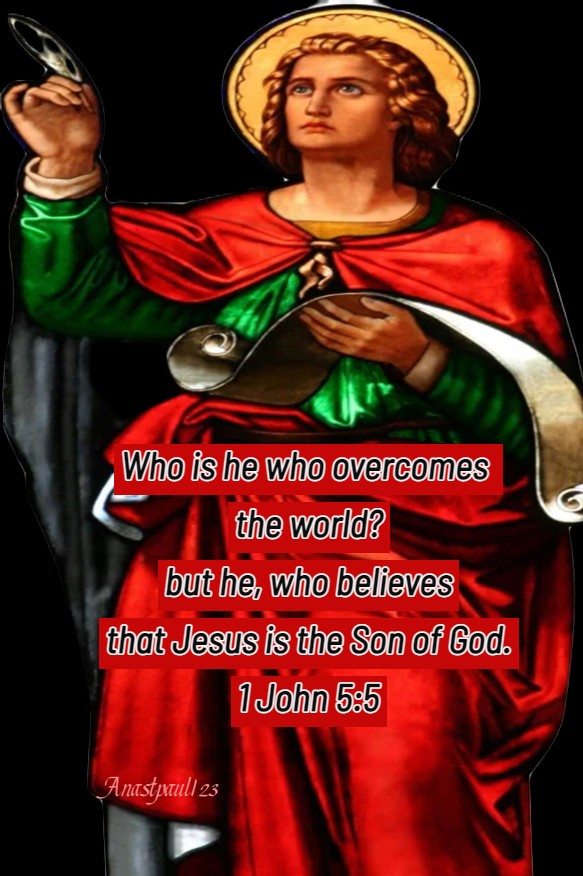
“Simon Peter answered and said: Thou art Christ, the Son of the living God. ”
Matthew 16:16
“The fruits of the earth are not brought to perfection immediately but by time, rain and care. Similarly, the fruits of men ripen through ascetic practice, study, time, perseverance, self-control and patience.”
St Anthony Abbot (251-356)
“No-one should fear to suffer for the sake of justice, no-one should lose confidence in the reward that has been promised. The way to rest is through toil, the way to life is through death. Christ has taken on Himself the whole weakness of our lowly human nature. If then, we are steadfast in our faith in Him and in our love for Him, we win the victory that He has won, we receive what He has promised.”
St Pope Leo the Great (400-461) Father and Doctor of the Church
“Now, you must always persevere in firmly placing all your trust in our Lord, in the troublesome business you have in hand. It will give you a fine opportunity of laying a good foundation of submission to God’s will and peace of soul.”
St Francis de Sales (1567-1622) Doctor Caritatis
“If we are to reach God, Who is our goal, it is necessary for us to know, love and serve Him. In the hidden depths of our own being, we hear His Voice. As our Creator, Redeemer and Benefactor, God has the right to the undivided affection of our hearts. This love should not be empty and sterile, however, it should be active and effective. Knowing and loving God, we should feel the obligation of serving Him as our Master, in whatever He commands, even when this demands a heavy sacrifice on our part!”
“We should also have great confidence in the continual assistance which God offers us in the temptations, troubles and trials of life. When pain torments us, when humiliations are difficult to bear, when all is dark. we fear each moment and we feel abandoned, let us trust in Him, Who is the Way, the Truth and Life. He says to us, as He said to Peter floundering in the waves: “O thou of little faith, why didst thou doubt?” (Mt 14:31). He is always ready to console and comfort. He is always there waiting for our call. We are not alone!”
One Minute Reflection – 14 October – “The Month of the Most Holy Rosary and of the Angels” – – St Callistus I (c218- c223) Confessor, Pope, Martyr – 1 Peter 5:1-4; 5:10-11, Matthew 16:13-19 – Scripture search here: https://www.drbo.org/
“Upon this rock I will build My Church” – Matthew 16:18
REFLECTION – “Brothers, when it comes to fulfilling my duties as Bishop, I discover that I am weak and slack, weighed down by the weakness of my own condition, while at the same time, I want to act generously and courageously. However, I draw my strength from the untiring intercession of the almighty and eternal Priest, Who, like us but equal to the Father, lowered His divinity to the level of man and raised humankind to the level of God. The decisions He made, give me a just and holy joy. For, when He delegated many shepherds to care for His flock, He did not abandon watching over His beloved sheep. Thanks to that fundamental and eternal assistance, I in turn, have received the protection and support of the Apostle Peter, who also does not abandon his function. This solid foundation, on which the whole of the Church is built, never grows tired of carrying the whole weight, of the building which rests on it.
The firmness of faith, for which the first of the Apostles was praised, never fails. Just as everything which Peter professed in Christ remains, so that which Christ established in Peter, remains… The order willed by God’s Truth remains. Saint Peter perseveres in the solidity which he received; he has not abandoned the governance of the Church which was placed in his hands. That, my brothers, is what that profession of faith, inspired by God the Father, obtained in the heart of the Apostle. He received the solidity of a rock which no assault can shake. In the entire Church, Peter says everyday: “Thou art the Messiah, the Son of the living God.” – St Leo the Great (400-461) Pope, Father and Doctor of the Church (Sermon on the anniversary of his Consecration as Bishop).
PRAYER – O God, Who behold how we fail in our weakness, mercifully restore us to Thy love, through the examples of Thy Saints. Through Jesus Christ, Thy Son our Lord, Who lives and reigns with Thee, in the unity of the Holy Ghost, God, world without end. Amen (Collect).
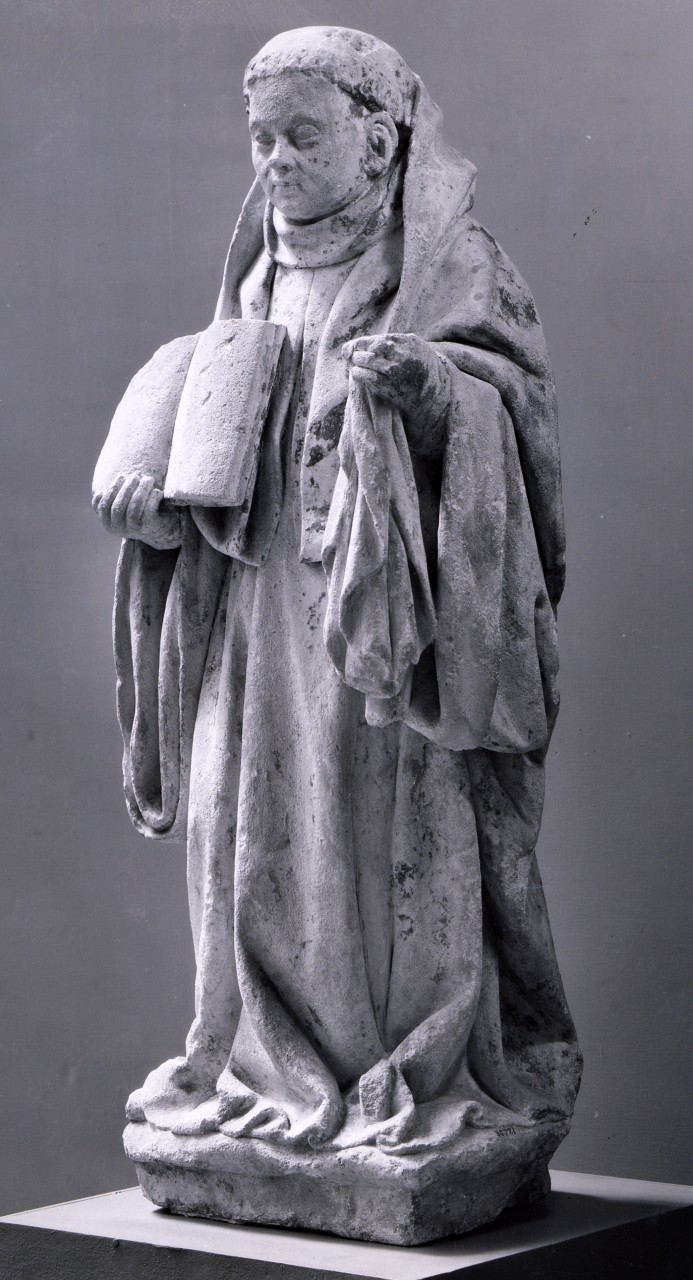
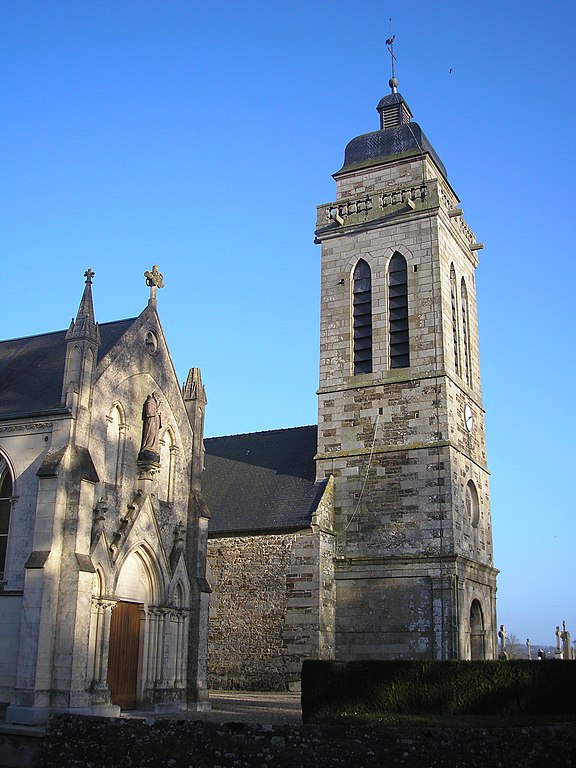
Saint of the Day – 14 October – Saint Bernard of Roccadarce (Died 8th Century) Pilgrim. Born in England (or France) in the 8th Century and died of natural causes in Roccadarce in Campagna in Italy. Also known as – Berhard of Arce, Bernardo. Additional Memorial – 26 June (recovery of the Relics), 13 September (translation of his Relics). Patronage – Roccadarce, Italy.
The details of the “Life of Saint Bernard” are deduced from the “Inventarium Originalis Ecclesiae Parochialis Sanctae Mariae Roccae Arcis” of 1698, by the hands of the Archpriest of the same Parish, Don Antonio Nardone of Arce (Roccadarce today).
Bernard, from the City of Silloth (sometimes known as Silloth-on-Solway, in Cumberland, Cumbria) in England, decided to walk the world, together with Saint Gerard, Saint Fulk and Saint Arduin, brothers in Christ and to visit the holy places of Jerusalem and the Holy Land, the Grotto of Saint Mary Magdalene in Marseilles, of St James in Galicia, of St Nicholas in Bari, of St Michael the Archangel in Puglia on Mount Gargano and the holy places of Rome, as in fact, they did.
These saintly pilgrims were moved too, by a very great need to escape from their land, from the Kingdom of England, unable to tolerate the tyranny and heresies spread there. Since those Saints were similar to four candlesticks of Holy Church, they could not shine in the darkness and the light of their good works did not shine in that place darkened by the thick darkness of sins.
The four Saints, therefore, walked through all the aforementioned places, until, coming from the Sanctuary of the Archangel in Puglia, they arrived in the City of Atina. Here, Saint Gerard, one of these four, fell ill and died on 11 August . Then, when St Bernard in Arpino, St Fulk in Santopadre and St Arduin in Ceprano, fell ill, they all died in a short space of time, one after the other, in the aforementioned places. To this day, their bodies rest in each of those Towns and where they are exposed to devotion, with great veneration, by all of the faithful.
Only Bernhard would not lie still. According to tradition, he appeared in a dream to a man and asked that he be moved from his tomb in Arpino to Rocca d’Arce (now Roccadarce). Then his remains were exhumed from the tomb in the Chapel of San Giovanni in Arpino and transferred to the Parish Church of Santa Maria Assunta in Roccadarce, where he still rests, surrounded by miracles.
These events are commemorated on14 October. In the current year 1698, on 26 June, the works for the construction of a new Chapel having begun, by order of Monsignor Giovanni Ferrari, Bishop of Aquino, the Holy Body was found there, which the aforementioned Bishop showed to the people, Consecrating and dedicating the Chapel and celebrating the Saint’s Mass there. Then he placed the body of the Saint again in a lead coffin, donated by the Duke, Antonio Boncompagni. ,The Archpriest of the aforementioned Church, Don Antonio Nardone of Arce, filled the lead coffin with a lining of cottonwool, on which the body would rest and placed the whole inside another wooden coffin . Meanwhile, the new Altar was completed and the coffin was placed in its centre, which was surrounded by iron on all sides and the construction of the entire Chapel was completed in the aforementioned year 1698, in the month of August, with an expense of 886 ducats.
In Roccadarce, they have several celebrations of their Patron Saint. On 13 September, the translation of Bernhard’s Relics is celebrated and this is the Town’s main festival. His Relics have been identified several times – in 1585 (assumed) and in 1698 and in 1901 (documented). The last time the Relics were identified was in 2001, when they were placed in a new casket with reinforced glass and laid to rest under the Altar in the Chapel of St Bernard.
On 14 October, Bernhard’s death is celebrated in Arpino on the border of Roccadarce and there is a religious festival combined with a market for goods and cattle. On 26 June, the recovery of the Relics in 1698, is celebrated with a new religious festival.
Saint Fortunatus of Todi (Died 537) Bishop, Confessor, miracle-worker. An entry in the Roman Martyrology under 14 October records: “At Todi in Umbria, St Fortunatus, Bishop, who, as is mentioned by blessed Gregory, was endowed with an extraordinary gift for casting out unclean spirits.” About St Fortunatus: https://anastpaul.com/2020/10/14/saint-of-the-day-14-october-saint-fortunatus-of-todi-died-537/
St Gaudentius of Rimini St Gundisalvus of Lagos St Lupulo of Capua St Lupus of Caesarea St Manacca St Manehildis St Modesto of Capua St Rusticus of Trier St Saturninus of Caesarea St Venanzio of Luni
Martyrs of Caesarea – 4 Saints: Three brothers and a sister Martyred together in the persecutions of Diocletian – Carponius, Evaristus, Fortunata and Priscian. In 303 in Caesarea, Cappadocia (in modern Turkey) – their relics enshrined in Naples, Italy.
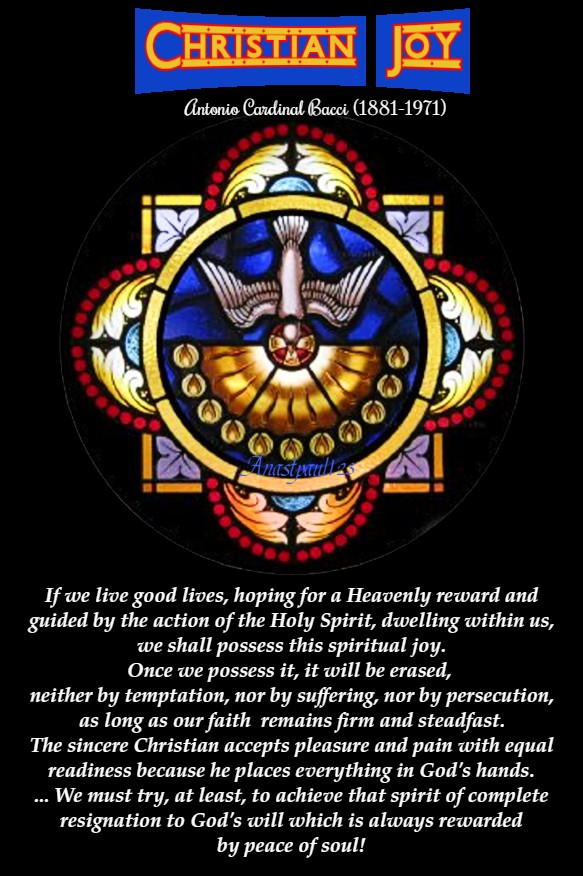
Thought for the Day – 13 October – Meditations with Antonio Cardinal Bacci (1881-1971)
“Month of the Holy Rosary” The Fifth Sorrowful Mystery The Crucifixion
“At last, Jesus reaches Calvary, breathless and reduced to utter exhaustion. The instrument of torture is taken from Him and laid upon the ground. Our divine Redeemer suffers acute pain as Her is again stripped of His garments, which have stuck to His wounds. Now, He is stretched, an innocent victim, on the altar of sacrifice, the Cross. One of the executioners grasps His hand, pierces it with a large nail and attaches it to the wood. Then, he does the same with the other hand and with the two feet. His Mother is close at hand. She feels in her heart the blows of the hammer which lacerate the living flesh of Jesus. Jesus remains silent “as a meek lamb that is carried to be a victim” (Jer 11:19).
Now, the executioners raise up the Cross and fix it in the hold already prepared for it. The shock of this impact sends a shudder of terrible pain through the Victim’s members and entire frame. Behold Him now, suspended between Heaven and earth, the Mediator between God and humanity, the Victim of Expiation for the innumerable sins of men.
Come near to the Cross and kiss the bloodstained feet. While the Jews are insulting Him and most of the Apostles have abandoned Him, let us tell Him how much we love Him. Let us tell Him of our sorrow for our sins and of our determination to make amends for our faults and for our ingratitude, by living in accordance with His teachings and example.”
Quote/s of the Day – 13 October – “The Month of the Most Holy Rosary and of the Angels” – Our Lady of Fatima: The Sixth & Final Apparition – Our Lady of the Holy Rosary (the name she gave herself when Lucia asked her name).
“The Rosary is the most excellent form of prayer and the most efficacious means of attaining eternal life. It is the remedy for all our evils, the root of all our blessings. There is no more excellent way of praying.”
Pope Leo XIII (1810-1903)
“If there were one million families praying the Rosary everyday, the entire world would be saved.”
St Pope Pius X (1835-1914)
“There is no surer means of calling down God’s blessing upon the family, than the daily recitation of the Rosary.”
“We put great confidence in the Holy Rosary, for the healing of evils which afflict our times.”
Pope Pius XII (1876-1958)
Act of Consecration and Reparation to the Immaculate Heart of Mary
O Immaculate Heart of Mary, Queen of Heaven and Earth and tender Mother of men, in accordance with thy ardent wish made known at Fatima, I consecrate to thee, myself, my brethren, my country and the whole human race. Reign over us and teach us how to make the Heart of Jesus reign and triumph in us and around us, as It has reigned and triumphed in thee. We wish to atone for the many crimes committed against Jesus and thee. We wish to call down upon our country and the whole world, the peace of God in justice and charity. We promise to imitate thy virtues, by the practice of a Christian life without regard to human respect. We resolve to receive Holy Communion on the first Saturday of every month and to offer thee five decades of the Rosary on this day, together with our sacrifices in the spirit of reparation and penance. Amen.
One Minute Reflection – 13 October – “The Month of the Most Holy Rosary and of the Angels” – Our Lady of Fatima: The Sixth & Final Apparition – St Edward King and Confessor (c1003-1066) – Sirach 31:8-11, Luke 12:35-40 – Scripture search here: https://www.drbo.org/
“Let your loins be girt about and your lamps burning …” – Luke 12:35
REFLECTION – “It is so that our spirit may be detached from its fantasies that the Word invites us, to shake off this heavy sleep, from the eyes of our souls, so that we may not slide away from the true reality, by clinging to what lacks substance. That is why He sets before us an image of vigilance when He says: “Let your loins be girt about and your lamps burning”… The meaning of these symbols is clear enough. Someone who is girded with temperance, lives in the light of a pure conscience because, filial trust enlightens his life, like a lamp. Lit up by the truth that person’s soul is detached from the sleep of illusion because, no empty dreams are leading it astray. As the Word says – if we do this, we shall enter into a life like that of the Angels…
Indeed, these are they who wait for the Lord at His return from the wedding and who are seated by the heavenly gates, with watchful eyes, so that the King of Glory (Ps 23:7) might once more pass through, when he returns from the marriage feast and enters again into the beatitude above the heavens. “Coming forth like the groom from his bridal chamber” (Ps 18:6)…, He united to Himself like a virgin, the nature we had prostituted to idols, once He had restored its virginal integrity, through sacramental regeneration. The nuptials, having now been accomplished, since the Church has been espoused by the Word… and brought into the chamber of His Mysteries, the Angels awaited the return of the King of Glory to the blessedness which matches His nature.
Hence, the text says that our lives ought to be like those of the Angels. Just as they live far from vice and self-deception, ready to welcome the second coming of the Lord, so we too ought to remain awake at the doors of our dwellings and stand ready to obey, when He comes and knocks at the door.” – St Gregory of Nyssa(335-395) Bishop, Father of the Church, Brother of St Basil the Great (Sermons on the Song of Songs No 11).
PRAYER – O God, Who crowned blessed King Edward with the glory of eternity, grant us, we beseech Thee, so to venerate him on earth that we may be worthy to reign with him in heaven. Through Jesus Christ, Thy Son our Lord, Who lives and reigns with Thee, in the unity of the Holy Ghost, God, world without end. Amen (Collect).
Our Morning Offering – 13 October – “The Month of the Most Holy Rosary and of the Angels” – Our Lady of Fatima: The Sixth & Final Apparition
Prayers of the Angel of Peace of Fatima (Given to the three children by the Angel who preceded Our Lady’s first appearance to them.)
I. My God, I believe, I adore, I hope and love Thee. I ask pardon for those who do not believe, who do not adore, who have no hope and who do not love Thee.
II. Most Holy Trinity, Father, Son and Holy Ghost, I offer to Thee, while I adore them – the Most Precious Body, Blood, Soul and Divinity of our Lord Jesus Christ, present in all the Tabernacles throughout the world, in reparation for the outrages by which He is Himself, offended. By the Infinite Merits of His Sacred Heart and by the intercession of the Immaculate Heart of Mary, I beg of Thee, the conversion of sinners.
The Angel of Peace
One day in the spring of 1916, when three little children, Lucia dos Santos, aged ten and her little cousins, Francisco Marto, aged nine,and his little sister Jacinta, only seven years old, were tending sheep near the village of Fatima, Portugal, the appearance of an oval of light, of unusual brilliance, startled them. The dazzling light seemed to advance, from the end of the field toward the cave, in which the young shepherds had sought shelter. In the midst of this light they beheld a young man who announced himself as the Angel of Peace. He taught the little seers a new prayer and then vanished.
A few months later, the Angel of Peace made his second appearance and urged the children to offer up sacrifices and prayers at all times. Upon asking what was meant by “sacrifice,” they were told to offer everything in reparation to God, for the sins by which He is offended and, as a petition for the conversion of sinners. “Thus you will bring peace to our country,” was the Angel’s promise. At this last saying, the children were baffled. Reading their thoughts, the Angel revealed that he was the Guardian Angel of Portugal.
In the Autumn of the same year, the Angel appeared a third time. He carried a host in his right hand extended over a Ciborium which he held with the left hand. Again the Angel taught the children a beautiful prayer and before parting distributed Holy Communion to the three little ones.
Saint of the Day – 13 October – Saint Theophilus of Antioch (Died c184) Confessor, Bishop of Antioch from 169 until 182, Scolar and Writer, Theologian, Apologist, Defender of the Faith against heresy. His writings (the only remaining extant being his apology to Autolycus) indicate that he was born a pagan, not far from the Tigris and Euphrates Rivers in Mesopotamia (modern Middle East) and was led to embrace Christianity by studying the Sacred Scriptures. Also known as – Teofilo.
The Roman Martyrology reads today: “At Antioch, the holy Bishop, Theophilus, who held the pontificate in that Church and City, the sixth after the blessed Apostle, Peter.”
Theophilus, Bishop of Antioch, was the Author of many works, one of which has survived, while we only know the titles of others. From the pages of this work, we can once again hear the words of the Saint, in defence of Christian doctrine and faith, even then the subject of accusations by unbelievers and the vicious.
“But, if you tell me” – wrote the ancient Bishop – “Show me your God,” I will say to you: “Show me your man and I will show you my God. Show me, therefore, that they see clearly, the eyes of your soul and that the ears of your heart hear well… God shows Himself to those who can see Him, when they have opened the eyes of the soul. Everyone has their good eyes but someone has veiled them, incapable of seeing the light of the sun. However, the fact that the blind do not see, does not show at all, how the light of the sun does not appear. The blind blame themselves and their eyes. In the same way, my son, if you have the eyes of your soul veiled by your faults and your bad habits, you will not be able to see the light. Like a clear mirror – this is how man must keep his soul pure. If the mirror is rusty, the face of man does not appear on its surface. In the same way, if man is a sinner, this man cannot contemplate God.”
The Author of these phrases, which St Augustine himself would later take up, was born in a region of the East, near the Tigris and the Euphrates. He was a pagan and received a Greek education. He converted by observing the customs of Christians, clearly superior to those of pagans and, by reading the Sacred Scriptures. He would then skilfully use his experiences as a convert and his knowledge of profane culture, in his polemics against unbelievers and philosophers.
He was elected Bishop of Antioch in 169 and still held the pastoral care of the great City, where Saint Peter himself had had his first Chair at the death of Marcus Aurelius, in 180. His apostolic care, in the midst of one of the most populous and most agitated communities of the early Christian world, did not distract him from his studies and intellectual activity.
Eusebius of Caesarea, the Historia (Died 339), speaks of the zeal which he and the other chief Shepherds displayed in driving away the heretics who were attacking Christ’s flock, with special mention of his work against Marcion.
He made contributions to Christian literature, writing polemical works against the heretics of the time, works of catechesis, commenting on the Scriptures, works of history, to clear away pagan myths. In short, he was a Bishop who left a strong imprint of his intelligence and culture in the history of his time, just as he left traces of his charity and mercy in the souls entrusted to him.
St Jerome and Eusebius mention numerous works of St Theophilus existing in their time. They are:
the existing Apologia addressed to Autolycus;
a work against the heresy of Hermogenes;
against that of Marcion;
some catechetical writings;
St Jerome also mentions having read some commentaries on the Gospels and on Proverbs, which bore Theophilus’ name but which he regarded as inconsistent with the elegance and style of his other works.
The one undoubted extant work of St Theophilus, the 7th Bishop of Antioch, is his Apology to Autolycus (Apologia ad Autolycum), a series of books defending Christianity written to a pagan acquaintance.
St Benedict of Cupra St Berthoald of Cambrai St Carpus of Troas St Chelidonia St Comgan the Monk St Florence of Thessalonica St Fyncana St Fyndoca Bl Gebrand of Klaarkamp
St Theophilus of Antioch (Died c184) Bishop St Venantius
Three Crowns of Cordoba – (3 Saints): Three Christian men Martyred in the persecutions of Diocletian – Faustus, Januarius and Martial. They were burned to death in 304 in Cordoba, Spain.
Thought for the Day – 12 October – Meditations with Antonio Cardinal Bacci (1881-1971)
“Month of the Holy Rosary” The Fourth Sorrowful Mystery The Road to Calvary
“Scourged, crowned with thorns and derided, Jesus is finally condemned to death. Burdened with the Cross, He sets out for the place of execution in the midst of a crowd of enemies, blasphemers and idle speculators. Among them , there is only a tiny group which sympathises with Jesus, namely, Mary His Mother, the devout women and the beloved Apostle, St John.
The divine Redeemer goes forward laboriously beneath the heavy weight of the Cross. He has already lost a large quantity of blood in Gethsemane and during the scourging and crowning with thorns. His strength seems to be failing but love sustains Him. Looking feebly around Him, He sees the mocking Jews, the indifferent and disrespectful Roman soldiers and a throng of curious spectators looking for something to amuse them. Is there nobody else? Where are those whom He cured miraculously and those whom He comforted and forgave? Has nobody any pity for Him? Suddenly the crowd falls silent. A woman, pale and tearful, is approaching Him, supported by her friends. She defies the commands of soldiers and the scowls of the executions and comes close to Him.
Here and there, a murmur is heard – It must be His Mother, poor woman! Jesus and Mary gaze at one another. It would be impossible for us to guess at the immense depths of love contained in that loving exchange of glances. Neither utters a word, for no words could express their anguish, nor manifest their love. They look and understand one another, offering themselves as a holocaust for the redemption of wayward humanity.
Nevertheless, in this silent meeting, there was great consolation for the Heart of Jesus, for He had found someone who loved and understood Him, amongst those malicious throngs. Why do we not sympathise with Him too and love Him with all our hearts?”
Quote/s of the Day – 12 October – Romans 15:4-13. Matthew 11:2-10 – Scripture search here: https://www.drbo.org/
“Now, the God of hope, fill you with all joy and peace in believing – that you may abound in hope and in the power of the Holy Ghost.”
Romans 15:13
“And as soon as He sees you seek Him fervently, He will make Himself known to you. He will appear to you, grant you His help, bestow the victory on you and save you from your enemies. In fact, when He sees how you are looking for Him, how you continually place all your hope in Him, then He will instruct you, teach you true prayer, give you that authentic charity that is Himself. Then, He will become everything to you: your Paradise, Life-giving Tree, Precious Pearl, Crown, Architect, Farmer, One subject to suffering but not afflicted with suffering, Man, God, Wine, Living Water, Lamb, Bridegroom, Soldier, Armour, Christ Who is “All in All” (1Cor 1B,28).
St Macarius of Egypt (c300-390)
“The soul glorifies the Lord, when it consecrates all its inner powers on praising and serving God and when, by its submission to the Divine commands, it proves that it never loses sight of His Power and Majesty. The spirit rejoices in God, its Saviour, when it places all its joy in the remembrance of its Creator, from Whom it hopes for eternal salvation.”
St Bede the Venerable (673-735) Father and Doctor of the Church
“Great indeed is the confidence which God requires us to have in His paternal care and in His Divine Providence but why should we not have it, seeing that no-one has ever been deceived in it? No-one ever trusts in God without reaping the fruits of his confidence.”
St Francis de Sales (1567-1622) Doctor of the Church
One Minute Reflection – 12 October – “The Month of the Most Holy Rosary and of the Angels” – Ferial Day – Romans 15:4-13. Matthew 11:2-10 – Scripture search here: https://www.drbo.org/
“And again Isaias says, There shall be the root of Jesse and He Who shall arise to rule the Gentiles… in Him the Gentiles shall hope.” – Roman 15:12
REFLECTION – “Until the beginning of the vision, or the burden of Babylon, which Isaias the son of Amos saw, his entire prophecy was about Christ, a prophecy which we want to explain piecemeal, lest the ideas and discussions thereof together, confuse the reader’s memory.
The Jews interpreted the branch and the flower from the root of Jesse, to be the Lord Himself because, the power of His governance, is demonstrated in the branch and His beauty, in the flower. But ,we understand the branch, from the root of Jesse, to be the holy Virgin Mary, who had no shoot connatural to herself. About her we read …: “Behold, a virgin will conceive and bear a son.” And the flower is the Lord our Saviour, Who said, in the Song of Songs, “I am the flower of the field and the lily of the valleys.” In place of “root,” which only the Septuagint translated, the Hebrew text has geza, which Aquila and Symmachus and Theodotus, interpret as kormon, that is, “stem.” And they translated “flower,” which the Hebrew text calls nēṣer, as “bud,” to show that after a long time in Babylonian captivity, no longer possessing any glory from the sprout of the old kingdom of David, Christ would rise from Mary, as though from her stem. The educated of the Hebrews believe that what all the ecclesiastics sought in the Gospel of Matthew but could not find, where it was written “Because He will be called a Nazarene,” was taken from this place. But it should be noted that nēṣer was written here with the [Hebrew] letter ṣade [צ], the peculiar sound of which—somewhere between z and s—the Latin language does not express.” – St Jerome (343-420) Father and Doctor of the Church (Commentary on Isaias 4.)
PRAYER – O God, Who, by the message of an Angel, willed to take flesh in the womb of the Blessed Virgin Mary, grant that we, Thy suppliants, who believe her to be truly the Mother of God, may, by her intercession, be assisted in attaining eternal life. Through the same Jesus Christ, Thy Son our Lord, Who lives and reigns with Thee, in the unity of the Holy Ghost, God, world without end. Amen (Collect).
Our Morning Offering – 12 October – “The Month of the Most Holy Rosary and of the Angels”
Sweet Angel of Mercy! By Fr Edward Caswell C.Orat. (1814-1878)
Sweet Angel of mercy! By Heaven’s decree Benignly appointed To watch over me! Without thy protection, So constant and nigh, I could not well live; I should tremble to die.
All thanks for thy love, Dear companion and friend! Oh may it continue With me to the end! Oh cease not to keep me, Blest guide of my youth, In the ways of religion And virtue and truth.
Support me in weakness, My spirit inflame; Defend me in danger, Secure me from shame, That safe from temptation, Or sudden surprise, I may mount the straight path That ascends to the skies.
When Satan his snares For my ruin shall lay, Be thou, gentle comrade, My comfort and stay And in every event Which may happen to me, Make all my desires With thine to agree.
When I wander in error, My footsteps recall, Remove from my path What might cause me to fall. Preserve me from sin And in all that I do, May God and His glory Be ever in view.
O thou who didst witness My earliest breath, Be with me, I pray, In the hour of death. Console me in sadness, Refresh me in pain And teach me how best I may mercy obtain.
That, cleansed by confession Complete and sincere, From every defilement Afflicting me here, All glowing with love, I may gladly depart. With faith on my lips And with hope in my heart.
Nor then do thou leave me, Angelical friend! But at the tribunal Of Judgement attend And cease not to plead For my soul, till, forgiven, Thou bear it aloft To the Palace of Heaven!
Saint of the Day – 12 October – Saint Monas of Milan (Died c249) the 15th Bishop of Milan, who occupied the Seat for 59 years. Died on25 March in c249 of natural causes. Additional Memorial – 25 March on some calendars.
The Roman Martyrology reads: “At Milan, St Monas, Bishop. He was chosen as head of that Church because a miraculous light from Heaven surrounded him whilst they were deliberating on the choice of a Bishop.”
As we know, a large group of Shepherds who have alternated on the Episcopal Seat of Milan, have deserved the halo of sanctity. Among these we find St Monas, Fifteenth Bishop of the Lombard Capital.
His Episcopate is placed between those of St Calimerius and St Mirocles. The latter appears to have participated in the Synods of Rome in 313 and of Arles, in 314. The narrative of the History of the Church of Milan which places the date of his death around 249, after fifty nine years of Episcopacy.
Bishop Monas, therefore, would have founded what are now considered the oldest Parishes scattered throughout the Milanese countryside.
As for the day of death, the ancient records of the Milanese Bishops indicate 25 March, an anniversary still reported today, while the Ambrosian liturgical calendar, to avoid the concomitance with the Lenten season, moved the Saint’s Feast day to 12 October, the Anniversary of recognition of the Relics, which apparently took place in the 11th Century by Archbishop Arnolfo. St Monas was initially buried in the Basilica Fausta, then known as the Church of St Vitales but, St Borromeo transferred his Relics to the Cathedral on 6 February 1576, where they remain today.
St Eustachius The Syrian Priest and Confessor St Evagrius the Martyr St Felix St Herlindis St Juan Osiense St Maximilian of Celeia St Meinards St Monas of Milan (Died c249) Bishop
St Serafino of Montegranaro OFM Cap (1540-1604) Confessor, Franciscan Capuchin Lay Friar, gifted with the Charism of prophecy, Mystic, Apostle of the poor, Spiritual Advisor, devoted to the Blessed Sacrament, the Holy Rosary and to the Blessed Virgin Mary, Miracle-worker. The Roman Martyrology states: “At Ascoli, St Seraphinus, Confessor, of the Order of Minorite Capuchins, distinguished by holiness of life and humility. Hre was enrolled among the Saints by the Sovereign Pontiff Clement XIII.” Holy St Serafino: https://anastpaul.com/2021/10/12/saint-of-the-day-12-october-st-serafino-of-montegranaro-ofm-cap-1540-1604/
Martyrs of Arian North Africa: Commemoration of the 4,996 Martyrs who died in the persecutions of the Vandals in Africa mandated by the Arian King Huneric. The persecuted Christians include Bishops, Priests, Deacons and thousands of the lay faithful. They died in 483 at various locations in North Africa. (Would we follow Christ and stand true to the Faith today?)
Thought for the Day – 11 October – Meditations with Antonio Cardinal Bacci (1881-1971)
Mary, the Mother of God
“Most Holy Mary, not only were you raised to the dignity of Mother of God but, you carried out His holy Will, heroically on all occasions. Obtain for me, from your divine Son, Jesus, the grace to co-operate always and at all costs, with His designs for me, both in life and in death, amen.”
Quote/s of the Day – 11 October – Feast of the Divine Maternity
“That anyone could doubt the right of the holy Virgin to be called the Mother of God, fills me with astonishment. Surely she must be the Mother of God, if our Lord Jesus Christ is God and she gave birth to Him!”
St Cyril of Alexandria (376-444) Father and Doctor of the Church
The God Whom Earth and Sea and Sky For Mary, The Mother of God For the Annunciation, Advent and Christmas By St Venantius Fortunatus (c 530 – c 609)
The God whom earth and sea and sky Adore and praise and magnify, Whose might they claim, whose love they tell, In Mary’s body comes to dwell.
O Mother blest! the chosen shrine Wherein the Architect Divine, Whose Hand contains the earth and sky, Has come in human form to lie.
Blest in the message Gabriel brought, Blest in the work the Spirit wrought, Most blest, to bring to human birth The long desired of all the earth.
O Lord, the Virgin-born, to You Eternal praise and laud are due, Whom with the Father we adore And Spirit blest for evermore.
“Having confidence in you, O Mother of God, I shall be saved. Being under you protection, I shall fear nothing. With your help, I shall give battle to my enemies and put them to flight, for devotion to you, is an arm of Salvation.”
St John Damascene (676-749) Father and Doctor of the Church
“And some seed fell on good ground” Luke 8:8
“Rejoice, O Mary, House of the Lord, earth trodden by the Footsteps of God… Rejoice, O Paradise more happy than the Garden of Eden, where every virtue has been seeded and where the Tree of Life has grown.”
St Theodore the Studite (750-826) Father, Abbot, Theologian, Writer
One Minute Reflection – 11 October – Feast of the Divine Maternity – Apocalypse 21:2-5, Luke 19:1-10 – Scripture search here: https://www.drbo.org/
“ … He climbed up into a sycamore tree that he might see Him …” – Luke 19:2
REFLECTION – “I’m writing with the desire to see you, a bold and good shepherd, pasturing and guiding the sheep entrusted to you with perfect zeal and thus, imitating the sweet Master of Truth, Who gave His life for us who are His sheep, who have strayed away from the path of grace. True…, we cannot do this without God and we cannot possess God while remaining on earth. But here is a sweet remedy – when our hearts are reduced to nothing and feeling small, we must do as Zacchaeus did. He was not tall and he climbed a tree to see God. This zeal of his, allowed him to hear these sweet words: “Zacchaeus, go home, for I must dine with you today.”
We must do this too, when we are feeling low, when our hearts are constricted and lacking in charity. We must climb the tree of the most holy Cross and there, we shall see, we shall touch God. There we shall find the fire of His inexpressible charity, the love that propelled Him, even to the humiliation of the Cross that raised Him up and made Him desire His Father’s honour and our salvation, with the craving of hunger and thirst… If this is what we want, if our carelessness does not get in the way, we can, in mounting the tree of the Cross, fulfill in ourselves, this word issuing from the mouth of Truth: “When I am lifted up from the earth, I shall draw all things to Myself” (Jn 12,32 Vg). Indeed, when the soul is thus raised up, it sees the blessings of the Father’s goodness and power…, it sees the mercy and lavishness of the Holy Spirit, that is to say, the inexpressible love holding Jesus bound to the wood of the Cross. Nails and bonds cannot hold Him there, only charity… O climb this most holy tree where hang, the ripe fruits of all the virtues that the body of the Son of God bears, ardently hasten. Dwell within the holy and sweet love of God. O sweet Jesus, Jesus love.” – St Catherine of Siena (1347-1380) Doctor of the Church (Letter 119, to the prior of the Olivetan Monks).
PRAYER – O God, Who, by the message of an Angel, willed to take flesh in the womb of the Blessed Virgin Mary, grant that we, Thy suppliants, who believe her to be truly the Mother of God, maybe assisted by her intercession with Thee.Through the same Jesus Christ, Thy Son our Lord, Who lives and reigns with Thee, in the unity of the Holy Ghost, God, world without end. Amen (Collect).
Our Morning Offering – 11 October – Feast of the Divine Maternity
O Mary, Mother of God By St Ephrem (306-373) Father and Doctor of the Church
O Virgin most pure, wholly unspotted, O Mary, Mother of God, Queen of the universe, thou art above all the saints, the hope of the elect and the joy of all the blessed. It is thou who hast reconciled us with God; thou art the only refuge of sinners and the safe harbour of those who are shipwrecked; thou art the consolation of the world, the ransom of captives, the health of the weak, the joy of the afflicted and the salvation of all. We have recourse to thee and we beseech thee to have pity on us. Amen.
Saint of the Day – 11 October – Saint Ethelburga of Barking (Died c782) Virgin, First Abbess of the double Monastery (for men and women) at Barking, in Essex, England, founded by her brother, Miracle-worker. Sister of St Erconwald of London (Died c 693, Bishop of London and known as “The Light of London.” Ethelburga is one of a significant number of female religious leaders who played an important role in the first Century of the Anglo-Saxon Church. Also known as – Adilburga, Æthelburh, Edilburge, Etelburg, Ethelburgh. Ethelburge. Additional Memorial – 12 October in the Diocese of Brentwood of which Barking forms a part
Not much is known about the family origin of these two saintly siblings but their names suggest they might have been connected to the Kentish Royal family. The main source for Ethelburga’s life is St Bede’s Historia Ecclesiastica Gentis Anglorum which recounts the foundation of Barking Monastery, early miracles there and Ethelburga’s death. St Bede describes Ethelburga as “upright in life and constantly planning for the needs of her community.”
Some time before he became the Bishop of London in 675, Erconwald founded a double Monastery at Barking for his sister and a Monastery at Chertsey for himself. Barking appears to have already been established by the time of the plague in 664.
Around the same year, 675, Ethelburga founded the Church of All Hallows Berkyngechirche (now known as All Hallows Barking or All Hallows by the Tower) in the City of London on land given to her by her brother.
St Ethelburga at the All Hallows Church
St Bede writes:
“In this Convent many proofs of holiness were effected which many people have recorded, from the testimony of eyewitnesses, in order that the memory of them might edify future generations. I have, therefore, been careful to include some in this history of the Church …
When Ethelburga, the devout Mother of this God-fearing community, was herself about to be taken out of this world, one of the sisters, whose name was Tortgyth, saw a wonderful vision. This nun had lived for many years in the Convent, humbly and sincerely striving to serve God and had helped the Mother to maintain the regular observances, by instructing and correcting the younger sisters.
In order that Ethelburga’s strength might be ‘made perfect in weakness’ as the Apostle says, she was suddenly attacked by a serious disease. Under the good Providence of our Redeemer, this caused her great distress for nine years, in order that any traces of sin which remained among her virtues, through ignorance, or neglec,t might be burned away, in the fires of prolonged suffering. Leaving her cell one night at first light of dawn, this Sister saw distinctly, what appeared to be a human body wrapped in a shroud and shining more brightly than the sun. This was raised up and carried out of the house where the Sisters used to sleep. She observed closely to see how this appearance of a shining body was being raised and saw, what appeared to be cords, brighter than gold which drew it upwards until it entered the open heavens and she could see it no longer. When she thought about this vision, there remained no doubt in her mind that some member of the Community was shortly to die and that her soul would be drawn up to Heaven by her good deeds as though by golden cords. And so it proved not many days later, when God’s beloved Ethelburga, the Mother of the Community, was set free from her bodily prison. And none, who knew her holy life, can doubt that when she departed this life, the gates of our heavenly home opened at her coming.
In the same convent there was also a Nun of noble family in the world, who was yet more noble in her love for the world to come. For many years she had been so crippled that she could not move a single limb and hearing that the venerable Abbess’ body had been carried into the Church until its burial, she asked to be carried there, and to be bowed towards it, in an attitude of prayer. Then she spoke to Ethelburga as though she were still alive and begged her to pray to God on her behalf and ask Him of His mercy to release her from her continual pain. Her request received a swift reply; for twelve days later she was set free from the body and exchanged her earthly troubles for a heavenly reward.
Three years after the death of the Abbess, Christ’s servant Tortgyth, was so wasted away by disease … that her bones scarcely held together, until finally, as death drew near, she lost the use of her limbs and even of her tongue. After three days and nights in this condition, she was suddenly refreshed by a vision from Heaven, opened her eyes and spoke. Looking up to Heaven, she began to address the vision …: “I am so glad that you have come; you are most welcome.” She then remained silent for a while, as if awaiting an answer from the person whom she saw and spoke to; then, seeming a little displeased, she said, “This is not happy news.” After another interval of silence, she spoke a third time: “If it cannot be today, I beg that it may not be long delayed.” Then she kept silent a little while as before and ended: “If this decision is final and unalterable, I implore that it may not be delayed beyond the coming night.” When she had finished, those around her asked her to whom she had spoken. “To my dearest Mother Ethelburga,” she replied and, from this they understood that she had come to announce the hour of her passing was near. So after a day and a night her prayers were answered and she was delivered from the burden of the body and entered the joys of eternal salvation.”
Several more miracles are also recorded, relating to an outbreak of plague in the community. In Ethelburga’s time, Barking Abbey was a double Monastery as was common in the earlier Anglo-Saxon period but it’s the bonds of community and affection between Ethelburga and her Nuns which emerge most memorably from St Bede’s account – ‘golden cords’ of another kind than those Tortgyth saw in her vision.
Barking Abbey
Barking Abbey grew to be one of the most important Monasteries in the country and, at the time of the Dissolution, it was the third richest in England. It was closely associated with a number of powerful Royal and noble women, including the wives and sisters of Kings – and, even St Thomas à Becket’s sister. The Abbess of Barking was not only an important landowner but a baroness in her own right, required to supply the king with soldiers in wartime like any secular lord. Barking also had a strong literary and educational tradition which continued throughout the medieval period- learned authors such as St Aldhelm (in the 8th Century) and Goscelin (in the 11th) wrote Latin works for the Nuns of Barking and several Nuns composed their own poetry and prose. Perhaps the first female author from England whom we can name was Clemence of Barking Abbey, who wrote a Life of St Catherine in Anglo-Norman, in the twelfth Century; a Nun of Barking (either Clemence or someone else) also wrote a Life of St Edward the Confessor, around the same time. Barking Abbey has been described as “perhaps the longest-lived, albeit not continuously recorded, institutional centre of literary culture for women in British history.” And it all began with our Saint Ethelburga.
Barking Abbey – Curfew Tower with St Margaret’s Church in background
Ethelburga was buried at Barking Abbey. The Old English Martyrology records her Feast day as 11 October. There are many Churches across England dedicated to St Ethelburga and many regions, streets, estates, schools and institutions too.
Feast of the Divine Maternity – Second Sunday in October or 11 October: The object of this Feast is to commemorate the dignity of the Mary as Mother of God. Mary is truly the Mother of Christ, who in One Person unites the Human and Divine Nature. This title was solemnly ratified by the Council of Ephesus on 22 June 431. It was first granted to Portugal, Brazil and Algeria in 1751; it is now of almost universal observance. Under this title Poland celebrates the Feast of the Blessed Virgin Mary, Queen of Poland. At present the Feast is not found in the Universal Calendar of the Church but nearly all Diocesan calendars have adopted it. Patronage – Trinitarian. HERE: https://anastpaul.com/2022/10/11/feast-of-the-divine-maternity-and-memorials-of-the-saints-11-october/
St Agilbert of Paris
St Alexander Sauli CRSP (1534-1592) Bishop “The Apostle of Corsica,” Clerk Regular of the Congregation of Saint Paul (The Barnabites) – St Alexander is referred to as “The Second Founder,” Missionary, Writer, Teacher of philosophy and theology at the University of Pavia, Reformer, Evangeliser, Confessor, Superior-General of the Barnabites in 1565. In addition, St Alexander Sauli was both friend, advisor and spiritual comfort to St Charles Borromeo, who held him in very high esteem. His Life: https://anastpaul.com/2020/10/11/saint-of-the-day-11-october-saint-alexander-sauli-crsp-1534-1592/
St Anastasius V St Anastasius the Apocrisarius St Andronicus of Ephesus St Andronicus the Soldier St Ansilio St Canice St Digna of Sicily St Dionisio de Santarem St Emilian of Rennes St Ethelburga of Barking (Died c782) Virgin, Abbess St Eufridus St Firminus of Uzes St Germanus of Besancon St Gratus of Oloron St Guiadenzio of Gniezno
St Juliana of Pavilly St Nectarius of Constantinople St Philip the Deacon St Philonilla St Placidia St Probus of Side St Santino of Verdun St Sarmata St Taracus of Cladiopolis St Zenaides
Martyrs of Vilcassin – 4 Saints: Four Christians who were Martyred together. We know little more than the names – Nicasius, Pienza, Quirinus and Scubicolus. Their martyrdom occurred in Vexin Lugdunense territory of Gaul (modern Vilcassin, France), date unknown.
Martyrs of Sicily: A group of eight Christians who were Martyred together. We know little more than the names – • Ampodus, • Anastasius, • Faustus, • Januarius, • Jovinian, • Marcellus, • Martialis and • Placidus. They died in Sicily, Italy,
Martyrs of Vilcassin: Four Christians who were Martyred together. We know little more than the names – Nicasius, Pienza, Quirinus and Scubicolus. They died in the Vexin Lugdunense territory of Gaul (modern Vilcassin, France).
Thought for the Day – 10 October – Meditations with Antonio Cardinal Bacci (1881-1971)
“Month of the Holy Rosary” The Third Sorrowful Mystery The Crowning with Thorns
“This new torture was a diabolical invention decreed by no law or authority. Purely for their own savage entertainment, the soldiers procured a bundle of thorned reeds, which they wound into the shape of a crown and pressed into Jesus’ head.
Mary knew what was going on. She was there with the holy women when Pilate brought her bloodstained Son before the people and, their blasphemous yells pierced her tender heart. Her mother’s heart felt the sharp thorns too but, she accepted this affliction with resignation, silently protesting against the insults of the crowd by acts of adoration and of love. We should behave in this way also. We should participate in the passion of Jesus, by offering our own sufferings and we should make acts of love and of self-surrender, in reparation for these acts of blasphemy!”
Quote/s of the Day – 10 October – St Francis Borgia SJ (1510-1572) Confessor
“When you pray, hear Mass, sit at table, engage in business and, when at bedtime you remove your clothes— at all times, yearn that by the pain which He felt when He was stripped just before His Crucifixion, He may strip us of our evil habits of mind. Thus, naked, of earthly things, we may also embrace the Cross!”
“What is it, my soul, that I seek in the world? How long shall I pursue and grasp at shadows? What is she already become, who was lately so beautiful, so great, so much revered? This death which has thus treated the imperial diadem, has already levelled his bow to strike me. Is it not prudent, to prevent its stroke, by dying now to the world that, at my death. I may live to God?”
One Minute Reflection – 10 October – “The Month of the Most Holy Rosary and of the Angels” – St Francis Borgia SJ (1510-1572) Confessor, Priest of the Society of Jesus, – Ecclesiasticus 45:1-6, Matthew 19:27-29 – Scripture search here: https://www.drbo.org/
“And everyone who has left house, or brethren, or sisters, or father, or mother, or wife, or children, or lands, for My Name’s sake, shall receive a hundredfold and shall possess life everlasting.” – Matthew 19:29
REFLECTION – “We must follow Christ, cleaving to Him, nor should we forsake Him until we die. As Elisha said to his master: “ As the Lord lives and as you yourself live, I will not leave you ” (2 Kgs 2:2) … So, let us follow Christ and stay close to Him! “To be near God is my good” says the Psalmist (72:28). “ My soul clings fast to Thee; Thy right hand upholds me ” (Ps 62:9). And Saint Paul adds : “ Whoever is joined to the Lord becomes One Spirit with Him ” (1 Cor 6:17). Not just One Body but One Spirit. His whole body lives from the Spirit of Christ through the Body of Christ, we attain to the Spirit of Christ. Remain, therefore, by faith, in Christ’s Body and you will become One Spirit with Him. You are already united to His Body through faith, in vision, you will also be united to Him in spirit. Not that we shall see without a body when we are above but our bodies will be spiritual (1 Cor 15:44).
“Father,” Christ said : “I pray that they may all be one, as Thou, art in Me and I in Thee, that the world may believe” this is what union through faith is. And later He asks: “” this is union through vision.
This is how we are spiritually nourished by the Body of Christ – by having a pure faith in Him, by continually seeking the content of this faith in assiduous meditation and, in this way, discovering, with our minds, what it is we are looking for, by loving passionately, the object of our discovery and imitating, as far as possible, Him Whom we love and, even as we imitate Him, by staying close to Him at all times, so that we may come to everlasting union with Him.” – Guigo II “The Angelic” O.Cart. (Died c1188) The 9th Prior of Grande Chartreuse, from 1174 to 1180 (Meditation 10).
PRAYER – O Lord Jesus Christ, model of true humility and its reward, we beseech Thee, that as Thou made blessed Francis one of Thy glorious imitators, by his contempt for earthly honours, grant us to follow his example and to share in his glory.Through the same Jesus Christ, Thy Son our Lord, Who lives and reigns with Thee, in the unity of the Holy Ghost, God, world without end. Amen (Collect).
Daily Consecration to the Sacred Heart of Jesus Prayers to the Sacred Heart 1936 – 15th Edition, Dublin
O Sacred Heart of Jesus, filled with infinite love, broken by our ingratitude and pierced by our sins, yet loving us still, accept the Consecration we make to Thee, of all that we are and all that we have. Take every faculty of our souls and bodies, only day by day draw us, nearer and nearer to Thy Sacred Heart, and there, as we shall hear the lesson, teach us Thy Holy Way. Amen
Saint of the Day – 10 October – St Francis Borgia SJ (1510-1572) Confessor, Priest of the Society of Jesus, Advisor, Missionary, Evangelist, Administrator par excelleance. Francisco de Borja y Aragon was the 4th Duke of Gandía, was a Grandee of Spain, a Spanish Jesuit and third Superior General of the Society of Jesus
A continuation of the life of St Francis Borgia – an entire year has slipped by, for which I should apologise, however, each day brings its own duties to the Saints being venerated on that particular day. Time runs away … Let us continue with a little more from Fr Alban Butler (1711-1773) who wrote his portrayal of our Saint from:
“The life, compiled by Fr Ribadeneira, who was for nine years, his Confessor, is the master-piece of that pious author, who, by his acquaintance with the holy man and his own experience in an interior life, was excellently qualified to animate, in his expression, the narrative of the actions of the Saint with that spirit with which they were performed.”
We continue – ST FRANCIS at COURT and his MARRIAGE until the DEATH of the EMPRESS – his “DAMASCUS MOMENT”:
Francis, although he delighted chiefly in the company of the most virtuous, was courteous and obliging to all, never spoke ill of anyone, nor ever suffered others to do it in his presence.
He was a stranger to envy, ambition, gallantry, luxury and gaming – vices which are often too fashionable in Courts and against which he armed himself with the utmost precaution. He not only never played but would never see others playing, saying that a man commonly loses by it four things – his money, his time, the devotion of his heart to God and his conscience.
One of his servants discovered, that on the days on which he was obliged to visit company in which ladies made a part, he wore a hair-shirt. In him it appeared, that there is no readier way to gain the esteem of men, though without seeking it, than by the heroic practice of Christian virtue. Nothing is so contemptible even amongst men of the world, as insolence, pride, injustice, or anger; nothing so hateful as one who loves nobody but himself, refers everything to himself and makes himself the centre of all his desires and actions.
Nor is there anything more amiable than a man who seeks not himself but refers himself to God and seeks and does all things for God, and the service of others; in which Christian piety consists. The wicked themselves, find no more solid comfort or protection in affliction, than the friendship of such a person; even those who persecute him,because his virtue is a censure of their irregularities, nevertheless admire in their breasts that sincere piety which condemns them. This is more conspicuous when such a virtue shines forth in an exalted station. It is not, therefore, to be wondered that Francis was honoured and beloved by all the Court, particularly by the Emperor, who called him the miracle of Princes!
… The Empress had so great an esteem for him and so high an idea of his merit, that she fixed her eye on him to marry Eleanor de Castro, a Portuguese lady of the first rank, a person of great piety and accomplishments, her principal favourite, who had been educated with her and whom, she had brought with her out of Portugal. The marriage was solemnised in the most Christian manner, to which state the Saint brought the best preparation – innocence of life with unsullied purity and an ardent spirit of religion and devotion. The Emperor on that occasion created him Marquis of Lombay and Master of the Horse to the Empress and having had experience of his wisdom, secrecy and fidelity, not only admitted him into his Privy-Council but took great delight in conferring, often privately, with him upon his most difficult undertakings and communicated to him his most important designs. …
Cristobal de Villalpando, Portrait of St. Francis Borgia , c1690
In 1537, being at the Court, which was then at Segovia, he fell ill of a dangerous quinsy, in which he never ceased praying in his heart, though he was not able to pronounce the words. These accidents were Divine graces which weaned Francis, daily more and more, from the world; although, whilst it smiled upon him, he saw the treachery, the shortness and the dangers of its flattering enjoyments, through that gaudy flash, in which it danced before his eyes.
… God blessed his marriage with a numerous and happy offspring – five boys and three girls: Charles, the eldest, who was Duke of Gandia, when Ribadeneira wrote the life of ourSaint; Isabel, John, Alvarez, Johanna, Fernandez, Dorothy and Alphonsus. Dorothy died young as a Poor Clare at Gandia; the rest all married, enjoyed different titles and posts of honour,and left families behind them.
St Francis was much affected, in 1537, by the death of his intimate friend, the famous poet, Garcilas de Vega, who was killed at the siege of a castle in Provence. The death of the pious Empress Isabel, happened two years after, on the 1st of May, 1539, whilst the Emperor was holding the states of Castile at Toledo, with the utmost pomp and magnificence. His majesty was much afflicted by the loss of so virtuous a consort. The Marquis and Marchioness of Lombay, were commissioned, by him, to attend her corpse to Granada, where she was to be buried. When the funeral convoy arrived at Granada and the Marquis delivered the corpse into the hands of the Magistrates of that City, they were on both sides, to make oath that it was the body of the late Empress. The coffin of lead was, therefore, opened and her face was uncovered but appeared so hideous and so much disfigured that no-one knew it and the stench was so noisome that everyone made, what haste he could away. Francis not knowing the face, would only swear it was the body of the Empress because, from the care he had taken, he was sure no-one could have changed it upon the road.
Being exceedingly struck at this spectacle, he repeated to himself:
“What is now become of those eyes, once so sparkling? Where is now the beauty and graceful air of that countenance which we so lately beheld? Are you her sacred majesty, Donna Isabel? Are you my Empress and my lady, my mistress?”
The impression which this spectacle made on his soul remained strong and lively during the thirty-three years by which he survived it, to his last breath!
Returning that evening from the Royal Chapel to his lodgings, Francis locked himself in his chamber and passed the whole night without a wink of sleep. Prostrate on the floor, shedding a torrent of tears, he said to himself,
“What is it, my soul, that I seek in the world? How long shall I pursue and grasp at shadows? What is she already become, who was lately so beautiful, so great, so much revered? This death which has thus treated the imperial diadem, has already levelled his bow to strike me. Is it not prudent, to prevent its stroke, by dying now to the world that at my death. I may live to God?”
St Aldericus St Cassius St Cerbonius of Populonia St Cerbonius of Verona St Clarus of Nantes Bl Demestrius of Albania Bl Edward Detkens St Eulampia St Eulampius St Florentius the Martyr St Fulk of Fontenelle St Gereon St Gundisalvus Bl Hugh of Macon
Bl Pedro de Alcantara de Forton de Cascajares St Pinytus of Crete Bl Pontius de Barellis St Tanca St Teodechilde St Victor of Xanten
Martyrs of Ceuta – 7 Beati: A group of seven Franciscan Friars Minor missionaries to Muslims in the Ceuta area of modern Morocco. Initially treated as madmen, within three weeks they were ordered to convert to Islam and when they would not they were first abused in the streets, then arrested, tortured and executed. Angelo, Daniele di Calabria, Donnolo, Hugolinus, Leone, Nicola, Samuele. They were beheaded in 1227 in Mauritania Tingitana (Ceuta, Morocco). Local Christians secreted the bodies away and gave them proper burial in Ceuta. They were Beatified in 1516 by Pope Leo X.
Thought for the Day – 9 October – Meditations with Antonio Cardinal Bacci (1881-1971)
“Month of the Holy Rosary” The Second Sorrowful Mystery The Scourging
“Tradition holds that Mary followed Jesus through the various stages of His Passion. It is impossible to believe that she would have abandoned Him in these tragic hours. She must, at least, have known of the cruel flogging which He endured and, while His body was being torn by lashes, she was most probably not far away, participating, by her maternal sorrow, in her Son’s torment. Here, then, was a double Martyrdom – the Martyrdom of Blood and the Martyrdom of tears.
Life demands the shedding of blood and the shedding of tears! What are the motives which cause you sorrow in life? Are yours the tears of unsated ambition, of frustrated caprice, or of discouragement in times of trouble? Such tears are not worthy of a Christian. His, should be tears of repentance for his sins and tears of love for Jesus and Mary.”
You must be logged in to post a comment.