Quote/s of the Day – 19 July – St Vincent de Paul CM (1581-1660) Confessor, “Holy Hero of Divine Charity.”
“If God is the centre of your life, no words are necessary. Your mere presence will touch hearts!”
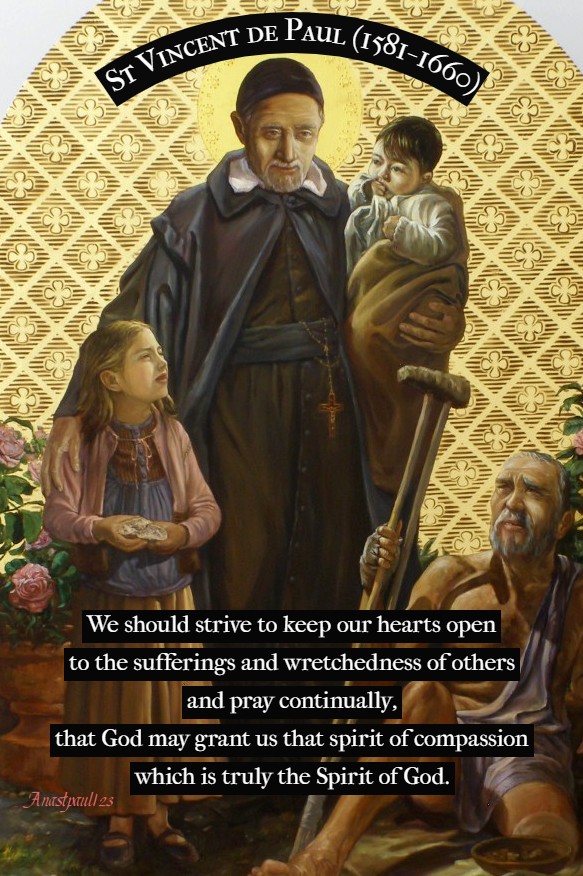
“We should strive to keep our hearts open to the sufferings and wretchedness of others and pray continually, that God may grant us that spirit of compassion which is truly the Spirit of God.”
“We should spend as much time, in thanking God for His benefits, as we do, in asking Him for them!”
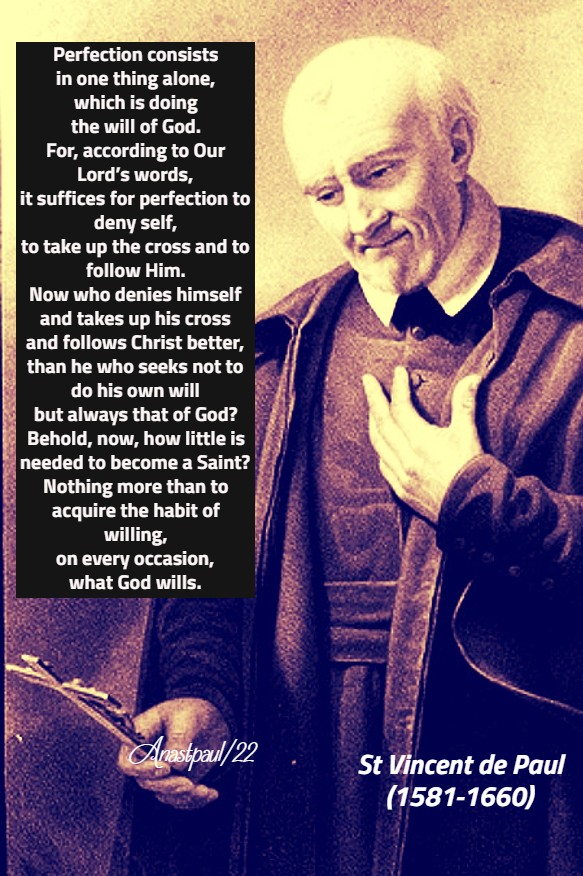
“Perfection consists in one thing alone which is doing the will of God. For, according to Our Lord’s words, it suffices for perfection to deny self, to take up the cross and to follow Him. Now, who denies himself and takes up his cross and follows Christ better than he, who seeks not to do his own will but always that of God? Behold, now, how little is needed, to become as Saint? Nothing more than to acquire the habit of willing, on every occasion, what God wills.”
“Humility and charity are the two master-chords: one, the lowest; the other, the highest; all the others are dependent upon them. Therefore, it is necessary, above all, to maintain ourselves in these two virtues; for observe well, that the preservation of the whole edifice depends on the foundation and the roof.”
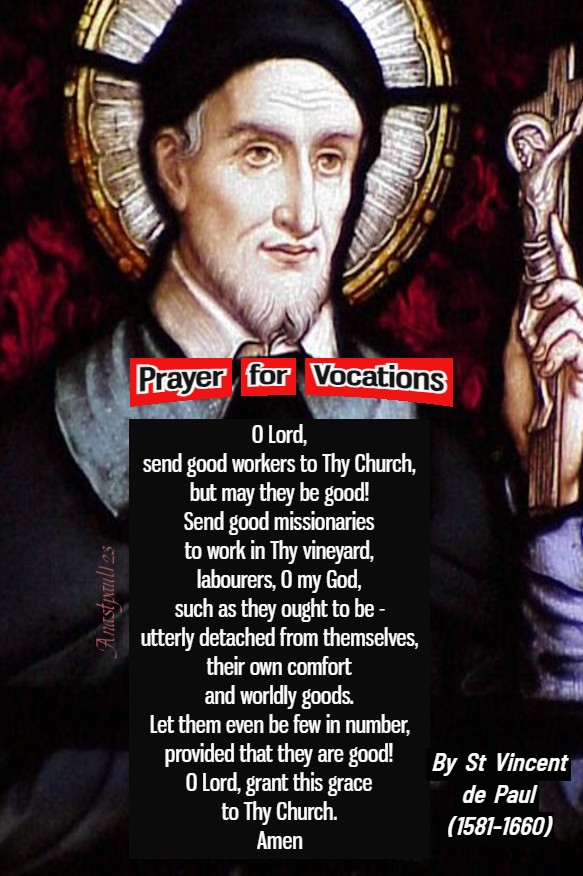
Prayer for Vocations By St Vincent de Paul (1581-1660)
O Lord, send good workers to Thy Church, but may they be good! Send good missionaries to work in Thy vineyard, labourers, O my God, such as they ought to be – utterly detached from themselves, their own comfort and worldly goods. Let them even be few in number, provided that they are good! O Lord, grant this grace to Thy Church. Amen
One Minute Reflection – 19 July – “The Month of the Most Precious Blood of Jesus” – St Vincent de Paul CM (1581-1660) Confessor, “Holy Hero of Divine Charity” – 1 Corinthians 4:9-14, Luke 10:1-9 – Scripture search here: https://www.drbo.org/
“The harvest indeed is great but the labourers are few.Pray ye, therefore, the Lord of the harvest that He send labourers into His harvest.” – Luke 10:2
REFLECTION – “Jesus Christ, loaded with scorn and insults by His foes, set Himself still more, to doing them good… He went through towns, villages and synagogues, teaching us not to pay back calumny with calumny but with even greater generosity. If you have God’s good pleasure and not people’s in mind when you do good to your neighbour, whatever they may do to you, do not stop doing good to them! Your reward can only be all the greater… That is why Christ did not wait for the sick to come to Him – He Himself went to them, taking them two essential goods at the same time – the Good News of the Kingdom and the healing of their ills.
Nor even was that enough for Him, He showed His concern in yet another way. “At the sight of the crowds, His heart was moved with pity for them because they were troubled and abandoned, like sheep without a shepherd. Then He said to His disciples, ‘The harvest is abundant but the labourers are few, so ask the Master of the harvest to send out labourers for His harvest.” Note, once again, His distancing Himself from vainglory. Not wanting to draw everyone to follow Him, He sent His disciples. He wanted to train them, not just for the struggles they were going to undergo in Judea but also, for the battles they will set in motion throughout the earth…
Jesus gives His disciples the power to heal bodies, while waiting before confiding to them, the equally important power to heal souls. Note how He demonstrates both the ease and the necessity of this work, at the same time. What does He say, in fact? “The harvest is plentiful but the labourers are few.” I am not sending you out to sow but to harvest… In speaking like this, our Lord gave them confidence and showed them that the most important work had already been achieved!” – St John Chrysostom (347-407) Father and Doctor of the Church (Sermons on Saint Matthew’s Gospel No 32).
PRAYER – O God, Who endowed St Vincent with apostolic strength, to preach the Gospel to the poor and to enhance the dignity of clerical life; grant, we beseech Thee, that we. who honour his holy merits, may also conform to the example of his virtues. Through Jesus Christ, Thy Son our Lord, Who lives and reigns with Thee, in the unity of the Holy Ghost, God, world without end. Amen (Collect).
Our Morning Offering – 19 July – St Vincent de Paul CM (1581-1660) Confessor, “Holy Hero of Divine Charity.” Founder of the Congregation of the Mission (Vincentians) and Co-Founder of the Sisters of Charity, is an outstanding example of great love for the poor and unfortunate and the Celestial Patron of all Catholic Charitable Societies. (added by Pope Leo XIII).
Let Thou Thyself O Lord, Be Thine Eternal Thanksgiving! By St Vincent de Paul (1581-1660)
O Saviour, Who gave us the law to love our neighbour as ourselves, Who practised it, in such a perfect fashion, towards men. Let Thou Thyself O Lord, Be Thine eternal thanksgiving! O Saviour, how happy I am to be in the state of loving my neighbour! Grant me the grace to acknowledge my good fortune, to love this blessed state and to ensure that this virtue, may be revealed now, tomorrow and always. Amen.
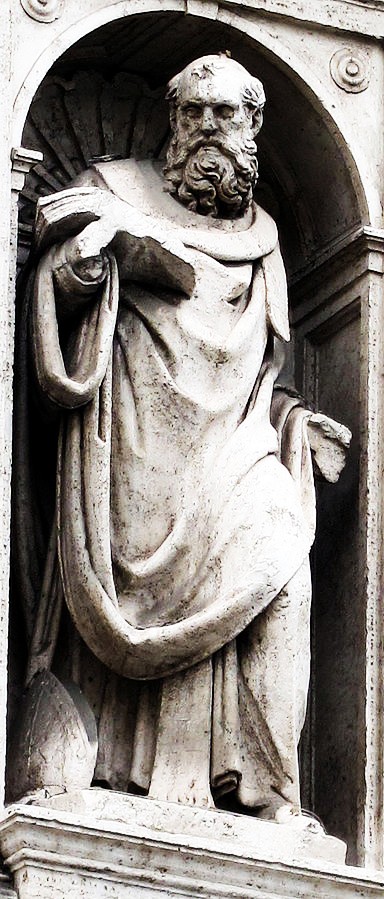
Saint of the Day – 19 July – St Epaphras of Colossae (1st Century) Bishop, Martyr, pagan Convert and Disciple of St Paul. Also known as – Epafra, Epagaphras.
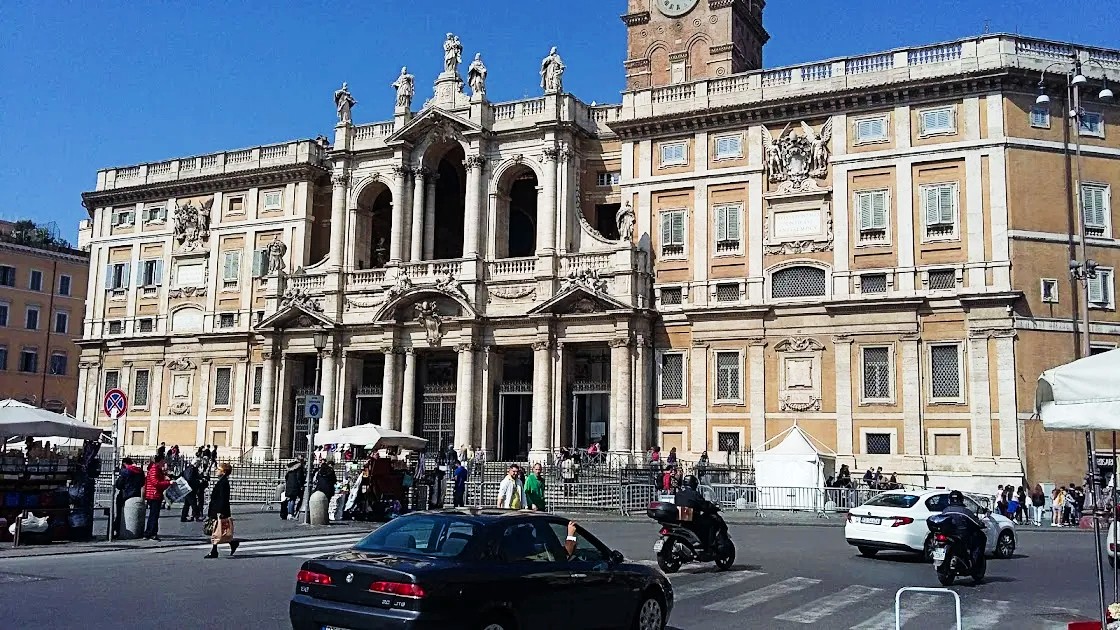
The Roman Martyrology reads today: “The birthday of St Epaphras, whom the Apostle St Paul calls his fellow-prisoner. By the same Apostles, he was Consecrated Bishop of Colossae, where, becoming renowned for his virtues, he received the Palm of Martyrdom, for courageously defending the flock commited to his charges. His body now lies at the Basilica of St Mary Major in Rome.”
St Epaphras Statue at St Mary Major in Rome
In St Paul’s letters to the Colossians and the letter to Philemon, he conveyed greetings from Epaphras:
“Epaphras saluteth you, who is one of you, a servant of Christ Jesus, who is always solicitous for you in prayers, that you may stand perfect, and full in all the will of God. For I bear his testimony that he hath laboured much for you,and for those who are at Laodicea, and those at Hierapolis.” Colossians 4:12–13
Originally from Colossae (in modern Turkey) and a pagan. Epaphras was converted by St Paul during the three years of apostolate in Ephesus. He is the founder and head of the Church of Colossae. The Apostle praises it twice: in Colossians 1:7 – the Colossians were evangelised by Epaphras “our beloved companion in the ministry, faithful minister of Christ, all devoted to your good.”
Finally, in the Epistle to Philemon, St Paul calls him “my fellow prisoner in Christ Jesus.” Epaphras, in fact, was in Rome with him, having come there from Colossae to visit and comfort him, with the assurance of the warm affection of all his faithful flock and disciples.
In the fervour of his apostolic zeal, Epaphras also made present to St Paul that heresy was trying to penetrate those Churches and to preserve them from danger, he had the Apostle write to them.
According to some critics, since the name Epaphras is a contraction of Epaphroditus, our Epaphras and the Epaphroditus mentioned by St Paul in the Epistle to the Philippians (3:25-28; 4:18) would be one and the same person. This identification, which rests only on the possible identity of the name, has nothing else on which to base itself and we agree to exclude it.
The tradition formed on this holy disciple of St Paul, was collected by Adonis: “On the birthday of the blessed Epaphras, who was Ordained Bishop of Colossae by the blessed Paul, famous for his virtues, received the Palm of Martyrdom for the sheep commended to him by a courageous struggle. He was buried in the same City but later his body was moved to St Mary Major in Rome.”
St Ambrose Autpertus Bl Antonio of Valladolid St Aurea of Cordoba
St Arsenius the Great (c 354-c 449) Deacon, Hermit, Desert Father, Theologian, writer. Arsenius one of the most highly regarded of the Desert Fathers, whose teachings were greatly influential on the development of asceticism and the contemplative life. His contemporaries so admired him as to surname him “the Great”. His Lifestory: https://anastpaul.com/2021/07/19/saint-of-the-day-19-july-saint-arsenius-the-great-c-354-c-449/
Bl Bernhard of Rodez St Daria of Constantinople St Epaphras of Colosse (1st Century) Bishop, Martyr, Disciple of St Paul St Felix of Verona
St Macrina the Younger (c 327-379) Virgin, Ascetic. With charm and grace, St Macrina ruled the roost in a family of saints. St Basil the Elder and St Emmelia, her parents, had ten children including the younger St Basil the Great (329-379) Father and Doctor of the Church, St Gregory of Nyssa (c 335–C 395) Father of the Church and St Peter of Sebaste Bishop (c 340–391). As the eldest child, Macrina exercised a formative influence on her more famous brothers and even on her mother. Her Life: https://anastpaul.com/2019/07/19/saint-of-the-day-19-july-saint-macrina-the-younger-c-327-379/
St Martin of Trier St Michael the Sabaitè Bl Pascasio of Lyon
St Romain of Ryazan St Pope Symachus (Died 514) Bishop of Rome from 22 November 498 until his death. St Vicente Cecilia Gallardo
Martyrs of Meros – 3 Saints: Three Christians tortured and Martyred together in the persecutions of emperor Julian the Apostate and governor Almachio. We know nothing else about them but the names – Macedoniuis, Tatian and Theodule. They were burned to death on an iron grill in Meros, Phrygia (in modern Turkey).
Martyrs of China: 3 Beati: Beatified on 17 April 1955 by Pope Pius XII. Elisabeth Qin Bianshi Elisabeth Ioannes Baptista Zhu Wurui Simon Qin Chunfu
Thought for the Day – 18 July – Meditations with Antonio Cardinal Bacci (1881-1971)
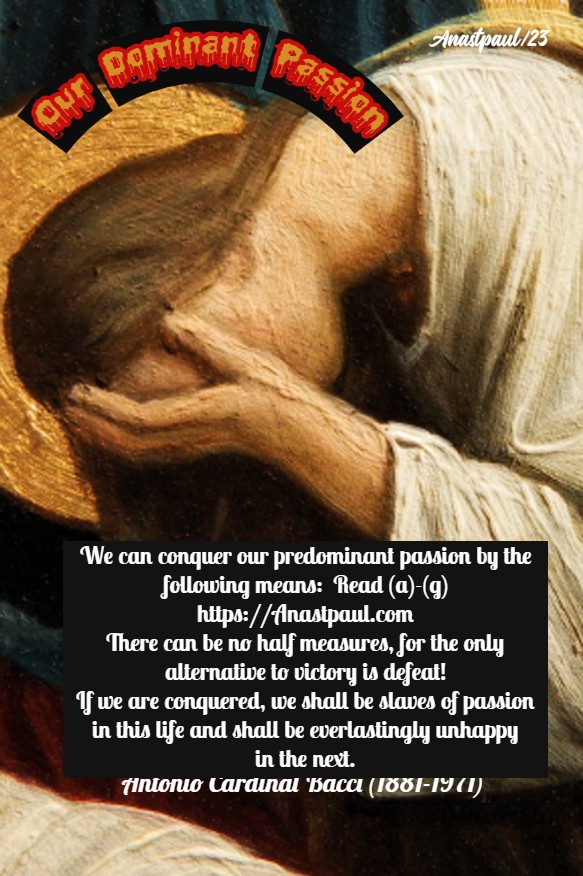
Our Dominant Passion
“We can conquer our predominant passion by the following means: (a) Fervent prayer. (b) A daily Examination of Conscience ,in the course of which we shall discover, whether we have made any progress, in the way of perfection and, shall renew our good resolutions. (c) Weekly, or at least, fortnightly Confession. (d) Daily, or at least, frequent Communion. (e) Avoidance of the occasions of sin and employment of the necessary means to overcome sin. (f) The performance of good actions which, are opposed to our predominant passion. (g) Determination to fight and to conquer because we are convinced that it is absolutely necessary to do so.
There can be no half measures, for the only alternative to victory is defeat! If we are conquered, we shall be slaves of passion in this life and shall be everlastingly unhappy in the next.”
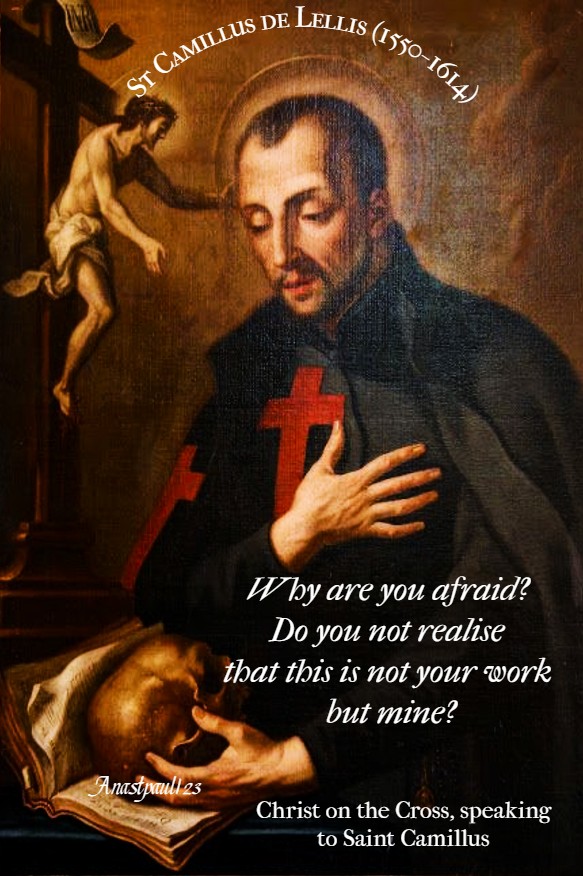
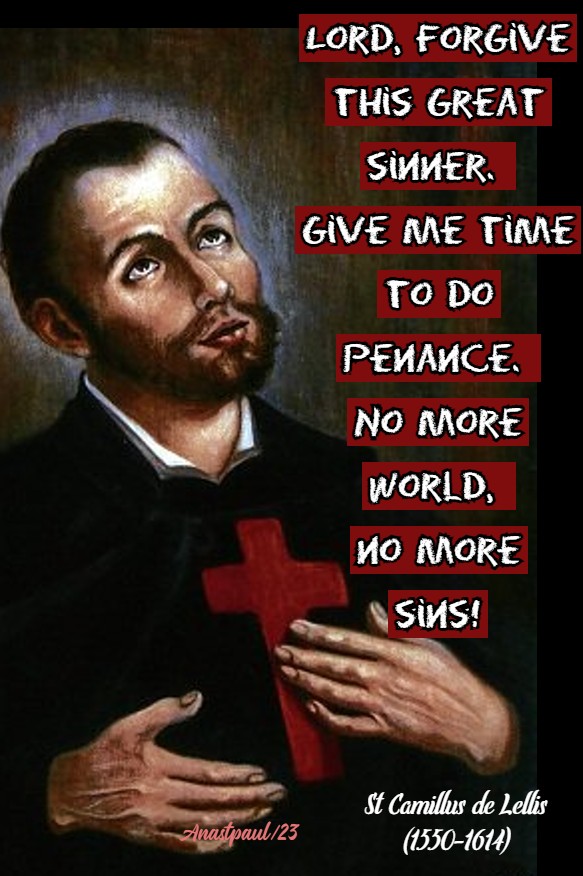
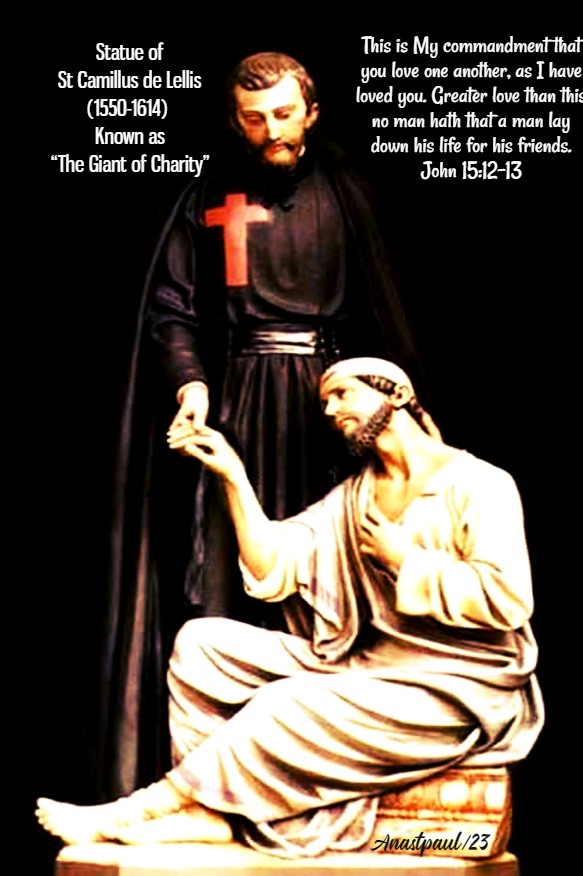
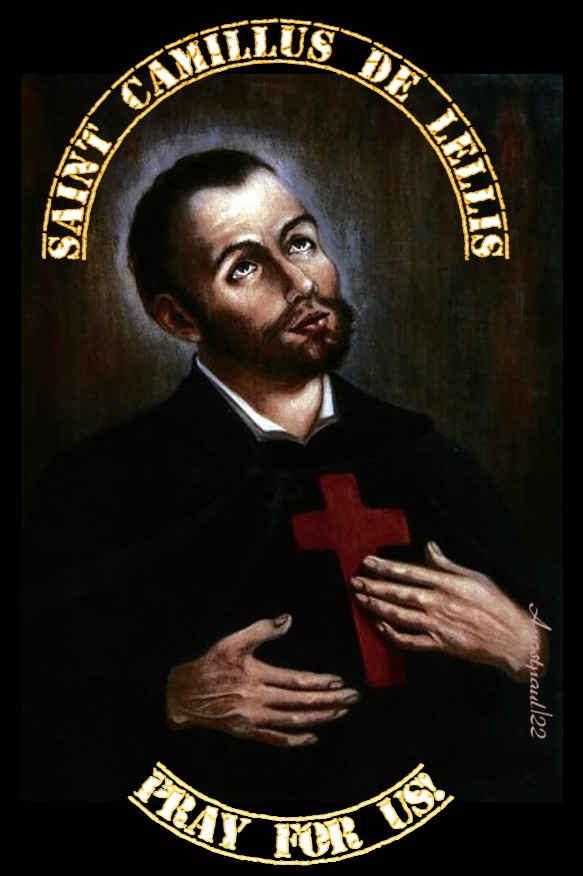
Quote/s of the Day – 18 July – “The Month of the Most Precious Blood of Jesus” – St Camillus de Lellis MI (1550-1614) “The Giant of Charity,” Confessor, Priest and Founder the Order of the Ministers of the Sick, or simply as the “Camillians”
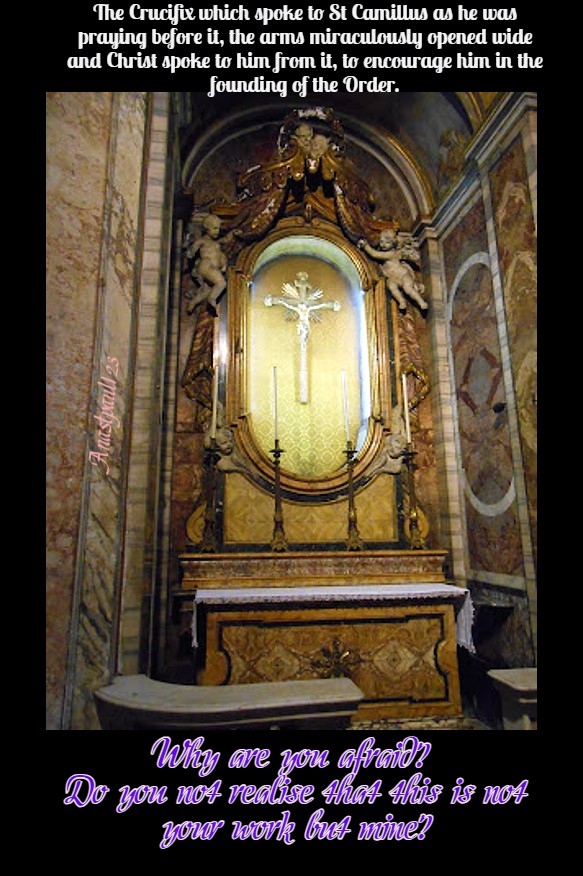
“Why are you afraid? Do you not realise that this is not your work but mine?”
Christ on the Cross speaking to Saint Camillus
“Lord, forgive this great sinner. Give me time to do penance. No more world, no more sins!”
One Minute Reflection – 18 July – “The Month of the Most Precious Blood of Jesus” – St Camillus de Lellis MI (1550-1614) Confessor, Priest and Founder, “The Giant of Charity.” – 1 John 3:13-18, John 15:12-16 – Scripture search here: https://www.drbo.org/
“This is My commandment that you love one another, as I have loved you. Greater love than this no man hath that a man lay down his life for his friends.” – John 15:12-13
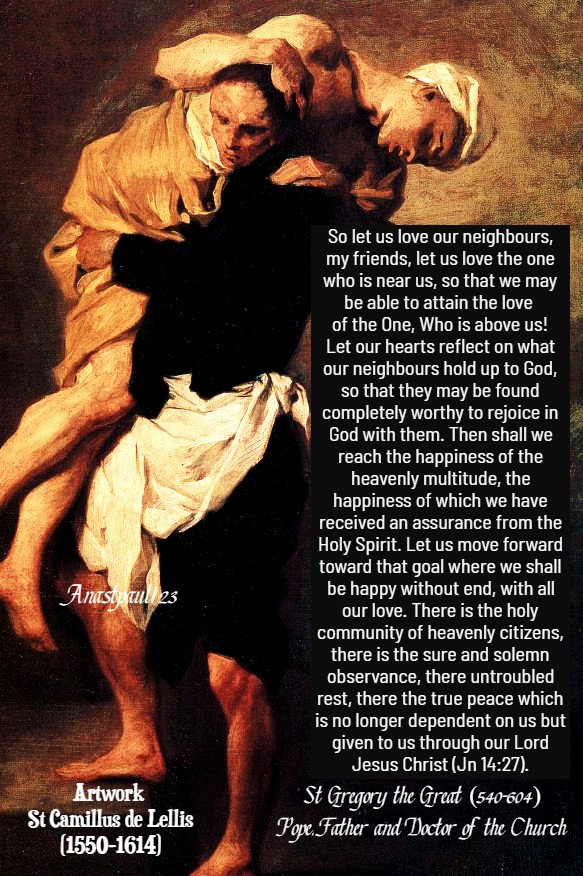
REFLECTION – “We cannot truly love God without loving our neighbour, nor can we truly love our neighbour without loving God. This is why… the Holy Spirit was given a second time to the disciples. First it was given by the Lord while He was still dwelling on earth and later while he was watching over us in Heaven (Jn 20:22; Acts 2). He was given to us on earth that we may love our neighbours, from Heaven that we may love God. Why first on earth and later from Heaven – except for the reason given us openly by John: “How can anyone, who does not love his brother, whom he sees love God Whom he does not see?”
So let us love our neighbours, my friends, let us love the one who is near us, so that we may be able to attain the love of the One, Who is above us! Let our hearts reflect on what our neighbours hold up to God, so that they may be found completely worthy to rejoice in God with them. Then shall we reach the happiness of the heavenly multitude, the happiness of which we have received an assurance from the Holy Spirit. Let us move forward toward that goal where we shall be happy without end, with all our love. There is the holy community of heavenly citizens, there is the sure and solemn observance, there untroubled rest, there the true peace which is no longer dependent on us but given to us through our Lord Jesus Christ (Jn 14:27).” – St Gregory the Great (540-604) Pope, Father and Doctor of the Church (Excerpt Sermons on the Gospel No 30).
PRAYER – O God, Who endowed St Camillus with a special gift of charity for the help of souls struggling in their final agony, pour upon us, we beseech Thee, by his merits, the spirit of Thy love, so that at the hour of our death, we may be found worthy to overcome the enemy and attain the heavenly crown. Through Jesus Christ, Thy Son our Lord, Who lives and reigns with Thee, in the unity of the Holy Ghost, God, world without end. Amen (Collect).
Our Morning Offering – 18 July – “The Month of the Most Precious Blood of Jesus”
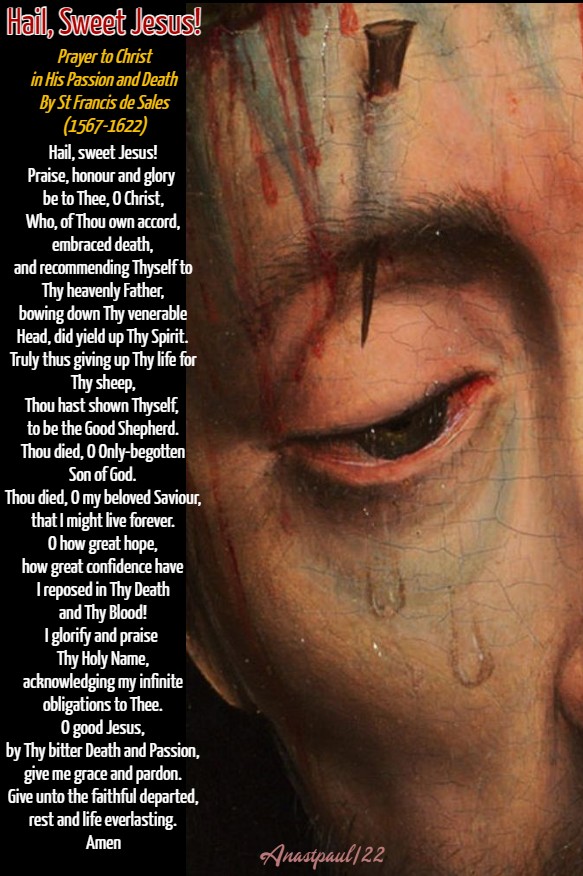
Hail, Sweet Jesus! Prayer to Christ in His Passion and Death By St Francis de Sales (1567-1622) Doctor of the Church
Hail, sweet Jesus! Praise, honour and glory be to Thee, O Christ, Who, of Thou own accord, embraced death, and recommending Thyself to Thy heavenly Father, bowing down Thy venerable Head, did yield up Thy Spirit. Truly thus giving up Thy life for Thy sheep, Thou hast shown Thyself, to be the Good Shepherd. Thou died, O Only-begotten Son of God. Thou died, O my beloved Saviour, that I might live forever. O how great hope, how great confidence have I reposed in Thy Death and Thy Blood! I glorify and praise Thy Holy Name, acknowledging my infinite obligations to Thee. O good Jesus, by Thy bitter Death and Passion, give me grace and pardon. Give unto the faithful departed, rest and life everlasting. Amen
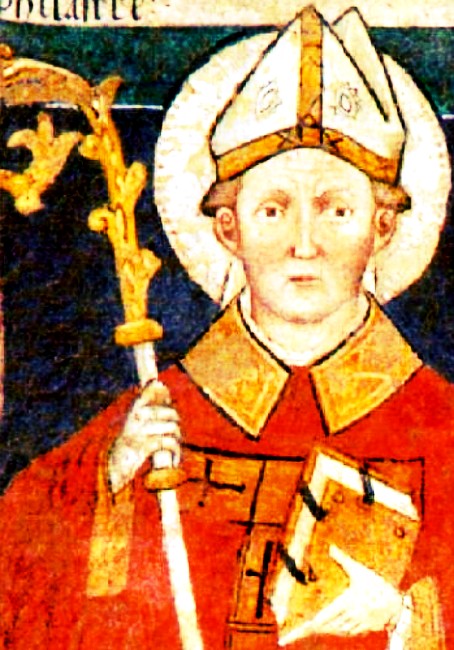
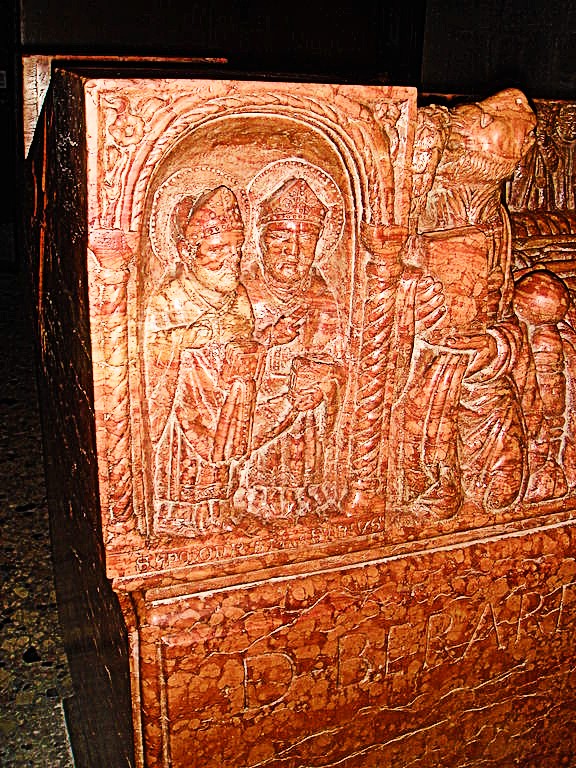
Saint of the Day – 18 July – St Philastrius of Brescia (c330-c387) Confessor, the 7th Bishop of Brescia, Italy, Defender of the True Faith against heretics, most particularly he fought zealously against the Arian heretics, Miracle-worker, he was one of the Bishops present at a Synod held in Aquileia in 381. Born in c330 in Spain and died in c387 of natural causes. St Philastrius’ Relics are venerated in the Crypt of Saint Apollonius in the Cathedral of Brescia, Italy. Also known as – Filastrius, Philaster.
The Roman Martyrology reads today: “At Brescia, the birthday of St Philastrius, Bishop of that City, who, in speech and writing combated heretics, especially the Arians, from whom he suffered much. Finally, he died in peace, renowned for miracles.”
WE know nothing of this Saint’s beginnings and his home, only that he quitted it and the house and inheritance of his ancestors, like Abraham, the more perfectly to disengage himself from the ties of the world.
He lived in perfect continency and often passed whole nights in meditating on the Holy Scriptures. Being Ordained Priest, he travelled through many provinces to oppose the infidels and heretics, especially the Arians, whose fury was, at that time, formidable over the whole Church. His zeal and lively faith gave him courage to rejoice with the apostles in suffering for the truth and to bear in his body, the marks of the stripes which he received by a severe scourging which he underwent for Jesus Christ. At Milan he vigorously opposed the endeavours of Auxentius, the impious Arian wolf, who laboured there, to destroy the flock of Christ and, our Saint was its strenuous guardian before St Ambrose was made Bishop of that City.
He afterwards went to Brescia and, finding the inhabitants of that place savage and barbarous, almost entirely ignorant in spiritual things, yet desirous to learn, he took much pain to instruct them and had the comfort to see his labours crowned with incredible success. He rooted out the tares of many errors and cultivated this wild soil with such assiduity that it became fruitful in good works.
Being chosen the 7th Bishop of this See, he exerted himself in the discharge of all his pastoral functions with such vigour as even to outdo himself and the authority of his high dignity added the greater weight to his endeavours. He was not quite equal in learning to the Ambroses and Augustins of that age but what was wanting in that respect, was abundantly made up by the example of his life, his spirit of perfect humility and piety and his unwearied application to every pastoral duty. Philastrius is an instance of what eminent service and may be capable of achieving in the Church, when they are joined with a heroic degree of virtue.
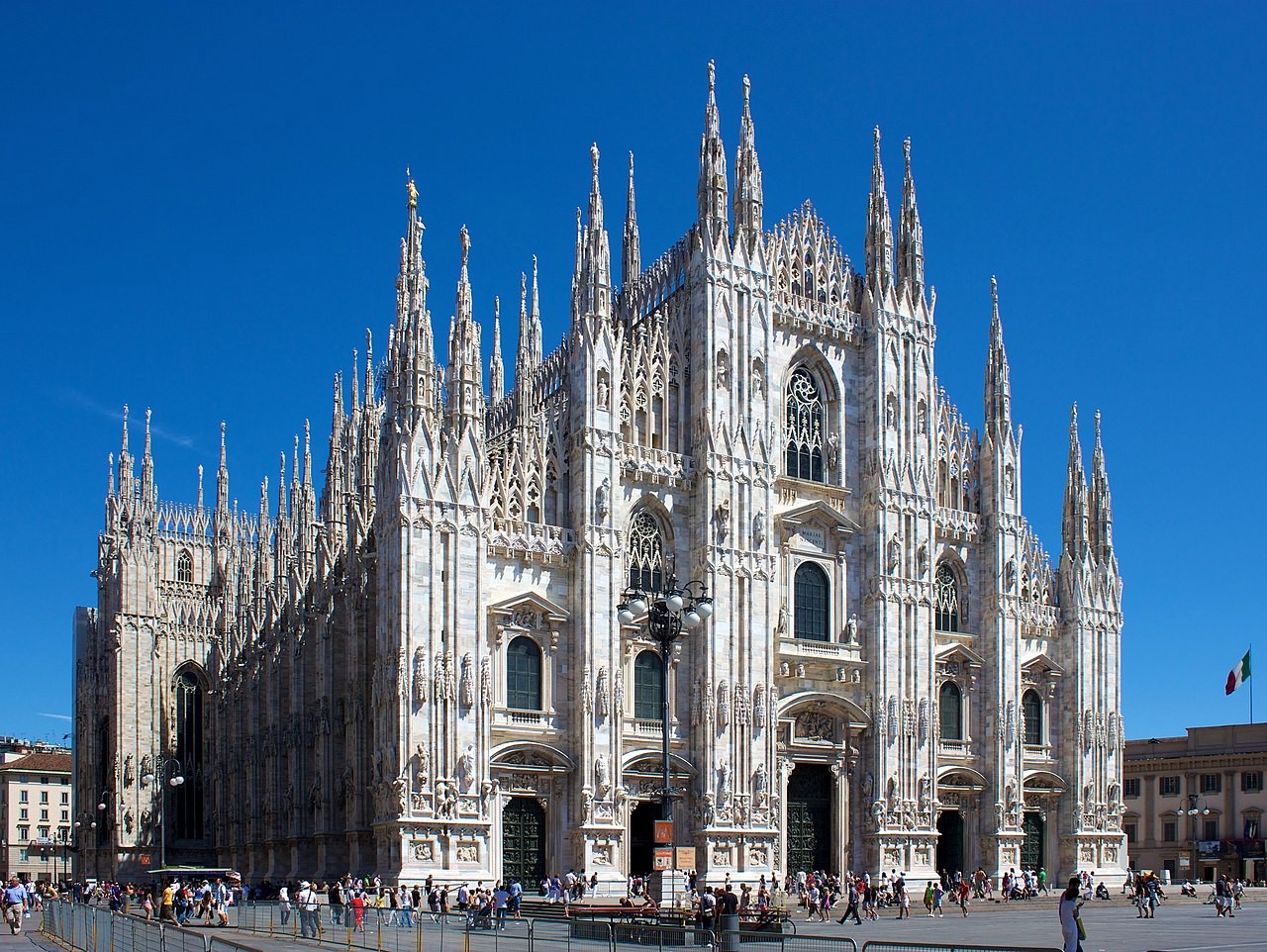
Brescia Cathedral
To caution his flock against the danger of errors in faith, he wrote his Catalogue of Heresies. He, everywhere breathes an ardent zeal for the Catholic faith. St. Gaudentius extols his profound humility, his meekness, and sweetness towards all men, which was such that it seemed natural to him to repay injuries only with kindness and favours and, he never discovered the least emotions of anger. By his charity and patience, he gained the hearts of all men. In all he did, he sought no interest but that of Jesus Christ and regarding with contempt all earthly things, he pursued and valued only those that are eternal.
Being most mortified and sparing in his diet and apparel, he seemed to know no other use of money than to employ it in relieving the poor and he extended his liberality, not only to all that were reduced to beggary but also, to tradesmen and all others, whom he often generously enabled to carry on, or when expedient, to enlarge their business. Although he communicated himself with surprising charity and goodness to all sorts of persons of every age, sex and condition, he seemed always to receive the poor with particular affection.
He trained many pious and eminent disciples, among whom are named St Gaudentius, his successor as Bishop of Brescia and one Benevolus, who, in his lifetime, was a true imitator of the Apostles. St Augustine met our St Philastrius at Milan with St Ambrose in the year 384. He died soon after, and before St Ambrose, his Archbishop, who after his death placed St Gaudentius in the See of Brescia. This Saint solemnised every year, with his people, the day on which his master, St Philastrius, passed to glory and always honoured it with a panegyric but of these discourses only the fourteenth is extant.
St Symphorosa and her seven sons / Also known as – The Martyrs of Tivoli – 8 Saints: A widow, St Symphorosa and her seven sons ( Crescens, Eugene, Julian, Justin, Nemesius, Primitivus and Stracteus) Martyred in Tivoli, Italy in the 2nd-century persecutions of Hadrian.
St Aemilian of Dorostorium St Alanus of Sassovivo St Alfons Tracki Blessed Angeline of Marsciano Bl Arnold of Amiens St Arnold of Arnoldsweiler St Arnoul the Martyr
St Goneri of Treguier St Gundenis of Carthage Bl Herveus St Marina of Ourense St Maternus of Milan St Minnborinus St Pambo of the Nitrian Desert St Philastrius of Brescia (c330-c387) Bishop St Rufillus of Forlimpopoli
Martyrs of Silistria – 7 Saints: Seven Christians who were Martyred together. No details about them have survived but the names – Bassus, Donata, Justus, Marinus, Maximus, Paulus and Secunda. They were martyred in Silistria (Durostorum), Moesia (in modern Bulgaria), date unknown.
Thought for the Day – 17 July – Meditations with Antonio Cardinal Bacci (1881-1971) on the Feast of the Humility of Mary
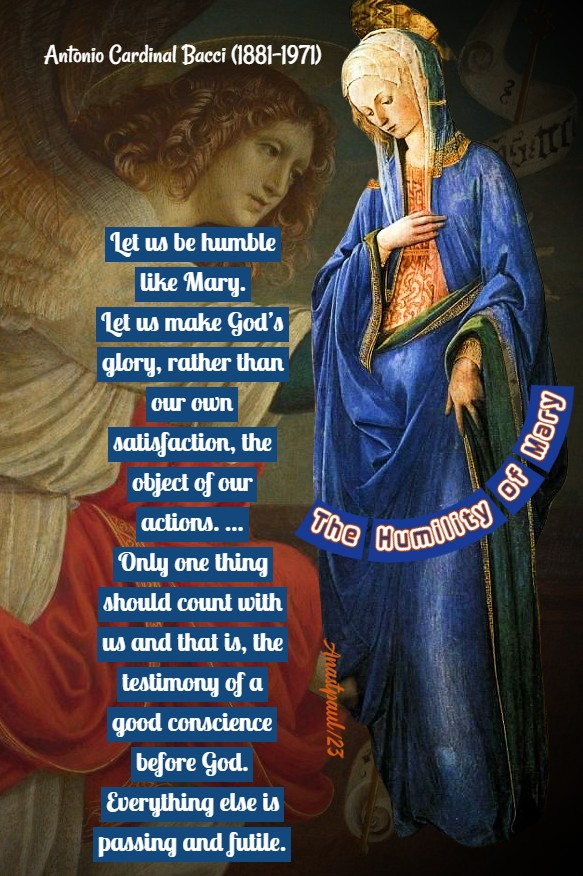
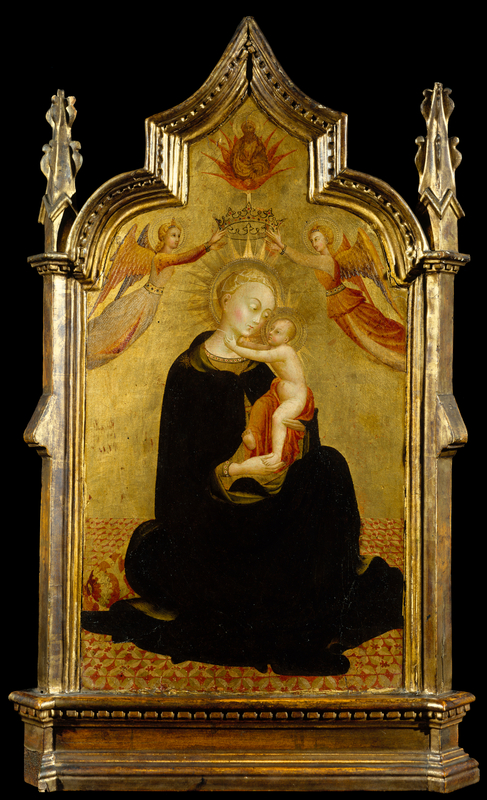
The Humility of Mary
“Unfortunately, we often look for our share of glory on earth. We wish to appear to others, not only at our true value but much more than we are really worth. We imagine that the gifts and qualities which God has given us, belong to ourselves, whereas they are entirely His.
We like to put on a good appearance to win praise and renown – in other words, we want to have our reward upon this earth. We should remember, however, that if we look for our reward now, we shall not have it in Heaven.
God sees when our motives in doing good are distorted and, when we appear before His judgement throne, He will say to us: “You have received your reward” (Cf Mt 6:2).
Let us be humble like Mary. Let us make God’s glory, rather than our own satisfaction, the object of our actions. It will sometimes happen that men will misunderstand us, perhaps even insult us. We are not forbidden to defend ourselves and explain our position. We may not have the heroic virtue of St Francis de Sales, who remained silent when he was caluminated. But we should not be too disturbed by lack of understanding or slander, nor should we be too elated by flattery. Only one thing should count with us and that is, the testimony of a good conscience before God. Everything else is passing and futile.
Our humility will be tested by the inevitable opposition, sometimes jealous and malicious, which we shall experience on the part of other men. On these occasions, we shall see if we are really meek and humble of heart, like Jesus and our Blessed Mother.”
Quote/s of the Day – 17 July –The Feast of the Humility of the Blessed Virgin Mary
“To arrive at the knowledge of the Truth, there are many paths – the first is humility, the second is humility and the third is humility.”
“Humility is a very strange entity. The moment we think we have it, we have already lost it!”
St Augustine (354-430) Father and Doctor of Grace)
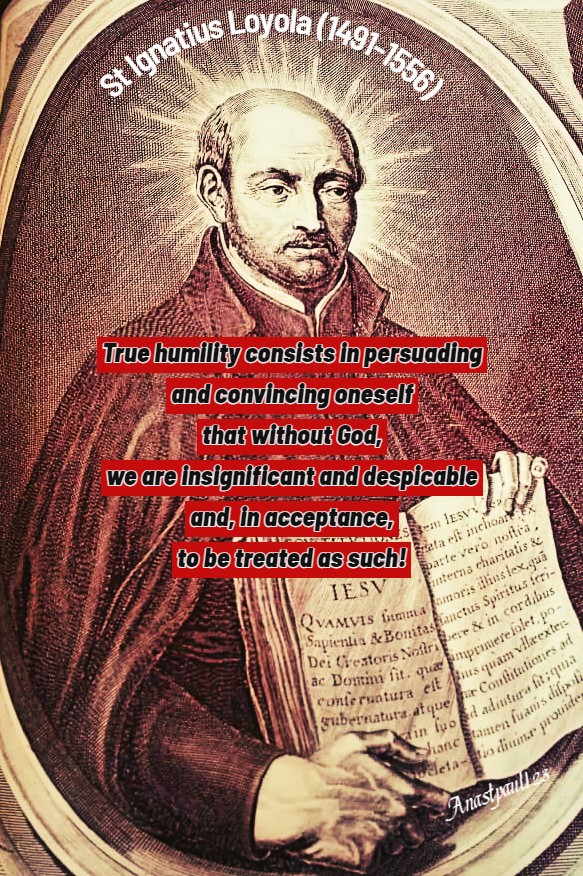
“True humility consists in persuading and convincing oneself that without God, we are insignificant and despicable and, in acceptance, to be treated as such!”
St Ignatius Loyola (1491-1556)
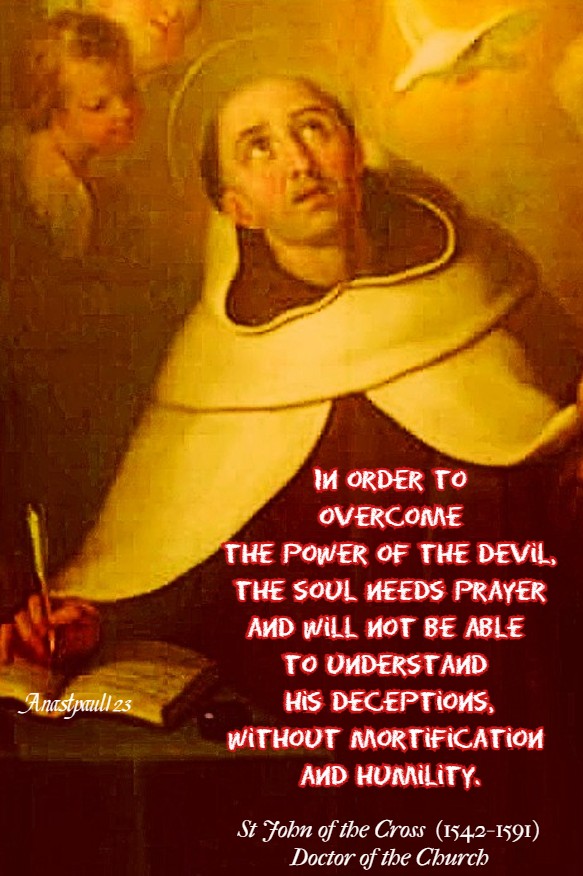
“In order to overcome the power of the devil, the soul needs prayer and will not be able to understand his deceptions, without mortification and humility.”
St John of the Cross (1542-1591) Doctor of the Church
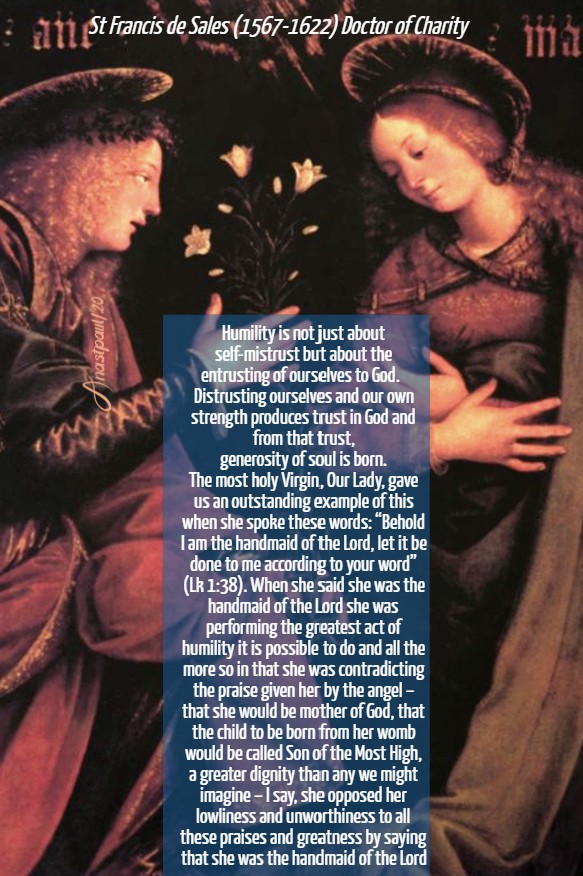
The most holy Virgin, Our Lady, gave us an outstanding example of this when she spoke these words: “Behold I am the handmaid of the Lord, let it be done to me according to your word” (Lk 1:38). When she said she was the handmaid of the Lord, she was performing the greatest act of humility it is possible to do and, all the more so, in that she was contradicting the praise given her by the angel – that she would be mother of God, that the child to be born from her womb would be called Son of the Most High, a greater dignity than any we might imagine – I say, she opposed her lowliness and unworthiness to all these praises and greatness, by saying that she was the handmaid of the Lord.”
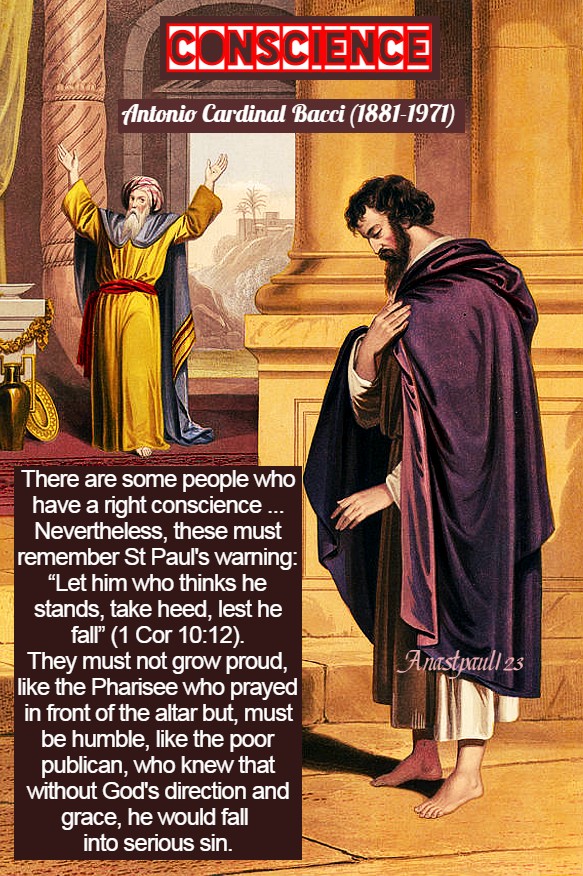
“There are some people who have a right conscience … Nevertheless, these must remember St Paul’s warning: “Let him who thinks he stands, take heed, lest he fall” (1 Cor 10:12). They must not grow proud, like the Pharisee who prayed in front of the altar but, must be humble, like the poor publican, who knew that without God’s direction and grace, he would fall into serious sin.”
One Minute Reflection – 17 July – “The Month of the Most Precious Blood of Jesus” – Feast of The Humility of the Blessed Virgin Mary – 1 Timothy 6:6-12, Matthew 19:27-29 – Scripture search here: https://www.drbo.org/
“And everyone who has left house, or brethren, or sisters, or father, or mother, or wife, or children, or lands for My Name’s sake, shall receive a hundredfold and shall possess life everlasting.” – Matthew 19:29
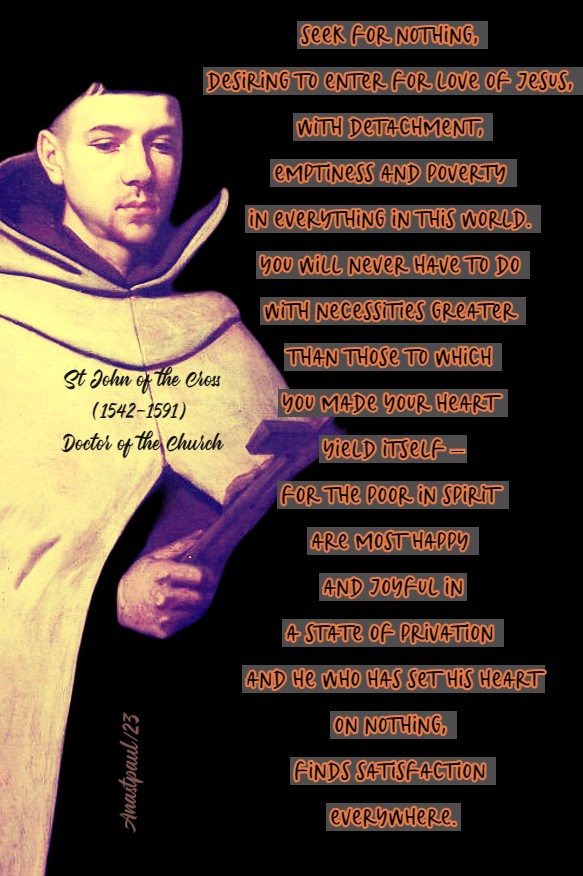
REFLECTION – “Seek for nothing, desiring to enter for love of Jesus, with detachment, emptiness and poverty in everything in this world. You will never have to do with necessities greater than those to which you made your heart yield itself – for the poor in spirit are most happy and joyful in a state of privation and he who has set his heart on nothing, finds satisfaction everywhere.
The poor in spirit (Mt 5:3) give generously all they have and their pleasure consists in being thus deprived of everything for God’s sake and out of love for their neighbour … Not only do temporal goods – the delights and tastes of the senses – hinder and thwart the way of God but spiritual delights and consolations also, if sought for or clung to eagerly, disturb the way of virtue.” – St John of the Cross (1542-1591) Carmelite, Doctor of the Church (Spiritual maxims Nos 352, 355, 356, 364).
PRAYER – Grant, we beseech Thee, O Lord God, unto all Thy servants, that they may remain continually in the enjoyment of soundness both of mind and body and, by the glorious intercession of the Blessed Mary, always a Virgin, maybe delivered from present sadness and enter into the joy of Thine eternal gladness.ThroughJesus Christ, Thy Son our Lord, Who lives and reigns with Thee, in the unity of the Holy Ghost, God, world without end. Amen (Collect).
Our Morning Offering – 17 July – “The Month of the Most Precious Blood of Jesus” – Feast of The Humility of the Blessed Virgin Mary
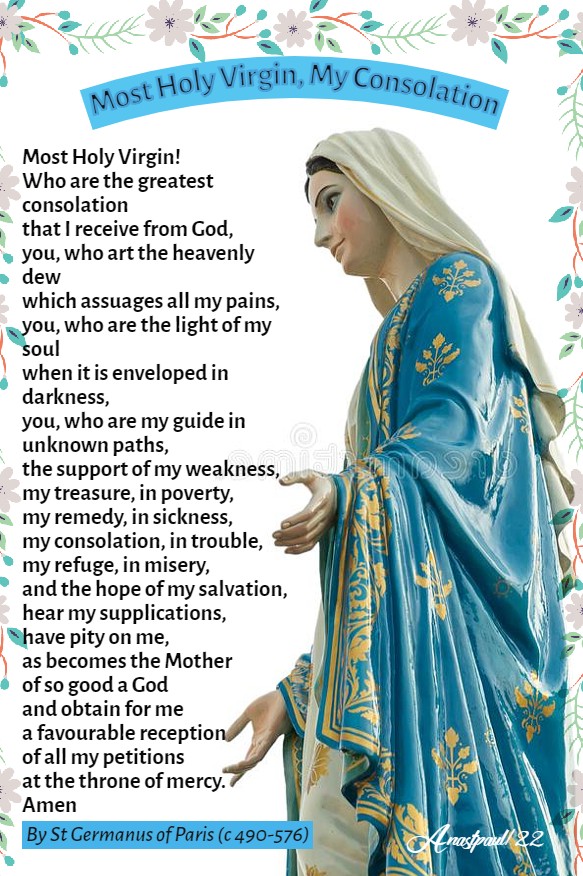
Most Holy Virgin, My Consolation By St Germanus of Paris (c 490-576)
Most Holy Virgin! Who are the greatest consolation that I receive from God, you, who art the heavenly dew which assuages all my pains, you, who are the light of my soul when it is enveloped in darkness, you, who are my guide in unknown paths, the support of my weakness, my treasure, in poverty, my remedy, in sickness, my consolation, in trouble, my refuge, in misery, and the hope of my salvation, hear my supplications, have pity on me, as becomes the Mother of so good a God and obtain for me a favourable reception of all my petitions at the throne of mercy. Amen
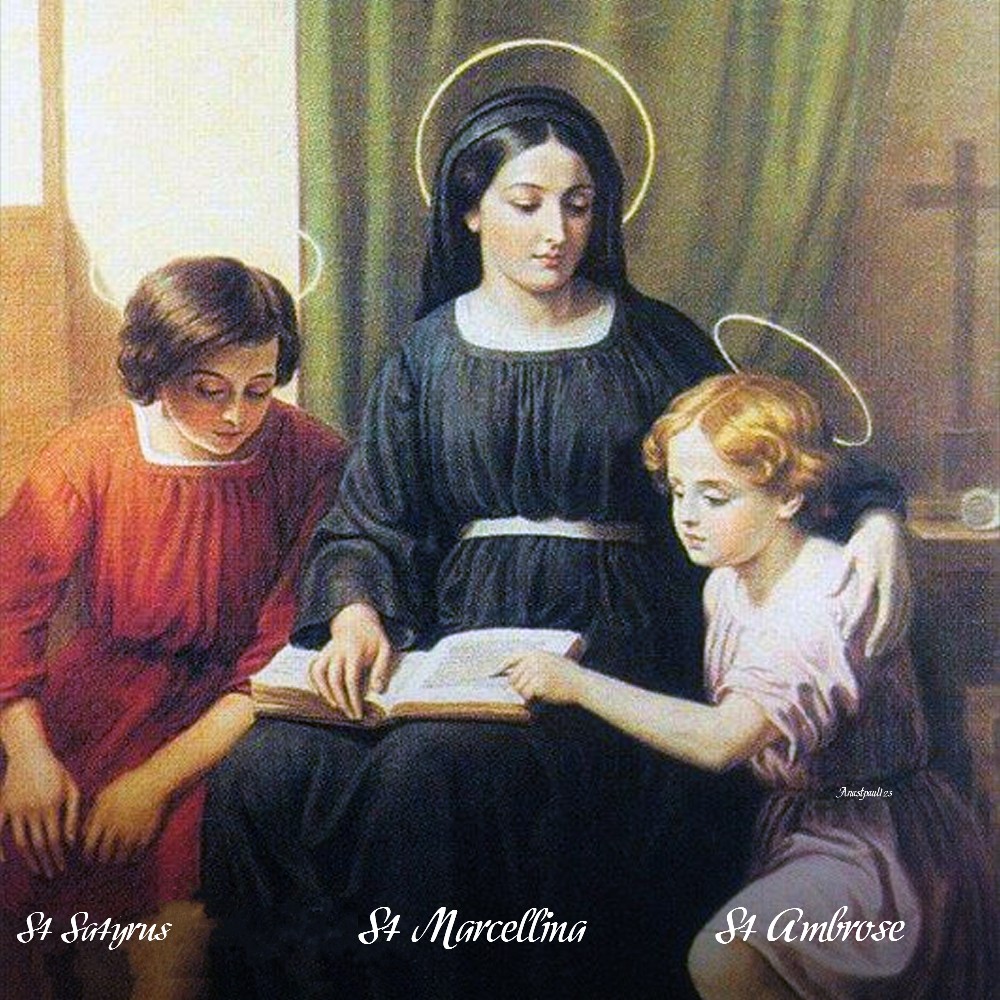
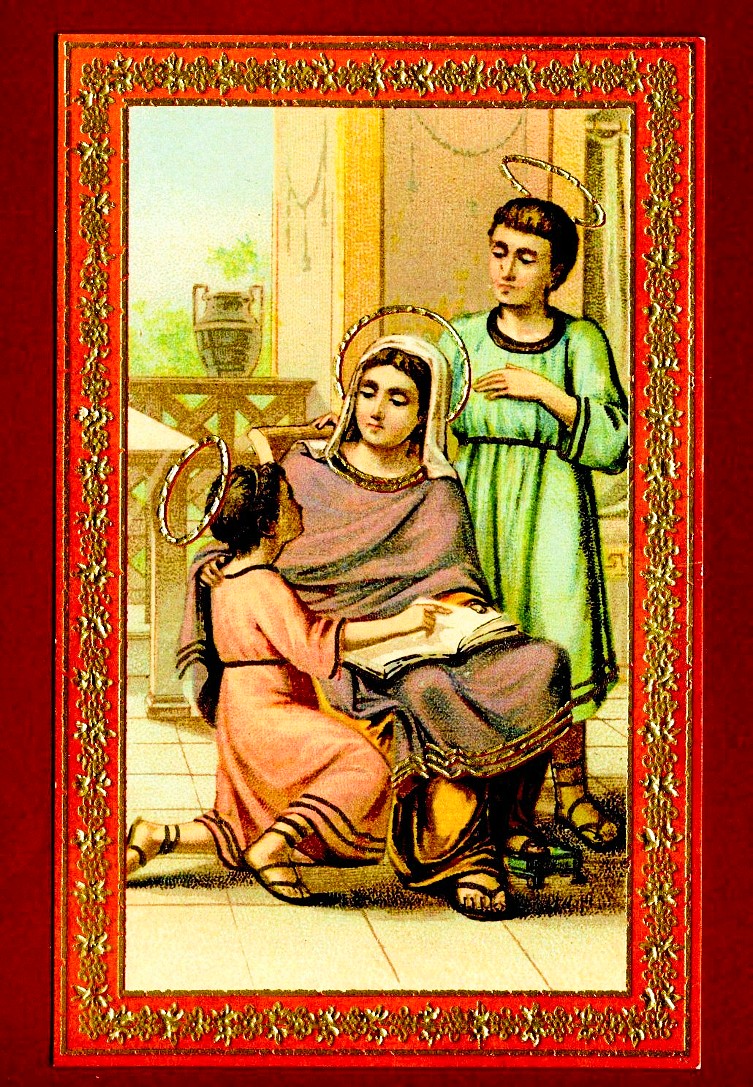
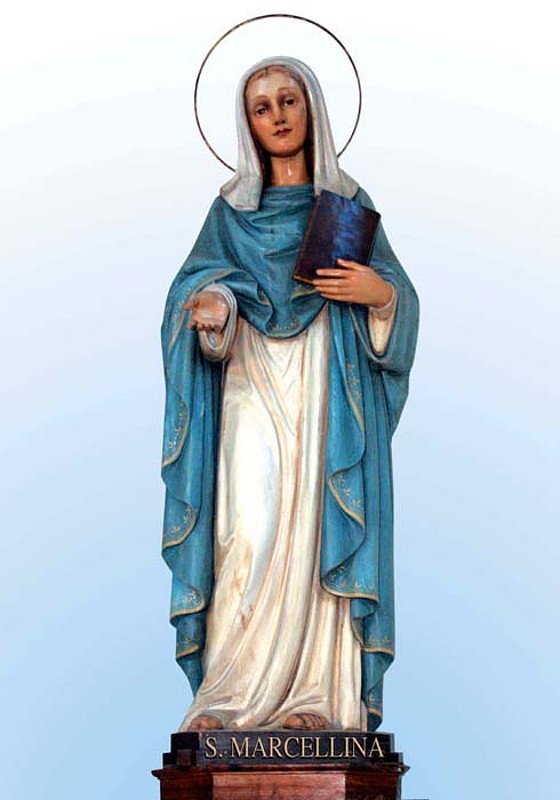
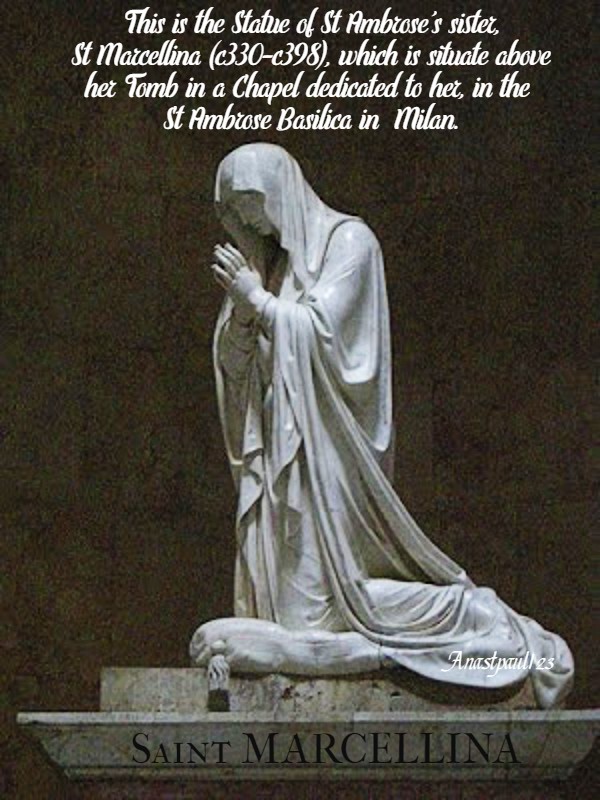
Saint of the Day – 17 July – St Marcellina (c330-c398) Consecrated Virgin. Born in Trier, Gaul (in modern Germany), the daughter of the Praetorian Prefect of Gaul and the elder sister of St Ambrose of Milan and St Satyrus of Milan. Marcellina died in c398 in Milan of natural causes.
The Roman Martyrology reads: “At Milan, the Virgin St Marcellina, sister of the blessed Archbishop Ambrose, who received the religious veil from Pope Liberius, in the Basilica of St Peter at Rome. Her sanctity is attested by St Ambrse in his writings.”
Saint Marcellina was born around 330, probably in Trier, where the Western Roman Emperor then resided. Her father, Galliarum (or Ambrosius of Gaul), who belonged to the Roman noble family Aurelia, was Prefect of the Praetorian Guard and Governor of Gaul, including Spain, the Netherlands and Britannia. The family had become Christians early on and had Martyrs in their family. She was the eldest of three siblings, the younger brothers being Satyrus (c334-c379) and St Ambrose of Milan (c340-397).
When Galliarum died in 345 (or 354), his pious widow returned to Rome with her children. On Christmas Day 353, Marcellina received the veil as a Consecrated Virgin from Pope Liberius (352-366) but she continued to live at home, since, at that time, there were few regular Convents for women. In his sermon on that occasion, the Pope exhorted her to love only Our Lord Jesus Christ, to live in eternal reflection and asceticism and to always behave in Church with the utmost respect and reverence. Ambrose recorded the sermon in writing and added to the Pope’s eloquence, where he found it insufficient for the occasion.
When Ambrose became the Bishop of Milan in 374, Marcellina used to visit him there. Their brother, Satyrus, resigned from his Prefecture and came to live with Ambrose and lighten his burdens by taking care of his worldly affairs, so that the Bishop could concentrate on spiritual matters. But around 379, after a business trip to Africa, Satyrus was shipwrecked on the way home. Although he was able to swim to shore, he was so weakened that he fell ill and died in Milan in the arms of Ambrose and Marcellina. In Ambrose’ Eulogy for his brother, “De excessu fratris sui Satyri,” he referred to Marcelina as “a holy sister, well esteemed for her innocence and also for her uprightness and not least for her kindness to others.”
Marcellina used to advise Ambrose in spiritual matters, continuing the work she had begun when she was put in charge of his early education as a child. Three letters which he wrote to her have been preserved, in which he deals with problems he faced. It was to her that he dedicated his work on Virginity: “Libri III de virginibus ad Marcellinam.”
Her own life was characterised by great severity and asceticism and towards her end, Ambrose begged her to moderate her fasting and penatential exercises. She did not live in a community but in a private house in Rome with a single companion.
She survived Ambrose, who died in 397 and an old biography states that she died while Ambrose’ successor, Saint Simplician, was the Bishop of Milan (397-401). She died in mid-July – the year of death is usually given as 398 but the year 400 is also mentioned. She was buried in the Basilica of Sant’Ambrogio in Milan near her brothers. In 1812, her Relics were transferred to a special Chapel built in her honour by donations from the faithful.
Her Feast day is 17 July and her name appears in the Martyrologium Romanum. The main sources for her biography are the writings of Ambrose and a Eulogy about her preserved by Mombritius. Ambrose’ Secretary, Paulinus, approached Marcellina to find out a little about Ambrose’ youth and it is also possible that Saint Jerome spoke to her.
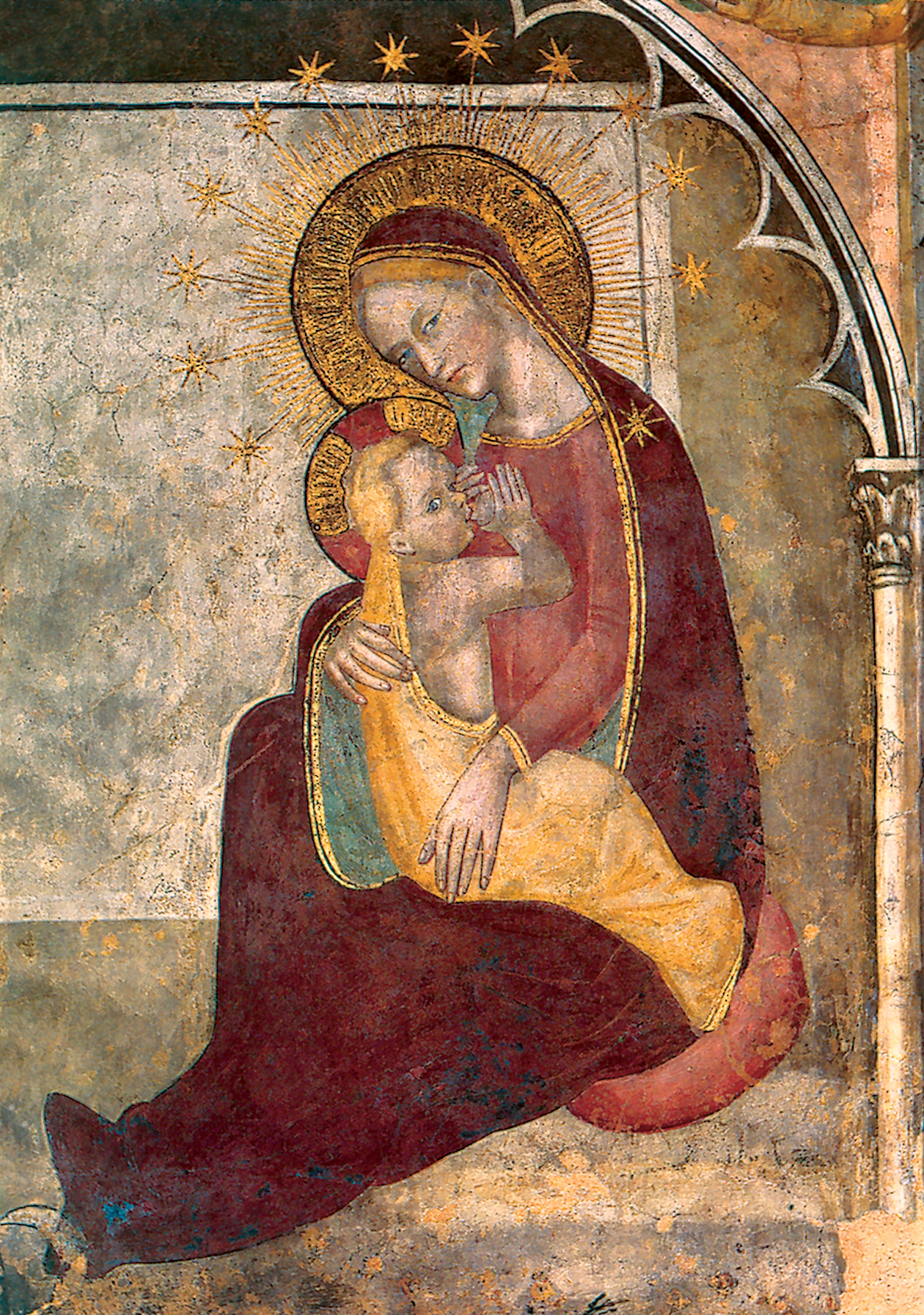
Feast of The Humility of the Blessed Virgin Mary or the Madonna of Humility: The Feast of the Humility of the Blessed Virgin Mary is celebrated on 17 July. It was included in the General Roman Calendar of 1954 among the feasts ‘pro aliquibus locis’ (in some places) but was removed from the General Roman Calendar of 1960. However, many Diocese worldwide still celebrate this beautiful Feast as do all Traditional Catholics. https://anastpaul.com/2022/07/17/saint-of-the-day-17-july-the-humility-of-mary-by-st-alphonsus/
Martyrs of Compiegne (16 Carmelite Beati): Sixteen Blessed Teresian Martyrs of Compiègne. Eleven Discalced Carmelite nuns, three lay sisters and two lay women servants who were Martyred together in the French Revolution. They were the earliest Martyrs of the French Revolution that have been recognised. They were: Angelique Roussel • Anne Pelras • Anne-Marie-Madeleine Thouret • Catherine Soiron • élisabeth-Julitte Vérolot • Marie Dufour • Marie Hanniset • Marie-Anne Piedcourt • Marie-Anne-Françoise Brideau • Marie-Claude-Cyprienne Brard • Marie-Françoise de Croissy • Marie-Gabrielle Trezel • Marie-Geneviève Meunier • Marie-Madeleine-Claudine Lidoine • Rose-Chretien de Neuville • Thérèse Soiron. They were guillotined on 17 July 1794 at the Place du Trône Renversé (modern Place de la Nation) in Paris, France. The 16 Martyrs Story: https://anastpaul.com/2017/07/17/saints-of-the-day-17-july-the-carmelite-martyrs-of-compiegne-o-c-d/
Bl Arnold of Himmerod Bl Bénigne Bl Biagio of the Incarnation
Bl Carlos de Dios Murias OFM Conv (1945-1976) Priest Martyr St Clement of Ohrid St Cynllo St Ennodius of Pavia St Fredegand of Kerkelodor St Generosus St Gorazd St Hyacinth of Amastris St Kenelm St Pope Leo IV St Marcellina (c330-c398) Consecrated Virgin, sister of St Ambrose. St Nerses Lambronazi Bl Sebastian of the Holy Spirit Bl Tarsykia Matskiv St Theodosius of Auxerre St Theodota of Constantinople St Turninus
Martyrs of Scillium (12 Saints): A group of twelve Christians Martyred together, the final deaths in the persecutions of Emperor Marcus Aurelius. Upon their conviction for the crime of being Christians, the group was offered 30 days to reconsider their allegiance to the faith; they all declined. Their official Acta still exist. Their names : • Acyllinus • Cythinus • Donata • Felix • Generosa • Januaria • Laetantius • Narzales • Secunda • Speratus • Vestina • Veturius They were beheaded on 17 July 180 in Scillium, Numidia (in North Africa).
Thought for the Day – 16 July – Meditations with Antonio Cardinal Bacci (1881-1971)
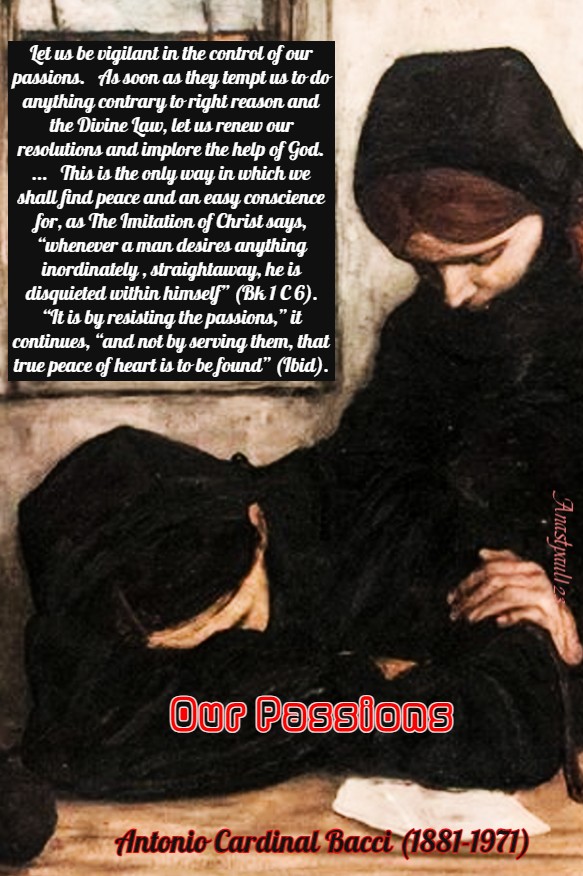
Our Passions
“Let us be vigilant in the control of our passions. As soon as they tempt us to do anything contrary to right reason and the Divine Law, let us renew our resolutions and implore the help of God. “O God,” let us pray, “I wish to love Thee above all things. I wish neither to contemplate, nor intend, nor do anything which could offend Thee in any way.” This is the only way in which we shall find peace and an easy conscience for, as The Imitation of Christ says, “whenever a man desires anything inordinately , straightaway, he is disquieted within himself” (Bk 1 C 6). “It is by resisting the passions,” it continues, “and not by serving them, that true peace of heart is to be found” (Ibid).”
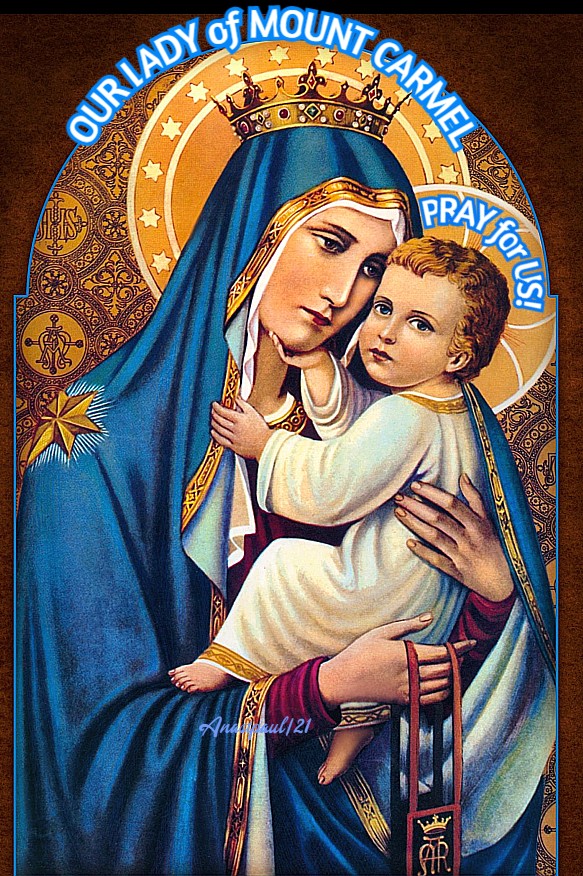
Quote/s of the Day – 16 July – Our Lady of Mount Carme
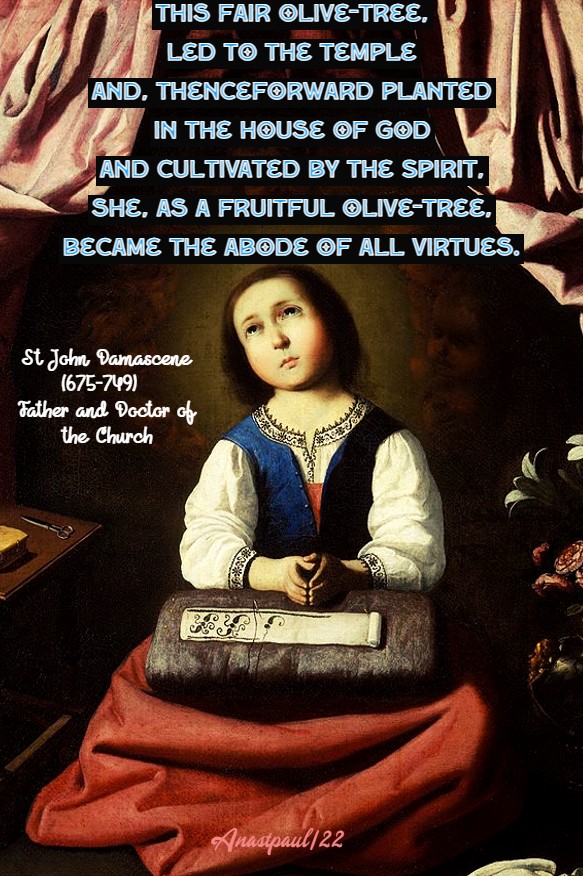
“This fair olive-tree, led to the temple and, thenceforward planted in the House of God and cultivated by the Spirit, she, as a fruitful olive-tree, became the abode of all virtues.”
St John Damascene (675-749) Father and Doctor of the Church
“Truly, we are passing through disastrous times, when we may well make our own, the lamentation of the Prophet: “There is no truth and there is no mercy and there is no knowledge of God in the land” (Hosea 4:1). Yet, in the midst of this tide of evil, the Virgin Most Merciful rises before our eyes, like a rainbow, as the arbiter of peace between God and man.”
St Pius X (1835-1914)
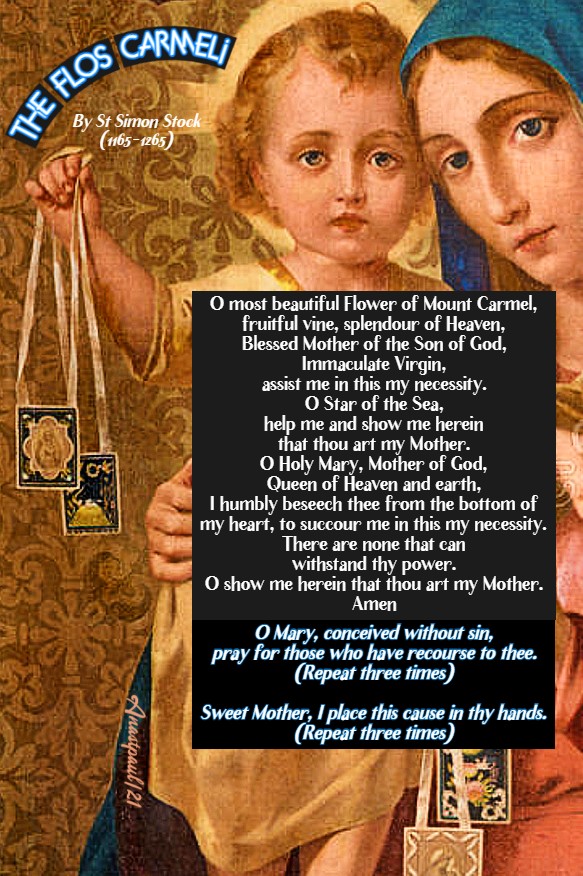
“The Flos Carmeli The Flower of Carmel” By St Simon Stock (1165-1265)
O most beautiful Flower of Mount Carmel, fruitful vine, splendour of Heaven, Blessed Mother of the Son of God, Immaculate Virgin, assist me in this my necessity. O Star of the Sea, help me and show me herein that thou art my Mother. O Holy Mary, Mother of God, Queen of Heaven and earth, I humbly beseech thee from the bottom of my heart, to succour me in this my necessity. There are none that can withstand thy power. O show me herein, that thou art my Mother. Amen.
O Mary, conceived without sin, pray for those who have recourse to thee. (Repeat three times)
Sweet Mother, I place this cause in thy hands. (Repeat three times)
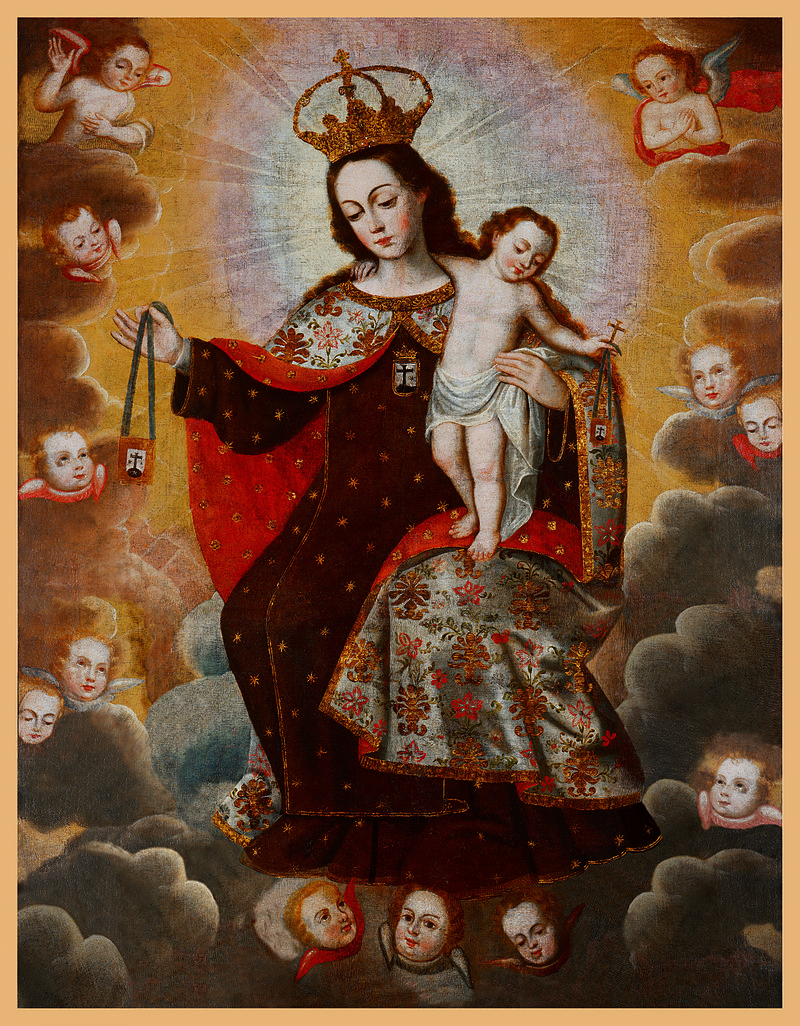
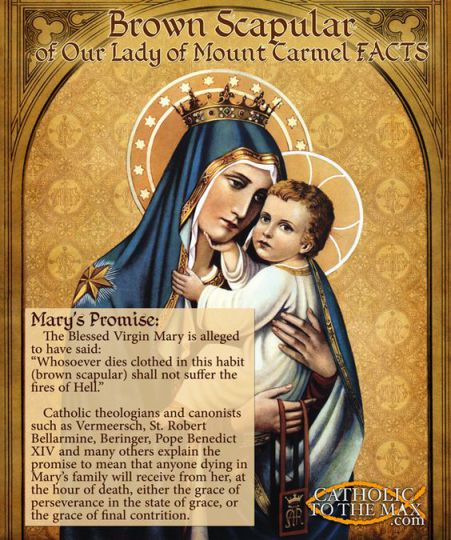
This prayer, the “Flos Carmeli” (“The Flower of Carmel”), was composed by St Simon Stock (1165-1265), a Carmelite, so-called because he and other members of his order lived atop Mount Carmel in the Holy Land. St Simon Stock was visited by the Blessed Virgin Mary on 16 July 1251, at which time, she bestowed upon him a scapular, or habit, (commonly called “the Brown Scapular”), which became part of the liturgical clothing of the Carmelite order Oral tradition tells of St Simon Stock praying, with a passionate intensity to Our Lady of Mount Carmel, during a time of great distress and hardship for the Order. With fervour and faith, he prayed his prayer, the Flos Carmeli for the first time. And Our Lady answered his prayer. Thus, for seven centuries the Flos Carmeli continues to be prayed to the Blessed Mother with the firm faith that she she will answer its request with her powerful help.
One Minute Reflection – 16 July – “The Month of the Most Precious Blood of Jesus” – Our Lady of Mount Carmel – Pentecost VII – Romans 6:19-23, Matthew 7:15-21 – Scripture search here: https://www.drbo.org/
“By their fruits you will know them. Do men gather grapes from thorns, or figs from thistles?”- Matthew 7:16
REFLECTION – “It does not seem to me that “false prophets” here refers to the heretics but rather to persons who live morally corrupt lives, while wearing a mask of virtue. They are usually called ‘frauds’ by most people. For this reason, Jesus continued by saying, “By their fruits you will know them.” For it is possible to find some virtuous persons, living among heretics. But among the corrupted of whom I speak, it is in not possible. “So what difference does it make,” Jesus says in effect, “if even among these false prophets some do put on a hypocritical show of virtue? Certainly, they will soon be detected.”
The nature of this road upon which He commanded us to walk, is toilsome and hard. The hypocrite would seldom choose to toil but would prefer only to make a show. For this very reason, the hypocrite is easily detected. When Jesus notes that “there are few who find it,” He distinguishes these, from those who do not find the way, yet pretend to find it. So do not look to the mask but to the behavioural fruits, of those who pursue the narrow way.” – St John Chrysostom (347-407) Archbishop of Constantinople, Father and Doctor of the Church (The Gospel of Matthew Homily 23).
PRAYER – O God, Who honoured the Order of Carmel with the special title of the most blessed Mary, ever Virgin, Thy Mother, graciously grant, that we, who this day honour her commemoration with solemn rites, defended by her care, may be found worthy to attain everlasting happiness.Through the same Jesus Christ, Who lives and reigns with God the Father, in the unity of the Holy Spirit, God, world without end. Amen (Collect).
Our Morning Offering – 16 July – “The Month of the Most Precious Blood of Jesus” – Pentecost VII
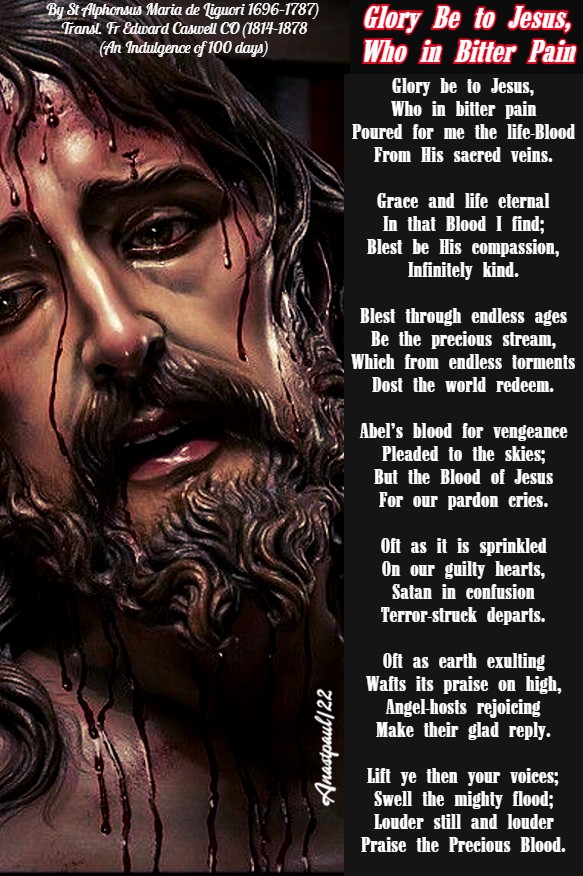
Glory Be to Jesus, Who in Bitter Pains By St Alphonsus Maria de Liguori 1696–1787) [Attrib] Transl. Fr Edward Caswell CO (1814-1878) (An Indulgence of 100 days)
Glory be to Jesus, Who in bitter pain Poured for me the life-Blood From His sacred veins.
Grace and life eternal In that Blood I find; Blest be His compassion, Infinitely kind.
Blest through endless ages Be the precious stream, Which from endless torments Dost the world redeem.
Abel’s blood for vengeance Pleaded to the skies; But the Blood of Jesus For our pardon cries.
Oft as it is sprinkled On our guilty hearts, Satan in confusion Terror-struck departs.
Oft as earth exulting Wafts its praise on high, Angel-hosts rejoicing Make their glad reply.
Lift ye then your voices; Swell the mighty flood; Louder still and louder Praise the Precious Blood.
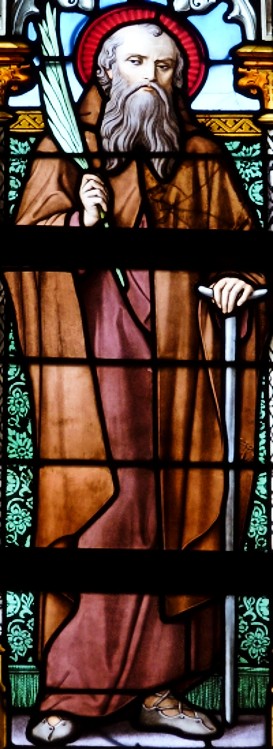
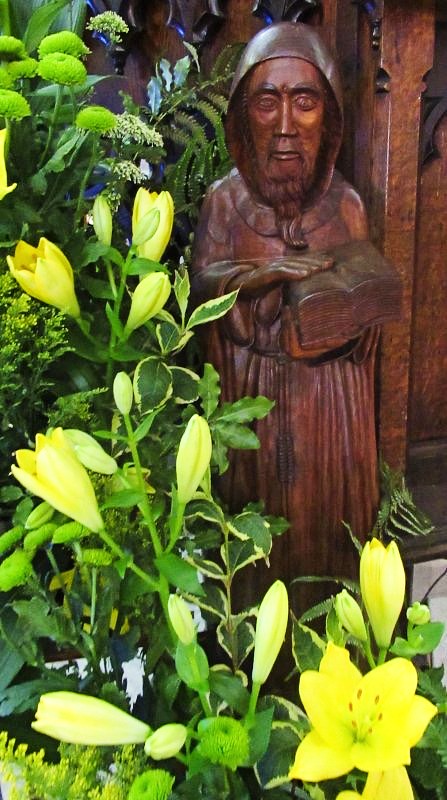
Saint of the Day – 16 July – St Helier of Jersey (Died c555) Martyr, Missionary from Belgium, Hermit, Ascetic, Miracle-worker. Born at Tongres, Belgium and died at Jersey in the Channel Islands. PATRONAGES – St Helier is the Patron Saint of Jersey and in particular of the Diocese and Capital City of Jersey, named for him – Saint Helier, he is invoked against and for the cure of EYE diseases and skin disorders, Also known as – Elerio, Elie, Helerous, Hielier, Helerius, Hélyi.
Helier was born to pagan parents in Tongeren (now in Belgium). His father was Sigebert, a nobleman from Tongres and his mother was Lusigard. Having had difficulties conceiving a child, they turned to a Christian teacher named St Cunibert, who advised them to pray to God and that when they had a child they must hand him over to God and that he, Cunibert, would bring him up in the Christian faith.
Their prayers having been answered, Helier was born but Helier’s father, the Frankish Governor of that place, eventually grew angry at the influence Cunibert exerted over his precocious son, who was already causing consternation with his youthful miracles. Helier’s father had Cunibert killed, whereupon Helier fled.
Helier’s wanderings led him to the coast of France where he sought retreat from the distractions of the world in the monastic community of Saint Marculf at Nantus (now St.-Marcouf-de-l’Isle in Manche).
Helier, however, found the monastic community did not provide the quiet he required to devote himself fully to a life of contemplation. St Marculf had received pleas from the few inhabitants of the island called Gersut, or Agna, now called Jersey, which was all but depopulated due to repeated attacks by Vikings. The inhabitants requested someone to help them and bring the Gospel to them as they had no shepherd to guide and care for their spiritual needs.
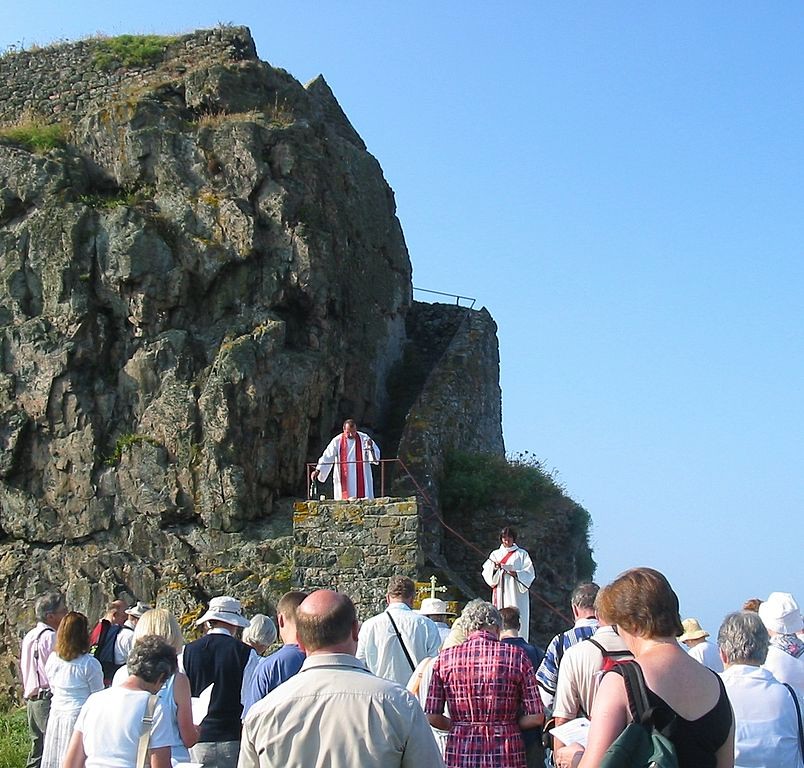
A medieval Chapel was constructed over ‘St Helier’s Bed’ the hollow in the rock whre Helier sheltered. The Hermitage rock is the focus of the annual pilgrimage
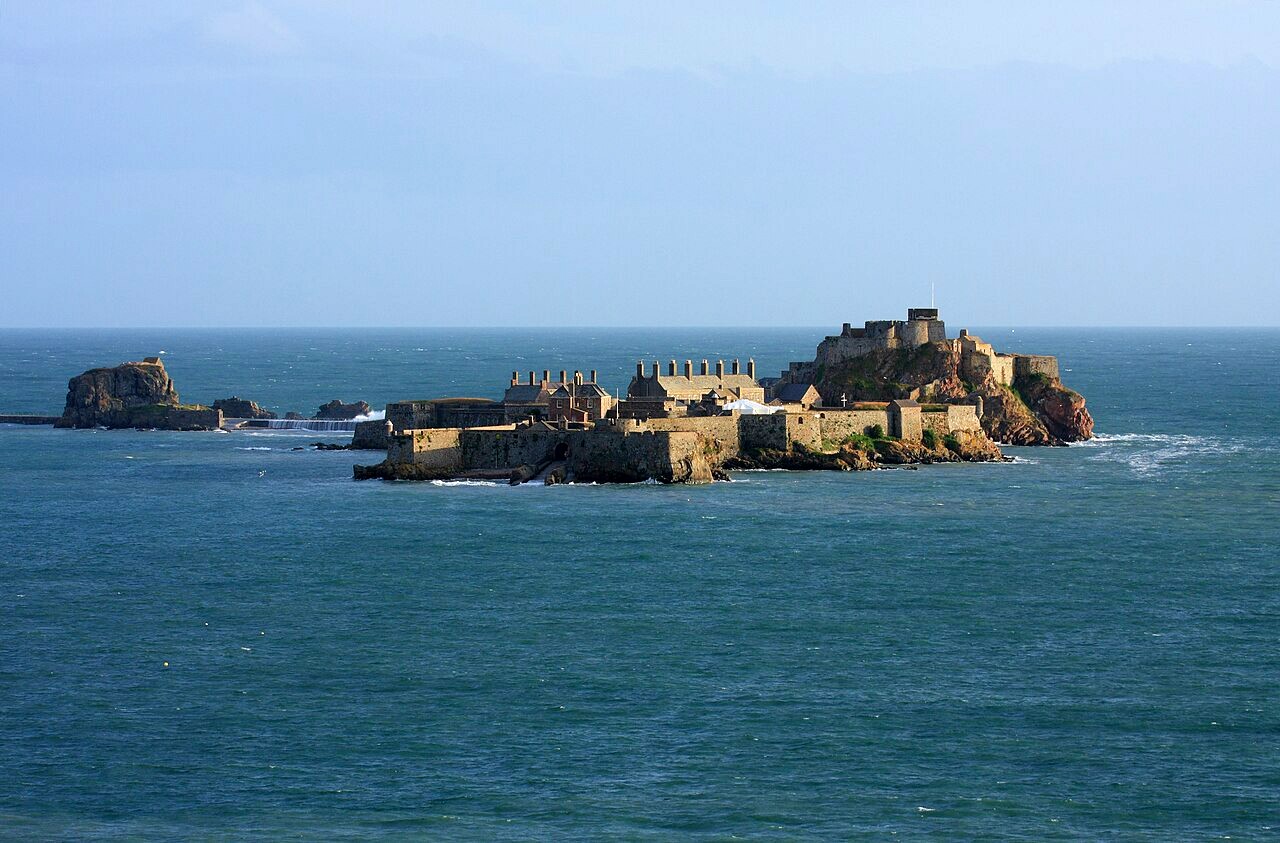
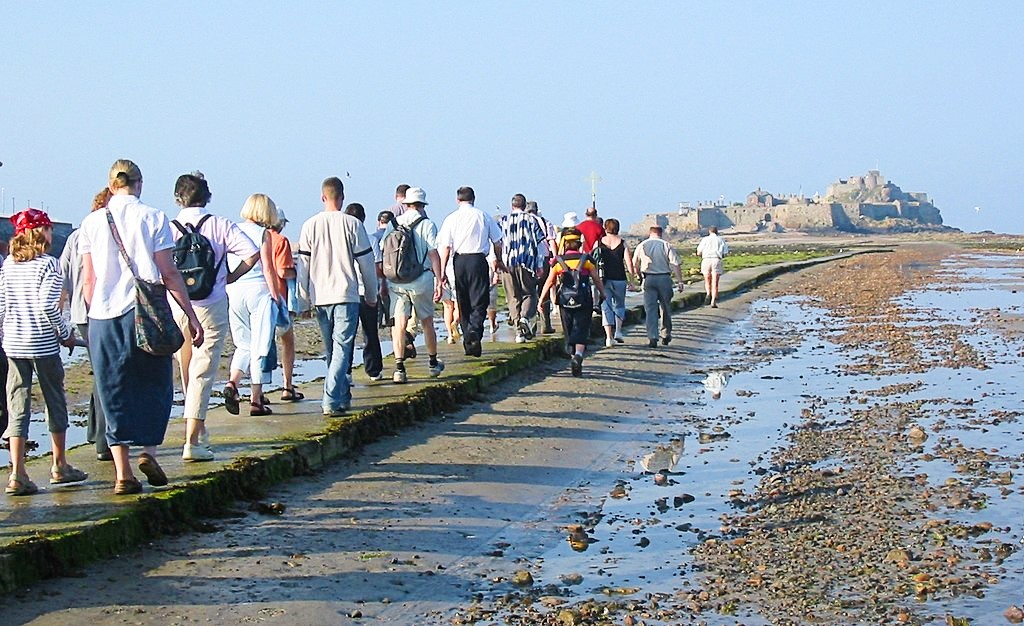
Marculf sent Helier and a companion, Saint Romard, to Jersey where he found a small community of fishermen on the sand dunes where the modern City of St Helier was to develop. Helier settled on a tidal islet, nowadays known as the Hermitage Rock, next to L’Islet,[ another tidal island now occupied by the 16th Century Elizabeth Castle. The Romard would travel back and forth between the hermitage on this rock and the fishing village.
The Elizabeth Castle
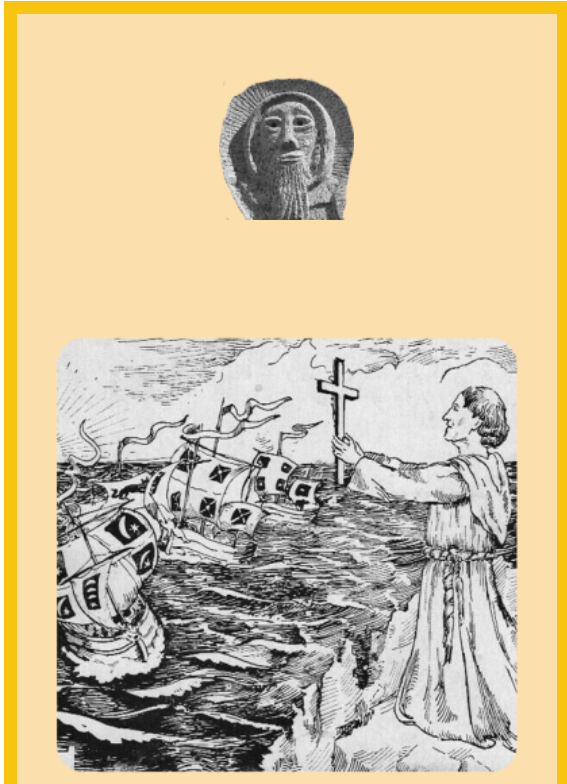
From the vantage point on his rock, Helier could see the sails of approaching attackers and would signal to the shore, whereupon the inhabitants would scatter into the surrounding marshes, thereby frustrating the attackers’ bloodlust. Small dark clouds on the horizon are still known in Jersey as the sails of St Helier.
Helier remained at his hermitage in fasting and prayer for about fifteen years. The belief is that around 555 he was Martyred by marauding pirates who beheaded him with an axe – hence the crossed axes on the parish crest.
Once while Marculf was visiting, a band of raiders arrived. The Holy men, Marculf, Helier and Romard, prayed atogether nd made the Sign of the Cross resulting in a great storm awhich suddenly arose and destroyed the raiders ships.
Although Helier’s fasting ensured that his body was of a very lean and weak statue, legend holds that he had the strength, when he was beheaded by attackers, to pick up his head and walk to shore. According to the hagiography, Romard discovered Helier’s body on the beach still clutching his head in his hands. He placed it in a boat and set off for the mainland. The boat, guided by the hand of God, arrived at Bréville-sur-Mer, where a miraculous Spring arose on the spot where Helier’s body had rested overnight. A Church was founded next to the Spring, which is now topped by a statue and still attracts those seeking a cure.
Marculf founded an Abbey on L’Islet not far from Helier’s Hermitage and named it for his pupil. It was later visited by St Samson of Dol.
Churches dedicated to Helier can be found in Rennes, St Helier, Beuzeville, Amécourt, Barentin (Seine-Maritime), Monhoudou (Sarthe). Evidence of veneration of the saint can be found in La Hague in the Cotentin at Querqueville and also at Omonville-la-Rogue where a 13th-Century mural in the Church of St John the Baptist links Helier with Thomas Becket.
St Helier’s Feast day, marked in Jersey by an annual municipal and Ecumenical Pilgrimage to the Hermitage on 16 July. The Hermitage is depicted on the Jersey 2 pence coin and on the 2010 issue of the Jersey £10 note.
In 2005, the tides necessitated an early morning start to the Pilgrimage.
St Andrew the Hermit St Antiochus of Sebaste Bl Arnold of Clairvaux Bl Arnold of Hildesheim St Athenogenes of Sebaste
St Bartholomew of Braga OP – ArchBishop of Braga also known as Bl Bartholomew of the Martyrs (Bartolomeu Fernandez dei Martiri Fernandes) (1514-1590) Portuguese Dominican Friar and Priest, Writer, Theologian, Advisor, Teacher and Catechetical writer, Apostle of Charity founding a series of hospitals and hospices in Braga and surrounds. St Bartholomew: https://anastpaul.com/2018/07/16/saint-of-the-day-16-july-blessed-bartholomew-of-the-martyrs-1514-1590/
St Generosus of Poitou St Gobbán Beg St Gondulf of Tongeren-Maastricht St Gondolf of Saintes St Grimoald of Saintes St Helier of Jersey (Died c555) Martyr, Hermit Bl Irmengard St Landericus of Séez Bl Madeleine-Françoise de Justamond Bl Marguerite-Rose de Gordon Bl Marguerite-Thérèse Charensol Bl Marie-Anne Béguin-Royal Bl Marie-Anne Doux
St Marie-Madeline Postel (1756-1846) Religious Sister and Founder of the Sisters of Christian Schools of which she is the Patron, Teacher, Franciscan tertiary. Pope Pius X later signified on 22 January 1908 his approval to two investigated miracles attributed to her intercession and so Beatified her on 17 May 1908. Pope Pius XI confirmed two additional miracles and Canonised Blessed Marie-Madeline on 24 May 1925. Her Life: https://anastpaul.com/2019/07/16/saint-of-the-day-16-july-st-marie-madeline-postel-
Bl Marie-Rose Laye Bl Milon of Thérouanne St Monulphus of Tongeren-Maastricht Bl Ornandus of Vicogne
Martyrs of Antioch – 5 Saints: Five Christians who were Martyred together. No details about them have survived by the names – Dionysius, Eustasius, Maximus, Theodosius and Theodulus. They were Martyred in Antioch, Syria, date unknown.
Thought for the Day – 15 July – Meditations with Antonio Cardinal Bacci (1881-1971)
The Voice of God
“It will go hard with the man who refuses to listen to God. He has reason to be afraid when he lets God’s inspirations and graces pass him by. Anyone who is deaf to God’s appeals, cannot be saved.
God spoke many times in the heart of His Apostle Judas but, he did not listen. Even in the Garden of Gethsemane. when Judas betrayed his Master with a kiss, Jesus spoke to him and called him His friend, giving him the kiss of peace and forgiveness. But, the traitor spurned this last appeal and went his way.
May this never be our fate. “Be not silent” let us plead, “Lord be not far from me!” (Ps 34:22). Above all, let us listen obediently to His Voice from whatever source it comes and let us do what He advises us.”
Quote/s of the Day – 15 July – Ecclesiasticus 31:8-11, Luke 12:35-40 – Scripture search here: https://www.drbo.org/
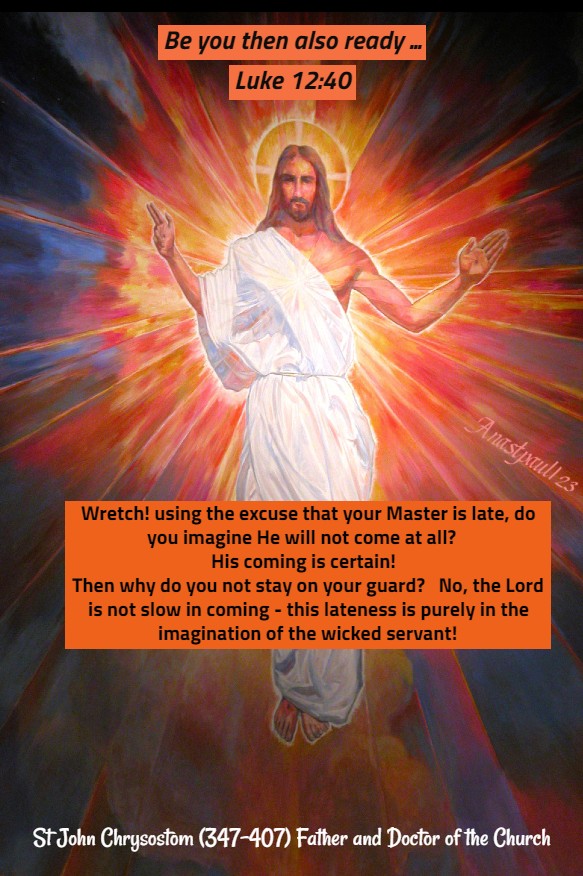
“Be you then also ready …” Luke 12:40
“Wretch! using the excuse that your Master is late, do you imagine He will not come at all? His coming is certain! Then why do you not stay on your guard? No, the Lord is not slow in coming – this lateness is purely in the imagination of the wicked servant!”
St John Chrysostom (347-407) Father and Doctor of the Church
“It is time now for us to rise from sleep!”
St Benedict (c 480-547)
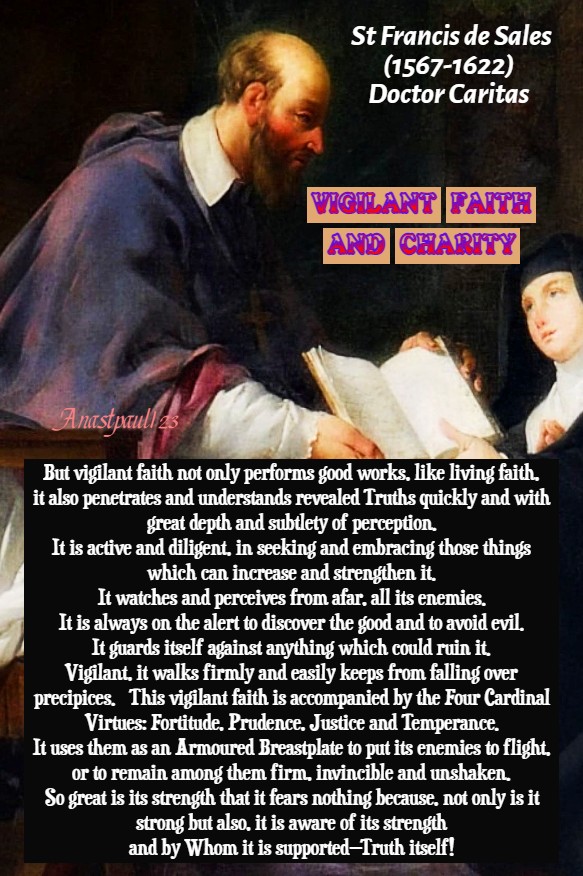
“But vigilant faith not only performs good works, like living faith, it also penetrates and understands revealed Truths quickly and with great depth and subtlety of perception. It is active and diligent, in seeking and embracing those things which can increase and strengthen it. It watches and perceives from afar, all its enemies. It is always on the alert to discover the good and to avoid evil. It guards itself against anything which could ruin it. Vigilant, it walks firmly and easily keeps from falling over precipices.
This vigilant faith is accompanied by the Four Cardinal Virtues: Fortitude, Prudence, Justice and Temperance. It uses them as an Armoured Breastplate to put its enemies to flight, or to remain among them firm, invincible and unshaken. So great is its strength that it fears nothing because, not only is it strong but also, it is aware of its strength and by Whom it is supported —Truth itself!””
One Minute Reflection – 15 July – “The Month of the Most Precious Blood of Jesus” – St Henry II (972-1024) Confessor, Holy Roman Emperor. – Ecclesiasticus 31:8-11, Luke 12:35-40 – Scripture search here: https://www.drbo.org/
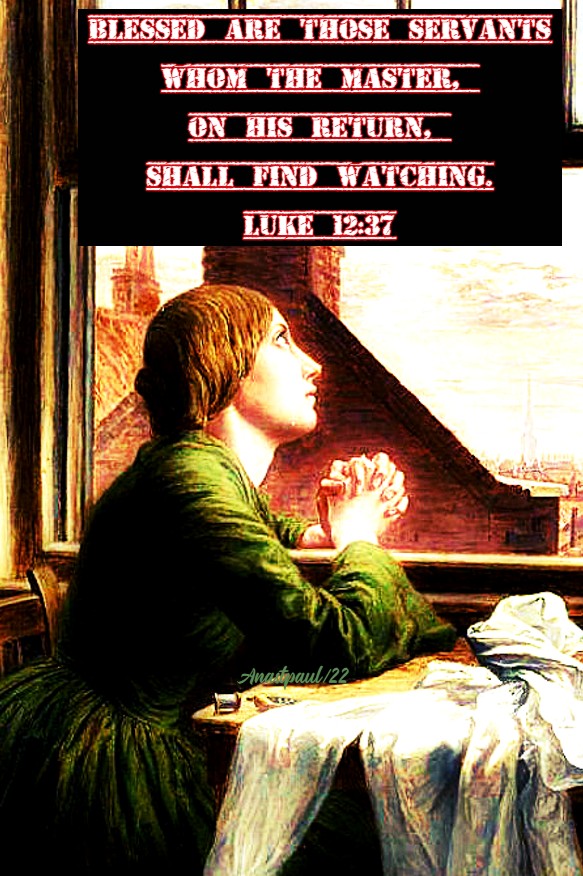
“Blessed are those servants, whom the Master, on His return, shall find watching.” – Luke 12:37
REFLECTION – “How blessed, how happy are those servants, “whom the lord when He comes shall find watching!” (Lk 12:37) Blessed watch, in which they watch for God the Creator of the universe, who fills all things and surpasses all!
Would that myself too, wretched though I be, yet His poor servant, He might deign so to arouse from the sleep of idleness, so to kindle with that fire of Divine Love that the flame of His Love, the longing of His so great Charity, would mount above the stars and the Divine Fire would ever burn within me!
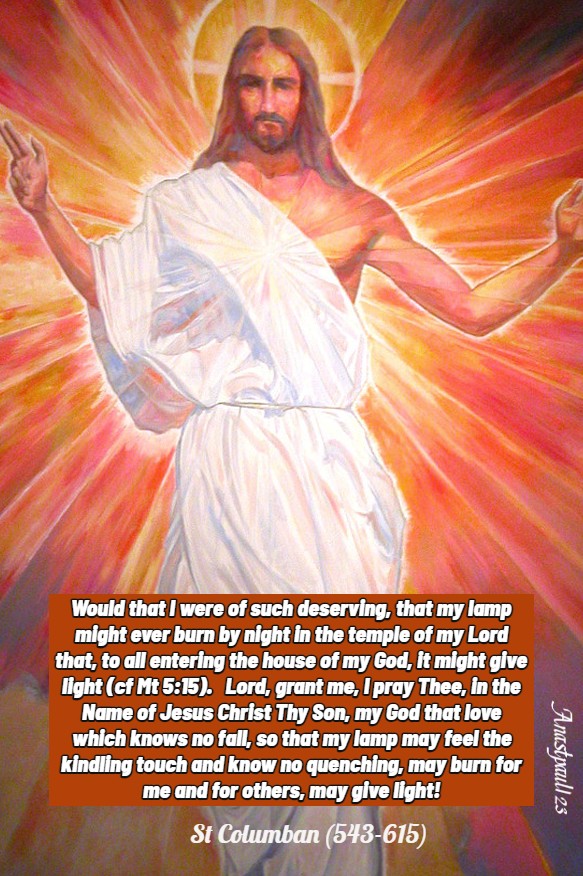
Would that I were of such deserving, that my lamp might ever burn by night in the temple of my Lord that, to all entering the house of my God, it might give light (cf Mt 5:15). Lord, grant me, I pray Thee, in the Name of Jesus Christ Thy Son, my God that love which knows no fall, so that my lamp may feel the kindling touch and know no quenching, may burn for me and for others, may give light!” – St Columban (543-615) Monk, Irish Missionary, Abbot, Writer, Reformer, Teacher, Miracle-worker, Founder of numerous Monateries in present-day France and Italy. (Spiritual Instructions No 12:2)
PRAYER – O God, Who on this day took Henry, Thy Confessor, to the everlasting Kingdom from the throne of an earthly empire; we humbly beseech Thee, that as Thou enabled him, protected by the abundance of Thy grace, to overcome the temptations of the world, so grant that we, in emulation of him, may shun the allurements of this world and come to Thee with pure hearts.Through Jesus Christ, Thy Son our Lord, Who lives and reigns with Thee, in the unity of the Holy Ghost, God, world without end. Amen (Collect).
Our Morning Offering – 15 July – “The Month of the Most Precious Blood of Jesus” and Mary’s Day
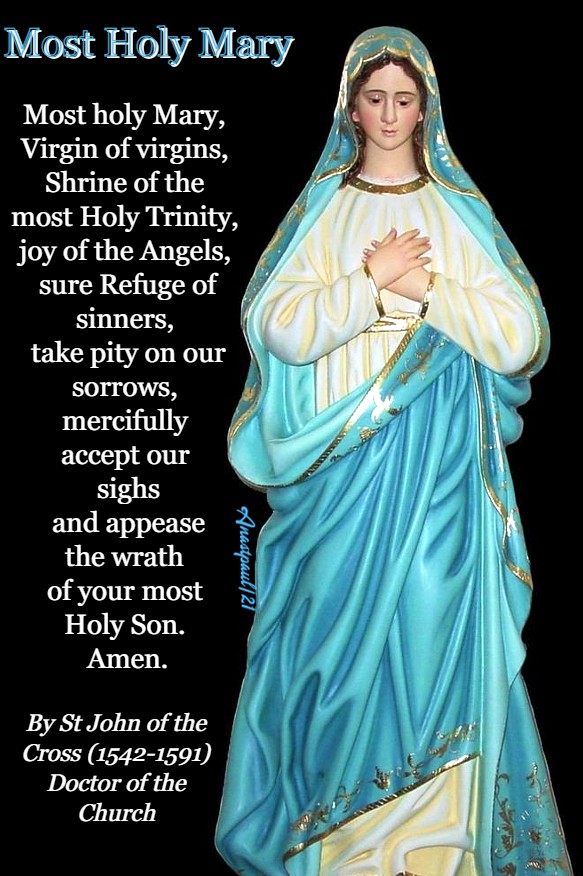
Most Holy Mary By St John of the Cross (1542-1591) Doctor of the Church
Most holy Mary, Virgin of virgins, Shrine of the most Holy Trinity, joy of the Angels, sure Refuge of sinners, take pity on our sorrows, mercifully accept our sighs and appease the wrath of your most holy Son. Amen.
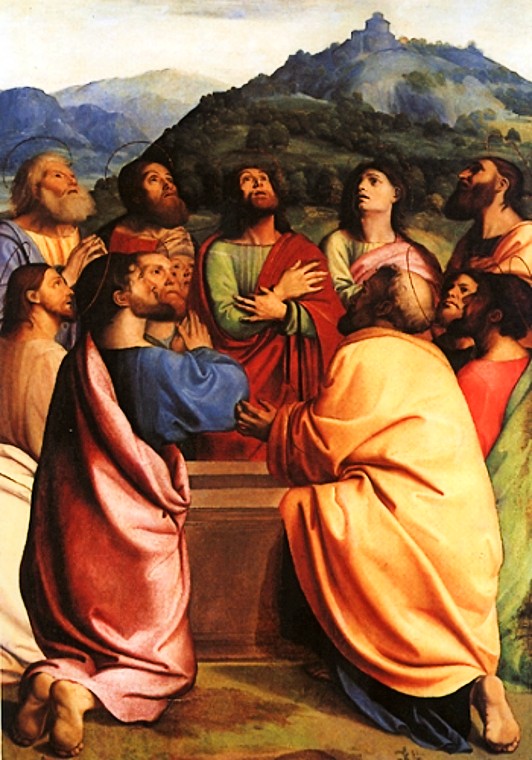
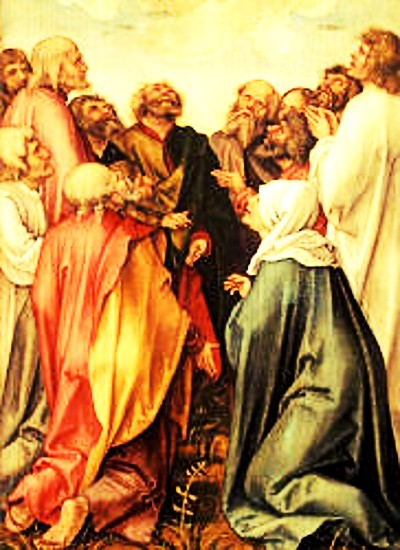
Saint or Feast of the Day – 15 July – The Feast of the the “Divisio Apostolorum – the Division of the Apostles” also known as (‘Dispersion’) a Feast which was very popular in the Middle Ages and continued into the Tridentine period on many local calendars but was never on the General Calendar. It is the Liturgical commemoration of an ancient tradition that some time after the Ascension, the Apostles cast lots for which part of the world each one of them would go, spreading out from Jerusalem. to preach the Gospel to all the ends of the earth.
The Common Office of the Apostles refers to this idea repeatedly, as, for example, in the first Antiphon of Matins, taken from Psalm 18. “Their sound hath gone forth into all the earth and their words unto the ends of the world” and, likewise, the third Antiphon from Psalm 44, “Thou shalt make them princes over all the earth; they shall remember Thy Name, O Lord.” …
The earliest reference to this Feast is a sequence which was well-known and widely used in the Middle Ages, written by one Godeschalk, a Monk of Limburg Abbey in Western Germany, who died in 1098.
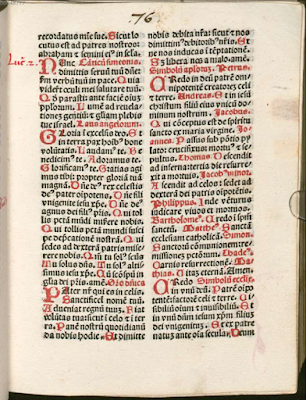
There is a tradition known from the 4th Century, which declares that the Baptismal Creed, now called the Apostles’ Creed, was composed as a rule of the Faith by the Twelve before this dispersal, with each one of them contributing an one of the Aarticles of our Faith. … It is seen here in a Carthusian Breviary c1490, (starting near the top of the right column), in which the name of an Apostle is printed in red before each Article of the Creed.
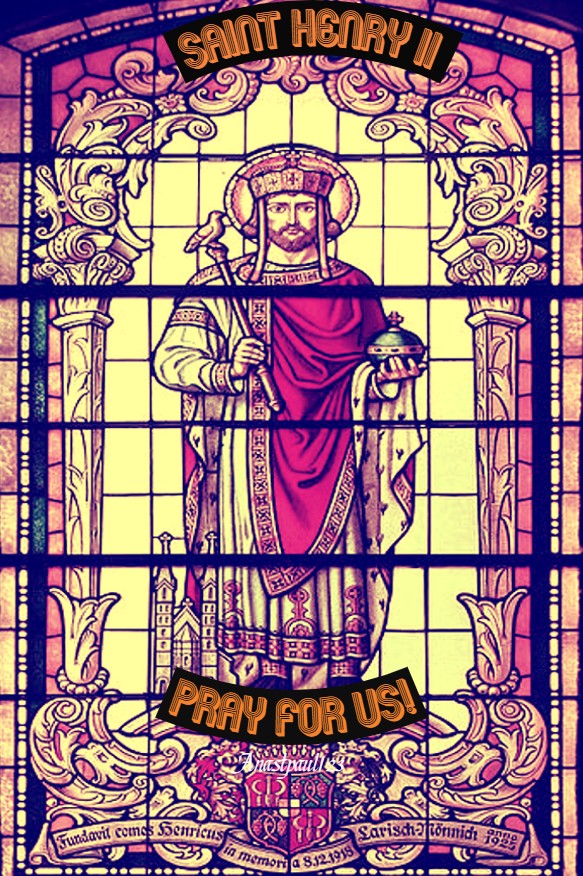
St Henry II (972-1024) Holy Roman Emperor. Henry was well known for his Missionary spirit and for his protection of the Pope in times of trouble. Henry ruled with a spirit of great humility and always sought to give the glory to God. He used his position to promote the work of the Church and the peace and happiness of the people. Another Saints whose Feast was moved in 1969 from today, 15 July to 13 July. Biography: https://anastpaul.wordpress.com/2017/07/13/saint-of-the-day-13-july-st-henry-ii-holy-roman-emperor/
Divisio Apostolorum / Division of the Apostles: Commemorates the missionary work of the Twelve Apostles. It was first mentioned in the 11th Century and was celebrated in the northern countries of Europe during the Middle Ages. It is now observed in Germany, Poland and some Diocese of England, France and the United States.
St Abundantia of Spoleto St Abudemius of Bozcaada St Adalard the Younger
Blessed Anne-Mary Javouhey (1779-1851) “The Mother of the Slaves,” Religious Sister, Missionary and Founder of the Sisters of Saint Joseph of Cluny. Imagine a Mother Teresa in the France of Napoleon’s day and you will have a picture of Anne-Marie Javouhey. Nanette, as she was called, was a “velvet brick,” a thin layer of gentleness covering her determined core. A competent leader, Nanette dominated every scene in her adventurous life. Blessed Anne-Marie was Beatified on 15 October 1950 by Pope Pius XII. Biography: https://anastpaul.com/2019/07/15/saint-of-the-day-15-july-blessed-anne-mary-javouhey-1779-1851/
St Apronia
St Athanasius of Naples (c 830-c 872) Confessor, Bishop of Naples from 849 until his death, Papal Legate, Reformer and restoring of Monasteries, he built a Hospice for pilgrims and a new Monastery, a man of austerity and prayer. This Athanasius should not be confused with his nephew, Athanasius II, also the Bishop of Naples. About this St Athanasius, a Patron of Naples among +70 Patrons: https://anastpaul.com/2022/07/15/saint-of-the-day-15-july-st-athanasius-of-naples-c-830-c-872/
St Antiochus of Sebaste St Benedict of Angers
Blessed Bernard of Baden TOSF (1428-1458) Margrave of Baden, Germany (Margrave was originally the medieval title for the military commander assigned to maintain the defence of one of the border provinces of the Holy Roman Empire.) Tertiary of the Order of St Francis, Apostle of the poor and the needy. Bernard was Beatified on 16 September 1769 by Pope Clement XIV. His Canonisation process continues, at present, the second miracle required is being investigated. Blessed Bernard’s Life: https://anastpaul.com/2021/07/15/saint-of-the-day-15-july-blessed-bernard-of-baden-tosf-1428-1458/
Bl Ceslas Odrowaz St David of Sweden St Donivald St Eberhard of Luzy St Edith of Tamworth St Eternus St Felix of Pavia St Gumbert of Ansbach St Haruch of Werden St Jacob of Nisibis St Joseph Studita of Thessalonica Bl Peter Aymillo St Plechelm of Guelderland Bl Roland of Chézery St Valentina of Nevers St Vladimir I of Kiev
Martyred Jesuit Missionaries of Brazil – 40 Beati: A band of forty Spanish, Portugese and French Jesuit Missionaries Martyred by the Huguenot pirate Jacques Sourie while en route to Brazil. They are – Aleixo Delgado • Alonso de Baena • álvaro Borralho Mendes • Amaro Vaz • André Gonçalves • António Correia • Antônio Fernandes • António Soares • Bento de Castro • Brás Ribeiro • Diogo de Andrade • Diogo Pires Mimoso • Domingos Fernandes • Esteban Zuraire • Fernando Sánchez • Francisco Alvares • Francisco de Magalhães • Francisco Pérez Godoy • Gaspar Alvares • Gonçalo Henriques • Gregorio Escribano • Ignatius de Azevedo • Iõao • João Fernandes • João Fernandes • Juan de Mayorga • Juan de San Martín • Juan de Zafra • Luís Correia • Luís Rodrigues • Manuel Alvares • Manuel Fernandes • Manuel Pacheco • Manuel Rodrigues • Marcos Caldeira • Nicolau Dinis • Pedro de Fontoura • Pedro Nunes • Simão da Costa • Simão Lopes • They were Martyed on 15 and 16 July 1570 on the ship Santiago near Palma, Canary Islands. They were Beatified on 11 May 1854 by Pope Pius IX.
Martyrs of Alexandria – 13 Saints: Thirteen Christians who were Martyred together. We know the names of three, no details about them and the other ten were all children. – Narseus, Philip and Zeno. Martyred in the early 4th-century in Alexandria, Egypt.
Martyrs of Carthage – 9 Saints: A group of nine Christians who were Martyred together. We know nothing else but their names – Adautto, Catulinus, Felice, Florentius, Fortunanziano, Januarius, Julia, Justa and Settimino. They were Martyred in Carthaginian and their relics at the Basilica of Fausta at Carthage.
Martyrs of Pannonia – 5 Saints: Five 4th-century Martyrs killed together. No information about them has survived except the names – Agrippinus, Fortunatus, Martialis, Maximus and Secundinus.
Thought for the Day – 14 July – Meditations with Antonio Cardinal Bacci (1881-1971)
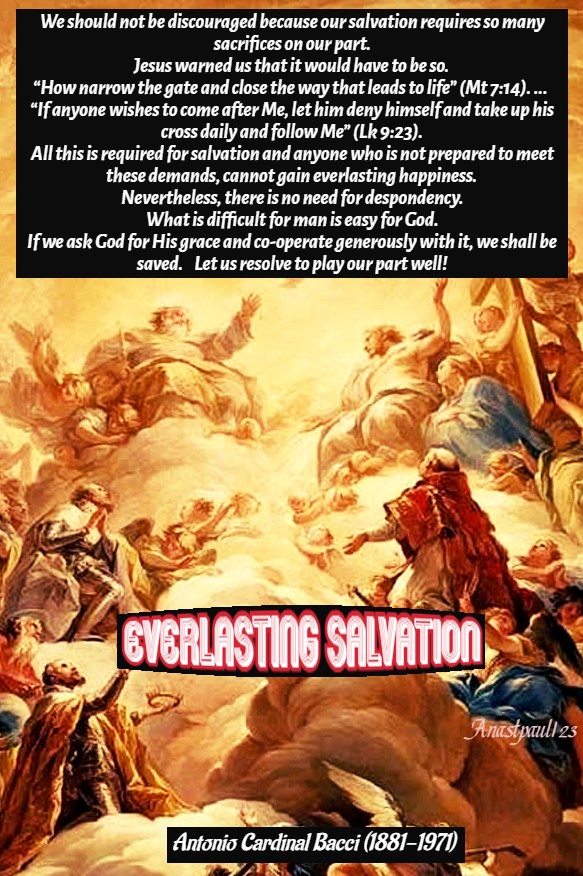
Everlasting Salvation
“We should not be discouraged because our salvation requires so many sacrifices on our part. Jesus warned us that it would have to be so. “How narrow the gate and close the way that leads to life” (Mt 7:14). “The Kingdom of Heaven has been enduring violent assault and, the violent have been seizing it by force” (Mt 11:12). “If anyone wishes to come after Me, let him deny himself and take up his cross daily and follow Me” (Lk 9:23).
All this is required for salvation and anyone who is not prepared to meet these demands, cannot gain everlasting happiness. Nevertheless, there is no need for despondency. What is difficult for man is easy for God. If we ask God for His grace and co-operate generously with it, we shall be saved.





























 AnaStpaul
You must be logged in to post a comment.