Thought for the Day – 18 December – Meditations with Antonio Cardinal Bacci (1881-1971)
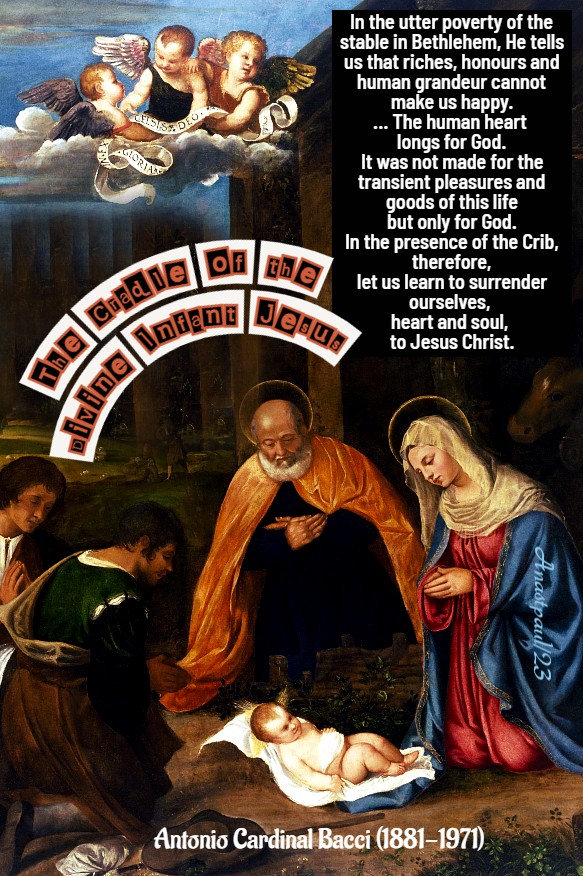
A Christmas Novena III The Cradle of the Divine Infant Jesus
“Blessed are the poor in spirit,” said Jesus Christ, “for theirs is the Kingdom of Heaven” (Mt 5:3), Before He spoke these words, however, He had taught us the same thing in deed.
In the utter poverty of the stable in Bethlehem, He tells us that riches, honours and human grandeur cannot make us happy. We are entitled to accept these things, if Providence bestows them upon us but, we should not become attached to them. The human heart longs for God. It was not made for the transient pleasures and goods of this life but only for God. In the presence of the Crib, therefore, let us learn to surrender ourselves, heart and soul, to Jesus Christ.
Quote/s of the Day – 18 December – “The Month of the Divine Infancy and the Immaculate Conceptio of the Blessed Virgin Mary” – Monday of the Third Week of Advent – Ferial Day – Philippians 4:4-7; John 1:19-28 – Scripture search here: https://www.drbo.org/
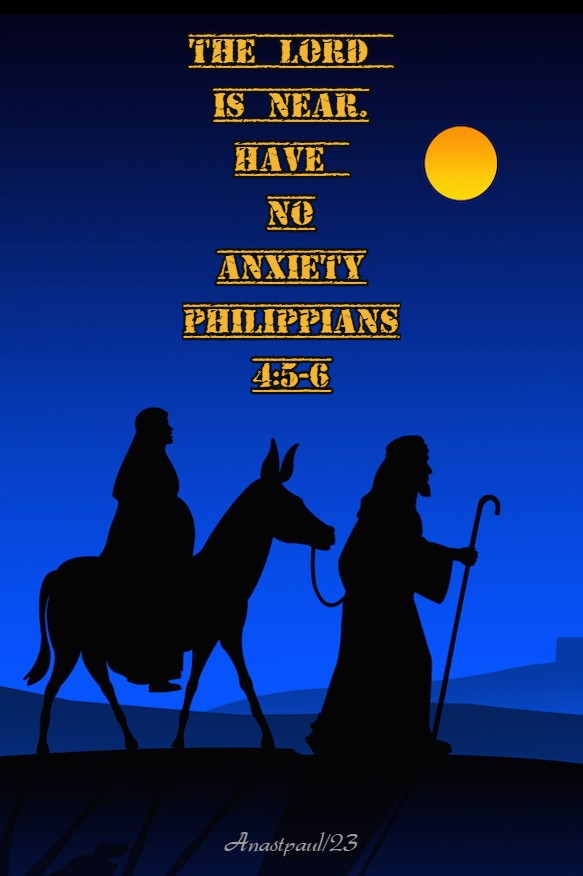
“The Lord is near. Have no anxiety …”
Philippians 4:5-6
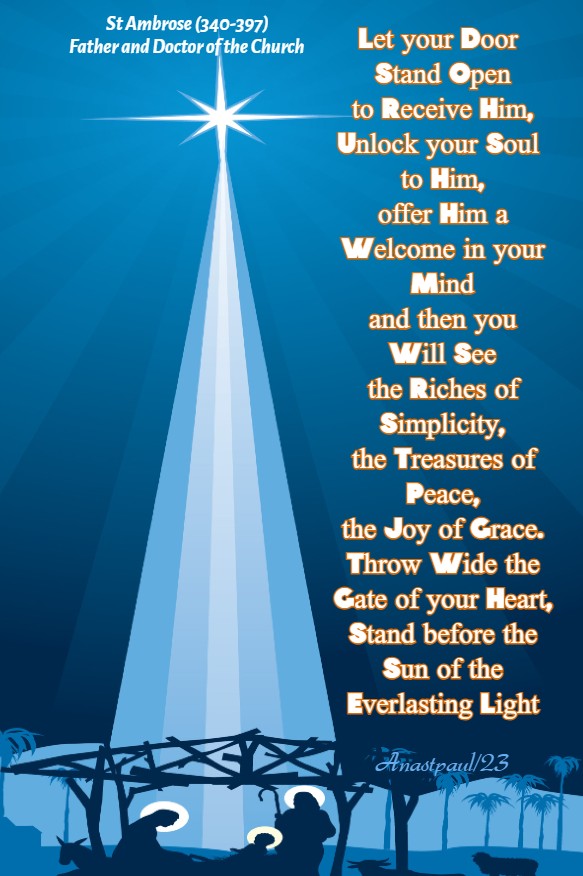
“Let your door stand open to receive Him, unlock your soul to Him, offer Him a welcome in your mind and then you will see the riches of simplicity, the treasures of peace, the joy of grace. Throw wide the gate of your heart, stand before the Sun of the Everlasting Light!”
St Ambrose (340-397) Father and Doctor of the Church
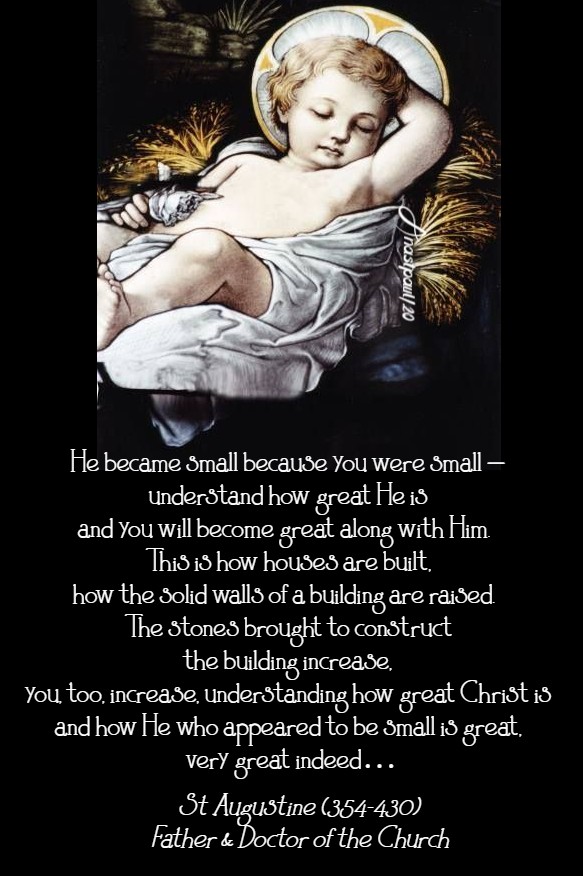
“He became small because you were small – understand how great He is and you will become great along with Him. This is how houses are built, how the solid walls of a building are raised. The stones brought to construct the building increase, you, too, increase, understanding how great Christ is and how He, Who appeared to be small, is great, very great indeed…”
St Augustine (354-430) Father & Doctor of the Church
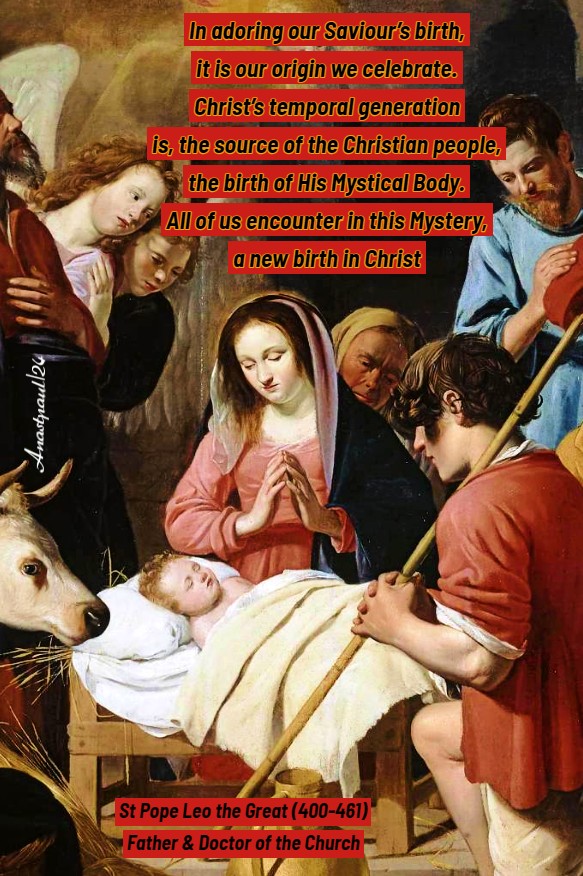
“In adoring our Saviour’s birth, it is our origin we celebrate. Christ’s temporal generation is the source of the Christian people, the birth of His Mystical Body. All of us encounter in this Mystery, a new birth in Christ.”
St Pope Leo the Great (400-461) Father & Doctor of the Church
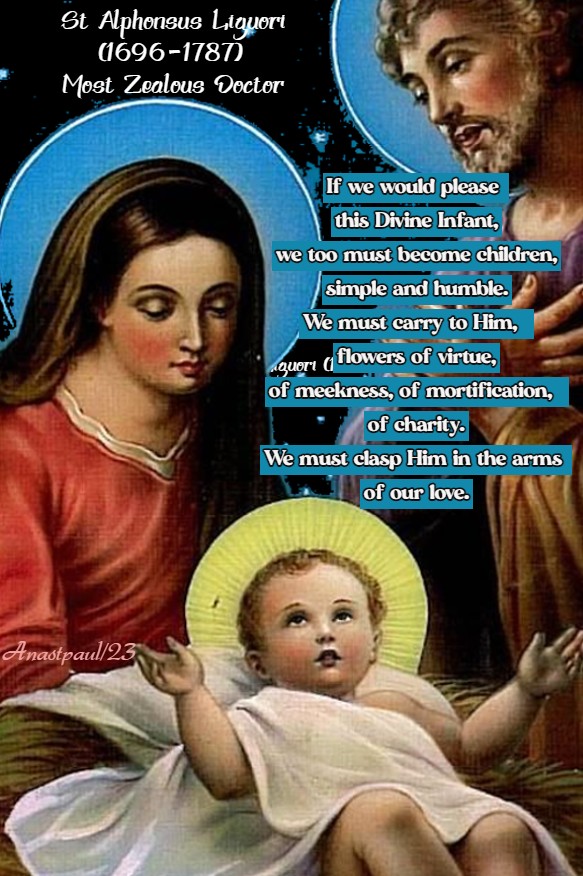
“If we would please this Divine Infant, we too must become children, simple and humble. We must carry to Him, flowers of virtue, of meekness, of mortification, of charity. We must clasp Him in the arms of our love.”
St Alphonsus Liguori (1696-1787) Most Zealous Doctor
One Minute Reflection – 18 December – “The Month of the Divine Infancy and the Immaculate Conception of the Blessed Virgin Mary” – Monday of the Third Week of Advent and the Feast of Our Lady of Expectation – Ferial Day – Philippians 4:4-7; John 1:19-28 – Scripture search here: https://www.drbo.org/
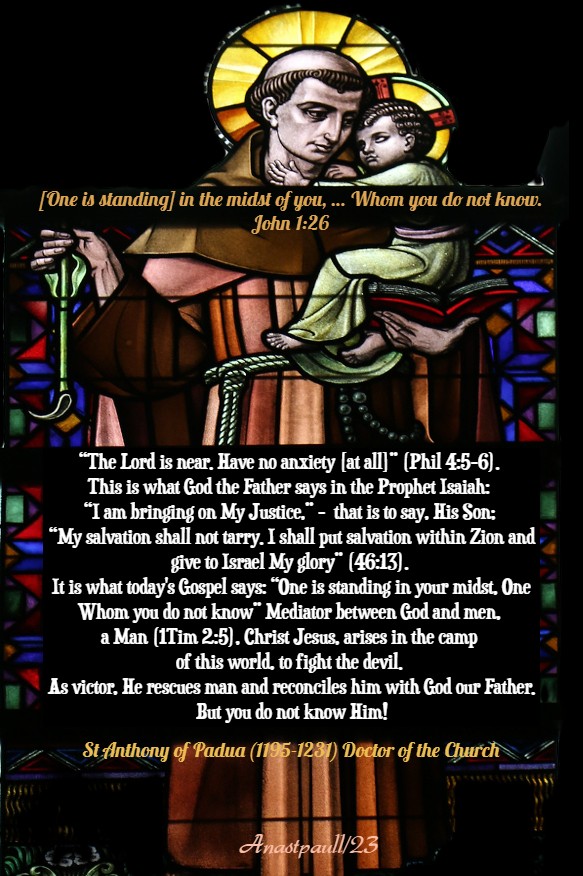
“[One is standing] in the midst of you, … Whom you do not know.” – John 1:26
REFLECTION – “The Lord is near.Have no anxiety [at all]” (Phil 4:5-6). This is what God the Father says in the Prophet Isaiah: “I am bringing on My Justice,” – that is to say, His Son; “My salvation shall not tarry. I shall put salvation within Zion and give to Israel My glory” (46:13). It is what today’s Gospel says: “One is standing in your midst, One Whom you do not know” Mediator between God and men, a Man (1Tim 2:5), Christ Jesus, arises in the camp of this world, to fight the devil. As victor, He rescues man and reconciles him with God our Father. But you do not know Him!
“Sons have I raised and reared but they have disowned Me. An ox knows its owner and an ass, its master’s manger. But Israel does not know Me and My people have not understood” (Is 1:2-3). How close the Lord is to us! And we do not know Him! “I have fed My children with My blood,” He says to us, “as a mother feeds her children with her milk. I have raised the human nature I have taken, to which I am united, above the Choirs of Angels.” Could He show us greater honour? “And they have rejected Me. See whether there is any sorrow like Mine” (Lam 1:12) …
So, then, “have no anxiety at all,” for it is anxiety concerning material things which makes us forget the Lord!” – St Anthony of Padua (1195-1231) Franciscan, Doctor of the Church (Sermons for Sundays and Feast days, 3rd Sunday of Advent).
PRAYER – O God, Who, by the message of an Angel, willed to take flesh in the womb of the Blessed Virgin Mary, grant that we, Thy suppliants, who believe her to be truly, the Mother of God, may be helped by her intercession with Thee. Through Jesus Christ, Thy Son our Lord, Who lives and reigns with Thee, in the unity of the Holy Ghost, God, world without end. Amen (Collect).
Our Morning Offering – 18 December – “The Month of the Divine Infancy and the Immaculate Conception of the Blessed Virgin Mary” – The Feast of Our Lady of Expectation
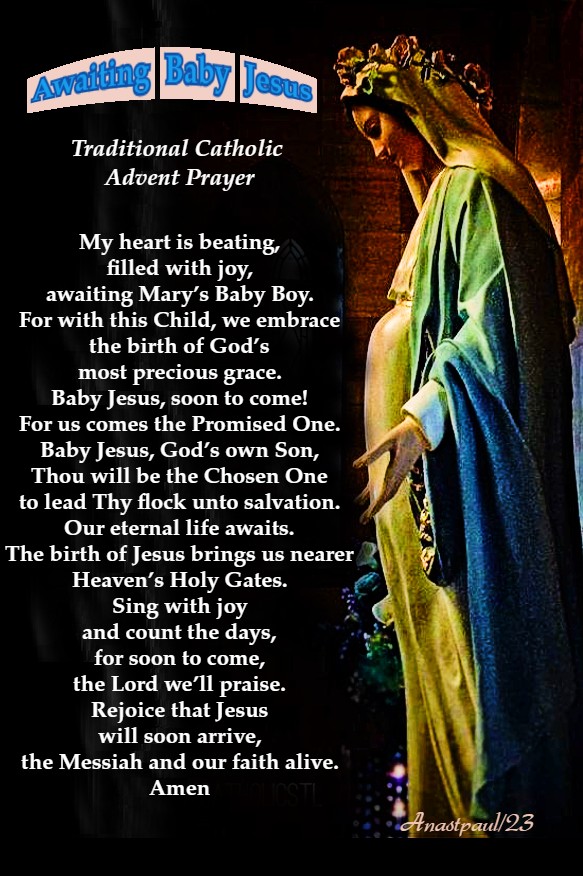
Awaiting Baby Jesus Traditional Catholic Advent Prayer
My heart is beating, filled with joy, awaiting Mary’s Baby Boy. For with this Child, we embrace the birth of God’s most precious grace. Baby Jesus, soon to come! For us comes the Promised One. Baby Jesus, God’s own Son, Thou will be the Chosen One to lead Thy flock unto salvation. Our eternal life awaits. The birth of Jesus brings us nearer Heaven’s Holy Gates. Sing with joy and count the days, for soon to come, the Lord we’ll praise. Rejoice that Jesus will soon arrive, the Messiah and our faith alive. Amen
Saint of the Day – 18 December – St Flavitus (Died 630) Priest, Hermit, Miracle-worker. Born in the mid-6th Century in Lombardy, Italy and died on 18 December 630 at Marcilly-le-Hayer, modern France. Also known as – Flavitus of Sens, Flaive, Flav, Flavy. Additional Memorial – 16 December on some Calendars.
The Relics of the Saint in the Church of the Assumption-of-the-Virgin of Villemaur-sur-Vanne.
Flavitus was captured in his home region of Lombardy in Italy and then sold as a slave by the victorious Franks to a rich lord, named, Montan, whose home was located at Marcilly-le-Hayer, in France. There, Flavitus guarded his master Montan’s herd of pigs in the forest of Othe.
Flavitus was falsely accused by the wife of this lord. But having cured Montan of illness and despite the hostility of those around him, his master;s gratitude served to free him from slavery.
Flavitus became a Hermit in the forest and soon attracted the goodwill of the population through his mortifications and holiness. His prayers drew a Spring from the ground and the miraculous waters drew the blind, the crippled, demonically possessed – all who brought their faith and infirmities, were healed. The Bishop of Sens, Saint Lupus, hearing of Flavitus great spiritual attraction and his many miracles Ordains him as a Priest.
He became a missionary apostle and miracle-worker of the region. He died in Marcilly-le-Hayer on 18 December 630, under the Episcopate of Ragnegisius(?), the 17th Bishop of Troyes.
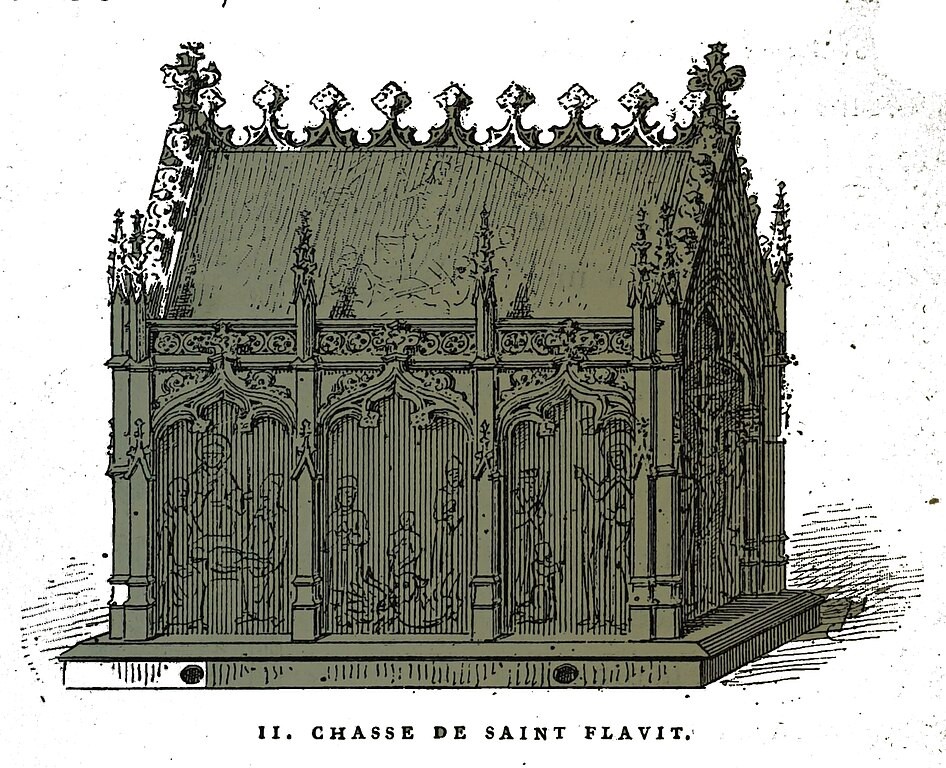
His Relics were shared between the Sainte-Colombe Abbey of Sens and the Saint-Flavit Priory of Villemaur-sur-Vanne which was destroyed in the 18th Century. The Treasury of the Cathedral of Sens preserves a Shrine of Saint Flavitus.
In 1807 a small Chapel was built on the site of his hermitage, very close to Marcilly-le-Hayer. The village of Saint-Flavy honours our Saint’s memory.
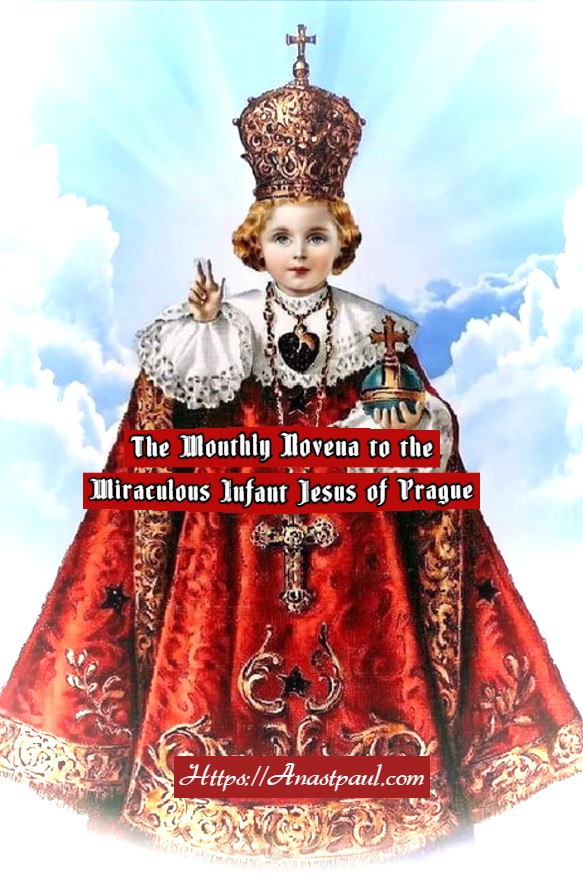
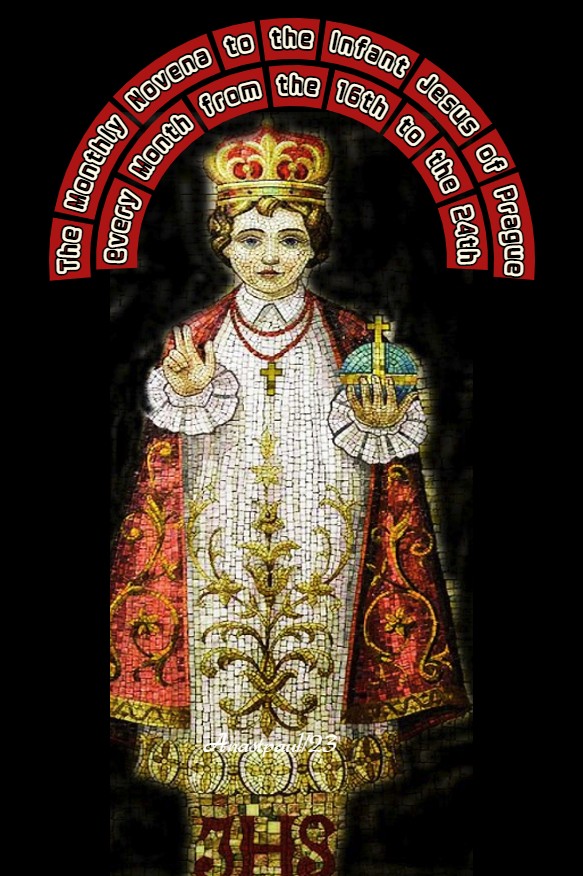
The Monthly Novena to the Infant of Prague – Day Three:
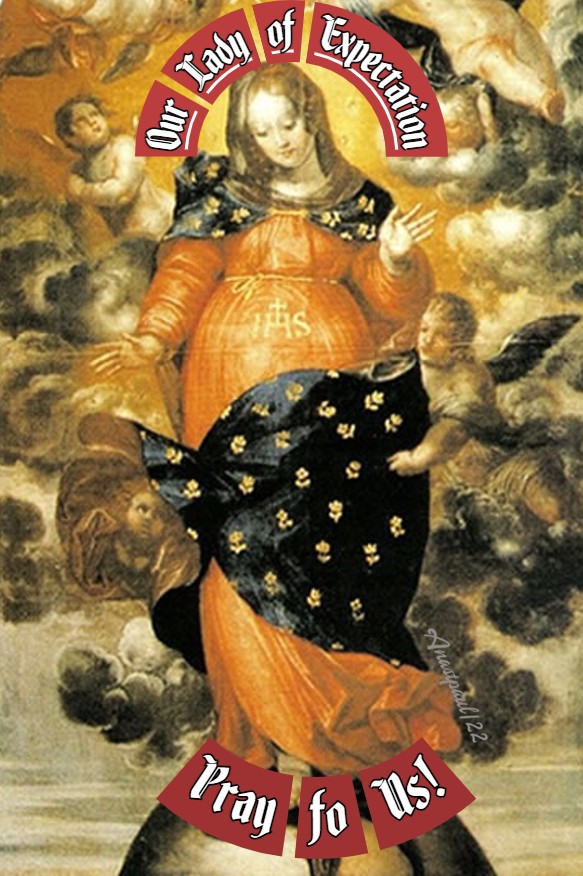
Our Lady of the Expectation – This Feast originated in Spain. When the Feast of the Annunciation (25 March) was transferred to 18 December because of the regulation forbidding Feasts in Lent, it remained on this date after the Annunciation was again celebrated on its original date. It impressed on the faithful, the sentiments of the Blessed Virgin as the time of her delivery approached. More about the Feast here: https://anastpaul.com/2018/12/18/the-feast-of-our-lady-of-expectation-18-december/
Mercedarians Redeemers – Also known as “Blessed Redentori.” A group of Mercedarian Friars who worked together, under the leadership of Saint Peter de Amer, to ransom prisoners and minister to them after. Blessed Bernardo de Pratis Blessed Giacomo de Lara Blessed Louis Gasco Blessed Peter de Quesada Blessed Peter of Barcelona Blessed William de Quadres
Martyrs of Northwest Africa – 42 Saints: Mercedarian Redeemers – 6 beati – These are a group of Mercedarian Friars who worked together, under the leadership of Saint Peter de Amer, to ransom (e.g., redeem) prisoners and minister to them after.
The Monthly Novena to the Miraculous Infant Jesus of Prague
There are two standard Novenas to the Infant Jesus of Prague – the one we will use below and the other for the Feast on 2 January. The Monthly Novena attracts Indulgences (see Note below).
“The more you honour Me, the more I will bless you.”
Sweet and merciful Infant Jesus, could we but relate all the wonders of Thy power and goodness! Bless at least these few pages written for Thy greater honour and glory! May they assist in making Thee better known and in instilling devotion to Thee in the hearts of all men!
The Infant’s Patronage is especially sought for: vocations, good health, financial issues, a holy family life, schools, the welfare of children, freedom and peace, the missions and safety in travel.
“Peaceful King, employ Thy graces and Thy charms to gain the love of men and through the sweetness of Thy Divine Infancy, establish throughout the world, Thy blissful reign.”
Nihil Obstat ij* Stephanus Schappler, OSB Abbas Coadjutor Im. Conceptionis
27th Edition, January 1956
THE NOVENA PRAYERS
Eternal Father, I offer to Thy honour and glory, for my own salvation and that of the whole world, the Mystery of the Birth of our Divine Saviour. Glory be to the Father, etc.
Eternal Father, I offer to Thy honour and glory and for my eternal salvation and that of the whole world, the sufferings of the most holy Virgin and of St Joseph, in that long and weary journey from Nazareth to Bethlehem. I offer Thee the sorrow of their hearts when they found no place wherein to shelter themselves, when the Saviour of the world was born. Glory be to the Father, etc.
Eternal Father, I offer to Thy honour and glory and for my eternal salvation and that of the whole world, the sufferings of Jesus in the stable where He was born, the cold He endured, the swaddling clothes which bound Him, the tears He shed and His tender Infant cries. Glory be to the Father, etc.
Eternal Father, I offer to Thy honour and glory and for my eternal salvation and that of the whole world, the pain which the Holy Child Jesus felt in His tender body, when He submitted to circumcision. I offer Thee that Precious Blood which then, for the first time He shed for the salvation of the whole humanrace. Glory be to the Father, etc.
Eternal Father, I offer to Thy honour and glory and for my eternal salvation and that of the whole world, the humility, mortification, patience, charity, all the virtues of the Child Jesus and I thank Thee and I love Thee and I bless Thee without end, for the ineffable Mystery of the Incarnation of the Divine Word. Glory be to the Father, etc.
The Word was made Flesh, And dwelt among us.
LET US PRAY O God, Whose Only-begotten Son was made manifest to us in the substance of our flesh, grant, we beseech Thee, that through Him, Whom we acknowledge to be like unto ourselves, our souls may be inwardly renewed. Who liveth and reigneth with Thee forever and ever. Amen.
7 years Indulgence each day, if the above prayers are recited on the 9 days preceding the 25th of any month. Plenary Indulgence under the usual conditions, when the Novena is completed. (125)
Thought for the Day – 17 December – Meditations with Antonio Cardinal Bacci (1881-1971)
A Christmas Novena II Preparation for the Nativity
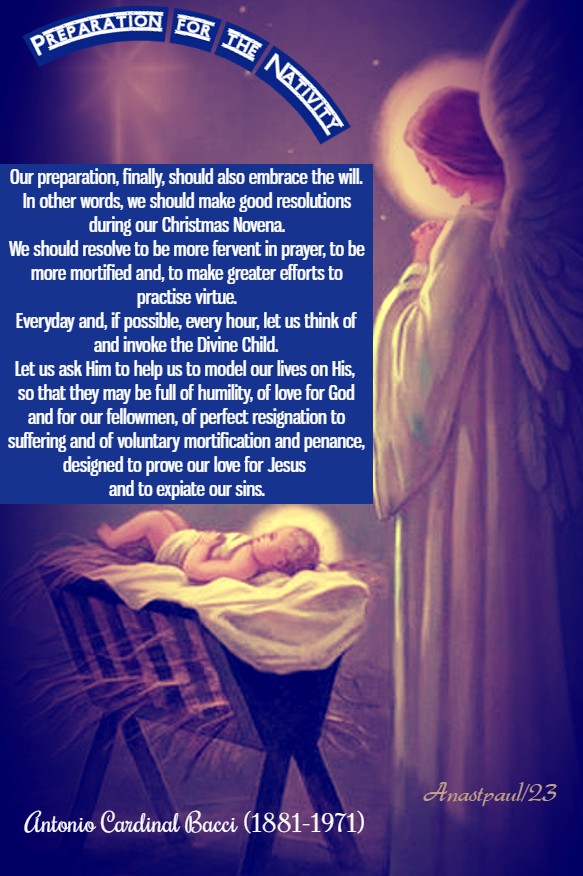
“Our preparation, finally, should also embrace the will. In other words, we should make good resolutions during our Christmas Novena. We should resolve to be more fervent in prayer, to be more mortified and, to make greater efforts to practise virtue.
Everyday and, if possible, every hour, let us think of and invoke the Divine Child. Let us ask Him to help us to model our lives on His, so that they may be full of humility, of love for God and for our fellowmen, of perfect resignation to suffering and of voluntary mortification and penance, designed to prove our love for Jesus and to expiate our sins.”
Quote/s of the Day – 17 December – “The Month of the Divine Infancy and the Immaculate Conception of the Blessed Virgin Mary” – Gaudete Sunday, The Third Sunday of Advent – Philippians 4:4-7; John 1:19-28 – Scripture search here: https://www.drbo.org/
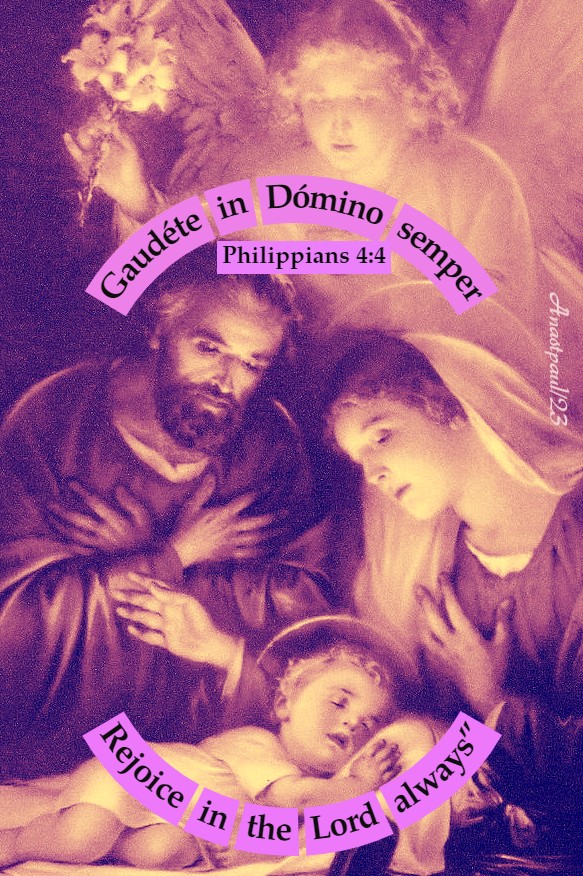
“Gaudéte in Dómino semper”
“Rejoice in the Lord always”
Philippians 4:4
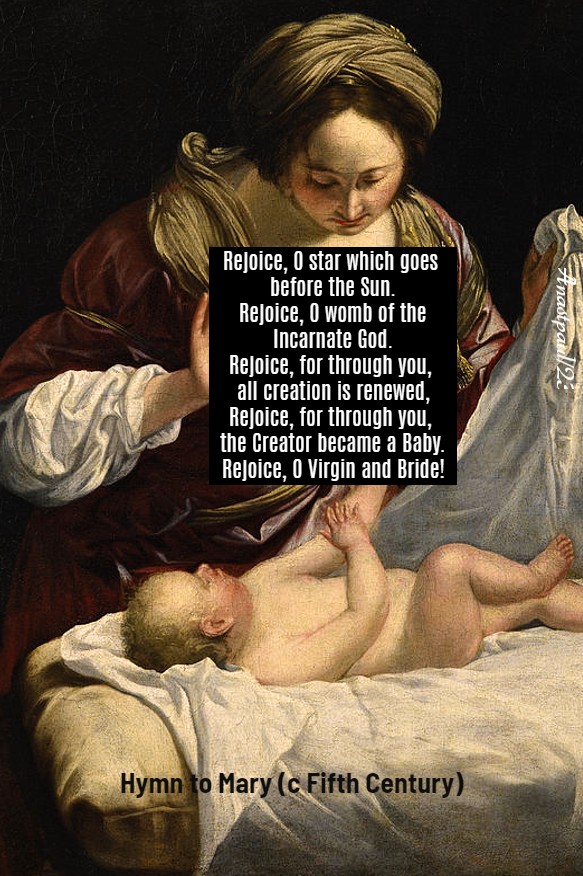
“ Rejoice, O star which goes before the Sun. Rejoice, O womb of the Incarnate God. Rejoice, for through you, all creation is renewed, Rejoice, for through you, the Creator became a Baby. Rejoice, O Virgin and Bride!”
Hymn to Mary (c Fifth Century)
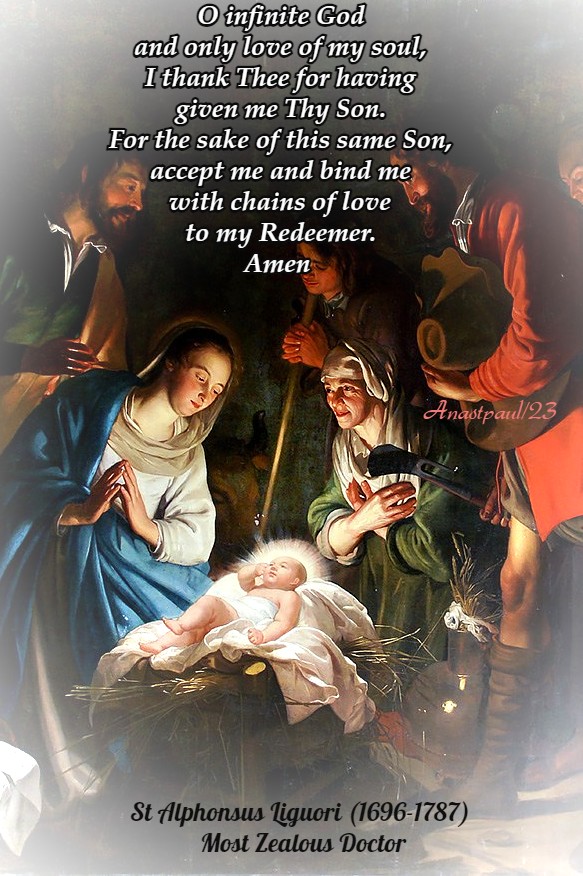
“O infinite God and only love of my soul, I thank Thee for having given me Thy Son. For the sake of this same Son, accept me and bind me with chains of love to my Redeemer. Amen ”
St Alphonsus Liguori (1696-1787) Most Zealous Doctor
One Minute Reflection – 17 December – “The Month of the Divine Infancy and the Immaculate Conception of the Blessed Virgin Mary” – Gaudete Sunday, The Third Sunday of Advent – Philippians 4:4-7; John 1:19-28 – Scripture search here: https://www.drbo.org/
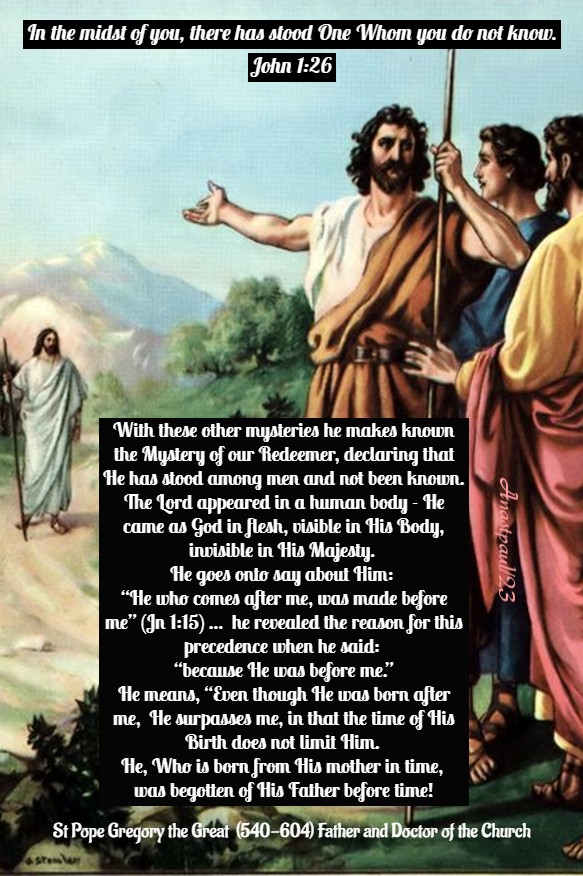
“ I baptise with water but, in the midst of you, there has stood One Whom you do not know.” – John 1:26
REFLECTION – “I baptise with water but, in the midst of you, there has stood One Whom you do not know.” John did not baptise with the Spirit but, with water, since he was unable to take away the sins of those being baptised. He washed their bodies with water but not their hearts with pardon. Why did one whose baptism did not forgive sins baptise, except that he was observing his vocation as forerunner? He, whose birth foreshadowed a greater birth, by his baptising, foreshadowed the Lord, Who would truly baptise; he ,whose preaching made him the forerunner of Christ, by baptising, also became his forerunner, using a symbol of the future Sacrament.
With these other mysteries he makes known the Mystery of our Redeemer, declaring that He has stood among men and not been known. The Lord appeared in a human body – He came as God in flesh, visible in His Body, invisible in His Majesty. He goes onto say about Him: “He who comes after me, was made before me” (Jn 1:15) … he revealed the reason for this precedence when he said: “because He was before me. ”He means, “Even though He was born after me, He surpasses me, in that the time of His Birth does not limit Him. He, Who is born from His mother in time, was begotten of His Father before time!”
John reveals the great humility and reverence he owes Christ by saying: “I am not worthy to undo the strap of His sandal.” It was the custom among the ancients, that if someone was unwilling to take the wife, he should be taking, he, who should have come to her as bridegroom, by right of relationship, would undo his sandal. How did Christ appear among men, if not as the Bridegroom of holy Church?… But since people considered John the Christ, a fact which he denied, he was right to declare his unworthiness to undo the strap of Christ’s sandal. It is as if he was saying … “I am not unjustly usurping, for myself, the name of Bridegroom” (Cf Jn 3:29).” – St Gregory the Great (540-604) Pope, Father and Doctor of the Church (Sermons on the Gospels 4).
PRAYER – Lend Thy ear to our prayers, O Lord, we beseech Thee and brighten the darkness of our minds by the grace of Thy coming. Through the same Jesus Christ, Thy Son our Lord, Who lives and reigns with Thee, in the unity of the Holy Ghost, God, world without end. Amen (Collect).
Our Morning Offering – 17 December – “The Month of the Divine Infancy and the Immaculate Conception of the Blessed Virgin Mary” – Gaudete Sunday, The Third Sunday of Advent
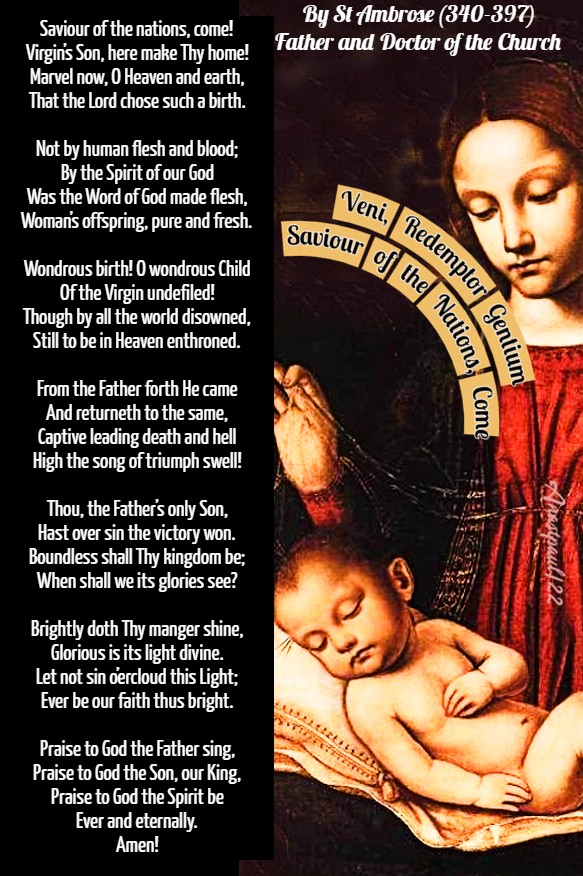
Veni Redemptor Gentium Saviour of the Nations, Come! By St Ambrose’s Advent Hymn
Saviour of the nations, come! Virgin’s Son, here make Thy home! Marvel now, O Heaven and earth, That the Lord chose such a birth.
Not by human flesh and blood; By the Spirit of our God Was the Word of God made flesh, Woman’s offspring, pure and fresh.
Wondrous birth! O wondrous Child Of the Virgin undefiled! Though by all the world disowned, Still to be in Heaven enthroned.
From the Father forth He came And returneth to the same, Captive leading death and hell High the song of triumph swell!
Thou, the Father’s only Son, Hast over sin the victory won. Boundless shall Thy kingdom be; When shall we its glories see?
Brightly doth Thy manger shine, Glorious is its light divine. Let not sin o’ercloud this Light; Ever be our faith thus bright.
Praise to God the Father sing, Praise to God the Son, our King, Praise to God the Spirit be Ever and eternally. Amen!
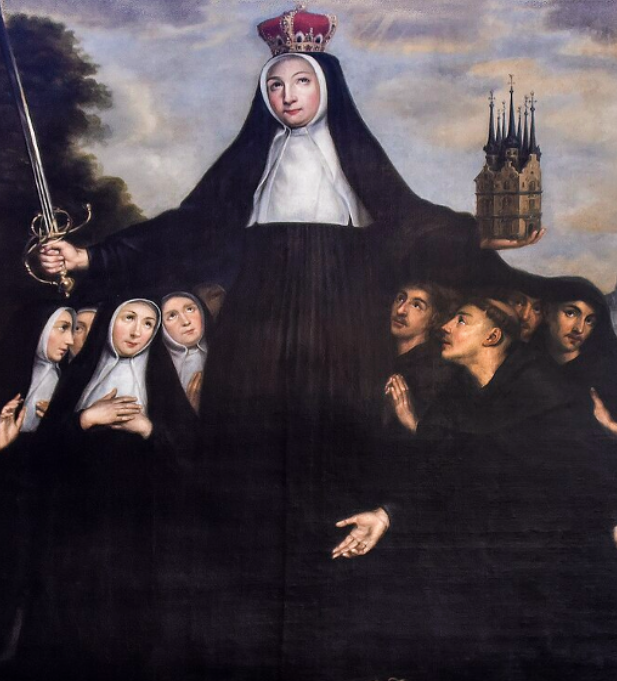
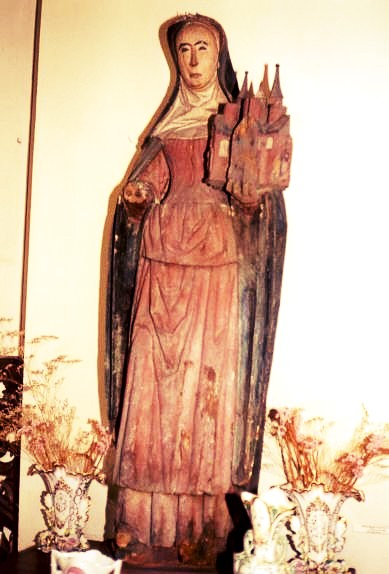
Saint of the Day – 17 December – Saint Begga of Ardenne (c613-693) Widow, Mother of 3 children, Founder of Churches and a Monastery of which she became the first Abbess. Patronages – Ardenne, against stuttering and of stutterers. Also known as – Begue, Bège, Beghe, Begge.
The Roman Martyrology reads: “At Ardenne, at the Seven Churches, St Begga Widow, sister of St Gertrude of Nivelles.”
Artwork of St Begga as Abbess and protector of her Monastery by Jan Verhoeven 1642-1676
Begga was a daughter of the nobles St Pepin of Landen (Died 639) and Saint Iduberga (Died 652). Her sister is the famous Saint Gertrude of Nivelles (Died 659; Feast 17 March). She married Ansegisus, who was the son of Saint Arnold of Metz (Died 641). Their son, Pepin of Herstal (Died 714), would become the ancestor of the Carolingians; he, in turn, was the father of Charles Martel (Died 741), the grandfather of Charlemagne.
Peter Paul Rubens (1577-1640) St Ansegisus and his wife St Begga
After the death of her husband, Begga decided to put her life and her possessions at the service of God. She then made a pilgrimage to Rome. to pray at the Shrines, mostly especially visiting the Seven Pilgrim Churches and after her return, she built seven Churches in the Town of Andenne aan de Maas, in imitation of them. In 691, Begga founded a Monastery at one of these Churches. She led it as Abbess until her death.
Begga is the Patron Saint of the Town of Ardenne and she is also the Patron Saint of stutterers and against stuttering (because her name resembles the French word ‘bègues = stutterers’).
In art she is depicted as a Queen (sometimes with three crowns); as Abbess, often holding seven Churches or a Church with seven towers.
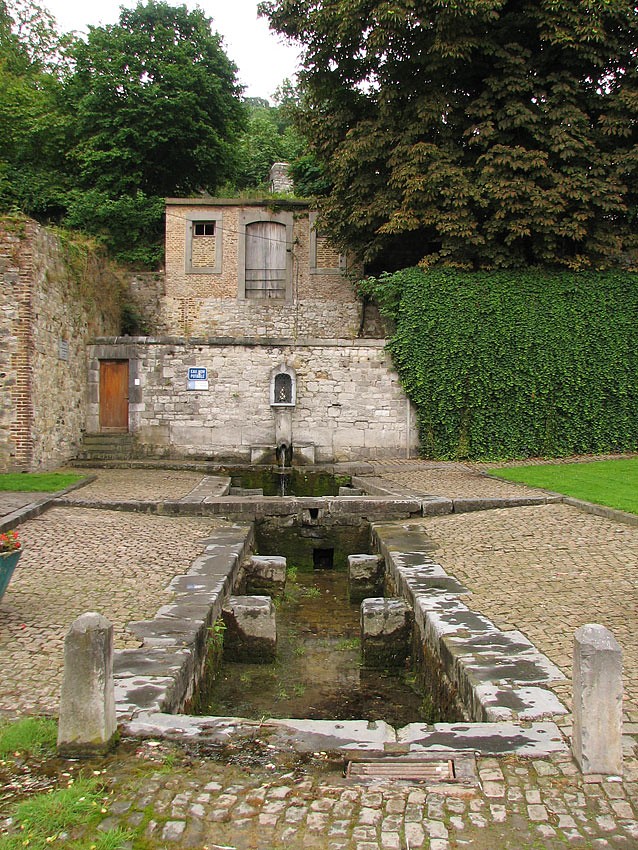
The Collegiate Church of Andenne later grew from the seven Churches (or Chapels). Not far from there flowed a spring – it is called ‘Fountain of Sinte Begga’ after her. Its water is miraculously hot in winter and cold in summer.
Fountain of Sinte Begga
Special Note:There are two Saints named Gertrude, one called “the Great” and the other from Nivelles. They are often confused, especially since they were both Nuns and appeared quite alike. However, they lived more than 600 years apart – St Gertrude the Great (1256-1302) born in Germany not too far from the Belgium of St Gertrude of Nivelles (626-659). The latter often has a special symbol in artworks, that of the mouse on her staff.
Martyrs of Eleutheropolis – (60+ Martyrs-Beati): Approximately 60 Christian soldiers in the imperial Roman army of emperor Heraclius; they were murdered as a group for their faith by invading Saracen Muslims. We know the names of two of them – Calaoicus and Florian. 638 in Eleutheropolis (Beit Jibrin), Palestine.
There are two standard Novenas to the Infant Jesus of Prague – the one we will use below and the other for the Feast on 2 January. The Monthly Novena attracts Indulgences (see Note below).
“The more you honour Me, the more I will bless you.”
So many graces have been received by those who invoke the Divine Child before the original Statue that it has been called “The Miraculous Infant Jesus of Prague.” We read the following in an old book printed in Kempt in Canada: “All who approach the miraculous Statue and pray there with confidence, receive assistance in danger, consolation in sorrows, aid in poverty, comfort in anxiety, light in spiritual darkness, streams of grace in dryness of soul, health in sickness and hope in despair.”
The Infant’s Patronage is especially sought for: vocations, good health, financial issues, a holy family life, schools, the welfare of children, freedom and peace, the missions and safety in travel.
THE NOVENA PRAYERS
Eternal Father, I offer to Thy honour and glory, for my own salvation and that of the whole world, the Mystery of the Birth of our Divine Saviour. Glory be to the Father, etc.
Eternal Father, I offer to Thy honour and glory and for my eternal salvation and that of the whole world, the sufferings of the most holy Virgin and of St Joseph, in that long and weary journey from Nazareth to Bethlehem. I offer Thee the sorrow of their hearts when they found no place wherein to shelter themselves, when the Saviour of the world was born. Glory be to the Father, etc.
Eternal Father, I offer to Thy honour and glory and for my eternal salvation and that of the whole world, the sufferings of Jesus in the stable where He was born, the cold He endured, the swaddling clothes which bound Him, the tears He shed and His tender Infant cries. Glory be to the Father, etc.
Eternal Father, I offer to Thy honour and glory and for my eternal salvation and that of the whole world, the pain which the Holy Child Jesus felt in His tender body, when He submitted to circumcision. I offer Thee that Precious Blood which then, for the first time He shed for the salvation of the whole humanrace. Glory be to the Father, etc.
Eternal Father, I offer to Thy honour and glory and for my eternal salvation and that of the whole world, the humility, mortification, patience, charity, all the virtues of the Child Jesus and I thank Thee and I love Thee and I bless Thee without end, for the ineffable Mystery of the Incarnation of the Divine Word. Glory be to the Father, etc.
The Word was made Flesh, And dwelt among us.
LET US PRAY O God, Whose Only-begotten Son was made manifest to us in the substance of our flesh, grant, we beseech Thee, that through Him, Whom we acknowledge to be like unto ourselves, our souls may be inwardly renewed. Who liveth and reigneth with Thee forever and ever. Amen.
7 years Indulgence each day, if the above prayers are recited on the 9 days preceding the 25th of any month. Plenary Indulgence under the usual conditions, when the Novena is completed. (125)
Thought for the Day – 16 December – Meditations with Antonio Cardinal Bacci (1881-1971)
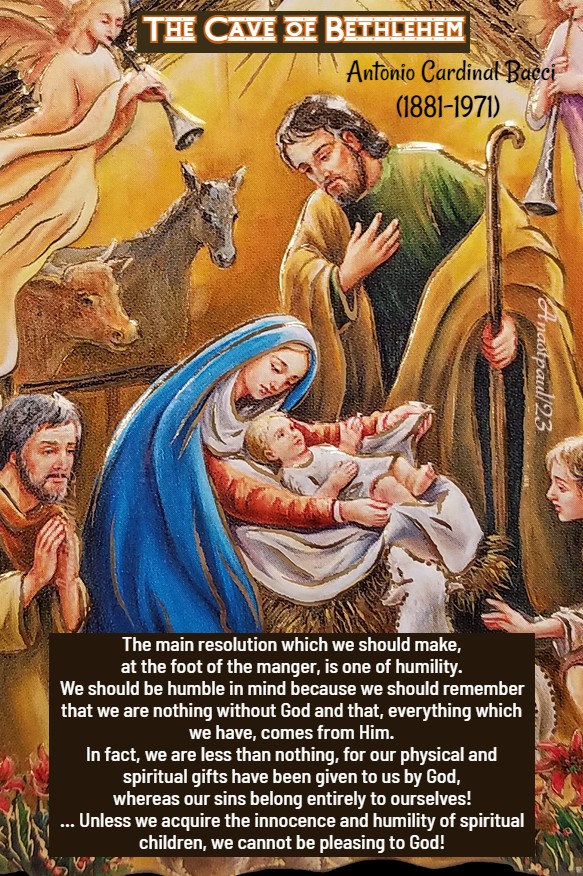
A Christmas Novena The Cave of Bethlehem
“The main resolution which we should make, at the foot of the manger, is one of humility. We should be humble in mind because we should remember that we are nothing without God and that, everything which we have, comes from Him. In fact, we are less than nothing, for our physical and spiritual gifts have been given to us by God, whereas our sins belong entirely to ourselves!
We should also be humble of heart. We should be innocent and simple, like children, as the Gospel commands, trusting and loving, so that we may be worthy of God’s favours and consolations.
Unless we acquire the innocence and humility of spiritual children, we cannot be pleasing to God!”
Quote/s of the Day – 16 December – 2 Corinthians 1:3-7; Matthew 16:24-27 – Scripture search here: https://www.drbo.org/
Seeking St John of the Cross
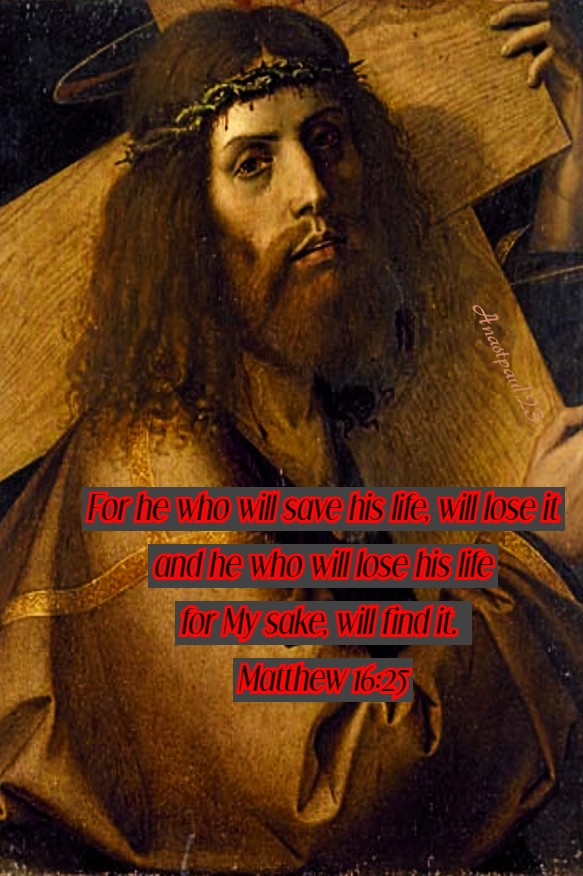
“For he who will save his life, will lose it and he who will lose his life for My sake, will find it. ”
Matthew 16:25
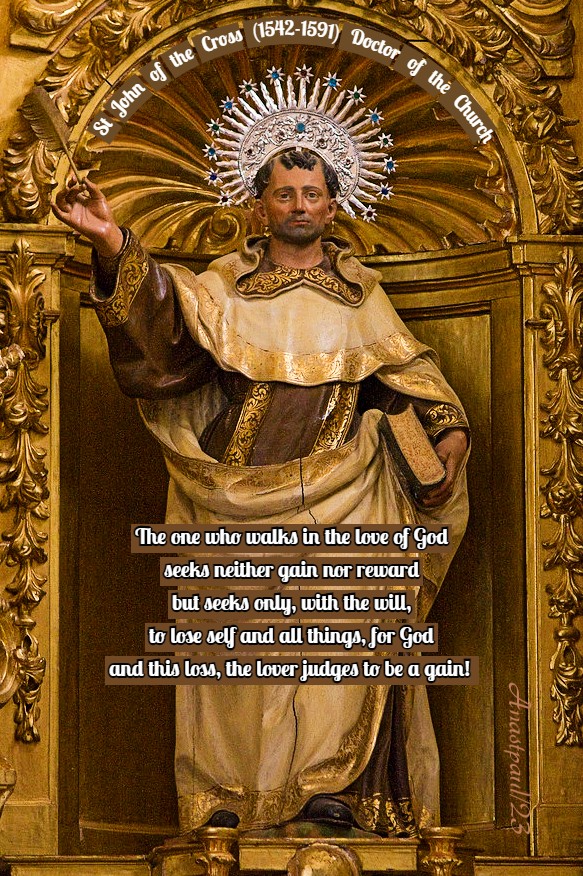
“The one who walks in the love of God seeks neither gain nor reward but seeks only, with the will, to lose self and all things, for God and this loss, the lover judges to be a gain! ”
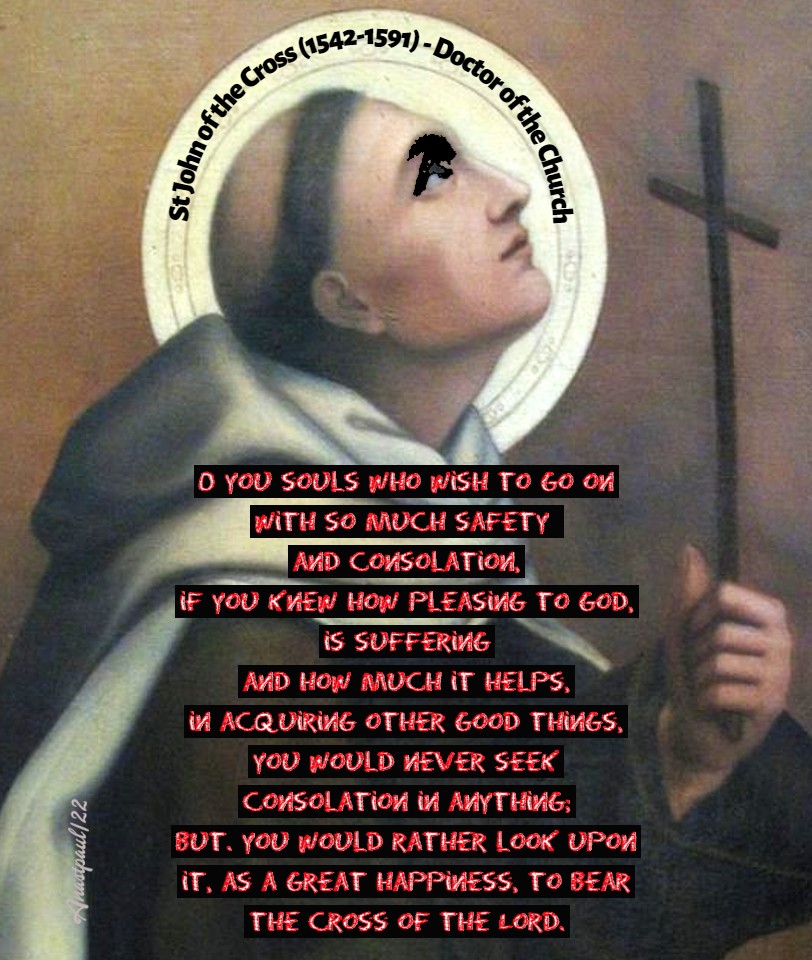
“O you souls who wish to go on with so much safety and consolation, if you knew how pleasing to God, is suffering and how much it helps, in acquiring other good things, you would never seek consolation in anything; but. you would rather look upon it, as a great happiness, to bear the Cross of the Lord.”
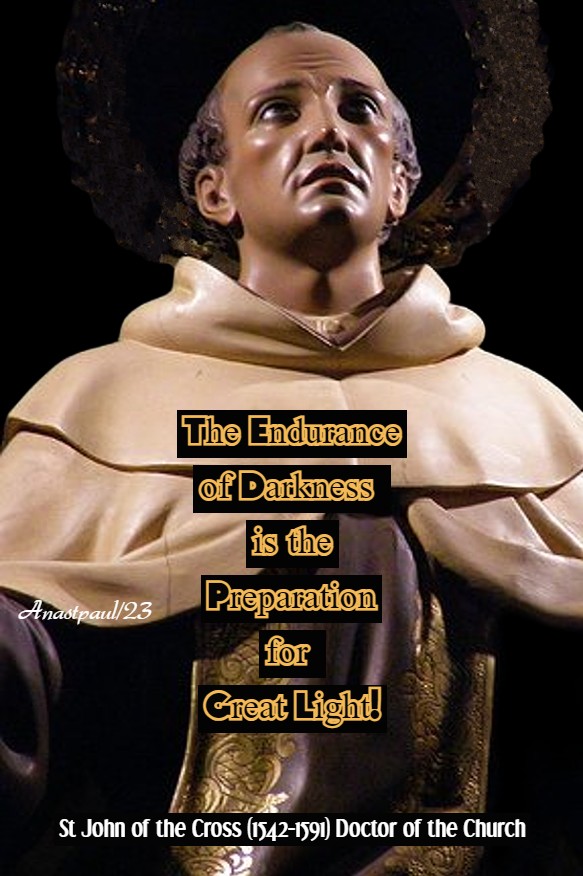
“The endurance of darkness is the preparation for great light!”
“Strive to preserve your heart in peace; let no event of this world, disturb it.”
“Happiness is not a destination, it is a method of travel.”
St John of the Cross (1542-1591) Doctor of the Church
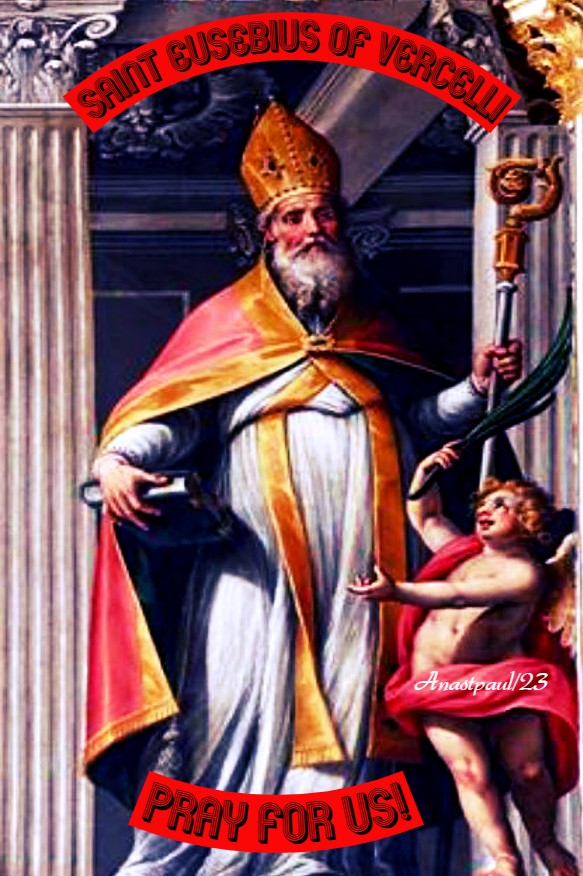
One Minute Reflection – 16 December – “The Month of the Divine Infancy and the Immaculate Conception of the Blessed Virgin Mary” – St Eusebius of Vercelli (c283-371) Bishop, Confessor – 2 Corinthians 1:3-7; Matthew 16:24-27 – Scripture search here: https://www.drbo.org/
“For he who will save his life, will lose it and he who will lose his life, for My sake, will find it. ” – Matthew 16:25
REFLECTION – “I lost myself and was found”
“The one who walks in the love of God seeks neither gain nor reward but seeks only, with the will, to lose self and all things, for God and this loss, the lover judges to be a gain! Thus it is, as St Paul asserts: “For me death is gain” [Phil 1:21], that is, my death to all things and to myself, for Christ, is my spiritual gain. Consequently, the soul declares: “I was found.” The soul who does not know how to lose himself, does not find himself but rather, loses himself, as Our Lord teaches in the Gospel: “For he that will save his life, shall lose it and he that will lose his life for my sake, will find it. ” (Mt 16:25).
Should we desire to interpret this verse more spiritually and in accord with what we are discussing here, it ought to be known that when a soul treading the spiritual road, has reached such a point that he has lost all roads and natural methods, in his communion with God and no longer seeks Him by reflections or forms or feelings or by any other way of creatures and the senses but, has advanced beyond them all and beyond all modes and manners and enjoys communion with God in faith and love, then it is said that God is his gain, because he has certainly lost all that is not God and has truly lost himself.” – St John of the Cross (1542-1591) Carmelite, Doctor of the Church (Spiritual Canticle 29:11).
PRAYER – O God, Who gladden us with the annual festival of blessed Eusebius, Thy Martyr and Bishop, mercifully grant that, as we venerate the anniversary of his Martyrdom, we may also rejoice in his protection.Through Jesus Christ, Thy Son our Lord, Who lives and reigns with Thee, in the unity of the Holy Ghost, God, world without end. Amen (Collect).
Our Morning Offering – 16 December – “The Month of the Divine Infancy and the Immaculate Conception of the Blessed Virgin Mary” – Saturday of the Second Week of Advent and a day to honour our Holy Mother
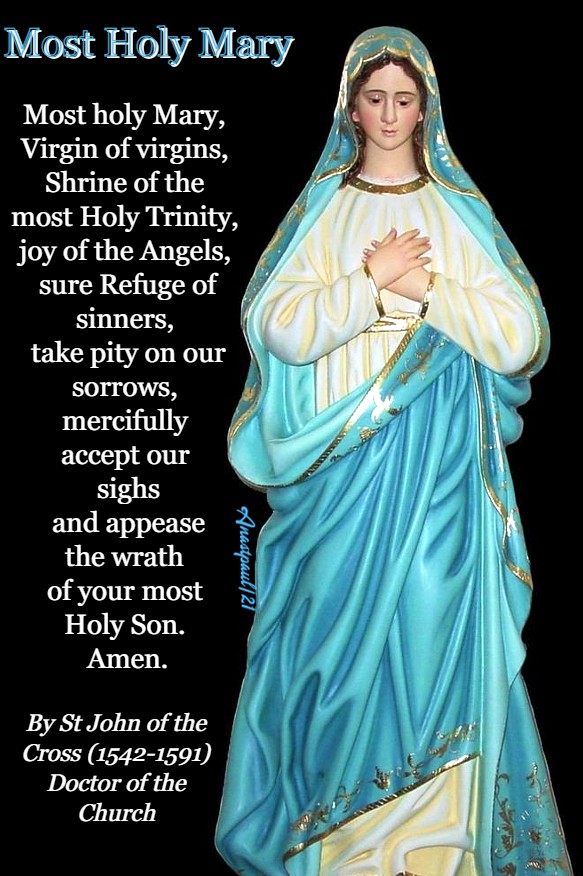
Most Holy Mary By St John of the Cross (1542-1591) Doctor of the Church
Most holy Mary, Virgin of virgins, Shrine of the most Holy Trinity, joy of the Angels, sure Refuge of sinners, take pity on our sorrows, mercifully accept our sighs and appease the wrath of your most holy Son. Amen.
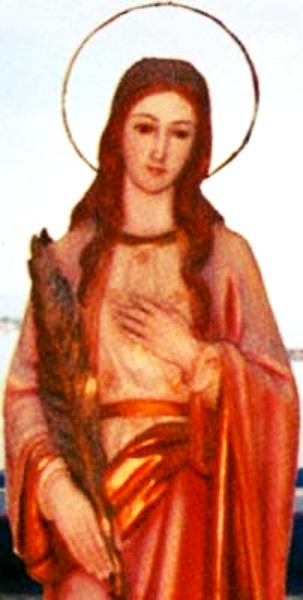
Saint of the Day – 16 December – Saint Albina of Caesarea (Died c250) Virgin Martyr. Born in Caesarea, Palestine and died by beheading in c250, during the reign of the Emperor Decius, at Formia, Gaeta, Campagna, Italy. Also known as – Ulbina.
The Roman Martyrology reads today: “At Mola-di-Gaeta, in Campagna, St Albina, Virgin and Martyr, under the Emperor Decius.”
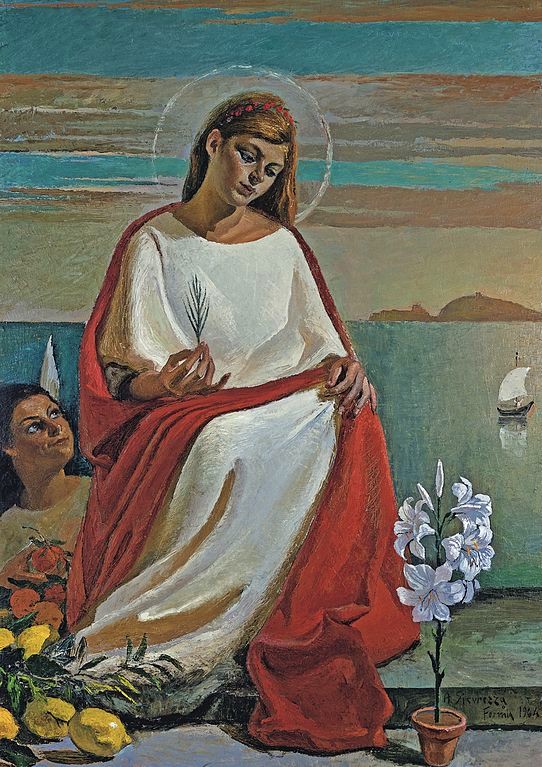
St Albina, painting by Antonio Sicurezza.
Albina was a young Christian girl who lived in the middle of the 2nd Century in Caesarea in Palestine. Because she would not give up her Christian faith, she was beheaded in c250 during the persecutions of Emperor Decius (249-251).
Legend has it that her body was placed on a boat which floated ashore near Formia at Gaeta in Campagna in southern Italy and that she was then transported to nearby Gaeta and buried there, next to Saint Erasmus. Albina’s Relics are venerated in Gaeta in the Cathedral
The learned Church Historian, Oratorian and Cardinal, the Venerable Cesare Baronius (1538-1607), included the story of her suffering in the Martyrologium Romanum when he revised it at the end of the 16th Century, based on “ancient documents of the Church of Gaeta.”
St Beoc St Dominic Dosso Bl Elizabeth of Saint Francis
St Everard of Friuli (c815-867) Duke, Count, Soldier, Founder of Churches and a Monastery. In contrast to his soldiering life, St Everard was a peacemaker, a humble and loving Master with a social conscience, striving always to free serfs, wherever possible or at least to free them from their burdens and assisting the poor and needy in all their deprivations. His Life: https://anastpaul.com/2021/12/16/saint-of-the-day-16-december-saint-everard-of-friuli-c-815-867/
Haggai the Prophet St Irenion Bl James of Tunis St Jean Wauthier St Macarius of Collesano
Martyred Women of North-West Africa: A large group of women Martyred in the persecutions of Hunneric, Arian King of the Vandals. 482 in North-West Africa.
Martyrs of Ravenna – 4 Saints: A group of Christians Martyred together. Four names and no other information has survived – Agricola, Concordius, Navalis and Valentine. c 305 at Ravenna, Italy.
Thought for the Day – 15 December– Meditations with Antonio Cardinal Bacci (1881-1971)
The Power of Mary
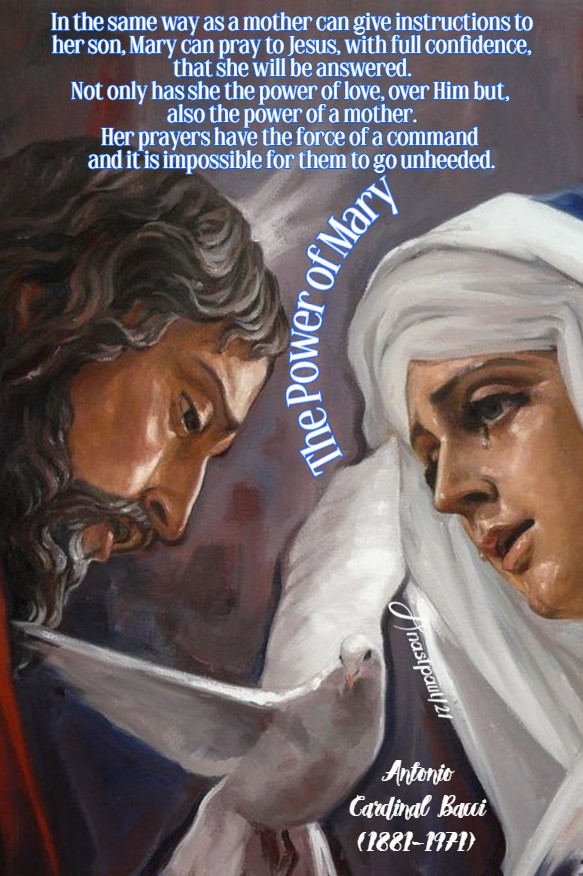
“Virgin most powerful, pray for us.” This is one of the invocations to Our Lady in her Litany. Mary’s power derives from her Divine Motherhood. The Eternal Word was made man in her most chaste womb. By assuming our human nature in the Hypostatic Union, He became her Son. In the same way as a mother can give instructions to her son, Mary can pray to Jesus with full confidence that she will be answered. Not only has she the power of love, over Him but, also the power of a mother. Her prayers have the force of a command and it is impossible for them to go unheeded. When Mary seeks a favour from her Divine Son for us, who are her adopted sons, says St Peter Damian, she commands rather than prays, she is more like the mistress than the handmaid of the Lord (Serm 41 de Nativitate). Some Ecclesiastical writers go as far as describing Mary as being omnipotent in grace and in intercession, even as God is omnipotent by reason of His nature. “O Mother of God,” writes St Gregory of Nicomedia, “you have such invincible power, that the multitude of our sins can never exhaust your mercy. Nothing can resist your power, for your Creator regards your glory as His own” (Orat de Exitu B Virg). This doctrine should console even the most hopeless sinners. It is enough to have loving recourse to Mary and we shall be sure of salvation.”
Quote/s of the Day – 15 December – Octave of the Immaculate Conception of the Blessed Virgin Mary, Mother of God – Proverbs 8:22-35, Luke 1:26-28 – Scripture search here: https://www.drbo.org/
“Hail, full of grace!” Luke 1:28
“Thou alone and Thy Mother, are in all things fair, there is no flaw in Thee and no stain in Thy Mother.”
St Ephrem (306-373) Father and Doctor of the Church
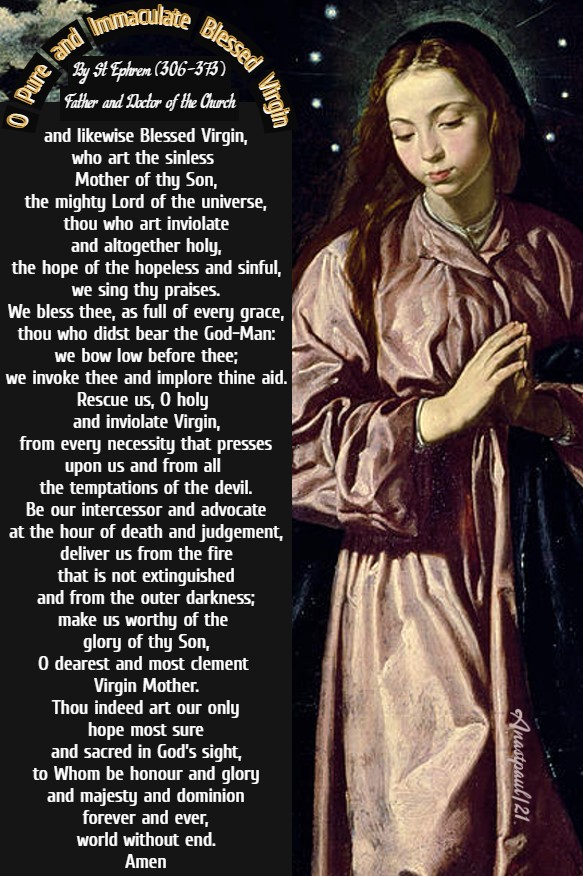
O Pure and Immaculate Blessed Virgin By St Ephrem (306-373) Father and Doctor of the Church
O Pure and Immaculate and likewise Blessed Virgin, who art the sinless Mother of thy Son, the mighty Lord of the universe, thou who art inviolate and altogether holy, the hope of the hopeless and sinful, we sing thy praises. We bless thee, as full of every grace, thou who didst bear the God-Man: we bow low before thee; we invoke thee and implore thine aid. Rescue us, O holy and inviolate Virgin, from every necessity that presses upon us and from all the temptations of the devil. Be our intercessor and advocate at the hour of death and judgement, deliver us from the fire that is not extinguished and from the outer darkness; make us worthy of the glory of thy Son, O dearest and most clement Virgin Mother. Thou indeed art our only hope most sure and sacred in God’s sight, to Whom be honour and glory and majesty and dominion forever and ever, world without end. Amen
St Ephrem of Syria (306-373) Father and Doctor of the Church
“The very fact that God has elected her, proves, that none was ever holier than Mary; if any stain had disfigured her soul, if any other virgin had been purer and holier, God would have selected her and rejected Mary.”
St Jacob of Sarug (c 451-521) Bishop, Theologian, Poet, Writer
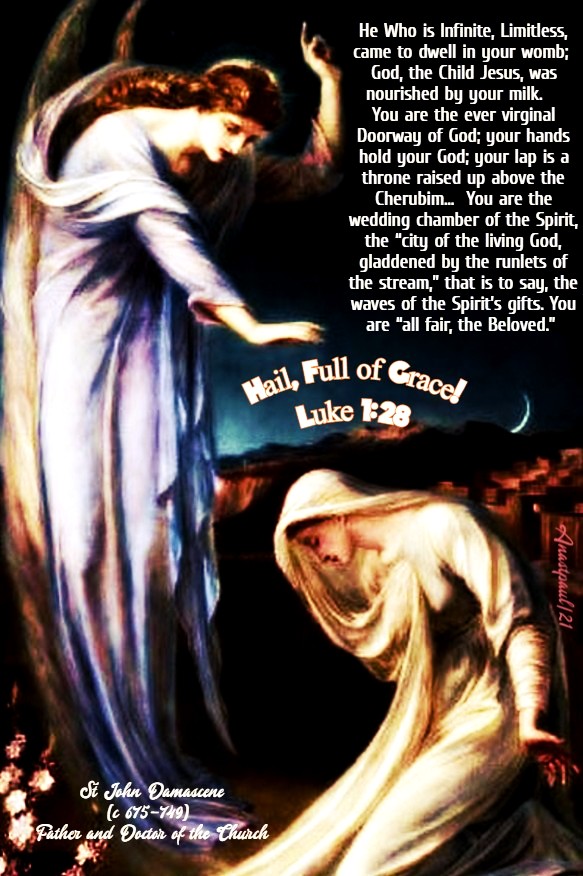
“He Who is Infinite, Limitless, came to dwell in your womb; God, the Child Jesus, was nourished by your milk. You are the ever virginal Doorway of God; your hands hold your God; your lap is a throne raised up above the Cherubim… You are the wedding chamber of the Spirit, the “city of the living God, gladdened by the runlets of the stream” that is to say, the waves of the Spirit’s gifts. You are “all fair, the Beloved” of God.”
St John Damascene (675-749) Father and Doctor of the Church
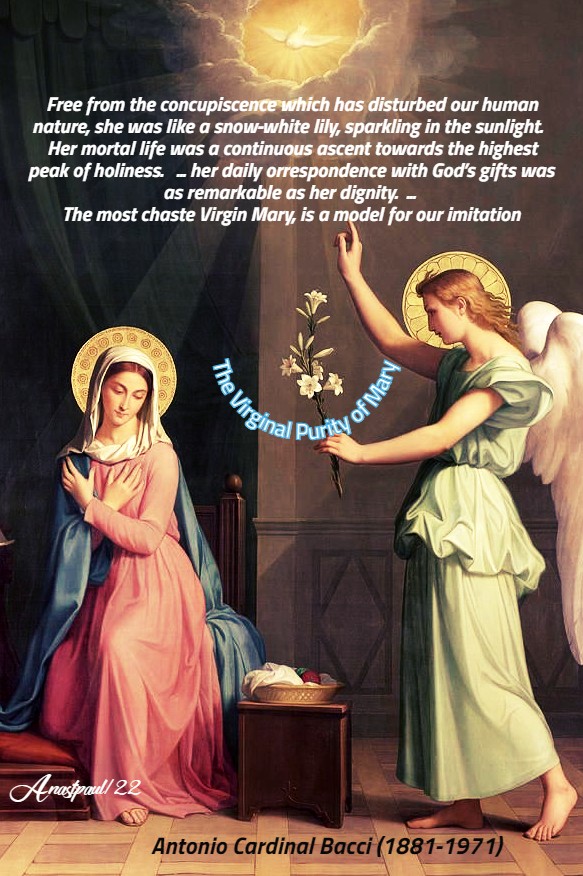
“Free from the concupiscence which has disturbed our human nature, she was like a snow-white lily, sparkling in the sunlight. Her mortal life was a continuous ascent towards the highest peak of holiness. … her daily correspondence with God’s gifts was as remarkable as her dignity. … The most chaste Virgin Mary, is a model for our imitation.”
One Minute Reflection –15 December – Octave of the Immaculate Conception of the Blessed Virgin Mary, Mother of God – Proverbs 8:22-35, Luke 1:26-28 – Scripture search here: https://www.drbo.org/
“Hail, full of grace!” – Luke 1:28
REFLECTION – “So the Lord now manifestly came to His own. Born by His own created order that He Himself bears, He by His obedience on the tree, renewed and reversed what was done by disobedience, in connection with a tree.
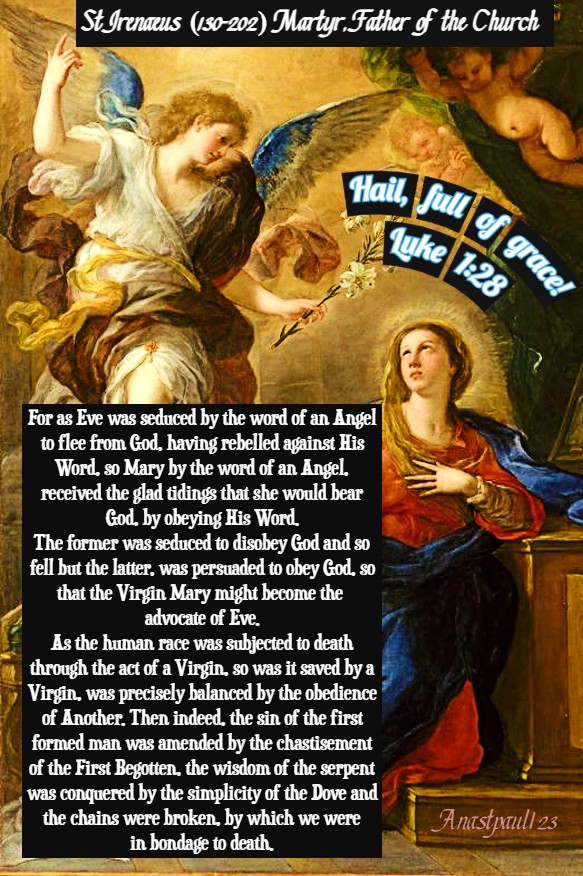
The power of that seduction, by which the virgin Eve, already betrothed to a man, had been wickedly seduced, was broken when the Angel in truth brought good tidings to the Virgin Mary, who already, by her betrothal belonged to a man. For as Eve was seduced by the word of an Angel to flee from God, having rebelled against His Word, so Mary, by the word of an Angel, received the glad tidings that she would bear God, by obeying His Word.
The former was seduced to disobey God and so fell but the latter, was persuaded to obey God, so that the Virgin Mary might become the advocate of Eve.
As the human race was subjected to death through the act of a Virgin, so was it saved by a Virgin, was precisely balanced by the obedience of Another. Then indeed, the sin of the first formed man was amended by the chastisement of the First Begotten, the wisdom of the serpent was conquered by the simplicity of the Dove and the chains were broken, by which we were in bondage to death.” – St Irenaeus (130-202) Bishop of Lyons, Martyr, Father of the Church (Against Heresies, 5)
PRAYER – O God, Who by the Immaculate Conception of the Virgin, prepared a worthy dwelling for Thy Son, and Who, by Thy Son’s death, foreseen by You, preserved her from all taint, grant, we beseech Thee through her intercession that we too may come to Thee unstained by sin. Through the same Jesus Christ, Thy Son our Lord, Who lives and reigns with Thee, in the unity of the Holy Ghost, God, world without end. Amen (Collect).
Our Morning Offering – 15 December – “The Month of the Divine Infancy and the Immaculate Conception of the Blessed Virgin Mary” and the Octave Day of the Feast
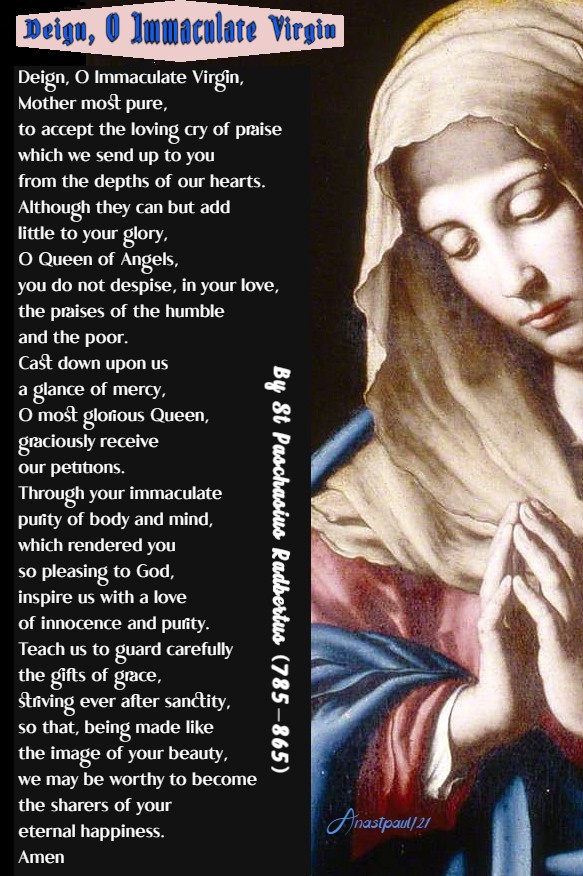
Deign, O Immaculate Virgin By St Paschasius Radbertus (785–865)
Deign, O Immaculate Virgin, Mother most pure, to accept the loving cry of praise which we send up to you from the depths of our hearts. Though they can but add little to your glory, O Queen of Angels, you do not despise, in your love, the praises of the humble and the poor. Cast down upon us a glance of mercy, O most glorious Queen, graciously receive our petitions. Through your immaculate purity of body and mind, which rendered you so pleasing to God, inspire us with a love of innocence and purity. Teach us to guard carefully the gifts of grace, striving ever after sanctity, so that, being made like the image of your beauty, we may be worthy to become the sharers of your eternal happiness. Amen
Saint of the Day – 15 December – Saint Valerian of Abbenza (c377-c457) Confessor, the 2nd Bishop of Abbenza in North Africa. Born in c377 and died in c457 of exposure in the region of his Diocese. Additional Memorial – 28 November as one of the Martyrs of North Africa.
The Roman Martyrology this day states: “In Africa, the holy Bishop Valerian, who, being upwards of eighty years old, in the persecution of the Vandals, under the Arian King Genseric, was asked to deliver the Sacred vessels of the Church and, as he constantly refused, an order was issued to drive him, all alone, out of the City and all were forbidden to allow him to stay, either in their houses or on their land. For a long time, he remained lying on the public roads in the open air and thus, in the confession and defence of the Catholic verity, closed his blessed life.”
Valerian was a Roman Bishop of Abbenza, an ancient Episcopal Seat of the Roman Province of Proconsular Africa, identifiable today with the ruins of Bordj-Hamdouna, in the Archdiocese of Carthage, in northern Africa, who lived in the 5th Century.
In the list of Bishops of this Diocese, he is second on the list after Fortunatus.
He is remembered for having refused to obey Genseric, the King of the Vandals, who arrived with his troops in the City, to hand over all the Sacred vessels and furnishings of the Church to him.
Valerian protested against the violence of the soldiers and was driven out and exiled from his City together with eight other Bishops of North Africa – although they were not sent into exile together.
The order was given forbidding anyone to offer him hospitality of any kind. He had to live and sleep outdoors, on the public roads, until his death.
Valerian, remembered as a Confessor, remained faithful to his faith until his death. The name of Saint Valerian was included in the Roman Martyrology on his Feast Day, 15 December.
Octave Day of the Immaculate Conception of the Blessed Virgin Mary
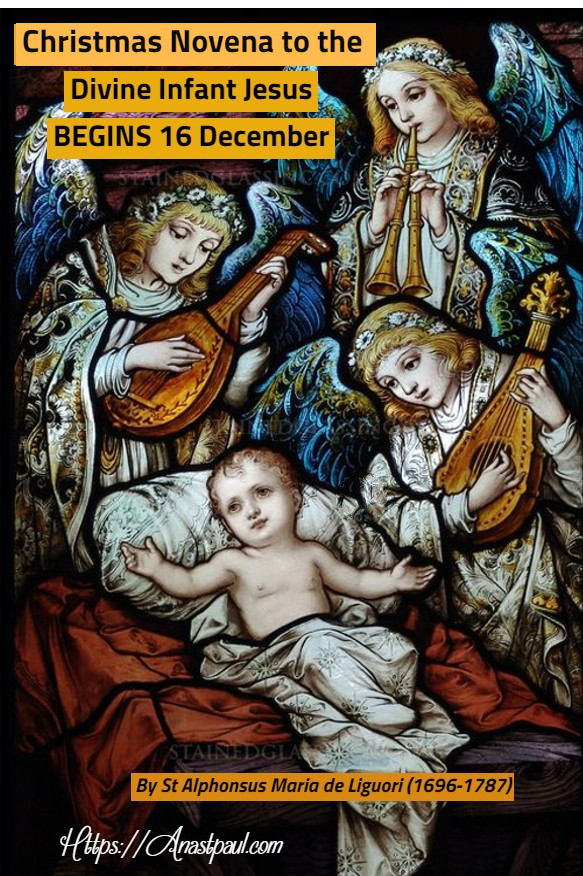
The Christmas Novena to the Divine Infant Jesus by St Alphonsus Maria de Liguori – BEGINS on 16 December: This Novena is translated from the Italian of Saint Alphonsus Maria de Liguori and was first published in 1758. Although this Novena is intended, primarily as a preparation for the Feast of our Lord’s Nativity, it can be used with spiritual profit at any time of the year, as a devotion in honour of the Infant Jesus. This translation by the Redemptorists of the UK.
AND/OR: December, naturally being the Month of the Divine Infant, is a wonderful time to begin this Monthly practice: The Monthly Novena to the Infant Jesus of Prague From 16 to 24 December (and of every Month on the same dates).
St Maximinus of Micy St Offa of Essex St Paul of Latros St Silvia of Constantinople St Urbicus St Valerian of Abbenza (c377-c457) Confessor, Bishop Blessed Victoria Strata (1562-1617) Widow,
Martyrs of North Africa – 7 Saints: A group of Christians Martyred together for their faith in North Africa. The only details about them that survive are their names – Caelian, Candidus, Faustinus, Fortunatus, Januarius, Lucius and Mark.
Martyrs of Rome – 22 Saints: A group of 22 Christians Martyred together in the persecutions of Valerian. The only details we have are five of their names – Antonius, Irenaeus, Saturnin, Theodorus and Victor. c 258 in Rome, Italy.
Thought for the Day – 14 December – Meditations with Antonio Cardinal Bacci (1881-1971)
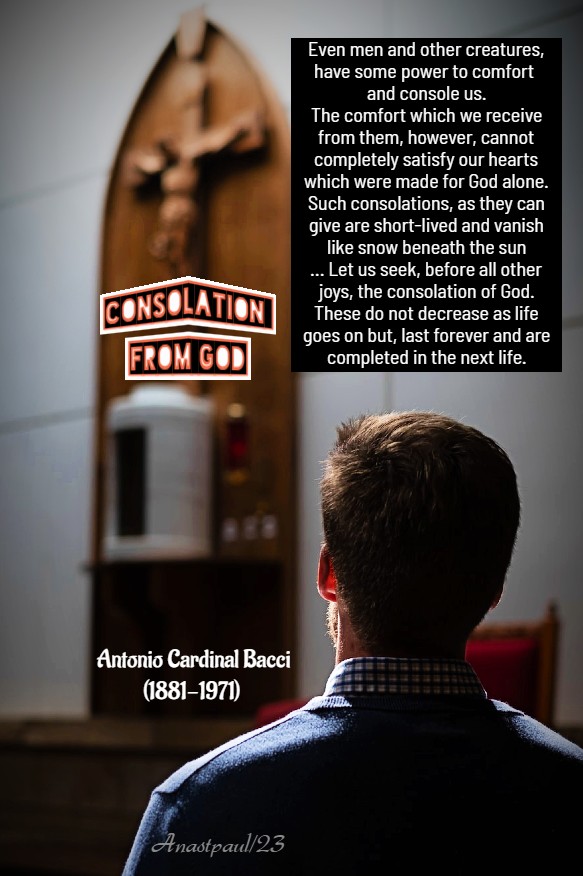
Consolation from God
“Even men and other creatures, have some power to comfort and console us. The comfort which we receive from them, however, cannot completely satisfy our hearts which were made for God alone. Such consolations, as they can give are short-lived and vanish like snow beneath the sun.
What can men or other worldly creatures give us? They can give us material wealth but this often turns out to be troublesome and vexatious and is too much inferior to the greatness of the human soul, to be able to satisfy it. Worldly honour can intoxicate our pride and self-conceit for a little while but this state of inebriation cannot last very long. We know too well that we are what we are in the sight of God and nothing more. The praise and flattery of other men adds nothing to our statue and only serves as an incentive to idle vanity. Then, there are worldly pleasures, some of which are healthy and commendable but how long do thy last? They are like flowers which open there petals to the morning air and fold them again in the evening. There are unhealthy pleasures too; not only are these passing and perishable like all created things but, they leave behind a sense of nausea and remorse!
Let us seek, before all other joys, the consolation of God. These do not decrease as life goes on but, last forever and are completed in the next life.”
Quote/s of the Day – 14 December – Within the Octave of the Immaculate Conception of the Blessed Virgin Mary – The Feast of St Venantius Fortunatus (c530 – c609) Bishop, Poet, Hymnist, Writer. Another “Golden Words.”
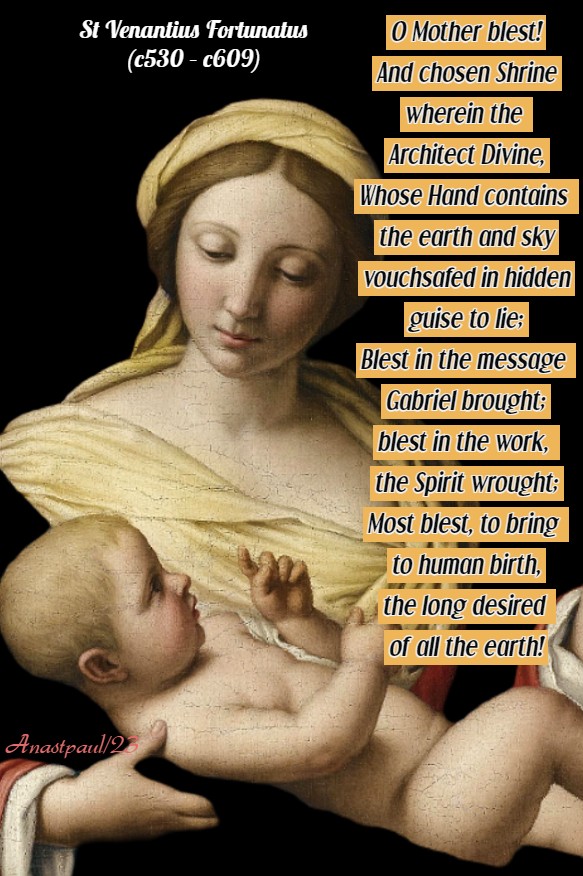
“O Mother blest! And chosen Shrine wherein the Architect Divine, Whose Hand contains the earth and sky vouchsafed in hidden guise to lie; Blest in the message Gabriel brought; blest in the work, the Spirit wrought; Most blest, to bring to human birth, the long desired of all the earth!”
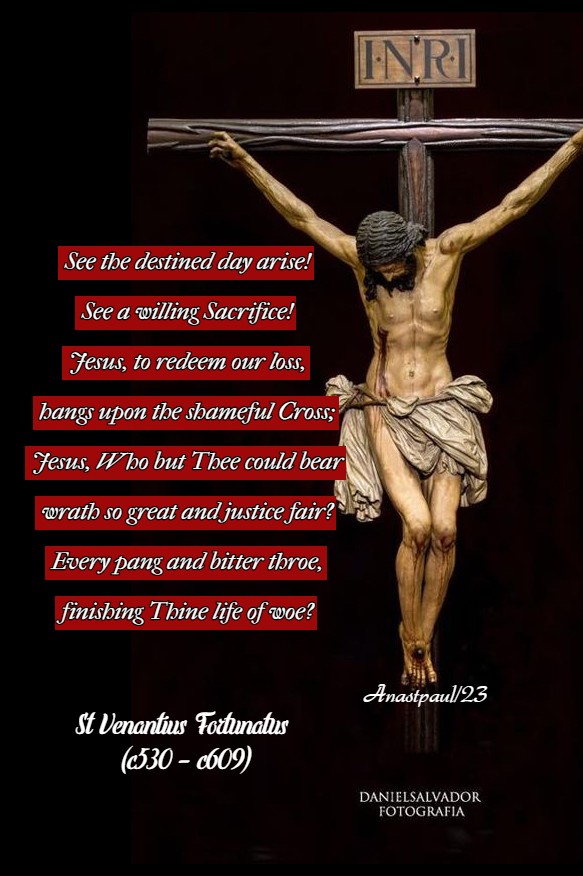
“See the destined day arise! See a willing Sacrifice! Jesus, to redeem our loss, hangs upon the shameful Cross; Jesus, Who but Thee could bear wrath so great and justice fair? Every pang and bitter throe, finishing Thine life of woe?”
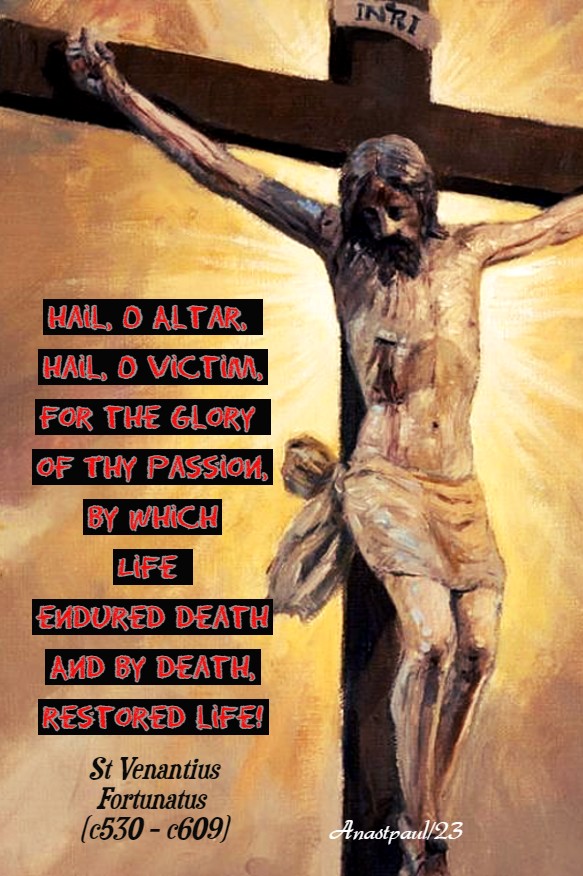
“Hail, O Altar, Hail, O Victim, For the glory of Thy Passion, By which Life endured death And by death, restored life!”
One Minute Reflection – 14 December –The Second Week of Advent, Within the Octave of the Immaculate Conception of the Blessed Virgin Mary – Proverbs 8:22-35; Luke 1:26-28 – Scripture search here: https://www.drbo.org/
“Hail, full of grace …” – Luke 1:28
REFLECTION – “How can I speak? What praises could I possibly make of the holy and glorious Virgin? She surpasses all other beings except for God Himself. She is by nature more beautiful than the Cherubim and Seraphim and the whole Angelic Host. No language, whether of Heaven or earth, or even of the Angels, is enough to praise her. Blessed Virgin, spotless dove, heavenly bride… temple and throne of the Godhead! Christ, the Sun Who shines resplendently in Heaven and on earth, belongs to thee. Thou art the luminous cloud which brought Christ down to earth, He Who is the bright streak of lightening, Who shines across the world.
Rejoice, full of grace, gate of Heaven! It was of thee, the author of the Song of Songs speaks… when he cries aloud: “A garden enclosed is my sister, my bride; an enclosed garden, a fountain sealed” (4:12)… Holy Mother of God, spotless ewe – thou gave birth to Christ, the Lamb, the Word made flesh in thee … How amazing a wonder in the heavens – a woman clothed with the sun (Apoc 12:1), carrying the Light in her arms! … How amazing a wonder in the heavens – the Lord of Angels becomes the Virgin’s Child. Angels judged Eve; now they fill Mary with glory, since it was she who raised Eve from her fall and brought Adam, expelled from Paradise, into Heaven.
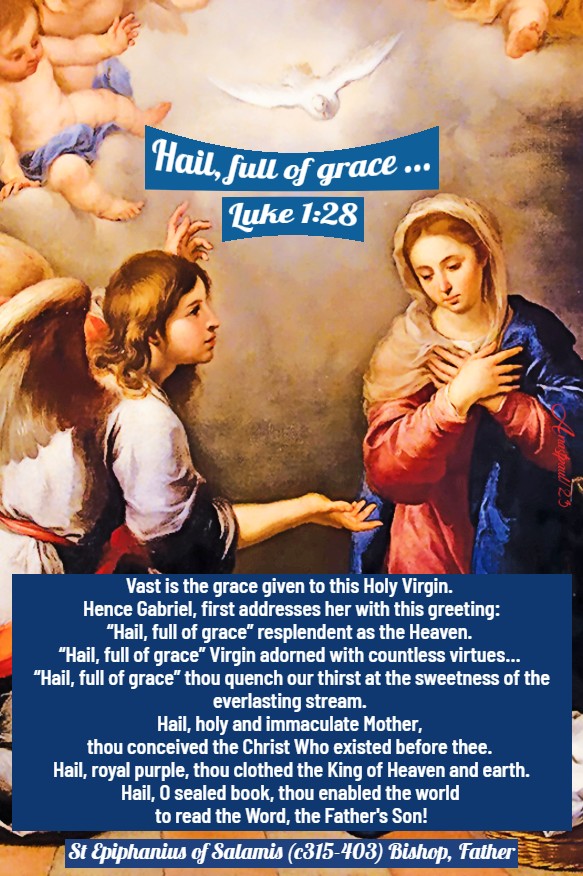
Vast is the grace given to this Holy Virgin. Hence Gabriel, first addresses her with this greeting: “Hail, full of grace” resplendent as the Heaven. “Hail, full of grace” Virgin adorned with countless virtues… “Hail, full of grace” thou quench our thirst at the sweetness of the everlasting stream. Hail, holy and Immaculate Mother, thou conceived the Christ Who existed before thee. Hail, royal purple, thou clothed the King of Heaven and earth. Hail, O sealed book, thou enabled the world to read the Word, the Father’s Son!” – St Epiphanius of Salamis (c315-403) Bishop of Salamis, known as the Oracle of Palestine and Father of the Church (Sermon No 5)
PRAYER – Stir up our hearts, O Lord, to prepare the ways of Thy only-begotten Son, so that through His coming we may be able to serve Thee with purified minds. Who lives and reigns with Thee, in the unity of the Holy Ghost, God, world without end. Amen (Collect).
Our Morning Offering – 14 December – “The Month of the Divine Infancy and the Immaculate Conception of the Blessed Virgin Mary” and Within the Octave of the Immaculate Conception – Today is also the Feast day of dear St Venantius Fortunatus (c530 – c609) Bishop, Poet, Hymnist, Writer. Another “Golden Words”:
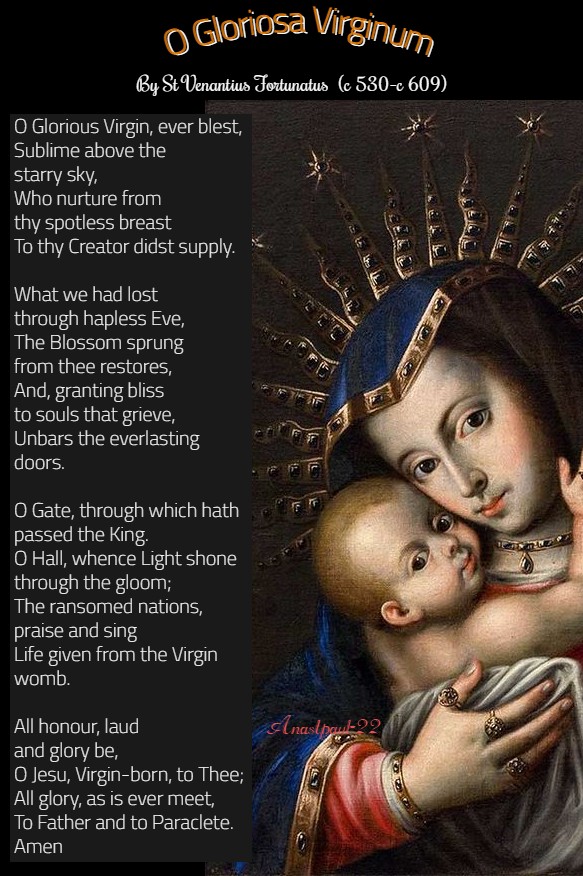
O Gloriosa Virginum By St Venantius Fortunatus (c530 – c609)
O Glorious Virgin, ever blest, Sublime above the starry sky, Who nurture from thy spotless breast To thy Creator didst supply.
What we had lost through hapless Eve, The Blossom sprung from these restores, And, granting bliss to souls that grieve, Unbars the everlasting doors.
O Gate, through which hath passed the King. O Hall, whence Light shone through the gloom; The ransomed nations, praise and sing Life given from the Virgin womb.
All honour, laud and glory be, O Jesu, Virgin-born, to Thee; All glory, as is ever meet, To Father and to Paraclete. Amen
O Gloriosa Domina is the second half of the Hymn: Quem Terra, Pontus, Aethera. It was composed by St Venantius Fortunatus (c530 – c609) the Bishop of Poitiers. In 1632, in accordance with revisions made to the Hymns of the Divine Office by Pope Urban VIII (1568-1644), it was altered and changed to O Gloriósa Vírginum. It is sung in the Common of the Blessed Virgin Mary of the Roman Breviary. It is said that St Anthony of Padua (1195-1231) was always singing this Hymn. His mother sang it to him as a baby,and even on his death bed after receiving Extreme Unction, he intoned the Hymn.























_Heilige_Begga_als_beschermvrouw_van_begijnen_en_beggaarden_Begijnhofkerk_Mechelen_19-08-2023.jpg)
You must be logged in to post a comment.