St Anastasius of Bourges St Benedicta of Sens St Cassius (Died 558) Bishop of Narni, Italy St Ciwg ap Arawn St Cocha St Ilud Ferch Brychan St Judith of Niederaltaich St Marcellus of Bourges St Mary, the Mother of John Mark St Salome of Niederaltaich St Syrus of Genoa Bl William of Sann
Quote/s of the Day – 28 June – St Irenaeus (c130 – c202) Bishop, Martyr
“The only true and steadfast Teacher, the Word of God, our Lord Jesus Christ, through His transcendent love, became what we are that He might bring us to be, what He is Himself.”
“Eve, by her disobedience, tied the knot of disgrace for the human race; whereas Mary, by her obedience, undid it.”
“For our flesh feeds on the Lord’s Body and Blood and is His member. So Saint Paul writes: “We are members of His body, of His flesh and of His bones” (Eph 5,30; Gn 2,23). He is not speaking about some spiritual and invisible man… he is speaking of the anatomy of a real man, consisting of flesh, nerves and bones. It is this that is nourished by His Chalice, the Chalice of His Blood and gains growth from the Bread which is His Body… ”
O Lamb of God By St Irenaeus (c130 – c202) Bishop & Martyr, Father of the Church
O Lamb of God, who takes away the sin of the world, look upon us and have mercy upon us, Thou who art Thyself, both Victim and Priest, Thyself, both Reward and Redeemer, keep safe from all evil those whom Thou hast redeemed, O Saviour of the world! Amen
One Minute Reflection – 28 June – “The Month of the Sacred Heart of Jesus” – St Irenaeus (c130 – c202) Bishop, Martyr – 2 Timothy 3:14-17, 4:1-5; Matthew 10:28-33 – Scripture search here: https://www.drbo.org/
“And fear you not them who kill the body and are not able to kill the soul …” – Matthew 10:28
REFLECTION – “They did not nail Polycarp but only tied him up. And so, he was bound, putting his arms behind his back, like a noble ram taken from a large flock for sacrifice, a burnt offering acceptable to and made ready for God. Then he gazed up to Heaven and said: “O Lord God Almighty, Father of Your beloved and blessed Son Jesus Christ, through Whom we have received knowledge of You, God of the angels and the powers and of all creation, God of the whole race of the righteous who live in Your sight: I bless You, for You have thought me worthy of this day and hour, to share the cup of Your Christ, as one of Your Martyrs, to rise again to eternal life in body and soul in the immortality of the Holy Ghost. May I be taken up today into Your Presence among Your Martyrs, as a rich and acceptable sacrifice, in the manner You have prepared and have revealed and have now brought to fulfillment, for You are the God of truth… And so also I praise You for all things; I bless and glorify you through our Eternal High Priest in Heaven (Heb 4,14), in Your beloved Child, Jesus Christ, through Whom be glory to You and to Him and to the Holy Ghost, now and for the ages to come. Amen.” – Letter of the Church of Smyrna concerning the Martyrdom of Saint Polycarp (69-155) [Especially appropriate today, as St Irenaeus was a Student and Disciple of St Polycarp.]
PRAYER – O God, Who enabled blessed Irenaeus, Thy Martyr and Bishop, to overcome heresy with true doctrine and to establish peace happily in the Church, grant, we beseech Thee that Thy people may be steadfast in holy religion and give us Thy peace in our times. Through Jesus Christ, Thy Son our Lord, Who lives and reigns with Thee, in the unity of the Holy Ghost, God, world without end. Amen (Collect).
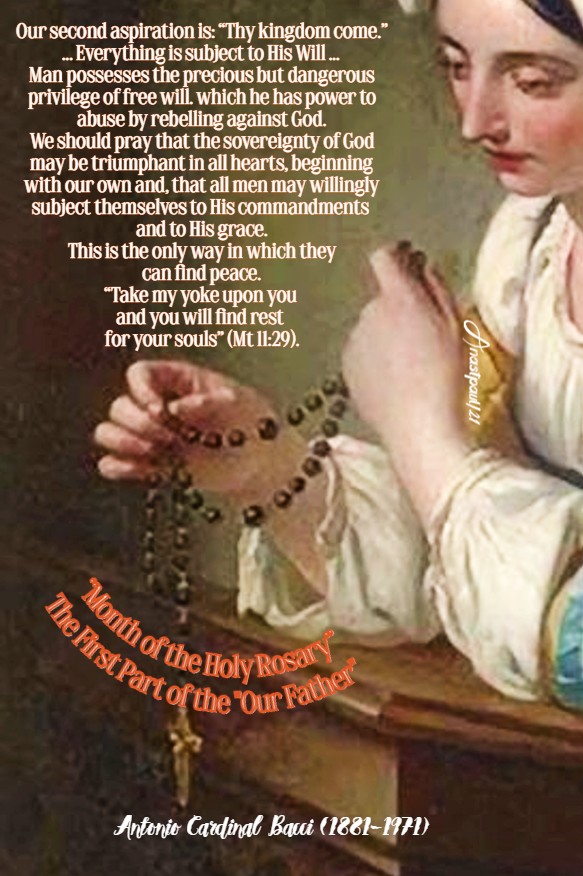
SWEET HEART of JESUS, be my LOVE. – Indulgence 300 Days, Once a Day – Pope Leo XIII 21 May 1802.
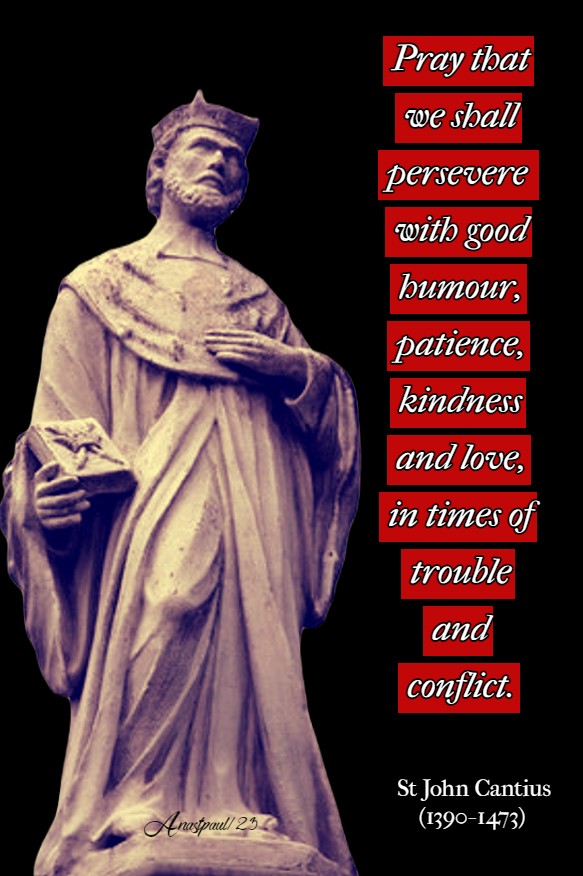
Our Morning Offering – 28 June – Angelus Domini nuntiavit Mariæ / The institution of the Angelus on 28-29 June 1456 by Pope Callistus III.
Pope Innocent XI, after the victorius battle of Vienna in 1683, requested the whole Christian world to recite the Angelus for peace. Let us renew this pious practice if we have become lax in our devotion and let us pray the Angelus, for the protection of the Church in our own times, from the many menaces, on all fronts, internally and exteriorly facing the Faith, the world and the whole existence of the Catholic Church.
The Angelus 6.00a.m. + 12.00Noon + 6.00p.m.
V. The Angel of the Lord declared unto Mary. R. And she conceived of the Holy Ghost. Hail Mary, full of grace, The Lord is with Thee; Blessed art thou among women And blessed is the fruit of thy womb, Jesus. Holy Mary, Mother of God, Pray for us sinners, Now and at the hour of our death. Amen
V. Behold the handmaid of the Lord. R. Be it done unto me according to thy word. Hail Mary, etc.
V. And the Word was made Flesh. R. And dwelt among us. Hail Mary, etc.
V. Pray for us, O holy Mother of God. R. That we may be made worthy of the promises of Christ.
LET US PRAY: Pour forth, we beseech Thee, O Lord, Thy grace into our hearts that we to whom the Incarnation of Christ Thy Son was made known by the message of an Angel, may by His Passion and Cross be brought to the glory of His Resurrection. Through the same Christ Our Lord. Amen
Saint of the Day – 28 June – St Heimerad (c970-1019) Priest, Pilgrim, Hermit, Miracle-worker. Born in c970 at Baden, Swabia, Germany and died on 28 June 1019 in Germany, of natural causes. Also known as – Eimerado, Heimrad, Haimrad or Heimo.
According to some sources Heimrad was born of a noble family but others say he was the son of a slave who was in the service of a wealthy lady who encouraged Heimerad to study to become a Priest. Heimerad was being Ordained at around 30 years of age.
Around 1006 he undertook numerous pilgrimages, to the seven pilgrimage Churches in Rome and to the Holy Land. After his return, he wanted to enter the Monastery in Memleben but was rejected and then went to the Benedictine mother Monastery in Hersfeld – today’s Bad Hersfeld – where he lived for a few years. But, he declined to take the religious vows and was, therefore, insulted, whipped and cast out by the enraged Abbot.
The ruins of the collegiate Church in Bad Hersfeld
Heimerad then settled in Kirchberg as a Hermit and was soon accused of stealing from the Chapel and was again expelled. Heimerad then worked nearby (this period is mentioned in an extant sermon dated 1012). But, even from here he was chased out of town by the local Priest because he had reproached the Priest’s housekeeper, for her unvirtuous way of life and the Priest recognised this as an attack on himself.
He asked Bishop Meinwerk in Paderborn for accommodation but he was turned away because of his unkempt appearance, called the devil and whipped. As a holy fool, he continued to endure shame and ridicule, finally he found a place on the Hasunger Berg near Kassel and, together with his servant, took over the care of the St Michael’s Chapel there. Bishop Meinwerk visited him there and asked his forgiveness for his harshness.
At first Heimerad was mocked and scorned even there but with the passage of time he came to be revered as a saint and his advice was sought by the great – the Count Dodiko von Warburg and the Empress Kunigundebecame protectors and spiritual disciples of our Saint. Heimerad became the guardian of Christianity in the Franconian-Saxon border region, which had only recently been Christianised. His holiness attracted many followers to join the Monastery.
Numerous miracles and anecdotes have been handed down from this time. One day, while climbing the mountain, Hemmo, a friend of Heimerad’s, recognised the devil who was smashing the trees on the mountain with a large boulder. Hemmo crossed himself and boldly continued the climb, for Heimerad had foreseen this attack and warned Hemmo not to fear but to cross himself.
Heimerad died as the mountain’s guardian, well respected and loved by the people, the nobles and the Bishops and Priests of the surrounding area.
Two years after Heimerad’s death, Archbishop Eribo of Mainz built a Church on the site of his Hermitage which served as the nucleus of Hasungen Abbey, founded in 1074. Pilgrimages to his grave reached their high point in the second half of the 11th Century, when Hasungen ranked as the most visited place of pilgrimage in Germany.
Around 1076, Heimerad’s life story was written by the Monk Ekkebert on behalf of Abbot Hartwig of Hersfeld The Hasunger Berg quickly became one of the most visited German pilgrimage site. But the Monastery was dissolved during the Reformation in 1527.
There have been many ‘Lives’ written about Heimerad and his fascinating and often misunderstood, earthly pilgrimage. In 2019, on the occasion of the 1000th anniversary of St Heimerad’s death, Stefan Blanz published a collection of contributions entitled “The Holy Heimerad – Priest. Pilgrim. Pauper of Christ.” The authors devote themselves to testimonies of veneration from the 11th Century to the present day.
Bl Almus of Balmerino St Argymirus of Córdoba St Attilio of Trino St Austell of Cornwall St Benignus of Utrecht St Crummine Bl Damian of Campania St Egilo St Heimerad (c970-1019) Priest, Pilgrim, Hermit St Lupercio St Papias the Martyr
Martyrs of Africa – 27 Saints: 27 Christians Martyred together. The only details about them to survive are the names – Afesius, Alexander, Amfamon, Apollonius, Arion, Capitolinus, Capitulinus, Crescens, Dionusius, Dioscorus, Elafa, Eunuchus, Fabian, Felix, Fisocius, Gurdinus, Hinus, Meleus, Nica, Nisia, Pannus, Panubrius, Plebrius, Pleosus, Theoma, Tubonus and Venustus. Unknown location in Africa, date unknown.
Martyrs of Alexandria – 8 Saints: A group of spiritual students of Origen who were Martyred together in the persecutions of emperor Septimius Severus – Heraclides, Heron, Marcella, Plutarch, Potamiaena the Elder, Rhais, Serenus and Serenus. They were burned to death c206 in Alexandria, Egypt.
Quote/s of the Day – 27 June – Feast of Our Mother of Perpetual Succour (Help)
“O Mary, you give assistance to everyone endeavouring to rise to God!”
St Bridget of Sweden (c 1303 – 1373)
“Wherefore, in the same holy bosom of His most chaste Mother, Christ took to Himself flesh and united to Himself, the spiritual Body formed by those who were to believe in Him. Hence Mary, carrying the Saviour within her, may be said, to have also carried, all those. whose life was contained in the life of the Saviour. Therefore, all we, who are united to Christ and, as the Apostle says, are members of His body, of His flesh and of His bones (Eph 5:30), have issued from the womb of Mary, like a body united to it’s Head.”
St Pius X (1835-1914) Pope from 1903 to 1914 Encyclical “Ad diem illum laetissimum” #10-11
“Be our Mother, O Mary, for you have borne us spiritually on Mount Calvary, at the foot of the Cross. Deign to obtain for us, through your intercession that we may love Jesus as you loved Him and follow Him faithfully, as you followed Him, unto Death. Amen.”
Antonio Cardinal Bacci (1881-1971)
Prayer to Our Mother of Perpetual Succour, When In Urgent Need By St Alphonsus’ Redemptorists
O Mother of Perpetual Succour, numerous clients continually surround thy Holy picture, all imploring thy mercy. All bless thee as the assured help of the miserable, all feel the benefit of thy motherly protection. With confidence then, do we present ourselves before thee in our misery. See, dear Mother, the many evils to which we are exposed, see how numerous are our wants. Trials and sorrows often depress us, reverses of fortune and privations, often grievous, bring misery into our lives, everywhere we meet the Cross. Have pity, compassionate Mother, on us and on our dear ones, especially in this our necessity …………… (mention your need). Help us, dear Mother in our distress, deliver us from all our ills, or, if it be the Will of God, that we should suffer still longer, grant that we may endure all, with love and patience. These Grace’s we expect of thee with confidence, because thou art our Perpetual Succour, amen.
One Minute Reflection – 27 June – “The Month of the Sacred Heart of Jesus” and Feast of Our Mother of Perpetual Succour, Within the Octave of St John – Isaias 49:1-3, 5-7, Luke 1:57-68 – Scripture search here: https://www.drbo.org/
“Immediately his mouth was opened, his tongue freed and he spoke blessing God.” – Luke 1:64
REFLECTION – “When John, his son was born, among his neighbours there was concern about what name he should be given. Writing tablets were offered to his father, so that he himself could put down the name that he had decided upon, so that he might express, in writing, what he could not, in speech. Then, in a wonderful manner, when he had taken the tablets in order to begin writing, his tongue was loosened, the written word gave way to speech and he did not write “John” but spoke it. Consider, then, the merit of the holy Baptist: he gave his father back his voice, he restored the faculty of speech to the priest. Consider, I say, his merit – John unloosed the mouth that the Angel had bound. What Gabriel had closed, the little child unlocked. When John is born, the father suddenly becomes a prophet or priest, speech attains its use, love receives an offspring, the office recognises the priest.” – – St Maximus of Turin (Died c 420) Bishop of Turin, Father (Sermon 6) St Maximus’ Feast Day today.
PRAYER – God our Father, Thou opens the gates of the Kingdom of Heaven to those who are born again of water and the Holy Ghost. Increase the grace Thou hast given, so that the people who have been purified from all sin, may not forfeit the promised blessing of Thy love. Grant that we may ever keep Thy Son, the Lord Jesus Christ, before our eyes and do all in Him and through Him and for Him and may the prayers of our Mother of Perpetual Succour ever guide and bear us in her care! We make our pray through Christ, our Lord,who livest and reignest with Thee and the Holy Ghost, one God forever, amen. (Collect).
Ejaculation:My Lady and my Mother, remember, I am thine; protect and defend me as thy property and possession.
Our Morning Offering – 27 June – Feast of Our Mother of Perpetual Succour
Prayer to Our Mother of Perpetual Succour
O Holy Virgin Mother Mary! Thy sweet name, “Mother of Perpetual Succour,” inspires me with unlimited confidence. I beg of thee to help me at all times and in all places; in my temptations, after my falls, in all my difficulties, in all the miseries of this life but above all, at the hour of my death. May I always have recourse to thee, for I am sure that if I invoke thee faithfully, thou wilt be faithful in helping me. Obtain for me, then, the grace to pray to thee with the confidence of a child, in order that I may secure thy perpetual help and final perseverance. Bless me, O tender Mother and pray for me, now and at the hour of my death. Amen.
Saint of the Day – 27 June – St Crescens of Galatia (Died c100) Bishop Martyr, Apostle of St Paul. Crescens is traditionally considered one of the 72 disciples sent out by Jesus in Luke 10. He was a missionary in Galatia and became a companion to and a disciple of St Paul. The name ‘Crescens’ means ‘increasing.’ Additional Memorial – 29 December (translation of Relics).
The Roman Martyrology reads today: “In Galatia, St Crescens, disciple of the blessed Apostle St Paul. In passing through Gaul, he converted many to the Faith by his preaching. Returning to the people for whom especially, he had been Consecrated Bishop, he maintained, to the end of his life, the Galatians in the service of the Lord and finally, consumated his Martyrdom under Trajan.”
Icon of the St Crescens (centre), with Saints Silvanus and Silas traditionally of the Seventy two.
Crescens, a companion of Paul during his second Roman captivity, appears once in the New Testament, where he is mentioned as having left the Apostle to go into Galatia: “Make haste to come to me,” Paul writes to Timothy, “for Demas hath left me, loving this world and is gone to Thessalonica, Crescens into Galatia, Titus into Dalmatia” (2 Timothy 4:8–10).
All commentators agree in ranking Crescens with Titus rather than with Demas and in seeing here, therefore, a reference to a missionary journey into Galatia. This term, in New Testament times, might mean either Gaul or the Roman Province of Galatia in Asia Minor, where Paul had laboured so much and its use here, has been interpreted in both senses. In the other passages where it occurs in the New Testament, however, it denotes Galatiain Asia Minor and most probably it would be so understood here by Timothy, especially, as the other regions mentioned are likewise to the east of Rome. Moreover, Paul might easily have a reason for sending a disciple to visit his old Churches in Galatia, while Fenlon notes that there is no proof that he had an active interest in Gaul.
Later traditions, on the other hand, locate him as Bishop of Vienne in Gaul, also at Mainz on the Rhine. But the earliest known traditions of Gaul itself, record nothing of this disciple of the Apostle, as a Founder of their Church and the belief is thought to have arisen later, from the desire of an Apostolic origin.
The claims of Vienne have been most strongly urged but they are based upon the mistaken identification of its first Bishop, Crescens, who lived in the Third Century.
As little can be said for Mainz. The reading of certain manuscripts which have ‘Gallia’ instead of ‘Galatia’ has also been advanced in favour of Gaul but the traditional reading is supported, by the great mass of manuscript evidence.
Crescens is mentioned as one of the seventy two disciples of Christ by Pseudo-Dorotheus. His Martyrdom in Galatia, under Trajan, is commemorated on 27 June.
St Adeodato of Naples St Aedh McLugack St Anectus of Caesarea St Arialdus of Milan St Arianell of Wales
Blessed Benvenutus of Gubbio OFM ) (Died 1232) Lay brother of the Order of the Friars Minor of St Francis, ex-Soldier, Apostle of the sick and of lepers. Benvenutus was graced with an ardent and mystical devotion to the Blessed Eucharist and to the Mother of God. So ardent was his faith and contemplation that he was seen to hold the Divine Infant in his arms. Biography: https://anastpaul.com/2021/06/27/saint-of-the-day-27-june-blessed-benvenutus-of-gubbio-ofm-died-1232/
St Brogan St Crescens of Galatia (Died c100) Bishop Martyr, Apostle of St Paul St Crescentius of Mainz Bl Daniel of Schönau Bl Davanzato of Poggibonsi St Desideratus of Gourdon St Dimman St Felix of Rome St Ferdinand of Aragon St Gudene of Carthage Bl Hemma of Gurk St Joanna the Myrrhbearer St John of Chinon
Thought for the Day – 26 June – Meditations with Antonio Cardinal Bacci (1881-1971)
Interior Mortification
“In the process of mortifying self-love, we mortify our other passions too because, it is the origin of them all! It is as well to bear in mind, however, that no matter how much we curb our passions, they never die. We need to be always on our guard, for fear that they may reassert themselves too strongly.
It is necessary for us to increase our love for God because, as St Augustine points out,, it is Divine Charity which conquers our passions. Constant prayer and union with God, help us to achieve interior mortification. Prayer without mortification, is an illusion which does not last long, so that it is necessary to combine fervent prayer with self-denial.
We may not be capable of the extraordinary mortification which the Saints practised because, our health or the obligations of iyr state in life may make these impossible for us. But,if we deny ourselves often in small matters, these will be so many steps up the ladder which will help us to reach Christian perfection.”
Quote/s of the Day – 26 June – Saint John and Saint Paul of Rome (Died c362) Martyrs – Ecclesiasticus 44:10-15, Luke 12:1-8 – Scripture search here: https://www.drbo.org/
“Are not five sparrows sold for two farthings? And yet not one of them is forgotten before God. Yes, the very hairs of your head are all numbered. Therefore, do not be afraid, you are of more value than many sparrows.”
Luke 12:6-7
“Let the world turn upside down, let everything be in darkness, in smoke, in uproar – God is with us!”
(Letters to Persons in the World, VI, 12)
“The good Angels are around you, like a company of Sentinels on guard!”
(Letters to Persons in Religion, IV, 14)
“Fear is a greater evil than the evil itself.”
(Letters to Persons in the World, VI, 12)
“Have no fear – He Who has given you the will, He will give you the accomplishing.”
(Letters to Persons in Religion, IV, 21)
“Why do you put yourself in trouble? God is good; He sees very well what you are.”
One Minute Reflection – 26 June – “The Month of the Sacred Heart of Jesus” – Saint John and Saint Paul of Rome (Died c362) Martyrs – Ecclesiasticus 44:10-15, Luke 12:1-8 – Scripture search here: https://www.drbo.org/
“Are not five sparrows sold for two farthings? And yet not one of them is forgotten before God. Yes, the very hairs of your head are all numbered. Therefore, do not be afraid, you are of more value than many sparrows.” – Luke 12:6-7
REFLECTION – “Do not look forward to the changes and chances of this life in fear – rather look to them with full hope that, as they arise, God, Whose you are, will deliver you out of them. He is your keeper. He has kept you hitherto. Do you but hold fast to His dear Hand and He will lead you safely through all things and, when you cannot stand, He will bear you in His arms. Do not look forward to what may happen tomorrow. Our Father will either shield you from suffering, or He will give you strength to bear it.” – St Francis de Sales (1567-1622) Doctor of the Church.
PRAYER – We beseech Thee, Almighty God that on this feast-day, we may have the double joy of celebrating blessed John and Paul, true brothers ,who obtained eternal glory through one Faith and one Martyrdom. Through Jesus Christ, Thy Son our Lord, Who lives and reigns with Thee, in the unity of the Holy Ghost, God, world without end. Amen (Collect).
All praise, honour and glory to the divine HEART of JESUS. – Indulgence 50 Days, Once a day. Raccolta 168 Pope Leo XIII, 14 June 1901.
Our Morning Offering – 26 June – “The Month of the Sacred Heart of Jesus”
May the Heart of Jesus be the King of My Heart! By St Francis de Sales (1567-1622) Doctor of Charity
May Your Heart dwell always, in our hearts! May Your Blood ever flow, in the veins of our souls! O Sun of our hearts, You give life to all things, by the rays of Your goodness! I will not go, until Your Heart has strengthened me, O Lord Jesus! May the Heart of Jesus be the King of my heart! Blessed be God. Amen
Saints of the Day – 26June – Saint John and Saint Paul of Rome (Died c362) Laymen siblings, Martyrs. John and Paul lived during the 4th Century in the Roman Empire. They were Martyred at Rome on 26 June. The year of their Martyrdom is uncertain according to their Acts; it occurred under the Emperor, Julian the Apostate
This image is in the Passionist Monastery
The Roman Martyrology reads today: “At Rome, on Mount Coelus, the holy Martyrs, John and Paul, brothers. The former was Steward, the other Secretary of the virgin Constantia, daughter of the Emperor Constantine. Afterwards, under Hulian the Apostate, they received the Palm of Martyrdom by being beheaded.”
These two Saints were brothers and were Officers of the Roman army in the days of Constantine the Great. They served in the house of Constantia, daughter of Constantine, who was consecrated to God. Their virtues and services to her father rendered them very dear to her. They would soon glorify God by a great moral victory – after despising the honours of the world, they triumphed by their Martyrdom over its threats and torments.
With the aid of the liberality of the Christian Princess, they were practising many works of charity and mercy, until the deaths of both Constantine and Constantia. Then, at the accession of Julian the Apostate to the imperial throne, they resigned their position in the palace. Julian had returned to the cult of idols and was attempting to re-establish it in the Empire. The Christian brothers saw many wicked men prosper in their impiety but were not dazzled by their example. They considered that worldly prosperity accompanied by impunity in sin, is the most dreadful of all judgements, indicating reprobation. And history reveals how false and short-lived was the glittering prosperity of Julian.
While still in power the apostate attempted to win back these influential Officers into active service. When he was refused, he gave them ten days to reconsider. The Officer Terentianus, who at the end of that time brought to their house a little idol of Jupiter for their adoration, found them in prayer. In the middle of that night they were decapitated secretly in their own garden, since the Emperor feared their execution might cause a sedition in Rome. He instigated a rumour that they had been exiled but the demons took hold of possessed persons in Rome and published the fact of their Martyrdom everywhere.
The son of the Officer who had slain them, also became possessed and it was only after their father, Terentianus, had prayed at the tomb of the Martyrs that the child was liberated. This so impressed him that he became a Christian, with all his family and wrote the history we have reported.
The Martyrdom of St John and St Paul, by Guercino, 1632.
The Martyrs, by their renunciation of favours and their heroic resistance, purchased an immense weight of never-fading glory and were a spectacle worthy of God. Their house became a magnificent Basilica already at the end of the 4th Century. Next to it, there was also a building to offer hospitality to the devotees of the cult of our Martyrs and to house those who would care for the sacred buildings. In time this became the Passionist Monastery Complex dedicated to Sts John and Paul, see below
The Basilica of Santi Giovanni e Paolo in Rome, is dedicated to them, as is the Basilica di San Zanipolo in Venice (Zanipolo being Venetian for John and Paul), which is situate in the Square of San Zanipolo. Since the erection of the Roman Basilica, the two Saints have been greatly venerated and since the 5th Century, their names have been included in the Roman Canon.
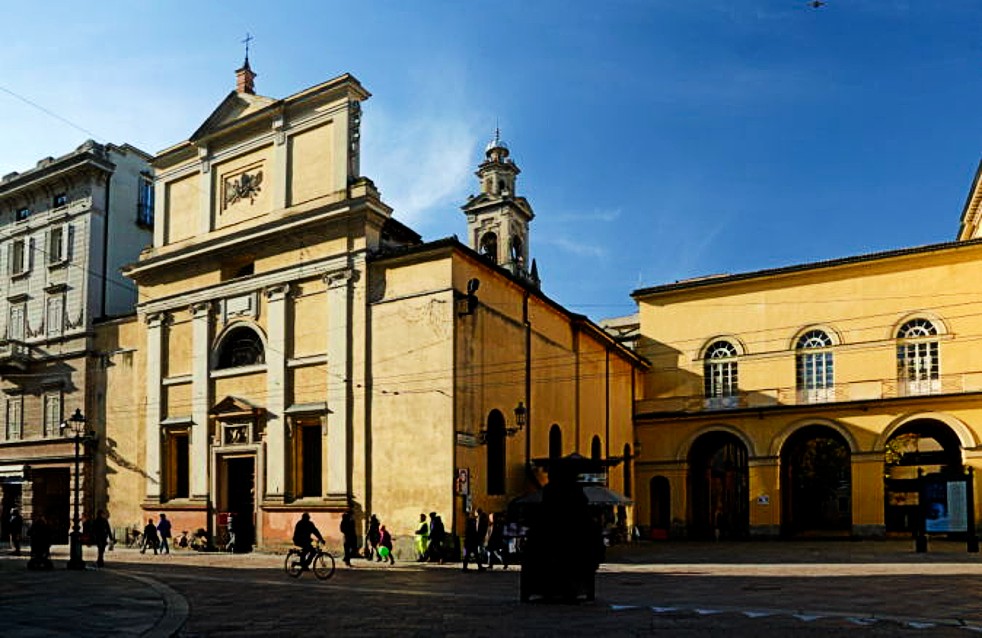
Exterior of Santi Giovanni e Paolo (Venice) from Campo San Zanipolo
Reflection. The Saints always consider that they had done nothing for Christ, as long as they had not resisted unto blood and completed their sacrifice, even to pouring forth its last drop, if God asked it of them. We must always bear in mind that we owe to God, all that we are and, after all our efforts, we remain unprofitable servants, doing only what we are bound to do. (Little Pictorial Lives of the Saints).
St Anthelm of Belley O. Cart. (c 1105-1178) Bishop of Belley, France, Prior of the Carthusian Grand Chartreuse. Reformer, talented Administrator, Founder of the female Carthusians and originated of the Carthusian Rule (with the zealous and learned assistance of Bless John the Spaniard whom we celebrated yesterday) Apostle of the poor, the sick and the needy. The wonderful St Anthelm: https://anastpaul.com/2021/06/26/saint-of-the-day-st-anthelm-of-belley-o-cart-c-1105-1178/
St Babolenus of Stavelot-Malmédy St Barbolenus of Fossés Bl Bartholomew of Vir St Corbican St David of Thessalonica St Deodatus of Nola St Dionysius of Bulgaria St Edburga of Gloucester St Hermogius of Tuy St Iosephus Ma Taishun St John of Rome * Layman, Martyr St John of the Goths St José Maria Robles Hurtado St Maxentius of Poitou St Medico of Otricoli St Paul of Rome * Layman, Martyr St Pelagius of Oviedo St Perseveranda of Poitiers Bl Raymond Petiniaud de Jourgnac St Salvius Bl Sebastian de Burgherre St Soadbair St Superius St Terence of Rome St Vigilius of Trent
Martyrs of Africa – 4 Saints: Four Christians who were Martyred together – Agapitus, Emerita, Felix and Gaudentius at an unknown location in Africa, date unknown.
Martyrs of Alexandria – 3 Saints: Three Christians who were Martyred together but we really know little more that the names – Agatho, Diogenes and Luceja. They were Martyred in Alexandria, Egypt, date unknown.
Martyrs of Cambrai – 4 Beati: Four Daughters of Charity of Saint Vincent de Paul, Nuns at Arras, France. Imprisoned together in 1792 and executed together two years later in the anti-Catholic excesses of the French Revolution. They were: , Jeanne Gerard, Marie-Françoise Lanel, Marie-Madeleine Fontaine, Thérèse-Madeleine Fantou, They were guillotined on 26 June 1794 at Cambrai, Nord, France and Beatified in June 1920 by Pope Benedict XV.
Quote/s of the Day – 25 June – Pentecost IV – Romans 8:18-23, Luke 5:1-11 – Scripture search here: https://www.drbo.org/
“Master, the whole night through we have toiled and have taken nothing but at Thy Word, I will lower the net.”
Luke 5:5
“To arrive at the knowledge of the truth, there are many paths – the first is humility, the second is humility and the third is humility.”
St Augustine (354-430) Father and Doctor of Grace)
“Those who refuse to be humble cannot be saved. They cannot say with the prophet: See, God comes to my aid; the Lord is the helper of my soul. But anyone who makes himself humble, like a little child, is greater in the Kingdom of Heaven.”
St Bede the Venerable (673-735) Father and Doctor if the Church
“At Thy Word I will lower the nets.” Whenever I lowered them on my own, I wanted to keep what belongs to Thee for myself. It was myself I was preaching and not Thee; my words, not Thine. That is why I caught nothing. Or, if I did catch something, it was not fish but frogs, only good for croaking my own praise! …”
St Anthony of Padua (1195-1231) Doctor of the Church
“When insults have no effect on us, when persecutions and penalties, have no terror for us, when prosperity or adversity, has no influence on us, when friend and foe, are viewed in the same light… do we not come close, to sharing, the serenity of God?”
St Aelred of Rievaulx (1110-1167) “St Bernard of the North”
“Humility is the mother of many virtues because from it, obedience, fear, reverence, patience, modesty, meekness and peace are born. He who is humble easily obeys everyone, fears to offend anyone, is at peace with everyone, is kind with all.”
“Dismiss all anger and look into yourself a little. Remember that he, of whom, you are speaking, is your brother and as he is, in the way of salvation, God can make him a Saint, in spite of his present weakness.”
St Thomas of Villanova (1488-1555)
“Humility and charity are the two master chords – one, the lowest; the other, the highest; all the others are dependent on them. Therefore, it is necessary, above all. to maintain ourselves in these two virtues, for observe well, that the preservation of the whole edifice depends on the foundation and the roof!”
One Minute Reflection – 25 June – “The Month of the Sacred Heart of Jesus” – Pentecost IV and the Feast of St William (1085-1142) Abbot – Romans 8:18-23, Luke 5:1-11 – Scripture search here: https://www.drbo.org/
“Fear not, henceforth you shall catch men.” – Luke 5:10
REFLECTION – “At Thy Word I will lower the nets.” It is at the command of divine grace and supernatural inspiration that the nets of preaching are to be spread out. Otherwise, the preacher wastes his time in lowering the lines of his words. People’s faith is won, not by carefully composed speeches but the grace of a divine vocation… O fruitful humility! When those who so far have not caught a thing, put their trust in Christ’s Word, they catch a great number of fish…
“At Thy Word I will lower the nets.” Whenever I lowered them on my own, I wanted to keep what belongs to Thee for myself. It was myself I was preaching and not Thee; my words, not Thine. That is why I caught nothing. Or, if I did catch something, it was not fish but frogs, only good for croaking my own praise…
“At Thy Word I will lower the nets.” Running out the net at the Word of Jesus Christ, means not attributing anything to oneself but all to Him; it means practising what one preaches. Then a great number of fish will be caught!” – St Anthony of Padua (1195-1231) Franciscan, Doctor of the Church (Sermons for Sundays and Saints’ days).
PRAYER – O God, Who made Thy Saints an example and a help for our weakness, grant us, as we walk the path of salvation, so to venerate the virtues of the blessed Abbot William that we may obtain his intercession and follow in his footsteps. Through Jesus Christ, Thy Son our Lord, Who lives and reigns with Thee, in the unity of the Holy Ghost, God, world without end. Amen (Collect).
EUCHARISTIC Heart of JESUS, model of the priestly heart, have mercy on us. COR JESU Eucharisticum, cordis sacerdotalis exemplar, miserere nobis. –Indulgence 300 Days, Everytime – Raccolta 177 St Pius X, 11 September 1907.
Our Morning Offering – 25 June – “The Month of the Sacred Heart of Jesus” – The Fourth Sunday after Pentecost
O DIVINE Heart of JESUS Pope Leo XIII Indulgence 100 Days, Once a day Raccolta 167 13 March 1901.
O DIVINE Heart of JESUS, grant, we beseech Thee, eternal rest to the souls in purgatory, the final grace to those who shall die today, true repentance to sinners, the light of the faith to pagans and Thy Blessing to me and mine. To Thee, O most compassionate Heart of JESUS! I commend all these souls and I offer to Thee, on their behalf, all Thy merits, together with the merits of Thy most Holy Mother and of all the Saints, Angels and all the Sacrifices of the Holy Mass, Communions, prayers and good works, which shall be accomplished today, throughout the Christian world. Amen
Saint of the Day – 25 June – Blessed John the Spaniard O.Cart. (1123-1160) Carthusian Prior, Founder of the female branch of the Carthusians for which he wrote the Rule, also Founder of the Reposoir Monastery. Born in 1123 at Almanza, Spain and died on 25 June 1160 at the Reposoit Chapterhouse in Switzerland of natural causes, aged just 37. Patronage – against fever. Also known as – John of Spain. Blessed John was Beatified in 1864 by Pope Pius IX.
At the age of thirteen John left his country for France, both to escape the Moslems and for the purpose of studies. He settled in the Town of Arles , in Southern France. At sixteen he felt drawn to the monastic life and entered a Monastery in the vicinity. After some years, he heard about the recently founded Order of the Carthusians and their Monastery of Montrieux, not far away, founded in 1118, 5 years before he himself was born. Drawn to their austere and entirely contemplative life, he joined the Carthusians there.
Once a vowed Carthusian, he was Ordained a Priest, was named Sacristan and eventually — still a man in his twenties! —elected Prior. We may assume he was precocious on the natural level but, even more so, by the early maturity of his virtues.
The Nuns of the Monastery of Prébayon in the vicinity, following the Rules of Saint Caesarius of Arles and of Saint Benedict , were so impressed with the fervour of Montrieux, under John’s leadership that they asked to be admitted to the Carthusian Order which, unil then, had consisted only of Monks. The Prior of the Motherhouse, La Grande Chartreuse and Superior General of the Order, Saint Anthelm, authorised this. He asked John to adapt the Consuetudines of Guigo , which were the Carthusian Rule at that time, to the nuns. He did so and this was the beginning of the female branch of the Order. It was the year 1145.
Virginal Consecration of Carthusian nuns, by Mathias de Visch (1748)
Various difficulties at Montrieux lead to his retirement from the Priorship and he moved to la Grande Chartreuse in 1150. Just then, a noble lord in neighbouring Savoy, asked for a Monastery of Carthusians on his lands. Saint Anthelm saw in Blessed John the man of Providence. He sent him to make the foundation in Savoy, which was eventually given the name of le Reposoir. There he ruled wisely as Prior for some years.
While being in this new Monastery, for several years he copied, for the Nuns, the liturgical books in use at the Chartreuse. Finally, he contributed to the ratification of the Nuns’ affiliation with the Order, probably during the Second General Chapter in 1155, in which he participated as Prior of the Charterhouse of Reposoir.
Reposoir Charterhouse. This House still exists but is today a monastery of Carmelite nuns.
On 25 June 1160 John died, not yet forty years old. Through unusual circumstances he was interred not inside the enclosure, as the custom is but outside. In fact, during his Priorate, two servants of the Monastery, having died in the mountains, under an avalanche of snow, had been interred in an inappropriate place, outside the enclosure, for which John had been reproved. To make amends he had made his Monks swear that after his death they would bury him at the same place as the two servants. This, however, permitted John’s Tomb—with his renowned for sanctity—to become the object of popular pilgrimages. The faithful prayed at his Tomb and many miracles occurred in the course of the centuries, particularly cures of malignant fever. In 1864 Blessed Pius IX approved the cult of Blessed John of Spain, venerated since time immemorial.
Let us pray: God our Father, Thou called on Blessed John to help draw up a Rule for our Nuns. May we ,who have eagerly embraced the monastic life, also arrive at the perfection of charity. We ask this through Christ Our Lord. Amen.
St Amand of Coly Bl Burchard of Mallersdorf St Cyneburga of Gloucester Bl Dorothy of Montau St Eurosia of Jaca St Febronia of Nisibis Bl Fulgentius de Lara St Gallicanus of Embrun
Quote/s of the Day – 24 June – The Feast of the Nativity of St John the Baptist – Isaias 49:1-3, 5-7, Luke 1:57-68 – Scripture search here: https://www.drbo.org/
“At my birth, I took away my mother’s barrenness and while still an infant, I healed my father’s dumbness, for You gave me in childhood, the gift of working miracles.”
St Gregory the Illuminator (c 213-270)
“John is a voice for a time but Christ is the eternal Word, from the beginning.”
St Augustine (354-430) Bishop, Father, Doctor of Grace
One Minute Reflection – 24 June – “The Month of the Sacred Heart of Jesus” and the Feast of the Nativity of St John the Baptist – Isaias 49:1-3, 5-7, Luke 1:57-68 – Scripture search here: https://www.drbo.org/
“What then will this child be?” – Luke 1:66
REFLECTION – “What will the glory of the Judge be, if the glory of the hero is so great? What will He be who comes as the Way (Jn 14:6), if such is the one, who prepares the way? . . . We are celebrating John’s birthday, we also celebrate the birthday of Christ . . . John was born of a woman who was too old for childbearing; Christ was born of a young virgin. John’s birth occurred in spite of the age of his parents; Christ’s birth occurred without the union of sexes. One was predicted by an Angel, the other was conceived by the voice of the Angel…The news of John’s birth was met with incredulity and his father was struck dumb; Mary believes in Christ’s birth and conceives Him through faith…
John, then, appears as the boundary between two covenants, the old and the new. That he is a sort of boundary the Lord Himself bears witness, when He speaks of the law and prophets lasting until John the Baptist: “The law and the prophets lasted until John” (Lk 16:16). Thus John represents the time that is past and, at the same time, he is the herald of the new era to come. Because he represents the past, he is born of aged parents; as herald of the new era, he is declared to be the prophet while still in his mother’s womb (Lk 1:41) . . . It was revealed that he was to be Christ’s precursor even before they had ever seen one another. These are Divine happenings surpassing the limits of our human frailty.
In due course he is born, he receives his name, his father’s tongue is loosened. One must read these events in the light of their deeper symbolic meaning.” – St Augustine (354-430) Father and Doctor of Grace (6th Sermon for the Nativity of John the Baptist, No 293:1)
PRAYER – O God, Who made this a day most worthy of our celebration because of blessed John; grant Thy people the grace of spiritual joys and direct the minds of all the faithful into the path of eternal salvation. T hrough Jesus Christ, thy Son our Lord, Who liveth and reigneth with thee, in the unity of the Holy Ghost, God, world without end. Amen (Collect).
OUR Lady of the Sacred Heart, Pray for Us! – Indulgence 100 Days. Everytime – Raccolta 174 St Pius X, 9 July 1904.
Saint of the Day – 24 June –The Nativity of St John the Baptist
“A man was sent from God, whose name was John. He came to testify to the light, to prepare a people fit for the Lord.” John 1:6-7
Ordinarily the Church observes the day of a Saint’s death as his Feast, because that day marks his entrance into Heaven. To this rule there are two notable exceptions, the birthdays of Blessed Mary and of St John the Baptist. All other persons were stained with original sin at birth, hence, were displeasing to God. But Mary, already in the first moment of her existence, was free from original sin (for which reason even her very conception is commemorated by a special Feast) and, John was cleansed of original sin in the womb of his mother. This is the dogmatic justification for today’s Feast. In the Breviary St Augustine explains the reason for today’s observance in the following words:
“Apart from the most holy solemnity commemorating our Saviour’s birth, the Church keeps the birthday of no other person, except that of bohn the Baptist. [The feasts of the Immaculate Conception and of the Nativity of the Blessed Virgin had not yet been introduced.] In the case of other saints or of God’s chosen ones, the Church, as you know, solemnises the day on which they were reborn to everlasting beatitude, after ending the trials of this life and gloriously triumphing over the world. For all these, the final day of their lives, the day on which they completed their earthly service is honoured.
But for John the day of his birth, the day on which he began this mortal life is likewise sacred. The reason for this, is, of course, that the Lord willed to announce to men His own coming through the Baptist, lest if He appeared suddenly, they would fail to recognise Him. John represented the Old Covenant and the Law. Therefore, he preceded the Redeemer, even as the Law preceded and heralded the new dispensation of grace.”
You must be logged in to post a comment.