Quote/s of the Day –23 April –The Second Sunday after Easter – 1 Peter 2:21-25, John 10:11-16 – Scripture search here: https://www.drbo.org/
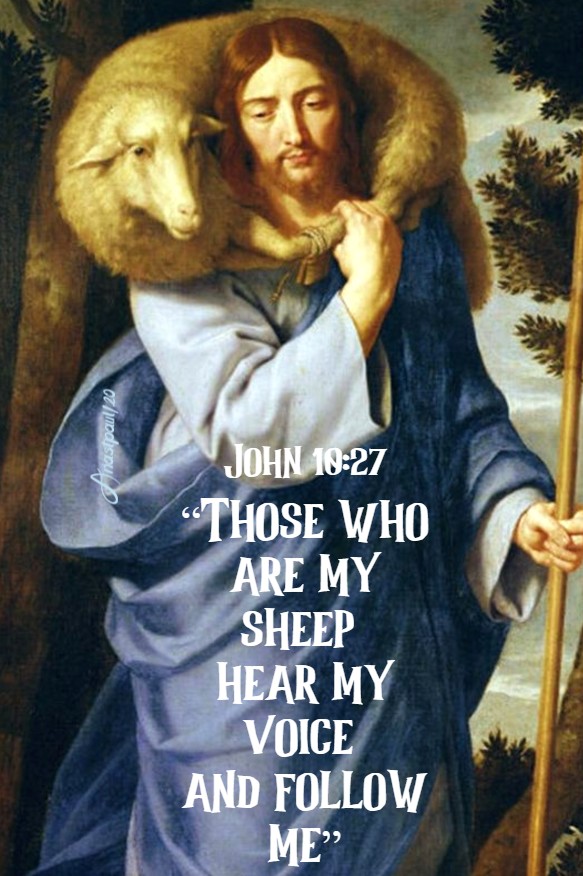
“Those who are My sheep hear My Voice and follow Me”
John 10:27
“I am like the sick sheep which strays from the rest of the flock. Unless the Good Shepherd takes me on His shoulders and carries me back to His fold, my steps will falter and, in the very effort of rising, my feet will give way!”
St Jerome (343-420) Father and Doctor of the Church
“With good reason Christ declares: I am the Good Shepherd, I seek out the lost sheep, the strayed I will bring back, the injured I will bind up, the sick I will heal (Ez 34:16). I have seen the flock of mankind struck down by sickness; I have witnessed my lambs wander about where demons dwell; I have seen my flock ravaged by wolves. All this I have seen and have not witnessed it from on high. That is why I took hold of the withered hand, gripped by pain, as if by a wolf; I have unbound those whom fever had bound; I taught him to see, whose eyes had been shut from his mother’s womb; I brought Lazarus out from the tomb where he had lain for four days (Mk 3:5; 1:31; Jn 9; 11). For I am the Good Shepherd and the good shepherd lays down His life for His sheep.”
Basil of Seleucia (Died 448) Bishop of Seleucia, Writer Oratio 26
“Christ said that the shepherd enters through the gate and that He is Himself the Gate, as well as the Shepherd. Then, it is necessary, that He enter through Himself. By so doing, He reveals Himself and through Himself, He knows the Father. But we enter through Him because through Him. we find happiness.”
St Thomas Aquinas (1225-1274) Doctor Angelicus Doctor Communis
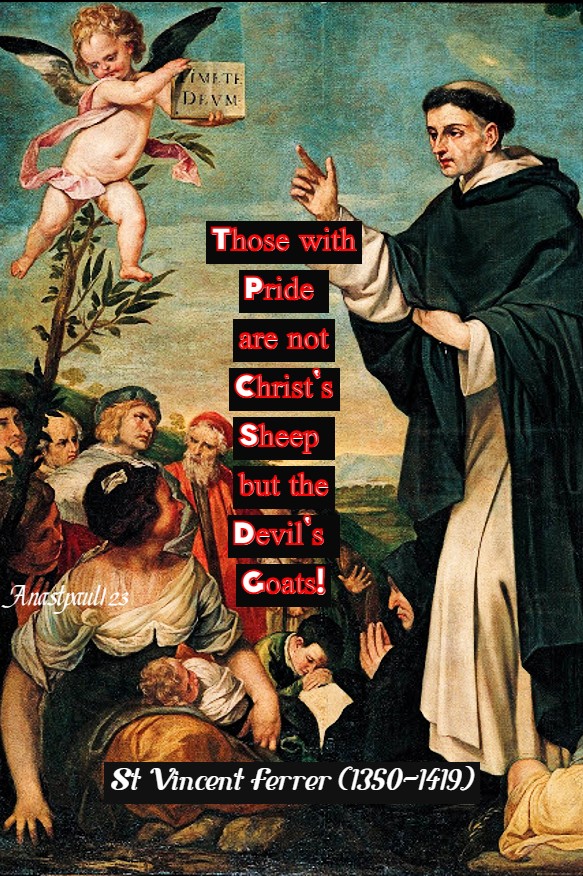
“Those with pride are not Christ’s sheep but the devil’s goats!”
One Minute Reflection – 23 April – “The Month of the Resurrection” –The Second Sunday after Easter and the Memorial of St George (Died c 303) Martyr – 1 Peter 2:21-25, John 10:11-16 – Scripture search here: https://www.drbo.org/
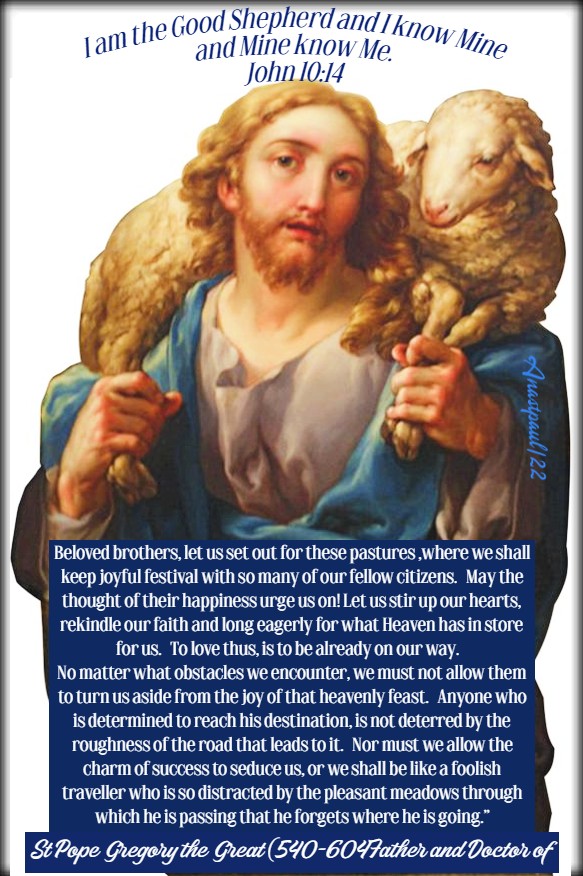
“I am the Good Shepherd and I know Mine and Mine know Me.”- John 10:14
REFLECTION – “I am the good shepherd. I know My Own—by which I mean, I love them—and My Own know Me. In plain words – those who love Me are willing to follow Me, for anyone who does not love the Truth, has not yet come to know it.
My dear brethren, you have heard the test we shepherds have to undergo. Turn now to consider, how these words of our Lord, imply a test for yourselves also. Ask yourselves whether you belong to His flock, whether you know Him, whether the Light of His Truth shines in your minds. I assure you that it is not by faith that you will come to know Him but, by love, not by mere conviction but, by action. John the Evangelist is my authority, for this statement. He tells us that anyone who claims to know God, without keeping His commandments, is a liar.
Consequently, the Lord immediately adds: ‘As the Father knows Me and I know the Father and I lay down My life for My sheep.‘ Clearly, He means that laying down His life for His sheep, gives evidence of His knowledge of the Father and the Father’s knowledge of Him. In other words, by the love with which He dies for His sheep, He shows, how greatly He loves His Father.
Again He says: ‘My sheep hear My voice and I know them; they follow Me,and I give them eternal life.’ Shortly before this He had declared – ‘If anyone enters the sheepfold through Me, he shall be saved, he shall go freely in and out and shall find good pasture.‘ He will enter into a life of faith; from faith, he will go out to vision, from belief to contemplation and will graze in the good pastures of everlasting life.
So our Lord’s sheep will finally reach their grazing ground, where all who follow Him in simplicity of heart, will feed on the green pastures of eternity. These pastures are the spiritual joys of Heaven. There, the elect look upon the Face of God with unclouded vision and feast at the banquet of life, forever more.
Beloved brothers, let us set out for these pastures ,where we shall keep joyful festival with so many of our fellow citizens. May the thought of their happiness urge us on! Let us stir up our hearts, rekindle our faith and long eagerly for what Heaven has in store for us. To love thus, is to be already on our way. No matter what obstacles we encounter, we must not allow them to turn us aside from the joy of that heavenly feast. Anyone who is determined to reach his destination, is not deterred by the roughness of the road that leads to it. Nor must we allow the charm of success to seduce us, or we shall be like a foolish traveller who is so distracted by the pleasant meadows through which he is passing that he forgets where he is going.” – St Gregory the Great (540-604) Bishop of Rome and Great Western Father and Doctor of the Church (An excerpt from his Sermon 14).
PRAYER – O God, Who dost gladden us through the worthy deeds and prayers of thy blessed Martyr George, mercifully grant that all they, who seek Thy mercy through him, may effectually obtain the gift of Thy grace. Through Jesus Christ, Thy Son our Lord, Who lives and reigns with Thee, in the unity of the Holy Ghost, God, world without end. Amen (Collect).
Our Morning Offering – 23 April – The Second Sunday after Easter
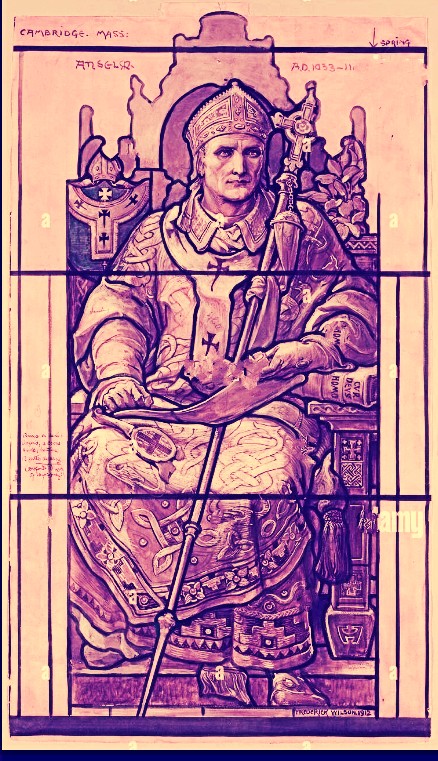
Prayer Before Holy Communion By St Anselm (1033-1109) Doctor of the Church
O Lord Jesus Christ, Son of the living God, Who according to the Will of the Father and with the co-operation of the Holy Ghost, has, by Thy Death. given life to the world, I adore and revere thi, Thy Holy Body and this, Thy Holy Blood which was given up and poured forth, for the many, unto remission of sins. O merciful Lord, I beg of Thee mercy, that through the power of this Sacrament, Thou will make me one of that many. Through faith and love, make me feel the power of these Sacraments, so I may experience their saving power. Absolve and free from all sin and punishment of sin, Thy servants, Thy handmaidens, myself, all who confessed their sins to me, those whom I have promised, or am obliged, to pray for and so too, those who themselves hope or beg, to be helped, by my prayers to Thee. Make our Church rejoice in Thy constant protection and consolation. Amen
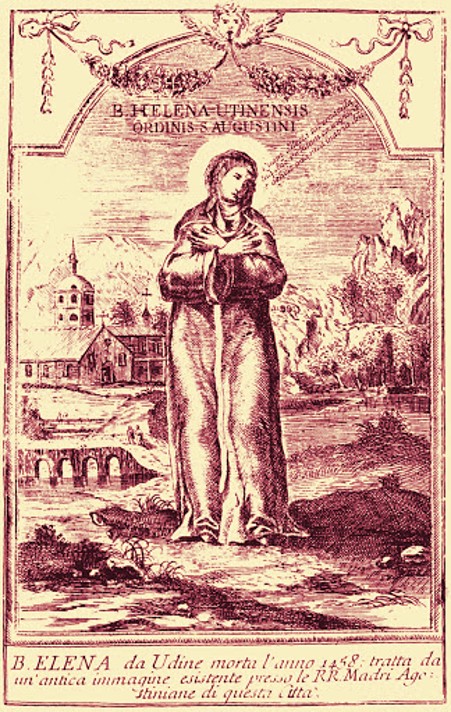
Saint of the Day – 23 April – Blessed Helen del Cavalanti OSA (1396-1458) Widow, Mother, Third Order Augustinian, Mystic, Miracle-worker. Helen was known for her spirit of penance, obedience, humility, devotion to the Passion of Christ and to the Eucharist and for her love of neighbour. Born in 1396 at Udine, Italy and died om 23 April 1458, at Udine of natural causes. Patronages – against temptations, of widows. Also known as – Helen Valentini. Helen of Udine, Helena Valentini of Udine, Elena…
Helen was born in Udine in 1396 to the nobleman Count Valentinis – a Lord of Maniago. We know of only one sibling, a sister: named Perfetta.
In 1411 at the age of 15, she married the Florentine Knight, Antonio del Cavalcanti, an Official of the City of Udine and the pair had six children – three males and three females, living happily as a loving family.
After 30 years together, raising their 6 children, Antonio died. Helen cut off her hair and placed it with her jewels in his coffin, saying: “These I wore for love of you – take them to the grave with you.”
A short while later, still within 1441, Helen heard a sermon in the Augustinian Church of Santa Lucia and decided then and there to join the Order. She became a professed Third Order member of the Order of Saint Augustine (the first for the Third Order in Udine).
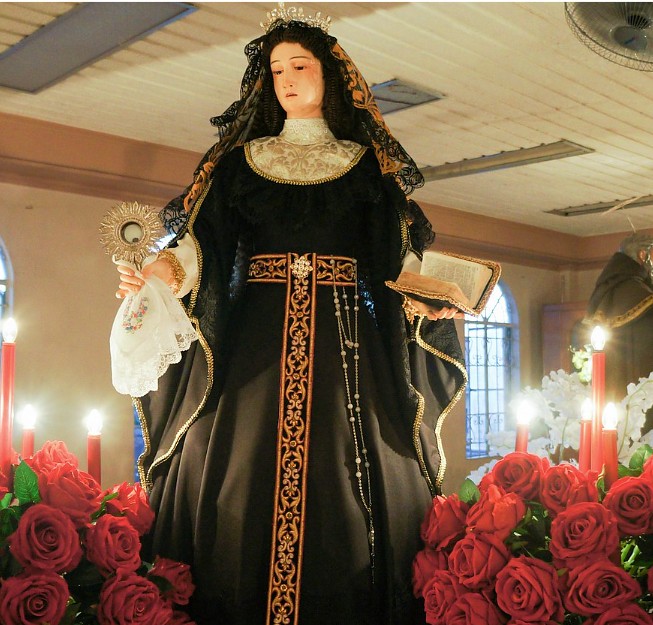
A Statue of Blessed Helen in Udine
She soon became known for her several austerities and her life of dedication to her fellowman. One of her mortifications was to take a vow of silence, speaking on Christmas alone. Helen placed 33 pebbles in jer shoes walking with pain for the rest of her days and slept on a stone pallet in place of a bed. She continued to live at home, in 1446 she moved in with her sister who was also a Third Order Augustinian, residing there until her death. She dedicated herself completely to God. She devoted long hours to prayer and meditation on the Gospels. She provided personal service and material contributions, to works of mercy. Helen developed a reputation as a Miracle worker with the power of curing the sick.
Helen became bedridden in 1455 after fracturing both her femurs in a fall. Even now, in this painful time, Helen preferred a pallet of stones and straw to a bed. Her declining health led to her death on the Saturday evening of 23 April 1458. Mass was celebrated in her room and Friars from a nearby Convent came to chant the Psalms.
Her remains were interred in Santa Lucia but in 1845. they were moved to the Udine Cathedral. On 27 September 1848, Pope Pius IX confirmed her cultus and Beatified her.
There is a wonderful procession in her honour each year.
St Giorgio di Suelli (Died 1117) Italian Bishop of Suelli, Apostle of the poor, Miracle-worker. For the Diocese he was a true shepherd, a lover of the poor whom he helped and of whom he had a list. He was devoted to prayer and fasting and lived a life of penitence and poverty. Biography: https://anastpaul.com/2021/04/23/saint-of-the-day-23-april-saint-giorgio-di-suelli-died-1117/
Blessed Helen del Cavalanti (Died 1458) Widow, Mother, Third Order Augustinian. St Ibar of Meath St Marolus of Milan St Pusinna of Champagne
Martyrs of Africa: A group of Christians murdered for their faith in northern Africa. Little information has survived but their names. The ones we know are – Catulinus, Chorus, Faustinus, Felicis, Felix, Nabors, Plenus, Salunus, Saturninus, Silvius, Solutus, Theodora, Theodorus, Theon, Ursus, Valerius, Venustus, Victorinus, Victurus, Vitalis.
Thought for the Day – 22 April – Meditations with Antonio Cardinal Bacci (1881-1971)
The Salvation of Souls
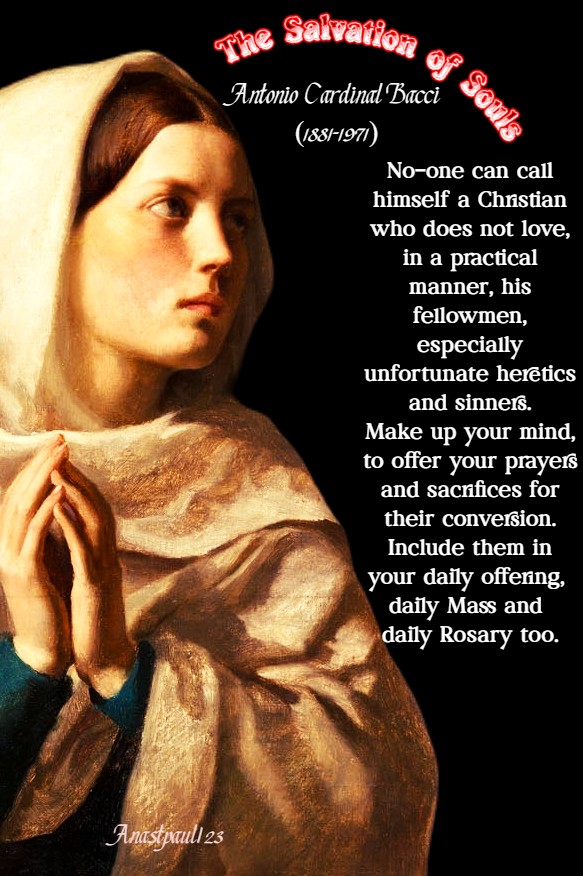
“Remember the countless conversions effected by the Saints as a result of their prayers, mortifications and heroic sacrifices. No-one can call himself a Christian who does not love, in a practical manner, his fellowmen, especially unfortunate heretics and sinners.
Make up your mind, to offer your prayers and sacrifices for their conversion. Include them in your daily offering, daily Mass and daily Rosary too.”
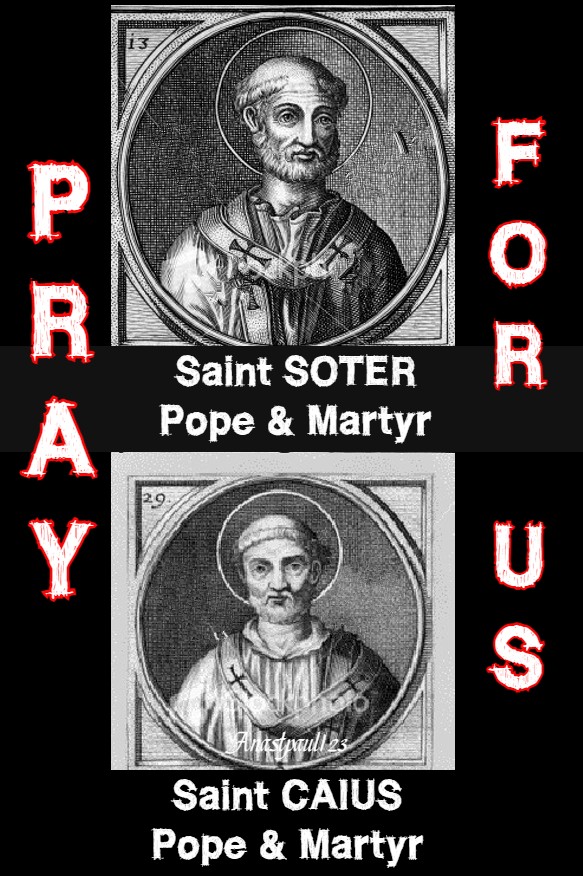
Quote/s of the Day – 22 April – St Pope Soter (Died c174) Martyr and St Pope Caius I (Died 296) Martyr – 1 Peter 5:1-4; 5:10-11, Matthew 16:13-19 – Scripture search here: https://www.drbo.org/
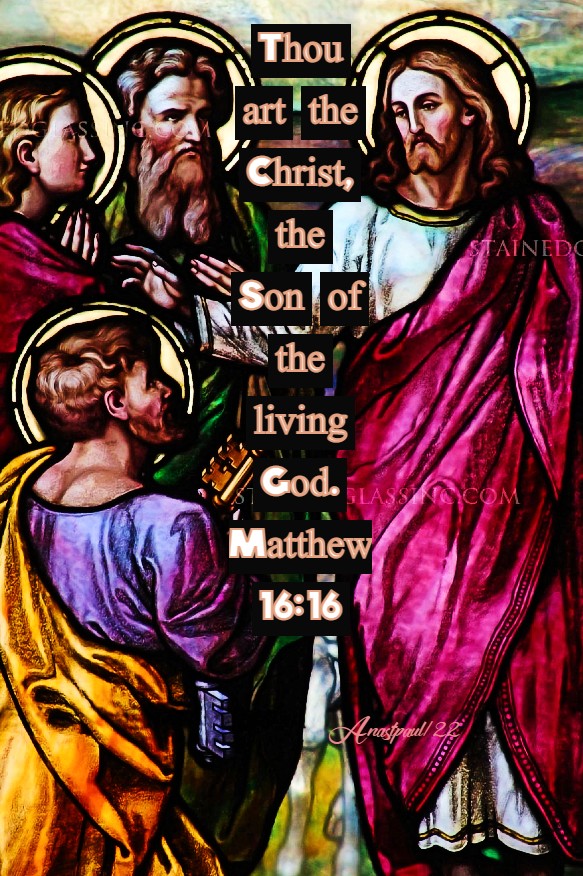
“Simon Peter answered and said: Thou art Christ, the Son of the living God.”
Matthew 16:16
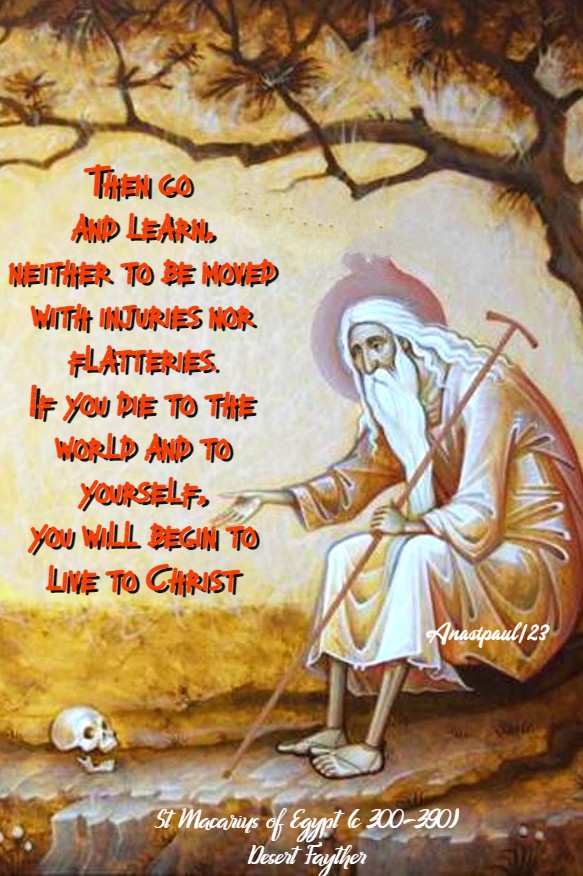
“Then go and learn, neither to be moved with injuries nor flatteries. If you die to the world and to yourself, you will begin to live to Christ.”
St Macarius of Egypt (c 300-390)
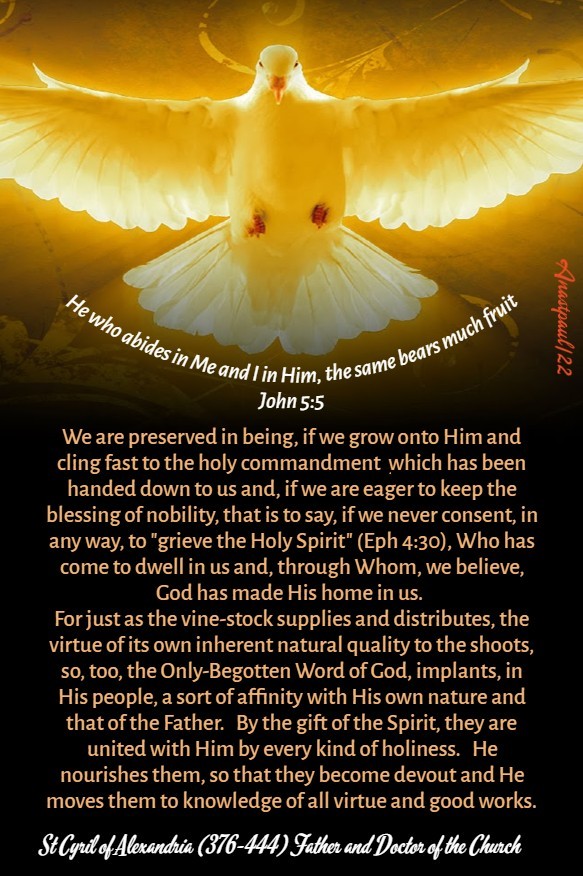
“He who abides in Me and I in Him, the same bears much fruit”
John 5:5
“We are preserved in being, if we grow onto Him and cling fast to the holy commandment, which has been handed down to us and, if we are eager to keep the blessing of nobility, that is to say, if we never consent, in any way, to “grieve the Holy Spirit” (Eph 4:30), Who has come to dwell in us and, through Whom, we believe, God has made His home in us. … For just as the vine-stock supplies and distributes, the virtue of its own inherent natural quality to the shoots, so, too, the Only-Begotten Word of God, implants, in His people, a sort of affinity with His own nature and that of the Father. By the gift of the Spirit, they are united with Him by every kind of holiness. He nourishes them, so that they become devout and He moves them to knowledge of all virtue and good works.”
St Cyril of Alexandria (376-444) Father & Doctor of the Church
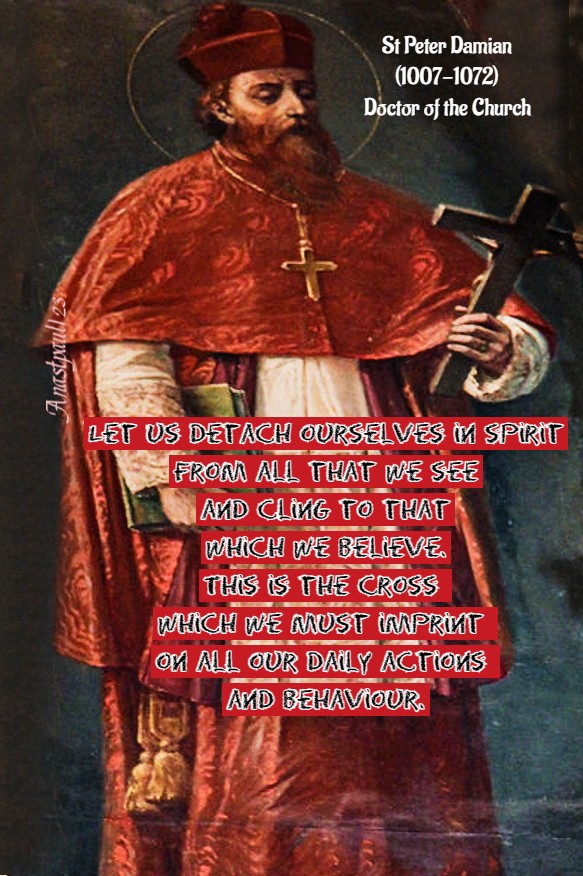
“Let us detach ourselves in spirit from all that we see and cling to that which we believe. This is the Cross which we must imprint on all our daily actions and behaviour.”
One Minute Reflection – 22 April – St Pope Soter (Died c174) Martyr and St Pope Caius I (Died 296) Martyr – 1 Peter 5:1-4; 5:10-11, Matthew 16:13-19 – Scripture search here: https://www.drbo.org/
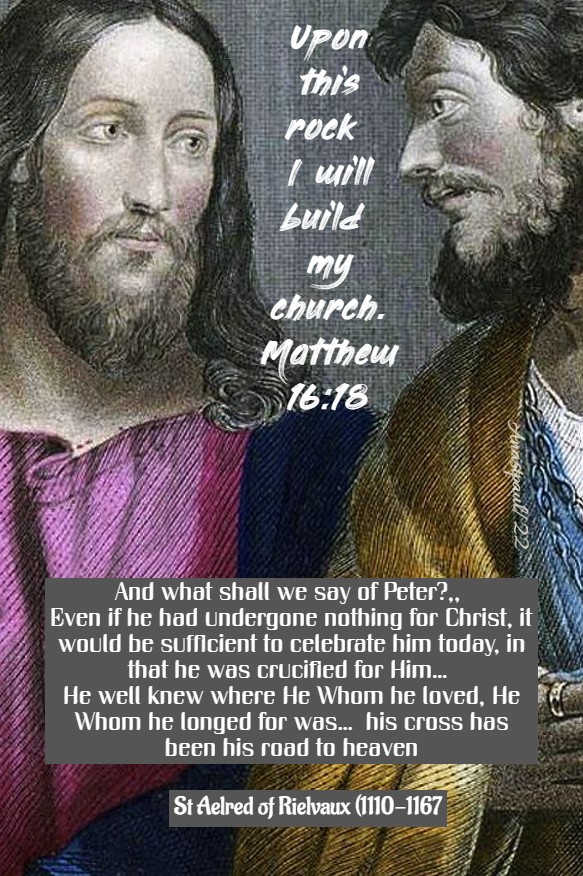
“Upon this rock I will build my church” – Matthew 16:18
REFLECTION – “Though the earth and all who dwell in it quake, I have set firm its pillars” (Ps 74:40). All the Apostles are pillars of the earth but, at their head, the two whose feast we are celebrating. They are the two pillars who support the Church with their teaching, their prayer and the example of their steadfastness. The Lord himself strengthened these pillars. For at first they were weak, completely incapable of supporting either themselves or others. And in this the Lord’s great design appears – if they had always been strong, people could have thought their strength came from themselves. That is why the Lord wanted to show ,what they were capable of before strengthening them, so that all might know their strength came from God… Peter was thrown to the ground by the voice of a mere servant… and the other pillar was very weak too: “I was once a blasphemer and persecutor and an arrogant man” (1Tm 1:13)…
Hence, we ought to praise these Saints with all our heart – our fathers who bore such trials for the Lord’s sake and who persevered with such determination. It is nothing to persevere in joy, happiness and peace. But this is what is great: to be stoned, scourged, struck for Christ (2Cor 11:25) and in all this, to persevere with Christ. With Paul, it is a great thing to be cursed and to bless, to be persecuted and to endure, to be slandered and to console, to be like the world’s rubbish and to draw glory from it (1Cor 4:12-13)…, And what shall we say of Peter?,, Even if he had undergone nothing for Christ, it would be sufficient to celebrate him today, in that he was crucified for Him… He well knew where He Whom he loved, He Whom he longed for was… his cross has been his road to heaven.” – St Aelred of Rielvaux (1110-1167) Cistercian Monk (Sermon 18, for the Feast of Saints Peter and Paul PL 195, 298).
PRAYER – Look forgivingly on Thy flock, Eternal Shepherd and keep it in thy constant protection, by the intercession of blessed Soter and Caius, Thy Martyrs and Sovereign Pontiffs, whom Thou didst constitute Shepherds of the whole Church. ThroughJesus Christ, Thy Son our Lord, Who lives and reigns with Thee, in the unity of the Holy Ghost, God, world without end. Amen (Collect).
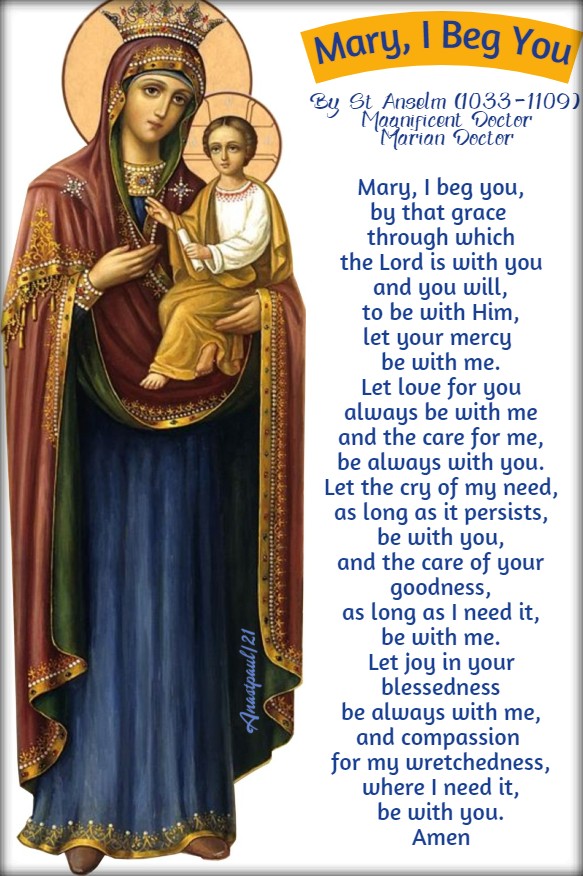
Mary, I Beg You By St Anselm (1033-1109) Magnificent Doctor Marian Doctor
Mary, I beg you, by that grace through which the Lord is with you and you will to be with Him, let your mercy be with me. Let love for you always be with me, and the care for me be always with you. Let the cry of my need, as long as it persists, be with you, and the care of your goodness, as long as I need it, be with me. Let joy in your blessedness be always with me, and compassion for my wretchedness, where I need it, be with you. Amen.
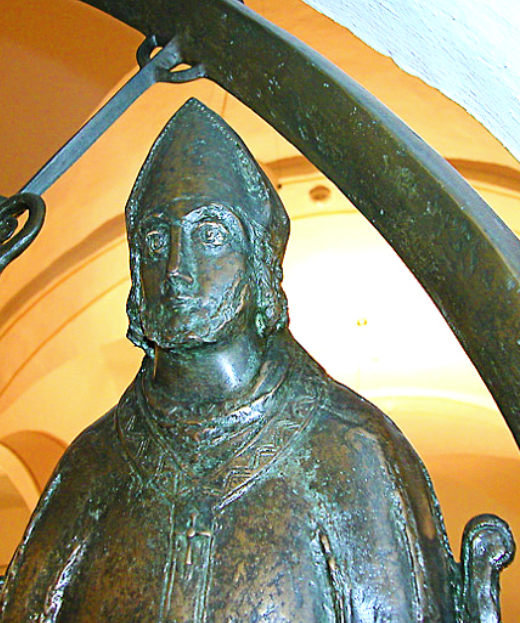
Saint of the Day – 22April – Saint Altfried of Münster (Died 849) the Third Bishop of Münster from (839–849) and Abbot of Essen-Werden and Helmstedt. Born in the 9th Century, n Friesland (in modern Netherlands) and died on 22 April 849 of natural causes. Altfried was a nephew of St Ludger (c 742-809) and his second successor in the See of Münster, as well as a successor as Abbot of the Abbey of Essen-Werden (founded by St Ludger). The second successor was also a close relative, St Gerfried of Münster. Altfried also wrote a comprehensive Vita of St Ludger. Also known as – Altfrid, Altfrith. The name Münster means Monastery.
We have such scant information on Altfried’s life, although I believe there is a complete Vita available somewhere online in Latin. He was born of a noble family and followed his uncle, St Ludger becoming a Monk and Priest in St Ludger’s Monastery of Essen-Werden, later becoming it’s Abbot. It seems that a second Monastery at Helmstedt, also founded by St Ludger fell under Altfried’s administration.
On the death of Bishop Gerfried in 839, Altfried succeeded him as the Bishop of Münster where he remained until his death.
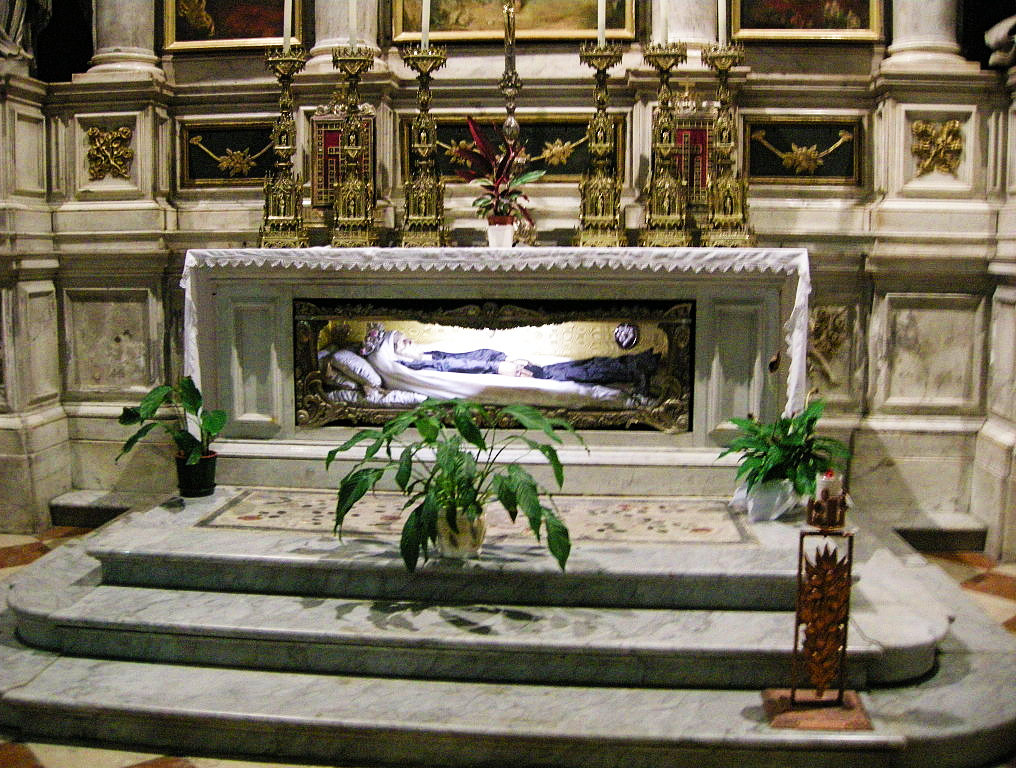
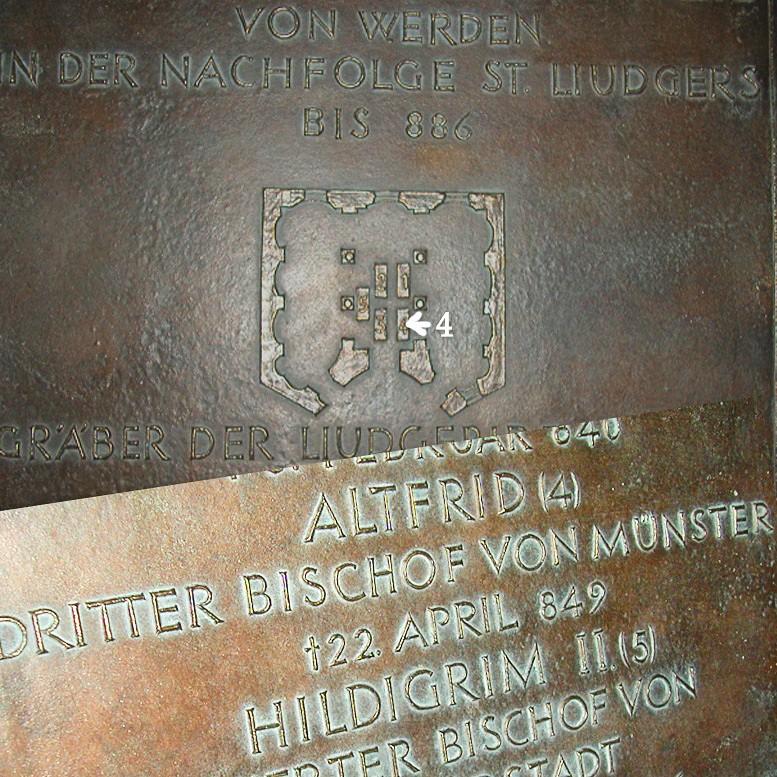
His remains were solemnly buried in the Crypt at the Monastery of Essen-Werden. The Statues and Tomb inscription below, are enshrined there.
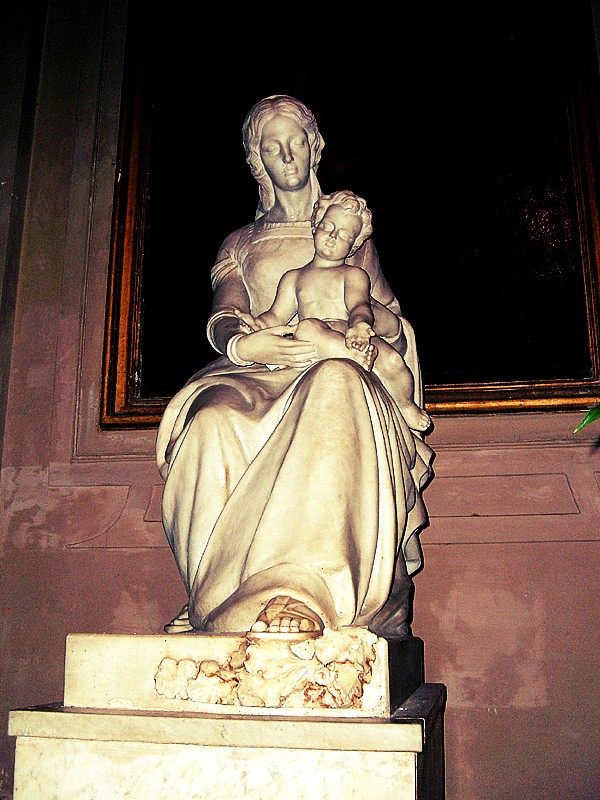
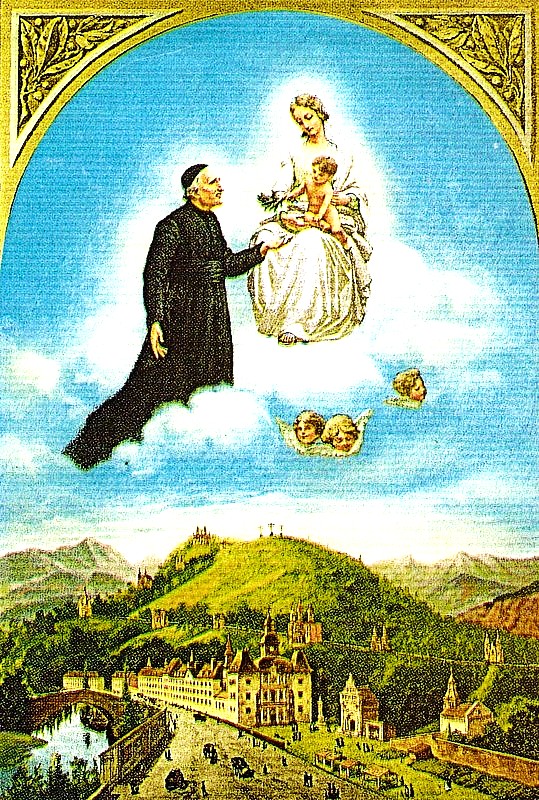
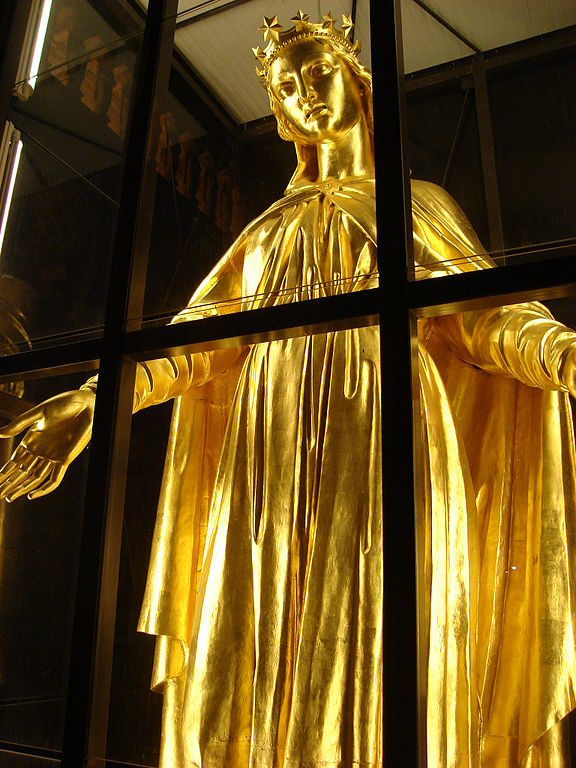
Notre-Dames de Betharam / Our Lady of Betharam, France (1503) – 22 April: Saint Bernadette Soubirous frequently visited the Shrine of Betharram. In fact, the rosary beads that Bernadette used when praying with the Blessed Virgin during the first apparition at Lourdes had come from the Betharram Shrine and the priest to whom she was sent after the apparitions, was Saint Michel Garicoïts (1797-1863) the Priest of Betharram. He it was who alone believed Bernadette’s accounts of the apparitions at Lourdes. He was Canonised in 1947. About St Michel Garicoits here: https://anastpaul.com/2019/05/14/saint-of-the-day-14-may-saint-michel-garicoits-1797-1863/ HERE: https://anastpaul.com/2021/04/22/notre-dames-de-betharam-our-lady-of-betharam-france-1503/
St Pope Caius I (Died 296) Martyr, Bishop of Rome from 17 December 283 to his death in 296. Christian tradition makes him a native of the Dalmatian city of Salona, today Solin near Split, the son of a man also named Caius and a member of a noble family related to the Emperor Diocletian. Biography: https://anastpaul.com/2019/04/22/saint-of-the-day-22-april-saint-pope-caius-i-died-613/
Martyrs of Persia: Bishops, Priests, Deacons and Laity who were Martyred in Persia and celebrated together. Several of them have their stories related in the Acta of Saints Abdon and Sennen.
Thought for the Day – 21 April – Meditations with Antonio Cardinal Bacci (1881-1971)
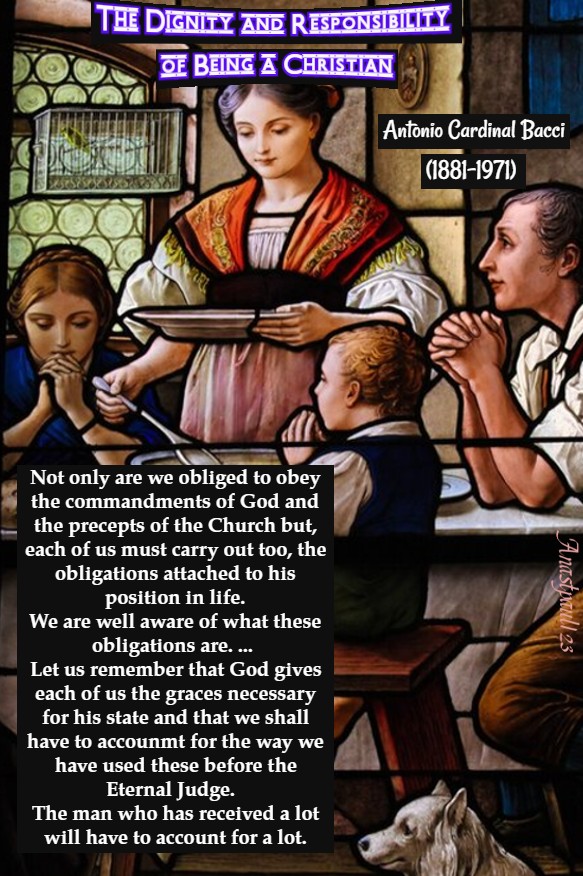
The Dignity and Responsibility of Being a Christian
“Let us examine ourselves particularly on the duties of our state and see if we are fulfilling them generously. Not only are we obliged to obey the commandments of God and the precepts of the Church but, each of us must carry out too, the obligations attached to his position in life. We are well aware of what these obligations are. Naturally, they vary from person to person. Let us remember that God gives each of us the graces necessary for his state and that we shall have to accounmt for the way we have used these before the Eternal Judge.
The man who has received a lot will have to account for a lot. Perhaps we have received a very large share of graces. If so, besides the general duties attached to the dignity of being a Christian, we have other important obligations which, as Christians, we must carry out generously,”
Quote/s of the Day – 21 April – The Memorial of St Anselm (1033-1109) Archbishop of Canterbury, Confessor, Magnificent and Marian Doctor of the Church
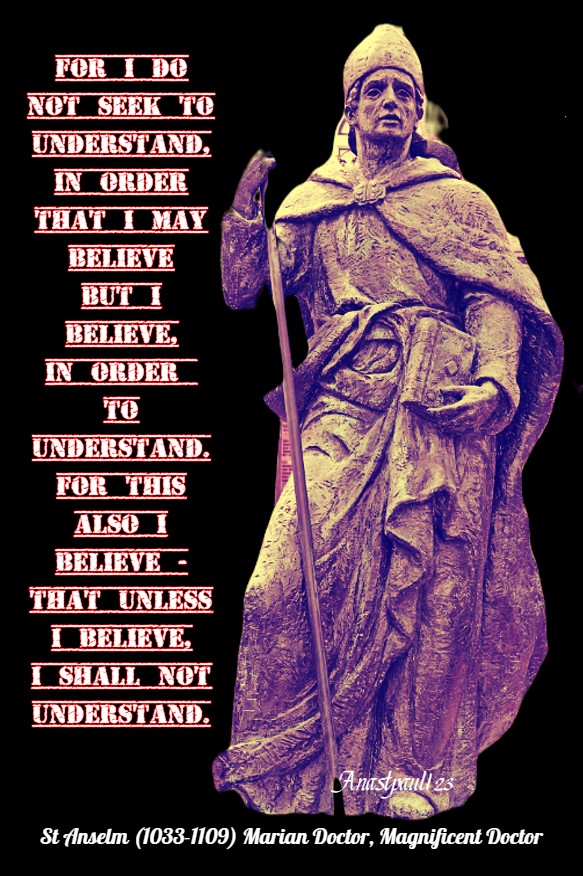
“For I do not seek to understand, in order that I may believe but I believe, in order to understand. For this also I believe – that unless I believe, I shall not understand.”
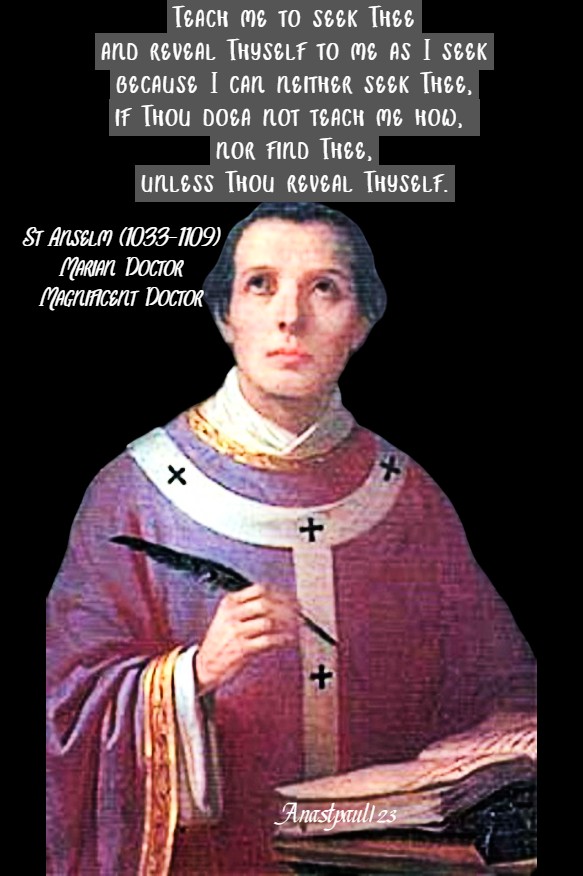
“Teach me to seek Thee and reveal Thyself to me as I seek because I can neither seek Thee, if Thou doea not teach me how, nor find Thee, unless Thou reveal Thyself.”
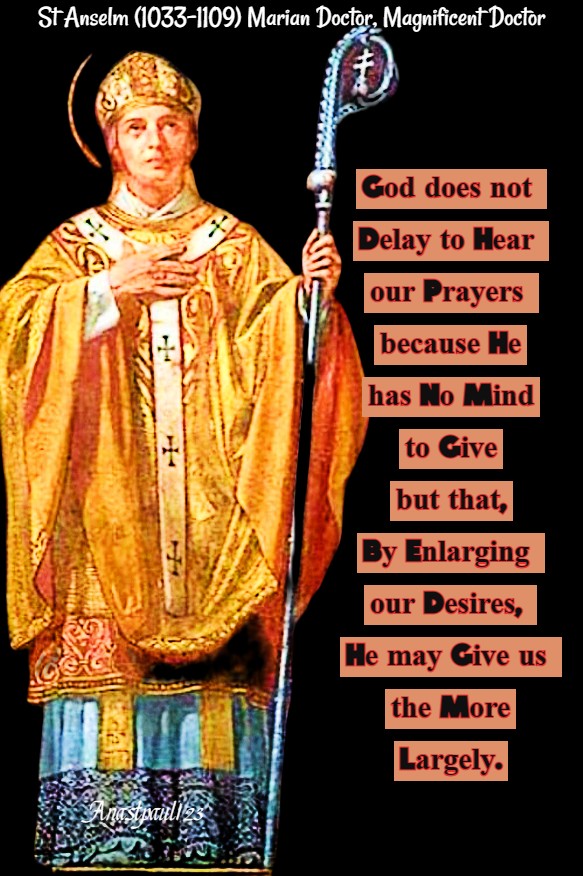
“God does not delay to hear our prayers because He has no mind to give but that, by enlarging our desires, He may give us the more largely.”
Mother of Salvation, Blessed Lady By Anselm (1033-1109) Magnificent Doctor Marian Doctor
Mother of Salvation, Blessed Lady, you are the Mother of Justification and those who are justified; the Mother of Reconciliation and those who are reconciled; the Mother of Salvation and those who are saved. What a blessed trust and what a secure refuge! The Mother of God is our Mother. The Mother of the One in Whom alone, we hope and Whom alone, we fear, is our Mother! … The One Who partook of our nature and by restoring us to life, made us children of His Mother, invites us by this grace, to proclaim that we are His brothers and sisters. Therefore, our Judge, is also our Brother. The Saviour of the world, is our Brother. Our God has become – through Mary – our Brother! Anen
One Minute Reflection – 21 April – “The Month of the Resurrection” – – The Memorial of St Anselm (1033-1109) Bishop, Confessor, Magnificent and Marian Doctor of the Church – 2 Timothy 4:1-8, Matthew 5:13-19 – Scripture search here: https://www.drbo.org/
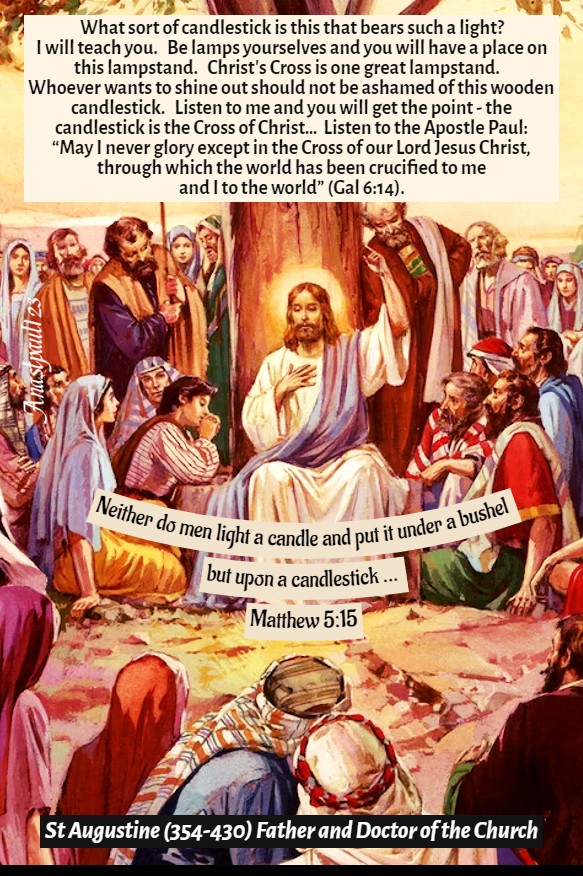
“Neither do men light a candle and put it under a bushel but upon a candlestick …” – Matthew 5:15
REFLECTION – “Brethren, the Apostles are lamps enabling us to wait for the coming of Christ’s Day. Our Lord tells them: “You are the light of the world.” And since they cannot believe themselves to be a light, like that of which it is said: “He was the true Light Who enlightens everyone” (Jn 1:9), He at once teaches them what that true light is. Having declared to them: “You are the light of the world,” He continues: “No-one lights a lamp to put it under a bushel basket.” I have called you lights, He says but I must clarify – you are only lamps. So do not give in, to the stirrings of pride, if you do not want to see this wick burning out. I am not putting you under the bushel basket but on the lampstand to cast light over everything with your rays.
What sort of candlestick is this that bears such a light? I will teach you. Be lamps yourselves and you will have a place on this lampstand. Christ’s Cross is one great lampstand. Whoever wants to shine out should not be ashamed of this wooden candlestick. Listen to me and you will get the point – the candlestick is the Cross of Christ…
“So will your light shine before others, so that they may see your good works and glorify” Glorify whom? Not yourself, since to seek your own glory is to want to be extinguished! “Glorify your heavenly Father.” Yes, that they may glorify Him, your heavenly Father, when they see your good works… Listen to the Apostle Paul: “May I never glory except in the Cross of our Lord Jesus Christ, through which the world has been crucified to me and I to the world” (Gal 6:14).” – St Augustine (354-430) Father and Doctor of the Church (Sermon 289, 6 PL 38, 1311-1312).
PRAYER – O God, Who didst give blessed Anselm to be Thy people’s minister in eternal salvation, grant we pray, that we, who have him for teacher of life here on earth, may also deserve now that he is in Heaven, to have him for an advocate. Through Jesus Christ, Thy Son our Lord, Who lives and reigns with Thee, in the unity of the Holy Ghost, God, world without end. Amen (Collect).
Our Morning Offering – 21 April – “The Month of the Resurrection” – The Memorial of St Anselm (1033-1109) Bishop, Confessor Magnificent and Marian Doctor of the Church
Complete Us, O Lord Jesus Christ By St Anselm (1033-1109) Magnificent and Marian Doctor of the Church
O Lord Jesus Christ, our Redemption and our Salvation, we praise You and give You thanks. Although we are unworthy of Your benefits and cannot offer to You, the devotion You deserve, let Your loving-kindness complete whatever our weakness tries to do. Before You, O Lord, we lay all our desires and whatever our heart rightly wishes, it is because of Your gifts. Help us to love You as You command. Do not let Your gifts be unfruitful in us. Complete what You have begun, give what You have made us desire, convert our lukewarmness into fervent love of You, for the glory of Your Holy Name. Amen.
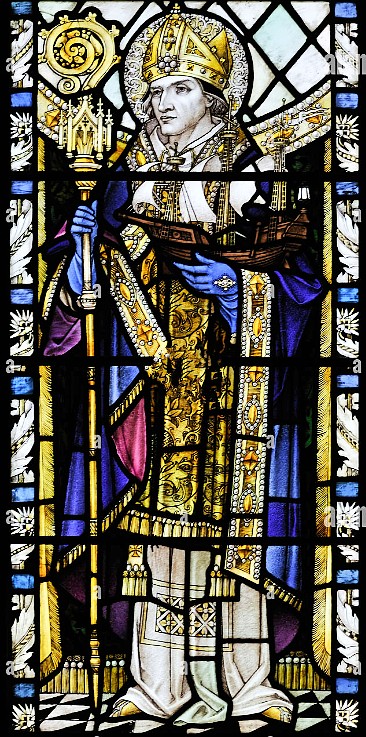
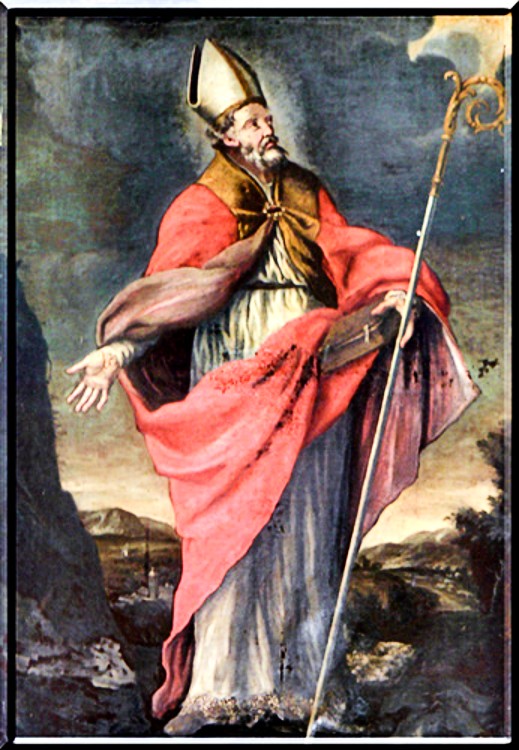
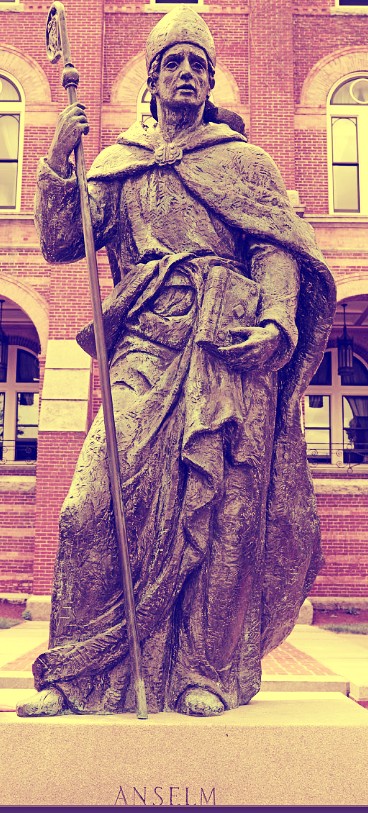
Saint of the Day – 21 April – St Anselm (1033-1109) Bishop, Confessor, Magnificent and Marian Doctor of the Church
St Anselm, Archbishop of Canterbury By Fr Francis Xavier Weninger SJ (1805-1888)
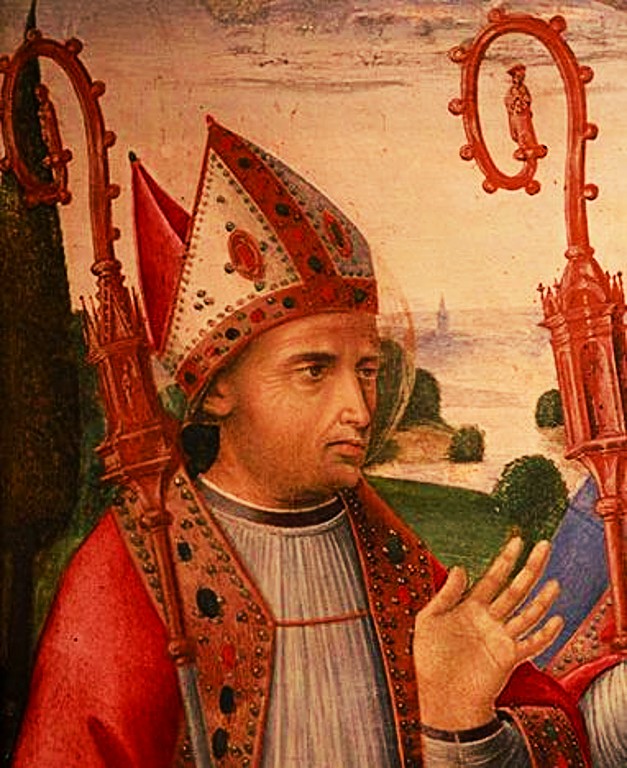
“Anselm, the celebrated Archbishop of Canterbury, in England, was born in Piedmont in the year 1033. He was gifted by nature with brilliant talents and a large, comprehensive mind. When he was hardly fifteen years of age, he was desirous of entering upon a religious life but he was not, admitted, as it was feared that it would provoke the wrath of his father and his noble relatives. This refusal was so deeply regretted by Anselm that he fell into a grievous illness which renewed his determination to enter a Monastery. On his recovery, however, he forgot his resolution and not only did he lose all inclination to enter the religious state, but he began to lead a much more worldly life than he had done previously. It was fortunate for him that, to a certain extent, he had lost his father’s love and was treated by him rather harshly. Not being able to endure this, Anselm left home, hoping that his absence might restore to him his father’s affection.
He, therefore, proceeded to France, where he remained for three years. Suddenly his desire to study, which had lain dormant in his mind so long, was reawakened and hearing that the celebrated Doctor Lanfranc, his compatriot, instructed young men in sacred science, in an Abbey not far distant, he went to him and begged to be admitted among the number of his disciples. Lanfranc consented and Anselm made such rapid progress in his studies that he soon left all others behind him.
During this time, he renewed his zeal in the practice of piety and virtue and also his determination to give his life entirely to the Almighty. In pursuance of this, he received the Habit, at the age of twenty-seven, in the Abbey of St Benedict, where he had studied and, after having passed through his novitiate, he took his vows. How eanestly he strove after spiritual perfection is evident from the fact that three years after, he had taken the vows, he succeeded Lanfranc, his teacher, as Prior of the same Abbey, the latter being called as Abbot to another Monastery. Several, who had been longer in the Order than he, envied and persecuted him on account of his promotion but the exquisite gentleness, patience and humility of Anselm soon won him all hearts and changed envy and jealousy into love and respect. His holy life added much to their veneration. He fasted almost daily,and his body became fearfully emaciated. By his constant mortification, he lost all relish for food. During the day, he instructed others in sacred science and in the Mysteries of the Faith. The greater part of the night he passed in prayer and meditation.
He attended, before all his other affairs, to the sick, day and night and wherever he was needed. He fed them and lifted them in and out of their beds, with his own hands. The most tender devotion he bore to our Crucified Saviour and often wept bitterly when he thought how our Redeemer, notwithstanding all His sufferings for us, is so frequently and so deeply offended. His aversion to sin was so intense that he, several times said that he would rather cast himself into hell, than commit a mortal sin. He shunned carefully the least thing that he thought was displeasing to God – because nothing is little which offends the Most High and often from something which appears, in itself, of small importance, eternal happiness or damnation depends! He too, was much devoted to the Blessed Virgin and was one of the first who defended, by the pen, her Immaculate Conception. Besides this, he wrote many other works in praise of the Divine Mother,and endeavoured to incite others to pay her due honours.
After the death of the Abbot, Anselm was unanimously elected as his successor, although he did what he could to prevent it. Invested with this new dignity, he changed, not in the least his mode of life, unless he was more fervent than ever in all his devotional exercises.
The fame of his sanctity and erudition spread abroad daily, more and more, so that he was not only esteemed by the Prelates of the Church, as well as by Kings but also by Pope Gregory VII, who, harassed on account of the sad condition of the Church at that period, recommended himself several times to the prayers of the Saint.
Some business appertaining to his Convent called Anselm to England and as his name was already well known there, he was everywhere received with the greatest honour. While he was, in England, Lanfranc, who after being instructor to Anselm, had become Abbot and then Archbishop of Canterbury, died and the King, without hesitation, chose St Anselm to be his successor and although the Saint most earnestly declined, he was at last obliged to yield to the influences of the clergy. He shed many bitter tears during his Consecration but once installed in his new functions, he went zealously to work to change the depraved manners of the people by preaching, writing instructive works and holding Councils.
Everything was going well, when the King himself caused great disturbances. He took forcible possession of a great deal of property belonging to the Church and would not consent that, during the division which at that time existed in the Church, anyone else but himself, should be regarded as the head thereof. Anselm courageously protected the rights and liberties of the Church and opposed, with manly independence, the wicked oppression and evil designs of the King. Hence, the unscrupulous counsellors of the King, persecuted him, banished his friends, deprived him of his revenues and tormented him in manifold ways, thinking thus to intimidate him and make him pliable to the King’s wishes. But they were mistaken. The Saint remained inflexible and was willing, rather to die, than in the least to swerve from his duty. Believing that the wrath of the King would be sooner appeased, if another occupied his See, he went to Rome and humbly requested the Pope to release him from his Archbishopric. The Pope, however, refusing his request, endeavoured to reconcile him with the King and meanwhile, made use of the knowledge and talents of the holy man in his warfare against the heretics and schismatics.
After sometime, Anselm went to Lyons, in France, to escape the honours which were tendered to him at Rome. While there, King William of England, who had so violently resented the Saint’s protection of the rights of the Church, died an unhappy death. He was hunting and the excitement was just at its height, when the fatal arrow of a French officer piercing his heart, sent him, without a moment for repentance, into eternity. Indescribably grieved was Anselm on hearing this news and he said more than once, that he would willingly give his life, if with his blood, he could save the soul of the unhappy Monarch. Before the intelligence of the King’s death had reached Lyons, Hugh, the holy Abbot of Cluny, said to Anselm : “King William stands accused before the Judgement Seat of the Most High and is already judged and sentenced to the eternal fire.”
On the death of King William, the crown fell to his son Henry, who, warned by the example of his father, endeavoured to ameliorate matters. He abolished the intolerable investitures, was gracious and kind to all, would neither have anything to do with the property of the Church, nor lay hands on the income of the clergy. As he knew how great the consideration was that Anselm enjoyed among all right-minded people, he recalled him to England and received him very graciously. But this behaviour was of short duration and before long the Archbishop had again to make a journey to Rome to seek protection for the rights of the Church, which Henry, like his father, commenced to violate. The Pope granted the Saint all he requested, all that justice demanded but when the King heard of it, he forbade the Archbishop to return to his See.
Anselm, therefore, repairing once more to Lyons, remained there for sixteen months. While there he daily celebrated the Holy Mass and offered many prayers and penances for the conversion of the King and the salvation of the whole land. Meanwhile, all England wished for the return of her shepherd and the King’s sister rested not in her endeavours, until her brother was appeased and allowed him to come back. After the holy man had returned to his See, he strove with all his energy to employ his few remaining years for the benefit of his flock. Thus he passed three peaceful years.
When he was no longer able to say Mass, he caused himself to be carried into the Church that he might at least be present at the Holy Sacrifice, for which he had always evinced the deepest veneration. After having received the Holy Sacraments on Wednesday in Holy Week, he requested to be laid, clad in a penitential robe, on the ground upon ashes and while they read to him the Passion of our Lord, he peacefully expired, in the seventy-sixth year of his age.
The many miracles which were wrought at his tomb caused the fame of his sanctity to be spread abroad through the whole of the Christian world.”
St Conrad of Parzham OFM Cap (1818-1894) Franciscan Religious Lay Friar, Devotee of Blessed Sacrament and Marian, Apostle of Charity, Miracle worker with the charism of prophecy. His heroic virtues and the miracles he performed won for him the distinction to be ranked among the Blessed by Pope Pius XI in 1930. Four years later, the same pope, approving additional miracles which had been performed, solemnly inscribed his name in the list of Saints. Biography: https://anastpaul.com/2018/04/21/saint-of-the-day-21-april-st-conrad-of-parzham-ofm-cap-1818-1894/
St Crotates of Nicomedia St Cyprian of Brescia St Felix of Alexandria St Fortunatus of Alexandria St Frodulphus St Isacius of Nicomedia St Maelrubba of Applecross
St Silvius of Alexandria St Simeon of Ctesiphon St Vitalis of Alexandria Bl Vitaliy Bayrak Bl Wolbodó of Liège
Thought for the Day – 20 April – Meditations with Antonio Cardinal Bacci (1881-1971)
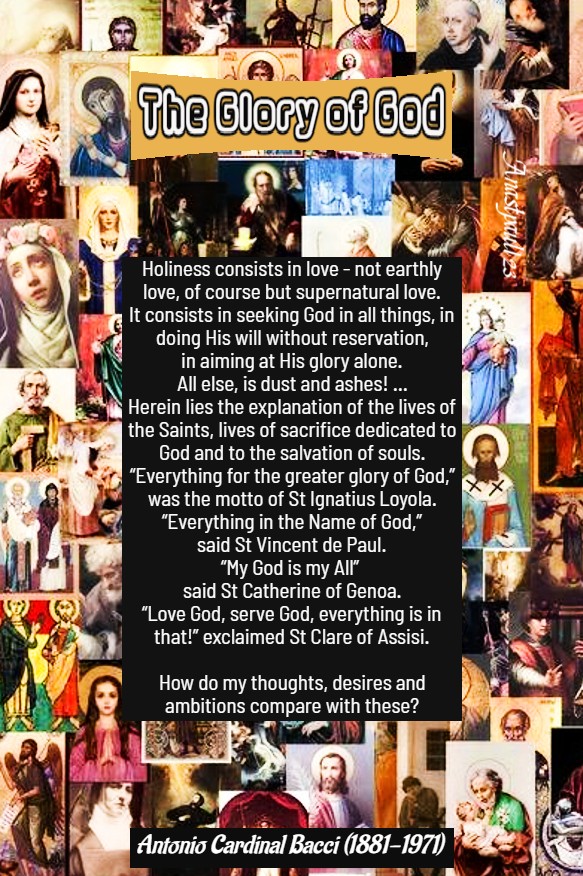
The Glory of God
“Holiness consists in love – not earthly love, of course but supernatural love. It consists in seeking God in all things, in doing His will without reservation, in aiming at His glory alone. All else, is dust and ashes!
So it will appear to us at the end of life when we shall be able to view ourselves and the world around us, in the light of eternity. Herein lies the explanation of the lives of the Saints, lives of sacrifice dedicated to God and to the salvation of souls. “Everything for the greater glory of God,” was the motto of St Ignatius Loyola. “Everything in the Name of God,” said St Vincent de Paul. “My God is my All” said St Catherine of Genoa. “Love God, serve God, everything is in that!” exclaimed St Clare of Assisi.
How do my thoughts, desires and ambitions compare with these? Are they sincerely directed towards God and towards His glory?”
Quote/s of the Day – 20 April – “The Month of the Resurrection” – Feria Day, Thursday in the Second Week of Easter – 1 John 5:4-10, John 20:19-31 – Scripture search here: https://www.drbo.org/
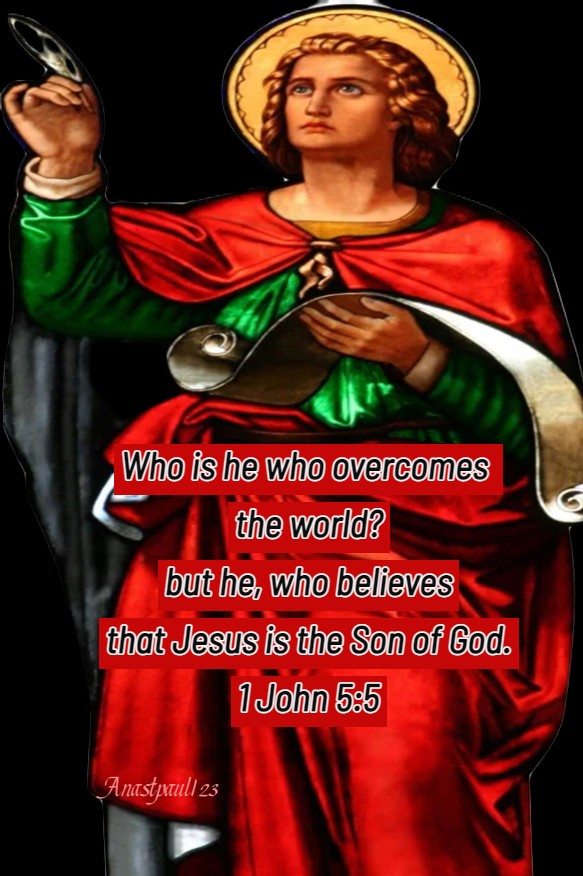
“Who is he who overcomes the world? but he who believes that Jesus is the Son of God.”
1 John 5:5
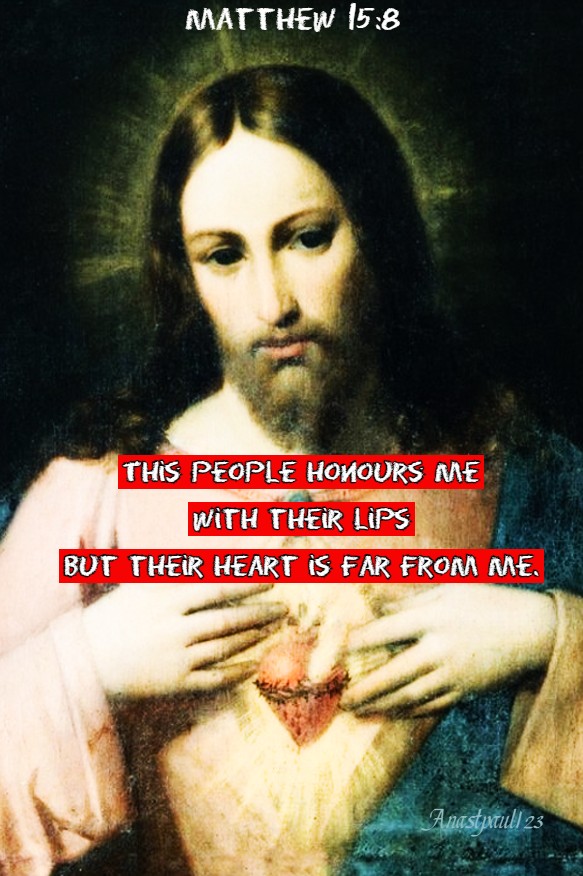
“This people honours Me with their lips but their heart is far from Me.”
Matthew 15:8
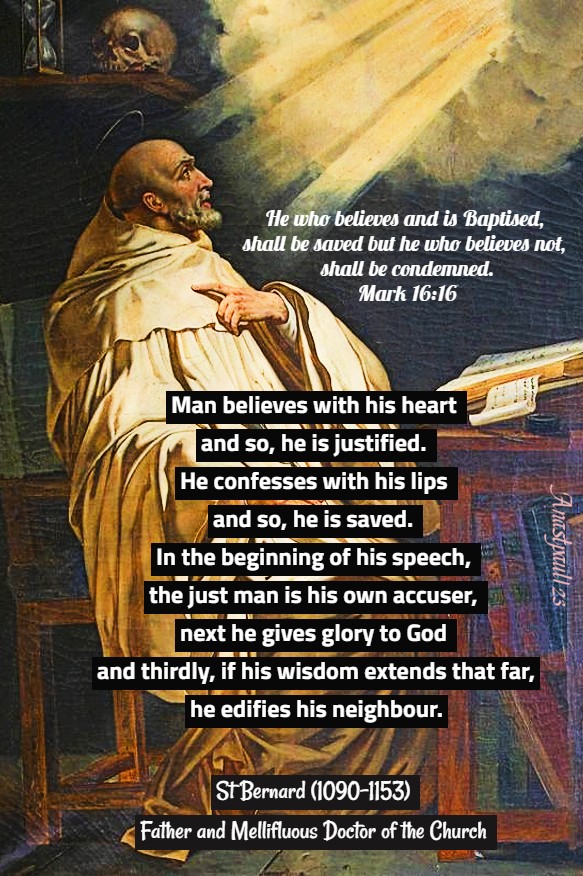
“He who believes and is Baptised, shall be saved but he who believes not, shall be condemned.”
Mark 16:16
“Man believes with his heart and so, he is justified. He confesses with his lips and so, he is saved. In the beginning of his speech, the just man is his own accuser, next he gives glory to God and thirdly, if his wisdom extends that far, he edifies his neighbour.”
St Bernard (1090-1153) The “Last Father” and Mellifluous Doctor of the Church
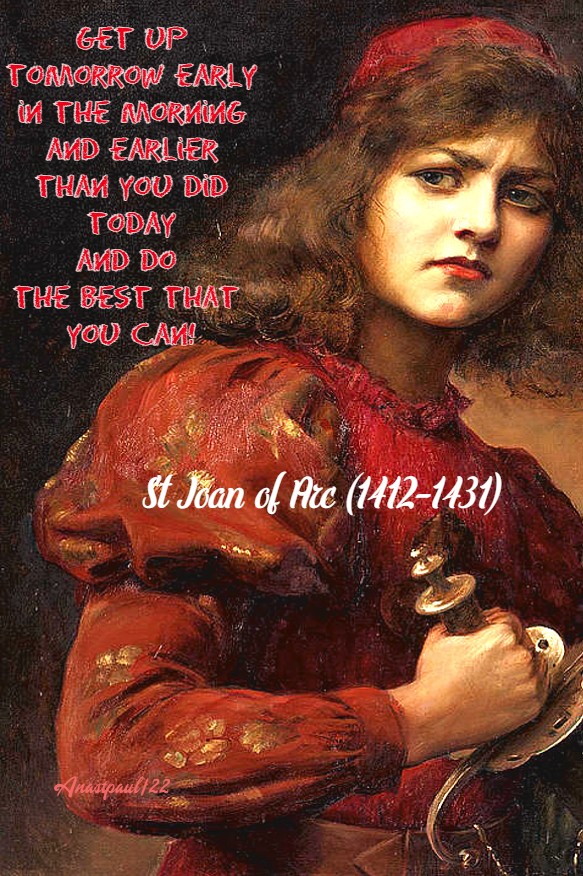
“Get up tomorrow early in the morning and earlier than you did today and do the best that you can!”
St Joan of Arc (1412-1431)
“The very prince of the universe, is man; the crowning point of man, is his heart; of the heart, is love and the perfection of love, is charity. That is why the love of God is the goal, the crowning point, the be-all and end-all of the universe.”
(Treatise on the Love of God, Book 10, Chapter 1)
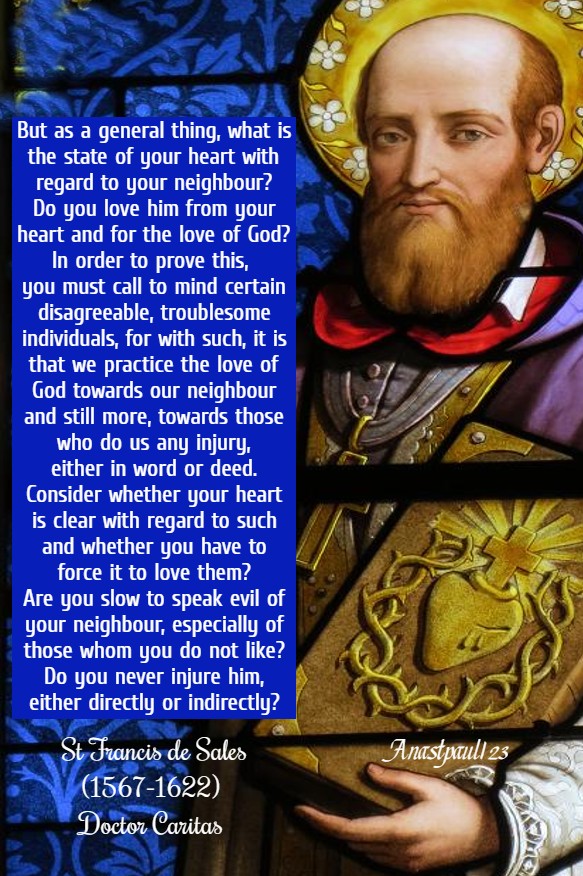
“But as a general thing, what is the state of your heart with regard to your neighbour? Do you love him from your heart and for the love of God? In order to prove this, you must call to mind certain disagreeable, troublesome individuals, for with such, it is that we practice the love of God towards our neighbour and still more, towards those who do us any injury, either in word or deed. Consider whether your heart is clear with regard to such and whether you have to force it to love them? Are you slow to speak evil of your neighbour, especially of those whom you do not like?” Do you never injure him, either directly or indirectly?”
(Introduction to the Devout Life).
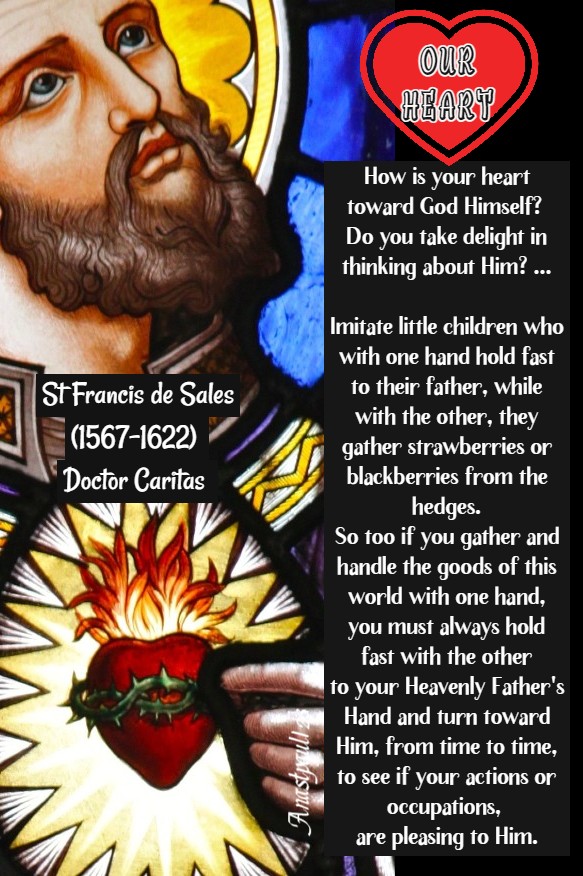
“HOW IS YOUR HEART TOWARDS GOD HIMSELF? Do you take delight in thinking about Him? … Imitate little children who, with one hand hold fast to their father, while with the other, they gather strawberries or blackberries from the hedges. So too if you gather and handle the goods of this world with one hand, you must always hold fast with the other to your Heavenly Father’s Hand and turn toward Him, from time to time, to see if your actions or occupations, are pleasing to Him.”
(Introduction to the Devout Life, Part 3, Chapter 10)
One Minute Reflection – 20 April – “The Month of the Resurrection” –Feria Day, Thursday in the Second Week of Easter – 1 John 5:4-10, John 20:19-31 – Scripture search here: https://www.drbo.org/
“My Lord and my God.” – John 20:28
REFLECTION – “Thomas said: “Unless I see the mark of the nails in His Hands and put my finger into the nailmarks and put my hand into His Side, I will not believe.” What an astonishing hardness of heart on this disciple’s part: not even the witness of so many of the brethren, nor even the sight of their joy, were enough to give him faith. Yet, the Lord appeared to take care of him. The good Shepherd does not allow the loss of His sheep (Mt 18:12) having said to His Father: “Thou gave them to me and none of them was lost” (Jn 17:6.12). Let the shepherds learn, then, what care they should show towards their sheep, since the Lord came for a single one. Any care and labour are a small thing, compared with the importance of one soul…
“Put your finger here and see My Hands, and bring your hand and put it into My Side, and do not be unbelieving but believe.” O blessed hand that penetrated the secrets of the Heart of Christ! What riches did they not find in it? It was while resting on this Heart that John drew out the Mysteries of Heaven (Jn 13:25), while penetrating It that Thomas found great treasures – what a wonderful school which forms such disciples! Thanks to this Heart, the former expressed marvellous things, higher than the stars, concerning the Divinity when he said: “In the beginning was the Word and the Word was with God and the Word was God” (Jn 1:1). And the latter, touched by the Light of Truth, cried out this sublime cry: “My Lord and my God!” – St Thomas of Villanova OSA (1486-1555) Hermit of Saint Augustine, Bishop (Sermon for Low Sunday (in Homiliarius Breviarii Romani).
PRAYER – Grant, we beseech Thee, O Lord God, unto all Thy servants that they may remain continually in the enjoyment of soundness, both of mind and body and, by the glorious intercession of the Blessed Mary, always a Virgin, may be delivered from present sadness and enter into the joy of Thine eternal gladness. Through Jesus Christ, Thy Son our Lord, Who lives and reigns with Thee, in the unity of the Holy Ghost, God, world without end. Amen (Collect).
Saint of the Day – 20 April – Blessed Hildegun of Schönau O.Cist. (Died 1188) Virgin, Cistercian Monk – yes! she was disguised as a boy as a child, for her own safety and after many frightening trials, decided to retain the identity in order to enter the Cistercian Monastery as Brother Joseph. Her true identity remained a secret until her death. Born in the Rhineland, Germany and died in 1188 in Schönau, Germany of natural causes. Also known as – Joseph, Brother Joseph, Hildegun of Neuss, Hildegunda of…. Hildegunde of…. Hildegund of…. (Hildegund should not be confused with Saint Hildegund (c1130–1178), whose Feast day is 6 February.)
Born to a noble family, her father Harper, took her on a pilgrimage to the Holy Land in 1182, when she was 12 years old. However, after landing at Tyre, Lebanon, Harper took ill and knew he would die. He entrusted her to the care of his manservant and, realising the dangers that could meet the girl on her return journey, her father dressed her as a boy.
No sooner was Harper buried, however, than the servant absconded with the money given him for expenses and abandoned Hildegun. Still dressed as a boy, she took the name Joseph for the patron of families and children. Left to beg on the streets, a well-connected German pilgrim saw her and offered to return her to her home but failed to fulfil his plans.
By 1187, Hildegun was moved by a call to the religious life. Thus she entered the Cistercian Monastery at Schönau — without mentioning that she was a young woman.
After a year’s novitiate and three days before she was to take her monastic vows, she took ill, dying on 20 April 1188. Only while preparing her for burial did the Monks discover her actual sex.
St Caedwalla of Wessex Bl Catwallon St Domninus of Digne Bl Gerald of Salles Bl Harduin Blessed Hildegun of Schönau (Died 1188) Virgin St Hugh of Anzy-le-Duc Bl John of Grace-Dieu
St Marcian of Auxerre St Margaret of Amelia Bl Maurice MacKenraghty St Michel Coquelet Bl Oda of Rivreulle St Sara of Antioch St Secundinus of Córdoba St Servilian
Blessed Simon Rinalducci OSA (Died 1322) Priest, Friar of the Order of the Hermits of St Augustine, noted for his theological studies, Prior of several houses, renowned Preader, Miracle-worker. Blessed Simon was a model of humility and obedience, even in the face of great trials and obvious injustices. Simon was Beatified on 19 March 1833 by Pope Gregory XVI (cultus confirmed). His Life: https://anastpaul.com/2021/04/20/saint-of-the-day-blessed-simon-rinalducci-osa-died-1322/
St Sulpicius St Theodore Trichinas St Theotimus of Tomi St Vincent of Digne St Wiho of Osnabrück
Thought for the Day – 19 April – Meditations with Antonio Cardinal Bacci (1881-1971)
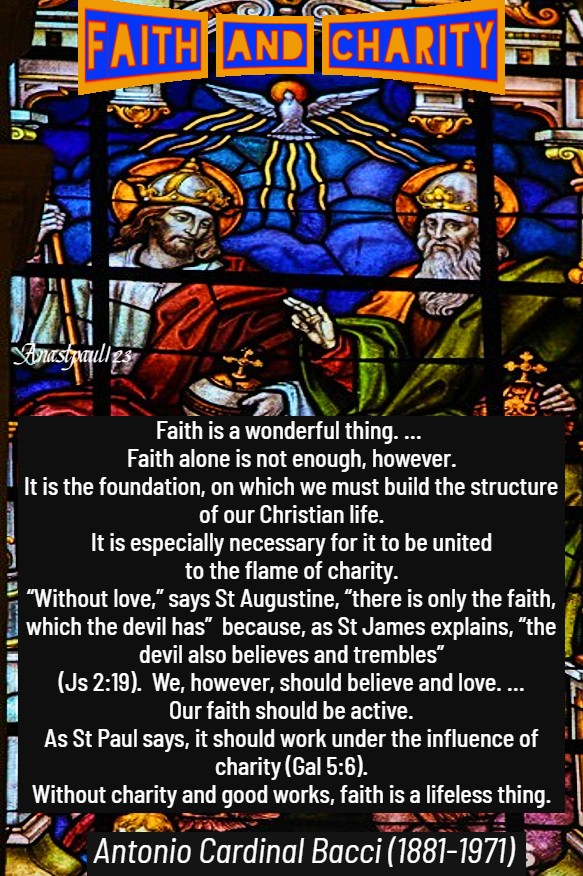
Faith and Charity
“Faith is a wonderful thing. As has been said, it is a supernatural gift from God, which we should keep alive by prayer. Faith alone is not enough, however. It is the foundation, on which we must build the structure of our Christian life. It is especially necessary for it to be united to the flame of charity. “Without love,” says St Augustine, “there is only the faith, which the devil has” (De Caritate 10) because, as St James explains, “the devil also believes and trembles” (Js 2:19). We, however, should believe and love. We must combine faith with charity towards God and towards our neighbour. Our faith should be active. As St Paul says, it should work under the influence of charity (Gal 5:6). Without charity and good works, faith is a lifeless thing.
If we really believe, we should love God above all things, even more than we love ourselves and, we should be ready to make any sacrifice for Him, even the sacrifice of our lives.
Faith should induce us to think constantly of God and charity should urge us to do everytig for His sake, rather than for any lesser purpose. If we lack this kind of charity, we cannot claim to be sincere Christians.”
Quote/s of the Day – 19 April – Feria Day, Wednesday in the Second Week of Easter – 1 John 5:4-10, John 20:19-31 – Scripture search here: https://www.drbo.org/
“Blessed are they who have not seen and have believed.”
St Ignatius of Antioch (c35–c107) Bishop, Martyr, Apostolic Father
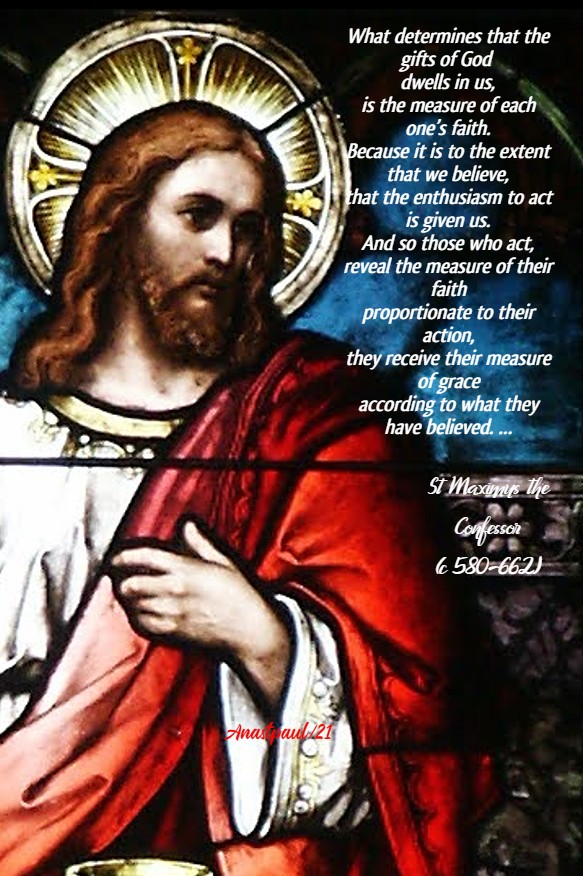
“What determines that the gifts of God dwells in us, is the measure of each one’s faith. Because it is to the extent that we believe that the enthusiasm to act is given us. And so those who act, reveal the measure of their faith proportionate to their action, they receive their measure of grace according to what they have believed. …”
St Maximus the Confessor (c 580-662) Monk and Theologian
“If we wish to make any progress in the service of God, we must begin everyday of our life, with new eagerness. We must keep ourselves, in the presence of God, as much as possible and have no other view or end, in all our actions but the Divine honour.”
St Charles Borromeo (1538-1584)
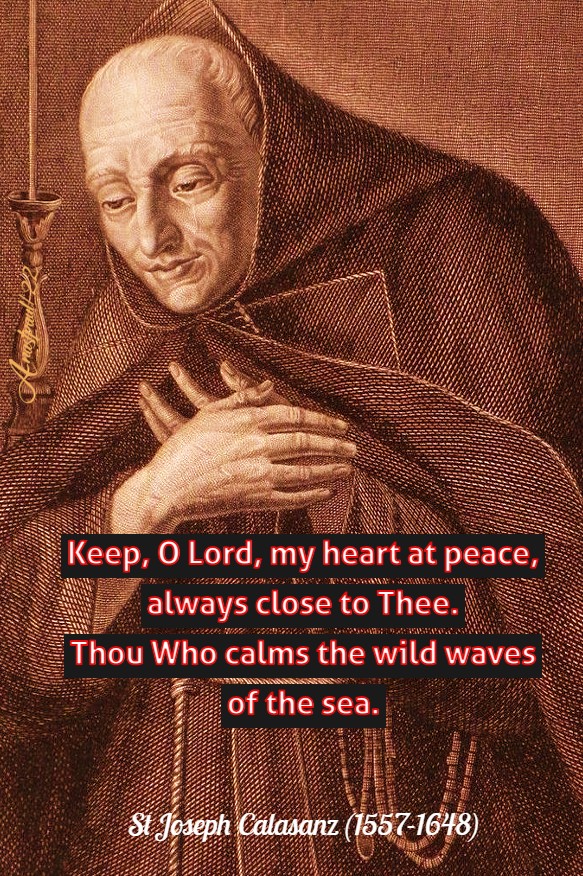
“Keep, O Lord, my heart at peace, always close to Thee. Thou Who calms the wild waves of the sea.”
One Minute Reflection – 19 April – “The Month of the Resurrection” – Feria Day, Wednesday in the Second Week of Easter – 1 John 5:4-10, John 20:19-31 – Scripture search here: https://www.drbo.org/
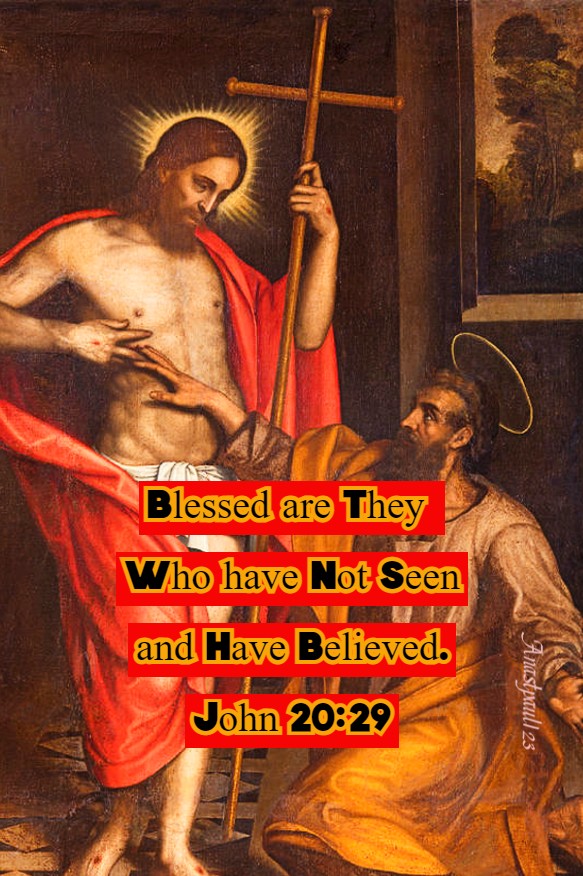
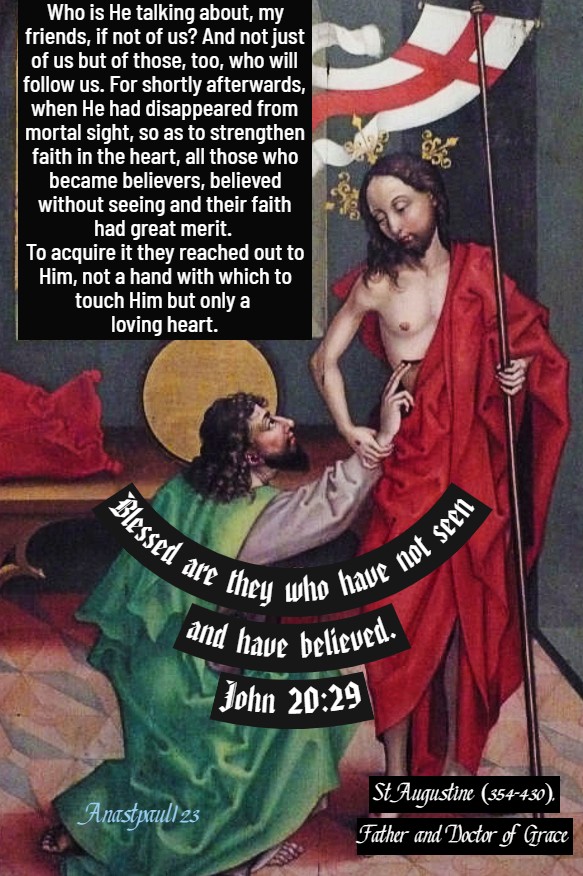
“Blessed are they who have not seen and have believed.” – John 20:29
REFLECTION – “The disciples’ weakness was so unsteady that, not content with seeing the Risen Lord, they still wanted to touch Him if they were to believe in Him. It was not enough for them to see Him with their eyes, they wanted to put out their hands to His limbs and touch the marks of His recent Wounds. It was after he had touched and acknowledged his scars that the unbelieving disciple cried out: “My Lord and my God!” Those scars revealed the One Who, where other people were concerned, healed every wound. Could the Lord not have Risen without scars? Yet He saw, within His disciples’ hearts, wounds which those scars He had preserved in His Body ,would heal.
And what does the Lord answer that confession of faith of His disciple, who says: “My Lord and my God”? “Have you come to believe because you have seen me? Blessed are those who have not seen and have believed.” Who is He talking about, my friends, if not of us? And not just of us but of those, too, who will follow us. For shortly afterwards, when He had disappeared from mortal sight, so as to strengthen faith in the heart, all those who became believers, believed without seeing and their faith had great merit. To acquire it they reached out to Him, not a hand with which to touch Him but only a loving heart.” – St Augustine (354-430), Bishop of Hippo, Father and Doctor of Grace (Sermon 88).
PRAYER – Grant, we beseech Thee, O Lord God, unto all Thy servants that they may remain continually in the enjoyment of soundness, both of mind and body and, by the glorious intercession of the Blessed Mary, always a Virgin, may be delivered from present sadness and enter into the joy of Thine eternal gladness. Through Jesus Christ, Thy Son our Lord, Who lives and reigns with Thee, in the unity of the Holy Ghost, God, world without end. Amen (Collect).
Our Morning Offering – 19 April – Feria Day, Wednesday in the Second Week of Easter
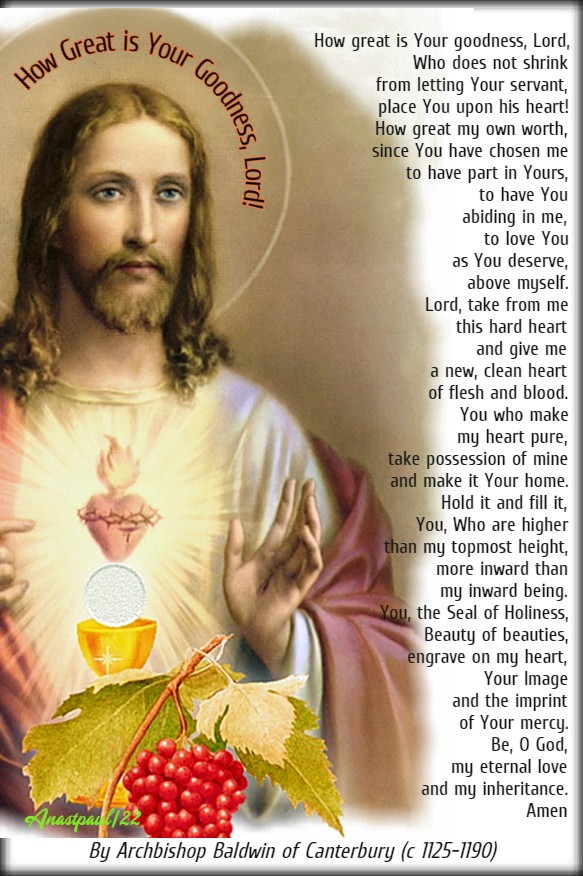
How Great is Your Goodness, Lord! By Archbishop Baldwin of Canterbury (c 1125-1190)
How great is Your goodness, Lord, Who does not shrink from letting Your servant, place You upon his heart! How great my own worth, since You have chosen me to have part in Yours, to have You abiding in me, to love You as You deserve, above myself. Lord, take from me this hard heart and give me a new, clean heart of flesh and blood. You Who make my heart pure, take possession of mine and make it Your home. Hold it and fill it, You, Who are higher than my topmost height, more inward than my inward being. You, the Seal of Holiness, Beauty of beauties, engrave on my heart, Your Image and the imprint of Your mercy. Be, O God, my eternal love and my inheritance. Amen
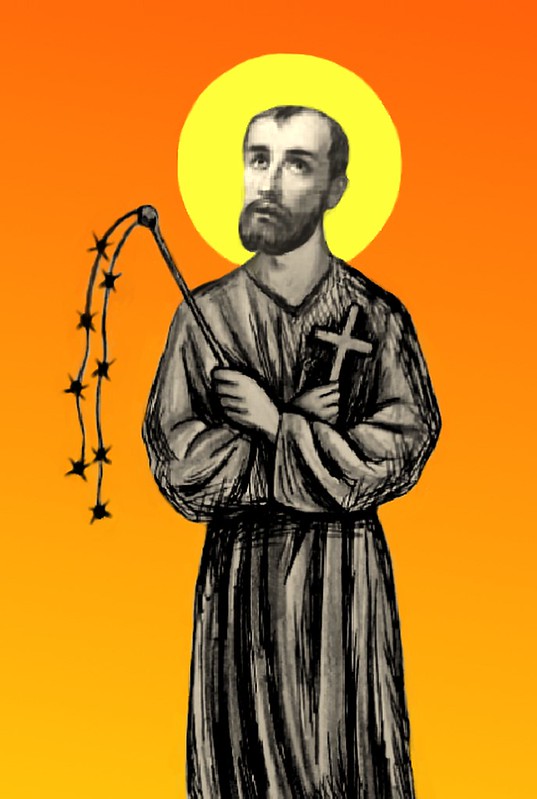
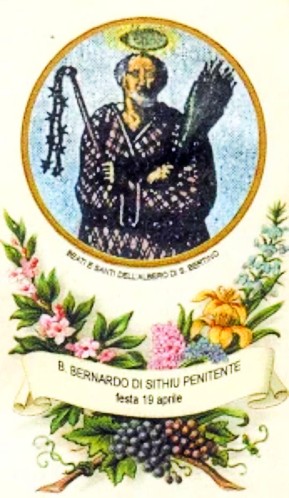
Saint of the Day – 19 April – Blessed Bernard of Sithiu (Died 1182) Layman Penitent, Pilgrim, Hermit Died on 19 April 1182 in the Monastery of Saint-Bertin, Thérouanne region, France of natural causes. Patronages – of sinners, convicts, prisoners, penitents, pilgrims. Also known as – Bernard of Maguellone, Bernard the Penitent, Bernard the Pilgrim.
The Roman Martyrology: “At the Monastery of Saint-Bertin in the territory of France in Thérouanne, lies the tomb of Blessed Bernard, penitent, who, eager to atone for the sins of his youth with an austere penitence, voluntarily chose exile and, barefooted, wearing rough garments, was a tireless pilgrim to the holy places.”
Like St Nicholas of Trani, St Benedict Joseph Labre, St Rocco and several others this Saint lived as an itinerant pilgrim to the Shrines of Europe.
The few reports received about the life of Blessed Bernard of Sithiu are those handed down in the writings of John of Sithiu, Abbot in 1187, a source of extraordinary interest. There is also the Office composed in his honour and in 1465, an inventory of his remains are cited, “relics of St Bernard, Penitent. “
From such documents and testimonies, we discover that Bernard, following a murder, was ordered to make a pilgrimage of atonement.
After wandering far and wide for a long time, he finally settled near the former town of Sithiu, where, for four years he lived in poverty and deprivation. He prayed and fasted incessantly and endured the elements, as well as many other trials and sufferings. He became a very saintly man in love with God and self-renunciation. Finally dying on 19 April 1182.
The fame for holiness which was gained in life, was later confirmed after death, by many miracles occurring at his tomb.
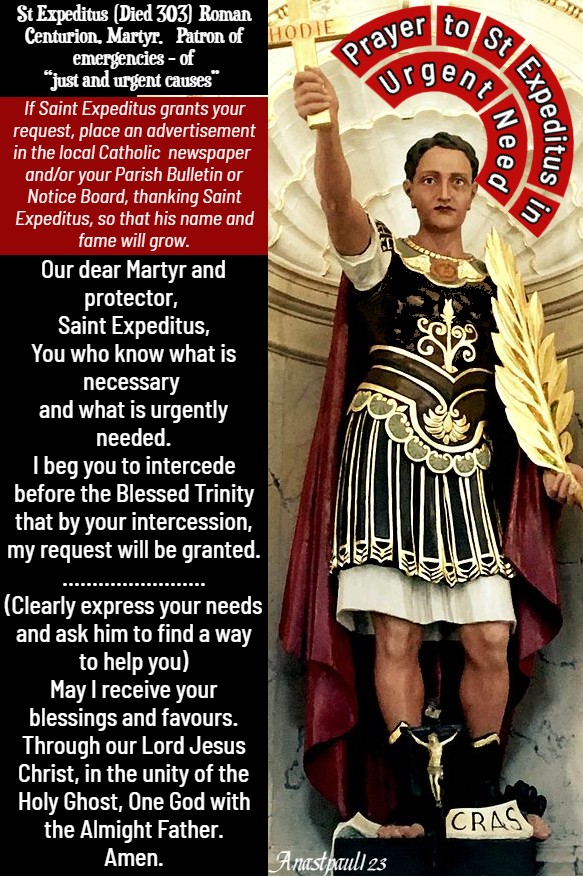
Our dear Martyr and protector, Saint Expeditus, You who know what is necessary and what is urgently needed. I beg you to intercede before the Blessed Trinity that by your intercession, my request will be granted. …………………… (Clearly express your needs and ask him to find a way to help you.) May I receive your blessings and favours. Through our Lord Jesus Christ, in the unity of the Holy Ghost, One God with the Almighty Father. Amen.
If Saint Expeditus grants your request, place an advertisement in the local Catholic newspaper and/or your Parish Bulletin or Notice Board, thanking Saint Expeditus, so that his name and fame will grow.
St Gaius of Melitene St Galata of Melitene St George of Antioch St Gerold of Saxony
St Pope Leo IX (1002-1054) known as “Apostolic Pilgrim” When the German Pope Damasus II died in 1048, Bishop Bruno was selected by the Emperor, Henry III, to succeed him. Bruno agreed to go to Rome and to accept the Papacy if freely elected thereto by the Roman people. He wished, at least, to rescue the See of Peter from its servitude to the German Emperors. When, in company with Hildebrand he reached Rome and presented himself to its people clad in pilgrim’s guise and barefooted but still tall and fair to look upon, they cried out with one voice that him and no other would they have as Pope. Assuming the name of Leo, he was solemnly enthronedon 12 February, 1049. Biography: https://anastpaul.wordpress.com/2018/04/19/saint-of-the-day-19-april-st-pope-leo-ix-1002-1954/
St Martha of Persia St Rufus of Melitene St Vincent of Collioure
Martyrs of Carthage – 17 Saints: A group of Christians Martyred in the persecutions of Decius. We know little more than the names – Aristo, Basso, Credula, Donato, Ereda, Eremio, Fermo, Fortunata, Fortunio, Frutto, Julia, Mappalicus, Martial, Paul, Venusto, Victorinus and Victor. Died in the year 250 in prison in Carthage, North Africa (modern Tunis, Tunisia).




























 AnaStpaul
You must be logged in to post a comment.