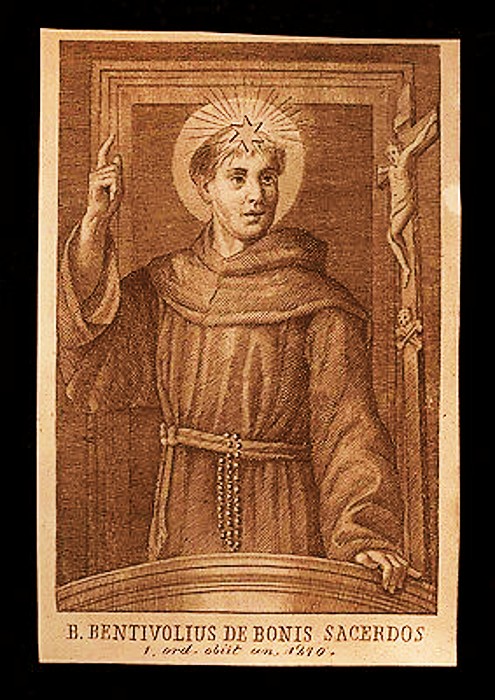
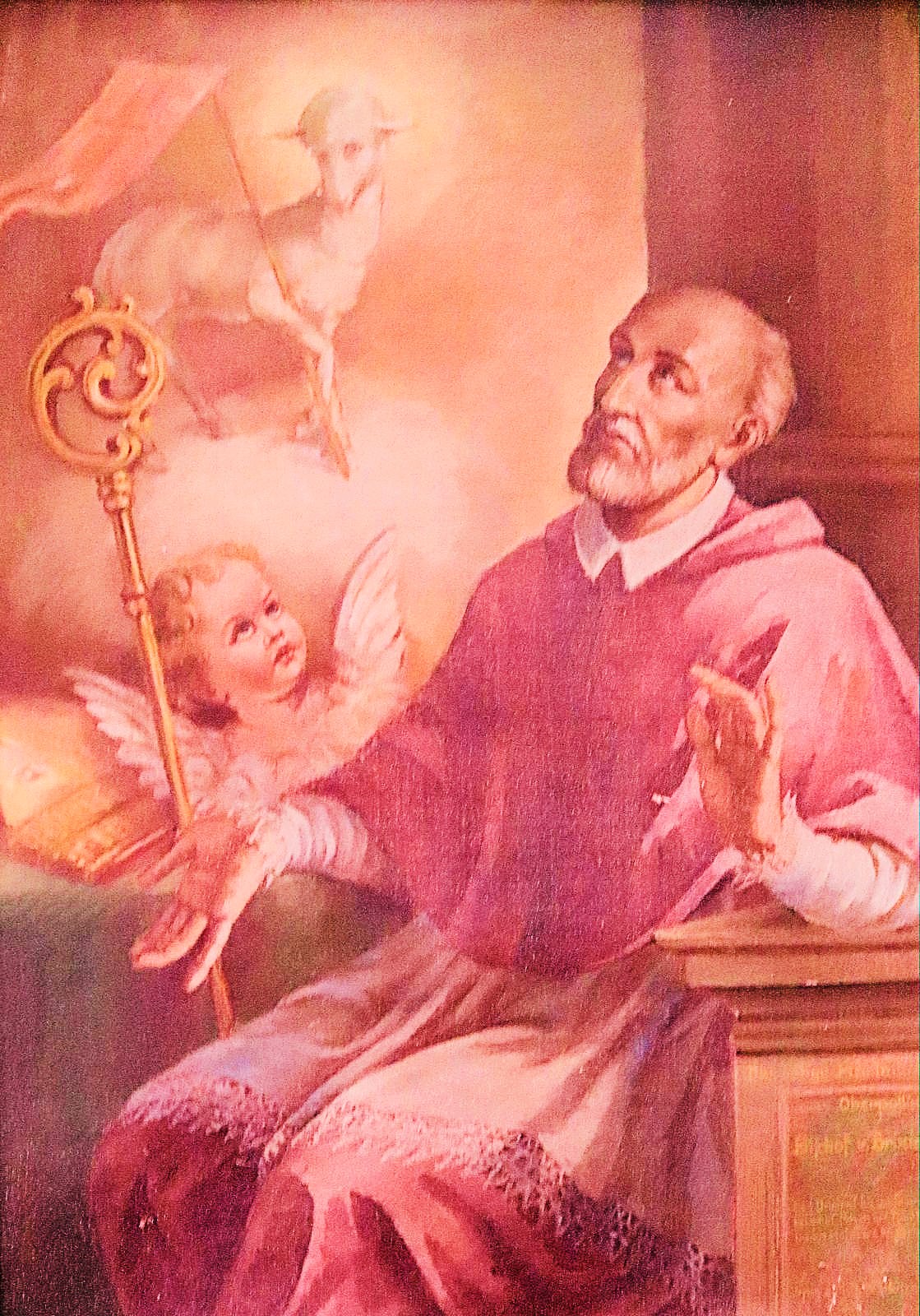
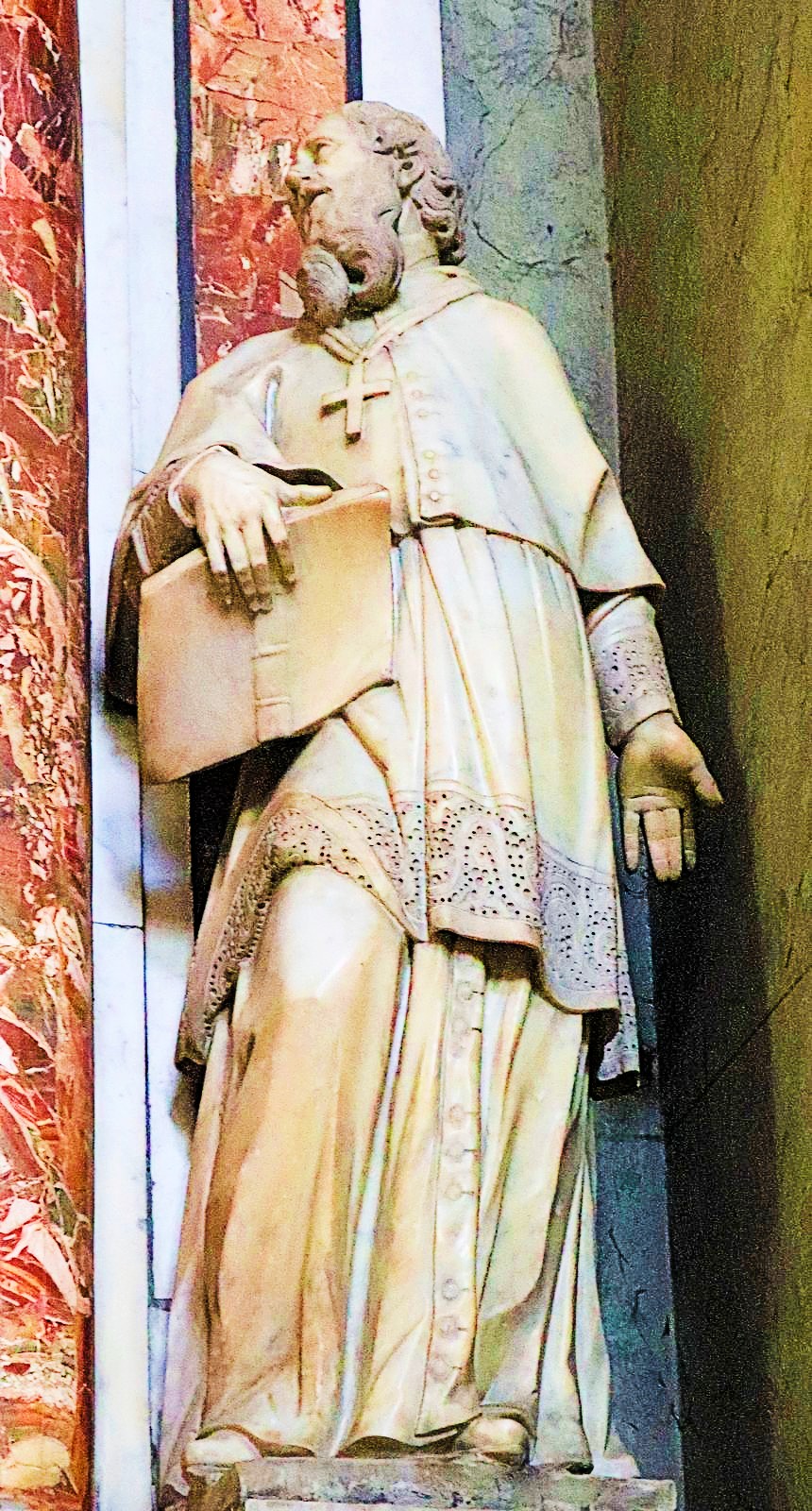
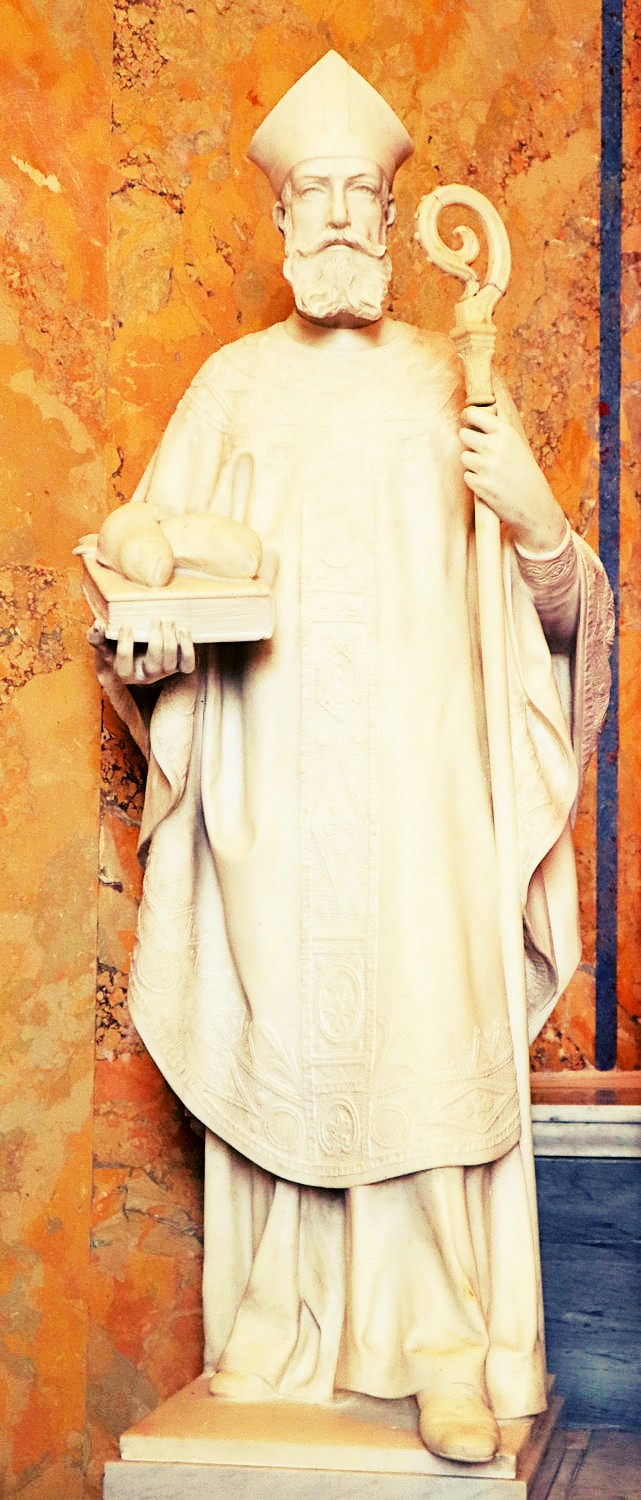
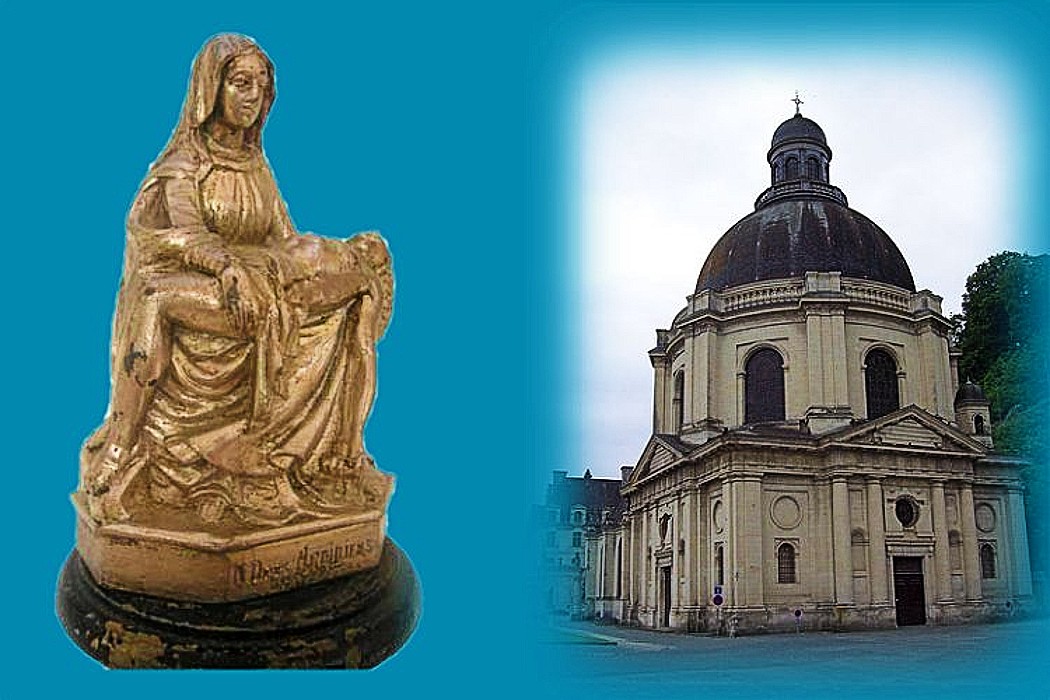
Saint of the Day – 25 December – Blessed Bentivoglio de Bonis OFM (1188-1232) Confessor, Priest and Friar of the Friars’ Minor of St Francis, Noted preachers, Miracle worker , Ecstatic and visionary. One of Saint Francis of Assisi’s earliest disciples and one of first Franciscans. Born in 1188 at San Severino, Italy and died in 25 December 1232 at San Severino, Italy of natural causes. Also known as – Bentivolius Buoni, Bentivoglio de Bonis of San Severino Marche. He was Beatified on 30 December 1852 by Pope Pius IX.
Bentivoglio was born at San Severino in the March of Ancona, toward the close of the twelfth Century and belonged to the distinguished family of the Buoni or Bonis. About the time that he grew into young manhood, reports of St Francis and his newly founded Order reached his native town and shortly after, a Franciscan preached at San Severino. Bentivoglio was so impressed by his words and his whole appearance that he became eager to join the new Order.
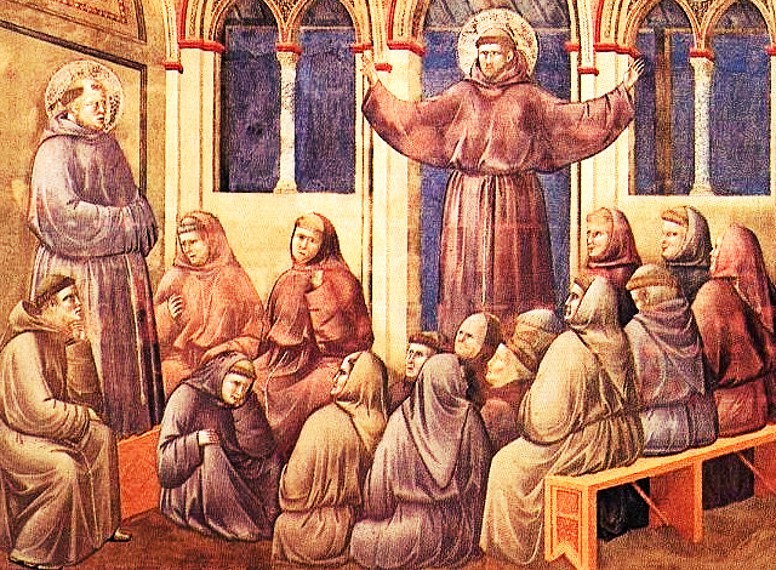
Triumphing over the first objections of his father, Blessed Bentivoglio went to Assisi and received the holy Habit from the hands of St Francis himself. Soon, he distinguished himself among the brethren, by exceptional virtue. Especially noteworthy were his humility, his patience, his obedience and his childlike simplicity.
He possessed the rare gift of affording, both pleasure and edification, by his pious conversation about heavenly things. Although he seemed to say it all in an offhand manner, nevertheless, everyone felt that it came from a holy heart, some invisible power seemed to move them to strive for perfection. Once a bright star was seen shining on his forehead, it was a sign that he was filled with the fire of the Holy Ghost.
The piety and holiness of Blessed Bentivoglio was evident in his devout conversation. Just as one can tell by the ticking of a clock, whether everything is in proper working order within, so, as a rule, one can detect in a person’s conversation, how matters stand interiorly with him. He who thinks only of profits and gain, speaks continually of trade and business. He who is filled with self-love, speaks continually of himself and considers others unimportant. He who is vain speaks of clothes and beauty. He whose heart is not pure and clean, takes pleasure in indecent speech. He who has God in his heart, converses with pleasure about God and religious matters.
After he had become a Priest and confessor, Bentivoglio laboured with the blessed success in the holy tribunal of the Confessional. At prayer, to which he was most devoted, he was often seen in ecstasy, sometimes he was even raised high above the earth.
God glorified Blessed Bentivoglio by many other miracles before and after his death, so that, the veneration that was paid to him at his grave, in the Franciscan Church at San Severino, constantly increased. Pope Pius IX gave the Church’s approval to this veneration, thus declaring him Blessed.
Prayer of the Church: O God, who didst reveal Thy glory through the words and miracles of Thy blessed Confessor Bentivoglio, mercifully grant that through his intercession and merits, we may be directed to behold Thy sublime Majesty. Through Christ our Lord Who livest and reignest with Thee, in the unity of the Holy Ghost, God, world without end. Amen.
The Nativity of Our Lord, Christmas Day! Celebration of the Anniversary of the Birth of Our Lord. In the earliest days of the Church there was no such Feast, the Saviour’s Birth was commemorated with the Epiphany by the Greek and other Eastern Churches. First mention of the Feast, then kept on 20 May, was made by Clement of Alexandria c 200. The Latin Church began in c 300 to observe it on 25 December, though there is no certainty that Our Lord was born on that day. Today, Priests have the privilege of saying three Masses, at midnight, daybreak and morning. This was originally reserved to the Holy Father alone – beginning about the 4th century he celebrated a midnight Mass in the Lateran Basilica (in which according to tradition, the manger of Bethlehem is preserved), a second in the Church of Saint Anastasia, whose Feast comes on 25 December and a third at the Vatican Basilica. Many peculiar customs of the day are the outcome of the pagan celebrations of the January calendar. The Christmas tree, of which the first known mention was made in 1605 at Strasbourg, was introduced into France and England in 1840. The Feast is a Holy Day of Obligation, preceded by the preparatory season of Advent and by a special Vigil – should it fall on a Friday it abrogates the law of abstinence. Of course, Christmas attracts an Octave, when this wonderful Mystery and Miracle is celebrated for eight days. https://anastpaul.com/2019/12/25/the-solemnity-of-the-nativity-of-our-lord-jesus-christ-25-december-2/ AND: https://anastpaul.com/2018/12/25/the-solemnity-of-the-nativity-of-our-lord-jesus-christ-25-december/ AND: https://anastpaul.wordpress.com/2017/12/25/25-december-the-solemnity-of-the-birth-of-our-lord-jesus-christ-2/
St Adalsindis of Hamay St Alburga of Wilton St Anastasia of Sirmium
Bl Artale St Basilée of the Via Latina Blessed Bentivoglio de Bonis OFM (1188-1232) Confessor, Priest and Friar of the Friars’ Minor of St Francis, Noted preachers, Miracle worker and visionary. One of Saint Francis of Assisi’s earliest disciples and one of first Franciscans. Bl Diego de Aro St Eugenia of Rome St Fulk of Toulouse
Martyrs of Nicomedia: 20,000 Christians Martyred by order of Diocletian. They were reported to have all been in the single Basilica to celebrate Christmas. As the Christmas holy day was not celebrated in the East in 303, they were probably gathered for another feast. They were burned alive in 303 in the Basilica of Nicomedia.
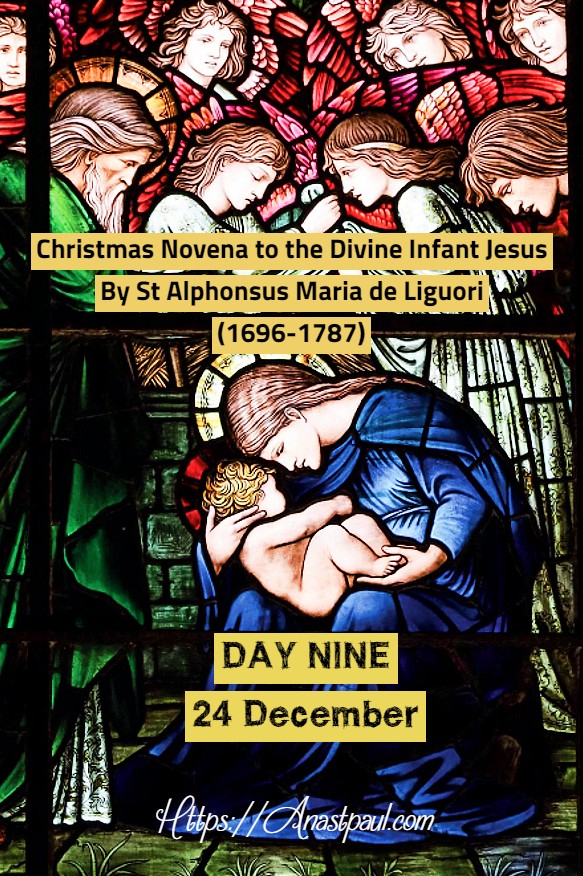
Christmas Novena to the Divine Infant Jesus By St Alphonsus Maria de Liguori (1696-1787)
THE NINTH DAY 24 December Meditation 9: The Birth of the Infant Jesus in the cave of Bethlehem.
Since the Roman Emperor’s edict said that everyone was to enrol in his own country, Joseph and his wife, Mary, departed for Bethlehem. The trip took four days, travelling over mountainous roads, in the cold of winter wind and rain. Think of how much the Blessed Virgin must have suffered on that journey.
As soon as they arrived, the time of her delivery was at hand, so Joseph went around the Town looking for lodging where Mary could give birth to her child. But, because they were poor, they were driven away by everyone, even from the Inn where poor people were normally sheltered. So, they left the Town and found a cave. As Mary entered, Joseph protested, saying, “My dear wife, how can you spend the night in this cold, damp place? Can you not see that this is a stable for animals?” But she answered, “Joseph, this shed is the Royal Palace where the Son of God chooses to be born.”
And since the time for the birth had arrived, the Holy Virgin was in prayer. Suddenly the cave became brilliantly lit, as if by the sun or a star and the Son of God came forth into the world, as a tender Infant, crying and trembling with cold. The first thing Mary did was to adore Him as her God. Then she held Him to her bosom and wrapped Him in swaddling clothes which she had brought along. Finally, she laid Him on a little straw in the manger, the feeding trough for animals.
That is how the Son of the eternal God chose to be born for love of us.
A saint once said, that those who love Jesus Christ most, ought to kneel at the feet of the Holy Infant and, in spirit, perform for Him the same service as the beasts in the stable at Bethlehem did, who warmed Him with their breath. We should warm Him with our sighs of love.
Affections and Prayers:
O Adorable Infant Jesus! I should not have the boldness to cast myself at Thy feet, if I did not know that Thou, Thyself, invitest me to draw near Thee. It is I, who by my sins, have made Thee shed so many tears in the stable of Bethlehem. But since Thou hast come on earth to pardon repentant sinners, forgive me too, now that I am heartily sorry for having spurned Thee, my Saviour and my God, Who art so good and Who hast loved me so much.
In this night, in which Thou bestowest great graces on so many souls, grant too, Thy heavenly consolation to this poor soul of mine. All that I ask of Thee is the grace to love Thee always, from this day forward, with all my heart. Set me on fire with Thy holy love. I love Thee, O my God, Who hast become a Babe for love of me. Never let me cease loving Thee evermore.
O Mary, Mother of Jesus and my Mother, thou canst obtain everything from thy Son by thy prayers. This is the only favour I ask of Thee. Do thou pray to Jesus for me. Amen.
Thought for the Day – 24 December – Meditations with Antonio Cardinal Bacci (1881-1971)
A Christmas Novena IX The Holy Family – Mary
“The Blessed Virgin Mary, is the second model proposed for our imitation in the Holy Family. She is the purest and most beautiful of creatures ever fashioned by the Hand of God. As Mother of the Word Incanate, her dignity touches the Divine. Preserved from all stain of sin from the moment of her conception, she is full of grace. Except in God Himself, no greater beauty and holiness can be found elsewhere, than in Mary.
We do not read that Mary worked miracles, had ecstasies, or possessed any extraordinary external gifts. Her sanctity was completely internal. She trod the ordinary way of perfection, therefore, the way most easily imitated by us and, nevertheless, reached the highest peak of holiness. Since we are her devoted and affectionate children, let us ask her for the grace to follow her in the way of perfection and of complete resignation to the will of God. Although we may have to follow her from afar, let us follow with enthusiasm and love..”
Quote/s of the Day – 24 December – The Vigil of the Nativity of Our Lord – “The Month of the Divine Infant and the Immaculate Conception”
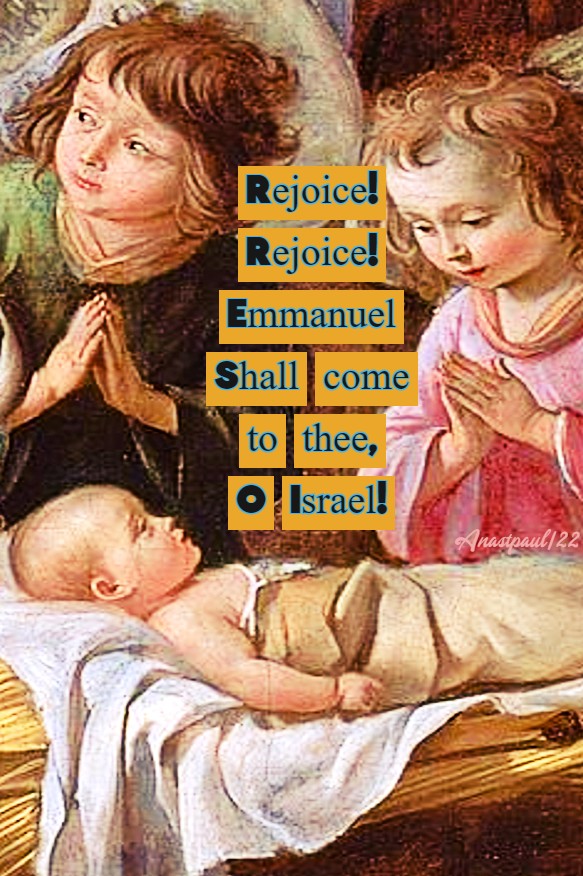
“Rejoice! Rejoice! Emmanuel Shall come to thee, O Israel! May the Lord bless us, protect us from all evil and bring us to everlasting life.”
Silent Night, Holy Night! Stille Nacht, heilige Nacht! By Father Joseph Mohr (1792-1818)
Silent night, holy night! All is calm, all is bright, Round yon Virgin Mother and Child! Holy Infant so tender and mild, Sleep in heavenly peace, Sleep in heavenly peace.
Silent night, holy night! Son of God, how the light Radiates love from Thy heavenly face, At the dawn of redeeming grace, Jesus, Lord at Thy birth, Jesus, Lord at Thy birth.
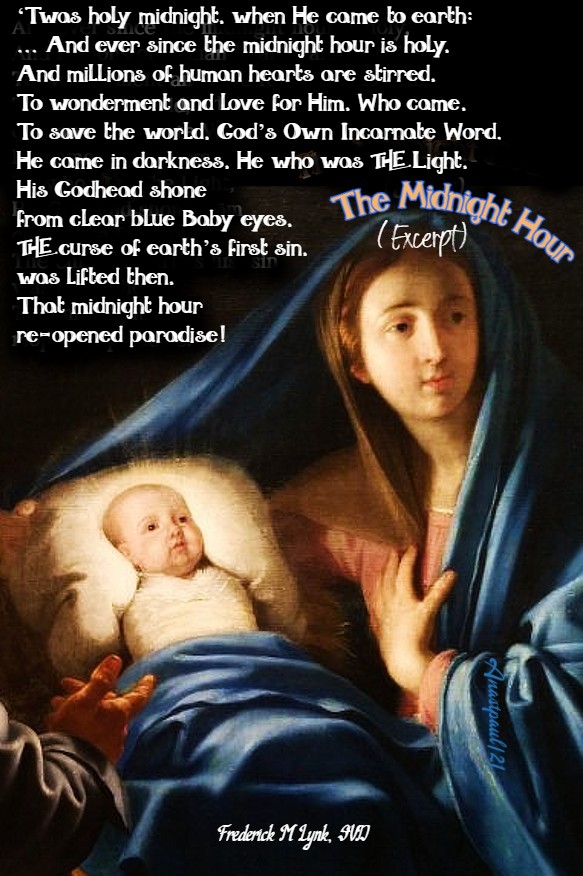
The Midnight Hour (Fr or Br) Frederick M Lynk, SVD
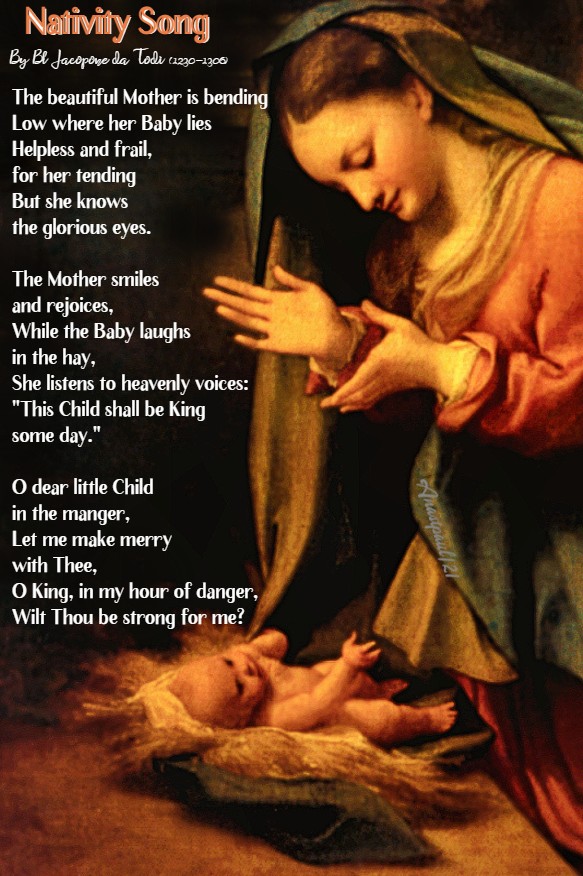
The Virgin Mother kneels upon the floor And holds her Baby in her arm, Her heart is gladder than her lips can say, To keep her newborn Baby snug and warm, A Babe more sweet and fair and dear Than any rosebud in the bright sunshine, Whose little eyes look straight into her own, O, blessed maid, God’s Son is also thine.
‘Twas holy midnight, when He came to earth: As pours a sun ray through a limpid glass, Not leaving any mark upon its face; A drop of dew upon the fresh green grass, A little star that fell upon her lap, A cooing Babe, that seeks her virgin breast. The hopes of all the sin-cursed world Upon this Baby’s eyelids rest.
And ever since the midnight hour is holy, And millions of human hearts are stirred, To wonderment and love for Him, Who came, To save the world, God’s Own Incarnate Word. He came in darkness, He who was The Light, His Godhead shone from clear blue Baby eyes, The curse of earth’s first sin, was lifted then, That midnight hour re-opened paradise!
One Minute Reflection – 24 December – The Vigil of the Nativity of Our Lord – “The Month of the Divine Infant and the Immaculate Conception” – Romans 1:1-6, Matthew 1:18-21 – Scripture search here: https://www.drbo.org/
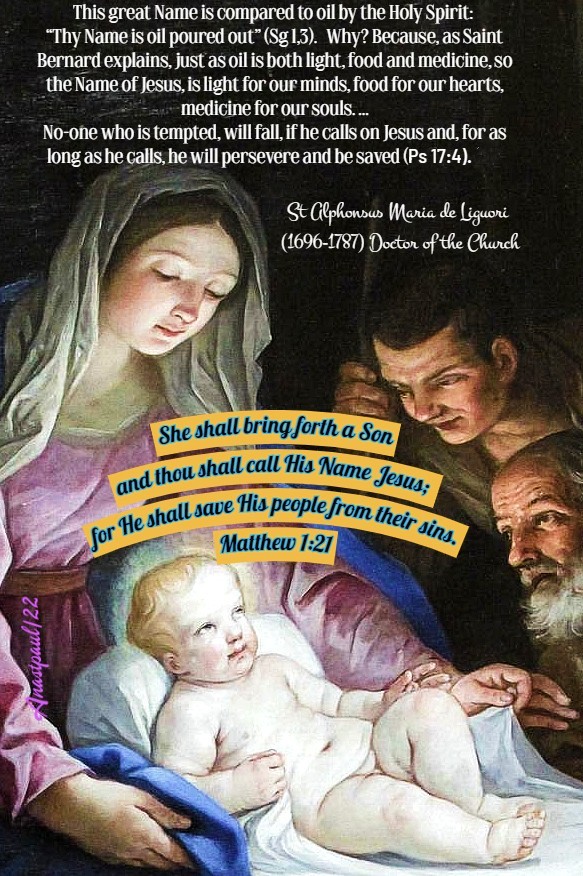
“She shall bring forth a Son and thou shall call His Name Jesus; for He shall save His people from their sins.” – Matthew 1:21
REFLECTION – “The Name of Jesus is a Divine Name which the Lord made known to Mary through the voice of the Archangel Gabriel: “Thou shalt give Him the Name, Jesus” (Lk 1,31). A Name which, for this reason, is called “above all names”, “the only Name by which we can be saved” (Phil 2,9; Acts 4,12). This great Name is compared to oil by the Holy Spirit: “Thy Name is oil poured out” (Sg 1,3). Why? Because, as Saint Bernard explains, just as oil is both light, food and medicine, so the Name of Jesus, is light for our minds, food for our hearts, medicine for our souls.
Light for our minds – it was the brilliance of this Name which enabled the world to pass from the shadows of idolatry, to the Light of Faith. We were born in a land, whose inhabitants were all pagans, before the coming of the Lord. We would be as they were, if He had not come to enlighten us. So how should we not give thanks to Jesus Christ for the gift of faith!…
Food for our hearts – this, too, is what the Name of Jesus is. For it calls to our minds all the painful work Jesus accomplished to save us. This is how he comforts us in tribulation, strengthens us to walk along the way of salvation, revives our hope and inflames us with love for our God.
And medicine for our souls – Jesus’ Name makes them strong in the face of temptation and our enemies’ attacks. Do they hear this Holy Name? The powers of hell tremble and take to flight. This is what Saint Paul says: “that at the Name of Jesus, every knee should bow, in the heavens, on earth and in the underworld” (Phil 2,10). No-one who is tempted, will fall, if he calls on Jesus and, for as long as he calls, he will persevere and be saved (cf Ps 17:4).” – St Alphonsus Maria de Liguori (1696-1787) Bishop and Doctor of the Church (Meditations for the Octave of Christmas no 8).
PRAYER – O God, Thou Who gladden us, year after year, with the expectation of our redemption, grant that we, who now welcome with joy Thy Only-begotten Son as our Redeemer, may also gaze upon Him without fear when He comes as our Judge, our Lord Jesus Christ. Through the same Jesus Christ, Thy Son our Lord, Who lives and reigns with Thee, in the unity of the Holy Ghost, God, world without end. Amen (Collect).
Our Morning Offering – 24 December – The Vigil of the Nativity of Our Lord – “The Month of the Divine Infant and the Immaculate Conception”
O Come, O come, Emmanuel
O Come, O come, Emmanuel And ransom captive Israel, That mourns in lonely exile here Until the Son of God appear. Refrain: Rejoice! Rejoice! Emmanuel Shall come to thee, O Israel!
O come, Thou Wisdom, from on high And order all things far and nigh, To us the path of knowledge show And teach us in her ways to go. Refrain
O come, o come, Thou Lord of might, Who to Thy tribes on Sinai’s height In ancient times did give the law, In cloud and majesty and awe. Refrain
O come, Thou Rod of Jesse’s stem, From ev’ry foe deliver them That trust Thy mighty power to save And give them vict’ry o’er the grave. Refrain
O come, Thou Key of David, come And open wide our heav’nly home, Make safe the way that leads on high, That we no more have cause to sigh. Refrain
O come, Thou Dayspring from on high And cheer us by Thy drawing nigh. Disperse the gloomy clouds of night And death’s dark shadow put to flight. Refrain
O come, Desire of nations, bind In one the hearts of all mankind. Bid every strife and quarrel cease And fill the world with heaven’s peace. Refrain
The favourite O Come, O Come Emmanuel carol was originally written in Latin text in the 12th Century. The author of the words and composer to the music of O Come, O Come Emmanuel is unknown. It is, however, believed that the melody was of French origin and added to the text a hundred years later. The Latin was translated into English by John Mason Neale in 1851.
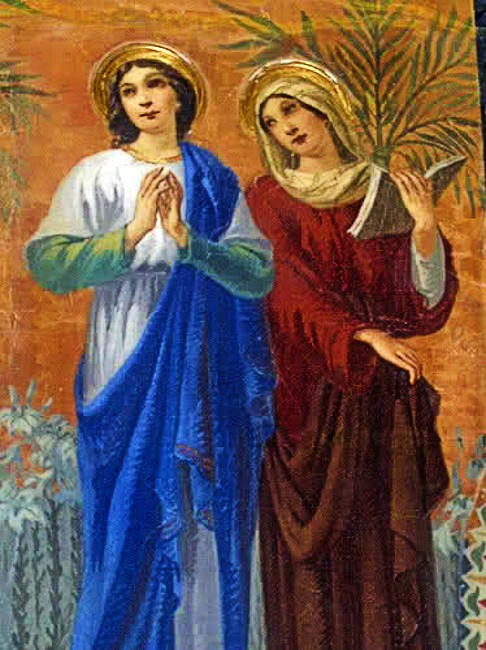
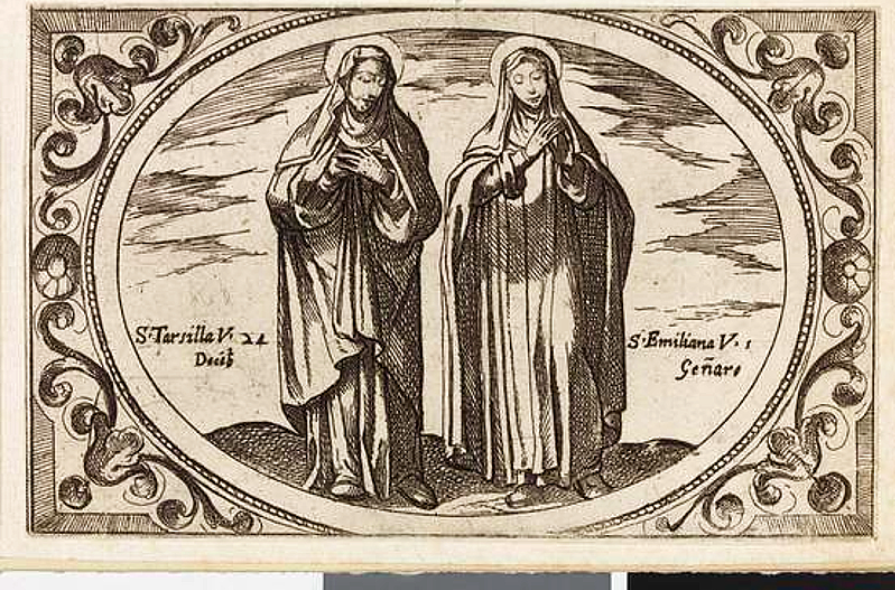
Saint of the Day – 24 December – St Trasilla (Sixth Century) Virgin, Aunt of Saint Pope Gregory the Great (540-604). Born as a Roman citizen and died on 24 December, in the 6th Century, year unknown. St Trasilla is usually mentioned with St Emiliana, her sister and, therefore, also St Gregory’s Aunt but her Feast day is celebrated on 5 January. Also known as – Tarsilla, Tharsilla, Thrasilla.
The Roman Martyrology reads today: “At Rome, the birthday of the holy Virgin, Trasilla, Aunt of St Gregory, Pope, who writs of her that at the hour of her death, she saw Jesus coming to her.”
Sts Trasilla and Emiliana
What we know of her life was recorded by the holy Pope, who was deeply moved by her model of Christian life and virtue.
Born in Rome, Trasilla and Emiliana were the daughters of Senator Gordian and Saint Silvia. Nieces of Pope Saint Felix III, the young women were destined for lives of holiness and together, while quite young, renounced the world. As young women, they together consecrated themselves to the Lord, desiring to stay pure. Their house was as a convent and the two spent so much time kneeling in prayer that their knees and elbows arthritically locked in the position of prayer. Living as hermits, they encouraged one another in the ways of the faith, drawing deeper and deeper into the spiritual life.
Trasilla had a third sister, Gordiana, who had initially made the same vows and consecrated herself to the Lord. Gradually, however, she withdrew from her sisters, returning to the world. Their reproaches fell on deaf ears and caused them significant sadness and grief.
Saint Trasilla died prior to Saint Emiliana but not before she received a vision of her Uncle, Saint Pope Felix. In her vision, the late Pope appeared to her, showing her a place of great beauty. He said, “Come, I will receive you into this habitation of light.” Immediately, she fell ill with fever. Her sister ministered to her but to no avail. By the following day, her illness had grown worse. Saint Trasilla, in agonising pain, called out to those around her; “Make way! Jesus is coming!” With her eyes fixed firmly on Heaven, she died soon thereafter and a heavenly fragrance filled the room, confirming her visions.
And just as she had been visited by a vision of St Felix, so she too visited her sister, Emiliana from Heaven.
St Gregory the Great recounted the tale of his Aunts throughout his lifetime. He used it to illustrate the point that we must work constantly to save our souls, repenting for our actions. To Saint Gregory, there is no point in beginning the work of salvation, if we do not plan to see it through to the end. As we prepare for the birth of Our Lord, we look to our own commitments. Are we ready to greet the Infant Christ, come to redeem and save us?
Tonight, we echo the sentiment of Saint Trasilla: “Make way! Jesus is coming!” How might we use this dark night—lit by the choirs of angels—to prepare for the coming of the Lord?
The Vigil of the Nativity of Our Lord Midnight Mass is the first liturgy of Christmastide which is celebrated on the night of Christmas Eve, traditionally beginning at midnight when Christmas Eve gives way to Christmas Day. This popular Christmas custom is a jubilant celebration of the Mass in honour of the Nativity of Jesus Christ.
Saint Thomas Aquinas wrote a commentary on these words and explained in his Summa Theologiae, “And from this ,the Mass derives its name … the deacon on festival days ‘dismisses’ the people at the end of the Mass, by saying: ‘Ite, missa est,’ that is, the Victim [Jesus] has been sent to God through the Angel, so that it may be accepted by God.”
St Adam the Patriarch St Adela of Pfalzel Bl Alberic of Gladbach Bl Brocard of Strasbourg St Bruno of Ottobeuren St Caran of Scotland St Delphinus of Bordeaux
St Euthymius of Nicomedia St Eve the Matriarch Bl Francesco dei Maleficii St Gregory of Spoleto
St Irmina of Oehren (Died c 716) Virgin Princess, Nun, Abbess, Founder and Co-founder of 2 Monasteries, benefactress of St Willibrord, the great Missionary Saint of Germany. The Roman Martyrology states: “In Trier in Austrasia, in Germany, Saint Irmina, Abbess of the Monastery of Öhren, who, a virgin consecrated to God, gave Saint Willibrord a small Monastery she founded in her villa in Echternach and was a generous giver of her goods.” Her Life: https://anastpaul.com/2021/12/24/saint-of-the-day-24-december-saint-irmina-of-oehren-died-c-716/
St Mochua of Timahoe
Bl Peter de Solanes St Trasilla (Sixth Century) Virgin, Aunt of Saint Pope Gregory the Great (540-604) Bl Venerandus of Clermont
Blessed Mercedarian Brothers:
Blessed Dionysius Roneo
Blessed Philip Claro
Blessed Giulio Pons
Blessed Peter of Valladolid
Blessed Mercedarian Sisters:
Blessed Anna Maria Prieto
Blessed Anna de Arrano
Blessed Orsola de Larisgoizia
Blessed Maguna Mary
Blessed Margaret
Blessed Mary of the Assumption Sarria
Martyred Maidens of Antioch – 40 Saints: A group of forty Virgins Martyred in the persecutions of Decius. None of their names have come down to us. They were martyred in 250 in Antioch, Syria.
Martyrs of Tripoli – 6 Saints: A group of Christians Martyred together, date unknown. The only details that have survived are six of the names – Drusus, Lucian, Metrobius, Paul, Theotimus and Zenobius. They were martyred in Tripoli, Libya.
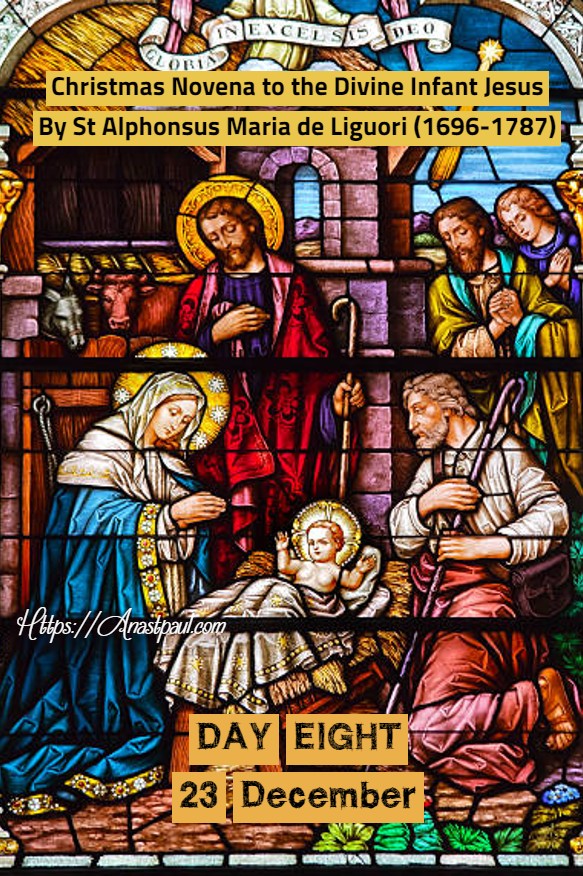
Christmas Novena to the Divine Infant Jesus By St Alphonsus Maria de Liguori (1696-1787)
THE EIGHTH DAY 23 December Meditation 8: The sojourn of the Infant Jesus in Egypt and Nazareth.
Our blessed Redeemer spent His Infancy in Egypt, living there for seven years in poverty and contempt. Joseph and Mary were unknown there, with neither relatives nor friends. And they could scarcely earn enough to get by, through the labour of their hands. Their cottage was poor, their bed was poor and their food was poor. In this humble hu holy home, Mary weaned Jesus. At first she fed Him from her breast. Later on, she took a little bread soaked in water and placed it in His mouth. It was in that cottage that she made His first little garments, taking off His swaddling clothes and dressing Him in tiny children’s garb. In that cottage, the Child Jesus took His first steps, although He kept faltering and toppling many times, just as all children do. There, also, He uttered His first words.
Imagine what God has reduced Himself to for love of us! God, stumbling and falling as He walked! God, stammering while He learned to speak!
The life Jesus led at the house in Nazareth, after His return from Egypt was much the same – poor and humiliating. Until age thirty, He was a simple shop boy, obeying Joseph and Mary. And He was obedient to them (Luke 2:51). Jesus went to fetch water; Jesus opened and closed the shop; Jesus swept the house; He gathered wood for the fire and worked all day helping Joseph and following his requests, teachings in the trade and commands.
Imagine God living as a boy! God sweeping the floor! God sweating as He planed a piece of wood! And who was He? The all-powerful God, Who, with a simple nod, created the whole universe and Who could destroy it, just as easily, if He wished! Should not the mere thought of this move our hearts to love Him?
How inspiring it must have been to watch the devotion with which Jesus said His prayers, the patience with which He laboured, the haste in which He obeyed, the moderation He used in eating and the kindness and charity, with which He spoke and interacted with others! Every word, every action of Jesus, was so virtuous that it filled everyone around Him with love for God — but especially Mary and Joseph, who were constantly with Him!
Affections and PrayersL
O Jesus, my Savior! When I consider how, for love of me. Thou didst spend thirty years of Thy life hidden and unknown in a poor workshop, how can I desire the pleasures and honours and riches of the world? Gladly do I renounce all these things, since I wish to be Thy companion on this earth, poor as Thou wast, mortified and humble as Thou wast, so that I may hope to be able, one day to enjoy Thy companionship in Heaven. What are all the treasures and kingdoms of this world – Thou, O Jesus, art my only treasure, my only Good!
I keenly regret the many times in the past when I spurned Thy friendship in order to satisfy my foolish whims. I am sorry for them, with all my heart. For the future, I would rather lose my life a thousand times than lose Thy grace by sin. I wish never to offend Thee again but always to love Thee. Help me to remain faithful to Thee until death.
O Mary, thou art the refuge of sinners, thou art my hope. Amen.
Thought for the Day – 23 December – Meditations with Antonio Cardinal Bacci (1881-1971)
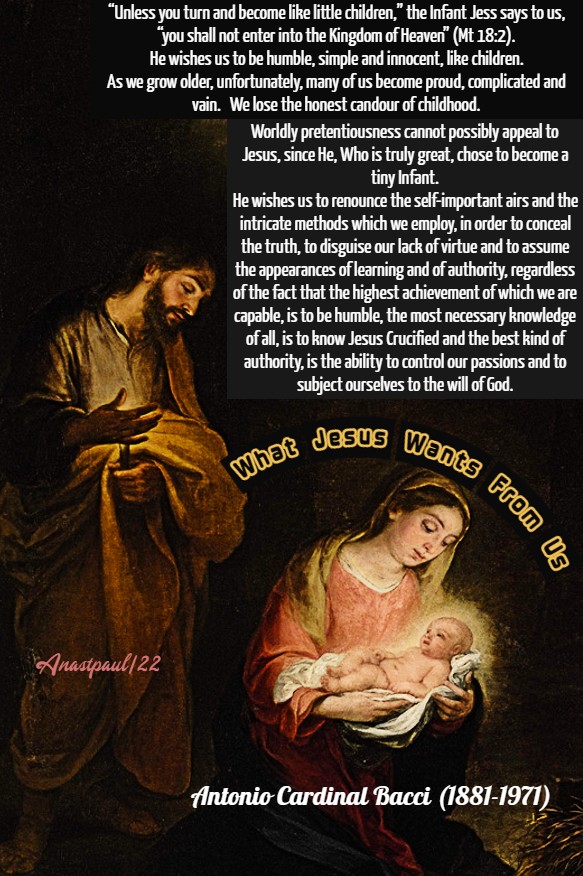
A Christmas Novena VIII What Jesus Wants From Us
“Unless you turn and become like little children,” the Infant Jess says to us, “you shall not enter into the Kingdom of Heaven” (Mt 18:2). He wishes us to be humble, simple and innocent, like children. As we grow older, unfortunately, many of us become proud, complicated and vain. We lose the honest candour of childhood
Worldly pretentiousness cannot possibly appeal to Jesus, since He, Who is truly great, chose to become a tiny Infant. He wishes us to renounce the self-important airs and the intricate methods which we employ, in order to conceal the truth, to disguise our lack of virtue and to assume the appearances of learning and of authority, regardless of the fact that the highest achievement of which we are capable, is to be humble, the most necessary knowledge of all, is to know Jesus Crucified and the best kind of authority, is the ability to control our passions and to subject ourselves to the will of God.
It is, in this sense, that we must become little children before God and before man. Then Jesus Christ will love us and will grant us His favours.”
Quote/s of the Day – 23 December – Friday of the Fourth Week of Advent – “The Month of the Divine Infant and the Immaculate Conception”
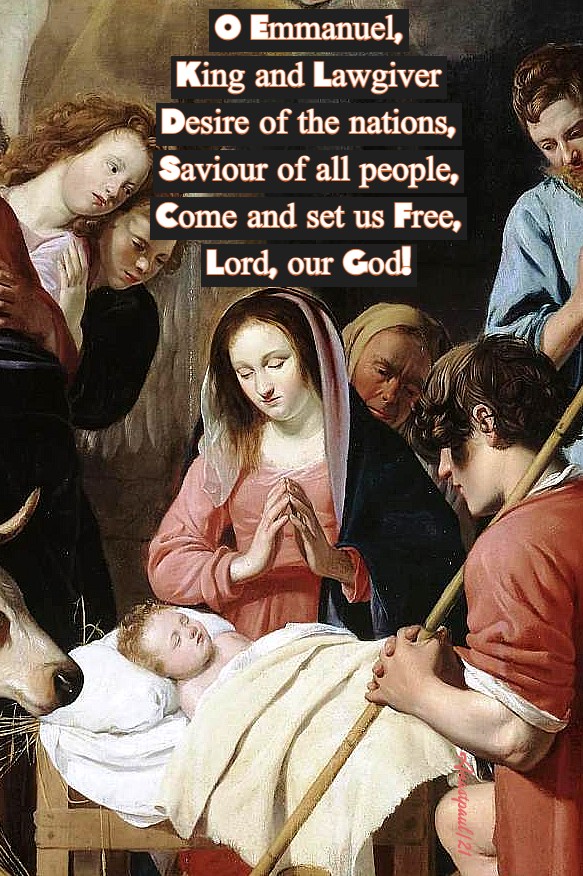
“O Emmanuel, King and Lawgiver Desire of the nations, Saviour of all people, Come and set us free, Lord, our God!”
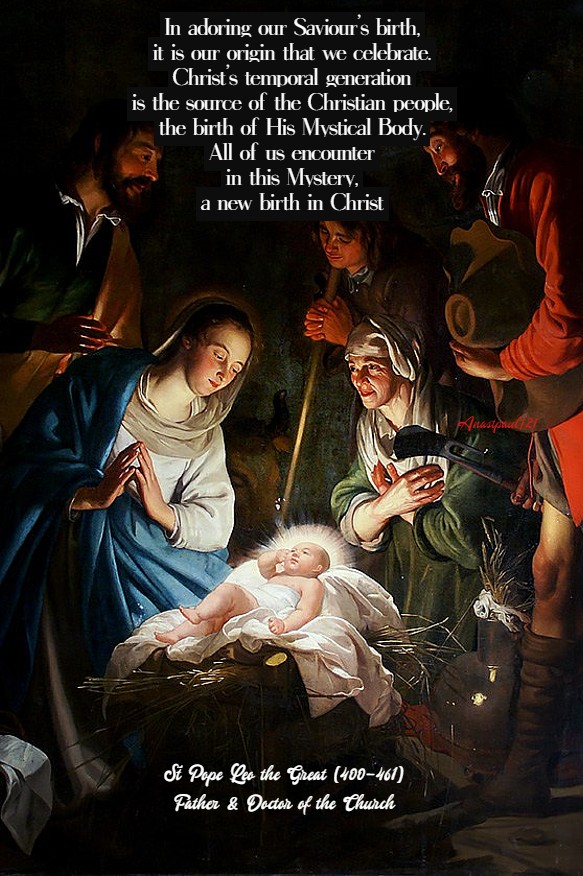
“In adoring our Saviour’s birth, it is our origin that we celebrate. Christ’s temporal generation is the source of the Christian people, the birth of His Mystical Body. All of us encounter in this Mystery, a new birth in Christ.”
St Pope Leo the Great (400-461) Father & Doctor of the Church
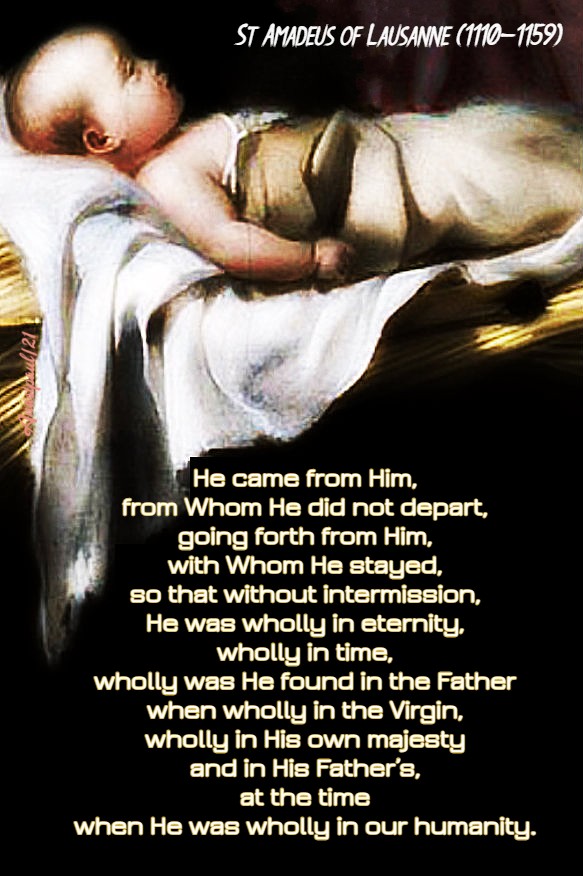
“He came from Him, from Whom He did not depart, going forth from Him, with Whom He stayed, so that without intermission, He was wholly in eternity, wholly in time, wholly was He found in the Father when wholly in the Virgin, wholly in His own Majesty and in His Father’s, at the time when He was wholly in our humanity. ”
One Minute Reflection – 23 December – “The Month of the Divine Infant and the Immaculate Conception” – Friday of the Fourth Week of Advent – 1 Corinthians 4:1-5, Luke 3:1-6 – Scripture search here: https://www.drbo.org/
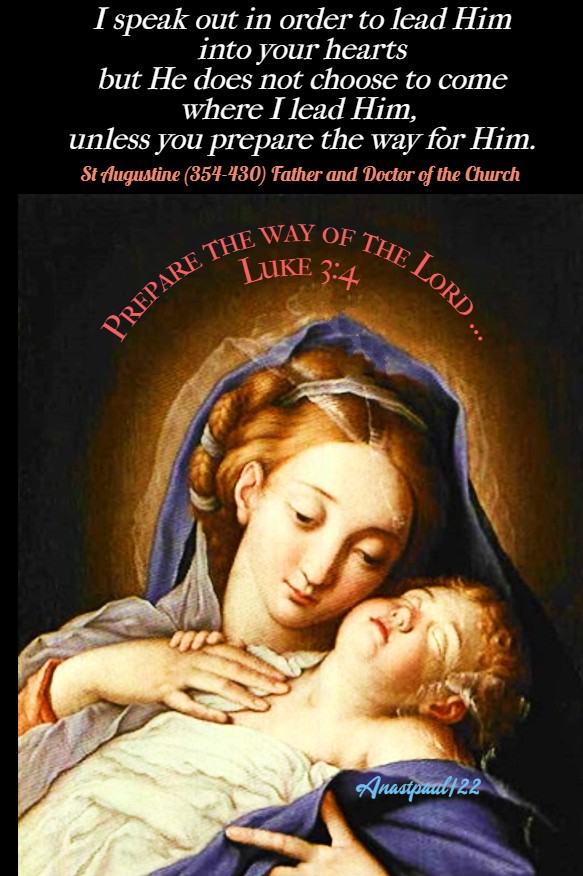
“Prepare the way of the Lord” – Luke 3:4
REFLECTION – “I speak out in order to lead Him into your hearts but He does not choose to come where I lead Him, unless you prepare the way for Him. To prepare the way means, to pray well – it means thinking humbly of oneself. We should take our lesson from John the Baptist. He is thought to be the Christ, he declares he is not what they think. He does not take advantage of their mistake to further his own glory.” … St Augustine (354-430) Father and Doctor of the Church
PRAYER – Almighty God, now that the birth of Your Son is drawing near, we pray that Your eternal Word, Who took flesh in the womb of the Virgin Mary and came to dwell amongst men, will show Your unworthy people, the greatness of His love. And by the intercession of His Holy Mother, may we be granted Your grace. Through Emmanuel, our Lord, Who lives and reigns with You and the Holy Spirit, God forever and ever, amen.
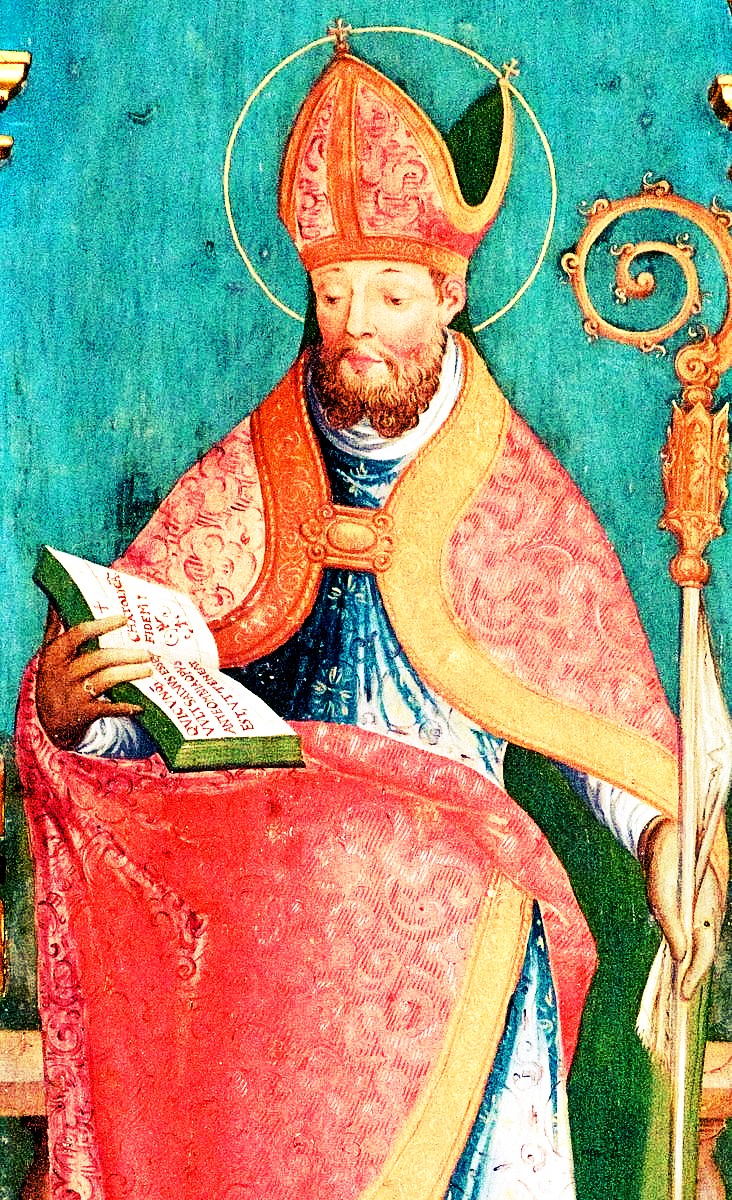
Saint of the Day – 23 December – Bl essed Hartmann OSA (c 1090-1164) Bishop of Brixen, in South Tyrol, Italy, from his appointment in 1140 until his death, Monk of the Hermits of St Augustine, Reformer of the Clergy, Advisor and Confessor to the Holy Roman Emperor, Leopold I, Miracle-worker. Blessed Hartmann’s name means: “the strong man.” Born in c 1090 at Oberpolling, Bavaria, Germany and died in 1164 of natural causes. Patronages – the City and Diocese of Brixen, in Italy, the Diocese of Bolzano-Bressanone, Italy, of Pregnant women, for a good yield of the vineyards. Also known as – Armand, Artmanno, Althochdt, Harmannu. Hartmann was Beatified on 11 February 1784 by Pope Pius VI.
Hartmann came from the Bavarian nobility. He was educated by Augustinian Canons in the St Nikola Monastery in Passau. He entered the Order , was Ordained to the Priesthood. iN 1122, it was Salzburg’s Archbishop Conrad, who decided to reform his Priests and chose Hartmann to lead a group of Priests under the Rule of Saint Augustine. In 1128, Hartmann was appointed as the Prior of an Augustinian Monastery at Herren-Chiemsee, which position he held until 1133.
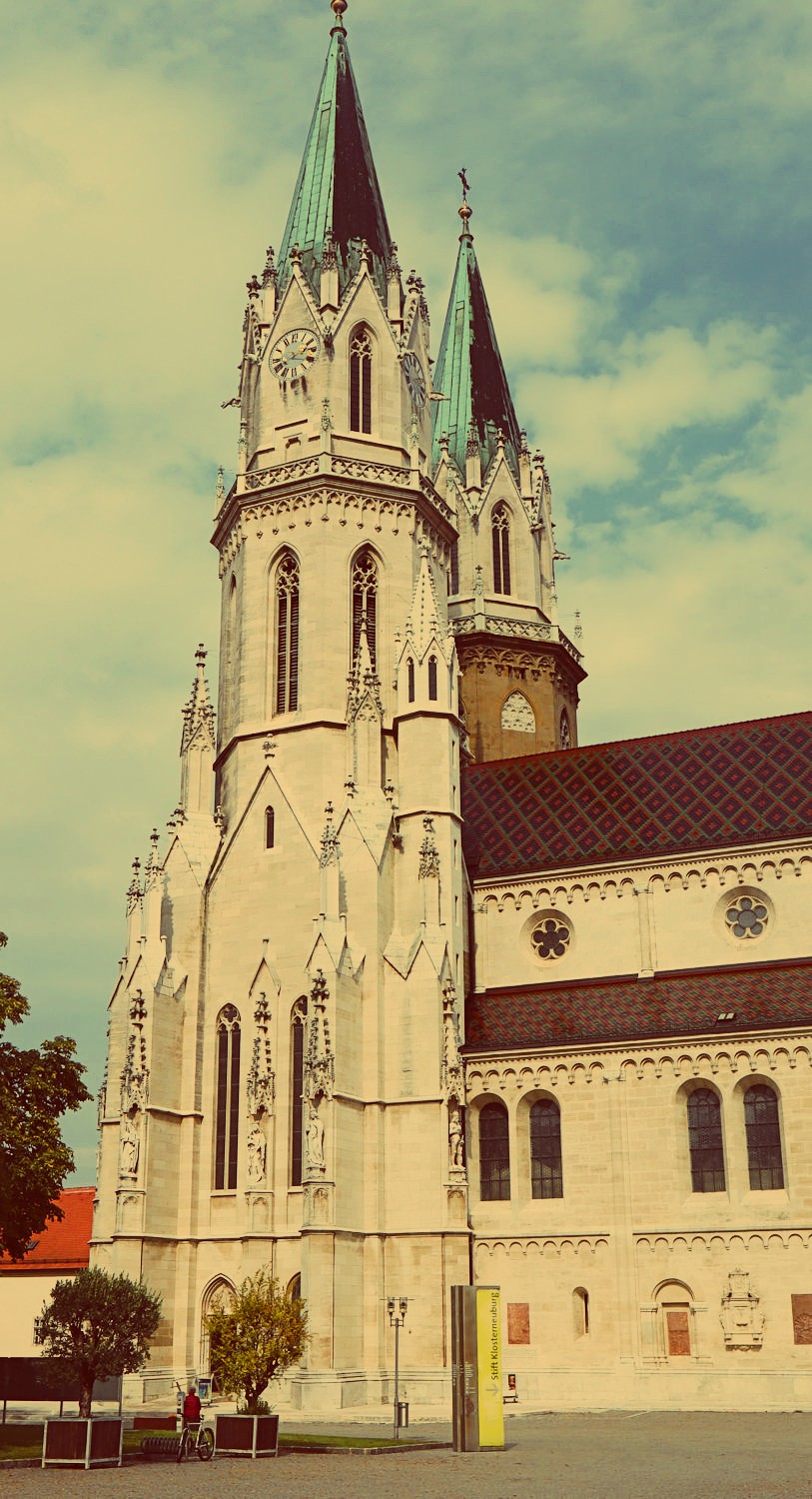
The Monasteries flourished under Hartmann’s direction and, in 1136, the collegiate Church in Klosterneuburg was completed and Consecrated. Hartmann was Advisor and Confessor to Emperor Frederick I, whom he tried to serve without betraying his loyalty to the Pope.
Church of the Klosterneuburg Nonastery
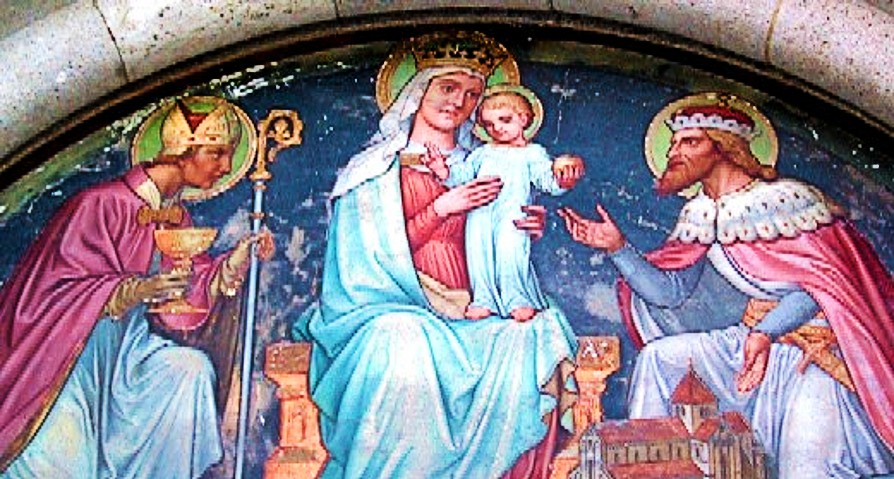
Blessed Hartmann (left) and Margrave Leopold III in front of the Blessed Virgin Mary and the Christ Child, on the main gate of the Klosterneuburg collegiate Church
In 1140 he was appointed as the Bishop of Brixen, by Pope Innocent II and, as such, received his Episcopal Consecration a short while after. He was installed shortly thereafter and dedicated himself to the reform of Priests in the Diocese, as well as acting as a benefactor to Religious Orders, with a particular emphasis on the introduction of the Order of Saint Benedict into the Diocese.
For Hartmann, a flourishing monastic life was the basis for the restoration of Ecclesiastical discipline and thus, for a religious growth in sanctity. In the conflicts surrounding the Papal election of 1159, Hartmann sided with Pope Alexander III against Emperor Frederick I.
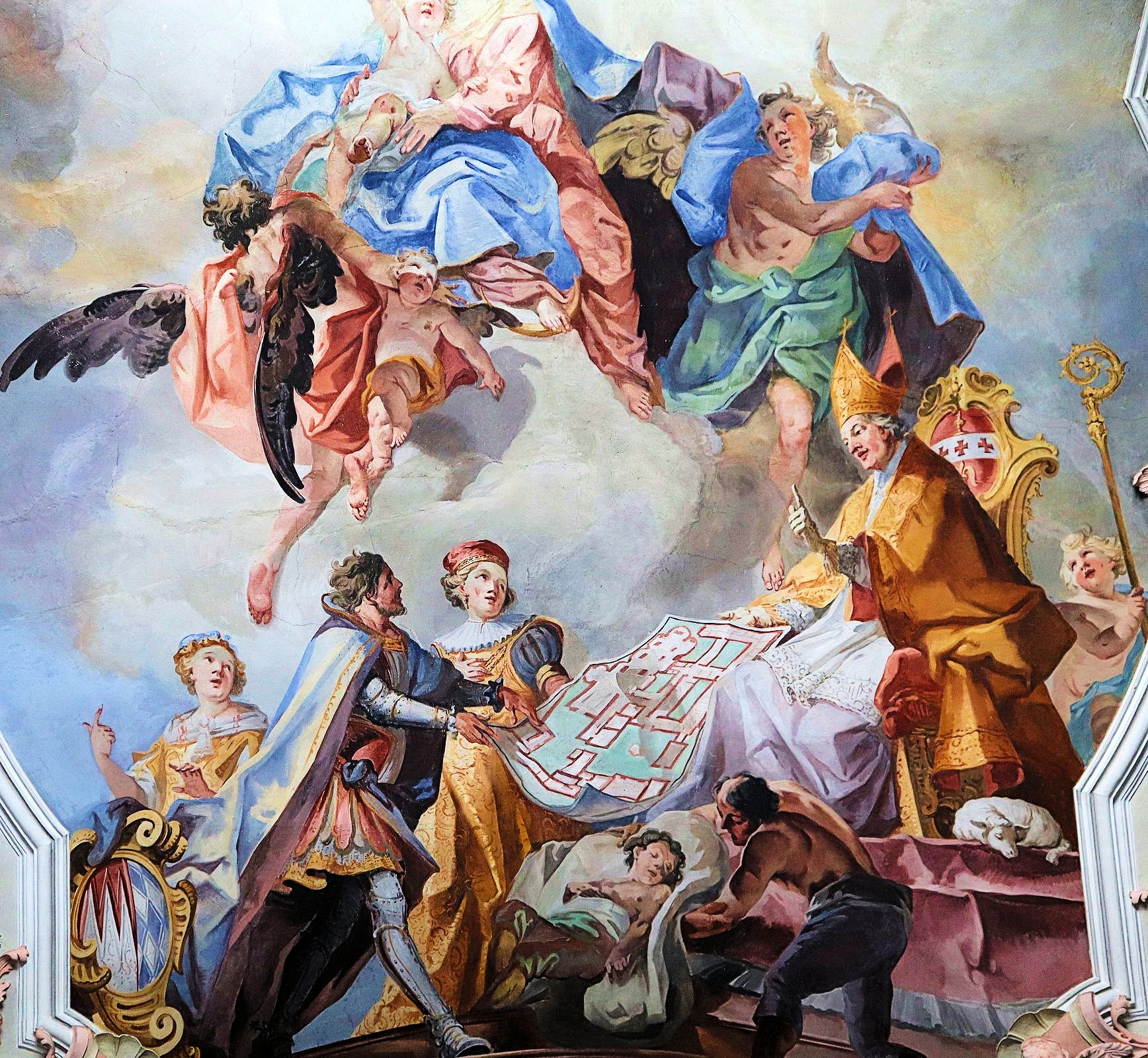
Blessed Hartmann explains the construction plan, to the two co-founders of the Neustift Monastery, Count Reginbert von Säben and his wife Christina. This is the ceiling fresco, n the Neustift collegiate Church, Painted by Matthäus Günther. in 1735-36.
Hartmann himself led an exemplary ascetic life, wearing sackcloth under a plain robe, instead of fullEepiscopal garments. He encouraging discipline in the Clergy and helped the poor and needy. With the assistance of the wealthy Canon Richer, he built the hospice for travellers and pilgrims, on the “Insula Sanctae Crucis” – “the Island of the Holy Cross” – on the site of today’s Seminary – and in 1157, he Consecrated the hospital Chapel.
Painting in the Church in Oberpolling near Passau
We have some information on Hartmann’s miracles but I have found nothing regarding his Patronage of pregnant women. A legend tells how Hartmann stopped on a journey in Longostagno – a district of Ritten near Bozen and refreshed his overheated face in a bowl of water. A woman whose face was badly swollen and bruised, also washed in this water and was instantly relieved of her ailment. Another legend tells that Hartmann hid from robbers in the tower of the Church in Antholz in Pustertal and lost the iron chain with which he flogged himself everyday. When the chain was later found, it unfolded miraculous powers and a fountain sprang up next to the tower,which still flows today and bears his name. The fountain on the Alm near Nova Levante on the Catinaccio Mountains which offered undrinkable water,, he made pure.
Hartmann was already venerated as a Saint during his lifetime. He died of a stroke after taking a too hot bath the day before Christmas Eve .
Statue in the Cathedral in Brixen
Hartmann’s grave was in the Chapel of the hospice he founded on the Island of the Holy Cross in Brixen. It was a popular place of pilgrimage, today the tomb is in the Chapel of the Seminary. Before 1200 a Canon from Neustift wrote his Vita There are also Relics in the collegiate Church in Novacella near Brixen.
St Besa of Egypt Bl Bincema St Dagobert II of Austrasia Bl Epifanio Gómez Alvaro St Frithbert of Hexham Blessed Hartmann OSA (c 1090-1164) Bishop of Brixen, Italy and Friar of the Hermits of St Augustine. Bl Herman of Scheda Bl James Aymerich
St Ivo of Chartres (c 1040-1115) Bishop of Chartres, France from 1090 until his death, Confessor, Reformer, Defender of the Faith, Lawyer, Canon Lawyer, Teacher and Theologian, Writer. The Roman Martyrology states: “In Chartres in France, Saint Ivo, Bishop, who re-established the Order of the Canons and did much work and wrote to promote harmony between the clergy and the civil powers and for the good of the Church.” Biography: https://anastpaul.com/2021/12/23/saint-of-the-day-23-december-saint-ivo-of-chartres-c-1040-1115/
St John Cirita St John Stone St Mardonius of Rome St Mazota of Abernethy St Migdonius of Rome
St Servulus (Died c 590) Layman, Beggar, paralysed by Palsy from birth. Saint Servulus was a perfect model of submission to the divine Will; it would be difficult to offer a more consoling example to persons afflicted by poverty, illnesses and the other miseries of life. It is Saint Gregory the Great who narrates for us his edifying story. St Servulus’ Life of devotion: https://anastpaul.com/2020/12/23/saint-of-the-day-23-december-saint-servulus-died-c-590/
Martyrs of Crete – 10 Saints: A group of ten Christians who died in the persecutions of Decius. They were – Agathopus • Basilides • Cleomenes • Eunician • Euporus • Evaristus • Gelasius • Saturninus • Theodulus • Zeticus They were martyred in 250 on the island of Crete.
Thought for the Day – 22 December – Meditations with Antonio Cardinal Bacci (1881-1971)
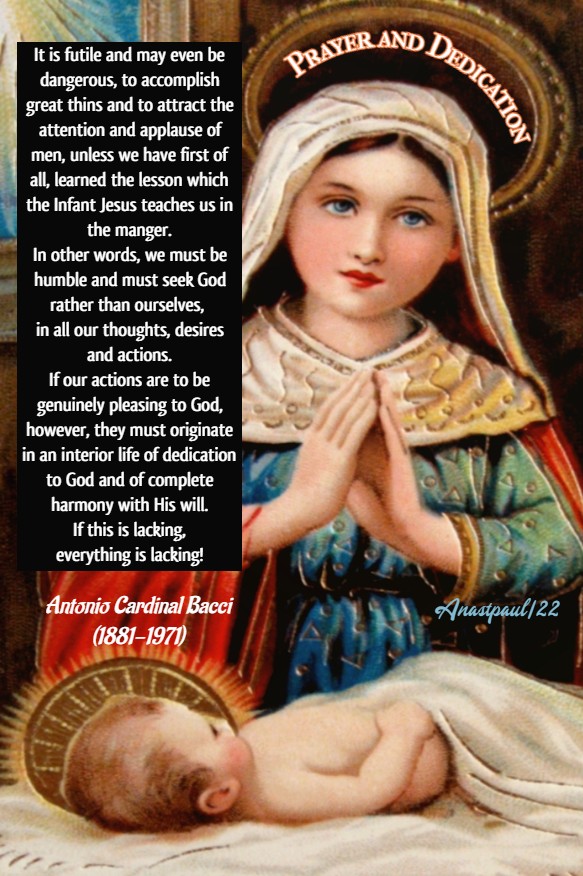
A Christmas Novena VII Prayer and Dedication
“Men are normally judged by their actions and by the degree of external success which they have achieved. God, however, judges them by their intentions and by their internal dispositions. It is futile and may even be dangerous, to accomplish great thins and to attract the attention and applause of men, unless we have first of all, learned the lesson which the Infant Jesus teaches us in the manger.
In other words, we must be humble and must seek God rather than ourselves, in all our thoughts, desires and actions. If our actions are to be genuinely pleasing to God, however, they must originate in an interior life of dedication to God and of complete harmony with His will. If this is lacking, everything is lacking! Without this interior life of grace and love, we are “as sounding brass or a tinkling cymbal” (1 Cor 13:1) and our actions are valueless in the sight of God.”
Christmas Novena to the Divine Infant Jesus By St Alphonsus Maria de Liguori (1696-1787)
THE SEVENTH DAY 22 December Meditation 7: The journey of the Infant Jesus to Egypt.
The Son of God came from Heaven to save humanity. But no sooner was He born, than they began to persecute Him, even unto death. Herod, afraid that this Infant would take away his kingdom, tried to put the Child to death. So in a dream, an Angel advised Saint Joseph to take Jesus and His Mother to Egypt. Informing Mary, Joseph promptly obeyed. He took along with him the tools of his trade that he had available, to use in providing a livelihood, while in Egypt, for himself and his poor family. For her part, Mary packed a small bag of clothes for the Holy Infant. Then, drawing near the crib with tears, she said to her sleeping Child, “O my Son and my God, Thou hast come down from Heaven to save humanity, yet hardly after Thou art born, they already seek to take away Thy life.”
That very night, still crying, she took the Infant Jesus and she and Joseph set off on their journey.
Think about how much these lonely pilgrims must have suffered, while making such a long journey, deprived of every comfort. The Infant was not yet able to walk, so Mary and Joseph had to take turns carrying him in their arms. During the journey through the desert of Egypt, their only bed at night was the bare earth in the open air. The Infant wept in the cold and Joseph and Mary also wept, out of compassion for Him. Who would not weep, seeing the Son of God, poor and persecuted, wandering about on the earth, so that He would not be killed by His enemies?
Affections and Prayers:
Dear Infant Jesus, crying so bitterly! Well hast Thou reason to weep in seeing Thyself persecuted by men, whom Thou lovest so much. I, too, O God, have once persecuted Thee, by my sins. But Thou knowest that now I love Thee, more than myself and that nothing pains me more, than the thought that I have so often spurned Thee, my Sovereign Good.
Forgive me, O Jesus and let me bear Thee with me, in my heart, on all the rest of the journey which I have still to travel through life, so that, together with Thee, I may enter into eternity. So often have I driven Thee from my soul by my sins. But now, I love Thee above all things and I regret, above other misfortunes, that I have offended Thee. I wish to leave Thee no more, my beloved Lord. But do Thou give me the strength to resist temptations. Never permit me to be separated from Thee again. Let me rather die, than ever again lose Thy good grace.
O Mary, my hope, make me always live in God’s love and then, die in loving Him. Amen.
Quote/s of the Day – 22 December – Thursday of the Fourth Week of Advent – “The Month of the Divine Infant and the Immaculate Conception”
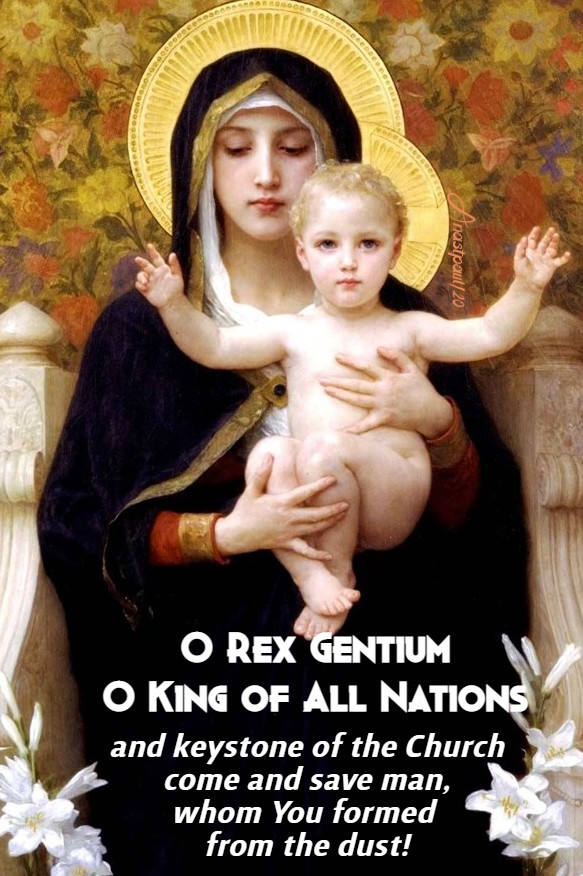
“O KING OF ALL NATIONS and keystone of the Church come and save man, whom You formed from the dust!”
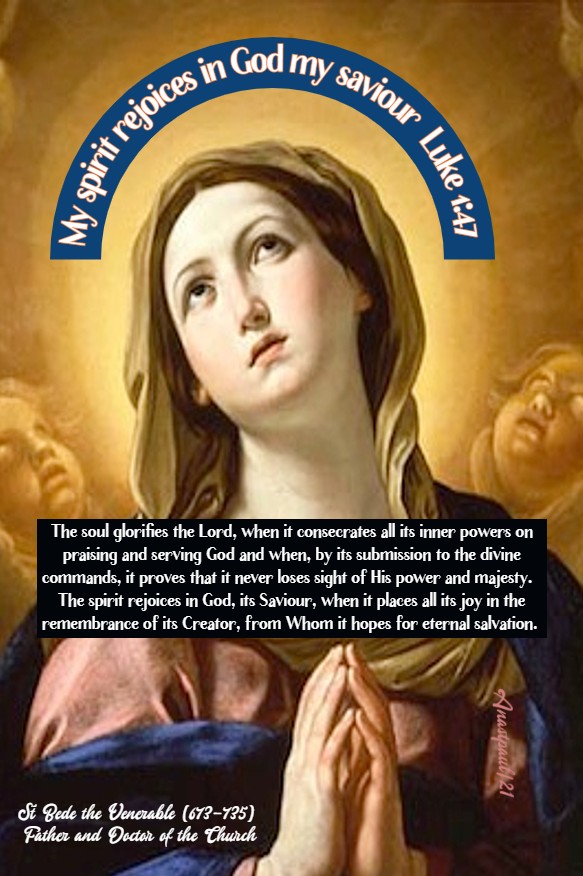
“The soul glorifies the Lord, when it consecrates all its inner powers on praising and serving God and when, by its submission to the Divine commands, it proves that it never loses sight of His Power and Majesty. The spirit rejoices in God, its Saviour, when it places all its joy in the remembrance of its Creator, from Whom it hopes for eternal salvation.”
St Bede the Venerable (673-735) Father and Doctor of the Church
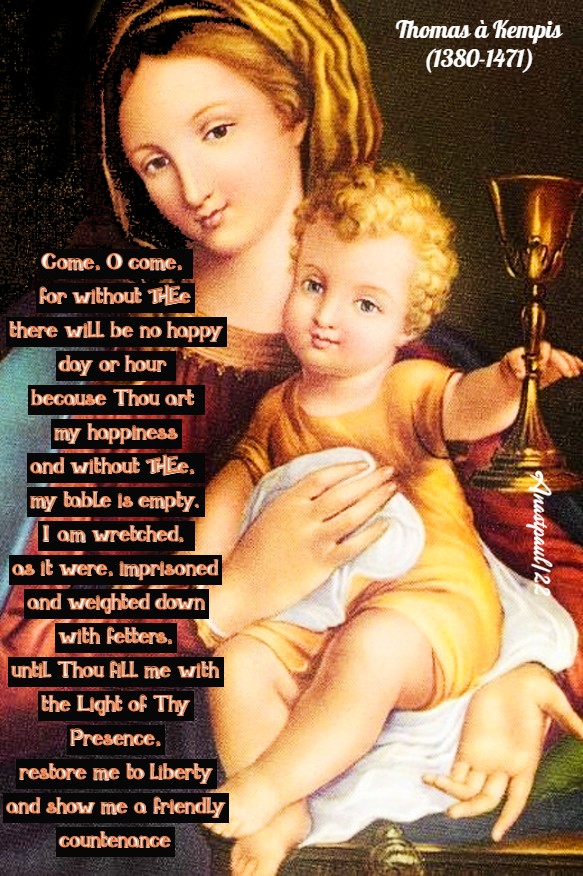
“Come, O come, for without Thee there will be no happy day or hour because Thou art my happiness and without Thee, my table is empty. I am wretched, as it were, imprisoned and weighted down with fetters, until Thou fill me with the Light of Thy Presence, restore me to liberty and show me a friendly countenance.”
One Minute Reflection – 22 December – “The Month of the Divine Infant and the Immaculate Conception” – Thursday of the Fourth Week of Advent – 1 Corinthians 4:1-5, Luke 3:1-6 – Scripture search here: https://www.drbo.org/
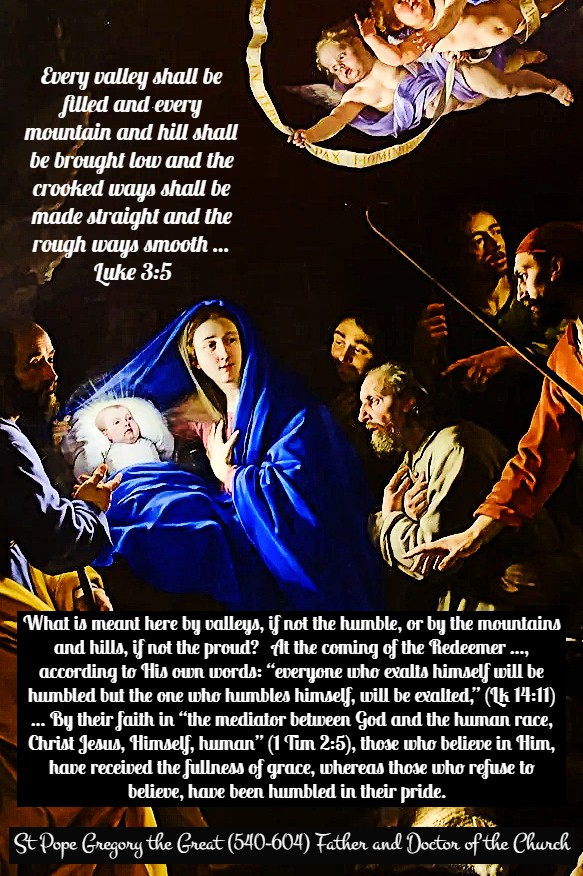
“Every valley shall be filled and every mountain and hill shall be brought low and the crooked ways shall be made straight and the rough ways smooth …” – Luke 3:5
REFLECTION –“Every valley shall be filled and every mountain and hill, shall be made low.” What is meant here by valleys, if not the humble, or by the mountains and hills, if not the proud? At the coming of the Redeemer …, according to His own words: “everyone who exalts himself will be humbled but the one who humbles himself, will be exalted,” (Lk 14:11) … By their faith in “the mediator between God and the human race, Christ Jesus, Himself, human” (1 Tim 2:5), those who believe in Him, have received the fullness of grace, whereas those who refuse to believe, have been humbled in their pride. Every valley has been filled in, since humble hearts, by receiving the words of holy doctrine, will be filled by the grace of the virtues, as it is written: “He made springs gush forth in the watercourses that wind among the valleys,” (cf. Ps 104:10).” – St Gregory the Great (540-604) Pope, Father and Doctor of the Church (Gospel Homilies no 20).
PRAYER – O God, Who, by the message of an Angel, willed to take flesh in the womb of the Blessed Virgin Mary, grant that we, Thy suppliants, who believe her to be truly the Mother of God, maybe helped by her intercession with Thee.Through the same Jesus Christ, Thy Son our Lord, Who lives and reigns with Thee, in the unity of the Holy Ghost, God, world without end. Amen (Collect).
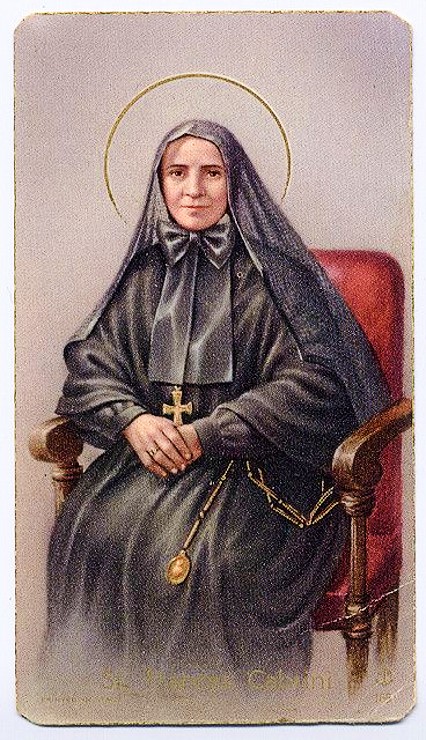
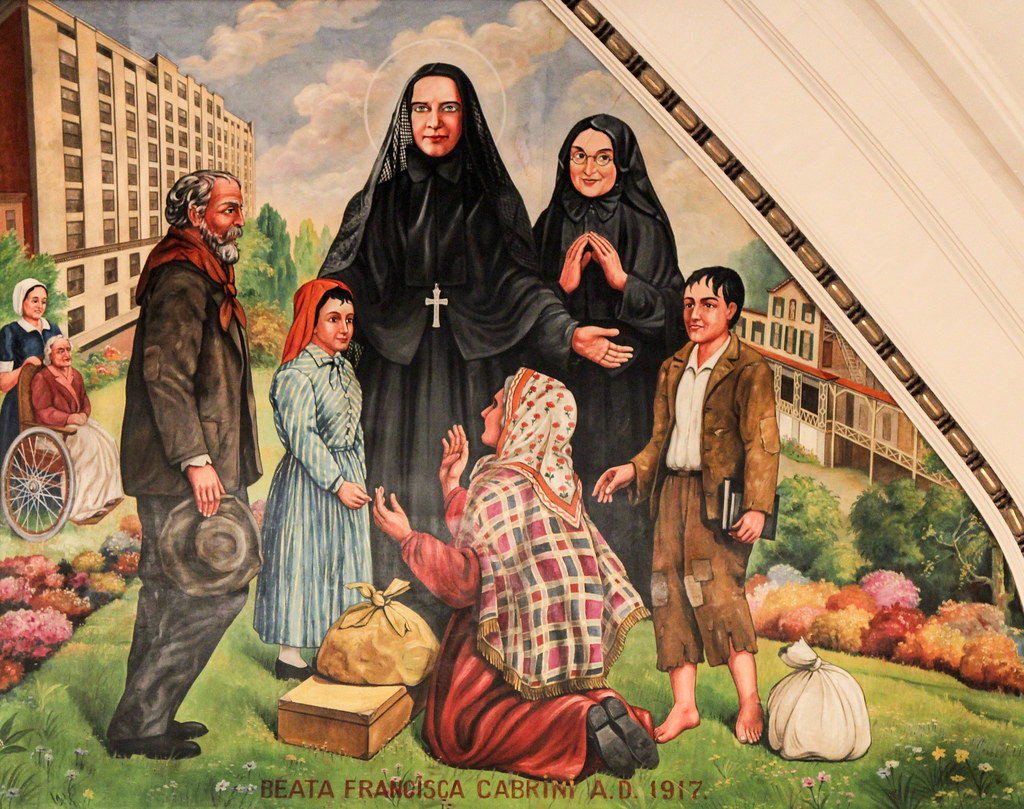
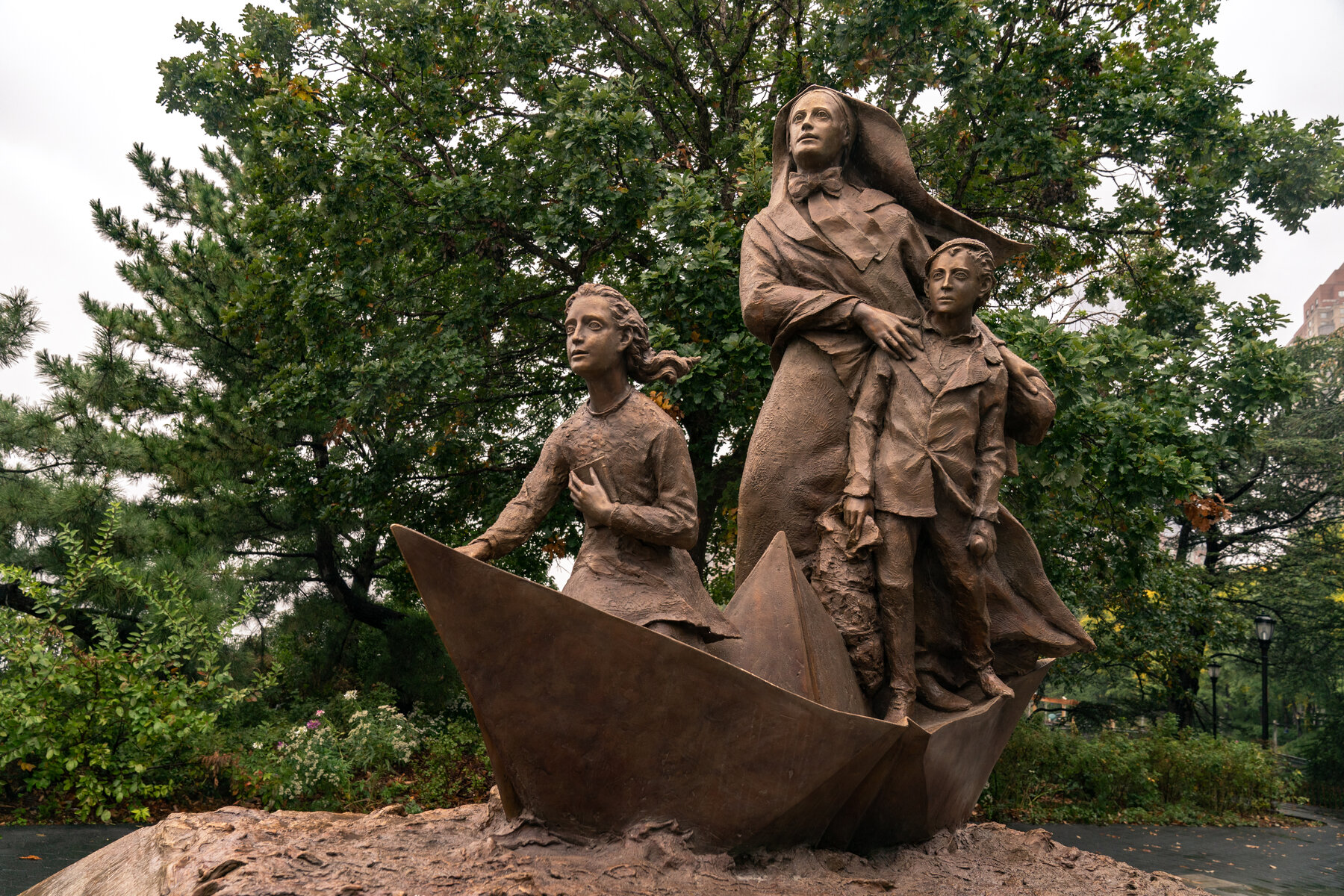
Saint of the Day – 22 December – St Frances Xavier Cabrini (1850-1917) Virgin, Religious Sister, Missionary, Founder. Patronages – against malaria, emigrants, immigrants (given on 8 September 1950 by Pope Pius XII) hospital administrators, orphans.
St Frances Xavier Cabrini From the Roman Breviary
Frances Cabrini, who later took the name of Xavier because of her desire to imitate the Apostle of the Indies, was born in the Town of Sant’ Angelo in the Diocese of Lodi in 1850. Her parents were holy and respectable people. Aided by divine grace, she had attained, even as a child, to a very high degree of union with God and was already given to the practice of austerities. When she was seven years old, the custom of listening before evening prayers, to readings from a magazine concerning missionary work in China, filled her with an ardent desire to go there, in order to win souls for God. She was hardly thirteen years old, when she took a vow of perpetual Virginity. From that time, the all-absorbing thought of her soul was how to return love, for love ,to the Sacred Heart of Jesus and thus bring some consolation to Him, in His sufferings and distress.
After the successful completion of her studies she resolved to embrace the religious life. Twice she applied for admission and each time was refused, on the ground of poor health. She then taught for some years in the public school, with a considerable measure of success. Thereafter, she was appointed by the Bishop of Lodi, as the directress of an orphanage, in which position, she displayed such prudence and zeal, especially in the Christian education of girls that the same Bishop urged her to found a new religious congregation which would principally be devoted, to the missions.
She undertook this difficult assignment with great courage and in 1880, in the Chapel of our Lady of Grace at Codogno, laid the foundation of the Institute of the Missionary Sisters of the Sacred Heart. She then sought from the Holy See, the approval of the Rules and Constitutions of the new Institute. This having been achieved, she laboured with all zeal, to imbue the new sisterhood with the same spirit of love of God and neighboir ,which she, herself had drawn, in copious draughts ,from the fountain of the Sacred Heart.
The expansion of this new religious family to include sixty-seven foundations in Europe and America, testifies to the extraordinary character and skill of its wise and saintly ruler. She had, moreover ,a mind to establish missions in more remote lands and being in doubt, concerning God’s will in the matter, she followed the advice of Pope Leo XIII and turned to the West.
It was to these western shores of both Americas, that large multitudes of Italians had emigrated, in order to find employment because they were unable to exist in their own land. The condition of the Italian immigrants was then very poor and Frances sought to alleviate it. It was the love of Christ that urged her to take up this work, so wholeheartedly and so courageously. No labour could overcome her, no danger could frighten her. Her intrepid and undaunted spirit braved the rough and dangerous voyages across the ocean, twenty-four times!
She travelled over the length and breadth of America, establishing everywhere, hospitals, schools, houses of rest, nurseries, orphanges and other institutions, in order to promote the material livelihood but above all the spiritual well-being of the working class. By such charitable endeavours, she won the hearts of her fellow-countrymen and so, came to be called the Mother of the Italians.
She exerted every effort to accomplish the work she had in mind and her zeal could brook no delay. Placing her complete confidence in Divine Providence, she took as her motto that saying of Paul: “I can do all things in Him Who strengtheneth me.”
Her heart was consecrated to God by a perpetual union with Him, so that even amid the most absorbing occupations, her mind never lost track of heavenly things. All she met with, on her various journeys, were like so many stepping-stones, by which her soul ascended to God.
She had the greatest veneration for the Roman Pontiff and the Apostolic See and saw in the laws of the Church, norms of conduct that give one the greatest sense of security. She cultivated a childlike love for the Blessed Virgin Mary and often used to say, that Mary was the Mother and Foundress of her Institute.
Finally her life, extraordinary by reason of its integrity and labours for God, came to an end at Chicago, on 22 December 1917. Later her body was translated to New York. She was solemnly Beatified by Pope Pius XI, whereas Pope Pius XII, after new miracles were performed, solemnly added her name to the list of holy Virgins.
“Inspired by the grace of God, we join the Saints in honouring the holy Virgin Frances Xavier Cabrini. She was a humble woman who became outstanding, not because she was famous or rich or powerful but because, she lived a virtuous life. From the tender years of her youth, she kept her innocence as white as a lily and preserved it carefully, with the thorns of penitence. As the years progressed, she was moved by a certain instinct and supernatural zeal, to dedicate her whole life to the service and greater glory of God. She welcomed delinquent youths into safe homes and taught them to live upright and holy lives. She consoled those who were in prison and recalled to them, the hope of eternal life. She encouraged prisoners to reform themselves and to live honest lives. She comforted the sick and the infirm in the hospitals and diligently cared for them. She extended a friendly and helping hand especially to immigrants and offered them necessary shelter and relief, for having left their homeland behind, they were wandering about in a foreign land with no place to turn for help. Because of their condition, she saw that they were in danger of deserting the practice of Christian virtues and their Catholic faith. Undoubtedly she accomplished all this through the faith which was always so vibrant and alive in her heart, through the divine love which burned within her and finally, through constant prayer, by which she was so closely united with God, from Whom she humbly asked and obtained, whatever her human weakness could not obtain. Although her constitution was very frail, her spirit was endowed with such singular strength that, knowing the will of God in her regard, she permitted nothing to impede her from accomplishing what seemed beyond her strength.”– From his sermon at the Canonisation of Saint Frances Xavier Cabrini by Pope Pius XII.
St Abban of New Ross Bl Adam of Saxony St Amaswinthus of Málaga St Athernaise of Fife St Bertheid of Münster St Chaeremon of Nilopolis
St Flavian of Acquapendente (Died 363) Martyr Layman, Prefect of Imperial Rome, Husband of Saint Dafrosa, Father of Saint Bibiana and Saint Demetria. The Roman Martyrology states: “At Rome, ex-Prefect, who, under Julian the Apostate, was condemned to be branded for Christ and banished to Aquae Taurinae, where he gave up his soul to God in prayer.” His Life and Death: https://anastpaul.com/2021/12/22/saint-of-the-day-22-december-saint-flavian-of-acquapendente-died-363-martyr/
Blessed Thomas Holland SJ (1600-1642) Priest of the Society of Jesus and Martyr. of England and Wales. With eyes closed in prayer, Fr Holland looked at a Priest secretly in the crowd and received absolution. After he was hanged, his body was beheaded and quartered and exposed on London Bridge. Fr Holland was only forty-two years of age and a Jesuit for eighteen years. Pope Pius XI Beatified him on 15 December 1929. His Life and Death: https://anastpaul.com/2019/12/22/saint-of-the-day-22-december-blessed-thomas-holland-sj-1600-1642-priest-and-martyr-his-faith-was-his-crime/
St Zeno of Nicomedia
Martyrs of Ostia – 3 Saints: A group of Christians Martyred together. The only details about them to survive are three names – Demetrius, Florus and Honoratus. They were martyred at Ostia, Italy.
Martyrs of Rhaitu – 43 Saints: 43 Monks Martyred by Blemmyes, in Raíthu, Egypt, date unknown.
Martyrs of Via Lavicana – 30 Saints: A group of 30 Christians Martyred together in the persecutions of Diocletian. c 303 in Rome, Italy and were buried between two bay trees on the Via Lavicana outside Rome.
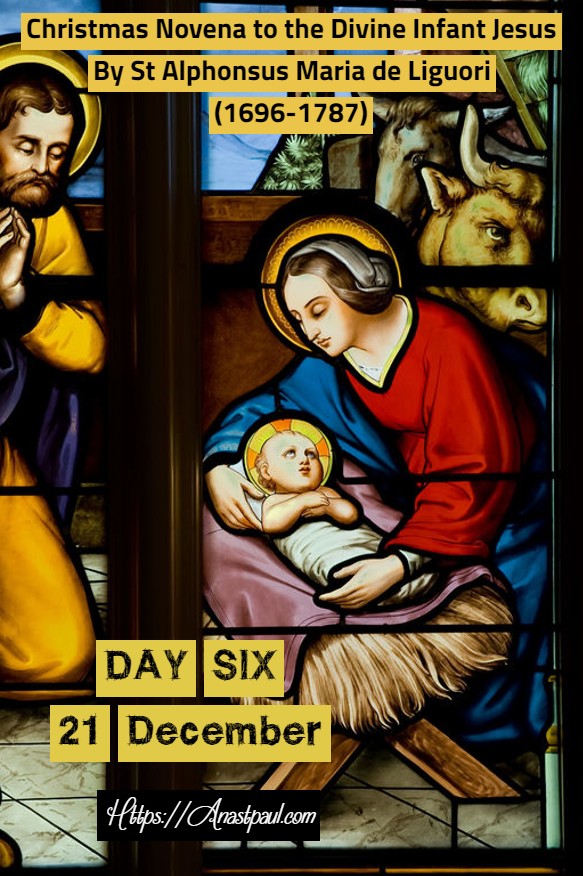
Christmas Novena to the Divine Infant Jesus By St Alphonsus Maria de Liguori (1696-1787)
THE SIXTH DAY 21 December Meditation 6: The Mercy of God in coming from Heaven, to save us, by His Death.
Saint Paul says, the goodness and loving kindness of God our Saviour appeared (Titus 3:4). It was then, when the Son of God made Man appeared on earth that we saw how great the goodness of God is toward us. Saint Bernard wrote that the power of God first appeared, through the creation of the world and sustaining the world, has shown God’s wisdom. But God’s mercy appeared, to an even greater degree, when God took human flesh to save lost humanity, by His sufferings and Death. And what greater mercy could the Son of God have shown us, than to take upon Himself, the pains we have deserved?
Imagine Him as a newborn Infant, wrapped in swaddling clothes in a manger, unable to move or feed Himself. Just to survive, He relied on Mary to feed Him with a little milk. Imagine Him many years later, in the judgement hall before Pilate, bound to a column by ropes, from which He could not loosen Himself and scourged from head to foot. Imagine Him on the journey to Calvary, falling down as He went along the road, from weakness and from the weight of the Cross which He carried. Finally, imagine Him nailed to that infamous tree upon which He finished His life, in agony and suffering.
Jesus Christ wished to gain all the endearments of our hearts, by His love for us and,, therefore, He would not send an Angel to redeem us but came Himself, to save us by His Passion and Resurrection. If an Angel had been our redeemer, we would have a divided heart—loving God as our Creator and the Angel as our redeemer. But because God, Who is our Creator, wants our whole heart, He chose to also be our Redeemer.
Affections and Prayers:
O my dear Redeemer! Where should I be now, if Thou hadst not borne with me so patiently but hadst called me from life, while I was in the state of sin? Since Thou hast waited for me till now, forgive me quickly, O my Jesus, before death finds me still guilty of so many offences which I have committed against Thee. I am so sorry for having vilely despised Thee, my Sovereign Good that I could die of grief. But Thou canst not abandon a soul that seeks Thee.
If hitherto I have forsaken Thee, I now seek Thee and love Thee. Yes, my God, I love Thee above all else; I love Thee more than myself. Help me, Lord, to love Thee always during the rest of my life. Nothing else do I seek of Thee. But this I beg of Thee, this I hope to receive from Thee.
Mary, my hope, do thou pray for me. If thou prayest for me, I am sure of grace. Amen.
Thought for the Day – 21 December – Meditations with Antonio Cardinal Bacci (1881-1971)
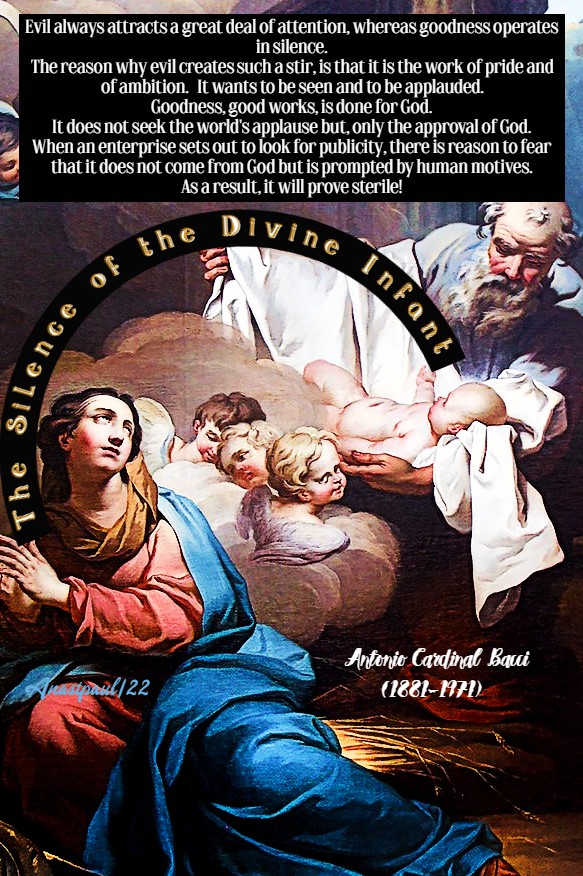
A Christmas Novena VI The Silence of the Divine Infant
“Evil always attracts a great deal of attention, whereas goodness operates in silence. The reason why evil creates such a stir, is that it is the work of pride and of ambition. It wants to be seen and to be applauded. Goodness, good works, is done for God. It does not seek the world’s applause but, only the approval of God. When an enterprise sets out to look for publicity, there is reason to fear that it does not come from God but is prompted by human motives. As a result, it will prove sterile!
If we sincerely desire to please God, we shall work in silence.
We shall not aim at our own worldly interests but, shall seek our own spiritual good and that of our fellowmen. If it is God’s will. our good work may shine also before men but let us remember that this is for the glory of God and in order to give good example to our neighbour.”
Quote/s of the Day – 21 December – Feast of St Thomas, Apostle of Christ, Martyr – “The Month of the Divine Infant and the Immaculate Conception” – Ephesians 2:19-22, John 20:24-29 – Scripture search here: https://www.drbo.org/
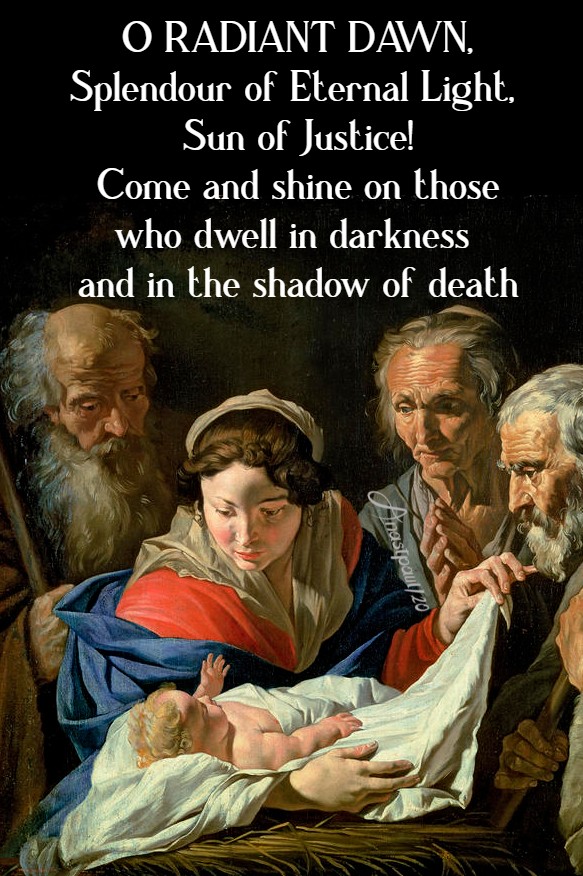
“O Radiant Dawn, Splendour of Eternal Light, Sun of Justice! Come and shine on those who dwell in darkness and in the shadow of death.”
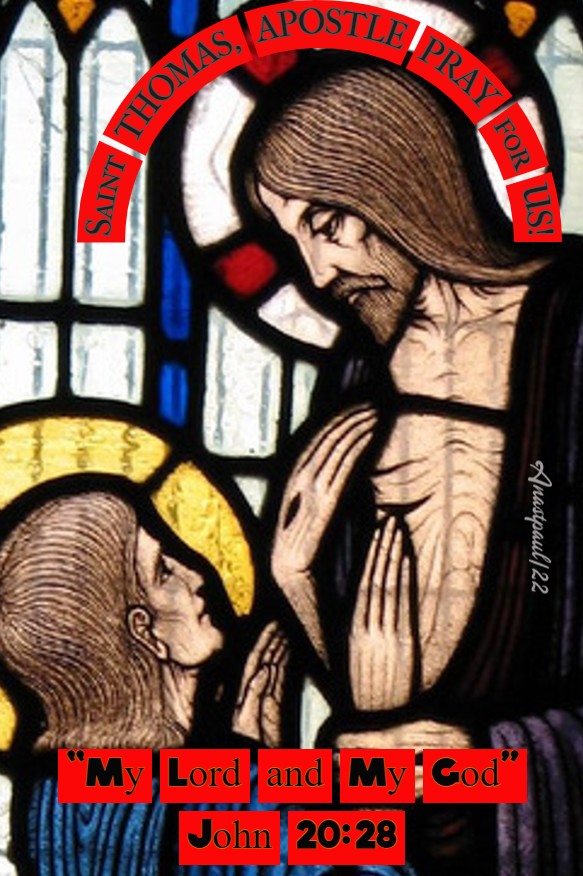
“My Lord and my God”
John 20:28
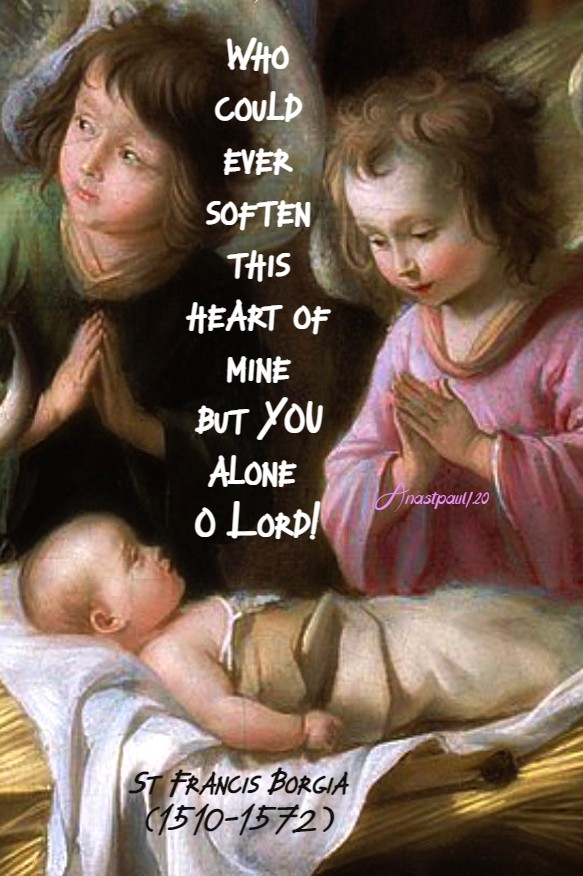
“Who could ever soften this heart of mine but YOU alone O Lord!”
St Francis Borgia (1510-1572)
“Christ first of all, Christ in the centre of the heart, in the centre of history and of the cosmos. Humanity needs Christ intensely because, He is our “measure.” There is no realm, that cannot be touched by His strength; there is no evil, that cannot find remedy in Him, there is no problem, that cannot be solved in Him. Either Christ or nothing!”
One Minute Reflection – 21 December – Feast of St Thomas, Apostle of Christ, Martyr – Ephesians 2:19-22, John 20:24-29 – Scripture search here: https://www.drbo.org/
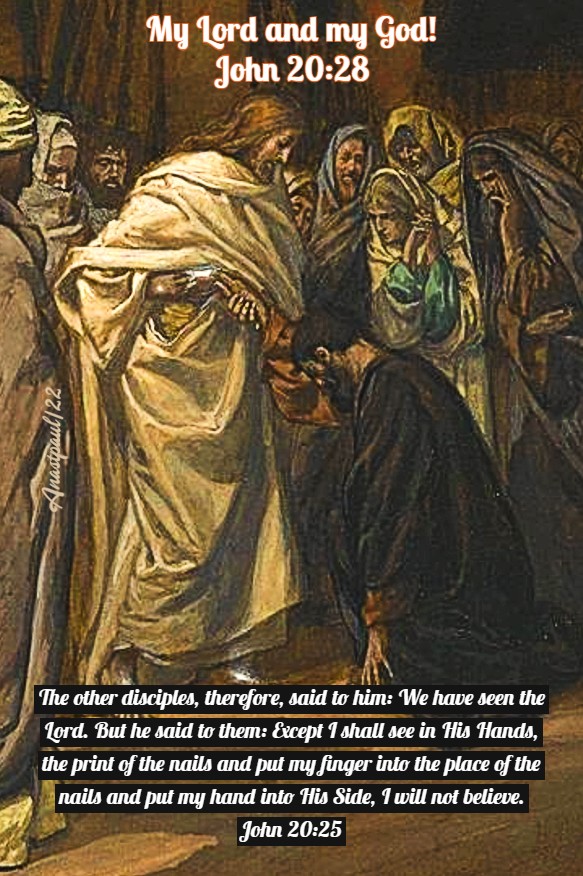
“The other disciples, therefore, said to him: We have seen the Lord. But he said to them: Except I shall see in His Hands, the print of the nails and put my finger into the place of the nails and put my hand into His Side, I will not believe.” – John 20:25
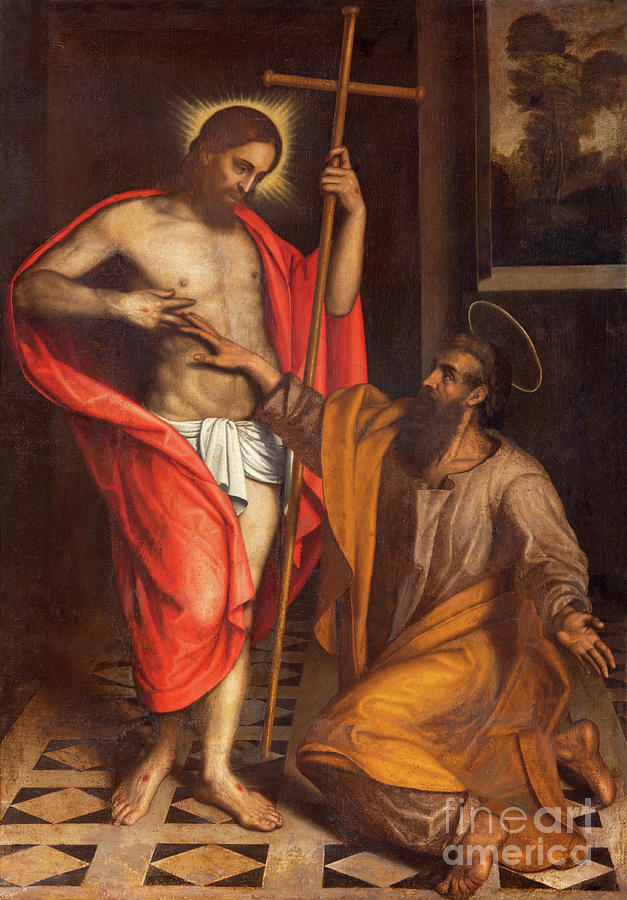
REFLECTION – “What, dearest brethren do you notice in this passage? Do you think that it happened by chance that this chosen disciple was absent at that time and afterwards coming, heard the news and hearing, doubted that doubting, he touched and touching, he believed? This did not happen by chance but by Divine dispensation. For the Divine clemency brought it about, in a wonderful way that the doubting disciple, while touching the wounds in his Master’s flesh, should thereby heal the wounds of our unbelief. The unbelief of Thomas is more to our faith, than the faith of the believing disciples. While he is brought back to faith by touching, our minds are set free from doubt and established in the faith.
So the Lord indeed, after His Resurrection permitted His disciple to doubt but He did not leave him in unbelief; just as before His birth, He wished Mary to have a spouse, who, however, never attained to the married state. The disciple who doubted and touched his Risen Lord, thus became, a witness to the truth of the Resurrection, just as the spouse of His Mother was the guardian of her inviolate Virginity. Thomas touched and cried out: My Lord and my God. Jesus said to him – Because you have seen me, you have believed. But since the Apostle Paul says – Now faith is the substance of things to be hoped for, the evidence of things which appear not; it is certainly clear that faith is the evidence, of those things which cannot appear. The things which appear are the object, not of faith but of knowledge.
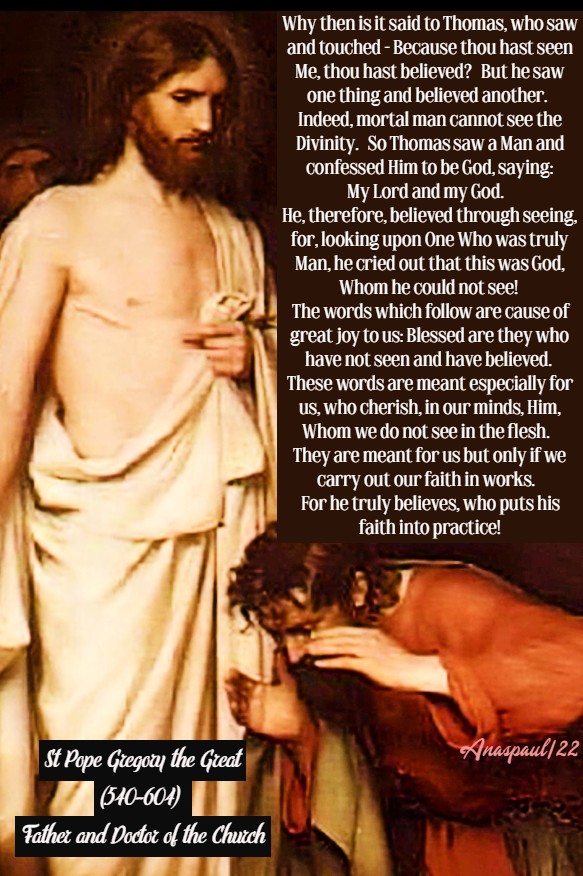
Why then is it said to Thomas, who saw and touched – Because thou hast seen Me, thou hast believed? But he saw one thing and believed another. Indeed, mortal man cannot see the Divinity. So Thomas saw a Man and confessed Him to be God, saying: My Lord and my God. He, therefore, believed through seeing, for, looking upon One Who was truly Man, he cried out that this was God, Whom he could not see! The words which follow are cause of great joy to us: Blessed are they who have not seen and have believed. These words are meant especially for us, who cherish, in our minds, Him, Whom we do not see in the flesh. They are meant for us but only if we carry out our faith in works. For he truly believes, who puts his faith into practice!” – St Gregory the Great (540-604) Pope. Father and one of the original four Doctors of the Latin Church (Sermon on the Feast of St Thomas).
PRAYER – O Lord, grant us, we beseech Thee, to glory in the Feast-day of blessed Thomas, Thy Apostle, that we maybe helped continually by his patronage and imitate his faith with a devotion like his. .Through Jesus Christ, Thy Son our Lord, Who lives and reigns with Thee, in the unity of the Holy Ghost, God, world without end. Amen (Collect).
Our Morning Offering – 21 December – St Thomas Apostle
Exsultet Orbis! Let the World Rejoice! Unknown Author
Now let the earth with joy resound, And Heaven the chant re-echo round; Nor Heaven nor earth too high can raise The great Apostles’ glorious praise.
O ye who, throned in glory dread, Shall judge the living and the dead, Lights of the world forever more! To you the suppliant prayer we pour.
Ye close the Sacred Gates on high. At your command apart they fly. O loose for us the guilty chain We strive to break and strive in vain.
Sickness and health your voice obey, At your command they go or stay. From sin’s disease our souls restore; In good confirm us more and more.
So when the world is at its end. And Christ to Judgment shall descend, May we be called, those joys to see Prepared from all eternity.
Praise to the Father, with the Son, And Holy Spirit, Three in One; As ever was in ages past And so shall be while ages last. Amen
(Roman Breviary for the Common of Apostles) An Office Hymn that was traditionally prescribed for Vespers and Lauds on the Feasts of Apostles and Evangelists outside Easter time. The Hymn is found as early as the tenth century in a hymnal of Moissac Abbey.
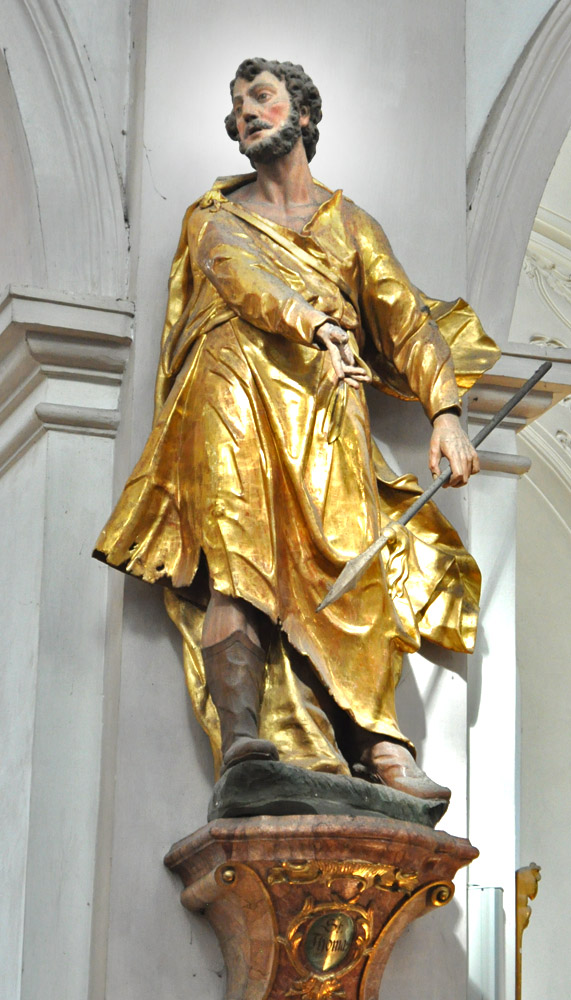
Saint of the Day – 21 December – Feast of St Thomas, Apostle of Christ, Martyr. His Patronages are:• people in doubt; against doubt• architects• blind people and against blindness• builders• construction workers• geometricians• stone masons and stone cutters• surveyors• theologians• Ceylon• East Indies• India• Indonesia• Malaysia • Pakistan• Singapore• Sri Lanka• Diocese of Bathery, India• Castelfranco di Sopra, Italy• Certaldo, Italy• Ortona, Italy.
St Thomas, Apostle From the Liturgical Year, 1870
This is the last Feast the Church keeps before the great one of the Nativity of her Lord and Spouse. She interrupts the Greater Ferias, in order to pay her tribute of honour to Thomas, the Apostle of Christ, whose glorious Martyrdom has consecrated this twenty first day of December and has procured, for the Christian people, a powerful patron that will introduce them to the Divine Babe of Bethlehem.
To none of the Apostles could this day have been so fittingly assigned, as to St Thomas. It was St Thomas whom we needed; St. Thomas, whose festal patronage would aid us to believe and hope, in that God, Whom we see not and Who comes to us in silence and humility, in order to try our Faith.
St Thomas was once guilty of doubting, when he ought to have believed and only learned the necessity of Faith by the sad experience of incredulity. He comes then most appropriately to defend us, by the power of his example and prayers, against the temptations which proud human reason might excite within us.
Let us pray to him with confidence. In that Heaven of Light and Vision, where his repentance and love have placed him, he will intercede for us,and gain for us that docility of mind and heart, which will enable us to see and recognise Him, Who is the Expected of Nations and Who, though the King of the world, will give no other signs of His Majesty, than the swaddling-clothes and tears of a Babe.






















 AnaStpaul
You must be logged in to post a comment.