One Minute Reflection – 21 March – Tuesday of the Fourth Week in Lent and the Memorial of St Benedict OSB (c 480-547) Abbot – Ecclesiasticus 45:1-6, Matthew 19:27-29 – Scripture search here: https://www.drbo.org/
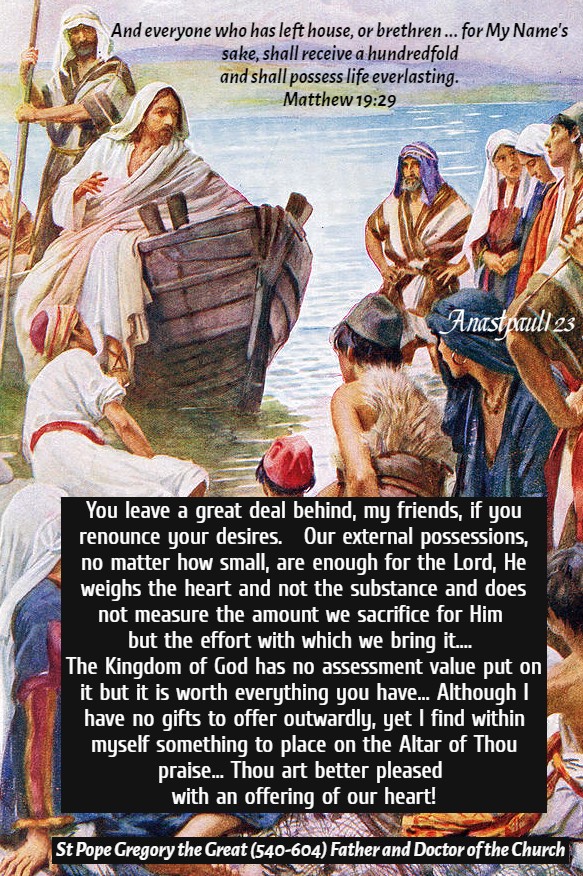
“And everyone who has left house, or brethren, or sisters, or father, or mother, or wife, or children, or lands, for My Name’s sake, shall receive a hundredfold and shall possess life everlasting.” – Matthew 19:29
REFLECTION – “No-one should say to himself, even when he regards others who have left a great deal behind: “I want to imitate those who despise this world but I have nothing to leave behind.” You leave a great deal behind, my friends, if you renounce your desires. Our external possessions, no matter how small, are enough for the Lord, He weighs the heart and not the substance and does not measure the amount we sacrifice for Him but the effort with which we bring it…. The Kingdom of God has no assessment value put on it but it is worth everything you have… To Peter and Andrew it was worth the nets and boat they gave up; to the widow it was worth two small coins (Lk 21:2); to another person it was worth a cup of cold water (Mt 10:42). The Kingdom of God, as I said, is worth everything you have. Think about it, my friends, what has less value when you purchase it, what is more precious when you possess it?
But perhaps a cup of cold water offered to someone who needs it, is not enough, even then the Word of God gives us assurance…: “Peace on earth to men of goodwill!” (Lk 2:4). In the sight of God, no hand is ever empty of a gift, if the deep places of the heart are filled with goodwill… Although I have no gifts to offer outwardly, yet I find within myself something to place on the Altar of Thou praise…: Thou art better pleased with an offering of our heart! (cf. Ps 55:13).” – St Gregory the Great (540-604) Pope, Father and Doctor of the Church (Sermons on the Gospel no 5).
PRAYER – May the intercession of the blessed Abbot Benedict, commend us to Thee, O Lord, so that through his merits we may obtain that which we cannot accomplish by our own. T hrough Jesus Christ, thy Son our Lord, Who lives and reigns with Thee, in the unity of the Holy Ghost, God, world without end.. Amen (Collect).
Our Morning Offering – 21 March – St Benedict OSB (c480-547) Abbot, Patron of Europe and Founder of Western Monasticism
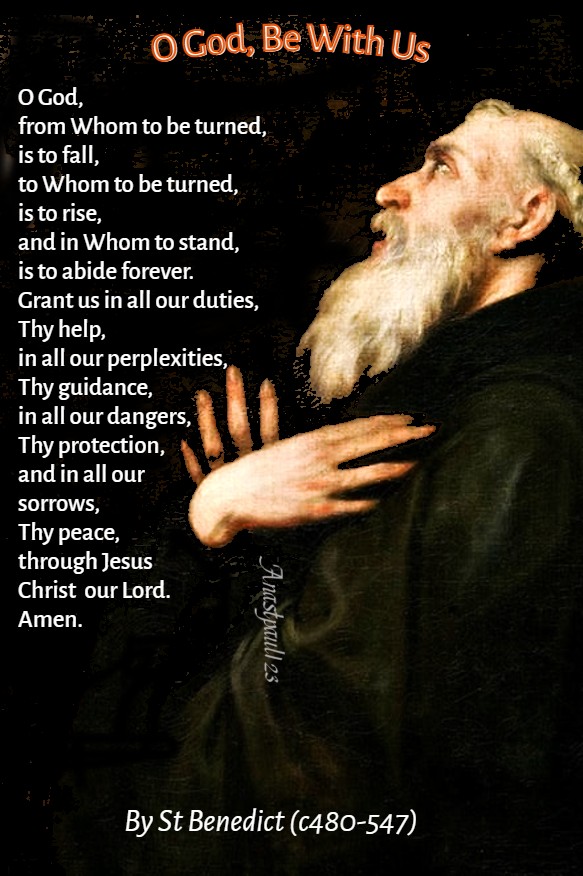
O God, Be With Us By St Benedict (c480-547)
O God, from Whom to be turned, is to fall, to Whom to be turned, is to rise, and in Whom to stand, is to abide forever. Grant us in all our duties, Thy help, in all our perplexities, Thy guidance, in all our dangers, Thy protection, and in all our sorrows, Thy peace, through Jesus Christ our Lord. Amen.
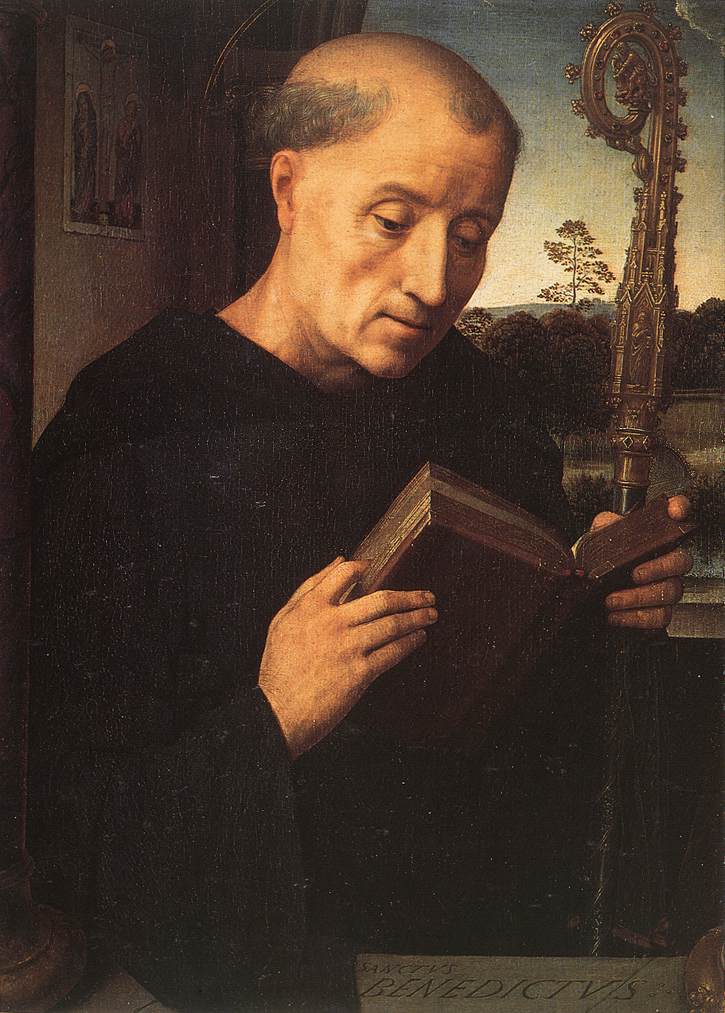
Saint of the Day – 21 March – St Benedict OSB (c480-547) Abbot, Patron of Europe and Founder of Western Monasticism. Born in c480, at Nursia, Umbria, Italy – as the twin brother of a sister, St Scholastica and died on 21 March 547 of a fever while in prayer at Monte Cassino, Italy. Patronages – of Europe, against Poison, against Witchcraft, agriculture, Cavers, Civil Engineers, Coppersmiths, Dying People, Farmers, Fevers, Inflammatory Diseases, Kidney Disease, Monks, Religious Orders, Schoolchildren, Temptations.
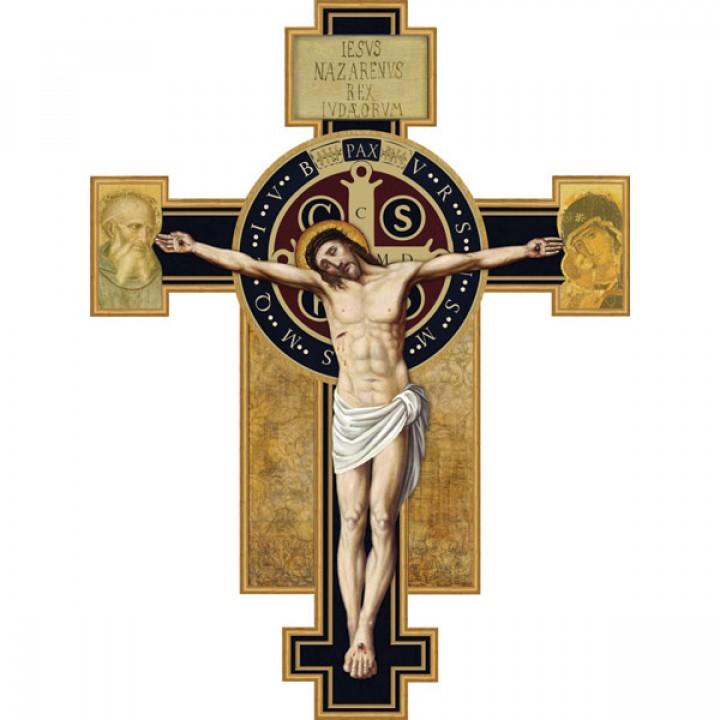
The Medal or Cross of St Benedict It’s Origin, Meaning, Benefits and Privileges By Abbot Dom Prosper Guéranger OSB (1805-1875)
“Of the Letters which are Inscribed on the Medal
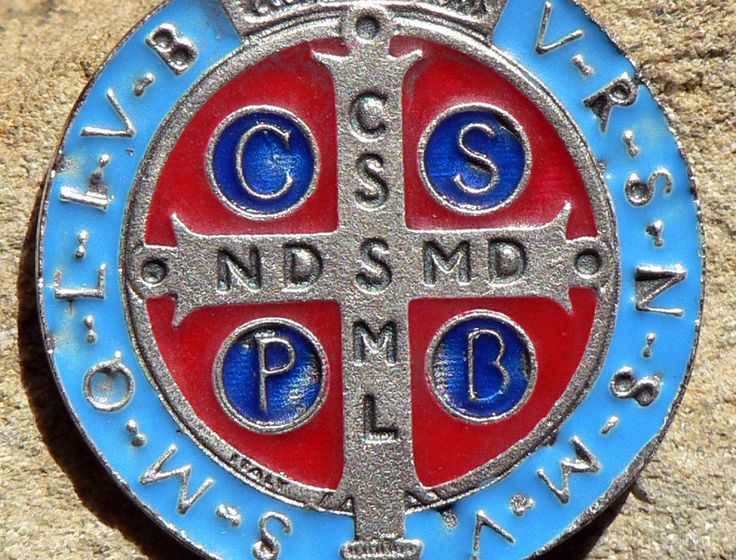
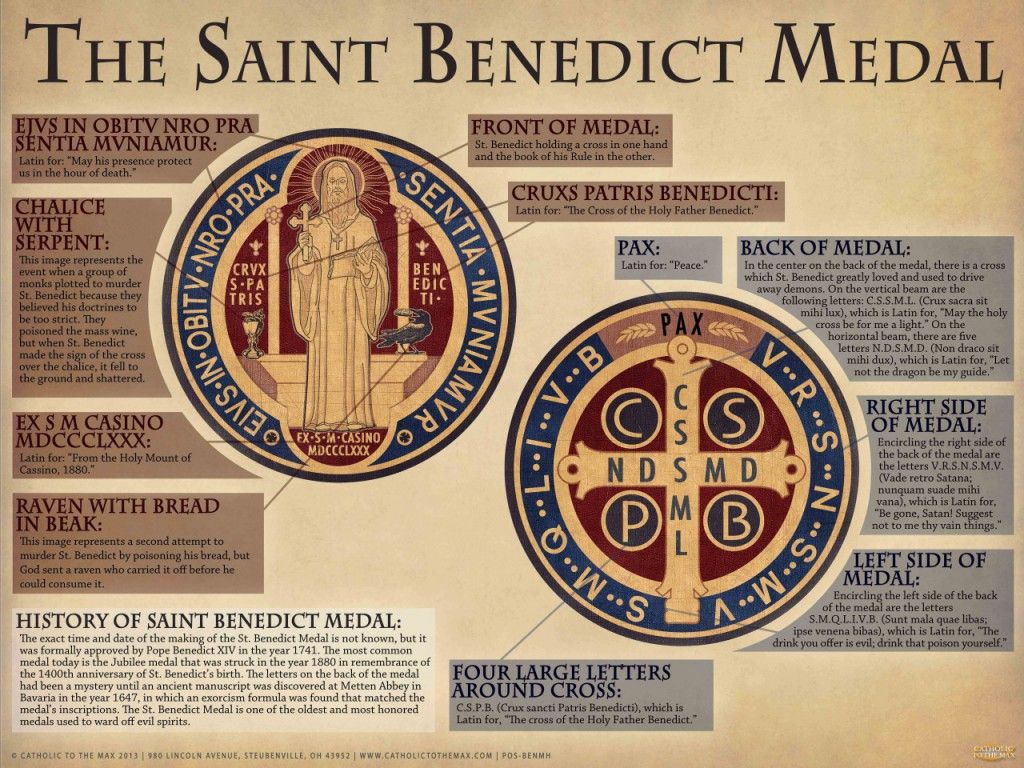
Besides the two figures of the Cross and of St Benedict, there are also inscribed on the Medal, a certain number of letters, each of which is the initial of a Latin word. These words compose one or two sentences, which explain the Medal and its object. They express the relationship existing between the holy Patriarch of the Monks of the West and the Sacred Sign of the salvation of mankind, at the same time that they offer the faithful a formula, which they may make use of, for employing the virtue of the Holy Cross against the evil spirits.
These mysterious letters are arranged on that side of the Medal on which the Cross is shown. Let us begin by noticing the four which are placed in the angles formed by the arms of the Cross.
C. S.P. B: They signify: Crux Sancti Patris Benedicti – in English: The Cross of Holy Father Benedict. These words explain the nature of the Medal.
On the perpendicular line of the Cross itself are these letters:– C.S.S.M.L: They stand for these words: Crux Sacra Sit Mihi Lux – in English: May the Holy Cross be my Light.
On the horizontal line of the Cross are these letters:– N. D. S. M. D: The words which they imply are: Non Draco Sit Mihi Dux – in English: Let not the Dragon be my Guide. These two lines put together form a pentameter verse, containing the Christian’s protestation that he confides in the Holy Cross and refuses to bear the yoke which the devil would put upon him.
On the rim of the Medal there are inscribed several other letters and first the well-known monogram of the Holy Name of Jesus, I. H. S. Faith and our own experience convince us of the all-powerfulness of this Divine Name. Then follow, beginning at the right hand, the following letters: —
V. R. S. N. S. M. V.S. M. Q. L. I. V. B: These initials stand for the two following verses:– VADE RETRO, SATANA; NUNQUAM SUADE MIHI VANA. SUNT MALA QUAE LIBAS; IPSE VENENA BIBAS – in English: Begone, Satan! and suggest not to me thy vain things: the cup thou profferest me is evil; drink thou thyself poison.
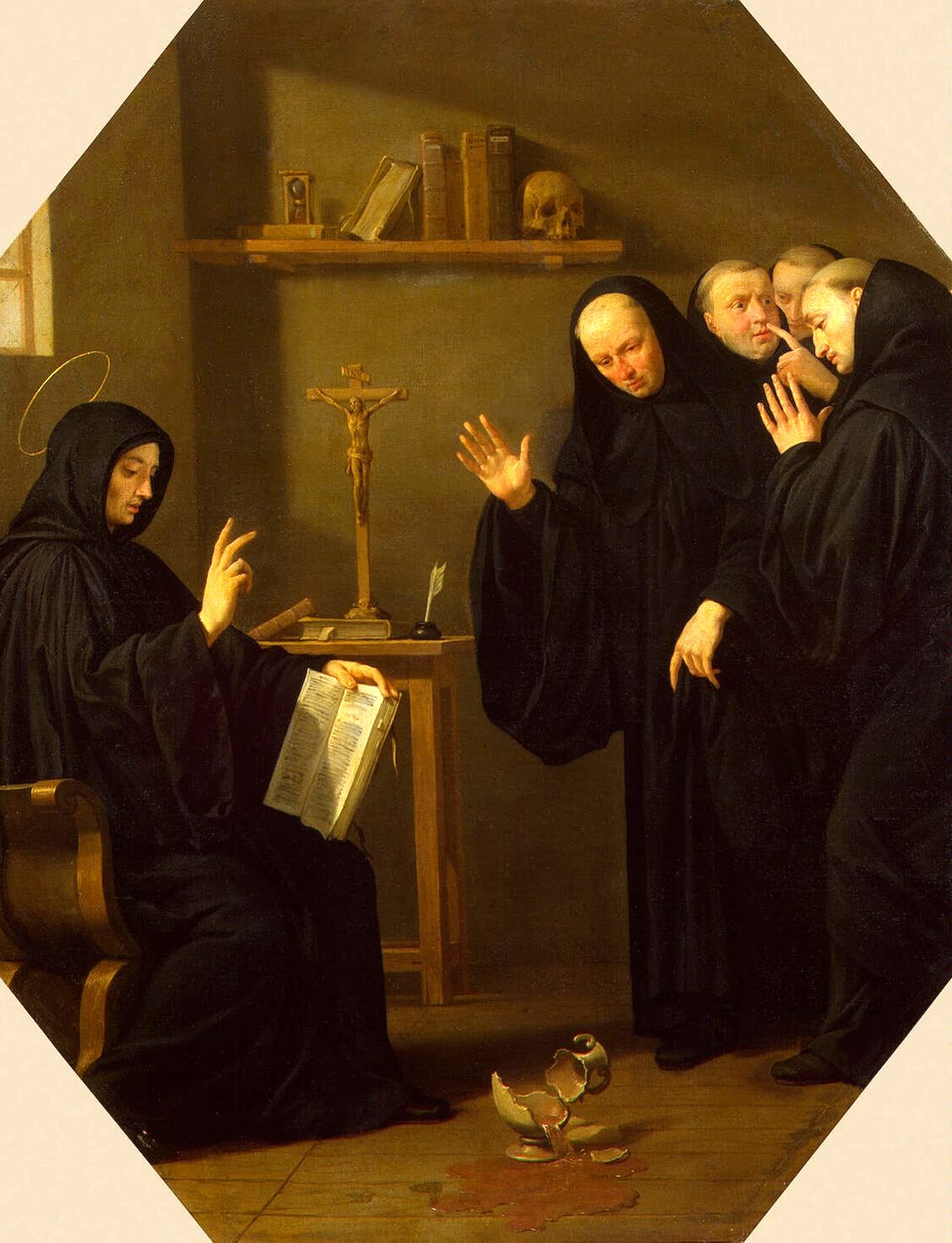
The poisoned Cup of wine
These words are believed to be uttered by St Benedict; those of the first verse when he was suffering the temptation in his cave and which he overcame by the Sign of the Cross and those of the second verse, at the moment of his enemies offering him the draught of death, which he discovered by his making over the poisoned cup, the Sign of Life.
The Christian may make use of these same words as often as he finds himself tormented by the temptations and insults of the invisible enemy of our salvation. Our Saviour sanctified the first of these words by Himself making use of them: “Begone, Satan!“ Vade retro, Satana. Their efficacy has thus been tested and the very Gospel is the guarantee of their power. The vain things to which the devil incites us are disobedience to the law of God. They are also the pomps and false maxims of the world. The cup proffered us by this angel of darkness is evil, that is, sin, which brings death to the soul.
And now, applying these considerations to the Medal which is the subject of these pages, we come to this conclusion, that it must be profitable to us, to use with faith the Medal of St Benedict on occasions when we have reason to fear the snares of the enemy. Its protection will infallibly prove efficacious in every kind of temptation. Numerous and undeniable facts attest its powerful efficacy on a thousand different occasions, in which the faithful had reason to apprehend a danger, either from the direct agency of Satan, or from the effects of certain evil practices.
We may also employ it in favour of others as a means of preserving or delivering them from dangers, which we foresee are threatening them.
Unforeseen accidents may happen to us on land or on sea; let us carry about us this holy Medal with faith and we shall be protected. Even in the most trivial circumstances and in those interests which regard solely man’s temporal wellbeing, the efficacy of the Holy Cross and the power of St Benedict, have been felt.
For example, the wicked spirits, in their hatred of man, sometimes molest the animals which God has created for our service, or infest the various articles of nourishment which the same Providence has given to us. Or again, it is not unfrequently the case that our bodily sufferings are caused or protracted by the influence of these our cruel enemies. Experience has proved that the Medal of St Benedict, made use of with a proper intention and with prayer, has frequently broken the snares of the devil, procured a visible improvement in cases of sickness and sometimes, even effected a complete cure.”
St John of Valence (Died 1146) Bishop, Founder of the Abbey of Bonnevaux, Monk, Abbot, Apostle of the poor, Social Reformer. The Roman Martyrology reads: “In Valence in the territory of Vienne in France, St John, Bishop, who, at first Abbot of Bonnevaux, suffered many adversities for the defence of justice and with charity took care of the peasants, the poor and the merchants ruined by debts.” His Life: https://anastpaul.com/2022/03/21/saint-of-the-day-21-march-saint-john-of-valence-died-1146/
Bl Lucia of Verona (1514-1574) Laywoman, Apostle of the Sick St Lupicinus of Condat
St Nicholas of Flue (1417-1487) Swiss Hermit and Ascetic who is the Patron Saint of Switzerland. He is sometimes invoked as Brother Klaus. A husband and father, a Mystic, a Writer, farmer, military leader, Member of the assembly, Councillor, Judge, he was respected as a man of complete moral integrity. He was Canonised on 15 May 1947 by Pope Pius XII. About St Nicholas: https://anastpaul.wordpress.com/2018/03/21/saint-of-the-day-21-march-st-nicholas-of-flue-1417-1487/St Nicholas of Flue (1417-1487)
St Serapion the Scolastic (Died c 354-370) Bishop of Thmuis, near Diospolis in the Nile delta of Egypt, Monk and Hermit, Confessor, brilliant Scholar of great learning, Theologian, Writer, a companion to St Anthony, the Desert and a close friend of St Athanasius and gave support to him against the heretic Arians in Egypt, for which action he was exiled. St Serapion’s Life: https://anastpaul.com/2021/03/21/saint-of-the-day-21-march-saint-serapion-the-scolastic-died-c-354-370-bishop/
St Philemon of Rome Bl Santuccia Terrebotti
Martyrs of Alexandria: A large but unknown number of Catholics massacred in several Churches during Good Friday services in Alexandria, Egypt by Arian heretics during the persecutions of Constantius and Philagrio. They were Martyred on Good Friday in 342 in Alexandria, Egypt.
Thought for the Day – 20 March – Meditations with Antonio Cardinal Bacci (1881-1971)
The Patronage of Saint Joseph
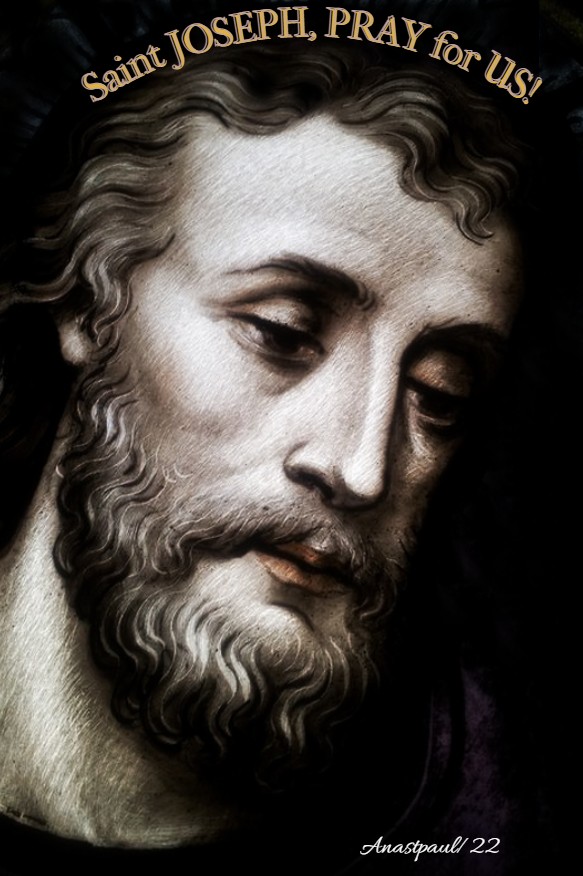
“St Joseph is the Universal Patron of the Church. We, who are loved children of the Church should invoke his special intercession, therefore, for the triumph and expansion of the Kingdom of God upon earth.
It is a sad but certain fact, that in every age, the Church is subject to persecution in many parts of the world, even in our own countries! There is always some nation and often, many of them, where the Church is obstructed in her mission for the salvation of souls and for the true welfare of society. Sometimes She is compelled to fight for her existence, with the weapons of the Spirit. “The weapons of our warfare are not carnal but, powerful before God …” (2 Cor 10:4).
Sometimes the Church is in bonds and the blood of her Martyrs is poured forth to become the seed, from which new Christians will spring. There is no reason for surprise at all this, for Christ Himself foretold it quite clearly. “If they have persecuted Me, they will persecute you too …” (Jn 15:20) but “the gates of hell shall not prevail against it” (Mt 16:18).
If we are loyal sons of the Church, we should pray that She may triumph. We should ask for the special intercession of St Joseph, Her Heavenly Patron.”
Quote of the Day – 20 March – “The Month of the St Joseph” and his Feast transferred from Sunday 19 March
“Since God could choose for the Guardian of His Son, the man in the world, the most accomplished in all sorts of perfections, according to the dignity and excellence of his Charge, Who was His most Glorious Son, the universal Prince of Heaven and earth, how could it be that being able, He did not will it and did not do it? There is, then, NO DOUBT that St Joseph was endowed with all the graces and all the gifts that were required for the care which the Eternal Father willed to give him, of the temporal and domestic economy of our Lord and of the guidance of his family … ”
Our Lenten Journey with St Francis de Sales – 20 March – St Joseph, Feast transferred from Sunday 19 March – Monday of the Fourth Week in Lent – Ecclesiasticus 45:1-6, Matthew 1:18-21 – Scripture search here: https://www.drbo.org/
“Blessed is the man who fears the Lord, who greatly delights in His commands.” Psalm 111:1
“And she shall bring forth a son and thou shalt call His Name Jesus …” Matthew 1:21
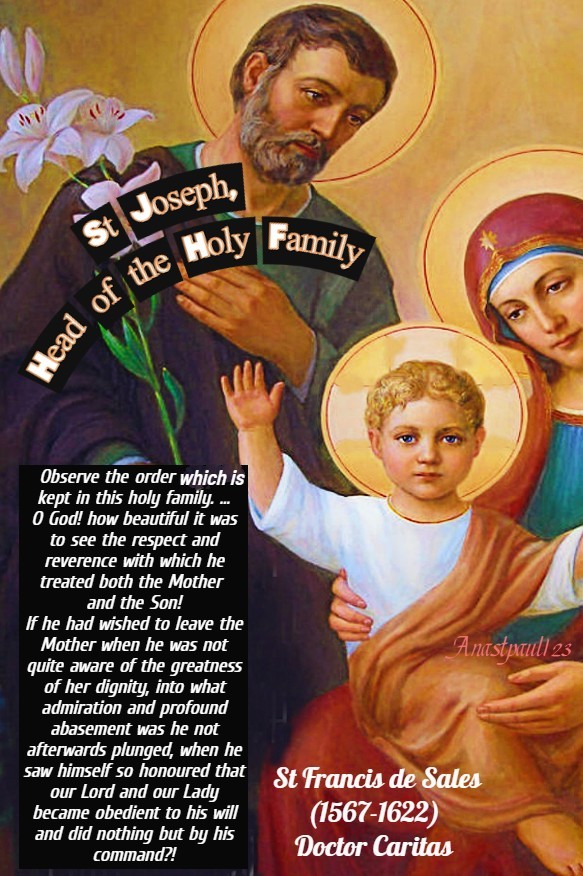
SAINT JOSEPH, HEAD OF THE HOLY FAMILY St Francis de Sales (1567-1622) Doctor Caritas
“OH, WHAT A DIVINE UNION between our Lady and the glorious St Joseph! A union which made that Good of eternal goods which is our Lord, belong to St Joseph, as he belonged to our Lady, (not by the nature that He had taken in the womb of our glorious Mistress, a nature that had been formed by the Holy Spirit of the most pure blood of our Lady) but, according to grace, which made him a partaker of all the goods of his dear Spouse and, which made him go on growing wonderfully in perfection and this was by his continual communication with our Lady, who possessed all virtues, in so high a degree, that no other pure creature can attain to it. Still the glorious St Joseph was the one who approached nearest to it. …
Observe the order which is kept in this holy family. … Who can doubt that our Lady was greater than St Joseph and that she had more discretion and qualities proper for governing, than her spouse? Yet the Angel does not address himself to her, for what is required to be done, whether it be going or coming, or anything else. Does it not seem to you that the Angel commits a great indiscretion, in addressing himself rather, to St Joseph than to our Lady, who is the head of the house, carrying with her the Treasure of the Eternal Father? Had she not reason to be offended at this proceeding and way of acting? Doubtless she might have said to her husband: “Why should I go into Egypt, since my Son has not revealed to me that I ought to do so, nor has the Angel spoken to me of it?” Now our Lady says nothing of this sort. She is not offended because the Angel addresses himself to St Joseph but she obey,s quite simply because she knows that God has so ordered it …”
O God! how beautiful it was to see the respect and reverence with which he treated both the Mother and the Son! If he had wished to leave the Mother when he was not quite aware of the greatness of her dignity, into what admiration and profound abasement was he not afterwards plunged, when he saw himself so honoured that our Lord and our Lady became obedient to his will and did nothing but by his command?!” (Sermons).
One Minute Reflection – 20 March – “The Month of the St Joseph” and his Feast transferred from Sunday 19 March – Monday of the Fourth Week in Lent – Ecclesiasticus 45:1-6, Matthew 1:18-21 – Scripture search here: https://www.drbo.org/
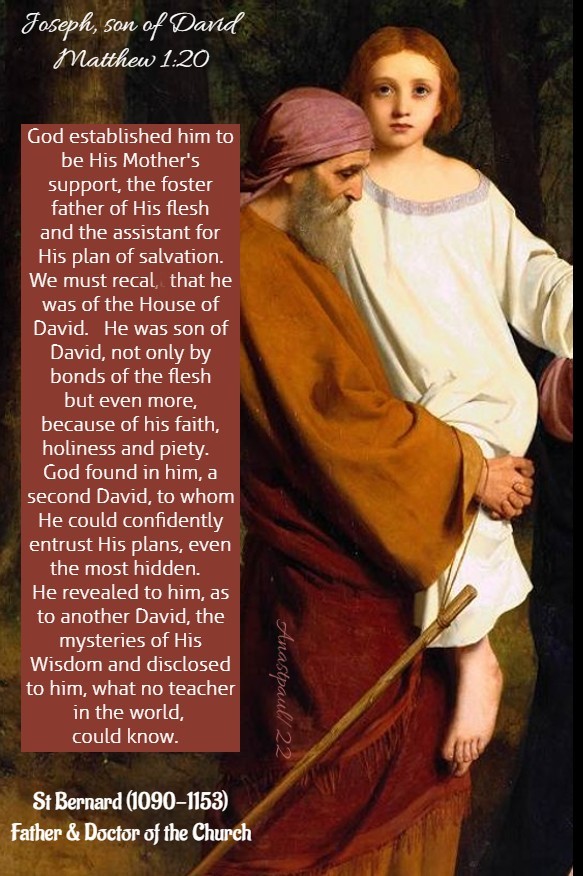
“Joseph, son of David ” – Matthew 1:20
REFLECTION – “There is no doubt that Joseph was a very holy and trustworthy man, since the Mother of the Saviour was to be his wife. He was the “faithful and prudent servant” (Mt 24:45), for God established him to be His Mother’s support, the foster father of His flesh and the assistant for His plan of salvation.
We must recall, that he was of the House of David. He was son of David, not only by bonds of the flesh but even more, because of his faith, holiness and piety. God found in him, a second David, to whom He could confidently entrust His plans, even the most hidden. He revealed to him, as to another David, the mysteries of His Wisdom and disclosed to him, what no teacher in the world, could know. He allowed him to see and listen, to things that so many kings and prophets had wished to see and hear but which,, in spite of their desire, they had not been able to see or to hear (Mt 13:7), even more,, He made him carry and guide, embrace, nurture and protect Him. Both Mary and Joseph belonged to David’s race; in Mary was fulfilled the promise once made by the Lord to David, while Joseph was the witness of this fulfilment.” – St Bernard (1090-1153) (Surname de Fontaine) Priest, Cistercian Monk, The Last Father and Doctor Mellifluus (Mellifluous Doctor) (Homily on the “Missus est”, 2, 16).
PRAYER – May the merits of Thy most holy Mother’s Spouse help us, we beseech Thee, O Lord, that through his intercession we may receive what we cannot obtain by our own efforts. Through the same Jesus Christ, Thy Son our Lord, Who lives and reigns with Thee, in the unity of the Holy Ghost, God, world without end. Amen (Collect).
Our Morning Offering – 20 March – “The Month of the St Joseph” and his Feast transferred from Sunday 19 March
Caelitum, Ioseph, decus Joseph, the Praise and Glory of the Heavens By Fr Juan Escollar (Died 1700)
Joseph, the praise and glory of the heavens, Sure pledge of life and safety of the wide world, as in our joy we sing to thee, in kindness listen to our praises.
Thou by the world’s Creator wert appointed Spouse of the Virgin, thee He willed to honour. Naming thee father of the Word and guardian of our salvation.
Thou, thy Redeemer, lying in a stable, whom long ago foretold the choir of Prophets, sawest rejoicing and thy God adorest Humble in childhood.
God, King of Kings and Governor of the ages, He at Whose word the powers of hell do tremble, He Whom the adoring heavens ever worship, called thee protector.
Praise to the Triune Godhead everlasting, Who with such honour mightily hath blest thee. O may He grant us at thy blest petition Joys everlasting. Amen
This Hymn was formerly used at Matins for the Feast of St Joseph, Spouse of the Blessed Virgin Mary (19 March). It is still used for this Feast but for Lauds. It is also the Hymn for Lauds for the Feast of St Joseph the Worker on 1 May. Translation by Alan G McDougall (1895-1964).
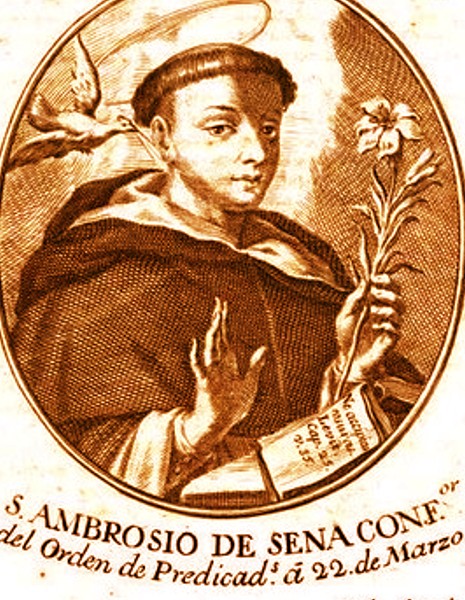
Saint of the Day – 20 March – Blessed Ambrose Sansedoni of Siena OP (1220-1287) Priest and Friar of the Order of Preachers, Confessor, Mystic, a powerful and convincing Preacher employed by various Popes as a Diplomatic Peacemaker and that which seems opposed, as a Preacher of the Crusades, Peacemaker. A fellow student with St Thomas Aquinas under St Albert Magnus. Born on 16 April 1220 at Siena, Italy and died on 20 March 1287 at Siena, Italy of natural causes. Patronages – of engaged couples, of Siena, Italy. Also known as – Ambrogio Sansedoni, Ambrose Sansedone.
The Roman Martyrology reads: “At Siena, in Tuscany, Blessed Ambrose (Sansedoni) of the Order of Friars Preachers. He was remarkable for his sanctity, preaching and miracles. Clement VIII ordered his name to be inscribed in the Roman Martyrology.”
Ambrose was born of noble parents at Siena, in Tuscany, on 16 April 1220. His mother, who had experienced extraordinary interior consolation whilst expecting his birth, was filled with bitter grief on finding the infant deformed and hideous. Unable to bear the painful sight, she sent him away to be brought up by strangers. One day, as his nurse was holding him in her arms at her cottage door, a venerable pilgrim passed by and gazed fixedly upon him, whereupon she veiled his face to conceal his ugliness. But the stranger, obeying a divine inspiration, said to her, “Woman, hide not the face of that child;,he will one day be the light and glory of this City.” So the nurse took courage and everyday, when she went to pray in the Church of the newly founded Friars Preachers, she took the child with her, his face still veiled.
Baby Ambrose always testified extreme reluctance to leave a certain Altar in this Church, on which some precious Relics were preserved. One day, when the cries and tears of the infant had induced his nurse to carry him back to his favourite Altar before returning home, he suddenly stretched out his little arms and legs which until now, had been distorted and motionless, raised his hands to Heaven and pronounced, three times in a loud and distinct tone, the Holy Name of Jesus. The blackened and disfigured countenance was now found to be radiant with beauty, every trace of deformity was gone forever!
The very young childhood of Ambrose was distinguished by a holiness beyond his years. Everyday he recited the Office of our Blessed Lady and would rise by night to meditate, when only seven years old. As he grew older, he was accustomed to visit and relieve the sick in the hospitals and prisoners in their dungeons. His love for the poor was very great and he obtained his father’s permission to bring home and lodge, five needy pilgrims every Saturday. This act of charity was rewarded even in this life, for five Angels appeared to the boy one night, singing sweet harmonies and said to him, “Ambrose, we are the five pilgrims whom thou hast been wont to entertain for the love of God.”
In spite of the allurements of the world, the earnest entreaties of his family and the open assaults of Satan, he very early resolved to embrace the religious life and received the Dominican Habit on his seventeenth Birthday, humbly kissing the feet of all the Brethren, before being admitted into their number.
Sometime after his profession, Ambrose was sent to Paris to study under St Albert the Great and here he had St Thomas Aquinas as a fellow disciple. When St Albert returned to Cologne in the year 1248, he took his two holy pupils back with him to teach under his supervision. Although Blessed Ambrose, from motives of humility, never took his Doctor’s Degree, yet he was a renowned Lector and taught with great edification, during thirty years in various Convents of his Order.
At the same time he did not neglect the duty of preaching, especially in vacation-time and his powerful eloquence converted many sinners and contributed not a little to re-establish peace in Italy, then torn by interior quarrels and the factions of the Guelphs and Ghibellines.
He was held in great esteem by successive Popes, who repeatedly employed him in important missions of peace, in reconciling heretics to the Church and in preaching the Crusade in various parts of Europe. They were anxious to signify their appreciation of his singular services by raising him to the Episcopate but humility was ever his most characteristic virtue and he steadily refused every offer of promotion. His example gave weight to his words. It was his inviolable custom never to go to the Altar to offer the Holy Sacrifice, until he had first asked pardon of any whom he believed to be irritated against him and his perfect sweetness and humility, under trying circumstances, had power to soften the hardest hearts.
One of his special devotions was to pray for those who were about to enter the married state that God would bless their union and grant them all the graces needful for their salvation. Hence, after his death, it became a custom for the maidens of Siena to offer a wax candle at his tomb to obtain a blessing on their marriage.
His interior life was one of almost uninterrupted prayer. Many a time were the Angels seen present when he celebrated Mas, which he seldom did without ecstasies. Often, when he preached, his body was miraculously raised from the ground and his head was seen surrounded by a circle, not of glory but of birds of various and brilliant plumage and in the midst of this new and beautiful nimbus, a face of wondrous majesty would sometimes appear, looking down upon Ambrose with a glance of unutterable love and a hand which seemed to hold the universe in its grasp, would be outstretched in benediction over his head.
We are indebted for these particulars to a holy penitent of his, Nera Tolomei, to whom Our Lord also revealed that He appeared to Blessed Ambrose shortly before his death and said to him, “If thou desirest to remain in this life, thou shalt send many souls to Heaven by thy preaching; if, on the other hand, thou wouldst rather come to Me now, I will, in consideration of thy merits, release five thousand souls from Purgatory and admit them to glory, together with thee.” The holy man resigned himself entirely to the Divine Will, adding, however, the words, “Nevertheless, I would willingly quit this world.” Then the Divine Master bade the Saints, in whose honour Blessed Ambrose had so often preached, to go forth to meet his happy soul and Nera beheld him, clothed in the Pontifical robes which his humility had led him, persistently to refuse on earth and placed in the ranks of the Apostles, whose labours for souls he had striven to emulate.
His happy death took place in the year 1287. Both in life and after death he was illustrious for miracles. In 1597, his name was enrolled in the Roman Martyrology and in the following Century, Pope Gregory XV gave leave for his Feast to be celebrated throughout the Dominican Order.
Prayer: May this glad Festival of Blessed Ambrose, Thy Confessor, give joy to Thy Church, O God and may it ever be defended by all spiritual helps and made worthy to be blessed with everlasting joys. Through our Lord Jesus Christ, in the unity of the Holy Ghost, One God world without end, amen.
St Photina & Companions / Martyrs of Rome – 9+ Saints: A group of Christians Martyred together in the persecutions of Nero. We know nothing else about them but the names Photina, Sebastian and Victor, Anatolius, Cyriaca, Joseph, Parasceve, Photis.
Blessed Ambrose Sansedoni of Siena OP (1220-1287) Priest and Friar of the Order of Preachers. A fellow student with St Thomas Aquinas under St Albert Magnus. Anastasius XVI Archippus of Colossi St Benignus of Flay St Cathcan of Rath-derthaighe St Clement of Ireland
St Guillermo de Peñacorada St Herbert of Derwenwater Bl Hippolytus Galantini Bl Jeanne Veron Bl John Baptist Spagnuolo St John Nepomucene St John Sergius
Martyrs of Amisus – 8 Saints: A group of Christian women Martyred together in the persecutions of Diocletian. The only details we have are eight of their names – Alexandra, Caldia, Derphuta, Euphemia, Euphrasia, Juliana, Matrona and Theodosia. They were burned to death c 300 in Amisus, Paphlagonia (modern Samsun, Turkey).
Martyrs of San Saba – 20 Saints: Twenty monks who were Martyred together in their monastery by invading Saracens. They were Martyred in 797 when they were burned inside the San Sabas monastery in Palestine.
Martyrs of Syria – 3+ Saints: A group of Christians who were Martyred together in Syria. We know nothing else about them but the names Cyril, Eugene and Paul.
(REMINDER: St Joseph’s Feast Day is transferred to 20 March this year as 19 March is Laetare Sunday)
Terror of Demons
Look down on us, Saint Joseph, Protector of Our Lord, Who followed you through deserts And gave you blessed reward; Our foes are yet about us, Be our strength now at our side, Be light against the darkness. Saint Joseph, be our guide and protector! We venerate your justice, The gospels praise your name, You are the Saint all humble, Who gained eternal fame. In your devoted family Our souls in trust confide, Direct our way to Heaven. Saint Joseph, be our guide. We implore your powerful intercession, to obtain from the gentle Heart of Jesus all the help and graces necessary for our spiritual and temporal welfare, particularly protection from the powers of evil and the special grace I now implore: …………….. (Mention your request) O guardian of the Word Incarnate we feel animated with confidence, that your prayers on our behalf, will be graciously heard, before the throne of God. St Joseph, Terror of Demons, Pray for us! Amen
Thought for the Day – 19 March – Meditations with Antonio Cardinal Bacci (1881-1971)
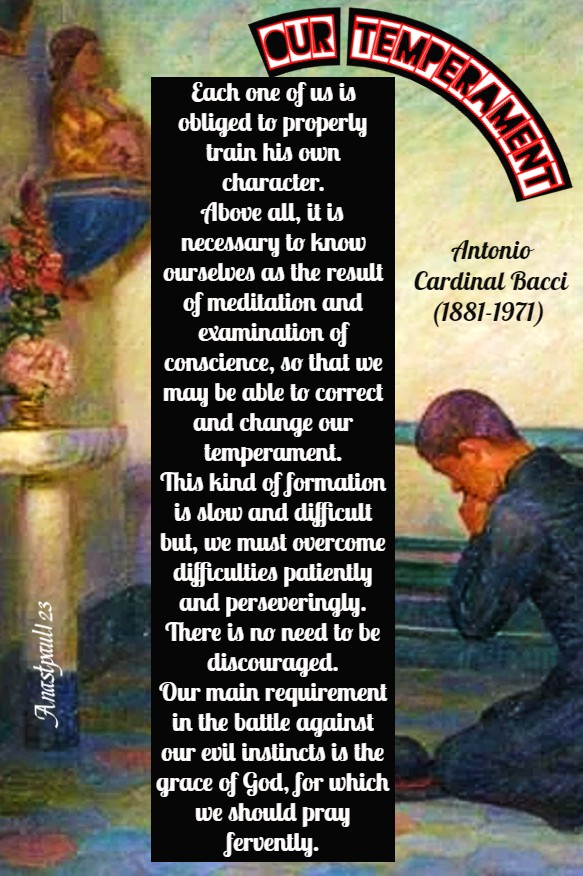
Our Temperament
“Each one of us is obliged to properly train his own character. Above all, it is necessary to know ourselves as the result of meditation and examination of conscience, so that we may be able to correct and change our temperament. This kind of formation is slow and difficult but, we must overcome difficulties patiently and perseveringly. There is no need to be discouraged. Our main requirement in the battle against our evil instincts is the grace of God, for which we should pray fervently. We need an enlightened spiritual director who will guide and encourage us. Finally, we need the determination to succeed, without which the grace of God cannot achieve the Christian transformation of our character.”
Quote/s of the Day – 19 March – Laetare Sunday / The Fourth Sunday in Lent – Galatians 4:22-31, John 6:1-15 – Scripture search here: https://www.drbo.org/
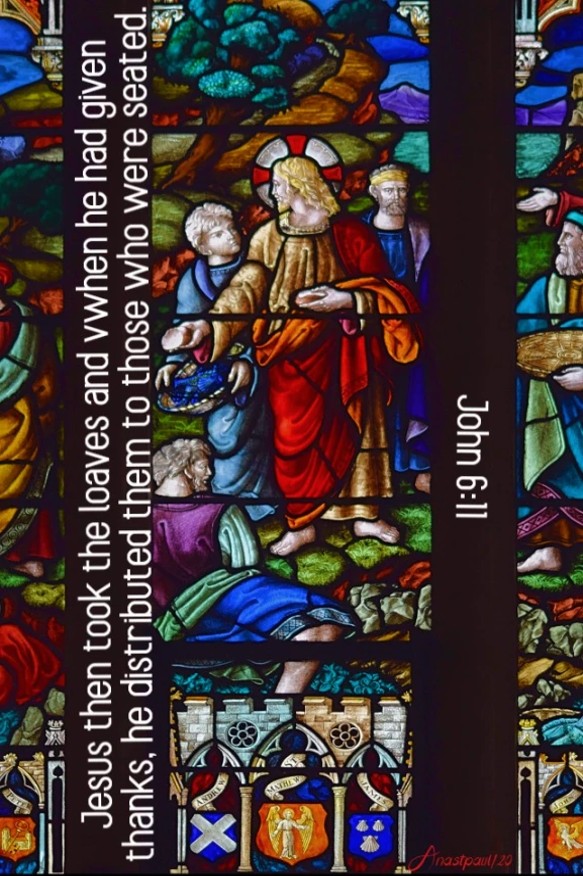
“Jesus then took the loaves of bread and having given thanks, he distributed them to those who were seated there; in the same way he gave them some fish, as much as they wanted.”
John 6:11
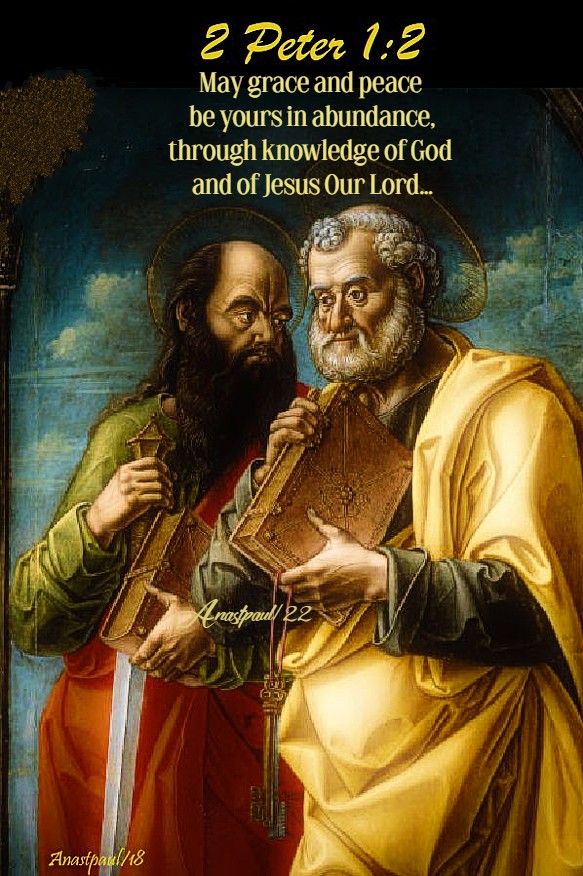
“… May grace and peace be yours in abundance, through knowledge of God and of Jesus Our Lord…”
2 Peter 1:2
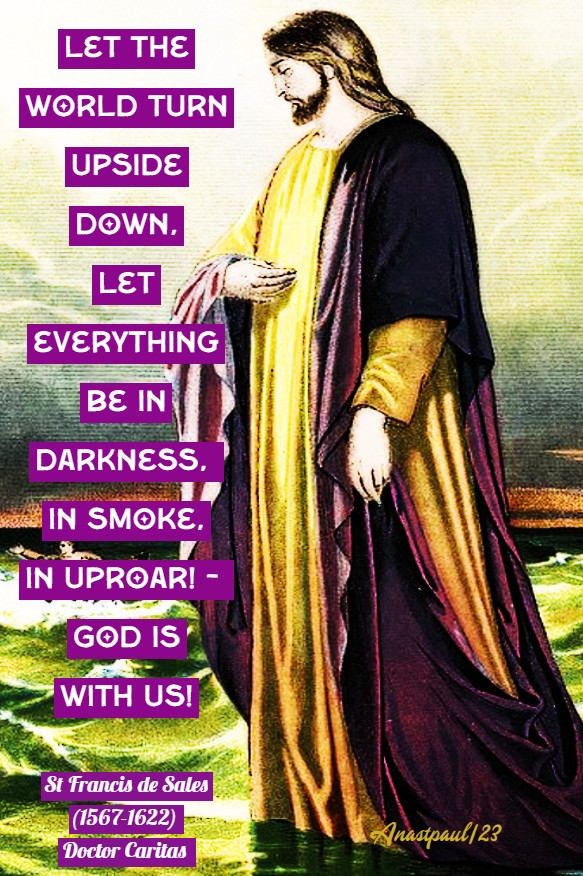
“Let the world turn upside down, let everything be in darkness, in smoke, in uproar – God is with us!”
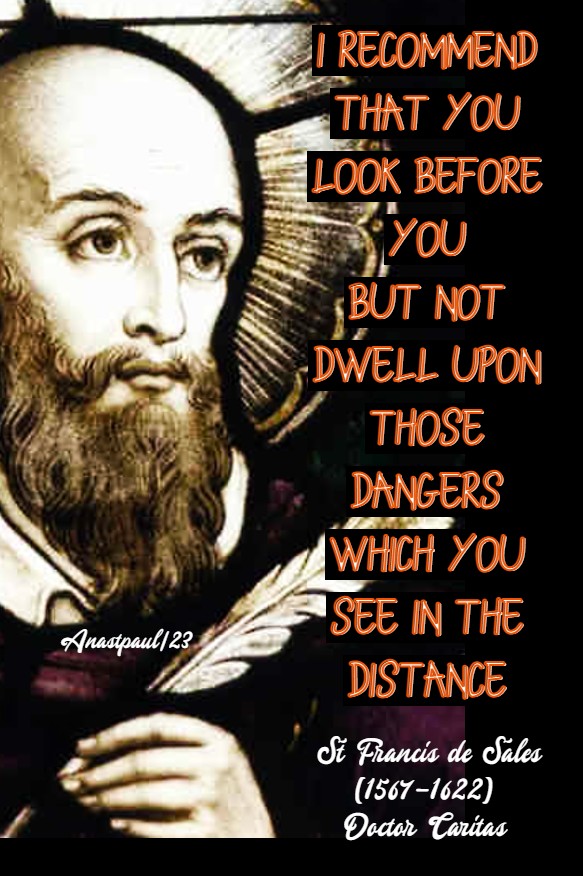
“I recommend that you look before you but not dwell upon those dangers which you see in the distance.”
“Do not look forward to the changes and chances of this life in fear – rather look to them with full hope that, as they arise, God, whose you are, will deliver you out of them. He is your keeper. He has kept you hitherto. Do you but hold fast to His dear hand and He will lead you safely through all things and, when you cannot stand, He will bear you in His arms. Do not look forward to what may happen tomorrow. Our Father will either shield you from suffering, or He will give you strength to bear it.”
St Francis de Sales (1567-1622) Doctor Caritas
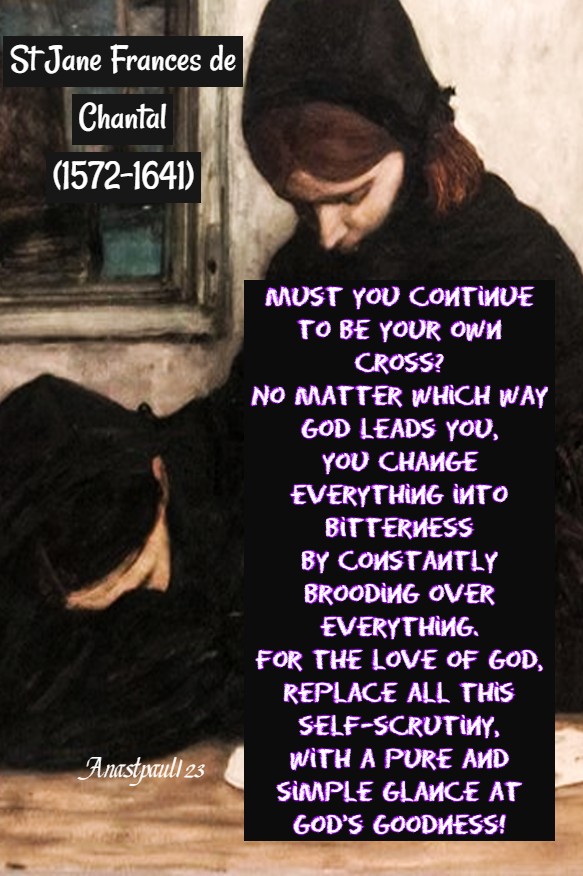
“Must you continue to be your own cross? No matter which way God leads you, you change everything into bitterness by constantly brooding over everything. For the love of God, replace all this self-scrutiny, with a pure and simple glance at God’s goodness!”
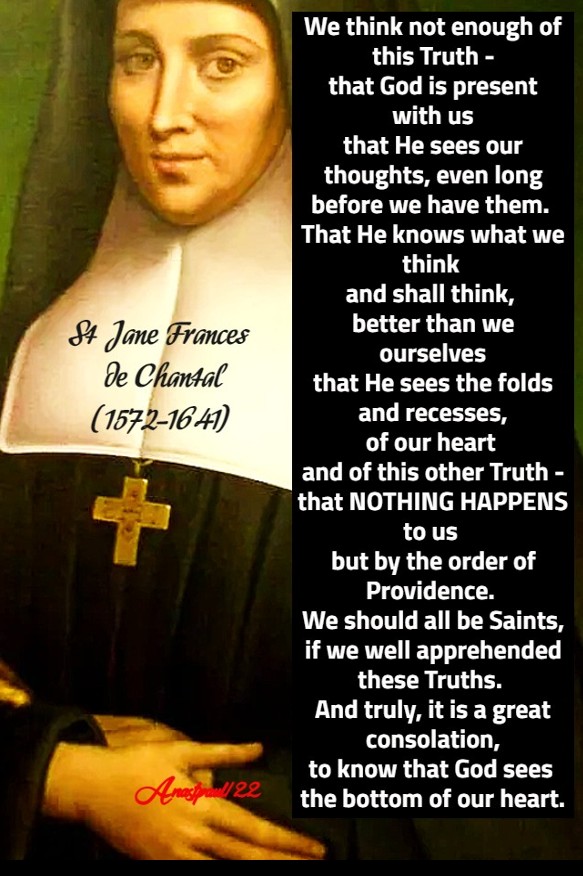
“We think not enough of this Truth – that God is present with us that He sees our thoughts, even long before we have them. That He knows what we think and shall think, better than we ourselves that He sees the folds and recesses, of our heart and of this other Truth – that NOTHING HAPPENS to us but by the order of Providence. We should all be Saints, if we well apprehended these Truths. And truly, it is a great consolation, to know that God sees the bottom of our heart.”
St Jane Frances de Chantal (1572-1641) Disciple and Collaborator with St Francis de Sales in Founding the Sisters of the Visitation
Prayer of Abandonment By St Jane Frances de Chantal (1572-1641)
O sovereign goodness of the sovereign Providence of my God! I abandon myself forever to Thy arms. Whether gentle or severe, lead me henceforth whither Thou will. I will not regard the way through which Thou will have me pass but keep my eyes fixed upon Thee, my God, who guides me. My soul finds no rest without the arms and the bosom of this heavenly Providence, my true Mother, my strength and my rampart. Therefore, I resolve with Thy Divine assistance, 0 my Saviour, to follow Thy desires and Thy ordinances, without regarding or examining why Thou does this rather than that but I will blindly follow Thee, according to Thy Divine will, without seeking my own inclinations. Hence I am determined to leave all to Thee, taking no part therein, save by keeping myself in peace in Thy arms, desiring nothing, except as Thou incites me to desire, to will, to wish. I offer Thee this desire, 0 my God, beseeching Thee to bless it. I undertake all it includes, relying on Thy goodness, liberality and mercy, with entire confidence in Thee, distrust of myself, and knowledge of my infinite misery and infirmity. Amen.
Our Lenten Journey with St Francis de Sales – 19 March – Laetare Sunday / The Fourth Sunday in Lent – Galatians 4:22-31, John 6:1-15 – Scripture search here: https://www.drbo.org/
“They who trust in the Lord are like Mount Sion which is immovable; which forever stands.” Psalm 124:1-2
“Jesus then took the loaves of bread and having given thanks, he distributed them to those who were seated there; in the same way he gave them some fish, as much as they wanted.” John 6:11
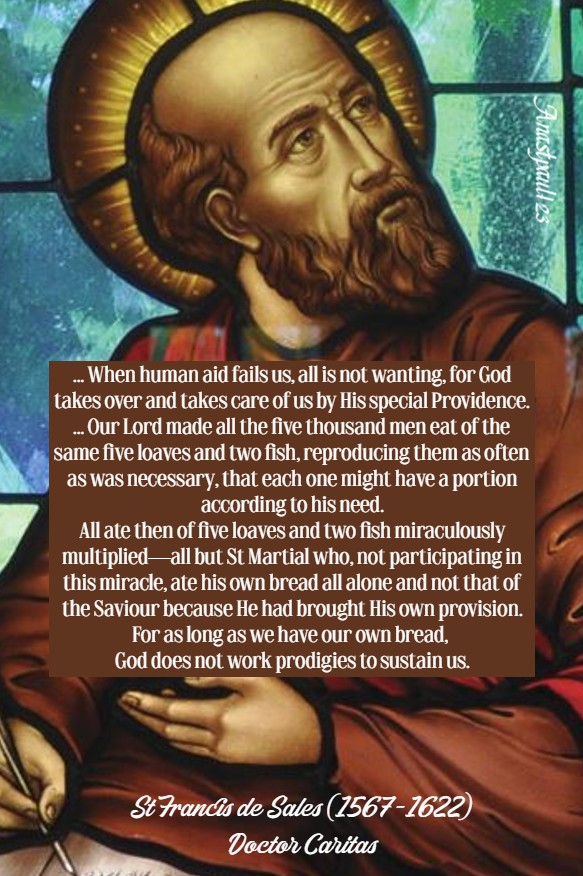
DIVINE PROVIDENCE St Francis de Sales (1567-1622) Doctor Caritas
“… WHEN HUMAN AID FAILS US, all is not wanting, for God takes over and takes care of us by His special Providence. This poor multitude who follow Our Lord today were assisted by Him, only after they were all near faint with hunger. He felt an extreme pity for them because, in their love of Him, they had so forgotten themselves that none had brought provisions, except the little Martial who had five barley loaves und two fish. It is as if the Saviour, full of love for the hearts of these good people (who numbered about five thousand), said to Himself: “You have no care whatever for yourselves but I Myself will take care of you.” Therefore, He called St. Philip to Him and asked him: “These poor people will faint on the way, if we do not assist them with some food but where could we find sufficient to sustain them?” He did not ask this through ignorance,but to test him. …
Notwithstanding the fact that St Philip and St Andrew declared that the five barley loaves and two fish were nothing for so many, Our Lord ordered them to be brought to Him and He commanded His Apostles to make the people sit down. They all did so very simply and in this they were certainly admirable, for they sat down to table without seeing anything on it and there was nothing to suggest that anything could be given to them. Then Jesus took the loaves of bread, blessed them, broke them and ordered the Apostles to distribute them. When this was done, there was still some left, even though all had had enough to satisfy their need.
Thus Our Lord made all the five thousand men eat of the same five loaves and two fish, reproducing them as often as was necessary, that each one might have a portion according to his need. All ate then of five loaves and two fish miraculously multiplied—all but St Martial who, not participating in this miracle, ate his own bread all alone and not that of the Saviour because He had brought His own provision. For as long as we have our own bread, God does not work prodigies to sustain us.” – (Excerpt from the Sermon for the Fourth Sunday of Lent, 6 March 1622).
One Minute Reflection – 19 March – Laetare Sunday / The Fourth Sunday in Lent – Galatians 4:22-31, John 6:1-15 – Scripture search here: https://www.drbo.org/
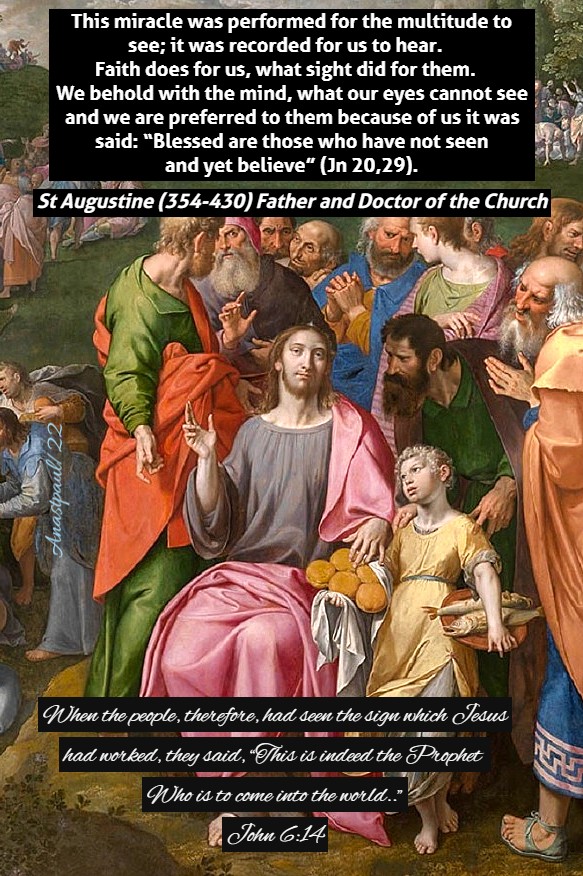
“When the people, therefore, had seen the sign which Jesus had worked, they said, “This is indeed the Prophet Who is to come into the world..” – John 6:14
REFLECTION – “Governing the entire universe, is a greater miracle, than feeding five thousand people with five loaves of bread, yet no-one marvels at it. People marvel at the feeding of the five thousand, not because this miracle is greater but because, it is out of the ordinary. Who is even now providing nourishment for the whole world if not the God Who creates a field of wheat from a few seeds? Christ did what God does. Just as God multiplies a few seeds into a whole field of wheat, so Christ multiplied the five loaves in His Hands. For there was power in the Hands of Christ. Those five loaves were like seeds, not because they were cast on the earth but because, they were multiplied by the One Who made the earth.
This miracle was presented to our senses, in order to stimulate our minds… and so make us marvel at “the God we do not see because of his works, which we do see” (Rom 1,20). For then, when we have been raised to the level of faith and purified by faith, we shall long to behold, although not with our eyes, the invisible God Whom we recognise, through what is visible. This miracle was performed for the multitude to see; it was recorded for us to hear. Faith does for us, what sight did for them. We behold with the mind, what our eyes cannot see and we are preferred to them because of us it was said: “Blessed are those who have not seen and yet believe” (Jn 20,29).” – St Augustine (354-430) Father and Doctor of the Church (Homilies on Saint John’s gospel, 24).
PRAYER – Grant, we beseech Thee, Almighty God, that we who justly suffer for our sins may find relief in the help of Thy grace.Through Jesus Christ, Thy Son our Lord, Who lives and reigns with Thee, in the unity of the Holy Ghost, God, world without end. Amen (Collect).
Our Morning Offering – 19 March – Laetare Sunday / The Fourth Sunday in Lent
God of Mercy and Compassion By Giovanni Battista Pergolesi (1710-1736) Composer
God of mercy and compassion, Look with pity upon me, Father, let me call Thee Father, ‘Tis Thy child returns to Thee.
Refrain: Jesus, Lord, I ask for mercy. Let me not implore in vain, All my sins, I now detest them, Never will I sin again.
By my sins I have deserved Death and endless misery, Hell with all its pains and torments, And for all eternity. (Refrain)
By my sins I have abandoned Right and claim to heav’n above. Where the saints rejoice forever In a boundless sea of love. (Refrain)
See our Saviour, bleeding, dying, On the cross of Calvary; To that cross my sins have nail’d Him, Yet He bleeds and dies for me. (Refrain)
Giovanni Battista Pergolesi 4 January 1710 – 16 or 17 March 1736 was an Italian Baroque composer, violinist and organist. His best-known works include his Stabat Mater and the opera La serva padrona (The Maid Turned Mistress). His compositions include operas and sacred Masses and music. He died of tuberculosis at the age of 26.
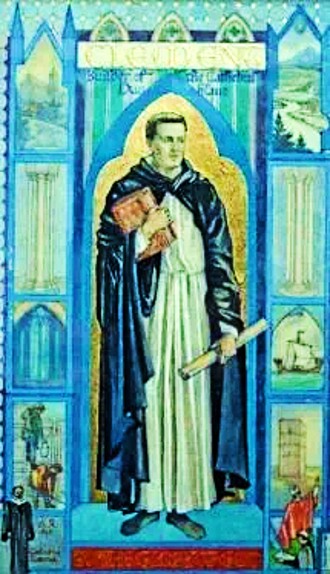
Saint of the Day – 19 March – Blessed Clement of Dunblane OP (1200-1258) Bishop, Priest and Friar of the Order of Preachers, a great and humble carer of the poor and needy, a zealous Administrator but just as much, a shepherd of souls, Reformer, Writer, a highly renowned Preacher and Linguist, a very learned man indeed. Clement was the first member of the Dominican Order in Britain and Ireland to become a Bishop. Born in Scotland in 1200 and died in 1258 in Dunblane, Scotland of natural causes. Also known as – Clement of Scotland.
Not much is recorded of his birth, childhood, or adolescence. Whether it was due to loss of documentation or no documentation at all, the only information that has survived the test of time was that Clement of Dunblane was born in Scotland in the year of 1200. He was a Scotsman by birth and his native tongue was Gaelic (Rabenstein, 1998). He later went on to pursue an education at the University of Paris, during this time he received his habit and grew fairly close to a man who is now known as Saint Dominic de Guzman.
The Chronicles of Melrose Abbey, which was in what is now Roxburghshire, says: “The Jacobin [Dominican] Fathers first came to Scotland in 1230. King Alexander brought them into the country. As he had great love for them, he proved a generous benefactor to them; for he not only gave them places, but also built and furnished convents for them.”(2) We do not doubt that the young monarch met Dominic at the time mentioned, or that the saint promised to send him a colony of the Order of Preachers. But the founder died before he could carry out his intention. Indeed, it would seem that several years had passed, when Blessed Jordan found it feasible to put the design into execution.
Doubtless Clement, who belonged to this sturdy race, was placed at the head of the little band of missionaries dispatched to labour among the Scotsmen and to establish the Order in his country. Prior to this time, he had shown himself to be possessed of rare talent and had become a learned man, no less than a model, pious and zealous religious. He had a special gift for languages and oratory. According to the Rev. D. O. Hunter-Blair, O. S. B. (Catholic Encyclopedia, V, 286), these Friar Preacher must have first set up their standard at Edinburgh. In Scotland, as in all Europe, marvellous success attended the efforts of the fathers and they were soon scattered throughout the northern Kingdom of the British Isle.
None of them, we may take it for granted, manifested greater ability, more zeal, or a truer religious spirit, than Father Clement. Early Scottish historians assure us that his labours and evident capacity for good, suggested him at once for the See of Dunblane, which became vacant in 1231. Possibly his own humble repugnance to such an honour combined with that of Blessed Jordan to delay his appointment, for he was not Consecrated until two years later. The Chronicles of Melrose Abbey state: “In the year of our Lord 1233, Clement, a Canon of the Order of Preachers, was elected Bishop of Dunblane. He was Consecrated in Wedale, in the southeastern part of County Edinburgh, on the Feast of the Translation of Saint Cuthbert, 4 September by William Malvoisin, Bishop of Saint Andrews.”
From the start, Clement began to give clear proofs of his executive talent; nor did he relax in his zeal throughout his long government of some twenty-five years. He found the Diocese in a deplorable condition. Under his watchful care it soon became a spiritual garden which blossomed with every virtue. Vigorous were his efforts to enkindle fervour and piety in hearts that had grown cold and indifferent from neglect, no less than to uproot vices that had become all too prevalent. Equally active and firm was he in defending the rights of the Church and in putting her laws into execution. God crowned the labours of His faithful servant with success, for in all things, he set the example which he asked others to follow.
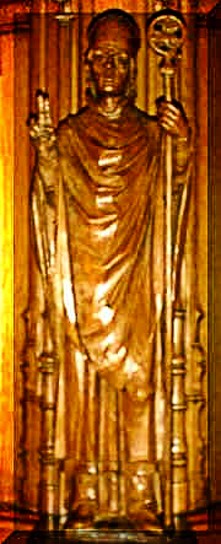
Statue at Dunblane Cathedral
Thus, while the model life of the Friar-Preacher prelate won the esteem and admiration of his flock, his kindness and affable ways brought him the affection of their hearts. One of his most prominent traits was charity towards the poor, of whom there were many in the Diocese. Although his varied learning and ability, no less than his virtue, caused all to look up to him as a man of marked distinction, his humility and zeal for souls never let him forget the lowly, or those in distress. These, indeed, were the objects of the holy man’s keenest interest. Like Saint Paul, he became all things to all men in order to gain all to Christ. In this, no doubt, we have the secret of the love in which the people of the Diocese of Dunblane held him.
It would seem, in fact, that Clement of Dunblane possessed a character which won him the good will of all with whom he came into contact. It would be difficult to find a better proof of the affection entertained for him by his Order, than that given by the General Chapter held at London in 1250. Although he had, in a measure, severed his relations with the Order seventeen years before, by his Consecration, the fathers of this assemblage enacted by formal decree: “We grant Brother Clement, Bishop in Scotland, (after his death) one Mass by every Priest throughout the Order and, by those in the Province of England, the same number which they say for any member of the Province.” Certainly this signal Act of benevolence is an unequivocal indication of the high esteem which he enjoyed among his former confrères, the world over. It inclines one to believe that his services, prior to his appointment to Dunblane, must have been far more than ordinary.
Another document, contained in a contemporary Scottish Chronicle which escaped the craze for the destruction of all things Catholic, speaks in no less high praise of the subject of this sketch. Here we read:
“In the year of our Lord 1258 died Clement, Bishop of Dunblane, a celebrated Preacher, even in the Order of Preachers. He was a skilled linguist and spoke several tongues with eloquence. So was he a man powerful in word and deed, before both God and man. Because of the carelessness of his predecessors, he found the Cathedral Church in a deplorable condition, both spiritually and temporally. Mass was said in it scarcely three times a week, as if it were no more than a rural Chapel. Under him, it became a renowned Sanctuary. Furthermore, he enriched it with lands and prebends (stipends) and supplied it with Canons.”
Dunblane Cathedral
As a writer, we may attribute to his pen a Life of Saint Dominic, a History of the Establishment of the Friars Preacher in Scotland, a Book on Pilgrimages to Holy Places and a Collection of Sermons. None of these works have ever appeared in general print. They are still in Manuscripts, stored away in archives or libraries, or have, like many other things of the kind, been destroyed by the hand of time. Our Saint also worked on the Cause for the Canonisation of Saint Margaret of Scotland.
One of Clement’s stamp, could hardly have failed to leave a lasting impress on his Order and the Church of Scotland, by neither of which, we may rest assured, will his memory ever cease to be cherished.
Blessed Clement’s Relics are enshrined in the Choir of Dunblane Cathedral.
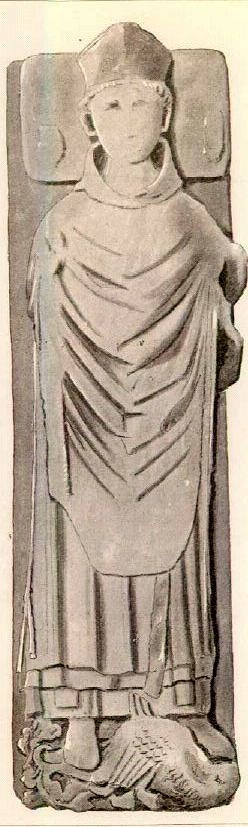
The Effigy of Bl Clement on his Tomb at Dunblane Cathedral
St Apollonius of Braga St Auxilius of Ireland Blessed Clement of Dunblane (1200-1258) Bishop St Colocer of Saint-Brieuc St Corbasius of Quimperlé St Cuthbert of Brittany St Gemus
St John the Syrian of Pinna St Lactali of Freshford St Landoald of Maastricht St Leontinus of Braga St Leontinus of Saintes Bl Mark of Montegallo St Pancharius of Nicomedia
Martyrs of Sorrento: A group of three sisters and a brother who were Martyred together. We have little more than their names – Mark, Quartilla, Quintilla and Quintius. They were Martyred in Sorrento, Italy, date unknown.
O glorious Saint Joseph, faithful follower of Jesus Christ, to you we raise our hearts and hands, to implore your powerful intercession, to obtain from the gentle heart of Jesus all the help and graces necessary for our spiritual and temporal welfare, particularly the grace of a holy death and the special grace I now implore: …………….. (Mention your request) O guardian of the Word Incarnate we feel animated with confidence, that your prayers on our behalf, will be graciously heard, before the throne of God. St Joseph, Patron of the Dying, Pray for us! Amen
Thought for the Day – 18 March – Meditations with Antonio Cardinal Bacci (1881-1971)
Charitable Works
“As well as the corporal works, there are the spiritual works of mercy. Everyone is not obliged to undertake the former, that would be impossible, for instance, for the desitute, the sick, the aged. But, everyone is OBLIGED to undertake the latter. Sometimes a kind word is more valuable than money!
There are many ways in which we can carry out the spiritual works of mercy. There is the well-timed and understanding advice we can give to others, the visit to a sick man who is alone in his suffering, the friendly and encouraging visit to an unfortunate prisoner, the tactful and patient instruction we can give to those who have gone astray through ignorance, rather than through malice and at times, the rebuke we can administer to a hardened sinner, in such a way, as to make it quite clear that our only motive is to win him back to the real happiness, which only goodness can give.
Remember, however, that the practice of the spiritual works of mercy, does not excuse us from the exercise of material works of charity, wherever that is possible for us (Cf Js 2:16).”
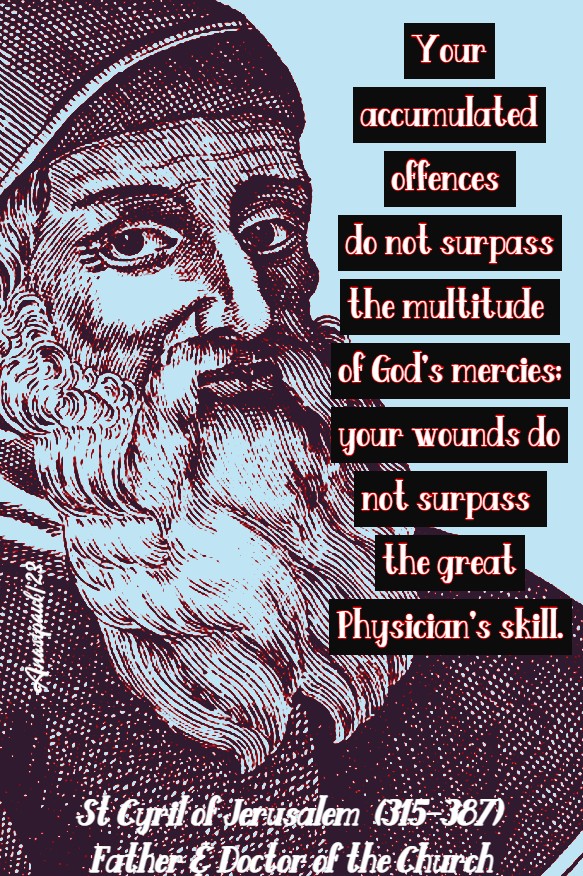
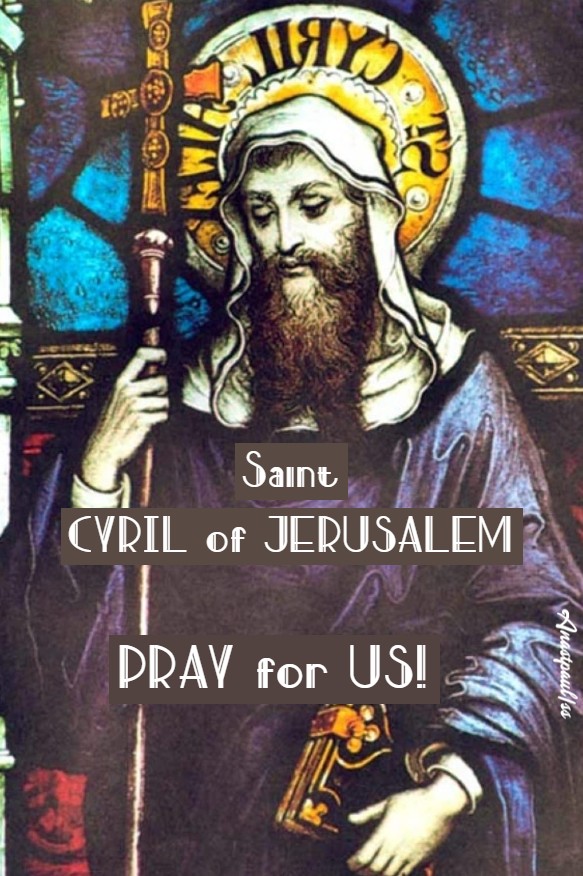
Quote/s of the Day – 18 March – The Memorial of St Cyril of Jerusalem (315-387) Bishop of Jerusalem, Confessor Father & Doctor of the Church
“ Your accumulated offences do not surpass the multitude of God’s mercies; your wounds do not surpass the great Physician’s skill!”
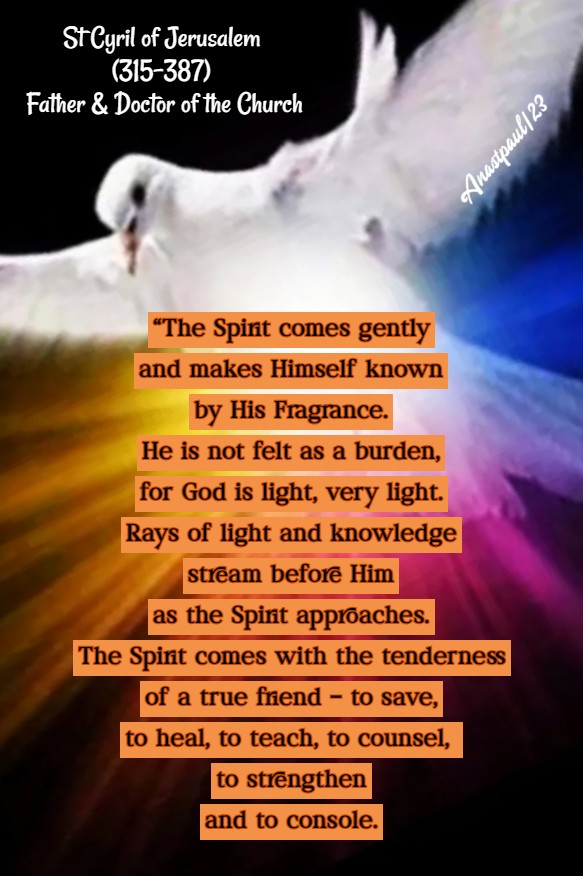
“The Spirit comes gently and makes Himself known by His Fragrance. He is not felt as a burden, for God is light, very light. Rays of light and knowledge stream before Him as the Spirit approaches. The Spirit comes with the tenderness of a true friend – to save, to heal, to teach, to counsel, to strengthen and to console.”
Our Lenten Journey with St Francis de Sales – 18 March – Saturday of the Third Week in Lent, to Mary our Mother we pray today
“Let us run to Mary and, as her little children, cast ourselves into her arms with a perfect confidence.”
“Hail Mary, full of grace …”
THE ANGELIC SALUTATION St Francis de Sales (1567-1622) Doctor Caritas
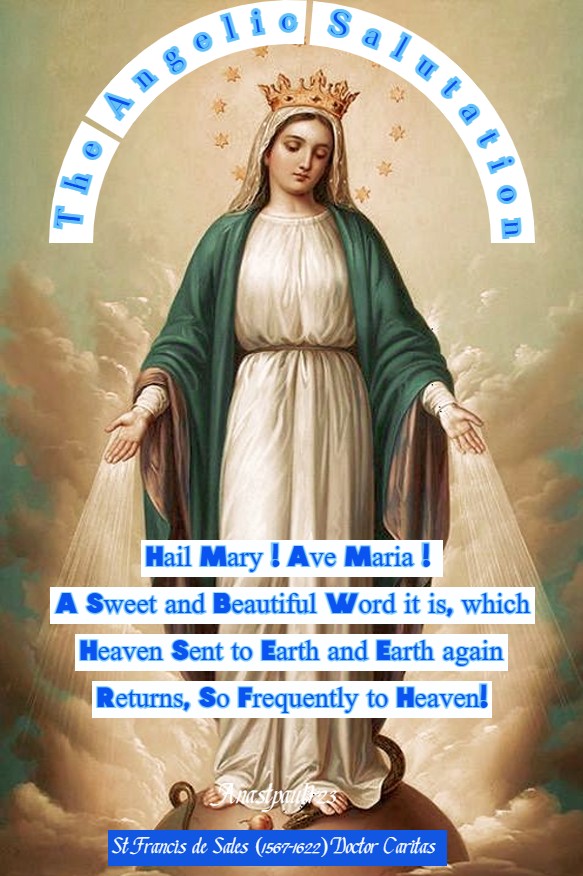
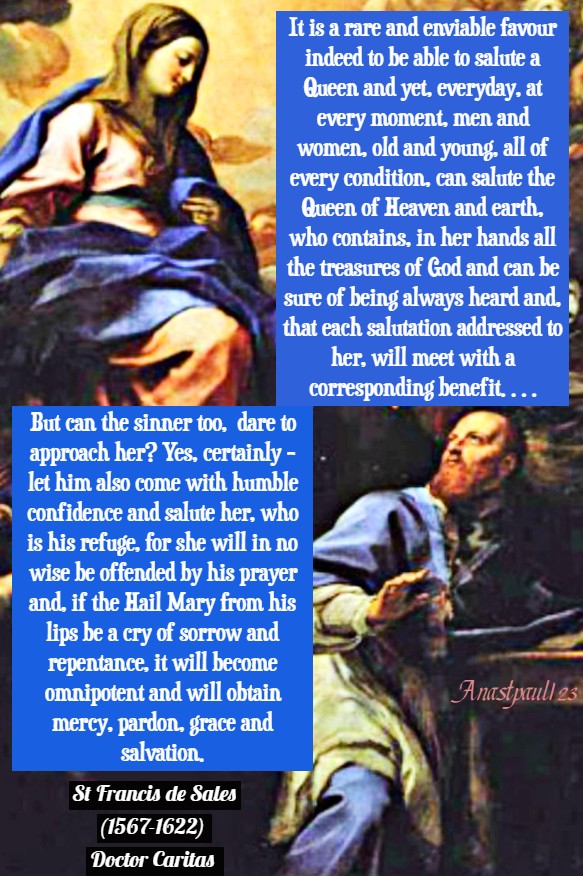
“LET US GLORY, says a pious author, in repeating this salutation, with the Angel Gabriel, the Apostles, the Martyrs and all the Christian world. Let this Ave Maria, which comes to us fragrant as a Canticle of Heaven and repeated by as many echoes as there are faithful souls on earth, be sweet to our lips and sweeter still to our hearts. It is a rare and enviable favour indeed to be able to salute a Queen and yet, everyday, at every moment, men and women, old and young, all of every condition, can salute the Queen of Heaven and earth, who contains, in her hands all the treasures of God and can be sure of being always heard and, that each salutation addressed to her, will meet with a corresponding benefit. . . . But can the sinner too, dare to approach her? Yes, certainly – let him also come with humble confidence and salute her, who is his refuge, for she will in no wise be offended by his prayer and, if the Hail Mary from his lips be a cry of sorrow and repentance, it will become omnipotent and will obtain mercy, pardon, grace and salvation. Hail Mary ! Ave Maria ! . . . A sweet and beautiful word it is, which Heaven sent to earth and earth again returns, so frequently to heaven! ” – (The Month of Mary According to the Spirit of St Francis de Sales).
One Minute Reflection – 18 March – “The Month of the St Joseph” – Saturday of the Third Week in Lent and the Memorial of St Cyril of Jerusalem (315-387) Bishop of Jerusalem, Confessor Father & Doctor of the Church– Ecclesiasticus Ecclus 39:6-14, Matthew 10:23-28 – Scripture search here: https://www.drbo.org/
“What you hear whispered, proclaim on the housetops.” … Matthew 10:27
REFLECTION – “He had said previously, “What I tell you in the dark, declare in the light and what you hear whispered, proclaim upon the housetops.” He now explains what follows after this proclamation. The whole world is divided against itself for the sake of faith in Christ. Every house contains both unbelievers and believers. And a necessary conflict has been sent to break an evil peace. It is written in Genesis that God did a similar thing to the rebellious people who streamed out of the east and rushed to build a tower, by which they meant to reach the heights of Heaven. God divided their languages. For this same reason David prays in the Psalm, “O God, scatter the peoples who delight in war.” – St Jerome (343-420) Priest, Monk, Translator of the Sacred Scriptures into Latin, Father and one of the original 4 Doctors of the Latin Church (Commentary on Matthew 1)
PRAYER – Grant us, we beseech Thee, Almighty God, through the intercession of the blessed Bishop Cyril, so to acknowledge Thee, the only true God and Jesus Christ Whom Thou have sent, that we may be found worthy to be forever numbered among the sheep who hear His Voice.Through the same Jesus Christ, Thy Son our Lord, Who lives and reigns with Thee, in the unity of the Holy Ghost, God, world without end. Amen (Collect).
Our Morning Offering – 18 March – Saturday of the Third Week in Lent, to Mary our Mother we pray today
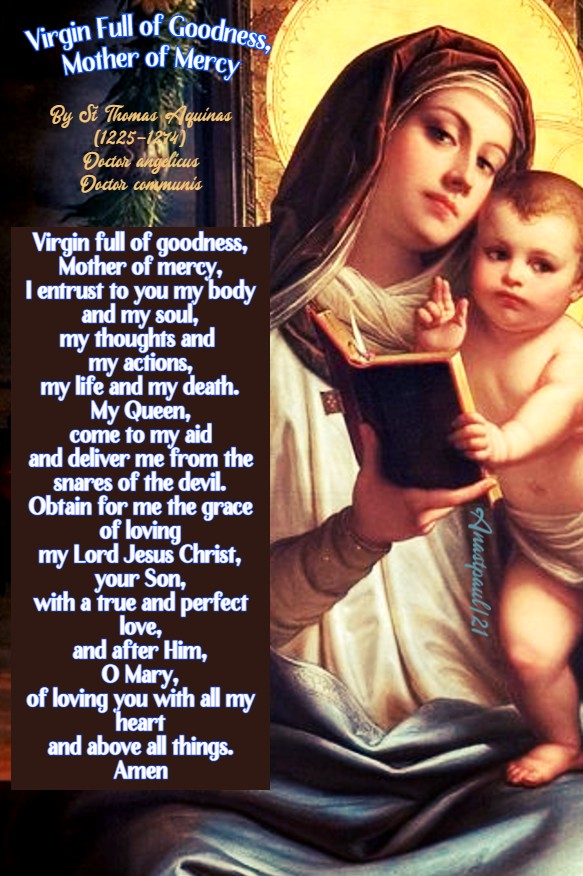
Virgin Full of Goodness, Mother of Mercy By St Thomas Aquinas (1225-1274) Doctor angelicus Doctor communis
Virgin full of goodness, Mother of mercy, I entrust to you my body and my soul, my thoughts and my actions, my life and my death. My Queen, come to my aid and deliver me from the snares of the devil. Obtain for me the grace of loving my Lord Jesus Christ, your Son, with a true and perfect love, and after Him, O Mary, of loving you with all my heart and above all things. Amen.
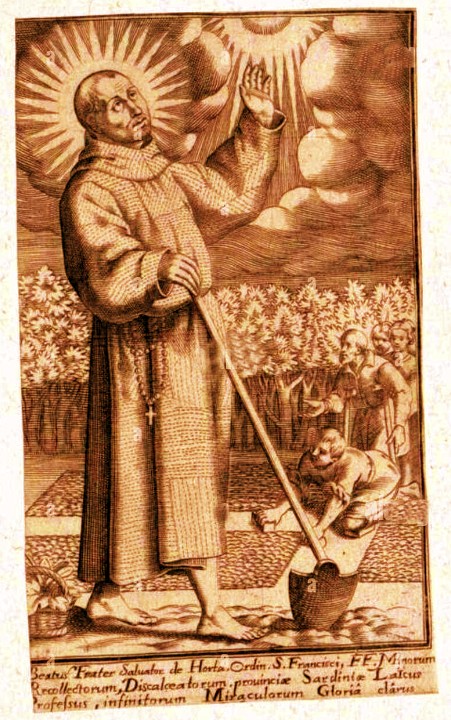
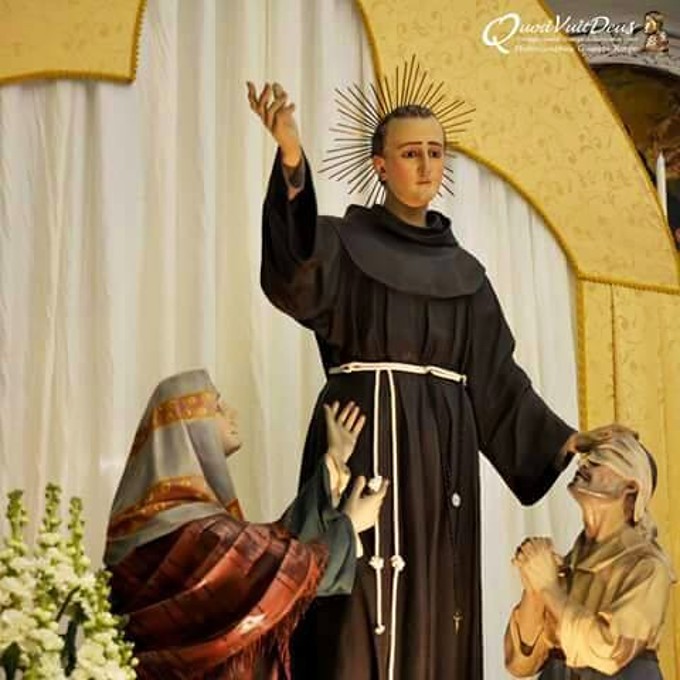
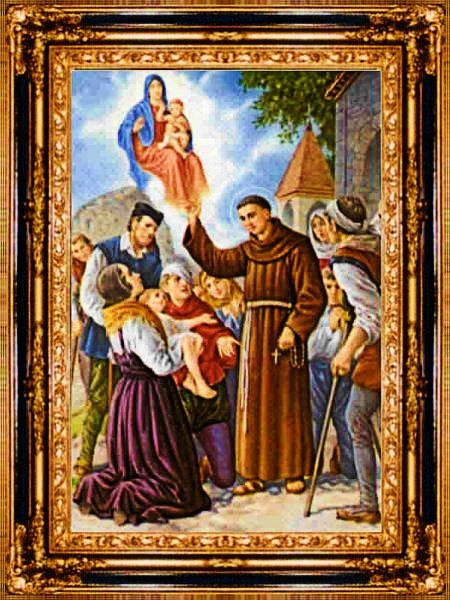
Saint of the Day – 18 March – Saint Salvator of Horta OFM (1520-1567) Lay Brother of Friars Minor, Cook, Porter and Quester of alms, Miracle-worker.Born in 1520 at Santa Columba, Gerona, Spain and died on 18 March 1567 at the Friary at Cagliari, Sardinia, Italy of natural causes, aged just 46. Also known as – Salvador, Salvatore. Additional Memorial – 17 April (Friars Minor). Canonised on 17 April 1938 by Pope Pius XI. His body is incorrupt.
In the Sixteenth Century when the Faith, especially in Germany, was so mightily shaken by the so-called reformers, when the Sign of the Cross was abolished as a superstitious practice, Almighty God permitted this very Sign of the Cross to shine with special power and radiance, in order to strengthen the Faith in another country. This was Spain and it was through the great Miracle-orker of the Sixteenth Century, St Salvator of Horta.
Salvator was born of poor parents in the year 1520. Orphaned when still quite young, he tended cattle and was later sent as an apprentice to a shoemaker in Barcelona. His devout heart, however, was constantly prompting him to consecrate himself to God; so, when he was twenty years old, he entered the Franciscan Order as a lay brother. He distinguished himself among his brethren by rigorous mortification, profound humility and extraordinary simplicity.
Almighty God, who chooses the lowly to make known the wonders of His power, manifested His power in Salvator at the very beginning of his religious life.
He was sent to assist the brother in the kitchen and one day, when the cook was ill, Salvator had to undertake the entire round of duties alone. When it was close to the noon hour, the Father Guardian went to the kitchen to see what Brother Salvator had prepared. He found the kitchen locked. After looking for Salvator for a considerable time, he finally found him kneeling before the Blessed Sacrament, deeply absorbed in prayer.
Statue (after 1606) by Michelangelo Naccherino (Florence 1550-Naples 1622) – Santa Maria di Montecalvario or della Mercede Church in Naples
He had been there since early morning without being aware of it. The Superior reproved him severely and Salvator acknowledged his guilt amid many tears, begging for a severe penance. How astonished, however, were both men when they arrived at the kitchen and found all the food ready to be served – the angels had substituted for Salvator! How beautiful!
After pronouncing his vows, Salvator was sent to the Convent at Tortosa. Although he was assigned in turn to the duties of cook, porter and quester of alms, he was ,nevertheless, continually recollected and intimately united with God.
While gathering alms, Salvator often came upon sick people for whom his prayers were requested. He would make the Sign of the Cross over them and immediately they were healed. News of this fact soon spread abroad and may sick were brought to the Convent. All were restored to health through the Sign of the Cross which Brother Salvator made over them.
The concourse of sick people, however, finally became so great that it disturbed the good order in the Convent. So the Superiors sent Brother Salvator to the nearby Convent of Horta, where he spent the greater part of his religious life, hence his surname “of Horta.”
Although the transfer was made in perfect secrecy and no one had been informed of it, the sick presented themselves at the Convent at Horta already in the first days after his arrival there and their number increased daily. The deaf, the blind, the dumb, the lame, the epileptic, came; the paralytic, the dropsical, those afflicted with fevers and sufferers of every type were brought to him on beds, so that Brother Salvator might restore their health.
Usually there were as many as two thousand a week, sometimes that many in one day and once, on the Feast of the Annunciation of the Blessed Virgin, as many as six thousand made their appearance!
One time the Grand Inquisitor, a renowned theologian, whose duty it was to guard the purity of the Faith, came in order to learn whether anything occurred there that savoured of superstition. Without giving any indication of his rank, he took his station at a corner of the Church were the sick were expecting the healing hand of Brother Salvator.
When the good religious arrived, Saint Salvator of Horta had the sick make way for him as he passed through their ranks till he reached the Grand Inquisitor. There he reverently kissed the latter’s hand and begged him to come to the upper Church, where he could watch the entire proceedings. Astonished at finding himself recognised, the Inquisitor was already assured of the power from on high which held sway there. Nevertheless, he followed the brother.
Salvator began, as usual, to admonish the sick to examine their conscience and to receive the Sacraments of Penance and of the Holy Eucharist worthily. Then he blessed them with the Sign of the Cross while he called upon the Blessed Trinity and imposed on them a few prayers in honour of the Immaculate Conception of the Blessed Virgin Mary, to whose intercession he ascribed all the cures. The sufferers were then all suddenly cured, except, as Salvator had foretold, those who were not sincere in their conversion.
St Salvator and the Grand Inquisitor by Esteban Murillo
In order to test the humility of the brother and to preserve him in it, his Superiors frequently imposed heavy trials but he always remained an obedient, humble and contented religious. A prominent gentleman once warned Salvator that he should be on guard against pride and presumption. The good brother answered:
“I always think of myself as a sack full of straw; the sack is indifferent as to whether it lies in a stable or is brought into a magnificent room.”
The last two years of Sa;vator’s life were spent on the Island of Sardinia and there he died in the Convent of Cagliari on 18 March 1567. Innumerable miracles occurred also at his grave. The uninterrupted devotion to the Saint was confirmed on 29 January 1711 by Pope Clement XI. Saint Salvator of Horta was CanoniSed by Pope Pius XI in 1938.
Death of Saint Salvator of Horta Viceregal Museum of Zinacantepec, Mexico
His remains were originally interred at the Church of St Mary of Jesus attached to the Friary where he died, in Cagliari, Sardinia. In 1606 it had been decided to open his grave to provide his heart as a Relic for the Franciscan community. When his tomb was opened, his body was found to be still intact and in perfect condition, bearing no signs at all of any corruption.
Thus, when the Church of St Mary of Jesus was demolished in 1718, his remains were interred first at another Church of the Order in the City, then finally, in 1758, they were entombed in a glass coffin under the Main Altar of the Church of St Rosalie in the City. This remains his Shrine, where his remains can be venerated.
St Egbert of Ripon St Eucarpius of Nicomedia St Felix of Gerona St Finan of Aberdeen St Leobard of Tours St Narcissus of Gerona St Salvator of Horta OFM (1520-1567) Lay Brother of Friars Minor. His body is incorrupt.
St Trophimus of Nicomedia
Martyrs of Nicomedia – Commemorates the Christians who were Martyred anonymously, either singly and in small groups, by local pagans in the area of Nicomedia prior to the year 300 and who may have been over-looked in the waves of Diocletian persecutions that resulted in the deaths of thousands.
Dear Saint Joseph, you were yourself once faced with the responsibility of providing the necessities of life, for Jesus and Mary. Look down with fatherly compassion upon us in our anxiety over inabilities to support our families. Please help any insuch need, to find gainful employment very soon, so that this heavy burden of concern, will be lifted from their hearts and that they soon may be able to provide for those whom God has entrusted to their care. Help them to guard against bitterness and discouragement, so that they may emerge from this trial, spiritually enriched with virtue and with even greater blessings from God. We raise our hearts to you to implore your powerful intercession in obtaining from the Divine Heart of Jesus all the graces necessary for our spiritual and temporal welfare, particularly the grace of a happy death, and the special grace I now implore: …………….. (Mention your request) Guardian of the Word Incarnate, We feel confident, that your prayers on our behalf, will be graciously heard before the throne of God St Joseph Most Holy Patron of Workers, Pray for us! Amen
Thought for the Day – 17 March – Meditations with Antonio Cardinal Bacci (1881-1971)
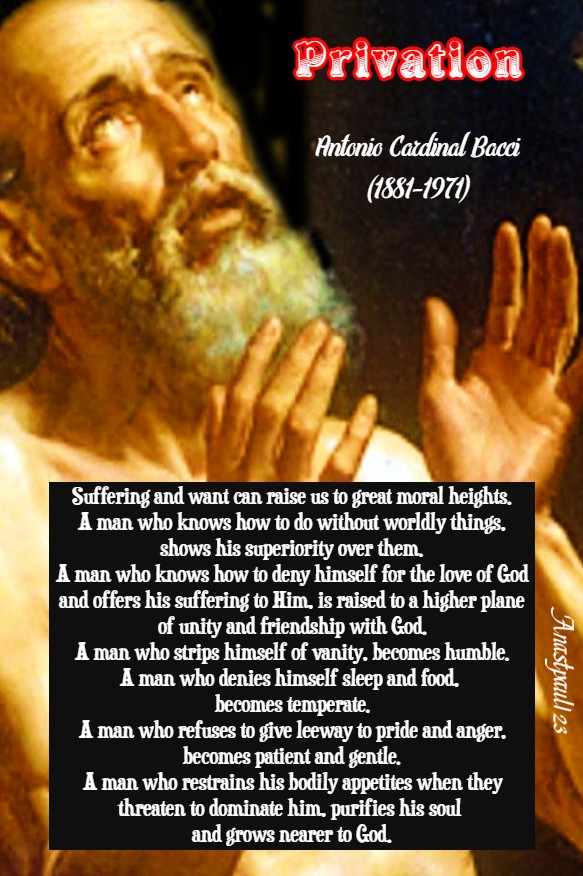
Privation
“Suffering and want can raise us to great moral heights. A man who knows how to do without worldly things, shows his superiority over them. A man who knows how to deny himself for the love of God and offers his suffering to Him, is raised to a higher plane of unity and friendship with God. A man who strips himself of vanity, becomes humble. A man who denies himself sleep and food, becomes temperate. A man who refuses to give leeway to pride and anger, becomes patient and gentle. A man who restrains his bodily appetites when they threaten to dominate him, purifies his soul and grows nearer to God.
When we cheerfully accept the sufferings and privations of this life from supernatural motives, we are preparing ourselves for the everlasting happiness of Heaven.”
Quote/s of the Day – 17 March – Feast of the Five Holy Wounds
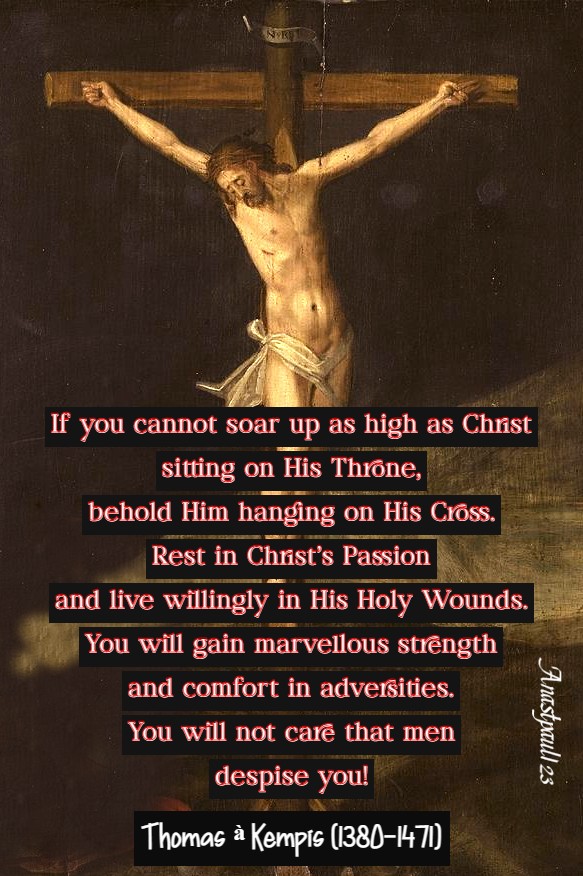
“If you cannot soar up as high as Christ sitting on His Throne, behold Him hanging on His Cross. Rest in Christ’s Passion and live willingly in His Holy Wounds. You will gain marvellous strength and comfort in adversities. You will not care that men despise you!”
Thomas à Kempis CRSA (1380-1471)
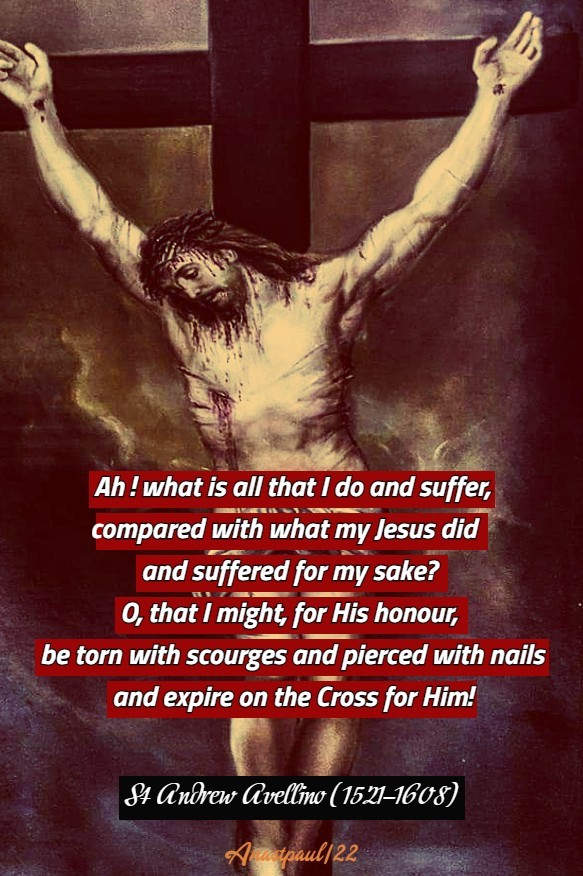
“Ah ! what is all that I do and suffer, compared with what my Jesus did and suffered for my sake? O, that I might, for His honour, be torn with scourges and pierced with nails and expire on the Cross for Him!”
St Andrew Avellino (1521–1608)
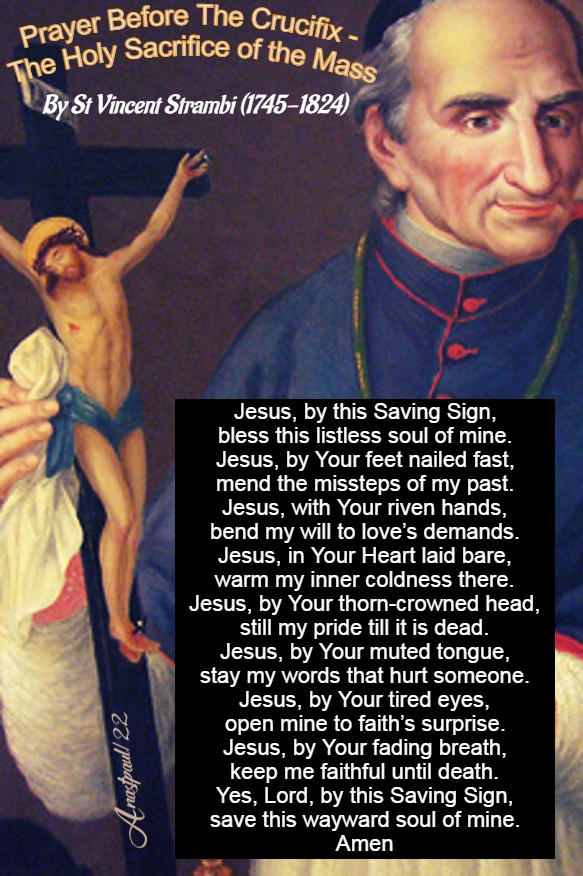
Prayer Before The Crucifix – The Holy Sacrifice of the Mass By St Vincent Strambi (1745-1824)
Jesus, by this Saving Sign, bless this listless soul of mine. Jesus, by Your feet nailed fast, mend the missteps of my past. Jesus, with Your riven hands, bend my will to love’s demands. Jesus, in Your Heart laid bare, warm my inner coldness there. Jesus, by Your thorn-crowned head, still my pride till it is dead. Jesus, by Your muted tongue, stay my words that hurt someone. Jesus, by Your tired eyes, open mine to faith’s surprise. Jesus, by Your fading breath, keep me faithful until death. Yes, Lord, by this Saving Sign, save this wayward soul of mine. Amen




































You must be logged in to post a comment.