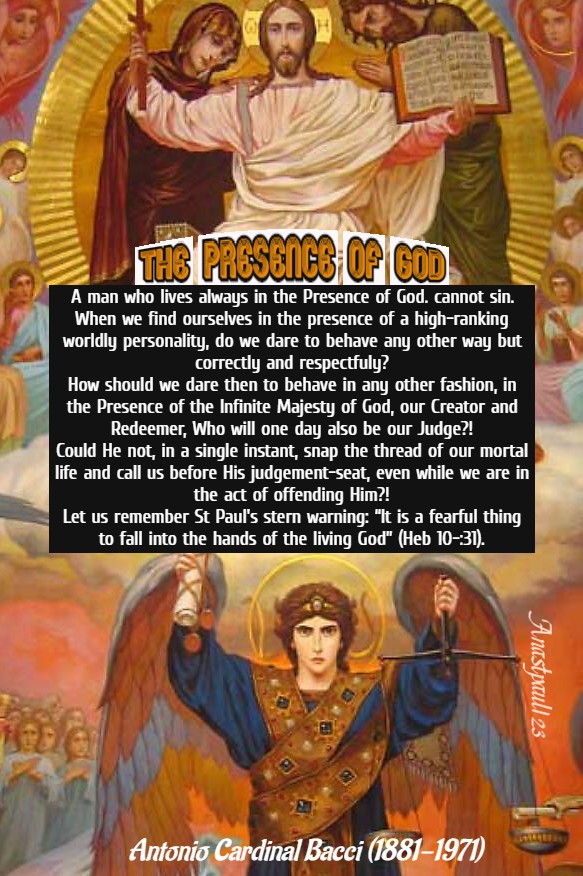
Thought for the Day – 23 November – Meditations with Antonio Cardinal Bacci (1881-1971)
The Blessedness of Those Who Mourn
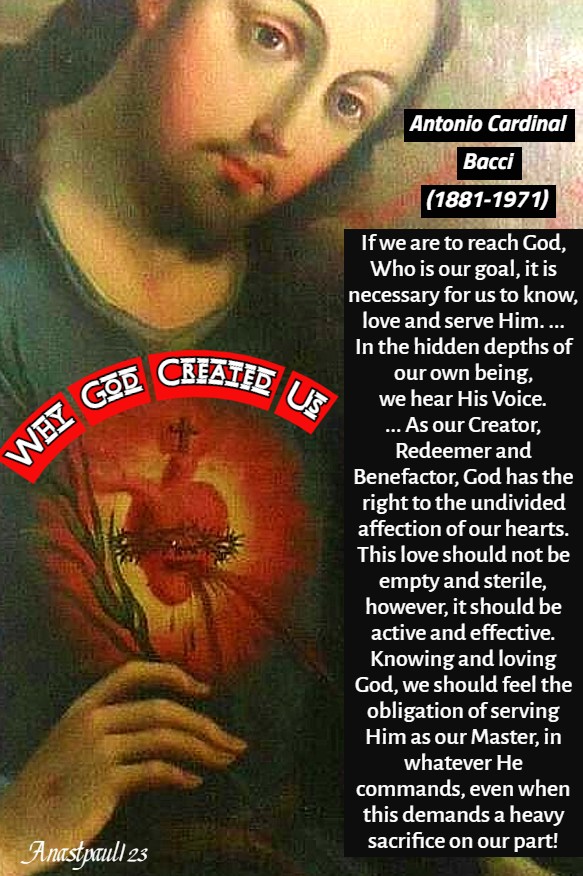
“As well as regretting the evils which beset humanity, the Christian should also shed tears of repentance for his sins. Our sins are so many that they demand penance and reparation. St Aloysius Gonzaga wept whenever he recalled the peccadilloes of his childhood, which were hardly serious enough to be real sins. We have sinned and maybe sinners still but do we weep for our transgressions?
A sincere Christian is not content merely to regret his sins and to pray for forgiveness but he imposes, on himself, voluntary penances in expiation of his own offences and of the offences of others. Tears of repentance are blessed by God, Who forgives and pardons those who mourn for their transgressions.”
Quote/s of the Day – 23 November – St Clement I (c 88–c 101) Pope Martyr and St Columban (543-615) Monk, Missionary
“Follow the Saints because those who follow them, will become Saints.”
“This world and the world to come, are two enemies. We cannot. therefore. be friends to both but, we must decide which we will forsake and which, we will enjoy.”
“Who can describe the bond of God’s love? Who is able to explain the majesty of its beauty? The height to which love leads is indescribable. … In love the Master received us, Jesus Christ our Lord, in accordance with God’s will gave His Blood for us and His Flesh for our flesh and His Life for our lives.”
“We are all fellow members of one body, whether Franks or Britons or Irish or whatever our race. Thus, let all our races rejoice, in knowledge of the faith and in recognising the Son of God … In Him, let us love one another, praise one another, correct one another, encourage one another, pray for one another.”
(Letter 2, to the French bishops)
Lord, Kindle our Lamps By St Columban (543-615)
Lord, kindle our lamps, Saviour most dear to us, that we may always shine in Your presence and always receive Light from You, the Light Perpetual, so that our own personal darkness, may be overcome and the world’s darkness driven from us. Amen
(This is an excerpt from a much longer prayer and is taken from the wonderful Sermon XII by St Columban/us)
One Minute Reflection – 23 November – St Clement I (c 88–c 101) Pope Martyr – Philippians 3:17-21; 4:1-3, Matthew 16:13-19 – Scripture search here: https://www.drbo.org/
“Blessed art thou, Simon Bar-Jona because flesh and blood hath not revealed it to thee but My Father Who is in Heaven.” – Matthew 16:17
REFLECTION – “Faith in Me, He intimates here, is no ordinary thing or one that comes from human reason but [it] needs a revelation from above. And this He establishes throughout His discourses, showing, that this faith requires a noble sort of soul and one drawn on by God. The expression “that the Father gives Me” shows, that it is no accident whether a person believes or not. It shows, that belief is not the work of human reasoning but requires a revelation from on high and a mind devout enough to receive the revelation. “Whoever then,” our Lord says, “comes to Me, shall be saved,” meaning, they shall be greatly cared for. For to save such as these, I took up flesh and the form of a servant.” – St John Chrysostom (347-407) Archbishop of Constantinople, Father and Doctor of the Church (Homilies on the Gospel of John 45)”
PRAYER – Look forgivingly on Thy flock, Eternal Shepherd and keep it in Thy constant protection, by the intercession of blessed Clement Thy Martyr and Sovereign Pontiff, whom Thou didst constitute Shepherd of the whole Church. Through Jesus Christ, Thy Son our Lord, Who lives and reigns with Thee, in the unity of the Holy Ghost, God, world without end. Amen (Collect).
Our Morning Offering – 23 November – The Memorial of St Columban (543-615).
May We Love Only You By St Columban (543-615)
Loving Saviour, be pleased to show Yourself to us who knock, so that in knowing You, we may love only You, love You alone, desire You alone, contemplate only You, day and night and always think of You. Inspire in us the depth of love that is fitting for You to receive as God. So may Your love pervade our whole being, possess us completely and fill all our senses, that we may know no other love but love for You, Who are everlasting. May our love be so great, that the many waters of sky, land and sea cannot extinguish it in us – many waters could not extinguish love. May this saying be fulfilled in us also, at least in part, by Your gift, Jesus Christ, our Lord, to whom be glory forever and ever. Amen
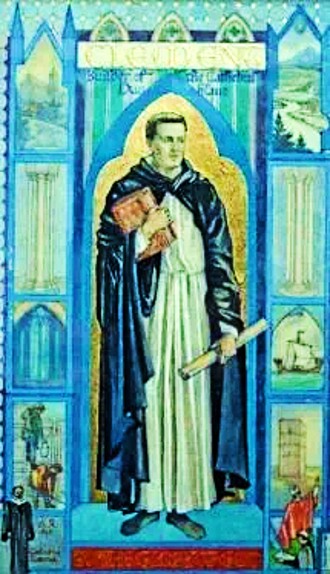
Saint of the Day – 23 November – St Clement I (c 88–c 101) Pope Martyr, Miracle-worker. St Clement is considered to be the first Apostolic Father of the Church, one of the three chief ones together with St Polycarp and St Ignatius of Antioch. Papal Ascensi,on c 88. Born in Rome, Italy and died by drowning at Chersonesus, Taurica, Bosporan Kingdom (modern Greece). Patronages – boatmen, sailors, marble workers, against blindness, sick children, stonecutters, Diocese of Aarhus, Denmark, Dundee, Scotland. Steenwijk, Netherlands, Velletri, Italy. Also known as – Clement of Rome, Clemens Romanus.
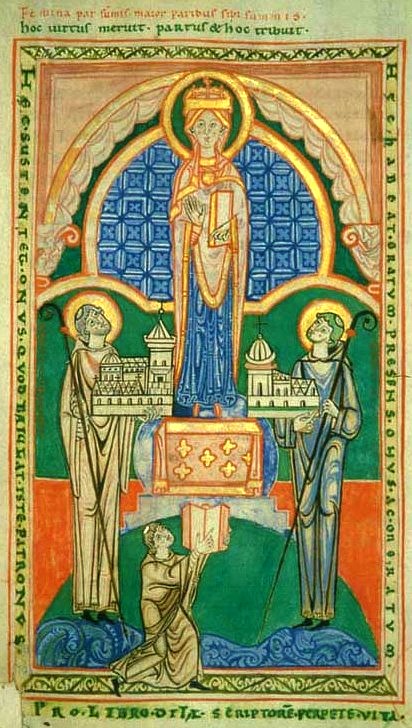
The Roman Martyrology reads: “The birthday of Pope Clement, who held the sovereign Pontificate, the third after the blessed Apostle St Peter. In the persecution of Trajan, he was banisbed to Chersonesus, where being percipitated into the sea with an anchor tied to his neck, he was crowned with Martyrdom. His body was taken to Rome during the Pontificate of Nicholas I and placecd, with due honour in the Church which had been previously built under his invocation.”
c 1000 portrayal at Saint Sophia’s Cathedral, Kyiv
Saint Clement I., Pope and Martyr By Father Francis Xavier Weninger SJ (1805-1888)
Whilst the holy Apostles, Peter and Paul, were preaching the Gospel at Rome, there came to them Clement, a son of Faustinus, who was related to the Emperor Domitian. After several discourses with St Peter, he saw the error of Paganism, in which he had been born and educated and became a convert to the Christian faith. He progressed so rapidly in virtue and holiness that he was of great help to Paul in converting the heathens, as the holy Apostle testifies in his Epistle to the Philippians. The unwearied zeal he manifested in such holy endeavours, his purity and other bright virtues, raised him, after the death of Sts Linus and Cletus, to the government of the entire Church of Christ.
In this elevated but burdensome dignity, his holy life was an example to his flock. He gave several excellent laws to the Church, by one of which he divided the City into seven districts and placed in each, a notary to record the deeds, virtues and Martyrdom, of those who were persecuted for Christ’s sake that posterity, admiring their heroism, might be animated to follow their example. His sermons were so full of deep thought and so powerful, that he daily converted several heathens. Among these was Flavia Domitilla, a niece of the Emperor Domitian, who not only became a zealous Christian but, refusing several advantageous offers of marriage, vowed her virginity to God.
He converted Sisinius, one of the most influential men in the City, by a miracle. While yet a heathen, Sisinius went unseen into the secret Chapel where the Christians assembled, in order to ascertain what they were doing and to see whether his wife was among them. God, however, punished him immediately with blindness in both eyes. He revealed himself by calling for, someone to lead him home and St. Clement, who was present, went to him and, restoring his sight after a short prayer, he improved the occasion, to explain to him, the truths of Christianity. Sisinius, being soon convinced, received holy Baptism and many heathens followed his example. The Emperor Trajan, being informed of this, commanded St Clement to be banished to the Chersonesus, unless he consented to sacrifice to the gods. Nearly two thousand Christians had already been banished to that region, where they were forced to work in mines and quarries. The holy Vicar of Christ rejoiced to be thought worthy to suffer for his Divine Master and indignantly, refused to comply with the Emperor’s command to worship the Pagan idols. He was accordingly transported, and condemned to labour like the others.
This fate at first seemed very hard to him but. the thought that he suffered it for Christ’s sake, strengthened him. With the same thought. he endeavoured also to inspire his unhappy companions, when he saw that they became discouraged and lost their patience. He also frequently represented to them, the reward which was awaiting them in Heaven. A miracle which God performed through him, raised him to great consideration, even with the heathens.
There was a great scarcity of water and the Christians suffered much from the thirst occasioned by their hard work. St Clement, pitying them most deeply, prayed to God to help them. Rising from his knees, he saw, on a high rock, a lamb, which seemed, with his raised right foot, to point to the place where water could be found. The holy man, trusting in the Almighty, seized an axe and, lightly striking the rock, procured a rich stream of clear water, which refreshed all the inhabitants of the country, especially the poor persecuted Christians. So many heathens were converted on account of this miracle, that, in the course of a year, almost all the idolatrous temples were torn down and Christian c=Churches erected in their stead.
St Clement by Tiepolo
Some of the idolatrous priests complained of this to the Emperor, who immediately sent Aufidian, a cruel tyrant, to force the Christians to forsake their faith and to put St Clement to death. The tyrant endeavoured to induce the holy man to forsake Christ but finding that all words were useless, he commanded the executioners to tie an anchor to the neck of St Clement, take him out into the sea and cast him into the deep, in order that nothing of him should remain to comfort the Christians. The last words of the holy Pope were: “Eternal Father! receive my spirit!”
Martyrdom of St Clement by Fungai
The Christians, who had been encouraged by him to remain constant in their faith, stood on the sea-shore, until the tyrant and his followers had departed, after the death of the Saint. They then knelt in prayer, to beg of the Almighty that He would restore to them the body of their beloved shepherd and, whilst they prayed, the sea began slowly to retreat from the shore. The Christians, following the retreating water, came to the place where the Saint had been cast into the sea and found, to their inexpressible astonishment and joy, a small marble Chapel and in it, a tomb of stone, in which the body of the holy Pope was reposing. At his side, lay the anchor which had been tied around his neck. The joy and comfort which filled the hearts of the faithful at this sight, can more easily be imagined than described. They wished to take the holy body away but God made known to them that, for the present, it should not be disturbed and that, every year, the sea would retreat, during seven days, so as to permit all to visit the shrine of the Saint! This took place for several years, until, at last, by divine revelation, the Relics were transported to Rome.
St Adalbert of Casauria St Alexander Nevski St Amphilochius of Iconium St Augusta of Alexandria St Clement of Metz Bl Detlev of Ratzeburg St Falitrus of Chabris St Faustina of Alexandria St Gregory of Girgenti Bl Guy of Casauria St Jaume Nàjera Gherna St Loëvan of Brittany St Lucretia of Mérida Bl Margaret of Savoy St Mustiola of Chiusi St Paternian of Fano St Paulinus of Whitland St Rachildis of Saint-Gall St Severin of Paris St Sisinius of Cyzicus St Trudo of Hesbaye St Wilfetrudis of Nivelless
Thought for the Day – 22 November – Meditations with Antonio Cardinal Bacci (1881-1971)
The Blessedness of the Meek
“Learn from me,” said Jesus when He proposed Himself to us, as our model, “for I am meek and humble of heart and You will find rest for your souls. For my yoke is easy and my burden light” (Mt 11:30). “By your patience,” He said on another occasion, “you will win your souls” (Lk 21:19). “Love your enemies,” He said too, “do good to those who hate you and pray for those who persecute and calymuniate you, so that you may be children of your Father in Heaven, Who makes His sun to rise on the good and the evil and sends rain on the just and the unjust” (Mt 5:44).
If we obey this lofty teaching, we shall have peace of soul. We shall not be easily annoyed but shall rather, regret the misdeeds and unhappiness, of those who unjustly offend us. Moreover, we shall be able to persuade our fellowmen to follow the path of virtue. This is why the Psalmist says that “the meek shall possess the land, they shall delight in abounding peace” (Ps 36:11). “Blessed are the meek,” Jesus repeats in the Sermon on the Mount, “for they shall possess the earth” (Mt 5:4).
What is meant by this promise? Tyrants, persecutions and evil-doers, have passed away and are remembered with bitterness and execration. But the Saints still hold sway over the world and dominate the minds and hearts of millions, winning universal love and veneration. We should imitate the gentleness which can give such peace and exert such influence!”
Quote/s of the Day – 22 November – St Cecilia Died 3rd Century) Virgin Martyr – Ecclesiasticus 51:13-17, Matthew 25:1-13 – Scripture search here: https://www.drbo.org/
“But the wise took oil in their vessels”
Matthew 25:4
“The Apostle says, “I will show you a still more excellent way.” “If I speak with the tongue of mortals and of angels but do not have love, I am a noisy gong or a clanging cymbal.” This is charity. It is “that way above the rest,” which is, with good reason, signified by the oil. For oil swims above all liquids. Pour in water and pour in oil upon it, the oil will swim above. If you keep the usual order, it will be uppermost, if you change the order, it will be uppermost. “Charity never fails!”
“Love the Lord and so, learn to love yourselves that when, by loving the Lord, you shall have loved yourselves, you may securely love your neighbour as yourselves. … So then, have faith with love. This is the “wedding garment!”
St Augustine (354-430) Father and Doctor of Grace
“Charity is the sweet and holy bond which links the soul with its Creator; it binds God with man and man with God.”
St Catherine of Siena OP (1347-1380) Doctor of the Church
“My dear souls, let us recognise, I pray you, Christ’s infinite charity towards us in the institution of this Sacrament of the Eucharist. In order that our love be a spiritual love, He wills a new heart, a new love, a new spirit for us. It is not with a carnal heart but with a spiritual one, that Christ has loved us with a gratuitous love, a supreme and most ardent love, by way of pure grace and charity. Ah! One needs to love Him back with one’s whole, whole, whole, living, living, living and true, true, true heart!”
St Lawrence of Brindisi(1559-1619)
“Humility and charity are the two master chords – one, the lowest; the other, the highest; all the others are dependent on them. Therefore, it is necessary, above all. to maintain ourselves in these two virtues, for observe well, that the preservation of the whole edifice depends on the foundation and the roof!”
St Vincent de Paul (1581-1660)
“A word or a smile, is often enough, to put fresh life into a despondent soul.”
St Therese of the Child Jesus and the Holy Face (1873-1897) Doctor of the Church
One Minute Reflection – 22 November – St Cecilia Died 3rd Century) Virgin Martyr – Ecclesiasticus 51:13-17, Matthew 25:1-13 – Scripture search here: https://www.drbo.org/
“But the wise took oil in their vessels” – Matthew 25:4
REFLECTION – “It is some great thing, some exceedingly great thing, that this oil signifies. Do you think it might be charity? If we try out this hypothesis, we hazard no precipitate judgement. I will tell you why charity seems to be signified by the oil. The Apostle says, “I will show you a still more excellent way.” “If I speak with the tongue of mortals and of angels but do not have love, I am a noisy gong or a clanging cymbal.” This is charity. It is “that way above the rest,” which is, with good reason, signified by the oil. For oil swims above all liquids. Pour in water and pour in oil upon it, the oil will swim above. If you keep the usual order, it will be uppermost, if you change the order, it will be uppermost. “Charity never fails!” … St Augustine (354-430) Father & Doctor (Sermon 93).
PRAYER – O God, Who gladden us by the annual feast of blessed Cecilia, Thy Virgin and Martyr, grant, we beseech Thee, that we may by virtuous conduct follow her, whom we venerate in this sacred rite. Through Jesus Christ, Thy Son our Lord, Who lives and reigns with Thee, in the unity of the Holy Ghost, God, world without end. Amen (Collect).
Our Morning Offering – 22 November – “The Month of the Holy Souls in Purgatory”
By the Merit of the Precious Blood of Jesus By Servant of God Pope Pius VII (1742-1823) Papacy from 1800 to 1823 Indulgenced Act of Oblation to Our Father
Eternal Father! I offer Thee the merit of the Precious Blood of Jesus, Thy well-beloved Son, my Saviour and my God, for all my wants, spiritual and temporal, in aid of the Holy Souls in Purgatory and chiefly for those who most loved this Precious Blood, the price of our redemption and who were most devout to the sorrows and pains of most Holy Mary, our dear Mother.
Glory be to the Blood of Jesus, now and forever and throughout all ages. Amen.
Indulgence of 300 days, each time this prayed is offered 22 September 1817 with a Plenary Indulgence, once a month, under the usual conditions.
Note of Interest:On 15 August 1811 – the Feast of the Assumption – it is recorded that the Pope celebrated Mass and was said to have entered a trance and began to levitate in a manner that drew him to the Altar. This particular episode aroused great wonder and awe among attendants, which included the French soldiers guarding him, who were awestruck at what had occurred and left records of it.
Saint of the Day – 22 November – Saint Pragmatius of Autun (Died c 520) Bishop of Autun, France, Peacemaker. Also known as Prammazio, Pragmazio.
We have very little information regarding the life of our Saint but we do know that he was a friend of the great holy Bishops of his time, Saints Sidoine Apollinaire and Saint Avitus of Vienne. We also we find his signature at the bottom of the Acts of one of the Councils of his time.
As Bishop, Pragmatius worked tirelessly, to spare his Diocese from the violence caused by the bitter feuding among the claimants to the Frankish throne during the early 6th Century.
In his old age, he had the pain of seeing his Episcopal See, devastated by the sons of Clovis, winners of the Burgundians, who opposed the invading Franks.
Autun Cathedral a famous Romanesque and Pilgrimage Church
St Agabbas of Syria St Amphilochius of Iconium St Ananias of Arbela St Apphia St Eugenia of Matera St Christian of Auxerre St Dayniolen the Younger St Joan of Montefalco St Mark of Antioch St Maurus of North Africa St Philemon St Pragmatius of Autun (Died c 520) Bishop St Sabinian the Abbot St Stephen of Antioch
Thought for the Day – 21 November – Meditations with Antonio Cardinal Bacci (1881-1971)
The Glory of God
“Let us study the behaviour of the Saints, who forgot themselves and thought only of God. In order to please Him, to win His approval and to co-operate in the manifestation of His glory, they deprived themselves of food and rest and sacrificed themselves entirely for His sake.
Now, consider yourself. Perhaps you are still excessively self-centred. Perhaps you love yourself too much and love God too little. Perhaps you try too hard to achieve worldly success and forget that at the end of life, your insignificant personal conquests and laurels, will seem to you, to be so many useless toys on which you have wasted the precious time which God gave you. Consider this carefully and form suitable resolutions for the future.”
Quote/s of the Day – 21 November – The Presentation of the Blessed Virgin Mary
“In her, God spun a garment with which to save us.”
Saint Ephrem (306-373) Father & Doctor of the Church
“Hail, holy throne of God, divine sanctuary, house of glory, jewel most fair, chosen treasure house and mercy seat for the whole world, heaven showing forth the glory of God.
Purest Virgin, worthy of all praise, sanctuary dedicated to God and raised above all human condition, virgin soil, unploughed field, flourishing vine, fountain pouring out waters, virgin bearing a child, mother without knowing man, hidden treasure of innocence, ornament of sanctity, by your most acceptable prayers, strong with the authority of motherhood, to our Lord and God, Creator of all, your Son, Who was born of you without a father, steer the ship of the Church and bring it to a quiet harbour.”
St Germanus (378-448)
“This fair olive-tree, led to the temple and, thenceforward planted in the House of God and cultivated by the Spirit, she, as a fruitful olive-tree, became the abode of all virtues.”
St John Damascene (675-749) Father and Doctor of the Church
“God Himself, with the whole heavenly court, made great rejoicings on that day, beholding His spouse, coming to the temple.”
St Bernardine of Siena OFM (1380-1444)
“Give thanks to Almighty God Who resists the proud and gives grace to the humble and offer Him all the glory that this Maiden accorded to His majesty by her practice of the richest humility during her childhood and throughout the rest of her life.”
One Minute Reflection – 21 November – The Presentation of the Blessed Virgin Mary – Sir ach24:14-1, Luke 11:27-28 – Scripture search here: https://www.drbo.org/
“Blessed is the womb that bore you” – Luke 11:27
REFLECTION – “This woman will be the Mother of God, the door to Light, source of Life; she will reduce to oblivion the judgement that weighed on Eve. “The rich among the people seek the face” of this woman, “the kings of the nations shall pay her homage” they shall “ offer gifts”…, yet the glory of the Mother of God is an interior glory: the fruit of her womb.
O woman, so worthy of love, thrice happy, “blessed are you among women and blessed is the fruit of your womb.” Daughter of David the king and Mother of God, King of the universe, masterpiece in whom the Creator rejoices…: you are to be nature’s full achievement. For you, life is not yours; you were not born for yourself alone but your life is to be God’s. You came into the world for Him, you will serve for the salvation of all people, fulfilling God’s design established from the beginning: the Incarnation of the Word and our own divinisation. Your whole desire is to feed on the words of God, to be strengthened by their sap, like “a green olive tree in the house of God,” “like a tree planted by running water,” you are the “tree of life” who “yielded its fruit in due season”…
He Who is Infinite, Limitless, came to dwell in your womb; God, the Child Jesus, was nourished by your milk. You are the ever virginal Doorway of God; your hands hold your God; your lap is a throne raised up above the Cherubim… You are the wedding chamber of the Spirit, the “city of the living God, gladdened by the runlets of the stream”, that is to say, the waves of the Spirit’s gifts. You are “all fair, the Beloved” of God.” – St John Damascene (675-749) Monk, Theologian, Father and Doctor of the Church (Homily on the Nativity of the Virgin, # 9 ; SC 80) [ ( Biblical references : Ps 44[45],13; 71[72],11.10; Mt 2,11; Lk 1,42; Is 62,5; Ps 51[52],10; 1,3; cf Gn 2,9, Rv 22,2; cf Ez 44,2; Ps 79[80],2; cf Sg 1,4; Ps 45[46],5; Sg 4,7]. Link to searchable Sacred Scripture here: https://www.drbo.org/
PRAYER – O God, by Whose will the blessed Mary, ever Virgin, the dwelling place of the Holy Spirit, was on this day presented in the temple, grant, we beseech Thee, that by her intercession, we may be found worthy to be brought into the temple of Thy glory. Through Jesus Christ, Thy Son our Lord, Who lives and reigns with Thee, in the unity of the Holy Ghost, God, world without end. Amen (Collect).
The Presentation of the Blessed Virgin Mary By Fr Francis Xavier Weninger SJ (1805-1888) (Excrrpt)
Today’s Festival is called the Presentation of Mary, because on this day, Joachim and Anna, the holy parents of the Blessed Virgin, Consecrated their little daughter to the Divine service in the temple at Jerusalem and Mary Consecrated herself to the Almighty.
At that time, there were two ways of Consecrating children – one was ordained by the law, which required every male child to be offered to God, forty days and every female child, eighty days after its birth. This ceremony was called the Consecration of the child and the purification of the mother.
The second kind of Consecration was a voluntary self-oblation by which some persons devoted themselves to the Almighty. There were also many parents who, either before, or immediately after their child’s birth, Consecrated it to the service of the Lord, sometimes for a few years, sometimes for life. To this end, several separate dwellings had been erected near the Temple, for men, women, youths and maidens, where they remained for the time which had been fixed by themselves or their parents.
Their occupations consisted in decorating the temple and in making the garments which the priests and levites wore during their sacred functions. Thus we read in the first book of Kings, that Anne the spouse of Elkana, made a vow that if she gave birth to a male child, she would Consecrate him to the Lord. The Lord blessed her and she brought forth a son, whom she named Samuel and afterwards, Consecrated to the Most High, through the hands of the High Priest, Heli. In the second book of the Maccabees, we find mention of virgins, who lived and were educated in the Temple, that is, in a building annexed to it.
t is the belief of several holy Fathers, that Joachim and Anna, being already advanced in years and having no issue, made a vow to God that if He would bless them with a child and thus, take from them, the dishonour of being barren, they would Consecrate their offspring to His service in the Temple.
God heard their prayer and blessed them so greatly that they became the parents of the most holy of all human beings, Mary, the ever Blessed Virgin. For three years they kept this sacred treasure at home, after which time, although Mary was their only comfort, they resigned her with pious fortitude, in fulfilment of their vow. Hence they went, with their daughter, to Jerusalem, presented her to the priest in the Temple and Consecrated her, through his hands, to the service of the Almighty.
Practical Considerations of this Feast:
In the third year of her life, Mary, the Blessed Virgin, consecrated herself to the service of the Almighty and this, not for days or years only but forever, for, as long as she lived, she ceased not to serve the Lord.
How is it with you? Did you also begin in your tender years to serve the Lord. Or to whom did you dedicate the years of your life? Ah! confess it with weeping eyes and repentant heart, not to the Lord but to the world, to the flesh, to Satan, you gave the years of your youth and, perhaps you have not even made the resolution to serve your God. Or it maybe, you think it will be time enough, when you are old, although it is unknown to you, whether you will ever count many years. But even had you been assured of this, tell me, do you not deserve to be disowned by the Almighty as a second Cain, since like him, you sacrificed only what was of less value and not, like the pious Abel, what was the best? God cursed him who took from his flock the meanest for his offering. This Curse you also deserve, for not having given to the Lord, your first and best years but reserving your old age for Him. Oh! truly you have reason to weep over this wickedness as long as you live. Humbly beg God to pardon you and resolve, at the same time, to serve Him from this hour most fervently and without ceasing, until your end, as the Blessed Virgin did. You have perhaps but a short time more, hence employ every moment in the service of God. The benefit will be yours and will last through all eternity.
In Consecrating herself to the Almighty, the Blessed Virgin gave herself entirely to Him without any reservation. Soul and body, every power of her soul, every member of her body, her whole heart and life, all was given forevermore to the service of the Most High. Doubtless you resolve today to serve your Lord most fervently for the future. Consecrate yourself, then, today to His service but without any reservation, your whole heart, your entire life, your soul with all its powers, your entire body with all its members, sacrifice all willingly and for vermore to the Lord. God Who desires the whole heart and not a part of it, wishes also your whole soul, your whole body, your entire life.
Do you wish to divide your heart and to give one part of it to the Almighty the other to the world and Satan? To serve God with one member of your body, and to offend Him with another? Do you wish to employ your memory to honour God with good thoughts but to soil your will with wicked desires? Oh! then do not imagine that your sacrifice will be acceptable to God. It will rather be a horror in the eyes of Him Who commands us to serve Him alone, and to sacrifice everythying to His service. Make today, a perfect sacrifice, so that you may, at least in something, follow the Blessed Virgin. And take care that you do not, after the lapse of some time, retract your sacrifice.
You Consecrate, today, your eyes, your tongue,and your hands, with the intention to use them only in God’s service. Guard yourself, lest, after some hours or days, you misuse them in offending the Lord, for, this would be as much robbing the Altar of what you have given to the Most High. Mary did not act thus. It is written: “I am the Lord that hate robbery in a holocaust,” (Isa lxi.)
Saint of the Day – 21 November – Saint Maurus of Cesena (Died 946) Bishop, Monk, Abbot. nephew of Pope John IX. Born in Rome, Italy and died on 21 November 946 in Cesena, Flaminia, Italy of natural causes. Patronage – against blindness. Also known as – Maur, Mauro.
Maurus was Ordained then became a Benedictine Monk at Classis in Ravenna, Italy. Having served as Abbot of the Monastery of Classis, in Ravenna, Italy, Maurus became Bishop of Cesena around 934, where he served until his death.
A zealous and devoted shepherd, he found the strength to care for his flock during the day, by withdrawing to pray in the evenings, to a hilltop retreat outside the City. Here, amid a densely wooded forest, he erected for himself a hermitage and Chapel. This retreat symbolically represented for him, Jerusalem’s Mount of Olives, where Christ withdrew to pray. During Lent, Maurus spent each day at his hermitage in solitude, praying and fasting.
Maurus was buried in a marble tomb on Monte Spaziano, Italy next to his small cell where he would retreat for prayer and solitude. His grave was lost for many years but accidentally re-discovered in the 11th century, whereafter his Relics were enshrined in the nearby Benedictine Church. In 1470 they were again moved to the Cathedral of Saint John the Baptist in Cesena with some Relics being enshrined in Ravenna.
Following his death, a number of miracles were attributed to his intercession. Upon arriving at the Church enclosing Maurus’ tomb, a blind woman from France passionately declared her determination never to leave there, unless Maurus obtained the restoration of her sight. Having given the Saint this “ultimatum,” she acted on her words, by erecting for her habitation, a small hut adjacent to the Church and began her prayers. After persevering for eight days in her supplications, the woman received her sight and, thereupon, gave thanks to God and Saint Maurus.
St Amelberga of Susteren St Celsus the Martyr St Clement the Martyr St Colman Iomramha of Inishmore St Columba the Younger St Demetrius of Ostia St Digain Bl Eoin O’Mulkern St Pope Gelasius I St Heliodorus of Pamphylia St Hilary of Vulturno St Honorius of Ostia St Maurus of Cesena (Died 946) Bishop, Priest, Monk, Abbot St Maurus of Porec St Maurus of Verona Bl Nicholas Giustiniani St Rufus of Rome
Martyrs of Asta – 3 Saints: Three Christians Martyred together for their faith during the persecutions of Diocletian. The only details about them to survive are their names – Eutychius, Honorius and Stephen. They were martyred in c 300 at Asta, Andalusia, Spain.
Thought for the Day – 20 November – Meditations with Antonio Cardinal Bacci (1881-1971)
The Storms of Life
“At other times, however, the tempest will come from outside ourselves and will have a shattering effect on our spiritual life. It may be some insult which has seriously wounded us. There may be somebody near to us who has grown quite insufferable. Or perhaps suffering will come to us in the guise of illness, disgrace or loss of our dear ones. We shall feel lonely and abandoned in the midst of the storm. To whom shall we have recourse in our hour of need? Shall we turn to our fellow-men? Perhaps there will be nobody able to understand us perfectly, or, if there is somebody who sympathises with us,he may be able to do nothing for us, save to utter a few kind words.
Let us turn, therefore, to Jesus on the Cross and to Jesus in the Blessed Eucharist. The Crucifix will teach us how to suffer with resignation and with love. Before this mystery of infinite love, all our anguish and unrest, will give way to a Christian acceptance of suffering.
If this is not enough, let us turn to Jesus in the Blessed Eucharist. Let us invite Him into our hearts to calm the tempest and to give us His divine grace, which will conquer every temptation and heal every wound.”
Quote/s of the Day – 20 November – “The Month of the Holy Souls in Purgatory”
“Even now, says the LORD, return to me with your whole heart, with fasting and weeping and mourning. Rend your hearts, not your garments and return to the LORD, your God. For gracious and merciful is he, slow to anger, rich in kindness and relenting in punishment.”
Joel 2:12-13
“ … Yet only grant me repentance here below That I may make reparation for my sins, … That these tears may extinguish the blazing furnace With its burning flames. …
And, instead of acting like the merciless, Set merciful compassion within me, That, by showing mercy to the poor, I may obtain Your mercy.”
St Nerses Chnorhali (1102-1173) Armenian Bishop
“The more one longs for a thing, the more painful does deprivation of it become. And because, after this life, the desire for God, the Supreme Good, is intense in the souls of the just – (because this impetus toward Him, is not hampered by the weight of the body and that time of enjoyment, of the Perfect Good, would have come) had there been no obstacle. The soul suffers enormously, from the delay.”
St Thomas Aquinas (1225-1274) Angelic Doctor
“If, during life, we have been kind to the suffering Souls in Purgatory, God will ensure that help be not denied us, after death.”
One Minute Reflection – 20 November – The Last Sunday after Pentecost – St Felix of Valois (1127-1212) Confessor – Colossians 1:9-14, Matthew 24:15-35 – Scripture search here: https://www.drbo.org/
“Even so, when you see all these things, know that it is near, even at the door. ” – Matthew 24:33
REFLECTION – “Watch” over your life. Do not let “your lamps” go out and do not keep “your loins ungirded,” but “be ready,” for “you do not know the hour when our Lord is coming.” Meet together frequently, in your search for what is good for your souls, since “a lifetime of faith will be of no advantage” to you, unless you prove perfect at the very end.
In the final days, multitudes of false prophets and seducers will appear. Sheep will turn into wolves and love into hatred. With the increase of iniquity, people will hate, persecute and betray each other. Then the world deceiver will appear in the disguise of God’s Son. He will work “signs and wonders,” and the earth will fall into his hands. He will commit outrages such as have never occurred before. Then humankind will come to the fiery trial, “and many will fall away” and perish. “Those who persevere in their faith will be saved” by the Curse himself. Then “there will appear the signs” of the Truth – first the sign of stretched-out hands in heaven, then the sign of “a trumpet’s blast” and third, the resurrection of the dead but not all the dead. As it has been said, “The Lord will come and all his saints with him.Then the world will see the Lord coming on the clouds of the sky.” TheUnknown Author of the Didache (Didache, 16) .
PRAYER – OGod, Who by heavenly inspiration graciously called forth blessed Felix, Thy Confessor, from the desert to the work of ransoming captives; grant, we beseech Thee, that by his intercession and liberated by Thy grace from the captivity of our sins, we may be led into our heavenly fatherland. Through Jesus Christ, Thy Son our Lord, Who lives and reigns with Thee, in the unity of the Holy Ghost, God, world without end. Amen (Collect).
Our Morning Offering – 20 November – The Last Sunday after Pentecost
Holy God, We Praise Thy Name By Fr Ignaz Franz Poland (1719-1790) (Attri) Archbishop of Schlawa, Germany
Holy God, we praise Thy Name. Lord of all, we bow before Thee. All on earth Thy sceptre claim; all in heav’n above adore Thee. Infinite Thy vast domain, everlasting is Thy reign.
Hark, the loud celestial hymn, angel choirs above are raising. Cherubim and seraphim, in unceasing chorus praising, fill the heav’ns with sweet accord: Holy, holy, holy Lord.
Holy Father, Holy Son, Holy Ghost, three we name Thee While in essence only One, Undivided God, we claim Thee and adoring, bend the knee, while we own the Mystery.
Spare Thy people Lord, we pray, By a thousand snares surrounded. Keep us without sin today, Never let us be confounded. Lo, I put my trust in Thee, Never Lord, abandon me.
Fr Ignaz Franz Poland (1719-1790) Archbishop of Schlawa, Germany, Hymnist, Musician He also functioned as the Assessor for Theological Affairs at the Apostolic Vicariate. He wrote hymn lyrics and compiled religious music. Trans. by Fr Clarence A Walworth (1820-1900) Convert, writer. He was one of the Founders of the Order of the Paulists in the U.S.A.
Saint of the Day – 20 November – Saint Cyprian of Calamizzi (c 1125-1190) Abbot, Hermit, Medical Doctor . Born in c 1125 in Reggio di Calabria, Italy and died on 20 November 1190 at the Monastery of San Nicola, Calamizzi, Italy of natural causes. Also known as – Cipriano.
Cyprian, son of a rich, noble doctor, became a doctor himself but then retired at the age of 25 as a Monk to Calanna near Reggio di Calabria Monastery of the Most Holy Redeemer of the Basilians – roughly on the site of the present Parish Church
Cyprian moved on and then lived for twenty years as a Hermit in a cave on his father’s estate at Pavigliana, above Reggio, near the Church dedicated to St Veneranda . He was increasingly visited by people who sought his help, both spiritual and bodily.
Some companions joined him as Hermits. Then the Abbot Paulus from the Monastery of San Nicola at Punta Calamizzi died and its Monks asked Cyprian to be their new Abbot.
Cyprian agreed and took over at the age of 60. There Cyprian became known for his austerity, adherance to the Rule of his Monastery, his charity to poor and his wise counsel to anyone who approached him. He revived the spiritual and cultural life of the Monks, restored the Church of the Monastery and built the bell tower,. He also restored the Monks’ cells and the refectory. He expanded the library, worked to increase the education and spirituality of his Monks and during the day, he laboured as a free Physician to all the poor sick in need of assistance.
The Calamizzi Parish Church which now stands on the site of St Cyprian’s Monastery
When he broke his leg in an accident whilst driving in his carriage, which was badly set and left him with a limp for the rest of his days also causing a steady decline in his health until he died on 20 November 1190.
Cyprian was buried in the Church of his Monastery at Punta Calamizzi . When the Monastery was destroyed in an earthquake in 1783, the Monks were miraculously unharmed, which they attributed to the intercession of St Cyprian.
St Agapius of Caesarea Bl Ambrose of Camaldoli St Ampelus of Messina St Anatolius of Nicea St Apothemius of Angers St Autbodus of Valcourt St Basil of Antioch St Bernerio of Eboli St Crispin of Ecija St Cyprian of Calamizzi (c 1125-1190) Abbot St Dasius of Dorostorum St Dorus of Benevento St Edmund of East Anglia St Eudo of Carméry St Eustachius of Nicea St Eval of Cornwall St Francisca Desamparados Honorata Lloret Martí St Gaius of Messina St Gregory Decapolites St Hippolytus of Belley St Humbert of Elmham St Leo of Nonantula St Maxentia of Beauvais St Milagros Ortells Gimeno St Nerses of Sahgerd and Companions St Simplicius of Verona St Sylvester of Châlons-sur-Saône St Thespesius of Nicea St Teonesto of Vercelli
Martyrs of Antioch – 3 Saints: Group of three Christians executed together for their faith. No details have survived except their names – Basil, Dionysius and Rusticus. They were martyred in Antioch (Antakya, Turkey).
Martyrs of Heraclea – 3 Saints: A group of 43 Christians Martyred together. The only details about them to survive are three of their names – Agapitus, Bassus and Dionysius. They were martyred in Heraclea, Thrace.
Martyrs of Turin – 3 Saints: Three Christian Martyrs whose original stories were lost and somehow came to be associated with the Theban Legion. They are – Adventor, Octavius and Solutor. They were beheaded in 297 in Turin, Italy. Patronage – Turin, Italy.
Thought for the Day – 19 November – Meditations with Antonio Cardinal Bacci (1881-1971)
The Most Terrifying Passage in the Gospel
“Why should the Eternal Judge punish or reward us, in accordance with our own deeds of charity and of mercy towards our unfortunate fellowmen? Simply because Christianity consists mainly of charity, since God Himself is charity. “God is love and he who abides in love, abides in God and God in him” (1 Jn 4:16). When charity is genuine, being the love of God above all things and of our neighbour as ourselves, it is “the bond of perfection,” (Col 3:14) and, “bears with all things, believes all things, hopes all things endures all things” (1 Cor 13:7). True love, in the Christian sense, presupposes faith, hope and all the other virtues, whereas faith without charity, is as St Paul says, as futile as “a tinkling cymbal” (1 Cor 13:1). Even the devils have faith but their faith will not save them. “He who does not love,” St John tells us, “abides in death” (1 Jn 3:14).”
One Minute Reflection – 19 November – St Elizabeth of Hungary (1207-1231) Widow, – Proverbs 31:10-31, Matthew 13:44-52 – Scripture search here: https://www.drbo.org/
“The kingdom of heaven is like a treasure buried in a field, which a person finds and hides again and out of joy, goes and sells all that he has and buys that field.” – Matthew 13:44
REFLECTION – “It was Christ who was present to all those to whom, from the beginning, God communicated His Speech and Word. If anyone, therefore, reads the Scriptures with attention, he will find in them, an expression of Christ and a foreshadowing of this new calling. For Christ is the treasure which was hidden in the field, that is, in this world (Mt 13:38) – a treasure hidden in the Scriptures, since it was alluded to by means of symbols and parables which, humanly speaking, could not be understood prior to the fulfilment of prophecy, that is to say, before the coming of the Lord. That is why it was said to Daniel the prophet: ” Keep secret the message and seal the book until the end of time ” (12:4) … And Jeremiah also says, “In the last days they shall understand these things.” (23:20) …
When read by Christians, the Law is a treasure, hidden beforehand in a field, but brought to light and interpreted by the Cross of Christ. It shows forth the Wisdom of God and makes known His intentions with regard to our salvation; it prefigures the Kingdom of Christ and preaches, by anticipation, the Good News of our inheritance of the holy Jerusalem. It proclaims beforehand, that those who love God shall advance even to hearing and seeing His Word and, that they will be glorified by this Word …
Thus it was, that the Lord explained the Scriptures to His disciples, after His Resurrection from the dead, proving to them, by their means, that “it was necessary the Christ should suffer these things and enter into his glory” (Lk 24:26). So if anyone should likewise read the Scriptures, that person will become a perfect disciple, “like the head of a household who brings from his storeroom things both new and old.” (Mt 13:52). – St Irenaeus of Lyons ((130-202) Bishop, Martyr, Theologian – Against the Heresies, IV, 26 ; SC 100
PRAYER – O merciful God, enlighten the hearts of Thy faithful people and through the glorious prayers of blessed Elizabeth, make us look upon worldly prosperity as nought and ever rejoice in heavenly consolation. Through Jesus Christ, Thy Son our Lord, Who lives and reigns with Thee, in the unity of the Holy Ghost, God, world without end. Amen (Collect).
Our Morning Offering – 19 November – Feast of Our Lady of Divine Providence and Mary’s Saturday
Prayer to Our Lady Mary, Mother of Divine Providence
Virgin Mary, Immaculate Mother of Divine Providence, protect our life and sanctify us with the gift of grace. Obtain for us from the Father of Mercy and the God of consolation, pardon for our sins, reconciliation with our brothers and sisters and comfort in the midst of afflictions. Renew our hearts, that they may become worthy dwelling places of your Divine Son, Jesus. Help us in our struggles against mediocrity, self-seeking and pride, so we can generously serve our neighbour. We entrust ourselves to you, O Mary, in our pilgrimage in this world. We invoke you as our guide and our defence against dangers. In the present tribulations, give us secure refuge. O sweet Mother of Divine Providence, turn your eyes toward us, you who are our hope on earth. Grant that we may have you as our Mother in the glory of Heaven. Amen
Saint of the Day – 19 November – Blessed James Benefatti OP (Died 1332) “Father of the Poor” Bishop of Mantua, Priest and Friar of the Order of Preachers, Papal Legate in the service of Pope Benedict XI and of Pope John XXII, Apostle of the poor. Born in the late 13th century at Mantua, Italy and died on 19 November 1332 at Mantua, Italy of natural causes. Also known as – James Benefatti, James of Mantua, “Father of the Poor.” Beatified in 1859by Pope Pius IX. His body is incorrupt.
Janes was born in Mantua and also died there, on 19 November 1332. He was both a Doctor of Theology and a Priest. In 1290 James entered the Dominican Convent in his hometown. There he became the friend and brother Friar of Nicholas Boccasino, who later became Pope Benedict XI. Under Pope Denedict XI, James held several important offices, including Papal Legate. And, in the course of his service to the Pope, he also served as Papal Legate for Pope John XXII.
In 1303 James was Consecrated as the Bishop of Mantua (some resources say he was Consecrated in 1304). There, Bishop James was known for his devotion to the poor, earning him the name “Father of the Poor.”
As Bishop, James rebuilt the Cathedral and refurbished Churches in his Diocese. He also actively fought against the hatred and division which plagued the City at that time. After his death, James was credited with many remarkable miracles that occurred and people began to call him Blessed James in gratefulness for his intercession.
Nearly 150 years after his death, in 1480, when repairs were being made to the Church were he was buried, an accident opened his tomb and people were startled to find his body completely incorrupt. Again, in 1604, the same phenomenon occurred.
Blessed James’ cult was confirmed in 1859 by Pope Pius IX.
Prayer
Eternal God, You established Blessed James as a model for Your flock and made him renowned for his zeal for peace and for his mercy towards Your people. By his prayers and example, may we be united in the Truth of Your Word and ever ardent in Your divine love. We ask this through our Lord Jesus Christ, You Son, Who lives and reigns with You and the Holy Spirit, one God, forever and ever. Amen.
St Elizabeth of Hungary TOSF (1207-1231) Widow, Princess, Third Order Franciscans, Mother, Apostle of the poor, the sick, the needy.. She was Canonised on 27 May 1235 by Pope Gregory IX at Perugia, Italy. Patronages – hospitals, nurses, bakers, brides, countesses, dying children, exiles, homeless people, lace-makers, widows. all Catholic charities and the Third Order of Saint Francis. About St Elizabeth: https://anastpaul.wordpress.com/2017/11/17/saint-of-the-day-st-elizabeth-of-hungary-1207-1231-t-o-s-f/ Her Feast Day is 19 November – movedto the 17 November in 1969
St Atto of Tordino St Azas of Isauria St Barlaam of Caves St Barlaam of Antioch St Corbre of Anglesey St David of Augsburg St Ebbe of Minster-of-Thanet St Egbert of York Bl James Benefatti OP (Died 1332) Bishop, Priest of the Order of Preachers. Beatified in 1859 by Pope Pius IX. St James of Sasseau St Maximus of Caesarea St Maximus of Rome
St Medana St Nerses the Great St Obadiah the Prophet St Tuto
Martyrs of Heraclea – 40 Saints: Forty women, a mix of Nuns, widows and other lay women, who were Martyred together. No other details have come down to us. They died at Heraclea, Thrace.
Martyrs of Vienne: – 3 Saints St Exuperius St Felicianus St Severinus
You must be logged in to post a comment.