One Minute Reflection – 20 July – “The Memorial of St Jerome Emiliani (1486–1537) Confessor – Isaias 58:7-11, Matthew 19:13-21
“If you would be perfect, go, sell what you possess and give to the poor and you will have treasure in heaven.” – Matthew 19:21
REFLECTION – “After his parents’ death … when Anthony was about eighteen or even twenty years old …) he went into the Church when it happened that the Gospel was being read,and he heard the Lord saying to the rich man: “If you would be perfect, go, sell what you possess and give to the poor and you will have treasure in heaven.” It was as if the passage were read on his account. Immediately Antony went out from the Lord’s house and gave to the townspeople the possessions he had from his forebears. And selling all the rest that was portable, when he collected sufficient money, he donated it to the poor, keeping a few things for his sister.
But when, entering the Lord’s house once more, he heard in the Gospel the Lord saying, “Do not be anxious about tomorrow” (Mt 6:34), he could not remain any longer but going out he gave those remaining possessions also to the needy. Placing his sister in the charge of respected and trusted virgins, and giving her over to the convent for rearing, he devoted himself from then on to the discipline rather than the household, giving heed to himself and patiently training himself ….
He worked with his hands, though, having heard that “he who is idle, let him not eat” (2 Thess 3:10). And he spent what he made partly for bread and partly on those in need. He prayed constantly, since he learned that it is necessary to “pray unceasingly” (Lk 21:36) in private. For he paid such close attention to what was read that nothing from Scripture did he fail to take in, rather, he grasped everything and in him the memory took the place of books. … All those then, who were from his village and those good people with whom he associated, seeing him living thus, used to call him ‘God-loved‘, and some hailed him as ‘son‘, some as ‘brother‘.” – St Athanasius (297-373) Bishop of Alexandria, Father and Doctor of the Church – Life of Saint Anthony, the Father of Monks, 2-4
PRAYER – O God, the Father of mercies, by the merits and intercession of St Jerome, whom Thou willed to be the helper and father of orphans, grant that we may faithfully guard the spirit of adoption which makes us Thy sons both in name and reality.Through Jesus Christ, Thy Son our Lord, Who lives and reigns with Thee, in the unity of the Holy Ghost, God, world without end. Amen (Collect).
Our Morning Offering – 20 July – The Memorial of St Jerome Emiliani (1486–1537) Confessor
O Mary, Twice Mother of Mercy By St Jerome Emiliani (1486–1537)
O Mary, thou art twice Mother of Mercy because thou hast been made Mother of our most merciful Saviour, and, furthermore because, thou hast given to us so many signs of thy maternal care and love. Turn upon us, we beseech thee, thy glance of compassion and grant, that we may always live free from sin, which is the only impediment to receiving the fruits of the Divine Mercies. Amen.
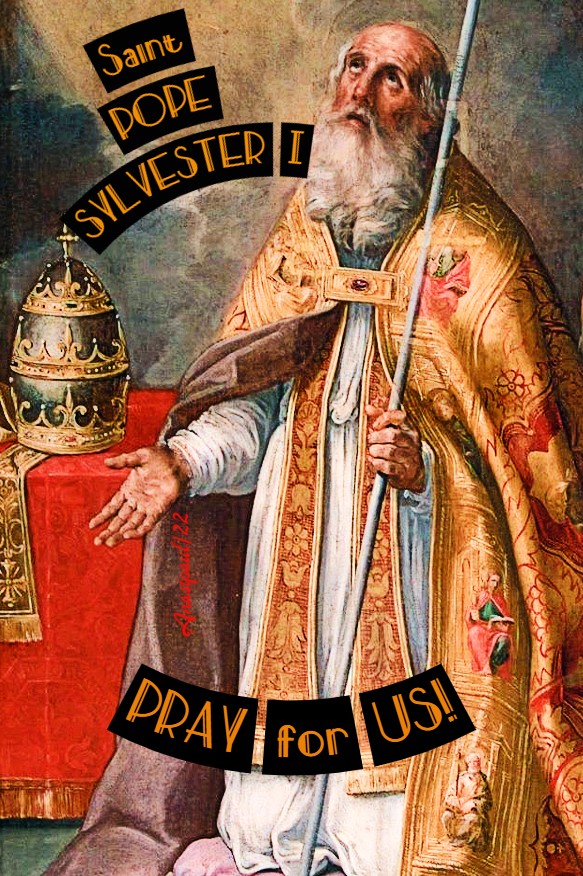
Saint of the Day – 20 July – St Jerome Emiliani (1486–1537) Confessor, Layman, Founder of the Somascan Fathers, Apostle of the poor, orphans, the sick, Catechist, Founder of countless Orphanages, Teaching institutions and Homes for converted street woman, Apostle of prayer. He was Beatified in 1747 by Pope Benedict XIV and Canonised in 1767 by Pope Clement XIII. Patronages – Orphans and Abandoned Children
Ca’Rezzonico – Cappella di Zianigo – San Girolamo Miani – Giandomenico Tiepolo
Jerome was bora at Venice, of the patrician family of the Emiliani and from his boyhood embraced a military life. At a time when the Republic was in great difficulty, he was placed in command of Castelnovo, in the territory of Quero, in the mountains of Tarviso. The fortress was taken by the enemy and Jerome was thrown, bound hand and foot, into a horrible dungeon. When he found himself thus destitute of all human aid, he prayed most earnestly to the Blessed Virgin, who mercifully came to his assistance. She loosed his bonds and led him safely through the midst of his enemies, who had possession of every road, till he was within sight of Tarviso. He entered the town; and, in testimony of the favour he had received, he hung up at the Altar of our Lady, to whose service he had vowed himself, the manacles, shackles and chains which he had brought with him.
On his return to Venice he gave himself with the utmost zeal to exercises of piety. His charity towards the poor was wonderful but he was particularly moved to pity, for the orphan children who wandered poor and dirty about the town. He received them into houses which he hired, where he fed them at his own expense and trained them to lead Christian lives.
At this time Blessed Cajetan and Peter Caraffa, who was afterwards Paul IV., disembarked at Venice. They commended Jerome’s spirit and his new institution for gathering orphans together. They also introduced him into the hospital for incurables, where he would be able to devote himself with equal charity to the education of orphans and to the service of the sick. Soon, at their suggestion, he crossed over to the Continent and founded orphanages, first at Brescia, then at Bergamo and Como. At Bergamo his zeal was specially prolific, for there, besides two orphanages, one for boys and one for girls, he opened a house, an unprecedented thing in those parts, for the reception of fallen women, who had been converted.
Finally he took up his abode at Somascha, a small village in the territory of Bergamo, near to the Venetian border and this he made his headquarters; here, too, he definitely established his Congregation, which, for this reason, received the name of Somasques. In course of time it spread and increased and, for the greater benefit of the Christian Republic, it undertook, besides the ruling and guiding of orphans and the taking care of Sacred buildings, the education, both secular and moral, of young men in Colleges, Academies and Seminaries.
Somasques. Italy
Pius V. enrolled it among religious Orders and other Roman Pontiffs have honoured it with privileges. Entirely devoted to his work of rescuing orphans, Jerome journeyed to Milan and Pavia and in both Cities, he collected numbers of children and provided them, through the assistance given him by noble personages, with a home, food, clothing and education. He returned to Somascha and, making himself all to all, he refused no labour which he saw might turn to the good of his neighbour. He associated himself with the peasants scattered over the fields and while helping them, with their work of harvesting, he would explain to them the mysteries of faith. He used to take care of children with the greatest patience, even going so far as to cleanse their heads and he dressed the corrupt wounds of the village folk, with such success, that it was thought he had received the gift of healing. In 1928 Pope Pius XI proclaimed St Jerome as the Universal Heavenly Patron of Orphans and abandoned children.
On the mountain which overhangs Somascha, he found a cave in which he hid himself and there, scourging himself, spending whole days fasting, passing the greater part of the night in prayer and snatching only a short sleep on the bare rock, he expiated his own sins and those of others. In the interior of this grotto, water trickles from the dry rock, obtained, as constant tradition says, by the prayers of the Servant of God. It still flows, even to the present day and being taken into different countries, it often gives health to the sick.
At length, when a contagious distemper was spreading over the whole valley and he was serving the sick and carrying the dead to the grave, on his own shoulders, he caught the infection and died at the age of fifty-six. His precious death, which he had foretold a short time before, occurred in the year 1537. He was illustrious both in life and death for many miracles. Benedict XIV. enrolled him among the Blessed,and Clement XIII. solemnly inscribed his name on the catalogue of the Saints.
Bl Anne Cartier St Ansegisus St Aurelius of Carthage St Bernward of Hildesheim St Cassian of Saint Saba St Elijah the Prophet
St Elswith St Frumentius of Ethiopia
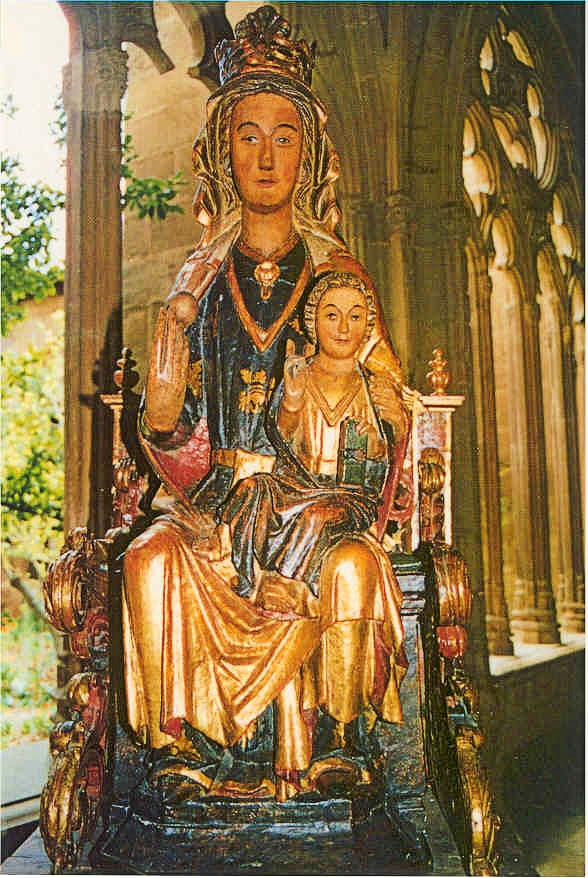
Blessed Gregory Lopez (1542-1596) “The Mystery Man” – Hermit, Spiritual Advisor, Writer. Around 1585, word of a “Mystery Man” began to leak into Mexico City, a strange hermit who lived out in the lonely valley of Guesteca, who walked miles to go to Mass, lived totally subject to “Lady Poverty” and had travelled from the Shrine of Our Lady of Guadalupe in Spain (which dates from 712), to her Shrine in Mexico (which dates from 1531). Biography: https://anastpaul.com/2018/07/20/saint-of-the-day-20-july-blessed-gregory-lopez-1542-1596/
St Joseph Barsabbas the Just (1st Century) Disciple of Jesus, Bishop, Martyr. The Roman Martyrology states today: “The birthday of the blessed Joseph, surnamed the Just, whom the Apostles selected with the blessed Matthias, for the Apostleshop in the place of the traitor, Judas. The lot having fallen upon Matthias, Joseph, notwithstanding, continued to preach and advance in virtue and after having sustained from the Jews, many persecutions for the Faith of Christ, happoily ended his life in Judea.” His Life and Death: https://anastpaul.com/2021/07/20/saint-of-the-day-20-july-saint-joseph-barsabbas-the-just-1st-century-disciple-of-jesus/
St Mère St Paul of Saint Zoilus St Rorice of Limoges St Severa of Oehren St Severa of Saint Gemma St Wulmar
Martyrs of Corinth – 22 Saints: 22 Christians who were Martyred together. We know nothing else about them but the names – • Appia • Calorus • Cassius • Celsus • Cyriacus • Donatus • Emilis • Felix • Fructus • Magnus • Maximus • Nestita • Partinus • Pasterus • Paul • Romanus • Spretus • Tertius • Theodolus • Ueratia • Valerian • Victor. They were martyred in Corinth, Greece.
Martyrs of Damascus – 16 Saints: 16 Christians who were Martyred together. We know the names of six of then, but no details about any of them – Cassia, Julian, Macrobius, Maximus, Paul and Sabinus. They were martyred in Damascus, Syria, date unknown.
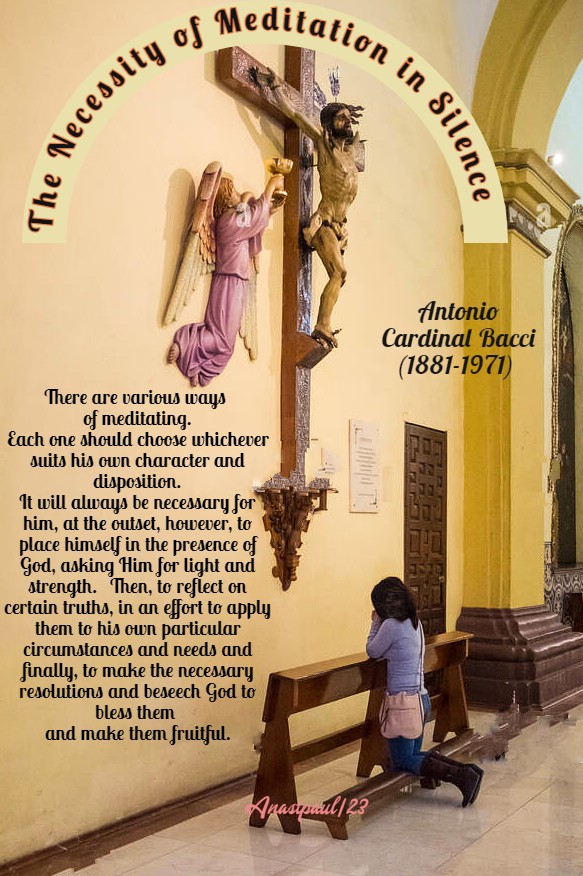
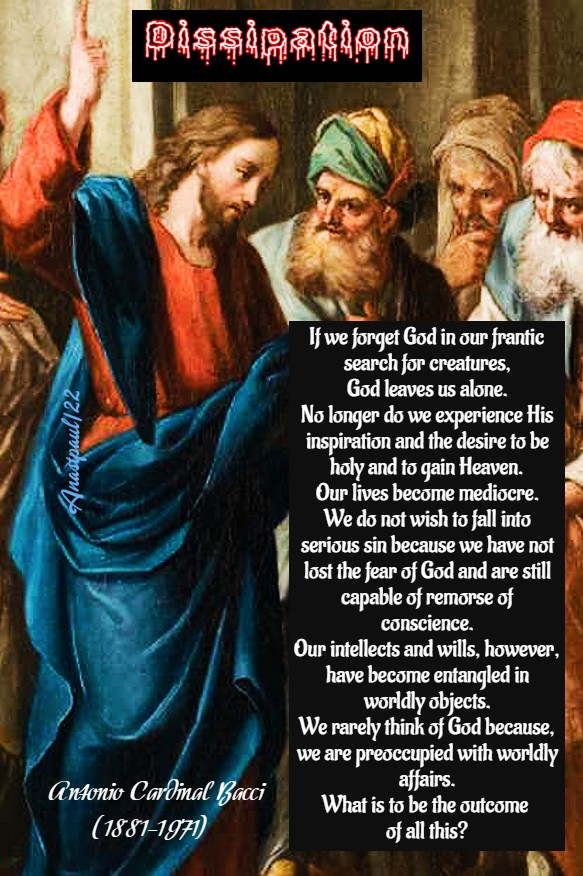
Thought for the Day – 19 July – Meditations with Antonio Cardinal Bacci (1881-1971)
The Voice of God – The Saints
“God speaks to us through His Saints.
The Saints are those in whom God dwells in such a special way that their entire personalities reflect Him. They live the Gospel perfectly. They have renounced themselves in order to belong completely to God. Not only have they overcome their evil inclinations but, they have conquered themselves in the process of that Christian annihilation which, sublimates human nature, rather than destroys it. They have enthroned God in the place of their own will and of their own ego, so that, like St Paul, they can claims: “It is no longer I that live but Christ lives in me.”
God still speaks to us through His Saints, for even in this troubled and [digital] age, there are pure and humble souls declared to God and the service of their fellowmen. Whenever we encounter one of these privileged beings, whether in the pages of a book [or online] or in our actual surrounding world, let us pay attention to them and do our best to imitate their virtues.”
Quote/s of the Day –19 July – The Memorial of St Vincent de Paul (1581-1660) Confessor
“Every time, that some unexpected event befalls us, be it affliction, or be it spiritual or corporal consolation, we should endeavour to receive it. with equanimity of spirit, since all comes from the Hand of God.”
“He who submits himself to God, in all thing, is certain that whatever men say or do, against him, will always turn to his advantage.”
“After knowing the Will of God, in regard to a work which we undertake, we should continue courageously, however difficult it may be. We should follow it to the end with as much constancy as the obstacles, which we encounter, are great.”
“We ought to have a special devotion to those saints who excelled in humility, particularly to the Blessed Virgin, Mary, who declares that the Lord regarded her on account of her humility.”
One Minute Reflection –19 July – “The Month of the Precious Blood” – The Memorial of St Vincent de Paul (1581-1660) Confessor – 1 Corinthians 4:9-14, Luke 10:1-9
“The Lord appointed seventy two others and sent them forth, two-by-two before Him, into every town and place, where He Himself was about to come.” – Luke 10:1
REFLECTION – “The names of the Apostles of the Saviour, are clear to everyone from the Gospels but no list of the seventy [two] disciples is in circulation anywhere. Some have said, to be sure, that Barnabas was one of them and the Acts of the Apostles and Paul writing to the Galatians, have made special mention of him. They say Sosthenes was of these as well. Together with Paul, he wrote to the Corinthians. Tradition also holds that Matthias, who was listed among the Apostles in place of Judas and Joseph Justus, who was honoured with him at the same casting of lots, were considered worthy of the same calling among the seventy [two]. They say that Thaddaeus was also one of them, about whom I shall presently relate a story which has come down to us. On observation, you would find that the disciples of the Saviour appear to have been more than the seventy. Paul says that after the Resurrection from the dead, Cephas saw Him first, then the Twelve. After these saw Him, He was seen by more than five hundred brothers all at once, some of whom he says, had fallen asleep, although the majority were still alive at the time that this account was being composed by him.” – St Eusebius of Caesarea (c 260-339) Bishop of Caesarea, Historian, Theologian, Father (Ecclesiastical History 1.)”
PRAYER – O God, Who endowed St Vincent with apostolic strength, to preach the Gospel to the poor and to enhance the dignity of clerical life; grant, we beseech Thee, that we. who honour his holy merits, may also conform to the example of his virtues. Through Jesus Christ, Thy Son our Lord, Who lives and reigns with Thee, in the unity of the Holy Ghost, God, world without end. Amen (Collect).
Our Morning Offering – 19 July – “The Month of the Most Precious Blood” and the Memorial of St Vincent de Paul (1581-1660) Confessor
Lord, Teach me How to Pray By St Vincent de Paul
Oh Lord, You selected the poor and simple people to be Your Apostles. Look upon Your poor servant kneeling before You now. I recognise that I am simple and poor too. Dear Lord, please teach me how to pray as You taught Your disciples upon their humble request. If it pleases You in Your goodness to grant me that grace, I shall be able to pray well and much better than I could ever hope for if left to my own efforts. Lord, I trust that You will bless me with the fulfilment of this request. Amen
Saint of the Day – 19 July – St Vincent de Paul (1581-1660) Confessor. “Holy Hero of Divine Charity.” The Roman Martyrology states of him today: “St Vincent de Paul, Confessor, who slept in the Lord on 27 September, Leo XIII declared the Heavenly Patron before the Thron of God, of all Charitable Organisations throughout the Catholic world, owing in any manner, their origin to him.” Vincent’s body was exhumed in 1712, 53 years after his death. The written account of an eyewitness states that “the eyes and nose alone showed some decay“. However, when it was exhumed again during the Canonisation in 1737, it was found to have decomposed due to an underground flood . His bones have been encased in a waxen figure which is displayed in a glass Reliquary in the Chapel of the headquarters of the Vincentian fathers in Paris,
St Vincent de Paul (1581-1660) Confessor, Founder of the Congregation of the Mission (Vincentians) and Co-Founder of the Sisters of Charity, is an outstanding example of great love for the poor and unfortunate and the Celestial Patron of all Catholic Charitable Societies. (added by Pope Leo XIII). By Fr Francis Xavier Weninger SJ (1805-1888)
Vincent de Paul, a Frenchman, was born at Pouy, not far from Dax, in Gascony and from his boyhood, was remarkable for his exceeding charity towards the poor. From the care of his father’s flocks, he was sent to study letters. He learned the humanities at Dax and Theology first at Toulouse, then at Saragossa. Having been Ordained Priest and having taken a Degree in Theology, he fell into the hands of the Turks and was led captive by them, into Africa. But being sold into slavery, he won his owner (an apostate) back to Christ. By the help of the Mother of God, therefore, Vincent and his owner hurried away from the shores of the barbarians. Then Vincent undertook a journey to Rome, to visit the thresholds of the Apostles.
Having returned to France, he governed, in a most saintly manner, first, the Parish of Clichy and then, that of Chatillon. He was appointed by the King as Principal Chaplain of the French galleys and showed marvellous zeal in striving for the salvation of both the drivers and the rowers. The holy Francis de Sales, appointed him Superior of the Nuns of the Visitation, whom he ruled for nearly forty years, with so great prudence that he amply justified the opinion of their most holy Founder, who confessed that he knew no worthier Priest than Vincent.
To the preaching of the Gospel unto the poor, especially to the country people, he devoted himself unweariedly, until he was disabled by old age. To this apostolic work he obligated both himself and the members of the Congregation, which he specially founded under the name of Secular Priests of the Mission, by a perpetual vow confirmed by the Holy See. And how greatly he laboured for bettering the discipline of the clergy, is attested by the Seminaries erected for senior clerics, by the frequency of sacred conferences among the Priests and by the religious exercises preparatory to the Sacrament of Holy Orders; for which purposes, as well as that of giving pious retreats for laymen, he desired that the Houses of his Institute, should be freely opened. Moreover, for the extension of faith and piety, he sent evangelical labourers, not only into the Provinces of France but also into Italy, Poland, Scotland, Ireland and even to Barbary and to the Indies.
And at the death of Louis XIII, whom he had attended and exhorted on his deathbed, Vincent himself was summoned by the Queen, Anne of Austria, mother of Louis XIV and made a member of the young King’s Council of Conscience. In this position, he most zealously urged that only the more worthy men should be placed in authority over the Churches and Monasteries; that civil discords, single combats, slowly-spreading false doctrines, which he both perceived and dreaded, should be ended; and that due obedience should be rendered by all, to the apostolic decisions.
There was no kind of misfortune which he did not, with fatherly tenderness, endeavour to relieve . The faithful groaning beneath the Turkish yoke, infants which had been abandoned, wayward youths, maidens exposed to danger, Nuns driven from their Convents, fallen women, convicts condemned to the galleys, infirm strangers, disabled workmen and even lunatics and beggars without number, all these he received and devoutly assisted with resources and in hospices, which have lasted to this day. When Lorraine, Champagne, Picardy and other Provinces were devastated by plague, famine and war, he relieved their necessities with an open hand. He founded many societies for seeking out and alleviating the lot of the wretched, among them, a celebrated association of matrons, widely spread under the name of Sisters of Charity. He likewise promoted the foundation of the Daughters of the Cross, of Providence and of St Genevieve, for the education of the weaker sex.
Amid these and other most important affairs, he was ever intent upon God, affable to everyone and always true to himself, simple, upright, lowly and ever shrank from honours, riches and luxuries. He was heard to say that in nothing was there any pleasure for him, except in Christ Jesus, Whom he desired to imitate in all things.
At length, worn out with bodily pains, labours and old age, on 27 September in the year of salvation 1660 and, in the eighty-fifth year of age, at Paris, in the House of St Lazare, which is the Motherhouse of the Congregation the Mission, he calmly fell asleep.
Since he became illustrious for virtues, merits and miracles, Clement XII placed him among the Saints, assigning 19 July as his annual feast. And Leo XIII, at the earnest request of many Bishops, claimed and appointed this notable hero of divine charity, who has deserved so exceedingly well, of every class of men, the special Patron before God, of all the Charitable Societies existing in the entire Catholic world and in any way soever, emanating from his foundation.
St Vincent de Paul CM (1581-1660) Confessor, known as the “Great Apostle of Trumpets” – Priest, Founder, Apostle of Charity, Doctor of Canon Law, Reformer of Society and Priests, founder of Hospital and Orphanages. St Vincent was Beatified on 13 August 1729 by Pope Benedict XIII and Canonised on 16 June 1737 by Pope Clement XII. His Body is incorrupt. Biography: https://anastpaul.com/2017/09/27/saint-of-the-day-27-september-st-vincent-c-m-1581-1660/
St Ambrose Autpertus Bl Antonio of Valladolid St Aurea of Cordoba
St Arsenius the Great (c 354-c 449) Deacon, Hermit, Desert Father, Theologian, writer. Arsenius one of the most highly regarded of the Desert Fathers, whose teachings were greatly influential on the development of asceticism and the contemplative life. His contemporaries so admired him as to surname him “the Great”. His Lifestory: https://anastpaul.com/2021/07/19/saint-of-the-day-19-july-saint-arsenius-the-great-c-354-c-449/
Bl Bernhard of Rodez St Daria of Constantinople St Epaphras of Colosse St Felix of Verona
St Macrina the Younger (c 327-379) Virgin, Ascetic. With charm and grace, St Macrina ruled the roost in a family of saints. St Basil the Elder and St Emmelia, her parents, had ten children including the younger St Basil the Great (329-379) Father and Doctor of the Church, St Gregory of Nyssa (c 335–C 395) Father of the Church and St Peter of Sebaste Bishop (c 340–391). As the eldest child, Macrina exercised a formative influence on her more famous brothers and even on her mother. Her Life: https://anastpaul.com/2019/07/19/saint-of-the-day-19-july-saint-macrina-the-younger-c-327-379/
St Martin of Trier St Michael the Sabaitè Bl Pascasio of Lyon
St Romain of Ryazan St Pope Symachus St Vicente Cecilia Gallardo
Martyrs of Meros – 3 Saints: Three Christians tortured and Martyred together in the persecutions of emperor Julian the Apostate and governor Almachio. We know nothing else about them but the names – Macedoniuis, Tatian and Theodule. They were burned to death on an iron grill in Meros, Phrygia (in modern Turkey).
Martyrs of China: 3 Beati Elisabeth Qin Bianshi Elisabeth Ioannes Baptista Zhu Wurui Simon Qin Chunfu
Thought for the Day – 18 July – Meditations with Antonio Cardinal Bacci (1881-1971)
Everlasting Salvation
“More than anything else, it is necessary to look after our eternal salvation. In comparison with this, all other business is unimportant. Our personal salvation is the only thing which is absolutely essential in our lives. Let us meditate on this momentous fact which has converted so many sinners and filled Heaven with Saints.
If I lose my soul, what use will ,money or success be to me? What good will be human learning or worldly pleasure? All this will pass away, whereas only my good actions will weigh the balance of Divine Justice in my favour.
Let us think of our sins, which are unfortunately so numerous and of our good actions, which are probably far fewer in number. It will be tragic for us if the weight of our sins should carry us towards damnation. It is still in our power, to guard against this by leading lives of penance and sanctity. “Strive … by good works, to make your calling and election sure” (2 Pet 1:10).”
Quote/s of the Day – 18 July – “The Month of the Precious Blood” – St Camillus de Lellis MI (1550-1614) Confessor, Priest and Founder the Order of the Ministers of the Sick, or simply as the “Camillians,” known as “The Giant of Charity.”
“My hope is placed in Your Divine Mercy through Your Precious Blood.”
“I do not put a penny’s value on this life if only our Lord will give me a tiny corner in Paradise.”
“The happiness to which I aspire is greater than anything on earth. Therefore, I regard with extreme joy, whatever pains and sufferings may befall me here.”
One Minute Reflection – 18 July – “The Month of the Precious Blood” – St Camillus de Lellis MI (1550-1614) Confessor, Priest and Founder the Order of the Ministers of the Sick, or simply as the “Camillians,” known as “The Giant of Charity.” – 1 John 3:13-18, John 15:12-16
“This is My commandment, that you love one another as I have loved you.” – John 15:12
REFLECTION – “This commandment that He is giving them, is a new one, the Lord Jesus tells ,is disciples. Yet was it not contained in the Old Law, where it is written: You shall love your neighbour as yourself? Why does the Lord call it new, when it is clearly so old? Or is the commandment new because it divests us of our former selves and clothes us with the new man? Love does indeed renew the man who hears, or rather obeys its command but only that love, which Jesus distinguished from a natural love, by the qualification – As I have loved you.
This is the kind of love that renews us. When we love as He loved us, we become new men, heirs of the new covenant and singers of the new song. My brothers, this was the love, which even in bygone days, renewed the holy men, the Patriarchs and Prophets of old. In later times, it renewed the blessed Apostles and now, it is the turn of the Gentiles. From the entire human race throughout the world, this love gathers together into One Body, a new people, to be the Bride of God’s Only Son. She is the Bride of whom it is asked in the Song of Songs: Who is this who comes clothed in white? White indeed are her garments, for she has been made new and the source of her renewal, is none other, than this new commandment.
And so, all her members make each other’s welfare their common care. When one member suffers, all the members suffer with him and if one member is glorified, all the rest rejoice. They hear and obey the Lord’s Words: A new commandment I give you, that you love one another, not as men love one another for their own selfish ends, nor merely on account of their common humanity but because. they are all gods and sons of the Most High. They love one another as God loves them, so that they may be brothers of His only Son. He will lead them to the goal that alone will satisfy them, where all their desires will be fulfilled. For when God is all in all, there will be nothing left to desire.
This love is the gift of the Lord who said: As I have loved you, you also must love one another. His object in loving us, then, was to enable us to love each other. By loving us Himself, our mighty Head has linked us all together, as members of His Own Body, bound to one another by the tender bond of love.” – St Augustine (354-430) Bishop of Hippo, Great Western Father and Doctor of the Grace, (Excerpt from his Tractates on the Gospel of John, 65).
PRAYER – O God, Who endowed St. Camillus with a special gift of charity for the help of souls struggling in their final agony, pour upon us, we beseech Thee, by his merits, the spirit of Thy love, so that at the hour of our death, we may be found worthy to overcome the enemy and attain the heavenly crown. Through Jesus Christ, Thy Son our Lord, Who lives and reigns with Thee, in the unity of the Holy Ghost, God, world without end. Amen (Collect).
Our Morning Offering – 18 July – “The Month of the Most Precious Blood”
Pardon Lord, I Ask By St Ambrose (340-397) Father and Doctor of the Church
Lord Jesus Christ, Who stretched out Your Hands on the Cross and redeemed us by Your Blood, forgive me, a sinner , for none of my thoughts are hidden from You. Pardon I ask, Pardon I hope for, Pardon I trust to have. You, Who are full of pity and mercy, spare me and forgive. Amen
Saint of the Day – 18 July – St Scariberga of Yvelines (c 495-c 550) Chaste wife and widow of St Arnulf of Bishop of Tours, Recluse. Born in c 495 in Gaul (in modern France) and died in c 550 in the forest of Yvelines in France of natural causes. Also known as – Scariberg, Scariberge.
The holy Scariberga was born around 495 in Gaul. She was descended from a noble family and the sources call her a niece of the first Christian Frankish King, Clovi I (481-511).
While still young, her uncle married her to Saint Arnulf , later the Bishop of Tours and Martyr. When Arnulf became a Bishop, he also gave his chaste wife, Scariberg, the veil.
When Arnulf was murdered in 535, she had him buried at the place where his Martyrdom had happened, in the forest Yvelines in Aquilina between Paris and Chartres. Over his grave she built a cell, where she lived the rest of her life in prayer and meditation.
She died around the middle of the 5th century. Her memorial day is today, the same day as her husband but 2 October is also mentioned.
Around Arnulf’s tomb grew the present Municipality of Saint-Arnoult-en-Yvelines in the department of Yvelines in the Île-de-France region.
St Symphorosa and her seven sons / Also known as – The Martyrs of Tivoli – 8 Saints: A widow, St Symphorosa and her seven sons ( Crescens, Eugene, Julian, Justin, Nemesius, Primitivus and Stracteus) Martyred in Tivoli, Italy in the 2nd-century persecutions of Hadrian.
St Aemilian of Dorostorium St Alanus of Sassovivo St Alfons Tracki Blessed Angeline of Marsciano Bl Arnold of Amiens St Arnold of Arnoldsweiler St Arnoul the Martyr
St Goneri of Treguier St Gundenis of Carthage Bl Herveus St Marina of Ourense St Maternus of Milan St Minnborinus St Pambo of the Nitrian Desert St Philastrius of Brescia St Rufillus of Forlimpopoli
St Scariberga of Yvelines (c 495-c 550) Chaste wife of St Arnulf of Bishop of Tours, Nun, Recluse.
Martyrs of Silistria – 7 Saints: Seven Christians who were Martyred together. No details about them have survived but the names – Bassus, Donata, Justus, Marinus, Maximus, Paulus and Secunda. They were martyred in Silistria (Durostorum), Moesia (in modern Bulgaria), date unknown.
Thought for the Day – 17 July – Meditations with Antonio Cardinal Bacci (1881-1971)
The Humility of Mary
“O Holy Mary, you were humble in life, even though you were the Mother of God. Obtain for me too, the difficult virtue of humility. I know that it is the basis of all the virtues and draws the grace of God. You see how much I need to be humble. Grant that God may be the centre of my mind and of my heart. Grant that His glory may be, the object of all my actions and desires and the chief purpose of my life. Amen.”
Quote/s of the Day – 17 July – The Sixth Sunday after Pentecost – The Humility of Mary
“True humility scarcely ever utters words of humility.”
“Humility, makes our lives acceptable to God, meekness, makes us acceptable to men.”
“Humility is not just about self-mistrust but about the entrusting of ourselves to God. Distrusting ourselves and our own strength produces trust in God and from that trust, generosity of soul is born.”
The most holy Virgin, Our Lady, gave us an outstanding example of this when she spoke these words: “Behold I am the handmaid of the Lord, let it be done to me according to your word” (Lk 1:38). When she said she was the handmaid of the Lord, she was performing the greatest act of humility it is possible to do and, all the more so, in that she was contradicting the praise given her by the angel – that she would be mother of God, t hat the child to be born from her womb would be called Son of the Most High, a greater dignity than any we might imagine – I say, she opposed her lowliness and unworthiness to all these praises and greatness, by saying t hat she was the handmaid of the Lord.”
One Minute Reflection – 17 July – “The Month of the Precious Blood” – The Humility of Mary – Romans 6:3-11, Mark 8:1-9
“If I send them away to their homes fasting, they will faint on the way,” – Mark 8:3
REFLECTION – “Lord Jesus, how well I know You have no wish to allow these people here with me, to remain hungry but to feed them with the food You distribute and so, strengthened with Your food, they will have no fear of collapsing from hunger. I know, too that You have no wish to send us away hungry, either… As You have said: you do not wish them to collapse on the way, meaning, to collapse in the byways of this life, before reaching the end of the road, before coming to the Father and understanding, that You come from the Father…
Our Lord takes pity, then, so that none may collapse along the way… Just as He makes it rain on the just, as well as the unjust, (Mt 5,45) so He feeds the just ,as well as the unjust. Was it not thanks to the strength of the food that the holy prophet Elijah, when he was collapsing on the way, was able to walk for forty days? (1Kgs 19,8). It was an Angel who gave that food to him but, in your case, it is Christ Himself Who feeds you. If you preserve the food you have received in this way, then you will walk, not forty days and forty nights… but for forty years, from your departure from the borders of Egypt, to your arrival in the land of plenty, the land where milk and honey flow (Ex 3,8)…
And so, Christ shares out the foodstuffs and, there is no question, he wants to give it to all. He withholds it from no-one, for He provides for everyone. Nevertheless, when He breaks the loaves and gives them to the disciples, unless you hold out your hands to receive your portion, you will collapse along the way… This bread that Jesus breaks, is the Mystery of the Word of God: it increases as it is distributed. With only a few words, Jesus has provided abundant nourishment for all peoples. He has given us His Words as bread and, while we are tasting them, they increase in our mouths… Even as the crowds are eating, the pieces increase and become more numerous, to such an extent that, in the end, the leftovers are even more plentiful than the loaves that were shared.” – St Ambrose (340-397) Bishop of Milan, Father and Doctor of the Church (Commentary on the Gospel of Saint Luke VI, 73-88).
PRAYER – Grant, we beseech Thee, O Lord God, unto all Thy servants, that they may remain continually in the enjoyment of soundness both of mind and body and, by the glorious intercession of the Blessed Mary, always a Virgin, maybe delivered from present sadness and enter into the joy of Thine eternal gladness.ThroughJesus Christ, Thy Son our Lord, Who lives and reigns with Thee, in the unity of the Holy Ghost, God, world without end. Amen (Collect).
Our Morning Offering – 17 July – The Sixth Sunday after Pentecost – The Humility of Mary
Make Me Like Yourself, Mary My Mother By St Louis-Marie de Montfort (1673-1716)
My powerful Queen, you are all mine, through your mercy and I am all yours. Take away from me, all that may displease God and cultivate in me, all that is pleasing to Him. May the light of your faith, dispel the darkness of my mind, your deep humility, take the place of my pride, your continual sight of God, fill my memory, with His Presence. May the love of your heart inflame the lukewarmness, of mine. May your virtues, take the place of my sins. May your merits, be my enrichment and make up for all which is wanting in me, before God. My beloved Mother, grant that I may have, no other spirit but your spirit, to know Jesus Christ and His Divine Will and to praise and glorify the Lord, that I may love God, with burning love like yours. Amen
By St Alphonsus Maria de Liguori (1696-1787) Most Zealous Doctor of the Church The Humility of Mary Excerpt from: “The Glories of Mary”
“Humility” says St. Bernard, “is the foundation and guardian of virtues” and with reason, for without it, no other virtue can exist in a soul. Should she possess all virtues, all will depart when humility is gone. But, on the other hand, as St Francis de Sales wrote to St Jane Frances de Chantal, “God so loves humility, that whenever He sees it, He is immediately drawn there.” This beautiful and so necessary virtue, was unknown in the world but the Son of God Himself came upon the earth, to teach it by His Own example and willed that in that virtue, in particular, we should endeavour to imitate Him – “Learn of Me, for I am meek and humble of heart.”
Mary, being the first and most perfect disciple of Jesus Christ, in the practice of all virtues, was the first also in that of humility and by it, merited to be exalted above all creatures. It was revealed to St. Matilda that the first virtue in which the Blessed Mother particularly exercised herself, from her very childhood, was that of humility.
The first effect of humility of heart is a lowly opinion of ourselves: – “Mary had always so humble an opinion of herself, that,” as it was revealed to the same St Matilda, “although she saw herself enriched with greater graces, than all other creatures, she never preferred herself to anyone.” The Abbot Rupert, explaining the passage of the Sacred Canticles, Thou hast wounded my heart, my sister, my spouse, …with one hair of thy neck, [Cant. 4:9] says, that the humble opinion, which Mary had of herself, was precisely that hair of the Spouse’s neck, with which she wounded the heart of God.” Not indeed that Mary considered herself a sinner: for humility is truth, as St Teresa remarks and Mary knew that she had never offended God: nor was it that she did not acknowledge that she had received greater graces from God, than all other creatures; for a humble heart always acknowledges the special favours of the Lord, to humble herself the more but the Divine Mother, by the greater light wherewith she knew the infinite greatness and goodness of God, also knew, her own nothingness and, therefore, more than all others, humbled herself, saying with the Sacred Spouse – Do not consider that I am brown, because the sun hath altered my colour. [Cant. 1:5] That is, as St Bernard explains it, “When I approach Him, I find myself black.” “
Yes,” says St Bernardine, for “the Blessed Virgin had always the majesty of God and her own nothingness, present to her mind.” As a beggar, when clothed with a rich garment, which has been bestowed upon her, does not pride herself on it, in the presence of the giver but is rather humbled, being reminded thereby, of her own poverty, so also, the more Mary saw herself enriched, the more did she humble herself, remembering that all was God’s gift; whence she herself told St Elizabeth of Hungary, that “she might rest assured that she looked upon herself, as most vile and unworthy of God’s grace.” Therefore, St Bernardine says, that “after the Son of God, no creature in the world was so exalted as Mary because, no creature in the world ever humbled itself, as much as she did.”
Moreover, it is an act of humility to conceal heavenly gifts. Mary wished to conceal from St Joseph, the great favour whereby she had become the Mother of God, although it seemed necessary to make it known to him, if only to remove from the mind of her poor spouse, any suspicions as to her virtue, which he might have entertained on seeing her pregnant: or, at least the perplexity, in which it indeed threw him: for St. Joseph,, on the one hand, unwilling to doubt Mary’s chastity and on the other, ignorant of the Mystery, was minded to put her away privately. [Matt. 1:19] This he would have done, had not the Angel revealed to him that his Spouse was pregnant by the operation of the Holy Ghost.
Again, a soul that is truly humble refuses her own praise and should praises be bestowed on her, she refers them all to God. Behold, Mary is disturbed at hearing herself praised by St Gabriel and when St Elizabeth said, Blessed art thou among women … and whence is this to me, that the Mother of my Lord should come to me? … blessed art thou that hast believed, [ Luke 1:42] Mary referred all to God, and answered in that humble Canticle, My soul doth magnify the Lord, [Ibid., 46-47] as if she had said: “Thou dost praise me, Elizabeth but I praise the Lord, to Whom alone honour is due, thou wonders that I should come to thee and I wonder at the Divine Goodness in which alone my spirit exults” and my spirit hath rejoiced in God my Saviour.Thou praisest me because I have believed; I praise my God because He hath been pleased to exalt my nothingness: because He hath regarded the humility of His handmaid. Hence Mary said to St Bridget: “I humbled myself so much and thereby, merited so great a grace because I though, and knew, that of myself I possessed nothing. For this same reason I did not desire to be praised, I only desired that praises should be given to the Creator and Giver of all.” Wherefore, an ancient author, speaking of the humility of Mary, says: “O truly blessed humility, which hath given God to men, opened Heaven and delivered souls from Hell.“
It is also a part of humility to serve others. Mary did not refuse to go and serve Elizabeth for three months. Hence St Bernard says, “Elizabeth wondered that Mary should have come to visit her but that which is still more admirable, is that she came, not to be ministered to but to minister.”
Those who are humble are retiring and choose the last places and, therefore, Mary, remarks St Bernard, when her Son was preaching in a house, as it is related by St Matthew, [12:46], wishing to speak to Him, would not, of her own accord, enter but “remained outside and did not avail herself of her maternal authority to interrupt Him.” For the same reason, when she was with the Apostles awaiting the coming of the Holy Ghost, she took the lowest place, as St Luke relates, All these were persevering with one mind in prayer, with the women, and Mary, the Mother of Jesus. [Acts 1:14] Not that St Luke was ignorant of the Divine Mother’s merits, on account of which, he should have named her in the first place but because she had taken the last place amongst the Apostles and women and, therefore, he described them all, as an author remarks, in the order in which they were. Hence St. Bernard says, “Justly has the last become the first, who being the first of all became the last.”
In fine, those who are humble, love to be contemned, therefore, we do not read that Mary showed herself in Jerusalem on Palm Sunday, when her Son was received by the people with so much honour but, on the other hand, at the Death of her Son, she did not shrink from appearing on Calvary, through fear of the dishonour which would accrue to her, when it was known that she was the Mother of Him Who was condemned to die an infamous death, as a criminal. Therefore, she said to St Bridget, “What is more humbling than to be called a fool, to be in want of all things and to believe one’s self, the most unworthy of all? Such, O daughter, was my humility, this was my joy, this was all my desire, with which I thought how to please my Son alone.”
The Venerable Sister Paula of Foligno was given to understand, in an ecstasy, how great was the humility of our Blessed Lady and giving an account of it to her Confessor, she was so filled with astonishment at its greatness that she could only exclaim, “O, the humility of the Blessed Virgin! O, Father, the humility of the Blessed Virgin, how great was the humility of the Blessed Virgin! In the world there is no such thing as humility, not even in its lowest degree, when you see the humility of Mary.” On another occasion our Lord showed St Bridget two ladies. The one was all pomp and vanity. “She,” He said, “is Pride but the other one, whom you see with her head bent down, courteous towards all, having God alone in her mind and considering herself as no -ne, is Humility: her name is Mary.” Hereby God was pleased to make known to us that the humility of His Blessed Mother, was such that she was humility itself.
Then, O my Queen, I can never be really thy child, unless I am humble but dost thou not see that my sins, after having rendered me ungrateful to my Lord, have also made me proud? O my Mother, do thou supply a remedy. By the merit of thy humilit, obtain that I may be truly humble and thus become thy child, Amen.
Martyrs of Compiegne (16 Carmelite Beati): Sixteen Blessed Teresian Martyrs of Compiègne. Eleven Discalced Carmelite nuns, three lay sisters and two lay women servants who were Martyred together in the French Revolution. They were the earliest martyrs of the French Revolution that have been recognised. • Angelique Roussel • Anne Pelras • Anne-Marie-Madeleine Thouret • Catherine Soiron • élisabeth-Julitte Vérolot • Marie Dufour • Marie Hanniset • Marie-Anne Piedcourt • Marie-Anne-Françoise Brideau • Marie-Claude-Cyprienne Brard • Marie-Françoise de Croissy • Marie-Gabrielle Trezel • Marie-Geneviève Meunier • Marie-Madeleine-Claudine Lidoine • Rose-Chretien de Neuville • Thérèse Soiron • They were guillotined on 17 July 1794 at the Place du Trône Renversé (modern Place de la Nation) in Paris, France. The 16 Martyrs Story: https://anastpaul.com/2017/07/17/saints-of-the-day-17-july-the-carmelite-martyrs-of-compiegne-o-c-d/
Bl Arnold of Himmerod Bl Bénigne Bl Biagio of the Incarnation
Bl Carlos de Dios Murias OFM Conv (1945-1976) Priest Martyr St Clement of Ohrid St Cynllo St Ennodius of Pavia St Fredegand of Kerkelodor St Generosus St Gorazd St Hyacinth of Amastris St Kenelm St Pope Leo IV St Marcellina St Nerses Lambronazi Bl Sebastian of the Holy Spirit Bl Tarsykia Matskiv St Theodosius of Auxerre St Theodota of Constantinople St Turninus
Martyrs of Scillium (12 Saints): A group of twelve Christians Martyred together, the final deaths in the persecutions of Emperor Marcus Aurelius. Upon their conviction for the crime of being Christians, the group was offered 30 days to reconsider their allegiance to the faith; they all declined. Their official Acta still exist. Their names : • Acyllinus • Cythinus • Donata • Felix • Generosa • Januaria • Laetantius • Narzales • Secunda • Speratus • Vestina • Veturius They were beheaded on 17 July 180 in Scillium, Numidia (in North Africa).
Thought for the Day – 16 July – Meditations with Antonio Cardinal Bacci (1881-1971)
Accepting the Will of God
“Let us pray fervently to God for spiritual peace. Let us surrender ourselves to His Will and accept everything from His Hands, remembering that everything, joy and sorrow, sickness and health, temptation and spiritual consolation, should form a mystical ladder which will gradually bring us nearer to Heaven and finally unite us to God for evermore. Everything passes but God is unchangeable.
Sufferings have to end but the merits we gain remain, if we have offered our afflictions to God. Let us surrender ourselves completely into the hands of God, Who in His goodness, gives us some happiness on earth for our consolation and causes us to suffer, so that we may be purified and made holy.”
Quote/s of the Day – 16 July – Our Lady of Mount Carmel – Ecclesiasticu, Sirach 24:23-31, Luke 11:27-28
“Blessed is the womb that bore You …”
Luke 11:27
“That anyone could doubt the right of the holy Virgin to be called the Mother of God, fills me with astonishment. Surely she must be the Mother of God, if our Lord Jesus Christ is God and she gave birth to Him!?”
Hail, O Mary, Mother of God By St Cyril of Alexandria (376-444) Father & Doctor of the Church
Hail, O Mary, Mother of God, Virgin and Mother! Morning Star, perfect vessel. Hail, O Mary, Mother of God, Holy Temple in which God Himself was conceived. Hail, O Mary, Mother of God, Chaste and pure dove. Hail, O Mary, Mother of God, who enclosed the One Who cannot be encompassed in your sacred womb. Hail, O Mary, Mother of God, From you flowed the true light, Jesus Christ, our Lord. Hail, O Mary, Mother of God, Through you the Conqueror and triumphant Vanquisher of hell, came to us. Hail, O Mary, Mother of God, Through you, the glory of the Resurrection blossoms. Hail, O Mary, Mother of God, You have saved every faithful Christian. Hail, O Mary, Mother of God, Pray for us sinners now and at the hour of our death. Amen
St Cyril of Alexandria (376-444)
“Wherefore, in the same holy bosom of His most chaste Mother, Christ took to Himself flesh and united to Himself, the spiritual Body formed by those who were to believe in Him. Hence Mary, carrying the Saviour within her, may be said, to have also carried, all those. whose life was contained in the life of the Saviour. Therefore, all we who are united to Christ and, as the Apostle says, are members of His body, of His flesh and of His bones (Eph 5:30), have issued from the womb of Mary, like a body united to it’s head.”
One Minute Reflection – 16 July – Our Lady of Mount Carmel – Ecclesiasticu, Sirach 24:23-31, Luke 11:27-28
“Blessed are they who hear the word of God and keep it.” – Luke 11:28
REFLECTION – “If you say, “Show me your God,” I will say to you, “Show me what kind of person you are and I will show you my God.” Show me then whether the eyes of your mind, can see and the ears of your heart, hear.
It is like this. Those who can see with the eyes of their bodies, are aware of what is happening in this life on earth. They get to know things that are different from each other. They distinguish light and darkness, black and white, ugliness and beauty, elegance and inelegance, proportion and lack of proportion, excess and defect. The same is true of the sounds we hear: high or low or pleasant. So it is with the ears of our heart and the eyes of our mind, in their capacity to hear or see God.
God is seen by those who have the capacity to see Him, provided that they keep the eyes of their mind open. All have eyes but some have eyes that are shrouded in darkness, unable to see the Light of the Sun. Because the blind cannot see it, it does not follow that the sun does not shine. The blind must trace the cause back to themselves and their eyes . In the same way, you have eyes in your mind that are shrouded in darkness because of your sins and evil deeds. …
But if you will, you can be healed. Hand yourself over to the Doctor, and He will open the eyes and ears of your mind and heart. Who is to be the Doctor? It is God, Who heals and gives life through His Word and Wisdom. … ” – St Theophilus of Antioch (Died c 185) Bishop of Antioch, Confessor, Apologist, Father (An excerpt from: A Book addressed to Autolycus).
PRAYER – O God, Who honoured the Order of Carmel with the special title of the most blessed Mary, ever Virgin, Thy Mother, graciously grant, that we, who this day honour her commemoration with solemn rites, defended by her care, may be found worthy to attain everlasting happiness.Through the same Jesus Christ, Who lives and reigns with God the Father, in the unity of the Holy Spirit, God, world without end. Amen (Collect).
Our Morning Offering – 16 July – Our Lady of Mount Carmel “Mary’s Day”
“The Flos Carmeli The Flower of Carmel” By St Simon Stock (1165-1265)
O most beautiful Flower of Mount Carmel, fruitful vine, splendour of Heaven, Blessed Mother of the Son of God, Immaculate Virgin, assist me in this my necessity. O Star of the Sea, help me and show me herein that thou art my Mother. O Holy Mary, Mother of God, Queen of Heaven and earth, I humbly beseech thee from the bottom of my heart, to succour me in this my necessity. There are none that can withstand thy power. O show me herein, that thou art my Mother. Amen.
O Mary, conceived without sin, pray for those who have recourse to thee. (Repeat three times)
Sweet Mother, I place this cause in thy hands. (Repeat three times)
This prayer, the “Flos Carmeli” (“The Flower of Carmel”), was composed by St Simon Stock (1165-1265), a Carmelite, so-called because he and other members of his order lived atop Mount Carmel in the Holy Land. St Simon Stock was visited by the Blessed Virgin Mary on 16 July 1251, at which time, she bestowed upon him a scapular, or habit, (commonly called “the Brown Scapular”), which became part of the liturgical clothing of the Carmelite order Oral tradition tells of St Simon Stock praying, with a passionate intensity to Our Lady of Mount Carmel, during a time of great distress and hardship for the Order. With fervour and faith, he prayed his prayer, the Flos Carmeli for the first time. And Our Lady answered his prayer. Thus, for seven centuries the Flos Carmeli continues to be prayed to the Blessed Mother with the firm faith that she she will answer its request with her powerful help.
Saint of the Day – 16 July – Saint Fulrad of Saint Denis (c 710-784) Abbot of Saint Denis Monastery, Chaplin and Counsellor of both King Pippin the Younger and King and Emperor Charlemagne, Founder of numerous Monasteries, Writer/Historian,, he oversaw the construction of a Basilica at St Denis. Born in c 710 in Alsace, France and died on 16 July 784 of natural causes. Also known as – Fulrade, Fulradus.
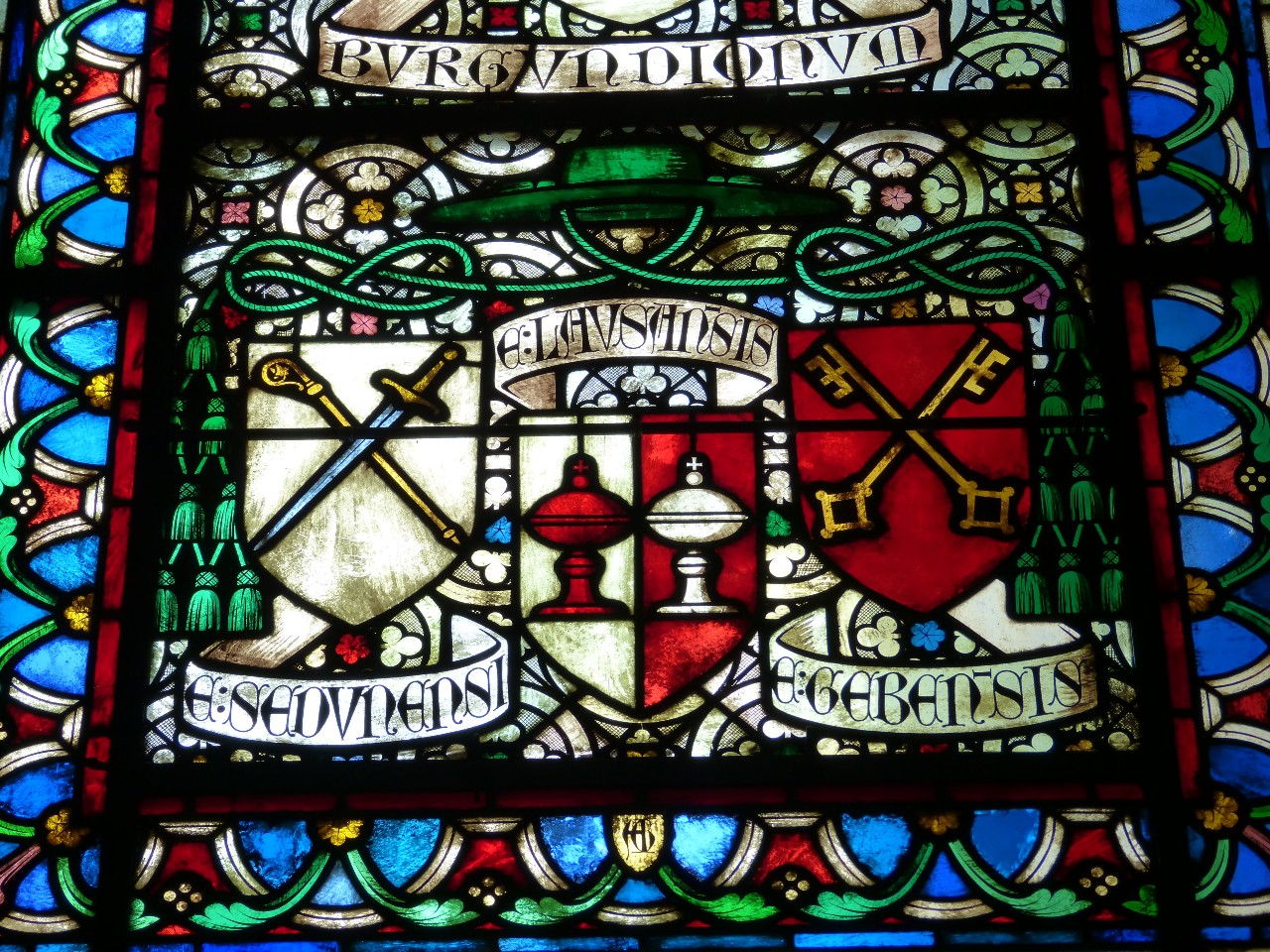
Stained glass window in the in the Parish Church at Lièpvre
Fulrad was the son of Riculf and Ermengard, who had rich estates in Alsace and the Meuse-Moselle region of modern France and was closely connected to the powerful families and the Carolingians. In 749, he was already one of the closest confidants of Hausmeier Pippin the Younger, who, together with Bishop Burkard of Würzburg, entrusted him with the highly important journey to Rome that initiated the disempowerment of the Merovingians and assisted Pippin’s rise to the throne.
Fulrad entered the Monastery of St-Denis and in 750 Fulrad received – apparently in gratitude for this service – the dignity of Abbot of the powerful Royal Abbey. When Pippin was actually made King in 751, he appointed Fulrad to lead his Court orchestra. Fulrad maintained ties with the Pope and served as an expert on Italy for Pippin and then for Charlemagne .
In his new position, Fulrad increased the size of the Abbey with his inheritance from his parents;. As a Benedictine Abbot of St-Denis , Fulrad regained many territories lost to his Monastery and gained new ones, often using his own inheritance to acquire land and build Monasteries. In these regions, he founded Monasteries which became centres of radiance and devotion. In the beginning, Fulrad administered the new Monasteries himself. The Monasteries were located in Alsace-Lorraine and Alemannia. Each Monastery possessed relics, which made them pilgrimage destinations.
St Fulrad receives the Relics of St Hippolytes from Pope Stephen
Fulrad’s Testament, gives an account of early Carolinian society. In the “Testament”, Fulrad presents a survey of certain places and gives a detailed account of the religious, political and economic differences between the towns.
Abbot Fulrad was the Chaplin and Counsellor of King Pippin III, the Younger. The connection between these two figures goes beyond just friendship but, as two strong figures who helped each other and had great respect for each other’s service. Historians have written about this great friendship, and examples of it are seen in distinctively in certain dealings with the Papacy and with Pippin’s burial. Fulrad had such an impact on Pippin that the latter’s final wishes and resting place were all connected to Fulrad and his Abbey of S-Denis. Pippin became very ill at his campaign in the City of Saintes. He managed to travelled to St-Denis where he would be buried. Pippin, at his own request, asked to be buried at Saint-Denis next to the saint; also he wanted to be buried at the Abbey where Fulrad, his Arch-Chaplin and “one of his staunchest allies” was the Abbot.
Fulrad was also the Arch-Chaplin and Counsellor to Charlemagne. Charlemagne gave Fulrad’s Abbey many riches and more land. Fulrad’s Monastery of St-Denis became the “Royal Mausoleum” of the Frankish Kings. Fulrad oversaw the new construction of the Basilica of St-Denis. Construction began in 754 and was completed under Charlemagne, who was present at its Consecration in 775.
Abbot Fulrad died on 16 July 784 and was buried at St-Denis, where his tomb became a pilgrimage site. St Alcuin of York wrote St Fulrad’s epitaph.
When Fulrad died, Charlemagne chose Angilram, the Bishop of Metz to be the new Abbots of St-Denis and to carry on the work of the zealous and holy Abbot Fulrad.
St Andrew the Hermit St Antiochus of Sebaste Bl Arnold of Clairvaux Bl Arnold of Hildesheim St Athenogenes of Sebaste
St Bartholomew of Braga OP – ArchBishop of Braga also known as Bl Bartholomew of the Martyrs (Bartolomeu Fernandez dei Martiri Fernandes) (1514-1590) Portuguese Dominican Friar and Priest, Writer, Theologian, Advisor, Teacher and Catechetical writer, Apostle of Charity founding a series of hospitals and hospices in Braga and surrounds. St Bartholomew: https://anastpaul.com/2018/07/16/saint-of-the-day-16-july-blessed-bartholomew-of-the-martyrs-1514-1590/
St Domnin St Domnio of Bergamo Bl Dorothée-Madeleine-Julie de Justamond St Elvira of Ohren St Eugenius of Noli St Faustus St Faustus of Rome and Milan St Fulrad of Saint Denis (c 710-784) Abbot St Generosus of Poitou St Gobbán Beg St Gondulf of Tongeren-Maastricht St Gondolf of Saintes St Grimoald of Saintes St Helier of Jersey Bl Irmengard St Landericus of Séez Bl Madeleine-Françoise de Justamond Bl Marguerite-Rose de Gordon Bl Marguerite-Thérèse Charensol Bl Marie-Anne Béguin-Royal Bl Marie-Anne Doux
St Marie-Madeline Postel (1756-1846) Religious Sister and Founder of the Sisters of Christian Schools of which she is the Patron, Teacher, Franciscan tertiary. Pope Pius X later signified on 22 January 1908 his approval to two investigated miracles attributed to her intercession and so Beatified her on 17 May 1908. Pope Pius XI confirmed two additional miracles and Canonised Blessed Marie-Madeline on 24 May 1925. Her Life: https://anastpaul.com/2019/07/16/saint-of-the-day-16-july-st-marie-madeline-postel-
Bl Marie-Rose Laye Bl Milon of Thérouanne St Monulphus of Tongeren-Maastricht Bl Ornandus of Vicogne
Martyrs of Antioch – 5 Saints: Five Christians who were Martyred together. No details about them have survived by the names – Dionysius, Eustasius, Maximus, Theodosius and Theodulus. They were Martyred in Antioch, Syria, date unknown.
Thought for the Day – 15 July – Meditations with Antonio Cardinal Bacci (1881-1971)
The Voice of God
“Be not silent Lord, be not far from me” (Ps 34:22).
It is never really God Who is silent. He is forever appealing to us to lead good lives. He is never really far from us but is always ready to bestow His gifts on us. Even when we have sinned, we hear His Voice prompting us to thoughts of remorse. Even when we stray away from Him, He follows and asks us to return to Him. It is we, who must ensure that the noise of the world, will not prevent us from hearing His Fatherly appeal and that sinful temptations will not destroy His influence over us.
Let us continually implore His graces because we are always in need of them. Let us use them well, so that they will enable us to gain everlasting life.”
Quote/s of the Day– 15 July – The Memorial of Saint Henry II (972-1024) Confessor, Holy Roman Emperor and Emperor of Germany – Ecclesiasticus 31:8-11, Luke 12:35-40
“Blessed are those servants whom the Master, on His return, shall find watching.”
Luke 12:37
“Be vigilant at all times and pray, that you have the strength to escape the tribulations that are imminent and to stand before the Son of Man…”
Luke 21:36
“Watch” over your life. … Sheep will turn into wolves and love into hatred. With the increase of iniquity, people will hate, persecute and betray each other. Then the world deceiver will appear in the disguise of God’s Son. He will work “signs and wonders” and the earth will fall into his hands. He will commit outrages such as have never occurred before. Then humankind will come to the “fiery trial“ and many will fall away” and perish.”
Unknown 1st Century Author of this early Treatise (Didache, 16)
“Give me grace, to amend my life and to have an eye to mine end, without grudge of death, which, to them, who die in You, good Lord, is the gate of a wealthy life.”
You must be logged in to post a comment.