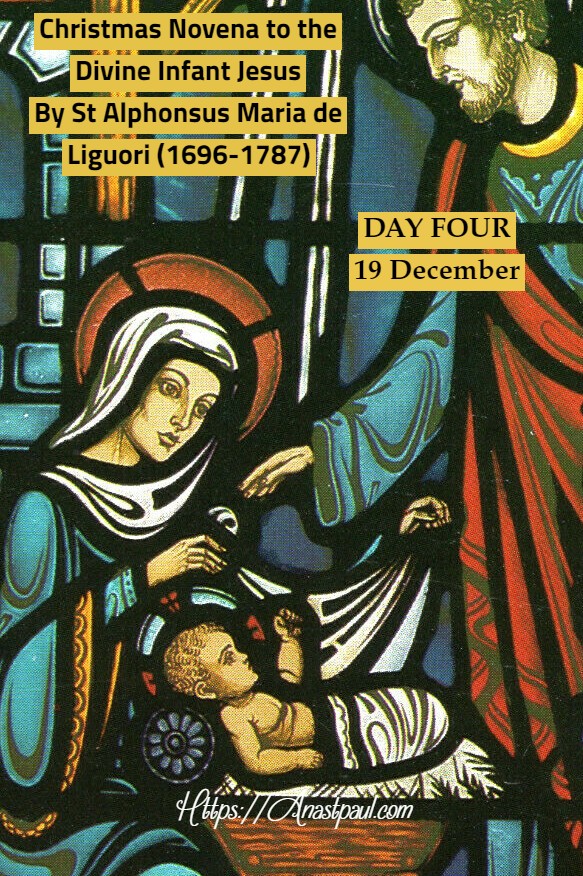
Christmas Novena to the Divine Infant Jesus By St Alphonsus Maria de Liguori (1696-1787)
THE SEVENTH DAY 22 December Meditation 7: The journey of the Infant Jesus to Egypt.
The Son of God came from Heaven to save humanity. But no sooner was He born, than they began to persecute Him, even unto death. Herod, afraid that this Infant would take away his kingdom, tried to put the Child to death. So in a dream, an Angel advised Saint Joseph to take Jesus and His Mother to Egypt. Informing Mary, Joseph promptly obeyed. He took along with him the tools of his trade that he had available, to use in providing a livelihood, while in Egypt, for himself and his poor family. For her part, Mary packed a small bag of clothes for the Holy Infant. Then, drawing near the crib with tears, she said to her sleeping Child, “O my Son and my God, Thou hast come down from Heaven to save humanity, yet hardly after Thou art born, they already seek to take away Thy life.”
That very night, still crying, she took the Infant Jesus and she and Joseph set off on their journey.
Think about how much these lonely pilgrims must have suffered, while making such a long journey, deprived of every comfort. The Infant was not yet able to walk, so Mary and Joseph had to take turns carrying him in their arms. During the journey through the desert of Egypt, their only bed at night was the bare earth in the open air. The Infant wept in the cold and Joseph and Mary also wept, out of compassion for Him. Who would not weep, seeing the Son of God, poor and persecuted, wandering about on the earth, so that He would not be killed by His enemies?
Affections and Prayers:
Dear Infant Jesus, crying so bitterly! Well hast Thou reason to weep in seeing Thyself persecuted by men, whom Thou lovest so much. I, too, O God, have once persecuted Thee, by my sins. But Thou knowest that now I love Thee, more than myself and that nothing pains me more, than the thought that I have so often spurned Thee, my Sovereign Good.
Forgive me, O Jesus and let me bear Thee with me, in my heart, on all the rest of the journey which I have still to travel through life, so that, together with Thee, I may enter into eternity. So often have I driven Thee from my soul by my sins. But now, I love Thee above all things and I regret, above other misfortunes, that I have offended Thee. I wish to leave Thee no more, my beloved Lord. But do Thou give me the strength to resist temptations. Never permit me to be separated from Thee again. Let me rather die, than ever again lose Thy good grace.
O Mary, my hope, make me always live in God’s love and then, die in loving Him. Amen.
Quote/s of the Day – 22 December – Thursday of the Fourth Week of Advent – “The Month of the Divine Infant and the Immaculate Conception”
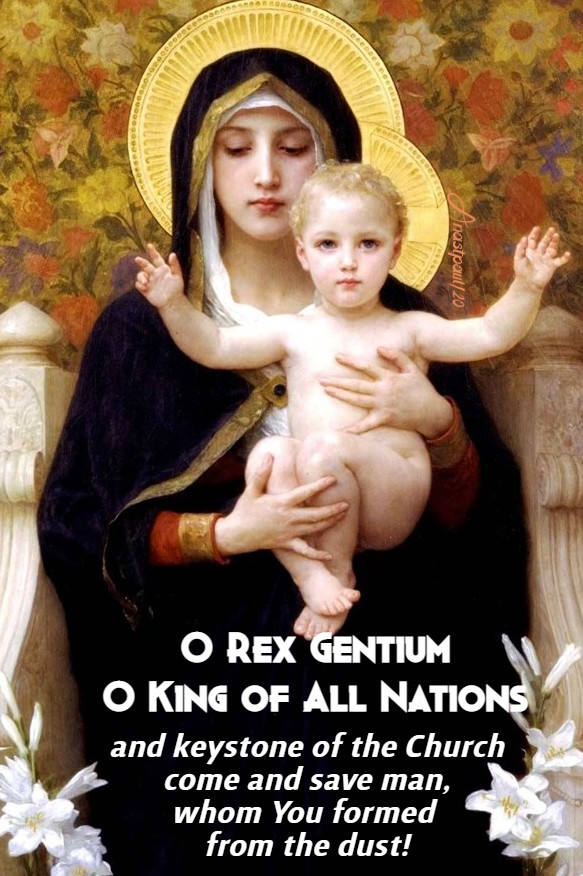
“O KING OF ALL NATIONS and keystone of the Church come and save man, whom You formed from the dust!”
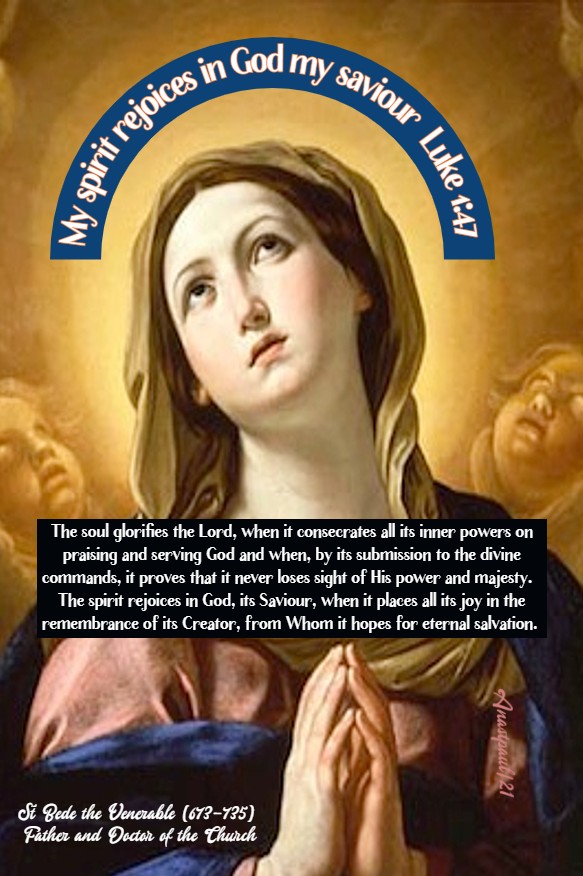
“The soul glorifies the Lord, when it consecrates all its inner powers on praising and serving God and when, by its submission to the Divine commands, it proves that it never loses sight of His Power and Majesty. The spirit rejoices in God, its Saviour, when it places all its joy in the remembrance of its Creator, from Whom it hopes for eternal salvation.”
St Bede the Venerable (673-735) Father and Doctor of the Church
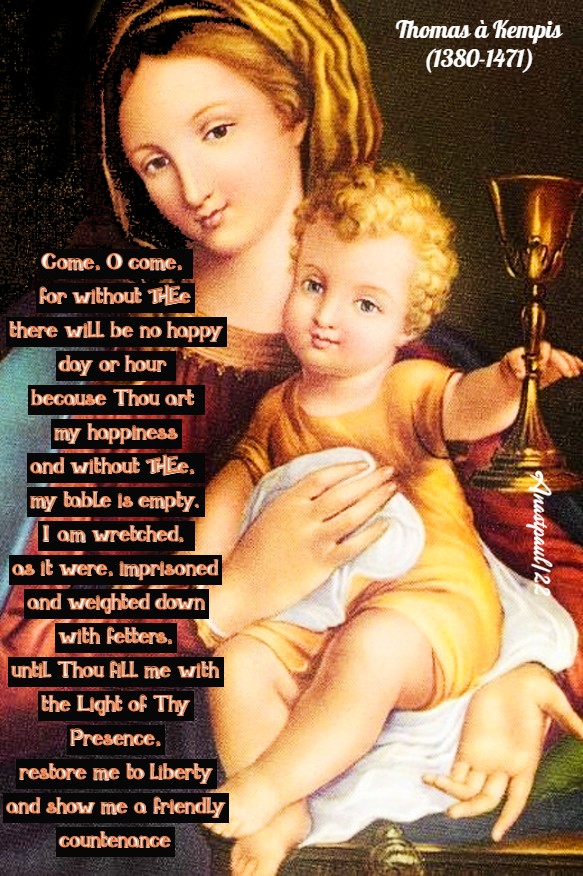
“Come, O come, for without Thee there will be no happy day or hour because Thou art my happiness and without Thee, my table is empty. I am wretched, as it were, imprisoned and weighted down with fetters, until Thou fill me with the Light of Thy Presence, restore me to liberty and show me a friendly countenance.”
One Minute Reflection – 22 December – “The Month of the Divine Infant and the Immaculate Conception” – Thursday of the Fourth Week of Advent – 1 Corinthians 4:1-5, Luke 3:1-6 – Scripture search here: https://www.drbo.org/
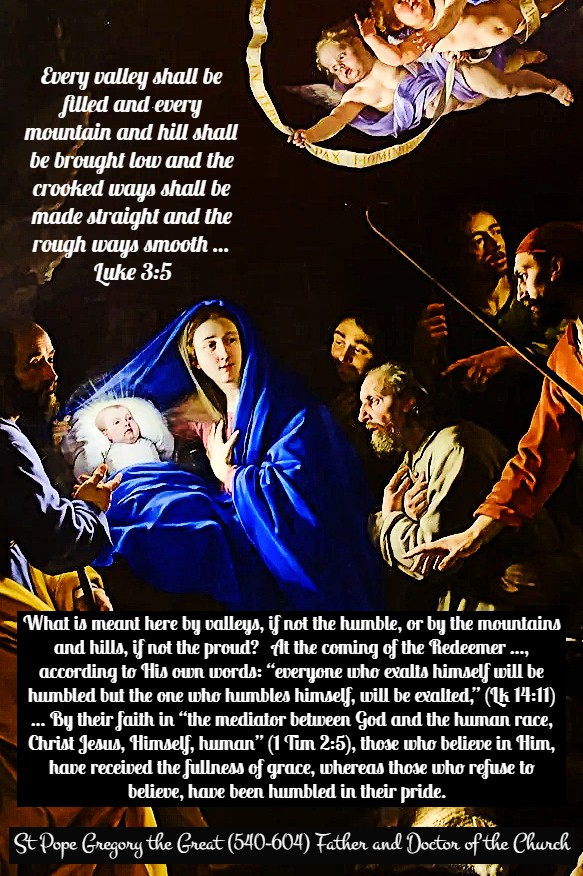
“Every valley shall be filled and every mountain and hill shall be brought low and the crooked ways shall be made straight and the rough ways smooth …” – Luke 3:5
REFLECTION –“Every valley shall be filled and every mountain and hill, shall be made low.” What is meant here by valleys, if not the humble, or by the mountains and hills, if not the proud? At the coming of the Redeemer …, according to His own words: “everyone who exalts himself will be humbled but the one who humbles himself, will be exalted,” (Lk 14:11) … By their faith in “the mediator between God and the human race, Christ Jesus, Himself, human” (1 Tim 2:5), those who believe in Him, have received the fullness of grace, whereas those who refuse to believe, have been humbled in their pride. Every valley has been filled in, since humble hearts, by receiving the words of holy doctrine, will be filled by the grace of the virtues, as it is written: “He made springs gush forth in the watercourses that wind among the valleys,” (cf. Ps 104:10).” – St Gregory the Great (540-604) Pope, Father and Doctor of the Church (Gospel Homilies no 20).
PRAYER – O God, Who, by the message of an Angel, willed to take flesh in the womb of the Blessed Virgin Mary, grant that we, Thy suppliants, who believe her to be truly the Mother of God, maybe helped by her intercession with Thee.Through the same Jesus Christ, Thy Son our Lord, Who lives and reigns with Thee, in the unity of the Holy Ghost, God, world without end. Amen (Collect).
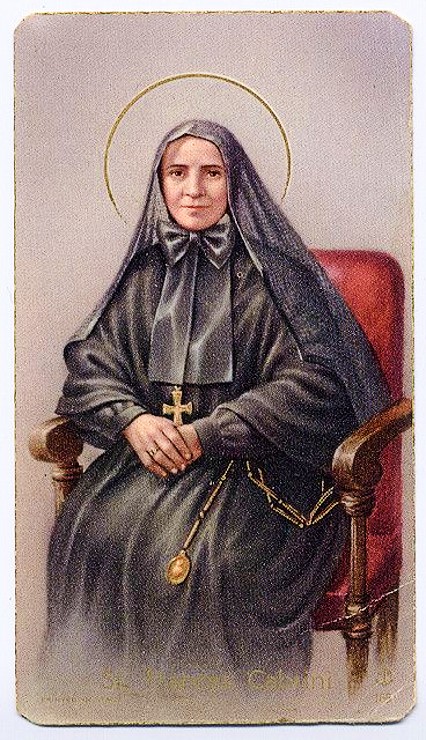
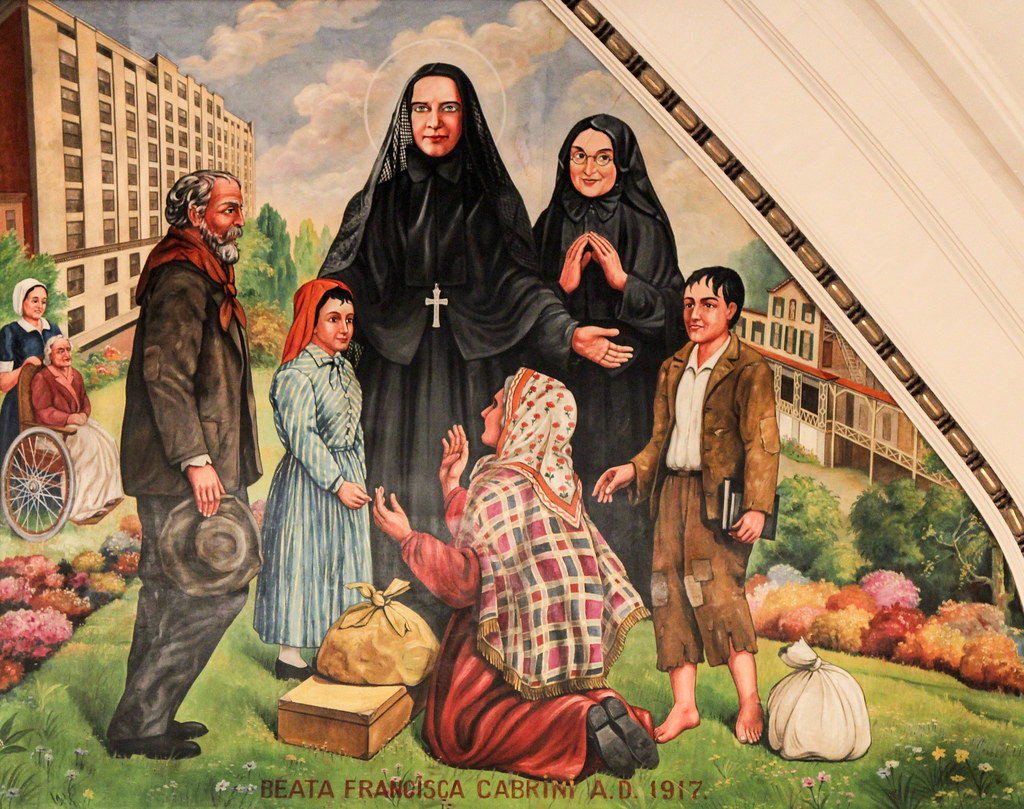
Saint of the Day – 22 December – St Frances Xavier Cabrini (1850-1917) Virgin, Religious Sister, Missionary, Founder. Patronages – against malaria, emigrants, immigrants (given on 8 September 1950 by Pope Pius XII) hospital administrators, orphans.
St Frances Xavier Cabrini From the Roman Breviary
Frances Cabrini, who later took the name of Xavier because of her desire to imitate the Apostle of the Indies, was born in the Town of Sant’ Angelo in the Diocese of Lodi in 1850. Her parents were holy and respectable people. Aided by divine grace, she had attained, even as a child, to a very high degree of union with God and was already given to the practice of austerities. When she was seven years old, the custom of listening before evening prayers, to readings from a magazine concerning missionary work in China, filled her with an ardent desire to go there, in order to win souls for God. She was hardly thirteen years old, when she took a vow of perpetual Virginity. From that time, the all-absorbing thought of her soul was how to return love, for love ,to the Sacred Heart of Jesus and thus bring some consolation to Him, in His sufferings and distress.
After the successful completion of her studies she resolved to embrace the religious life. Twice she applied for admission and each time was refused, on the ground of poor health. She then taught for some years in the public school, with a considerable measure of success. Thereafter, she was appointed by the Bishop of Lodi, as the directress of an orphanage, in which position, she displayed such prudence and zeal, especially in the Christian education of girls that the same Bishop urged her to found a new religious congregation which would principally be devoted, to the missions.
She undertook this difficult assignment with great courage and in 1880, in the Chapel of our Lady of Grace at Codogno, laid the foundation of the Institute of the Missionary Sisters of the Sacred Heart. She then sought from the Holy See, the approval of the Rules and Constitutions of the new Institute. This having been achieved, she laboured with all zeal, to imbue the new sisterhood with the same spirit of love of God and neighboir ,which she, herself had drawn, in copious draughts ,from the fountain of the Sacred Heart.
The expansion of this new religious family to include sixty-seven foundations in Europe and America, testifies to the extraordinary character and skill of its wise and saintly ruler. She had, moreover ,a mind to establish missions in more remote lands and being in doubt, concerning God’s will in the matter, she followed the advice of Pope Leo XIII and turned to the West.
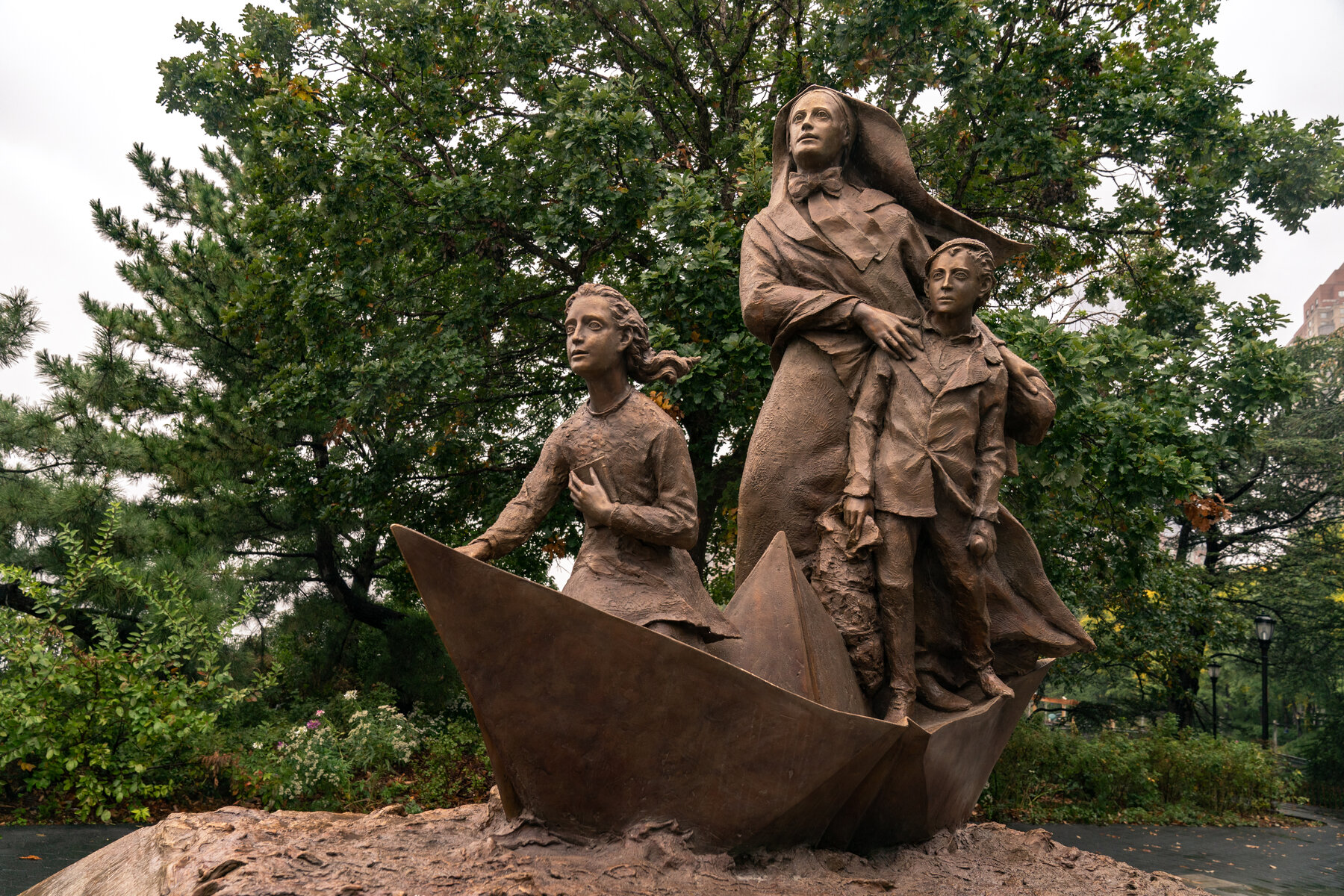
It was to these western shores of both Americas, that large multitudes of Italians had emigrated, in order to find employment because they were unable to exist in their own land. The condition of the Italian immigrants was then very poor and Frances sought to alleviate it. It was the love of Christ that urged her to take up this work, so wholeheartedly and so courageously. No labour could overcome her, no danger could frighten her. Her intrepid and undaunted spirit braved the rough and dangerous voyages across the ocean, twenty-four times!
She travelled over the length and breadth of America, establishing everywhere, hospitals, schools, houses of rest, nurseries, orphanges and other institutions, in order to promote the material livelihood but above all the spiritual well-being of the working class. By such charitable endeavours, she won the hearts of her fellow-countrymen and so, came to be called the Mother of the Italians.
She exerted every effort to accomplish the work she had in mind and her zeal could brook no delay. Placing her complete confidence in Divine Providence, she took as her motto that saying of Paul: “I can do all things in Him Who strengtheneth me.”
Her heart was consecrated to God by a perpetual union with Him, so that even amid the most absorbing occupations, her mind never lost track of heavenly things. All she met with, on her various journeys, were like so many stepping-stones, by which her soul ascended to God.
She had the greatest veneration for the Roman Pontiff and the Apostolic See and saw in the laws of the Church, norms of conduct that give one the greatest sense of security. She cultivated a childlike love for the Blessed Virgin Mary and often used to say, that Mary was the Mother and Foundress of her Institute.
Finally her life, extraordinary by reason of its integrity and labours for God, came to an end at Chicago, on 22 December 1917. Later her body was translated to New York. She was solemnly Beatified by Pope Pius XI, whereas Pope Pius XII, after new miracles were performed, solemnly added her name to the list of holy Virgins.
“Inspired by the grace of God, we join the Saints in honouring the holy Virgin Frances Xavier Cabrini. She was a humble woman who became outstanding, not because she was famous or rich or powerful but because, she lived a virtuous life. From the tender years of her youth, she kept her innocence as white as a lily and preserved it carefully, with the thorns of penitence. As the years progressed, she was moved by a certain instinct and supernatural zeal, to dedicate her whole life to the service and greater glory of God. She welcomed delinquent youths into safe homes and taught them to live upright and holy lives. She consoled those who were in prison and recalled to them, the hope of eternal life. She encouraged prisoners to reform themselves and to live honest lives. She comforted the sick and the infirm in the hospitals and diligently cared for them. She extended a friendly and helping hand especially to immigrants and offered them necessary shelter and relief, for having left their homeland behind, they were wandering about in a foreign land with no place to turn for help. Because of their condition, she saw that they were in danger of deserting the practice of Christian virtues and their Catholic faith. Undoubtedly she accomplished all this through the faith which was always so vibrant and alive in her heart, through the divine love which burned within her and finally, through constant prayer, by which she was so closely united with God, from Whom she humbly asked and obtained, whatever her human weakness could not obtain. Although her constitution was very frail, her spirit was endowed with such singular strength that, knowing the will of God in her regard, she permitted nothing to impede her from accomplishing what seemed beyond her strength.”– From his sermon at the Canonisation of Saint Frances Xavier Cabrini by Pope Pius XII.
St Abban of New Ross Bl Adam of Saxony St Amaswinthus of Málaga St Athernaise of Fife St Bertheid of Münster St Chaeremon of Nilopolis
St Flavian of Acquapendente (Died 363) Martyr Layman, Prefect of Imperial Rome, Husband of Saint Dafrosa, Father of Saint Bibiana and Saint Demetria. The Roman Martyrology states: “At Rome, ex-Prefect, who, under Julian the Apostate, was condemned to be branded for Christ and banished to Aquae Taurinae, where he gave up his soul to God in prayer.” His Life and Death: https://anastpaul.com/2021/12/22/saint-of-the-day-22-december-saint-flavian-of-acquapendente-died-363-martyr/
Blessed Thomas Holland SJ (1600-1642) Priest of the Society of Jesus and Martyr. of England and Wales. With eyes closed in prayer, Fr Holland looked at a Priest secretly in the crowd and received absolution. After he was hanged, his body was beheaded and quartered and exposed on London Bridge. Fr Holland was only forty-two years of age and a Jesuit for eighteen years. Pope Pius XI Beatified him on 15 December 1929. His Life and Death: https://anastpaul.com/2019/12/22/saint-of-the-day-22-december-blessed-thomas-holland-sj-1600-1642-priest-and-martyr-his-faith-was-his-crime/
St Zeno of Nicomedia
Martyrs of Ostia – 3 Saints: A group of Christians Martyred together. The only details about them to survive are three names – Demetrius, Florus and Honoratus. They were martyred at Ostia, Italy.
Martyrs of Rhaitu – 43 Saints: 43 Monks Martyred by Blemmyes, in Raíthu, Egypt, date unknown.
Martyrs of Via Lavicana – 30 Saints: A group of 30 Christians Martyred together in the persecutions of Diocletian. c 303 in Rome, Italy and were buried between two bay trees on the Via Lavicana outside Rome.
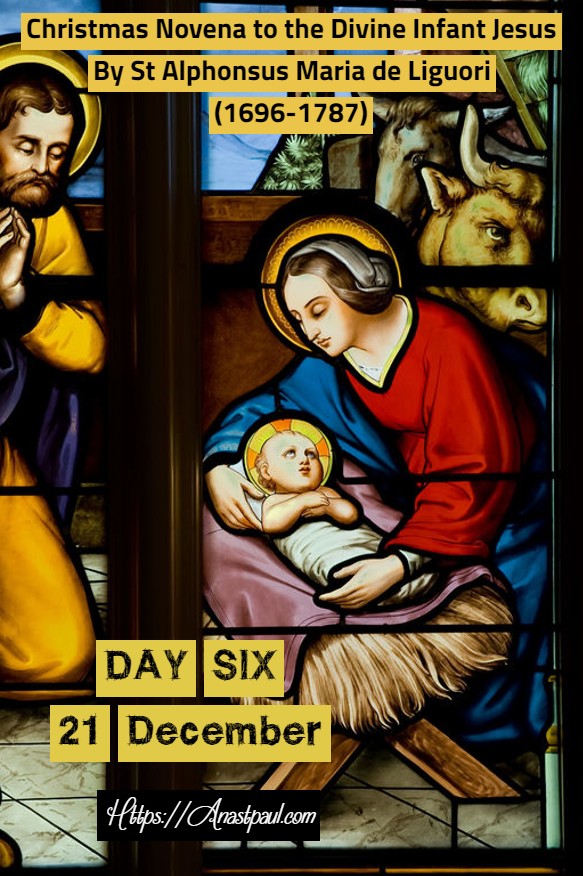
Christmas Novena to the Divine Infant Jesus By St Alphonsus Maria de Liguori (1696-1787)
THE SIXTH DAY 21 December Meditation 6: The Mercy of God in coming from Heaven, to save us, by His Death.
Saint Paul says, the goodness and loving kindness of God our Saviour appeared (Titus 3:4). It was then, when the Son of God made Man appeared on earth that we saw how great the goodness of God is toward us. Saint Bernard wrote that the power of God first appeared, through the creation of the world and sustaining the world, has shown God’s wisdom. But God’s mercy appeared, to an even greater degree, when God took human flesh to save lost humanity, by His sufferings and Death. And what greater mercy could the Son of God have shown us, than to take upon Himself, the pains we have deserved?
Imagine Him as a newborn Infant, wrapped in swaddling clothes in a manger, unable to move or feed Himself. Just to survive, He relied on Mary to feed Him with a little milk. Imagine Him many years later, in the judgement hall before Pilate, bound to a column by ropes, from which He could not loosen Himself and scourged from head to foot. Imagine Him on the journey to Calvary, falling down as He went along the road, from weakness and from the weight of the Cross which He carried. Finally, imagine Him nailed to that infamous tree upon which He finished His life, in agony and suffering.
Jesus Christ wished to gain all the endearments of our hearts, by His love for us and,, therefore, He would not send an Angel to redeem us but came Himself, to save us by His Passion and Resurrection. If an Angel had been our redeemer, we would have a divided heart—loving God as our Creator and the Angel as our redeemer. But because God, Who is our Creator, wants our whole heart, He chose to also be our Redeemer.
Affections and Prayers:
O my dear Redeemer! Where should I be now, if Thou hadst not borne with me so patiently but hadst called me from life, while I was in the state of sin? Since Thou hast waited for me till now, forgive me quickly, O my Jesus, before death finds me still guilty of so many offences which I have committed against Thee. I am so sorry for having vilely despised Thee, my Sovereign Good that I could die of grief. But Thou canst not abandon a soul that seeks Thee.
If hitherto I have forsaken Thee, I now seek Thee and love Thee. Yes, my God, I love Thee above all else; I love Thee more than myself. Help me, Lord, to love Thee always during the rest of my life. Nothing else do I seek of Thee. But this I beg of Thee, this I hope to receive from Thee.
Mary, my hope, do thou pray for me. If thou prayest for me, I am sure of grace. Amen.
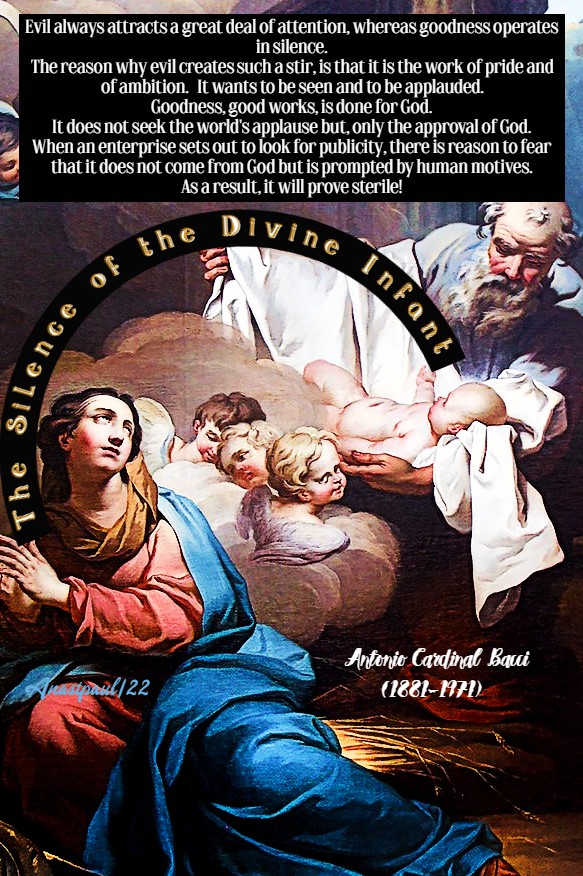
Thought for the Day – 21 December – Meditations with Antonio Cardinal Bacci (1881-1971)
A Christmas Novena VI The Silence of the Divine Infant
“Evil always attracts a great deal of attention, whereas goodness operates in silence. The reason why evil creates such a stir, is that it is the work of pride and of ambition. It wants to be seen and to be applauded. Goodness, good works, is done for God. It does not seek the world’s applause but, only the approval of God. When an enterprise sets out to look for publicity, there is reason to fear that it does not come from God but is prompted by human motives. As a result, it will prove sterile!
If we sincerely desire to please God, we shall work in silence.
We shall not aim at our own worldly interests but, shall seek our own spiritual good and that of our fellowmen. If it is God’s will. our good work may shine also before men but let us remember that this is for the glory of God and in order to give good example to our neighbour.”
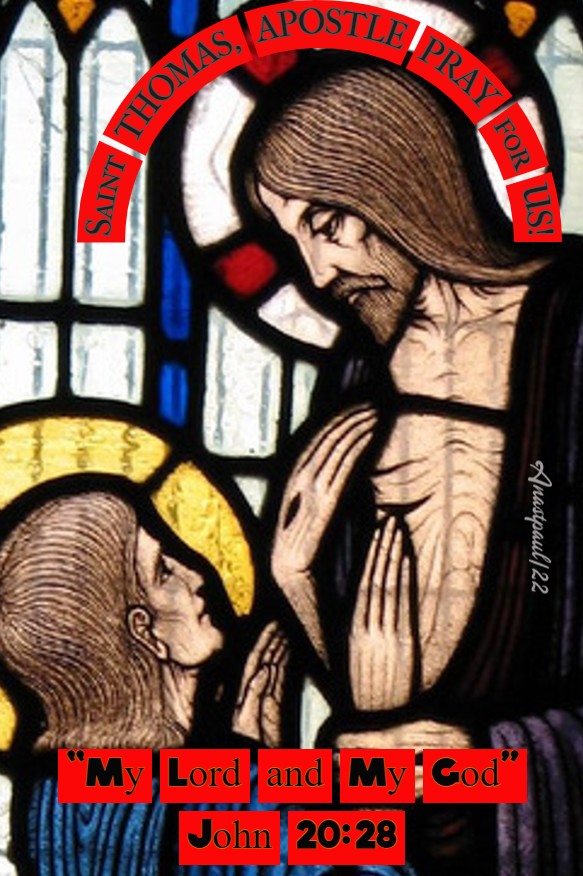
Quote/s of the Day – 21 December – Feast of St Thomas, Apostle of Christ, Martyr – “The Month of the Divine Infant and the Immaculate Conception” – Ephesians 2:19-22, John 20:24-29 – Scripture search here: https://www.drbo.org/
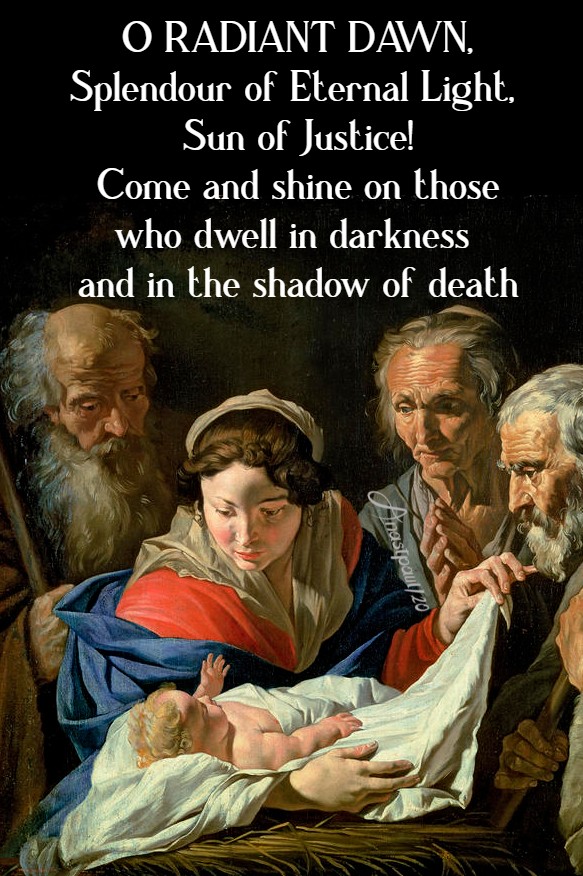
“O Radiant Dawn, Splendour of Eternal Light, Sun of Justice! Come and shine on those who dwell in darkness and in the shadow of death.”
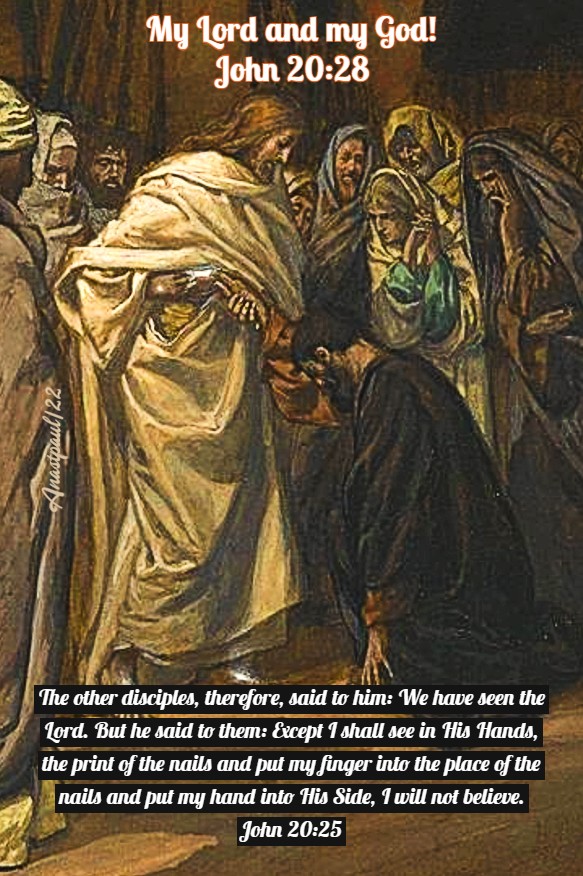
“My Lord and my God”
John 20:28
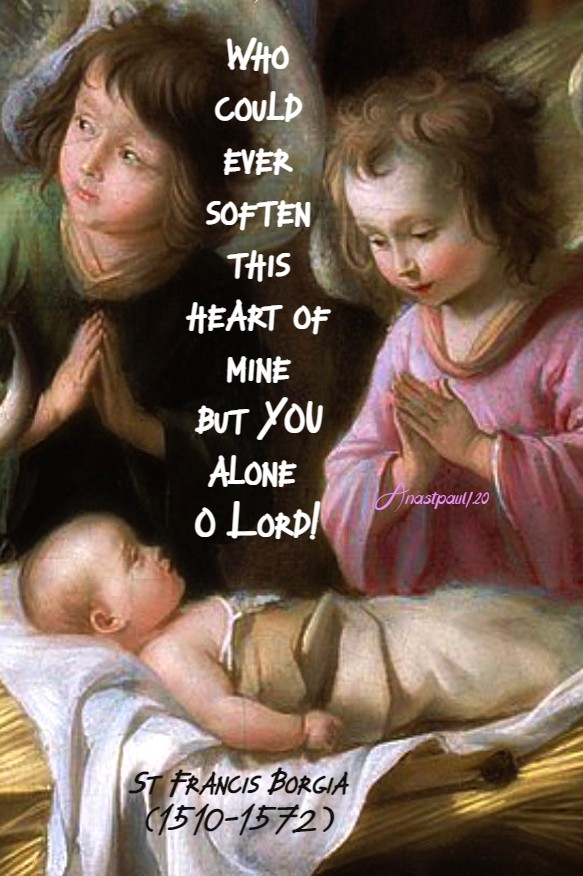
“Who could ever soften this heart of mine but YOU alone O Lord!”
St Francis Borgia (1510-1572)
“Christ first of all, Christ in the centre of the heart, in the centre of history and of the cosmos. Humanity needs Christ intensely because, He is our “measure.” There is no realm, that cannot be touched by His strength; there is no evil, that cannot find remedy in Him, there is no problem, that cannot be solved in Him. Either Christ or nothing!”
One Minute Reflection – 21 December – Feast of St Thomas, Apostle of Christ, Martyr – Ephesians 2:19-22, John 20:24-29 – Scripture search here: https://www.drbo.org/
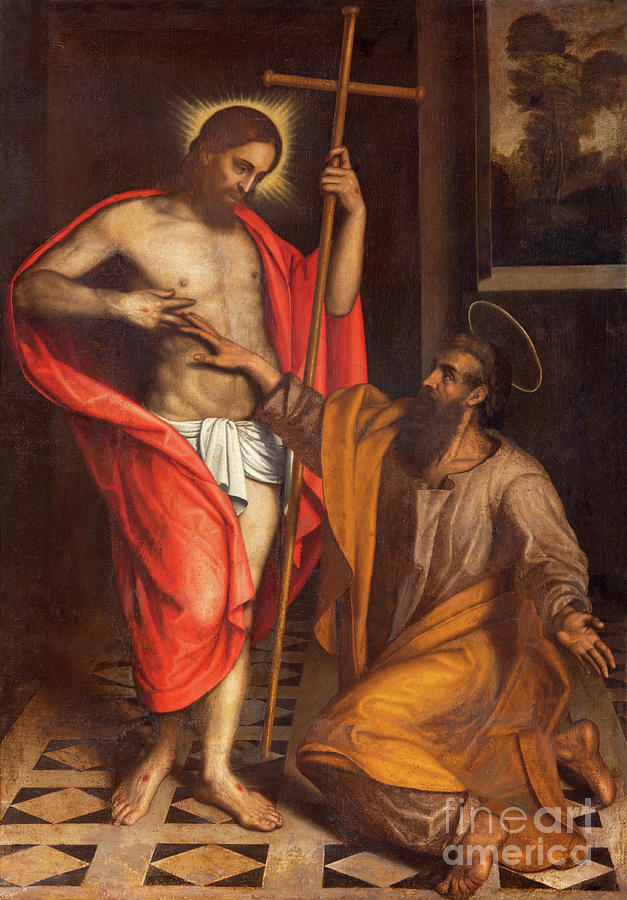
“The other disciples, therefore, said to him: We have seen the Lord. But he said to them: Except I shall see in His Hands, the print of the nails and put my finger into the place of the nails and put my hand into His Side, I will not believe.” – John 20:25
REFLECTION – “What, dearest brethren do you notice in this passage? Do you think that it happened by chance that this chosen disciple was absent at that time and afterwards coming, heard the news and hearing, doubted that doubting, he touched and touching, he believed? This did not happen by chance but by Divine dispensation. For the Divine clemency brought it about, in a wonderful way that the doubting disciple, while touching the wounds in his Master’s flesh, should thereby heal the wounds of our unbelief. The unbelief of Thomas is more to our faith, than the faith of the believing disciples. While he is brought back to faith by touching, our minds are set free from doubt and established in the faith.
So the Lord indeed, after His Resurrection permitted His disciple to doubt but He did not leave him in unbelief; just as before His birth, He wished Mary to have a spouse, who, however, never attained to the married state. The disciple who doubted and touched his Risen Lord, thus became, a witness to the truth of the Resurrection, just as the spouse of His Mother was the guardian of her inviolate Virginity. Thomas touched and cried out: My Lord and my God. Jesus said to him – Because you have seen me, you have believed. But since the Apostle Paul says – Now faith is the substance of things to be hoped for, the evidence of things which appear not; it is certainly clear that faith is the evidence, of those things which cannot appear. The things which appear are the object, not of faith but of knowledge.
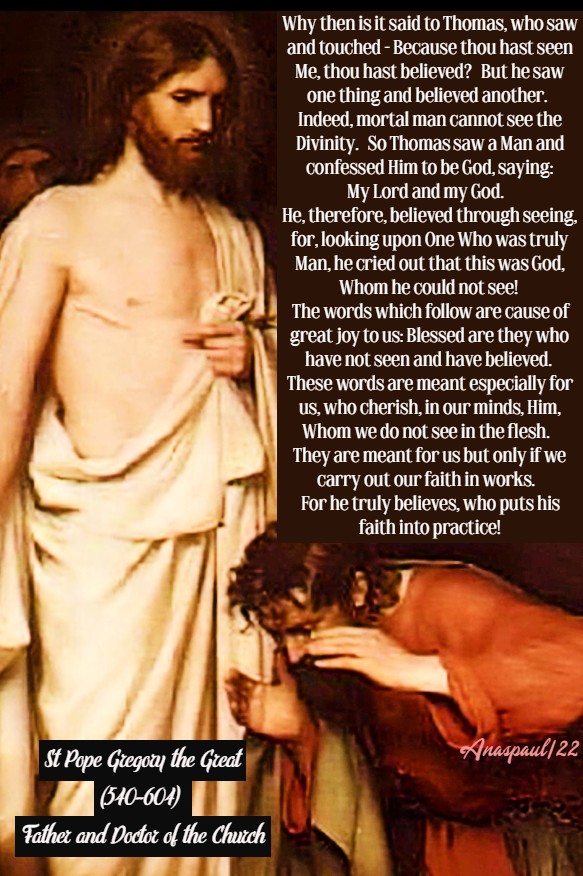
Why then is it said to Thomas, who saw and touched – Because thou hast seen Me, thou hast believed? But he saw one thing and believed another. Indeed, mortal man cannot see the Divinity. So Thomas saw a Man and confessed Him to be God, saying: My Lord and my God. He, therefore, believed through seeing, for, looking upon One Who was truly Man, he cried out that this was God, Whom he could not see! The words which follow are cause of great joy to us: Blessed are they who have not seen and have believed. These words are meant especially for us, who cherish, in our minds, Him, Whom we do not see in the flesh. They are meant for us but only if we carry out our faith in works. For he truly believes, who puts his faith into practice!” – St Gregory the Great (540-604) Pope. Father and one of the original four Doctors of the Latin Church (Sermon on the Feast of St Thomas).
PRAYER – O Lord, grant us, we beseech Thee, to glory in the Feast-day of blessed Thomas, Thy Apostle, that we maybe helped continually by his patronage and imitate his faith with a devotion like his. .Through Jesus Christ, Thy Son our Lord, Who lives and reigns with Thee, in the unity of the Holy Ghost, God, world without end. Amen (Collect).
Our Morning Offering – 21 December – St Thomas Apostle
Exsultet Orbis! Let the World Rejoice! Unknown Author
Now let the earth with joy resound, And Heaven the chant re-echo round; Nor Heaven nor earth too high can raise The great Apostles’ glorious praise.
O ye who, throned in glory dread, Shall judge the living and the dead, Lights of the world forever more! To you the suppliant prayer we pour.
Ye close the Sacred Gates on high. At your command apart they fly. O loose for us the guilty chain We strive to break and strive in vain.
Sickness and health your voice obey, At your command they go or stay. From sin’s disease our souls restore; In good confirm us more and more.
So when the world is at its end. And Christ to Judgment shall descend, May we be called, those joys to see Prepared from all eternity.
Praise to the Father, with the Son, And Holy Spirit, Three in One; As ever was in ages past And so shall be while ages last. Amen
(Roman Breviary for the Common of Apostles) An Office Hymn that was traditionally prescribed for Vespers and Lauds on the Feasts of Apostles and Evangelists outside Easter time. The Hymn is found as early as the tenth century in a hymnal of Moissac Abbey.
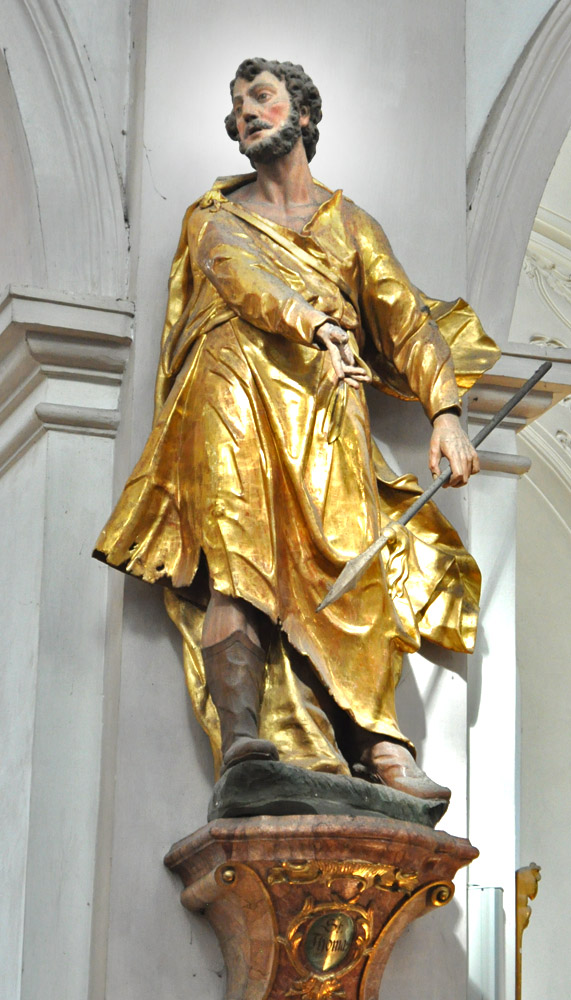
Saint of the Day – 21 December – Feast of St Thomas, Apostle of Christ, Martyr. His Patronages are:• people in doubt; against doubt• architects• blind people and against blindness• builders• construction workers• geometricians• stone masons and stone cutters• surveyors• theologians• Ceylon• East Indies• India• Indonesia• Malaysia • Pakistan• Singapore• Sri Lanka• Diocese of Bathery, India• Castelfranco di Sopra, Italy• Certaldo, Italy• Ortona, Italy.
St Thomas, Apostle From the Liturgical Year, 1870
This is the last Feast the Church keeps before the great one of the Nativity of her Lord and Spouse. She interrupts the Greater Ferias, in order to pay her tribute of honour to Thomas, the Apostle of Christ, whose glorious Martyrdom has consecrated this twenty first day of December and has procured, for the Christian people, a powerful patron that will introduce them to the Divine Babe of Bethlehem.
To none of the Apostles could this day have been so fittingly assigned, as to St Thomas. It was St Thomas whom we needed; St. Thomas, whose festal patronage would aid us to believe and hope, in that God, Whom we see not and Who comes to us in silence and humility, in order to try our Faith.
St Thomas was once guilty of doubting, when he ought to have believed and only learned the necessity of Faith by the sad experience of incredulity. He comes then most appropriately to defend us, by the power of his example and prayers, against the temptations which proud human reason might excite within us.
Let us pray to him with confidence. In that Heaven of Light and Vision, where his repentance and love have placed him, he will intercede for us,and gain for us that docility of mind and heart, which will enable us to see and recognise Him, Who is the Expected of Nations and Who, though the King of the world, will give no other signs of His Majesty, than the swaddling-clothes and tears of a Babe.
St Festus of Tuscany St Glycerius of Nicomedia St James of Valencia St John of Tuscany St John Vincent St Micah the Prophet St Severin of Trèves (Died c 300) Bishop, Confessor Bl Sibrand of Marigård St Themistocles of Lycia
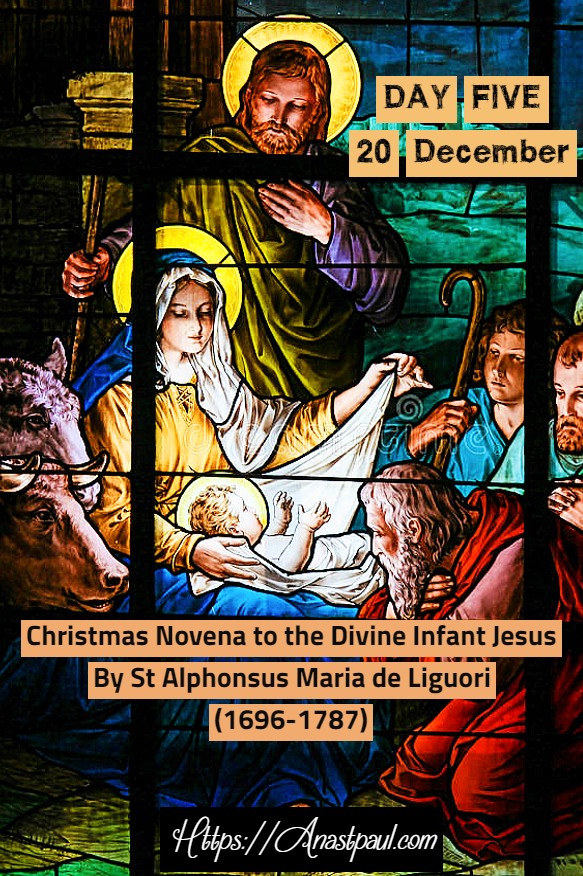
Christmas Novena to the Divine Infant Jesus By St Alphonsus Maria de Liguori (1696-1787)
THE FIFTH DAY 20 December Meditation 5: The Life of sorrow which Jesus lived, even from His birth.
Jesus could have saved us without suffering and without dying. But He willingly chose a life full of tribulations, to show how much He loved us. The prophet Isaias called Him, the man of sorrows (Isaias 53:3) because the life of Christ was to be full of woe. His passion did not begin at the time of His death but, from the beginning of His life.
Imagine Jesus, as soon as He was born, lying in a stable, where everything caused distress for Him. His sight was troubled because he could see nothing in that cave but dark, rough walls. His sense of smell was haunted, by the stench of dung from the animals, lying nearby. His skin was irritated by the itchy straw that served as His bed. Soon after birth, He was forced to flee to Egypt, where He lived several years of His childhood, poor, and despised as a foreigner. The life He led afterward, in Nazareth, was not much better. Then, consider how His life ended in Jerusalem, dying in anguish on a Cross.
So the life of Jesus was one of continual anxiety, even worse than that because he had constantly, before His eyes, all the sadness that would be His on the day of His death. One day a Nun, complaining before the Crucifix, said to Him, “O Lord, Thou remained on the Cross for three hours but I have suffered my pain for several years.” Jesus answered her, “What you have said shows how unaware you are. I suffered even from my mother’s womb, all the pains of my life and death.” But because Jesus voluntarily chose those afflictions, they did not hurt Him as much as did the sight of our sins and our ingratitude for His great love. One particular saint could never stop lamenting over the offences she committed against God. Her Confessor said to her, “Cease crying. God has already forgiven you.” But she replied, “How can I cease crying, when I know that my sins kept Jesus in a state of agony all his life?!”
Affections and Prayers:
O Jesus, my sweet Love! I too have kept Thee suffering through all Thy life. Tell me, then, what I must do in order to win Thy forgiveness. I am ready to do all Thou askest of me. I am sorry, O sovereign Good, f or all the offences I have committed against Thee. I love Thee more than myself, or at least I feel a great desire to love Thee. Since it is Thou who hast given me this desire, do Thou also give me the strength to love Thee exceedingly.
It is only right that I, who have offended Thee so much, should love Thee very much. Always remind me of the love Thou hast borne me, in order that my soul may ever burn with love of Thee and long to please Thee alone. O God of love, I, who was once a slave of hell, now give myself all to Thee. Graciously accept me and bind me to Thee with the bonds of Thy love. My Jesus, from this day and forever, in loving Thee will I live and in loving Thee will I die.
O Mary, my Mother and my hope, help me to love Thy dear God and mine. This is the only favour I ask of thee and through thee, I hope to receive it. Amen.
Thought for the Day – 20 December – Meditations with Antonio Cardinal Bacci (1881-1971)
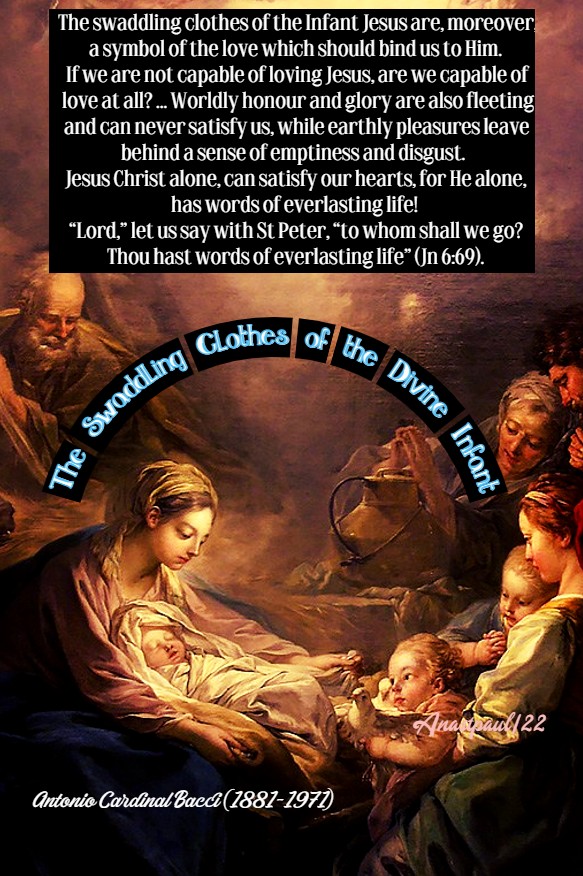
Christmas Novena V The Swaddling Clothes of the Divine Infant
“The swaddling clothes of the Infant Jesus are, moreover, a symbol of the love which should bind us to Him. If we are not capable of loving Jesus, are we capable of love at all? Perhaps we love wealth, honour and pleasure? Some day, however, we shall have to leave all our wealth behind. Worldly honour and glory are also fleeting and can never satisfy us, while earthly pleasures leave behind a sense of emptiness and disgust.
Jesus Christ alone, can satisfy our hearts, for He alone, has words of everlasting life! “Lord,” let us say with St Peter, “to whom shall we go? Thou hast words of everlasting life” (Jn 6:69).”
Quote/s of the Day – 20 December – “The Month of the Divine Infant and the Immaculate Conception”
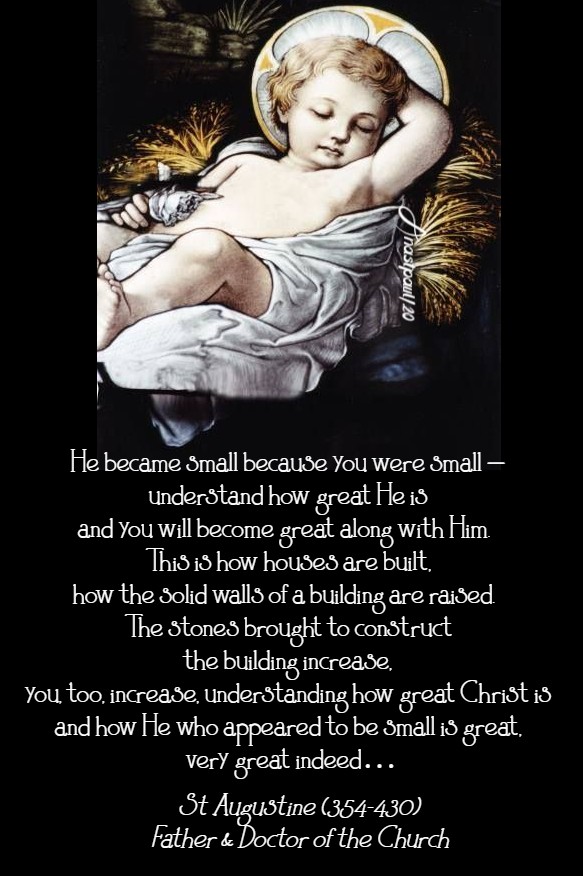
“He became small because you were small – understand how great He is and you will become great along with Him. This is how houses are built, how the solid walls of a building are raised. The stones brought to construct the building increase, you, too, increase, understanding how great Christ is and how He, who appeared to be small, is great, very great indeed…”
St Augustine (354-430) Father & Doctor of the Church
“If we would please this Divine Infant, we too must become children, simple and humble. We must carry to Him, flowers of virtue, of meekness, of mortification, of charity. We must clasp Him in the arms of our love.”
St Alphonsus Liguori (1696-1787) Most Zealous Doctor
One Minute Reflection – 20 December – “The Month of the Divine Infant and the Immaculate Conception” – Tuesday of the Fourth Week of Advent – 1 Cor.inthians 4:1-5, Luke 3:1-6 – Scripture search here: https://www.drbo.org/
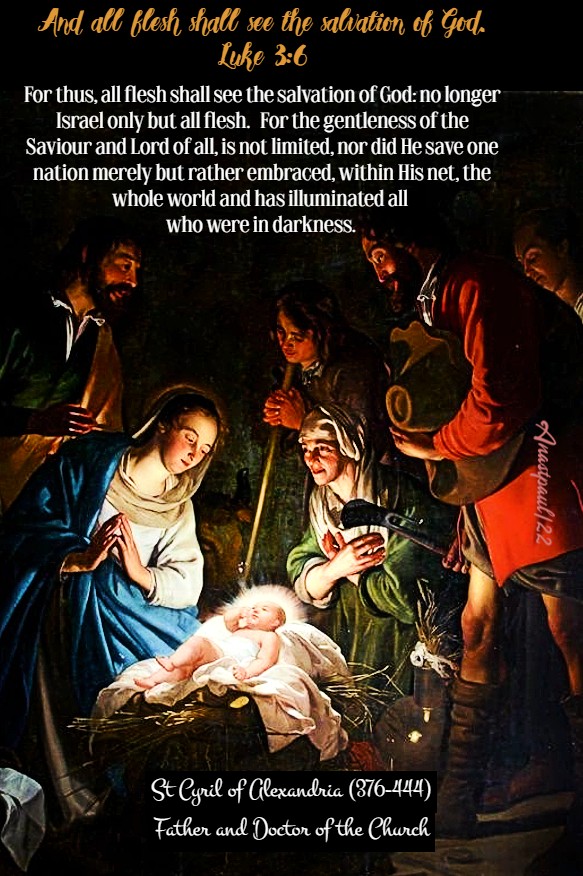
“And all flesh shall see the salvation of God. ” – Luke 3:6
REFLECTION – “And all flesh did see the salvation of God, even of the Father, for He sent the Son to be our Saviour. And in these words by “flesh,” man generally is to be understood, that is, the whole human race. For thus all flesh shall see the salvation of God: no longer Israel only but all flesh. For the gentleness of the Saviour and Lord of all, is not limited, nor did He save one nation merely but rather embraced, within His net, the whole world and has illuminated all who were in darkness. And this is what was celebrated by the Psalmist’s lyre, “All the nations whom Thou hast made, shall come and worship before Thee, O Lord.” While, at the same time, the remnant of the Israelites is saved, as the great Moses also long ago declared, saying, “Rejoice ye nations with His people.” – St Cyril of Alexandria (376-444) Known as “The Pillar of Faith” Archbishop of Alexandria, Father and Doctor of the Church (Homiletic Commentary on Luke 3:1-6 – Fragment).
PRAYER – Put forth Thy power, O Lord, we beseech Thee and delay not and with Thy great might, come to our aid, so that what is hindered by our sins, maybe hastened by Thy merciful goodness. Who livest and reignest with God the Father, in the unity of the Holy Spirit, God, world without end. Amen (Collect)
Our Morning Offering – 20 December – Tuesday in the Fourth Week of Advent – “The Month of the Divine Infant and the Immaculate Conception”
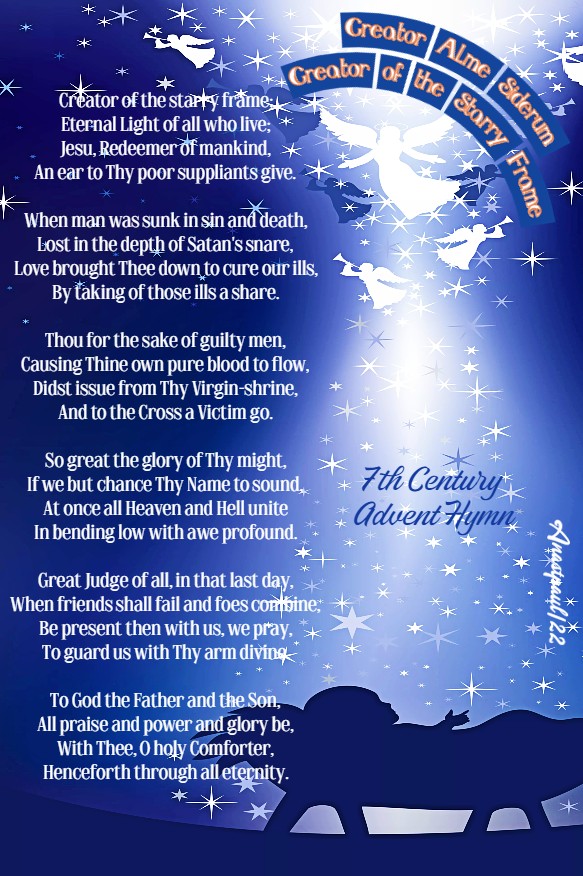
Creator Alme Siderum Creator of the Starry Frame 7th Century Advent Hymn
Creator of the starry frame; Eternal Light of all who live; Jesu, Redeemer of mankind, An ear to Thy poor suppliants give.
When man was sunk in sin and death, Lost in the depth of Satan’s snare, Love brought Thee down to cure our ills, By taking of those ills a share.
Thou for the sake of guilty men, Causing Thine own pure blood to flow, Didst issue from Thy Virgin-shrine, And to the Cross a Victim go.
So great the glory of Thy might, If we but chance Thy Name to sound, At once all Heaven and Hell unite In bending low with awe profound.
Great Judge of all, in that last day, When friends shall fail and foes combine, Be present then with us, we pray, To guard us with Thy arm divine.
To God the Father and the Son, All praise and power and glory be, With Thee, O holy Comforter, Henceforth through all eternity.
Also known as Advent Hymn, this translation of the Latin hymn Creator Alme Siderum (Pope Urban VIII’s 1632 revision of the 7th Century Hymn Conditor alme siderum) was first published in Fr Edward Caswall’s Lyra Catholica, 1849.
Saint of the Day – 20 December – Blessed Peter Massalenus (1375-1453) Monk, Mystic. Born in 1375 in Othoca, Sardinia and died in 1453 in Venice, Italy of natural causes. Also known as Pietro.
Before entering religious life, Peter Massalenus made several pilgrimages to the Holy Land, visiting the Holy sites and following the footsteps of the Lord.
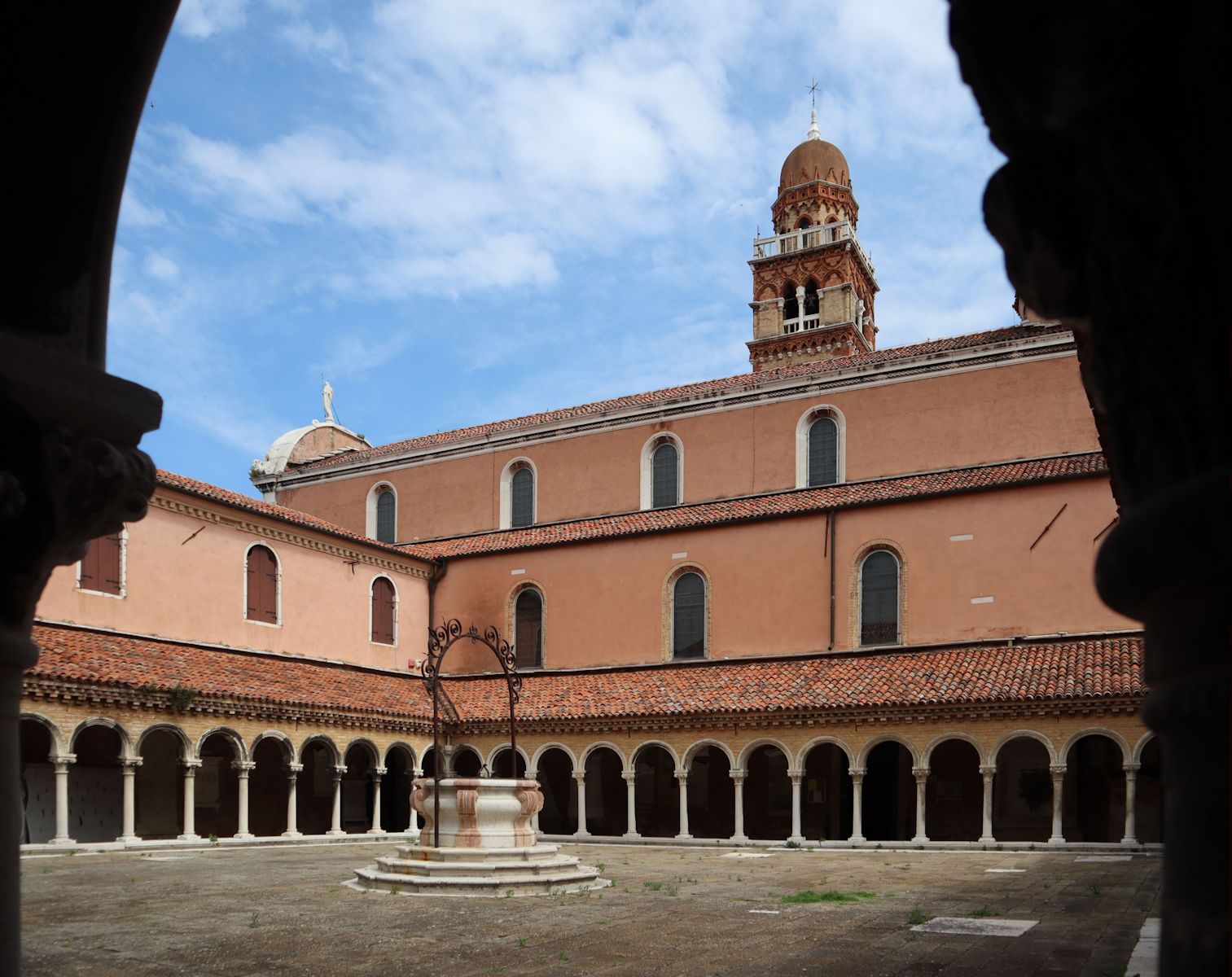
In 1410 he became a Camaldolese Monk in the Monastery of San Michele on the island of the same name in Venice.
Cloister on San Michele
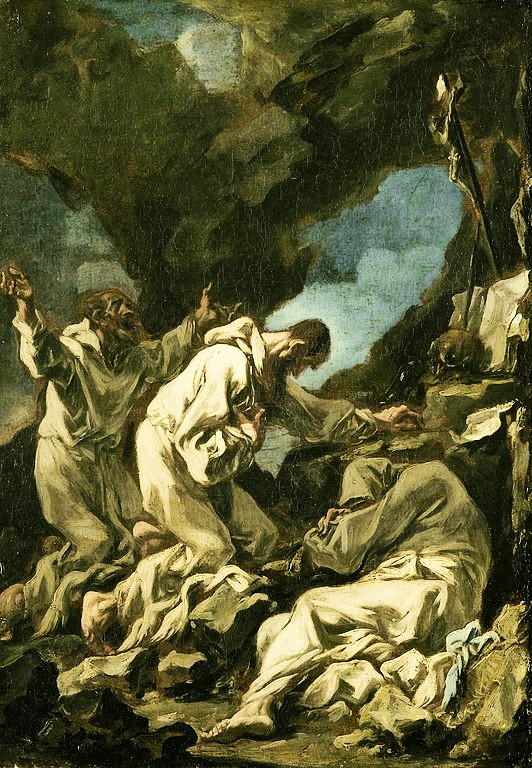
Here he became known for his gifts of mystical contemplation and prayer, assisting others in their desire to seek the heights of contemplation and unity with Christ.
Alessandro Magnasco – Three Camaldolese Monks in Ecstatic Prayer
Peter spent the rest of his life within the cloister of San Michele and was buried there.
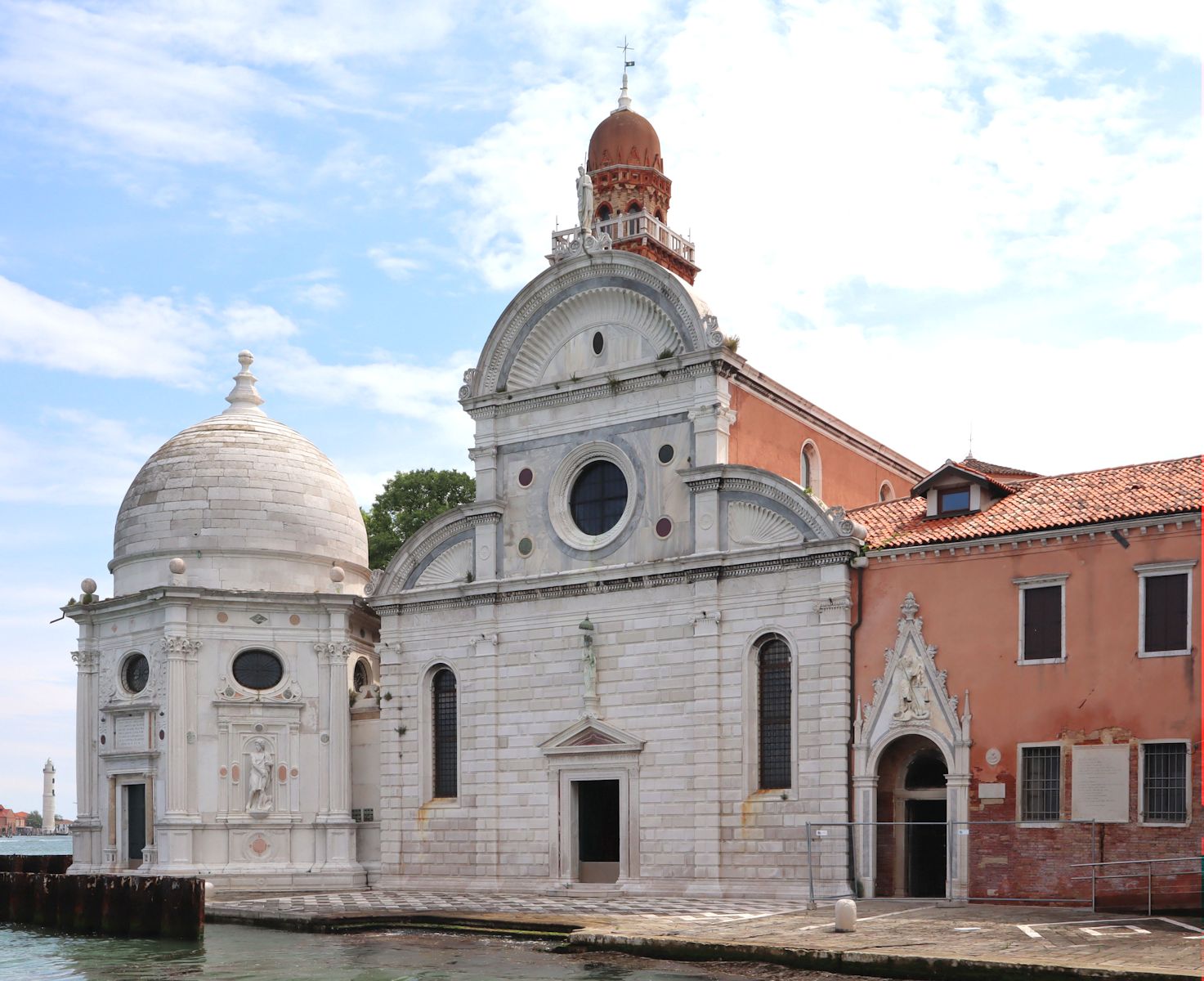
The Camaldolese Monastery of San Michele was closed by Napoleon’s decree in 1810. Today, the island is the vast cemetery of Venice.
Church of San Michele on the island of San Michele – today’s Cemetery Island – near the island of Murano in Venice
St Attala of Strasbourg St Bajulus of Rome St Crescentius of Africa St Damian of Padua St Dominic of Brescia
St Dominic de Silos OSB (1000-1073) Monk, Abbot. He was a Spanish Monk, to whom the Abbey of Santo Domingo de Silos, where he served as the Abbot, is dedicated. The mother of the better-known Saint Dominic de Guzmán, the Blessed Joan of Aza, is said to have prayed at his shrine before she was able to conceive the son she named for him. That son would grow up to found the Dominican Order. Dominic’s special patronage thus became connected with pregnancy and until the establishment of the Second Spanish Republic in 1931, his abbatial crozier was used to bless the queens of Spain and was placed by their beds when they were in labour. Biography: https://anastpaul.wordpress.com/2017/12/20/saint-of-the-day-20-december-st-dominic-de-silos-o-s-b-c1000-1073/
St Eugene of Arabia St Gabriel Olivares Roda St Hoger of Hamburg-Bremen Bl John de Molina St Julius of Gelduba Bl Lorenzo Company St Liberatus of Rome St Macarius of Arabia St Malou of Hautvillers St Paul of Latra Blessed Peter de la Cadireta Blessed Peter Massalenus (1375-1453) Monk, Mystic
Christmas Novena to the Divine Infant Jesus By St Alphonsus Maria de Liguori (1696-1787)
THE FOURTH DAY 19 December Meditation 4: The Life of humility which Jesus lived, even from His Infancy.
All the clues that the Angels gave the shepherds to help them find the Saviour, Who had just been born, were marks of humility – “This will be a sign for you: you will find a Child wrapped in bands of cloth and lying in a manger” (Luke 2:12). This is how you will find the newborn Messiah, the Angel said. You will find Him as an Infant, wrapped in poor ragged clothes, in a stable, lying on straw in a manger for animals. That is how the King of Heaven, the Son of God, was born because ,He came to destroy the pride which had been the cause, of humanity’s spiritual ruin.
The prophets foretold that our Redeemer would be treated as the most wretched person on earth and that He would be overwhelmed with insults. How much ridicule Jesus had to tolerate because of us! He was treated as a drunkard, as a magician, as a blasphemer and a heretic. Think of how many insults He had to endure during His passion. He was abandoned by His own disciples. One of them even sold Him for thirty pieces of silver,and another, denied having ever known Him. He was led through the streets bound like a criminal, scourged like a slave, treated like a madman and mocked as a bogus king. He was struck, spat upon in the face and finally, He was put to death on a Cross, suspended between two thieves. One would think that he had been the greatest lawbreaker the world had ever seen.
Saint Bernard commented that the noblest of all men, Jesus Christ, was treated like the most depraved person of all. “But, my Jesus,” he adds, “the more degraded Thou art, the more dear Thou art to me.” The more humbled and despised He appears, the more esteemed and worthy of our love He becomes.
Affections and Prayers:
O Dearest Saviour, Thou hast embraced so many outrages for love of me, yet, I have not been able to bear one word of insult without at once, being filled with resentful thought – I who have so often deserved to be trodden under foot by the demons in hell! I am ashamed to appear before Thee, sinful and proud as I am. Yet, do not drive me from Thy presence, O Lord, even though that is what I deserve. Thou hast said that Thou wilt not spurn a contrite and humbled heart. I am sorry for the offences I have committed against Thee. Forgive me, O Jesus. I will not offend Thee again.
For love of me Thou hast borne so many injuries; for love of Thee, I will bear all the injuries that art done to me. I love Thee, Jesus, Who wast despised for love of me. I love Thee above every other good. Give me the grace to love Thee always and to bear every insult, for love of Thee.
O Mary, recommend me to Thy Son, pray to Jesus for me. Amen.
Thought for the Day – 19 December – Meditations with Antonio Cardinal Bacci (1881-1971)
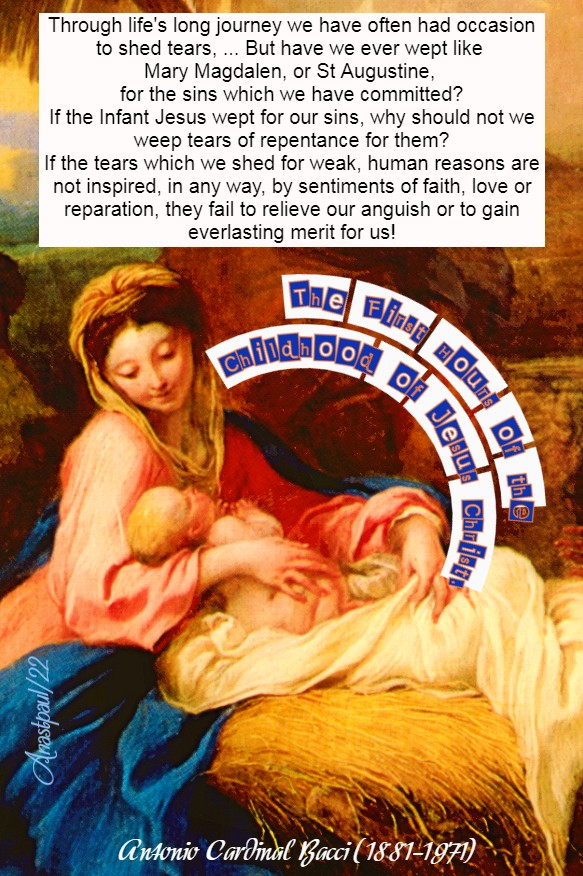
A Christmas Novena IV The First Hours of the Childhood of Jesus Christ
“Through life’s long journey we have often had occasion to shed tears, We have wept for sheer physical pain or moral suffering. Sometimes perhaps, we have wept for joy, for such joy as the world can give. On other occasions, jealousy, hatred or caprice, may have moved us to tears. But have we ever wept like Mary Magdalen, or St Augustine, for the sins which we have committed?
If the Infant Jesus wept for our sins, why should not we weep tears of repentance for them? If the tears which we shed for weak, human reasons are not inspired, in any way, by sentiments of faith, love or reparation, they fail to relieve our anguish or to gain everlasting merit for us!”
Quote/s of the Day – 19 December – Monday of the Fourth Week of Advent – “The Month of the Divine Infant and the Immaculate Conception”
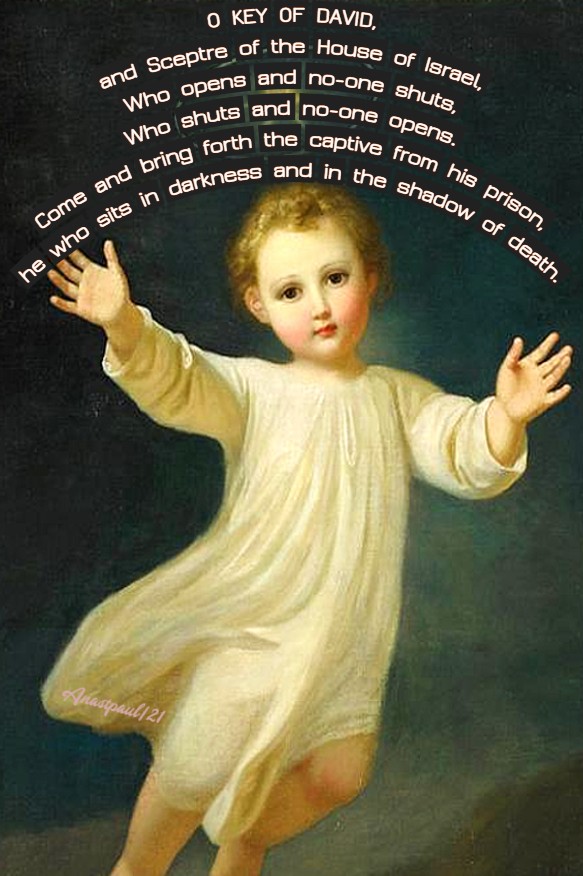
“O KEY OF DAVID, and Sceptre of the House of Israel, Who opens and no-one shuts, who shuts and no-one opens. Come and bring forth the captive from his prison, he who sits in darkness and in the shadow of death.”
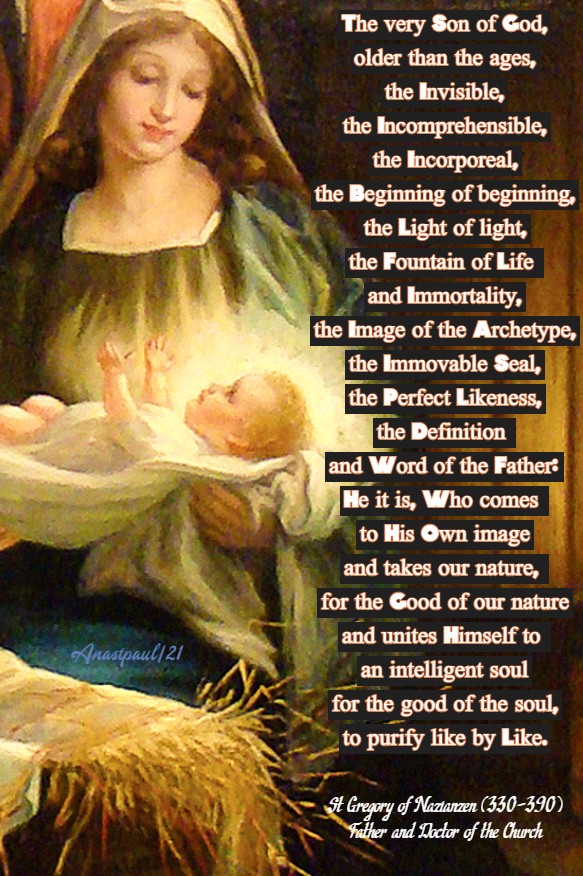
“The very Son of God, Older than the ages, the Invisible, the Incomprehensible, the Incorporeal, the Beginning of beginning, the Light of light, the Fountain of Life and Immortality, the Image of the Archetype, the Immovable Seal, the Perfect Likeness, the Definition and Word of the Father: He it is, Who comes to His Own Image and takes our nature, for the Good of our nature and unites Himself to an intelligent soul for the good of the soul, to purify like by Like.”
St Gregory of Nazianzen (330-390) Father and Doctor of the Church
One Minute Reflection – 19 December – “The Month of the Divine Infant and the Immaculate Conception” – Monday of the Fourth Week of Advent – 1 Corinthians 4:1-5, Luke 3:1-6 – Scripture search here: https://www.drbo.org/
“Let a man so account of us, as servants of Christ and stewards of the Mysteries of God. Moreover, it is required of stewards that they should be found trustworthy …” – 1 Corinthians 4:1-2
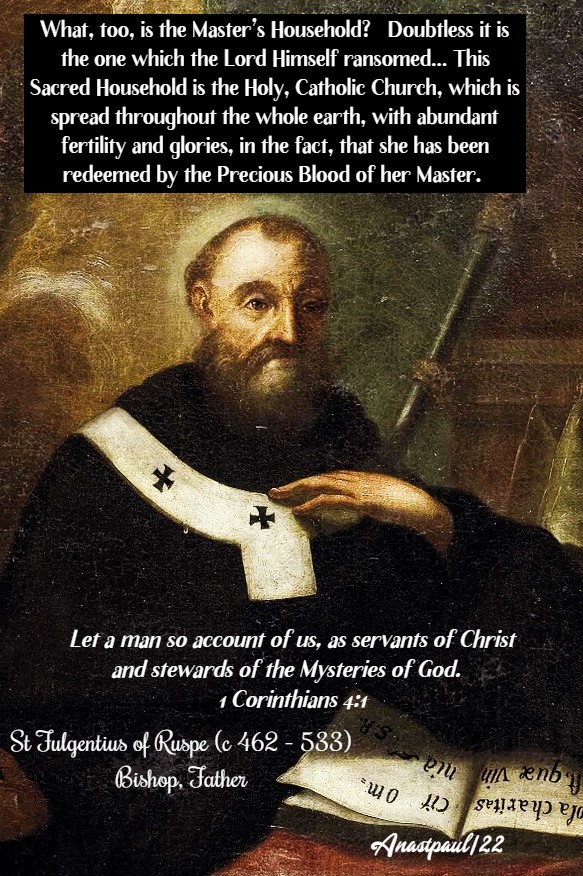
REFLECTION – “Wishing to emphasise the special office of the servants whom He has placed in charge of His people, the Lord says, “Who, do you think, is the faithful and wise steward, whom the Lord sets over His household, to give to them their measure of wheat at the proper time? Blessed is that servant, whom his Master will find so doing, when He comes.” Who is that Master, brethren? Without a doubt it is Christ, who says to His disciples: “You call me Teacher and Lord and you are right, for so I am” (Jn 13,13). What, too, is the Master’s Household? Doubtless it is the one which the Lord Himself ransomed… This Sacred Household is the Holy, Catholic Church, which is spread throughout the whole earth, with abundant fertility and glories, in the fact, that she has been redeemed by the Precious Blood of her Master.
As He Himself says: “The Son of Man came not to be served but to serve and to give His life as a ransom for many” (Mk 10,45). He is, too, the Good Shepherd, Who laid down His life for His sheep” (Jn 10,11)…
As to who the steward is, who ought to be faithful, as well as wise, the Apostle Paul shows us, when, speaking of himself and his companions, he says: “This is how one should regard us, as the servants of Christ and stewards of the Mysteries of God. Moreover, it is required of stewards that they should be found trustworthy” (1Cor 4,1-2). Now, lest anyone of us should think that it is only the Apostles who have been made stewards… the blessed Apostle Paul shows us that the Bishops also are stewards, when he says: “For a Bishop, as God’s steward, must be blameless” (Tt 1,7)…We, therefore, who are the servants of the Master of the household, we are the stewards of the Lord, we have received the measure of wheat to disburse to you.” – St Fulgentius of Ruspe (c 462-533) Bishop, Father (Homily 1, on the Lord’s servants).
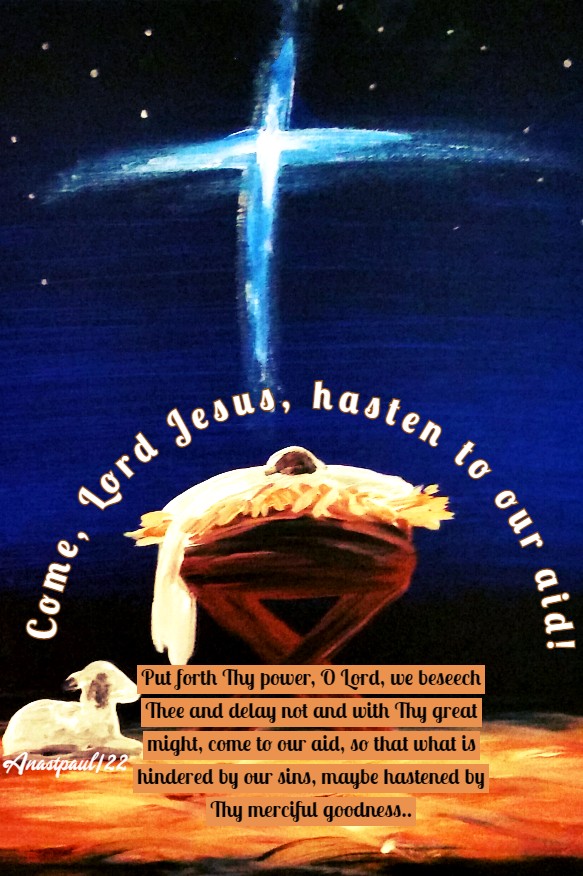
PRAYER – Put forth Thy power, O Lord, we beseech Thee and delay not and with Thy great might, come to our aid, so that what is hindered by our sins, maybe hastened by Thy merciful goodness. Who livest and reignest with God the Father, in the unity of the Holy Spirit, God, world without end. Amen (Collect).
Our Morning Offering – 19 December – The Fourth Week of Advent – “The Month of the Divine Infant and the Immaculate Conception”
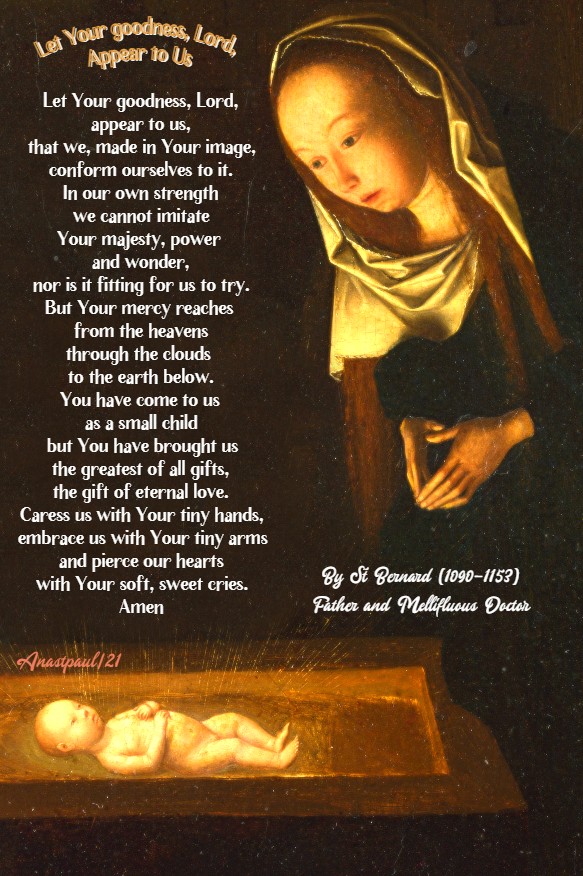
Let Your Goodness, Lord, Appear to Us An Advent Prayer By St Bernard (1090-1153) Father and Mellifluous Doctor
Let Your goodness, Lord, appear to us, that we, made in Your image, conform ourselves to it. In our own strength we cannot imitate Your majesty, power and wonder, nor is it fitting for us to try. But Your mercy reaches from the heavens through the clouds to the earth below. You have come to us as a small child but You have brought us the greatest of all gifts, the gift of eternal love. Caress us with Your tiny hands, embrace us with Your tiny arms and pierce our hearts with Your soft, sweet cries. Amen
Saint of the Day – 19 December – Saint Manirus of Scotland (c 700-824) Confessor, Bishop, Missionary. … Manirus is venerated as one of the Apostles of northern Scotland. His work seems to have concentrated on encouraging the newly converted Highlanders in their faith. Born in c 700 in Scotland and died in 824 in Scotland of natural causes. Also known as – Manire, Monire, Miniar, Niniar.
The last of the Celtic Apostles to bring the Gospel to Deeside, were St Devenick and St Manirus. Both were active in the valley during the 9th century but their Sees were widely separated.
St Manirus’ main sphere of activity was on upper Deeside, in the Crathie district, where he established his Church. The site of Manirus’ foundation is at Rhynabaich, a knoll to the north of the North Deeside Road.
A solitary standing-stone is all that remains of Manirus’ establishment but local place-names such as “Alt Eaglais, the burn of the Church,” “Ereag Eaglais, the hill of the Church,” “Pollmanire, the pool of Manire” – a deep salmon pool on the river Dee almost opposite Balmoral Castle – recall the activities of this almost forgotten Saint. The ancient Church site at Crathie south of the present Crathie-Kirk, is under his invocation.
Some might have forgotten our Saint but he has long been honoured on this day, 19 December, in Church calendars of the area where he evangelised.
He is said to have suffered persecution but did not receive the crown of martyrdom. Hence he appears in the Calendars as a Confessor,
Manire is believed to have died in 824 and to have been buried in his Church at Crathie.
St Boniface of Cilicia Bl Cecilia of Ferrara St Fausta of Sirmium St Gregory of Auxerre St Jaume Boguñá Casanovas St Johannes Gogniat St Jordi Sampé Tarragó St Josep Albareda Ramoneda Bl Konrad Liechtenau St Manirus of Scotland (c 700-824) Confessor, Bishop, Missionary St Meuris of Alexandria St Nemesius of Alexandria St René Dubroux St Ribert of Saint-Oyend St Thea of Alexandria St Timothy the Deacon
Blessed Mercedarian Fathers – (6 Beati): A group of Mercedarian Friars noted for their dedication to the Order’s Rule, for their continuous prayer life and their personal piety.
Blessed Bartolomeo of Podio
Blessed Giovanni of Verdera
Blessed Guglielmo de Gallinaris
Blessed Guglielmo of Prunera
Blessed Pietro of Benevento
Blessed Pietro of Gualba
Martyrs of Nicaea – (4 Saints): A group of Christians Martyred together. The only surviving details are four of their names – Darius, Paul, Secundus and Zosimus. They were martyred at Nicaea, Bithynia (modern Izmit, Turkey).
Martyrs of Nicomedia – (5 Saints): A group of Christians Martyred together in the persecutions of Diocletian. We know little more than the names of five – Anastasius, Cyriacus, Paulillus, Secundus and Syndimius. They were martyred in 303 at Nicomedia, Asia Minor.
Christmas Novena to the Divine Infant Jesus By St Alphonsus Maria de Liguori (1696-1787)
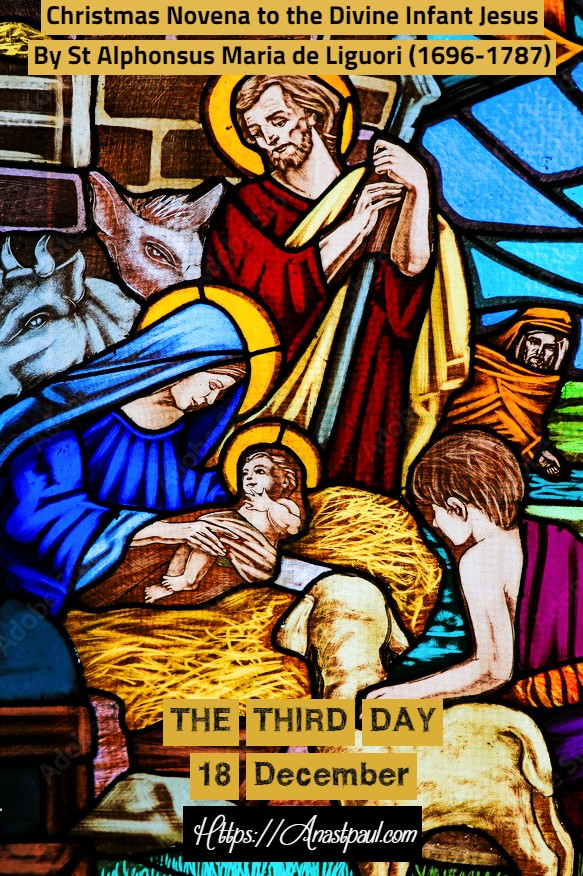
THE THIRD DAY 18 December Meditation 3: The life of poverty which Jesus lived, even from His birth.
God planned that when His Son was to be born on earth, an edict would be promulgated by the Emperor, obliging the head of every household to go to the place of his birth and register. And so, Joseph had to go with his wife to Bethlehem, to enrol according to the Decree of Caesar. While there, Mary’s time of delivery arrived. Because she had been driven from all the other houses and even from the common shelter for poor people, she ended up spending the night in a cave, and there, gave birth to the King of Heaven. It is true that Jesus would have been just as poor if he had been born in Nazareth. But at least there, He would have had a dry room, a little fire, warm clothes and a comfortable cradle. But no, He chose to be born in a cold cavern without a fire to warm Him. He chose to have the livestock’s manger for His cradle and a little prickly straw for His bedding, in order that He might experience what poor people have to experience.
Let us enter that cave in Bethlehem but, let us enter with faith. If we go without faith we will see nothing but a poor Infant, Who moves us to compassion, by seeing Him so beautiful but shivering with cold and crying, from the itchiness of the straw on which He lies. But if we enter with faith, we will believe that this Child is the Son of God, Who loved us so much that He came down to earth and endured so much, to pay for our sins. How could we not thank Him and love Him?
Affections and Prayers:
O dear Infant Jesus, how could I be so ungrateful and offend Thee so often, if I realised, how much Thou hast suffered for me? But these tears which Thou sheddest, this poverty which Thou embraces! for love of me, make me hope for the pardon of all the offences I have committed against Thee.
My Jesus, I am sorry for having so often, turned my back on Thee. But now I love Thee above all else. “My God and my all!” From now on Thou, O my God, shalt be my only treasure and my only good. With Saint Ignatius of Loyola I will say to Thee, “Give me the grace to love Thee – that is enough for me.” I long for nothing else; I want nothing else. Thou alone art enough for me, my Jesus, my life, my love.
O Mary, my Mother, obtain for me, the grace that I may always love Jesus and always be loved by Him. Amen.
Thought for the Day – 18 December – Meditations with Antonio Cardinal Bacci (1881-1971)
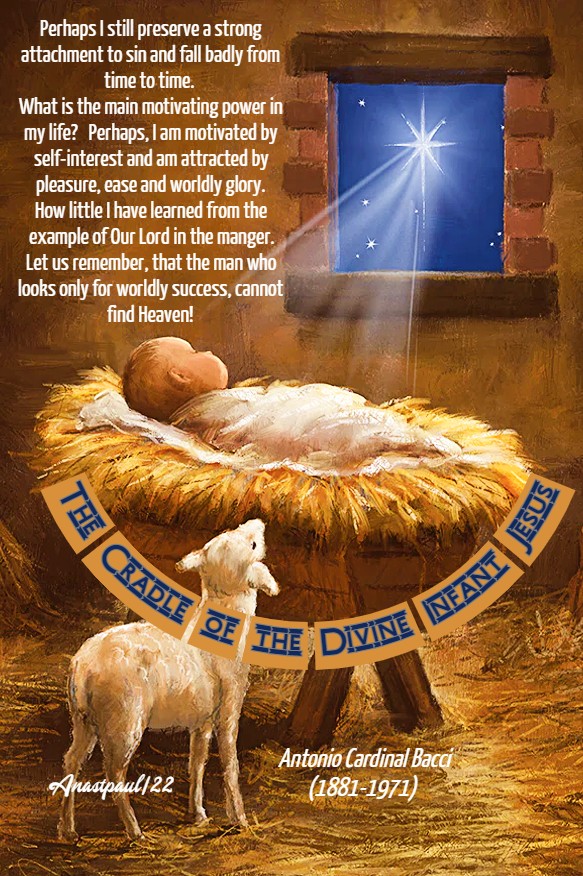
A Christmas Novena III The Cradle of the Divine Infant Jesus
“Perhaps I still preserve a strong attachment to sin and fall badly from time to time. What is the main motivating power in my life? Perhaps, I am motivated by self-interest and am attracted by pleasure, ease and worldly glory. How little I have learned from the example of Our Lord in the manger.
Let us remember, that the man who looks only for worldly success, cannot find Heaven! He will wind up bitter and disillusioned, whereas the man who seeks Jesus Christ, will eventually enjoy the peace and happiness which God alone can give.”
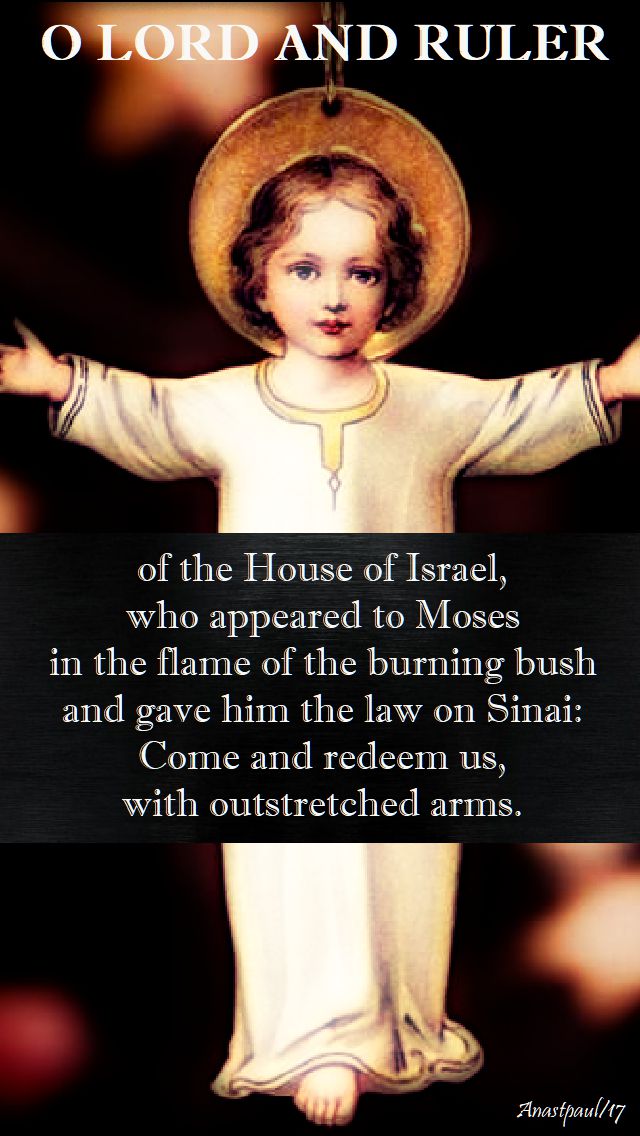
Quote/s of the Day – 18 December – “The Month of the Divine Infant and the Immaculate Conception” – O LORD AND RULER
“O LORD AND RULER of the House of Israel, who appeared to Moses in the flame of the burning bush and gave him the law on Sinai, Come and redeem us with outstretched arms.”
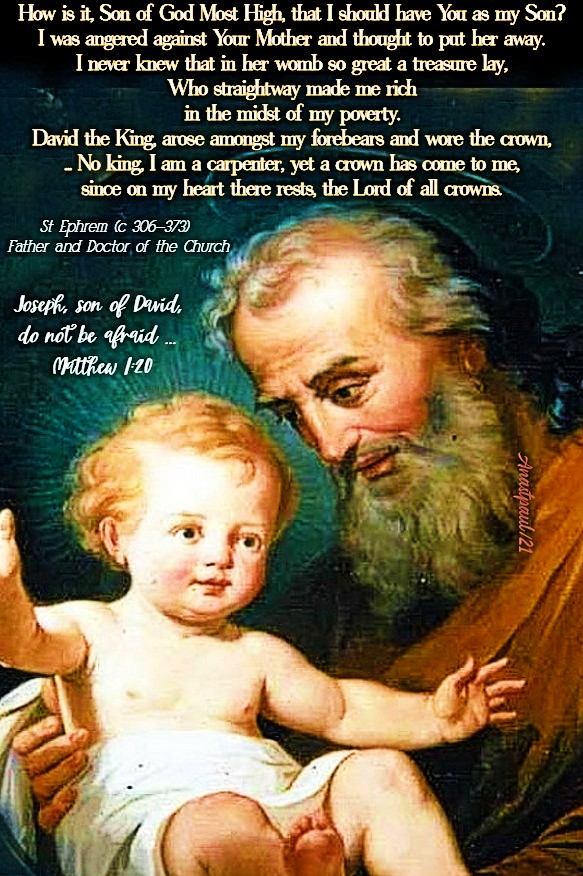
“Joseph embraced the Son of the heavenly Father as he would a newborn babe and served Him as his God. He took pleasure in this as in goodness itself and he, who was complete righteousness (Mt 1:19), worshiped Him.
Oh how great was his wonderment! “How is it, Son of God Most High, that I should have You as my Son? I was angered against Your Mother and thought to put her away. I never knew that in her womb so great a treasure lay, Who straightway made me rich in the midst of my poverty.
David the King, arose amongst my forebears and wore the crown, yet how great is the destitution to which I have come! No king, I am a carpenter, yet a crown has come to me, since on my heart there rests, the Lord of all crowns.”
St Ephrem (306-373) Father and Doctor of the Church


























You must be logged in to post a comment.