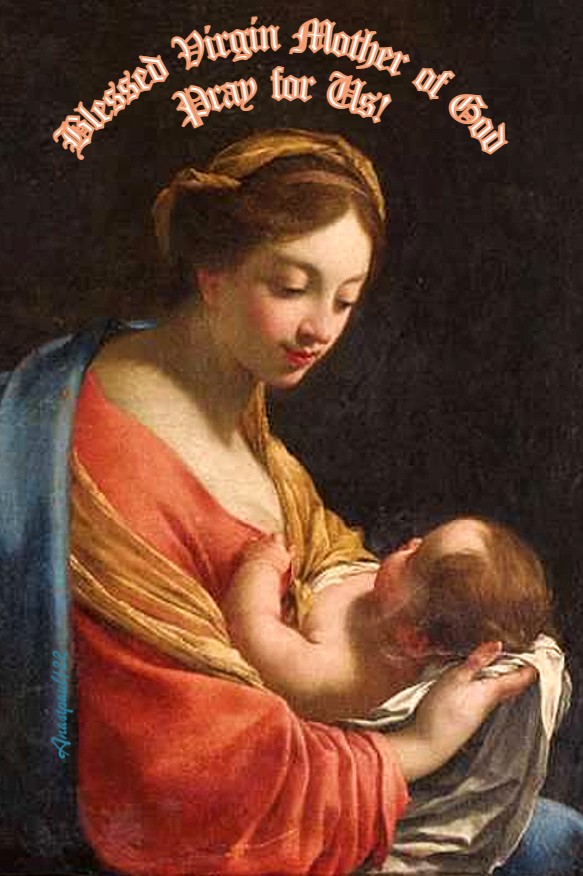
Our Morning Offering – 15 July – “The Month of the Most Precious Blood”
To Christ Crucified Traditional Irish Prayer Trans. Brendan Devlin
May the sweet Name of Jesus Be written deeply on my heart and mind. Through the power of His Passion, Through the force of His Prayer, Through the shedding of His Blood, Through the sweetness of His Sweetness, Through His cruel Death on the Cross, for the sake of us all. O Lord Jesus Christ, be the Saviour of our souls. O Mary, Mother of Jesus and Jesus, be with me, the bond of love, binding us together and never be loosed. Amen
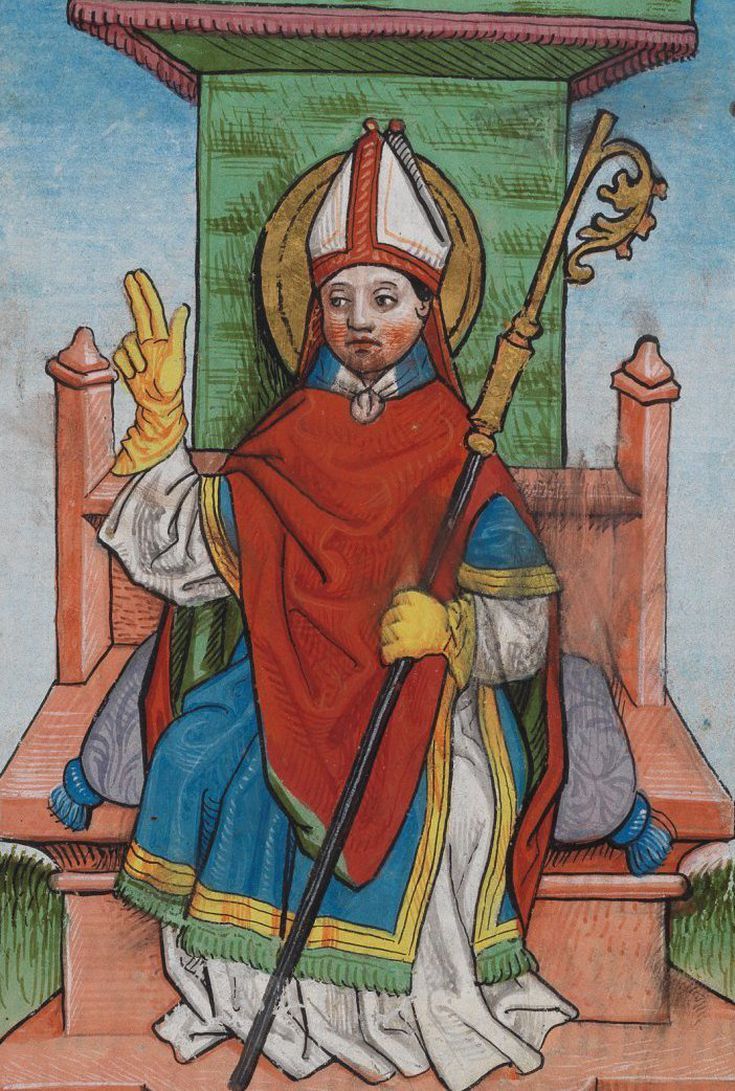
Saint of the Day – 15 July – St Athanasius of Naples (c 830-c 872) Confessor, Bishop of Naples from 849 until his death, Papal Legate, Reformer and restoring of Monasteries, he built a Hospice for pilgrims and a new Monastery, a man of austerity and prayer. This Athanasius should not be confused with his nephew, Athanasius II, also the Bishop of Naples. Born in c 830 in Naples, Italy and died in c 872 at Veroli, Italy of natural causes. Patronage – of Naples.
Athanasius was the second son of Sergius I of Naples and not quite twenty years old when he became Bishop of Naples in 849. At the same time, his brother, Gregory, became Co-Duke. He was Consecrated Bishop in Rome by Pope Leo IV.
Athanasius led a life of austerity and prayer and was particular concerned with the proper education and training of the Clergy in his Diocese. He oversaw the restoration of the Monastery of the Most Holy Saviour and established a Monastery dedicated to Sts.Januarius and Agrippinus. He also established a hospice for pilgrims, and set up a process for ransoming prisoners captured by the Saracens.
He attended the Lateran Council of 863.[2]
Athanasius was an intimate of both the Court of the Western Emperor and that of the Pope. He was a relative of Emperors Lothair I and Louis II and was made a Papal legate because of his connections with the Roman Curia.
Before dying, Sergius, his father, bade Gregory , his brother the Duke, to follow the counsel of his brother the Bishop. Gregory did but his son, Sergius II, did not. He persecuted Athanasius, who was opposed to the alliance with the Aghlabids of Sicily and took possession of the treasures of the Cathedral. In 870 Duke Sergius II imprisoned his uncle Caesar, Admiral of the Neapolitan fleet, who similarly, opposed his closeness to the Aghlabids, Caesar died in prison.
The Bishop was exiled to a small island, only to be rescued by ships sent by the Emperor Louis. While travelling to Rome, Athanasius died at Veroli and was buried at Monte Cassino. His body was soon afterwards translated to the Cathedral of Naples.[6]
He is regarded as the Co-Patron Saint of the City of Naples. A Vita of Athanasius was written by John the Deacon in 872.
St Henry II (972-1024) Holy Roman Emperor ,Henry was well known for his Missionary spirit and for his protection of the Pope in times of trouble. Henry ruled with a spirit of great humility and always sought to give the glory to God. He used his position to promote the work of the Church and the peace and happiness of the people. Another Saints whose Feast was moved in 1969 from today, 15 July to 13 July. Biography: https://anastpaul.wordpress.com/2017/07/13/saint-of-the-day-13-july-st-henry-ii-holy-roman-emperor/
Dispersion of the Apostles – Divisio Apostolorum: Commemorates the missionary work of the Twelve Apostles. It was first mentioned in the 11th century and was celebrated in the northern countries of Europe during the Middle Ages. It is now observed in Germany, Poland and some Diocese of England, France and the United States.
St Abundantia of Spoleto St Abudemius of Bozcaada St Adalard the Younger
Blessed Anne-Mary Javouhey (1779-1851) “The Mother of the Slaves,” Religious Sister, Missionary and Founder of the Sisters of Saint Joseph of Cluny. Imagine a Mother Teresa in the France of Napoleon’s day and you will have a picture of Anne-Marie Javouhey. Nanette, as she was called, was a “velvet brick,” a thin layer of gentleness covering her determined core. A competent leader, Nanette dominated every scene in her adventurous life. Blessed Anne-Marie was Beatified on 15 October 1950 by Ven Pope Pius XII. Biography: https://anastpaul.com/2019/07/15/saint-of-the-day-15-july-blessed-anne-mary-javouhey-1779-1851/
St Apronia St Athanasius of Naples (c 830-c 872) Bishop St Antiochus of Sebaste St Benedict of Angers
Blessed Bernard of Baden TOSF (1428-1458) Margrave of Baden, Germany (Margrave was originally the medieval title for the military commander assigned to maintain the defence of one of the border provinces of the Holy Roman Empire.) Tertiary of the Order of St Francis, Apostle of the poor and the needy. Bernard was Beatifed on 16 September 1769 by Pope Clement XIV. His Canonisation process continues, at present, the second miracle required is being investigated. Blessed Bernard’s Life: https://anastpaul.com/2021/07/15/saint-of-the-day-15-july-blessed-bernard-of-baden-tosf-1428-1458/
Bl Ceslas Odrowaz St David of Sweden St Donivald St Eberhard of Luzy St Edith of Tamworth St Eternus St Felix of Pavia St Gumbert of Ansbach St Haruch of Werden St Jacob of Nisibis St Joseph Studita of Thessalonica Bl Peter Aymillo St Plechelm of Guelderland Bl Roland of Chézery St Valentina of Nevers St Vladimir I of Kiev
Martyred Jesuit Missionaries of Brazil – 40 Beati: A band of forty Spanish, Portugese and French Jesuit Missionaries Martyred by the Huguenot pirate Jacques Sourie while en route to Brazil. They are – • Aleixo Delgado • Alonso de Baena • álvaro Borralho Mendes • Amaro Vaz • André Gonçalves • António Correia • Antônio Fernandes • António Soares • Bento de Castro • Brás Ribeiro • Diogo de Andrade • Diogo Pires Mimoso • Domingos Fernandes • Esteban Zuraire • Fernando Sánchez • Francisco Alvares • Francisco de Magalhães • Francisco Pérez Godoy • Gaspar Alvares • Gonçalo Henriques • Gregorio Escribano • Ignatius de Azevedo • Iõao • João Fernandes • João Fernandes • Juan de Mayorga • Juan de San Martín • Juan de Zafra • Luís Correia • Luís Rodrigues • Manuel Alvares • Manuel Fernandes • Manuel Pacheco • Manuel Rodrigues • Marcos Caldeira • Nicolau Dinis • Pedro de Fontoura • Pedro Nunes • Simão da Costa • Simão Lopes • They were Martyed on 15 and 16 July 1570 on the ship Santiago near Palma, Canary Islands. They were Beatified on 11 May 1854 by Pope Pius IX.
Martyrs of Alexandria – 13 Saints: Thirteen Christians who were Martyred together. We know the names of three, no details about them and the other ten were all children. – Narseus, Philip and Zeno. Martyred in the early 4th-century in Alexandria, Egypt.
Martyrs of Carthage – 9 Saints: A group of nine Christians who were Martyred together. We know nothing else but their names – Adautto, Catulinus, Felice, Florentius, Fortunanziano, Januarius, Julia, Justa and Settimino. They were Martyred in Carthaginian and their relics at the Basilica of Fausta at Carthage.
Martyrs of Pannonia – 5 Saints: Five 4th-century Martyrs killed together. No information about them has survived except the names – Agrippinus, Fortunatus, Martialis, Maximus and Secundinus.
Thought for the Day – 14 July – Meditations with Antonio Cardinal Bacci (1881-1971)
The Enemies of the Soul
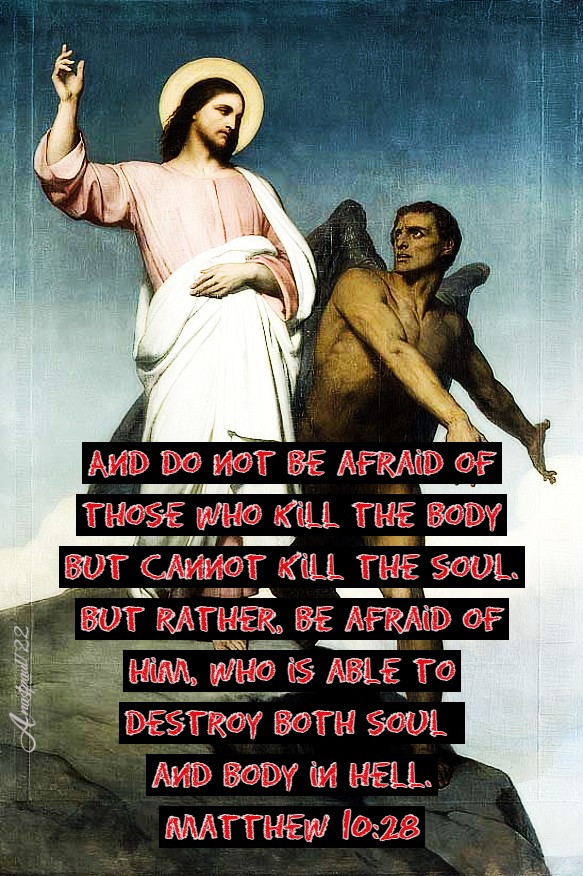
“It is Christian teaching that we have three enemies which are a constant threat to our salvation. The first, is the devil, an invisible but very powerful foe.
The devil was once an Angel of beauty. He had gifts superior to those of men and was in a state of happiness. But God required from him, a proof of his fidelity before he could merit the everlasting reward for which he had been destined.
Lucifer was proud of his beauty and power. Believing that he was equal to the Most High God, he rebelled against his Creator and drew with him, into eternal ruin, innumerable bands of disloyal Angels. Their sin was greater than ours because they had been endowed with a superior intellect and their will was not subject to the pull of the sensitive appetites of a material body. This is why God did not give them time to repent but condemned them immediately to the everlasting torments of Hell. It is false to imagine, however, that they are confined, as it were, in one place. Being pure spirit, they can, with God’s permission, wander throughout the world, carrying their hell within themselves. Moreover, they can endanger, in a thousand ways, our eternal salvation. The Gospel often speaks of diabolical temptations and obsessions and, St Peter warns us to be continually on our guard against the onslaughts of the enemy. “Be sober,” he says, “be watchful. For your adversary, the devil, as a roaring lion, goes about seeking someone to devour. Resist him, steadfast in the faith, knowing that the same suffering befalls your brethren all over the world” (1 Peter 5:8).
It is the same now as it was in the time of Jesus and His Apostles.
We do not see this infernal spirit but, we feel his presence. Let us remember what St Augustine wrote about him. “The devil,” he said, “is a mastiff in chains. He can bark but, he cannot bite, unless we yield to his evil suggestions and approach him. Watch and pray!””
Quote/s of the Day – 14 July – “The Month of the Precious Blood” – The Memorial of St Bonaventure OFM (1221-1274) Seraphic Doctor of the Church (No images until later. We are being subjected to constant Power Cuts again – they can be up to 8 hours per day.)
“Since happiness is nothing else than the enjoyment of the Supreme Good and the Supreme Good is above us, no-one can enjoy happiness, unless he rises above himself.”
“As “pride, is the beginning of all sin,” (Eccl. 10:15) so humility, is the foundation of all virtue. Learn to be really humble and not, as the hypocrite, humble merely in appearance.”
One Minute Reflection – 14 July – “The Month of the Precious Blood” – The Memorial of St Bonaventure OFM (1221-1274) Seraphic Doctor of the Church – 2 Timothy 4:1-8, Matthew 5:13-19
“You are the light of the world.” – Matthew 5:14
REFLECTION – “I shall always love and reverence the Apostles sent by Christ and their successors, in sowing the seed of the Gospel, those zealous and tireless co-operators in propagating the Word, who may justly say of themselves: Let a man so account of us as the ministers of Christ and the dispensers of the mysteries of God. For Christ, like a most watchful and most faithful householder, wished that the Gospel lamp should be lighted by such ministers and delegates, with fire sent down from Heaven and once lighted, should not be put under a measure but set upon a candlestick, so that it may spread its brightness far and wide and put to flight, all darkness and error, rife among both Jews and Gentiles.
Now it is not enough for the Gospel teacher to be a brilliant speaker in the eyes of the people; he must also be as a voice crying in the desert and endeavour, by his eloquence, to help many to lead good lives, lest, if he omit his duty of speaking, he be called the dumb dog that is not able to bark, spoken of by the prophet. Yes, he should also burn, in such a way, that, equipped with good works and love, he may adorn his evangelical office and follow the leadership of Paul. He indeed, was not satisfied with bidding the Bishop of the Ephesians: Thus command and teach: conduct thyself in work as a good soldier of Christ Jesus but he unflaggingly preached the Gospel to friend and foe alike and, said with a good conscience to the Bishops gathered at Ephesus: You know how I have kept back nothing that was for your good but have declared it to you and taught you in public and from house to house, urging Jews and Gentiles to turn to God in repentance and to believe in our Lord Jesus Christ.
Such should be the shepherd in the Church who, like Paul, becomes all things to all men, so that the sick may find healing in him; the sad, joy; the desperate, hope; the ignorant, instruction; those in doubt, advice; the penitent, forgiveness and comfort and finally, everyone, whatever is necessary for salvation. And so Christ, when He wished to appoint the chief teachers of the world and of the Church, did not limit Himself to saying to His disciples: You are the light of the world but also added these words: A city seated on a mountain cannot be hid. Neither do men light a candle and put it under a measure but upon a candlestick, that it may shine to all who are in the house. Those churchmen err, who imagine that it is by brilliant preaching, rather than by holiness of and all-embracing love, they fulfil their office.” – St Peter Canisius SJ (1521-1597) Doctor of the Church (Sermon excerpt).
PRAYER – O God, Who gave to Thy people, blessed Bonaventure, as a minister of salvation, grant, we beseech Thee, that we who cherished him on earth as a teacher of life, may be found worthy to have him as an intercessor in heaven. Through the same Jesus Christ, Thy Son our Lord, Who lives and reigns with Thee, in the unity of the Holy Ghost, God, world without end. Amen (Collect).
Our Morning Offering – 14 July – “The Month of the Most Precious Blood” and the Memorial of St Bonaventure OFM (1221-1274) Seraphic Doctor of the Church
Prayer for the Gifts of the Holy Spirit By St Bonaventure (1221-1274) Seraphic Doctor of the Church
We beg the All-Merciful Father through Thee, His Only-Begotten Son, made Man for our sake, Crucified and Glorified for us, to send upon us, from His treasure-house, the Spirit of Sevenfold Grace, Who rested upon Thee in all His fullness.
The Spirit of Wisdom, enabling us to relish the fruit of the tree of life, which is indeed Thyself. The Gift of Understanding, to enlighten our perceptions. The Gift of Prudence, enabling us to follow in Thine Footsteps. The Gift of Strength, to withstand our adversary’s onslaught. The Gift of Knowledge, to distinguish good from evil, by the light of Thine holy teaching. The Gift of Piety, to clothe ourselves with charity and mercy. The Gift of Fear, to withdraw from all ill-doing and live quietly in awe of Thy Eternal Majesty.
These are the things for which we petition. Grant them for the honour of Thy Holy Name, to which, with the Father and the Holy Ghost, be all honour and glory, thanksgiving, renown and Lordship, forever and ever. Amen
Saint of the Day – 14 July – PATRONAGES – Blessed Boniface of Canterbury O.Cart. (c 1207-1270) Carthusian Monk and Prior, the forty sixth Archbishop of Canterbury. Reformer, Mediator. Born in c 1207 near Sainte-Hélòne-du-Luc in the Savoy region of modern France and died on 18 July 1270 at the Sainte-Hélòne des Milliere Castle in Hautecombe, Savoy, France of natural causes. Also known as – Boniface of Savoy. Beatified on 7 September 1838 by Pope Gregory XVI. His body is incorrupt.
Born to the nobility as a member of the Ducal House of Savoy. Boniface was the eleventh child of Count Thomas of Savoy and the brother of Queen Beatrix of Savoy, as well as the Uncle of Queen Eleanor of England.
Boniface became a Carthusian Monk at the Grande Chartreuse at a very young age. As a young man he was appointed as the Prior of the Carthusian Monastery in Natua, France.
In 1233, as a Sub-Deacon, he was elected Bishop of Belley in Burgundy and, in 1241, Boniface administered the Diocese of Valence, as well. In 1245, Boniface was chosen as the forty sixth Archbishop of Canterbury, England by Pope Innocent IV. In the same year, he attended the Council of Lyon.
As the Archbishop, Boniface revised the Court, eliminated unnecessary offices in the Archdiocese and worked to solve the fiscal problems of the nearly bankrupt Diocese. Boniface exerted diplomacy and mediation in order to reduce the Royal interference in the Church’s internal affairs and the control of Eccleasiastical appointments.
Boniface proceeded to implement reforms in a number of the Monasteries in his Diocese but many refused to recognise him or permit his visits. Some of the disputes actually led to violence and he was forced to excommunicate some Clerics in order to implement compliance. Others, however, welcomed his reform efforts, and were impressed with his personal piety, his charity, and his simple lifestyle.
In 1258 he was chosen the leader of a group of the King‘s Counsellors who represented the interests of the English Barons against the King. In May 1261 he called a Council at Lambeth Castle which led to declarations explaining that the Church had the right to oppose worldly forces and interventions. However, Pope Urban IV needed the support of King Henry and refused to ratify these Decrees.
Boniface went into voluntary exile in France from 1262 to 1266, administering his Archdiocese as best he could, from across the Channel and continued to oppose Henry’s unilateral appointments to Ecclesiastical offices and his taxation of Church property. But he sided with the King on other matters, especially when the Barons resorted to civil war. On the triumph of the King’s party in 1265, he returned to England, arriving there in May 1266.
Boniface even briefly served as Regent of England and accompanied the King on diplomatic expediations to France.
Boniface died while trying to settle family business and end feuds between family factions. Later English historians complained of his excessive involvement in worldly politics and his family affairs but. in France, he was far more appreciated by those who knew his true holiness and zeal for the Church of Christ.
Boniface was buried with his family in the Cistercian Abbey of Hautecombe in Savoy. In his will, he left legacies to all the houses of the Franciscans and Dominicans in the Diocese of Canterbury. His will had differing provisions for his burial depending on whether he died in England, France, or near the Alps.
After his death, Boniface’s tomb was the center of a cult, and when the tomb was opened in 1580, his body was found to be perfectly preserved
Blessed Angelina di Marsciano Blessed Boniface of Canterbury O.Cart. (c 1207-1270) Carthusian Monk and Prior, Archbishop of Canterbury. Beatified on 7 September 1838 by Pope Gregory XVI. His body is incorrupt.
St Colman of Killeroran St Cyrus of Carthage St Deusdedit of Canterbury St Donatus of Africa
Blessed Gaspar de Bono OM (1530– 1604) Spanish Priest, Friar of the Order of Minims, Vicar Provincial of the Order. He was noted for his particular devotion to the Passion of Christ, carrying his Crucifix everywhere as a means of evangelisation and to be able to constantly immerse himself in his Saviour’s sufferings. His Loving Life: https://anastpaul.com/2021/07/14/saint-of-the-day-14-july-blessed-gaspar-de-bono-om-1530-1604/
Bl Giorgio of Lauria Bl Hroznata of Bohemia Bl Humberto of Romans St Idus of Ath Fadha St Just St Justus of Rome St Liebert St Marciano of Frigento St Marchelm Bl Michael Ghebre St Optatian of Brescia St Papias of Africa Bl Richard Langhorne Bl Toscana of Verona St Ulric of Zell St Vincent Madelgaire
Thought for the Day – 13 July – Meditations with Antonio Cardinal Bacci (1881-1971)
The Grace of God
“It is astonishing to consider how much St Paul accomplished when he had been transformed by the grace of God. Formerly, a persecutor of Christians, he became the Apostle of the Gentiles. Enlightened by faith and inspired by charity, he travelled the globe, spreading everywhere, the religion of Jesus Christ.
He feared neither the anger of the hostile Jews, nor the tribunals of the Roman judges, neither long and difficult journeys, nor scourging, shipwreck and imprisonment. “The love of Christ impels us,” (2 Cor 5:14) he said. It was the love of God which drove him on and on, until he met his martyrdom. But what about ourselves? We also have received grace from God. Often we hear His voice appealing to us to abandon our sinful ways, to practise virtue, to love Him more ardently and to prove our love, by deeds. If we co-operate, we shall be able to say with St Paul: “by the grace of God, I am what I am and his grace in me has not been fruitless,” (1 Cor 15:10) and “I have laboured … yet, not I but the grace of God with me” (ibid).
It is wise to recall, however, that Judas also received special graces from God. He did not correspond with them and was probably damned for eternity. If we fail to correspond with God’s graces, the result will be tragic for ourselves.”
Quote/s of the Day – 13 July – “The Month of the Precious Blood” – The Memorial of St Anacletus (c25-c89) 3rd Bishop of Rome and Martyr
“There are also some among the heretics who … flatter themselves with claims of martyrdom … But not all ,who submit their bodies to suffering, even to flames, are to be considered as having as having shed their blood for their sheep; rather, they may have shed it against the salvation of their sheep, for the Apostle says: “If I should deliver my body to be burned and have not charity, it profits me nothing” (1 Corinthians 13:3). And how can he have the faintest charity in him who, although shown to be at fault, yet has no love for that unity which the Lord chose to recommend? Indeed, so long as you remain outside the Church and severed from the fabric of unity and bond of charity, you will be punished with everlasting chastisement, even if you were burned alive for the sake of Christ
St Augustine (354-430) Father and Doctor of the Church
“Without the Cup of the Lord preserving the holy bond of love, even if a man should deliver his body to be burned, he gains nothing!”
St Fulgentus of Ruspe (c 462 – 533)
The prayer below, was written by Saint Thomas More while he was imprisoned in the Tower of London, awaiting execution by King Henry VIII.
Give Me Thy Grace, Good Lord! A Prayer of Hope By St Thomas More (1478-1535)
Give me Thy grace, good Lord. To set the world at naught. To set the mind firmly on Thee and not to hang upon the words of men’s mouths. To be content to be solitary. Not to long for worldly pleasures. Little by little, utterly to cast off the world and rid my mind of all its business. Not to long to hear of earthly things but that the hearing of worldly fancies, may be displeasing to me. Gladly to be thinking of God, piteously to call for His help. To lean into the comfort of God. Busily to labour to love Him. To know mine own vileness and wretchedness. To humble myself under the mighty Hand of God. To bewail my sins past, for the purging of them, patiently to suffer adversity. Gladly to bear my purgatory here. To be joyful in tribulations. To walk the narrow way that leads to life. To bear the Cross with Christ. To have the last thing in remembrance. To have ever before mine eyes, my death that is ever at hand. To make death no stranger to me. To foresee and consider, the everlasting fire of Hell. To pray for pardon before the Judge come. To have continually in mind, the Passion that Christ suffered for me. For His benefits, unceasingly to give Him thanks. To buy the time again, that I before have lost. To abstain from vain conversations. To shun foolish mirth and gladness. To cut off unnecessary recreations. Of worldly substance, friends, liberty, life and all, to set the loss at naught, for the winning of Christ. To think my worst enemies, my best friends, for the brethren of Joseph could never have done him so much good with their love and favour, as they did him, with their malice and hatred. These minds are more to be desired of every man, than all the treasures of all the princes and kings, Christian and heathen, were it gathered and laid together, all in one heap. Amen
One Minute Reflection – 13 July – “The Month of the Precious Blood” – The Memorial of St Anacletus (c25-c89) 3rd Bishop of Rome and Martyr – 1 Petet 5:1-4; 5:10-11, Matthew 16:13-19
“Upon this rock I will build my church” – – Matthew 16:18
REFLECTION – “Although the earth and all who dwell in it quake, I have set firm its pillars” (Ps 74[75],40). All the Apostles are pillars of the earth but, at their head, the two whose Feast we are celebrating. They are the two pillars who support the Church with their teaching, their prayer and the example of their steadfastness. The Lord Himself strengthened these pillars. For at first they were weak, completely incapable of supporting either themselves or others. And in this the Lord’s great design appears: it they had always been strong, people could have thought their strength came from themselves. That is why the Lord wanted to show what they were capable of, before strengthening them, so that all might know, that their strength came from God… Peter was thrown to the ground by the voice of a mere servant… and the other pillar was very weak too: “I was once a blasphemer and persecutor and an arrogant man” (1Tm 1,13)…
Hence we ought to praise these Saints with all our heart: our Fathers who bore such trials for the Lord’s sake and who persevered, with such determination. It is nothing to persevere in joy, happiness and peace. But this is what is great – to be stoned, scourged, struck for Christ (2 Cor 11,25) and in all this, to persevere with Christ. With Paul it is a great thing to be cursed and to bless, to be persecuted and to endure, to be slandered and to console, to be like the world’s rubbish and to draw glory from it (1 Cor 4,12-13)… And what shall we say of Peter? Even if he had undergone nothing for Christ, it would be sufficient to celebrate him today in that he was crucified for Him… He well knew where He Whom he loved, He Whom he longed for was…: his cross has been his road to Heaven.” – St Aelred of Rielvaux (1110-1167) Cistercian Monk Sermon 18, for the feast of S (ints Peter and Paul ; PL 195, 298).
PRAYER – Look forgivingly on thy flock, Eternal Shepherd, and keep it in thy constant protection, by the intercession of blessed Anacletus thy Martyr and Sovereign Pontiff, whom thou didst constitute Shepherd of the whole Church.Through the same Jesus Christ, Thy Son our Lord, Who lives and reigns with Thee, in the unity of the Holy Ghost, God, world without end. Amen (Collect).
Our Morning Offering – 13 July – “The Month of the Most Precious Blood” 1 Petet 5:1-4; 5:10-11, Matthew 16:13-19
Prayer for the Gift of Prayer By St Alphonsus Liguori (1696-1787) Most Zealous Doctor of the Church
O Incarnate Word, You have given Your Blood and Your Life to confer on our prayers that power by which, according to Your promise, they obtain for us, all that we ask. And we, O God, are so careless of our salvation, that we will not even ask You for the graces that we must have, if we should be saved! In prayer You have given us the key of all Your Divine treasures and we, rather than pray, choose to remain in our misery. Alas! O Lord, enlighten us, and make us know the value of prayers, offered in Your Name and by Your merits, in the eyes of Your Eternal Father. Amen
Saint of the Day – 13 July – St Mildred of Thanet OSB (Died c 700) English Benedictine Nun and Abbess, Born as an Anglo-Saxon Princess and died in c.700 of natural causes. Patronage – the Island of Thanet, Kent, England. Also known as – “The Fairest Lily of the English,” Mildred of Minster, Mildryth, Mildthryth. Additional Memorials – 18 May (translation of relics), 20 February (translation of relics).
Mildred was the daughter of King Merewalh of Magonsaete, an area similar to the present day Herefordshire, a sub-kingdom of Mercia. Her mother was Domne Eafe (also sometimes named as Saint Eormenburga), herself a great-granddaughter of Æthelberht of Kent and as such, appears in the Kentish Royal Legend.
Her sisters Milburga of Much Wenlock and Mildgyth, are also Saints and Mildred, along with her extended family, also feature in the Kentish Royal Legend. In the 11th Century, Goscelin wrote a hagiography of Mildred, the Vita Mildrethae. Another work, the Nova Legenda Anglie of 1516, gives an extensive account of her life.
Mildred was educated at the prestigious Merovingian Royal Abbey of Chelles. She entered the Abbey of Minster-in-Thanet, which her mother had established and became Abbess there by 694. A number of dedications to Mildred exist in the Pas-de-Calais, including at Millam, thereby suggesting that ties to Gaul were maintained. Mildred died at Minster-in-Thanet some time after 700 and was buried there in the Abbey Church of St Mary.
Mildrith’s successor as Abbess, Eadburg, also known as Edburga of Minster-in-Thanet, a correspondent of Saint Boniface, built a new Abbey Church, dedicated to Saints Peter and Paul and translated Mildred’s relics there, not later than 748. The Shrine within the Abbey became a popular place of local pilgrimage, with Mildred becoming a much-loved local Patron Saint.
The last Abbess of Minster in Thanet was Leofruna, who was captured by Danes in 1011. The Abbey was abandoned and the Church downgraded to a Parish Church. n 1030, Mildred’s remains, despite fierce local opposition, were translated to St Augustine’s Abbey, Canterbury, an event commemorated on 18 May. St Mildred’s Church, within the town walls at Canterbury, dates back to this time.
In the 11th Century, some of her relics were given, to a Church at Deventer, Netherlands. In 1881 St Mildred’s Feast Day was officially reinstated by Pope Leo XIII.n 1882, following a refounding of the Benedictine Convent at Minster in Thanet, the nuns petitioned the Archbishop of Utrecht, who granted their return to Thanet. In 1937, Minster Abbey was bought by Nuns of the Benedictine Order, and in 1953, a relic of St Mildred was brought there.
There are numerous medieval Churches dedicated to St Mildred of Thanet, most of them in Kent. This one is in pretty Tenterden (whose name means ‘woodland pasture of the people of Thanet.’ (I have many times visited this Tenterden, a very pretty Town indeed and have visited this Church.)
Bl Anne-Andrée Minutte St Arno of Würzburg Bl Berthold of Scheide St Dogfan Bl Élisabeth Verchière St Esdras the Prophet St Eugene of Carthage St Giustina of Arzano
St Henry (972-1024) Holy Roman Emperor ,Henry was well known for his Missionary spirit and for his protection of the Pope in times of trouble. Henry ruled with a spirit of great humility and always sought to give the glory to God. He used his position to promote the work of the Church and the peace and happiness of the people. Biography: https://anastpaul.wordpress.com/2017/07/13/saint-of-the-day-13-july-st-henry-ii-holy-roman-emperor/
St Iosephus Wang Kuiju
Blessed James of Voragine OP (c 1226 – 3 or 16 July 1298) Italian Archbishop of Genoa, Author of the ‘Golden Legend’ (a collection of lives of Saints and treatises on Christian festivals, one of the most popular religious works of the Middle Ages and is still published and referred to today – completed 1265), Priest and Friar of the Order of Preachers of St Dominic, Writer, Scholar of great genius, Prior and Provincial General of the Order. Blessed James was Beatified on 11 May 1816 by Pope Pius VII. Biography: https://anastpaul.com/2021/07/13/saint-of-the-day-13-july-blessed-james-of-voragine-op-c-1226-1298-author-of-the-golden-legend/
Bl Jean of France St Joel the Prophet Bl Marie-Anastasie de Roquard Bl Marie-Anne Depeyre Bl Marie-Anne Lambert St Mildred of Thanet OSB (Died c 700) English Benedictine Nun and Abbess.
St Muritta of Carthage St Myrope St Salutaris of Carthage St Sarra of Egypt St Serapion of Alexandria Serapion of Macedonia Bl Thérèse-Henriette Faurie Bl Thomas Tunstal St Turian
Martyrs of Cyprus – 300 Saints: 300 Christians who retired to Cyprus to live as cave Hermits, devoting themselves to prayer and an ascetic life devoted to God. Tortured and Martyred for their faith and their bodies thrown into the various caves in which they had lived. We know the names of five of them but no other details even about them – Ammon, Choulélaios, Epaphroditus, Eusthénios and Héliophotos. They were beheaded in the 12th century on Cyprus and their bodies dumped in the cave where they had lived and only rediscovered long afterwards.
Martyrs of Philomelio – 31 Saints: 31 soldiers Martyred for their faith in the persecutions of prefect Magno, date unknown. The only name that has come down to us is Alexander. In Philomelio, Phrygia (in modern Turkey).
Thought for the Day – 12 July – Meditations with Antonio Cardinal Bacci (1881-1971)
The Good Odour of Christ
“What quality of attraction do I possess? My behaviour is the mirror of my spiritual life. If I love God and am detached from the world, especially from sin and, if I practise mortification and strive to advance in the way of Christian perfection, my personality, will influence others to do good. My good example, rather than my words, will have a spiritual appeal for others, so that I shall be a living sermon.
Words are heard but example attracts. It is a great misfortune for me, if my sins tepidity, or vices, are the true reflection of my spiritual state and lead others into evil ways too!”
Quote/s of the Day – 11 July – The Memorial of St John Gualbert (c 985-1073) Abbot – Ecclesiasticus 45:1-6, Matthew 5:43-48
“But I say to you, love your enemies …”
Matthew 5:44
St John Gualbert said to his enemy, “I cannot refuse what you ask in Christ’s Name. I grant you your life and I give you my friendship. Pray that God may forgive me my sin.”
St John Gualbert (c 985-1073) “The Merciful Knight.”
“BE NOT troubled about those who are with you or against you but take care that God be with you in everything you do. Keep your conscience clear and God will protect you, for the malice of man cannot harm one whom God wishes to help. If you know how to suffer in silence, you will undoubtedly experience God’s help. He knows when and how to deliver you, therefore, place yourself in His hands, for it is a divine prerogative to help men and free them from all distress. … It is the humble man, whom God protects and liberates; it is the humble, whom He loves and consoles. To the humble, He turns and upon them bestows great grace, that after their humiliation, He may raise them up to glory.”
One Minute Reflection – 11 July – “The Month of the Precious Blood” – The Memorial of St John Gualbert (c 985-1073) Abbot – Ecclesiasticus 45:1-6, Matthew 5:43-48
“But I say to you, love your enemies” – Matthew 5:44
REFLECTION – “One of you will say: “I’m not able to love my enemies at all.” All through Holy Scripture God has said to you that you can and do you answer Him that, to the contrary, you cannot!? Now think about it – who are we to believe? God or you? Since He who is Truth itself cannot lie, let human weakness leave off its futile excuses forthwith! He who is just, cannot demand something impossible and He who is merciful, will not condemn someone for something that person could not avoid. So why these evasions then? There is no-one who knows better, what we are capable of, than He who has given us the ability. Such numbers of men, women, children, tender young girls, have borne flames, fire, sword and the wild beasts for Christ’s sake, without flinching and we, do we say that we cannot bear the insults of unintelligent persons?…
Indeed, if only the good are to be loved, what are we to say of the action of our God, of Whom it is written: “God so loved the world that he gave his only Son?” (Jn 3,16). For what good deeds are they, that the world had done, for God to love it so? Christ our Lord, found us all to be, not only evil but even dead, on account of original sin and yet… “he loved us and handed himself over for us” (Eph 5,2). In so acting, He loved even those who did not love Him, as the Apostle Paul also says: “Christ died for the guilty” (Rm 5,6). And in His inexpressible mercy, He gave this example to all humankind, saying: “Learn from me, for I am gentle and humble of heart” (Mt 11,29).” – St Caesarius of Arles (470-543) Bishop and Monk – Sermons to the people, no 37
PRAYER – May the intercession of the blessed Abbot John commend us to Thee, O Lord, so that through his merits we may obtain that which we cannot accomplish by our own. Through the same Jesus Christ, Thy Son our Lord, Who lives and reigns with Thee, in the unity of the Holy Ghost, God, world without end. Amen (Collect).
Our Morning Offering – 12 July – “The Month of the Most Precious Blood”
O Most Compassionate Jesus! By Blessed Pope Pius IX (1792-1878) Indulgence of 100 days, once a day 6 October 1870
O Most compassionate Jesus! Thou alone art our salvation, our life and our resurrection. We implore Thee, therefore, do not forsake us in our needs and afflictions but by the agony of Thy Most Sacred Heart and by the sorrows of Thy Immaculate Mother, succour Thy servants, whom Thou hast redeemed by Thy most Precious Blood. Amen
Saints of the Day – 12 July – Saints Nabor and Felix of Milan (Died c 304) Martyrs, Roman Soldiers. lLymen Soldiers Martyred during the Persecution under the Roman emperor Maximian.
12 July is traditionally the Feast day of two early Martyrs of the Church of Milan, Saints Nabor and Felix, who have long occupied a prominent place in the Ambrosian Rite. Together with their fellow Soldier St Victor, they are named in the Communicantes of the Ambrosian Canon. In the Roman Rite, they have been kept as a commemoration on the Feast of St John Gualbert, since the early 17th century.
The Hymn for Vespers of their Feast, which was composed by St Ambrose himself, refers to them as “Mauri genus – Moors by birth,”,since they were from the Roman Province of Mauretania in Africa. It is also sung on the Feast of St Victor on 8 May, as he was also a Moor and Martyred in the same persecution – they may have all belonged to a Berber tribe known as the Gaetuli, a great many of whom served in the Roman armies in the 3rd and 4th centuries. A later tradition associates all three of them with the Theban Legion, partly because they were in Milan in service to the Emperor Maximian, who made his headquarters in that City and was the persecutor of that legion.
Their 5th century Acts recount that they refused to sacrifice to the gods worshipped by the Empire and the army and were, therefore, beheaded at the City of Laus Pompeia (now called Lodi Vecchio). A noblewoman named Savina, a native of Milan married to a Patrician of Laus Pompeia, is said to have comforted them in prison and then to have secretly buried them in her own home after their execution. Once the persecution had ceased, in the year 310, she brought their relics to Milan, where they were laid to rest in the Chapel of her family, the Valerii. This Chapel then came to be known as the Basilica Naboriana.
Within the Basilica of St Ambrose in Milan, the Chapel known as “San Vittore in Ciel d’Oro – St Victor in the Heaven of Gold” contains a mosaic portrait of the Bishop of Milan at the time of this translation, St Maternus, with the Mart,yrs to either side of him. On the opposite wall are St Ambrose with Ss Gervasius and Protasius, underlining the parallels between the two Bishops in their devotion to the Martyrs. And in point of fact, the place where St Ambrose discovered the relics of Gervasius and Protasius, was very close to the Basilica Naboriana.
By 1249, the ancient Church was in very poor condition, and it was decided to entrust it to the then very new order of the Franciscans, recently arrived in Milan. A much larger Church was built to replace it, which was long known as San Francesco Grande. Devotion to the Martyrs was renewed, to such an extent, that in 1396, their Feast was declared a public holiday in Milan. In 1472, the relics were moved to be closer to the High Altar – the skulls of the two Martyrs were separated from the other bones and placed in their own bust-shaped Reliquaries, which were traditionally exposed on the Altar on major Feast days.
In 1798, when the French armies under Napoleon invaded northern Italy and the religious Orders were suppressed throughout the region, the Church of San Francesco Grande was destroyed. The Martyrs’ relics were fortunately saved and brought to the Basilica of St Ambrose. Since 1960, they have been enclosed within the Sarcophagus below, although some still reside in the Reliquary above.
It was probably at this point that the Reliquaries containing the skulls disappeared, most likely stolen by French soldiers. It was not until 1959 that they were rediscovered, with both the relics and authentication papers sealed and intact, in an antique shop in Namur, Belgium. The Bishop of Namur, André Charue, to whom they had been handed over, then generously returned them to Milan. the Cardinal Archbishop Giovanni Battista Montini, the future Pope Paul VI, had them installed in a new Parish built on the outskirts of the City, where they remain to this day, after solemn expositions at both Milan and Lodi.
The Virgin Mary Crowned by the Holy Trinity, with Saints Francis, Claire, John the Baptist, Saint Mary Magdalene, Catherine of Alexandria and (in the foreground) Nabor and Felix; painted by Orazio Samacchini ca. 1575 for the Church of San Francesco Grande in Milan, now in the National Painting Gallery in Bologna.
Bl Conrad of Maleville Bl David Gonson St Epiphana St Faustus the Soldier St Felix of Milan * Commemorated with St Nabor St Fortunatus of Aquileia (1st Century – Died c 66) Deacon St Hermagorus of Aquileia (1st Century – Died c 66) Bishop, Disciple of St Mark the Evangelist Bl Guy Vignotelli St Hilarion of Ancyra St Jason of Tarsus Bl Jeanne-Marie de Romillon
St John the Georgian Bl Lambert of Cîteaux Bl Madeleine-Thérèse Talieu Bl Marguerite-Eléonore de Justamond Bl Marie Cluse St Menas the Soldier St Menulphus of Quimper St Nabor of Milan * Commemorated with St Felix St Paternian of Bologna St Paulinus of Antioch St Phêrô Khan St Proclus of Ancyra St Proculus of Bologna St Uguzo of Carvagna St Ultán
St Viventiolus of Lyons
Three Holy Exiles: Three Christian men who became Benedictine Monks at the Saint James Abbey in Regensburg, Germany, then Hermits at Griestatten and whose lives and piety are celebrated together. – Marinus, Vimius and Zimius.
Martyrs of Rome – Four members of the Imperial Roman nobility. They were all soldiers, one or more may have been officers, and all were Martyred in the persecutions of Diocletian – Basilides, Cyrinus, Nabor and Nazarius. Died in c 304 outside Rome, Italy and were buried there along the Aurelian Way.
Martyrs of Nagasaki – 8 Beati: Additional Memorial – 10 September as one of the 205 Martyrs of Japan Eight lay people, many them related to each other, who were martyred together: • Catharina Tanaka • Ioannes Onizuka Naizen • Ioannes Tanaka • Ludovicus Onizuka • Matthias Araki Hyozaemon • Monica Onizuka • Petrus Araki Chobyoe • Susanna Chobyoe 12 July 1626 in Nagasaki, Japan Beatified on 7 May 1867 by Pope Blessed Pius IX.
Thought for the Day – 11 July – Meditations with Antonio Cardinal Bacci (1881-1971)
VANITY
“Vanity destroys whatever is good in our actions and makes them useless in the sight of God. It robs our good actions of all merit because they should be done only for the glory of God, whereas we are performing them for our own glory. We want them to be seen by others so that we shall be honoured by men as noble and holy.
If our actions have been motivated by self-interest, rather than by the desire for the glory of God, we shall hear, at the judgement seat of God the terrible condemnation: “You have received your reward” (Cf Mt 6:2).
If we have sought our own satisfaction instead of God’s glory during our lifetime, we shall not receive an everlasting reward!”
Quote/s of the Day – 11 July – The Memorial of St Pius I, Pope (Died c 154) Martyr – 1 Peter 5:1-4; 5:10-11, Matthew 16:13-19
“Blessed art thou, Simon Bar-Jona because flesh and blood hath not revealed it to thee but My Father Who is in Heaven.”
Matthew 16:17
“Faith gives rise to prayer and this prayer obtains an increase of faith.”
St Augustine (354-430) Father and Doctor of Grace
“My sheep follow me,” says Christ. By a certain God-given grace, believers follow in the footsteps of Christ. No longer subject to the shadows of the Law , they obey the commands of Christ, and guided by His words, rise through grace, to His own dignity, for they are called children of God. When Christ ascends into heaven, they also follow Him.”
St Cyril of Alexandria (376-444) Father & Doctor of the Church
“And like the little grain of mustard seed … we should set it in the garden of our soul, all weeds being pulled out for the better feeding of our faith. Then shall it grow and … through the true belief of God’s word … we shall be well able to command a great mountain of tribulation to void from the place where it stood in our hearts, whereas with a very feeble faith and faint, we shall scarcely be able to remove a little hillock.”
St Thomas More (1478-1535)
The Apostles’ Creed
I believe in God, the Father Almighty, Creator of Heaven and earth and in Jesus Christ, His only Son, our Lord, Who was conceived by the Holy Ghost, born of the Virgin Mary, suffered under Pontius Pilate, was Crucified, died and was buried; He descended into hell; on the third day He rose again from the dead; He ascended into Heaven and is seated at the Right Hand of God the Father Almighty; from thence He shall come to judge the living and the dead. I believe in the Holy Ghost, the Holy Catholic Church, the communion of Saints, the forgiveness of sins, the resurrection of the body and life everlasting. Amen
One Minute Reflection – 11 July – “The Month of the Precious Blood” – The Memorial of St Pius I, Pope (Died c 154) Martyr – 1 Peter 5:1-4; 5:10-11, Matthew 16:13-19
“Blessed art thou, Simon Bar-Jona because flesh and blood hath not revealed it to thee but My Father Who is in Heaven.” – Matthew 16:17
REFLECTION – “Faith in Me, He intimates here, is no ordinary thing or one that comes from human reason but [it] needs a revelation from above. And this He establishes throughout His discourses, showing, that this faith requires a noble sort of soul and one drawn on by God. The expression “that the Father gives Me” shows, that it is no accident whether a person believes or not. It shows, that belief is not the work of human reasoning but requires a revelation from on high and a mind devout enough to receive the revelation. “Whoever then,” our Lord says, “comes to Me, shall be saved,” meaning, they shall be greatly cared for. For to save such as these, I took up flesh and the form of a servant.” – St John Chrysostom (347-407) Archbishop of Constantinople, Father and Doctor of the Church (Homilies on the Gospel of John 45)”
PRAYER – Look forgivingly on thy flock, Eternal Shepherd and keep it in Thy constant protection, by the intercession of blessed Pius thy Martyr and Sovereign Pontiff, whom Thou didst constitute Shepherd of the whole Church.. Through the same Jesus Christ, Thy Son our Lord, Who lives and reigns with Thee, in the unity of the Holy Ghost, God, world without end. Amen (Collect).
Our Morning Offering – 11 July – “The Month of the Most Precious Blood”
Daily Offering to the Father Attri To St Gertrude the Great (1256-1302)
Eternal Father, I offer Thee the Most Precious Blood of Thy Divine Son, Jesus, in union with the Masses said throughout the world today, for all the Holy Souls in Purgatory, for sinners everywhere, for sinners in the universal Church, for those in my own home, and in my family. Amen
You might see fantastic claims for this prayer, especially printed on Holy Cards, such as the release of 1000 souls from Purgatory, each time it is prayed. Nowhere in St Gertrude’s writings, is this wild promise made so be careful of treating prayers and devotions as amulets or magical charms. And further, this prayer is claimed to have been written by heer but this is very uncertain. The Church has summarily condemned prayer cards containing a promise to release one or more souls from Purgatory, or any other ‘miraculous’ claims. Such an easy way to release 1,000 souls seems inconsistent with the Church’s understanding of Purgatory and, given all the means the Church employs to help the dead, such as special Masses or Indulgences applicable only to the dead.
Saint of the Day – 11 July – Saint Kjeld of Viborg OSA (Died c 1150) St Francis of the North,” Priest, Apostle of the poor, needy and sick. Born in Denmark and died in c 1150 in Viborg, Denmark of natural causes. Patronage – Viborg, Denmark, of the blind and those with eye diseases. Also known as – “St Francis of Assisi of the North,” Ketil, Ketille, Kield, Exuperian.
Kjeld was born in the early 12th Century to wealthy parents, who lived on a farm in central Denmark. He was a Godly boy and it was soon decided that he should have a future in the Church. He was sent to Viborg, where he joined the Cathedral College or Chapter. The Cathedral Chapter was the place where Priests were trained and while they lived as Canons at the Cathedral, they assisted the Bishop in his administrative work. The Canons Regular lived in a community following St Augustine’s Rule and they were led by a Prior.
Kjeld thrived in the Cathedral Chapter, where he was elected as head of the Cathedral Chapter College and around 1145 he was elected Prior of the other Canons. Kjeld was a very caring, generous and compassionate man who gave all he could to the sick, poor and needy. It is told in his biography that IN 1145, when Viborg City was threatened by fire, Kjeld ran to the Tower of the Cathedral, where he prayed fervently to God to spare the City and the Church, after which the fire miraculously receded.
Despite the fact that the Canons had chosen Kjeld as their Prior, there soon came disputes between them and him, apparently because they objected to his generous distribution of the Cathedral Chapter’s funds to the poor. The Canons elected a new Prior and Kjeld moved to Aalborg for a while. Although Kjeld was popular in Aalborg he longed to spread the Christian faith and desired Martyrdom among the Wends. He went on a pilgrimage to Rome, where he visited the Tombs of the Apostles and had an audience with Pope Eugene III (1145-1153). He sought the Pope’s permission to go on a mission among the Wends but, although he received the desired authorisation, the Pope expressed the sentiment that he would rather see Kjeld return to Viborg and continue his work as Prior of the Cathedral College. The Pope wrote to the Cathedral College, who had to bow and take Kjeld back as their leader. But soon after, in 1150, Kjeld died in Viborg and was buried in the Cathedral.
Numerous miracles were granted by God at his grave. The sick became healthy after visits to the tomb and the blind especially, were granted their sight – according to the Saint’s biography, at least twelve people had their sight restored. The Church authorities now sought Kjeld’s Canonisation and they, therefore, sent a request to the Pope in Rome. In 1188 Pope Clement III (1187-1191) consented and the Archbishop Absalon celebrated Kjeld’s Canonisation locally, which occurred on 11 July 1189.
St Pius I, Pope (Died c 154) Martyr The Ninth Successor of St Peter. Papal Ascension c 142. Born at Aquileia, Italy and died in Rome. The Roman Martyrology states of him today: “At Rome, the blessed Pius, Pope and Martyr, who was crowned with Martyrdom in the persecution of Marcus Aurelius.” Biography: https://anastpaul.com/2021/07/11/saint-of-the-day-11-july-saint-pope-pius-i-died-c-154/
St Abundius of Ananelos St Amabilis of Rouen St Anna An Jiaoshi St Anna An Xingshi Bl Antonio Muller St Berthevin of Lisieux St Cindeus St Cowair St Cyprian of Brescia St Cyriacus the Executioner St Hidulf of Moyenmoutier St Januarius St John of Bergamo St Kjeld of Viborg OSA (Died c 1150) Priest St Leontius the Younger St Marcian of Lycaonia St Marciana of Caesarea Bl Maria An Guoshi Bl Maria An Linghua Bl Marie-Clotilde Blanc Bl Marie-Marguerite de Barbégie d’Albrède
St Olga Queen of Kiev (c 890-969) She was known as a ruthless and effective ruler but “when Olga was enlightened, she rejoiced in soul and body. The Bishop, who instructed her in the faith, said to her, ‘Blessed art thou among the women of Rus,’,for thou hast loved the light and quit the darkness. The sons of Rus’ shall bless thee to the last generation of thy descendants.” About St Olga: https://anastpaul.com/2020/07/11/saint-of-the-day-11-july-saint-olga-queen-of-kiev-c-890-969/
St Placid of Dissentis Bl Rosalie-Clotilde Bes St Sabinus of Brescia St Sabinus of Poitiers St Sidronius St Sigisbert of Dissentis Bl Thomas Hunt Bl Thomas Sprott St Thurketyl
Thought for the Day – 10 July – Meditations with Antonio Cardinal Bacci (1881-1971)
A Ladder Ascending to God
“How often, nevertheless, is our mind led astray by the passing beauty of this world. How often is our heart engrossed in a search for a happiness, which is purely illusory. God has given us created things so that we may see in them, a reflection of His goodness and beauty and may use them as a ladder, which will lead us to Him. We shall be lost if we look back and fall beneath the false spell of this earthly fairyland. Our minds and hearts should look upwards towards Heaven.
God alone can satisfy the infinite desires of the soul. Let us never lose sight of Him. Everything else passes but God does not change. He will be our sure guide in this life and our everlasting happiness in the next.”
Quote/s of the Day – 10 July – “The Month of the Precious Blood” – The Fifth Sunday after Pentecost and the Solemnity of the Most Precious Blood
“Many indeed are the wondrous happenings of that time: God hanging from a Cross, the sun made dark and again flaming out; for it was fitting, that creation should mourn with its Creator. The temple veil rent, Blood and Water flowing from His side – the one as from a Man, the other as from what was above man; the earth shaken, the rocks shattered because of the Rock; the dead risen to bear witness to the final and universal resurrection of the dead. The happenings at the sepulchre and after the sepulchre, who can fittingly recount them? Yet not one of them, can be compared, to the Miracle of my Salvation. A few drops of Blood renews the whole world and do, for all men, what the rennet does for the milk – joining us and binding us together!”
St Gregory Nazianzen (330-390) Father & Doctor of the Church
“The Word of the Cross Look on thy God, Christ hidden in our flesh. A bitter word, the Cross and bitter sight: Hard rind without, to hold the heart of Heaven. Yet sweet it is, for God upon that tree Did offer up His Life upon that rood My Life hung, that my Life might stand in God. Christ, what am I to give Thee for my life? Unless take from Thy Hands the cup they hold, To cleanse me with the precious draught of death. What shall I do? My body to be burned? Make myself vile? The debt’s not paid out yet. Whate’er I do, it is but I and Thou, And still do I come short, still must Thou pay My debts, O Christ, for debts Thyself hadst none. What love may balance Thine? My Lord was found In fashion like a slave, that so His slave Might find himself in fashion like his Lord. Think you the bargain’s hard, to have exchanged The transient for the eternal, to have sold Earth to buy Heaven? More dearly God bought me!
St Paulinus of Nola (c 354-431) Father of the Church
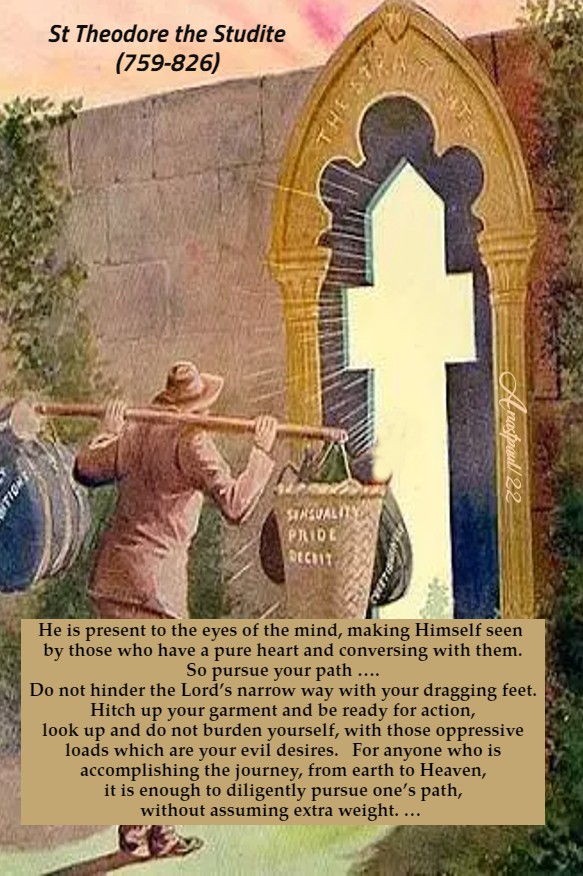
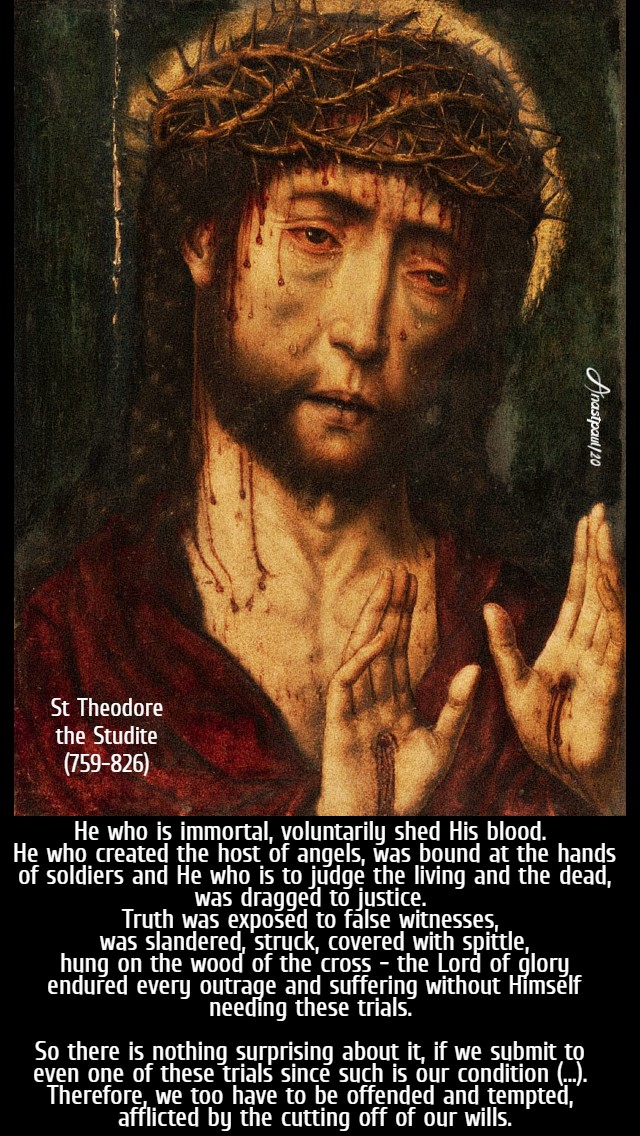
“He who is immortal, voluntarily shed His Blood. He who created the Host of Angels, was bound at the hands of soldiers and He who is to judge the living and the dead, was dragged to justice (cf. Acts 10:42; 2 Tm 4:1). Truth was exposed to false witnesses, was slandered, struck, covered with spittle, hung on the Wood of the Cross – the Lord of Glory (cf. 1 Cor 2:8) endured every outrage and suffering without Himself needing these trials. …
So there is nothing surprising about it, if we submit to even one of these trials, since such is our condition … Therefore, we too have to be offended and tempted, afflicted by the cutting off of our wills.”
St Theodore the Studite (759- 826) Monk at Constantinople, Father (Catecheses 1)
One Minute Reflection – 10 July – “The Month of the Precious Blood” – The Fifth Sunday after Pentecost and the Solemnity of the Most Precious Blood – Hebrews 9:11-15, John 19:30-35
“But one of the soldiers opened His side with a lance and immediately there came forth, Blood and water.” – John 19:34
REFLECTION – “Take thought now, redeemed man and consider how great and worthy is He, Who hangs on the Cross for you… Arise, then, beloved of Christ! Imitate the dove ‘that nests in a hole in the cliff’ (Jr 48:28), keeping watch at the entrance ‘like the sparrow that finds a home’(Ps 84:4). There, like the turtledove, hide your little ones, the fruit of your chaste love. Press your lips to the Fountain, draw water from the wells of your Saviour; for this is the spring flowing out of the middle of paradise, dividing into four rivers, inundating devout hearts, watering the whole earth and making it fertile.
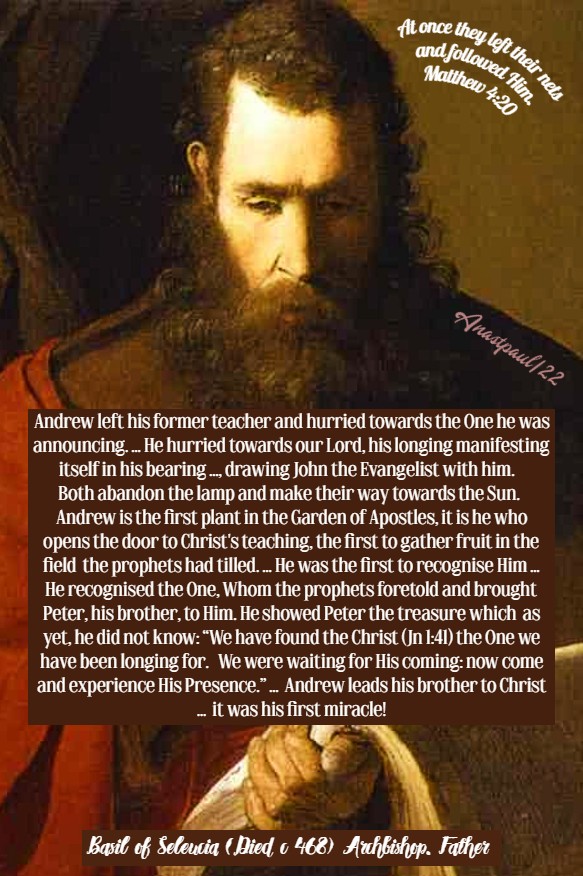
Run with eager desire to this Source of Life and Light, all you who are vowed to God’s service. Come, whoever you maybe and cry out to Him, with all the strength of your heart. O indescribable Beauty of the most high God and purest Radiance of Eternal Light! Life that gives all life, Light that is the Source of every other light, preserving, in everlasting splendour, the myriad flames that have shone before the throne of Your Divinity from the dawn of time!
Eternal and inaccessible Fountain, clear and sweet stream, flowing from a hidden spring, unseen by mortal eye! None can fathom Your depths nor survey Your boundaries, none can measure Your breadth, nothing can sully Your purity. From You flows ‘the river which gladdens the city of God’ (Ps 46:5) and makes us cry out with joy and thanksgiving, in hymns of praise to You, for we know, by our own experience, that ‘with You is the Source of Life and in Your Light we see light’ (Ps 36:10).” – St Bonaventure (1221-1274) Doctor of the Church (The Tree of Life, 29-30, 47, – Breviary)
PRAYER – Almighty, eternal God, Who made Thy Only Begotten Son the Redeemer of the world and willed to be reconciled by His Blood, grant us, we beseech Thee, so to worship in this Sacred rite the price of our salvation and to be so protected by its power against the evils of the present life on earth, that we may enjoy its everlasting fruit in Heaven. Through the same Jesus Christ, Thy Son our Lord, Who lives and reigns with Thee, in the unity of the Holy Ghost, God, world without end. Amen (Collect). Aspiration:Precious Blood, ocean of Divine Mercy, Flow upon us.
You must be logged in to post a comment.