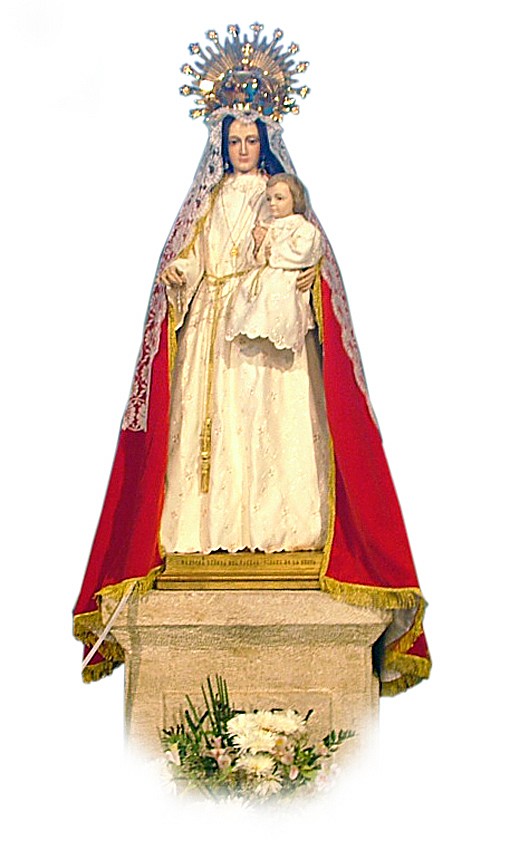
Our Morning Offering – 28 September – “The Month of the Seven Sorrows of the Blessed Virgin Mary and the Holy Cross”
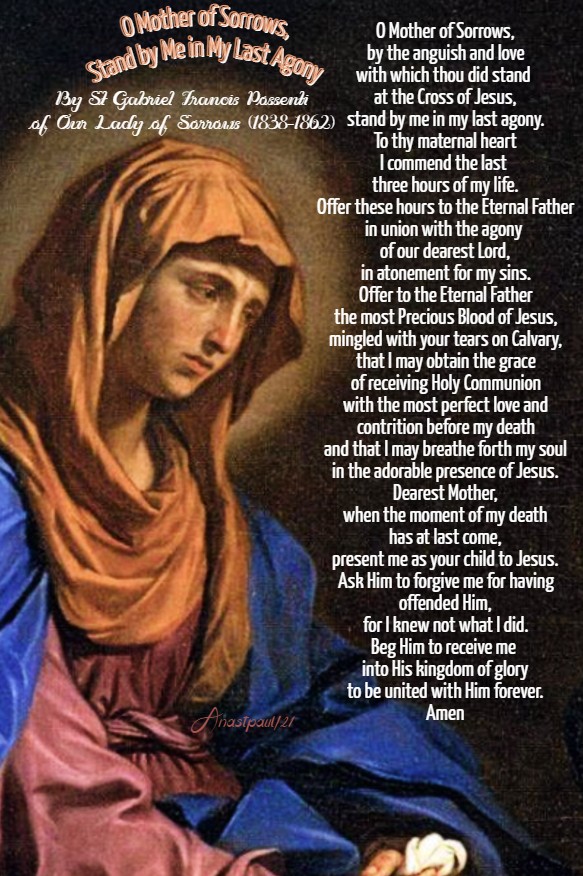
O Mother of Sorrows, Stand by Me in My Last Agony By St Gabriel Francis Possenti of Our Lady of Sorrows (1838-1862)
O Mother of Sorrows, by the anguish and love with which thou did stand at the Cross of Jesus, stand by me in my last agony. To thy maternal heart I commend the last three hours of my life. Offer these hours to the Eternal Father in union with the agony of our dearest Lord, in atonement for my sins. Offer to the Eternal Father the most precious blood of Jesus, mingled with your tears on Calvary, that I may obtain the grace of receiving Holy Communion with the most perfect love and contrition before my death and that I may breathe forth my soul in the adorable presence of Jesus. Dearest Mother, when the moment of my death has at last come, present me as your child to Jesus. Ask Him to forgive me for having offended Him, for I knew not what I did. Beg Him to receive me into His kingdom of glory to be united with Him forever. Amen
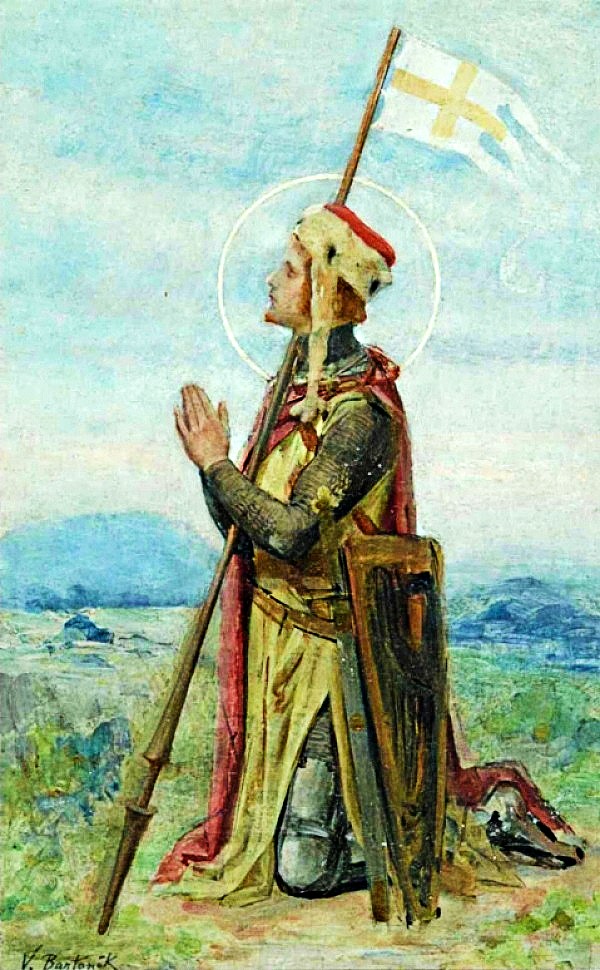
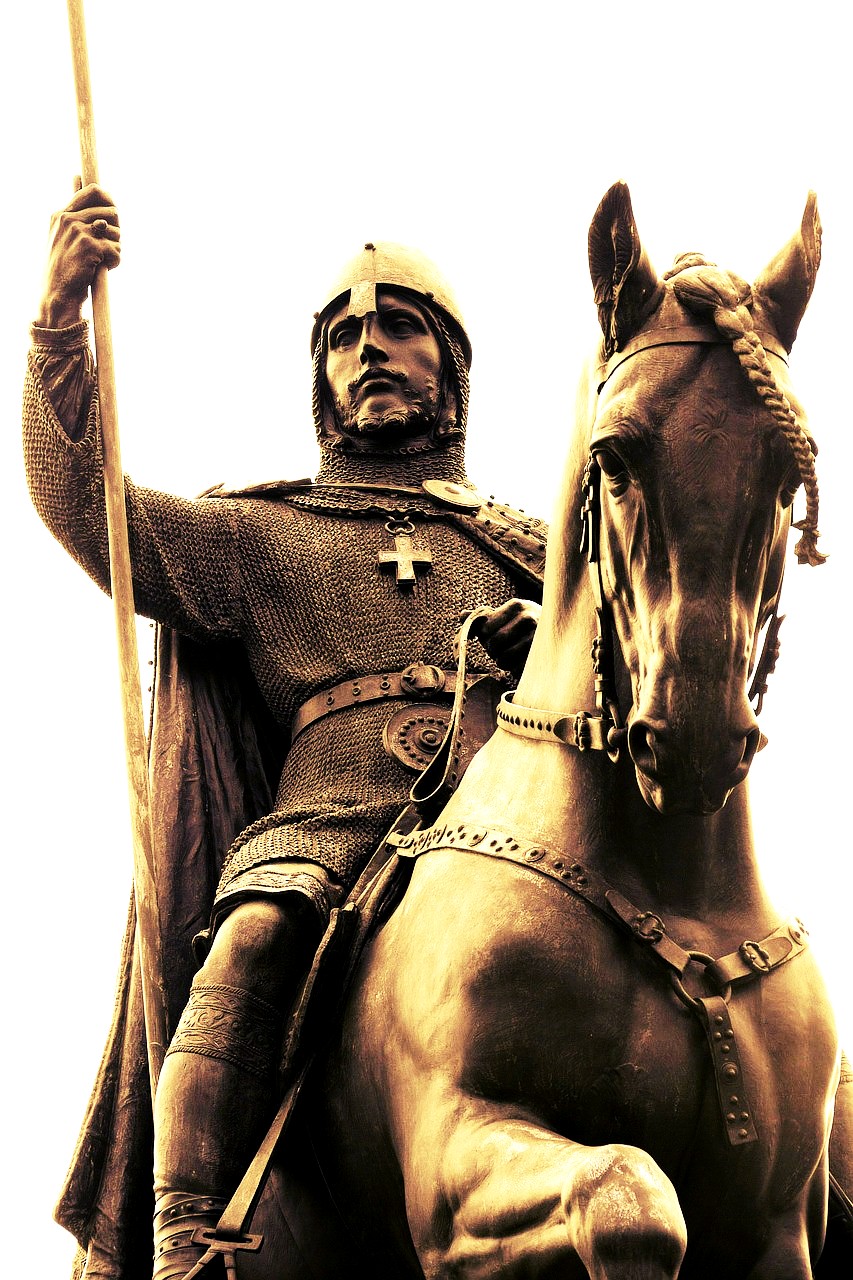
Saint of the Day – 28 September – St Wenceslaus (907-935) Duke of Bohemia, Martyr.
St Wenceslas, Duke of Bohemia, Martyr From an old Slavic legend about Saint Wenceslaus
At the death of Vratislaus, the people of Bohemia made his son, Wenceslaus their King. He was by God’s grace, a man of utmost faith. He was charitable to the poor and he would clothe the naked, feed the hungry and offer hospitality to travellers, according to the summons of the Gospel. He would not allow widows to be treated unjustly; he loved all his people, both rich and poor; he also provided for the servants of God and he adorned many Churches.
The men of Bohemia, however, became arrogant and prevailed upon Boleslaus, his younger brother. They told him, “Your brother Wenceslaus is conspiring with his mother and his men to kill you.”
On the feasts of the dedication of the Churches in various Cities, Wenceslaus was in the habit of paying them a visit. One Sunday he entered the City of Boleslaus, on the feast of Saints Cosmas and Damian and after hearing Mass, he planned to return to Prague. But Boleslaus, with his wicked plan in mind, detained him with the words, “Why are you leaving brother?“
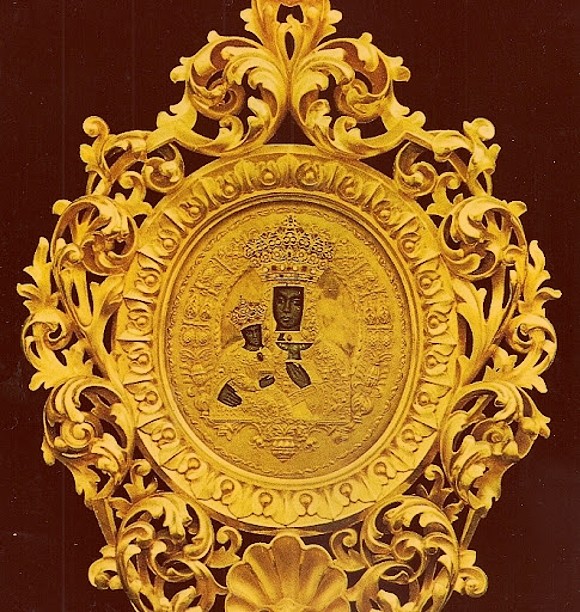
St Wenceslaus Altar, at St Peter’s Basilica, Vatican
The next morning when they rang the bell for Matins, Wenceslaus, on hearing the sound, said, “Praise to Thee, Lord; Thou hast allowed me to live to this morning.” And so he rose and went to Matins. Immediately Boleslaus followed him to the Church door. Wenceslaus looked back at him and said, “Brother, you were a good subject to me yesterday.“
“Praise to Thee, Lord; Thou hast allowed me to live to this morning.“
But the devil had already blocked the ears of Boleslaus and perverted his heart. Drawing his sword, Boleslaus replied, “And now I intend to be a better one!” With these words, he struck his brother’s head with his sword.
But Wenceslaus turned and said, “Brother, what are you trying to do?” And with that he seized Boleslaus and threw him to the ground. But one of Boleslaus’ counsellors ran up and stabbed Wenceslaus in the hand. With his hand wounded, he let go of his brother and took refuge in the Church. But two evil men struck him down at the Church door and then another rushed up and ran him through with a sword. Thereupon, Wenceslaus died with the words: “Into your hands, O Lord, I commend my spirit.”
Although Wenceslaus was a Duke during his lifetime, the Holy Roman Emperor, Otto I posthumously “conferred on [Wenceslaus] the regal dignity and title of King” which is why he is referred to as King in legend and song.
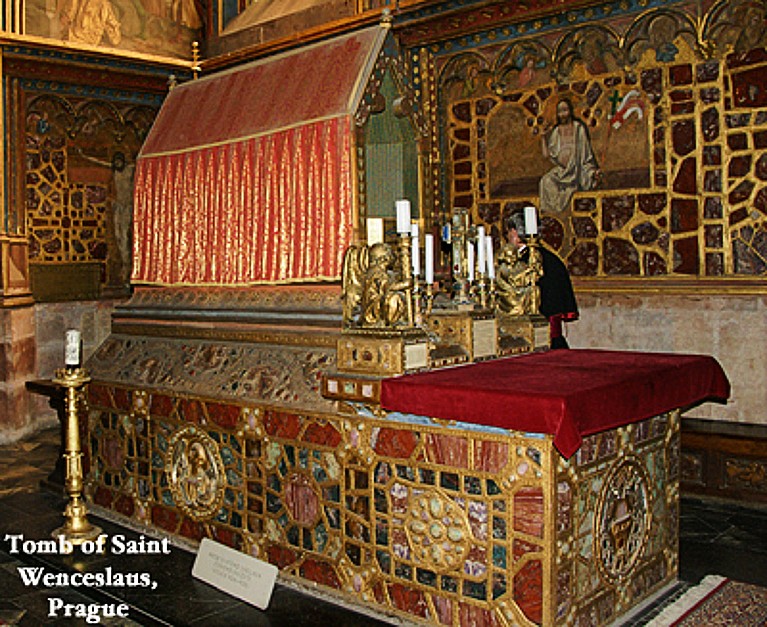
The Church door below, to which Saint Wenceslaus clung at his Martyrdom, leads to his Chapel in the Cathedral of Saint Vitus in Prague.
Bl Aaron of Auxerre St Alodius of Auxerre St Annemond of Lyons St Bardomianus
Blessed Bernardine of Feltre OFM (1439-1494) Franciscan Priest and Friar, Missionary Preacher, Poet, peace-maker, Civil protestor against the practice of usury, defender of the poor. He was a true ‘child prodigy’ – by the time he was 12 he was fluent in Latin and at the age of 15 he composed a poem and read it in the Town Square to celebrate a local peace treaty. He is remembered most especially, in connection with the “Monti di Pietà” “Mount of Piety” of which he was the reorganiser and, in a certain sense, the Founder, together with the Blessed Michele Carcano. On 13 April 1654, Pope Innocent X confirmed the cultus of Blessed Bernardine and he was formally Beatified in 1728 by Pope Benedict XIII. Biography: https://anastpaul.com/2020/09/28/saint-of-the-day-28-september-blessed-bernardine-of-feltre-ofm-1439-1494/
St Chariton of Palestine Bl Christian Franco St Conval of Strathclyde St Eucarpus St Eustochium St Exuperius of Toulouse (Died 411) Bishop St Faustus of Riez
Blessed Francesco Piani of Caldarola OFM (1424-1507) Francisan Friar, renowned Preacher and Peacemaker, a collaborator in the fight against usury by the institution of the “Mount of Piety,” (a type of pawn shop), social activist and protector of the struggling rural communities. He was Beatified by Pope Urban VII in 1634 – his cult was reaffirmed on 1 September 1843 by Pope Gregory XVI. His Amazing Life: https://anastpaul.com/2021/09/28/saint-of-the-day-28-september-blessed-francesco-piani-of-caldarola-ofm-1424-1507/
St John of Dukla St Laurence of North Africa St Lioba of Bischofsheim St Machan St Martial of North Africa St Martin of Moyenmoutier St Paternus of Auch St Privatus of Rome St Salonius of Geneva St Silvinus of Brescia
St Solomon of Genoa St Stacteus St Tetta of Wimborne Bl Thiemo St Willigod of Moyenmoutier St Zama of Bologna
Augustinian Martyrs of Japan: The first Augustinian Missionaries arrived in Japan in 1602 and met with immediate success; many were brought to the faith; many of them became Augustinians and many of them were Martyred in the periodic persecutions of Christians. This memorial commemorates all of them, whether they have a sanctioned Cause for Canonisation or not. They include: • Blessed Bartolomé Gutiérrez Rodríguez • Blessed Ferdinand Ayala • Blessed Francisco Terrero de Ortega Pérez • Blessed Ioannes Mukuno Chozaburo • Blessed Laurentius Kaida Hachizo • Blessed Mancius Yukimoto Ichizaemon • Blessed Martín Lumbreras Peralta • Blessed Melchor Sánchez Pérez • Blessed Michaël Ichinose Sukezaemon • Blessed Pedro de Zúñiga • Blessed Petrus Sawaguchi Kuhyoe • Blessed Thomas Jihyoe of Saint Augustine • Blessed Thomas Terai Kahyoe • Blessed Vicente Simões de Carvalho • Saint Magdalena of Nagasaki
Martyrs of Antioch – 37 Saints: A group of 30 soldiers and 7 civilians who were murdered together for their faith. The names that have come down to us are – Alexander, Alphinus, Heliodorus, Mark, Neon, Nicon and Zosumus. c 303 at Antioch, Pisidia (in modern Turkey).
Announcing a Novena to Our Lady of the Rosary Begins 28 September
The Feast of the Most Holy Rosary is celebrated on 7 October.
Please join me in praying a Novena in honour of Our Lady of the Rosary for the nine days preceding her Feast on 7 October and, of course, October is the Month of the Holy Rosary.
This Feast was instituted to commemorate the victory of Christianity over the forces of Islam at the battle of Lepanto on 7 October 1571. The victory was brought about through the recitation of the Rosary. In thanksgiving for another victory over the same foes in Hungary in 1715, the Feast was extended to the entire Church. In the course of centuries the Rosary has been a source of abundant blessings. In her apparitions at Lourdes, France, in 1858 and again at Fatima, Portugal, in 1917, Mary urged Catholics to pray the Rosary daily in order to bring about the conversion of sinners and a lasting world peace. We should resolve to say the Most Holy Rosary everyday. Besides being a beautiful tribute of love and filial piety, to our Heavenly Mother, it will be our support and joy in life and our consolation at the hour of death.
Thought for the Day – 27 September – Meditations with Antonio Cardinal Bacci (1881-1971)
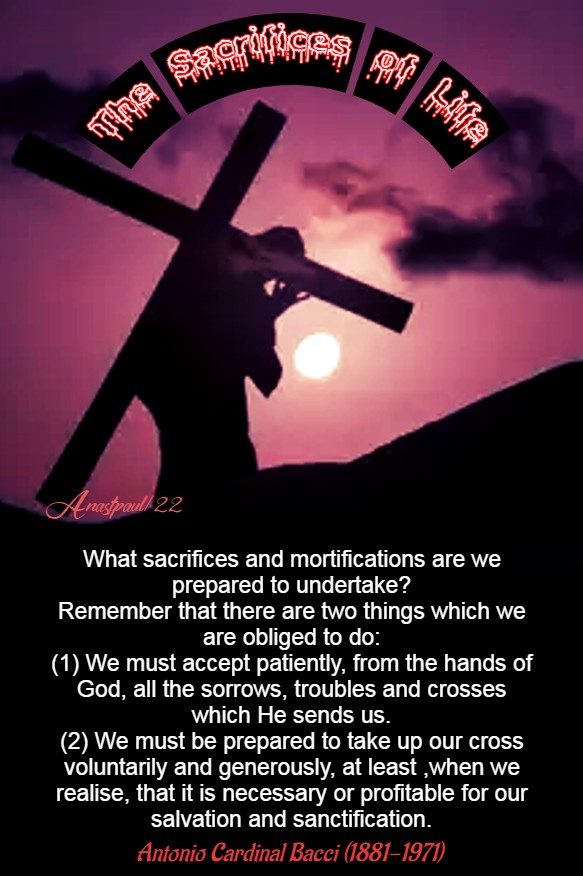
The Sacrifices of Life
“The Saints looked for mortifications, humiliations, sacreifices; they desired to suffer to show their love for Jesus and to conquer the disordered inclinations of their bodies.
By setting out on the way of penance of the Cross, they purified themselves and reached the summit of sanctity, step-by-step.
What sacrifices and mortifications are we prepared to undertake? Remember that there are two things which we are obliged to do: (1) We must accept patiently, from the hands of God, all the sorrows, troubles and crosses which He sends us. (2) We must be prepared to take up our cross voluntarily and generously, at least ,when we realise, that it is necessary or profitable for our salvation and sanctification.”
Quote/s of the Day – 27 September – Wisdpm 5:16-20, Luke 6:17-23
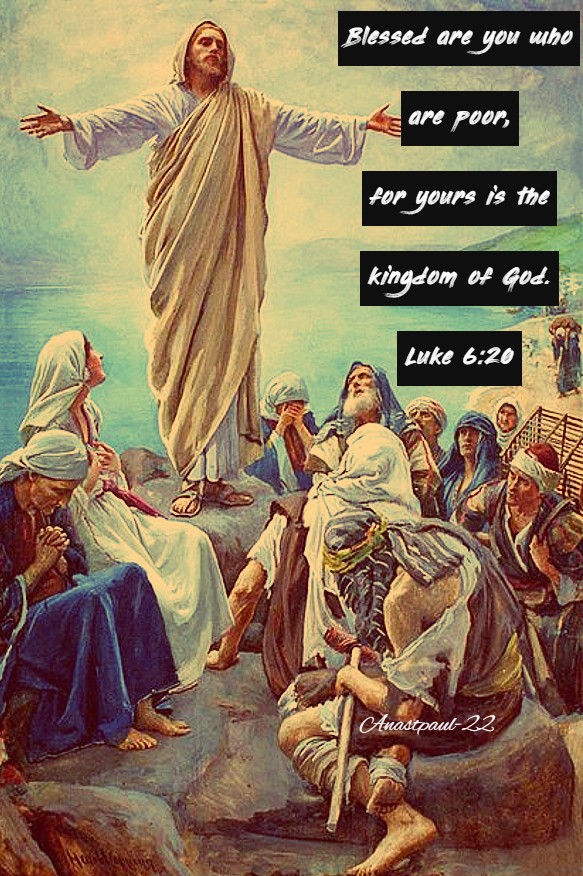
“Blessed are you who are poor, for yours is the Kingdom of God.”
Luke 6:20
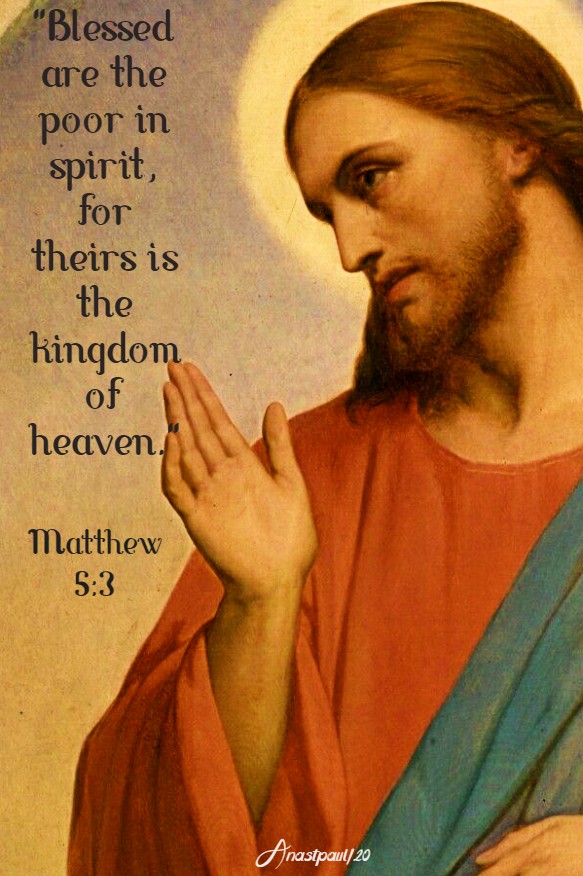
“Blessed are the poor in spirit, for theirs is the Kingdom of Heaven.”
Matthew 5:3
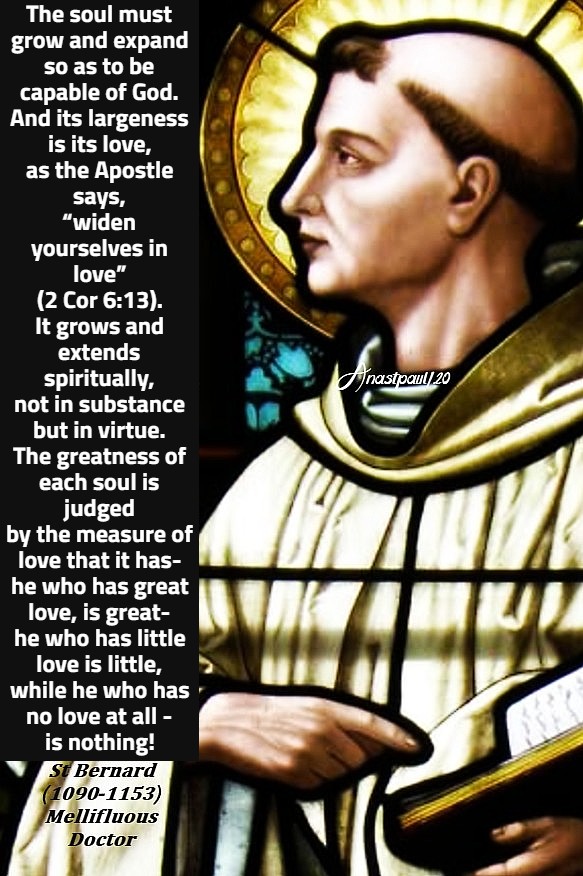
“The soul must grow and expand so as to be capable of God. And its largeness is its love, as the Apostle says, “widen yourselves in love” (2 Cor 6:13). It grows and extends spiritually, not in substance but in virtue. The greatness of each soul is judged by the measure of love that it has- he who has great love, is great- he who has little love is little, while he who has no love at all – is nothing!”
St Bernard (1090-1153) Mellifluous Doctor of the Church
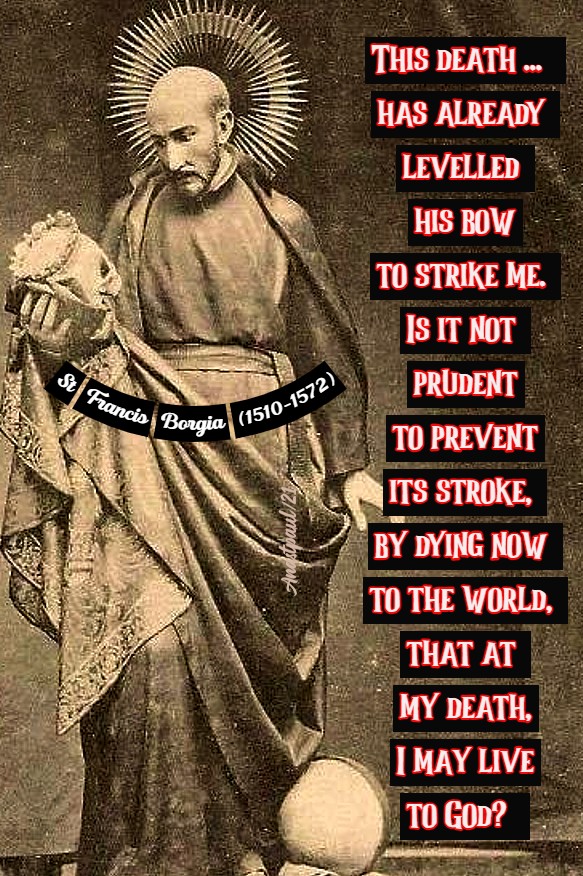
“This death … has already levelled his bow to strike me. Is it not prudent to prevent its stroke, by dying now to the world, that at my death, I may live to God?”
St Francis Borgia (1510-1572)
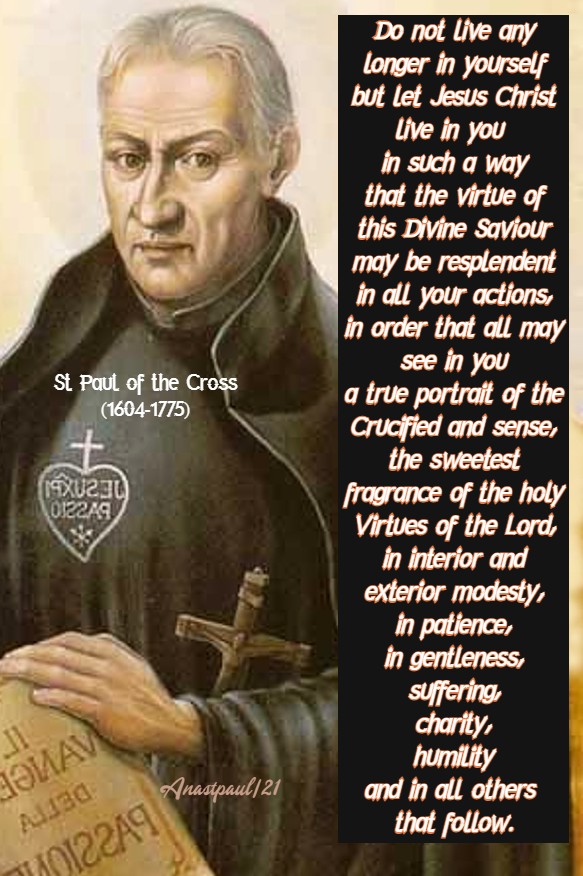
“Do not live any longer in yourself but let Jesus Christ live in you in such a way that the virtue of this Divine Saviour may be resplendent in all your actions, in order that all may see in you a true portrait of the Crucified and sense, the sweetest fragrance of the holy virtues of the Lord, in interior and exterior modesty, in patience, in gentleness, suffering, charity, humility and in all others that follow.”
St Paul of the Cross (1604-1775)
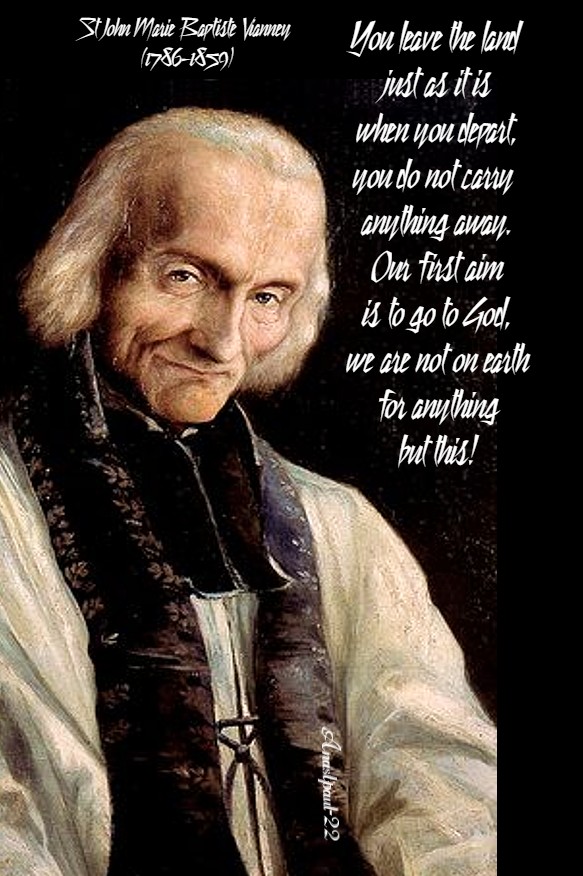
“You leave the land just as it is when you depart, you do not carry anything away. Our first aim is to go to God, we are not on earth for anything but this!”
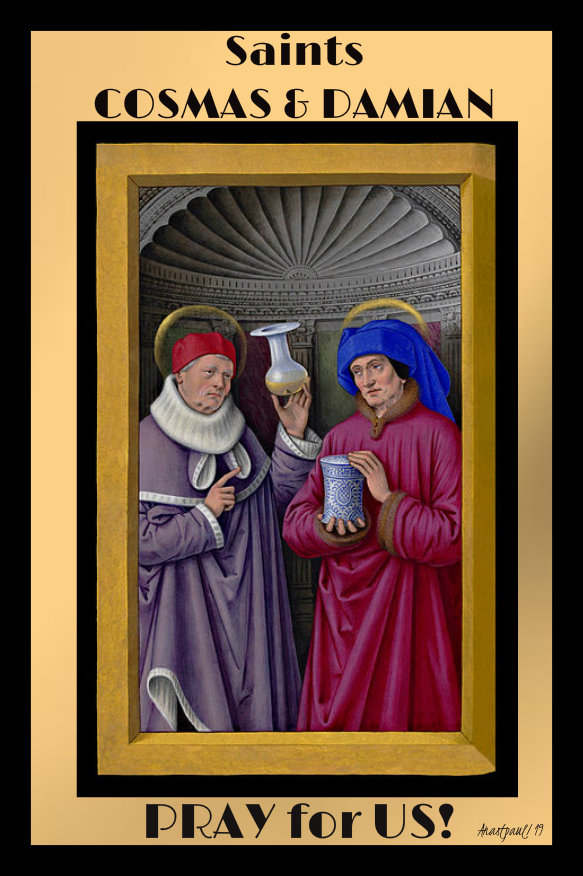
One Minute Reflection – 27 September – Saints Cosmas and Damian (Died c 286 ) Martyrs – Wisdpm 5:16-20, Luke 6:17-23
“And raising his eyes toward his disciples he said: “Blessed are you who are poor, for yours is the Kingdom of God.” – Luke 6:20
REFLECTION – “Let us see how St Luke encompassed the eight blessings in the four. We know that there are four Cardinal Virtues – Temperance, Justice, Prudence and Fortitude. One who is poor in spirit, is not greedy. One who weeps, is not proud but is submissive and tranquil. One who mourns, is humble. One who is just does not deny what he knows is given jointly to all for us. One who, is merciful – gives away his own goods. One who bestows his own goods, does not seek another’s, nor does he contrive a trap for his neighbour. These virtues are interwoven and interlinked, so that one, who has one, may be seen to have several and a single virtue, befits the Saints. Where virtue abounds, the reward too abounds…. Thus temperance has purity of heart and spirit, justice has compassion, patience has peace and endurance has gentleness.
“Blessed,” it says, “are the poor.” Not all the poor are blessed, for poverty is neutral. The poor can be either good or evil, unless, perhaps, the blessed pauper is to be understood as he whom the prophet described, saying, “A righteous poor man is better than a rich liar.” Blessed is the poor man who cried and whom the Lord heard. Blessed is the man poor in offence. Blessed is the man poor in vices. Blessed is the poor man, in whom the prince of this world finds nothing. Blessed is the poor man who, is like that Poor Man Who, although He was rich, became poor for our sake. Matthew fully revealed this when he said, “Blessed are the poor in spirit.” One poor in spirit is not puffed up, is not exalted in the mind of his own flesh. This Beatitude is first, when I have laid aside every sin and I have taken off all malice and I am content with simplicity, destitute of evils. All that remains is that I regulate my conduct. For what good does it do me to lack worldly goods, unless I am meek and gentle?
Although there are many charms of delights in riches, yet there are more incentives to practice virtues. Although virtue does not require assistance and the contribution of the poor person, is more commended, than the generosity of the rich, yet with the authority of the heavenly saying, He condemns, not those who have riches but those who do not know how to use them. The pauper is more praiseworthy who gives with eager compassion and is not restrained, by the bolts of looming scarcity. He thinks that he who has enough for nature, does not lack. So the rich person is the more guilty, who does not give thanks to God, for what he has received but vainly hides wealth given for the common use and conceals it, in buried treasures. Then the offence consists, not in the wealth but in the attitude.
Purify yourself with your tears. Wash yourselves with mourning. If you weep for yourself, another will not weep for you…. One who is a sinner weeps for himself and rebukes himself, that he may become righteous, for just people accuse themselves of sin. Let us pursue order because, it is written, “Set in order love in me.” I have laid down sin. I have tempered my conduct. I have wept for my transgressions. I begin to hunger. I hunger for righteousness. The sick, when he is seriously ill, does not hunger, because the pain of the illness excludes hunger. What is the hunger for righteousness? What is the bread of which it is said, “I have been young and am old and I have not seen the righteous man forsaken, nor his seed begging bread?” Surely, one who is hungry, seeks increase of strength. What greater increase of virtue is there, than the rule of righteousness?” – St Ambrose (340-397) Bishop of Milan, Father and Doctor of the Church( Exposition on the Gospel of Luke, 5).
PRAYER – Grant, we beseech Thou, almighty God, that we who celebrate the anniversary of the death of Thy holy Martyrs, Cosmas and Damian, may by their intercession, be delivered from all the evils that threaten us. Through Christ, Thy Son our Lord, Who lives and reigns with Thee, in the unity of the Holy Ghost, God, world without end. Amen (Collect).
Our Morning Offering – 27 September – “The Month of the Seven Sorrows of the Blessed Virgin Mary and the Holy Cross
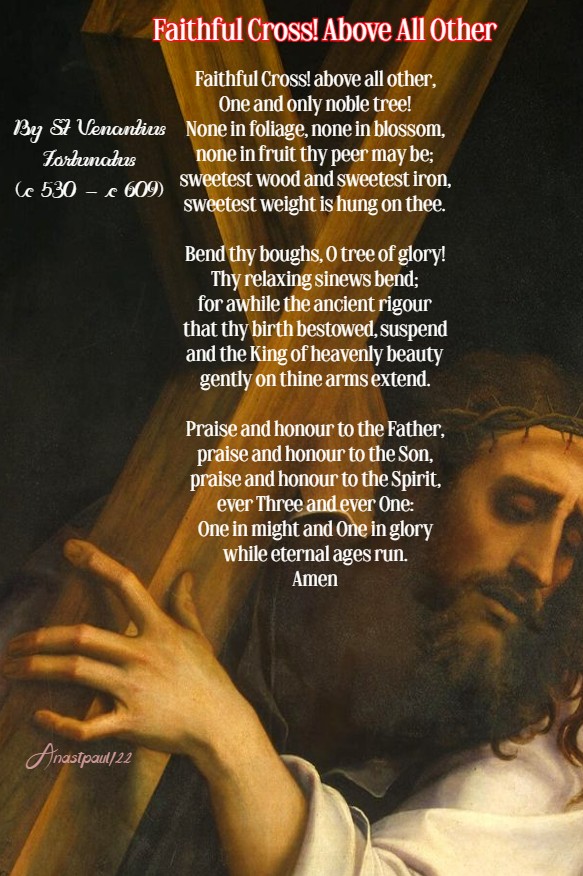
Faithful Cross! Above All Other By St Venantius Fortunatus (c 530 – c 609)
Faithful Cross! above all other, one and only noble tree! None in foliage, none in blossom, none in fruit thy peer may be; sweetest wood and sweetest iron, sweetest weight is hung on thee.
Bend thy boughs, O tree of glory! Thy relaxing sinews bend; for awhile the ancient rigour that thy birth bestowed, suspend and the King of heavenly beauty gently on thine arms extend.
Praise and honour to the Father, praise and honour to the Son, praise and honour to the Spirit, ever Three and ever One: One in might and One in glory while eternal ages run.
Saint of the Day – 27 September – Saint Delphina TOSF (1283-1360) Virgin Laywoman, Married in Chastity to St Elzear (below) Widow, Recluse, Apostle of the Poor and needy. Born in 1283 at the Chateau-Puimichel in Languedoc (modern Puy-en-Velay, France) and died on 26 November 1360 of natural cause, having lived as a Franciscan tertiary for most of her life. Patronages – • Brides, Tertiaries, Diocese of Ariano Irpino-Lacedonia, Italy. Also known as – Delphine, Delphine of Glandèves, Delphina/e of Sabran.
Delphine was the daughter and heiress of the Count of Puy-Michel. Left an orphan in her infancy, she was placed under the guardianship of her uncles and was brought up under the direction of her Aunt, who was the Abbess of the Convent of St Catherine of Sorps, at Bauduen. As a young girl, she took a vow of virginity which she kept to the end of her life.
Despite her vow, at the age of twelve she was espoused to the ten-year-old Elzéar, Count of Sabran. They were married three years later at the Castle of Puy-Michel. Having grown up together, they regarded each other as brother and sister, rather than husband and wife. Inspired by her example, her husband also took a vow of celibacy, which both honoured throughout their married life. The couple, having both received the habit of the Third Order of St Francis, lived together at their Castle in Ansouis, in the practice of prayer, penance andgood works towards the poor. After seven years, they moved to Puy-Michel. When Elzéar had to go to Naples to see to some inherited property, they kept up a regular correspondence. Elzéar died in 1323.
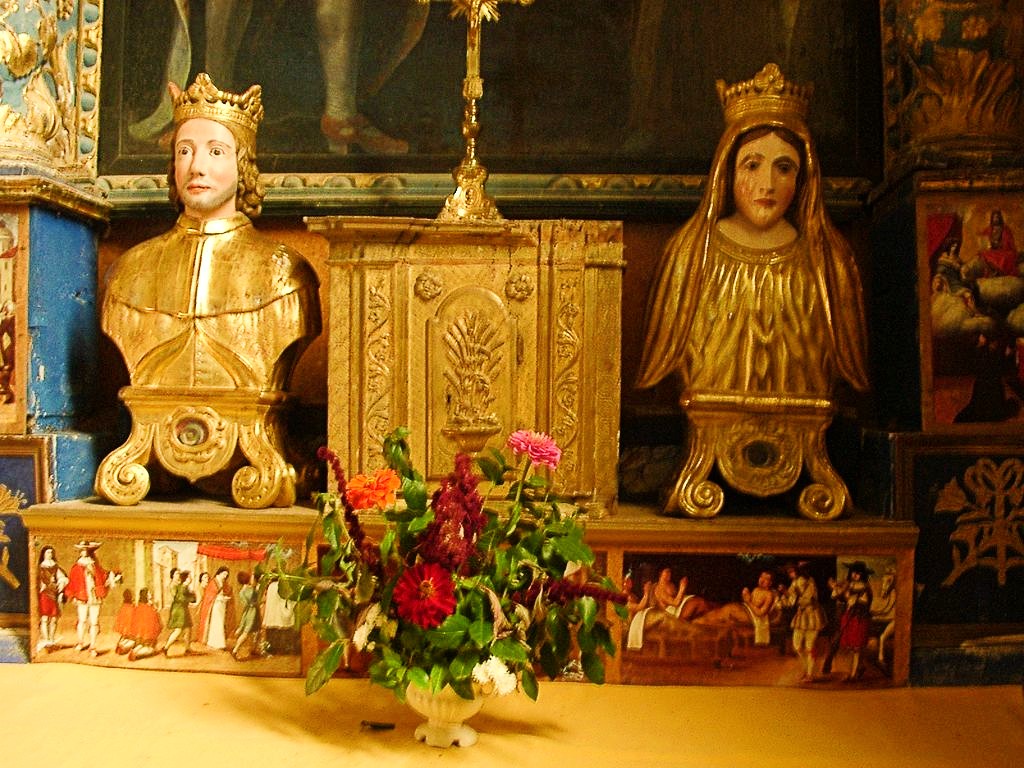
Reliquaries of Sts Elzéar and Delphina in the Franciscan Church of Ansouis, France
After the death of her husband, Delphina sold all her possessions for the benefit of the poor and retired first to Naples and then to Cabrières, which was the location of the Castle where her husband had been born. She finally returned to Apt where her husband had been buried. Upon her death, she was buried with him in the church of the Friars Minor there, wearing the habit of the Order.
The veneration that had begun to be given to Delphina was confirmed by Pope Urban V, godson of Elzéar, who Canonised Elzéar and Delphina in 1694. Her feast day is not the date of her death, 26 November but today, 26 September, sharing this day with the remembrance of her husband.
St Ceraunus of Paris St Chiara of the Resurrection St Deodatus of Sora Saint Delphina TOSF (1283-1360) Laywoman, Married in Chastity to St Elzear (below) Widow, Recluse.
Martyrs of Aegea – (3 Saints): Three Christians Martyred with Saints Cosmas and Damian in the persecutions of Diocletian – Anthimus, Euprepius and Leontius. They were tortured and beheaded c.303 in Aegea, Cilicia (modern Ayas, Turkey).
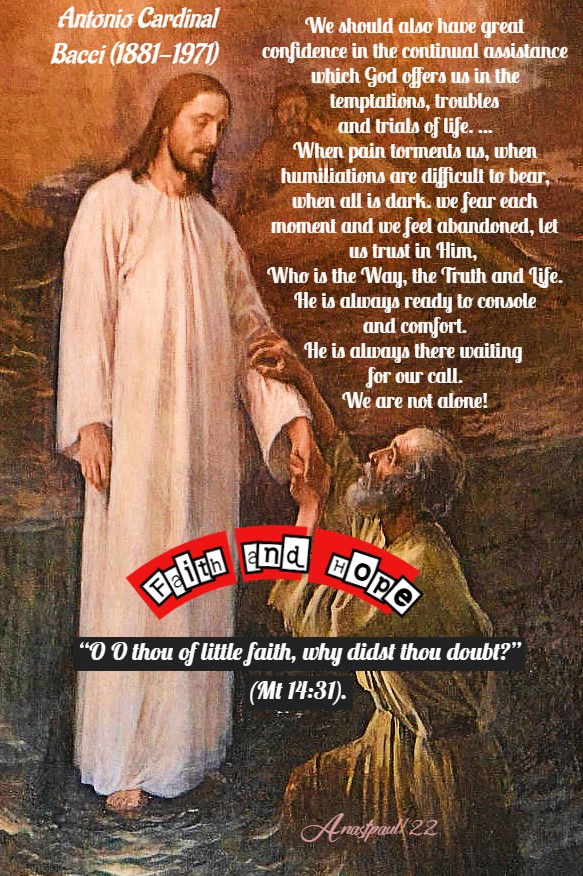
Thought for the Day – 26 September – Meditations with Antonio Cardinal Bacci (1881-1971)
Faith and Hope
“We should also have great confidence in the continual assistance which God offers us in the temptations, troubles and trials of life. When we are strongly tempted, we should remember that God will not permit us to be tempted beyond our strength (Cf 1 Cor 10:13), and we should pray to Him for help.
When pain torments us, when humiliations are difficult to bear, when all is dark. we fear each moment and we feel abandoned, let us trust in Him, Who is the Way, the Truth and Life. He says to us, as He said to Peter floundering in the waves: “O O thou of little faith, why didst thou doubt?” (Mt 14:31).
He is always ready to console and comfort. He is always there waiting for our call. We are not alone!”
Quote/s of the Day – 26 September – St Isaac Jogues SJ (1607-1646) Priest, Martyr, Missionary and Companions
“My confidence is placed in God, Who does not need our help to accomplishing His designs. Our single endeavour, should be, to give ourselves to the work and to be faithful to Him.”
St Isaac Jogues (1607-1646) Martyr
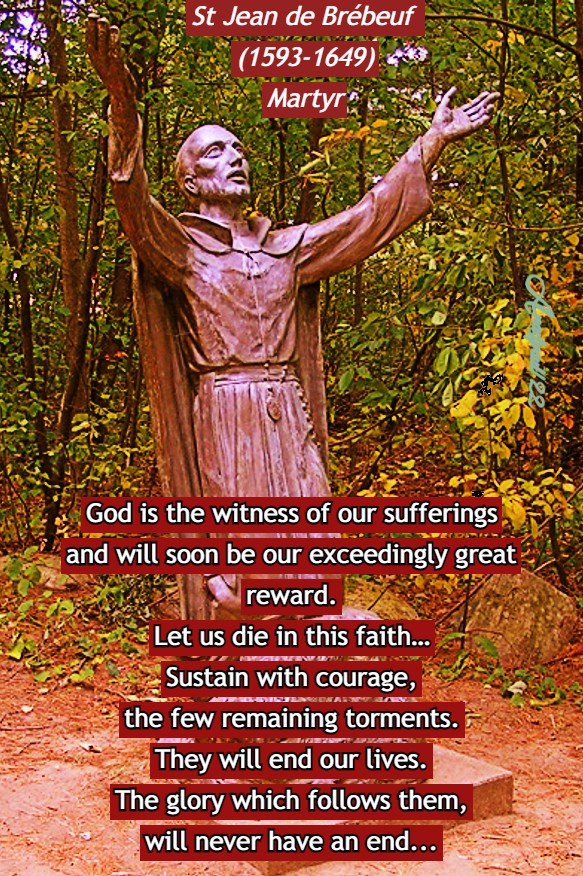
“God is the witness of our sufferings and will soon be our exceedingly great reward. Let us die in this faith… Sustain with courage, the few remaining torments. They will end our lives. The glory which follows them, will never have an end...”
One Minute Reflection – 26 September – “The Month of the Seven Sorrows of the Blessed Virgin Mary and the Holy Cross” – St Isaac Jogues SJ (1607-1646) Priest, Martyr, Missionary and Companions – Hebrews 10:32-38, Luke 12:1-8 Sacred Scripture seach here: https://www.drbo.org/
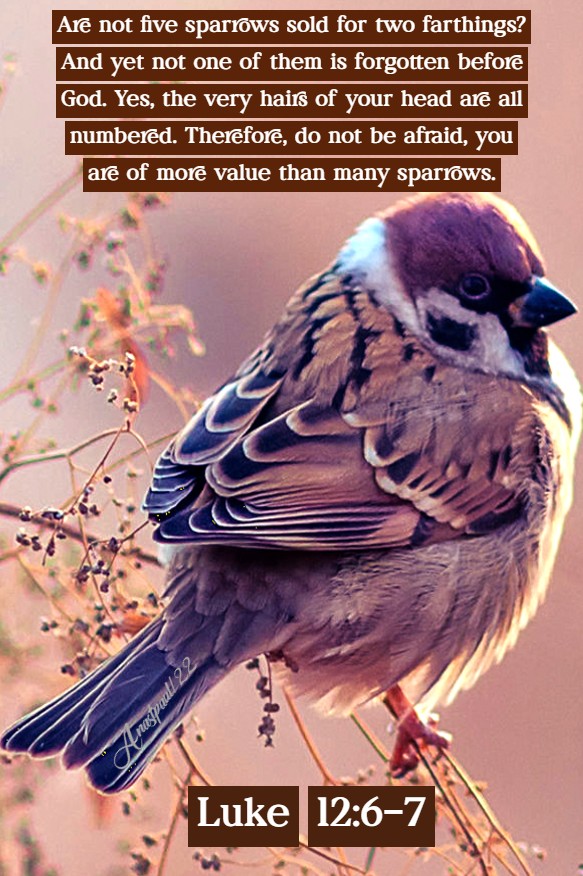
“Are not five sparrows sold for two farthings? And yet not one of them is forgotten before God. Yes, the very hairs of your head are all numbered. Therefore, do not be afraid, you are of more value than many sparrows.” – Luke 12:6-7
REFLECTION – “Do not look forward to the changes and chances of this life in fear – rather look to them with full hope that, as they arise, God, whose you are, will deliver you out of them. He is your keeper. He has kept you hitherto. Do you but hold fast to His dear hand and He will lead you safely through all things and, when you cannot stand, He will bear you in His arms. Do not look forward to what may happen tomorrow. Our Father will either shield you from suffering, or He will give you strength to bear it.” – St Francis de Sales (1567-1622) Doctor of the Church.
PRAYER – May the continual protection of the blessed Martyrs comfort us, O Lord, for Thou do not cease to behold with favour those whom You have granted the grace of such assistance. Through Jesus Christ, Thy Son our Lord, Who lives and reigns with Thee, in the unity of the Holy Ghost, God, world without end. Amen (Collect).
Our Morning Offering – 26 September – St Isaac Jogues SJ (1607-1646), St Isaac Jogues SJ (1607-1646) Priest, Martyr, Missionary and Companions
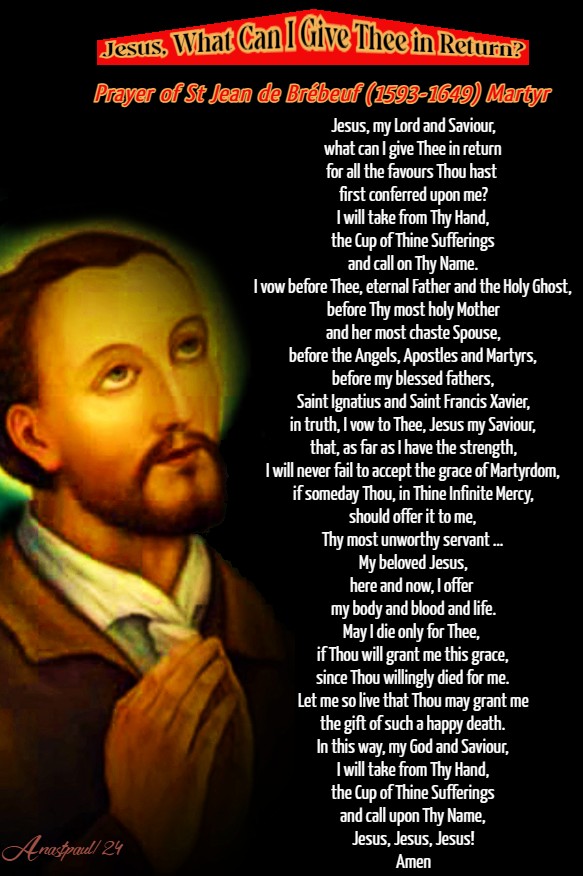
Jesus, What Can I Give Thee in Return? The Prayer of St Jean de Brébeuf SJ (1593-1649)
Jesus, my Lord and Saviour, what can I give Thee in return for all the favours Thou hast first conferred upon me? I will take from Thy Hand, the Cup of Thine Sufferings and call on Thy Name. I vow before Thee, eternal Father and the Holy Ghost, before Thy most holy Mother and her most chaste Spouse, before the Angels, Apostles and Martyrs, before my blessed fathers, Saint Ignatius and Saint Francis Xavier, in truth, I vow to Thee, Jesus my Saviour, that, as far as I have the strength, I will never fail to accept the grace of Martyrdom, if someday Thou, in Thine Infinite Mercy, should offer it to me, Thy most unworthy servant … My beloved Jesus, here and now, I offer my body and blood and life. May I die only for Thee, if Thou will grant me this grace, since Thou willingly died for me. Let me so live that Thou may grant me the gift of such a happy death. In this way, my God and Saviour, I will take from Thy Hand, the Cup of Thine Sufferings and call upon Thy Name, Jesus, Jesus, Jesus! Amen
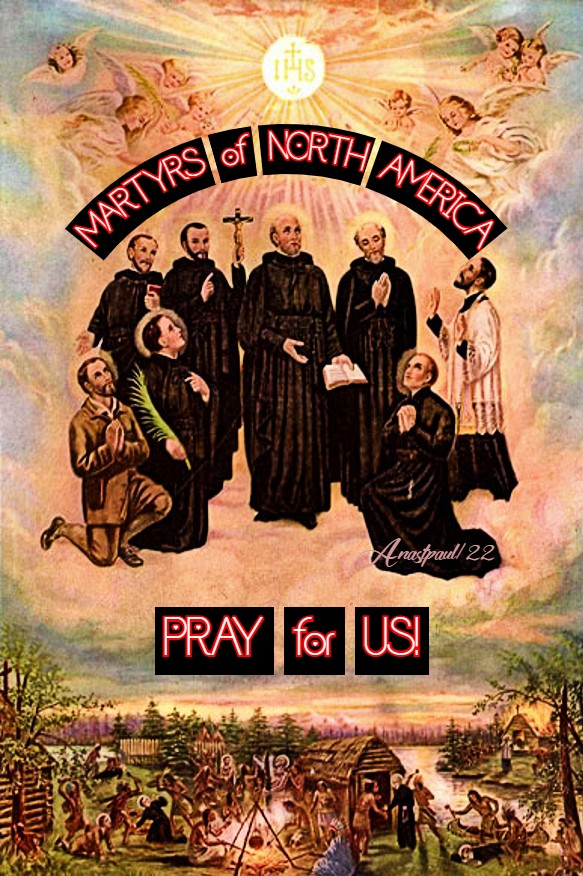
Saints of the Day – 26 September – St Isaac Jogues SJ (1607-1646) Priests, Martyrs, Missionary and Companions – known as The North American or the Canadian Martyrs. Born on 10 January 1607 o, Orléans, Orléanais, France. In 1646, Jogues was Martyred by the Mohawk at their village of Ossernenon, near the Mohawk River. They were Beatified on 21 June 1925, by Pope Pius XI and Canonised on 29 June 1930, by Pope Pius XI. They are collectively the secondary Patron Saints of Canada.
St Isaac Jogues and Companions from the Roman Breviary
Among the members of the Society of Jesus who brought most renown to the infant Church in North America, in the middle of the seventeenth Century, God chose as victims eight men of outstanding integrity, that from the seeds of faith watered with their blood, there might spring up a more abundant harvest.
All these Martyrs–six Priests and two Laymen–natives of France, were sent by their Superiors to the Missions in Canada, at that time known as New France. With Quebec as a centre, they made numberless missionary journeys to the various sectors of this vast territory, labouring amidst the greatest hardships. In the end, all were most cruelly put to death and for the same reaso – their faith, although not at the same time and place.
Jean de Brebeuf, born at Conde-sur-Vire, in the Diocese of Bajon (now Constance), of an illustrious family and Isaac Jogues, born in Orleans, are regarded as their leaders and masters and rightly so. For they were valiant men, fired with apostolic zeal, living most mortified lives, in intimate prayerful union with God and, at times, were honoured with heavenly visions.
St Jean de Brébeuf (1607-1646 aged 39) Priest
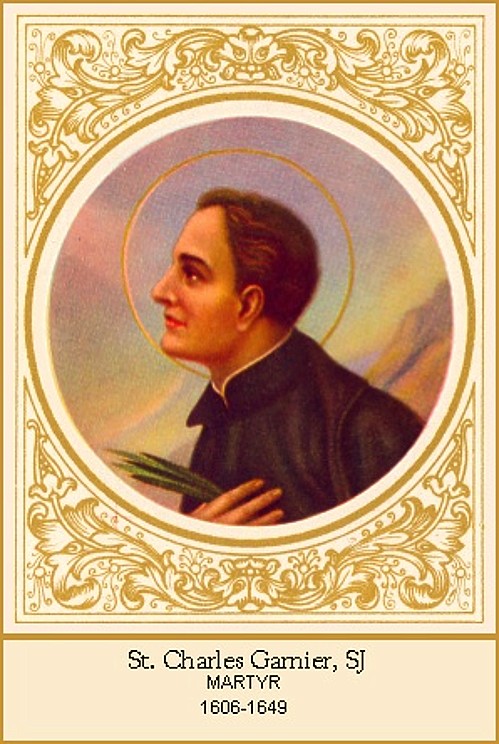
Not unlike them, were their four companion Priests: Antoine Daniel, born at Dieppe, Gabriel Lalemant and Charles Gamier, both Parisian born and Noel Chabanel, a native of Mende – all of these faithfully fulfilled their Priestly functions, labouring principally in various villages of the Huron country.
Frequent raids by the Iroquois, a hostile neighbouring tribe, often wrought havoc in the Huron missions and seriously endangered the lives of the Fathers in charge of them. In 1642, on a journey from Quebec to the Huron country, Isaac Jogues, together with Rene Goupil, a lay co-adjutor of the Society of Jesus, fell in with the Iroquois, who held him and his companion as slaves and subjected them to most horrible torments. In the same year on the 29th of September, Rene was killed by order of an old savage, out of hatred for the Cross of salvation. It was near Auriesville, in the present State of New York, where this most sincere man breathed forth his soul to God.
In the following year Isaac managed to escape and made his way back to France. He returned to America after another year and along with John Lalande, who was also a co-adjutor of the Society of Jesus, made a second and third journey to the savages, his erstwhile tormentors.
On 18 October 1646, in the present diocese of Albany, Isaac was struck with a tomahawk and thus obtained the Palm of Martyrdom. The following day his companion, John, meeting with a like fate, took his flight to Heaven, to be rewarded with the same Crown of Martyrdom.
St Isaac Jogues (1607-1646) aged 39) Priest
On 4 July 1648, in an attack upon the village of St Joseph by the Iroquois, Antoine Daniel, in charge of the Huron mission there, was slain while fearlessly defending his flock. Overwhelmed by a shower of arrows and bullets at the entrance of the Church, like a good shepherd he laid down his life for his sheep. Within a year, on 16 March 1649, at St Ignace, a village situated in what is now the Province of Ontario, Canada, John de Brebeuf and Gabriel Lalemant were captured by the Iroquois. That same day, Brebeuf, rightly called the Apostle of the Hurons, died a glorious death, after undergoing long drawn-out tortures of the most atrocious description, during which, this gallant soldier of Christ manifested such fortitude, as to excite even the admiration of the savages themselves. On the following day Gabriel Lalemant suffered the same cruel Martyrdom, during which, he showed the same heroic virtue.
St Gabriel Lalemant (1610-1649) aged 38 Priest
St Antoine Daniel (1601-1648) aged 47) Priest
In December of the same year, 1649, on the eve of the Immaculate Conception of the Blessed Virgin Mary, Charles Garnier, after several bullet Wounds was killed by a blow from a hatchet, thereby adding a glorious Crown to a life of exceptional innocence. On the following day Noel Chabanel became the victim of the treachery of a Huron apostate, who killed him and threw his body into a river. His longing for the Palm of Martyrdom was thus realised in his own beloved mission. Although he felt a natural repugnance for this work among the savages, hero that he was, he bound himself by a vow to remain in this mission until death.
St Charles Garnier (1606-1649) aged 33) Priest
These eight Martyrs, the first in North America, were Beatified by Pope Pius XI in 1925 and were Canonised by the same Pontiff five years later.
Thought for the Day – 25 September – Meditations with Antonio Cardinal Bacci (1881-1971)
The Sacrifices of Life
“When we say that we must be prepared to make any sacrifice, even to die, rather than offend God and risk eternal damnation, we mean exactly what we say. “If thy right eye is an occasion of sin to thee,” Jesus says in the Gospel, “pluck it out and cast it from thee; for it is better for thee that one of thy members should perish than that thy whole body should be thrown into hell. And if thy right hand is an occasion of sin to thee, cut it off and cast it from thee; for it is better for thee that one of thy members should be lost, than thy whole body should go into hell” (Mt 5:29-30).
We are prepared to do all this when there is a question of preserving mortal life; we are prepared to undergo an amputation in order to avoid death. Are we prepared to do as much for eternal salvation?
Sometimes, when we wish to set ourselves free from the danger of sin, we must deprive ourselves of things that are dear to us; we must suppress our natural instincts and affections and we must impose on ourselves severe penances and bodily mortifications. All this is demanded from us by Jesus in these words which seem hard and almost cruel but are none other than a just and necessary commandment. In certain grave cases, heroism is necessary for all – now is the time of heroes! Are we courageous for Christ and for eternal life with Him?”
Quote/s of the Day – 25 September – “The Month of the Seven Sorrows of the Blessed Virgin Mary and the Holy Cross” and the Memnorial of St Vincent Strambi CP (1745-1824) Bishop
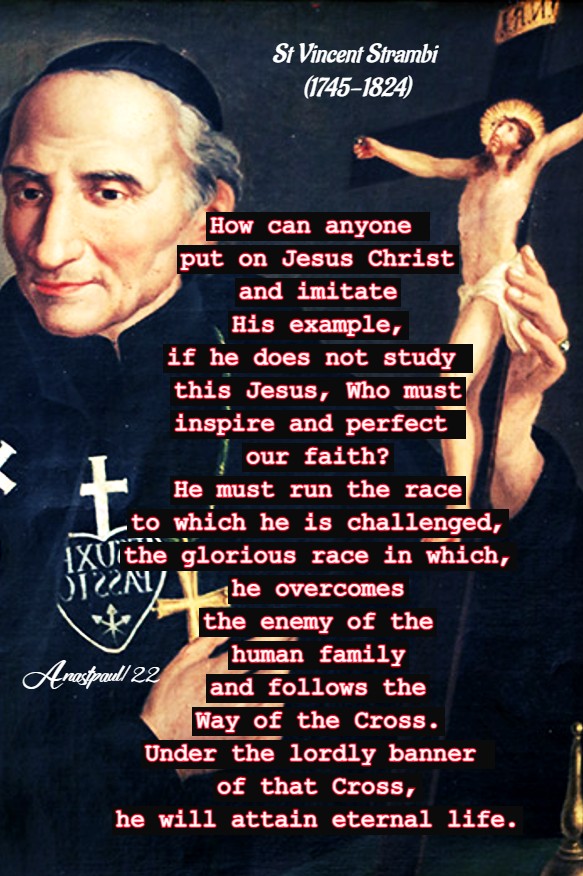
“… How can anyone put on Jesus Christ and imitate His example, if he does not study this Jesus, who must inspire and perfect our faith? He must run the race to which he is challenged, the glorious race in which, he overcomes the enemy of the human family and follows the Way of the Cross. Under the lordly banner of that Cross, he will attain eternal life.”
(From his first Pastoral Letter as Bishop)
“The poor are my supervisors and I am their treasurer.”
One Minute Reflection – 25 September – “The Month of the Seven Sorrows of the Blessed Virgin Mary and the Holy Cross” – Ephesians 3:13-21, Luke 14:1-11 – Seardh Scripture here: https://www.drbo.org/
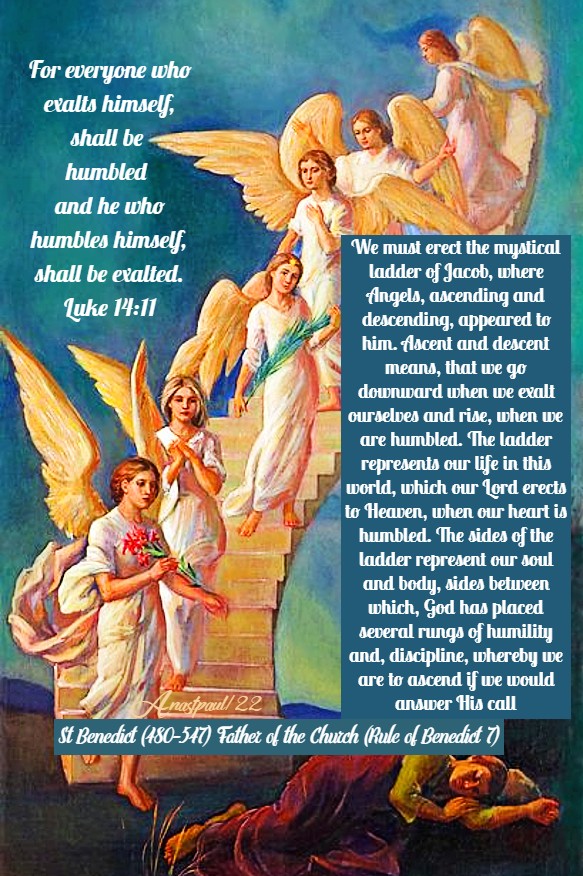
“For everyone who exalts himself, shall be humbled and he who humbles himself, shall be exalted.” – Luke 14:11
REFLECTION – “The Scripture asserts that “everyone who exalts himself shall be humbled and he who humbles himself shall be exalted.” If we want to attain to true humility and come quickly to the top of that heavenly ascent, to which we can only mount, by lowliness in this present life, we must ascend by good works.
We must erect the mystical ladder of Jacob, where Angels, ascending and descending, appeared to him. Ascent and descent means, that we go downward when we exalt ourselves and rise, when we are humbled. The ladder represents our life in this world, which our Lord erects to Heaven, when our heart is humbled. The sides of the ladder represent our soul and body, sides between which, God has placed several rungs of humility and, discipline, whereby we are to ascend if we would answer His call.”– St Benedict (480-547) Father of the Church (Rule of Benedict #7)
PRAYER – Grant, we beseech Thee, O Lord God, unto all Thy servants, that they may remain continually in the enjoyment of soundness, both of mind and body and by the glorious intercession of the Blessed Mary, always a Virgin, our sorrowful Mother, may be delivered from present sadnes, and enter into the joy of thine eternal gladness.Through Jesus Christ, Thy Son our Lord, Who lives and reigns with Thee, in the unity of the Holy Ghost, God, world without end. Amen (Collect).
Our Morning Offering – 25 September – The Sixteenth Sunday after Pentecost +
An Act of Consecration to the Holy Trinity By St Francis de Sales (1567-1622) Doctor of Charity
I vow and consecrate to God all that is in me: my memory and my actions to God the Father; my understanding and my words to God the Son; my will and my thoughts to God the Holy Ghost; my heart, my body, my tongue, my senses and all my sorrows to the Sacred Humanity of Jesus Christ, “who was content to be betrayed into the hands of wicked men and to suffer the torment of the Cross..” Amen
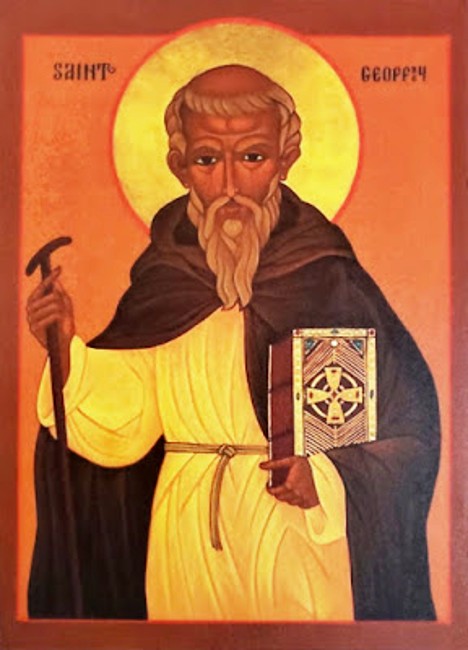
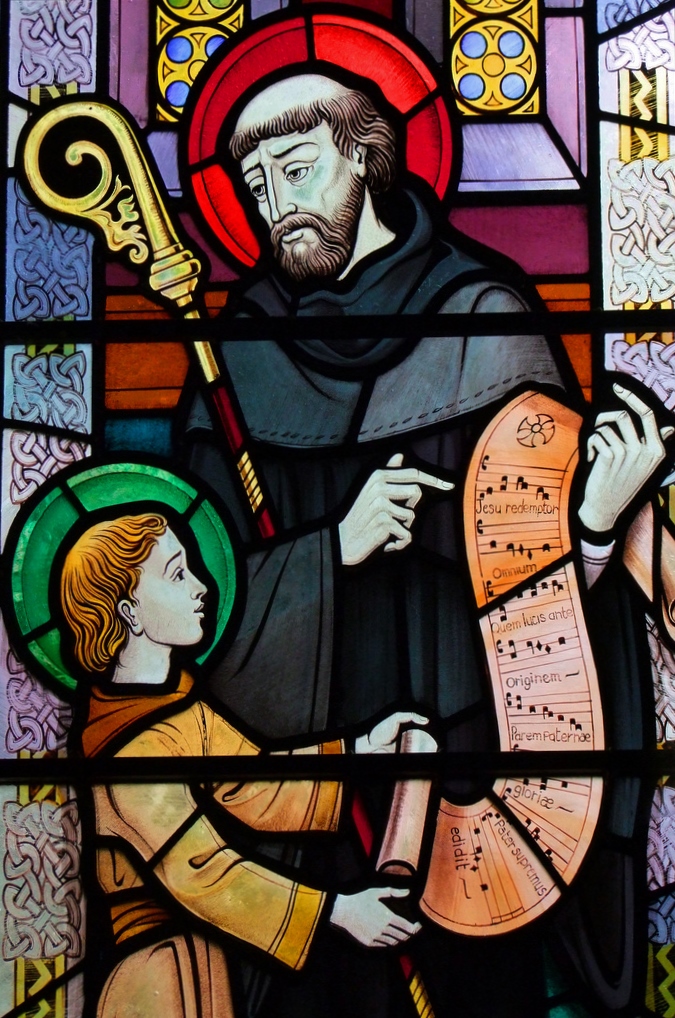
Saint of the Day – 25 September – Saint Ceolfrid (642-716) Abbot and Guardian of the Venerable St Bede, who was placed in his care when the child was 7 years old, for his education in the Monastery. He built an immense library at Jarrow and was himself a man of great knowledge of the Sacred writings. He was the Abbot of Monkwearmouth-Jarrow Abbey, of Wiremouth,Monastery and a major contributor to the production of the the famous Codex Amiatinus, which is considered the best-preserved manuscript of the Latin Vulgate. It was one of three giant single-volume Scriptures then made at Monkwearmouth–Jarrow and is the earliest complete, one-volume Latin Vulgates to survive. Born in 642 in Northumbria, England and died on 25 September 716 at Longres, Champagne, France of natural causes, whilst en route to Rome, to deliver a copy of the Codex to Pope Gregory II. Also known as – Ceolfrith, Ceufrey, Gaufrid, Geoffrey, Geoffroy, Geofroi, Gioffredo, Godefrid, Godefridus, Godfrey, Goffredo, Goffrey, Gofrido, Gotfrid, Gottfried, Jeffrey. CEOLFRID is the same Teutonic name as Geoffrey and signifies “Joyful.”
Ceolfrid was nobly born in Bernicia and related to St Benedict Biscop (c 628-690), (Tutor of the Venerable St Bede) wth whom he joined in the generous resolution of turning their backs upon the world and gave themselves to God.. With him, he made a journey to Rome, partly out of devotion, and partly for improvement in sacred studies and divine knowledge.
After their return he was St. Benedict’s assistant in the foundation of his Monastery of St Peter at Wiremouth, on the north bank of the river, in the Bishopric of Durham. S. Ceolfrid would have regarded it as his greatest felicity on earth, if he could have been as much forgotten by all creatures and despised by everyne as he studied to forget himself. He lived in his, community as St Antony and St Hilarion lived, on their mountains, in the most profound recollection and in the practice of the most austere penance.
When St Benedict built the Monastery of St Paul at Jarrow, he sent Ceolfrid, with seventeen Monks, to lay the foundation of that house and appointed him Abbot. Our Saint governed this Abbey for seven years in St Benedict’s life-time and was constituted, at the desire of that saint, in his last sickness, Abbot also of Wiremouth, from which time, he presided, for twenty-eight years, over both those Monasteries, which, for their proximity and constant interaction, were usually esteemed as one and were generally subject to one Abbot..
The remains of St Paul’s Monastery, Jarrow, where Ceolfrid was Abbot.
St Ceolfrid was diligent and active in everything he took in hand, of a sharp wit, wise and mature in judgement and fervent in zeal. the Venerable St Bede, who had the happiness to live under this admirable man, has left us most authentic testimonies of his learning, abilities and extraordinary sanctity. He was a great lover of Sacred literature and enriched the libraries of his two Monasteries with a great number of excellent volumnes but banished those which could only serve to entertain curiosity.
To how great a pitch he carried the Sacred sciences in his Monasteries, St Bede is an instance. He was himself very learned. Naitan, King of the Picts, sent to him, desiring to be informed concerning the right time of celebrating Easter and the true form of the clerical tonsure. The holy Abbot strongly proved and recommended to him ,the Catholic custom of observing Easter and the Roman tonsure called St Peter’s, by a letter which Bede hath inserted in his history. The King received it with great joy and satisfaction and commanded both points to be received and observed throughout his dominions. This King, likewise desired our Saint to send him builders, who might erect a stone Church, after the manner of the Romans, promising to dedicate it in honour of St Peter. The Abbot complied also with this request.
St Ceolfrid, finding himself broken with age and infirmities and no longer capable of teaching his Monks, by word and example, the perfect form of monastic observance, resigned his Abbacy. The Monks entreated him on their knees to alter his resolution but were obliged to acquiesce and, upon his recommendation, chose Hubert, a very learned Priest, Abbot of both Monasteries, in which then lived six hundred Monks.
This being done, the Saint, having sung Mass in the morning, made them a strong exhortation to mutual love and concord and, for fear of being stopped by the grandees of the kingdom, who all held him in great veneration, set out immediately with a design to perform a pilgrimage to the tombs of the Apostles at Rome. On the road, besides the canonical hours, he everyday sung the whole Psalter twice over and also, offered to God, the saving victim in the Mass which he sung everyday, except one when he was upon the sea and the three last days of his life.
After travelling one hundred and fourteen days, he arrived at Langres, in France, where, being stopped by sickness, he happily died on the 25th of September, in the year of our Lord 716, of his age seventy-four, of his sacerdotal character forty-seven and his Abbatial dignity, thirty-five years.
He was buried in the Church of the three brother Martyrs, Saints Speusippus, Eleusippus and Meleusippus. His relics were afterwards removed to his Monastery of Jarrow and thence, in the time of the Danish devastations, to Glastenbury. On a square stone at Jarrow, this inscription was found: “The dedication of the Church of St Paul at Jarrow, on the ninth day before the ides of May, in the fifteenth year of King Ecfrid and the fourth of the Abbot Ceolfrid, the builder of this Church.”
Blessed Herman of Reichenau/the Cripple (1013–1054) Benedictine Monk, Confessor, Scholar, Scientist, Writer, Hymnist, Poet, Musical Composer, Teacher. In his own day, the heroic cripple who achieved learning and holiness was called ‘The Wonder of His Age.’. Composer of the “Salve Regina” Hail Holy Queen, “Veni Sancte Spiritus” Come Holy Spirit and “Alma Redemptoris Mater” amongst many others. His Amazing Life and Works: https://anastpaul.com/2019/09/25/saint-of-the-day-blessed-herman-of-reichenau-the-cripple-osb-1013-1054-the-wonder-of-his-age/
St Fymbert Bl Marco Criado St Mewrog St Neomisia of Mecerata St Paphnutius of Alexandria St Principius of Soissons St Sergius of Moscow St Solemnis of Chartres
Martyrs of Damascus: A Christian family of six who were tortured to death in a persecution by Roman authorities. They were: Eugenia, Maximus, Paul, Rufus, Sabinian and Tatta. They were tortured to death in Damascus, Syria, date unknown.
The Holy Bishops of Milan: Imagine being part of a Diocese in which 36 of your past Bishops are Saints and some are also Doctors of the Church and Popes (and others being considered for Sainthood)! Today, the Church in Milan commemorates these holy Bishops. They are: • Blessed Alfredo Ildefonso Schuster • Blessed Andrea Carlo Ferrari • Pope Pius XI • Saint Ambrose of Milan • Saint Ampelius of Milan • Saint Anathalon of Milan • Saint Antoninus of Milan • Saint Auxanus of Milan • Saint Benedict Crispus of Milan • Saint Benignus of Milan • Saint Calimerius of Milan • Saint Castritian of Milan • Saint Charles Borromeo • Saint Datius of Milan • Saint Dionysius of Milan • Saint Eugene of Milan • Saint Eusebius of Milan • Saint Eustorgius II of Milan • Saint Eustorgius of Milan • Saint Gaius of Milan • Saint Galdinus of Milan • Saint Geruntius of Milan • Saint Glycerius of Milan • Saint Honoratus of Milan • Saint John Camillus the Good • Saint Lazarus of Milan • Saint Magnus of Milan • Saint Mansuetus of Milan • Saint Marolus of Milan • Saint Martinian of Milan • Saint Mirocles of Milan • Saint Mona of Milan • Saint Natalis of Milan • Saint Protasius of Milan • Saint Senator of Milan • Saint Simplician of Milan • Saint Venerius of Milan
Thought for the Day – 24 September – Meditations with Antonio Cardinal Bacci (1881-1971)
Fundamental Facts
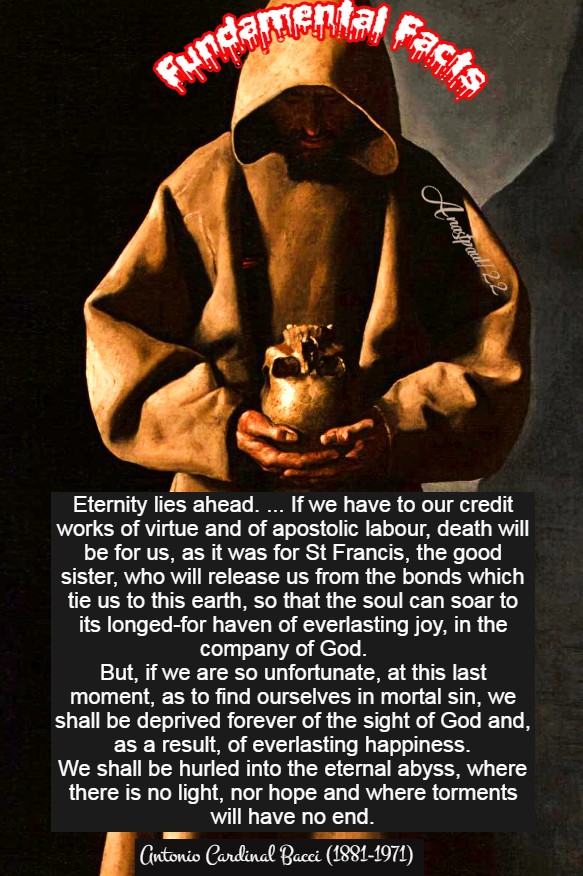
“Eternity lies ahead. Where the tree falls, there it will remain. So it will be with us. If we have to our credit works of virtue and of apostolic labour, death will be for us, as it was for St Francis, the good sister, who will release us from the bonds which tie us to this earth, so that the soul can soar to its longed-for haven of everlasting joy, in the company of God. But, if we are so unfortunate, at this last moment, as to find ourselves in mortal sin, we shall be deprived forever of the sight of God and, as a result, of everlasting happiness. We shall be hurled into the eternal abyss, where there is no light, nor hope and where torments will have no end!
While there is still time, let us meditate on these truths. Remember – this hour, might be our last!”
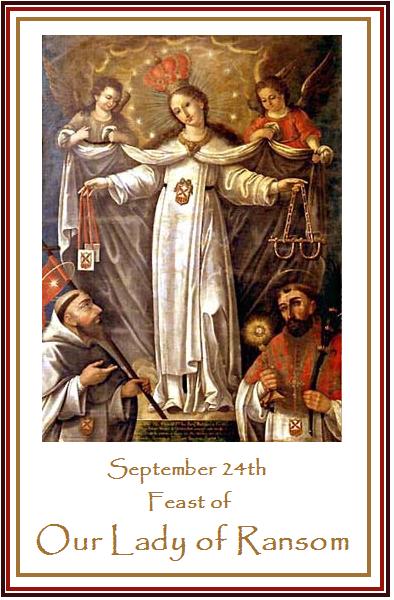
Quote/s of the Day – 24 September – Our Lady of Ransom
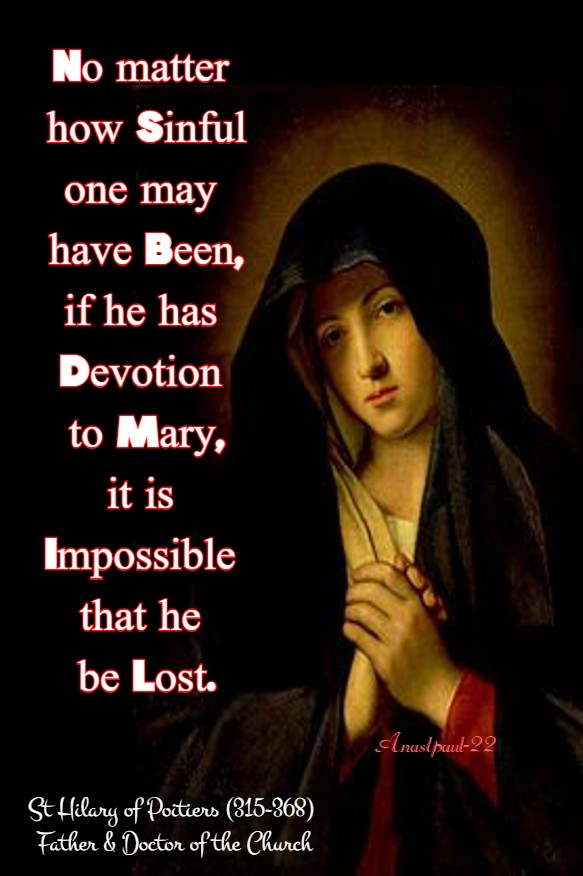
“No matter how sinful one may have been, if he has devotion to Mary, it is impossible that he be lost.”
St Hilary of Poitiers (315-368) Father & Doctor of the Church
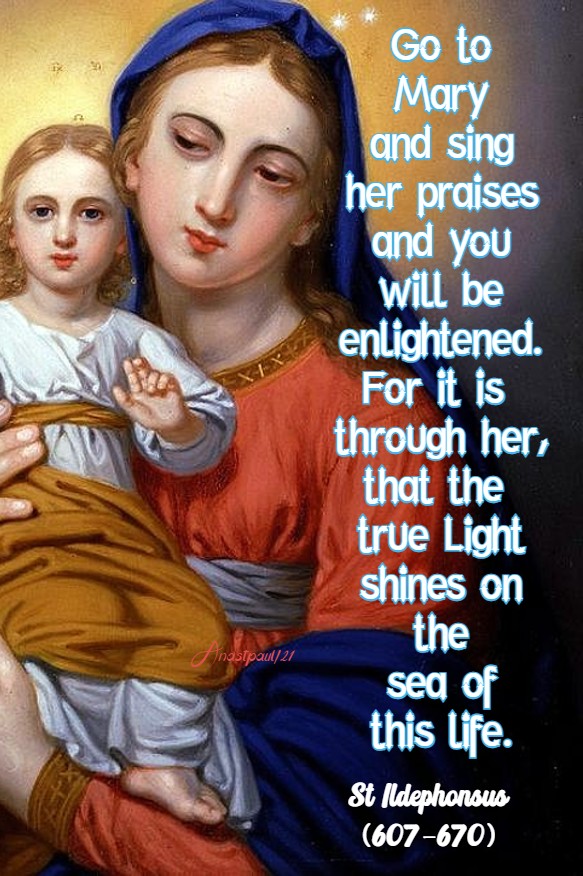
“Go to Mary and sing her praises and you will be enlightened. For it is through her, that the true Light shines on the sea of this life.”
St Ildephonsus (607-670)
“O great, O gentle, O most lovable Mary, thy Holy Name cannot be spoken without inflaming the heart. To those who love thee, it is unspeakable consolation and joy even to think of thee; thou art a sweet memory to those who honour thee.”
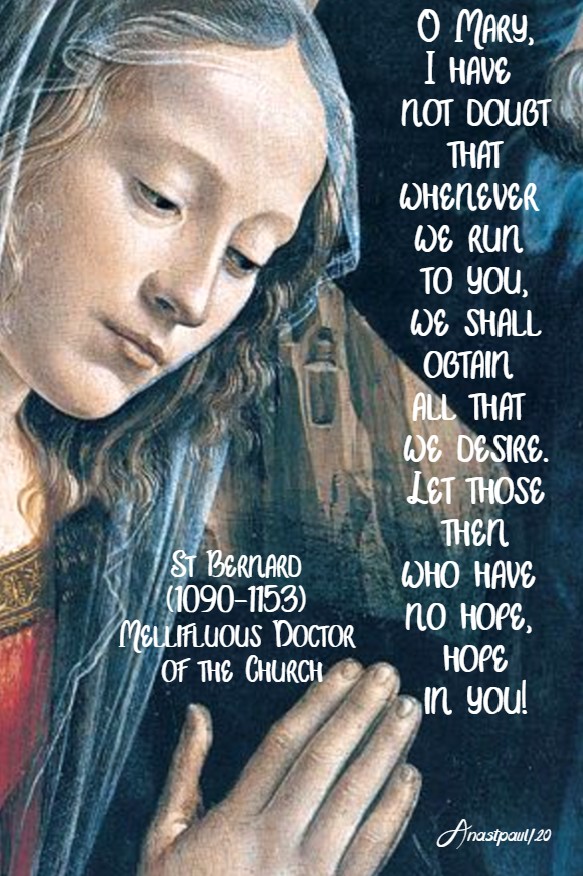
“O Mary, I have not doubt that whenever we run to you, we shall obtain all that we desire. Let those then who have no hope, hope in you!”
St Bernard (1090-1153) Mellifluous Doctor of the Church
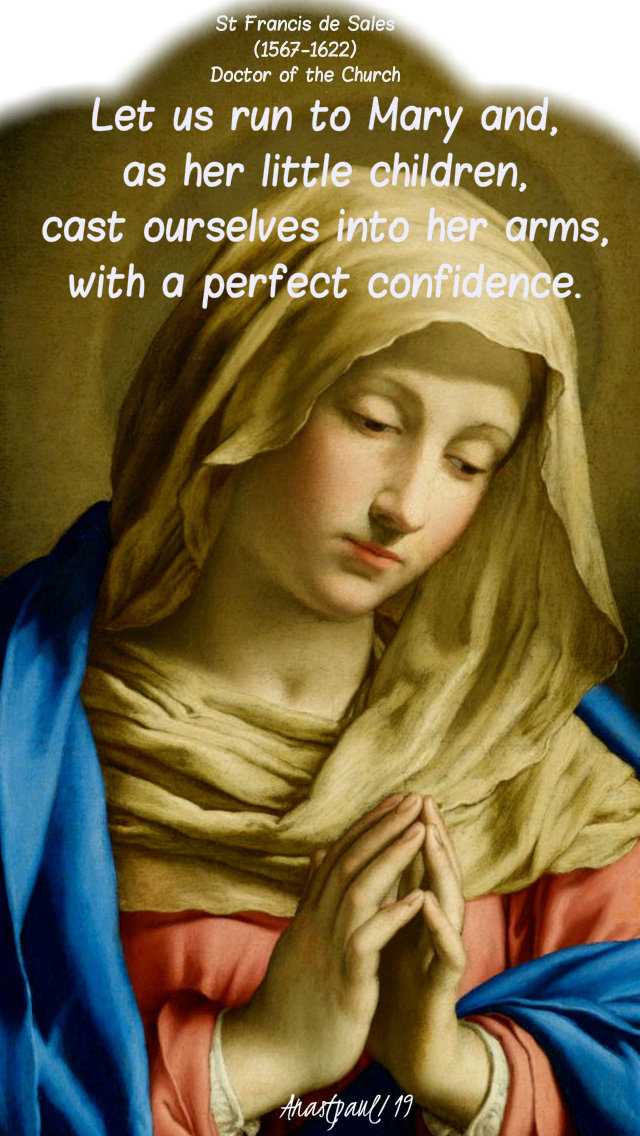
“Let us run to Mary and, as her little children, cast ourselves into her arms with a perfect confidence.”
St Francis de Sales (1567-1622) Doctor of the Church
“No-one who shall invoke this Mother of Grace, with devotion and perseverance, can possibly perish forever.”
St John Eudes (1601-1680) “The Apostle of Two Hearts”
“Truly we are passing through disastrous times, when we may well make our own, the lamentation of the Prophet: “There is no truth and there is no mercy and there is no knowledge of God in the land” (Hosea 4:1). Yet in the midst of this tide of evil, the Virgin Most Merciful rises before our eyes like a rainbow, as the arbiter of peace between God and man.”
St Pope Pius X (1835-1914)
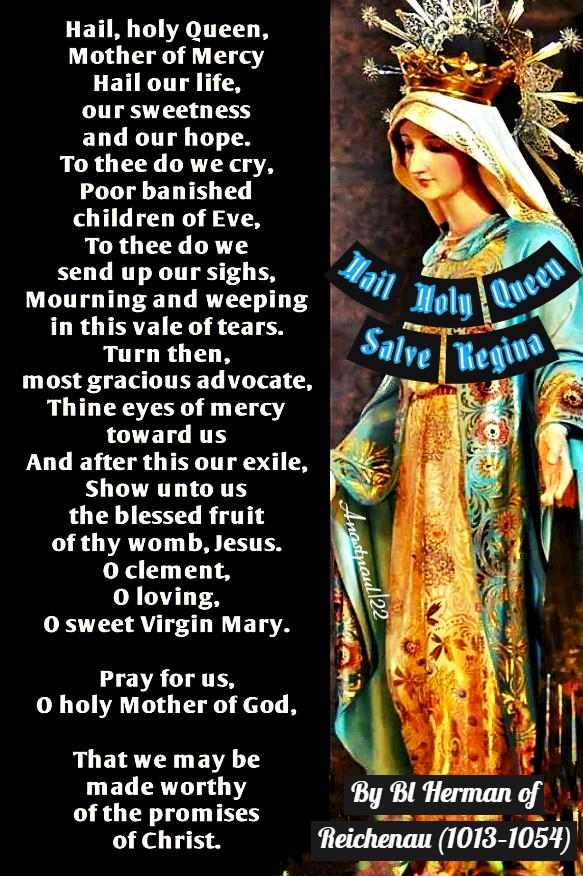
Salve Regina Hail Holy Queen By Blessed Herman of Reichenau (1013–1054)
Hail, holy Queen, Mother of Mercy, Hail our life, our sweetness and our hope. To thee do we cry, Poor banished children of Eve; To thee do we send up our sighs, Mourning and weeping in this valley of tears. Turn then, most gracious advocate, Thine eyes of mercy toward us; And after this our exile, Show unto us the blessed fruit of thy womb, Jesus.
This line, below, by St Bernard of Clairvaux (1090-1153) Doctor of the Church
O clement, O loving, O sweet Virgin Mary.
℣ Pray for us, O holy Mother of God, ℟ that we may be made worthy of the promises of Christ.
One Minute Reflection – 24 September – “The Month of the Seven Sorrows of the Blessed Virgin Mary and the Holy Cross” – Our Lady of Ransom – Sirach 24:14-16, Luke 11:27-28
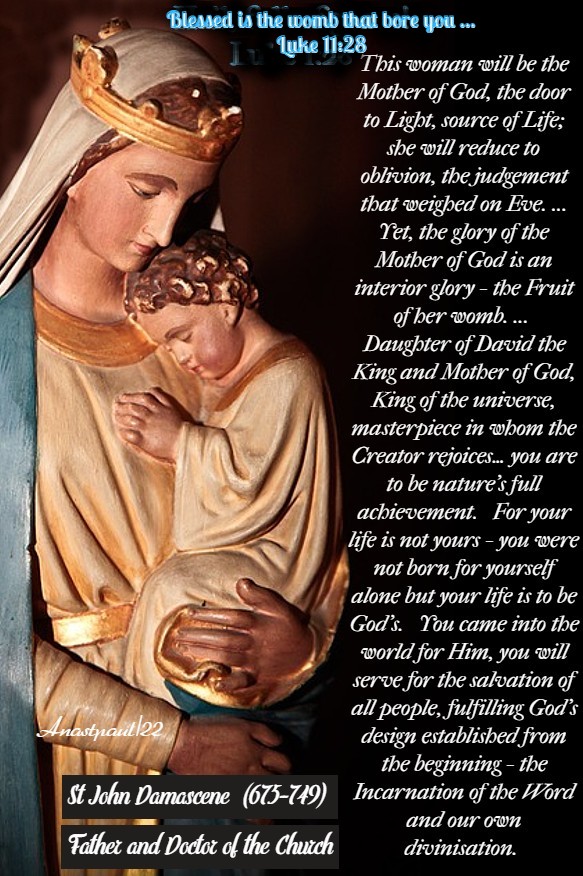
“Blessed is the womb that bore you” – Luke 11:27
REFLECTION – “This woman will be the Mother of God, the door to Light, source of Life; she will reduce to oblivion the judgement that weighed on Eve. “The rich among the people seek the face” of this woman, “the kings of the nations shall pay her homage” they shall “ offer gifts”…, yet the glory of the Mother of God is an interior glory: the fruit of her womb.
O woman, so worthy of love, thrice happy, “blessed are you among women and blessed is the fruit of your womb.” Daughter of David the king and Mother of God, King of the universe, masterpiece in whom the Creator rejoices…: you are to be nature’s full achievement. For you, life is not yours; you were not born for yourself alone but your life is to be God’s. You came into the world for Him, you will serve for the salvation of all people, fulfilling God’s design established from the beginning: the Incarnation of the Word and our own divinisation. Your whole desire is to feed on the words of God, to be strengthened by their sap, like “a green olive tree in the house of God,” “like a tree planted by running water,” you are the “tree of life” who “yielded its fruit in due season”…
He Who is Infinite, Limitless, came to dwell in your womb; God, the Child Jesus, was nourished by your milk. You are the ever virginal Doorway of God; your hands hold your God; your lap is a throne raised up above the Cherubim… You are the wedding chamber of the Spirit, the “city of the living God, gladdened by the runlets of the stream”, that is to say, the waves of the Spirit’s gifts. You are “all fair, the Beloved” of God.” – St John Damascene (675-749) Monk, Theologian, Father and Doctor of the Church (Homily on the Nativity of the Virgin, # 9 ; SC 80) [ ( Biblical references : Ps 44[45],13; 71[72],11.10; Mt 2,11; Lk 1,42; Is 62,5; Ps 51[52],10; 1,3; cf Gn 2,9, Rv 22,2; cf Ez 44,2; Ps 79[80],2; cf Sg 1,4; Ps 45[46],5; Sg 4,7]. Link to searchable Sacred Scripture here: https://www.drbo.org/
PRAYER – O God, Who for the deliverance of Christians from the power of the pagans, graciously willed to enrich Thy Church by a new religious offspring through the most glorious Mother of Thy Son; grant, we beseech Thee, that by the merits and intercession of her, whom we piously venerate, as the founder of so great a work, we may be delivered from all our sins and from the captivity of the devil. Through Jesus Christ, Thy Son our Lord, Who lives and reigns with Thee, in the unity of the Holy Ghost, God, world without end. Amen (Collect).
Our Morning Offering –24 September – “The Month of the Seven Sorrows of the Blessed Virgin Mary and the Holy Cross” and Mary’s Day
O Afflicted Virgin! By St Alphonsus de Liguori (1696-1787) Most Zealous Doctor
O afflicted Virgin! O soul, great in virtues and great also in sorrows! for both arise from that great fire of love thou hast for God; thou “whose heart can love nothing but God.” O Mother, have pity on me, for I have not loved God and I have so much offended Him. Thy sorrows give me great confidence to hope for pardon. But this is not enough; I wish to love my Lord and who can better obtain this for me than thou, thou who art the Mother of fair love? O Mary, thou dost console all, comfort me also. Amen
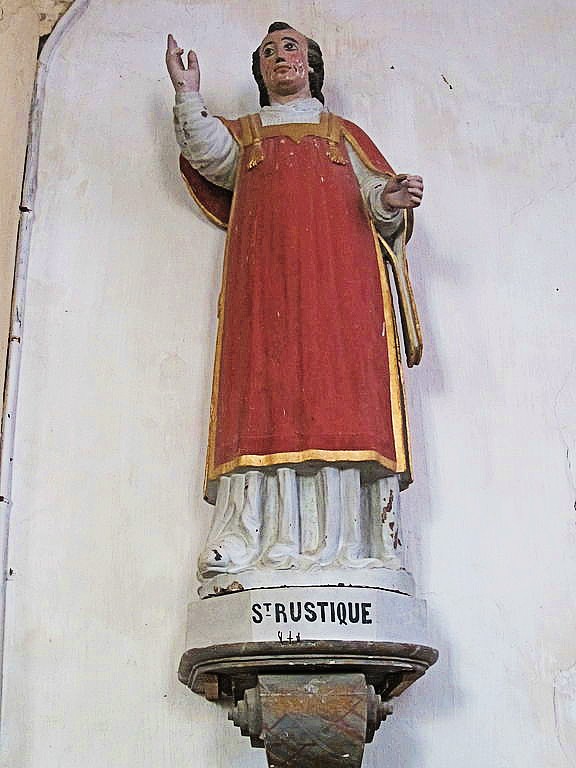
Saint of the Day – 24 September – Saint Rusticus of Clermont (Died 446) Bishop of Clermont, Confessor – the Seventh Bishop of Clermont in Auvergne, concerning whose election Saint Gregory of Tours relates, that it was brought about by a special intervention of Divine Providence. Born in Auvergne, France and died in 446 in Clermont, Auvergne of natural causes. Also known as – Rustique, Rotiri. Rusticus of Auvergne.
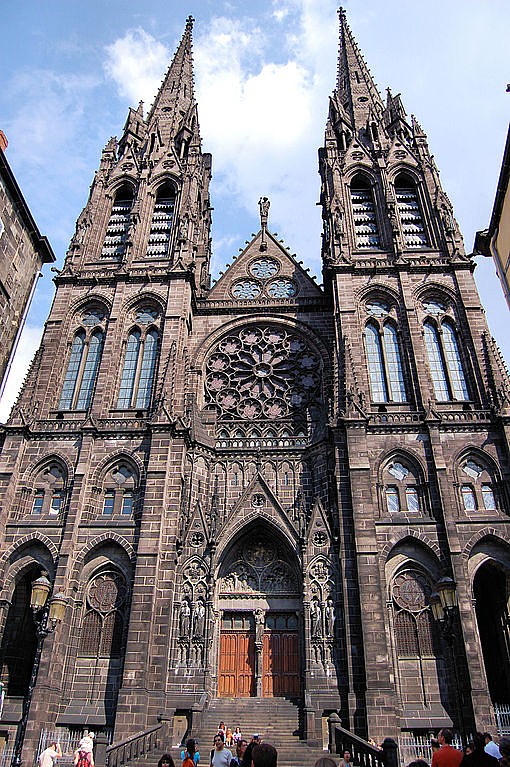
At Clermont Cathedral
Rusticus was a Priest in Clermont, remarkable for the sanctity of his manners. He was a native of the Diocess and had the administration of a Parish there. This is all which is known, with any cerntainty, concerning his life.
Église Saint-Denis in Saint-Denis-le-Vêtu – Statue of saint Rustique
When the former Bishop, Venerandus, died on the 24th of December, 423,. It is said that an assembly of citizens were adiscussing candidates to succeed Venerandus, when a veiled Nun told them to let the Lord make the choice and the chosen would appear.
At that moment, Rusticus arrived and the woman cried out that he was the one appointed by the Lord.
Rusticus duly succeeded as the Bishop of Clermont. His term as the Bishop was 22 years long , from 424 to 446. He was succeeded by Saint Namatius, who was the Bishop from 446 to 462 and founded Clermont Cathedral.
Martyrs of Chalcedon – (49 Saints): Forty-nine Christian choir singers of the Church in Chalcedon in Asia Minor who were Martyred together in their persecutions of Diocletian in 304.
Thought for the Day – 23 September – Meditations with Antonio Cardinal Bacci (1881-1971)
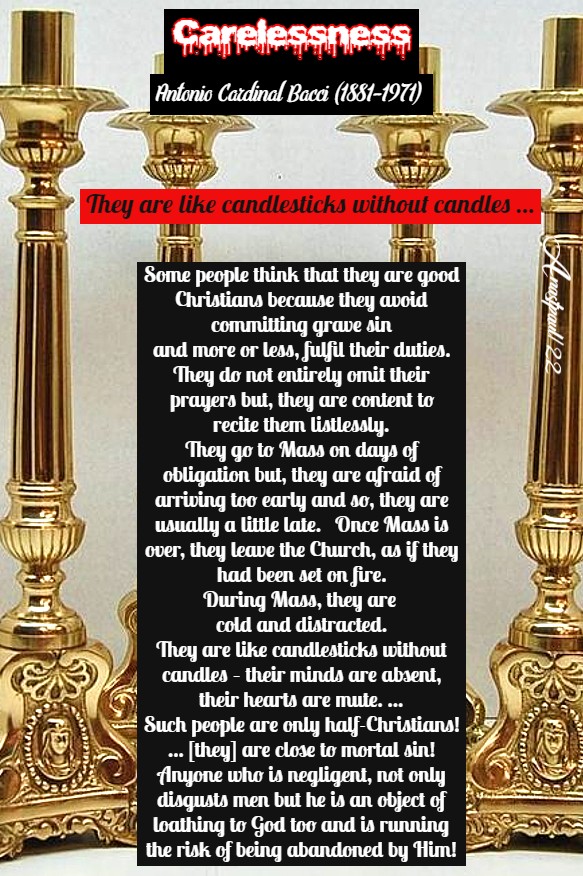
Carelessness
“Some people think that they are good Christians because they avoid committing grave sin and more or less, fulfil their duties. They do not entirely omit their prayers but, they are content to recite them listlessly.
They go to Mass on days of obligation but, they are afraid of arriving too early and so, they are usually a little late. Once Mass is over, they leave the Church, as if they had been set on fire. During Mass, they are cold and distracted. They are like candlesticks without candles – their minds are absent, their hearts are mute.
In regard to their work or other obligations, any excuse suffices to escape or to leave a job half-done. It is useless to expect from them, anything like fervour in prayer, attention to duty, or a spirit of sacrifice in the performance of good works.
Such people are only half-Christians. They do not wish to serve Satan but, they lack the generosity ad the strength of will to become true sons of God. Do you belong to this category? If your carelessness derives from a lack of appreciation of divine things and of your duty in life, you can hardly avoid grave fault. If it comes from laziness, tepidity or lack of mortification, there is no doubt but that you are close to mortal sin! Anyone who is negligent, not only disgusts men but he is an object of loathing to God too and is running the risk of being abandoned by Him! We should examine ourselves seriously and, if we discover this indifference in ourselves, we should shake off our lethargy and make good resolutions to love God more and to serve Him with greater fidelity and diligence. We should be ready, no matter how great the sacrifice, to avoid every imperfection and sin. Any offence against God can lead us nearer to eternal damnation!”
Quote/s of the Day – 23 September – Osee 14:2-10, Luke 7:36-50
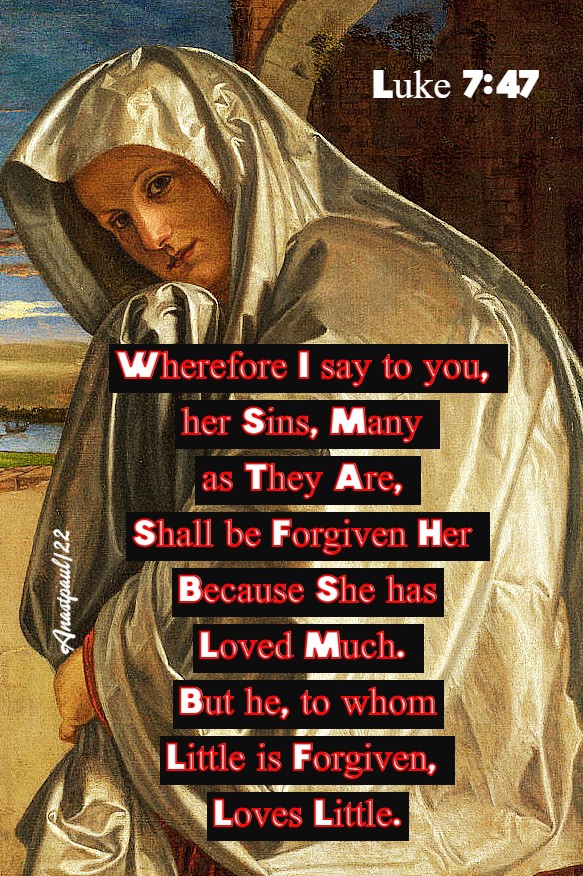
“Wherefore I say to you, her sins, many as they are, shall be forgiven her because she has loved much. But he, to whom little is forgiven, loves little.”
Luke 7:47
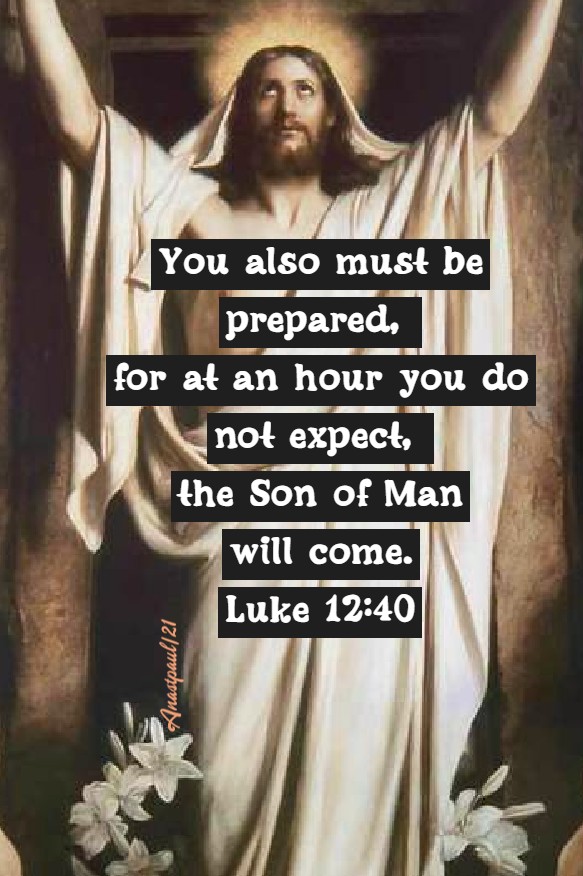
“You also must be prepared, for at an hour you do not expect, the Son of Man will come.”
Luke 12:40
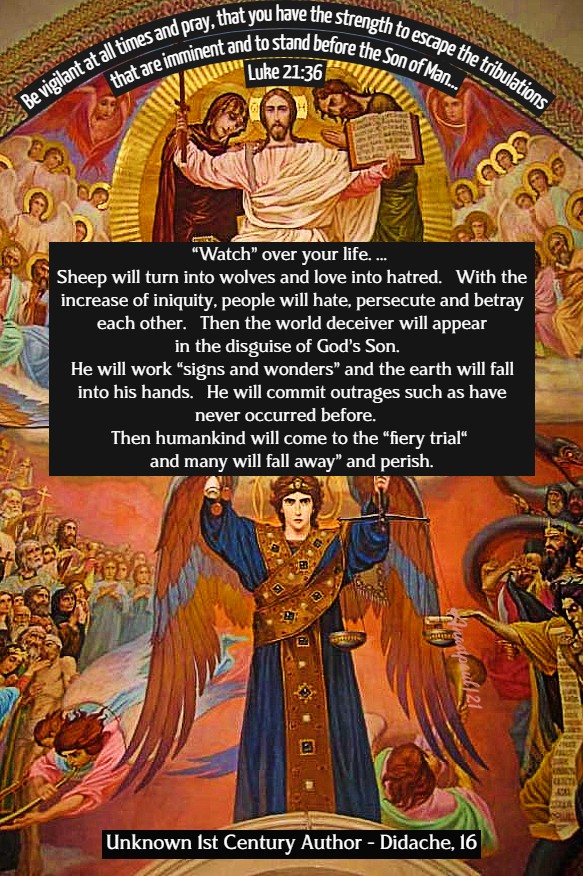
“Be vigilant at all times and pray, that you have the strength to escape the tribulations that are imminent and to stand before the Son of Man…”
Luke 21:36
“Watch” over your life. … Sheep will turn into wolves and love into hatred. With the increase of iniquity, people will hate, persecute and betray each other. Then the world deceiver will appear in the disguise of God’s Son. He will work “signs and wonders” and the earth will fall into his hands. He will commit outrages such as have never occurred before. Then humankind will come to the “fiery trial“ and many will fall away” and perish.”
Unknown 1st Century Author of this early Treatise (Didache, 16)
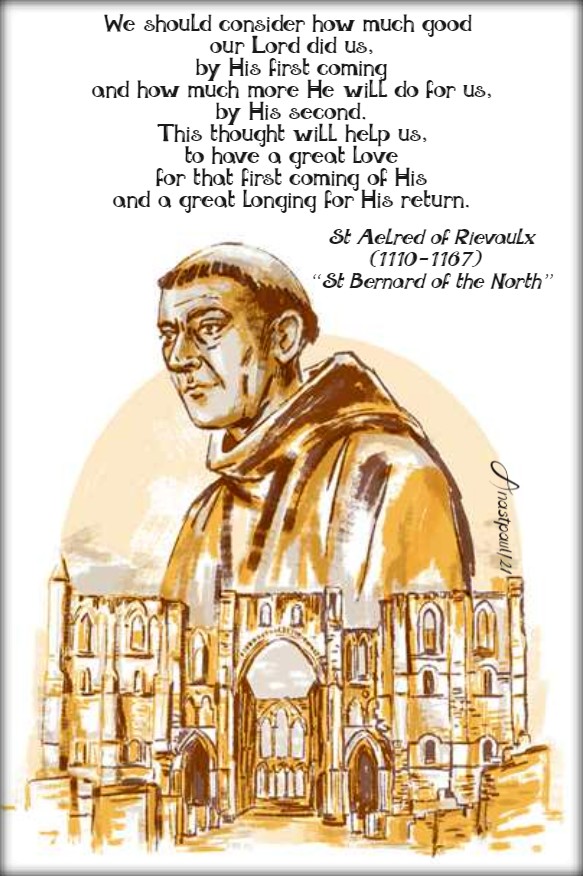
“We should consider how much good our Lord did us, by His first coming and how much more He will do for us, by His second. This thought will help us, to have a great love for that first coming of His and a great longing for His return.”



































You must be logged in to post a comment.