Posted in DOCTORS of the Church, FATHERS of the Church, MARIAN PRAYERS, MARIAN TITLES, SAINT of the DAY, The APOSTLES & EVANGELISTS

The Octave Day of St Stephen, Nuestra Señora del Pilar / Our Lady of the Pillar (Zaragoza, Spain) (40) and Memorials of the Saints – 2 January

The Octave Day of St Stephen

Nuestra Señora del Pilar / Our Lady of the Pillar (Zaragoza, Spain) (40) – 2 January, 12 October (originally 4 October), 15 August – (This Apparition it is considered the first Marian Apparition, and is unique because it happened while Mary was still living on Earth):
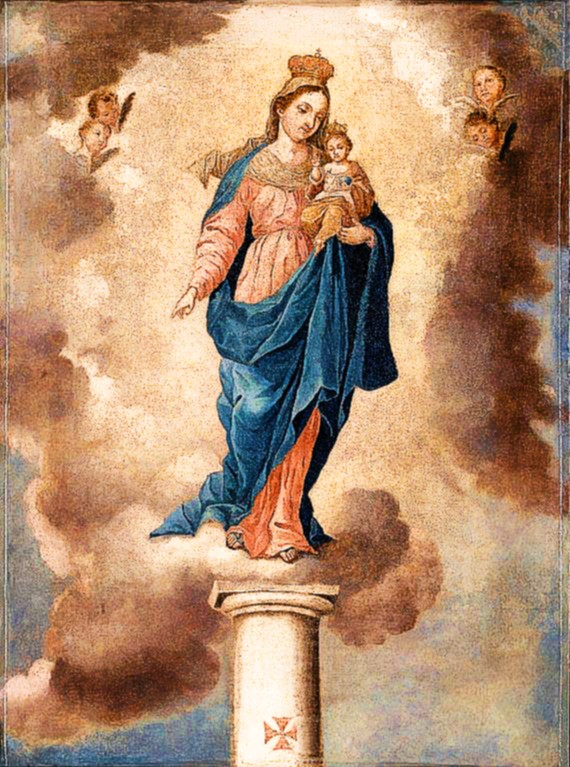
According to ancient Spanish history, on 2 January in the year 40, in the early days of Christianity, James the Greater, one of the original Twelve Apostles of Jesus Christ, was preaching the Gospel in what was then the pagan land of Caesaraugusta (now Zaragoza), in the Roman Province of Hispania.

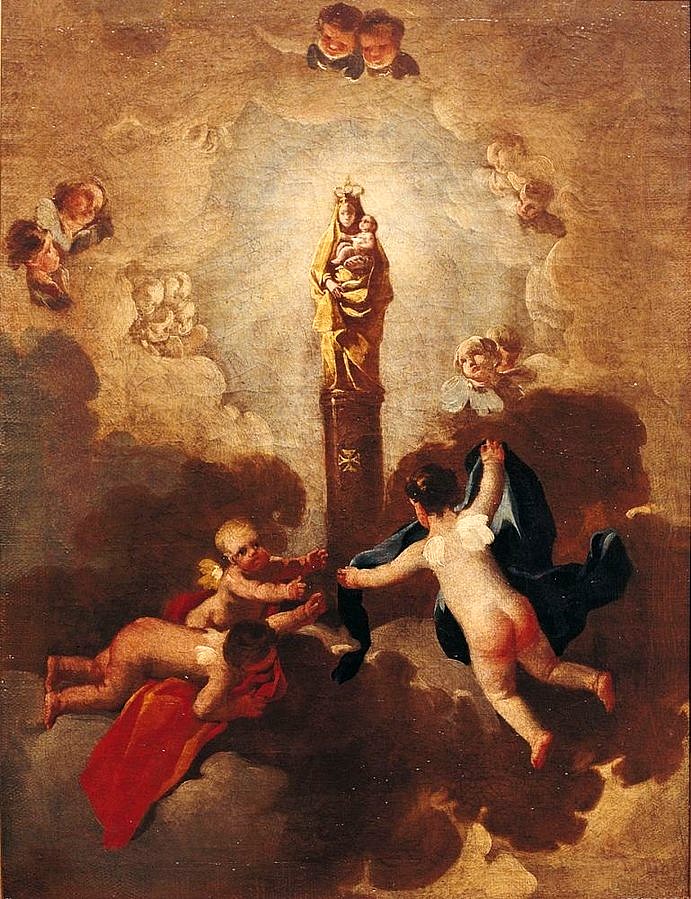
St James was disheartened with his mission, having made only a few converts. While he was praying by the banks of the Ebro River with some of his disciples, the Blessed Virgin Mary miraculously appeared before him atop a pillar accompanied by Angels. Mary assured James that the people would eventually be converted, becoming a stronghold of the Faith due to his efforts and their faith would be as strong as the pillar she was standing on. She gave him the pillar as a symbol and a wooden image of herself. James was also instructed to build a Chapel on the spot where she left the pillar which he did, making it the first Church in Spain.
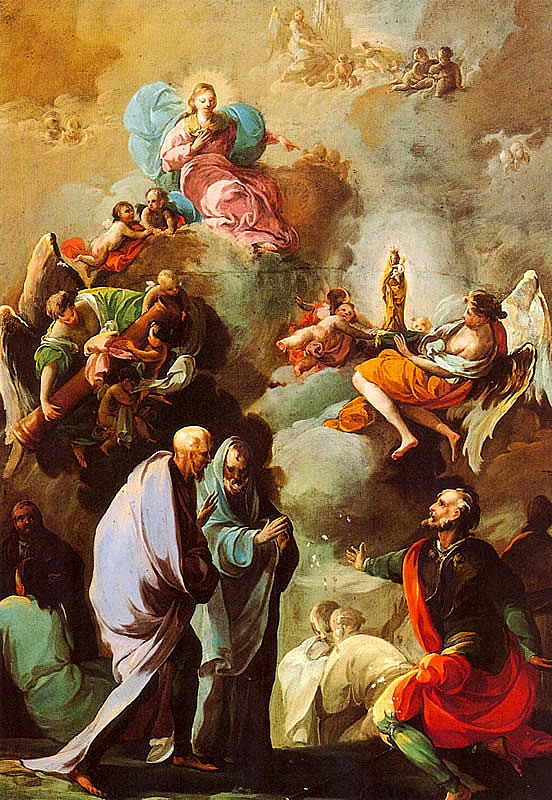
Apparition of the Virgin of the Pillar to Saint James and his Saragossan disciples by Francisco Goya, c 1769.

It is generally believed, that Mary appeared to James through bilocation, as she was still living, either in Ephesus or Jerusalem, at the time of this event, as she is believed to have died three to fifteen years after Jesus ascended into Heaven. After establishing the church, James returned to Jerusalem with some of his disciples where he became a Martyr, beheaded in 44 under Herod Agrippa. His disciples returned his body to Spain.
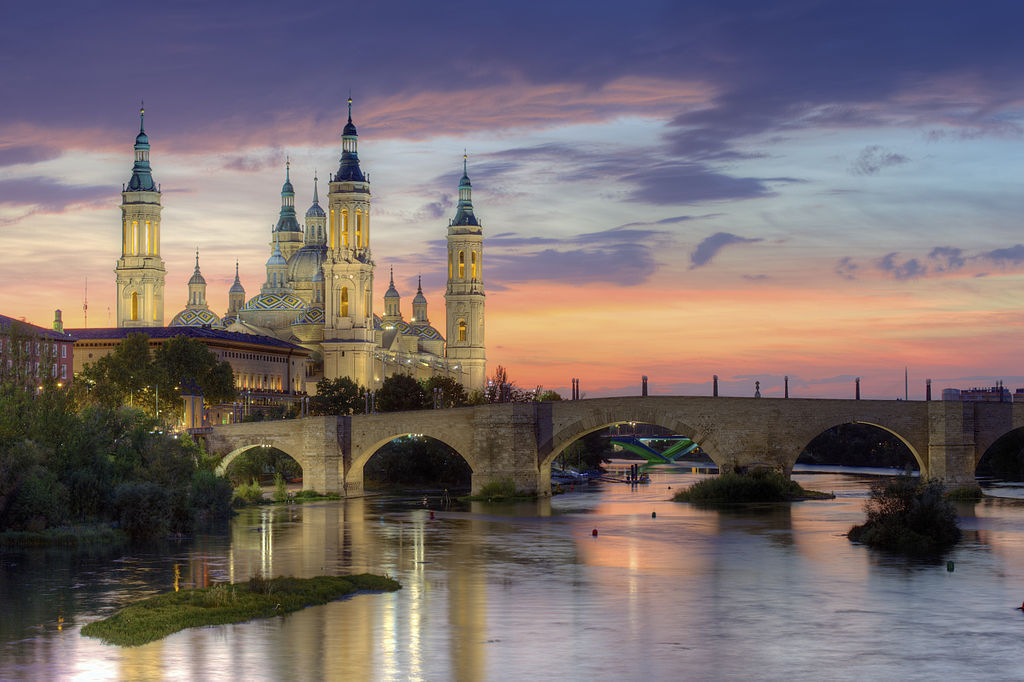
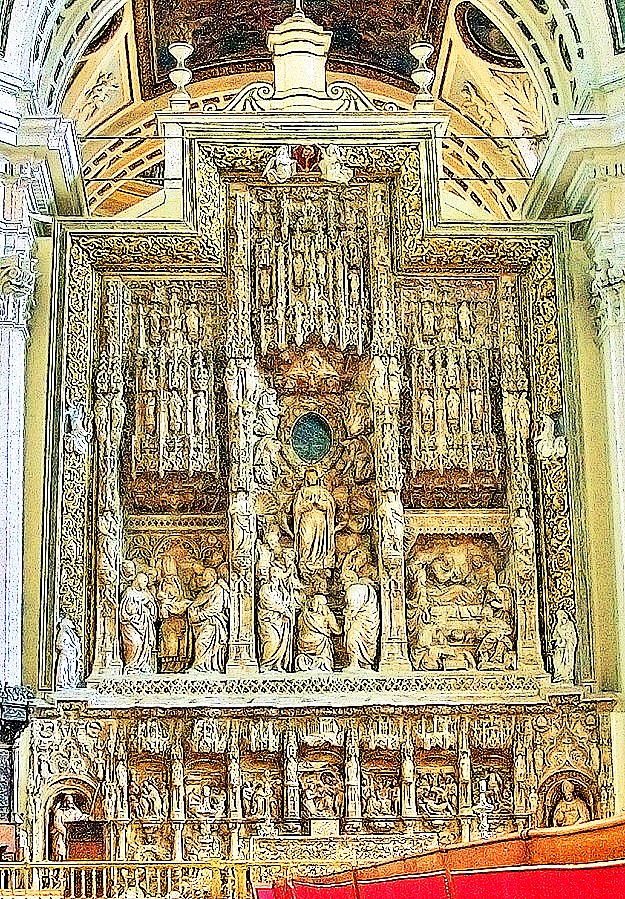
The pillar left by the Virgin Mary is presently enshrined in the same but larger Basilica of Our Lady of the Pillar. It is believed to be the same pillar given and promised by Mary, in spite of numerous disasters that beset the Church. A fire in 1434 razed the Church that preceded the present Basilica Cathedral, see below.
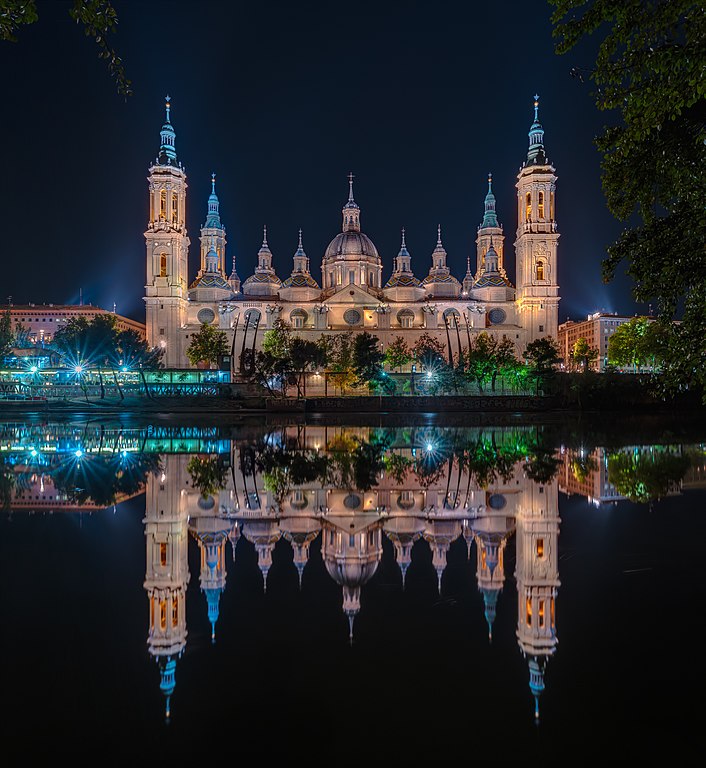
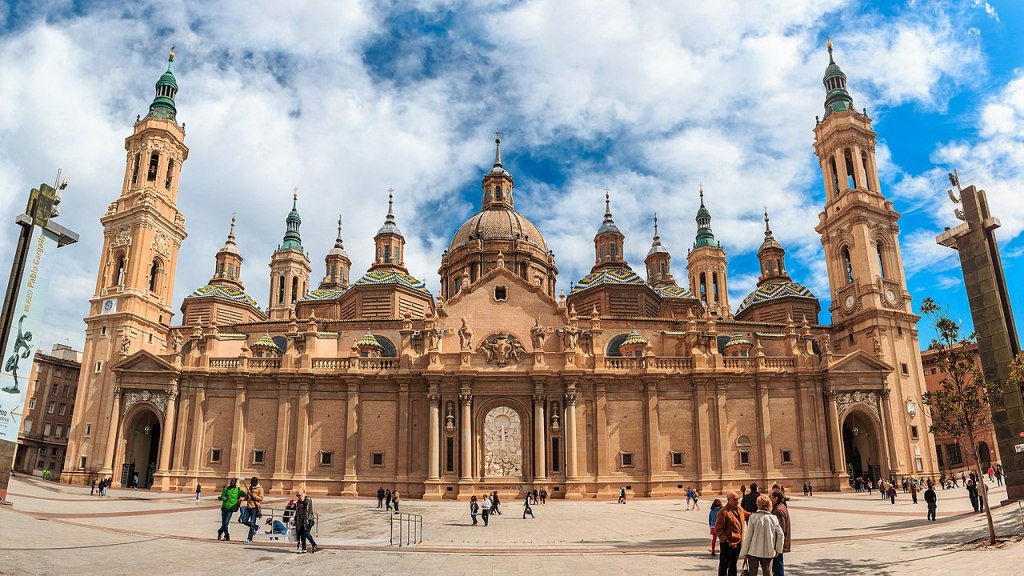
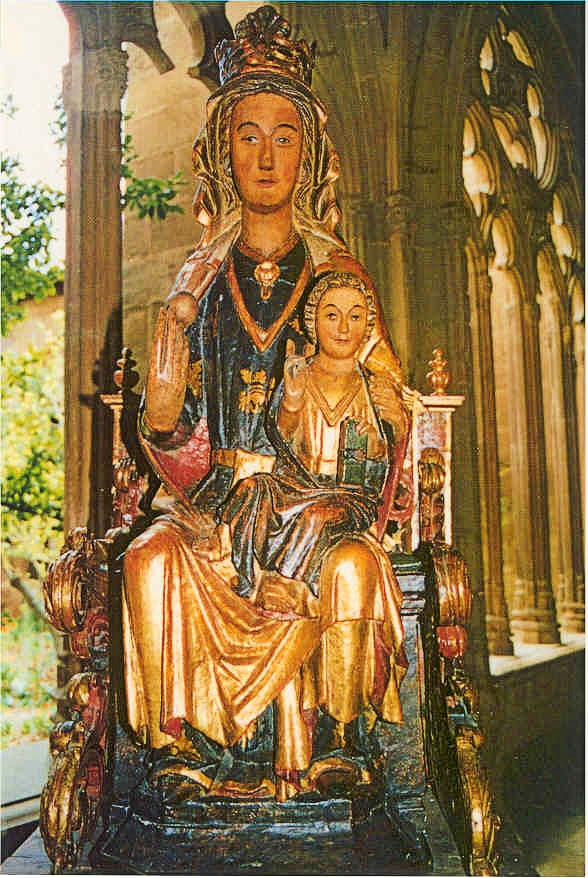
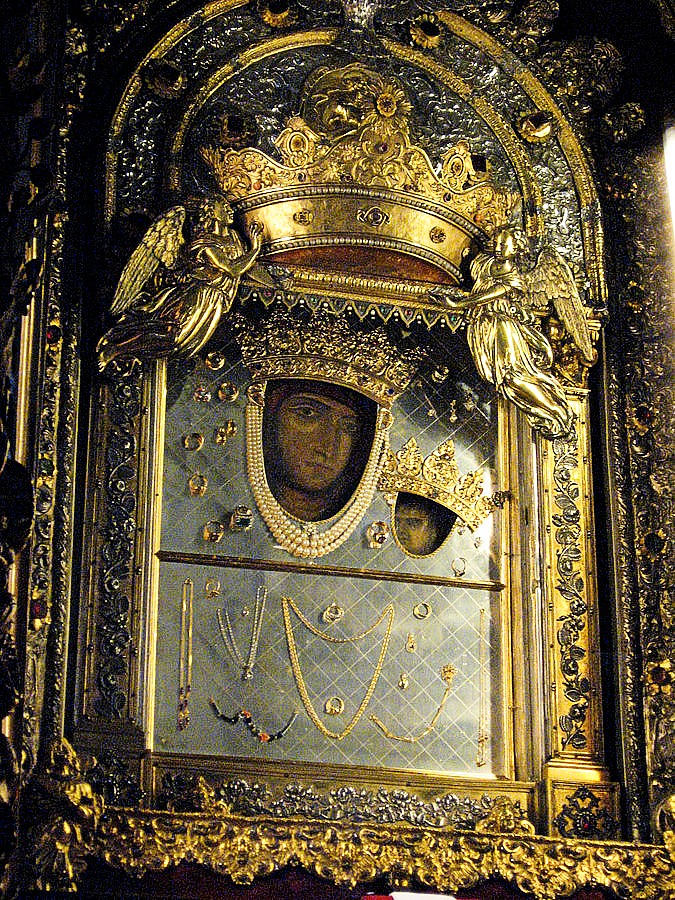
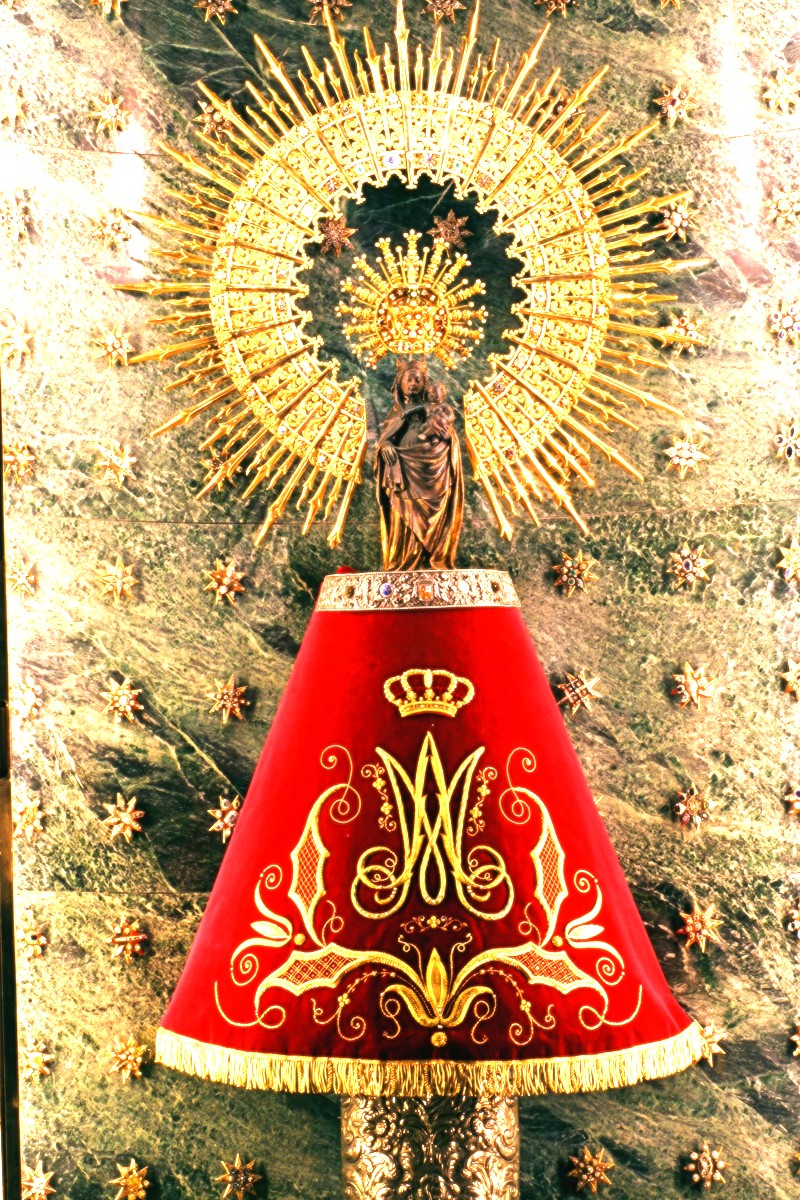
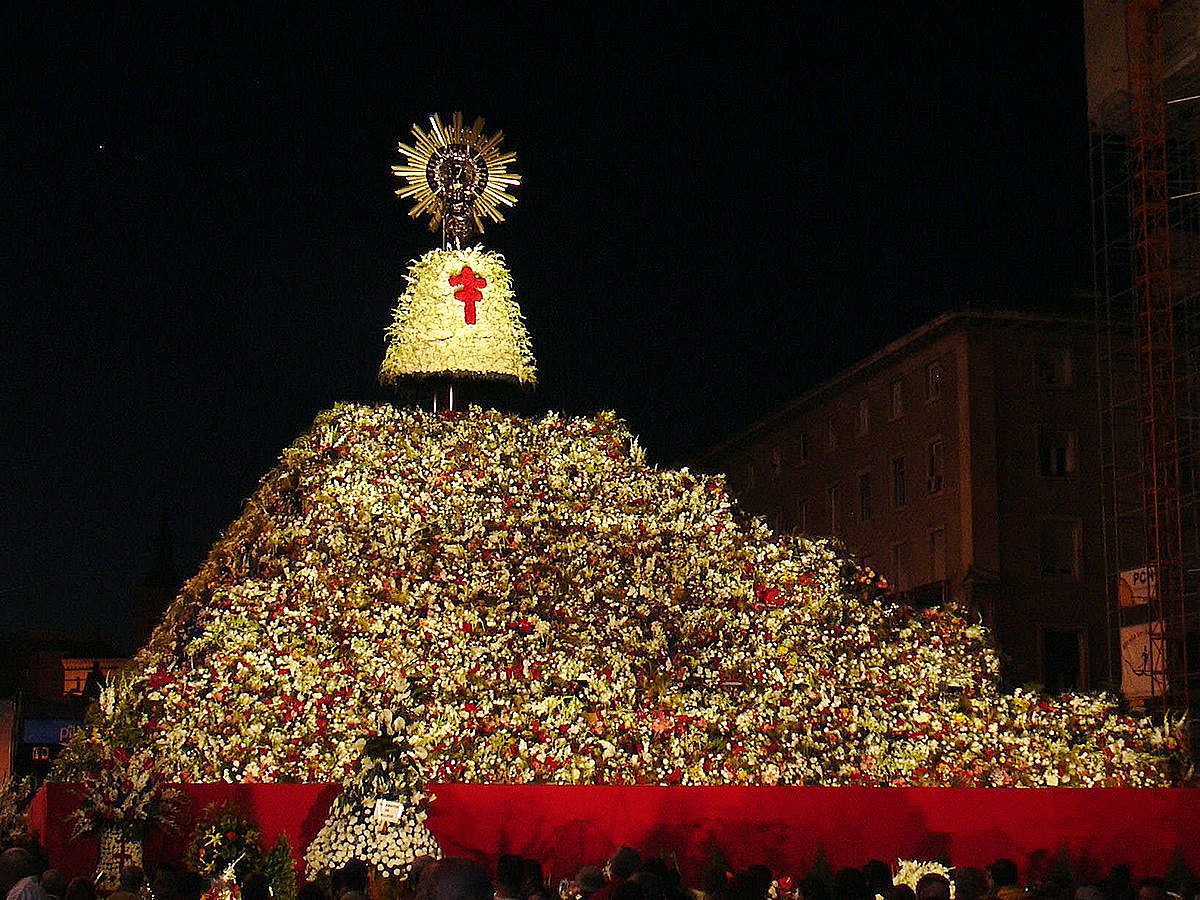
The image of the Blessed Virgin Mary may or may not be the original. Some reports state that the original wooden image was destroyed when the Church burned down in 1434, contradicting other reports, that it is still the original Statue. The Statue of the Blessed Virgin Mary is made of wood and stands 39 centimetres tall while the 1.8 m pillar is made of jasper.quartz. The Statue depicts Mother Mary with the Child Jesus on her left arm, Who has a dove sitting on His left palm. Since the 16th century, the pillar is usually draped in a skirt-like cover called manto (in English: mantle). As a whole, it is protected by a bronze case and then another case of silver. The image was canonically crowned in 1905 during the reign of Pope Pius X. The crown was designed by the Marquis of Griñi, valued at 450,000 pesetas (£18,750, in1910). During the three Marian festivities of today, 15 August and 12 October, the faithful adorn the base of the Pillar and Statue with flowers – see below (both our Blessed Mother and St James would be thrilled by this display of such immense faith and piety!)
The apparition of Our Lady of the Pillar is a widely accepted sacred tradition. Popes from earliest times issued Papal Bulls attesting to the authenticity of the Shrine and the appearance of the Virgin Mary. Pope Calixtus III issued a Bull in 1456 encouraging pilgrimage to the Lady of the Pillar. It acknowledged the miracle of its foundation and the miracles that had taken place at the Spanish Shrine. It was also through this Bull that the name “Our Lady of the Pillar” was confirmed.
So many contradictions had arisen concerning the miraculous origin of the Church that during the reign of Pope Innocent XIII , the Bishops of Spain appealed to the Holy See to settle the controversy. After careful investigation, the twelve Cardinals, in whose hands the affair rested, adopted the following account, which was approved by the Sacred Congregation of Rites on 2 August 1723 and has since been inserted in the lessons of the Office of the Feast of Our Lady of the Pillar, celebrated on 12 October.
Of all the places that Spain offers for the veneration of the devout, the most illustrious is doubtless the Sanctuary consecrated to God under the invocation of the Blessed Virgin, under the title of Our Lady of the Pillar, at Saragossa.
According to ancient and pious tradition, St James the Greater, led by Providence into Spain, spent some time at Saragossa. He there received a signal favour from the Blessed Virgin. As he was praying with his disciples one night, upon the banks of the Ebro, as the same tradition informs us, the Mother of God, who still lived, appeared to him and commanded him to erect an oratory in that place. The Apostle delayed not to obey this injunction,and with the assistance of his disciples, soon constructed a small Chapel. In the course of time, a larger Church was built and dedicated, which, with the dedication of Saint Saviour’s, is kept as a festival in the City and Diocese of Saragossa on the 4th of October.

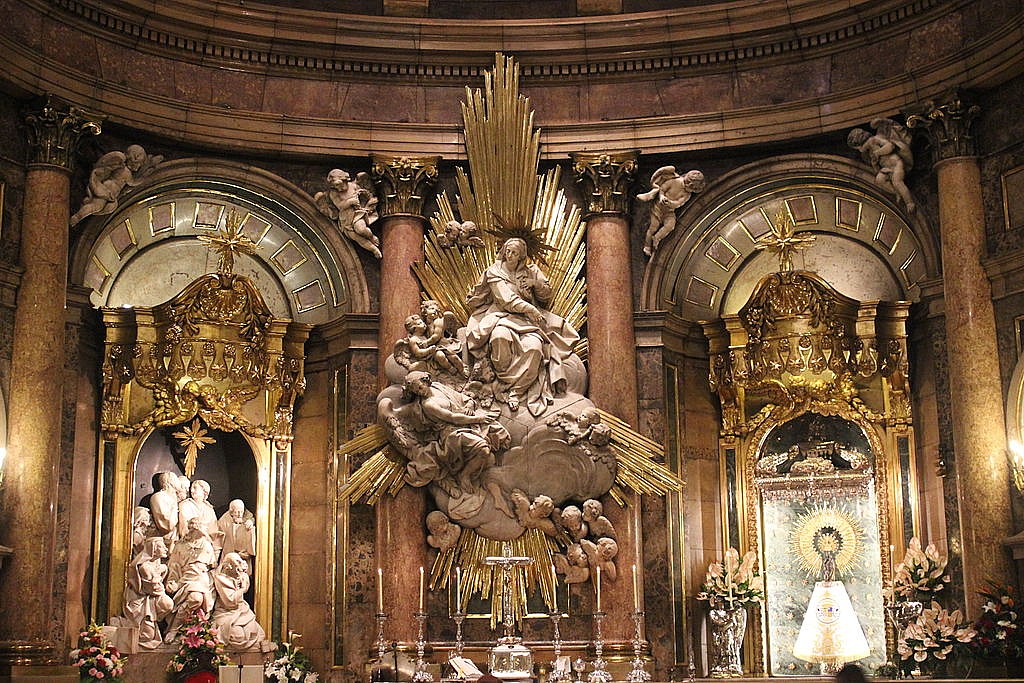
Holy Chapel of the Pillar of Zaragoza. Altar with the Arrival of the Virgin by ‘José Ramírez de Arellano.

In 1730, Pope Clement XII allowed the celebration of the Feast of Our Lady of the Pillar all over the Spanish Empire. As the date coincides with the discovery of the Americas, the Lady was later named as Patroness of the Hispanic World although her Patronages include all of the following:
Zaragoza, Spain, Melo, Uruguay, Buenos Aires, Argentina, Diocese of Imus, Cavite, Zamboanga City, Santa Cruz, Manila, Alaminos, Laguna, San Simon, Pampanga, Libmanan, Camarines Sur, Pilar and Morong in Bataan, Mamburao, Occidental Mindoro, Sibonga, Cebu, Baleno, Masbate, Cauayan, Isabela.

Prayer:
Hail, Mary, Our Lady of the Pillar,
conceived without sin,
I come to venerate and honour you.
above all the Angels and Saints in Heaven,
as my Queen, my Lady and my dearest Mother.
I firmly resolve to serve you always
and to do whatever I am able,
that all may render faithful service to you.
Most Holy Mary,
through your kind intercession
and by your own merits,
obtain for me from your Divine Son Jesus,
our Lord and Saviour,
all the graces I need
for the eternal salvation of my soul.
Therefore, most devoted Mother of mothers,
through the Precious Blood
which your Son shed for us,
I humbly beseech thee to receive me
among your devotees
and to accept me as your servant forever.
Help me in my every thought,
action word and deed,
never to be displeasing in your sight
and in the sight of your Son,
our Lord and Redeemer.
Think of me always,
my dear Lady of the Pillar
and do not forsake me
in the hour of my death.
Amen.
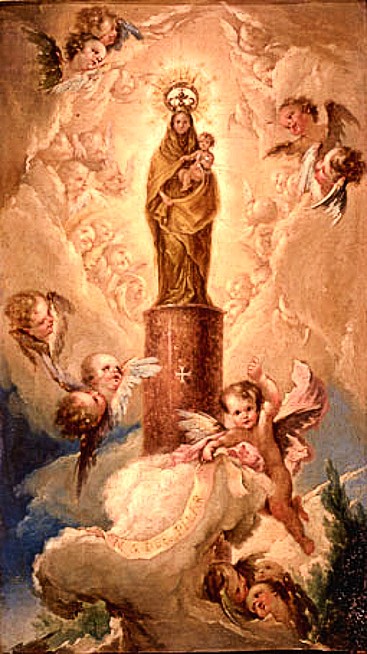
Our Lady of the Pillar by Ramón Bayeu, 1780.

St Basil the Great (329-379) Father & Doctor of the Church (Memorial)
St Basil is celebrated individually on 14 June (General Roman Calendar from 13th century to 1969.
St Gregory of Nazianzen (330-390) Father & Doctor of the Church (Memorial)
St Gregory is celebrated individually on 9 May (General Roman Calendar prior to 1969).
About these 2 great Fathers and Doctors:
https://anastpaul.wordpress.com/2018/01/02/saint-s-of-the-day-st-basil-the-great-329-379-and-st-gregory-of-nazianzen-330-390-fathers-and-doctors-of-the-church/
AND:
https://anastpaul.com/2019/01/02/saint-s-of-the-day-2-january-st-basil-the-great-329-379-and-st-gregory-of-nazianzen-330-390-two-bodies-one-spirit/

St Adelard of Corbie (c 751 – 827) Monk, Abbot, Apostle of the poor and needy, Court administrator, Counsellor to Charlemagne.
Biography:

https://anastpaul.com/2021/01/02/saint-of-the-day-2-january-saint-adelard-of-corbie-c-751-827/

Bl Airaldus of Maurienne
St Asclepius of Limoges
St Aspasius of Auch
St Blidulf of Bobbio
Bl Guillaume Répin
St Hortulana of Assisi
St Isidore of Antioch
St Isidore of Nitria
St Laurent Bâtard

Blessed Marie Anne Blondin SSA (1809-1890) Religious Sister and Foundress of the Sisters of Saint Anne, apostle of the Holy Eucharist and Divine Providence, Teacher.
https://anastpaul.com/2020/01/02/saint-of-the-day-blessed-marie-anne-blondin-ssa-1809-1890/

Saint Macarius the Younger of Alexandria (Died c 401) Priest, Monk, Desert Hermit.

St Maximus of Vienne
Bl Odino of Rot
St Paracodius of Vienne
St Seiriol
Blessed Sylvester of Troina
St Telesphorus, Pope
St Theodota
St Theopistus
St Vincentian of Tulle

Many Martyrs Who Suffered in Rome: There were many Martyrs who suffered in the persecutions of Diocletian for refusing to surrender the holy books. Though we know these atrocities occurred, we do not know the names of the Saints and we honour them as a group. c 303 in Rome, Italy.

Martyrs of Antioch – 5 saints: A group of Christian soldiers Martyred together for their faith. We know the names of five – Albanus, Macarius, Possessor, Starus and Stratonicus. They were born in Greece and were Martyred in Antioch (modern Antakya, Turkey).

Many Martyrs of Britain: The Christians of Britain appear to have escaped unharmed in the earlier persecutions which afflicted the Church but the cruel edicts of Diocletian were enforced in every corner of the Roman Empire and the faithful inhabitants of this land, whether native Britons or Roman colonists, were called upon to furnish their full number of holy Martyrs and Confessors. The names of few are on record but the British historian, Saint Gildas, after relating the Martyrdom of Saint Alban, tells us, that many others were seized, some put to the most unheard-of tortures and others immediately executed, while not a few hid themselves in forests and the caves of the earth, where they endured a prolonged death until God called them to their reward. The same writer attributes it to the subsequent invasion of the English, then a pagan people, that the recollection of the places, sanctified by these Martyrdoms, has been lost and so little honour paid to their memory. It may be added, that, according to one tradition, a thousand of these Christians were overtaken in their flight near Lichfield and cruelly massacred and that the name of Lichfield, or Field of the Dead, is derived from them.

Martyrs of Ethiopia – 3 saints: A group of Christians Martyred together for their faith. We know the names of three – Auriga, Claudia and Rutile.

Martyrs of Jerusalem – 2 saints: A group of Christians Martyred together for their faith. We know the names of two – Stephen and Vitalis.

Martyrs of Lichfield: Many Christians suffered at Lichfield (aka Lyke-field, meaning field of dead bodies), England in the persecutions of Diocletian. Though we know these atrocities occurred, we do not know the names of theSsaints and we honour them as a group. Their Martyrdom occurred in 304 at Lichfield, England.

Martyrs of Piacenza: A group of Christians who died together for their faith in the persecutions of Diocletian. No details about them have survived. They were Martyred on the site of Church of Madonna di Campagna, Piacenza, Italy.

Martyrs of Puy – 4 saints: Missionaries, sent by Saint Fronto of Périgueux to the area of Puy, France. Tortured and Martyred by local pagans. We know the names – Frontasius, Severinus, Severian and Silanus. They were beheaded in Puy (modern Puy-en-Velay), France and buried together in the Church of Notre Dame, Puy-en-Velay by Saint Fronto, their bodies laid out to form a cross.

Martyrs of Syrmium – 7 saints: Group of Christians Martyred together, date unknown. We know the names of seven – Acutus, Artaxus, Eugenda, Maximianus, Timothy, Tobias and Vitus – but very little else. This occurred in the 3rd or 4th century at Syrmium, Pannonia (modern Sremska Mitrovica, Serbia).

Martyrs of Tomi – 3 saints: Three brothers, all Christian soldiers, in the Imperial Roman army and all three Martyred in the persecutions of Emperor Licinius Licinianus. We know their names – Argeus, Marcellinus and Narcissus – but little else.
They were Martyred in 320 at Tomi, Exinius Pontus, Moesia (modern Constanta, Romania).
Posted in NOTES to Followers, QUOTES for the NEW YEAR, The WORD

It’s 2022!

It’s 2022!

May the Peace and Love
of Our Lord, Jesus Christ
reign in our hearts
and grant us His Grace and Blessings

in 2022

Let us pray for the strength and courage to withstand the father of lies, as the persecutions manifested in the past two years, continue to bombard us all.

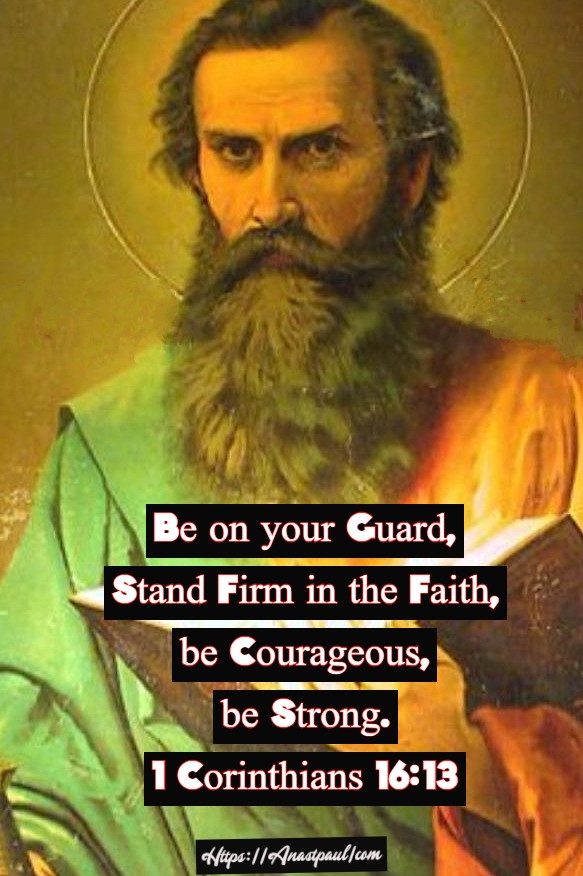
“Be on your guard,
stand firm in the faith,
be courageous,
be strong.

1 Corinthians 16:13

Posted in Holy Name PRAYERS, JANUARY month of THE MOST HOLY NAME of JESUS, The HOLY NAME

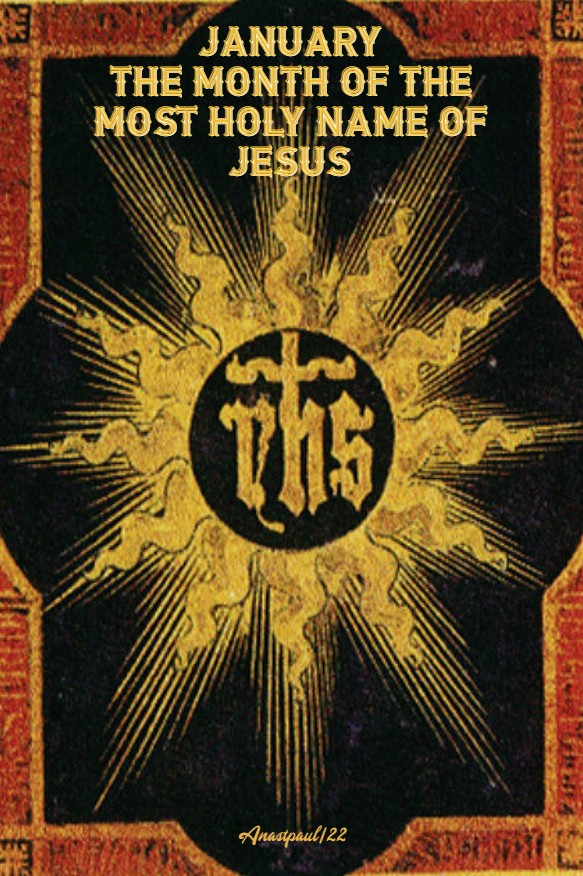
Catholic Devotion for JanuaryThe Month of THE MOST HOLY NAME of JESUS

Catholic Devotion for January
The Month of THE MOST HOLY NAME of JESUS

Oh Most Sacred Name,
Name of peace,
Balsam of life,
which is the centre of all the sighs,
of the most fervent lovers of Jesus.
The Sign of those who truly love Jesus
is to bear Jesus imprinted in the heart
and to name often and with devotion,
the Most Holy Name of Jesus.

St Leonard of Port Maurice (1676-1751)

Very early on, Christians came to understand, that the very Name of Jesus had great power, and the recitation of His Name, was itself, a prayer. This short prayer is a combination of that early Christian practice and the prayer offered by the publican in the parable of the pharisee and the publican (Luke 18:9-14).

It is perhaps the most popular prayer among Eastern Christians, both Orthodox and Catholic.

The Word of God:
Jesus also told this parable to some who trusted in themselves that they were righteous and regarded others with contempt: “Two men went up to the temple to pray, one a Pharisee and the other a tax collector. The Pharisee, standing by himself, was praying thus, ‘God, I thank you that I am not like other people: thieves, rogues, adulterers, or even like this tax collector. I fast twice a week; I give a tenth of all my income.’ But the tax collector, standing far off, would not even look up to heaven, but was beating his breast and saying, ‘God, be merciful to me, a sinner!’ I tell you, this man went down to his home justified rather than the other; for all who exalt themselves will be humbled, but all who humble themselves will be exalted.” – Luke 18:9-14

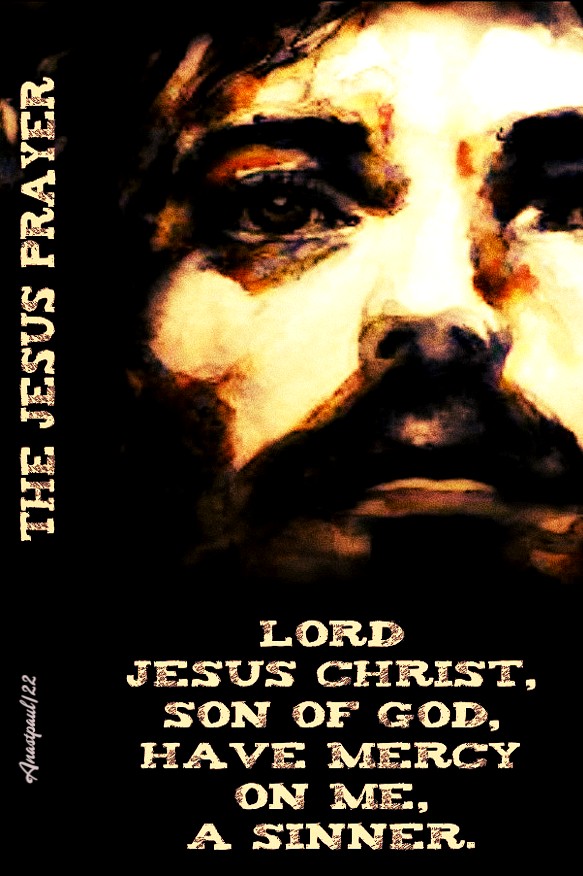
And so we say the Jesus Prayer:

Lord Jesus Christ, Son of God,
have mercy on me, a sinner.

The Second Council of Lyons in 1274 decreed that “at the name of Jesus every knee should bow; whenever that glorious name is recalled, especially during the Sacred Mysteries of the Mass, everyone should bow the knees of his heart, which he can do even by a bow of his head.

It may very well be that the custom of bowing the head at the name of Jesus has passed out of general use, as have other laudable customs, in recent times but, that does not prevent us personally, from continuing to live it and passing on to our children this ancient custom.

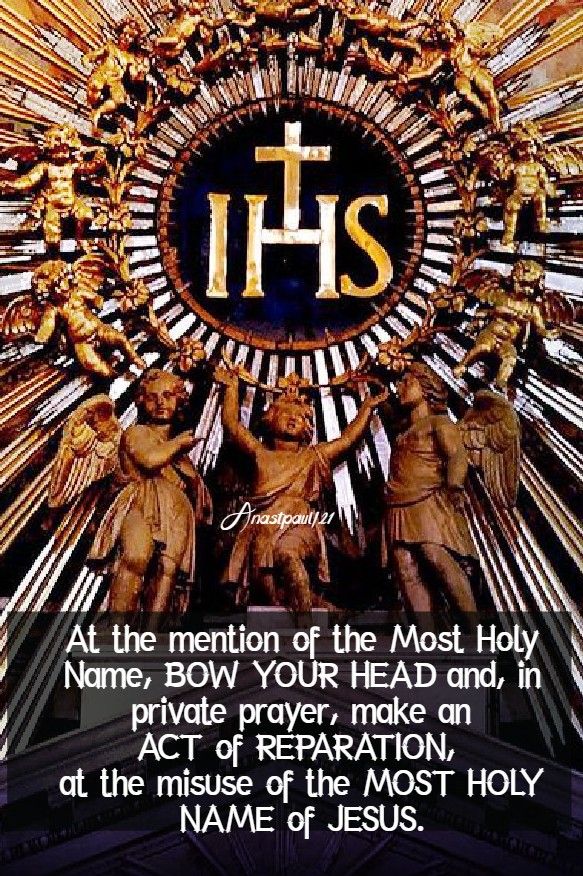
At the mention of the Most Holy Name, BOW YOUR HEAD and in private prayer, make an ACT of REPARATION, at the misuse of the MOST HOLY NAME of JESUS.

Posted in GOD ALONE!, MEDITATIONS - ANTONIO CARD BACCI, QUOTES for the NEW YEAR, QUOTES on PRAYER

Thought for the Day – 1 January – The New Year

Thought for the Day – 1 January – Meditations with Antonio Cardinal Bacci (1881-1971)

The New Year

“During these days, it is customary to exchange, verbally or in writing, good wishes for the New Year.
But these poor greetings are often nothing more than conventional phrases.
Men lack the power to transmute such good wishes into reality.
God alone is the source of every material and spiritual good, therefore, He alone can ensure that these benevolent expressions are translated into deeds of Christian renovation.
Since we are at the beginning of a new year, it is especially important for us to ask God more fervently and insistently, to bless the resolutions which are making for ourselves and the good wishes, which we are showering on our friends.

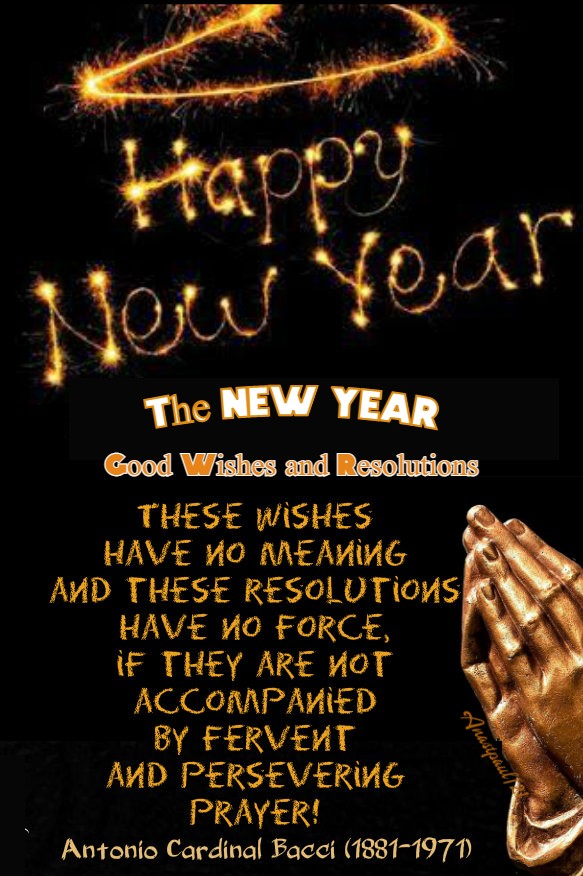
These wishes have no meaning and these resolutions have no force, if they are not accompanied by fervent and persevering prayer!”

Antonio Cardinal Bacci

PART ONE HERE:
https://anastpaul.com/2020/01/01/meditations-with-antonio-cardinal-bacci-1-january-the-new-year/

Posted in DOCTORS of the Church, FATHERS of the Church, Holy Name PRAYERS, JANUARY month of THE MOST HOLY NAME of JESUS, PRAYERS of the SAINTS, QUOTES on BLASPHEMY, The HOLY NAME

Quote/s of the Day – 1 January – The Most Holy Name of Jesus

Quote/s of the Day – 1 January – “Month of the Most Holy Name of Jesus” – The Octave Day of the Nativity of Jesus and the Feast of the Circumcision of the Lord,

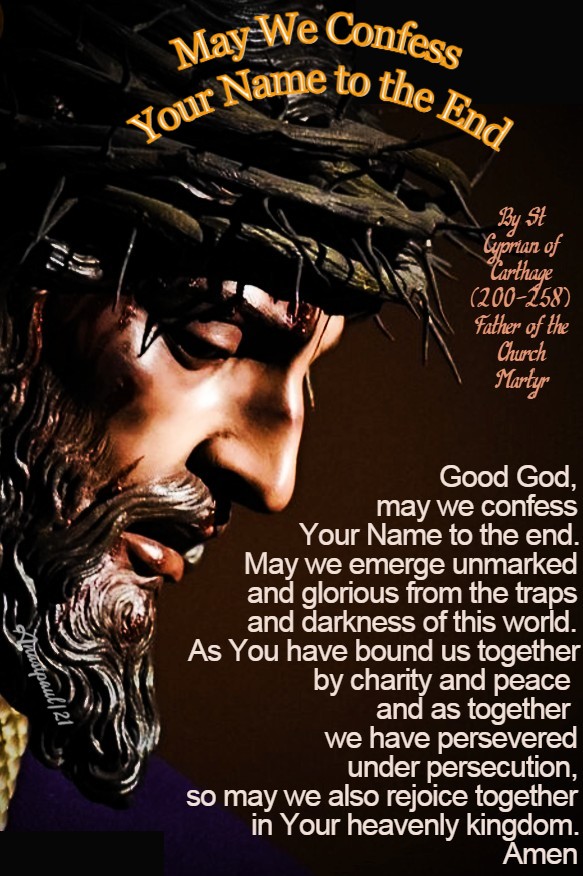
May We Confess Your Name to the End
By St Cyprian of Carthage (200-258)
Bishop and Martyr

Father of the Church

Good God,
may we confess Your Name to the end.
May we emerge unmarked
and glorious from the traps
and darkness of this world.
As You have bound us together
by charity and peace
and as together
we have persevered under persecution,
so may we also rejoice together
in Your heavenly kingdom.
Amen

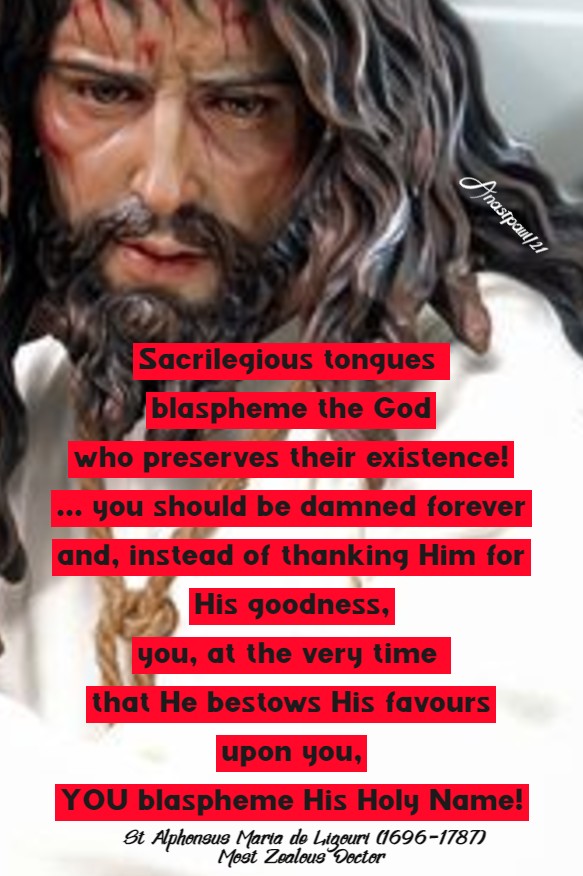
“Sacrilegious tongues blaspheme the God
who preserves their existence!
… you should be damned forever
and, instead of thanking Him for His goodness,
you, at the very time
that He bestows His favours upon you,
YOU blaspheme His Holy Name!

St Alphonsus Maria de Liguori (1696-1787)
Most Zealous Doctor

Posted in FEASTS and SOLEMNITIES, JANUARY month of THE MOST HOLY NAME of JESUS, ONE Minute REFLECTION, QUOTES for the NEW YEAR, The HOLY NAME, The LORD'S PRAYER, The WORD

One Minute Reflection – 1 January – ‘Hallowed be Thy Name’ – New Year Resolution?

One Minute Reflection – 1 January – “Month of the Most Holy Name of Jesus” – – The Octave Day of the Nativity of Jesus and the Feast of the Circumcision of the Lord, Readings: Titus 2:11-15; Luke 2:21.

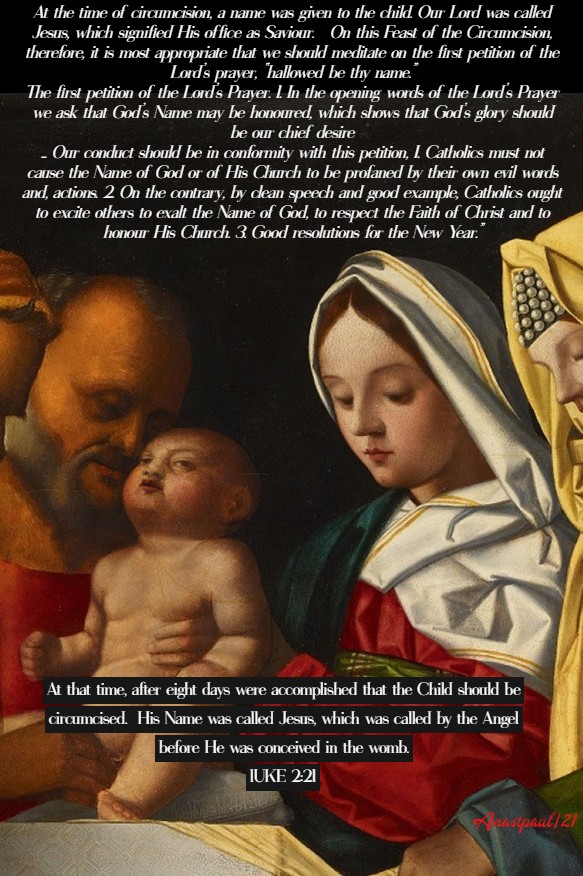
At that time, after eight days were accomplished that the Child should be circumcised. His Name was called Jesus, which was called by the Angel before He was conceived in the womb.” – Luke 2:21

REFLECTION – “In the Old Law (Gen 22;12), it was required that every male child should, on the eighth day after his birth, be circumcised and thus admitted among God’s chosen people. The rite of circumcision in the Old Law, corresponded to the Sacrament of Baptism in the New Law and was the means of remitting original sin. Our Lord, although free from every sin, submitted to this rit,e in order to show, that He was a true Son of Abraham, to manifest respect and obedience to the established law and to prove that He had a real human body. At the time of circumcision, a name was given to the child. Our Lord was called Jesus, which signified His office as Saviour. On this Feast of the Circumcision, therefore, it is most appropriate that we should meditate on the first petition of the Lord’s prayer, “hallowed be thy name.”
I. The first petition of the Lord’s Prayer. 1. In the opening words of the Lord’s Prayer we ask that God’s Name may be honoured, which shows that God’s glory should be our chief desire. 2. This petition does not mean, that God’s essential glory or perfection should be increased, nor that the honour given Him on earth, should be equal to that shown Him in heaven.
II. The objects of this petition. We ask: 1. That we may praise God with our hearts and lips; 2. That those in error may be brought to recognise and revere His Church; 3. That sinners may be converted to His service; 4. That men may learn to refer all blessings to Him as to their Author and Source.
CONCLUSION. Our conduct should be in conformity with this petition, I. Catholics must not cause the Name of God or of His Church to be profaned by their own evil words and, actions. 2. On the contrary, by clean speech and good example, Catholics ought to excite others to exalt the Name of God, to respect the Faith of Christ and to honour His Church. 3. Good resolutions for the New Year.” Excerrpt Catechism of the Council of Trent, (Part IV – Hallowed be Thy Name).

PRAYER – Almighty God and Father of our Lord Jeus Christ, may Your Name be hallowed on earth as it is in Heaven. May we bow our heads and revere and honour the Holy Name and teach others to do the same. We offer our hearts and penances in reparation to You for the blasphemies suffered each moment of each day and we resolve to do all in our power to amend this evil. We make our prayer, through Your Son, Jesus our Saviour in union with the Holy Spirit, God now and for all eternity, amen.

Posted in Holy Name PRAYERS, JANUARY month of THE MOST HOLY NAME of JESUS, JULY - The MOST PRECIOUS BLOOD, Our MORNING Offering, PRECIOUS BLOOD PRAYERS, QUOTES on the CROSS of CHRIST, The HEART, The HOLY CROSS, The HOLY NAME, The PASSION

Our Morning Offering – 1 January – To Christ Crucified

Our Morning Offering – 1 January – “Month of the Most Holy Name of Jesus” – Feast of the Circumcision of the Lord

His name was called Jesus, which was called by the angel, before He was conceived in the womb” — Luke 2:21

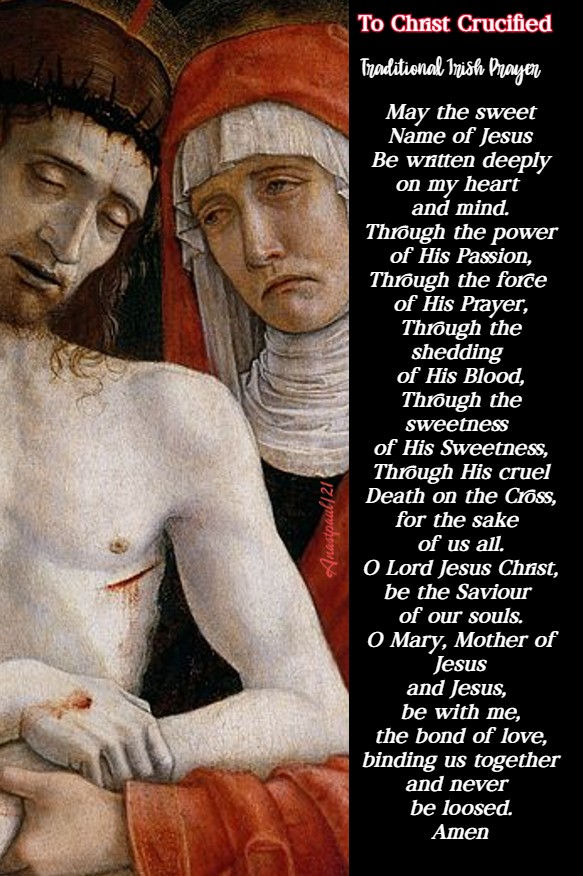
To Christ Crucified
Traditional Irish Prayer
Trans. Brendan Devlin

May the sweet Name of Jesus
Be written deeply
on my heart and mind.
Through the power of His Passion,
Through the force of His Prayer,
Through the shedding of His Blood,
Through the sweetness of His Sweetness,
Through His cruel Death on the Cross,
for the sake of us all.
O Lord Jesus Christ,
be the Saviour of our souls.
O Mary, Mother of Jesus
and Jesus, be with me,
the bond of love,
binding us together
and never be loosed.
Amen

Posted in SAINT of the DAY

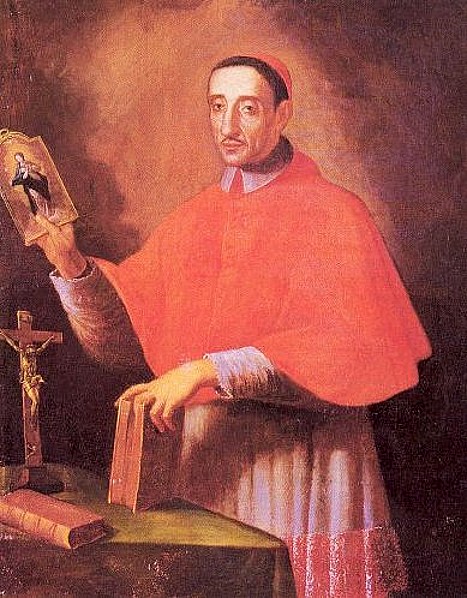
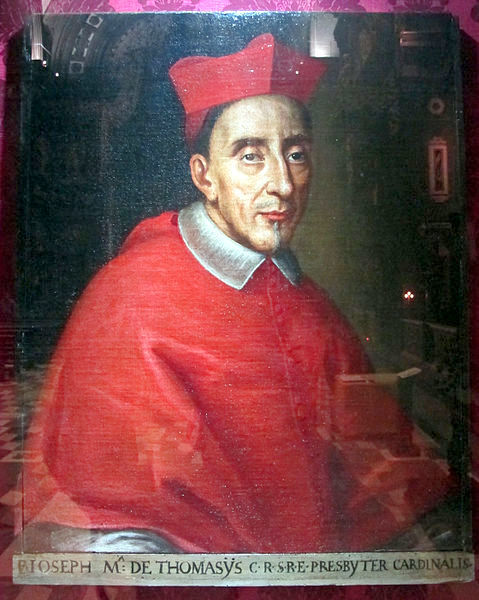
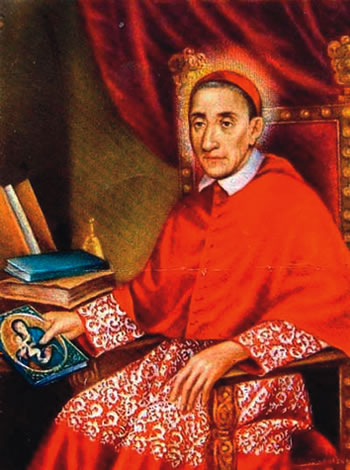
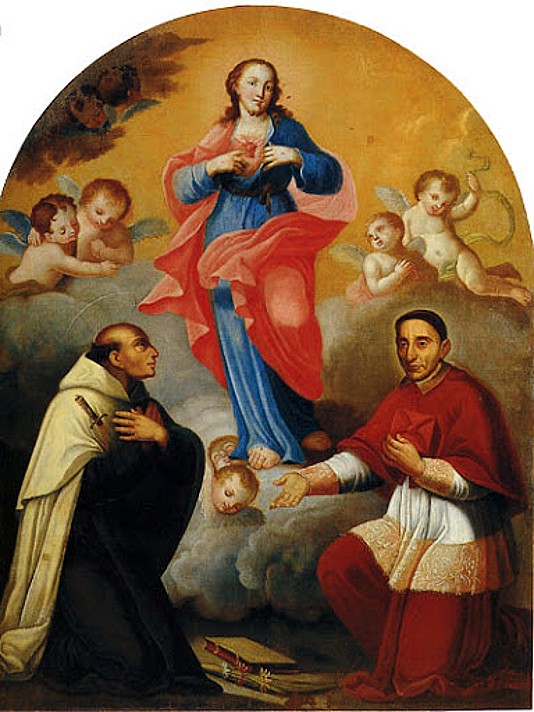
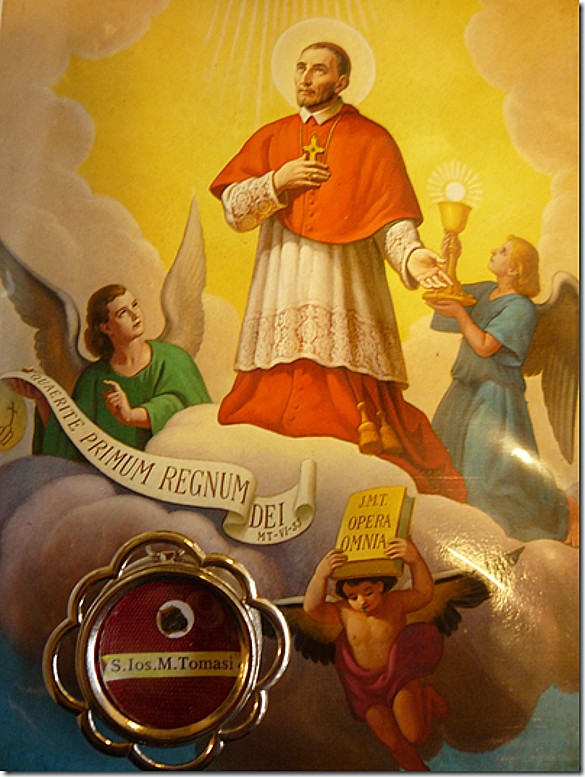
Saint of the Day – 1 January – Saint Joseph Mary Tomasi CR (1649-1713)

Saint of the Day – 1 January – Saint Joseph Mary Tomasi CR (1649-1713) Cardinal, of the Order of Clerics Regular Theatine, renowned Liturgical Scholar, Writer, Polyglot. Known as “a Second St Charles Borromeo,“ the Prince of the Roman Liturgists” and of “Liturgists” and of “Liturgical Doctor.” Born on 12 September 1649 at Licata, archdiocese of Agrigento, Sicily, Italy, as Giuseppe Maria Tomasi and died on 1 January 1713 at home next to the Church of San Lorenzo in Panisperna, Rome, Italy of natural causes. Patronage – Liturgy. Also known as – Giuseppe Maria Tomasi di Lampedusa, Giuseppe Maria Tomasi, Giuseppe Maria Tommasi, Josef Maria Tomasi, Joseph Marie Carus, Joseph Mary Tommasi. Additional Memorial – 3 January (Theatines).

The very eminent Servant of God Joseph Mary Tomasi, Cardinal, whom Pope Pius VII decorated with the honours of the Blessed in 1803 and whom today the Supreme Pontiff John Paul II ascribes solemnly in the book of the Saints, was born at Licata, in Sicily, the Diocese of Agrigento, on 12 September 1649, the first son of Julius Tomasi and Rosalie Traina, the Prince of Lampedusa and the Duke of Palma di Montechiaro.

His own life was oriented toward God from his first years. Formed and educated in the noble paternal home, where they did not lack riches nor virtue, he gave proofs of a spirit, very open to study and to piety. His parents cared greatly for this and for his own Christian formation and his instruction in the classical and modern languages, above all, in the Spanish language because, he was destined by the family, for the Court of Madrid, as he was bound to inherit from his own father, for his own noble titles, that of “Grande of Spain“.

But his own spirit aspired, even from youth, to be small in the Kingdom of God and to serve not the kings of the earth but the King of Heaven. He cultivated his pious desire in his heart, until he obtained the consent of his father, to follow his vocation to the religious life.

After having renounced, by means of a notarial document, the Principate, which belonged to him through heredity and his very rich patrimony, he was admitted into the Order of the Clerics Regular Theatine, founded by St Cajetan of Thien in 1524. He made his religious profession in the Theatine house of St Joseph, at Palermo, on 25 March 1666.

In the new state of life, which he had embraced to follow the call of Christ, he was able to dedicate himself to piety and study. The Sacred Liturgy had been his attraction from childhood; even as a child he wanted to wear, everyday, the clothes of the Liturgical colour of the day. Gregorian chant had blossomed soon on his lips, which exulted with joy singing the Liturgical psalms. The sacred languages of Latin and Greek, as if by an innate disposition, he knew well and appreciated from his adolescence.

He completed his studies of philosophy in Messina, Ferrara, Bologna and Modena, forced to the transfers for reasons of health. He studied Theology instead at Rome, in the House of St Andrea della Valle.

In Rome, after having received the subdiaconate and the diaconate, on the Saturday of Advent, on 23 December 1673, he was Ordained a Priest in the Lateran Basilica, at the hands of Msgr Joachim De Angelis, Archbishop of Urbino, Vice-Regent of the Cardinal Vicar Gaspar Carpegna. Two days later, on the night of the Nativity, he celebrated his first Mass, in the Church of St Silvestro al Quirinale, at that time, the residence of the General House of the Theatine Fathers.
The Priestly Anointing seems to have incardinated Father Tomasi to Rome and to give him Roman citizenship. Here, from his Priestly Ordination and in the same house of St Silvestro al Quirnale, for almost forty years, he dedicated himself, with intense productivity, to piety and to assiduous studies. To his knowledge of Latin and Greek, acquired from adolescence, he added that of Hebrew, Syriac, Chaldean and Arabic.

Urged by his particular love for the ancient documents of the Church and for the sound ecclesiastical traditions, he considered that a good part of his own religious perfection, lay in dedicating himself, with the spirit of faith, to the publication of rare Liturgical books and of the ancient texts of the Sacred Liturgy and so bringing to light, many ancient Sacred writings which until then had been hidden in the libraries.

In fact, thanks to his wide knowledge of sacred matters, he edited many volumes dealing with Scriptural Patristic and principally Liturgical subjects. With these last, it is sufficient to mention: Codices Sacramentorum nongentis annis vetustiores (edited in 1680); the critical edition of the Salterio in its double Roman and Gallican version; the Antifonari and Responsoriali of the Roman Church prepared by St Gregory the Great (edited in 1686); the critical edition of the Sacra Biblia according to the codes from the fifth century to the eleventh century (published in 1688).

On account of his vast scholarship and his excellent and well-known virtues, Father Joseph Mary Tomasi was subject to such fame and esteem that everyone sought and felt honoured by his acquaintance and knowledge and his friendship. The Queen of Sweden, Christina Alexandra, wanted him among the members whom she honoured among her own circle of scholars; the Roman Academy of Arcadia counted him among its own more illustrious members; the learned Rabbi of the Synagogue of Rome, Moses Cave, who was converted to Catholicism while he taught Father Tomasi Hebrew, considered him his friend and father in the faith.

But the greater the praises which the persons of that time attributed to him, the more he tried to remain hidden, even to the point of publishing because of his humility, some of his own works under a pseudonym.

Besides being in relationship with important persons and scholars of his own intellectual breadth, he dedicated himself, no less, to the formation of the simple faithful. For these he composed: Vera norma di glorificare Iddio e di far Orazione secondo la dottrina delle divine Scritture e dei Santi Padri and also a Breve istruzione del modo di assistere fruttuosamente al Santo sacrificio della Messa, as well as a condensed version of the Psalms selected and prepared for facilitating the prayer of the Christian.

Named General Consultor of his Order by his confreres, out of humility he quickly renounced the appointment, alleging the many other occupations for the appointments which he had already in the Roman Curia, among which were those of Consultor of the Sacred Congregations of Rites and of Indulgences, as well as that of Qualificator of the Holy Office.

His many publications on liturgical subjects, in which piety was united with scholarship, motivated the titles which some of his contemporaries gave to him, those of “the Prince of the Roman Liturgists” and of “Liturgists” and of “Liturgical Doctor“.

In truth, not a few of the norms, established by the authority of the Roman Pontiffs … and today praiseworthily in use in the Church, were already proposed and ardently desired by Father Tomasi, among which it is sufficient to recall:
the present-day form of the Liturgy of the Hours for the prayer of the Divine Office;
the distinction and use of the Missal and of the Lectionary in the celebration of the Eucharist;
various norms contained in the Pontifical and in the Roman Ritual;
the use of the vernacular language, which he himself recommended only for private devotions and in the prayers made in common by the faithful; all intended to promote a more intimate and personal participation of the People of God at the celebration of the Sacred Liturgy.

All his labours and solicitudes, in research and in his studies, were not able, in the slightest amount, to distract Father Tomasi from aiming, constantly and with all his strength, at the attainment of that evangelical perfection to which God had called him from his infancy.

To all, he was an example of profound humility, of the spirit of mortification and of sacrifice, of faithful observance, of meekness, poverty, piety and filial devotion to the Blessed Virgin Mary. He helped the poor; he gave relief to the sick, both at home and in the hospital of St John Lateran. In this way, wisdom and charity were united and harmonised in him.

Pope Clement XI, who knew him personally and admired his eminent virtues and the widespread fame of his doctrine, named him Cardinal, with the title of Sts Silvestro e Martino ai Monti, in the Consistory of 18 May 1712. He accepted the Cardinalate only through the expressed mandate of the Pope. Placed in this sublime grade, as a lamp on a lampstand, he illuminated the Roman Church to such a point, with the splendour of his virtues, that many venerated him as another St Charles Borromeo, whom he himself had proposed to imitate.

He joined to the cardinalatial dignity all those virtues which distinguished him as a Theatine religious; he changed none of his previous rule of life. For his court and for the service of his home, he chose, for motives of humility, the poor, the weak, the lame and persons with various physical handicaps.
In his titular church of Sts Silvestro e Martino ai Monti he not only participated, with
the clergy of his family, in the Liturgical celebrations of the Carmelite Fathers but also dedicated himself to teaching the Catechism of Christian doctrine to children and to the other faithful.

But such a light of good example and of virtues shone for a short time. Not having completed eight months as a Cardinal, he was struck by a violent pneumonia after he took part, as a member of the Papal Chapel, at the Vigil of the Nativity in the Vatican Basilica. He died a saintly death on 1 January 1713, aged 64 years, in his apartment at the Passarini Palace on the Via Panisperna.

The first panegyric for Cardinal Tomasi was pronounced by the same Pope Clement XI, in the Consistory celebrated one month after his passing. “We cannot disguise“, the Pope said, “the intimate sorrow which the death of eminent and most pious Cardinal Tomasi has provided Us.He was an authentic model of the most holy and ancient discipline and We already expect much from his virtues and his doctrine”.

The fame of his sanctity, which during life, accompanied Cardinal Tomasi became even greater, immediately after his death. Because of this, only five months from his pious entry into eternity, on the desire of Pope Clement XI, the canonical Ordinary Informative Process for his Beatification began. After having overcome vicissitudes and difficulties of various kinds, after two miracles attributed to the intercession of the Venerable Cardinal Tomasi were approved, Pope Pius VII proclaimed him Blessed on 29 September 1803.

A new miracle, attributed to the intercession of Blessed Joseph M. Tomasi, was approved, with the Decree of 6 July 1985, by the Holy Father John Paul 11, for his Canonisation.

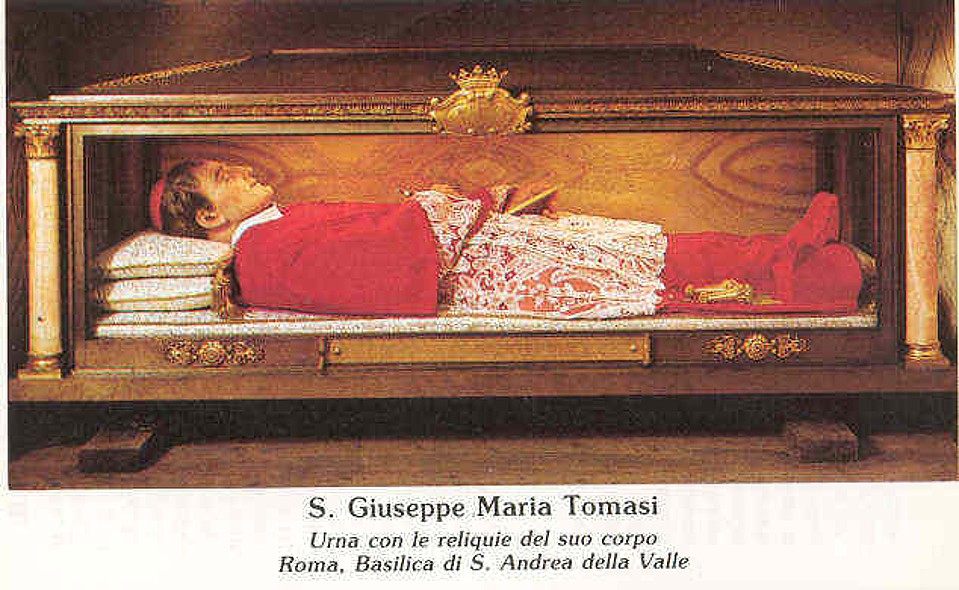
The relics of his body, transferred in 1971 from the Basilica of his title of Sts Silvestro e Martini ai Monti, are presently exposed for the veneration of the faithful in the Basilica of St Andrea della Valle of the Theatine Fathers, in Rome. His feast is celebrated on 3 January by his Order.

Posted in FEASTS and SOLEMNITIES, JESUIT SJ, MARIAN TITLES, MOTHER of GOD, SAINT of the DAY, The NATIVITY of JESUS

The Octave Day of the Nativity of the Lord, The Circumcision of the Lord, Mary, Mother of God and Memorials of the Saints – 1 January

The Circumcision of the Lord (Feast) (Holy Day)

The Octave Day of the Nativity of the Lord

Mary, Mother of God, the Divine Motherhood:

The Feast was celebrated in the East before it was in the West but by the 5th Century it was celebrated in France and Spain on the Sunday before Christmas. In Rome, even before the 7th Century, 1 January was used as a celebration of the Maternity of the Blessed Virgin Mary. In the 13th and 14th Centuries, the Feast of the Circumcision of Christ had come to replace the Marian Feast on 1 January. The celebration of the Feast of the Circumcision on 1 January was expanded to the entire Catholic Church in 1570 when Pope Pius V promulgated the Missal.
In 1914, the Feast of the “Maternity of the Blessed Virgin Mary” was established in Portugal, occurring on 11 October. In 1931, this Feast was extended to the entire Catholic Church by Pope Pius XI and maintained on 11 October. Following the Second Vatican Council in 1974, Pope Paul VI removed the Feast of the Circumcision of Christ from the Liturgical Calendar and replaced it with the Feast of the “Solemnity of Mary, Mother of God.” In the Extraordinary form of the Roman Rite, Catholics continue to celebrate this Feast day with the old name “The Maternity of the Blessed Virgin Mary” on 11 October, and 1 January is the Octave Day of the Nativity of the Lord and the Feast of the Circumcision.
The feast is a celebration of Mary’s motherhood of Jesus. The title “Mother of God” is a western derivation from the Greek: Theotokos, the God-bearer. The term was adopted at the First Council of Ephesus as a way to assert the Divinity of Christ, from which it follows, that what is predicated of Christ is predicated of God. So, if Mary is the Mother of Jesus, she is the Mother of God. Therefore, the title “Mother of God” which celebrates her under this title, are at once both Mariological and Christological.

Titular Feast of the Society of Jesus – But now celebrated on 3 January, the Feast of the Holy Name of Jesus

Bl Adalbero of Liege
St Baglan of Wales
St Basil of Aix
Bl Bonannus of Roio
St Brogan
St Buonfiglio Monaldi
Bl Catherine de Solaguti
St Clarus of Vallis Regia
St Clarus of Vienne
St Colman mac Rónán
St Colman Muillin of Derrykeighan
St Concordius of Arles
St Connat
St Cuan
St Demet of Plozévet
St Elvan
St Eugendus of Condat
St Euphrosyne of Alexandria
St Fanchea of Rossory
St Felix of Bourges
St Frodobert of Troyes

St Fulgentius of Ruspe (c 462 – 533) “The Pocket Augustine,” Abbot, Bishop of the City of Ruspe, North Africa in modern day Tniisia, Theologian, Writer.
About St Fulgentius!

https://anastpaul.com/2020/01/01/saint-of-the-day-1-january-saint-fulgentius-of-ruspe-c-462-533-the-pocket-augustine/

St Gisela of Rosstreppe
St Gregory Nazianzen the Elder
Bl Hugolinus of Gualdo Cattaneo
Bl Jean-Baptiste Lego
Bl Jean of Saint-Just-en-Chaussée
St Joseph Mary Tomasi CR (1649-1713) Cardinal, of the Order of Clerics Regular Theatine
St Justin of Chieti
Bl Lojze Grozde
St Maelrhys
St Magnus the Martyr
Bl Marian Konopinski
St Mydwyn

St Odilo of Cluny OSB (962-1049) “Archangel of the Monks,” Priest, Monk, 5th Abbot of Clun, Reformer, Apostle of the poor and needy, Marian devotee and promoter of prayer for the Souls in Purgatory. He established All Souls’ Day (on 2 November) in Cluny and its Monasteries as the annual commemoration to pray for all the faithful departed. The practice was soon adopted throughout the whole Church.
St Odilo’s Life:

https://anastpaul.com/2021/01/01/saint-of-the-day-1-january-saint-odilo-of-cluny-osb-962-1049-the-archangel-of-the-monks/

St Odilo of Stavelot
St Peter of Atroa
St Peter of Temissis
Bl René Lego
St Sciath of Ardskeagh
St Severino Gallo
St Telemachus
St Thaumastus of Mainz
St Theodotus
St Tyfrydog
Bl Valentin Paquay
St Vincent Strambi
St William of Dijon
St Zedislava Berka
St Zygmunt Gorazdowski

Breton Missionaries to Britain
Martyred Soldiers of Rome: Thirty soldiers martyred in Rome as a group during the persecutions of Diocletian. We don’t even known their names. They were martyred c 304 at Rome, Italy.

Martyrs of Africa – 8 saints: Eight Christians martyred together in Africa, date unknown. The only details we have are four of their names – Argyrus, Felix, Narcissus and Victor.

Martyred in the Spanish Civil War:
• Blessed Andrés Gómez Sáez

Posted in MEDITATIONS - ANTONIO CARD BACCI, QUOTES for the NEW YEAR, QUOTES on DEATH, QUOTES on GRATITUDE, QUOTES on Lukewarmness, QUOTES on MEDIOCRITY, QUOTES on SACRIFICE, QUOTES on SANCTITY, QUOTES on SELF-DENIAL, QUOTES on SIN, QUOTES on the DEVIL/EVIL, QUOTES on TIME

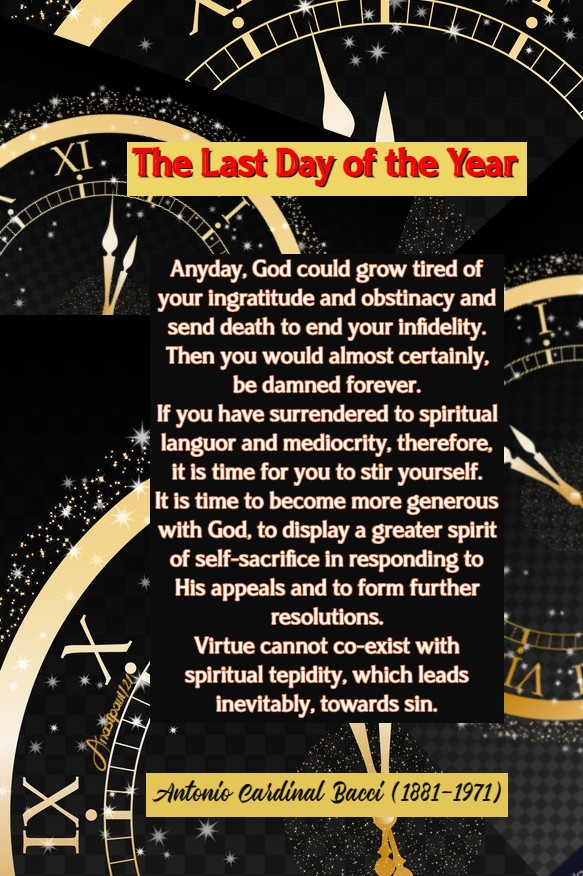
Thought for the Day – 31 December – The Last Day of the Year

Thought for the Day – 31 December – Meditations with Antonio Cardinal Bacci (1881-1971)

The Last Day of the Year

“Now that the year is almost over, cast your mind back to the good resolutions which you made at the beginning of it.
Have you put these resolutions into effect?
Has there been any improvement in your spiritual life during these twelve months, or must you confess, that it has deteriorated?
How often have you committed sin, perhaps even grave sin, during the year?
When God appealed to you to perform some good action, how often did you refuse Him?

Your future outlook is very dark if your life has developed into a gradual descent towards evil.
Anyday, God could grow tired of your ingratitude and obstinacy and send death to end your infidelity.
Then you would almost certainly, be damned forever.
If you have surrendered to spiritual languor and mediocrity, therefore, it is time for you to stir yourself.
It is time to become more generous with God, to display a greater spirit of self-sacrifice in responding to His appeals and to form further resolutions.

Virtue cannot co-exist with spiritual tepidity, which leads inevitably, towards sin.

Antonio Cardinal Bacci

PART ONE HERE:
https://anastpaul.com/2020/12/31/thought-for-the-day-31-december-the-last-day-of-the-year/

Posted in CHRIST the KING, CHRIST the LIGHT, CHRIST the WORD and WISDOM, CHRIST, the WAY,TRUTH,LIFE, CHRISTMASTIDE!, QUOTES for CHRIST, The WORD

Quote/s of the Day – 31 December – ‘In the beginning …’

Quote/s of the Day – 31 December – The Seventh Day in the Octave of Christmas, Readings: 1 John 2:18-21, Psalms 96:1-2, 11-12, 13, John 1:1-18

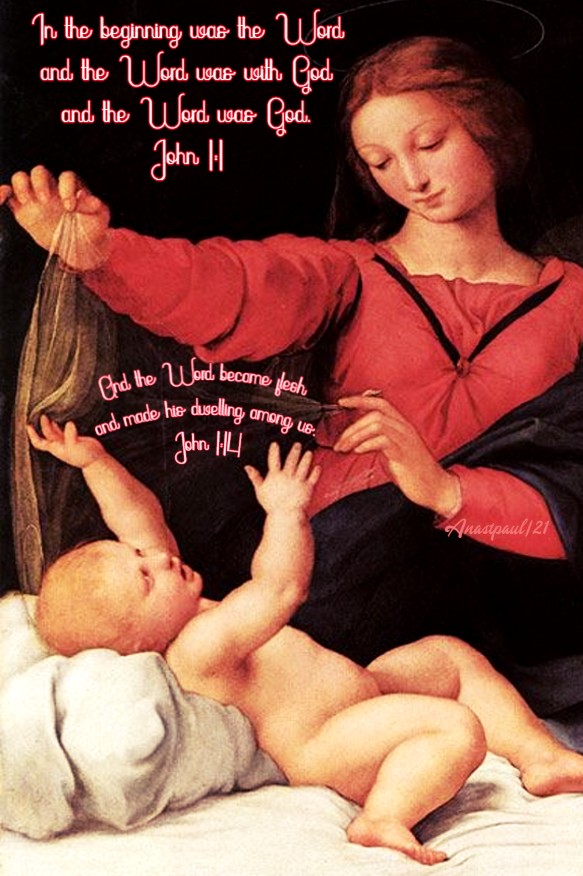
In the beginning was the Word
and the Word was with God
and the Word was God.

John 1:1

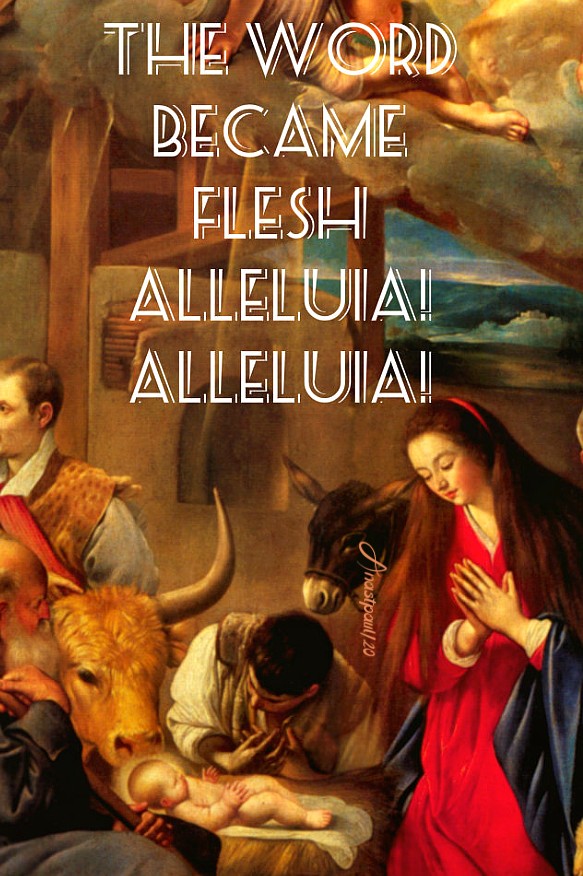
And the Word became flesh
and dwelt among us
and we have seen his glory,
glory as of the only Son of the Father,
full of grace and truth.

John 1:14

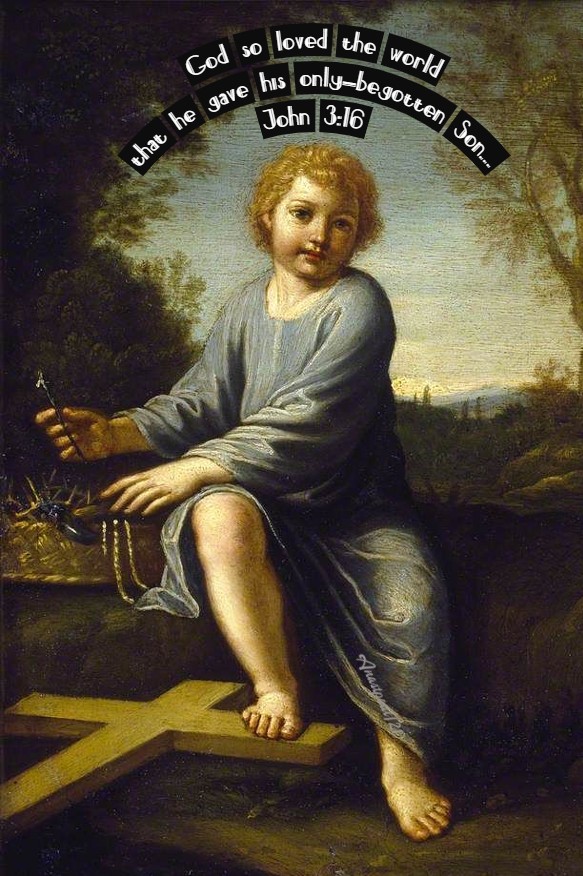
“God so loved the world
that he gave his only-begotten Son

John 3:16

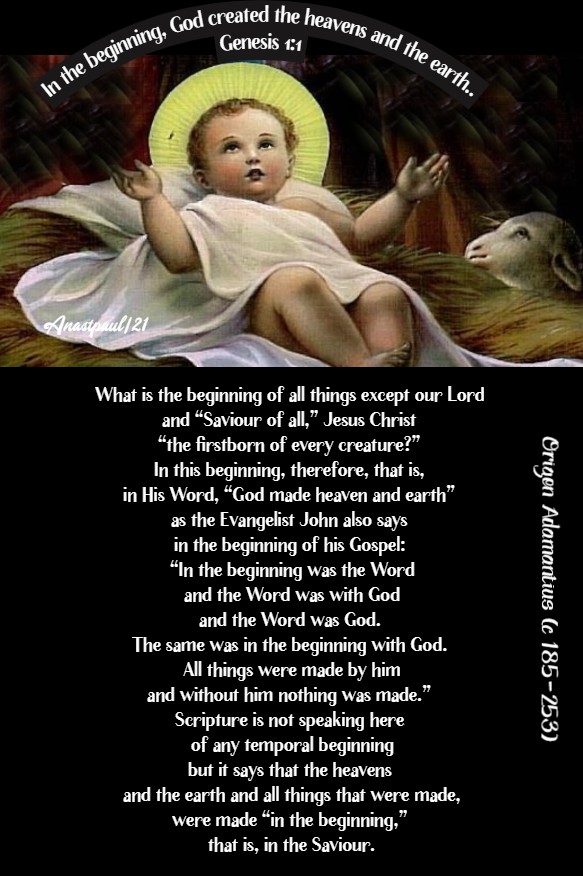
“In the beginning,
God created the heavens
and the earth…

Genesis 1:1

“What is the beginning of all things
except our Lord
and “Saviour of all,” Jesus Christ
“the firstborn of every creature?”
In this beginning, therefore, that is,
in His Word, “God made heaven and earth”
as the Evangelist John also says
in the beginning of his Gospel:
“In the beginning was the Word
and the Word was with God
and the Word was God.
The same was in the beginning with God.
All things were made by him
and without him nothing was made.”
Scripture is not speaking here
of any temporal beginning
but it says that the heavens
and the earth and all things that were made,
were made “in the beginning,”
that is, in the Saviour.

Origen Adamantius (c 185-253)
Priest, Theologian, Exegist,
Writer, Apologist, Father

(Homilies on Genesis, 1)

“Whoever believes in him …
might have eternal life

John 3:16

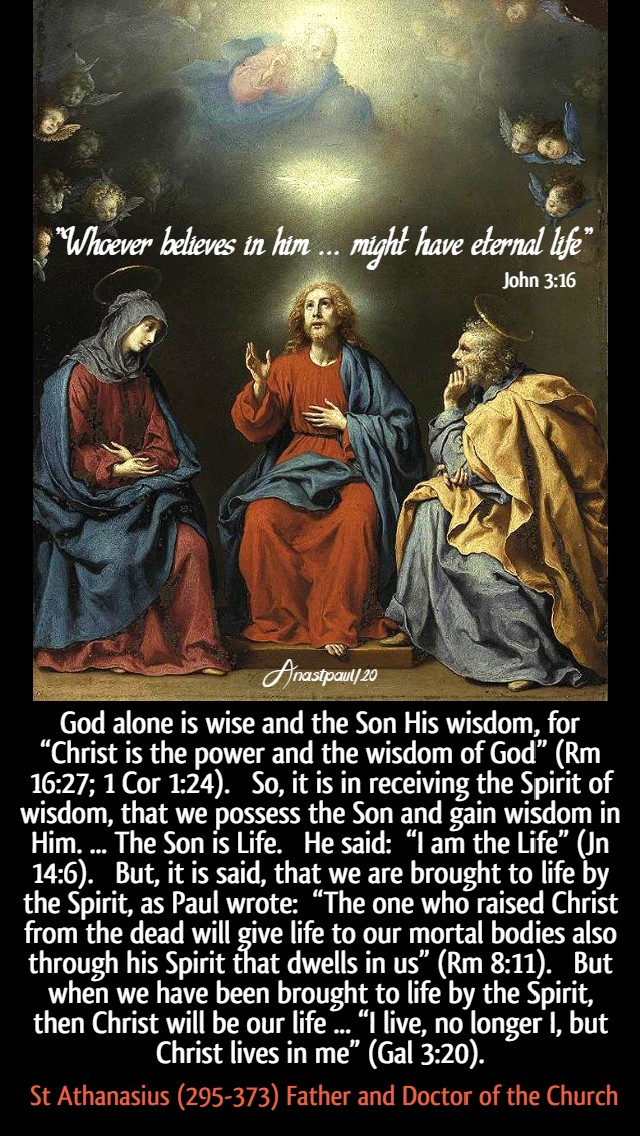
“God alone is wise and the Son His wisdom,
for “Christ is the power
and the wisdom of God” (Rm 16:27; 1 Cor 1:24).
So, it is in receiving the Spirit of wisdom,
that we possess the Son and gain wisdom in Him. …
The Son is Life.
He said: “I am the Life” (Jn 14:6).
But, it is said,
that we are brought to life by the Spirit,
as Paul wrote: “The one who raised Christ
from the dead will give life
to our mortal bodies also through his Spirit
that dwells in us” (Rm 8:11).
But when we have been brought to life by the Spirit,
then Christ will be our life …
“I live, no longer I, but Christ lives in me
” (Gal 2:20).”

St Athanasius (295-373)
Bishop of Alexandria,
Father and Doctor of the Church

( Letters to Serapion, no.1, 19).

Posted in CHRIST the HIGH PRIEST, CHRIST the JUDGE, CHRIST the KING, CHRIST the LIGHT, CHRIST the PHYSICIAN, CHRIST the WORD and WISDOM, CHRIST, the WAY,TRUTH,LIFE, FATHERS of the Church, ONE Minute REFLECTION, QUOTES for CHRIST, QUOTES on SACRED SCRIPTURE, The INCARNATION, The SEVEN LAST WORDS of CHRIST

One Minute Reflection – 31 December – ‘… He sent His own Mind into the world, as its Lord. …’

One (maybe 3 minutes today 😘) Minute Reflection – 31 December – “Month of the Immaculate Conception” – The Seventh Day in the Octave of Christmas, Readings: 1 John 2:18-21, Psalms 96:1-2, 11-12, 13, John 1:1-18

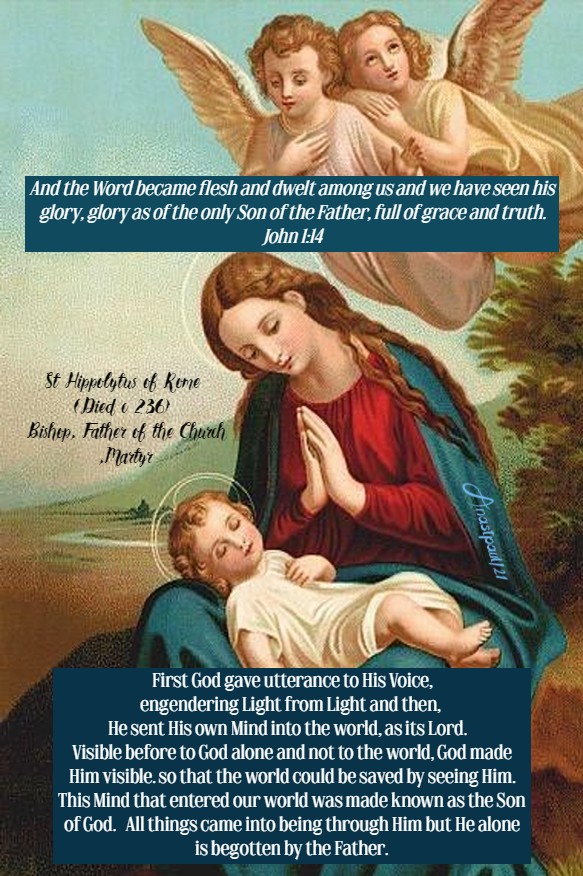
And the Word became flesh and dwelt among us and we have seen his glory, glory as of the only Son of the Father, full of grace and truth.” – John 1:14

REFLECTION – “There is only one God, brethren and we learn about Him only from Sacred Scripture. It is,therefore, our duty to become acquainted with what Scripture proclaims and to investigate its teachings thoroughly. We should believe them in the sense that the Father wills, thinking of the Son, in the way the Father wills and accepting the teaching He wills to give us, with regard to the Holy Spirit. Sacred Scripture is God’s gift to us and it should be understood in the way that He intends: we should not do violence to it by interpreting it according to our own preconceived ideas.

God was all alone and nothing existed but Himself, when He determined to create the world. He thought of it, willed it, spoke the word and so made it. It came into being instantaneously, exactly as He had willed. It is enough then for us to be aware of a single fact, nothing is co-eternal with God. Apart from God, there was simply nothing else. Yet, although He was alone, He was manifold because He lacked neither reason, wisdom, power, nor counsel. All things were in Him and He Himself, was all. At a moment of His own choosing and, in a manner determined by Himself, God manifested His Word and through Him, He made the whole universe.

When the Word was hidden within God Himself, He was invisible to the created world but God made Him visible. First God gave utterance to His Voice, engendering Light from Light and then, He sent His own Mind into the world, as its Lord. Visible before to God alone and not to the world, God made Him visible. so that the world could be saved by seeing Him. This Mind that entered our world was made known as the Son of God. All things came into being through Him but He alone is begotten by the Father.

The Son gave us the law and the prophets and He filled the prophets with the Holy Spirit, to compel them to speak out. Inspired by the Father’s power, they were to proclaim the Father’s purpose and His will.

So the Word was made manifest, as Saint John declares when, summing up all the sayings of the prophets, he announces that this is the Word through Whom the whole universe was made. He says – In the beginning was the Word and the Word was with God and the Word was God. Through Him all things came into being; not one thing was created without Him. And further on he adds: The world was made through Him, and yet the world did not know Him. He entered His own creation and His own did not receive Him.” – St Hippolytus of Rome (Died c 236) Bishop, Father of the Church and Martyr (An excerpt from his A Treatise against Noetus, Book 1).

PRAYER – All-powerful, ever-living God, we thank You for the human birth of Your Son, which is the source and perfection of our Christian life and worship. Number us among His people, for the salvation of all mankind is found in Him, for the Word became flesh who lives and reigns with You and the Holy Spirit, God, forever and ever, amen.

Posted in CATHOLIC-PRAYERS OF THE CHURCH, CREEDS, I BELIEVE!, Our MORNING Offering, PRAYERS of the CHURCH, The APOSTLES & EVANGELISTS, The FAITHFUL on PILGRIMAGE

Our Morning Offering – 31 December – The Apostles’ Creed

Our Morning Offering – 31 December – The Seventh Day of the Octave of Christmas

The Apostles’ Creed

I believe in God,
the Father Almighty,
Creator of heaven and earth
and in Jesus Christ, His only Son, our Lord,
who was conceived by the Holy Spirit,
born of the Virgin Mary,
suffered under Pontius Pilate,
was crucified, died and was buried;
He descended into hell;
on the third day He rose again from the dead;
He ascended into heaven
and is seated at the right hand
of God the Father Almighty;
from thence He shall come
to judge the living and the dead.
I believe in the Holy Spirit,
the Holy Catholic Church,
the communion of Saints,
the forgiveness of sins,
the resurrection of the body
and life everlasting.
Amen

Posted in SAINT of the DAY

Saint of the Day – 31 December – Saint Columba of Sens (c 256-273) Virgin Martyr

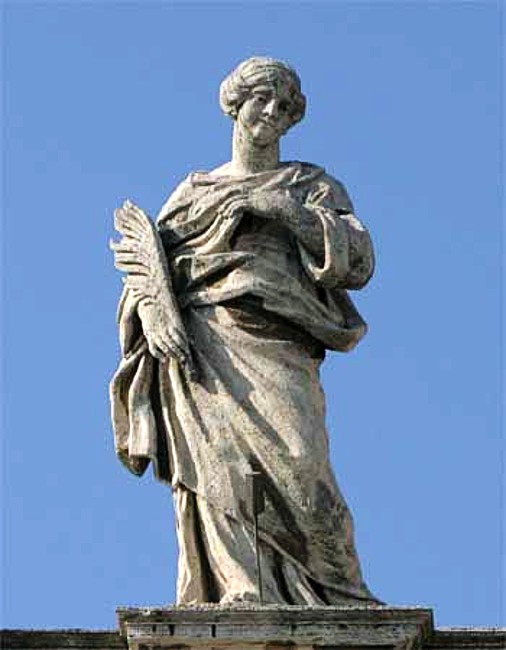
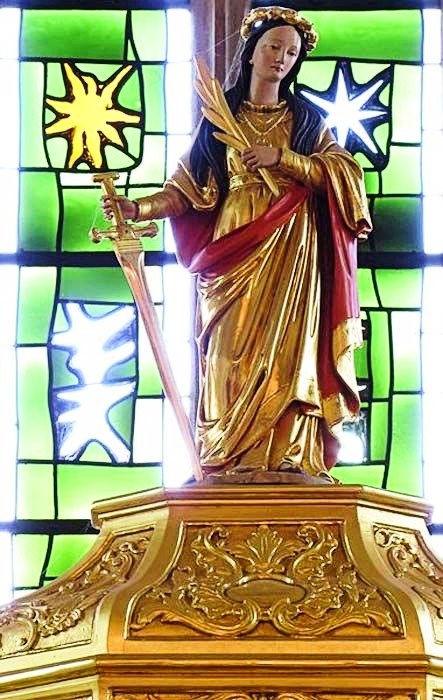
Saint of the Day – 31 December – Saint Columba of Sens (c 256-273) Virgin Martyr Born as Eporita in c257 in Spain and died by beheading in 273 at Sens, France near a fountain named d’Azon. Patronages – for rain, of bears. St Columba is a Colonnade Saint at St Peter’s – you can find her as Saint Number 40 on the North Colonnade.

St Columba on the North Colonnade

Columba was a virgin and martyr at Sens. Though little historical information is known, popular devotion made her one of the most famous and revered Martyrs in the Middle Ages.

The Roman Martyrology states: “At Sens in Lugdunense Gaul, now in France, Saint Colomba, Virgin and Martyr.”

Colomba is presented as belonging to a noble but pagan family of Spain and lived in the third century. To escape the cult of the gods, she left her family and went to Gaul (France) first to Vienne, where she received Baptism, then to Sens. It appears that her real name was Eporita and that she would later be called the Dove (the meaning of Columba) due to her innocence.

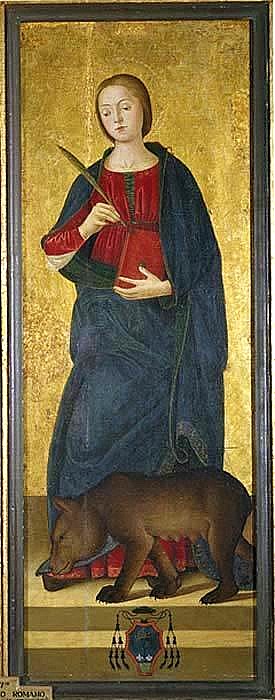
In Sens, she was arrested as a Christian in the ongoing persecution throughout the Roman Empire. The Emperor Aureliano Lucio Domizio (270-275), being present in Sens at that time, had Columba and others, brought before him,. In an attempt to make her renounce her Christian virginity, he proposed marriage to her. But then irritated by her refusal, he condemned her to be locked up in the amphitheater in a prostitution cell. When a young soldier arrived there to abuse her, a she-bear who had been kept in the amphitheater, intervened to protect her, putting the man to flight.

Since none of the soldiers, fearful of their lives, now wanted to take his place,Aureliano furiously ordered, that both the Virgin and the Bear be burned but a cloud coming from Africa, procured a providential rain, which extinguished the fire already prepared, while the bear ran away into the forests. The stubborn Emperor then sentenced Colomba to be beheaded, after one last attempt to make her change her faith.

The young woman, just sixteen years old, suffered Martyrdom not far from Sens and was buried by a Christian who, immediately invoking her intercession, recovered his sight. This happened in the second half of the third Century, in the years between 270 and 275, referring to the Emperor Aurelian, who found himself in Sens for his wars in Gaul.

Highly venerated in France at the time, in 620 King Lothair III founded the famous Royal Abbey of Sainte-Colombe-les-Sens on the Tomb of the Saint. In 623 the Bishop of Sens, St Wolf († 623) wanted to be buried at the Martyr’s feet; in 853 the Bishop Wessilone in Consecrating the new Church, found the relics of the two Saints united and had them wrapped in a precious shroud in oriental fabric. Pieces of this shroud were found in the nineteenth Century and are kept in the Treasury of the Cathedral.

The Abbey Church was built a third time and Consecrated in 1164 by Pope Alexander III, then destroyed in 1792 at the time of the French Revolution. The remains of the Abbey and Church complex were purchased in 1842 by the Nuns of the Holy Childhood of Jesus and Mary, who built their Mother House there, safeguarding the remains of the ancient crypt. The relics of St Columba had ,however ,in a803, been transferred to the Cathedral of Sens.

There are numerous Churches dedicated to the holy Martyr in France, Spain, Flanders, Germany and Italy, where her cult spread, most especially in Rimini. According to local traditions, some merchants who sailed in the Adriatic had, with them, a relic of the head of St Columba but were forced to land in Rimini, where the relic was welcomed by Bishop Stennio and placed in the Cathedral.

The Shrine of St Columba in Sens

In 1581 Msgr. Castelli, Bishop of Rimini, being Apostolic Nuncio to France, obtained, from the Monks of the Abbey of Sens, the relics of a rib and two teeth of the Martyr, which since the 18th Century, are preserved in a Reliquary bust now placed in the Malatesta TChurch the new Cathedral , which replaced the other, which was demolished in 1815 AND dedicated to the St Trinità and St Columba.
There was talk of a translation of the body of Columba to Bari in the 17th Century but without any serious foundation.

Starting from the Geronymian Martyrology, up to the Roman one, the feast of St Columba is reported to be celebrated on 31 December. The popularity of the cult in France then slowly waned and an attempt to bring it back into widespread circulation in the 14th Century failed. In Sens, however, due to a local festival, concomitant with New Year’s Eve, St Columba’s feast was postponed to 27 July and is still honoured on this day as well as further devotions and celebrations, on the anniversary of the transfer of her relics and the dedication of her Church. All of these memorials are still observed with great devotion in Sens and the neighbouring area.

Posted in MARIAN TITLES, SAINT of the DAY

The Seventh Day of the Octave of Christmas, Santa María la Real de Uxue / Our Lady of Uxue (Uxue, Spain) (8th Century) and Memorials of the Saints – 31 December

The Seventh Day of the Octave of Christmas

Santa María la Real de Uxue / Our Lady of Uxue (Uxue, Spain) (8th Century) – 31 December:

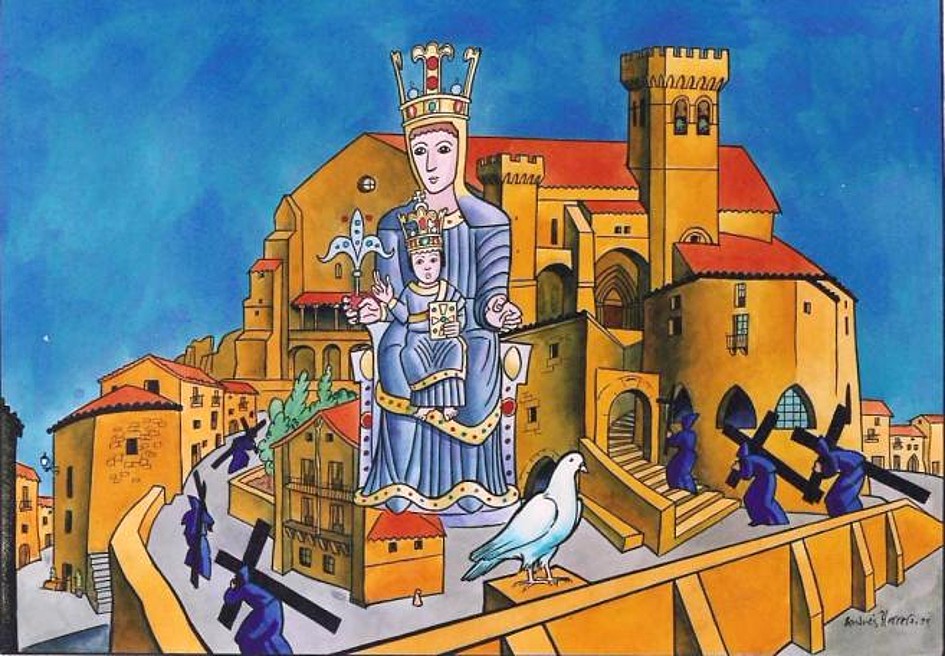
The Town of Uxue formed, according to legend, around the site of the discovery of the image of Our Lady of Uxue, whose site was designated by the flight of a dove. By the 8th century, the image was well-known.
The settlement takes the form of a fortress and the 11th Century, Church of St Mary, is a medieval jewel of Romanesque art of Navarra, which is very popular and protected by successive Monarchs.

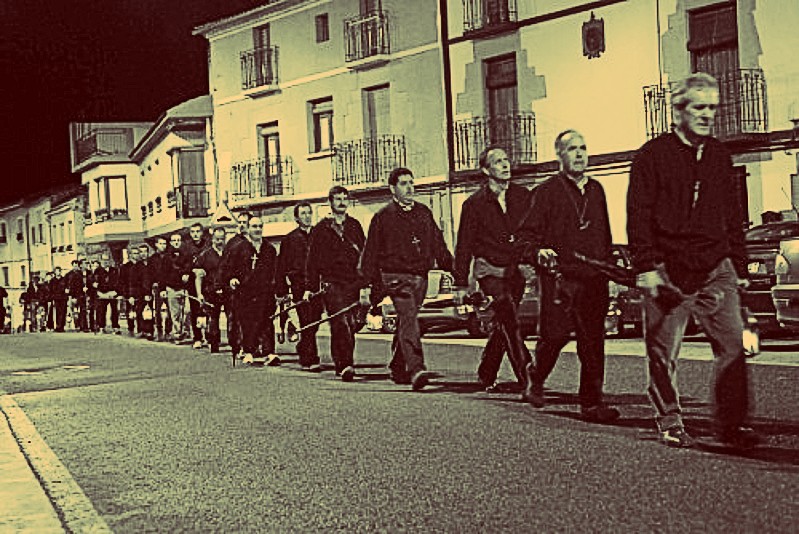
The strong medieval devotion to this image has remained to our times. Among the celebrations and devotions, are the festivities of an annual pilgrimage and the pilgrimage of the Brotherhood of the Twelve of Uxué.
Uxué is a small medieval Town full of charm, located in the eastern middle of Navarra (north of Spain and on the border with France), 53 km from Pamplona and 20 km from Tafalla. Its location is unique, as it is located on the top of a mountain overlooking the Sierra de Uxué. With an altitude of 815 meters above sea level, Uxué constitutes an authentic watchtower from which on clear days you can see from the Pyrenean ridge to the north to the banks of the Ebro and the silhouette of the Moncayo to the south. The origins of this Town are unclear, the exact date of its foundation being unknown but the beginnings are attributed to the Virgin Mary accompanied by the Holy Spirit in the form of a dove.

Legend has it that a dove went in and out of the hole in a rock. A boy who was herding sheep, moved by curiosity, approached with the intention of scare the dove away.
But the dove continued with its insistent flapping, he approaches and found a beautiful Romanesque image of the Virgin Mary. This is how the Uxué was born. The name of the town comes from Uxua, the Basque language word for “dove“.
Already before Roman domination, there was a Basque population scattered throughout the mountains, as recent archaeological discoveries attest. A Sanctuary honouring the Blessed Virgin was immediately built and has retained it’s popularity amongst the pious faithful across the ages. Many miraculous graces and cures have been granted there.
A total of 44 members of the Brotherhood of the Twelve Apostles of Our Lady of Uxué, including the Chaplain, participate each year in their traditional night march to the sanctuary of the Virgin of Uxué. This Brotherhood has its origins in 1607 and therefore 2007 commemorated the fourth centenary of its foundation.

St Pope Sylvester I (Died 335) Papal Ascension 314. Bishop of Rome, Confessor. (Optional Memorial)
Biography:

https://anastpaul.com/2018/12/31/saint-of-the-day-st-pope-sylvester-i-died-335/

Blessed Alain de Solminihac OSA (1593-1659) Bishop of Cahors, Abbot, Reformer, Marian devotee most especially to Our Lady of Rocamadour, Apostle of the Holy Eucharist especially by his promotion of Adoration, he was also a member of the Compagnie du Saint-Sacrement.
His Story:

https://anastpaul.com/2019/12/31/saint-of-the-day-31-december-blessed-alain-de-solminihac-osa-1593-1659/
St Anton Zogaj
St Barbatian of Ravenna
St Columba of Sens (c 256-273) Virgin Martyr
Bl Dominic de Cubells
St Festus of Valencia
St Gelasius of Palestine
Bl Giuseppina Nicoli
St Hermes the Exorcist

St Melania the Younger (c 383-439) Foundress, Desert Hermit, Wife, Mother, Widow.
Her Life:

https://anastpaul.com/2020/12/31/saint-of-the-day-31-december-saint-melania-the-younger-c-383-439/

St Offa of Benevento
Bl Peter of Subiaco
St Pinian
St Potentian of Sens
St Sabinian of Sens
St Theophylact of Ohrid
Bl Walembert of Cambrai
Bl Wisinto of Kremsmünster
St Zoticus of Constantinople

Martyrs of Catania – 10 saints: A group of early Christians martyred together, date unknown. The only other information to survive are ten of their names – Attalus, Cornelius, Fabian, Flos, Minervinus, Pontian, Quintian, Sextus, Simplician and Stephen. They were martyred in Catania, Sicily, Italy.

Martyrs of Rome – 10 saints: A group of Roman women martyred in an early persecution, date unknown. We known the names of ten of them – Dominanda, Donata, Hilaria, Nominanda, Paolina, Paulina, Rogata, Rustica, Saturnina and Serotina.
Their relics were enshrined in the catacombs of Via Salaria, Rome, Italy.

Martyred in the Spanish Civil War:
• Blessed Leandro Gómez Gil
• Blessed Luis Vidaurrázaga González

Posted in GOD ALONE!, MEDITATIONS - ANTONIO CARD BACCI, QUOTES on Lukewarmness, QUOTES on SIN, QUOTES on THE WORLD

Thought for the Day – 30 December – Dissipation

Thought for the Day – 30 December – Meditations with Antonio Cardinal Bacci (1881-1971)

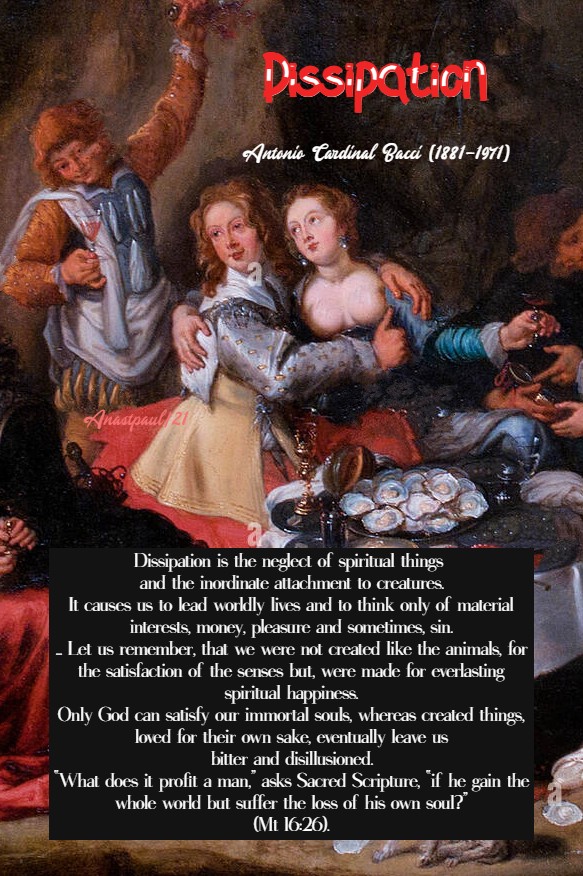
Dissipation

“Dissipation leads to tepedity and tepidity leads to sin.
Why are we dissipated?
So much beauty and goodness surrounds us, created by God for our benefit.
It often happens, that when we gaze on worldly beauty, we become inordinately attached to it.
We see worldly goods and desire too ardently to possess them.
We forget, that the beauty of the earth, is only a fleeting reflection of the eternal beauty of God and that, the good things of creation, are gifts from God.
Everything which is good and beautiful in this world, therefore, should raise our minds and hearts towards God and prompt us to love Him Who created it.
Unfortunately, we often stop halfway, forget God and begin to seek, in creatures, the perfect satisfaction, which they are incapable of giving us.

Dissipation is the neglect of spiritual things and the inordinate attachment to creatures.
It causes us to lead worldly lives and to think only of material interests, money, pleasure and sometimes, sin.

If we find that we have fallen into this wretched state, let us act at once.
Let us remember, that we were not created like the animals, for the satisfaction of the senses but, were made for everlasting spiritual happiness.
Only God can satisfy our immortal souls, whereas created things, loved for their own sake, eventually leaves us bitter and disillusioned.
“What does it profit a man,” asks Sacred Scripture, “if he gain the whole world but suffer the loss of his own soul?” (Mt 16:26).”

Antonio Cardinal Bacci

Posted in CHRIST the WORD and WISDOM, CHRISTMASTIDE!, DOCTORS of the Church, FATHERS of the Church, GOD ALONE!, GOD is LOVE, POETRY, QUOTES on HUMILITY, QUOTES on LOVE of GOD, QUOTES on OBEDIENCE, QUOTES on WATCHING, The DIVINE INFANT, The MOST HOLY REDEEMER, Our SAVIOUR, The WORD

Quote/s of the Day – 30 December – ‘He has come down to earth, to take you to heaven …’

Quote/s of the Day – 30 December – The Sixth Day in the Christmas Octave, Readings: 1 John 2:12-17, Psalm 96:7-10, Luke 2:36-40

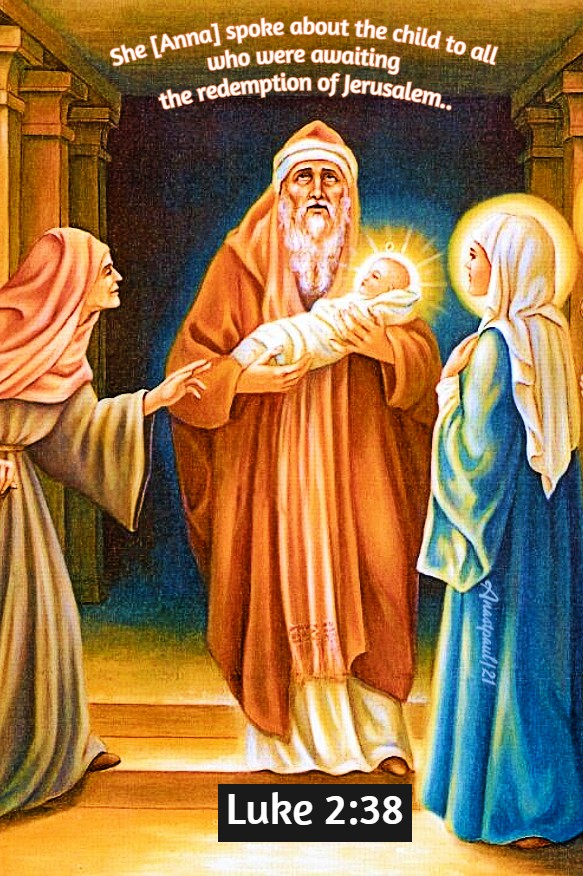
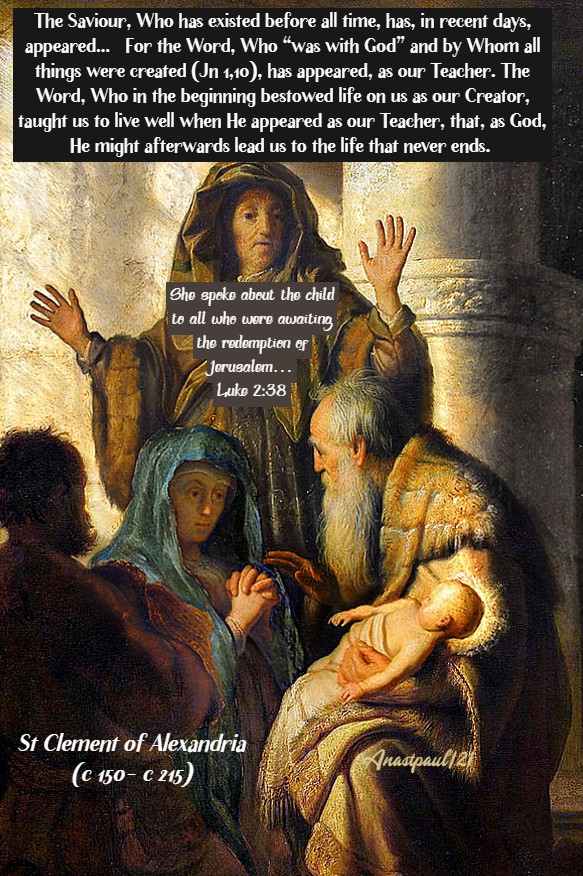
“She [Anna] spoke about the child to all
who were awaiting
the redemption of Jerusalem…

Luke 2:38

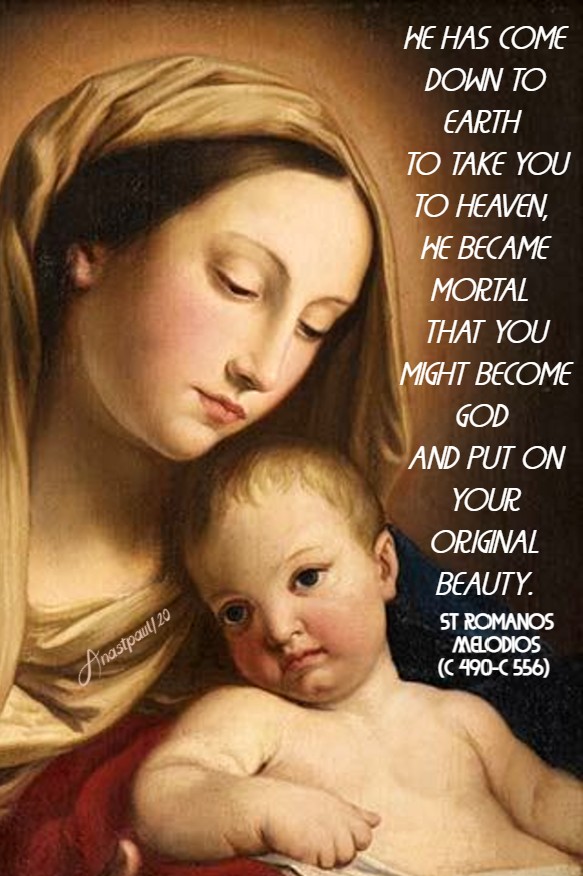
“He has come down to earth
to take you to heaven,
He became mortal
that you might become God
and put on your original beauty
.”

St Romanos Melodios (c 490-c 556)
Monk, Composer of Hymns, Poet

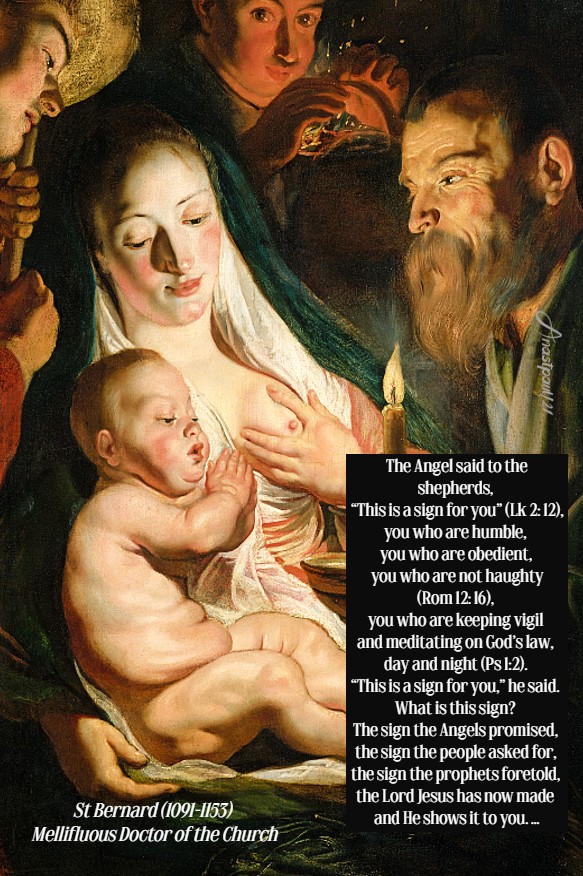
“The Angel said to the shepherds,
“This is a sign for you” (Lk 2: 12),
you who are humble,
you who are obedient,
you who are not haughty (Rom 12: 16),
you who are keeping vigil
and meditating on God’s law,
day and night (Ps 1:2).
“This is a sign for you,” he said.
What is this sign?
The sign the Angels promised,
the sign the people asked for,
the sign the prophets foretold,
the Lord Jesus has now made
and He shows it to you. …

St Bernard (1091-1153)
Mellifluous Doctor of the Church

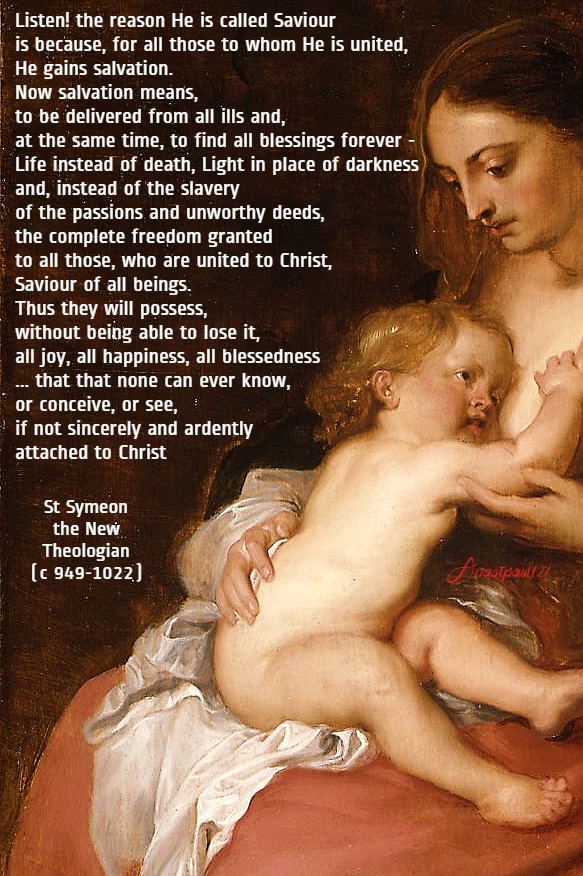
“Listen! the reason He is called Saviour
is because, for all those
to whom He is united,
He gains salvation.
Now salvation means,
to be delivered from all ills and,
at the same time,
to find all blessings forever –
Life instead of death,
Light in place of darkness
and, instead of the slavery
of the passions and unworthy deeds,
the complete freedom granted
to all those, who are united to Christ,
Saviour of all beings.
Thus they will possess,
without being able to lose it,
all joy, all happiness, all blessedness (…)
that that none can ever know,
or conceive, or see,
if not sincerely and ardently
attached to Christ
.”

St Symeon the New Theologian (c 949-1022)

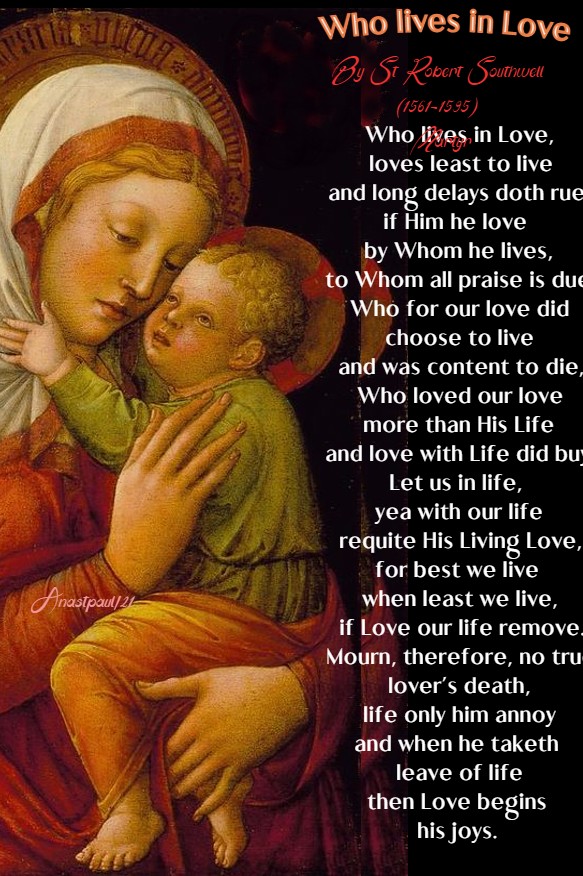
Who lives in Love
By St Robert Southwell SJ (1561-1595)
Martyr

Who lives in Love, loves least to live
and long delays doth rue,
if Him he love by Whom he lives,
to Whom all praise is due,
Who for our love did choose to live
and was content to die,
Who loved our love more than His life
and love with Life did buy.
Let us in life, yea with our life
requite His Living Love,
for best we live when least we live,
if Love our life remove.
Mourn, therefore, no true lover’s death,
life only him annoy
and when he taketh leave of life
then Love begins his joys.

Posted in CHRIST the WORD and WISDOM, CHRIST, the WAY,TRUTH,LIFE, CHRISTMASTIDE!, FATHERS of the Church, The WORD

One Minute Reflection – 30 December – She spoke about the child to all … Luke 2:38

One Minute Reflection – 30 December – “Month of the Immaculate Conception” – The Sixth Day in the Christmas Octave, Readings: 1 John 2:12-17, Psalm 96:7-10, Luke 2:36-40

“She spoke about the child to all who were awaiting the redemption of Jerusalem” … Luke 2:38

REFLECTION – “Inasmuch as the Word was from above, He was and is, the Divine Source of all things but, inasmuch as He has now received the name Christ, consecrated of old and worthy of power, He has been called by me “a new song” (Pss 33[34], 144[145], 149[150], etc.). This Word, then, the Christ, the Cause of both our being (for He was in God) and of our well-being, this very Word has now appeared to us – He alone being both God and man—the Author of all blessings to us. Having been taught by Him to live well, we are introduced by Him to life eternal. For, according to that inspired Apostle of the Lord: “The grace of God has appeared, bringing salvation to all and training us to reject godless ways and worldly desires and to live temperately, justly and devoutly in this present age as we await the blessed hope, the appearance of the glory of the great God and of our Saviour Jesus Christ” (Tit 2,11-13).

This is the new song, the manifestation of the Word, that was in the beginning and Who comes to shine in our midst. The Saviour, Who has existed before all time, has, in recent days, appeared… For the Word,Who “was with God” and by Whom all things were created (Jn 1,10), has appeared, as our Teacher. The Word, Who in the beginning bestowed life on us as our Creator, taught us to live well when He appeared as our Teacher, that, as God, He might afterwards lead us to the life that never ends. It was not only now, that He took pity us because of our sins but, He pitied us from the first, from the beginning.” – St Clement of Alexandria (c 150- c 215) Father, Theologian, Philosopher (Protreptic 1,6-8 ; SC 2)/).

PRAYER – Almighty God and Father, the human birth of Your Only-begotten Son, was the beginning of new life. May He set us free from the tyranny of sin. Imitating our Master and following His ways, may His Immaculate Mother, be our hope and our advocate. We make our prayer through Christ, our Lord with the Holy Spirit, God forever and ever, amen.

Posted in CHRIST the WORD and WISDOM, CHRISTMASTIDE!, Our MORNING Offering, PRAYERS of the SAINTS, The DIVINE INFANT

Our Morning Offering – 30 December – Beloved and Most Holy Word of God

Our Morning Offering – 30 December – The Sixth Day of the Octave of Christmas

Beloved and Most Holy Word of God
By St James of the Marches (1391-1476)

Beloved and most holy Word of God!
You enlighten the hearts of the faithful,
You satisfy the hungry,
console the afflicted.
You make the souls of all,
productive of good
and cause all virtues to blossom.
You snatch souls
from the devil’s jaw.
You make the wretched holy
and men of earth,
citizens of heaven!
Amen

Posted in franciscan OFM, SAINT of the DAY

Saint of the Day – 30 December – Blessed Margherita Colonna (c 1255-1284)

Saint of the Day – 30 December – Blessed Margherita Colonna (c 1255-1284) Virgin, Nun, Mystic, Apostle of the poor. Born in c 1255 at Palestrina, Rome, Italy and died on 30 December 1284 at Castel San Pietro, Rome, Italy of natural causes. Also known as – Margaret, Margherita, Marguerite.

The Roman Martyrology states: “At Palestrina in Lazio, Blessed Margherita Colonna, Virgin, who preferred poverty for Christ to the riches and pleasures of the world, which she served by professing the Rule of St Clare.

Margherita was a member of the Italian Colonna family, which was notable in Italian history for centuries. She was born in Palestrina in 1255, daughter of Oddone Colonna and Mabilia Orsini who had two other children – Giovanni and Giacomo. In 1212, Giacomo became Cardinal of St Prassede and Legate of the Pontiff during the Fifth Crusade. It was he who brought the Column to Rome from the East, which, according to tradition, was used for the flagellation of Christ and which, even today, is preserved in the Roman Basilica which was his seat.

The years in which Margherita lived, were complicated and tumultuous for the Church: from 1268 to 1271, the Papal seat remained vacant, for the longest period in history. The Pope had not resided in Rome for twenty years. Long conclaves were followed by short Pontificates – the power of the Pontiff was fundamental eroded in the balance of the antagonism between France (Charles of Anjou occupied many regions of Italy) and the German Emperor of the Holy Roman Empire.

Margherita and the two brothers were soon orphaned. Destined for a prestigious wedding, important for noble alliances in her day, Margherita, in her heart, however, only wanted to be the virginal bride of Jesus. On 6 March 1273, with two pious housewives, she retired to Castel San Pietro, on the mountain overlooking Palestrina, at the Church of St Maria della Costa, to follow her vocation. In the wake of the Franciscan movement, their ideal of life fascinated a multitude of people from all walks of life. Margherita put on the rough habit, under which she put a sackcloth. She began fasting and penance, praying that her wish would come true: – to become a Poor Clare Nun.

She lived there for a few years in retreat. Her life as an anchorite was a scandal for the powerful Colonna family. However, the comfort came from her brother Giacomo, who, although very young, was already a Cardinal (from 1278) at the behest of Pope Nicholas III, while Giovanni was a Senator of Rome. Giacomo sincerely loved Christ as did his sister, so he took Margherita to Rome and together they prayed at the Tomb of the Apostles Peter and Paul. Then a new life began for Margherita. The substantial inheritance no longer belonged to her, it belonged to the poor who are never lacking on the path of the Saints. Her shining example aroused interest, especially from other women eager to spend their lives like her in the service of Jesus.

Margherita asked the General of the Friars Minor Girolamo Masci (future Pope Nicholas IV) for permission to enter the Monastery of Assisi. However, an illness prevented her from doing so. The Lord’s plans were different. She then thought of the Convent of Mentola (between Palestrina and Tivoli) where an image of the Holy Virgin, to which she was very devoted, a place also visited by St Francis. However, it was a fiefdom of the Count of Poli who did not want a Colonna in his territories. Margherita returned home and, with the help of her brother, the Cardinal, founded a Monastery on the nearby mountain, where the Lord was praised night and day.

Margherita took care of the formation of her companions but her charity went further, to the sick and the poor of the neighbouring region. Tradition says ,that once Jesus and the St John the Baptist came to her table, when she fed the poor but then disappeared when Margaret recognised them.

Having exhausted her substantial personal patrimony, she, who was born very rich, reached out to ask for alms and thus be able to continue her works of mercy for the suffering and hungry. She is also remembered for assisting the Friars Minor of the nearby Zagarolo Convent.

Margherita’s union with Christ became more and more intense: she was visibly comforted by Jesus, the Madonna and the Holy Father Francis. She fell into ecstasy several times and for seven years, she patiently endured an ulcerative wound on her side, carried like a stigmata of the Passion of Jesus.

Not even thirty years old, Margherita’s death was precious in the eyes of the Lord. She died, due to violent fevers, on 30 December 1284. Immediately her Tomb became a pilgrimage destination and the devotees, through her intercession, obtained many graces. In 1285, the community of Poor Clares moved to Rome, by the authorisation of Pope Honorius, taking with them, the venerated body of the Blessed (it remained there until 1871).

Margherita’s first biographer was her brother, the Cardinal and the second was the first Abbess of the St Sylvester Monastery in Rome, where her sisters had moved.

On 17 September1847, the Blessed Pope Pius IX confirmed the “ab immemorabili” cult and the liturgical memorial. Today the relics of Blessed Margherita are venerated in the Church of Castel San Pietro, not far from Palestrina. Here the seed she sowed over seven centuries ago, is still alive today through the Poor Clares of the Monastery of Santa Maria degli Angeli.

PRAYER
O God, You have made
the Blessed Virgin Margaret
admirable in the contempt of earthly goods,
ardent with love for You,
grant us, through her intercession,
that we may be continuously united to You,
as we carry our cross.
Pour upon us, O Lord,
the spirit of holiness
that You have given
to Blessed Margherita Colonna,
so that we can know the love of Christ,
which surpasses all knowledge
and enjoy the fullness of eternal life.
With Christ our Lord
and the Holy Ghost.
Amen.


Posted in ART DEI, MARIAN TITLES, SAINT of the DAY, The APOSTLES & EVANGELISTS

The Sixth Day in the Christmas Octave, Madonna of San Luca / Nostra Signora della Guardia / Our Lady of Saint Luke of La Guardia, Bologna, Italy (433) and Memorials of the Saints – 30 December

The Sixth Day in the Christmas Octave

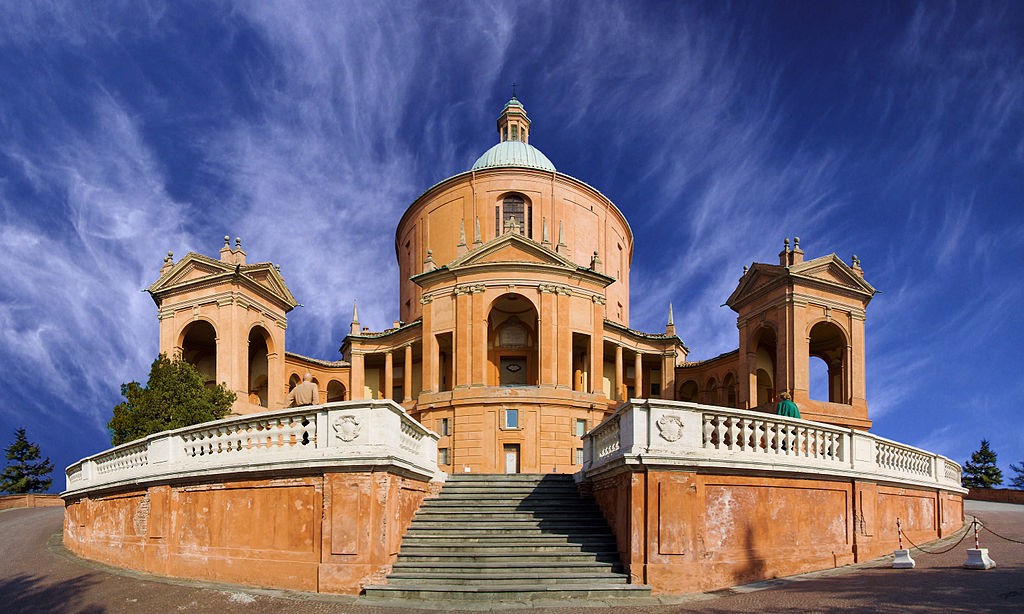
Madonna of San Luca / Nostra Signora della Guardia / Our Lady of Saint Luke of La Guardia, Bologna, Italy (433) – 30 December:

The Abbot Orsini wrote: “This picture was in the Church of Santa Sophia, at Constantinople, with this inscription: “This picture, painted by Saint Luke, must be taken to the mountain of La Garde and placed over the Altar of the Church.” A Greek monk set out for Italy about the year 433, with the picture entrusted to him and deposited it on the mountain of La Garde.

The account mentioned by the Abbot above, is also told in the chronicle of Graziolo Accarisi, who wrote of a Greek hermit who went on pilgrimage to Constantinople where he received from the Priests of the Church of Santa Sofia, the icon of Our Lady of La Guardia. This image was attributed to Saint Luke the Evangelist and there was an inscription on the painting itself that it should one day be taken to the “mountain of the guard.”
The hermit took the Icon,and walked throughout Italy in search of the place where the Icon was meant to be,but it was not until he reached the City of Emilia near Bologna that the authorities of the City came out to greet him and processed with the icon back to the mountain. The Icon had finally found its home and it is now more commonly known as the Madonna of San Luca.
Among the many miracles attributed to the image is especially noted the “miracle of the rain,” which occurred on 5 July 1433. An extremely heavy spring rain came late in the season, threatening to destroy the crops. Facing the prospect of famine, the people turned to the Blessed Virgin for assistance. The storm and rain stopped suddenly, with the arrival into the City, of a procession carrying the miraculous Icon. Since that time these processions have been repeated annually. There is even an incredible arched walkway that is only a little short of four kilometers in length, that is meant to protect the Icon from the elements, as well as those on procession.
The Icon shows the Blessed Virgin Mary holding the Infant Jesus in blessing. She wears a blue-green robe, with a red tunic. The nose, eyes and fingers appear somewhat elongated. The Divine Child wears a tunic of the same colour as His Mothers’, with His right hand in a gesture of giving a blessing and his left hand being closed. In 1625 the image was covered with a silver panel which leaves only the faces of the figures uncovered.
The Icon was crowned in 1603 by the Archbishop Alfonso Paleotti. The Sanctuary of Saint Luke, where the Icon is kept, was declared a national monument in the year 1874. In 1907 the Church was raised to the dignity of a Minor Basilica by the holy Pope Saint Pius X.

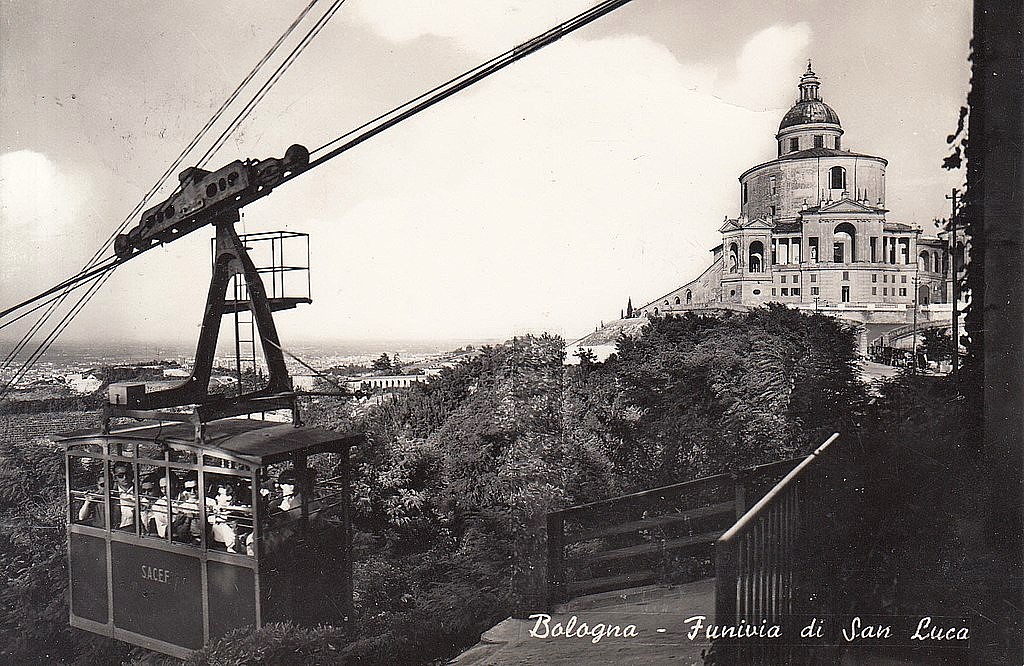
The Sanctuary is situate some 300 metres above the City plain, just south-west of the historical centre of the City. While a road now leads up to the Sanctuary, it is also possible to reach it along a 3.8 km monumental roofed arcade (Portico di San Luca) consisting of 666 arches, which was built in 1674–1793. It was meant to protect the Icon as it was paraded up the hill. A yearly procession from the Cathedral of San Pietro in the centre of Bologna to the Sanctuary goes along this path. The arches held sacred images or Chapels erected by patron families. There is also a cable car which takes tourists up to the Basilica.

Cable car approaching the Mountain Sanctuary

St Anysia of Thessalonica
St Anysius of Thessalonica

St Egwin of Worcester OSB (Died 717) Bishop of Worcester, England, Benedictine Monk, Reformer and Penitent, miracle-worker. Egwin was devout and lived for God from his youth. His biographers say, that king, clergy and the faithful, all united in demanding Egwin’s elevation to Bishop.
About St Egwin:

https://anastpaul.com/2020/12/30/saint-of-the-day-30-december-saint-egwin-of-worcester-osb-died-717/

St Elias of Conques
St Eugene of Milan
St Pope Felix I
St Geremarus

Blessed Giovanni Maria Boccardo (1848-1913) He is remembered as “Father of the Poor” – Priest, Founder of the Poor Daughters of Saint Cajetan. 
His Life:

https://anastpaul.com/2019/12/30/saint-of-the-day-30-december-blessed-giovanni-maria-boccardo-1848-1913-father-of-the-poor/

St Hermes of Moesia
St Jucundus of Aosta
St Liberius of Ravenna
Blessed Margherita Colonna (c 1255-1284) Virgin, Nun

St Perpetuus of Tours
Bl Raoul of Vaucelles
St Raynerius of Aquila
Bl Richard of Wedinghausen
St Ruggero of Canne
St Sebastian of Esztergom

Martyrs of Alexandria – (5 saints): A group of Christians martyred in the unrest caused by Monophysite heretics. We know the names for five of them – Appian, Donatus, Honorius, Mansuetus and Severus. They were martyred in c 483 at Alexandria, Egypt.

Martyrs of Oia – (6 saints): A group of Christians martyred together, date unknown. The only details to have survived are the names – Cletus, Florentius, Papinianus, Paul, Serenusa and Stephen. They were martyred in Oia, Greece.

Martyrs of Spoleto – (4 saints): A group of Christians martyred in the persecutions of Diocletian – Exuperantius, Marcellus, Sabinus and Venustian. They were martyred in 303 in Spoleto, Italy.

Posted in DIVINE Mercy, Goodness, Patience, MEDITATIONS - ANTONIO CARD BACCI, QUOTES on FORGIVENESS, QUOTES on REPENTANCE, QUOTES on SIN, QUOTES on TEMPTATION, QUOTES on the DEVIL/EVIL

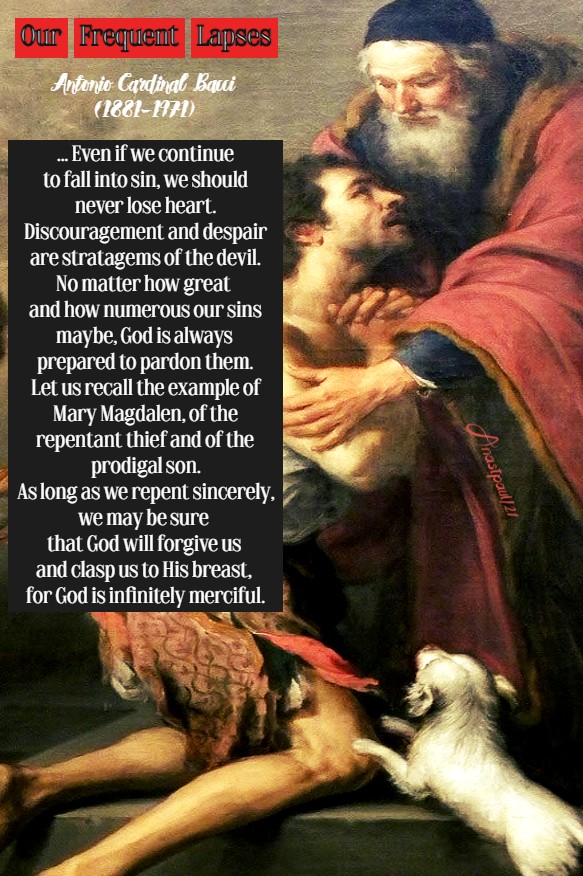
Thought for the Day – 29 December – Our Frequent Lapses

Thought for the Day – 29 December – Meditations with Antonio Cardinal Bacci (1881-1971)

Our Frequent Lapses

“It is sad to have to admit, that in spite of our good resolutions and in spite of the graces which we receive from God, we continue to fall into sin.
Our continual lapses can cause us to become discouraged.
This, however, is a device of the devil, who has already lured us into sin and now, proceeds to suggest thoughts of despair.
He wishes to convince us that resistance is useless, that our nature is completely corrupt and, that there is no escape for us.

My dear children,” wrote St John to the early Christians, “these things I write to you, in order that you may not sin. But, if anyone sins, we have an advocate with the Father, Jesus Christ, the just and he is a propitiation for our sins, not for ours only but also, for those of the whole world” (1 Jn 2:1-2).
If we say that that we have no sin, we deceive ourselves and the truth is not in us. If we acknowledge our sins, he is faithful and just to forgive us our sins and to cleanse us from all iniquity.” (1 Jn 1:9).
He who says that he knows him and does not keep his commandments, is a liar and the truth is not in him But he who keeps his word, in him the love of God is truly perfected” (1 Jn 2:5).

It is clear, therefore, that we ought to avoid sin by every means in our power because, it extinguishes our charity and brings death to the soul.
Nevertheless, even if we continue to fall into sin, we should never lose heart.
Discouragement and despair are stratagems of the devil.
No matter how great and how numerous our sins maybe, God is always prepared to pardon them.

Let us recall the example of Mary Magdalen, of the repentant thief and of the prodigal son.
As long as we repent sincerely, we may be sure that God will forgive us and clasp us to His breast, for God is infinitely merciful.

Antonio Cardinal Bacci

Posted in CHRIST the LIGHT, CHRISTMASTIDE!, QUOTES on FEAR, QUOTES on PERSECUTION, QUOTES on the CHURCH, SAINT of the DAY, The DIVINE INFANT, The NATIVITY of JESUS

Quote/s of the Day – 29 December – St Thomas à Becket (1118-1170) Martyr

Quote/s of the Day – 29 December – The Fifth Day of the Octave of Christmas and the Memorial of St Thomas à Becket (1118-1170) Martyr, Archbishop of Canterbury

“… No matter who plants or waters,
God gives no harvest
unless what he plants
is the faith of Peter
and unless he himself.
assents to Peter’s teaching.

“Those who tread among serpents
and along a tortuous path,
must use the cunning of the serpent
.”

“If all the swords in England
were pointed against my head,
your threats would not move me.

St Thomas à Becket (1118-1170)
Martyr, Archbishop of Canterbury

MORE HERE:
https://anastpaul.com/2020/12/29/quote-s-of-the-day-29-december-st-thomas-a-becket-1118-1170/

Posted in CHRIST the LIGHT, CHRIST the WORD and WISDOM, FATHERS of the Church, ONE Minute REFLECTION, The WORD

One Minute Reflection – 29 December – ‘ … light your candles with His Light…’

One Minute Reflection – 29 December – The Fifth Day of the Octave of Christmas, Readings: 1 John 2:3-11, Psalms 96:1-2, 2b-3, 5-6, Luke 2:22-35 and the Memorial of St Thomas à Becket (1118-1170) Martyr, Archbishop of Canterbury

“A light for revelation to the Gentiles” – Luke 2:32

REFLECTION – “Who is there today who, as he holds a lighted candle in his hand, does not immediately think of the old man who today received Jesus in his arms, the Word in the flesh, the Light in the wax and who bore witness ,that He was the Light that shines upon all nations? The old man was himself a burning flame that enlightens and gives witness to the Light, he who, in the Holy Spirit with which he was filled, came to receive, O God, your love within your Temple (Ps 47[48],10) and bear witness, that You are the Love and Light of Your people…

Rejoice, just old man, look now at what you had once foreseen, darkness has disappeared from the world, the nations walk by Your Light (Is 60,3). The whole earth is filled with the glory (Is 6,3) of this Light which, in the past, you used to hide in your heart and which today, illumines your eyes… Embrace the Wisdom of God, O blessed old man and may your youth be renewed (Ps 102[103],5). Receive the mercy of God in your heart and your old age will know the sweetness of mercy. “He will rest in my bosom,” says Scripture (Wsd 1,12). Even when I give Him back to His Mother, He will continue to dwell with me, my heart will be filled with His mercy and, even more, the heart of His Mother… I give thanks and rejoice for you, full of grace, for you gave birth to the Mercy I have received – the Candle which you prepared, I am holding in my hands…

And you, brethren, look at the Candle that burns in the hands of Simeon, light your candles with His Light… Then, not only will you bear a Light in your hands but you yourselves, will be a light for others. A Light in your hearts, a Light in your lives, a Light for your brothers and sisters.” – Bl Guerric of Igny (c 1080-1157), Cistercian Abbot (1st Sermon for the Purification, 2-3).

PRAYER – God our Father, our human nature is the wonderful work of Your hands. Your Son took to Himself our manhood, grant us a share in His Sonship, that as co-heirs with Him, we may strive evermore obediently to gain our final home with the Blessed Virgin, St Thomas à Becket and all Your saints. Through Christ, our Lord, with the Holy Spirit, one God with You, now and for evermore, amen.

Posted in CHRISTMASTIDE!, DOCTORS of the Church, Our MORNING Offering, The DIVINE INFANT

Our Morning Offering – 29 December – O Dearest Infant by St Alphonsus

Our Morning Offering – 29 December – The Fifth Day of the Christmas Octave

O Dearest Infant
By St Alphonsus Liguori (1696-1787)
Most Zealous Doctor

O dearest Infant,
tell me what You came on earth to do.
Tell me whom You are seeking.
Ah, yes, I now understand…
You have come to die for me, a lost sheep,
in order that I may no more
hide from You but love You.
O Jesus, my treasure,
my life, my love, my all,
if I do not love You,
then whom shall I love?
Where can I find a mother or father,
a friend, or a spouse more loving than You?
And who has ever loved me more than You have?
I am sorry that I have lived so many years in this world
and yet still love You so little,
even having offended You
and sometimes forgotten You.
Amen

Posted in SAINT of the DAY

Saint of the Day – 29 December – Saint Ebrulf of Ouche (c 626-7c 06)

Saint of the Day – 29 December – Saint Ebrulf of Ouche (c 626c -706) Abbot, Hermit. Founder of many Monasteries, Married but separated by mutual agreement, miracle-worker. Born in c 626 in Bayeux, Normandy, France and died in c 706 of natural causes, at the Monastery he had founded. Also known as – Ebrolfo, Ebrulfo, Ebrulfus, Ebrulphus, Evroul, Evroult, éVroult. Additional Memorial – 30 August, in England, where some of his relics are venerated.

Of noble birth, Ebrulf received a careful education and gave proofs of profound virtue.

He became a highly-ranked Official of King Childeric II. Ebrulf was a cup-bearer to the King and an Administrator of the Royal Palace but he desired a life consecrated to God.

It was some time before he was given leave to detach himself from his duties at the Court to become a Monk. As he was married to a woman of his own social rank, the two separated by mutual consent, he to lead a life of greater perfection and she, it is believed, became a Nun.

He joined the Monastery of Deux-Jumeaux (Bayeux) before deciding to become a Hermit at Exmes but there, crowds came to visit him and ask for his advice. He then settled, with some companions, in the forest of Ouche, which was infested with wild beasts and brigands. A legend states, that he converted a robber to Christianity when the robber visited Ebrulf’s the rough settlement which consisted of a hedge enclosure and wattle and daub huts. The robber warned Ebrulf of the dangers of the forest but Ebrulf informed him that he feared no-one. Repenting of his own sins, the robber brought a gift consisting of three loaves baked in ashes and a honeycomb, and asked to be admitted as a Monk.

This settlement became the Abbey of Saint-Evroul. He founded other monastic houses, fifteen in total, all of which placed emphasis on manual labour both as a spiritual and economic exercise. Members of the nobility came to Ebrulf offering him money, land, to build monasteries. He founded, after 560, several Monasteries in the Diocese of Séez; one of them became the important Abbey of St-Martin-de-Séez.

The ruins of St Ebrulf Abbey

The Saint worked numerous miracles and even raised the dead . In the 12th century John of St-Evroult composed a work in verse in his honour and many miracles were worked at his tomb.

During the Norman invasions, his remains were transported to Orleans. Later, an attempt was made to bring them back to the Abbey of Saint- Ebrulf but without success.

He was venerated in England as a result of the Norman invasion and the link between Ebrulf and England was maintained, by the fact, that four Abbots from Saint-Evroul Abbey ruled English Monasteries in the 11th and 12th Centuries. They brought to England some of Ebrulf’s relics. A Feast commemorating the translation of his relics is kept at Deeping Abbey in England on 30 August.

Posted in CATHOLIC-PRAYERS OF THE CHURCH, DOCTORS of the Church, FATHERS of the Church, MARIAN Antiphons, MARIAN PRAYERS, MARIAN TITLES, SAINT of the DAY

The Fifth Day of the Octave of Christmas, Unsere Liebe Frau vom Speyer / Our Lady of Speyer, Germany, Featuring the Salve Regina and St Bernard (1146) and Memorials of the Saints – 29 December

The Fifth Day of the Octave of Christmas

Unsere Liebe Frau vom Speyer / Our Lady of Speyer, Germany Featuring the Salve Regina and St Bernard (1146) – 29 December:

The Abbot Orsini wrote: “Our Lady of Spire (Speyer), in Germany. Saint Bernard, entering this Church on the 29th of December, 1146, was honourably received there by the Canons, who conducted him to the choir, singing the Salve Regina. The antiphon being finished, Saint Bernard saluted the image of the Blessed Virgin in these terms: “O clems, O pia, O dulcis Virgo Maria!” and she answered: “Salve Bernarde!” The words of this Saint to the image are seen engraved in a circle on the pavement of the Church, on the same spot where he pronounced them and they have since been added to the Salve Regina, which was composed in the year 1040, by Herman, surnamed Contractus, a Benedictine monk.” [He is Blessed Herman of Reichenau (often known as Blessed Herman the Cripple OSB (1013–1054) – his Biography here: https://anastpaul.com/2019/09/25/saint-of-the-day-blessed-herman-of-reichenau-the-cripple-osb-1013-1054-the-wonder-of-his-age/ ]

This date on the Marian calendar, Our Lady of Speyer, actually refers to the Cathedral of Speyer, dedicated to the Blessed Virgin Mary and known as Kaiserdom zu Speyer in Germany. Construction began on the Romanesque style Cathedral in the year 1030 and was completed in 1106. It is 134 metres long and 43 metres wide, which made it one of the largest buildings constructed at that time and is now thought to be, the largest surviving Romanesque building in the world.

During the Nine Years’ War the entire Town of Speyer was burned to the ground and the heat from the inferno caused part of the nave to collapse. In 1792 the Town was occupied by the French revolutionary troops and the Church pillaged. It was in that century that the ruins of the Chapel of Saint Bernard were removed. The Cathedral was subsequently used as a warehouse and hospital.
In 1957 the Cathedral was restored and, although much of the plaster and 19th century paintings were removed, the scenes of the life of the Blessed Virgin were left undisturbed. n 1981 the Cathedral was added to the World Heritage List of UNESCO.

St Thomas a Becket (1118-1170) Martyr, Archbishop of Canterbury from 1162 until his murder in 1170. He engaged in conflict with Henry II, King of England, over the rights and privileges of the Church and was murdered by followers of the King in Canterbury Cathedral. Soon after his death, he was Canonised by Pope Alexander III. (Optional Memorial)
Biography:
https://anastpaul.wordpress.com/2017/12/29/saint-of-the-day-29-december-st-thomas-a-becket-1118-1170/
AND:
https://anastpaul.com/2018/12/29/saint-of-the-day-29-december-st-thomas-a-becket-1118-1170-martyr-archbishop-of-canterbury/

St Aileran of Clonard
St Albert of Gambron
St Aproniano de Felipe González
St David the King
St Ebrulf of Ouche (c 626-c 706) Abbot, Hermit
St Enrique Juan Requena
St Florent of Bourges
Bl Francis Ruiz
St Girald of Fontenelle
St Jacinto Gutiérrez Terciado
Bl José Aparicio Sanz
Bl José Perpiñá Nácher
St Juan Bautista Ferreres Boluda
St Libosus of Vaga
St Marcellus the Righteous
St Martinian of Milan
Bl Paul Mary
Bl Peter the Venerable
St Quartillosa of Carthage
St Thaddeus of Scythia
St Trophimus of Arles
St Trophimus of Ephesus

Blessed William Howard (1614–1680) Martyr, Married Laymam and Father, 1st Viscount Stafford. William was the grandson of the Venerable Philip Howard, Earl of Arundel, fifth son of Earl Thomas (the first great art collector of England) and Uncle of Thomas Philip – Cardinal Howard.
His Life and Death:

https://anastpaul.com/2020/12/29/saint-of-the-day-29-december-blessed-william-howard-1614-1680-martyr/

Martyrs of North Africa – (8 saints): A group of Christians executed together for their faith. The only details to survive are eight names – Crescentius, Dominic, Honoratus, Lybosus, Primian, Saturninus, Secundus and Victor.

Martyrs of Rome – (3 saints): A group of Christians executed together for their faith. The only details to survive are three names – Boniface, Callistus and Felix.

Martyrs of Seoul – (7 saints): Additional Memorial – 20 September as part of the Martyrs of Korea.
A group of seven lay woman in the apostolic vicariate of Korea who were martyred together.
• Barbara Cho Chung-I
• Barbara Ko Sun-I
• Benedicta Hyong Kyong-Nyon
• Elisabeth Chong Chong-Hye
• Magdalena Han Yong-I
• Magdalena Yi Yong-Dok
• Petrus Ch’oe Ch’ang-Hub
They were born in South Korea and were martyred by beheading on 29 December 1839 at the Small West Gate, Seoul, South Korea. They were Canonised on 6 May 1984 by St Pope John Paul II.

Martyred in the Spanish Civil War:
Thousands of people were murdered in the anti-Catholic persecutions of the Spanish Civil War from 1934 to 1939.
• Blessed Aproniano de Felipe González
• Blessed Enrique Juan Requena
• Blessed Jacinto Gutiérrez Terciado
• Blessed Juan Bautista Ferreres Boluda

Posted in CONFESSION/PENANCE, EUCHARISTIC Adoration, LOVE of NEIGHBOUR, MEDITATIONS - ANTONIO CARD BACCI, QUOTES for the NEW YEAR, QUOTES on BAD CONVERSATION, QUOTES on CONVERSION, QUOTES on LOVE of GOD, QUOTES on PRAYER, QUOTES on SIN, QUOTES on THANKSGIVING, QUOTES on TIME

Thought for the Day – 28 December – The Value of An Hour

Thought for the Day – 28 December – Meditations with Antonio Cardinal Bacci (1881-1971)

The Value of An Hour

There are twenty four hours in a day, eight thousand seven hundred and sixty, in a year.
How have you spent all the hours which God has given you in the past?

How do you intend to use the hours which He will give you in the future?

When you examine the past, you will find much to regret.
Perhaps you have spent many hours in sin, in idle gossp, in useless or dangerous pastimes, or in innumerable business transactions, all of which will contribute NOTHING towards your eternal salvation, which should be our main concern in this life.

How much time have you spent thinking of God, your Creator and Redeemer?
How many hours have you devoted to prayer, thanksgiving and penance.
How many have you spent in apostolic work on behalf of your neighbour?
It may be that the service of God and your spiritual welfare have, so far, been the least of your worries, on which you have expended no more than the few odd moments left over from your other preoccupations.
You are well aware, nevertheless, that the purpose of life is to know, love and serve God.
You know that you ought to offer Him all your thoughts, affections and actions, for He alone can make your happy – or do you NOT know and believe this?

Antonio Cardinal Bacci

Posted in "Follow Me", CHRIST, the WAY,TRUTH,LIFE, DOCTORS of the Church, FATHERS of the Church, FEASTS and SOLEMNITIES, QUOTES on COURAGE, QUOTES on LOVE of GOD, QUOTES on SUFFERING, QUOTES on TEMPTATION, The FAITHFUL on PILGRIMAGE, The WORD

Quote/s of the Day – 28 December – Suffering

Quote/s of the Day – 28 December – The Feast of the Holy Innocents – The Fourth Day of the Christmas Octave, Readings: 1 John 1:5-2:2, Psalm 124:2-5, 7-8, Matthew 2:13-18

“Whoever says he abides in Christ,
ought to walk, even as Christ walked…”

1 John 2:6

“How grave is the case of a Christian,
if he, a servant, is unwilling to suffer
when his Master first suffered! …
The Son of God suffered,
that He might make us sons of God
and the son of man will not suffer,
that he may continue to be a son of God!?

St Cyprian of Carthage (c 200-258)
Martyr, Father of the Church

Letter 55

“Our pilgrimage on earth
cannot be exempt from trial.
We progress by means of trial.
No-one knows himself except through trial,
or receives a crown,
except after victory,
or strives,
except against an enemy or temptations.

St Augustine (354-430)
Father and Doctor of Grace

“He gives according to the love He bears us …,
according to the courage He sees in each
and the love each has for His Majesty.
He will see, that whoever loves Him much,
will be able to suffer much for Him;
whoever loves Him little,
will be capable of little.
I myself hold,
that the measure for being able to bear,
a large or small cross, is love …

St Teresa of Avila (1515-1582)
Doctor of Prayer of the Church

Posted in FATHERS of the Church, FEASTS and SOLEMNITIES, ONE Minute REFLECTION, QUOTES on MARTYRDOM, The WORD

One Minute Reflection – 28 December – They could not yet speak but already, they are confessing Christ.

One Minute Reflection – 28 December – The Feast of the Holy Innocents and the Fourth Day of the Christmas Octave, Readings: 1 John 1:5-2:2, Psalm 124:2-5, 7-8, Matthew 2:13-18

“When Herod realised that he had been deceived by the magi, he became furious. He ordered the massacre of all the boys in Bethlehem and its vicinity, two years old and under, in accordance with the time he had ascertained from the Magi.“” – Matthew 2:16

REFLECTION – “Why, Herod, do you fear when you hear a King is born? He has not come to dethrone you but to overthrow the devil. But you fail to understand, you take fright and fall into a fury. Because you lost the single child you were seeking, you become the cruel murderer of the many. Neither the weeping mothers’ love, nor the mourning of fathers weeping for their sons, nor the screams and howling of the children themselves, holds you back. You massacre these little ones in their bodies because fear is killing you, in your heart. And you think that, if you achieve your end, you will live on for a long time, whereas it is Life itself you are trying to kill! He Who is the source of grace, Who is both small and great, Who is lying in a manger, causes your throne to topple. He accomplishes His design through you, without your knowing it. He gathers together the children of your enemies and makes of them, children of adoption.

These little ones died for Christ without knowing it ; their parents weep for the death of Martyrs. Although they were unable to speak, Christ made them capable of being His Witnesses. See how this King reigns. Already He is setting free and bestowing salvation. But as for you, Herod, you are oblivious of what is happening, you take fright and fall into a rage. And when you get annoyed with a little Child, you are already placing yourself at His service without realising it.

How great the gift of grace is! What are the merits by which these children won the victory? They could not yet speak but already, they are confessing Christ. Their little bodies are as yet unable to engage in combat but already, they are carrying off the Palm of Victory.” – St Quodvultdeus (Died c 453) Father, Bishop at Carthage fromc 437-c 450 (Second sermon on the Creed; PL40, 655).

PRAYER – We praise You, O God, we acclaim You as Lord, the white-robed army of Martyrs praise You. (From the Te Deum).