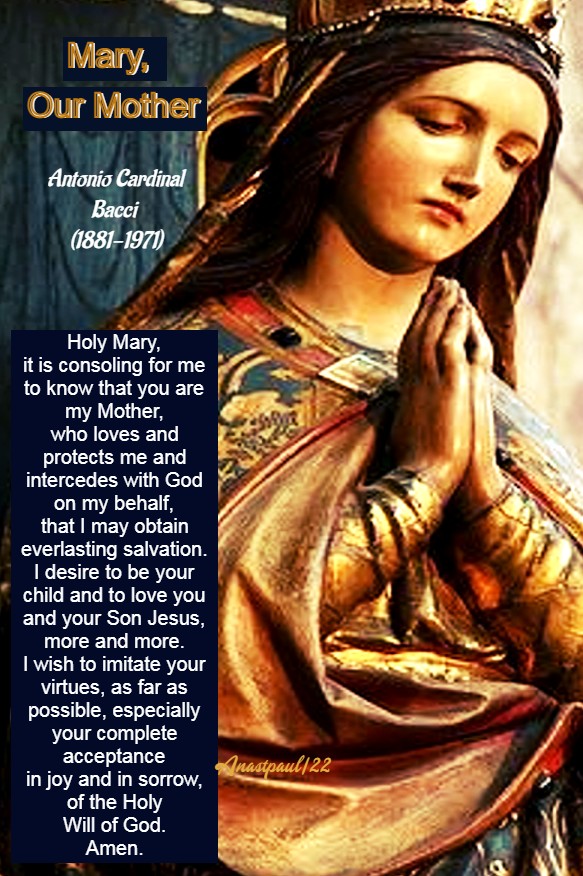
Thought for the Day – 15 December – Meditations with Antonio Cardinal Bacci (1881-1971)
Merit and the Love of God
“The more we know, writes St Catherine of Siena, the more we love and the more we love, the more we receive. Our merit, she concludes, increases in accordance with the measure of our love (Dialogues, c 131). We tend to judge men on the strength of their achievements and to judge ourselves, according to the degree of success which we have attained. Our standards could hardly be more false. “How much soever each one is in Thy eyes,” the author of The Imitation of Christ cries out to God in the words of St Francis, “so much is he and no more” (Bk III, c 50).
It is not success which counts with God and still less, human esteem. What matters with God, is our intention of pleasing Him and of working for His glory, from the motive of pure love. If we are successful in our work, let us praise God. If we are unsuccessful, let us thank Him, just the same. Our merit is commensurate with our love for God. If we love Him very much, we shall work hard and make sacrifices for His sake. We must work to satisfy God alone, however and not, for ourselves. If we work for any other purpose, all our labour is wasted. We sow abundantly and reap little or nothing. God alone matters. If we work only for Him, we shall be blessed by Him and shall reap the fruits of everlasting life. Amen!”
Quote/s of the Day – 15 December – “Month of the Immaculate Conception” – The Octave Day of the Immaculate Conception of the Blessed Virgin Mary
“I am the Immaculate Conception.”
Our Lady of Lourdes to St Bernadette 25 March 1858
“He came down into the Virgin’s womb, a womb unstained, unspotted, hallowed by the touch of divine unction.”
St Amadeus of Lausanne (1108-1159)
“Enraptured by the splendour of your heavenly beauty and impelled by the anxieties of the world, we cast ourselves into your arms, O Immaculate Mother of Jesus and our Mother Mary, confident of finding in your most loving heart, appeasement of our ardent desires and a safe harbour from the tempests which beset us on every side.”
Ven Pope Pius XII (1876-1958)
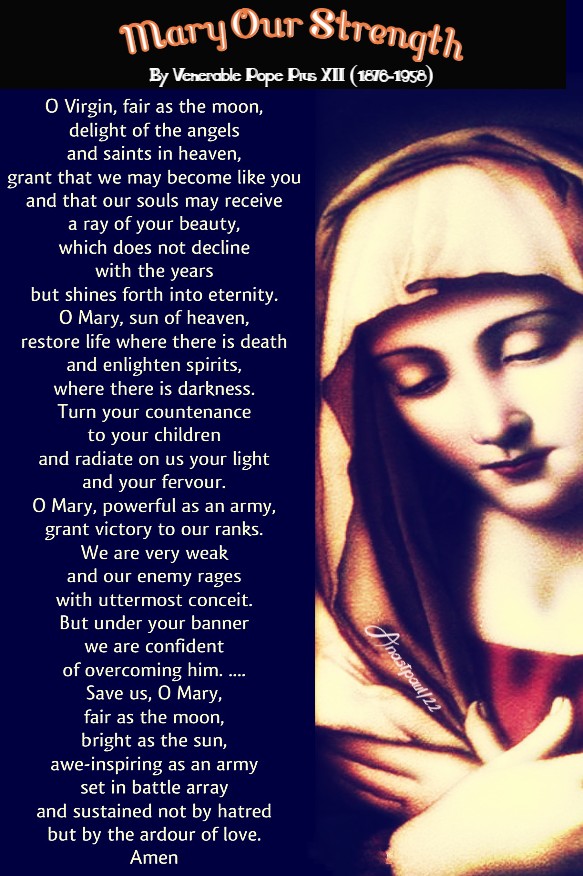
Deign, O Immaculate Virgin By St Paschasius Radbertus (785–865)
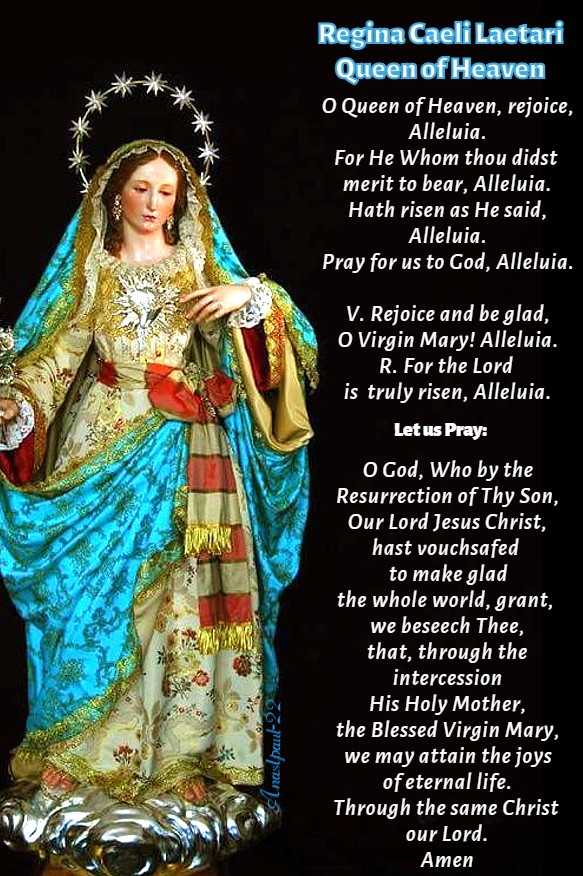
Deign, O Immaculate Virgin, Mother most pure, to accept the loving cry of praise which we send up to you from the depths of our hearts. Though they can but add little to your glory, O Queen of Angels, you do not despise, in your love, the praises of the humble and the poor. Cast down upon us a glance of mercy, O most glorious Queen, graciously receive our petitions. Through your immaculate purity of body and mind, which rendered you so pleasing to God, inspire us with a love of innocence and purity. Teach us to guard carefully the gifts of grace, striving ever after sanctity, so that, being made like the image of your beauty, we may be worthy to become the sharers of your eternal happiness. Amen
One Minute Reflection – 15 December – Wednesday of the Third week of Advent, Readings: Zephaniah 3: 1-2, 9-13; Psalms 34: 2-3, 6-7, 17-18, 19 and 23; Luke 7:19-23
“Go and tell John what you have seen and heard – the blind regain their sight, the lame walk, lepers are cleansed, the deaf hear, the dead are raised, the poor have the good news proclaimed to them.” – Luke 7:23
REFLECTION – “The sun’s light as seen by our bodily eyes proclaims the spiritual Sun, the “Sun of Justice” (Mal 3,20). This was truly the gentlest of Suns to have arisen on those who, at that time, had the happiness of being His disciples and of seeing Him with their own eyes, while He was sharing man’s life, as though He were an ordinary man. And yet, by nature, He was also truly God, which was why He was capable of restoring sight to the blind, of making the lame to walk and the deaf to hear; He cleansed lepers and, with a word, brought back the dead to life.
And now, too, there is truly nothing sweeter than to fix our spiritual eyes on Him, so as to contemplate and picture to ourselves, His inexpressible, divine beauty. There is nothing sweeter than to be enlightened and made beautiful, by this participation and communion in the Light, to have one’s heart softened, one’s soul sanctified and to be filled with a holy joy all the days of this present life… Truly, this Sun of Justice is, for those who gaze at it, the transmitter of joy according to the prophecy of David: “The just rejoice and exult before God, they are glad and rejoice!” And again: “Exult you just in the Lord, praise from the upright is fitting!” (Ps 68[67],4; 33[32],1).” – St Gregory of Agrigente (c 559-c 630) Bishop (Commentary on Ecclesiastes, 10, 2).
PRAYER – Almighty God, let the splendour of Your glory dawn in our hearts. May the coming of Your only Son dispel all darkness and reveal that we are children of Light. By the care and love of the Mother of Your Son and our Mothers, may we be ever strong as we carry our own crosses after Jesus, our Master and our Saviour. Through Jesus Christ our Lord, in union with the Holy Spirit, one God forever and ever, amen.
Our Morning Offering – 15 December – “Month of the Immaculate Conception” – The Octave Day of the Immaculate Conception of the Blessed Virgin Mary
Rosa Mystica By Fr Gerard Manley Hopkins SJ (1844-1889)
The rose in a mystery, where is it found? Is it anything true? Does it grow upon ground? — It was made of earth’s mould but it went from men’s eyes And its place is a secret and shut in the skies. In the Gardens of God, in the daylight Divine Find me a place by thee, Mother of mine.
But where was it formerly? which is the spot That was blest in it once, though now it is not? — It is Galilee’s growth: it grew at God’s Will And broke into bloom upon Nazareth hill. In the Gardens of God, in the daylight Divine I shall look on thy loveliness, Mother of mine.
What was its season then? how long ago? When was the summer that saw the bud blow? — Two thousands of years are near upon past Since its birth and its bloom and its breathing its last. In the Gardens of God, in the daylight Divine I shall keep time with thee, Mother of mine.
Tell me the name now, tell me its name. The heart guesses easily: is it the same? — Mary the Virgin, well the heart knows, She is the Mystery, she is that Rose. In the Gardens of God, in the daylight Divine I shall come home to thee, Mother of mine.
Is Mary the Rose then? Mary the tree? But the blossom, the blossom there, who can it be? — Who can her Rose be? It could be but One: Christ Jesus our Lord, her God and her Son. In the Gardens of God, in the daylight Divine Shew me thy Son, Mother, Mother of mine.
What was the colour of that blossom bright? — White to begin with, Immaculate white. But what a wild flush on the flakes of it stood When the Rose ran in crimsonings down the Cross-wood! In the Gardens of God, in the daylight Divine I shall worship His Wounds with thee, Mother of mine.
How many leaves had it? — Five they were then, Five like the senses and members of men; Five is their number by nature but now They multiply, multiply who can tell how?┬░ In the Gardens of God, in the daylight Divine Make me a leaf in thee, Mother of mine.
Does it smell sweet too, in that holy place? — Sweet unto God and the sweetness is grace: O Breath of it bathes great Heaven above In grace that is charity, grace that is love. To thy breast, to thy rest, to thy glory Divine Draw me by charity, Mother of mine. Amen
Saint of the Day – 15 December – Blessed Marino of Cava OSB (Died 1170) Monk, the Seventh Abbot of the famous Abbey of The Holy Trinity of Cava (La Trinità della Cava) in the Province of Salerno, southern Italy. The Abbey was founded in 1011 by Alferius of La Cava (930–1050). Marino was a powerful administrator, so much so, that many other Monasteries elected to be governed by him. He was also appointed as a Royal and secular Governor, through the efforts of his diplomatic peace negotiations.
The Roman Martyrology states: “In the Monastery of Cava de ‘Tirreni in Campania, blessed Marino, Abbot, admirable in his fidelity to the Roman Pontiff.”
We have no information of our Saints early life but we know that Marino was at first a simple Monk, who distinguished himself by the task of the care of the precious vessels and the ancient books and documents of the Monastery.
When Marino was elected Abbot on 9 July 1146, he went to Rome, at the beginning of his mandate, according to the custom at La Cava, to obtain the Papal blessing. The then Cistercian Pope Eugene III (1145-1153),the disciple of St Bernard, welcomed him with honour and on that occasion also entrusted him with the reform of the Monastery of S.t Laurence in Panisperna, according to the manner in which La Cava was administered.
The same Pope by a Bull of 6 May 1149, took the La Cava Abbey under his own protection, making it subject to the Apostolic See, thus appointing it independent of the Diocesan authorities.
The government of Abbot Marino was fruitful in works and prosperity thanks to the generous donations of Bishops, Princes and feudal Lords. So much so, that other Monasteries and other Churches came to place themselves under Abbot Marino’s wise and careful protection and care.
The wealth that flowed ,was used to help the poor and suffering, for the sustenance of the numerous Monks, for the construction of buildings and for the splendour of worship. Below is the Interior of the Abbey Basilica, one of grand proportions and beauty.
(La Trinità della Cava Interior
The Abbey Basilica was covered with precious inlaid marble, decorated with frescoes, paved with polychrome mosaics; moreover, for his work as negotiator for peace between the King of Sicily, William the Bad (1120-66) and Pope Adrian IV (1154-1159), having gone to the Court of Palermo, he obtained a document from the King, confirming the possessions fof his Abbey, taking it under Royal protection and exempting it from taxes. Marino was then a secular administrator too, enabling him to appoint vassals, enlist soldiers, appoint judges and notaries.
(La Trinità della Cava
Marino died a holy death on 15 December 1170. His body was buried in the Abbey’s Basilica. In 1648 his relics were translated to a Shrine Altar in the Basilica after the confirmation of the Marino’s Beatification on 16 May 1928, by Pope Pius XI.
Nuestra Señora de Monguí / Our Lady of Mongui, Monguí, Boyacá, Colombia (16th Century) – 15 December:
Highly venerated, the Virgin of Monguí, is the Patroness of Boyacá. When King Charles I of Spain retired from his throne, he went to the Monastery of Yuste in the Spanish Province of Cáceres to prepare for death. He went into the Monastery looking for painted works of the Virgin Mary to send to the New World, in order to express gratitude to indigenous leaders for their loyalty to the Spanish Crown. In 1558, King Philip II, his son and successor, sent two paintings: one of St Martín which was to be presented to the leader of Monguí and another of the Holy Family, for Sogamoso. Although the works were marked, there was confusion and the destinations were reversed. Given the error, the inhabitants of Sogamoso protested and asked for the exchange. But the pictures inexplicably returned to the same places and the exchange, through divine intervention, could, therefore, not be accomplished. All agreed that this was a miraculous occurence and the great devotion to the Blessed Virgin began to grow. This painting still includes its original frame, a rare but fortunate occurrence and the fine gold-leaf embellishments. It is because of miraculous events like these, among others, that the Virgin Mary is present in the history of Boyacá and its inhabitants feel entrusted to her protection. Between 1694 and 1760, the present Church was built to house the image and still draws thousands of pilgrims to its Shrine each year. The Church has been elevated to the status of a Basilica.
St Maximinus of Micy St Offa of Essex Bl Pau Gracia Sánchez St Paul of Latros Bl Ramón Eirin Mayo St Silvia of Constantinople St Urbicus St Valerian of Abbenza Blessed Victoria Strata (1562-1617) Widow,
Martyrs of Drina – (5 beati): Also known as • Daughters of Divine Charity of Drina • Drina Martyrs Five members of the Daughters of Divine Charity who were martyred while fighting off Chetnik rapists. They were – Jozefa Bojanc Jozefa Fabjan Karoline Anna Leidenix Kata Ivanisevic Terezija Banja Their martyrdom occured in December 1941 in Gorazde, Bosansko-Podrinjski, Bosnia-Herzegovina They were Beatified on 24 September 2011 by Pope Benedict XVI.
Martyrs of North Africa – (7 saints): A group of Christians martyred together for their faith in North Africa. The only details about them that survive are their names – Caelian, Candidus, Faustinus, Fortunatus, Januarius, Lucius and Mark.
Martyrs of Rome – (22 saints): A group of 22 Christians martyred together in the persecutions of Valerian. The only details we have are five of their names – Antonius, Irenaeus, Saturnin, Theodorus and Victor. c 258 in Rome, Italy.
Thought for the Day – 14 December – Meditations with Antonio Cardinal Bacci (1881-1971)
Leaving Our Worries in God’s Hands
“Although we ought to be busy, we should never be too preoccupied. We should do what we can and leave the rest to Providence. Preoccupation is unprofitable and even harmful, for it produces worry and anxiety. Very often, it impedes our work because it destroys our peace of mind. We should do everything of which we are capable, therefore and leave the rest for God to do, if He believes that it is for our spiritual benefit. If He does not consider that it would be to our advantage, He will leave it undone and we shall be the gainers thereby.
Preoccupation springs from lack of faith and lack of resignation to the Will of God. One is reminded, in this context ,of a story which is told about St John Bosco. He was waiting one day for an audience with a Minister of State, with whom he would have to discuss various difficult problems. There were a good many other people in the waiting room, most of whom walked up and down agitatedly as they pondered over what they intended to say to the Minister and what they hoped to receive from him. Dom Bosco, however, remained calm, so calm in fact, that because he was also very tired, he fell asleep. At last the Minister appeared in the doorway and to his amusement discovered the Priest slumbering contentedly. Dom Bosco awoke when the Minister called him and calmly proceeded to explain, at once, what it was that he desired. He spoke in the manner of one accustomed to conversing with God and he obtained, without any trouble, everything which he wanted.
We should try and behave with similar serenity. We should stay close to God and live in complete conformity with His Will. We should perform our duties attentively and whole-heartedly but, we should never worry about them. As a result, we shall do more and do it more effectively. Most important of all, we shall be sure that God will bless our work.”
Quote/s of the Day – 14 December – The Memorial of St Venantius Fortunatus (c 530 – c 609)
“On whose dear arms, so widely flung, The weight of this world’s ransom hung, The price of humankind to pay And spoil the spoiler of his prey All hail, O Cross, our only hope!”
“There are the gates of our true country, the two lights of the immense world. There Paul’s voice is heard like thunder; there Peter withholds or hurls the bolt . The former opens the hearts of men, the latter opens Heaven. Peter is the Foundation-stone, Paul the Architect of the temple where stands the Altar by which God is propitiated. Both together form a single Fountain, which pours out its healing and refreshing waters.”
St Venantius Fortunatus (c 530 – c 609) “The Troubadour of Christ”
One Minute Reflection – 14 December – Tuesday of the Third Week of Advent, Readings: Zephaniah 3:1-2, 9-13; Psalm 34: 2-3, 6-7, 17-18, 19 and 23; Matthew 21: 28-32 and the Memorial of St Berthold of Regensburg OFM (c 1220-1272
“John came to you in the way of righteousness and you did not believe him.” – Matthew 21:32
REFLECTION – “John the Baptist is teaching in both word and deed. A true teacher, he shows by example what he describes in speech. Knowledge makes the teacher but action bestows authority. … To teach by doing, is the only rule followed, by one who wants to give instruction, for instructing by words is knowledge but, when it passes on into deeds, then it is virtue. Therefore, that knowledge is genuine that is combined with virtue: this and this alone, is divine, rather than human. …
“In those days John the Baptist appeared, preaching in the desert of Judea and saying: ‘Repent, for the kingdom of heaven is at hand!‘” “Repent” – Why did he not rather say: “Rejoice“? “Rejoice, rather because what is human gives way to what is divine, what is earthly to what is heavenly, what is temporal to what is eternal, what is evil to what is good, what is unsure to what is certain, sadness to happiness, what is perishable to those things that endure forever. The Kingdom of Heaven is close at hand. Repent!” Let your behaviour as one who has converted be manifest. You who preferred what is human, to what is divine, who desired to be the world’s slave, rather than to conquer the world along with the world’s Lord, Repent. You who fled the freedom which virtue would have won for you because you wished to take on the yoke of sin: Repent. Repent in earnest, you who, for fear of possessing Life, have given yourself up to death! – St Peter Chrysologus (c 400-450) Bishop of Ravenna, Father and Doctor of the Church (Sermon 167).
PRAYER – Lord God, You hold out the Light of Your Word to those who do not know You. Strengthen in our hearts, the faith You have given us and the Credo we profess, so that no trials may quench the fire Your Spirit has kindled in us. May the intercession of St Berthold of Regensburg who spent himself preaching repentance, grant us the grace of following the way of the Cross, to stand beneath it with our Mother, the Mother of God, Ave Maria! We make our prayer through Jesus Christ with the Holy Spirit, one God forever, amen.
Saint of the Day – 14 December – Saint Berthold of Regensburg OFM (c 1220-1272) Friar of the Order of the Friars Minor, Renowned Preacher for which reason he was known as “Sweet Brother Berthold,” “The Beloved of God and man,” “A Second Elias,” “The Teacher of the Nations,” Missionary Evangelist covering large areas of Germany. It is recorded that he would preach to up to 100,000 people at one time. Born as Berthold Sachs, at Ratisbon, which is now Regensburg, Germany in c 1220 and died there on 14 December 1272 of natural causes. Also known as – Berthold of Ratisbon. Berthold was a Franciscan Friar in the Monastery of Regensburg and the most powerful preacher of repentance in the Thirteenth Century. Patronage – of Preachers.
Berthold was probably a member of a well-to-do middle-class family of Ratisbon named Sachs. The excellence of his literary training is proved by his sermons ,which show more than common acquaintance with the ancient classics. From his knowledge of the usages of secular life, it may be inferred that he was of mature age before he entered the Franciscans. The first fixed date in Berthold’s life is 1246, when the Papal Legate appointed him and David of Augsburg (another Franciscan Friar) as Inspectors of the Convent of Niedermünster. One of his contemporaries, the Abbot of Niederaltaich, a reliable Historian, speaks in 1250 of the great reputation that Berthold had in Bavaria as a preacher.
Four years later, the missionary journeys of this preacher extended as far as the Valley of the Rhine, Alsace and Switzerland. During the next ten years Berthold’s apostolic labours led him eastward into Austria, Moravia, Bohemia and Silesia. In 1263 Pope Urban IV appointed him to preach the Crusade and Saint Albert the Great was designated as his assistant. When speaking to Slavonic audiences, Berthold naturally employed an interpreter, just as St Bernard, in his day, made use of an interpreter in Germany. Notwithstanding any difficulties that might arise as to understanding, wherever he went Berthold exerted an extraordinary power of attraction over his hearers so that the Churches were not able to hold the great crowds of the faithful who came from all quarters to his Masses, and he was often obliged to preach in the open air. When this was the case, a Pulpit was generally arranged under the spreading branches of a linden tree. Long after his day “Berthold’s Linden” was to be seen at Glatz.
About 1270 he seems to have returned to Regensburg where he remained until his death on 14 December 1272. He had fallen down the stairs a few days prior to his death. His remains form the most precious relic among the treasures of the Cathedral of Regensburg.
Regensburg Cathedral
The poets and chroniclers of Bertold’s time made frequent reference to him. He was called “Sweet Brother Berthold,” “The Beloved of God and man,” “A Second Elias,” “The Teacher of the Nations.” All of these expressions are proofs of the high esteem in which his preaching and missionary zeal were held. The secret of the Preacher’s success, lay partly in the saintliness of his life and partly in his power to make use of the language of humble life. He became the great master, it may be said, the classic of homely speech and this rank has been maintained by his sermons to the present day. One of his two popular discourses on the Last Judgment became a favourite book of the people under the title “The Valley of Josaphat“. There is no doubt, that Brother Berthold preached in German., and used translators when necessary, as said above
The Interior of Regensburg Cathedral
For a long time scholars disagreed as to how his sermons had been preserved. It is now generally accepted, that the sermons were often written down afterwards in Latin, frequently with marginal comments in German – these reports of the sermons, as they may be called, partly German, partly Latin, or at times in the language in which they were delivered (recorded by the translators, we presume), are what have been handed down to posterity.
The discourses thus preserved, are of the greatest importance for the history of the development of the literature of homiletics; -they are of equal value as rich sources for determining the condition of education and culture in the thirteenth century. It is difficult, therefore, to understand, how this greatest of Catholic Preachers to the poor, could have been forgotten for centuries! It was not until some of Brother Berthold’s sermons were published in 1824 that attention was called to the eloquent Franciscan and his holy and zealous life of a true disciple of Christ! Since this date, the enthusiasm for Berthold grew steadily, so that he has become a favourite, both of Germanic scholars and of the historians of the development of German civilization and of the Faith. He is also regarded as the great pattern of homely Pulpit eloquence.
Seventy-two of his sermons have been preserved for our edification, some of which are available online.
Madonna del Patrocinio / Our Lady of Defence – also known as Santa Maria del Calcare (Faenza, Ravenna, Emilia-Romagna, Italy) (1685) – 14 December:
In Forlì, in eastern Italy, the Baldi family owned a painting of the Madonna nursing the Christ Child. A woman of the family joined the Camaldolese Benedictine Convent there under the name of Sister Frances and at her death, the Bishop requested that the sacred image be moved to the Convent Church. In 1614, such great crowds attended the Madonna’s transfer ceremony that the Sisters decided to build a special Chapel for the Blessed Virgin of Defence. On the last Sunday of September, 1650, the painting was installed in its new marble Shrine. An annual festa on that day commemorated the beginning of public veneration of the Virgin of Defence. During the night of 20 November 1685, a fire spread from the Convent laundry to the parlour and Sacristy and had almost entered the Chapel of the holy image when the flames stopped unexpectedly. Only in morning did the nuns realise what happened. This miracle rekindled public devotion to the Blessed Virgin of Defence, which the Vatican approved officially in 1721. During the Risorgimento, the government closed many religious communities and seized their goods. When their Convent was suppressed in 1862, the Camaldolese Nuns of Forlì moved with their Madonna to Faenza, about 15 miles away. The small Sanctuary of the Madonna del Patrocinio, is located along the old mule track that led from Bieno and Santino to the sunny pastures of Ompio. The Sanctuary, built at the beginning of the 18th century, was the destination of endless penitential processions of peasants, shepherds and woodcutters. The place is surrounded by dense chestnut and oak woods; almost a border between the lakes (Maggiore and Mergozzo) and the infinite forest of the Val Grande. On 14 December 1954, at the close of the Marian Year, the sacred image was solemnly crowned by the Bishop of Faenza, Msgr Giuseppe Battaglia. At the nuns’ request, the Virgin’s crown was made of the gold rings they had received at their solemn profession, together with pilgrims’ votive offerings. St Catherine’s Convent was demolished in 2008 for construction of a Catholic rest home. I believe the miraculous image now resides in the local Parish Church.
St Abundius of Spain St Agnellus of Naples St Berthold of Regensburg OFM (c 1220-1272) Friar of the Order of the Friars Minor, Renowned Preacher for which reason he was known as “Sweet Brother Berthold,” “The Beloved of God and man,” “A Second Elias,”,”The Teacher of the Nations.” Bl Buenaventura Bonaccorsi St Folcuino of Therouanne Bl Joan Lambertini St John Pan y Agua (Bread-and-Water) Bl John Discalceat St Justus of Spain St Matronianus of Milan St Pompeius of Pavia Bl Protasi Cubells Minguell
St Viator of Bergamo St Yusuf Jurj Kassab al-Hardini Bl William de Rovira — Martyrs of Alexandria – 4 saints: A group of Egyptian Christians martyred together in the persecutions of Decius – Arsenius, Dioscurus, Heron and Isidore. They were burned to death in 250 at Alexandria, Egypt.
Martyrs of Apollonia – 7 saints: Martyred in the persecutions of Decius. The only surviving details are three names – Callinicus, Leucio and Tirso. Apollonia, Bithynia (in modern Turkey).
Martyrs of Ashkelon – 3 saints: Several pilgrims from Egypt to Cilicia (in modern Turkey) who planned to minister to fellow Christians suffering in the persecutions of emperor Maximinus. They were arrested, torture, mutilated and then imprisoned in Ashkelon. Some were ordered to forced labour in the mines, but we have the names of three who were martyred by order of governor Firmilian – Ares, Elijah and Promo. They were burned at the stake or beheaded at the gates of Ashkelon c 308.
Martyrs of Hayle – 2+ saints: Several Christians, including a brother and sister, who were martyred together by pagans. The only other information to survive are the names of the two siblings – Fingar and Phiala. 5th century at Hayle, Cornwall, England.
Martyrs of Syria – 3 saints: Three Christians who were martyred together. Known to Saint John Chrysostom who preached on their feast day and left us the only details we have – their names – Drusus, Theodore and Zosimus. The date and precise location of their martyrdom is unknown, but it was in Syria, possibly in Antioch.
Thought for the Day – 12 December – Meditations with Antonio Cardinal Bacci (1881-1971)
The Word of God
“The supernatural power of the Word of God derives from God Himself, not from the particular person who utters it.
Remember what Jesus Christ said to His Apostles when He told them to convert the world to faith and holiness. “Go into the whole world and preach the Gospel to every creature. He who believes and is baptised, shall be saved but he who does not believe, shall be condemned” (Mk 16:15-16).
The Salvation of the world must come from the preaching of the Apostles and their successors but, only because their preaching contains the Word of God. There have been many philosophers throughout the centuries who taught their own particular doctrines with great eloquence and persuasiveness. Their teaching did little to make men better, however. Perhaps men did not listen to them, or perhaps they heeded them for a while and soon forgot them. That is always the fate of human achievement. After the initial noise and flourish, comes silence and oblivion! But the Word of God remains forever.
“The word of the Lord endures forever” (1 Peter 1:25).
The Light of the Gospel never fades because it is a Light which comes from God. The goodness which emanates from its inspired pages, will move and transform human hearts until the end of time.”
Quote/s of the Day – 13 December – The Memorial of St Lucy (c 283-304) Virgin Martyr “Bringer of Light” and St Odilia of Alsace (c 660-720) Virgin Both Patrons of those with eye ailments
“I am the light of the world; he who follows me will not walk in darkness but will have the light of life.”
John 8:12
Saint Lucy’s name (Lucia in Italian) shares the root luc with the Latin word for light, lux. Because of this connection, Saint Lucy is often depicted in art and religious custom as a bringer of light – which also ties in to her Patronage of eyes and sight. Her feast day today, is during Advent when we await the Light of Christ and is in winter, for the Northern Hemisphere, so there is significant iconography of Lucy as a bringer of light in the darkness.
“In your light God, we see light.”
Psalm 35:36
Let us pray to St Lucy, for the intercession for all those with eye illnesses and for the protection of the ‘eyes of our faith’ of all of us.
“Let your light shine before men”
Matthew 5:16
O St Lucy, you preferred to let your eyes be torn out instead of denying the faith and defiling your soul and God, through an extraordinary miracle, replaced them with another pair of sound and perfect eyes to reward your virtue and faith, appointing you as the protector against eye diseases. I come to you for you to protect my eyesight and to heal the illness in my eyes.
O St Lucy, preserve the light of my eyes so that I may see the beauties of creation, the glow of the sun, the colour of the flowers and the smile of children.
Preserve also the eyes of my soul, the faith, through which I can know my God, understand His teachings, recognise His love for me and never miss the road that leads me to where you, St Lucy, can be found in the company of the angels and saints. St Lucy, protect my eyes and preserve my faith.
St Lucy, “Bringer of Light” Pray for those with eye ailments, Pray for us all!
“Light came into the world.”
John 3:19
St Odilia, born blind – at the age of 12, her bodily eyes were opened and she was equally enlightened by the “eyes of faith” when she was Baptised, Pray for those with eye ailments, Pray for us all that our faith may grow and strengthen as those around us grow more and more blind!
“Then again He laid His hands upon his eyes and he looked intently and was restored and saw everything clearly.”
Mark 8:25
Prayer for the Intercession of St Odilia
Merciful God, I come to You to ask Your aid that my life may always give You praise. I ask through the intercession of St Odilia and all your holy people to be a beacon of Your Light to all I meet. Give me holiness of soul and body and bring me into Your divine Light. May I obtain these favours, as well as my special prayer, St Odilia, pray for my eyes and the eyes of my faith. Through the merits of Our Saviour, Jesus Christ, Your Son, our Lord, Who lives with you and the Holy Spirit, God forever and ever. Amen.
One Minute Reflection – 13 December – “Month of the Immaculate Conception” – Monday of the Third week of Advent, Readings: Numbers 24:2-7, 15-17a; Psalm 25:4-9; Matthew 21:23-27
“Then why did you not believe him?” – Matthew 21:25
REFLECTION – “The prophets had been sent, along with Moses, to heal Israel but they ministered in tears, failing to overcome evil, as one of them said: “Woe is me! For the faithful have vanished from the earth” (Mi 7:1-2). … Humanity’s wound was great indeed – from the sole of the foot to the head, no sound place, no spot to put bandage or oil or dressing (cf. Is 1:6). Drained with weeping, the prophets said: “Who will send from Zion the healing saviour?” (cf. Ps 14[13]7) … And another prophet pleads thus: “Incline your heavens, Lord and come down” (Ps 144[143]:5). The wounds of humanity surpass our healing . They have killed the prophets and destroyed your altars (cf. 1 Kgs 19:10). We cannot cure our own wretchedness; it is You we need to raise us up.
The Lord heard the prayer of the prophets. The Father has not despised our broken race but has sent His own Son from Heaven as our physician. “The Lord whom you seek is coming and he will come speedily” said one of the prophets. Where? “Into his Temple” (cf. Mal 3:1) where you stoned His prophet (2 Chr 24:21) … And again, God Himself said: “See, I am coming to dwell among you and many nations shall take refuge in the Lord” (cf. Zech 2:14-15) … Now I am coming to gather together all people of all languages because “he came to his own and his own people did not receive him” (Jn 1:11).
You come and what do You give to the nations? “I come to gather nations and I will set my sign among them” (Is 66:18-19). For, following My combat on the Cross, I am giving each one of My soldiers, the Royal Seal to wear on his forehead (Ap 7:3). Another prophet said: “He inclined the heavens and came down, a dark cloud under his feet” (Ps 18[17]:10). However, His descent from Heaven remained unknown to people.” – St Cyril of Jerusalem (315-387) Bishop of Jerusalem, Father and Doctor of the Church (Baptismal catechesis 12, 6-8).
PRAYER – “My beloved Redeemer, how much did it cost You to raise me from the ruin, which I brought on myself through my sins? What can I do without Your grace? I can do nothing but pray that You will help me but even this prayer comes from the merits of Your suffering and death! O my Jesus, help me!” … St Alphonsus Liguori (1696-1787) Most zealous Doctor.
Our Morning Offering – 13 December – Monday of the Third week of Advent
My Most Sweet Lord Morning Offering Of St Alphonsus Liguori (1696-1787) Most Zealous Doctor
My most sweet Lord, I offer and consecrate to Thee. this morning all that I am and have – my senses, my thoughts, my affections, my desires, my pleasures, my inclinations, my liberty. In a word, I place my whole body and soul in Thy Hands. Amen.
Saint of the Day – 13 December – Saint Odilia of Alsace (c 660-720) Virgin Abbess, born blind, but was miraculously granted her sight, miracle-worker. Born of a noble family in c 660 at Oberheim in the Vosges Mountains, Germany and died on 13 December 720 at Niedermunster, Mount Sainte Odile, Germany of natural causes. Also known as – Odilia of Hohenbourg, Odilia of Hohenburg, Adilia, Odile, Odilia, Othilia, Ottilia.Patronages – against eye diseases and partial sightedness, ear diseases and ailments, of Alsace, France (proclaimed in 1807 by Pope Pius VII). Additional Memorial 7 July – translation of her relics.
The Roman Martyrology states: “In the territory of Strasbourg in ancient Burgundia in France, Saint Ottilia, Virgin and first Abbess of the Monastery of Hohenbourg founded by her father, Duke Adalríco.”
A Mosaic Depiction of St Odilia in Mont Sainte-Odile, Alsace
Odilia, daughter of Duke Adalric of Alsace, (also known as Etichon, Alderic, Aldarico, Athich) a region of eastern France but which region, in the past centuries, belonged to France or Germany alternatively, several times – she was, therefore, born in Alsace in the seventh century, blind from birth and according to legend, her father entrusted her to a peasant family.
When Odilia was 12 years old, they took the child to the Monastery of Balma (Baume-les-Dames) to be educated. At the time when the Bishop, St Erhard of Regensburg who was led by an angel to the Monastery, Baptised Odilia. When he touched her with the Oil of Chrism, she received her sight. Her younger brother Hugo had her brought home again, for [purposes of arranging a marriage for Odilia. Aldaric was so enraged at Hugo’s presumption, that he accidentally killed his son. Odilia miraculously revived him and immediately fled the family home again.
She fled across the Rhine to a cave or cavern in one of two places (depending on the source – the Musbach valley near Freiburg im Breisgau, Germany, or Arlesheim near Basel, Switzerland.) The cliff face opened up in order to rescue her from her plight. In the cave, she hid from her father. When he tried to follow her, he was injured by falling rocks and relinquished his search. This mountain has since then been called “Odilienberg.”
But when Aldaric fell ill, Odile returned to nurse him. He finally capitulated, ceased resisting his headstrong daughter and founded the monastic community of Mont Ste. Odile (also known as Hohenburg Abbey) for her.
Some years later Odile was shown, in a vision, the site of Niedermünster at the foot of the mountain by St John the Baptist. There she founded a second Monastery, including a hospital. Here, the head and an arm of St Lazarus of Marseille were displayed but later transferred to Andlau. The buildings of the Niedermünster burned down in 1542 but the local well is still said to cure eye diseases.
Odilia died on 13 December 720 and the holy Abbess was buried in Hohenbourg in the Church of St John. This Church and Odilia’s Tomb were first mentioned by Pope Leo IX on 17 December 1050.
St Odilia in Avolsheim, Alsace
The relics have a history all of their own, the Emperor Charles IV received her right arm on 4 May 1353, which is now kept in Prague. Other relics which were in Odilienberg were saved from the French Revolution, although the marble covering the Sarcophagus was then lost. In 1842 the relics were placed in a chest under the Altar in Hohenbourg in the Church of St John and some are found in Alsace.
Odilia’s cult was widespread throughout the Middle Ages, in all Germanic Abbeys and in some French regions. She is still greatly venerated today in the Diocese of Alsace, Munich, Meissen, Strasbourg and in the Austrian fBenedictine Abbeys and by those all over the world suffering from eye ailments.
St Odilia has been the patron saint of Alsace since 1807, where she receives a great popular cult. Mont-Sainte-Odile is a very popular pilgrimage site, where her Feast day is celebrated on the anniversary of the transfer of her relics, which took place on 7 July 1842.
Chapels in her honour are built on hills and mountains, she is invoked especially for the healing of eyes, ears or headaches, in fact she is represented in the guise of Abbess, with an open book on which two eyes rest.
Sometimes she is depicted while freeing the soul of her father Aldaric from Purgatory and sometimes she carries a Chalice in her hand, which refers to a miraculous episode in which Odilia, being seriously ill, died without having received the Viaticum. Thanks to the prayers of her sorrowful Sisters, she rose again and had the Chalice with the Consecrated Hosts brought to her bedside. After communicating she died again.
La Reina del Rosario de Banos de Agua Santa / Queen of the Holy Rosary, also known as the Virgin of the Holy Waters, Baños de Agua Santa, Ecuador (1570) 13 December:
This is or is similar to, the Statue which stands at the Holy Waters
A few years before the founding of Quito, Dominican Missionaries travelled throughout the Ecuadorian Province of Tungurahua, bringing the Faith to the people. A bamboo Chapel was erected at Baños de Agua Santa ( Bath) wherein was venerated the Blessed Virgin of Montserrat. One night the Sacristan of the Church saw a small Statue of the Virgin accompanied by two beautiful Angels hovering in the air then coming down to the foot of a waterfall that flowed from the mountain. This event was repeated several times, causing the people gathered in the Chapel, to beseech the Blessed Virgin to clearly manifest her intentions. The following night the Virgin appeared asking for the erection of a Church at the spring, promising to cure the sick who bathe with faith, in those waters.
A new Church was built as Our Lady asked but the Statue of the Virgin of Montserrat had disappeared before it could be transferred to the new Church. A mule came to the Town Square carrying a box containing a beautiful Statue of Our Lady of the Rosary. When this was unclaimed by anyone, it was seen as a gift from Our Lady and the image of “La Reina del Rosario de Agua Santa” was lovingly placed in the Church. The present Basilica was completed in 1929. A brief of Pope Pius XII in 1957 declared the Virgin of Banos de Agua Santa “Principal Patroness of the missions of eastern Ecuador.” On 13 December 1959, the Cardinal Archbishop of Quito, Carlos M de la Torre, solemnly crowned the Statue of the Virgin in the presence of President of the Republic, Dr Camilo Ponce, who offered to the Mother of God, the Presidential baton invoking her as the Patron of Ecuador.
Many miracles and cures were granted by Our Lady of the Rosary of Agua Santa and numerous times, the Church has provided a sanctuary when the volcano Tungurahua hsd erupted. On one occasion, a horrendous eruption began while many were gathered to honour Our Lady. Lava was flowing toward the Church. The people raised the Statue of Our Lady of Agua Santa on high and processed to the Town Square. There, Our Lady lifted her hand silencing the roaring volcano and and diverting the flow of lava. In 1916, a nearby farmhouse was burned completely to the ground, except for a picture of Our Lady of the Rosary of Agua Santa.
St Lucy (of Syracuse) – St Lucy/Lucia of Syracuse (c 283-304) Virgin and Martyr Patron of the blind, eye disorders, martyrs, Perugia, Italy, Malta; epidemics; salesmen, Syracuse, Italy, throat infections, writers, against fire, against poverty, against spiritual blindness, peasants, penitent prostitutes, poor people, sick children, authors, cutlers, farmers, glass blowers, glass makers, glaziers, labourers, lawyer, maid servants, notaries, ophthalmologists, opticians, porters, printers, saddler, sailors, salesmen, seamstresses, stained glass workers, tailors, upholsterers, weavers and 10 further towns and cities. St Lucy’s Life and Death: https://anastpaul.wordpress.com/2017/12/13/saint-of-the-day-13-december-st-lucy-c-283-304/
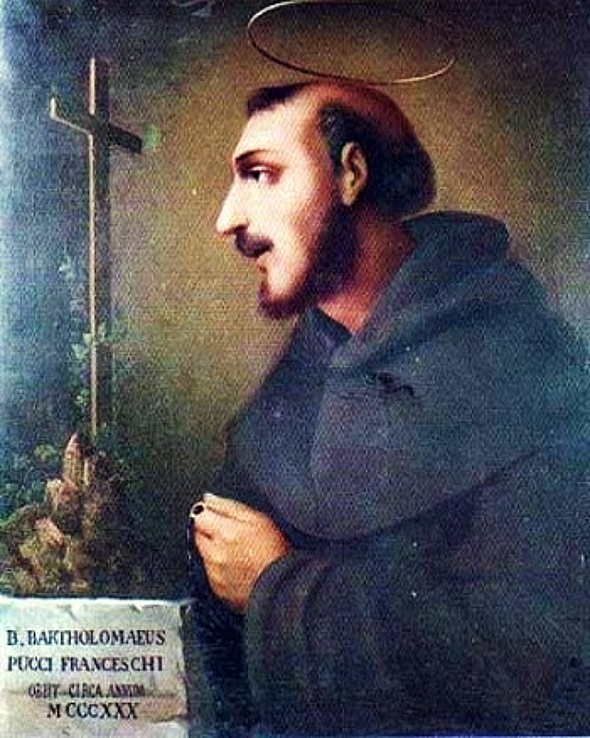
St Aristone St Arsenius of Latro St Aubert of Arras Bl Bartholomew of Tuscany St Edburgh of Lyminge St Einhildis of Hohenburg Bl Elizabeth Rose St Jodocus
St Martino de Pomar St Odilia of Alsace (c 660-720) Virgin Abbess St Roswinda St Tassio of Bavaria St Wifred
Blessed Mercedarian Knights – (7 beati): A group of Mercedarian knights who fought the enemies of the Catholic faith in the first century of the Order. • Blessed Bernardo de Podio • Blessed Giacomo de Copons • Blessed Giovanni de Bruquera • Blessed Guglielmo de Sa • Blessed Pietro Boguer • Blessed Pietro Ricart • Blessed Raimondo de Frexa
Martyrs of Jeongju – (6 saints): Six Christian laymen who were imprisoned, tortured and martyred together in the persecutions in Korea. They were beheaded on 13 December 1866 in Supjeong-i, Jeongju, Chungcheong-do, South Korea and Canonised on 6 May 1984 by St Pope John Paul II. • Bartholomaeus Chong Mun-Ho • Iosephus Han Won-So • Peter Cho Hwa-so • Petrus Son Son-Ji • Petrus Yi Myong-So • Petrus Chong Won-Ji
Martyrs of Sebaste – (5 saints): A group of Christians martyred together in the persecutions of Diocletian. We know little more than their names – Auxentius, Eustratius, Eugene, Mardarius and Orestes. They were martyred in c 302 at Sebaste, Armenia (in modern Turkey) and their relics are enshrined at the church of Saint Apollinaris in Rome, Italy.
Thought for the Day – 12 December – Meditations with Antonio Cardinal Bacci (1881-1971)
Peace of Soul
“Peace of soul is more to be desired than anything else in this world. Wealth, honours and pleasures are valueless, as long as we are discontented and disturbed at heart. Happiness is essentially internal, not external. Anyone who looks for it outside himself cannot find it, simply because it does not exist there. Interior peace, however, is capable of bringing us whatever happiness can be obtained in this world.
We can have this peace if, we avoid sin. The Holy Spirit assures us that “there is no peace for the wicked” (Isa 48:22). Our tranquillity will be increased by humility and gentleness. A haughty and ambitious man can never be at peace. “Come to me” Jesus invites us, “all you who labour and are burdened and I will give you rest. Take my yoke upon you and learn from me, for I am meek and humble of heart and you will find rest for your soul” (Mt 11:28-29).
The only way then, by which we can acquire peace of soul, is by avoiding sin, practising humility and obeying the law of God. The Saints possessed this serenity, even in times of trial and of suffering because they lived in God and were perfectly faithful to His law.”
Quote/s of the Day – 12 December – “Gaudete Sunday” – Readings: Zephaniah 3: 14-18; Psalm Isaiah 12: 2-6; Philippians 4: 4-7; Luke 3: 10-18
“Gaudete in Domino semper”
“Rejoice in the Lord always”
Philippians 4:4
“The very Son of God, Older than the ages, the Invisible, the Incomprehensible, the Incorporeal, the Beginning of beginning, the Light of light, the Fountain of Life and Immortality, the Image of the Archetype, the Immovable Seal, the Perfect Likeness, the Definition and Word of the Father: He it is, Who comes to His Own Image and takes our nature, for the Good of our nature and unites Himself to an intelligent soul for the good of the soul, to purify like by Like.”
St Gregory of Nazianzen (330-390) Father and Doctor of the Church
“Awake, you who lie in the dust, awake and give praise. Behold, the Lord comes with salvation. He comes with salvation, He comes with unction, He comes with glory. Jesus cannot come without salvation, Christ cannot come without unction, nor the Son of God without glory. For He Himself is salvation, He is unction, He is glory, as it is written, ‘A wise son is the glory of his father.‘”
St Bernard (1090-1153) MellifluousDoctor of the Church
One Minute Reflection – 12 December – “Gaudete Sunday” – Readings: Zephaniah 3: 14-18; Psalm Isaiah 12: 2-6; Philippians 4: 4-7; Luke 3: 10-18 – Feast of Our Lady of Guadalupe
“I am baptising you with water, for repentance but one mightier than I is coming. I am not worthy to loosen the thongs of his sandals. He will baptise you with the holy Spirit and fire.” – Luke 3:16
REFLECTION – “Now we must focus on what is meant by these sandals from the spiritual standpoint. We know that Moses said long ago: “Put off your sandals from your feet, for the place on which you are standing is holy ground.” We read that Joshua, the son of Nun likewise said, “Remove the latchet from your sandal.” But as to why they are ordered by the Lord to remove their sandals, we must understand this to be the type of a future truth. According to the law, if a man is unwilling to accept the wife of his brother after his brother’s death, he should take off his shoes, so that another may marry her and succeed, by right of law. As to the commandment prefigured in law, we find it fulfilled in Christ, Who is the true Bridegroom of the Church. Therefore, because neither Moses the lawgiver, nor Joshua the leader of the people, could be the bridegroom of the Church, not without good reason, was it said to them that they should remove the sandals from their feet because the true future Bridegroom of the Church, Christ, was to be expected. John says concerning Him: “He who has the bride is the bridegroom.” To bear, or loosen His sandals, John professed himself to be unworthy. The Lord Himself, through David, revealed that these sandals signify the footsteps of Gospel preaching when he says, “Upon Edom I cast my shoe,” through His Apostles, He will take the steps of Gospel ,teaching everywhere.” – St Chromatius of Aquileia Bishop and Father of the Church (Died c 407) (Tractate on Matthew, 11). About St Chromatius below.
PRAYER – O infinite God and only love of my soul, I thank You, for having given me Your Son. For the sake of this same Son, accept me and bind me with chains of love to my Redeemer. Amen … St Alphonsus Liguori (1696-1787) Most Zealous Doctor Our Lady of Guadalupe, Pray for us!
Saint of the Day – 12 December – Saint Pope Callistus II (c 1065-1124) Bishop of Rome 1 February 1119-13 December 1124) Born in c1065 Quingey, France as Guy or Guido and died on 13 December 1124 in Rome, Italy of natural causes. Also known as – Calixtus II, Guy of Burgundy, Guido of Burgundy.
Guy or Guido in Italian, as he was called before his elevation to the Papacy, was the son of Count William of Burgundy and both by his father’s and mother’s side, was closely connected with nearly all the Royal Houses of Europe. He was the uncle of the Queen of France, cousin of the King of England, related to the German Emperor. His brother Hugh had been appointed Archbishop of Besançon and he himself was named Archbishop of Vienne in 1088 and afterwards appointed Cardinal and Papal Legate in France by Pope Paschal II.
When appointed Papal Legate in France by Pope Paschal II, Guido strenuously opposed Paschal’s “Privilege,” extorted by Henry V, which would have surrendered most of the political positions held by Church officials in the Empire. After protesting the “Privilege” at the Lateran Synod of 1112, he called and presided over a Synod of French and Burgundian Bishops at Vienne, which denounced lay investiture of the clergy as heretical and excommunicated Henry V as hostile to the welfare of the Church. When Gelasius II, who succeeded Pascal, refused to confirm the “Privilege,” the angry Henry V set up Archbishop Burdinus of Braga as antipope Gregory VIII and installed him in Rome. Gelasius was forced to spend his brief, harassed Pontificate in exile and died at Cluny within a year. Some of the Cardinals who had come to Cluny now elected Guido, who was crowned in Vienne on 1 February 1119.
Callistus took immediate steps to establish peace with the imperial government, since both sides were tired of the long investiture struggle. Henry V favourably received a Papal Embassy and temporarily withdrew his support from Gregory VIII. A meeting between Pope and Emperor was arranged.
After presiding over a Synod at Toulouse (1119), which was mainly concerned with reform of the French Church, Callistus proceeded to Reims, where he held a great Council (1119), attended by some 400 Prelates and by Louis VI of France. Negotiations with Henry V broke down after he came to Mousson with a large army and Papal plans to meet with the Emperor were abandoned. The Emperor was excommunicated again (October 1119).
Callistus then went to Rome, where he was enthusiastically received by the people, who had meanwhile driven out the antipope. He allied himself with the Normans, who aided in the capture of antipope Gregory VIII. Gregory, who had taken refuge at Sutri, was held prisoner and subsequently other enemies of the Pope in Italy were overcome too.
Callistus then sent a new embassy to Henry V. A preliminary understanding with a truce was arranged at Würzburg in 1121. The following year, the famous Concordat of Worms (1122) was arrived at, in a Synod held in that City. Because of the Pope’s patience and perseverance, the Concordat was a reasonably satisfactory arrangement for both sides, although a complete victory for neither, bringing peace to both Empire and Church, to the great relief of Christendom.
The First Lateran Council (1123), convoked by Callistus, solemnly confirmed the Concordat of Worms and issued Decrees against clerical marriage and simony. It provided penalties against violators of the Truce of God and against forgers of Ecclesiastical documents and renewed Indulgences for crusading.
During his Pontificate, Callistus also secured from Henry I of England, the acceptance of his candidate, Thurstan, for the Archbishopric of York, transferred metropolitan rights in Spain from the ancient See of Merida to the popular See of Santiago de Compostela and settled the old French rivalry over metropolitan disagreements between Aries and Vienne, in favour of the latter.
Callistus died in 1124 and after some dispute Honorius II was selected as his successor. As to the great influence of the reign of Callistus II on the policy of the Church, there can be no dispute. Owing mainly to him ,the concessions so weakly made by Pope Paschal II were recalled and on his own accession to the Papal throne, his firmness and strength of character secured a settlement of the controversy between Church and State which, although not entirely satisfactory, was at least sufficient to assure a much needed peace.
Through his exertions he put an end to the wholesale bestowal of Ecclesiastical offices by laymen; he re-established the freedom of canonical elections and secured recognition of the principle that Ecclesiastical jurisdiction can come, only from the Church, while on the other hand, he conceded to the secular authorities, the influence to which they were rightly entitled, in the election of Prelates who were at the same time the most powerful and richest subjects of the State.
Callistus II was not very remarkable for his literary productions, yet a few works have come down to us which are ascribed to his pen. They are: “De Miraculis Sancti Jacobi Apostoli,” “De obitu et Vita Sanctorum,”,”Vita Caroli Magni Imperatoris.” Many letters attributed to him are preserved.
Martyrs of Alexandria – (6 saints): A group of six Christians martyred for their faith during the persecutions of Decius. We know little more than five of their names – Alexander, Ammonaria, Dionysia, Epimachus and Mercuria. They were burned to death c 250 in Alexandria, Egypt.
Martyrs of Trier – (4 saints): A group of six Christians martyred for their faith during the persecutions of Decius. We know little more than five of their names – Alexander, Ammonaria, Dionysia, Epimachus and Mercuria. They were burned to death c 250 in Alexandria, Egypt.
Thought for the Day – 11 December – Meditations with Antonio Cardinal Bacci (1881-1971)
The Use and Abuse of the Sacraments
“Let us go back in our imagination to the day when we were Baptised. That was the day of our spiritual rebirth, when we were cleansed from original sin and enriched by the gift of grace, which is the life of the soul. On this solemn occasion, we promised, through the agency of our Godparents, to remain faithful to the trust which we had received and to renounce Satan and whatever else might have power to extinguish our supernatural life and to plunge us into sin.
Have we kept these promises, which were made4 on our behalf and which we repeated from time to time before the Altar as we grew older? Every gift of God demands our gratitude and our co-operation. It is our own grave loss, if we remain cold and indifferent, in spite of the precious favours which we received from God. God is infinitely good and merciful but, precisely because of this, He demands generous co-operation on our part. If we abuse His graces, He will leave us to our own devices. We shall no longer be aware of His inspirations and His appeals to us to advance in virtue. What is to happen to us then? We shall be like an arid plain on which only weeds and thorns can grow. Our lives will be meaningless and purposeless, for God and everlasting happiness are the only goals worthy of our pursuit.”
Quote/s of the Day – 11 December – Saturday of the Second week of Advent
“Let us become like Christ, since Christ became like us. He assumed the worse, that He might give us the better; He became poor, that we through His poverty, might be rich.”
St Gregory of Nazianzen (330-390) Father and Doctor of the Church
“Those who refuse to be humble cannot be saved. They cannot say with the prophet: See, God comes to my aid; the Lord is the helper of my soul. But anyone who makes himself humble, like a little child, is greater in the kingdom of heaven.”
St Bede the Venerable (673-735)
“Let all your desires then be, directed toward Him, the Infinite One, the Giver of all Good.”
Bl Jacopone da Todi (1230-1306)
“Who could ever soften this heart of mine but YOU alone O Lord!”
St Francis Borgia (1510-1572)
“Unreasoning and stupid that you look for God where He is not! Listen and be filled with awe – God is in our hearts, I know it. God lives in the human heart when this heart lives withdrawn from all that is not Him, when this heart heeds God’s knock at it’s door (Rv 3,20) and, sweeping and cleaning all its rooms, makes itself ready to welcome Him who alone truly satisfies.”
One Minute Reflection – 11 December – Saturday of the Second week of Advent, Readings: Sirach 48:1-4, 9-11; Psalm 80:2ac and 3b, 15-16, 18-19; Matthew 17: 9-13
“I tell you that Elijah has already come and they did not recognise him but did to him, whatever they pleased.” – Matthew 17:12
REFLECTION – “Our Lord bore witness that John is the greatest of the prophets, yet he received the Spirit according to a certain degree, since John received a spirit like that of Elijah.
Just as Elijah went to dwell in solitude, so God’s Spirit led John to dwell in the wilderness, mountains and caves. A raven flew to Elijah’s help by feeding him; John ate locusts. Elijah wore a leather belt and John wore a leather loincloth round his hips. Elijah was persecuted by Jezebel; Herodias persecuted John. Elijah rebuked Ahab; John rebuked Herod. Elijah divided the waters of the Jordan; John opened up baptism. Elijah’s double measure of spirit came to rest on Elisha; John placed his hands on Our Lord, Who then received the Spirit without measure (Jn 3:34). Elijah opened Heaven and went up; John saw the Heavens opened and the Spirit of God descending and resting on our Saviour.” – St Aphrahat “Jacob” (c 280-c345) Monk and Bishop near Mosul (The Demonstrations, no 6, 13).
PRAYER – Almighty God, let the splendour of Your glory dawn in our hearts. May the coming of Your only Son, dispel all darkness and reveal that we are children of light and Truth. and may His Holy Mother always intercede for us in this vale of tears. We make our prayer through Our Lord Jesus Christ, in the unity of the Holy Spirit, one God with You, now and forever, amen.
The long list of Syriac writers whose works have come down to us, is headed by Aphraates (fourth century), surnamed the “Persian Sage”. The few biographical data which we possess of this illustrious author are gleaned from his own writings. From these we learn that he was born of pagan parents during the last half of the third century, very probably on the frontier region of the Persian empire. After his conversion to Christianity he embraced the religious life and was later elevated to the episcopate, on which occasion he assumed the Christian name of Jacob. The adoption of this name subsequently led to a confusion of identity, and for centuries the works of Aphraates were ascribed to the famous Jacob, Bishop of Nisibis (died 338). It was not until the tenth century that the “Persian Sage” was finally identified with Aphraates, the name under which he is known to modern scholars. The writings of Aphraates consist of twenty-three “Demonstrations,” or homilies on moral and controversial topics.
Our Morning Offering – 11 December – As Sunday is the Feast of Our Lady of Guadalupe and today is Mary’s Saturday, let us pray this powerful indulgenced prayer now.
Our Lady of Guadalupe, Mystical Rose Prayer to Our Lady of Guadalupe By St Pius X (1835-1914)
Our Lady of Guadalupe, Mystical Rose, make intercession for the holy Church, protect the Sovereign Pontiff, help all those who invoke thee in their necessities, and since thou art the ever Virgin Mary and Mother of the true God, obtain for us from thy most holy Son the grace of keeping our faith, sweet hope in the midst of the bitterness of life, burning charityand the precious gift of final perseverance. Amen
This prayer was approved and enriched with an indulgence of five hundred days by St Pope Pius X at an audience held on August, 1908 and was included in the official edition of approved indulgenced prayers (1950). Raccolta number 389, 500 days Indulgence, St Pope Pius X audience, 15 August 1908.
Saint of the Day – 11 December – Blessed Jerome Ranuzzi OSM (c 1410-c 1468) “The Angel of Good Counsel,” “The Blessed Bachelor,” Priest and Friar of the Order of the Servants of Mary, the Servites, Theologian, Adviser both spiritual and secular, renowned for his learning and scholarship, Penitent and Hermit with a great love of solitude and silence. Born as Girolamo Ranuzzi in c 1410 at Sant’Angelo, Vado, Pesaro-Urbino, Italy and died in c 1468 of natural causes. Also known as – Jerome Ranucci, Girolamo and “The Angel of Good Counsel,” “The Blessed Bachelor.” Additional Memorials, 10 and 12 December on local calendars. Patronage – Sant’Angelo, Vado. His body is incorrupt and is still available for veneration in St Mary of the Servites.
The Roman Martyrology states: “In Sant’Angelo in Vado always in the Marches, Blessed Girolamo, Priest of the Order of the Servants of Mary, who in solitude and silence reached the wisdom of holiness.”
“Becoming holy is the vocation of every man and woman who comes into this world. The Servants of Mary lived this noble toil within the Church of Christ. The results of this journey are as colourful as ever, precisely because the Holy Spirit renews everything without ever repeating Himself. The saints are alike but none are the same.” (The journey of the Servants of Mary, Servitium editrice, 2001).
Jerome, who was born around 1410 in Sant’Angelo in Vado, of the wealthy Ranuzzi family (or Ranucci, according to the spelling of contemporary documents). The family became regarded as part of nobles. In 1404, his father Antonio, became the municipal guardian for the Parish of St Eusebius, two kilometers away from his home.
Jerome, while still a teenager, entered the Convent of the Servants of Mary of St Angelo in Vado, from where he went to Bologna to study. There he applied himself to philosophy and theology, obtaining the degree of bachelor and after being Ordained a Priest, returned to his hometown Convent.
The first documented report of Jerome’s presence in St Angelo among the Servants of Mary, dates to 1449. Jerome was at this time, the Vicar of the Provincial Superior Michael Ambrosi, who called a General Chapter at his Convent in St Angelo. Another document certifying his presence in the said Convent is his signing of a contract dated 20 November 1454.
Jerome was undoubtedly a man of doctrine, in fact, several of his famous contemporaries mention him in their historical works as the “bachelor,” from the title obtained for his studies in the ecclesiastical universities of the time.
The famous Duke Federick of Montefeltro of Urbino, used his advice for the most important affairs and then always venerated his memory, when, as shown by subsequent documents of 1471 and 1478, the Duke Federick visited Jerome’s Convent to pay homage at the Tomb of the Blessed.
His contemporaries and fellow Friars, narrated his fame as an ascetic, a rigorous penitent, a persuasive adviser, who was very much alive in St Angelo in Vado. A local tradition indicates a cave where our Blessed Jerome lived his periods of solitude located along the road that leads to Montata, right where the Shrine of the Virgin called “Madonnina di Pagnignò” stands.
In 1462 the “Blessed Bachelor” began the foundation of the female Monastery of St Mary of Gracenear, nearby the male Monastery.
The date of his death is around 1468 and from then on, a crowd of people went to his Tomb to recommend themselves to his intercession. Shortly after his death, when the fame of miracles grew, Friar Jerome was acclaimed a saint by the voice of the people. His incorrupt body is preserved under the main Altar of the Church of St Mary of the Servites, where it is still venerated by the faithful today.
After a long process, his cult was confirmed on 1 April 1775 by Pope Pius VI with the title of Blessed. The Roman Martyrology celebrates his feast today, the 11th December.
Bl Hugolinus Magalotti Bl Jean Laurens Blessed Jerome Ranuzzi OSM (c 1410-c 1468) “The Angel of Good Counsel,” “The Blessed Bachelor,” Priest and Friar of the Order of the Servants of Mary, the Servites Bl Kazimierz Tomasz Sykulski
Bl Martín Lumbreras Peralta Bl Martino de Melgar Bl Melchor Sánchez PérezPens Bl Pilar Villalonga Villalba Bl Severin Ott Martyrs of Saint Aux-Bois – (3 saints): Two Christian missionaries and one of their local defenders who faith in the persecutions of governor Rictiovarus – Fuscian, Gentian and Victoricus. They were beheaded in 287 in Saint Aux-Bois, Gaul (in modern France).
Martyrs of Rome – (3 saints): Three Christians murdered in the persecutions of Diocletian for giving aid to Christian prisoners – Pontian, Practextatus and Trason. They were imperial Roman citizens. They were martyred in c 303 in Rome, Italy.

You must be logged in to post a comment.