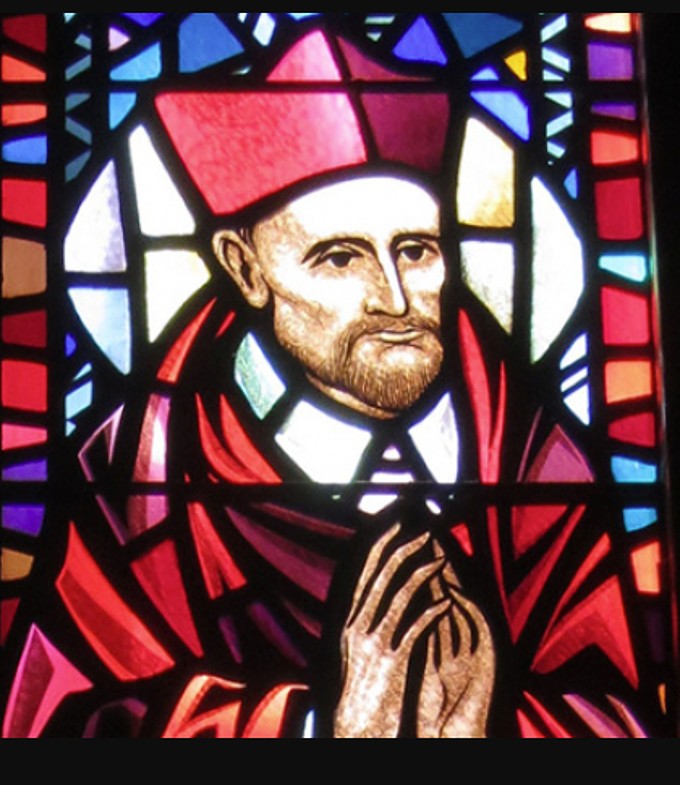
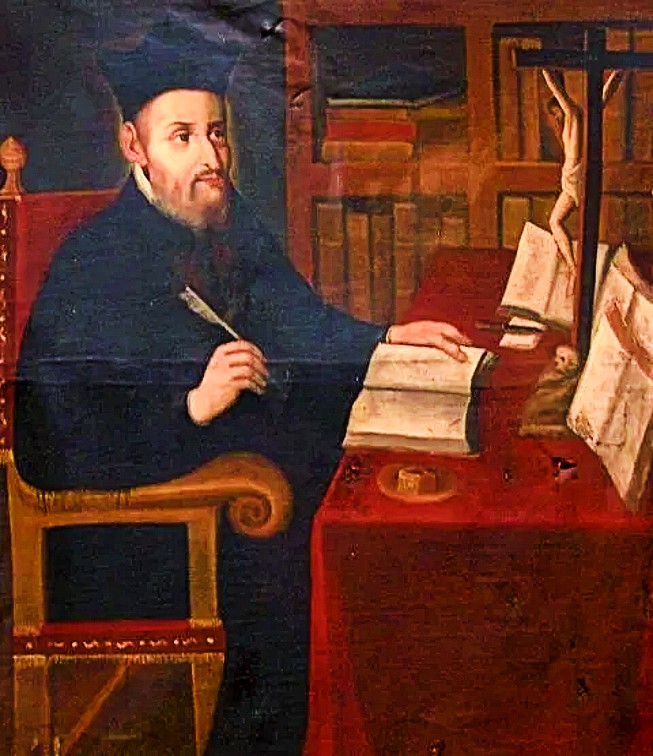
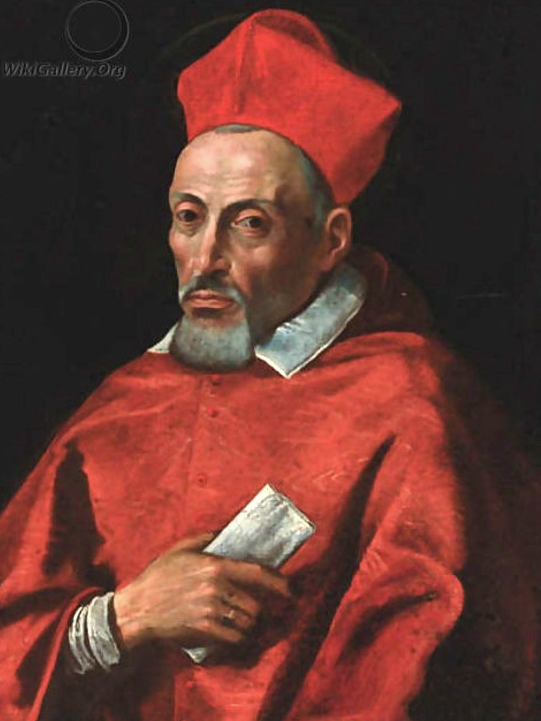
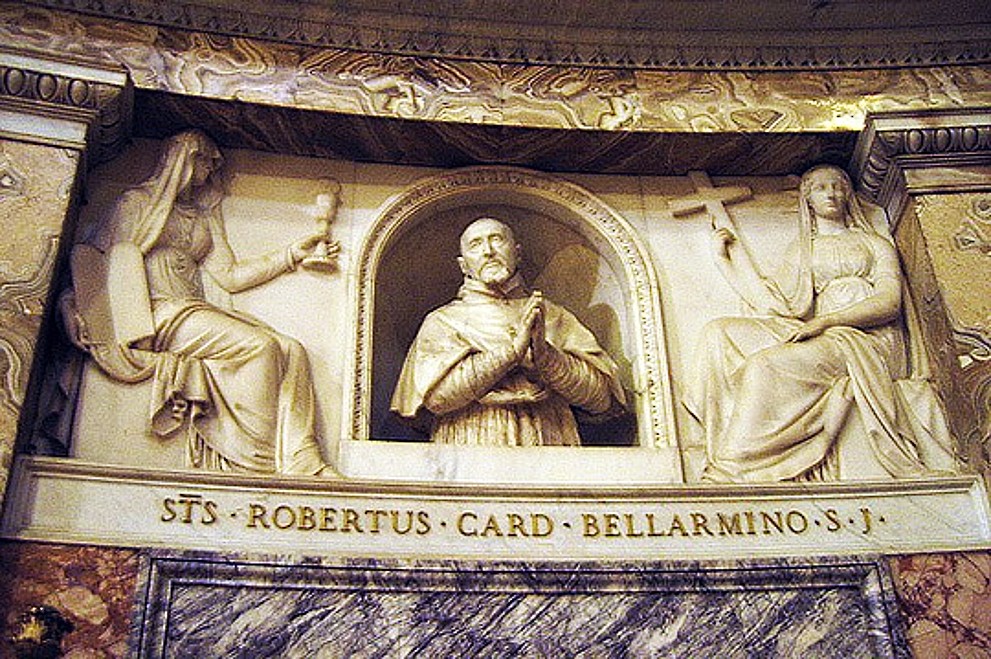
Saint of the Day – 13 May – St Robert Bellarmine SJ (1542-1621) Archbishop of Capua, Italy, Rector of the Roman College, Confessor, Cardinal, Doctor of the Church, Theologian, Professor, Writer, Preacher, Mediator. Known as – “The Father of the Poor,” “The Hammer of Heretics,” “The Model of Promoters and Defenders of the Catholic religion.”
St Robert Bellarmine From the Roman Breviary
Robert, a native of Montepulciano, Italy and of the noble family of Bellarmine, had for his mother, the most pious Cynthia Cervini, sister of Pope Marcellus II. From the first, he was conspicuous for exemplary piety and most chaste manners, earnestly desiring this one thing, to please God alone and to win souls to Christ.
He attended the college of the Society of Jesus in his native town where he was highly commended for his intelligence and modesty. At the age of eighteen, he entered the same Society at Rome and was a model of all religious virtues. Having passed through the course of philosophy at the Roman College, he was sent firstly to Florence, then to Monreale, later to Padua to teach Sacred Theology and afterwards, to Louvain where, not yet a Priest, he ably discharged the office of preacher. After Ordination at Louvain, he taught Theology with such success, that he brought back many heretics to the unity of the Church and was regarded throughout Europe, as a most brilliant Theologian, so much so, that St Charles, Bishop of Milan and others, keenly sought after him.
Recalled to Rome at the wish of Pope Gregory XIII, he taught the science of controversial Theology at the Roman College and there, as Spiritual Director, he guided the angelic youth St Aloysius in the paths of holiness. He governed the Roman College and then the Neapolitan Province of the Society of Jesus, in accordance with the spirit of St Ignatius.
Again summoned to Rome, he was employed by Clement VIII in the most important affairs of the Church, with the greatest advantage to the Christian state. Then, against his will and in spite of opposition, he was admitted among the number of the Cardinals because, as the Pontiff publicly declared, he did not have his equal among Theologians in the Church of God, at the time. He was Consecrated Bishop by the same Pope and administered the Archdiocese of Capua in a most saintly manner for three years. Having resigned this office, he lived in Rome until his death, as a most impartial and trusty Counsellor to the Supreme Pontiff. He wrote much and in an admirable manner.
His principal merit lies in his complete victory in the struggle against the new errors, during which he distinguished himself as a strenuous and outstanding vindicator of Catholic tradition and the rights of the Roman See. He gained this victory by following St Thomas as his guide and teacher, by a prudent consideration of the needs of his times, by his irrefragable teaching and by a most abundant wealth of testimony, well-chosen from the Sacred Writings and from the very rich fountain of the Fathers of the Church. He is eminently noted for very numerous short works, for fostering piety and especially for that golden Catechism, winch he never failed to explain to the young and ignorant, both at Capua and at Rome, although preoccupied with other very important affairs.
A contemporary Cardinal declared, that Robert was sent by God for the instruction of Catholics, for the guidance of the good and for the confusion of heretics. St Francis de Sales regarded him as a fountain of learning; the Supreme Pontiff Benedict XIV called him the Hammer of Heretics and Benedict XV proclaimed him the Model of Promoters and Defenders of the Catholic religion.
He was most zealous in the religious life and he maintained that manner of life after having been chosen as one of the empurpled Cardinals. He did not want any wealth beyond what was necessary; he was satisfied with a moderate household and scanty fare and clothing. He did not strive to enrich his relatives and he could scarcely be induced to relieve their poverty, even occasionally. He had the lowest opinion of himself and was of wonderful simplicity of soul. He had an extraordinary love for the Mother of God; he spent many hours daily in prayer. He ate very sparingly and fasted three times a week. Uniformly austere with himself, he burned with charity towards his neighbour and was often called the Father of the poor. He earnestly strove that he might not stain his baptismal innocence by even the slightest fault.
Almost eighty years old, he fell into his last illness at St Andrew’s on the Quirinal hill and in it, he showed his usual radiant virtue. Pope Gregory XV and many Cardinals visited him on his deathbed, lamenting the loss of such a great pillar of the Church. He fell asleep in the Lord in the year 1621, on the day of the Sacred Stigmata of St Francis, the memory of which, he had been instrumental in having celebrated everywhere. The whole City mourned his death, unanimously proclaiming him a Saint. The Supreme Pontiff Pius XI inscribed his name, firstly, in the number of the Blessed, and then in that of the Saints and shortly afterwards, by a Decree of the Sacred Congregation of Rites, he declared him a Doctor of the Universal Church.
His body is honoured with pious veneration at Rome in the Church of St Ignatius, near the tomb of St Aloysius, as he himself had desired. Blessed be God in His Holy Saints! Amen.
St Anno of Verona St Argentea of Cordoba St Euthymius the Illuminator Bl Fortis Gabrielli Bl Gerard of Villamagna Bl Gemma of Goriano St Glyceria of Trajanopolis
St Lucius of Constantinople St Mael of Bardsey Bl Magdalen Albrizzi St Merewenna of Rumsey St Mucius of Byzantium St Natalis of Milan St Onesimus of Soissons St Servatus of Tongres St Valerian of Auxerre
Martyrs of Alexandria: A group of Christians Martyred in the Church of Theonas, Alexandria, Egypt by order of the Arian Emperor Valens. Their names have not come down to us. 372 in Alexandria, Egypt.
Thought for the Day – 12 May – Meditations with Antonio Cardinal Bacci (1881-1971)
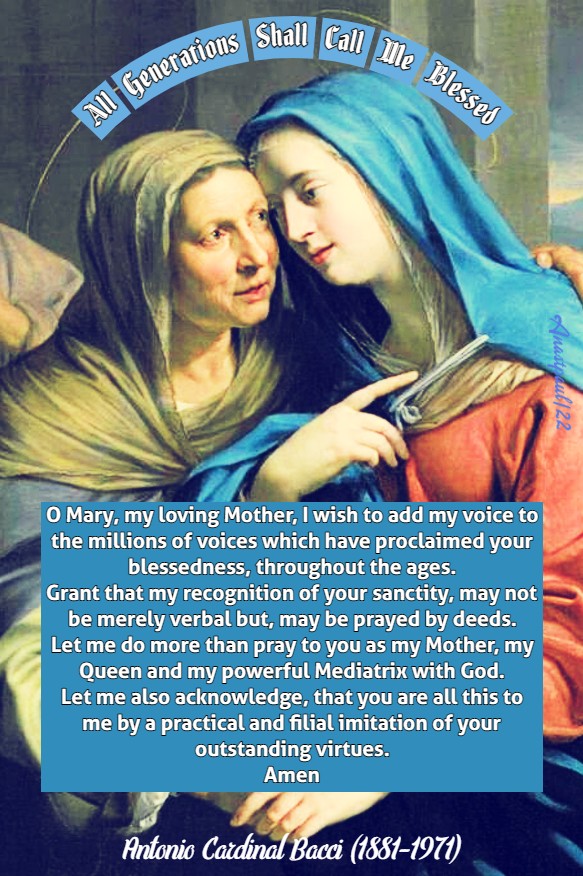
“All Generations Shall Call Me Blessed”
“O Mary, my loving Mother, I wish to add my voice to the millions of voices which have proclaimed your blessedness, throughout the ages. Grant that my recognition of your sanctity, may not be merely verbal but, may be prayed by deeds. Let me do more than pray to you as my Mother, my Queen and my powerful Mediatrix with God. Let me also acknowledge, that you are all this to me by a practical and filial imitation of your outstanding virtues. Amen.”
Quote/s of the Day – 12 May – Wisdom 5:1-5, John 4:46-53.
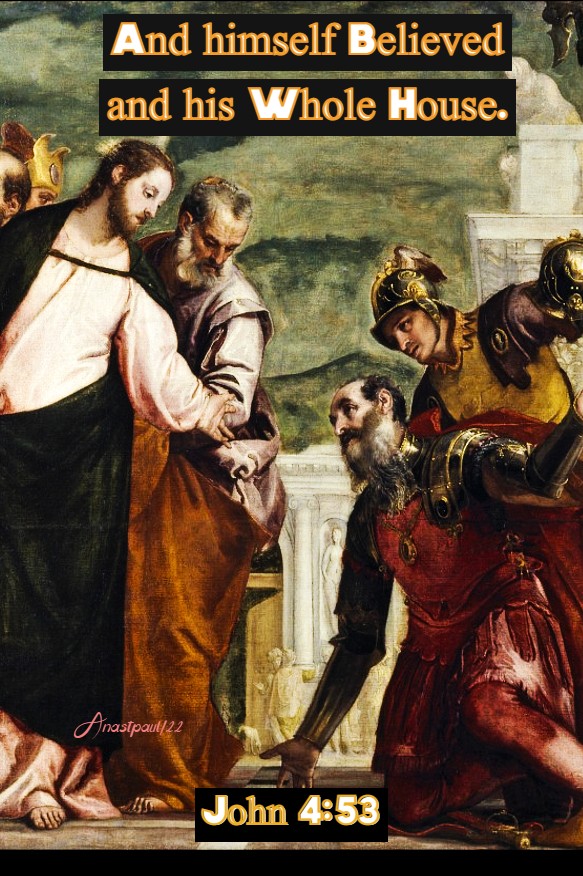
“And himself believed and his whole house.”
John 4:53
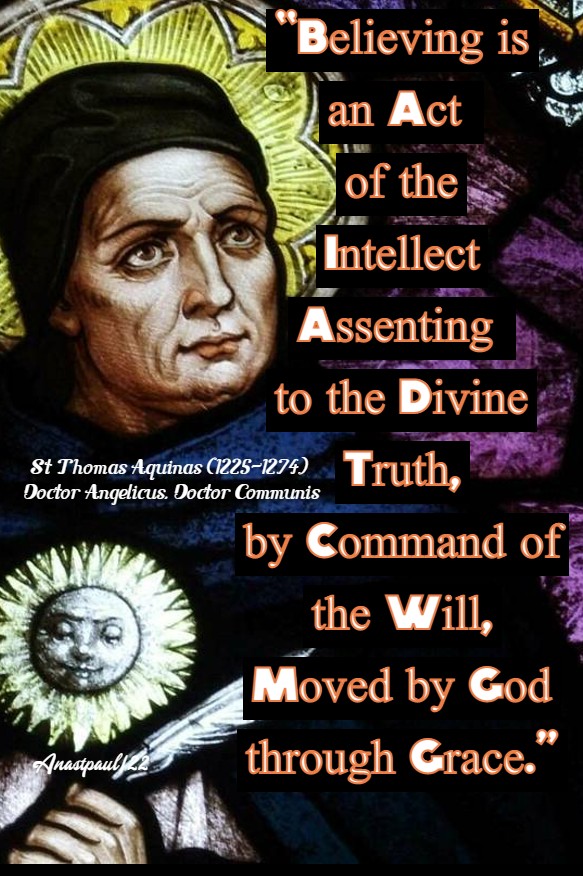
“Believing is: an act of the intellect assenting to the divine truth, by command of the will, moved by God through grace.”
St Thomas Aquinas (1225-1274) Doctor Angelicus. Doctor Communis
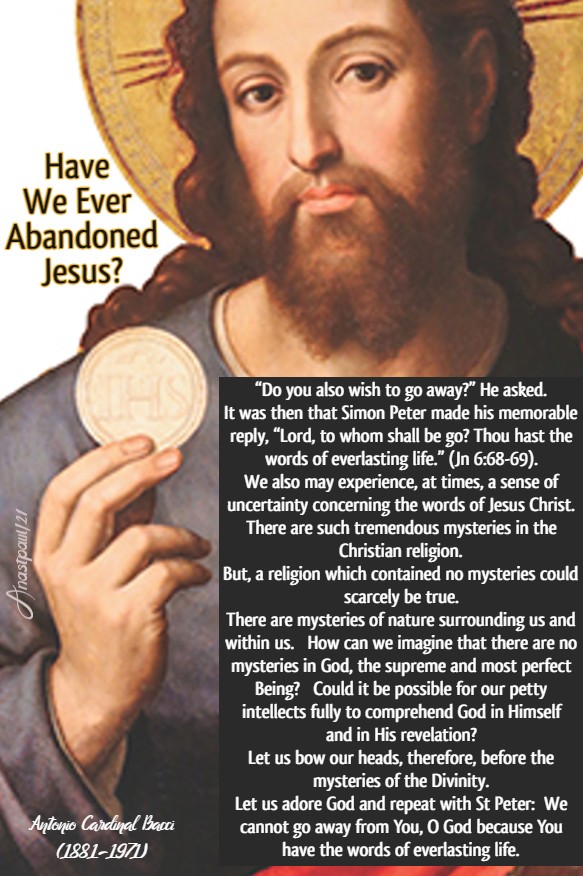
“Do you also wish to go away?” He asked. It was then that Simon Peter made his memorable reply, “Lord, to whom shall be go? Thou hast the words of everlasting life.” (Jn 6:68-69). We also may experience, at times, a sense of uncertainty concerning the words of Jesus Christ. There are such tremendous mysteries in the Christian religion. But, a religion which contained no mysteries could scarcely be true. There are mysteries of nature surrounding us and within us. How can we imagine that there are no mysteries in God, the supreme and most perfect Being? Could it be possible for our petty intellects fully to comprehend God in Himself and in His revelation? Let us bow our heads, therefore, before the mysteries of the Divinity. Let us adore God and repeat with St Peter: We cannot go away from You, O God because You have the words of everlasting life.”
Antonio Cardinal Bacci (1881-1971)
The Apostles’ Creed
I believe in God, the Father Almighty, Creator of heaven and earth and in Jesus Christ, His only Son, our Lord, who was conceived by the Holy Spirit, born of the Virgin Mary, suffered under Pontius Pilate, was crucified, died and was buried; He descended into hell; on the third day He rose again from the dead; He ascended into heaven and is seated at the right hand of God the Father Almighty; from thence He shall come to judge the living and the dead. I believe in the Holy Spirit, the Holy Catholic Church, the communion of Saints, the forgiveness of sins, the resurrection of the body and life everlasting. Amen
One Minute Reflection – 12 May – The Memorial of Sts Nereus, Achilleus, Domitilla (Virgin) and Pancras, Martyrs – Wisdom 5:1-5, John 4:46-53.
“Unless you see signs and wonders, you believe not.” – John 4:48
REFLECTION – “Whoever examines the majesty of God will be crushed by His glory” (Prv 25,27 Vg). God can do works that surpass man’s understanding… Faith is required of you and sincerity of life – not high intelligence, nor penetrating knowledge of the mysteries of God. If you do not understand, nor grasp what is below you, how will you comprehend what is above you? Be subject to God, submit yourself to the faith and the light of knowledge will be given to you, as much as you need and can use.
Some have grave temptations concerning faith and sacraments, which are not to be imputed to them but rather, to the enemy. Take no notice, do not argue with your thoughts, nor answer the doubts with which the devil attacks you; believe God’s word, believe His saints and prophets and the wicked enemy will be routed. It is often most profitable to God’s servant, to endure such things. For the devil does not tempt the infidel or sinner, of whom he has already secure possession but he uses various means, to tempt and harass the devout faithful.
Go on then with simple unquestioning faith and approach the Sacrament with reverent beseeching. Anything you cannot understand, commit it surely to God, Who is omnipotent. God does not deceive you – the over-confident person deceives himself. God walks in step with the simple ones, He shows Himself to the humble ones, He grants understanding to the little ones; “He reveals hidden meanings to little ones” and hides away His grace from the inquisitive and the proud. Human reason is feeble and fallible but true faith cannot be deceived. All use of reason, all human inquiry should walk in the footsteps of faith; it should not go on in front of it, nor call it in question.” – Thomas à Kempis CRSA (1380-1471) (The Imitation of Christ IV, 18).
PRAYER – May the holy feast of Your Martyrs, Nereus, Achilles, Domitilla and Pancras, ever comfort us, we beseech You, O Lord and make us worthy to serve You. And grant, we beseech Thee, O Lord God, unto all Thy servants, that they may remain continually in the enjoyment of soundness, both of mind and body, and by the glorious intercession of the Blessed Mary, always a Virgin, may be delivered from present sadness and enter into the joy of Thine eternal gladness. Through Jesus Christ, Thy Son our Lord, Who lives and reigns with Thee, in the unity of the Holy Ghost, God, world without end. Amen.
Our Morning Offering – 12 May – “The Month of the Blessed Virgin Mary”
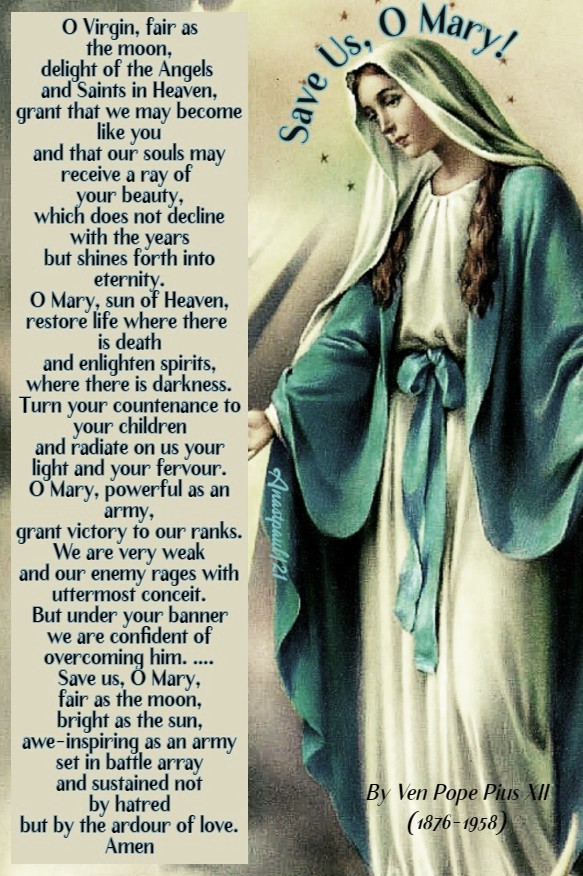
Save Us, O Mary! By Venerable Pope Pius XII (1876-1958) (Pontiff 1939-1958)
O Virgin, fair as the moon, delight of the Angels and Saints in Heaven, grant that we may become like you and that our souls may receive a ray of your beauty, which does not decline with the years but shines forth into eternity. O Mary, sun of Heaven, restore life where there is death and enlighten spirits, where there is darkness. Turn your countenance to your children and radiate on us your light and your fervour. O Mary, powerful as an army, grant victory to our ranks. We are very weak and our enemy rages with uttermost conceit. But under your banner we are confident of overcoming him. …. Save us, O Mary, fair as the moon, bright as the sun, awe-inspiring as an army set in battle array and sustained, not by hatred but by the ardour of love. Amen.
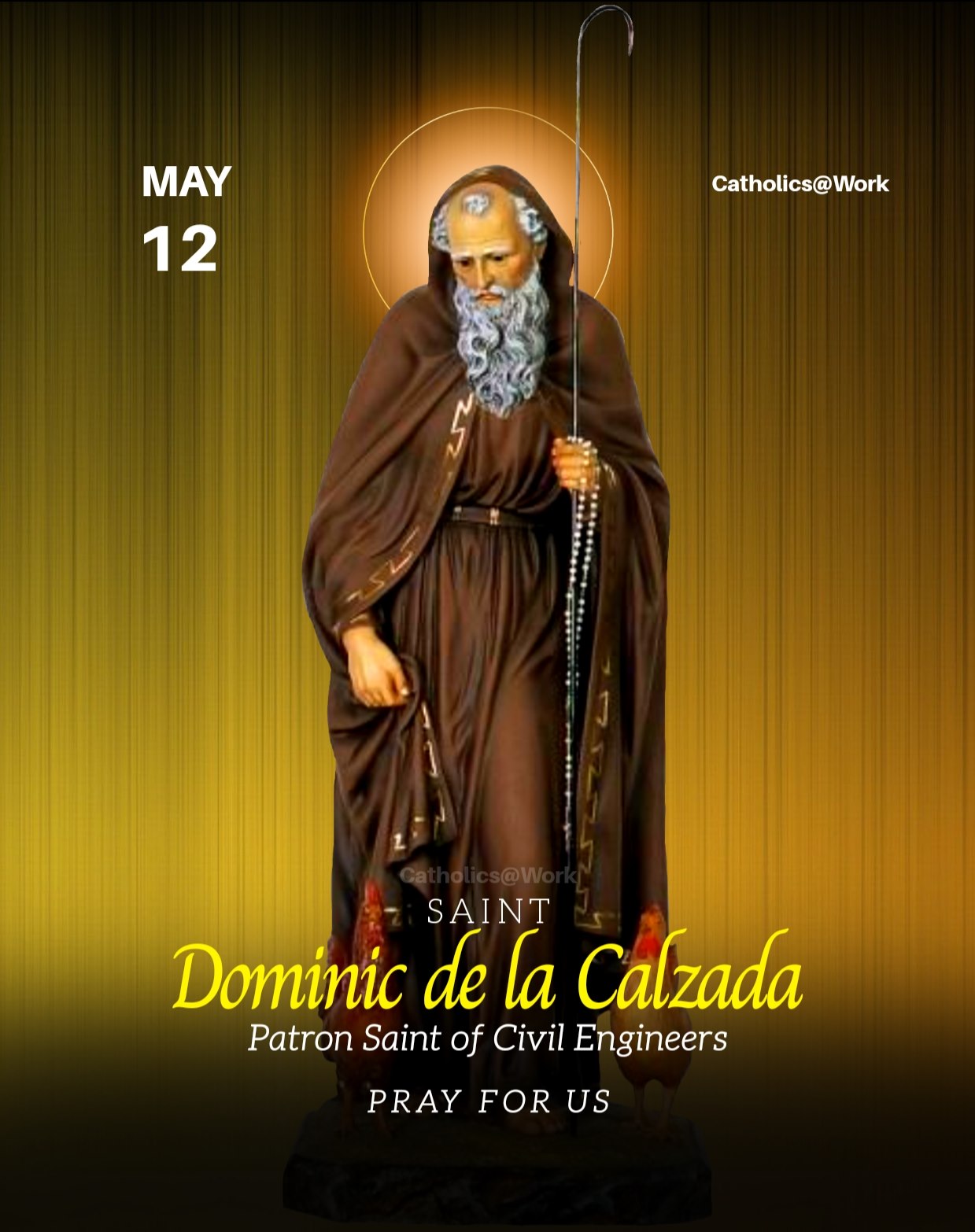
Saint of the Day – 12 May – St Domingo de la Calzada / Dominic of the Causeway ((1019 – 1109) Priest, Hermit, Bridge Builder, a road, a Hospital/Hostel, a Church, in effect a town, Miracle-worker. Born in 1019 as Domingo García in Victoria, Biscay, Spain and died in 1109 at Santo Domingo de la Calzada, Spain, of natural causes. Patronages – Spanish civil engineers. eye diseases, the blind, the Pilgrim’s Town of Santo Domingo de la Calzada, Spain. Also known as – Dominic of Landeveien, Domenico, Dominicus…
Dominic was the son of a peasant named Ximeno García. His mother was named Orodulce. We know little about his early years, except that he worked as a shepherd and then tried, in vain, to be admitted as a Monk in the Benedictine Monasteries of Valvanera and San Millán de la Cogolla. This failure caused him to retire as a Hermit to a secluded place, Ayuela, near present-day Santo Domingo de la Calzada. There he led a contemplative life until 1039.
Fundamental to his later development was the relationship he established, around this date, with Gregory, Bishop of Ostia, who arrived in Calahorra as a Papal Envoy to combat a terrible locust plague that devastated the Navarrese and Riojan territories. For five years and until the death of the future Ostiense Saint in 1044, Dominic became Bishop Gregory’s close collaborator.
He received the Priestly Ordination from Gregory’s hands. Together, they decided to build a first wooden bridge over the Oja River to facilitate the transit of pilgrims to Compostela.
After the death of Saint Gregory, Dominic returned to the area where he had spent his years of retirement and undertook a profound colonising work there. He cut down the forests, cleared the land and began the construction of a stone road that was a deviation from the traditional path between Logroño and Burgos but which became, from that moment on, the main route between Nájera and Redecilla.
To improve the conditions of the pilgrims on their way to Compostela. who began to cross it, he replaced the first wooden bridge with another made of stone and built a complex consisting of a hospital, a well and a Church, to attend to the needs of travellers. Today, it is the Casa del Santo, which is a used as a hostel by modern-day pilgrims.
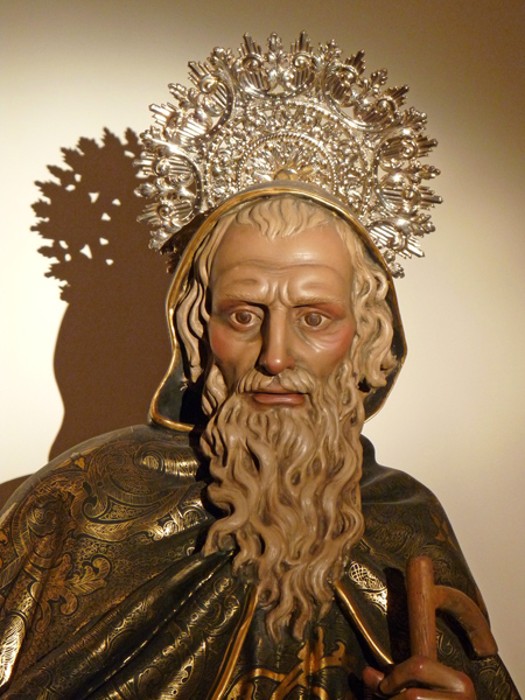
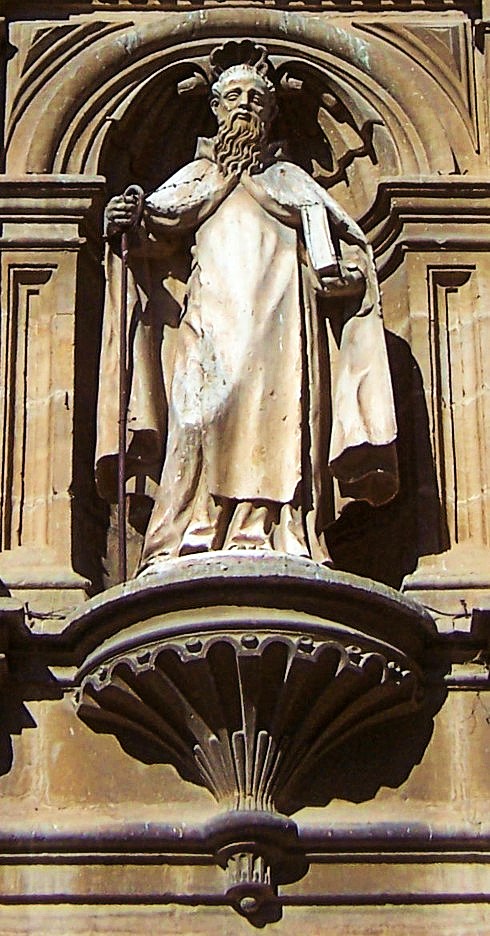
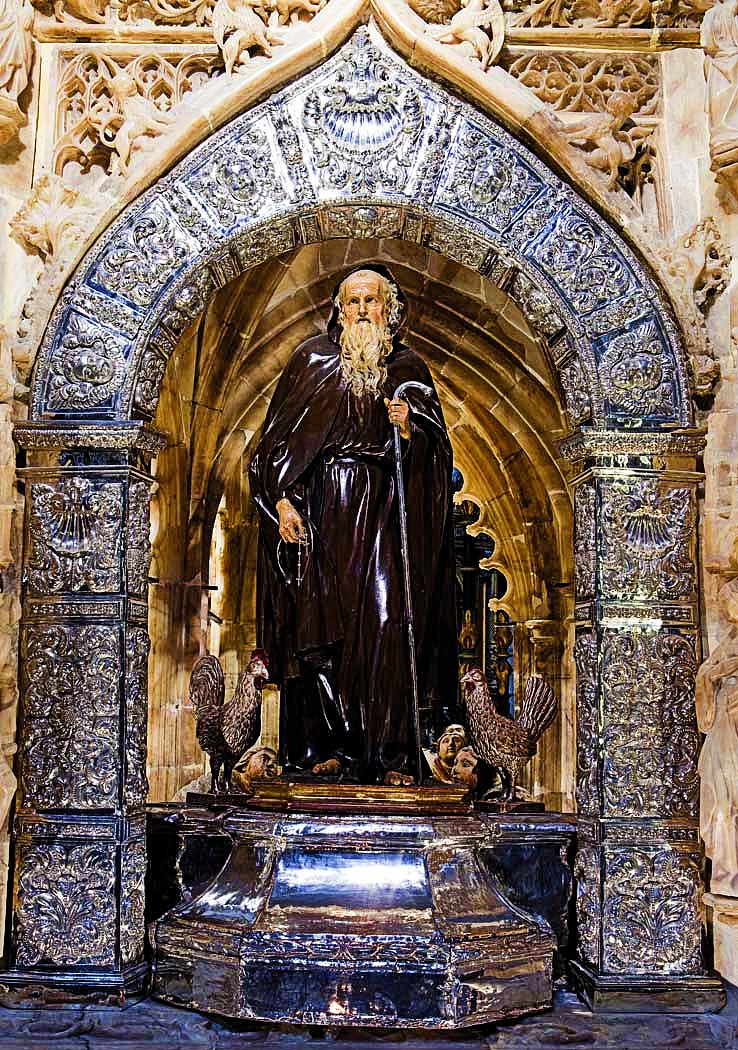
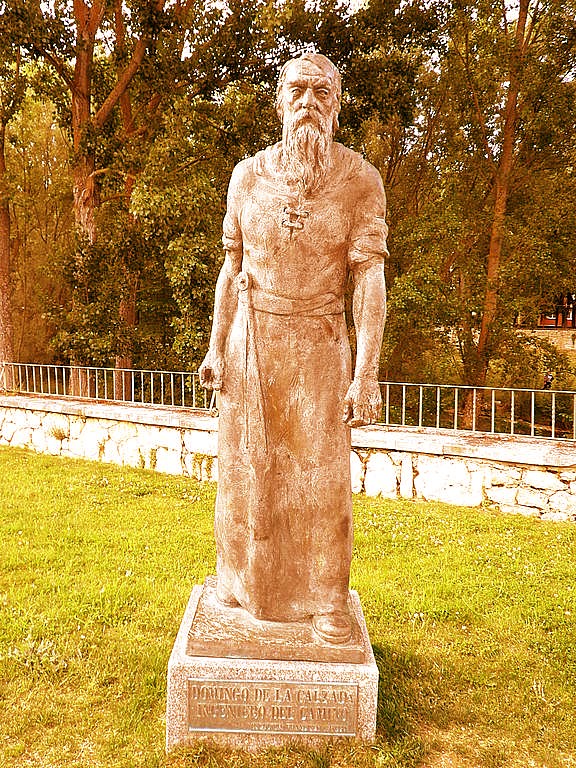
Statue of Dominic de la Calzada, Cathedral of Santo Domingo de la Calzada.
The town of Santo Domingo de la Calzada began as a few houses built around the Hermitage of the Saint in his lifetime. At his death in 1109, the village had grown in population. King Alfonso VI of Castile annexed La Rioja in 1076 and seeing that Dominic’s efforts contributed to the Castilianisation of the region, decided to support him and his projects. He visited Dominic in 1090 and, thereafter, Dominic, assisted by his disciple Juan de Ortega, began construction on a Church dedicated to Christ and the Virgin Mary. Outside, and attached to its walls, the Saint chose a place for his own burial. The Church was Consecrated by the Bishop of Calahorra in 1106.
Dominic died in 1109. His Church, later the Cathedral of Santo Domingo de la Calzada, was where he was buried, as he had requested and it was elevated to the rank of Cathedral after being placed in the jurisdiction of the Diocese of Calahorra in the 1230s.
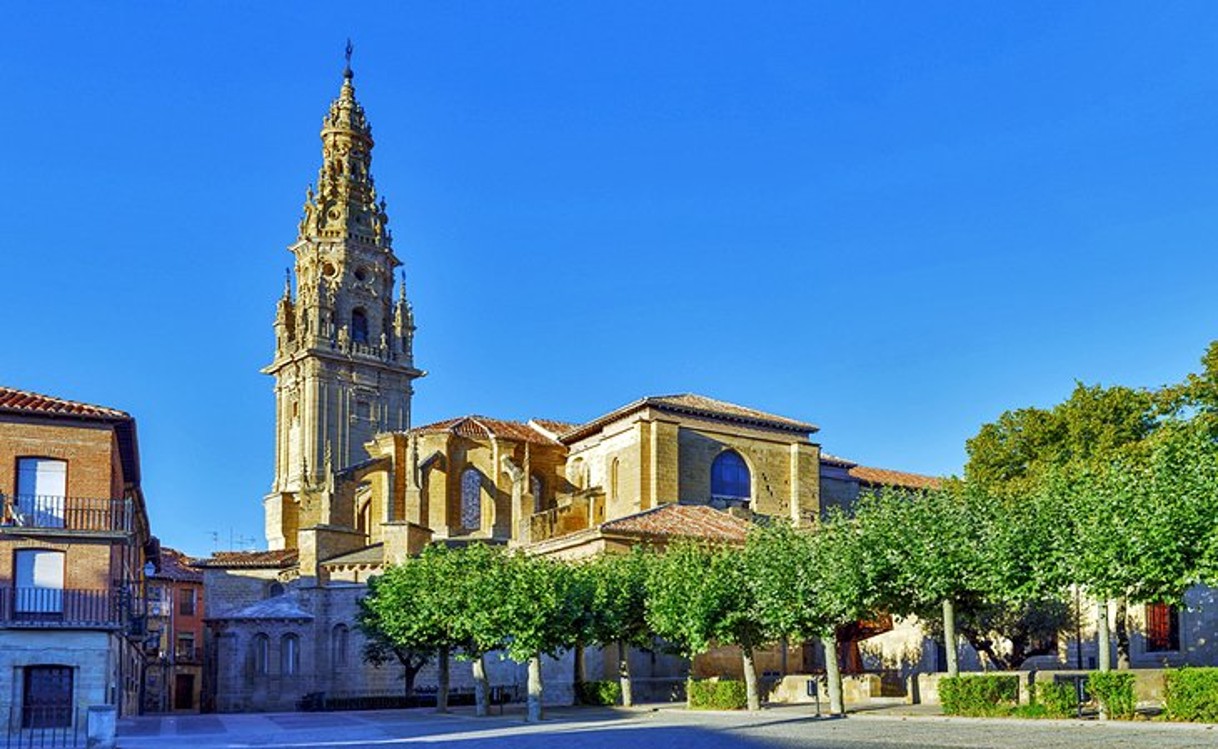
Santo Domingo de la Calzada
Many miracles are attributed to the intercession of St Dominic, among them the exorcism of a French knight who had been possessed by the devil and who was freed of his affliction by visiting the tomb of Dominic. Another miracle, concerns the healing of a German pilgrim named Bernard in the 15th Century, who was cured of an affliction of the eyes, by his prayers at Dominic’s tomb. Another concerns the healing of a blind Norman who was granted his eyesight by God, when he prayed fervently for Dominic’s intercession in the Cathedral.
The most famous miracle, however, concerns that of the rooster and the chicken, which occurred at Santo Domingo de la Calzada. In the 14th Century, a German 18-year-old named Hugonell, from Xanten, went on pilgrimage to Santiago de Compostela with his parents. A Spanish girl at the hostel where they were staying made sexual advances toward Hugonell. But he rejects her advances. Angry at this, the girl hid a silver cup in the German’s bag and then informs the authorities, that the youth had stolen it. Hugonell was sentenced to the gallows, in accordance with the laws of Alfonso X of Castile.
The parents sadly decided to examine their son’s body, still hanging on the gallows,but suddenly heard his voice telling them that Saint Dominic had saved his life! His parents quickly made their way to Santiago de Compostela to see the Magistrate. The Magistrate, who was eating dinner, remarked: “Your son is as alive as this rooster and chicken that I was feasting on before you interrupted me.” And at that moment, the two birds jump from the plate and begin to sing and crow happily.
The first element of the tale, that of a hanged pilgrim, is found in many collections of miracles, with the restoring of life after the death of the victim attributed not only St Dominic, but also to Saint James the Great, or to the Virgin Mary. The second part of the tale, the miracle of the dancing and singing roasted chicken and rooster, is unique to St Dominic de la Calzada.
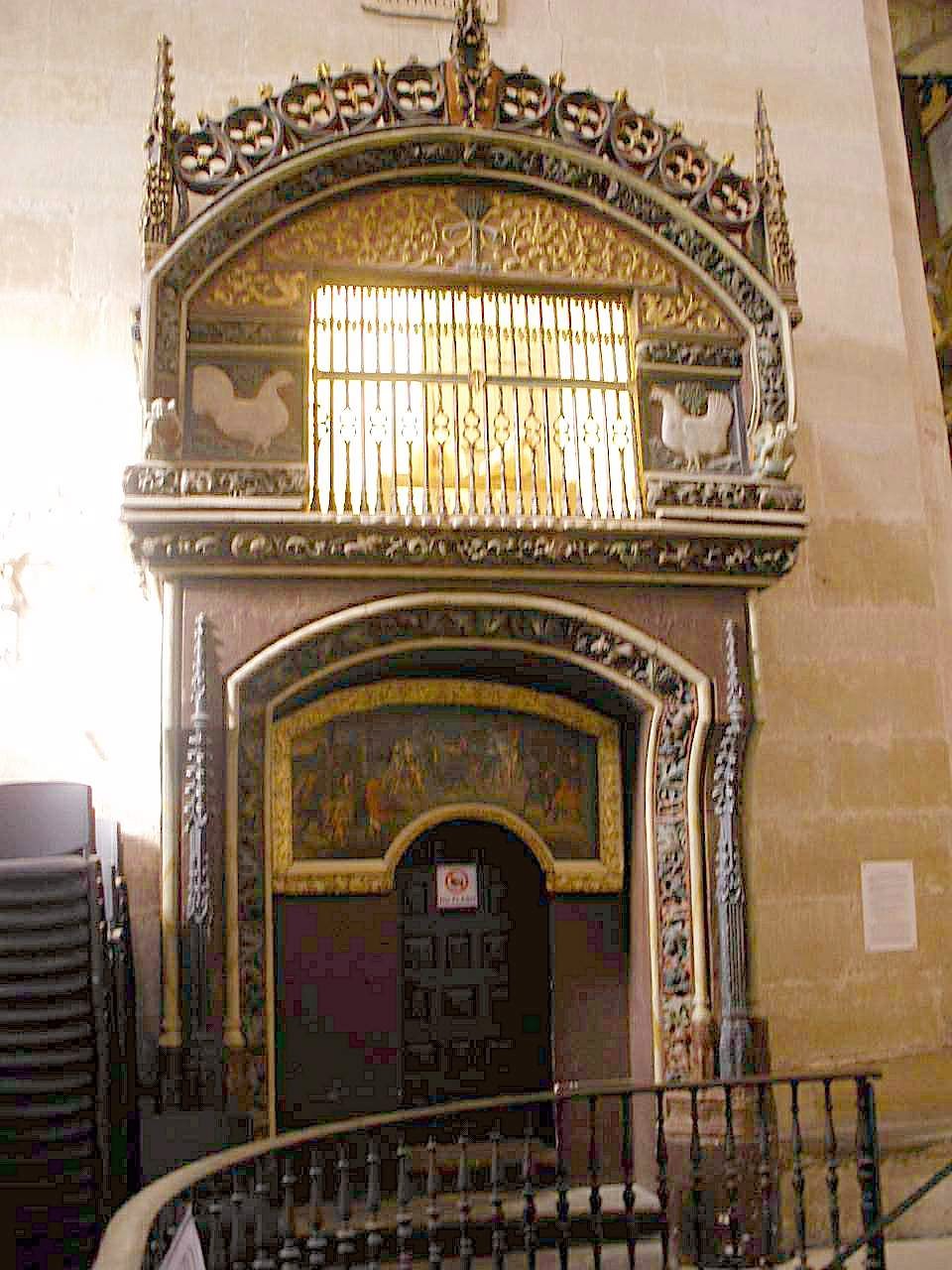
In memory of Dominic’s miracle, a rooster and chicken, with white feathers, are kept alive at the Cathedral all year round. A different rooster and chicken are alternated each month, although they are called descendants of the original birds, who miraculously danced even though roasted. The pairs of roosters and chickens, when they are not at the Cathedral, are kept in a chicken coop called the Gallinero de Santo Domingo de la Calzada, which the Confraternity of St Dominic maintains with the help of donations. A wayside Shrine built in 1445, holds a relic associated with the miracle: a piece of wood from the gallows from which Hugonell was hanged and then restored to life. Medieval pilgrims gathered the feathers of these favoured birds, or received them from the Priest and would affix them to their hats. Another tradition claimed that if the birds ate breadcrumbs directly from the end of the pilgrim’s staff, that pilgrim would arrive safely in Compostela.
The German pilgrim Hermann Künig (15th century) claimed to have seen the room where the roasted birds began to sing and dance. Documents written by pilgrims, state that Hugonell’s shirt as well as the gallows, had been conserved by the Church of Santo Domingo. These artifacts are now lost
The rooster and chicken, are visible behind the bars of its ornate coop.
St Crispoldus St Cyril of Galatz St Dedë Malaj St Diomma of Kildimo St Dionysius of Asia St Domingo de la Calzada / Dominic of the Causeway ((1019 – 1109) Priest, Hermit, Bridge Builder St Ejëll Deda St Ephrem of Jerusalem
Blessed Joanna of Portugal OP (1452-1490) Religious of the Second Order of St Dominic, Virgin, Princess of Portugal of the House of Aviz, daughter of King Afonso V of Portugal and his first wife Isabella of Coimbra, Penitent. About Blessed Joanna whom the Portuguese called “Saint Princess Joanna”: https://anastpaul.com/2020/05/12/saint-of-the-day-12-may-blessed-joanna-of-portugal-1452-1490/
Bl Juan de Segalars St Lucien Galan
St Maria Domenica Mazzarello
St Modoald of Trier St Palladius of Rome St Philip of Agira St Richrudis of Marchiennes St Theodora of Terracina St Thomas Khampheuane Inthirath
Thought for the Day – 11 May – Meditations with Antonio Cardinal Bacci (1881-1971)
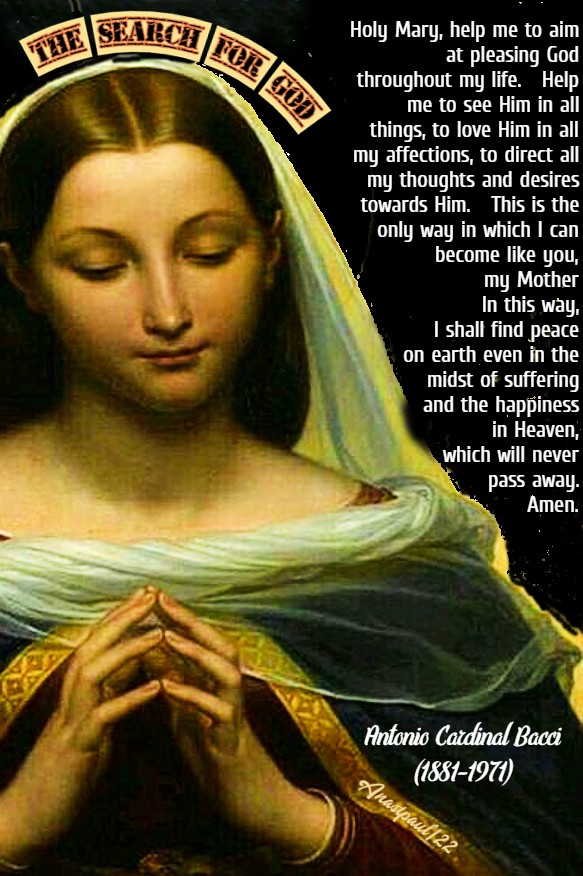
The Search for God
“Holy Mary, help me to aim at pleasing God throughout my life. Help me to see Him in all things, to love Him in all my affections, to direct all my thoughts and desires towards Him. This is the only way in which I can become like you, my Mother. In this way, I shall find peace on earth, even in the midst of suffering and the happiness in Heaven, which will never pass away. Amen.”
Quote/s of the Day – 11 May – Octave Day of St Joseph
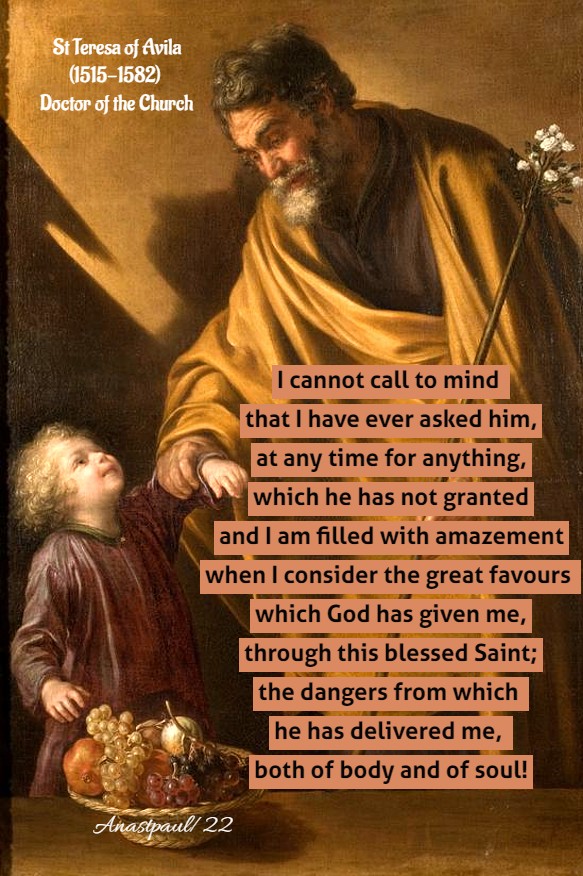
“I cannot call to mind that I have ever asked him, at any time for anything, which he has not granted and I am filled with amazement when I consider the great favours which God has given me, through this blessed Saint; the dangers from which he has delivered me, both of body and of soul!”
St Teresa of Avila (1515-1582) Doctor of the Church
“It is impossible, that he could be denied the favours for which he asks and which we should request him to obtain for us. Let us go to him trustingly but, let us remember, that the surest way of being heard by him, is to imitate his wonderful virtues, especially his humility, his spirit of prayer, his purity and his calm desire always, to do God’s will.”
Antonio Cardinal Bacci (1881-1971)
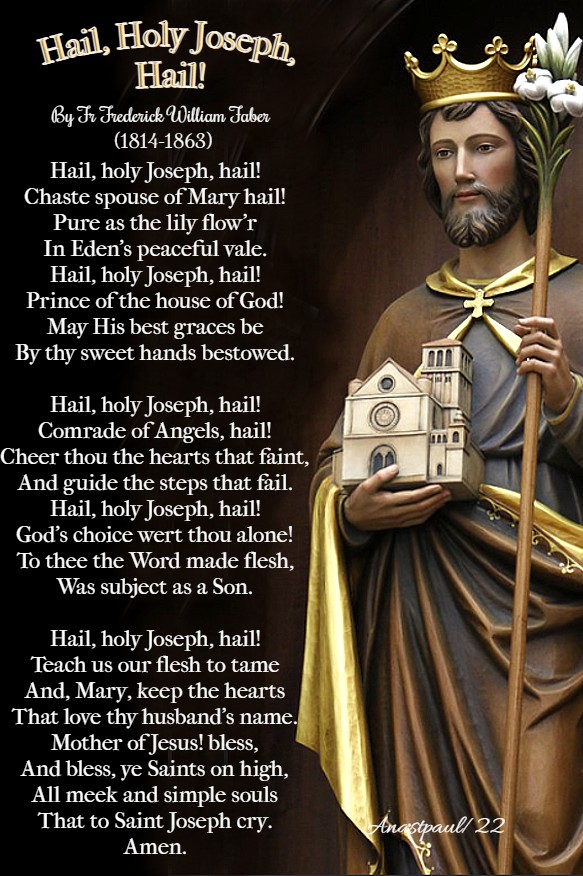
Hail, Holy Joseph, Hail! By Father Frederick William Faber CO (1814-1863)
Hail, holy Joseph, hail! Chaste spouse of Mary hail! Pure as the lily flow’r In Eden’s peaceful vale. Hail, holy Joseph, hail! Prince of the house of God! May His best graces be By thy sweet hands bestowed.
Hail, holy Joseph, hail! Comrade of Angels, hail! Cheer thou the hearts that faint, And guide the steps that fail. Hail, holy Joseph, hail! God’s choice wert thou alone! To thee the Word made flesh, Was subject as a Son.
Hail, holy Joseph, hail! Teach us our flesh to tame And, Mary, keep the hearts That love thy husband’s name. Mother of Jesus! bless, And bless, ye Saints on high, All meek and simple souls That to Saint Joseph cry. Amen.
One Minute Reflection – 11 May – Octave Day of St Joseph – Genesis 49:22-26, Luke 3:21-23
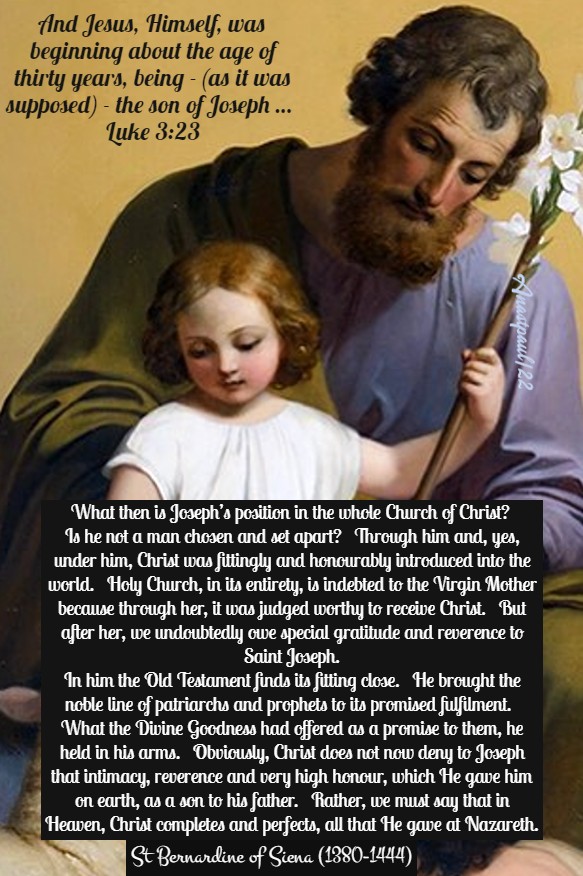
“And Jesus, Himself, was beginning about the age of thirty years, being – (as it was supposed) – the son of Joseph … “” – Luke 3:23
REFLECTION – “There is a general rule, concerning all special graces granted to any human being. Whenever the divine favour chooses someone to receive a special grace, or to accept a lofty vocation, God adorns the person chosen, with all the gifts of the Spirit, needed to fulfil the task at hand.
This general rule is especially verified in the case of Saint Joseph, the Foster-Father of our Lord and the husband of the Queen of our world, enthroned above the Angels. He was chosen by the eternal Father as the trustworthy Guardian and Protector of his greatest treasures, namely, his Divine Son and Mary, Joseph’s wife. He carried out this vocation with complete fidelity until at last God called him, saying: Good and faithful servant, enter into the joy of your Lord.
What then is Joseph’s position in the whole Church of Christ? Is he not a man chosen and set apart? Through him and, yes, under him, Christ was fittingly and honourably introduced into the world. Holy Church, in its entirety, is indebted to the Virgin Mother because through her, it was judged worthy to receive Christ. But after her, we undoubtedly owe special gratitude and reverence to Saint Joseph.
In him the Old Testament finds its fitting close. He brought the noble line of patriarchs and prophets to its promised fulfilment. What the Divine Goodness had offered as a promise to them, he held in his arms. Obviously, Christ does not now deny to Joseph that intimacy, reverence and very high honour which He gave him on earth, as a son to his father. Rather, we must say that in Heaven, Christ completes and perfects, all that He gave at Nazareth.
Now, we can see ,how the last summoning words of the Lord appropriately apply to Saint Joseph – Enter into the joy of your Lord. In fact, although the joy of eternal happiness enters into the soul of a man, the Lord preferred to say to Joseph – Enter into joy. His intention was, that the words should have a hidden spiritual meaning for us. They convey, not only that this holy man possesses an inward joy but also, that it surrounds him and engulfs him, like an infinite abyss.
Remember us, Saint Joseph and plead for us to your Foster-Child. Ask your most holy bride, the Virgin Mary, to look kindly upon us, since she is the Mother of Him Who, with the Father and the Holy Spirit, lives and reigns eternally. Amen.” – St Bernardine of Siena (1380-1444) (An excerpt on his Sermon 2 of St Joseph).
PRAYER – O God, Who in thine unspeakable foreknowledge, didst choose Thy blessed servant Joseph to be the husband of thine Own most holy Mother; mercifully grant, that now that he is in heaven with Thee, we, who on earth do reverence him for our Defender, may worthily be assisted by the succour of his prayers to Thee ,on our behalf. Who lives and reigns with God the Father, in the unity of the Holy Spirit, God, world without end. Amen (Collect).
Our Morning Offering – 11 May – “The Month of the Blessed Virgin Mary”
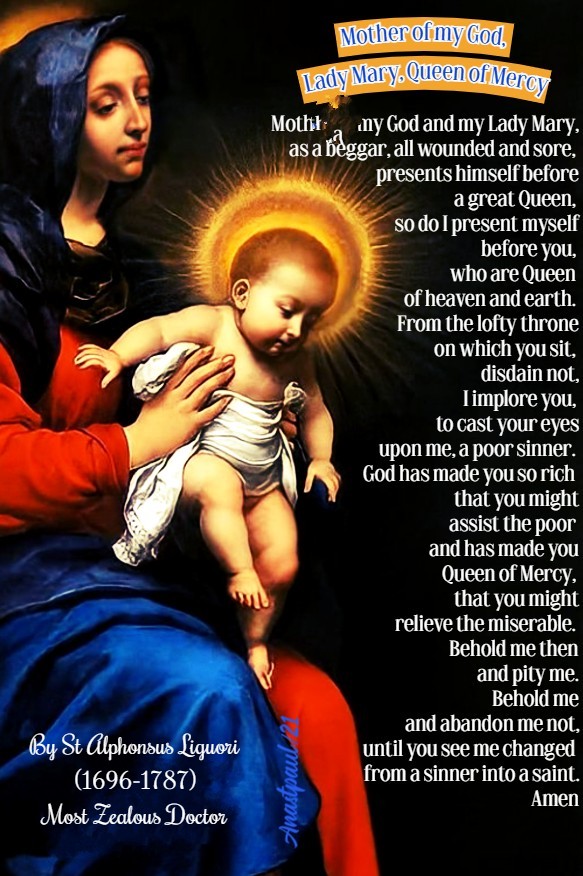
Mother of my God, Lady Mary, Queen of Mercy By St Alphonsus Liguori (1696-1787) Most Zealous Doctor
Mother of my God and my Lady Mary, as a beggar, all wounded and sore, presents himself before a great Queen, so do I present myself before you, who are Queen of heaven and earth. From the lofty throne on which you sit, disdain not, I implore you, to cast your eyes on me, a poor sinner. God has made you so rich that you might assist the poor and has made you Queen of Mercy, that you might relieve the miserable. Behold me then and pity me. Behold me and abandon me not, until you see me changed from a sinner into a saint. Amen
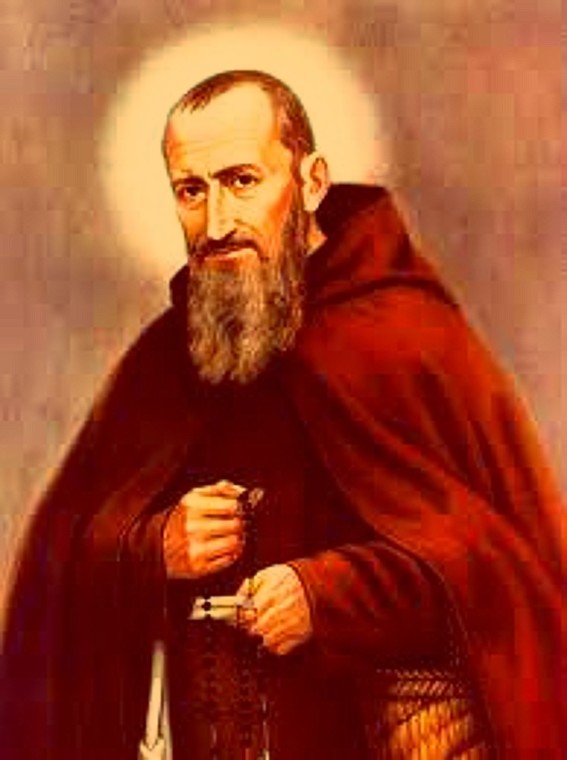
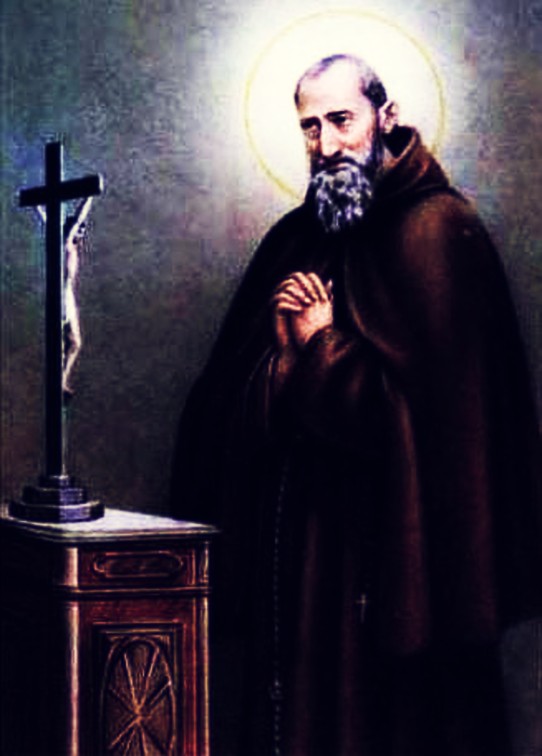
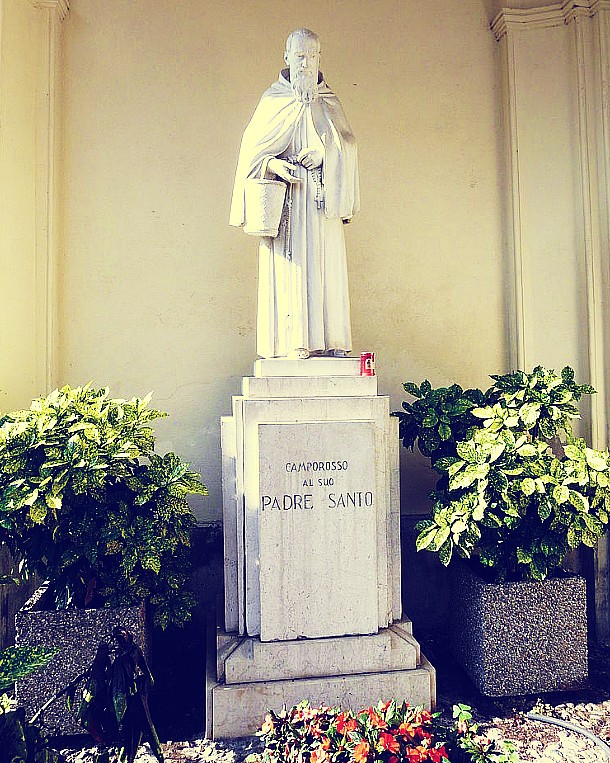
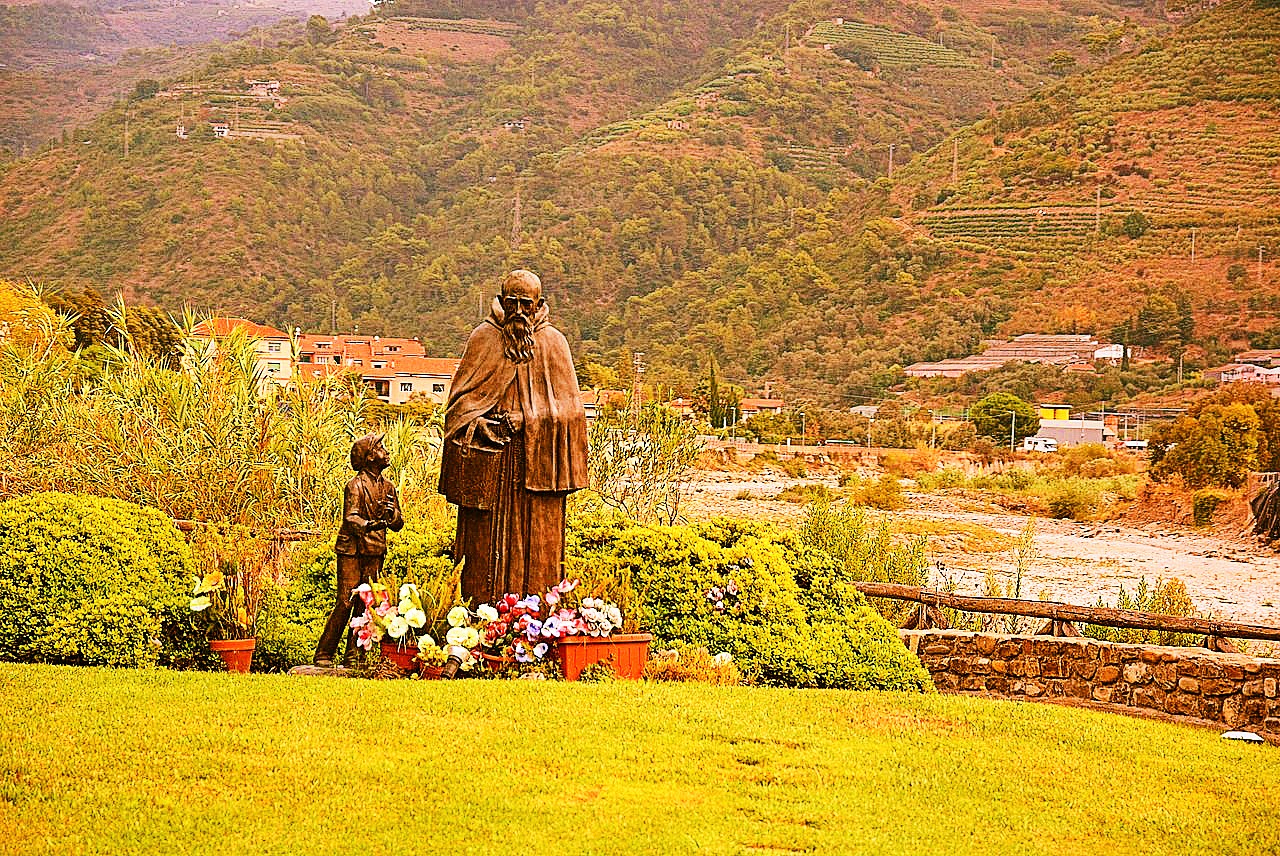
Saint of the Day – 11 May – St Francesco Maria da Camporosso OFM Cap (1804-1866) Lay Friar of the Friars Minor Capuchin Branch, “Quaestor” or Alms collector, as well as humble services such as Infirmarian, Cook, Gardener, Sacristan, gentle carer of the Poor, the sick, the imprisoned, the needy of all kinds, both spiritual and material. Francesco was gifted with immense graces to touch the hearts of all, both small and great and to listen and advise, often blessed with the gifts of prophecy and mind-reading. Born Giovanni Evangelista Croese on 27 December 1804 at Camporosso, Liguria, Kingdom of Sardinia. Italy and died on 17 September 1866 (aged 61) at Genoa, Italy. Patronage – Camporosso. Also known as St Frances Mary of Camporosso, Giovanni Croese, Antonio.
Giovanni Croese was born on 27 December 1804 in the small village of Camporosso near the town of Ventimiglia on the west coast of the Italian Riviera. He was the fourth of the five children of Anselmo Croese and Maria Antonia Gazzo, farm workers. ,Giovanni received his Baptism on 29 December in his local Parish Church and was named Giovanni Evangelista.
He attended school for a little while and was a less than enthusiastic student. So at seven years of age, Giovanni began to work with the family. He used to lead a small cow to pasture, a guarantee of something to eat for the family. He helped by working in the fields – small parcels of land, where the family could produce some oil, wine and vegetables. Marian devotion was strong in the family. When he was a little more than ten years old, he fell seriously ill. He was taken on pilgrimage to the Sanctuary of Our Lady of the Lake, near Nice. This impressed him deeply and he began to visit the Franciscan Friars and knew one of the Friars, Br. Giovanni, quite well.
On 14 October 1822, aged nearly 18, he entered the Conventual Friary at Sesti Ponente as a tertiary, with the name Br Antonio. Life here, however, was more comfortable than at home and the young man was dissatisfied. He longed for absolute poverty and for deeper meditative prayer. He decided then, to take the Capuchin habit. Unable to get the consent of his Superiors for a transfer, with the agreement of Br Alessandro Canepa da Genova, a Capuchin he knew, he fled Sestri one morning in late autumn. He was accepted at San Francesco di Volti, a Capuchin Hermitage where he received the name Br Francesco Maria. He remained a postulant for nearly three years. He was outstanding for his spirit of charity, even to the point of giving his food to the poor and contenting himself with the leftovers, as one witness testified. However, such deeds were not new to him. Since he was little, he was used to them. It is said that during a trip to Mentone, where his father was trying to set up a small business, he gave away a newly acquired piece of his clothing to a boy his age, dressed in rags. In a temper, his father gave him a sound slap. The young Giovanni replied by offering his other cheek, earning from his father a hug of admiration instead.
The experience at Voltri, in reality, completed that of Sestri. So, at the end of 1825, with the authority of the Vicar Provincial, Antonio da Cipressa, Br Francesco Maria left for the Hermitage of San Barnaba in Genoa, to do his Novitiate year. On 17 December he received the Novice Habit and his master, Br Bernardo da Pontedecimo, had to moderate the young man’s fervour. However, his companions, who shared that experience with him, remembered his goodness and cordiality. He had chosen to be a Lay Friar and would confide later, that, he did so after the example of Saint Francis: “it is preferable to be humble and obedient.”
One year later on 17 December 1826, aged 22, he professed his vows into the hands of Fr Samuel Bocciardo da Genova. He had just turned twenty two but his spiritual maturity convinced the Superiors, to assign him straightaway to the main Friary of the Province, that of the Immaculate Conception in Genoa. He would remain there for the rest of his life.
This Friary was a focal point of many religious and social activities. Apart from the usual Friary observances and apostolates, the Friary also included the Provincial Curia, the Infirmary, the “Lanificio” (a facility for spinning and weaving their own fabrics, traditionally in wool) for the clothing of the Friars, a Pharmacy which also offered health care to the public, the supervision of the public weigh scales and the distribution of firewood from the port bridge of the Immaculate Conception. The new arrival was given various tasks: – firstly, in the office and then, in an initiation to various humble services such as Infirmarian, Cook, Gardener, Sacristan. The processes say that he was “always tireless and calm.”
Almost five years passed uneventfully, but his charity grew ever more refined, so that in 1831 when the old rural Questor, Br Pio da Pontedecimo could no longer continue. Br Francesco Maria became his companion. His vocation and mission that would make him the most famous Questor of his Province was now beginning to take shape. He travelled about the little valley of Bisagno for around two years, visiting the various ‘villas’ of the farm workers. This was a precious apprenticeship that taught him his style of life and one of his ways to relate with the public, with words of faith, patience, charity, humility and devotion.
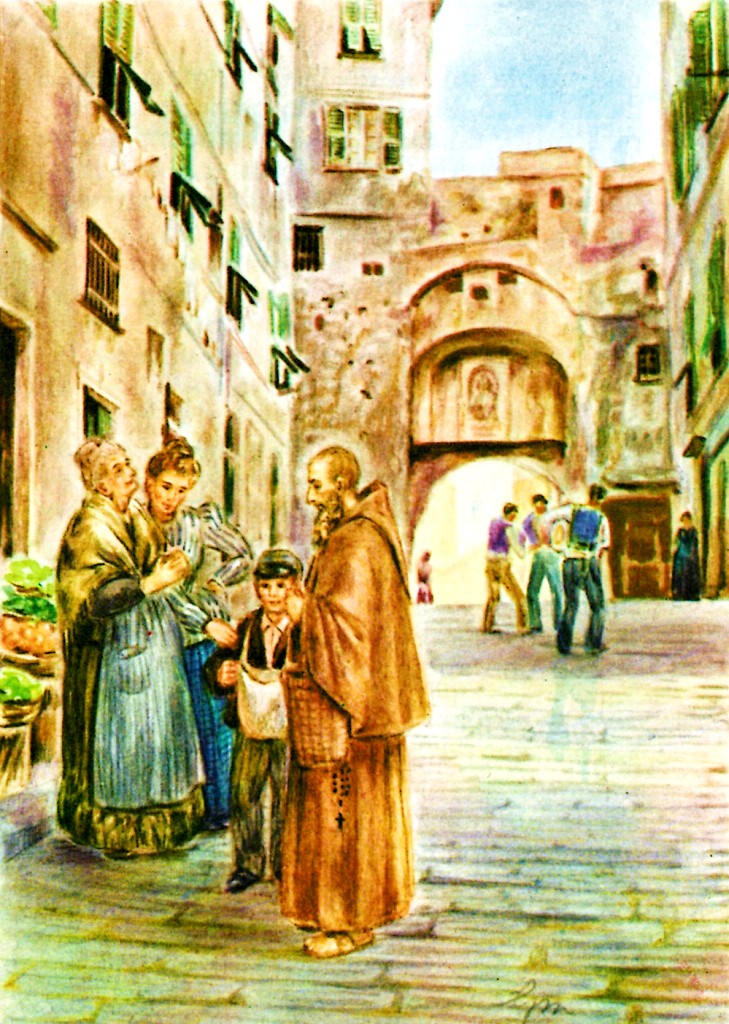
The outstanding results of this rural questing, urged the Guardian to entrust to him, the City questing. The people, who had already intuited his holiness, would come to depend upon him. They were so accustomed to see him along the streets of the City, that they felt the need to do so. After attending some Masses very early in the morning, he used to walk through the streets of the City with his sack slung over his shoulder and always with a child carrying a small bag around his neck, to receive alms of money. He chose Saint Felice da Cantalice, as his protector.
However, it would not be possible to tell the story of his life now, without first saying something about the history of the City of Genoa in the nineteenth century. It was fermenting with tensions and hesitant steps of the Risorgimento. He listened to everyone and people of all kinds, whether small or great, entrusted him confidently with their own day-to-day concerns. There are countless ‘fioretti’ (stories) about this, which are often charming and miraculous and that translate realistically and exactly, the scene of this new development of the City. Its main narrators were the mothers at home, the shopkeepers, the sailors, the handlers on the wharves, the little children with their little problems, the merchants who asked advice, the sick whom he went to visit even when requiring great sacrifice on his own part, the incarcerated who sought greater justice. The Lord endowed him with special gifts when he answered questions, that had not yet been asked! or when he spoke of things far away or in the future. His fame spread even outside the City, beyond the little streets that he frequented. With great effort he had to answer the many letters he received, a massive correspondence which has been almost completely lost.
One date, 1840, represents the great regard for his service, even among his confreres. The Superiors made him “Capo-sportella,” or the Chief Questor, the guide and co-ordinator of the group of Questor Friars. He substituted the sack slung over his shoulder with the wattle basket woven according to a uniquely Capuchin technique. This basket he carried on his arm. He was authorised to beg for the more refined kinds of food needed by the sick and could enter the port area where valuable goods were sold.
In the Monastery he organised a storeroom to collect goods there and then distribute them, as well as administer the Mass alms and assign the various Questor Friars to different locations. These new authoritative responsibilities allowed the “holy father,” as the people already called him, usually, to provide more timely and ongoing help, even financial help, for families and individuals in difficulty, especially the families of those who had emigrated to America, or the families of sailors away from home for prolonged periods. Among his benefactors there were also protestants, Jews and non-believers who willingly contributed to his collection, certain that the proceeds would go to the poor. His Superiors also authorised him to do that. They trusted his prudence and balance, a trust that overcame simple objections during the process of Beatification.
The lamp of his piety was replenished, above all, in the silent hours of the night. He sought to find time for his prayer in many ways: – by frequent visits to Churches along the streets, meditations, particularly upon the sufferings of Christ and faithfulness to the liturgical life of the fraternity. And penance – he was extremely strict with himself, sleeping only on bare planks. He was content with a few crusts of bread soaked in hot water and would only wear threadbare and patched habits. He always went about barefoot. For years he only ate once a day and made constant use of a hair shirt and the flail. However, he was ready in obedience and with freedom of spirit, to use greater care, as can be read in the depositions of his process, spreading a truly attractive kind of holiness. With the people, his spirituality assumed that popular touch of immediacy and spontaneity but also, with a missionary ardour, so vibrant in the Church at that time and which he desired so much. “Oh to be young again. I could go with our missionaries!” He also concerned himself with fostering vocations and to set young men, without means, on the road to the Priesthood.
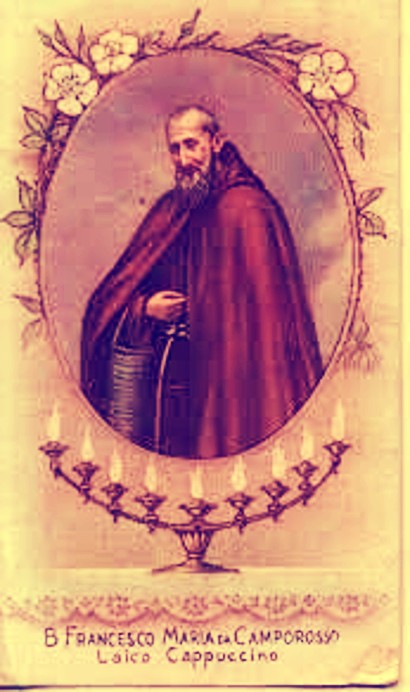
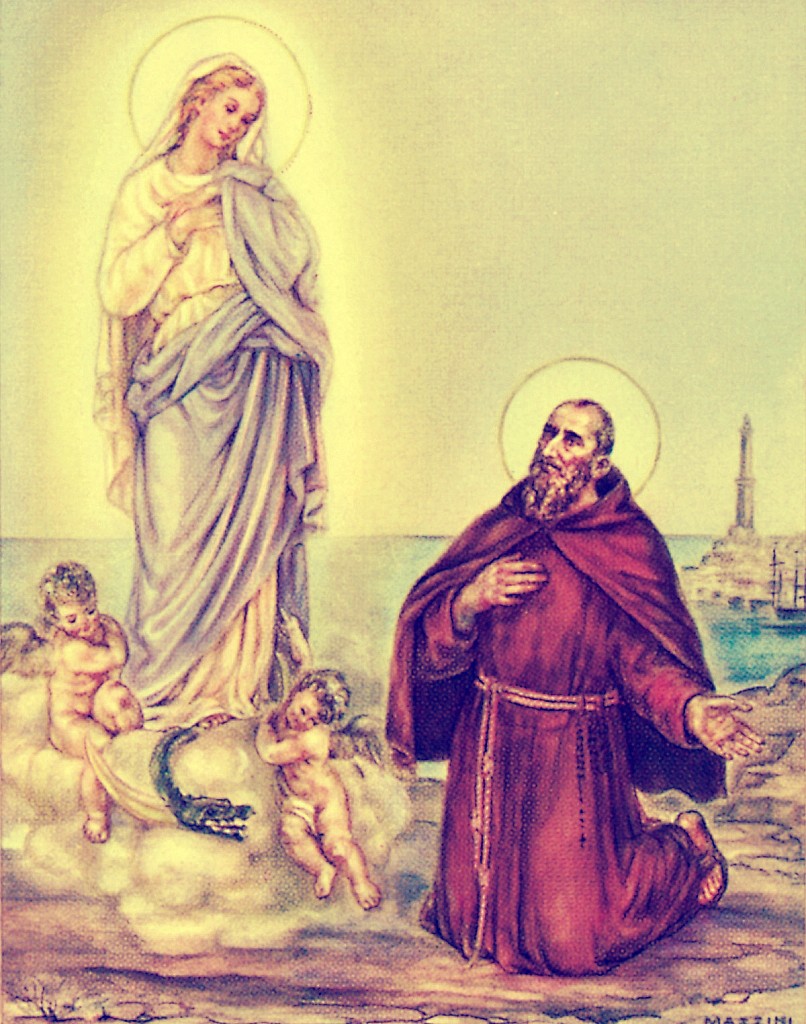
Popular iconography portrays him as tall, thin, austere, inseparable from that basket, and always accompanied by a boy with the offering box. His generous help for the people he met in his daily questing made him well-known in every quarter of the Genoa. In the evening, when he returned to the Friary, he found an ever growing number of people whose needs were well beyond his strength. These he invited to entrust themselves to the intercession of Our Lady. This is a particular aspect of the Francesco Maria’s spirituality that is expressed in the Statue by G Galletti and dedicated to him by the people of Genoa. In it the saint is represented inviting a vagabond, a mother with her dying baby and a dock worker, to invoke the Blessed Virgin.
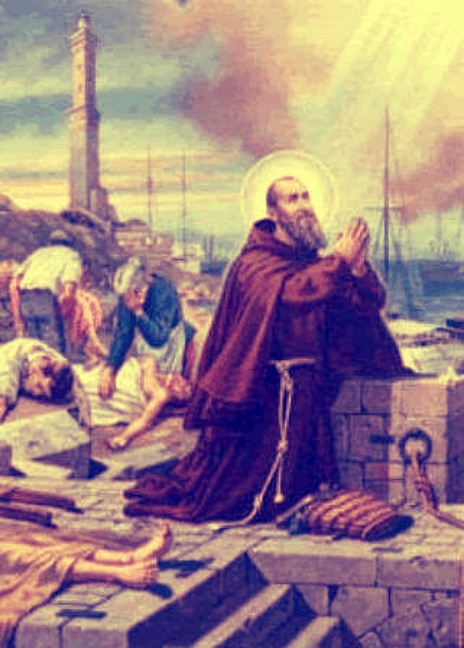
In the final years of his life he employed even harsher mortifications and continued in his commitments, despite a grave infirmity, which affected his legs. His simple spirituality found its focus in the offering of sacrifice, nourished by faith and hope. His letters express this. He either wrote them himself with tremendous effort, or would dictate them. The most representative image of him, traceable to a picture painted by Fr Donato and given to the blessed Pope Pius IX, shows him in the act of giving his life for the salvation of Genoa.
In 1866 in fact, when the port city was struck by a cholera epidemic and Francesco Maria was unable to help the sick, due to the precarious condition of his health, he offered his life for the defeat of the sickness. He died from the sickness three days later on 17 September 1866. According to some contemporary sources, the number of cholera victims started to diminish at the same time.
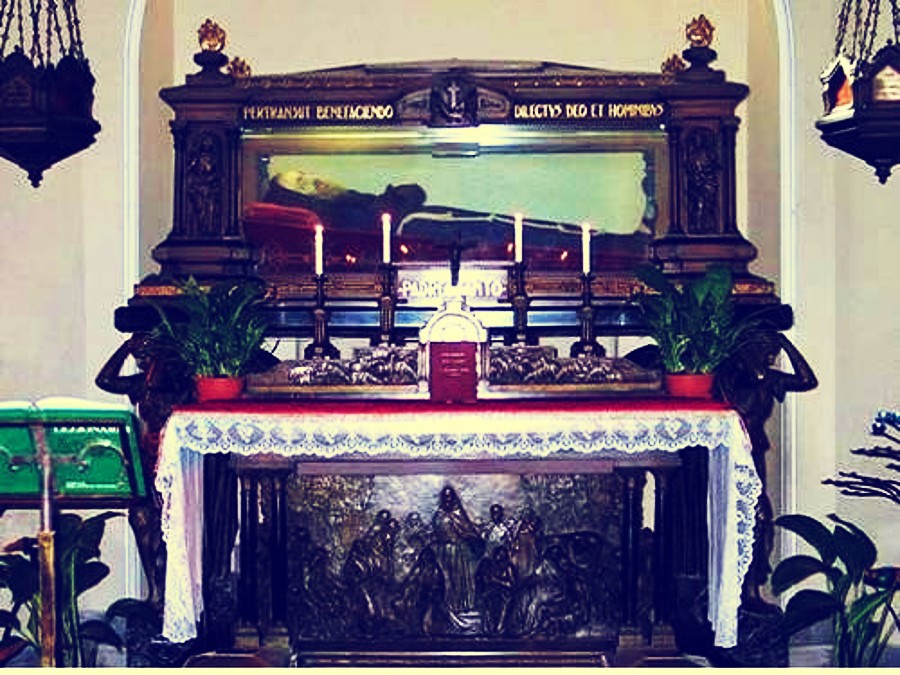
His body, covered with quicklime, was first buried in the cemetery at Staglieno where a monument was erected to him by public subscription. In 1914, his remains were translated to the Friary Church where he had lived most of his life. After his death, the faithful continued to turn to him with devotion. Graces and miracles began to occur which were attributable to his intercession. After the initial stages, his cause was introduced in Rome on 9 August 1896.
The decree recognising the heroism of his virtue was signed on 18 December 1922. Pope Pius XI Beatified him on 30 June 1929. John XXIII Canonised him on 9 December 1962. The City of Genoa has erected a monument in the port district to Saint Francisco as their Patron Saint.
St Anastasius of Lérida St Anthimus of Rome St Bassus of Sabina St Bertilla St Criotan of MacReddin Bl Diego of Saldaña St Evellius of Pisa St Fabius of Sabina St Francesco Maria da Camporosso OFM Cap (1804-1866) Friar of the Friars Minor Capuchin Branch St Francesco de Girolamo SJ St Fremund of Dunstable St Gengulphus of Burgundy
Bl Illuminatus St Illuminatus of San Severino Bl James Walworth Bl John Rochester St Maiulo of Hadrumetum
St Mamertus (Died c 477) Archbishop of Vienne in Gaul – present day France, Theologian, Writer, Founder of the introduction of the praying of Litanies prior to Ascension Day, called “Rogation Days.” Rogation days are days of prayer and fasting in the Church. They are observed with processions and the praying of the Litany of the Saints. The major Rogation is held on 25 April, the minor Rogations are held on Monday to Wednesday, preceding Ascension Thursday. The word Rogation comes from the Latin verb rogare, meaning “to ask,” which reflects the beseeching of God, for the appeasement of His anger and for protection from calamities. His Life: https://anastpaul.com/2019/05/11/saint-of-the-day-11-may-st-mamertus-died-c-475/
St Mozio of Constantinople St Possessor of Verdun St Principia of Rome St Tudy St Vincent L’Hénoret Bl Vivaldus St Walbert of Hainault
Martyrs of Camerino: An imperial Roman official, his wife, their children and servants, all of whom were converts and martyrs: Anastasius, Aradius, Callisto, Eufemia, Evodius, Felice, Primitiva, Theopista.
Thought for the Day – 10 May – Meditations with Antonio Cardinal Bacci (1881-1971)
Mary’s Patience
“Holy Mary, Mother of Sorrows, obtain for me the spirit of loving patience which made you the Queen of Martyrs. Help me to carry with resignation the cross which God has given me. Help me to walk like you in the footsteps of Jesus, until I reach my Calvary, so that I may join Him and you, in the glory of Heaven. Amen,”
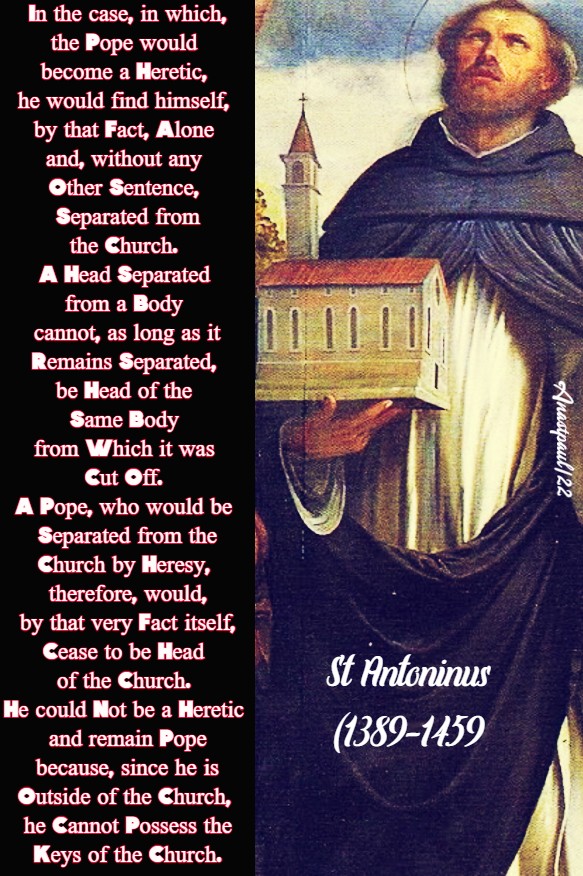
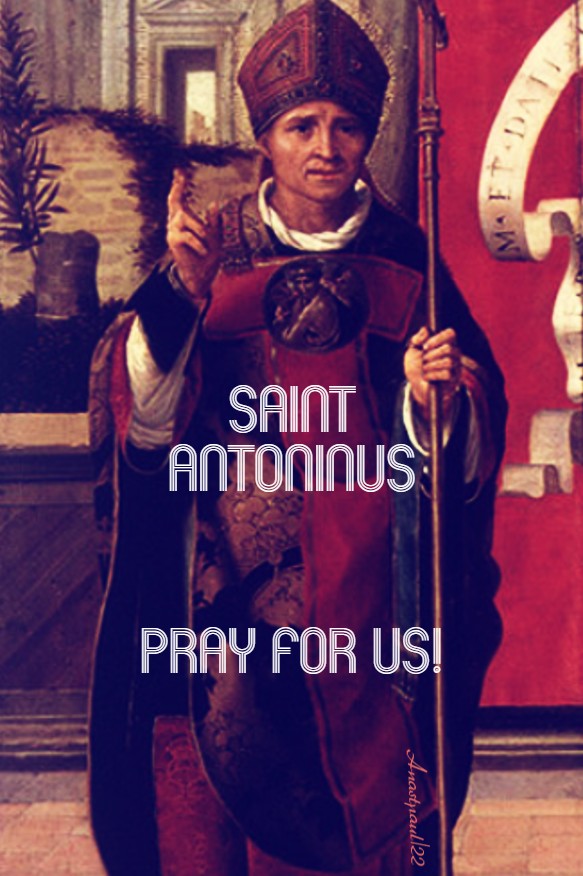
Quote of the Day – 10 May – The Memorial of St Antoninus OP (1389-1459) Archbishop of Florence
“In the case, in which, the Pope would become a heretic, he would find himself, by that fact, alone and, without any other sentence, separated from the Church. A head separated from a body cannot, as long as it remains separated, be head of the same body from which it was cut off. A Pope, who would be separated from the Church by heresy, therefore, would, by that very fact itself, cease to be head of the Church. He could not be a heretic and remain Pope because, since he is outside of the Church, he cannot possess the keys of the Church.”
One Minute Reflection – 10 May – The Memorial of St Antoninus OP (1389-1459) – Sirach 44:16-27; 45:3-20, Matthew 25:14-23.
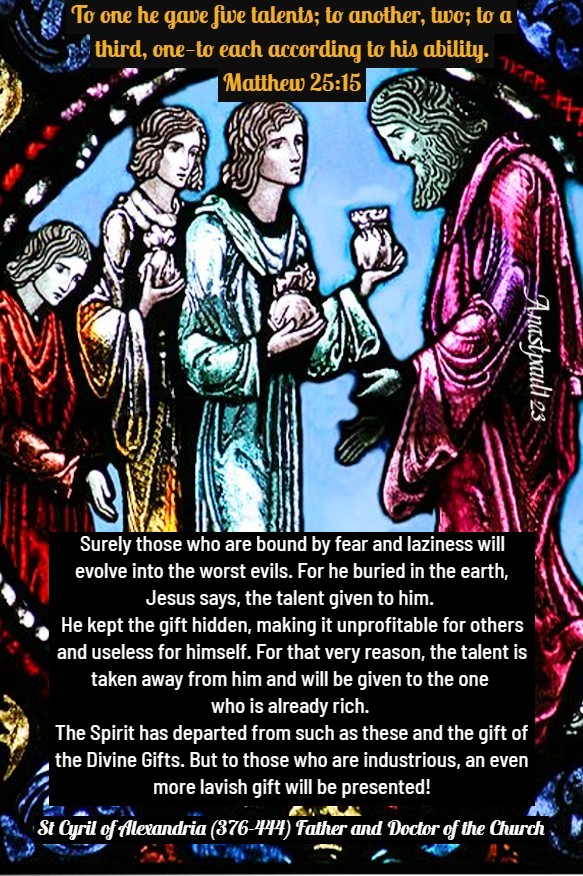
“To one he gave five talents; to another, two; to a third, one—to each according to his ability. Then he went away. Immediately …” – Matthew 25:15
REFLECTION – “The man who is the landowner is actually the Creator and Lord of all. The Word compares, in the parable, the time the landowner spends away from home, to either the Ascension of Christ into Heaven, or, at any rate, to the unseen and invisible character of the Divine Nature. Now, one must conceive of the property of God, as those in each country and city, who believe in Him. He calls His servants, those who, according to the times, Christ crowns with the glory of the Priesthood. For the holy Paul writes, “No-one takes this honour upon himself; he must be called by God.”
He hands over [His property] to those who are under Him, to each giving a spiritual gift, so that he might have character and aptitude. We think that this distribution of the talents, is not supplied to the household servants in equal measure because, each is quite different from the other, in their understanding. Immediately they head out for their labours, He says, directly, indicating to us here, that apart from the procrastination of one, they are fit to carry out the work of God.
Surely those who are bound by fear and laziness will evolve into the worst evils. For he buried in the earth, Jesus says, the talent given to him. He kept the gift hidden, making it unprofitable for others and useless for himself. For that very reason, the talent is taken away from him and will be given to the one who is already rich. The Spirit has departed from such as these and the gift of the Divine Gifts. But to those who are industrious, an even more lavish gift will be presented!” –– St Cyril of Alexandria (376-444) Archbishop of Alexandria, Father and Doctor of the Church (Fragment 283)
PRAYER – O Lord, may the merits of Antoninus, Your Confessor and Bishop, help us and just as we praise You for the wonders You have wrought in him, so may we glory in Your mercy toward us. T hrough Jesus Christ, Thy Son our Lord, Who lives and reigns with Thee, in the unity of the Holy Ghost, God, world without end. Amen (Collect).
Our Morning Offering – 10 May – “The Month of the Blessed Virgin Mary” –
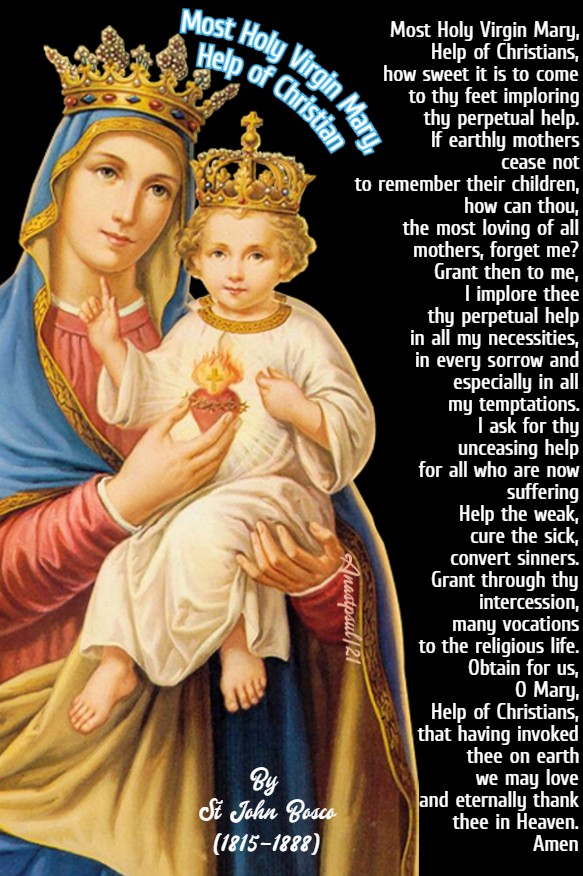
Most Holy Virgin Mary, Help of Christian By St John Bosco (1815-1888)
Most Holy Virgin Mary, Help of Christians, how sweet it is to come to thy feet imploring thy perpetual help. If earthly mothers cease not to remember their children, how can thou, the most loving of all mothers, forget me? Grant then to me, I implore thee thy perpetual help in all my necessities, in every sorrow and especially in all my temptations. I ask for thy unceasing help for all who are now suffering. Help the weak, cure the sick, convert sinners. Grant through thy intercession, many vocations to the religious life. Obtain for us, O Mary, Help of Christians, that having invoked thee on earth we may love and eternally thank thee in Heaven. Amen
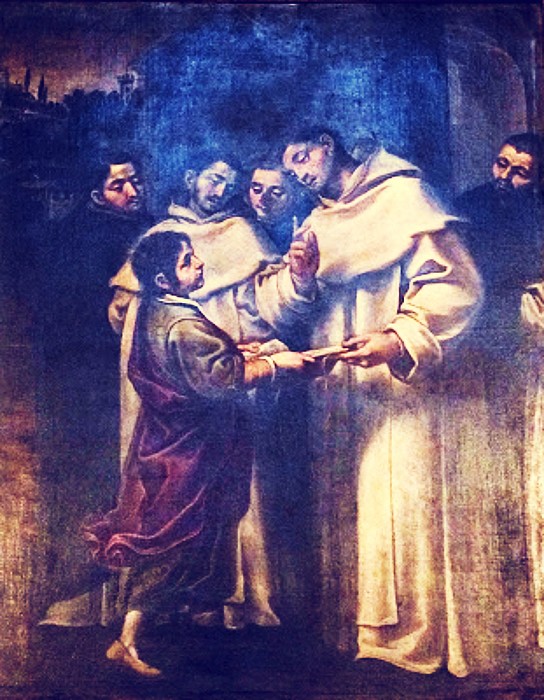
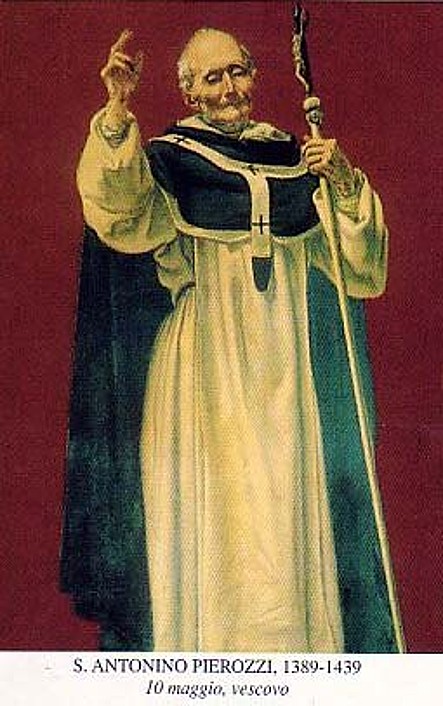
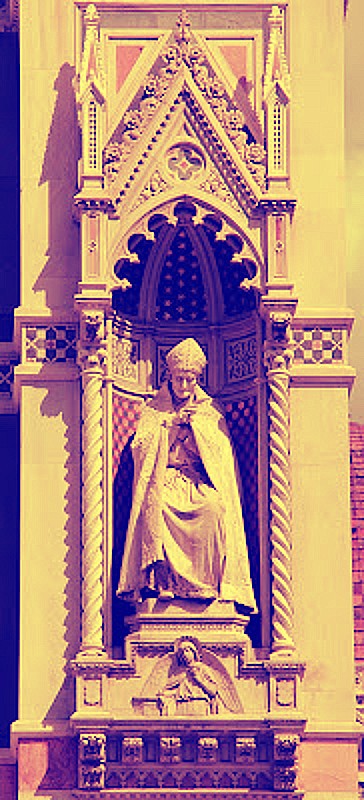
Saint of the Day – 10 May – Saint Antoninus of Florence OP (1389-1459) Archbishop of Florence, Dominican Priest and Friar, Confessor, Spiritual Director, Apostle of Mercy, Theologian, Writer, Reformer, Prior of the Order. Known as “Antoninus the Counsellor.”
The Roman Martyrology reads: “At Florence, the Bishop St Antoninus, of the Order of Preachers, renowned for holiness and learning.”
Saint Antoninus, Bishop and Confessor By Abbot Prosper Guéranger OSB (1805-1875)
“Antoninus was born at Florence, of respectable parents. He gave great promise, even when quite a child, of his later sanctity. Having at the age of sixteen, entered the Religious Order of Friars Preachers, he at once became an object of admiration, by the practice of the highest virtues. He declared ceaseless war against idleness. After taking a short sleep at night, he was the first at the Office of Matins; which over, he spent the remainder of the night in prayer, or reading, or writing. If at times, he felt himself oppressed with unwelcome sleep, owing to fatigue, he would lean his head, for a while, against the wall and then, shaking off the drowsiness, he resumed his holy vigils with renewed earnestness.
Being a most rigid observer of Religious discipline, he never ate flesh-meat, save in the case of severe illness. His bed was the ground, or a naked board. He always wore a hair shirt, and sometimes an iron girdle next to his skin. He observed the strictest chastity during his whole life. Such was his prudence in giving counsel, that he went under the name of Antoninus the Counsellor. He so excelled in humility, that, even when Prior and Provincial, he used to fulfil, with the utmost self-abjection, the lowest duties of the Monastery.
He was made Archbishop of Florence by Pope Eugenius the Fourth. Great was his reluctance to accept such a dignity: nor would he have consented, had it not been out of fear of incurring the spiritual penalties, wherewith he was threatened by the Pope.
It would be difficult to describe the prudence, piety, charity, meekness and apostolic zeal, wherewith he discharged his Episcopal Office. He learned almost all the sciences to perfection and, what is surprising, he accomplished this by his own extraordinary talent, without having any master to teach him.
Finally, after many labours and after having published several learned books, he fell sick. Having received the Holy Eucharist and Extreme Unction, embracing the Crucifix, he joyfully welcomed death, on the sixth of the Nones of May (2 May), in the year 1459. He was illustrious for the miracles which he wrought during his life, as also for those, which followed after his death. He was Canonised by Pope Adrian the Sixth, in the year of our Lord 1523.
St Joseph de Veuster SS.CC. (1840-1889) – St Damian of Molokai “The Martyr of Molokai,” Priest of the Congregation of the Sacred Hearts of Jesus and Mary, Missionary – known as “Martyr of Molokai”, “Martyr of Charity”, “Apostle to the Lepers” – Patron of lepers. (Optional Memorial) St Damian’s life: https://anastpaul.wordpress.com/2017/05/10/10-may-the-memorial-of-st-damian-de-veuster-de-molokai/
St Alphius of Lentini Bl Amalarius of Metz Bl Antonio of Norcia St Aurelian of Limoges Bl Beatrix d’Este the Elder St Blanda of Rome St Calepodius of Rome
Bl Nicholas Albergati St Palmatius of Rome St Philadelphus of Lentini St Quartus of Capua St Quintus of Capua St Simplicius of Rome St Solange of Bourges St Thecla Bl William of Pontnoise
Thought for the Day – 9 May – Meditations with Antonio Cardinal Bacci (1881-1971)
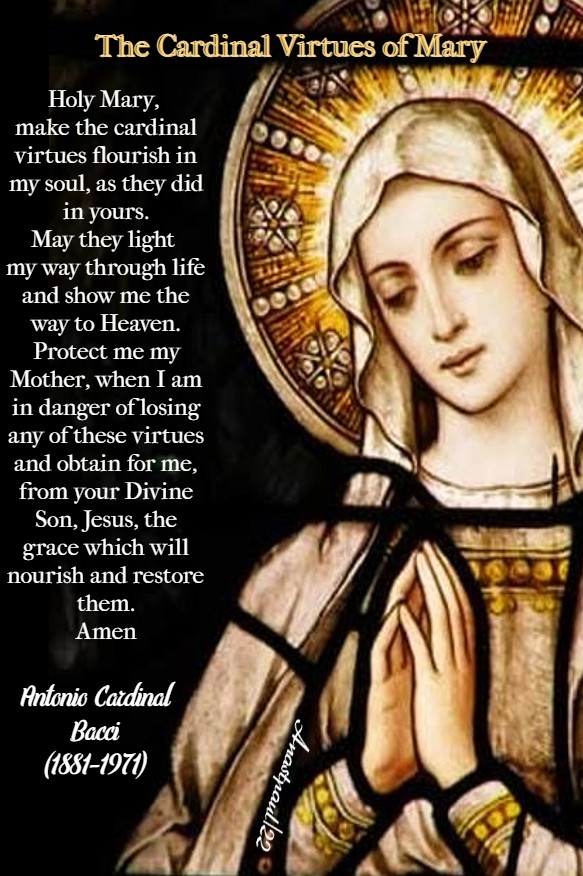
The Cardinal Virtues of Mary
“Holy Mary, make the cardinal virtues flourish in my soul, as they did in yours. May they light my way through life and show me the way to Heaven. Protect me my Mother, when I am in danger of losing any of these virtues and obtain for me, from your Divine Son, Jesus, the grace which will nourish and restore them. Amen.”
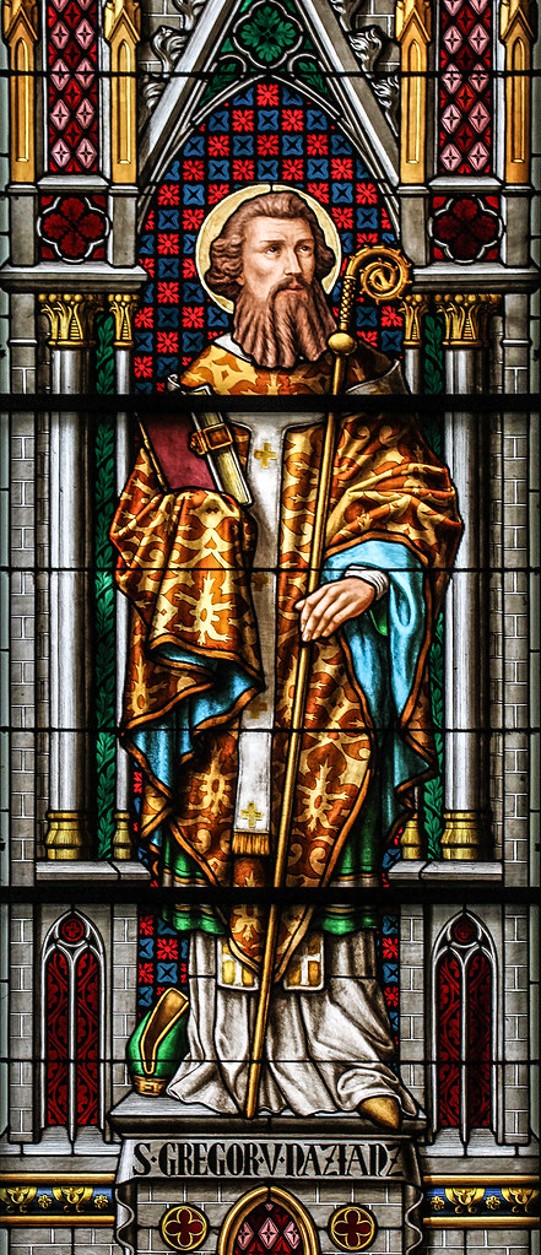
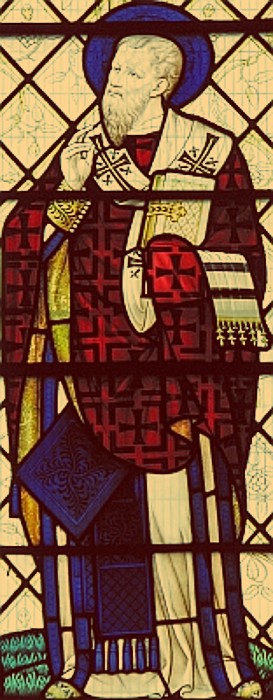
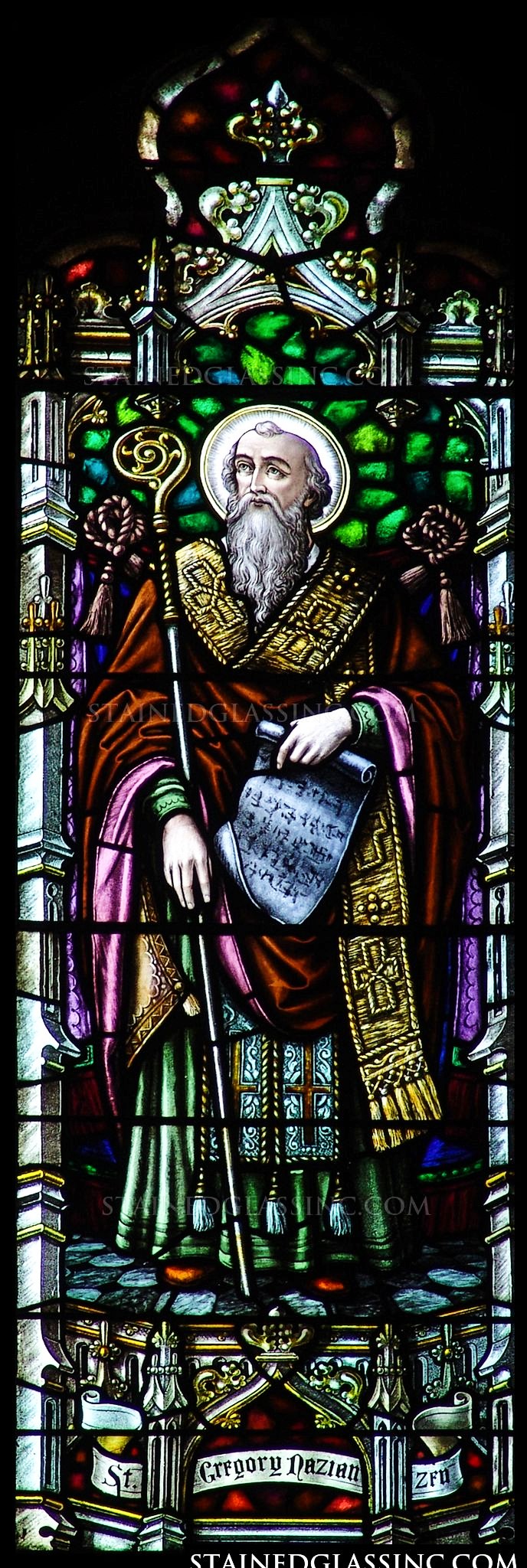
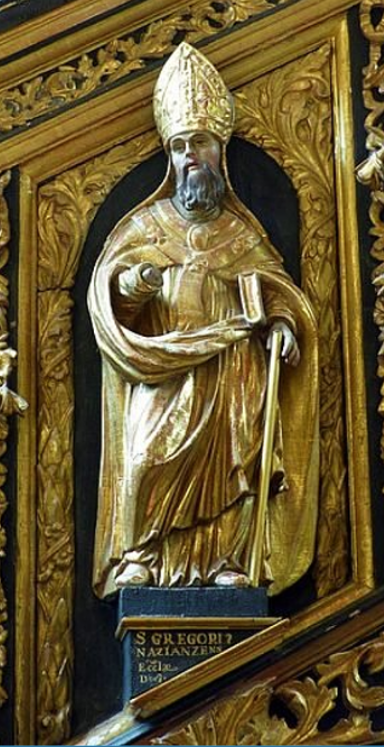
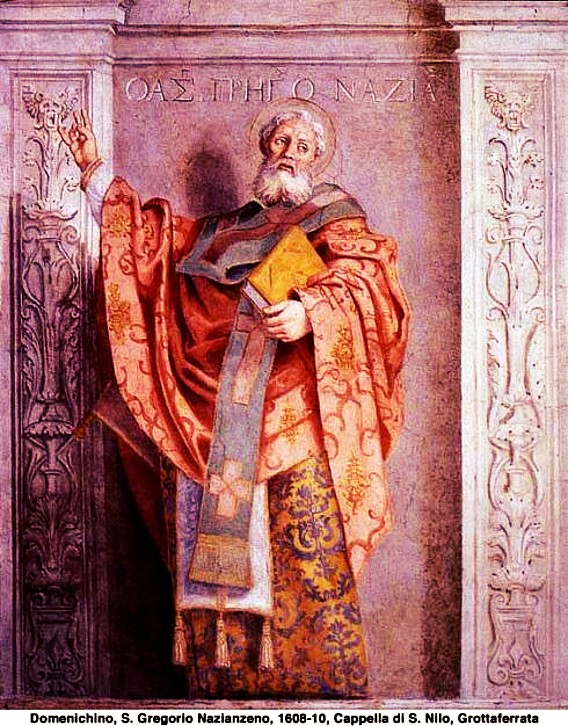
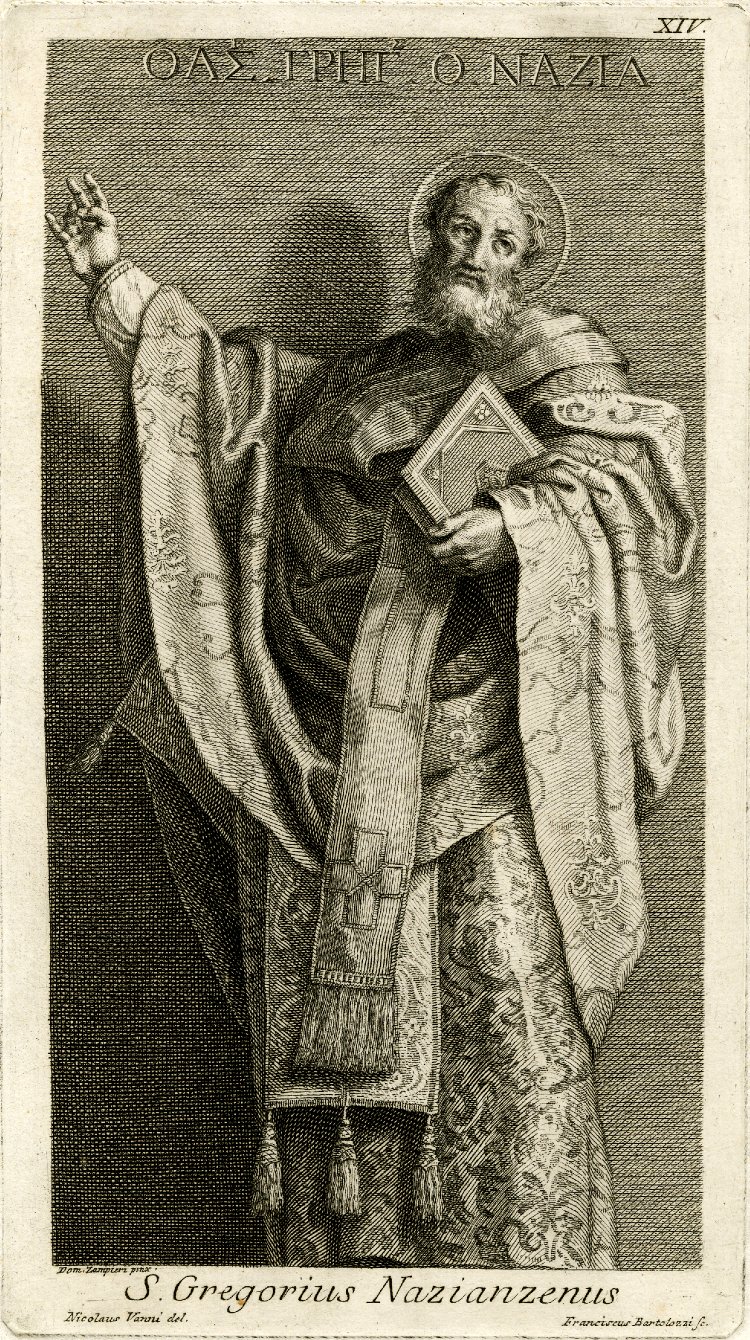
Quote/s of the Day – 9 May – The Memorial of St Gregory Nazianzen (330-390) Bishop, Confessor, Father and Doctor of the Church
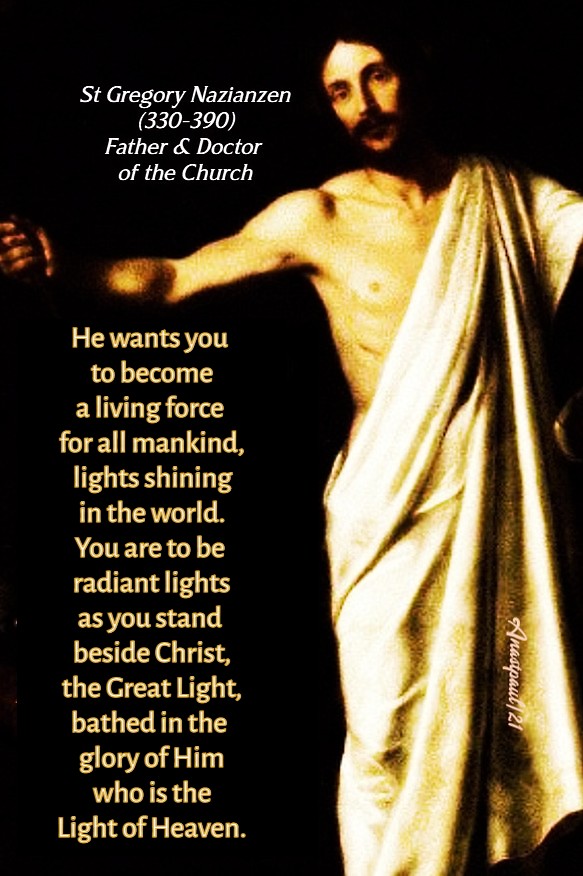
“He wants you to become a living force for all mankind, lights shining in the world. You are to be radiant lights as you stand beside Christ, the Great Light, bathed in the glory of Him who is the Light of Heaven.”
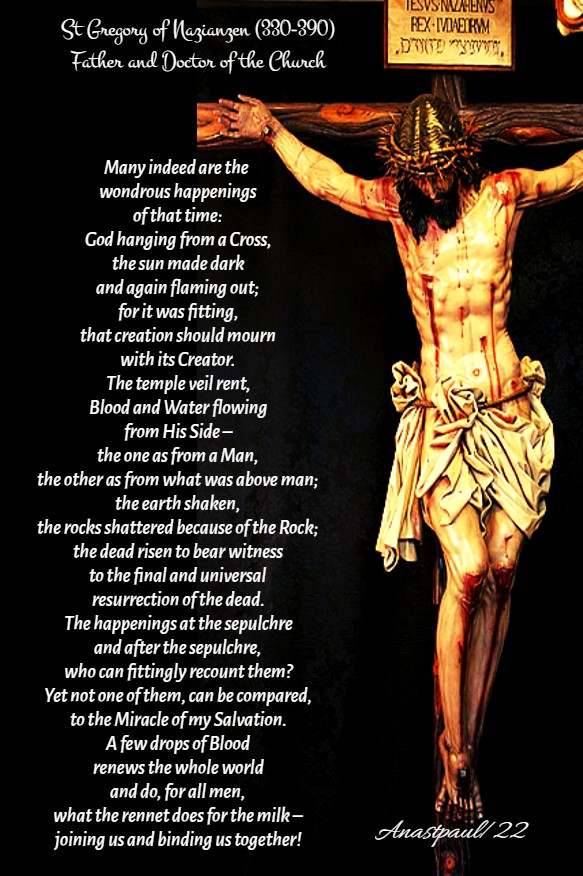
“Many indeed are the wondrous happenings of that time: God hanging from a Cross, the sun made dark and again flaming out; for it was fitting, that creation should mourn with its Creator. The temple veil rent, blood and water flowing from His side – the one as from a Man, the other as from what was above man; the earth shaken, the rocks shattered because of the Rock; the dead risen to bear witness to the final and universal resurrection of the dead. The happenings at the sepulchre and after the sepulchre, who can fittingly recount them? Yet not one of them, can be compared, to the Miracle of my Salvation. A few drops of Blood renews the whole world and do, for all men, what the rennet does for the milk – joining us and binding us together!”
“God accepts our desires as though they were of great value. He longs ardently for us to desire to and love Him. He accepts our petitions for benefits, as though we were doing Him a favour. His joy in giving, is greater than ours in receiving. So let us not be apathetic in our asking, nor set too narrow bounds to our requests; nor ask for frivolous things unworthy of God’s greatness.”
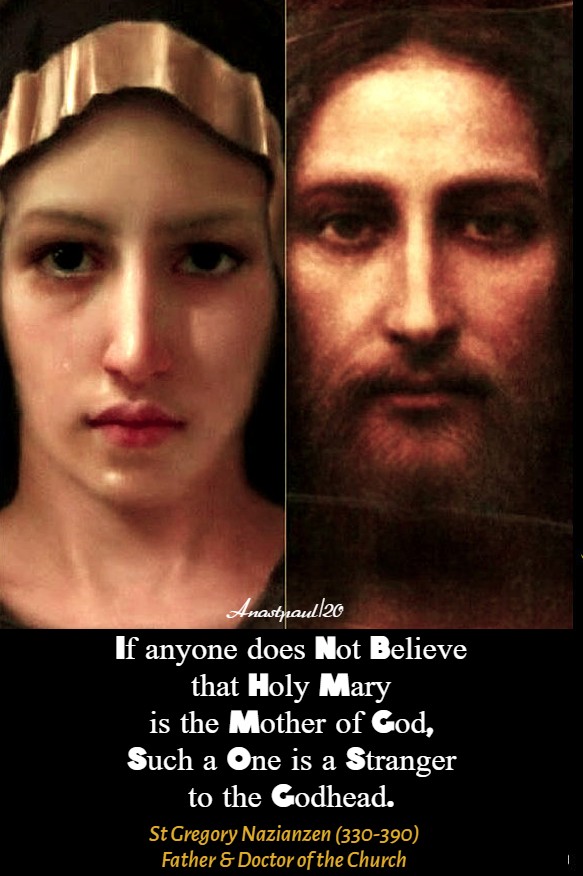
“If anyone does not believe that Holy Mary is the Mother of God, such a one is a stranger to the Godhead.”
St Gregory Nazianzen (330-390) Father & Doctor of the Church
One Minute Reflection – 9 May – The Memorial of St Gregory Nazianzen (330-390) Bishop, Confessor, Father and Doctor of the Church – Sirach 39:6-14, Matthew 5:13-19
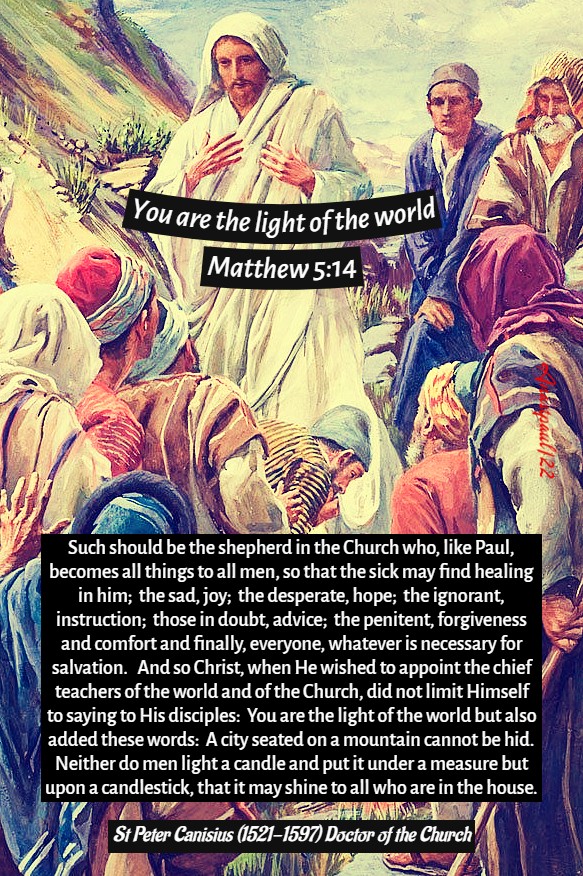
“You are the light of the world.” – Matthew 5:14
REFLECTION – “I shall always love and reverence the Apostles sent by Christ and their successors, in sowing the seed of the Gospel, those zealous and tireless co-operators in propagating the Word, who may justly say of themselves: Let a man so account of us as the ministers of Christ and the dispensers of the mysteries of God. For Christ, like a most watchful and most faithful householder, wished that the Gospel lamp should be lighted by such ministers and delegates, with fire sent down from Heaven and once lighted, should not be put under a measure but set upon a candlestick, so that it may spread its brightness far and wide and put to flight, all darkness and error, rife among both Jews and Gentiles.
Now it is not enough for the Gospel teacher to be a brilliant speaker in the eyes of the people; he must also be as a voice crying in the desert and endeavour, by his eloquence, to help many to lead good lives, lest, if he omit his duty of speaking, he be called the dumb dog that is not able to bark, spoken of by the prophet. Yes, he should also burn, in such a way, that, equipped with good works and love, he may adorn his evangelical office and follow the leadership of Paul. He indeed was not satisfied with bidding the Bishop of the Ephesians: This command and teach: conduct thyself in work as a good soldier of Christ Jesus but he unflaggingly preached the Gospel to friend and foe alike and, said with a good conscience to the Bishops gathered at Ephesus: You know how I have kept back nothing that was for your good but have declared it to you and taught you in public and from house to house, urging Jews and Gentiles to turn to God in repentance and to believe in our Lord Jesus Christ.
Such should be the shepherd in the Church who, like Paul, becomes all things to all men, so that the sick may find healing in him; the sad, joy; the desperate, hope; the ignorant, instruction; those in doubt, advice; the penitent, forgiveness and comfort and finally, everyone, whatever is necessary for salvation. And so Christ, when He wished to appoint the chief teachers of the world and of the Church, did not limit Himself to saying to His disciples: You are the light of the world but also added these words: A city seated on a mountain cannot be hid. Neither do men light a candle and put it under a measure but upon a candlestick, that it may shine to all who are in the house. Those churchmen err, who imagine that it is by brilliant preaching, rather than by holiness of and all-embracing love, they fulfil their office.” – St Peter Canisius SJ (1521-1597) Doctor of the Church (Sermon excerpt).
PRAYER – O God, Who gave to Your people, blessed Gregory, as a minister of salvation, grant, we beseech You, that we, who cherished him on earth as a teacher of life, may be found worthy to have him as an intercessor in Heaven. Through Jesus Christ, Thy Son our Lord, Who lives and reigns with Thee, in the unity of the Holy Ghost, God, world without end. Amen (Collect).
Our Morning Offering – 9 May – “The Month of the Blessed Virgin Mary”
Let Me Love Your Jesus By St Ildephonsus (c 607-670)
Virgin Mary, hear my prayer, through the Holy Spirit, you became the Mother of Jesus, from the Holy Spirit, may I too have Jesus. Through the Holy Spirit, your flesh conceived Jesus, through the same Spirit, may my soul receive Jesus. Through the Holy Spirit, you were able to know Jesus, to possess Jesus and to bring Him into the world. Through the Holy Spirit, may I too come to know your Jesus. Imbued with the Spirit, Mary, you could say “I am the handmaid of the Lord, be it done unto me according to your word,” in the Holy Spirit, lowly as I am, let me proclaim the great truths about Jesus. In the Spirit, you now adore Jesus as Lord and look on Him as Son, in the same Spirit, Mary, let me love your Jesus. Amen
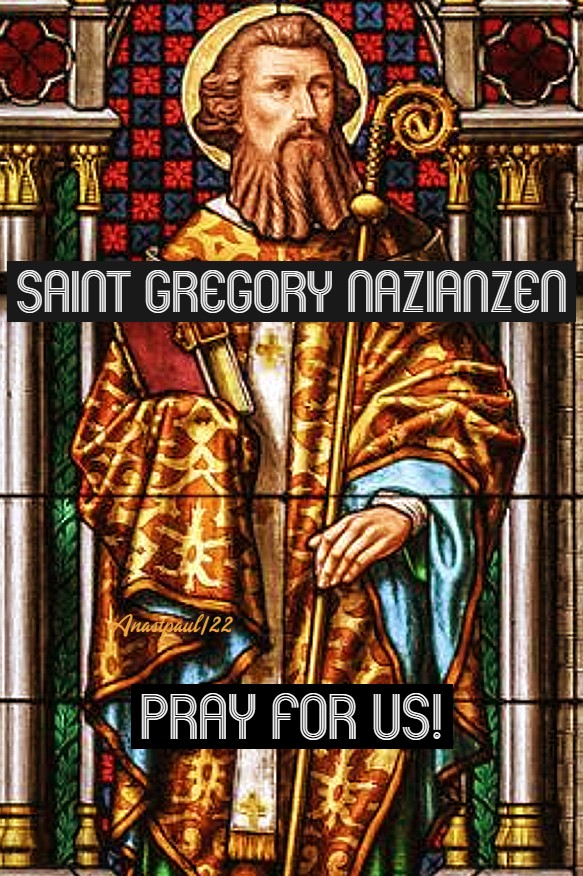
Saint of the Day – 9 May – St Gregory Nazianzen (330-390) Archbishop of Constantinople, Father and Doctor of the Church, Confessor, Theologian, Philosopher, Orator, Poet, Writer, he is remembered as the “Trinitarian Theologian.” He is widely considered one of the most accomplished rhetorical stylist of the patristic age. Along with his great friends and colleagues, the brothers St Basil the Great and St Gregory of Nyssa, he is known as one of the Cappadocian Fathers. The Cappadocia region, in modern-day Turkey, was an early site of Christian activity, with several missions by St Paul in this region. The Cappadocians advanced the development of early Christian theology, for example the doctrine of the Trinity and are highly respected as “Great” Fathers of the Church.
The Roman Martyrology states of him today: “At Naziazus, the birthday of St Gregory, Bishop and Doctor of the Church, surnamed “The Theologian” because of his remarkable knowledge of divinity. At Constantinople, he restored the Catholic Faith, which was fast waning and repressed the rising heresies.”
St Gregory Nazianzen (330-390) Bishop, Father and Doctor of the Church By Fr Francis Xavier Weninger, SJ (1805-1888)
St Gregory who, on account of his great knowledge in Sacred science, is surnamed the Theologian, was born at Nazianzum, in the year c 300. His father, whose name was also Gregory, his mother, Nonna, his brother Caesarius and Gorgonia, his sister, are all honoured as Saints. At Athens, where St. Gregory devoted himself to study, he became acquainted with St Basil the Great, who had made his home there with the same intention. They became most intimate friends, as both were virtuous and diligent. They secluded themselves from all frivolous young men, shunned gaming, idleness, and other vices of youth, cultivating only piety and knowledge. They knew of only two roads, one of which led to school, the other to Church.
After having finished his studies, Basil returned to his home but Gregory remained and studied eloquence, in which he was, in after years, unsurpassed. At that time also, Julian studied at Athens, who afterwards became Emperor and was called the Apostate. In regard to the manners and behaviour of this prince, Gregory said at that time; “Oh what a monster the Roman Empire nourishes in its bosom!” At the same time he predicted, that if Julian should ever wear the imperial crown, he would become the great enemy and persecutor of Christendom, which unhappily became true.
After several years, Gregory left Athens and returned to his native place. One day, while studying, he was overtaken by sleep and it appeared to him that he saw two beautiful virgins, who came as if wishing to speak to him. He asked who they were and what they desired. “One of us,” they answered, “is chastity, the other wisdom.God has sent us to be your friends and remain constantly with you.” His life proved that this vision was no empty dream. Gregory preserved his chastity inviolable and was endowed by the Almighty with such wisdom, that on account of it, he became celebrated throughout the whole world. Great men, among whom was St Jerome, often travelled many miles to hear him speak.
Having been Ordained Priest, he went secretly toBasil, who had retired to the desert of Pontus. There they lived in the greatest harmon, but, at the same time, in the greatest rigour occupied only in prayer and in studying the holy Scriptures.
After the lapse of some years, Gregory returned again to his home, to bring back to the True Faith, his father who, not out of wickedness,but out of simplicity and ignorance, had been deluded by the Arians. Gregory happily extricated him from his error …
Meanwhile Basil became Bishop of Caesarea and most earnestly requested Gregory to take the small bishopric of Sasima, as the far spreading heresy demanded a strong opposition. Gregory allowed himself to be prevailed upon and accepted the See. When, however, another one came who asserted that the office was his, he gave place to him and retired. They wished him afterwards to take charge of the church at Nazianzum but he arranged matters in such a manner, that they chose someone else.
He, however, did not succeed so well in Constantinople. He had gone thither to oppose the heretics, who had filled the whole city with their poison, to defend the Catholic faith and teach its doctrines to the people. After he had laboured there some time with great success, Peter, Bishop of Alexandria, nominated him Bishop of Constantinople and Gregory was obliged to take this heavy burden. All his thoughts were now directed to exterminate heresy and to restore the ancient prestige of the Church.
The Catholics had, at that time, only one Church where they assembled, the heretics having taken possession of all the others. Gregory, however, so brought it about that the newly chosen Emperor Theodosius came himself to Constantinople and gave the Cathedral back to the Catholics, although the heretics opposed it with all their power. This enraged the latter to such a degree that they hired a villain to assassinate the Bishop. The Saint was sick in bed when the murderer came under the pretext of visiting him. As he, however, was alone with him and, therefore, had every opportunity of committing the crime, God suddenly changed his heart, and falling at the feet of the Saint, he confessed his wicked intention and asked forgiveness. The Saint said; “May God, Who protected me, forgive you. I ask you nothing but that you forsake your heresy.”
Much more had he to suffer from the heretics but it in no wise slackened his zeal. The Catholics also gave him just cause of complaint.
Among the Bishops assembled in Council, a dispute arose, concerning the validity of Gregory’s election. The Saint represented to them, that he had not in any manner sought the office but that it had been forced upon him against his desire. Perceiving, however, that all were not satisfied with his explanation and fearing that the peace of the Church might be materially endangered, to the detriment of the whole Christian community, he arose and addressed the assemblage in the following manner:
“Dear colleagues and joint-shepherds of the flock of Christ, it would be very unbecoming to your dignity, should you, whose office it is to exhort others to peace, become disunited among yourselves. Am I the cause of your discord? Behold, I am not better than the prophet Jonas; cast me, therefore, into the sea and the tempest will be calmed. Although I am innocent of your charges, I will suffer without a murmur, that unanimity may be restored among you.”
after having thus spoken calmly and sweetly, he took leave of all present and went to the Emperor, whom he acquainted with his resolution to leave Constantinople. The Emperor, at first refused his consent but the Saint knew so well how to represent to him his reasons, that he at last gave him the desired permission.
He immediately made all the necessary preparations for his departure but once more ascended the pulpit of his Episcopal Church and in a last discourse, took leave of all the assembled faithful, as also of all the other Churches, hospitals and asylums of the city. To those who had frequently complained of his sermons because he unhesitatingly denounced their vices, he said: “Now joyfully clap your hands and cry that the bad, talkative tongue will cease to strike you; yes, it will cease but the hand still remains and pen and ink must in future sustain the combat.” Finally, he admonished them all to lead a Christian life and concluded his sermon with these words: “I exhort you, my dear children, to keep my instructions in your hearts. May the Grace of our Lord Jesus Christ, remain with you all. Amen!“
How deeply affected all his hearers were, was plainly perceived by their tears and their emotion. Well had they reason to be grieved, for they had possessed in Gregory a most tender father for their needy widows and orphans, an invincible protector of their faith, a teacher whom God had gifted with unusual wisdom, a careful, never weary pastor and almost perfect model of all virtue. They tried in every possible way to prevent his leaving but he was not to be persuaded to change his resolution but went on board the ship, which was ready to set sail and returned to his home.
On his arrival, he settled himself upon his parental estate, with the intention of then passing the remainder of his life in solitude and in the exercise of virtue.
This intention he carried out and prayers and devout meditation were his greatest comfort, until, failing health owing to excessive labour, besides old age and sickness, kept him for the greater part of the time in bed. Sometimes, however, he took the pen in hand and wrote several works to confute the doctrine of the heretics and to strengthen and confirm the Catholics. God permitted that the holy man, who had lived until now so piously and pure a life, should endure most fearful temptations from the Evil One. Constant calling on God, austere fasting, prayers, reading devout books and severe study, were the weapons he used against the enemy of man and he always conquered. The Most High also permitted that some men, envious and devoid of conscience, should calumniate the Saint everywhere and even falsely accuse him of some great crimes, to the Bishop of Tianea. The holy man was not angry but, while defending his honour, prayed God to bestow His grace upon his enemies and to pardon them.
Omitting much that might still be related of this great Saint, I will only mention one instance of his solicitude to avoid sin and to do penance. He thought that he had spoken in a certain affair more than was necessary and punished himself by remaining forty days without uttering a single word to anyone!
At length he expired happily, in the 90th year of his age, having laboured and suffered much for the honour of the Almighty and the protection of the True Church. Praise be to God!Amen.
Martyrs of Persia: 310 Christians murdered together for their faith in Persia. No details about them have survived.
20 Mercedarian Martyrs of Riscala: 20 Mercedarian friars who were murdered by Huguenot heretics for refusing to denounce their faith. 16th century at the Santa Maria convent at Riscala, France.
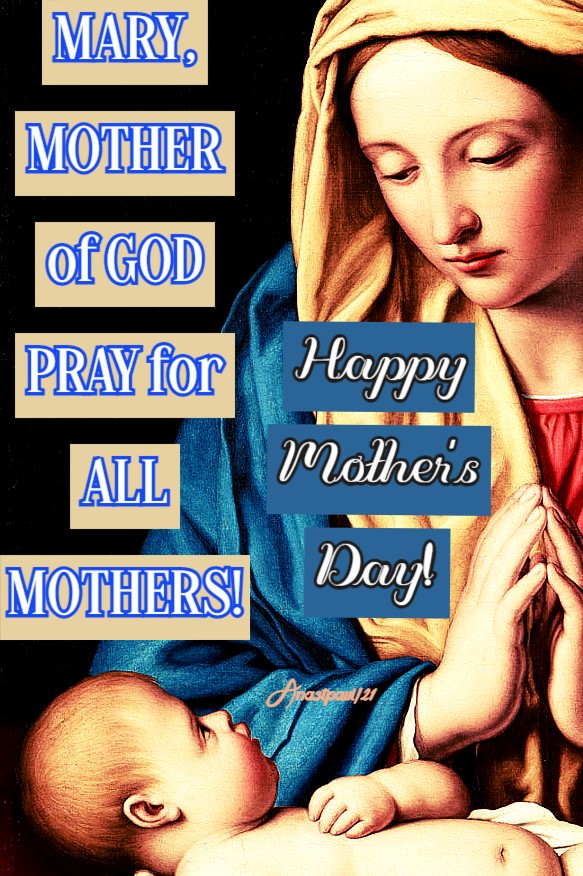
Wishing all Mothers a Blessed and Happy Mothers’ Day May Mary, the Mother of our Lord Jesus Christ and our Mother, be a guide and a comfort to us all.
“For a mother’s heart and a mother’s faith And a mother’s steadfast love, Were fashioned by the Angels And sent from God above.” – Author Unknown
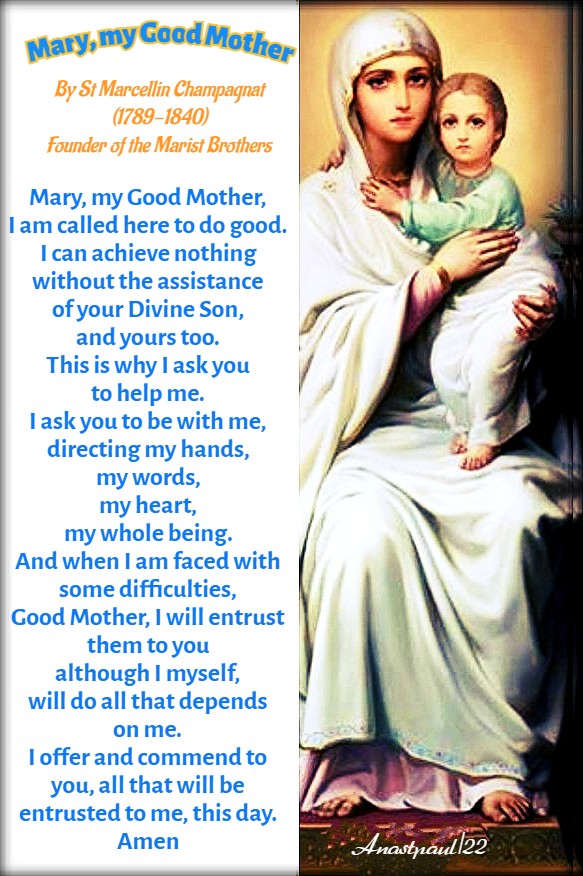
Mary, my Good Mother By St Marcellin Champagnat (1789-1840) Founder of the Marist Brothers
Mary, my Good Mother, I am called here to do good. I can achieve nothing without the assistance of your Divine Son, and yours too. This is why I ask you to help me. I ask you to be with me, directing my hands, my words, my heart, my whole being. And when I am faced with some difficulties, Good Mother, I will entrust them to you although I myself, will do all that depends on me. I offer and commend to you, all that will be entrusted to me, this day. Amen
Thought for the Day – 8 May – Meditations with Antonio Cardinal Bacci (1881-1971)
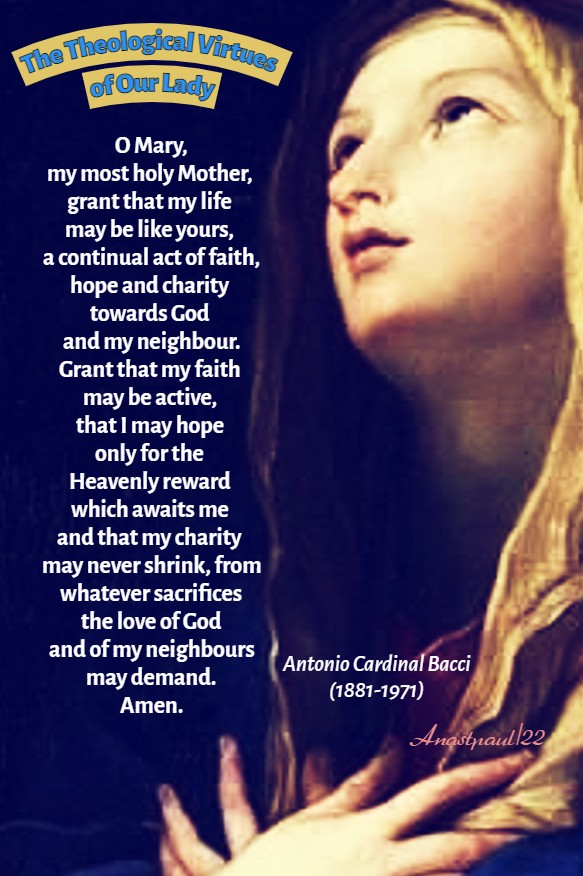
The Theological Virtues of Our Lady
“O Mary, my most holy Mother, grant that my life may be like yours, a continual act of faith, hope and charity towards God and my neighbour. Grant that my faith may be active, that I may hope only for the Heavenly reward which awaits me and that my charity may never shrink, from whatever sacrifices the love of God and of my neighbours may demand. Amen.”
Quote/s of the Day – 8 May – The Third Sunday after Easter – 1 Peter 2:11-19, John 16:16-22
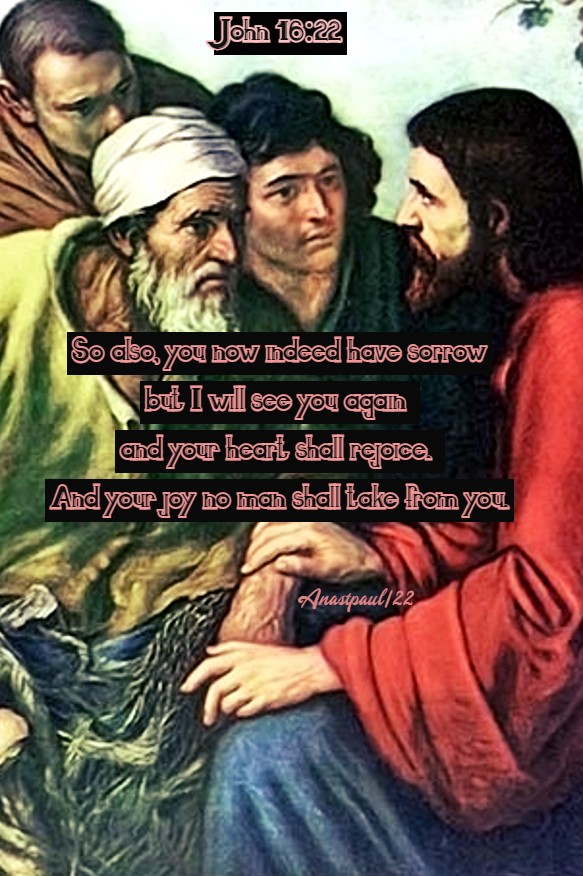
“So also, you now indeed have sorrow but I will see you again and your heart shall rejoice. And your joy, no man shall take from you.”
John 16:22
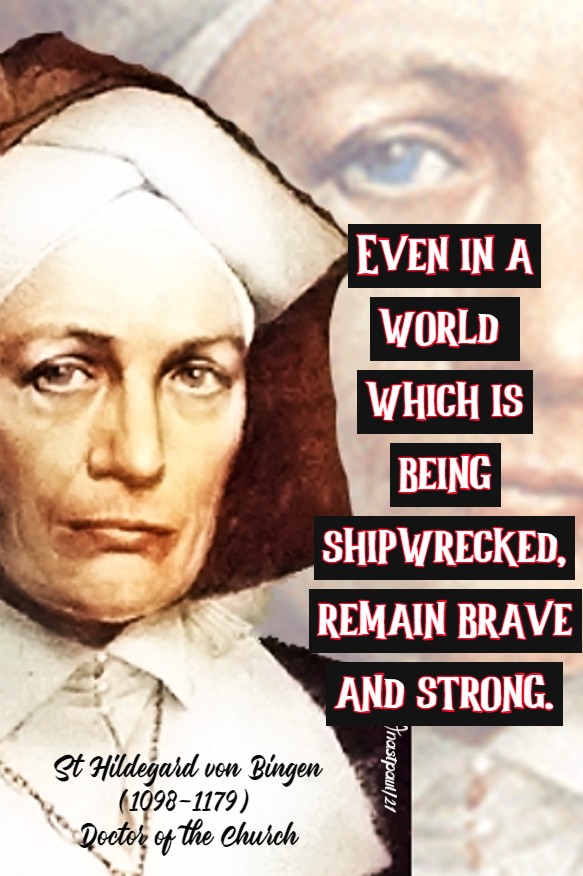
“Even in a world which is being shipwrecked, remain brave and strong.”
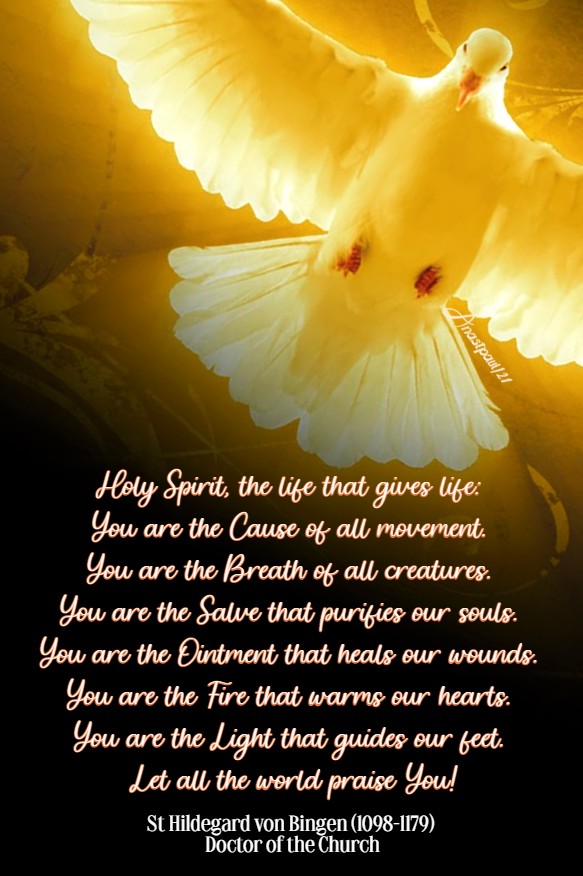
“Holy Spirit, the Life that gives life: You are the Cause of all movement. You are the Breath of all creatures. You are the Salve that purifies our souls. You are the Ointment that heals our wounds. You are the Fire that warms our hearts. You are the Light that guides our feet. Let all the world praise You!”
St Hildegard von Bingen (1098-1179) Doctor of the Church
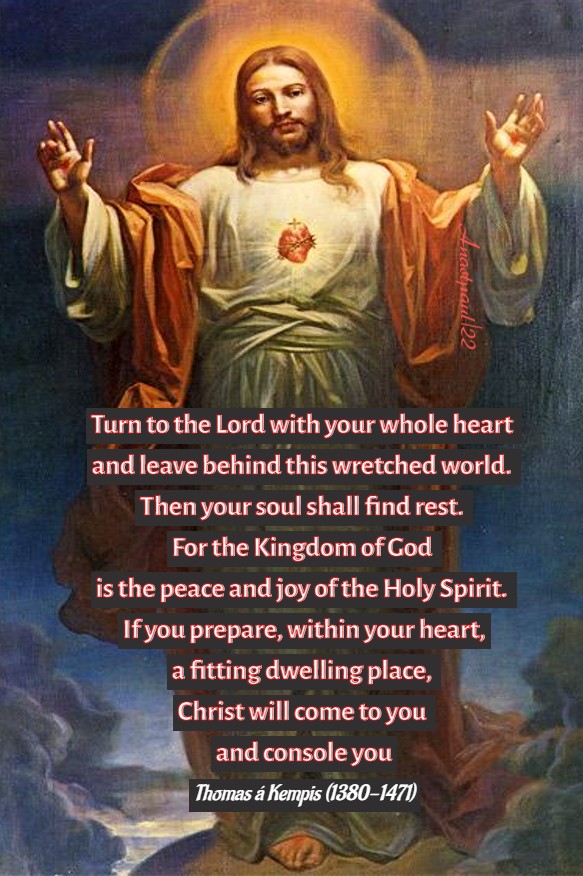
“Turn to the Lord with your whole heart and leave behind this wretched world. Then your soul shall find rest. For the Kingdom of God is the peace and joy of the Holy Spirit. If you prepare, within your heart, a fitting dwelling place, Christ will come to you and console you.”
Thomas á Kempis CRSA (1380-1471)
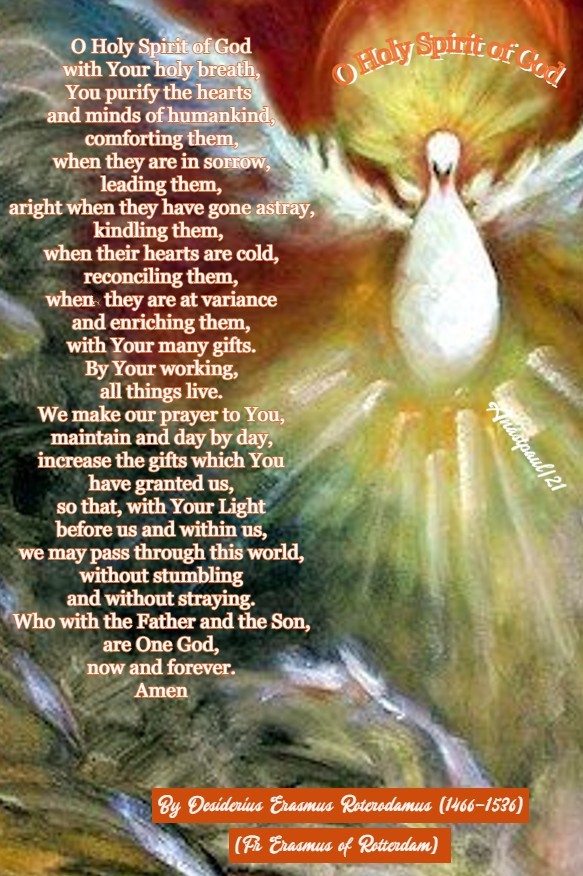
O Holy Spirit of God By Desiderius Erasmus Roterodamus (1466-1536) (Fr Erasmus of Rotterdam)
O Holy Spirit of God with Your holy breath, You purify the hearts and minds of humankind, comforting them, when they are in sorrow, leading them, aright when they have gone astray, kindling them, when their hearts are cold, reconciling them, when they are at variance and enriching them, with Your many gifts. By Your working, all things live. We make our prayer to You, maintain and day by day, increase, the gifts which You have granted us, so that with Your Light before us and within us, we may pass through this world, without stumbling and without straying. Who with the Father and the Son, are One God, now and forever. Amen
One Minute Reflection – 8 May – The Third Sunday after Easter – 1 Peter 2:11-19, John 16:16-22 and the Feast of the Apparition of St Michael the Archangel at Monte Gargano, Italy (492)
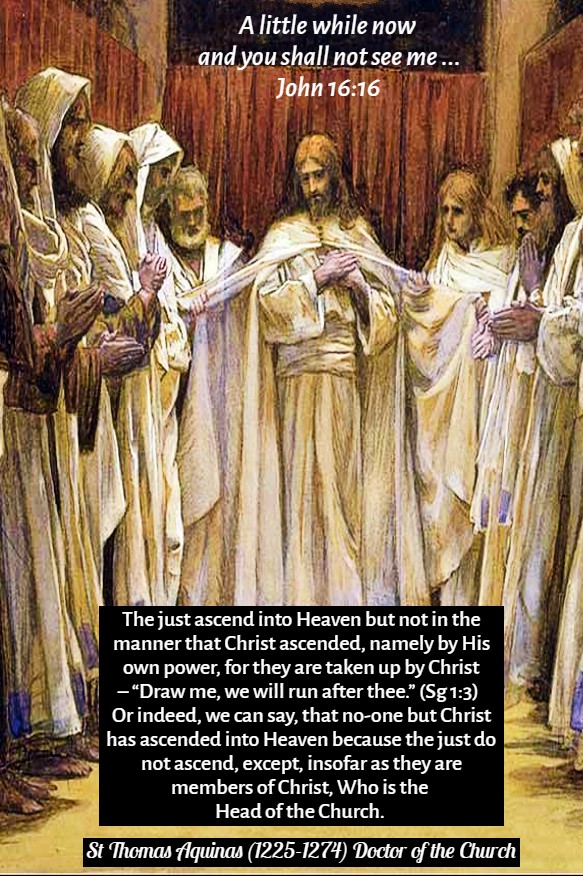
“A little while now and you shall not see me” – John 16:16
REFLECTION – “The Ascension of Christ into Heaven is in accord with reason – firstly, because Heaven was due to Christ by His very nature. It is natural for someone to return to the place from whence they take their origin. The beginning of Christ is from God, Who is above all things. Jesus says to the Apostles (Jn 16:28): “I came from the Father and have come into the world and now I am leaving the world and going back to the Father” … The just ascend into Heaven but not in the manner that Christ ascended, namely by His own power, for they are taken up by Christ – “Draw me, we will run after thee.” (Sg 1:3) Or indeed, we can say, that no-one but Christ has ascended into Heaven because the just do not ascend, except, insofar as they are members of Christ, Who is the Head of the Church. … Secondly, Heaven is due to Christ because of His Victory. For He was sent into the world to combat the devil and He did overcome him. Therefore, Christ deserved to be exalted above all things – “I myself first won the victory and sit with my Father on His throne” (Rv 3:21)
Finally, the Ascension was owing to Christ because of His humility. There never was humility so great as that of Christ Who, although He was God yet wished to become man and although He was the Lord, yet He wished to take the form of a servant and, as Saint Paul says: “He was obedient even unto death” (Phil 2:7) and descended even into hell. Therefore, He deserved to be exalted even to Heaven, to God’s throne, for humility leads to exaltation. “For whoever humbles himself will be exalted” (Lk 14:11) and, “the one who descended is also the one who ascended far above all the heavens” (Eph 4:10).” … St Thomas Aquinas (1225-1274) Doctor Angelicus/Doctor Communis (Commentary on the Apostle’s Creed).
PRAYER – O God, Who hast ordained and constituted the services of angels and men in a wonderful order, mercifully grant, that as Thy holy Angels alway do Thee service in Heaven, so, by Thy appointment, they may succour and defend us on earth. Through Jesus Christ, Thy Son our Lord, Who lives and reigns with Thee, in the unity of the Holy Ghost, God, world without end. Amen (Collect).
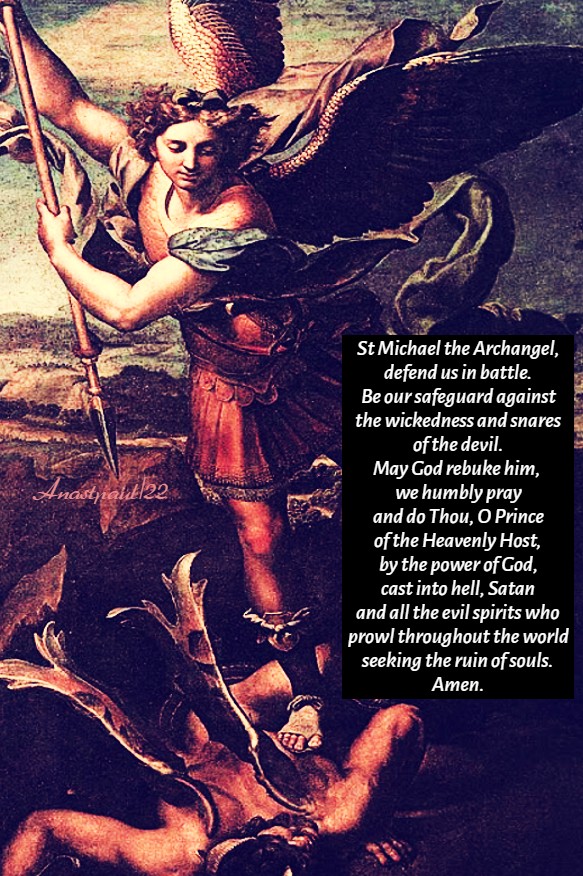
St Michael the Archangel, defend us in battle. Be our safeguard against the wickedness and snares of the devil. May God rebuke him, we humbly pray and do Thou, O Prince of the Heavenly Host, by the power of God, cast into hell, Satan and all the evil spirits who prowl throughout the world seeking the ruin of souls. Amen.

























You must be logged in to post a comment.