For the past week our Electricity supplier has cut our power for up to 10 hours per day. This made it very difficult to do the posts but I managed. Then, on Sunday morning, at 08.00, without prior warning, our electricity went off and is still off. We managed to get our phones charged elsewhere and so I am able to let you know. So sorry!We need to save up to buy a generator.
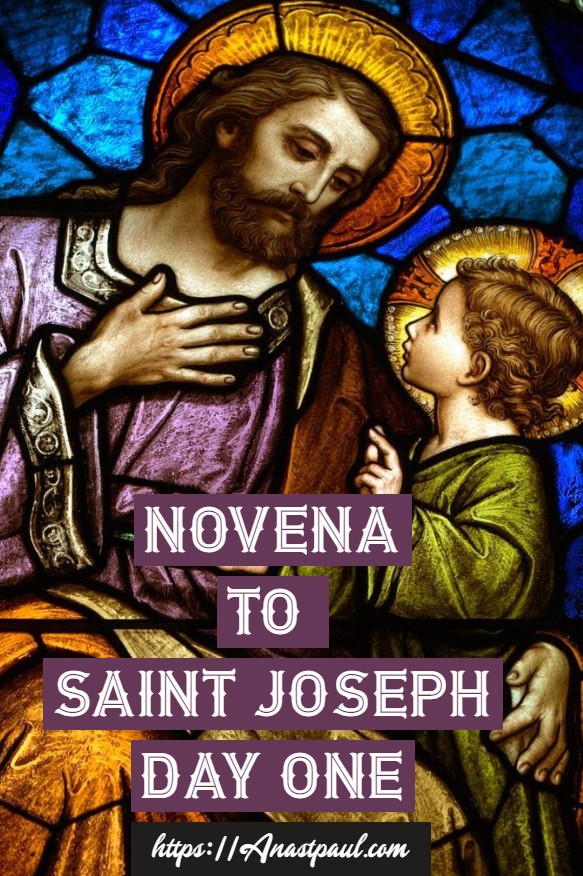
Saint Joseph, you lived for one purpose — to be the personal servant of Jesus Christ, the Word made flesh. Your noble birth and ancestry, the graces and gifts, so generously poured out on you by God — all this was yours, to serve our Lord. Your every thought, word and action, was a homage to the love and glory of the Incarnate Word. You fulfilled most faithfully the role of a good and faithful servant who cared for the House of God. Glorious Saint Joseph, Spouse of the Immaculate Virgin, pray for me to have a pure, humble, faithful heart and perfect resignation to the divine Will. Be my guide, my father and my model throughout life, that I may die as you did, in the arms of Jesus and Mary. Loving Saint Joseph, faithful follower of Jesus Christ, I raise my heart to you to implore your powerful intercession in obtaining from the Divine Heart of Jesus all the graces necessary for my spiritual and temporal welfare, particularly the grace of a happy death, and the special grace I now implore: …………….. (Mention your request) Guardian of the Word Incarnate, I feel confident that your prayers on my behalf will be graciously heard before the throne of God St Joseph Most Faithful, Pray for us! Amen.
Glory be to the Father and to the Son and to the Holy Spirit, as it was in the beginning, is now and ever shall be, world without end. Amen
Most Chaste Spouse the Immaculate Virgin Mother of God
Saint Joseph, Foster Father and Guardian of Jesus and Protector of the Blessed Virgin, to whose faithful keeping , Christ Jesus, Purity and Innocence itself and Mary, the Virgin of virgins, were entrusted, we pray and beseech you by that twofold and most precious charge, by Jesus and Mary, to save us from all uncleanness, to keep our minds untainted, our hearts pure and our bodies chaste. Help us always, to serve Jesus and Mary in perfect chastity. And for this special grace we now implore you, ……………. (Mention your request) We humbly beg you to look graciously upon the beloved inheritance which Jesus Christ purchased by His Blood and to aid us in our necessities with your power and strength. May the wholesome fear of God, strengthen us, that virtue may adorn our lives and lead us to Heaven. St Joseph, Most Chaste, Pray for us! Amen.
Glory be to the Father and to the Son and to the Holy Spirit, as it was in the beginning, is now and ever shall be, world without end. Amen
Thought for the Day – 13 March – Meditations with Antonio Cardinal Bacci (1881-1971)
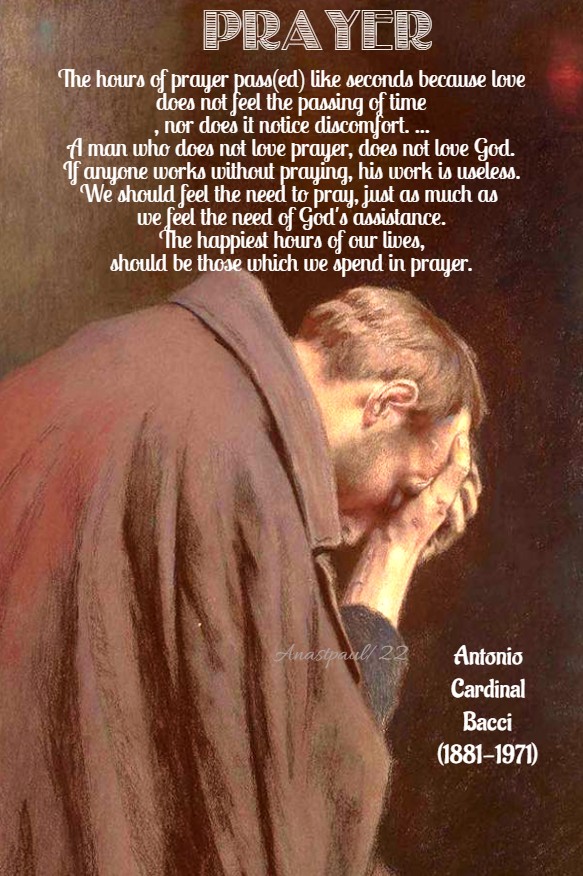
PRAYER
“The Saints loved to pray. Prayer was the source of their strength and consolation. They prayed with enthusiasm and for as long as they were able. They would have liked to spend their lives in intimate conversation with Jesus. They loved God so much, that they lived and worked only for Him. For this reason, they regarded prayer as a pleasure. The hours of prayer passed like seconds because love does not feel the passing of time, nor does it notice discomfort.
Our Lord gave us an example of this in His own life. When He prayed to His Heavenly Father, “He continued all night in prayer to God” (Lk 6:12). In spite of the fact that He was God, He gave Himself in prayer to His Heavenly Father before He worked any of His miracles and in Gethsemane, before He went to His Passion.
It must be the same with us. A man who does not love prayer, does not love God. If anyone works without praying, his work is useless. We should feel the need to pray, just as much as we feel the need of God’s assistance. The happiest hours of our lives, should be those which we spend in prayer.”
The Second Sunday of Lent – 3 March – Our Lenten Journey with the Great Fathers – Matthew 17:1-9
“In You is the source of life and in Your Light Lord, we see light…” – Psalm 35(36)
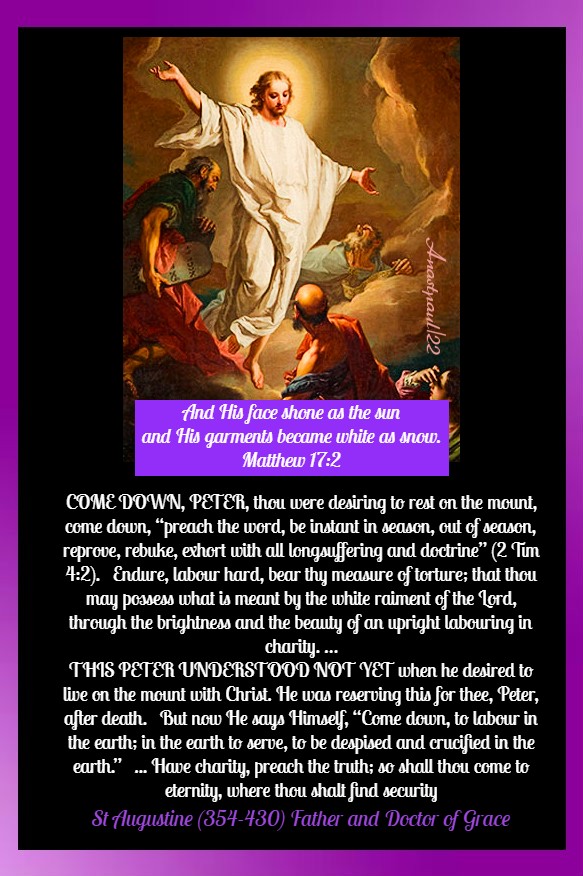
“And His face shone as the sun and His garments became white as snow.”
Matthew 17:2
“THE LORD JESUS,HIMSELF shone bright as the sun, His raiment became white as the snow and Moses and Elias talked with Him (Matt 17:2-3). Jesus Himself indeed, shone as the sun, signifying that “He is the light which lights every man that comes into the world” (Jn 1:9).
WHAT THIS SUN IS to the eyes of the flesh, that is He, to the eyes of the heart and what that is to the flesh of men, that is He to their hearts.
NOWHis raiment is His Church. For if the raiment be not held together by Him Who puts it on, it will fall off. Of this raiment, Paul was, as it were, a sort of last border. For he says himself, “I am the least of the Apostles” (1 Cor 15:9) And in another place, “I am the last of the Apostles.” Now in a garment the border is the last and least part.
WHEREFORE as that woman which suffered from an issue of blood, when she had touched the Lord’s hem, was made whole (Mk 5:34), so the Church, which came from out of the Gentiles, was made whole by the preaching of Paul. What wonder if the Church is signified by white raiment, when you hear the Prophet Isaias saying, “Though your sins be as scarlet, I will make them white as snow”?(Isa 1:18). Moses and Elias, that is, the Law and the Prophets, what avail they, except they converse with the Lord? Except they give witness to the Lord, who would read the Law or the Prophets? Mark how briefly the Apostle expresses this; “For by the Law is the knowledge of sin but now, the righteousness of God, without the Law is manifested:” behold the sun – “being witnessed by the Law and the Prophets” (Rom 3:20-21), behold the shining of the Sun.
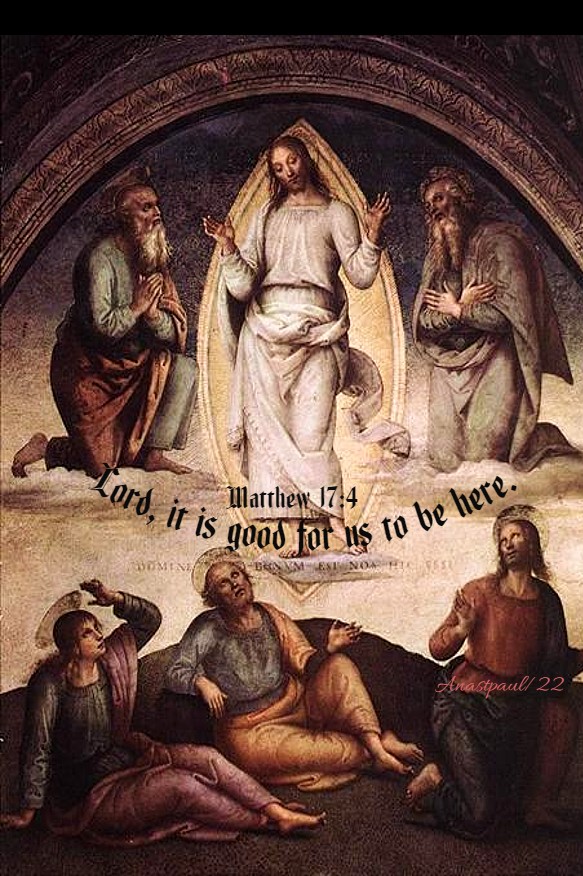
PETER SEES THIS and as a man savouring the things of men says, “Lord, it is good for us to be here” (Matt 17:4) He had been wearied with the multitude, he had found now the mountain’s solitude; there he had Christ, the Bread of the soul. What! should he depart thence again to travail and pains, possessed of a holy love to God and thereby of a good conversation? He wished well for himself and so he added, “If Thou wilt, let us make here three tabernacles; one for Thee and one for Moses and one for Elias.”
TO THIS the Lord made no answer but, notwithstanding, Peter was answered. “For while he yet spake, a bright cloud came and overshadowed them” (Matt 17:5). He desired three tabernacles – the Heavenly Answer showed him, that we have One, which human judgement desired to divide.
CHRIST, the Word of God, the Word of God in the Law, the Word in the Prophets. Why, Peter, dost thou seek to divide them? It were more fitting for thee to join them. Thou seekest three; understand, that they are but ONE. …
COME DOWN, PETER, thou were desiring to rest on the mount, come down, “preach the word, be instant in season, out of season, reprove, rebuke, exhort with all longsuffering and doctrine” (2 Tim 4:2). Endure, labour hard, bear thy measure of torture; that thou may possess what is meant by the white raiment of the Lord, through the brightness and the beauty of an upright labouring in charity. …
THIS PETER UNDERSTOODNOT YET when he desired to live on the mount with Christ. He was reserving this for thee, Peter, after death. But now He says Himself, “Come down, to labour in the earth; in the earth to serve, to be despised and crucified in the earth.” The Life came down, that He might be slain; the Bread came down, that He might hunger; the Way came down, that Life might be wearied in the Way; the Fountain came down, that He might thirst and dost thou refuse to labour? `Seek not thine own.’ Have charity, preach the truth; so shall thou come to eternity, where thou shalt find security.” – St Augustine (354-430) Bishop of Hippo, Father and Doctor of Grace (Homily on the Transfiguration) (Matthew 17:1-9).
Quote/s of the Day – 13 March – The Second Sunday of Lent – Let us be Transfigured!
“And when I hear it said, that God is good and He will pardon us and then see, that men cease not from evil-doing, oh, how it grieves me! The infinite goodness with which God communicates with us, sinners as we are, should constantly make us love and serve Him better but we, on the contrary, instead of seeing in His goodness an obligation to please Him, convert it into an excuse for sin, which will, of a certainty, lead in the end, to our deeper condemnation.”
St Catherine of Genoa (1447-1510)
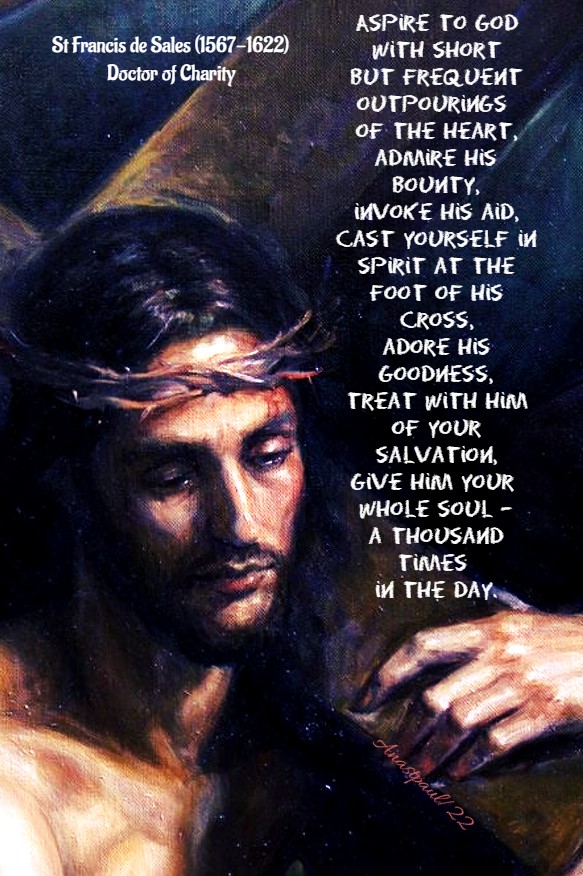
“Aspire to God with short but frequent outpourings of the heart, admire His bounty, invoke His aid, cast yourself in spirit at the foot of His Cross, adore His goodness, treat with Him of your salvation, give Him your whole soul – a thousand times in the day.”
St Francis de Sales (1567-1622) Doctor of Charity
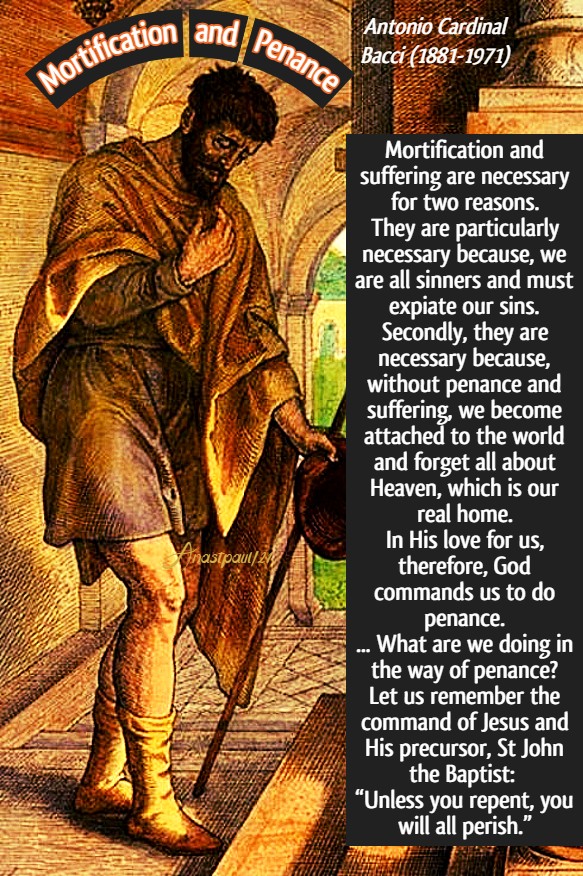
“Mortification and suffering are necessary for two reasons. They are particularly necessary because, we are all sinners and must expiate our sins. Secondly, they are necessary because, without penance and suffering, we become attached to the world and forget all about Heaven, which is our real home. In His love for us, therefore, God commands us to do penance. What are we doing in the way of penance? Let us remember the command of Jesus and His precursor, St John the Baptist: “Unless you repent, you will all perish!”
One Minute Reflection – 13 March – The Second Sunday of Lent – Daniel 3:47-51, Matthew 17:1-9 and “The Month of St Joseph”
“Lord, it is good for us to be here” – Matthew 17:4
REFLECTION – “Rejoice and be happy! Persevere to the end and prefer to die rather than abandon the post to which God has called you!
But embrace the Cross with patience and hide in God’s breast with your troubles: fix your eyes on the Lamb immolated for your sake and always be content with what God gives you and destines for you. We must act like this because we are sure that God is calling us and has chosen for us ,what will make us the most pleasing in His sight. Thus you will go from light to light and the pains endured for the sake of Jesus Crucified will be delightful to you, whereas the pleasures and consolations of the world ,will become bitter.
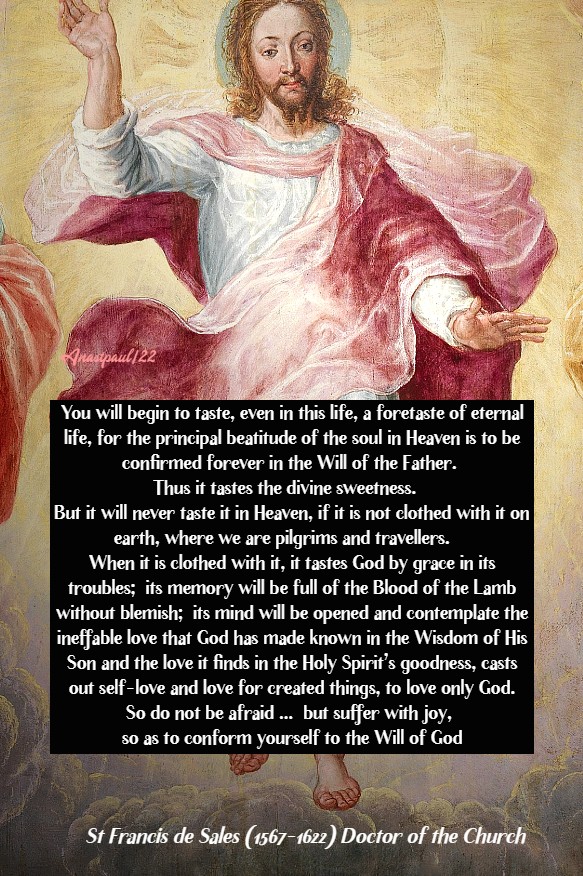
You will begin to taste, even in this life, a foretaste of eternal life, for the principal beatitude of the soul in Heaven is to be confirmed forever in the Will of the Father. Thus it tastes the divine sweetness. But it will never taste it in Heaven, if it is not clothed with it on earth, where we are pilgrims and travellers. When it is clothed with it, it tastes God by grace in its troubles; its memory will be full of the Blood of the Lamb without blemish; its mind will be opened and contemplate the ineffable love that God has made known in the Wisdom of His Son and the love it finds in the Holy Spirit’s goodness, casts out self-love and love for created things, to love only God.
So do not be afraid … but suffer with joy, so as to conform yourself to the Will of God.” – St Francis de Sales (1567-1622) Bishop of Geneva and Doctor of the Church (Sermon for the Second Sunday of Lent [20 Feb 1622])
PRAYER – O God, Who tempered the flames of fire for the three young men, mercifully grant that the flames of sin may not burn us, Your servants. Through Jesus Christ, Thy Son our Lord, Who lives and reigns with Thee, in the unity of the Holy Ghost, God, world without end. Amen (Collect).
Our Morning Offering – 13 March – The Second Sunday of Lent
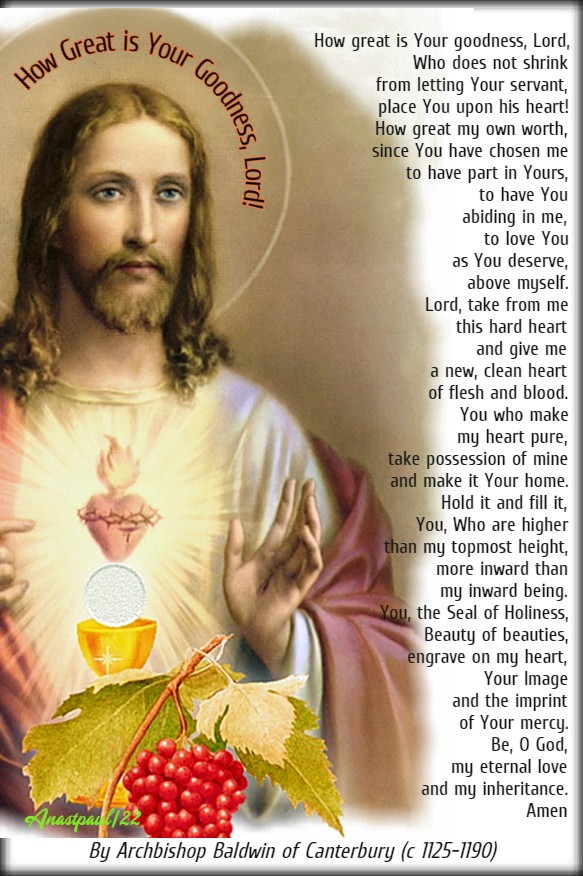
How Great is Your Goodness, Lord! By Archbishop Baldwin of Canterbury (c 1125-1190)
How great is Your goodness, Lord, Who does not shrink from letting Your servant, place You upon his heart! How great my own worth, since You have chosen me to have part in Yours, to have You abiding in me, to love You as You deserve, above myself. Lord, take from me this hard heart and give me a new, clean heart of flesh and blood. You who make my heart pure, take possession of mine and make it Your home. Hold it and fill it, You, Who are higher than my topmost height, more inward than my inward being. You, the Seal of Holiness, Beauty of beauties, engrave on my heart, Your Image and the imprint of Your mercy. Be, O God, my eternal love and my inheritance. Amen
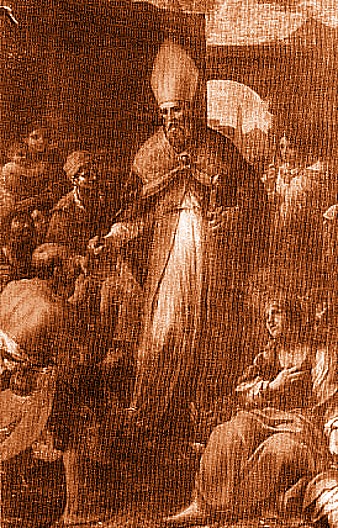
Saint of the Day – 13 March – Saint Ansovinus of Camerino (Died 868) Bishop, Hermit, Peace-maker, Spiritual Adviser and Confessor to the Holy Roman Emperor, Miracle-worker. Born at Camerino, Italy and died in 868 at Camerino, Italy from a fever contracted at Rome. Also known as – Ansovino, Ansuinus, Answin, Oswin. Patronages – gardeners, protection of crops, Diocese of Camerino-San Severino Marche, Italy.
St Ansovinus and St Jerome(detail), Carlo Crivelli
Ansovinus was educated at the Cathedral school of Pavia. After Ordination to the Priesthood, he became a Hermit at Castel Raimondo near Torcello. Before being elected Bishop of Camerino, he served as Confessor to Louis II, Holy Roman Emperor. Ansovinus refused to accept the office of Bishop until Louis was agreed that his See be kept exempt from the conscription of the locals into the army. During this time, Bishops were often required to be responsible for recruiting men for the imperial army.
He was Consecrated at Rome by Pope Leo IV and returned to this City for the Council of Rome held by Pope Nicholas I in 861, where records show that he signed as Ansuinus Camerinensis. His Episcopate was characterised by his generosity to the poor and his pacification of the City’s various warring factions.
The gift of multiplying food was attributed to Ansovinus. He fed thousands of starving people from the regional granary at Castel Raimondo but the grain never ran out.
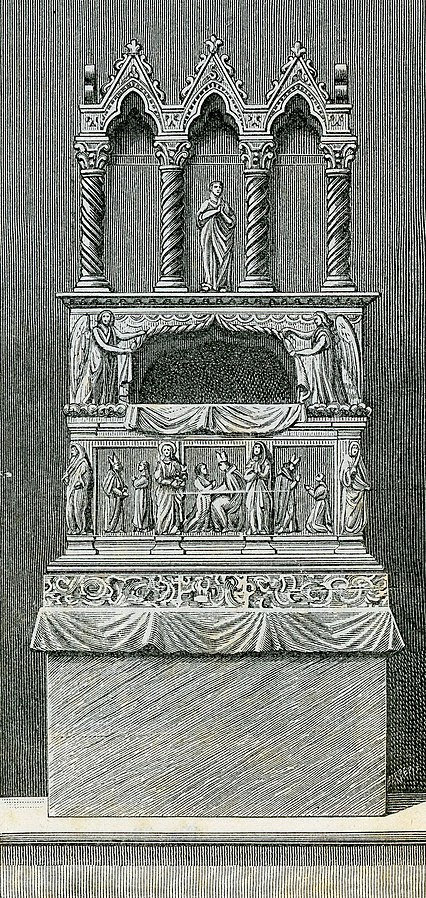
The Cathedral at Camerino includes the marble medieval arch of St Ansovinus. A monumental sarcophagus erected around 1390 holds his relics. His festival was once celebrated by Camerino and the nobles of other castles in the region. The Church of Santi Venanzio e Ansovino at Rome was dedicated to him. Additionally, there are rural Churches dedicated to him at Avacelli, Casenove, Bevagna and Monsammartino.
St Leander of Seville (c 534-c 600) BIshop, Confessor of the Faith, Teacher, Writer, Apostle of Spain and Evangelisation, Father of the Church – Patron of Episcopal attire and Liturgical garments. Saint Leander, as Bishop, instituted the practice of praying the Nicene Creed during Mass—a practice which continues today. Biography: https://anastpaul.wordpress.com/2017/03/13/saint-of-the-day-13-march-st-leander-of-seville/
Bl Agnellus of Pisa St Ansovinus of Camerino (Died 868) Bishop Bl Berengar de Alenys St Christina of Persia St Euphrasia
Bl Judith of Ringelheim St Kevoca of Kyle St Mochoemoc St Nicephorus of Constantinople Bl Peter II of La Cava St Pientius of Poitiers St Ramirus of Leon
Saint Joseph, you are the faithful protector and intercessor of all who love and venerate you. O most prudent Guardian of the Holy Family, protect our home. Pour forth from heaven. blessings on our family. Remain in our midst. Help us to live in love and harmony, in peace and joy. May the wholesome fear of God, strengthen us, that virtue may adorn our lives and lead us to heaven. To you this day we give the key to our dwelling place. Lock out all things that could do us harm. Lock our home and our loved ones, in the hearts of Jesus and Mary. And for this special grace we now implore you: ……………. (Mention your request) We humbly beg you to look graciously upon the beloved inheritance which Jesus Christ purchased by His blood and to aid us in our necessities with your power and strength. Guardian of the Word Incarnate, we feel confident that your prayers on our behalf, will be graciously heard before the throne of God. St Joseph Most Loving Husband and Guardian, Pray for us! Amen
Glory be to the Father and to the Son and to the Holy Spirit, as it was in the beginning, is now and ever shall be, world without end. Amen.
Thought for the Day – 12 March – Meditations with Antonio Cardinal Bacci (1881-1971)
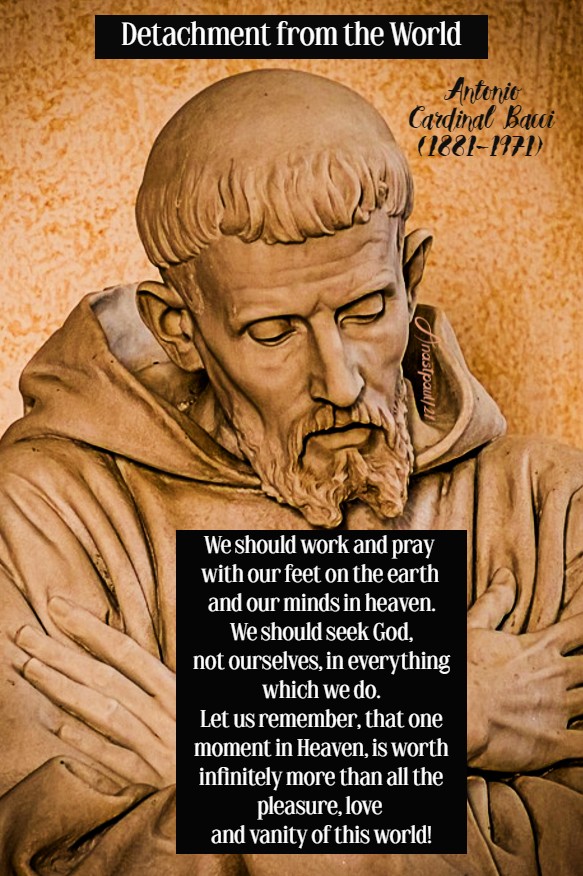
Detachment from the World
“This is not the same as saying that we should have no interest in worldly affairs. Far from it. It is our duty to think about them and make provision for the future. We cannot and should not, look for miracles from God. We may have obligations to ourselves or to our family, or to our position in life. We are in this world to work, not to surrender to apathy or inactivity. We must engage in worldly activity insofar as our circumstances demand it. Nevertheless, our hearts should not be engrossed in earthly things, for they belong to God. In the midst of our other preoccupations, we should adore, love and thank God, the Giver of every good, our Creator and Redeemer. St John Bosco said, that we should work as if we never had to die. But, we should also be as detached from worldly things, as if we had to die in one hour. A man who works like this, can accomplish wonders because, he is not working for himself but, for God. We should work and pray with our feet on the earth and our minds in Heaven. We should seek God, not ourselves, in everything which we do. Let us remember, that one moment in Heaven, is worth infinitely more than all the pleasure, love and vanity of this world!”
Ember Saturday in Lent – 12 March – Our Lenten Journey with the Great Fathers – 1 Thess. 5:14-23, Matthew 17:1-9
“Behold, O God, our Protector and look upon Your servants.” – Psalm 83:10,9
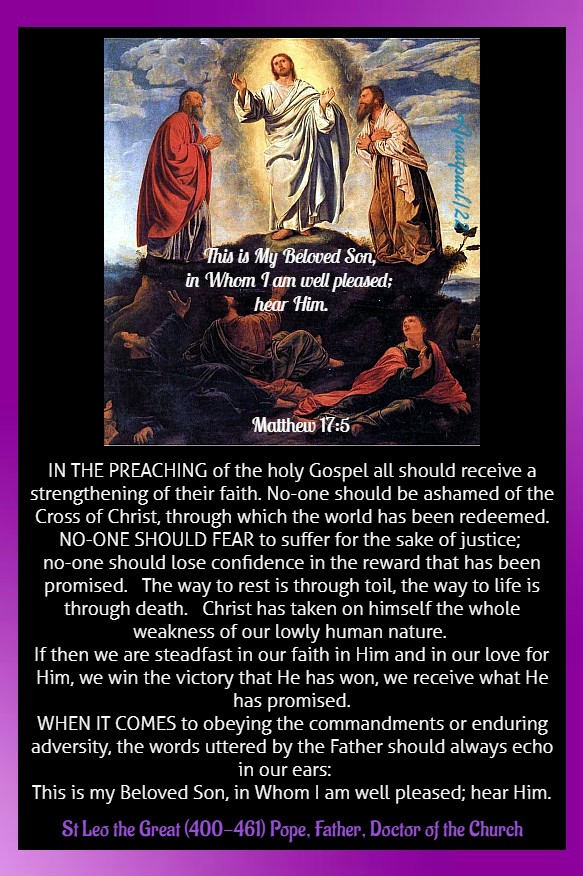
“This is My beloved Son, in Whom I am well pleased; hear Him.”
Matthew 17:5
“THE LORD REVEALS HIS GLORY in the presence of chosen witnesses. His body is like that of the rest of mankind but He makes it shine with such splendour that His face becomes like the sun in glory and His garments, as white as snow.
THE GREAT REASON for this Transfiguration was to remove the scandal of the cCoss from the hearts of His disciples, and to prevent the humiliation of His voluntary suffering, from disturbing the faith, of those who had witnessed the surpassing glory that lay concealed.
WiITH NO LESS FORETHOUGHTHe was also providing a firm foundation for the hope of holy Church. The whole body of Christ was to understand the kind of transformation that it would receive as His gift. The members of that body were to look forward to a share in that glory which first blazed out in Christ their head.
THE LORD had Himself spoken of this, when He foretold the splendour of His coming: Then the just will shine like the sun in the Kingdom of their Father. Saint Paul the Apostle bore witness to this same truth when he said: I consider that the sufferings of the present time are not to be compared with the future glory that is to be revealed in us. In another place he says: You are dead and your life is hidden with Christ in God. When Christ, your life, is revealed, then you also will be revealed with him in glory.
THIS MARVEL of the TRANSFIGURATION contains another lesson for the apostles, to strengthen them and lead them into the fullness of knowledge. Moses and Elijah, the law and the prophets, appeared with the Lord in conversation with Him. This was in order to fulfill exactly, through the presence of these five men, the text which says: Before two or three witnesses every word is ratified. What word could be more firmly established, more securely based, than the word which is proclaimed by the trumpets of both old and new testaments, sounding in harmony, and by the utterances of ancient prophecy and the teaching of the Gospel, in full agreement with each other?
THE WRITINGS of the two testaments support each other. The radiance of the Transfiguration reveals clearly and unmistakably the One Who had been promised by signs foretelling Him under the veils of mystery. As Saint John says: The law was given through Moses, grace and truth came through Jesus Christ. In Him the promise made through the shadows of prophecy stands revealed, along with the full meaning of the precepts of the law. He is the One who teaches the truth of prophecy through His presence and makes obedience to the commandments possible through grace.
IN THE PREACHING of the holy Gospel all should receive a strengthening of their faith. No-one should be ashamed of the Cross of Christ, through which the world has been redeemed.
NO-ONE SHOULD FEAR to suffer for the sake of justice; no-one should lose confidence in the reward that has been promised. The way to rest is through toil, the way to life is through death. Christ has taken on himself the whole weakness of our lowly human nature. If then we are steadfast in our faith in Him and in our love for Him, we win the victory that He has won, we receive what He has promised.
WHEN IT COMES to obeying the commandments or enduring adversity, the words uttered by the Father should always echo in our ears: This is my Beloved Son, in Whom I am well pleased; hear Him.” – St Leo the Great (400-461) Pope, Father, Doctor of the Church (An excerpt from Sermon 51)
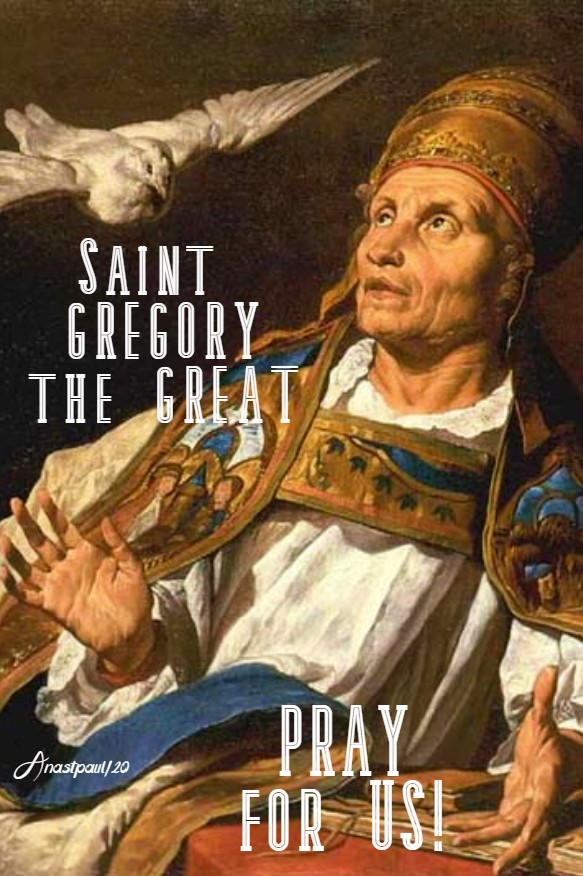
Quote/s of the Day – 12 March – Ember Saturday in Lent – The Memorial of St Pope Gregory the Great (540-604) – Confessor, Father & Doctor
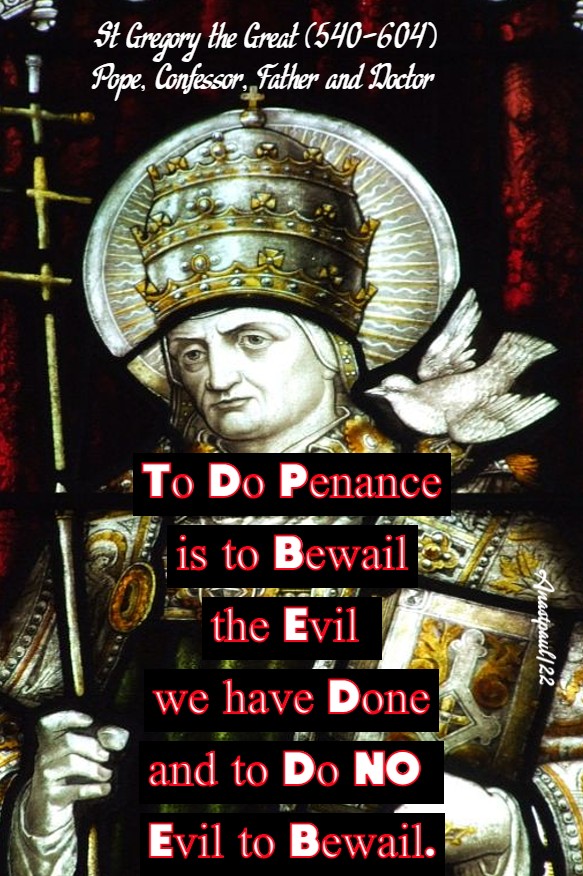
“To do penance is to bewail the evil we have done and to do no evil to bewail.”
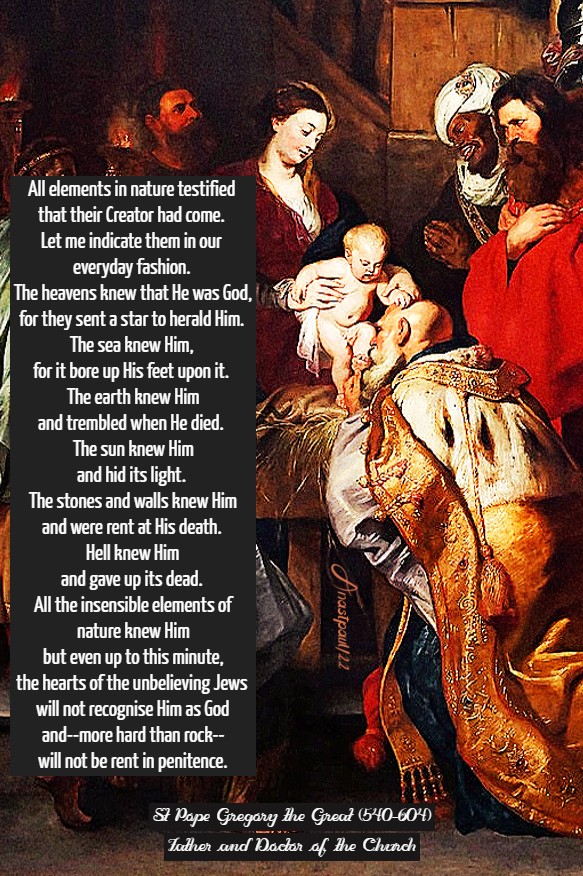
“All elements in nature testified that their Creator had come. Let me indicate them in our everyday fashion. The heavens knew that He was God, for they sent a star to herald Him. The sea knew Him, for it bore up His feet upon it. The earth knew Him and trembled when He died. The sun knew Him and hid its light. The stones and walls knew Him and were rent at His death. Hell knew Him and gave up its dead. All the insensible elements of nature knew Him but even up to this minute, the hearts of the unbelieving Jews will not recognise Him as God and–more hard than rock– will not be rent in penitence.”
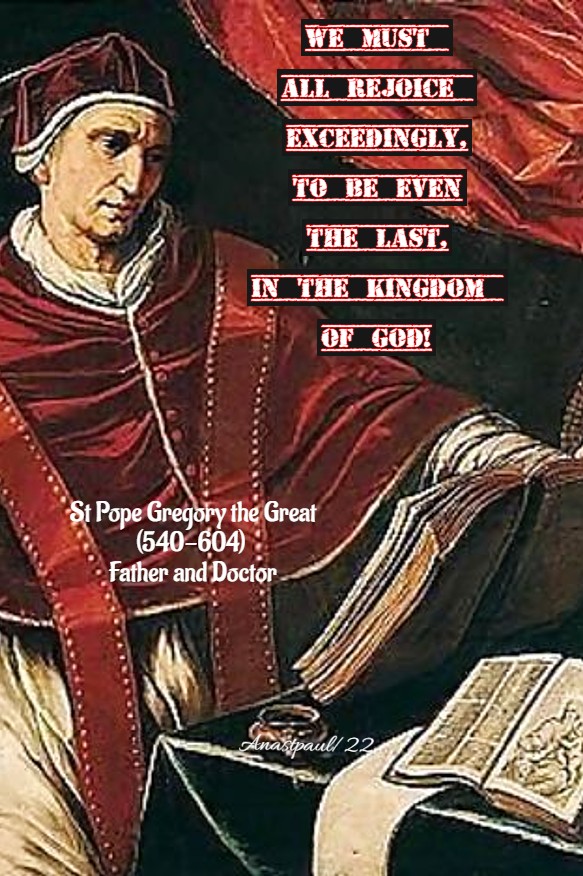
“… We must all rejoice exceedingly, to be even the last, in the Kingdom of God!”
St Gregory the Great (540-604) Pope, Confessor, Father and Doctor “Father of the Fathers”
One Minute Reflection – 12 March – Ember Saturday in Lent – 1 Thess. 5:14-23, Matthew 17:1-9 and the Memorial of St Pope Gregory the Great (540-604) – Confessor, Father & Doctor
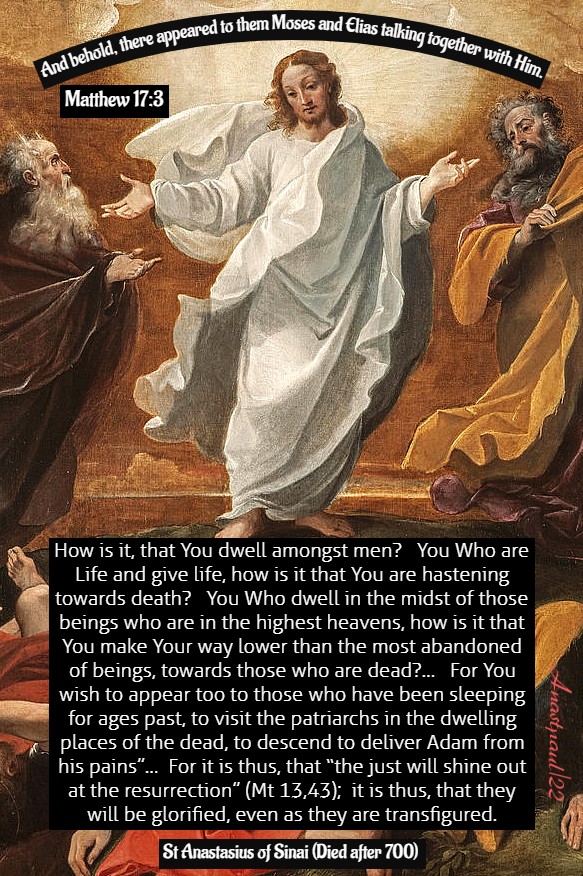
“And behold, there appeared to them Moses and Elias talking together with Him.” – Matthew 17:3
REFLECTION – “Today our Lord truly appeared on the mountain. Today, human nature, which was previously created in the form of God but obscured by the formless figures of idols, has been transfigured into man’s former beauty, created “in the image and likeness of God” (Gn 1,26)… Today man, who had been dressed in garments of skin, plain and dark (Gn 3,21), has put on divine clothing on the mountain, “clothed in light as in a robe” (Ps 103[104],2)…
Moses looked a second time at the fire that did not consume the bush (Ex 3,2) but gives life to all flesh…, and he said : Now I see You : You Who really are and Who exist eternally; You Who are with the Father and have said to me: ‘I am who am’ (v.14)… Now I see You Whom I longed to see before, saying: ‘Let me see your glory’ (Ex 33,18). No longer do I see Your back while hidden in the cleft of the rock (v.23) but I see You, O God, lover of humankind, hidden in human form. No longer do You shelter me with Your right hand (v.22) but You are the Right Hand of the Most High, Who has been revealed to the world. You are the Mediator of both the Old and the New Covenants, O God from of old, New Man…
You Who said to me on Sinai: ‘No-one can see me and live’ (v.20): how is it that You can now be contemplated face-to-face on earth, in the flesh? How is it, that You dwell amongst men? You Who are Life and give life, how is it that You are hastening towards death? You Who dwell in the midst of those beings who are in the highest heavens, how is it that You make Your way lower than the most abandoned of beings, towards those who are dead?…For You wish to appear too to those who have been sleeping for ages past, to visit the patriarchs in the dwelling places of the dead, to descend to deliver Adam from his pains”… For it is thus, that “the just will shine out at the resurrection” (Mt 13,43); it is thus, that they will be glorified, even as they are transfigured.” – St Anastasius of Sinai (Died after 700) Monk (Sermon for the Feast of the Transfiguration).
PRAYER – God our Father, Your rule is a rule of love, Your providence is full of mercy for Your people. Through the intercession of St Gregory, grant the spirit of wisdom and understanding in Your Word through Your Son Jesus Christ. Grant that by the light of His Resurrection we may know our eternal home and strive to attain eternal joy there with You. Through Jesus Christ our Lord, with the Holy Spirit, one God forever, amen.
Our Morning Offering – 12 March – Saturday of Ember Week in Lent and the Memorial of St Pope Gregory the Great (540-604) – Father & Doctor
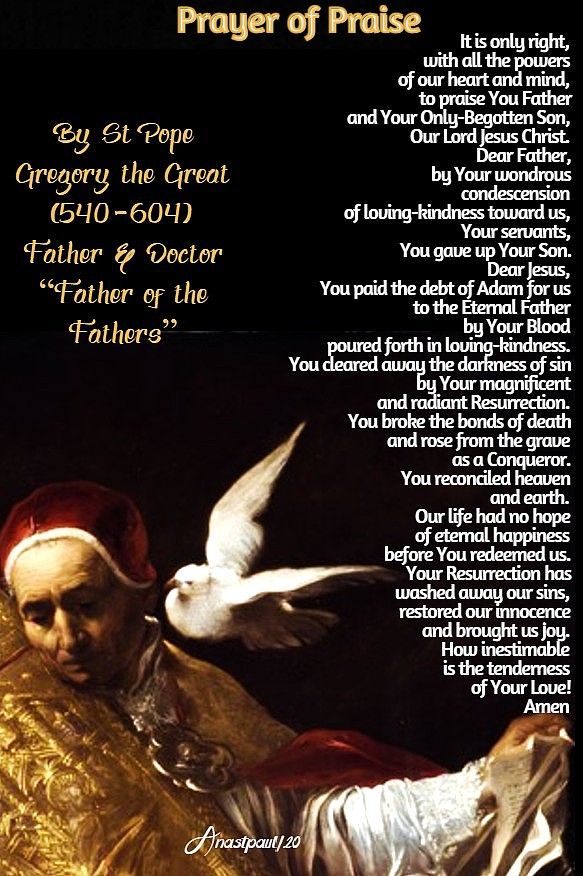
Prayer of Praise By St Gregory the Great (540-604) Father & Doctor “Father of the Fathers”
It is only right, with all the powers of our heart and mind, to praise You Father and Your Only-Begotten Son, Our Lord Jesus Christ. Dear Father, by Your wondrous condescension of loving-kindness toward us, Your servants, You gave up Your Son. Dear Jesus, You paid the debt of Adam for us to the Eternal Father by Your Blood poured forth in loving-kindness. You cleared away the darkness of sin by Your magnificent and radiant Resurrection. You broke the bonds of death and rose from the grave as a Conqueror. You reconciled Heaven and earth. Our life had no hope of eternal happiness before You redeemed us. Your Resurrection has washed away our sins, restored our innocence and brought us joy. How inestimable is the tenderness of Your Love! Amen
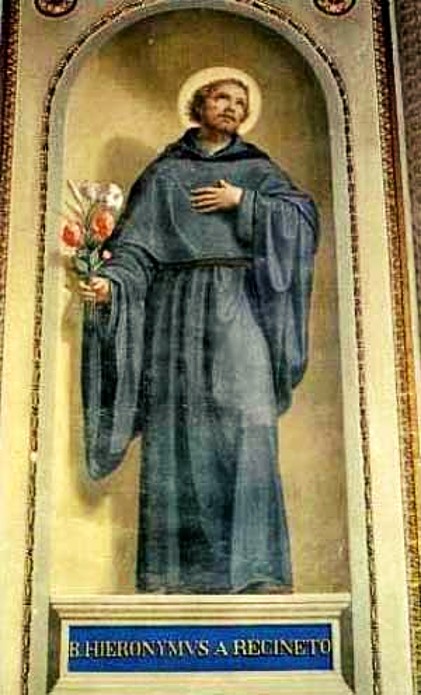
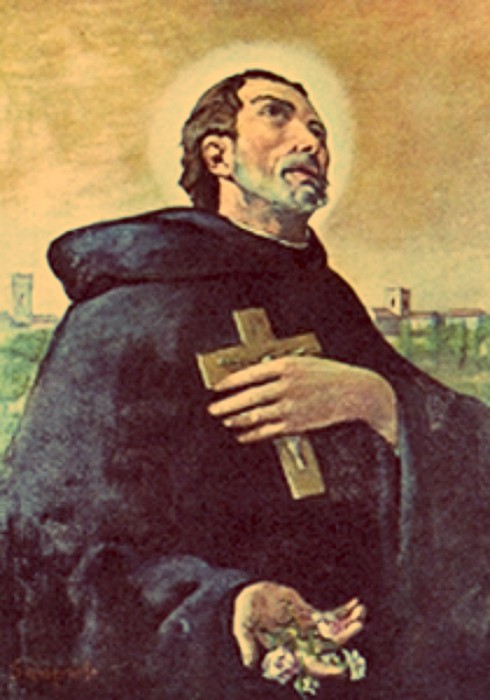
Saint of the Day – 12 March – Blessed Jerome of Recanati OSA (Died 1350) Priest, Friar of the Hermits of Saint Augustine, peacemaker. Died on 12 March 1350 in Recanati, Piceno, Italy of natural causes.
The Roman Martyrology reads : “In Recanati in the Marche, Blessed Girolamo Gherarducci, Priest of the Order of the Hermits of St Agustine, who worked for peace and harmony between peoples.”
Blessed Jerome of Recanati lived in the Augustinian Convent in his hometown, where he died on 12 March 1350. Very little is known about his life. Certainly he lived in a period of flowering of holiness in the Marches, just think of his most famous example: St Nicholas of Tolentino (1254-1305).
In addition to the life of prayer, a peculiar characteristic of his apostolate, was the fact that he was a man who devoted himself to the pacification of souls in times of fratricidal struggles. As part of his ministry, he mediated numerous disputes between families and the City. It is said that he brought peace to the Cities of Ascoli and Fermo, which had been at war with each other for many a long year.
To remember and imitate him, as early as 1369, the Town of Recanati was publicly celebrating the Feast of the blessed Jerome on the Second Sunday of Lent. On this occasion, until recent times, it choose twelve peacemakers from among the populace, six men and six women, whose responsibility it was, to settle disputes among the citizens.
Pope Pius VII confirmed the cult of Jerome in 1804. His mortal remains are venerated in the Church of St Augustine in Recanati.
St Almut of Wetter St Alphege the Bald Bl Angela Salawa St BasilissS of Asia Bl Beatrix of Engelport St Bernard of Carinola Bl Claudius the Minor St Egdunus St Fechno
Blessed Jerome of Recanati OSA (Died 1350) Priest, Friar of the Hermits of Saint Augustine.
St Heiu of Hartlepool St Indrecht of Iona St Pope Innocent I St Joseph Zhang Dapeng
St Luigi Orione FDP (1872-1940) “The Advocate of the Poor and of Orphans” Priest, Preacher, Confessor, Writer, Apostle of Charity, Apostle of Eucharistic Adoration, Marian Devotee and Founder of Sons of Divine Providence Congregation, the Congregation of the Little Missionary Sisters of Charity, Blind Sisters, Adorers of the Blessed Sacrament, Contemplative Sisters of Jesus Crucified. About St Luigi: https://anastpaul.com/2019/03/12/saint-of-the-day-12-march-st-luigi-orione-fdp-1872-1940/
St Maximilian of Thebeste St Mura McFeredach St Paul Aurelian St Peter the Deacon
Martyrs of Nicomedia – 8 Saints: Christians who were Martyred in succession in a single incident during the persecutions of Diocletian. First there were the eight imprisoned Christians, Domna, Esmaragdus, Eugene, Hilary, Mardonius, Maximus, Mígdonus and Peter, about whom we know little more than their names. Each day for eight days one of them would be strangled to death in view of the others so that they would spend the night in dread, not knowing if they were next. Peter was the chamberlain or butler in the palace of Diocletian. When he was overheard complaining about this cruelty, he was exposed as a Christian, arrested, tortured and executed by having the flesh torn from his bones, salt and vinegar poured on the wounds and then being roasted to death over a slow fire. Gorgonio was an army officer and member of the staff in the house of emperor Diocletian, Doroteo was a staff clerk. They were each exposed as Christians when they were overhead objecting to the torture and murder of Peter. This led to their own arrest, torture and executions. Died in 303 in Nicomedia, Bithynia (in modern Turkey) Additional Memorial – 28 December as part of the 20,000 Martyrs of Nicomedia.
To you, O Blessed Joseph, we come in our trials and having asked the help of your most holy spouse, we confidently ask your patronage too. Through that sacred bond of charity, which united you to the Immaculate Virgin Mother of God and through the fatherly love, with which you embraced the Child Jesus, we humbly beg you to look graciously upon the beloved inheritance which Jesus Christ purchased by His Blood and to aid us in our necessities with your power and strength and the special grace we now implore: ……………. (Mention your request)
O most prudent Guardian of the Holy Family, defend the chosen family of Jesus Christ. Most beloved father, dispel the evil of falsehood and sin. Our most mighty protector, graciously assist us from Heaven in our struggle with the powers of darkness. And just as you once saved the Child Jesus from mortal danger, so now, defend God’s Holy Church from the snares of her enemies and from all adversity. Shield each one of us by your constant protection, so that, supported by your example and your help, we may be able to live a virtuous life, to die a holy death and to obtain eternal happiness in Heaven. St Joseph Most Prudent, Pray for us! Amen
Glory be to the Father and to the Son and to the Holy Spirit, as it was in the beginning, is now and ever shall be, world without end. Amen
Thought for the Day – 11 March – Meditations with Antonio Cardinal Bacci (1881-1971)
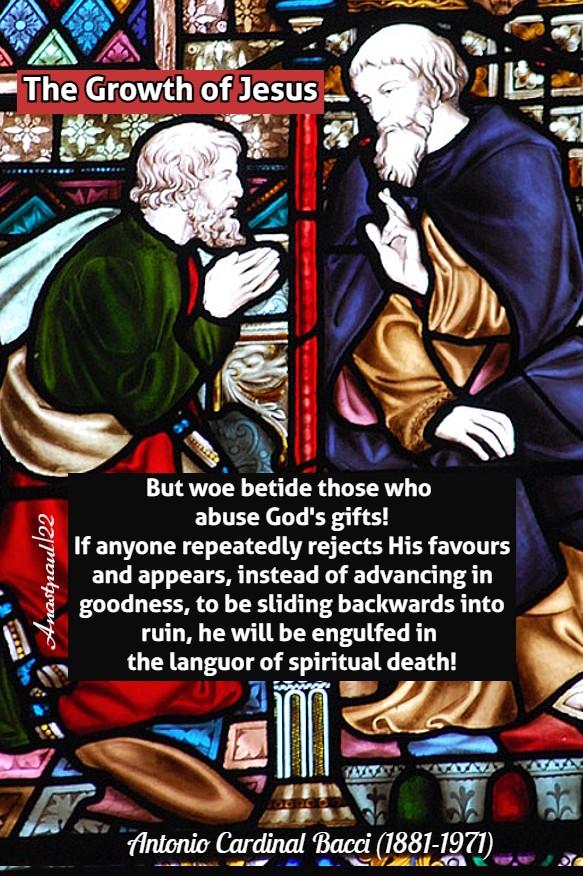
The Growth of Jesus
“It is impossible to stand still in life. This is true, whether we are speaking of the natural or of the supernatural order of life.. Life is motion and activity; there can be no cessation. In the natural order, life begins in the womb and passes through the various stages of infancy, adolescence, maturity and old age.
The supernatural life begins in Baptism, matures in Confirmation and is made entirely holy in the Eucharistic union with Jesus But, if this life begins to fail, the result can be everlasting ruin. It is true that in His infrinite goodness, Jesus has provided the Sacrament of Penance for those who fall and extinguish in themselves, the supernatural life of grace. The Sacrament of Penance, has been instituted for their salvation.
At the hour of death moreover, the Sacrament of Extreme Unction heals the soul of sin and soothes the worn-out body with a refreshing ray of the spiritual life.
But woe betide those who abuse God’s gifts! If anyone repeatedly rejects His favours and appears, instead of advancing in goodness, to be sliding backwards into ruin, he will be engulfed in the languor of spiritual death!”
Friday of the First Week of Lent – 11 March – Our Lenten Journey with the Great Fathers – Ezechiel 18:10-28, John 5:1-15
“Bring me out of distress, O Lord; put an end to my affliction and my suffering and take away all my sins.” – Psalm 24:17-18
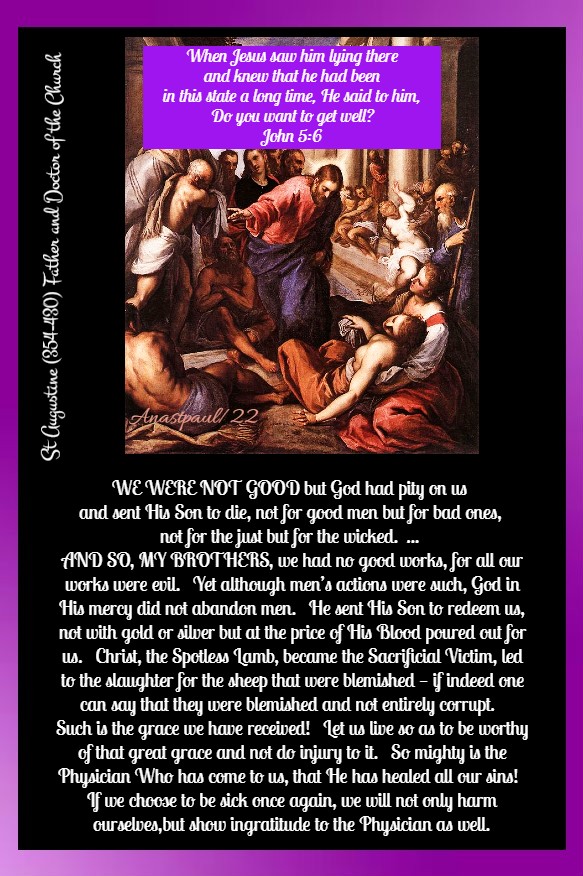
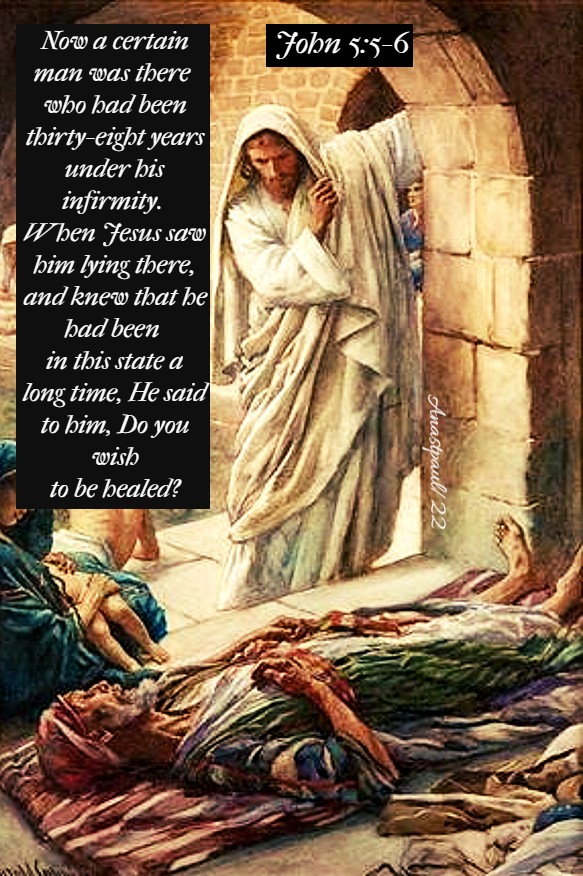
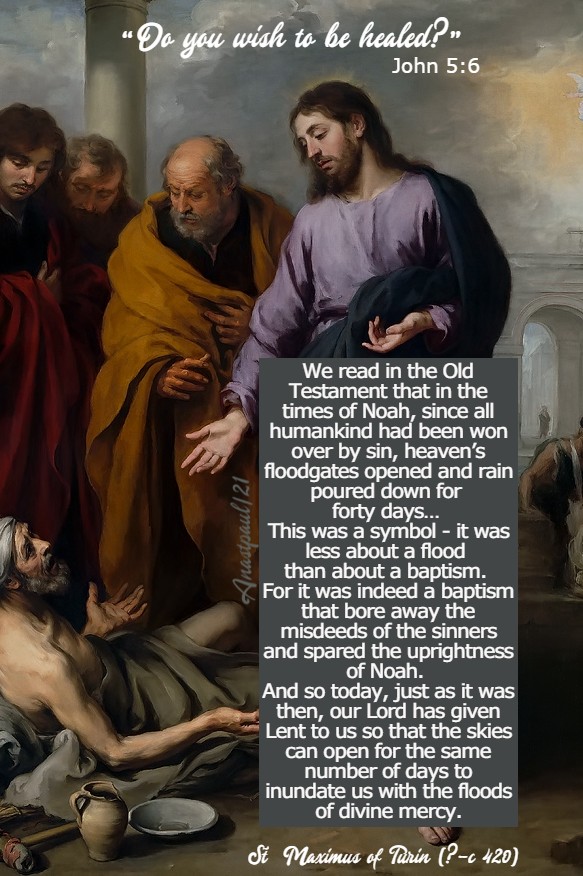
“Now a certain man was there who had been thirty-eight years under his infirmity. When Jesus saw him lying there and knew that he had been in this state a long time, He said to him, Do you want to get well?”
John 5:5-6
“The Lord has had pity on us”
“HAPPY ARE WE if we do the deeds of which we have heard and sung. Our hearing of them means having them planted in us, while our doing them, shows that the seed has borne fruit. By saying this, I wish to caution you, dearly beloved, not to enter the Church fruitlessly, satisfied with mere hearing of such mighty blessings and failing to do good works. For we have been saved by His grace, says the Apostle and not by our works, lest anyone may boast; for it is by His grace that we have been saved. It is not as if a good life of some sort came first and that thereupon, God showed His love and esteem for it from on high, saying: “Let us come to the aid of these men and assist them quickly because they are living a good life.” No, our life was displeasing to Him. He will, therefore, condemn what we have done but He will save, what He Himself has done in us.
WE WERE NOT GOOD but God had pity on us and sent His Son to die, not for good men but for bad ones, not for the just but for the wicked. Yes, Christ died for the ungodly. Notice what is written next: One will hardly die for a righteous man, although perhaps for a good man one will dare even to die. Perhaps someone can be found who will dare to die for a good man but for the unjust man, for the wicked one, the sinner, who would be willing to die except Christ alone, Who is so just, that He justifies even the unjust?
AND SO, MY BROTHERS,we had no good works, for all our works were evil. Yet although men’s actions were such, God in His mercy did not abandon men. He sent His Son to redeem us, not with gold or silver but at the price of His Blood poured out for us. Christ, the Spotless Lamb, became the Sacrificial Victim, led to the slaughter for the sheep that were blemished — if indeed one can say that they were blemished and not entirely corrupt. Such is the grace we have received! Let us live so as to be worthy of that great grace and not do injury to it. So mighty is the Physician Who has come to us, that He has healed all our sins! If we choose to be sick once again, we will not only harm ourselves,but show ingratitude to the Physician as well.
LET US THEN FOLLOW Christ’s paths which He has revealed to us, above all, the path of humility, which He Himself became for us. He showed us that path by His precepts, and He Himself followed it by His suffering on our behalf. In order to die for us —because as God, He could not die — the Word became flesh and dwelt among us. The immortal One took on mortality, that He might die for us and by dying, put to death our death. This is what the Lord did, this the gift He granted to us. The mighty one was brought low, the lowly one was slain and after He was slain, He rose again and was exalted. For He did not intend to leave us dead in hell but to exalt, in Himself, at the Resurrection of the Dead, those whom He had already exalted and made just by the faith and praise they gave Him. Yes, He gave us the path of humility. If we keep to it we shall confess our belief in the Lord and have good reason to sing: We shall praise You, God, we shall praise You and call upon Your Name.” – St Augustine (354-430) Father and Doctor of the Church (An excerpt from a Homily 23).
Quote/s of the Day – 11 March – Ember Friday of the First Week of Lent – Ezechiel 18:10-28, John 5:1-15
“Now a certain man was there who had been thirty-eight years under his infirmity. When Jesus saw him lying there, and knew that he had been in this state a long time, He said to him, Do you want to get well?”
John 5:5-6
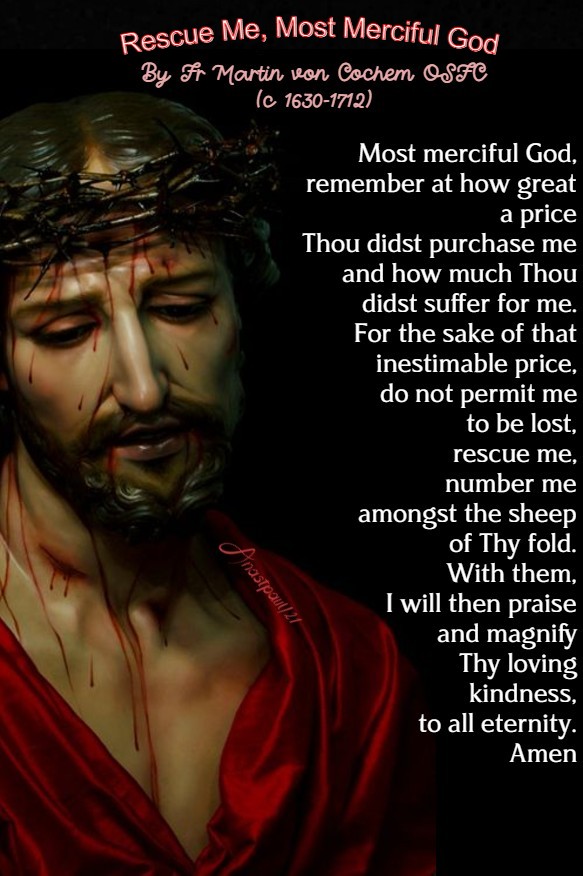
Rescue Me, Most Merciful God By Father Martin von Cochem OSFC (c 1630-1712)
Most merciful God, remember at how great a price Thou didst purchase me and how much Thou didst suffer for me. For the sake of that inestimable price, do not permit me to be lost, rescue me, number me amongst the sheep of Thy fold. With them, I will then praise and magnify Thy loving kindness, to all eternity. Amen
Fr Martin von Cochem was a German Capuchin theologian, preacher and prolific ascetic writer. Father Martin’s works embrace a great variety of subjects: a huge volume of apologetics against Protestantism, the life of Christ, lives of the Saints, edifying narratives, the setting forth of certain points in Christian asceticism, forms of prayer, methods to be followed for the worthy reception of the sacraments, etc. The prayer above is from the renowned “The Four Last Things.”
One Minute Reflection – 11 March – Ember Friday of the First Week of Lent – Ezechiel 18:10-28, John 5:1-15
“Jesus said to him, “Do you wish to be healed?”The sick man answered Him, ‘Sir, I have no one to put me into the pool’ … Jesus said to him, “Rise, take up your pallet and walk.” And at once the man was cured.” – John 5:6-8
REFLECTION – “We read in the Old Testament that in the times of Noah, since all humankind had been won over by sin, heaven’s floodgates opened and rain poured down for forty days… This was a symbol – it was less about a flood, than about a baptism. For it was indeed a baptism that bore away the misdeeds of the sinners and spared the uprightness of Noah. And so today, just as it was then, our Lord has given Lent to us so that the skies can open for the same number of days to inundate us with the floods of divine mercy. Once washed in the saving waters of baptism, this Sacrament enlightens us and, just as formerly, its waters bear away the evil of our sins and confirm the uprightness of our virtues.
Today’s situation is just the same as in Noah’s time. Baptism is flood to sinners and consecration for the faithful. In Baptism the Lord rescues justice and destroys injustice. We can see this in the example of one and the same man – before he was cleansed by the spiritual commands, the Apostle Paul, was a persecutor and blasphemer (1Tm 1,13). But once he had been bathed with the heavenly rain of Baptism, the blasphemer died, the persecutor died, Saul died. Then the Apostle, the just man, Paul, came to life… Anyone who lives Lent in a religious manner and observes the Lord’s decrees will see sin die in him and grace come to life… such as these die as sinners and live as righteous persons.” – St Maximus of Turin (?-c 420), Bishop – Sermon for Lent 50
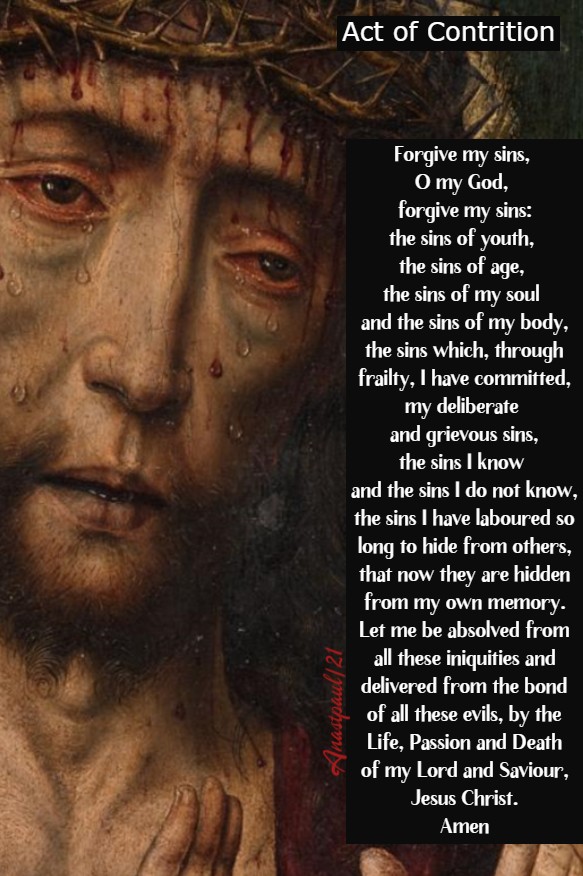
PRAYER – Forgive my sins, O my God, forgive my sins: the sins of youth, the sins of age, the sins of my soul and the sins of my body, the sins which, through frailty, I have committed, my deliberate and grievous sins, the sins I know and the sins I do not know, the sins I have laboured so long to hide from others, that now they are hidden from my own memory. Let me be absolved from all these iniquities and delivered from the bond of all these evils, by the Life, Passion and Death of my Lord and Saviour, Jesus Christ. Amen
Our Morning Offering – 11 March – Ember Friday of the First Week of Lent
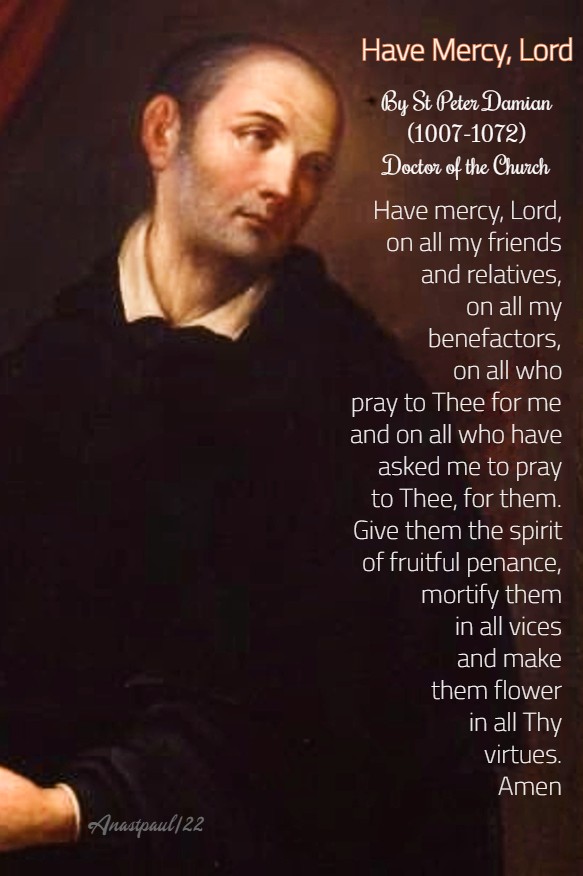
Have Mercy, Lord By St Peter Damian (1007-1072) Doctor of the Church
Have mercy, Lord, on all my friends and relatives, on all my benefactors, on all who pray to Thee for me and on all who have asked me to pray to Thee, for them. Give them the spirit of fruitful penance, mortify them in all vices and make them flower in all Thy virtues. Amen
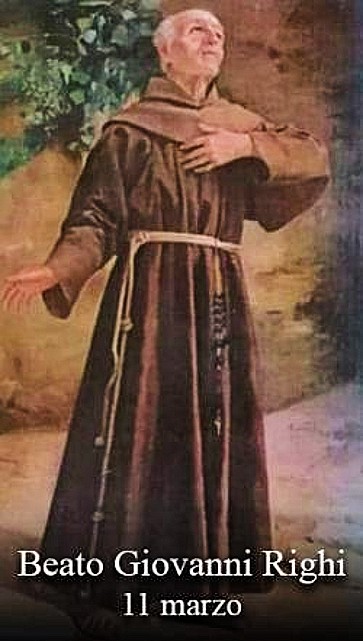
Saint of the Day – 11 March – Blessed John Baptist Righi of Fabriano OFM (1469–1539) Priest, Confessor, Friar of the Friars Minor, Ascetic, Ecstatic, renowned Preacher, Peace-maker, Hermit. Born as Giovanni Battista Righi in 1469 at Fabriano, Ancona, Italy and died on 11 March 1539 of natural causes. Also known as – Giovanni Battista da Fabriano, Giovanni da Fabriano, Giovanni Righi, Joannes de Fabriano, Johannes Baptista Righi, John Baptist of Fabriano. His body is incorrupt.
John was born in Fabriano of the Righi family. From an early age, he was very obedient to the teachings he received in his family. Reading the life of St Francis of Assisi, he decided to become a Franciscan Friar. And so, in the prime of his youth, our Blessed wore the Franciscan habit in the Convent of Forano, near Rieti. After his profession, he devoted several years to the study of philosophy and theology before being Ordained a Priest. For many years he was a very obedient and humble Friar. It is assumed that the young professed went from Forano to the solitary Convent of La Romita, a former Monastery of the Camaldolese.
Giovanni spent practically the rest of his life, about fifty years, up there in Romita, sometimes dedicated to the apostolate and more often, to silence and prayer, penance, reading the works of the Holy Fathers of the Church. In the solitude of La Romita, our blessed found what his heart desired. In the Church, there was a venerable image of Jesus Crucified, which belonged to St John of the Marches – John made it the object of frequent visits, ardent prayers, profound meditations and even,, by permission of the Lord, not rare ecstasies.
Emulating his seraphic Father, he ardently wanted to unite himself to the sufferings of Jesus, to transform himself into the Crucified Love, so little loved by much of the world. He found another object that touched his heart and fueled his filial piety: a terracotta image, which represented the Blessed Virgin contemplating the Child Jesus lying on her lap and which was flanked by the figures of the Apostle St James the Greater and St Francis of Assisi. And so, the solitary devotee spent long hours at the foot of the new and captivating image of the Mother of the Lord, exchanging affections and feelings. In the evening, after the Matins prayer, when his brothers retired to rest, he remained in the choir to continue his prayers which often ended in ecstasy. exchanging affections and feelings. In the evening, after the Matins prayer, when his brothers retired to rest, he remained in the choir to continue his prayers which often ended in ecstasy. exchanging affections and feelings.
In the dense forest that surrounded the solitary Convent, there was and still is, a small cave, like a hermitage inside the hermitage, where John went to devote himself to prayer and penance . For our blessed, Heaven on earth was in his retreat and solitude. But charity and obedience required him, from time to time, to undertake long journeys.
At that time, the different lords and noble families of the region were in conflict. Society and the Church experienced the ups and downs of the progress of a rebirth in all orders. And in high society, as well as among soldiers and ordinary people, demoralisation and the decline of good manners was the norm. John was not an eloquent orator but with his simple and persuasive word he managed to touch hearts and lead them to conversion.
He embarked on long journeys with joy of spirit to pacify the belligerents or to exhort both warring parties to convert and change their lives. When he travelled, always accompanied by another friar as was obligatory, he brought with him nothing but his peaceful poverty and his firm trust in God. his word was always a warm exhortation to the fulfillment of the divine Commandments, to the frequency of the Sacraments, to love one’s neighbour, to free the world from slavery. And he spoke with such zeal and persuasion that many were converted to God, reconciled, confessed, they did penance for their sins. The fame of the simple Friar spread throughout the Marches of Ancona.
Great was the charity of John with all those who met him on his travels or with those who came to him for spiritual guidance and Confession.. But what he practiced with the Friars of his Convent was even greater. He was attentive to their wants and needs and his greatest joy was to serve the sick, giving them every care promptly and gently.
His love for Jesus Crucified, the constant object of his love and contemplation, led him to practice the austerities and penances typical of the ancient anchorites, whose writings he read with pleasure, in particular those of St John Climacus. He continually fasted on bread and water, eating only one meal a day and even less during Lent. As a true son of St Francis, he loved poverty and practiced it, contenting himself with the patched tunic and the Breviary for the liturgical praise of the Lord. His cell, later transformed into an oratory, was small and sober. Indeed, his reputation for holiness soon spread throughout the region and when our Friar travelled, sick people were brought to him even from distant regions, to bless them,and there were numerous votive offerings that were and still are displayed.
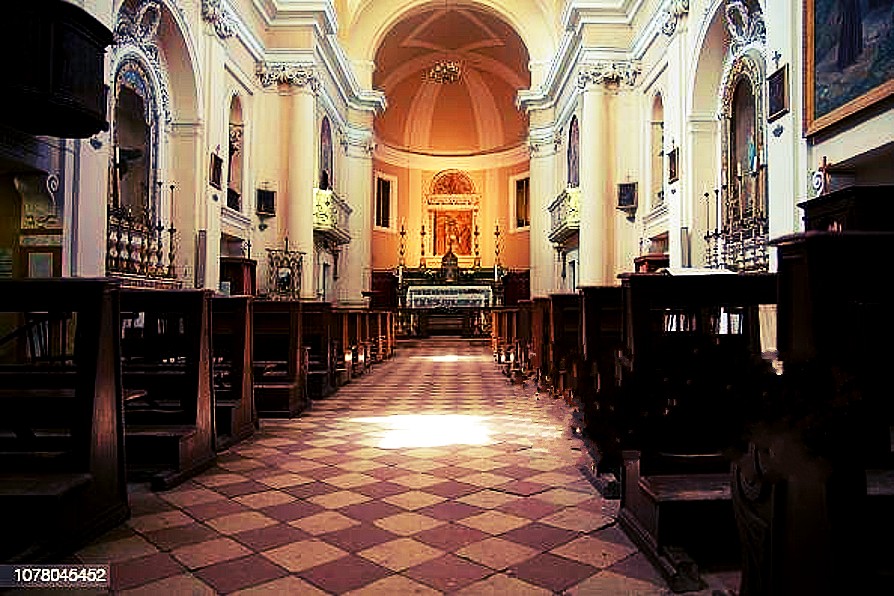
One day he was seized by a great malaise. The Friars came, gave him first aid and looked after him until it seemed to them that the danger had passed, then they withdrew . Soon after, left alone in his small cell, he fell asleep peacefully in the Lord. His body was buried in the cemetery of the Convent but, ten years later, it was unearthed, found incorrupt and placed in an urn under the Altar of the Holy Christ. And there, in the Church of San Giacomo della Romita, he is still preserved and venerated today. His cult was confirmed by Pope Leo XIII on 7 September 1903.
The Church where the Body of Blessed John Righi is enshrined
St Aengus the Culdee St Alberta of Agen St Alexius U Se-Yong St Amunia St Aurea of San Millán
St Benedict Crispus of Milan (Died 725) Archbishop of Milan from c 685 until his death. A poem written about ten years after his death, De laudibus Mediolani- In Praise of Milan, praises him and remembers his veneration by the entire land and informs us that he was buried in the Basilica of Saint Ambrose. His Life: https://anastpaul.com/2020/03/11/saint-of-the-day-11-march-saint-benedict-crispus-of-milan-died-725/
St Candidus the Martyr St Constantine II St Constantine of Carthage St Ðaminh Cam
St Firmian the Abbot St Firmus the Martyr St Gorgonius the Martyr St Heraclius of Carthage Bl John Kearney Blessed John Baptist Righi of Fabriano OFM (1469–1539) Priest, Friar of the Friars Minor St Marcus Chong Ui-Bae St Peter the Spaniard St Pionius St Piperion the Martyr St Rosina of Wenglingen St Sophronius of Jerusalem St Thalus the Martyr Bl Thomas Atkinson St Trophimus the Martyr St Vigilius of Auxerre St Vincent of Leon
Saint Joseph, you are the faithful protector and intercessor of all who love and venerate you. You know that I have confidence in you and that, after Jesus and Mary, I come to you as an example of holiness, for you are especially close to God. Therefore, I humbly commend myself, with all who are dear to me and all for whom I pray, to your intercession. I beg of you, by your love for Jesus and Mary, not to abandon me during life and to assist me at the hour of my death. Glorious Saint Joseph, Spouse of the Immaculate Virgin, pray for me to have a pure, humble, charitable heart and perfect resignation to the divine Will. Be my guide, my father and my model throughout life, that I may die as you did, in the arms of Jesus and Mary. Loving Saint Joseph, faithful follower of Jesus Christ, I raise my heart to you to implore your powerful intercession in obtaining from the Divine Heart of Jesus all the graces necessary for my spiritual and temporal welfare, particularly the grace of a happy death, and the special grace I now implore: …………….. (Mention your request) Guardian of the Word Incarnate, I feel confident that your prayers on my behalf will be graciously heard before the throne of God St Joseph Most Just, Pray for us! Amen.
Glory be to the Father and to the Son and to the Holy Spirit, as it was in the beginning, is now and ever shall be, world without end. Amen.
Thought for the Day – 10 March – Meditations with Antonio Cardinal Bacci (1881-1971)
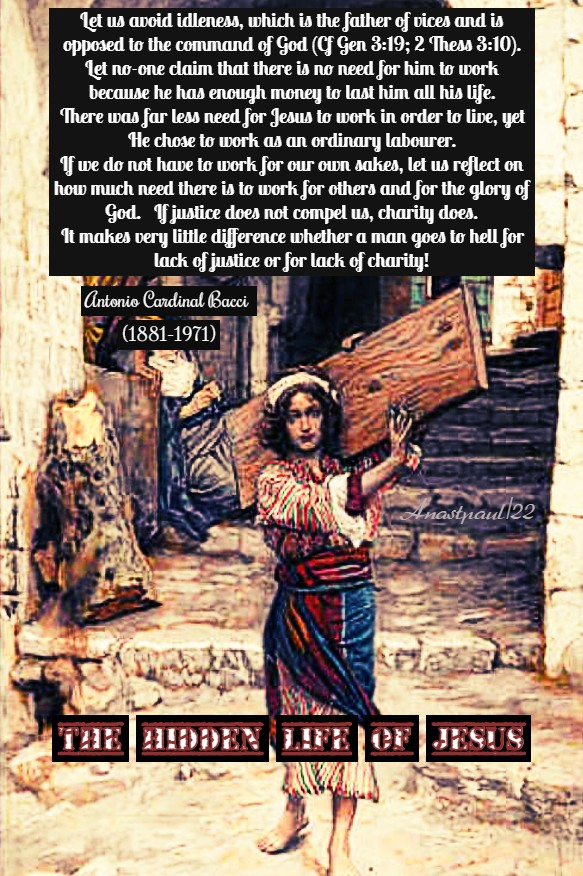
The Hidden Life of Jesus
“Jesus chose to be an ordinary workman. He had power over the Angels of Heaven, over the sun and stars of the firmament, over the waves of the ocean and over all the elements, By a single act of His Divine Will , He could multiply loaves and change water into wine. Yet, He elected to earn His living by the sweat of His brow. In His times, the artisan was held in low esteem and was very often a slave. Manual labour was regarded as sordid and undignified. Christ wished to sanctify manual work by His own toil. He wished to teach men that, in the eyes of God, the hoe is as valuable as the pen. There is no difference between driving a plough and wielding a sceptre, as long as a man is fulfilling his duty for the love of God. The only thing in this regard which is displeasing to God, is laziness and inactivity. Anyone who leads an idle life at the expense of others, is breaking God’s law, which commands everyone to work.
Let us follow the example of Jesus the Worker. Let us avoid idleness, which is the father of vices and is opposed to the command of God (Cf Gen 3:19; 2 Thess 3:10). Let no-one claim that there is no need for him to work because he has enough money to last him all his life. There was far less need for Jesus to work in order to live, yet He chose to work as an ordinary labourer. If we do not have to work for our own sakes, let us reflect on how much need there is to work for others and for the glory of God. If justice does not compel us, charity does. It makes very little difference whether a man goes to hell for lack of justice or for lack of charity!”
Thursday of the First Week of Lent – 10 March – Our Lenten Journey with the Great Fathers – Ezechiel 18:1-9, Matthew 15:21-28
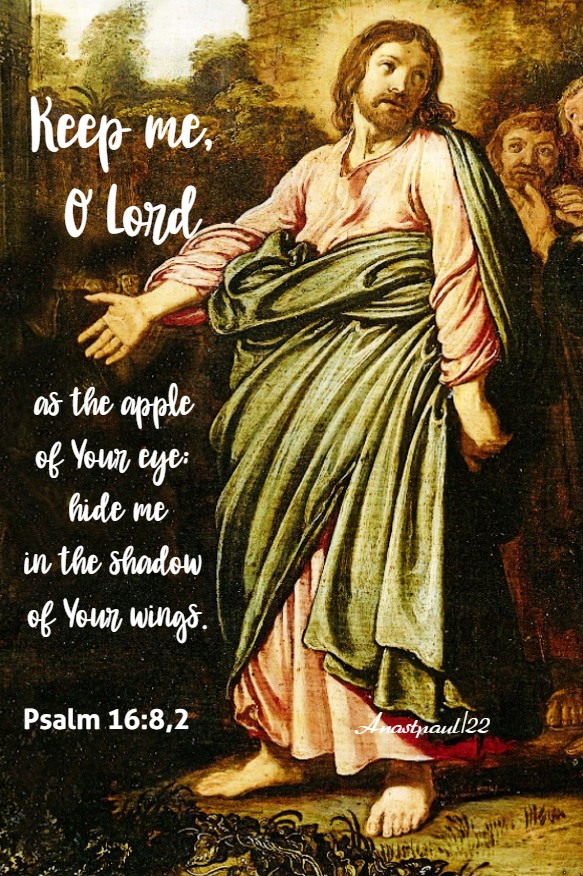
Keep me, O Lord, as the apple of Your eye; hide me in the shadow of Your wings. Psalm 16:8,2
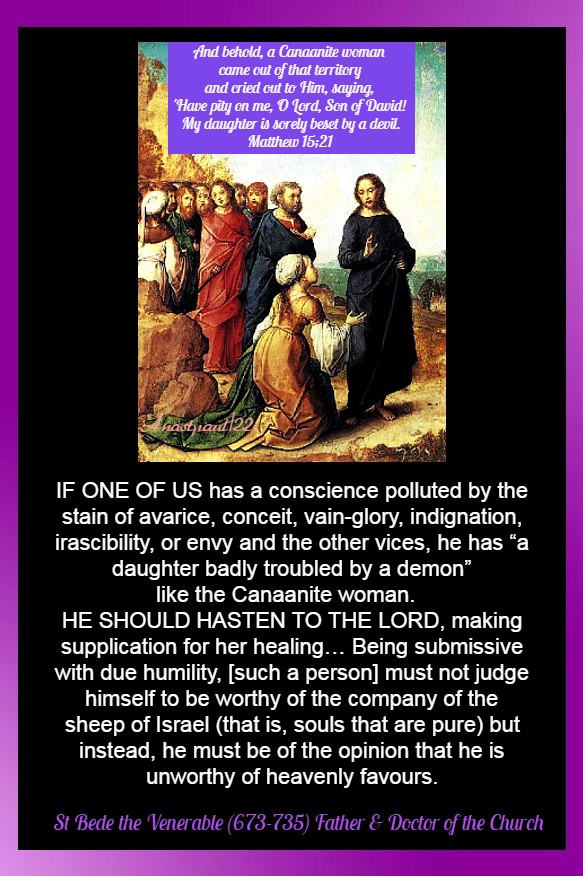
“And behold, a Canaanite woman came out of that territory and cried out to Him, saying, ‘Have pity on me, O Lord, Son of David! My daughter is sorely beset by a devil.’
Matthew 15;21
“O WOMAN, YOUR FAITH IS GREAT. Let it be done to you as you wish” (Mt 15:28). Indeed, she had great enough faith, since she knew neither the ancient miracles, commands and promises of the prophets, nor the more recent ones of the Lord Himself.
IN ADDITION, as often as she was disregarded by the Lord, she persevered in her entreaties and she did not cease knocking by asking Him, although she knew only by popular opinion that He was the Saviour. On account of this, she secured the great object for which she implored…
IF ONE OF US has a conscience polluted by the stain of avarice, conceit, vain-glory, indignation, irascibility, or envy and the other vices, he has “a daughter badly troubled by a demon” like the Canaanite woman.
HE SHOULD HASTEN TO THE LORD, making supplication for her healing… Being submissive with due humility, [such a person] must not judge himself to be worthy of the company of the sheep of Israel (that is, souls that are pure) but instead, he must be of the opinion that he is unworthy of heavenly favours.
NEVERTHELESS, LET HIM NOT IN DESPAIR, rest from the earnestness of his entreaty but with his mind free of doubt, let him trust in the goodness of the supreme Benefactor, for the One who could make a confessor from a robber (Lk 23:39f.), an apostle from a persecutor (Acts 9:1-30, an evangelist from a publican (Mt 9:9-13) and who could make sons for Abraham out of stones, could turn even the most insignificant dog into an Israelite sheep.”…St Bede the Venerable (673-735) – Father & Doctor of the Church
Quote/s of the Day – 10 March –Thursday of the First Week of Lent – Ezechiel 18:1-9, Matthew 15:21-28
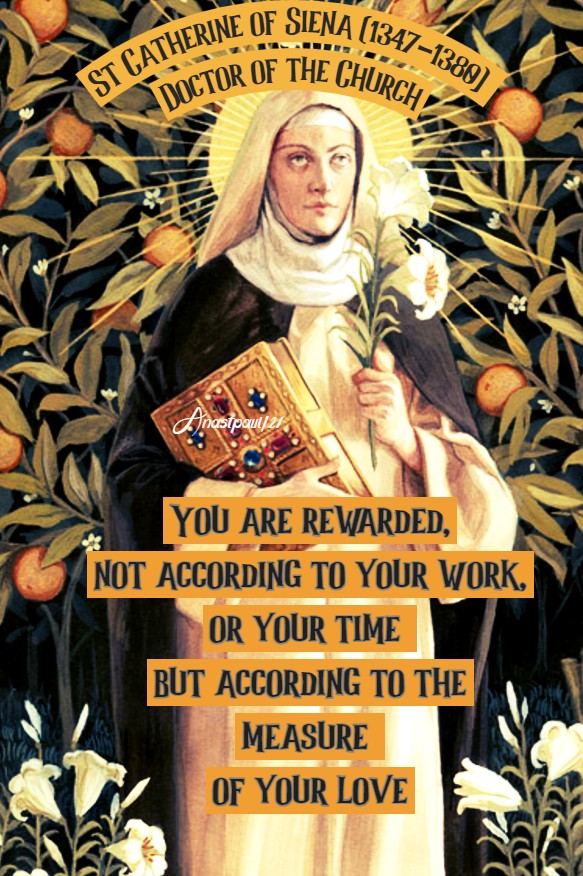
“You are rewarded, not according to your work, or your time but according to the measure of your love.”
St Catherine of Siena (1347-1380) Doctor of the Church
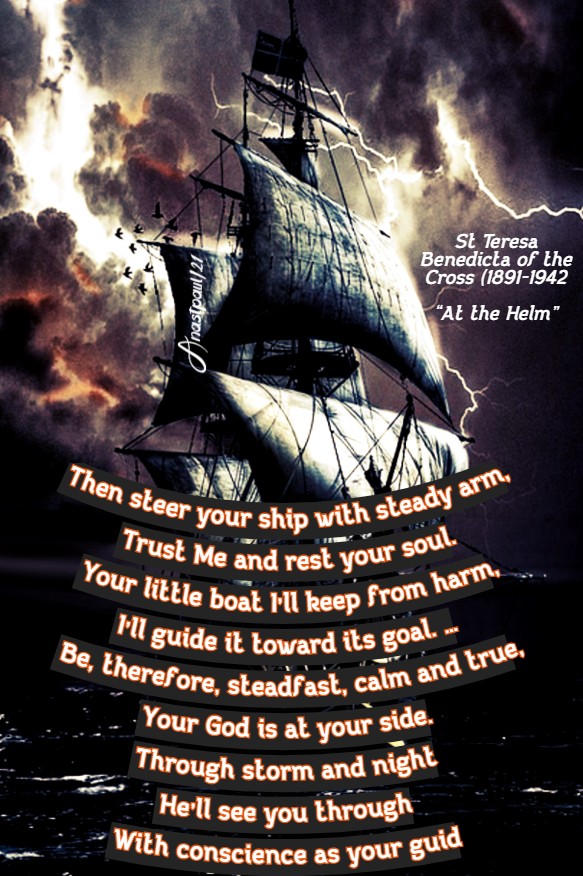
“Then steer your ship with steady arm, Trust Me and rest your soul. Your little boat I’ll keep from harm, I’ll guide it toward its goal. … Be therefore, steadfast, calm and true, Your God is at your side. Through storm and night He’ll see you through With conscience as your guide.”
St Teresa Benedicta of the Cross OCD.(1891-1942 Edith Stein “At the Helm”
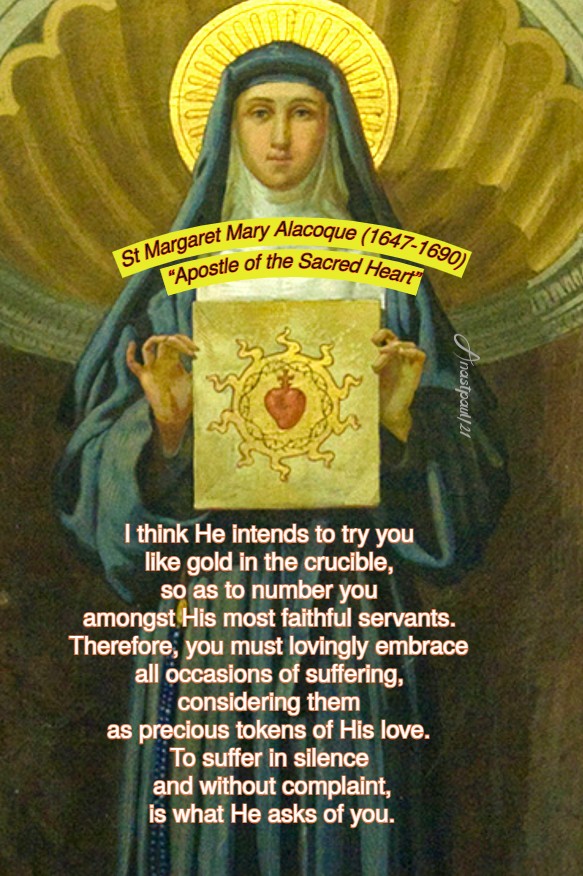
“I think He intends to try you like gold in the crucible, so as to number you amongst His most faithful servants. Therefore, you must lovingly embrace all occasions of suffering, considering them as precious tokens of His love. To suffer in silence and without complaint, is what He asks of you.”
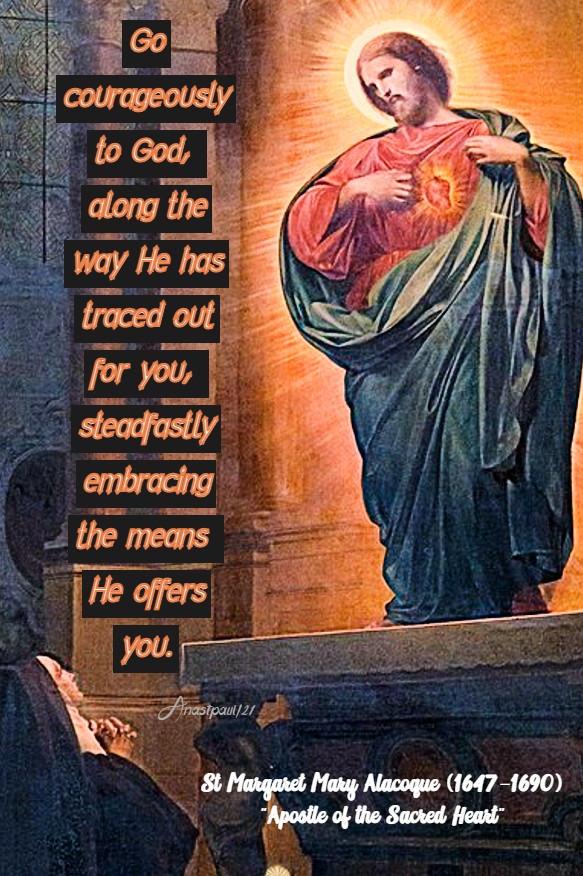
“Go courageously to God, along the way He has traced out for you, steadfastly embracing the means He offers you.”
St Margaret Mary Alacoque (1647-1690)
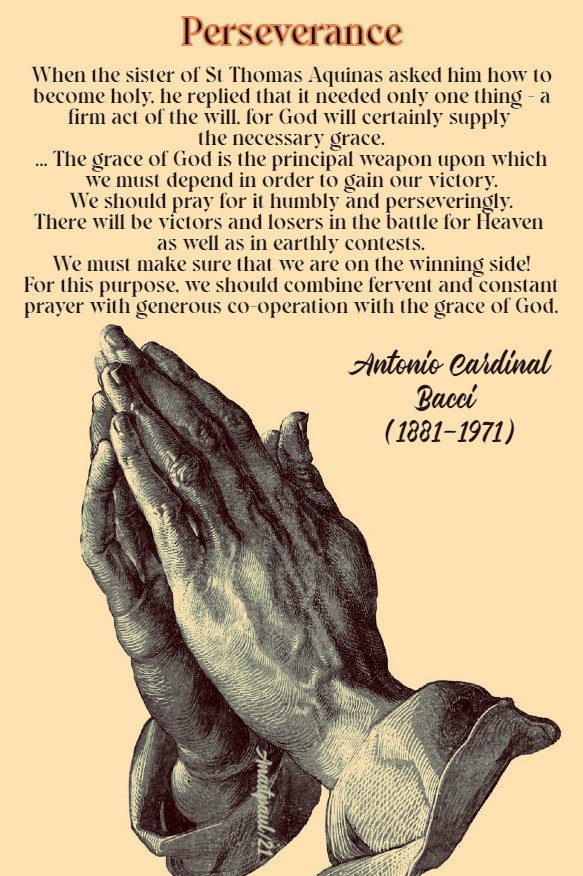
“When the sister of St Thomas Aquinas asked him how to become holy, he replied that it needed only one thing – a firm act of the will, for God will certainly supply the necessary grace. The grace of God is the principal weapon upon which we must depend in order to gain our victory. We should pray for it humbly and perseveringly. There will be victors and losers in the battle for Heaven, as well as in earthly contests. We must make sure, that we are on the winning side! For this purpose, we should combine fervent and constant prayer with generous co-operation with the grace of God.”































You must be logged in to post a comment.