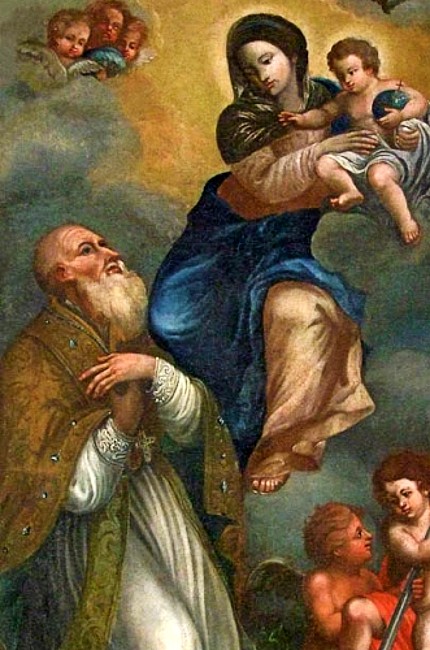
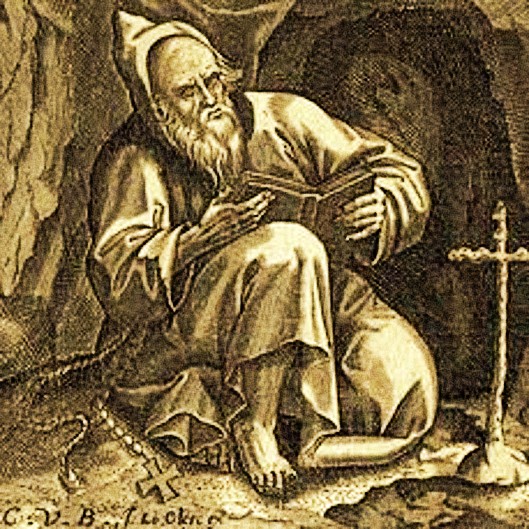
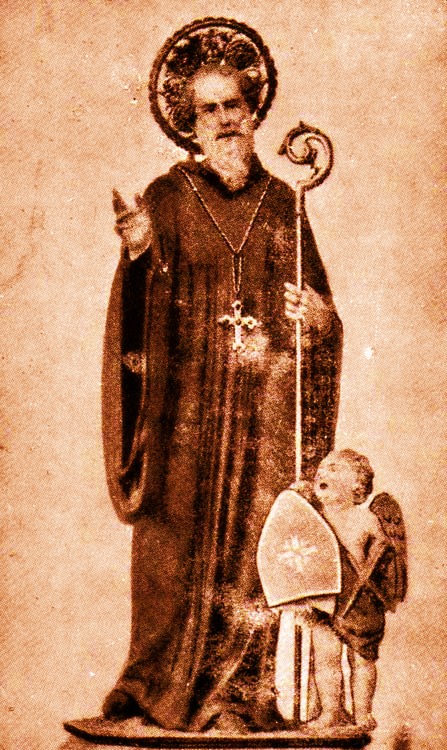
Saint of the Day – 11 September – Saint Elijah Speleota OSBM (863-960) Basilian Monk and Hermit, Spiritual adviser. Born as Elia Bozzetta in 863 in Reggio Calabria, Italy and died on 11 September 960 at the Aulon Monastery in Calabria, Italy of natural causes. Also known as – Elijah Bozzetta, Elijah Espeleota, Elia…
The Roman Martyrology states of him today “In the Monastery of Aulinas in Calabria, Saint Elia, known as the Speleota, a distinguished scholar of the hermit and cenobitic life.”
Elijah was born to the wealthy nobility, the son of Peitro Bozzetta and Leonzia de Leontini. At age 18, to avoid an arranged marriage and answer a call to religious life, Elijah left home to become a pilgrim to Rome.
He became a Basilian Monk at Grottaferrata outside Rome. He returned briefly to Reggio Calabria, whereater he and a fellow Monk named Arsenio, travelled to Patras, Greece for further study.
When Elijah returned to Italy, he withdrew from populated areas to live as a Hermit in a cave near Melicuccà, Italy with two fellow Monks, Cosma and Vitale – the word Speleota is Greek for “inhabitant of caves.”
Word of their wisdom and holiness soon spread and pilgrims regularly visited the caves for spiritual direction and advice.
On 11 September 960, when he was already 97 years old, Elijah died. He was buried in the tomb that he had dug in the cave with his own hands. There, his body remained buried until 2 August 1747 when his bones were discovered., as attested by the public deed drawn up by the notary Fantoni Carmelo. On 12 August of that year, Antonio Germanò, a seriously ill young man from Melicuccà, was instantly cured at the mere sight of the bones of Saint Elijah.
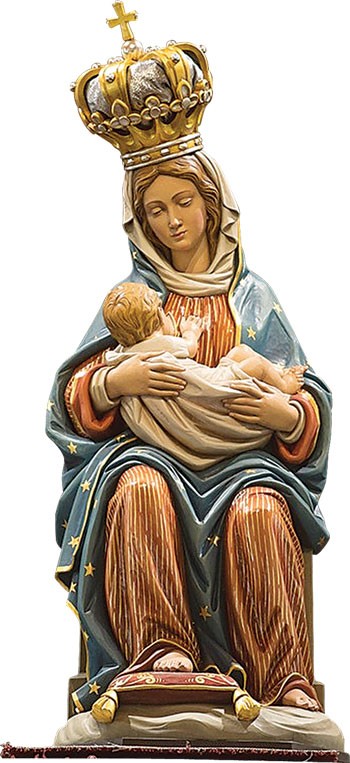
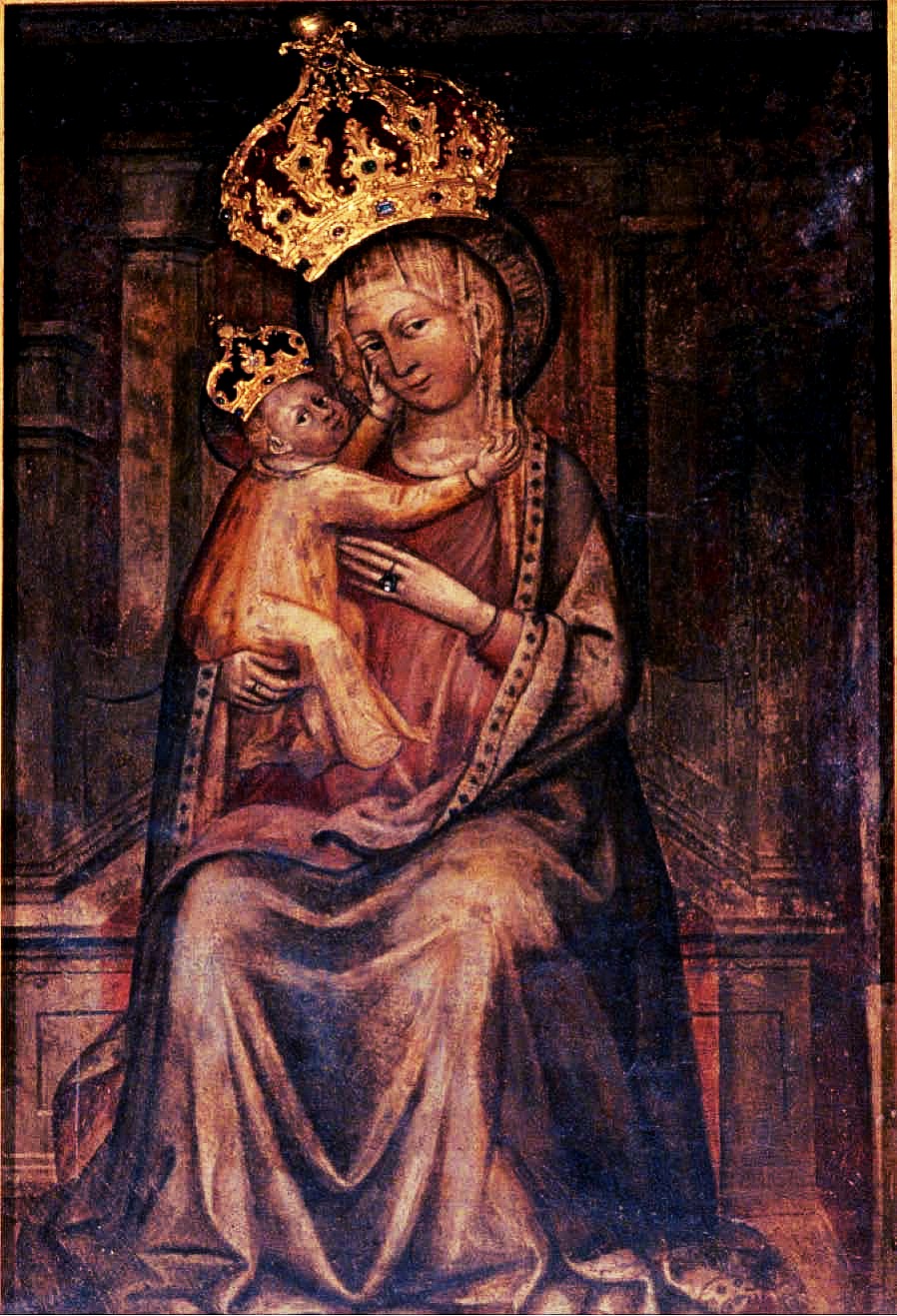
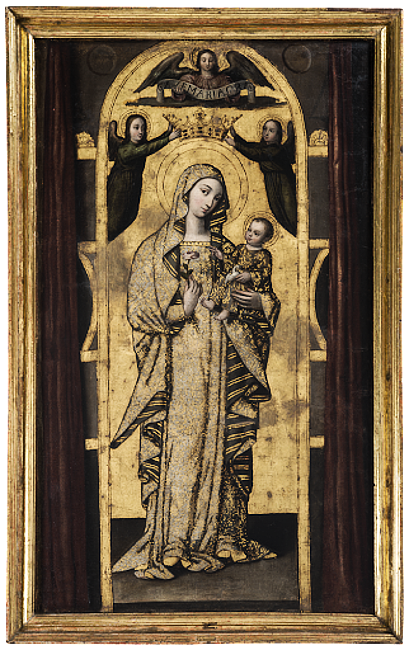
Nuestra Señora de la Leche y Buen Parto / Our Lady of La Leche, St Augustine, Florida, USA , 16th century – First Saturday after The Nativity of the Blessed Virgin Mary:
On 8 September 1565, Feast of the Nativity of Mary, Pedro Menendez de Aviles landed at St Augustine, Florida and claimed it for Spain. At the Mission of Nombre de Dios here, Spanish missionaries installed a Statue of the nursing Madonna, Nuestra Señora de la Leche y Buen Parto – Our Lady of Milk and Good Childbirth.
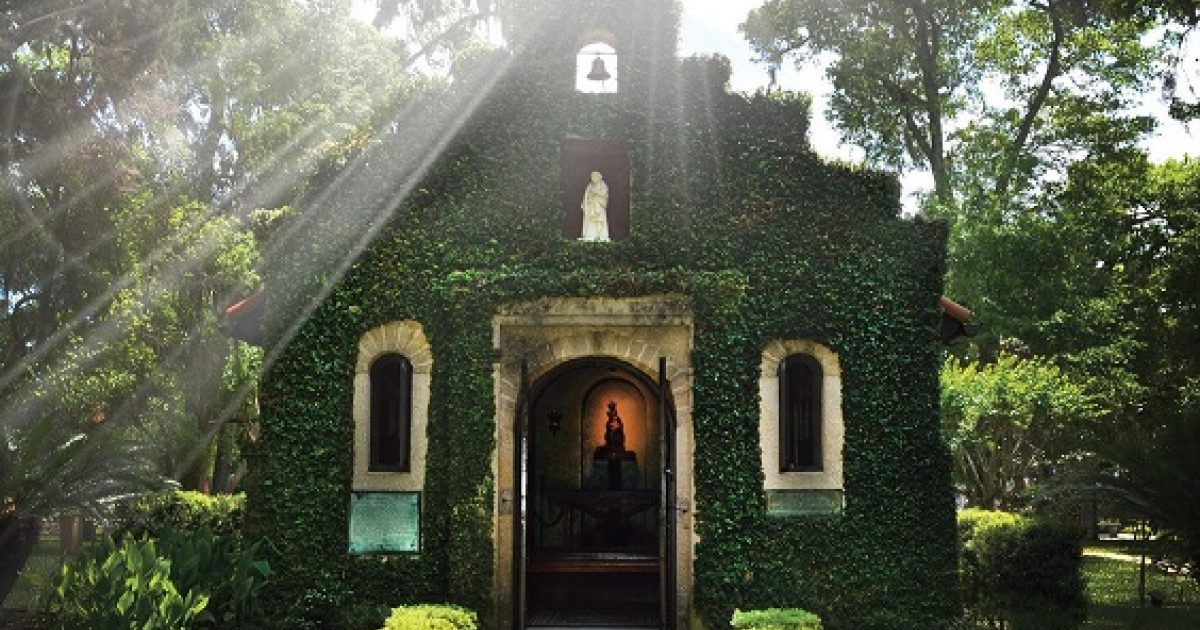
This first Shrine to Our Lady in what is now the United States is still an active place of devotion, as well as a tourist attraction. On the Saturday closest to 8 September, Holy Mass is celebrated at an outdoor rustic Atar to accommodate the large numbers who attend the commemoration of the Anniversary of the First Mass and the founding of the Mission.
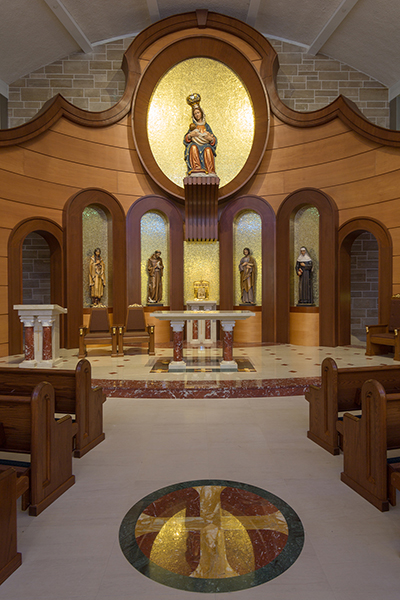
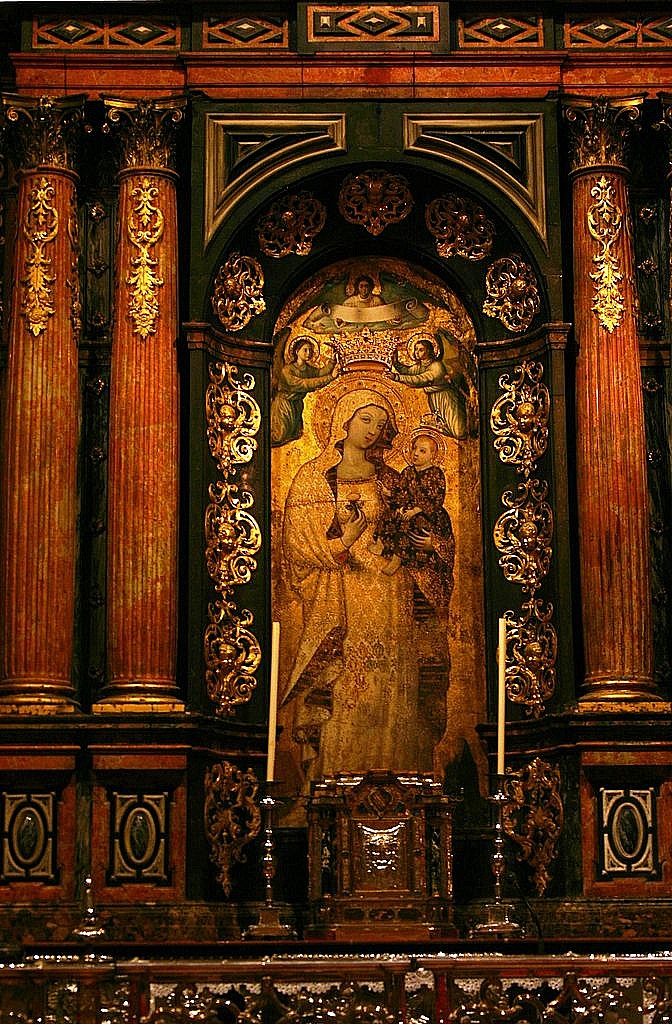
Interior view of the National Shrine of Our Lady of La Leche, located on the grounds of Mission Nombre de Dios in St. Augustine. The shrine was established in 1609, a devotion brought to the U.S. by the Spanish explorers and missionaries.
St Adelphus of Remiremont St Almirus Bl Baldassarre Velasquez
St Deiniol of Bangor St Didymus of Laodicea St Diodorus of Laodicea Bl Dominic Dillon St Elijah Speleota OSBM (863-960) Basilian Monk and Hermit St Emilian of Vercelli St Essuperanzio of Zurich St Felix of Zurich Bl Francesco Giovanni Bonifacio Bl Franciscus Takeya Bl François Mayaudon Bl Gaspar Koteda St Gusmeo of Gravedona sul Lario St Hyacinth of Rome
Bl John Bathe St Leudinus of Toul St Matthew of Gravedona sul Lario St Paphnutius of Thebes St Patiens of Lyon Bl Peter Taaffe Bl Petrus Kawano St Protus of Rome St Regula of Zurich Bl Richard Overton St Sperandea St Theodora the Penitent Bl Thomas Bathe — Martyred in the Spanish Civil War: • Blessed José María Segura Panadés • Blessed José Piquer Arnáu • Blessed Josep Pla Arasa • Blessed Lorenzo Villanueva Larrayoz
Thought for the Day – 10 September – Meditations with Antonio Cardinal Bacci (1881-1971)
The Causes of Discontent
“It is hard to find anyone, in this world, who is really content. Some grumble about poor health, others about not having enough to live on, others about an unsuccessful career. Some complain about the lack of sympathy and the ingratitude of men, others, about constant temptation, spiritual dryness and the discouragement of frequently falling into sin. Still others, are confined to a bed of pain for weeks, months or even years at a time. There are some, too, who must endure mental suffering, which is greater than any physical pain. Perhaps, they have lost a loved one, who was the centre of their own life upon earth, or perhaps they are suffering from a loss of reputation, the result of some calumny or of some moment of weakness, on their own part. In short, this world can be compared to quote St Therese of the Child Jesus – to an unsatisfactory hotel, in which we must spend the night, while we are waiting for the breaking of an eternal day in which we shall be able to see God. He is fortunate, who knows how to live contentedly, or, at least resignedly, in this poor boarding-house, until the dawn of that better life, which is the only object of our earthly journey!”
Quote/s of the Day – 10 September – “Month of the Seven Sorrows of the Blessed Virgin Mary” – Readings: First Timothy 1: 1-2, 12-14; Psalm 16: 1b-2a and 5, 7-8, 11; Luke 6: 39-42
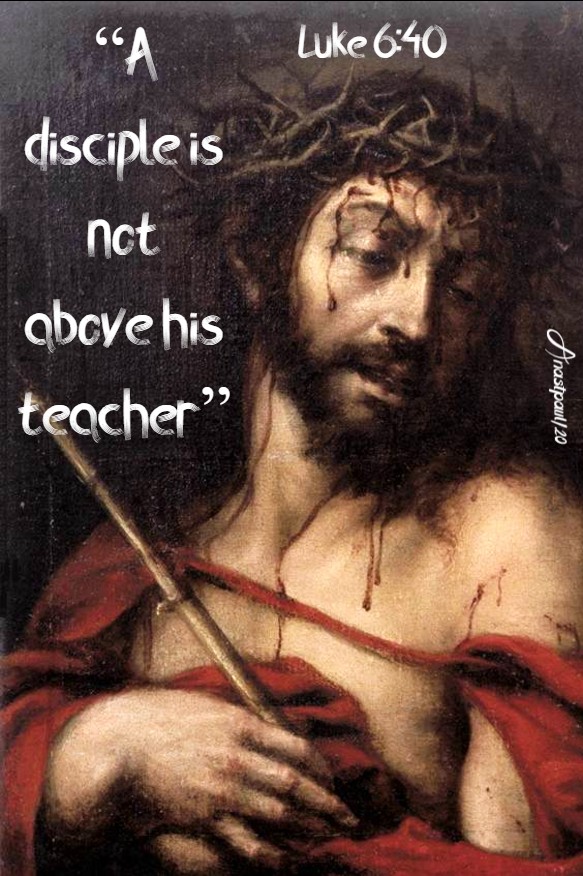
“A disciple is not above his teacher…”
Luke 6:40
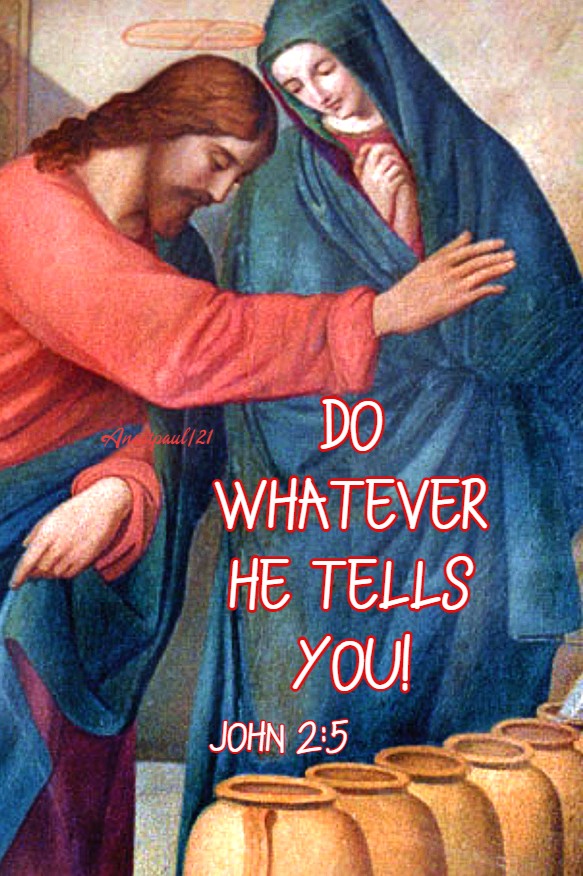
“Do whatever he tells you.”
John 2:5
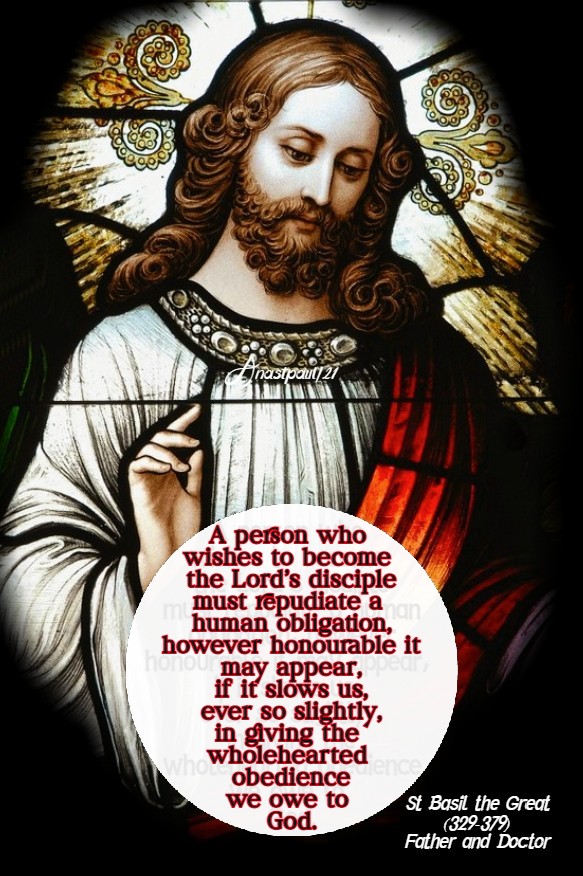
“A person who wishes to become the Lord’s disciple must repudiate a human obligation, however honourable it may appear, if it slows us, ever so slightly, in giving the wholehearted obedience we owe to God.”
St Basil the Great (329-379) Father and Doctor of the Church
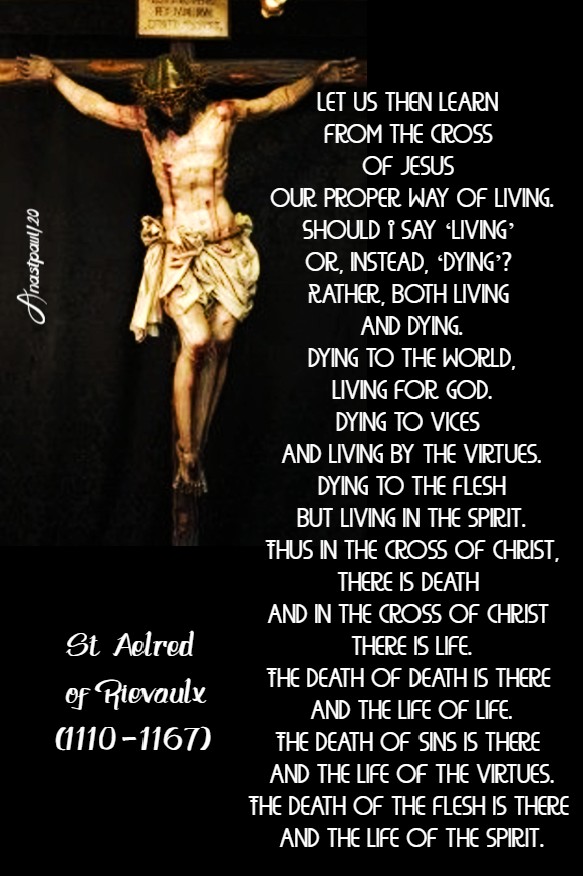
“Let us then learn from the Cross of Jesus our proper way of living. Should I say ‘living’ or, instead, ‘dying’? Rather, both living and dying. Dying to the world, living for God. Dying to vices and living by the virtues. Dying to the flesh, but living in the spirit. Thus in the Cross of Christ, there is death and in the Cross of Christ there is life. The death of death is there and the life of life. The death of sins is there and the life of the virtues. The death of the flesh is there and the life of the spirit.”
St Aelred of Rievaulx (1110-1167)
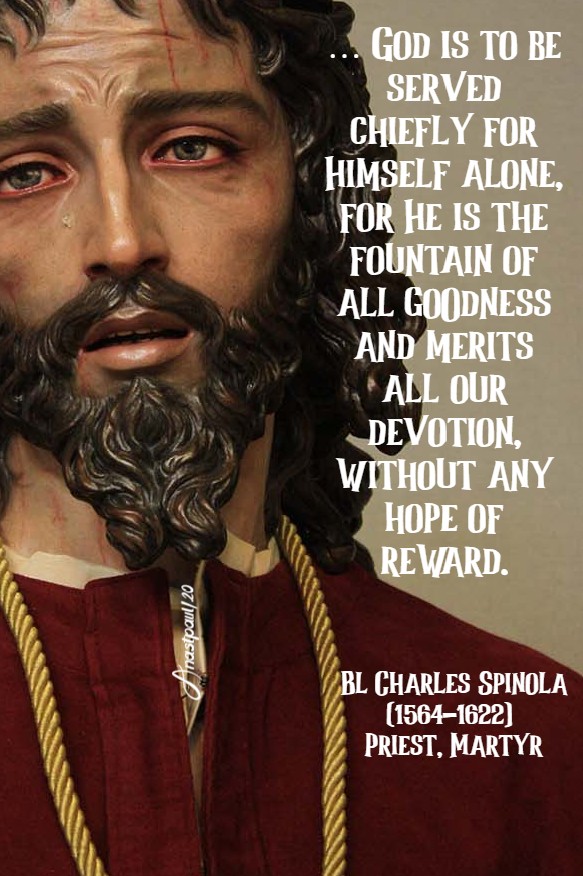
“… God is to be served chiefly for Himself alone, for He is the fountain of all goodness and merits all our devotion, without any hope of reward.”
One Minute Reflection – 10 September – “Month of the Seven Sorrows of the Blessed Virgin Mary” – Readings: First Timothy 1: 1-2, 12-14; Psalm 16: 1b-2a and 5, 7-8, 11; Luke 6: 39-42
“And he told them a parable, “Can a blind person guide a blind person? Will not both fall into a pit?…” – Luke 6:39
REFLECTION – “This parable He added, as a most necessary attachment to what had been said. The blessed disciples were about to be the initiators and teachers of the world. It was necessary for them, therefore, to prove themselves possessed of everything piety requires. They must know the pathway of the evangelic mode of life and be workmen, ready for every good work. They must be able to bestow upon well-instructed hearers, such correct and saving teaching, as exactly represents the truth. This they must do, as having already first received their sight and a mind illuminated with the divine light, lest they should be blind leaders of the blind. It is not possible, for those enveloped in the darkness of ignorance, to guide those, who are afflicted in the same way into the knowledge of the truth. Should they attempt it, they will both roll into the ditch of carelessness!
He overthrew the bragging passion of boastfulness, to which most give way, that they may not enviously strive to surpass their teachers in honour. He added, “The disciple is not above his teacher.” Even if some make such progress, as to attain to a virtue that rivals that of their teachers, they will range themselves no higher than their level and be their imitators. Paul shall again support us. He says, “Imitate me, as I also imitate Christ.” St Cyril of Alexandria (376-444) Bishop, known as “The Pillar of Faith,” Father and Doctor of the Church (Commentary on Luke, Homuly 29)
PRAYER – Lord God, in Your wisdom, You created us, in love. By Your providence, You rule us, in love. Penetrate our inmost being with the holy light of Your Son. Penetrate our hearts with the overwhelming love for Your love, so that we may weep in consolation. May the Light that is Jesus Christ our Lord, enlighten our hearts that we may see clearly the way we should tread. May the prayers of Your holy Angels, Martyrs, Saints and our Sorrowful Martyr Mother, the Blessed Virgin Mary, be our guiding inspiration. Through Christ our Lord, with the Holy Spirit, God forever amen.
Our Morning Offering – 10 September – “Month of the Seven Sorrows of the Blessed Virgin Mary”
On Fridays in Catholic Time, we honour the Passion of Our Lord Jesus Christ, our Saviour – Jesus was Scourged, Mocked and Crucified on a Friday. Because of this, the Church has always set aside Fridays as days of penance and sacrifice. While in South Africa, the Bishops have sadly removed abstinence from meat on Fridays, although many still continued the practice, penance is still required in one form or another. This day should always be a day of repentance and a day in which we recall Christ’s complete self-sacrifice to save us from our sins.
I Rise – An Old Morning Prayer – Excerpt From The Blossoms of the Cross — 1894 The Sisters of St Joseph
I rise In God’s strength, In God’s power, In the Agony of Christ, In the Cross of Christ, In Christ’s Precious Blood, These will sustain me against my enemies, visible and invisible. I rise in the blessing of Christ which my dearest Jesus left to the whole world. Protect me, All-Holy Trinity, God the Father, Who created me, God, the Son, Who redeemed me in His Precious Blood, God, the Holy Ghost, Who sanctified me in Holy Baptism. God, the Father, I give myself to Thee! God, the Son, I commend myself to Thee! God, the Holy Ghost, teach me! Mary, Mother of God, assist me! All you Saints of God, pray for me! All you Holy Angels, protect me! The Cross of Christ preserve me! Amen
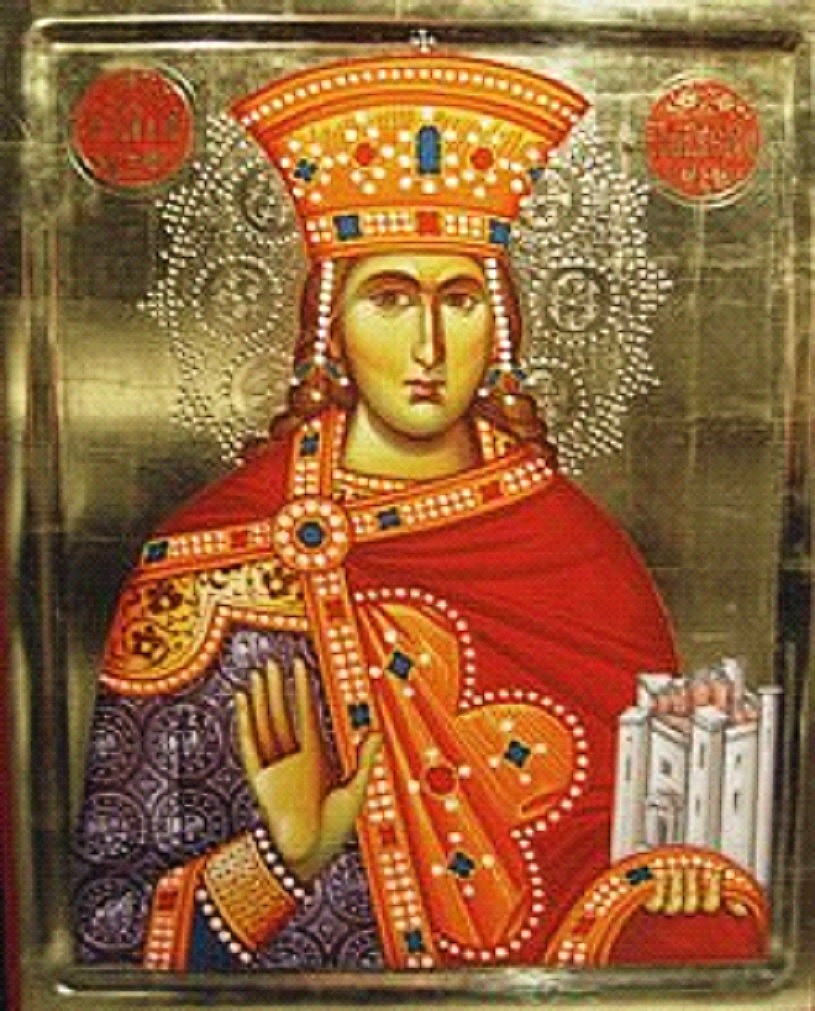
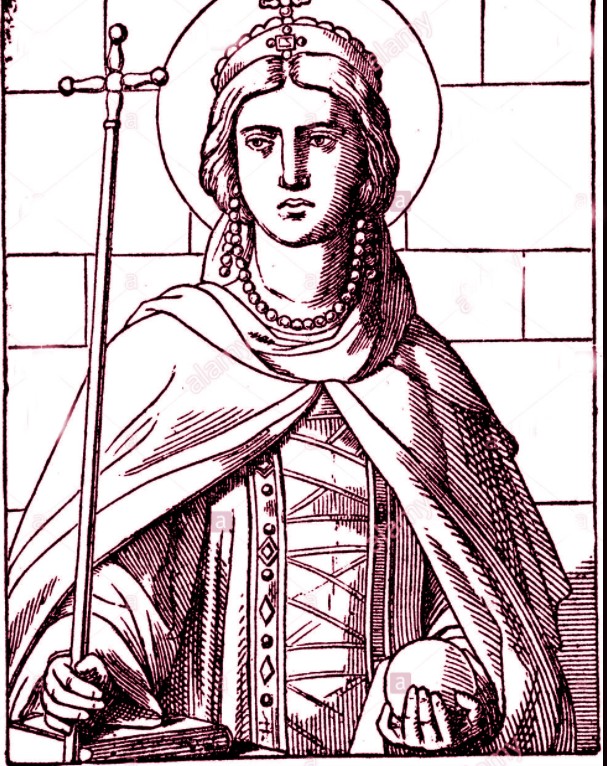
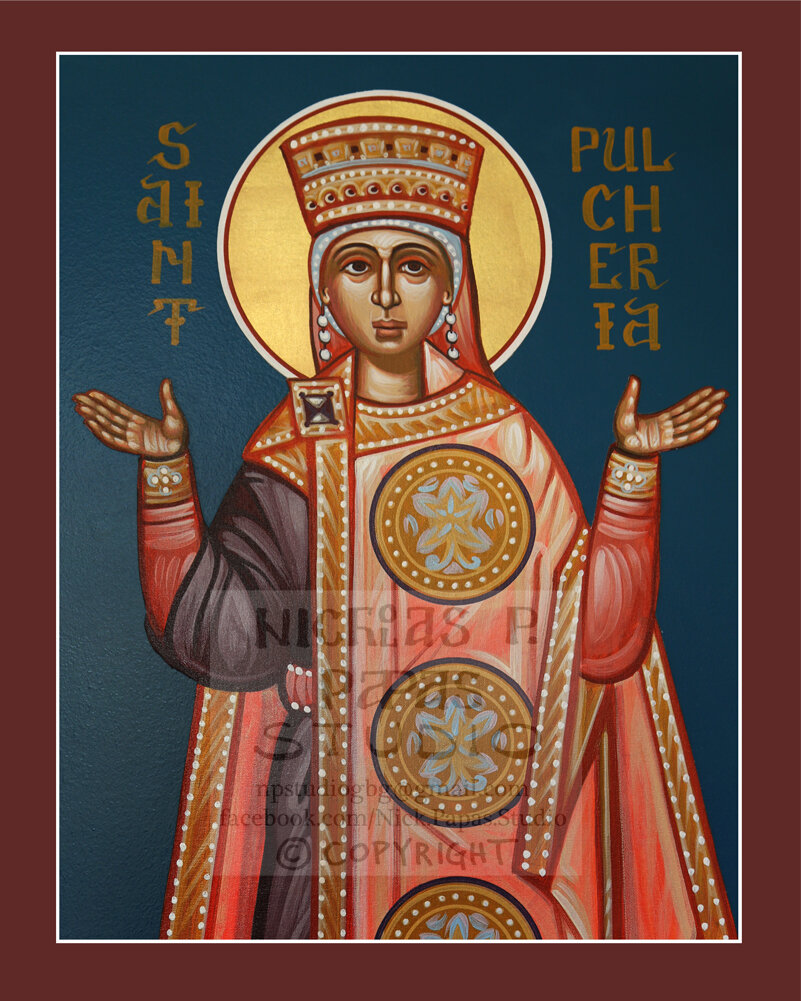
Saint of the Day – 10 September – Saint Pulcheria (399-453) Virgin Empress, Widow, (remaining chaste during her marriage), Defender of the Faith against heresy, Apostle of the poor. Born on 19 January 399 and died in July 453 of natural causes. Patronages – against in-law problems, against the death of parents, empresses, orphans, people in exile, victims of betrayal. Also known as – Pulqueria.
The Roman Martyrology states: “At Constantinople, Pucheria, Virgin and Empress, distiniguished by her piety and zeal for the True Faith.“
The daughter of Arcadius and Aelia Eudoxia, the Emperor and Empress of the Eastern Roman Empire, Pulcheria was an exceptional woman. Her mother lived the life one would expect of Royalty — not immoral in our sense but luxurious and gaudy. She (Eudoxia) ran afoul of Saint John Chrysostom, Bishop of Constantinople, who declared that a silver statue of the Empress (and the unveiling celebration for it) dishonoured the Church. John had already been exiled and recalled once for criticising Eudoxia — his comparison of her to Herodias and himself to John the Baptist earned him exile to the Caucasus. When he was writing letters, critical of the Imperials, they further relocated him to Georgia, but he died on the way.
Eudoxia, died not long after, soon followed by her husband. Pulcheria, who was still a minor and her younger brother, who became Emperor were governed by regents who were appointed to administer the kingdom. These were veteran Palace administrators, loyal and wise but Pulcheria, even at fifteen, was a woman who knew her on mind.
One of the regents offered to arrange a marriage for her, perhaps to his grandson. But Pulcheria was determined to consecrate her virginity to God. Having come of age, she thanked the regent for his good service and appointed herself regent for her younger brother and set about training him in all ways to be emperor, instituting a monastic way of life in the Palace. Pulcheria insisted on chanting and praying and fasting for herself, her sisters and all the servants of the Palace. They gave up the jewelry and finery, preferred instead to provide food and clothing for the poor. This and the restoration of honours for St John Chrysostom, after his death, led to her being much admired by the Church.
Pulcheria arranged a marriage for her brother when he was twenty but the young wife was always jealous of her sister-in-law’s influence over Theodosius and the two quarreled. When Theodosius died on 26 July 450, Pulcheria married Marcian, allowing her to continue to rule in place of her brother, while simultaneously not violating her vow of virginity. She died three years later, in July 453.
Pulcheria influenced the Church and its theological development by being involved in the Council of Ephesus and guiding the Council of Chalcedon, in which the Church ruled on Christological issues.
Pulcheria also engaged in a fierce battle with the Nestor, the Archbishop of Constantinople, who accused her of adultery. Eventually, in the arguments over the human nature of Christ, Nestor was vanquished and exiled. There is no doubt that Pulcheria was in the thick of fight against his heresy.
Beata Vergine Maria della Vita / Our Lady of Life (1289) 10 September: Patronage – hospitals in the Diocese of Bologna, Italy.
The cult of the Madonna della Vita is connected with the hospital of the same name founded in 1289 by the Compagnia dei Battuti, present in Bologna since 1261. In the Sanctuary dedicated to her, between 1370 and 1380, Simone dei Crocefissi frescoed the image of the Blessed Virgin, which remained covered during the renovations in the years 1454-1502 and accidentally found among the exultation of the Bolognese people on 10 September 1614. It depicts Mary Mother and Queen as she rests her face to the cheek of Jesus, according to the iconography of the Mother of Tenderness. The close link between the original hospital activity and the devotion of the brothers, was also expressed by the motto inscribed under the double Cross: “Vitam dat nobis crux tua, Christe Jesu” “Your Cross gives us life, Christ Jesus.”
St Peter Martinez St Pulcheria (399-453) Empress, Widow St Salvius of Albi St Sosthenes of Chalcedon St Theodard of Maastricht St Victor of Chalcedon — Martyrs of Bithynia – 3 sister saints: Three young Christian sisters martyred in the persecutions of emperor Maximian and governor Fronto: Menodora, Metrodora, Nymphodora. They were martyred in 306 in Bithynia, Asia Minor (in modern Turkey).
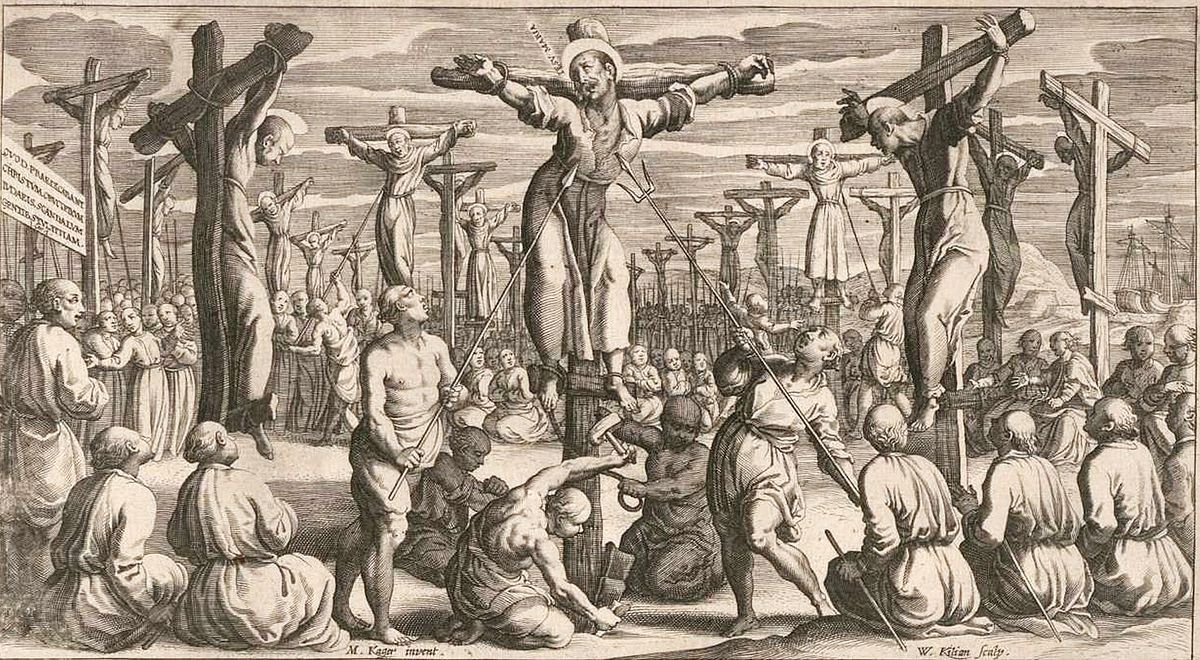
Martyrs of Japan – 205 beati: A unified feast to memorialise 205 missionaries and native Japanese known to have been murdered for their faith between 1617 and 1637.
Martyrs of Sigum – 8 saints: A group of Nicomedian martyrs, condemned for their faith to be worked to death in the marble quarries of Sigum. There were priests, bishops and laity in the group but only a few names have come down to us: Dativus, Felix, Jader, Litteus, Lucius, Nemesian, Polyanus, Victor. They were worked to death c 257 in Sigum.
Martyred in the Spanish Civil War: • Blessed Félix España Ortiz • Blessed Leoncio Arce Urrutia • Blessed Tomàs Cubells Miguel
Thought for the Day – 9 September – Meditations with Antonio Cardinal Bacci (1881-1971)
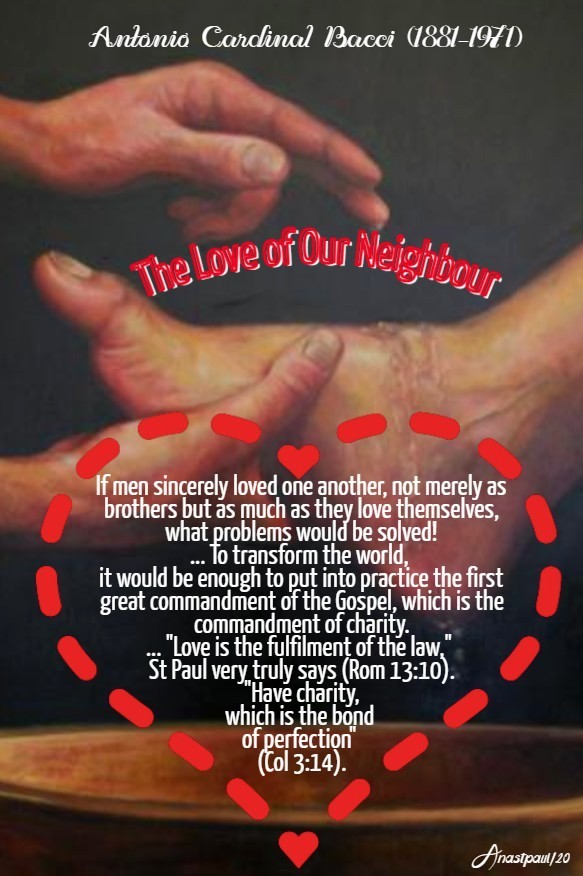
The Love of Our Neighbour
“The Gospel not only commands us to love God above all things but also, to love our neighbour as ourselves (Cf Mt 13:35-40). The Christian love of our neighbour, flows necessarily from the love of God. Our Creator loves all men as His own sons. Therefore, we ought to love one another as brothers, even as Our Lord loves us. We should see, in our neighbour, especially if he is in need, the person of Christ Himself, our elder brother, “the first-born among many brethren” (Rom 8:29).
If men sincerely loved one another, not merely as brothers but as much as they love themselves, what problems would be solved! Who can say how many evils would be abated and how many sorrows would be assuaged? To transform the world, it would be enough to put into practice the first great commandment of the Gospel, which is the commandment of charity. Admittedly, the world would not become an earthly paradise, for any such Utopia is an impossibility. But, it would become a dignified dwelling place of brothers, loving and helping one another. “Love is the fulfilment of the law,” St Paul very truly says (Rom 13:10). “Have charity, which is the bond of perfection” (Col 3:14).
Quote/s of the Day – 9 September – “Month of the Seven Sorrows of the Blessed Virgin Mary ” – Readings: Colossians 3: 12-17; Psalm 150: 1b-2-6 Luke 6:27-38
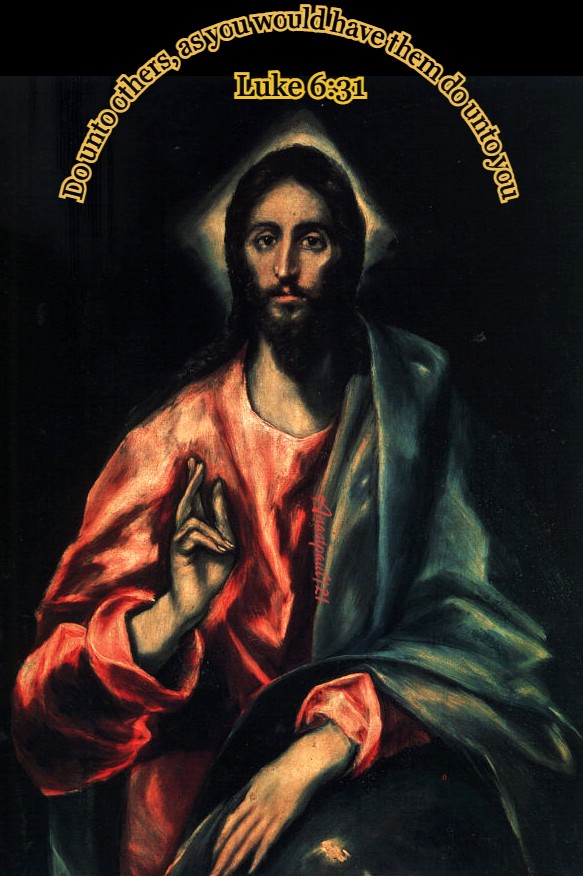
“ Do unto others, as you would have them do unto you.”
Luke 6:31
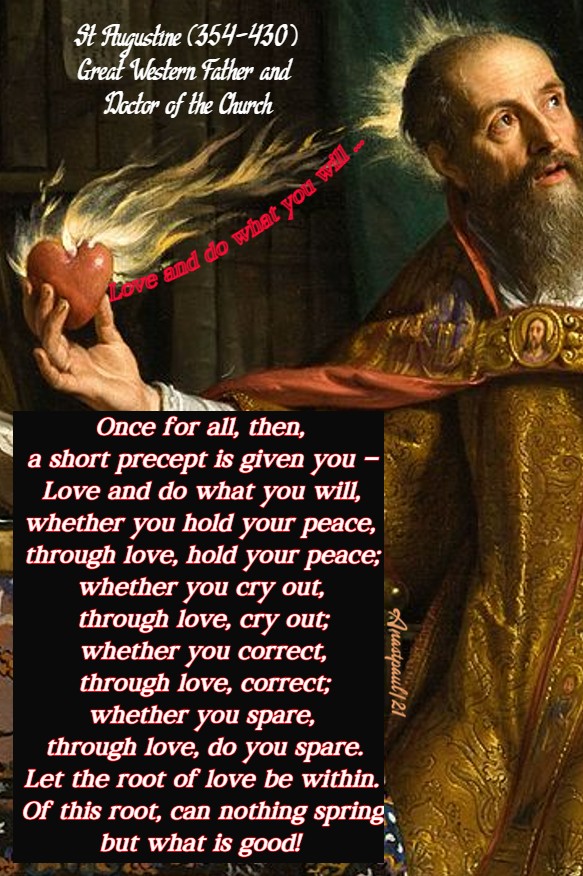
“Once for all, then, a short precept is given you – Love and do what you will, whether you hold your peace, through love, hold your peace; whether you cry out, through love, cry out; whether you correct, through love, correct; whether you spare, through love, do you spare. Let the root of love be within. Of this root, can nothing spring but what is good!”
St Augustine (354-430) Father and Doctor of the Church
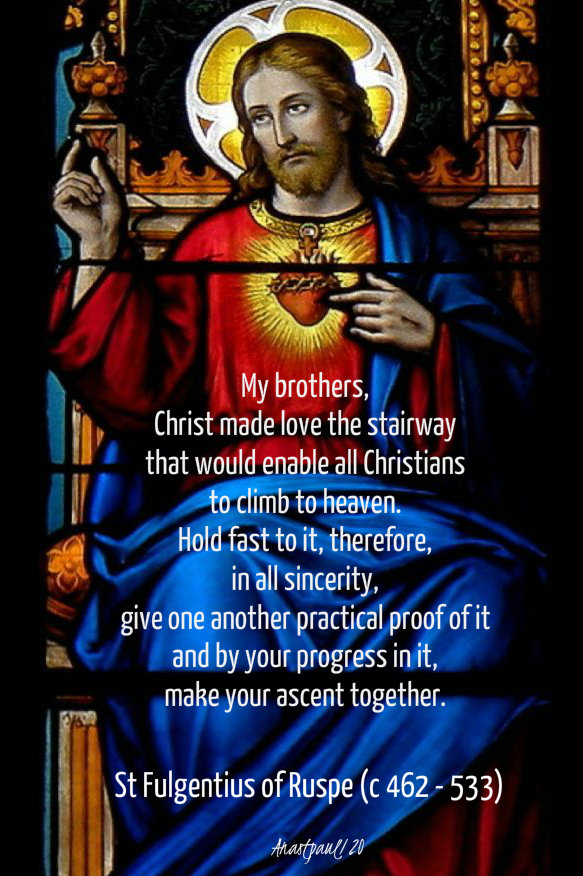
“My brothers, Christ made love the stairway that would enable all Christians to climb to heaven. Hold fast to it, therefore, in all sincerity, give one another practical proof of it and by your progress in it, make your ascent together.”
St Fulgentius of Ruspe (c 462 – 533)
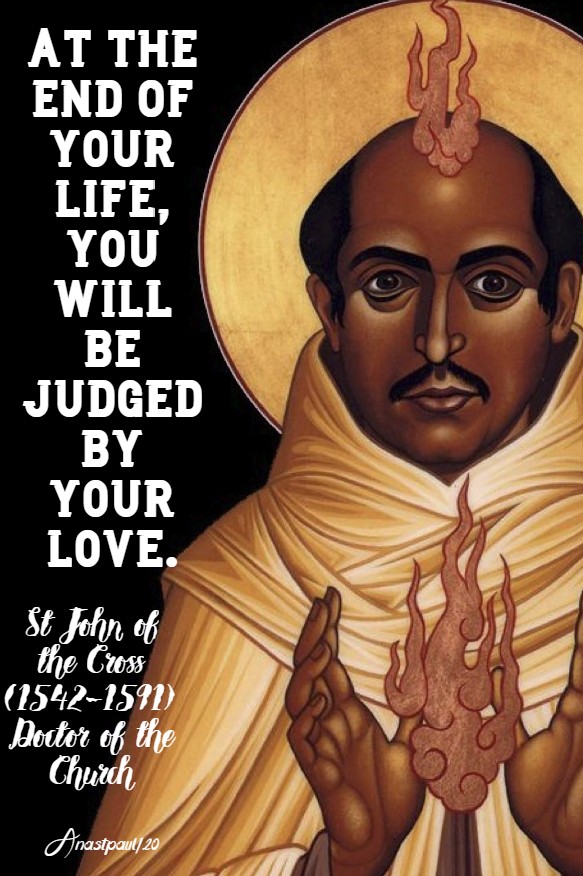
“At the end of your life, you will be judged by your love.”
St John of the Cross (1542-1591) Doctor of the Church
One Minute Reflection – 9 September – “Month of the Seven Sorrows of the Blessed Virgin Mary ” – Readings: Colossians 3: 12-17; Psalm 150: 1b-2-6 Luke 6:27-38
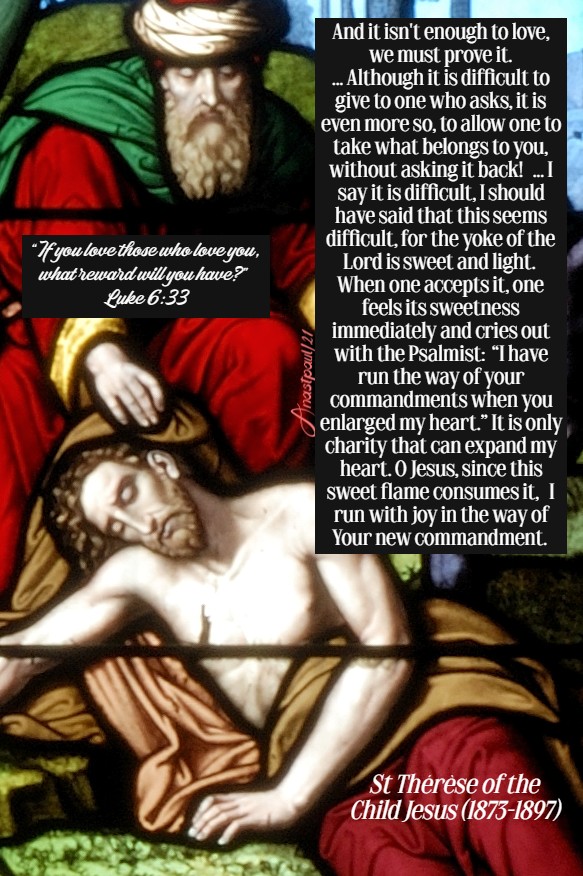
“If you love those who love you, what reward will you have? For even sinners love those who love them.” – Luke 6:33
REFLECTION – “You have heard that it was said: You shall love your neighbour and hate your enemy. But I say this to you: Love your enemies, … pray for those who persecute you” (Mt 5:43-44). No doubt, we don’t have any enemies in Carmel but there are feelings. One feels attracted to this Sister, whereas with regard to another, one would make a long detour in order to avoid meeting her. And so, without even knowing it, she becomes the subject of persecution. Well, Jesus is telling me that it is this Sister who must be loved, she must be prayed for, even though her conduct would lead me to believe that she doesn’t love me: “If you love those who love you, what reward will you have? For even sinners love those who love them.”
And it isn’t enough to love, we must prove it. We are naturally happy to offer a gift to a friend; we love especially to give surprises, however;,this is not charity, for sinners do this too. Here is what Jesus teaches me also: “Give to everyone who asks of you and from him who takes away your goods, ask no return.” Giving to all those who ask is less sweet than offering oneself by the movement of one’s own heart. … Although it is difficult to give to one who asks, it is even more so, to allow one to take what belongs to you, without asking it back! O Mother, I say it is difficult, I should have said that this seems difficult, for the yoke of the Lord is sweet and light (Mt 11:30). When one accepts it, one feels its sweetness immediately and cries out with the Psalmist: “I have run the way of your commandments when you enlarged my heart.” (Ps 119[118],32) It is only charity that can expand my heart. O Jesus, since this sweet flame consumes it, I run with joy in the way of Your new commandment (Jn 13:34).” – St Thérèse of the Child Jesus (1873-1897) Carmelite, Doctor of the Church – Autobiographical Manuscript C, 15v° – 16r°
PRAYER – Almighty Lord and God, protect us by Your power and love throughout this day, even as You have enabled us, in Your love to begin it. Do not let us turn aside to any sin but let our every thought, word and deed be done in love for You and Your creatures, our neighbour. Teach us to love as You have loved us and may our Sorrowful and Holy Mother, show us the way. Through Jesus Christ our Lord, Who loved us to the end, with the Holy Spiriti, God now and for all eternity, amen.
Our Morning Offering – 9 September – “Month of the Seven Sorrows of the Blessed Virgin Mary”
In Catholic Time, Thursday is the day of the Holy Eucharist – Our Lord instituted the most Holy Eucharist on a Thursday, so it is fitting that we remember this greatest of Sacraments on this day. The Eucharist is the greatest gift of God to mankind, as it is nothing less than Jesus Himself. What gift could be greater? Therefore, on Thursdays, many spend an hour in Adoration of the Blessed Sacrament as an aspect of devotion to the Sacred Heart of Jesus in the Most Blessed Sacrament.
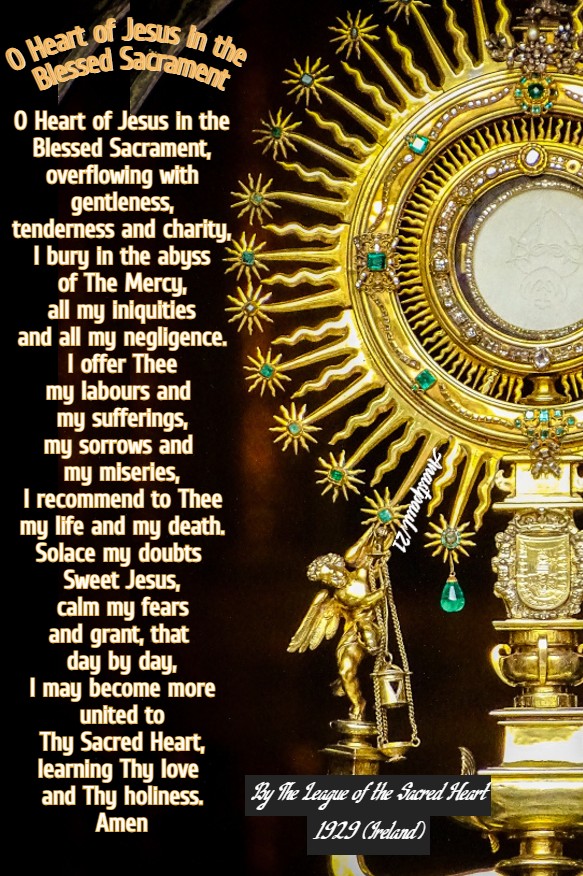
O Heart of Jesus in the Blessed Sacrament By The League of the Sacred Heart 1929 (Ireland)
O Heart of Jesus in the Blessed Sacrament, overflowing with gentleness, tenderness and charity, I bury in the abyss of The Mercy, all my iniquities and all my negligence. I offer Thee my labours and my sufferings, my sorrows and my miseries, I recommend to Thee my life and my death. Solace my doubts Sweet Jesus, calm my fears and grant, that day by day, I may become more united to Thy Sacred Heart, learning Thy love and Thy holiness. Amen
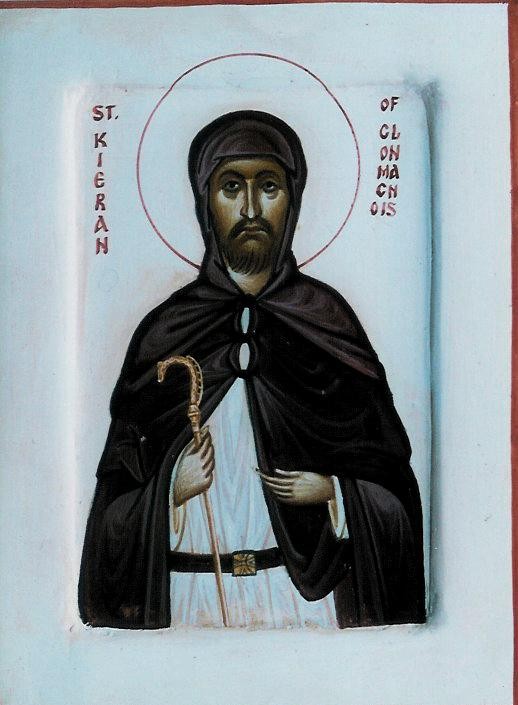
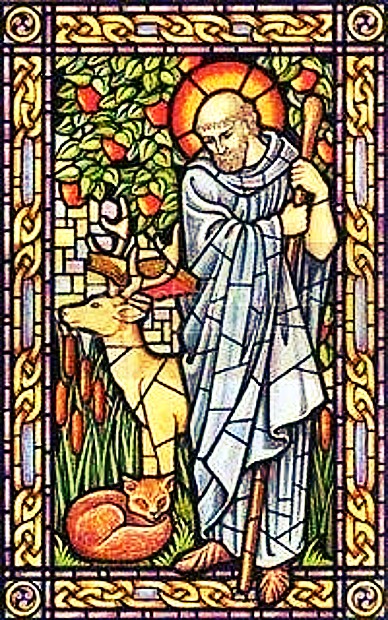
Saint of the Day – 9 September – Saint Kieran the Younger (c 516-c 550) Priest, Monk, Abbot, Teacher, one of the Twelve Apostles of Ireland, Founder of Clonmacnoise Monastery St Kieran, like so many Saints, had a supernatural affinity with animals – there are many legends related to this. Born in c 516 at Connacht, County Roscommon, Ireland as Ciarán mac an tSaeir (“son of the carpenter”) and died in c 556 of natural causes. Patronage – Diocese of Clonmacnois, Ireland. Also known as – Kieran of Clonmacnoise, Ceran, Ciaran, Kyaranus, Kyran, Kyrian, Queran, Queranus, Ciarano, Querano, Kiriano, one of the Twelve Apostles of Ireland.
Kieran was born in around 516 in County Roscommon, Connacht, in Ireland. His father was a carpenter and chariot maker. As a boy, Kieran worked as a cattle herder.
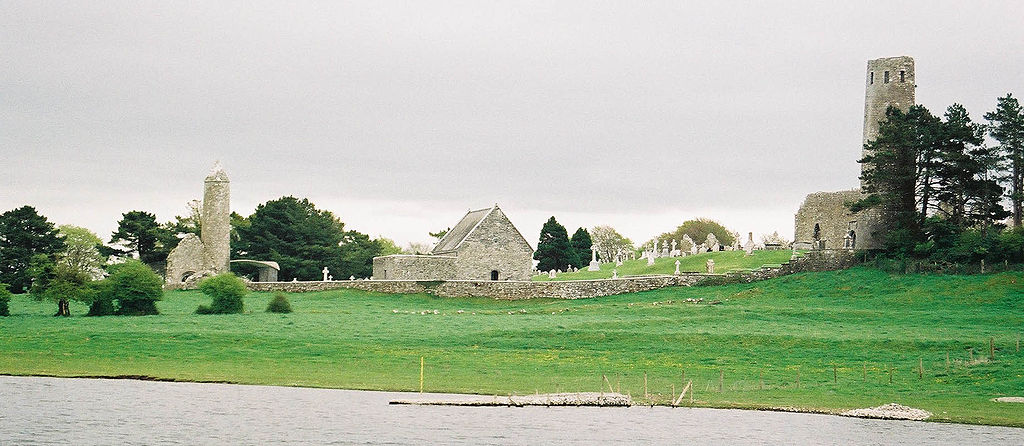
He studied under St Finian’s at Clonard and in time became a teacher, himself. Columba of Iona said of Ciarán, “He was a lamp, blazing with the light of wisdom.” In about 534, he left Clonard for Inishmore where he studied under St Enda of Aran, who Ordained him a Priest and advised him to build a Church and Monastery in the middle of Ireland.[ Later, he travelled to Senan on Scattery Island (in about 541). In 544, he finally settled in Clonmacnoise, where he founded the Monastery of Clonmacnoise with ten fellow Monks. As Abbot, he worked on the first buildings of the Monastery; however, he died about seven months later of a plague, in his early thirties.
Various miracles are connected to St Kieran. One of the most famous relates, that it was his cow – which he took with him as payment when he went to Clonard and gave milk to all at the Abbey – which supplied the parchment for the Book of the Dun Cow, one of the oldest and most important Irish literary collections, compiled by a Clonmacnoise scribe in 1106.
One story tells that he lent his copy of the Gospel of St Matthew to fellow-student St Ninnidh. When Finnian tested the class, Kieran knew only the first half of the Gospel. The other students laughed and called him “Kieran half-Matthew.” St Finnian silenced them and said, “Not Kieran half-Matthew, but Kieran half-Ireland, for he will have half the country and the rest of us will have the other half.”
During a time of famine, when it was Kieran’s turn to carry a sack of oats to the mill in order to provide a little food for the Monks, he prayed that the oats would become fine wheat. While Kieran was singing the Psalms with pure heart and mind, the single sack of oats was miraculously transformed into four sacks of the best wheat. Kieran returned home and baked bread with this wheat, which the older Monks said was the best they had ever tasted. These loaves not only satisfied their hunger, they were said to heal every sick person in the Monastery who ate them.
Another tale relates that as a student, a young fox would take his writings to his master, until it was old enough to eat his satchel. Yet another tale tells of the other Irish saints envying him, to such a degree, that everyone of them (apart from St Columba) prayed for his early death and finally, he is believed to have told his followers that upon his death, they were to leave his bones upon the hillside and to preserve his spirit rather than his relics.
The Monastery at Clonmacnoise became one of the most important centres of learning and religious life in Ireland. Unusually, the title of Abbot – which included the title “Heir of Saint Kieran ” – at the community was not hereditary, which reflected the humble origins of its Founder. It managed to survive the plunderings of the Viking raids and the Anglo-Norman wars and was only destroyed during the Dissolution of the Monasteries, in 1552. The ruins still exist and remain a centre of civic and religious activity to this day.
The treasures of Kieran’s Shrine were dispersed throughout the Medieval era; although the Clonmacnoise Crozier still exists and is stored in the National Museum of Ireland.
Santa María la Antigua / St Mary the Ancient, Panama City, Panama , 16th century, Patron of the Republic of Panama – 9 September:
In 1510 Martín Fernández de Enciso and Vasco Nuñez de Balboa founded a Town in Chief Cémaco’s territory on the west shore of the Gulf of Urabá, initially named La Guardia and a few months later renamed Santa María la Antigua, fulfilling a vow they made to the Virgin if they emerged alive from the confrontation with the natives.
Chief Cémaco’s house was converted into a Chapel in honour of St Mary the Ancient, named for the Madonna in the Cathedral in Fernández de Enciso’s home town of Seville, Spain. A Christian community developed there composed of native converts and Spaniards.
On 9 September 1513, Pope Leo X created the first mainland Diocese with the bull “Pastoralis Officii Debitum,” transforming the little Chapel of St Mary the Ancient into a Cathedral under the Archdiocese of Seville. Later the see moved to the newer City of Panama, whose Cathedral was dedicated to Santa María la Antigua on 4 April 1796. In 2001 the Vatican confirmed St. Mary the Ancient as Patron of the Republic of Panama, setting 9 September as her feast day for the country.
St Peter Claver SJ (1581-1654) (Memorial) Priest of the Society of Jesus, Missionary, Confessor, Patron of the missions to African peoples and Human Rights Defender, Apostle of Charity. Also known as “The Apostle of Cartagena” and “The Slave of the Slaves.” Biography: https://anastpaul.com/2017/09/09/saint-of-the-day-9-september-st-peter-claver-s-j/
St Alexander of Sabine
Blessed Antoine-Frédéric Ozanam (1813–1853) “Servant to the Poor” Married layman, Literary scholar, Lawyer, Journalist, Professor of Law and of Foreign Literature, Apostle of Charity, Writer and Equal Rights Advocate, Doctor of Letters. He founded, with colleagues, the Conference of Charity, later known as the Society of Saint Vincent de Paul. About: https://anastpaul.com/2019/09/09/saint-of-the-day-9-september-blessed-antoine-frederic-ozanam-1813-1853/
St Basura of Masil St Bettelin St Dorotheus of Nicomedia Bl Gaudridus Bl George Douglas St Gorgonio of Rome St Gorgonius of Nicomedia St Isaac the Great Bl Jacques Laval St Joseph of Volokolamsk St Kieran the Younger (c 516-c 550) Monk, Abbot, One of the Twelve Apostles of Ireland. Bl Maria Eutimia Uffing Bl Mary de la Cabeza St Omer St Osmanna Bl Pierre Bonhomme St Rufinian St Rufinus Bl Seraphina Sforza St Severian St Straton St Teódulo González Fernández St Tiburtius St Valentinian of Chur St Wilfrida St Wulfhilda
Thought for the Day – 8 September – Meditations with Antonio Cardinal Bacci (1881-1971)
Mary, Mother of God
“The near-infinite greatness of Mary, flows from the fact, that she is the Mother of God. The Eternal Word of the Father, consubstantial with Him in nature and equal to Him in majesty, willed to become man in order to set us free from the slavery of sin and to regain Heaven for us. He became man in the chaste womb of the Virgin Mary. He took a human body and soul and was born of her, as the God-Man. For this reason, there is attributed to His Divine Person, the title of Son of Mary and to Mary, the title of Mother of God.
There is a relationship between Mary and each of the three Divine Persons, for she is the daughter of God the Father, the spouse of the Holy Spirit by whose power the Word became incarnate in her and the mother of the Word made Man. She is, moreover, in the words of Dante, the “termine fisso di eterno consiglio” (Paradiso 33:1-3). In other words, she is the centre of the eternal plan which God established for the redemption of the human race. It was God’s eternal design to reunite creation to the Uncreated, by means of Mary. She became the mother of the Eternal Word, in whom the divine and human natures were indissolubly united. He redeemed us by His infinite merits but, in this work of redemption, He employed the co-operation of His holy Mother. All the graces, privileges and virtues of Mary, flow from this great mystery of her divine Motherhood. As befitted the future Mother of God, she was conceived free from the stain of original sin and full of grace. Her mortal life was a continuous ascent towards the highest peak of sanctity. When she died, she was assumed body and soul into Heaven, where she was crowned in glory, as Queen of Angels and Queen of Saints. When we consider the sublime nobility of Our Lady, we should be moved to love and venerate her. This love and veneration does not subtract in the slightest from God’s glory, because, she is the Mother of God. In fact, it is a great advantage to us, to imitate her and to call on her to intercede for us.”
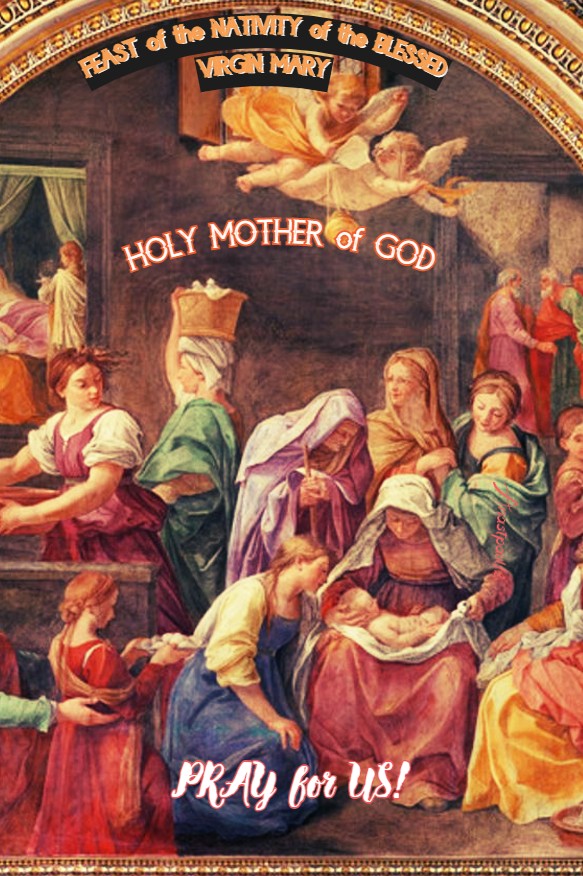
Quote/s of the Day – 8 September – Feast of the Nativity of the Blessed Virgin Mary
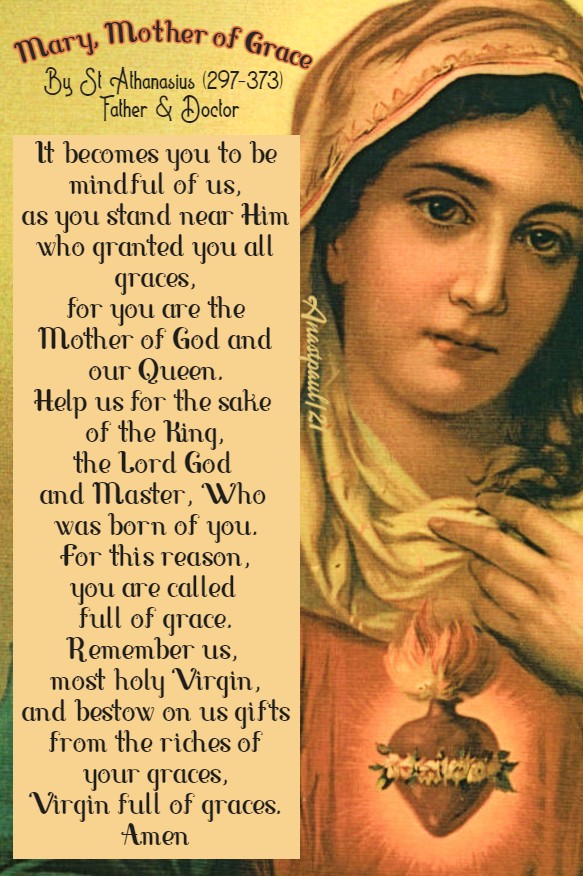
“Mary, Mother of Grace, it becomes you to be mindful of us, as you stand near Him who granted you all graces, for you are the Mother of God and our Queen. Help us for the sake of the King, the Lord God and Master, Who was born of you.”
St Athanasius (297-373) Father & Doctor of the Church
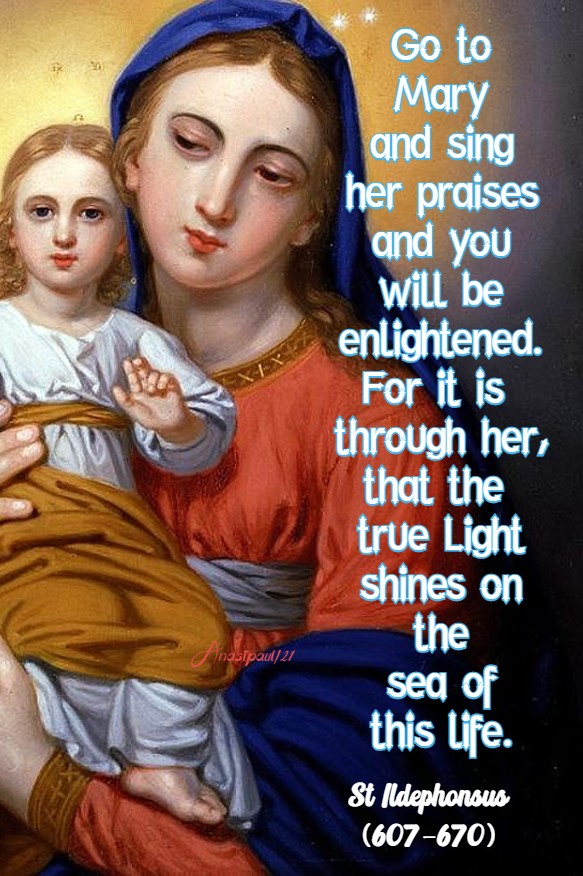
“Go to Mary and sing her praises and you will be enlightened. For it is through her, that the true Light shines on the sea of this life.”
St Ildephonsus (607-670)
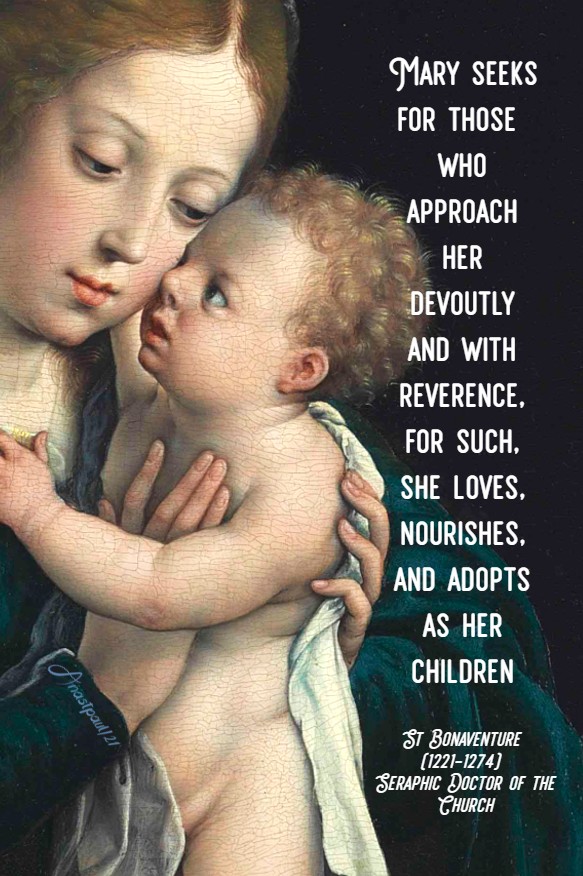
“Mary seeks for those who approach her devoutly and with reverence, for such she loves, nourishes, and adopts as her children. ”
St Bonaventure (1221-1274) Seraphic Doctor of the Church
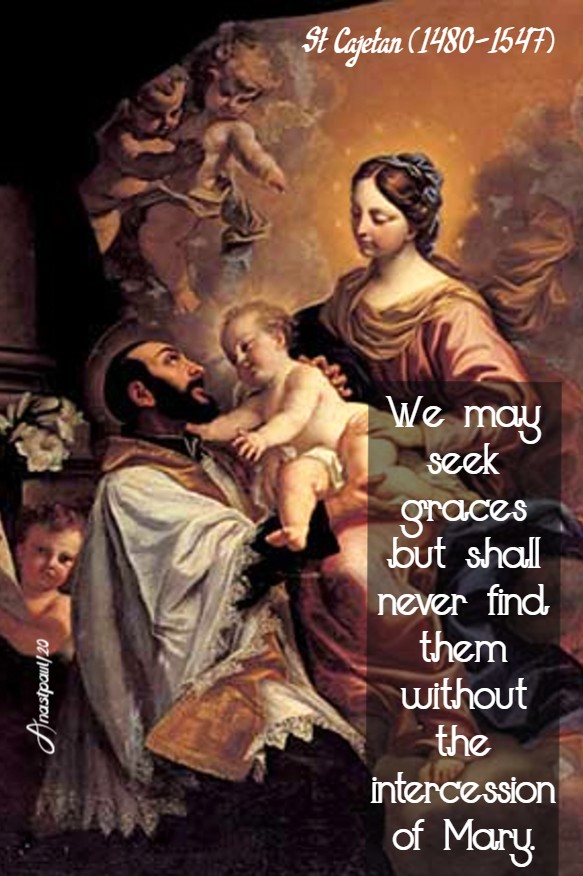
“We may seek graces but shall never find them without the intercession of Mary.”
St Cajetan (1480-1547)
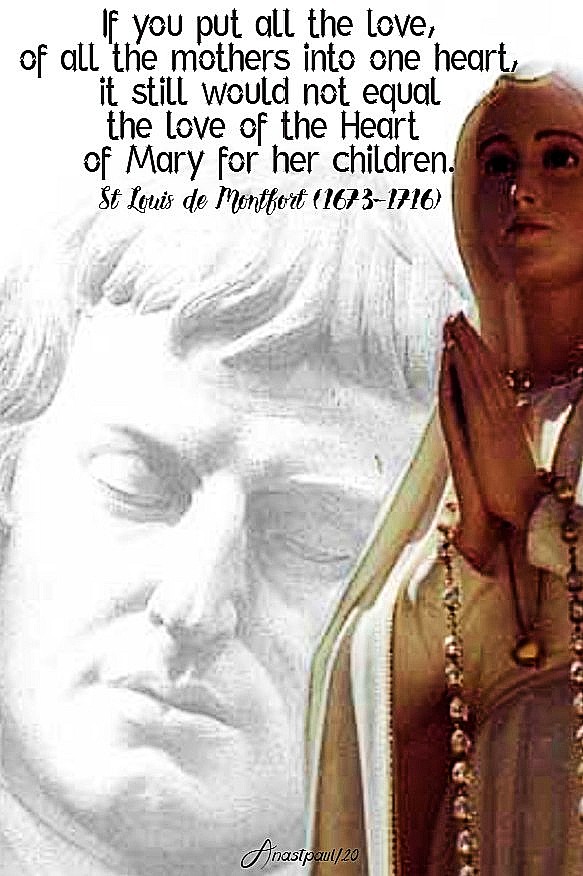
“If you put all the love, of all the mothers into one heart, it still would not equal the love of the Heart of Mary for her children.”
St Louis de Montfort (1673-1716)
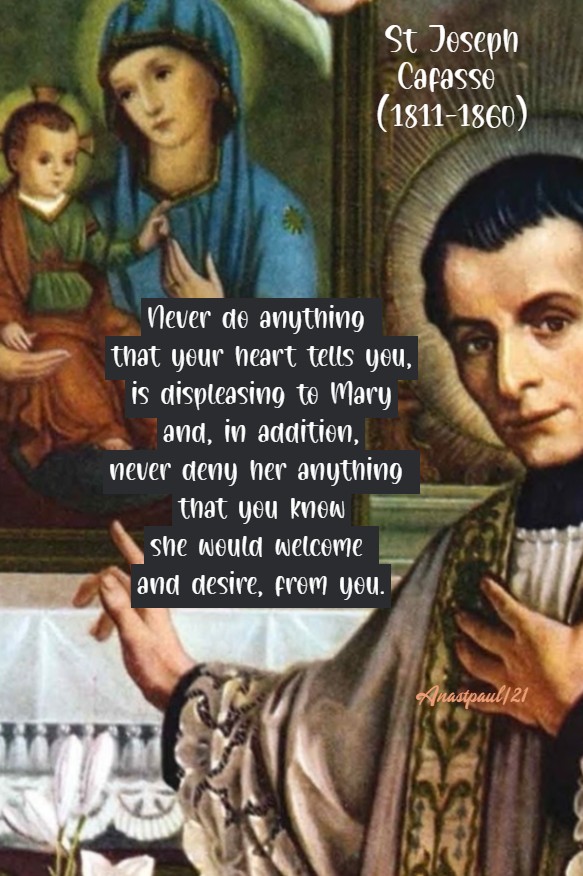
“Never do anything that your heart tells you, is displeasing to Mary and, in addition, never deny her anything that you know she would welcome and desire from you.”
St Joseph Cafasso (1811-1860)
Mary, Mother of Grace St Athanasius (297-373) Father & Doctor of the Church
It becomes you to be mindful of us, as you stand near Him who granted you all graces, for you are the Mother of God and our Queen. Help us for the sake of the King, the Lord God and Master, Who was born of you. For this reason, you are called full of grace. Remember us, most holy Virgin, and bestow on us gifts from the riches of your graces, Virgin full of graces. Amen
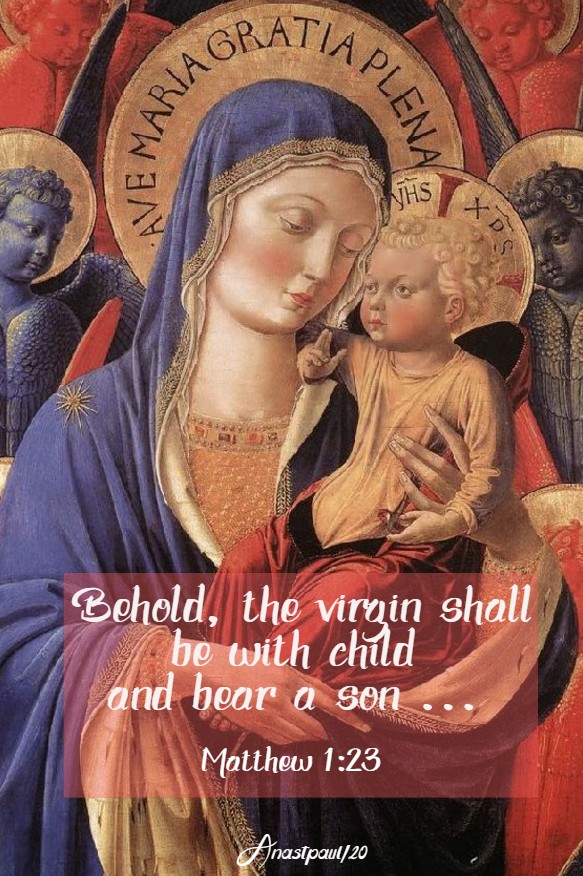
One Minute Reflection –8 September – Feast of theNativity of the Blessed Virgin Mary – Readings: Micah 5:1-4a or Romans 8:28-30, Psalms 13:6, 6, Matthew 1:1-16, 18-23
“Behold, the virgin shall be with child and bear a son – Matthew 1:23
REFLECTION – “Come, you nations; come, all peoples of every race and language, every age and rank. Joyfully let us celebrate the nativity of the whole world’s joy! If even the pagans honour the birthday of their king … what ought not we to do to honour that of the Mother of God, through whom all humanity has been transformed and the pain of Eve, our first mother, has been turned to joy? For Eve heard God’s sentence: “You will bring forth children in pain” (Gn 3:16) but Mary: “Rejoice, most highly favoured … the Lord is with you” (Lk 1:28). …
Let all creation celebrate and sing the holy childbirth of a holy woman, for she has brought a lasting treasure into the world. … Through her, the creative Word of God has been united to the whole creation and we celebrate the ending of human barrenness, the ending of the sickness that kept us from possessing all our good. … Nature has given way to grace … As the Virgin Mother of God had to be born of barren Anna, so nature remained without fruit until grace had produced its own. It was to open the womb of its mother, she who would give birth to “The Firstborn of all creation” in whom “all things hold together” (Col 1:15,17).
O blessed couple, Joachim and Anna! All creation owes you thanks; through you it has offered the Creator the best of all His gifts: a Mother worthy of veneration, the only Mother worthy of the One who created her. ”- St John Damascene (675-749) Monk, Theologian, Father and Doctor of the Church – Homily on the Nativity of the Virgin Mary, 1-2 (cf SC 80, p. 48)
PRAYER – Lord God, the day of our salvation dawned when the Blessed Virgin gave birth to Your Son. As we celebrate her nativity, grant us Your grace and Your peace. Through Christ, our Lord, Your Son in union with the Holy Spirit. Mary, Mother of God, pray for us, amen.
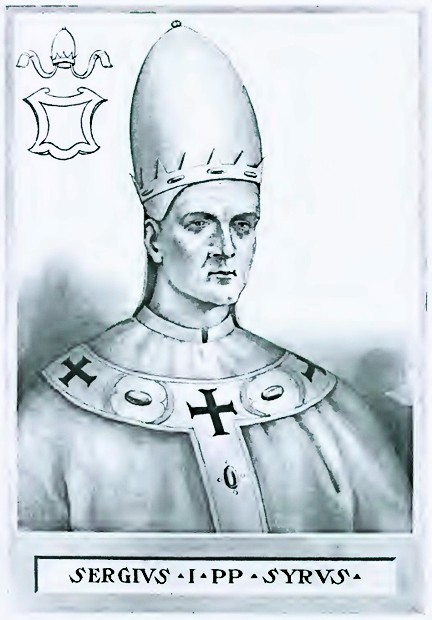
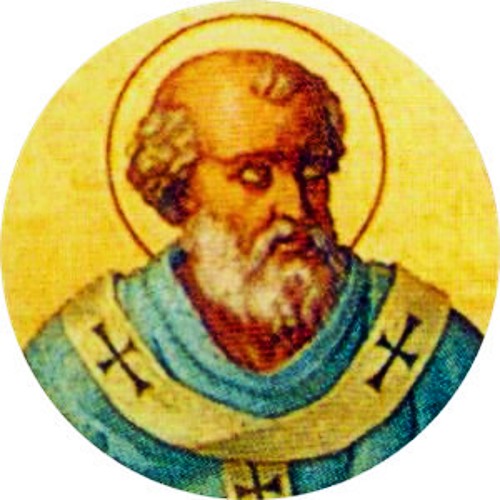
Saint of the Day – 8 September – Saint Pope Sergius I (c 650–701) Papal Ascension 15 December 687. Born in c 650 at Palermo, Sicily and died on 8 September 701 of natural causes in Rome, Italy.
Sergius was born about the year 650 into a Syrian family from Antioch that had moved to Palermo in Sicily. He received his education in Sicily before he moved to Rome during the Pontificate of Pope Adeodatus II in the 670s. Ordained by Pope Leo II, he was a Cardinal-Priest of the Church of St Susanna at the Baths of Diocletian in Rome.
As Pope Conon was dying in 687, two warring factions vied to elect a successor. In simultaneous elections after the death of Pope Conon the Archdeacon Pascal and the Priest Theodore were elected to the Papal throne. However, an assembled group of clergy and people ignored these elections and chose instead, the Priest Sergius, who was then consecrated on 15 December 687. Theodore, recognising the support behind the election of Sergius, quickly acknowledged Sergius I as Pope. Pascal, who had turned for help to the Exarch of Ravenna, John Platyn with offers of gold, was soon abandoned by the Exarch after the Consecration of Sergius and Pascal eventually ended up confined to a Monastery on charges of witchcraft.
During the early years of his Pontificate, Sergius had numerous contacts with England and English notables. He received King Caedwalla of the West Saxons and baptised him on 10 April 689, before his death on 20 April, apparently from battle wounds. Under Pope Sergius’ direction Caedwalla was buried in St Peter’s. He consecrated St Willibrord, an Englishman, as Bishop of the Frisians.
The cruel Emperor Justinian wanted him to sign the decrees of the so-called Quinisext or Trullan Council of 692, in which the Greeks allowed Priests and Deacons to keep the wives they had married before their Ordination and which aimed at placing the Patriarch of Constantinople on a level with the Pope of Rome. When Sergius refused to acknowledge this Synod, the Emperor sent an officer to bring him to Constantinople as a prisoner. But the people protected the Pope, and Justinian himself was soon afterwards deposed (695).
Sergius succeeded in extinguishing the last remnants of the Schism of the Three Chapters in Aquileia. He repaired and adorned many Basilicas, added the Agnus Dei to the Mass and instituted processions to various Churches.
Pope Sergius died in Rome on 8 September 701. He was succeeded by John VI.
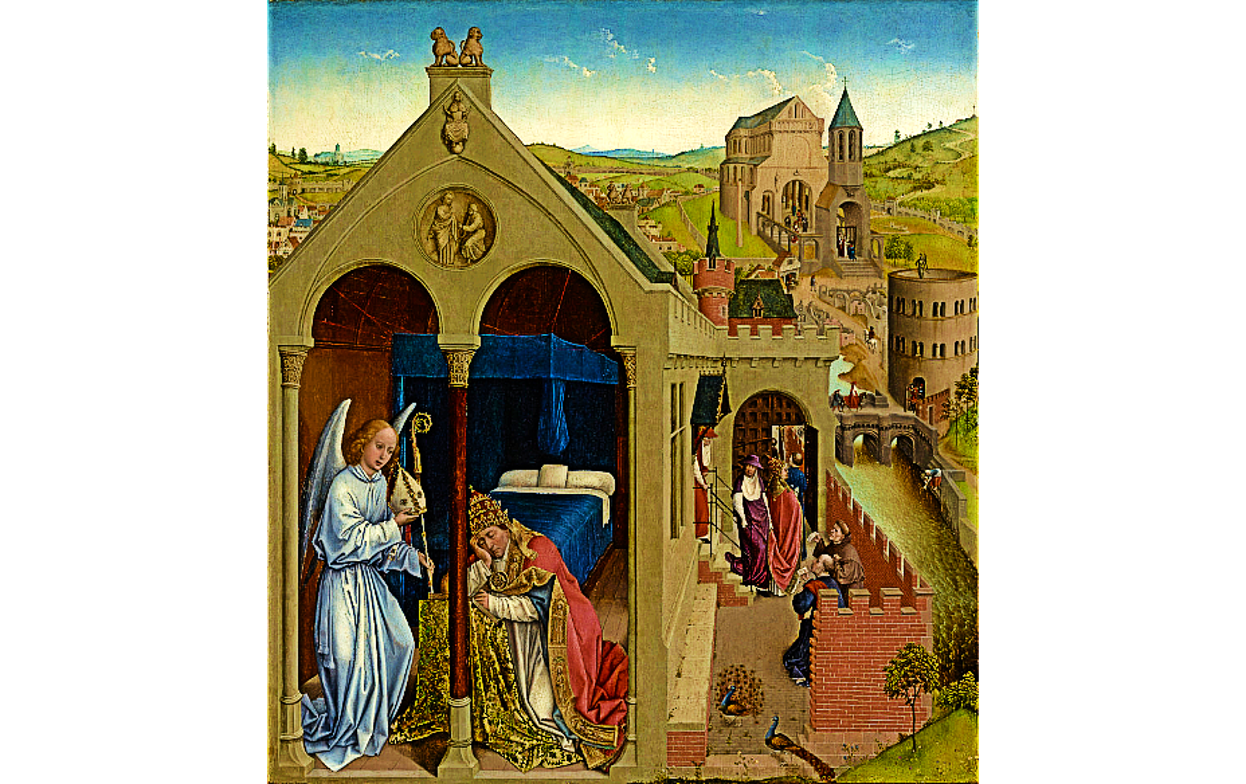
The image below The Dream of Pope Sergius depicts an miraculous incident in the life of our Saint. A cut-away wall reveals a small bedroom where an Angel appears to Pope Sergius in his sleep. The Angel tells Sergius that the Bishop Saint Lambert has been assassinated and Sergius is to appoint a new Bishop, Saint Hubert. The Angel holds a Bishop’s mitre and crozier formerly belonging to Saint Lambert. To the right, the Pope and two Cardinals go out into a brick enclosure, meeting a lawyer or noble and a Franciscan friar, who both kneel before the Papal retinue and present petitions requesting benefits or indulgences. In the far distance, on the steps of the early Saint Peter’s Basilica, Pope Sergius presents Saint Hubert with the Bishop’s mitre and staff.
An amplified detail of St Sergius placing the Bishop’s mitre on St Hubert’s head
The artists made an imaginative effort to recreate Rome as it would have appeared at that time. The depiction of minutely detailed objects and the ability to portray space in a convincing manner were among the major achievements of Netherlandish painters in the 1400s.
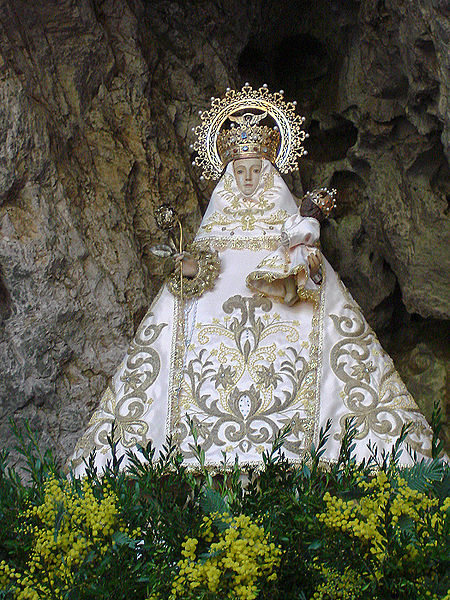
Nuestra Senora de la Covadonga, also named “La Santina” / Our Lady of Covadonga (720) – 8 September:
This is a title of the Blessed Virgin Mary and the name of a Marian Shrine devoted to her at Covadonga, Asturias. The Shrine in northwestern Spain rose to prominence following the Battle of Covadonga in about 720, which was the first defeat of the Moors during their invasion of Spain. A Statue of the Virgin Mary, secretly hidden in one of the caves, was believed to have miraculously aided the Christian victory. Our Lady of Covadonga is the Patron of Asturias, and a Basilica was built to house the current Statue. Our Lady of Covadong’s east day is 8 September.
Our Lady of Health of Vailankanni (16th Century) – 8 September:
This is the title given to the Blessed Virgin Mary by people as she twice appeared in the town of Velankanni, Tamil Nadu, India, in the 16th to 17th centuries. The Feast of the Nativity of Mary, is also commemorated as the feast of Our Lady of Good Health. The celebration starts on 29 August and ends on the day of the feast. The feast day prayers are said in Tamil, Marathi, East Indian, Malayalam, Telugu, Kannada, Konkani, Hindi and English.
Nuestra Senora de la Meritxell / Our Lady of Meritxell (12th Century) – 8 September:
This is an Andorran Roman Statue depicting an apparition of the Virgin Mary. Our Lady of Meritxell is the Patron Saint of Andorra. On 6 January in the late 12th century, villagers from Meritxell, Andorra were going to Mass in Canillo. Though it was winter, they found a wild rose in bloom by the roadside. At its base was a Statue of the Virgin and Child. They placed the Statue in a Chapel in the Church in Canillo. The next day the Statue was found sitting under the wild rose again. Villagers from Encamp took the Statue to their Church but the next day the Statue had returned to the rose bush. Though it was snowing, an area the size of a Chapel was completely bare and the villagers of Meritxell took this to mean that they should build a Chapel to house the Statue and so they did. On 8-9 September 1972 the Chapel burned down and the Statue was destroyed, a copy now resides in the new Meritxell Chapel. The feast day of Our Lady of Meritxell is 8 September and the Andorran National Day.
St Adam Bargielski St Adela of Messines Bl Alanus de Rupe
St Disibod of Disenberg St Ethelburgh of Kent St Faustus of Antioch St Isaac the Great St István Pongrácz St Kingsmark St Peter of Chavanon Bl Seraphina Sforza St Pope Sergius I (c 650–701)
St Timothy of Antioch Bl Wladyslaw Bladzinski — Martyrs of Alexandria – (5 saints) A group of Christians martyred together in the persecutions of Diocletian – Ammon, Dio, Faustus, Neoterius and Theophilus. Martyred in Alexandria, Egypt.
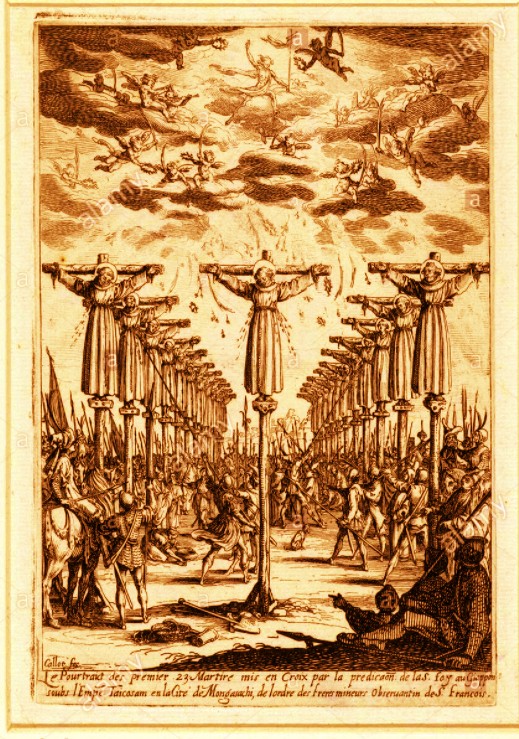
Martyrs of Japan – (21 beati): A group of 21 missionaries and converts who were executed together for their faith. • Antonio of Saint Bonaventure • Antonio of Saint Dominic • Dominicus Nihachi • Dominicus of Saint Francis • Dominicus Tomachi • Francisco Castellet Vinale • Franciscus Nihachi • Ioannes Imamura • Ioannes Tomachi • Laurentius Yamada • Leo Aibara • Lucia Ludovica • Ludovicus Nihachi • Matthaeus Alvarez Anjin • Michaël Tomachi • Michaël Yamada Kasahashi • Paulus Aibara Sandayu • Paulus Tomachi • Romanus Aibara • Thomas of Saint Hyacinth • Thomas Tomachi Died on 8 September 1628 in Nagasaki, Japan Beatified on 7 May 1867 by Pope Pius XI
Martyred in England: Bl John Norton Bl Thomas Palaser
Martyred in the Spanish Civil War: • Blessed Adrián Saiz y Saiz • Blessed Apolonia Lizárraga Ochoa de Zabalegui • Blessed Bonifacio Rodríguez González • Blessed Dolores Puig Bonany • Blessed Eusebio Alonso Uyarra • Blessed Ismael Escrihuela Esteve • Blessed Josefa Ruano García • Blessed Josep Padrell Navarro • Blessed Mamerto Carchano y Carchano • Blessed Marino Blanes Giner • Blessed Miguel Beato Sánchez • Blessed Pascual Fortuño Almela • Blessed Segimon Sagalés Vilá • Blessed Tomàs Capdevila Miquel
Thought for the Day – 7 September – Meditations with Antonio Cardinal Bacci (1881-1971)
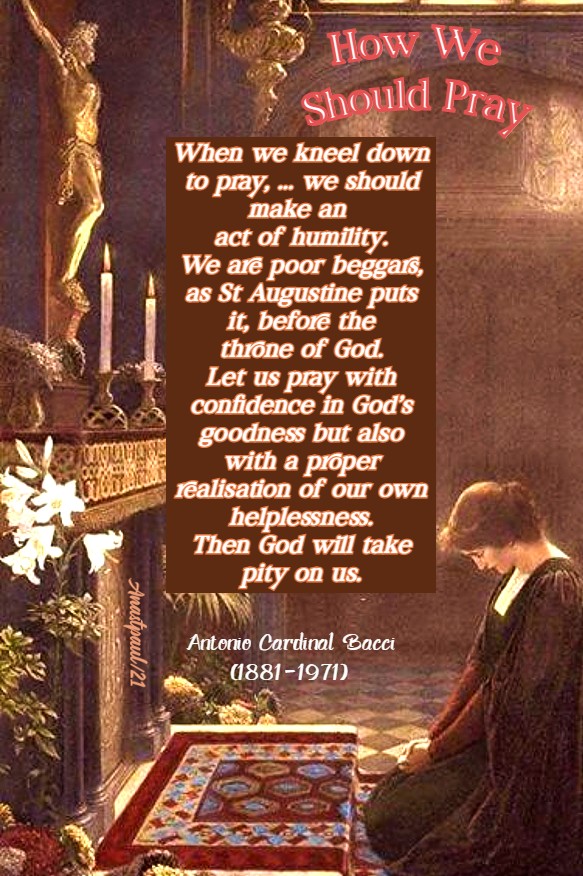
How We Should Pray
“We must pray with deep humility. Once again we find, that the Man-God Jesus, has given us an example. In Gethsemane He fell prostate on the ground and begged that, if it were possible, the bitter chalice might be taken away from Him. Immediately He added. with full submission to the will of His Heavenly Father – “Yet, not my will but thine be done” (Lk 22:42). Let us remember, moreover, the parable of the Pharisee and the publican. The former appeared to be full of virtue but he was proud and was rejected. The latter, recognised in all humility, that he was a poor sinner and he was exalted. “Everyone who exalts himself shall be humbled and he who humbles himself shall be exalted” (Lk 14:11). “God resists the proud but gives grace to the humble” (Js 4:6). “The prayer of the lowly pierces the clouds; it does not rest, until t reaches its goal” (Ecclus 35:17).
When we kneel down to pray, therefore, we should make an act of humility. We are poor beggars, as St Augustine puts it, before the throne of God. Let us pray with confidence in God’s goodness but also with a proper realisation of our own helplessness. Then God will take pity on us.
Quote/s of the Day – 7 September – “Month of the Seven Sorrows of the Blessed Virgin Mary” – Readings: Colossians 2: 6-15; Psalm 145: 1b-2, 8-9-11; Luke 6: 12-19
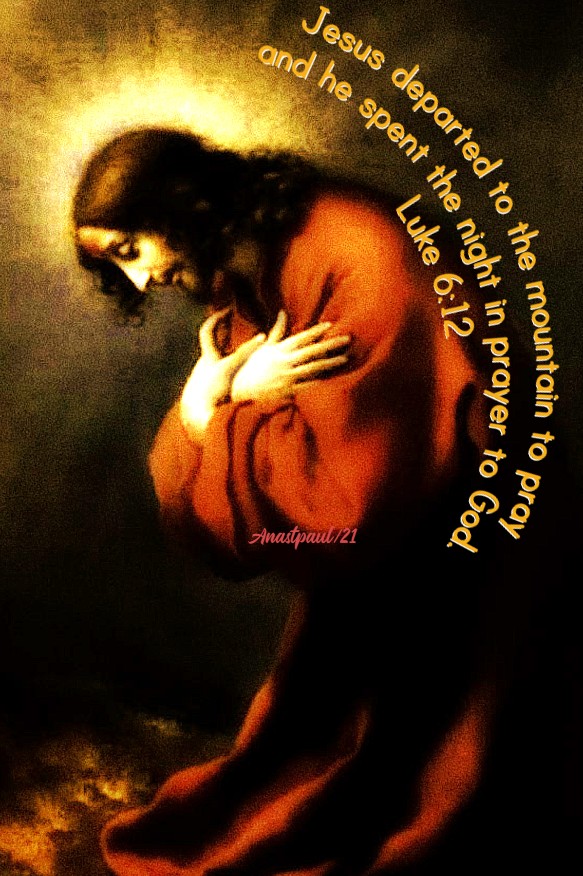
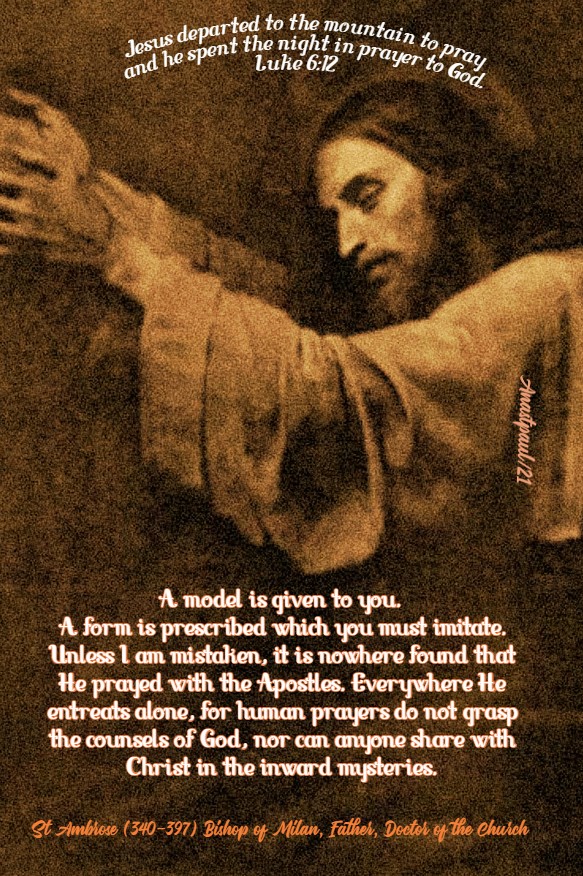
“Jesus departed to the mountain to pray and he spent the night in prayer to God”
Luke 6:12
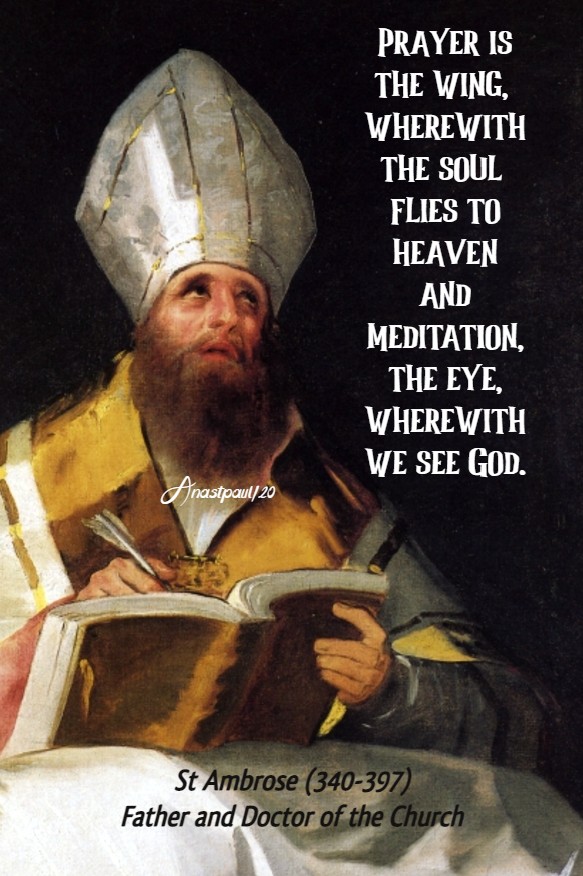
“Prayer is the wing, wherewith the soul flies to heaven and meditation, the eye, wherewith we see God.”
St Ambrose (340-397) Father and Doctor of the Church
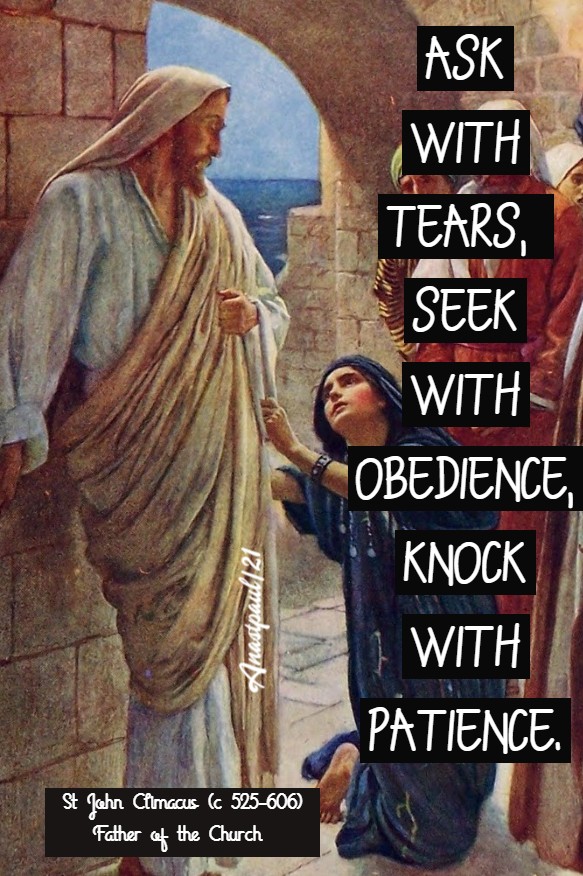
“Ask with tears, seek with obedience, knock with patience.”
St John Climacus (c 525-606) Father of the Church
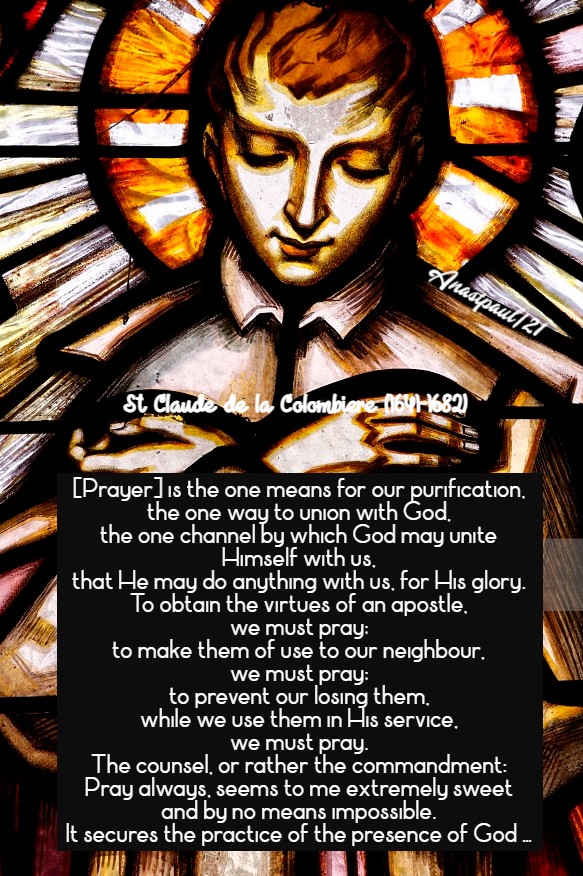
“[Prayer] is the one means for our purification, the one way to union with God, the one channel by which God may unite Himself with us, that He may do anything with us, for His glory. To obtain the virtues of an apostle, we must pray; to make them of use to our neighbour, we must pray; to prevent our losing them, while we use them in His service, we must pray. The counsel, or rather the commandment: Pray always, seems to me extremely sweet and by no means impossible. It secures the practice of the presence of God …”
St Claude de la Colombiere (1641-1682) “Apostle of the Sacred Heart”
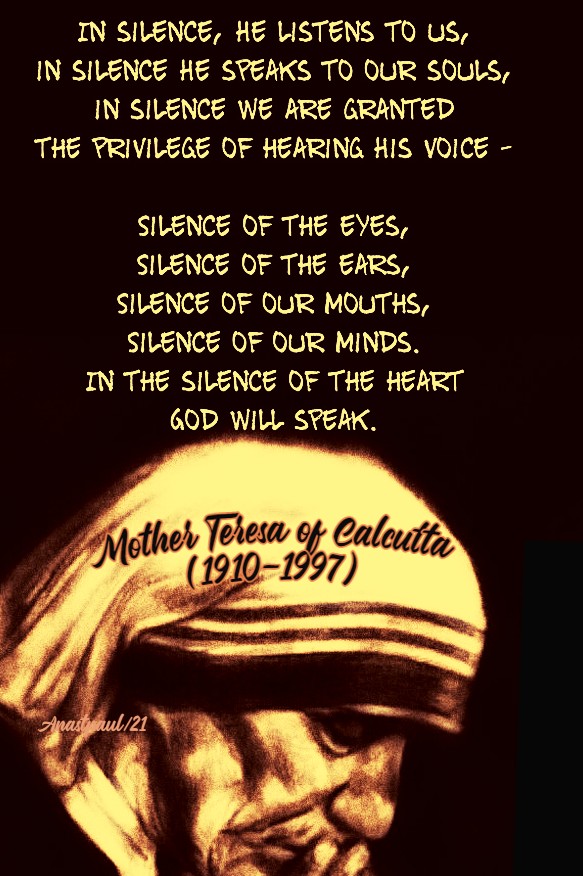
“In silence, He listens to us, in silence He speaks to our souls, in silence we are granted the privilege of hearing His voice –
Silence of the eyes, Silence of the ears, Silence of our mouths, Silence of our minds. In the silence of the heart God will speak.”
One Minute Reflection – 7 September – “Month of the Seven Sorrows of the Blessed Virgin Mary” – Readings: Colossians 2: 6-15; Psalm 145: 1b-2, 8-9-11; Luke 6: 12-19
“Jesus departed to the mountain to pray and he spent the night in prayer to God”– Luke 6:12
REFLECTION – “So the Lord prays, not to entreat for Himself but to intercede for me. Although the Father placed all things in the power of His Son, yet the Son, in order to fulfill the form of a man, thinks that the Father must be entreated for us because He is our Advocate. If He is an Advocate, He must intercede on account of my sins.
It says, “He passed the whole night in prayer.” A model is given to you. A form is prescribed which you must imitate. Unless I am mistaken, it is nowhere found that He prayed with the Apostles. Everywhere He entreats alone, for human prayers do not grasp the counsels of God, nor can anyone share with Christ in the inward mysteries.” – St Ambrose (340-397) Bishop of Milan, Father, Doctor of the Church – (Exposition on the Gospel of Luke, 5.)
PRAYER – Our Father who art in heaven, almighty and eternal God, teach us to pause often during our active lives and recollect ourselves. Let us put away the problems of life and commune with You in prayer and meditation. Mary, Holy and Sorrowful Mother of our Lord Jesus Christ, teach us the how to pray and how to imitate your courage and strength in silence. Pray for us that we may be inspired to turn to our God for strength, in this vale of tears. Through Jesus Christ our Lord and Advocate, with the Holy Spirit, one God now and for all eternity, amen.
Our Morning Offering – 7 September – “Month of the Seven Sorrows of the Blessed Virgin Mary”
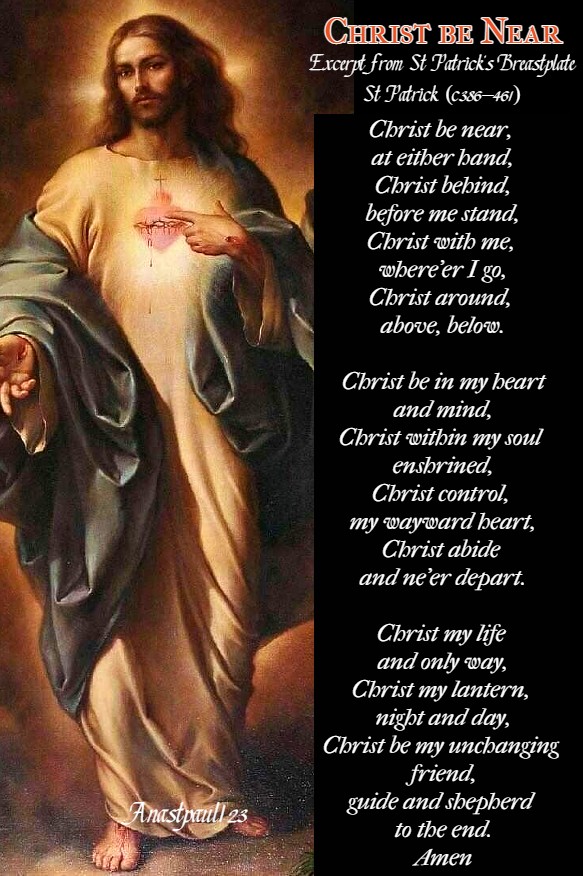
Christ be Near Excerpt from St Patrick’s Breastplat St Patrick (c 386 – 461)
Christ be near, at either hand, Christ behind, before me stand, Christ with me, where’er I go, Christ around, above, below.
Christ be in my heart and mind, Christ within my soul enshrined, Christ control, my wayward heart, Christ abide and ne’er depart.
Christ my Life and only Way, Christ my Lantern, night and day, Christ be my unchanging Friend, Guide and Shepherd to the end.
We have this prayer and his own story in one of the certainly authentic writings of this beloved Saint Patrick – his Confessio, which is, above all, an act of homage to God, for having called Patrick, unworthy sinner, to the apostolate.
Saint of the Day – 7 September – Blessed Thomas Tsuji SJ (1570-1627) Priest of the Society of Jesus, Martyr. Born in c1571 in Sonogi, Nagasaki, Japan and died by being burned at the stake on 7 September 1627 at Nagasaki, Japan. Additional Memorial – 7 May together with the Martyrs of Japan. Also known as – Thomas Tsugi, Thomas Tsughi, Thomas Tzugi.
Thomas Tsuji was born in Sonogi, near Omura of a noble family. He received his early education from the Jesuits in Arima and entered the Society in January 1589. He was Ordained a Priest in Nagasaki sometime before 1613. He was an excellent preacher and became well known throughout southern Japan. He was transferred to Hakata after he became too outspoken in his condemnation of the scandalous conduct of some Christian Japanese in the City. While exercising his priestly ministry in Hakata, the edict of 1641 which ordered the banishment of all Catholic Priests from Japan was enacted. In obedience to the order, Fr Tsuji and the other eighty Priests left for Macau and remained there for four years.
In August 1618, Fr Tsuji,disguised as a merchant, returned to Japan and secretly resumed his apostolic work. Unlike the European Jesuits who could only minister at night, Fr Tsuji worked day and night, achieving great results, disguised sometime as a prosperous Japanese gentleman and at times, as an artisan. His favourite disguise was as a humble wood seller who could knock at the doors of Christian homes without being noticed.
As the persecution against Christians intensified and his workload increased, Fr Tsuji found his energy waning as he began to doubt whether he could match the heroic example of his brother Jesuits who were being martyred. This uncertainty of himself, led him to be depressed and as he found it difficult to continue living up to the ideals that the Society demanded of its men, he was released of his religious vows in late 1619.
Within a short time of his departure from the Society, he requested to be readmitted but while immediate readmission was not possible, the Jesuit superiors allowed him to go through a period of probation. This lasted six years, during which time he demonstrated more zealously, by exposing himself to many dangers, in order to help other Christians. After his readmission in 1626, Fr Tsuji was assigned to Nagasaki where he continued his apostolic duties until his capture the same year.
Fr Tsuji had been living with a devout Christian, Louis Maki and his son John. On the morning of 21 July 1626, just after he had celebrated Mass, which the Makis attended, the house was invaded by soldiers and the three were arrested. Fr Tsuji appeared before the district judge and when asked who he was and what he was doing, he responded: “For many years the people of Nagasaki have seen Thomas Tsuji, a religious of the Society of Jesus and have heard him preach the Christian message. I am he and I am prepared to uphold. with my life and to testify with my blood. to the truths that I have faithfully taught.” He was found guilty and imprisoned at the Omura prison. The Makis were also imprisoned for collaborating with a Priest and offering him hospitality.
While in prison, Fr Tsuji had to endure the visits of his family who endlessly asked him to think of them and not to bring shame upon them. They appealed to him to renounce his Christian religion and return to live with them. His reply was: “What you ask me to do is wrong and even if you offered me a thousand Japans, or the whole world, I could not do it.” After thirteen months of incarceration the three prisoners were taken to Nagasaki to receive the death sentence
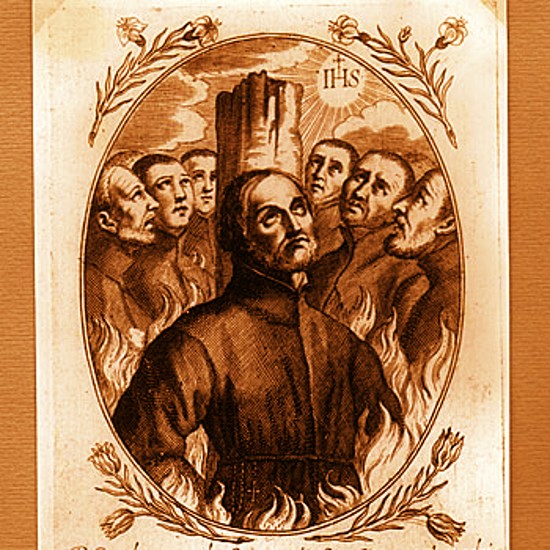
On 7 September 1627 they were led to the Martyrs’ Hill, made holy by many Martyrs and there, they were tied to stakes. Fr Tsuji comforted his two companions and urged them to think of Christ’s passion. When the stakes were on fire, he blessed his companions, raised his eyes to heaven and prayed silently. When the flames twirled and wrapped about his body, he chanted the psalm: “Praise the Lord, All You Nations.”
Many witnesses have attested that few moments before his death, his breast burst open and from it there issued a flame that rose upwards and upwards until it was lost in sight. They believed that the sacrifice offered by Fr Tsuji and his companions was found to be most pleasing to God.
Fr Tsuji, Louis and John Maki were beatified by Pope Pius IX together with other Japanese martyrs on 7 May 1867.
Vigil of the Nativity of the Nativity of the Blessed Virgin Mary, instituted by Pope Gregory II (722):
The day destined for the parturition of Saint Anne and for the birth of her, who was consecrated and sanctified to be the Mother of God, had arrived – a day most fortunate for the world. This birth happened on the eighth day of September, fully nine months having elapsed since the Conception of the soul of our most holy Queen and Lady.
Saint Anne was prepared by an interior voice of the Lord, informing Her, that the hour of her parturition had come. Full of the joy of the Holy Spirit at this information, she prostrated herself before the Lord and besought the assistance of his grace and his protection for a happy deliverance.
Presently she felt a movement in her womb similar to that which is proper to creatures being born to the light. The most blessed child Mary was at the same time, by divine providence and power, ravished into a most high ecstasy. Hence Mary was born into the world without perceiving it by her senses, for their operations and faculties were held in suspense. As She had the use of her reason, she would have perceived it by her senses, if they would have been left to operate in their natural manner at that time. However, the Almighty disposed otherwise, in order that the Princess of heaven might be spared the sensible experience, otherwise connected with birth. she was born pure and stainless, beautiful and full of grace, thereby demonstrating, that she was free from the law and the tribute of sin. Although she was born substantially like other daughters of Adam, yet her birth was accompanied by such circumstances and conditions of grace, that it was the most wonderful and miraculous birth in all creation and will eternally redound to the praise of her Maker.
At twelve o-clock in the night this divine child issued forth, dividing the night of the ancient Law and its pristine darknesses from the new day of grace, which now was about to break into dawn. She was clothed, handled and dressed like other infants, through she excelled all mortals and even all the angels in wisdom. Her mother did not allow her to be touched by other hands than her own but she, herself, wrapped her in swaddling clothes: and in this Saint Anne was not hindered by her present state of incapacity, for she was free from the toils and labours, which mothers endure in such circumstances.
So then Saint Anne received in her arms she, who was her Daughter but at the same time, the most exquisite treasure of all the universe, inferior only to God and superior to all other creatures. (The City of God, by Venerable Mary of Jesus of Agreda OIC (1602-1665) [Her body is incorrupt].
St Alcmund of Hexham Bl Alexander of Milan St Augustalus St Balin St Carissima of Albi St Chiaffredo of Saluzzo Bl Claude-Barnabé Laurent de Mascloux
St Desiderio of Benevento St Dinooth Bl Eugenia Picco St Eupsychius of Caesarea St Eustace of Beauvais St Evortius of Orleans St Faciolus St Festo of Benevento Bl François d’Oudinot de la Boissière
St Giovanni of Lodi St Goscelinus of Toul St Gratus of Aosta St Grimonia of Picardy St Hiduard Bl Ignatius Klopotowski Bl John Duckett Bl John Maki Bl John of Nicomedia Bl Ludovicus Maki Soetsu Madalberta Bl Maria of Bourbon St Marko Križevcanin St Melichar Grodecký St Memorius of Troyes St Pamphilus of Capua Bl Ralph Corby
St Sozonte Blessed Thomas Tsuji SJ (1570-1627) Priest of the Society of Jesus, Martyr.
St Tilbert of Hexham — Martyrs of Noli: Four Christians who became soldiers and were martyred together for their faith. A late legend makes them member of the Theban Legend who escaped their mass martyrdom but that’s doubtful – Paragorius, Partenopeus, Parteus and Severinus. They were born in Noli, Italy and martyred in Corsica, France. Attribute – soldiers with a banner of Noli.
Martyred in the Spanish Civil War: • Blessed Antoni Bonet Sero • Blessed Ascensión Lloret Marcos • Blessed Gregorio Sánchez Sancho • Blessed Félix Gómez-Pinto Piñero
Thought for the Day – 6 September – Meditations with Antonio Cardinal Bacci (1881-1971) (Apologies for the late post – the usual South African problem to blame – Power Cuts! 🙄)
Pride is Robbery!
“When we are proud, we steal from God! Everything which we are and have, both in the natural and supernatural order, is a gift from God. Therefore, when we claim the credit for ourselves, we take from Him that which really belongs to Him. “What hast thou that thou hast not received.” asks St Paul. “And if thou has received it, why do thou boast as if thou had not received it?” (1 Cor 4:7).
Pride is a very grave sin, therefore. According to Sacred Scripture, “pride is the reservoir of sin, a source which runs over with vice” (Ecclus 10:15). “The beginning of pride,” says the same Book of Ecclsiasticus, “is man’s stubbornness in withdrawing his heart from his Maker” (10:14). It is worth meditating on these words, for because of this sin “God sends unheard-of afflictions and brings men to utter ruin” (Ecclus 10:15). As St Augustine points out, the first sin was one of pride and it changed an angel into a demon. (In Ps 18:15).
When we reflect on the matter, it becomes quite clear, that pride is the basis of every sin (Ibid). When man disobeys the law of God, he prefers sin to God. Sin, therefore, is always an act of rebellion against God. It is as if we were to say to Him: “I prefer to obey my own caprice, rather than to obey Your will.” In this sense, it is true to state, that every sin is founded on pride and involves a turning away from God. But, when we turn away from our Creator and Redeemer, where are we to go? “Lord,” let us say with St Peter, “to whom shall we go? Thou has the words of everlasting life …” (Jn 6:69).”
Quote/s of the Day – 7 September – “Month of the Seven Sorrows of the Blessed Virgin Mary” – Readings: Colossians 1: 24 – 2: 3; Psalm 62: 6-7,9; Luke 6:6-11
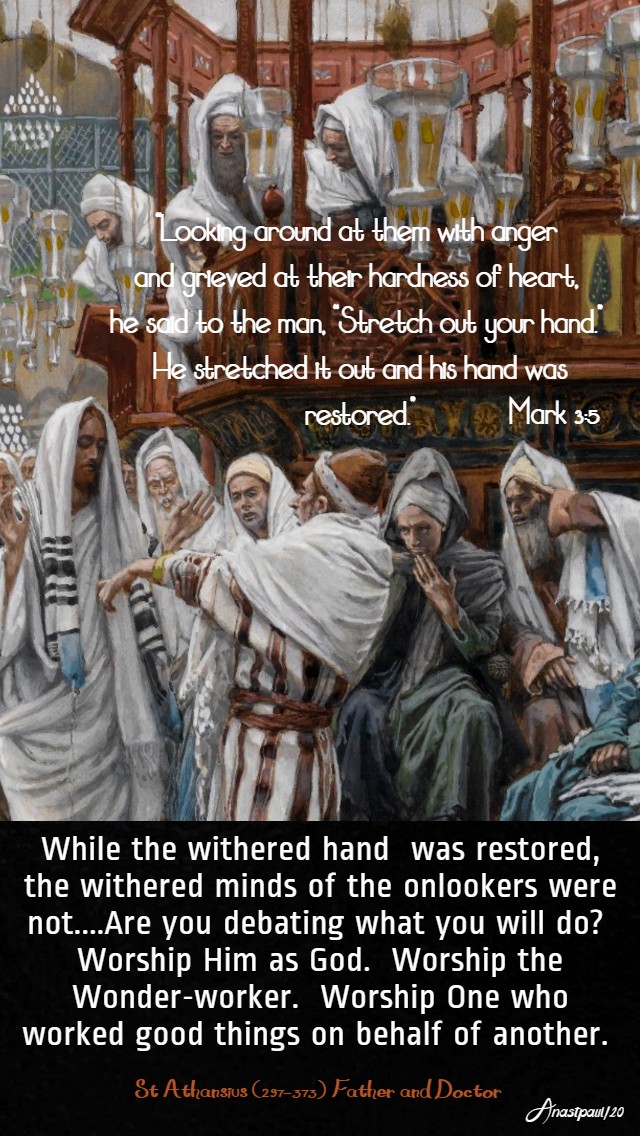
JEALOUSY/ENVY!
“Stretch forth your hand.”
Luke 6:10
“While the withered hand was restored, the withered minds of the onlookers were not. … Are you debating what you will do? Worship Him as God. Worship the Wonder-worker. Worship One who worked good things on behalf of another.”
St Athansius (297-373) Father and Doctor of the Church
“And I became their abomination because there was no jealousy in me. Because I continually did good to every man I was hated. And they surrounded me like mad dogs (Ps 22[21]:17) those, who in stupidity, attack their masters. Because their mind is depraved and their sense is perverted.”
Odes of Solomon (Hebrew Christian text from the beginning of the 2nd century) No 28
“Jealousy has no limit; it is an evil that continually endures and a sin, without end. The lies of jealousy burn hotter in proportion to the increasing success of the person who is envied.”
St Cyprian of Carthage (c 200- c 258) Bishop, Martyr, Father of the Church
“ It is ever thus, the more you envy your brother, the greater good you confer upon him. God, who sees all, takes the cause of the innocent in hand and, irritated by the injury you inflict, deigns to raise up him whom you wish to lower and will punish you to the full extent of your crime.”
St John Chrysostom (347-407) Father & Doctor of the Church
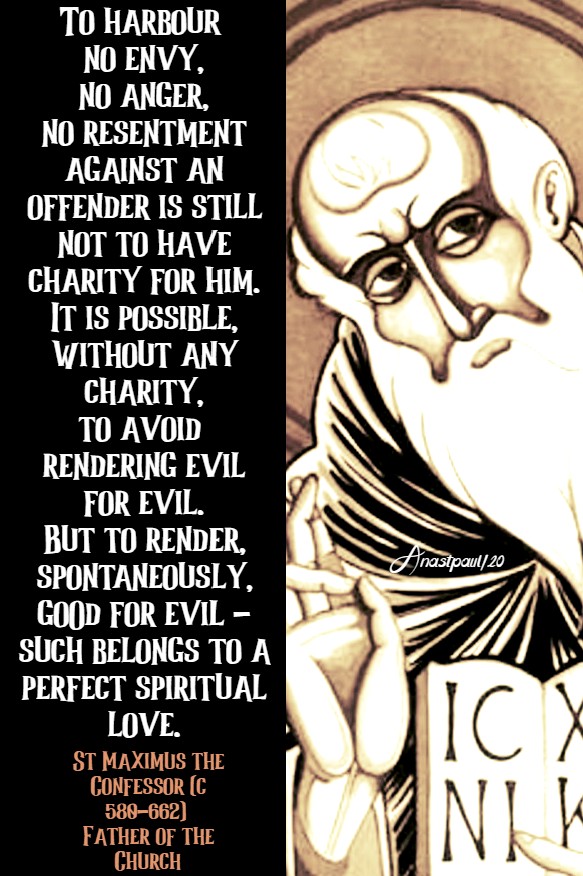
“To harbour no envy, no anger, no resentment against an offender is still not to have charity for him. It is possible, without any charity, to avoid rendering evil for evil. But to render, spontaneously, good for evil – such belongs to a perfect spiritual love.”
St Maximus the Confessor (c 580-662) Father of the Church
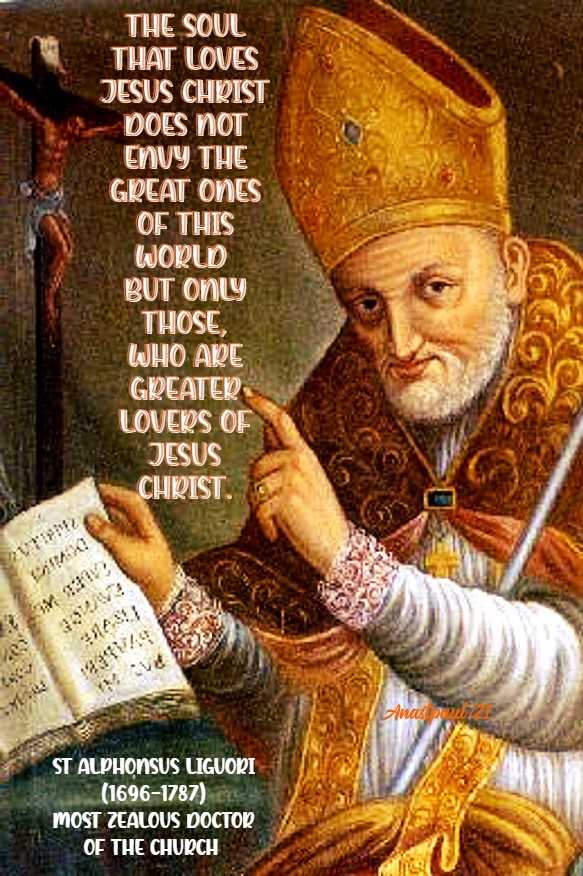
“The soul that loves Jesus Christ does not envy the great ones of this world but only those, who are greater lovers of Jesus Christ.”
St Alphonsus Maria de Liguori (1696-1787) Most Zealous Doctor of the Church
One Minute Reflection – 7 September – “Month of the Seven Sorrows of the Blessed Virgin Mary” – Readings: Colossians 1: 24 – 2: 3; Psalm 62: 6-7,9; Luke 6:6-11
“On another Sabbath, he entered the synagogue and was teaching and there was a man whose right hand was withered. ” – Luke 6:6
REFLECTION – “The miracle sometimes converts to faith those who had disbelieved the word but the Pharisees watched Him to see if He would heal on the Sabbath. The nature of an envious person is such, that he makes the praises of others food for his own disease and is wickedly maddened by their reputation. Once more He spoke thus; “I ask you, is it lawful to do good on the Sabbath rather than to do evil, to save life rather than to destroy it?” And why did He do this? Perhaps it might be to move the cruel and unpitying Pharisee to compassion. The man’s malady [his withered hand] perhaps might shame them and persuade them to dispel the flames of their envy.
This question is most wise indeed and a most suitable statement to meet their folly. If it is lawful to do good on the Sabbath and nothing prevents the sick being pitied by God, cease picking up opportunities for fault-finding against Christ and bringing down on your own head, the sentence which the Father has decreed against those who dishonour the Son. You have heard the Father where He says of the Son by the voice of David, “I will crush his foes before him and strike down those who hate him.” But, if it is not lawful to do good on the Sabbath and the law forbids the saving of life, you have made yourself an accuser of the law.” – St Cyril of Alexandria (376-444) Father and Doctor of the Church. Doctor of the Incarnation (Known a\s the Pillar of Faith) – (Commentary on Luke, Homily 23)
PRAYER – God of mercy and love, You offer all peoples the dignity of sharing in your life. Rule over our hearts and bodies this day. Sanctify us and guide our every thought, word and deed, my our hands be held out to our neighbour in imitation of Your love and mercy. By the intercession of Mary the Sorrowful Mother of Our Lord Jesus Christ and our Mother, strengthen us to love each other as brothers and sisters. We ask this through our Lord Jesus Christ, your Son, who lives and reigns with you and the Holy Spirit, one God, forever and ever amen.
Our Morning Offering – 6 September – “Month of the Seven Sorrows of the Blessed Virgin Mary”
The Day is Filled with Splendour Benedictine Nuns of Stanbrook Abbey
The day is filled with splendour When God brings light from light, And all renewed creation Rejoices in His sight. — The Father gives His children The wonder of the world In which His power and glory Like banners are unfurled. — With every living creature, Awaking with the day, We turn to God our Father, Lift up our hearts and pray: — O Father, Son and Spirit, Your grace and mercy send, That we may live to praise You Today and to the end. Amen
The Day is Filled with Splendour, is a hymn written by the Benedictine Nuns of Stanbrook Abbey. It is sung during Morning Prayer in the Divine Office. It is set to the hymn tune: Paderborn, first published in the Katholische Kirchengesänge of 1616. Psalter Week 3.




















 AnaStpaul
You must be logged in to post a comment.