One Minute Reflection – 27 July – “Month of the Most Precious Blood” – Readings: Exodus 33: 7-11; 34: 5b-9, 28; Psalms 103:6-7, 8-9, 10-11, 12-13; Matthew 13: 36-43
“Then the righteous shall shine like the sun in the kingdom of their Father.” – Matthew 13:43
REFLECTION – “In your imagination see our Lord Jesus Christ seated on a throne of glory; beside Him stand the seraphim, cherubim and each angelic order, serving Him with fear and trembling. Then those who will have finished the combat, without allowing themselves to be drawn by any worldly pleasures or seduced by the attractions of this vain world, will hear the blessed voice of the Master. “Then, he says, “the righteous will shine like the sun” (Mt 13:43) when they have come from east and west, north and south to take their places at the feast with Abraham, Isaac and Jacob (cf. Mt 8:11) in an indescribable joy (cf. 1 Pt 1:8), when our King and Lord, will distribute gifts according to their merits. Ah! my brothers and children. ah! how great and beautiful is the glory which the thrice blessed will enjoy and the saints who practised asceticism! Yes, most certainly, each will receive the blessings promised, according to the degree to which they have pleased God. … So from now on, run well (cf. Gal 5:7) and may the devil not bewitch you (cf. Gal 3:1) nor hinder you! … May mercy, peace, charity, freedom from envy, from jealousy and ostentation come upon you, docility, friendly speech, solidarity, compassion towards each other, humility. Live like this, act like this, praying, too, with all your heart for my humble self that I may not be thrown into the eternal fire. May we all escape it, having been judged worthy of the kingdom of heaven, in Christ Himself, our God, to whom belongs all glory, honour, adoration, magnificence, together with the Father and the Holy Spirit, now and always, world without end. Amen.” … St Theodore the Studite (759-826) Monk and Theologian – Catechesis 42
PRAYER – All-powerful and ever-living God, splendour of true light and never-ending day, chase away the night of sin and fill our minds with the glory of Your coming. Take away our heart of stone and give us a heart of flesh, help us in our battle with sin and the devil. By our prayers, Your holy Sacraments and the strength of the Holy Spirit, may we be ever vigilant of the evil one. By our Baptism in Your Son, we are Your children, grant us Your protection. Kindly listen to the prayers of the Blessed Virgin Mary and all the saints and Angels, whose prayers we beg, through Christ our Lord, with the Holy Spirit, God for all eternity, amen.
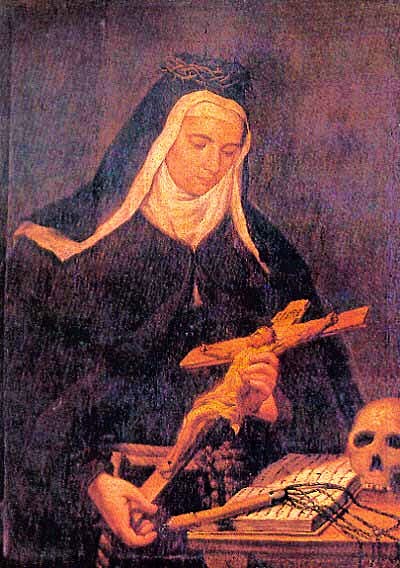
Saint of the Day – 27 July – Blessed Maria Magdalena Martinengo OSC Cap (1687-1737) Nun of the Order of the Capuchin Poor Clares, Mystic with a great devotion to the Passion of Christ, Mother Superior. Maria Magdalena devoted her life as a professed religious to the performance of small but humble chores in her time as a Poor Clare nun and was noted for her life of spiritual discernment and devotion to God above all else. She had a great horror of sin and devoted much time to contemplating death, and the Divine Judgement . Born Margherita Martinengo da Barco on 5 October 1687 in Brescia, Milan, Italy and died on 27 July 1737 (aged 49) also in Brescia,, Patronage – against tuberculosis. Also known as – Margarita Martinengo, Maria Maddalena.
Margherita was born on 5 October 1687 in Brescia into a noble household in the Martinengo Ducal Palace to Francesco Leopoldo Martinengo and Margherita Secchi d’Aragona. Her brothers were Nestore and Gianfrancesco. Her mother died five months after her birth in 1688. She was Baptised straight after her birth since there was fear that she might die. The Baptism was formally celebrated on 21 August 1691 at the Baptism of her half-sister Cecilia, born to the second marriage of her father to Elena Palazzi.
As a child she was perceived to be an intelligent girl and received a structured and comprehensive education based on the civic and religious studies. At the age of six she was entrusted to the Ursulines for additional education. Her teacher, Isabella Marazzi, instructed her in proper devotional practices to God and Marazzi played a formative role in Margherita’s religious education. Margherita was an avid reader and made full use of the Latin literature that her father owned.
On one occasion during her childhood, she was in a six horse carriage and she fell out. She would have been crushed had there not been, what she described as, an invisible touch that seemed to save her life.
On 11 October 1689 she entered the Convent boarding school of the Augustinian nuns of Santa Maria degli Angeli – two nuns there were her maternal aunts.
She made her First Communion towards the end of her childhood during which – in the nervous tension and emotion of the moment – she dropped the Host which forced her to pick it up from the floor with her tongue.
In August 1699 she asked her father for permission to go to the Spirito Santo boarding school of the Benedictines. Before she left the family went on a holiday with her father and siblings, in the mountains around Lago d’Iseo where she realised what her true calling was.
Around this time, at the age of thirteen, she took a vow to God in which she promised to remain a virgin. But at the age of sixteen several suitors approached her and her father had even promised her to the son of a prominent Venetian Senator. It even grew to the point where her two brothers Nestore and Gianfrancesco, pressured her to accept one of the offers. Her suitors bought her books and love stories and she did in fact like them – but she brooded over the fact that such stories which were given to her were “books from Hell.”
Margherita returned from the Spirito Santo Convent after the conclusion of her studies in 1704 and on 21 December 1704, announced to her father and brothers, her intention of becoming a Capuchin Poor Clare nun. Her Confessor and house servants, as well as her father and siblings, opposed this decision. Despite this opposition, on Christmas 1704 she went to the Capuchin Poor Clare Convent of Santa Maria della Neve and presented herself to them with the words: “I want to become holy.”. However, she was required to undergo a period of probation, which was conducted in the Ursuline-run Maggi College.
Once she entered the Convent at the age of eighteen, she was described to be “like wax” for her delicate appearance. On 8 September 1705 she was clothed in the habit and assumed the religious name of “Maria Magdalena” and parted from her family. Maria Magdalena was later deemed to be unfit for the Capuchin life but with a change in mistress she received unanimous support. She made her solemn profession on 8 September 1706.
Her Confessor instructed her to compile notes of her life and experiences which she did in the spirit of obedience. She was appointed as the Mistress of Novices at the age of 36 and made Abbess in 1732; – she was re-elected in that post on 12 July 1736.
Maria Magdalena died of tuberculosis in 1737 and when news of her death spread across Brescia people across the entire area mourned her passing. Her remains are located in the Church of the Convent of the Capuchin Poor Clare nuns in Brescia.
The recognition of two miracles attributed to her direct intercession allowed for Pope Leo XIII to preside over her Beatification on 3 June 1900. The miracles in question concerned the healings of Isabella Groppelli Gromi and of the future priest Giuseppe Tosi.
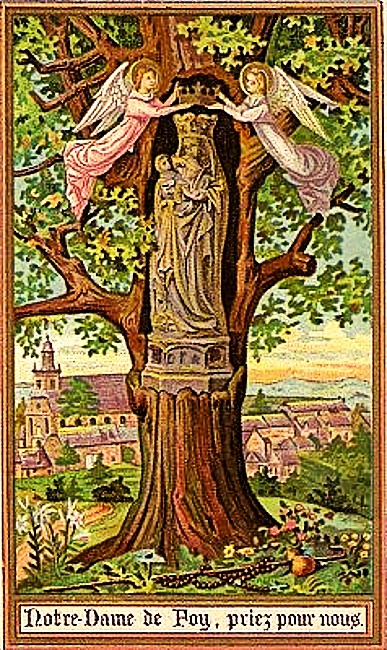
Notre-Dame-de-Foy / Our Lady of Faith,Gravelines, Liege, France (1616) – 27 July:
Not far from the small town of Dinant, in Liege near a home belonging to the Lord of Celles, two magnificent oaks once grew. One of the two venerable old trees was felled in the year 1609 by a man named Gilles, a lumberjack. The worker who inspected the tree found a small terracotta statue of the Mother of God, enthroned, as it were, with three iron bars that served as a trellis. The old oak stood on the edge of a path taken by pilgrims travelling to St Hubert. Apparently, at some time in the distant past, some pious Christian soul had placed the holy image in a hollow of the oak, as if in a niche. Then, over a period of time, the opening the tree had made while it was still young gradually closed and as it grew, the tree hid in its womb, the precious figure. Over the years the bark of the tree closed upon it and, as the road became less frequented, the existence of the Statue was completely forgotten.
To honour the Virgin, the Statue was subsequently displayed on the other oak, once again behind an iron grating, by order of the Baron of Celles. In this new Sanctuary, the Mother of God was honoured with the title of Our Lady of Faith. Those passing by did not fail to venerate the Statue;and there were many unexpected miracles. Graces of all kinds multiplied,and soon pilgrims began to flock to the area because of the dazzling miracles and very quickly a spontaneous cult grew. The Statue was first placed in another oak but it was almost thrown away by servants who thought it had no value. The local Baron placed it near the door to his oratory at the Castle of Veves as pilgrims began to flock there. In this new Sanctuary, the image of Our Lady was honoured under the title of Our Lady of Faith, which was the name of the farm. The first miracle occurred in 1616. As a result of the intercession of the Blessed Virgin Mary an old man was healed from a painful and debilitating hernia. The canonical investigation prescribed by the Bishop of Liege, was positive in its conclusion. A Priest of the Society of Jesus had recently been sent to Gravelines. He worked diligently to cultivate souls, as if upon a fruitful vine and by his sermons excited the people of the region to a greater love for the Mother of God. Seeing that this devotion had taken root, he met with the local Magistrate to discuss how to maintain and increase the piety of the people. It was decided that they should make replicas of the Statue of Our Lady of Faith, made from the wood of the first oak. When the first was completed, the image was observed to have a great resemblance to the original. Received with great joy, it was placed in a large reliquary above the high Altar in the Parish Church.
St Aetherius of Auxerre St Anthusa of Constantinople St Arethas St Aurelius of Cordoba St Benno of Osnabruck (c 1020-1088) Bishop Bl Berthold of Garsten
St Ecclesius of Ravenna Bl Felipe Hernández Martínez St Felix of Cordoba St Galactorio of Lescar St George of Cordoba St Hermippus St Hermocrates St Hermolaus Bl Jaime Ortiz Alzueta Bl Joaquín Vilanova Camallonga Bl José María Ruiz Cano St Juliana of Mataró St Lillian of Cordoba Bl Lucy Bufalari St Luican
Bl Maria Klemensa Staszewska Blessed Maria Magdalena Martinengo OSC Cap (1687-1737) Nun St Maurus of Bisceglia Bl Modesto Vegas y Vegas St Natalia of Cordoba Bl Nevolone of Tavenisa St Pantaleimon
Bl Rudolf Aquaviva S.J. Bl Robert Sutton St Semproniana of Mataró St Sergius of Bisceglia Bl William Davies Bl Zacarías Abadía Buesa
Martyrs of Nicomedia – 3 saints: Three Christians martyred together. The only other information to survive are their names – Felix, Jucunda and Julia. Nicomedia, Asia Minor.
Seven Sleepers of Ephesus: A group of seven young Christian men who hid in a cave in hopes of avoiding the persecution of Decius in the year 250. Found and arrested, they were ordered by the pro-consul in Ephesus to renounce their faith; they refused and were sentenced to die. Legend says that they were walled up in their hiding cave, guarded by the dog Al Rakim; when the cave wall was breached in 479 – they all woke up! It is likely that the youths were tortured to death in various ways and buried in the cave. The resurrection story confusion came from the phrase “went to sleep in the Lord” which was used to describe the death of Christians and 479 is when their relics were discovered. Their names were Constantinus, Dionysius, Joannes, Malchus, Martinianus, Maximianus and Serapion. They were martyred in 250 in Ephesus (in modern Turkey); tradition says that they were walled up in a cave to suffocate but other records indicate that they were tortured to death in various ways. Their relics discovered in 479 and translated to Marseilles, France and enshrined in a large stone coffin.
Thought for the Day – 26 July – Meditations with Antonio Cardinal Bacci (1881-1971)
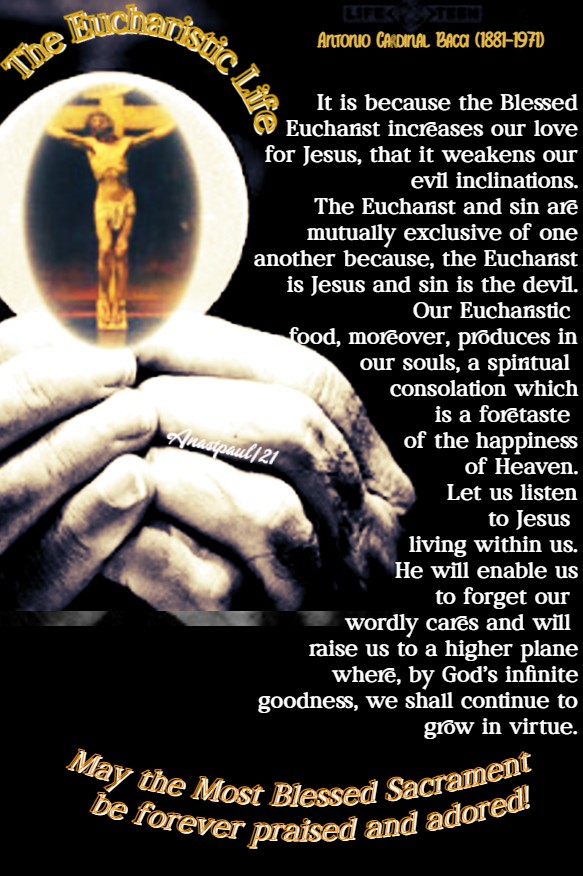
The Eucharistic Life
The Eucharistic life, which is the life of union with Jesus, especially by means of daily Communion, transforms us and makes us holy. It preserves and increases in us, the grace which is the supernatural life of the soul. The Eucharist, of itself, does not bestow grace because it is a Sacrament of the living. It is our food and food is not given to the dead but to the living. For this reason, we should receive Holy Communionb free from the stain of sin. The Eucharist, moreover, remits venial sins, strengthens us in our resolutions and increases our charity. Venial sin is a sickness of the soul. Just as natural food banishes listlessness and vulnerability to disease, our Eucharistic nourishment has the same effect on our spiritual life.
It is because the Blessed Eucharist increases our love for Jesus, that it weakens our evil inclinations. The Eucharist and sin are mutually exclusive of one another because, the Eucharist is Jesus and sin is the devil. Our Eucharistic food, moreover, produces in our souls, a spiritual consolation which is a foretaste of the happiness of Heaven.
Let us listen to Jesus living within us. He will enable us to forget our worldly cares and will raise us to a higher plane where, by God’s infinite goodness, we shall continue to grow in virtue.
May the Most Blessed Sacrament be forever praised and adored!
Quote/s of the Day – 26 July – “Month of the Most Precious Blood” – Readings: Exodus 32: 15-24, 30-34; Psalms 106: 19-20, 21-22, 23; Matthew 13: 31-3
The Leaven of Life
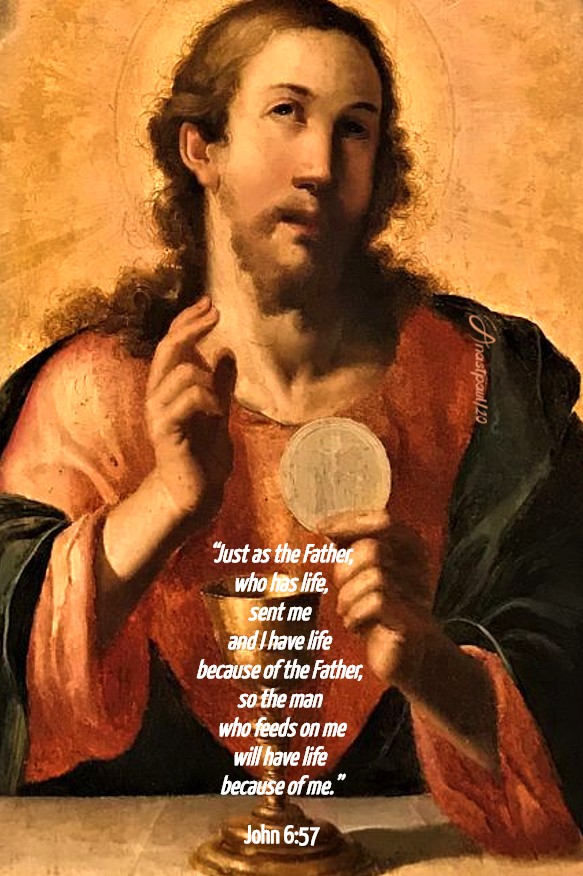
“Just as the Father who has life sent me and I have life because of the Father, so the man who feeds on me will have life because of me.”
John 6:57
“An inborn imperfection in our human dough was removed, thanks to the leaven that comes from His perfect body… To complete what was missing, in these human bodies of ours, He gave something of Himself, just as He gives Himself to be eaten …”
St Ephrem (306-373) Father and Doctor of the Church
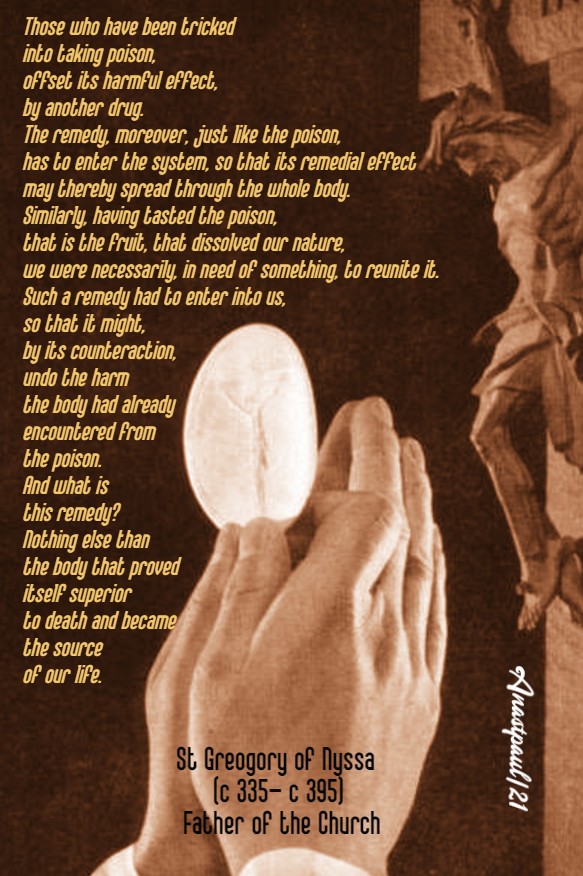
“Those who have been tricked into taking poison, offset its harmful effect, by another drug. The remedy, moreover, just like the poison, has to enter the system, so that its remedial effect may thereby spread through the whole body. Similarly, having tasted the poison, that is the fruit, that dissolved our nature, we were necessarily, in need of something, to reunite it. Such a remedy had to enter into us, so that it might, by its counteraction, undo the harm the body had already encountered from the poison. And what is this remedy? Nothing else than the body that proved itself superior to death and became the source of our life.”
St Greogory of Nyssa (c 335– c 395) Father of the Church
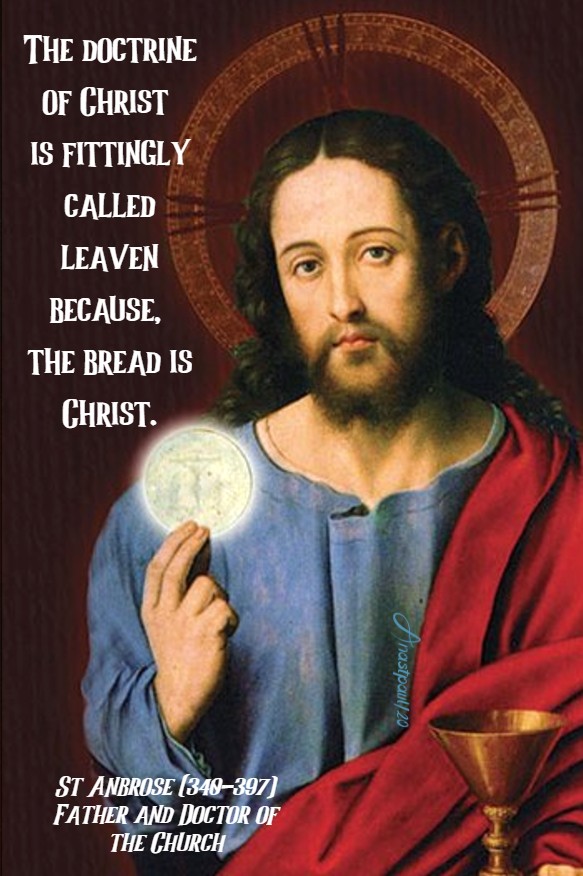
“The doctrine of Christ is fittingly called leaven because, the bread is Christ.”
St Anbrose (340-397) Father and Doctor of the Church
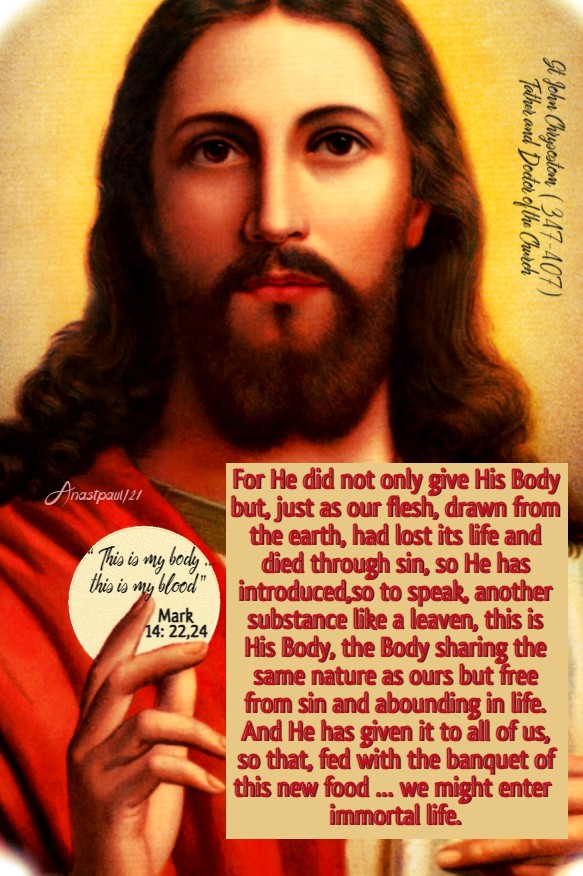
“ … For He did not only give His Body but, just as our flesh, drawn from the earth, had lost its life and died through sin, so He has introduced, so to speak, another substance like a leaven, this is His Body, the Body sharing the same nature as ours but free from sin and abounding in life. And He has given it to all of us, so that, fed with the banquet of this new food … we might enter immortal life.”
St John Chrysostom (347-407) Father ad Doctor of the Church
“Dust, so to speak, had forcibly entered humanity’s eye; earth had entered it, had injured the eye and it could not see the light. … That physician made a salve for you. And because He came, in such a way, that by His flesh, He might extinguish the faults of the flesh and by His death He might kill death … ”
St Augustine (354-430) Father and Doctor of the Church
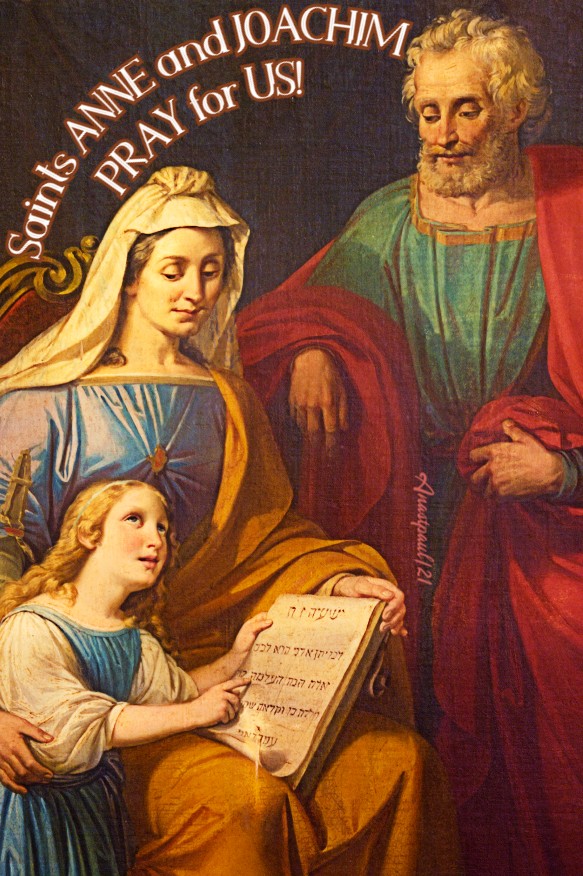
One Minute Reflection – 26 July – “Month of the Most Precious Blood” – Readings: Exodus 32: 15-24, 30-34; Psalms 106: 19-20, 21-22, 23; Matthew 13: 31-35 and the Memorial of Saints Anne and Joachim – Parents of the Blessed Virgin Mary, Grandparents of Jesus
“Until the whole was leavened” – Matthew 13:33
REFLECTION – “If someone kneads bread without mixing leaven into it, they may well apply themselves to the task, knead and work at it, the dough will not rise and cannot be used as food. But when leaven has been mixed in, it draws all the dough to itself and makes it all rise, as in the parable the Lord applied to the Kingdom… It is the same with meat – no matter how much care you take, if you neglect to put in salt to preserve it,… it will smell badly and become inedible In the same sort of way, imagine the whole of humanity as meat or dough and that the divine nature of the Holy Spirit is salt and leaven from another world. If the heavenly leaven of the Spirit and good salt of the divine nature… are not added to our lowly human nature and mixed into it, the soul will never lose its bad odour of sin and will not rise by losing the heaviness and impurities of the “leaven of wickedness” (1Cor 5,7)…
If a soul only relies on its own strength and thinks itself able to achieve complete success of itself, without the help of the Holy Spirit, it is greatly deceived. It is not made for the dwelling places of Heaven nor made for the Kingdom… If sinful man does not draw near to God, does not renounce the world, does not await in hope and patience a good that is foreign to its own nature, namely, the strength of the Holy Spirit; if the Lord does not instil His own divine life from on high into that soul, that person will never taste the true life… On the other hand, if he has received the Spirit’s grace, if he does not turn away from it, if he does not offend Him by his negligence and wrongdoing, if, after persevering a long time like this in the fight, he does not “grieve the Spirit” (Eph 4,30), he will have the happiness of winning eternal life.” – Attri to St Macarius of Egypt (c 300-390) Monk
PRAYER – True light of the world, Lord Jesus Christ, as You enlighten all men for their salvation, give us grace, we pray, to herald Your coming by preparing the ways of justice and of peace. Help us Lord, that we may sprout and bear fruit, fitting to grow and be a home of comfort to our neighbour. By the prayers of Sts Anne and Joachim, may we too be beacons of Your Light and of the glory of Your Kingdom. Through Jesus our Lord, Who lives and reigns with the Father and the Holy Spirit, God forever, amen.
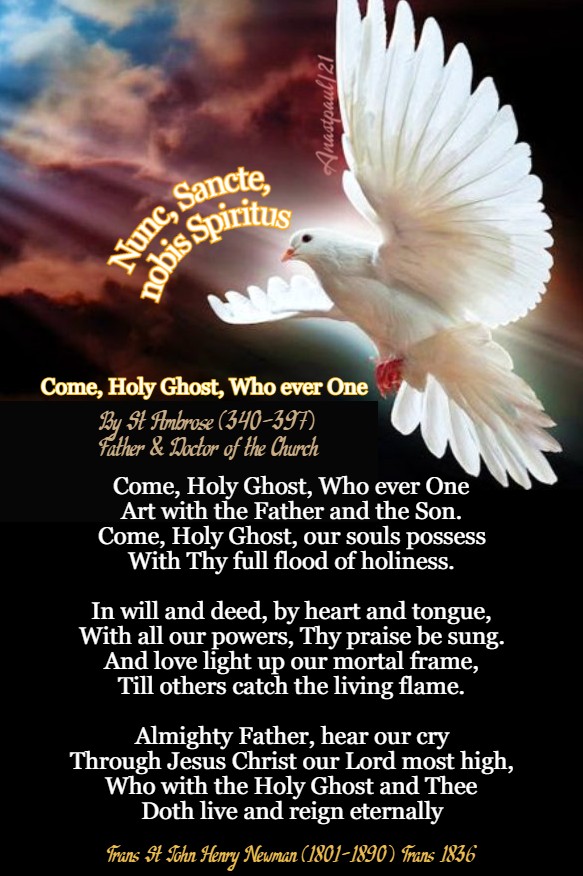
Our Morning Offering – 26 July – “Month of the Most Precious Blood – Reminding you and myself, that in Catholic Time, Monday is the day of the Holy Ghost and/or the Holy Angels.
Nunc, Sancte, nobis Spiritus By St Ambrose (340-397) Come, Holy Ghost, Who ever One Trans St John Henry Newman (1801-1890) Trans 1836
Come, Holy Ghost, Who ever One Art with the Father and the Son. Come, Holy Ghost, our souls possess With Thy full flood of holiness.
In will and deed, by heart and tongue, With all our powers, Thy praise be sung. And love light up our mortal frame, Till others catch the living flame.
Almighty Father, hear our cry Through Jesus Christ our Lord most high, Who with the Holy Ghost and Thee Doth live and reign eternally.
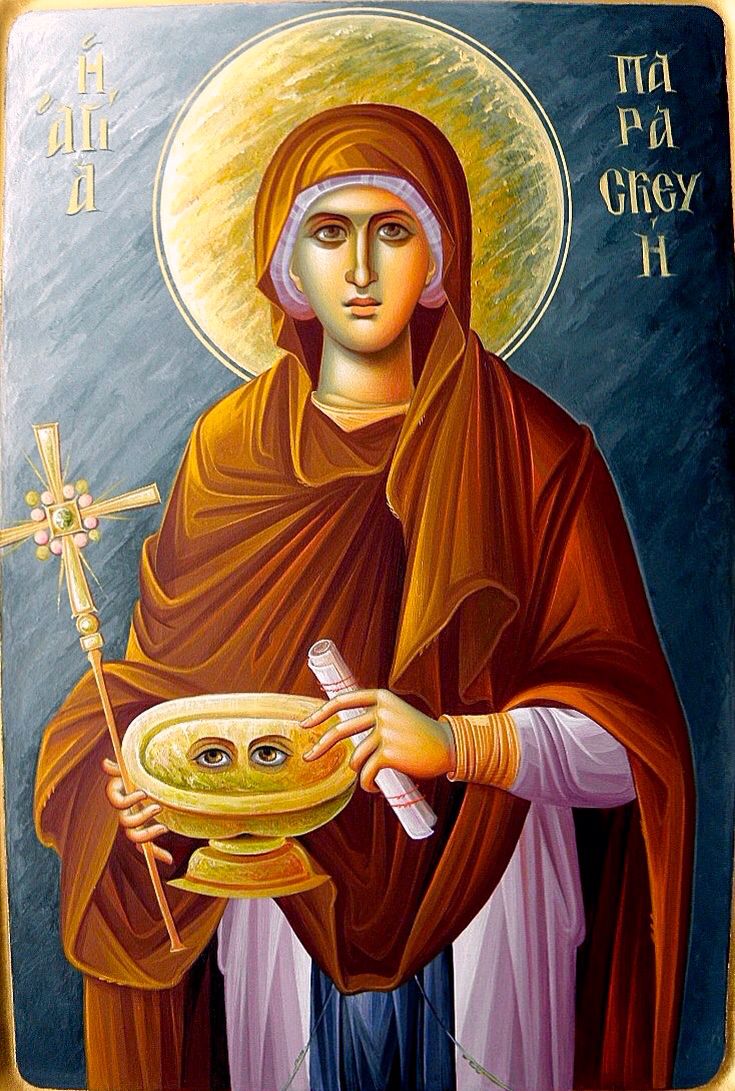
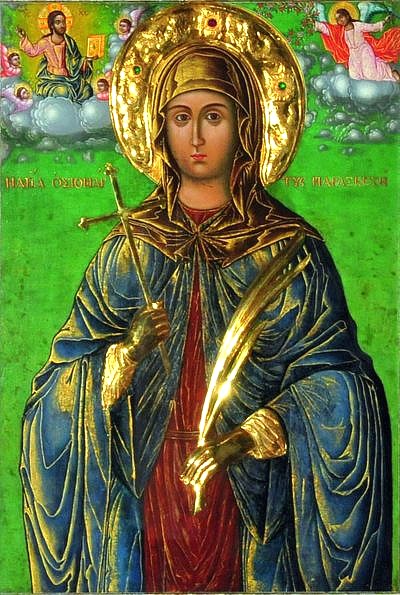
Saint of the Day – 26 July – St Parasceva of Rome (Died c 180) Virgin Martyr, Confessor. Born near Rome in the 2nd Century and died by beheading in c 180. Patronage – invoked against blindness, healer of the blind.
Parasceva was born in a village near Rome, likely during the reign of the Roman Emperor Hadrian (117-138). Her parents, Agathon and Politia, were Christians of Greek origin and had prayed for many years to have a child. When Politia finally bore a child, she was born on a Friday, the day of Our Lord’s suffering. They, therefore, named the baby girl Parasceva, meaning “Friday” in Greek (literally “preparation (day)” for the sabbath – cf. Mark 15:42). Parasceva grew up to be a devout and well-read woman, who rejected many suitors.
After the death of her parents, she gave away all of her possession and became the head of a Christian community of young virgins and widows. She also began to preach the Christian faith and at the age of 30, left Rome and ministered in many Towns and Villages.
In the Village of Therapia, Constantinople, she was arrested by soldiers of the Emperor Antoninus Pius and brought to trial. The charge was blasphemy and they charged her with inciting resistance to authorities. Antoninus Pius attempted to convince her to denounce her faith and even offered to marry her. Parasceva refused and was beaten and tortured by having a steel helmet lined with nails placed on her head and tightened with a vice. No pain seemed to affect her and her endurance caused many to convert to Christianity. Eventually, at his wit’s end, Antoninus Pius demanded that Parasceva be immersed into a large kettle of oil and tar. However, she emerged from even this unscathed. When she was accused of using magic, she responded by throwing the liquid into the Emperor’s face. He was blinded, and desperately asked for her help. Antoninus Pius regained his sight. This miracle moved him to convert to Christianity and set Parasceva free. Neither die he persecute Christians thereafter.
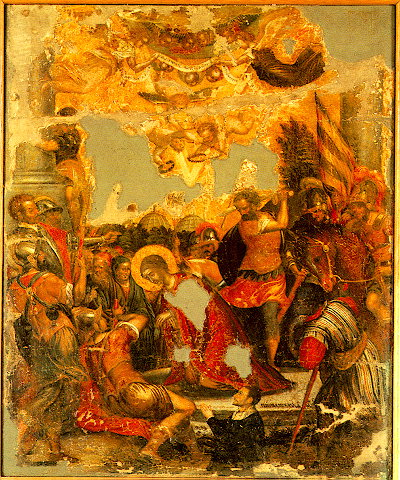
The Martyrdom of St Parasceva
However, after the death of Antoninus Pius, the laws changed once again under the Emperor Marcus Aurelius. A plague struck the Roman people and many, including Marcus Aurelius, considered Christians responsible for angering the gods. Parasceva was again arrested amongst many other Christians in a City governed by a man named Asclepius, who threw her into a pit with a large snake. She, however, made a Sign of the Cross and the snake fell asleep or dead. Just as with Antoninus Pius, Parasceva ‘s miracle converted Asclepius to Christianity and he released her. She continued to travel from Town to Town, preaching the Faith.
Finally, Parasceva was arrested for the last time by a Roman official named Tarasius and taken to the Temple of Apollo. Upon entering the Temple, Parasceva made a Sign of the Cross and all the idols in the Temple were instantly destroyed. Instead of converting the onlookers to Christianity, however, they became enraged, and beat her. Taracius then had her beheaded.
Her remains were eventually taken to Constantinople. Although it is not certain when or how her relics reached Constantinople, it seems that they were exhibited there in around 1200 to pilgrims.
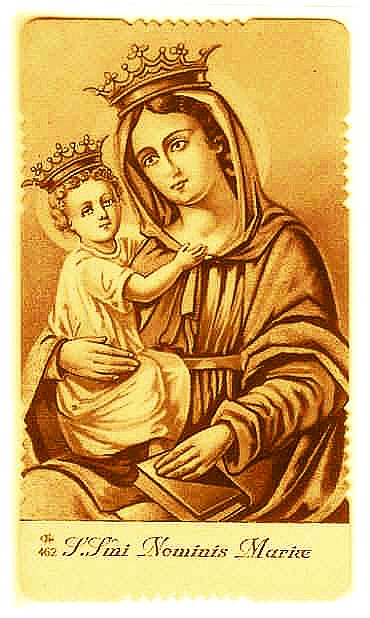
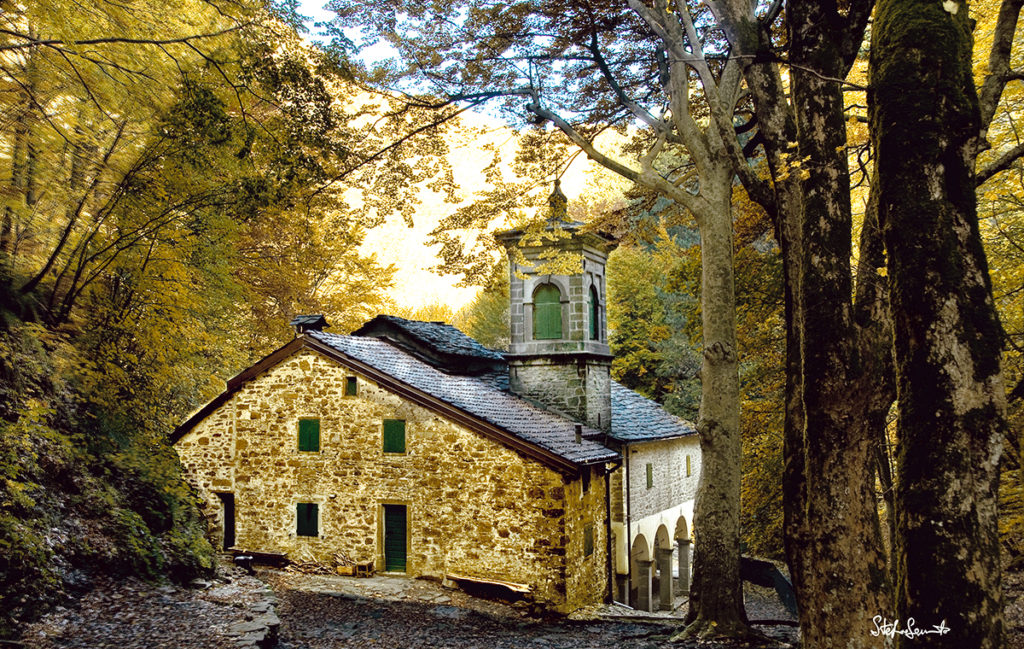
Madonna del Faggio (Our Lady of the Beech Tree), Castelluccio, Bologna, Emilia Romagna, Italy (1672) – 26 July, Ascension Thursday:
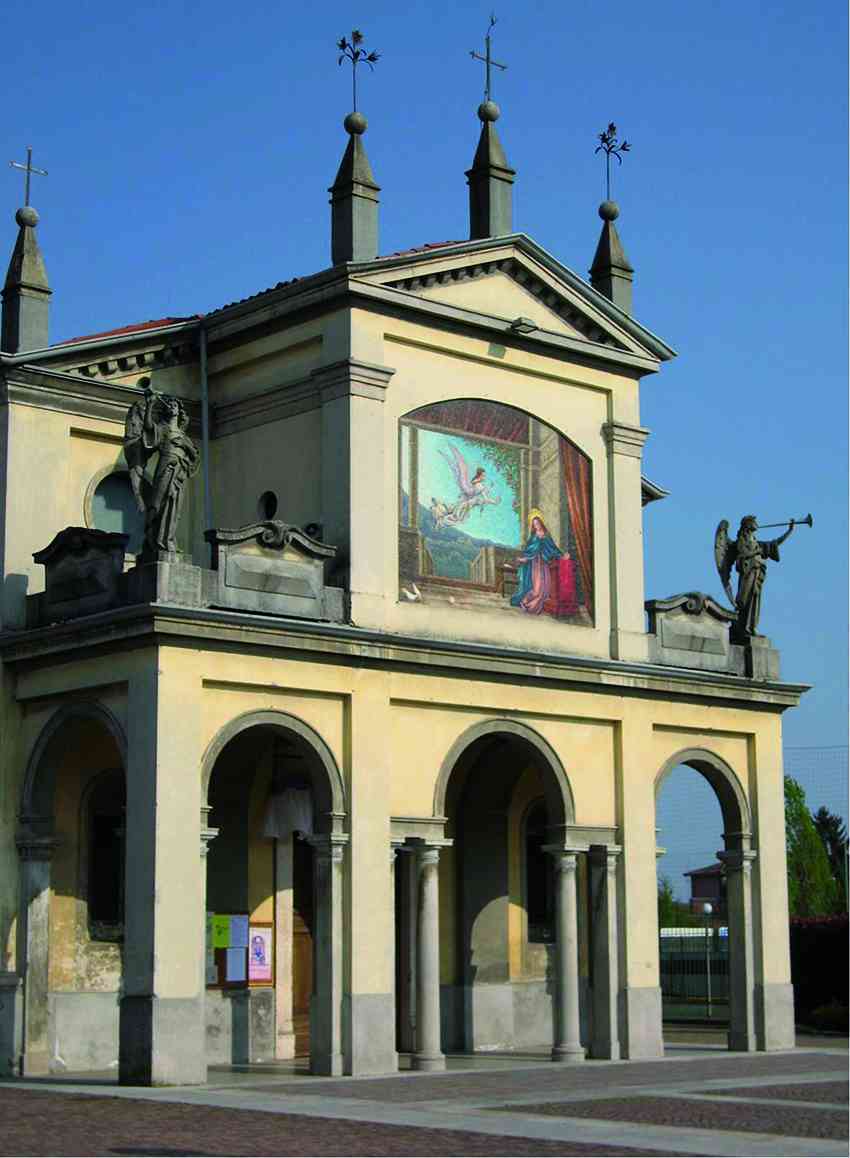
In 1672 the Blessed Virgin appeared to a shepherd boy and told him that she wished to be venerated at a certain place in the beech woods near Castelluccio in central Italy. Tthe child , following the directions to the site, discovered a terracotta Madonna affixed to one of the trees. The tiny Statue, barely 18 centimetres tall (7 inches) was moved to a wayside Shrine and then, in 1722, to its own mountain Sanctuary. Until 1964 a caretaker lived in the hermitage there. Since then a volunteer opens the Chapel only in summer on Sundays. In 1975 the sacred image was stolen and a copy was made to replace it. Since 1756, an annual pilgrimage on Ascension Day brings the image to the Town and back again, and on St Anne’s day, 26 July, a procession goes to the site of the beech tree where the Statue had been originally found, although the tree itself is no longer there as it fell during a storm. The Sanctuary’s holy card, shown above, does not seem to depict the terracotta image. It may represent one of the paintings of Lorenzo Pranzini, who decorated the interior of the Chapel in the 1800s.
St Benigno of Malcestine Bl Camilla Gentili St Charus of Malcestine Bl Edward Thwing Bl Élisabeth-Thérèse de Consolin St Erastus Bl Évangéliste of Verona St Exuperia the Martyr Bl George Swallowell St Gérontios Bl Giuseppina Maria de Micheli St Gothalm St Hyacinth Bl Jacques Netsetov Bl John Ingram St Joris Bl Marcel-Gaucher Labiche de Reignefort Bl Marie-Claire du Bac Bl Marie-Madeleine Justamond Bl Marie-Marguerite Bonnet St Olympius the Tribune St Parasceva of Rome (Died c 180) Virgin Martyr, Confessor St Pastor of Rome Bl Pérégrin of Verona Bl Pierre-Joseph le Groing de la Romagère
Thought for the Day – 25 July – Meditations with Antonio Cardinal Bacci (1881-1971)
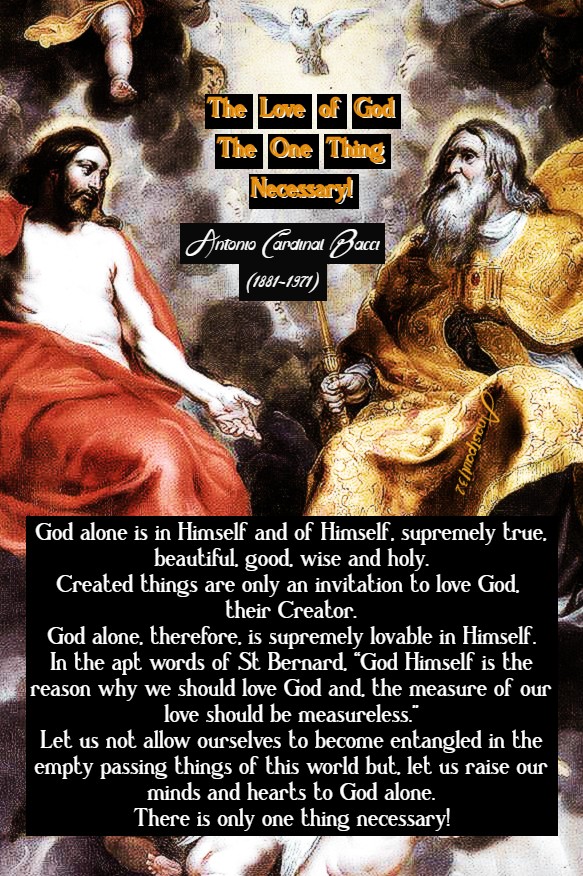
The Love of God The One Thing Necessary!
“If we really know God, we should love Him above all created things. “I have loved you too little, My God,” said St Augustine in his Confessions, “because I have not known You well enough.” If we knew God, we should recognise, that He is infinite beauty, goodness and wisdom. We should realise, that the beauty of creatures is like a passing cloud, for it is a vague and distant reflection of the eternal beauty of God. We should realise, that the wisdom of men, is only a ray of God’s light which comes from Him and must return to Him. Finally, we should perceive that men are good, only insofar, as they do their best to respond to the inspirations of grace which God has placed in their hearts. God alone is in Himself and of Himself, supremely true, beautiful, good, wise and holy. Created things are only an invitation to love God, their Creator. God alone, therefore, is supremely lovable in Himself. In the apt words of St Bernard, “God Himself is the reason why we should love God and, the measure of our love should be measureless.”
Let us not allow ourselves to become entangled in the empty passing things of this world but, let us raise our minds and hearts to God alone. There is only one thing necessary!”
Quote of the Day – 25 July – “Month of the Most Precious Blood” – Memorial of St Christopher (died c 251) One of the Fourteen Holy Helpers
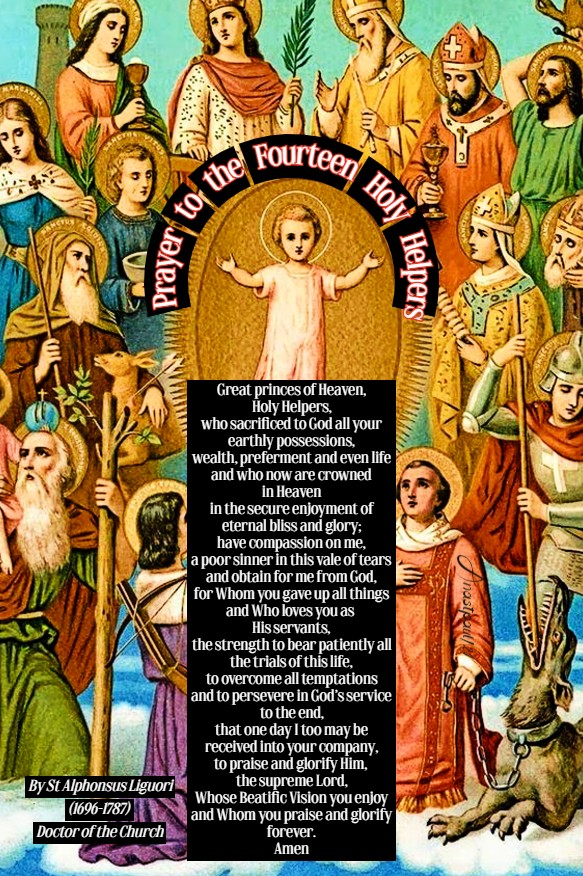
The Fourteen Holy Helpers: – Plague Saints for a time of plague!
In the middle of the 14th century, the Plague – also called “The Black Death” and the “The Greatest Catastrophe Ever” – ravaged Europe, killing 50 million people, or about 60% of the population, within a few years (a vastly higher death rate than any ‘pandemic’ since.)
Layering dead bodies in pits, watching loved ones succumb to the ravages of a ghastly illness, people turned to the Almighty and All-powerful Physician for help. It was at this time that the Fourteen Holy Helpers came to be invoked against the Plague and other misfortunes. As we face true death – the death of everything we know and love, even any form of Catholic life and any Catholic lifesigns, let us turn to true FAITH – no mask needed – and revive the assistance of these gracious and efficacious Holy Helpers.
Prayer to the Fourteen Holy Helpers By St Alphonsus Liguori (1696-1787) Doctor of the Church
Great princes of Heaven, Holy Helpers, who sacrificed to God all your earthly possessions, wealth, preferment and even life and who now are crowned in Heaven in the secure enjoyment of eternal bliss and glory; have compassion on me, a poor sinner in this vale of tears and obtain for me from God, for Whom you gave up all things and Who loves you as His servants, the strength to bear patiently all the trials of this life, to overcome all temptations and to persevere in God’s service to the end, that one day I too may be received into your company, to praise and glorify Him, the supreme Lord, Whose Beatific Vision you enjoy and Whom you praise and glorify forever. Amen
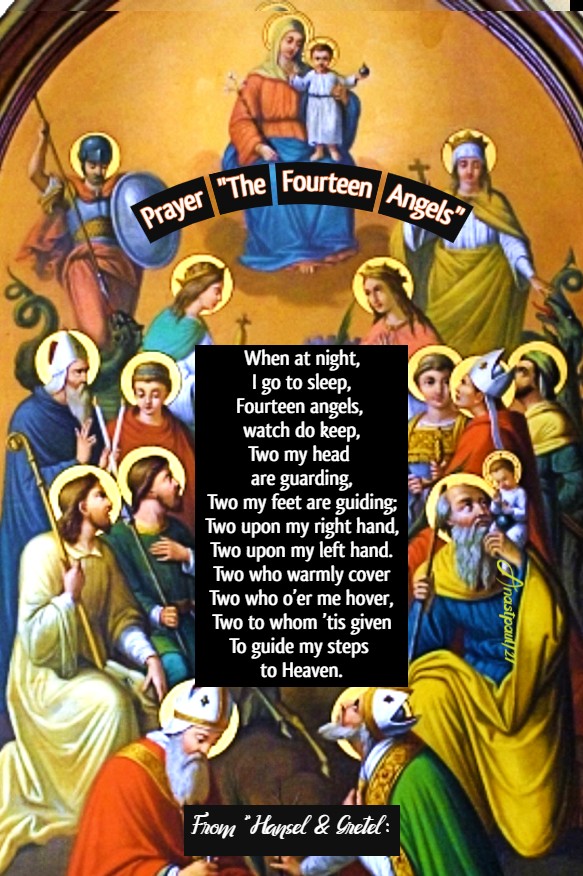
The “fourteen angels” of the lost children’s prayer in the Composer, Engelbert Humperdinck’s (1854-1921) (not the popular Welsh singer) fairy opera, ‘Hansel and Gretel’, are the Fourteen Holy Helpers. The English words are familiar and very beautiful:
When at night, I go to sleep, Fourteen angels, watch do keep, Two my head are guarding, Two my feet are guiding; Two upon my right hand, Two upon my left hand. Two who warmly cover Two who o’er me hover, Two to whom ’tis given To guide my steps to Heaven.
One Minute Reflection – 25 July – “Month of the Most Precious Blood” – Feast of St James the Greater – Reaqdings: Second Kings 4: 42-44; Psalms 145: 10-11, 15-16, 17-18; Ephesians 4: 1-6; John 6: 1-15
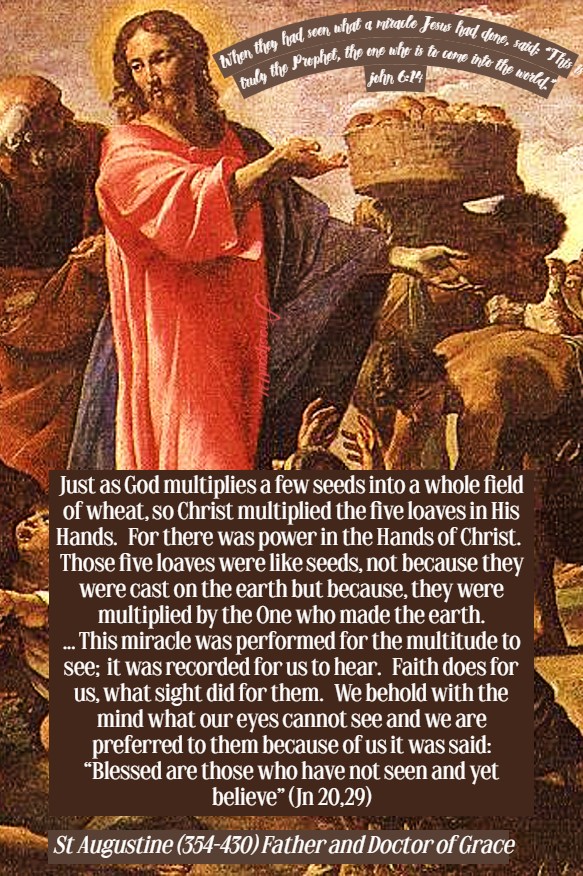
When they had seen what a miracle Jesus had done, said: , “This is truly the Prophet, the one who is to come into the world.” – John 6:14
REFLECTION – “Governing the entire universe is a greater miracle than feeding five thousand people with five loaves of bread, yet no-one marvels at it. People marvel at the feeding of the five thousand not because this miracle is greater but because, it is out of the ordinary. Who is even now providing nourishment for the whole world if not the God Who creates a field of wheat from a few seeds? Christ did what God does. Just as God multiplies a few seeds into a whole field of wheat, so Christ multiplied the five loaves in His Hands. For there was power in the Hands of Christ. Those five loaves were like seeds, not because they were cast on the earth but because, they were multiplied by the One who made the earth.
This miracle was presented to our senses, in order to stimulate our minds… and so make us marvel at “the God we do not see because of his works, which we do see” (Rom 1,20). For then, when we have been raised to the level of faith and purified by faith, we shall long to behold, though not with our eyes, the invisible God Whom we recognise through what is visible. This miracle was performed for the multitude to see; it was recorded for us to hear. Faith does for us, what sight did for them. We behold with the mind what our eyes cannot see and we are preferred to them because of us, it was said: “Blessed are those who have not seen and yet believe” (Jn 20,29). – St Augustine (354-430) Father and Doctor of Grace – Homilies on Saint John’s gospel, 24, 1.6.7.
PRAYER – Lord our God, You accepted the sacrifice of St James, the first of Your Apostles to give his life for Your sake. May Your Church find strength in his martyrdom and support in his constant prayer. Through our Lord Jesus Christ, your Son, who lives and reigns with you in the unity of the Holy Spirit, one God, for ever and ever. St James the Greater, Apostle of Christ, Pray for us! Amen
Our Morning Offering – 25 July – “Month of the Most Precious Blood” – Feast of St James the Greater and the Memorial of St Christopher (died c 251)
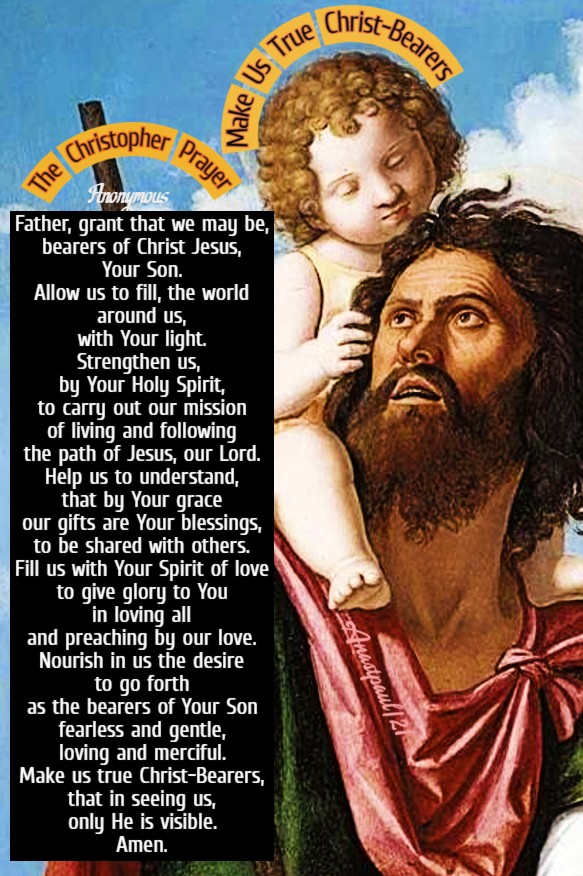
The Christopher Prayer, Make Us True Christ-Bearers Anonymous
Father, grant that we may be, bearers of Christ Jesus, Your Son. Allow us to fill, the world around us, with Your light. Strengthen us, by Your Holy Spirit, to carry out our mission of living and following the path of Jesus, our Lord. Help us to understand, that by Your grace our gifts are Your blessings, to be shared with others. Fill us with Your Spirit of love to give glory to You in loving all and preaching by our love. Nourish in us the desire to go forth as the bearers of Your Son fearless and gentle, loving and merciful. Make us true Christ-Bearers, that in seeing us, only He is visible. Amen.
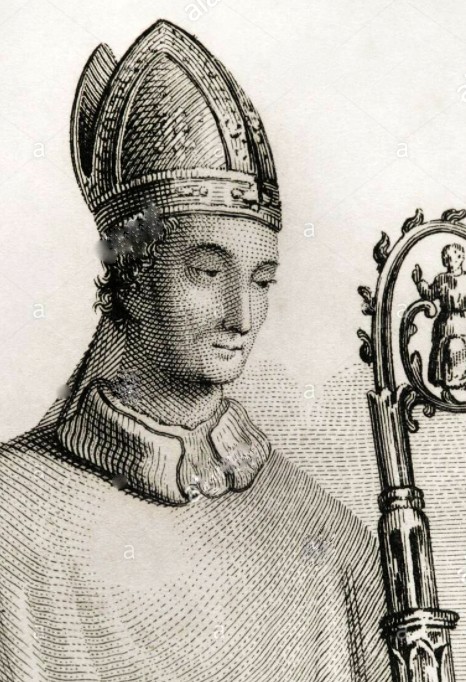
Saint of the Day – 25 July – Saint Magnericus of Trier (c 520-596) Bishop and Confessor. Born in c 520 and died on 25 July 596 of natural causes. Also known as – Magnerich, Magnerico, Magnerik, Meinrich. Magnericu. Magnericus was a friend and disciple of St Gregory of Tours, mentioned in his History of the Franks and ordained St Géry, one of his disciples, who became Bishop of Cambrai-Arras. St Venantius Fortunatus (c 530 – c 609) (his life here:https://anastpaul.com/2019/12/14/saint-of-the-day-14-december-saint-venantius-fortunatus-c-530-c-609/) described the Bishop as virtuous and charitable and an “ornament of bishops“.
Magnericus was born and grew up in Trier, Germany. Not much is known about his early life. Once installed as Bishop, he continued the work begun by his predecessor of restoring the City of Trier and its environs. He founded several clerical communities and Churches, including St.Eucharius and St Paulin. He had a great devotion to Saint Martin of Tours and built several Monasteries and Churches dedicated to him. He converted the Holy Cross Church in Trier into an Oratory in honour of St Martin; it later became the Abbey of St. Martin. Other Churches Magnericus dedicated to St Martin are in Ivois, Carden on the Moselle and a second one in Trier.
He lived in the residence of Bishop Nicetius,and accompanied the Bishop into exile when Nicetius was banished by King Clotaire I. This was an act of revenge for the King being excommunicated. Magnericus returned to Trier the next year. He was Ordained by Nicetius in 566.
He gave sanctuary to Bishop Theodore of Marseilles when he was exiled by Guntramnus of Burgundy in 585 and pleaded with King Childebert II on behalf of the Bishop.
Magnericus was close to the Merovingian Royal house and Childebert II, who made him Godfather of his son,Theudebert II. In 587 he attended a family congress of Kings Childebert and Guntram, which nearly cost him his life. At the meeting, Duke Boso, who had been condemned by the King, fled to his house and took the Bishop hostage. The house was set on fire at the King’s command but fortunately, Magnericus escaped with his life.
The proximity to the Merovingian family and his influence on the fortunes of Austrasia and the Gallic Church helped him maintain urban and regional domination until his death.
He was buried in the cemetery of St Martins. Around the year 1000 Abbot Eberwin wrote a hagiography of the Bishop, whereupon his veneration spread throughout Lorraine. In 1506 his grave was opened but after the destruction of the Church during the French Revolution, his remains disappeared.
Notre-Dame du Saguenay / Our Lady of Lac Bouchet, Quebec (1920) – 25 July:
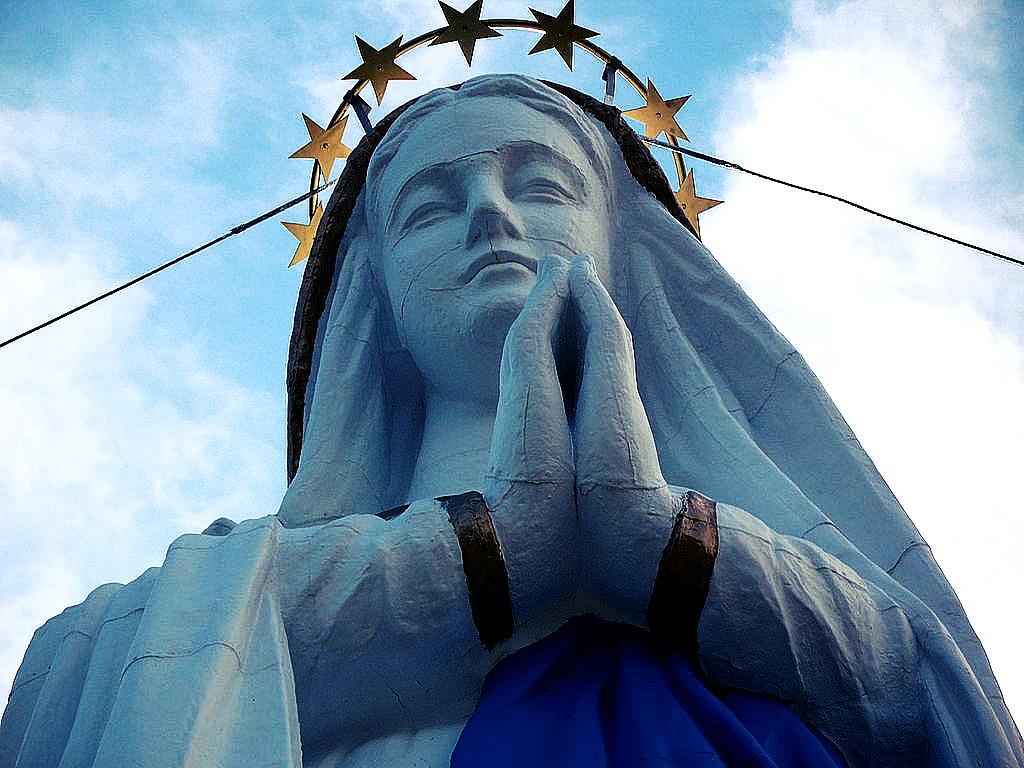
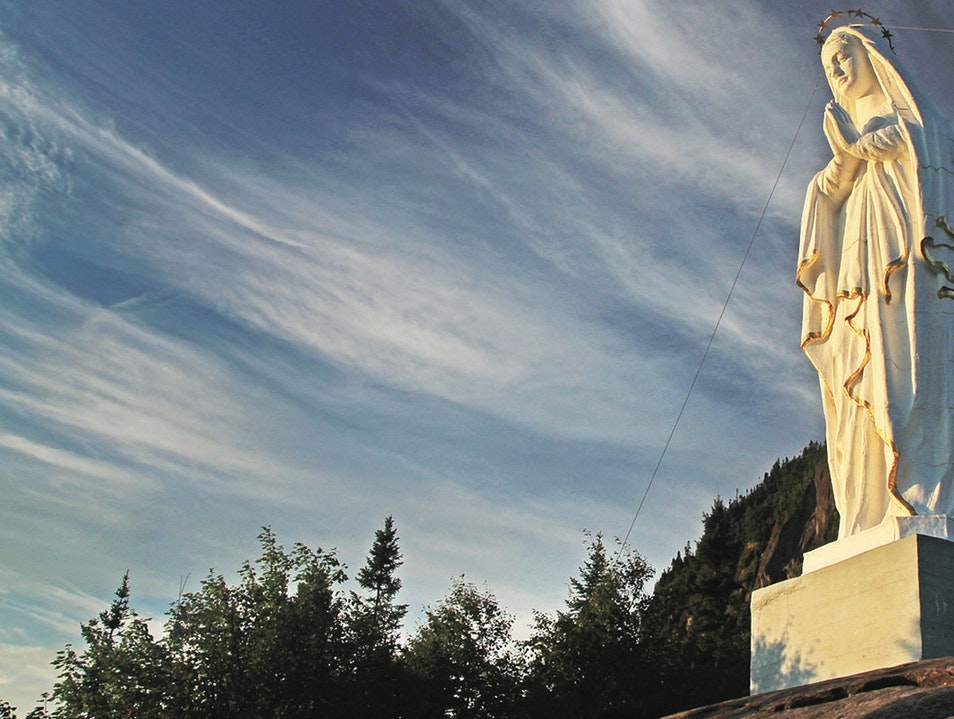
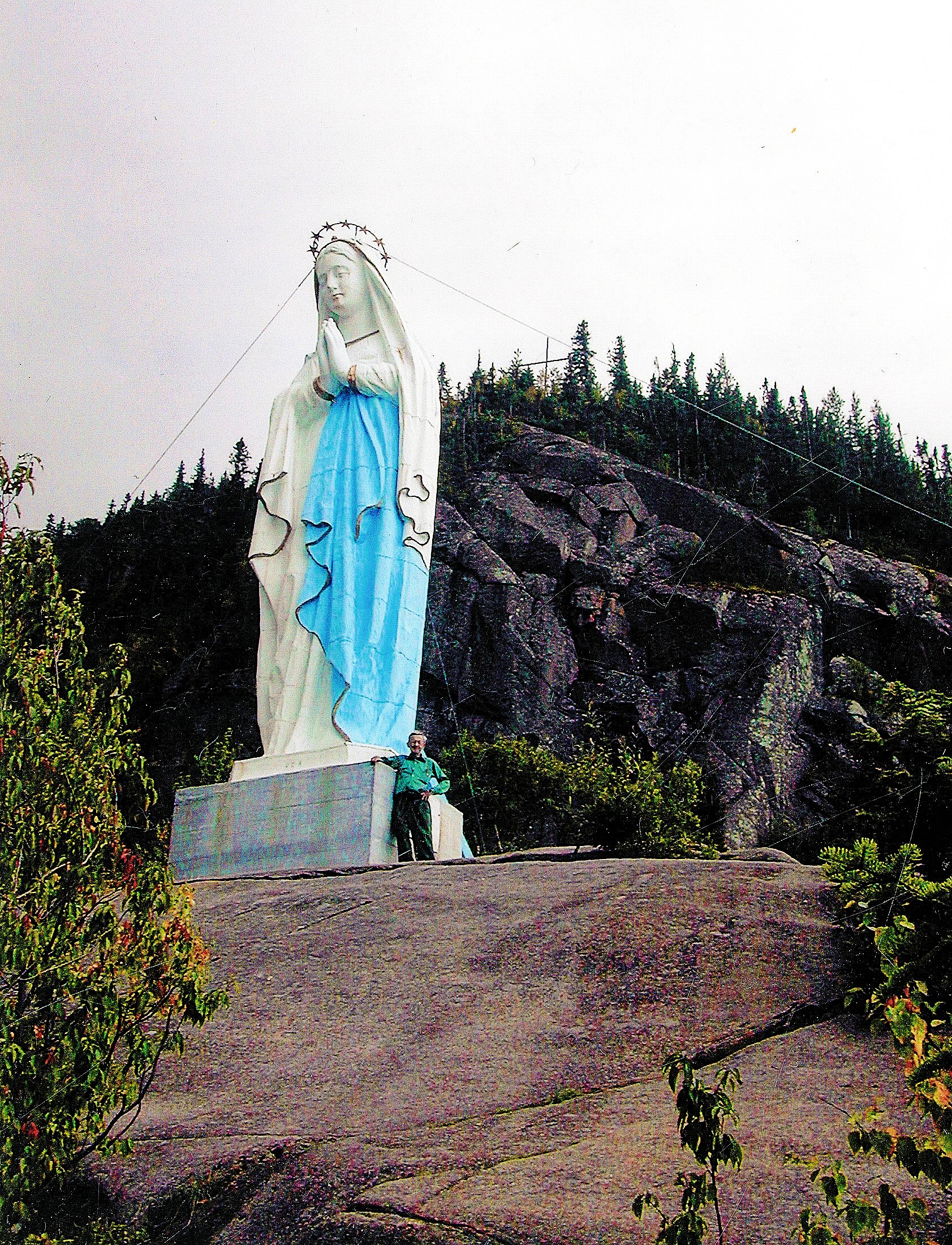
The Saguenay Fjord is an ancient glacial valley that has been overrun with sea water. In the year 1828 a surveyor, Joseph Bouchette, ventured into the region for the purpose of collecting data for topographical maps. It was during this expedition that he found a suitable site for a future village, which Pascal Dumais and his family later settled. This marked the founding of the village of Lac-Bouchette, with more and more people coming to settle in the area until the village had 300 inhabitants by 1888. Our story actually begins with a man named Charles Napoleon Robitaille, a salesman who travelled the roads in and around Quebec. During the winters he would have to cross frozen rivers and it was in the winter of 1878 while trying to cross the Saguenay River that the ice broke under the weight of his horse and sleigh. Pulled beneath the surface of the icy waters, Charles was alone and completely helpless. Knowing he was dying, he implored the Blessed Virgin Mary to save him. Charles miraculously survived, and managed to escape from the river with his life. He knew the Virgin had assisted him and so to honour Mary and her recent apparition at Lourdes, he asked Louis Jobin to create a huge Statue of the Blessed Virgin sculpted in the image of Our Lady of Lourdes, the Immaculate Conception. He envisioned the Statue in the heights overlooking the mouth of the river. The Statue Jobin sculpted became known as Notre-Dame du Saguenay.
The finished Statue is an impressive more than 10,5 metres high and weighs 3 tons. Sculpted of solid white pine, it was then sheathed in lead to protect it from the harsh weather. Hauling such a huge Statue into place was a difficult task in the late nineteenth century. After being constructed, it was broken down into 14 separate pieces and then hoisted into place and rebuilt. The Statue made Louis Jobin the most famous sculptor of the time,and it has become a regional landmark, with visitors from all over the world assembling at her feet to sing the Ave Maria.
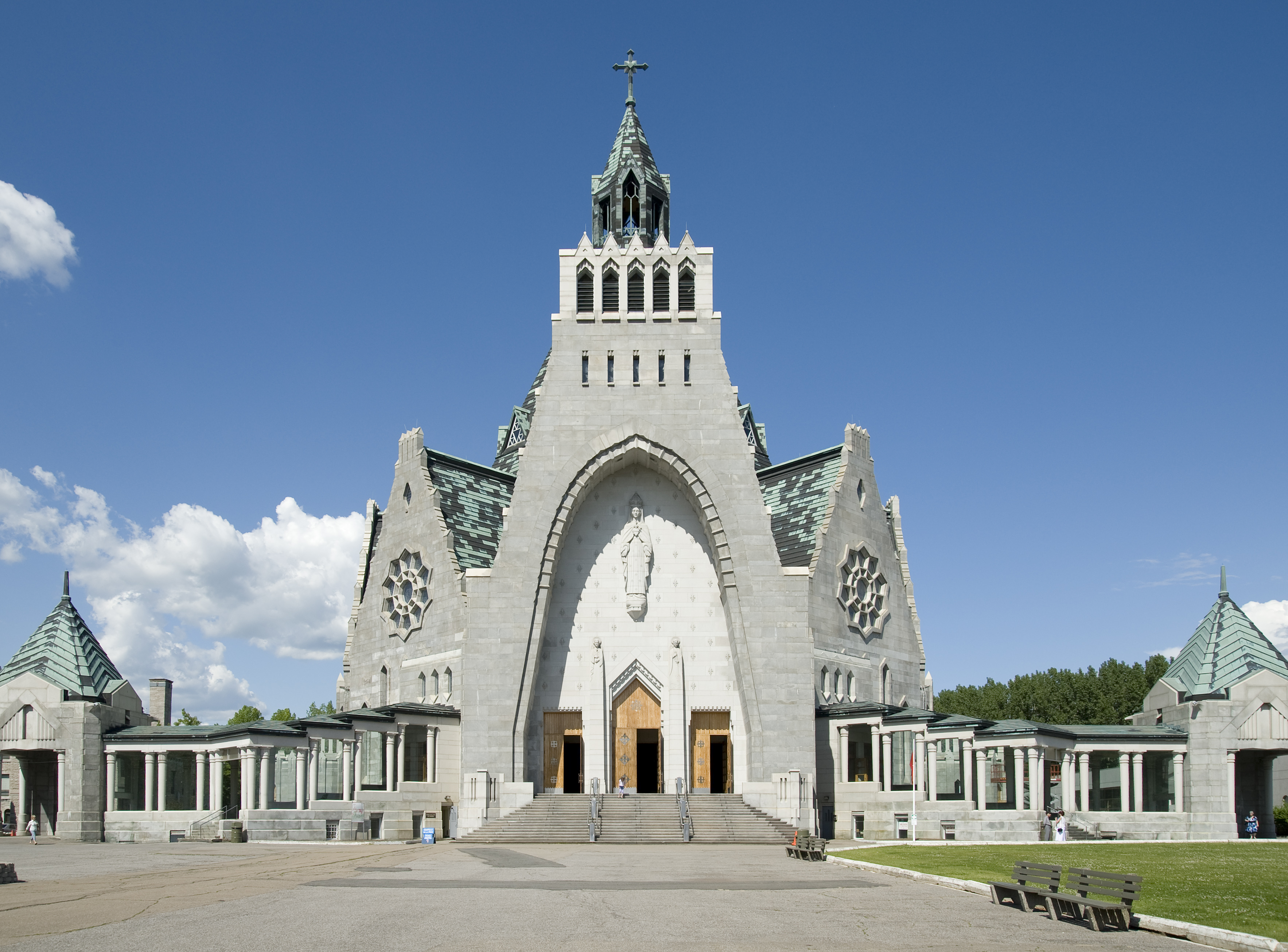
In 1889 the mission Church of Saint Thomas Aquinas was built and the next year Father Joseph Ironwood became the first Priest there A second Church was soon built, in 1898, as the population increased dramatically. Now, on the north shore of Lake Bouchet, in the Province of Quebec, there stand the buildings of a Friary and the Sanctuary of Our Lady of the Saguenay. In 1920, Father Elzear Delamarre built a house and a private Chapel dedicated to Saint Anthony of Padua on the site, which later became known as the hermitage of Saint Anthony and is one of the national Shrines in Quebec. So began the pilgrimage-shrine that has since grown steadily in popularity. After Father de Lamarre’s death in 1925, the Capuchin Franciscans took over the property, built their house and Church there and minister to the thousands of pilgrims who visit the Blessed Mother at her Sanctuary.
St Cugat del Valles Bl Darío Acosta Zurita St Ebrulfus St Fagildo of Santiago St Felix of Furcona St Florentius of Furcona St Glodesind of Metz St Magnericus of Trier (c 520-596) Bishop and Confessor Bl Michel-Louis Brulard Bl Mieczyslawa Kowalska St Mordeyren St Nissen of Wexford St Olympiad of Constantinople St Paul of Palestine
St Theodemir of Cordoba — Martyrs of Caesarea – 3 saints: Three Christians martyred together in the pesecutions of emperor Maximilian and governor Firmilian – Paul, Tea and Valentina. 309 in Caesarea, Palestine.
Martyrs of Cuncolim – 20 saints: On 15 July 1583 the group met at the church of Orlim, and hiked to Cuncolim to erect a cross and choose land for a new church. Local anti-Christian pagans, seeing the unarmed Christians, gathered their weapons and marched on them. One of the parishioners, a Portuguese emigre named Gonçalo Rodrigues, carried a firearm, but Father Alphonsus Pacheco stopped him from using it. The pagans then fell upon them, and killed them all without mercy. They were – • Alphonsus Pacheco • Alphonsus the altar boy • Anthony Francis • Dominic of Cuncolim • Francis Aranha • Francis Rodrigues • Gonçalo Rodrigues • Paul da Costa • Peter Berno • Rudolph Acquaviva • ten other native Christian converts whose names have not come down to us They were martyred on Monday 25 July 1583 at the village of Cuncolim, district of Salcete, territory of Goa, India. Beatified on 30 April 1893 by Pope Leo XIII.
Thought for the Day – 24 July – Meditations with Antonio Cardinal Bacci (1881-1971)
The Particular and General Judgements
“It is appointed unto men to die once and after this comes the judgement” (Heb 9:27).
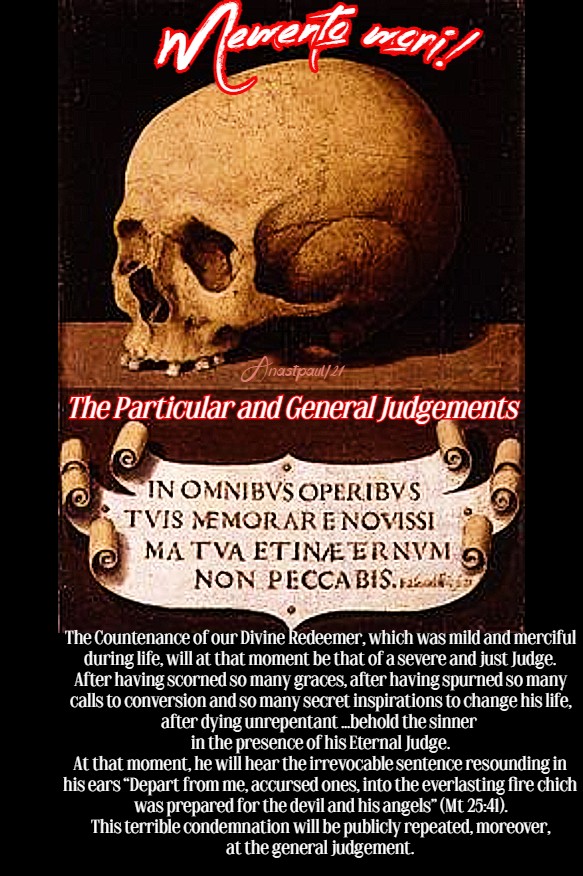
To have to appear before the Face of the Living God is terrifying for everybody. How much more terrifying will it be for the sinner? Weighed down by numberless sins, he will stand before the scrutinising gaze of God. He will be able to hide nothing. Everything will be evident and clear. The Countenance of our Divine Redeemer, which was mild and merciful during life, will at that moment be that of a severe and just Judge. After having scorned so many graces, after having spurned so many calls to conversion and so many secret inspirations to change his life, after dying unrepentant …behold the sinner in the presence of his Eternal Judge. At that moment, he will hear the irrevocable sentence resounding in his ears “Depart from me, accursed ones, into the everlasting fire chich was prepared for the devil and his angels” (Mt 25:41). This terrible condemnation will be publicly repeated, moreover, at the general judgement. Memento mori!”
Quote/s of the Day – 24 July – “Month of the Most Precious Blood” – Readings: Exodus 24: 3-8; Psalms 50: 1b-2, 5-6, 14-15; Matthew 13: 24-30
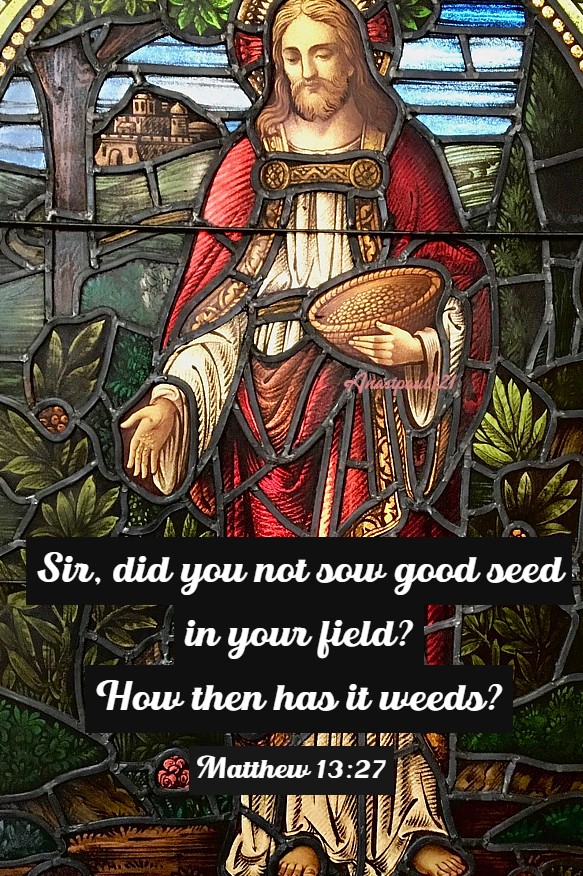
“Sir, did you not sow good seed in your field? How then has it weeds?”
Matthew 13:27
“Every kingdom devided against itself is laid waste.”
Luke 11:17
“No-one can have God as his father, if he does not have the Church as his mother… The Lord warned us of this when He said: “Whoever is not with me, is against me and whoever does not gather together with me, scatters.” The person who breaks the peace and concord of Christ, acts against Christ; the person who gathers together, outside of the Church, scatters the Church of Christ.”
St Cyprian of Carthage (c 200- c 258) Bishop and Martyr, Father of the Church On the unity of the Church
“It is better to be cured within the Church’s community than to be cut off from its Body as incurable members. As long as a member still forms part of the Body, there is no reason to despair of its cure; once it has been cut off, it can be neither cured nor healed.”
St Augustine (354-430) Father and Doctor of Grace
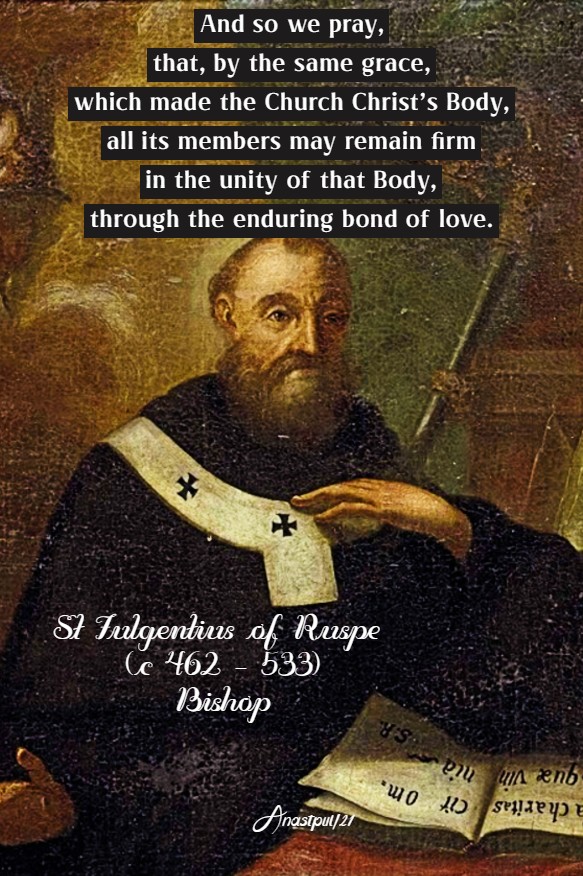
“And so we pray, that, by the same grace, which made the Church Christ’s Body, all its members may remain firm in the unity of that Body, through the enduring bond of love.”
St Fulgentius of Ruspe (c 462 – 533) Bishop, Father of the Church
“For nothing more glorious, nothing nobler, nothing surely, more honourable can be imagined, than to belong to the One, Holy Catholic, Apostolic and Roman Church, in which we become members of one Body as venerable as it is unique; are guided by one supreme Head; are filled with one divine Spirit; are nourished during our earthly exile by one doctrine and one heavenly Bread, until at last, we enter into the one, unending blessedness of heaven. But lest we be deceived, by the angel of darkness, who transforms himself into an angel of light, let this be the supreme law of our love – to love the Spouse of Christ, as Christ willed her to be and as He purchased her with His Blood.”
Pope Pius XII (1876-1958) “Mystici Corporis Christi” 1943
One Minute Reflection – 24 July – “Month of the Most Precious Blood” – Readings: Exodus 24: 3-8; Psalms 50: 1b-2, 5-6, 14-15; Matthew 13: 24-30
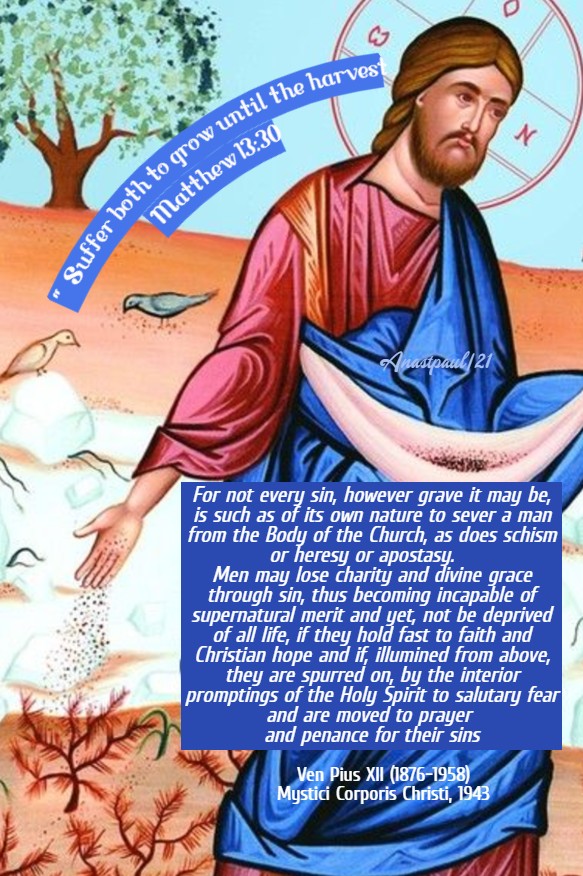
“Suffer both to grow until the harvest” – – Matthew 13:30
REFLECTION – “Nor must one imagine that the Body of the Church, just because it bears the name of Christ, is made up during the days of its earthly pilgrimage, only of members conspicuous for their holiness, or, that it consists only of those whom God has predestined to eternal happiness. It is owing to the Saviour’s infinite mercy, that place is allowed in His Mystical Body here below, for those whom, of old, He did not exclude from the banquet (cf. Mt 9:11). For not every sin, however grave it may be, is such as of its own nature to sever a man from the Body of the Church, as does schism or heresy or apostasy. Men may lose charity and divine grace through sin, thus becoming incapable of supernatural merit and yet, not be deprived of all life, if they hold fast to faith and Christian hope and if, illumined from above, they are spurred on, by the interior promptings of the Holy Spirit to salutary fear and are moved to prayer and penance for their sins.
Let everyone then abhor sin, which defiles the mystical members of our Redeemer but,, if anyone unhappily falls and his obstinacy has not made him unworthy of communion with the faithful, let him be received with great love and let eager charity see in him a weak member of Jesus Christ. For, as the Bishop of Hippo remarks – “it is better to be cured within the Church’s community than to be cut off from its Body as incurable members. As long as a member still forms part of the Body, there is no reason to despair of its cure; once it has been cut off, it can be neither cured nor healed.’”- Venerable Pius XII (1876-1958) – Pope from 1939 to 1958 – Encyclical – Mystici Corporis Christi, 1943
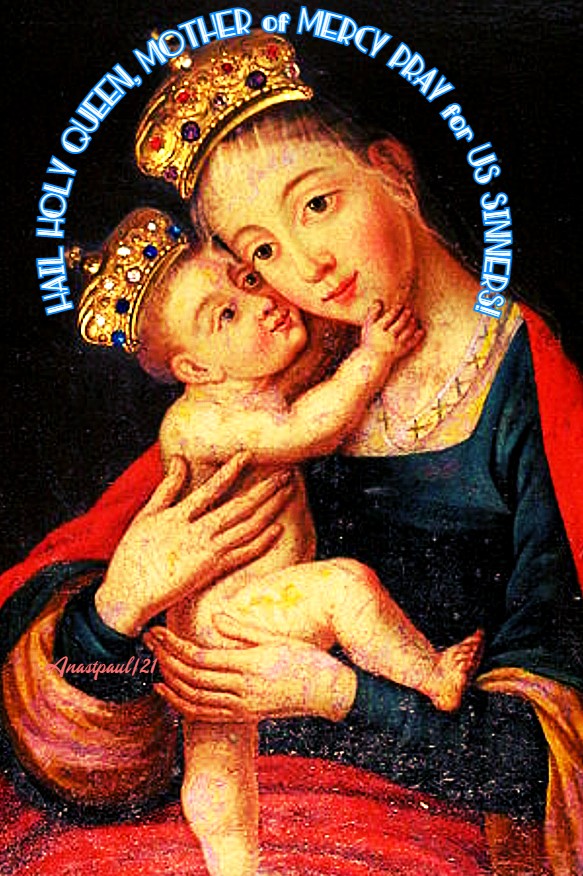
PRAYER – All-powerful and ever-living God, splendour of true light and never-ending day, chase away the night of sin and fill our minds with the glory of Your coming. Take away our heart of stone and give us a heart of flesh, help us in our battle with sin and the devil. By our prayers, Your holy sacraments and the strength of the Holy Spirit, may we be ever vigilant of the evil one. Hear the prayers of our Queen and Mother, the Blessed Virgin of Mercy on our behalf dear Lord. We make our prayer through Christ, our Lord with the Holy Spirit, one God forever, amen.
Our Morning Offering – 24 July – “Month of the Most Precious Blood”
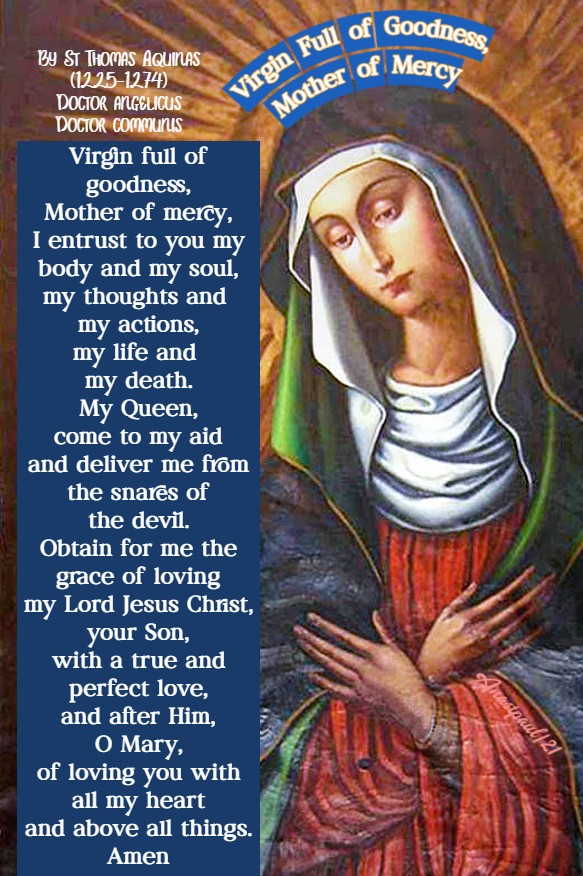
Virgin Full of Goodness, Mother of Mercy By St Thomas Aquinas (1225-1274) Doctor angelicus Doctor communis
Virgin full of goodness, Mother of mercy, I entrust to you my body and my soul, my thoughts and my actions, my life and my death. My Queen, come to my aid and deliver me from the snares of the devil. Obtain for me the grace of loving my Lord Jesus Christ, your Son, with a true and perfect love, and after Him, O Mary, of loving you with all my heart and above all things. Amen.
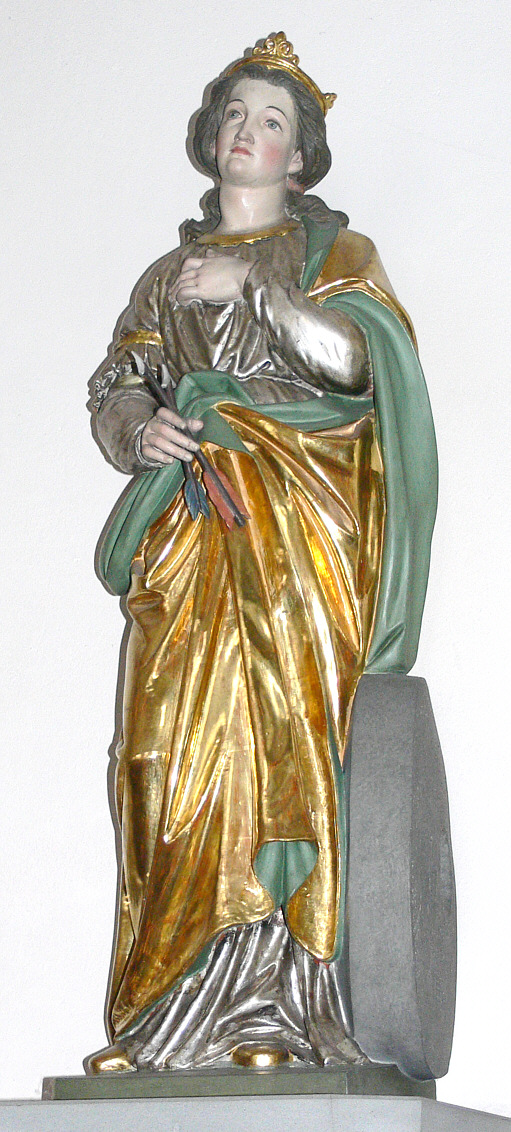
Saint of the Day – 24 July – Saint Christina Bolsena (3rd Century) Virgin Martyr. Born in the 3rd Century, probably at Rome, Italy into the family Anicii and died in the late 3rd Century at Lake Bolsena, Tuscany, Italy. Patronages – archers, mariners, millers . Also known as Cristina Anicii, Cristina of Tyro, Cristina.
Dolci, Carlo; Saint Christina of Bolsena
The Roman Martyrology’s entry today says: “At Tyro, in Tuscany, on the lake Bolsena, St Christina, Virgin and Martyr. Believing in Christ and breaking up her Father’s gold and silver idols to give them to the poor, she was cruelly scourged by his command, subjected to other most severe torments and thrown with a heavy stone into the lake, from which she was drawn out by an angel. Then, under another Judge, who succeeded her Father, she bore courageously still more bitter tortures. Finally, after she had been shut up by the Governor, Julian, in a burning furnace for five days, without any injury and being cured of the sting of serpents, she ended her Martyrdom by having her tongue cut out and being pierced with arrows.”
St Christina was the daughter of Urbain, a rich and powerful magistrate. . At least one account says that she destroyed her father’s golden idols and distributed their peices among the poor.
Saint Christina giving her father’s idols of gold to the poor, 17th-century painting.
By her father’s command, Christina was tortured to death. Her executions tore into her body with iron hooks. Afterward, they fastened her to a rack and lit a strong fire under her . Narratives say that God protected Christina by turning the burning flames against her onlookers. Next, although a heavy stone was tied around her neck to drown her in Bolsena Lake, an angel loosened the bonds and saved her. Unexpectedly, Christina’s father died while she was being tortured. Perhaps a glimmer of remorse saved his soul from eternal death!
Christina was again tortured by the magistrate who succeeded her father. The writer Fr Alban Butler states, that Christina remained unhurt inside a burning furnace for 5 days. Once removed, serpents could not bite her. In a rage, Christina’s torturers cut out her tongue and shot her to death with arrows. The island-city, Tyro, where she was executed was swallowed up by waters in the course of time.
Chapel of our Lady of the Rosary of Santi Giovanni e Paolo (Venice) – Martyrdom of St Christina by Sante Peranda
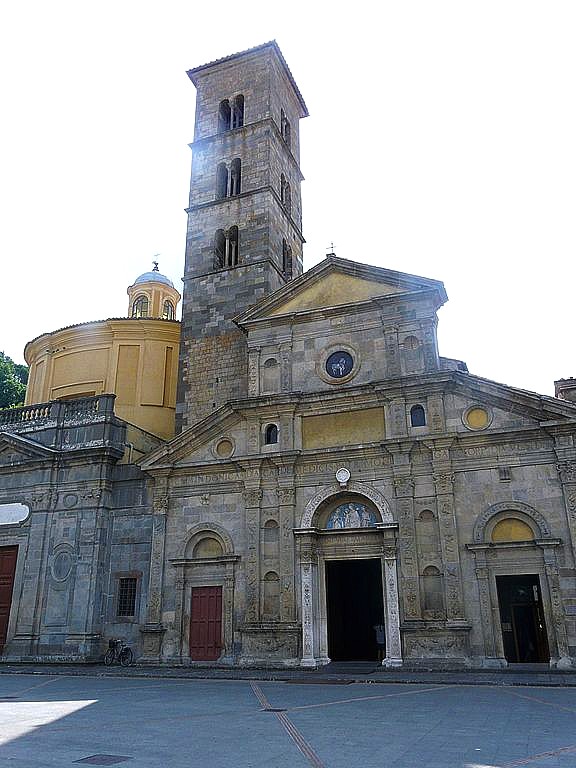
St.Christina’s relics are kept at Palermo in Sicily in a Basilica named for her. Her courage is testament to her perfect love for Jesus. “There is no fear in love but perfect love casts out fear. (Jn. 4:18)”
The Tomb of St Christina with Buglioni sculpture in the centre. Tthe Statue illustrates the stone used in the attempt to drown her.
Foundation of Our Lady of Cambron, France (1148) – 24 July:
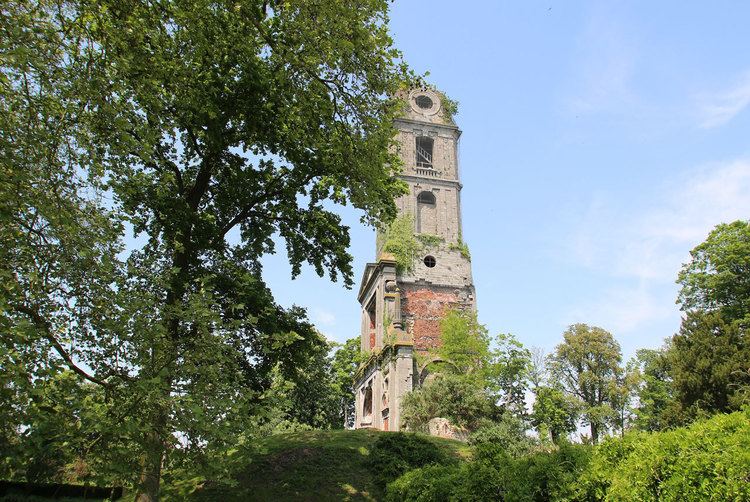
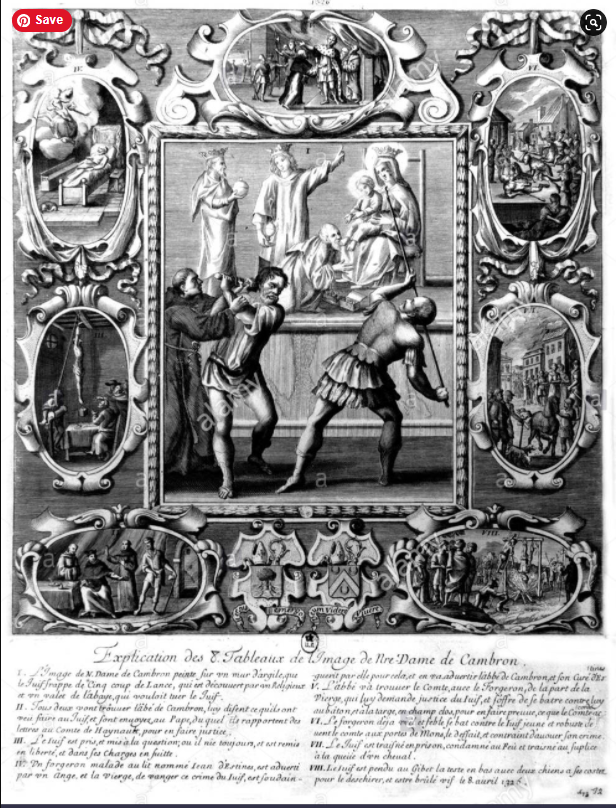
This feast day celebrates the Foundation of the Abbey of Our Lady of Cambron, near Mons, in Hainault, Belgium, by Anselm de Trasigny, Lord of Peronne and Canon of Soignies, in the year 1148. The Abbey of Cambron was founded on the River Blanche and was a daughter house of Saint Bernard of Clairvaux. It was situated some distance from Mons in Cambron-Casteau in Hainaut, Belgium and took its name from the land on which it was built. Cambron, in its turn, had daughter houses in the Abbeys of Fontenelle at Valenciennes and six other sites. The image of Our Lady formerly honoured at Cambron was famous for a great number of miraculous cures. A Chapel dedicated to Our Lady of Cambron, was built at Mons in 1550 in a part of the Prince’s park. In the following centuries the magistrates of Mons had a beautiful door built for the Shrine and added other embellishments. There was a small but well honoured and visited Oratory. In 1559, thieves broke into the Chapel and stole everything of value. After the French Revolution when the State took over all properties belonging to the Church, this Chapel of Our Lady of Cambron was also taken. It was demolished after all the wood, iron and lead was removed. The Statue of the Blessed Virgin which decorated the Altar was then placed in the Church of Saint Elizabeth at Mons. The Abbey of Cambron was rebuilt in the 18th Century but was ordered to be vacated in 1783 by the Holy Roman Emperor Joseph II. It was later sold to a wealthy Count who built a mansion on the property and the land remained in his family’s hands until it was sold in 1993 to a family, who turned the holy and once revered site, into the location of a public zoo known as the Pairi Daiza. Verneration of Our Lady of Cambron: “In 1322 there was a serious incident at Cambron. An image of the Virgin Mary was profaned. The widely held suspicion was that a Jewish perpetrator had falsified conversion to Christianity to gain access to the image. The affair caused significant unrest and provoked the sympathy of many Christians. There were prayers and devotions held to repair the image. Thus the devotion to Our Lady of Cambron was begun. After a request by the King of France Philip of Valois, Pope Benedict XII issued a Papal Bull granting indulgences to pilgrims to Cambron. The pilgrimage to the Virgin of Cambron was thus begun. A solemn procession takes place each year on the third Sunday of Easter.”
Among the pilgrims and visitors were several important figures, including the Emperor Maximilian I, who, passing through Belgium in the early 16th century, visited the Sanctuary of Our Lady of Cambron. He gave the Abbey sufficient funds to commission the restoration of the painted image.
The above very old and blurred image relates the legend of the attack on the Holy Painting
Martyred in England: John Boste Joseph Lambton Nicholas Garlick Richard Simpson Robert Ludlam
Martyred in the Spanish Civil War: Bl Cándido Castán San José Bl Cecilio Vega Domínguez St Ignacio González Calzada St Jaime Gascón Bordas Bl José Joaquín Esnaola Urteaga Bl José Máximo Moro Briz St Josep Guillamí Rodo St Marcos Morón Casas Bl Maria Angeles of Saint Joseph Bl Maria Mercedes Prat Bl Maria Pilar of Saint Francis Borgia Bl Teresa of the Child Jesus and of Saint John of the Cross St Xavier Bordas Piferrer
Thought for the Day – 23 July – Meditations with Antonio Cardinal Bacci (1881-1971)
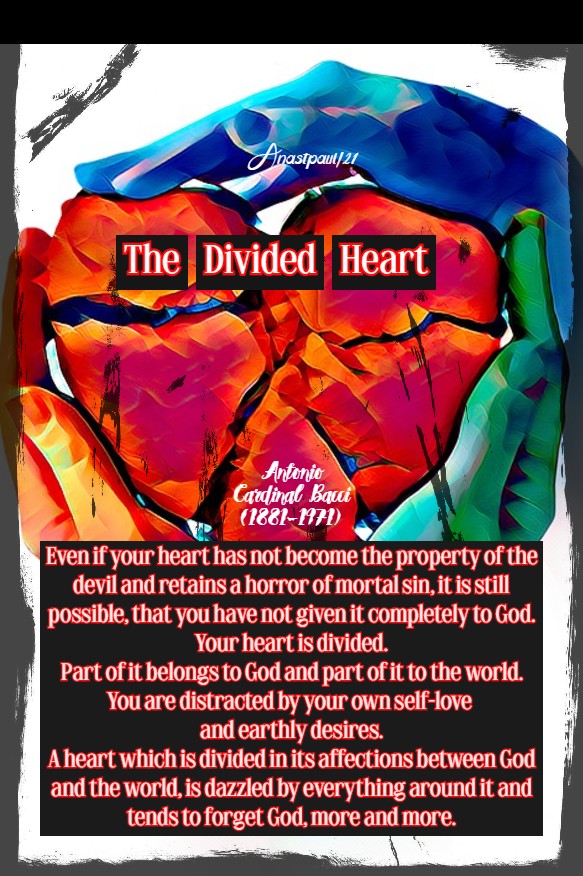
The Divided Heart
“Even if your heart has not become the property of the devil and retains a horror of mortal sin, it is still possible, that you have not given it completely to God. Your heart is divided. Part of it belongs to God and part of it to the world. You are distracted by your own self-love and earthly desires. A heart which is divided in its affections between God and the world, is dazzled by everything around it and tends to forget God, more and more.
We protest that we belong entirely to God but, in practice, we are so absorbed by work, ambition and pleasure, that we neglect God.
A man who is torn between love of God and love of the world is like Cain who, unlike Abel, did not offer God, the best part of his flock but kept this for himself and offered God whatever he had rejected. God was pleased with Abel’s sacrifice but had no regard for that of Cain, who finally became a murderer and was cursed by his Creator.
Do we offer God the leavings of life while we keep the best part of it for our selves? Do we think of ourselves nearly all the time and give very little thought to God? This is not the way in which God has dealt with us. Not only has He created us but, He loves us with an everlasting love. He came down to earth and lived as our fellow man. He redeemed us by His Precious Blood and gave Himself to us as our food!
Why are we not willing to give ourselves to Him forever in return? Gratitude demands that we should do so. God, moeover, is our supreme and only good.
Quote/s of the Day – 23 July – “Month of the Most Precious Blood” – Readings: Exodus 20: 1-17; Psalms 19: 8, 9, 10, 11; Matthew 13: 18-23
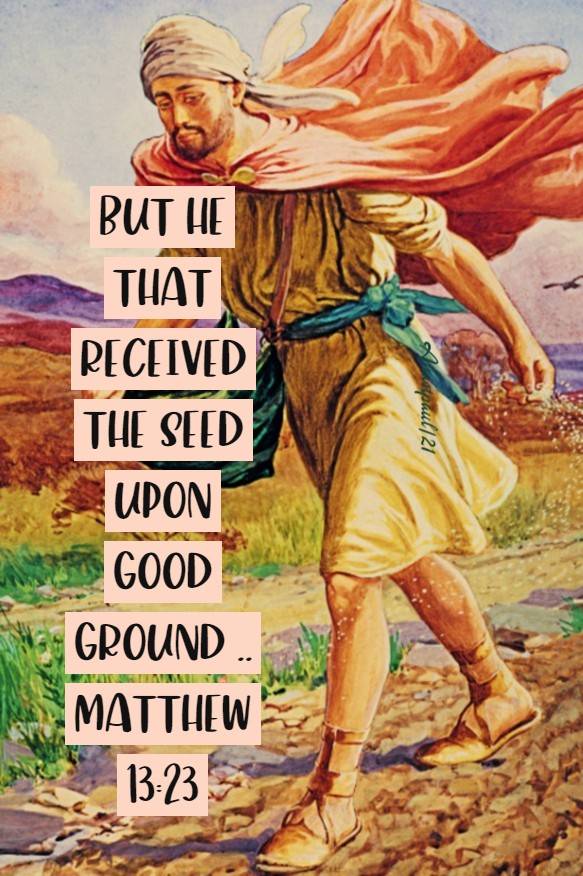
“But he that received the seed upon good ground”
Matthew 13:23
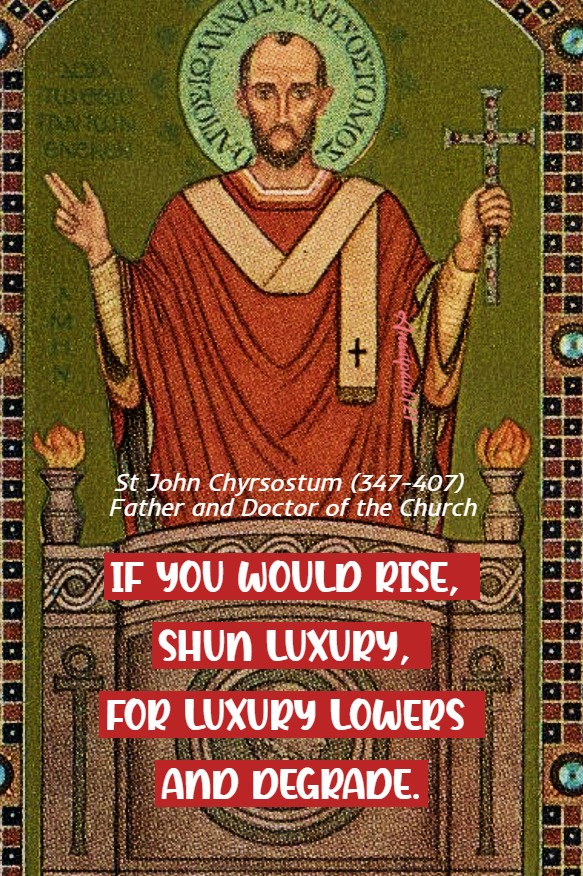
“ If you would rise, shun luxury, for luxury lowers and degrades.“
St John Chyrsostum (347-407) Father and Doctor of the Church
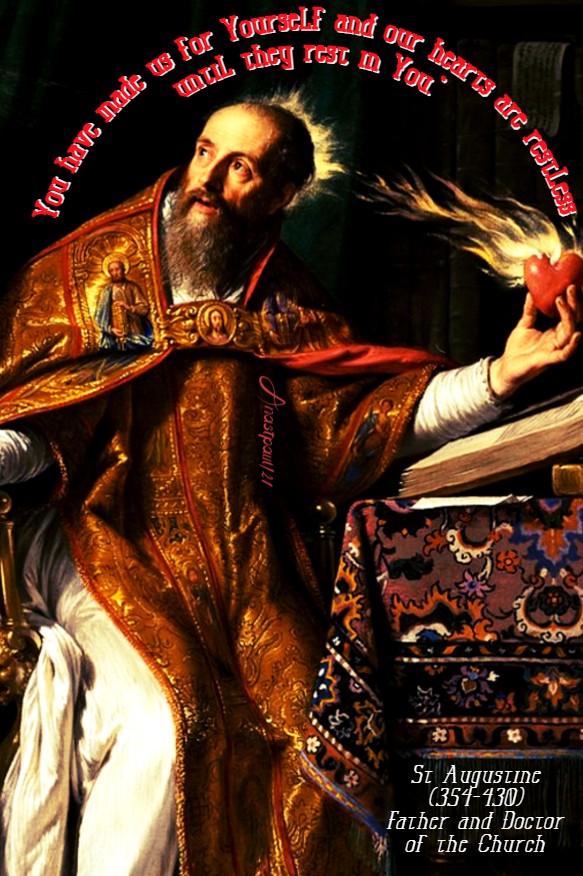
“You have made us for Yourself and our hearts are restless until they rest in You.”
St Augustine (354-430) Father and Doctor of the Church
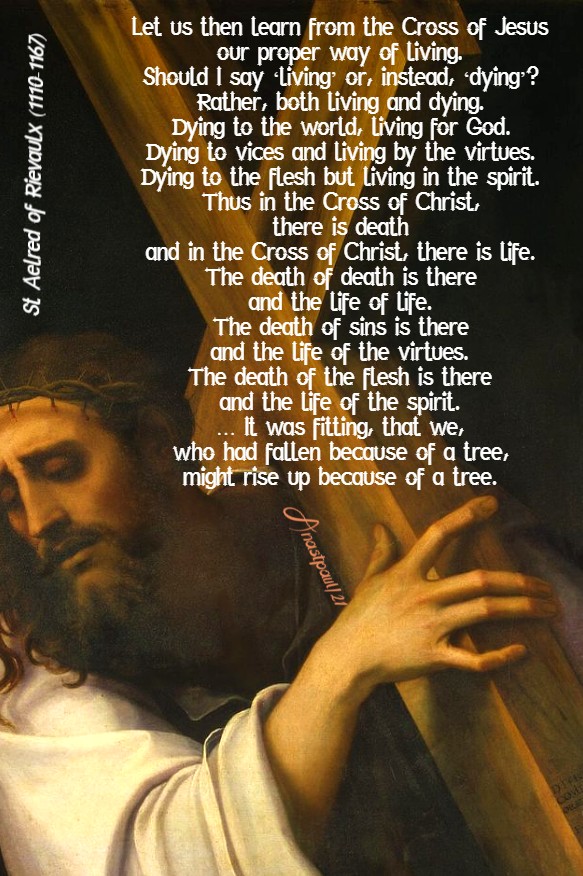
“Let us then learn from the Cross of Jesus our proper way of living. Should I say ‘living’ or, instead, ‘dying’? Rather, both living and dying. Dying to the world, living for God. Dying to vices and living by the virtues. Dying to the flesh but living in the spirit. Thus in the Cross of Christ, there is death and in the Cross of Christ, there is life. The death of death is there and the life of life. The death of sins is there and the life of the virtues. The death of the flesh is there and the life of the spirit. … It was fitting, that we, who had fallen because of a tree, might rise up because of a tree.”
St Aelred of Rievaulx (1110-1167) “St Bernard of the North”
One Minute Reflection – 23 July – “Month of the Most Precious Blood” – Readings: Exodus 20: 1-17; Psalms 19: 8, 9, 10, 11; Matthew 13: 18-23
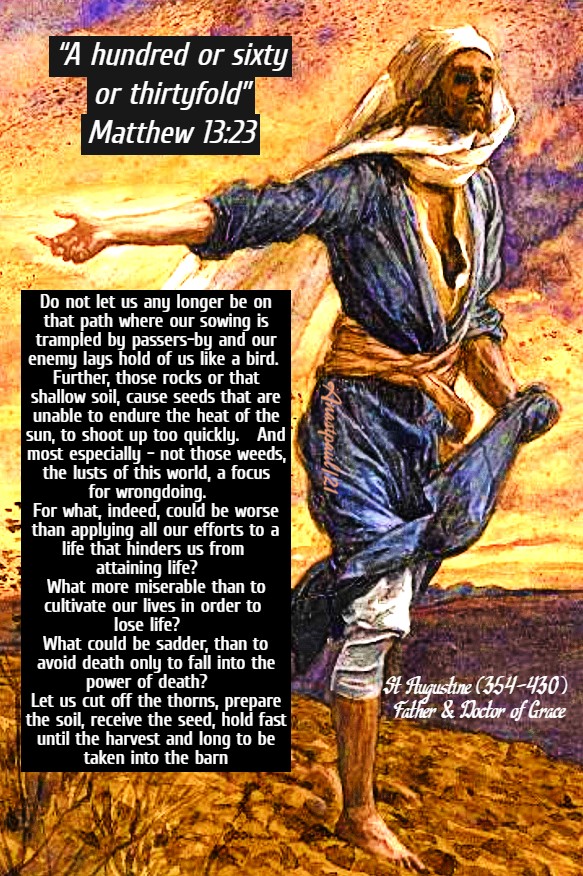
“A hundred or sixty or thirtyfold”- Matthew 13:23
REFLECTION – “ The sowing was carried out by the Apostles and prophets, yet it is the Lord Himself who sows. The Lord Himself is the One present in them, since it is the Lord Himself Who did the reaping. For without Him they are nothing, whereas, without them, He remains unmoved. As He said to them: “Without me you can do nothing” (Jn 15,5). And so what does Christ say as He sows among the gentiles? “A sower went out to sow” (Mt 13,3). In another text reapers were sent out to reap but here, the sower goes out to sow and does not complain of his labour. For what, indeed, does it matter if some seed falls on the path, or rocky ground, or among thorns? If He were to let Himself be discouraged by these arid terrains, He would make no progress towards the good soil!…
Now this has a bearing on ourselves – are we that pathway, those rocks, those weeds? Do we want to be good soil? Let us prepare our hearts to yield thirty, sixty, a hundred, a thousandfold. Thirtyfold or a thousandfold – in each case, it is a question of wheat and nothing but wheat. Do not let us any longer be on that path where our sowing is trampled by passers-by and our enemy lays hold of us like a bird. Further, those rocks or that shallow soil, cause seeds that are unable to endure the heat of the sun, to shoot up too quickly. And most especially – not those weeds, the lusts of this world, a focus for wrongdoing. For what, indeed, could be worse than applying all our efforts to a life that hinders us from attaining life? What more miserable than to cultivate our lives in order to lose life? What could be sadder, than to avoid death only to fall into the power of death? Let us cut off the thorns, prepare the soil, receive the seed, hold fast until the harvest and long to be taken into the barn.” – St Augustine (354-430) – Sermon 101; PL 38, 605
PRAYER – A pure heart create for me O God, put a steadfast spirit within me! (Ps 50[51]) Lord God, bestow a full measure of Your grace to us. Keep us within in the path of Your commandments, help us to work on the earth of our souls, rooting out the weeds and casting forth the stones of malice. Grant that by the prayers of our Blessed and Merciful Mother, we may succeed in attaining sanctity. Through Christ, our Lord, in union with the Holy Spirit, one God, forever, amen.
Our Morning Offering – 23 July – “Month of the Most Precious Blood”
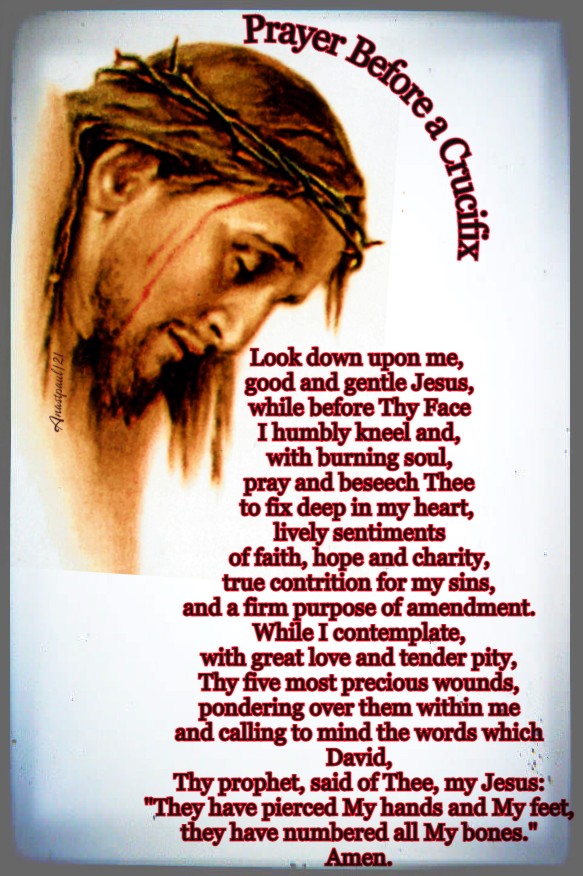
Prayer Before a Crucifix
Look down upon me, good and gentle Jesus, while before Thy face I humbly kneel and, with burning soul, pray and beseech Thee to fix deep in my heart, lively sentiments of faith, hope and charity, true contrition for my sins, and a firm purpose of amendment. While I contemplate, with great love and tender pity, Thy five most precious wounds, pondering over them within me and calling to mind the words which David, Thy prophet, said of Thee, my Jesus: “They have pierced My hands and My feet, they have numbered all My bones.” Amen.
Say – Our Father, Hail Mary, Glory Be for the Catholic Church and the intentions of the Holy Father. A Plenary Indulgence, under the usual conditions, may be gained by those who shall say this prayer with devotion before an image of our Crucified Redeemer. A Partial Indulgence may also be gained for each devout recitation.
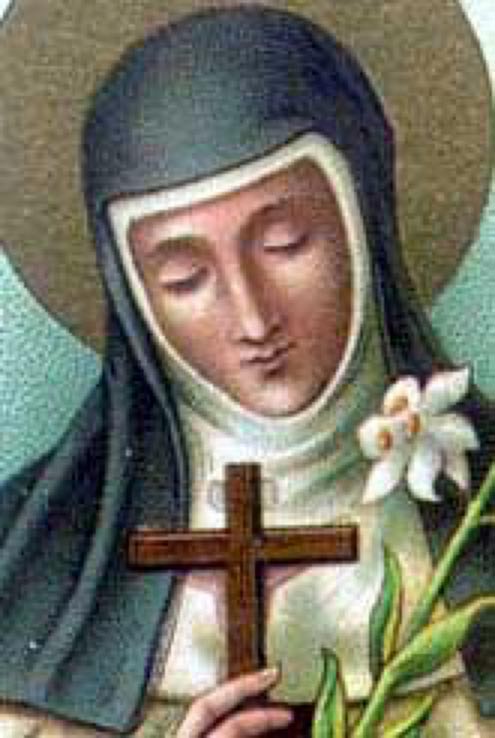
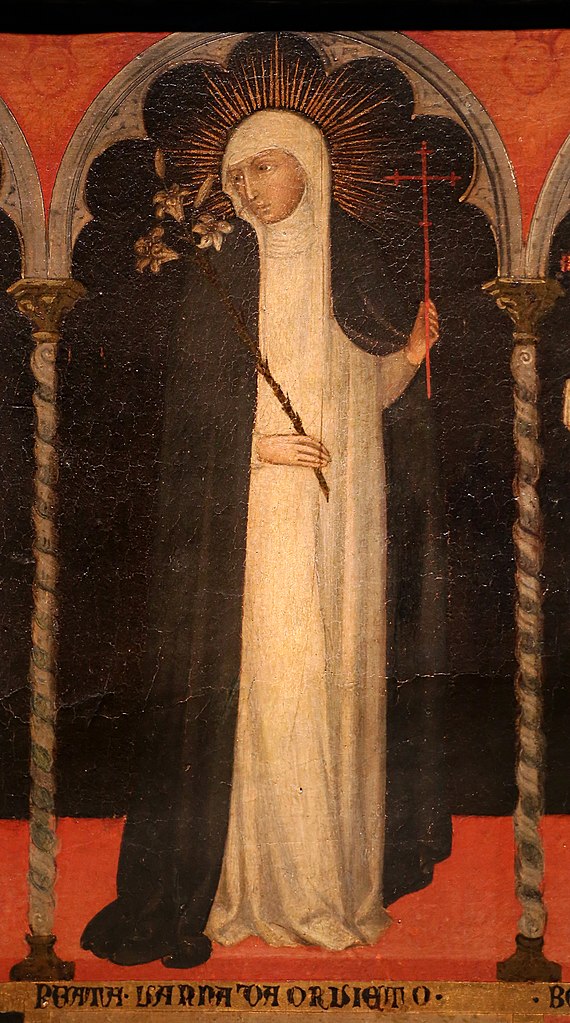
Saint of the Day – 23 July – Blessed Giovanna of Orvieto OP (c 1264-1306) Virgin, Tertiary of the Order of Preachers, Mystic, Stigmatist , miracle-worker. Born in c 1264 at Carnaiola, Italy and died on 23 July 1306, aged 42, of natural causes. She was known for her wise intellect and for her intense devotion to serving the will of God while being noted for the charism of prophecy and visions. Patronages – embroiderers, seamstresses, Italian working women (chosen in 1926). Also known as Jane and Vanna of Orvieto.
The Roman Martyrology states of her today: “In Orvieto in Umbria, Blessed Giovanna, Virgin, Sister of Penance of Saint Domenic, distinguished for charity and patience.”
Giovanna was born near Orvieto, in 1264 of humble peasant parents who both died when she was very young. Moved by a celestial instinct, she entrusted herself entirely to the custody of the Angels, whose loving protection she was deeply aware of.
At the age of ten, she consecrated herself to Jesus and was already yearning for a life of complete dedication to Him. In the meantime she grew beautiful and graceful, while the plan to enter the Third Order of St Dominic, then in bloom, was maturing in her heart. members publicly wore the habit and led religious life, without however, leaving their respective homes.
Realising her decision, the relatives, with whom Giovanna lived, and who had already promised her to a rich young man of the area, showed themselves highly indignant at her decision and began to hinder her in every way.
The young girl then, left Carnaiada and took refuge in nearby Orvieto, where other relatives assisted her, offering her a solitary room and the freedom to serve God. Giovanna, who was only 14 years old at the time, was thus able to receive the white habit of the Order.
Her life was an admirable ascent in the most heroic ways of love. Encouraged by very high contemplation, she entered with so much tenderness in the mysteries of the Passion of Jesus, that she deserved a painful participation in it.
In the last ten years of her life, every Friday, when she entered into ecstasy, she looked like a living crucifix and her bones dislocated with so much clatter, as if they were shattered. To her fellow citizens she was a mirror and teacher of Christian life.
After her death, which took place on 23 July 1306 in Orvieto, from the wound in her side, living blood flowed and God honoured her with many miracles. Her body rests in the Town Church of St Domenic. In 1926 she was elected Patroness of Italy for female workers, seamstresses and embroiderers.
The year after her death, her body was transferred to the Chapel of the Three Kings and many miracles occurred, giving impetus to the process of Beatification, which, however, was not completed for more than 400 years
Giovanna was Beatified on 11 September 1754 by Pope Benedict XIV (cultus confirmed).
Madonna di Altino / Our Lady of Altino, Albino, Bergamo, Lombardy, Italy (1496) – 23 July:
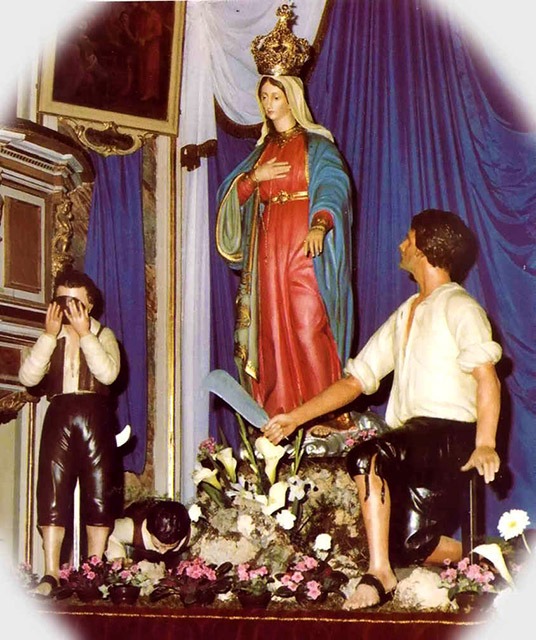
On 23 July 1496, during a heatwave and drought,Quinto Foglia and his two little boys were walking from their home in Vall’Alta to the wooded slopes of Monte Altino, where they worked making charcoal. Stricken with thirst and afraid for his children, Quinto prayed to the Madonna. She appeared and told him to strike a rock with his staff. When he did, a spring surged forth. The next day, people began building a little Chapel, which was completed on 5 September 1496. In 1865 a statuary group depicting the apparition was installed in the Sanctuary. On 23 July 1919, in thanksgiving for her protection during World War I, the Madonna’s Statue was solemnly crowned. The Shrine celebrates its feast with an evening procession on 22 July and solemn Mass on 23 July, the anniversary of both the apparition and the crowning.
Bl Beaudoin of Beaumont St Conan of Cornwall Bl Emilio Arce Díez St Eugene of Rome St Herundo of Rome Blessed Giovanna of Orvieto OP (c 1264-1306) Virgin, Tertoary of the Order of Preachers, Mystic, Stigmatist
Bl Pedro Ruiz de los Paños Angel St Phocas the Gardener St Primitiva of Rome St Rasyphus of Macé St Rasyphus of Rome St Ravennus of Macé St Redempta of Rome St Romula of Rome St Severus of Bizye St Theophilus of Rome St Trophimus of Rome St Valerian of Cimiez Bl Wojciech Gondek — Martyrs of Barcelona – 7 beati: Seven Christians, some lay people, some members of the Missionaries of the Sacred Hearts of Jesus and Mary and some of the Franciscan Daughters of Mercy, who were martyred in two groups on the same day in the Spanish Civil War. • Catalina Caldés Socías • Francesc Mayol Oliver • Miquel Pons Ramis • Miquela Rul-Làn Ribot • Pau Noguera Trías • Prudència Canyelles Ginestà de Aguadé • Simó Reynés Solivellas 23 July 1936 in Barcelona, Spain. They were Beatified on 28 October 2007 by Pope Benedict XVI. Martyrs of Bulgaria: An unknown number of Christians killed for their faith during the 9th century war between the Greek Emperor Nicephorus and the Bulgars.
Martyrs of Carabanchel Bajo – 9 beati: A group of nine Passionist priests, brothers and clerics who were martyred together in the Spanish Civil War. • Anacario Benito Nozal • Felipe Ruiz Fraile • Felipe Valcobado Granado • José Osés Sainz • José Ruiz Martinez • Julio Mediavilla Concejero • Laurino Proaño Cuesta • Manuel Pérez Jiménez • Maurilio Macho Rodríguez 22 July 1936 in Carabanchel Bajo, Madrid, Spain. They were Beatified on 1 October 1989 by Pope John Paul II.
Martyrs of Horta – 10 beati: A lay woman and nine Minim nuns who were martyred together in the Spanish Civil War. • Ana Ballesta Gelmá • Dolors Vilaseca Gallego • Josefa Pilar García Solanas • Josepa Panyella Doménech • Lucrecia García Solanas • Maria Montserrat Ors Molist • Mercè Mestre Trinché • Ramona Ors Torrents • Teresa Ríus Casas • Vicenta Jordá Martí 23 July 1936 at the Sant Genís dels Agudells highway, Horta, Barcelona, Spain. They were Beatified on 27 October 2013 by Pope Benedict XVI.
Martyrs of Manzanares – 5 beati: Five Passionist clerics who were martyred together in the Spanish Civil War. • Abilio Ramos y Ramos • Epifanio Sierra Conde • José Estalayo García • Vicente Díez Tejerina • Zacarías Fernández Crespo They were shot on 23 July 1936 in Manzanares, Ciudad Real, Spain and Beatified on 1 October 1989 by Pope John Paul II.
Thought for the Day – 22 July – Meditations with Antonio Cardinal Bacci (1881-1971)
Progress in the Love of God
“The entire Christian system is based on the love of God. This, is “the greatest and first commandment” (Mt 22:38) of Jesus, from which the second commandment, to love our neighbour, naturally flows. A man who does not observe this first commandment is not a Christian, whereas a man who endeavours to increase, everyday, his love for God, is a saint. There are may grades of ascent in this love but, the basic step is indicated in the words of our Divine Master: “He who has my commandments and keeps them, he is is who loves me” (Jn 14:15,21).
The love of God should not consist of an empty and ineffective sentimentality but, should comprise a sincere determinations to please God by carrying out His will, without reserve and by becoming more closely united to Him, by the help of His holy grace. Progress in the love of God is divided by the masters of the spiritual lfe into three stages: (1) the period of purification; (2) the period of illuminations and; (3) the period of union with God. We may have advanced no farther than the first stage because there is still so much to be purified in our souls. Nevertheless, let us ask God’s grace, to help us to begin this work immediately!”
Quote/s of the Day – 22 July –“Month of the Most Precious Blood” – Feast of St Mary of Magdala -– Readings: Song of Solomon 3:1-4, Psalm 63:2-6, 8-9, John 20:1-2, 11-18
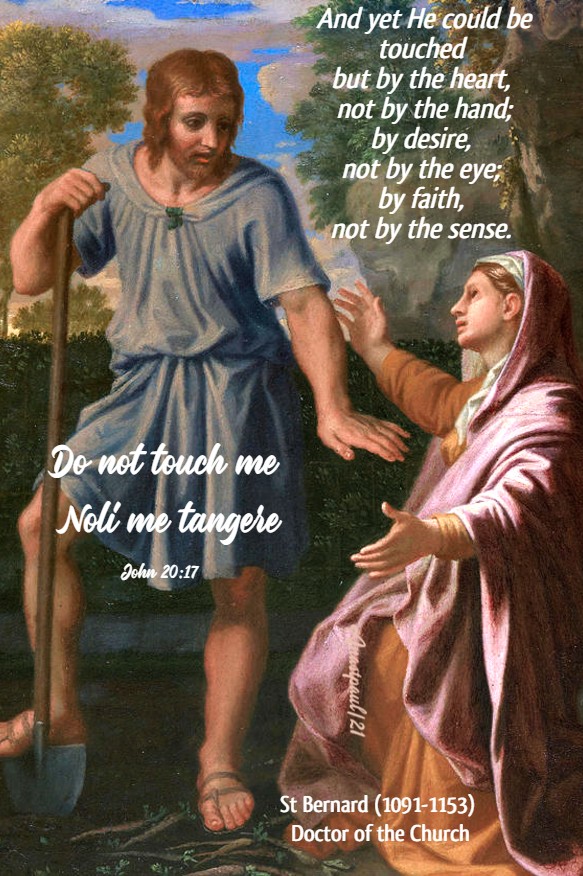
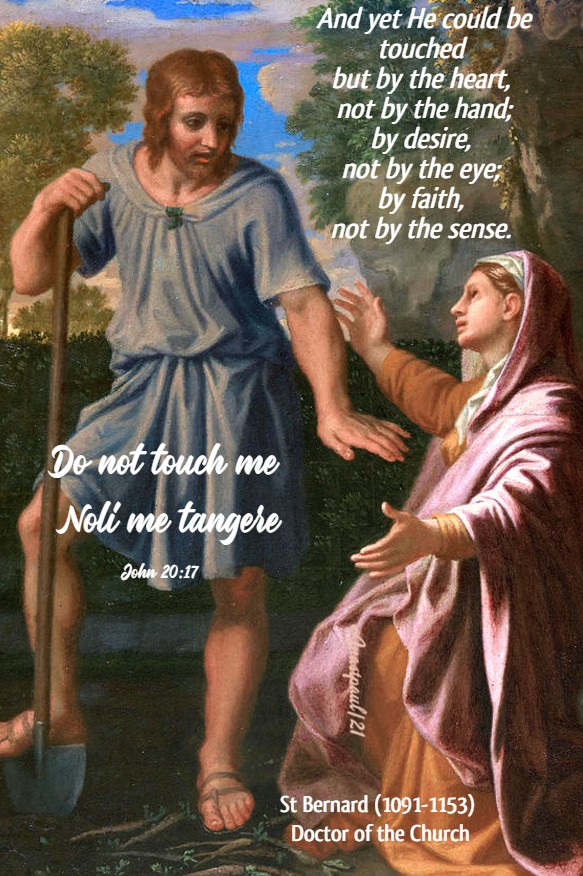
“Do not touch me ” “Noli me tangere”
John 20:17
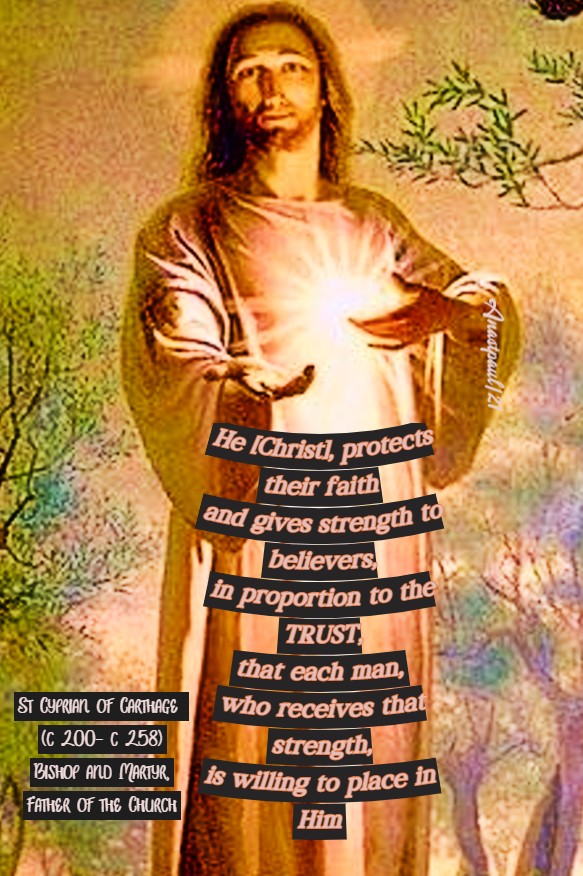
“He [Christ], protects their faith and gives strength to believers, in proportion to the TRUST, that each man, who receives that strength, is willing to place in Him.”
St Cyprian of Carthage (c 200- c 258) Bishop and Martyr, Father of the Church
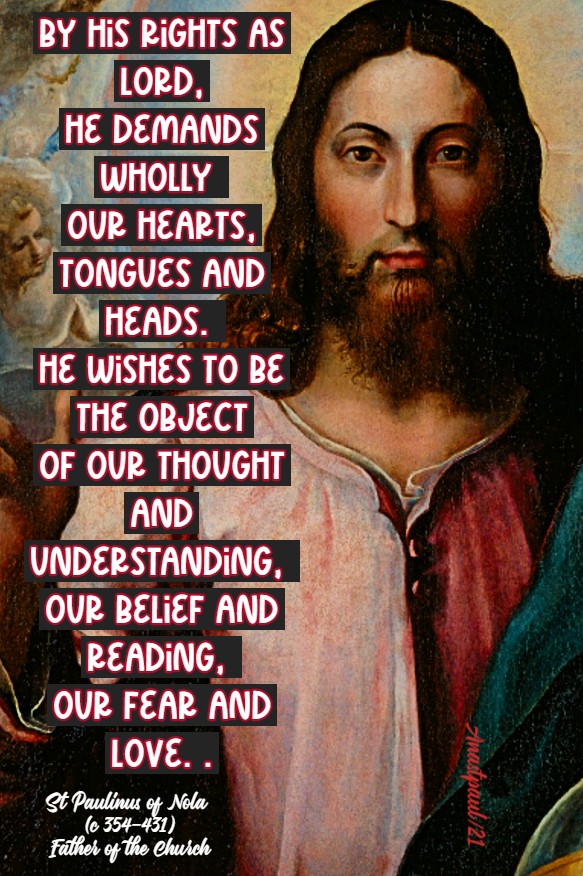
“By His rights as Lord, He demands wholly our hearts, tongues and heads. He wishes to be the object of our thought and understanding, our belief and reading, our fear and love. . . ”
St Paulinus of Nola (c 354-431) Father of the Church
Above Poem 10, from The Poems of St. Paulinus of Nola,
“And yet He could be touched but by the heart, not by the hand; by desire, not by the eye; by faith, not by the sense. …”
St Bernard (1091-1153) Doctor of the Church
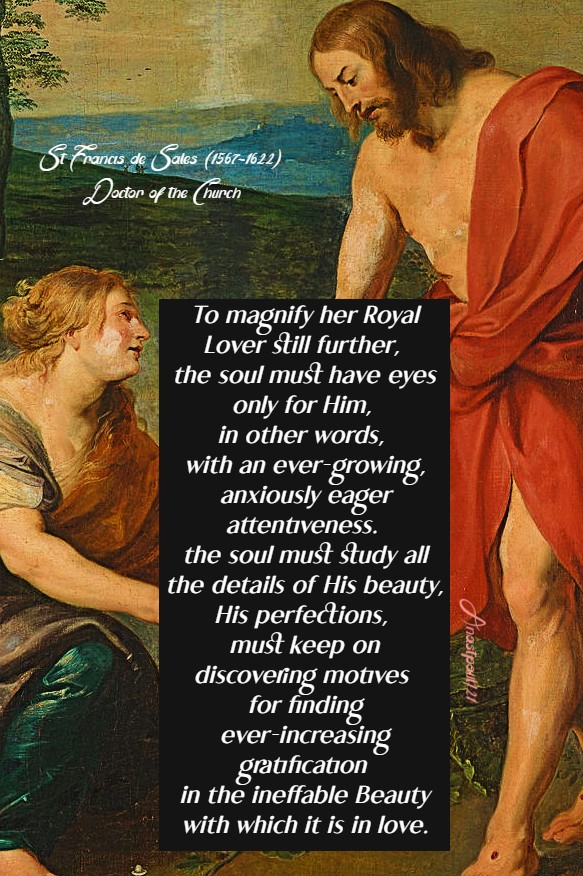
“To magnify her Royal Lover still further, the soul must have eyes only for Him, in other words, with an ever-growing, anxiously eager attentiveness. the soul must study all the details of His beauty, His perfections, must keep on discovering motives for finding ever-increasing gratification in the ineffable Beauty with which it is in love.”
St Francis de Sales (1567-1622) Doctor of the Church
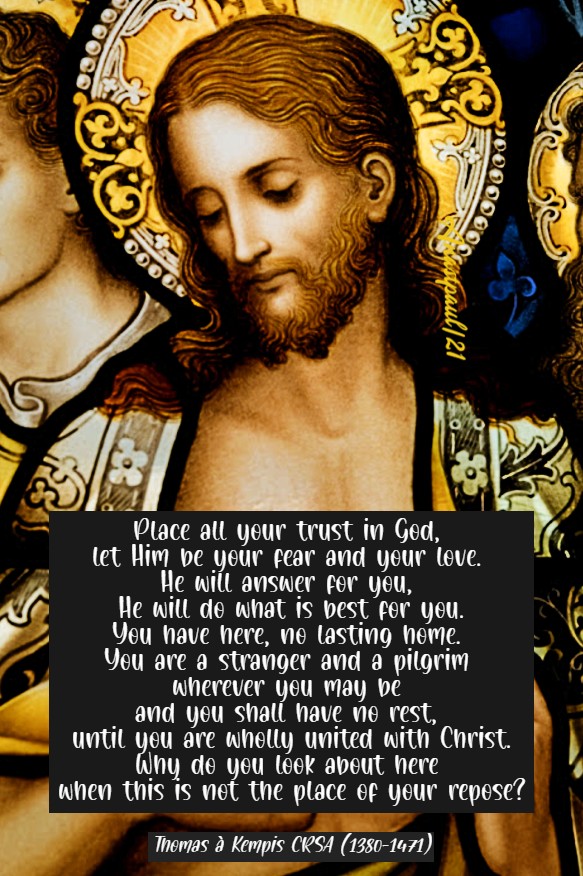
“Place all your trust in God, let Him be your fear and your love. He will answer for you, He will do what is best for you. You have here no lasting home. You are a stranger and a pilgrim wherever you may be and you shall have no rest, until you are wholly united with Christ. Why do you look about here when this is not the place of your repose?”
Thomas à Kempis CRSA (1380-1471)
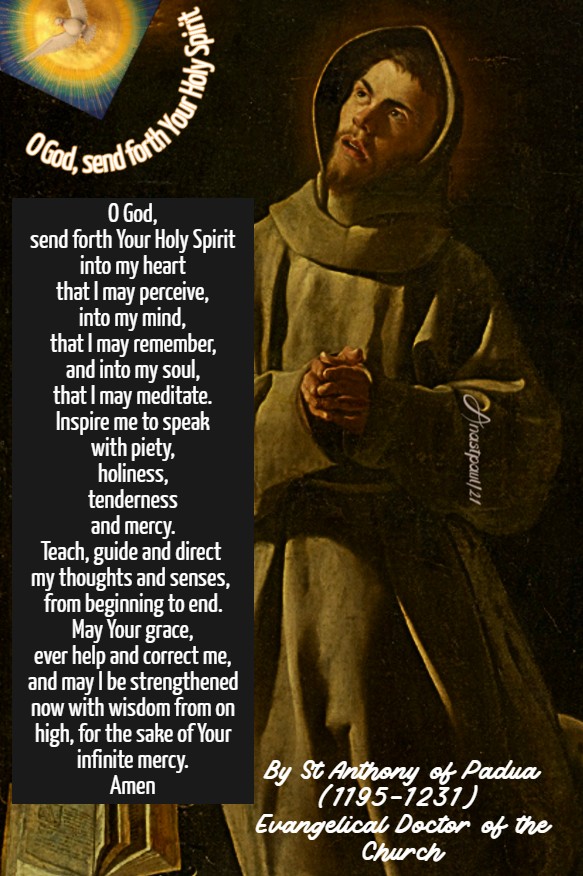
O God, send forth Your Holy Spirit By St Anthony of Padua (1195-1231) Doctor of the Church
O God, send forth Your Holy Spirit into my heart that I may perceive, into my mind, that I may remember, and into my soul, that I may meditate. Inspire me to speak with piety, holiness, tenderness and mercy. Teach, guide and direct my thoughts and senses, from beginning to end. May Your grace, ever help and correct me, and may I be strengthened now with wisdom from on high, for the sake of Your infinite mercy. Amen
St Anthony of Padua (1195-1231) Evangelical Doctor of the Church




























 AnaStpaul
You must be logged in to post a comment.