Thought for the Day –9 July – Meditations with Antonio Cardinal Bacci (1881-1971)
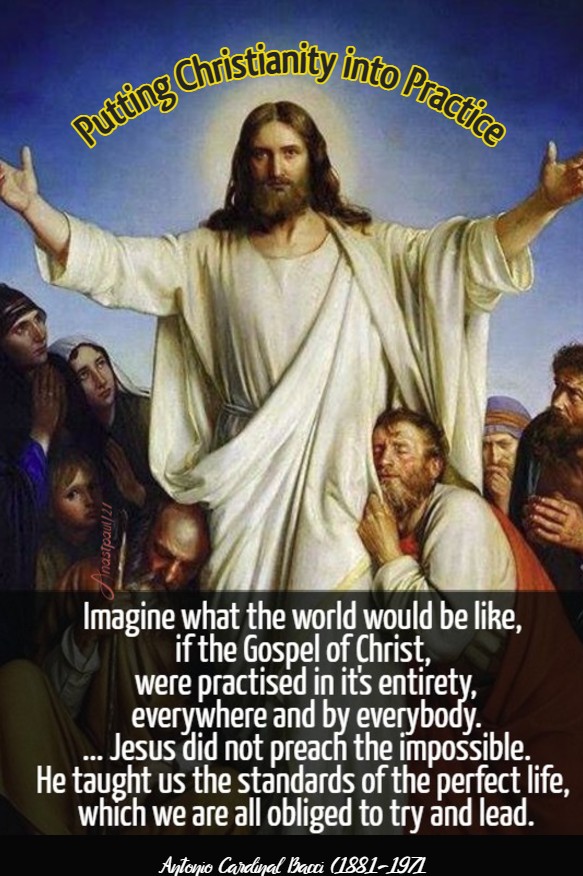
Putting Christianity into Practice
“Imagine what the world would be like, if the Gospel of Christ, were practised in it’s entirety, everywhere and by everybody. It would not, of course, become another earthly Paradise, because suffering and death are the legacy of sin and Our Lord, did not remove these when He redeemed us but made them a necessary element, in our purification and spiritual elevation. Nevertheless, the full practice of Christianity would transform the world. A little reflection will convince us of this. Men would love God above all things and their neighbours as themselves. The sincere and ardent love of God, would cause wickedness, brutality and every kind of immorality to disappear. Love of their neighbour, would make men brothers in reality, so that there would be no more wars nor threats of conflict. The enormous wealth which is squandered on weapons of destruction, could then be diverted to good works. There would be no more poverty, because, if men loved one another, those who had more than enough, would give to those in want. There would be no more prisons, because, there would be no more criminals. There would be no need for a police force, because, everyone would do his duty of his own accord. The reign of love, which is the reign of Jesus Christ, would triumph upon earth. Excessive wealth and the selfish love of ease and pleasure, would disappear on one hand, while, on the other, the extreme need of those who can never be sure of a meal, nor of a roof over their heads, would be palliated, until they had been raised to a standard of living, consistent with the laws of God and with the dignity of men. The love of our neighbour as ourselves, would solve every individual and social problem in this life. Men would grow into a vast community of brothers devoid of all barriers of hate, selfishness and greed. This is not a Utopian dream, because it is the clear teaching of the Gospel. Jesus did not preach the impossible. He taught us the standards of the perfect life, which we are all obliged to try and lead.”
Quote/s of the Day – 9July – “Month of the Precious Blood” – Readings: Genesis 46: 1-7, 28-30; Psalms 37: 3-4, 18-19, 27-28, 39-40; Matthew 10:16-23
“Behold, I send you as sheep in the midst of wolves. Be, therefore, wise as serpents and simple as doves.”
Matthew 10:16
“But above all these things have charity, which is the bond of perfection.”
Colossians 3:14
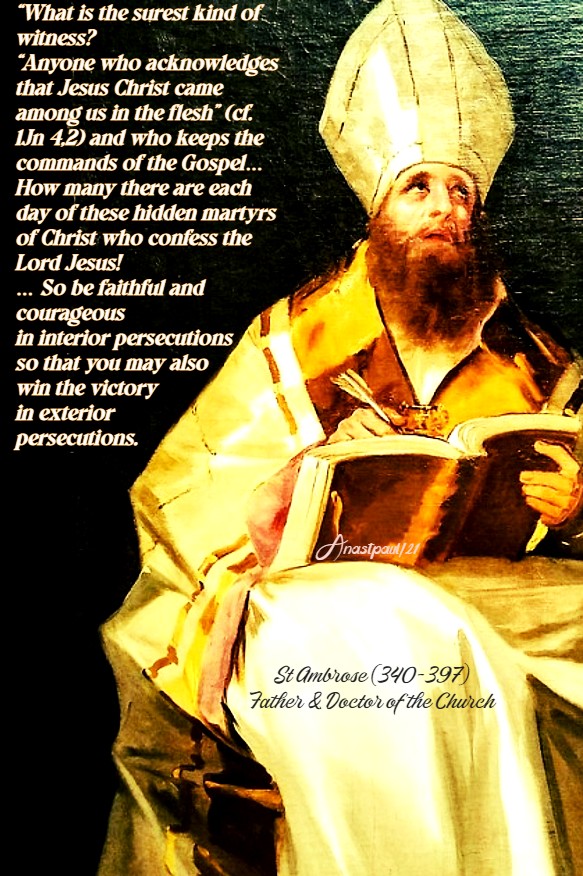
“What is the surest kind of witness? “Anyone who acknowledges that Jesus Christ came among us in the flesh” (cf. 1Jn 4,2) and who keeps the commands of the Gospel… How many there are each day of these hidden martyrs of Christ who confess the Lord Jesus! … So be faithful and courageous in interior persecutions so that you may also win the victory in exterior persecutions.”
St Ambrose (340-397) Father & Doctor of the Church
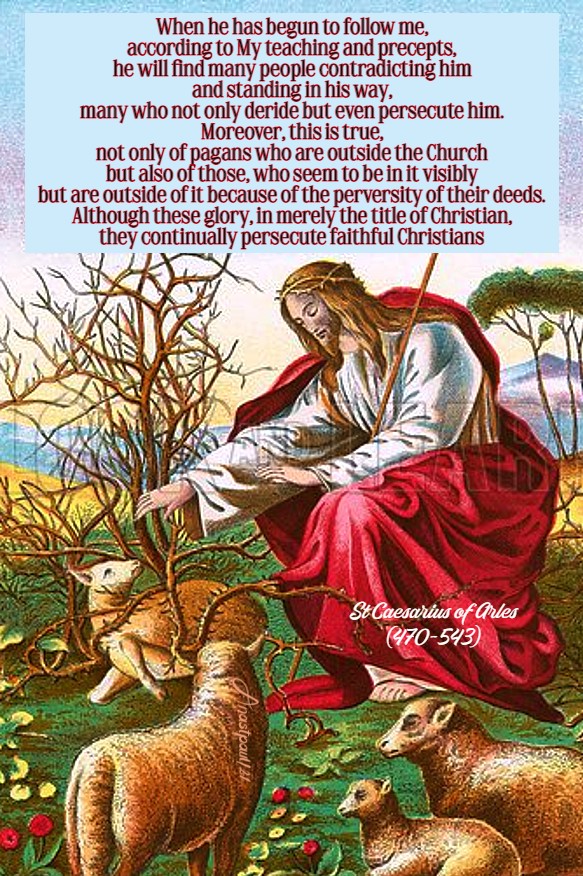
“When he has begun to follow me, according to My teaching and precepts, he will find many people contradicting him and standing in his way, many who not only deride but even persecute him. Moreover, this is true, not only of pagans who are outside the Church but also of those, who seem to be in it visibly but are outside of it because of the perversity of their deeds. Although these glory, in merely the title of Christian, they continually persecute faithful Christians.”
One Minute Reflection – 9 July – “Month of the Precious Blood” – Readings: Genesis 46: 1-7, 28-30; Psalms 37: 3-4, 18-19, 27-28, 39-40; Matthew 10: 16-23
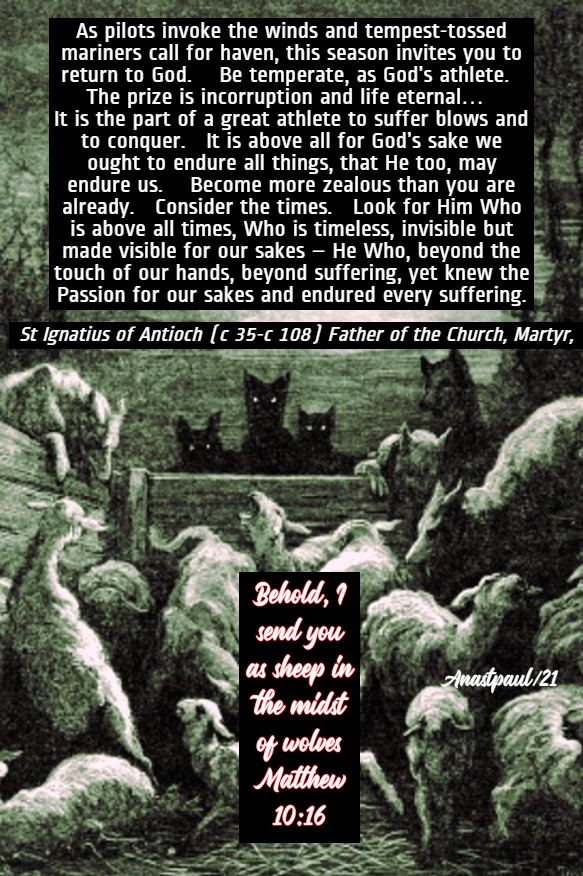
“Behold, I send you as sheep in the midst of wolves. Be, therefore, wise as serpents and simple as doves.” –Matthew 10:16
REFLECTION – “I urge you, by the grace in which you are clothed, to press on in your race and urge everyone to be saved. Assert your office with all the diligence of flesh and spirit. Give your attention to unity, for there is nothing better. carry your brethren as the Lord also carries you. Patiently, bear with them all in love, as indeed you do bear with them. Devote yourself to unceasing prayer. Ask for greater understanding than you have. Be watchful, possessing a wakeful spirit. Speak to each one individually, concerning God’s way. “Bear the infirmities” (cf Mt 8,17) of each as a perfect athlete. Where there is more toil, there is greater gain. If you only love the good disciples, this wins you no advantage. Rather, subdue by meekness the more annoying. Not every wound is cured by the same salve. Ease sharp pains with a hot compress. In everything “be wise as serpents” and always “harmless as doves”. You who are of flesh and spirit, humour those things visibly present before you but pray, too, that what is invisible may be manifested to you, so that you may lack nothing and may abound in every spiritual gift.
As pilots invoke the winds and tempest-tossed mariners call for haven, this season invites you to return to God. Be temperate, as God’s athlete. The prize is incorruption and life eternal… It is the part of a great athlete to suffer blows and to conquer. It is above all for God’s sake we ought to endure all things, that He too, may endure us. Become more zealous than you are already. Consider the times. Look for Him Who is above all times, Who is timeless, invisible but made visible for our sakes – He Who, beyond the touch of our hands, beyond suffering, yet knew the Passion for our sakes and endured every suffering.” – St Ignatius of Antioch (c 35-c 108) Father of the Church, Martyr, Bishop – Letter to St Polycarp (69-155) Bishop and Martyr), 1-3 ; SC 10
PRAYER – Father of all holiness, guide our hearts to You. Keep in the light of Your truth, all those You have freed from the darkness of unbelief. May our lives be the source of enlightenment to others and our faith and love every remain strengthened by Your grace. Listen to the prayers of our Blessed Mother on our behalf, as we long for our eternal home. We ask this through our Lord Jesus Christ, Your Son, who lives and reigns with You and the Holy Spirit, one God, forever and ever. Amen
Our Morning Offering – 9 July – “Month of the Most Precious Blood”
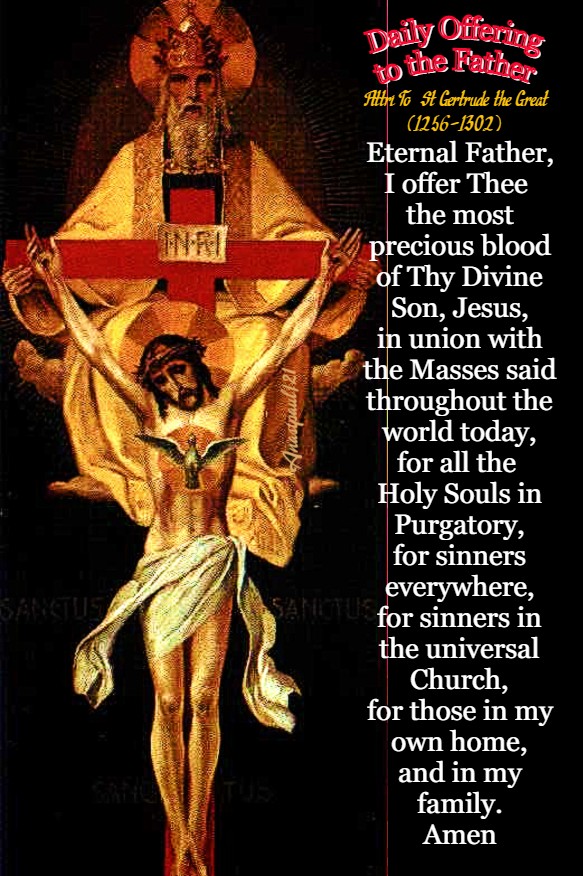
Daily Offering to the Father Attri To St Gertrude the Great (1256-1302)
Eternal Father, I offer Thee the most precious blood of Thy Divine Son, Jesus, in union with the Masses said throughout the world today, for all the Holy Souls in Purgatory, for sinners everywhere, for sinners in the universal Church, for those in my own home, and in my family. Amen
You might see fantastic claims for this prayer, especially printed on Holy Cards, such as the release of 1000 souls from Purgatory, each time it is prayed. Nowhere in St Gertrude’s writings, is this wild promise made so be careful of treating prayers and devotions as amulets or magical charms. And further, this prayer is claimed to have been written by heer but this is very uncertain. The Church has summarily condemned prayer cards containing a promise to release one or more souls from Purgatory, or any other ‘miraculous’ claims. Such an easy way to release 1,000 souls seems inconsistent with the Church’s understanding of Purgatory, given that ordinarily, to release one soul, requires a plenary indulgence which is very difficult to get and, given all the means the Church employs to help the dead, such as special masses or indulgences applicable only to the dead.
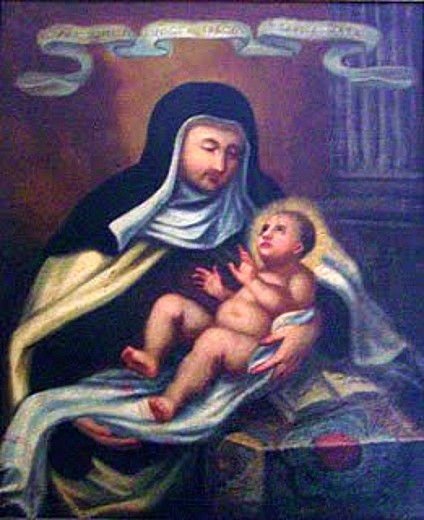
Saint of the Day – 9 July – Blessed Giovanna Scopelli O.Carm (1428 – 1491) Virgin, Mystic, Italian Religious of the Carmelites and established her own Convent as its first Prioress. She was known, during her lifetime as a miracle-worker with many coming to her to ask for her assistance and prayers. Born in 1428 at Reggio d’ Emilia, Italy and died in 1491 of natural causes, aged 63. Also known as – Jane Scopelli, Joan Scopelli, Giovanna of of Reggio Her body is incorrupt.
Giovanna Scopelli was born in 1428 in Reggio Emilia to Simone and Caterina Scopelli. From her childhood she felt a strong attraction to the religious life though her parents disapproved of this vocation and forbade her to pursue it. Scopelli submitted to this and so led her austere and pious life at home until the death of her parents around 1480, when she then decided to form the Carmelite Convent of Santa Maria del Popolo while in the process of her Novitiate.
Giovanna took on the task of looking for a suitable place, when a widow offered herself, two daughters and her home. They lived together from 1480 until 1484, meanwhile Giovanna was looking for a place twhich could serve as a Monastery. Giovanna set her eyes on the Church of St Bernard, which belonged to the Humiliati Friars. With the support of the Bishop, Philip Zoboli, she obtained it from the Friars’ General on his way through Reggio. The beginnings of the new Monastery dates from 1485, with the name changed from that of St Bernard to that of St Mary of the People (afterwards called of the White Sisters). The inevitable financial difficulties at the beginning were surmounted through the help of a certain Christopher Zoboli. Under Joan’s direction more than twenty religious made up the new community, which was entrusted to the care of the Mantuan Congregation of Carmelites and, for which, in 1487, the Carmelites provided a Confessor.
She refused all endowments and gifts – and urged her fellow religious to do the same thing – unless such gifts were given as alms with no conditions attached to them. In 1487 a Priest was assigned to them as their Confessor. The nuns became known as “The White Nuns.”
God gifted Giovanna with extraordinary charisms. She herself fostered a deep Marian piety (she venerated the Blessed Virgin with a special devotion of her own, called the Tunic of Our Lady – mainly a frequent repetition of Hail Marys and was animated by an intense spirit of penance.
She died on 9 July1491;. Her cult began the following year, with the exhumation of her incorrupt body. In 1500 a public judgement was passed on her life, her virtues and her miracles. During the years 1767-70 the Diocesan process for the recognition of the cult was held, which met with the approval of Pope Clement XIV on 24 August 1771. After the suppression of the Monastery by the secular powers and of the Church of the Carmelite nuns in 1797, the body of the Blessed was transferred to the Cathedral in the year 1803.
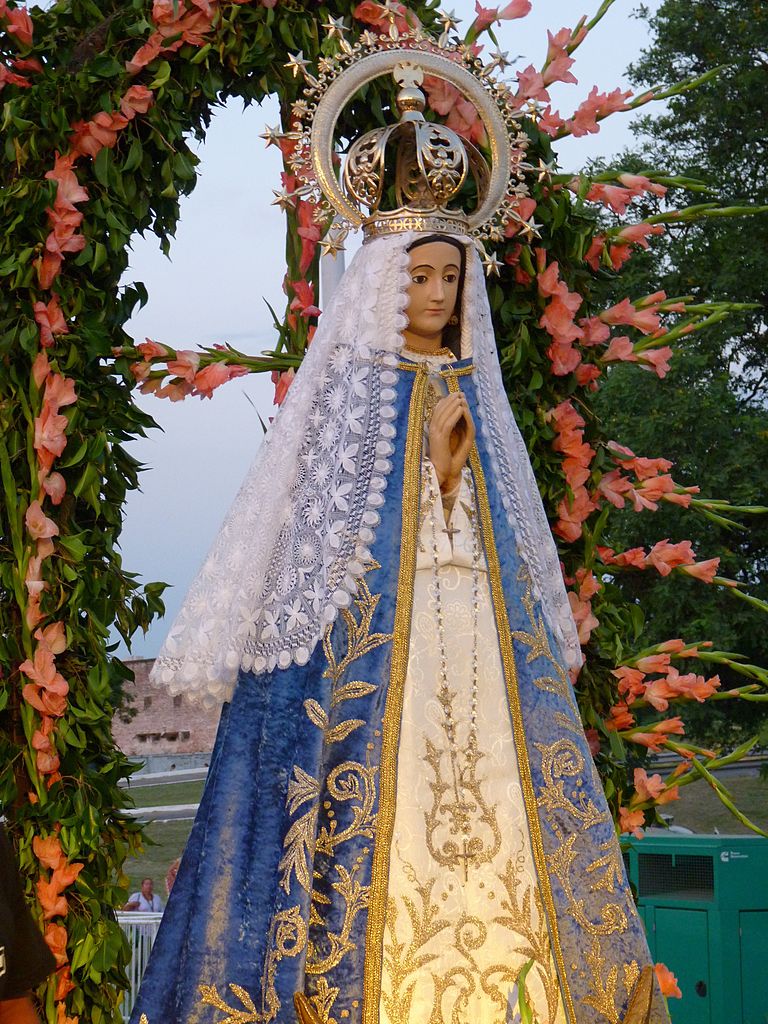
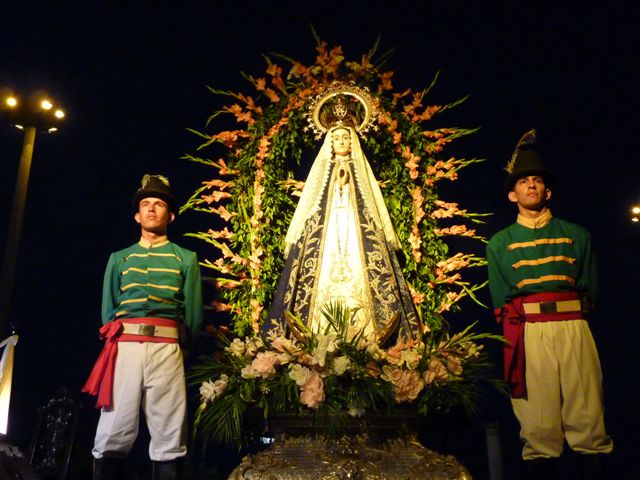
Virgen de Itatí / Our Lady of Itati (17th Century) – 9 July:
Our Lady of Itatí is a celebrated wooden representation of Virgin Mary in the City of Itatí, Corrientes Province, Argentina.
According to legend, it saved the life of 17th Century Jesuit missionary Friar Luis de Bolaños. In 1950 a Basilica was built with one of the tallest domes in South America.
The Virgin of Itatí is venerated in the City of Itatí , Province of Corrientes , Argentina . The devotion dates to a Jesuit historical legend, according to which, the recitation of the Rosary saved the missionary Spanish Jesuit Luis de Bolaños and natives he had converted, from an attack by natives who fought with the the conquerors. The legend relates how the Yaguar river opened, creating a passage and the rebels retreated and dispersed, leaving the people of Itatí safe, thanks to the intervention of the Virgin.
Today the Blessed Virgin of Itati is the Patron of the Province of Corrientes and enjoys great popular devotion. The Basilica of Itatí has become the major Pilgrimage centre of the Country.
St Augustine Zhao Rong, Priest and Martyr (Died + 1815) and his 119 companions or Martyrs of China (Died 1648–1930, Qing dynasty and Republic of China) (Optional Memorial): 25 priests, friars, nuns, seminarians and lay people. The 87 Chinese Catholics and 33 Western missionaries, from the mid-17th century to 1930, were martyred because of their ministry and, in some cases, for their refusal to apostatise. Many died in the Boxer Rebellion, in which xenophobic peasants slaughtered 30,000 Chinese converts to Christianity along with missionaries and other foreigners. Canonised on 1 October 2000 by Pope John Paul II in Rome. Full story here: https://anastpaul.com/2019/07/09/saints-of-the-day-st-augustine-zhao-rong-and-companions-or-martyrs-of-china/
Blessed Adrian Fortescue TOSD (1476-1539) Martyr,. A husband and father, a Justice of the Peace, a Knight of the Realm, a Knight of Malta and a Dominican Tertiary (Lay Dominican), he was at once a loyal servant of the Crown so far as he could be but still more, he was a man of unshakeable faith. About Blessed Adrian: https://anastpaul.com/2018/07/09/saint-of-the-day-blessed-adrian-fortescue-1476-1539-martyr/
St Agrippinus of Autun St Alexander of Egypt St Audax of Thora St Brictius of Martola St Copra of Egypt St Cyril of Gortyna Bl Dionysius the Rhetorician St Everild of Everingham St Faustina of Rome St Felician of Sicily Bl Fidelis Chojnacki Blessed Giovanna Scopelli O.Carm (1428 – 1491) Virgin, Religious of the Carmelites. Incorrupt. St Floriana of Rome St Hérombert of Minden St Joachim Ho Bl Luigi Caburlotto Bl Marguerite-Marie-Anne de Rocher Bl Marie-Anne-Madeleine de Guilhermier
Four Holy Polish Brothers – 4 saints: Four brothers who became hermits, Benedictine monks and saints – Andrew, Barnabas, Benedict and Justus. They were born in Poland and died in 1008 of natural causes.
Martyrs of Gorkum – 19 saints: Nineteen martyrs killed by Calvinists for loyalty to the Pope and for their belief in the Real Presence in the Eucharist. They are – • Adrianus van Hilvarenbeek • Andreas Wouters • Antonius van Hoornaar • Antonius van Weert • Cornelius van Wijk • Francisus de Roye • Godfried van Duynen • Godfried van Melveren • Hieronymus van Weert • Jacobus Lacops • Joannes Lenaerts • John of Cologne • Leonardus van Veghel • Nicasius Janssen van Heeze • Nicolaas Pieck • Nicolaas Poppel • Petrus van Assche • Theodorus van der Eem • Willehad van Deem • They werehanged on 9 July 1572 in Brielle, Zuid-Holland, Netherlands. Beatified on 24 November 1675 by Pope Clement X and Canonised on 29 June 1867 by Pope Pius IX.
Martyrs of Orange – 32 beati: 32 nuns from several orders who spent up to 18 months in prison and were finally executed for refusing to renounce Christianity during the persecutions of the French Revolution. • Anne Cartier • Anne-Andrée Minutte • Dorothée-Madeleine-Julie de Justamond • élisabeth Verchière • élisabeth-Thérèse de Consolin • Jeanne-Marie de Romillon • Madeleine-Françoise de Justamond • Madeleine-Thérèse Talieu • Marguerite-Eléonore de Justamond • Marguerite-Marie-Anne de Rocher • Marguerite-Rose de Gordon • Marguerite-Thérèse Charensol • Marie Cluse • Marie-Anastasie de Roquard • Marie-Anne Béguin-Royal • Marie-Anne Depeyre • Marie-Anne Doux • Marie-Anne Lambert • Marie-Anne-Madeleine de Guilhermier • Marie-Claire du Bac • Marie-Clotilde Blanc • Marie-Elisabeth Pélissier • Marie-Gabrielle-Françoise-Suzanne de Gaillard de Lavaldène • Marie-Gertrude de Ripert d’Alauzier • Marie-Marguerite Bonnet • Marie-Marguerite de Barbégie d’Albrède • Marie-Rose Laye • Rosalie-Clotilde Bes • Suzanne-Agathe Deloye • Sylvie-Agnès de Romillon • Thérèse-Henriette Faurie They were guillotined between 6 July and 26 July 1794 at Orange, Vaucluse, France. Beatified on 10 May 1925 by Pope Pius XI.
Martyrs of the Baths – 10,204 saints: A group of Christians enslaved by Diocletian to build the gigantic baths in imperial Rome, Italy. The end of their labours coincided with the beginning of the great persecutions of Diocletian and they were all executed. Ancient records indicated there were 10,204 of them; Zeno of Rome is the only one whose name has come down to us and we know nothing else about any of their individual lives.
Thought for the Day – 8 July – Meditations with Antonio Cardinal Bacci (1881-1971)
Living the Gospel
“The Gospel teaches perfection. It teaches the perfection of the interior life, as well as the exterior life, of private, as well as of domestic and social life. There is no problem in the universe, which has not been solved in the Gospel. In regard to the spiritual life, its command is clear. “You are to be perfect, even as your heavenly Father is perfect” (Mt 5:48). “Thou shalt love the Lord thy God with thy whole heart and with thy whole soul and with they whole mind … Thou shalt love thy neighbour as thyself” (Mt 22:37, Mk 12:30, Lk 10:27). “This is my commandment, that you love one another, as I have loved you” (Jn 15:12). “If anyone wishes to come after me, let him deny himself and take up his cross daily and follow me” (Lk 9:23). “Blessed are the poor in spirit … the clean of heart … the peacemakers …” (Mt 5:3-10). “If thou wilt be perfect, go, sell what thou hast and give to the poor and thou shall have treasure in heaven” (Mt 19:21). “Our Father who art in heaven … thy will be done on earth as it is in heaven” (Mt 6:10). “Father … not my will but thine be done” (Lk 22:42). Anyone who identifies himself with these maxims, rises above the level of a man, to that of an angel. His interior life soars to such a peak, that he seems to be leading a heavenly, rather than an earthly existence. If he is living the Gospel, moreover, his external behaviour will be a faithful mirror of his interior life, for it is not enough to say “Lord, Lord” but a man must also do the will of the Father (Cf Mt 7:21). A man’s domestic and social life, will follow the pattern of his private life.
When he has reached the summit of perfection, an invisible force will emanate from him, the force of good example. This force will transform everything, within him and around him. Like Mary and the Saints, he will become the loyal and powerful co-worker of Christ in the redemption of the human race and in the Christian transformation of society. Redemption and restoration, can come only through the Gospel. Other theories are always bound up with and impeded by, human egoism. The doctrine of the Gospel is reinforced by the love of God and our neighbour. In the Gospel, public and private justice is transformed into the charity of Christ which cannot be impeded by any earthly difficulty, nor by any human barrier, not even by death. “Who shall separate us from the charity of Christ?” (Rom 8:35) asks St Paul. Let us meditate on this.”
Quote/s of the Day – 8 July – “Month of the Most Precious Blood” – Readings: Genesis 44, 18-21, 23b-29, 45: 1-5; Psalms 105: 16-17, 18-19, 20-21; Matthew 10: 7-15.
Obedience
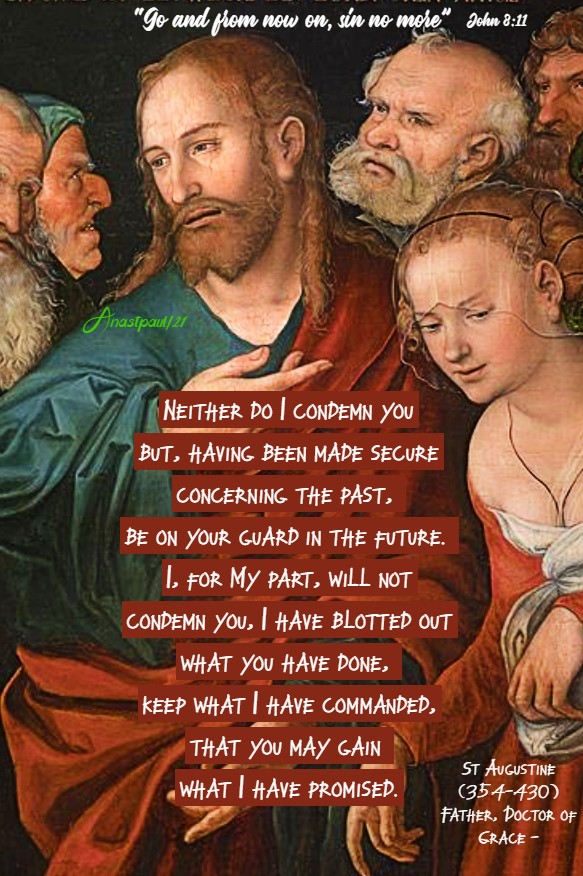
“Go and from now on, sin no more”
John 8:11
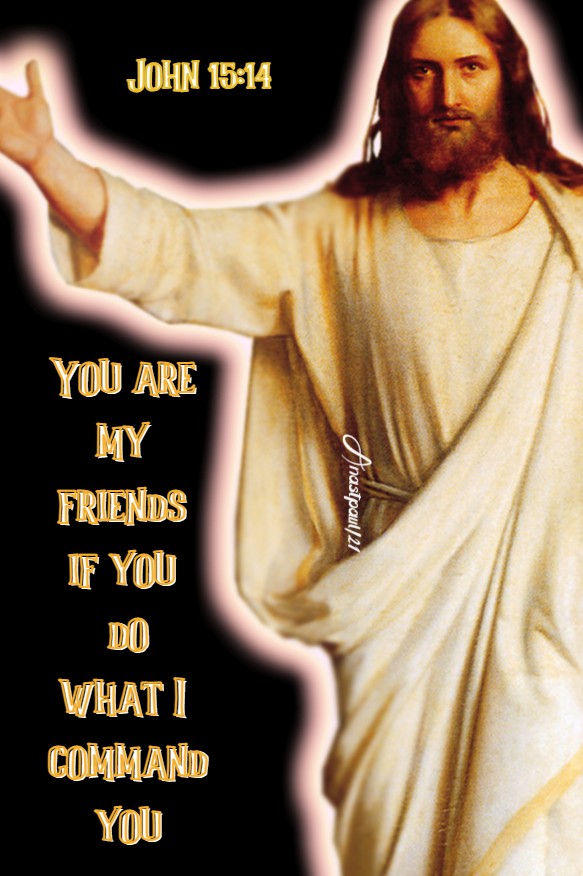
“You are my friends, if you do the things that I command you.”
John 15:14
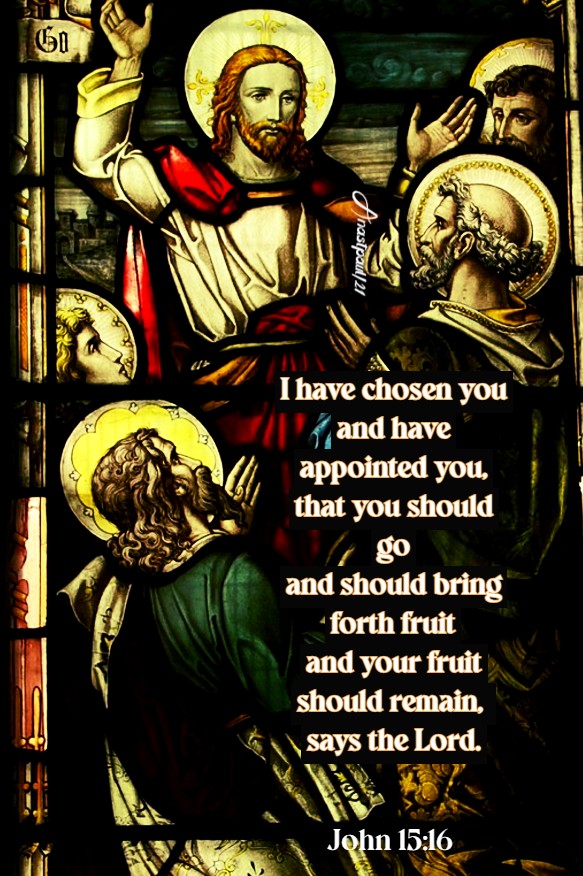
“I have chosen you and have appointed you, that you should go and should bring forth fruit and your fruit should remain, says the Lord.”
John 15:16
“Let it be understood, that those who are not found living as He taught, are NOT Christian- even though they profess with the lips, the teaching of Christ.”
St Justin Martyr (c 100-165) Father of the Church
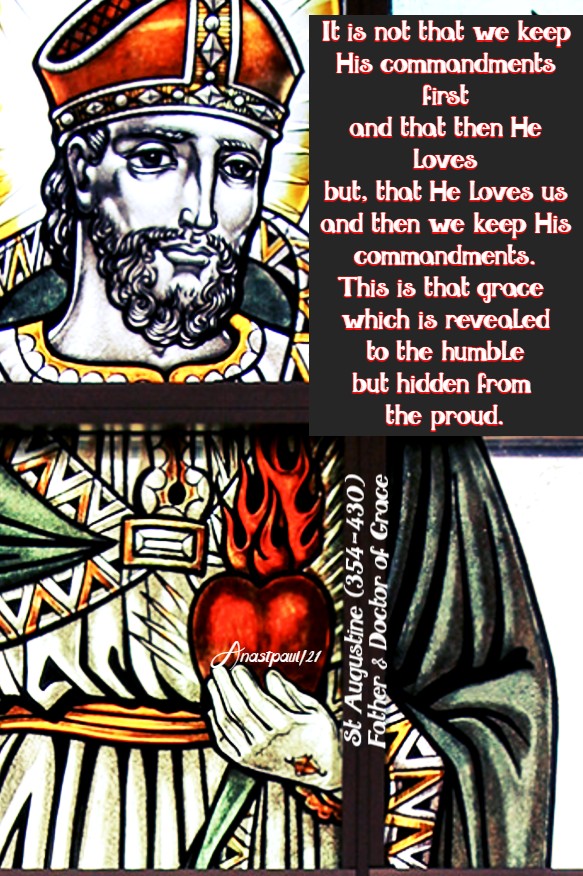
“It is not that we keep His commandments first and that then He loves but, that He loves us and then we keep His commandments. This is that grace which is revealed to the humble but hidden from the proud.”
“Neither do I condemn you but, having been made secure concerning the past, be on your guard in the future. I, for My part, will not condemn you, I have blotted out what you have done; keep what I have commanded, that you may gain what I have promised.”
One Minute Reflection – 8 July – “Month of the Most Precious Blood” – Readings: Genesis 44, 18-21, 23b-29, 45: 1-5; Psalms 105: 16-17, 18-19, 20-21; Matthew 10: 7-15.
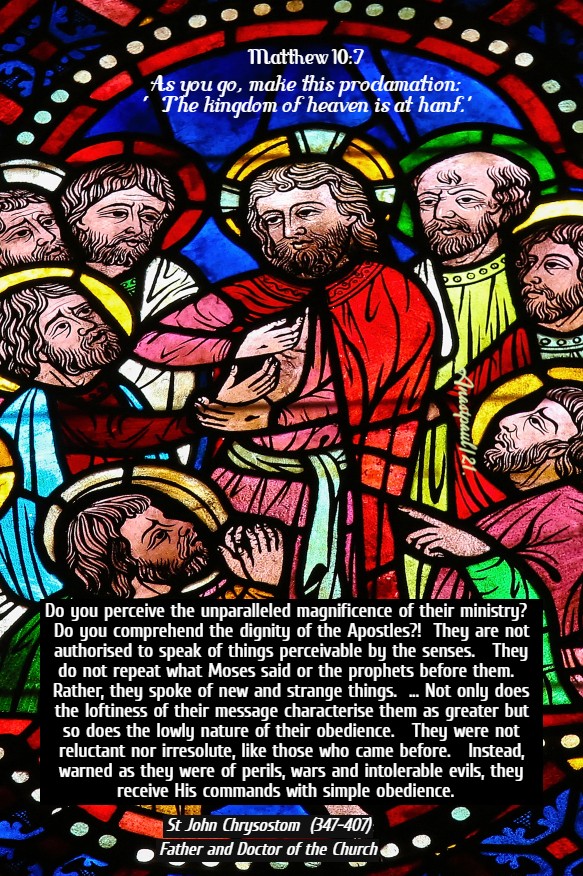
“As you go, make this proclamation: ‘The kingdom of heaven is at hand.’” – Matthew 10:7
REFLECTION – “Do you perceive the unparalleled magnificence of their ministry? Do you comprehend the dignity of the Apostles?! They are not authorised to speak of things perceivable by the senses. They do not repeat what Moses said or the prophets before them. Rather, they spoke of new and strange things. Moses and the prophets spoke of temporal promises of an earthly land. The Apostles proclaimed the Kingdom of Heaven and all that this implies.
Not only does the loftiness of their message characterise them as greater but so does the lowly nature of their obedience. They were not reluctant nor irresolute, like those who came before. Instead, warned as they were of perils, wars and intolerable evils, they receive His commands with simple obedience. They immediately became heralds of the coming Kingdom.” – St John Chrysostom (347-407) Bishop, Father, Doctor – The Gospel of Matthew: Homily, 32.
PRAYER – Holy God and Almighty Father, we are the disciples of Your Son as we follow Him home to You. As He taught His Apostles, so they have passed their learning onto us and we reach out in love and obedience for the Kingdom of Heaven. Grant us we pray, the strength and love to imitate Jesus Our Lord in all things and to daily, pick up our cross with joy and commitment. May the Blessed Virgin, be a constant protection and assistance in our times of struggle and may all your Angels and Saints and Martyrs, pray for us, through our Lord Jesus Christ, with the Holy Spirit, God for always and forever, amen.
Our Morning Offering – 8 July – “Month of the Most Precious Blood”
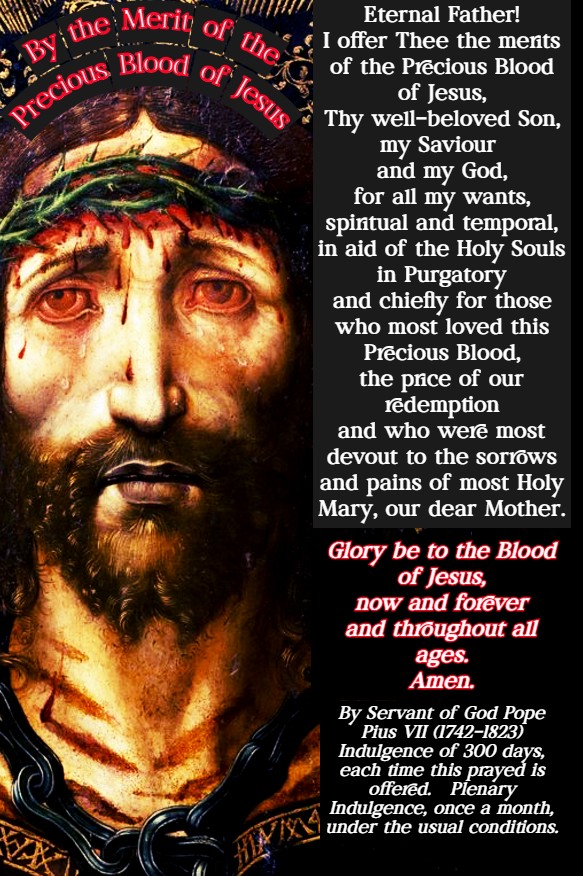
By the Merit of the Precious Blood of Jesus By Servant of God Pope Pius VII (1742-1823) Papacy from 1800 to 1823 Indulgenced Act of Oblation to Our Father
Eternal Father! I offer Thee the merit of the Precious Blood of Jesus, Thy well-beloved Son, my Saviour and my God, for all my wants, spiritual and temporal, in aid of the Holy Souls in Purgatory and chiefly for those who most loved this Precious Blood, the price of our redemption and who were most devout to the sorrows and pains of most Holy Mary, our dear Mother.
Glory be to the Blood of Jesus, now and forever and throughout all ages. Amen.
Indulgence of 300 days, each time this prayed is offered 22 September 1817 with a Plenary Indulgence, once a month, under the usual conditions.
In 2007, Pope Benedict XVI approved and granted it the Nihal Obstat – (nothing stands against), the process towards Canonising Pope Pius VII and he was granted the title Servant of God. In late 2018, the Bishop of Savona announced that the cause for Pius VII would continue following the completion of initial preparation and investigation. The Bishop named a new Postulator and a Diocesan tribunal began work into the cause. The first Postulator for the cause, was Father Giovanni Farris (2007-18) and the current Postulator since 2018, is Father Giovanni Margara.
Note of Interest: On 15 August 1811 – the Feast of the Assumption – it is recorded that the Pope celebrated Mass and was said to have entered a trance and began to levitate in a manner that drew him to the Altar. This particular episode aroused great wonder and awe among attendants, which included the French soldiers guarding him, who were awestruck at what had occurred and left records of it.
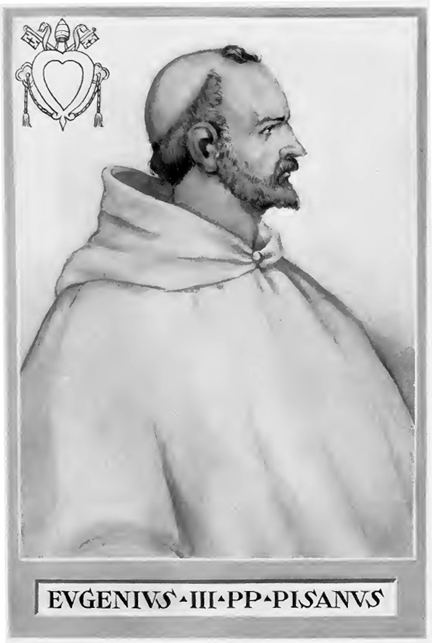
Saint of the Day – 8 July – Blessed Pope Eugene III (c 1080-1153) the first Cistercian Monk to be raised to the Chair of St Peter, Born Bernardo Pignatelli, in Montemagno, Pisa, Italy and died on 8 July 1151 at Tivoli, Italy of natural causes. In response to the fall of Edessa to the Muslims in 1144, Eugene proclaimed the Second Crusade. The Crusade however, failed to recapture Edessa. Also known as – Peter dei Paganelli di Montemagno, Bernard of Pisa, Bernardo Pignatelli.
Bernardo was born in the vicinity of Pisa. Little is known about his origins and family except that he was son of a certain Godius.[3] From the 16th century he is commonly identified as member of the family of Paganelli di Montemagno, which belonged to the Pisan aristocracy.
Between May 1134 and February 1137 he was Ordained to the Priesthood by Pope Innocent II, who resided at that time in Pisa. Under the influence of Bernard of Clairvaux he entered the Cistercian Order in the Monastery of Clairvaux in 1138. A year later he returned to Italy as leader of the Cistercian community in Scandriglia.
After he became a Cistercian he took the name of “Bernard” in honour of his friend, Saint Bernard of Clairvaux. Father Bernard was appointed Abbot of Tre Fontaine in Rome. Following the death of Pope Lucius II (+1145) the Cardinals elected Abbot Bernard to be Pope, who was not present at the conclave due to not being a Cardinal. It is reported that ALL were surprised. But he always remained a Cistercian Monk at heart.
Bernardo’s election was assisted by being a friend and pupil of Bernard of Clairvaux, the most influential ecclesiastic of the Church and a strong assertor of the pope’s temporal authority. The choice did not have the approval of Bernard, however, who remonstrated against the election, writing to the entire Curia:
“May God forgive you what you have done! … What reason or counsel, when the Supreme Pontiff was dead, made you rush upon a mere rustic, lay hands on him in his refuge, wrest from his hands the axe, pick or hoe, and lift him to a throne?”
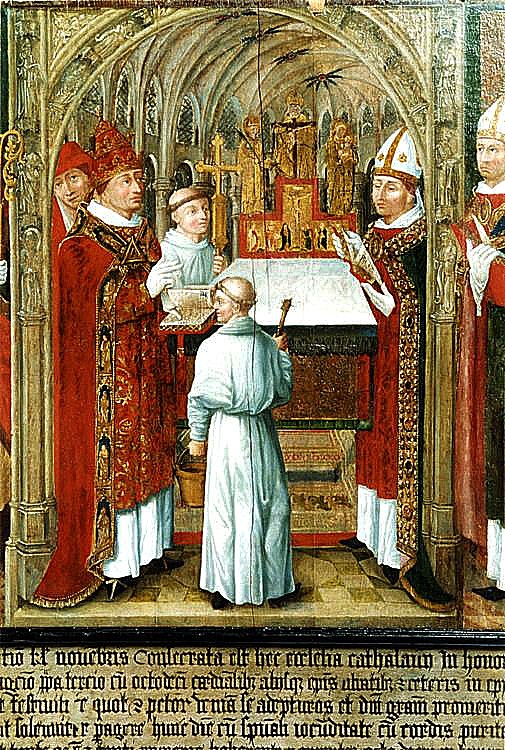
Episcopal Consecration of Blessed Eugene.
Bernard was equally forthright in his views directly to Eugene, writing:
“Thus does the finger of God raise up the poor out of the dust and lift up the beggar from the dunghill that he may sit with princes and inherit the throne of glory.”
Never a shy man and passionate teacher, Saint Bernard wrote De consideratione to instruct him, that is Eugene, in Papal duties. Despite these criticisms, Eugene seems to have borne no resentment to Bernard and notwithstanding these criticisms, after the choice was made, Bernard took advantage of the qualities in Eugene III which he objected to, so as virtually to rule in his name.
On hearing of the fall of Edessa (now the modern day city of Urfa, the first of the Crusader states established in the Levant) to the Turks, which occurred in 1144, he had, in December 1145, addressed the bull Quantum praedecessores to Louis VII of France, calling on him to take part in another Crusade. At a great diet held at Speyer in 1146, King Conrad III of Germany and many of his nobles were also incited to dedicate themselves to the Crusade by the eloquence of St Bernard of Clairvaux, preached to an enormous crowd at Vézelay. The Second Crusade turned out to be “an ignominious fiasco” and, after travelling for a year, the army abandoned their campaign after just five days of siege “having regained not one inch of Muslim territory.”
The Dominican, St Antoninus called Pope Eugene “a great Pope with great sufferings.” And, St Bernard spoke of Pope Eugene in this way: “There is no arrogance or domineering way in him.” Eugene III held synods in northern Europe at Paris, Rheims, and Trier in 1147 and 1149 that were devoted to the reform of clerical life. He also considered and approved the works of Hildegard of Bingen
Throughout most of his Papacy, Eugene had been an “absentee landlord” of Rome, due to the infighting of those who rejected his claim to temporal, as well as spiritual power over its citizens. Although the citizens of Rome resented Eugene III’s effort to assert his temporal authority, they recognised him as their spiritual lord. Until the day of his death he continued to wear the coarse habit of a Cistercian Monk under his robe. He was buried in the Vatican with every mark of respect and veneration. The people of Rome speedily recognised him as a pious figure who was meek and spiritual. His tomb acquired considerable fame due to the miracle which occurred there and his cause for sainthood commenced. Pope Pius IX Beatified him on 28 December in 1872.
With the Church we pray:
Almighty ever-living God, Who chose blessed Eugene III to preside over Your whole people and benefit them by word and example, keep safe, we pray, by his intercession, the shepherds of your Church along with the flocks entrusted to their care and direct them in the way of eternal salvation. Through our Lord Jesus Christ, Your Son in the unity ofthe Holy Ghost, one God now and forever, amen.
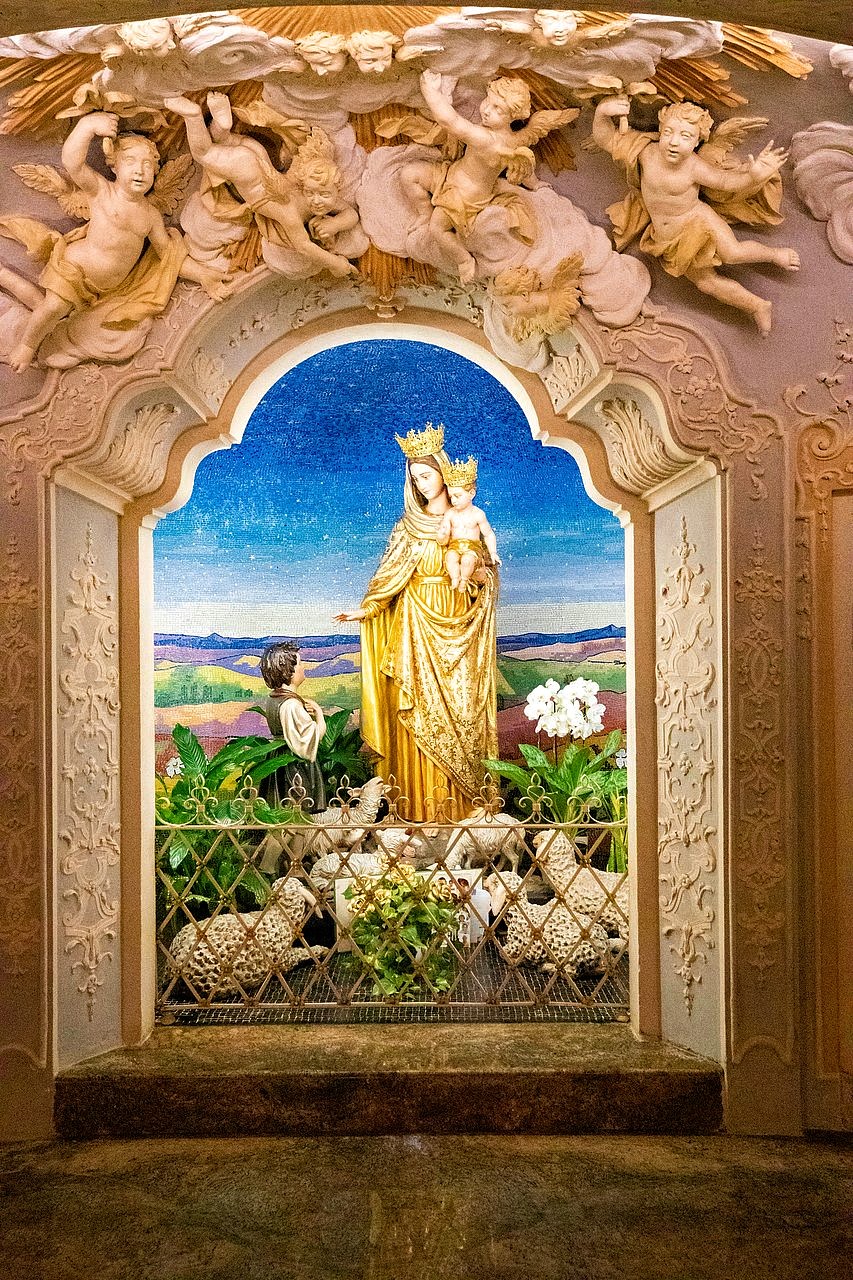
Nostra Signora della Neve, Adro, Italy/ Our Lady of the Snow, Adro, Brescia, Italy (1519) – 8 July, 5 August:
Adro is a Town in the Province of Brescia, in the Lombardy region, northern Italy. The Sanctuary emerged after the appearance of the Madonna in this place. to Battista Bajoni Comino, the deaf-mute who was visited by the Holy Mother on 8 July 1519. The Virgin appeared saying she was the Mother of God and sent a message to the people of Adro. Our Lady’s message contained a reference to a Christian life, repentance for sins and conversion and reparation and the construction of a Sanctuary in her honour. The built the Church at the place of vision, and began to amend their lives. They practised devotion on Sundays and Holy Days, stopped blaspheming the Holy Name and refrained from other evil habits, for Our Lady had also said that if they did not repent they could expect a serious penalty . Mary said – “And if they wonder how it is that you speak, tell them that you have been with the Advocate of Sinners. Everyone knows you were dumb. Now take this stone with you and show it to them as it will change colour from time to time. “
The central Feast of Our Lady of the Snows is celebrated on 5 August Immediately after the miracle, it was called “Madonna della Cava,” the place where the Virgin had appeared to the Shepherd and the feast was celebrated on 8 July the anniversary of the vision. Later, however, Church officials transferred the Feast to 5 August, the day the dedication of Santa Maria Maggiore in Rome, also known as “Santa Maria de las Nieves,” built by Pope Liberius commemorates after Miracle of snow (that happened in Rome). It was then that this temple took the name of “Our Lady of the Snows.” In pilgrimage season (April to October) groups of pilgrims arriving from neighbouring provinces, especially from Brescia, Bergamo, Como, Varese, Milan, Cremona, Mantua and Verona. Sunday is preferred by families. All opportunities for spiritual growth are offered through preaching and the Sacraments.
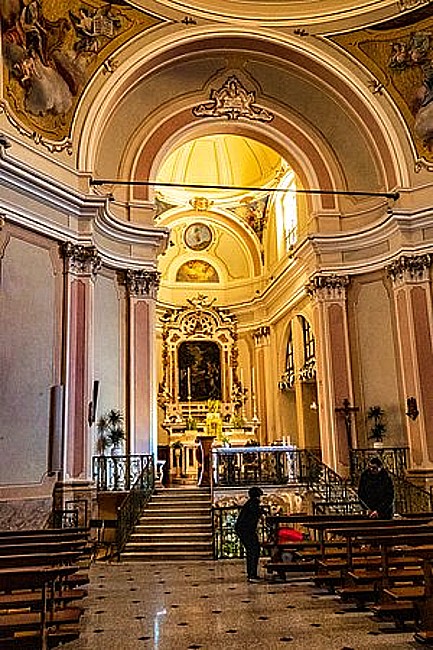
Such is the fascination of the Virgin on the pilgrims who will then return again. It is a ceremony in which you have to enter the crypt “to see the Madonna”.
The miracle of the deaf-mute who began to hear and speak gave rise to a small Shrine (1521). It remains alongside the current main Altar. It was visited by Saint Charles Borromeo in 1581 and visited by John XXIII and Paul VI being Cardinals. Being too small for the influx of pilgrims,the Church was demolished in 1750 and enlarged. It was built on a design by architect Gaspare Turbini and opened in 1776.
The Carmelites of St Teresa, built a Monastery nearby.
The current statue is gilded wood sculptor . Next to the Shrine a discreet and well-shaded park with tables and benches offers a welcome drink to pilgrims.
St Abraham the Martyr Bl Adolf IV of Schauenburg St Pope Adrian III St Ampelius of Milan St Apollonius of Benevento
St Arnold St Auspicius of Toul St Auspicius of Trier Brogan of Mothil St Colman of Thuringia St Doucelin St Edgar the Peaceful Blessed Pope Eugene III O.Cist (c 1080-1153) Papal Ascension – 15 February 1145 until his death. The 167th Pope.
St Procopius of Ceasarea St Sunniva of Bergen St Thibaud de Marly St Totnan of Thuringia — Abrahamite Monks/Martyrs of Constantinople: A group of monks in a monstery founded by Saint Abraham of Ephesus. Martyred in the iconoclast persecutions of emperor Theophilus. In c 835 in Constantinople. Martyrs of Shanxi – 7 saints: In 1898 seven sisters of the Franciscan Missionaries of Mary were sent to the Shanxi diocese in China to serve the poor in hospitals and care for the unwanted or other destitutes in orphanages. They were – • Anne-Catherine Dierks • Anne-Francoise Moreau • Clelia Nanetti • Irma Grivot • Jeanne-Marie Kuergin • Marianna Giuliani • Pauline Jeuris There they all died in one of the periodic crackdowns against foreign missionaries. They were beheaded on 9 July 1900 at Taiyuanfu, China- Beatified on 24 November 1946 by Pope Pius XII and Canonised on 1 October 2000 by Pope John Paul II. Martyrs of Syrmium – 5 saints: Five Christians martyred together for their faith. We know nothing else about them but the names – Cecilia, Eperentius, Eraclius, Sostratus and Spirus. They were martyred in the 4th century in Syrmium, Pannonia (modern Serbia).
Thought for the Day – 7 July – Meditations with Antonio Cardinal Bacci (1881-1971)
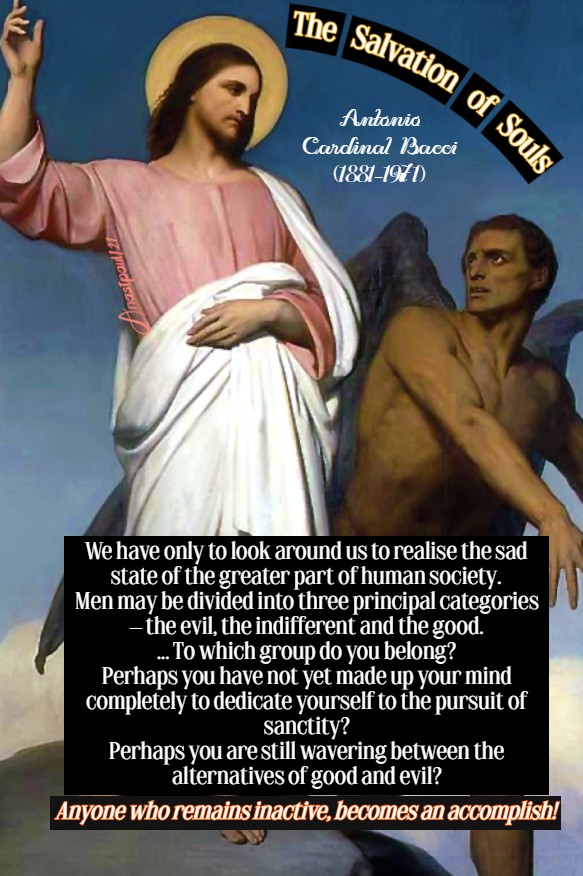
The Salvation of Souls
“We have only to look around us to realise the sad state of the greater part of human society. Men may be divided into three principal categories – the evil, the indifferent and the good. The evil are very numerous. The Holy Spirit tells us that the number of fools is infinite (Eccles 1:15). Now, the greatest and most real folly, is sin because, sin offends God, our supreme good, our Creator and Redeemer and because, it endangers the salvation of the soul. Nevertheless, countless sins are committed. There is an immense number of people who commit sin not merely through human frailty but who have abandoned God absolutely by denying or insulting Him and by striving to eradicate Him from the consciousness of their fellow-men. Their God is themselves!
The second group is that of the indifferent, those for whom God, religion and the supernatural are quite unimportant. They are content to lead materialistic lives without any thought of eternity. It is enough for them to be able to live, make money and to enjoy themselves. Nothing else matters. Their God is the world and its goods! The number of such people is increasing at an alarming rate.
Lastly, there are the good people who desire to become more and more perfect. Unfortunately, there are very few of these now and one would like to see them displaying greater generosity and enthusiasm for the salvation of those around them.
To which group do you belong? Perhaps you have not yet made up your mind completely to dedicate yourself to the pursuit of sanctity? Perhaps you are still wavering between the alternatives of good and evil? Anyone who remains inactive, becomes an accomplish!”
Quote/s of the Day – 7 July – “Month of the Most Precious Blood” – Readings: Genesis 41: 55-57; 42: 5-7a, 17-24a, Psalms 33: 2-3, 10-11, 18-19, Matthew 10: 1-7
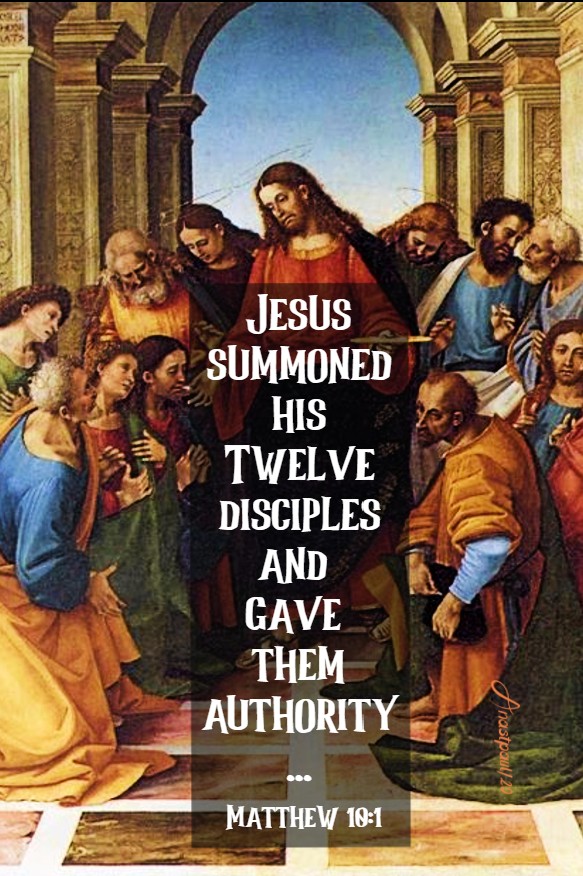
“Jesus summoned his Twelve disciples and gave them authority … “
Matthew 10:1
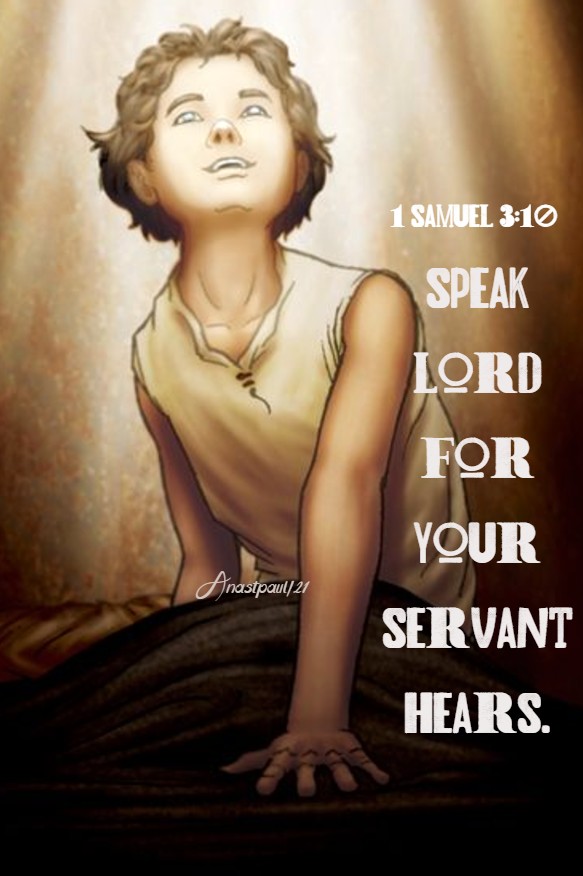
“Speak Lord for your servant hears.”
1 Samuel 3:10
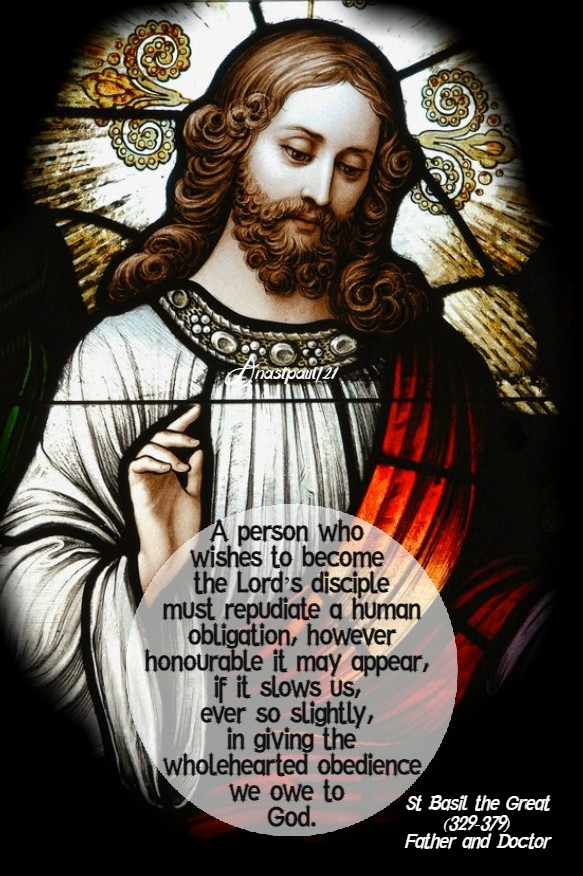
“A person who wishes to become the Lord’s disciple must repudiate a human obligation, however honourable it may appear, if it slows us, ever so slightly, in giving the wholehearted obedience we owe to God.”
St Basil the Great (329-379) Father and Doctor of the Church
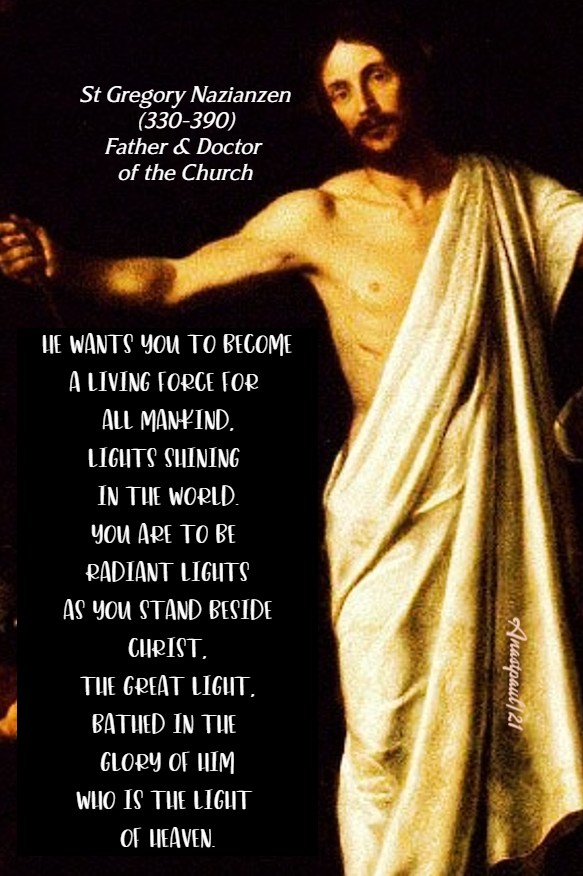
“He wants you to become a living force for all mankind, lights shining in the world. You are to be radiant lights as you stand beside Christ, the Great Light, bathed in the glory of Him who is the Light of Heaven.”
St Gregory Nazianzen (330-390) Father & Doctor of the Church
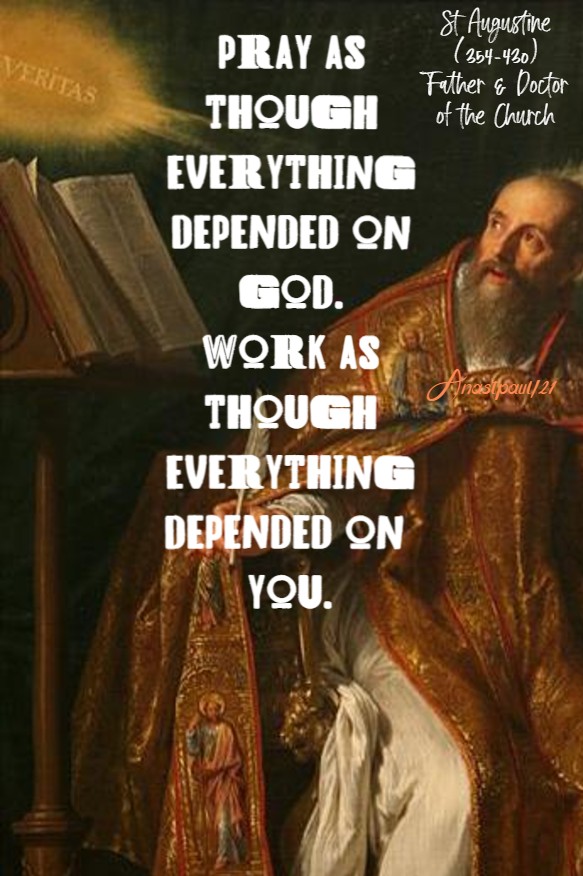
“Pray as though everything depended on God. Work as though everything depended on you.”
St Augustine (354-430) Father & Doctor of the Church
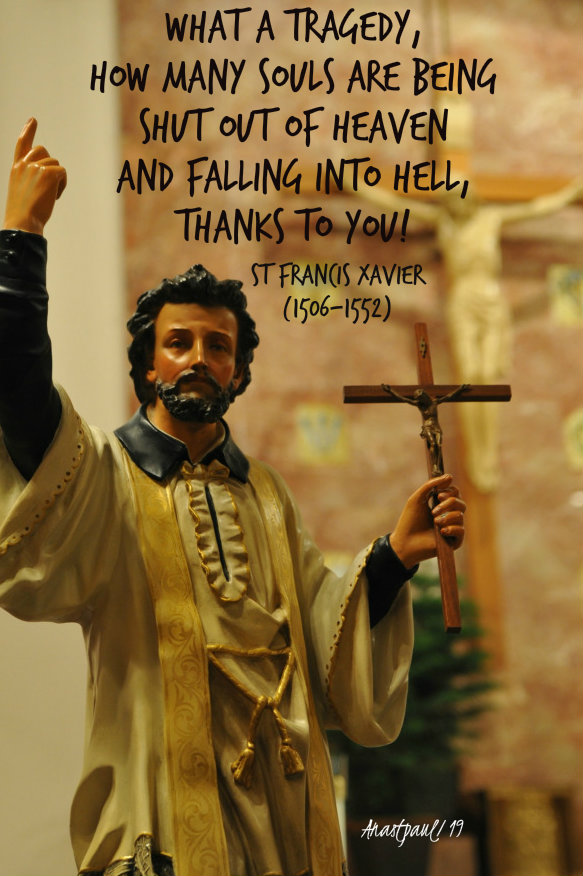
“What a tragedy, how many souls are being shut out of heaven and falling into hell, thanks to you!”
One Minute Reflection – 7 July – “Month of the Most Precious Blood” – Readings: Genesis 41: 55-57; 42: 5-7a, 17-24a, Psalms 33: 2-3, 10-11, 18-19, Matthew 10: 1-7
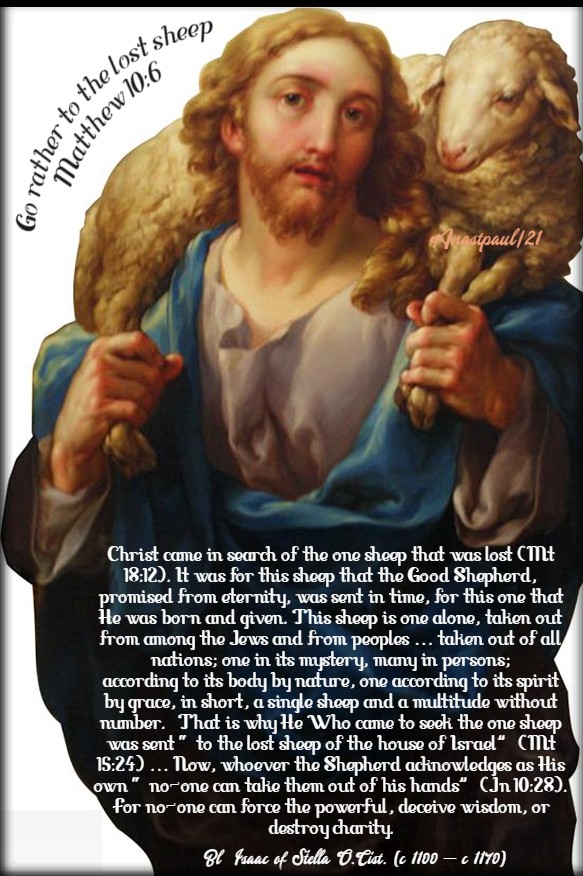
“Go rather to the lost sheep”– Matthew 10:6
REFLECTION – “Christ came in search of the one sheep that was lost (Mt 18:12). It was for this sheep that the Good Shepherd, promised from eternity, was sent in time, for this one that He was born and given. This sheep is one alone, taken out from among the Jews and from peoples … taken out of all nations; one in its mystery, many in persons; according to its body by nature, one according to its spirit by grace, in short, a single sheep and a multitude without number. That is why He Who came to seek the one sheep was sent “to the lost sheep of the house of Israel” (Mt 15:24) … Now, whoever the Shepherd acknowledges as His own “no-one can take them out of his hands” (Jn 10:28). For no-one can force the powerful, deceive wisdom, or destroy charity.
That is why He speaks with confidence when He says: “Father, I have lost none of those you have given me” (cf. Jn 17:11-12) … And so, He was sent as truth for the deceived, path for the straying, life for the dead, wisdom for the ignorant, medicine for the sick, ransom for captives and food for those dying of hunger. In the person of all these, it could be said, that He was sent to “the lost sheep of the house of Israel” that they might not be lost forever. – Blessed Isaac of Stella O.Cist. (c 1100 – c 1170) – Sermon 35
PRAYER – Holy God and Almighty Father, we are the disciples of Your Son as we follow Him home to You, grant us we pray, the strength and love to imitate Him in all things and to daily, pick up our cross with joy and commitment. May the Blessed Virgin, be a constant protection and assistance in our times of struggle and may all your Angels , the Apostles and Saints and Martyrs, pray for us, through our Lord Jesus Christ, with the Holy Spirit, God for always and forever, amen.
Our Morning Offering – 7 July – “Month of the Most Precious Blood”
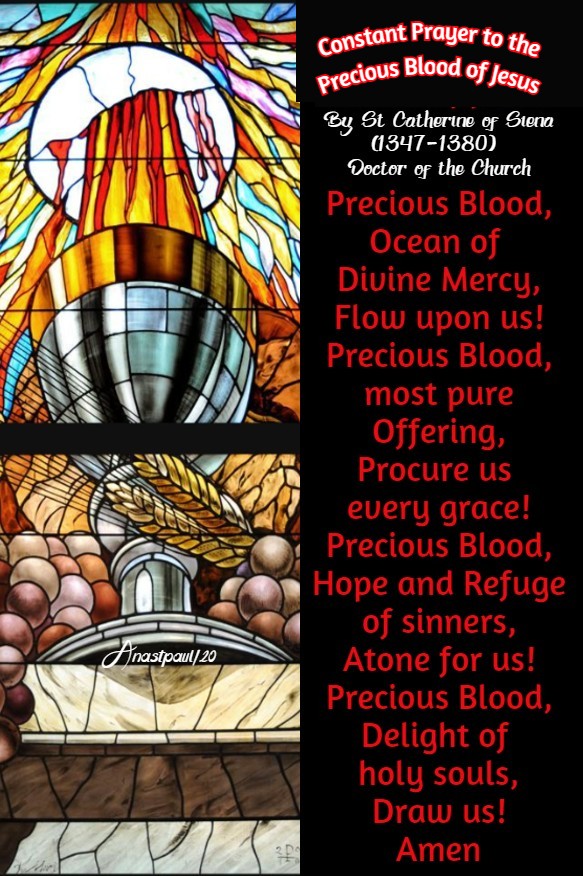
Constant Prayer to the Precious Blood of Jesus By St Catherine of Siena (1347-1380) Doctor of the Church
Precious Blood, Ocean of Divine Mercy, Flow upon us! Precious Blood, most pure Offering, Procure us every grace! Precious Blood, Hope and Refuge of sinners, Atone for us! Precious Blood, Delight of holy souls, Draw us! Amen
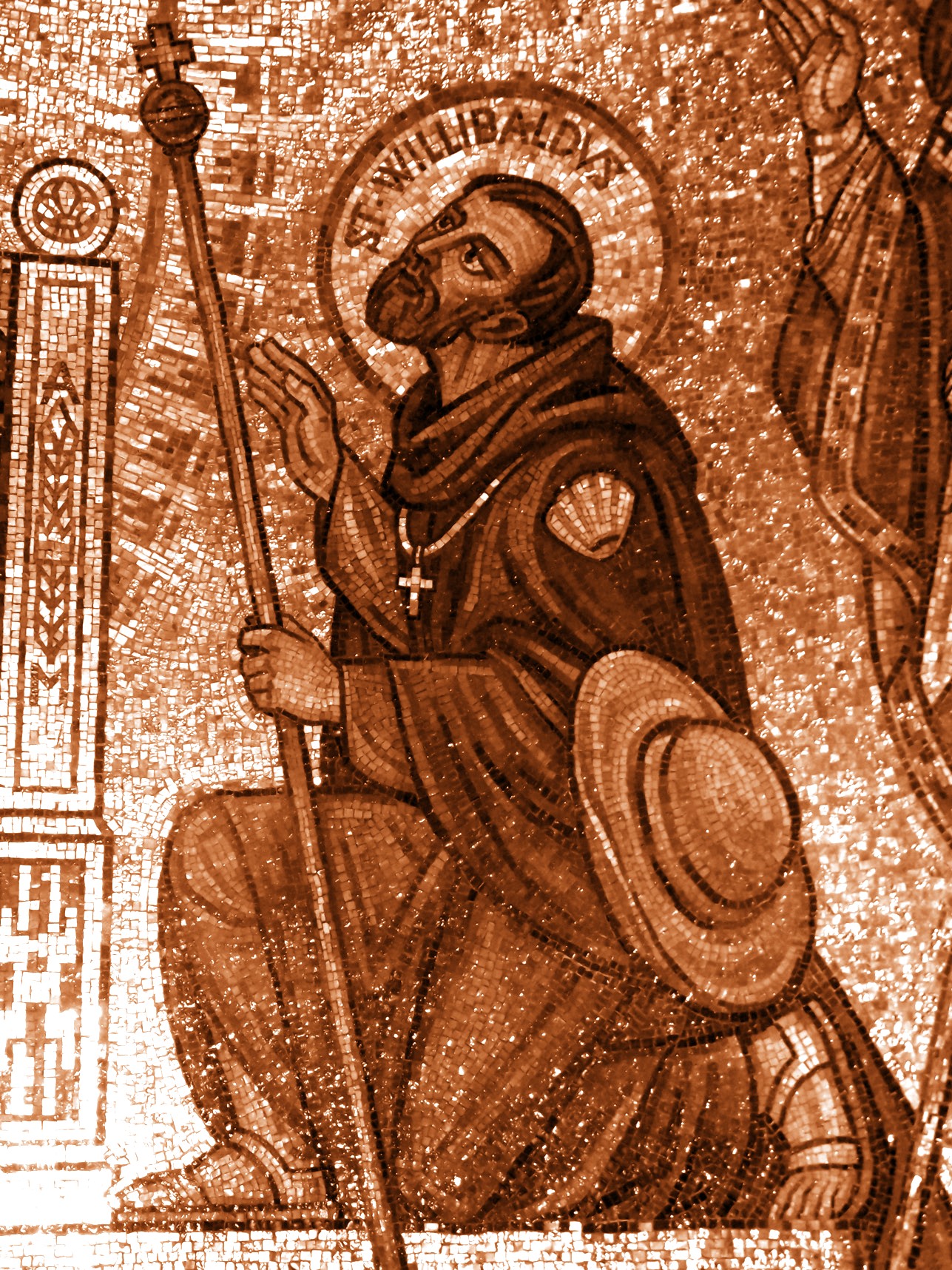
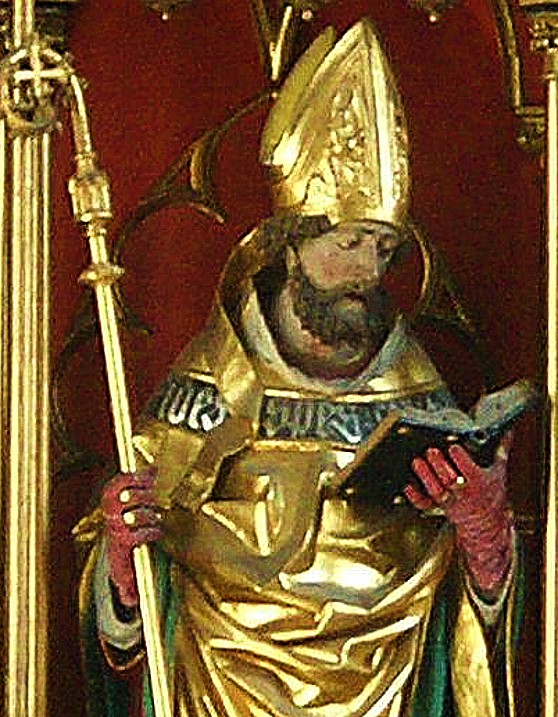
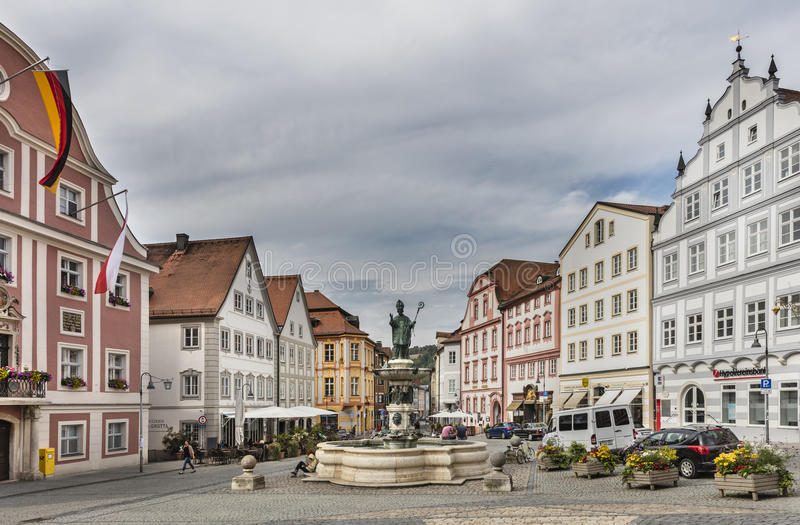
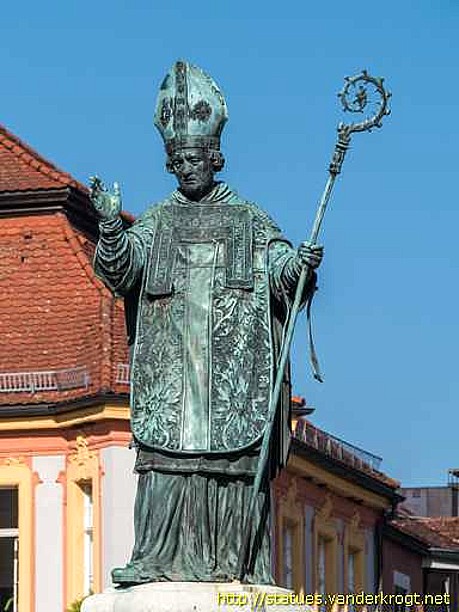
Saint of the Day – 7 July – St Willibald of Eichstatt (c.700 – 787) Bishop of Eichstätt, Prince, Missionary Born on 21 October 700 in Wessex, England and died on 7 July 781 of natural causes. Also known as Willebald. Patronages – Diocese and City of of Eichstätt, Germany.
Information about his life is largely drawn from the Hodoeporicon (itinerary) of Saint Willibald, a text written in the 8th century by Sister Huneberc, an Anglo-Saxon Nun from Heidenheim am Hahnenkamm who knew Willibald and his brother personally. The text of the Hodoeporicon was dictated to Huneberc by Willibald himself, shortly before he died.
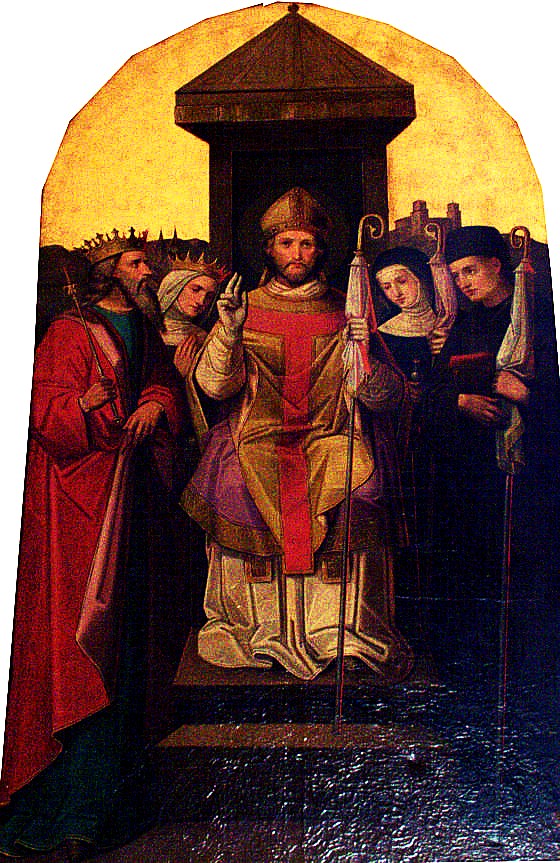
This beautiful artwork depicts St Willibald in the centre with his Father, St Richard and Mother, St Wuna on his right. His Sister St Walburga and brother, St Winibald on the his left.
At the age of three, Willibald suffered from a violent illness. His parents prayed to God, vowing to commit Willibald to a monastic life if he was to be spared. Willibald survived and at the age of five entered the Benedictine monastery at Waldheim) and was educated by Abbot Egwald.[4] At the monastery he became accustomed to the Irish and Anglo-Saxon monastic ideal of peregrinatio religiosa, or pious rootlessness
In 721 Willibald set out on a pilgrimage to Rome with his Father and Brother. After departing by ship, the group arrived in Rouen, France visiting Shrines and spending much of their time in prayer. Eventually they arrived in Lucca, a City in northern Italy. It was here that Willibald’s Father became gravely ill and died. After burying their Father, Willibald and Winibald continued on their journey, travelling through Italy until they reached Rome. Here they visited the Lateran Basilica and St. Peter’s. They spent some time in Italy, strengthening in devotion and discipline but soon the two brothers became ill with the Black Plague.
Sr Hunebrec recounts the disease and miraculous recovery:
“Then with the passing of the days and the increasing heat of the summer, which is usually a sign of future fever, they were struck down with sickness. They found it difficult to breathe, fever set in and at one moment they were shivering with cold, the next burning with heat. They had caught the black plague. So great a hold had it got on them, that, scarcely able to move, worn out with fever and almost at the point of death, the breath of life had practically left their bodies. But God in His never failing providence and fatherly love deigned to listen to their prayers and come to their aid, so that each of them rested in turn for one week whilst they attended to each other’s needs.“
Willibald left Rome in 724, heading for Naples. From there, accompanied by two unnamed companions and his Brother, he departed by sea, visited Sicily and Greece along the way, and eventually arrived in Asia Minor. Winnebald had, after the departure of his Brother for Palestine, lived in a Monastery at Rome. In Palestine, Willibald visited all the Holy places of the life of Christ.
He then visted Constantinople and finally arrived at Monte Cassino where he joined he Benedictine Monks. Willibald would spend over ten years (c 729–739) at Monte Cassino, helping Saint Petronax restore the Monastery, learning their monastic discipline and administration and acting, dyring those years as a Sacristan, a porter and a auxiallary to the Abbot, It happened that in 738 Saint Boniface, visiting Rome, asked of Pope Gregory III if Willibald might be sent to assist him in his missions in Germany. The Pope desired to see the Monk,and was much delighted with the history of his travels and acquainted him with Boniface’s request.
Upon arriving at Eichstätt, Willibald was Ordained a Priest by Boniface on 22 July 741and asked to begin missionary work in the area. A year later, Boniface summoned him to Thuringia. While travelling, Willibald encountered his brother, Winibald, whom he had not seen for over eight years.
Shortly thereafter, he returned to Eichstätt to begin his work. In 742 he and Winibald founded the double Monastery of Heidenheim. Winibald served as the first Abbot. Following his death, Willibald’s sister, Saint Walburga, was appointed the first Abbess of the Monastery. In 746 Boniface Consecrated Willibald Bishop of Eichstätt.
Eichstätt was the site of Willibald’s most successful missionary efforts, although specific details like the means of conversion and number of converts are not known. The Monastery was one of the first buildings in the region and served as an important centre, “not only for the Diocesan apostolate but also for the diffusion and development of monasticism.” Willibald served as the Bishop of the region in Franconia for over four decades, living in the Monastery and entertaining visitors, from various countries throughout Europe ,who would come to hear of his journeys and monasticism.
Willibald died on 7 July 781. His relics are kept in a marble reliquary urn in Saint Willibald Cathedral, Eichstätt, Germany, which was completed in 1269. He was Canonised in 938 by Pope Leo VII.
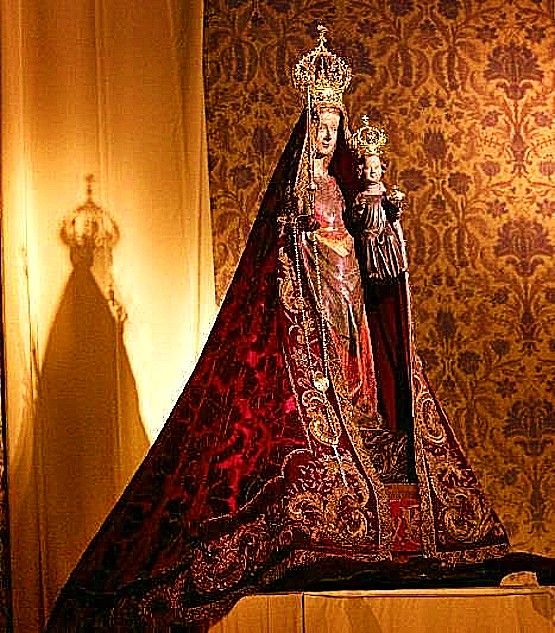
Onze Zoeten Dame van Den Bosch , Arras / Our Lady of Arras, Netherlands (1380) – 7 July:
The image known as the “Kind Mother” at Sint Hertogenbosch, or “Our Sweet Lady” of Den Bosch, as she is also known in the north Brabant Province of the Netherlands, was an object of derision when it was first heard of in 1380. It had been found dirty and damaged in a builder’s junk-yard, but it soon became celebrated for the wonders connected with it. It was in 1380, when Saint John’s Cathedral was being renovated, that the Statue was found. An apprentice stone mason, was looking for wood for his fire when he uncovered a scruffy wooden Statue in the rubble. The Statue was in such poor conditio, that he didn’t recognise it as the Mother of God. The mason in charge somehow recognised Her, even without the Infant Jesus in her arms. The Statue was placed on the Altar of Saint Martin, in the Cathedral,but the faithful did not like it and were upset that such a dilapidated Statue was exposed for veneration. It wasn’t long before one of the Priests attempted to remove the Statue but found that it had become so heavy, that he could not move it. It was soon noted, though, that any who spoke disapprovingly of the Statue became weak, fainted, or had nightmares. One woman mocked the Statue, and became partially paralysed. That night, she had a vision of Our Lord, who ordered her to repair the Statue and honour it. The next day she was able to drag herself to the Cathedral to begin the work. At the end of each day, she was able to walk a little more. It was an entire year later when a Brother Wout ,found the missing image of the Infant Jesus that berlonged to the Statue. Local children were using if for a toy but now the Statue was reunited and complete. There were still some who ridiculed the Statue but now they fainted on the spot. Many experienced strange pains, headaches,and even indigestion. On the other hand, those who prayed before the Statue received a cure of their illnesses and otherwise were greatly favoured. Due to the presence of the Statue, the Church became a place of pilgrimage. Emperor Maximilian, Holy Roman Emperor, and King Fernando of Castile were among the notables who visited the miraculous Statue. The Statue of Our Sweet Lady is of oak and is nearly four feet tall and is of an unusual pattern – Our Lady stands upright, while her forearms are extended at right angles to her body. The Child is balanced on her left hand and in her right she holds an apple. The dedication of the new Church of Our Lady of Arras occurred in the year 1484 by Bishop Peter de Ranchicourt, who was Bishop of that City. The first Church which had been built at the site had been constructed by Saint Vaast, who had been the Bishop of Arras, in the year 542, using the liberal donations of the first Kings of France. The desolation caused by the Calvinists began in 1566 and many Churches were plundered. The Kind Mother was hidden and saved from the destruction. Years later, when the City was seized by the Spanish, two Carmelites took the Statue to Bishop Ophovius, who gave it to one of the women of the parish to safeguard. Eventually it was feared that the Statue of the Kind Lady would not be safe if it stayed were it was and so, it was decided to take the Statue to Brussels for safety. The Statue had to be hidden and was placed in a chest and smuggled through the Town gates. It was then taken to St Geradus’s Church in Belgium before being taken to Koudenberg Church in Brussels. It wasn’t until the year 1810 when the Cathedral at Den Bosch was returned to the Catholics by Napoleon. Then, it took the prolonged efforts of Bishop J. Zwijsen, the Bishop of Hertogenbosh, to have the beloved Statue of Our Sweet Lady returned to his Cathedral in 1878. It was Crowned by the grateful Bishop in the name of Pope Leo XIII that same year and the Feast is 7 July with proper Mass and Office in certain places.
INTERESTING NOTE: Around 7% of the men in the Netherlands are called Maria. Yes, over 1/20 of Dutch men are named after the Virgin Mary. In 1954, a Marian Year, 17% of Dutch men where named after the Blessed Virgin. Incidentally, most of those men named Mary live in or around Den Bosch, and Mary is one of the Patron Saints of this beautiful City.
St Alexander St Angelelmus of Auxerre St Antonino Fantosati St Apollonius of Brescia
Blessed Pope Benedict XI OP (1240-1303) Cardinal-Priest of St Sabina, Bishop of Ostia then of Rome, Dominican Friar, Prior Provincial of Lombardy prior to becoming the Master of the Order in 1296, Apostolic Papal Legate to Hungary and France, Teacher, Preacher, Writer and renowned Scholar with special emphasis on Biblical commentary. His Papacy began on 22 Ocober 1303 and ended at his death on 7 July 1304. His Life: https://anastpaul.com/2020/07/07/saint-of-the-day-7-july-blessed-pope-benedict-xi-1240-1303/
Bl Bodard of Poitiers St Bonitus of Monte Cassino St Carissima of Rauzeille St Eoaldus of Vienne St Ethelburga of Faremoutier Bl Francisco Polvorinos Gómez St Hedda of Wessex Bl Joseph Juge de Saint-Martin Bl Juan Antonio Pérez Mayo Bl Juan Pedro del Cotillo Fernández Bl Justo González Lorente St Maelruan Bl Manuel Gutiérrez Martín St Marcus Ji Tianxiang Bl María del Consuelo Ramiñán Carracedo
Blessed Maria Romero Meneses FMA (1902-1977) “The Social Apostle of Costa Rica” and “The Female John Bosco” – a Salesian Religious, Apostle of Charity and Social Reform, Teacher, Catechist, establishing whole villages with work opportunities for the poor, Mystic and Apostle of the Holy Eucharist and of Mary, Mother of God. Biography: https://anastpaul.com/2018/07/07/saint-of-the-day-7-july-blessed-maria-romero-meneses-1902-1977/
Bl Marie-Gabrielle-Françoise-Suzanne de Gaillard de Lavaldène St Medran St Merryn Bl Oddino Barrotti St Odo of Urgell St Odran St Palladius of Ireland St Pantaenus of Alexandria
St Pantænus (Died c 216) Father of the Church, Theologian, Philosopher, Teacher, Confessor and Defender of the Faith, Writer and interpreter of the Bible, the Trinity and Christology, |Missionary. Convert ofthe disciples of the Apostles. Head of the Alexandrian School of Learning – a famous pupil was St Clement of Alexandria. Biography: https://anastpaul.com/2019/07/07/saint-of-the-day-7-july-st-pantaenus-father-of-the-church-died-c-216/
St Prosper of Aquitaine St Syrus of Genoa St Th St Willibald of Eichstätt (c.700 – 787) Bishop, Prince, Missionary — Martyrs of Durres – 7 saints: Also known as – Martyrs of Dyrrachium/ Martyrs of Durazzo. A group of seven Italian Christians who fled Italy to escape the persecutions of emperor Hadrian. Arrived in Dyrrachium, Macedonia to find Saint Astius tied to a cross, covered in honey, laid in the sun and left to be tortured by biting and stinging insects. When they expressed sympathy for Astius, they were accused of being Christians, arrested, chained, weighted down, taken off shore and drowned. We know little more about each of them than their names – Germaus, Hesychius, Lucian, Papius, Peregrinus, Pompeius and Saturninus. They were born in Italy and were martyred at sea c117 off the coast of Dyrrachium (Durazzo), Macedonia (modern Durres, Albania).
Thought for the Day – 6 July – “Month of the Most Precious Blood” – Meditations with Antonio Cardinal Bacci (1881-1971)
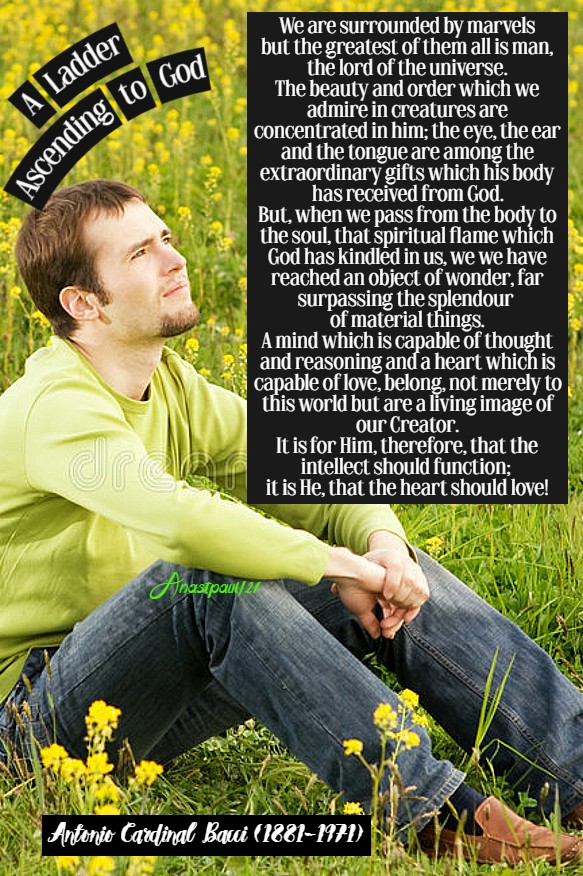
A Ladder Ascending to God
“Let us lower our eyes and observe the world around us. Here again, everything speacks to us of God, for everything is a reflection of His power and goodness. From the tiny flowers which opens its perfumed petals to the dawn and closes them again to the sunset, as if in an an act of self-effacement before its Creator, to the pines and cedars of the forest, all nature seems to send up a hymn of praise and thanksgiving to God. We are surrounded by marvels but the greatest of them all is man, the lord of the universe. The beauty and order which we admire in creatures are concentrated in him; the eye, the ear and the tongue are among the extraordinary gifts which his body has received from God.
But, when we pass from the body to the soul, that spiritual flame which God has kindled in us, we we have reached an object of wonder, far surpassing the splendour of material things. A mind which is capable of thought and reasoning and a heart which is capable of love, belong, not merely to this world but are a living image of our Creator. It is for Him, therefore, that the intellect should function; it is He, that the heart should love!”
Quote/s of the Day– 6 July – “Month of the Precious Blood” – Readings: Genesis 32: 23-33, Psalms 17: 1b, 2-3, 6-7ab, 8b and 15, Matthew 9: 32-3
We are not without a Shepherd!
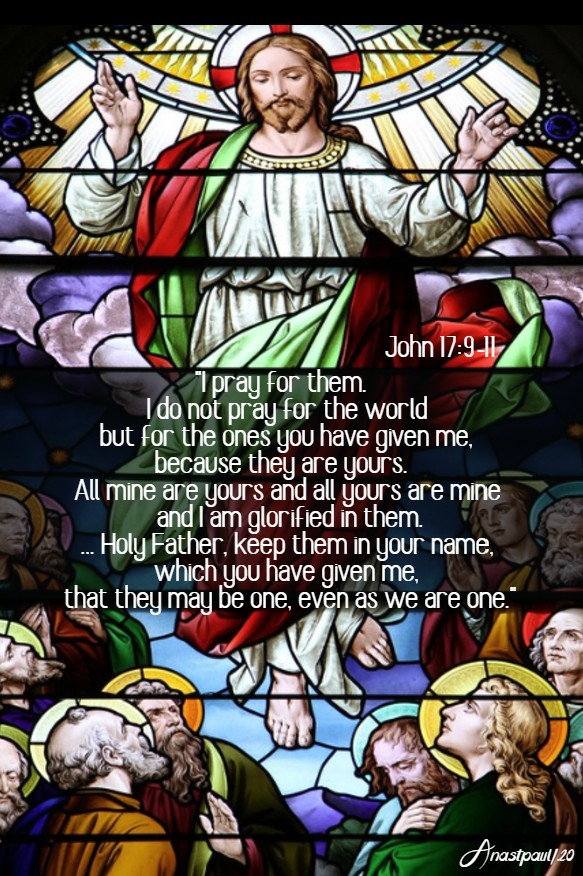
“I pray for them. I do not pray for the world but for the ones you have given me, because they are yours. All mine are yours and all yours are mine and I am glorified in them. … Holy Father, keep them in your name, which you have given me, that they may be one, even as we are one.”
John 17:9-11
“This, beloved, is the way in which we found our salvation, Jesus Christ, the High Priest who offers our gifts, the patron and helper in our weakness (Heb 10:20; 7:27; 4:15). I t is through Him, that we look straight at the heavens above. Through Him, we see mirrored, God’s faultless and transcendent countenance. Through Him, the eyes of our heart were opened. Through Him, our unintelligent and darkened mind shoots up into the light. Through Him, the Master was pleased to let us taste the knowledge that never fades,”
St Pope Clement I (c 35 – c 99)
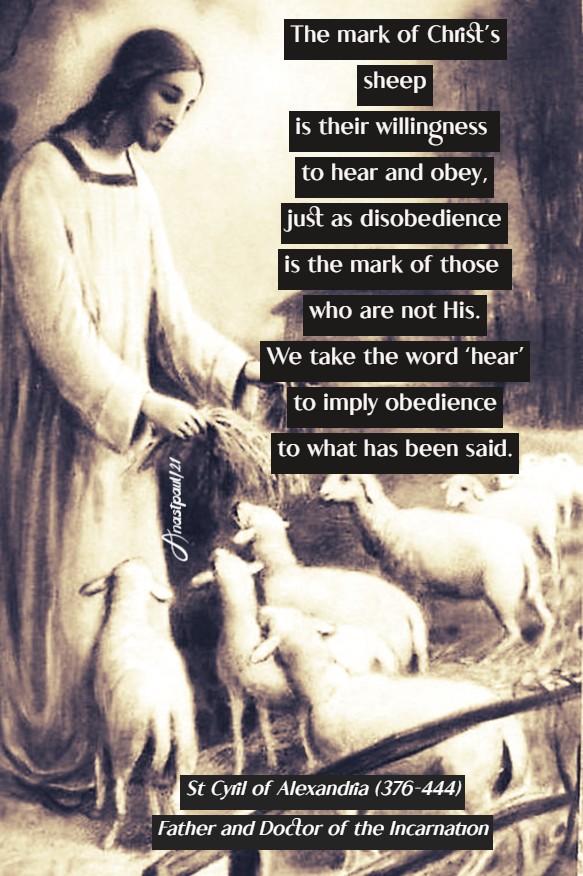
“The mark of Christ’s sheep is their willingness to hear and obey, just as disobedience is the mark of those who are not His. We take the word ‘hear’ to imply obedience to what has been said.”
St Cyril of Alexandria (376-444) Father and Doctor of the Church
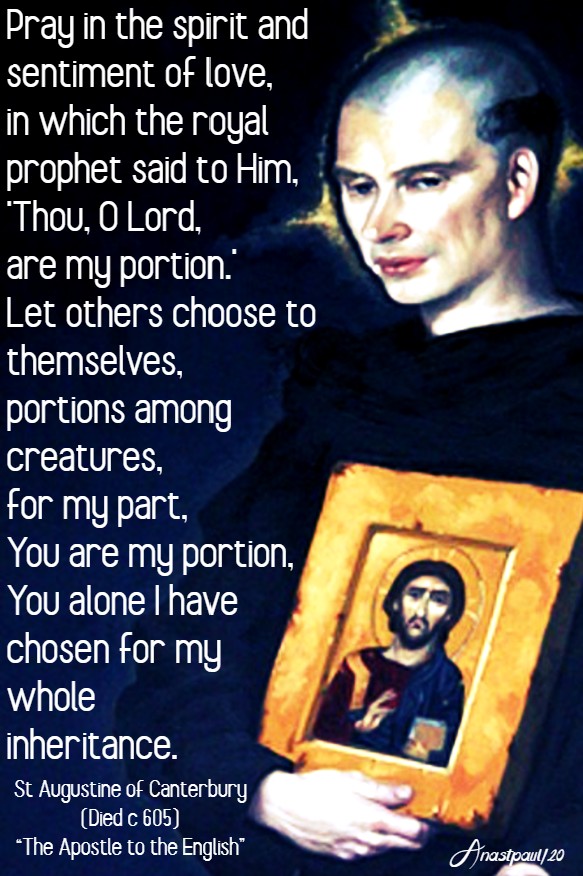
“Pray in the spirit and sentiment of love, in which the royal prophet said to Him, ‘Thou, O Lord, are my portion.’ Let others choose to themselves, portions among creatures, for my part, You are my portion, You alone I have chosen for my whole inheritance.”
St Augustine of Canterbury (Died c 605)
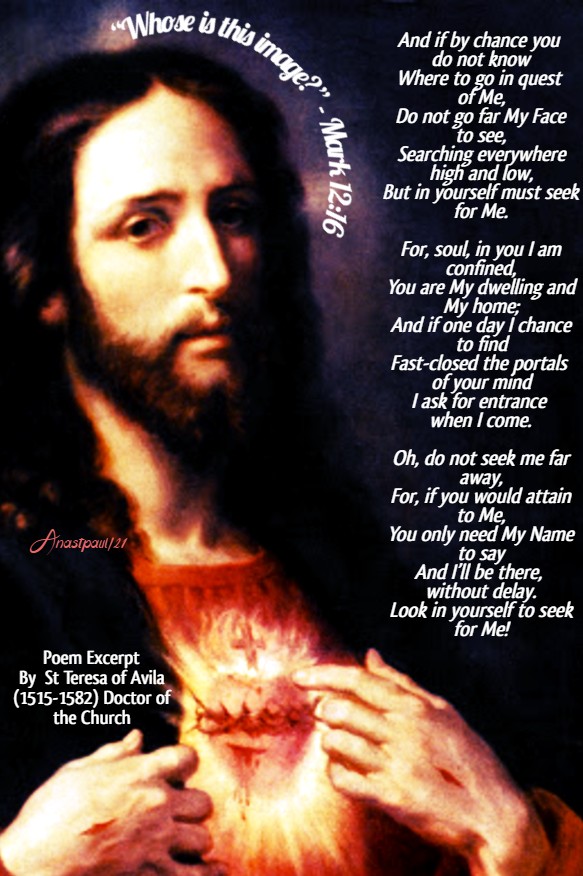
And if by chance you do not know Where to go in quest of Me, Do not go far My Face to see, Searching everywhere high and low, But in yourself must seek for Me.
For, soul, in you I am confined, You are My dwelling and My home; And if one day I chance to find Fast-closed the portals of your mind I ask for entrance when I come.
Oh, do not seek me far away, For, if you would attain to Me, You only need My Name to say And I’ll be there, without delay. Look in yourself to seek for Me!”
One Minute Reflection – 6 July – “Month of the Precious Blood” – Readings: Genesis 32: 23-33, Psalms 17: 1b, 2-3, 6-7ab, 8b and 15, Matthew 9: 32-38 and the Memorial of St Maria Goretti
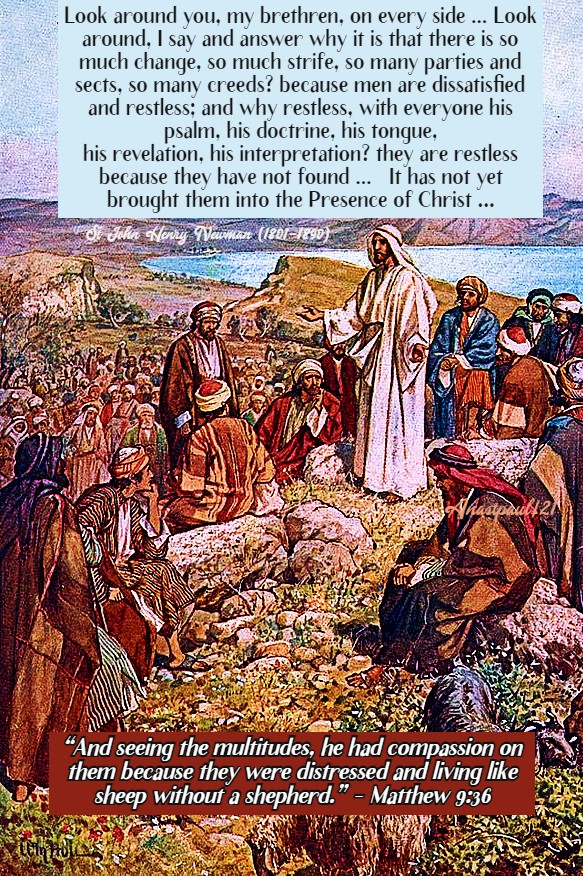
“And seeing the multitudes, he had compassion on them because they were distressed and living like sheep without a shepherd.” – Matthew 9:36
REFLECTION – “Look around you, my brethren, on every side … Look around, I say and answer why it is that there is so much change, so much strife, so many parties and sects, so many creeds? because men are dissatisfied and restless; and why restless, with everyone his psalm, his doctrine, his tongue, his revelation, his interpretation? they are restless because they have not found … It has not yet brought them into the Presence of Christ, in which “is fulness of joy” and “pleasure for evermore” (Ps 16[15]:11).
Had they been fed with the bread of life (Jn 6:35) and tasted of the honeycomb, their eyes, like Jonathan’s (1 Sam 14:27), had been enlightened, to acknowledge the Saviour of men but having no such real apprehension of things unseen, they have still to seek and are at the mercy of every rumour from without.
O sad and pitiable spectacle, when the people of Christ wander on the hills as “sheep which have no shepherd;” and instead of seeking Him in His ancient haunts and His appointed home, busy themselves in human schemes, follow strange guides, are taken captive by new opinions, become the sport of chance, or of the humour of the hour, or the victims of self-will, are full of anxiety and perplexity,and jealousy and alarm, “tossed to and fro, and carried about by every wind of doctrine, by the sleight of men, and cunning craftiness whereby they lie in wait to deceive;” (Eph 4:14) —and all because, they do not seek the “one body” and the “one Spirit,” and the “one hope of their calling,” the “one Lord, one faith, one baptism, one God and Father of all,” (Eph 4:5-6) and “find rest for their souls” (Mt 11:29)! – St John Henry Newman (1801-1890) Cardinal, Founder of the Oratory in England, Theologian, Writer, Poet, Hymnist – Sermon “Invisible Presence of Christ” Sermons on Subjects of the Day, no 21
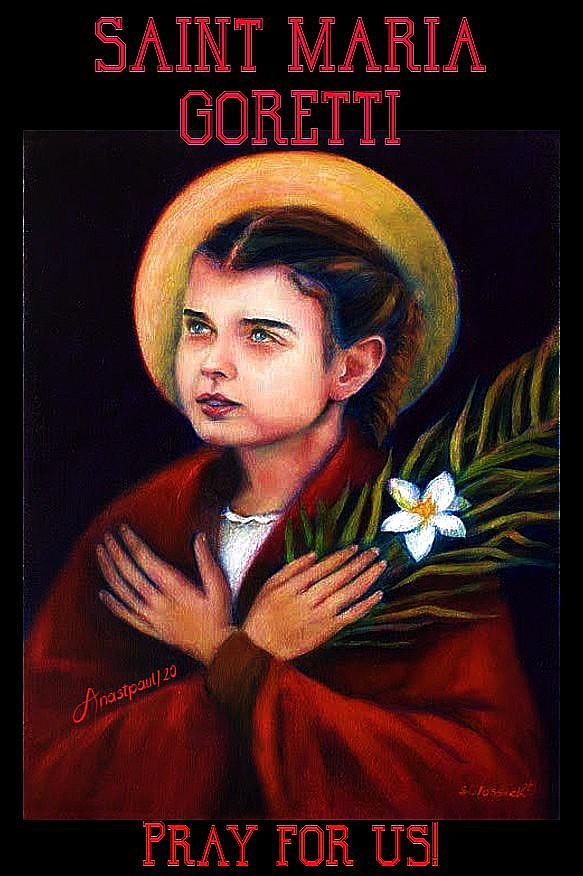
PRAYER – True Light of the world, Lord Jesus Christ, as You enlighten all men for their salvation, give us grace, we pray, to herald Your coming, by preparing Your ways of justice and of peace. We lift our hearts and eyes in prayer and beg of You that we may always offer You the souls of those in need of You. And may the prayers of Bl At Maria Goretti, strengthen us on our journey. Who live and reign with the Father and the Holy Spirit, God forever, amen.
Our Morning Offering – 6 July – “Month of the Precious Blood”
An Old Morning Prayer – Excerpt From The Blossoms of the Cross — 1894 The Sisters of St Joseph
I rise In God’s strength, In God’s power, In the Agony of Christ, In the Cross of Christ, In Christ’s Precious Blood, These will sustain me against my enemies, visible and invisible. I rise in the blessing of Christ which my dearest Jesus left to the whole world. Protect me, All-Holy Trinity, God the Father, Who created me, God, the Son, Who redeemed me in His Precious Blood, God, the Holy Ghost, Who sanctified me in Holy Baptism. God, the Father, I give myself to Thee! God, the Son, I commend myself to Thee! God, the Holy Ghost, teach me! Mary, Mother of God, assist me! All you Saints of God, pray for me! All you Holy Angels, protect me! The Cross of Christ preserve me! Amen
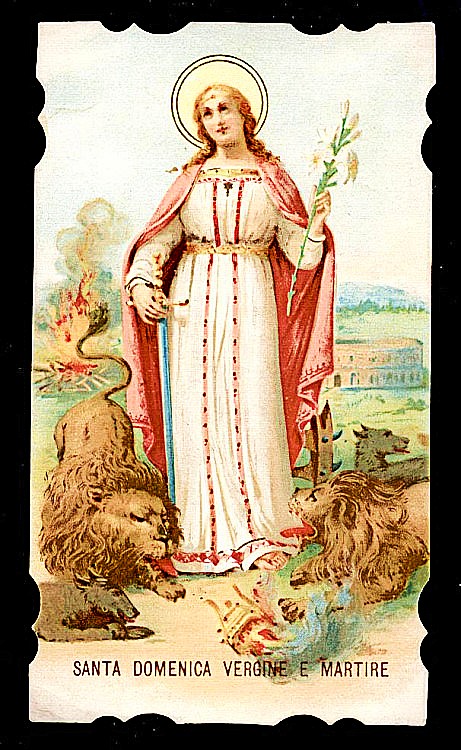
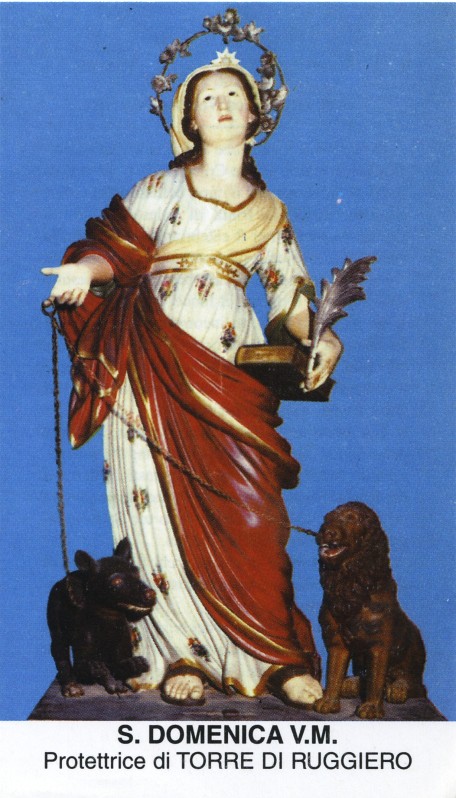
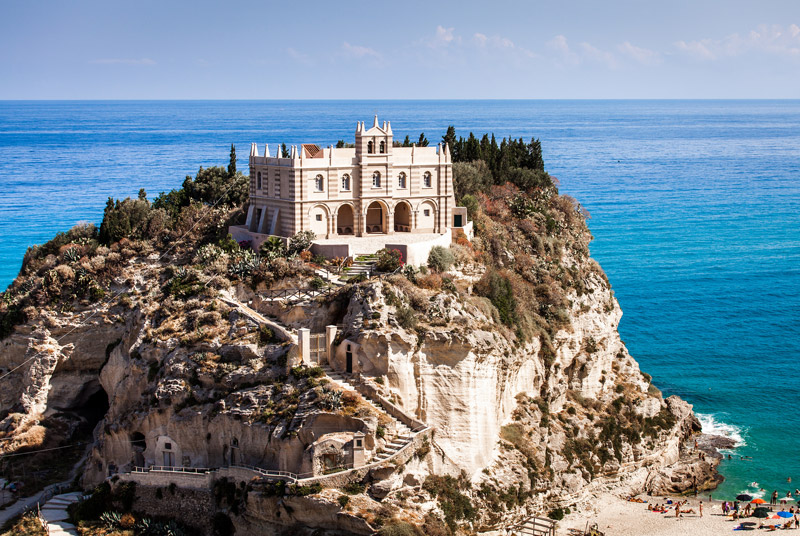
Saint of the Day – 6 July – Saint Dominica of Campania (c 287-303) Virgin Martyr. Born in c 287 in Tropea, Calabria, Italy and died in the first attempt by being thrown to wild animals who refused to harm her. Thereafter, she was beheaded on 6 July 303, making her between 15 and 16 years old. Patronages – Camaldoli, Italy, Caraffa di Catanzaro, Italy, Mandanici, Italy, Scorrano, Italy, Torre di Ruggiero, Italy, Tremestieri, Italy, Tropea, Italy, in Nicomedia, Bithynia (in modern Turkey). Also known as – Dominica of Tropea, Ciriaca.
The Roman Martyrology states of her today: “In Campania, St Dominica, Virgin and Martyr, in the time of the Emperor Diocletian. For having destroyed idols, she was condemned to the beasts but being uninjured by them. she was beheaded and departed for Heaven. Her body is kept with great veneration at Tropea, in Calabria.”
Almost nothing more is known of Dominica except that she was the daughter of Christian parents, Doroteo and Arsenia.
The Sacred Congregation of Rites granted a special Mass in her honour to Tropea, Calabria, Italy on 14 May 1672.
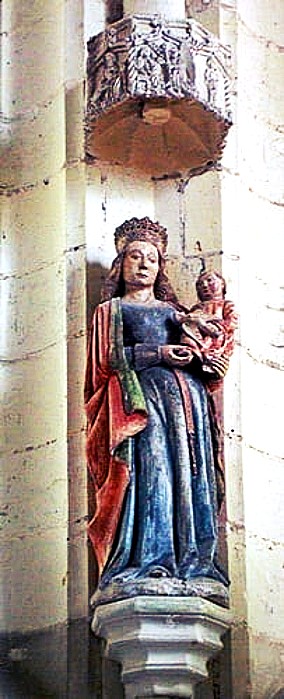
Notre-Dame d’Iron / Our Lady of Iron, Dunois, France (1631) – 6 July:
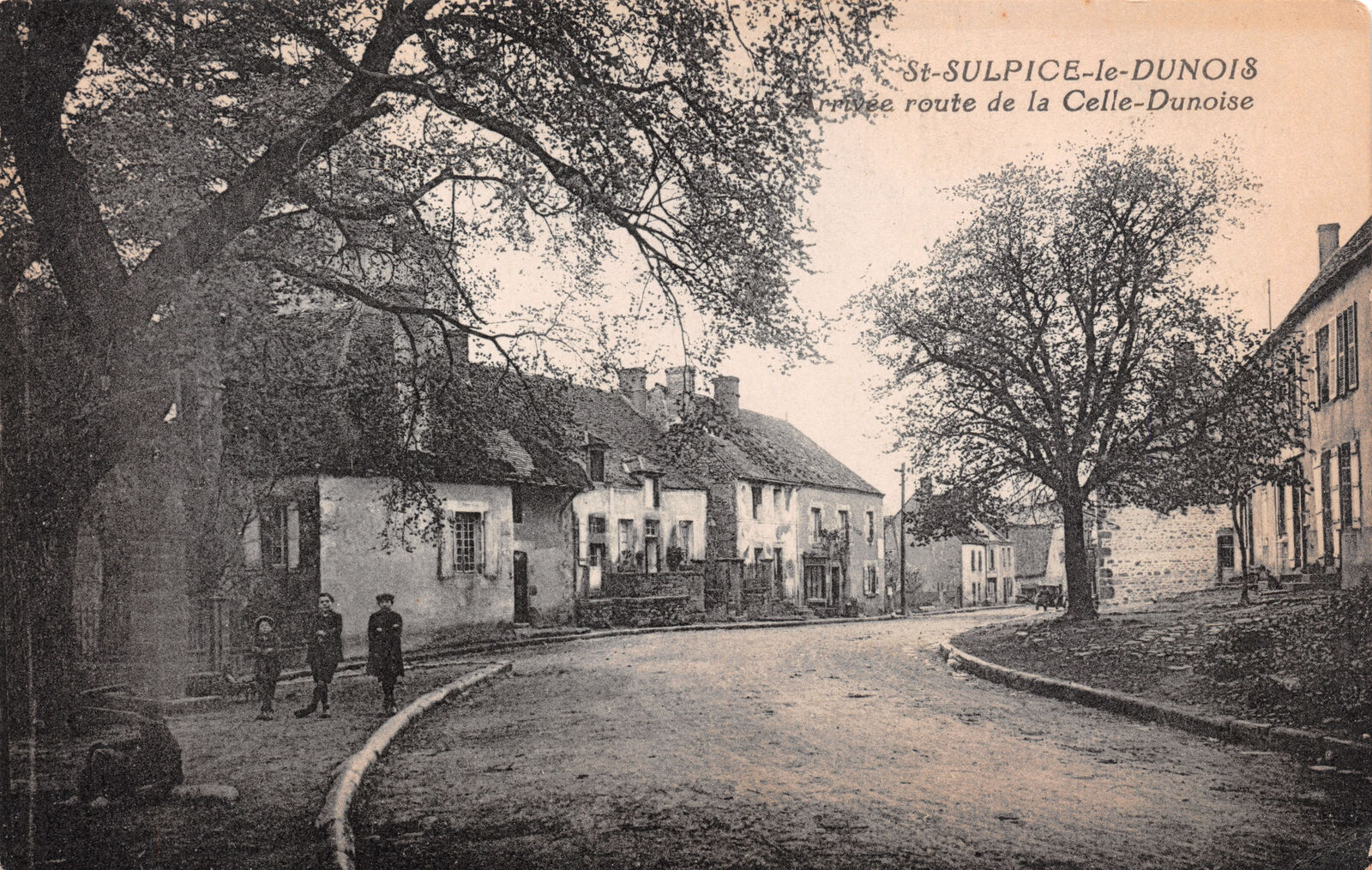
Saint-Sulpice-le-Dunois is a small Village located near the centre of France. Once home to Our Lady of Iron, it is situated near the larger Town of Blois, its population was only 517 citizens in the year 2007, which was a decrease from the 636 citizens who had lived there in 1999. It was in the Chapel of this tiny Village of Saint-Sulpice-le-Dunois, in the year 1631, that our story takes place involving Our Lady of Iron.
There was a young French couple living in the village at that time, who felt themselves singularly blessed. Were they not fortunate? They took pleasure in their youth and enjoyed good health, had happy employment,lived in a modest home and they had recently been blessed with a fine baby whom they felt was as sweet as the Babe of Bethlehem. Thus they mused on their way home together after early morning Mass one day. As soon as they entered their home, Pierre hurried to the cradle to gaze lovingly at his infant son. The child must have been restless, he thought, as there was evidence that he had struggled with the bedclothes which were tossed about and tangled strangely about the infant. Pierre reached in and lifted his son to hold him in his arms, only to find that the tiny figure was rigid and cold. Stunned, he called for his wife disbelieving, for it seemed their baby was dead! Pierre’s thoughts turned to Our Blessed Mother and then to the Statue of Our Lady of Iron at the Parish Church. They had spent many hours there in the past praying for her assistance and her help had never failed them. They determined to take their baby there instantly! Surely, Mary would not fail them in this time of dire need. Together they entered the Church, and sadly laid the lifeless form at the feet of the Statue of Our Lady of Iron. As they began to pray for her intercession, they dedicated their baby to the Blessed Virgin Mary. In that very instant, the child who had been smothered by struggling in its cradle, cried out and came back to life. News of the miracle spread far and wide and the fame of Our Lady of Iron was assured.
Bl Angela of Bohemia Bl Augustin-Joseph Desgardin Bl Christopher Solino St Cyril of Thessaloniki St Dominica of Campania (c 287-303) Virgin Martyr St Gervais St Giusto of Condat St Goar of Aquitaine St Godelieve
St Saxburgh of Ely St Sisoes the Great Bl Suzanne Agathe de Loye St Thomas Alfield St Tranquillinus of Rome — Martyrs of Campania – 23 saints: A group of 23 Christians arrested, tortured and then beheaded together in the later 3rd century by order of governor Rictiovarus in the persecutions of Diocletian. The names that have come down to us are – Antoninus, Arnosus, Capicus, Cutonius, Diodorus, Dion, Isidore, Lucia, Lucian, Rexius, Satyrus and Severinus.
Martyrs of Fiesole – 5 saints: Five Christians martyred together in the persecutions of emperor Domitian – Carissimus, Crescentius, Dulcissimus, Marchisianus and Romulus. c 90 near Fiesole, Italy.
Thought for the Day – 5 July – Meditations with Antonio Cardinal Bacci (1881-1971)
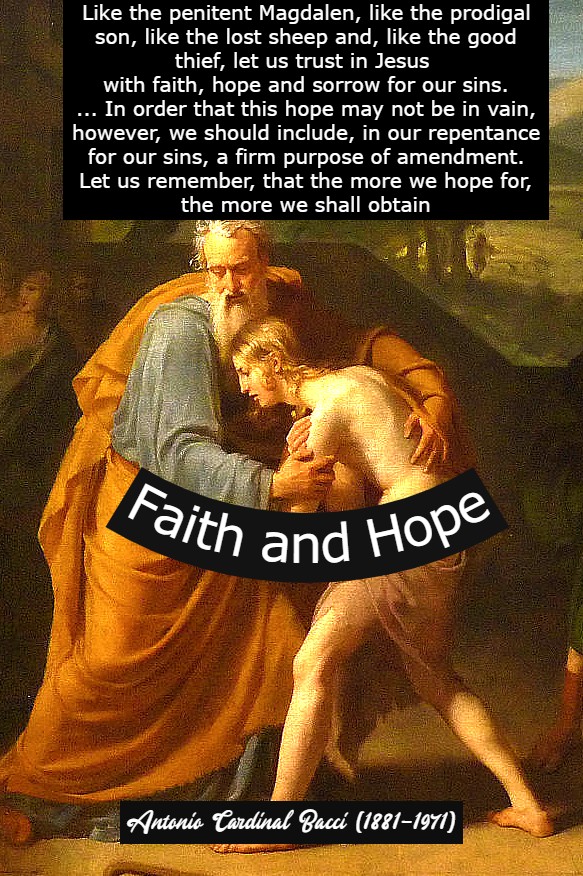
Faith and Hope
“Christian hope derives from faith. When we believe in the infinitely good and merciful God, Who was made man for us and Who shed His Precious Blood, for our salvation, we experience a great hope and a great confidence. No matter how numerous our sins and our defects, as long as we are sincerely repentant, we should continue to hope for the forgiveness of God. Despair, which led Judas to commit suicide, should never be allowed to enter our minds. Like the penitent Magdalen, like the prodigal son, like the lost sheep and, like the good thief, let us trust in Jesus with faith, hope and sorrow for our sins. Let us remember, that He is infinitely good and merciful and ardently desires to pardon us. Together with this hope of God’s forgiveness, we should nurture the hope of gaining Heaven, which the Lord, in His infinite goodness, has promised, not only to innocent souls but, also to repentant sinners. In order that this hope may not be in vain, however, we should include, in our repentance for our sins, a firm purpose of amendment.
Let us remember, that the more we hope for, the more we shall obtain!”
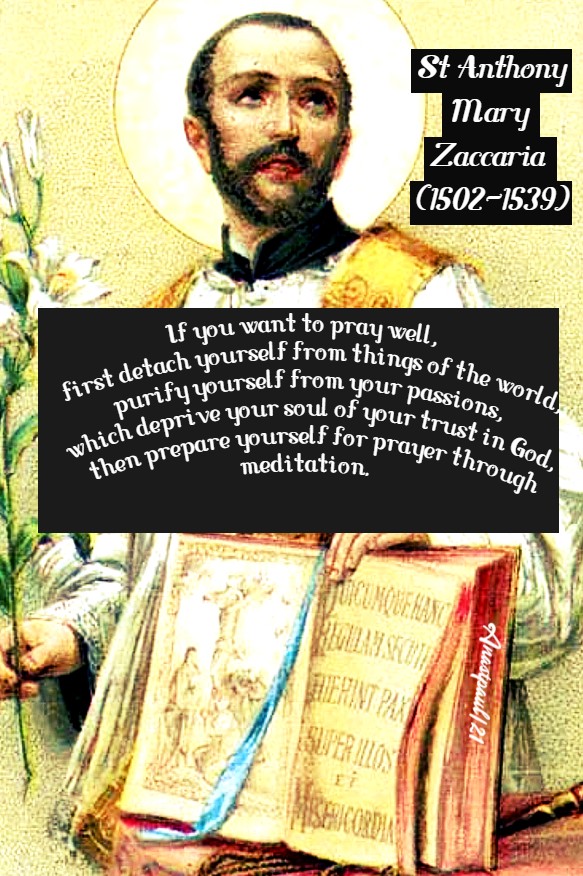
Quote/s of the Day – 5 July – “Month of the Most Precious Blood” – the Memorial of St Anthony Mary Zaccaria CRSP (1502-1539)
“In His mercy, God has chosen us, unworthy as we are, out of the world, to serve Him and thus, to advance in goodness and to bear the greatest possible fruit of love in patience.”
“If you want to pray well, first detach yourself from things of the world, purify yourself from your passions, which deprive your soul of your trust in God, then prepare yourself for prayer through meditation.”
“ True spiritual life consists in this: that man keep his eyes on God all the time, long for nothing but for God, keep nothing in mind but God, begin every single action,in God’s name and direct it to Him.”
One Minute Reflection – 5 July – “Month of the Most Precious Blood” – Readings: Genesis 28: 10-22a, Psalms 91: 1-2, 3-4, 14-15ab, Matthew 9: 18-26 and the Memorial of St Anthony Mary Zaccaria CRSP (1502-1539)
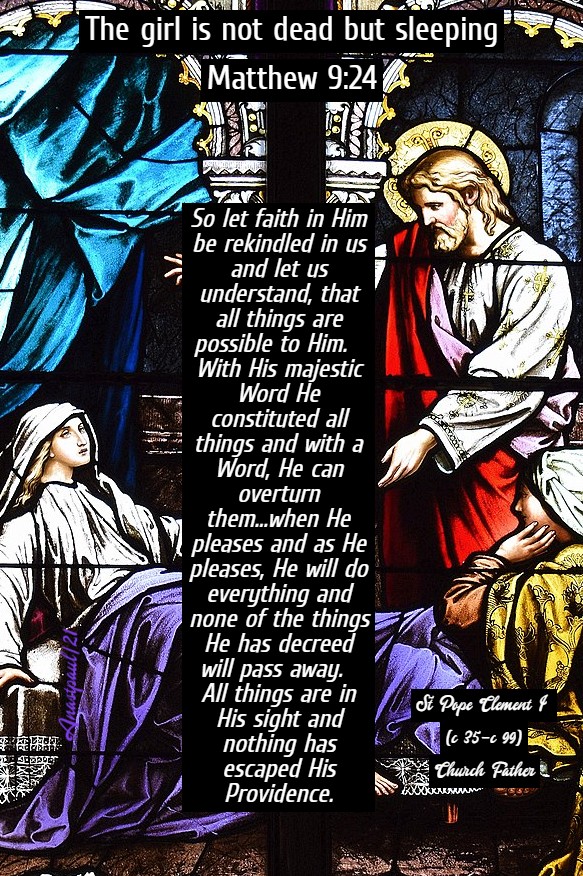
“The girl is not dead but sleeping” – Matthew 9:24
REFLECTION – “Let us consider, dear friends, how the Master is continually proving to us, that there is to be a resurrection, of which He made the Lord Jesus Christ the first fruits, when He raised Him from the dead.
Let us observe, dear friends, the resurrection that is regularly taking place. Day and night show us a resurrection – night falls asleep, day arises; day departs, night comes on. Let us take the crops – how and in what way does the sowing take place? The sower goes out and sows each seed in the ground. They fall into the ground dry and bare, and decay; – then from their decay, the greatness of the Master’s providence raises them up, and from a single grain, many spring up and bear fruit…
Do we, then, regard it as a great and marvellous thing, for the Creator of all things, to bring about the resurrection of those who have served Him with holiness in the assurance of a good faith?… With this hope, then, let our souls be bound to Him, that is faithful, to His promises and upright in His judgements. He, Who has commanded us not to lie will much more not lie Himself. For nothing is impossible to God except lying (Jn32:17; Lk 1:37; 6,18).
So let faith in Him be rekindled in us and let us understand, that all things are possible to Him. With His majestic Word He constituted all things and with a Word, He can overturn them…when He pleases and as He pleases, He will do everything and none of the things He has decreed will pass away. All things are in His sight and nothing has escaped His Providence.” – St Pope Clement I (c 35-c 99) Pope from about 90 to 99 – Letter to the Corinthians, §24-28 ; SC 167
PRAYER – Almighty Lord and God, protect and strengthen us by Your power throughout this day, even as You have enabled us to begin it. By Your grace, may the our faith be our guide and let our every thought, word and deed aim at doing Your will and what is pleasing in Your sight. Grant that by the prayers of Saint Anthony Zaccaria, we may ever turn our eyes and hearts to our Lord Jesus Christ. Through Him, Your divine Son, who lives and reigns with You and the Holy Spirit, God now and forever, amen.
Our Morning Offering – 5 July – “Month of the Most Precious Blood”
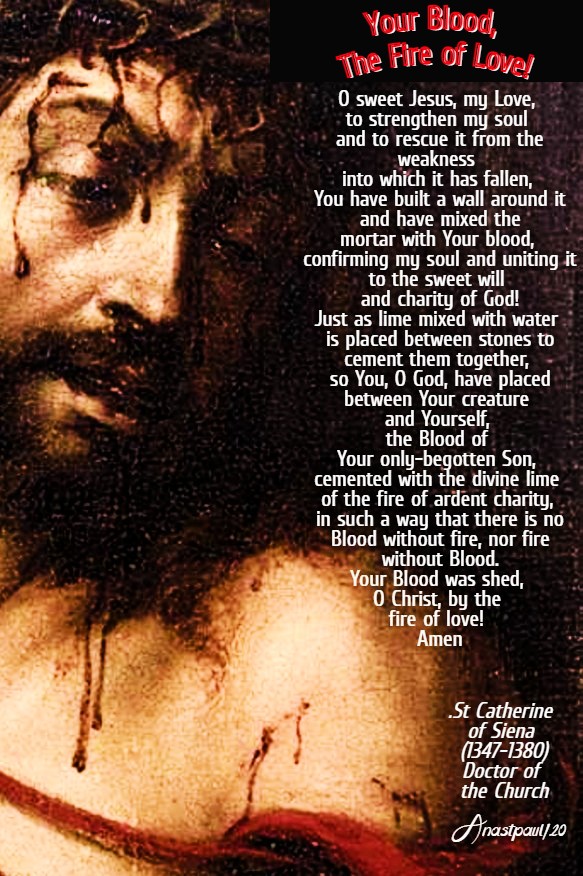
Your Blood, The Fire of Love! By St Catherine of Siena (1347-1380) Doctor of the Church
O sweet Jesus, my Love, to strengthen my soul and to rescue it from the weakness into which it has fallen, You have built a wall around it and have mixed the mortar with Your Blood, confirming my soul and uniting it to the sweet will and charity of God! Just as lime mixed with water is placed between stones to cement them together, so You, O God, have placed between Your creature and Yourself, the Blood of Your only-begotten Son, cemented with the divine lime of the fire of ardent charity, in such a way that there is no Blood without fire, nor fire without Blood. Your Blood was shed, O Christ, by the fire of love! Amen.
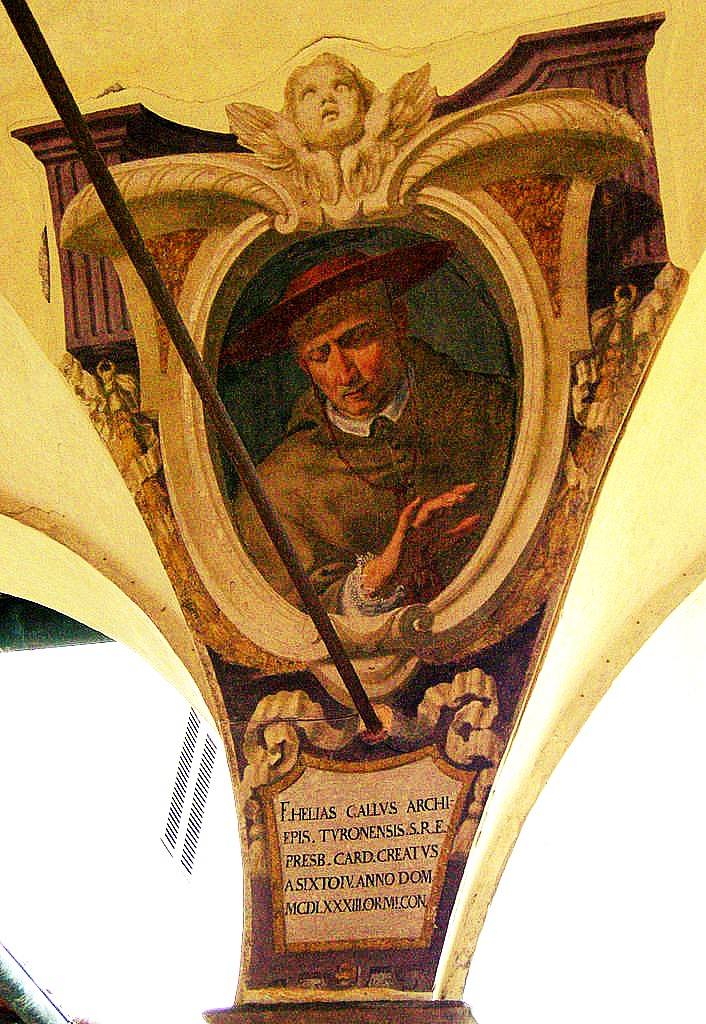
Saint of the Day – 5 July – Blessed Elias of Bourdeilles OFM (c 1423-1484) Archbishop of Tours and Cardinal, Defender of the Church against the State and a political prisoner because of it, devout son of St Francis of Assisi, living a life of poverty and caring for the poor. Born in c 1423 at Périgord, France and died on 5 July, 1484, at Artannes near Tours, France of natural causes. Also known as – Elie, Hélie.
You know enough about Saint Jeanne d’Arc (Joan of Arc) to understand that she was a victim of international politics and rival patriarchal systems. Within twenty-five years of her death, Pope Callixtus III concluded an inquiry with a declaration of her innocence and Martyrdom. One of the advocates who worked on the report that vindicated her was a Bishop named Elias of Bourdeilles.
Elia was the son of the Viscount Arnaud de Bourdeilles and was born at the Castle of Bourdeilles in Périgord,
Having entered the Franciscan Order at an early age, he was only twenty four years old when, at the request of King Charles VII, he was appointed to the See of Périgueux in 1447.
During the wars between France and England he was held prisoner for several years by the English, in consequence of his defence of ecclesiastical immunity.
In 1468 he was appointed to the Archepiscopal See of Tours and in 1483 he was raised to the Cardinalate by Pope Sixtus IV.
He was a devout Franciscan and he lived in personal poverty and used the Church’s available resources to aid the poor. Elias was an intimate friend of St Frances of Paola.
He is mentioned among the Blessed in the Franciscan Martyrology for the 5th day of July. A stanch defender of the rights of the Church against the encroachments of the State, Cardinal Elias advocated the abolition of the Pragmatic Sanction of Bourges, as may be seen from his treatise, “Pro Pragmaticæ Sanctionis Abrogatione” (Rome, 1486). He also wrote “Libellus in Pragmaticam Sanctionem Gallorum” (Rome, 1484) and a Latin defence of Jeanne d’Arc which is attached in manuscript to the process of her rehabilitation.
Our Lady of Mount Athos, Great Lavra, Greece , 8th cent. – 5 July:
In the 900s, the unfinished Great Monastery on Mount Athos ran out of funds and the starving Monks had to leave. Finally the Monastery Founder, St Athanasius the Athonite, left too in search of help. On the road he met a woman in a long blue veil, who said, “Go back! You will have everything you need if you do not abandon the Monastery!” When Athanasius asked the lady’s name, she answered, “I am the Mother of your Lord.” The Abbot asked for a sign. “Strike the rock with your staff,” she said, and promised to be responsible for the Monastery provisions herself — to be its stewad. As water flowed from the rock, she vanished.
Athanasius returned to find the building completed and stocked with supplies. Soon it was full of Monks again To this day, the Great Lavra regards the Mother of God as its steward, helped by a Monk with the title of assistant steward. In a Shrine on the left of the entrance to the Monastery Church, the Icons depict many saints connected with the Monastery. To Our Lady’s right St. Athanasius holds a model of the building. Down the road, the holy spring still flows.
St Agatho of Sicily St Athanasius the Athonite St Athanasius of Jerusalem St Cast St Cyprille of Libya St Cyrilla of Cyrene St Domèce St Domitius of Phrygia St Edana of West Ireland Bl Edward Cheevers Blessed Elias of Bourdeilles OFM (c 1407-1484) Archbishop of Tours and Cardinal St Erfyl St Fragan Bl George Nichols St Grace of Cornwall St Gwen Bl Humphrey Pritchard
St Marinus of Tomi St Mars of Nantes St Marthe Bl Matthew Lambert St Modwenna St Numerian of Treves Bl Patrick Cavanagh St Philomena of San Severino St Probus of Cornwall Bl Richard Yaxley Bl Robert Meyler St Rosa Chen Aijieh St Sedolpha of Tomi St Stephen of Reggio St Teresia Chen Qingjieh St Theodotus of Tomi Bl Thomas Belson St Thomas of Terreti St Triphina of Brittany St Triphina of Sicily St Zoe of Rome
































You must be logged in to post a comment.