Quote/s of the Day – 16 June – “Month of the Sacred Heart” and The Memorial of St John Francis Régis SJ (1597-1640)
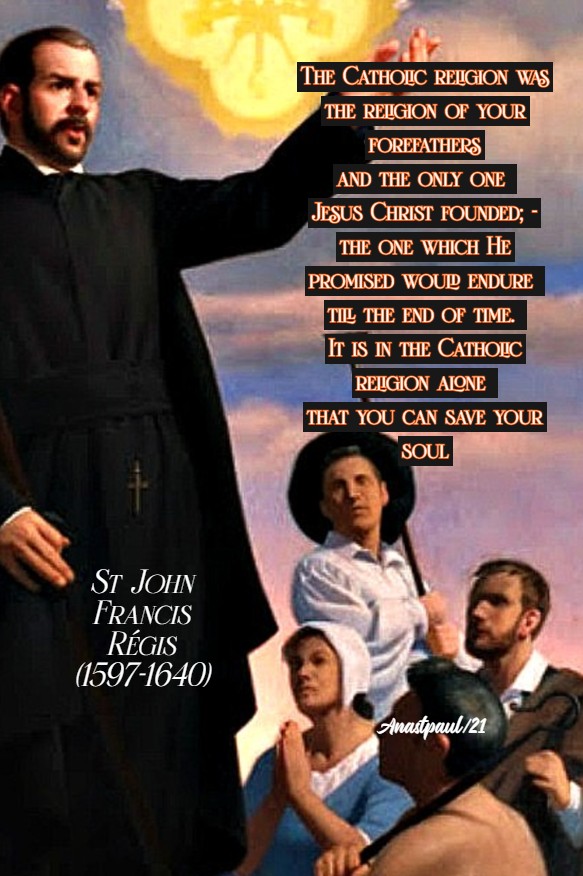
“The Catholic religion was the religion of your forefathers and the only one Jesus Christ founded; – the one which He promised would endure till the end of time. It is in the Catholic religion alone that you can save your soul.”
“How long are you going to be deaf to His call? Or are you going to lose your soul, which Jesus Christ bought at the price of His Precious Blood?”
“My child, it is indeed the Voice of God you have heard. He has given you a great grace in thus calling you into His one true Church. While you live, never cease to thank Him and bless Him for it.”
(All the above from – Rev Fr D. Chisholm, The Catechism in Examples (London: R & T Washbourne, Ltd
“Brother, I see our Lord and our Lady opening the gates of Paradise for me. Into Your hands, O Lord, I commend my spirit.” St John Francis Regis on his deathbed
One Minute Reflection –16 June – “Month of the Sacred Heart” – Readings: Second Corinthians 9: 6-11, Psalms 112: 1bc-2, 3-4, 9, Gospel: Matthew 6: 1-6, 16-18
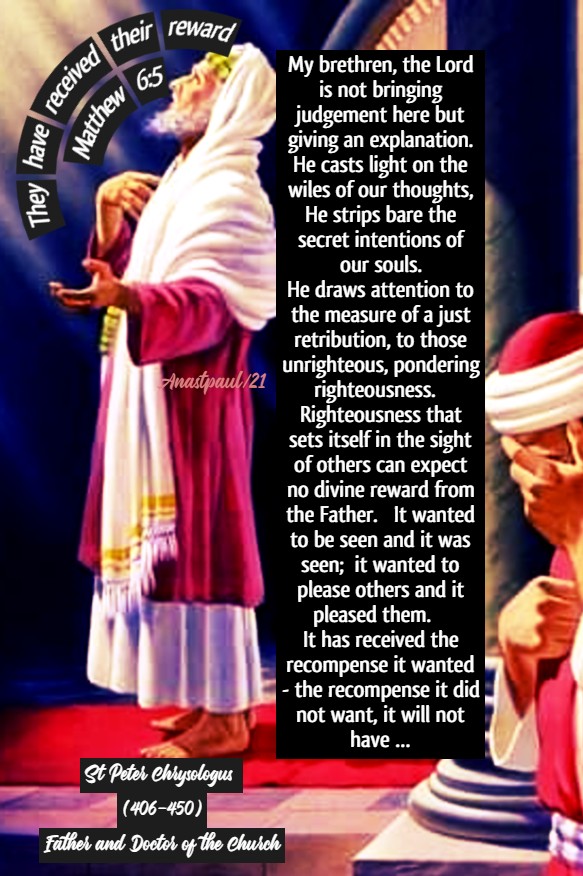
“They have received their reward” – Matthew 6:5
REFLECTION – “Take care not to perform righteous deeds in order that people may see them.” Why not? If people see them then what will you get out of them? “You will have no recompense from your heavenly Father.”My brethren, the Lord is not bringing judgement here but giving an explanation. He casts light on the wiles of our thoughts, He strips bare the secret intentions of our souls. He draws attention to the measure of a just retribution, to those unrighteous, pondering righteousness. Righteousness that sets itself in the sight of others can expect no divine reward from the Father. It wanted to be seen and it was seen; it wanted to please others and it pleased them. It has received the recompense it wanted – the recompense it did not want, it will not have …
“When you give alms, do not blow a trumpet before you, as the hypocrites do.” “Blow your trumpet” – this is the exact phrase in that this kind of alms is more like a deed of war than of peace. It passes wholly into its sound but has nothing to do with mercy. It comes from the land of disunion but has not been nourished by goodness. It is a dealing in outward show, not chaste commerce …. “So, then, when you give alms, do not blow a trumpet before you as the hypocrites do in the synagogues and in the streets to win the praise of others. Amen, I say to you, they have received their reward.” You have taken good note: – alms offered at a meeting, in public square and street corners, is not an offering made for the comforting of the poor but has been set forward in the sight of others to attract their admiration … Flee hypocrisy, my brethren, flee from it …. It does not bring comfort to the poor; the groans of the homeless but is only a pretext for it, to seek out even more busily, a spectacular glory for itself. It inflates its praise of the suffering of the poor. – St Peter Chrysologus (406-450) Bishop of Ravenna, Father and Doctor of the Church – Sermon 9
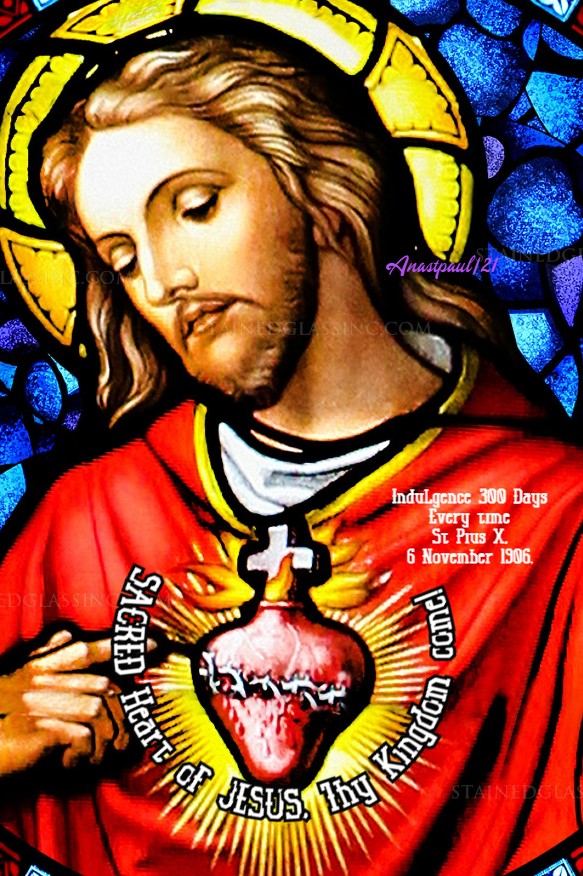
PRAYER – Lord God, in Your wisdom, You created us, by Your providence You rule us, penetrate our inmost being with Your light, so that our way of life may always be one of faithful service to You, as we follow the way of Your Son. Holy Mother, guide us as you guided Your Son. Through Christ our Lord, with the Holy Spirit, one God, amen. SACRED Heart of JESUS, Thy Kingdom come! – Indulgence 300 Days – Every time – Raccolta 179 St Pius X, 6 November 1906.
Our Morning Offering – 16 June – “Month of the Sacred Heart”
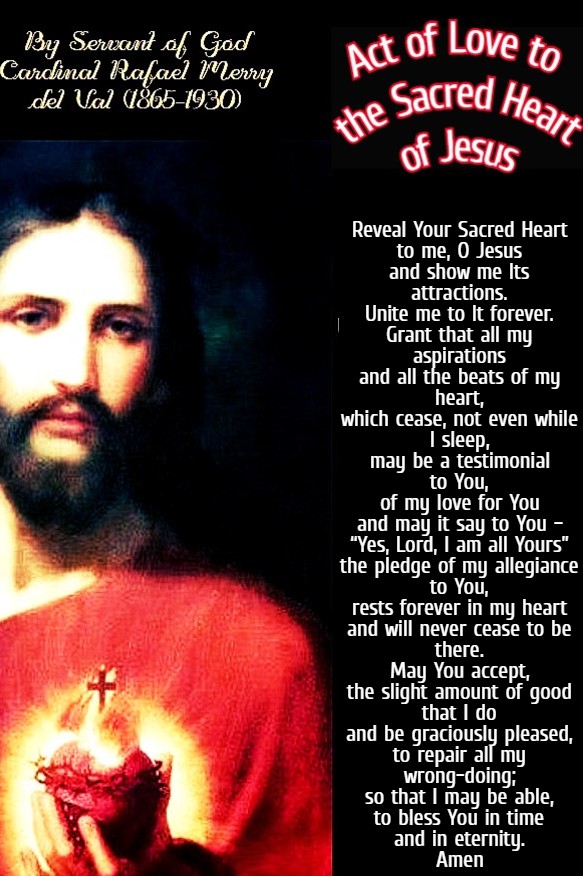
Act of Love to the Sacred Heart of Jesus By Servant of God Cardinal Rafael Merry del Val (1865-1930)
Reveal Your Sacred Heart to me, O Jesus and show me Its attractions. Unite me to It forever. Grant that all my aspirations and all the beats of my heart, which cease, not even while I sleep, may be a testimonial to You, of my love for You and may it say to You – “Yes, Lord, I am all Yours” the pledge of my allegiance to You, rests forever in my heart and will never cease to be there. May You accept, the slight amount of good that I do and be graciously pleased, to repair all my wrong-doing; so that I may be able, to bless You in time and in eternity. Amen
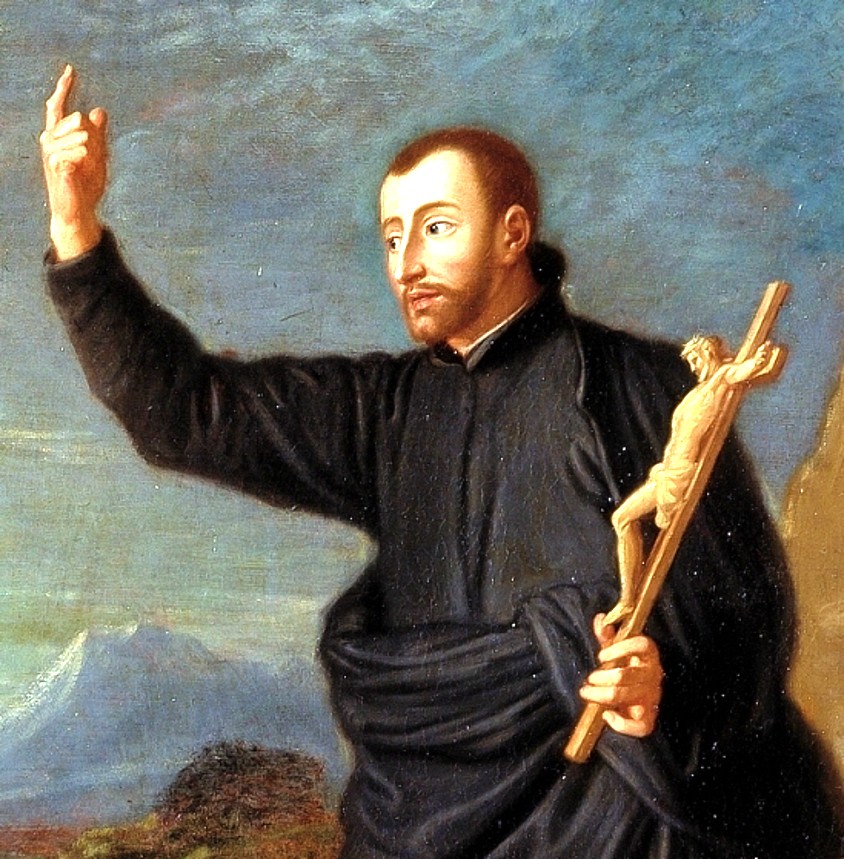
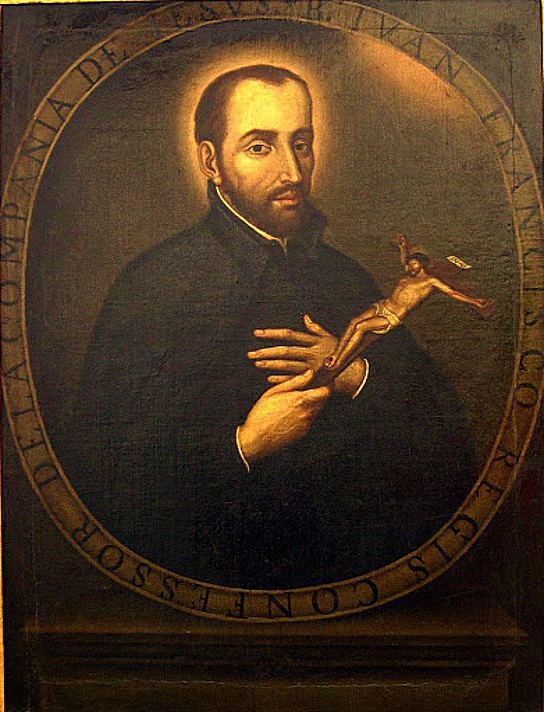
Saint of the Day – 16 June – St John Francis Régis SJ (1597-1640) Priest, Confessor., renowned Preacher, Missionary., miracle-worker. Born as Jean-François Régis on 31 January 1597 at Fontcouverte, Aude, France and died on 31 December 1640 (aged 43) at La Louvesc, Ardèche, France of natural causes. Patronages – lacemakers, medical social workers, illegitimate children, Regis University, Regis High School (New York City), Regis Jesuit High School (Aurora, Colorado).
The Roman Martyrology states of him today: “In the village of La Louvese, formerly of the Diocese of Vienne in Dauphiny, the decease of St Jean-Francois Régis, Confessor, of the Society of Jesus, distinguished by his zeal for the salvation of souls and by his patience. He was placed on the list of Saints by Pope Clement XII.”
John Francis ministered to Catholics suffering neglect after civil conflict between Calvinists and Catholics devastated France. Much of southern France had fallen under control of the Huguenots who destroyed Catholic Churches and killed the Priests. Home missioners such as Régis had the task of rekindling a once-strong faith.
John Francis was born on 31 January 1597 in Fontcouverte, in southern France. His father, Jean Régis, had recently been ennobled as a result of service rendered during the Wars of the League. His mother, Marguerite de Cugunhan, was of a noble family. John Francis was remarkably holy from childhood. He was disinterested in children’s games, preferring instead, to contemplate the things of God. Sensitive and devout as he was, he managed not to be insufferable and was well-liked by his peers. He was educated at the Jesuit College of Béziers.
In 1616, at the age of 19, he entered the Jesuit Novitiate in Toulouse and began to prepare for a priestly ministry that would save thousands of souls. He studied humanities, philosophy and then theology. After finishing his course in rhetoric at Cahors, Regis was sent to teach grammar at several colleges: Billom (1619–22), Puy-en-Velay (1625–27), and Auch (1627–28). While he was teaching, he also pursued his studies in philosophy at the scholasticate at Tournon. Noted for an intense love of preaching and teaching the Faith, as well as a great desire to save souls, John Francis began his study of theology at Toulouse in 1628. Less than two years later, in 1630, he was Ordained a Priest at 31. The following year, having completed his studies, John Francis made his tertianship.
He was now fully prepared for his vocation and life’s work and entered upon his apostolic career in the summer of 1631. He was a tireless worker who spent most of his life serving the marginalised. As a newly ordained Priest, he worked with bubonic plague victims in Toulouse. From May 1632 until September 1634, his headquarters was at the Jesuit College of Montpellier. Here he laboured for the conversion of the Huguenots, visited hospitals, assisted the poor and the needy, withdrew from vice wayward women and girls and preached Catholic doctrine with tireless zeal to children and the poor. John Francis is best known for his work with at-risk women and orphans. He established safe houses and found jobs for them. He established the Confraternity of the Blessed Sacrament, which organised charitable collections of money and food from the wealthy. He also established several hostels for prostitutes and helped many become trained lace makers, which provided them with a stable income and an opportunity to avoid the threat of exploitation.
In 1633, he went to the Diocese of Viviers at the invitation of the local Bishop,, Monsignor Louis II de la Baume de Suze, giving missions throughout the Diocese. From 1633 to 1640 he evangelised more than fifty districts in le Vivarais, le Forez, and le Velay. John Francis laboured diligently on behalf of both Priests and laypersons. His preaching style was said to have been simple and direct. He appealed to the uneducated peasantry and immense numbers of conversions resulted.
Others it seems, were jealous of his success in reaping a harvest of conversions.His boldness – perceived as arrogance in some cases – led to a conflict with certain other Priests, a period of tension with the local Bishop and even threats of violence from those whose vices he condemned. Although he longed to devote himself to the conversion of the indigenous inhabitants of Canada, he remained in France all his not very long life. The influence of the best people on the one hand and on the other the patience and humility of the Saint, soon succeeded in confounding the calumny and caused the discreet and enlightened ardour of Father John Francis to shine forth with renewed splendour.
Less moderate indeed was his love of mortification, which he practiced with extreme rigour on all occasions, without ruffling, in the least, his evenness of temper. As he returned to the house one evening after a hard day’s toil, one of his confrères laughingly asked: “Well, Father Regis, speaking candidly, are you not very tired?”“No”, he replied, “I am as fresh as a rose.” He then took only a bowl of milk and a little fruit, which usually constituted both his dinner and supper and finally, after long hours of prayer, lay down on the floor of his room, the only bed he knew.
John Francis walked from town to town, in rough mountainous areas where travel was difficult, especially in the winter. On one particularly treacherous journey, Fr John Francis slipped and broke his leg. Leaning on his companion, he managed to make it to town, where he refused the help of the doctor in favour of spending a few hours in the Confessional. When he emerged several hours later, his badly broken leg had been healed.
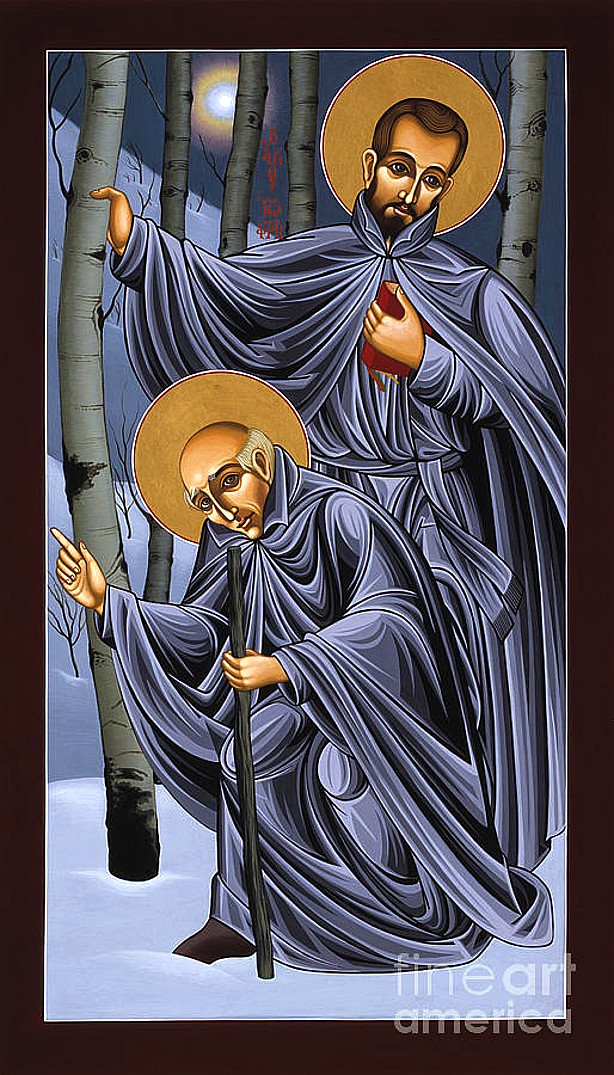
In mid-December 1640 the Jesuit Missioner was giving a Mission at Montregard; – he interrupted his work there to return to his home at Le Puy because he had an intimation that he would soon die. He wanted to prepare for his death so he spent three days in retreat before making a general confession. Then he and his companion, Brother Claude Bideau, went back to Montregard to finish the Mission there.
Brother Claude Bideau with St John Francis
On 23 December the two set out for La Louvesc, the site of the next Mission but a winter storm blew in and they lost their way in the snow and had to spend the night in a battered shack. The next day they were able to reach La Louvesc where they found people waiting for them. Rather than taking a few minutes to eat and rest, John Francis immediately began preaching, then heard Confessions and celebrated Mass. So many people came for Confession that hedid not stop until it was time for Midnight Mass. Both Christmas day and the following day were also spent in the Confessional. Because of the crush of people, John Francis had to hear Confessions in the Sacristy where a broken window let in cold air directly onto him. By late afternoon he felt weak and suddenly collapsed. He was put in the Parish Priest’s bed but people followed him even there, seeking to confess. He lapsed into unconsciousness and the physician who attended him, confirmed that pneumonia had set in. Nothing could be done. John Francis lingered on until 31 December, praying constantly. He died as he had lived:,entirely poured out for souls.
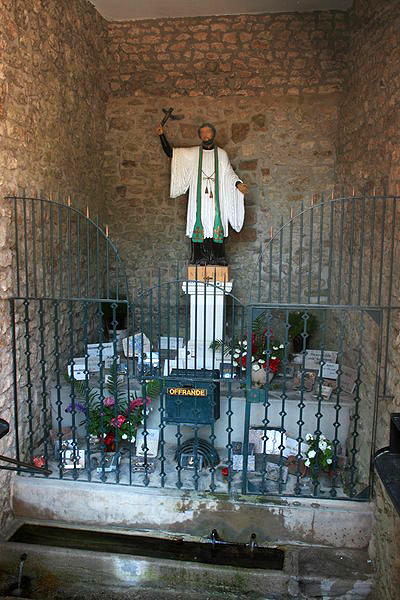
But immediately after his death Regis was venerated as a saint. Pilgrims came in crowds to his tomb and since then, the concourse has only grown. Mention must be made of the fact that a visit made in 1804 to the blessed remains of the Apostle of Vivarais, was the beginning of the vocation of the Blessed Curé of Ars, Jean-Baptiste Vianney, whom the Church has raised in his turn to her altars.“Everything good that I have done”, he said when dying, “I owe to [John Francis] him.” The place where John Francis died has been transformed into a mortuary Chapel. Nearby is a spring of fresh water to which those who are devoted to Saint John Francis attribute miraculous cures through his intercession.
The fresh water spring in the village of La Louvesc, to which devotees of Saint John Francis Regis attribute miraculous cures through his intercession.
Today, Régis’ name lives on across the world. There are Churches, lakes, mountains, Schools. hotels, apartment complexes, swimming pools and Streets with his name. The Jesuit mission at Conewago, PA was named after him.
John Francis Régis was Beatified om 18 May 1716 by Pope Clement XI and Canonised on 5 April 1737 by Pope Clement XII.
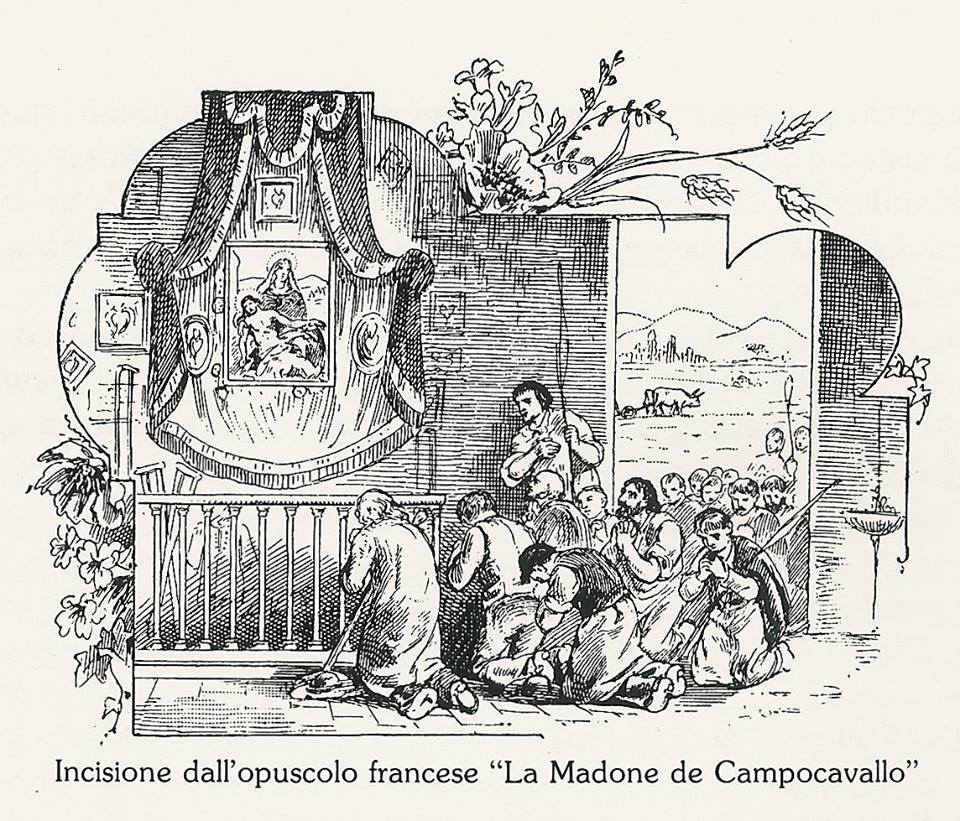
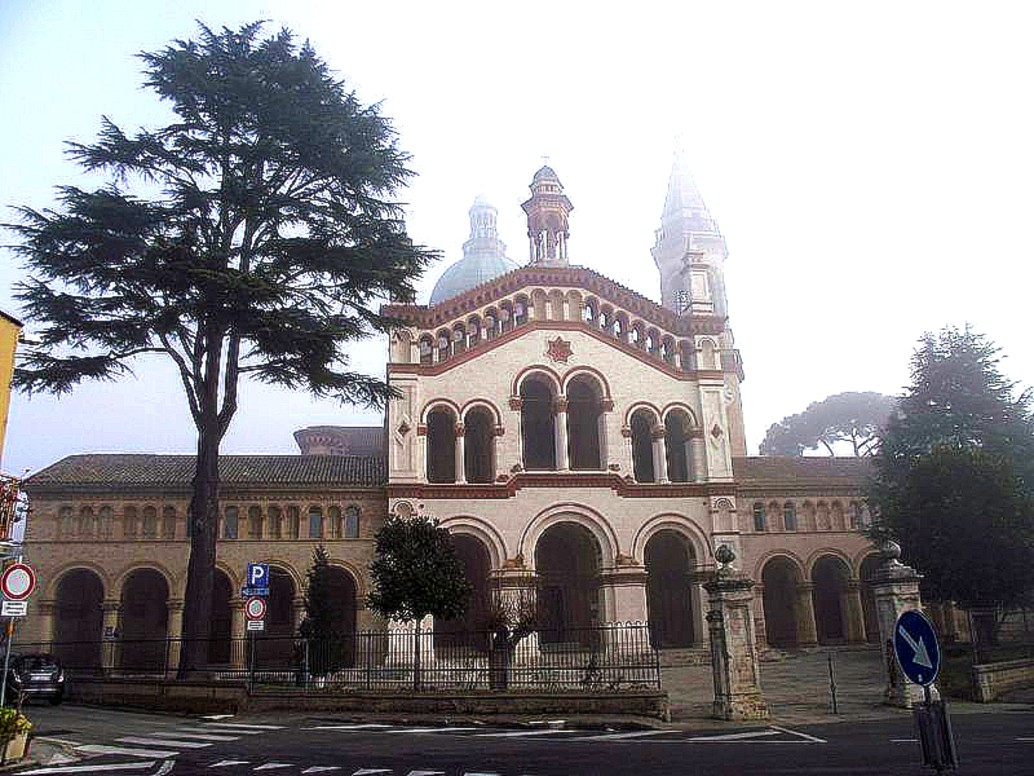
Beata Vergine Addolorata / The Blessed Virgin of Sorrows, Campocavallo, Osimo, Ancona, Marche, Italy (1892) – 16 June, The first Sunday of August., 15 September (Feast o Our Lady of Sorrows), The last Sunday of September AND special Devotions thrughout May: 16 June
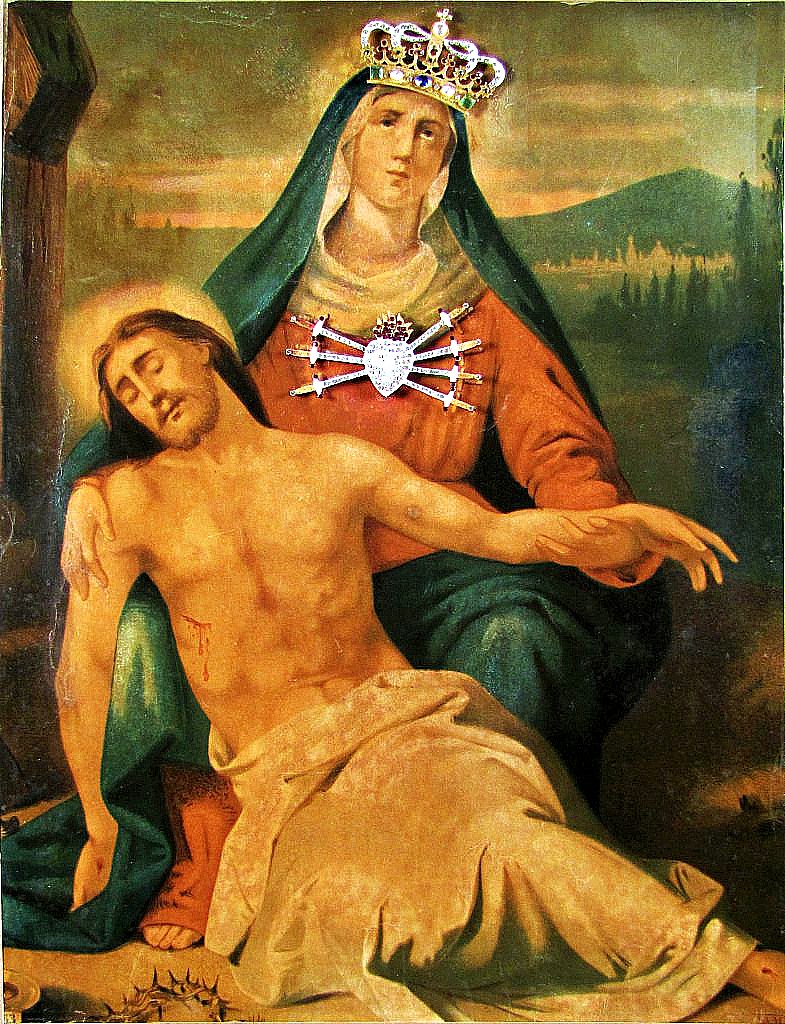
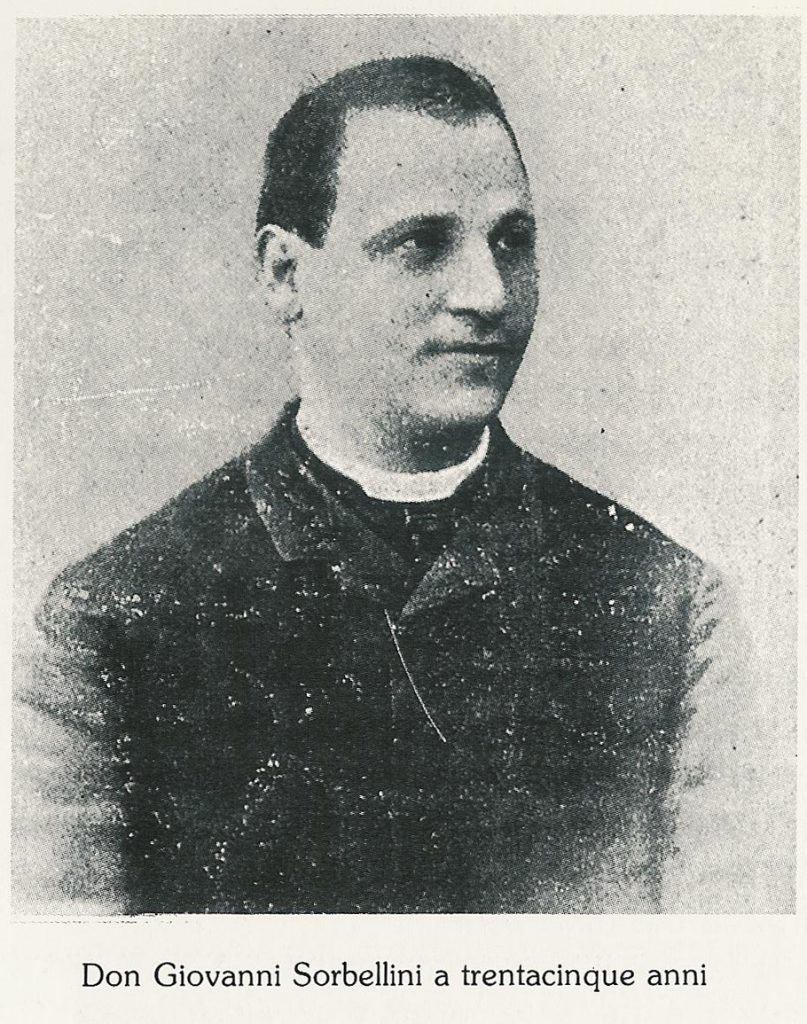
In the 1870s, a small country Chapel was built three miles from Osimo, a Town just inland from the Adriatic near the world-famous Shrine of Loreto. Don Giovanni Sorbellini, appointed in 1883 to say holy day Masses at the Campocavallo Chapel, hung in it an oleograph of the Pietà he had bought from a travelling salesman.
The Miraculous image is an oleograph, a particular type of print that imitates oil painting, measures 38cm x 52cm and portrays the Virgin holding the lifeless body of Jesus in her arms, just taken down from the Cross. On the ground some instruments of the passion are depicted and in the background the City of Jerusalem. Our Lady has her gaze turned to heaven in action, not of resigned pain, but of complete uniformity of her will to that of God.
On 16 June 1892, a few families who stayed to pray after Mass saw the eyes of the Sorrowful Virgin move and blink and tears dropped onto her cheeks. Everyone then shouted: “Our Lady is crying!”. News of theMiracle travelled rapidly and widely.
On 7 July a blind woman regained her sight whilst at prayer before the image. The same year, Don Sorbellini began building the present magnificent Sanctuary, consecrated in 1905. For at least 10 years, in truth, there are many miracles and testimonies of those who saw the movement and tears and even today!
It’s the focus of the Festa del Covo, a Nativity-themed harvest festival the first Sunday of August, and the Festa dell’Addolorata the third Sunday of September, the date of the Consecration of the Church and Crowning of Mary. The Feast of the first Miracle is celebrated today, 16 June and of course, the Feast of Our Lady of Sorrows is celebrated o 15 September.
St Actinea of Volterra St Aitheachan of Colpe St Amandus of Beaumont Bl Antoine Auriel St Aurelian of Arles St Aureus of Mainz
St Berthaldus St Ceccardus of Luni St Cettin of Oran St Colman McRhoi St Crescentius of Antioch St Cunigunde of Rapperswil St Curig of Wales St Cyriacus of Iconium
Blessed Donizetti Tavares de Lima (1882-1961) Priest, Apostle of the poor, the elderly and the sick, miracle-worker, known to bilocate. A prophecy related to Vatican II: “No, no, Archbishop! We won’t see this disgrace (prophesying that they both would die soon) but it will come! This was not just a dream, nor a nightmare! The darkness will fall over this world! I beg you: don’t let them destroy the Altars!” An amazing life: https://anastpaul.com/2020/06/16/saint-of-the-day-16-june-blessed-donizetti-tavares-de-lima-1882-1961/
St Elidan St Felix of San Felice St Ferreolus of Besançon St Ferrutio of Besançon Bl Gaspare Burgherre St Graecina of Volterra St Ismael of Wales St John Francis Régis SJ (1597-1640) Priest, Confessor
St Maurus of San Felice St Palerio of Telese St Similian of Nantes Bl Thomas Redyng St Tycho of Amathus — Martyrs of Africa: A group of five Christians martyred together. We know nothing else but the names – Cyriacus, Diogenes, Marcia, Mica, Valeria. They were martyred in an unknown location in Africa, date unknown.
Martyrs of Làng Cóc: A group of five Christian laymen, four farmers and a doctor, from the same village in the apostolic vicariate of Central Tonkin (in modern Vietnam). During the persecutions of emperor Tu Duc, they were each ordered to stomp on a cross to show their contempt for Christianity; they each refused. Imprisoned, tortured and martyred. • Anrê Tuong • Ðaminh Nguyen • Ðaminh Nguyen Ðuc Mao • Ðaminh Nhi • Vinh Son Tuong The were beheaded on 16 June 1862 in Làng Cóc, Nam Ðinh, Vietnam and canonised on 19 June 1988 by St Pope John Paul II.
Thought for the Day – 15 June – Meditations with Antonio Cardinal Bacci (1881-1971)
Steadfastness in Suffering
“We are all obliged to suffer in soul and body. Suffering begins at birth and ends at death. “The whole life of a Christian is a cross,” (Sermon 31) says St Augustine. For this reason, we have to develop the virtue of patience. “Let patience have it’s perfect work,” says St James, “that you may be perfect and entire” (Js 1:4). If we are to be perfect, we must accept suffering and trials from the hands of God and offer them to Him in a spirit of harmony with His holy will. In this way, all our actions become valuable, for they are acts of reparation and of love, which will be rewarded in Heaven. Both our joys and our sorrows are sanctified, if we offer them to God, Who arranges everything for our own good. The Saints longed to suffer because, they loved God and knew that suffering is the only true way in which we can prove our love. Suffering is the best medicine for the soul, for when it is endured with patience, it purifies us and prepares us for Heaven. “If God does not punish you for our sins,” says St Augustine, “it is a sign that you are no longer counted among His sons” (De Pastoribus liber unus, c 5). “Whom the Lord loves, he chastises,” St Paul writes “and, he scourges every son whom he receives” (Heb 12:6).
Suffering is, in fact, a gift from God. It reminds us that we have not been created for this world but for Heaven, in preparation for which, we must carry our cross with patience in the footsteps of Jesus. No matter what we do, we must suffer. Either we bear trials patiently and gain an increase of merit, or we rebel against them and gain no merit at all. When we suffer, let us think of the two thieves, both of whom were tortured in the same way. But the good thief accepted his torments with patience in reparation for his sins and was saved, while the bad thief, rebelled against his sufferings and was most probably damned forever!”
Quote/s of the Day – 15 June – “Month of the Sacred Heart” – Readings: Second Corinthians 8: 1-9, Psalms 146: 2, 5-6ab, 6c-7, 8-9a, Gospel: Matthew 5: 43-48
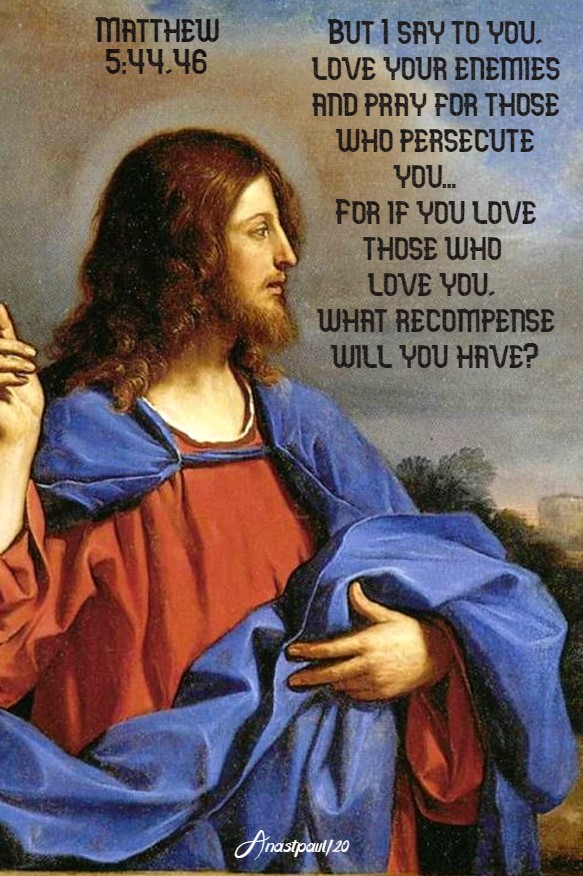
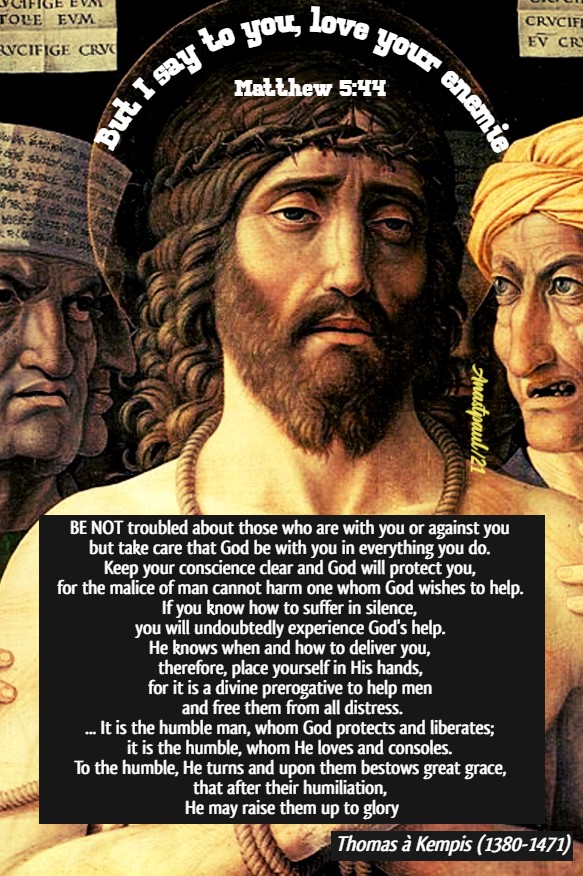
“But I say to you, love your enemies”
Matthew 5:44
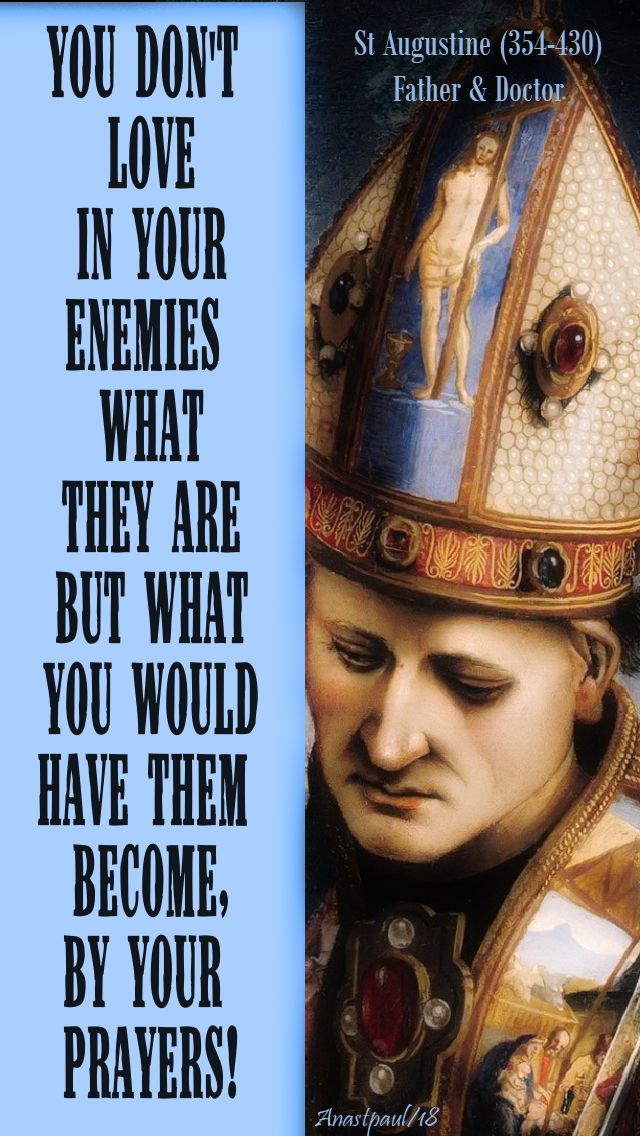
“You don’t love in your enemies what they are but what you would have them become, by your prayers!”
St Augustine (354-430) Father & Doctor
“BE NOT troubled about those who are with you or against you but take care that God be with you in everything you do. Keep your conscience clear and God will protect you, for the malice of man cannot harm one whom God wishes to help. If you know how to suffer in silence, you will undoubtedly experience God’s help. He knows when and how to deliver you, therefore, place yourself in His hands, for it is a divine prerogative to help men and free them from all distress. … It is the humble man, whom God protects and liberates; it is the humble, whom He loves and consoles. To the humble, He turns and upon them bestows great grace, that after their humiliation, He may raise them up to glory.”
Thomas à Kempis (1380-1471)
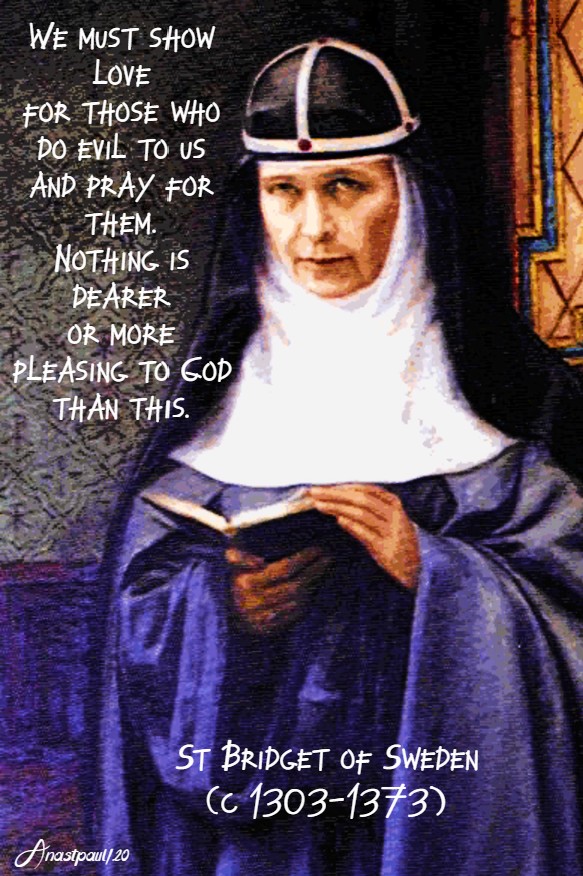
“We must show love for those who do evil to us and pray for them. Nothing is dearer or more pleasing to God than this.”
St Bridget of Sweden (c 1303-1373)
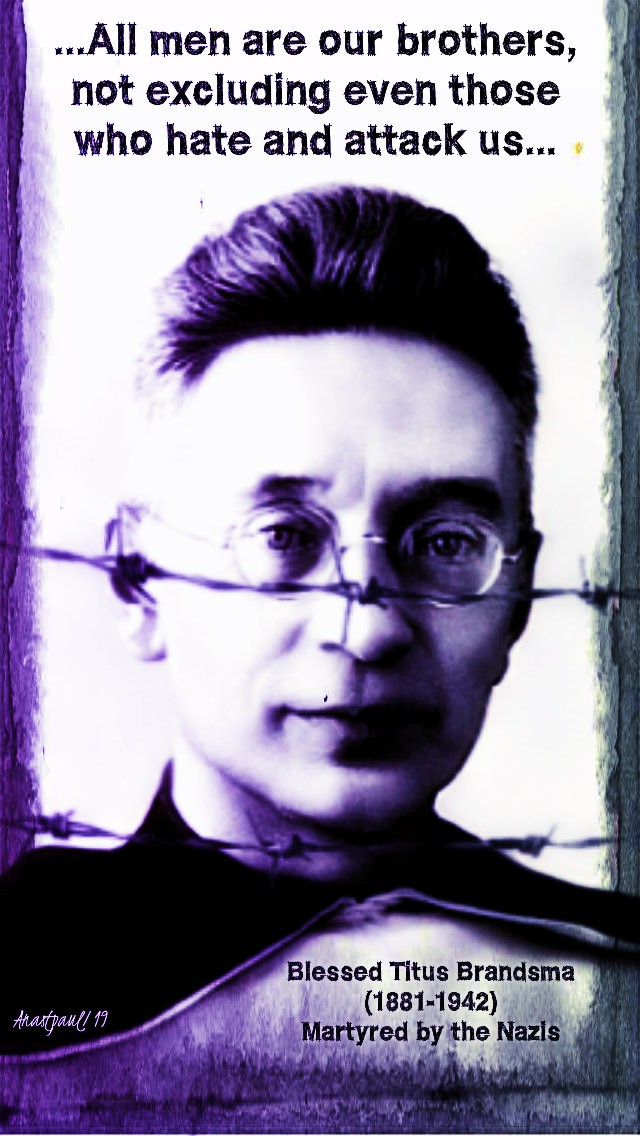
“ … All men are our brothers – not excluding even those who hate and attack us. … ”
One Minute Reflection –15 June – “Month of the Sacred Heart” – Readings: Second Corinthians 8: 1-9, Psalms 146: 2, 5-6ab, 6c-7, 8-9a, Gospel: Matthew 5: 43-48
“ Your Father, … makes his sun to rise upon the good,and bad and rains upon the just and the unjust.” – Matthew 5:45
REFLECTION –“Proclaim the goodness of God. For even while you are unworthy, He guides you and when you owe Him everything, He asks for nothing back and in return for the little things you do for Him, He repays you with great things! Therefore, do not simply call God “just” since it is not with regard to what you yourself do, that He reveals His justice. If David calls Him just and right (Ps 33[32],5), His Son has revealed to us, that He is yet more kind and gentle: “He is kind to the ungrateful and the wicked,” (Lk 6,35).
How can you possibly remain at the level of God’s simple justice when you read the chapter about the workmen’s wages? “My friend, I am not cheating you. I wish to give this last one the same as you. Are you envious because I am generous?” (Mt 20,13-15). How can one say no more, than that God is just when one reads the chapter about the prodigal son, who squandered his father’s wealth in a life of dissipation and how, at the merest sign of compunction shown by him, his father ran to him, threw his arms round him and granted him full rights over all his wealth? (cf Lk 15,11ff.). It was not some other who told us all this about God, causing us to have doubts about it. It is His Son in person -He Himself gave this testimony concerning God. So where is God’s justice to be found? Is it not in this: “while we were still sinners, Christ died for us,” (Rom 5,8)? If God reveals Himself to be compassionate here below, then let us believe, that He will be so for all eternity.” – St Isaac the Syrian of Nineveh (c 613- c 700) Bishop of Nineveh, Monk at Mosul – Ascetical discourses, 1st. series, no.60
PRAYER – Almighty God, to whom this world, with all it’s goodness and beauty belongs, give us grace joyfully, to begin this day for Christ Your Son, in Him and with Him and to fill it, with an active love for all Your children, even those who may not like or who do us harm. Help us to love as You do, so that we may become like You. Through Christ our Lord, with the Holy Spirit, one God, forever, amen. OUR Lady of the Sacred Heart, pray for us. Indulgence 100 Days. Raccolta 174 St Pius X, 9 July 1904.
Our Morning Offering – 15 June – “Month of the Sacred Heart”
Be the Heart of My Heart By St John Eudes (1501-1680) Apostle of the Sacred Heart
O Heart all lovable and all loving of my Saviour, be the Heart of my heart, the Soul of my soul, the Spirit of my spirit, the Life of my life and the sole principle of all my thoughts, words and actions, of all the faculties of my soul and of all my senses, both interior and exterior. Amen
St John Eudes is the author of the Proper for the Mass and Divine Office of the Sacred Heart of Jesus Christ and the Immaculate Heart of the Blessed Virgin. St John was an ardent proponent of the Sacred Heart and dedicated himself to it’s promotion and celebration. The Masses he compiled for both the Sacred Heart of Jesus and for the Immaculate Heart of Mary, were both first celebrated during his lifetime. He preached missions across France, including Paris and Versailles, while earning recognition as a popular evangelist and confessor. St John Eudes was also a prolific writer and wrote on the two Holy Hearts despite opposition from the Jansenists.
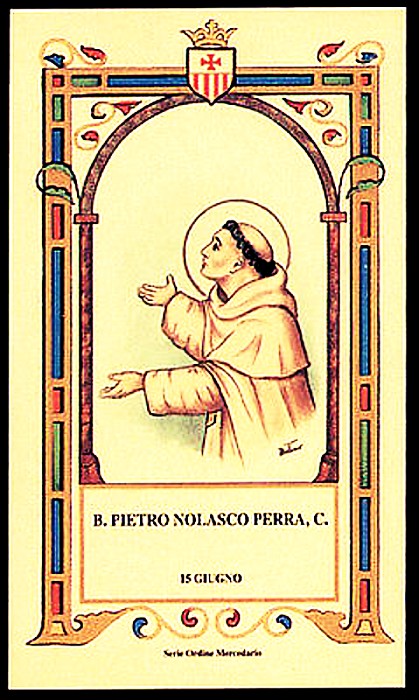
Saint of the Day – 15 June – Blessed Pietro Nolasco Perra OdeM (1574-1606) Priest of the Order of the Blessed Virgin Mary of Mercy (the Mercedarian Friars), Missionary. Born in Gergei, Sardinia, Sicily in 1574 as Pietro Giovanni Perra and died in Valencia, Spain on 15 June 1606 of natural causes aged 32.
The Order of Mercedaries was founded in Spain by St Peter Nolasco (1180-1245), with the main purpose of the ‘redemption’ of the Christians enslaved by the Arab Moors and brought to the Muslim countries of North Africa. After the era of Arab domination, the Order continued its apostolic work and evangelisation, spreading to all the countriess of Europe, but also to America (with Christopher Columbus there were also some Mercedarian Chaplains); -by now the ‘redemption’ was intended, above all, as liberation from the sin of the misled souls. As for Italy, the first Convent was founded in Cagliari in Sardinia, at that time subject to the Aragonese dominion and it was King Alfonso IV of Aragon in 1335 who made it a gift to the Order. Then in 1442 Naples followed and in 1463 Palermo and little by little foundations followed in other cities of Italy, including, in 1569 that of St Rufina in Rome, followed by the convent of St Adrian. And from the ancient Convent of the Blessed Virgin Mother of Bonaria in Cagliari, the Order received the gift of a holy figure of a Mercedarian Friar, Pietro Nolasco Perra.
He was sent to Valencia to continue his studies and in this City in 1603, he was Ordained a Priest. Documents of the time attest his presence in Valencia on 6 July 1604 and in the following years, in the Chapter meetings for the admission of other religious to the Order.
He was an example of the interior life, of obedience and humility in brotherly love. During the celebration of his Mass, the faithful who participated, were moved by the great devotion with which he prayed. He had words of comfort and encouragement for anyone who approached him, especially during Confession.
He died in Valencia at the age of only 32, on 15 June 1606, leaving behind the fame of a saint;. One of his companions, Fra ‘Machin, an eminent scholar, narrated that Fra’ Pietro Nolasco Perra on the verge of death, asked his superiors to command him to die, so that his death would be the daughter of obedience and thus have greater merits before God. Two years after his departure, collections of documentation and testimonies of those who had known him were opened, by order of the Archbishop of Cagliari, Msgr. Francesco Desquivel.
Two years after his death, the Archbishop of Cagliari, Francisco Desquivel began to collect information in order to start the Beatification process – from these data it is clear, that even in his native country, in contact with objects that belonged to him, there were numerous and miraculous occurences. The process of Beatification was thus initiated.
In 1652 a delegation was sent to Valencia to obtain some relics of “santu Impera” (Sician dialect) – fragments of his clothes and an arm were thus brought to the island. At the same time, a Church began to be built in his hometown, so that, as soon as Pietro Nolasco Perra was declared a saint, the saint and his relics could be publicly venerated in a suitable place. However, at the beginning of the 18th century, the Beatification process ran aground due to the mysterious disappearance of the file and, for the same reason, has not resumed.
The search for that dossier is currently underway, also because the Sardinian Catholic world, led by Bishop Antioco Piseddu , is asking for the investigation to be reopened. According to some sources, Pietro is currently only a Servant of God and Venerable but he is remembered by the Mercedarian Order as Blessed and celebrates him today.
Our Lady of the Taper of Cardigan (1100s)– 15 June:
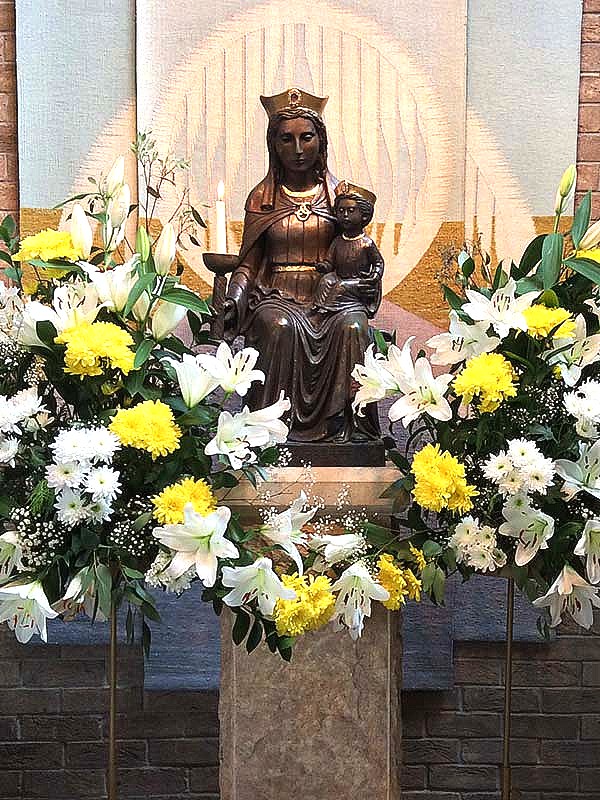
During the middle ages there was a notable pilgrimage in honour of Our Lady in Cardigan. A beautiful legend describes how a Statue of Mary was found by the side of the river Teifi, “and her sonne upon her lappe and the taper bernynge in her hande.” It was taken to the Parish Church but would not remain there, returning three or four times to “the place where now is buyIded the Church of our Lady,” the present St.Mary’s Church. A chantry Priest sang Mass daily in honour of Our Lady for pilgrims who came to pray and leave gifts. They lodged with the Knights Hospitallers of S. John, where the Angel Hotel now stands.
St Mary’s dates from 1158, built to hold the Statue. It resembles an earlier Shrine in the city of Arras, which was then in Flanders. Did Flemish merchants, who settled in Cardigan and traded in Welsh wool out of the port, bring the Statue back with them?
Devotion to Mary was once universal in Wales. Many places are called Llanfair or Capel Mair (Mary’s Church, Chapel) and dozens of flowers and plants bear her name. No girl was given the name Mair (Mary), as it was reserved for Our Lady.
We do not know how the devotion transferred to Barcelona and Cagliari. In the 1320’s and 1330’s Catalonian sailors had thronged British waters. Did they come to Cardigan, see the Shrine and copy it? In 1904 Breton Monks, in exile near Cardigan, revived the devotion, giving the title Our Lady of Cardigan to their Abbey Church and also to the little Church they opened in Town in 1912. They left in 1916 and another generation passed before the name was heard again.
In 1952 Martin Gillett, who later was to found the Ecumenical Society of the Blessed Virgin Mary, told Bishop Petit that Cardigan had once possessed a famous Shrine. The Bishop instantly decided to restore it. In 1956 a new Statue was blessed by Cardinal Griffin in Westminster Cathedral and then taken to every Parish in the Diocese of Menevia before arriving in Cardigan. On 27 May 1956, a great concourse from all parts of Britain bore it to the little Church of Our Lady of Sorrows. On 23 July 1970 Bishops Petit and Fox consecrated the new church of Our Lady of the Taper, named after the Shrine. Three days later pilgrims transferred the Statue there.
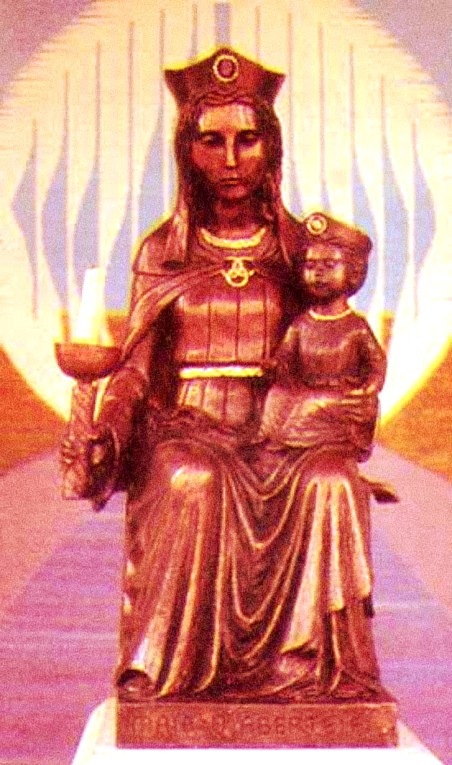
The original Statue was taken to London and destroyed at Chelsea in 1538 along with other Marian images on the orders of Thomas Cromwell, 1st Earl of Essex, Chief Minister of King Henry VIII. Mother Concordia, OSB, was asked to make another in bronze. Designated as a Welsh National Shrine of Our Lady, it was blessed in Cardiff Metropolitan Cathedral and brought all over Wales before, on Pentecost Sunday, 18 May 1986, it was solemnly installed in the presence of 4,500 pilgrims. Its beauty catches the imagination and arouses devotion. Pope John Paul II wrote a special message for the occasion, and a taper he blessed in Rome was placed in the hand of the statue and lit.
Its symbolism is that Mary presents her Son to us, as she did to the Wise Men, to be adored. The taper testifies that He is Light of the World. Pilgrims come to pray individually and in groups. May they learn to treasure the word of God in their hearts, as Mary did, and live by the light of her Son, who is her Saviour and ours.
St Abraham of Saint-Cyriacus St Achaicus of Corinth St Barbara Cui Lianshi St Benildis of Córdoba
St Bernard of Montjoux/Menthon CRSA (c 1020-1081) “Apostle of the Alps” Priest, Founder of a patrol that cleared robbers from the mountains and he established hospices for travellers and pilgrims. The large dogs, trained to search for lost victims in the mountains, are named for him. Patronages – Alpinists, Alps (proclaimed by Pope Pius XI on 20 August 1923), Campiglia Cervo, Italy, mountain climbers (proclaimed by Pope Pius XI on 20 August 1923), mountaineers, skiers, travellers in the mountains (proclaimed by Pope Pius XI on 20 August 1923). Biography: https://anastpaul.com/2018/06/15/saint-of-the-day-15-june-st-bernard-of-menthon-c-r-s-a-c-1020-1081-apostle-of-the-alps/
St Constantine of Beauvais St Domitian of Lobbes St Edburgh of Winchester St Eigil St Eutropia of Palmyra St Fortunatus of Corinth
St Hadelinus of Lobbes St Hesychius of Durostorum St Hilarion of Espalion Bl Juan Rodriguez St Julius of Durostorum St Landelin of Crespin St Leonides of Palmyra St Libya of Palmyra St Lotharius of Séez St Melan of Viviers St Orsisius Bl Pedro da Teruel Bl Peter Snow St Pierre de Cervis Blessed Pietro Nolasco Perra OdeM (1574-1606) Bl Ralph Grimston St Tatian of Cilicia Bl Thomas Scryven St Trillo of Wales St Vaughen of Ireland
St Vitus (c 290-c 303) – Martyr, One of the Seven Holy Helpers. Died aged 12-13 years of age. Patronages – against animal attacks, against dog bites, against epilepsy; epileptics, against lightning, against over-sleeping, against rheumatic chorea or Saint Vitus Dance, against snake bites, against storms, against wild beasts, of actors, comedians, dancers, dogs, Bohemia, Czech Republic, Serbia, 17 cities. His very short life: https://anastpaul.com/2017/06/15/saint-of-the-day-15-june-st-vitus/
St Vouga of Lesneven — Martyr of Lucania – 11 saints: Eleven Christians martyred together. We known nothing else about them but the names – Anteon, Candidus, Cantianilla, Cantianus, Chrysogonus, Jocundus, Nivitus, Protus, Quintianus, Silvius, Theodolus in Lucania (modern Basilicata), Italy, date unknown.
Thought for the Day – 14 June – Meditations with Antonio Cardinal Bacci (1881-1971)
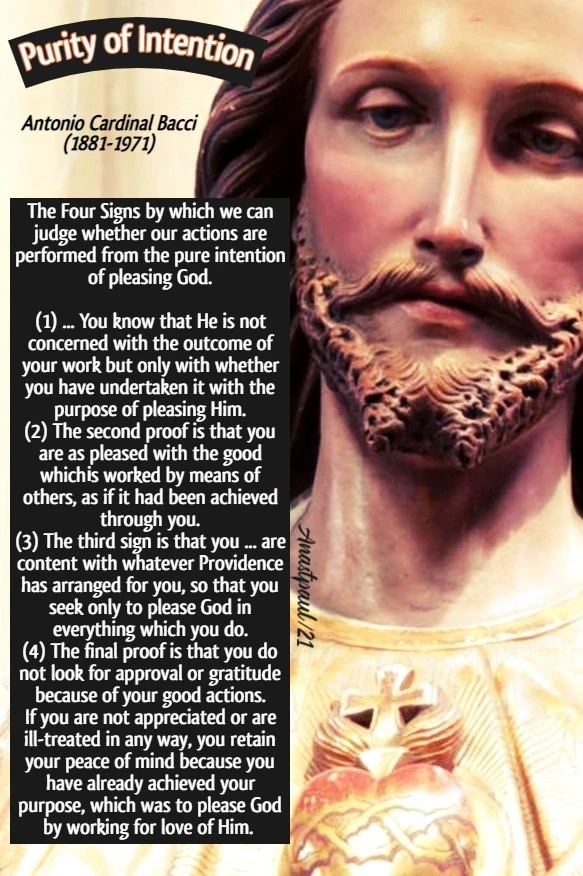
Purity of Intention
“St Alphonsus indicates the signs by which we can judge whether our actions are performed from the pure intention of pleasing God.
(1) The first sign is that you are not disturbed when your projects are unsuccessful but retain the same composure as if you had succeeded. This will be the case when you are working for GOD ALONE, so that once you realise, that God has not desired your efforts to succeed, you no longer desire it either. You know that He is not concerned with the outcome of your work but only with whether you have undertaken it with the purpose of pleasing Him.
(2) The second proof is that you are as pleased with the good which is worked by means of others, as if it had been achieved through you.
(3) The third sign is that you do not long for one position rather than another but, are content with whatever Providence has arranged for you, so that you seek only to please God in everything which you do.
(4) The final proof is that you do not look for approval or gratitude because of your good actions. If you are not appreciated or are ill-treated in any way, you retain your peace of mind because you have already achieved your purpose, which was to please God by working for love of Him. (Cf Al Divino Servizo, 11, 7).”
Quote/s of the Day – 14 June – “Month of the Sacred Heart” – Readings: Second Corinthians 6: 1-10, 98: 1, 2b, 3ab, 3cd-4, Matthew 5: 38-42
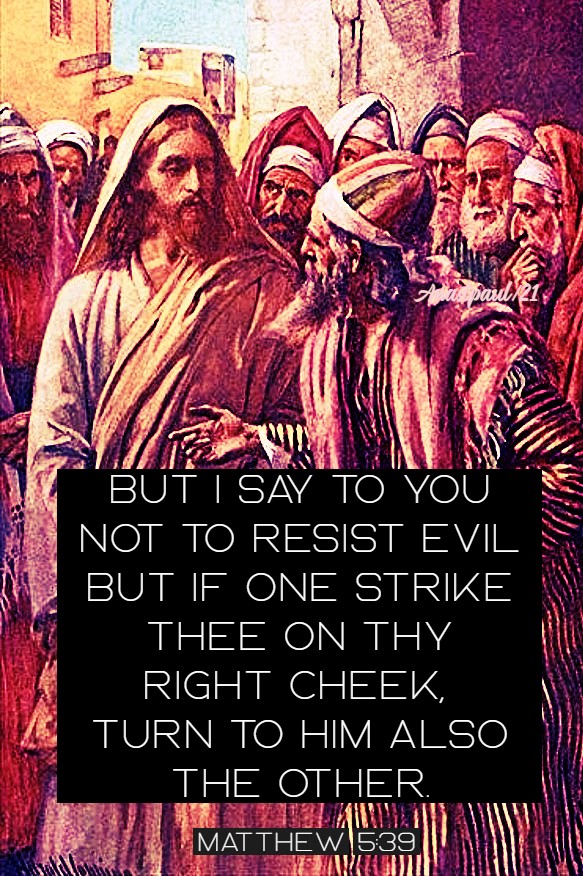
“But I say to you not to resist evil but if one strike thee on thy right cheek, turn to him also the other.“
Matthew 5:39
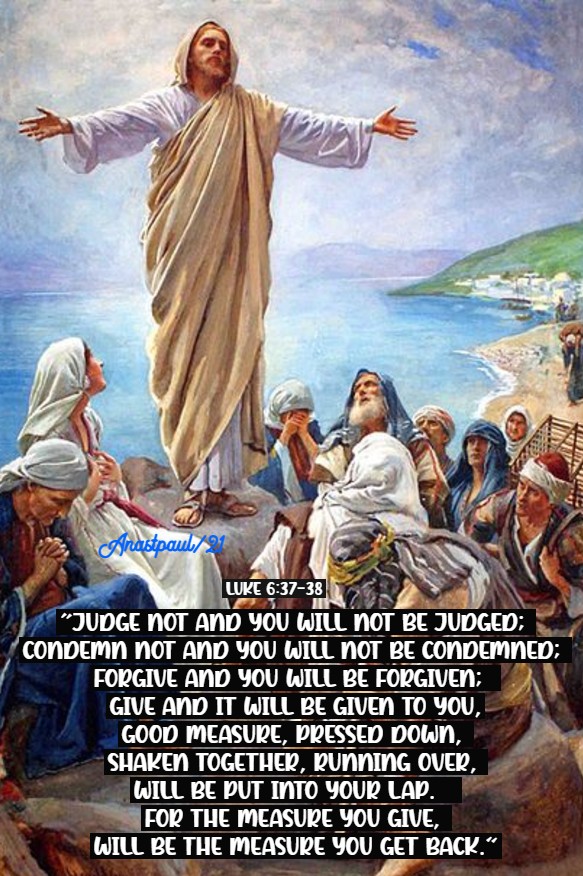
“Judge not and you will not be judged; condemn not and you will not be condemned; forgive and you will be forgiven; give and it will be given to you, good measure, pressed down, shaken together, running over, will be put into your lap. For the measure you give, will be the measure you get back.“
Luke 6:37-38
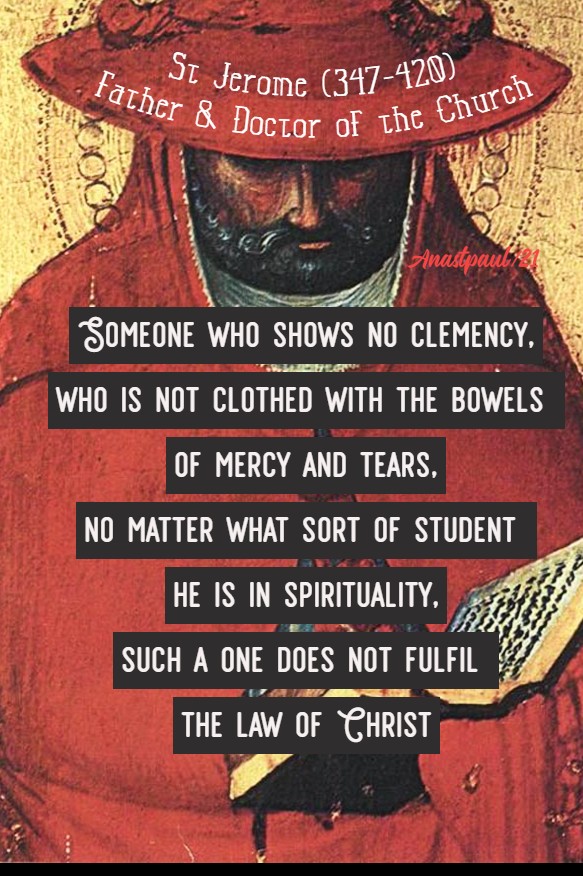
“Someone who shows no clemency, who is not clothed with the bowels of mercy and tears, no matter what sort of student he is in spirituality, such a one does not fulfil the law of Christ.”
St Jerome (347-420) Father & Doctor of the Church
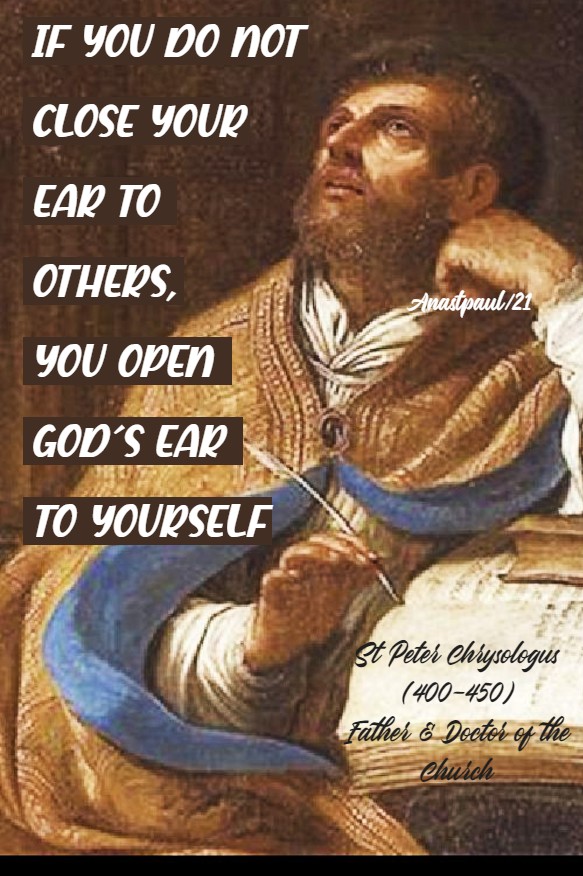
“If you do not close your ear to others, you open God’s ear to yourself.”
St Peter Chrysologus (400-450) Father & Doctor of the Church
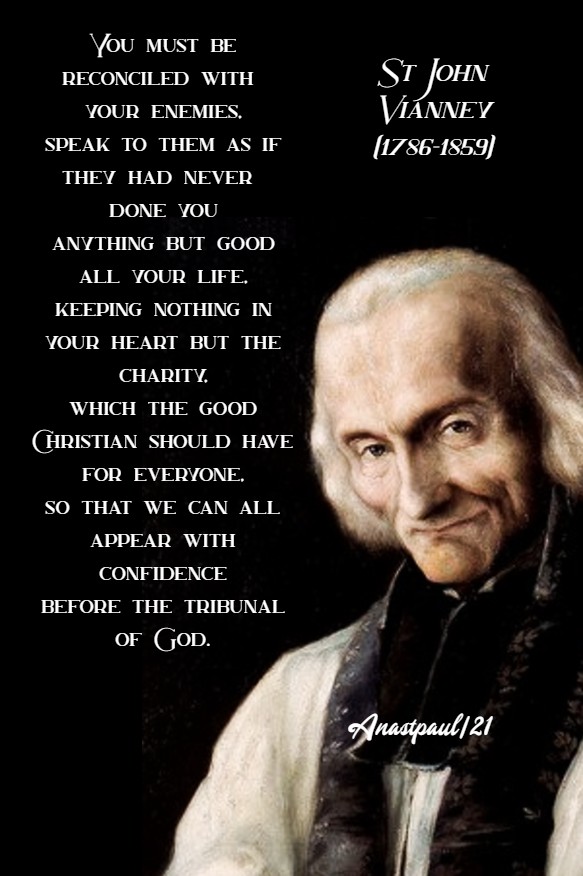
“You must be reconciled with your enemies, speak to them as if they had never done you anything but good all your life, keeping nothing in your heart but the charity, which the good Christian should have for everyone, so that we can all appear with confidence before the tribunal of God.”
One Minute Reflection – 14 June – “Month of the Sacred Heart” – Readings: Second Corinthians 6: 1-10, 98: 1, 2b, 3ab, 3cd-4, Matthew 5: 38-42
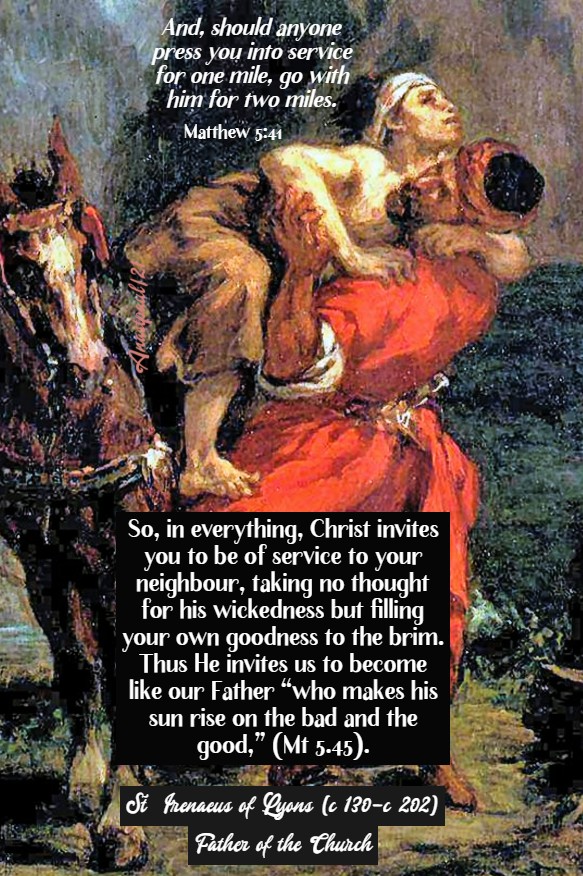
“And, should anyone press you into service for one mile, go with him for two miles.” – Matthew 5:41
REFLECTION – “If anyone wants to go to law with you over your tunic, hand him your cloak as well; from the one who takes what is yours do not demand it back and do to others what you would have them do to you,” (Mt 5.40; Lk 6.30-31). In that way, we will not be dismayed like those whose possessions have been taken away against their will but, to the contrary, will be glad like people who have willingly given, since we would rather make a free gift to our neighbour, than give way to constraint. “And,” He continues, “should anyone press you into service for one mile, go with him for two miles.” In that way, we are not following him like a slave but going before him like a free man. So, in everything, Christ invites you to be of service to your neighbour, taking no thought for his wickedness but filling your own goodness to the brim. Thus He invites us to become like our Father “who makes his sun rise on the bad and the good,” (Mt 5.45).
All this is not the deed of someone who abolishes the Law but of someone who fulfils and develops it for us (Mt 5.17). To serve freedom is an even greater service and our Liberator puts forward, an even deeper submission and devotion towards Him. For He has not set us free from the obligations of the old Law to make us independent of Himself… but so that, having received His grace, yet more abundantly, we might love Him all the more and, in loving Him all the more, might receive an even greater glory from Him, when we are forever in the presence of His Father. ” – St Irenaeus of Lyons (c 130-c.208) Bishop, Martyr, Ttheologian – Against the Heresies, IV, 13, 3
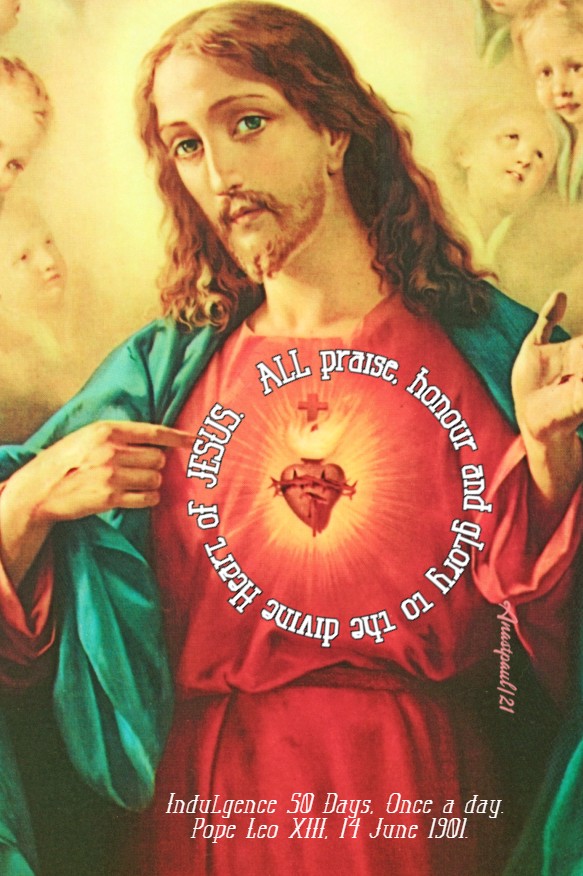
PRAYER – True Light of the world, Lord Jesus Christ, as You enlighten all men for their salvation, give us Your grace, we pray to herald Your coming by preparing the ways of justice and of peace. Grant, that by the prayers of Your Saints who have gone before us and the assistance of Your Blessed Mother, we may follow more closely in Your footsteps and obey Your words. We pray to You Lord Jesus, Who live and reign with the Father and the Holy Spirit, one God forever, amen. All praise, honour and glory to the divine HEART of JESUS. – Indulgence 50 Days, Once a day. Raccolta 168 Pope Leo XIII, 14 June 1901.
Our Morning Offering – 14 June – “Month of the Sacred Heart”
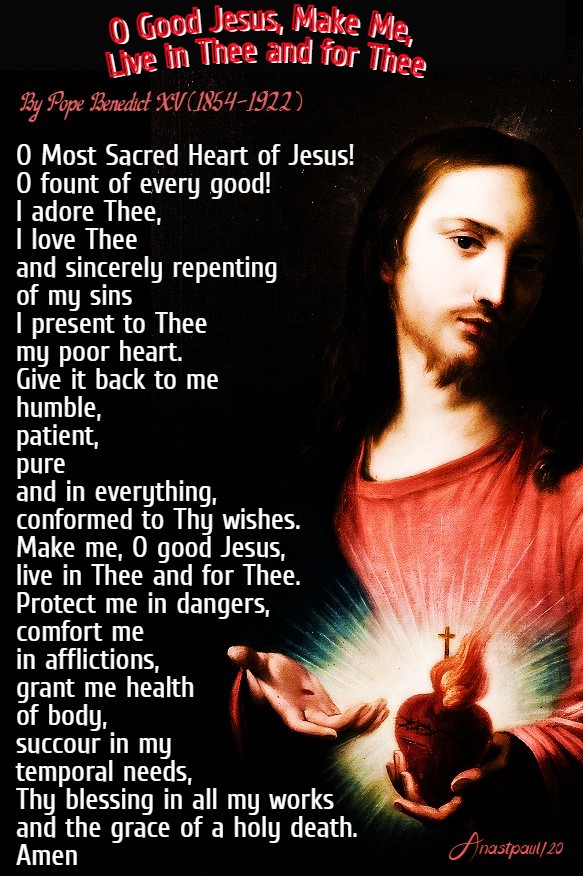
O Good Jesus, Make Me Live in Thee and for Thee By Pope Benedict XV (1854-1922)
O Most Sacred Heart of Jesus! O fount of every good! I adore Thee, I love Thee and sincerely repenting of my sins I present to Thee my poor heart. Give it back to me humble, patient, pure and in everything, conformed to Thy wishes. Make me, O good Jesus, live in Thee and for Thee. Protect me in dangers, comfort me in afflictions, grant me health of body, succour in my temporal needs, Thy blessing in all my works and the grace of a holy death. Amen
Indulgence – 100 days Once a day Pope Benedict XV 4 December 1916
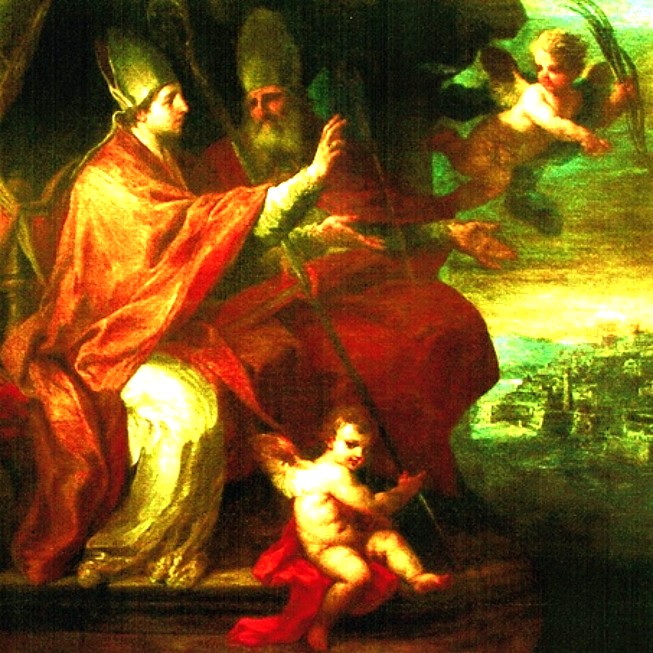
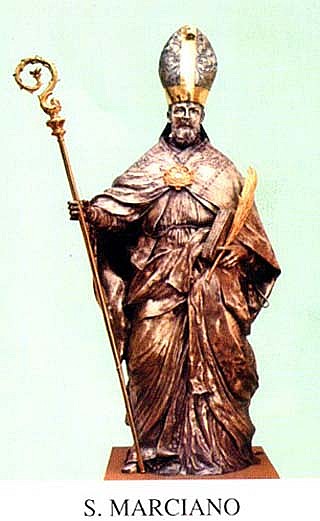
Saint of the Day – 14 June – St Marcian of Syracuse (Died c 68) Martyr, Bishop of Syracuse, Sicily, Italy, Disciple of and Consecrated by St Peter, Missionary, Evangelist. Born in the first century in Antioch and died in c 68 in Syracuse, Italy by murder. Patronages – Cities of Gaeta and Syracuse, Italy. Also known as Marcellus.
St Erasmus (Elmo) left and St Marcian on the right
The Roman Martyrology states of him today: “At Syracuse, St Marcian, Bishop, who was Consecrated Bishop by the blessed St Peter and killed by the Jews after he had preached the Gospel.”
Marcian is considered the first evangeliser of Christianity in that Italian City, where he arrived in the year 39, sent by Saint Peter, of whom he was a disciple. He is considered the first Bishop of Syracuse .
His preaching was completed with that of Saint Paul.
He made many conversions,for which he suffered persecution by the local Jewish community and in the year 68 he was Martyred.
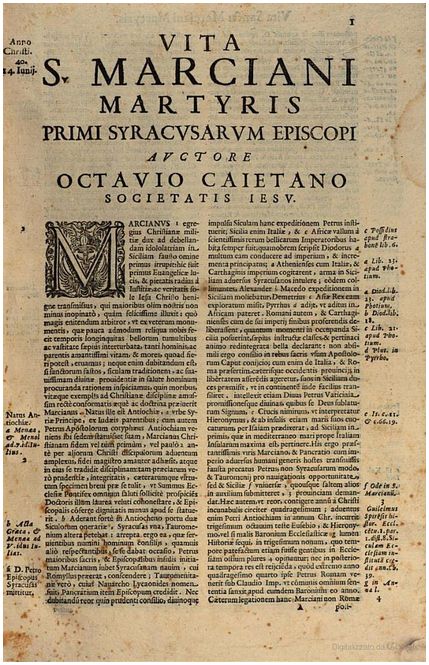
The life of St Marcian
His body is venerated in the Cathedral of Gaeta, the City of which he is a Co-patron but the oldest representation is found in the Catacomb of Santa Lucia in Syracuse.
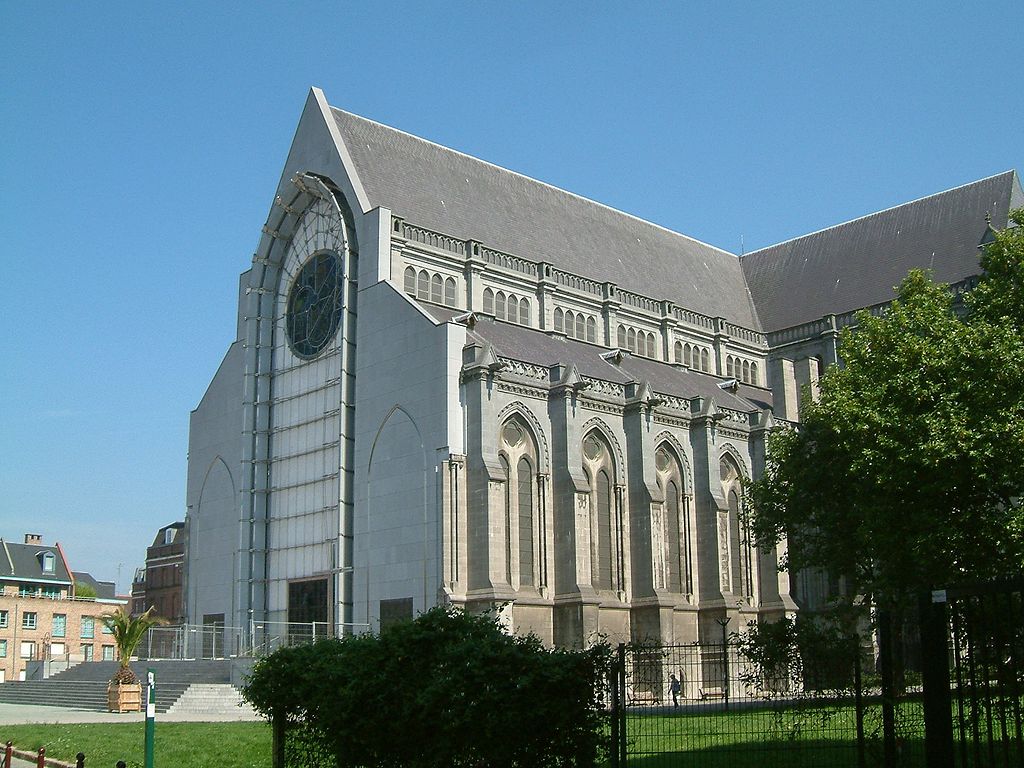
Notre-Dame de la Treille / Our Lady of the Trellis, Lille, Nord, Flandres, France, 1234 – 14 June:
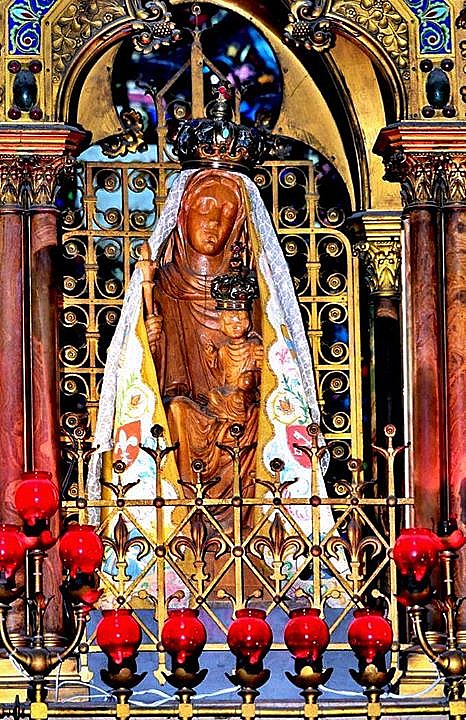
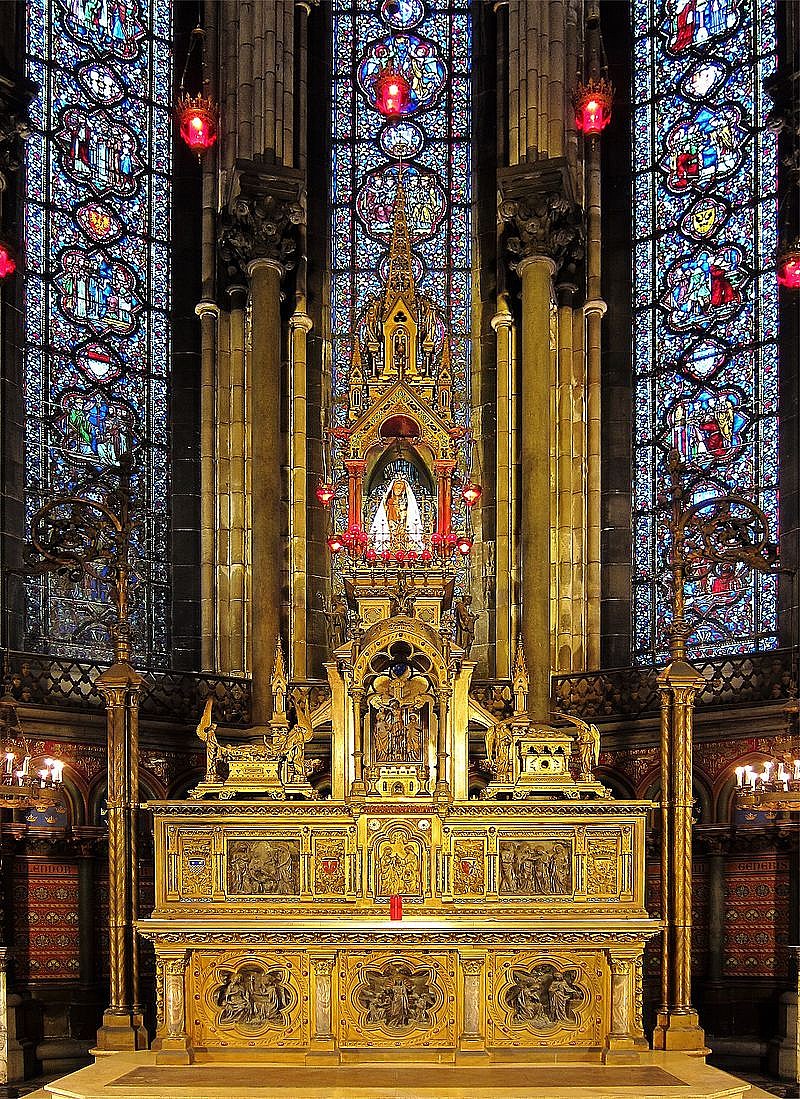
Three series of miraculous events are associated with the Statue, occurring in 1234, from 1519 to 1527 and from 1634 to 1638. The miracle of 1234 was the healing of the 53 disabled patients who resorted to her intercession and were cured upon praying before the Statue of Our Lady of the Trellis, installed behind a latticework fence in St Peter’s Collegiate Church in Lille, France. The miracles in the 16th century were varied and included deliverance from demonic possession, hernias, blindness, paralysis and plague. In 1254, a Confraternity of Our Lady of the Treille was canonically established by Pope Alexander IV and since 1259, an annual procession in honour of Our Lady of the Treille was held – a practice which continued until the French Revolution and since then resumed and is continued today. In 1634, Jean Le Vasseur, Mayor of Lille, Consecrated the City to Our Lady of the Treille. In 1667, Louis XIV, who had just taken Flanders, took an oath to respect the freedoms of Lille before the Statue. A procession held annually on the second Sunday after Pentecost commemorates the miracles. Saved during the destruction of St Peter’s Church in the French Revolution, the Statue moved afterwards to St Catherine’s Church. Devotion to Our Lady of the Trellis revived in the mid-1800s and a grand neo-Gothic Church arose in her honour, where the Statue was installed in 1872 and canonically crowned in 1874. After the theft of the original in 1959, sculptor Marie Madeleine Weerts carved the image now displayed in Lille’s Catholic Cathedral, the Basilica of Notre-Dame de la Treille.
The statue is described by Father Charles Bernard, Parish Priest of the Church of St Catherine, as a sSatue of stone “a little more than two and a half feet high; she has a scepter in her right hand and from her left. she supports the Baby Jesus on her knees.” He mentions the trellis of gilded wood surrounding the Statue and its pedestal, and specifies that the old trellis made of gilded iron was lost in 1792 during the destruction of the Collegiate Church of St. Peter. He speculates that this trellis is what gave the Statue its name, although it is more likely that the name came from Treola, a place existing in the 9th century in what is now Lille.
St Anastasius of Córdoba St Burchard of Meissen St Caomhán of Inisheer St Castora Gabrielli St Cearan the Devout Bl Constance de Castro St Cyprien St Cyriacus of Zeganea St Davnet St Digna of Córdoba St Dogmael of Wales St Elgar of Bardsey
St Etherius of Vienne St Felix of Córdoba Bl Fortunatus of Napoli Bl Francisca de Paula de Jesus Isabel St Gerold of Evreux Bl Hartwig of Salzburg St Joseph the Hymnographer St Marcian of Syracuse (Died c 68) Bishop Martyr, Consecrated by St Peter St Mark of Lucera
St Nennus of Arran Bl Peter de Bustamante St Protus of Aquileia St Quintian St Richard of Saint Vannes St Rufinus of Soissons St Thecla St Theopista St Valerius of Soissons Bl Walter Eustace
Thought for the Day – 13 June – Meditations with Antonio Cardinal Bacci (1881-1971)
St Anthony
“On the 13th of June in the year 1231, a crowd of children set out from the nearby Convent of Arcella and entered Padua crying out: “The Saint is dead!” The entire City was -plunged into mourning because it’s Saint was dead.
Anthony had traversed Italy, converting heretics, recalling innumerous sinners to repentance, working miracles and giving peace to souls and to strife-torn cities. Soon he had felt that his young life was already running out as the result of these labours and austerities and he had determined to hide himself in a little Franciscan Monastery at Camposampiero near Padua. In order to shelter himself from the world ,as far as possible, he built a little cell in the bifurcation of the branches of a giant walnut tree. Here he spent his last days in prayer and contemplation, joining with the birds in their songs of praise to God. He was no longer a man but an angel in human form. Crowds of the faithful flocked around the tree to hear, once again, the voice of the Saint calling on them to practise virtue and to follow the road to Heaven.
It was in this little nest, at only thirty six years of age, that his life slowly flickered out, consumed, not so much by disease as by a burning love for God and for his fellowman.
Let us pray that we may obtain a spark of this love, which will detach us from the world, cause us to belong entirely to God and make us generous apostles in our work for the salvation of souls. Jesus, my God, I love You above all things. Amen.”
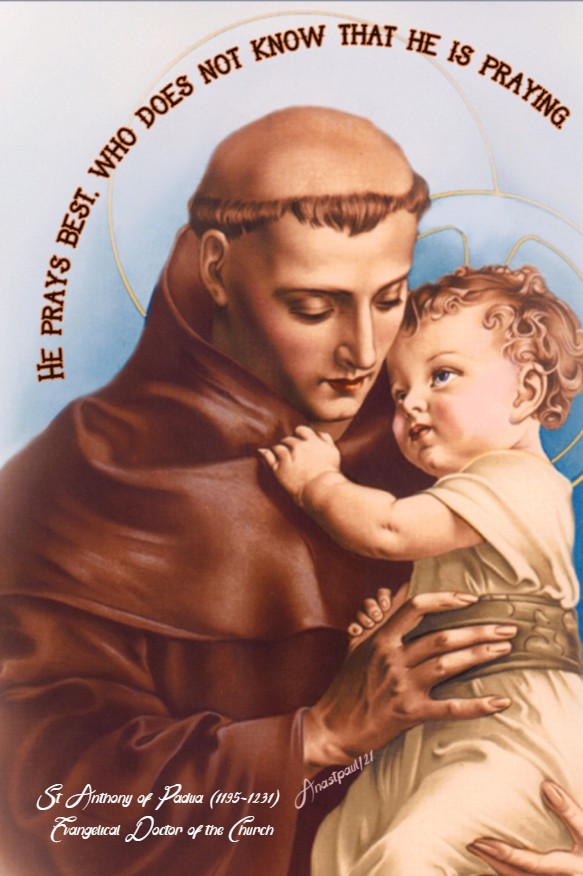
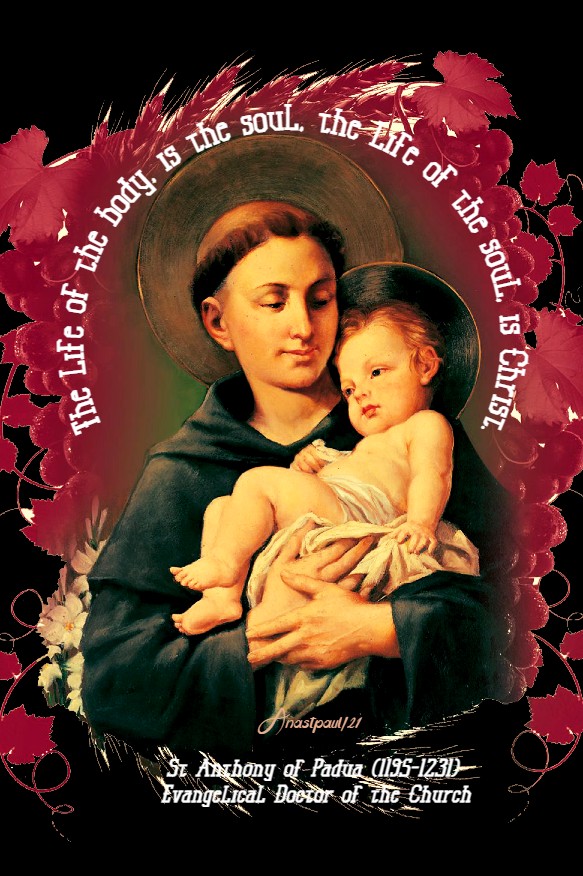
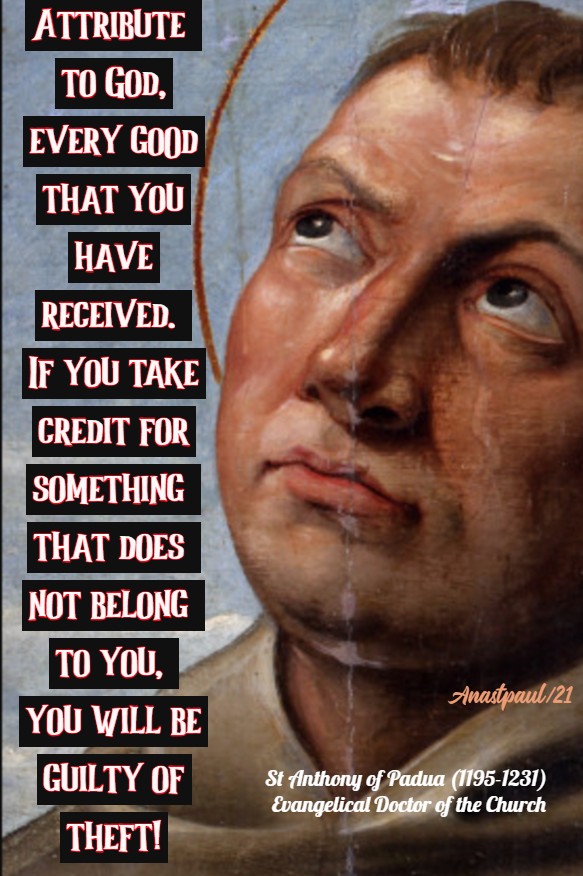
Quote/s of the Day – 13 June – – “Month of the Sacred Heart” – The Memorial of St Anthony of Padua (1195-1231) Evangelical Doctor of the Church
“The breadth of charity, widens the narrow heart, of the sinner.”
“Charity is the soul of faith and makes it alive; without love, faith dies.”
“He prays best , who does not know that he is praying.”
“The life of the body, is the soul, the life of the soul, is Christ.”
“Attribute to God, every good that you have received. If you take credit for something that does not belong to you, you will be guilty of theft!”
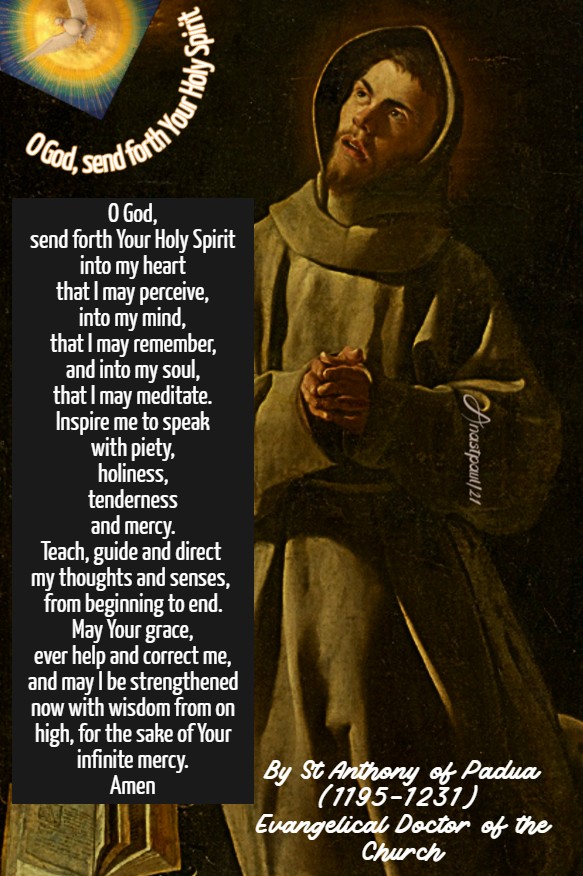
O God, send forth Your Holy Spirit By St Anthony of Padua (1195-1231) Doctor of the Church
O God, send forth Your Holy Spirit into my heart that I may perceive, into my mind, that I may remember, and into my soul, that I may meditate. Inspire me to speak with piety, holiness, tenderness and mercy. Teach, guide and direct my thoughts and senses, from beginning to end. May Your grace, ever help and correct me, and may I be strengthened now with wisdom from on high, for the sake of Your infinite mercy. Amen
St Anthony of Padua (1195-1231) Evangelical Doctor of the Church
One Minute Reflection – 13 June – “Month of the Sacred Heart” – Sunday within the Octave, Readings: Ezekiel 17: 22-24, Psalms 92: 2-3, 13-14, 15-16, Second Corinthians 5: 6-10, Mark 4: 26-34
“It puts forth large branches, so that the birds of the sky can dwell in its shade” – Mark 4:32
REFLECTION – “The kingdom of heaven, says the gospel, is like a mustard seed … Christ is the kingdom of heaven. Sown like a mustard seed in the garden of the Virgin’s womb, He grew up into the tree of the Cross whose branches stretch across the world … Christ is the kingdom, because all the glory of His kingdom is within Him. Christ is a man because all humanity is restored in Him. Christ is a mustard seed because the infinitude of divine greatness, is accommodated to the littleness of flesh and blood.
Do we need further examples? Christ became all things in order to restore all of us in Himself. The man Christ, received the mustard seed which represents the kingdom of God … though as God, He had always possessed it He sowed it in His garden.
The Church is a garden extending over the whole world, tilled by the plough of the Gospel, fenced in by stakes of doctrine and discipline, cleared of every harmful weed by the labour of the Apostles, fragrant and lovely with perennial flowers – virgins’ lilies and martyrs’ roses, set amid the pleasant verdure of all, who bear witness to Christ and the tender plants of all, who have faith in Him.
Such then is the mustard seed which Christ sowed in His garden. When He promised a kingdom to the partriarchs, the seed took root in them, with the prophets it sprang up, with the Apostles it grew tall in the Church – it became a great tree putting forth innumerable branches laden with gifts. And now, you too must take the wings of the psalmist’s dove (Ps 68[67]:14) … and fly to rest forever among those sturdy, fruitful branches. No snares are set to trap you there (Ps 91[90]:3); fly off, then, with confidence and dwell securely in its shelter.” – St Peter Chrysologus (406-450) Bishop of Ravenna, Father and Doctor of the Church – Sermon 98.
PRAYER – Almighty Father, we bless You Lord of life, through whom all living things tend. You are the source of all, our first beginning and our end! Grant holy Father, that we may allow the Word to enter our hearts and grow by Your grace, so that we may always live for Your glory. May the intercession of the Blessed Virgi Mary, all Your Angels and Saints, grant us strength and zeal. Through Jesus Christ, our Lord with the Holy Spirit, God forever, amen. MAY the Heart of JESUS in the most Blessed Sacrament be praised, adored and loved with grateful affection, at every moment, in all the Tabernacles of the world, even to the end of time. Amen.Indulgence 100 Days, Once a day. Raccolta 161 Blessed Pius IX, 29 February 1868.
Our Morning Offering – 13 June – “Month of the Sacred Heart” – Sunday within the Octave
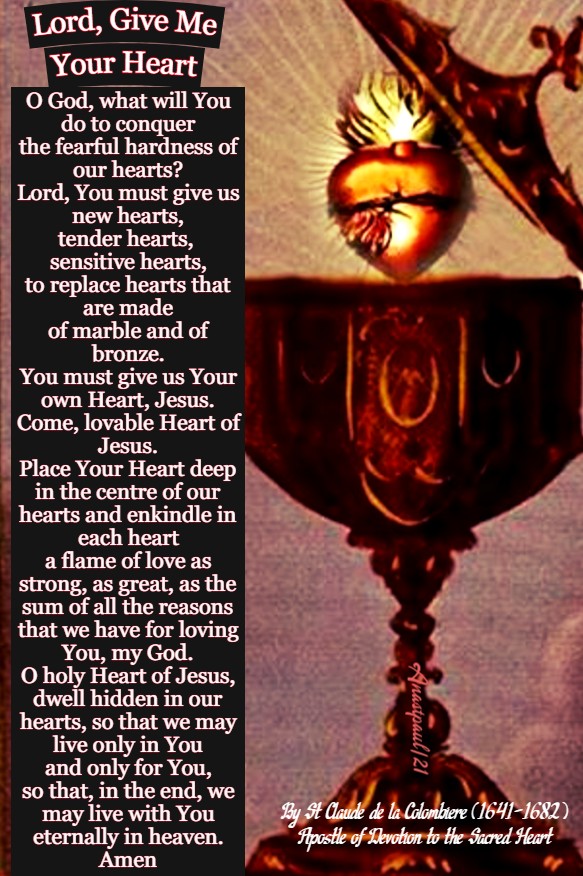
Lord, Give Me Your Heart By St Claude de la Colombiere SJ (1641-1682) Apostle of Devotion to the Sacred Heart and Spiritual Director to St Margaret Mary Alacoque
O God, what will You do to conquer the fearful hardness of our hearts? Lord, You must give us new hearts, tender hearts, sensitive hearts, to replace hearts that are made of marble and of bronze. You must give us Your own Heart, Jesus. Come, lovable Heart of Jesus. Place Your Heart deep in the centre of our hearts and enkindle in each heart a flame of love as strong, as great, as the sum of all the reasons that we have for loving You, my God. O holy Heart of Jesus, dwell hidden in our hearts, so that we may live only in You and only for You, so that, in the end, we may live with You eternally in heaven. Amen
Saint of the Day – 13 June – Saint Tryphillius (Died 370) Bishop of Nicosia, Cyprus, eloquent and learned Priest, Defender of the True Faith against Arianism and of St Athanasius of Alexandria. Born in Rome, Italy and died in 370 of natural causes. Also known as – Triphyllius, Trifilio, Trifillo.
Tryphillius was educated in law at the school of Beirut. He converted to Christianity and was named Bishop of Nicosis.
He was a disciple of Saint Spyridon of Trimythous. He was also an ardent supporter of St Athanasius of Alexandria against the Arians. Saint Athanasius praised Tryphillius for his adherence to orthodoxy and consequently, the Arians turned their attacks on him.
Tryphillius lived in simplicity without pomp or splendour,and preached everyday. St Jerome considered him one of the most eloquent Church figures of the era.
Sunday within the Octave of the Sacred Heart +2021
13 June 1917 – The Second Apparition of our Lady of Fatima
Madonna della Cava/ Our Lady of the Cave, Latera, Viterbo, Latium, Italy – 13 June:
The Church of the Madonna della Cava is a small Church located in an area of tufa quarries in one of the roads leading to the agricultural areas of the country. It is the Church and above all, a painting depicting the Madonna and child, ae the subject of particular devotion on the part of the inhabitants of Latium. The Church, rebuilt today, was bombed during World War II and reduced to ruins, ruined from flying debris and explosions with only the framework surviving behind the Altar and the painting.
Bl Achilleo of Alexandria Bl Alfonso Gomez de Encinas Bl Anthony of Ilbenstadt St Aquilina of Syria St Aventino of Arbusto St Damhnade St Diodorus of Emesa St Eulogius of Alexandria St Fandilas of Penamelaria St Felicula of Rome St Fortunatus of North Africa
Blessed Gerard of Clairvaux (Died 1138) – was the elder brother of Saint Bernard of Clairvaux. He was a Soldier. When he was wounded in combat at the siege of Grancy, Gerard resolved to become a Monk. He became a Benedictine Cistercian Monk at Citeaux. He worked with Saint Bernard at Clairvaux and became his closest confidant. He died in 1138 of natural causes.
St Lucian of North Africa St Mac Nissi of Clonmacno
St Maximus of Cravagliana St Nicolas Bùi Ðuc The St Peregrinus of Amiterno St Rambert St Salmodio Bl Servatius Scharff St Thecla St Tryphillius (Died 370) Bishop St Victorinus of Assisi St Wilicarius of Vienne
Thought for the Day – 12 June – Meditations with Antonio Cardinal Bacci (1881-1971) “Month of the Sacred Heart” – Memorial of the Immaculate Heart of Mary
“All Generations Shall Call Me Blessed”
‘A Jewish girl, poor in this world’s goods but rich in virtue, arrived after a long and difficult journey at a village in the hills of Judea, called Hebron. There, she paid a visit to her cousin, Elizabeth. When Elizabeth saw the girl, she was immediately enlightened by the Holy Spirit with the knowledge, that her visitor, was the Mother of God. “How have I deserved,” she cried out, “that the mother of my Lord, should come to me?” (Lk 1:43). At these words, Mary looked up towards Heaven and gave spontaneous expression to a hymn of humble acknowledgement to God, Who had “regarded the lowliness of His Handmaid” (Lk 1:48). Then she made a solemn prophecy, which would surely have assured the cynical intellectuals and nobles of the land but, which history has wonderfully fulfilled. “Behold” she said, “all generations shall call me blessed” (ibid). We can testify today, that this miracle came to pass. All the nations have paid reverence to the Jewish girl, who became the Mother of God and our Mother, the Queen of Heaven and earth, the comforter of the afflicted, the conqueror of Satan and the invincible Guardian of the Church. From the engravings in the Catacombs, to the celestial Madonnas of the Angelico, from the rudimentary sculpture of Roman art, to the prayerful statues on the pinnacles of more modern Cathedrals, the image of Mary has shone as a beacon of hope for all generations. Men bow before her and ask for light, for comfort and for pardon. “If anyone follows Mary,” says St Bernard, “he will not lose his way; if anyone pray to her, he will not despair; if anyone thinks of her, he will not sin; if anyone reaches out to her, he will not fall; if anyone places himself under her protection, he need have no fear; if anyone places himself under her leadership, he will never give up; if anyone pays homage to her, he is certain to reach his destination safely”(Homil Missus est 2:17).”
Quote/s of the Day – 12 June – “Month of the Sacred Heart” – Memorial of the Immaculate Heart of Mary
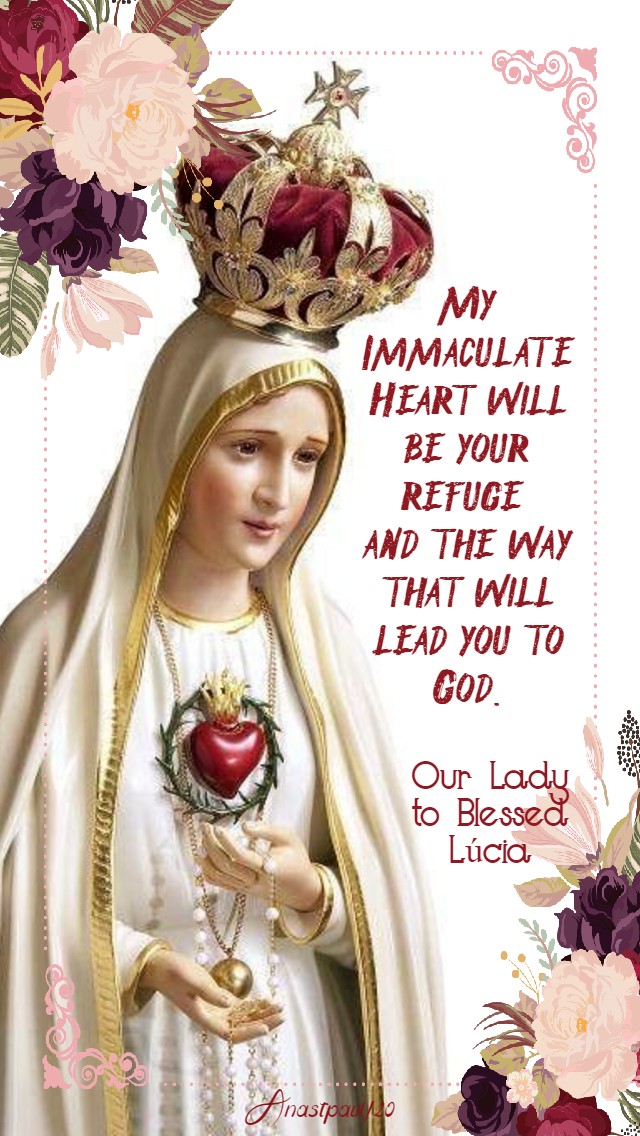
Our Lady assured Blessed Lúcia:
“My Immaculate Heart will be your refuge and the way that will lead you to God.” Thus, if we devote ourselves to her Immaculate Heart, Mary will lead us to her Son, Jesus Christ and we will be on the way to Heaven.“
Our Lady of Fatima
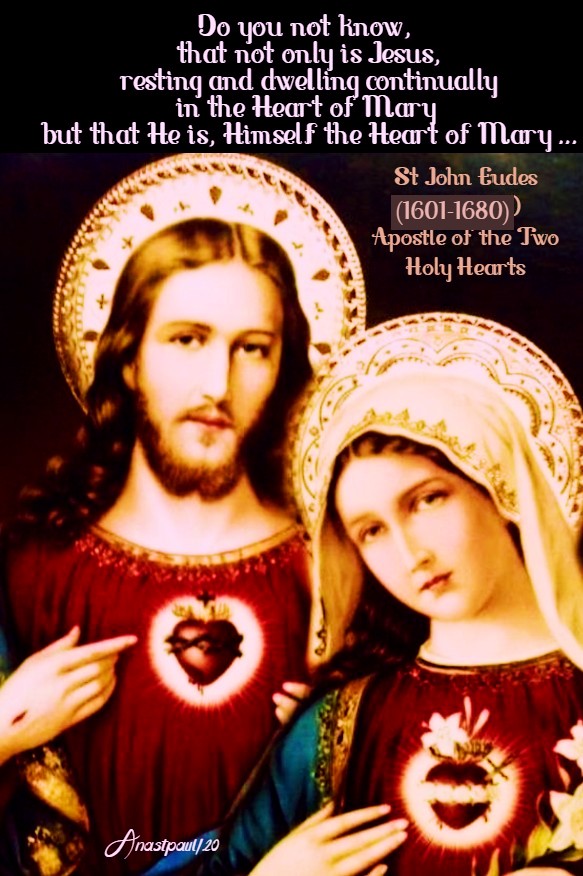
“Do you not know, that not only is Jesus, resting and dwelling continually in the Heart of Mary but that He is, Himself the Heart of Mary … “
St John Eudes (1601-1680) Apostle of the Two Holy Hearts
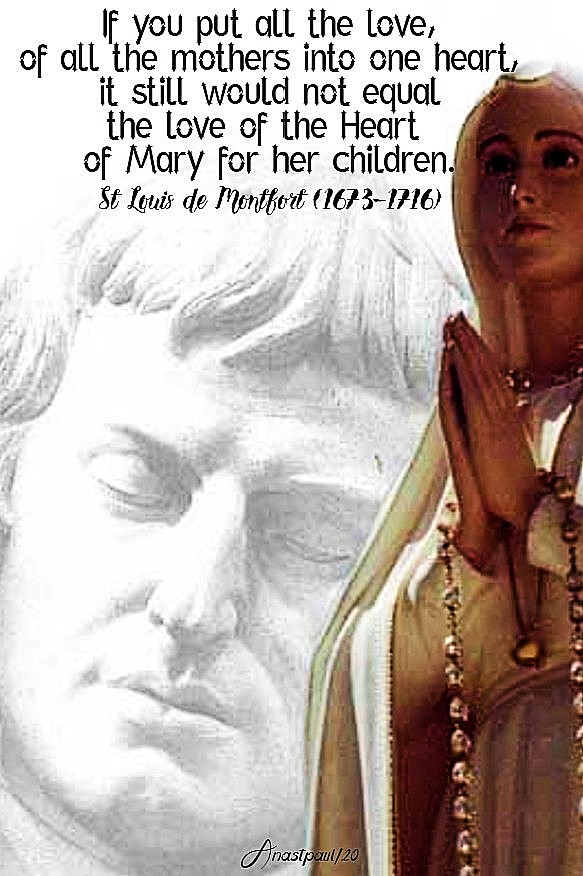
“If you put all the love, of all the mothers into one heart, it still would not equal the love of the Heart of Mary for her children.”
One Minute Reflection – 12 June – “Month of the Sacred Heart” Memorial of the Immaculate Heart of Mary, Readings: Second Corinthians 5: 14-21, Psalms 103: 1-2, 3-4, 9-10, 11-12, Gospel: Luke 2: 41-51
“And his mother kept all these words in her heart.” – Luke 2:51
REFLECTION – “Often, it seems to us, Mary forgot to eat and to drink, keeping vigil in order to think about Christ, to see Christ in His flesh. She burned with love of Him and passionately loved to serve Him. She often did what the Song of Songs sings about: “I was sleeping, but my heart kept vigil.” (Song 5:2) Even when she was resting, she continued to dream of Him who filled her thoughts throughout the day. Whether she was keeping vigil or resting in peace, she always lived in Him, was always occupied with Him.
Where her treasure was, there also was her heart (Mt 6:21); where her glory was, there also was her mind. She loved her Lord and her Son with all her heart, with all her mind, with all her strength (Mt 22:37). She saw with her eyes, touched with her hands, the Word of Life (1 Jn 1:1). How blessed was Mary, to whom it was given to embrace Him who embraces and nourishes everything! How happy was she who carried Him, who carries the universe (Heb 1:3), she who nursed a Son, who gives her life, a Son who nourishes her and all beings on earth (Ps 145:15).
The One Who is the wisdom of the Father, put His arms around her neck, the One Who is the strength, that gives movement to everything sat in her arms. He Who is the rest of souls, (Mt 11:29) rested on her motherly breast. How gently He held her in His hands, peacefully looked at her, He Whom the angels wish to contemplate (1 Pet 1:12) and He gently called her, He Whom every being calls upon when in need. Filled with the Holy Spirit, she held Him close to her heart … She never had enough of seeing Him or of hearing Him, Whom “many prophets and kings wished to see … but did not see.” (Lk 10:24) Thus Mary grew evermore in love and her mind was unceasingly attached to divine contemplation.” – St Amadeus of Lausanne (1108-1159) Bishop – Homily on Mary, 4
PRAYER – Lord open our hearts to Your grace. As You brought joy to the world through the incarnation of Your Son, Our Lord Jesus Christ, grant that through the prayer of the Immaculate Heart of His Ever-Virgin Mother, our hearts too may grow in virtue and love by learning to reflect constantly on His commandments and counsels. We make our prayer through our Lord Jesus, with the Holy Spirit, God forever, amen.
Our Morning Offering – 12 June – “Month of the Sacred Heart” Memorial of the Immaculate Heart of Mary
O Mother Blest By St Alphonsus Maria Liguori (1696-1787) Most Zealous Doctor of the Church Trns. Fr Edmund Vaughn C.SS,R, (1827 – 1908 )
O Mother blest, whom God bestows On sinners and on just, What joy, what hope thou givest those Who in thy mercy trust. Thou are clement, thou are chaste, Mary thou art fair, Of all mothers, sweetest best, none with thee compare.
O heavenly Mother, mistress sweet! it never yet was told that suppliant sinner left thy feet, unpitied, unconsoled. Thou are clement, thou are chaste, …
O Mother, pitiful and mild, Cease not to pray for me; For I do love thee as a child, And sigh for love of thee. Thou art clement, thou art chaste, …
Most powerful Mother, all men know Thy Son denies thee nought; Thou askest, wishest it, and lo! His power thy will hath wrought. Thou art clement, thou art chaste, …
O Mother blest, for me obtain, Ungrateful though I be, To love that God who first could deign To show such love for me. Thou art clement, thou art chaste, Mary, thou art fair. Of all mothers, sweetest, best, None with thee compare.
Saint of the Day – 12 June – St Pope Leo III (c 750-816) Bishop of Rome and Ruler of the Papal States from 26 December 795 to his death, Diplomat, financial administrator and Defender of the City ad peoples of Rome and of the Church. Peacemaker and restorer of Churches and Monasteries, Patron of the Arts and apostle of the poor. Known as “Charlemagne’s Pope” Born at Rome, Italy in c 750 and died on 12 June 816.
The Roman Martyrology statesof him today: “At Rome, in the Vatican Basilica, St Leo III, to whom God miraculously restored his eyes and his tongue, after they had been torn out by impious men.”
Leo was of a modest family in southern Italy, the son of Atyuppius and Elizabeth. He was made Cardinal-Priest of Santa Susanna by Pope Adrian I, and also Vestiarius, or Chief of the Pontifical Treasury, or wardrobe.
He was elected on 26 December 795, the day Adrian I was buried and Consecrated on the following day. With the letter informing Charlemagne that he had been unanimously elected Pope, Leo sent him the keys of the cCnfession of St Peter and the Standard of the City. This he did, to show that he regarded the Frankish King as the Protector of the Holy See. In return he received from Charlemagne, letters of congratulation and a great part of the treasure which the King had captured from the Avars. The acquisition of this wealth, was one of the causes which enabled Leo to be such a great benefactor to the Churches and charitable institutions of Rome.
Prompted by jealousy or ambition, or by feelings of hatred and revenge, a number of the relatives of Pope Adrian I formed a plot to render Leo unfit to hold his sacred office. On the occasion of the procession of the Greater Litanies (25 April, 799), when the Pope was making his way towards the Flaminian Gate, he was suddenly attacked by a body of armed men. He was dashed to the ground and an effort was made to root out his tongue and tear out his eyes. After he had been left for a time bleeding in the street, he was hurried off at night to the Monastery of St Erasmus (remeber St Elmo?)on the Cœlian. There, in what seemed quite a miraculous manner, he recovered the full use of his eyes and tongue. Escaping from the Monastery, he betook himself to Charlemagne, accompanied by many of the Romans. He was received by the Frankish King with the greatest honour at Paderborn, although his enemies had filled the King’s ears with malicious accusations against him. After a few months’ stay in Germany, the Frankish Monarch caused him to be escorted back to Rome, where he was received with every demonstration of joy by the whole populace, natives and foreigners.
The Pope’s enemies were then tried by Charlemagne’s envoys and, being unable to establish either Leo’s guilt or their own innocence, were sent as prisoners to France (Frankland). In the following year (800) Charlemagne himself came to Rome and the Pope and his accusers were brought face to face. The assembled Bishops declared that they had no right to judge the Pope;but Leo of his own free will, in order, as he said, to dissipate any suspicions in men’s minds, declared on oath, that he was wholly guiltless of the charges which had been brought against him. At his special request, the death sentence which had been passed upon his principal enemies, was commuted into a sentence of exile.
A few days later, Leo and Charlemagne again met. It was on Christmas Day in St. Peter’s. After the Gospel had been sung, the Pope approached Charlemagne,, who was kneeling before the Confession of St Peter,and placed a Crown upon his head. The assembled multitude at once made the Basilica ring with the shout: “To Charles, the most pious Augustus, crowned by God, to our great and pacific Emperor life and victory!” By this act was revived the Empire in the West and, in theory, at least, the world was declared by the Church, subject to one temporal head, as Christ had made it subject to one spiritual head.
Pope Leo III Crowns Charlemagne
It was understood that the first duty of the new Emperor was to be the Protector of the Roman Church and of Christendom against the heathen. With a view to combining the East and West under the effective rule of Charlemagne, Leo strove to further the project of a marriage between him and the Eastern Empress Irene. Her deposition, however (801), prevented the realisation of this excellent plan. Some three years after the departure of Charlemagne from Rome (801), Leo again crossed the Alps to see him (804). According to some he went to discuss with the Emperor ,the division of his territories between his sons. At any rate, two years later, he was invited to give his assent to the Emperor’s provisions for the said partition. Equally while acting in harmony with the Pope, Charlemagne combatted the heresy of Adoptionism which had arisen in Spain but he went somewhat further than his spiritual guide when he wished to bring about the general insertion of the Filioque in the Nicene Creed. The two were, however, acting together when Salzburg was made the metropolitical City for Bavaria and when Fortunatus of Grado was compensated for the loss of his See of Grado by the gift of that of Pola. The joint action of the Pope and the Emperor was felt even in England. Through it, Eardulf of Northumbria recovered his Kingdom, and the dispute between Eanbald, Archbishop of York and Wulfred, Archbishop of Canterbury, was regulated.
Leo had, however, many relations with England solely on his own account. By his command, the Synod of Beccanceld (or Clovesho, 803), condemned the appointing of laymen as superiors of Monasteries. In accordance with the wishes of Ethelheard, Archbishop of Canterbury, Leo excommunicated Eadbert Praen for seizing the throne of Kent and withdrew the pallium which had been granted to Litchfield, authorising the restoration of the ecclesiastical jurisdiction of the See of Canterbury “just as St. Gregory the Apostle and Master of the nation of the English had arranged it”.
During the Pontificate of Leo, the Church of Constantinople was in a state of unrest. In their distress, the Monks turned for help to Leo, as they had done earlier. The Pope replied, not merely with words of praise and encouragement but also, by the dispatch of rich presents and, after Michael I came to the Byzantine throne, he ratified the treaty between him and Charlemagne which was to secure peace for East and West.
Not only in the last mentioned transaction but in all matters of importance, did the Pope and the Charlemagne act in concert. It was on Charlemagne’s advice that, to ward off the savage raids of the Saracens, Leo maintained a fleet,and caused his coast line to be regularly patrolled by his ships of war. But because he did not feel competent to keep the Moslem pirates out of Corsica, he entrusted the guarding of it to the Emperor.
But when the great Emperor died (28 January 814), evil times once more broke on Leo. A fresh conspiracy was formed against him but on this occasion the Pope was apprised of it before it came to a head. He caused the chief conspirators to be seized and executed. No sooner had this plot been crushed than a number of nobles of the Campagna rose in arms and plundered the country. They were preparing to march on Rome itself, when they were overpowered by the Duke of Spoleto, acting under the orders of the King of Italy (Langobardia).
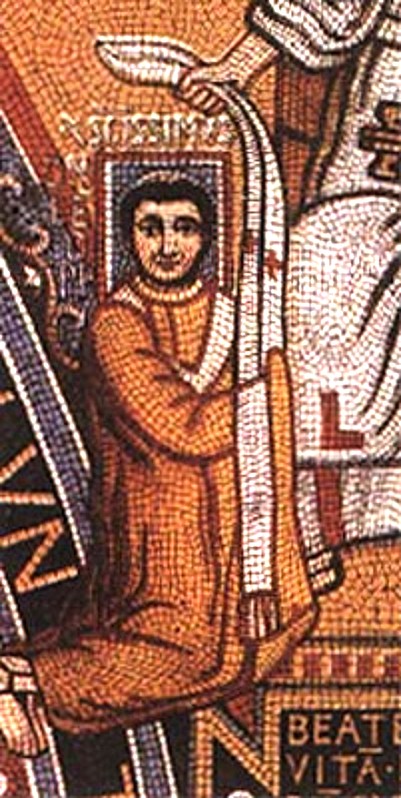
The large sums of money which Charlemagne had given to the Papal Treasury enabled Leo to become an efficient helper of the poor and a patron of art, and to renovate the Churches, not only of Rome, but even of Ravenna. He employed the imperishable art of mosaic not only to portray the political relationship between Charlemagne and himself but chiefly, to decorate the Churches, especially his titular Church of St Susanna. Up to the end of the sixteenth century a figure of Leo in mosaic was to be seen in that ancient church.
Leo III was buried in St Peter’s (12 June, 816), where his relics are to be found along with those of Sts Leo I, Leo II and Leo IV. He was Canonised in 1673 by Pope Clement X. The silver denarii of Leo III still extant, bears the name of the Frankish Emperor upon them, as well as that of Leo, showing thereby the Emperor as the Protector of the Church and overlord of the City of Rome.
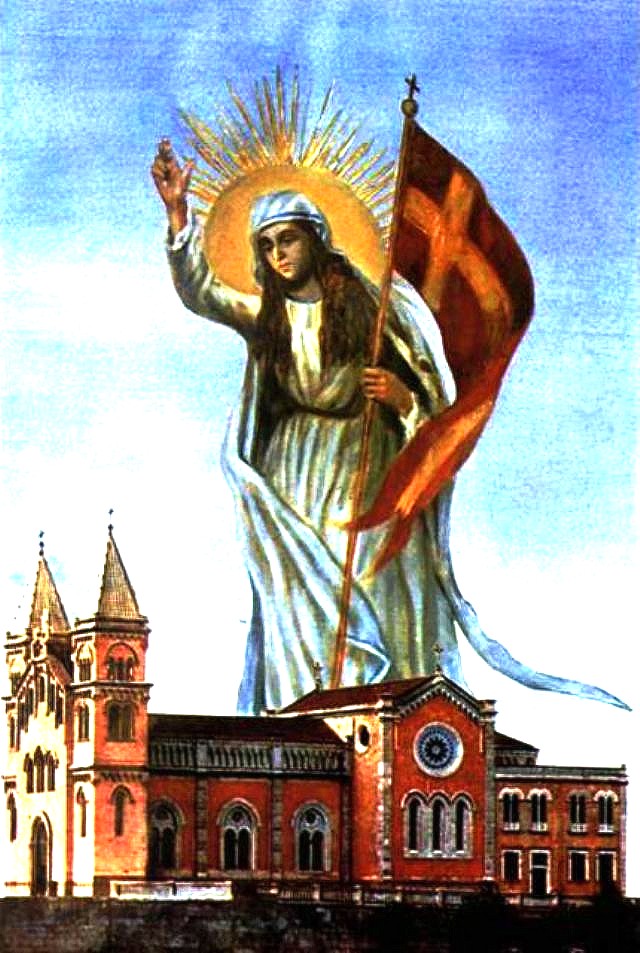
Madonna del Giorno di Montalto / Our Lady of Montalto, Messina, Italy, 1294 – 12 June:
One night a humble Friar named Nicholas dreamt of the Virgin Mary who told him to go the next day, by the Senate of Messina and inform them, that Our Lady wanted a temple on that hill, dedicated as the Lady of the High Mountain. In the morning, the Friar thought it was all his imagination and not believing that the Mother of our Lord Jesus Christ would go to a poor Friar and thought no more of it. The next night, the Virgin appeared again in a dream to Nicholas, scolding him for disobedience. The monk then asked him how he could get himself heard by the Senate. Our Lady told him not to despair and the next day, at noon, a white dove on the hill site was outlined at the area where the Church was to be built. So it was, 12 June 1294, the hill was full of people and notables of Messina and a white dove appeared and marked out the spot for the Church (this miracle is represented by Statues in motion in the bell tower of the Cathedral). Fra Nicholas then went to the nearby Matagrifone castle to find the Queen Constance. He explained the facts, in the presence of a Court handmaiden who advised the Queen to drive the Monk away. The evil courtesan was suddenly seized with paralysis of her arm and excruciating pain throughout her body. The Monk advised her to apologise to the Madonna, she did so, and the pain was relieved. Queen Constance, remained shaken from the occurrence and she promised her help, indeed it was she who laid the first stone. By 1295 the Church was already built.
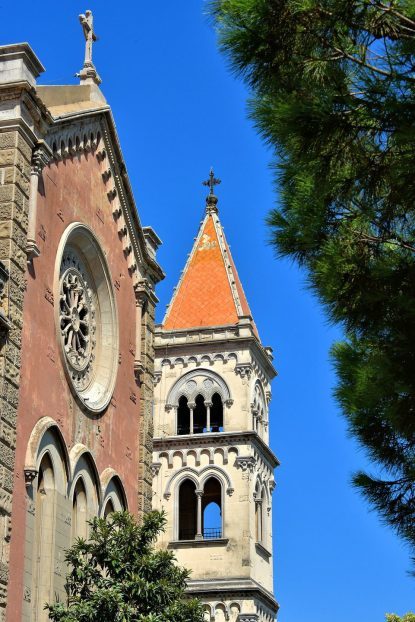
The Santuario della Madonna di Montalto was severely damaged during the 1908 earthquake and rebuilt in 1930. This view of the bell tower gives you a hint of the beauty of this Gothic and Romanesque structure.
St Amphion of Nicomedia Bl Antonia Maria Verna Bl Antonio de Pietra St Arsenius of Konev St Christian O’Morgair of Clogher St Chrodobald of Marchiennes St Cominus Bl Conrad of Maleville St Cunera St Cuniald St Cyrinus of Antwerp St Eskil St Galen of Armenia
St Pope Leo III (c 750-816) Bishop of Rome and Ruler of the Papal States from 26 December 795 to his death. Know as “Charlemagne’s Pope” St Lochinia of Ireland
Bl Mercedes Maria of Jesus St Odulf of Utrecht St Olympius of AEnos St Onuphrius of Egypt Bl Pelagia Leonti of Milazzo St Peter of Mount Athos St Placid of Val d’Ocre Bl Stanislaw Kubista Bl Stefan Grelewski Bl Stefan Kielman St Ternan of Culross St Valerius of Armenia
Martyrs of Bologna: Three Christians who were martyred at different times and places, but whose relics have been collected and enshrined together – Celsus, Dionysius, and Marcellinus. Their relics were enshrined in churches in Bologna and Rome in Italy.
Martyrs of Rome: Four members of the Imperial Roman nobility. They were all soldiers, one or more may have been officers, and all were martyred in the persecutions of Diocletian – Basilides, Cyrinus, Nabor and Nazarius. They were martyred in 304 outside Rome, Italy and buried along the Aurelian Way.
Three Holy Exiles: Three Christian men who became Benedictine monks at the Saint James Abbey in Regensburg, Germany, then hermits at Griestatten and whose lives and piety are celebrated together. – Marinus, Vimius and Zimius.
Thought for the Day – 11 June – Solemnity of the Most Sacred Heart of Jesus – Meditations with Antonio Cardinal Bacci (1881-1971)
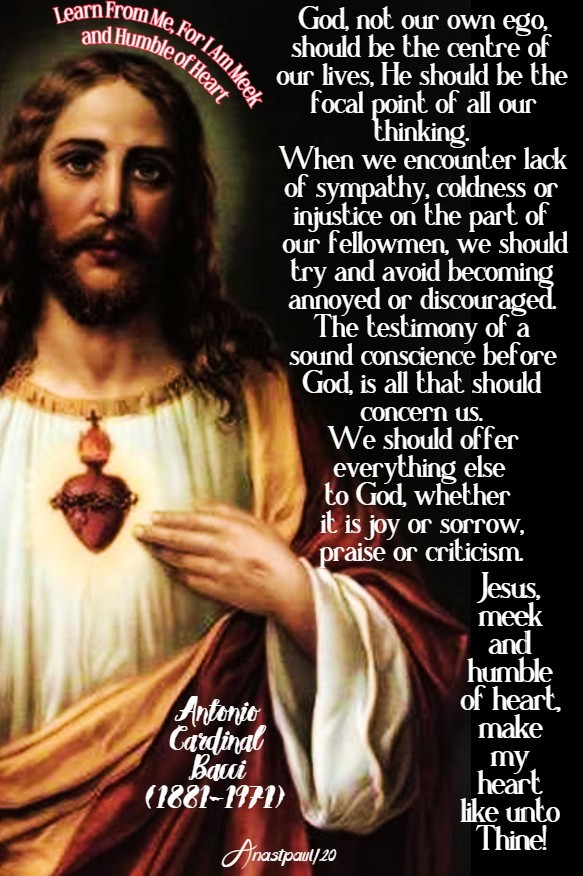
“Learn From Me, For I Am Meek and Humble of Heart”
“It is very easy to be gentle and humble when everything is going well for us. It is difficult, however, when we meet humiliation, misunderstanding or opposition. We need to be well advanced in perfection, if we are to have mildness and humility of heart, like that of Jesus.
We can only reach this state of perfection by prayer, sacrifice and character formation. Pride, self-love and the desire to excel, are the evil effects of our corrupted nature. St Francis de Sales jestingly remarked that self-love dies three days after us. It is difficult to remove it completely from our character and to put, in it’s place, the love of God and of our neighbour but, this operation is necessary, if we are to obtain Christ-like humility and gentleness of heart. God, not our own ego, should be the centre of our lives, He should be the focal point of all our thinking. Let us beseech God for this grace and try and behave in this fashion on all occasions.
When we encounter lack of sympathy, coldness or injustice on the part of our fellowmen, we should try and avoid becoming annoyed or discourage. The testimony of a sound conscience before God, is all that should concern us. We should offer everything else to God, whether it is joy or sorrow, praise or criticism. We shall be rewarded with peace of soul.”





























You must be logged in to post a comment.