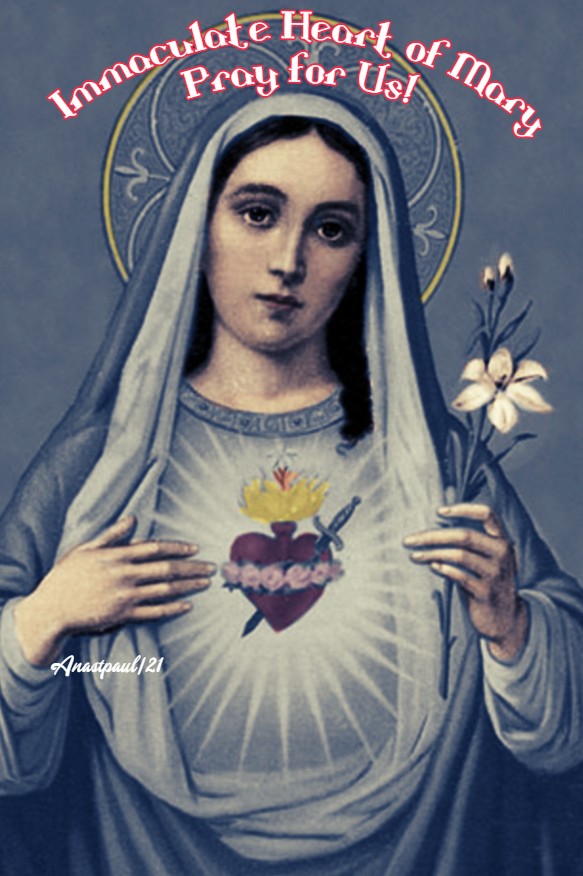
Quote/s of the Day – 12 June – “Month of the Sacred Heart” – Memorial of the Immaculate Heart of Mary
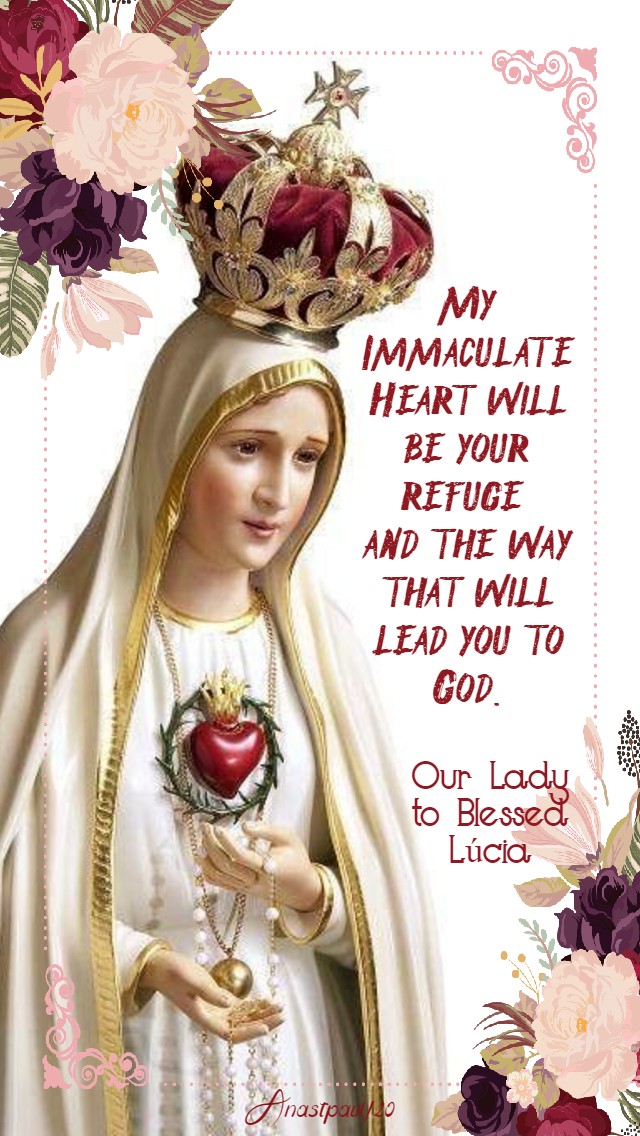
Our Lady assured Blessed Lúcia:
“My Immaculate Heart will be your refuge and the way that will lead you to God.” Thus, if we devote ourselves to her Immaculate Heart, Mary will lead us to her Son, Jesus Christ and we will be on the way to Heaven.“
Our Lady of Fatima
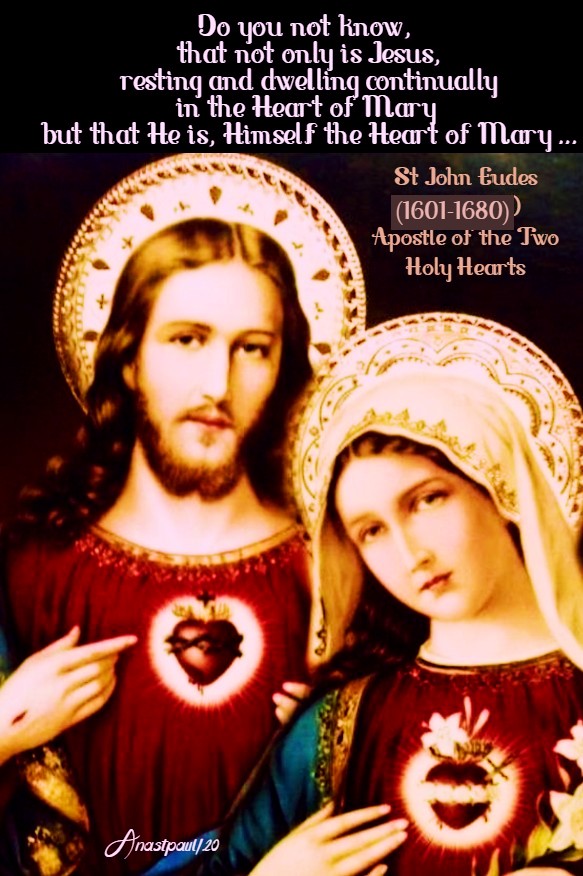
“Do you not know, that not only is Jesus, resting and dwelling continually in the Heart of Mary but that He is, Himself the Heart of Mary … “
St John Eudes (1601-1680) Apostle of the Two Holy Hearts
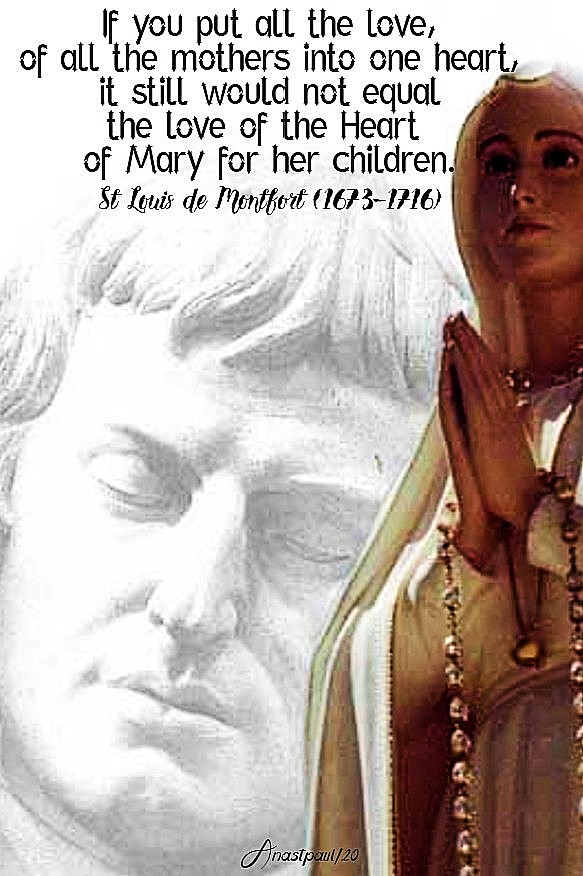
“If you put all the love, of all the mothers into one heart, it still would not equal the love of the Heart of Mary for her children.”
One Minute Reflection – 12 June – “Month of the Sacred Heart” Memorial of the Immaculate Heart of Mary, Readings: Second Corinthians 5: 14-21, Psalms 103: 1-2, 3-4, 9-10, 11-12, Gospel: Luke 2: 41-51
“And his mother kept all these words in her heart.” – Luke 2:51
REFLECTION – “Often, it seems to us, Mary forgot to eat and to drink, keeping vigil in order to think about Christ, to see Christ in His flesh. She burned with love of Him and passionately loved to serve Him. She often did what the Song of Songs sings about: “I was sleeping, but my heart kept vigil.” (Song 5:2) Even when she was resting, she continued to dream of Him who filled her thoughts throughout the day. Whether she was keeping vigil or resting in peace, she always lived in Him, was always occupied with Him.
Where her treasure was, there also was her heart (Mt 6:21); where her glory was, there also was her mind. She loved her Lord and her Son with all her heart, with all her mind, with all her strength (Mt 22:37). She saw with her eyes, touched with her hands, the Word of Life (1 Jn 1:1). How blessed was Mary, to whom it was given to embrace Him who embraces and nourishes everything! How happy was she who carried Him, who carries the universe (Heb 1:3), she who nursed a Son, who gives her life, a Son who nourishes her and all beings on earth (Ps 145:15).
The One Who is the wisdom of the Father, put His arms around her neck, the One Who is the strength, that gives movement to everything sat in her arms. He Who is the rest of souls, (Mt 11:29) rested on her motherly breast. How gently He held her in His hands, peacefully looked at her, He Whom the angels wish to contemplate (1 Pet 1:12) and He gently called her, He Whom every being calls upon when in need. Filled with the Holy Spirit, she held Him close to her heart … She never had enough of seeing Him or of hearing Him, Whom “many prophets and kings wished to see … but did not see.” (Lk 10:24) Thus Mary grew evermore in love and her mind was unceasingly attached to divine contemplation.” – St Amadeus of Lausanne (1108-1159) Bishop – Homily on Mary, 4
PRAYER – Lord open our hearts to Your grace. As You brought joy to the world through the incarnation of Your Son, Our Lord Jesus Christ, grant that through the prayer of the Immaculate Heart of His Ever-Virgin Mother, our hearts too may grow in virtue and love by learning to reflect constantly on His commandments and counsels. We make our prayer through our Lord Jesus, with the Holy Spirit, God forever, amen.
Our Morning Offering – 12 June – “Month of the Sacred Heart” Memorial of the Immaculate Heart of Mary
O Mother Blest By St Alphonsus Maria Liguori (1696-1787) Most Zealous Doctor of the Church Trns. Fr Edmund Vaughn C.SS,R, (1827 – 1908 )
O Mother blest, whom God bestows On sinners and on just, What joy, what hope thou givest those Who in thy mercy trust. Thou are clement, thou are chaste, Mary thou art fair, Of all mothers, sweetest best, none with thee compare.
O heavenly Mother, mistress sweet! it never yet was told that suppliant sinner left thy feet, unpitied, unconsoled. Thou are clement, thou are chaste, …
O Mother, pitiful and mild, Cease not to pray for me; For I do love thee as a child, And sigh for love of thee. Thou art clement, thou art chaste, …
Most powerful Mother, all men know Thy Son denies thee nought; Thou askest, wishest it, and lo! His power thy will hath wrought. Thou art clement, thou art chaste, …
O Mother blest, for me obtain, Ungrateful though I be, To love that God who first could deign To show such love for me. Thou art clement, thou art chaste, Mary, thou art fair. Of all mothers, sweetest, best, None with thee compare.
Saint of the Day – 12 June – St Pope Leo III (c 750-816) Bishop of Rome and Ruler of the Papal States from 26 December 795 to his death, Diplomat, financial administrator and Defender of the City ad peoples of Rome and of the Church. Peacemaker and restorer of Churches and Monasteries, Patron of the Arts and apostle of the poor. Known as “Charlemagne’s Pope” Born at Rome, Italy in c 750 and died on 12 June 816.
The Roman Martyrology statesof him today: “At Rome, in the Vatican Basilica, St Leo III, to whom God miraculously restored his eyes and his tongue, after they had been torn out by impious men.”
Leo was of a modest family in southern Italy, the son of Atyuppius and Elizabeth. He was made Cardinal-Priest of Santa Susanna by Pope Adrian I, and also Vestiarius, or Chief of the Pontifical Treasury, or wardrobe.
He was elected on 26 December 795, the day Adrian I was buried and Consecrated on the following day. With the letter informing Charlemagne that he had been unanimously elected Pope, Leo sent him the keys of the cCnfession of St Peter and the Standard of the City. This he did, to show that he regarded the Frankish King as the Protector of the Holy See. In return he received from Charlemagne, letters of congratulation and a great part of the treasure which the King had captured from the Avars. The acquisition of this wealth, was one of the causes which enabled Leo to be such a great benefactor to the Churches and charitable institutions of Rome.
Prompted by jealousy or ambition, or by feelings of hatred and revenge, a number of the relatives of Pope Adrian I formed a plot to render Leo unfit to hold his sacred office. On the occasion of the procession of the Greater Litanies (25 April, 799), when the Pope was making his way towards the Flaminian Gate, he was suddenly attacked by a body of armed men. He was dashed to the ground and an effort was made to root out his tongue and tear out his eyes. After he had been left for a time bleeding in the street, he was hurried off at night to the Monastery of St Erasmus (remeber St Elmo?)on the Cœlian. There, in what seemed quite a miraculous manner, he recovered the full use of his eyes and tongue. Escaping from the Monastery, he betook himself to Charlemagne, accompanied by many of the Romans. He was received by the Frankish King with the greatest honour at Paderborn, although his enemies had filled the King’s ears with malicious accusations against him. After a few months’ stay in Germany, the Frankish Monarch caused him to be escorted back to Rome, where he was received with every demonstration of joy by the whole populace, natives and foreigners.
The Pope’s enemies were then tried by Charlemagne’s envoys and, being unable to establish either Leo’s guilt or their own innocence, were sent as prisoners to France (Frankland). In the following year (800) Charlemagne himself came to Rome and the Pope and his accusers were brought face to face. The assembled Bishops declared that they had no right to judge the Pope;but Leo of his own free will, in order, as he said, to dissipate any suspicions in men’s minds, declared on oath, that he was wholly guiltless of the charges which had been brought against him. At his special request, the death sentence which had been passed upon his principal enemies, was commuted into a sentence of exile.
A few days later, Leo and Charlemagne again met. It was on Christmas Day in St. Peter’s. After the Gospel had been sung, the Pope approached Charlemagne,, who was kneeling before the Confession of St Peter,and placed a Crown upon his head. The assembled multitude at once made the Basilica ring with the shout: “To Charles, the most pious Augustus, crowned by God, to our great and pacific Emperor life and victory!” By this act was revived the Empire in the West and, in theory, at least, the world was declared by the Church, subject to one temporal head, as Christ had made it subject to one spiritual head.
Pope Leo III Crowns Charlemagne
It was understood that the first duty of the new Emperor was to be the Protector of the Roman Church and of Christendom against the heathen. With a view to combining the East and West under the effective rule of Charlemagne, Leo strove to further the project of a marriage between him and the Eastern Empress Irene. Her deposition, however (801), prevented the realisation of this excellent plan. Some three years after the departure of Charlemagne from Rome (801), Leo again crossed the Alps to see him (804). According to some he went to discuss with the Emperor ,the division of his territories between his sons. At any rate, two years later, he was invited to give his assent to the Emperor’s provisions for the said partition. Equally while acting in harmony with the Pope, Charlemagne combatted the heresy of Adoptionism which had arisen in Spain but he went somewhat further than his spiritual guide when he wished to bring about the general insertion of the Filioque in the Nicene Creed. The two were, however, acting together when Salzburg was made the metropolitical City for Bavaria and when Fortunatus of Grado was compensated for the loss of his See of Grado by the gift of that of Pola. The joint action of the Pope and the Emperor was felt even in England. Through it, Eardulf of Northumbria recovered his Kingdom, and the dispute between Eanbald, Archbishop of York and Wulfred, Archbishop of Canterbury, was regulated.
Leo had, however, many relations with England solely on his own account. By his command, the Synod of Beccanceld (or Clovesho, 803), condemned the appointing of laymen as superiors of Monasteries. In accordance with the wishes of Ethelheard, Archbishop of Canterbury, Leo excommunicated Eadbert Praen for seizing the throne of Kent and withdrew the pallium which had been granted to Litchfield, authorising the restoration of the ecclesiastical jurisdiction of the See of Canterbury “just as St. Gregory the Apostle and Master of the nation of the English had arranged it”.
During the Pontificate of Leo, the Church of Constantinople was in a state of unrest. In their distress, the Monks turned for help to Leo, as they had done earlier. The Pope replied, not merely with words of praise and encouragement but also, by the dispatch of rich presents and, after Michael I came to the Byzantine throne, he ratified the treaty between him and Charlemagne which was to secure peace for East and West.
Not only in the last mentioned transaction but in all matters of importance, did the Pope and the Charlemagne act in concert. It was on Charlemagne’s advice that, to ward off the savage raids of the Saracens, Leo maintained a fleet,and caused his coast line to be regularly patrolled by his ships of war. But because he did not feel competent to keep the Moslem pirates out of Corsica, he entrusted the guarding of it to the Emperor.
But when the great Emperor died (28 January 814), evil times once more broke on Leo. A fresh conspiracy was formed against him but on this occasion the Pope was apprised of it before it came to a head. He caused the chief conspirators to be seized and executed. No sooner had this plot been crushed than a number of nobles of the Campagna rose in arms and plundered the country. They were preparing to march on Rome itself, when they were overpowered by the Duke of Spoleto, acting under the orders of the King of Italy (Langobardia).
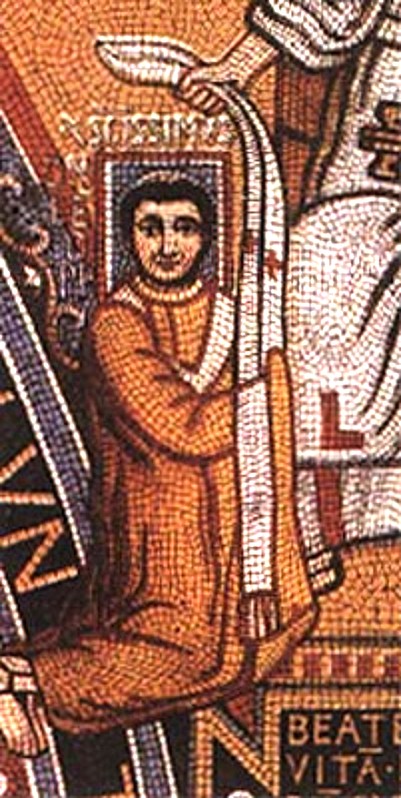
The large sums of money which Charlemagne had given to the Papal Treasury enabled Leo to become an efficient helper of the poor and a patron of art, and to renovate the Churches, not only of Rome, but even of Ravenna. He employed the imperishable art of mosaic not only to portray the political relationship between Charlemagne and himself but chiefly, to decorate the Churches, especially his titular Church of St Susanna. Up to the end of the sixteenth century a figure of Leo in mosaic was to be seen in that ancient church.
Leo III was buried in St Peter’s (12 June, 816), where his relics are to be found along with those of Sts Leo I, Leo II and Leo IV. He was Canonised in 1673 by Pope Clement X. The silver denarii of Leo III still extant, bears the name of the Frankish Emperor upon them, as well as that of Leo, showing thereby the Emperor as the Protector of the Church and overlord of the City of Rome.
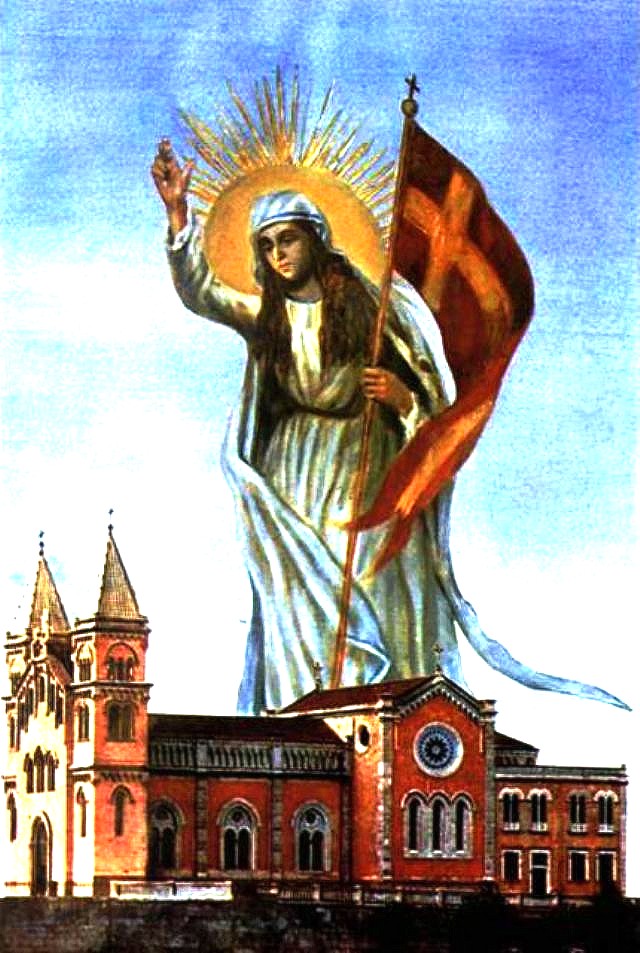
Madonna del Giorno di Montalto / Our Lady of Montalto, Messina, Italy, 1294 – 12 June:
One night a humble Friar named Nicholas dreamt of the Virgin Mary who told him to go the next day, by the Senate of Messina and inform them, that Our Lady wanted a temple on that hill, dedicated as the Lady of the High Mountain. In the morning, the Friar thought it was all his imagination and not believing that the Mother of our Lord Jesus Christ would go to a poor Friar and thought no more of it. The next night, the Virgin appeared again in a dream to Nicholas, scolding him for disobedience. The monk then asked him how he could get himself heard by the Senate. Our Lady told him not to despair and the next day, at noon, a white dove on the hill site was outlined at the area where the Church was to be built. So it was, 12 June 1294, the hill was full of people and notables of Messina and a white dove appeared and marked out the spot for the Church (this miracle is represented by Statues in motion in the bell tower of the Cathedral). Fra Nicholas then went to the nearby Matagrifone castle to find the Queen Constance. He explained the facts, in the presence of a Court handmaiden who advised the Queen to drive the Monk away. The evil courtesan was suddenly seized with paralysis of her arm and excruciating pain throughout her body. The Monk advised her to apologise to the Madonna, she did so, and the pain was relieved. Queen Constance, remained shaken from the occurrence and she promised her help, indeed it was she who laid the first stone. By 1295 the Church was already built.
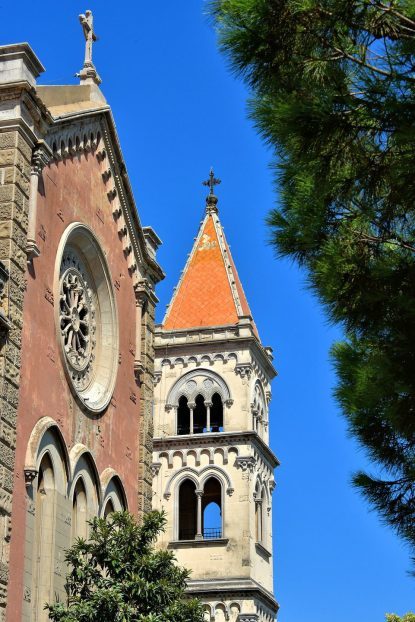
The Santuario della Madonna di Montalto was severely damaged during the 1908 earthquake and rebuilt in 1930. This view of the bell tower gives you a hint of the beauty of this Gothic and Romanesque structure.
St Amphion of Nicomedia Bl Antonia Maria Verna Bl Antonio de Pietra St Arsenius of Konev St Christian O’Morgair of Clogher St Chrodobald of Marchiennes St Cominus Bl Conrad of Maleville St Cunera St Cuniald St Cyrinus of Antwerp St Eskil St Galen of Armenia
St Pope Leo III (c 750-816) Bishop of Rome and Ruler of the Papal States from 26 December 795 to his death. Know as “Charlemagne’s Pope” St Lochinia of Ireland
Bl Mercedes Maria of Jesus St Odulf of Utrecht St Olympius of AEnos St Onuphrius of Egypt Bl Pelagia Leonti of Milazzo St Peter of Mount Athos St Placid of Val d’Ocre Bl Stanislaw Kubista Bl Stefan Grelewski Bl Stefan Kielman St Ternan of Culross St Valerius of Armenia
Martyrs of Bologna: Three Christians who were martyred at different times and places, but whose relics have been collected and enshrined together – Celsus, Dionysius, and Marcellinus. Their relics were enshrined in churches in Bologna and Rome in Italy.
Martyrs of Rome: Four members of the Imperial Roman nobility. They were all soldiers, one or more may have been officers, and all were martyred in the persecutions of Diocletian – Basilides, Cyrinus, Nabor and Nazarius. They were martyred in 304 outside Rome, Italy and buried along the Aurelian Way.
Three Holy Exiles: Three Christian men who became Benedictine monks at the Saint James Abbey in Regensburg, Germany, then hermits at Griestatten and whose lives and piety are celebrated together. – Marinus, Vimius and Zimius.
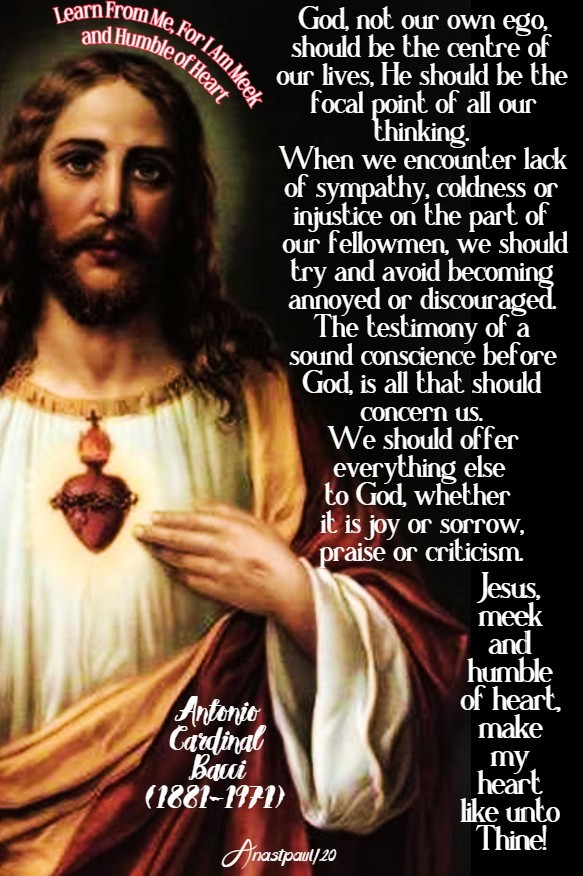
Thought for the Day – 11 June – Solemnity of the Most Sacred Heart of Jesus – Meditations with Antonio Cardinal Bacci (1881-1971)
“Learn From Me, For I Am Meek and Humble of Heart”
“It is very easy to be gentle and humble when everything is going well for us. It is difficult, however, when we meet humiliation, misunderstanding or opposition. We need to be well advanced in perfection, if we are to have mildness and humility of heart, like that of Jesus.
We can only reach this state of perfection by prayer, sacrifice and character formation. Pride, self-love and the desire to excel, are the evil effects of our corrupted nature. St Francis de Sales jestingly remarked that self-love dies three days after us. It is difficult to remove it completely from our character and to put, in it’s place, the love of God and of our neighbour but, this operation is necessary, if we are to obtain Christ-like humility and gentleness of heart. God, not our own ego, should be the centre of our lives, He should be the focal point of all our thinking. Let us beseech God for this grace and try and behave in this fashion on all occasions.
When we encounter lack of sympathy, coldness or injustice on the part of our fellowmen, we should try and avoid becoming annoyed or discourage. The testimony of a sound conscience before God, is all that should concern us. We should offer everything else to God, whether it is joy or sorrow, praise or criticism. We shall be rewarded with peace of soul.”
Quote/s of the Day – 11 June – Solemnity of the Most Sacred Heart of Jesus
“We, Christians, are the true Israel which springs from Christ, for we are carved out of His Heart, as from a Rock!”
St Justin Martyr (100-165) Father of the Church and Martyr
“How good and pleasant it is to dwell in the Heart of Jesus! Who is there who does not love a heart so wounded? Who can refuse a return of love to a Heart so loving? Amen.”
St Bernard (1090-1153) Mellifluous Doctor
“It is our vocation to set people’s hearts ablaze, to do what the Son of God did, who came to light a fire on earth in order to set it ablaze with His love.”
Blessed Frédéric Ozanam (1813–1853) “Servant to the Poor”
“The well-being of souls is only in Christ. Therefore, let the love of Jesus be our perfection and our profession, let us light our hearts from the eternal flames of love that radiate from the Sacred Heart of Jesus.”
One Minute Reflection – 11 June – Solemnity of the Most Sacred Heart of Jesus, Readings: First: Hosea 11: 1, 3-4, 8c-9, Psalm: Isaias 12: 2-3, 4, 5-6 (3), Second: Ephesians 3: 8-12, 14-19, Gospel: John 19: 31-37
“With joy you will draw water at the fountain of salvation” – Isaias 12:3
REFLECTION – “So where can our fragility find rest and security if not in the Saviour’s wounds? … They pierced His hands, His feet and His side with a thrust of a lance. Through these gaping holes, I can taste the honey from the rock (Ps 81:17) and the oil that flows from the very hard rock, which is to say, “Taste and see how good the Lord is.” (Ps 34:9) He had plans of peace (cf. Jer 29:11) and I did not know it. “For ‘who has known the mind of the Lord? Or who has been his counselor?’” (Rom 11:34) The nail that enters His flesh has become for me, a key that opens to me, the mystery of His plans.
How could we not see through these openings? The nails and the wounds cry out, that truly, in the person of Christ, God reconciles the world to Himself. Iron pierced His being and touched His Heart, so that He is no longer ignorant of how to suffer my weaknesses. The secret of His Heart, is laid bare, in the wounds of His body; we see revealed the great mystery of His kindness, the merciful tenderness of our God, “the Dayspring who visited us from on high.” (Lk 1:78) And how could this tenderness not be manifested in His wounds? How could You show more clearly, than by Your wounds, that You, Lord, are gentle and compassionate and very merciful, since there is no greater love, than to give one’s life (Jn 15:13) for those who are condemned to death?!
So, all my merit is the Lord’s mercy and I shall not be lacking in merit, so long as mercy is not lacking in Him. If God’s mercies multiply, my merits will be many. But what will happen if I have to reproach myself with many faults? “Where sin increased, grace abounded all the more.” (Rom 5:20) And if “the steadfast love of the Lord is from everlasting to everlasting,” I for my part “will sing forever the favours of the Lord.” (Ps 103:17; 89:2) Is that my righteousness? Lord, I shall remember Your righteousness alone, for it is my righteousness, since You became “righteousness of God for me (Rom 1:17). ”- St Bernard (1091-1153) Mellifluous Ddoctor of the Church – Homilies on the Song of Songs, no. 61, 3-5
PRAYER – Almighty God and Father, we glory in the Sacred Heart of Jesus, Your beloved Son, as we dwell on the great things His love has done for us. Fill us with the grace which flows in abundance from the wounded Heart of Jesus, the source of Heaven’s gifts and eternal life. Through Christ our Lord in the unity of the Holy Spirt and the glory of God the Father, amen. Sweet Heart of my JESUS, Make me love Thee ever more and more! – 300 Days Indulgence Once a day, Plenary Once a month – Blesed Pope Pius IX – 26 November 1876
Our Morning Offering – 11 June – Solemnity of the Most Sacred Heart of Jesus
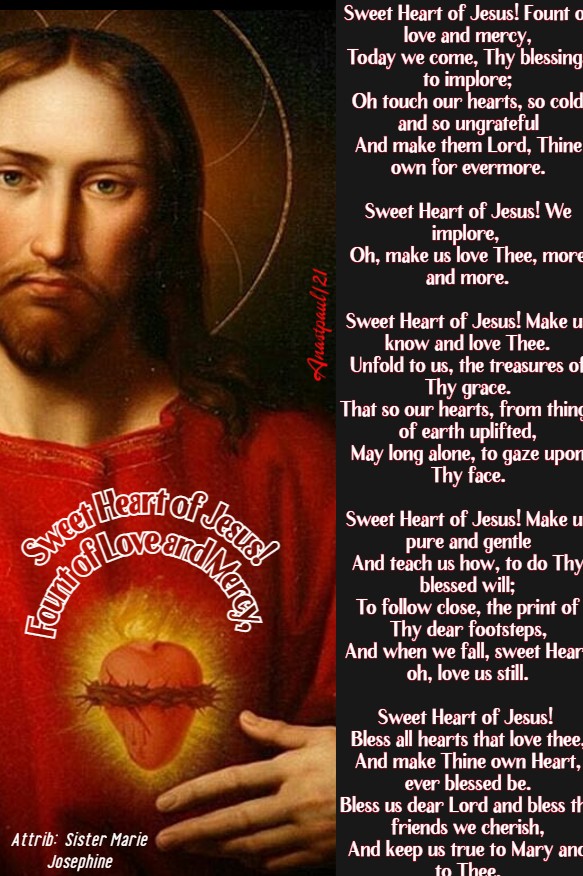
Sweet Heart of Jesus! Fount of Love and Mercy Attrib: Sister Marie Josephine.
Sweet Heart of Jesus! Fount of love and mercy, Today we come, Thy blessings to implore; Oh touch our hearts, so cold and so ungrateful And make them Lord, Thine own for evermore.
Sweet Heart of Jesus! We implore, Oh, make us love Thee, more and more.
Sweet Heart of Jesus! Make us know and love Thee. Unfold to us, the treasures of Thy grace. That so our hearts, from things of earth uplifted, May long alone, to gaze upon Thy face.
Sweet Heart of Jesus! Make us pure and gentle And teach us how, to do Thy blessed will; To follow close, the print of Thy dear footsteps, And when we fall, sweet Heart oh, love us still.
Sweet Heart of Jesus! Bless all hearts that love thee, And make Thine own Heart, ever blessed be. Bless us dear Lord and bless the friends we cherish, And keep us true to Mary and to Thee.
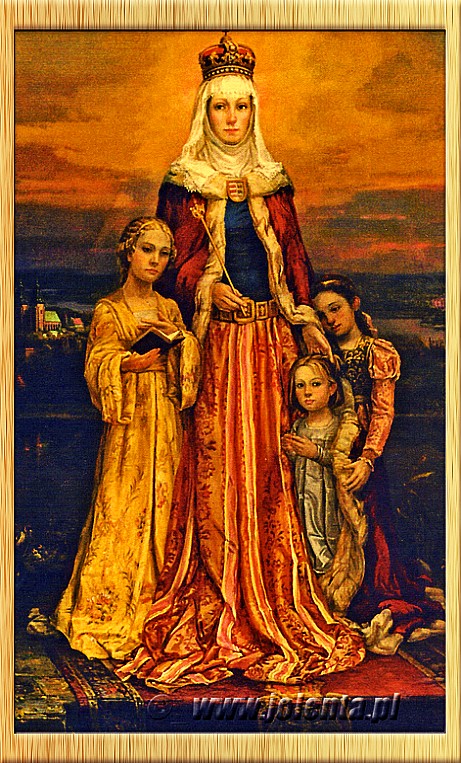
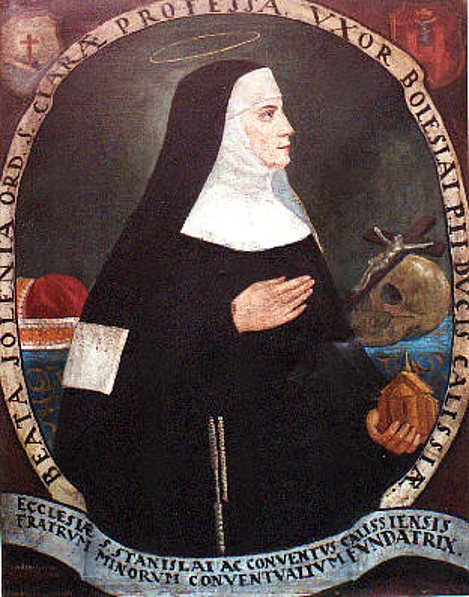
Saint of the Day – 11 June – Blessed Helen of Poland (c 1235-1298) Princess, Widow, Mother, Nun and Abbess of the Poor Clares, apostle of the poor, the needy and the sick. Born in c 1235 in Esztergom, Hungary as Jolenta Árpádházi and died on 11 June 1298 at Gniezno Poland of natural causes. Also known as – Helen of Hungary, Helena, Iolantha, Joheleth, Jolanda, olenta, Yolanda.
Jolenta was the daughter of King Béla IV of Hungary and Maria Laskarina. She was the sister of Saint Margaret of Hungary and Saint Kinga of Poland. One of her paternal aunts was the Franciscan Saint Elizabeth of Hungary.
As a young girl, Jolenta was sent to Poland to be tutored under the supervision of her sister, Kinga, who was married to the Duke of Poland. There, she was encouraged to marry Bolesław the Pious, which she did in 1257. They had three daughters:
Elisabeth of Kalisz (1263 – 28 September 1304); married Henry V, Duke of Legnica; Hedwig of Kalisz (1266 – 10 December 1339); married Władysław I the Elbow-high, King of Poland; Anna of Kalisz (born 1278, date of death unknown); a nun in Gniezno. During the time of her marriage, she was noted for her great services to the poor and needy of the country, as well as being a major benefactor of the Monasteries, Friaries and hospitals connected to them. Her husband gave her so much support in her charities that he earned the nickname “the Pious.” She was widowed in 1279.
Following Boleslaus’ death, Jolenta and Kinga, along with one of Jolenta’s daughters, Anna, retired to the Poor Clare Monastery that Kinga had founded in Sandez. and here she took the name Helen. Forced to relocate due to armed conflict in the region, Jolenta founded a new Monastery in Gniezno. She was persuaded to become Abbess of the community of nuns shortly before her death.
Helen was Beatified on 26 September 1827 by Pope Leo XII (cultus confirmed).
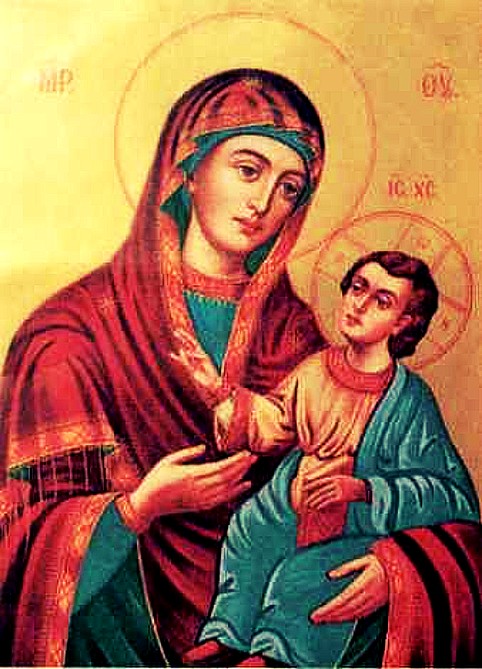
Our Lady of Mantara / Our Lady of ‘Awaiting’, Maghdouché, Sidon, South Governorate, Lebanon (1721) – 11 June, 8 September:
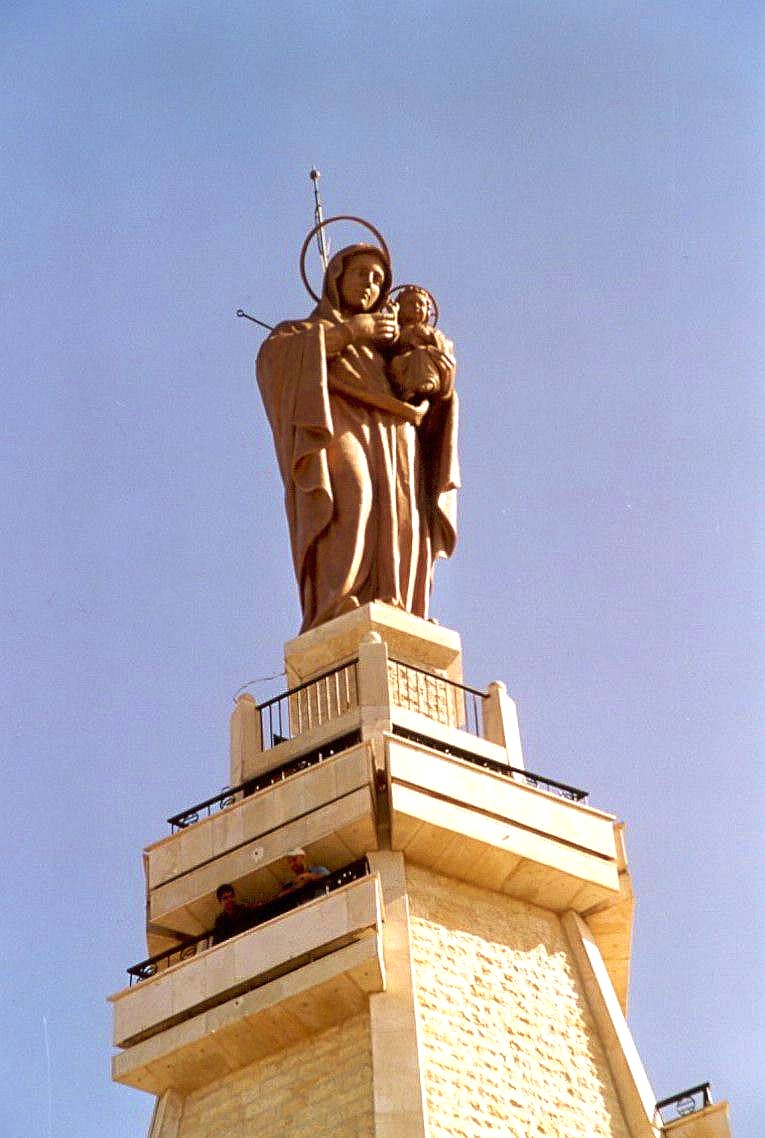
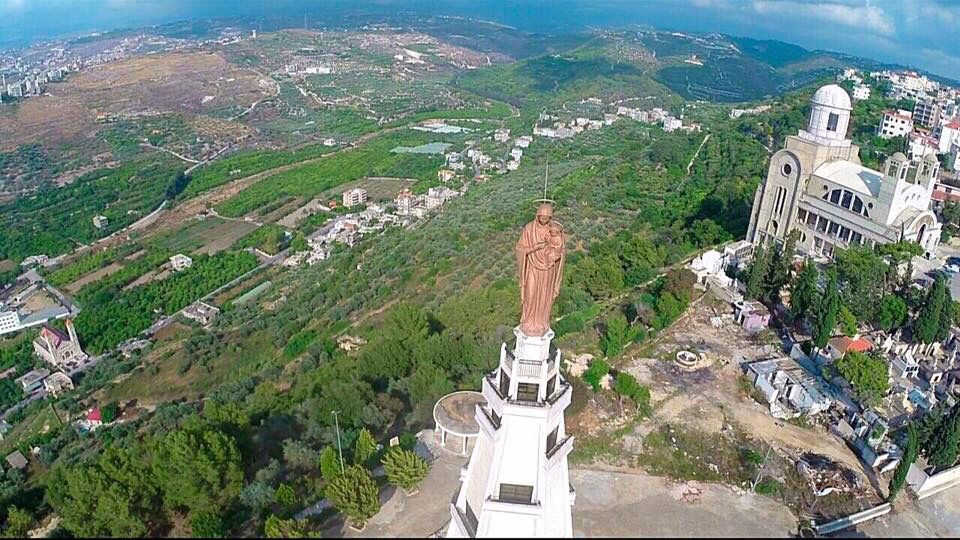
While Jesus preached in Sidon, Mary is said to have waited here in the cave of Mantara (“awaiting” in Arabic). Emperor Constantine’s wife Helena replaced a pagan shrine with one to the Holy Mother, donating to it an Icon and Altar furnishings. Three centuries later, after takeover by an intolerant Arab ruler, Christians sealed the cave and fled Maghdouché. In 1683, descendants of the exiles returned to their homeland under the inclusive Prince Fakhreddin II. On 8 September 1721, when a goat fell through a gap in the porous limestone, its young herder made a rope from vine twigs, tied it to a tree and followed the animal into the hole but the rope broke. The boy fell into the darkness, where eventually he made out the golden glimmer of an Icon of the Madonna and Child. On seeing the image, the Melkite Catholic clergy recognised it as St Helen’s Icon.
Christians now celebrate its rediscovery annually on 8 September, Feast of the Virgin’s Birth. A Cathedral was added to the site in 1860 and a modern tower topped with a bronze Statue in the 1960s.
On 11 June 1911, some 400 people saw a silent, luminous apparition of the Madonna and Child near the cave. Our Lady of Mantara is invoked for the healing of eye diseases and the protection of children, so the Shrine is a popular site for infant Baptisms.
Bl Kasper of Grimbergen St Maximus of Naples St Parisius St Paula Frasinetti St Riagail of Bangor St Tochumra of Kilmore St Tochumra of Tuam — Martyrs of Tavira – 7 beati: Members of the Knights of Santiago de Castilla. During the re-conquest of the Iberian peninsula from the Muslims by Christian forces, in a period of truce between the armies, the group was allowed to leave the Portuguese camp to hunt. Near Tavira, Portugal, he and his companions were ambushed and killed by a Muslim force. Making a reprisal attack, the Portuguese army took the city of Tavira. The murdered knights were considered to be martyrs as they died in an action defending the faith. They were – • Blessed Alvarus Garcia • Blessed Beltrão de Caia • Blessed Damião Vaz • Blessed Estêvão Vasques • Blessed Garcia Roiz • Blessed Mendus Valle • Blessed Pedro Rodrigues They were martyred in 1242 outside Tavira, Faro, Portugal. Their relics are enshrined under the altar of Saint Barnabas in the Church of Our Lady, Queen of the Angels (modern Santa Maria do Castelo) in Tavria
Mercedarian Martyrs of Damietta: Three Mercedarian lay knights who worked to ransom Christians enslaved by Muslims. During the 7th Crusade, a plague swept through the Christian army and these knights volunteered to work with the sick. During this work they were captured by Muslims and ordered to convert to Islam; they refused. They were tortured, taken to Damietta, Egypt where they were murdered for their faith. They were thrown from a tower in the mid-13th century in Damietta, Egypt.
Thought for the Day – 10 June – “Month of the Sacred Heart” – Meditations with Antonio Cardinal Bacci (1881-1971)
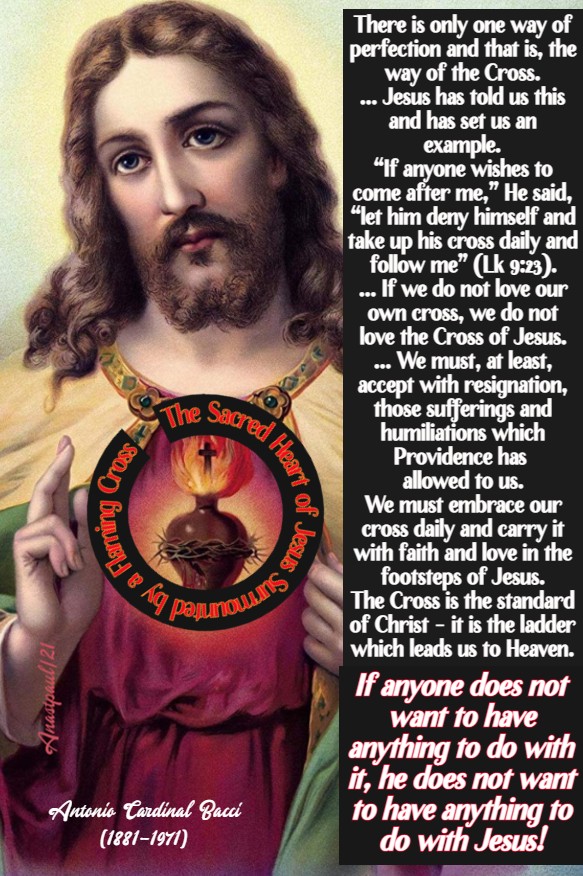
The Sacred Heart of Jesus Surmounted by a Flaming Cross
“This flaming Heart surmounted by a Cross represents, not only the infinite love of Jesus, the obedient victim of love but indicates also, that if we wish to follow our divine Redeemer as far as Heaven, our true country, we must follow Him along the path of love and of the Cross. There is only one way of perfection and that is, the way of the Cross.
Jesus has told us this and has set us an example. “If anyone wishes to come after me,” He said, “let him deny himself and take up his cross daily and follow me” (Lk 9:23). He gave us an example by allowing Himself, innocent as He was, to be burdened with our sin. He staggered as far as Calvary beneath the weight of the Cross and there, He shed His Precious Blood to the last drop.
We must take the road of the Cross also. If we do not love our own cross, we do not love the Cross of Jesus. The Saints looked for humiliation and suffering in order to prove their love for Jesus. We must, at least, accept with resignation, those sufferings and humiliations which Providence has allowed to us.
We must embrace our cross daily and carry it with faith and love in the footsteps of Jesus. The Cross is the standard of Christ – it is the ladder which leads us to Heaven. If anyone does not want to have anything to do with it, he does not want to have anything to do with Jesus!”
Quote/s of the Day – 10 June – “Month of the Sacred Heart” – Readings: First: Second Corinthians 3: 15 — 4: 1, 3-6, Psalm: Psalms 85: 9ab and 10, 11-12, 13-14, Gospel: Matthew 5: 20-26
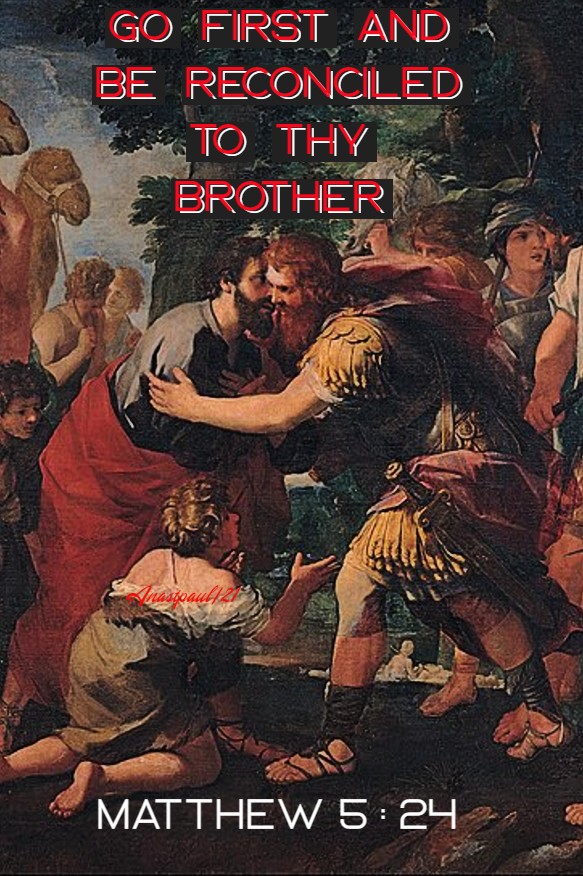
“Go first and be reconciled with your brother”
Matthew 5:24
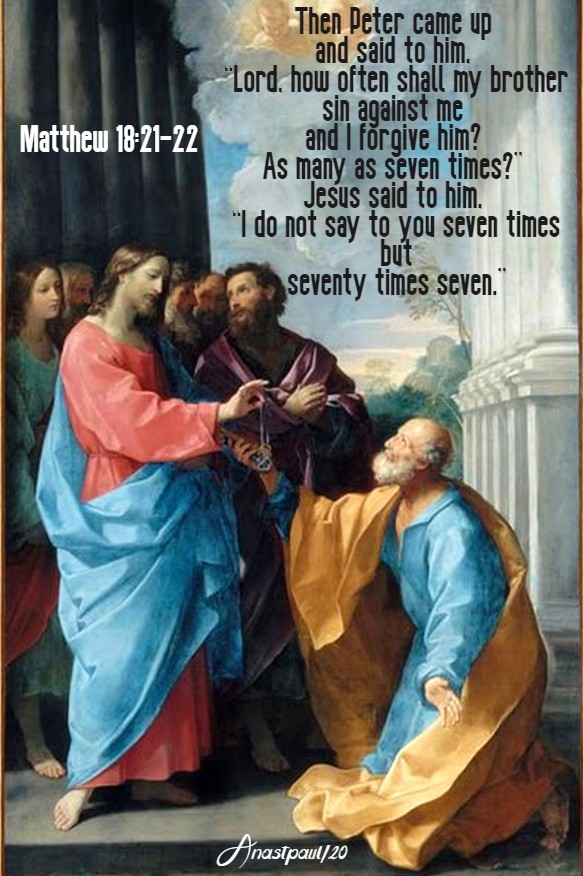
“Then Peter came up and said to him, “Lord, how often shall my brother sin against me and I forgive him? As many as seven times?” Jesus said to him, “I do not say to you seven times but seventy times seven.”
Matthew 18:21-22
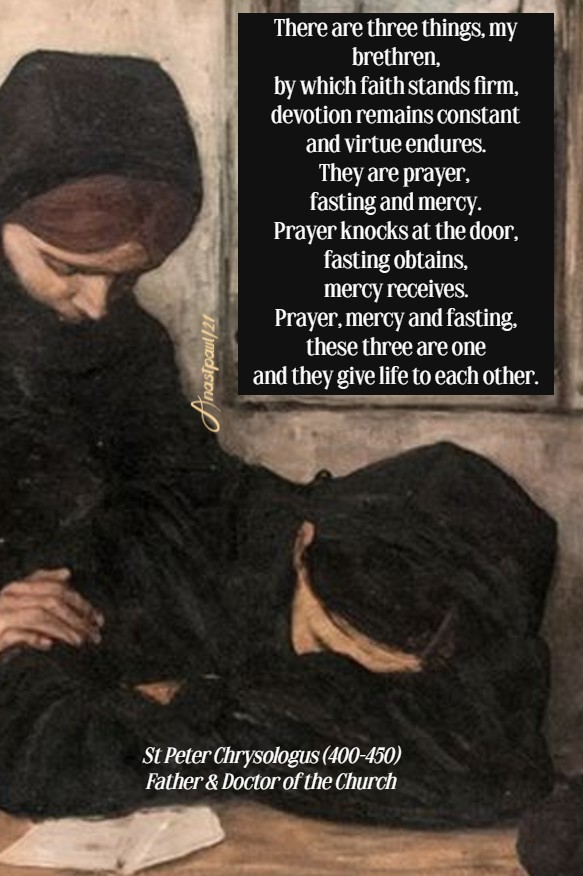
“There are three things, my brethren, by which faith stands firm, devotion remains constant and virtue endures. They are prayer, fasting and mercy. Prayer knocks at the door, fasting obtains, mercy receives. Prayer, mercy and fasting, these three are one and they give life to each other.”
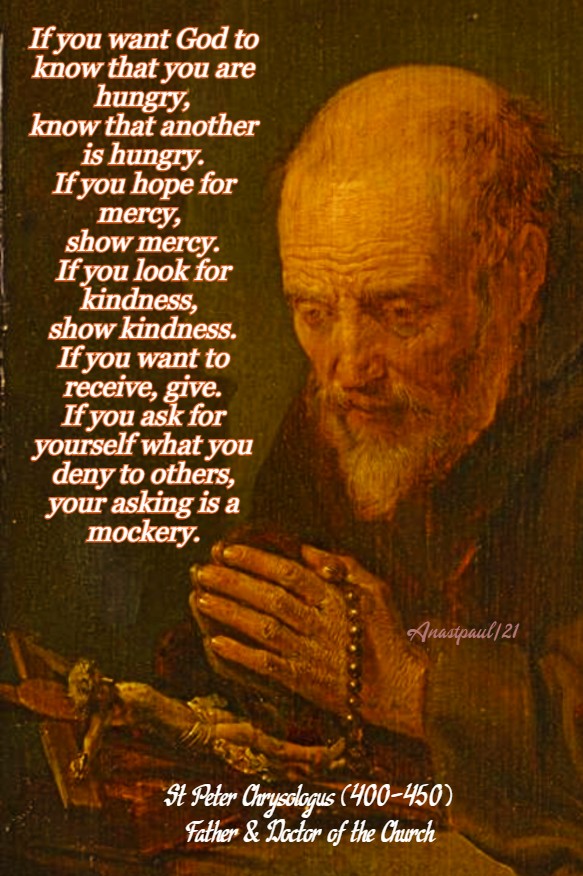
“If you want God to know that you are hungry, know that another is hungry. If you hope for mercy, show mercy. If you look for kindness, show kindness. If you want to receive, give. If you ask for yourself what you deny to others, your asking is a mockery.”
St Peter Chrysologus (400-450) Bishop of Ravenna, Father & Doctor of the Church
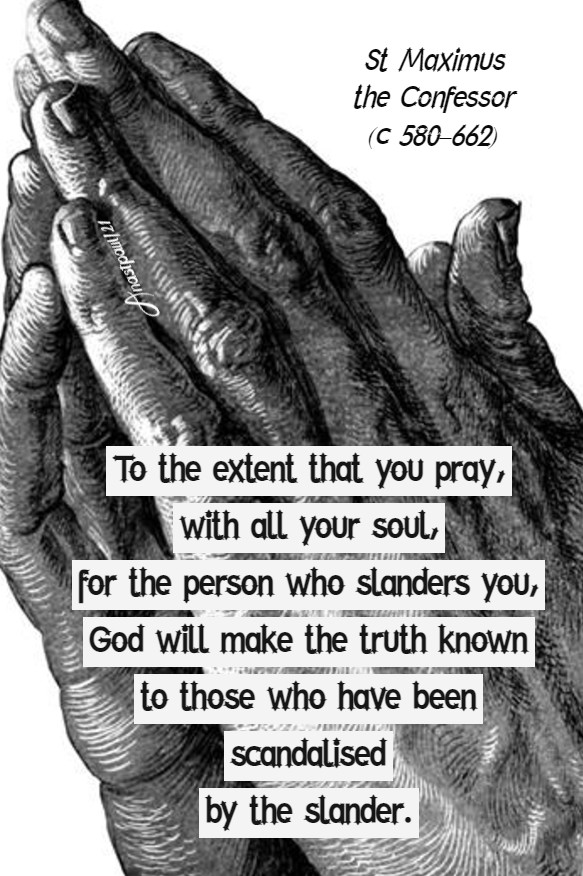
“To the extent that you pray, with all your soul, for the person who slanders you, God will make the truth known to those who have been scandalised by the slander.”
St Maximus the Confessor (c 580–662)
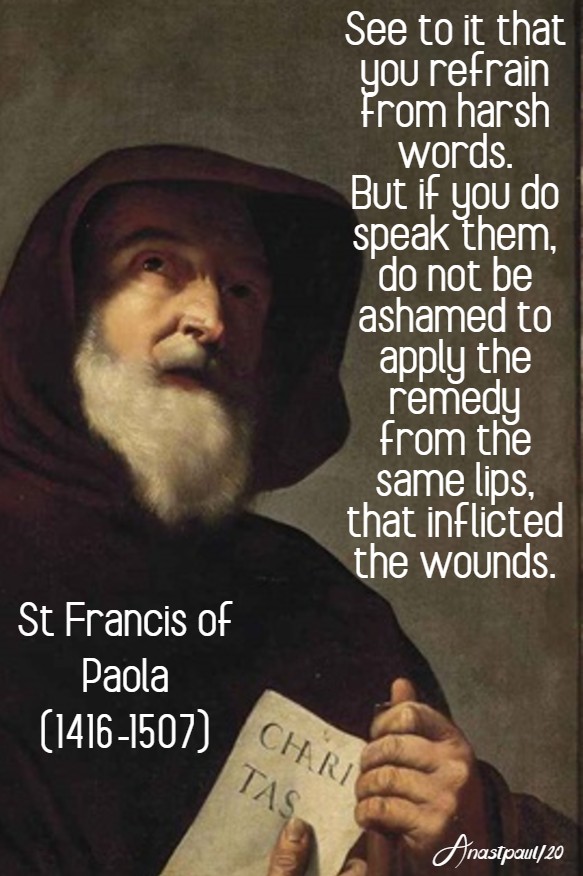
“See to it that you refrain from harsh words. But if you do speak them, do not be ashamed to apply the remedy from the same lips, that inflicted the wounds.”
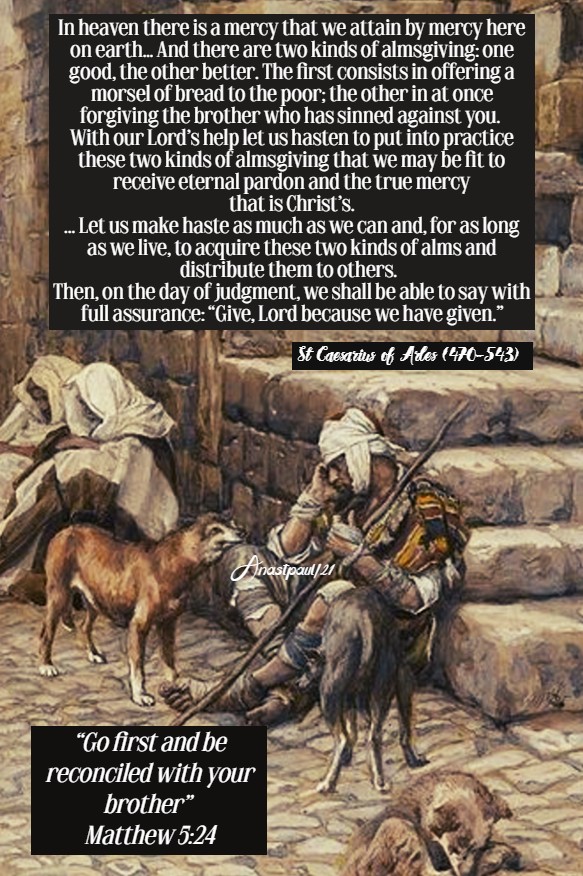
“Go first and be reconciled with your brother” – Matthew 5:24
REFLECTION – “In heaven there is a mercy that we attain by mercy here on earth… And there are two kinds of almsgiving: one good, the other better. The first consists in offering a morsel of bread to the poor; the other in at once forgiving the brother who has sinned against you. With our Lord’s help let us hasten to put into practice these two kinds of almsgiving that we may be fit to receive eternal pardon and the true mercy that is Christ’s. For He Himself has said: “If you forgive others their transgressions, your heavenly Father will forgive you. But if you will not forgive others, neither will your Father forgive your transgressions” (Mt 6,14-15). And elsewhere the Holy Spirit cries aloud: “Should a man nourish anger against his fellows and expect healing from the Lord? Should a man refuse mercy to his fellows yet seek God’s pardon for his own sins?” (Sir 28,3-4)…
Let us make haste as much as we can and, for as long as we live, to acquire these two kinds of alms and distribute them to others. Then, on the day of judgement, we shall be able to say with full assurance: “Give, Lord, because we have given.” – St Caesarius of Arles (470-543) Bishop and Monk – Sermons to the people no 25
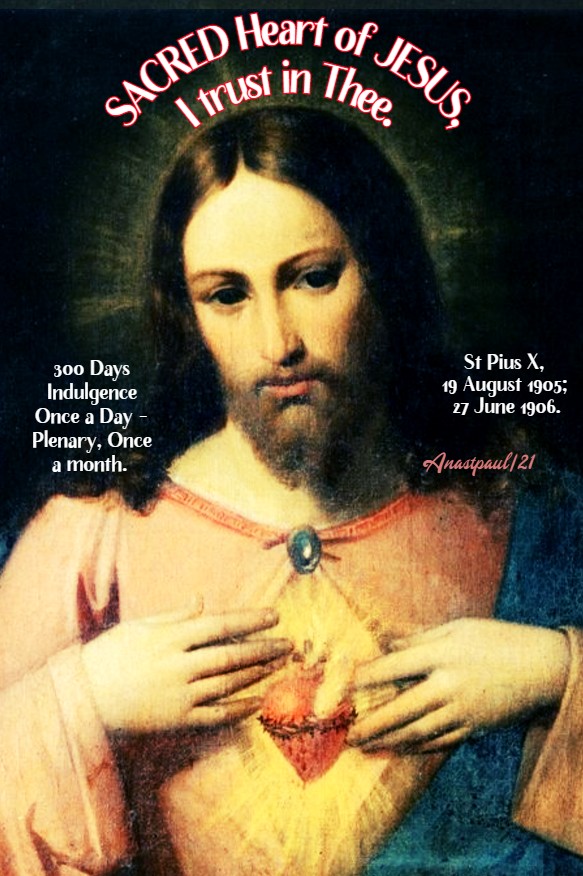
PRAYER – Lord God, true light and creator of light, grant that faithfully following the instructions of Your Son and pondering all that is holy, we may ever live in the splendour of Your presence. By the gifts of the Holy Spirit, may we always be light to our neighbour. Mary, Mother of Love and our loving mother, by your prayers, may we grow in charity and love. We make our prayer through Christ, our Lord amen. SACRED Heart of JESUS, I trust in Thee. 300 Days Indulgence Once a Day – Plenary, Once a month. Raccolta 175 – St Pius X, 19 August 1905; 27 June 1906.
Our Morning Offering – 10 June – “Month of the Sacred Heart”
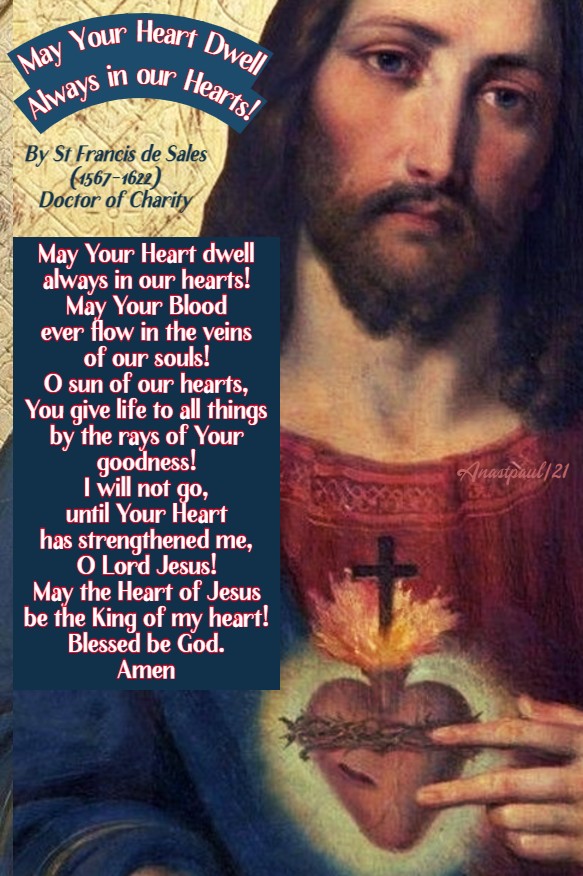
May Your Heart Dwell Always in our Hearts! By St Francis de Sales (1567-1622) Doctor of Charity
May Your Heart dwell always in our hearts! May Your Blood ever flow in the veins of our souls! O sun of our hearts, You give life to all things by the rays of Your goodness! I will not go, until Your Heart has strengthened me, O Lord Jesus! May the Heart of Jesus be the King of my heart! Blessed be God. Amen
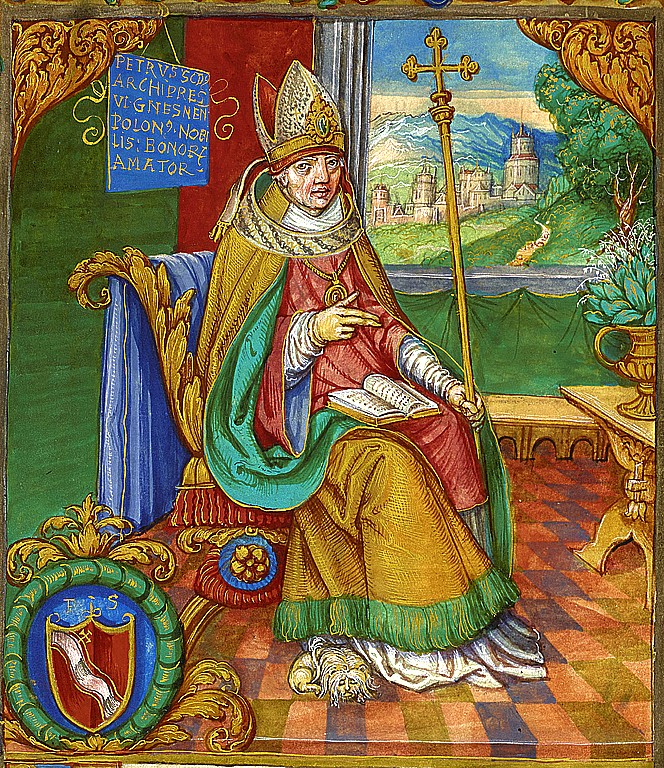
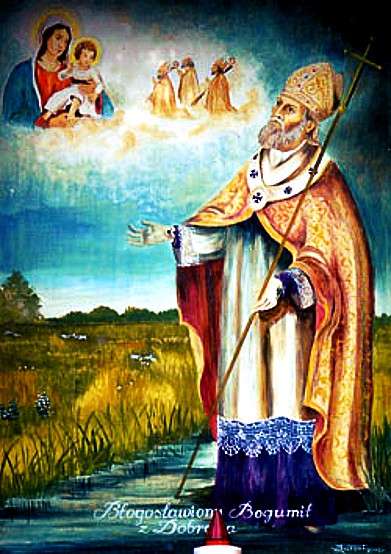
Saint of the Day – 19 June – Blessed Bogumilus of Gniezno (c 1135-c 1182) Archbishop of Gniezno, Camaldolese Hermit . Bornin c 1135 bear Dobrow, Poland and died in c 1182 near Uniedow, Poland of natural causes. Also known as Bogimilus, Bogumil Piotr, Bogumilo, Theophilus. Patronage – Archdiocese of Gniezno.
Bogumilus and his twin brother, Boguphalus, were born into a noble family in about 1135 at Dobrów, Poland. They studied in Paris, France. Having completed his studies Bogumilus was Ordained a Priest near Dobrów. His Uncle, who was the Archbishop of Gniezno, made him the Chancellor of Gniezno. Bogumilus succeeded his Uncle as Archbishop of Gniezno in 1167. Bogumilus founded a Cistercian Abbey at Koronowo.
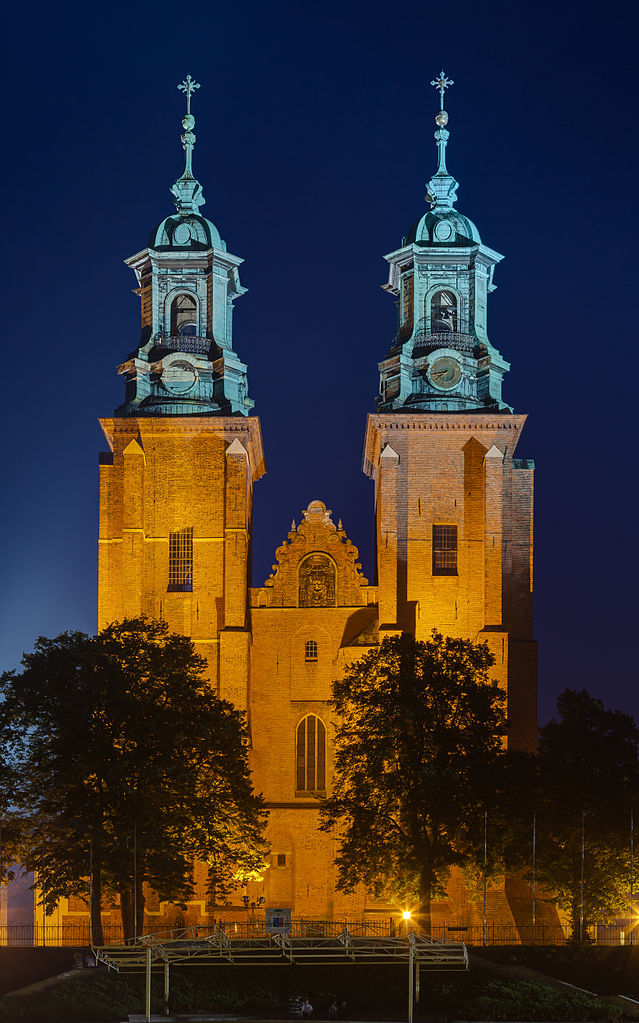
Gniezno Cathedral
He resigned his See in 1172, possibly due to opposition by his clergy to what they viewed as his excessive strictness. Bogumilus then joined the Camaldolese Hermits at Uniedow, Poland, where he remained until his death. While on his deathbed, Bogumilus saw a vision of the Virgin Mary and Child, surrounded by a throng of angels, who were inviting him to Heaven.
The cult and veneration of Bogumilus began almost immediately after his death, especially in Eastern Poland. Many people prayed for his intercession. When their prayers were answered, many faithful visited his tomb in the Cathedral of Gniezno and it became a place for local pilgrimage. Yet it was not until 1625 that the formal process of Beatification began under the Primate of Poland, Archbishop Maciej Łubieński.
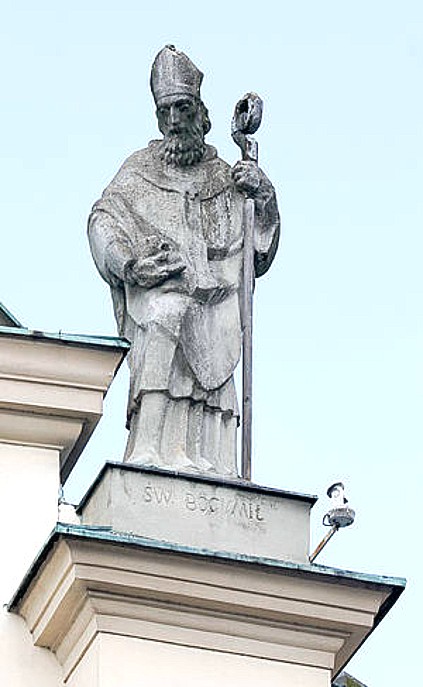
Statue of Blessed Bogumił on the Gniezno Cathedral.
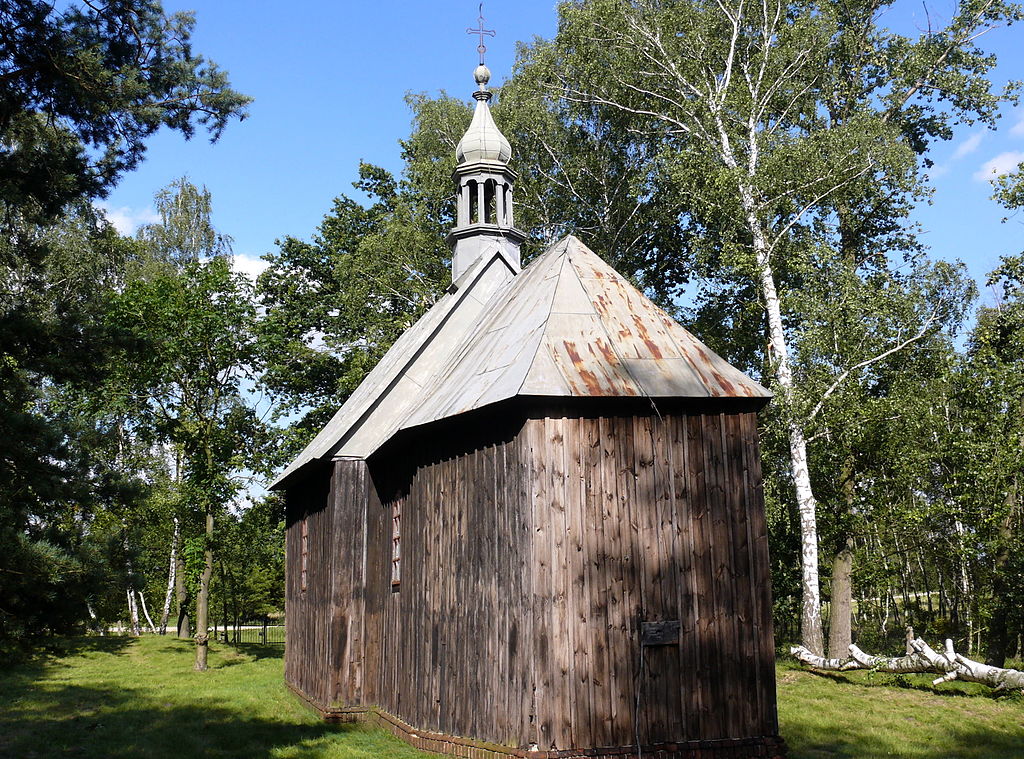
The files were sent to Rome in 1651, however the process was never completed as the Book of Miracles, which was in the hands of a Count, by the name of Sebastian Głębocki, was burned at his Court in Głębokie, Kruszwica. In 1788 a small wooden Chapel dedicated to Bogumilus was built, near Dobrów. The process of Beatification would remain dormant until 1908, when Stanislaw Zdzitowiecki, the Bishop of Kujawy, reactivated the process. On 27 May 1925 Pope Pius XI proclaimed Bogumilus, as Blessed.
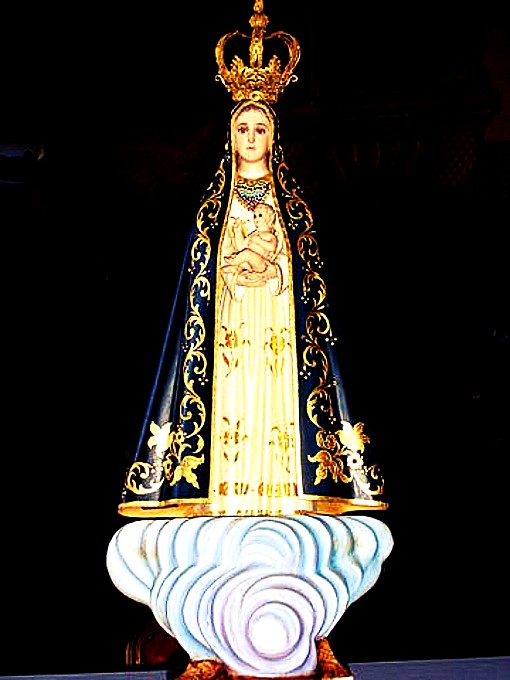
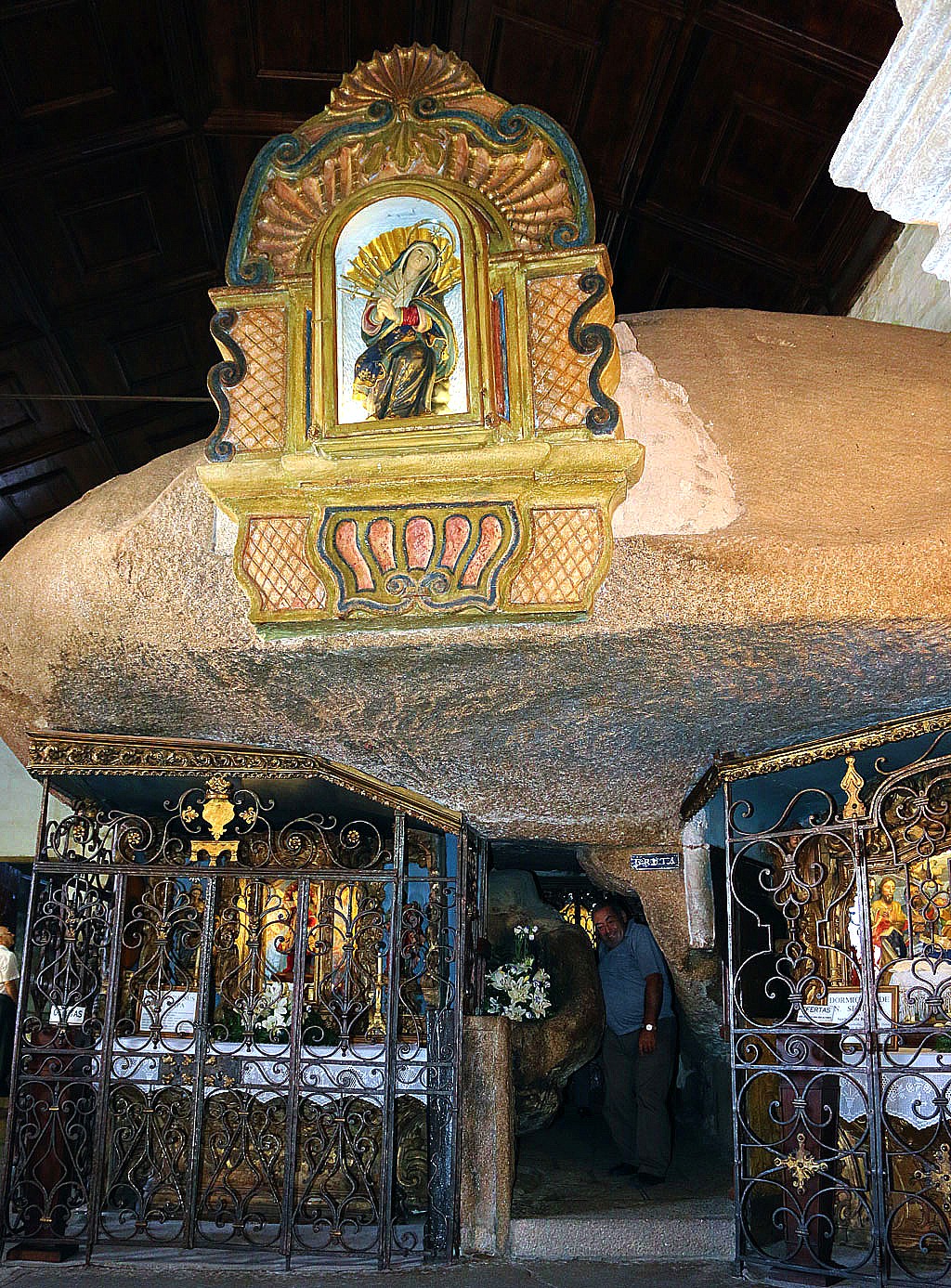
Nossa Senhora da Lapa / Our Lady of the Grotto, Sernancelhe, Viseu, Douro, Norte, Portugal, 1498 – 10 June:
In 1498, a mute girl was herding her flock in the hills of Quintela, outside the Town of Sernancelhe in north central Portugal, when she found a Statue of the Virgin and Child in the cleft of a rock. Young Joana made the Statue an object of personal devotion, carrying it back and forth from home, where she made clothes for it, to the hills, where she would set it on a rock, surround it with flowers and pray, while the sheep grazed nearby. Her mother began to feel the “doll” was distracting the girl from her chores and one day threw it in the fireplace. Suddenly Joana spoke, for the first time in her life: “Mother! That’s Our Lady of the Grotto! What are you doing?”The girl grabbed the unburnt image out of the fire. She was cured but her mother’s arm became paralysed! After they both prayed, the mother regained use of her arm. As word spread through the area, people began coming to venerate the Statue, and the Parish Priest suggested moving it to the Church. But three times, the image vanished from the Church, reappearing in its original place between the rocks. So, a Chapel was built there, enclosing the location where Joana found the Statue. People believed that in 982, nuns fleeing the Islamic conqueror Almanzor, had hidden the image there.
Nossa Senhora da Lapa became one of Portugal’s major pilgrimage destinations, attracting devotion from colonies in Brazil and India, as well as from the Portuguese aristocracy. In 1575, Pope Gregory XIII approved the request of King Sebastian to transfer the Shrine to the Society of Jesus. Between 1610 and 1635, the Jesuits rebuilt the Church, decorating the interior with azulejo tilework. Later, they added a college and housing for pilgrims, students and themselves. From the 1700s to the 1900s, the complex changed hands several times, repeatedly taken over by the state then returned to the Church. Since 1929, it has belonged to the Roman Catholic Diocese of Lamego.
n addition to the huge boulders within the Sanctuary, another unusual feature of the Shrine is a crocodile hanging from the ceiling (as in the Church of Our Lady of the Cherry Tree in Belgium)—a wooden replica of the long-decayed stuffed skin, which some say a pilgrim brought to thank the Virgin for her help against the beast in India. A more fanciful local story relates that a monstrous lizard menaced a girl who was spinning by hand while watching her flock. After invoking Our Lady of Lapa, she was able to subdue the animal by stuffing its mouth with balls of wool, then lead it home by a thread to be killed and mounted.
Although the Shrine’s fame has been eclipsed by that of Fatima, it still hosts three big pilgrimages annually: on 10 June Portugal Day, on `15 August Feast of the Assumption (preceded by novenas) and on 8 September Feast of Mary’s Birth.
Bl Amata of San Sisto St Amantius of Tivoli St Asterius of Petra St Bardo of Mainz Blessed Bogumilus of Gniezno (c 1135-c 1182) Bishop, Camaldolese Hermit St Caerealis of Tivoli St Censurius of Auxerre St Crispulus of Rome
Bl José Manuel Claramonte Agut Bl Joseph Kugler St Landericus of Novalese St Landericus of Paris Bl Mary Magdalene of Carpi St Maurinus of Cologne St Primitivus of Tivoli St Restitutus of Rome Bl Thomas Green St Timothy of Prusa Bl Walter Pierson St Zachary of Nicomedia — Martyrs of North Africa – 17 saints: A group of seventeen Christians martyred together in North Africa; the only surviving details are two of their names – Aresius and Rogatius. Both the precise location in North Africa and the date are unknown.
Martyrs of the Aurelian Way – 23 saints: A group of 23 martyrs who died together in the persecutions of Aurelian. The only details that survive are three of their names – Basilides, Mandal and Tripos. c.270-275 on the Aurelian Way, Rome, Italy.
Thought for the Day – 9 June – “Month of the Sacred Heart” – Meditations with Antonio Cardinal Bacci (1881-1971)
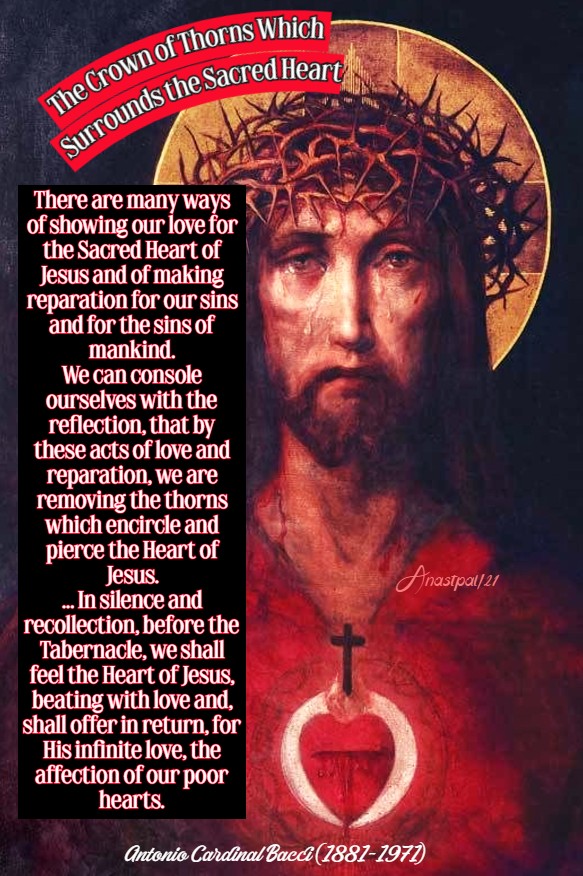
The Crown of Thorns Which Surrounds the Sacred Heart
“There are many ways of showing our love for the Sacred Heart of Jesus and of making reparation for our sins and for the sins of mankind. We can console ourselves with the reflection, that by these acts of love and reparation, we are removing the thorns which encircle and pierce the Heart of Jesus. The simplest ways of doing this, are by prayers, aspirations and expressions of love, directed towards the adorable Heart of our Redeemer and, by visits to Jesus in the Blessed Sacrament. In silence and recollection, before the Tabernacle, we shall feel the Heart of Jesus, beating with love and, shall offer in return, for His infinite love, the affection of our poor hearts.
We can also receive Holy Communion in reparation. When Jesus is in us and we are in Jesus, it will be easier and more pleasant, to offer Him our love and expiation. We can make reparation also, by practising the devotion of the First Fridays of the month. This pious practice, so pleasing to the Heart of Jesus, aims at being a mass offering of love and reparation, for the sins of the entire human race.”
Quote/s of the Day – 9 June – “Month of the Sacred Heart” – The Memorial of St Ephrem (306-373) Father & Doctor of the Church, , “The Harp of the Holy Spirit!”
“Scripture brought me to the Gate of Paradise and the mind stood in wonder as it entered.”
“When you begin to read or listen to the Holy Scriptures, pray to God thus: “Lord Jesus Christ, open the ears and eyes of my heart so that I may hear Thy words and understand them and may fulfill Thy will.” Always pray to God like this, that He might illumine your mind and open to you, the power of His words. Many, having trusted in their own reason, have turned away into deception.”
“Have mercy, O Lord, on our children, In our children, Call to mind Your childhood, You who were a child. Let them that are like Your childhood Be saved by Your grace.”
O Lord and Master of My Life By Saint Ephrem (306-373) Father & Doctor of the Church
O Lord and Master of my life, give me not a spirit of sloth, vain curiosity, lust for power and idle talk. But give to me, Thy servant, a spirit of soberness, humility, patience and love. O Lord and King, grant me to see my own faults and not to condemn my brother. For blessed art Thou to the ages of ages. Amen O God, be merciful to me a sinner. O God, cleanse me, a sinner. O God, my Creator, save me and for my many sins forgive me!
One Minute Reflection – 9 June – “Month of the Sacred Heart” – Readings: First: Second Corinthians 3: 4-11, Psalm: Psalms 99: 5, 6, 7, 8, 9m Gospel: Matthew 5: 17-19
“I have come, not to abolish but to fulfil.” … Matthew 5:17
REFLECTION – “Do you want to know how Jesus, far from abolishing the law and the prophets, comes rather to confirm and to complete them? Where the prophets are concerned, this happens first of all ,when He confirms, through His works, what they had announced. This is where the expression comes from, constantly repeated in St Matthew: “That the word of the prophets might be fulfilled” …
Where the law is concerned, Jesus fulfilled it in three ways. First of all, by not omitting any of its legal requirements. He told John the Baptist: “We must do this if we would fulfil all of God’s demands,” (Mt 3:15). To the Jews He said: “Can any of you convict me of sin?” (Jn 8:46) … In the second place, He fulfils it because He wanted to submit Himself to it for our salvation. Oh marvel! By submitting to it, He communicated to us, too, the grace of fulfilling it! St Paul teaches us this when he says: “Christ is the end of the law. Through him, justice comes to everyone who believes,” (Rom 10:4). He also says that the Saviour condemned sin in the flesh “so that the just demands of the law might be fulfilled in us who live not according to the flesh,” (Rom 8:4.) He also says: “Are we then abolishing the law by means of faith? Not at all! On the contrary, we are confirming the law,” (Rom 3:31).
For the law aimed at making a person righteous but it didn’t have the strength do so so; then Christ came, He who is the end of the law and He showed us the way which leads to righteousness, that is to say – faith. Thus He fulfilled the law’s intention. The letter of the law could not justify the sinner; faith in Jesus Christ will justify him. That is why He can say: “I have not come to abolish the law.”
Now, if we look more closely, we can perceive a third way of fulfilling the law. What is this? It consists in the very precepts, which Christ had to give; far from overturning those of Moses, they are their just consequence and their natural complement.” – St John Chrysostom (345-407) Bishop of Constantinople, Father and Doctor of the Church – Homilies on St. Matthew 16
PRAYER – Shed your clear light on our hearts, Lord, so that walking continually in the way of Your commandments, we may never be deceived or misled. May the Mother of Our God and our Mother, be at our side and guide our way. We make our prayer through our Lord Jesus Christ in the unity of the Holy Spirit, one God forever and ever, amen. All praise, honour and glory to the divine Heart of JESUS.50 Days Indulgence, Once a day, Raccolta, 168 Pope Leo XIII, 13 June 1901.
Our Morning Offering – 9 June – “Month of the Sacred Heart”
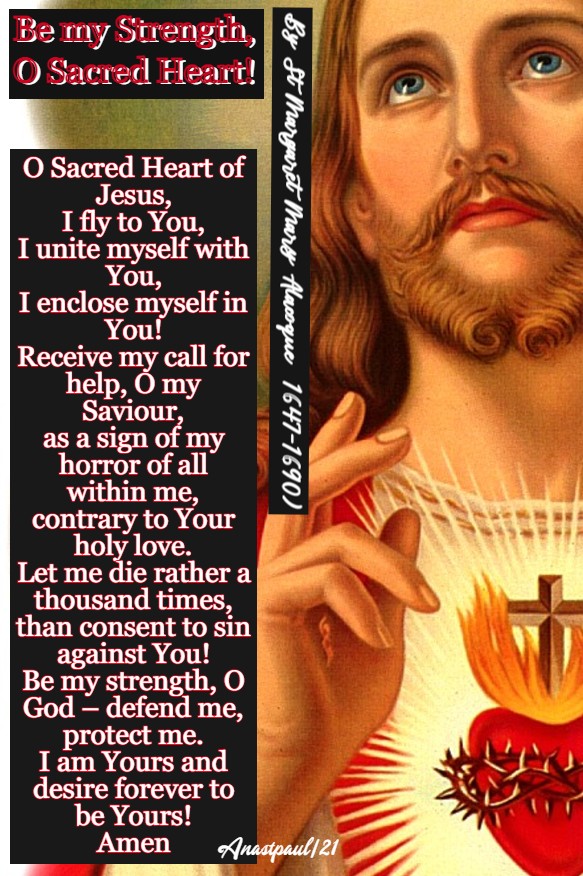
Be my Strength, O Sacred Heart! By St Margaret Mary Alacoque (1647-1690) Visionary of the Sacred Heart
O Sacred Heart of Jesus, I fly to You, I unite myself with You, I enclose myself in You! Receive my call for help, O my Saviour, as a sign of my horror of all within me, contrary to Your holy love. Let me die rather a thousand times, than consent to sin against You! Be my strength, O God – defend me, protect me. I am Yours and desire forever to be Yours! Amen
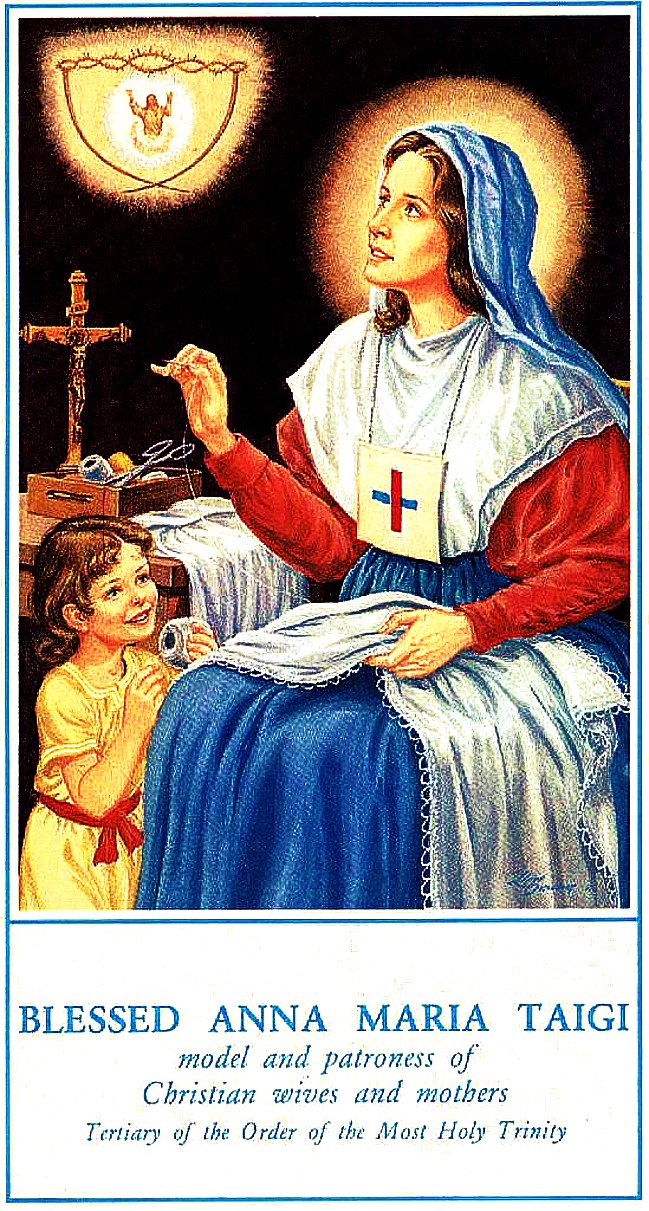
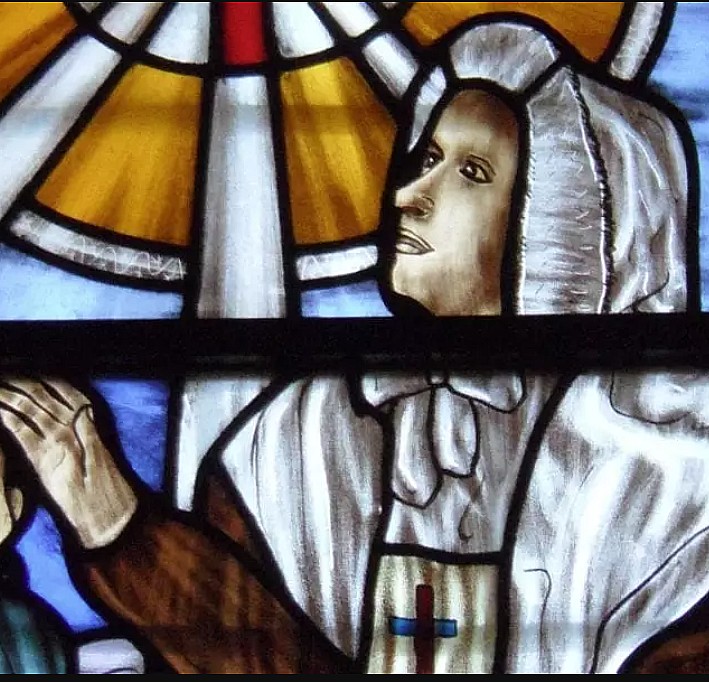
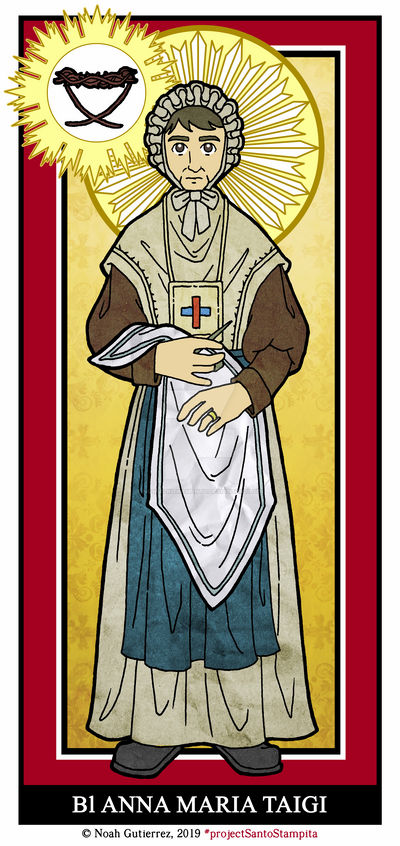
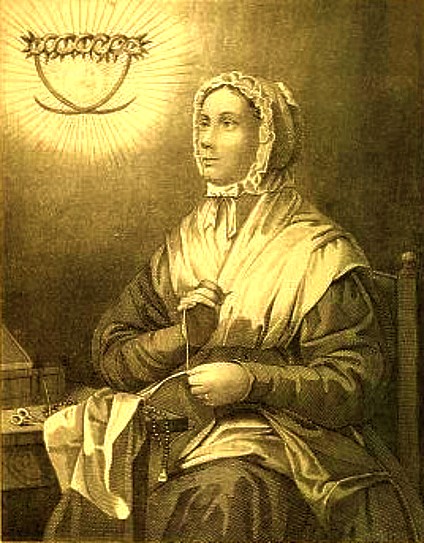
Saint of the Day – 9 June – Blessed Anna Maria Taigi O.SS.T. (1769-1837) Secular Religious of The Order of the Most Holy Trinity and of the Captives – known as the Trinitarians, Married laywoma, Mystic. Born on 29 May 1769 at Siena, Italy as Anna Maria Gianetti and died on 9 June 1837 at Rome, Italy of natural causes. Patronages – Housewives,Mothers,Victims of verbal abuse, Victims of spousal abuse,Families,Trinitarian tertiaries. Also known as – Anne Marie Gesualda Antonia Taigi, Anna Maria Taigi, Anne Marie Gianetti. Her body incorrupt.
Hailing from Siena, Italy, Taigi’s family moved to Rome when her pharmacist father needed to find employment after financial ruin. Poverty, although unchosen then, later in life would be embraced as one of her defining characteristics.
Unsure of her vocation as a young woman, Taigi considered religious life but because she was too ambivalent to it, a confessor suggested marriage. Her future husband’s path crossed hers while both were engaged in service work in the homes of Italian nobility. Domenico Taigi was a rough and tumble man, prone to making life difficult for those around him in word and deed. And his wife got the brunt of his temperament. But Taigi softened him, showing love when least expected. A hardened heart, almost assuredly will melt over time from love’s gentleness — such as an unwarranted smile. Taigi models how one takes seriously the marriage vows as a means to one’s own sanctification and growth in holiness.
This self-denial for which Anna Maria became known was not always what defined her. In the early years of their marriage, her life was marked by vanity and luxury. It has been disputed that she engaged in an adulterous affair.
But a conversion experience led Anna Maria to embrace a Gospel way of life that came to define her life. Baptised the day after her birth, Anna Maria’s faith had not blossomed until after her marriage. A chance encounter with a Priest in S. Peter’s Square prompted her to subsequently make a fruitful Confession, in which she renounced the life of worldly priorities which she had been living. That night, Taigi had been moved by an inner voice that said God desired more from her. Her husband described years later, how, as a first step in this new life, his wife “took to wearing the plainest possible clothes,” noting ,that, in obedience to her spouse, she asked for his consent. He gave it completely, he said, for he saw “she was entirely given to the love of God.”
All this had kept her from giving her all to Christ, which took place while in prayer before a Crucifix. She heard Jesus ask from the Cross, “What is your wish? To follow Jesus poor and naked and stripped of all, or to follow Him in His triumph and glory? Which do you choose?” To which she replied, “I embrace the Cross of my Jesus. I will carry it like Him in pain and ignominy. I wait at His hands, triumph and glory in the hereafter.”
Single-minded dedication to Christ, defined the rest of Anna Maria’s life, which was a constant display of the closeness to Christ she experienced in the Sacrament. She worked to serve Christ in the sick and poor as a Third Order Trinitarian ,while keeping up with the duties of a wife and mother. A gift of prophesying the future was the spiritual fruit of visions and ecstasies — all the more incredible that this came to an ordinary housewife, not the likes of a cloistered nun. Her prophetic abilities caused her to become sought after by many notable figures, including Napoleon’s Mother and the Pope. Anna Maria became acquainted with Cardinal Luigi Ercolani, and Giovanni Maria Mastai Ferretti ,who would become Blessed Pope Pius IX. Pope Pius VII often asked St Vincent Strambi , the Priest who had assisted her in her convesion, how she was doing and would send his blessings to her. Pope Leo XII and Giuseppe Bartolomeo Menocchio both held her in high esteem Anna Maria composed a prayer to the Blessed Virgin Mary. Pedicini took this prayer to Pius VII who, in a rescript on 6 March 1809, granted an indulgence. For 100 days, those who recited it, a plenary indulgence once a month on the usual conditions.
Anna Maria attended the 1825 Jubilee which Pope Leo XII had summoned. She knew of the latter Pope’s ill health. Before he died, in 1829, she saw the morning sun and prayed for him. She heard a heavenly voice say, “Arise and pray. My Vicar is on the point of coming to render an account to Me.” Pope Leo’s successor Pope Pius VIII lived in the shadow of ill health. Anna Maria foresaw his death and prayed for his soul as she did with his predecessor. She had predicted the pontificate of Pius VIII would be a short one.
She successfully foresaw that Cardinal Bartolomeo Alberto Cappellari would be elected as Pope Gregory XVI. Before Pius VIII died, Anna Maria went to San Paolo fuori le Mura. When Cappellari arrived she fixed her eyes on him When she was asked why she was doing this, she frankly responded, “That is the future Pope.”
On 24 October 1836, Anna Maria fell ill. She was confined to her bed and would never rise again. On 2 June 1837, her fever slightly declined but a few days later, her fever rose again. On 5 June she bid farewell to those who visited her bedside. On 8 June she received the last rites of Extreme Unction.
Ana Maria received the Viaticum and the Anointing of the Sick from the local curate. On 9 June 1837, at 4 a.m., she died. Pedicini sent a letter at once to Cardinal Carlo Odescalchi to inform him of her death. Anna Maria’s remains were exposed until 11 June in the Church of Santa Maria in Via Lata. She was buried at Campo Verano where, on the orders of Pope Gregory XVI, her remains were enclosed in a leaden sepulcher with seals affixed to it. Cardinal Odescalchi asked her Confessor to compile all documents so that her biography could be published.
Upon her death in 1837, the future St Vincent Pallotti praised her holiness. This was reiterated by Venerable Bernardo Clausi who said, “If she is not in heaven, there is no room there for anybody.” She was Beatified by Pope Benedict XV on 30 May 1920.
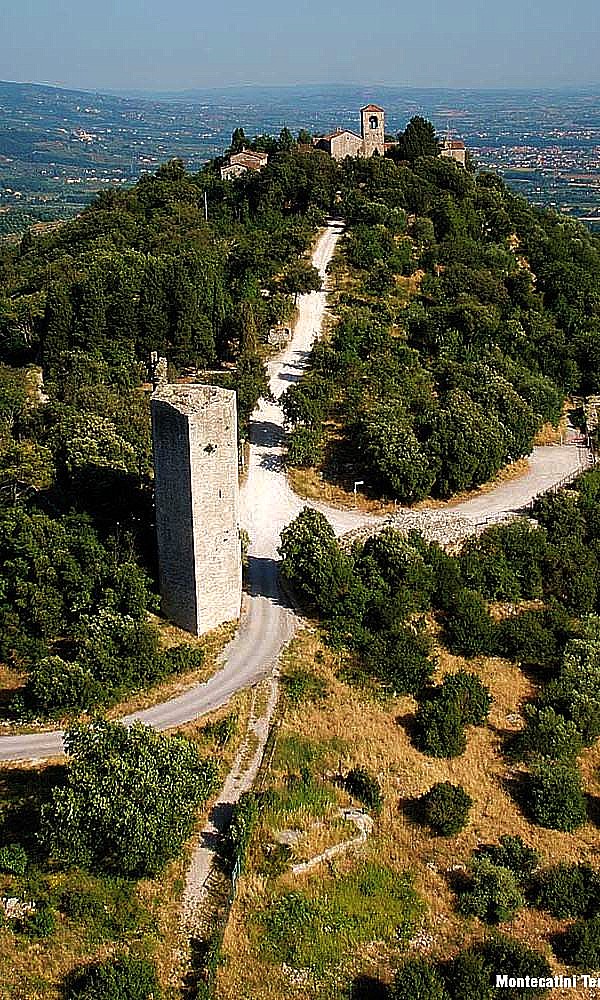
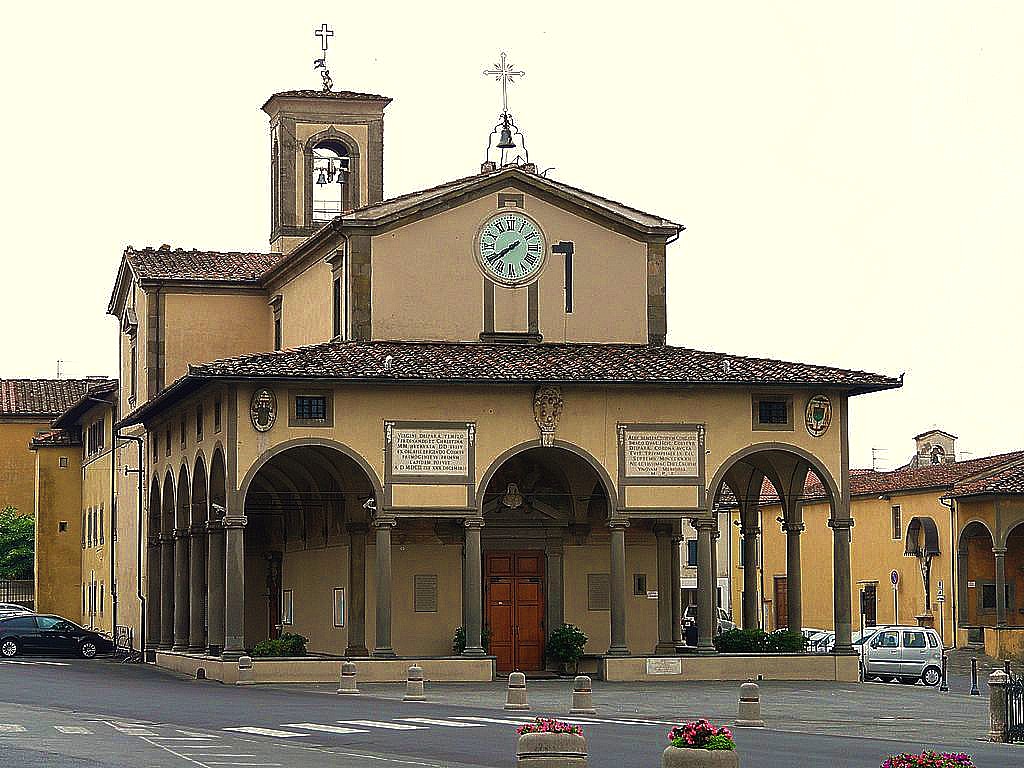
Madonna della Fontenuova / Our Lady of the Plain , Monsummano Terme, Pistoia, Tuscany, Italy, 1573 – 9 June
In the year 500, in the area where now stands the Church, there were only swamps, forests and meadows, an area used only by shepherds on the slopes of Monsummano Alto, with streets that wind their way through marshes and grassy fields., a place unlikely for a town to develop.
But what nature seems to deny was achieved, by a sudden and unexpected intervention of Our Lady. On 9 June 1573, in fact, Jacopina Mariotti, a shepherdess sweet and mild, as well as pious, simple and modest, prayed in front of one of the many pictures painted in fresco on the wall,s that dot the streets of the plan. After the prayer, she realised that she had lost her flock. Her crying moved the Virgin Mary who, according to a documented records, appearing to Jacopinam and showed her where her flock had wandered.
In addition, the Blessed Mother asked Jacopina to go to the Priest of the Church of the Castle, to sask him to build a Church in her honour on the spot where she had appeared. Devotion to Our Lady of the Plain grew with great fervour and faith. Just two months after the first event, local authorities, agreeing with the will of the people to build a Chapel to Our Lady of the Plain and allocated for this purpose, the many offerings of pilgrims from all over the Valdinievole area.
Another appearance, this time more crucial and decisive for the erection of the Shrine and the Marian movement resulting therefrom, occurred on10 June 1602 and was witnessed by the Priest of Monsummano, Alto Simone Casciani. On 7 July of the same year, during the celebration of the Mass, aftera long drought, the rain began to pour with abundance. The people attributed this long needed rain to their novena to Our Lady of the Plain. .
From that day, the Madonna del Piano was called: Our Lady of Fontenova. The explosion of devotion to Mary, already significant after the events of 9 June 1573, became even greater, requiring the intervention of the Grand Duke of Tuscany, Ferdinando I de ‘Medici. He ordered that the building work of the Marian Shrine proceed with speed, the first stone was laid 30 December 1602. On 13 February 1607 the Grand Duke of Tuscany approved the project for the construction of the Hostel for pilgrims to be administered by the Sanctuary.
On 8 June 1608 Cosimo de ‘Medici in fulfillment of a vow made by his father Ferdinand, crowned the Blessed Mother in a precious and costly diadem, finely crafted and carved. Experts consider it the best and most intricate example of the art of the period. This Crown was placed on the head of the Virgin Mary by the Vatican Chapter in 1782. (Apologies for this Italia translation).
Bl Alexander of Kouchta St Alexander of Prusa Blessed Anna Maria Taigi O.SS.T. (1769-1837) Religious of the Secular Trinitarians, Married laywoma, Mystic St Arnulf of Velseca St Baithen of Iona
St Comus of Scotland St Cumian of Bobbio St Cyrus Bl Diana d’Andalo St Diomedes of Tarsus St Felicianus Bl Henry the Shoemaker St Jose de Anchieta Bl Joseph Imbert St Julian of Mesopotamia St Luciano Verdejo Acuña Bl Luigi Boccardo St Maximian of Syracuse St Pelagia of Antioch St Primus St Richard of Andria Bl Robert Salt Bl Sylvester Ventura St Valerius of Milan St Vincent of Agen — Martyrs of Arbil – 5 saints: Five nuns who were martyred together in the persecutions of Tamsabur for refusing to renounce Christianity for sun-worship – Amai, Mariamne, Martha, Mary and Tecla. They were beheaded on 31 May 347 at Arbil, Assyria (in modern Kurdistan, Iraq).
Thought for the Day – 8 June – “Month of the Sacred Heart” – Meditations with Antonio Cardinal Bacci (1881-1971)
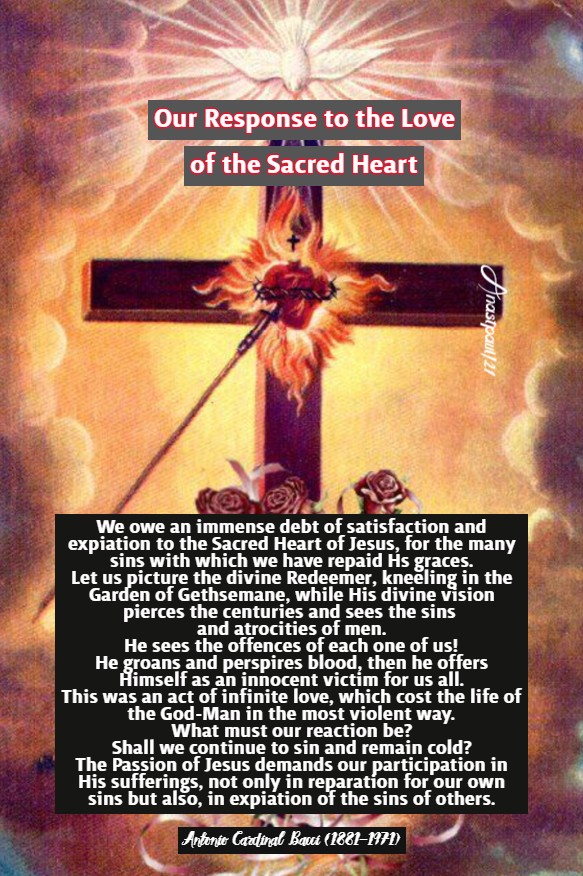
Our Response to the Love
of the Sacred Heart
“We owe an immense debt of satisfaction and expiation to the Sacred Heart of Jesus, for the many sins with which we have repaid Hs graces. Let us picture the divine Redeemer, kneeling in the Garden of Gethsemane, while His divine vision pierces the centuries and sees the sins and atrocities of men. He sees the offences of each one of us! He groans and perspires blood, then he offers Himself as an innocent victim for us all. This was an act of infinite love, which cost the life of the God-Man in the most atrocious way.
What must our reaction be? Shall we continue to sin and remain cold? The Passion of Jesus demands our participation in His sufferings, not only in reparation for our own sins but also, in expiation of the sins of others. Let us look around us and see how many men are so indifferent and wicked, as if Jesus had never come to save us, had never shed His Precious Blood for us and, had never loved us with an infinite love. At this spectacle, the Saints inflicted penances on themselves, in order to offer to Jesus, a return of love and reparation for sin.”
One Minute Reflection – 8 June – Readings: First: Second Corinthians 1: 18-22, Psalm: Psalms 119: 129, 130, 131, 132, 133, 135, Gospel: Matthew 5: 13-16
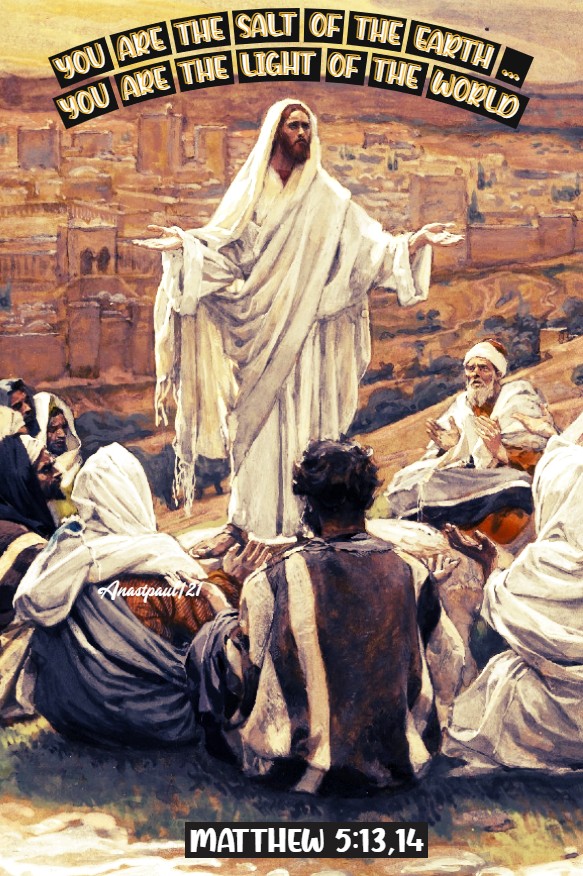
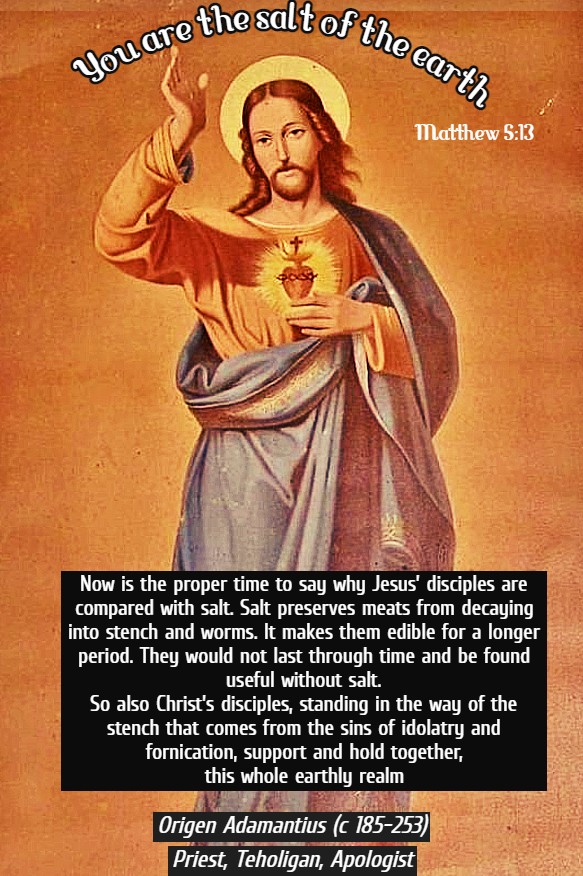
“You are the salt of the earth” – Matthew 5:13
REFLECTION – “Salt is useful for so many purposes in human life! What need is there to speak about this? Now is the proper time to say why Jesus’ disciples are compared with salt. Salt preserves meats from decaying into stench and worms. It makes them edible for a longer period. They would not last through time and be found useful without salt. So also Christ’s disciples, standing in the way of the stench that comes from the sins of idolatry and fornication, support and hold together, this whole earthly realm.” – Origen Adamantius (c 185-253) Priest, Theologian, Exegist, Writer, Apologist, Father – (Fragment 91)
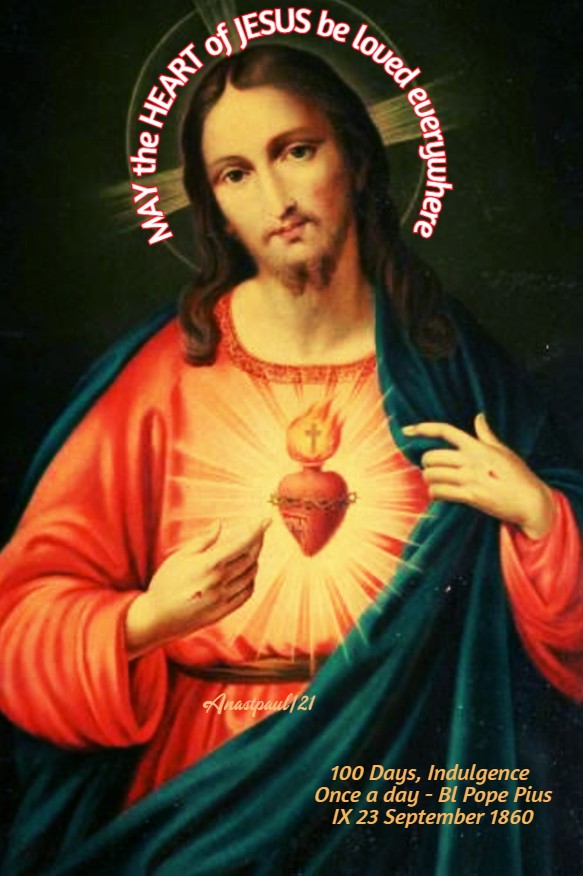
PRAYER – Holy Almighty Father, we pray that we may be the light of Your divine Son and the salt of the earth. Help us, we pray, to ever strive to be both the light and salt of the earth and may the protection of Our Lady of Grace, first disciple of Jesus and model, be of help to believers who live every day their vocation and mission in history. May our Mother help us, to let ourselves always be purified and illumined by the Lord, to become in turn “salt of the earth” and “light of the world. Through the Sacred Heart of Jesus in the unity of the Holy Ghost, God now and for all eternity, amen. MAY the HEART of JESUS be loved everywhere. 100 Days, Indulgence Once a day – Bl Pope Pius IX 23 September 1860
Our Morning Offering – 08 June – “Month of the Sacred Heart”
Daily Offering to the Sacred Heart By St Therese of the Child Jesus of Lisieux (1873-1897) Doctor of the Church
O my God! I offer You all my actions of this day for the intentions and for the glory of the Sacred Heart of Jesus. I desire to sanctify every beat of my heart, my every thought, my simplest works, by uniting them to His infinite merits and I wish to make reparation for my sins by casting them into the furnace of His Merciful Love. O my God! I ask of You for myself and for those whom I hold dear, the grace to fulfil perfectly Your Holy Will, to accept for love of You the joys and sorrows of this passing life, so that we may one day be united together in heaven for all Eternity. Amen
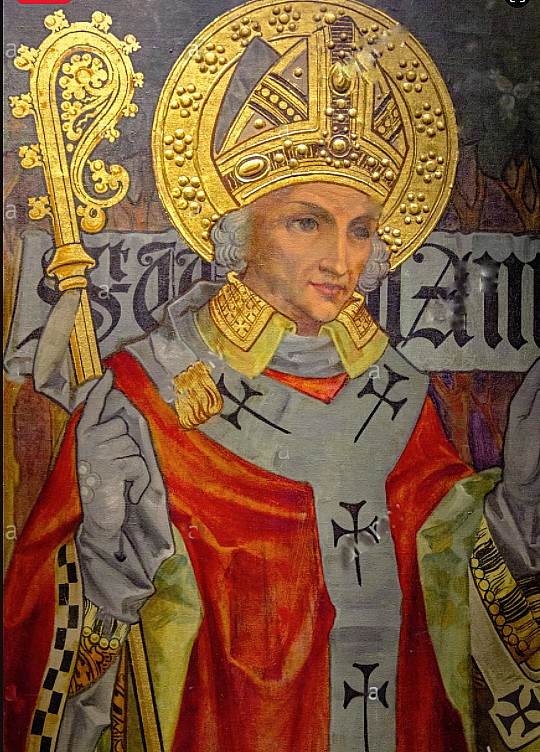
Saint of the Day – 8 June – Saint William of York (Died 1154) Archbishop of York, Monk. Also known as William FitzHerbert, William FitzHerbert of York, William of Thwayt.
Born William FitzHerbert in York, William was the son of Herbert of Winchester, Chancellor and Treasurer of King Henry I. Thus born into a powerful family in 12th-century England, William seemed destined for great things. His uncle was next in line for the English throne—though a nasty dynastic struggle complicated things. William himself faced an internal Church feud.
He was elected as the Archbishop of York in 1140. His selection was challenged by reformers, especially a group of Cistercians and William was accused of simony, sexual misconduct and being unduly influenced by his connections to the Royal Court.
The Vatican investigated and Pope Innocent cleared him of all charges,and confirmed him as Archbishop on 26 September 1143, 3 years of his election. However, the charges resurfaced a few years later under Pope Eugene III, a Cistercian; Eugene suspended William from his See and in 1147 removed him as Archbishop, replacing him with the Cistercian Henry Murdac, Abbot of Fountains’ Abbey. Some of William’s supporters took to the streets to defend him and during a riot, they attacked and burned a section of the Monastery of Fountains’ Abbey. William, however, retired to Winchester and became a Monk, noted for his austerities and active prayer life.
In 1154, in the reign of Pope Anastasius IV, William was called from his seclusion and again became the Archbishop of York. When he entered the City that Spring after years of exile, he received an enthusiastic welcome. Within two months, however, he was dead, probably from poisoning believed to be in the sacramental wine. One of William’s Clerks accused Osbert de Bayeux, an Archdeacon of York and Osbert was summoned before the King to be tried at the Royal Court. But the King died before the trial could take place ad it seems to have never occurred.
William was buried at York Cathedral. A few months of his death, miracles were attributed to his intervention and a sweet smell came from his tomb when it was damaged during a fire. Nor was the body decayed or burnt in the fire. Pope Honorius III then ordered an investigation into the miracles. In 1226, he was Canonised in Rome by Pope Honorius III on 18 March 1226, just 73 years after his death.
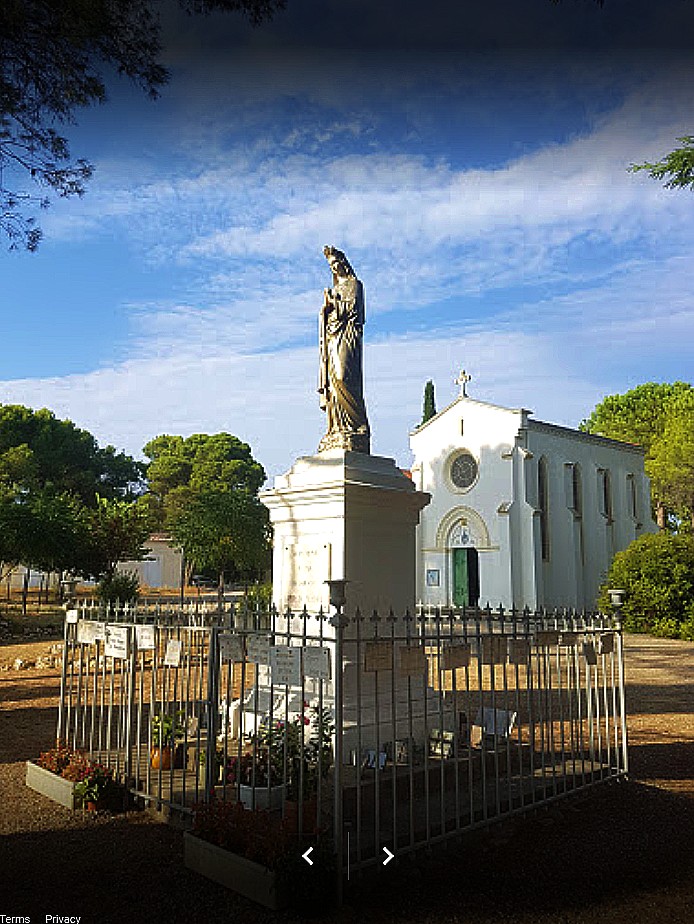
Notre-Dame du Dimanche/ Our Lady of Sunday, Saint-Bauzille-de-la-Sylve, l’Hérault, France (1873) – 8 June:
An apparition of the Blessed Virgin Mary to Auguste Arnaud on 8 June 1873 and 8 July 1873. Arnaud was married, the father of two,and a winemaker who regularly skipped Sunday Mass to work his vineyards. Our Lady appeared to him in the vineyard on 8 June and reminded him:
“You must not work on Sundays.”
In honour of this blessing, Arnaud placed a Cross and a Statue of Mary at the site in the field. Later a little Chapel in honour of the Virgin was built there too.
On 8 July Our Lady appeared again, this time to both Auguste and his neighbours who had gathered there and told them again:
“You must never work on Sunday! Blessed are those who believe.”
In 1876, the Diocesan Bishop, Bishop De Cabrières, after the establishment of a commission of inquiry and having questioned several times the seer, he recognised the supernatural origin of the apparitions.
St Anne Mary Taigi St Bron of Cassel St Calliope St Clodulf of Metz Bl Engelbert of Schäftlarn St Eustadiola of Moyen-Moutier St Fortunato of Fano St Gildard of Rouen * Twin Brother of St Medard below Bl Giorgio Porta Bl Giselbert of Cappenberg St Heraclius of Sens Bl István Sándor
The Roman Martyrology states of St Medard and his twin brother, St Gildard, today: “At Soissons, in France, the birthday of St Medard, Bishop of Novon, whose life and precios death are illustrated by glorious miracles – at Rouen, St Gildard, Bishop, twin brother of St Medard,who was born with his brother on the same day, Consecrated Bishops at the same time and being taken away from this life, also on the same day, they entered Heaven together!”
St Melania the Elder St Muirchu St Pacificus of Cerano Bl Peter de Amer Bl Robert of Frassinoro St Sallustian St Syra of Troyes St Victorinus of Camerino St William of York (Died 1154) ArchBishop of York, Monk
Thought for the Day – 7 June – “Month of the Sacred Heart” – Meditations with Antonio Cardinal Bacci (1881-1971)
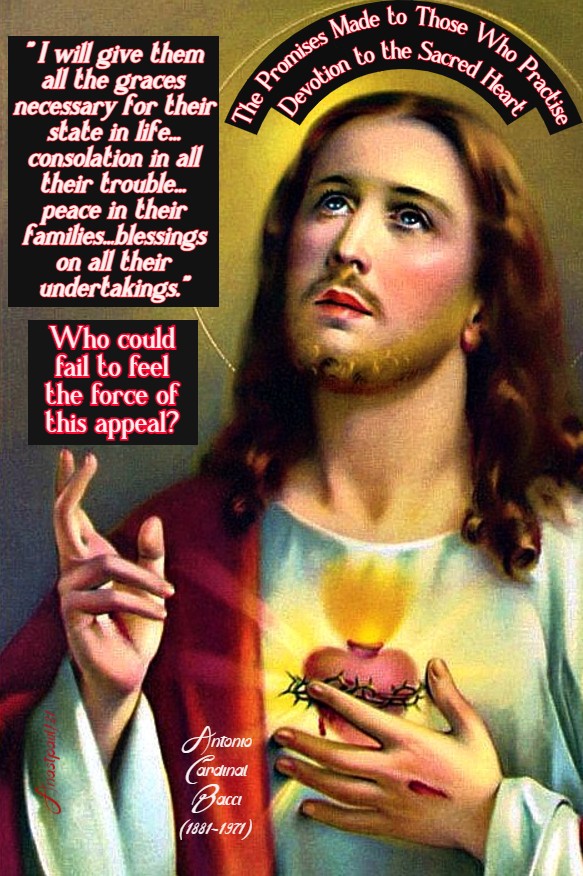
The Promises Made to Those Who Practise Devotion to the Sacred Heart
“When Jesus appeared to St Margaret Mary Alacoque and commanded her to propagate the worship of His Sacred Heart, He promised very special blessings to those who would be truly devoted to His Sacrd Heart and spread this devotion among others. “I will give them all the graces necessary for their state in life…consolation in all their trouble…peace in their families…blessings on all their undertakings.”
These promises are an inducement to us, to love Jesus and to spread devotion to His Sacred Heart.
Our Divine Saviour, is not content with having loved us so much during His mortal life and given us His Precious Blood, the Blessed Eucharist and His most Holy Mother, for our salvation. He sees that His infinite love is not returned as it ought to be and seems to exercise a gentle pressure, in order to compel us to love Him. “Behold this Heart which has so loved men that It spare nothing…to prove to them It’s love. And, in return, I receive from the greater part of men, nothing but ingratitude, by the contempt, irreverence, sacrileges and coldness with which they treat Me in this Sacrament of Love.”
“I thirst, I burn with a consuming desire for men’s love and I find none to quench this thirst, according to My wish, by making any return of love.”



























You must be logged in to post a comment.