Bl Alexandrina di Letto
St Attala of Taormina
St Benatius of Kilcooley
St Benignus of Tomi
St Burgundofara
St Chrestus
St Comman
St Evagrius of Tomi
Bl Francisco Solís Pedrajas Saint or Blessed (conflicting reports?) Gandulphus of Binasco OFM (c 1200-1260)
Bl Iacobus Won Si-bo
St John I of Naples
Bl John of Penna
St Joseph the Hymnographer Blessed John of Jesus and Mary/Juan Otazua Madariaga O.SS.T (1895-1937) Priest Martyr
Bl Lawrence Pak Chwi-deuk St Luigi Scrosoppi Cong. Orat. (1804-1884) About St Luigi:
Thought for the Day – 2 April – Meditations with Antonio Cardinal Bacci (1881-1971)
The Imitation of the Saints
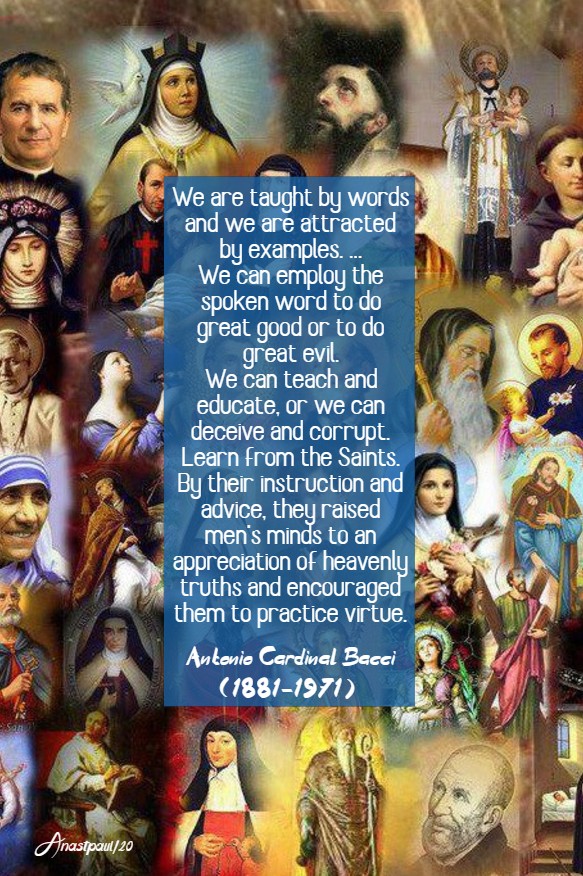
“We are taught by words and we are attracted by examples. Speech is a wonderful gift from God. By means of it, we photography our thoughts, as it were and communicate them to others. We express our wishes and our commands; we give life and colour to the innermost feelings of the heart. We can employ the spoken word to do great good or to do great evil. We can teach and educate, or we can deceive and corrupt.
Speech is an extraordinary gift and one day, we shall have to render God a strict account of it. Learn from the Saints. They understood perfectly, that they have to account, not only for evil or deceitful words but, “that of every idle word men speak, they shall give account on the day of judgement” (Mt 12:36). For this reason, their conversation was always impregnated with divine wisdom. By their instruction and advice, they raised men’s minds to an appreciation of heavenly truths and encouraged them to practice virtue. They did this, not only by word but, also by example. Their own lives were a complete theoretical and practical model, which led others towards sanctity.”
Quote/s of the Day – 2 April – The Memorial of St Francis of Paola OM (1416-1507)
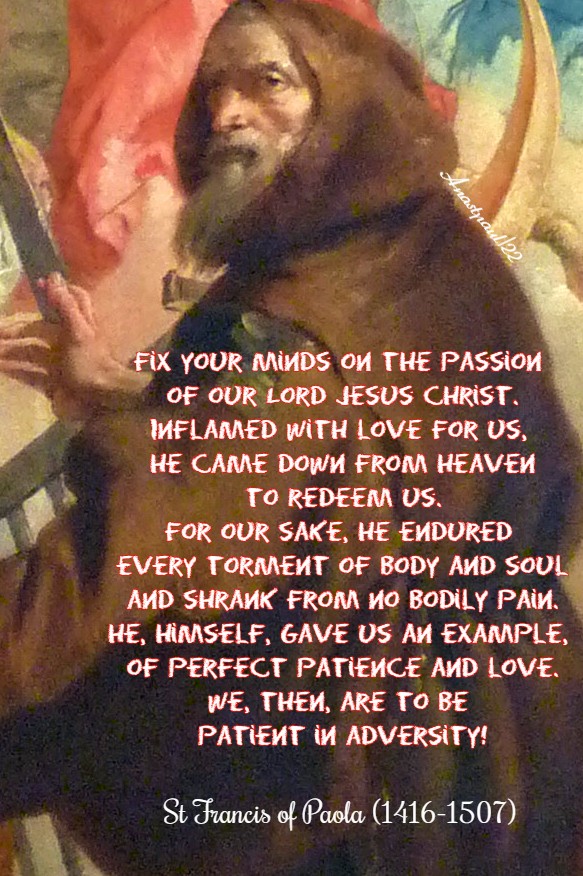
“Fix your minds on the passion of our Lord Jesus Christ. Inflamed with love for us, He came down from heaven to redeem us. For our sake He endured every torment of body and soul and shrank from no bodily pain. He Himself gave us an example of perfect patience and love. We, then, are to be patient in adversity.”
“See to it that you refrain from harsh words. But if you do speak them, do not be ashamed to apply the remedy from the same lips, that inflicted the wounds.”
Lenten Reflection – 2 April – Thursday of the Fifth Week of Lent, Readings: Genesis 17:3-9, Psalm105:4-9, John 8:51-59
“Lord, open my lips, and my mouth shall declare your praise.”
“Truly, truly, I say to you, if any one keeps my word, he will never see death.”...John 8:51
Daily Meditation: Come to us, free us, help us and guide us.
“See, the days are coming, says the Lord, when I will make a new covenant with the house of Israel and the house of Judah … I will plant my law within them and inscribe it in their hearts. I will be their God and they shall be my people … All shall know me, from the least to the greatest, says the Lord.
The Israel of old was already called the Church of God while it was on pilgrimage through the desert. So the new Israel, as it makes its way in this present age, seeking a city that is to come, a city that will remain, is also known as the Church of Christ, for He acquired it by His own blood, filled it with His Spirit and equipped it with appropriate means, to be a visible and social unity. God has called together the assembly of those, who in faith, look on Jesus, the author of salvation and the principle of unity and peace and so has established the Church to be for each and all, the visible Sacrament of this unity which brings with it salvation.” … An excerpt from Lumen Gentium, #9.
Seek the Lord and his strength, seek his presence continually!
Psalm 105:4
Intercessions:
Christ our Lord came among us as the light of the world,
that we might walk in His light and not in the darkness of death.
Let us praise Him and cry out to Him:
Let Your word be a lamp to guide us.
God of mercy, help us today to grow in Your likeness,
– that we who sinned in Adam, may rise again in Christ.
Let Your word be a lamp to guide us,
– that we may live the truth and grow always in Your love.
Teach us to be faithful in seeking the common good for Your sake,
– that Your light may shine on the whole human family, by means of your Church.
Touch our hearts to seek Your friendship more and more,
– and to make amends for our sins, against Your wisdom and goodness.
Closing Prayer:
Only What You Will or Will Not By Thomas à Kempis (1380-1471)
Grant me Your grace,
most merciful Jesus,
so that it may be with me
and work with me
and persevere with me to the end.
Grant that I may always want
and desire that which is
most acceptable and pleasing to You.
Let Your will be mine
and let my will always follow Yours
and be in perfect accord with it.
Let me always will or not will,
the same with You
and may I not be able to will
or not will
anything, except
what You will or will not.
Amen
One Minute Reflection – 2 April – Thursday of the Fifth Week of Lent, Readings: Genesis 17:3-9, Psalm 105:4-9, John 8:51-59
“Truly, truly, I say to you, before Abraham was made, I AM. ” So they took up stones to throw at him but Jesus hid himself and went out of the temple. … John 8:58-59
REFLECTION – “Before Abraham was made, I am.” Recognise the Creator-distinguish the creature. He who spoke was made the seed of Abraham and that Abraham might be made, He Himself was before Abraham.
Hence, as if by the most open of all insults thrown at Abraham, they were now excited to greater bitterness. Of a certainty it seemed to them, that Christ the Lord had uttered blasphemy in saying, “Before Abraham was made, I am.” “Therefore took they up stones to cast at Him.” To what could so great hardness have recourse, save to its like? “But Jesus” [acts] as man, as one in the form of a servant, as lowly, as about to suffer, about to die, about to redeem us with His blood, not as He who is-not as the Word in the beginning and the Word with God. For when they took up stones to cast at Him, what great thing were it had they been instantly swallowed up in the gaping earth and found the inhabitants of hell in place of stones? It were not a great thing to God but better was it that patience should be commended than power exerted. Therefore “He hid Himself” from them, that He might not be stoned. As man, He fled from the stones but woe to those from whose stony hearts God has fled?”… St Augustine (354-430) Father & Doctor
PRAYER – Lord God, break the bonds of our sin which our weakness have forged to enchain us and in Your loving mercy, forgive Your people’s guilt. Never flee from us in our weakness O Lord and grant us Your salvation. Help us Holy Mother to be the imitators of your Son. Through Christ our Lord, with the Holy Spirit, one God for all time and eternity, amen.
Our Morning Offering – 2 April – Thursday of the Fifth week of Lent
O Saviour of the World By St Ignatius of Antioch (c 35-c 108) Father of the Church
Lord Jesus Christ,
on the human side
You are sprung from David’s line,
Son of God according to God’s will and power,
born of the Virgin Mary,
baptised by John
and actually Crucified for us in the flesh,
under Pontius Pilate and Herod the Tetrarch.
On the third day, You raised a standard
to rally Your saints and faithful forever
in the one body of Your Church.
By the grace and power of these mysteries,
fit us out with unshakeable faith,
nail us body and soul to Your Cross
and root us in love by Your Blood, shed for us,
O Saviour of the world,
living and reigning, now and forever,
amen.
Saint of the Day – 2 April – Blessed Vilmos Apor (1892–1945) Bishop Martyr, Chaplain of the Order of Malta – born as Baron Vilmos Apor de Altorja on 29 February 1892 at Segesvár, Transylvania, Hungary and died by shooting on 2 April 1945 at Gyõr, Hungary. (Also known as – Vilhelm, Gulielmus, William). Patronages – Abuse victims, Sexual abuse victims, Activists, Virgins, Military chaplains.
He became famous for protesting against the persecution of the Hungarian Jewish population and for his steadfast commitment to the poor. His outreach also extended to abuse victims with a particular emphasis on the protection of women – it would be this latter point that saw him sustain fatal injuries leading to his death. The Bishop dedicated himself to being an opponent of both communism and Nazism and used his sermons as a chance to condemn them, at a great personal risk to himself. He was a beloved figure in his Diocese where people hailed him as a great saint upon learning of his death which came as a profound shock and loss to the Diocese he had served during the course of most of the war.
Vilmos Apor de Altorja was born in 1892 as the sixth of eight children to the nobles Baron Gábor Apor (1851–98) and Countess Fidelia Pálffy ab Erdöd (1863–1934); one was stillborn and three died in their childhoods. One sister was Gizella and another was Henrietta who was his junior and an elder brother was Gábor. His elder brother served in World War I but later became a Hungarian delegate to the Vatican until his resignation in 1944 in protest of the German occupation of his homeland. His father died in his childhood due to complications from diabetes. His mother was strict but caring and imparted sage religious instruction to her children. He served as an altar server during his childhood and his love for the Priesthood intensified to the stage where he harboured an interest in becoming a Priest himself. Bishop Miklós Széchnyi was his uncle.
Year one of his initial education saw him teach Henrietta how to read and she often got him to instruct her in catechism. He even asked his mother once for a chalice and missal for Christmas. He attended high school at a Jesuit-run school in Kalksburg where his desires to become a Priest intensified further, despite his initial homesickness. Apor liked Latin as well as historical studies and received outstanding marks in these subjects, while a treatise on the historical Church, earned him a prize. He also liked tennis and swimming. He then transferred to another Jesuit school at Kalocsa.
He decided to begin his studies for the Priesthood despite his mother’s wish that he wait a little while longer – she consented at Christmas in 1909 – and the local Bishop was delighted to receive him in 1910. The Bishop sent him to Innsbruck for further studies with the Jesuits in 1910, where he later received a doctorate in theological studies, the rector there was a relative of his. He was made a subdeacon on 22 August 1915 and was elevated to the diaconate on 23 August.
He received his Ordination to the Priesthood on 24 August 1915 and he celebrated his first Mass on 25 August, with his mother and sisters, Henrietta and Gizella, in attendance. Gabor could not be there because he was on the battlefront and was unable to obtain leave. Vilmos was first sent to Gyula on 31 August 1915 and he preached his first sermon on the following 8 September. On 27 March 1916 he opened an office for the protection of women that became a predominant focus for him on his pastoral mission while on 4 January 1917 he was sent as a chaplain to the Italian front before being transferred as such to Austria and then back to Gyula at the start of 1919 at the end of the war.
Pope Pius XII appointed him as a Bishop in 1941 and he received his Episcopal Consecration a month later. His brother, Gabor, paid for his new Episcopal vestments. He took formal possession of his new Episcopal See on 2 March 1941. On 25 February 1941 – in a unanimous decision – the town council of Gyula made him an honorary citizen, due to his commitment to it’s people and his strong and tireless activism. He became noted for his strong dedication to the poor and his tireless commitment to a range of social justice issues.
In summer 1944 he wrote to the Hungarian Primate Jusztinian Serédi to persuade him to take a strong stance against the government. He also appealed to the Gestapo headquarters in Berlin in an attempt to free the Jews of his Diocese from the ghetto and negotiated with the Nazi command to spare the town from a siege. The introduction of racial laws sought to further make matters worse and so the bishop spoke out for those affected from racial slurs and other forms of persecution. He provided supplies to those Jews being deported through his Diocese and also sheltered those made homeless after air raids in the Episcopal palace while he himself withdrew to a small room for himself.
On the afternoon of 28 March 1945 – Good Friday – as Soviet troops reached his Diocese he offered safe haven to numerous women and children in his residence and also protected women who feared being raped. Four or five drunken Soviet soldiers arrived with the intention of bringing 100 women to their barracks but Apor had them well-hidden in the cellar. He refused to give them up and a long altercation saw an officer making threats with his gun and soon gave chase to a girl who came out of her hiding place, the girl screamed “Uncle Vilmos! Help!” and he ran to her defense and shouted at them: “Out! Get out of here!” The officers turned to leave but one officer turned around and opened fire with a machine gun that shot him three times. Apor suffered a first shot that grazed his forehead as well as a second in the right sleeve of his cassock and the third that perforated his abdomen. Meanwhile the soldiers became frightened and fled the scene.
He lent on the arms of two of his aides and walked towards the cellar with blood coming from his forehead. A doctor administered first aid and his sister, Gizella, aided the doctor in placing her brother on a stretcher. But getting to the hospital took longer due to checkpoints and had to stop several times, since the Russians wanted to inspect the ambulance, the blanket had to be taken off him on these occasions so the Russians could see there was no hidden treasure. Professors Jung and Petz – who had known Apor – performed the operation which seemed to be successful and saw a slight improvement on Holy Saturday when he received the Eucharist, with his sister at his side. He thanked God for having accepted his sacrifice and for the fact that the women he protected were still safe. On Easter his condition deteriorated due to an infection – he made his confession and was given the Anointing of the Sick. He remained lucid with his sister and Doctor Jung at his side, in addition to the nurses and the parish priest.
He died from his injuries not long after, in the afternoon of 2 April 1945, Easter Monday. István Sándor witnessed a stretcher on 3 April being carried from the hospital and saw the bishop’s remains as it was being transported. The funeral was put on hold due to conflict in the area but was carried out within a week of his death. His remains were buried in a Carmelite church as his confessor was the Carmelite priest Erno Szeghy. His remains were later relocated to the Diocesan Cathedral. St Pope John Paul II visited his tomb in 1996.
Blessed Vilmos Apor’s tomb carved by the Hungarian sculptor Sándor Boldogfai Farkas (1907–1970)
The theologian and cardinal-elect Hans Urs von Balthasar was his nephew. St Pope John Paul II had named him as Cardinal in 1988 . He died, however, in his home in Basel on 26 June 1988, two days before the ceremony which would have granted him that position, therefore, he is often called “Cardinal” and is also a Servant of God.
St John Paul II confirmed on 7 July 1997 that Blessed Vilmos was killed “in odium fidei” (in hatred of the faith) and thus approved his Beatification. The pope presided over his Beatification on 9 November 1997 in Saint Peter’s Square.
Today, there stands a statue in District XII of Budapest in Hungary in his honour and the place itself has been named Apor Vilmos tér according to the Hungarian standard of name order.
The Collect of the Mass of the Order of Malta on the Memorial of Blessed Vilmos
Almighty and Eternal God, through your grace, Bishop Vilmos, by courageously shedding his blood for his flock, earned a martyr’s crown. Grant that we, despite the difficulties of our daily lives, may do Your will and offer our good works for the salvation of our brothers and sisters. We ask this through Our Lord Jesus Christ, Your Son, who lives and reigns with You and the Holy Spirit, one God, forever and ever. Amen
St Abundius of Como
St Agnofleda of Maine
St Appian of Caesarea
St Bronach of Glen-Seichis
St Constantine of Scotland
St Ðaminh Tuoc
Bl Diego Luis de San Vitores-Alonso
St Ebbe the Younger
St Eustace of Luxeuil
St Francis Coll Guitart
St Gregory of Nicomedia
St John Payne
Bl Leopold of Gaiche
St Lonochilus of Maine
St Musa of Rome
Bl Mykolai Charnetsky
St Nicetius of Lyon St Pedro Calungsod (1654–1672) Martyr His Life and death:st gregory of nicomedia
St Rufus of Glendalough
St Theodora of Tiria
St Urban of Langres
St Victor of Capua Blessed Vilmos Apor (1892–1945) Bishop Martyr
Devotion for the Month of April – The Blessed Sacrament
Holy Thursday, the day on which Catholics celebrate the institution of the Sacrament of Holy Communion at the Last Supper, falls most often in April and so it is no surprise that the Catholic Church dedicates this month to devotion to the Blessed Sacrament.
In these very sad times when we cannot attend the Passion week ceremonies, we need to focus our hearts and minds, much, much more on the Passion of Our Lord, on the Holy Eucharist and on our Communion with our Lord and Saviour.
Neither are we able to attend Eucharistic Adoration, live, though there are many ‘live’ opportunities online for both Holy Mass and Adoration.
This beautiful prayer by St John Damascene, with a slight adaptation, may be used as our Spiritual Communion.
God, my God, inextinguishable and invisible fire,
You make Your angels flaming fire.
Out of Your inexpressible love,
You have given me Your divine Flesh as food
and through this communion
of Your immaculate Body and precious Blood,
You receive me as a partaker of Your divinity.
Permeate all my body and soul, all my bones and sinews.
Consume my sins in fire.
Enlighten my soul and illumine my mind.
Sanctify my body and make Your abode in me,
together with Your blessed Father and all-holy Spirit,
that I may always abide in You,
through the intercession of Your immaculate Mother and all Your saints.
Amen Prayer of St John Damascene (675-749) Father and Doctor of the Church
Now, at least, in this great depredation we suffer, we might truly understand and agree with the words of St Claude:
If we only knew the treasure we hold in our hands! St Claude de la Colombiere SJ (1641-1682)
“God is more honoured by a single Mass
than He could be by all the actions of angels and men together,
however fervent and heroic they might be.
Yet, how FEW, hear Mass
with the intention of giving God
this sublime honour!
How FEW think,
with joy on the glory, a Mass gives to God.
How FEW rejoice,
to possess the means of honouring Him
as He deserves! . . .
If we only knew the treasure we hold in our hands!”
Let us pray, all day, for the restoration of the Holy Mass!
Thought for the Day – 1 April – Meditations with Antonio Cardinal Bacci (1881-1971)
The Passion of Our Lord
“The Incarnation of Our Lord Jesus Christ is one of the most profound mysteries of our religion.
It is a mystery of infinite goodness and mercy, that, out of love for fallen humanity, the Eternal Word of God, should have assumed a human form and become man, in order to show us the way to Heaven and to enable us, to reach it.
Jesus came amongst us, to instruct us, to call us, to perfection and to give us, an example and the necessary help.
But He did much more than this.
He came also to bear the weight of our offences and to offer Himself, as a spotless victim of love and suffering in expiation of our sins.
All this, seems too great a mystery, almost inconceivable, in fact, until we consider that the charity of God is as infinite as His nature.
This is why, the Saints experienced hours of ecstasy contemplating the Passion and Death of our Divine Redeemer.
Whenever St Gertrude looked upon the figure of Jesus nailed to the Cross, she could not restrain her tears.
She was accustomed to say, that God was specially merciful towards those who meditated on the Passion and Death of Jesus.
St Bernard writes, that even as the rocks were rent asunder at the Death of Our Redeemer, so, our sin-hardened hearts, should feel as if they were breaking, when we meditate on His Sufferings.
Let us meditate, therefore, on the Passion and Death of Our Lord Jesus Christ.
If we are sinners, as unfortunately, we all are, we shall we moved to weep for our sins.
If we are imperfect and lukewarm, we shall be set on fire with love and a determination, to requite, as far as possible, the infinite charity of Jesus Christ.”
Lenten Reflection – 1 April – Wednesday of the Fifth week of Lent, Readings: Daniel 3:14-20, 91-92, 95, Responsorial psalm Daniel 3:52-56, John 8:31-42
“Lord, open my lips, and my mouth shall declare your praise.”
“If you continue in my word, you are truly my disciples
and you will know the truth and the truth will make you free.”…John 8:31-32
Daily Meditation: Enlighten our minds and sanctify our hearts.
“God could give no greater gift to men than to make His Word, through whom He created all things, their head and to join them to Him as His members, so that the Word might be both Son of God and son of man, one God with the Father and one man with all men. The result is that when we speak with God in prayer, we do not separate the Son from Him and when the body of the Son prays, it does not separate its head from itself, it is the one Saviour of His body, our Lord Jesus Christ, the Son of God, who prays for us and in us and is Himself the object of our prayers.
He prays for us, as our priest, He prays in us, as our head, He is the object of our prayers, as our God.
Let us then recognise both our voice in His and His voice in ours. When something is said, especially in prophecy, about the Lord Jesus Chris,t that seems to belong to a condition of lowliness, unworthy of God, we must not hesitate to ascribe this condition to one who did not hesitate to unite Himself with us. Every creature is His servant, for it was through Him that every creature came to be.” … Saint Augustine (354-430) Bishop and Great Western Father of the Church
Intercessions:
Blessed be God, the giver of salvation,
who decreed that mankind should become a new creation in Himself,
when all would be made new.
With great confidence let us ask Him:
Lord, renew us in Your Spirit.
Lord, You promised a new heaven and a new earth,
renew us daily through Your Spirit,
– that we may enjoy Your presence forever in the heavenly Jerusalem.
Help us to work with You to make this world alive with Your Spirit,
– and to build on earth a city of justice, love and peace.
Free us from all negligence and sloth,
– and give us joy in Your gifts of grace.
Deliver us from evil,
– and from slavery to the senses,
which blinds us to Your love, freedom and truth.
Closing Prayer:
Grant that I may love You and be loved by You By St Alphonsus Liguori (1696-1787)
O God of love,
You are
and shall be forever,
the only delight of my heart
and the sole object of my affections.
Since Jesus said,
‘Ask and you shall receive,’
I do not hesitate to say,
‘Give me Your love
and Your grace.’
Grant that I may love You
and be loved by You.
I want nothing else.
Amen
One Minute Reflection – 1 April – Wednesday of the Fifth week of Lent, Readings: Daniel 3:14-20, 91-92, 95, Responsorial psalm Daniel 3:52-56, John 8:31-42 and the Memorial of St Lodovico Pavoni FMI (1784-1849)
“If you continue in my word, you are truly my disciples and you will know the truth and the truth will make you free.”...John 8:31-32
REFLECTION – “By faith we adhere to Christ and the edifice of our spiritual life becomes thereby firm and stable. Christ makes us share in the stability of the divine rock against which even hell’s fury cannot prevail (Mt 16:18).
Thus divinely sustained, we are conquerors over the assaults and temptations of the world and of the devil, the prince of this world (1 Jn 5:4). The devil and the world, which the devil uses as an accomplice, offer violence to us or solicit us; by faith in the word of Jesus we come out victorious from these attacks. …Now, the devil is “the father of lies and the prince of darkness” (cf. Eph 6:12) while God is ” the Truth” and “in Him is no darkness” (cf. Jn 14:6; 1 Jn 1:5). If we always listen to God, we shall always be victorious. When our Lord, who is our model in all things, was tempted, He repulsed temptation by placing the authority of God’s Word in opposition to each solicitation of the Evil One. We ought to do the same and repulse hell’s attacks by faith in Jesus’ word. (…)
What is true of the devil is true of the world – it is by faith that we overcome it. When people have a living faith in Christ, they fear neither difficulties nor opposition, nor the world’s judgement,s because they know that Christ abides in us, by faith and because they rely on Him.” … Blessed Columba Marmion (1858-1923) Abbot – Our faith, the victory over the world (Christ, the Ideal of the Monk, rev.)
PRAYER – God of mercy, shed Your light on our hearts that are being purified by penance and in Your goodness, give us a favourable hearing. Teach us to work with You and for You and thus fill the world with Your Spirit. In Christ our Saviour, we become a new creation and Your adopted children, therefore, all things are renewed. May the prayers of St Lodovico Pavoni, who gave himself completely to You and Your little ones, assist us to do the same. Through Christ our Lord, with the Holy Spirit, God forever, amen.
Our Morning Offering – 1 April – Wednesday of the Fifth Week of Lent
The One Thing Necessary By St Alphonsus Liguori (1696-1787) Most Zealous Doctor
O my God,
help me to remember,
that time is short, eternity long.
What good is all the greatness of this world
at the hour of death?
To love You, my God
and save my soul is the one thing necessary.
Without You, there is no peace of mind or soul.
My God, I need fear only sin
and nothing else in this life,
for to lose You, my God, is to lose all.
O my God, help me to remember,
that I came into this world with nothing,
and shall take nothing from it when I die.
To gain You, I must leave all.
But in loving You,
I already have all good things,
the infinite riches of Christ and His Church in life,
Mary’s motherly protection and perpetual help
and the eternal dwelling place Jesus has prepared for me.
Eternal Father, Jesus has promised
that whatever we ask
in His Name will be granted us.
In His Name, I pray,
give me a burning faith,
a joyful hope,
a holy love for You.
Grant me perseverance in doing Your will
and never let me be separated from You.
My God and my All,
make me a Saint.
Amen
Saint of the Day – 1 April – Saint Lodovico Pavoni FMI (1784-1849) Priest, Founder of the Sons of Mary Immaculate which came to be known also as the “Pavoniani, “ Pioneer in vocational schools, known as the “Forerunner of St John Bosco” – born on 11 September 1784 at Brescia, Italy and died on Palm Sunday, 1 April 1849 at Saianco, Italy of natural causes. The figure of Pavoni is of a Saint who made a great impact by his work on behalf of youth and persons most in need of support (deaf, disabled, orphans and the poor) while also contributing to the renewal of contemplative life. Patronages – Sons of Mary Immaculate, Vocational and Trade schools.
Blessed Lodovico Pavoni was born in Brescia on 11 September 1784 and, after 30 years of service to young people, died in Saiano, outside Brescia, on 1 April 1849. For 30 years he followed his inspiration to serve the needs of the young boys on the streets with positive methods of education. He began by opening his own oratory (catechetical and recreation centre) that in 1821 he expanded it into a hostel for their shelter and a school to teach them a trade. In 1825 he founded a religious congregation of priests and brothers to run the educational and industrial activities that grew out of his intuition.
Lodovico was a lively and bright child, interested in the world around him and quick to grasp the social problems of his day. He prepared for the priesthood by receiving his theological formation at the home of the Dominican, Fr Carlo Domenico Ferrari, future Bishop of Brescia. During the Napoleonic era in Italy (1799-1814), the French Emperor closed seminaries. In Brescia, in 1807, he was Ordained a Priest and first launched the oratory. A book by Pietro Schedoni, Moral Influences, listed the reasons for the “rebellion” of young boys – leaving inadequate schooling for a job, bad influences of adult workers, poverty and peer pressure. The author confirmed Lodovico in his personalist approach – to concentrate on the personal and social formation of the young, with a positive and preventative approach.
In 1812 when appointed secretary to Bishop Gabrio Nava, he received permission to continue with his “oratory”. In 1818, he was named rector of the Church of St Barnabas with permission to found an orphanage and a vocational school that in 1821 became the “Institute of St Barnabas.” Lodovico decided that the first trade would be book publishin, to this end, in 1823 he set up “The Publishing House of the Institute of St Barnabas,” the precursor of today’s Ancora press. The boys could also choose to be carpenters, silversmiths, blacksmiths, shoemakers, experts in tool and dye making. In 1823, Fr Pavoni welcomed the first deaf mutes to the school. He purchased a farm to set up an Agricultural School.
In 1825 he established a religious institute to continue his work. In 1843 Pope Gregory XVI authorised it for Brescia. On 11 August 1847, the Brescia Vicar Capitular, Msgr Luchi, established the Congregation of the Sons of Mary Immaculate or “Pavoniani.” On 8 December 1847, Lodovico and the first members made their religious profession.
On 24 March 1849, during the “Ten-Days” when Brescia rebelled against the Austrians and both sides were ready to pillage the city, Bl Lodovico, who had taken care of citizens during a cholera epidemic, performed his last heroic act of charity when he led his boys to safety, to the novitiate on the hill of Saiano, 12 kilometres away. A week later he died at the dawn of Palm Sunday, 1 April 1849 as Brescia was in flames. Lodovico’s ideal of education was a broad one, to dispose a person in his wholeness to be good. Fifty years before “Rerum novarum”, he grasped the religious significance of social justice and set an example by his own dealings with his employees.
Like St John Bosco after him, Pavoni’s used encouraging and preventative methods – he preferred gentleness to severity. He used to say, “Rigorism keeps Heaven empty”.
His Congregation numbers 210 members in six nations: Brazil, Colombia, Eritrea, Germany, Italy and Spain. They still publish books . In Rome they run the Ancora bookstore outside St Peter’s Square. As of 2008 there were 34 houses and out of the 210 religious there were 107 of them being Priests…. Vatican.va
There are many reasons why Pavoni can be considered a precursor. Long before Don Bosco or Don Murialdo, Pavoni saw in the phenomenon of juvenile neglect, one of the great dramas that characterised the age of transition, between the old regime and industrialised society. He understood, that the only way of redemption, was through holistic education of the person. Religious education was his fundamental objective but Pavoni saw professional training, as the way that best covers all aspects of the person.
Pavoni was not an teacher but he had a real educational method, which is characterised by an emphasis on prevention. There are many modern congregations that consider it a point of reference.
The centrality of the Christian faith, love for each person, the importance of work as an instrument of human and social development, clear rules within an organisation but implemented as in a family, attention to personal relationship and recourse to reason, rather than imposition, – these are the components of a plan that aims to equip young people with the necessary tools to develop a balanced personality and to recognise their social role, before the impact of the social situation drives them, inexorably to the margins.
In the decree of 5 June 1947 Pope Pius XII described Pavoni as “another Philip Neri, the precursor of St John Bosco and the perfect emulator of St Joseph Cottolengo.” This authoritative judgement has now received the most solemn approval and recognition of a second miracle with the Canonisation of St Lodovico Pavoni on 16 October 2016 by Pope Francis.
This slideshow requires JavaScript.
“This Jesus,God has raised Him up and of that we are all witnesses” (Acts 2:32). The interior consciousness, that became a burning and invincible faith, guided the spiritual and Priestly experience of Lodovico Pavoni, Priest, Founder of the Congregation of the Sons of Mary Immaculate. Gifted with a particularly sensitive spirit, he was totally comitted to the care of poor and abandoned youngsters and even deaf-mutes. His activity branched out in many directions, from that of education to the publishing sector, with original apostolic intuitions and courageous innovations. At the basis of everything, there was a solid spirituality. By his example, he exhorts us to place our confidence in Jesus and to be, ever more immersed, in the mystery of His love. “– from the Beatification homily by St Pope John Paul II on Sunday, 14 April 2002.
Blessed Abraham of Bulgaria
Blessed Alexander of Sicily
Saint Anastasio
Blessed Antonius of Noto
Saint Berhard of Amiens
Blessed Bernhardin of Noto
Saint Celsus of Armagh
Saint Dodolinus of Vienne
Blessed Gerard of Sassoferrato
Saint Gilbert de Moray
Blessed Giuseppe Girotti
Blessed Hugh of Bonnevaux
Saint Hugh of Grenoble
Saint Jacoba of Rome
Blessed John Bretton
Saint Leucone of Troyes Saint Lodovico Pavoni FMI (1784-1849)
Blessed Marcelle
Saint Mary of Egypt Saint Melito Bishop of Sardis (Died c 180) Early Church Father Biography: https://anastpaul.com/2019/04/01/saint-of-the-day-1-april-st-melito-died-c-180/
Blessed Nicolò of Noto
Saint Prudentius of Atina
Saint Tewdrig ap Teithfallt
Saint Theodora of Rome
Saint Valery of Leucone
Saint Venantius of Spalato
Blessed Vinebault
Blessed Zofia Czeska-Maciejowska
—
Apostles of Picardy:
Saint Caidoc
Saint Fricor
Martyrs of Dalmatia and Istria – 9 saints: A group of Christians martyrs who died at various locations in Dalamtia and Istria (in modern Croatia, whose relics were later taken to Rome, Italy, and who are remembered together. We know the names Anastasio, Antiochiano, Asterius, Gaiano, Mauro, Paoliniano, Septimius, Telio and Venantius.
Died
• on the Adriatic coast of modern Croatia
• relics translated to Rome, Italy
Martyrs of Thessalonica – 6 saints: A group of Christians martyred. We know nothing about them but the names Alexander, Dionysius, Ingenianus, Panterus, Parthenius and Saturninus.
Died
Thessalonica, Greece, date unknown
Martyred Sisters of Thessalonica:
Saint Agape
Saint Chionia
Martyred in Alexandria:
Saint Stephen
Saint Victor
Martyred in Armenia:
Saint Irenaeus
Saint Quintian
Martyred in Heraclea:
Saint Castus
Saint Victor
Martyred in the Mexican Revolution
Blessed Anacleto González Flores
Blessed Jorge Vargas González
Blessed Luis Padilla Gómez
Blessed Ramón Vargas González
Thought for the Day – 31 March – Meditations with Antonio Cardinal Bacci (1881-1971)
Entertainment and Sport
“It is wrong to imagine that Christianity is a sad and gloomy religion.
Quite otherwise, it is the religion of joy, that is, which comes from God, from the serenity of a sound conscience and from the hope and sure expectation of the immeasurable happiness of heaven, after the trials of this world are over.
Other pleasures are passing and often leave behind disillusionment, boredom and remorse.
The happiness of living a sincere Christian life does not vanish, even in the midst of suffering, for it bestows an inner peace, which nothing else can give. “The kingdom of God,” says St Paul, “does not consist in food and drink but in justice and peace and joy, in the Holy Spirit” (Rom 14:17). “The fruit of the Spirit,” he says in his letter to the Galatians, “is charity, joy, peace, patience, kindness, goodness…” (Gal 5:22).
St John the Apostle, writing to the faithful of his time, encourages them to be joyful with the joy which comes from Jesus Christ. “These things we write to you that you may rejoice and our joy may be full” (1 Jn 1:4).
It is not contrary to Christian teaching, to indulge in lawful recreation and amusement.
If a bow is drawn too tight, it snaps.
Our physical constitution demands that after our work, we should rest.
Resting does not mean idleness and inactivity but suitable recreation and entertainment.
God, Himself, set aside six days for working and one for repose.
This day of solemn repose, however, should be dedicated in a particular way to God, by the fulfilment of the obligations which the Church prescribes.
But, there is no question of our being forbidden to refresh ourselves, mentally and physically, on this day, by suitable entertainment.”
Antonio Cardinal Bacci
The image is, of course, our mountain-climbing Blessed,
Quote/s of the Day – 31 March – Tuesday of the Fifth Week of Lent
“This is that enviable and blessed Cross of Christ . . . the Cross in which alone, we must make our boast, as Paul, God’s chosen instrument, has told us.”
St Raymond of Peñafort (1175-1275)
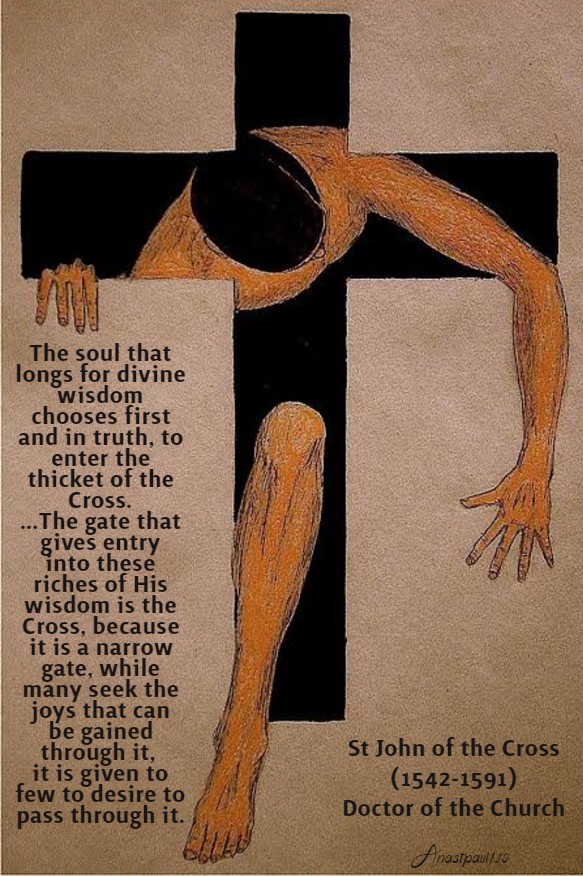
“The soul that longs for divine wisdom chooses first and in truth, to enter the thicket of the Cross. …The gate that gives entry, into these riches of His wisdom, is the Cross, because it is a narrow gate, while many seek the joys that can be gained through it, it is given to few to desire to pass through it.”
St John of the Cross (1542-1591)
Doctor of the Church
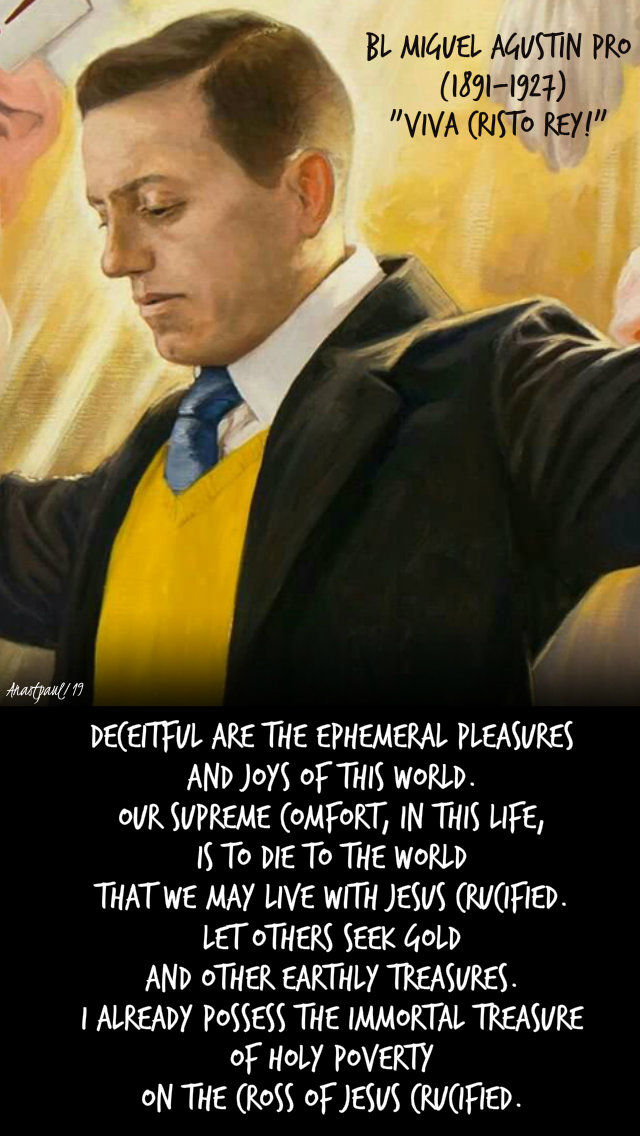
“Deceitful are the ephemeral pleasures and joys of this world. Our supreme comfort in this life, is to die to the world that we may live with Jesus crucified. Let others seek gold and other earthly treasures. I already possess the immortal treasure of holy poverty on the Cross of Jesus crucified. The angelic virtue, growing like a pure, fragrant lily in the hidden beauteous garden of the cloister, adorns the forehead with heavenly tints, for it has roots in the Cross of Jesus crucified. A third crown completes my oblation, it is the seal of glory, whereby the obedient, spotless Lamb gained victory. Obedience is the secure science of living with Jesus crucified. With this triple treasure, I can hope to pass beyond the fleeting confines of mortal man, by living poor on this earth and rich in heaven, united with Jesus crucified.”
Blessed Miguel Agustin Pro (1891-1927)
Priest and Martyr
Lenten Reflection – 31 March – Tuesday of the Fifth Week of Lent, Readings: Numbers 21:4-9, Psalm 102:2-3, 16-21, John 8:21-30
“Lord, open my lips, and my mouth shall declare your praise.”
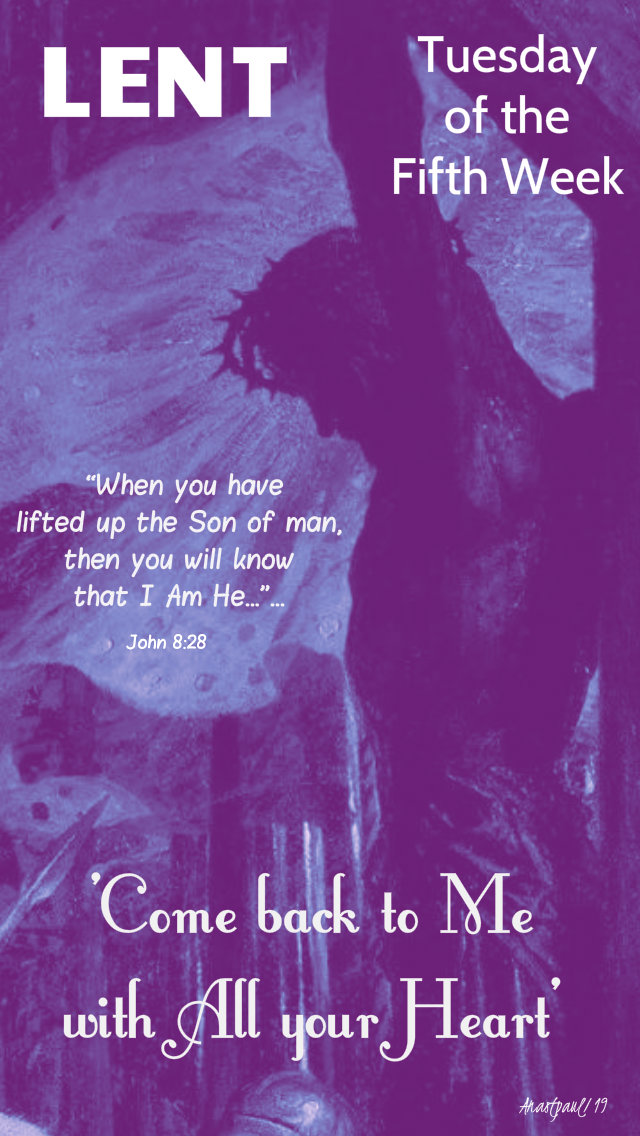
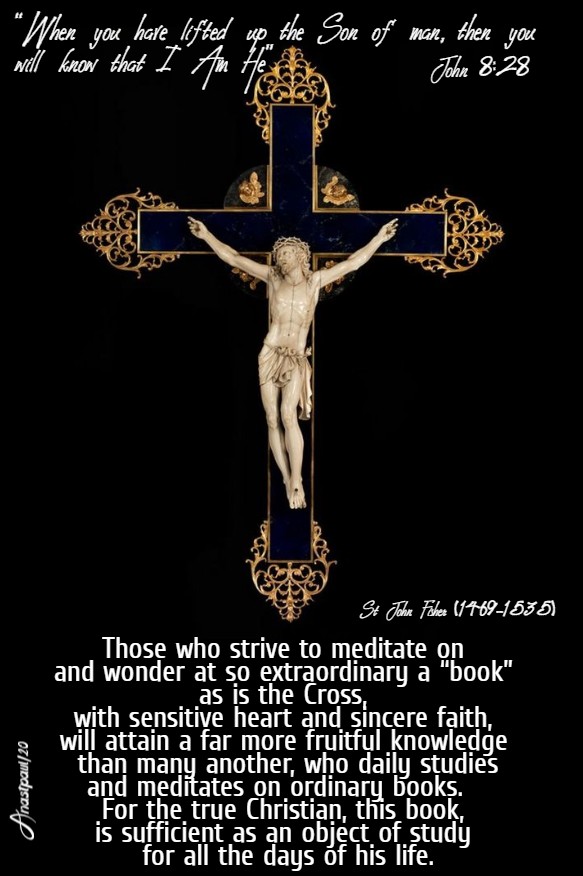
“When you have lifted up the Son of man, then you will know that I Am He…”…John 8:28
Daily Meditation: May we be lifted up with you.
“Jesus lifted up draws all to Himself.
Jesus lifted up on the Cross, reveals fully Whoe He really is.
Jesus is most Jesus, when He is on the Cross.
Even though at Calvary, Jesus was taunted and mocked
by the rabid rabble, to come down from the Cross,
He remained transfixed on it, till the very end.
We need to mount the Cross with Jesus!
We need to see the world from that vantage viewpoint.
Then, everything falls into proper perspective,
then we begin to see the world, as it is.
It is only when we are with Jesus on the Cross,
that we are stretched to our fullest dimensions!” … Msgr Alex Rebello
For my days pass away like smoke and my bones burn like a furnace.
Psalm 102:3
Intercessions:
Praise to Christ, who has given us Himself as the bread from heaven.
Let us pray to Him, saying:
Jesus, You feed and heal our souls, come to strengthen us.
Lord, feed us at the banquet of the Eucharist,
– with all the gifts of Your Paschal Sacrifice.
Give us a perfect heart to receive Your word,
– that we may bring forth fruit in patience.
Make us eager to work with You in building a better world,
– so that it may listen to Your Church and its gospel of peace.
We confess, Lord, that we have sinned,
– wash us clean by Your gift of salvation.
Closing Prayer:
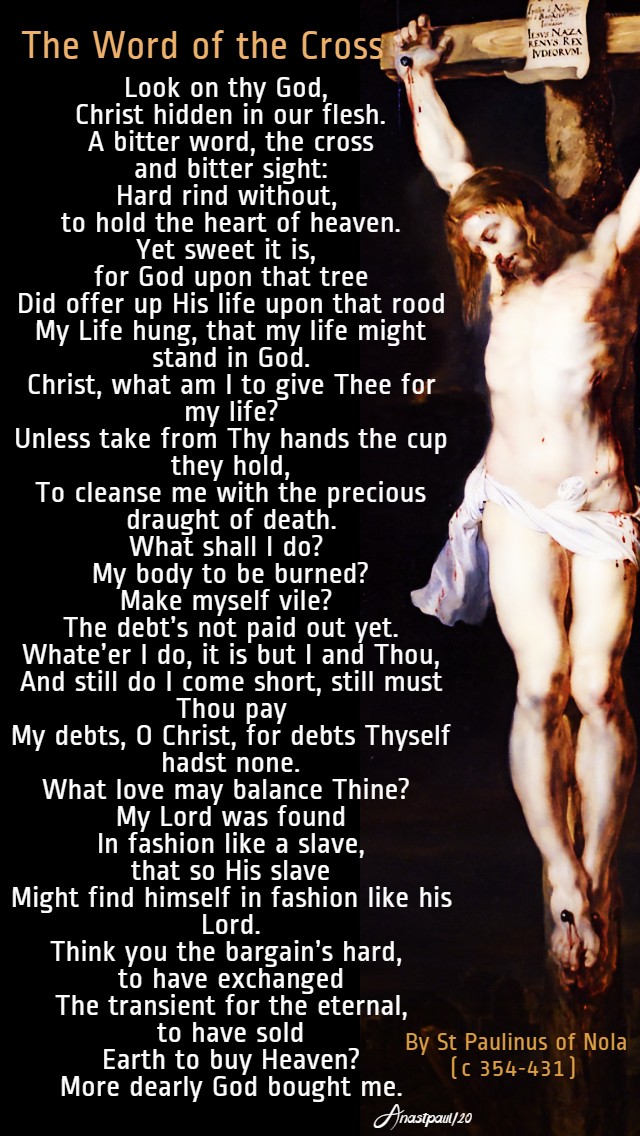
The Word of the Cross by Saint Paulinus of Nola (c 354-431)
Look on thy God, Christ hidden in our flesh.
A bitter word, the cross and bitter sight:
Hard rind without, to hold the heart of heaven.
Yet sweet it is, for God upon that tree
Did offer up His life upon that rood
My Life hung, that my life might stand in God.
Christ, what am I to give Thee for my life?
Unless take from Thy hands the cup they hold,
To cleanse me with the precious draught of death.
What shall I do? My body to be burned?
Make myself vile? The debt’s not paid out yet.
Whate’er I do, it is but I and Thou,
And still do I come short, still must Thou pay
My debts, O Christ, for debts Thyself hadst none.
What love may balance Thine? My Lord was found
In fashion like a slave, that so His slave
Might find himself in fashion like his Lord.
Think you the bargain’s hard, to have exchanged
The transient for the eternal, to have sold
Earth to buy Heaven? More dearly God bought me.
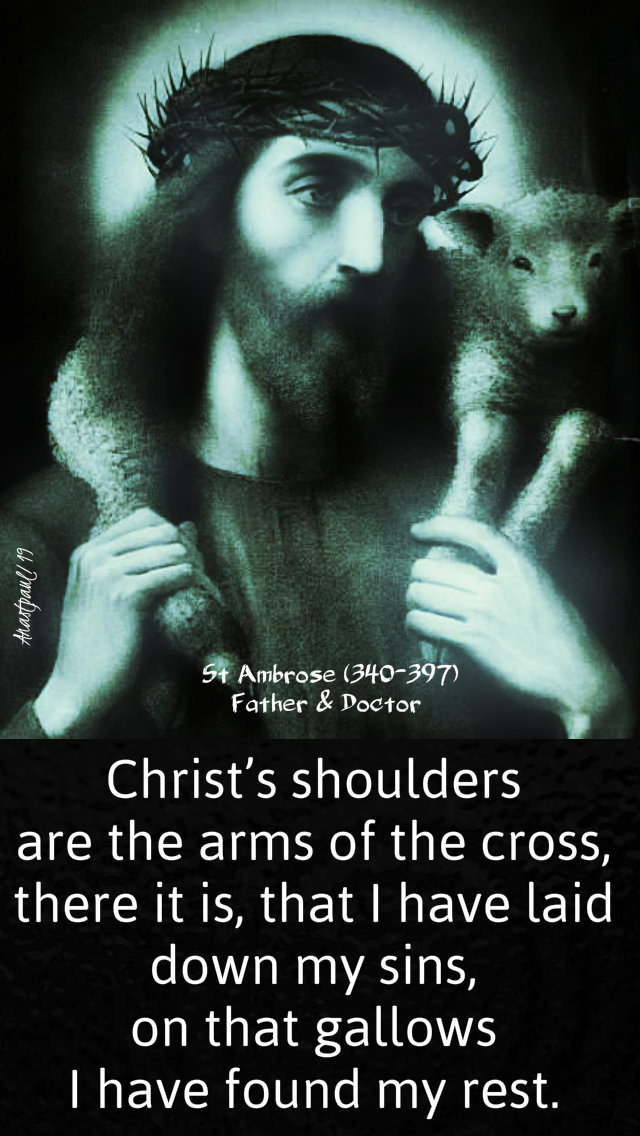
“Christ’s shoulders are the arms of the cross, there it is, that I have laid down my sins, on that gallows I have found my rest. “
St Ambrose (340-397)
Father & Doctor of the Church
One Minute Reflection – 31 March – Tuesday of the Fifth Week of Lent, Readings: Numbers 21:4-9, Psalm 102:2-3, 16-21, John 8:21-30
“When you have lifted up the Son of man, then you will know that I Am He…”...John 8:28
REFLECTION – “Wonder is the source from which philosophers draw their great learning. They encounter and reflect on the marvels of nature, such as earthquakes or thunder (…) or eclipses of the sun and moon, for example. Moved by these wonders, they seek out their cause. Thus, by patient research and extensive investigation, they attain remarkable knowledge and subtlety, which men call “natural philosophy”.
But there is another, even higher form of philosophy, above that of nature, to which one likewise attains, through wonder – this is the philosophy of Christians. And there is no question that, of all that characterises Christian doctrine, it is particularly wonderful and marvellous, that the Son of God, for love of man, consented to be crucified and to die on the cross (…). Is it not astonishing that He, for whom we should have the most respectful awe, felt such fear that He sweated water and blood? (…) Is it not astonishing that He, who gives life to every creature, should have endured so humiliating, cruel and painful a death?
And so, those who strive to meditate on and wonder, at so extraordinary a “book”, as is the Cross, with sensitive heart and sincere faith, will attain a far more fruitful knowledge than many another, who daily studies and meditates on ordinary books. For the true Christian, this book, is sufficient as an object of study for all the days of his life.” … Saint John Fisher (c.1469-1535) Bishop, Martyr – A Sermon preached on Good Friday
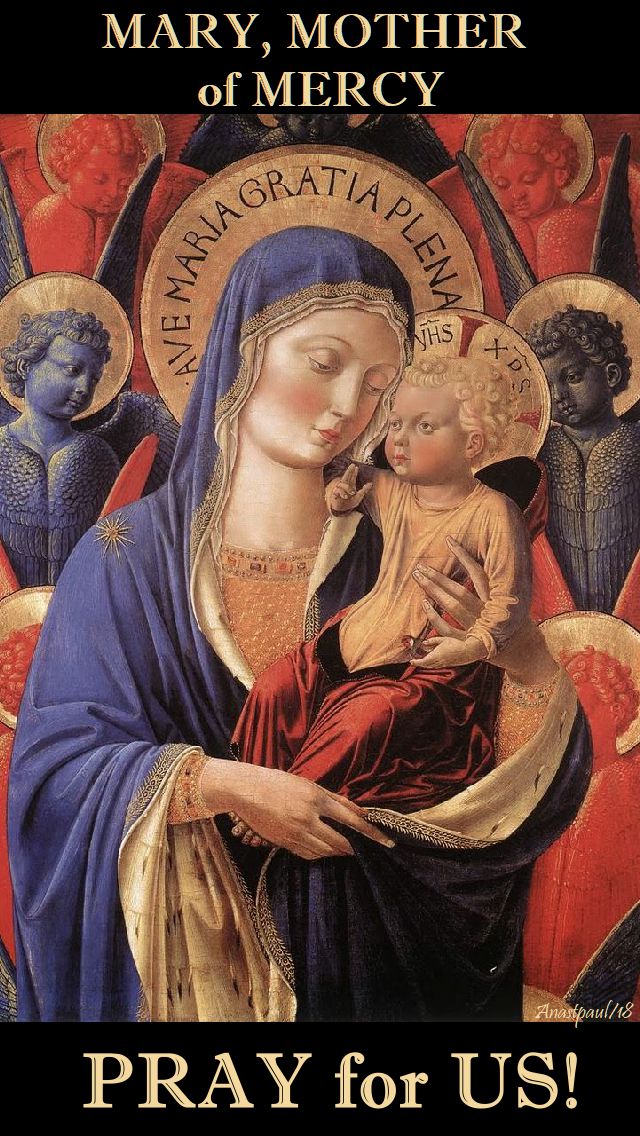
PRAYER – Holy Father, we have sinned against You and beg for Your forgiveness and mercy. Through the merits of the saving Cross of Your Son, help Your people O Lord, to persevere in obedience to Your will, so that through this obedience, we may reach our eternal home. We hope for the intercession of your angels and saints and our most loving Mother of Mercy. Through Christ, our Lord with the Holy Spirit, God forever, amen.
Our Morning Offering – 31 March – Tuesday of the Fifth Week of Lent
Sonnet to our Lord Crucified Anonymous, of Spanish origen
I am not moved to love You, O my God,
That I might hope in promised heaven to dwell,
Nor am I moved by fear of pain in hell,
To turn from sin and follow where You trod.
You move me, Lord, broken beneath the rod,
Or stretched out on the cross, as nails compel
Your hand to twitch. It moves me that we sell,
To mockery and death, Your precious blood.
It is, O Christ, Your love which moves me so,
That my love rests not on a promised prize,
Nor holy fear on threat of endless woe,
It is not milk and honey but the flow
Of blood from blessed wounds before my eyes,
That waters my buried soul and makes it grow.
Amen
Spanish:
No me mueve, mi Dios, para quererte,
Elcielo que me tienes prometido,
Mi me mueve el infierno tan temido,
para dejar por eso de ofenderte.
Tu me mueves, Senor, mueveme el verte
Clavado en una cruz y escarnecido,
Mueveme el ver tu cuerpo tan herido,
Muevenme tus afrentas y tu muerte.
Mueveme, en fin, tu amor de tal manera,
que aunque no hubiera cielo, yo te amara,
Y aunque no hubiera infierno, te temiera.
No me tienes que dar porque Te quiera,
Porque, aunque lo que espero no esperara,
Lo mismo que te quiero Te quisiera.
Who wrote it? Who knows? The names fell from the pages, Lost and never To return to where The eyes of the reader Might ever see them. ‘I am no-one, Constructing eternity so, I can live forever’
St Abda
St Acacius Agathangelos of Melitene
St Agigulf
St Aldo of Hasnon
St Balbina of Rome
St Benjamin the Deacon Blessed Bonaventure Tornielli OSM (1411-1491)
Bl Christopher Robinson
St Daniel of Venice St Guy of Pomposa (Died 1046) Biography: https://anastpaul.com/2019/03/31/saint-of-the-day-31-march-st-guy-of-pomposa-died-1046/
Bl Guy of Vicogne
Bl Jane of Toulouse
St Machabeo of Armagh
Bl Mary Mamala
St Mella of Doire-Melle
Bl Natalia Tulasiewicz
St Renovatus of Merida
—
Martyrs of Africa – 4 saints: A group of Christians martyred together for their faith. No details have survived except for of their names – Anesius, Cornelia, Felix and Theodulus. They were martyred in Roman pro-consular Africa.
Thought for the Day – 30 March – Meditations with Antonio Cardinal Bacci (1881-1971)
The Presence of God
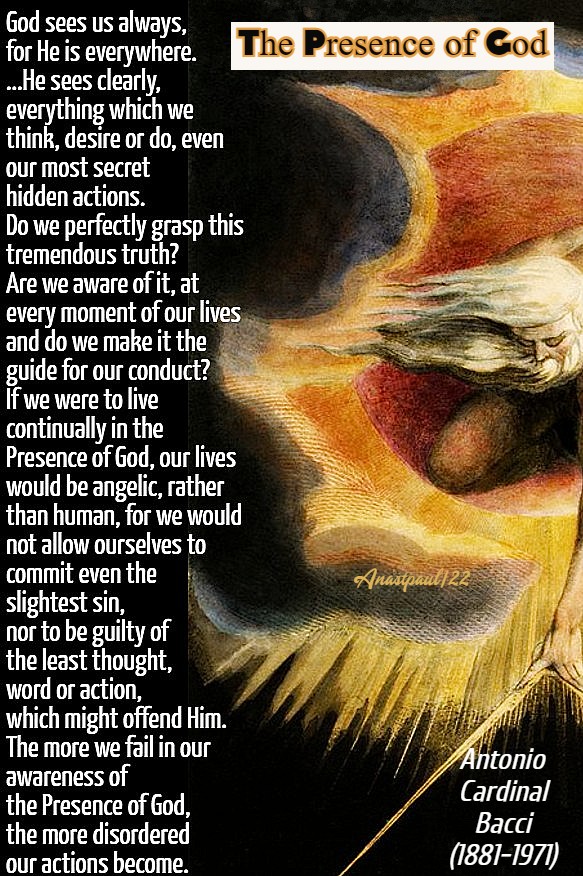
“God sees us always, for He is everywhere. “In Him, we live and move and have our being” (Acts 17:28) We did not exist and He produced us from nothing, by His omnipotence. If He did not support us continually, we should return to nothingness, for conservation is a continuous act of creation. But He has given us immortal souls and has created us for Himself, so that we may serve, enjoy and love Him for all eternity. We are always in His Presence. He sees clearly, everything which we think, desire or do, even our most secret hidden actions. Do we perfectly grasp this tremendous truth? Are we aware of it, at every moment of our lives and do we make it the guide for our conduct? If we were to live continually in the Presence of God, our lives would be angelic, rather than human, for we would not allow ourselves to commit even the slightest sin, nor to be guilty of the least thought, word or action, which might offend Him. The more we fail in our awareness of the Presence of God, the more disordered our actions become. Let us resolve, therefore, to live continually in the Presence of God and to direct all our thoughts, desires and actions towards Him.“
Quote/s of the Day – 30 March – The Memorial of St John Climacus (c 525-606) Father of the Church
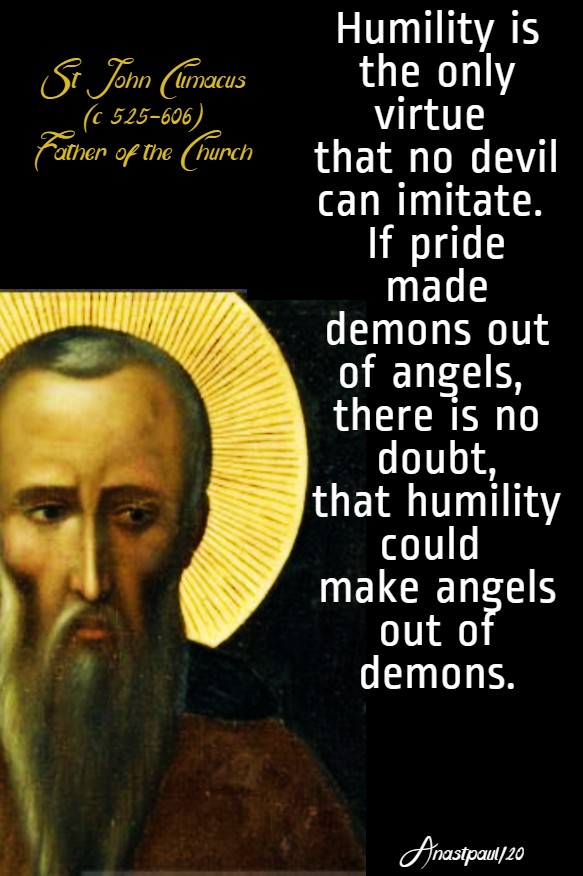
“Humility is the only virtue that no devil can imitate. If pride made demons out of angels, there is no doubt, that humility could make angels out of demons.”
“Obedience is the burial of the will and the resurrection of humility.”
“Repentance lifts a man up. Mourning knocks at heaven’s gate. Holy humility opens it.”
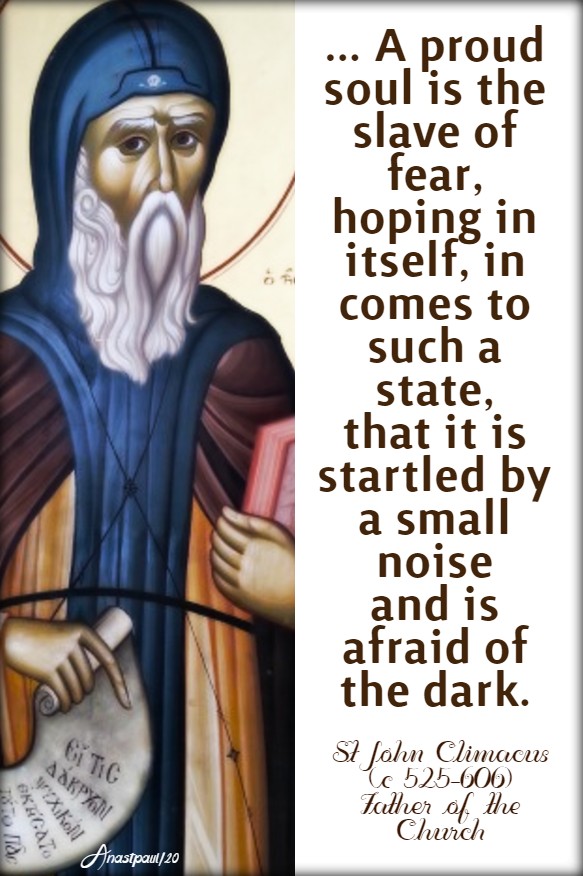
“… A proud soul is the slave of fear, hoping in itself, in comes to such a state, that it is startled by a small noise and is afraid of the dark.”
Lenten Reflection – 30 March – Monday of the Fifth Week of Lent, Readings: Daniel 13:1-9, 15-17, 19-30, 33-62, Psalm 23, John 8:1-11
“Lord, open my lips, and my mouth shall declare your praise.”
“Neither do I condemn you; go and do not sin again.” … John 8:11
Daily Meditation: Help us to pass from our old life of sin to our new life of grace.
“The Lord Jesus, the Saviour of all, “made himself all things to all men” (1 Cor 9:22) in such a way that He revealed Himself as being smaller than the small, He who was greater than the great. To save a soul who was surprised in adultery and accused by the demons, He lowered Himself to the point of writing on the ground with His finger…. He, Himself, is the holy and sublime ladder that the traveller Jacob saw in his sleep (Gen 28:12),… the ladder that was set up from the earth to God and that God held out to the earth. When He wants, He goes up to God. Sometimes He is accompanied by a few people … and sometimes no-one can follow Him. And when He wants, He joins the crowd… He heals lepers, eats with publicans and sinners… touches the sick to heal them.
Blessed is the soul that can follow the Lord Jesus wherever He goes, going up to the rest of contemplation… and on the other hand, coming down by the practice of charity, following Him to the point of lowering itself in service, of loving poverty, of bearing with (…) fatigue, work, tears, prayer and finally compassion and the passion. For He came in order to obey even to death, to serve and not to be served, not to give gold or silver but His teaching and His help to the many, His life for the many (Mk 10:45)…
So, brethren, may this be the model for your life: (…) to follow Christ by going up to the Father… to follow Christ by going down to your neighbour, refusing no practice of charity, making yourselves all things to all persons.” … Isaac of Stella (c 1100-c 1171) Cistercian Monk, theologian, philosopher – Sermon 12
The Lord is my shepherd, I shall not want; he makes me lie down in green pastures. He leads me beside still waters, he restores my soul. He leads me in paths of righteousness for his name’s sake.
Psalm 23:1-3
Intercessions:
Praise to Jesus, our Saviour.
By His death He has opened for us the way of salvation.
Let us ask Him:
Lord, guide Your people to walk in Your ways.
God of mercy, You gave us new life through Baptism,
– make us grow day by day in Your likeness.
May our generosity today bring joy to those in need,
– in helping them may we find You.
Help us to do what is good, right and true in Your sight,
– and to seek You always with undivided hearts.
Forgive our sins against the unity of Your family,
– make us one in heart and spirit.
Closing Prayer:
I Unite My Sacrifice Prayer for Submission to Divine Providence By St Joseph Maria Pignatelli SJ (1737 – 1811)
My God, I do not know
what must come to me today.
But I am certain
that nothing can happen to me
that You have not foreseen, decreed
and ordained from all eternity.
That is sufficient for me.
I adore Your impenetrable
and eternal designs,
to which I submit with all my heart.
I desire, I accept them all
and I unite my sacrifice to that of
Jesus Christ, my Divine Saviour.
I ask in His name
and through His infinite merits,
patience in my trials
and perfect and entire submission,
to all that comes to me
by Your good pleasure.
Amen
One Minute Reflection – 30 March – Monday of the Fifth Week of Lent, Readings: Daniel 13:1-9, 15-17, 19-30, 33-62, Psalm 23, John 8:1-11 and the Memorial of St Antoine Daveluy MEP (1818-1866) Martyr
“Neither do I condemn you; go and do not sin again.” … John 8:11
REFLECTION – “The scene is full with drama – the life of that person and also His own life depend on Jesus. Indeed, the hypocritical accusers pretend to entrust the judgement to Him whereas it is actually He, Himself, whom they wish to accuse and judge. Jesus, on the other hand, is “full of grace and truth” (Jn 1: 14) – He can read every human heart, He wants to condemn the sin but save the sinner and unmask hypocrisy. St John the Evangelist highlights one detail – while His accusers are insistently interrogating Him, Jesus bends down and starts writing with His finger on the ground. St Augustine notes that this gesture portrays Christ as the divine legislator, in fact, God wrote the law with His finger on tablets of stone (cf. Commentary on John’s Gospel, 33,5). Thus Jesus is the Legislator, He is Justice in person. And what is His sentence? “Let him who is without sin among you, be the first to throw a stone at her.” These words are full of the disarming power of truth that pulls down the wall of hypocrisy and opens consciences to a greater justice, that of love, in which consists the fulfilment of every precept (cf. Rom 13: 8-10). This is the justice that also saved Saul of Tarsus, transforming him into St Paul (cf. Phil 3: 8-14).
When His accusers “went away, one by one, beginning with the eldest,” Jesus, absolving the woman of her sin, ushers her into a new life oriented to good. “Neither do I condemn you; go and do not sin again.” … Pope Benedict XVI – 21 March 2010
PRAYER – Lord God, Your abounding grace has enriched us with every blessing. Transform us from our sinful condition to newness of life and prepare us for the glory of Your kingdom. Open our eyes to see by the light of Your Son, who always walks with us. Let us lift our eyes to Him, for even now He is preparing for us a place, in His Father’s house. Listen, we pray, to the prayers of all the angels and saints, St Antoine Daveluy a Martyr for Christ, who petition on our behalf and may our Mother Mary, keep ever close to our path. Through Christ, our Lord, in the unity of the Holy Spirit, God for always and forever, amen.
Our Morning Offering – 30 March – Monday of the Fifth Week of Lent
Lord, Kindle our Lamps By St Columban (543-615)
Lord, kindle our lamps,
Saviour most dear to us,
that we may always shine
in Your presence
and always receive light
from You, the Light Perpetual,
so that our own personal darkness
may be overcome
and the world’s darkness
driven from us.
Amen
(This is an excerpt from a much longer prayer and is taken from the wonderful Sermon XII by St Columban)
Saint of the Day – 30 March – Saint Marie-Nicolas-Antoine Daveluy MEP (1818-1866) Bishop Martyr, Missionary of the Paris Foreign Missionary Society, Apostolic Vicar to Korea – commonly known as St Antoine Daveluy – born on 16 March 1818 in the parish of Saint-Leu, Amiens, Somme, France and died by beheading on Good Friday, 30 March 1866 at the Galmaemot naval base, Boryeong, Chungcheong-do, South Korea, he was 48, along with two French priests, Pierre Aumaître and Martin-Luc Huin and two lay catechists, Lucas Hwang Sŏk-tu (Bishop Daveluy’s personal assistant) and Joseph Chang Chu-gi. Additional Memorial – 20 September as one of the Martyrs of Korea.
Antoine Daveluy was born 16 March 1818 in Amiens, France. His father was a factory owner, town councilman and government official. The members of his family were devout Catholics and two of his brothers became priests. He entered the St Sulpice Seminary in Issy-les-Moulineaux himself, in October 1834 and was Ordained a Priest on 18 December 1841.
His first assignment was as an assistant Priest in Roye. Despite poor health, he joined the Paris Foreign Missions Society on 4 October 1843. He departed for East Asia on 6 February 1844, intending to serve as a Missionary in the Ryukyu Islands of Japan. He arrived in Macau, where he was persuaded by the newly appointed Apostolic Vicar of Korea, Jean-Joseph-Jean-Baptiste Ferréol, to accompany him there instead. The two were joined by St Andrew Kim Taegŏn, a Korean Seminarian who had been studying for the Priesthood in Macau. They first traveled to Shanghai, where Bishop Ferréol ordained Father Kim on 17 August 1845. The three priests then made a stormy crossing by sea to Korea, arriving in Chungcheong Province in October.
Father Daveluy began work as a Missionary in Korea. Two years later, he was in charge of the Seminary. He then took over the administration of a district, while doing it, he scrupulously prepared a Chinese-Korean-French dictionary, translated several Korean works of history and chronology and revised the books of the Faith.
On 13 November 1855, Pope Pius IX appointed him titular Bishop of Akka and coadjutor to Bishop Siméon-François Berneux, who had been appointed Apostolic Vicar in 1854 after the death of Bishop Ferréol in 1853. He was Consecrated by Bishop Berneux on 25 March 1857.
In 1859 he completed various works for the instruction of Christians, as well as, the the annals of the country’s first Martyrs and wrote biographical notes on most Korean confessors. In the same year, he embarked on a three-month trip to search for and interview, the living witnesses to the persecution of 1801. In October 1802, he sent his work on the history of the mission to the Motherhouse of the Missionary Society in Paris. It is thanks to these documents, often literally reproduced, that Mr Dallet wrote the History of the Church of Korea which, must very largely, be attributed to Bishop Daveluy.
Residence of Bishop Antoine Daveluy between 1845 and 1866 in the village Sin-ri (rural part of Dangjin)
After Bishop Berneux was executed during a campaign by the Korean government against Christians, Bishop Daveluy became Apostolic Vicar on 8 March 1866.
He was promptly arrested on 11 March. Imprisoned and tortured, he staunchly defended his Catholic faith. When he appeared before his judges, he was able, thanks to his in-depth knowledge of the Korean language, to make several long apologetic explanations for Christianity. Perhaps for this reason but above all, because of his dignity as grand master of the Faith in their eyes, he had to suffer more frequently and more severely than his companions – whipping the legs, blows with wooden batons and puncturing with the sharpened rods.
Finally, the court imposed a death sentence against the three prisoners. St Antoine asked to be executed on Good Friday, 30 March. But the king was then sick and numerous sorcerers, assembled in the palace, made to cure him by superstitious ceremonies; moreover, he was soon to celebrate his marriage. It was feared that the torture of the Europeans would harm the effect of the spells and that an outpouring of human blood in the capital, would be an unfortunate omen for the royal wedding. This is why, the regent prescribed that the beheading of the condemned be committed on the peninsula of Syou-yeng, twenty-five miles south of Seoul.
The Bishop and his Priests were led on horseback to the designated place. Their hearts overflowed with joy and, to the astonishment of the officials and the curious, they addressed fervent thanksgiving to God, singing psalms and hymns. On Maundy Thursday, 29 March they had arrived fairly close to Syou-yeng. Archbishop Daveluy heard the officials chatting among themselves, deciding to delay the immolation of the confessors and first to parade them through the neighbouring town. Touched by a strong desire to die on the anniversary of the Saviour’s death, he interrupted them: “No, he cried, what you are saying is impossible. You will go tomorrow, right to the place of execution, because it is tomorrow that we must die.” The prisoner was obeyed and the next day, Good Friday, 30 March 1866, was the day of their Martyrdom.
The mandarin who presided over their torture enjoined the martyrs to bow down to him. It is the custom in Korea for convicts to salute those who kill them. Daveluy replied that he would greet in the French manner and he refused to kneel. A brutal push threw him face down. Another horrific incident marked the death of the holy Bishop, who was beheaded first. The executioner had not set the price for his bloody work. After striking the condemned man with the first blow of his saber, which cut his neck deeply, he stopped and refused to continue, unless he was promised a large sum. The avarice of the mandarin resisted these pretensions. Employees of the prefecture had to be brought together to make a decision. The discussion lasted a long time, the victim struggled on the ground in convulsions of agony, finally the deal was concluded and two new saber strokes delivered the soul of the witness of Jesus Christ.
The bodies of the Martyrs, buried in the sand at the very place of execution by pagans in the neighbourhood, were collected by Christians the following June and buried in the district of Hong-san, 3 miles from the coast. Transferred elsewhere as a result of various circumstances, they were exhumed in March 1882 by order of the preacher, Fr Blanc and in the following November they were sent to Nagasaki (Japan), in order to be protected from any profanation. They were brought back to Korea when there was no longer any fear of persecution and since 1900 they have been buried in the Seoul Cathedral.
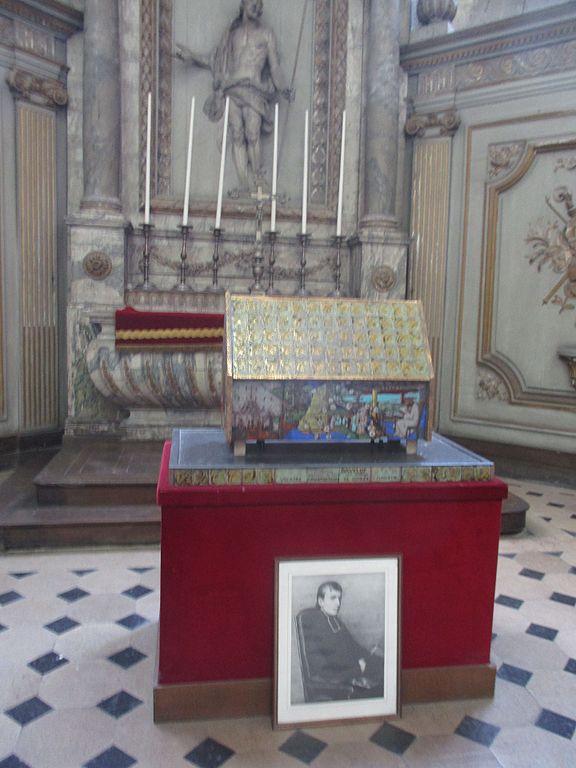
Reliquary of saint Anthony Daveluy in Amiens Cathedral
Bishop Daveluy was a stubborn zealous worker. He was also distinguished by his spirit of renunciation and mortification, as much as by his perseverance and humility. Unfortunately, due to this humility, his important dictionary and most of his writings had not been sent to the Motherhouse and they were destroyed during the persecution.
All five were Canonised on 6 May 1984 by St Pope John Paul II, along with Father Kim, Bishop Berneux and 96 other Korean martyrs.
St Julio Álvarez Mendoza
St Leonard Murialdo
St Ludovico of Casoria
St Mamertinus of Auxerre St Marie-Nicolas-Antoine Daveluy MEP (1818-1866) Bishop Martyr
Bl Maria Restituta Kafka
St Osburga of Coventry
St Pastor of Orléans
St Patto of Werden
St Peter Regulatus
St Quirinus the Jailer
St Regulus of Scotland
St Regulus of Senlis
St Secundus of Asti
St Tola
St Zozimus of Syracuse
—
Martyrs of Constantinople: ourth-century Christians who were exiled, branded on the forehead, imprisoned, tortured, impoverished and murdered during the multi-year persecutions of the Arian Emperor Constantius. They were martyred between 351 and 359 in Constantinople.
Martyrs of Korea:
Marie-Nicolas-Antoine Daveluy
Iosephus Chang Chu-gi
Lucas Hwang Sok-tu
Martin-Luc Huin
Pierre Aumaître
Thought for the Day – 29 March – Meditations with Antonio Cardinal Bacci (1881-1971)
Jesus Lost in the Temple
The Gospel of St Luke relates that when Jesus was twelve years of age, He went with Mary and Joseph to Jerusalem to celebrate the Pasch. When the feast was over, Our Lady and St Joseph set out on the return journey and, as was the custom, they went in separate caravans, one being for men and the other for women. Each believed that the Child Jesus was in the other group but, at the end of the first day’s journey, they failed to find Him in either. They were stricken with worry and sorrow and returned immediately to Jerusalem, where they searched anxiously for Him. At last they found Him in the Temple. There He was, carrying on a discussion in the midst of a gathering of doctors of the Law, who were amazed at the wisdom of His answers. When the Blessed Virgin gently reproved Him, Jesus replied: “How is it that you sought me? Did you not know that I must be about my Father’s business?” (Cf Lk 2:41-51) After this, He went back readily with them to Nazareth “and was subject to them.” We have a great deal to learn from this chapter of the Gospel. Above all, let us learn the humility and mildness of Jesus, Who quietly replied, in answer to Mary’s gentle reproach, that it was His special mission to look after the work of His Heavenly Father, for He owed obedience, in the first place, to God and then to men (Cf Acts 5:29). What is our attitude when we are rebuked or criticised? Are we humble in the manner of Jesus Christ? Or, are we angry and resentful? Let us earnestly examine ourselves in this matter.








 The two were joined by St Andrew Kim Taegŏn, a Korean Seminarian who had been studying for the Priesthood in Macau. They first traveled to Shanghai, where Bishop Ferréol ordained Father Kim on 17 August 1845. The three priests then made a stormy crossing by sea to Korea, arriving in Chungcheong Province in October.

 AnaStpaul
You must be logged in to post a comment.