Posted in DOCTORS of the Church, DOCTRINE, DOGMA, FATHERS of the Church, GOD the FATHER, PRAYERS of the SAINTS, QUOTES of the SAINTS, SAINT of the DAY, The MOST HOLY & BLESSED TRINITY

Thought for the Day – 13 January – May I serve You by making You known

Thought for the Day – 13 January – May I serve You by making You known
The Memorial of St Hilary of Poitiers (315-368) Father & Doctor of the Church

This prayer is an excerpt from a sermon On the Trinity by Saint Hilary of Poitiers, a bishop and early Church Father of the fourth century who struggled valiantly against the Arian heresy, defending the divinity of Christ and the doctrine of the Trinity.
From a sermon on the Trinity by St Hilary of Poitiers (315-368) Father & Doctor of the Church – (Lib 1, 37-38: PL 10, 48-49)

May I serve You by making You known

“I am well aware, almighty God and Father, that in my life I owe You a most particular duty.   It is to make my every thought and word speak of You.

In fact, You have conferred on me this gift of speech and it can yield no greater return than to be at Your service.   It is for making You known as Father, the Father of the only-begotten God and preaching this to the world that knows You not and to the heretics who refuse to believe in You.

In this matter, the declaration of my intention, is only of limited value.   For the rest, I need to pray for the gift of Your help and Your mercy.   As we spread our sails of trusting faith and public avowal before You, fill them with the breath of Your Spirit, to drive us on, as we begin this course of proclaiming Your truth.   We have been promised and He who made the promise is trustworthy:   Ask, and it will be given to you; seek, and you will find; knock, and it will be opened to you.

Yes, in our poverty we will pray for our needs.   We will study the sayings of Your prophets and apostles with unflagging attention and knock for admittance wherever the gift of understanding is safely kept.   But Yours it is, Lord, to grant our petitions, to be present when we seek You and to open when we knock.

There is an inertia in our nature that makes us dull and in our attempt to penetrate Your truth. we are held within the bounds of ignorance. by the weakness of our minds.   Yet we do comprehend divine ideas by earnest attention to Your teaching and by obedience to the faith, which carries us beyond mere human apprehension.

So we trust in You to inspire the beginnings of this ambitious venture, to strengthen its progress and to call us into a partnership, in the spirit, with the prophets and the apostles.   To that end, may we grasp precisely what they meant to say, taking each word in its real and authentic sense.   For we are about to say what they already have declared as part of the mystery of revelation – that You are the eternal God, the Father of the eternal, only-begotten God;  that You are one and not born from another;  and that the Lord Jesus is also one, born of You from all eternity.   We must not proclaim a change in truth regarding the number of gods.   We must not deny that He is begotten of You who are the one God, nor must we assert that He is other than the true God, born of You who are truly God the Father.

Impart to us, then, the meaning of the words of Scripture and the light to understand it, with reverence for the doctrine and confidence in its truth.   Grant that we may express what we believe.   Through the prophets and apostles we know about You, the one God the Father and the one Lord Jesus Christ.   May we have the grace, in the face of heretics who deny You, to honour You as God, who is not alone and to proclaim this as truth.”

The above is used in the Roman Office of Readings for the feast (liturgical memorial) of St Hilary of Poitiers on 13 January.
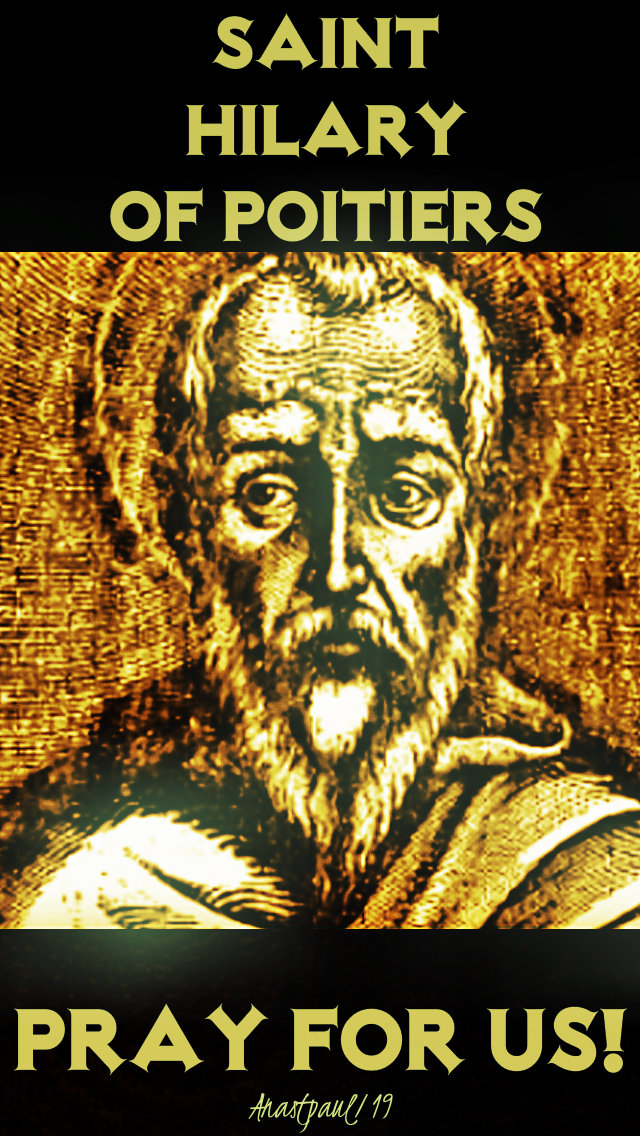
St Hilary of Poitiers Pray for us!st hilary pray for us no 2 13 jan 2019.jpg

Posted in DOCTORS of the Church, EUCHARISTIC Adoration, FATHERS of the Church, FEASTS and SOLEMNITIES, MARIAN QUOTES, QUOTES of the SAINTS, QUOTES on FAITH, QUOTES on MERCY, QUOTES on PERSECUTION, QUOTES on the CHURCH, The BLESSED VIRGIN MARY, The HOLY EUCHARIST / The HOLY MASS, The WORD

Quote/s of the Day – 13 January

Quote/s of the Day – 13 January – The Feast of the Baptism of the Lord, the Memorial of St Hilary of Poitiers (315-368) Father & Doctor of the Church and Blessed Francesco Maria Greco (1857-1931)

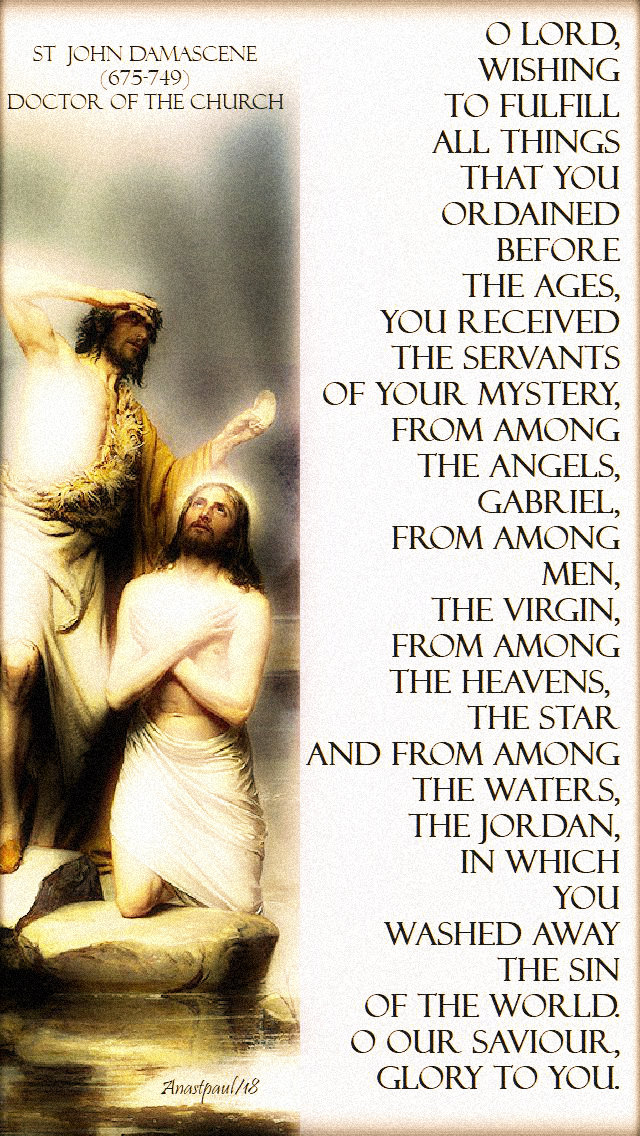
“O Lord, wishing to fulfil all things
that You ordained before the ages,
You received the servants of Your mystery,
from among the Angels, Gabriel,
from among Men, the Virgin,
from among the Heavens, the Star
and from among the Waters, the Jordan,
in which You washed away the sin of the world,
O our Saviour, glory to You.”

St John Damascene (675-749) Doctor of the Churcho-lord-wishing-to-fulfil-all-things-st-john-damascene-7-jan-20181.jpg

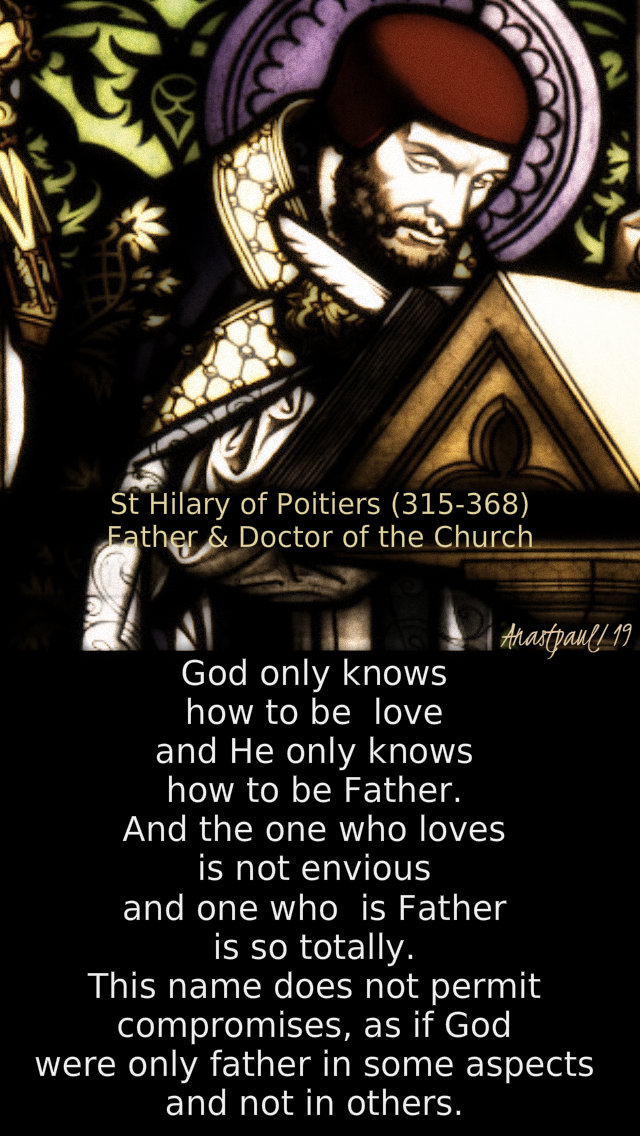
“God only knows how to be love
and He only knows how to be Father.
And the one who loves is not envious
and one who is Father is so totally.
This name does not permit compromises,
as if God were only father in some aspects
and not in others.”god only knows how to love - st hilary 13 jan 2019.jpg

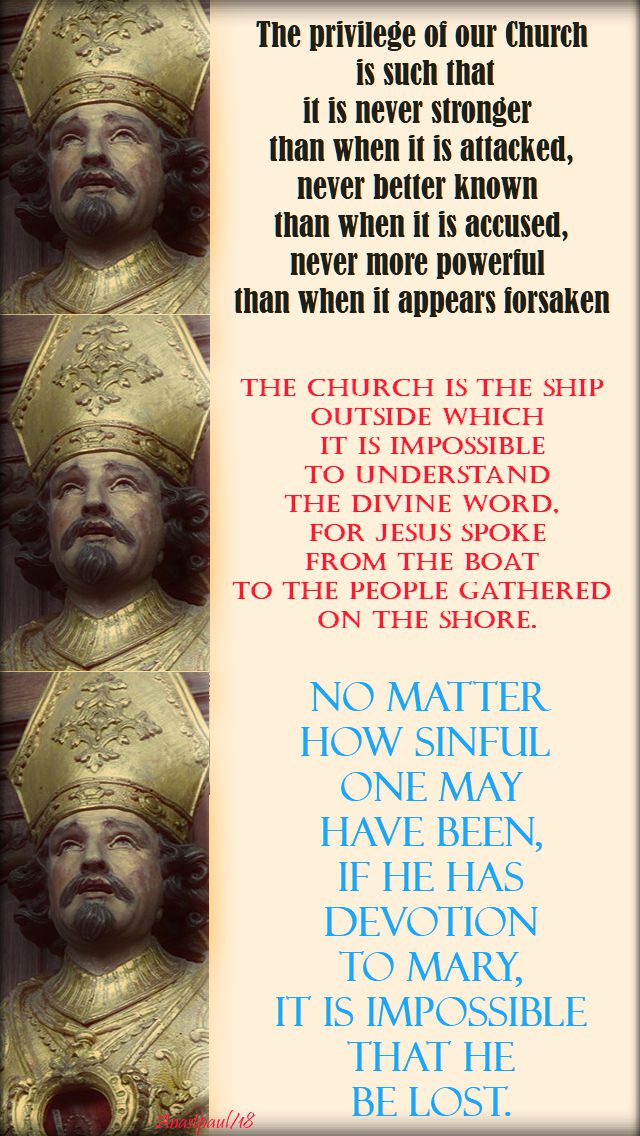
“The privilege of our Church is such that
it is never stronger
than when it is attacked,
never better known
than when it is accused,
never more powerful
than when it appears forsaken.”
(Treatise on the Trinity)

“The Church is the Ship
outside which
it is impossible to understand
the Divine Word,
for Jesus spoke from the boat
to the people gathered
on the shore.”

“No matter how sinful
one may have been,
if he has devotion to Mary,
it is impossible that he be lost.”

St Hilary of Poitiers (315-368) Father & Doctor of the Churchthe-privilege-of-our-church-st-hilary-of-pitiers-13-jan-2018.jpg

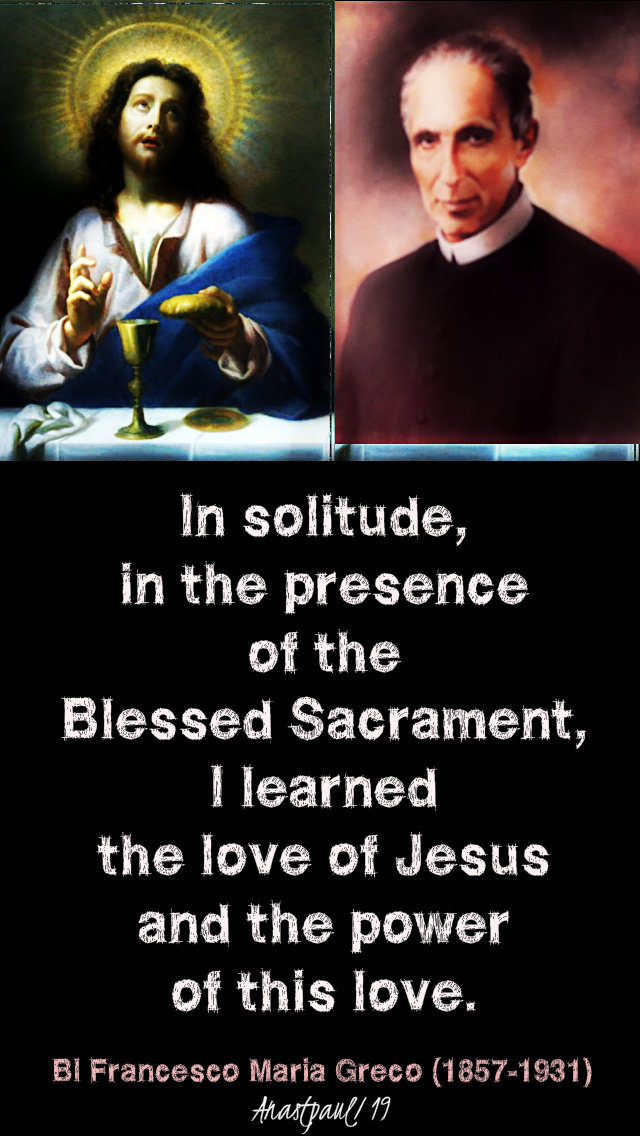
“In solitude,
in the presence
of the Blessed Sacrament,
I learned the love of Jesus
and the power of this love.”

Blessed Francesco Maria Greco (1857-1931)in solitude in the presence of the blessed sacrament - bl francesco m greco 13 jan 2019.jpg

Posted in DOCTORS of the Church, FATHERS of the Church, FEASTS and SOLEMNITIES, MORNING Prayers, PRAYERS of the SAINTS, QUOTES of the SAINTS, The HOLY GHOST, The MOST HOLY & BLESSED TRINITY, The WORD

One minute Reflection – 13 January – The Feast of the Baptism of the Lord

One minute Reflection – 13 January – The Feast of the Baptism of the Lord, Gospel:  Luke 3:15-22 and Memorial of St Hilary of Poitiers (315-368) Father & Doctor of the Church

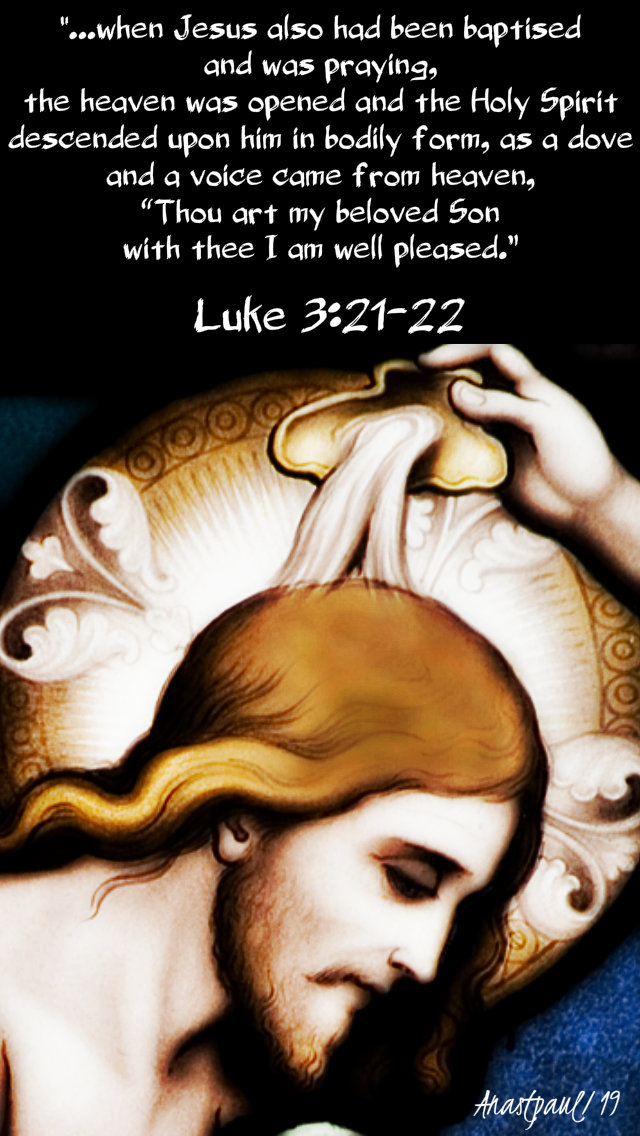
“…when Jesus also had been baptised and was praying, the heaven was opened and the Holy Spirit descended upon him in bodily form, as a dove and a voice came from heaven, “Thou art my beloved Son with thee I am well pleased.”…Luke 3:21-22when jesus also had been baptised luke 3 21-22 13 jan 2019.jpg

REFLECTION – “Jesus rises from the waters;  the world rises with Him.   The heavens like Paradise with its flaming sword, closed by Adam for himself and his descendants, are rent open.   The Spirit comes to Him as to an equal, bearing witness to His Godhead.  A voice bears witness to Him from heaven, His place of origin.   The Spirit descends in bodily form like the dove that so long ago announced the ending of the flood and so gives honour to the body that is one with God.
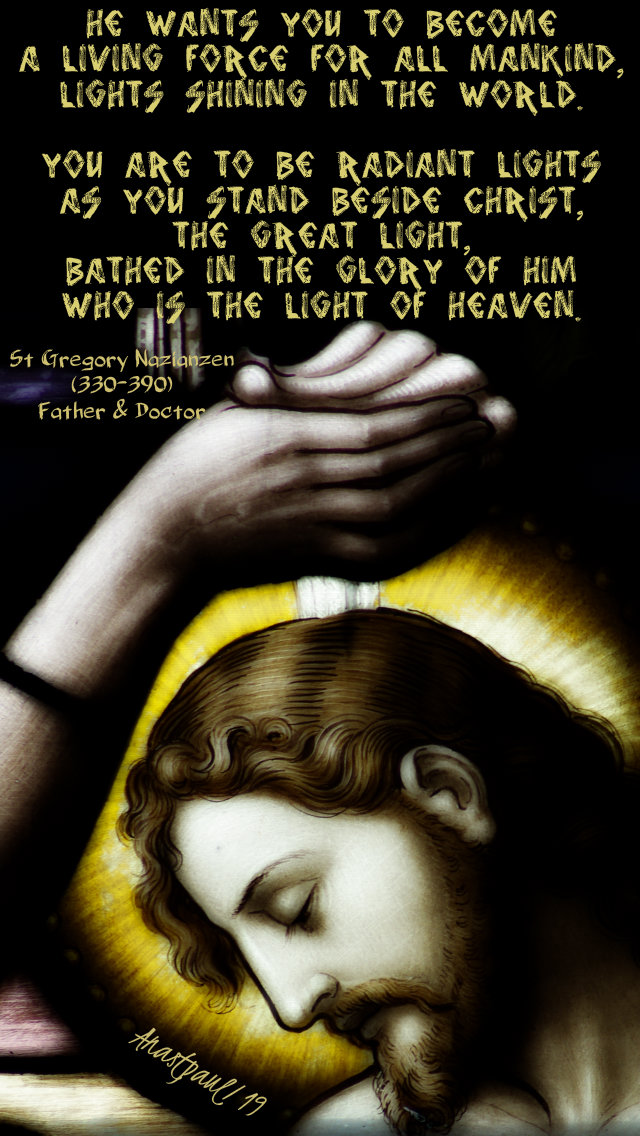
Today, let us do honour to Christ’s baptism and celebrate this feast in holiness.   Be cleansed entirely and continue to be cleansed.   Nothing gives such pleasure to God as the conversion and salvation of men, for whom His every word and every revelation exist. He wants you to become a living force for all mankind, lights shining in the world.   You are to be radiant lights as you stand beside Christ, the great light, bathed in the glory of Him who is the light of heaven.   You are to enjoy, more and more, the pure and dazzling light of the Trinity, as now you have received—though not in its fullness—a ray of its splendour, proceeding from the one God, in Christ Jesus our Lord, to whom be glory and power for ever and ever. Amen. “…St Gregory Nazianzen (330-390 – Father & Doctor of the Church (An excerpt from Oration 39: On Holy Light)he wants you to become a living force - st gregory of nazianzen - 13 jan 2019.jpg

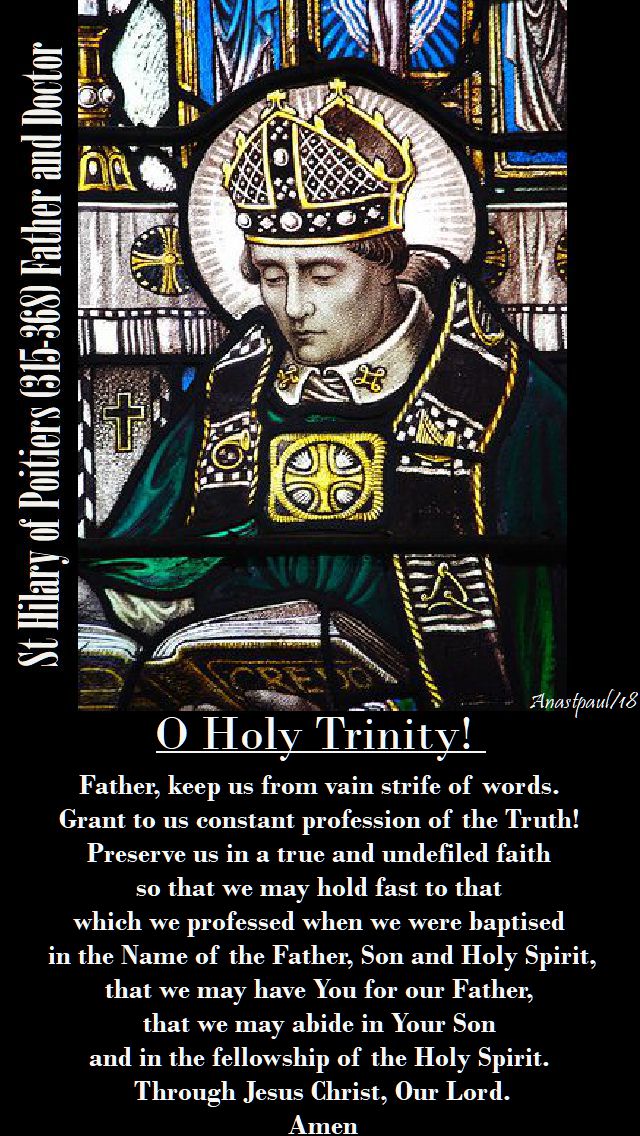
PRAYER – Father, keep us from vain strife of words.
Grant to us constant profession of the Truth!
Preserve us in a true and undefiled faith
so that we may hold fast to that
which we professed when we were baptised
in the Name of the Father, Son and Holy Spirit,
that we may have You for our Father,
that we may abide in Your Son
and in the fellowship of the Holy Spirit.
Through Jesus Christ, Our Lord.
Amen…St Hilary of Poitierso-holy-trinity-prayer-for-perseverance-in-truth-st-hilary-of-poitiers-13-jan-2018.jpg

Posted in EUCHARISTIC Adoration, MORNING Prayers, QUOTES of the SAINTS, SUNDAY REFLECTIONS, The HOLY EUCHARIST / The HOLY MASS

Sunday Reflection – 13 January – Above all, let us pray Him to draw us to Him and to give us faith.

Sunday Reflection – 13 January – Feast of the Baptism of the Lord

Above all, let us pray Him to draw us to Him and to give us faith.

Blessed John Henry Newman (1801-1890)
(Parochial & Plain Sermons, Vol. VI, no. 11)

“Above all, let us pray Him to draw us to Him and to give us faith.   When we feel that His mysteries are too severe for us and occasion us to doubt, let us earnestly wait on Him for the gift of humility and love.   Those who love and who are humble will apprehend them, carnal minds do not seek the and proud minds are offended at them but while love desires them, humility sustains them.

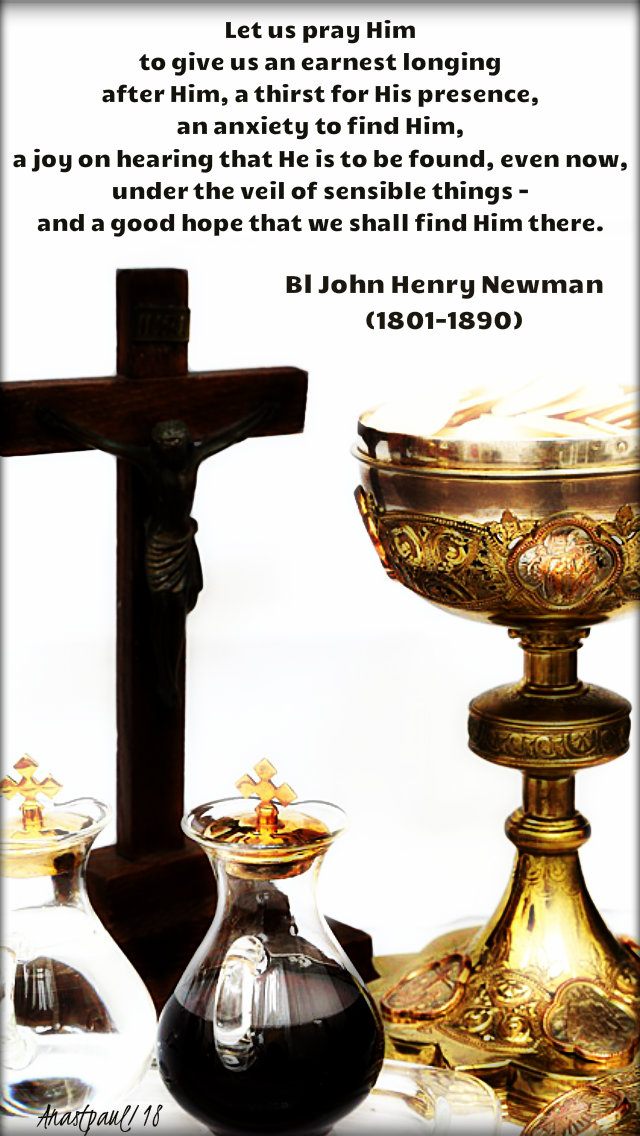
Let us pray Him to give us an earnest longing after Him – a thirst for His presence – an anxiety to find Him – a joy on hearing that He is to be found, even now, under the veil of sensible things – and a good hope that we shall find Him there.

Blessed indeed are they who have not seen and yet have believed.   They have their reward in believing, they enjoy the contemplation of a mysterious blessing, which does not even enter into the thoughts of other men and while they are more blessed than others, in the gift vouchsafed to them, they have the additional privilege of knowing that they are vouchsafed it.”let us pray him to give us - bl john henry newman 13 jan 2019.jpg

Posted in EUCHARISTIC Adoration, Our MORNING Offering, PRAYERS of the SAINTS, SACRED and IMMACULATE HEARTS, The HOLY EUCHARIST / The HOLY MASS

Our Morning Offering – 13 January – Feast of the Baptism of the Lord

Our Morning Offering – 13 January – Feast of the Baptism of the Lord

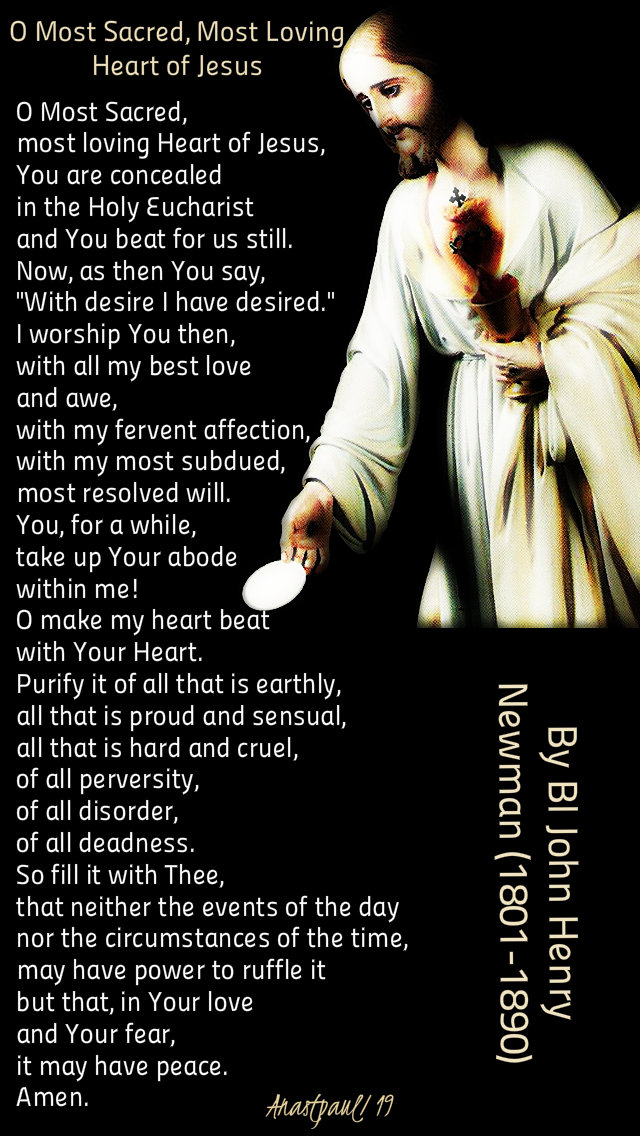
O Most Sacred, Most Loving Heart of Jesus
By Blessed John Henry Newman (1801-1890)

O Most Sacred, most loving Heart of Jesus,
You are concealed in the Holy Eucharist
and You beat for us still.
Now, as then You say,
“With desire I have desired.”
I worship You the,
with all my best love and awe,
with my fervent affection,
with my most subdued, most resolved will.
You, for a while, take up Your abode within me!
O make my heart beat with Your Heart.
Purify it of all that is earthly,
all that is proud and sensual,
all that is hard and cruel,
of all perversity,
of all disorder,
of all deadness.
So fill it with Thee,
that neither the events of the day
nor the circumstances of the time,
may have power to ruffle it
but that, in Your love
and Your fear,
it may have peace.
Amen.o most sacred most loving heart of jesus bl john henry newman - 13 jan 2019.jpg

Posted in SAINT of the DAY

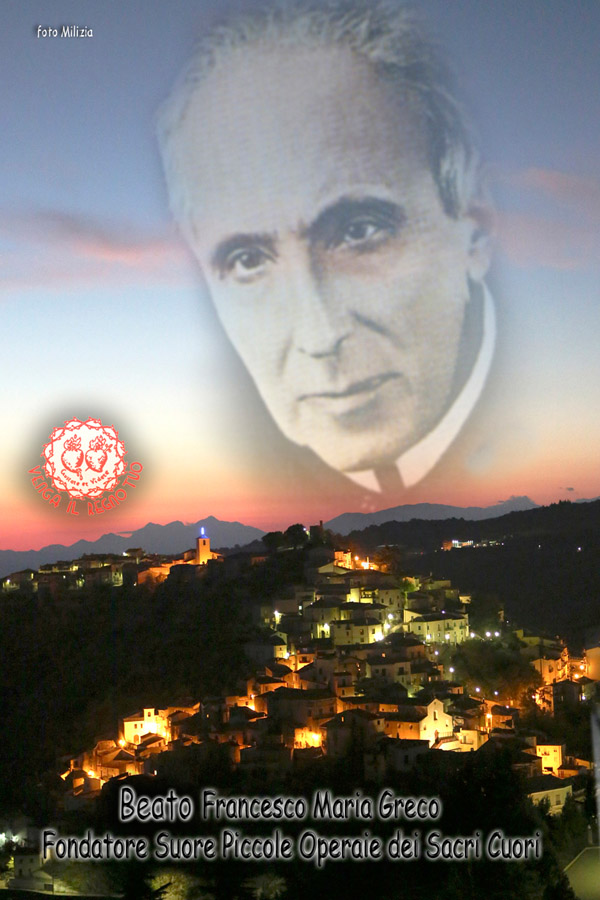
Saint of the day – 13 January – Blessed Francesco Maria Greco (1857-1931)

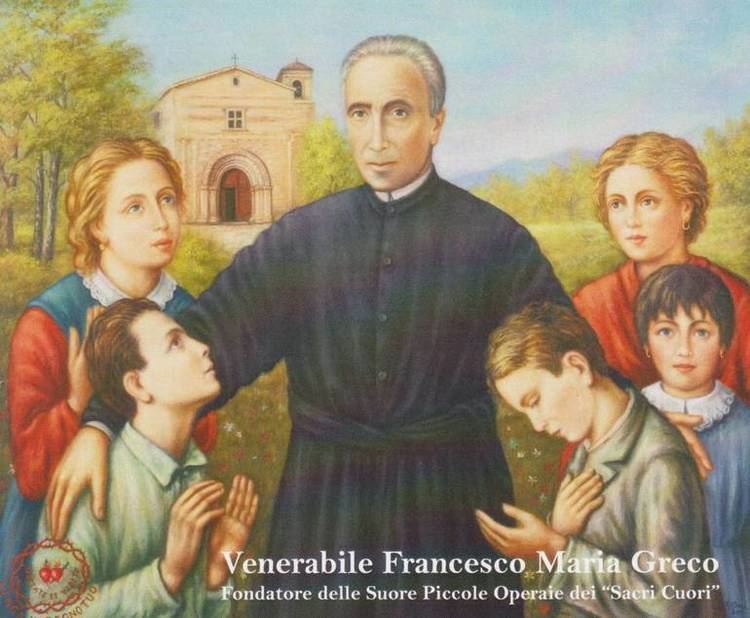
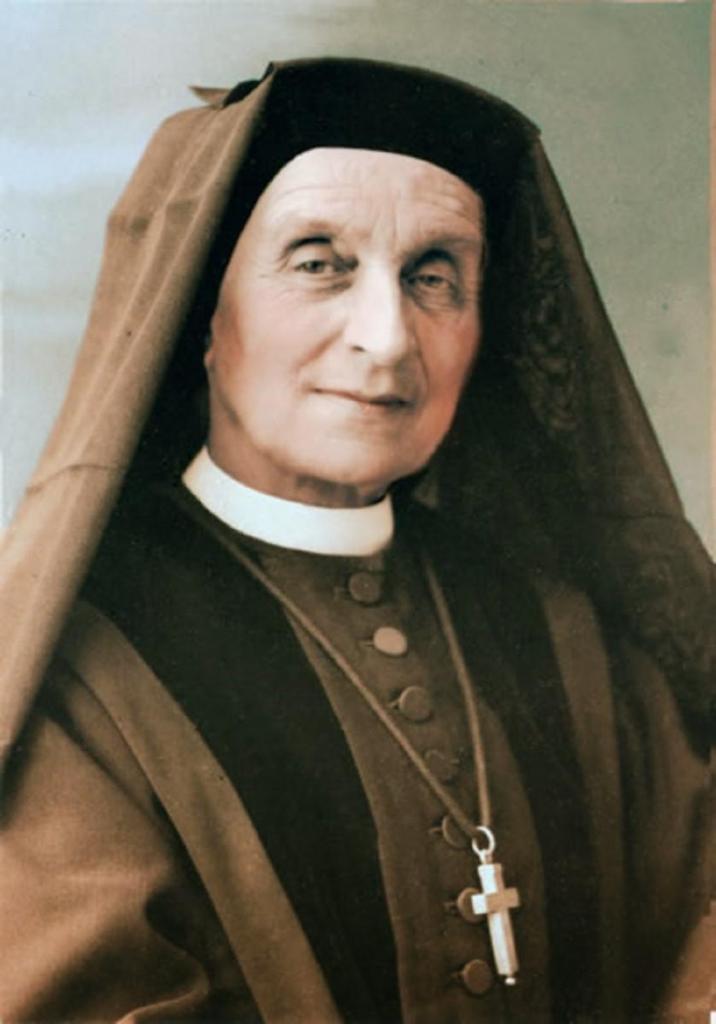
Saint of the day – 13 January – Blessed Francesco Maria Greco (1857-1931) Priest and Founder with Servant of God Raffaela De Vincentis (Sr Maria Teresa De Vincenti (1872-1936) of the Little Workers of the Sacred Hearts, Professor of Dogmatic Theology and Sacred Scripture, Apostle of Charity, devotee of Eucharistic Adoration, the Blessed Virgin and the Sacred and Immaculate Hearts.   Born on 26 July 1857 in Acri, Cosenza, Italy and died on 13 January 1931 in Acri, Cosenza, Italy of bronchitis.   Patronages – the Little Workers of the Sacred Hearts and Acri.bl francesco maria greco

Francesco Maria Greco, was born on 27 July 1857 in Acri, in what was then the Diocese of San Marco e Bisignano.   Preparing for his father’s profession, pharmacist, while still a student in Naples he felt a call to the priesthood.   At that time, while visiting the Shrine of the Blessed Virgin of the Rosary of Pompeii, still under construction, he asked for the grace of becoming “a learned priest for doing good ministry.”   He conquered the resistances of his parents and was ordained a priest in 1881.   In Acri he became arch-priest-pastor of the Church of St Nicholas, from 1888 to his death.

In the light of the Sacred Hearts of Jesus and Mary, for whom he had a special devotion, he carried out intense and fruitful pastoral work.    Living and working in Acri in the late 1800s, Fr Francesco realised that religious ignorance was the greatest problem his parishioners and townspeople face – for the less they knew about God, the further from Him they remained.   Together with his sister, Maria Teresa, he began a catechetical program to teach children, young people and adults about the Catholic faith.   The most dedicated catechist was Raffaella De Vincenti, who later became the faithful collaborator of Blessed Francisco, in the Institute’s foundation, on 21 November 1894, through her profession of the vows, of chastity, poverty and obedience, through which she received her religious name of Sister Maria Teresa of the Sacred Hearts.

Others soon followed as young women from Acri and nearby towns heard of the catechetical work to which she and Fr Francesco had devoted all their energies.   The Institute “… founded out of a spirit of charity, namely the love of God”, has as “its principal purpose catechetical instruction in parishes .”   Through its apostolic works, this Institute, gives witness to the charity of the Sacred Hearts directed in a special way to children and young people who are in need of human and Christian formation.francesco-maria-greco-1b233c6d-5f83-4994-9435-cb65fc83e45-resize-750

Always full of priestly concern for others, this blessed man founded the Caritas hospital which he entrusted to his sisters.

He also co-operated to the good performance of his diocese, making himself available to requests from Bishops, who held him in high esteem.   He taught Dogmatic Theology and Sacred Scripture in the Seminary of Bisignano and was its Rector for three years, while at the same time the fulfilling his role as pastor.   Surrounded by wide fame of holiness he fell asleep in the Lord on 13 January 1931.bl francesco maria greoc 21 may 2016

The cause of beatification began in 1960, was given in 1999 to Fr P Luca De Rosa, OFM, general Postulator.   The servant of God was declared Venerable on 19 April 2004.   On 21 January 2016, Pope Francis authorised the Congregation for the causes of Saints to promulgate the Decree of recognition of a miracle attributed to his intercession, thus allowing for his Beatification which took place on 21 May 2016.  The Beatification recognition was celebrated at Cosenza, Italy, with Cardinal Angelo Amato as the chief celebrant.   The beatification miracle involved bringing Nina Pancaro out of a coma in which she had lapsed following a severe illness and surger.   While comatose, she was visited by a dream of Father Francesco who healed her and woke her up.francesco_maria_greco2

Posted in FEASTS and SOLEMNITIES

Feast of the Baptism of the Lord – 13 Jan 2019

Feast of the Baptism of the Lord – 13 Jan 2019

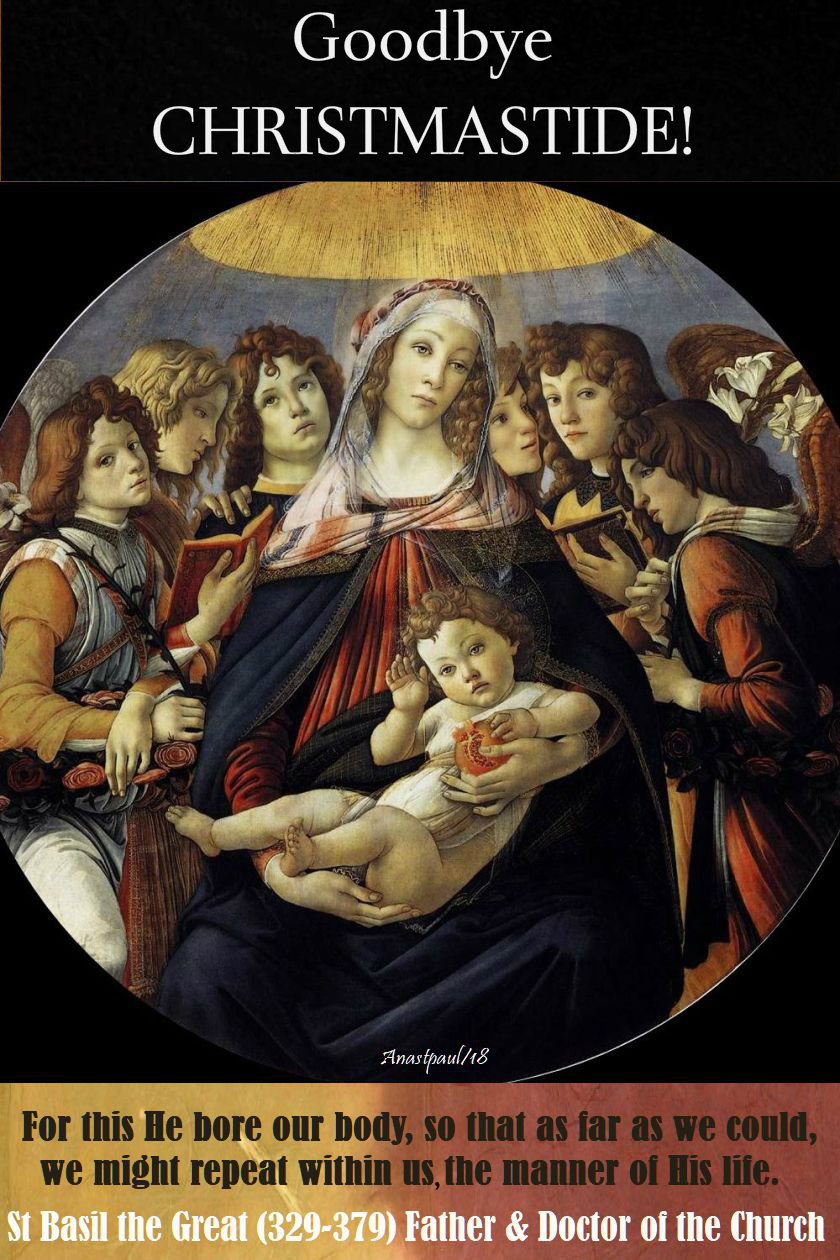
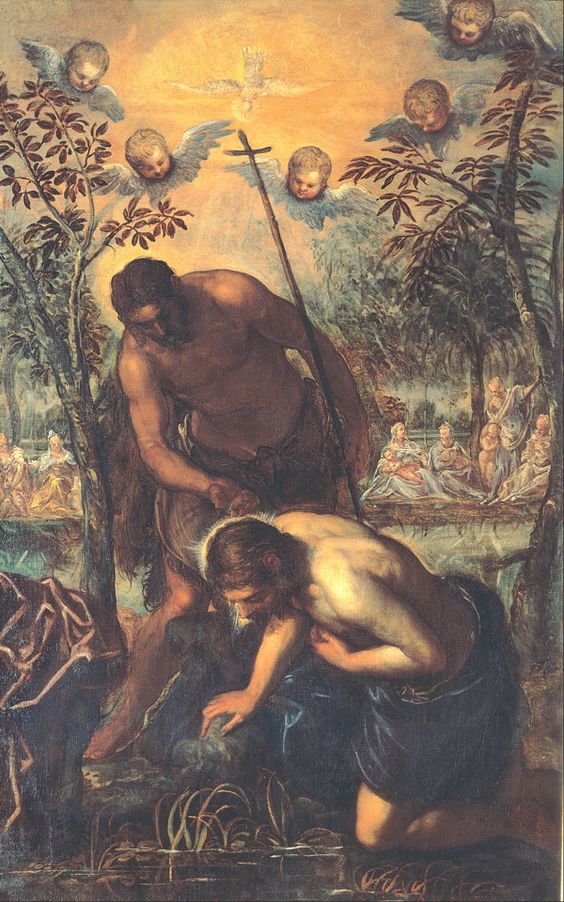
Today we celebrate the baptism of Christ in the Jordan.   This is the second epiphany, or manifestation, of the Lord.   The past, the present and the future are made manifest in this epiphany.goodbye-christmastide-13-jan-2019-for-this-he-bore-our-body-st-basil-the-great.jpg

The most holy one placed Himself among us, the unclean and sinners.   The Son of God freely humbled Himself at the hand of the Baptist.   By His baptism in the Jordan, Christ manifests His humility and dedicates Himself to the redemption of man.   He takes upon Himself the sins of the whole world and buries them in the waters of the Jordan. — The Light of the World by Benedict Baur, OSBthe-baptism-of-the-lord

The mystery of Christ’s baptism in the Jordan by St John, the Precursor, proposes the contemplation of an already adult Jesus.   This mystery is infinitely linked to the Solemnities of the Lord’s birth and the Epiphany that we have just celebrated, as in some ways it takes up and represents their significance to us.

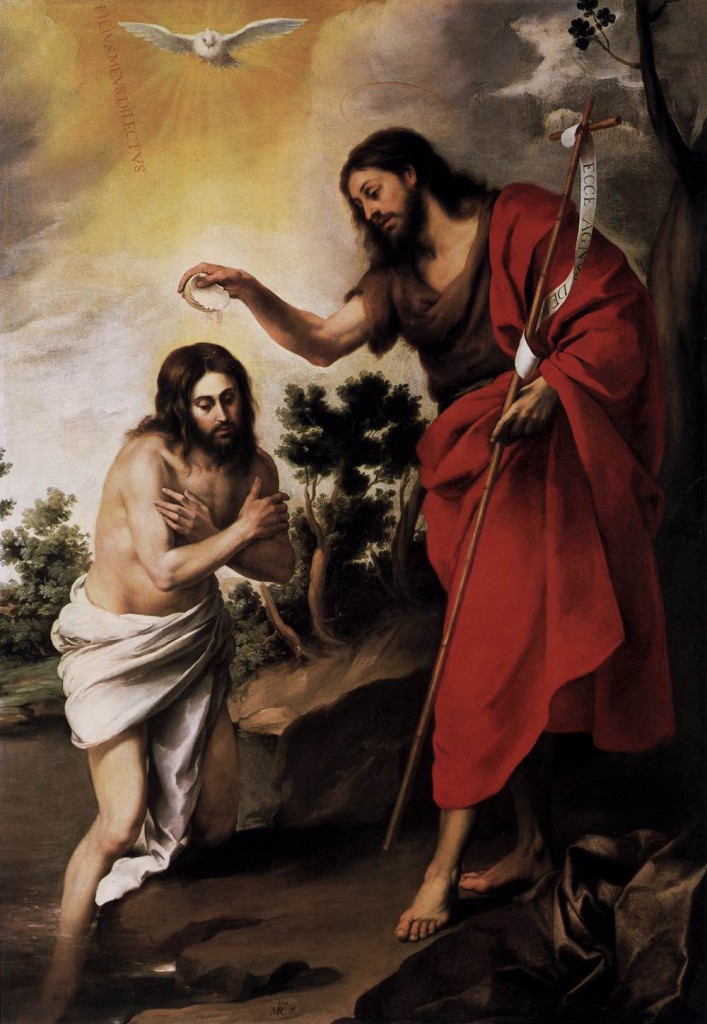
At Christmas we have contemplated the human birth of the Word incarnate by the Virgin Mary.   In the 4th century, the Fathers of the Church deepened the understanding of the faith with regard to the Christmas mystery in the light of Jesus’ Humanity.   They spoke of the Incarnation of the Word already working like the ‘Christification’ of that humanity that he had assumed from His mother.   Or put in simpler terms – Jesus is the Christ from the first instant of conception in Mary’s spotless womb because He Himself, with His Divine Power, consecrated, anointed and ‘Christified’ that human nature with which He became incarnate.baptism of the lord murillo.jpg
In the mystery of the Epiphany, we then meditated on Christ’s manifestation to all nations that was represented by the Magi, the wise men from the East, who came to adore the Child.

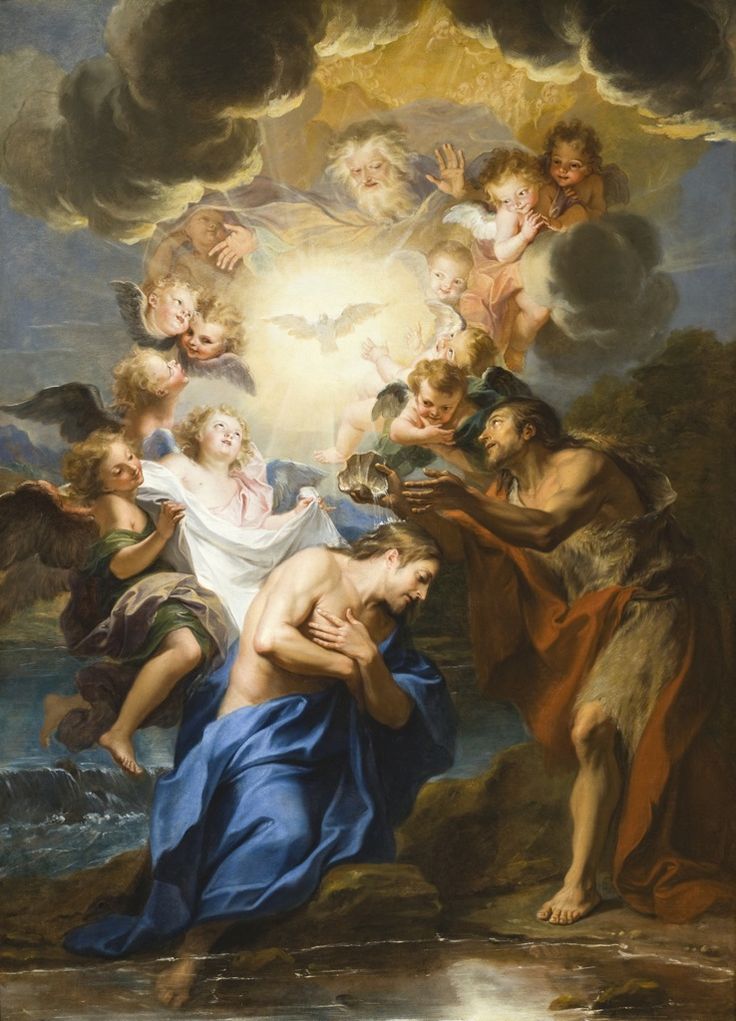
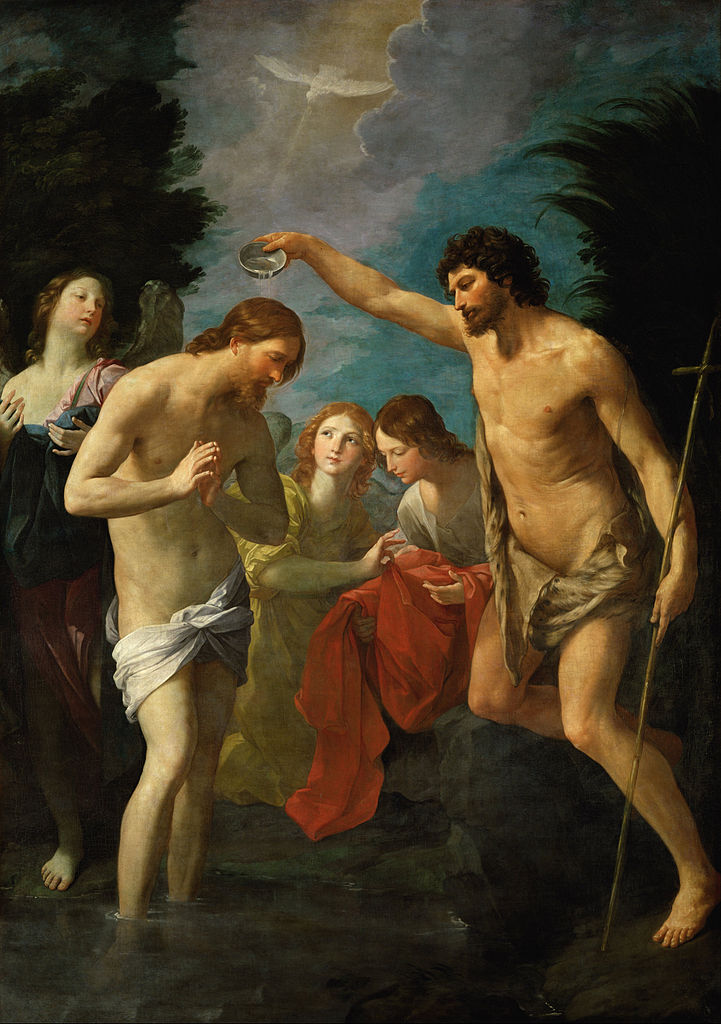
Now, in the mystery of Christ’s Baptism in the Jordan River, we again encounter and represent the truth of the Lord’s incarnation and His manifestation as the Christ.   Jesus’ Baptism is in fact His definitive manifestation as the Messiah or Christ to Israel and as the Son of the Father to the entire world.   Here we find the dimension of the Epiphany which was His manifestation to all nations.   The Father’s voice from heaven shows that Jesus of Nazareth is the eternal Son and the descent of the Holy Spirit in the form of a dove shows the Trinitarian nature of the Christian God.   The true and unique God, Father, Son and Holy Spirit, shows Himself in Christ, through Him, with Him and in Him.baptism of the lord

The Baptism in the Jordan returns to the great Christmas theme of ‘Christification,’ Jesus of Nazareth’s spiritual anointing, His presentation as the Anointed One par excellence, the Messiah or the One sent by the Father for the salvation of mankind.   The Spirit that descended on Jesus shows and seals in an incontrovertible way the ‘Christification’ of Jesus’ humanity that the Word had already fulfilled from the first moment of His miraculous conception by Mary.   Jesus, from the very beginning, was always the Lord’s Christ, He was always God.   Yet, His one, true humanity, that which is perfect in every way, as the Gospel records, constantly grew in natural and supernatural perfection.   ‘And Jesus increased in wisdom, in stature, and in favour with God and with men’ (Lk2:52).   In Israel at 30 years of age, one reached full maturity and therefore could become a master.   Jesus came of age and the Spirit, descending and remaining on Him, definitively consecrated His whole being as the Christ.721px-Guido_Reni_-_The_Baptism_of_Christ_-_Google_Art_Project.jpg
The same Spirit, that descended on the water of the River Jordan wafted over the waters during the first creation (Gen 1:2).   Therefore, the Baptism in the Jordan presents yet another truth – that Jesus has started a new creation.   He is the second man (1 Cor 15:47) or the last Adam (1 Cor 15:45), that comes to repair the first Adam’s guilt.   He does this as the Lamb of God that takes away our sins.

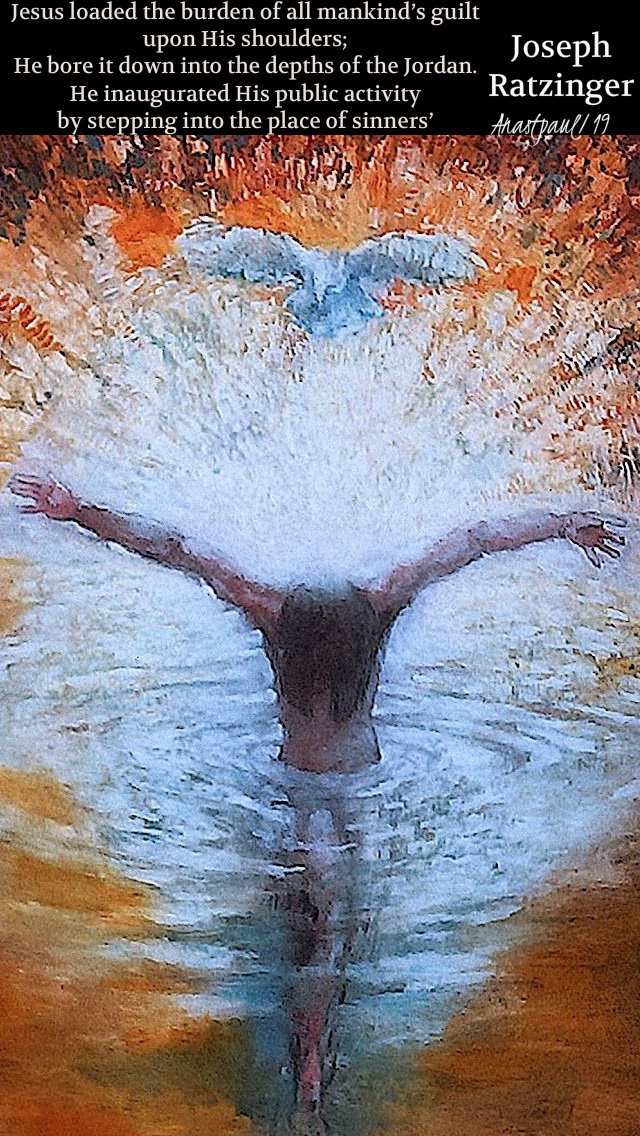
“Looking at the events in light of the Cross and Resurrection, the Christian people realised what happened – Jesus loaded the burden of all mankind’s guilt upon His shoulders;  he bore it down into the depths of the Jordan.   He inaugurated his public activity by stepping into the place of sinners”

(Joseph Ratzinger, Jesus of Nazareth).

jesus loaded the burden of all mankind's guilt - papa Benedict joseph ratzigner jesus of naz 13 jan 2019.jpg

Excerpted from the Congregation for the Clergy

Posted in FEASTS and SOLEMNITIES, SAINT of the DAY

Feast of The Baptism of the Lord – Year C (2019) & Memorials of the Saints – 13 January

Feast of The Baptism of the Lord – Year C (2019)

(This one is worth every second of viewing time!)

St Hilary of Poitiers (315-368) Doctor of the Church (Optional Memorial)
Biography: https://anastpaul.wordpress.com/2018/01/13/saint-of-the-day-13-january-st-hilary-of-poitiers-315-368-father-doctor-of-the-church/

St Agrecius of Trier
St Andrew of Trier
St Berno of Cluny
St Ðaminh Pham Trong Kham
St Designatus of Maastricht
St Elian of Brittany
St Emil Szramek
St Enogatus of Aleth
St Erbin of Cornwall
Bl Francesco Maria Greco (1857-1931)
Bl Francisca Inés Valverde González
St Giuse Pham Trong Ta
St Glaphyra
St Gumesindus of Córdoba
St Hermylus
Bl Hildemar of Arrouaise
Bl Ida of Argensolles
Bl Ivetta of Huy
St Kentigern of Glasgow
St Leontius of Caesarea
St Luca Pham Trong Thìn
Bl María Francisca Espejo y Martos
Bl Matteo de Lana
St Peter of Capitolíade
St Servusdei of Córdoba
St Stephen of Liège
St Stratonicus
Bl Veronica of Milan
St Viventius
St Vivenzio of Blera

Forty Martyred Soldiers at Rome: Forty soldiers martyred in the persecutions of Gallienus.
They werr martyred in 262 on the Via Lavicana, Rome, Italy.

Posted in PRACTISING CATHOLIC, QUOTES of the SAINTS, QUOTES on CHARITY, QUOTES on FORGIVENESS, QUOTES on LOVE, QUOTES on MERCY, QUOTES on PERSECUTION, QUOTES on SACRIFICE, QUOTES on SUFFERING, QUOTES on the CROSS of CHRIST, SAINT of the DAY, The HOLY CROSS, The PASSION

Thought for the Day – 12 January – St Aelred of Rievaulx OCSO (1110-1167)

Thought for the Day – 12 January – 6th day after Epiphany and The Memorial of St Aelred of Rievaulx OCSO (1110-1167)

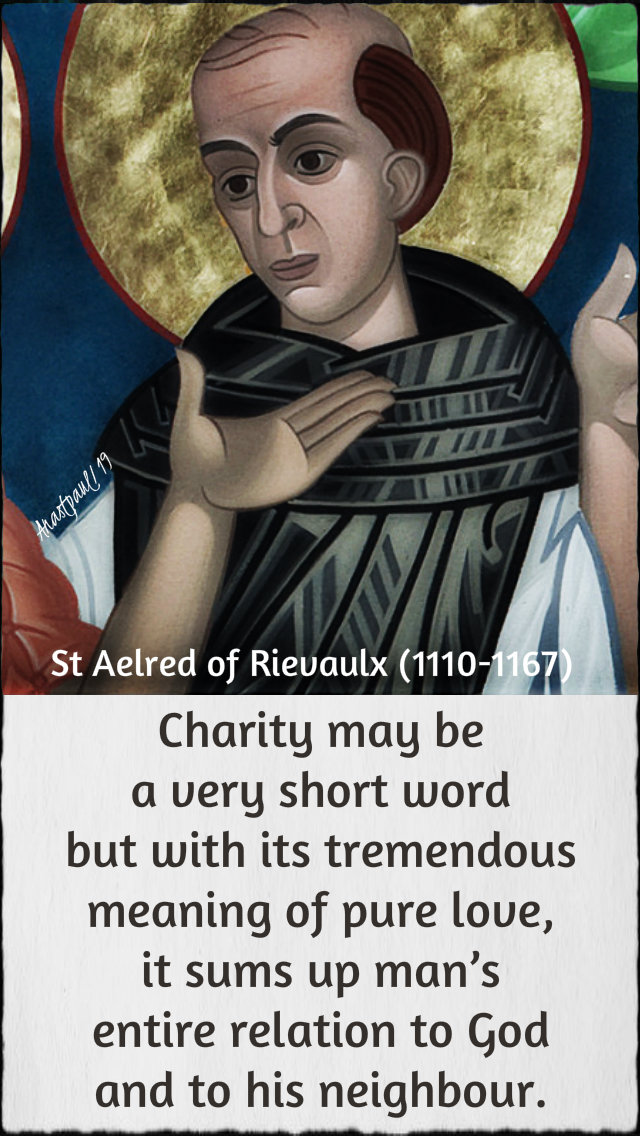
“Charity may be
a very short word
but with its tremendous
meaning of pure love,
it sums up man’s
entire relation to God
and to his neighbour.”

St Aelred of Rievaulx (1110-1167)charity may be a very short word - st aelred - 12 jan 2019

Aelred of Rievaulx on Jesus Christ as the model of brotherly love and patience through His forgiveness of persecutors and enemies and His prayer from the cross
“Father, forgive them, for they know not what they do.”

“The perfection of brotherly love lies in the love of one’s enemies.   We can find no greater inspiration for this, than grateful remembrance of the wonderful patience of Christ.   He who is more fair than all the sons of men, offered His fair face to be spat upon by sinful men;  He allowed those eyes that rule the universe to be blindfolded by wicked men;  He bared His back to the scourges;  He submitted that head which strikes terror in principalities and powers, to the sharpness of the thorns;  He gave Himself up to be mocked and reviled and, at the end, endured the cross, the nails, the lance, the gall, the vinegar, remaining always gentle, meek and full of peace.

In short, He was led like a sheep to the slaughter and like a lamb before the shearers, He kept silent and did not open His mouth.

Who could listen to that wonderful prayer, so full of warmth, of love, of unshakeable serenity – Father, forgive them – and hesitate to embrace his enemies with overflowing love?   Father, He says, forgive them!   Is any gentleness, any love, lacking in this prayer?

Yet He put into it something more.   It was not enough to pray for them – He wanted also to make excuses for them.  Father, forgive them, for they do not know what they are doing.   They are great sinners, yes but they have little judgement;  therefore, Father, forgive them.   They are nailing me to the cross but they do not know who it is that they are nailing to the cross – if they had known, they would never have crucified the Lord of glory, therefore, Father, forgive them.   They think it is a lawbreaker, an impostor claiming to be God, a seducer of the people.   I have hidden my face from them and they do not recognise my glory, therefore, Father, forgive them, for they do not know what they are doing.

If someone wishes to love himself he must not allow himself to be corrupted by indulging his sinful nature.   If he wishes to resist the promptings of his sinful nature he must enlarge the whole horizon of his love to contemplate the loving gentleness of the humanity of the Lord.   Further, if he wishes to savour the joy of brotherly love, with greater perfection and delight, he must extend even to his enemies the embrace of true love.

But if he wishes to prevent this fire of divine love from growing cold because of injuries received, let him keep the eyes of his soul always fixed on the serene patience of his beloved Lord and Saviour.”

This excerpt from the Mirror of Love by Saint Aelred of Rievaulx, abbot (Lib 3, 5: PL 195, 382) focuses on Christ as the supreme model of brotherly love, shown primarily in His love of persecutors and enemies.   It is used in the Roman Catholic Office of Readings for Friday of the 1st week in Lent with the accompanying biblical reading taken from Exodus 12: 21-36.

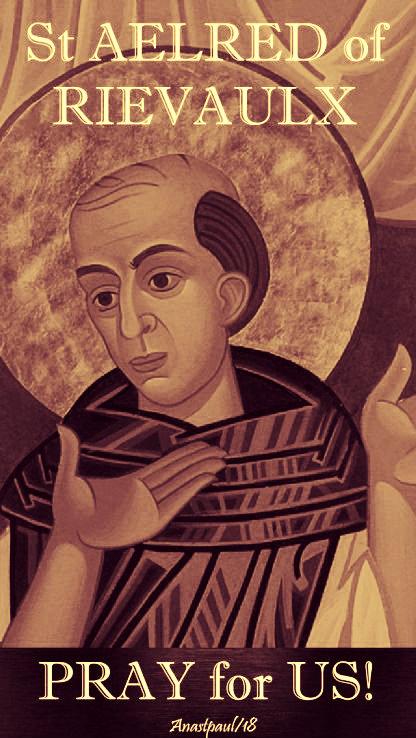
St Aelred, Pray for Us!st-aelred-pray-for-us-12-jan-2019

Posted in CHRISTMASTIDE!, MORNING Prayers, The WORD

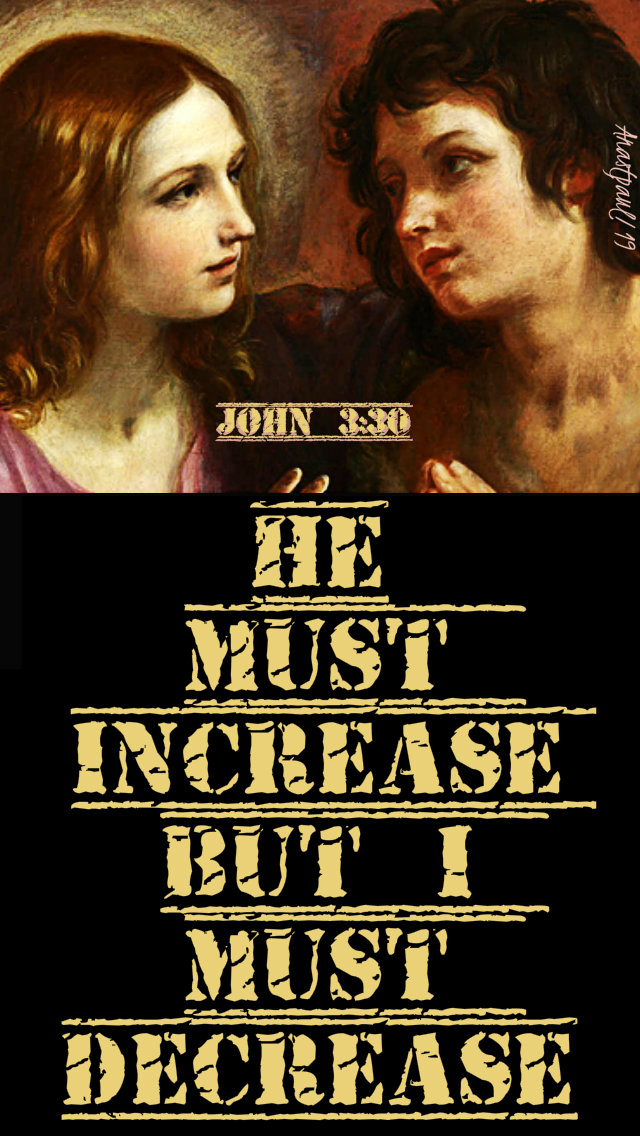
Quote of the Day – 12 January – John 3:30

Quote of the Day – 12 January – 6th day after Epiphany – Today’s Gospel: John 3:22–30

“He must increase
but I must decrease.”

John 3:30john 3 30 - he must increase 12 jan 2019 no 2.jpg

Posted in CHRISTMASTIDE!, DOCTORS of the Church, FATHERS of the Church, MORNING Prayers, QUOTES of the SAINTS, The BLESSED VIRGIN MARY, The NATIVITY of JESUS, The WORD

One Minute Reflection – 12 January – 6th day after Epiphany – Today’s Gospel: John 3:22–30

One Minute Reflection – 12 January – 6th day after Epiphany – Today’s Gospel: John 3:22–30

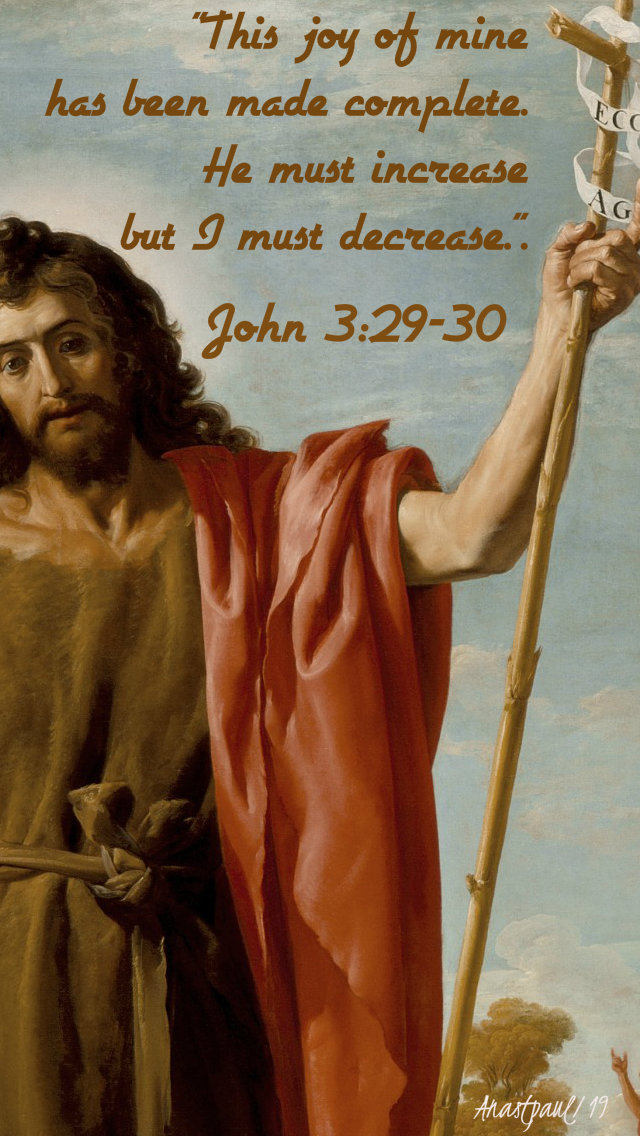
“This joy of mine has been made complete.
He must increase, but I must decrease.”…John 3:29-30this joy of mine ...he must increase - john 3 29-30 12 jan 2019

REFLECTION – “Listen, children of light: you who have been adopted for the Kingdom of God;  listen, my dearest brethren; listen and exult for joy in the Lord, you just, for “praise from the upright is fitting” (Ps 33:1).   Listen to what you already know;  reflect on what you have heard ; love what you believe; proclaim what you love!…
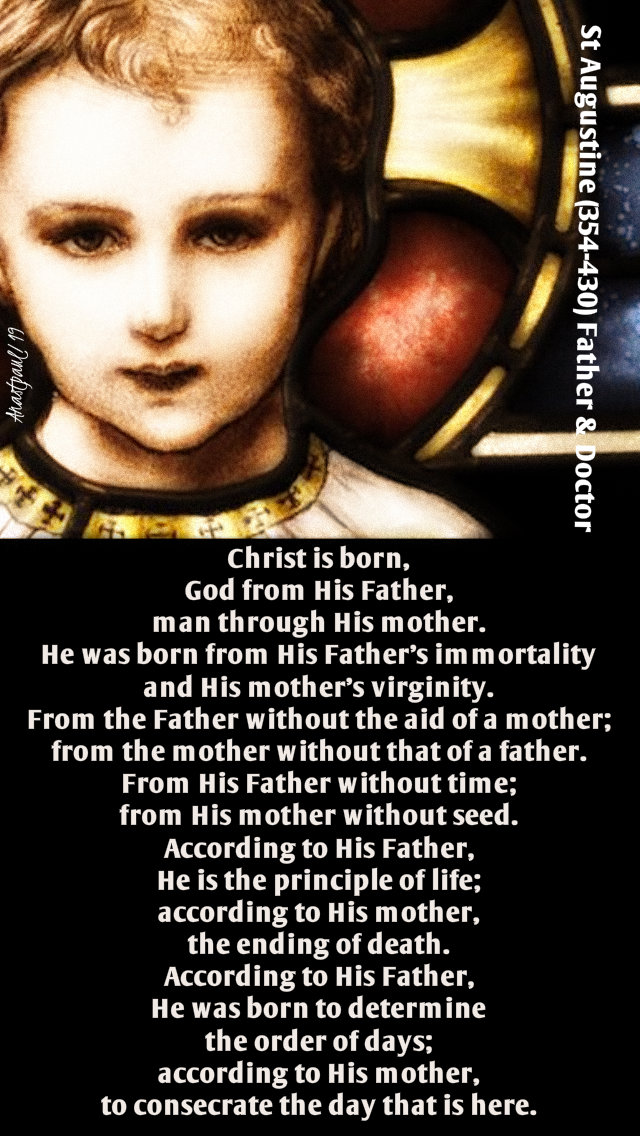
Christ is born, God from His Father, man through His mother.   He was born from His Father’s immortality and His mother’s virginity.   From the Father without the aid of a mother;  from the mother without that of a father.   From His Father without time; from His mother without seed.   According to His Father he is the principle of life; according to His mother, the ending of death.   According to His Father, He was born to determine the order of days;  according to His mother, to consecrate the day that is here.
He sent John the Baptist before Him, causing him to be born when the days were beginning to decrease, while He Himself was born when the days began to grow in length, thus prefiguring John’s own words:  “He must increase, I must decrease”.   For indeed, human life must grow weaker in itself but stronger in Jesus Christ “so that those who live might no longer live for themselves but for him who for their sake died and was raised” (2Cor 5:15) and so that each one of us might repeat those words of the apostle Paul:  “Yet I live, no longer I, but Christ lives in me” (Gal 2:20).”…St Augustine (354-430) Father & Doctorchrist is born - st augustine 12 jan 2019

PRAYER – Almighty ever-living God, through Christ Your Son, You made of us a new creation.   Shape us then, in His likeness, since in Him, our human nature now lives with You.   Grant that by the prayers of our blessed Virgin Mary and of Your holy men and women, we may be granted assistance in our struggle here below.   Through Christ our Lord, in the unity of the Holy Spirit, God for all eternity, amen.blessed virgin holy mother pray for us

Posted in Our MORNING Offering, PRAYERS of the SAINTS, SAINT of the DAY

Our Morning Offering – 12 January – Behold me, O Sweet Lord – St Aelred

Our Morning Offering – 12 January – 6th day after Epiphany and The Memorial of St Aelred of Rievaulx OCSO (1110-1167)

Behold me, O Sweet Lord, Behold me!
By St Aelred of Rievaulx

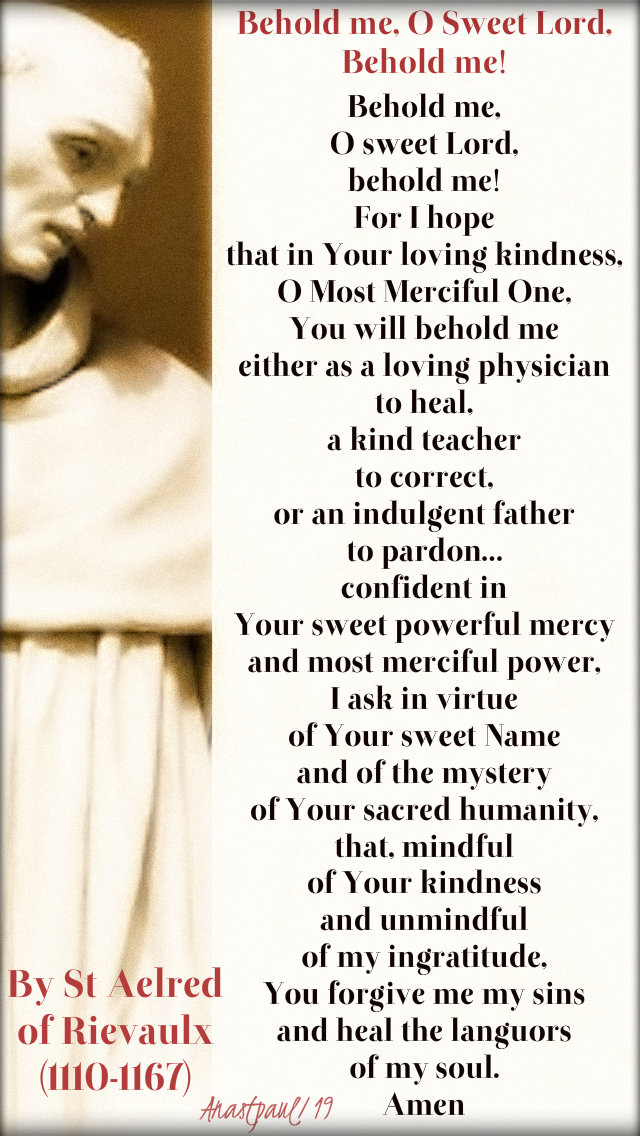
Behold me, O sweet Lord, behold me!
For I hope that in Your loving kindness,
O Most Merciful One,
You will behold me
either as a loving physician to heal,
a kind teacher to correct,
or an indulgent father to pardon…
confident in Your sweet powerful mercy
and most merciful power,
I ask in virtue of Your sweet Name
and of the mystery of Your sacred humanity,
that, mindful of Your kindness
and unmindful of my ingratitude,
You forgive me my sins
and heal the languors of my soul.
Amenbehold me o sweet lord behold me - st aelred 12 jan 2019

Posted in SAINT of the DAY

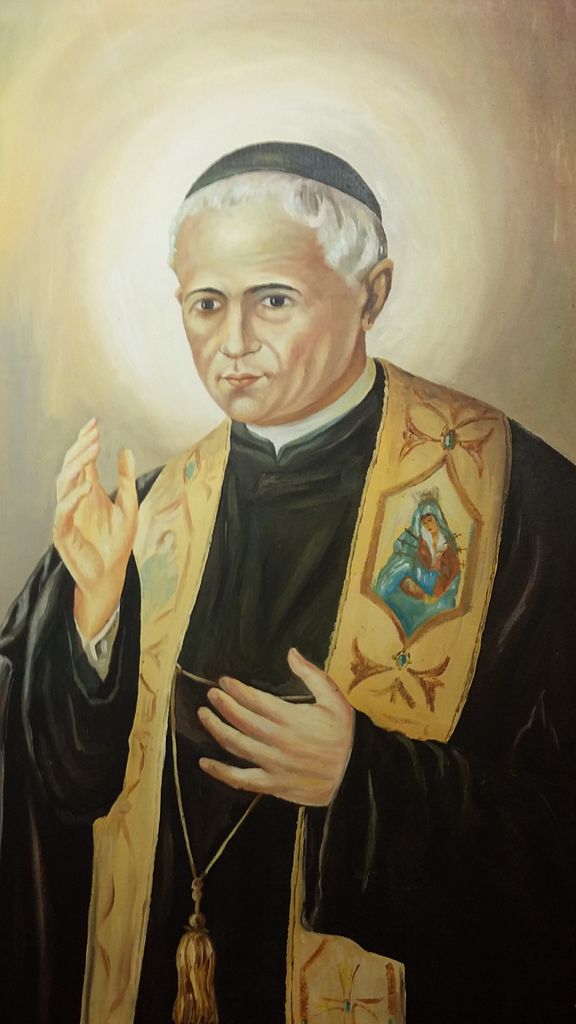
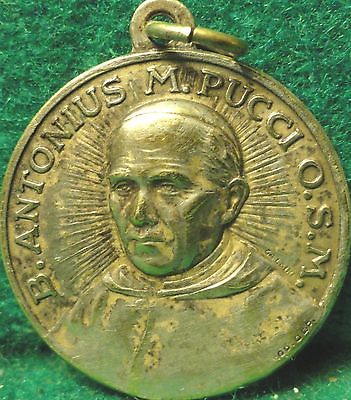
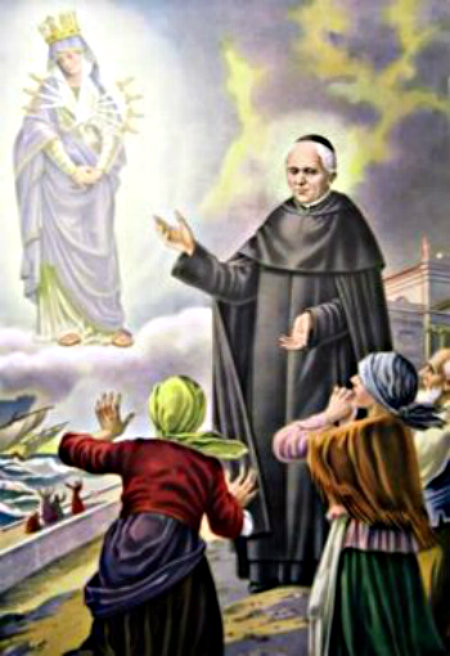
Saint of the Day – St Anthony Mary Pucci OSM (1819-1892)

Saint of the Day – St Anthony Mary Pucci OSM (1819-1892) – Religious Priest of the Servite Order, known as “the Father of the Poor”, Apostle of prayer, Mystic, Eucharistic and Marian devotee – born Eustance Pucci on 16 April 1818 in Poggiole di Vernio, Italy as Eustacchio Pucci and died on 12 January 1892 at Viareggio, Italy.

Anthony Mary Pucci was born of fine Christian parents at Poggiole, in the diocese of Pistoia, Italy, in 1819, he was the second of nine children.   After a youth marked by prayer and study, his devotion to Mary, the Mother of God, caused him to seek entrance in the Order of Servants of Mary at the age of eighteen.   He made his novitiate at Florence and studied philosophy and theology at Monte Senario for six years, where he also made his solemn profession.   In 1844, a year after his ordination to the priesthood, Anthony was sent to Viareggio as assistant pastor.   In 1847 he was named pastor and for forty-five years, until his death, he fulfilled this responsibility with great love, giving an example of a pure and fruitful life, singularly dedicated to God and his flock. Notwithstanding pastoral duties he continued his studies and in 1850 received the title of Master in Theology.sant'antonio_maria_pucci_icona

For many years Father Anthony was prior of the community in Viareggio and also prior provincial of the Tuscan Province.   This was a period of hostility between Church and civil authorities due to laws passed against religious orders and congregations.   In these offices, mindful of the words of Saint Augustine, he preferred to be loved rather than feared by his brothers and was happy to serve with love rather than exercise power.

Anthony was characterised by humility of spirit, reserve in speaking, abiding contact with God and love of poverty.   He dedicated himself completely to his priestly ministry in order to lead all to Christ; he knew his parishioners individually, he showed them fatherly love, offering them the word of God and supporting them with his advice and direction.   His charity to the needy knew no limits – he even went so far as to give a poor man the shirt off his back and because of this he was called “the Father of the Poor”.blessed-anthony-maria-pucci-now-st-mater

He was a faithful minister of the sacrament of penance, dedicating several hours a day to this work.   Of greatest importance to him was reconciling sinners to God, comforting the afflicted, forgiving those who had offended him, uniting those separated by hatred and violence, bringing peace to families, and assisting the sick and dying.   His love for others was particularly visible during the cholera epidemic of 1854-1856, when day and night, almost without rest, he worked with the sick.   God gave him many gifts, including discernment of spirits and the gift of healing.   He was seen at times in ecstasy or raised from the ground in prayer.

Father Anthony founded a congregation of Servite sisters in his parish for the education of youth and he directed them with particular concern.   He was a pioneer in establishing parish associations for young children, teenagers, men and women in order to intensify the Christian life of his community.   He promoted the St Vincent de Paul Society, recently introduced into Italy from France and the work for the Propagation of the Faith.   He founded the first permanent seaside home for the care of children.   In this work of the apostolate he was supported and animated by his great love for the Eucharist and Our Lady of Sorrows to whom he solemnly consecrated his parish.st antonio maria pucci.jpg

He was stricken with pneumonia on a winter’s day after he gave his coat to a poor man on the street.   A few days later, 12 January 1892, having received the sacraments, he died a holy death.
The entire city, including even those hostile to the Church, wept at the death of their beloved pastor.

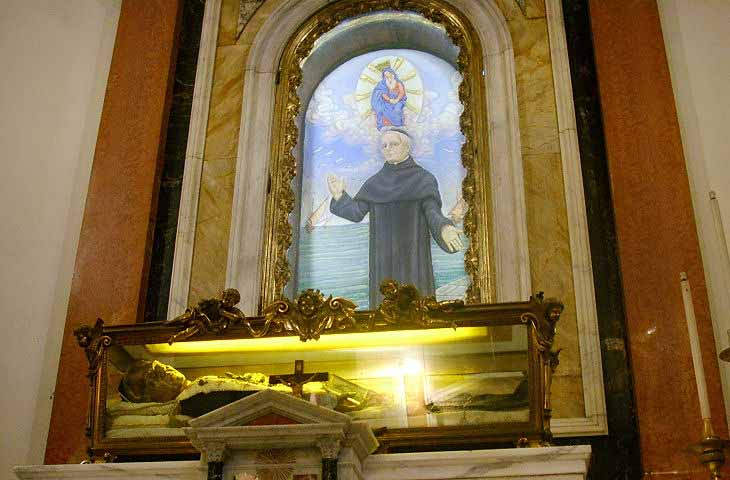
At the end of the first session of the Second Vatican Council St Pope John XXIII, on 9 December 1962, added his name to the list of saints.   The body of Saint Anthony Pucci is venerated in the Basilica of St Andrew in Viareggio, below is his tomb and a stained glass window in the Basilica.shrine st antonio maria pucci576px-viareggio,_chiesa_di_sant'andrea,_vetrata_di_sant'antonio_maria_pucci

Posted in SAINT of the DAY

Memorials of the Saints – 12 January

St Aelred of Rievaulx OCSO (1110-1167)
About St Aelred: https://anastpaul.wordpress.com/2018/01/12/saint-of-the-day-12-january-st-aelred-of-rievaulx-1110-1167-saint-bernard-of-the-north/

Bl Antoine Fournier
St Antonio Maria Pucci OSM (1819-1892)
St Arcadius of Mauretania
Bl Bartholomew Alvarez
Bl Bernardo de Plano
St Biccianus
St Benedict Biscop
St Bernard of Corleone
St Caesaria of Arles
St Caroticus
Bl Emmanuel d’Abreu
St Eutropius
St Ferreolus of Grenoble
Bl John Gaspard Cratz
St John of Ravenna
Bl Lucia of Valcaldara
St Marguerite Bourgeoys CND (1620-1700)
St Marguerite’s Biography: https://anastpaul.wordpress.com/2017/01/12/saint-of-the-day-12-january-st-marguerite-bourgeoys/

St Martinian of Belozersk
St Martin of León
Bl Nicholas Bunkerd Kitbamrung
St Peter of Abessala
Bl Pierre-François Jamet
St Probus of Verona
St Quinctus the Soldier
St Satyrus
St Tatiana of Rome
St Tigrius
St Victorian of Asana
Bl Vincent da Cunha

Martyrs of Africa – 44 saints: A group of 44 Christian soldiers murdered together for their faith in Africa. The only details that survive are four of their names – Castulus, Modestus, Rogatus and Zoticus.

Martyrs of Ephesus – 42 saints: Forty-two monks martyred at a monastery in Ephesus (modern Turkey) during the persecutions of the Iconoclast Byzantine Emperor Constantine V. Their names have not come down to us. Martyred c 762.

Martyrs of Iona – 38 saints: Thirty-eight monks martyred in Iona, Ireland. Their names have not come down to us. They were Martyred in 750 at Iona, Ireland.

Posted in CONFESSION/PENANCE, DIVINE Mercy, Goodness, Patience, QUOTES "CARPE DIEM" - Seize the Day, QUOTES of the SAINTS, QUOTES on DIVINE PROVIDENCE, QUOTES on REPENTANCE, QUOTES on TIME, QUOTES on WORRY/ANXIETY, SPEAKING of ....., The WORD

Thought for the Day – 11 January – Living the Present Moment and the Joy of Confession

Thought for the Day – 11 January – 5th day after Epiphany

Living the Present Moment and the Joy of Confession:

The Wisdom of Venerable Fulton J Sheen (1895-1979)

“All our anxieties relate to time.   A human being is the only time-conscious creature. Humans alone can bring the past to mind, so that it weighs on the present moment, with its accumulated heritage and they can also bring the future into the present, so as to imagine its occurrences as happening now.   No animal ever says: “I have suffered this pain for six years and it will last until I die.”   But, because a human being can unite the past to the present by memory and the future to the present by imagination, it is often necessary to distract him in his sufferings — to break up the continuity of misery.   All unhappiness (when there is no immediate cause for sorrow) comes from excessive concentration on the past or from extreme preoccupation with the future.   The major problems of psychiatry revolve around an analysis of the despair, pessimism, melancholy and complexes that are the inheritances of what has been or with the fears, anxieties, worries, that are the imaginings of what will be.

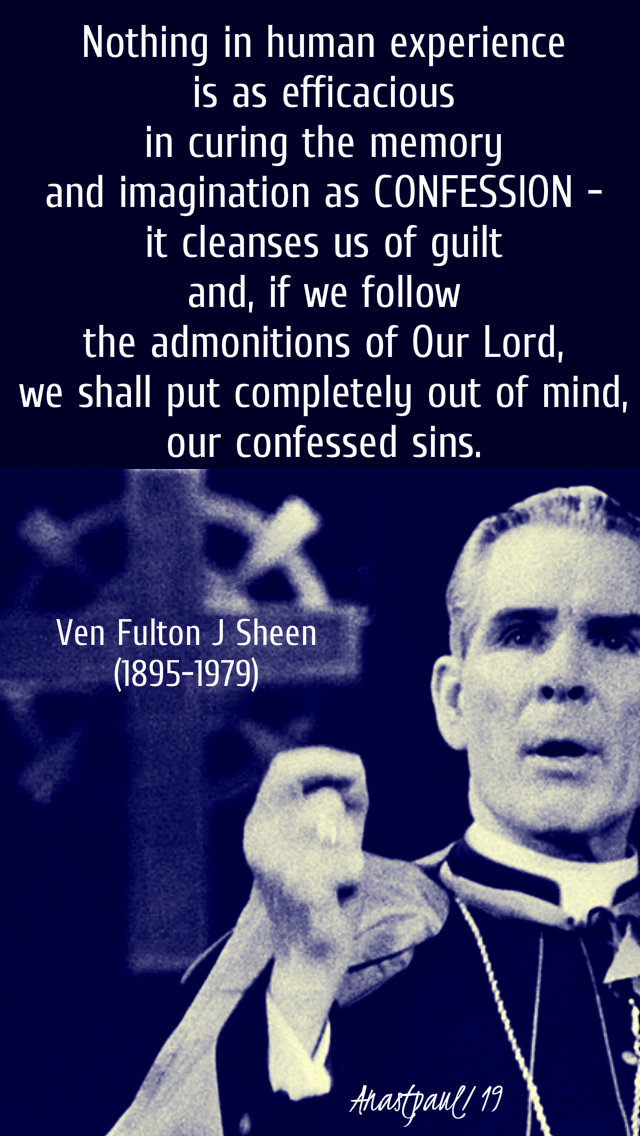
…A conscience burdened with the guilt of past sins is fearful of divine judgement.   But God in His mercy, has given us two remedies for such an unhappiness.   One is the Sacrament of Penance, which blots out the past by remission of our sins and lightens the future by our hope for divine mercy, through continued repentance and amendment of our lives.     Nothing in human experience, is as efficacious in curing the memory and imagination, as confession – it cleanses us of guilt and if we follow the admonitions of Our Lord, we shall put completely out of mind our confessed sins:  “No one who puts a hand to the plow and looks back is fit for the kingdom of God” (Lk 9:62).   Confession also heals the imagination, eliminating its anxiety for the future – for now, with Paul, the soul cries out:  “I can do all things through Him who strengthens me” (Phil 4:13).nothing in human experience - ven fulton sheen 11 jan 2019.jpg

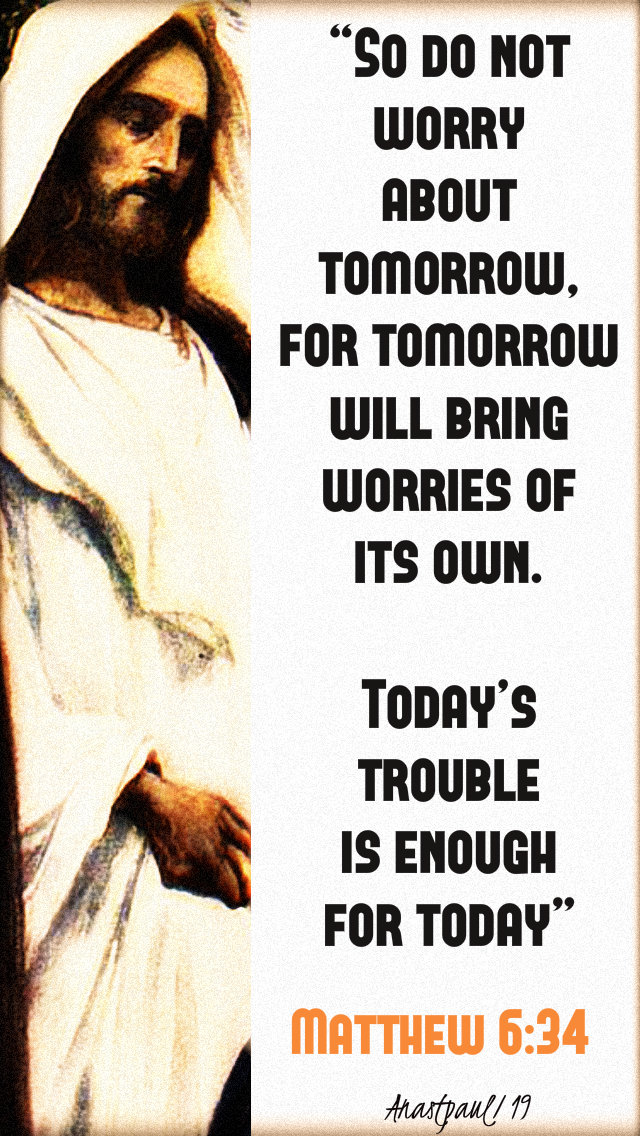
The second remedy, for the ills, that come to us from thinking about time, is what might be called the sanctification of the moment — or the Now.   Our Lord laid down the rule for us in these words:  “So do not worry about tomorrow, for tomorrow will bring worries of its own. Today’s trouble is enough for today” (Mt 6:34). so do not worry about tomorrow - matthew 6 34 11 jan 2019 - fulton sheen.jpg

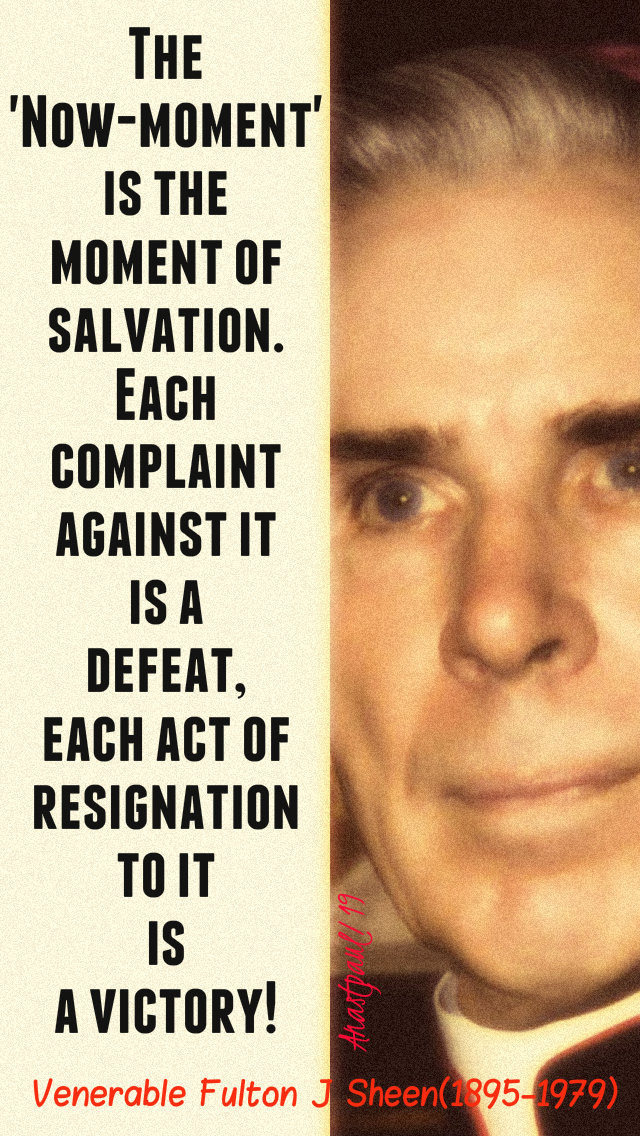
This means, that each day, has its own trials, we are not to borrow troubles from tomorrow, because that day too will have its cross.   We are to leave the past to divine mercy and to trust the future, whatever its trials, to God’s loving providence.   Each minute of life has its peculiar duty — regardless of the appearance that minute may take.   The Now-moment is the moment of salvation.   Each complaint against it is a defeat, each act of resignation to it is a victory.”the now-moment is the moment of salvation - ven fulton j sheen 11 jan 2019.jpg

Posted in DOCTORS of the Church, MORNING Prayers, QUOTES "CARPE DIEM" - Seize the Day, QUOTES of the SAINTS, QUOTES on GRATITUDE, QUOTES on WORRY/ANXIETY

Quote/s of the Day – 11 January – “Carpe Diem”

Quote/s of the Day – 11 January – 5th day after Epiphany

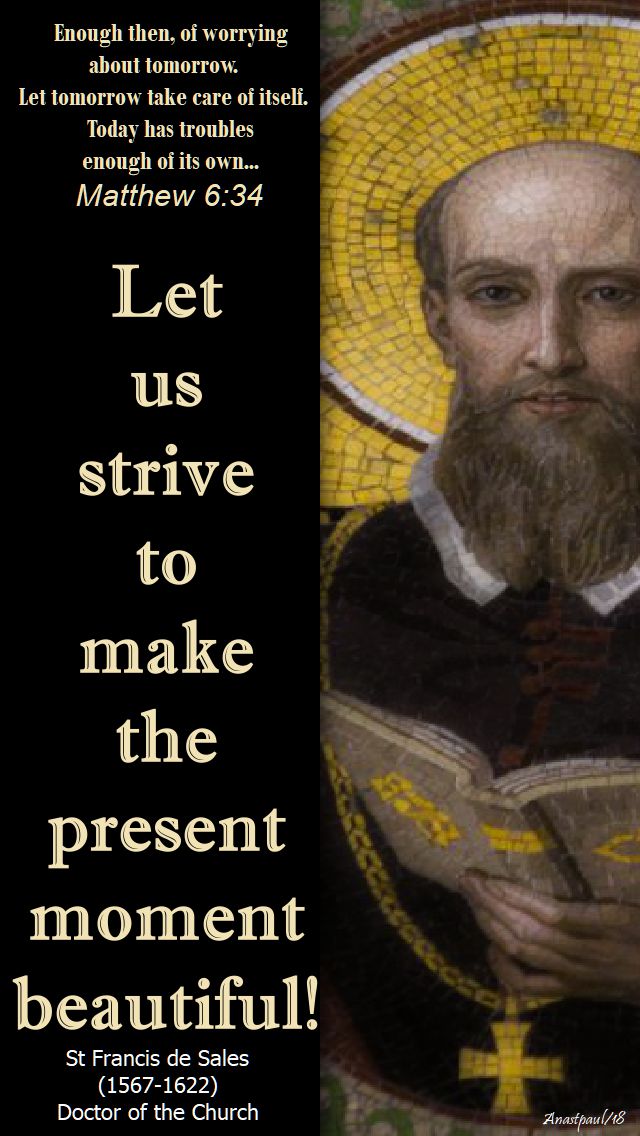
“Let us strive to make
the present moment beautiful!”

St Francis de Sales (1567-1622) Doctor of the Churchlet-us-strive-st-frances-de-sales-11-jan-2018

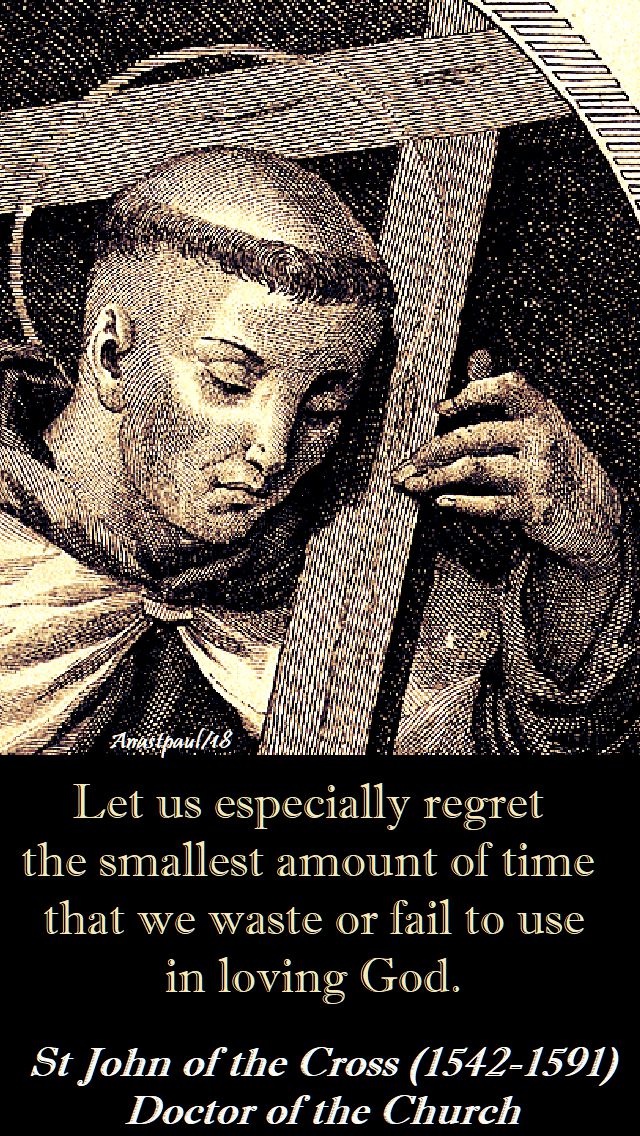
“Let us especially regret,
the smallest amount of time,
that we waste, or fail to use,
in loving God.”

St John of the Cross (1542-1591) Doctor of the Churchlet-us-especially-regret-st-john-of-the-cross-11-jan-2018

Posted in FATHERS of the Church, MORNING Prayers, QUOTES of the SAINTS, QUOTES on PRAYER, SAINT of the DAY, The WORD

One Minute Reflection – 11 January – 5th day after Epiphany – Today’s Gospel: Luke 5:12–16

One Minute Reflection – 11 January – 5th day after Epiphany – Today’s Gospel: Luke 5:12–16

But he withdrew to the wilderness and prayed…Luke 5:16

REFLECTION – “Not by words alone but also by deeds, has God taught us to pray.   He Himself prayed frequently and demonstrated what we ought to do, by the testimony of His own example.   As it is written:  “But he himself was in retirement in the desert and in prayer,” and again, “He went out into the mountain to pray and continued all night in prayer to God.”   But if He who was without sin prayed, how much more ought sinners to pray and if He prayed continually, watching through the whole night with uninterrupted petitions, how much more ought we to lie awake at night in continuing prayer!”…St Cyprian of Carthage (c 200- c 258) Bishop and Martyr, Father of the Church (The Lord’s Prayer #29)luke 5 16 but he withdrew to the wilderness - but if he who was without sin - st cyprian 11 jan 2019.jpg

PRAYER – Almighty God and Father, by the guidance of a star, You revealed the birth of the Saviour of the world and by His teachings, the way of our path to You is shown to us. Open our minds and our hearts to these revelations and let them bear fruit in our lives. Listen we pray, to the prayers of St Tommaso da Cori on our behalf, who so diligently followed Your revelationS.   Through Jesus, our Lord and Christ, with the Holy Spirit, God forever, amen.st tommaso of cori pray for us 11 jan 2019.jpg

Posted in Our MORNING Offering, PRAYERS of the SAINTS, Thomas a Kempis

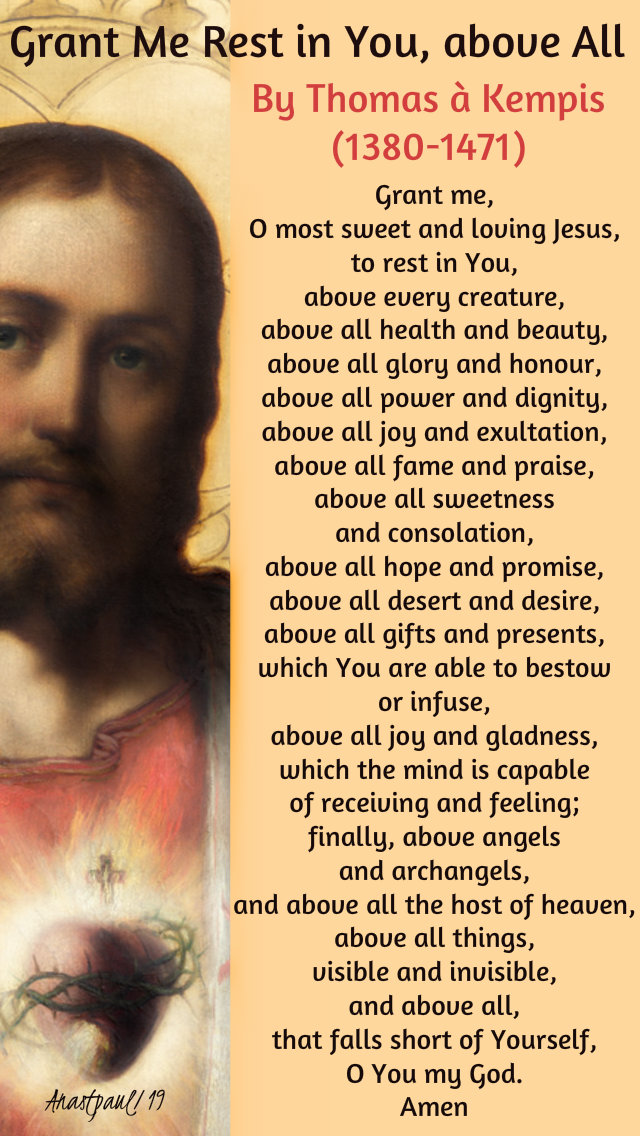
Our Morning Offering – 11 January – Grant Me Rest in You, above All – By Thomas à Kempis (1380-1471)

Our Morning Offering – 11 January – 5th day after Epiphany

Grant Me Rest in You, above All
By Thomas à Kempis (1380-1471)

Grant me, O most sweet and loving Jesus,
to rest in You, above every creature,
above all health and beauty,
above all glory and honour,
above all power and dignity,
above all joy and exultation,
above all fame and praise,
above all sweetness and consolation,
above all hope and promise,
above all desert and desire,
above all gifts and presents,
which You are able to bestow or infuse,
above all joy and gladness,
which the mind is capable of receiving and feeling;
finally, above angels and archangels,
and above all the host of heaven,
above all things, visible and invisible,
and above all,
that falls short of Yourself,
O You my God.
Amengrant me rest in you above all o Jesus - thomas a kempis 11 jan 2019.jpg

Posted in franciscan OFM, SAINT of the DAY

Saint of the Day – 11 January – St Tommaso da Cori OFM (1655-1729)

Saint of the Day – 11 January – St Tommaso da Cori OFM (1655-1729) Franciscan Friar and Priest, Preacher, Spiritual advisor, Evangeliser, Apostle of the Holy Eucharist, Prayer and Charity – known as the “Apostle of the Sublacense” – born Francesco Antonio Placidi on 4 June 1655 in Cori, Latina, Italy as Francesco Antonio Placidi and died on 11 January 1729 at Bellegra, Rome, Italy of natural causes.   Patronages – Subiaco, Province of Rome (co-patron), Preachers.119tomaso4_zpsfb73ac5d

St Tommaso was born in Cori (Latina) on 4 June 1655.   He knew a childhood marked by the premature loss first of his mother and then of his father, thus being left alone at the age of 14 to look after his younger sister.   Shepherding sheep, he learned wisdom from the simplest things.   Once his sister was married, the youth was free to follow the inspiration that for some years he had kept in the silence of his heart – to belong completely to God in the Religious Life of a Franciscan.   He had been able to get to know the Friars Minor in his own village at the St Francis convent.   Once his two sisters were settled in good marriages and he was rendered free of all other preoccupations, he was received into the Order and sent to Orvieto (PG) to fulfill his novitiate year.   After professing his vows according to the Rule of St Francis and completing his theological studies, he was ordained to the priesthood in 1683.   He was immediately nominated vice master of novices at Holy Trinity convent in Orvieto, since his superior recognised at once his gifts.

After a short time, Fr Tommaso heard of the hermitages that were beginning to bloom in the Order and the intention of the superiors of the Roman Province to inaugurate one at the convent at Civitella (today Bellegra).   His request was accepted and the young friar thus knocked at the door of the poor convent in 1684, saying, “I am Fr Tommaso of Cori and I come here to become holy!”   In speech perhaps distant from ours, he expressed his anxiousness to live the Gospel radically, after the spirit of Saint Francis.st tommaso young

From then, Fr Tommaso lived at Bellegra until death, with the exception of six years in which he was Guardian at the convent of Palombara, where he initiated the Hermitage modelled after the one at Bellegra.   He wrote the Rule first for one and then for the other, observing it scrupulously and consolidating by word and example the new institution of the two Hermitages.

The long years spent at Saint Francis of Bellegra can be summed up in three points:

Prayer:
St Tommaso of Cori was surely – as is said of St Francis – not so much a man who prayed as a man who became prayer.   This dimension animated the entire life of the founder of the Hermitage.   The most evident aspect of his spiritual life was undoubtedly the centrality of the Eucharist, as attested by St Tommaso in his celebration of the Eucharist, which was intense and attentive and in the silent prayer of adoration during the long nights at the Hermitage after the Divine Office, celebrated at midnight.   His life of prayer was marked by a persistent aridity of spirit.   The total absence of sensible consolation in prayer and in his life of union with God was protracted for a good 40 years, finding him always serene and totally in living the primacy of God.   Truly, his prayer was configured as a remembrance of God that made concretely possible a unity of life, notwithstanding his manifold activities.

Evangelisation:
St Tommaso did not close himself up in the Hermitage, forgetting the good of his brothers and sisters, and the heart of the Franciscan vocation, which is apostolic.   He was called with good reason the Apostle of Sublacense (the Subiaco region), having crossed the territory and its villages with the indefatigable proclamation of the Gospel, in the administration of the sacraments and the flowering of miracles at his passage, a sign of the presence and nearness of the Kingdom.   His preaching was clear and simple, convincing and strong.   He did not climb the most illustrious pulpits of his time, his personality was able to give its best in an ambit restricted to our territory, living his Franciscan vocation in littleness and in the concrete choice of the poorest.

Exquisite charity:
St  Tommaso of Cori was to his brothers, a very gentle father.   In the face of the resistance of some brothers before his will to reform and his radicality in living the Franciscan ideal, the Saint knew how to respond with patience and humility, even finding himself alone to mind the convent.   He had understood well that every true reform initiates itself.st tomasso of cori

The considerable correspondence left by him, demonstrates St Tommaso’ attention to the smallest expectations and needs of his Friars and of numerous friends, penitents and Friars who turned to him for his counsel.   In the convent, he demonstrated his spirit of charity in his availability for every necessity, even the most humble.

Rich in merits, he fell asleep in the Lord on 11 January 1729.   St Tommaso of Cori shines among us and in Rome, of which he is the co-patron, above all in his thirst for a Christian and Franciscan ideal that is pure and lived in its essentials.   A inspiration for all of us, not to take lightly the Gospel and its all-encompassing exigencies….Vatican.vastatua-san-tommaso-da-cori-620x639

St Tommaso’s body is enshrined in the Franciscan Chapel of Bellagra.   He was Beatified on 3 September 1786, at Saint Peter’s Basilica, by Pope Pius VI and Canonised on 21 November 1999, at Saint Peter’s Square, Vatican City by St Pope John Paul II.st tommaso body

Posted in SAINT of the DAY

Thought for the Day – 10 January – St Léonie Aviat

Thought for the Day – 10 January – 4th day after Epiphany and The Memorial of St Léonie Françoise De Sales Aviat (1844-1914) the co-founder of the Oblate Sisters of St Francis de Sales

St Pope John Paul on the Canonisation of St Léonie – 25 November 2001

“The loving plan of the Father “who has made us enter the kingdom of his beloved Son” found a splendid realisation in St Léonie Frances de Sales Aviat, who lived her self-offering to the end.

At the heart of her dedication and of her apostolate, Sister Léonie put prayer and union with God, where she found the light and the energy to overcome trials and difficulties and to persevere to the end of her life in the life of faith, desiring to be led by the Lord – “O my God, let my happiness be found in sacrificing my will and my desires for you!”   The resolution which distinguished Mother Aviat so well, “Forget oneself completely“, is also for us an appeal to go against the current of egotism and easy pleasures and open ourselves to the social and spiritual needs of our time.

Dear Oblate Sisters of St Francis-de-Sales, at the school of your foundress, in profound communion with the Church and wherever God has placed you, be determined to receive the present graces and to benefit from them, for it is in God that we find the light and the help necessary in every circumstance!

Trusting in the powerful intercession of the new saint, accept with joy the invitation to live, with renewed fidelity, the intuitions which she so perfectly lived.”

“O my God, let my happiness be found in sacrificing my will and my desires for you!”

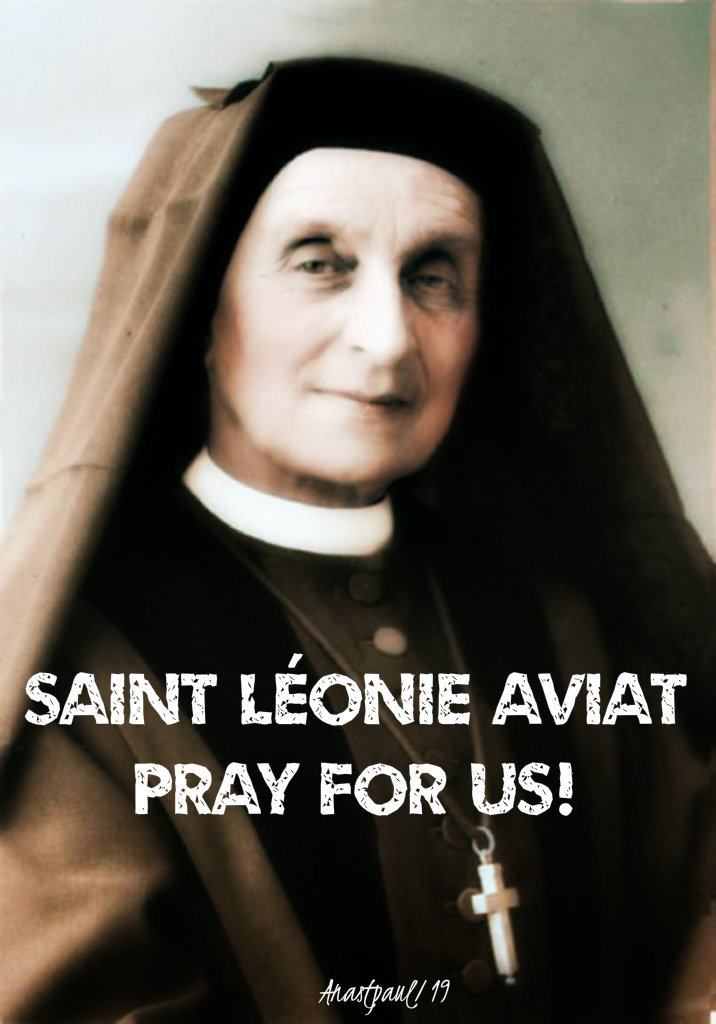
St Léonie Aviat, Pray for Us!st leonie aviat opray for us no 2 10 jan 2019

Posted in ArchAngels and Angels, EUCHARISTIC Adoration, QUOTES of the SAINTS, QUOTES on CHARITY, QUOTES on DIVINE PROVIDENCE, QUOTES on FAITH, QUOTES on GRACE, QUOTES on PERSEVERANCE, QUOTES on PRAYER, QUOTES on SACRIFICE, QUOTES on SUFFERING, QUOTES on TRUST and complete CONFIDENCE in GOD, QUOTES on WORK/LABOUR, SAINT of the DAY

Quote/s of the Day – 10 January – St Léonie Françoise De Sales Aviat OSFS (1844-1914)

Quote/s of the Day – 10 January – 4th day after Epiphany and The Memorial of St Léonie Françoise De Sales Aviat OSFS (1844-1914)

“Let us work for the happiness of others.”

let us work for the happiness of others st leonie aviat 10 jan 2019.jpg

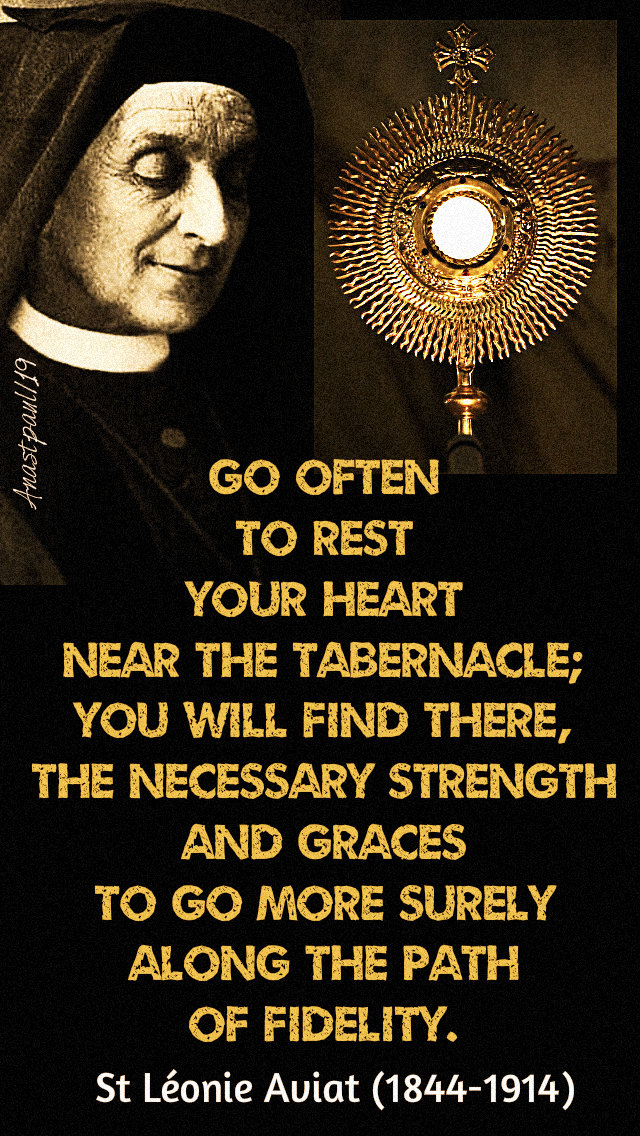
“Go often to rest your heart
near the tabernacle;
you will find there,
the necessary strength
and graces
to go more surely
along the path of fidelity.”go often to rest your heart near the tabernacle - st leonie aviat no 1 - 10 jan 2019.jpg

“God does not try us beyond our strength.
When He sends difficulty,
He adds the means of overcoming it.”god does not try us - st leonie - 10 jan 2019.jpg

“Our good Jesus always puts grace,
where He puts a sacrifice.”

“Our good Master never lets Himself
be outdone in generosity.
He gives back one hundredfold
what we sacrifice to Him.”our good Jesus, our good master - st leonie aviat - 10 jan 2019.jpg

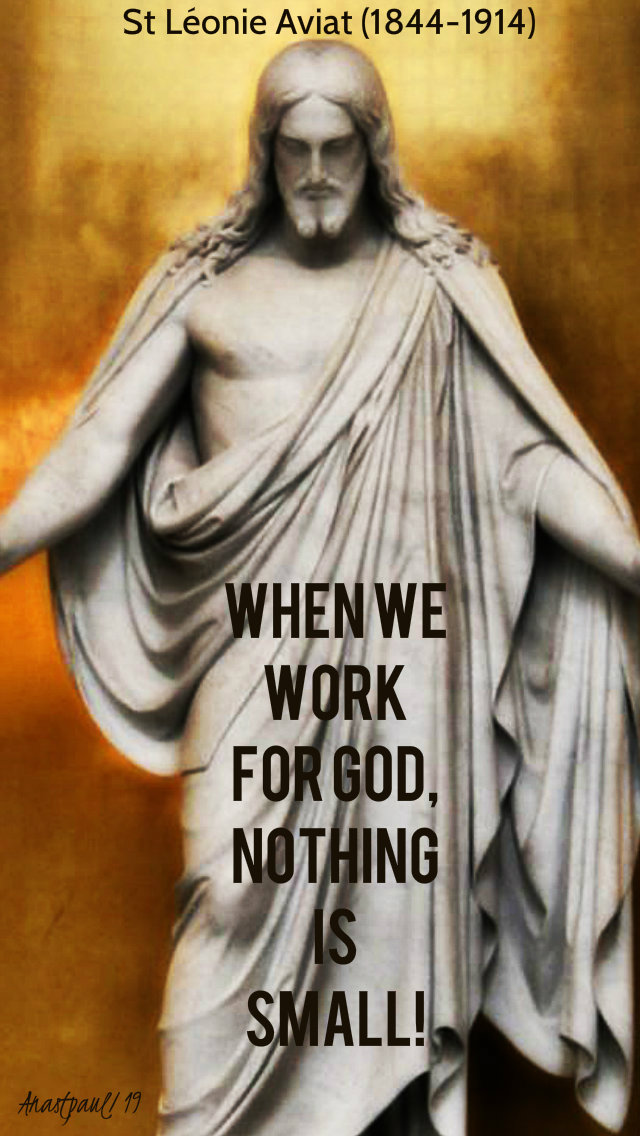
“When we work for God, nothing is small!”when we work for god nothing is small st leonie aviat 10 jan 2019.jpg

“I formed the habit
of never approaching anyone
without casting a glance at our Lord.
Try my little method –
I can assure you it is a good one.”I formed the habit of never approaching st leonie aviat 10 jan 2019.jpg

“Pray to your good angels;
use them as messengers
in your little joys and sufferings.”pray to your good angels - st leonie aviat - 10 jan 2019.jpg

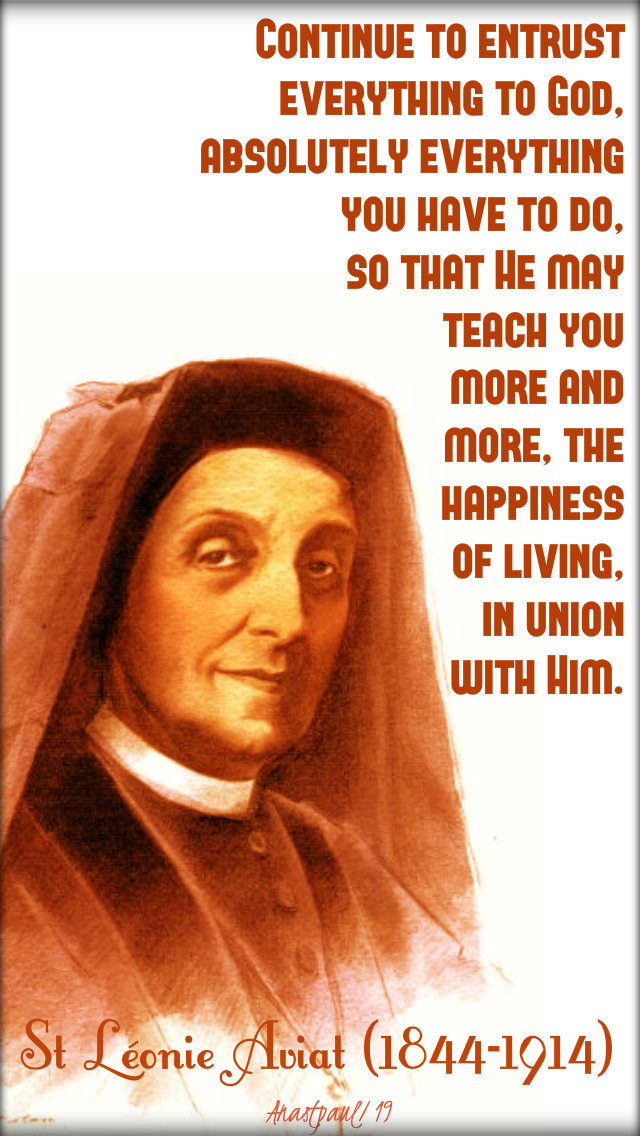
“Continue to entrust everything to God,
absolutely everything you have to do,
so that He may teach you more and more,
the happiness of living,
in union with Him.”

St Léonie Aviat (1844-1914)continue to entrust everything to god - st leonie aviat 10 jan 2019.jpg

Posted in MORNING Prayers, SAINT of the DAY, The WORD

One Minute Reflection – 10 January – 4th day after Epiphany:  Gospel Luke 4:14–22

One Minute Reflection – 10 January – 4th day after Epiphany:  Gospel  Luke 4:14–22 and The Memorial of St Léonie Françoise De Sales Aviat (1844-1914)

“The Spirit of the Lord is upon me,
because he has anointed me to preach good news to the poor.
He has sent me to proclaim release to the captives
and recovering of sight to the blind,
to set at liberty those who are oppressed...” Luke 4:18the spirit of the lord - luke 4 18-10 jan 2019

REFLECTION – “Evangelising the poor – this is Jesus’ mission.   According to what He says, this is also the mission of the Church and of every person baptised in the Church. Being a Christian is the same thing as being a missionary.   Proclaiming the Gospel with one’s word and even before, with one’s life, is the primary aim of the Christian community and of each of its members.  It is noted here that Jesus addresses the Good News to all, excluding no one, indeed favouring those who are distant, suffering sick, cast out by society.”...Pope Francis – Angelus, 24 January 2016being a christian is the same thing - pope francis - 10 jan 2019

PRAYER – Through Your Son, Lord God, You shed Your eternal light on all mankind.   You gave us our mission, You taught us our way.   Grant us the grace to acknowledge the full splendour of our Redeemer, so that, in His steps, we may grow from strength to strength in evangelising all.   Fill us with Your Spirit to enlighten and guide us.   May the intercession of St Léonie Françoise De Sales Aviat, who followed our Saviour and imitated Him, help us in our mission.   Through our Lord Jesus Christ, in union with the Holy Spirit, God forever, amen.st leonie aviat pray for us 10 jan 2019

Posted in DOCTORS of the Church, Our MORNING Offering, PRAYERS of the SAINTS, SAINT of the DAY

Our Morning Offering – 10 January – The Memorial of St Léonie Françoise De Sales Aviat

Our Morning Offering – 10 January – 4th day after Epiphany and The Memorial of St Léonie Françoise De Sales Aviat (1844-1914) the co-founder of the Oblate Sisters of St Francis de Sales

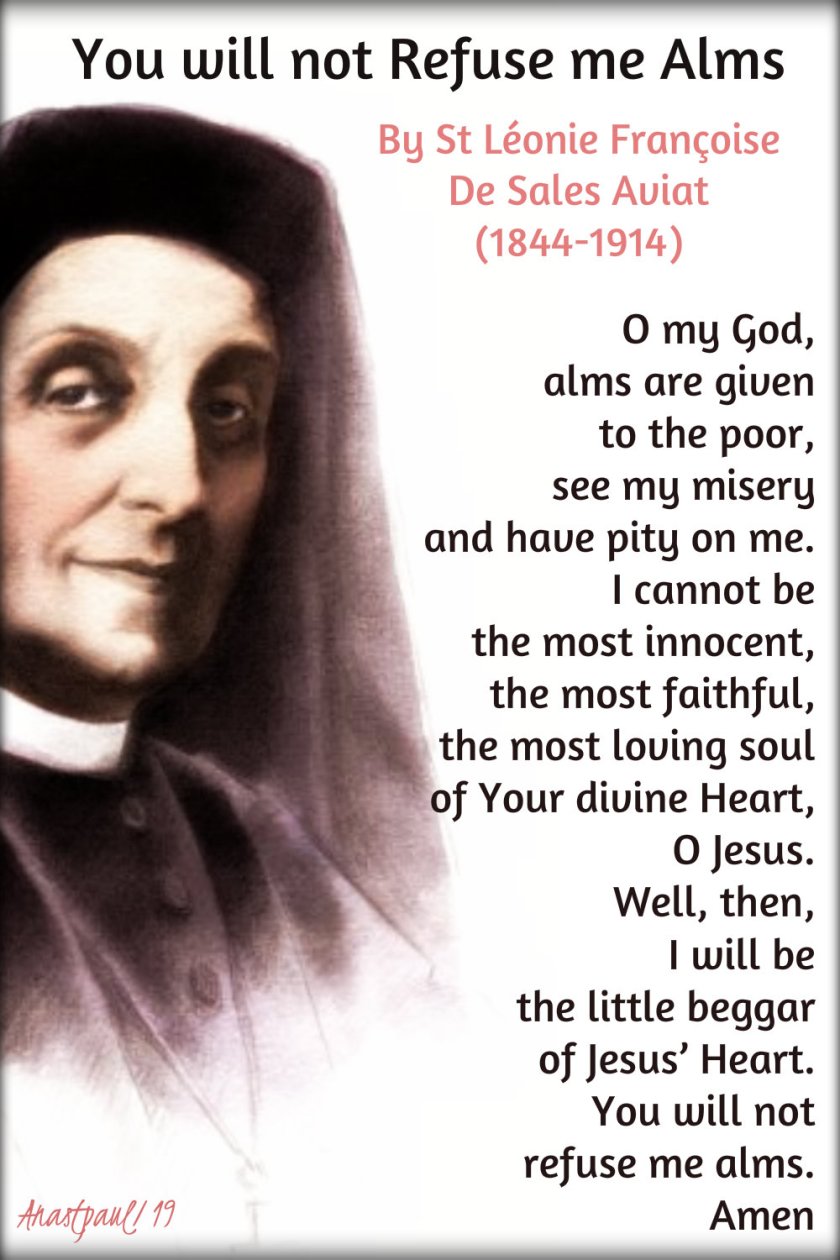
You will not Refuse me Alms (The Little Beggar of Jesus’ Heart)
By St Léonie Françoise De Sales Aviat (1844-1914)

O my God,
alms are given to the poor,
see my misery and have pity on me.
I cannot be the most innocent,
the most faithful,
the most loving soul of Your divine Heart, O Jesus.
Well, then,
I will be the little beggar of Jesus’ Heart.
You will not refuse me alms.
Amenyou will not refuse me alms - st leonie aviat 10 jan 2019

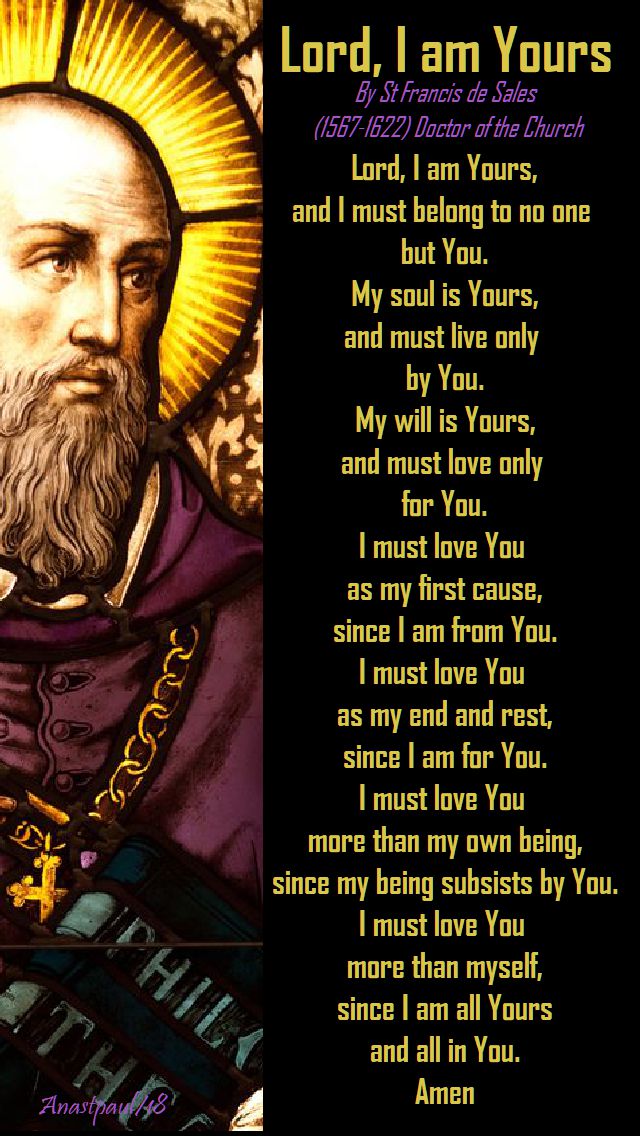
Lord I am Yours
By St Francis de Sales (1567-1622) Doctor of the Church

Lord, I am Yours,
and I must belong to no one but You.
My soul is Yours,
and must live only by You.
My will is Yours,
and must love only for You.
I must love You as my first cause,
since I am from You.
I must love You as my end and rest,
since I am for You.
I must love You more than my own being,
since my being subsists by You.
I must love You more than myself,
since I am all Yours and all in You.
Amenlord, i am yours by st francis de sales - 28 july 2018

Posted in SAINT of the DAY

Saint of the Day – 10 January – St Léonie Françoise De Sales Aviat (1844-1914)

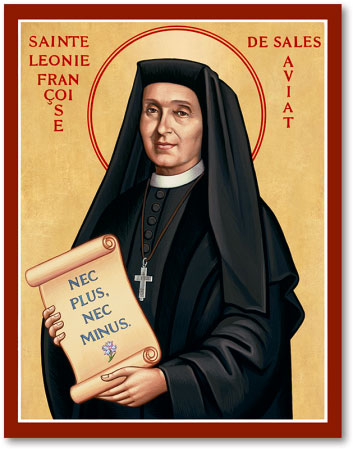
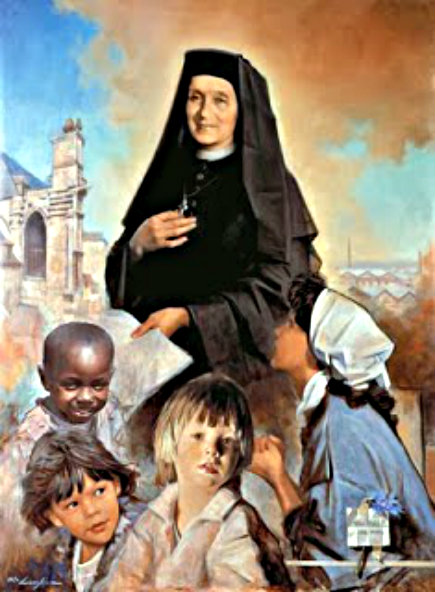
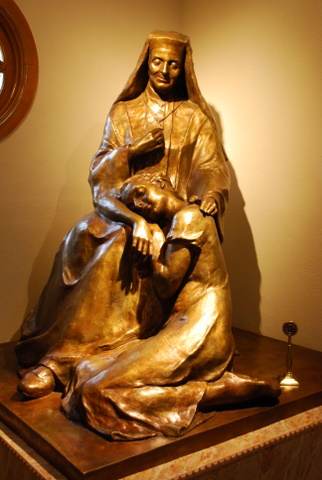
Saint of the Day – 10 January – St Léonie Françoise De Sales Aviat (1844-1914) was a professed religious and the co-founder of the Oblate Sisters of St Francis de Sales alongside Blessed Louis Brisson (1817–1908), Teacher, Apostle of Eucharistic Adoration, Prayer and Charity.  Born in Sézanne, France on 16 September 1844 and died on 10 January 1914 (aged 69) in Perugia, Italy, she was baptised on 17 September in the local parish church.    Patronages – Oblate Sisters of St Francis de Sales, Marne, Aube, Sézanne, Teachers.st leonie aviat

Léonie Aviat was born in Sézanne, in the region of Champagne (France) on 16 September 1844.   She attended school at the Monastery of the Visitation in the city of Troyes, where Mother Marie de Sales Chappuis, the superior and Father Louis Brisson, the chaplain, exerted a decisive influence on her.   Having thus been formed at the school of St Francis de Sales, she prepared herself for the mission with which she was to be entrusted – the foundation of a Congregation committed to the Salesian spirituality and to the evangelisation of young workers.santa_francesca_salesia-leonia_aviat-a

The beginnings came in the year 1866.   This was the time when large industrial concerns were attracting an underpaid labour force to the cities.   This was also the case in the city of Troyes, where textile mills engaged young girls of rural extraction.   Father Brisson, a zealous apostle and already one of the forerunners of the great social movement that developed at the end of the 19th century, had opened a centre, in 1858, to welcome young girls working in the textile mills in order to give them a complete education, both human and Christian.   Unable to find a suitable directress and a stable supervisory staff for this centre, known as the “Workers of Saint-François de Sales”, with God’s inspiration, he decided to establish a religious congregation.   He found in Léonie Aviat an incomparable co-worker, in whom he discerned a vocation to the consecrated life as well.   Indeed, upon completing her studies, the young lady left the Visitation monastery with the firm intention of returning to it as a lay Sister.   But Father Brisson and Mother Chappuis advised her to wait.   Obedient to what she regarded as God’s will, she received a special sign from Him a little later, one that couldn’t be mistaken for an illusion – obliged to go to the factory, where glasses were manufactured and repaired, in Sézanne, her native city, an inspiration enlightened her mind and guided her decision.   The sight of the workroom filled with young factory workers busily engaged in their work beneath the watchful and maternal gaze of a supervisor aroused in her heart the desire to take her place among them in order to counsel and guide them.   This attraction would press her even more strongly the day that Father Brisson invited her to visit the “Workers of Saint-François de Sales” which he had founded in Troyes.

On 18 April 1866, she joined the “Oeuvre (Workers of) Saint-François de Sales”, with one of her former classmates of the Visitation, Lucie Canuet.st-leonie-aviat-icon-390

On 30 October 1868, the young foundress was clothed with the religious habit and received the name of Sister Françoise de Sales.   This name was a sign indicating what would be her life’s work, as she herself expressed it in the form of a prayer in her personal notes:  “St Francis de Sales, you have chosen me to be at the head of this little group;  give me your spirit, your heart…  Grant me a share of your union with God and of that interior spirit which knows how to do everything in union with Him and nothing without Him” (August, 1871).   The “little group” which she guided placed itself under the protection of the saintly Bishop of Geneva and completely adopted his method of spirituality and of pedagogy, hence, the name that it chose for itself – the “Oblate Sisters of St Francis de Sales”, which means offered to God and to the neighbour by means of their whole life.

On 11 October 1871, Sister Françoise de Sales professed her vows and the following year, she was elected Superior General of the new Congregation which was thus canonically established and able to expand rapidly.   Under her guidance, the community grew in numbers and the social apostolate developed.   At the same time, grade schools were opened in parishes and in Paris the first boarding school for young ladies was also opened, an establishment which Mother Aviat directed for eight years.   The apostolate of the Oblate Sisters thus extended to the different classes of society and to all forms of education and, from the very first years of its foundation, to the missions to the nations, as well.santa_leonie_aviat

In 1893, after a period of effacement which brought to light her humility, Mother Françoise de Sales was again elected Superior General, an office she held until her death. During this time, she endeavoured to develop the apostolate of the Congregation in Europe, South Africa and Ecuador, while lavishing her untiring solicitude on every community and on each of her Sisters.   In 1903, she had to cope with the persecution directed against religious orders in France.   While maintaining the houses of her Congregation that could be maintained in France, she transferred the Mother House to Perugia, Italy.   In 1911, she secured the final approbation of the Constitutions of the Institute from Pope St Pius X.Mother_Françoise_de_Sales_Aviat (1).jpg

On 10 January 1914, she died in Perugia with serenity, totally entrusting herself to God. To the very end, she remained faithful to the resolution made at the time of her Profession:  “To forget myself entirely”.   To her daughters in every age, she left this very Salesian precept:  “Let us work for the happiness of others”.snip st leonia aviat

The beatification miracle came from Cape Town in South Africa and concerned the January 1976 healing of Vincent Kesner who was a child stricken with cancer that had been deemed incurable.   The canonisation miracle concerned the cure of Bernadette McKenzie (aged fourteen) from Philadelphia in the United States of America from paralysing spinal disease.

Léonie was Beatified on 27 September 1992, at St Peter’s and Canonised on 25 November 2001, also at St Peter’s and on both occasions by St Pope John Paul II.- good lg image of st francisca_de_sale_aviat_leonia_-_10_de_enero.jpgstleonie

Posted in SAINT of the DAY

Memorials of the Saints -10 January

St Aldo of Carbonari
St Pope Agatho
Bl Anna of the Angels Monteagudo
St Arcontius of Viviers
Bl Benincasa of Cava
St Dermot of Inis Clothrann
St Domitian of Melitene
Bl Pope Gregory X
Bl Giles of Lorenzana
St Léonie Aviat/Françoise de Sales OSFS (1844-1914)
St Marcian of Constantinople
Bl Maria Dolores Rodríguez Sopeña y Ortega
St Maurilius of Cahors
St Nicanor of Cyprus
St Paul the Hermit
St Peter Orseolo O.S.B. Cam. (928–987)

About St Peter – https://anastpaul.wordpress.com/2018/01/10/saint-of-the-day-10-january-st-peter-orseolo-o-s-b-cam-928-987/

St Petronius of Die
Bl Raymond de Fosso
St Saethryth of Faremoutier
St Thecla of Lentini
St Thomian of Armagh
St Valerius of Limoges
St William of Bourges

Posted in SAINT of the DAY

Saints of the Day – Sts Julian and Basilissa (died c 304) – Martyrs

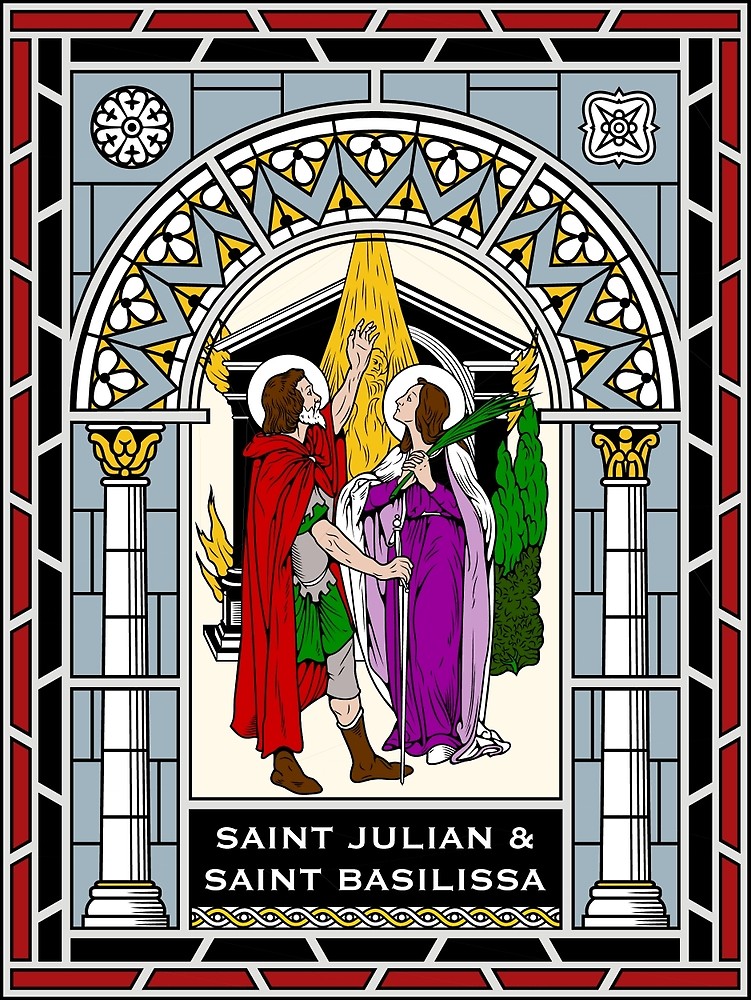
Saints of the Day – Sts Julian and Basilissa (died c 304) – Martyrs – Julian and Basilissa were husband and wife.   They were Christian martyrs who died at either Antioch or, more probably, at Antinoe, in the reign of Diocletian, early in the fourth century.

Forced by his family to marry, Julian, agreed with his spouse, Basilissa, that they should both preserve their virginity and further encouraged her to found a convent for women, of which she became the superior, while he himself gathered a large number of monks and undertook their direction.   The two converted their home into a hospital which could house up to 1,000 people (thus, Julian is often confused with Julian the Hospitaller). There, they worked tirelessly, using their own funds, to assist the poor, the sick, the needy.  Basilissa attended those of her sex, in separate lodgings from the men, these were taken care of by Julian, who from his charity is named the Hospitalarian.   Egypt, where they lived, had then begun to abound with examples of persons who, either in the cities or in the deserts, devoted themselves to the most perfect exercises of charity, penance, and mortification.  sts julian and basilissa

Basilissa, after having stood severe persecutions, died in peace.   Julian survived her many years but was martyred, (together with Celsus a youth, Antony a priest, Anastatius and Marcianilla the mother of Celsus) under the Persecutions of Diocletian.

During the persecution of Diocletian he was arrested, tortured and put to death at Antioch, in Syria, by the order of the governor, Martian, according to the Latins, at Antinoe, in Egypt, according to the Greeks, which seems more probable.   Celsus, the young son of Marcionilla, was martyred along with Julian.   The priest Anthony (Antony) was martyred at the same time, as well as a convert and neophyte named Anastasius. Marcionilla’s seven brothers are also said to have been killed.

In any case, these two saints must have enjoyed a great reputation in antiquity and their veneration was well established before the eighth century.   Only a fragment of Ælfric’s Passion of St Julian and His Wife Basilissa from his Lives of the Saints has survived but the traditional legend is there – the two saints vow not to consummate their marriage on their wedding night and devote themselves to chastity.   Julian suffers martyrdom by beheading.

Many churches and hospitals especially in the West, bear the name of one or other of these martyrs.   Four churches at Rome and three out of five at Paris, which bear the name of St Julian, were originally dedicated under the name of St Julian, the Hospitalarian and martyr.

In the time of St Gregory the Great, the skull of St Julian was brought out of the East into France and given to Queen Brunehault, who gave it to the nunnery which she founded at Étampes. Part of it is at present in the monastery of Morigny, near Étampes and part in the church of the regular canonesses of St Basilissa at Paris.

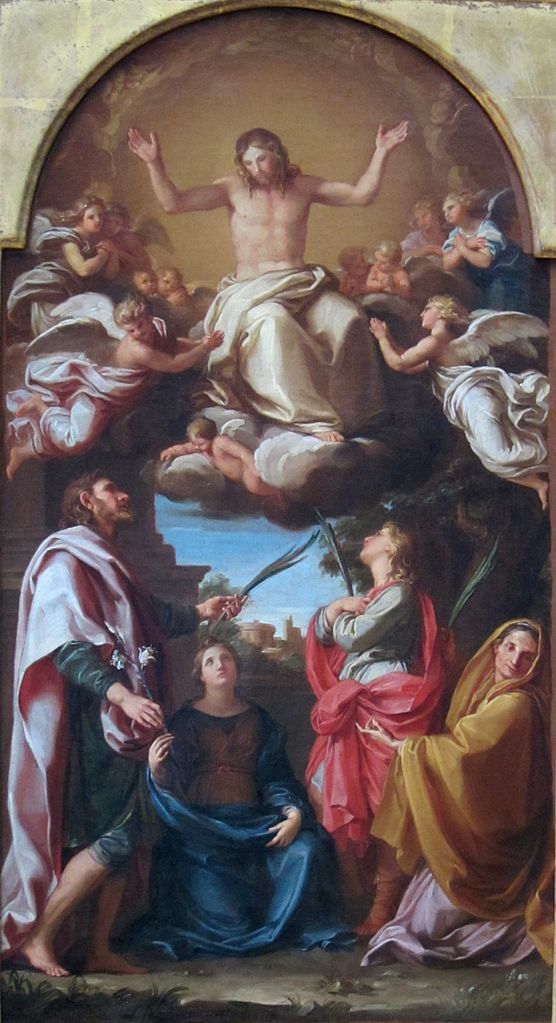
556px-Basilissa_Julian.jpg
Christ with Saints Julian and Basilissa, Celsus and Marcionilla, Pompeo Batoni, 1736-8.
Posted in CHRISTMASTIDE!, MORNING Prayers, PAPAL SERMONS, The NATIVITY of JESUS

Thought for the Day – 9 January – 3rd Day after Epiphany

Thought for the Day – 9 January – 3rd Day after Epiphany

Excerpt from Pope Francis’ Homily for the Solemnity of the Epiphany of the Lord, celebrated 6 January 2019, in St Peter’s Basilica

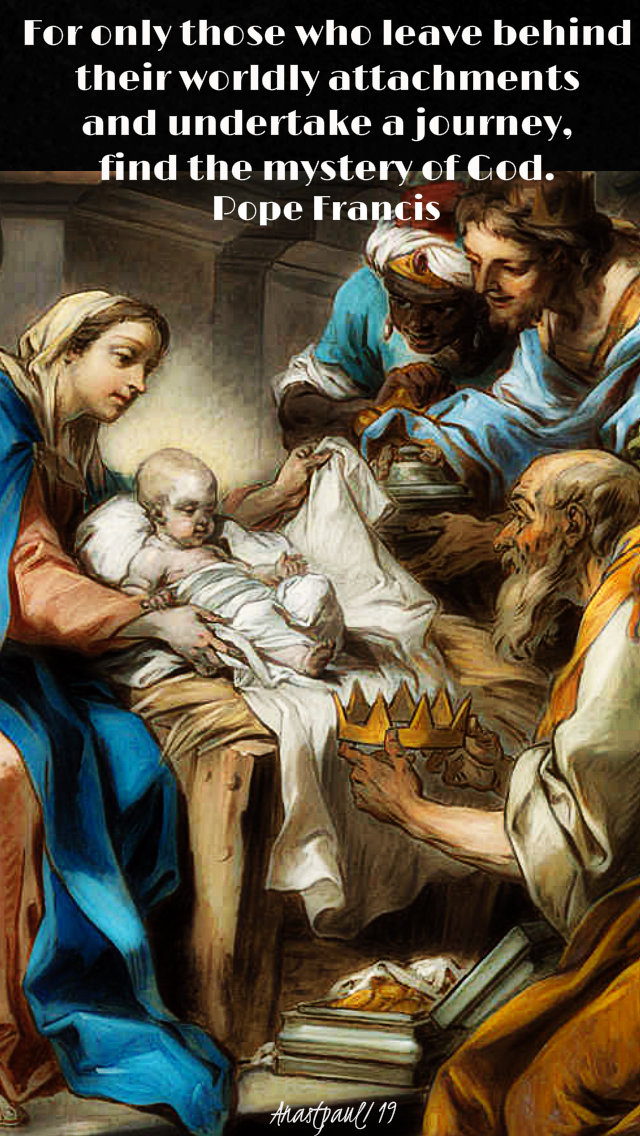
“In order to find Jesus, we also need to take a different route, to follow a different path, His path, the path of humble love.   And we have to persevere.   Today’s Gospel ends by saying that the Magi, after encountering Jesus, “left for their own country by another road” (Mt 2:12).   Another road, different from that of Herod.   An alternative route than that of the world, like the road taken by those who surround Jesus at Christmas – Mary and Joseph, the shepherds.   Like the Magi, they left home and became pilgrims on the paths of God.   For only those, who leave behind their worldly attachments and undertake a journey, find the mystery of God.for only those who leave behind their worldly attachments - pope francis epiphany 2019 9jan2019.jpg

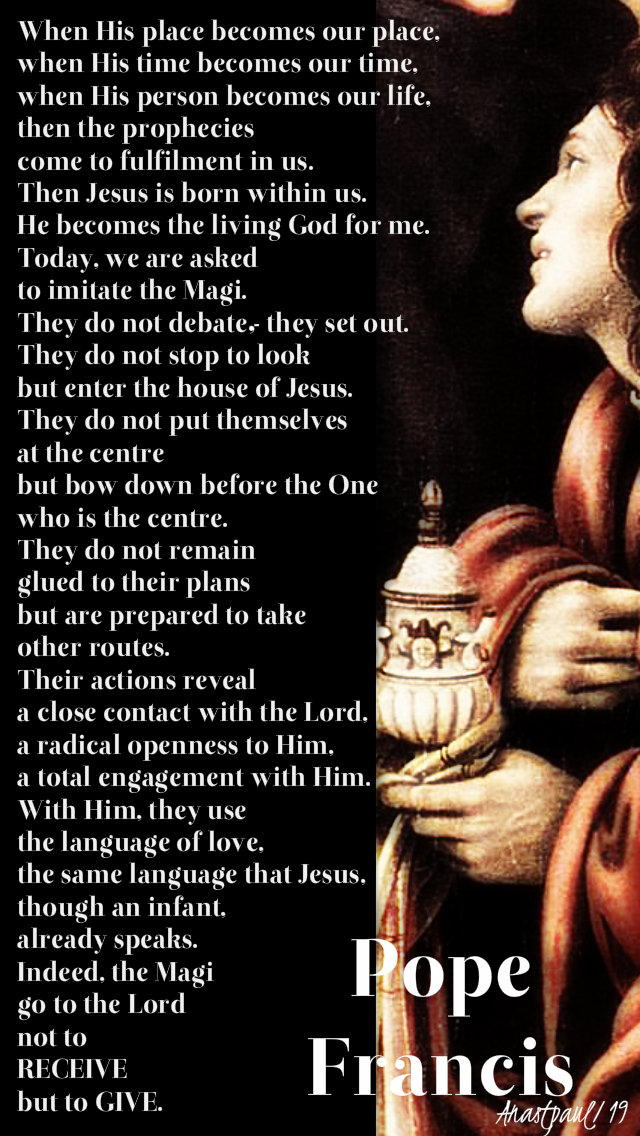
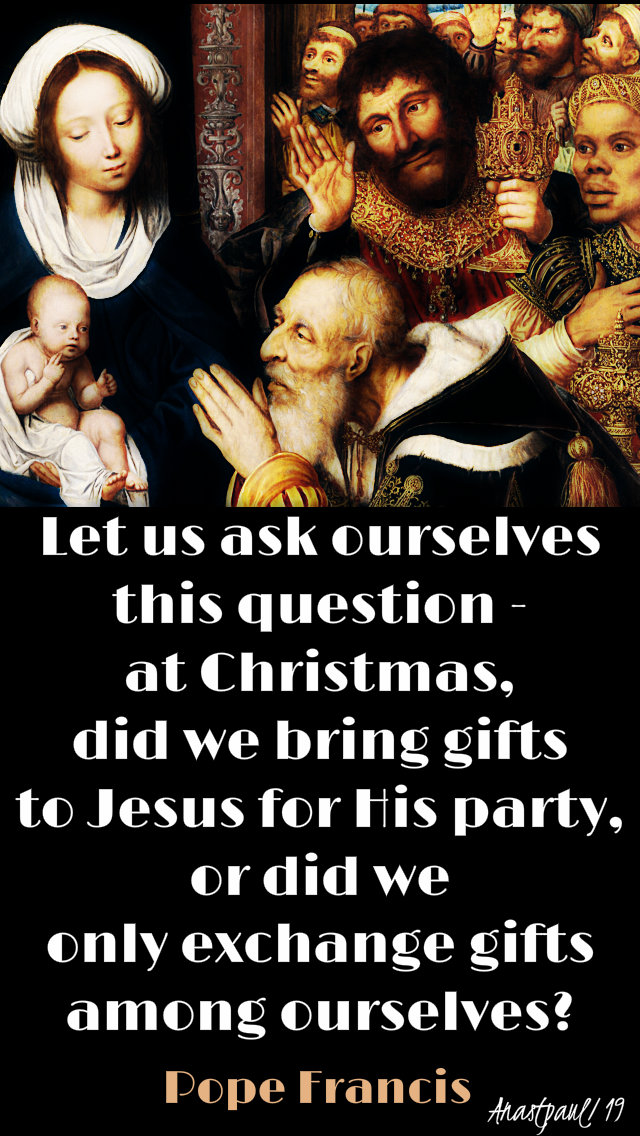
This holds true for us too.   It is not enough to know where Jesus was born, as the scribes did if we do not go there.   It is not enough to know that Jesus was born, like Herod, if we do not encounter Him.   When His place becomes our place, when  His time becomes our time, when His person becomes our life, then the prophecies come to fulfilment in us.   Then Jesus is born within us.   He becomes the living God for me.   Today we are asked to imitate the Magi.   They do not debate – they set out.  They do not stop to look but enter the house of Jesus.   They do not put themselves at the centre but bow down before the One who is the centre.   They do not remain glued to their plans but are prepared to take other routes.   Their actions reveal a close contact with the Lord, a radical openness to Him, a total engagement with Him.   With Him, they use the language of love, the same language that Jesus, though an infant, already speaks.   Indeed, the Magi go to the Lord not to receive but to give.   Let us ask ourselves this question – at Christmas did we bring gifts to Jesus for His party, or did we only exchange gifts among ourselves?when his place becomes our place - pope franics epip homily 2019 9 jan 2019.jpg

let us ask ourselves - pope francis 9 jan 2019 epiphany homily 2019.jpg

If we went to the Lord empty-handed, today we can remedy that.   The Gospel, in some sense, gives us a little “gift list”: gold, frankincense and myrrh.   Gold, the most precious of metals, reminds us God has to be granted first place – He has to be worshipped. But to do that, we need to remove ourselves from the first place and to recognise our neediness, the fact that we are not self-sufficient.    Then there is frankincense, which symbolises a relationship with the Lord, prayer, which like incense rises up to God (cf. Ps 141:2).   Just as incense must burn in order to yield its fragrance, so too, in prayer, we need to “burn” a little of our time, to spend it with the Lord.   Not just in words but also by our actions.   We see this in the myrrh, the ointment that would be lovingly used to wrap the body of Jesus taken down from the cross (cf. Jn 19:39).   The Lord is pleased when we care for bodies racked by suffering, the flesh of the vulnerable, of those left behind, of those who can only receive without being able to give anything material in return.   Precious in the eyes of God is mercy shown to those who have nothing to give back.   Gratuitousness!

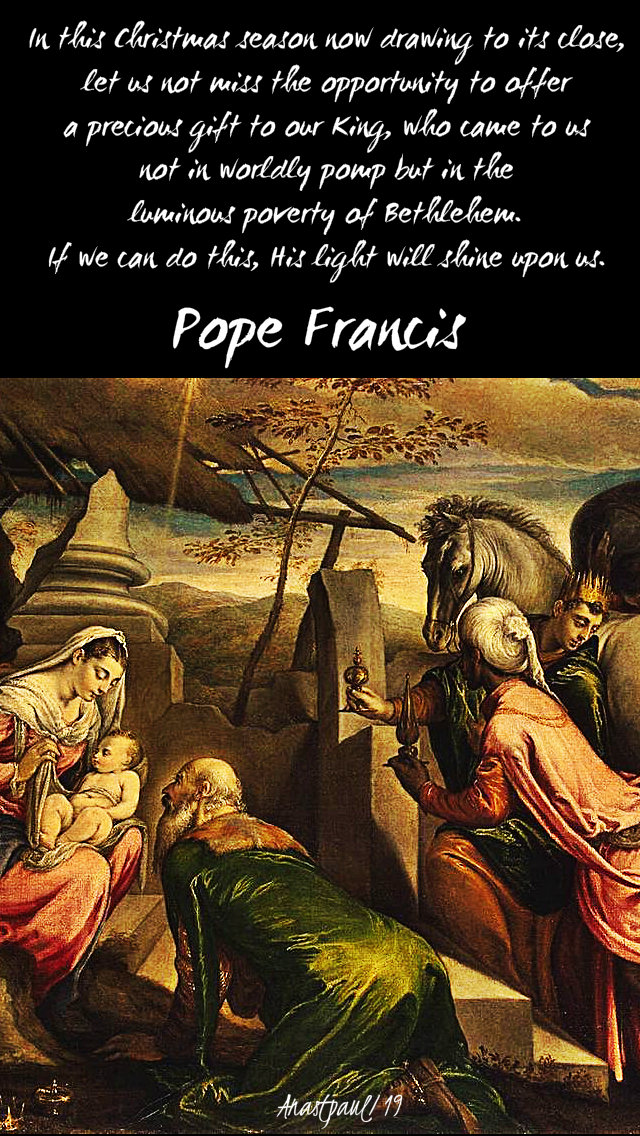
In this Christmas season now drawing to its close, let us not miss the opportunity to offer a precious gift to our King, who came to us not in worldly pomp but in the luminous poverty of Bethlehem.   If we can do this, His light will shine upon us.”in this christmas season - pope francis - 9 jan 2019.jpg

Posted in CHRISTMASTIDE!, Our MORNING Offering

Our Morning Offering – 9 January – 3rd day after Epiphany

Our Morning Offering – 9 January – 3rd day after Epiphany

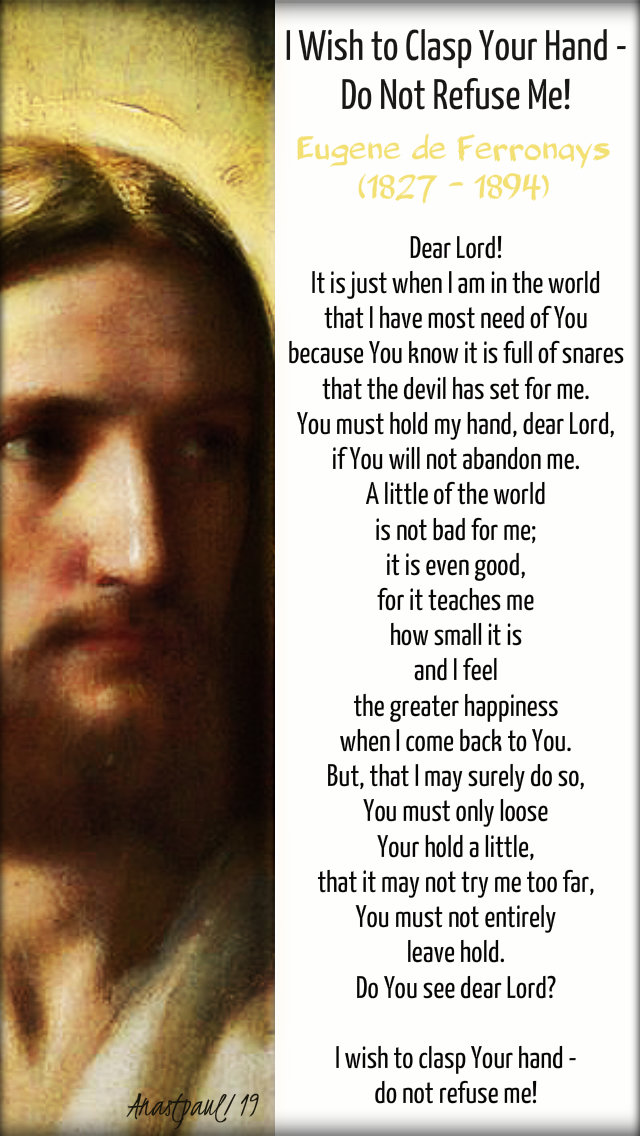
I Wish to Clasp Your Hand – Do Not Refuse Me!
Prayer of Eugene de Ferronays (1827 – 1894)

Dear Lord! It is just when I am in the world
that I have most need of You
because You know it is full of snares
that the devil has set for me.
You must hold my hand, dear Lord,
if You will not abandon me.
A little of the world is not bad for me;
it is even good, for it teaches me how small it is
and I feel the greater happiness
when I come back to You.
But, that I may surely do so,
You must only loose Your hold a little,
that it may not try me too far,
You must not entirely leave hold.
Do You see dear Lord?

I wish to clasp Your hand – do not refuse me!i wish to clasp your hand dear lord, do not refuse me eugene de ferronays 9 jan 2019

Posted in SAINT of the DAY

Feast of the The Black Nazarene and Memorials of the Saints -9 January

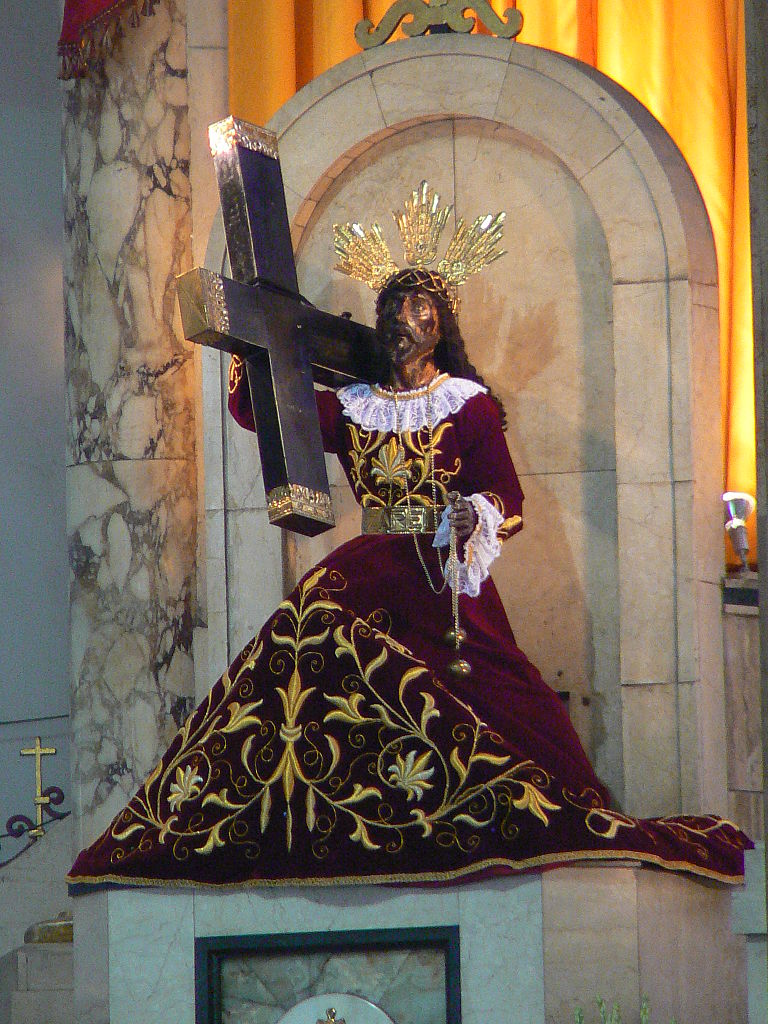
The Black Nazarene:   The Black Nazarene is a blackened, life-sized wooden icon of Jesus Christ carrying a cross.   It was constructed in Mexico in the early 17th century by an Aztec carpenter. Spanish Augustinian Recollect friar missionaries to Manila, Philippines originally brought the icon to Manila in 1606.   The transport ship caught fire, burning the icon but the locals kept the charred statue. Miracles, especially healings, have been reported in its presence.  The church in which it stood burned down around it in 1791 and 1929, was destroyed by earthquakes in 1645 and 1863 and was damaged during bombing in 1945.   It used to be carried through the streets every January and Christians would rub cloths on it to make healing relics but centuries of this treatment have left the statue in bad shape and since 1998 a replica is paraded at the feast day celebrations.   In 1650, Pope Innocent X issued a papal bull which canonically established the Cofradia de Jesús Nazareno to encourage devotion.   In the 19th century Pope Pius VII granted indulgences to those who piously pray before the image. Patronage: Quiapo, Philippines.768px-black_nazarene

St Adrian of Canterbury (c 635-710)
About: https://anastpaul.wordpress.com/2018/01/09/saint-of-the-day-9-january-st-adrian-of-canterbury-c-635-710/

Bl Alix le Clerc
St Agatha Yi
Bl Antony Fatati
St Brithwald of Canterbury
St Eustratius of Olympus
Bl Franciscus Yi Bo-Hyeon
St Honorius of Buzancais
Bl Józef Pawlowski
Sts Julian and Basilissa (died c 304) Martyrs
Bl Kazimierz Grelewski
St Marcellinus of Ancona
St Marciana
Bl Martinus In Eon-min
St Maurontius
St Nearchus
St Paschasia of Dijon
St Peter of Sebaste
St Philip Berruyer
St Polyeucte
St Teresa Kim
St Waningus of Fécamp

Martyrs of Africa – 21 saints: A group of 21 Christians murdered together for their faith in the persecutions of Decius. The only details to survive are 14 of their names – Artaxes, Epictetus, Felicitas, Felix, Fortunatus, Jucundus, Pictus, Quietus, Quinctus, Rusticus, Secundus, Sillus, Vincent and Vitalis. They were martyred in c 250.
Martyrs of Antioch – 6 saints: A group of Christians martyred together during the persecutions of Diocletian – Anastasius, Anthony, Basilissa, Celsus, Julian and Marcionilla

Posted in CHRISTMASTIDE!, PAPAL SERMONS, The NATIVITY of JESUS

If we want to live Christmas, we must open our heart and be open to surprises, namely, to an unexpected change of life’

Thought for the Day – 8 January – 2nd Day after Epiphany – It is still Christmastide!

‘If we want to live Christmas, we must open our heart
and be open to surprises, namely, to an unexpected change of life’

Pope Francis’ Homily – 19 December 2018 – General Audience

Dear Brothers and Sisters, good morning!

In six days, it will be Christmas.   The trees, the decorations and the lights everywhere recall that this year also there will be a celebration.   Advertising invites to keep exchanging newer and newer gifts to have surprises.   However, is this the celebration that pleases God?   What Christmas would He want, what presents and surprises?

We look at the first Christmas of history to discover God’s tastes.   That Christmas was full of surprises.   It begins with Mary, who was Joseph’s promised bride – the Angel arrives and changes her life.   From being a virgin, she will be a mother.   It continues with Joseph, called to be the father of a son without generating Him.   A son that — in a dramatic turn of events — arrives in the least indicated moment, namely, when Mary and Joseph were betrothed and, according to the Law, could not live together.   In face of the scandal, the good sense of the time invited Joseph to repudiate Mary and save his good name but he, although he had the right, surprises us – not to hurt Mary he thinks of taking leave of her in secret, at the cost of losing his own reputation.   Then, another surprise – in a dream, God changes his plans and asks him to take Mary to himself.   Jesus having been born, when Joseph had his plans for the family, again in a dream he is told to rise and go to Egypt.   To summarise, Christmas brought unexpected life changes.  And if we want to live Christmas, we must open our heart and be open to surprises, namely, to an unexpected change of life.

However, it’s on Christmas Eve that the greatest surprise arrives – the Most High is a little baby.   The divine Word is an infant, which means literally, “incapable of speaking.”   And the divine Word becomes “incapable of speaking.”  The Authorities of the time or of the place or the ambassadors were not there to receive the Saviour – no, it was simple shepherds, who, surprised by the Angels while they were working at night, run without delay.   Who would have expected it?   Christmas is to celebrate the unheard-of God, or better, it is to celebrate an unprecedented God, who overturns our logics and our expectations.

To celebrate Christmas, then, is to receive on earth Heaven’s surprises.   One can’t live “down to earth,” when Heaven has brought its novelties into the world.   Christmas inaugurates a new era, where life isn’t planned but is given;  where one no longer lives for oneself, on the basis of one’s tastes, but for God;  and with God because since the first Christmas, God is God-with-us, who lives with us, who walks with us.   To live Christmas is to let oneself be shaken by its surprising novelty.   Jesus’ Birth doesn’t offer the reassuring warmth of a fireplace but the divine thrill, that shakes history.  Christmas is the revenge of humility over arrogance, of simplicity over abundance, of silence over noise, of prayer over “my time,” of God over my “I.”christmas is - pope francis no 2 - 8 jan 2019

To celebrate Christmas is to do as Jesus did, who came for us needy people and to come down to those in need of us.   It is to do as Mary did, to entrust ourselves, docile to God, even without understanding what He will do.   To celebrate Christmas is to do as Joseph did, to rise to do what God wants, even if it’s not according to our plans.   Saint Joseph is surprising – he never speaks in the Gospel, there isn’t one word of Joseph in the Gospel and the Lord speaks to him in silence, He speaks to him in fact in his sleep. Christmas is to prefer God’s silent voice to the noises of consumerism.   If we are able to be silent before the Crib, Christmas will be a surprise for us also, not something already seen.   To be in silence before the Crib – this is the invitation for Christmas.  Take a bit of time, go before the Crib and stay in silence.   And you will feel, you will see the surprise.

Unfortunately, however, the celebration can be mistaken and we can prefer the usual things on earth, to the novelties of Heaven.   If Christmas remains only a beautiful traditional feast, where we and not Him, are at the centre, it will be a lost occasion.   Please, let us not make Christmas worldly!   Let us not put the One celebrated aside as ‘happened’ then, when “He came among His own and His own received Him not” (John 1:11).   Since the first Gospel of Advent, the Lord has put us on guard, asking us not to be weighed down with “dissipation” and “the cares of life” (Luke 21:34).   In these days one runs, perhaps more than ever during the year.   So, the opposite is done of what Jesus wants.   We blame the many things that fill our day, the world that goes fast.   Yet Jesus didn’t blame the world.   He asked us not to let ourselves be dragged, to watch at all times praying (Cf. v. 36).

Behold, it will be Christmas if, like Joseph, we make room for silence;  if, like Mary, we say to God “Here I am”;  if, like Jesus, we are close to one who is alone;  if, like the shepherds, we go out of our enclosures to be with Jesus.   It will be Christmas, if we find the light in the poor cave of Bethlehem.   It won’t be Christmas if we seek the shimmering glow of the world, if we fill ourselves with gifts, lunches and dinners but we don’t help at least one poor person, who is like God, because at Christmas God came poor.

Dear brothers and sisters, I wish you a happy Christmas, a Christmas rich in Jesus’ surprises!   They might seem uncomfortable surprises but they are God’s tastes.   If we embrace them, we will have a splendid surprise for ourselves.   Each one of us has hidden in the heart, the capacity to be surprised.   Let us let Jesus surprise us this Christmas.

It’s Christmas every day!  behold it will be christmas - pope francis given 19 dec 2018 gen aud - 8 jan 2019