Posted in CHRISTMASTIDE!, MORNING Prayers, The WORD

Quote/s of the Day – 8 January – 2nd Day after Epiphany

Quote/s of the Day – 8 January – 2nd Day after Epiphany

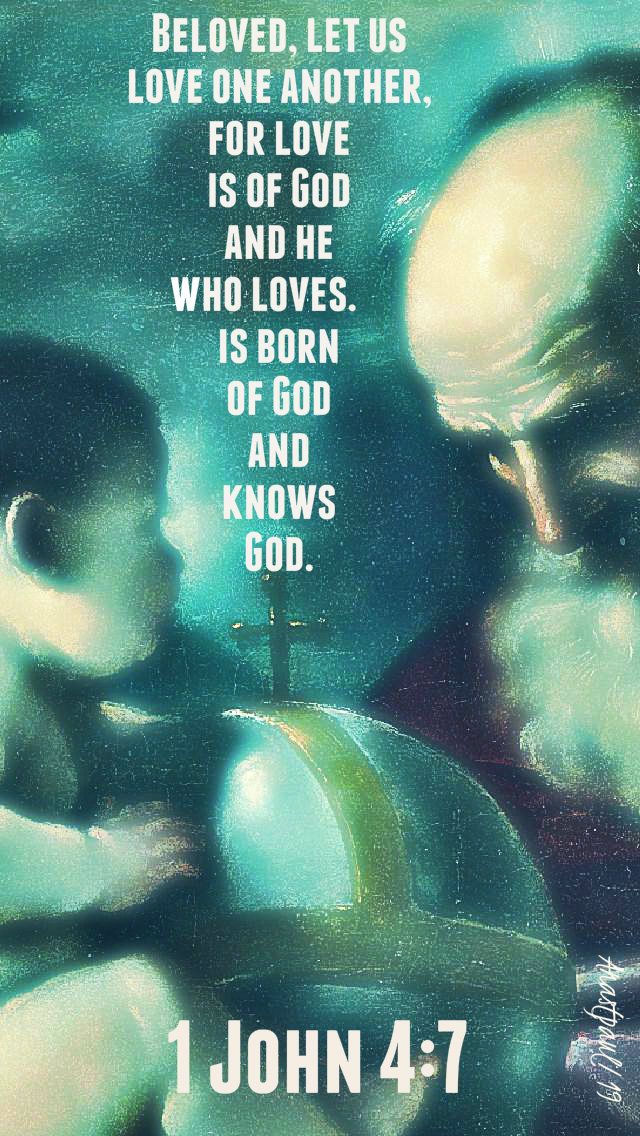
7 Beloved, let us love one another;
for love is of God and he who loves.
is born of God and knows God.1 john 4 7 - beloved let us love one another 8 jan 2019

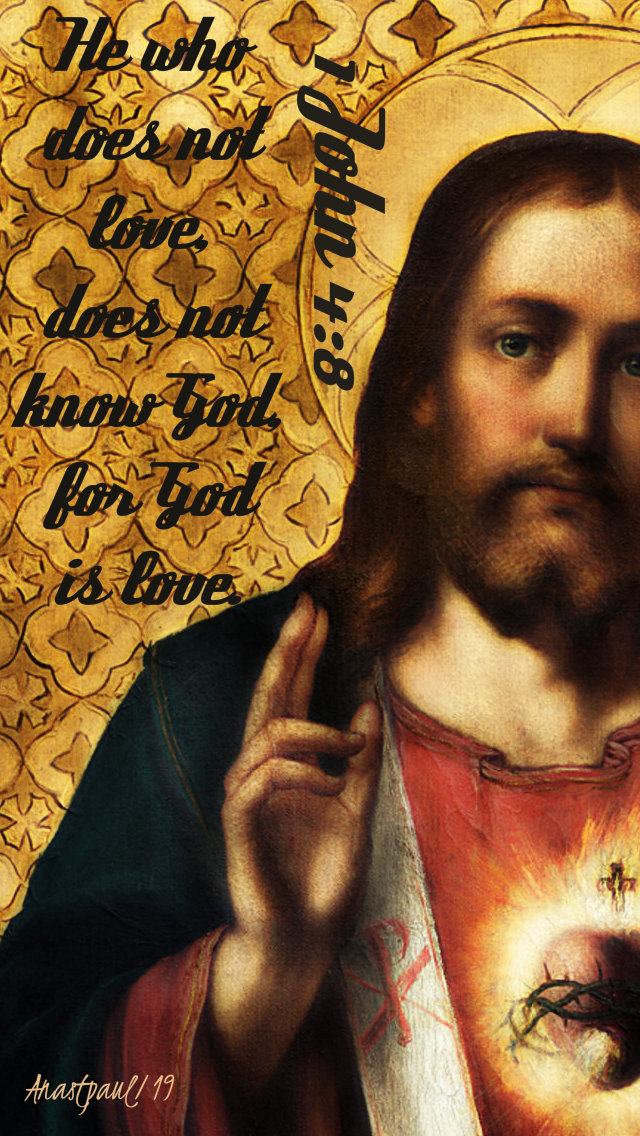
8 He who does not love,
does not know God,
for God is love.1 john 4 8 he who does not love - 8 jan 2018

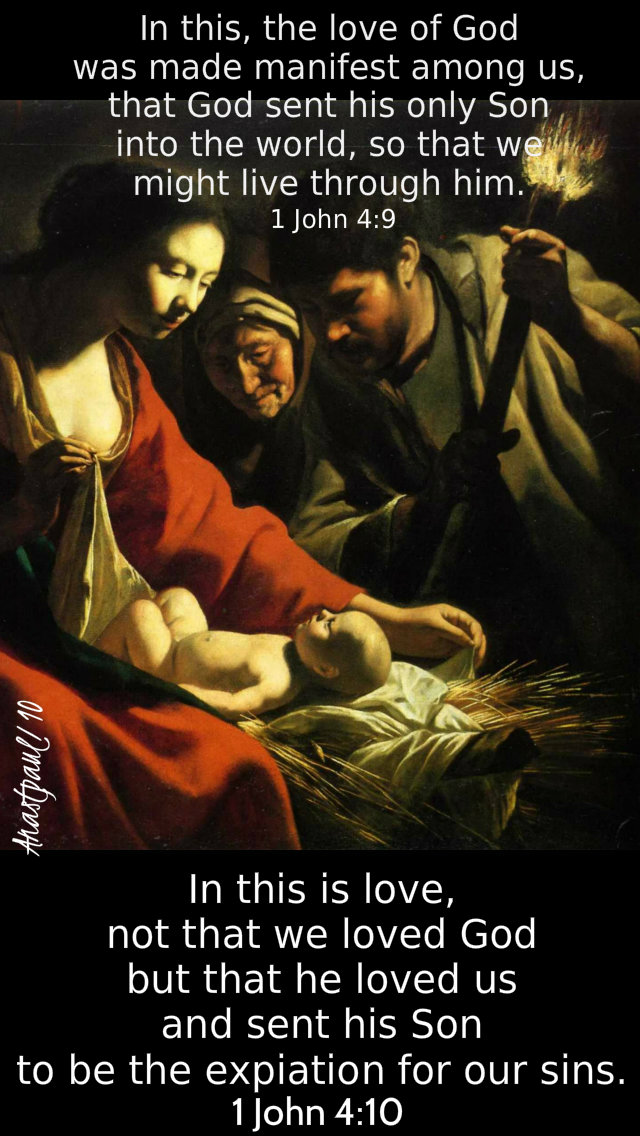
9 In this, the love of God
was made manifest among us,
that God sent his only Son
into the world, so that we
might live through him.

10 In this is love, not that we loved God
but that he loved us and sent his Son
to be the expiation for our sins.

Today’s First Reading : 1 John 4:7-101 john 4 9-10 in this the love of god was manifest - 8 jan 2019

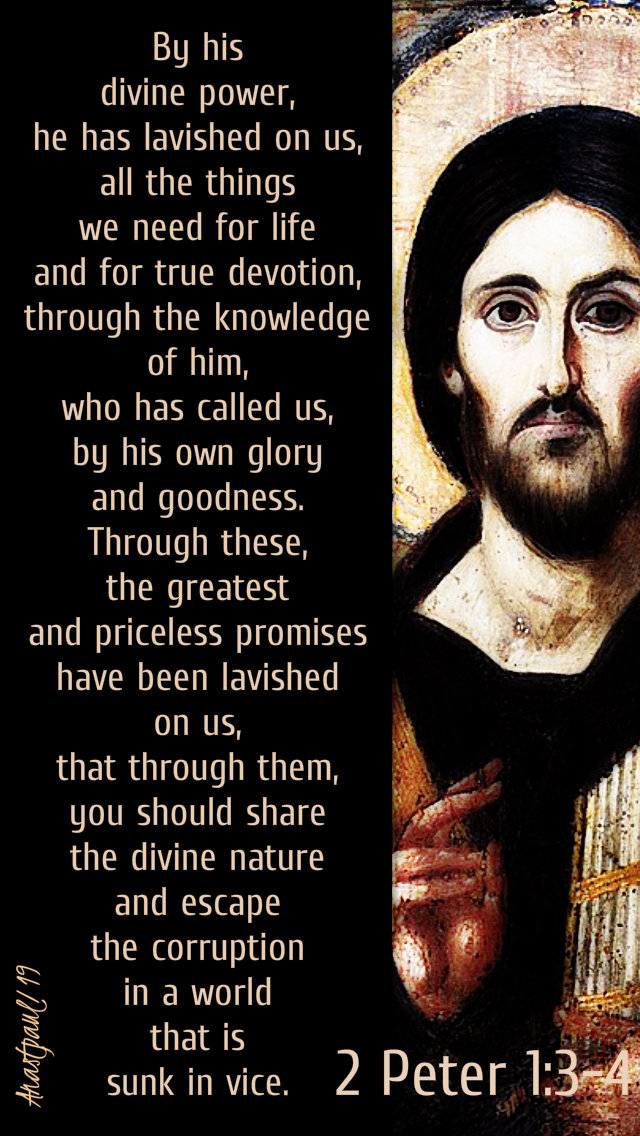
By his divine power, he has lavished on us,
all the things we need for life
and for true devotion,
through the knowledge of him,
who has called us,
by his own glory and goodness.
Through these, the greatest and priceless promises
have been lavished on us, that through them,
you should share the divine nature
and escape the corruption in a world
that is sunk in vice.

2 Peter 1:3-42 peter 1 3-4 by his divine power he has lavished on us - 8 jan 2019

Posted in CHRISTMASTIDE!, MORNING Prayers, SAINT of the DAY, The WORD

One Minute Reflection – 8 January – 2nd Day after Epiphany – Gospel: Mark 6:34-44

One Minute Reflection – 8 January – 2nd Day after Epiphany – Gospel: Mark 6:34-44

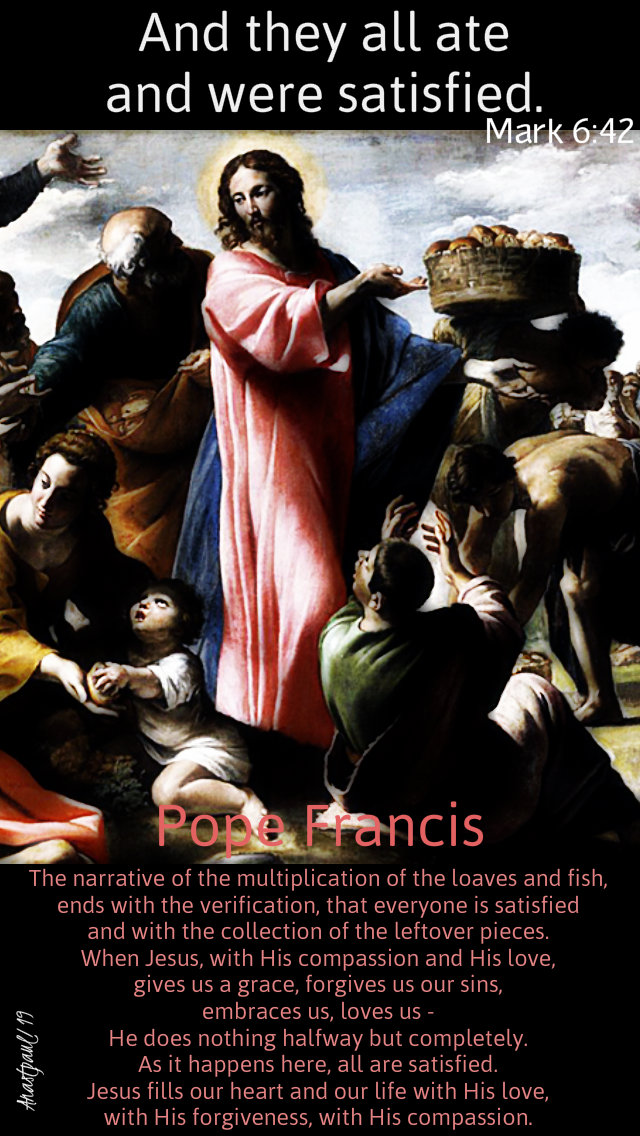
And they all ate and were satisfied. And they took up twelve baskets full of broken pieces and of the fish. And those who ate the loaves were five thousand men.…Mark 6:42-44

REFLECTION – “The narrative of the multiplication of the loaves and fish, ends with the verification, that everyone is satisfied and with the collection of the leftover pieces.  When Jesus, with His compassion and His love, gives us a grace, forgives us our sins, embraces us, loves us – He does nothing halfway but completely.   As it happens here, all are satisfied.   Jesus fills our heart and our life with His love, with His forgiveness, with His compassion.”…Pope Francis – General Audience, 17 August 2016mark 6 42 and they all ate and were satisfied - pope francis - the narrative of the loaves 8 jan 2019.jpg

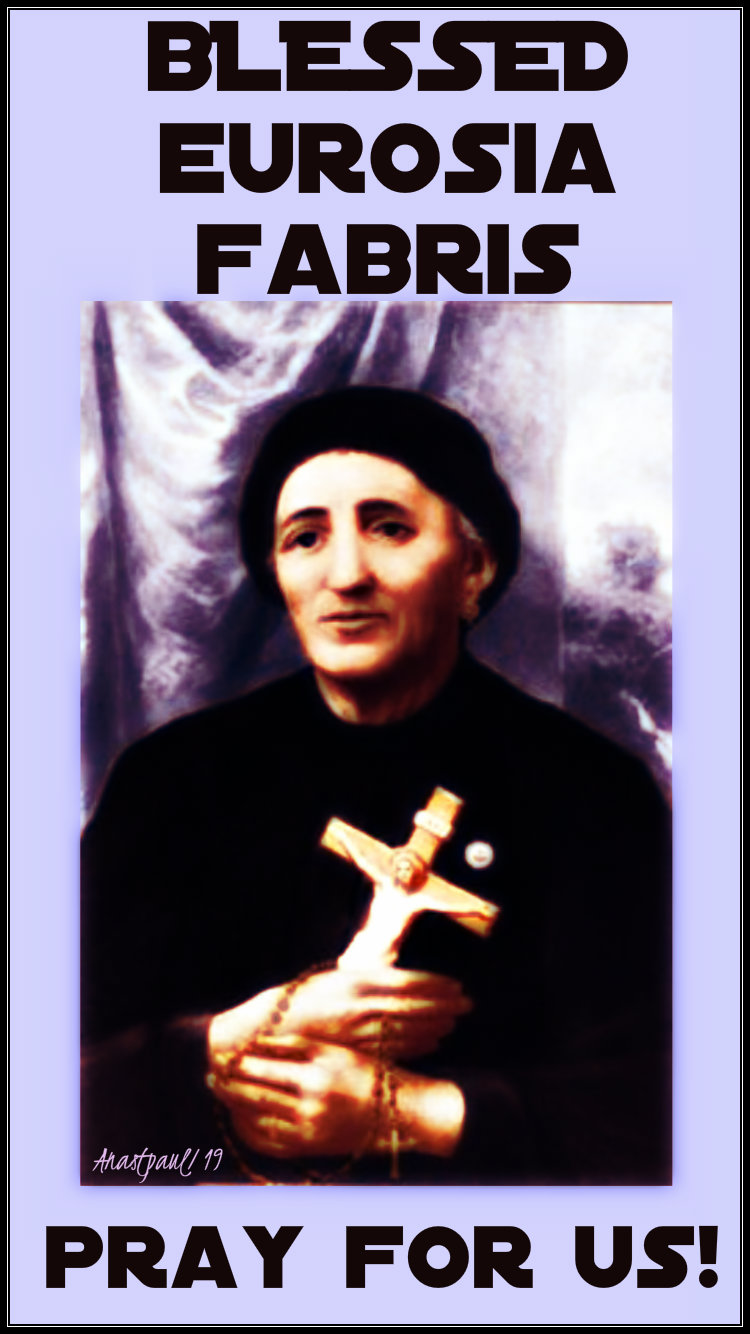
PRAYER – God our father, when Your only-begotten Son, revealed Himself in flesh and blood, we came to know Him as our fellow-man.   As He transformed 5 loaves and 2 fish, may He transform us inwardly, until we bear His likeness.   Blessed Eurosia, you were filled with the love of God and your neighbour and by His grace, transformed all those who came within your care, please intercede on our behalf.   We ask this through Christ, our Lord, in the unity of the Holy Spirit, one God forever, amen.bl eurosia fabris pray for us 8 jan 2019

Posted in JESUIT SJ, Our MORNING Offering, PRAYERS to the SAINTS

Our Morning Offering – 8 January – 2nd Day after Epiphany

Our Morning Offering – 8 January – 2nd Day after Epiphany

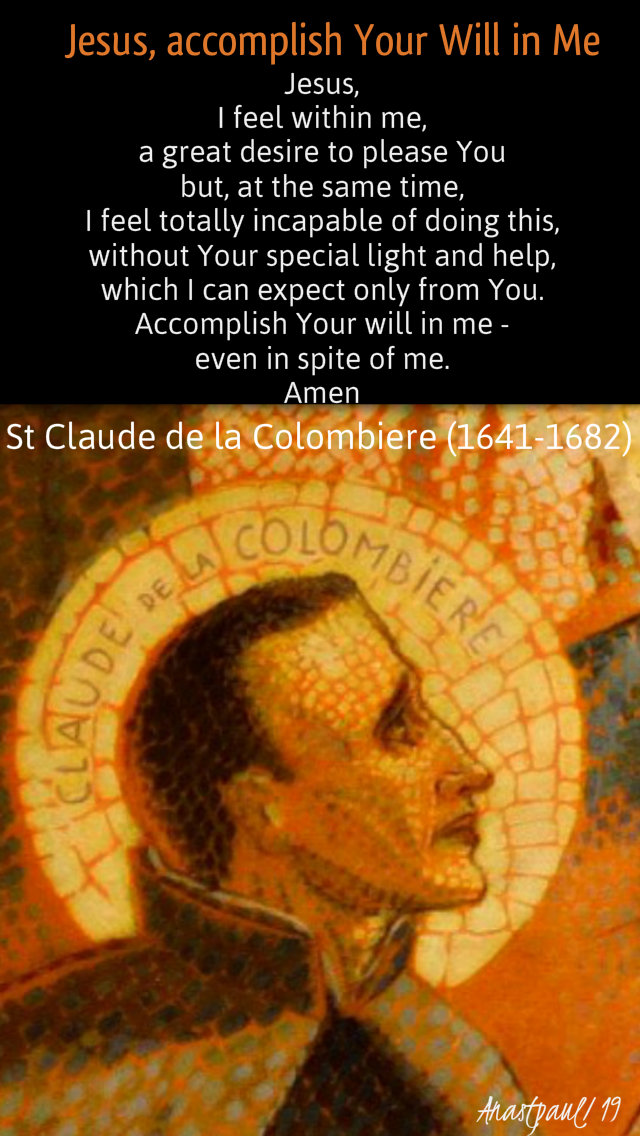
Jesus, accomplish Your Will in Me
by St Claude de la Colombiere (1641-1682)

Jesus,
I feel within me,
a great desire to please You
but, at the same time,
I feel totally incapable of doing this,
without Your special light and help,
which I can expect only from You.
Accomplish Your will in me –
even in spite of me.
Amenjesus accomplish your will in me - st claude de la colombiere 8 jan 2019

Posted in franciscan OFM, SAINT of the DAY, VATICAN Resources

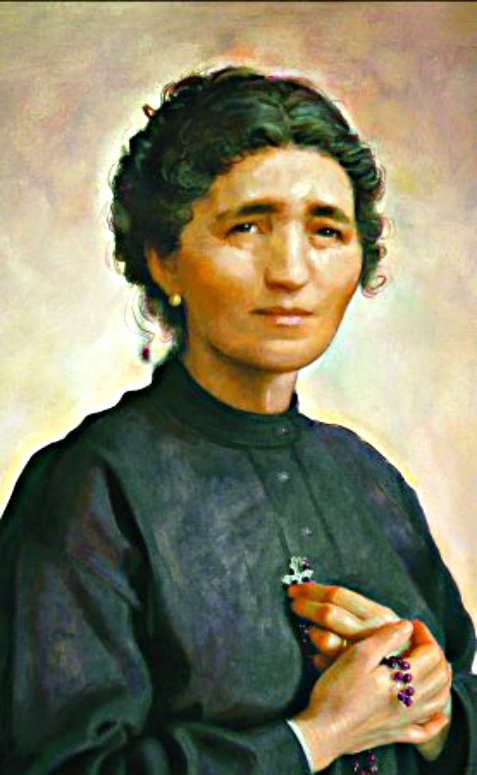
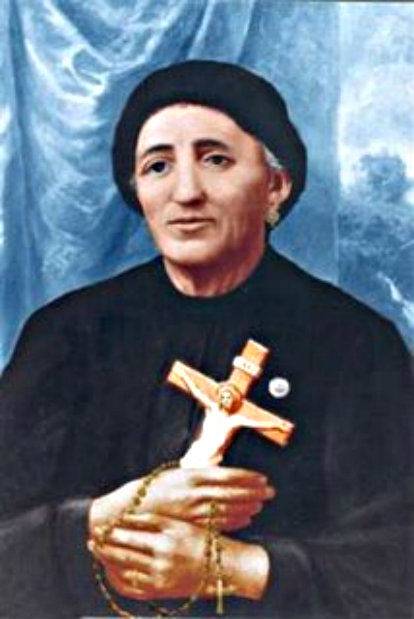
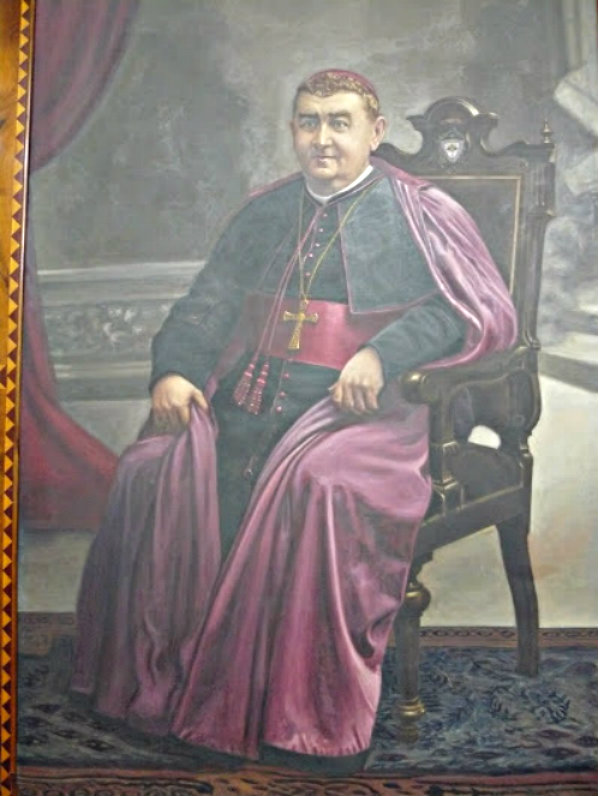
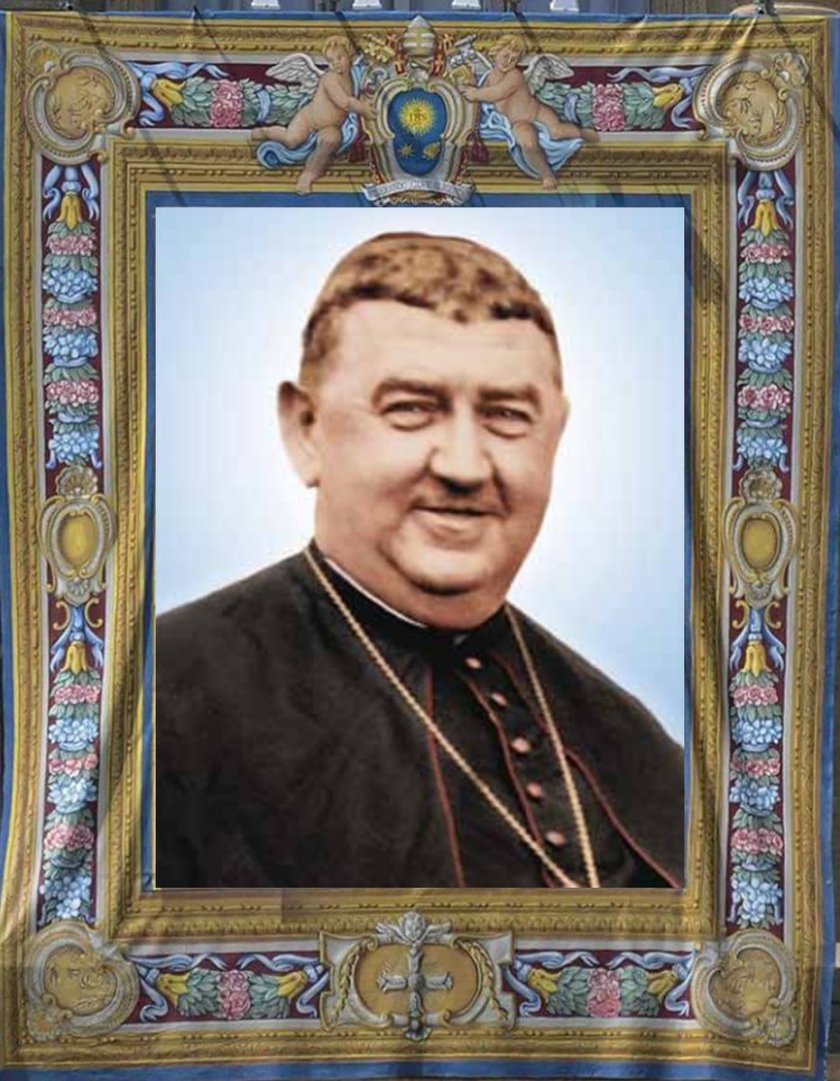
Saint of the Day – 8 January – Blessed Eurosia Fabris (1866-1932) “Mamma Rosa”

Saint of the Day – 8 January – Blessed Eurosia Fabris (1866-1932) “Mamma Rosa”Laywoman, Wife and Mother, Secular Franciscan, Apostle of Charity, Marian devotee, Apostle of Prayer and of the Holy Eucharist – born on 27 September 1866 in Quinto Vicentino, Italy and died on 8 January 1932 at Marola di Torri, Vicenza, Italy of natural causes.bl eurosia fabris 1855-1932.jpg

Eurosia Fabris was born in Quinto Vicentino, an agricultural area, some kilometers from Vicenza in Italy, on 27 of September 1866.   Her parents, Luigi and Maria Fabris, were farmers.   In 1870, at the age of four, Eurosia moved with her family to Marola, a village in the municipality of Torri di Quartesolo (Vicenza).   She lived there for the rest of her life.   She attended only the first two years of elementary school between 1872 and 1874 because even at such a young age, she was forced to help her parents with farm work and her mother in particular with the household chores.   It was enough, however, for her to learn to read and write with the help of the Holy Scriptures or religious books such as the Catechism, Church history, the Philothea and the Eternal Maxims of St Alfonso Liguori.

Besides her domestic tasks, she helped her mother in her work as a dressmaker, a practice which Eurosia would also take on later.   Even as a child, she was rich in virtue and spirituality, always very careful in providing for the needs of her family.

She was twelve years old when she made her First Holy Communion.   From then on, she received Holy Eucharist on all religious feasts, since at that time daily communion was not the practice.   It was not until 1905 that daily communion was permitted by a Decree of Pope St Pius X.

Eurosia joined the Association of the Daughters of Mary in the parish church of Marola, and was faithful in participating in their devotions.   She diligently observed the practices of the group which helped increase in her a love for Mary.   In Marola, she lived within sight of the shrine of the Madonna of Monte Berico.

Her favourite devotions were to the Holy Spirit, the infant Jesus, the Cross of Christ, the Eucharist, the Virgin Mary and the souls in the Purgatory.   She was an apostle of good will in her family, among her friends and in her parish, where she taught catechism to the children and sewing to the girls who came to her home.

At the age of eighteen, Eurosia was a dedicated, pious and hardworking young lady. These virtues, along with her pleasant personality, did not go unobserved and several young men proposed marriage to her, though she did not feel called to accept.

In 1885, Rosina, as she was called by her family, was affected by a tragic event.   A young married woman near her home died leaving three very young daughters.   The first of them died shortly after her mother.   The other two girls, Chiara Angela and Italia were only 20 months old and 2 months old, respectively.   The father of these girls was away, living with his uncle and a grandfather who suffered from a chronic disease.   They were three very different men, always quarrelling among themselves.

For six months, every morning, Rosina would go to care for the children and take care of their home.   Later, following the advice of her relatives and that of the parish priest and after praying about this turn of events, she decided to marry.   Rosina was joined in marriage to a man named Carlo Barban, well aware of the sacrifices that married life would hold for her in the future.   She accepted this fact as the will of God who she now felt was calling her through these two babies to embrace a new mission.   The parish priest would often comment:  “This was a true act of heroic charity towards others.”

The marriage was celebrated on the fifth of May 1886 and, in addition to the two orphaned babies, was blessed with nine other children.   Her home was always opened to other children as well.   Among them were Mansueto Mazzuco, who became a member of the Order of Friars Minor, taking the name, Brother Giorgio.   To all these children, “Mamma Rosa”, as she was called since her marriage, offered affection and care, sacrificing her own needs to provide for them a solid Christian formation.  Between 1918-1921, three of her sons were ordained priests, two for the Diocesan clergy and one as a Franciscan (Fr Bernardino), who would become her first biographer.

Once married, she embraced her marital obligations, always showing the greatest love and respect for her husband and becoming his confidante and adviser.   She had a tender love for all her children.   She was a hard worker and a person who could be counted on to fulfil her duties.

Mamma Rosa lived an intense life of prayer, which was evident by her great devotion to God love’s, to the Holy Eucharist and to the Blessed Virgin Mary.   Like the strong woman in Sacred Scripture, she became a real treasure to her family.   She knew how to balance the family budget and at the same time exercised great charity towards the poor, sharing her daily bread also with them.   She cared for the sick and gave them continuous assistance, showing heroic strength during the final illness of her husband Carlo, who died in 1930.

Mamma Rosa became a member of the Franciscan Third Order, known today as the Secular Franciscans.   She faithfully attended all their meetings but above all tried to live the true Franciscan spirit of poverty and joy in her home, in the midst of her daily work and prayer.   She had a gentle manner with everyone and praised God as the Creator and source of all good and the giver of all hope.

Mama Rosa’s family home was an ideal Christian community where her children were taught to pray, to obey, to respect the will of God and to practice Christian virtues.   In her vocation as a Christian mother, Mamma Rosa sacrificed and consumed herself day by day like a lamp burning brightly on the altar of charity.   She died on 8 January 1932 and was buried, with the hope of final resurrection, in the church of Marola.

The canonical process of beatification and canonisation was initiated on 3 February 2005 at the Diocesan curia of Padova, after getting passed several difficulties and misunderstandings among the different juridical persons trying to promote the Cause.

Mamma Rosa was a model of holiness in what should be the daily life of a Catholic family.   Her three sons who became priests were encouraged in their vocation by her example of holiness.   She was proclaimed Venerable on the 7th of July, 2003, by St Pope John Paul II who recognised the testimony of her heroic and singular virtues.   It was the wish of Venerable Pope Pius XII that the life of this marvellous woman be known among all Christian families of our day…Vatican.va

Blessed Eurosia was Beatified on 6 November 2005 by Pope Benedict XVI
the recognition was celebrated by Cardinal Saraiva Martins at Vincenza, Italy.
blessed-eurosia-fabris-barban-jan-8

Posted in SAINT of the DAY

Feast of Our Lady of Prompt Succour and Memorials of the Saints – 8 January

8 January – Our Lady of Prompt Succour –

In 1727, French Ursuline nuns founded a monastery in New Orleans, Louisiana, and organised their area schools from it.   In 1763 Louisiana became a Spanish possession and Spanish sisters came to assist. In 1800 the territory reverted back to France and the Spanish sisters fled in the face of French anti – Catholicsm.   In 1803, short on teachers, Mother Saint Andre Madier requested reinforcements in the form of more sisters from France  . The relative to whom she wrote, Mother Saint Michel, was running a Catholic boarding school for girls. Bishop Fournier, short-handed due to the repressions of the French Revolution, declined to send any sisters.   Mother Saint Michel was given permission to appeal to the pope.   The pope was a prisoner of Napoleon and it seemed unlikely he would even receive her letter of petition.   Mother Saint Michel prayed,

O most Holy Virgin Mary, if you obtain for me a prompt and favorable answer to this letter, I promise to have you honoured at New Orleans under the title of Our Lady of Prompt Succour.

and sent her letter on 19 March 1809.   Against all odds, she received a response on 29 April 1809.   The pope granted her request and Mother Saint Michel, commissioned a statue of Our Lady of Prompt Succour holding the Infant Jesus. Bishop Fournier blessed the statue and Mother’s work.

Mother Saint Michel and several postulants came to New Orleans on 31 December 1810.   They brought the statue with them and placed it in the monastery chapel.   Since then, Our Lady of Prompt Succour has interceded for those who have sought her help.

A great fire threatened the Ursuline monastery in 1812.   A lay sister brought the statue to the window and Mother Saint Michel prayed

Our Lady of Prompt Succour, we are lost if you do not come to our aid.

The wind changed direction, turned the fire away, and saved the monastery.

Our Lady interceded again at the Battle of New Orleans in 1815.   Many faithful, including wives and daughters of American soldiers, gathered in the Ursuline chapel before the statue of Our Lady of Prompt Succour and spent the night before the battle in prayer.  They asked Our Lady for victory by Andrew Jackson’s forces over the British, which would save the city from being sacked. Jackson and 200 men from around the South won a remarkable victory over a superior British force in a battle that lasted twenty-five minutes, and saw few American casualties.

It is still customary for the devout of New Orleans to pray before the statue of Our Lady of Prompt Succour whenever a hurricane threatens New Orleans.

our_lady_of_prompt_succor_patroness_of_louisiana

St Abo of Tblisi
St Albert of Cashel
St Apollinaris the Apologist
St Athelm of Canterbury
St Atticus of Constantinople
St Carterius of Caesarea
Bl Edward Waterson
St Ergnad of Ulster
St Erhard of Regensburg
St Eugenian of Autun
Bl Eurosia Fabris (1866-1932)
St Garibaldus of Regensburg
St Gudule of Brussels
St Helladius
St Julian of Beauvais
St Lawrence Giustiniani
St Lucian of Beauvais
St Maximian of Beauvais
St Maximus of Pavia
Bl Nathalan of Aberdeen
St Patiens of Metz
St Pega of Peakirk
St Severinus of Noricum
St Theophilus the Martyr
St Thorfinn
St Wulsin of Sherborne

Martyrs of Greece – 9 saints: A group of Christians honored in Greece as martyrs, but we have no details about their lives or deaths – Euctus, Felix, Januarius, Lucius, Palladius, Piscus, Rusticus, Secundus and Timotheus

Martyrs of Terni – 4 saints: A group of Christian soldiers in the imperial Roman army. Executed during the persecutions of emperor Claudius. Martyrs. – Carbonanus, Claudius, Planus and Tibudianus.   They were martyred in 270 in Terni, Italy.

Posted in DOMINICAN OP, PRAYERS of the SAINTS, QUOTES of the SAINTS, QUOTES on CONVERSION, QUOTES on FAITH, QUOTES on PATIENCE, QUOTES on PEACE, QUOTES on PERSECUTION, QUOTES on PERSEVERANCE, QUOTES on SANCTITY, SAINT of the DAY

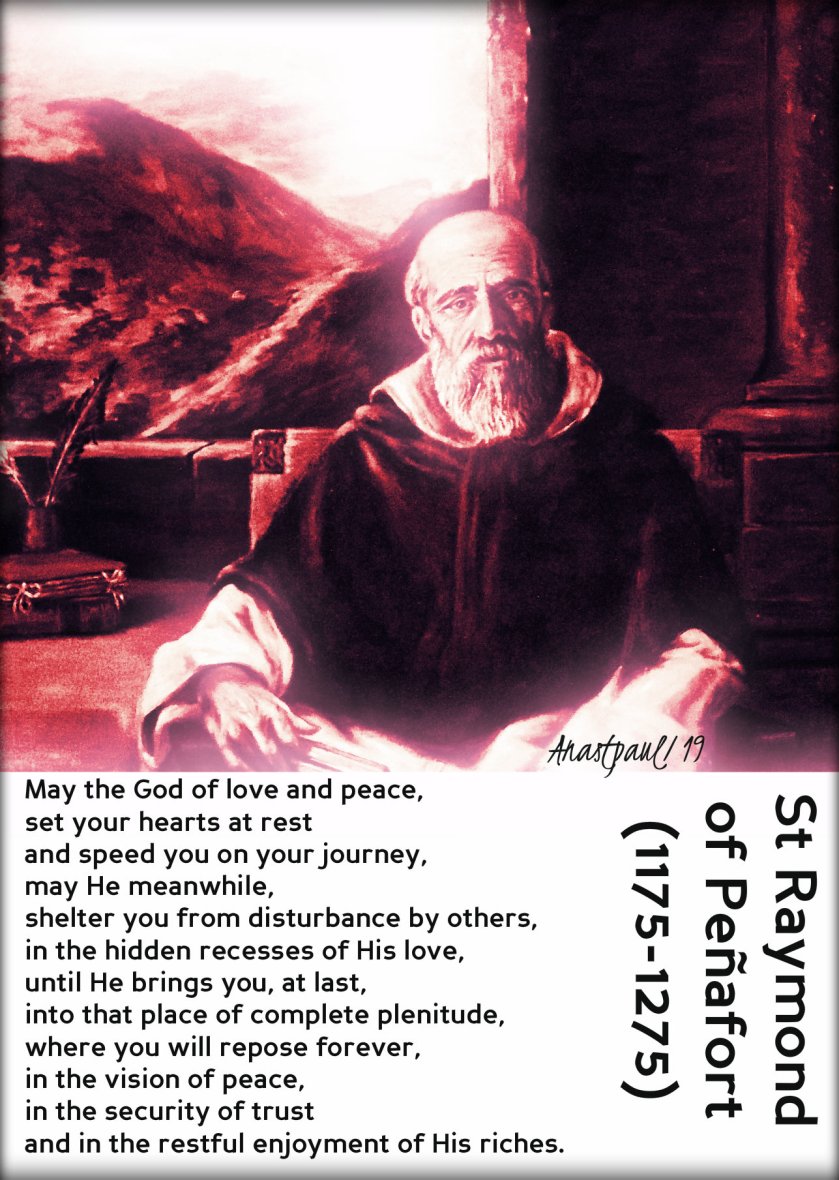
Thought for the Day – 7 January – The Memorial of St Raymond of Peñafort (1175-1275) “Father of Canon Law”

Thought for the Day – 7 January – The Memorial of St Raymond of Peñafort (1175-1275) “Father of Canon Law”

As a lawyer, priest and preacher, St Raymond of Penyafort made a significant mark on the history of Spain and the church.   His preaching helped re-Christianise Spain after the Moors were overthrown.   And his compilation of papal and conciliar decrees was the main source of canon law for seven centuries.

An accomplished lawyer and scholar, Raymond joined the Dominicans at Barcelona in 1222.   The 47-year-old novice was assigned to develop a book of case studies for confessors that helped to shape the medieval church’s penitential system.   Also a gifted preacher, Raymond had remarkable success evangelising Moors and Jews.   And he travelled throughout Spain, rejuvenating the spiritual life of Christians, that the Moors had enslaved.   Among his main themes were spiritual combat and standing firm in trials.

He wrote:

“Your purity of life, your devotion, deserve and call for a reward, because you are acceptable and pleasing to God, your purity of life must be made purer still, by frequent buffetings, until you attain perfect sincerity of heart.   If from time to time you feel the sword falling on you with double or treble force, this also should be seen as sheer joy and the mark of love.”

And then, he encouraged and prayed for us all:

“May the God of love and peace,
set your hearts at rest
and speed you on your journey,
may He meanwhile,
shelter you from disturbance by others,
in the hidden recesses of His love,
until He brings you, at last,
into that place of complete plenitude,
where you will repose forever,
in the vision of peace,
in the security of trust
and in the restful enjoyment of His riches.”may the god of love and peace - st raymond of penafort - 7 jan 2019.jpg

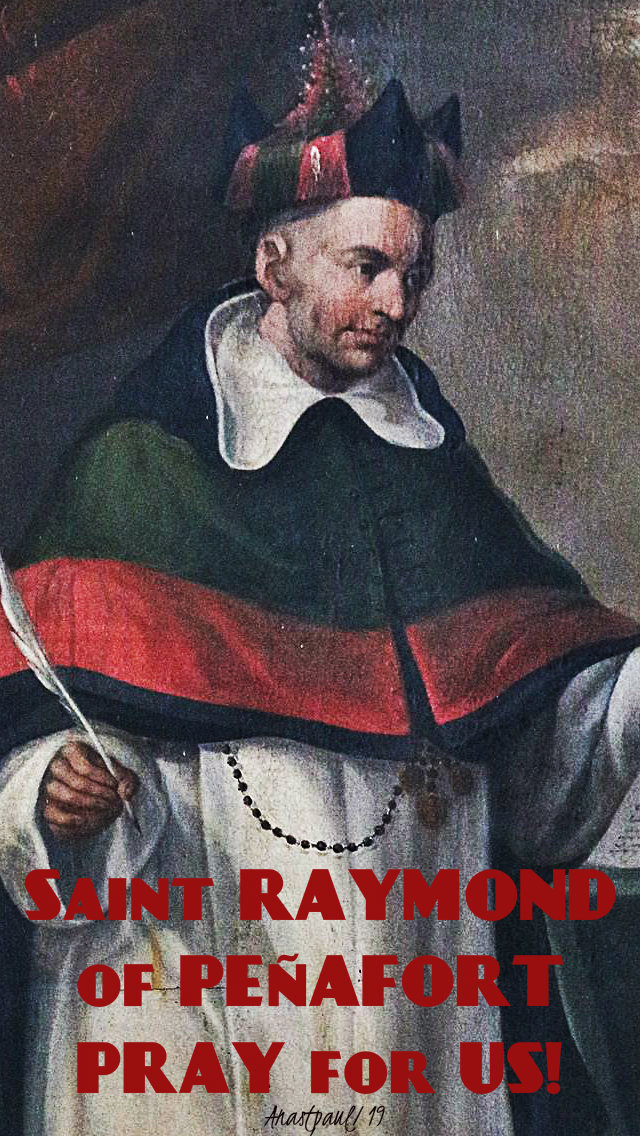
St Raymond of Peñafort, Pray for Us!st raymond of penafort pray for us no 2. 7 jan 2019.jpg

Posted in DOCTORS of the Church, FATHERS of the Church, MORNING Prayers, PRACTISING CATHOLIC, QUOTES of the SAINTS, SAINT of the DAY, The INCARNATION, The NATIVITY of JESUS, The WORD

One Minute Reflection – 7 January – Monday after Epiphany – Gospel:  Matthew 4:12-17, 23-25

One Minute Reflection – 7 January – Monday after Epiphany – Gospel:  Matthew 4:12-17, 23-25 and the Memorial of St Raymond of Peñafort (1175-1275) “Father of Canon Law”

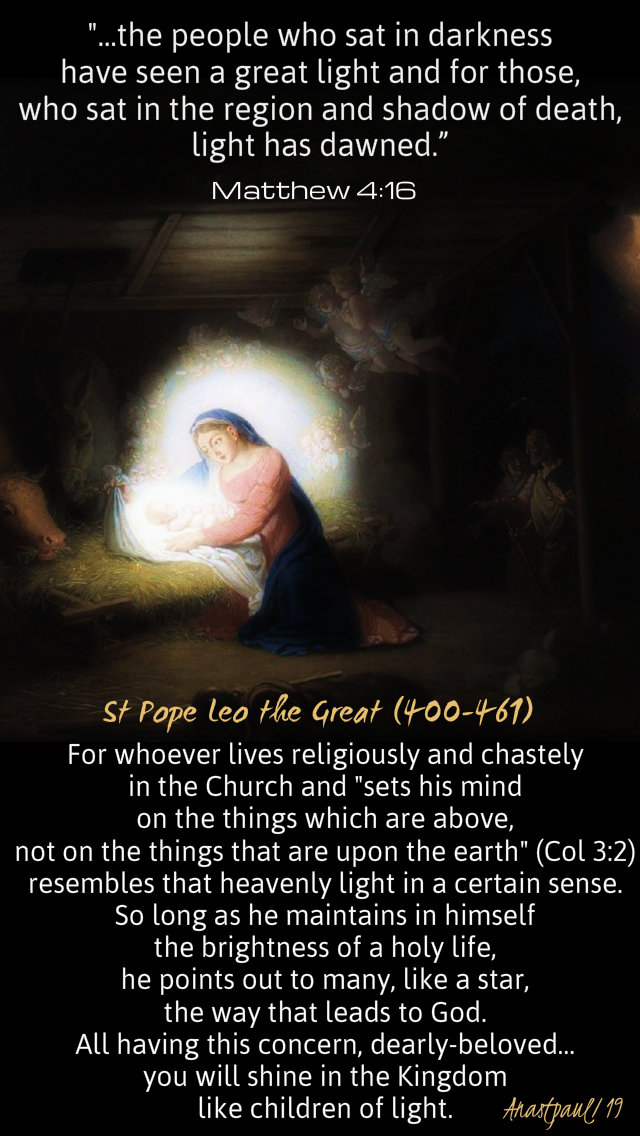
“…the people who sat in darkness have seen a great light and for those, who sat in the region and shadow of death, light has dawned.”…Matthew 4:16

REFLECTION – “All these things we know to have taken place ever since the three wise men, aroused in their far-off land, were led by a star to recognise and worship the King of heaven and earth.   The responsiveness of that star exhorts us to imitate it’s obedience and, as much as we can, to make ourselves servants of that grace which invites us all to Christ.   For, whoever lives religiously and chastely in the Church and “sets his mind on the things which are above, not on the things that are upon the earth” (Col 3:2) resembles that heavenly light in a certain sense.   So long as he maintains in himself the brightness of a holy life, he points out to many, like a star, the way that leads to God.   All having this concern, dearly-beloved… you will shine in the Kingdom like children of light.”…St Pope Leo the Great (400-461) Father & Doctor of the Churchmatthew 4 16 - the people who sat in darkness - for whoever lives - st pope leo 7 jan 2019

PRAYER – Lord, may the radiance of Your glory, light up our hearts and bring us through the shadows of this world, until we reach our homeland of everlasting light.   Grant we pray, that by the intercession of St Raymond of Peñafort , our way may be smoothed and our troubles eased.   We ask this through Jesus, our Lord, with the Holy Spirit, God forever, amen.st raymond of penafort pray for us 7 jan 2019

Posted in Our MORNING Offering, PRAYERS of the SAINTS

Our Morning Offering – 7 January – Christmas Weekday  Monday after Epiphany

Our Morning Offering – 7 January – Christmas Weekday Monday after Epiphany

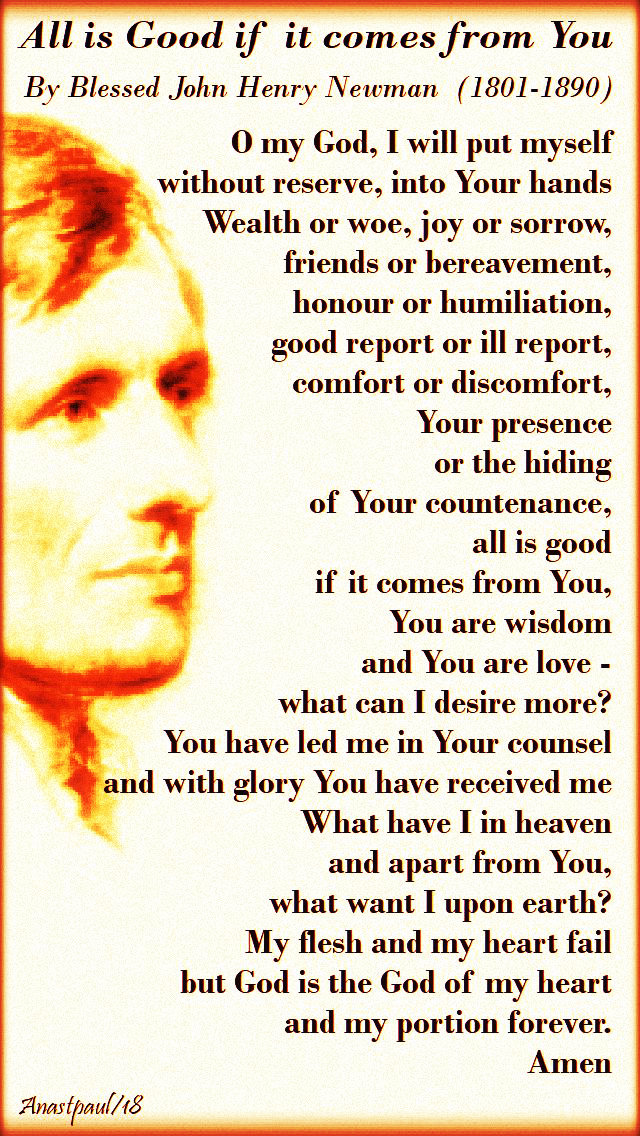
O my God, all is Good if it comes from You
By Blessed John Henry Newman (1801-1890)

O my God,
I will put myself without reserve,
into Your hands.
Wealth or woe, joy or sorrow,
friends or bereavement,
honour or humiliation,
good report or ill report,
comfort or discomfort,
Your presence
or the hiding of Your countenance,
all is good if it comes from You,
You are wisdom and You are love –
what can I desire more?
You have led me in Your counsel
and with glory You have received me
What have I in heaven
and apart from You,
what want I upon earth?
My flesh and my heart fail
but God is the God of my heart
and my portion forever.
Ameno-my-god-all-is-good-if-it-comes-from-you-bl-john-henry-newman-no-3-25-sept-2018

Posted in DOMINICAN OP, SAINT of the DAY

Memorials of the Saints -7 January

St Raymond of Peñafort OP (1175-1275) (“Father of Canon Law”) (Optional Memorial)

St Aldric of Le Mans
Bl Ambrose Fernandez
St Anastasius of Sens
St Brannock of Braunton
St Candida of Greece
St Canute Lavard
St Cedd
St Clerus of Antioch
St Crispin I of Pavia
St Cronan Beg
St Emilian of Saujon
St Felix of Heraclea
Bl Franciscus Bae Gwan-gyeom
St Januarius of Heraclea
St Julian of Cagliari
St Kentigerna
St Lucian of Antioch
Bl Marie-Thérèse Haze
St Pallada of Greece
St Polyeuctus of Melitene
St Reinhold of Cologne
St Spolicostus of Greece
St Theodore of Egypt
St Tillo of Solignac
St Valentine of Passau
St Virginia of Ste-Verge
Bl Wittikund of Westphalia

Posted in DOMINICAN OP, Of LAWYERS & CANON Lawyers, Attorneys, Solicitors, Barristers, Notaries, Para-Legals, SAINT of the DAY

Saint of the Day – St Raymond of Peñafort OP (1175-1275) “Father of Canon Law”

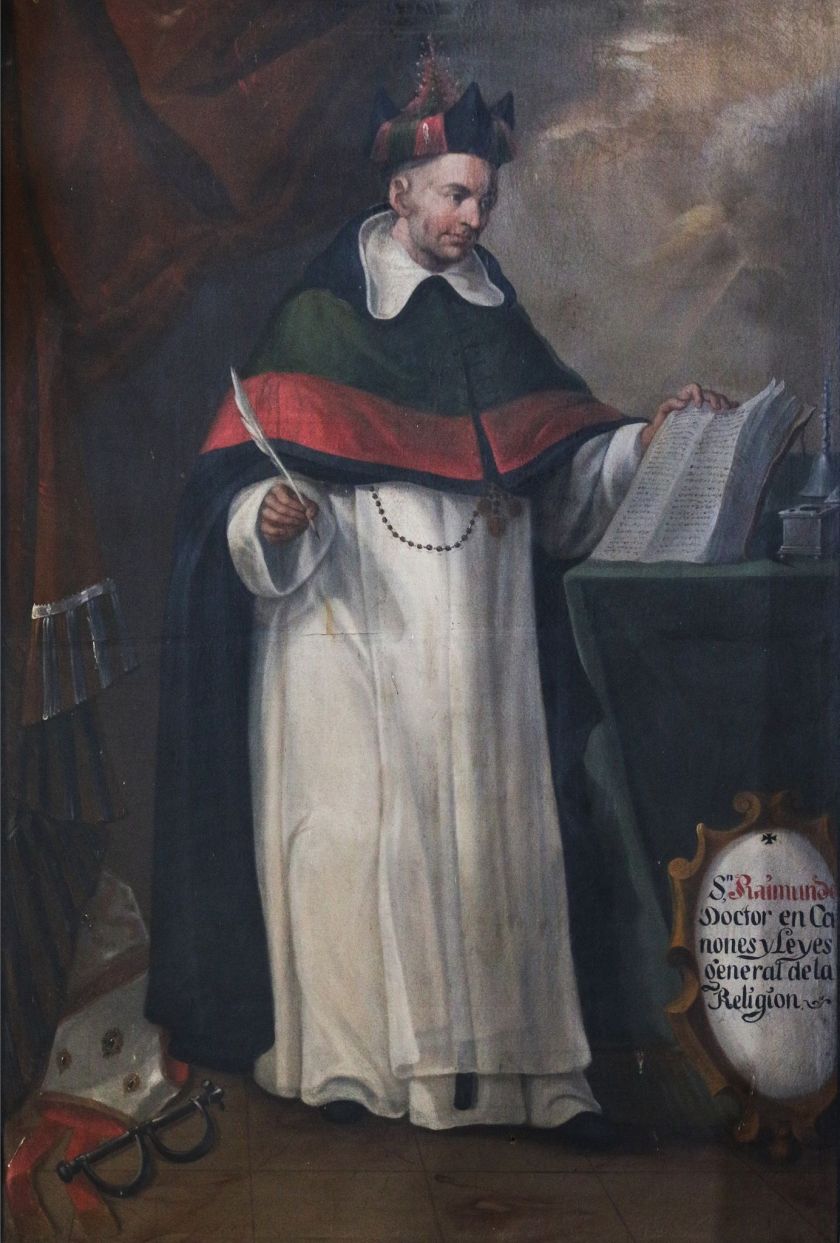
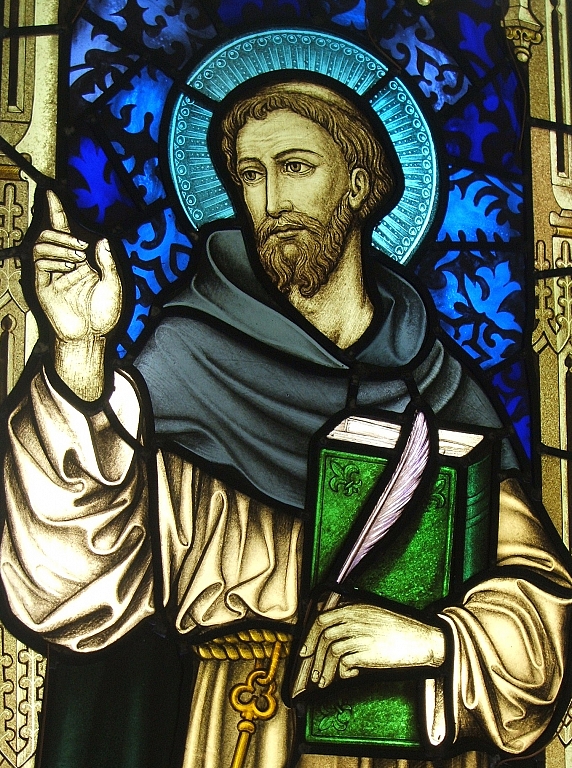
Saint of the Day – St Raymond of Peñafort OP (1175-1275) “Father of Canon Law” Dominican Priest, Doctor of Canon Law, Founder of the Mercedarian friars, the third Master of the Order of Preachers, Writer, Teacher, Miracle-Worker – born on 1175 at Peñafort, Catalonia, Spain and died on 6 January 1275 at Barcelona, Spain of natural causes. PatronagesLawyers, Canonists, Medical Record Librarians, Barcelona, Spain, Navarre, Spain.

sod-0107-saintraymondofpeñafort-790x480
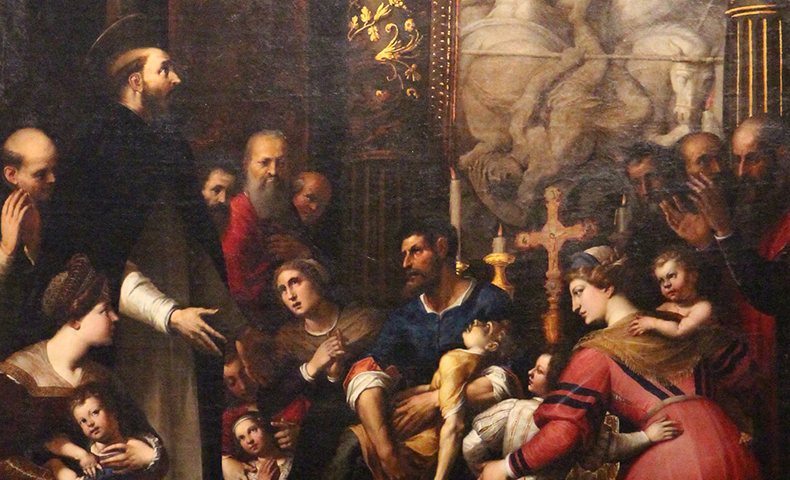
Saint Raymond of Peñafort’s Miracle by Jacopo Ligozzi 

Raymond was born of a noble Spanish family, at the age of twenty, taught philosophy at Barcelona with marvellous success.   Ten years later his rare abilities won for him the degree of Doctor in the University of Bologna and many high dignities.

A tender devotion to our blessed Lady, which had grown up with him from childhood, determined him in middle life to renounce all his honours and to enter her Order of St. Dominic.   There, again, a vision of the Mother of Mercy instructed him to co-operate with his penitent St Peter Nolasco (1189-1256) and with James, King of Aragon, in founding the Order of Our Lady of Ransom for the Redemption of Captives (the Mercedarian friars).  He began this great work by preaching a crusade against the Moors and rousing to penance the Christians, enslaved in both soul and body by the infidel.   King James of Aragon, a man of great qualities but held in bond by a ruling passion, was bidden by the Saint to put away the cause of his sin.  saint_raymond

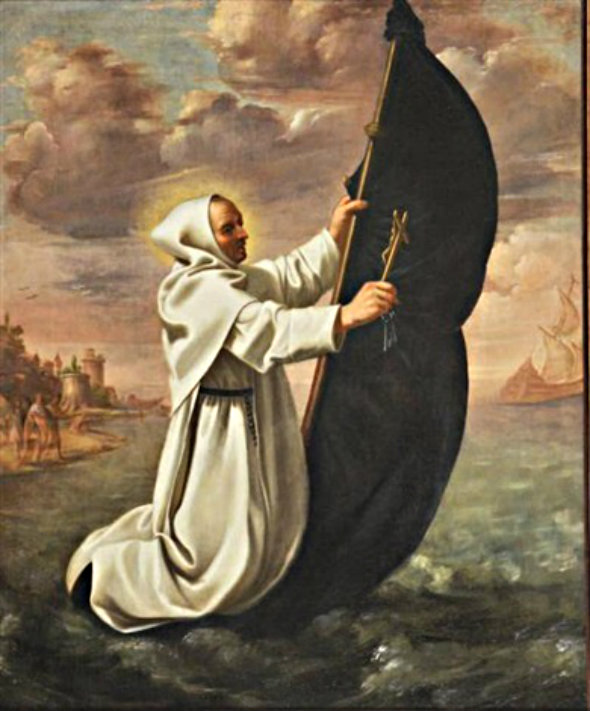
On his delay, Raymond asked for leave to depart from Majorca, since he could not live with sin.   The king refused and forbade, under pain of death, his conveyance by others.  Full of faith, Raymond spread his cloak upon the waters and, tying one end to his staff as a sail, made the sign of the cross and fearlessly stepped upon it.   In six hours he was borne to Barcelona, where, gathering up his cloak dry, he stole into his monastery.   The king, overcome by this miracle, became a sincere penitent and the disciple of the Saint till his death.french-school-(17)-le-miracle-de-saint-raymond-de-penyafort-(1175-1275)

In 1230, Gregory IX. summoned Raymond to Rome, made him his confessor and grand penitentiary and directed him to compile “The Decretals,” a collection of the scattered decisions of the Popes and Councils.  st raymond penafort - canonist.jpg

Having refused the archbishopric of Tarragona, Raymond found himself in 1238 chosen third General of his Order  which post he again succeeded in resigning, on the score of his advanced age.  Rejoicing to see himself again free of office, he applied himself with fresh vigour to the Christian ministry, especially working for the conversion of the Moors.   To this end he encouraged Thomas Aquinas to write his work Against the Gentiles.   He instituted the teaching of Arabic and Hebrew in several houses of the friars.   He also founded priories in Murcia (then still ruled by Arabs) and in Tunis.   Additionally he went to help establish the Church in the recently conquered island of Mallorca.   In 1256 Raymond, then eighty-one, was able to report that ten thousand Saracens had received Baptism.  st-raymond-011,-louth-1318847641.jpg

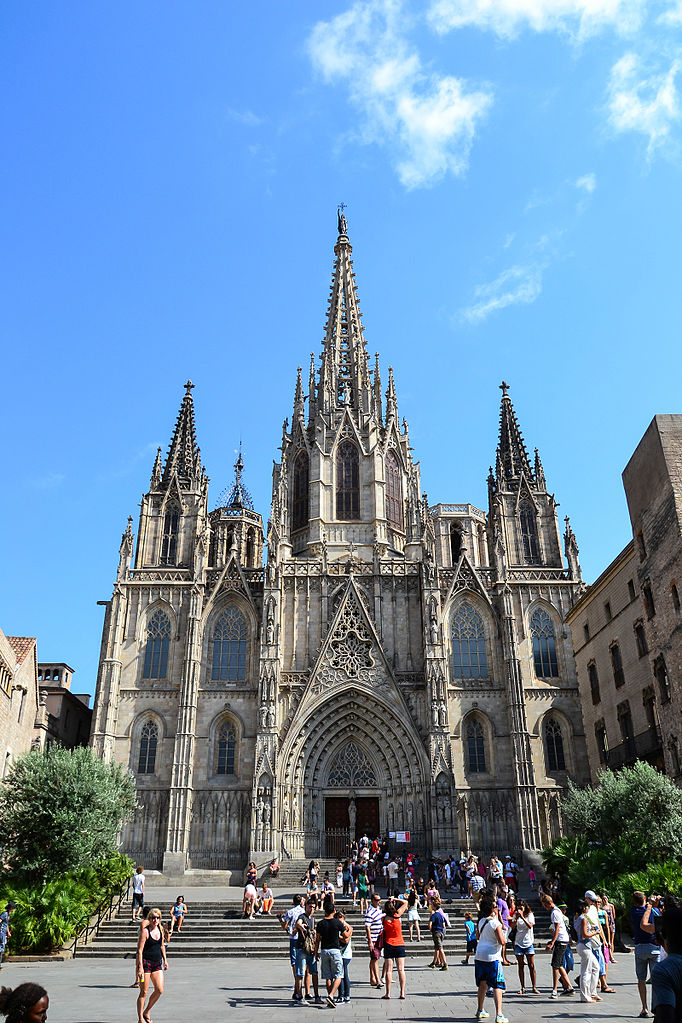
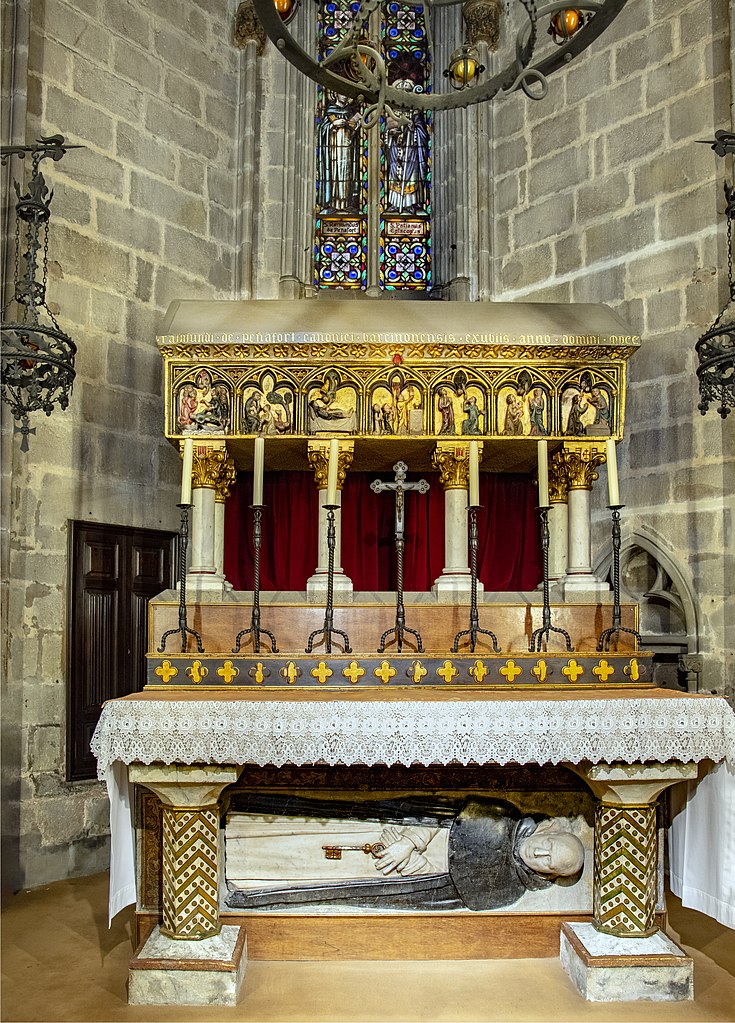
Raymond died at the age of 100 in Barcelona in 1275 and was Canonised by Pope Clement VIII in 1601.   He was buried in the Cathedral of Santa Eulalia in Barcelona.cathedral_of_the_holy_cross_and_saint_eulaliashrine 735px-barcelona_cathedral_interior_-_capella_de_sant_ramon_de_penyafortst raymondf penafort statue

Here is one of my first posts on the saints but it has a lot more detail of his life – St Raymond:  https://anastpaul.wordpress.com/2017/01/07/saint-of-the-day-7-january/

Posted in CATHOLIC-PRAYERS OF THE CHURCH, FEASTS and SOLEMNITIES, MORNING Prayers, PRAYERS for SEASONS, PRAYERS of the CHURCH, THE EPIPHANY of the LORD

“Chalk the Door” – 6 January – Epiphany House Blessing

“Chalk the Door” – 6 January – The Solemnity of the Epiphany of the Lord

Each year around the feast of the Epiphany many parishes throughout the world participate in an annual blessing of chalk.   It is an ancient tradition that not only places God at the entrance of your home, it places your entire family under his protection.

The Epiphany blessing of chalk and homes is a centuries old tradition where priests would visit each home in their parish after the Feast of the Epiphany.   Over time it became more difficult to accomplish such a feat, as parishes became larger and larger and priests were stretched thin.   For this reason it became an accepted tradition that a member of the household is able to lead this blessing in place of the priest.

The blessing has biblical roots, deeply tied to the Passover in the book of Exodus.

The Lord said to Moses and Aaron in the land of Egypt … “take some of the blood [of the lamb], and put it on the two doorposts and the lintel of the houses in which they eat them. They shall eat the flesh that night, roasted; with unleavened bread and bitter herbs they shall eat it … The blood shall be a sign for you, upon the houses where you are; and when I see the blood, I will pass over you, and no plague shall fall upon you to destroy you, when I smite the land of Egypt.” (cf. Exodus 12:1-13)

It is no coincidence that the Epiphany blessing is traditionally written on the lintel of the main doorway and even some of the prayers echo God’s words of protection that He gave to Moses.   While the Epiphany blessing was not given in the same manner as it was to Moses, the Church provides it for our own spiritual benefit.   The Church desires our salvation and so gives us beautiful sacramentals to assist us along the path to Eternal Life.

Traditionally a priest blesses chalk on the Feast of the Epiphany by saying the following prayer (from the Roman Ritual):

Bless, + O Lord God, this creature, chalk and let it be a help to mankind.   Grant that those who will use it with faith in your most holy name and with it inscribe on the doors of their homes the names of your saints, Casper, Melchior, and Baltassar, may through their merits and intercession enjoy health in body and protection of soul, through Christ our Lord.

The chalk is then distributed after Mass.   If your local parish does not administer such a blessing, inquire around and see if any neighbouring parishes do.   Parishioners then take the chalk home and use it while invoking God’s blessing upon their home.

It is a beautiful blessing, one that brings many graces upon those who practice it in faith and is an added protection against any spiritual enemies that may be lurking around.

The Blessing:
Once you acquire the blessed chalk, either a priest or another member of the household can bless the home in the following manner (adapted from the Roman Ritual):

Upon entering the house [or at the front door]:

Priest/Head of Household:   Peace be to this house.
All:   And to all who dwell herein.
Priest:   From the east came the Magi to Bethlehem to adore the Lord and opening their treasures, they offered precious gifts – gold for the great King, incense for the true God and myrrh in symbol of His burial.

During the Magnificat, the room is sprinkled with holy water and incensed.

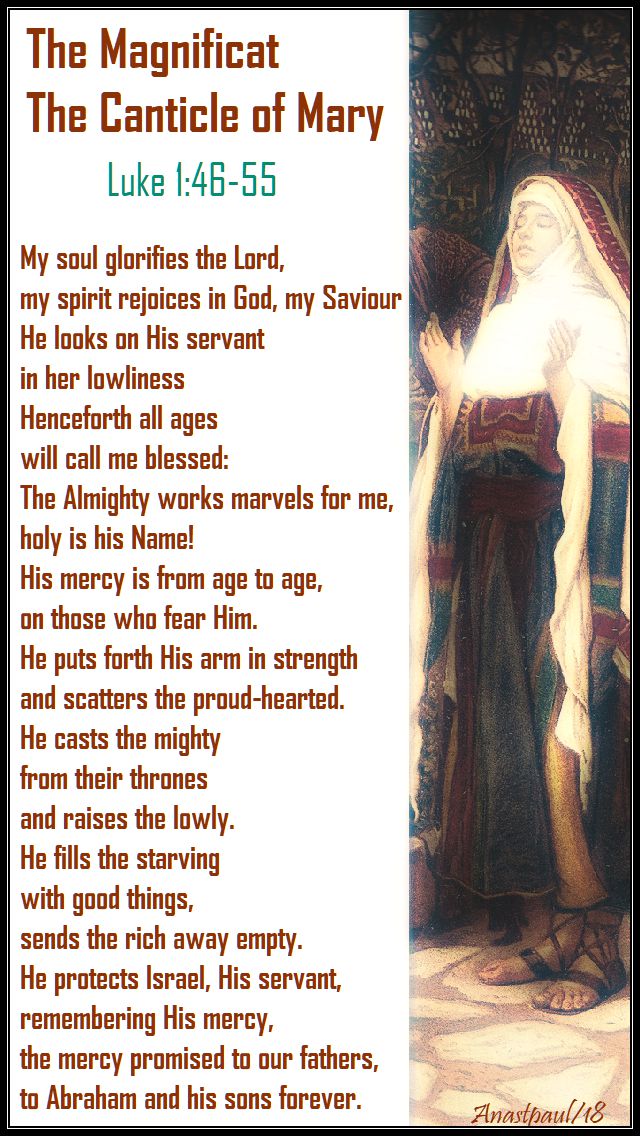
The Magnificat
The Canticle of Mary
Luke 1:46-55

My soul glorifies the Lord,
my spirit rejoices in God, my Saviour
He looks on His servant in her lowliness
Henceforth all ages will call me blessed:
The Almighty works marvels for me,
holy is his Name!
His mercy is from age to age,
on those who fear Him.
He puts forth His arm in strength
and scatters the proud-hearted.
He casts the mighty from their thrones
and raises the lowly.
He fills the starving with good things,
sends the rich away empty.
He protects Israel, His servant,
remembering His mercy,
the mercy promised to our fathers,
to Abraham and his sons forever. the-magnificat-luke-1-46-55-31-may-2018-feast-of-the-visitation1
After this is completed:  All: From the east came the Magi to Bethlehem to adore the Lord and opening their treasures, they offered precious gifts: gold for the great King, incense for the true God and myrrh in symbol of His burial.

Priest:   Our Father Who art in Heaven, hallowed be Thy Name. Thy Kingdom come, Thy will be done on earth as it is in Heaven.   Give us this day our daily bread, and forgive us our trespasses as we forgive those who trespass against us.   And lead and lead us not into temptation,
All: But deliver us from evil.
Priest:  All they from Saba shall come
All:  Bringing gold and frankincense.
Priest:  O Lord, hear my prayer.
All:  And let my cry come unto Thee.

Priest:
Let us pray.   O God, who by the guidance of a star didst on this day manifest Thine only-begotten Son to the Gentiles, mercifully grant that we who know Thee by faith may also attain the vision of Thy glorious majesty.   Through Christ our Lord.

All:  Amen.
Priest:  Be enlightened, be enlightened, O Jerusalem, for thy light is come and the glory of the Lord is risen upon thee– Jesus Christ born of the Virgin Mary.
All:  And the Gentiles shall walk in thy light and kings in the splendour of thy rising, and the glory of the Lord has risen upon thee.

Priest:  Let us pray. Bless, O Lord God almighty, this home, that in it there may be health, purity, the strength of victory, humility, goodness and mercy, the fulfilment of Thy law, the thanksgiving to God the Father and to the Son and to the Holy Spirit.   And may this blessing remain upon this home and upon all who dwell herein.   Through Christ our Lord.
All: Amen

After the prayers of the blessing are recited, walk through the house and bless each room by sprinkling with Epiphany/holy water and incensing it.

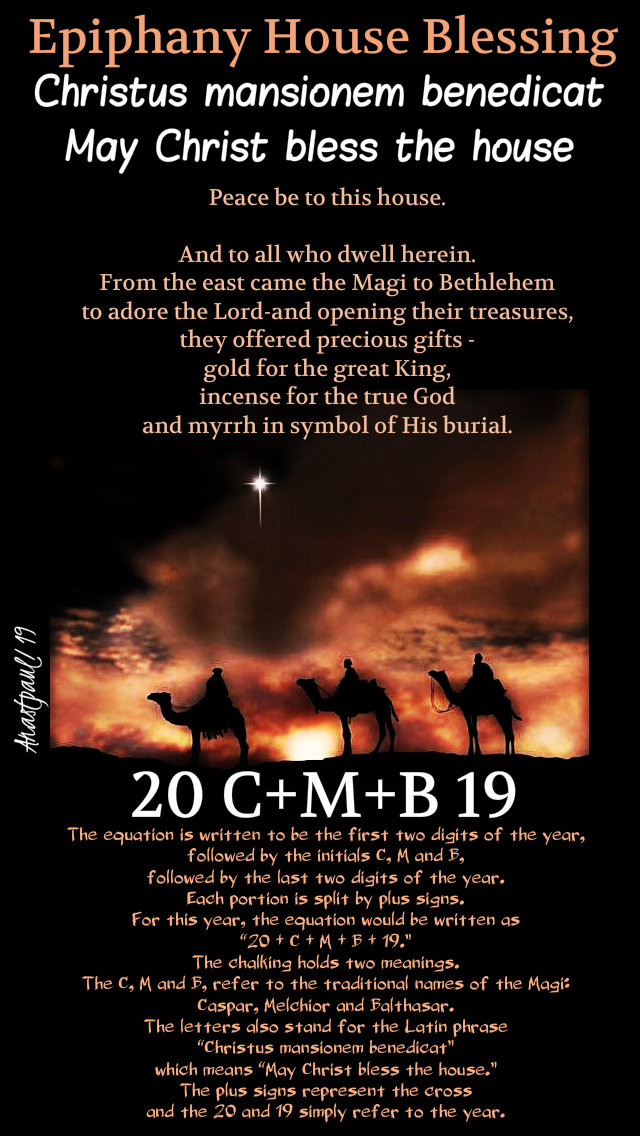
Take the blessed chalk and first write the initials of the three Wise Men, connected with Crosses, over the inside of your front door (on the lintel, if possible).   Then write the year, breaking up the numbers and the year so that they fall on both sides of the initials. It should look like this, for example

20 C+M+B 19

The equation is written to be the first two digits of the year, followed by the initials C, M, and B, followed by the last two digits of the year.   Each portion is split by plus signs.   For this year, the equation would be written as “20 + C + M + B + 19.”

The chalking holds two meanings. The C, M and B, refer to the traditional names of the Magi:  Caspar, Melchior and Balthasar.   The letters also stand for the Latin phrase “Christus mansionem benedicat” which means “May Christ bless the house.”   The plus signs represent the cross and the 20 and 19 simply refer to the year.epiphany house blessing 2019
Posted in MORNING Prayers, PRACTISING CATHOLIC, QUOTES of the SAINTS, SUNDAY REFLECTIONS, THE EPIPHANY of the LORD, The HOLY EUCHARIST / The HOLY MASS, Thomas a Kempis

Sunday Reflection – 6 January – The Solemnity of the Epiphany of the Lord

Sunday Reflection – 6 January – The Solemnity of the Epiphany of the Lord

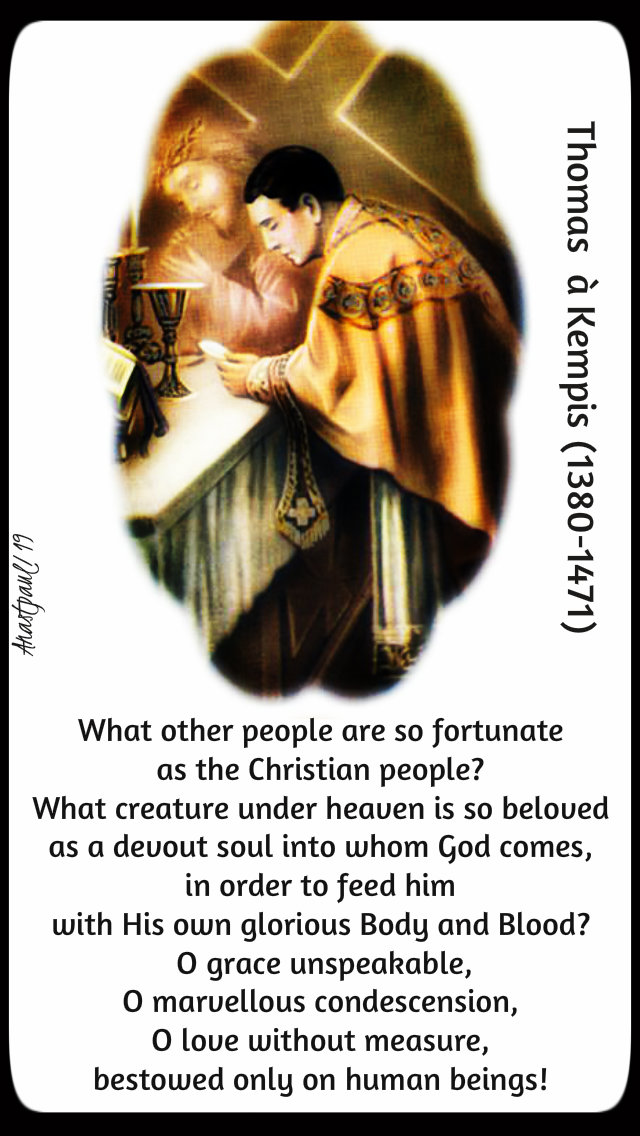
“What other people are so fortunate as the Christian people?   What creature under heaven is so beloved as a devout soul into whom God comes, in order to feed him with His own glorious Body and Blood?   O grace unspeakable, O marvellous condescension, O love without measure, bestowed only on human beings!

There is nothing I can give to the Lord for this grace – this supreme love;  nothing acceptable I can offer Him but my heart entirely given to God and closely united to Him. Then, all that is within me will be filled with joy, when my soul is perfectly one with God.

Then He will say to me:  “If you will be with Me, I will be with you.”  And I will answer Him and say: “Stay with me, Lord, I implore You, for my desire is to be with You.”

This is my whole desire – that my heart be united to You.”

Thomas à Kempis (1380-1471)

Book 4-Chapter 13 #3
Blessed Sacramentwhat other people are so fortunate - thomas a kempis - sun reflec 6 jan 2019.jpg

Posted in CHRISTMASTIDE!, DOCTORS of the Church, FEASTS and SOLEMNITIES, MORNING Prayers, PRACTISING CATHOLIC, PRAYERS of the SAINTS, QUOTES of the SAINTS, REDEMPTORISTS CSSR, The NATIVITY of JESUS

Thought for the Day – 6 January – The Solemnity of the Epiphany of the Lord

Thought for the Day – 6 January – The Solemnity of the Epiphany of the Lord – Gospel: Matthew 2:1-12

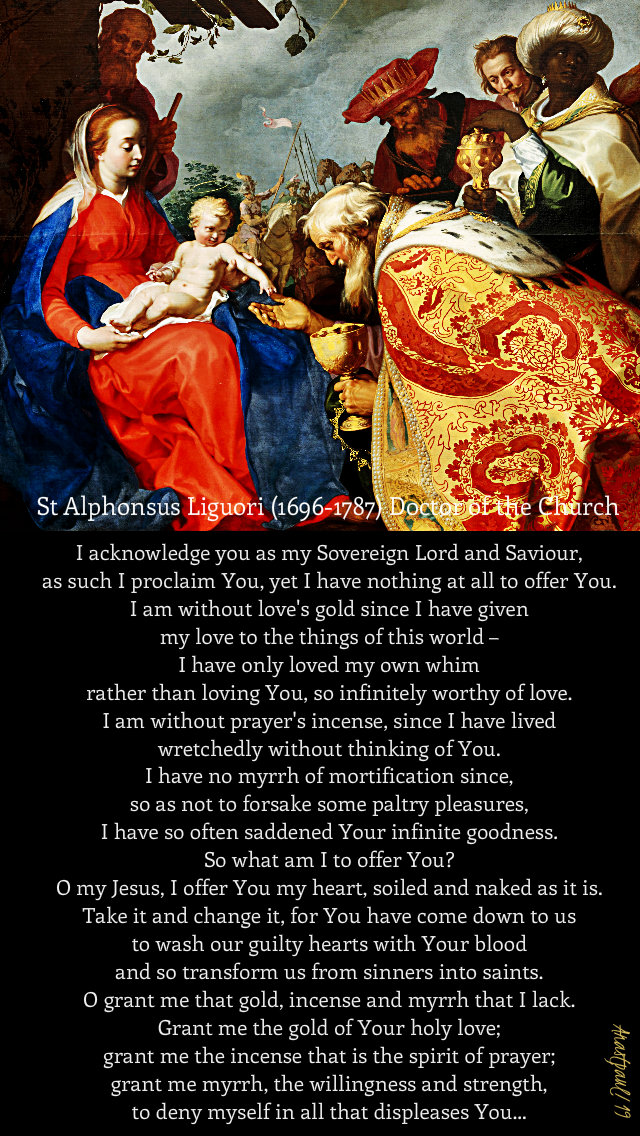
St Alphonsus Liguori (1696-1787) Doctor of the Church

epiphany-feast-7-jan-2018 (1)

“They saw the child with Mary his mother.   They prostrated themselves and did him homage”...Matthew 2:11

The magi find a poor young woman with a poor child wrapped in poor linen bands… and yet, on entering this cave, they feel a joy never experienced before… The divine Infant’s expression lights up, sign of the loving delight with which He welcomes them as the first conquest of His redeeming work.   Then the holy kings turn their eyes to Mary, who does not speak, remaining silent, yet her face, reflecting joy and shining with a heavenly sweetness, confirms that she welcomes them and is grateful to them for being the first to recognise her Son for who He is – their Sovereign Lord…

O Child so worthy of our love, I see You lying on the straw in this cave, so poor and despised.   Yet faith teaches me that You are my God come down from heaven for my salvation.   I acknowledge You as my Sovereign Lord and Saviour, as such I proclaim You, yet I have nothing at all to offer You.   I am without love’s gold, since I have given my love to the things of this world – I have only loved my own whim, rather than loving You, so infinitely worthy of love.   I am without prayer’s incense since I have lived wretchedly without thinking of You.   I have no myrrh of mortification since, so as not to forsake some paltry pleasures, I have so often saddened Your infinite goodness.   So what am I to offer You?   O my Jesus, I offer You my heart, soiled and naked as it is.   Take it and change it, for You have come down to us to wash our guilty hearts with Your blood and so transform us from sinners into saints.   O grant me that gold, incense and myrrh that I lack.   Grant me the gold of Your holy love;  grant me the incense that is the spirit of prayer;  grant me myrrh, the willingness and strength to deny myself in all that displeases You…

O holy Virgin, you welcomed those devout magi kings with keen affection and satisfied them.   Deign to welcome and comfort me also, I who come, following their example, to visit and offer myself to your Son.i acknowledge you as my lord and saviour - st alphonsus 6 jan 2019

Posted in CHRISTMASTIDE!, DOCTORS of the Church, FATHERS of the Church, FEASTS and SOLEMNITIES, MORNING Prayers, QUOTES of the SAINTS, The NATIVITY of JESUS, The WORD

Quote/s of the Day – 6 January – The Solemnity of the Epiphany of the Lord

Quote/s of the Day – 6 January – The Solemnity of the Epiphany of the Lord

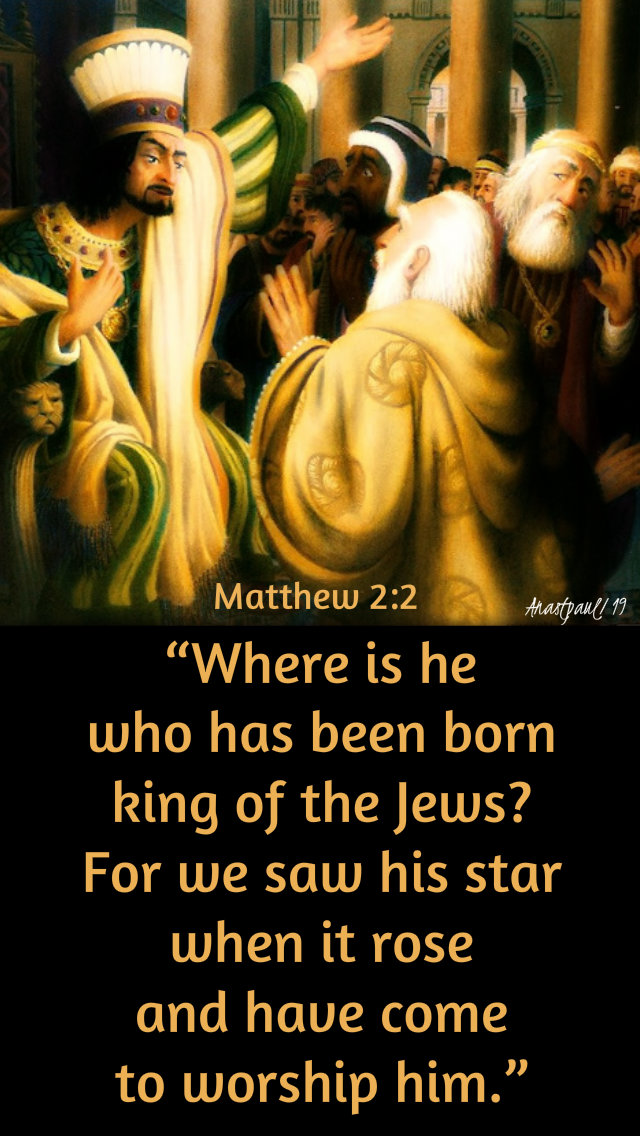
“Where is he who has been born king of the Jews?
For we saw his star when it rose
and have come to worship him.”

Matthew 2:2matthew 2 2 - where is he - 6 jan 2019

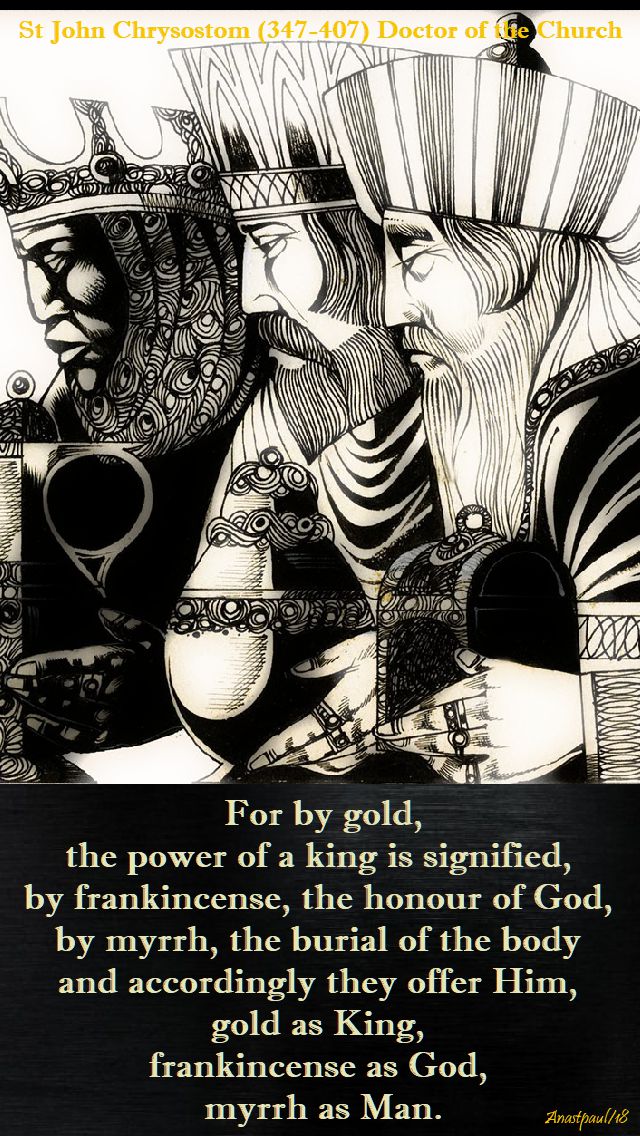
“For by gold, the power of a king is signified,
by frankincense the honour of God,
by myrrh the burial of the body
and accordingly they offer Him,
gold as King,
frankincense as God,
myrrh as Man.”

St John Chrysostom (347-407) Father & Doctor of the Churchfor-by-gold-st-john-chrysostom-7-jan-2018

“Though many kings of the Jews
had been born and died, none of them,
did the Magi seek to adore.
And so they, who came from a distant foreign land,
to a kingdom that was entirely strange to them…
But they had learnt, that such a King was born,
that by adoring Him, they might be sure of obtaining
from Him the salvation which is of God.”though many kings had been born and died st augustine 6 jan 2019

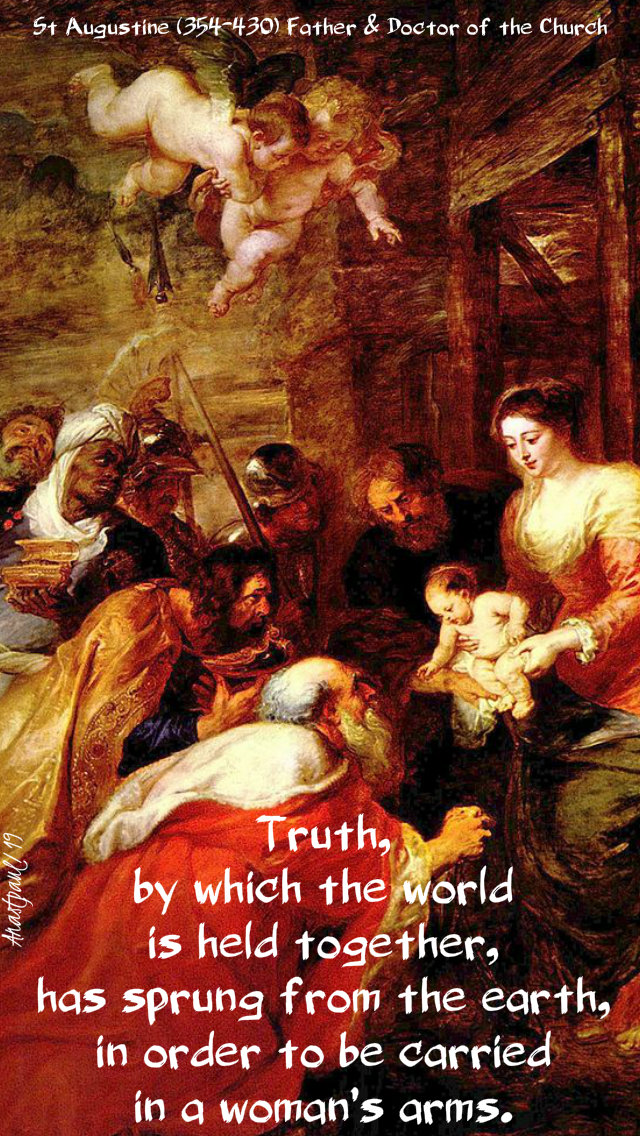
“Truth,
by which the world is held together,
has sprung from the earth,
in order to be carried
in a woman’s arms.”

St Augustine (354-430) Father & Doctor of the Churchtruth by which the world is held together - st augustine - 6 jan 2019.jpg

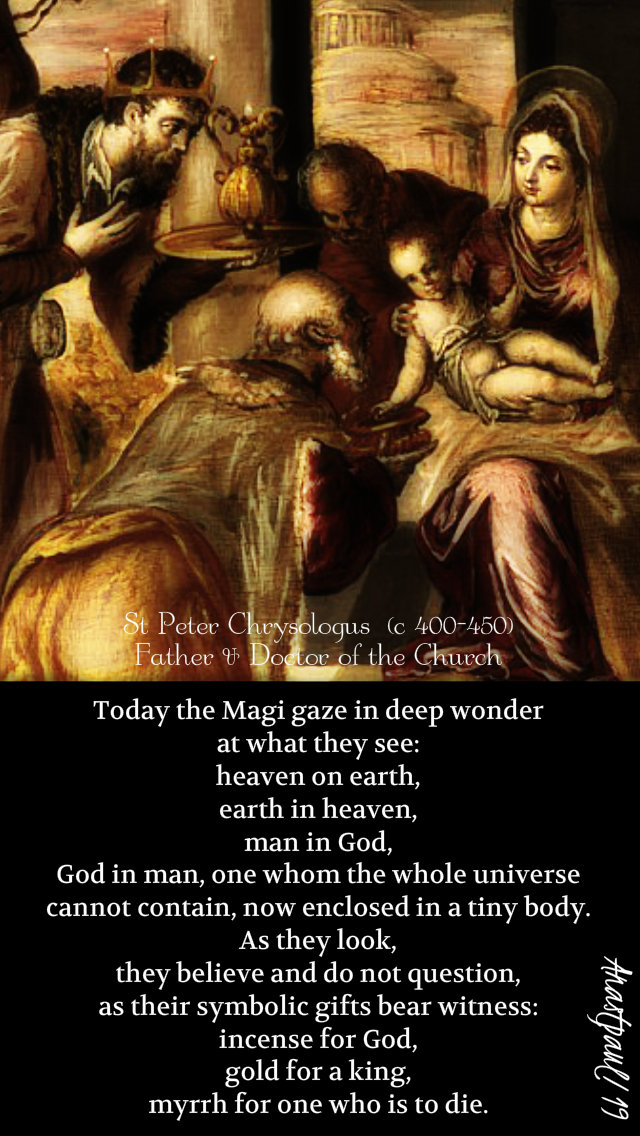
“Today the Magi gaze in deep wonder
at what they see:
heaven on earth, earth in heaven, man in God,
God in man, one whom the whole universe
cannot contain, now enclosed in a tiny body.
As they look, they believe and do not question,
as their symbolic gifts bear witness:
incense for God,
gold for a king,
myrrh for one who is to die.”

St Peter Chrysologus (c 400-450) Father & Doctor of the Churchtoday the magi gaze in deep wonder - st peter chrysologus 6 jan 2019.jpg

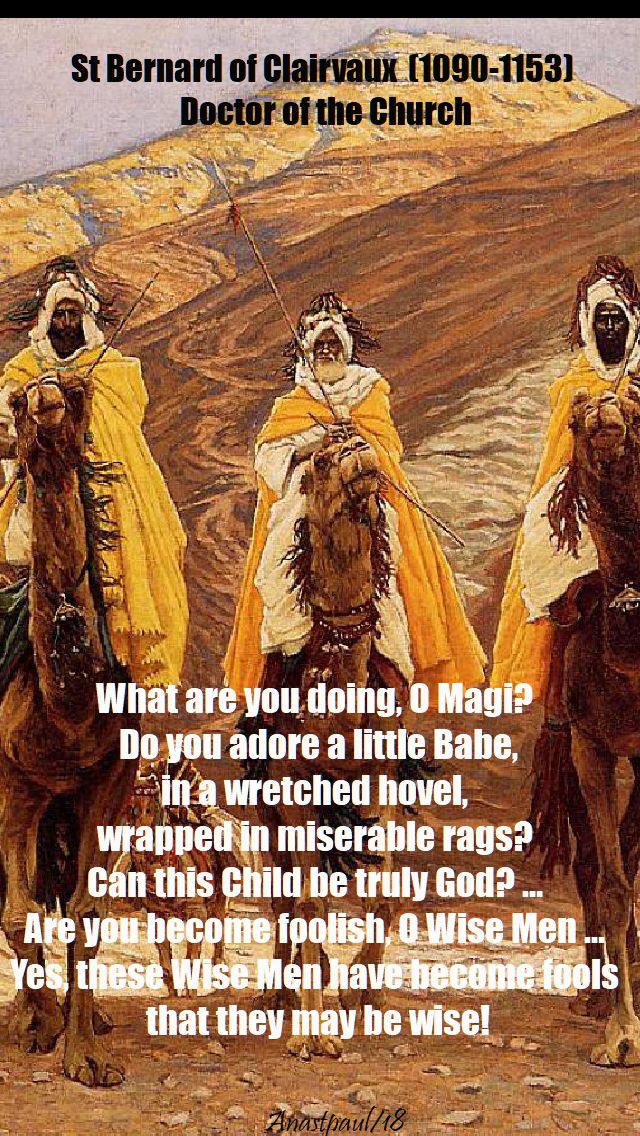
“What are you doing, O Magi?
Do you adore a little Babe, in a wretched hovel,
wrapped in miserable rags?
Can this Child be truly God? …
Are you become foolish, O Wise Men …
Yes, these Wise Men have become fools
that they may be wise!”

St Bernard of Clairvaux (1090-1153) Doctor of the Churchwhat-are-you-doing-o-magi-st-bernard-7-jan-2018.jpg

Posted in CHRISTMASTIDE!, FEASTS and SOLEMNITIES, MORNING Prayers, PAPAL SERMONS, SAINT of the DAY, The NATIVITY of JESUS, The WORD

One Minute Reflection – 6 January – The Solemnity of the Epiphany of the Lord

One Minute Reflection – 6 January – The Solemnity of the Epiphany of the Lord – Gospel: Matthew 2:1-12

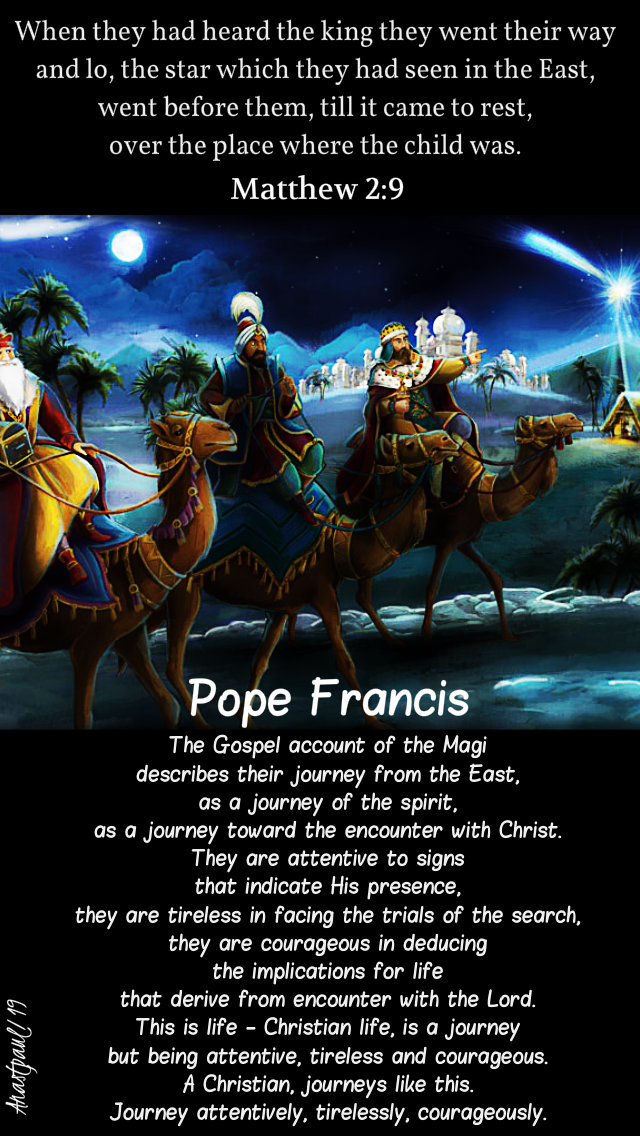
When they had heard the king they went their way; and lo, the star which they had seen in the East went before them, till it came to rest over the place where the child was...Matthew 2:9

REFLECTION – “The Gospel account of the Magi describes their journey from the East as a journey of the spirit, as a journey toward the encounter with Christ.   They are attentive to signs that indicate His presence;  they are tireless in facing the trials of the search;  they are courageous in deducing the implications for life that derive from encounter with the Lord.   This is life – Christian life, is a journey but being attentive, tireless and courageous.   A Christian, journeys like this.   Journey attentively, tirelessly, courageously.”…Pope Francis – Angelus, 6 January 2015matthew 2 9 when they heard the king - the gospel account of the magi pope francis 6 jan 2019

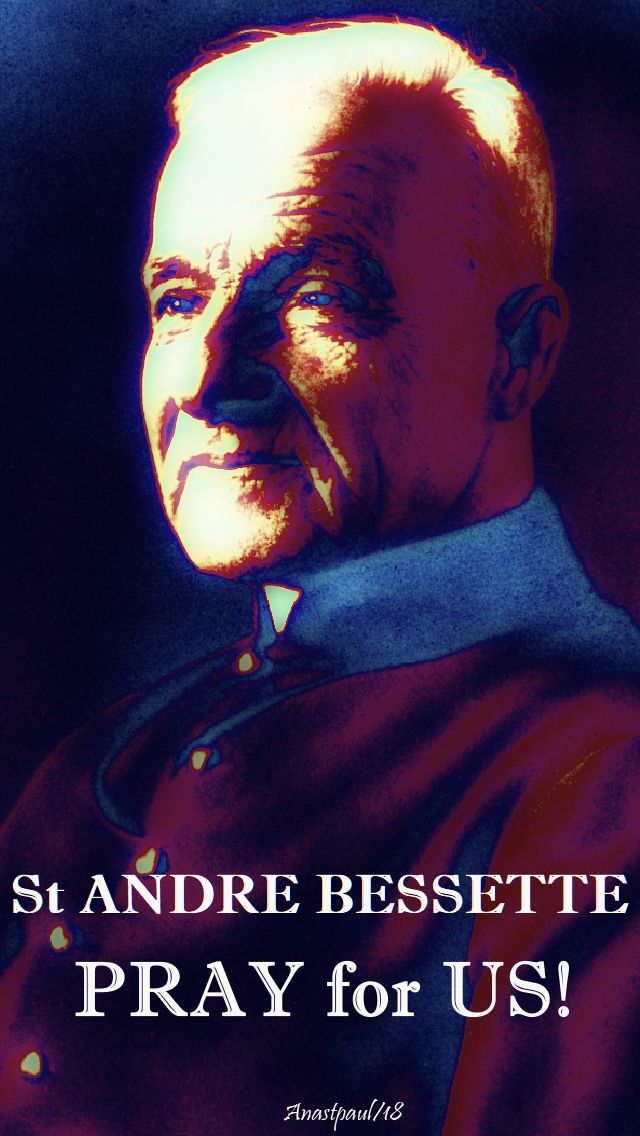
PRAYER – On this day, Lord God, by a guiding star, You revealed Your Only-begotten Son to all the peoples of the world.   Lead us from the faith by which we know You now, to the vision of Your glory, face to face.   May the prayers of St Andre Bessette and all Your saints, who stand beside You, assist us on our journey.   Through Christ our Lord, with the Holy Spirit, God, forever amen.the solemnity of epiphany light of all light reveal yourself this day 6 jan 2019

st andre bessette pray for us -6 jan 2018

Posted in CATHOLIC-PRAYERS OF THE CHURCH, CHRISTMASTIDE!, FEASTS and SOLEMNITIES, Our MORNING Offering, PRAYERS of the CHURCH, The NATIVITY of JESUS

Our Morning Offering – 6 January – The Solemnity of Epiphany

Our Morning Offering – 6 January – The Solemnity of Epiphany

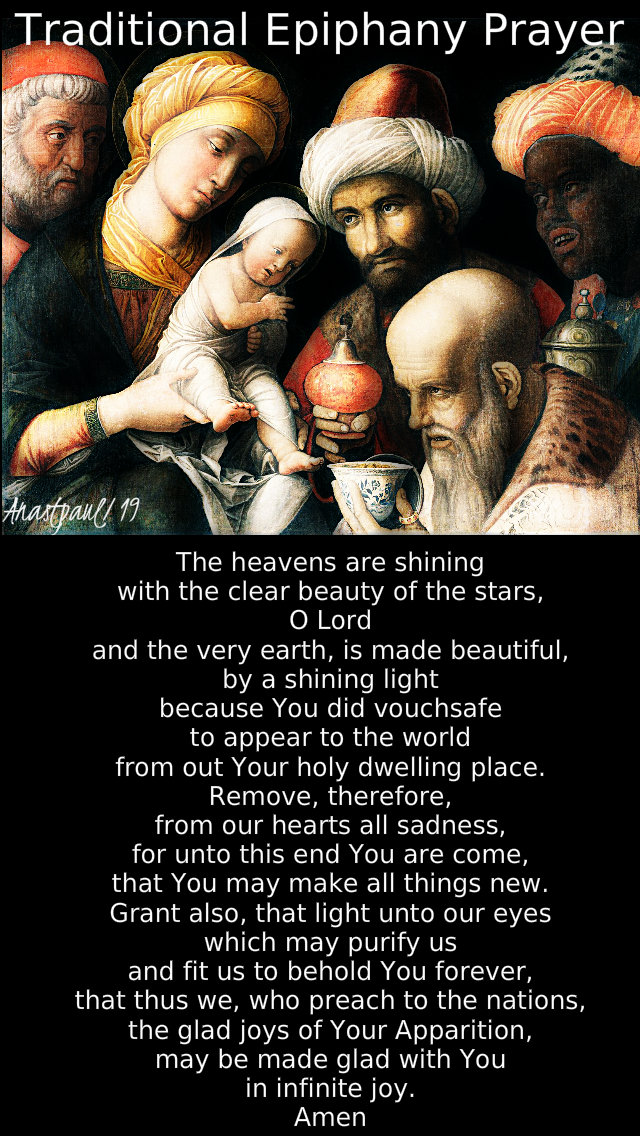
Traditional Andalusian Epiphany Prayer

The heavens are shining
with the clear beauty of the stars,
O Lord
and the very earth, is made beautiful,
by a shining light
because You did vouchsafe
to appear to the world
from out Your holy dwelling place.
Remove, therefore,
from our hearts all sadness,
for unto this end You are come,
that You may make all things new.
Grant also, that light unto our eyes
which may purify us
and fit us to behold You forever,
that thus we, who preach to the nations,
the glad joys of Your Apparition,
may be made glad with You
in infinite joy.
Amentrad epiphany prayer - 6 jan 2019.jpg

Posted in CHRISTMASTIDE!, FEASTS and SOLEMNITIES, The NATIVITY of JESUS

The Solemnity of the Epiphany of the Lord – 6 January

The Solemnity of the Epiphany of the Lord – 6 Januaryepiphany

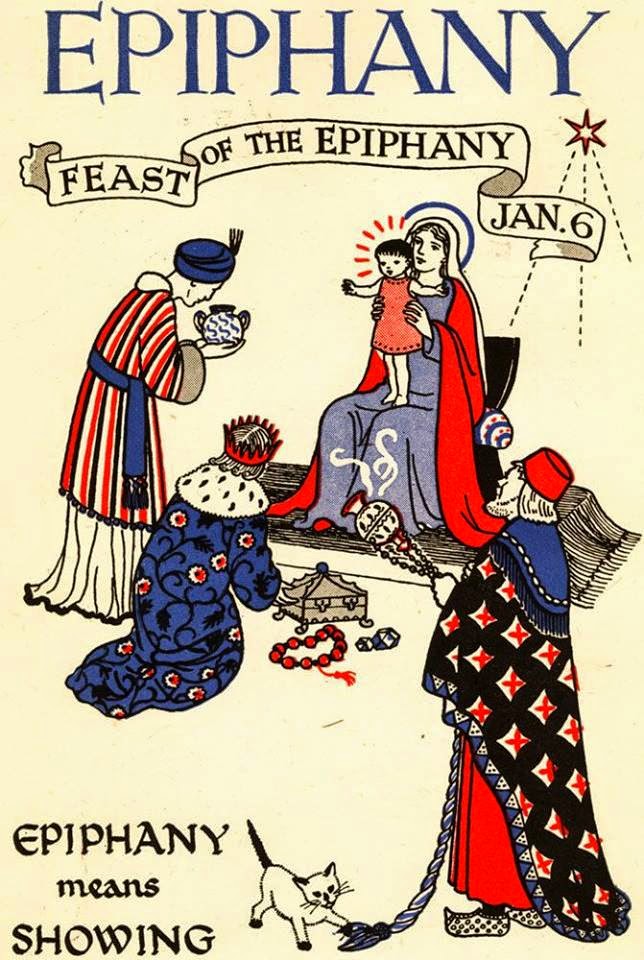
For many years in the English speaking world the feast of Epiphany has been overshadowed by that of Christmas.   But unless we realise the significance of this great day, we see only one side of the mystery of the Incarnation.   Now after contemplating the staggering fact that God has become a human child, we turn to look at this mystery from the opposite angle and realise that this seemingly helpless Child is, in fact, the omnipotent God, the King and Ruler of the universe.   The feast of Christ’s divinity completes the feast of His humanity.   It fulfils all our Advent longing for the King “who is come with great power and majesty.”   We see that whereas Christmas is the family feast of Christianity, Epiphany is the great “world feast of the Catholic Church.”

1024px-francesco_bassano_the_younger_-_adoration_of_the_magi_-_wga01413
Francesco Bassano the Younger

Epiphany is a complex feast.   Originating in the Eastern Church and formed by the mentality of a people whose thought processes differ sharply from our own, the Epiphany is like a rich Oriental tapestry in which the various themes are woven and interwoven — now to be seen in their historical setting, again to be viewed from a different vantage point in their deep mystical significance.   In this brief introduction four of the main ideas of the Epiphany will be outlined.

Divine manifestation:   The Epiphany takes its name from the Greek epiphania, which denotes the visit of a god to earth.   The first idea of the feast is the manifestation of Christ as the Son of God.   “Begotten before the daystar and before all ages, the Lord our Saviour is this day made manifest to the world.”   The feast unites three events in the life of Christ when His divinity, as it were, shines through His humanity – the adoration of the Magi;  the baptism of Christ in the Jordan and the first miracle at the wedding feast of Cana.   Moreover, at Epiphany the Church looks forward to the majestic coming of Christ on the “youngest day” when His manifestation as God will be complete.   The Gospels of the baptism and the marriage at Cana are read on the Octave Day and the Second Sunday after Epiphany and later Sunday masses in the Epiphany season continue to show the divine power of our Lord in some of His most striking miracles.

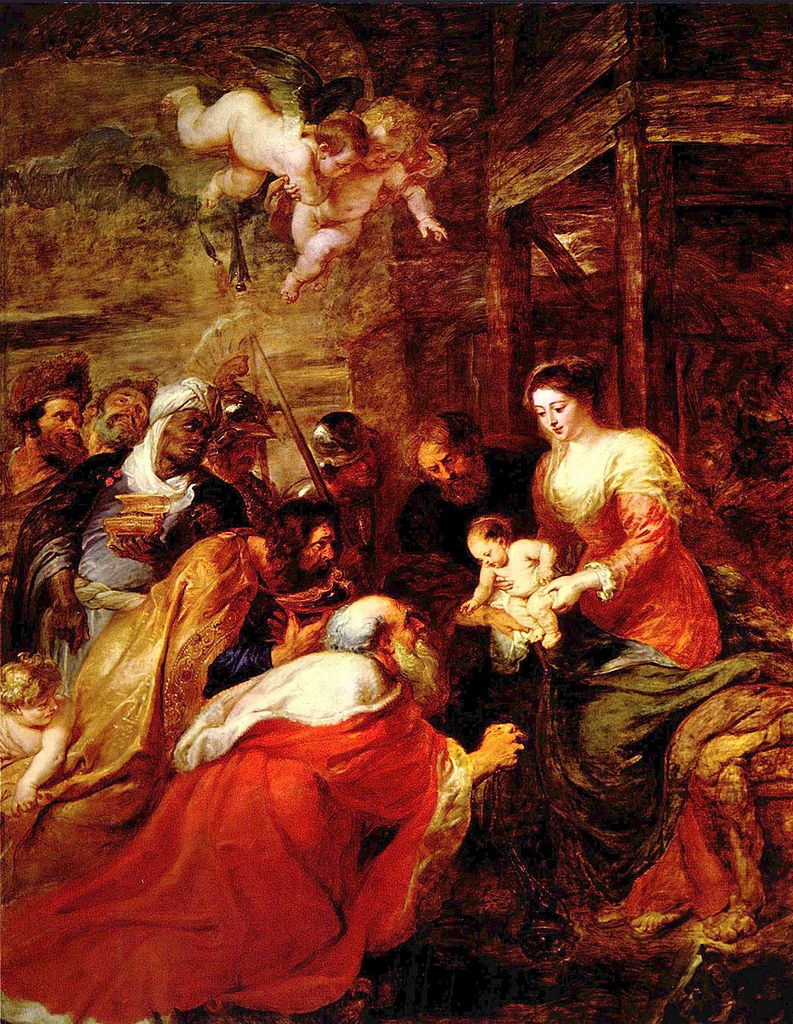
epiphany 793px-peter_paul_rubens_009
Peter Paul Rubens

Royal kingship:   A second important idea in Epiphany is the extension of Christ’s kingship to the whole world.   The revelation of Christ to the three kings at Bethlehem is a symbol of His revelation to the whole of the Gentile world.   Epiphany presents to us the calling of not merely a chosen few but all nations to Christianity.

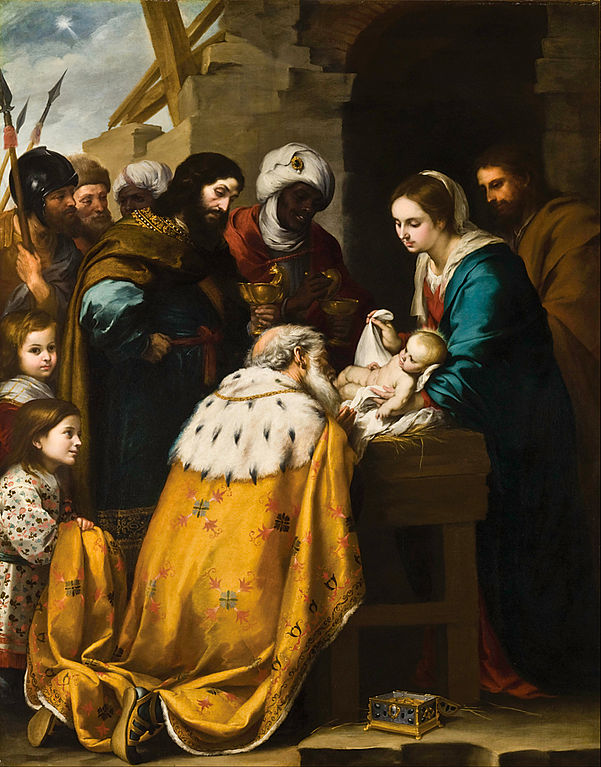
epiphany bartolomé_esteban_murillo_-_adoration_of_the_magi_-_google_art_project
Bartholome Esteban Murillo

Your Light is Come:   Closely linked to both these themes of divine manifestation and world kingship is a third idea running through the Epiphany feast – that of light.   During Advent, the world was in darkness and we prayed and waited in the spirit of the Jewish nation, which lived in expectation of the Coming Light during thousands of years.   At Christmas, the Light shone forth but dimly, seen only by a few around the crib, Mary and Joseph and the shepherds.   But at Epiphany the Light bursts forth to all nations and the prophecy is fulfilled:  “The Gentiles shall walk in Thy light and kings in the brightness of Thy rising.”   The mysterious star of Epiphany, “flashing like a flame,” is still another facet of the light-motif, a symbol capable of being interpreted in a dozen different ways.

epiphany velázquez_-_adoración_de_los_reyes_(museo_del_prado,_1619)
Velazquez

How much food for thought and reflection is contained in just these three ideas and what a significance they have for our own time!   Epiphany lifts our eyes from the family celebrations and demands that we should include in our vision “all the ends of the earth.”   It demands that, like the three wise men, we should have the courage to follow the light of the star we have seen, however hazardous the journey;   that the light of our faith, like that of the wise men, should be so strong that we are able to see and recognise our Lord and Ruler, in however unexpected a way, He may present Himself to us and that having recognised Him, we should bow down and adore Him, offering Him our total loyalty.

Moreover, Epiphany demands that like these kings we should return to our own countries a different way, carrying to all those we meet the light of Christ.   “For behold, darkness shall cover the earth,” says the Epistle of the Epiphany Mass, “and a mist the people but the Lord shall arise upon Thee and His glory shall be seen upon Thee.   And the Gentiles shall walk in Thy light. . .”   These words may be applied to us, upon whom the light of Christ has indeed risen and who have the responsibility to radiate that light in the darkness of our own world.   It is clear how much the feast of Epiphany must mean to all who are engaged in the apostolate and are striving to extend the kingdom of Christ.

The royal nuptials:   Besides the important ideas outlined above, there is still another great theme threaded through the Epiphany feast—the theme of the royal nuptials, the wedding of Christ with humanity.   It is an idea on a completely different level from the historical events which the Epiphany celebrates, yet inextricably bound up with them; for example, the historical marriage feast of Cana is used by the Church to suggest the setting for Christ’s nuptials with the Church, the wise men represent not only the three Persian Magi adoring the Babe 2000 years ago at Bethlehem but also the Gentile world hurrying to the wedding feast at the end of time when mankind’s nuptials with the divine Bridegroom will be celebrated, the gold, frankincense and myrrh are not only tokens for the little Baby King in the stable but royal wedding gifts for the mystical marriage feast of heaven.

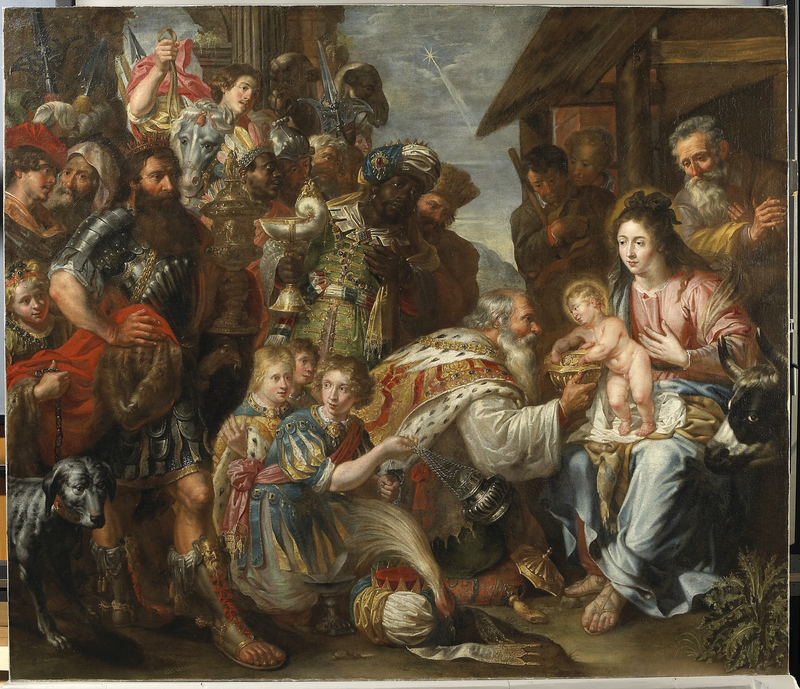
epiphany pieter_van_lint_-_adoration_of_the_magi
Pieter van Lint

The Epiphany antiphon for the hour of Lauds brings out strikingly this theme of the divine marriage of Christ with humanity and at the same time shows the deep mystical significance behind the historical events surrounding the feast.   Perhaps nowhere more clearly than in this antiphon, do we see that on Epiphany we do not commemorate a set of historical facts, as much as we celebrate a great mystery:

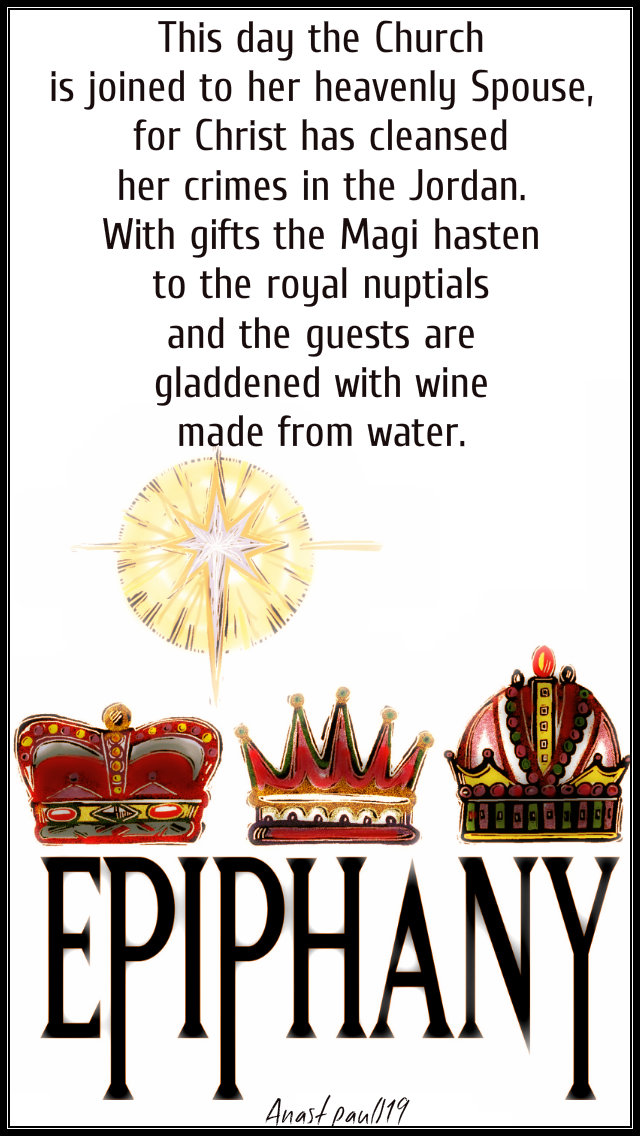
“This day the Church is joined to her heavenly Spouse, for Christ has cleansed her crimes in the Jordan.   With gifts the Magi hasten to the royal nuptials and the guests are gladdened with wine made from water.”this day the church - epiphany - 6 jan 2019

Twelve Days of Christmas, The by Elsa Chaney, The Liturgical Press, Collegeville, MN, 1955

Posted in FEASTS and SOLEMNITIES, SAINT of the DAY

The Solemnity of the Epiphany of the Lord and Memorials of the Saints – 6 January

The Solemnity of the Epiphany of the Lord – Epiphany celebrates the visit of the three kings or wise men to the Christ Child, signifying the extension of salvation to the Gentiles.   The date of Epiphany, one of the oldest Christian feasts, is 6 January the 12th day after Christmas.   However, in most countries, the celebration of Epiphany is transferred to the Sunday that falls between January 2 and January 8 (inclusive).   Greece, Ireland, Italy and Poland continue to observe Epiphany on 6 January as do some dioceses in Germany.
Because Epiphany is one of the most important Christian feasts, it is a Holy Day of Obligation in most countries.

Epiphany 2018:  https://anastpaul.wordpress.com/2018/01/07/the-solemnity-of-the-epiphany-of-our-lord-jesus-christ-7-january-god-reveals-himself-to-us/

St Andre Bessette (1845-1937) (7 January in Canada)

St Andrew Corsini
St Antoninus
St Basillisa of Antinoë
St Charles of Sezze OFM (1613-1670)

About St Charles:  https://anastpaul.wordpress.com/2018/01/06/saint-of-the-day-6-january-st-charles-of-sezze-o-f-m-1613-1670/

St Demetrius of Philadelphia
St Diman Dubh of Connor
St Edeyrn
St Eigrad
St Erminold of Prüfening
St Felix of Nantes
Bl Frederick of Saint-Vanne
Bl Gertrud of Traunkirchen
Bl Gertrude van Oosten
St Guarinus of Sion
St Guy of Auxerre
St Honorius
St Hywyn of Aberdaron
St John de Ribera
St Julian of Antinoë
St Julius
Bl Luc of Roucy
Bl Macarius the Scot
St Macra of Rheims
St Merinus
St Nilammon of Geris
St St Petran of Landévennec
St Peter of Canterbury
Bl Peter Thomas
St Pia of Quedlinburg
St Pompejanus
St Rafaela Porras y Ayllón
Bl Raymond de Blanes
Bl Rita Amada de Jesus
St Schotin
St Wiltrudis of Bergen

Martyrs in Africa: Unknown number of Christian men and women who were martyred in the persecutions of Septimus Severus. They were burned to death c 210.

Martyrs of Sirmium – 8 saints: A group of Christians martyred together for their faith. The only surviving details are the names of eight of them – Anastasius VIII, Florianus, Florus, Jucundus, Peter, Ratites, Tatia and Tilis. They were martyred in the 4th century at Syrmium, Pannonia (modern Sremska Mitrovica, Vojvodina, Serbia).

Twelve Apostles Saints of Ireland: Twelve 6th century Irish monks who studied under Saint Finian at Clonard Abbey and then spread the faith throughout Ireland. Each has his own commemoration but on this day they and their good work are considered and celebrated together. Though Saint Finian is sometimes included, most ancient writers list them as –
• Brendan of Birr
• Brendan the Navigator
• Columba of Iona
• Columba of Terryglass
• Keiran of Saighir
• Kieran of Clonmacnois
• Canice of Aghaboe
• Lasserian of Leighlin
• Mobhí of Glasnevin
• Ninnidh the Saintly of Loch Erne
• Ruadh´n of Lorrha
• Senan of Iniscathay

Posted in QUOTES of the SAINTS, SAINT of the DAY

Thought for the Day – 5 January – The Loves of St Charles – His family and the Faith

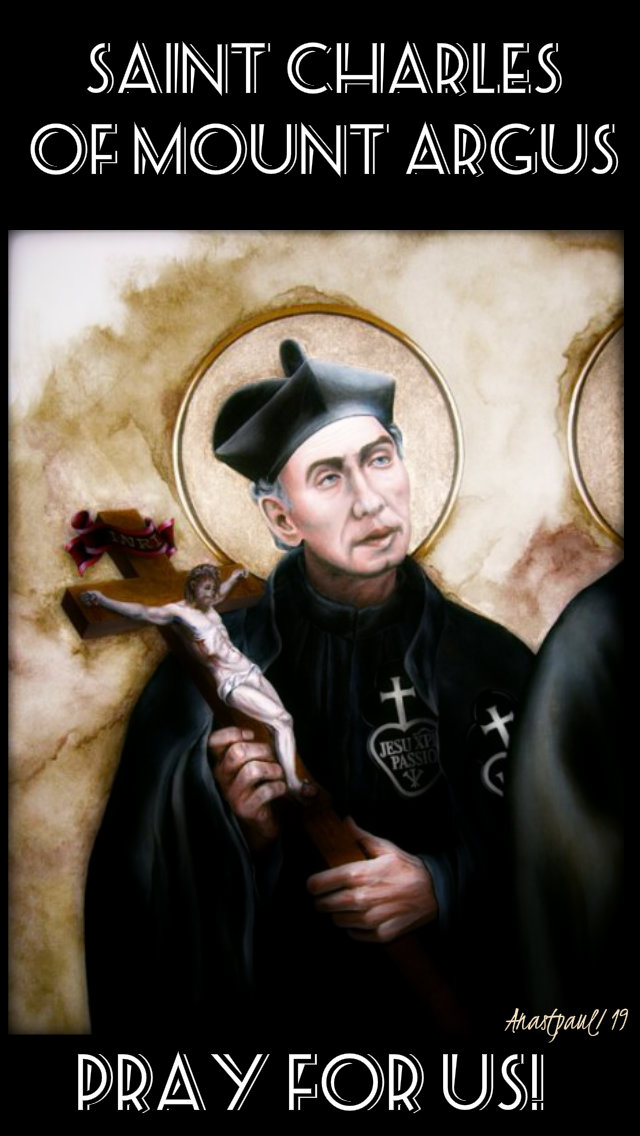
Thought for the Day – 5 January – the Memorial of St Charles of Mount Argus C.P. (1821-1893)

Excerpt from a letter to his brother, Father Peter Joseph Houben
Written at Blessed Paul’s Retreat, Harold’s Cross, Dublin.
20 November 1862.

“My dear Reverend Brother,
I was delighted to hear that you and our brothers and sisters are keeping well, also our uncle, the mayor, (2) and our niece (3).   I too am very well, thank God.   It seems to me that our niece is a very devout and humble girl and I hope that she remembers to pray for me from time to time (child of Mary, would you be willing to say a little prayer for me?) I want to pray for you that you may come to a complete understanding of your state in life.

I have now been away from you for 17 years;  this time has passed so quickly that to me it seems but a moment.   I am very far away from you all but what does it matter how far we are from each other in this life, so long as we are united for all eternity with Jesus and Mary.
I think of you, my brother, everyday during Mass – I think and think again of you, my good Peter Joseph;  also dear Mary Sibyl, Mary Christine, John Matthew, Godfrey, Anne Mary and Mary Helen, my dearest uncle, the mayor and my good niece Mary Philomena. Remember me sometimes in your prayers.   I wish my brother John Matthew and my sister Anne Mary (4) much happiness in married life – my best wishes to their families.   I pray for them, that if God grants them children, they will bring them up to know His peace, have them pray every morning and every night and teach them to recite the rosary in the evening and that the welfare of their souls will be the most important thing in life for them.   We should be thankful to God for having given us such good parents and for our aunts, uncles, etc.

I now find it quite difficult to write and speak in my own native tongue.   Here in Dublin we have built a huge monastery which cost about eight thousand pounds.   The Irish gave us this money;  they are very generous when it comes to their Catholic faith. However, here in the city of Dublin and in the surrounding districts there are also thousands of people who neither go to confession nor make their Easter communion.

With all my heart I implore you to pray for them, to offer your evening rosary for the conversion of so many great sinners;  go to Mass and offer your communions for this intention.   I shudder when I think of how often our Lord is offended in this large city, crucified by serious sins.   Ah, pray that these sinners may turn back to God.   In Dublin and the surrounding districts there are about 300 thousand Catholics and 50 thousand Protestants. 

In our monastery there is a religious, John Joseph Renon from Hoensbrock, who was in London for twelve years; we have a monastery there, too.

…I must finish now. I give my priestly blessing to everyone, let us try to please God in all that we do and suffer and let us think often of the Passion of Christ and the Seven Sorrows of Mary.

My best wishes to my dear uncle J. N. Luyten, the mayor and to all my family and friends.
Your affectionate brother,
Fr Charles Houben, Passionist

St Charles of Mount Argus, Pray for Us!

Letter 5-Notes

1. Summ. p. 333, L.13.
2. Mayor Luyten of Munstergeleen was Charles’ mother’s brother.
3. Mary Philomena Houben, John Peter’s daughter, who was fifteen years of age.
4. Anne Mary had married John Peter Lenssen on 14th January, 1862.st charles of mount argus pray for us 5 jan 2019

Posted in CHRISTMASTIDE!, QUOTES for the NEW YEAR, QUOTES of the SAINTS, QUOTES on ETERNAL LIFE, QUOTES on GRACE, SAINT of the DAY, The INCARNATION, The NATIVITY of JESUS

Quote/s of the Day – 5 January – St Charles of Mount Argus C.P. (1821-1893)

Quote/s of the Day – 5 January – Christmas Saturday and the Memorial of St Charles of Mount Argus C.P. (1821-1893)

“The birth of our Lord Jesus Christ
in the stable at Bethlehem is a mystery,
it is a miracle so great,
abounding so much in humility and love,
that it will be wondered at by the angels
and saints in heaven for all eternity.
What can I, a mere man,
give the Divine Redeemer in return for such great
and innumerable blessings-
so great, that they cannot be explained-
which, for so many years, I have received from His mercy?
When I consider this, I feel urged,
to thank God with greater fervour,
to please Him more
and to do and suffer everything willingly,
for His love and for His greater glory.”
(Letter 15-To his brother, Father Peter Joseph Houben.
J. X. P. St Paul’s Retreat, Harold’s Cross, Mount Argus, Dublin. 29th December, 1875)the birth of our lord jesus - st charles of mount argus 5 jan 2019

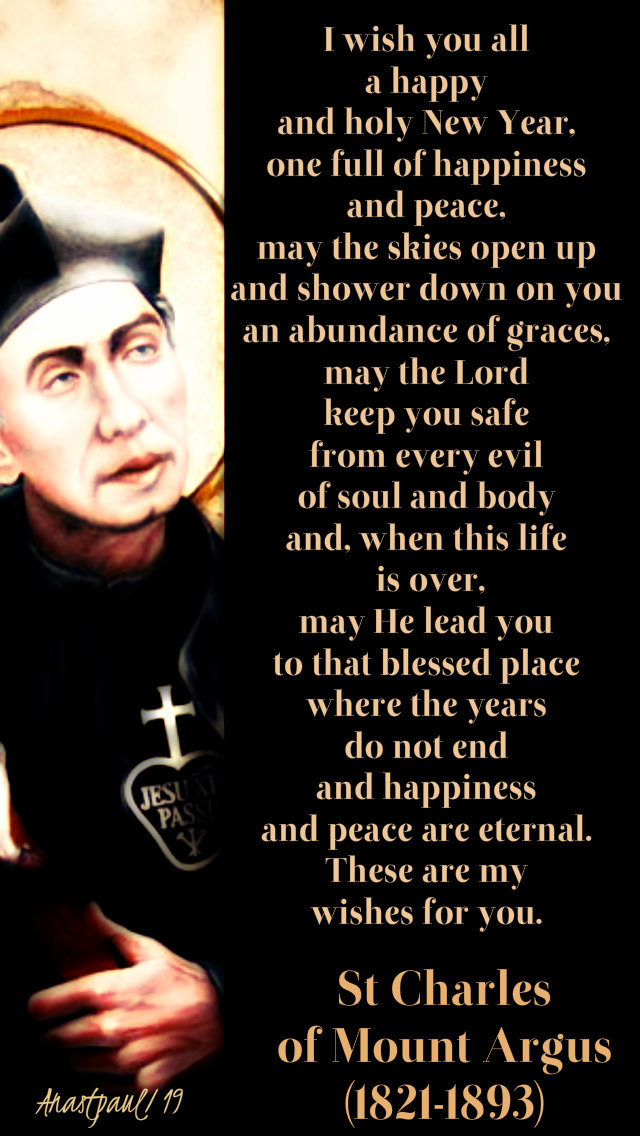
“I wish you all a happy and holy New Year,
one full of happiness and peace,
may the skies open up and shower down on you
an abundance of graces,
may the Lord keep you safe
from every evil of soul and body
and, when this life is over,
may He lead you to that blessed place
where the years do not end
and happiness and peace are eternal.
These are my wishes for you.”
(Letter 13-To his brother, Father Peter Joseph Houben.
J. X. P. St Joseph’s Retreat, Highgate, London W. 15th January, 1873.)

St Charles of Mount Argus (1821-1893)i wish you all a happy and holy new year - st charles of mount argus 5 jan 2019

Posted in QUOTES of the SAINTS, QUOTES on HOPE, QUOTES on TRUST and complete CONFIDENCE in GOD, SAINT of the DAY, The WORD

One Minute Reflection – 5 January – Christmas Saturday, today’s Gospel John 1:35–42

One Minute Reflection – 5 January – Christmas Saturday, today’s Gospel John 1:35–42
and the Memorial of St John Nepomucene Neumann CSsR (1811-1860)
& St Charles of Mount Argus C.P. (1821-1893)

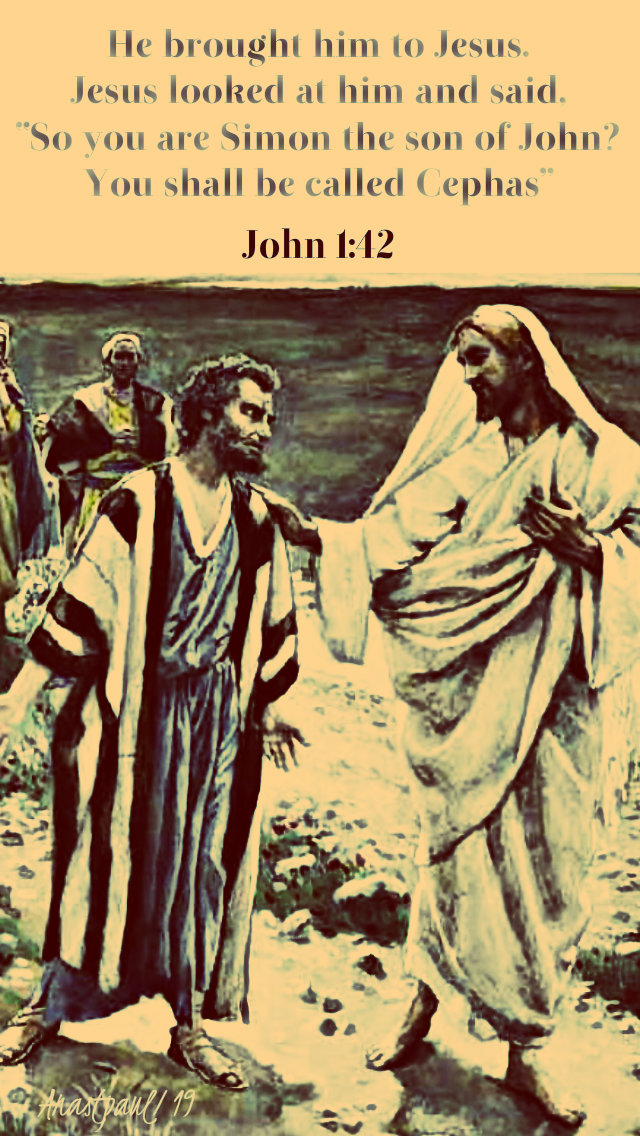
He brought him to Jesus.  Jesus looked at him and said,
“So you are Simon the son of John? You shall be called Cephas” (which means Peter)...John 1:42john 1 42 - he brought him to jesus, jesus looked at him 5 jan 2019.jpg

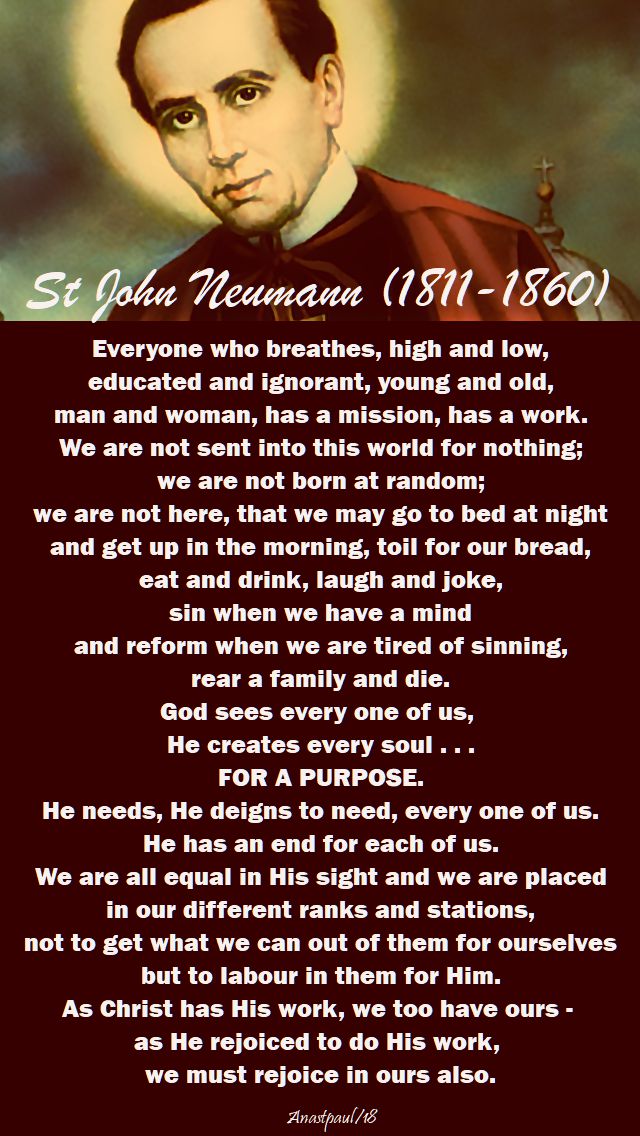
REFLECTION – “Everyone who breathes, high and low,
educated and ignorant, young and old,
man and woman, has a mission, has a work.
We are not sent into this world for nothing;
we are not born at random;
we are not here, that we may go to bed at night
and get up in the morning, toil for our bread,
eat and drink, laugh and joke,
sin when we have a mind
and reform when we are tired of sinning,
rear a family and die.
God sees every one of us,
He creates every soul . . .
FOR A PURPOSE.
He needs, He deigns to need, every one of us.
He has an end for each of us.
We are all equal in His sight and we are placed
in our different ranks and stations,
not to get what we can out of them for ourselves
but to labour in them for Him.
As Christ has His work, we too have ours –
as He rejoiced to do His work,
we must rejoice in ours also.”

St John Neumann (1811-1860)everyone-who-breathes-st-john-neumann-5-jan-2018

PRAYER – God, our Father, since through the human birth of Your only Son, You began in us the work of redemption, keep us firm in faith and with Christ as the Shepherd of our souls, bring us to the glory You have promised.   Through time, You send us holy men and women, who bring us new light to help us along the sometimes very dark ways of our path, grant that by the prayers of St John Neumann and St Charles of Mount Argus, Your beacons of holiness, we may be guided and assisted to carry our side of the yoke with our Lord and Saviour.   We make our prayer through the Child of Bethlehem and the Holy Spirit, God forever, amen.st-john-neumann-pray-for-us-2017-5-jan

st charles of mount argus pray for us no 1. 5 jan 2019

Posted in MARIAN PRAYERS, MARIAN Saturdays, Our MORNING Offering, PRAYERS of the SAINTS, SAINT of the DAY, The BLESSED VIRGIN MARY

Our Morning Offering – 5 January – St Charles of Mount Argus’s Prayer to Mary

Our Morning Offering – 5 January – Christmas Saturday and the Memorial of St Charles of Mount Argus C.P. (1821-1893)

Most Holy Virgin Mary Oh, my Mother!
By St Charles of Mount Argus

Most Holy Virgin Mary Oh, my Mother!
How sweet it is to come to thy feet,
imploring thy perpetual help!
If earthly mothers cease not to remember their children,
how can thou, the most loving of all mothers, forget me?
Grant then, to me, I implore thee,
thy perpetual help in all my necessities,
in every sorrow and especially in all my temptations.
As we are all thy children,
I ask for thy unceasing help for all who are now suffering.
Help the weak, cure the sick, convert sinners
and console all earthly mothers
who are now weeping over their children.
Open the gates of heaven to those we loved upon earth
and who are now suffering in purgatory.
Obtain for us, dear Mother,
that having earnestly invoked thee on earth,
we may see thee, love thee
and eternally thank thee, hereafter in heaven.
Amenmost holy virgin mary oh my mother by st charles of mount argus 2 -5 jan 2019

Posted in SAINT of the DAY, VATICAN Resources

Saint of the Day – 5 January – St Charles of Mount Argus C.P. (1821-1893)

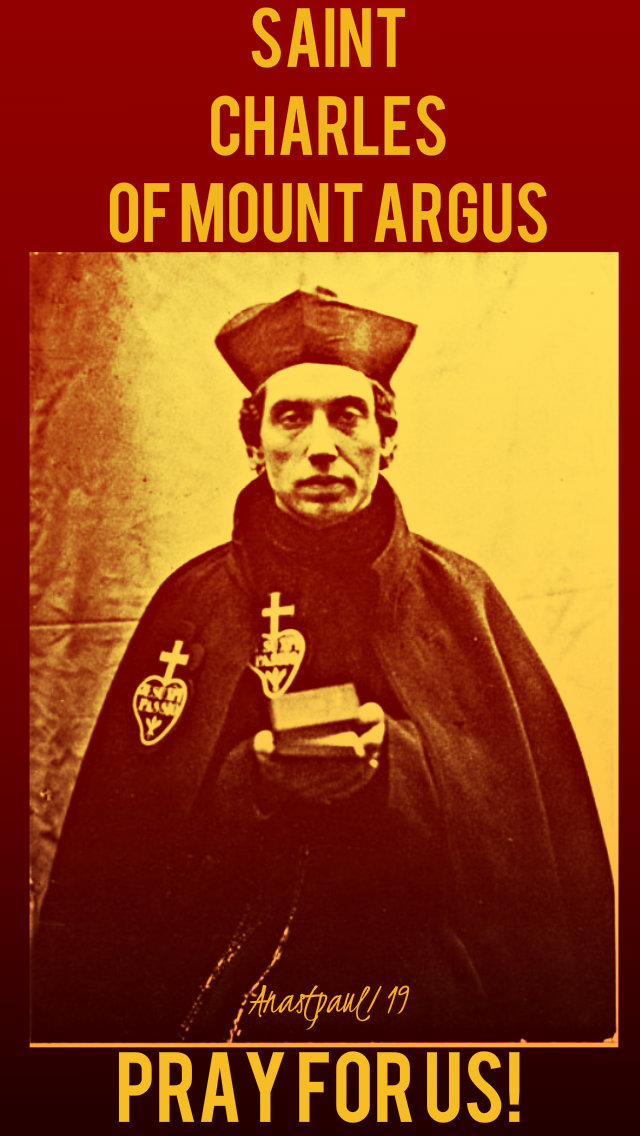
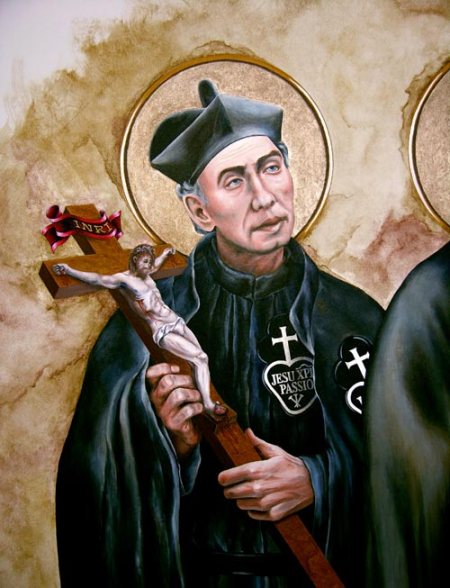
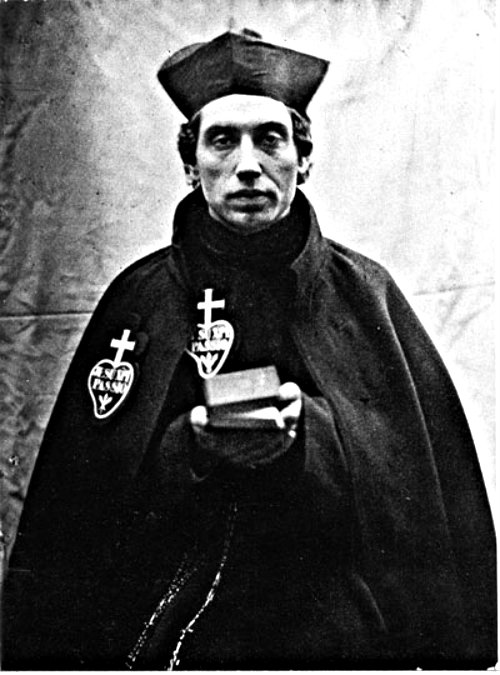
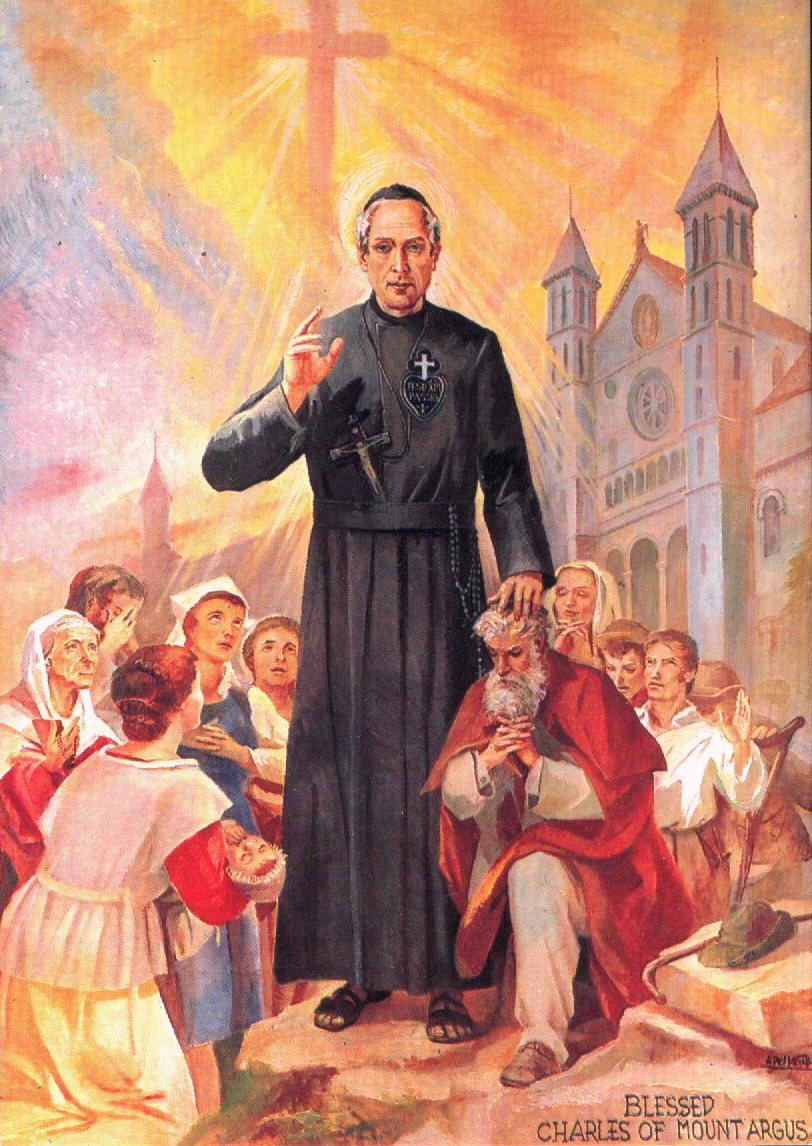
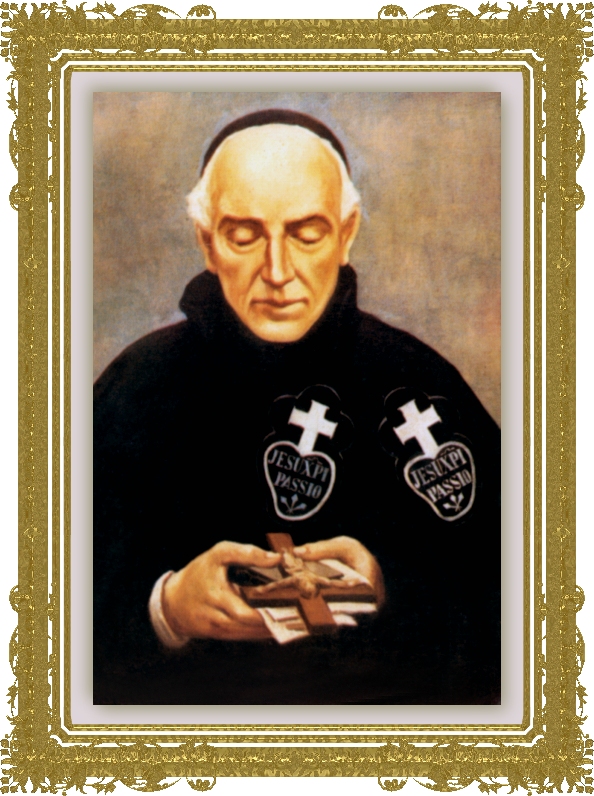
Saint of the Day – 5 January – St Charles of Mount Argus C.P. (1821-1893) – Religious Passionist Priest, Apostle of Charity, Spiritual guide, Miracle-worker – born Joannes Andreas Houben on 11 December 1821 in the village of Munstergeleen in the Province of Limburg in the Kingdom of the Netherlands and died on 5 January 1893 at Mount Argus, Ireland from an infected leg wound received in a carriage accident.saint_charles_argus

Fr Charles of St Andrew, known in secular life as John Andrew Houben, was born on 11 December 1821 in Munstergeleen, in the diocese of Ruremond (Holland), the fourth of eleven children.   He was baptised the same day with the name John Andrew.   He received his First Communion on 26 April 1835 and the sacrament of Confirmation on 28 June in the same year.   He began his formal education in Sittard and then in Broeksittard.   In 1840 he had to interrupt his studies to enter the military.   It was during this latter period that he first heard about the Congregation of the Passion.   At the end of his military service he completed his studies and requested to be admitted to the Congregation.   He was received by Blessed Dominic Barberi (1792-1849), Passionist and he entered the novitiate in the Belgium city of Ere, near Tournai on 5 November 1845. In December of that same year he was vested with the Passionist religious Habit and was given the name of Charles of St Andrew.   Having completed the canonical year of novitiate he professed First Vows on 10 December 1850.   At the conclusion of his studies he was ordained a priest by Bishop Labis, the ordinary of Tournai.houben
Immediately he was sent to England where the Passionists had founded three monasteries and it was here that, for a period of time, he undertook the ministry of vice-master of novices in the monastery of Broadway.   He also did parochial ministry in the parish of St Wilfred and neighbouring areas until 1856 when he was transferred to the newly established monastery of Mount Argus, on the outskirts of Dublin.

Blessed Charles Houben lived almost the remainder of his life in this retreat and was greatly loved by the Irish people to point that they referred to him,­ a native of Holland, ­ as Father Charles of Mount Argus.   He was a particularly pious priest.   He was outstanding in exercising obedience, in the practice of poverty, humility and simplicity and to an even greater degree, to devotion to the Passion of the Lord.

Due to his poor mastery of the English language, he was never a formal preacher and he never preached missions.   Rather, he very successfully dedicated himself to spiritual direction, especially through the sacrament of Reconciliation (Confession).

The fame of his virtue was such that great crowds of people would gather at the monastery to seek his blessing.   There are also numerous testimonies to the outstanding miraculous cures that he worked to the extent, that even during his lifetime, he was known as a miracle worker.
Precisely because of this fame that extended throughout all of Great Britain as well as in America and Australia that in 1866, in order to afford him some rest, he was transferred to England where he lived for a time in the communities at Broadway, Sutton and London.   There he ministered as usual and there too, inside and outside the monastery, he was sought by the faithful, both Catholics and non-Catholics alike.

He returned to Dublin in 1874 where he remained until his death that took place at dawn on 5 January 1893.

During his very solemn funeral that was attended by people from all of Ireland there was definite proof of the popular devotion that had surrounded him throughout his life.   In a newspaper of the time we read: “Never before has the memory of any man sparked an explosion of religious sentiment and profound veneration as that which we observed in the presence of the mortal remains of Father Charles.”   The Superior of the monastery wrote to his family:  “The people have already declared him a saint.”charlesmtargus

The cause of his Beatification and Canonisation was introduced on 13 November 1935, and on 16 October 1988, His Holiness John Paul II proceeded with the Beatification of the one whom everyone called the saint of Mount Argus.

The miracle that led to his Canonisation was obtained through his intercession on behalf of Mr Adolf Dormans of Munstergeleen, the birthplace of the Blessed.   The diocesan inquiry super miro was also undertaken in the diocese of Roermond (Holland) from 6 November 2002 until 19 February 2003 at which time the validity of the miracle was recognised by a Decree from the Congregation for the Causes of Saints on 7 November 2003.

The medical consulta was convoked on 24 November 2005 and following the investigation of the matter, the members unanimously expressed that the cure of Mr. Dormans of “perforated, gangrenous appendicitis with generalised peritonitis that was multi-organically compromising and included extenuating and prolonged agony” was “not scientifically explainable”.

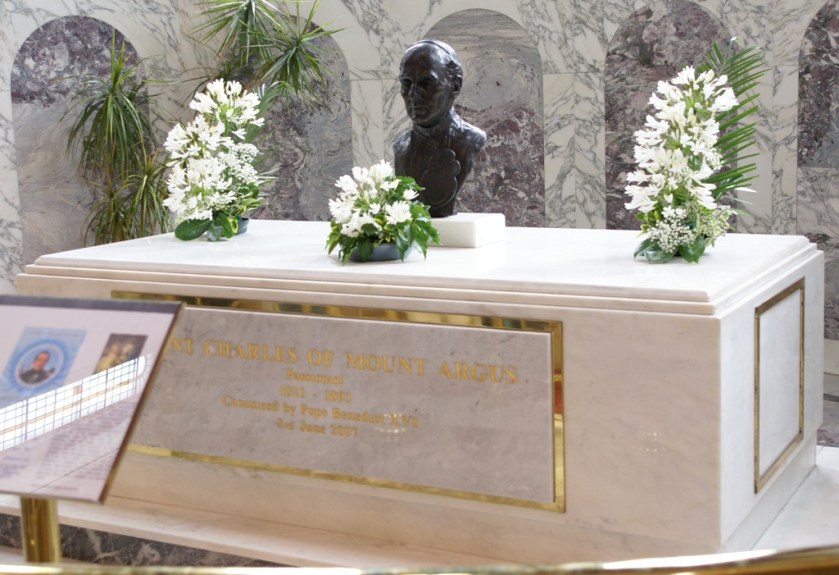
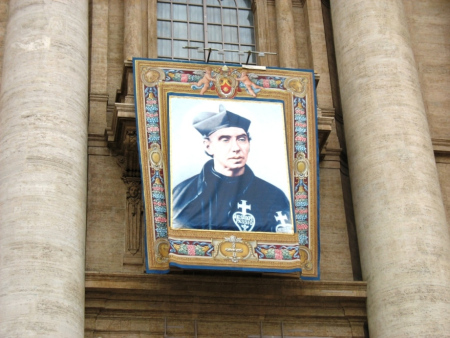
The theologian consultors, in the particular Congress of 21 February 2006 and the Ordinary Congregation of Cardinals and Bishops of 12 December 2006 also gave their unanimous approval of the supernatural aspect of the said healing.   The Decree concerning the miracle was given in the presence of the Holy Father, Benedict XVI on 21 December 2006…and he was Canonised on 3 June 2007 by Pope Benedict XVI at Saint Peter’s Basilica, Rome, Italy…Vatican.va

During the last years of his life he had many trials.   He was also in failing health, was anxious about death.   His family in Holland were dying.   Old injuries returned to plague him.   Towards the end of 1892, it was obvious that the life of Fr Charles was coming to an end.   He said his last Mass on the Feast of the Immaculate Conception 1892.   Word of his illness spread through the city, crowds gathered to enquire about him.   Just after Christmas he couldn’t eat, lost his sight and was like a living skeleton.   At 5.30 in the morning of the 5th January 1893 he passed peacefully to his Maker.

His body was brought to the Church and lay in state for five days.   Despite heavy snow, thousands filed past his coffin with the police keeping order.   His funeral was said to have been bigger than Parnell’s two years before.   Finally his remains were laid to rest in the cemetery beside Mount Argus Church.   His grave became a place of pilgrimage where people came daily to pray.   When in 1949 his remains were moved inside the Church the Shrine became the place of prayer.   Today people come twice each day to be blest with the Relic of Blessed Charles.SONY DSC

canonisation st charles of mount argusst charles passionists-argus

Posted in SAINT of the DAY

Memorials of the Saints – 5 January

St John Nepomucene Neumann CSsR (1811-1860) (Memorial)
St John: https://anastpaul.wordpress.com/2018/01/05/saint-of-the-day-5-january-st-john-nepomucene-neumann-cssr-1811-1860/

Bl Alacrinus of Casamari
St Apollinaris Syncletica
St Cera of Kilkeary
St Charles of Mount Argus C.P. (1821-1893)

Bl Convoyon of Redon
St Deogratias of Carthage
St Dorotheus the Younger
Bl François Peltier
St Gaudentius of Gnesen
St Genoveva Torres Morales
St Gerlac of Valkenburg
Bl Jacques Ledoyen
Bl Joan Grau Bullich
St Kiara
St Lomer of Corbion
Bl Marcelina Darowska
Bl Maria Repetto
Bl Paula of Tuscany
Nl Pierre Tessier
Bl Pietro Bonilli
St Simeon Stylites
St Syncletica
St Talida of Antinoë

Martyrs of Africa – 14 saints: A group of Christians martyred together in Africa, date unknown, exact location unknown. We know nothing more than their names – Acutus, Anastasia, Candidus, Coelifloria, Felix, Honorius, Januaria, Jucundus, Lucianus, Marcus, Petrus, Secundus, Severus and Telesphorus.

Martyrs of Sais: A group of Christians martyred for their faith, but about whom no details have survived. They were martyred by drowning near Sais, Egypt.

Martyrs of Upper Egypt: There were many martyrs who suffered in the persecutions of Diocletian in the Thebaid region. Though we know these atrocities occurred, to the point that witnesses claim the torturers and executioners were exhausted by the work, we do not know the names of the saints and we honour them as a group. Many were beheaded and or burned alive in 303 in Upper Egypt.

Posted in EUCHARISTIC Adoration, SAINT of the DAY, The HOLY EUCHARIST / The HOLY MASS

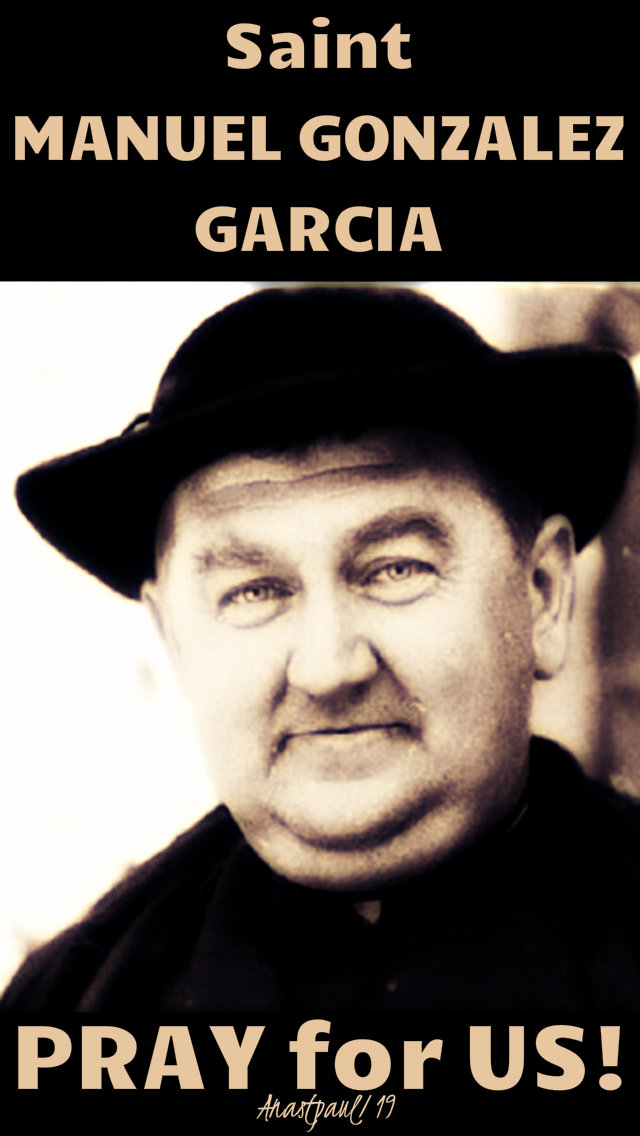
Thought for the Day – 4 January on the Memorial of St Manuel Gonzalez Garcia (1877–1940) the “Apostle of the Abandoned Tabernacles”

Thought for the Day – 4 January on the Memorial of St Manuel Gonzalez Garcia (1877–1940) the “Apostle of the Abandoned Tabernacles”

Excerpt from an interview with Cardinal Mauro Piacenza who was the Relator of the Cause of St Manuel.

Eminence, I understand that there are three committees present that must analyse an alleged miracle – the Medical Commission of theologians and Cardinals and bishops. What is the Mission of this Commission, of Cardinals and bishops, in the process of approval of a miracle?   Which elements should you take into account to give your vote?

Examining the alleged miracles, the Congregation for the causes of Saints comes with a lot of seriousness.   The study involves a series of steps, including the medical part is especially important.   Finally, the Commission of Cardinals and bishops members of the Congregation examines the case.   They receive, along with the letter … full documentation of the case and a booklet with a summary, that highlights the most relevant areas of the analysis, as well as possible difficulties.

You have been the Relator of the cause of Blessed Manuel González García at the regular meeting of cardinals and bishops.   Can you explain the role of the Relator?

A cardinal is designated or a Bishop from among the members of the Congregation, and is called the ‘speaker’.   He is responsible for presenting the case and expresses his own outlook.   After this takes place, interventions of all those present, that is to adhere to or not to the conclusions of the Relator and then they present their own views.

The Relator presents the essential features of the biographical profile of Blessed, ie, describes the fundamentals of the case being examined, presents the evidence, the medical report (diagnosis of healing, prognosis, therapy, healing) and theological evaluation.   Finally, it formulates its conclusion, issues its own vote also asking the agreement of the other members and then presentation of all the results is proposed to the Holy Father.

BL Manuel González García devoted many of his energies to the clergy and to the formation of the same, as well as seminarians.   How can his message assist the current profile of the priest?

You ask me what particular message of Bl Manuel, can assist the priests and bishops of our time, in the whirlwind of their commitments.

Priests yesterday, today’s priests, priests of about-to-be:   Yes, it is right to pay attention to time and to the diverse situations and circumstances but I would like to talk about what transcends time.

Being priests is to be Christ and Christ is the one who atones for others, He is the one who begs for everyone.   He is the One at the top of the pedestal;   on the other hand, the priest is under the pedestal and carries its weight.   The priest elevates that weight to God with prayer.   And this is what is called in the Eucharist: the offering of Christ and of the whole Church.   In the instant that God raises His Son, raised, with the Son, also, is all mankind who, through the priest, must be saved.   Yes, also by the means of his Ministry, which closely associates it with Christ the Saviour.   This is the prayer of the priest.   It is true that the only saviour of the world is God but this prayer  brings God’s salvation.

Blessed Manuel Gonzalez with his example preached and believed that too much human activity, too, in a disproportionate manner, ends in a sort of Pelagianism.   The activity of man is worth something if it is presented and united to God in prayer and it is imbued in this charity.   From this it also follows, that the priest cannot be a victim because it is Christ, who has united in His person the priesthood and the victim.   In pagan sacrifices, the priest sacrifices to someone else – in Christianity Christ Himself is sacrificed.
 
That is the great warning of our blessed [Manuel] – there is no possibility of priesthood if not through self-sacrifice [and the] immolation that the priest lives in the continuing gift of his own being.

The one thing made very clear from the whole of the writings of St Manuel, is how much we leave Christ alone in the tabernacle of our hearts and our lives, how much we are cheating ourselves of Christ’s presence and gaze.   Saint Manuel González García’s writings are a means of discovering Who we adore, as well as reminding us constantly, why we ought to seek to always be adoring.

St Manuel Gonzalez Garcia (1877–1940)
“Apostle of the Abandoned Tabernacles”
Pray for Us!st manuel gonzalez garcia pray for us no 2 -4 jan 2019

Posted in EUCHARISTIC Adoration, PRACTISING CATHOLIC, QUOTES of the SAINTS, SAINT of the DAY, The HOLY EUCHARIST / The HOLY MASS

Quote/s of the Day – 4 January – Eucharistic Adoration

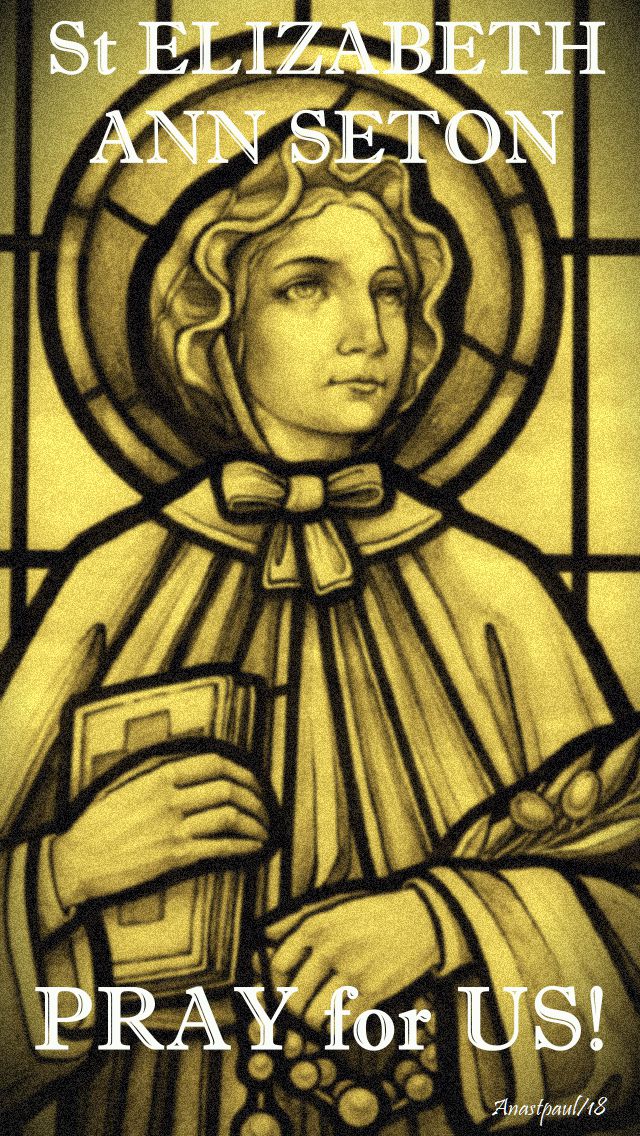
Quote/s of the Day – 4 January – The Memorial of St Elizabeth Ann Seton (1774-1821) and St Manuel Gonzalez Garcia (1877–1940) the “Apostle of the Abandoned Tabernacles”

“God is everywhere, in the very air I breathe,
yes everywhere
but in His Sacrament of the Altar
He is as present actually and really
as my soul within my body;
in His Sacrifice daily offered
as really as once offered on the Cross!”

“Our Lord Himself I saw in this venerable Sacrament . . .
I felt as if my chains fell, as those of St Peter,
at the touch of the Divine messenger.”

“How sweet, the presence of Jesus
to the longing, harassed soul!
It is instant peace and balm to every wound.”

St Elizabeth Ann Seton (1774-1821)god-is-everywhere-st-e-a-seton-4-jan-2018

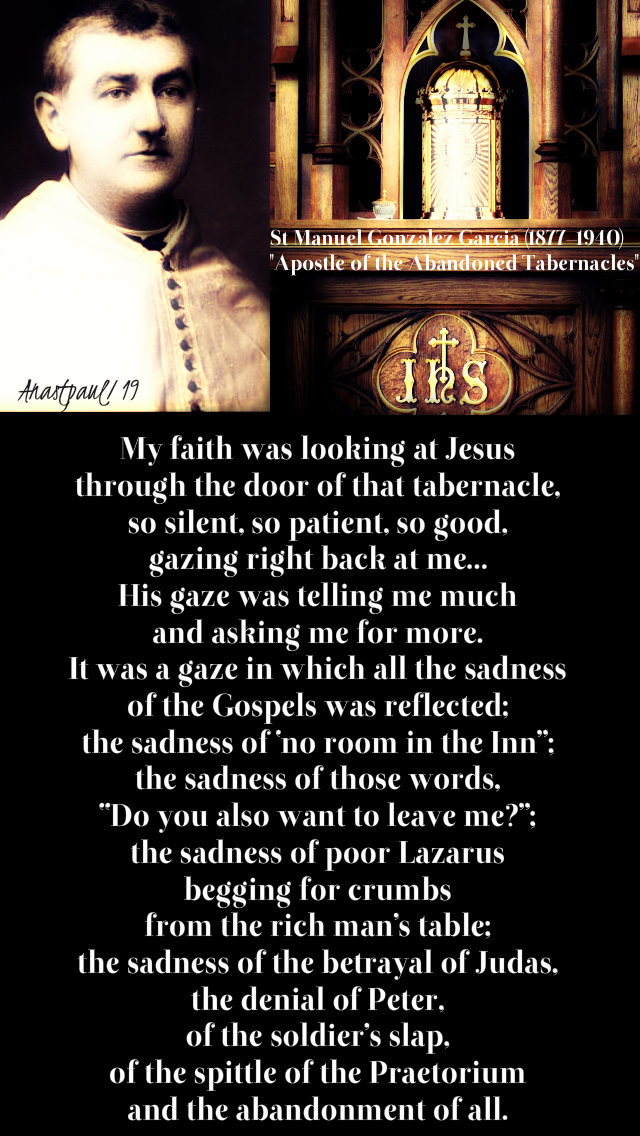
“My faith was looking at Jesus
through the door of that tabernacle,
so silent, so patient, so good, gazing right back at me…
His gaze was telling me much and asking me for more.
It was a gaze in which all the sadness of the Gospels was reflected;
the sadness of ‘no room in the Inn”;
the sadness of those words, “Do you also want to leave me?”;
the sadness of poor Lazarus begging for crumbs from the rich man’s table;
the sadness of the betrayal of Judas,
the denial of Peter,
of the soldier’s slap,
of the spittle of the Praetorium
and the abandonment of all.”my faith was look at jesus - st manuel gonzalez garcia 4 jan 2019

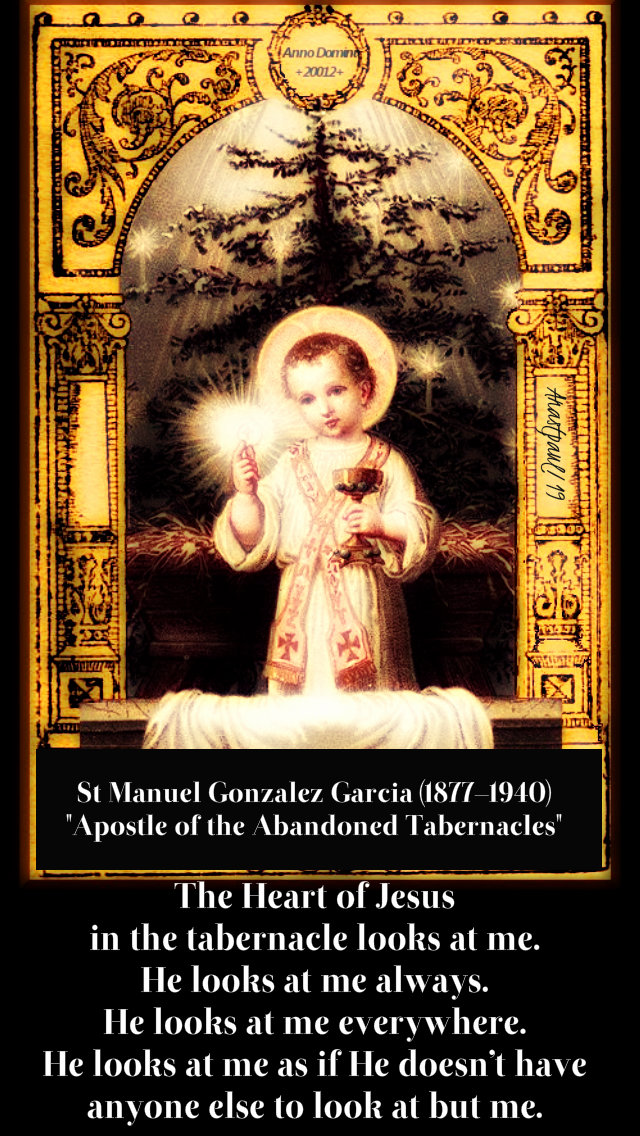
“The Heart of Jesus in the tabernacle looks at me.
He looks at me always.
He looks at me everywhere.
He looks at me as if He doesn’t have
anyone else to look at but me.”

St Manuel Gonzalez Garcia (1877–1940)
“Apostle of the Abandoned Tabernacles”the heart of jesus in the tabernacle - st manuel gonzxalez garcia - 4 jan 2019

Posted in DOCTORS of the Church, FATHERS of the Church, MORNING Prayers, QUOTES of the SAINTS, SAINT of the DAY, The GOOD SHEPHERD, The WORD

One Minute Reflection – 4 January – Christmas Weekday – Today’s Gospel: John 1:35–42

One Minute Reflection – 4 January – Christmas Weekday – Today’s Gospel: John 1:35–42

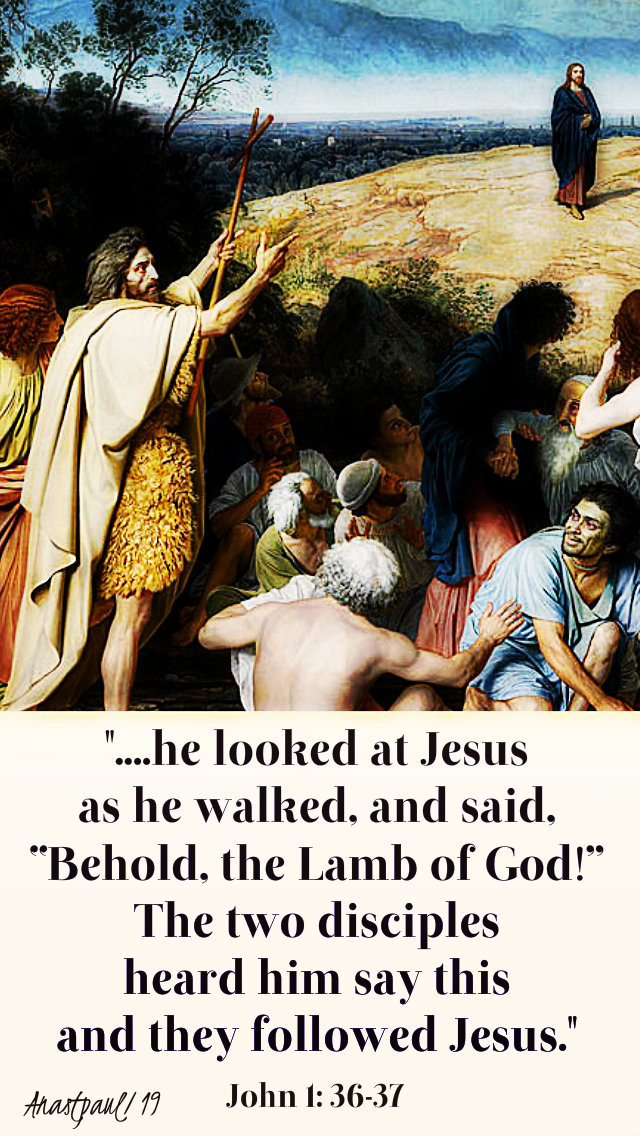
“….he looked at Jesus as he walked, and said, “Behold, the Lamb of God!”   The two disciples heard him say this and they followed Jesus.”...John 1: 36-37behold the lamb of god - john 1 36-37 4 jan 2019

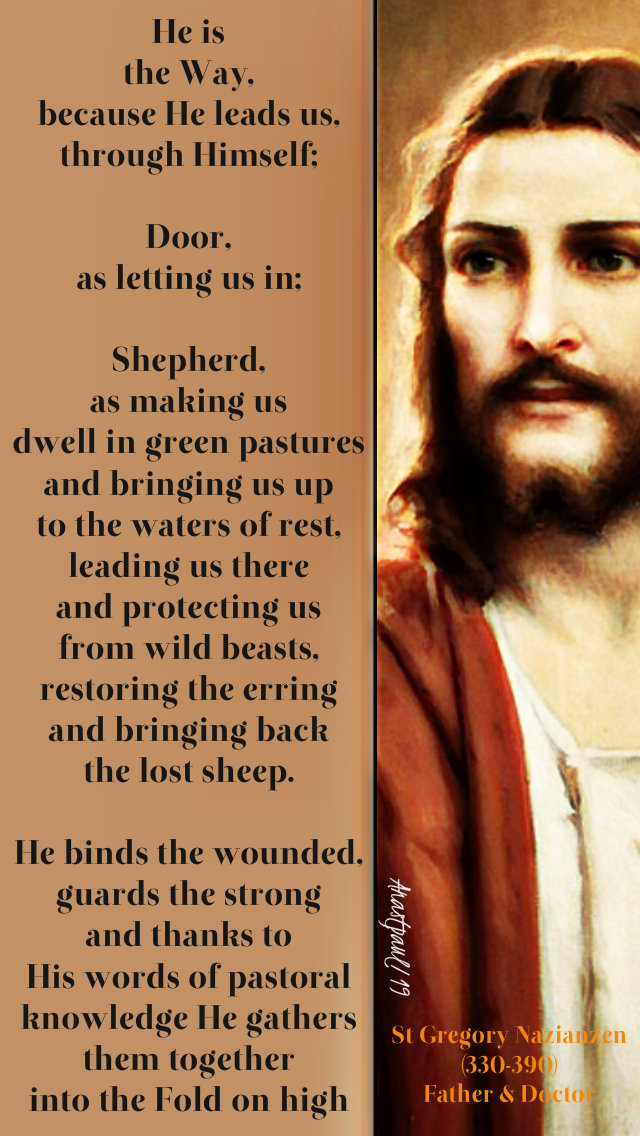
REFLECTION – “He is the Way, because He leads us through Himself;   Door, as letting us in;   Shepherd, as making us dwell in green pastures and bringing us up to the waters of rest, leading us there and protecting us from wild beasts, restoring the erring and bringing back the lost sheep.  He binds the wounded, guards the strong and thanks to His words of pastoral knowledge He gathers them together into the Fold on high.”…St Gregory Nazianzen (330-390) Father & Doctorhe is the way because he leads us - st gregory of nazianzen 4 jan 2019

PRAYER – Heavenly Father, thank You for making me a child of eternity.   Help me to live each day in such a way that I may deserve to be a child of Yours forever.   Grant that by the prayers of St Elizabeth Ann Seton and St Manuel Gonzalez Garcia, we may strive always to keep our eyes fixed on Your Son, our entry to You, our Shepherd and our Saviour who will lead us to our eternal home.   May we never waiver from Your commandments. Amen.st-e-a-seton-pray-for-us-4-jan-2018

st manuel gonzalez garcia pray for us 4 jan 2019

Posted in EUCHARISTIC Adoration, Our MORNING Offering, PRACTISING CATHOLIC, PRAYERS for VARIOUS NEEDS, PRAYERS of the SAINTS, SAINT of the DAY, The HOLY EUCHARIST / The HOLY MASS

Our Morning Offering on the Memorial of St Manuel Gonzalez Garcia (1877–1940) the “Apostle of the Abandoned Tabernacles” – 4 January 

Our Morning Offering on the Memorial of St Manuel Gonzalez Garcia (1877–1940) the “Apostle of the Abandoned Tabernacles” – 4 January

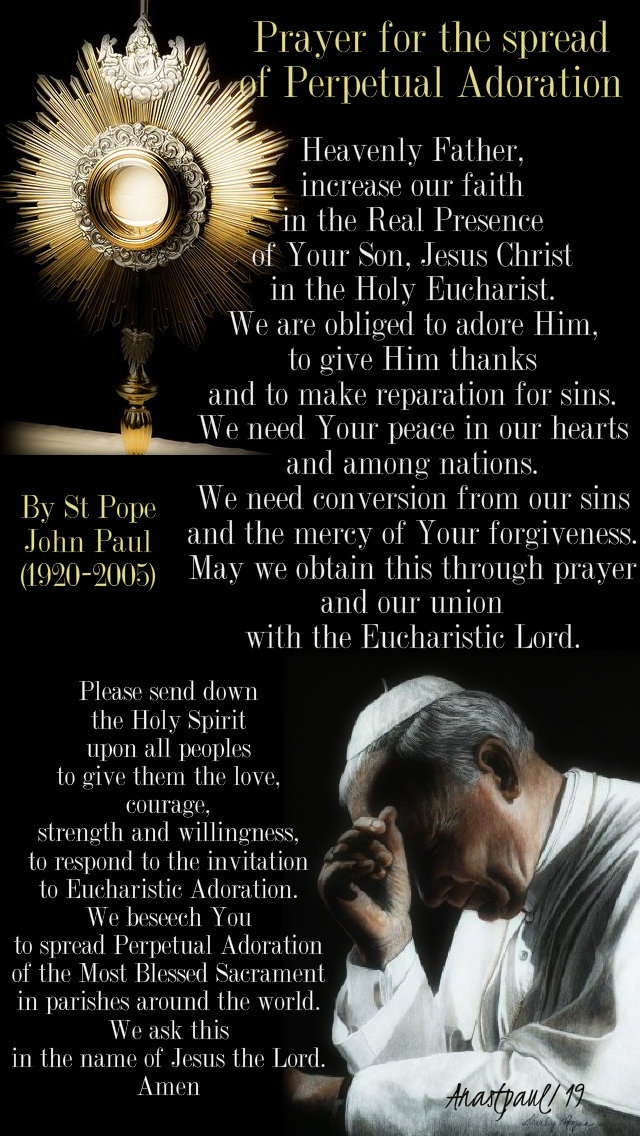
St Manuel has written much, 3 volumes full and many prayers and devotions related to Eucharistic Adoration and the Holy Eucharist but thus far, only 1% of his works have been translated from the original Spanish.  So today we pray via St John Paul, another great advocate of Eucharist Adoration and the Holy Eucharist.

Prayer for the Spread of Perpetual Adoration
By St Pope John Paul (1920-2005)

Heavenly Father,
increase our faith in the Real Presence of Your Son,
Jesus Christ in the Holy Eucharist.
We are obliged to adore Him,
to give Him thanks
and to make reparation for sins.
We need Your peace in our hearts
and among nations.
We need conversion from our sins
and the mercy of Your forgiveness.
May we obtain this through prayer
and our union with the Eucharistic Lord.
Please send down the Holy Spirit upon all peoples
to give them the love, courage, strength and willingness,
to respond to the invitation to Eucharistic Adoration.
We beseech You to spread Perpetual Adoration
of the Most Blessed Sacrament in parishes around the world.
We ask this in the name of Jesus the Lord.
Amenprayer for the spread of eucharistic adoration by st pope john paul 4 jan 2019

Our Lady of the Most Blessed Sacrament
Help us to spread the glory of Your Son
through Perpetual Adoration.

On 2 December 1981 St Pope John Paul II inaugurated Perpetual
Adoration in the Blessed Sacrament Chapel of St Peter’s Basilica with a Mass.
At the end of the Mass following exposition of the Blessed Sacrament he prayed,
in part: (see above) (L’Osservatore Romano, Dec. 14, 1981))

Stay with Us
By St Pope John Paul (1920-2005)

Stay with us today
and stay from now on, everyday,
according to the desire of my heart,
which accepts the appeal of so many hearts
from various parts, sometimes far away…
Stay that we may meet You in
prayers of adoration and thanksgiving,
in prayers of expiation and petition
to which all those who visit this Basilica are invited…
May the unworthy successor of Peter
and all those who take part in the
adoration of Your Eucharistic Presence
attest with every visit and make
ring out again the truth contained in the Apostle’s words:
‘Lord, you know everything.
You know that I love you.’
Amen

Posted in EUCHARISTIC Adoration, SAINT of the DAY, The HOLY EUCHARIST / The HOLY MASS

Saint of the Day – 4 January – St Manuel Gonzalez Garcia (1877–1940) “Apostle of the Abandoned Tabernacles”

Saint of the Day – 4 January – St Manuel Gonzalez Garcia (1877–1940) “Apostle of the Abandoned Tabernacles” – Bishop, Founder of the Eucharistic Missionaries of Nazareth and established both the Disciples of Saint John and the Children of Reparation, Apostle of the Holy Eucharist and of Charity, Marian devotee – born on 25 February 1877 at Seville, Spain and died on 4 January 1940 in Madrid, Spain of natural causes.   Patronages – Diocese of Palencia, the Children of Reparation, the Disciples of Saint John and the Eucharistic Missionaries of Nazareth.st manuel garcia

St Manuel was born in Seville on 25 February 1877.   He entered the Minor Seminary of Seville on September of 1889 where he wrote:  “If I would be born a thousand times; a thousand times I would be a priest.”st manuel young

He was ordained by Blessed Cardinal Spínola, the founder of the newspaper “El Correo de Andalucía”, where he worked when he was still a seminarian.   On 29 September 1901, he celebrated his first Mass at the Church of the Holy Trinity and entrusted himself to the intercession of Mary, Help of Christians.

Blessed Manuel was sent by the Archbishop of Seville to Palomares del Río, a beautiful and secluded village of Aljarafe but upon his arrival no one came out to meet him. he church was abandoned, filled with dust and dirt, cobwebs inside the tabernacle and torn altar cloths.   Upon seeing this situation, he knelt before the altar and thought about the many abandoned tabernacles in the world.   This prompted him to start the Children of Reparation.

At the age of 28, he was sent to Huelva where he was saddened to find many children living on the streets.   He devoted his attention mainly to assisting these children and founded schools, homes and established classes to catechise them with the help of his parishioners.

On 6 December 1915, Pope Benedict XV appointed Blessed Manuel as auxiliary bishop of Málaga.   He celebrated his appointment with a banquet to which he invited, not the authorities but the poorest children of the area.   Three thousand children attended the banquet and accompanied him to the Episcopal Palace.   He remained there until the night of the 11 May 1931, the proclamation of the Republic, where a revolt expelled him and the Palace was burnt, destroying everything.st manuelgonzalezobispo

On 5 August 1935 he was appointed bishop of Palencia by Pope Pius XI.   During a visit to Zaragoza in 1939 he fell seriously ill and had to be transferred to Madrid where he died on the 4 January 1940.   Before he died he asked to be buried at the foot of the tabernacle. Fulfilling his wish, he was buried beside the Tabernacle at the main altar of the Cathedral of Palencia.st manuel garcia bishop

His heroic virtues were recognised on the 6 April 1998 and he was Beatified by St Pope John Paul II on 29 April 2001.   The Beatification miracle involved the healing of Sara Ruiz Ortega, then 18 years old, of tuberculosis peritonitis which had left her paralysed. He was Canonised on 16 October 2016 by Pope Francis.   The Canonisation miracle involved the healing of a Galician woman who suffered from aggressive lymphoma.st manuel canonisation

Posted in SAINT of the DAY

Memorials of the Saints – 4 January

St Elizabeth Ann Seton (1774-1821) (Memorial, United States)
Biography: https://anastpaul.wordpress.com/2018/01/04/saint-of-the-day-st-elizabeth-ann-seton-1774-1821/

St Aedh Dubh
St Aggaeus the Martyr
St Angela of Foligno
St Celsus of Trier
Bl Chiara de Ugarte
St Chroman
St Dafrosa of Acquapendente
St Ferreolus of Uzès
St Gaius of Moesia
St Gregory of Langres
St Hermes of Moesia
St Libentius of Hamburg
Bl Louis de Halles
St Manuel Gonzalez Garcia (1877–1940)
St Mavilus of Adrumetum
St Neophytos
St Neopista of Rome
St St St Oringa of the Cross
Bl Palumbus of Subiaco
St Pharaildis of Ghent
St Rigobert of Rheims
Bl Roger of Ellant
St Stephen du Bourg
St Theoctistus
Bl Thomas Plumtree

Martyrs of Africa – 7 saints: A group of Christians martyred together in the persecutions of the Arian Vandal king Hunneric. Saint Bede wrote about them. – Aquilinus, Eugene, Geminus, Marcian, Quintus, Theodotus and Tryphon. In 484 in North Africa.

Martyrs of Rome – 3 saints: Three Christians martyred together in the persecutions of Julian the Apostate for refusing to renounce Christianity as ordered. – Benedicta, Priscillianus and Priscus. In 362 in Rome, Italy.