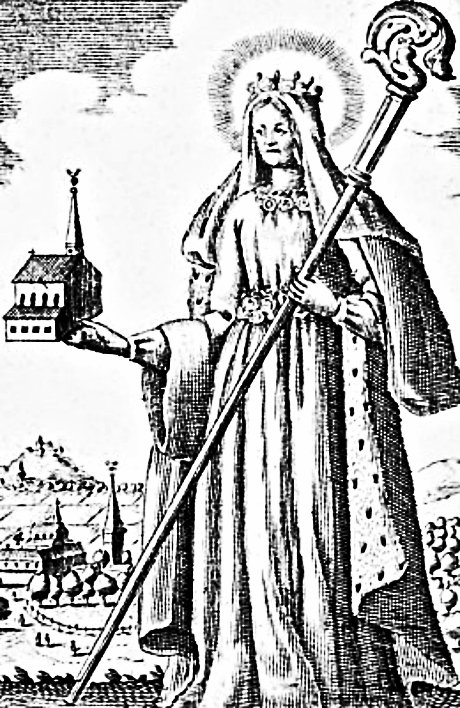
Saint of the Day – 5 February – St Adelaide of Guelders (c 970–1015) – Abbess, Apostle of Charity, Miracle-worker, Reformer, Counsellor to the Archbishop of Cologne. She is also known as Adelaide of Vilich, Adelaide of Bellich, Alice, Adelheid, Adalheide. Born in c970 in Geldern, North Rhine-Westphalia, Germany and died on 5 February 1015 at Our Lady of the Capitol convent at Cologne, North Rhine-Westphalia, Germany of natural causes.
When Adelaide was still very young, she entered the convent of St Ursula, Our Lady of the Capitol, founded by her parents in Cologne, where the Rule of St Jerome was followed. About 980, her parents founded the convent of Villich. Adelaide was “redeemed” from the Ursulione convent by exchange with a parcel of land and became abbess of this new convent, initially established as an unusually late example of a community of canonesses. Canons were attached to the convent in order that Mass might be said. Here, Adelaide introduced the stricter Benedictine rule. She insisted that the nuns under her care learn to read Latin, that they might understand the Mass.
According to the Catholic Encyclopedia “the fame of her sanctity and of her gift of working miracles soon attracted the attention of Saint Heribert, Archbishop of Cologne”, who could scarcely have ignored an abbess of her high connections. He appointed her abbess of the convent of St Maria im Kapitol, Cologne, to succeed her sister Bertha, who died about 1000. Emperor Otto III reaffirmed Vilich’s immunities from ecclesiastical interference and the right to appoint its own abbess, a title that remained only briefly in the founding family. She died at her convent in Cologne in the year 1015 but was buried at Vilich, where her feast was solemnly celebrated on 5 February and rapidly attracted pilgrims.
A hagiography, Vita Adelheidis, provides some information regarding her family.
St Adelaide of Guelders (c 970–1015)
St Agatha Hildegard of Carinthia
St Agricola of Tongres
St Albinus of Brixen
St Anthony of Athens
St Avitus of Vienne
St Bertulph
St Buo of Ireland
St Calamanda of Calaf
St Dominica of Shapwick
St Fingen of Metz
Bl Françoise Mézière
St Gabriel de Duisco
St Genuinus of Sabion
St Indract
St Isidore of Alexandria
St Jesús Méndez-Montoya
Bl John Morosini
St Kichi Franciscus
St Luca di Demenna
St Modestus of Carinthia
Bl Primo Andrés Lanas
St Saba the Younger
St Vodoaldus of Soissons
—
Martyrs of Pontus: An unknown number of Christians who were tortured and martyred in assorted painful ways in the region of Pontus (in modern Turkey) during the persecutions of Maximian.
Thought for the Day – 4 February – The Memorial of St John de Britto SJ (1647-1693) Martyr
We are called to serve.
Excerpt from the EUCHARISTIC CELEBRATION IN HONOUR OF ST JOHN DE BRITTO
HOMILY OF HIS HOLINESS JOHN PAUL II Madras Wednesday, 5 February 1986
“Let the peoples praise you, O God, let all the peoples praise you” .
Saint John de Britto, whom we are remembering in today’s liturgical celebration, was born in Lisbon in 1647. After entering the Society of Jesus he followed the footsteps of Saint Francis Xavier to India where he chose to work for the humble and needy in what was then called the Madurai Mission. His patient labours, selfless zeal and genuine love for the poor, won for him their confidence. Like Jesus he was “a sign of contradiction” and his success created jealousy and opposition. As a result, John de Britto died a martyr on 4 February 1693, bearing witness to Christ.
…Saint John de Britto’s life faithfully reflected the life of our Lord and Saviour Jesus Christ, for it was a life of service unto death. Today it challenges all of us to continue with fresh vigour the Church’s role of loving service to humanity. The immense and tender love of Jesus Christ for the poor and the downtrodden, for sinners and the suffering, remains a challenge for every Christian. Christ’s unrelenting stand for truth is a compelling example. Above all, the generosity shown in His suffering and death, as the culmination of His service to humanity and the supreme act of Redemption, is the example for us. We are called to serve.
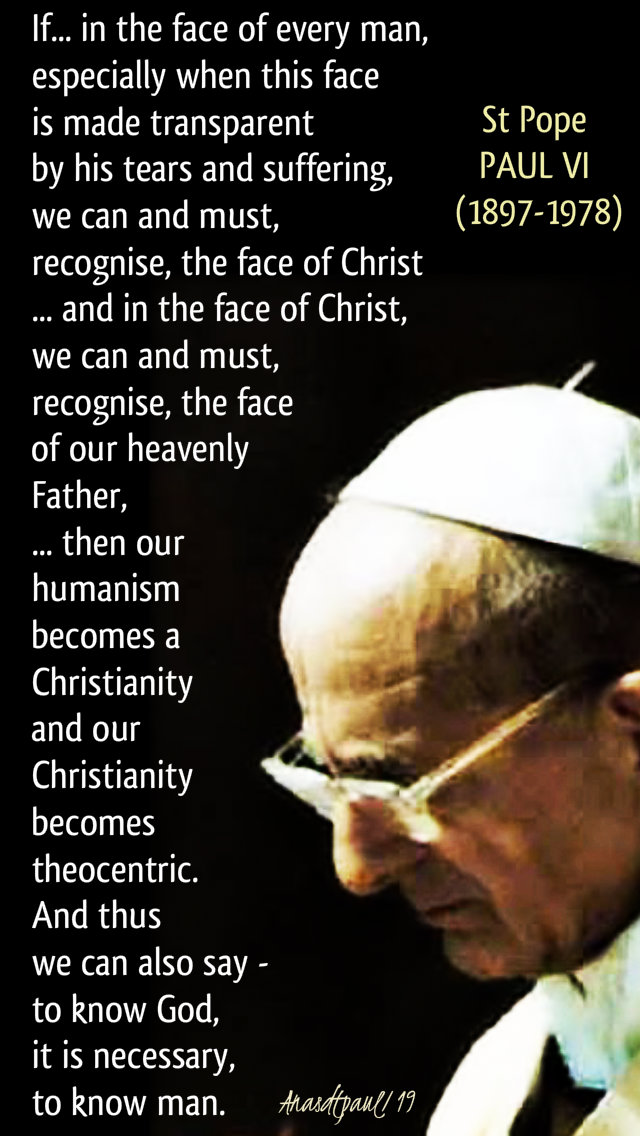
There can be no authentic Christian life without an effective love of our fellow human beings. At the closing of the Vatican Council Pope Paul VI affirmed that ” if… in the face of every man, especially when this face is made transparent by his tears and suffering, we can and must, recognise the face of Christ … and in the face of Christ, we can and must, recognise, the face of our heavenly Father, … then our humanism becomes a Christianity and our Christianity becomes theocentric. And thus we can also say – to know God, it is necessary, to know man.”
Today we live at a time of history when peace and harmony between nations and races is constantly threatened. Division and hatred, fear and frustration – these are among the counter-values of our day. The message of love in Christ Jesus in urgently needed. Hence, the Church’s task of proclaiming the Gospel and of being at the service of society is supremely relevant in India today. This task requires the active collaboration of all sectors of the ecclesial community, especially the laity.
…Through the testimony of your lives, through your words and deeds, the word of God is made known to the minds and hearts of others who seek Him, so that “they also may obtain salvation in Christ Jesus with its eternal glory” – that “they may obtain salvation”!
Brothers and sisters, if we die with Christ, we shall live also with Him, “if we endure, we shall also reign with him” .
Christ – Shepherd, Prophet and Priest – has sealed our hearts with His call just as He touched the hearts of the apostles, the hearts of Saint Thomas, Saint Francis Xavier and Saint John de Britto. May they intercede for the Church in India, for this beloved country and its people!
We will be happy if we remain faithful. For He, Christ, is faithful – “He remains faithful for He cannot deny Himself” .
Brothers and sisters, you are called to be living witnesses to Christ, living witnesses to God’s word, living witnesses to the saving message of love and mercy that Christ revealed to the world. Amen.
Quote/s of the Day – 4 February – The Memorial of Blessed Rabanus Maurus OSB (776-856), St Joseph of Leonissa OFM CAP (1556-1612) and St John de Britto SJ (1647-1693) Martyr
Veni Creator Spiritus
Come, Creator, Spirit, come from Your bright heavenly throne, come take possession of our souls and make them all Your own. You who are called the Paraclete, best gift of God above, the living spring, the vital fire, sweet christ’ning and true love. . . . O guide our minds with Your best light, with love our hearts inflame and with Your strength, which ne’er decays, confirm our mortal frame. Far from us drive our deadly foe, true peace unto us bring and through all perils lead us safe beneath Your sacred wing. Through You may we the Father know, through You th’eternal Son and You the Spirit of them both, thrice-blessed Three in One. . . .
By Blessed Rabanus Maurus (776-856)
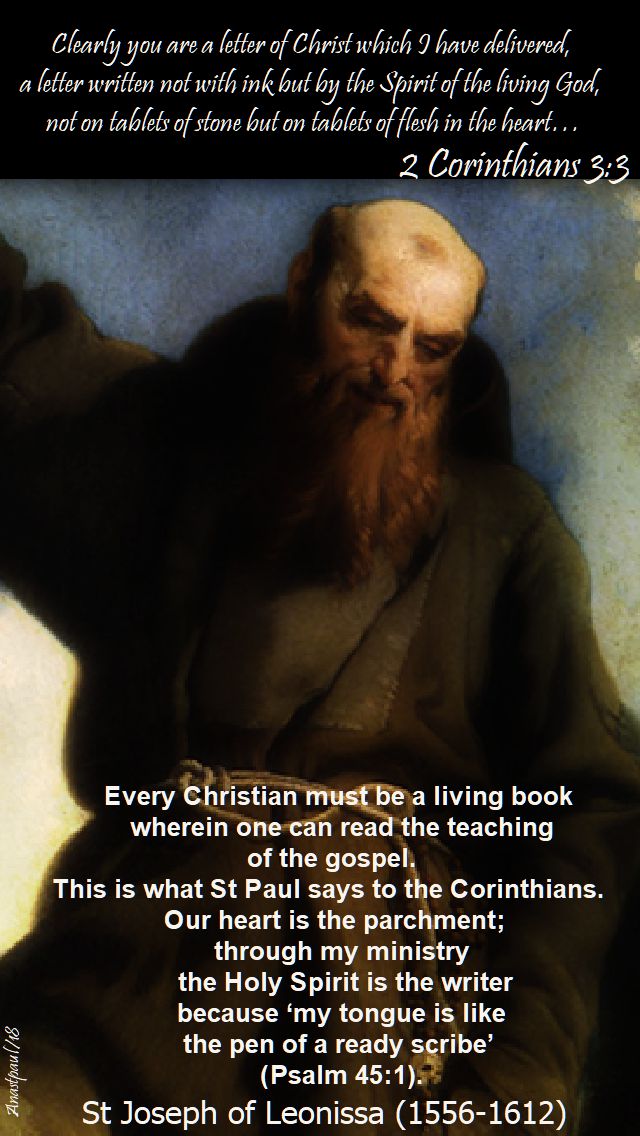
“Every Christian must be a living book wherein one can read the teaching of the gospel. This is what St Paul says to the Corinthians. Our heart is the parchment; through my ministry the Holy Spirit is the writer because ‘my tongue is like the pen of a ready scribe’ (Psalm 45:1).”
St Joseph of Leonissa OFM CAP (1556-1612)
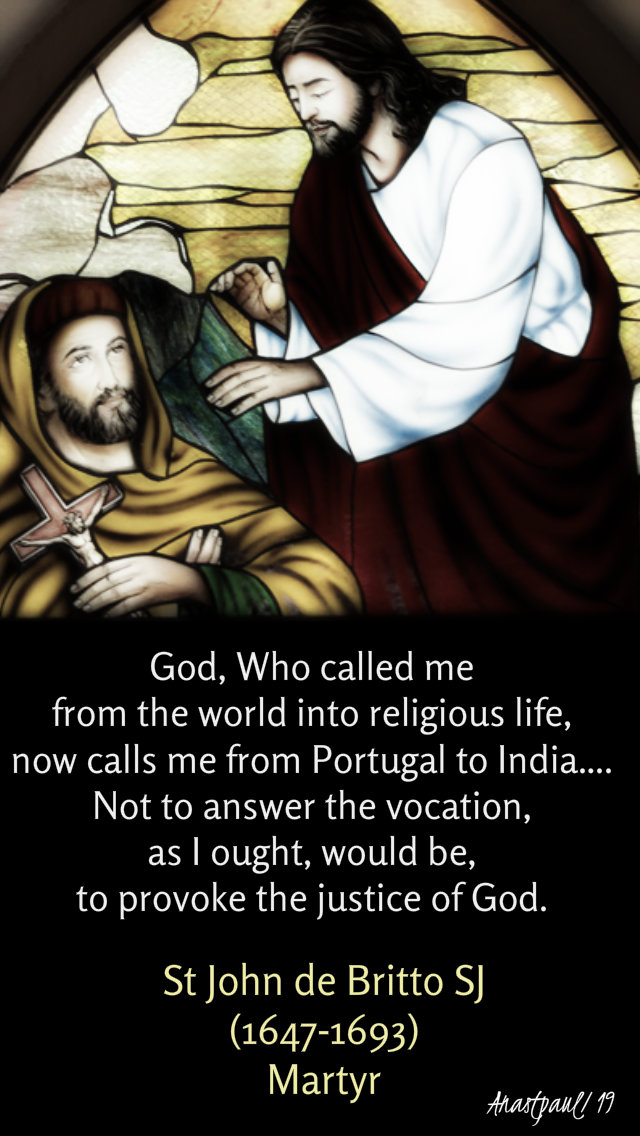
“God, Who called me from the world into religious life, now calls me from Portugal to India…. Not to answer the vocation as I ought, would be to provoke the justice of God.”
One Minute Reflection – 4 February – Monday of the Fourth week in Ordinary Time, Year C, Gospel: Mark 5:1–20 and the Memorial of St John de Britto SJ (1647-1693) Martyr
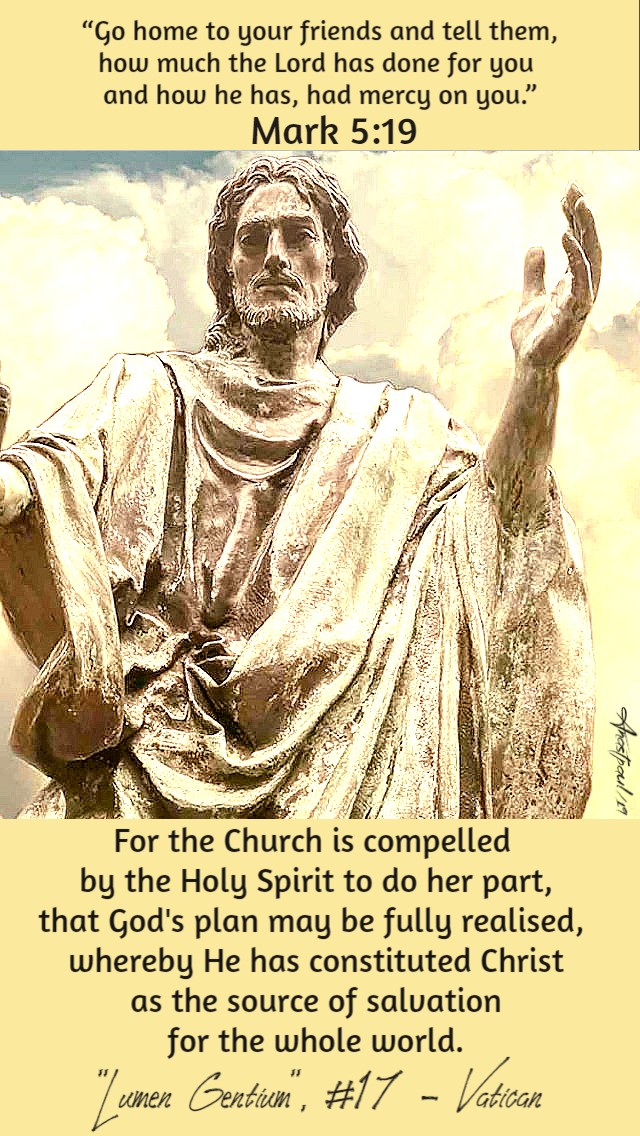
“Go home to your friends and tell them, how much the Lord has done for you and how he has, had mercy on you.”…Mark 5:19
REFLECTION – “As the Son was sent by the Father, so He too sent the Apostles (Jn 20:21), saying: “Go, therefore, make disciples of all nations, baptising them in the name of the Father and of the Son and of the Holy Spirit, teaching them to observe all things whatsoever I have commanded you. And behold I am with you all days even to the consummation of the world”.(Mt 28:19) The Church has received this solemn mandate of Christ to proclaim the saving truth from the apostles and must carry it out to the very ends of the earth.(Acts 1:8) Wherefore, she makes the words of the Apostle her own: “Woe to me, if I do not preach the Gospel” (1Cor 9:16) and continues unceasingly to send heralds of the Gospel until such time as the infant churches are fully established and can themselves continue the work of evangelising.
For the Church is compelled by the Holy Spirit to do her part, that God’s plan may be fully realised, whereby He has constituted Christ as the source of salvation for the whole world. By the proclamation of the Gospel she prepares her hearers to receive and profess the faith. She gives them the dispositions necessary for baptism, snatches them from the slavery of error and of idols and incorporates them in Christ, so that through charity, they may grow up into full maturity in Christ. Through her work, whatever good is in the minds and hearts of men, whatever good lies latent in the religious practices and cultures of diverse peoples, is not only saved from destruction but is also cleansed, raised up and perfected unto the glory of God, the confusion of the devil and the happiness of man.
The obligation of spreading the faith is imposed on every disciple of Christ, according to his state. However, although all the faithful can baptise, the priest alone can complete the building up of the Body in the eucharistic sacrifice. Thus are fulfilled the words of God, spoken through His prophet: “From the rising of the sun until the going down thereof my name is great among the gentiles and in every place a clean oblation is sacrificed and offered up in my name”.(Mal 1:11) In this way the Church both prays and labours in order that the entire world may become the People of God, the Body of the Lord and the Temple of the Holy Spirit.”… Dogmatic Constitution on the Church, “Lumen Gentium”, #17 – Vatican Council II
PRAYER – Lord God and Father, who entrusted the earth to men, to till and care for it and made the sun to serve their needs, give us grace this day, to work faithfully for Your Glord and for our neighbours’ good. As we follow the Way of Your Son, fill us with the Holy Spirit of faith, hope and love. Almighty God, You made Saint John of Britto, an illustrious preacher of the gospel. Through his prayers inflame us with love and with his zeal for souls that we may serve You alone. St John of Britto, pray for us! Through Jesus, our Lord in the unity of the Holy Spirit, God forever and ever, amen.
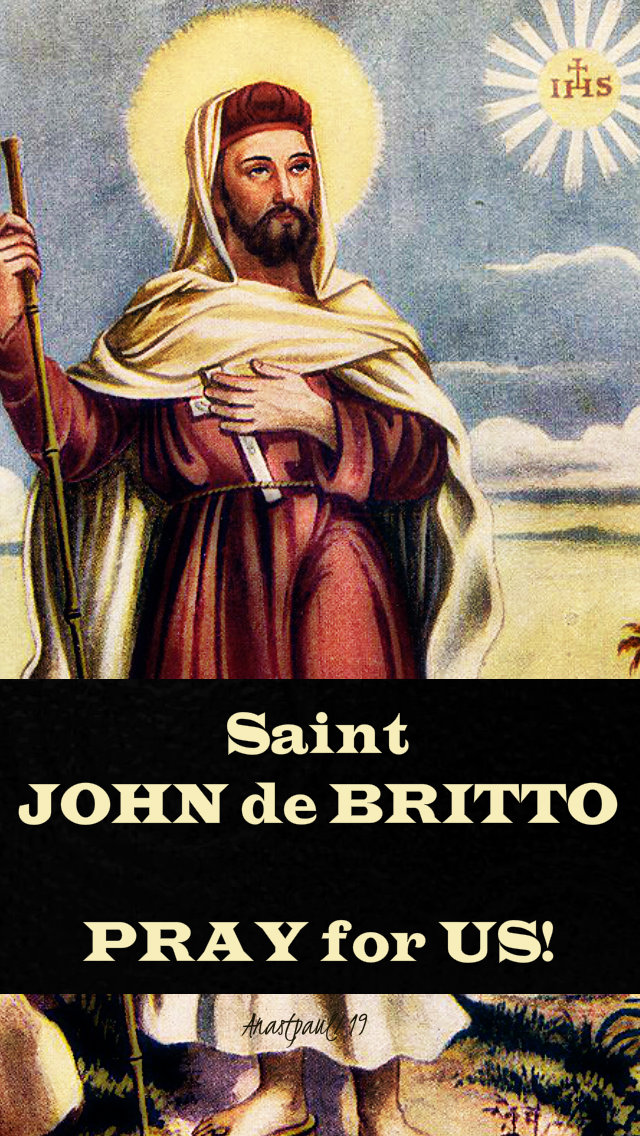
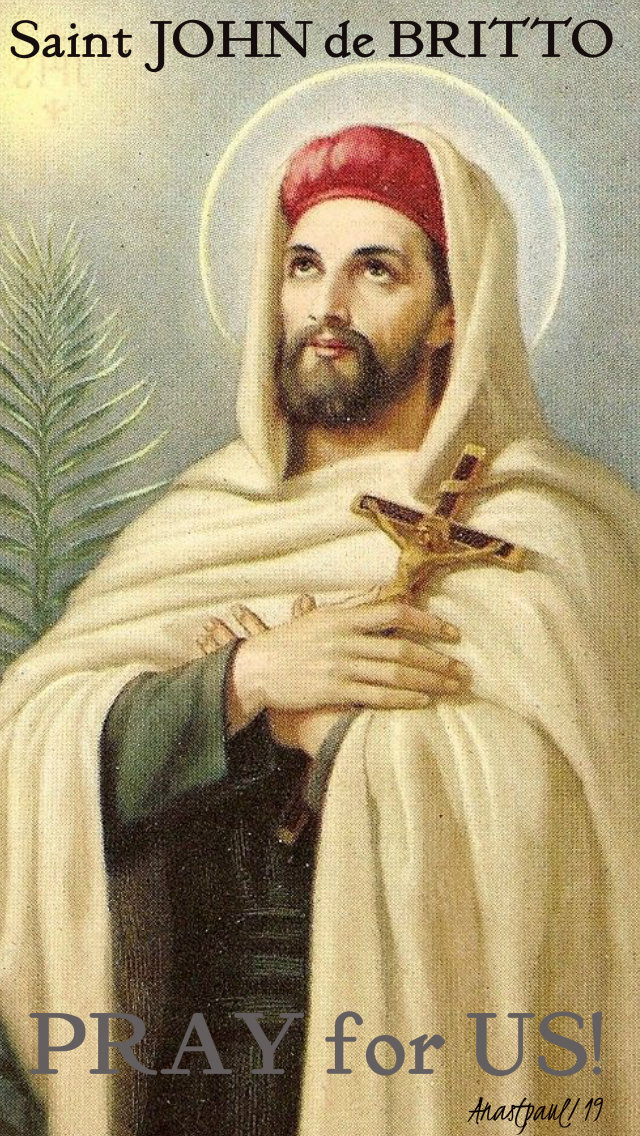
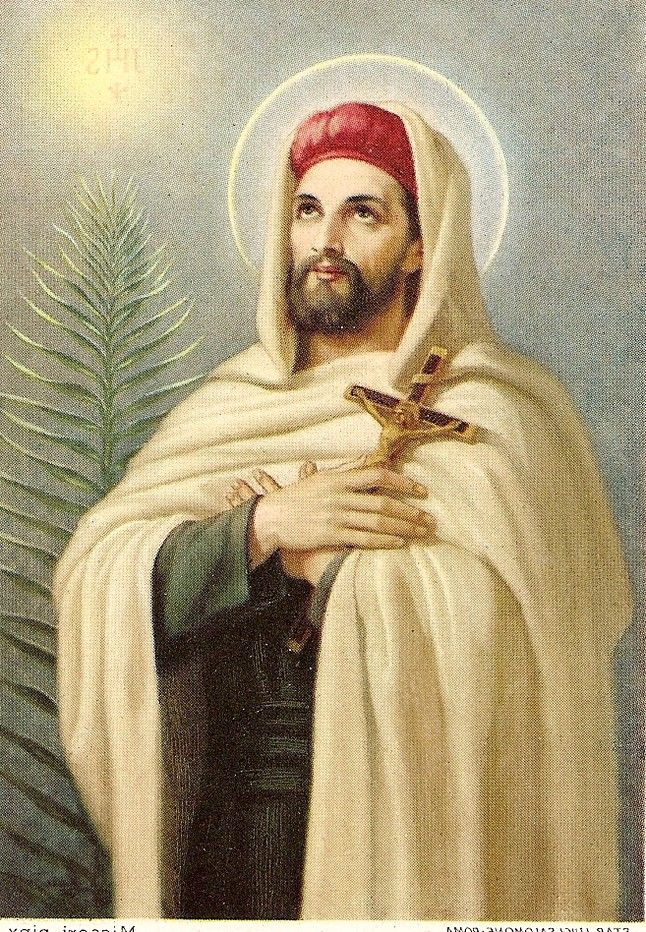
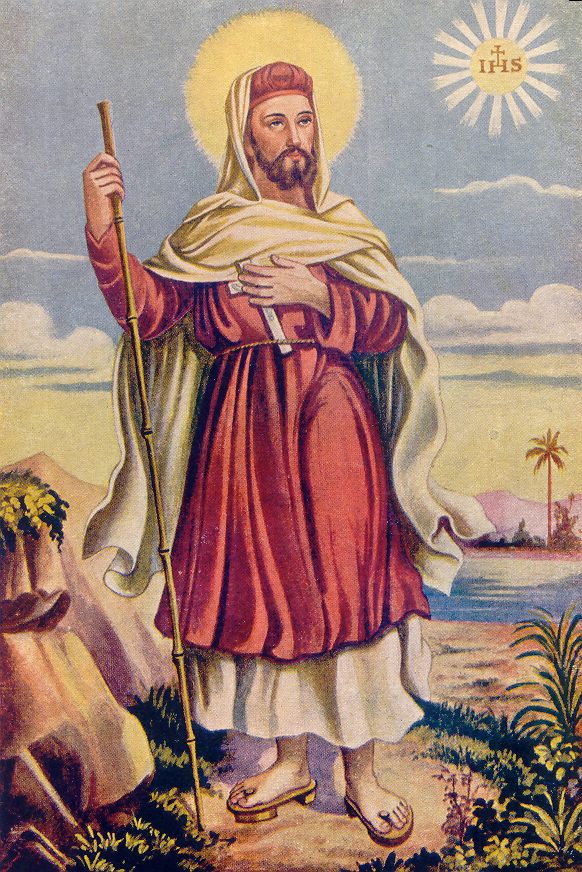
Saint of the Day – 4 February – St John de Britto SJ (1647-1693) also known as Arul Anandar (his Indian title and name) – Martyr, Priest, Missionary, Confessor, Preacher – born João de Brito in Lisbon, Portugal on 1 March 1647 – martyred at Oriyur, Tamil Nadu, India on 11 February 1693 (aged 46). Patronages – Portugal, Diocese of Sivagangai, India.
King Pedro II of Portugal, when a child, had among his little pages a modest boy of rich and princely parents. Much had John de Britto—for so was he called—to bear from his careless-living companions, to whom his holy life was a reproach. A terrible illness made him turn for aid to St Francis Xavier, a Saint so well loved by the Portuguese and when, in answer to his prayers, he recovered, his mother vested him for a year in the dress worn in those days by the Jesuit Fathers. From that time John’s heart burned to follow the example of the Apostle of the Indies He gained his wish.
On 17 December 1662, he entered the novitiate of the Society at Lisbon and eleven years later, in spite of the most determined opposition of his family and of the court, he left all to go to convert the Hindus of Madura. When Blessed John’s mother knew that her son was going to the Indies, she used all her influence to prevent him leaving his own country and persuaded the Papal Nuncio to interfere. “God, Who called me from the world into religious life, now calls me from Portugal to India,” was the reply of the future martyr. “Not to answer the vocation as I ought, would be to provoke the justice of God. As long as I live, I shall never cease striving to gain a passage to India.”
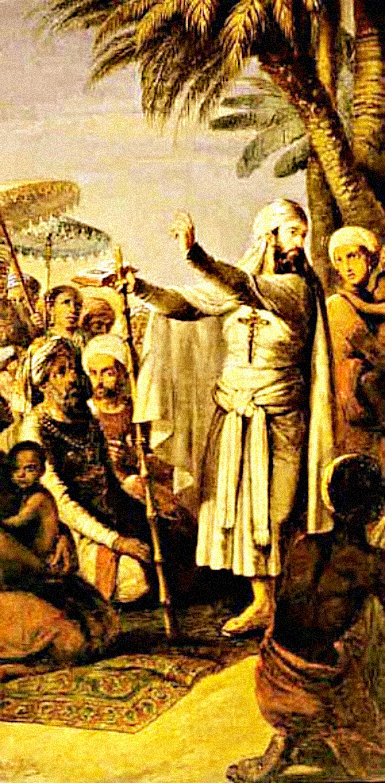
He travelled to the missions of Madurai, in Southern India, present-day Tamil Nadu, in 1673 and preached the Christian religion in the region of the Maravar country. He renamed himself, Arul Anandar in Tamil and for fourteen years he toiled, preaching, converting, baptising multitudes, at the cost of privations, hardships and persecutions.
John at first hoped to win over members of both the higher and the lower castes to Christianity, and so he dressed and lived as an Indian ascetic. He attracted so many members of the lowest caste to Christianity that members of the royalty of Madura saw John as a threat to the caste system. They imprisoned and tortured him but then released him. The Jesuits recalled him to Portugal in 1687 and worked as a missions procurator. King Pedro III (his childhood friend who was now the King) wanted him to stay but in 1690 but after four years, he was allowed to return to Goa and went back to the same territory where he had once been held captive with 24 new missionaries.
The Madurai Mission was a bold attempt to establish an Indian Catholic Church that was relatively free of European cultural domination. As such, Britto learned the native languages, went about dressed in yellow cotton and lived like the people he was seeking to convert – abstaining from every kind of animal food and from wine. St John de Britto tried to teach the Catholic faith in categories and concepts that would make sense to the people he taught. This method, proposed and practised by Fr Roberto de Nobili SJ (1577–1656) (an Italian Jesuit missionary to Southern India. He used a novel method of adaptation (accommodation) to preach Christianity, adopting many local customs of India which were, not contrary to Christianity) met with remarkable success. Britto remained a strict vegan until the end of his life, rejecting meat, fish, eggs and alcohol and living only on legumes, fruits and herbs.
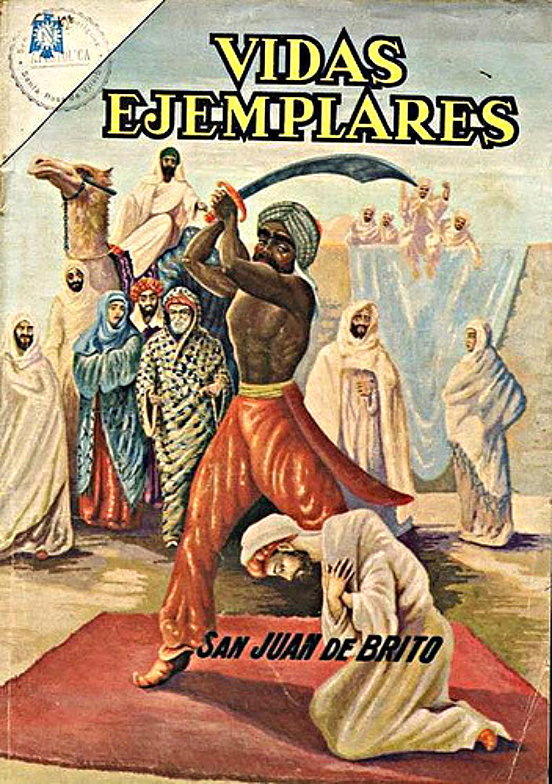
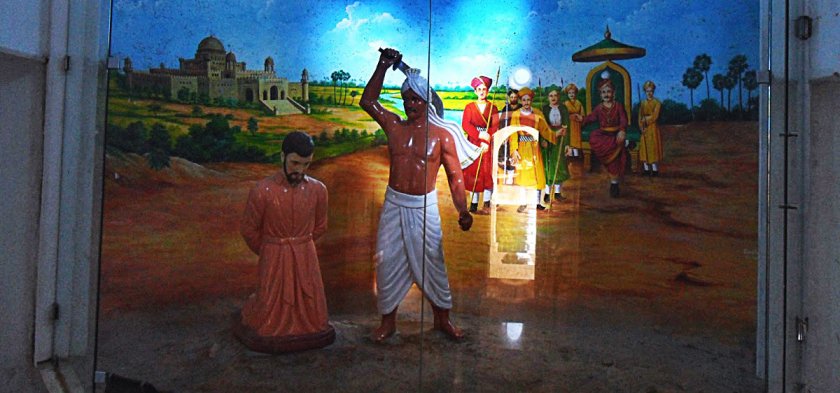
Like St John the Baptist, he died a victim to the anger of a guilty woman, whom a convert king had put aside and, like the Precursor, he was beheaded after a painful imprisonment. St John’s preaching had led to the conversion of a Marava prince who had several wives. When Thadiyathevan, the prince, was required to dismiss all his wives but one, a serious problem arose. One of the wives was a niece of the neighbouring king, who took up her quarrel and began a general persecution of Christians. Britto and the catechists were taken and carried to the capital, Ramnad. Thence he was led to Oriyur, some 30 miles northward along the coast, where he was executed on 4 February 1693.
St John was Beatified by Pope Pius IX on 21 August 1853. He was Canonised by Pope Pius XII on 22 June 1947.
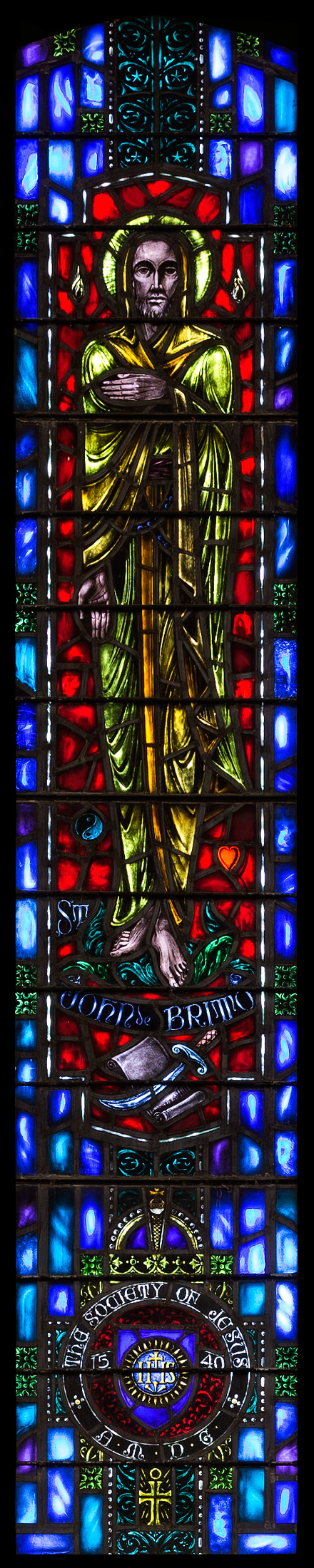
The stained glass below shows St John portrayed in the attire of an ascetic, with a gold flame at each side of his head, representing two miracles attributed to him during his lifetime. The orange-red heart at the right knee and a black yin and yang symbol at the right ankle indicate his love for the people of all India. He stands on greenery, under which is a black scroll weighted down by a scimitar.
The shield of the Society of Jesus consists of a blue circlet on a purple background on which the Jesuit logo, IHS is written above the three nails of the crucifixion of Jesus, surrounded by rays of light. A circle around the shield contains the words “Society of Jesus” and the abbreviated motto of the Society, “A.M.D.G.” (“For the Greater Glory of God”). The foundation date of the Society is 1540.
The Red Sand of St John
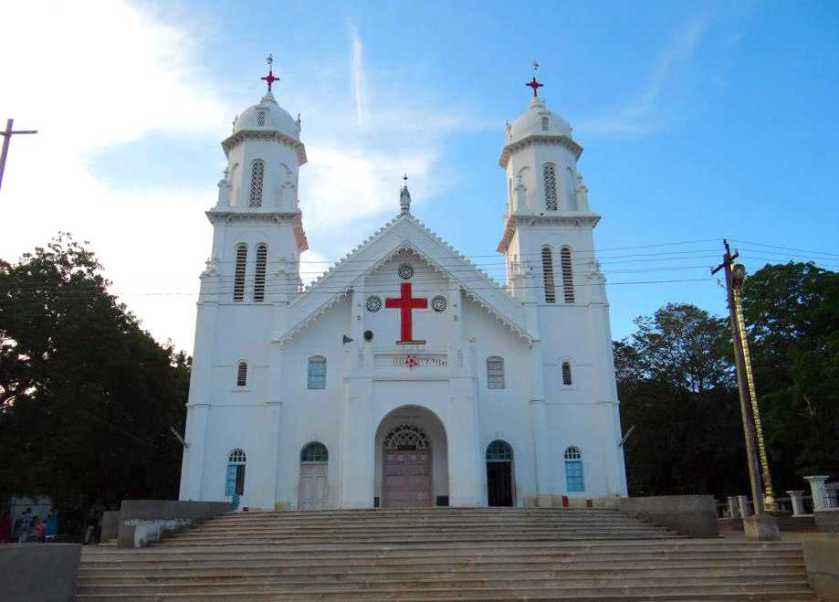
This seashore sightseeing location is one of the most venerable pilgrim centres of Christians in the world, as it is the site of St John de Britto’s martyrdom. It was at this place where the saint was beheaded in 1693. The sand dune here was stained by the blood of the revered saint. There is a shrine constructed in Portuguese style (see below) containing a statue of the saint, known locally as ‘Arul Anandar’ who had modestly offered his neck to the executioner.
The “red sand dune” has become a pilgrimage site where many miracles have been granted. Numerous incurable diseases have been cured by the application of the red sand on the respective body parts. Couples are believed to have blessed with children on visiting the shrine and praying for St John’s intercession. During festivities, pilgrims mainly from Tamil Nadu and Kerala participate irrespective of their caste, creed and religion. Thus, together with Christians, Hindus and Muslims also come to worship at the shrine in thousands, to mark respect to a unique holy man who shed his life and blood at that spot. The occasion appears to be more as a social gathering rather than a religious festival. The auspicious ceremony is a rare opportunity for these simple people to bring gaiety and enthusiasm in their life. The strong faith and enviable ability to combine pleasure and righteousness on a pilgrimage gives a divine atmosphere to the Oriyur feast.
Devotees from other dioceses and districts visit the shrine on specific dates. In February, believers from Dindigul arrive while in June, they are from Karunguli and Nagapattinam. During September more than 25,000 pilgrims visit the shrine for dedicating prayers and offerings. In October, nearly thousands of pilgrims arrive from the neighbouring Sivagangai district and in December, visitors are from Madurai and Melur. Throughout the year, thousands of pilgrims from Sakthikulangara, the only parish in Kerala, visit the St John de Britto shrine to seek the unique blessings.
St Liephard of Cambrai
St Magnus of Fossombrone
St Modan
St Nicholas Studites
St Nithard
St Obitius
St Phileas of Alexandria
Bl Rabanus Maurus
St Rembert
St Themoius
St Theophilus the Penitent
St Vincent of Troyes
St Vulgis of Lobbes
—
Jesuit Martyrs of Japan: A collective memorial of all members of the Jesuits who have died as martyrs for the faith in Japan.
Martyrs of Perga – 4 saints: A group of shepherds martyred in the persecutions of Decius. The only details we have about them are the names – Claudian, Conon, Diodorus and Papias. They were martyred in c 250 in Perga, Asia Minor (in modern Turkey).
Second Thoughts for the Day – 3 February – Fourth Sunday in Ordinary Time, Year C – First Reading: Jeremiah 1:4-5, 17-19
Now the word of the Lord came to me saying, “Before I formed you in the womb I knew you, and before you were born I consecrated you, I appointed you a prophet to the nations.”…Jeremiah 1:4–5
As linked with the Gospel episode of Jesus’ proclaiming the Word of God in Nazareth and the people’s response, it is fair to ponder, all gifts given by the Father of our Lord Jesus Christ to build-up the Body of Christ, the Church. Through Baptism, Confirmation and the Most Holy Eucharist, all have been “set apart” and “appointed” for particular missions throughout our lives, beginning with the call ‘to be holy.’
This quote by Blessed John Henry Newman (1801-1890), is written and speaks of you and me:
God has created me to do Him some definite service;
He has committed some work to me
which He has not committed to another.
I have my mission—
I may never know it in this life but I shall be told it in the next.
…I am a link in a chain,
a bond of connection between persons.
He has not created me for naught.
I shall do good,
I shall do His work,
I shall be an angel of peace,
a preacher of truth in my own place, while not intending it,
if I do but keep His Commandments.
…Therefore I will trust Him.
Whatever, wherever I am.
I can never be thrown away.
If I am in sickness, my sickness may serve Him;
in perplexity, my perplexity may serve Him;
in sorrow, my sorrow may serve Him.
…He does nothing in vain.
…He knows what He is about.
Thought for the Day – 3 February – The Memorial of Saint Ansgar OSB (801-865)
The “Apostle of the North” had enough frustrations to become a saint—and he did.
History records what people do, rather than what they are. Yet the courage and perseverance of men and women like Ansgar can only come from a solid base of union with the original courageous and persevering Missionary.
Ansgar’s life is another reminder that God writes straight with crooked lines. Christ takes care of the effects of the apostolate in His own way, He is first concerned about the purity of the apostles themselves.
Sunday Reflection – 3 February – Fourth Sunday in Ordinary Time, Year C
“May we be Worthy”
“He [Paul] threatens, moreover, the stubborn and forward and denounces them, saying, ‘Whosoever eats the bread or drinks the cup of the Lord unworthily, is guilty of the body and blood of the Lord’ [1 Cor. 11:27].
All these warnings being scorned and contemned—[lapsed Christians will often take Communion] before their sin is expiated, before confession has been made of their crime, before their conscience has been purged by sacrifice and by the hand of the priest, before the offence of an angry and threatening Lord has been appeased, [and so] violence is done to His body and blood and they sin now, against their Lord, more with their hand and mouth than when they denied their Lord”
St Cyprian of Carthage (c 200- c 258) Bishop and Martyr, Father of the Church (The Lapsed 15–16 [written in 251])
One Minute Reflection – 3 February – Fourth Sunday in Ordinary Time, Year C, Gospel: Luke 4:21–30 and The Memorial of St Blaise – Martyr (Died c 316) and St Ansgar (801-865)
And they rose up and put him out of the city and led him to the brow of the hill on which their city was built, that they might throw him down headlong. But passing through the midst of them he went away….Luke 4:29-30
REFLECTION – “A doctor came amongst us to restore us to health – our Lord Jesus Christ. He discovered blindness in our hearts and promised the light that “eye has not seen and ear has not heard, and has not entered the heart of man” (1Cor 2:9).
The humility of Jesus Christ is the cure for your pride. Don’t scorn what will bring you healing, be humble, you for whom God humbled Himself. Indeed, He knew that the medicine of humility would cure you, He who well understood your sickness and knew how to cure it. While you were unable to run to the doctor’s house, the doctor in person came to your house… He is coming, He wants to help you, He knows what you need.
God has come with humility precisely in order that man might imitate Him. If He had remained above you, how would you have been able to imitate Him? And, without imitating Him, how could you be healed? He came with humility because He knew the nature of the remedy He had to administer – a little bitter, it is true but healing. And do you continue to scorn Him? He who holds out the cup to you and you say: “But what sort of God is this God of mine? He was born, suffered, was covered with spittle, crowned with thorns, nailed on the cross!” O miserable soul! You see the doctor’s humility and not the cancer of your pride. That is why humility displeases you…
It often happens that mentally ill people end up by beating their doctor. When that happens, the unfortunate doctor is not only not distressed by the one who beat him but attempts to treat him… As for our doctor, He did not fear being killed by sick people afflicted with madness, He turned His own death into their remedy. Indeed, He died and rose again.”…St Augustine (354-430) Father and Doctor of the Church
PRAYER – Lord our God, make us love You above all things and all our fellow-men, with a love that is worthy of You. May we look to Your Divine Son in love and imitation. Holy Father, You sent St Ansgar, Monk and Bishop, to bring the light of Christ to many nations of Northern Europe. Through his prayer give us grace to live always in the light of Your truth. Grant too, that by the prayers of St Blaise, we too may be granted the grace to follow Your only Son, no matter our sufferings, to You, in our heavenly home. We make our prayer, through Christ our Lord, in the unity of the Holy Spirit, one God, forever amen.
Our Morning Offering – 3 February – Fourth Sunday in Ordinary Time, Year C
The Bread of Angels By St Bonaventure (1217-1274) Doctor of the Church
Pierce, O most sweet Lord Jesus,
my inmost soul with the most joyous
and healthful wound of Your love,
and with true, calm and most holy apostolic charity,
that my soul may ever languish and melt
with entire love and longing for You,
may yearn for You and for Your courts,
may long to be dissolved and to be with You.
Grant that my soul may hunger after You,
the Bread of Angels, the refreshment of holy souls,
our daily and supersubstantial bread,
having all sweetness and savour
and every delightful taste.
May my heart ever hunger after and feed upon You,
Whom the angels desire to look upon,
and may my inmost soul
be filled with the sweetness of Your savour;
may it ever thirst for You,
the fountain of life,
the fountain of widsom and knowledge,
the fountain of eternal light,
the torrent of pleasure,
the fulness of the house of God;
may it ever compass You,
seek You, find You, run to You,
come up to You, meditate on You, speak of You
and do all for the praise and glory of Your name,
with humility and discretion,
with love and delight,
with ease and affection,
with perseverence to the end
and be You alone ever my hope,
my entire confidence, my riches, my delight,
my pleasure, my joy, my rest and tranquility,
my peace, my sweetness, my food, my refreshment,
my refuge, my help, my wisdom, my portion,
my possession, my treasure;
in Whom may my mind and my heart
be ever fixed and firm and rooted immovably.
Amen
Saint of the Day – 3 February – Saint Ansgar OSB (801-865) “Apostle of the North”, Bishop, Monk, Mystic, Missionary, Preacher, Miracle-worker, Apostle of Charity Ascetic. Patronages – Denmark, Scandinavia, Sweden, Bremen, Germany, diocese of Hamburg, Germany, archdiocese of. He is also known as Anskar or Anschar. St Ansgarwas the Archbishop of Hamburg-Bremen – a northern part of the Kingdom of the East Franks. The See of Hamburg was designated a mission to bring Christianity to Northern Europe and Ansgar became known as the “Apostle of the North”. He was born in 801 at Amiens, Picardy, France and died on 3 February 865 at Bremen, Germany.
Ansgar was the son of a noble Frankish family, born near Amiens. After his mother’s early death, Ansgar was brought up in Corbie Abbey and was educated at the Benedictine monastery in Picardy. According to the Vita Ansgarii – The Life of Ansgar, when the little boy learned in a vision that his mother was in the company of the Blessed Virgin Mary, his careless attitude toward spiritual matters changed to seriousness. His pupil, successor and eventual biographer St Rimbert (830–888) considered the visions, of which this was the first, to be the main motivation of the saint’s life.
Ansgar was a product of the phase of Christianisation of Saxony (present day Northern Germany) begun by Charlemagne and continued by his son and successor, Louis the Pious. A group of monks including Ansgar were sent back to Jutland with the baptised exiled king Harald Klak. Ansgar returned two years later and was one of a number of missionaries sent to found the abbey of Corvey in Westphalia and there became a teacher and preacher. Then in 829 in response to a request from the Swedish king Björn at Hauge for a mission to the Swedes, Louis the Pious appointed Ansgar missionary. With an assistant, the friar Witmar, he preached and made converts for six months at Birka, on Lake Mälaren. They organised a small congregation there with the king’s steward, Hergeir and Mor Frideborg as its most prominent members. In 831 he returned to Louis’ court at Worms and was appointed to the Archbishopric of Hamburg. This was a new archbishopric with a see formed from those of Bremen and Verden, plus the right to send missions into all the northern lands and to consecrate bishops for them. He was given the mission of evangelising Denmark, Norway and Sweden. The King of Sweden decided to cast lots as to whether the Christian missionaries should be admitted into his kingdom. Ansgar recommended the issue to the care of God, and the lot was favourable.
Ansgar was consecrated in November 831 and, the arrangements having been at once approved by Pope Gregory IV, he went to Rome to receive the pallium directly from the hands of the pope and to be named legate for the northern lands. This commission had previously been bestowed upon Ebbo, Archbishop of Reims but the jurisdiction was divided by agreement, with Ebbo retaining Sweden for himself. For a time Ansgar devoted himself to the needs of his own diocese, which was still missionary territory with but a few churches. He founded a monastery and a school in Hamburg.
A depiction of Saint Ansgar from the Church Trinitatis, in Hamburg, Germany
After Louis died in 840, his empire was divided and Ansgar lost the abbey of Turholt, which had been given as an endowment for his work. Then in 845, the Danes unexpectedly raided Hamburg, destroying all the church’s treasures and books and leaving the entire diocese beyond repair. Ansgar now had neither see, nor revenue. Many of his helpers deserted him but the new king, Louis the German, came to his aid. After failing to recover Turholt for him, in 847 he awarded him the vacant diocese of Bremen, where he took up residence in 848. However, since Hamburg had been an archbishopric, the sees of Bremen and Hamburg were combined for him. This presented canonical difficulties and also aroused the anger of the Bishop of Cologne, to whom Bremen had been suffragan but after prolonged negotiations, Pope Nicholas I approved the union of the two dioceses in 864.
Through all this political turmoil, Ansgar continued his mission to the northern lands. The Danish civil war compelled him to establish good relations with two kings, Horik the Elder and his son, Horik II. Both assisted him until his death. He was able to secure recognition of Christianity as a tolerated religion and permission to build a church in Sleswick. He did not forget the Swedish mission and spent two years there in person (848–850), at the critical moment when a pagan reaction was threatened, which he succeeded in averting. In 854, Ansgar returned to Sweden when king Olof ruled in Birka. According to Rimbert, he was well disposed to Christianity.
Ansgar wore a rough hair shirt, lived on bread and water and showed great charity to the poor. Being the first missionary in Sweden and the organiser of the hierarchy in the Nordic countries, he was declared Patron of Scandinavia. Ansgar was buried in Bremen in 865.
His life story was written by his successor as archbishop, Rimbert, in The Life of Ansgar – Vita Ansgarii.
His Relics are located in Hamburg on two places – St. Mary’s Cathedral and St Ansgar’s and St Bernard’s Church.
St Ansgar Statue in Hamburg
The Life of Ansgar aims above all to demonstrate Ansgar’s sanctity. It is speaks of St Ansgar’s visions, which, encouraged and assisted Ansgar’s remarkable missionary feats.
Through the course of this work, St Ansgar repeatedly embarked on a new stage in his career following a vision. His studies and ensuing devotion to the ascetic life of a monk were inspired by a vision of his mother in the presence of the Blessed Virgin Mary. When the Swedish people were left without a priest for some time, he begged King Horik to help him with this problem. St Ansgar was convinced he was commanded by heaven to undertake this mission and was influenced by a vision he received when he was concerned about the journey, in which he met a man who reassured him of his purpose and informed him of a prophet that he would meet, the Abbot Adalard, who would instruct him in what was to happen. In the vision, he searched for and found Adalard, who commanded, “Islands, listen to me, pay attention, remotest peoples”, which Ansgar interpreted as God’s will that he go to the Scandinavian countries as “most of that country consisted of islands and also, when ‘I will make you the light of the nations so that my salvation may reach to the ends of the earth’ was added, since the end of the world in the north was in Swedish territory”. Saint Adalard of Corbie (c 751-827), was the cousin of Charlemagne.
There are Statues dedicated to him in Hamburg, Copenhagen, Ribe as well as a stone cross at Birka. A crater on the Moon, Ansgarius, has been named for him.
St Blaise (Died c 316) – Martyr (Optional Memorial)
All about St Blaise: https://anastpaul.wordpress.com/2018/02/03/saint-of-the-day-st-blaise-died-c-316-martyr/
St Ansgar OSB (801-865) (Optional Memorial)
Bl Alois Andritzki
St Anatolius of Salins
St Anna the Prophetess
St Berlinda of Meerbeke
St Blasius of Armentarius
St Blasius of Oreto
St Caellainn
St Celerinus of Carthage
St Claudine Thevenet
St Clerina of Carthage
St Deodatus of Lagny
St Eutichio
St Evantius of Vienne
St Felix of Africa
St Felix of Lyons
St Hadelin of Chelles
Bl Helena Stollenwerk
Bl Helinand of Pronleroy
St Hippolytus of Africa
St Ia of Cornwall
St Ignatius of Africa
Bl Iustus Takayama Ukon
Bl John Nelson
Bl John Zakoly
St Laurentinus of Carthage
St Laurentius of Carthage
St Lawrence the Illuminator
St Liafdag
St Lupicinus of Lyon
St Margaret of England
Bl Marie Rivier
St Oliver of Ancona
St Philip of Vienne
St Remedius of Gap
St Sempronius of Africa
St Tigrides
St Werburga of Bardney
St Werburga of Chester
—
Benedictine Martyrs: A collective memorial of all members of the Benedictine Order who have died as martyrs for the faith.
Thought for the Day – 2 February – Feast of the Presentation of the Lord and the World Day of Prayer for Consecrated Life
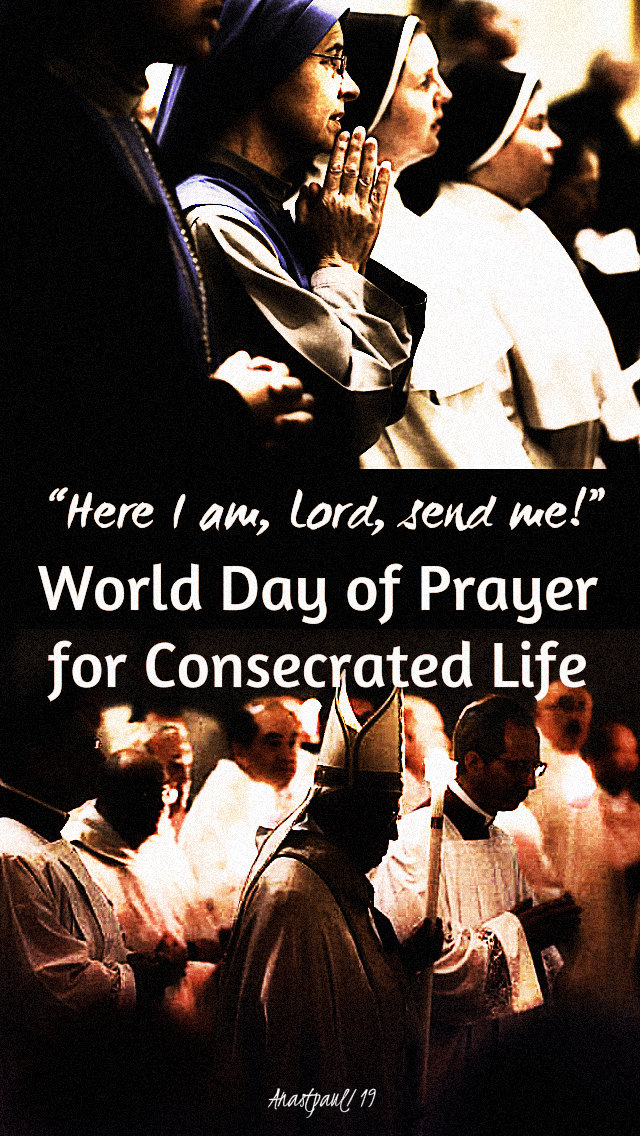
The celebration of World Day for Consecrated Life invites all the Church to reflect on the role of Consecrated Life within the Christian community. Those who choose to live a consecrated life do so for the sake of the gospel.
Some Christian women and men respond to God’s call to become followers of Jesus through profession of vows and a life dedicated to prayer and service. They live out the consecrated life in different ways. Religious sisters, nuns, brothers, religious priests and monks consecrate their lives through their profession of the evangelical vows and live as part of a community. Secular institutes are another form of living the consecrated life as single people. Those who become followers of Jesus through the consecrated life bless the Church.
And so, as we think about the many ways in which we are called to love in ordinary ways and do it extraordinarily well, let us not forget those women and men who have responded to God’s call to serve as a consecrated religious. This day and Mass is dedicated to them throughout the world. On this World Day for Consecrated Life, may the lives of consecrated women and men be blessed with God’s overwhelming grace of love! May their lives inspire us to hear God’s vocational call. May this tune be forever in our minds and transform our hearts to say boldly:
“Here I am, Lord, send me!”
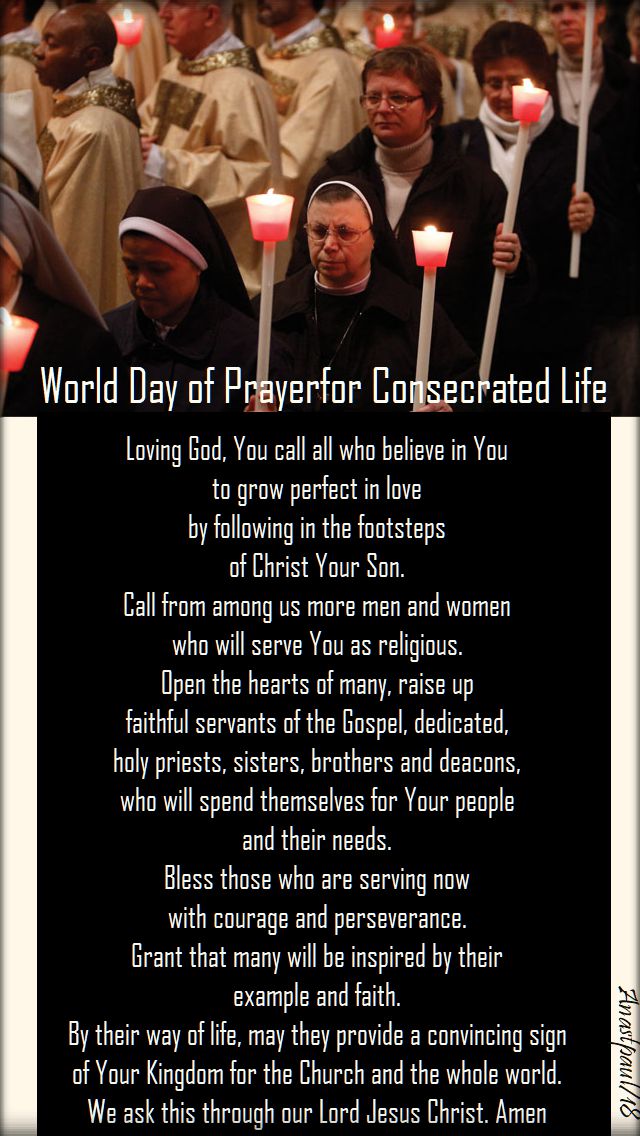
LET US PRAY FOR ALL CONSECRATED MEN & WOMEN AND FOR VOCATIONS:
Loving God, You call all who believe in You
to grow perfect in love
by following in the footsteps
of Christ Your Son.
Call from among us more men and women
who will serve You as religious.
Open the hearts of many, raise up
faithful servants of the Gospel, dedicated,
holy priests, sisters, brothers and deacons,
who will spend themselves for Your people
and their needs.
Bless those who are serving now
with courage and perseverance.
Grant that many will be inspired by their
example and faith.
By their way of life, may they provide a convincing sign
of Your Kingdom for the Church and the whole world.
We ask this through our Lord Jesus Christ.
Amen
Quote of the Day – 2 February – Feast of the Presentation of the Lord
Come then, my brethren, give an eye to that candle burning in Simeon’s hands. Light your candles too by borrowing from that Light, for these candles I speak of are the lamps which the Lord orders us to have in our hands (Mt 25:1; Lk 12:35). Come to Him and be enlightened (Ps 34[33], 6), so as to be not merely carrying lamps but to be very lamps yourselves, shining inside and out, for yourselves and for your neighbours.
Be a lamp then in heart, in hand, in lips. The lamp in your heart will shine for you, the lamp in your hand or on your lips will shine out for your neighbours. T he lamp in the heart is loving faith, the lamp in the hand is the example of good works, the lamp on the lips is edifying speech. But not just before men must we shine by works and word but before angels too by prayer and before God Himself, by pure intention. Our lamp before the angels is the purity of our devotion when in the sight of angels we chant the psalms with care or pray with burning ardour, our lamp before God is the honesty of our intention to please Him only, whose approval we have won…
There are so many lamps then, my brethren, to lighten your way, if only you will come to the source of all light and be enlightened.
Come, I say, to Jesus who shines out to us from Simeon’s arms. He will give light to your faith, lustre to your works, meaning to your words for men, ardour to your prayer, purity to your intentions… And when this life’s lamp is extinguished there will arise a life’s light which can never be extinguished, a shimmering noonday light, arising as it were at the evening of your life.
Blessed Guerric of Igny O.Cist. (c 1080-1157)
Cistercian abbot
One Minute Reflection – 2 February – Feast of the Presentation of the Lord, Gospel: Luke 2:22–40 and the World Day of Prayer for Consecrated Life
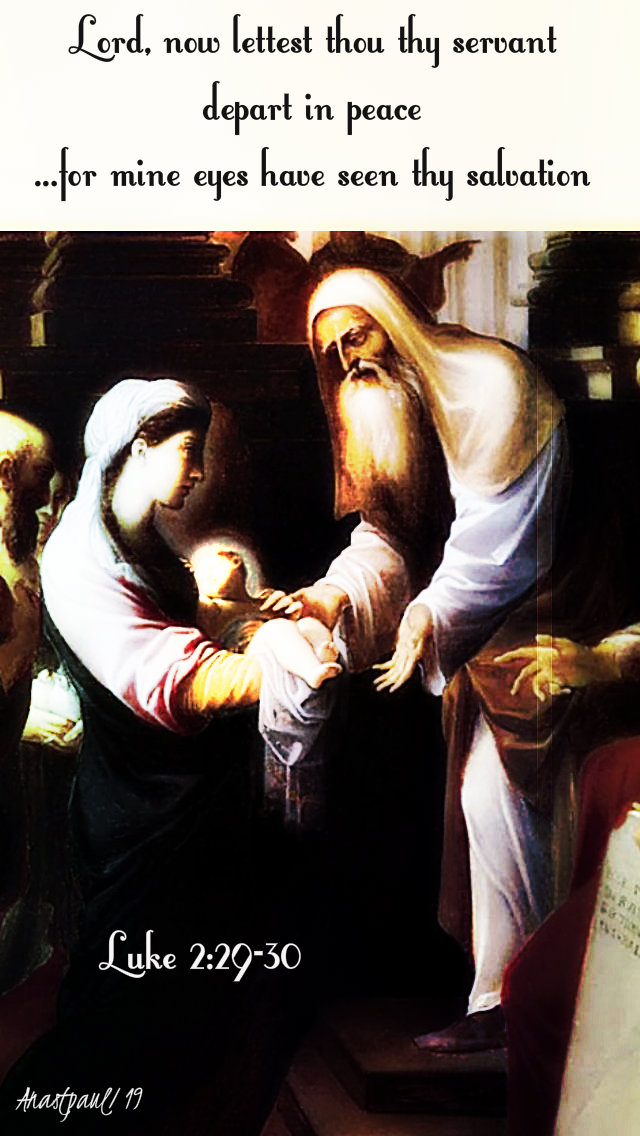
“Lord, now lettest thou thy servant depart in peace, according to thy word; for mine eyes have seen thy salvation which thou hast prepared in the presence of all peoples, a light for revelation to the Gentiles and for glory to thy people Israel.”...Luke 2:29-32
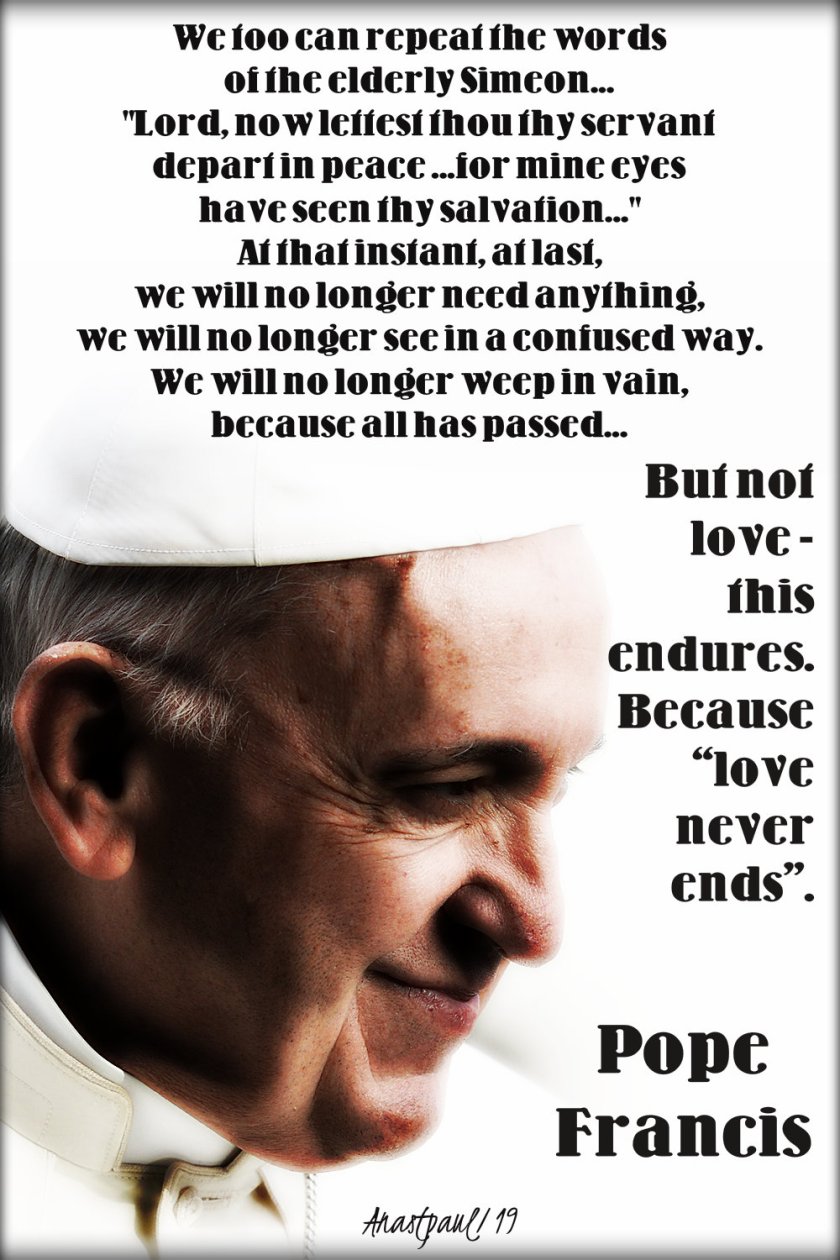
REFLECTION – “Those who have met Jesus no longer fear anything. We too can repeat the words of the elderly Simeon, he too was blessed by the encounter with Christ, after a lifetime spent in anticipation of this event: “Lord, now lettest thou thy servant depart in peace, according to thy word; for mine eyes have seen thy salvation” (Lk 2:29-30). At that instant, at last, we will no longer need anything, we will no longer see in a confused way. We will no longer weep in vain, because all has passed, even the prophecies, even consciousness. But not love – this endures. Because “love never ends” (1 Cor 13:8).”…Pope Francis – General Audience, 25 October 2017
PRAYER – May the Lord renew in you and in all consecrated people each day the joyful response to His freely given and faithful love. Dear brothers and sisters, like lighted candles, always and everywhere shine with the love of Christ, Light of the world. May Mary Most Holy, the consecrated Woman, help you to live to the full, your special vocation and mission in the Church for the world’s salvation. And may we all follow our Lord in obedience. Amen!
Our Morning Offering – 2 February – The Feast of the Presentation of the Lord
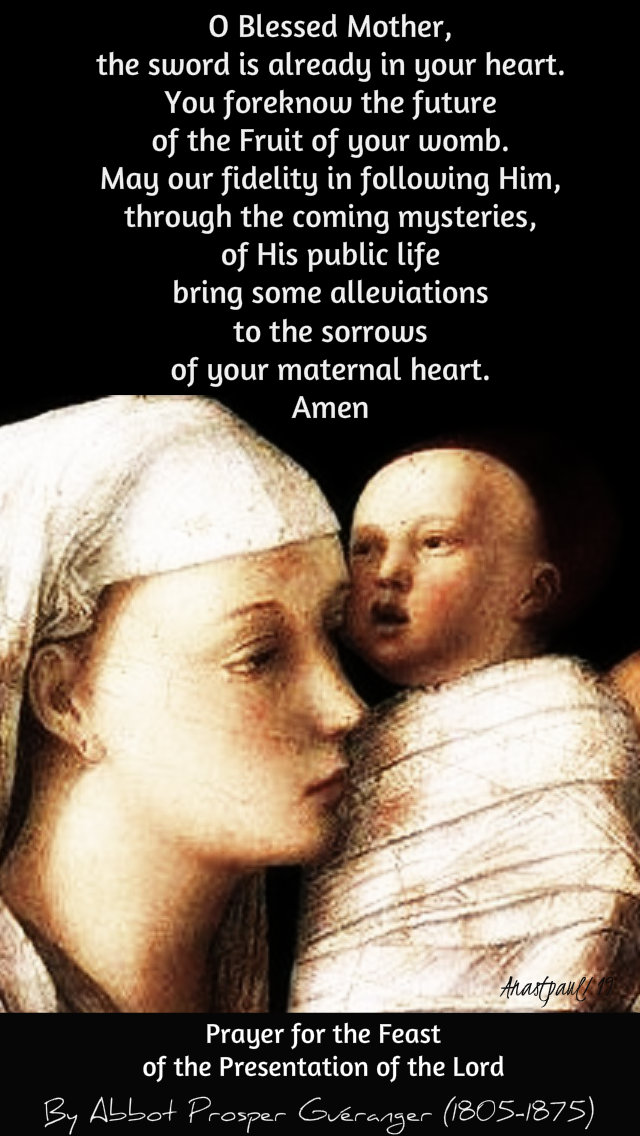
Prayer for the Feast of the Presentation of the Lord By Abbot Prosper Guéranger OSB (1805-1875)
O Blessed Mother,
the sword is already in your heart.
You foreknow the future
of the Fruit of your womb.
May our fidelity in following Him,
through the coming mysteries,
of His public life
bring some alleviations
to the sorrows
of your maternal heart.
Amen
The feast of Jesus’ presentation in the temple forty days after his birth, celebrated on 2 February, has a long history in the Eastern and Western Church.
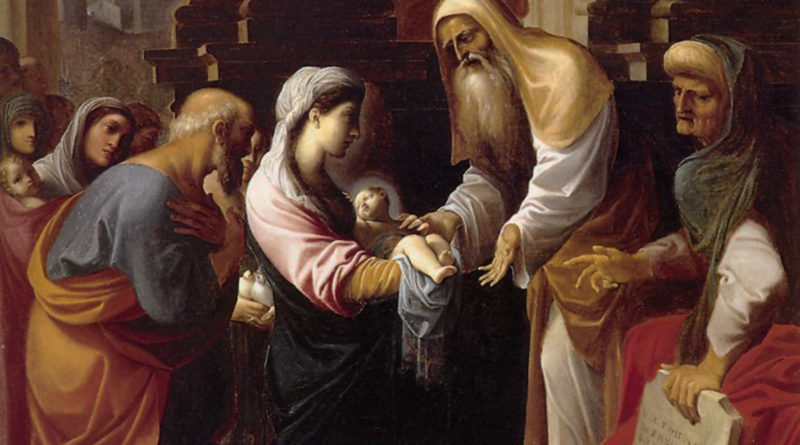
The Mosaic law prescribed that every firstborn male in Israel had to be consecrated to God forty days after birth and redeemed with a sum deposited in the Temple treasury. This was in remembrance of the firstborn sons being preserved from death on the night of the first Passover during the exodus from Egypt. The Gospel according to St. Luke gives us this account of Jesus’ presentation in the Temple: when the time came for their purification according to the law of Moses, they brought him up to Jerusalem to present him to the Lord, as it is written in the law of the Lord, “Every male that opens the womb shall be called holy to the Lord.” St Joseph and our Lady entered the temple, unnoticed among the crowd. The “desired of all nations” came to the house of his Father in his Mother’s arms. The liturgy of this feast-day exhorts us, in the Responsorial Psalm, to adore the King of Glory in the heart of his humble family “Lift up your heads, O gates! and be lifted up, O ancient doors! that the King of glory may come in.”
The Church of Jerusalem began the annual commemoration of this mystery in the 4th century. The feast was celebrated on 14 February forty days after the Epiphany because the Jerusalem liturgy had not yet adopted the Roman custom of celebrating Christmas on 25 December. That is why when this became the common custom throughout the whole Christian world, the feast of the Presentation was moved to 2 February and was soon celebrated throughout the entire East. In Byzantium, the emperor Justinian I introduced it in the 6th century, under the title “Hypapante” or “encounter,” referring to Jesus’ encounter with the aged Simeon, who was a figure of the just men of Israel who had patiently awaited the fulfilment of the messianic prophecies for so many years.
During the 7th century, the celebration also took root in the West. The widespread name of Candlemas comes from the tradition instituted by Pope Sergius I of having a procession with candles. As the elderly Simeon proclaimed, Jesus is the Saviour, prepared in the presence of all peoples, a light for revelation to the Gentiles. In commemorating the arrival and manifestation of the divine light to the world, the Church each year blesses candles, symbol of Jesus’ perennial presence and the light of faith that the faithful receive in the sacrament of Baptism. The procession with lighted candles thus becomes an expression of Christian life: a pathway illuminated by the light of Christ.
The annual commemoration of the Presentation of the Lord in the Temple is also a Marian celebration and therefore at certain times in the past it was also known as the feast of the Purification of Mary. Even though Mary was preserved by God from original sin, as a Hebrew mother she chose to submit to the Law of the Lord and therefore offered a pair of turtledoves or two young pigeons. Mary’s offering was thus a sign of her prompt obedience to God’s commands.
Feast of the Presentation of the Lord: The feast commemorates the purifying of the Blessed Virgin according to the Mosaic Law, 40 days after the birth of Christ and the presentation of the Infant Jesus in the Temple. The feast was introduced into the Eastern Empire by Emperor Justinian I and is mentioned in the Western Church in the Gelasian Sacramentary of the 7th century. Candles are blessed on that day in commemoration of the words of Holy Simeon concerning Christ “a light to the revelation of the Gentiles” (Luke 2) and a procession with lighted candles is held in the church to represent the entry of Christ, the Light of the World, into the Temple of Jerusalem. “Candlemas” is still the name in Scotland for a legal term-day on which interest and rents are payable (2 February).
Patronage
• Jaro, Philippines
• Western Visayas, Philippines
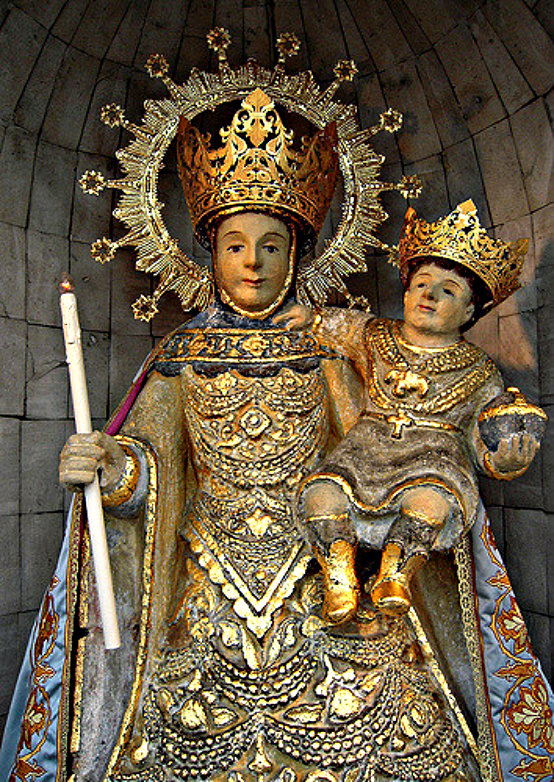
Our Lady of the Candles – (formally known as Nuestra Señora de la Purificación y la Candelaria) is a Marian title and image venerated by Filipino Catholics. The image, which is enshrined on the balcony of Jaro Cathedral, is known as the patroness of Jaro District of Iloilo City and the whole of the Western Visayas.
The feast day of Our Lady of the Candles is on Candlemas (2 February) and is celebrated in Iloilo City with a Solemn Pontifical Mass presided by the Archbishop of Jaro. St Pope John Paul II personally issued a Canonical coronation towards the venerated image on 21 February 1981.
World Day of Prayer for Consecrated Life: Begun in 1997 by St Pope John Paul II, the World Day for Consecrated Life was intended to serve three purposes:
• to praise the Lord and thank Him for the great gift of consecrated life;
• to promote a knowledge of and esteem for the consecrated life by the entire People of God;
• to allow those in consecrated life to celebrate together the marvels which the Lord has accomplished in them, to discover by a more illumined faith the rays of divine beauty, spread by the Spirit in their way of life and to acquire a more vivid consciousness of their irreplaceable mission, in the Church and in the world;
It serves an opportunity to highlight the extraordinary contributions of men and women religious, as well as a time to pray for vocations to the consecrated life.
—
St Adalbald of Ostrevant
St Adeloga of Kitzingen
St Agathodoros of Tyana
St Andrea Carlo Ferrari
St Apronian the Executioner
St Bruno of Ebsdorf
St Burchard of Wurzburg
St St Candidus the Martyr
St Columbanus of Ghent
St Cornelius the Centurion
St Felician the Martyr
St Feock
St Firmus of Rome
St Flosculus of Orléans
St Fortunatus the Martyr
St Giovanni Battista Clemente Saggio
St Hilarus the Martyr
St Jean Theophane Venard
St Jeanne de Lestonnac
St Lawrence of Canterbury
Bl Louis Alexander Alphonse Brisson
Bl Maria Domenica Mantovani
St Marquard of Hildesheim
St Mun
Bl Peter Cambiano
St Rogatus the Martyr
St Saturninus the Martyr
St Sicharia of Orleans
St Simon of Cassia Fidati
Bl Stephen Bellesini
St Theodoric of Ninden
St Victoria the Martyr
—
Martyrs of Ebsdorf: Members of the army of King Louis III of France under the leadership of Duke Saint Bruno of Ebsdorf. The martyrs died fighting invading pagan Norsemen, and defending the local Christian population. Four bishops, including Saint Marquard of Hildesheim and Saint Theodoric of Ninden, eleven nobles, and countless unnamed foot soldiers died repelling the invaders. They were martyred in the winter of 880 in battle at Luneberg Heath and Ebsdorf, Saxony (modern Germany).
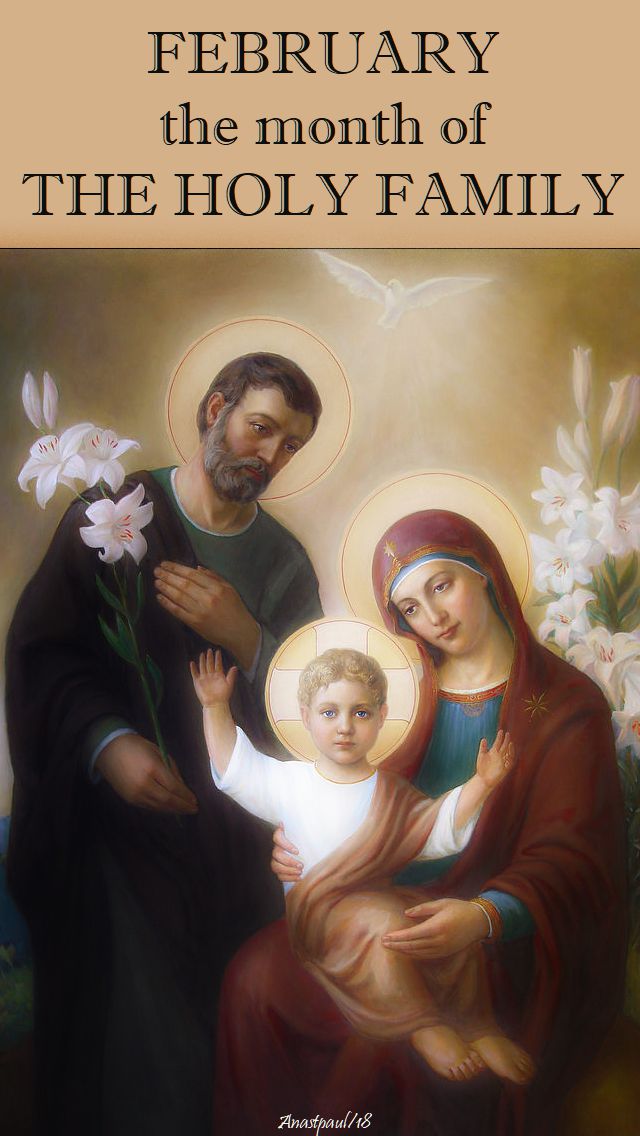
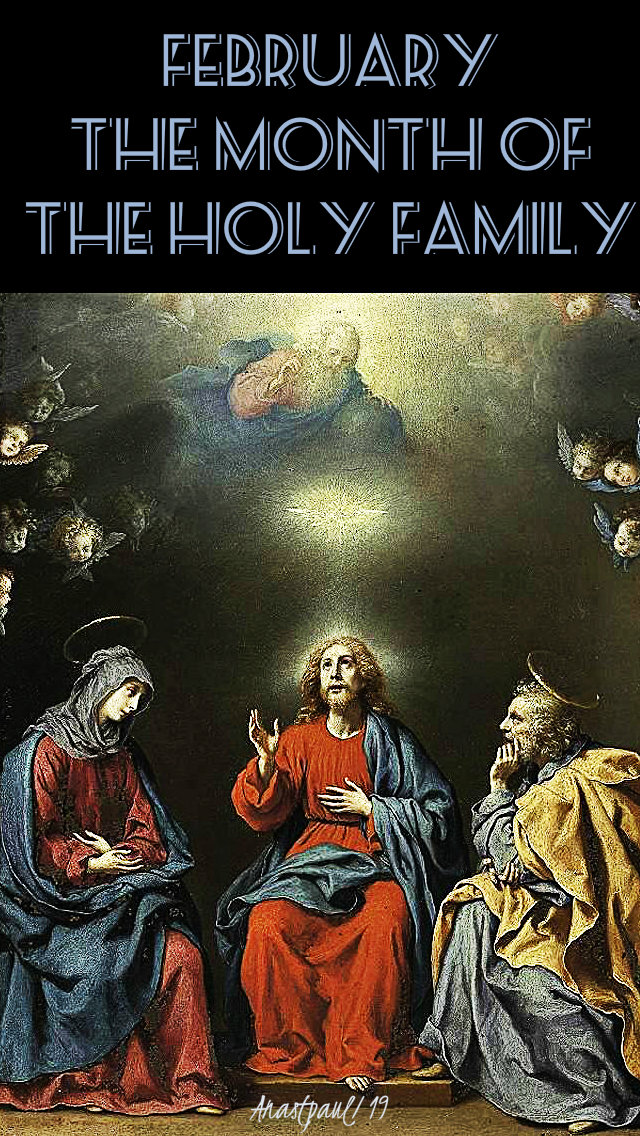
In January, the Catholic Church celebrated the Month of the Holy Name of Jesus and in February, we turn to the entire Holy Family—Jesus, Mary and Joseph.
The special devotion which proposes the Holy Family of Jesus, Mary and Joseph as the model of virtue of all Christian households began in the 17th century. It started almost in France – the Association of the Holy Family was founded by the Daughters of the Holy Family in Paris in 1674.
This devotion soon spread and in 1893 Pope Leo XIII expressed his approval of a feast under this title and himself composed part of the Office. On account of the flight into Egypt this feast has been observed by the Copts from early times.
The feast was welcomed by succeeding Pontiffs as an efficacious means for bringing home to the Christian people the example of the Holy Family at Nazareth and by the restoration of the true spirit of family life, stemming, in some measure, the evils of present-day society.
In the words of His Holiness Pope Leo XIII, “Nothing truly can be more salutary or efficacious for Christian families to meditate upon than the example of this Holy Family, which embraces the perfection and completeness of all domestic virtues.”
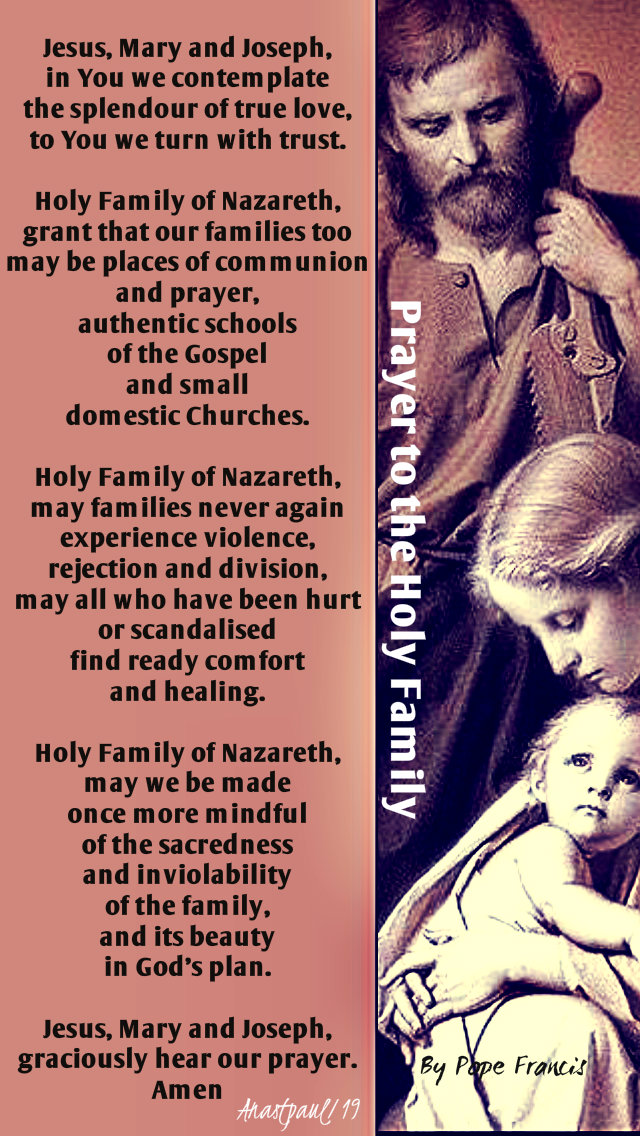
Prayer to the Holy Family By Pope Francis Angelus, 29 December 2013
Jesus, Mary and Joseph,
in You we contemplate
the splendour of true love,
to You we turn with trust.
Holy Family of Nazareth,
grant that our families too
may be places of communion and prayer,
authentic schools of the Gospel
and small domestic Churches.
Holy Family of Nazareth,
may families never again
experience violence, rejection and division:
may all who have been hurt or scandalised
find ready comfort and healing.
Holy Family of Nazareth,
may we be made
once more mindful
of the sacredness
and inviolability of the family,
and its beauty in God’s plan.
Jesus, Mary and Joseph,
graciously hear our prayer.
Amen
(This prayer was composed for the Synod of the Family in 2014, so it has been very slightly adapted to remove the reference to the said Synod).
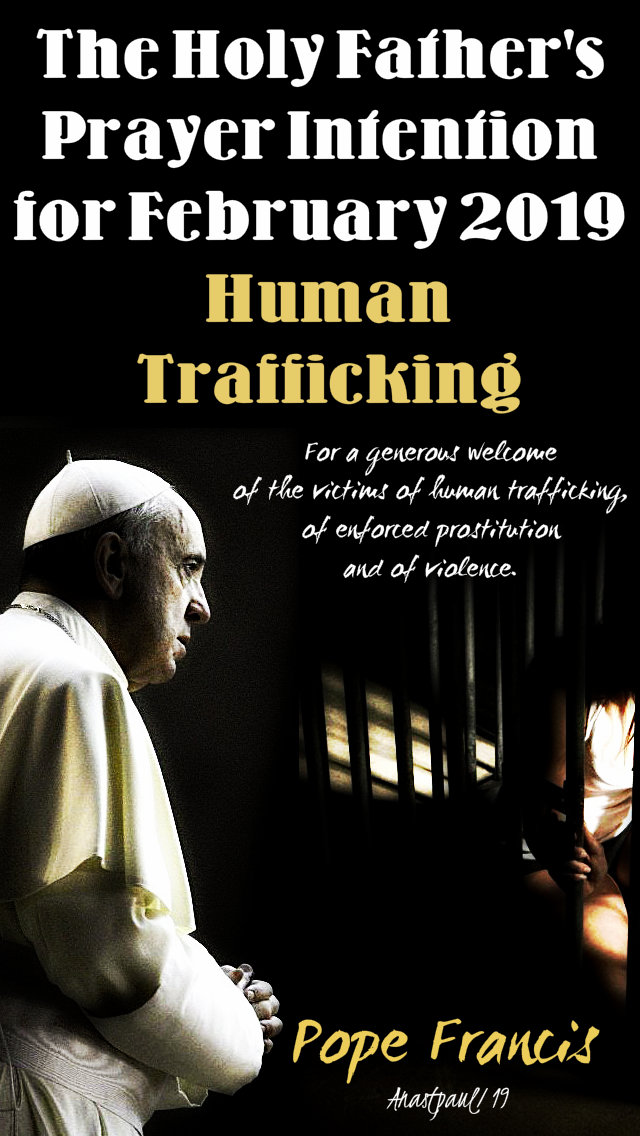
The Holy Father’s Prayer Intention for February 2019
FEBRUARY 2019
Human Trafficking
For a generous welcome of the victims of human trafficking, of enforced prostitution and of violence.
Let us pray:
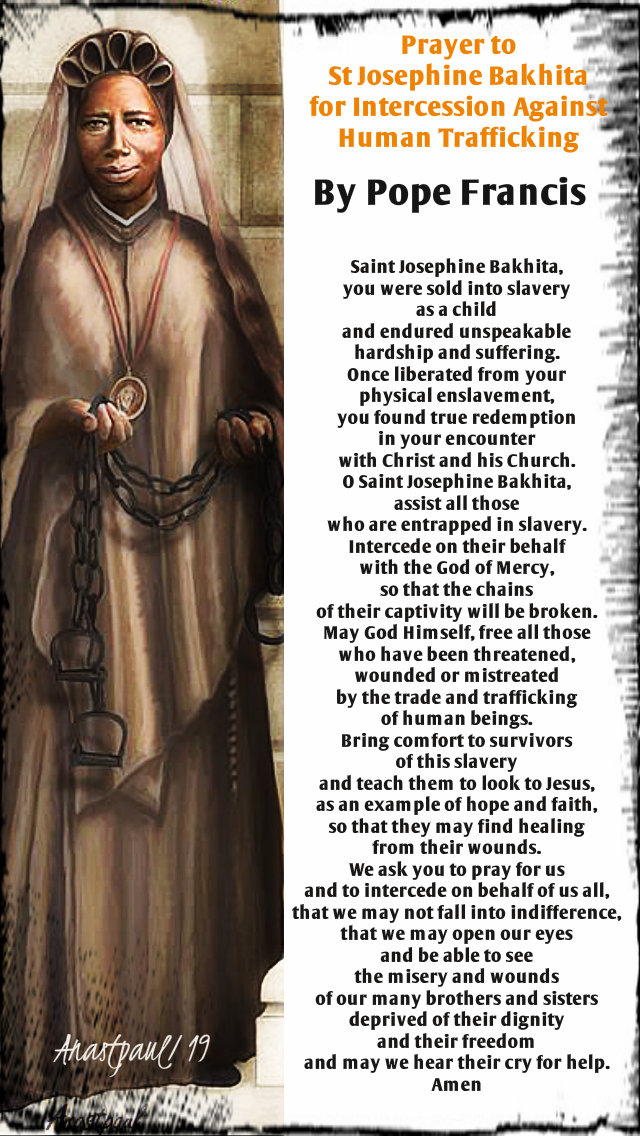
Prayer to St Josephine Bakhita for Intercession Against Human Trafficking By Pope Francis
Saint Josephine Bakhita, you were sold into slavery as a child and endured unspeakable hardship and suffering. Once liberated from your physical enslavement, you found true redemption in your encounter with Christ and his Church. O Saint Josephine Bakhita, assist all those who are entrapped in slavery. Intercede on their behalf with the God of Mercy, so that the chains of their captivity will be broken. May God Himself free all those who have been threatened, wounded or mistreated by the trade and trafficking of human beings. Bring comfort to survivors of this slavery and teach them to look to Jesus, as an example of hope and faith, so that they may find healing from their wounds. We ask you to pray for us and to intercede on behalf of us al, that we may not fall into indifference, that we may open our eyes and be able to see the misery and wounds of our many brothers and sisters deprived of their dignity and their freedom and may we hear their cry for help. Amen
PRAYER FROM THE ADDRESS OF HIS HOLINESS POPE FRANCIS TO PARTICIPANTS IN THE WORLD DAY OF PRAYER, REFLECTION AND ACTION AGAINST HUMAN TRAFFICKING
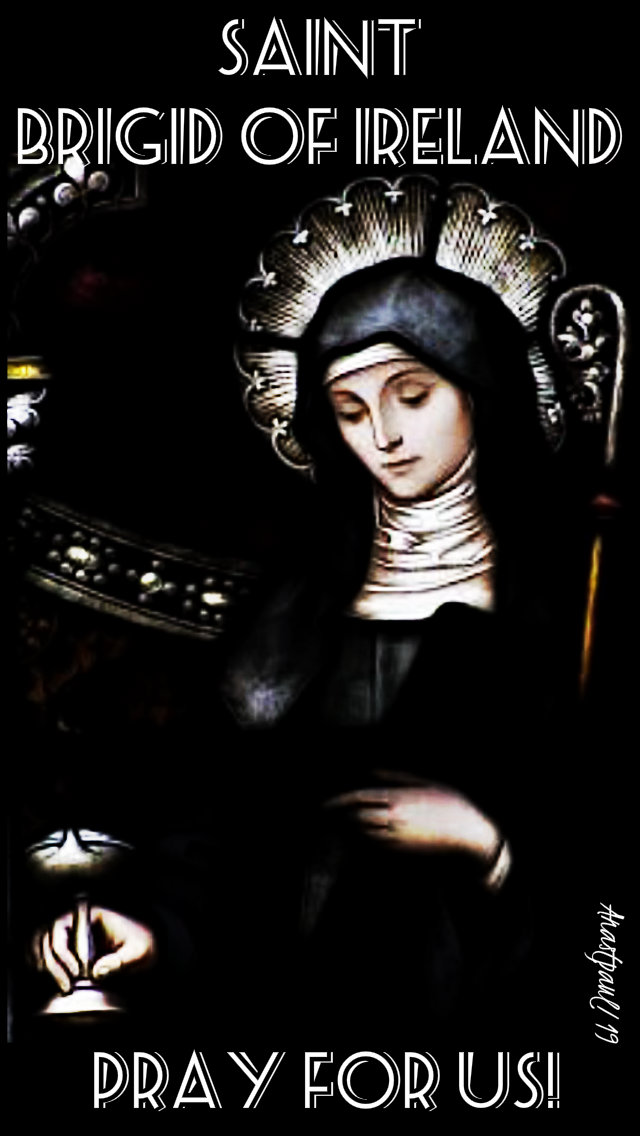
Thought for the Day – 1 February – the Memorial of St Brigid of Ireland (c 453-523)
St Brigid directly influenced several other future saints of Ireland and her many religious communities helped to secure the country’s conversion from paganism to the Catholic faith.
The Irish call on her in every need, for, as the ancient legends run, “everything that Brigid asked of the Lord, was granted her at once. For this was her desire – to satisfy the poor, to expel every hardship, to spare every miserable man.” And, she still carries on this mission today.
St Brigid took the whole of humanity into her heart and 1500 years after her death, the power of goodness and holiness reaches down through the centuries. There was no limit to her charity and her love for all. God thus graced her with great power to do good for all. There should be no limit to ours – imagine a world such as this!
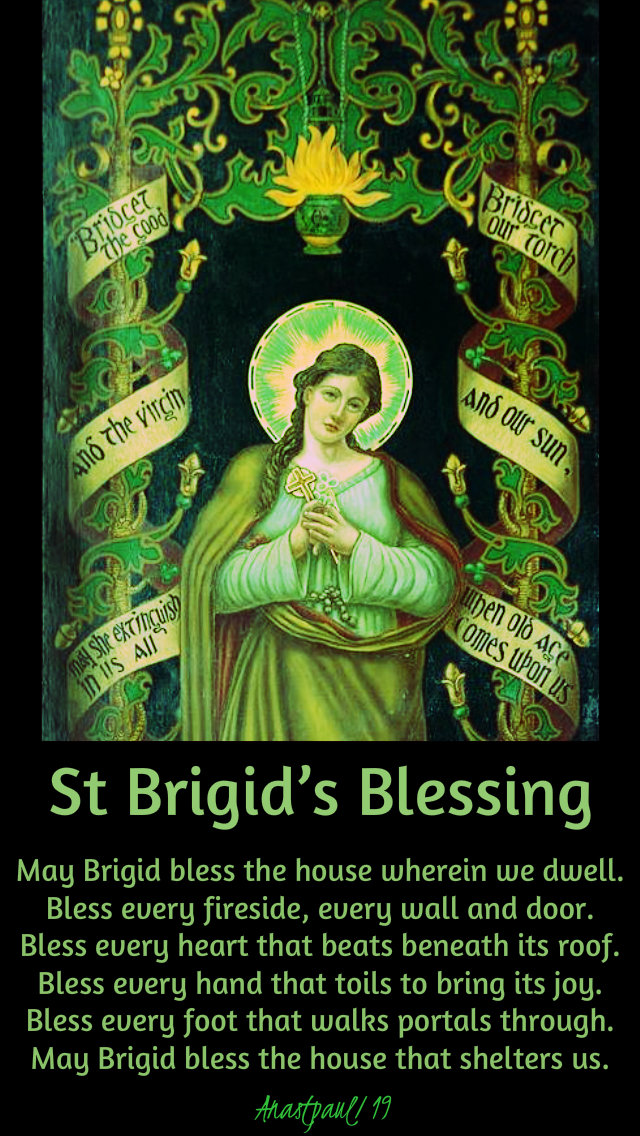
St Brigid’s Blessing
May Brigid bless the house wherein we dwell. Bless every fireside, every wall and door. Bless every heart that beats beneath its roof. Bless every hand that toils to bring its joy. Bless every foot that walks portals through. May Brigid bless the house that shelters us.
Quote of the Day – 1 February – the Memorial of St Brigid of Ireland (c 453-523)
I would like the angels of Heaven to be among us. I would like an abundance of peace. I would like full vessels of charity. I would like rich treasures of mercy. I would like cheerfulness to preside over all. I would like Jesus to be present. I would like the three Marys of illustrious renown to be with us. I would like the friends of Heaven, to be gathered around us, from all parts. I would like myself to be a rent-payer to the Lord, that I should suffer distress, that He would bestow a good blessing upon me. I would like a great lake of beer for the King of Kings. I would like to be watching Heaven’s family drinking it through all eternity.
One Minute Reflection – 1 February – Friday of the Third week in Ordinary Time, Year Gospel: Mark 4:26–34 and the Memorial of St Brigid of Ireland (c 453-523)
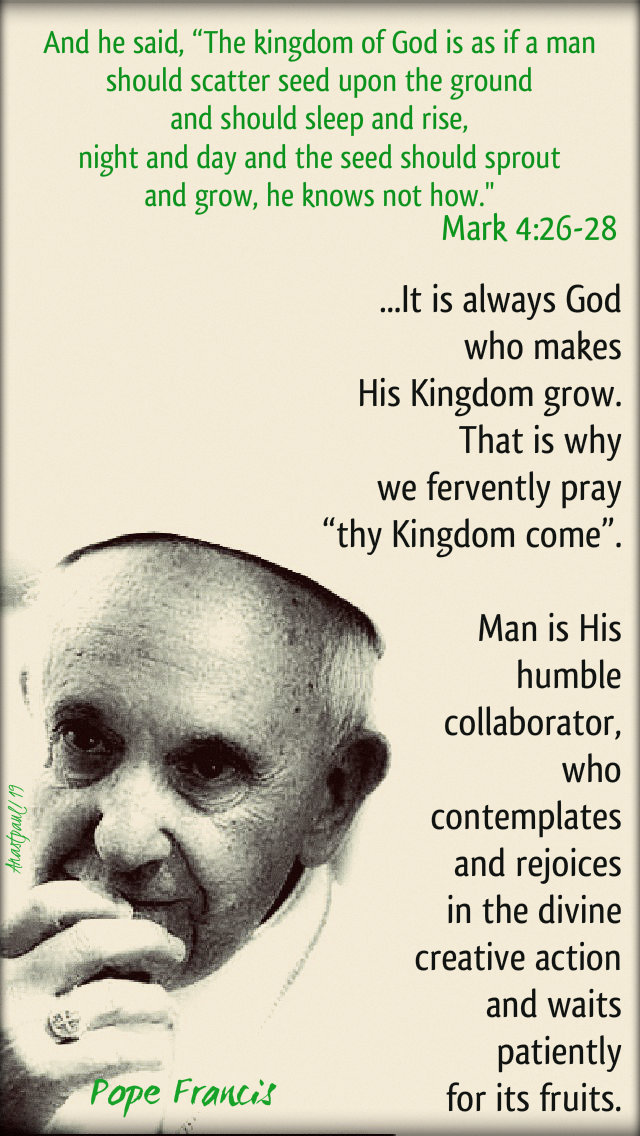
And he said, “The kingdom of God is as if a man should scatter seed upon the ground and should sleep and rise, night and day and the seed should sprout and grow, he knows not how.”...Mark 4:26-28
REFLECTION – “We can be confident because the Word of God is a creative word, destined to become the “full grain in the ear” (v. 28). This Word, if accepted, certainly bears fruit, for God Himself makes it sprout and grow in ways that we cannot always verify or understand. (cf. v. 27). All this tells us that it is always God, it is always God who makes His Kingdom grow. That is why we fervently pray “thy Kingdom come”. It is He who makes it grow. Man is His humble collaborator, who contemplates and rejoices in divine creative action and waits patiently for its fruits.”…Pope Francis – Angelus, 14 June 2015
PRAYER – Almighty Father, we bless You Lord of life, through whom all living things tend. You are the source of all, our first beginning and our end! Grant holy Father, that we may allow the Word to enter our hearts and grow by Your grace, so that we may always live for Your glory. May the intercession of St Brigid of Ireland, who consistently tended Your seed, grant us strength and zeal. Through Jesus Christ, our Lord with the Holy Spirit, God forever, amen.
Our Morning Offering – 1 February – Friday of the Third week in Ordinary Time, Year C
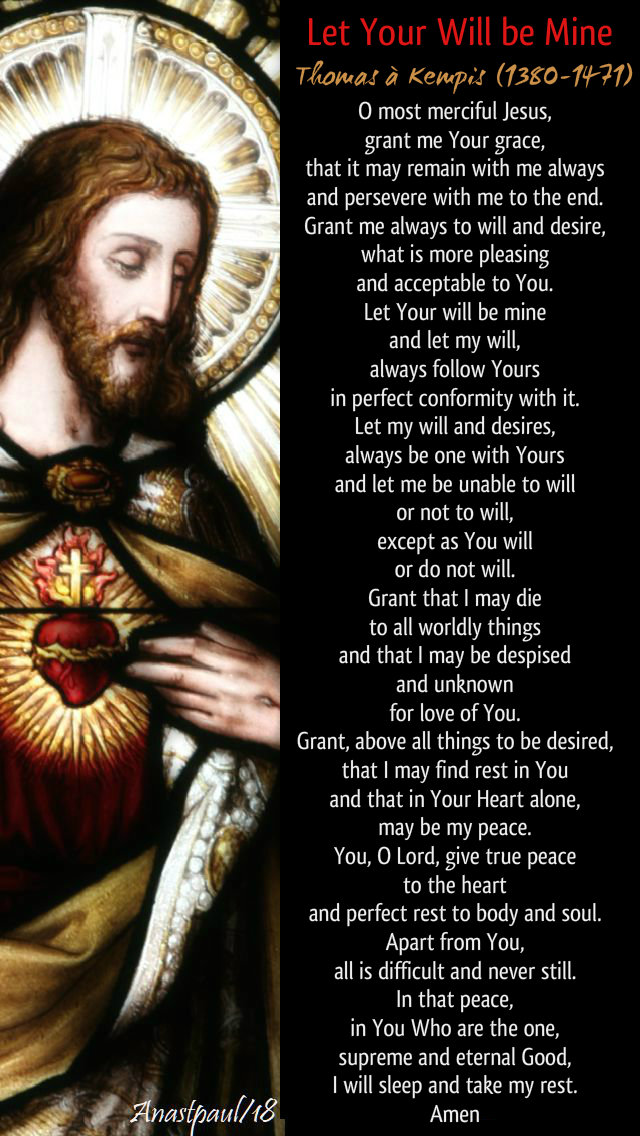
Let Your Will be Mine A Prayer for Fulfilling the Will of God Thomas à Kempis (1380-1471)
O most merciful Jesus,
grant me Your grace,
that it may remain with me always
and persevere with me to the end.
Grant me always to will and desire,
what is more pleasing and acceptable to You.
Let Your will be mine
and let my will always follow Yours
in perfect conformity with it.
Let my will and desires, always be one with Yours
and let me be unable to will or not to will,
except as You will or do not will.
Grant that I may die to all worldly things
and that I may be despised and unknown
for love of You.
Grant, above all things to be desired,
that I may find rest in You
and that in Your Heart alone, may be my peace.
You, O Lord, give true peace to the heart
and perfect rest to body and soul.
Apart from You, all is difficult and never still.
In that peace, in You Who are the one,
supreme and eternal Good,
I will sleep and take my rest.
Amen
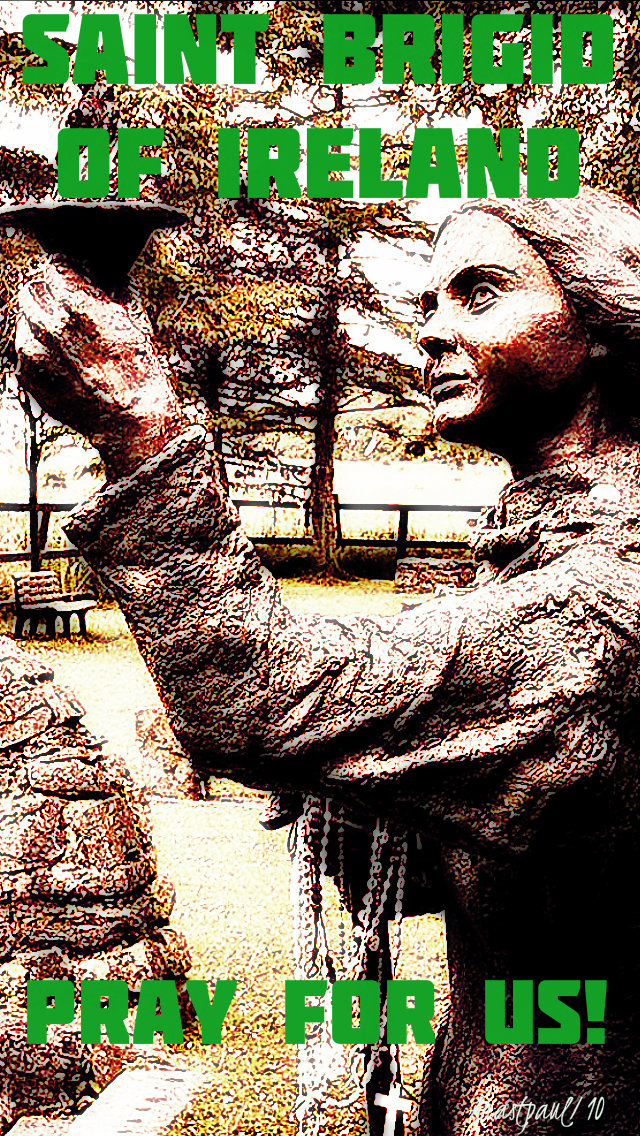
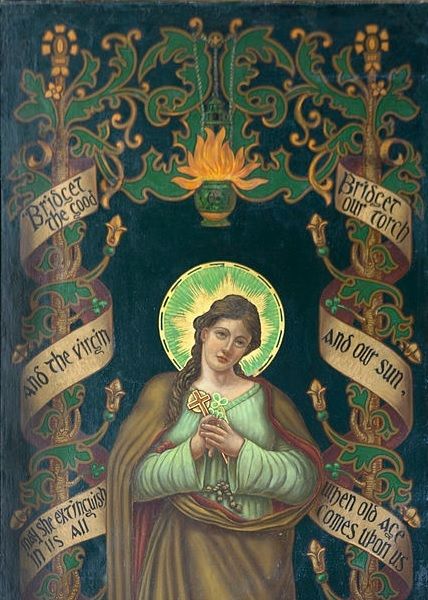
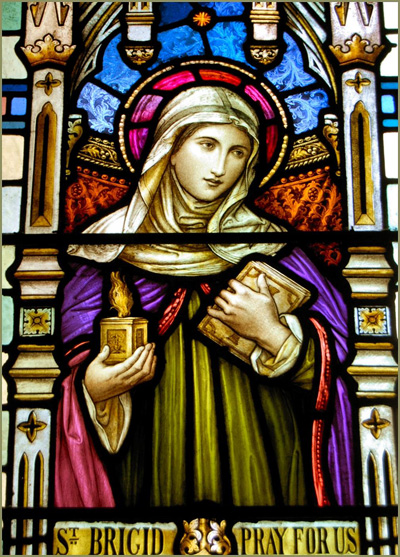
Saint of the Day – 1 February – St Brigid of Ireland/Kildare (c 453-523) Virgin, Abbess, Apostle of Charity and foundress of several Monasteries of Nuns, including that of Kildare in Ireland, which was famous and was greatly revered – born in 453 at Faughart, County Louth, Ireland and died on 1 February 523 at Kildare, Ireland of natural causes. Patronages – Ireland, babies, blacksmiths, sailors, brewers, cattle, chicken farmers, children whose parents are not married, children with abusive fathers, children born into abusive unions, Clan Douglas, dairy workers, Florida, fugitives, Leinster, midwives, Nuns, poets, the poor, printing presses, students, travellers.
Next to the glorious St Patrick, St Brigid, whom we may consider his spiritual daughter in Christ, has ever been held in singular veneration in Ireland.
Historians say we know a lot more about St Brigid than we have facts, a polite way of saying that legends swirl about Ireland’s most celebrated woman. But even legends may have cores of truth. And some miracle stories are not legends at all but true accounts of God’s interventions.
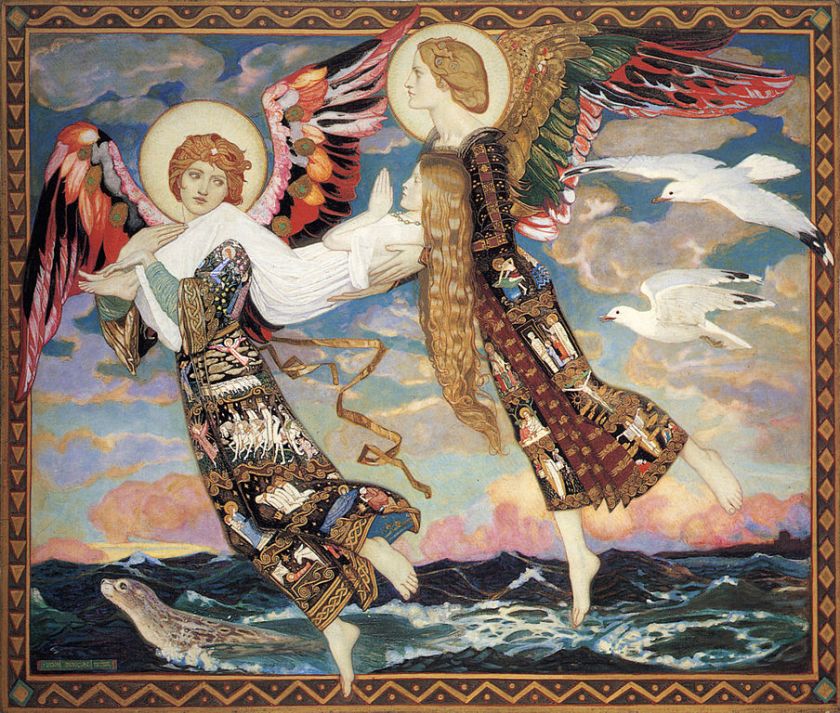
St Bride (Brigid) Carried By Angels, a painting by Scottish artist, John Duncan, 1913.
Brigid was the daughter of a slave woman and a chieftain, who liberated her at the urging of his overlord. As a girl she sensed a call to become a nun and St Mel, bishop of Armagh, received her vows. Before Brigid, consecrated virgins lived at home with their families. But the saint, imitating Patrick, began to assemble nuns in communities, a historic move which enriched the church in Ireland.
In 471, Brigid founded a monastery for both women and men at Kildare. This was the first convent in Ireland and Brigid was the abbess. Under her leadership Kildare became a centre of learning and spirituality. Her school of art fashioned both lovely utensils for worship and beautifully illustrated manuscripts. Again following Patrick’s model, Brigid used Kildare as a base and built convents throughout the island. The renown of Brigid’s unbounded charity drew multitudes of the poor to Kildare, the fame of her piety attracted thither many persons anxious to solicit her prayers or to profit by her holy example. In course of time the number of these so much increased that it became necessary to provide accommodation for them in the neighbourhood of the new monastery and thus was laid the foundation and origin of the town of Kildare.
Brigid’s hallmark was uninhibited, generous giving to anyone in need. Many of the saint’s earliest miracles seem to have rescued her from punishment for having given something to the poor that was intended for someone else. For example, once as a child she gave a piece of bacon to a dog and was glad to find it replaced when she was about to be disciplined. Brigid exhibited this unbounded charity all her life, giving away valuables, clothing, food—anything close by—to anyone who asked.
One of the most appealing things told of Brigid is her contemporaries’ belief that there was peace in her blessing. Not merely did contentiousness die out in her presence but just as by the touch of her hand she healed leprosy, so by her very will for peace she healed strife and laid antiseptics on the suppurating bitterness that foments it.
In the ninth century, the country being desolated by the Danes, the remains of St Brigid were removed in order to secure them from irreverence and, being transferred to Down-Patrick, were deposited in the same grave with those of the glorious St Patrick. Their bodies, together with that of St Columba, were translated afterwards to the cathedral of the same city but their monument was destroyed in the reign of King Henry VIII. The head of St Brigid is now kept in the church of the Jesuits at Lisbon.
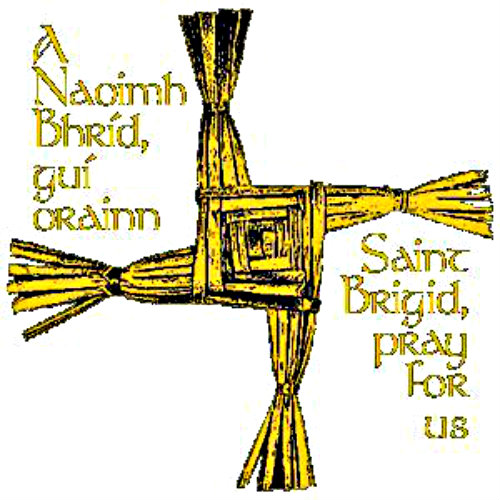
Saint Brigid’s Cross
A special type of cross known as “Saint Brigid’s cross” is popular throughout Ireland. It commemorates a famous story in which Brigid went to the home of a pagan leader when people told her that he was dying and needed to hear the Gospel message quickly. When Brigid arrived, the man was delirious and upset, unwilling to listen to what Brigid had to say. So she sat with him and prayed and while she did, she took some of the straw from the floor and began weaving it into the shape of a cross. Gradually the man quieted down and asked Brigid what she was doing. She then explained the Gospel to him, using her handmade cross as a visual aid. The man then came to faith in Jesus Christ and Brigid baptised him just before he died.
Today, many Irish people display a Saint Brigid’s cross in their homes, since it is said to help ward off evil and welcome good. Brigid died in 523 and after her death people began to venerate her as a saint, praying to her for help seeking to heal from God, since many of the miracles during her lifetime related to healing.
Blessing of St Brigid’s Crosses
Father of all creation and Lord of Light,
You have given us life and entrusted Your creation to us, to use it and to care for it.
We ask You to bless these crosses made of green rushes in memory of holy Brigid,
who used the cross to recall and to teach Your Son’s life, death and resurrection.
May these crosses be a sign of our sharing in the Paschal Mystery of your Son
and a sign of Your protection of our lives, our land and its creatures,
through Brigid’s intercession, during the coming year and always.
We ask this through Christ our Lord.
The crosses are sprinkled with holy water:
May the blessing of God, Father, Son and Holy Spirit
be on these crosses and on the places where they hang
and on everyone who looks at them.
Amen
St Brigid of Fiesole St Brigid of Ireland/Kildare (c 453-523)
St Cecilius of Granada
St Cinnia of Ulster
St Clarus of Seligenstadt
Bl Conor O’Devany
St Crewenna
St Darlaugdach of Kildare
St Henry Morse
St Ioannes Yi Mun-u
St Jarlath
Bl John of the Grating
St Kinnia
Bl Luigi Variara
Bl Patrick O’Lougham
St Paul of Trois-Châteaux
St Paulus Hong Yong-ju
St Raymond of Fitero
St Sabinus
St Severus of Avranches
St Severus of Ravenna
St Sigebert III of Austrasia
St Tryphon of Lampsacus
St Ursus of Aosta
St Veridiana
—
Martyrs of Avrillé – 47 beati: Forty-seven Christians executed together for their faith in the anti-Catholic persecution of the French Revolution.
• Anne-François de Villeneuve
• Anne Hamard
• Catherine Cottenceau
• Charlotte Davy
• François Bellanger
• François Bonneau
• François Michau
• François Pagis epouse Railleau
• Gabrielle Androuin
• Jacquine Monnier
• Jeanne Bourigault
• Jeanne Fouchard épouse Chalonneau
• Jeanne Gruget veuve Doly
• Jeanne-Marie Sailland d’Epinatz
• Louise-Aimée Dean de Luigné
• Louise-Olympe Rallier de la Tertinière veuve Déan de Luigné
• Madeleine Blond
• Madeleine Perrotin veuve Rousseau
• Madeleine Sailland d’Epinatz
• Marguerite Rivière epouse Huau
• Marie Anne Pichery épouse Delahaye
• Marie-Anne Vaillot
• Marie Cassin épouse Moreau
• Marie Fausseuse épouse Banchereau
• Marie Gallard épouse Quesson
• Marie Gasnier épouse Mercier
• Marie Grillard
• Marie-Jeanne Chauvigné épouse Rorteau
• Marie Lenée épouse Lepage de Varancé
• Marie Leroy
• Marie Leroy épouse Brevet
• Marie Roualt épouse Bouju
• Odilia Baumgarten
• Perrine Androuin
• Perrine Besson
• Perrine-Charlotte Phelippeaux épouse Sailland d’Epinatz
• Perrine Grille
• Perrine Ledoyen
• Perrine Sailland d’Epinatz
• Renée Cailleau épouse Girault
• Renée Grillard
• Renée Martin épouse Martin
• Renée Valin
• Rose Quenion
• Simone Chauvigné veuve Charbonneau
• Suzanne Androuin
• Victoire Bauduceau epouse Réveillère
They were martyred on 1 February 1794 in Avrillé, Maine-et-Loire, France and Beatified on 19 February 1984 by St Pope John Paul II at Rome, Italy.
Martyrs of Korea: Thousands of people were murdered in the anti-Catholic persecutions in Korea. Today we celebrate and honour:
• Saint Barbara Ch’oe Yong-i
• Saint Ioannes Yi Mun-u
• Saint Paulus Hong Yong-ju















 AnaStpaul
You must be logged in to post a comment.