Posted in SAINT of the DAY

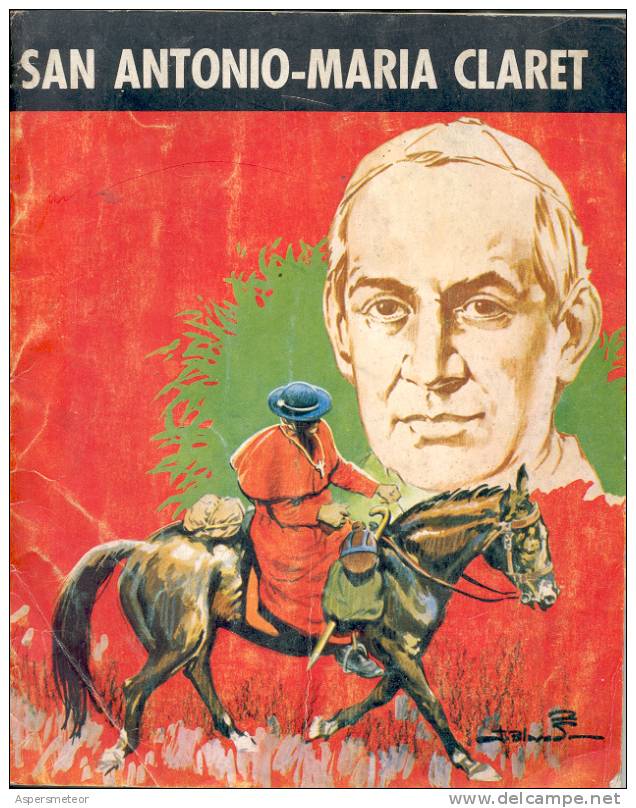
Saint of the Day – 24 October – St Anthony Mary Claret (1807-1870) CMF

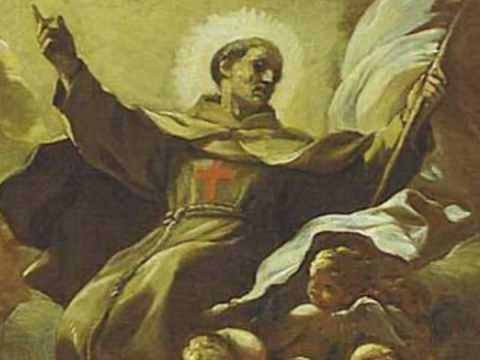
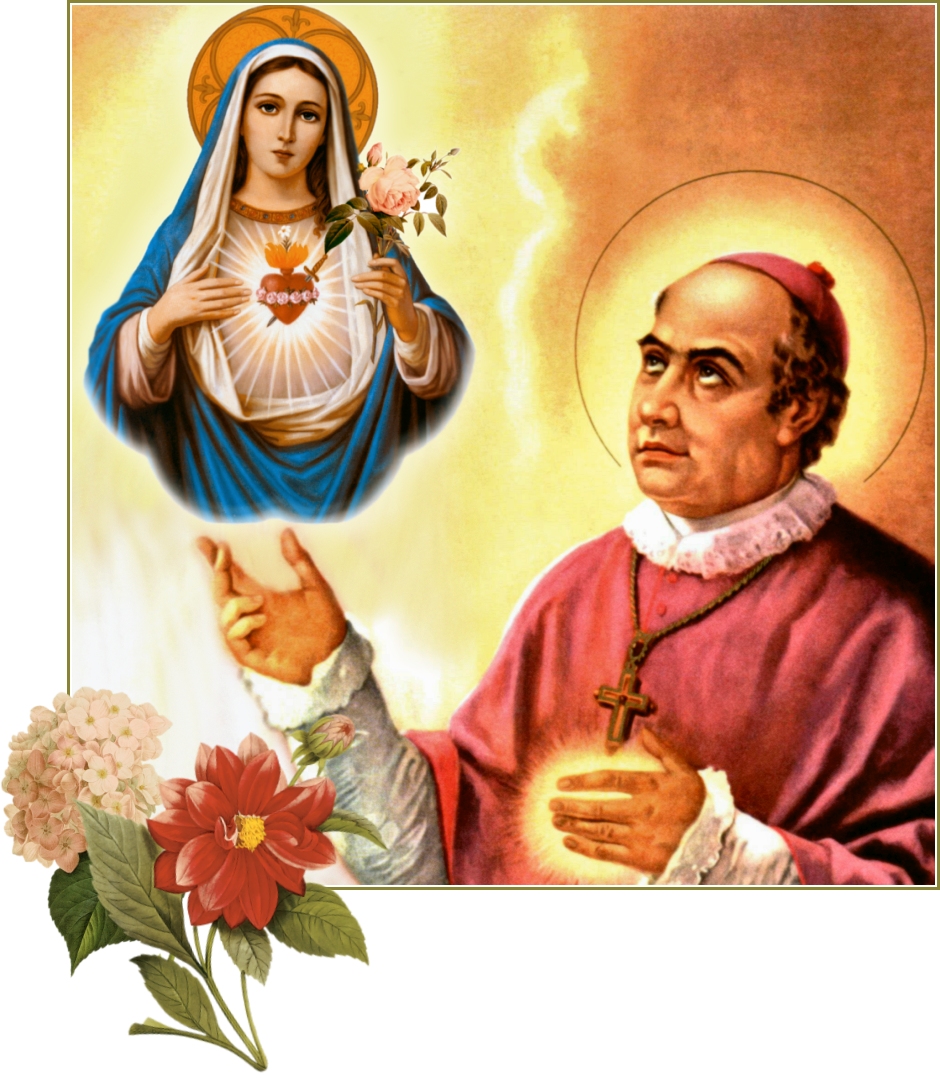
Saint of the Day – 24 October – St Anthony Mary Claret (1807-1870) CMF – Archbishop, Missionary, Founder, Confessor, Mystic, Social Reformer, Queen’s Chaplain, Spiritual Director, Writer, Publisher, Preacher, Apostle of Charity.  Known as “the Spiritual Father of Cuba”. He founded the Congregation of Missionary Sons of the Immaculate Heart of Mary, commonly called the Claretians.  Born Antonio María Claret y Clarà on 23 December 1807 at Sallent, Catalonia, Spain and Died on 24 October 1870 in a Cistercian monastery at Fontfroide, Narbonne, France.   Patronages – Textile merchants, weavers, savings (taught the poor the importance of savings), Catholic press, Claretians, Dioceses of the Canary Islands, Claretian students, Claretian educators and Claretian educational institutions and foundations.  Attributes – Bishop’s robe, crozier, an open book, catechism, 2 students beside him at his side and having his bent arm pointing to the heavens.

st anthony mary claret

Childhood:  St Anthony Mary Claret was born in Catalonia, the northeastern corner of Spain, in a town called Sallent on 23 December 1807.   He was the fifth son of Juan Claret and Josefa Clará’s eleven children.   His father owned a small textile factory but was not rich. Anthony grew up in a Christian environment and at a very early age had a strong sense of the eternal life that Christ wanted all men and women to enjoy.   He wanted to spare sinners eternal unhappiness and felt moved to work for their salvation.   When he was about eleven years old, a bishop visited his school and asked him what he wanted to be when he grew up. Without hesitation he responded: “A priest.”

Weaver:  As soon as Anthony was old enough, he began working as an apprentice weaver.   When he turned 17, his father sent him to Barcelona to study the latest techniques in textile manufacturing and to work in the large textile mills.   He did so well in the textile design school that he began receiving offers from large textile companies. Even though he had the talent to succeed, he turned down the offers and returned home after experiencing the emptiness of worldly achievements.

Vocation:  The words of the Gospel kept resounding in his heart: “what good is it for man to win the world if he loses his soul?”   He began to study Latin to prepare to enter the Seminary.   He wanted to be a Carthusian Monk.   His father was ready to accept the will of God but preferred to see him become a diocesan priest.   Anthony decided to enter the local diocesan seminary in the city of Vic.   He was 21 years old. After a year of studies, he decided to pursue his monastic vocation and left for a nearby monastery.   On the way there, he was caught in a big storm.   He realised that his health was not the best and withdrew from his decision to go to the monastery.

He was ordained a priest at 27 years of age and was assigned to his hometown parish. The town soon became too small for his missionary zeal and the political situation -hostile to the Church- limited his apostolic activity.   He decided to go to Rome to offer himself to serve in foreign missions.   Things did not work out as expected and he decided to join the Jesuits to pursue his missionary dream.   While in the Jesuit Novitiate, he developed a strange illness, which led his superiors to think that God might have other plans for him.   Once again, he had to return home to keep searching for God’s will in his life.

“Apostolic Missionary” in Catalonia and Canary Islands:  Back in a parish of Catalonia, Claret began preaching popular missions all over.   He traveled on foot, attracting large crowds with his sermons.   Some days he preached up to seven sermons in a day and spent 10 hours listening to confessions.   He dedicated to Mary all his apostolic efforts. He felt forged as an apostle and sent to preach by Mary.claret2-3
The secret of his missionary success was LOVE. In his words: “Love is the most necessary of all virtues.   Love in the person who preaches the word of God is like fire in a musket.   If a person were to throw a bullet with his hands, he would hardly make a dent in anything;  but if the person takes the same bullet and ignites some gunpowder behind it, it can kill.   It is much the same with the word of God.   If it is spoken by someone who is filled with the fire of charity- the fire of love of God and neighbour- it will work wonders.” (Autobiography #438-439).

His popularity spread- people sought him for spiritual and physical help.   By the end of 1842, the Pope gave him the title of “apostolic missionary.”   Aware of the power of the press, in 1847, he organised with other priests a Religious Press.   Claret began writing books and pamphlets, making the message of God accessible to all social groups.   The increasing political restlessness in Spain continued to endanger his life and curtail his apostolic activities.   So, he accepted an offer to preach in the Canary Islands, where he spent 14 months.   In spite of his great success there too, he decided to return to Spain to carry out one of his dreams: the organization of an order of missionaries to share in his work.

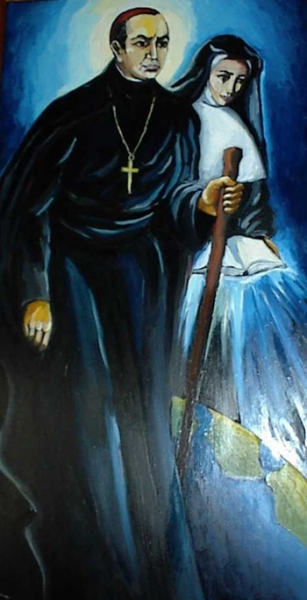
Founder and Archbishop of Cuba:  On July 16, 1849, he gathered a group of priests who shared his dream   This is the beginning of the Missionary Sons of the Immaculate Heart of Mary, today also known as Claretian Fathers and Brothers.   Days later, he received a new assignment:  he was named Archbishop of Santiago de Cuba.   He was forced to leave the newly founded community to respond to the call of God in the New World. After two months of travel, he reached the Island of Cuba and began his episcopal ministry by dedicating it to Mary.   He visited the church where the image of Our Lady of Charity, patroness of Cuba was venerated.   Soon he realized the urgent need for human and Christian formation, specially among the poor.  He called Antonia Paris to begin there the religious community they had agreed to found back in Spain.   He was concerned for all aspects of human development and applied his great creativity to improve the conditions of the people under his pastoral care.AA new foundation
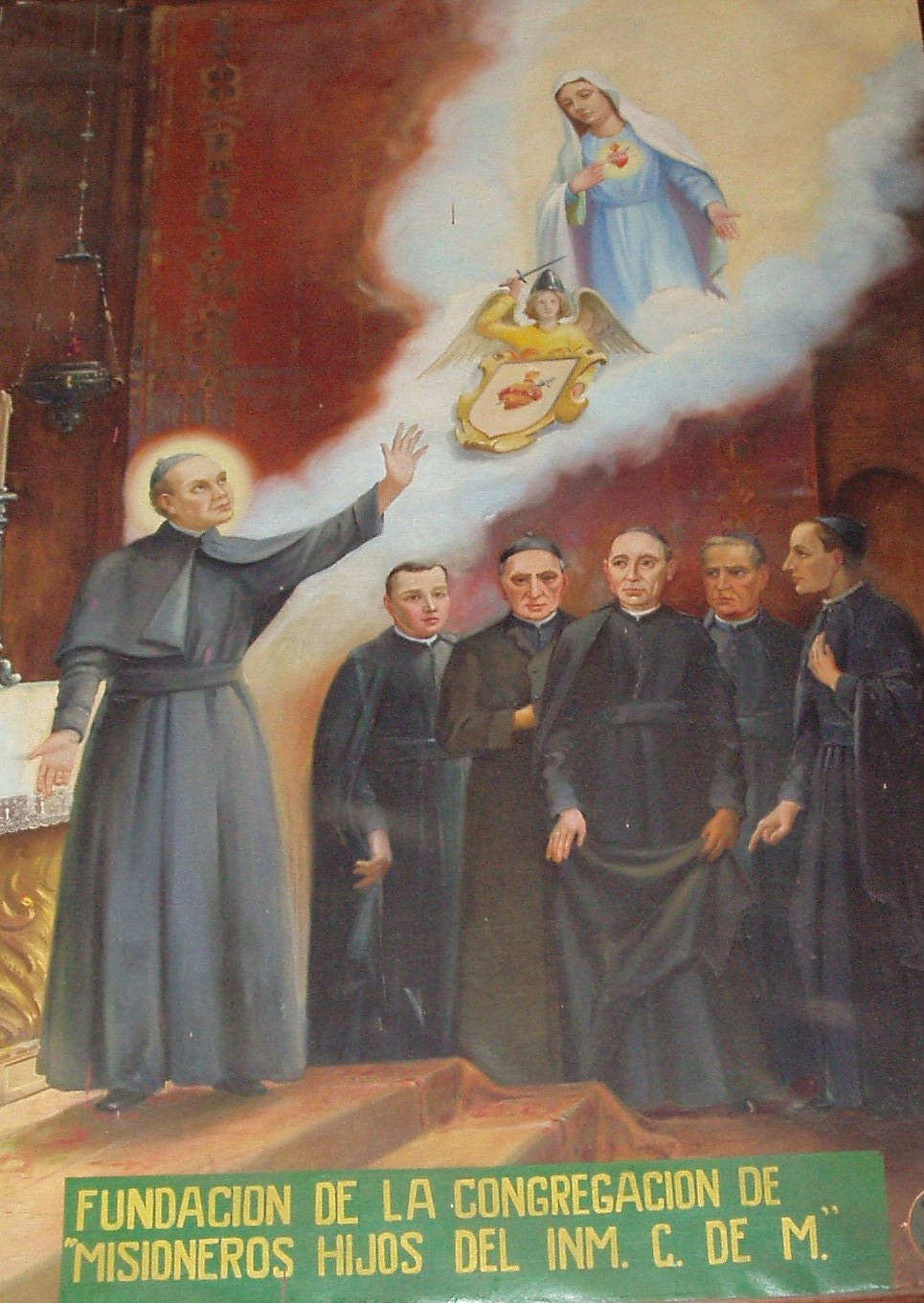
st antony in cuba

Among his great initiatives were:  trade or vocational schools for disadvantaged children and credit unions for the use of the poor.   He wrote books about rural spirituality and agricultural methods, which he himself tested first.   He visited jails and hospitals, defended the oppressed and denounced racism.   The expected reaction came soon.   He began to experience persecution and finally when preaching in the city of Holguín, a man stabbed him on the cheek in an attempt to kill him.   For Claret this was a great cause of joy.  He writes in his Autobiography:  “I can´t describe the pleasure, delight, and joy I felt in my soul on realising that I had reached the long desired goal of shedding my blood for the love of Jesus and Mary and of sealing the truths of the gospel with the very blood of my veins.” (Aut. # 577).   During his 6 years in Cuba he visited the extensive Archdiocese three times…town by town.   In the first years, records show, he confirmed 100,000 people and performed 9,000 sacramental marriages.

Confessor to the Queen of Spain:  Claret was called back to Spain in 1857 to serve as confessor to the Queen of Spain, Isabella II.   He had a natural dislike for aristocratic life. He loved poverty and the simplest lifestyle.  He accepted in obedience but requested to be allowed to continue some missionary work.   Whenever he had to travel with the Queen, he used the opportunity to preach in different towns throughout Spain.   In a time where the Queens and Kings chose the bishops for vacant dioceses, Claret played an important role in the selection of holy and dedicated bishops for Spain and its colonies.
The eleven years he spent as confessor to the Queen of Spain were particularly painful, because the enemies of the Church directed toward him all kinds of slanders and personal ridicule.   In 1868 a new revolution dethroned the Queen and sent her with her family into exile.   Claret’s life was also in danger, so he accompanied her to France.   This gave him the opportunity to preach the Gospel in Paris.   He stayed with them for a while, then went to Rome where he was received by Pope Pius IX in a private audience.

First Vatican Council:  On December 8, 1869, seven hundred bishops from all over the world gathered in Rome for the First Vatican Council.   Claret was one of the Council Fathers.   His presence became noticeable when the subject of papal infallibility was discussed, which Claret defended vehemently.   This teaching became a dogma of faith for all Catholics at this Council.   The Italian revolution interrupted the process of the Council, which was never concluded.   Claret’s health deteriorated, so he returned to France accompanied by the Superior General of the Sons of the Immaculate Heart of Mary, his congregation.
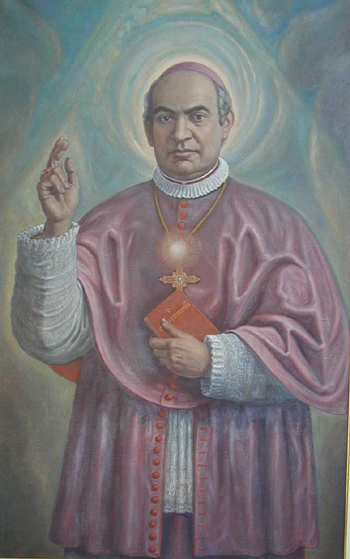
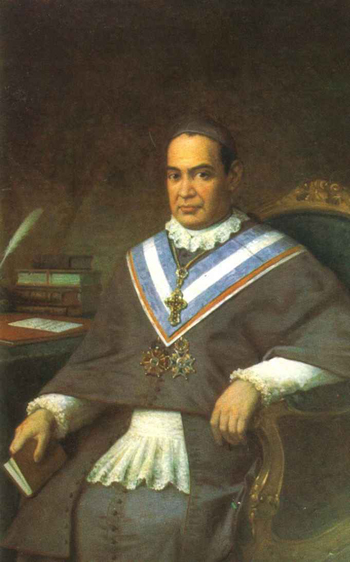
Last Days in Exile:  In France, Claret joined his missionaries who were also in exile. Soon he found out, that there was a warrant for his arrest.   He decided to go into hiding in a Cistercian Monastery in the French southern town of Fontfroide.   There he died on 24October 1870 at the age of 62.   As his last request, he dictated to his missionaries the words that are to appear on his tombstone: “I have loved justice and hated iniquity; therefore I die in exile.”   His zealous life and the wonders he wrought, both before and after his death, testified to his sanctity.   Information was sought in 1887 and he was declared venerable by Pope Leo XIII in 1899.   His relics were transferred to the mission house at Vic in 1897, at which time his heart was found incorrupt.   His grave is visited by many pilgrims.  Claret was beatified in 1934 and in 1950 canonised by Pope Pius XII.
 
Posted in DOMINICAN OP, MORNING Prayers, PRAYERS of the SAINTS

Our Morning Offering – 24 October

Our Morning Offering – 24 October

Our Lord, King of all!
St ALBERT the GREAT O.P.

We pray to You, O Lord,
who are the surpeme Truth,
and all truth is from You.
We beseech You, O Lord,
who are the highest Wisdom,
and all the wise
depend on You for their wisdom.
You are the supreme Joy,
and all who are happy owe it to You.
You are the Light of minds,
and all receive
their understanding from You.
We love, we love You above all.
We seek You, we follow You,
and we are ready to serve You.
We desire to dwell under Your power
for You are the King of all. Amenour lord, king of all - st albert the geat op


Posted in Uncategorized

Memorials of the Saints – 24 October

St Anthony Mary Claret (1807-1870) (Optional Memorial) – https://www.youtube.com/watch?v=cbBMzR-J8R8

Bl Amado García Sánchez
St Audactus of Thibiuca
St Cadfarch
St Ciriacus of Hierapolis
St Claudian of Hierapolis
St Ebregislus of Cologne
St Felix of Thibiuca
St Fortunatus of Thibiuca
St Fromundus of Coutances
St Giuse Lê Dang Thi
Bl Giuseppe Baldo
St Januarius of Thibiuca
St Luigi Guanella
St Maglorius of Wales
St Marcius of Monte Cassino
St Martin of Vertou
St Proclus of Constantinople
St Senoch
St Senócus of Tours
St Septimus of Thibiuca

Martyrs of Ephesus – 3 saints: Three Christians martyred together. All we know about them are the names Mark, Sotericus and Valentina.
They were stoned to death near Ephesus, Asia Minor (in modern Turkey). Their relics are enshrined on the island of Tasos.

Posted in JESUIT SJ, POETRY

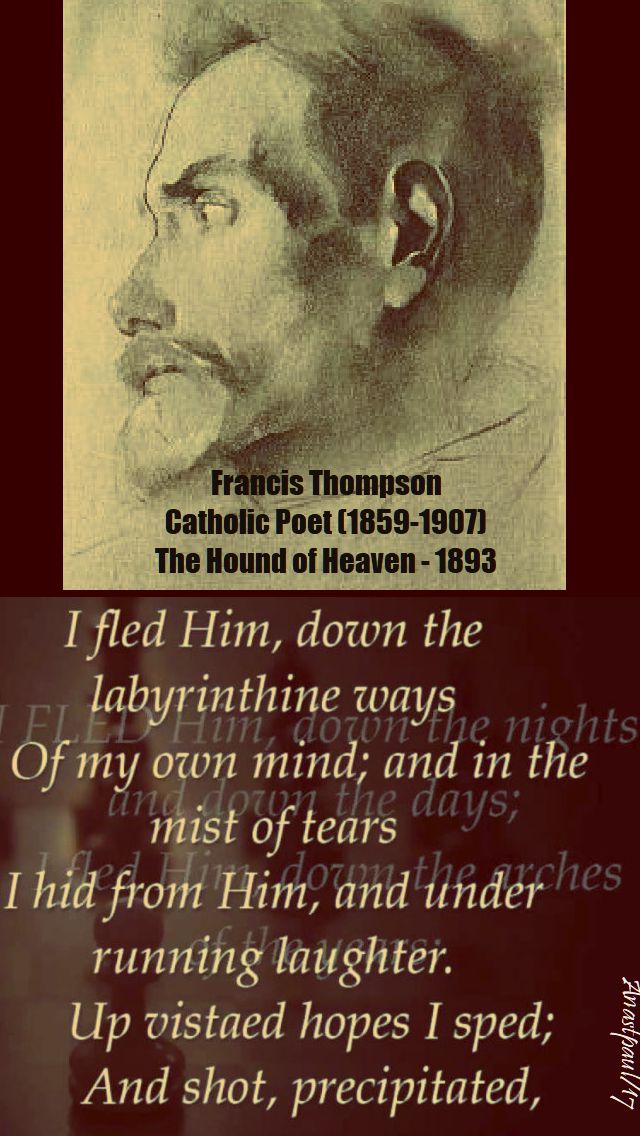
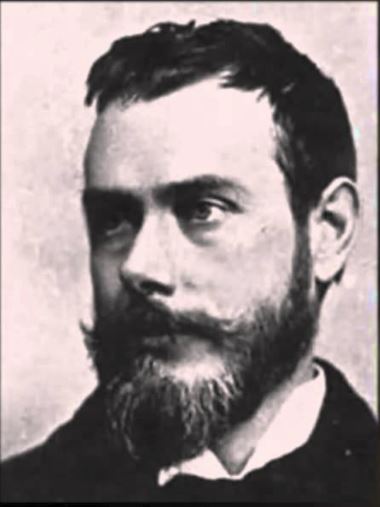
THE HOUND OF HEAVEN – By Francis Thompson, (1859-1907)

“The Hound of Heaven” is a 182-line poem written by English Catholic poet Francis Thompson (1859–1907).   The poem became famous and was the source of much of Thompson’s posthumous reputation.   The poem was first published in Thompson’s first volume of poems in 1893.   It was included in the Oxford Book of English Mystical Verse (1917).   Thompson’s work was praised by G K Chesterton and it was also an influence on J R R Tolkien, who presented a paper on Thompson in 1914.

This Christian poem has been described as follows:

“The name is strange.   It startles one at first.   It is so bold, so new, so fearless.   It does not attract, rather the reverse.   But when one reads the poem this strangeness disappears.   The meaning is understood.   As the hound follows the hare, never ceasing in its running, ever drawing nearer in the chase, with unhurrying and imperturbed pace, so does God follow the fleeing soul by His Divine grace.   And though in sin or in human love, away from God it seeks to hide itself, Divine grace follows after, unwearyingly follows ever after, till the soul feels its pressure forcing it to turn to Him alone in that never ending pursuit.”    Fr JFX. O’Conor, S.Jthe hound of heaven - francis thompson - 23 oct 2017

THE HOUND OF HEAVEN (1893)  – By Francis Thompson (16 December 1859 – 13 November 1907)

https://youtu.be/gToj6SLWz8Q (Richard Burton – a beautiful version)

I fled Him, down the nights and down the days;
I fled Him, down the arches of the years;
I fled Him, down the labyrinthine ways
Of my own mind; and in the midst of tears
I hid from Him, and under running laughter.
Up vistaed hopes I sped;
And shot, precipitated,
Adown Titanic glooms of chasmed fears,
From those strong Feet that followed, followed after.
But with unhurrying chase,
And unperturbèd pace,
Deliberate speed, majestic instancy,
They beat—and a Voice beat
More instant than the Feet—
‘All things betray thee, who betrayest Me’.

I pleaded, outlaw-wise,
By many a hearted casement, curtained red,
Trellised with intertwining charities;
(For, though I knew His love Who followed,
Yet was I sore a dread
Lest, having Him, I must have naught beside.)
But, if one little casement parted wide,
The gust of His approach would clash it to:
Fear wist not to evade, as Love wist to pursue.
Across the margent of the world I fled,
And troubled the gold gateway of the stars,
Smiting for shelter on their clanged bars;
Fretted to dulcet jars
And silvern chatter the pale ports o’ the moon.
I said to Dawn: Be sudden—to Eve: Be soon;
With thy young skiey blossom heap me over
From this tremendous Lover—
Float thy vague veil about me, lest He see!
I tempted all His servitors, but to find
My own betrayal in their constancy,
In faith to Him their fickleness to me,
Their traitorous trueness, and their loyal deceit.
To all swift things for swiftness did I sue;
Clung to the whistling mane of every wind.
But whether they swept, smoothly fleet,
The long savannahs of the blue;
Or, whether, Thunder-driven,
They clanged his chariot ‘thwart a heaven,
Plashy with flying lightnings round the spurn o’ their feet:—
Fear wist not to evade as Love wist to pursue.
Still with unhurrying chase,
And unperturbed pace,
Deliberate speed, majestic instancy,
Came on the following Feet,
And a Voice above their beat—
‘Naught shelters thee, who wilt not shelter Me.’

I sought no more after that which I strayed
In face of man or maid;
But still within the little children’s eyes
Seems something, something that replies,
They at least are for me, surely for me!
I turned me to them very wistfully;
But just as their young eyes grew sudden fair
With dawning answers there,
Their angel plucked them from me by the hair.
Come then, ye other children, Nature’s—share
With me’ (said I) ‘your delicate fellowship;
Let me greet you lip to lip,
Let me twine with you caresses,
Wantoning
With our Lady-Mother’s vagrant tresses,
Banqueting
With her in her wind-walled palace,
Underneath her azured dais,
Quaffing, as your taintless way is,
From a chalice
Lucent-weeping out of the dayspring.’
So it was done:
I in their delicate fellowship was one—
Drew the bolt of Nature’s secrecies.
          I knew all the swift importings
On the wilful face of skies;
I knew how the clouds arise
Spumèd of the wild sea-snortings;
All that’s born or dies
Rose and drooped with; made them shapers
Of mine own moods, or wailful divine;
With them joyed and was bereaven.
I was heavy with the even,
When she lit her glimmering tapers
Round the day’s dead sanctities.
I laughed in the morning’s eyes.
I triumphed and I saddened with all weather,
Heaven and I wept together,
And its sweet tears were salt with mortal mine:
Against the red throb of its sunset-heart
I laid my own to beat, And share commingling heat;
But not by that, by that, was eased my human smart.
In vain my tears were wet on Heaven’s grey cheek.
For ah! we know not what each other says,
These things and I; in sound I speak—
Their sound is but their stir, they speak by silences.
Nature, poor stepdame, cannot slake my drouth;
Let her, if she would owe me,
Drop yon blue bosom-veil of sky, and show me
The breasts o’ her tenderness:
Never did any milk of hers once bless
My thirsting mouth.
Nigh and nigh draws the chase,
With unperturbed pace,
Deliberate speed, majestic instancy;
And past those noisèd Feet
A voice comes yet more fleet—
‘Lo! naught contents thee, who content’st not Me.’

Naked I wait Thy love’s uplifted stroke!
My harness piece by piece Thou has hewn from me,
And smitten me to my knee;
I am defenceless utterly.
I slept, methinks, and woke,
And, slowly gazing, find me stripped in sleep.
In the rash lustihead of my young powers,
I shook the pillaring hours
And pulled my life upon me; grimed with smears,
I stand amidst the dust o’ the mounded years—
My mangled youth lies dead beneath the heap.
My days have crackled and gone up in smoke,
Have puffed and burst as sun-starts on a stream.
Yea, faileth now even dream
The dreamer, and the lute the lutanist;
Even the linked fantasies, in whose blossomy twist
I swung the earth a trinket at my wrist,
Are yielding; cords of all too weak account
For earth with heavy griefs so overplussed.
Ah! is Thy love indeed
A weed, albeit an amarinthine weed,
Suffering no flowers except its own to mount?
Ah! must—
Designer infinite!—
Ah! must Thou char the wood ere Thou canst limn with it?
My freshness spent its wavering shower i’ the dust;
And now my heart is as a broken fount,
Wherein tear-drippings stagnate, spilt down ever
From the dank thoughts that shiver
Upon the sighful branches of my mind.
Such is; what is to be?
The pulp so bitter, how shall taste the rind?
I dimly guess what Time in mists confounds;
Yet ever and anon a trumpet sounds
From the hid battlements of Eternity;
Those shaken mists a space unsettle, then
Round the half-glimpsed turrets slowly wash again.
But not ere him who summoneth
I first have seen, unwound
With glooming robes purpureal, cypress-crowned;
His name I know and what his trumpet saith.
Whether man’s heart or life it be which yields
Thee harvest, must Thy harvest-fields
Be dunged with rotten death?

Now of that long pursuit
Comes on at hand the bruit;
That Voice is round me like a bursting sea:
‘And is thy earth so marred,
Shattered in shard on shard?
Lo, all things fly thee, for thou fliest Me!

‘Strange, piteous, futile thing!
Wherefore should any set thee love apart?
Seeing none but I makes much of naught’ (He said),
‘And human love needs human meriting:
How hast thou merited—
Of all man’s clotted clay the dingiest clot?
Alack, thou knowest not
How little worthy of any love thou art!
Whom wilt thou find to love ignoble thee,
Save Me, save only Me?
All which I took from thee I did but take,
Not for thy harms,
But just that thou might’st seek it in My arms.
All which thy child’s mistake
Fancies as lost, I have stored for thee at home:
Rise, clasp My hand, and come!’

Halts by me that footfall:
Is my gloom, after all,
Shade of His hand, outstretched caressingly?
‘Ah, fondest, blindest, weakest,
I am He Whom thou seekest!
Thou dravest love from thee, who dravest Me.’

FRANCIS THOMPSON - MY SNIP

Posted in franciscan OFM, MORNING Prayers, SAINT of the DAY

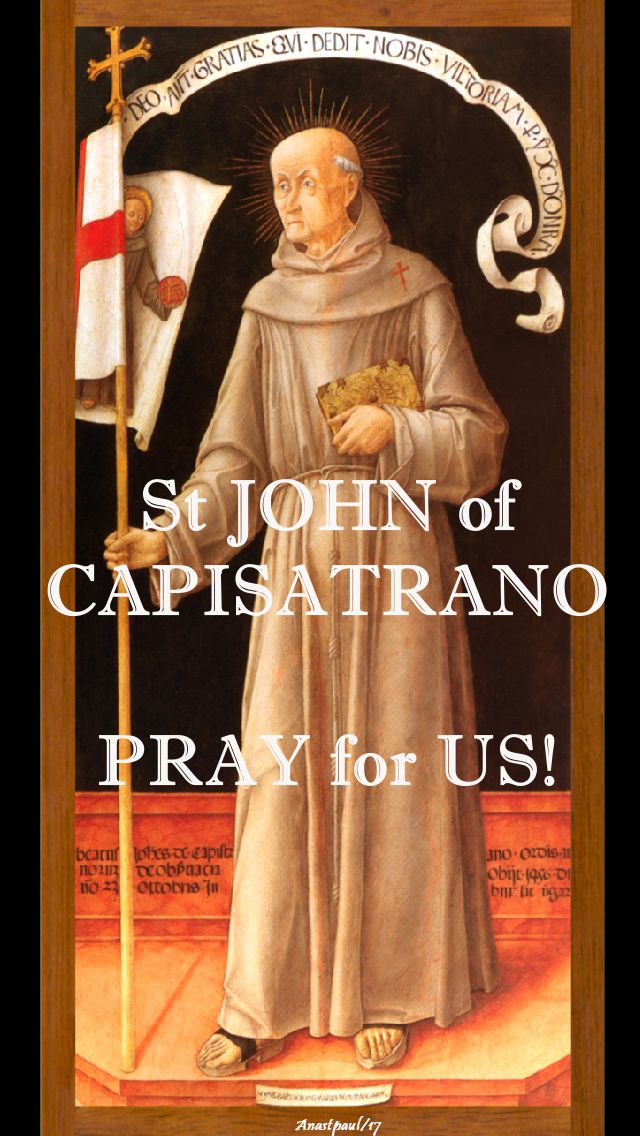
Thought for the Day – 23 October – The Memorial of St John of Capistrano (1386-1456)

Thought for the Day – 23 October – The Memorial of St John of Capistrano (1386-1456)

John was a Franciscan friar and priest, but not of the good-natured variety of Franciscans that holds the popular imagination.   To describe John as zealous would be an understatement.   He walked the fine line between zeal and fanaticism, allowing God to write straight with the crooked lines he drew throughout his life.   Some might wonder why such a man is even a saint but he is, and the lesson in that might be that being a saint is about more than just being nice and friendly.   Sanctity is an uncanny quality that can be as off-putting as it is attractive.

We might be “put off” by a saint like John Capistrano.  Perhaps the lesson there is that if he made it, there is hope for us all.

John Hofer, a biographer of John Capistrano, recalls a Brussels organization named after the saint.   Seeking to solve life problems in a fully Christian spirit, its motto was: “Initiative, Organisation, Activity.”   These three words characterised John’s life.   He was not one to sit around.   His deep Christian optimism drove him to battle problems at all levels with the confidence engendered by a deep faith in Christ.

We are not Christians because we build and maintain institutions.   We are Christians because people experience in us an invitation to know Jesus Christ and find in His Church the reality of His divine life and presence.

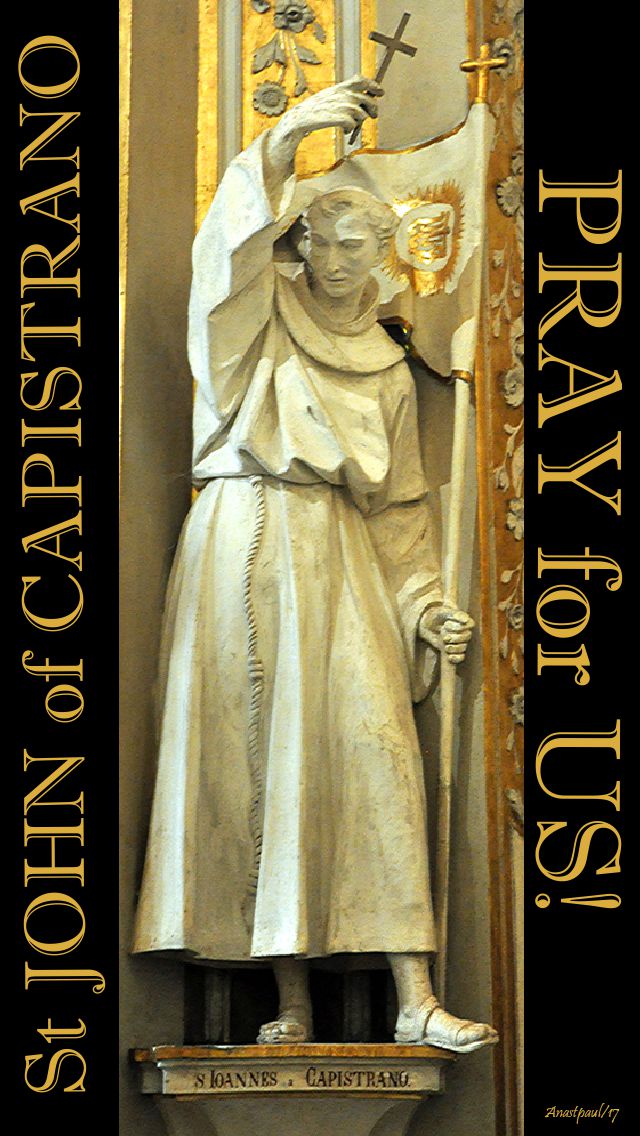
St John of Capistrano, pray for us!st john of capistrano pray for us 2 - 23 oct 2017

Posted in franciscan OFM, MORNING Prayers, QUOTES of the SAINTS, SAINT of the DAY

Quote of the Day – 23 October – The Memorial of St John of Capistrano (1386-1456)

Quote of the Day – 23 October – The Memorial of St John of Capistrano (1386-1456)

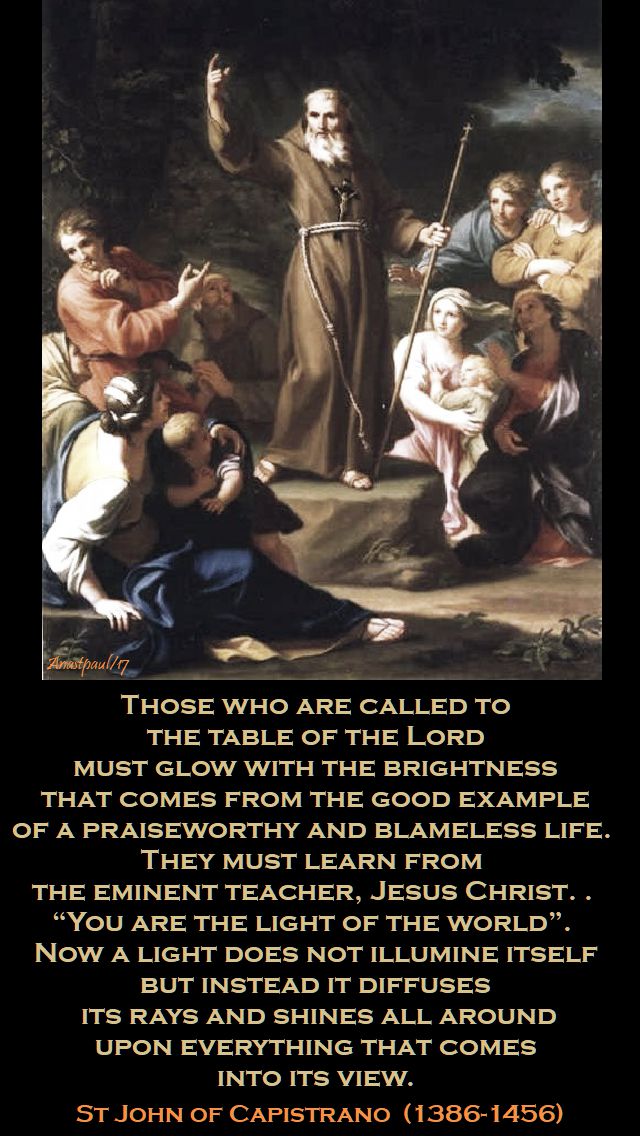
Those who are called to the table of the Lord
must glow with the brightness that comes from
the good example of a praiseworthy and blameless life.
They must learn from the eminent teacher, Jesus Christ. .
“You are the light of the world” (see Matthew 5:14).
Now a light does not illumine itself but instead it diffuses
its rays and shines all around upon everything that comes
into its view..

St John of Capistranothose who are called - st john of capistrano - 23 oct 2017

Posted in MORNING Prayers, PRAYERS of the SAINTS

Our Morning Offering – 23 October

Our Morning Offering – 23 October

Prayer to God for Guidance
By St Pope John Paul II

With all my heart
I seek You;
let me not stray
from Your commands…
Open my eyes,
that I may consider
the wonders
of Your law.
I am a wayfarer
of earth;
hide not Your commands
from me…
Make me understand
the way of Your precepts,
and I will meditate
on Your wondrous deeds…
Your compassion
is great, O Lord…
Amenprayer to god for guidance - 22 oct 2017

Posted in franciscan OFM, MORNING Prayers, SAINT of the DAY, The WORD

One Minute Reflection – 23 October – The Memorial of St John of Capistrano (1386-1456)

One Minute Reflection – 23 October – The Memorial of St John of Capistrano (1386-1456)

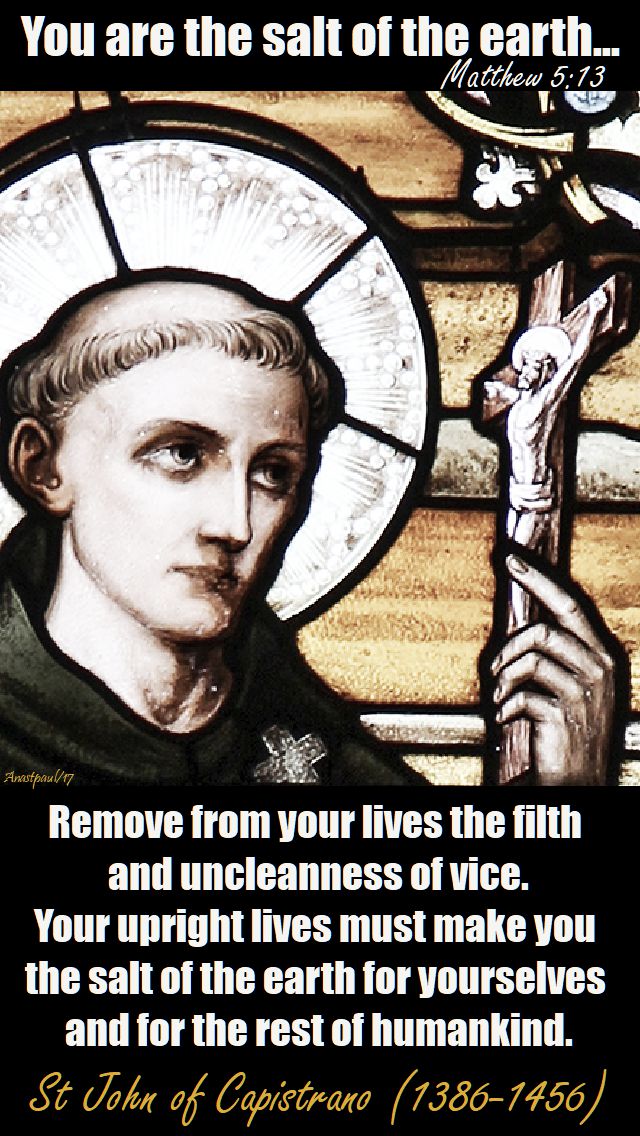
You are the salt of the earth.……Matthew 5:13

REFLECTION – Remove from your lives the filth and uncleanness of vice.
Your upright lives must make you the salt of the earth for yourselves
and for the rest of humankind…….St John of Capistranoremove from your lives - st john of capistrano - 23 oct 2017

PRAYER – Heavenly Father, enable me both to practice and to preach Your Message to all those I meet.   Grant that – in accord with Your Son’s mandate – I may be the salt of the earth.   St John of Capistrano, you lived a zealous life endlessly becoming “salt” to all.
Please pray for us that we may grow in zeal to glorify the Kingdom by our lives! Amenst john pray for us - 23 oct 2017

Posted in franciscan OFM, Of LAWYERS & CANON Lawyers, Attorneys, Solicitors, Barristers, Notaries, Para-Legals, SAINT of the DAY

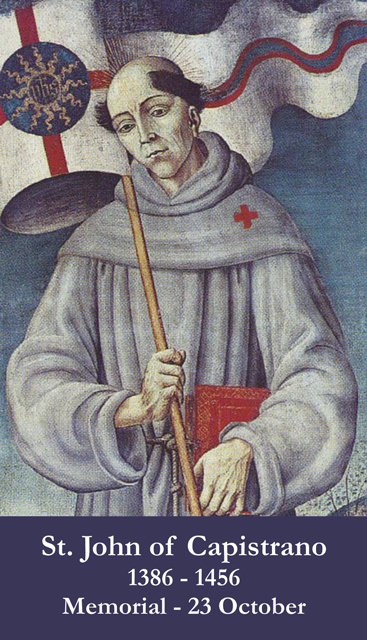
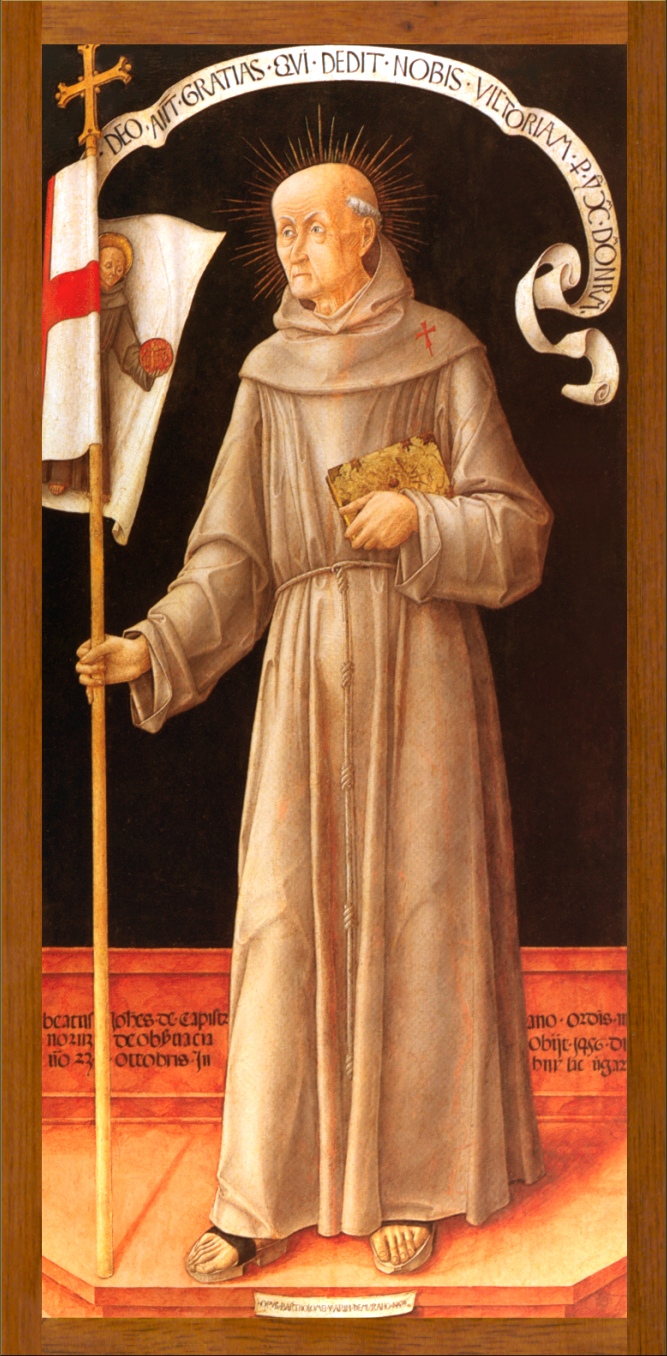
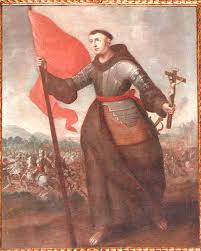
Saint of the Day – 23 October – St John Capistrano OFM (1386-1456) – ‘the Soldier Saint’

Saint of the Day – 23 October – St John Capistrano OFM (1386-1456) Priest and Friar of the Friars Minor, Confessor and Preacher.   Famous as a Preacher, Theologian and Inquisitor, trained Lawyer, he earned himself the nickname the Soldier Saint’ when, in 1456 at age 70 he led a Crusade against the invading Ottoman Empire at the Siege of Belgrade with the Hungarian Military Commander, John Hunyadi, called the Athleta Christi (“Christ’s Champion”) by Pope Pius II.   Born in 1386 at Capistrano, Italy – 23 October 1456 at Villach, Hungary of natural causes.   He was Beatified on 19 December 1650 by Pope Innocent X and Canonised on 16 October 1690 by Pope Alexander VIII.   Patronages – judges, jurists
• lawyers • military chaplains • military ordinariate of the Philippines • Hungary and Belgrade, Serbia.     He was buried in Ilok, Croatia.

400px-Ilok_church
St John of Capistrano Church in Ilok, Croatia
ST JOHN OF CAPISTRANO 1.

As was the custom of this time, John is denoted by the village of Capestrano, in the Diocese of Sulmona, in the Abruzzi region, Kingdom of Naples.   He studied law at the University of Perugia. In 1412, King Ladislaus of Naples appointed him Governor of Perugia.   When war broke out between Perugia and the Malatestas in 1416, John was sent as ambassador to broker a peace but Malatesta threw him in prison.   It was during this imprisonment that he began to think more seriously about his soul.   He decided eventually to give up the world and become a Franciscan Friar, owing to a dream he had in which he saw St Francis and was warned by the saint to enter the Franciscan Order. Having never consummated the marriage, he asked and received permission from his wife to annul the marriage and started studying theology with St Bernardine of Siena.

Together with St James of the Marches, John entered the Order of Friars Minor at Perugia on 4 October 1416.   At once he gave himself up to the most rigorous asceticism, violently defending the ideal of strict observance and orthodoxy, following the example set by Bernardine.   From 1420 onwards, he preached with great effect in numerous cities and eventually became well known.capistrano

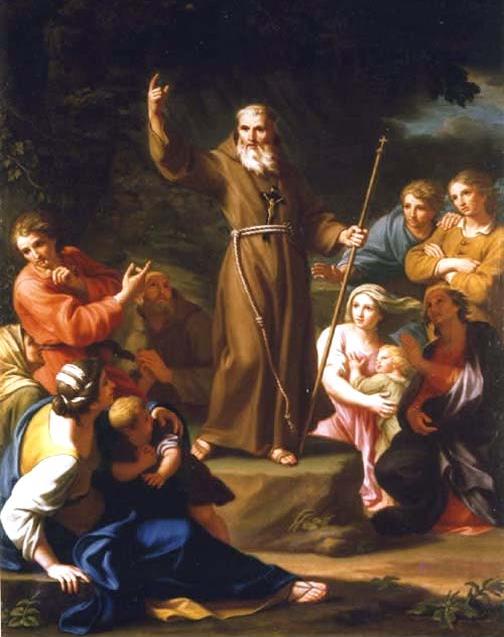
Unlike most Italian preachers of repentance in the 15th century, John was effective in northern and central Europe – in German states of Holy Roman Empire, Bohemia, Moravia, Austria, Hungary, Croatia and Kingdom of Poland.   The largest churches could not hold the crowds, so he preached in the public squares—at Brescia in Italy, he preached to a crowd of 126,000.

When he was not preaching, John was writing tracts against heresy of every kind.   This facet of his life is covered in great detail by his early biographers, Nicholas of Fara, Christopher of Varese and Girlamo of Udine. While he was thus evangelising, he was actively engaged in assisting Bernardine of Siena in the reform of the Franciscan Order, largely in the interests of a more rigorous discipline in the Franciscan communities. Like Bernardine, he strongly emphasised devotion to the Holy Name of Jesus and, together with that saint, was accused of heresy on this account.   In 1429, these Observant friars were called to Rome to answer charges of heresy and John was chosen by his companions to speak for them.   They were both acquitted by the Commission of Cardinals appointed to judge the accusations.

John, in spite of this restless life, found time to work—both during the lifetime of his mentor, Bernardine and afterwards—on the reform of the Order of Friars Minor.   He also upheld, in his writings, speeches and sermons, theories of papal supremacy rather than the theological wranglings of councils (see Conciliar Movement).   John, together with his teacher, Bernardine, his colleague, James of the Marche, and Blessed Albert Berdini of Sarteano, are considered the four great pillars of the Observant reform among the Friars Minor.

After the Fall of Constantinople in 1453, the Ottoman Empire, under Sultan Mehmed II, threatened Christian Europe.   That following year Pope Callixtus III sent John, who was already aged seventy, to preach a Crusade against the invading Turks at the Imperial Diet of Frankfurt.   Gaining little response in Bavaria and Austria, he decided to concentrate his efforts in Hungary.   John succeeded in gathering together enough troops to march onto Belgrade, which at that time was under siege by Turkish forces.   In the summer of 1456, these troops, together with John Hunyadi, managed to raise the siege of Belgrade; the old and frail friar actually led his own contingent into battle.   This feat earned him the moniker of ‘the Soldier Priest’.

Although he survived the battle, John fell victim to the bubonic plague, which flourished in the unsanitary conditions prevailing among armies of the day.   He died on 23 October 1456 at the nearby town of Ilok, Kingdom of Croatia in personal union with Hungary (now a Croatian border town on the Danube).

Posted in SAINT of the DAY

Memorials of the Saints – 23 October

Feast of the Most Holy Redeemer:  Celebrated in honur of the graces and benefits of the Redemption. It was instituted at Venice, Italy in 1576 in thanksgiving for the cessation of a plague and is now found only in the special calendar of some dioceses and religious orders, the Redemptorists being one of them.

redeemer

St John of Capistrano (1386-1456) (Optional Memorial) – https://www.youtube.com/watch?v=3pkNuVZwB04

St Allucio of Campugliano
Bl Anne-Joseph Leroux
St Amo of Toul
St Arethas of Negran
Bl Arnold Reche
St Benedict of Sebaste
St Clether
St Domitius
St Elfleda
St Ethelfleda
St Gratien of Amiens
St Henry of Cologne
St Ignatius of Constantinople
Bl John Angelo Porro
Bl John Buoni
St John of Syracuse
Oda of Aquitaine
St Phaolô Tong Viet Buong
St Romanus of Rouen
Bl Severinus Boethius
St Severinus of Cologne
Syra of Faremoutiers
St Theodoret of Antioch
Bl Thomas Thwing
St Verus of Salerno

Martyrs of Cadiz – 2 saints
Germanus
Servandus
Martyrs of Hadrianopolis – 2 saints
Dorotheus
Severus
Martyrs of Nicaea – 3 saints
Euerotas
Socrates
Theodota
Martyrs of Valenciennes – 6 beati: A group of Urusuline and Briggittine nuns murdered together in the anti-Christian excesses of the French Revolution. They were guillotined on 23 October 1794 in Valenciennes, Nord, France and Beatified on 13 June 1920 by Pope Benedict XV.
• Anne-Joseph Leroux
• Clotilde-Joseph Paillot
• Jeanne-Louise Barré
• Marie-Augustine Erraux
• Marie-Liévine Lacroix
• Marie-Marguerite-Joseph Leroux

Martyred in the Spanish Civil War including Martyrs of Manzanares (7 beati):
• Agapit Gorgues Manresa
• Agustín Nogal Tobar
• Andrés Navarro Sierra
• César Elexgaray Otazua
• Cristóbal González Carcedo
• Dorinda Sotelo Rodríguez
• Eduardo Valverde Rodríguez
• Felipe Basauri Altube
• José María Fernández Sánchez
• Juan Nuñez Orcajo
• Leonardo Olivera Buera
• Manuel Navarro Martínez
• Roque Guillén Garcés
• Toribia Marticorena Sola

Posted in MORNING Prayers, The BLESSED VIRGIN MARY

World Mission Sunday – 22 October – 29th Sunday in Ordinary Time

World Mission Sunday – 22 October – 29th Sunday in Ordinary Time

‘Mission at the Heart of the Christian Faith’

Pope Francis’ Message for World Mission Sunday 2017, which is focused on Mission at the Heart of the Christian Faith.WORLD MISSION SUNDAY 22 OCT 2017

Dear Brothers and Sisters,

Once again this year, World Mission Day gathers us around the person of Jesus, “the very first and greatest evangeliSer” (PAUL VI, Evangelii Nuntiandi, 7), who continually sends us forth to proclaim the Gospel of the love of God the Father in the power of the Holy Spirit.    This Day invites us to reflect anew on the mission at the heart of the Christian faith.    The Church is missionary by nature; otherwise, she would no longer be the Church of Christ but one group among many others that soon end up serving their purpose and passing away.   So it is important to ask ourselves certain questions about our Christian identity and our responsibility as believers in a world marked by confusion, disappointment and frustration, and torn by numerous fratricidal wars that unjustly target the innocent.  What is the basis of our mission?   What is the heart of our mission?   What are the essential approaches we need to take in carrying out our mission?

Mission and the transformative power of the Gospel of Christ, the Way, the Truth and the Life

1. The Church’s mission, directed to all men and women of good will, is based on the transformative power of the Gospel.   The Gospel is Good News filled with contagious joy, for it contains and offers new life: the life of the Risen Christ who, by bestowing His life-giving Spirit, becomes for us the Way, the Truth and the Life (cf. Jn 14:6).   He is the Way who invites us to follow Him with confidence and courage.   In following Jesus as our Way, we experience Truth and receive His Life, which is fullness of communion with God the Father in the power of the Holy Spirit.   That life sets us free from every kind of selfishness and is a source of creativity in love.

2. God the Father desires this existential transformation of his sons and daughters, a transformation that finds expression in worship in spirit and truth (cf. Jn 4:23-24), through a life guided by the Holy Spirit in imitation of Jesus the Son to the glory of God the Father.   “The glory of God is the living man” (IRENAEUS, Adversus Haereses IV, 20, 7).  The preaching of the Gospel thus becomes a vital and effective word that accomplishes what it proclaims (cf. Is 55:10-11): Jesus Christ, who constantly takes flesh in every human situation (cf. Jn 1:14).

Mission and the kairos of Christ

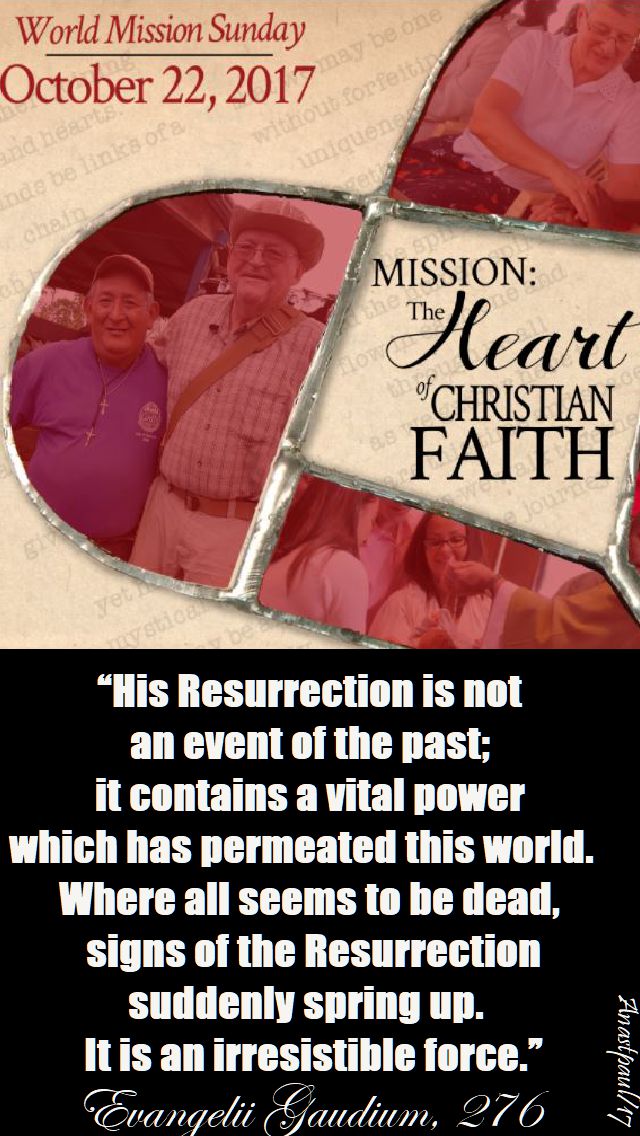
3. The Church’s mission, then, is not to spread a religious ideology, much less to propose a lofty ethical teaching.   Many movements throughout the world inspire high ideals or ways to live a meaningful life.   Through the mission of the Church, Jesus Christ himself continues to evangelize and act; her mission thus makes present in history the kairos, the favourable time of salvation.   Through the proclamation of the Gospel, the risen Jesus becomes our contemporary, so that those who welcome Him with faith and love can experience the transforming power of His Spirit, who makes humanity and creation fruitful, even as the rain does with the earth.  “His resurrection is not an event of the past; it contains a vital power which has permeated this world.   Where all seems to be dead, signs of the resurrection suddenly spring up.  It is an irresistible force” (Evangelii Gaudium, 276).

4. Let us never forget that “being Christian is not the result of an ethical choice or a lofty idea but the encounter with an event, a Person, which gives life a new horizon and a decisive direction” (BENEDICT XVI, Deus Caritas Est, 1).   The Gospel is a Person who continually offers Himself and constantly invites those who receive Him with humble and religious faith to share His life by an effective participation in the paschal mystery of His death and resurrection.   Through Baptism, the Gospel becomes a source of new life, freed of the dominion of sin, enlightened and transformed by the Holy Spirit.  Through Confirmation, it becomes a fortifying anointing that, through the same Spirit, points out new ways and strategies for witness and accompaniment.   Through the Eucharist, it becomes food for new life, a “medicine of immortality” (IGNATIUS OF ANTIOCH, Ad Ephesios, 20, 2).

5. The world vitally needs the Gospel of Jesus Christ.   Through the Church, Christ continues his mission as the Good Samaritan, caring for the bleeding wounds of humanity, and as Good Shepherd, constantly seeking out those who wander along winding paths that lead nowhere.   Thank God, many significant experiences continue to testify to the transformative power of the Gospel.   I think of the gesture of the Dinka student who, at the cost of his own life, protected a student from the enemy Nuer tribe who was about to be killed.   I think of that Eucharistic celebration in Kitgum, in northern Uganda, where, after brutal massacres by a rebel group, a missionary made the people repeat the words of Jesus on the cross:   “My God, My God, why have you abandoned me?” as an expression of the desperate cry of the brothers and sisters of the crucified Lord.   For the people, that celebration was an immense source of consolation and courage.   We can think too of countless testimonies to how the Gospel helps to overcome narrowness, conflict, racism, tribalism, and to promote everywhere, and among all, reconciliation, fraternity, and sharing.

Mission inspires a spirituality of constant exodus, pilgrimage, and exile

6. The Church’s mission is enlivened by a spirituality of constant exodus.   We are challenged “to go forth from our own comfort zone in order to reach all the peripheries in need of the light of the Gospel” (Evangelii Gaudium, 20).   The Church’s mission impels us to undertake a constant pilgrimage across the various deserts of life, through the different experiences of hunger and thirst for truth and justice.   The Church’s mission inspires a sense of constant exile, to make us aware, in our thirst for the infinite, that we are exiles journeying towards our final home, poised between the “already” and “not yet” of the Kingdom of Heaven.

7.  Mission reminds the Church that she is not an end unto herself but a humble instrument and mediation of the Kingdom.   A self-referential Church, one content with earthly success, is not the Church of Christ,hhis crucified and glorious Body.  That is why we should prefer “a Church which is bruised, hurting and dirty because it has been out on the streets, rather than a Church which is unhealthy from being confined and from clinging to its own security” (ibid., 49).

Young people, the hope of mission

8. Young people are the hope of mission.   The person of Jesus Christ and the Good News He proclaimed continue to attract many young people.   They seek ways to put themselves with courage and enthusiasm at the service of humanity.   “There are many young people who offer their solidarity in the face of the evils of the world and engage in various forms of militancy and volunteering…  How beautiful it is to see that young people are ‘street preachers’, joyfully bringing Jesus to every street, every town square and every corner of the earth!” (ibid., 106).   The next Ordinary General Assembly of the Synod of Bishops, to be held in 2018 on the theme Young People, the Faith and Vocational Discernment, represents a providential opportunity to involve young people in the shared missionary responsibility that needs their rich imagination and creativity.

The service of the Pontifical Mission Societies

9. The Pontifical Mission Societies are a precious means of awakening in every Christian community a desire to reach beyond its own confines and security in order to proclaim the Gospel to all.   In them, thanks to a profound missionary spirituality, nurtured daily, and a constant commitment to raising missionary awareness and enthusiasm, young people, adults, families, priests, bishops and men and women religious work to develop a missionary heart in everyone.    World Mission Day, promoted by the Society of the Propagation of the Faith, is a good opportunity for enabling the missionary heart of Christian communities to join in prayer, testimony of life and communion of goods, in responding to the vast and pressing needs of evangelization.

Carrying out our mission with Mary, Mother of Evangelization

10. Dear brothers and sisters, in carrying out our mission, let us draw inspiration from Mary, Mother of Evangelisation.   Moved by the Spirit, she welcomed the Word of life in the depths of her humble faith.   May the Virgin Mother help us to say our own “yes”, conscious of the urgent need to make the Good News of Jesus resound in our time.  May she obtain for us renewed zeal in bringing to everyone the Good News of the life that is victorious over death.   May she intercede for us so that we can acquire the holy audacity needed to discover new ways to bring the gift of salvation to every man and woman.

From the Vatican, 4 June 2017
Solemnity of Pentecost

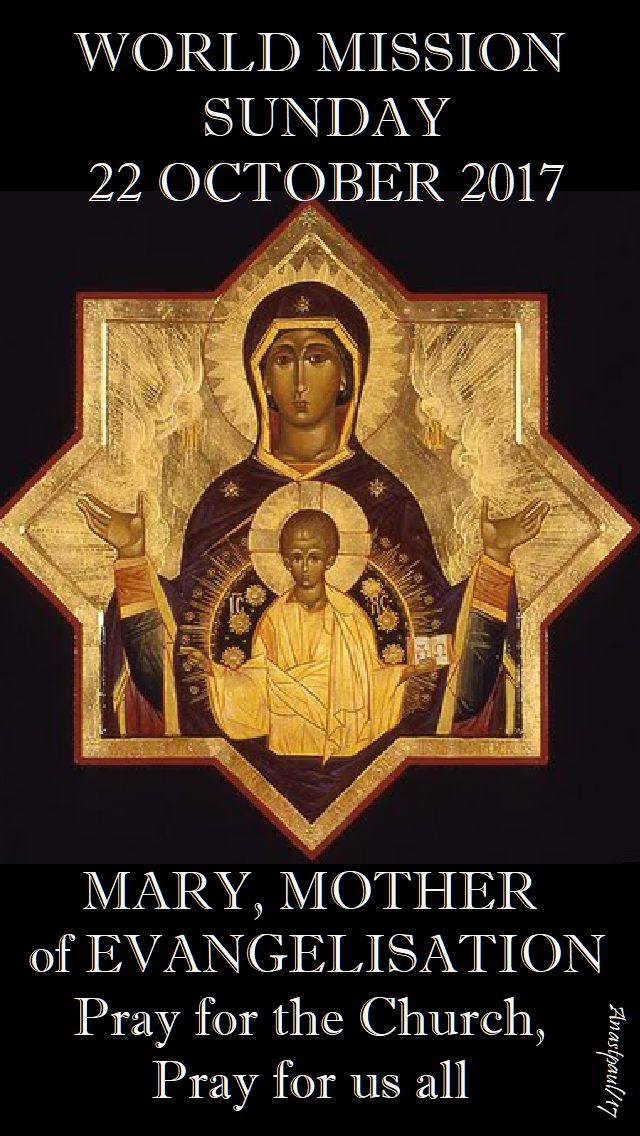
Mary, Mother of Evangelisation, Pray for the Church, Pray for us all – that we may go forth and make the Good News of Jesus resound in our time!MARY MOTHER OF EVANGELISATION - 22 oct 2017

Posted in SAINT of the DAY

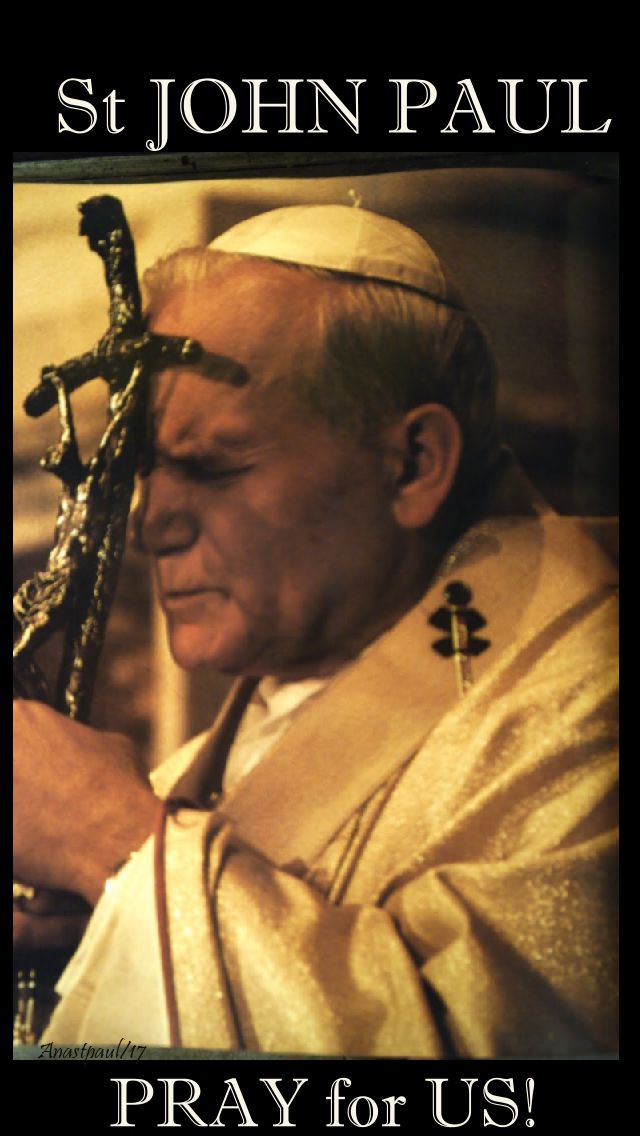
Saint of the Day – 22 October – St Pope John Paul II (1920-2005)

Saint of the Day – 22 October – St Pope John Paul II (1920-2005) Pope, Philosopher, Theologian, Writer, Preacher, Professor and Teacher, Apostle of the Holy Eucharist, Eucharistic Adoration, Charity and Mercy.   Patronages – Archdiocese of Kraków, World Youth Day (Co-Patron). World Meeting of Families 2015 (Co-Patron), Young Catholics, Families, Świdnica.   St John Paul was the second longest-serving pope in modern history after Pope Pius IX, who served for nearly 32 years from 1846 to 1878.   Born in Poland, John Paul II was the first non-Italian pope since the Dutch Pope Adrian VI, who served from 1522 to 1523.   John Paul II’s cause for canonisation commenced in 2005 one month after his death with the traditional five-year waiting period waived.   On 19 December 2009, John Paul II was proclaimed Venerable by his successor Pope Benedict XVI and was beatified on 1 May 2011 (Divine Mercy Sunday) after the Congregation for the Causes of Saints attributed one miracle to his intercession, the healing of a French nun from Parkinson’s disease.   A second miracle attributed to John Paul II’s intercession was approved on 2 July 2013 and confirmed by Pope Francis two days later (two miracles must be attributed to a person’s intercession to be declared a saint).   John Paul II was canonised on 27 April 2014 (again Divine Mercy Sunday), together with Pope John XXIII.   On 11 September 2014, Pope Francis added John Paul II’s optional memorial feast day to the worldwide General Roman Calendar of saints, in response to worldwide requests.   It is traditional to celebrate saints’ feast days on the anniversary of their deaths but that of John Paul II (22 October) is celebrated on the anniversary of his papal inauguration.

KAROL JÓZEF WOJTYŁA, elected Pope on 16 October 1978, was
born in Wadowice, Poland, on 18 May 1920.

He was the third of three children born to Karol Wojtyła and Emilia
Kaczorowska, who died in 1929. His elder brother Edmund, a
physician, died in 1932, and his father, Karol, a non-commissioned
officer in the army, died in 1941.

He was nine years old when he received his First Communion and
eighteen when he received the Sacrament of Confirmation.   After
completing high school in Wadowice, he enrolled in the Jagellonian
University of Krakow in 1938.

When the occupying Nazi forces closed the University in 1939,
Karol worked (1940-1944) in a quarry and then in the Solvay
chemical factory to earn a living and to avoid deportation to Germany.

Feeling called to the priesthood, he began his studies in 1942 in
the clandestine major seminary of Krakow, directed by the Archbishop
Adam Stefan Sapieha.   During that time, he was one of the organisers
of the “Rhapsodic Theatre”, which was also clandestine.

After the war, Karol continued his studies in the major seminary,
newly reopened and in the school of theology at the Jagellonian
University, until his priestly ordination in Krakow on 1 November
1946.   Father Wojtyła was then sent by Cardinal Sapieha to Rome,
where he attained a doctorate in theology (1948).   He wrote his
dissertation on faith as understood in the works of Saint John of
the Cross.   While a student in Rome, he spent his vacations
exercising pastoral ministry among Polish emigrants in France,
Belgium and Holland.

In 1948, Father Wojtyła returned to Poland and was appointed a
curate in the parish church of Niegowić, near Krakow, and later at
Saint Florian in the city.   He was a university chaplain until 1951,
when he again undertook studies in philosophy and theology.   In
1953, Father Wojtyła presented a dissertation at the Jagellonian
University of Krakow on the possibility of grounding a Christian
ethic on the ethical system developed by Max Scheler.   Later he
became professor of moral theology and ethics in the major
seminary of Krakow and in the theology faculty of Lublin.

On 4 July 1958, Pope Pius XII appointed Father Wojtyła auxiliary
bishop of Krakow, with the titular see of Ombi.   Archbishop
Eugeniusz Baziak ordained him in Wawel Cathedral (Krakow)
on 28 September 1958.

On 13 January 1964, Pope Paul VI appointed Bishop Wojtyła as
Archbishop of Krakow and subsequently, on 26 June 1967, created
him a Cardinal.

Bishop Wojtyła took part in the Second Vatican Council (1962-
1965) and made a significant contribution to the drafting of the
Constitution Gaudium et Spes.   He also took part in the five assemblies
of the Synod of Bishops prior to the start of his Pontificate.

On 16 October 1978, Cardinal Wojtyła was elected Pope and on 22
October he began his ministry as universal Pastor of the Church.

Pope John Paul II made 146 pastoral visits in Italy and, as the Bishop
of Rome, he visited 317 of the current 322 Roman parishes.   His
international apostolic journeys numbered 104 and were expressions
of the constant pastoral solicitude of the Successor of Peter for
all the Churches.

His principal documents include 14 Encyclicals, 15 Apostolic
Exhortations, 11 Apostolic Constitutions and 45 Apostolic Letters.
He also wrote five books:   Crossing the Threshold of Hope (October
1994); Gift and Mystery:   On the Fiftieth Anniversary of My Priestly
Ordination 
(November 1996);   Roman Triptych, meditations in
poetry 
(March 2003);   Rise, Let Us Be on Our Way (May 2004)
and Memory and Identity (February 2005).

Pope John Paul II celebrated 147 beatifications, during which he
proclaimed 1,338 blesseds and 51 canonisations, for a total of 482
saints.   He called 9 consistories, in which he created 231 Cardinals
(plus one in pectore).   He also presided at 6 plenary meetings of the
College of Cardinals.

From 1978, Pope John Paul II convoked 15 assemblies of the Synod
of Bishops: 6 ordinary general sessions (1980, 1983, 1987, 1990,
1994 and 2001), 1 extraordinary general session (1985) and 8
special sessions (1980, 1991,1994,1995,1997,1998 (2) and 1999).

On 3 May 1981, an attempt was made on Pope John Paul II’s life
in Saint Peter’s Square.   Saved by the maternal hand of the Mother
of God, following a lengthy stay in the hospital, he forgave the
attempted assassin and, aware of having received a great gift,
intensified his pastoral commitments with heroic generosity.

Pope John Paul II also demonstrated his pastoral concern by
erecting numerous dioceses and ecclesiastical circumscriptions,
and by promulgating Codes of Canon Law for the Latin and the
Oriental Churches, as well as the Catechism of the Catholic Church.
He proclaimed the Year of Redemption, the Marian Year and the
Year of the Eucharist as well as the Great Jubilee Year of 2000,
in order to provide the People of God with particularly intense spiritual
experiences. He also attracted young people by beginning the
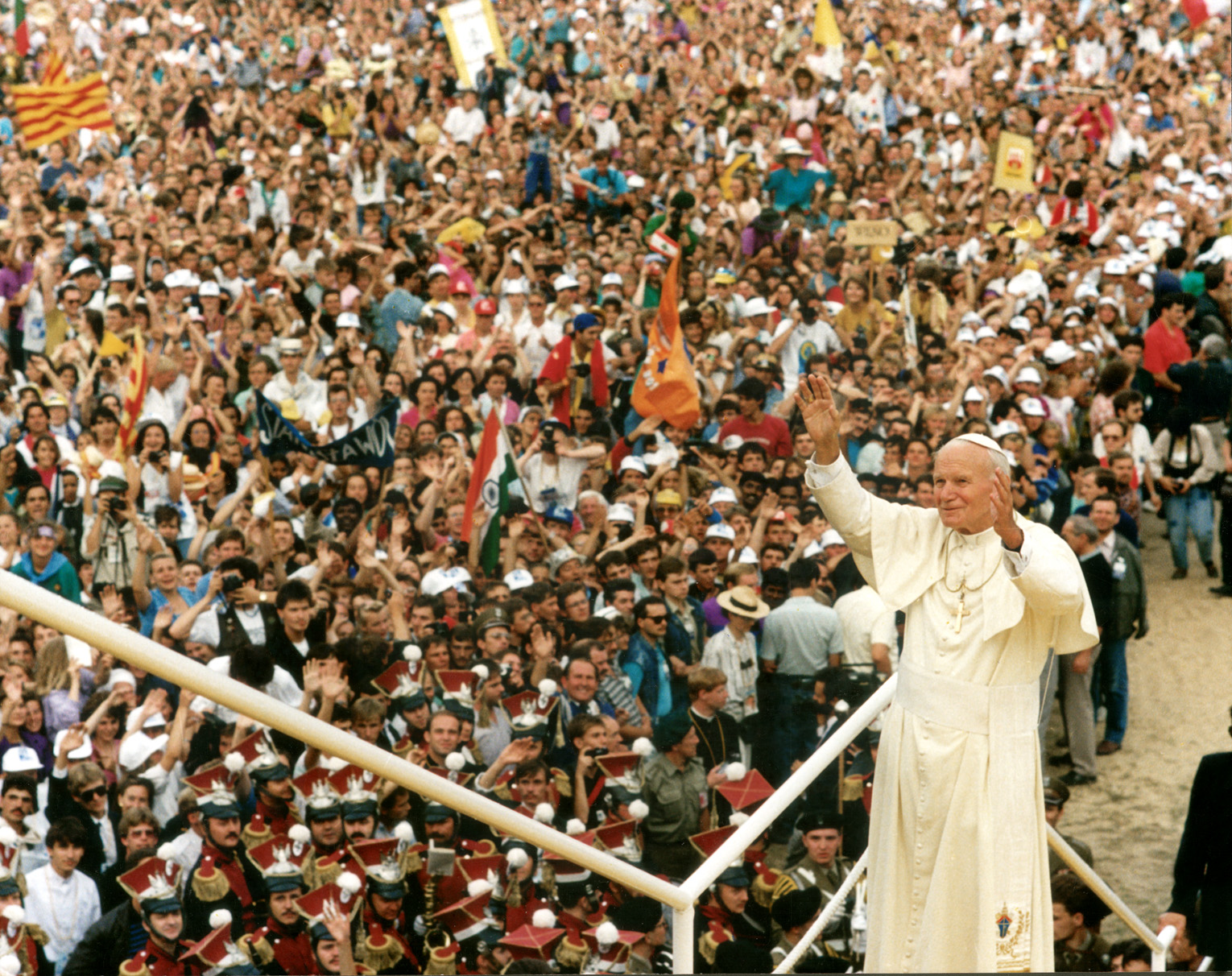
celebration of World Youth Day.WYD 2YOUTH GATHER IN CZESTOCHOWA FOR WORLD YOUTH DAY

No other Pope met as many people as Pope John Paul II. More
than 17.6 million pilgrims attended his Wednesday General Audiences
(which numbered over 1,160). This does not include any of
the other special audiences and religious ceremonies (more than 8
million pilgrims in the Great Jubilee Year of 2000 alone). He met
millions of the faithful in the course of his pastoral visits in Italy
and throughout the world. He also received numerous government
officials in audience, including 38 official visits and 738 audiences
and meetings with Heads of State, as well as 246 audiences and
meetings with Prime Ministers.

Pope John Paul II died in the Apostolic Palace at 9:37 p.m. on
Saturday, 2 April 2005, the vigil of Sunday in albis or Divine Mercy
Sunday, which he had instituted. On 8 April, his solemn funeral
was celebrated in Saint Peter’s Square and he was buried in the
crypt of Saint Peter’s Basilica.


John Paul II was beatified in Saint Peter’s Square on 1 May 2011 by
Pope Benedict XVI, his immediate successor and for many years
his valued collaborator as Prefect for the Congregation for the
Doctrine of the Faith and canonised on 27 April 2014, together
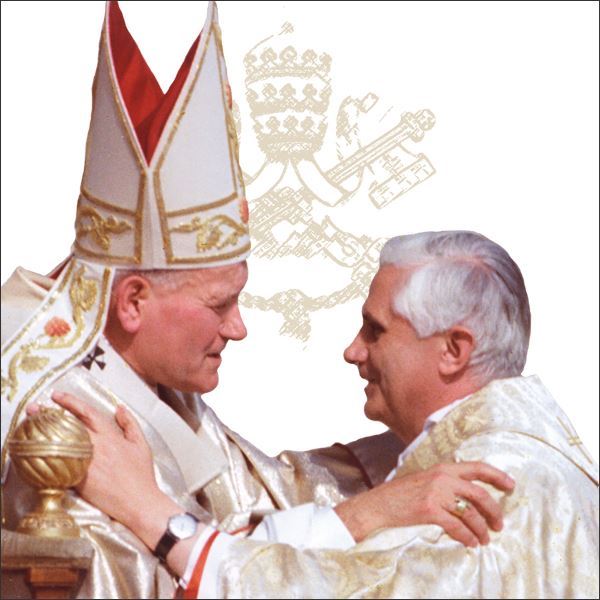
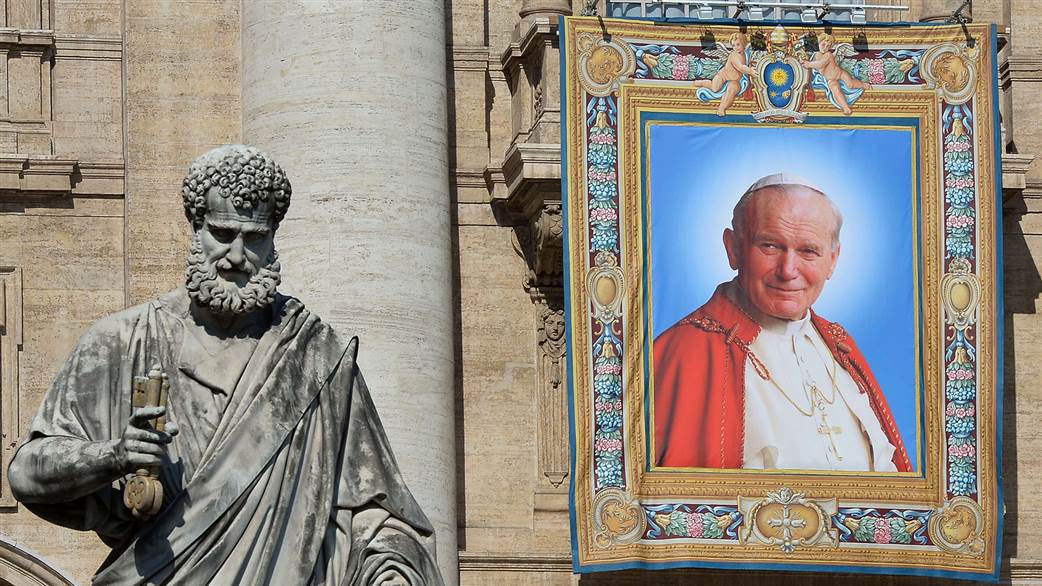
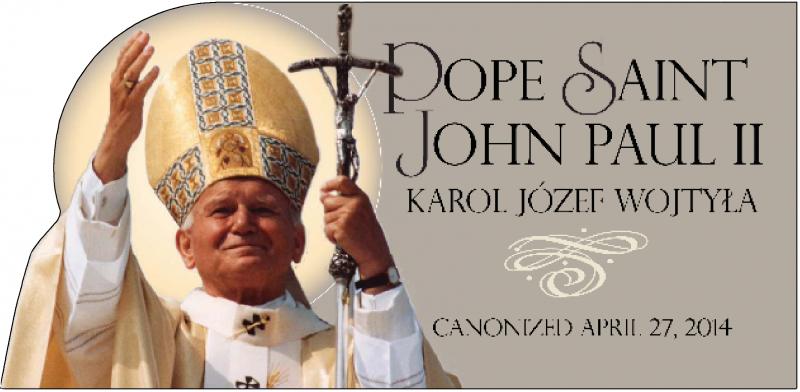
with Pope John XXIII, by Pope Francis.0005260_tu-es-petrus-le-chiavi-del-regno-da-giovanni-paolo-ii-a-benedetto-xvi-1-x-60-minpope benedict holds a new portraitCanonisation 1.canonisation 2.canonisation 3.

Booklet for the Celebration of the Canonization of Blesseds John XXIII and John Paul II, 27 April 2014 from the Vatican

Posted in MARIAN PRAYERS, MARIAN QUOTES, MORNING Prayers, QUOTES of the SAINTS, SAINT of the DAY

Thought for the Day – 22 October – The Memorial of St Pope John Paul II (1920-2005)

Thought for the Day – 22 October – The Memorial of St Pope John Paul II (1920-2005)

Before John Paul II’s funeral Mass in St Peter’s Square, hundreds of thousands of people had waited patiently for a brief moment to pray before his body, which lay in state inside St Peter’s for several days.   The media coverage of his funeral was unprecedented.

Presiding at the funeral Mass, Cardinal Joseph Ratzinger–then dean of the College of Cardinals and later Pope Benedict XVI–concluded his homily by saying:  “None of us can ever forget how, in that last Easter Sunday of his life, the Holy Father, marked by suffering, came once more to the window of the Apostolic Palace and one last time gave his blessing urbi et orbi (‘to the city and to the world’).

“We can be sure that our beloved pope is standing today at the window of the Father’s house, that sees us and blesses us.   Yes, bless us, Holy Father.   We entrust your dear soul to the Mother of God, your Mother, who guided you each day and who will guide you now to the glory of her Son, our Lord Jesus Christ. Amen.”

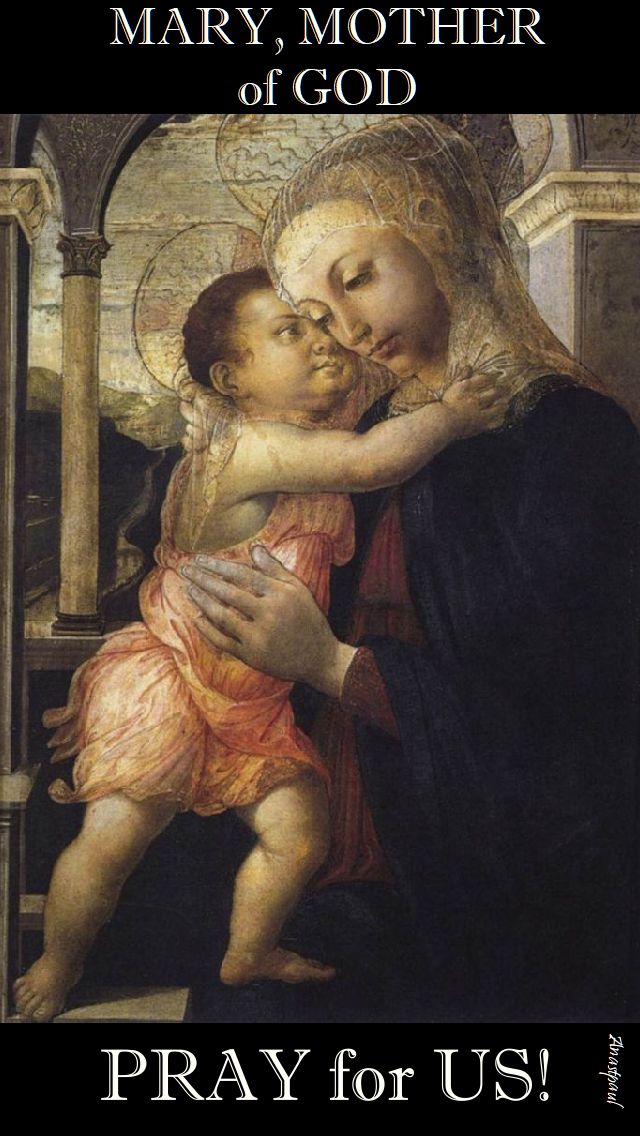
Mary, Mother of God, Pray for us!mary mother of god pray for us
St John Paul, ‘Witness to Hope’ – Pray for us!st jp pray for us.2

“Christ is the center of the universe and of human history” was the opening line of John Paul II’s 1979 encyclical, Redeemer of the Human Race. In 1995, he described himself to the United Nations General Assembly as “a witness to hope.”

Posted in MORNING Prayers, QUOTES of the SAINTS, SAINT of the DAY

Quote/s of the Day – 22 October – The Memorial of St Pope John Paul II (1920-2005)

Quote/s of the Day – 22 October – The Memorial of St Pope John Paul II (1920-2005)

“The cemetery of the victims of human cruelty
in our century is extended to include
yet another vast cemetery,
that of the unborn.”the cemetery-st jop - 22 oct 2017

“The ultimate test of your greatness
is the way you treat every human being.”

“Nobody is so poor he has nothing to give
and nobody is so rich he has nothing to receive.”

“It’s better to cry than be angry
because anger hurts others,
while tears flow silently through the soul
and cleans the heart.”the ultimate test - st jp - 22 oct 2017

“If you want peace, work for justice.
If you want justice, defend life.
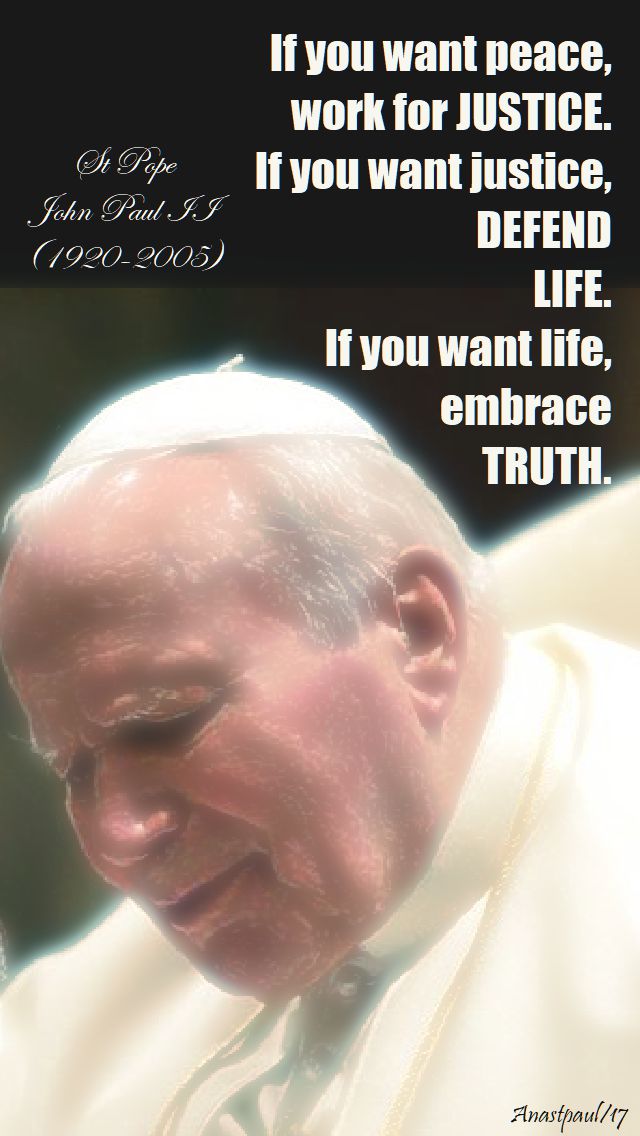
If you want life, embrace truth.”if you want peace - st jp - 22 oct 2017

“Darkness can only be scattered by light,
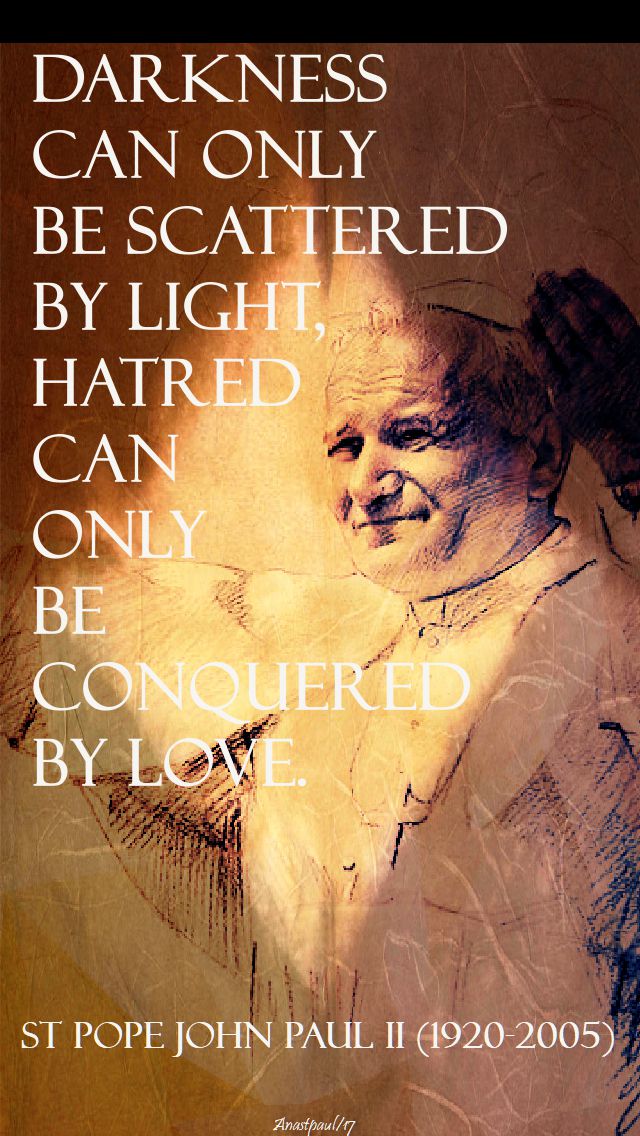
hatred can only be conquered by love.”darkness - st jp - 22 oct 2017

“In this silence of the white Host,
carried in the Monstrance, are all His words;
there is His whole life given in offering to the Father
for each of us;
there is also the glory of the glorified body,
which started with the Resurrection
and still continues in Heavenly union.”

St Pope John Paul II (1920-2005)in this silence of the white host - st jp - 22 oct 2017

Posted in PAPAL ENCYLICALS, SAINT of the DAY, The WORD

One Minute Reflection – 22 October – The Memorial of St Pope John Paul II (1920-2005)

One Minute Reflection – 22 October – The Memorial of St Pope John Paul II (1920-2005)

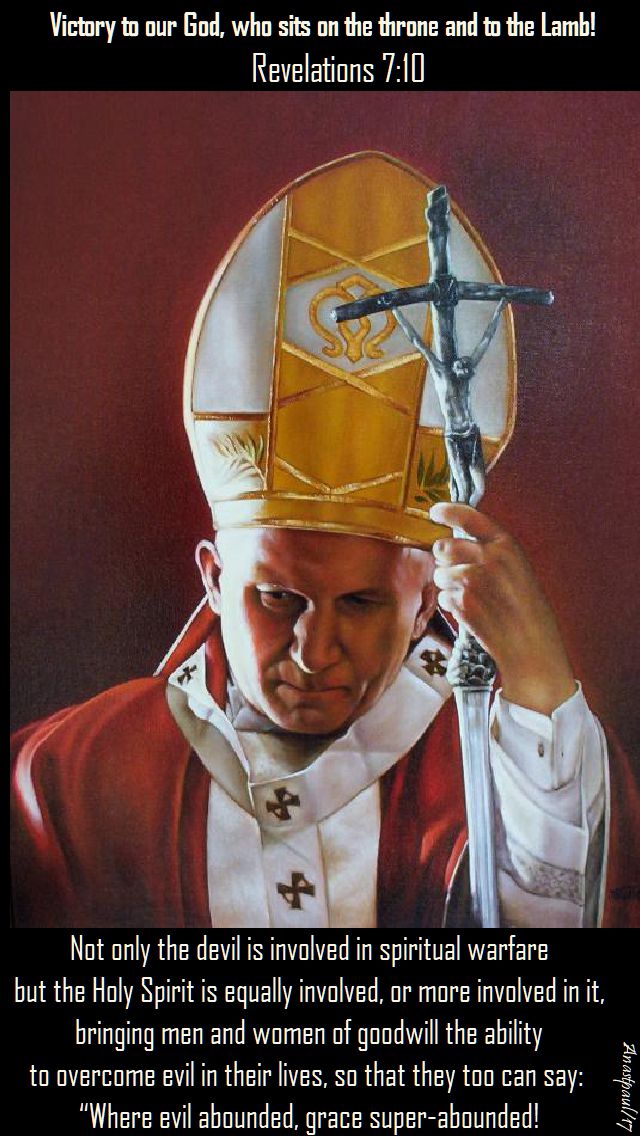
Victory to our God, who sits on the throne and to the Lamb!“…Revelations 7:10

REFLECTION – “Not only the devil is involved in spiritual warfare but the Holy Spirit is equally involved, or more involved in it,
bringing men and women of goodwill the ability to overcome evil in their lives, so that they too can say: “Where evil abounded, grace super-abounded!” (Rom 5:20).” …St John Paul (The Holy Spirit (Dominum Et Vivificantem – 1986)not only the devil - st jp - 22 oct 2017

PRAYER – Holy Father, Holy Son, Holy Spirit! Your light will never fail us! By the intercession of St John Paul, grant us the grace to ever call on You, blessed and Holy Trinity, one God who brings us everlasting light and protection here on earth from the evil one. St John Paul, pray for us, amen.st jp pray for us

Posted in MORNING Prayers, PRAYERS of the SAINTS, SAINT of the DAY, The HOLY EUCHARIST / The HOLY MASS

Our Morning Offering – 22 October – The Memorial of St Pope John Paul II (1920-2005)

Our Morning Offering – 22 October – The Memorial of St Pope John Paul II (1920-2005)

Thanksgiving for the Eucharist
By St Pope John Paul II

For our paschal lamb,
Christ, has been sacrificed.
Therefore, let us celebrate the feast!
O Christ the Saviour,
we give You thanks
for Your redeeming sacrifice,
the only hope of men!
O Christ the Saviour,
we give You thanks
for the Eucharistic breaking of bread,
which You instituted,
in order to really meet, Your brothers,
in the course of the centuries!
O Christ the Saviour,
put into the hearts of the baptised,
the desire to offer themselves with You
and to commit themselves,
for the salvation of their brothers!
You who are really present
in the Blessed Sacrament,
spread Your blessings abundantly
on Your people…Amenprayer of thanksgiving for the eucharist - st john paul - 22 oct 2017

Posted in SAINT of the DAY

Memorials of the Saints – 22 October

St Pope John Paul II (Optional Memorial) – https://www.youtube.com/watch?v=gEQKbB5sKKc

St Abericus Marcellus
St Alodia of Huesca
St Apollo of Bawit
St Benedict of Macerac
St Bertharius of Monte Cassino
St Cordula
St Donatus of Fiesoli
Bl Esclaramunda of Majorca
St Hermes of Adrianople
St Ingbert
St Leothade of Auch
St Lupenzius
St Mark of Jerusalem
St Maroveus of Precipiano
St Mellon
St Moderan of Rennes
St Nepotian of Clermont
St Nunctus of Mérida
St Nunilo of Huesca
St Philip of Adrianople
St Philip of Fermo
St Rufus of Egypt
St Symmachus of Capua
St Valerius of Langres
St Verecundus of Verona

Martyrs of Heraclea – 4 saints: A group of four clerics in Heraclea (modern Marmara Ereglisi, Turkey) who were arrested in the persecutions of Diocletian. They were imprisoned, abused and ordered to turn over all the scriptures that they had hidden from authorities; they refused and were executed together. Martyrs. – Eusebius, Hermes, Philip and Severus. They were burned at the stake in 304 in Adrianople (modern Edirne, Turkey).

Martyrs of Adianople:
• Blessed Alexander
• Blessed Anna
• Blessed Elisabeth
• Blessed Glyceria
• Blessed Heraclius
• Blessed Theodota

Martyred in the Spanish Civil War:
• Blessed Álvaro Ibáñez Lázaro
• Blessed Andrés Zarraquino Herrero
• Blessed Estanislao García Obeso
• Blessed Germán Caballero Atienza
• Blessed José Menéndez García
• Blessed Josep Casas Lluch
• Blessed Luis Minguel Ferrer
• Blessed Pedro Lorente Vicente
• Blessed Victoriano Ibañez Alonso

Posted in MORNING Prayers, NOVENAS, QUOTES of the SAINTS

NOVENA to St John Paul the Great: DAY NINE – 21 OCTOBER

NOVENA to St John Paul the Great: DAY NINE – 21 OCTOBER

Little Known Fact #9:   While visiting the United States in 1976, Cardinal Karol Wojtyla spent a few days in Pomfret, Vermont with philosopher Anna-Teresa Tymieniecka and her family.   His main purpose was to work on the English translation of Osobo I Czyn (The Acting Person) but he also used it as a time to relax and enjoy nature.  For example, he was often late for lunch because he had been swimming in the neighbour’s pond. Additionally, he didn’t want to be treated like a guest but instead insisted that he cut the grass and help bale hay.   He was truly in his element in Vermont and remarked that it reminded him of the Tatras in Poland.   Wojtyla spent most of his time outdoors, working on the English translation while sitting on the trunk of a tree that had fallen.

REFLECTION:   “This was his message:  man is the way of the Church and Christ is the way of man.  With this message, which is the great legacy of the Second Vatican Council and of its “helmsman”, the Servant of God Pope Paul VI, John Paul II led the People of God across the threshold of the Third Millennium, which thanks to Christ he was able to call “the threshold of hope”.   Throughout the long journey of preparation for the great Jubilee he directed Christianity once again to the future, the future of God, which transcends history while nonetheless directly affecting it.   He rightly reclaimed for Christianity that impulse of hope which had in some sense faltered before Marxism and the ideology of progress.  He restored to Christianity its true face as a religion of hope, to be lived in history in an “Advent” spirit, in a personal and communitarian existence directed to Christ, the fullness of humanity and the fulfillment of all our longings for justice and peace.”   Pope Benedict XVI at the Beatification Ceremonyday nine novena st john paul - 21 oct

Let us Pray:

O Holy Trinity, we thank You for having given to the Church Pope John Paul II and for having made him shine with Your fatherly tenderness, the glory of the Cross of Christand the splendour of the Spirit of love.

He, trusting completely in Your infinite mercy and in the maternal intercession of Mary, has shown himself in the likeness of Jesus the Good Shepherd and has pointed out to us the way of holiness as the path to reach eternal communion with You Grant us, through his intercession, according to Your will, the grace that we implore,

………………….. [state your intention here].

Continue, beloved St John Paul, we implore you, to sustain from heaven the faith of God’s people. We praise and thank You Father that St John Paul has been numbered among Your saints and make our prayer through our Lord Jesus Christ with the Holy Spirit, one God forever.

Totus Tuus, Amen.

Quote Day 9:   “Two thousand years have gone by but sinners in need of mercy — and who is not? — still experience the consolation of that “today” of salvation which on the Cross opened the gates of the Kingdom of God to the repentant thief: “Truly, I say to you, today you will be with me in Paradise” (Lk 23:43).” St John Paultwo thousand years - st john paul - 21 oct 2017.NO 1

Posted in MORNING Prayers, SAINT of the DAY

Thought for the Day – 21 October – The Memorial of St Hilarion of Gaza (c 291-371)

Thought for the Day – 21 October – The Memorial of St Hilarion of Gaza (c 291-371)

St Hilarion longed for a solitude that continually escaped him, the price of being a pioneer.   But he persisted and finally found the solitary life he was looking for.   We all have to be alone with God sometimes and although we may have trouble doing it, it is worth the effort, time and trouble.

God seeks after those who seek Him and He comes to them!

St Hilarion, pray for us!st hilarion pray for us 2

Posted in JESUIT SJ, MORNING Prayers, QUOTES of the SAINTS, The HOLY GHOST

Quote/s of the Day – 21 October

Quote/s of the Day – 21 October

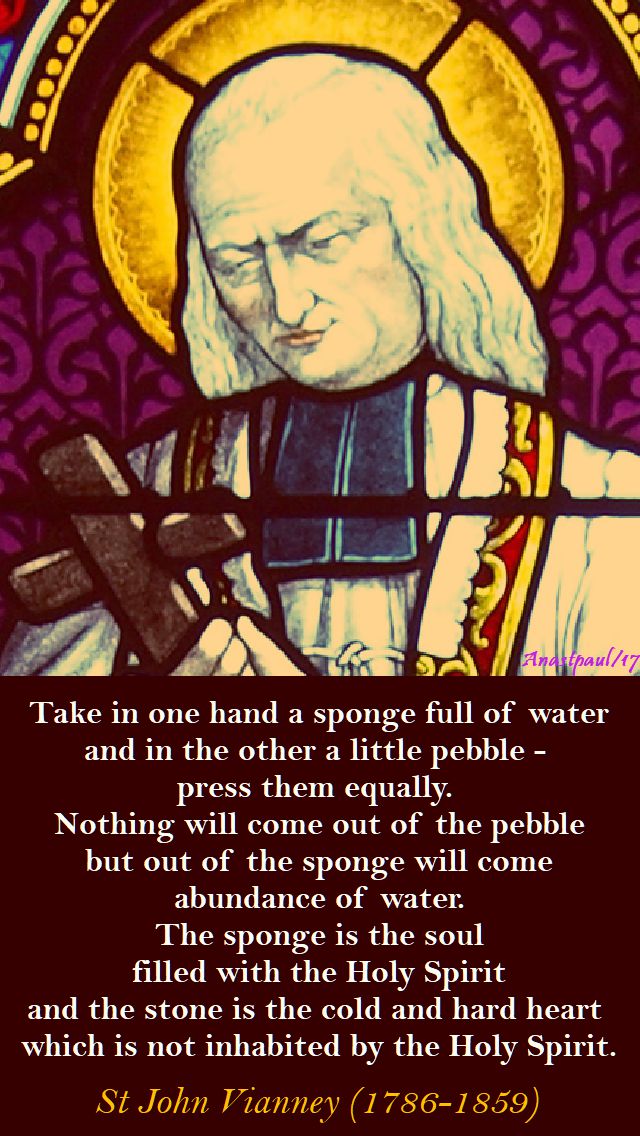
“Take in one hand a sponge full of water
and in the other a little pebble – press them equally.
Nothing will come out of the pebble
but out of the sponge will come abundance of water.
The sponge is the soul filled with the Holy Spirit
and the stone is the cold and hard heart
which is not inhabited by the Holy Spirit.”

St John Vianney (1786-1859)take in one hand - st john vianney - 21 oct 2017

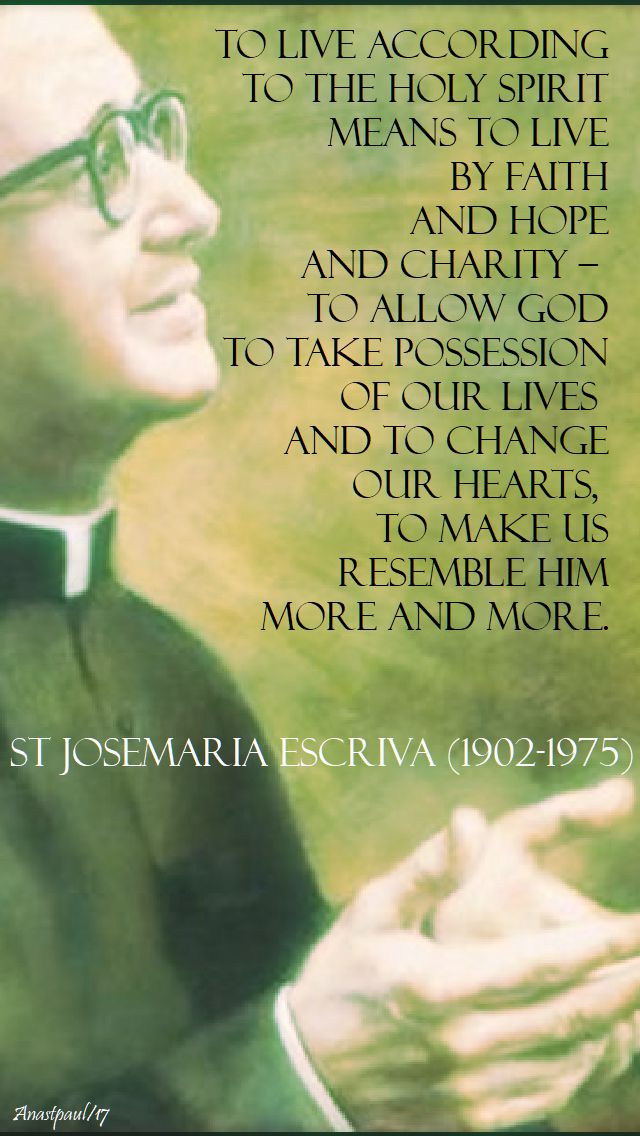
“To live according to the Holy Spirit
means to live by faith and hope and charity –
to allow God to take possession of our lives
and to change our hearts,
to make us resemble him more and more.”

St Josemaria Escriva (1902-1975)to live according - st josemaria - 21 oct 2017

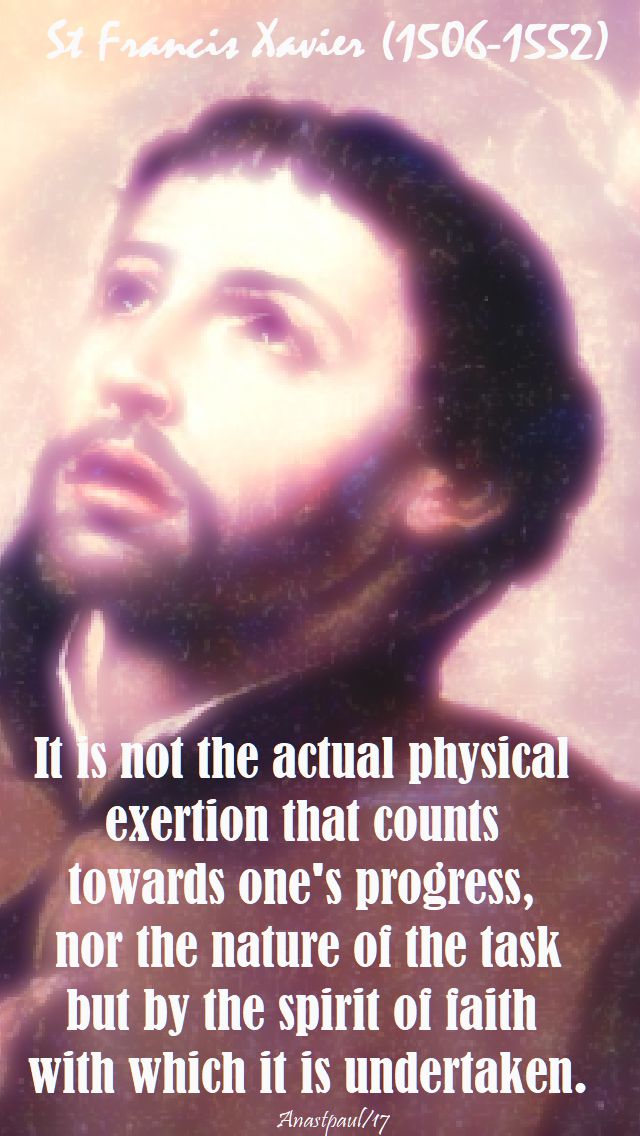
“It is not the actual physical exertion that counts
towards one’s progress, nor the nature of the task
but by the spirit of faith with which it is undertaken.”

St Francis Xavier (1506-1552)it is not - st francis xavier - 21 oct 2017

Posted in DOCTORS of the Church, MORNING Prayers, QUOTES of the SAINTS, SAINT of the DAY, The WORD

One Minute Reflection – 21 October – The Memorial of St Hilarion of Gaza (c 291-371)

One Minute Reflection – 21 October – The Memorial of St Hilarion of Gaza (c 291-371)

Jesus said to his disciples:
“No one who prefers father or mother to me is worthy of me.”…Matthew 10:37

REFLECTION – To believe in God – for Christians, does not simply mean to believe that God exists, nor merely to believe that He is true.
It means to believe by loving, to believe by abandoning oneself to God, uniting and conforming oneself to Him.”… St Anthony of Padua (1195-1231) Doctor of the Churchto believe in God - st anthony of padua

PRAYER – Holy Father, grant me an operative faith, a faith that will move mountains. Englighten my soul with Your Light, Goodness, Power and Wisdom. Let my faith be an image of You by lively deeds and love and by conforming myself to Your Will in all things. St Hilarion from such a young age you searched for complete closeness and abandonment to God, please pray that we may manifest such a true faith, amen.st hilarion pray for us

Posted in MORNING Prayers, PRAYERS of the SAINTS, The HOLY GHOST

Our Morning Offering – 21 October

Our Morning Offering – 21 October

A Prayer for Enlightenment
St Alcuin of York (735-804)

Eternal light, shine into our hearts,
Eternal Goodness, deliver us from evil,
Eternal Power, be our support,
Eternal Wisdom, scatter the
darkness of our ignorance,
Eternal Pity, have mercy on us;
that with all our heart
and mind
and soul
and strength,
we may seek Your Face
and be brought by Your infinite mercy
to Your Holy Presence;
through Jesus Christ, our Lord
Amen.a prayer for enlightenment - st alcuin - 21 oct 2017

Posted in DOCTORS of the Church, FATHERS of the Church, QUOTES of the SAINTS, SAINT of the DAY

Saint of the Day – 21 October – St Hilarion of Gaza (c 291-371)

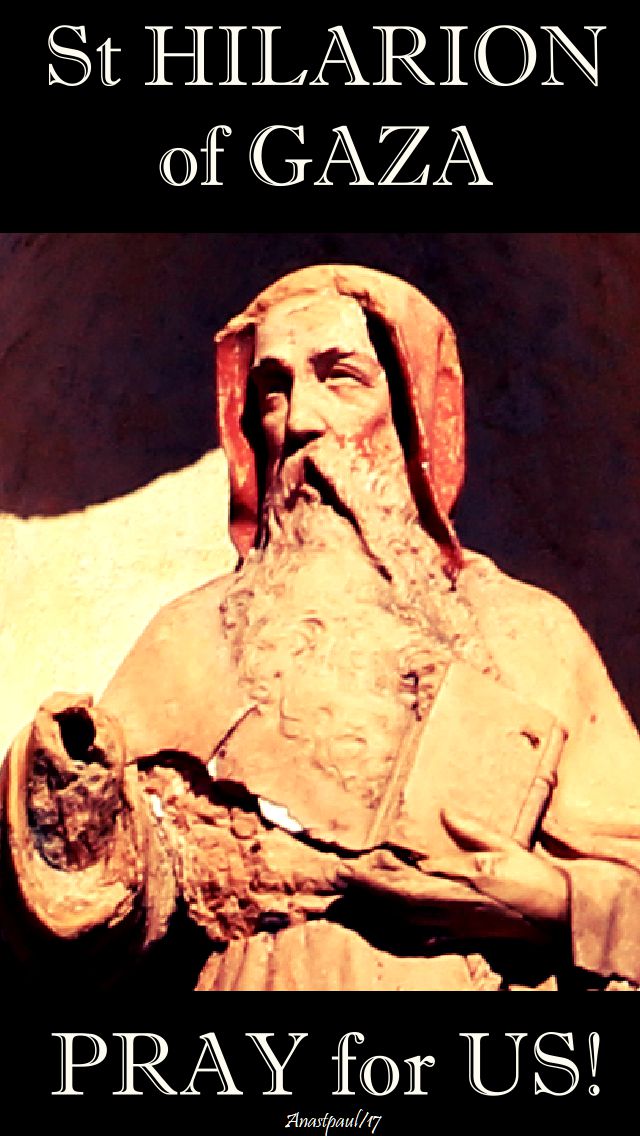
Saint of the Day – 21 October – St Hilarion of Gaza (c 291-371) Hermit and Miracle-Worker.

St Hilarion spent most of his life in the desert according to the example of Anthony the Great.

Shortly after St Hilarion’s death, St Jerome wrote about the life of this hermit who had introduced monasticism into Palestine.   Jerome told of Hilarion’s lifelong pursuit of solitude, where he could encounter God in prayer.

Hilarion was born in Thabatha, south of Gaza in Syria Palaestina of pagan parents. He successfully studied rhetoric with a Grammarian in Alexandria.   It seems that he was converted to Christianity in Alexandria.   After that, he shunned the pleasures of his day—theatre, circus and arena—and spent his time attending church.   According to St Jerome, he was a thin and delicate youth of fragile health.

After hearing of Saint Anthony, whose name (according to St.erome), “was in the mouth of all the races of Egypt” Hilarion, at the age of fifteen, went to live with him in the desert for two months.   As Anthony’s hermitage was busy with visitors seeking cures for diseases or demonic affliction, Hilarion returned home along with some monks.   At Thabatha, his parents having died in the meantime, he gave his inheritance to his brothers and the poor and left for the wilderness.Hilarion_the_Great_(Menologion_of_Basil_II)

St Jerome wrote about the divine irony of the fame that denied it to him because his miracles attracted so many people. In this brief excerpt, Jerome describes Hilarion’s faith and a typical miracle:

Once . . . when he was eighteen years old, brigands tried to find him at night.   Either they believed that he had something to steal or they thought he would scorn them if they didn’t intimidate him. . . . From evening till dawn, they hunted in every direction but couldn’t find him.   In the broad daylight, however, they came upon him and apparently as a joke asked him:  “What would you do if robbers attacked you?”   He answered:   “A naked person does not fear robbers.”   “You could be killed.”   “I could,” he said.   “But I am not afraid of robbers because I am ready to die.”   Admiring his faith, they confessed their folly of the night before and their blindness and promised to reform their lives…

A woman of Eleutheropolis, despised by her husband of fifteen years because of her sterility, . . . was the first who dared to intrude upon blessed Hilarion’s solitude.   While he was still unaware of her approach, she suddenly threw herself at his knees saying:  “Forgive my boldness. . . ., he asked her why she had come and why she was weeping.   When he learned the cause of her grief, raising his eyes to heaven, he commanded her to have faith and to believe.   He followed her departure with tears.   When a year had gone by, he saw her with her son.

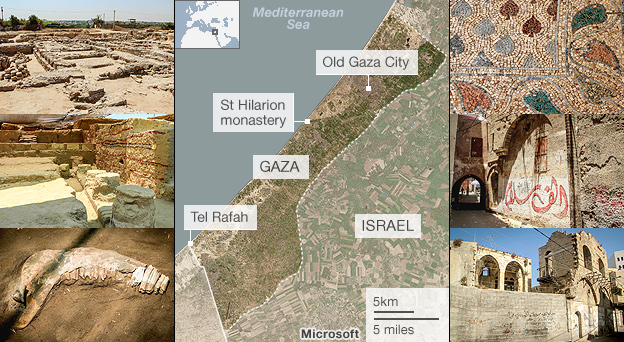
Like Anthony, Hilarion took only a little food once a day at sunset.   When tempted sexually, he ate even less.  “I’ll see to it, you jackass,” he said, “that you shall not kick.”  He never bathed nor changed his tunic until it wore out.   He said, “It is idle to expect cleanliness in a hair shirt.”   Jerome relates that even though Hilarion suffered extreme dryness of spirit, he persevered in prayer and cured many people of sickness and demon possession.   The parade of petitioners and would-be disciples drove Hilarion to retire to more remote locations.   But they followed him everywhere.   First he visited Anthony’s retreat in Egypt.   Then he withdrew to Sicily, later to Dalmatia and finally to Cyprus. He died there in 371.hilarion monastery

Posted in SAINT of the DAY

Memorials of the Saints – 21 October

St Agatho the Hermit
St Asterius of Périgord
St Asterius of Rome
St Berthold of Parma
St Celina of Meaux
Bl Charles of Austria
St Cilinia
St Condedus
St Domnolus of Pouilly
St Finian Munnu
St Gebizo
Bl Giuseppe Puglisi
Bl Gundisalvus of Lagos
St Hilarion of Gaza
Bl Hilarion of Moglena
St Hugh of Ambronay
Bl Imana of Loss
Bl Iulianus Nakaura
St John of Bridlington
St Laura of Saint Catherine of Siena
St Letizia
St Maurontus of Marseilles
St Malchus of Syria
Bl Peter of Città di Castello
St Petrus Yu Tae-Ch’ol
St Pontius de Clariana
St Raymond of Granada
Bl Sancho of Aragon
Bl Severinus of Bordeaux
Bl Tuda of Lindisfarne
Bl Viator of Lyons
St Wendelin
St William of Granada
St William of Montreal
St Zaira
St Zoticus of Nicomedia

Martyrs of Nicaea – 279 saints:

Martyrs of Nicomedia – 3 saints:
Caius of Nicomedia
Dasius of Nicomedia
Zoticus of Nicomedia

Martyred in the Spanish Civil War:
• Blessed Genaro Fueyo Castañon
• Blessed Isidro Fernández Cordero
• Blessed Segundo Alonso González

Saint Ursula and Companions: Legendary princess, the daughter of a Christian British king and Saint Daria. She travelled Europe in company of either 11 or 11,000 fellow maidens; the 11,000 number probably resulted from a misreading of the term “11M” which indicated 11 Martyrs, but which a copyist took for a Roman numeral. Ursula and her company were tortured to death to get them to renounce their faith, and old paintings of them show many of the women being killed in various painful ways. Namesake for the Ursuline Order, founded for the education of young Catholic girls and women.
There are other saints closely associated with Ursula and her story –
travelling companions who were martyred with her

Antonia of Cologne
Cesarius of Cologne
Cyriacus of Cologne
Daria
Fiolanus of Lucca
Ignatius of Cologne
James of Antioch
Mauritius of Cologne
Pontius of Cologne
Sulpitius of Ravenna
Vincent of Cologne

Travelling companion, but escaped the massacre:
• Cunera

led by a dove to the lost tomb of Ursula:
• Cunibert of Cologne

Posted in MORNING Prayers, PRAYERS for VARIOUS NEEDS, QUOTES of the SAINTS, SAINT of the DAY

Thought for the Day – 20 October – The Memorial of Blesseds Daudi Okelo and Jildo Irwa – Ugandan Martyrs

Thought for the Day – 20 October – The Memorial of Blesseds Daudi Okelo and Jildo Irwa – Ugandan Martyrs

“My thoughts turn first of all to the two young catechists from Uganda, Daudi Okelo and Jildo Irwa.   These two courageous witnesses were no more than boys when, with simplicity and faith, they shed their blood for Christ and his Church.   With youthful enthusiasm for their mission of teaching the faith to their fellow countrymen, they set out in 1918 for northern Uganda.   It was there, as evangelisation was just beginning in that region, that they chose to embrace death rather than abandon the area and forsake their duties as catechists.   Truly, in their lives and witness we can see that they were “beloved by God and chosen by him” (cf. I Thes 1,4).

Daudi and Jildo are today raised to the glory of the altar.   They are given to the entire Christian community as examples of holiness and virtue and as models and intercessors for catechists throughout the world, especially in those places where catechists still suffer for the faith, sometimes facing social marginalisation and even personal danger. May the life and witness of these two dedicated servants of the Gospel inspire many men and women – in Uganda, in Africa and elsewhere – to answer with generosity the call to be a catechist, bringing knowledge of Christ to others and strengthening the faith of those communities that have recently received the Gospel of salvation.”

(Pope John Paul II on World Mission Sunday 20 October 2002)

“These two young catechists are a shining example of fidelity to Christ, commitment to Christian living and selfless dedication to the service of neighbour.   With their hope firmly set on God and with a deep faith in Jesus’ promise to be with them always, they set out to bring the Good News of salvation to their fellow countrymen, fully accepting the difficulties and dangers that they knew awaited them.   May their witness serve to strengthen you as you seek to bear true Christian witness in every aspect of your lives. Through their intercession may the Church be an ever more effective instrument of goodness and peace in Africa and in the world. God bless Uganda.”
(Pope John Paul II to Ugandan visitors – 21 October 2002)

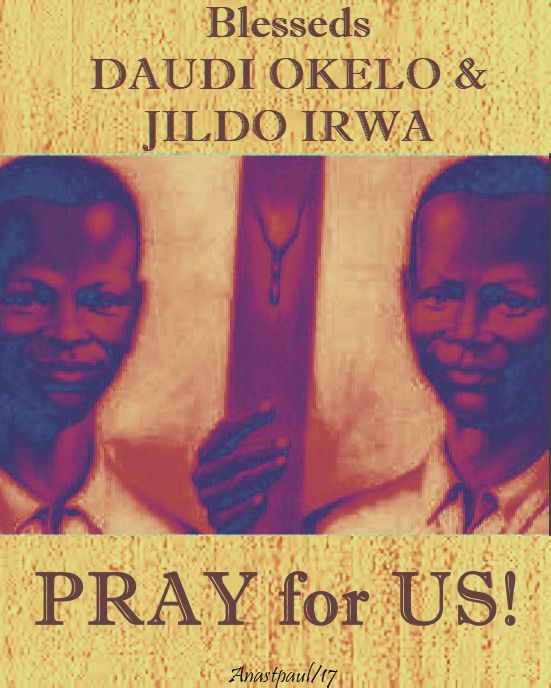
Blesseds Daudi Okelo and Jildo Irwa, Pray for Catechists, pray for us all!bls daudi and jildo pray for us - 20 oct 2017.no2

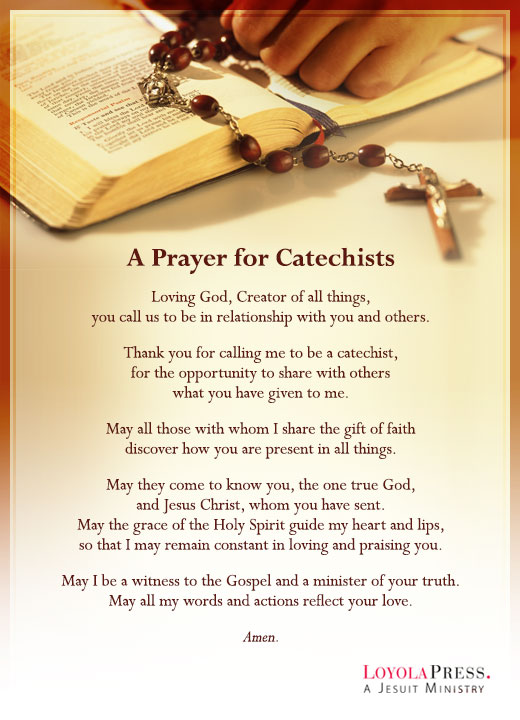
A Prayer for Catechists

Loving God, Creator of all things,

You call us to be in relationship with You and others.

Thank You for calling me to be a catechist,
for the opportunity to share with others
what You have given to me.

May all those with whom I share the gift of faith
discover how You are present in all things.

May they come to know You, the one true God,
and Jesus Christ, whom Uou have sent.
May the grace of the Holy Spirit guide my heart and lips,
so that I may remain constant in loving and praising You.

May I be a witness to the Gospel and a minister of Your truth.
May all my words and actions reflect Your love.

Amen

CatechistsPrayer_520

Posted in franciscan OFM, JESUIT SJ, MARIAN QUOTES, MORNING Prayers, The BLESSED VIRGIN MARY, The HOLY ROSARY/ROSARY CRUSADE, Uncategorized

Quote/s of the Day – 20 October – The Month of the Holy Rosary

Quote/s of the Day – 20 October – The Month of the Holy Rosary

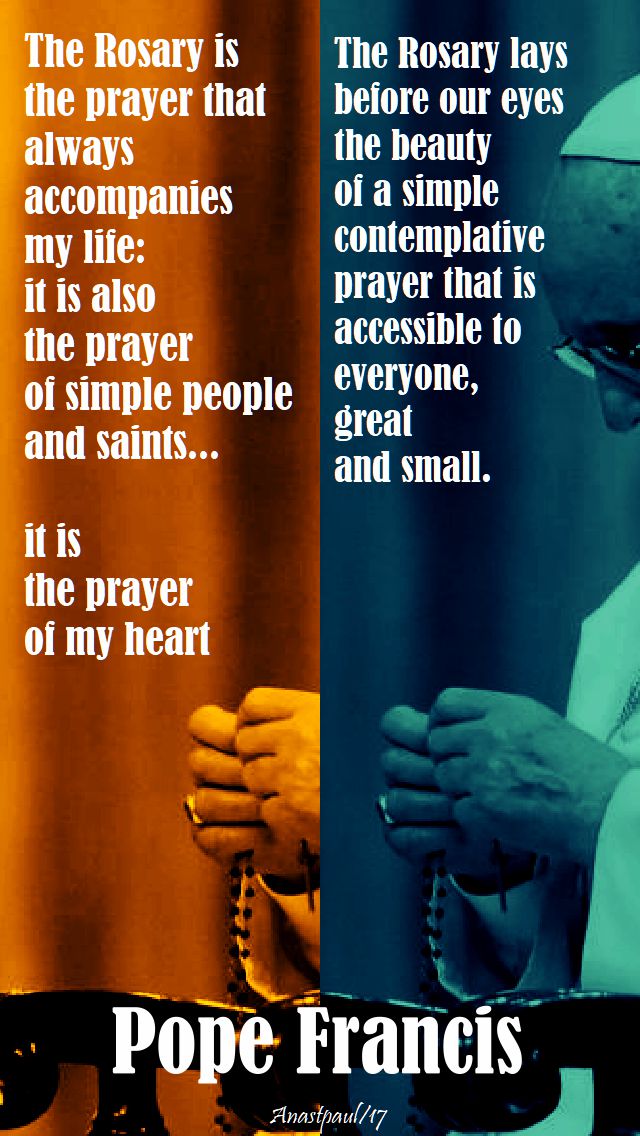
“The Rosary is the prayer
that always accompanies my life:
it is also the prayer
of simple people and saints…
it is the prayer of my heart”.

“The Rosary lays before our eyes the beauty
of a simple contemplative prayer
that is accessible to everyone, great and small.”

Pope Francispope francis on the rosary - quotes - 20 oct 2017

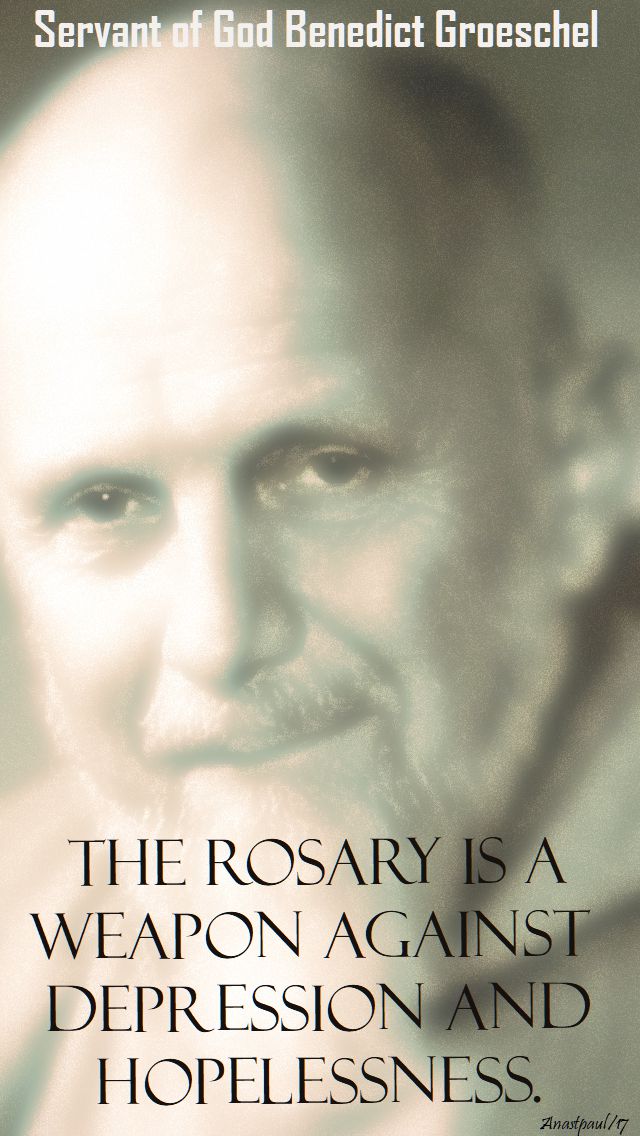
“The rosary is a weapon against
depression and hopelessness.”

Servant of God Benedict Groeschelthe rosary is - benedict groeschel

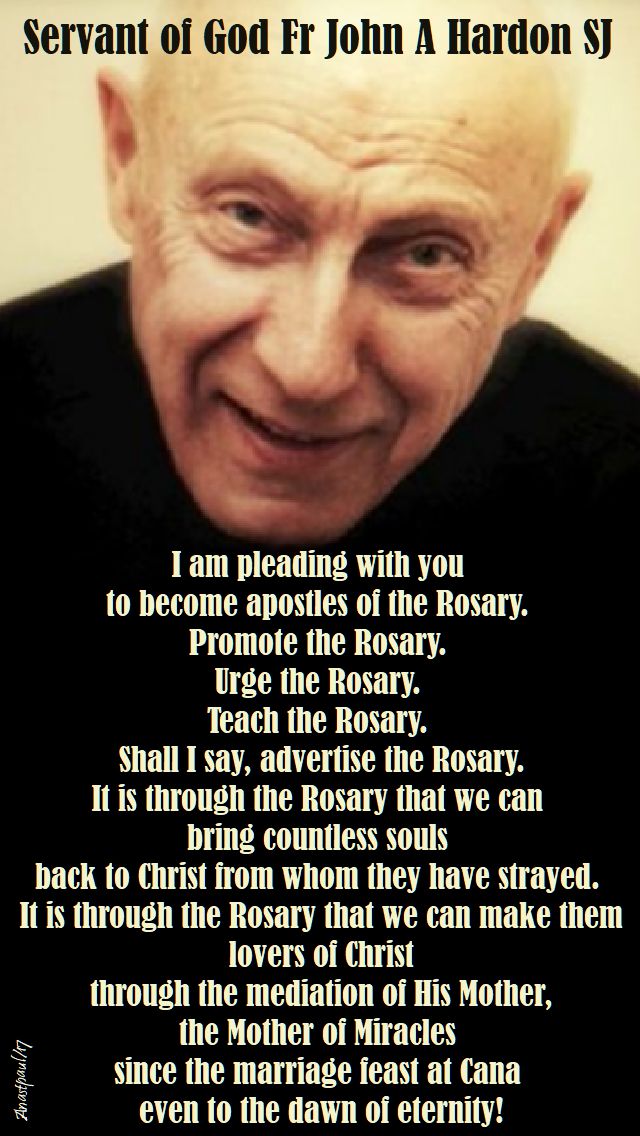
“I am pleading with you to become apostles of the Rosary.
Promote the Rosary.
Urge the Rosary.
Teach the Rosary.
Shall I say, advertise the Rosary.
It is through the Rosary that we can bring countless souls
back to Christ from whom they have strayed.
It is through the Rosary that we can make them
lovers of Christ through the mediation of His Mother,
the Mother of Miracles since the marriage feast at Cana
even to the dawn of eternity!”

Servant of God Fr John A Hardon SJ

(Father Hardon wrote and gave this conference before His Holiness, John Paul II, issued the Apostolic Letter Rosarium Virginis Mariae that added five more mysteries (the Luminous Mysteries) to the Rosary.)i am pleading with you - john a hardon - on the rosary - 20 oct 2017

Posted in MORNING Prayers, SAINT of the DAY, The WORD

One Minute Reflection – 20 October – The Memorial of Blesseds Okelo & Ir

One Minute Reflection – 20 October – The Memorial of Blesseds Okelo & Irwa

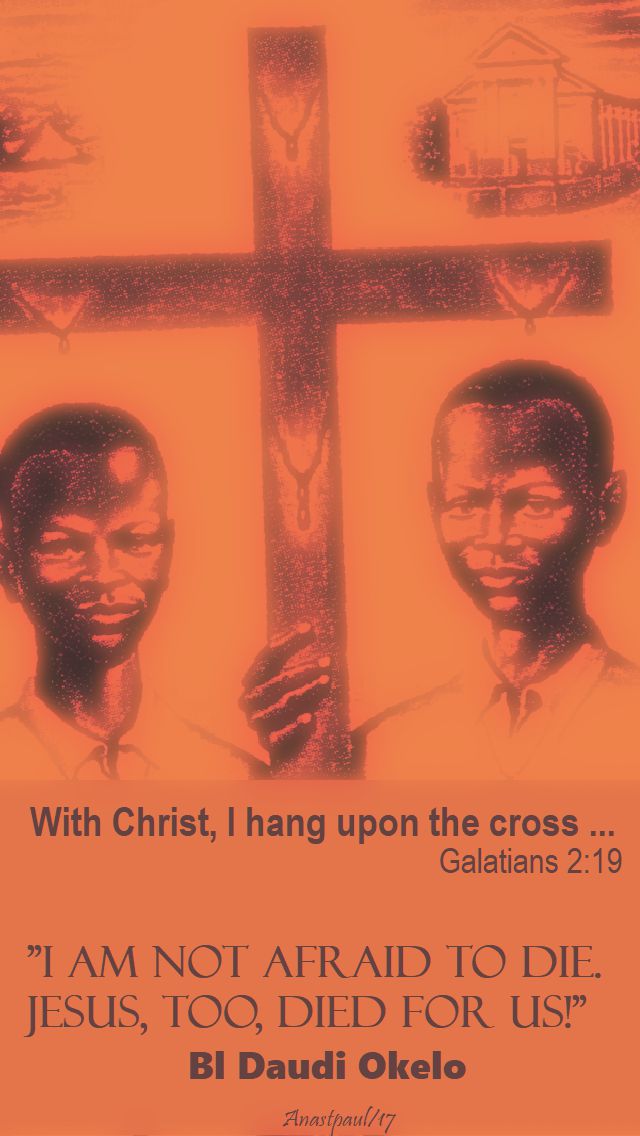
With Christ, I hang upon the cross ….Galatians 2:19

REFLECTION – “I am not afraid to die. Jesus, too, died for us!”….Blessed Daudi OkeloI am not afraid to die - bl daudi okelo - 20 oct 2017

PRAYER – God of power and mercy, You gave Blessed Okelo and Irwa, grace to overcome the sufferings of martyrdom, grant us, who celebrate their victory, that the power of Your protecting hand may keep us unshaken in the face of our ancient enemy and all his hidden snares. Blesseds Daudi and Jildo, pray for us!  Through He who died for us, our Lord Jesus Christ, in union with our Father and the Holy Spirit, one God for all eternity, amen.bls daudi and jildo pray for us - 20 oct 2017

Posted in MARIAN PRAYERS, MORNING Prayers, PRAYERS of the SAINTS, The BLESSED VIRGIN MARY

Our Morning Offering – 20 October

Our Morning Offering – 20 October

Mary, I love you
St Philip Neri (1515-1595)

Mary, I love you.
Mary, make me live in God,
with God,
and for God.
Draw me after you, holy mother.
O Mary, may your children
persevere in loving you.
Mary, Mother of God and mother of mercy,
pray for me and for the departed.
Mary, holy Mother of God,
be our helper.
In every difficulty and distress,
come to our aid, O Mary.
O Queen of Heaven,
lead us to eternal life with God.
Mother of God,
remember me,
and help me always to remember you.
O Mary, conceived without sin,
pray for us who have recourse to you.
Pray for us,
O holy Mother of God,
that we may be made worthy
of the promises of Christ.
Holy Mary, Mother of God,
pray to Jesus for me.
Amenmary i love you - st philip neri

Posted in SAINT of the DAY

Saint/s of the Day – 20 October – Blessed Daudi Okelo (1902 ca.-1918) and Jildo Irwa (1906 ca.-1918)

Saint/s of the Day – 20 October – Blessed Daudi Okelo (1902 ca.-1918) and Jildo Irwa (1906 ca.-1918) – Martyrs, Catechists.

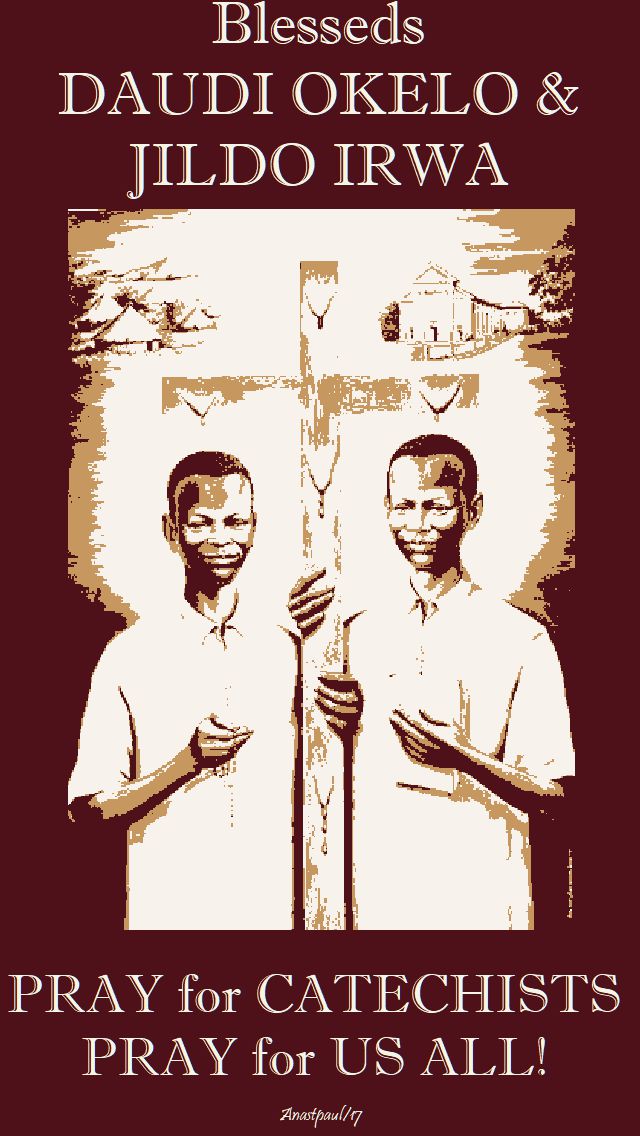
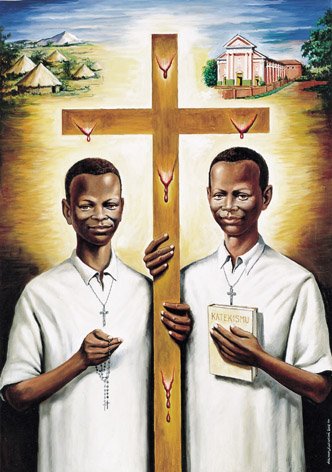
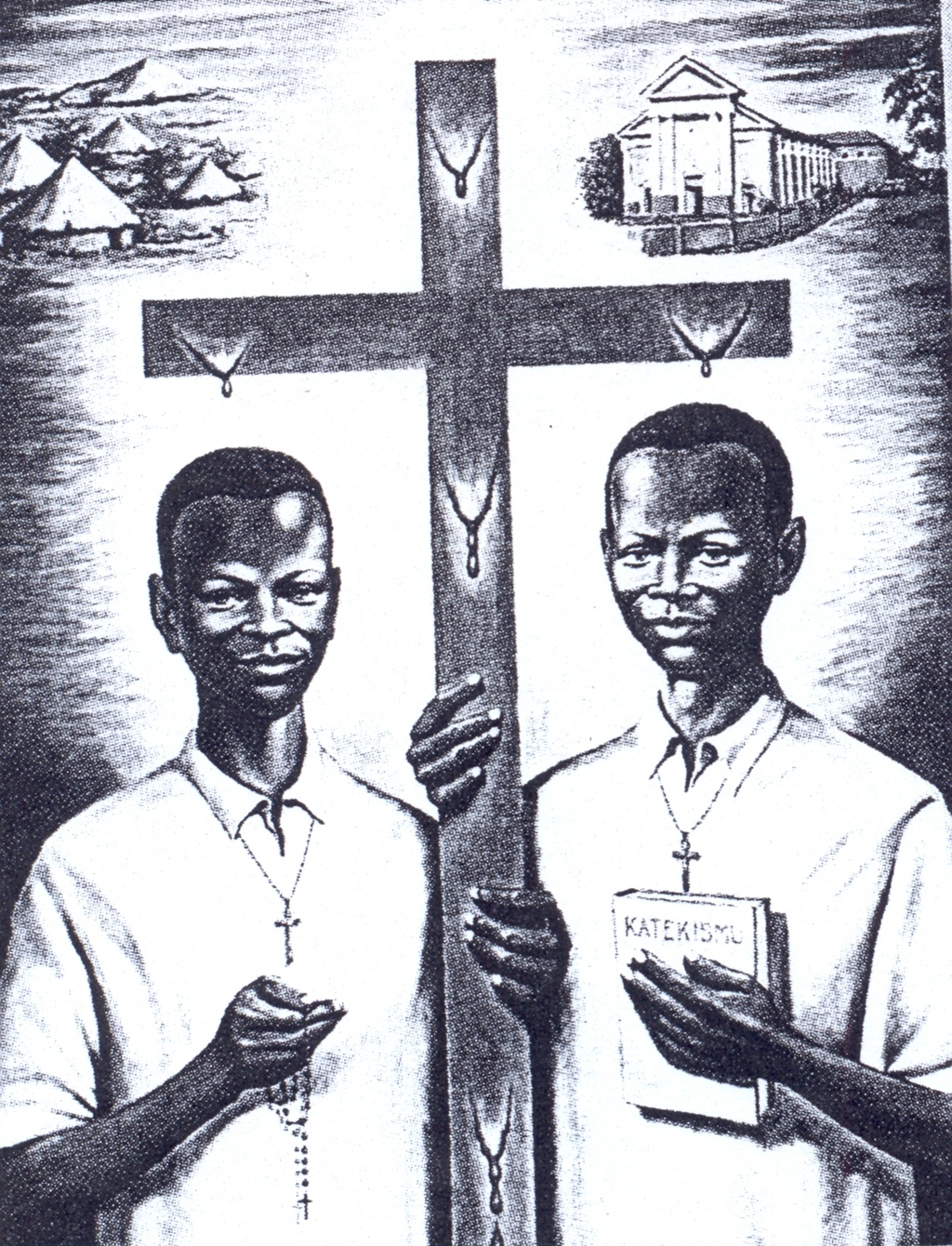
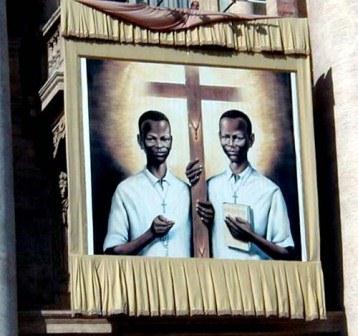
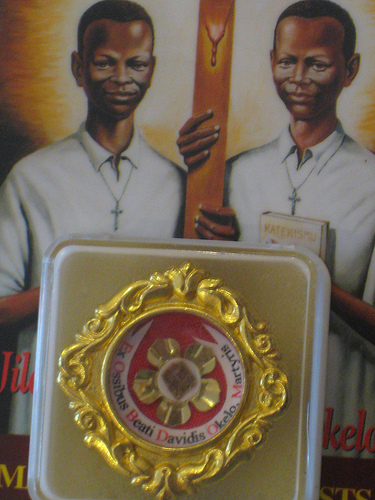
The martyrs Daudi Okelo and Jildo Irwa were two young catechists from Uganda at the beginning of the 20th century.   They belonged to the Acholi tribe, a subdivision of the large Lwo group whose members even today live mostly in the North of Uganda but they are also present in Southern Sudan, Kenya, Tanzania and Congo.   They lived and were martyred in the years immediately following the foundation of the mission of Kitgum by the Comboni Missionaries in 1915.

bl daudi okelo and Jildo Irwa.1

Daudi Okelo

Daudi Okelo was born around 1902 in Ogom-Payira, a village on the road Gulu-Kitgum. The son of pagan parents, Lodi and Amona, at 14-16 years of age he attended the instruction to receive baptism.   Baptised by Fr Cesare Gambaretto on 1 June 1916, Daudi received his first holy communion on the same day and was confirmed on 15 October 1916.   After completing his formation, Daudi accepted to be enrolled as a catechist.

At the beginning of 1917, Antonio, the catechist in charge of Paimol, died.   Daudi went to Fr Cesare, then superior at the mission of Kitgum, offering to take Antonio’s place. Daudi’s appointment came only towards the end of that year, during one of the catechists’ monthly meeting.   The young Jildo Irwa was to go with him as his assistant. Before setting off, the two of them went to Fr Cesare who informed them of the difficulties of their work, like the long travelling distance—the village was about 80 km from Kitgum—and, in particular, the frequent in-fights of the local people, instigated also by gangs of raiders and traders of slaves and gold, sporadically visiting the area.   To all this Daudi is alleged to have answered:  “I am not afraid to die. Jesus, too, died for us!”.

So around November-December 1917, with Fr Cesare’s blessing, Boniface, the head-catechist of Kitgum, accompanied Daudi and Jildo to Paimol.   Here Daudi immediately began his work by gathering children willing to take religious instruction.

At dawn he beat the drum to call his catechumens for morning prayers and, for Jildo and himself, also for the Rosary.   He taught them the prayers and the catechism’s questions and answers, repeated often in a sign-song like manner during the lesson, to facilitate the memorising.   It was a matter of teaching the first elements of faith, the so-called Lok-odiku (the words of the morning), namely the essential parts of the catechism.   To this activity Daudi added the visits to the nearby small villages from where the catechumens were coming, busy during the day in assisting their parents to look after the cattle or work in the fields.

At sunset, Daudi gave the signal for common prayer and the Rosary, always closing with a song to Our Lady.   On Sunday, he held a longer prayer service, often enlivened by the presence of catechumens and catechists of the area.

Daudi of Payira is described as young man of peaceful and shy character, diligent in his duties as a catechist and loved by all.   He never got involved in tribal or political disputes, fairly frequent at that time, as submission to the British government was often followed by ill-concealed intolerance.   In fact, due to an unhappy decision taken by the District Commissioner, there rose a serious tension.   Raiders, Muslim elements and witchdoctors took advantage of the violent situation to get rid of the new religion brought by Daudi.

During the weekend of 18-20 October 1918, long before dawn, five people headed for the hut where Daudi and Jildo were staying with the clear intention of killing them.   A village elder confronted the new comers telling them they were not allowed to kill the catechists, as they were his guests.   Daudi appeared at the door of his hut and entreated the elder not to get involved.   Then the intruders entered into Daudi’s hut and insisted with him that he gave up teaching catechism.   Realising that Daudi was not giving in to their threats, they dragged him outside, pushed him to the ground and pierced him with their spears.   He was about 16-18 years old.

His body was then left unburied until a few days later some people, tying a rope around the neck, dragged the body over a nearby empty termite hill.   The mortal remains, collected in February 1926, were later placed in the mission church of Kitgum, at the foot of the altar of the Sacred Heart.bl daudi okelo and Jildo Irwa.2

Jildo Irwa

Jildo Irwa was born around 1906 in the village of Bar-Kitoba, North-West of Kitgum, from pagan parents:   Ato, his mother, and Okeny, his father who later became a Christian.

He was baptised by Cesare Gambaretto on 6 June 1916, at the age of 10-12 years;  on the same day he received his first Holy Communion and was confirmed on 15 October 1916.

Father Cesare wrote about him “Jildo was much younger than Daudi. Of lively and gentle nature, like many Acholi youngsters, he was quite intelligent and occasionally acted as secretary to the vice-chief Ogal who had given hospitality in Paimol. He was of great help to Daudi in gathering the children for the instruction with his gentle way and infantile insistence.   He knew also how to entertain them with innocent village games and noisy and merry meetings. He had recently received baptism, whose grace he preserved in his heart and let it transpire by his charming behaviour”.

He had spontaneously and very willingly offered to go with Daudi to teach God’s word in Paimol.   Here he was loved by everyone because he was always available and exemplary in his duties as assistant-catechist.

On the morning of their martyrdom Jildo answered to Daudi who was warning him about a possible cruel death, “Why should we be afraid?   We have done nothing wrong to anyone; we are here only because Fr Cesare sent us to teach the word of God. Do not fear!”

He repeated the same words to those who were urging him to leave that place and his duty as assistant-catechist.   “We have done nothing wrong”, he was saying in tears “For the same reason you killed Daudi you must also kill me, because together we came here and together we have been teaching God’s word”.   Having said this, somebody grabbed him, pushed him outside the hut and, placing him at a distance of two steps, pierced him through with a spear.   Then one of them struck Jildo’s head with a knife.   He was about 12-14 years old.

bl daudi okelo and Jildo Irwa

The martyrdom of these two young catechists from Uganda is very meaningful for the current events the country is going through.   It is a matter, first of all, of two young lay catechists who together carried out and remained faithful to their assignment to spread the Gospel by words and deeds.   Furthermore, by courageously accepting to move to a place outside the influence of their own ethnic clan, they have become in their environment a sign of the catholicity and unity of the Church.   Finally, having lived during a period of tribal fights, colonial interests and still flourishing domestic slavery, they represent the integrity of a Gospel that always protects and safeguards personal dignity and promotes peace among peoples, ethnic groups and cultures.   For this, even today they are remembered in their land as Christ’s true “witnesses by blood”.bl daudi okelo and Jildo Irwa.3

Posted in SAINT of the DAY

Memorials of the Saints – 20 October

St Acca of Hexham
St Adelina
St Aderald
St Aidan of Mayo
St Andrew of Crete
St Artemius Megalomartyr
St Barsabias
St Bernard of Bagnorea
St Bradan
St Caprasius of Agen
Bl Daudi Okello & Jildo Irwa
Bl Gundisalvus of Silos
St Irene
St Leopardo of Osimo
St Lucas Alonso Gorda
St Maria Bertilla Boscardin
St Martha of Cologne
St Maximus of Aquila
St Orora
St Saula of Cologne
St Sindulphus of Rheims
St Usthazanes
St Vitalis of Salzburg