The Holy Guardian Angels (Memorial)
—
St Alfonso del Rio
St Andrea Ximenez
St Beregisius
St Eleutherius of Nicomedia
St Emilie de Villeneuve
Bl Georges-Edme René
St Gerinus
Bl Jan Beyzym
St Leodegarius of Autun
St Leudomer
St Maria Antonina Kratochwil
St Modesto of Sardinia
St Saturius of Soria
St Theophilus of Bulgaria
St Ursicinus II
—
Martyred in Antioch, Syria: Martyred in one of the early persecutions, date unknown.
St Cyril of Antioch
St Primus of Antioch
St Secundarius of Antioch
Martyred in Nagasaki, Japan: A husband, wife and two sons, who were all martyred together in the persecutions in Japan. They were beheaded on 2 October 1622 in Nagasaki, Japan and Beatified by Pope Pius IX on 7 May 1867.
• Blessed Andreas Yakichi
• Blessed Franciscus Yakichi
• Blessed Lucia Yakichi
• Blessed Ludovicus Yakichi
Martyred in the Spanish Civil War:
• Blessed Elías Carbonell Molla
• Blessed Enrique Sáiz-Aparicio
• Blesssed Felipe González de Heredia Barahona
• Blessed Francisco Carceller Galindo
• Blessed Isidoro Bover Oliver
• Blessed Juan Carbonell Molla
• Blessed Juan Iñiguez de Ciriano Abechuco
• Blessed Manuel Borrajo Míguez
• Blessed María Francisca Ricart Olmos
• Blessed Mateu Garrolera Masferrer
• Blessed Pedro Artolozaga Mellique
• Blessed Pedro Salcedo Puchades
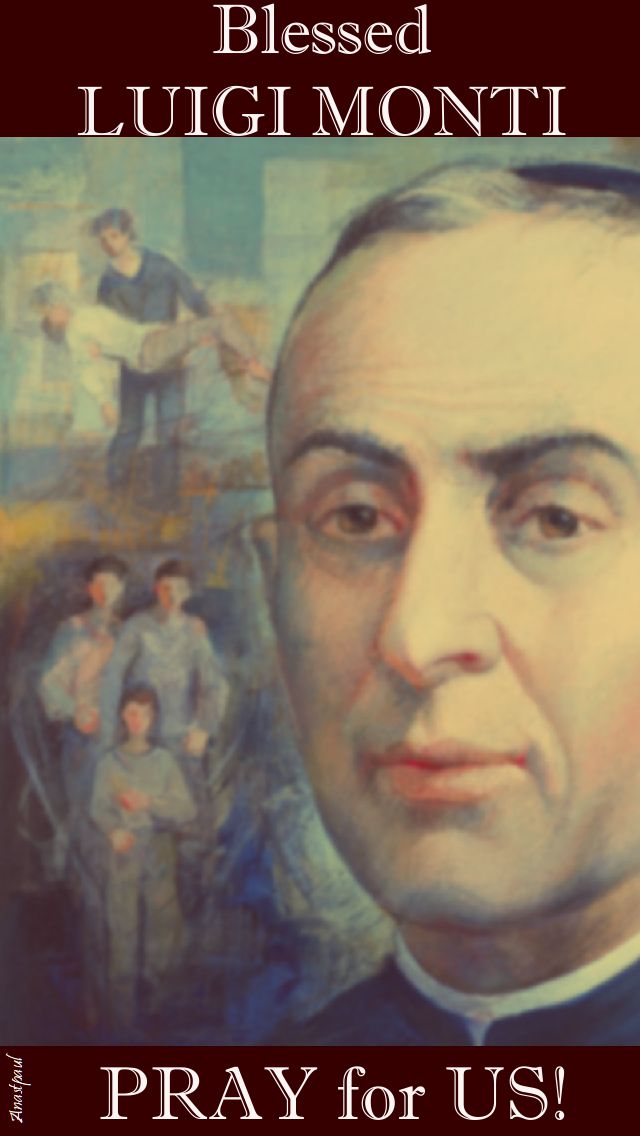
Thought for the Day – 1 October – The Memorial of Bl Luigi Maria Monti
“I saw water flowing out from beneath the threshold of the temple… everything will live where the water goes” (Ez 47: 1, 9).
The image of water, which brings everything back to life, illuminates well the life of Bl Luigi Maria Monti, entirely dedicated to healing the physical and spiritual wounds of the sick and the orphaned.
He loved to call them “Christ’s poor ones”and he served them, enlivened by a living faith and sustained by intense and continual prayer. In his evangelical commitment, he was constantly inspired by the example of the Holy Virgin and placed the Congregation he founded under the sign of Mary Immaculate.
How relevant is the message of this new Blessed!
For his spiritual sons and for all believers, he is an example of faithfulness to God’s call and to the proclamation of the Gospel of charity.
He is a model of solidarity towards the needy and of affectionate entrustment to the Immaculate Virgin.”
“What does love look like?
It has the hands to help others.
It has the feet to hasten to the poor and needy.
It has eyes to see misery and want.
It has the ears to hear the sighs and sorrows of men.
That is what love looks like. (St Augustine)
“Have charity – first for our own souls and then for our neighbour.
For as water quenches fire, charity quenches sin.” (St John of God)
And so we are called! “Mary, Mother of Christ and our Mother, is our strength and guide in this commitment. May the new Blessed Luigi Maria Monti, whom we contemplate today in the glory of Heaven, intercede for us. May it also be granted to us all that we one day find ourselves in Paradise, to experience together the joy of everlasting life. Amen!
(St John Paul at the Beatification of Bl Luigi Monti, Founder of the Sons of the Immaculate Conception, 9 November 2003)
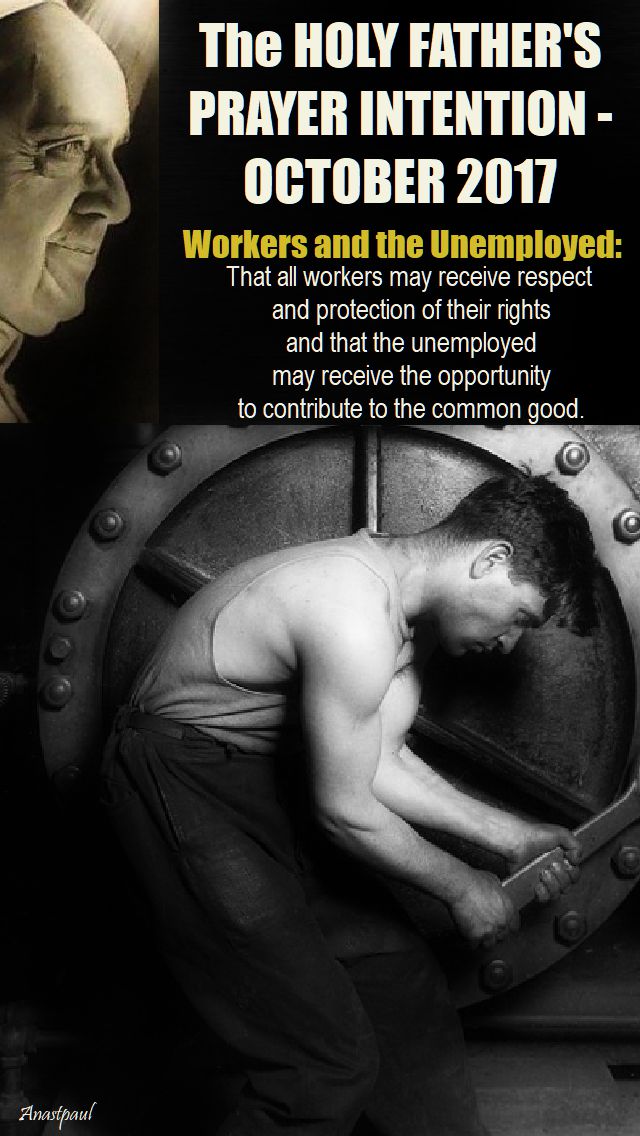
1 October – The Holy Father’s Prayer Intentions for October 2017
WORKERS and the UNEMPLOYED:
That all workers may receive respect and protection of their rights and that the unemployed may receive the opportunity to contribute to the common good.
The Feast of the Rosary is celebrated on 7 October and the month of October is traditionally the month of the rosary. Without having to say, this is the month to commit to praying the rosary more regularly and if you can, every day.
Why did our Mother Mary ask us to pray the rosary at many of her approved apparitions such as at Fatima? Why should we pray at all?
The rosary is a powerful prayer and weapon and can affect and benefit us significantly each time we pray it. The most important reason for strongly encouraging the practice of the Rosary according to Pope John Paul II is that it represents a most effective means of fostering among the faithful that commitment to the contemplation of the Christian mystery; the life of Jesus and Mary’s role in Salvation. Contemplation is a gaze of faith, fixed on Jesus.
The rosary is not only a vocal prayer but also a meditative prayer.
The Devotion:
Since the 16th century Catholic piety has assigned entire months to special devotions. Pope Leo XIII personally started the practice of devoting October to the Rosary devotion. In a letter of 1 September 1883, mindful of the Rosary’s power to strengthen faith and foster a life of virtue, he outlined the triumphs of the Rosary in past times and admonished the faithful to dedicate the month of October to the Blessed Virgin through the daily recitation of her Rosary in the presence of the Blessed Sacrament, in order to obtain through her intercession the grace that God would console and defend His Church in her sufferings.
Never mind if you’re a bit rusty, or if it’s been ages since you last prayed your rosary. It’s never too late to begin again and everyone deserves to experience the power of the rosary.
Pope Benedict XVI in an address at the Basilica of St Mary Major where he prayed the rosary with the faithful said:
Today, together we confirm that the Holy Rosary is not a pious practice banished to the past, like prayers of other times thought of with nostalgia. Instead, the Rosary is experiencing a new Springtime.
Without a doubt, this is one of the most eloquent signs of love that the young generation nourish for Jesus and his Mother, Mary.
In the current world, so dispersive, this prayer helps to put Christ at the centre, as the Virgin did, who meditated within all that was said about her Son and also what he did and said. When reciting the Rosary, the important and meaningful moments of salvation history are relived. The various steps of Christ’s mission are traced. With Mary the heart is oriented toward the mystery of Jesus. Christ is put at the centre of our life, of our time, of our city, through the contemplation and meditation of his holy mysteries of joy, light, sorrow and glory.
May Mary help us to welcome within ourselves the grace emanating from these mysteries, so that through us we can “water” society, beginning with our daily relationships and purifying them from so many negative forces, thus opening them to the newness of God.
The Rosary, when it is prayed in an authentic way, not mechanical and superficial but profoundly, it brings, in fact, peace and reconciliation. It contains within itself the healing power of the Most Holy Name of Jesus, invoked with faith and love at the centre of each “Hail Mary”.
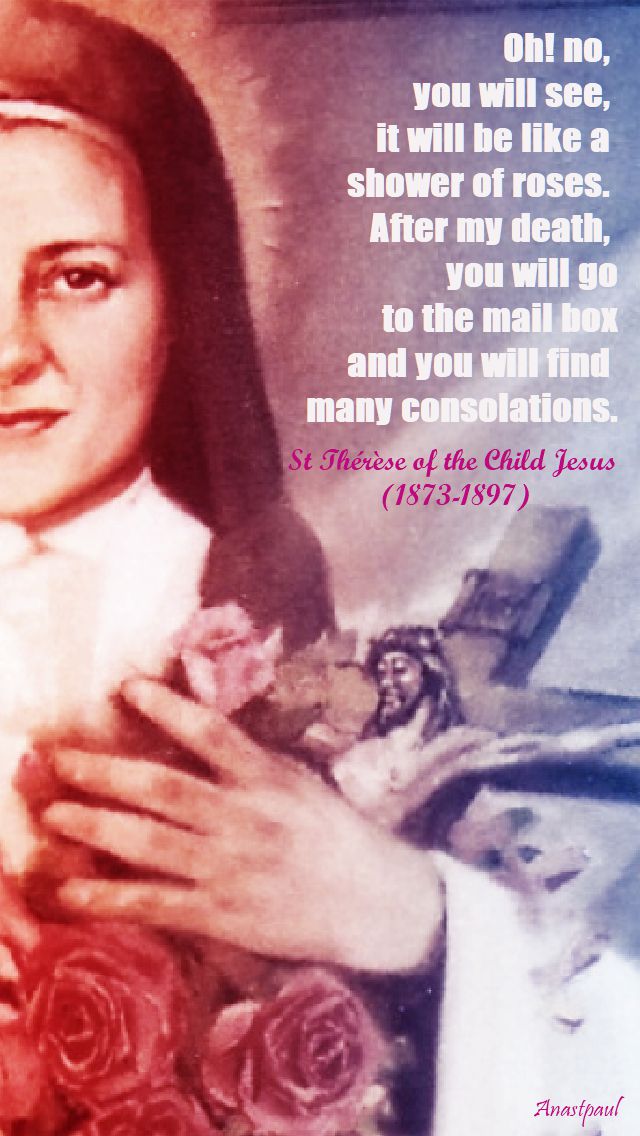
Quote/s of the Day – 1 October – The Memorial of St Thérèse of the Child Jesus (1873-1897) Doctor of the Church
“Jesus set the book of nature before me and I saw that all the flowers He has created are lovely. The splendour of the rose and the whiteness of the lily do not rob the little violet of its scent nor the daisy of its simple charm. I realised that, if every tiny flower wanted to be a rose, spring would lose its loveliness and there would be no wildflowers to make the meadows gay. It is just the same in the world of souls – which is the garden of Jesus. He has created the great saints, who are like the lilies and the roses but He has also created much lesser saints and they must be content to be the daisies or the violets which rejoice His eyes, whenever He glances down. Perfection consists in doing His will, in being that which He wants us to be. Jesus, help me to simplify my life by learning what you want me to be – and becoming that person.”
St Thérèse – (Story of a Soul)
“Oh! no, you will see, it will be like a shower of roses. After my death, you will go to the mail box and you will find many consolations.”
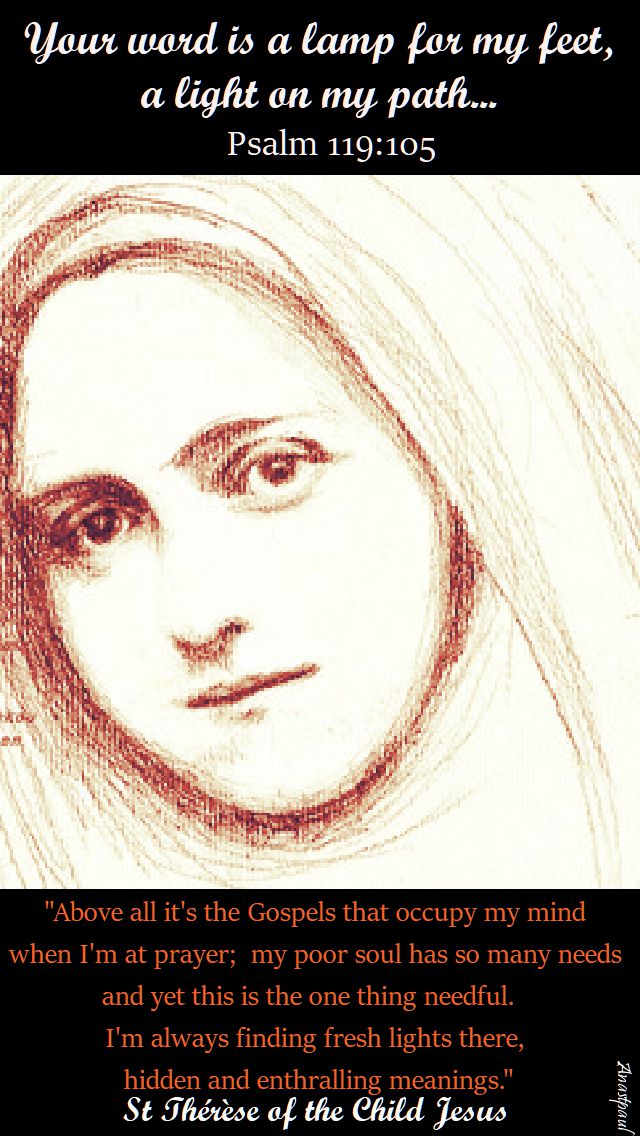
One Minute Reflection – 1 October – The Memorial of St Thérèse of the Child Jesus (1873-1897) Doctor of the Church
Your word is a lamp for my feet, a light on my path….Psalm 119:105
REFLECTION – “Above all it’s the Gospels that occupy my mind when I’m at prayer; my poor soul has so many needs and yet this is the one thing needful. I’m always finding fresh lights there, hidden and enthralling meanings.”…St Thérèse of the Child Jesus
PRAYER – Holy Father, assist me to live by the Word of the Word made Flesh. Teach me the ways of understanding each word that passed from His mouth and those inspired by Your Holy Spirit in all Your prophets and teachers. St Therese, in humility you grew in understanding by submitting yourself to each holy Word, please pray for us all, amen.
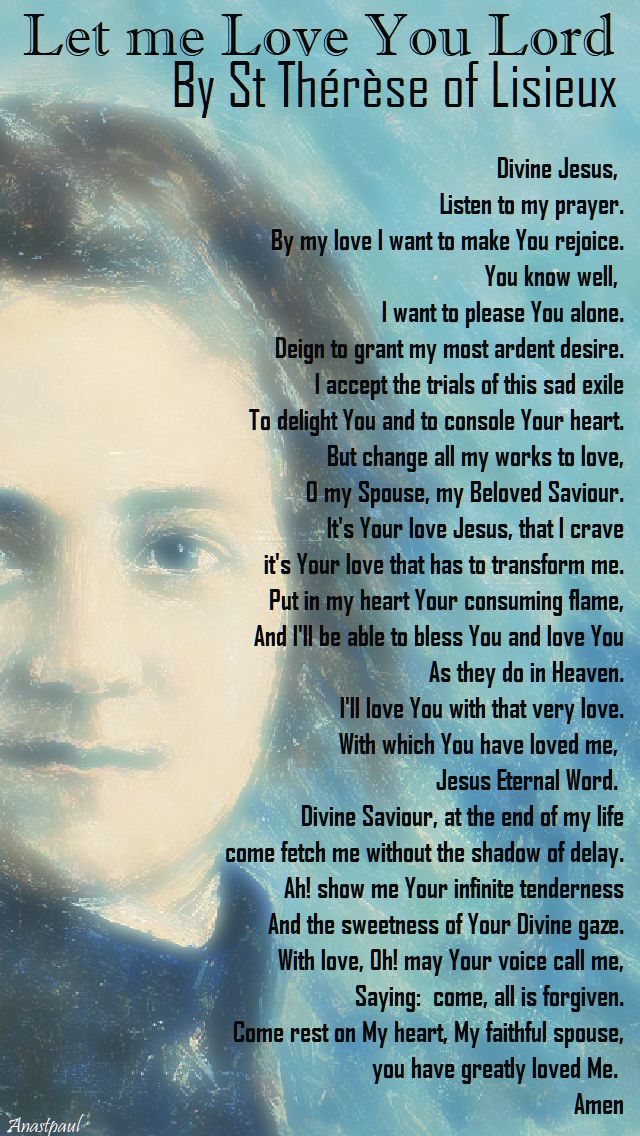
Our Morning Offering – 1 October – The Memorial of St Thérèse of Lisieux (1873-1897) Doctor of the Church
Let me Love You Lord By St Thérèse of Lisieux
Divine Jesus,
Listen to my prayer.
By my love I want to make You rejoice.
You know well,
I want to please You alone.
Deign to grant my most ardent desire.
I accept the trials of this sad exile
To delight You and to console Your heart.
But change all my works to love,
O my Spouse, my Beloved Saviour.
It’s Your love Jesus, that I crave
it’s Your love that has to transform me.
Put in my heart Your consuming flame,
And I’ll be able to bless You and love You
As they do in Heaven.
I’ll love You with that very love.
With which You have loved me,
Jesus Eternal Word.
Divine Saviour, at the end of my life
come fetch me without the shadow of delay.
Ah! show me Your infinite tenderness
And the sweetness of Your Divine gaze.
With love, Oh! may Your voice call me,
Saying: come, all is forgiven.
Come rest on My heart, My faithful spouse,
you have greatly loved Me.
Amen
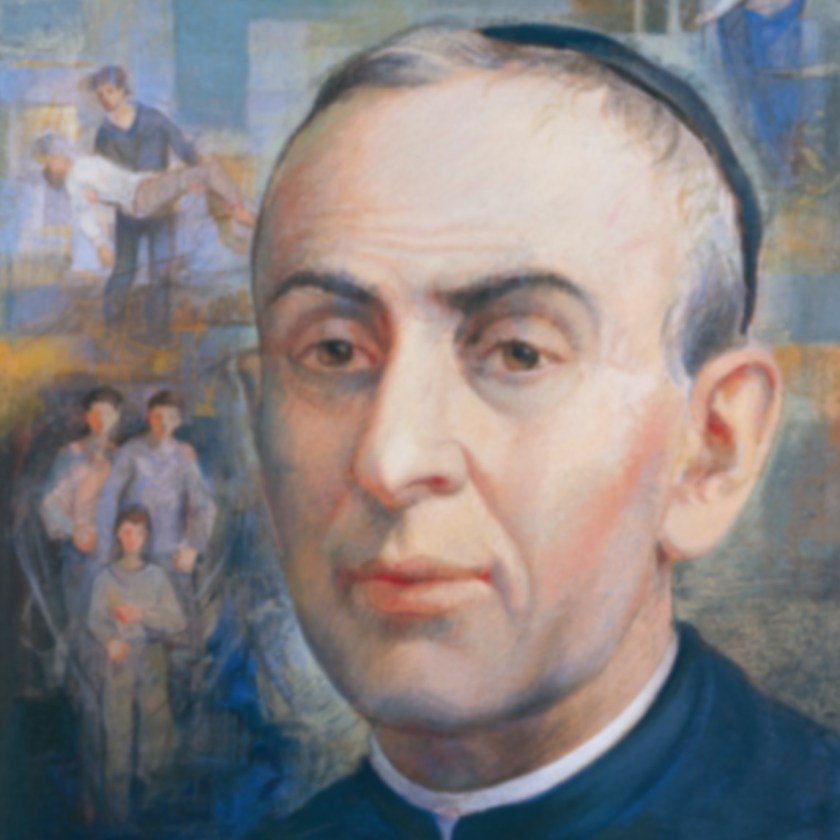
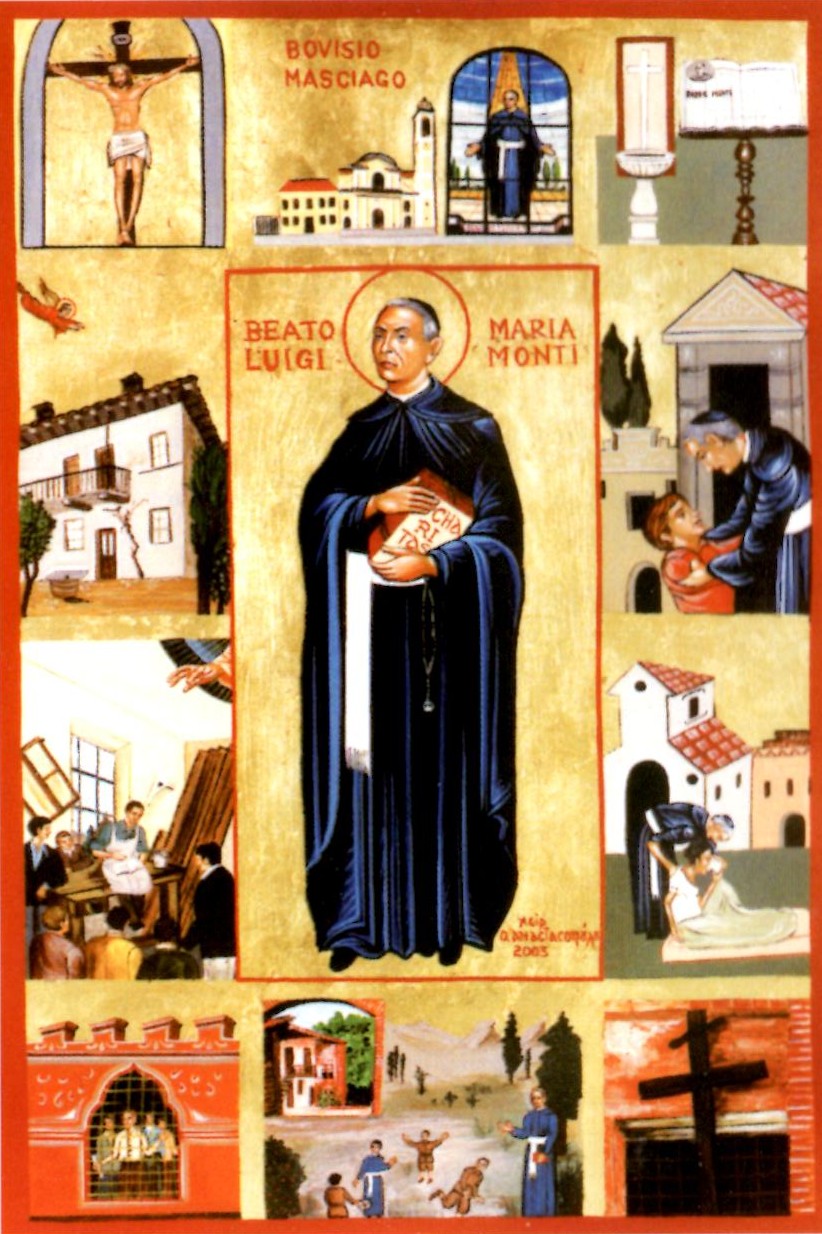
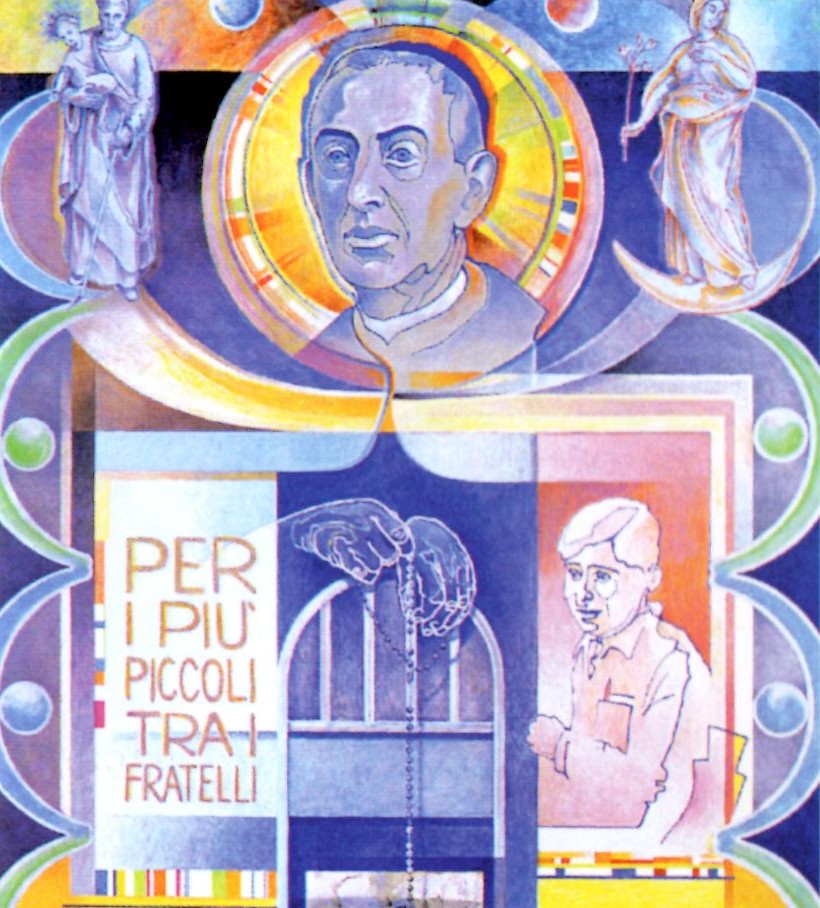
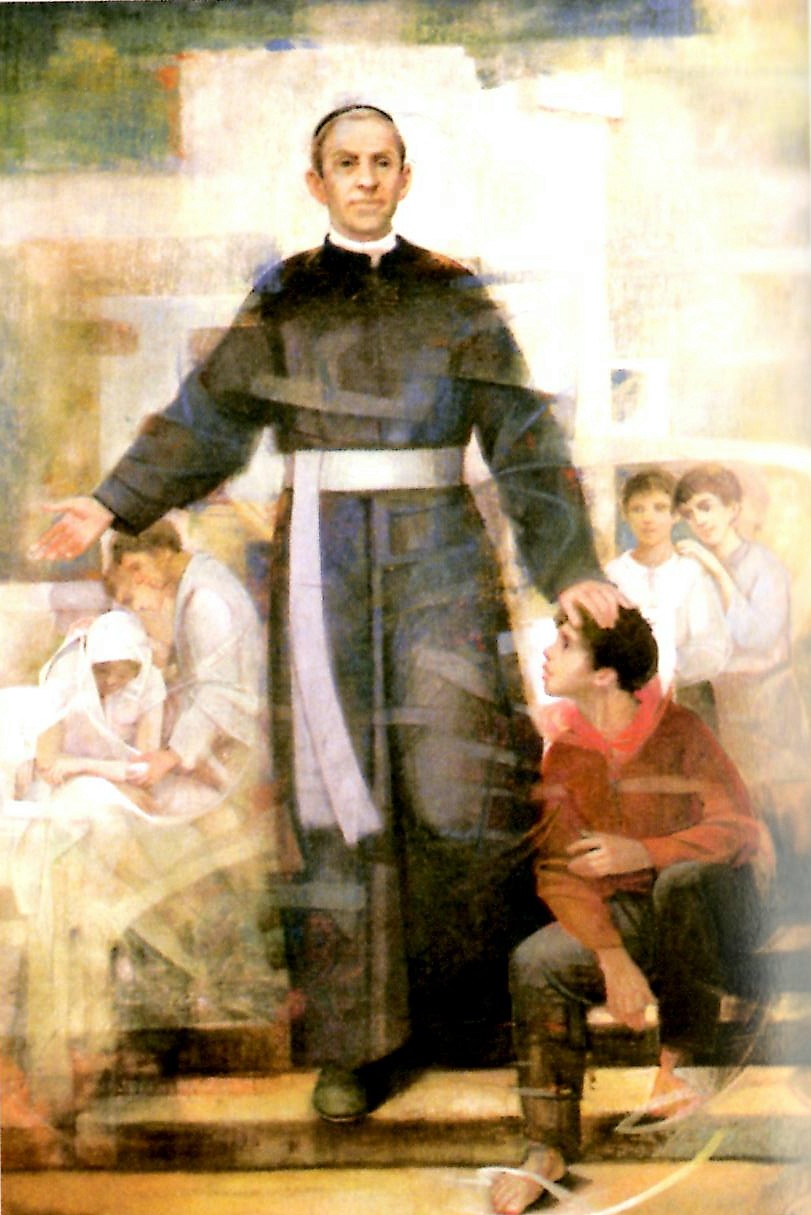
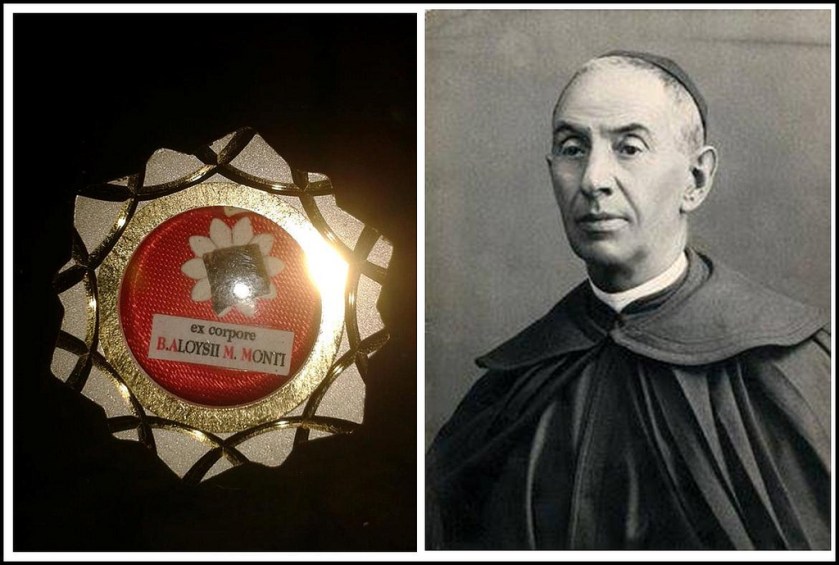
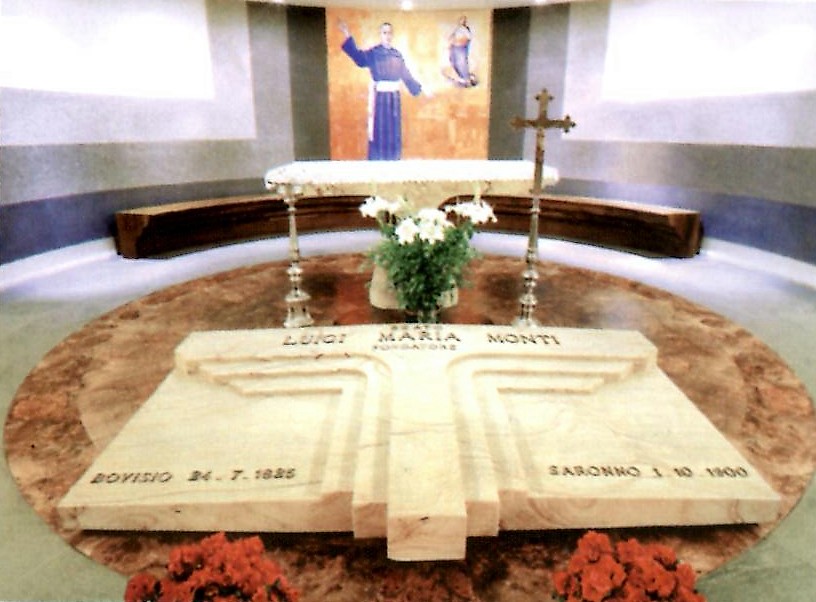
Saint of the Day – 1 October – Blessed Luigi Maria Monti (1825-1900) Religious and Founder of the Sons of the Immaculate Conception.
In order to thwart the agnosticism spreading like wildfire in the 19th century, the Holy Spirit brought forth exceptional men and women endowed with the charism of “assistance” and “receptivity” so the love of neighbour could convince skeptical and positivist man to believe in God-Love.
Numbered in these ranks of the faithful replete with the Holy Spirit was Luigi Monti, blessed of charity. He bore witness to love of neighbour under the hallmark of the Woman who did not know sin, the sign of liberation from all evil: the Immaculate Conception.
A lay religious called “father” out of veneration by his followers because of his readily evident spiritual fatherhood, Luigi Monti was born on 24 July 1825 at Bovisio in the diocese of Milan and was the eighth of 11 children. His father passed away when he was 12 and he became a craftsman of products in wood to help support his mother and younger siblings. Ever an ardent youth, in his shop he gathered together many artisans and farmers of his age in order to give life to an evening oratory. This group took the name of “The Company of the Sacred Heart of Jesus” but the people of Bovisio referred to it as “The Company of Friars”.
This group of young men stood out for its austerity of life, dedication to the sick and the poor and its zeal in evangelising those who had lapsed from the Church. Luigi, the leader of the group, consecrated himself to God in 1846, at the age of 21, by professing the vows of chastity and obedience into the hands of his spiritual director. He was a faithful layman consecrated in the Church of God with neither convent nor habit. Not everyone, however, was able to grasp what the Spirit had bestowed upon Luigi Monti. In fact, some people in the small town, together with the parish priest, mounted a campaign of servile yet evident opposition which led to slanderous charges of political conspiracy against the Austrian occupation authorities. In 1851 Luigi Monti and his companions were jailed in Desio (Milan) and released only 72 days later at the end of the formal investigation into the charges filed.
Docile to his spiritual director, Fr Luigi Dossi, Luigi Monti joined him in entering the Sons of Mary Immaculate, the congregation founded by Blessed Ludovico Pavoni only five years earlier. He remained in the congregation as a novice for six years. This was a period of transition for Luigi Monti but during it he fell in love with the constitutions written by Blessed Pavoni, gained experience as an educator and learned both the theory and practice of nursing care which he placed at the service of the community and those stricken by cholera during the epidemic of 1855 in Brescia, when he willingly accepted to be isolated in the local asylum with the sick. At the age of 32 Luigi Monti was still searching for the concrete realidation of his own consecration. In a letter dated 1896, four years prior to his death, he evoked the nightime of the spirit which he had lived at that time: “I would spend hours before Jesus in the Blessed Sacrameny but they were all hours without a drop of heavenly dew; my heart remained arid, cold, and unmoved. I was on the verge of abandoning everything, when, alone in my room, I heard a clear and distinct inner voice saying to me: “Luigi, go to the choir in church and present your tribulations once again to the Blessed Sacrament’. I heeded this inspiration and hastened to follow it. I knelt down and after a short time—what wonder!—I saw two personages in human form. I recognised them. It was Jesus with His Most Holy Mother, who approached me and in a loud voice said to me: “Luigi, much indeed will you still have to suffer; other varied and greater battles will you face. Be strong; you will emerge victorious from everything; never lacking to you will be our powerful help. Continue the way you began. Thus did they speak and then disappeared”.
Inspired by the witness of charity of Saint Crocifissa Di Rosa, Fr Luigi Dossi broached the idea that Luigi Monti give life to a “Congregation for the service of the sick in Rome.” Luigi embraced the idea and suggested calling it “The Congregation of the Sons of the Immaculate Conception”. The idea was shared by several of his friends dating back to the time of the ‘Company’ and by a young, ardent and experienced nurse by the name of Cipriano Pezzini.
A foundation in the Rome of Pius IX was no simple matte, and especially so in one of the most famous hospitals of Europe, the Santo Spirito Hospital. In the meantime, the Capuchin chaplains in the selfsame hospital were in the process of creating a sort of Third Order of St Francis for bodily assistance to patients.
When Luigi Monti arrived in Rome in 1858, the situation he found was quite different compared with the plans he had made with his friend Pezzini, who had gone before him to handle the necessary negotiations with the ‘Commendatore’, the hospital’s highest ranking authority.
He understood that for the time being God wanted him simply as ‘Fra Luigi from Milan’, a nurse at the Santo Spirito Hospital and he humbly asked to be admitted to the group organised by the Capuchin Fathers. He was initially assigned to those tasks nowadays reserved to practical nurse assistants and then to the responsibilities of a phlebotomist, as certified in the diploma he received from the La Sapienza University in Rome.
In 1877, following the unanimous wish of his confreres, Pius IX placed him at the head of ‘his’ Congregation and so he remained until his death twenty-three years later.
Pius IX harboured a special predilection for the Congregation of the Sons of the Immaculate Conception from its very origin, because of his intense yearning to see the patients in Roman hospitals well assisted and because it bore the name of the Immaculate Conception.
When he became Superior General, Luigi Monti prepared for the Congregation a rule of life reflecting the experiences he had lived under the impulse of the Holy Spirit. And, through his animation, the community of Santo Spirito Hospital lived the “apostolica vivendi forma” of the Sons of the Immaculate Conception. Nourished by the Eucharist and meditation upon the privilege of the “Lady All Pure”, the Brothers dedicated themselves with heroism to the care of the sick. At times of mass admissions due to epidemics of malaria or typhoid, or in the aftermath of armed conflicts, the Brothers did not hesitate to surrender their own beds for the comfort of the sick and infirm. They declared their readiness to assist all those afflicted by forms of malaria, no matter where they might be sent. Luigi Monti opened other small communities in the upper part of the Latium region, where he himself had worked earlier in sundry hospital roles, as well as a traveling nurse attending to needs in isolated farm houses scattered all over the countryside around Orte (Viterbo).
In 1882 a Carthusian monk came to see him at the Santo Spirito Hospital and said he had been inspired by Mary Immaculate to do so. This monk came from Desio and presented Luigi Monti with the pitiful case of his four nephews who had lost both their parents. This was a sign from the Spirit of God, and Luigi Monti expanded his mission of assistance to encompass completely orphaned children and opened a home for them in Saronno. His fundamental pedagogical principle was based on the fatherhood of an educator: the community of the religious receives the orphan just like a family in order to provide him with a human and Christian formation serving as the basis for all vocations in life: civic life, family life, life in the state of special consecration.
Luigi Monti, a consecrated layman, conceived the community of ordained and lay ‘Brothers’ in equality of rights and responsibilities, where elected as superior of the community was to be the Brother deemed best suited. He died in 1900 at the age of 75, completely worn out and practically blind. His project had yet to receive ecclesial approbation and only did so in 1904 from St. Pius X, who approved the new model of community foreseen by the Founder, granting the ministerial priesthood as an essential complement for carrying out an apostolic mission addressed to the whole of man in both assistance to the sick and save haven for youth in need.
In 1941 Blessed Ildefonso Schuster, Archbishop of Milan, initiated the diocesan phase of the cause of beatification which lasted until 1951.
In 2001 the Congregation for the Cause of the Saints promulgated the decree acknowledging the heroic nature of the virtues, and 2003 witnessed the decree which endorsed as miraculous the healing of Giovanni Luigi Iecle, a farmer from Bosa (Sardegna), in 1961.
Hard at work all over the world, the Congregation of the Sons of the Immaculate Conception continues to imbue works of charity with the charism of paternal openness and assistance practiced with such professionalism and utmost dedication by the Founder, Luigi Monti. (From the Vatican)
St Thérèse of Lisieux (Memorial)
—
St Aizan of Abyssinia
St Albaud of Toul
Bl Andrew Sushinda
Bl Antoni Rewera
St Aretas of Rome
St Bavo of Ghent
Bl Cecilia Eusepi
Bl Christopher Buxton
St Crescens of Tomi
St Dodo
Bl Dominic of Villanova
Bl Edward James
St Evagrius of Tomi
St Fidharleus
Bl Gaspar Fisogiro
St Gregory the Illuminator
St John Kukuzelis
Bl John Robinson
Bl Juan de Palafox Mendoza
St Julia of Lisbon
Bl Luigi Maria Monti
St Maxima of Lisbon
Bl Nikita Budka
St Piaton of Tournai
St Priscus of Tomi
Bl Ralph Crockett
Bl Robert Widmerpool
Bl Robert Wilcox
St Romanos the Melodist
St Sazan of Abyssinia
St Verissimus of Lisbon
St Virila
St Wasnulf
—
Martyred in the Spanish Civil War:
• Blessed Carmelo Juan Pérez Rodríguez
• Blessed Higinio Mata Díez
• Blessed Juan Mata Díez
• Blessed Álvaro Sanjuán Canet
• Blessed Florencia Caerols Martínez
Thought for the Day – 30 September The Memorial of St Jerome (347-419) Father and Doctor of the Church
This is a saint of explosive likes and dislikes, of tremendous zeal and passion.
As a young man, he made friendships which lasted a lifetime but his thunderous invectives against his enemies, against heretics and critics are just as famous. Thus, he is seen to be the most ‘human’ of saints but still (and this is of huge encouragement to us) one of the most powerful forces for good in the entire history of the Church.
He was, as someone has said, no admirer of moderation whether in virtue or against evil.
He was swift to anger but also swift to feel remorse, even more severe on his own shortcomings than on those of others.
The mortifications he inflicted on himself are legend – even a tiny bit of these would do us well in tempering our own sins.
I, personally, feel less worried about my leanings to explosive anger when I look at Jerome for he is an example to us of learning control, of fighting evil, of doing penance but also of growing in sanctity, of loving the Church and the Holy Scriptures and thus becoming master of tendencies to lose control!
Quote/s of the Day – 30 September
The Memorial of St Jerome (347-419) Father and Doctor
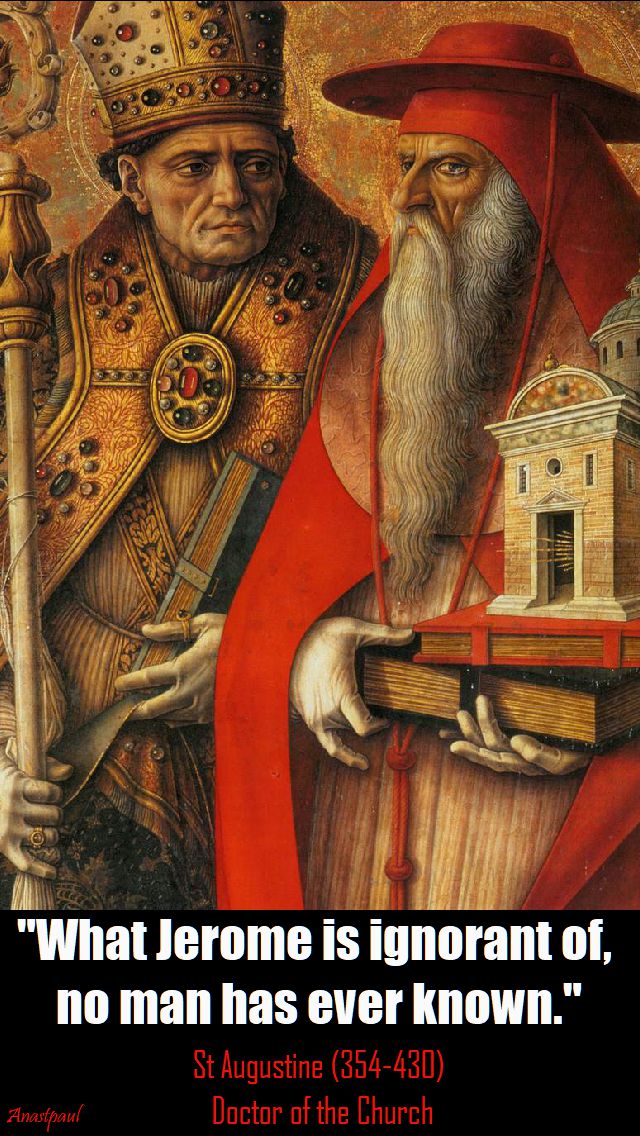
“What Jerome is ignorant of, no man has ever known.”
St Augustine of Hippo
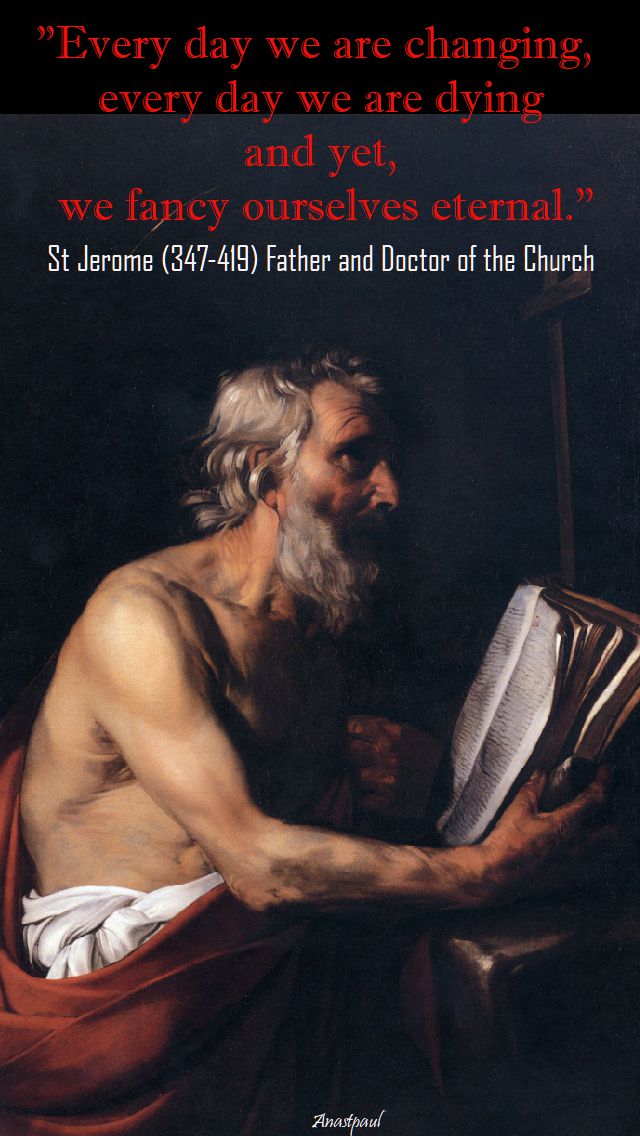
“Every day we are changing, every day we are dying and yet we fancy ourselves eternal.”
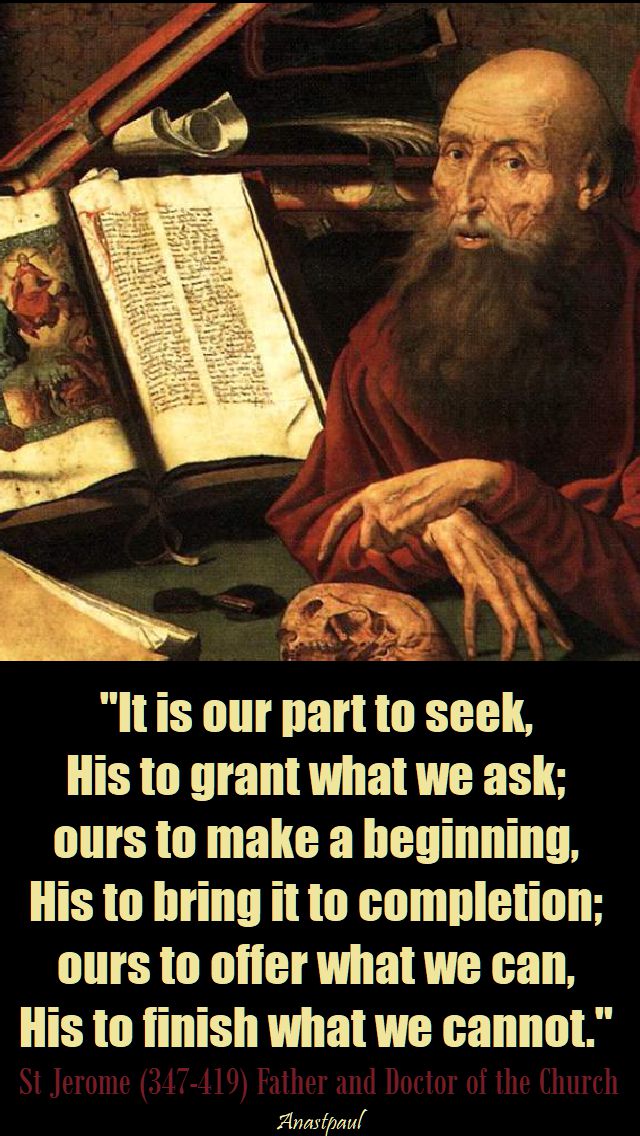
“It is our part to seek, His to grant what we ask; ours to make a beginning, His to bring it to completion; ours to offer what we can, His to finish what we cannot.”
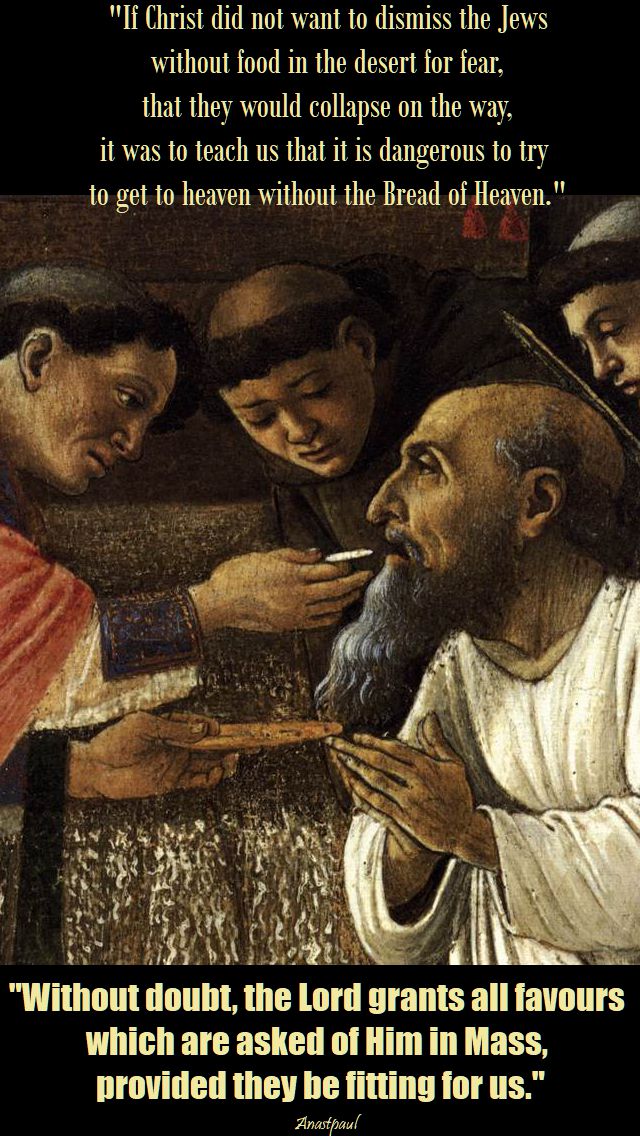
“If Christ did not want to dismiss the Jews without food in the desert for fear, that they would collapse on the way, it was to teach us that it is dangerous to try to get to heaven without the Bread of Heaven.”
“Without doubt, the Lord grants all favours which are asked of Him in Mass, provided they be fitting for us.”
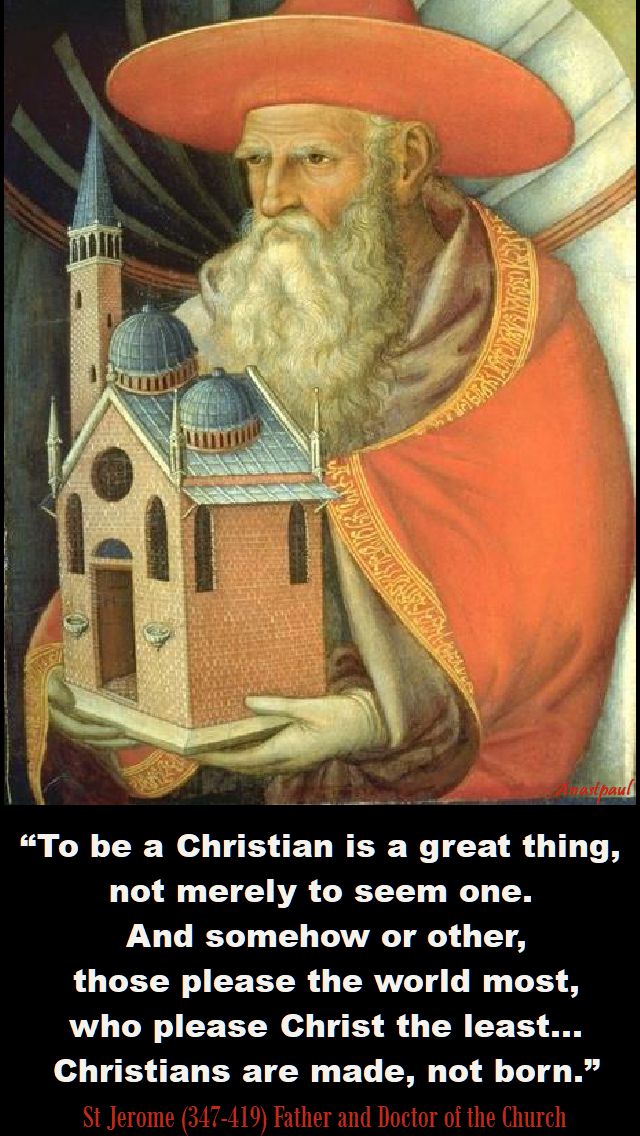
“To be a Christian is a great thing, not merely to seem one. And somehow or other, those please the world most, who please Christ the least… Christians are made, not born.”
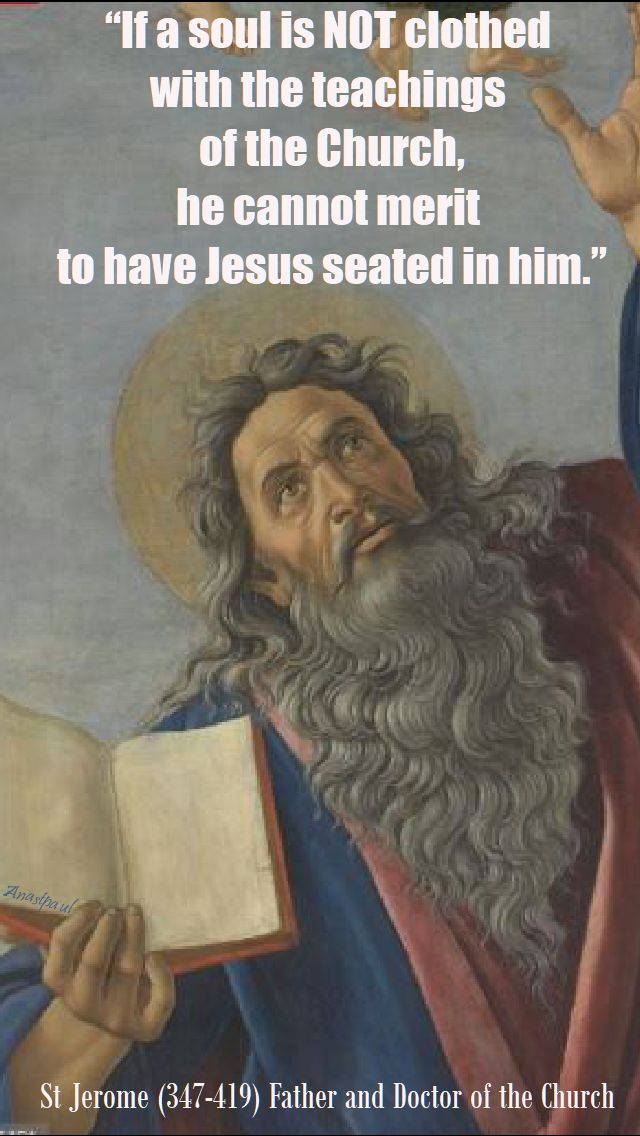
“If a soul is not clothed with the teachings of the Church. he cannot merit to have Jesus seated in him.”
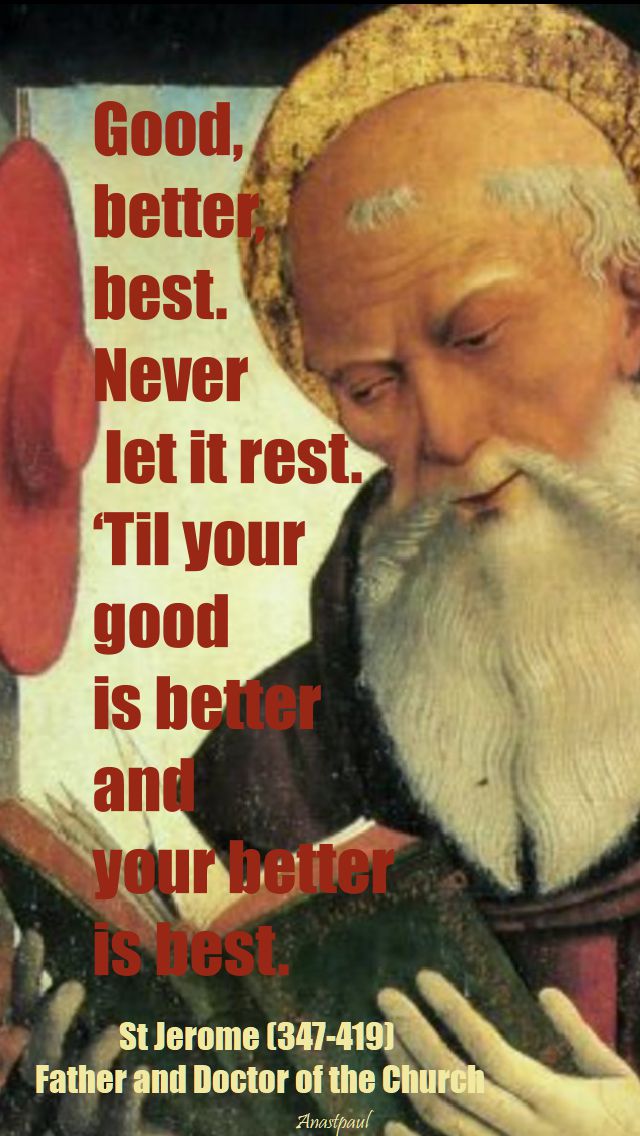
“Good, better, best. Never let it rest. ‘Til your good is better and your better is best.”
Our Morning Offering – 30 September – Memorial of St Jerome (347-419) Father and Doctor
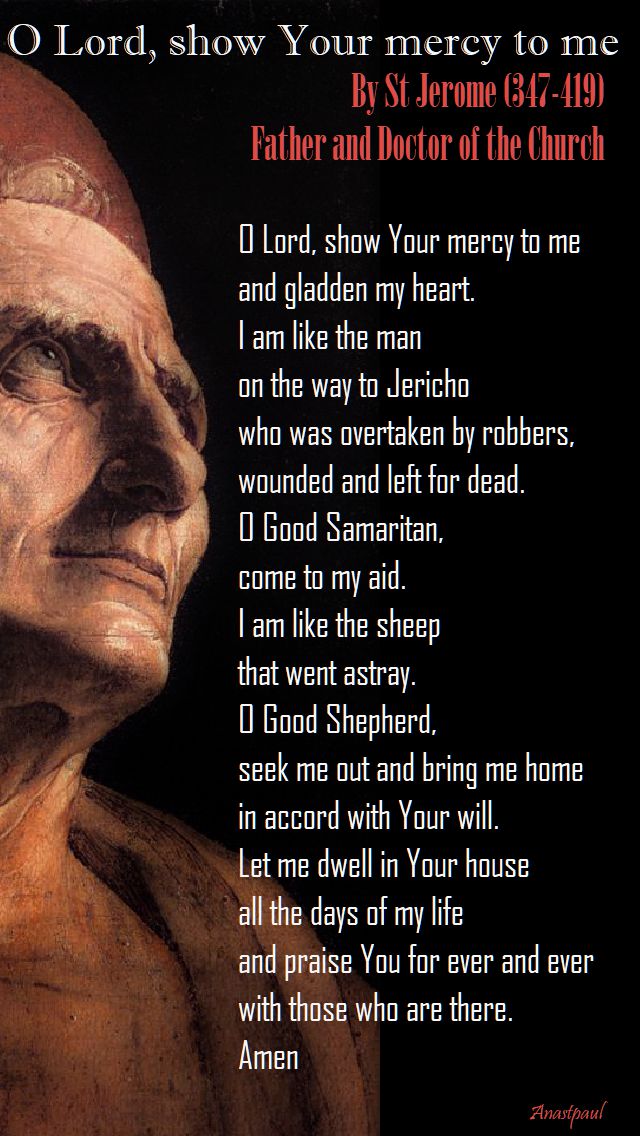
O Lord, show Your mercy to me By St Jerome
O Lord, show Your mercy to me
and gladden my heart.
I am like the man on the way to Jericho
who was overtaken by robbers,
wounded and left for dead.
O Good Samaritan,
come to my aid.
I am like the sheep that went astray.
O Good Shepherd,
seek me out and bring me home
in accord with Your will.
Let me dwell in Your house
all the days of my life
and praise You for ever and ever
with those who are there. Amen
One Minute Reflection – 30 September – The Memorial of St Jerome (347-419) Father and Doctor
In your fight against sin, you have not yet resisted to the point of shedding blood…..Hebrews 12:4
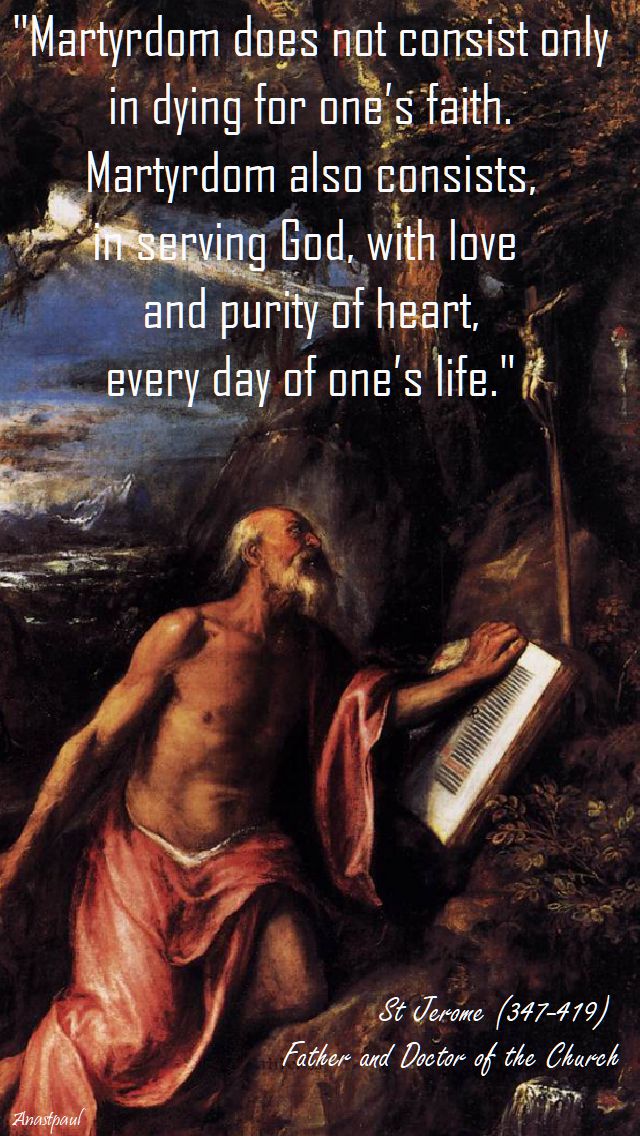
REFLECTION – “Martyrdom does not consist only in dying for one’s faith.
Martyrdom also consists, in serving God, with love and purity of heart,
every day of one’s life.”…St Jerome
PRAYER – Dear and Holy God, let me offer You all my daily struggles against sin and evil.
Grant me the strength to resist even to the shedding of blood, if it should be required of me.
Sustain me ever more with Your word and help me to find in it, the source of life.
St Jerome Pray for us. Amen
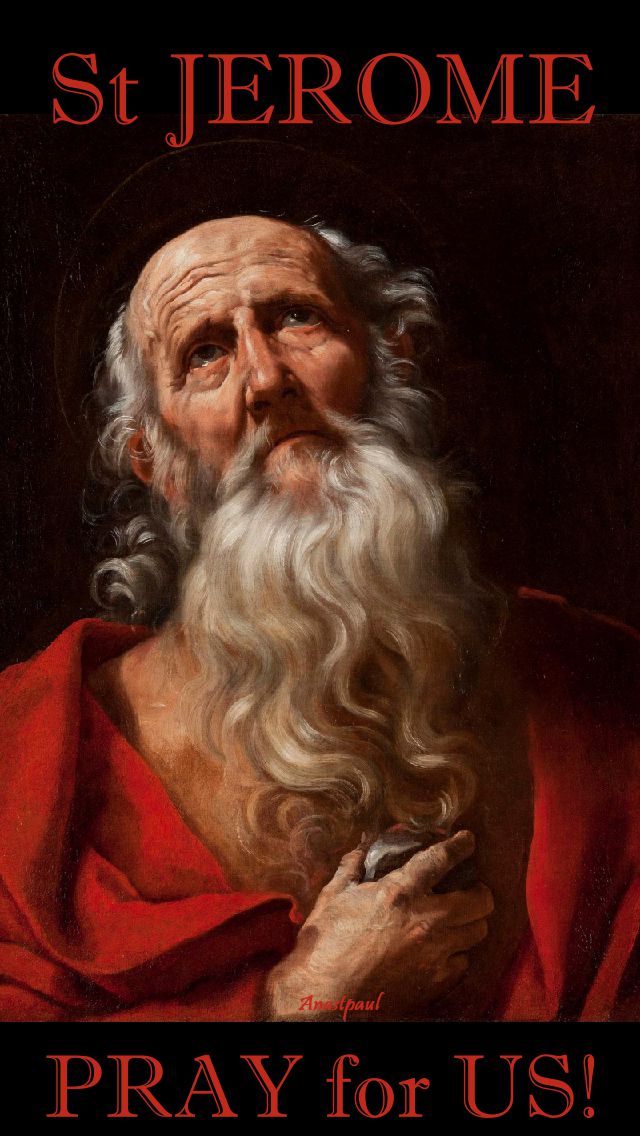
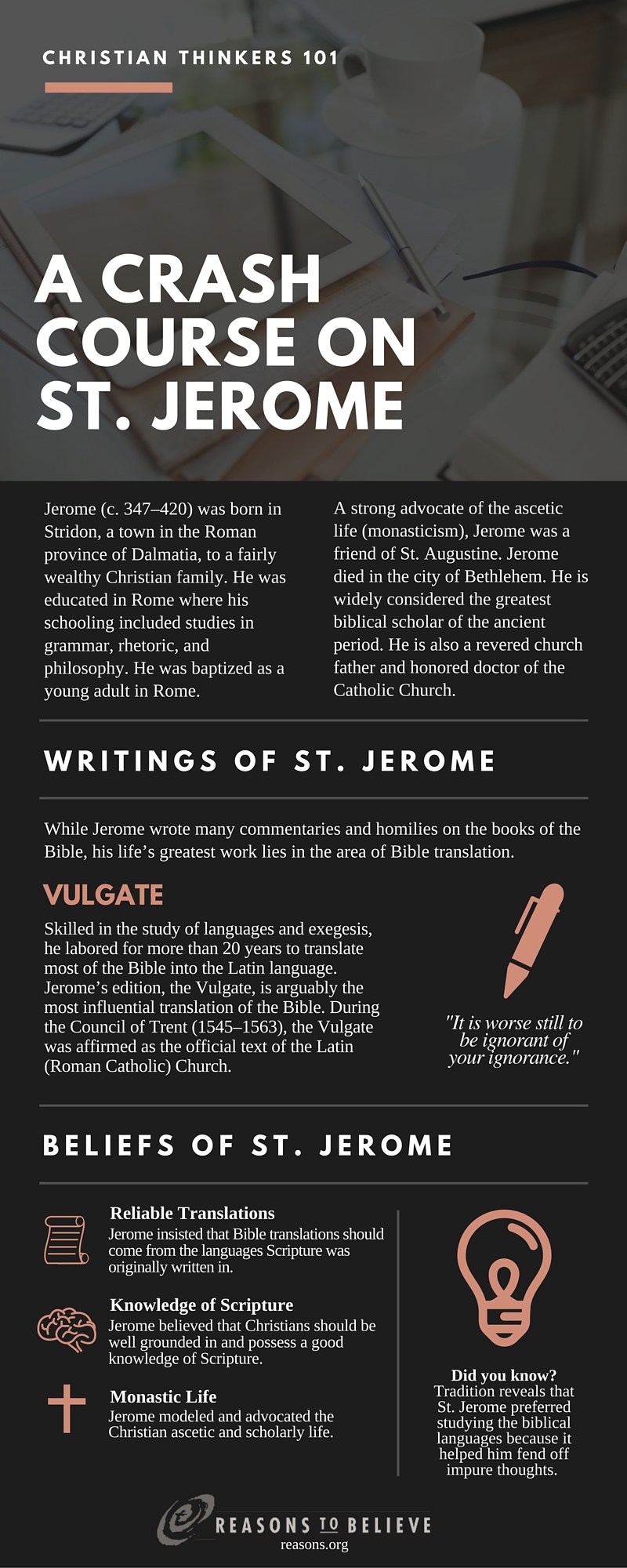
Saint of the Day – 30 September – St Jerome (347-419) Father and Doctor of the Church – Priest, Confessor, Theologian, Historian, Hermit, Mystic – born Eusebius Hieronymus Sophronius also known as Girolamo, Hieronymus, Jerom and the Man of the Bible – (347 at Strido, Dalmatia – 419 of natural causes). His body was interred in Bethlehem and his relics are now enshrined at the Basilica of Saint Mary Major in Rome, Italy. Patronages – Archeologist, archivists, Scripture scholars, librarians and libraries, schoolchildren; students, translators, Saint-Jérôme, Québec, City of, Saint-Jérôme, Québec, Diocese of, Taos Indian Pueblo. Attributes – • cardinal’s hat, often on the ground or behind him, indicating that he turned his back on the pomp of ecclesiastical life• lion, referring to the lion who befriended him after he pulled a thorn from the creature’s paw• man beating himself in the chest with a stone• aged monk in desert• aged monk with Bible• aged monk writing • old man with a lion• skull• hourglass.
St Jerome was a man of extremes. He lived to age 91 even though he undertook extreme penances. Jerome had a fierce temper but an equally intense love of Christ. This brilliant saint was born in Eastern Europe around 345. His Christian family sent him to Rome at age 12 for a good education. He studied there until he was 20. Then he and his friends lived in a small monastery for three years, until the group dissolved. Jerome set out for Palestine but when he reached Antioch, he fell seriously ill. He dreamed one night that he was taken before the judgment seat of God and condemned for being a heretic. This dream made a deep impression on him.
He is best known for his translation of the Bible into Latin mainly from the Hebrew (the translation that became known as the Vulgate) and his commentaries on the Gospels. His list of writings is extensive. Jerome was strong willed. His writings, especially those opposing what he considered heresy, were sometimes explosive. His temperament helped him do difficult tasks but it also made him enemies. Jerome was named a Doctor of the Church for the Vulgate, his commentaries on Scripture, his writings on monastic life and his belief that during a controversy on theological opinions, the See of Rome was where the matter should be settled.
In order to be able to do such work, Jerome prepared himself well. He was a master of Latin, Greek, Hebrew and Chaldaic. He began his studies at his birthplace, Stridon in Dalmatia. After his preliminary education, he went to Rome, the center of learning at that time and thence to Trier, Germany, where the scholar was very much in evidence. He spent several years in each place, always trying to find the very best teachers. He once served as private secretary to Pope Damasus.
Skilled in the study of languages and exegesis, he laboured for more than 20 years to translate most of the Bible into the Latin language. Jerome’s edition, the Vulgate, is arguably the most influential translation of the Bible. During the Council of Trent (1545–1563), the Vulgate was affirmed as the official text of the Church. He is still considered the Church’s greatest Doctor of Scriptures.
He conferred this praise upon St. Augustine: “As I have done, you applied all your energy to make the enemies of the Church your personal enemies.” This eulogy is consistent with the counsel of St. Augustine: “You must hate the evil, but love the one who errs.”
Regarding St. Jerome the Roman Breviary says: “He pummeled the heretics with his most harsh writings.”
St Jerome was orthodox in his theology and was a defender of historic Christianity. However, his greatest contributions to the faith came in terms of biblical studies and translation.
Jerome insisted that Bible translations should come from the languages Scripture was originally written in. For example, instead of relying on the popular Greek translation of the Hebrew Scriptures of the time (the Septuagint), Jerome utilized ancient Hebrew copies that he considered more reliable.
Jerome believed that Christians should be well grounded in and possess a good knowledge of Scripture. In his commentary on Isaiah, Jerome stated: “Ignorance of Scripture is ignorance of Christ.”
Jerome modeled and advocated the Christian ascetic and scholarly life. The life of a monk seems well suited for a Bible translator.
After these preparatory studies, he traveled extensively in Palestine, marking each spot of Christ’s life with an outpouring of devotion. Mystic that he was, he spent five years in the desert of Chalcis so that he might give himself up to prayer, penance and study. Finally, he settled in Bethlehem, where he lived in the cave believed to have been the birthplace of Christ. Jerome died in Bethlehem and the remains of his body now lie buried in the Basilica of St Mary Major in Rome.
“When the Latin Fathers are represented in a group, Saint Jerome is sometimes in a cardinal’s dress and hat,
although cardinals were not known until three centuries later than his time but as the other Fathers held exalted positions in the Church
and were represented in ecclesiastical costumes and as Saint Jerome held a dignified office in the court of Pope Dalmasius,
it seemed fitting to picture him as a cardinal.
The Venetian painters frequently represented him in a full scarlet robe, with a hood thrown over the head. When thus habited, his symbol was a church in his hand, emblematic of his importance to the universal Church.
Saint Jerome is also seen as a penitent, or again, with a book and pen, attended by a lion.
As a penitent, he is a wretched old man, scantily clothed, with a bald head and neglected beard, a most unattractive figure.
When he is represented as translating the Scriptures, he is in a cell or a cave, clothed in a sombre coloured robe and is writing, or gazing upward for inspiration. In a few instances, an angel is dictating to him. – from Saints in Art, by Clara Irskine Clement
St Jerome (Memorial) (347-419) Father and Doctor
—
St Amatus of Nusco
St Antoninus of Piacenza
St Castus of Piacenza
St Colman of Clontibret
Bl Conrad of Urach
St Desiderius of Piacenza
St Enghenedl of Anglesey
St Eusebia of Marseilles
Bl Frederick Albert
St Honoratus of Canterbury
St Ismidone of Die
Bl ean-Nicolas Cordier
St Laurus
St Leopardus the Slave
Bl Ludwik Gietyngier
St Midan of Anglesey
St Simon of Crépy
St Ursus the Theban
St Victor the Theban
—
Martyrs of Valsery Abbey: An unknown number of Premonstratensian monks at the Abbey of Notre-Dame de Valsery, Picardie, France who were martyred by Calvinists. They were martyred in 1567 at Valsery, Pircardy, France
Thought for the Day – 29 September – The Feast of Sts Michael, Gabriel and Raphael
We are celebrating the Feast of the three Archangels who are mentioned by name in Scripture: Michael, Gabriel and Raphael. But what is an Angel? Sacred Scripture and the Church’s tradition enable us to discern two aspects.
On the one hand, the Angel is a creature who stands before God, oriented to God with his whole being. All three names of the Archangels end with the word “El”, which means “God”. God is inscribed in their names, in their nature.
Their true nature is existing in His sight and for Him. In this very way the second aspect that characterizes Angels is also explained: they are God’s messengers. They bring God to men, they open heaven and thus open earth. Precisely because they are with God, they can also be very close to man.
Like an angel to others Indeed, God is closer to each one of us than we ourselves are. The Angels speak to man of what constitutes his true being, of what in his life is so often concealed and buried. They bring him back to himself, touching him on God’s behalf. In this sense, we human beings must also always return to being angels to one another – angels who turn people away from erroneous ways and direct them always, ever anew, to God. If the ancient Church called Bishops “Angels” of their Church, she meant precisely this: Bishops themselves must be men of God, they must live oriented to God. “Multum orat pro populo” – “Let them say many prayers for the people”, the Breviary of the Church says of holy Bishops. The Bishop must be a man of prayer, one who intercedes with God for human beings. The more he does so, the more he also understands the people who are entrusted to him and can become an angel for them – a messenger of God who helps them to find their true nature by themselves, and to live the idea that God has of them.
St Michael: making a space for God in the world
All this becomes even clearer if we now look at the figures of the three Archangels whose Feast the Church is celebrating today. First of all there is Michael. We find him in Sacred Scripture above all in the Book of Daniel, in the Letter of the Apostle St Jude Thaddeus and in the Book of Revelation.
Two of this Archangel’s roles become obvious in these texts. He defends the cause of God’s oneness against the presumption of the dragon, the “ancient serpent”, as John calls it. The serpent’s continuous effort is to make men believe that God must disappear so that they themselves may become important; that God impedes our freedom and, therefore, that we must rid ourselves of him.
However, the dragon does not only accuse God. The Book of Revelation also calls it “the accuser of our brethren…, who accuses them day and night before our God” (12: 10). Those who cast God aside do not make man great but divest him of his dignity. Man then becomes a failed product of evolution. Those who accuse God also accuse man. Faith in God defends man in all his frailty and short-comings: God’s brightness shines on every individual. It is the duty of the Bishop and of every christian, as a man of God, to make room in the world for God, to counter the denials of Him and thus to defend man’s greatness. And what more could one say and think about man than the fact that God Himself was made man? Michael’s other role, according to Scripture, is that of protector of the People of God (cf. Dn 10: 21; 12: 1).
Dear friends, be true “guardian angels” of the Church which will be entrusted to you! Help the People of God whom you must lead in its pilgrimage to find the joy of faith and to learn to discern the spirits: to accept good and reject evil, to remain and increasingly to become, by virtue of the hope of faith, people who love in communion with God-Love.
St Gabriel: God who calls
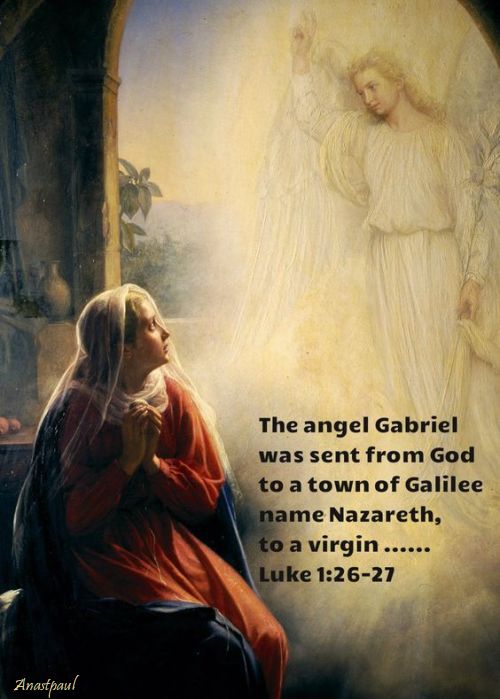
We meet the Archangel Gabriel especially in the precious account of the annunciation to Mary of the Incarnation of God, as Luke tells it to us (1: 26-38). Gabriel is the messenger of God’s Incarnation. He knocks at Mary’s door and, through him, God himself asks Mary for her “yes” to the proposal to become the Mother of the Redeemer, of giving her human flesh to the eternal Word of God, to the Son of God. The Lord knocks again and again at the door of the human heart. In the Book of Revelation He says to the “angel” of the Church of Laodicea and, through him, to the people of all times: “Behold, I stand at the door and knock; if any one hears my voice and opens the door, I will come in to him and eat with him, and he with me” (3: 20). The Lord is at the door – at the door of the world and at the door of every individual heart. He knocks to be let in, the Incarnation of God, His taking flesh, must continue until the end of time. All must be reunited in Christ in one body – the great hymns on Christ in the Letters to the Ephesians and to the Colossians tell us this. Christ knocks. Today too He needs people who, so to speak, make their own flesh available to Him, give Him the matter of the world and of their lives, thus serving the unification between God and the world, until the reconciliation of the universe. Dear friends, it is your task to knock at people’s hearts in Christ’s Name. By entering into union with Christ yourselves, you will also be able to assume Gabriel’s role: to bring Christ’s call to men.
St Raphael: recovering sight
St Raphael is presented to us, above all in the Book of Tobit, as the Angel to whom is entrusted the task of healing. When Jesus sends His disciples out on a mission, the task of proclaiming the Gospel is always linked with that of healing. The Good Samaritan, in accepting and healing the injured person lying by the wayside, becomes without words a witness of God’s love. We are all this injured man, in need of being healed. Proclaiming the Gospel itself already means healing in itself, because man is in need of truth and love above all things.
The Book of Tobit refers to two of the Archangel Raphael’s emblematic tasks of healing. He heals the disturbed communion between a man and a woman. He heals their love. He drives out the demons who over and over again exhaust and destroy their love. He purifies the atmosphere between the two and gives them the ability to accept each other for ever. In Tobit’s account, this healing is recounted with legendary images.
In the New Testament, the order of marriage established in creation and threatened in many ways by sin, is healed through Christ’s acceptance of it in His redeeming love. He makes marriage a sacrament: His love, put on a cross for us, is the healing power which in all forms of chaos offers the capacity for reconciliation, purifies the atmosphere and mends the wounds. The priest is entrusted with the task of leading men and women ever anew to the reconciling power of Christ’s love. He must be the healing “angel” who helps them to anchor their love to the sacrament and to live it with an ever renewed commitment based upon it.
Secondly, the Book of Tobit speaks of the healing of sightless eyes. We all know how threatened we are today by blindness to God. How great is the danger that with all we know of material things and can do with them, we become blind to God’s light. Healing this blindness through the message of faith and the witness of love is Raphael’s service, entrusted day after day to the priest and in a special way to the Bishop. Thus, we are prompted spontaneously also to think of the Sacrament of Reconciliation, the Sacrament of Penance which in the deepest sense of the word is a sacrament of healing. The real wound in the soul, in fact, the reason for all our other injuries, is sin. And only if forgiveness exists, by virtue of God’s power, by virtue of Christ’s love, can we be healed, can we be redeemed.
“Abide in my love”, the Lord says to us today in the Gospel (Jn 15: 9). At the moment of your Episcopal Ordination he says so particularly to you, dear friends. Abide in His love! Abide in that friendship with Him, full of love, which He is giving you anew at this moment! Then your lives will bear fruit, fruit that abides (cf. Jn 15: 16). Let us all pray for you at this time, dear Brothers, so that this may be granted to you. Amen.
Benedict XVI, fragments of a homily (to Bishops) given on September 29, 2007
Quote of the Day – 29 September – – The Feast of Sts Michael, Gabriel and Raphael
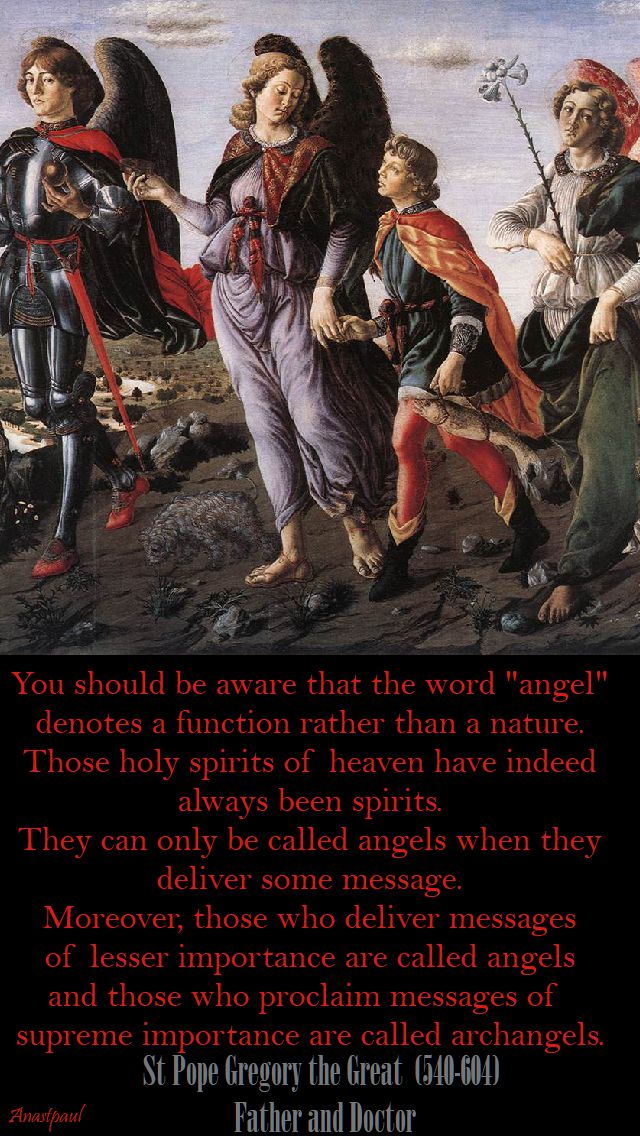
St Gregory the Great teaches us about the Archangels and why they are distinct from angels.
You should be aware that the word “angel” denotes a function rather than a nature.
Those holy spirits of heaven have indeed always been spirits.
They can only be called angels when they deliver some message.
ANGELS & ARCHANGELS
Moreover, those who deliver messages of lesser importance are called angels; and those who proclaim messages of supreme importance are called archangels. And so it was that not merely an angel but the archangel Gabriel was sent to the Virgin Mary. It was only fitting that the highest angel should come to announce the greatest of all messages.
Some angels are given proper names to denote the service they are empowered to perform. In that holy city, where perfect knowledge flows from the vision of almighty God, those who have no names may easily be known. But personal names are assigned to some, not because they could not be known without them but rather to denote their ministry when they came among us. Thus, Michael means “Who is like God” Gabriel is “The Strength of God” and Raphael is “God’s Remedy.”
ST MICHAEL
Whenever some act of wondrous power must be performed, Michael is sent, so that his action and his name may make it clear that no one can do what God does by his superior power. So also our ancient foe desired in his pride to be like God, saying: I will ascend into heaven; I will exalt my throne above the stars of heaven; I will be like the Most High. He will be allowed to remain in power until the end of the world when he will be destroyed in the final punishment. Then, he will fight with the archangel Michael, as we are told by John: A battle was fought with Michael the archangel.
GABRIEL & RAPHAEL
So too Gabriel, who is called God’s strength, was sent to Mary. He came to announce the One who appeared as a humble man to quell the cosmic powers. Thus God’s strength announced the coming of the Lord of the heavenly powers, mighty in battle. [Luke 1:11-38]
Raphael means, as I have said, God’s remedy, for when he touched Tobit’s eyes in order to cure him, he banished the darkness of his blindness. Thus, since he is to heal, he is rightly called God’s remedy.
This post on the archangels is an excerpt from a homily on the Gospels (Hom. 32, 8-9: PL 76, 1250-1251) by St Gregory the Great is used in the Roman Catholic Office of Readings for the Feast of the Archangels Michael, Gabriel and Raphael today.
One Minute Reflection – 29 September – The Feast of Sts Michael, Gabriel and Raphael
The angel Gabriel was sent from God to a town of Galilee name Nazareth, to a virgin ….Luke 1:26-27
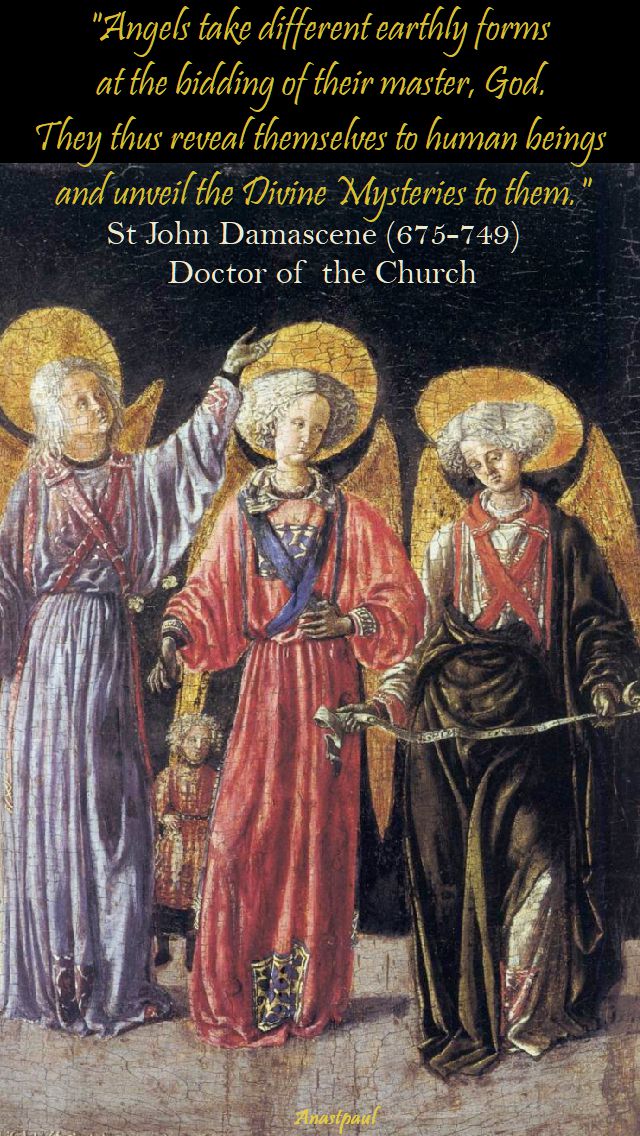
REFLECTION – Angels take different earthly forms at the bidding of their master, God.
They thus reveal themselves to human beings and unveil the Divine Mysteries to them……St John Damascene
PRAYER – God of all Wisdom, You direct the ministry of angels and of human beings. Grant that the angels who always minister to You in heaven may defend us during our life on earth and protect us from evil. Grant this, through our Lord Jesus Christ, Your Son, in union with the Holy Spirit, one God forever and ever. Amen
Our Morning Offering – 29 September – The Feast of Sts Michael, Gabriel and Raphael
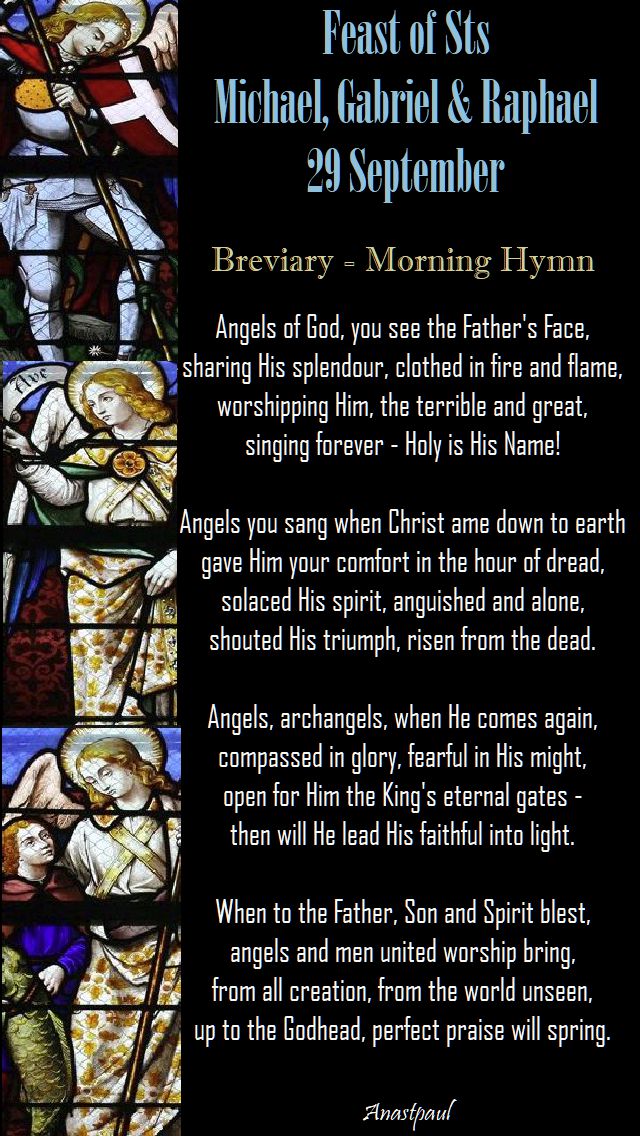
Morning Hymn from the Breviary
Angels of God, you see the Father’s Face,
sharing His splendour, clothed in fire and flame,
worshipping Him, the terrible and great,
singing forever – Holy is His Name!
Angels you sang when Christ ame down to earth
gave Him your comfort in the hour of dread,
solaced His spirit, anguished and alone,
shouted His triumph, risen from the dead.
Angels, archangels, when He comes again,
compassed in glory, fearful in His might,
open for Him the King’s eternal gates –
then will He lead His faithful into light.
When to the Father, Son and Spirit blest,
angels and men united worship bring,
from all creation, from the world unseen,
up to the Godhead, perfect praise will spring.
Saints of the Day – Feast of The Three Archangels – 29 September
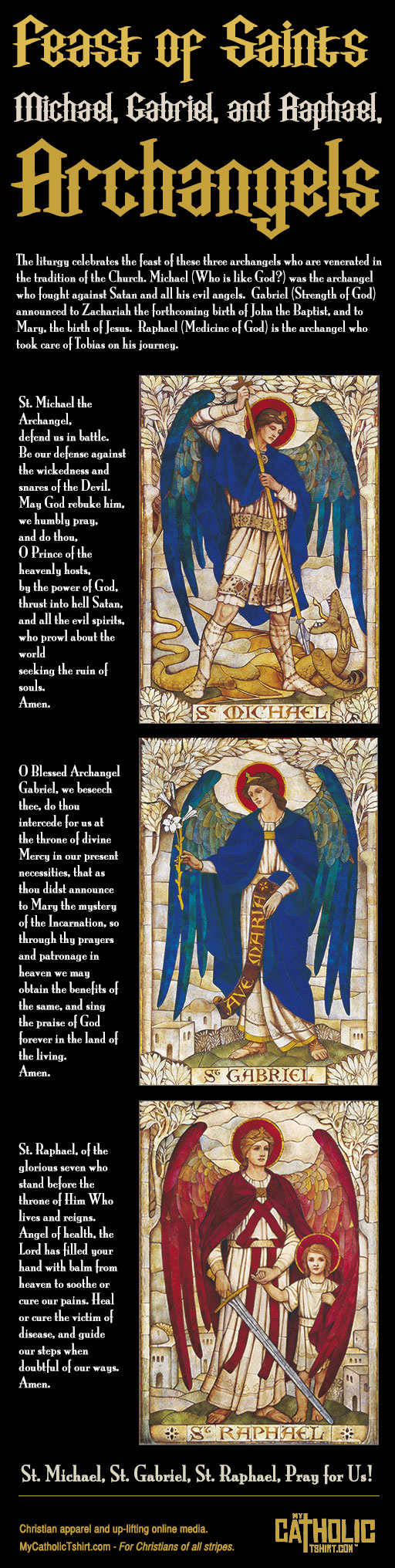
The liturgy celebrates the feast of these three archangels who are venerated in the tradition of the Church. Michael (Who is like God?) was the archangel who fought against Satan and all his evil angels, defending all the friends of God. He is the protector of all humanity from the snares of the devil. Gabriel (Strength of God) announced to Zachariah the forthcoming birth of John the Baptist and to Mary, the birth of Jesus. His greeting to the Virgin, “Hail, full of grace,” is one of the most familiar and frequent prayers of the Christian people. Raphael (Medicine of God) is the archangel who took care of Tobias on his journey.
The Catechism of the Catholic Church teaches us that, “[T]he existence of the spiritual, non-corporeal beings that Sacred Scripture usually calls “angels” is a truth of faith. The witness of Scripture is as clear as the unanimity of Tradition.”
Angels are pure, created spirits. The name angel means servant or messenger of God. Angels are celestial or heavenly beings, on a higher order than human beings. Angels have no bodies and do not depend on matter for their existence or activity. They are distinct from saints, which men can become. Angels have intellect and will and are immortal. They are a vast multitude but each is an individual. Archangels are one of the nine choirs of angels listed in the Bible. In ascending order, the choirs or classes are 1) Angels, 2) Archangels, 3) Principalities, 4) Powers, 5) Virtues, 6) Dominations, 7) Thrones, 8) Cherubim, and 9) Seraphim.
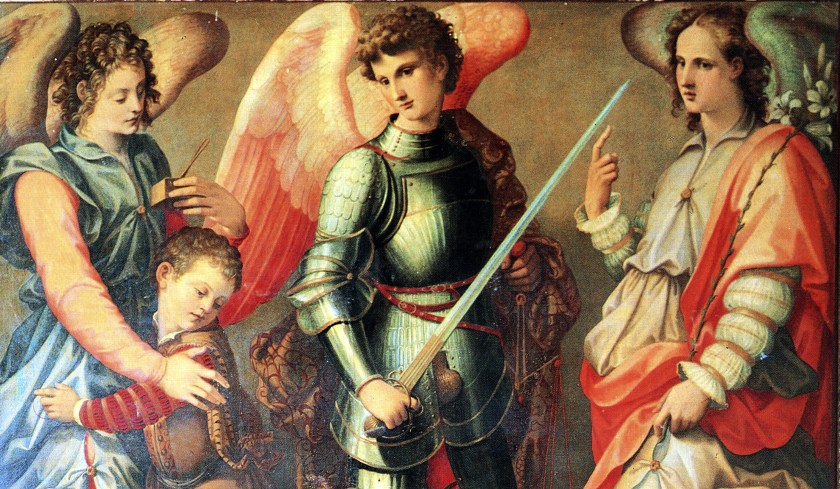
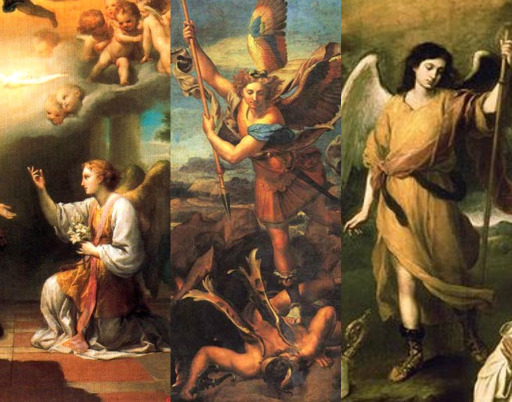
St Michael The name of the archangel Michael means, in Hebrew, who is like unto God? and he is also known as “the prince of the heavenly host.” He is usually pictured as a strong warrior, dressed in armour and wearing sandals. His name appears in Scripture four times, twice in the Book of Daniel and once each in the Epistle of St Jude and the Book of Revelation. From Revelation we learn of the battle in heaven, with St. Michael and his angels combating Lucifer and the other fallen angels (or devils). We invoke St Michael to help us in our fight against Satan; to rescue souls from Satan, especially at the hour of death; to be the champion of the Jews in the Old Testament and now Christians; and to bring souls to judgment.
Patronages: Against temptations; against powers of evil; artists; bakers; bankers; battle; boatmen; cemeteries; coopers; endangered children; dying; Emergency Medical Technicians; fencing; grocers; hatmakers; holy death; knights; mariners; mountaineers; paramedics; paratroopers; police officers; radiologists; sailors; the sick; security forces; soldiers; against storms at sea; swordsmiths; those in need of protection; Brussels, Belgium; Caltanissett, Sicily; Cornwall, England; Diocese of Pensacola-Tallahassee Florida; England; Germany; Archdiocese of Mobile, Alabama; Papua, New Guinea; Puebla, Mexico; San Miguel de Allende, Mexico; Sibenik, Croatia; Archdiocese of Seattle, Washington; Diocese of Springfield, Massachusetts.
Attributes: Angel with wings; dressed in armour; lance and shield; scales; shown weighing souls; millstone; piercing dragon or devil; banner charged with a dove; symbolic colours orange or gold.
St Gabriel St Gabriel’s name means “God is my strength”. Biblically he appears three times as a messenger. He had been sent to Daniel to explain a vision concerning the Messiah. He appeared to Zachary when he was offering incense in the Temple, to foretell the birth of his son, St John the Baptist. St Gabriel is most known as the angel chosen by God to be the messenger of the Annunciation, to announce to mankind the mystery of the Incarnation.
The angel’s salutation to our Lady, so simple and yet so full of meaning, Hail Mary, full of grace, has become the constant and familiar prayer of all Christian people.
Patronages: Ambassadors; broadcasting; childbirth; clergy; communications; diplomats; messengers; philatelists; postal workers; public relations; radio workers; secular clergy; stamp collectors; telecommunications; Portugal; Archdiocese of Seattle, Washington.
Attributes: Archangel; sceptre and lily; MR or AM shield; lantern; mirror; olive branch; scroll with words Ave Maria Gratia Plena; Resurrection trumpet; shield; spear; lily; symbolic colours, silver or blue.
St Raphael Our knowledge of the Archangel Raphael comes to us from the book of Tobit. His mission as wonderful healer and fellow traveller with the youthful Tobias has caused him to be invoked for journeys and at critical moments in life. Tradition also holds that Raphael is the angel that stirred the waters at the healing sheep pool in Bethesda. His name means “God has healed”.
Patronages: Blind; bodily ills; counselors; druggists; eye problems; guardian angels; happy meetings; healers; health inspectors; health technicians; love; lovers; mental illness; nurses; pharmacists; physicians; shepherds; against sickness; therapists; travellers; young people; young people leaving home for the first time; Archdiocese of Dubuque, Iowa; Archdiocese of Seattle, Washington.
Attributes: Staff; wallet and fish; staff and gourd; archangel; young man carrying a staff; young man carrying a fish; walking with Tobias; holding a bottle or flask; symbolic colours, gray or yellow.
—
Bl Alericus
St Anno of Eichstätt
St Casdoe of Persia
St Catholdus of Eichstätt
Bl Charles of Blois
St Dadas of Persia
St Diethardus of Eichstätt
St Fraternus of Auxerre
St Gabdelas of Persia
St Grimoaldus of Pontecorvo
St Gudelia
St Guillermo Courtet
Bl John de Montmirail
Bl John of Ghent
St Lazaro of Kyoto
St Liutwin of Trier
Bl Luigi Monza
St Miguel de Aozaraza
St Quiriacus of Palestine
St Rene Goupil
St Rhipsime
Bl Richard Rolle
St Sapor of Persia
St Theodota of Thrace
St Vicente Shiwozuka de la Cruz
—
Martyrs of Thrace – 3 saints: Three Christian men murdered in Thrace for their faith. They are – Eutychius, Heracleas and Plautus.
Martyred in the Spanish Civil War:
• Blessed Antonio Arribas Hortigüela
• Blessed Antonio Martínez López
• Blessed Dario Hernández Morató
• Blessed Francesc de Paula Castelló Aleu
• Blessed Francisco Edreira Mosquera
• Blessed José Villanova Tormo
• Blessed Pau Bori Puig
• Blessed Vicente Sales Genovés
• Blessed Virgilio Edreira Mosquera
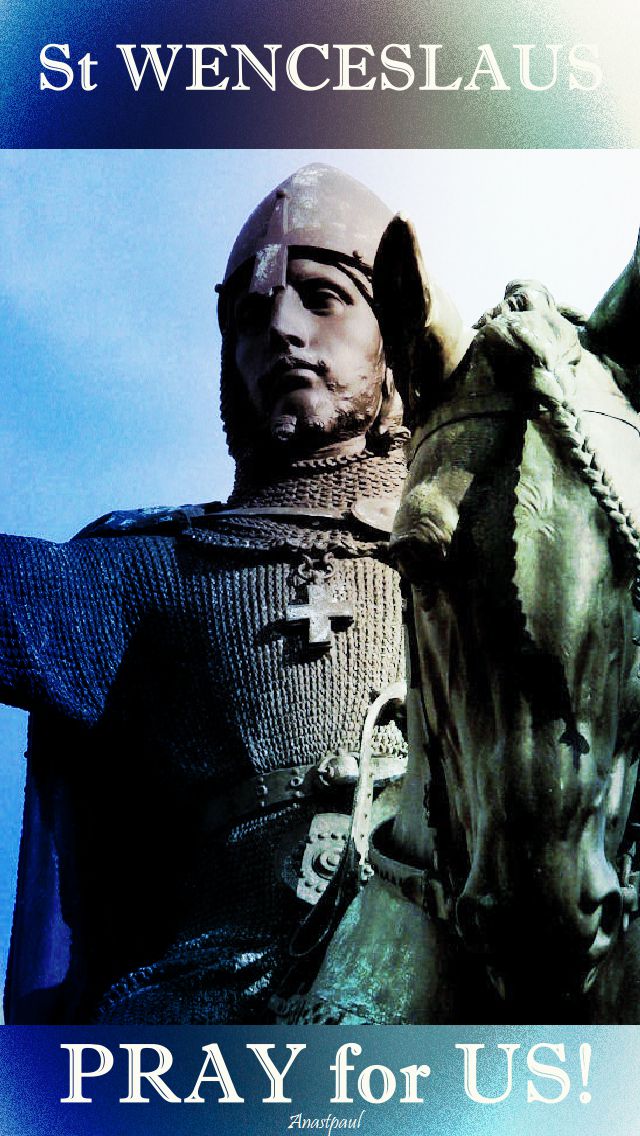
Thought for the Day – 28 September – The Memorial of St Wenceslaus
Good example lives on. St Wenceslaus’ generosity to the poor was legendary and his sanctity known everywhere.
He made peace with his mother so that he could govern and with the surrounding monarchs. He worked with the Church, ended the persecution of the Christians, brought back exiled priests and built churches. Wenceslaus set an example all could follow. He gave alms to those who were poor and was just to those who were rich, he visited prisoners and promoted the religious and educational improvement of his people.
“Good King Wenceslaus” was able to incarnate his Christianity in a world filled with political unrest. While we are often victims of violence of a different sort, we can easily identify with his struggle to bring harmony to society. The call to become involved in social change and in political activity is addressed to Christians; the values of the gospel are sorely needed today, the example of St Wenceslaus is still an inspiration to us all.
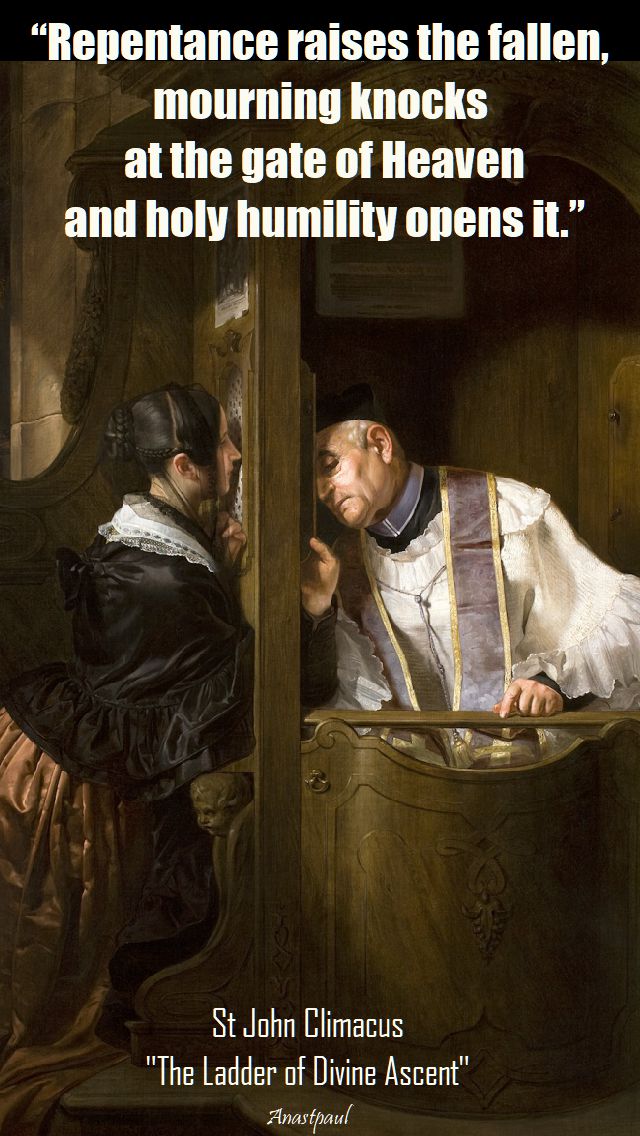
“Repentance raises the fallen, mourning knocks at the gate of Heaven and holy humility opens it.”
“Repentance is the renewal of baptism. Repentance is a contract with God for a second life. A penitent is a buyer of humility. Repentance is constant distrust of bodily comfort. Repentance is self-condemning reflection and carefree self-care. Repentance is the daughter of hope and the renunciation of despair. A penitent is an undisgraced convict. Repentance is reconciliation with the Lord by the practice of good deeds contrary to the sins. Repentance is purification of conscience. Repentance is the voluntary endurance of all afflictions. A penitent is the inflicter of his own punishments. Repentance is a mighty persecution of the stomach and a striking of the soul into vigorous awareness.”
One Minute Reflection – 28 September – The Memorial of St Wenceslaus
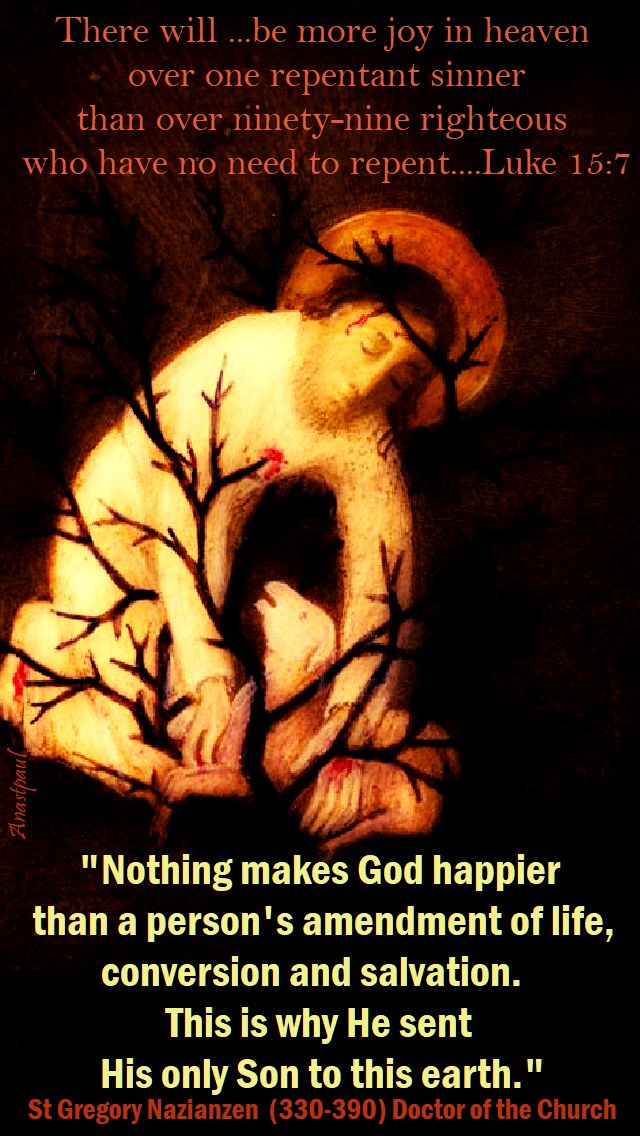
There will …be more joy in heaven over one repentant sinner than over ninety-nine righteous who have no need to repent.…Luke 15:7
REFLECTION – “Nothing makes God happier than a person’s amendment of life,
conversion and salvation.
This is why He sent His only Son to this earth.”…St Gregory Nazianzen (330-390) Doctor of the Church
PRAYER – Holy God, help me to amend my life constantly and be sincerely converted to You. Let me seek Your interests rather than my own and be ever more closely united with You.
St Wenceslaus, who was assassinated by his own brother but who, by his holiness opened his brother’s eyes to repentance, please pray for us, that we may always seek the forgiveness of God. Amen
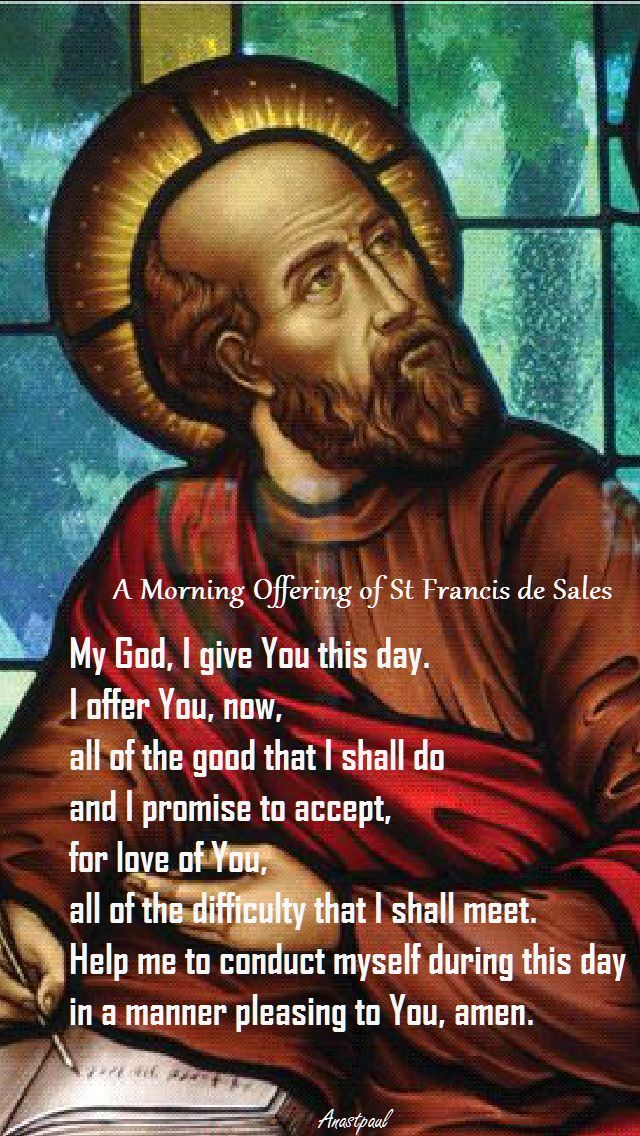
My God, I give You this day.
I offer You, now,
all the good that I shall do
and I promise to accept
for love of You,
all of the difficulty that I shall meet.
Help me to conduct myself during this day,
in a manner pleasing to You, Amen.
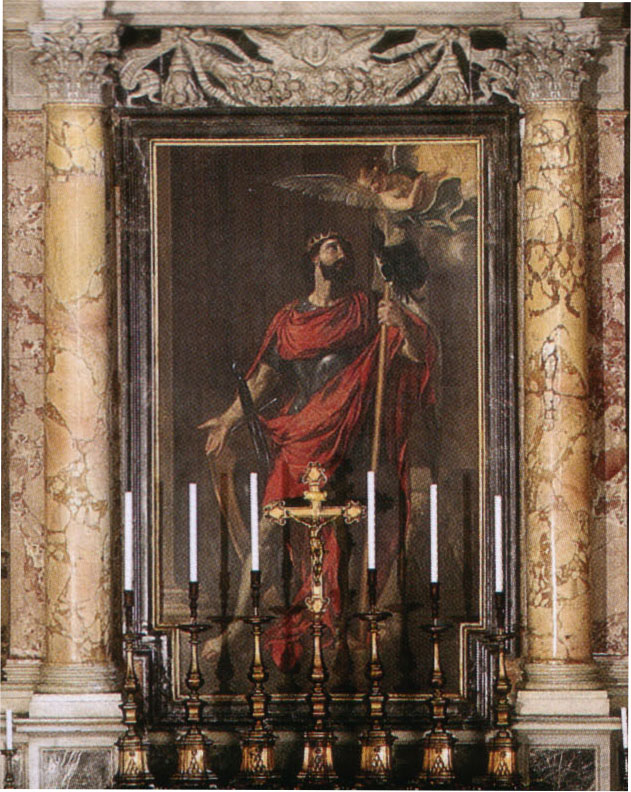
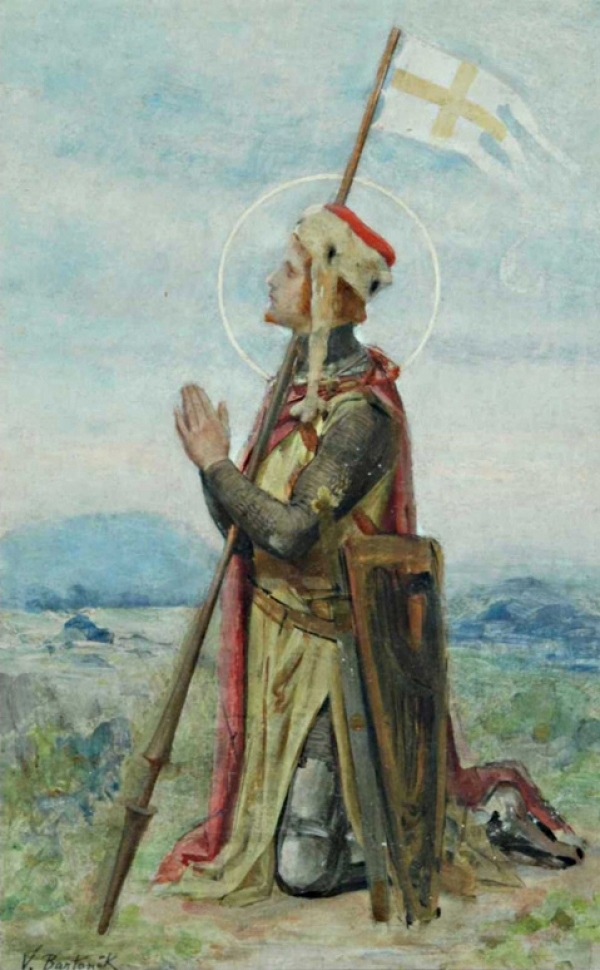
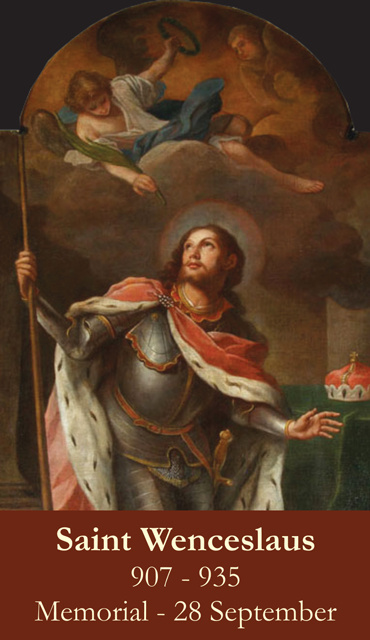
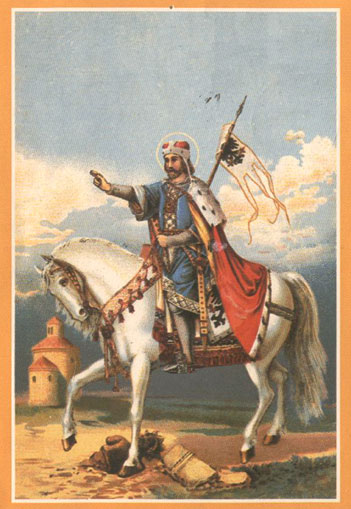
Saint of the Day – 28 September – St Wenceslaus (907-935) King of Bohemia, Martyr – also known as Vaceslav, Vaclav, Wenzel, Wenceslas, Václav. (Born 907 at Prague, Bohemia (in Czech Republic) -and died on 28 September 935 by assassination). Patronages- brewers, Bohemia, Czech Republic, Czechoslovakia, Moravia, Prague, Czech Republic, Archdiocese and the city. Attributes – banner, crown, eagle, staff, soldier, horse, armour.
St Wenceslaus Altar, at St Peter’s Basilica, Vatican
St Wenceslaus was born around the year 907. His father Duke Wratislaw was a Catholic but his mother Princess Dragomir practiced the native pagan religion. She would later arrange the murders of both Wenceslaus and his grandmother Ludmilla, who is also a canonised saint. During his youth, Wenceslaus received a strong religious education from Ludmilla, in addition to the good example of his father. He maintained a virtuous manner of living while attending college near Prague, making significant progress both academically and spiritually. But with the death of his father Wratislaw, the devout young nobleman faced a spiritual and political crisis.
His mother Dragomir, who had never accepted the Catholic faith, turned against it entirely. She seized her husband’s death as a chance to destroy the religion his parents had received from Sts Cyril and Methodius, through methods that included purging Catholics from public office, closing churches and preventing all teaching of the faith. Dragomir’s Catholic mother-in-law Ludmilla urged Wenceslaus to seize power from his mother and defend their faith. His attempt to do so resulted in the division of the country into two halves: one ruled by Wenceslaus, advised by Ludmilla; the other ruled by Wenceslaus’ younger brother Boleslaus, who had absorbed his mother’s hatred of the Church.
Wenceslaus, who would have preferred to become a monk and not a duke, fortified himself in this struggle through fervent prayer, extreme asceticism, charitable service and a vow of chastity. Meanwhile, his mother carried out a plot to kill Ludmilla, having her strangled in her private chapel. St Ludmilla’s liturgical feast day is 16 September.
The Bohemian duke also faced the threat of invasion from abroad, when Prince Radislaus of Gurima demanded that Bohemia submit to his rule. When Wenceslaus sought to avoid a war by challenging him in single combat, two angels are said to have appeared, deflecting the javelin thrown at Wenceslaus and immediately inspiring Radislaus to drop to his knees in surrender.
During his period of rule, Wenceslaus received the relics of several saints from the Holy Roman Emperor Otto I, who also conferred on him the title of “King Wenceslaus.” But some noblemen of his own country resented the saintly king’s strict morals and allied themselves with Dragomir and Boleslaus. Wenceslaus’ brother sought to appear as a peacemaker, inviting the king to his realm for a celebration. When Wenceslaus was praying in a chapel during the visit, Boleslaus’ henchmen attacked and wounded him. Boleslaus himself delivered the final blow, killing his brother by running him through with a lance. St Wenceslaus died on 28 September 935.
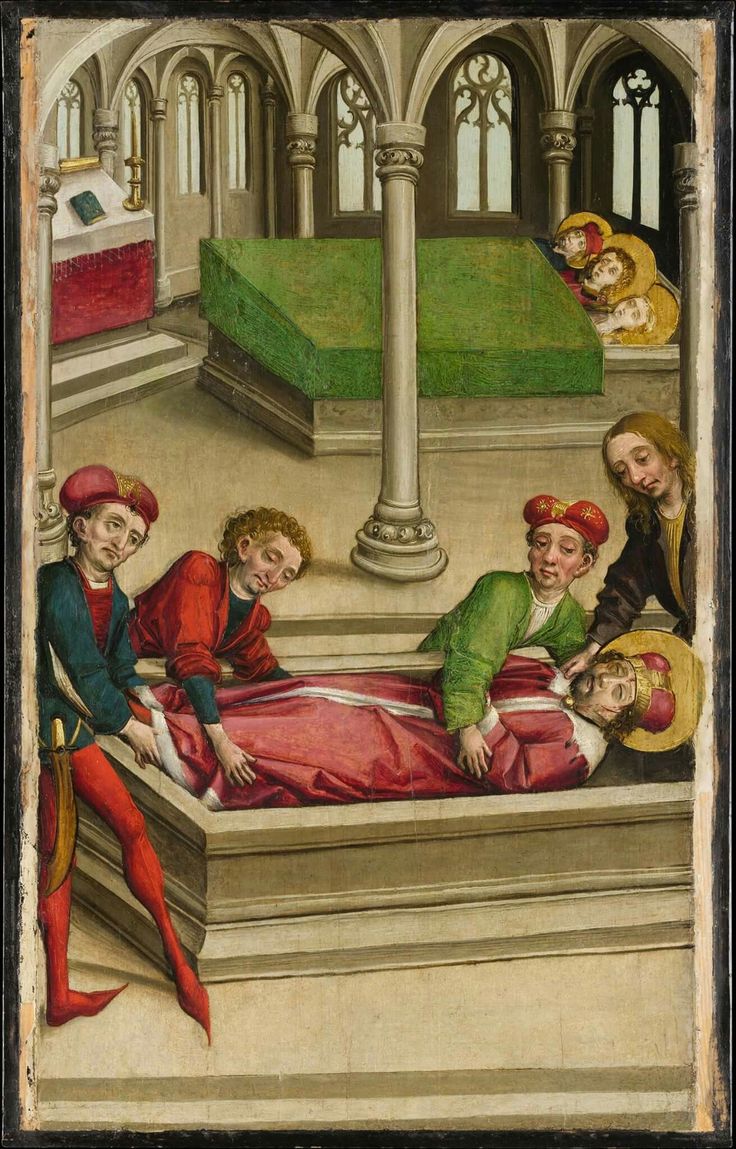
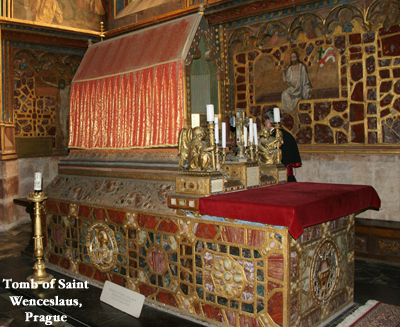
Emperor Otto responded to St Wenceslaus’ death by invading Bohemia and making war against Boleslaus for several years. He succeeded in conquering the region and forced Boleslaus to reverse the anti-Catholic measures he and his mother had taken. There is no evidence that Dragomir, who died soon after the murder of St.Wenceslaus, ever repented of killing her family members. Boleslaus, however, came to regret his sin when he learned of the miracles that were taking place at his brother’s tomb. He moved St Wenceslaus’ body to a cathedral for veneration by the faithful.
St Wenceslas was considered a martyr and a saint immediately after his death, when a cult of Wenceslas grew up in Bohemia and in England. Within a few decades of Wenceslas’ death, four biographies of him were in circulation. These hagiographies had a powerful influence on the High Middle Ages conceptualisation of the rex justus, or “righteous king”, that is, a monarch whose power stems mainly from his great piety, as well as from his princely vigour.
Referring approvingly to these hagiographies, the chronicler Cosmas of Prague, writing in about the year 1119, states:
But his deeds I think you know better than I could tell you; for, as is read in his Passion, no one doubts that, rising every night from his noble bed, with bare feet and only one chamberlain, he went around to God’s churches and gave alms generously to widows, orphans, those in prison and afflicted by every difficulty, so much so that he was considered, not a prince, but the father of all the wretched.
Several centuries later the legend was claimed as fact by Pope Pius II.
Burial of St Wenceslaus
The hymn “Svatý Václave” (Saint Wenceslas) or “Saint Wenceslas Chorale” is one of the oldest known Czech hymns in history. Its roots can be found in the 12th century and it still belongs to the most popular religious songs to this day. In 1918, in the beginning of the Czechoslovak state, the song was discussed as one of the possible choices for the national anthem. His feast day is celebrated today while the translation of his relics, which took place in 938, is commemorated on 4 March.
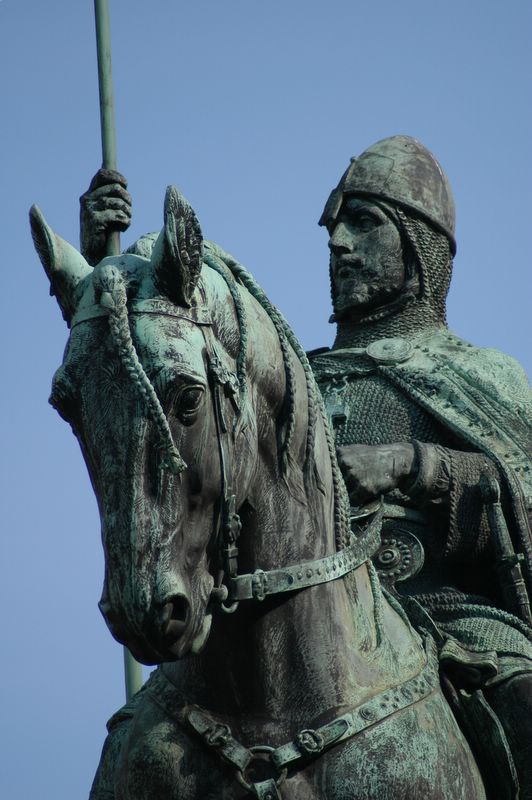
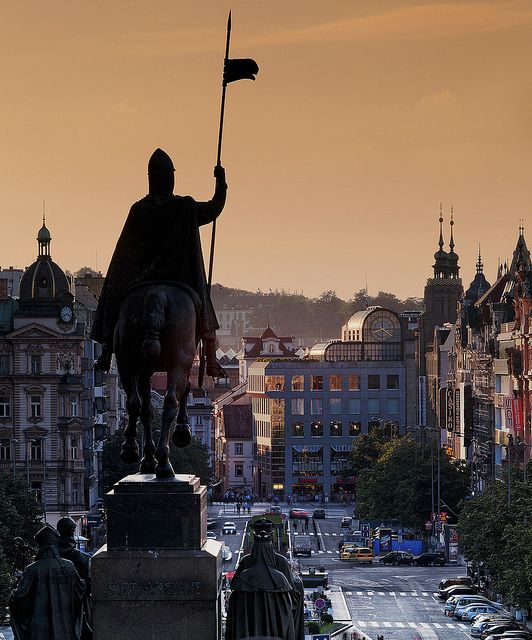
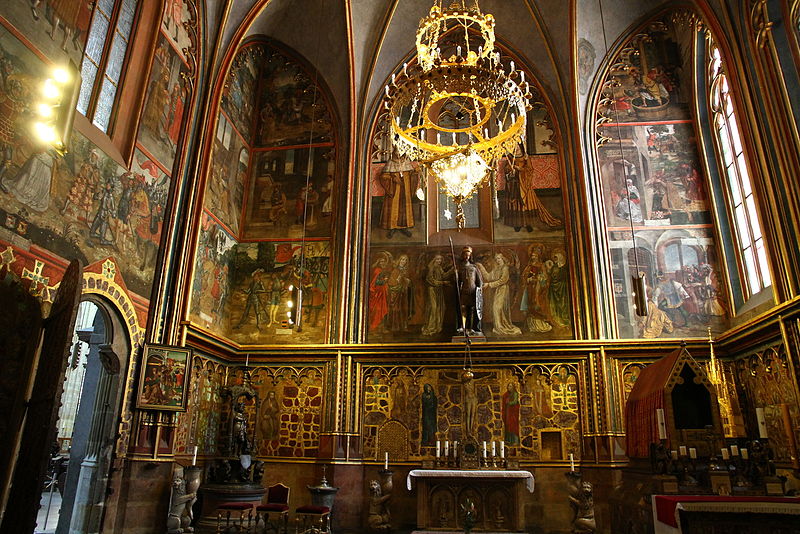
St Wenceslaus on the Wenceslaus Square, PragueWenceslaus Square, PragueSt Wenceslaus Chapel at St Vitus Cathedral, Prague
Since 2000, the feast day of Saint Wenceslas is a public holiday in the Czech Republic, celebrated as the Czech Statehood Day.
Good King Wenceslaus
Good King Wenceslas looked out, on the Feast of Stephen,
When the snow lay round about, deep and crisp and even;
Brightly shone the moon that night, tho’ the frost was cruel,
When a poor man came in sight, gath’ring winter fuel.
“Hither, page, and stand by me, if thou know’st it, telling,
Yonder peasant, who is he? Where and what his dwelling?”
“Sire, he lives a good league hence, underneath the mountain;
Right against the forest fence, by Saint Agnes’ fountain.”
“Bring me flesh, and bring me wine, bring me pine logs hither:
Thou and I will see him dine, when we bear them thither.”
Page and monarch, forth they went, forth they went together;
Through the rude wind’s wild lament and the bitter weather.
“Sire, the night is darker now and the wind blow stronger;
Fails my heart, I know not how; I can go no longer.”
“Mark my footsteps, my good page. Tread thou in them boldly
Thou shalt find the winter’s rage freeze thy blood less coldly.”
In his master’s steps he trod, where the snow lay dinted;
Heat was in the very sod which the saint had printed.
Therefore, Christian men, be sure, wealth or rank possessing,
Ye who now will bless the poor, shall yourselves find blessing.
St Lorenzo Ruiz of Manila (Optional Memorial)
St Wenceslaus of Bohemia (Optional Memorial) – https://www.youtube.com/watch?v=raxyo8yRYwE https://www.youtube.com/watch?v=F1EW1MSFfpE – Msgr Charles Pope – My recitation of the old carol
—
Bl Aaron of Auxerre
St Alodius of Auxerre
St Annemond of Lyons
St Bardomianus
Bl Bernardine of Feltre
St Chariton of Palestine
Bl Christian Franco
St Conval of Strathclyde
St Eucarpus
St Eustochium
St Exuperius of Toulouse
St Faustus of Riez
St John of Dukla
St Laurence of North Africa
St Lioba of Bischofsheim
St Machan
St Martial of North Africa
St Martin of Moyenmoutier
St Paternus of Auch
St Privatus of Rome
St Salonius of Geneva
St Silvinus of Brescia
St Solomon of Genoa
St Stacteus
St Tetta of Wimborne
Bl Thiemo
St Willigod of Moyenmoutier
St Zama of Bologna
—
Augustinian Martyrs of Japan: The first Augustinian missionaries arrived in Japan in 1602 and met with immediate success; many were brought to the faith; many of them became Augustinians; and many of them were martyred in the periodic persecutions of Christians. This memorial commemorates all of them, whether they have a sanctioned Cause for Canonisation or not. They include:
• Blessed Bartolomé Gutiérrez Rodríguez
• Blessed Ferdinand Ayala
• Blessed Francisco Terrero de Ortega Pérez
• Blessed Ioannes Mukuno Chozaburo
• Blessed Laurentius Kaida Hachizo
• Blessed Mancius Yukimoto Ichizaemon
• Blessed Martín Lumbreras Peralta
• Blessed Melchor Sánchez Pérez
• Blessed Michaël Ichinose Sukezaemon
• Blessed Pedro de Zúñiga
• Blessed Petrus Sawaguchi Kuhyoe
• Blessed Thomas Jihyoe of Saint Augustine
• Blessed Thomas Terai Kahyoe
• Blessed Vicente Simões de Carvalho
• Saint Magdalena of Nagasaki
Martyrs of Antioch – 37 saints: A group of 30 soldiers and 7 civilians who were murdered together for their faith. The names that have come down to us are – Alexander, Alphinus, Heliodorus, Mark, Neon, Nicon and Zosumus. c 303 at Antioch, Pisidia (in modern Turkey).
Martyrs of China – 120 saints: A common memorial for the hundreds of the faithful, lay and clergy, who have died for their faith in the last couple of centuries in China. They were Canonised on 1 October 2000 by Pope John Paul II.
Martyred in the Spanish Civil War:
• Blessed Francesc Xavier Ponsa Casallach
• Blessed Josep Casas Juliá
• Blessed Josep Casas Ros
• Blessed Josep Tarrats Comaposada
• Blessed María Fenollosa Alcaina
• Blessed Santiago Mestre Iborra
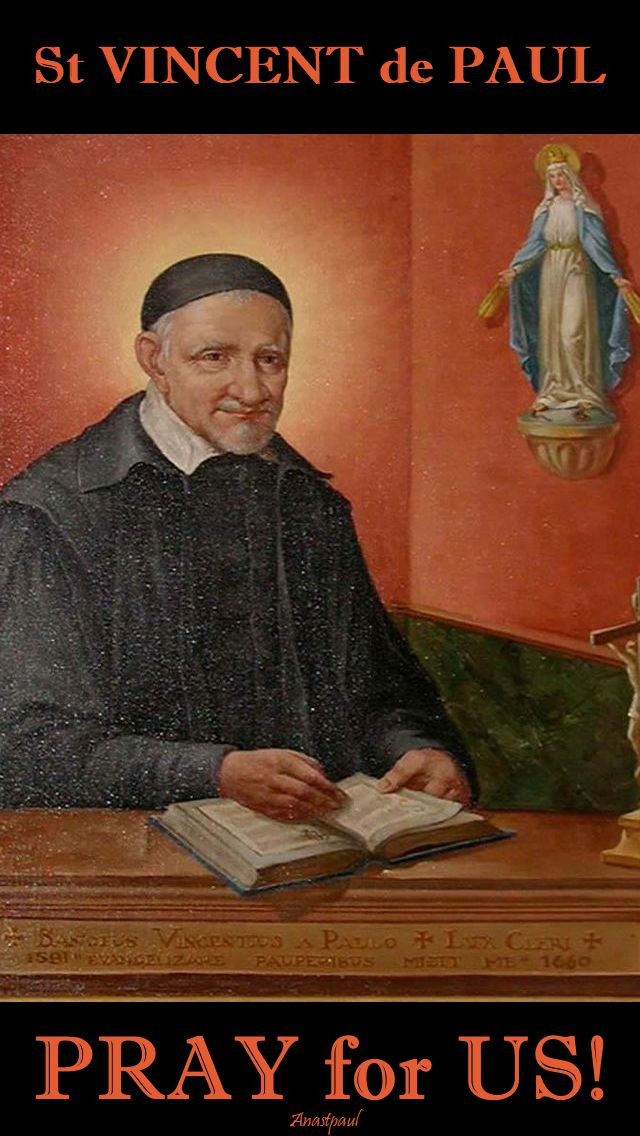
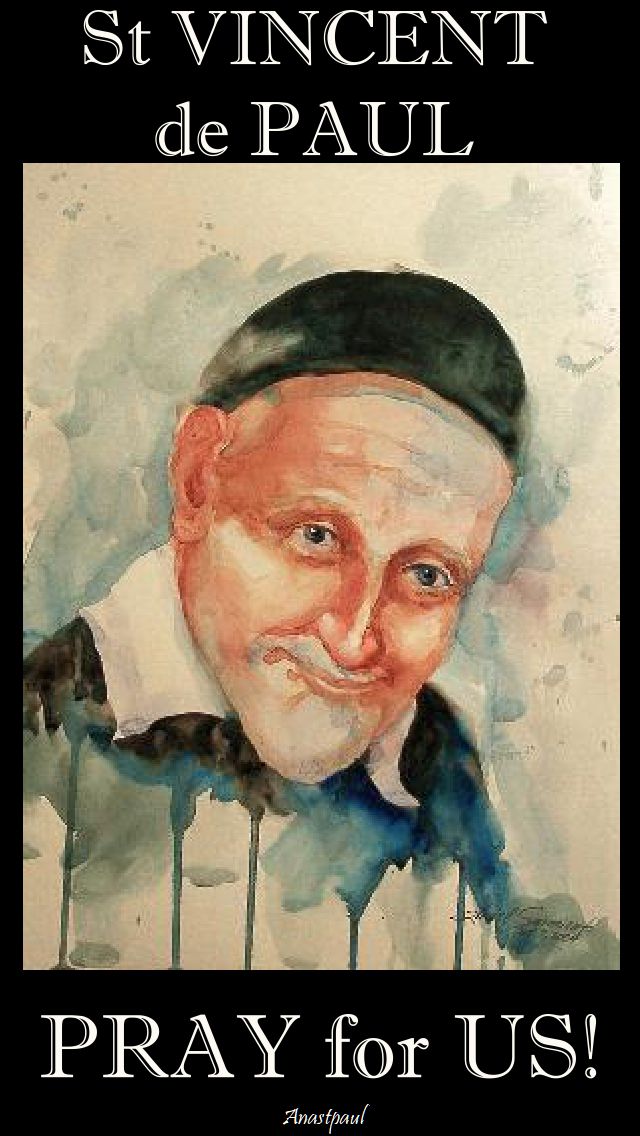
Thought for the Day – 27 September – The Memorial of St Vincent de Paul (1581-1660)
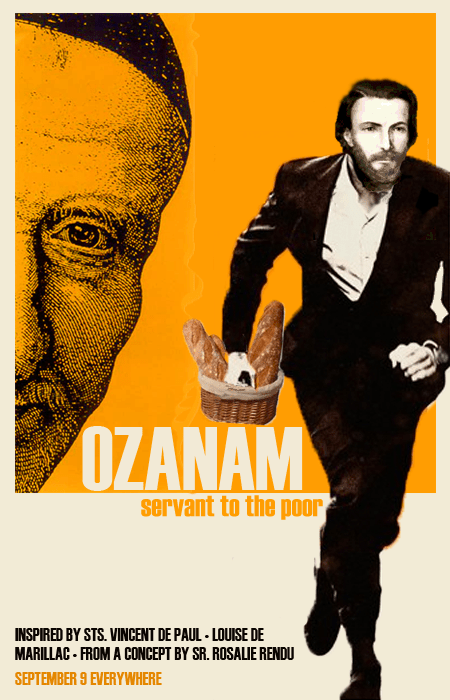
Most remarkably, Vincent was by temperament a very irascible person—even his friends admitted it. He said that except for the grace of God he would have been “hard and repulsive, rough and cross.” But he became a tender and affectionate man, very sensitive to the needs of others. Pope Leo XIII made him the patron of all charitable societies. Outstanding among these, of course, is the Society of St. Vincent de Paul, founded in 1833 by his admirer Blessed Frédéric Ozanam.
St Vincent found himself deeply shocked by the religious state of the people around him and he found himself thrust into his life’s work.
Sometimes, something just has to be done and there is no-one else to do it. And God will provide the way, He will change that inner being – who perhaps is often “rough and cross” to do His work. All St Vincent did was relinquish himself totally in trust. He handed himself over, hauled up that cross and followed Him who leads.
The gaze of Christ rests upon us and your cross is lying at your feet – have you felt it, have you seen it?
One Minute Reflection – 27 September – The Memorial of St Vincent de Paul (1581-1660)
May the God of hope fill you with all joy and peace in believing, so that you may abound in hope by the power of the holy Spirit…Romans 15:13
REFLECTION – “Free your mind from all that troubles you; God will take care of things. You will be unable to make haste in this (choice) without, so to speak, grieving the heart of God because he sees that you do not honour Him sufficiently with holy trust. Trust in Him, I beg you and you will have the fulfillment of what your heart desires.”….St Vincent de Paul
PRAYER – Father, You endowed St Vincent de Paul with the spirit of an apostle to give himself to the poor and to the training of priests. Give us, good Lord, a share of the same spirit, that we may love what he loved and do as he taught. Fill us with hope and total trust and abandonment to Your Holy Providence. Through our Lord Jesus Christ, in union with the Holy Spirit, one God, forever and ever. St Vincent de Paul, pray for us, amen.
Our Morning Offering – 27 September – The Memorial of St Vincent de Paul (1581-1660)
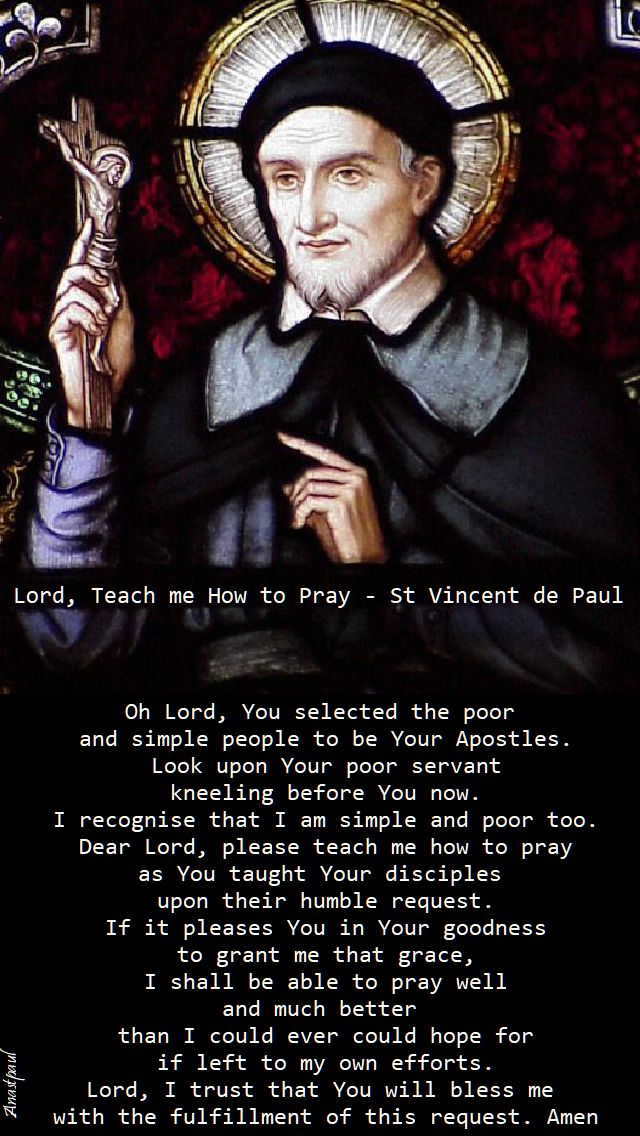
Lord, Teach me How to Pray St Vincent de Paul
Oh Lord,
You selected the poor
and simple people to be Your Apostles.
Look upon Your poor servant
kneeling before You now.
I recognise that I am simple and poor too.
Dear Lord, please teach me how to pray
as You taught Your disciples
upon their humble request.
If it pleases You in Your goodness
to grant me that grace,
I shall be able to pray well
and much better
than I could ever could hope for
if left to my own efforts.
Lord, I trust that You will bless me
with the fulfillment of this request.
Amen







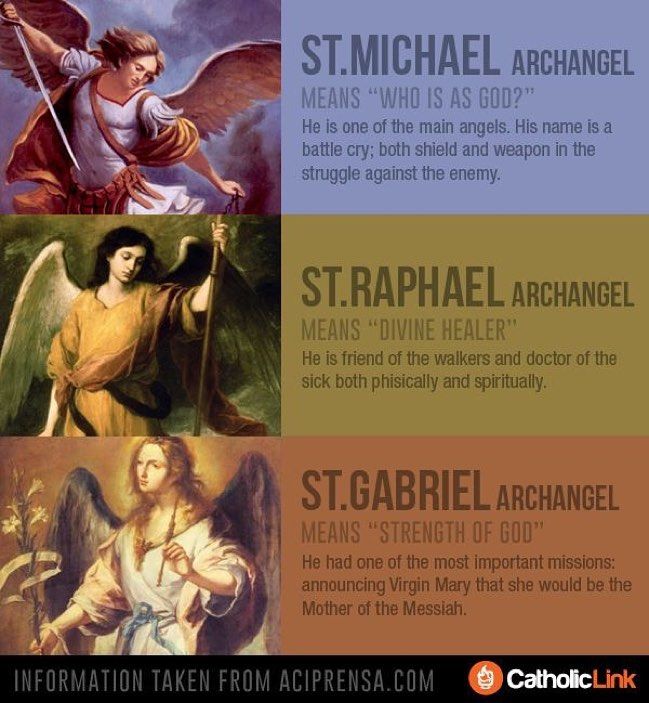
 The name of the archangel Michael means, in Hebrew, who is like unto God? and he is also known as “the prince of the heavenly host.” He is usually pictured as a strong warrior, dressed in armour and wearing sandals. His name appears in Scripture four times, twice in the Book of Daniel and once each in the Epistle of St Jude and the Book of Revelation. From Revelation we learn of the battle in heaven, with St. Michael and his angels combating Lucifer and the other fallen angels (or devils). We invoke St Michael to help us in our fight against Satan; to rescue souls from Satan, especially at the hour of death; to be the champion of the Jews in the Old Testament and now Christians; and to bring souls to judgment.
 St Gabriel’s name means “God is my strength”. Biblically he appears three times as a messenger. He had been sent to Daniel to explain a vision concerning the Messiah. He appeared to Zachary when he was offering incense in the Temple, to foretell the birth of his son, St John the Baptist. St Gabriel is most known as the angel chosen by God to be the messenger of the Annunciation, to announce to mankind the mystery of the Incarnation.
 Our knowledge of the Archangel Raphael comes to us from the book of Tobit. His mission as wonderful healer and fellow traveller with the youthful Tobias has caused him to be invoked for journeys and at critical moments in life. Tradition also holds that Raphael is the angel that stirred the waters at the healing sheep pool in Bethesda. His name means “God has healed”.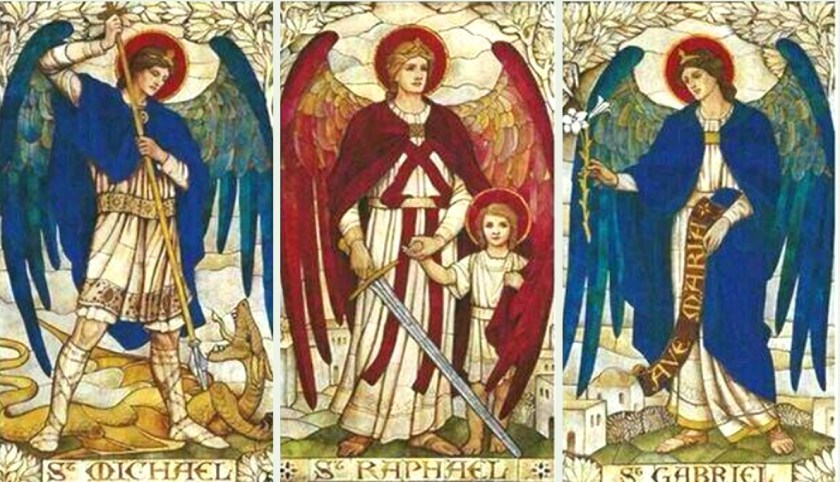
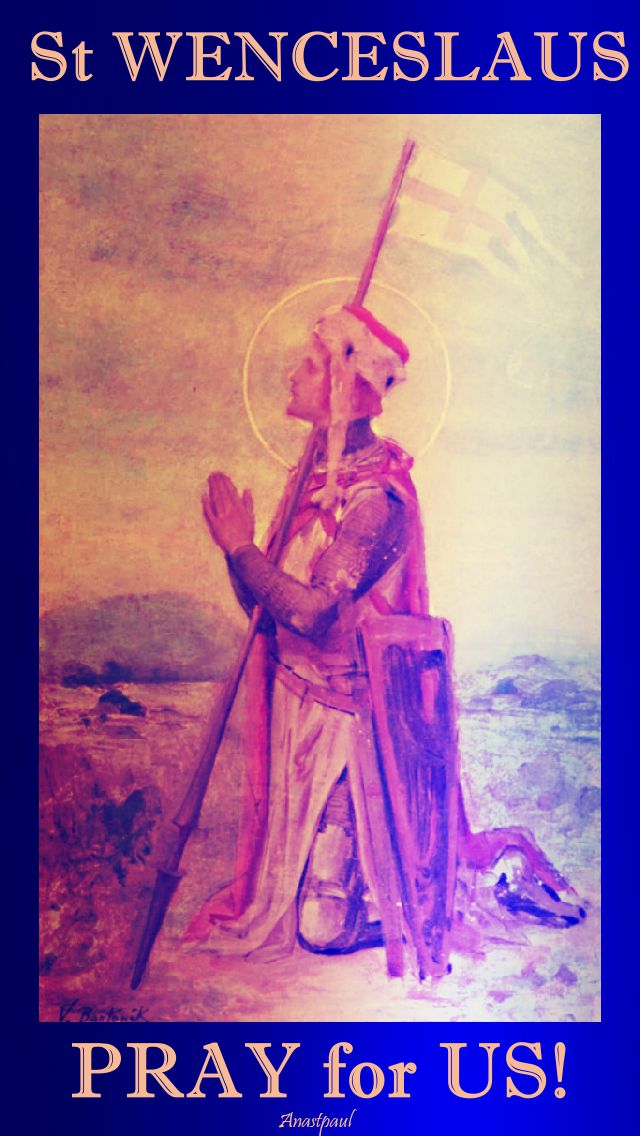




 AnaStpaul
You must be logged in to post a comment.