Posted in MORNING Prayers, SAINT of the DAY, The WORD

One Minute Reflection – 6 October – The Memorial of St Bruno (c 1030-1101)

One Minute Reflection – 6 October – The Memorial of St Bruno (c 1030-1101)

Sacrifice or oblation you wished not but ears open to obedience you gave me……..Psalm 139:7psalm 139 7

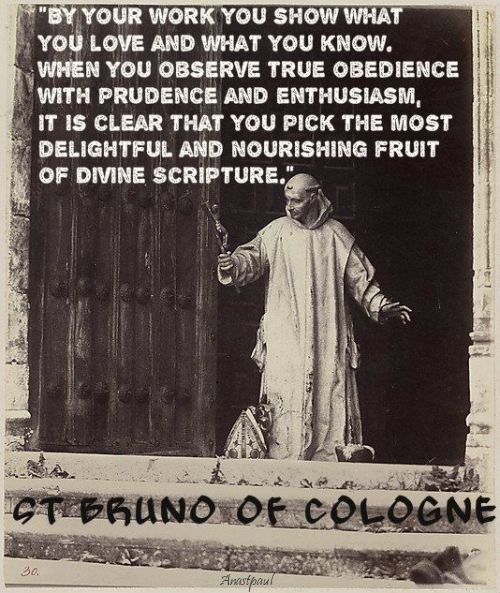
REFLECTION – “By your work you show what you love and what you know.
When you observe true obedience with prudence and enthusiasm, it is clear, that you pick the most delightful and nourishing fruit of Divine Scripture.”…St Brunoby your work-st bruno - 6 oct 2016 my pic

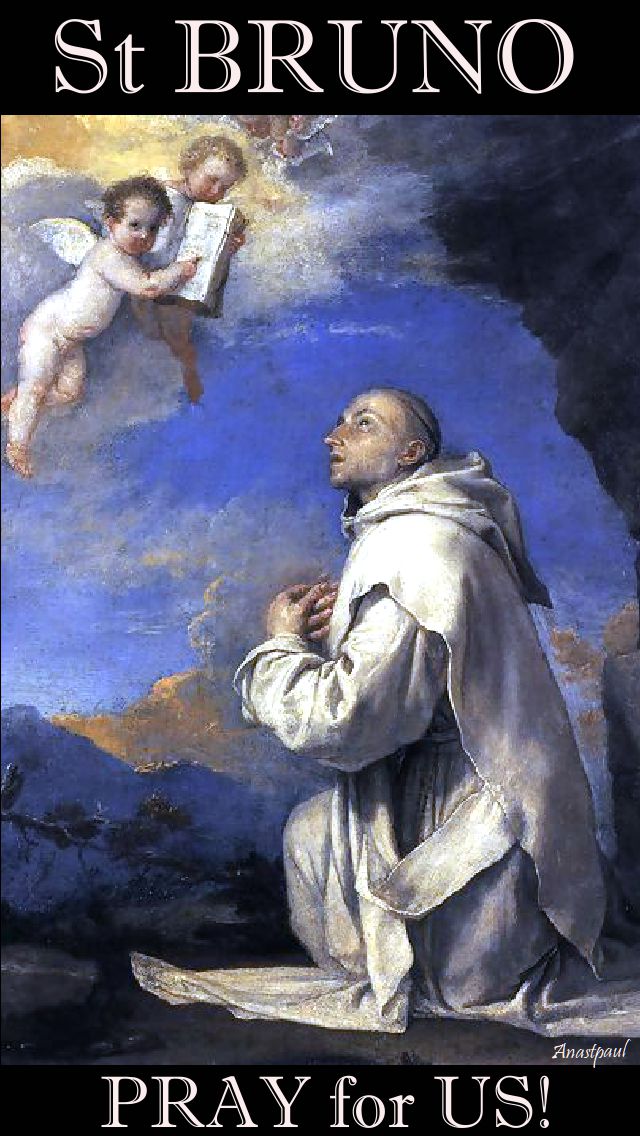
PRAYER – Lord God, You called St Bruno to serve You in a life of solitude.   Amidst this world’s changes, help us, by his prayers, to set out hearts always on You.   Heavenly Father, let me realise that You guide our lives through Your Providence, Your Word and Sacraments.   Help me to be obedient to the rules for my state in life and so be obedient to Your will for me.   Through our Lord, Jesus Christ, Your Son in union with the Holy Spirit, one God forever and ever.   St Bruno, Pray for us. Amenst bruno - pray for us

Posted in DOCTORS of the Church, MARIAN PRAYERS, MORNING Prayers, PRAYERS of the SAINTS

Our Morning Offering – 6 October

Our Morning Offering – 6 October

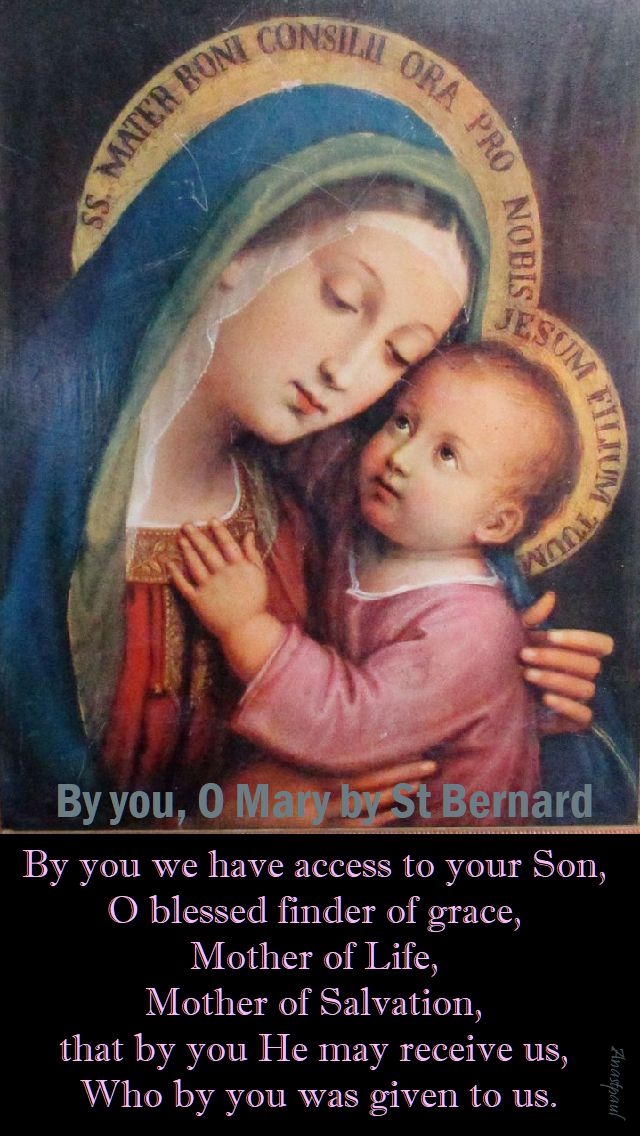
By you, O Mary
St Bernard of Clairvaux (1090-1153)

By you we have access to your Son,
O blessed finder of grace,
Mother of Life,
Mother of Salvation,
that by you He may receive us,
Who by you was given to us.
Amenby you O Mary by St Bernard

Posted in SAINT of the DAY

Saint of the Day – 6 October – St Bruno (c 1030-1101)

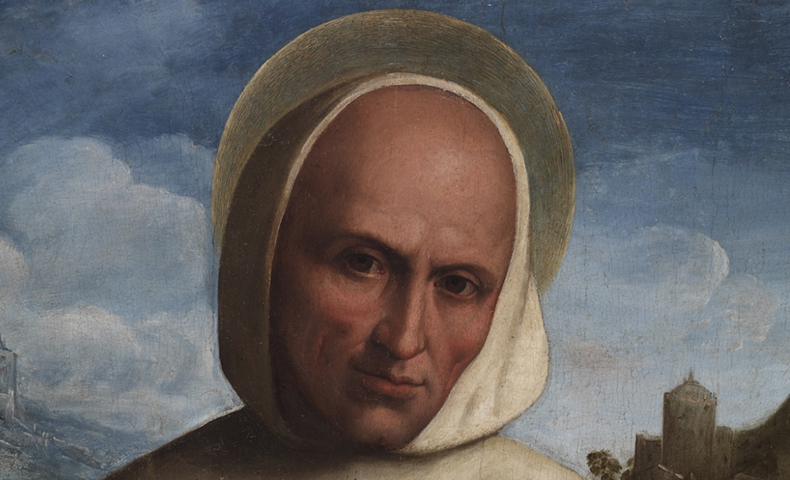
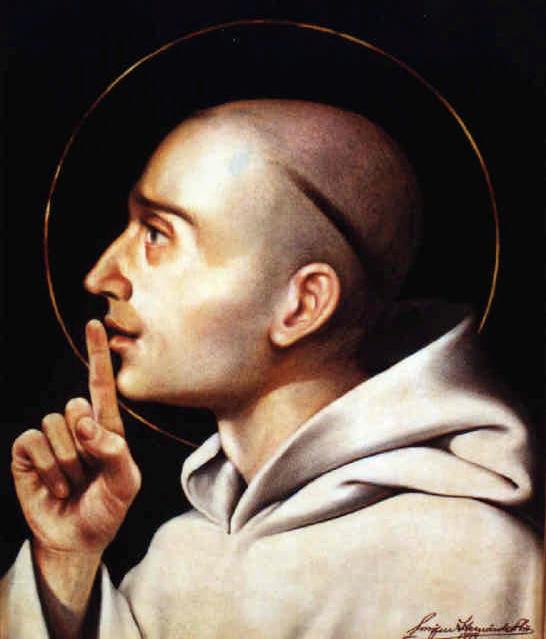
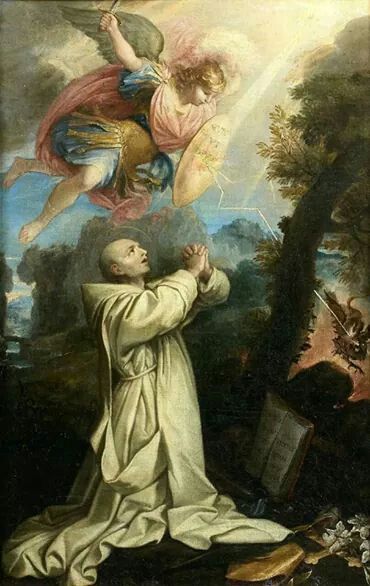
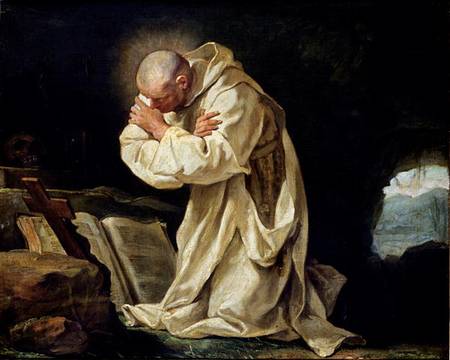
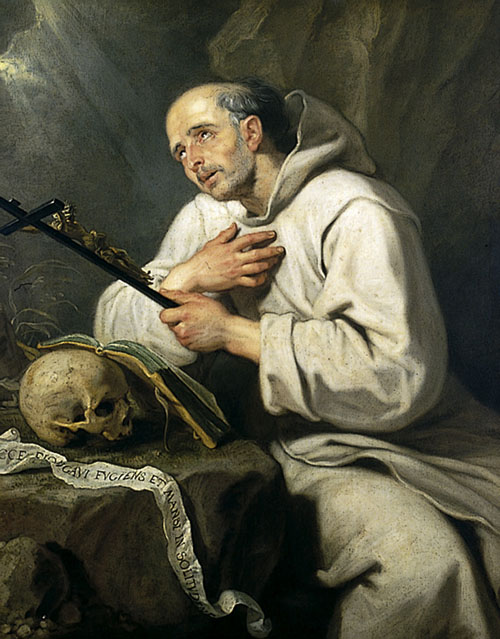
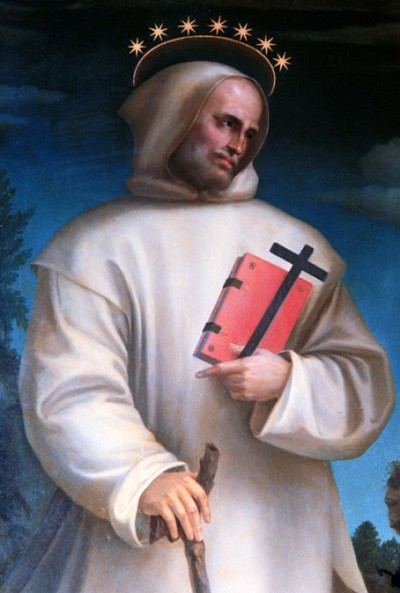
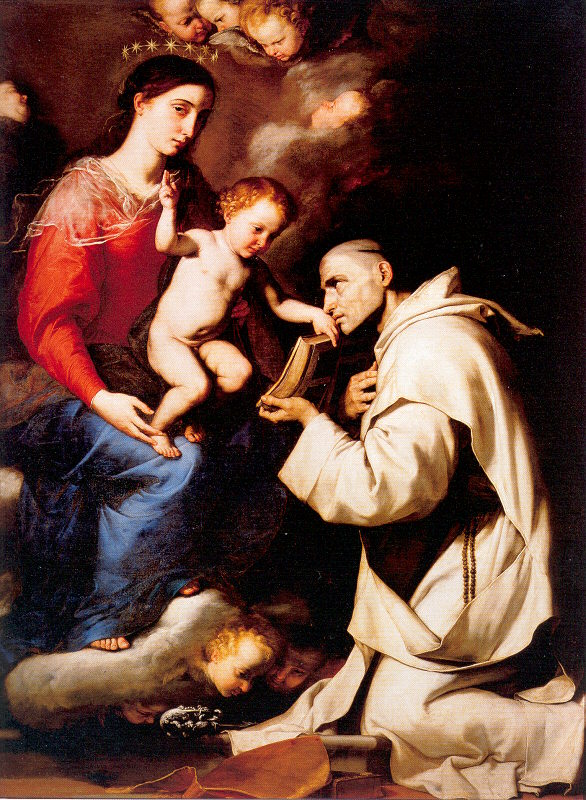
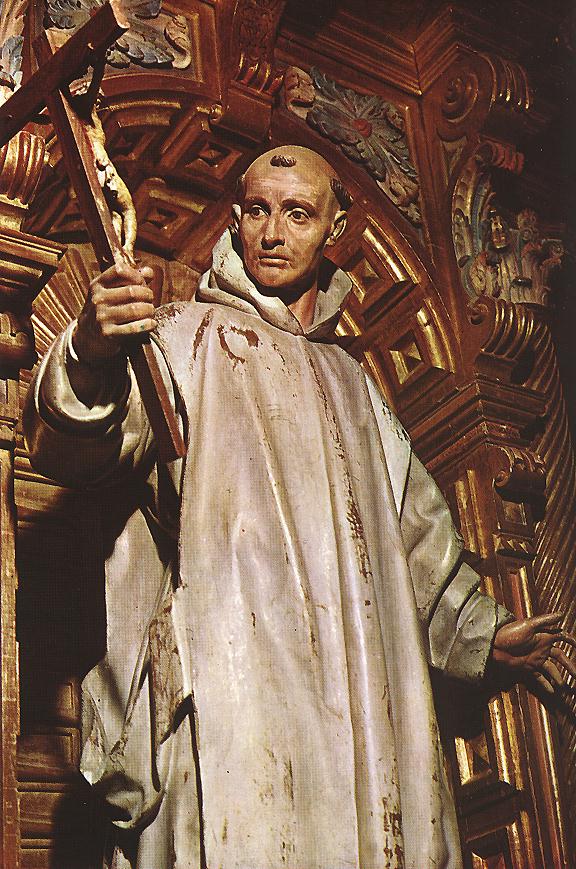
Saint of the Day – 6 October – St Bruno (c 1030-1101) – Priest, Confessor, Hermit, Monk, Mystic, Founder, Philosopher, Theologian, Teacher, Advisor, Writer (c 1030 at Cologne, Germany –  1101 at Torre, Calabria, Italy of natural causes).  His body was buried in the church of Saint Stephen at Torre.   He was Beatified in 1514 by Pope Leo X and Canonised on 17 February 1623 by Pope Gregory XV.   Patronages – Germany, Calabria, monastic fraternities, Carthusians, trade marks, Ruthenia, possessed people.   Attributes – Skull that he holds and contemplates, with a book and a cross, Carthusian habit.   St Bruno was the founder of the Carthusian Order, he personally founded the order’s first two communities.   He was a celebrated teacher at Reims and a close advisor of his former pupil, Pope Urban II.Saint Bruno - Girolamo MarchesiST BRUNO LOVE

St Bruno was born at Cologne about the year 1030.  According to tradition, he belonged to the family of Hartenfaust, or Hardebüst, one of the principal families of the city.   Little is known of his early years, except that he studied theology in the present-day French city of Reims before returning to his native land.

His education completed, Bruno returned to Cologne, where he was most likely ordained a priest around 1055 and provided with a canonry at St Cunibert’s.   In 1056 Bishop Gervais recalled him to Reims, where the following year he found himself head of the episcopal school, which at the time included the direction of the schools and the oversight of all the educational establishments of the diocese.   For eighteen years, from 1057 to 1075, he maintained the prestige which the school of Reims attained under its former masters, Remi of Auxerre, and others.   Bruno led the school for nearly two decades, acquiring an excellent reputation as a philosopher and theologian.   Among his students were Eudes of Châtillon, afterwards Pope Urban II, Rangier, Cardinal and Bishop of Reggio, Robert, Bishop of Langres and a large number of prelates and abbots.

On the verge of being made bishop himself, Bruno instead followed a vow he had made to renounce secular concerns and withdrew, along with two of his friends, Raoul and Fulcius, also canons of Reims.   Following a vision he received of a secluded hermitage where he could spend his life becoming closer to God, he retired to a mountain near Chartreuse in Dauphiny.   The area was desolate and mountainous and received few visitors.   Under Saint Bruno’s leadership, the first house of the Carthusian Order was established, complete with an oratory and individual cells for the brothers. They Order generally followed the rule of Saint Benedict, although they had no official written rule. Brothers embraced a life of poverty, manual work, prayer, and spent their days transcribing manuscripts.   Rather than complete solitude, however, Saint Bruno felt that the rigours of the solitary life needed occasional companionship and so solitary meditation with occasional brotherly congregation became the structure of their lives.  They built an oratory with small individual cells at a distance from each other where they lived isolated and in poverty, entirely occupied in prayer and study, for these men had a reputation for learning and were frequently honoured by the visits of St Hugh who became like one of themselves.

7682c7d9d8aa2b21abff79cdb4c0ab96--bruno-saints

XIR200019

st bruno 3.

st BRUNO beautiful

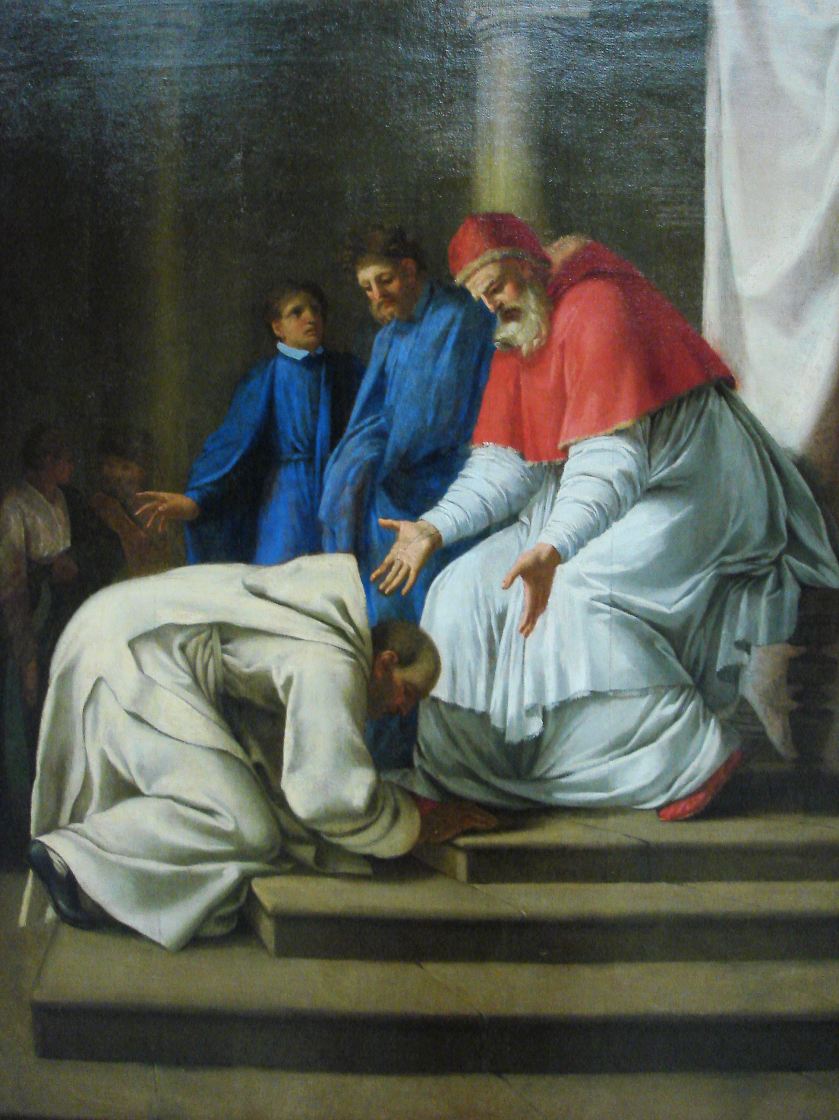
At the time, Bruno’s pupil, Eudes of Châtillon, had become pope as Urban II (1088). Resolved to continue the work of reform commenced by Gregory VII and being obliged to struggle against Antipope Clement III and Emperor Henry IV, he was in dire need of competent and devoted allies and called his former master to Rome in 1090.

Eustache_Lesueur_-_Saint_Bruno_aux_pieds_du_pape_Urbain_II.jpg
Saint Bruno the feet of Pope Urban II, 1645 – 1648 – Eustache Le Sueur

It is difficult to assign the place which Bruno occupied in Rome, or his influence in contemporary events, because it remained entirely hidden and confidential.   Lodged in the Lateran with the pope himself, privy to his most private councils, he worked as an advisor but wisely kept in the background, apart from the fiercely partisan rivalries in Rome and within the curia.

Clearly drawn back to his quiet and contemplative life, Pope Urban released Saint Bruno from his service, allowing him to resume his eremitical state… although first offered him the archbishopric of Reggio. aint Bruno declined the honou, promptly founding another hermitage: aint Mary’s at La Torre (in Calabria). e remained there, until his death, writing commentaries on Holy Scripture and leading his brothers in their pursuit of piety.

The place for his new retreat, chosen in 1091 by Bruno and some followers who had joined him, was in the Roman Catholic Diocese of Squillace, in a small forested high valley, where the band constructed a little wooden chapel and cabins  . His patron there was Roger I of Sicily, Count of Sicily and Calabria and uncle of the Duke of Apulia, who granted them the lands they occupied and a close friendship developed.   Bruno went to the Guiscard court at Mileto to visit the count in his sickness (1098 and 1101) and to baptise his son, Roger (1097), the future King of Sicily.   But more often Roger went into retreat with his friends, where he erected a simple house for himself.   Through his generosity, the monastery of St Stephen was built in 1095, near the original hermitage dedicated to the Virgin.

At the turn of the new century, the friends of St. Bruno died one after the other:  Urban II in 1099;  Landuin, the prior of the Grande Chartreuse, his first companion, in 1100;  Count Roger in 1101.   Bruno followed on 6 October 1101 in Serra San Bruno.

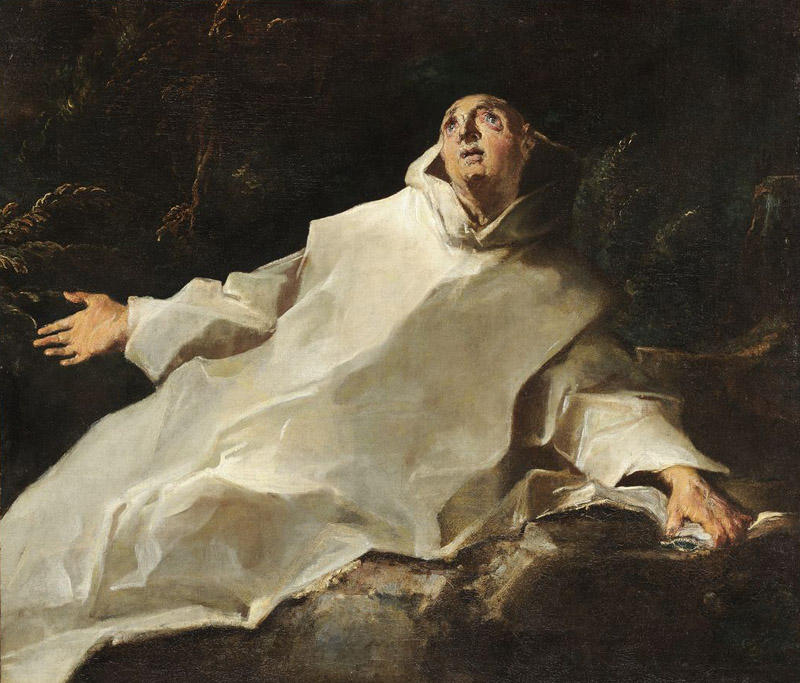
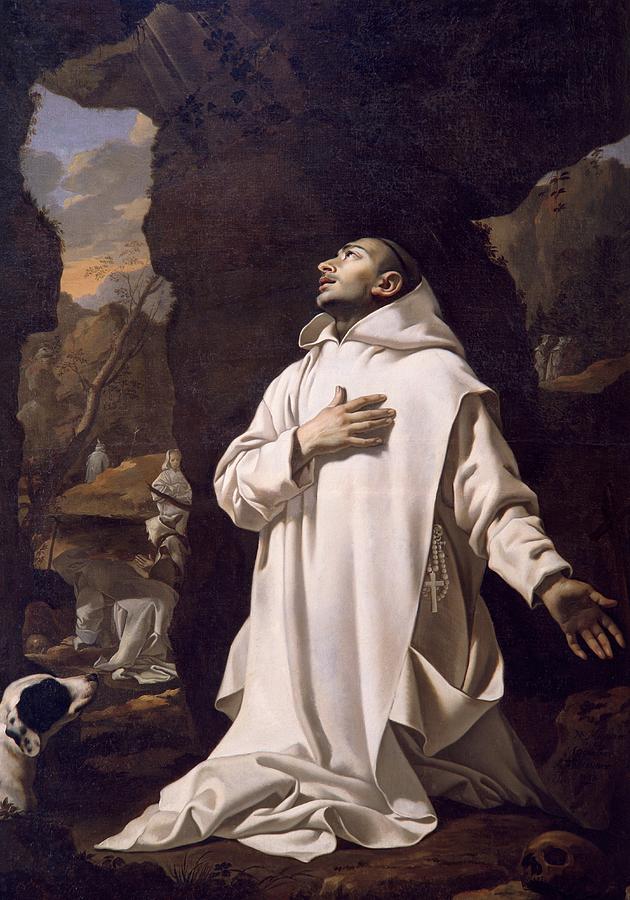
After his death, the Carthusians of Calabria, following a frequent custom of the Middle Ages, dispatched a roll-bearer, a servant of the community laden with a long roll of parchment, hung round his neck, who travelled through Italy, France, Germany,and England, stopping to announce the death of Bruno and in return, the churches, communities, or chapters inscribed upon his roll, in prose or verse, the expression of their regrets, with promises of prayers.   Many of these rolls have been preserved but few are so extensive or so full of praise as that about St Bruno.  A hundred and seventy-eight witnesses, of whom many had known the deceased, celebrated the extent of his knowledge and the fruitfulness of his instruction.   Strangers to him were above all struck by his great knowledge and talents.   But his disciples praised his three chief virtues — his great spirit of prayer, extreme mortification and devotion to the Blessed Virgin.Cretey-Vision-Saint-Brunost-bruno-praying-in-desert-nicolas-mignard

madonna-with-the-christ-child-and-saint-bruno-1624

Both the churches built by him in the desert were dedicated to the Blessed Virgin:  Our Lady of Casalibus in Dauphiné and Our Lady Della Torre in Calabria; faithful to his inspirations, the Carthusian Statutes proclaim the Mother of God the first and chief patron of all the houses of the order, whoever may be their particular patron.

Bruno was buried in the little cemetery of the hermitage of Santa Maria.   In 1513, his bones were discovered with the epitaph “Haec sunt ossa magistri Brunonis” (these are the bones of the master Bruno) over them.   Since the Carthusian Order maintains a strict observance of humility, Saint Bruno was never formally canonised with a ceremony.

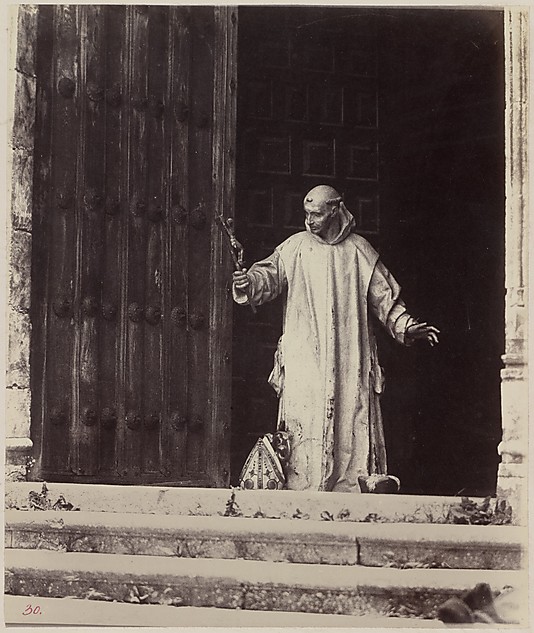
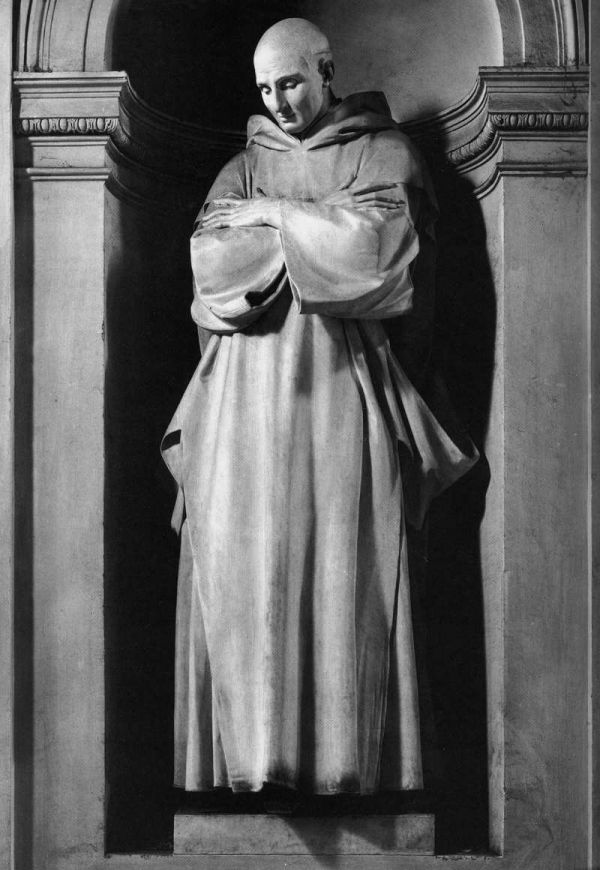
A writer as well as founder of his order, Saint Bruno composed commentaries on the Psalms and on the Epistles of Paul the Apostle.   Two letters of his also remain, his profession of faith, and a short elegy on contempt for the world which shows that he cultivated poetry.  St Bruno’s Commentaries reveal that he knew a little Hebrew and Greek;  he was familiar with the Church Fathers, especially Augustine of Hippo and Ambrose.   “His style,” said Dom Rivet, “is concise, clear, nervous and simple, and his Latin as good as could be expected of that century:  it would be difficult to find a composition of this kind at once more solid and more luminous, more concise and more clear.”sanbruno - AMAZINGjpgst bruno statuest-bruno-jean-antoine-houdon-1766-1767-1429754959_b

Posted in SAINT of the DAY

Memorials of the Saints – 6 October

St Bruno (Optional Memorial) – https://www.youtube.com/watch?v=_9RZ7UU0MIc
Bl Marie Rose Durocher (Optional Memorial)

Bl Adalbero of Lambach
St Alberta of Agen
Bl Artaldo of Belley
St Aurea of Boves
St Ceollach
St Epiphania
St Erotis
St Faith of Agen
St Francis Trung Von Tran
Bl François Hunot
Bl Isidore of Saint Joseph
St Iwi
St John Xenos
Bl Juan de Prunera
St Magnus of Orderzo
St Mary Frances of the Five Wounds of Christ
St Pardulf
St Renato of Sorrento
St Romanus of Auxerre
St Sagar of Laodicea

Martyrs of Capua – 4 saints: A group of martyrs who were either killed in Capua, Italy, or that’s where their relics were first enshrined. We now know nothing but their names – Aemilius, Castus, Marcellus and Saturninus.

Martyrs of Kyoto – 52 beati: Fifty-two Japanese lay people, some single, some married, some parents, some children, who were martyred together during one of the government sponsored persecutions of Christians.
• Blessed Agatha of Kyoto • Blessed Anna Kajiya • Blessed Antonius Domi • Blessed Benedictus of Kyoto • Blessed Catharina Hashimoto • Blessed Cosmas of Kyoto • Blessed Didacus Tsuzu • Blessed Emmanuel Kosaburo • Blessed Franciscus Hashimoto • Blessed Franciscus of Kyoto • Blessed Franciscus Shizaburo • Blessed Gabriel of Kyoto • Blessed Hieronimus Soroku • Blessed Ioachim Ogawa • Blessed Ioannes Hashimoto Tahyoe • Blessed Ioannes Kyusaku • Blessed Ioannes Sakurai • Blessed Leo Kyusuke • Blessed Linus Rihyoe • Blessed Lucia of Kyoto • Blessed Lucia Soroku • Blessed Lucia Toemon • Blessed Ludovica Hashimoto • Blessed Ludovicus Matagoro • Blessed Magdalena Kyusaku • Blessed Magdalena of Kyoto • Blessed Mancius Kyujiro • Blessed Maria Chujo • Blessed Maria Koshima Shinshiro • Blessed Maria of Kyoto • Blessed Maria of Kyoto • Blessed Maria of Kyoto • Blessed Maria of Kyoto • Blessed Martha Kyusuke • Blessed Martha of Kyoto • Blessed Martha of Kyoto • Blessed Mencia of Kyoto • Blessed Monica of Kyoto • Blessed Monica of Kyoto • Blessed Monica of Kyoto • Blessed Petrus Hashimoto • Blessed Regina Kyusaku • Blessed Rufina of Kyoto • Blessed Sixtus of Kyoto • Blessed Thecla Hashimoto • Blessed Thomas Hashimoto • Blessed Thomas Ikegami • Blessed Thomas Kajiya Yoemon • Blessed Thomas Kian • Blessed Thomas Koshima Shinshiro • Blessed Thomas Toemon • Blessed Ursula Sakurai •
They were martyred on 6 October 1619 in Kyoto (Miyako), Japan and Beatified on 24 November 2008 by Pope Benedict XVI.

Martyrs of Trier: Commemorates the large number of martyrs who died in Trier, Germany in the persecutions of Diocletian. 287 in Trier, Germany.

Martyred in the Spanish Civil War
• Blessed Josep Lluis Raga Nadal
• Blessed Plàcid Fàbrega Julià

Posted in CATHOLIC DEVOTIONS of the Month, DEVOTIO, MARIAN PRAYERS, MARIAN TITLES, SAINT of the DAY, The BLESSED VIRGIN MARY, The HOLY ROSARY/ROSARY CRUSADE

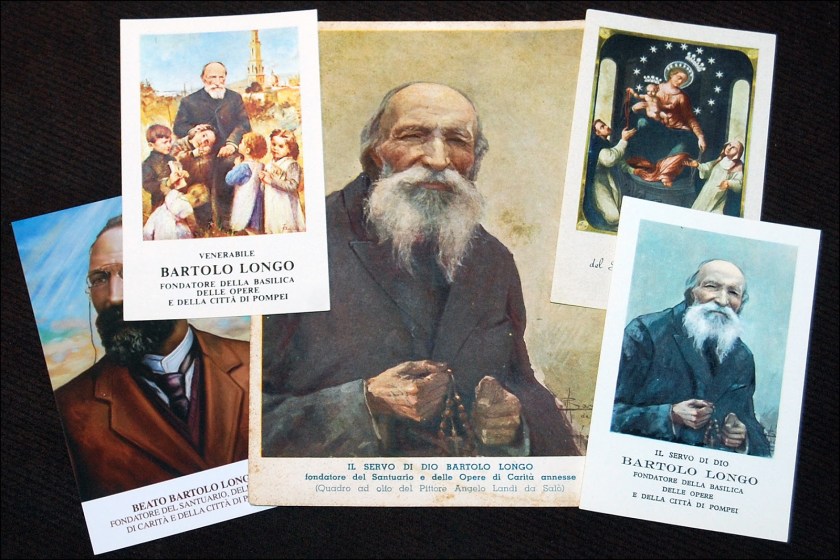
Prayers to accompany the Holy Rosary By Blessed Bartholomew Longo

Prayers to accompany the Holy Rosary
By Blessed Bartholomew Longo

First Joyful Mystery:   The Annunciation.
O Mary, immaculate lily, through the joy you felt when at the Angel’s message you became the Mother of God:  obtain for me the virtue of purity and of humility, that I may become your worthy son/daughter and the brother/sister of Jesus.

Second Joyful Mystery:  The Visitation.
O Mary, Mother of grace and of charity, through the joy you felt when, upon visiting Elizabeth, you brought joy to the home of Zechariah and the Baptist was sanctified at the sound of your voice:   visit my soul, let it hear your Motherly voice and fill it with love of God and love of neighbour.

Third Joyful Mystery:   The Birth of Jesus.
O Mary, mirror of humility and of poverty, through the joy you felt when, turned away by the inhabitants of Bethlehem and forced to take refuge in a stable from the cold and darkness, you gave birth to the Divine Redeemer:  grant that by accepting scorn and poverty I remain faithful to grace and gain the reward of eternal salvation by means of good works.

Fourth Joyful Mystery:  The Presentation.
O Mary, the perfect model of obedience and of sacrifice, you who offered Jesus to the Eternal Father on our behalf:  place your Child upon my bosom, that, together with you, I may offer Him the sacrifice of my passions and of my whole being.

Fifth Joyful Mystery:  The Finding in the Temple.
O Mary, a shining example of patience, through the joy you felt when, after three days of anxiously searching, you found Jesus in the Temple:  grant that I too, seeking Jesus with love in every moment of my life in imitation of you, may find Him at last in your arms at the hour of my death, never to lose Him again.

First Sorrowful Mystery:  The Agony in the Garden.
O Grieving Virgin, through the anguish of that saddest of nights in which Jesus in agony in the garden sweat blood at the sight of my sins and, betrayed, was tied as a criminal: obtain for me the perfect sorrow of my sins and perseverance in prayer, that I may never again betray His most loving Heart.

Second Sorrowful Mystery:  The Scourging at the Pillar.
O most grieving Mother, through the pain you felt in knowing that your innocent and holy Son had been publicly stripped and bloodily scourged with biting whips:  obtain for me the spirit of true repentance and the virtue of chastity and of the mortification of the senses.

Third Sorrowful Mystery: The Crowning with Thorns.
O Mother of sorrows, through the atrocious torment which pierced your heart when you saw Jesus, the King of glory, then become the King of suffering, crowned with thorns and shame, with a reed in His hands, derided by the crowd:  ah!, encircle my intellect and my heart with these very thorns, that I may never offend Him again with evil thoughts and sentiments;  and obtain for me pureness in my thoughts and the right intentions in my actions.

Fourth Sorrowful Mystery:  The Carrying of the Cross.
O grieving Mother, through the martyrdom of your heart, when you met your Son weighed down beneath the heavy cross, staining the road to Calvary with His blood: grant that I, clinging to Jesus’ cross, follow behind, daily carrying the cross of my troubles with meekness and with perfect conformity to the will of God.

Fifth Sorrowful Mystery:  The Crucifixion and Death of Our Lord.
O Queen of the Martyrs, through the extreme spasm of your heart when you witnessed Jesus dying on the cross in the midst of a thousand torments, forsaken and without comfort:  grant that I die to myself, to the world and to sin, and live in the heart of Jesus alone, having abandoned myself in His most holy arms.

First Glorious Mystery:   The Resurrection.
O Most Holy Mother of God, through the joy you felt in seeing Jesus risen from the dead and surrounded in glory:  obtain for me that I too rise from the death of sin to a life of grace and of faith and may persevere in it till my very last breath.

Second Glorious Mystery:  The Ascension.
O Queen of the Heavens, through the joy you experienced in seeing Jesus rising to Heaven triumphant as King of the Universe and as our Advocate by His Father:   obtain His blessing for me also, so that I be changed by Him from a sinner into a saint; moreover, by separating me from all earthly affection, through the virtue of hope may He kindle in me the desire of paradise.

Third Glorious Mystery:   The Descent of the Holy Spirit.
O Queen of the Universe, through the joy you felt when the Holy Spirit descended on you and on the Apostles:  grant that He come into my soul and fill it with His holy gifts and the heavenly fruits of charity, of joy, of patience and of peace.

Fourth Glorious Mystery:   The Assumption.
O Queen, Lady of the Angels, through the joy you experienced when you were taken into heaven body and soul: come with Jesus to assist me at the hour of my death and lead me with you to everlasting happiness.

Fifth Glorious Mystery:  The Coronation of the Blessed Virgin Mary.
O Queen of all the Saints and the honour and delight of humankind, through the joy you felt when the Most Holy Trinity crowned you as Queen of Heaven and Earth: inflame me with your love and with the love of God, that I may love and serve you on earth and glorify you, O Queen of my heart, in heaven.

Bartolo Longo prayer cards

Posted in CATHOLIC DEVOTIONS of the Month, DEVOTIO, MARIAN PRAYERS, MARIAN QUOTES, MARIAN TITLES, MORNING Prayers, QUOTES of the SAINTS, SAINT of the DAY, The BLESSED VIRGIN MARY, The HOLY ROSARY/ROSARY CRUSADE

Thought for the Day – 5 October – The Memorial of Blessed Bartholomew Longo – Apostle of the Holy Rosary

Thought for the Day – 5 October – The Memorial of Blessed Bartholomew Longo – Apostle of the Holy Rosary

Before entering the Shrine to recite the Holy Rosary with you, I paused briefly before the tomb of Bl Bartolo Longo and, praying, I asked myself:  “Where did this great apostle of Mary find the energy and perseverance he needed to bring such an impressive work, now known across the world, to completion? Was it not in the Rosary, which he accepted as a true gift from Our Lady’s Heart?”   Yes, that truly was how it happened!   The experience of the Saints bears witness to it:  this popular Marian prayer is a precious spiritual means to grow in intimacy with Jesus and to learn at the school of the Blessed Virgin always to fulfil the divine will.   It is contemplation of the mysteries of Christ in spiritual union with Mary as the Servant of God Paul VI stressed in his Apostolic Exhortation Marialis cultus (n. 46) and as my venerable Predecessor John Paul II abundantly illustrated in his Apostolic Letter Rosarium Virginis Mariae that today I once again present in spirit to the Community of Pompeii and to each one of you.   You who live and work here in Pompeii, especially you, dear priests, men and women religious and lay people involved in this unique portion of the Church, are all called to make Bl. Bartolo Longo’s charism your own and to become, to the extent and in the way that God grants to each one, authentic apostles of the Rosary.

To be apostles of the Rosary, however, it is necessary to experience personally the beauty and depth of this prayer which is simple and accessible to everyone.   It is first of all necessary to let the Blessed Virgin take one by the hand to contemplate the Face of Christ:  a joyful, luminous, sorrowful and glorious Face.   Those who, like Mary and with her, cherish and ponder the mysteries of Jesus assiduously, increasingly assimilate his sentiments and are conformed to him.   In this regard, I would like to quote a beautiful thought of Bl Bartolo Longo:  “Just as two friends, frequently in each other’s company, tend to develop similar habits”, he wrote, “so too, by holding familiar converse with Jesus and the Blessed Virgin, by meditating on the mysteries of the Rosary and by living the same life in Holy Communion, we can become, to the extent of our lowliness, similar to them and can learn from these supreme models a life of humility, poverty, hiddenness, patience and perfection” (I Quindici Sabati del Santissimo Rosario, 27th edition, Pompeii, 1916, p. 27: cited in Rosarium Virginis Mariae, n. 15).   POPE BENEDICT XVI – 19 October 2008

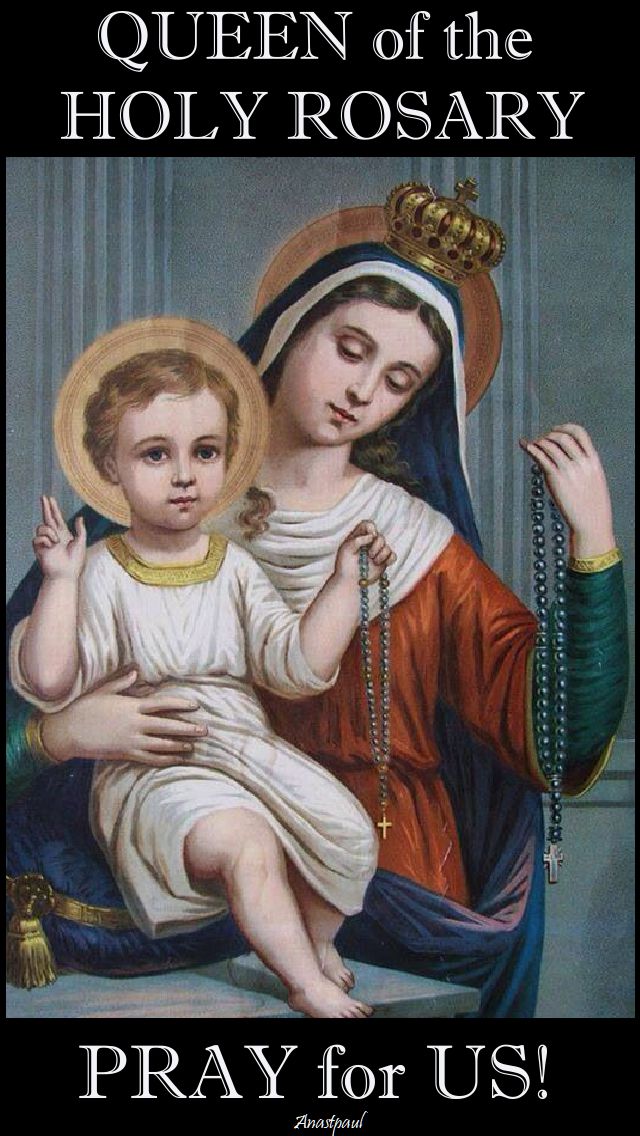
Queen of the Holy Rosary, Pray for us!queen of the holy rosary - pray for us - 5 oct 2017

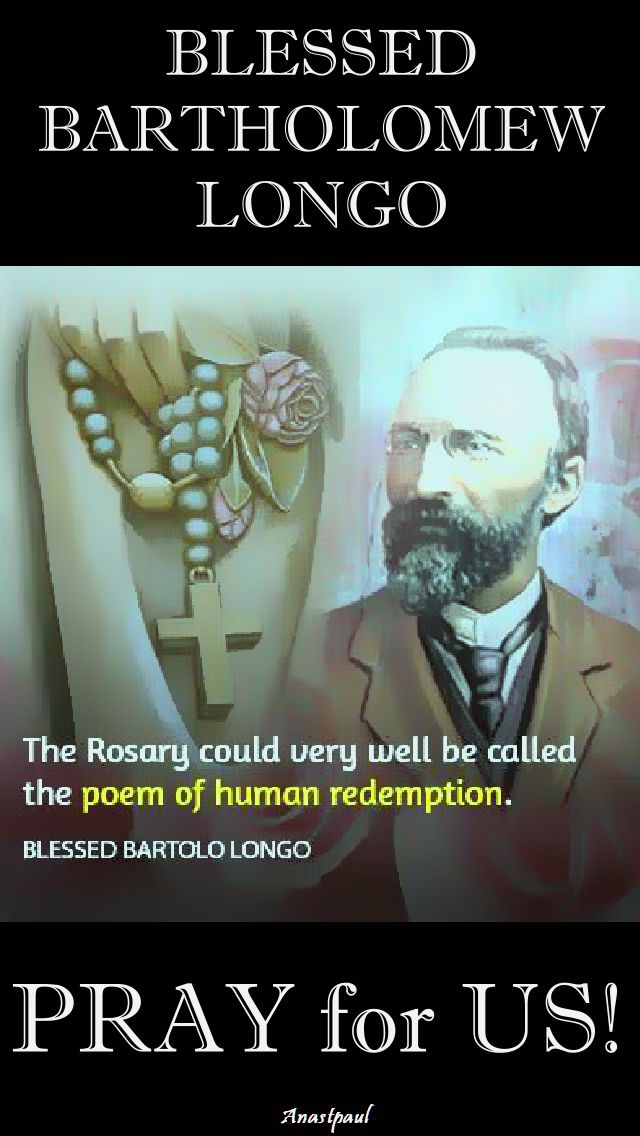
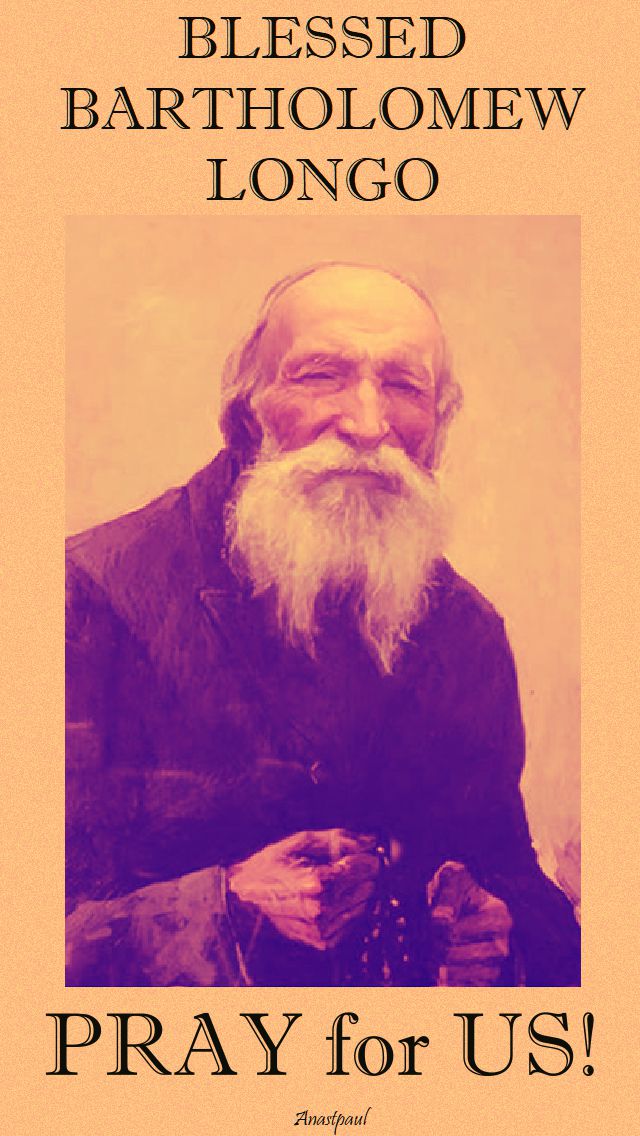
Blessed Bartholomew Longo, Pray for us!bl bartholomew longo pray for us 2


Posted in CATHOLIC DEVOTIONS of the Month, DEVOTIO, MARIAN PRAYERS, MARIAN QUOTES, MARIAN TITLES, MORNING Prayers, QUOTES of the SAINTS, SAINT of the DAY, The BLESSED VIRGIN MARY, The HOLY ROSARY/ROSARY CRUSADE

Quote/s of the Day – 5 October – The Memorial of Blessed Bartholomew Longo – Apostle of the Holy Rosary

Quote/s of the Day – 5 October – The Memorial of Blessed Bartholomew Longo – Apostle of the Holy Rosary

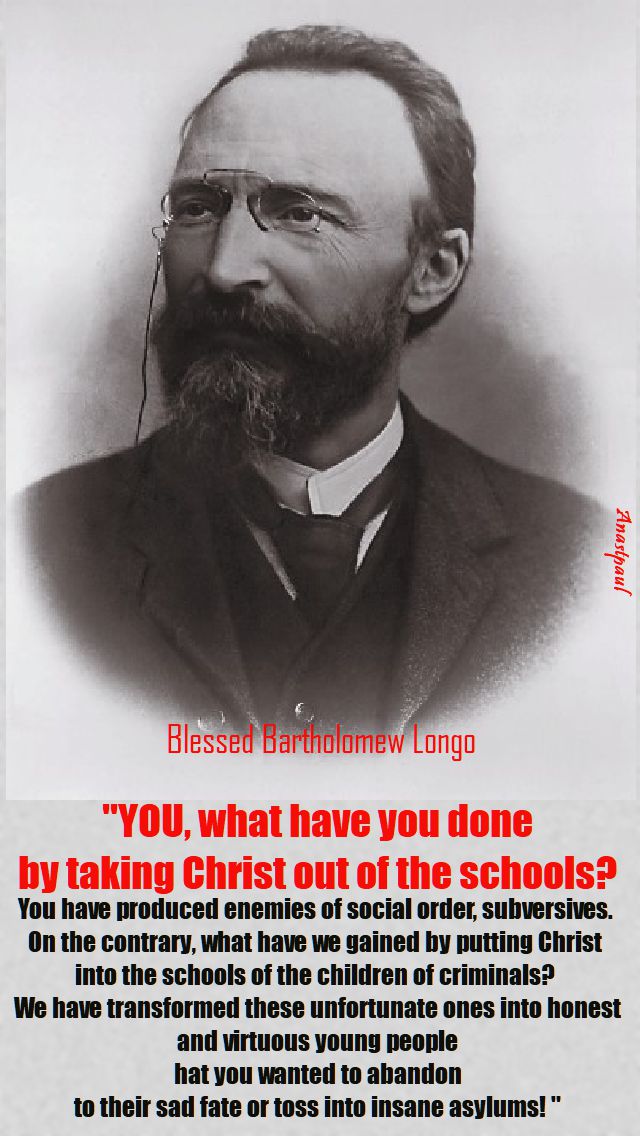
“You, what have you done by taking Christ out of the schools?
You have produced enemies of social order, subversives.
On the contrary, what have we gained by putting Christ
into the schools of the children of criminals?
We have transformed these unfortunate ones into honest
and virtuous young people that you wanted to abandon
to their sad fate or toss into insane asylums! “YOU WHAT HAVE YOU DONE - bl bartholomew longo - 5 oct 2017

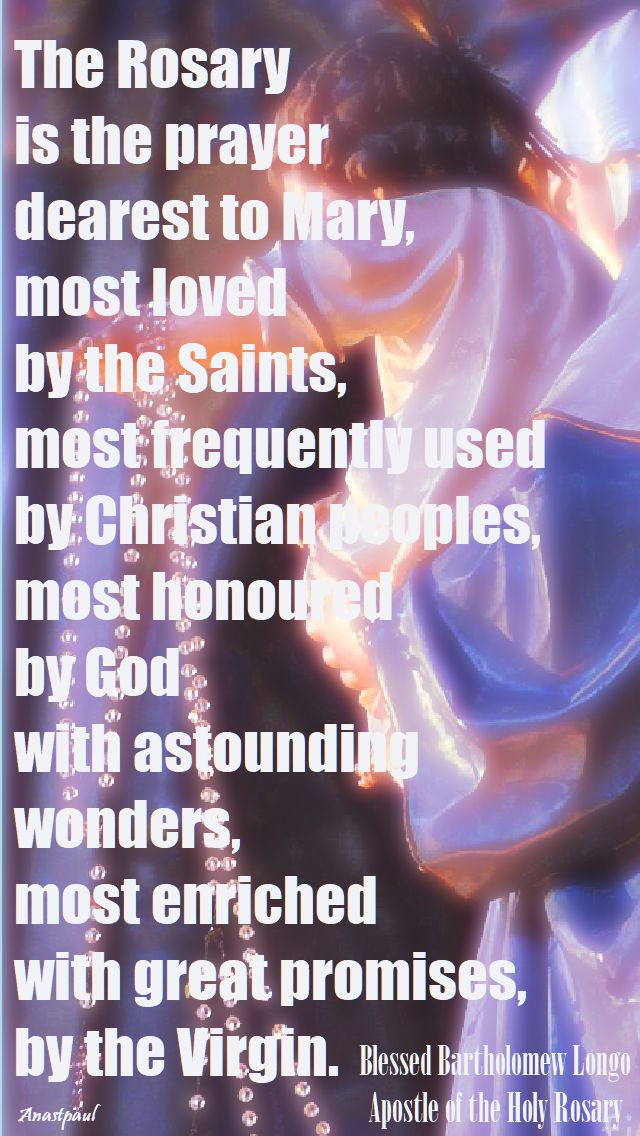
“The Rosary is the prayer dearest to Mary,
most loved by the Saints,
most frequently used by Christian peoples,
most honoured by God with astounding wonders,
most enriched with great promises,
by the Virgin.”

Blessed Bartholomew Longothe rosary is the prayer - bl bartolo longo - 5 oct 2017

Posted in CATHOLIC DEVOTIONS of the Month, MARIAN PRAYERS, MARIAN QUOTES, MARIAN TITLES, MORNING Prayers, QUOTES of the SAINTS, SAINT of the DAY, The HOLY ROSARY/ROSARY CRUSADE, The WORD

One Minute Reflection – 5 October – The Memorial of Blessed Bartholomew Longo – Apostle of the Holy Rosary

One Minute Reflection – 5 October – The Memorial of Blessed Bartholomew Longo – Apostle of the Holy Rosary

Blessed is she who believed that there would be a fulfilment of what was spoken to her from the Lord……Luke 1: 45.luke 1-45 - 5 oct 2017

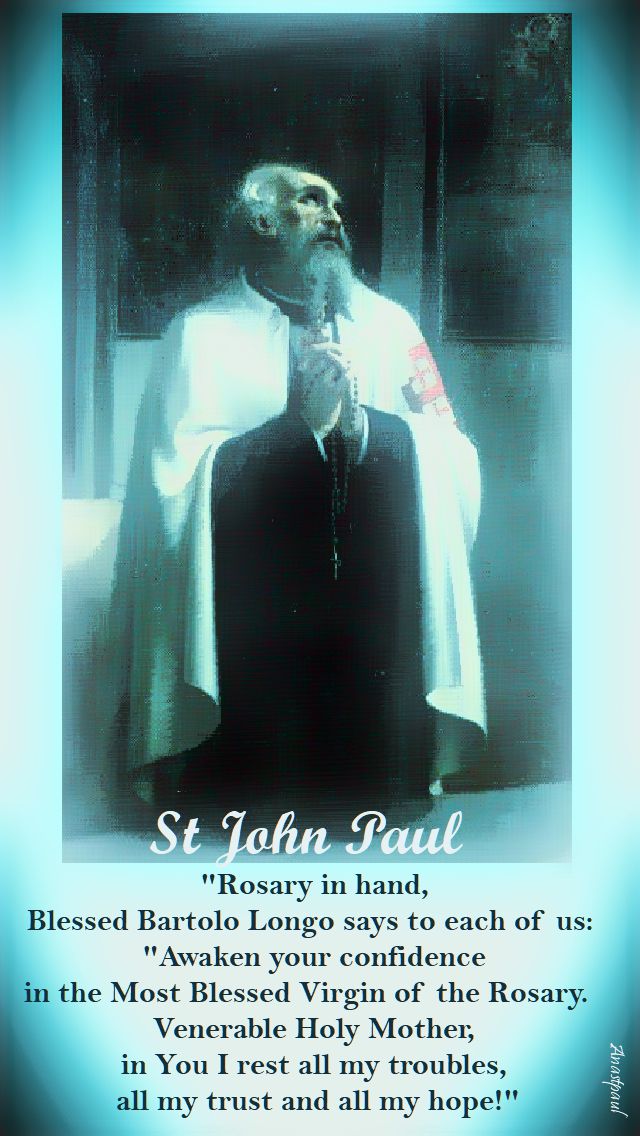
REFLECTION – “Rosary in hand, Blessed Bartolo Longo says to each of us: “Awaken your confidence in the Most Blessed Virgin of the Rosary.   enerable Holy Mother, in You I rest all my troubles, all my trust and all my hope!” – St Pope John Paul II in his homily during the beatification ceremony for Blessed Bartholomewrosary in hand - st john paul - 5 oct 2017

PRAYER – And we exult you, O Mary Assumed into Heaven, as we contemplate you who have been glorified and, in the risen Christ, have become the co-worker of the Holy Spirit in communicating divine life to mankind. In you we see the goal of holiness to which God calls all the Church’s members.   In your life we recognise the clear sign of the path to spiritual maturity and Christian holiness.   With you, with Blessed Bartholomew Longo and with all the saints, we glorify God the Trinity, who sustains our earthly pilgrimage and lives and reigns for ever and ever. Amen (by St Pope John Paul Nov 2000)bl bartolo longo pray for us - 5 oct 2017

Posted in CATHOLIC DEVOTIONS of the Month, CATHOLIC-PRAYERS OF THE CHURCH, MARIAN PRAYERS, MARIAN TITLES, MORNING Prayers, SAINT of the DAY, The HOLY ROSARY/ROSARY CRUSADE

Our Morning Offering – 5 October – The Memorial of Blessed Bartholomew Longo – Apostle of the Holy Rosary

Our Morning Offering – 5 October – The Memorial of Blessed Bartholomew Longo – Apostle of the Holy Rosary

In this prayer to Our Lady of the Rosary, we ask the Virgin Mary to help us to cultivate a habit of interior prayer through the daily recitation of the rosary. We pray this prayer, particularly during the month of October, as we daily cultivate the habit of praying the Holy Rosary. This is the object of all of our prayers: to arrive at the point where we can “pray without ceasing,” as Saint Paul tells us to do.

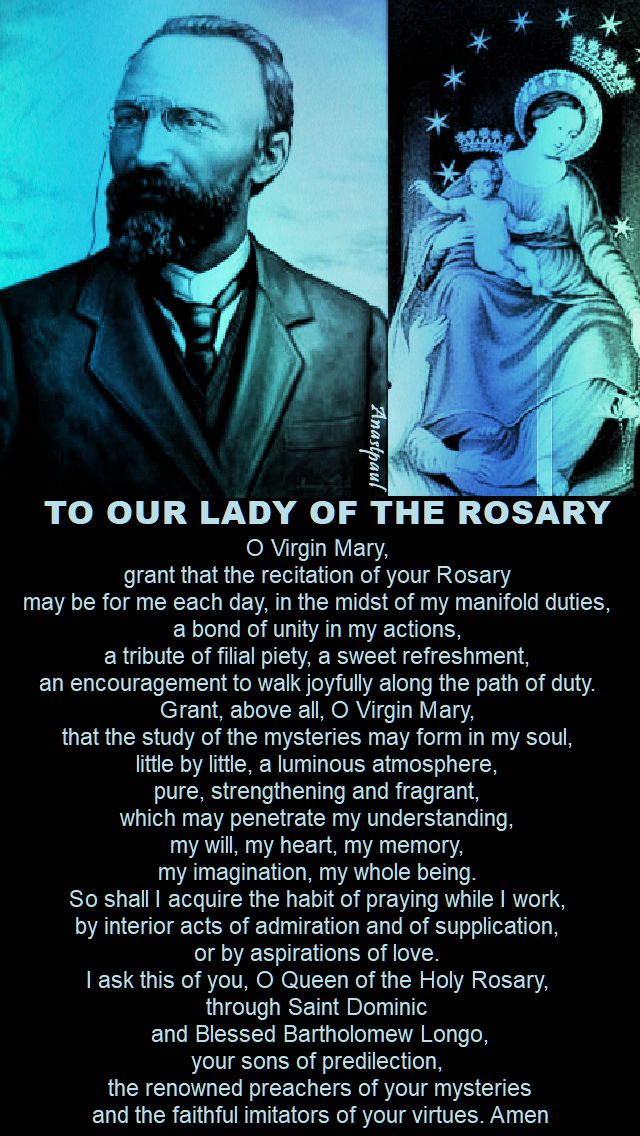
TO OUR LADY OF THE ROSARY

O Virgin Mary,
grant that the recitation of your Rosary
may be for me each day,
in the midst of my manifold duties,
a bond of unity in my actions,
a tribute of filial piety,
a sweet refreshment,
an encouragement to walk joyfully
along the path of duty.
Grant, above all, O Virgin Mary,
that the study of the mysteries may form in my soul,
little by little, a luminous atmosphere, pure, strengthening
and fragrant, which may penetrate my understanding,
my will, my heart, my memory, my imagination, my whole being.
So shall I acquire the habit of praying while I work,
by interior acts of admiration and of supplication,
or by aspirations of love.
I ask this of you, O Queen of the Holy Rosary,
through Saint Dominic and Blessed Bartholomew Longo,
your sons of predilection,
the renowned preachers of your mysteries
and the faithful imitator of your virtues. Amen

Queen of the Holy Rosary, pray for us

Bl Bartholomew Longo, pray for us.to our lady of the rosary - 5 oct memorial of bl bartholomew longo - 2017


Posted in MARIAN PRAYERS, MIRACLES, PAPAL ENCYLICALS, SAINT of the DAY, The BLESSED VIRGIN MARY, The HOLY ROSARY/ROSARY CRUSADE

Saint of the Day – 5 October – Blessed Bartholomew Longo (1841-1926)

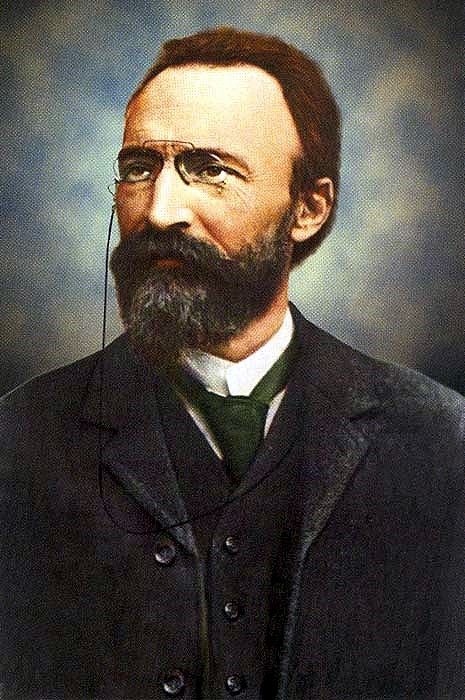
Saint of the Day – 5 October – Blessed Bartholomew Longo (Italian – Bartolo Longo) (1841-1926) Lawyer, Dominican Tertiary, Confessor, Apostle of the Rosary, Apostle of Marian Devotion, Papal Knight of the Holy Sepulchre.BL BARTOLO LONGO.2

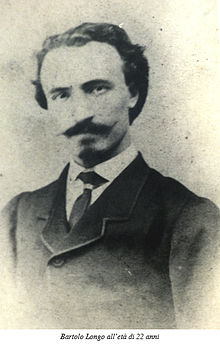
Bartolo Longo was born into a wealthy family on February 10, 1841 in the small town of Latiano, near Brindisi, in southern Italy.   His parents were devout Roman Catholics.   In 1851, Longo’s father died and his mother remarried a lawyer.   Despite Longo’s stepfather wanting him to become a teacher, Longo was set on becoming a lawyer.   In 1861, Longo succeeded in convincing his stepfather and was sent to the University of Naples to study law.

220px-Bartolo_Longo_A_22_anni

In the 1860s, the Catholic Church in Italy found itself at odds with a strong nationalistic movement.   General Giuseppe Garibaldi, who played a key role in Italian unification, saw the Pope as an antagonist to Italian nationalism and actively campaigned for the elimination of the papal office altogether.   The Catholic Church in Europe was also competing with a growing popularity in Spiritualism and Occultism.   Because of this, many students at the University of Naples took part in demonstrations against the pope, dabbled in witchcraft and consulted Neapolitan mediums.   Longo became involved with a movement that he claimed led him into a Satanist cult.   After some study and several “spiritual” experiences Longo said that he was ordained as a satanic priest.

In the following years, Longo’s life became one of “depression, nervousness and confusion”.   Bothered by paranoia and anxiety, he turned to a hometown friend, Vincenzo Pepe, for guidance.   It was Pepe who convinced him, in Longo’s account, to abandon Satanism and introduced him to the Dominican Father Alberto Radente who led him to a devotion to the rosary.    On October 7, 1871, Longo became a Dominican tertiary and took the name “Rosario”.   Around this time, he reportedly visited a séance and held up a rosary, declaring, “I renounce spiritualism because it is nothing but a maze of error and falsehood.”   He also came to know some Franciscans with whom he helped the poor and incurably ill for two years.   Bartolo also kept up his law practice, which took him to the nearby village of Pompei.   He went to Pompei to take care of the affairs of Countess Marianna Farnararo De Fusco.

In Pompei, Longo later recounted, he was shocked at the erosion of the people’s faith.   He wrote, “Their religion was a mixture of superstition and popular tradition. … For their every need, … they would go to a witch, a sorceress, in order to obtain charms and witchcraft.”   Through talking to the citizens, Bartolo came to recognise their severe lack of catechesis.   When he asked one man if there was only one God, the fellow answered, “When I was a child, I remember people telling me there were three. Now, after so many years, I don‘t know if one of them is dead or one has married.”

Longo wrote of his personal struggles with mental illness, paranoia, depression and anxiety.   At one point, he noted struggling with suicidal thoughts but rejected them by recalling the promise of Saint Dominic, “he who propagates my Rosary will be saved.” Longo wrote that this promise is what convinced him to encourage public devotion to the rosary.

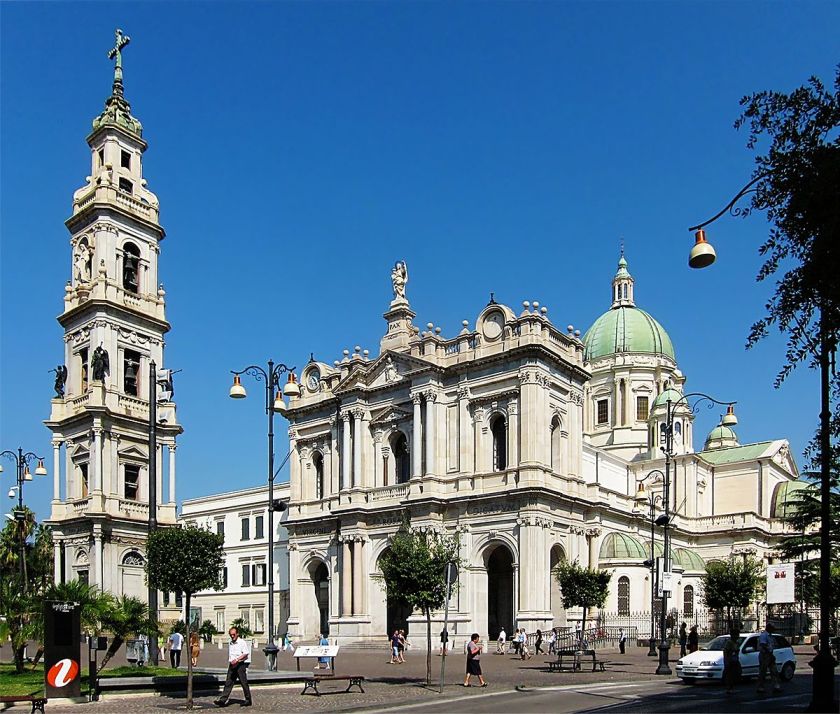
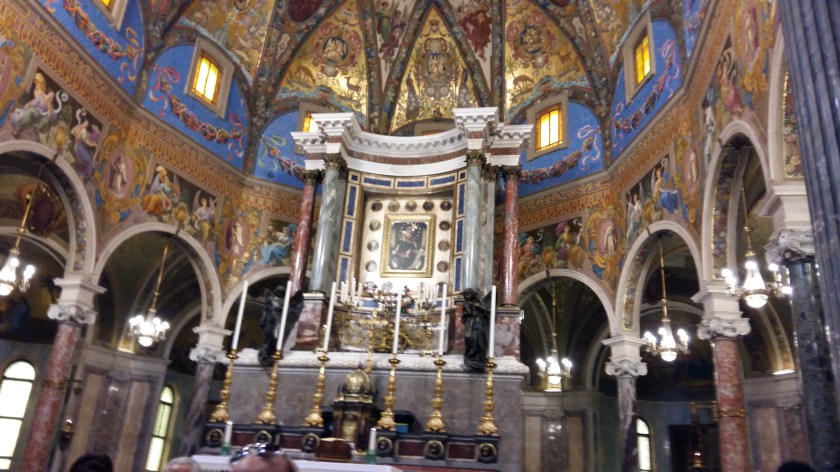
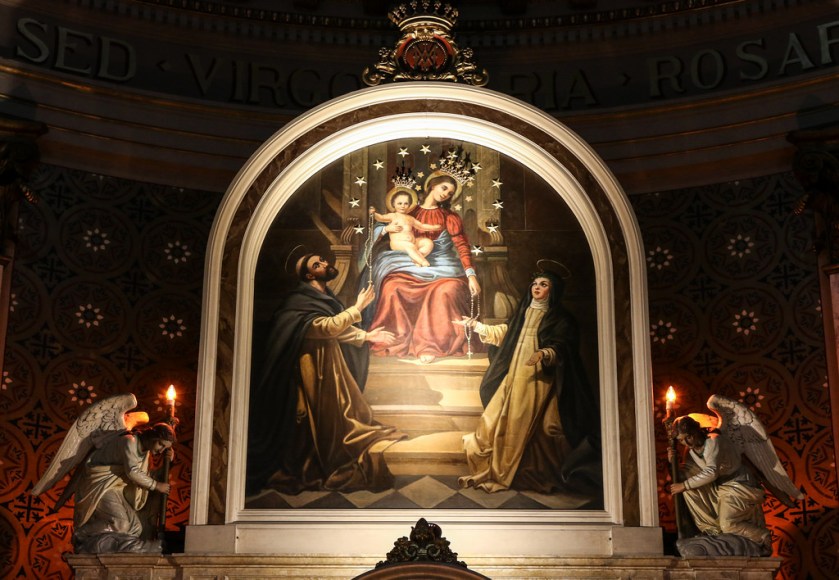
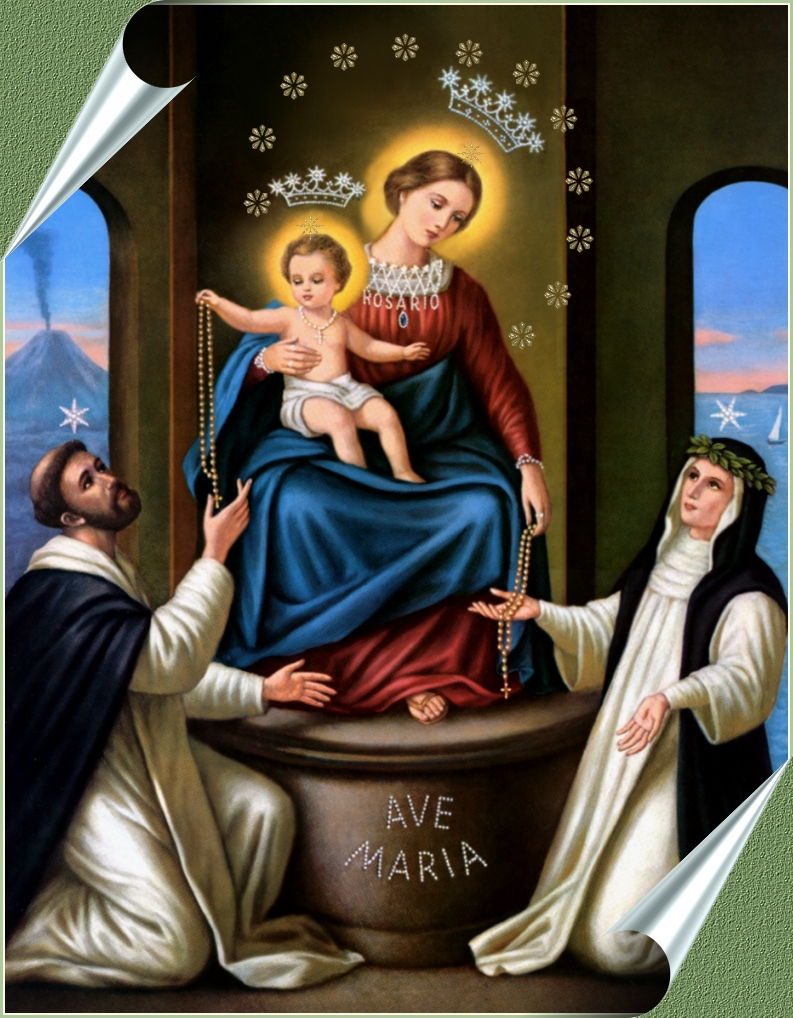
With the help of Countess Mariana di Fusco, he inaugurated a confraternity of the Rosary and in October 1873 started restoring a dilapidated church.   He sponsored a festival in honour of Our Lady of the Rosary.   In 1875, Longo obtained as a gift a painting portraying Our Lady of the Rosary, with Saint Dominic and Saint Catherine of Siena. Sister M Concetta de Litala of the Monastery of the Rosary at Porta Medina had been holding it for the Dominican priest Alberto Radente.   Radente had acquired it from a junk-shop dealer in Naples for a very small sum.   The painting was in bad condition and Longo wrote of his immediate distaste of the poor artistic quality when he first saw it. However, he accepted the gift to conserve funds and to not insult the Sister Concetta. Longo raised funds to restore the image and placed it in the church in an effort to encourage pilgrimages.  Miracles began to be reported and people began flocking in droves to the church.   Longo was encouraged by the Bishop of Nola to begin the construction of a larger church—the cornerstone being laid on May 8, 1876.   The church was consecrated in May 1891 by Cardinal La Valletta (representing Pope Leo XIII).   In 1939, the church was enlarged to a basilica, known today as the Basilica of Our Lady of the Most Holy Rosary of Pompei.1200px-Pompei_duomopompeii altarpompeii shrinepompeii

At the suggestion of Pope Leo XIII, Bartolo Longo and the Countess Mariana di Fusco were married on April 7, 1885.   The couple remained chaste and continued to do many charitable works and provided for orphaned children and the children of prisoners which for its time was revolutionary.

In 1906 they donated the entire property of the Pompeii shrine to the Holy See.   Longo continued promoting the Rosary until his death on October 5, 1926, at the age of 85.   The piazza on which his basilica stands has since been named in memory of Longo.   His body is encased in a glass tomb and he is wearing the mantle of a Knight of the Order of the Holy Sepulchre, a papal order of knighthood.

blessed_bartolo_longo_at_pompei

On October 26, 1980 he was beatified by Pope John Paul II, who would call him the “Apostle of the Rosary” and mentioned him specifically in his apostolic letter “Rosarium Virginis Mariae” (The Rosary of the Virgin Mary).

On October 7, 2003 Pope John Paul II prayed for world peace at the Basilica.   More than 30,000 people were waiting to greet him as he flew in by helicopter.

Posted in SAINT of the DAY

Memorials of the Saints – 5 October

Bl Francis Xavier Seelos (Optional Memorial)

Bl Alberto Marvelli
St Alexander of Trier
St Anna Schaeffer
St Apollinaris of Valence
St Attilanus of Zamora
St Aymard of Cluny
Bl Bartholomew Longo – https://www.youtube.com/watch?v=kLi9V9oO6ew (Part One) https://www.youtube.com/watch?v=vAemzQDLVxo (part Two)
St Boniface of Trier
St Charitina of Amasa
St Eliano of Cagliari
St Faustina Kowalska
St Firmatus of Auxerre
St Flaviana of Auxerre
Bl Flora of Beaulieu
St Gallo of Aosta
St Jerome of Nevers
Bl John Hewett
St Magdalveus of Verdun
St Mamlacha
St St Marcellinus of Ravenna
Bl Marian Skrzypczak
St Meinulph
St Palmatius of Trier
Bl Raymond of Capua
Bl Robert Sutton
Bl Sante of Cori
St Thraseas of Eumenia
St Tranquilino Ubiarco Robles
Bl William Hartley

Martyrs of Messina – 30 saints: A group of about 30 Benedictine monks and nuns, some blood relatives, who were sent in the early days of the order to establish monasteries in the vicinity of Messina, Sicily, Italy, and who were martyred. We know the names, and a few details, about seven of them –
• Donatus
• Eutychius
• Faustus
• Firmatus
• Flavia
• Placidus
• Victorinus
6th century Messina, Sicily, Italy.

Martyred in the Spanish Civil War:
• Blessed Eugenio Andrés Amo
• Blessed Sebastià Segarra Barberá
• Blessed Rafael Alcocer Martínez

Posted in franciscan OFM, MORNING Prayers, SAINT of the DAY

Thought for the Day – 4 October – The Memorial of St Francis of Assisi (1181–1226)

Thought for the Day – 4 October – The Memorial of St Francis of Assisi (1181–1226)

Francis, the destitute and lowly, enters heaven, a rich man, acclaimed by the songs of angels!   (Antiphon for the Memoria of St Francis from the Divine Office)

Joyful Saint, Joyful Pope!

In my presence and in the presence of others, try to be always joyful, for it is not fitting that a servant of God appear before the brothers or other men with a sad and glum face. —Saint Francis

The encounter with the living Jesus…fills the heart with joy, because it fills it with true life, a profound goodness that does not pass away or decay. —Pope Francispapa f - joy

Saint Francis called himself God’s court jester—the Jongleur de Dieu—as he went about singing the praise of God.   Pope Francis brought the house down the night of his election, telling his brother cardinals, “May God forgive you!

One can’t help but notice a kind of effervescent joy that spreads happiness to others. These men have shattered the stereotype of rigid, grim, calcified piety.   They radiate something entirely different: the joy of Christ.

Jesus was attractive, in the literal sense of the word.   People wanted to meet Him and hear Him and follow Him.   Saint Francis had a similar effect and if the three million people who showed up at World Youth Day in Rio de Janeiro are any indication, Pope Francis does too.   The wisdom and faith of these men make them intriguing, to be sure, but their spirit of joy goes a long way in drawing these crowds.

Jesus, too, “rejoiced in the Holy Spirit” (Luke 10:21).   And he wanted us to share in his joy. “These things I have spoken to you,” Jesus told his disciples, “that my joy may be in you, and that your joy may be full” (John 15:11).   Twice again Jesus speaks in these terms: “Ask, and you will receive, that your joy may be full” (John 16:24), and, “These things I speak in the world, that they may have my joy fulfilled in themselves” (John 17:13).

This fullness of joy is our inheritance as Christians.   And it doesn’t always have to come with suffering!   The gift of knowing Christ, being subjects of the King of Kings, is a great joy in and of itself.   This is what Jesus taught:  “The kingdom of heaven is like treasure hidden in a field, which a man found and covered up; then in his joy he goes and sells all that he has and buys that field” (Matthew 13:44).

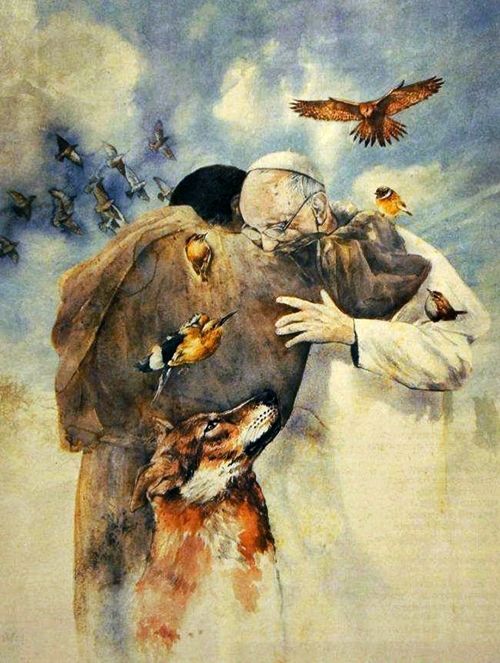
Saint Francis and Pope Francis have given everything, dedicating their entire lives for the sake of the kingdom of heaven.   And in this they have found great joy.francis and franics

St Francis Pray for us and let us all pray for our Holy Father!francis pray 2 - 4 oct 2017

St Francis leaves us with his blessing:

May the Lord bless you and keep you.

May the Lord make His face to shine upon you

and be gracious to you.

May the Lord lift up His countenance upon you and give you peace.

ST FRANCIS PRAYER - MAY THE LORD BLESS YOU AND KEEP YOU

Posted in franciscan OFM, SAINT of the DAY

Saint Francis of Assisi’s Song of Praise

Saint Francis of Assisi’s Song of Praise

We could simply say that Francis’ prayer life was, “My God and my all!” and stop at that. Everything that can be stated about prayer in the life of Saint Francis of Assisi is expressed in those four little words.   While the truth is contained in that brief and holy phrase, the way in which Francis reached that apex of prayer needs exploration.

In searching Francis’ journey in prayer, we discover our own way to believing and living “My God and my all!”   There are many significant markers in Francis’ prayer life but among them shines the Canticle.

The Canticle sings in simple words of praise all that Francis discovered of the glory and goodness of God.   All he learned through visions in his early conversion, from the words from the crucifix of San Damiano, his pummeling of God in prayer in the caves, his experiences of the brotherhood of lesser brothers, his own illness and approaching death–all is distilled to praise.

Each path Francis took on his journey to God led him to a single action:  praise of God. Through the entire domain of earth, from the glory of daybreak to nightfall’s softened light, Francis praises the Lord.   Through all weather, the elements of fire and water and the motherhood of the earth, Francis continues in praise.   Sickness and trial give birth to continuing praise.   The inevitable encounter with Sister Death spurs Francis to close his work with praise, blessing and thanksgiving.   Everything that happened in Francis’ life fueled the fire of his praise to the Lord.

Francis leaves us with a legacy of praise.   If we claim it as our heritage, we must use it as Francis did–in every circumstance of life without reservation.   “But,” we think, “I can’t praise God for my father’s Alzheimer’s disease.   How can I praise God for joblessness? For debilitating illness?   For the pain and grief that thunder through my life?”

Francis, like the Lord he followed, teaches us to praise God through the trials that enter every life.   Only then can we experience release from the bonds of anguish and despair. If we release our deepest emotions to God, we defuse their power to create havoc in our lives.

Learning to praise God through all the events with which life confronts us may seem like an impossible task.   In reality, all we have to do is begin to follow the path of praise. God will lead us on.

A Song of Brother Sun/Canticle of the Creatures
By St Francis of Assisi

Most High, all powerful, good Lord,
Yours are the praises, the glory, the honour
and all blessing.
To you alone, Most High, do they belong
and no human is worthy to mention Your name.

Praised be You, my Lord, with all Your creatures,
especially Sir Brother Sun,
who is the day and through whom You give us light.
And he is beautiful and radiant with great splendour;
and bears a likeness of You, Most High One.

Praised be You, my Lord,
through Sister Moon and the stars:
in heaven You formed them clear
and precious and beautiful.

Praised be You, my Lord, through Brother Wind;
and through the air, cloudy and serene
and every kind of weather,
through which You give sustenance to Your creatures.

Praised be You, my Lord, through Sister Water,
who is very useful and humble and precious and chaste.

Praised be You, my Lord,
through Brother Fire,
through whom You light the night:
and he is beautiful and playful and robust and strong.

Praised be You, my Lord,
through our Sister, Mother Earth,
who sustains and governs us
and who produces various fruit
with coloured flowers and herbs.

Praised be You, my Lord,
through those who give pardon for Your love
and bear infirmity and tribulation.

Blessèd are those who endure in peace:
for by You, Most High, shall they be crowned.

Praised be You, my Lord, for our Sister,
Bodily Death,
from whom no one living can escape:
woe to those who die in mortal sin.

Blessèd are those whom death will find
in Your most holy will,
for the second death shall do them no harm.

Praise and bless my Lord and give Him thanks
and serve Him with great humility.

a song of brother sun - st francis - 4 oct 2017

Posted in franciscan OFM, MORNING Prayers, QUOTES of the SAINTS, SAINT of the DAY

Quote/s of the Day – 4 October – The Memorial of St Francis of Assisi (1181–1226)

Quote/s of the Day – 4 October – The Memorial of St Francis of Assisi (1181–1226)

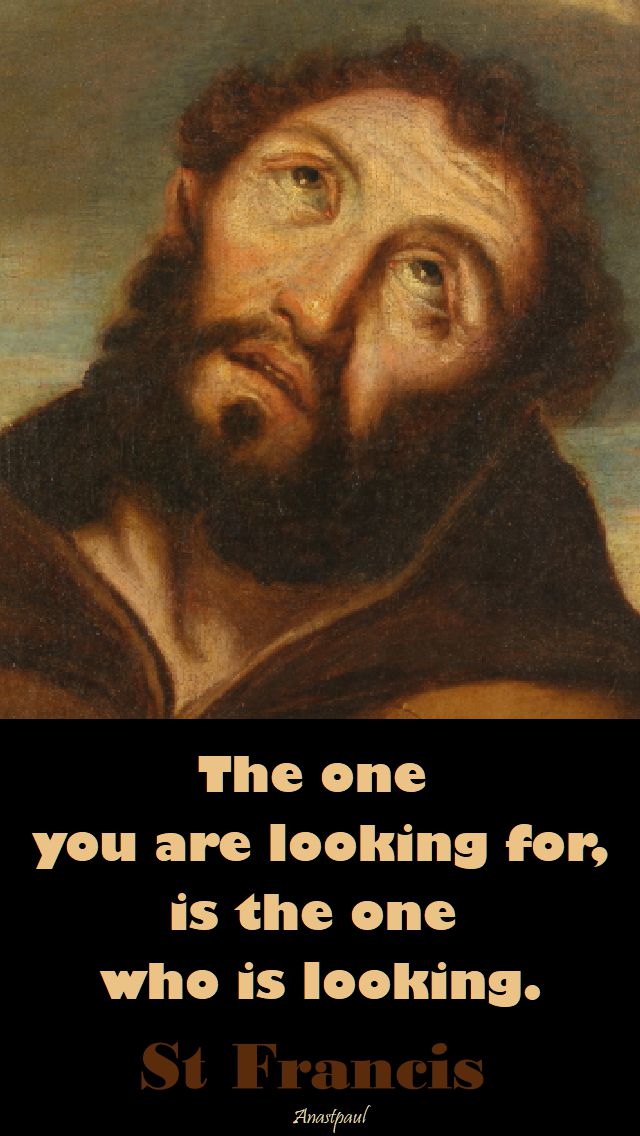
“The one you are looking for,
is the one who is looking.”the one you are looking for - st francis - 4 oct 2017

“Let the whole world of mankind tremble,
the whole world shake
and the heavens exult when Christ,
the Son of the living God,
is on the altar in the hands of a priest.
O admirable heights and sublime lowliness!
O sublime humility! O humble sublimity!
That the Lord of the universe, God and the Son of God,
so humbles Himself that for our salvation,
He hides Himself under the little form of bread!
Look, brothers, at the humility of God
and pour out your hearts before Him!
Humble yourselves, as well,
that you may be exalted by Him.
Therefore, hold back nothing
of yourselves, for yourselves,
so that He,
Who gives Himself totally to you,
may receive you totally.”let the whole world tremble - st francis - 4 oct 2017

“Therefore, O sons of men, how long will you be hard of heart?   Why do you not recognize the truth and believe in the Son of God? See, daily He humbles Himself as when He came from the royal throne into the womb of the Virgin;  daily He comes to us in a humble form;  daily He comes down from the bosom of the Father upon the altar in the hands of the priest.   And as He appeared to the holy apostles in true flesh, so now He reveals Himself to us in the sacred bread.   As they saw only his flesh by means of their bodily slight, yet believed Him to be God as they contemplated Him with the eyes of faith, so, as we see bread and wine with [our] bodily eyes, we too are to see and firmly believe them to be His most holy Body and Blood living and true.   And in this way the Lord is always with His faithful, as He Himself says:  Behold I am with you even to the end of the world (cf. Mt. 28:30).”therefore o sons of men - st francis - 2017

“What is it that stands higher than words?
ACTION.
What is it that stands higher than action?
SILENCE.”what is it that stands higher than words - st francis 4 oct 2017

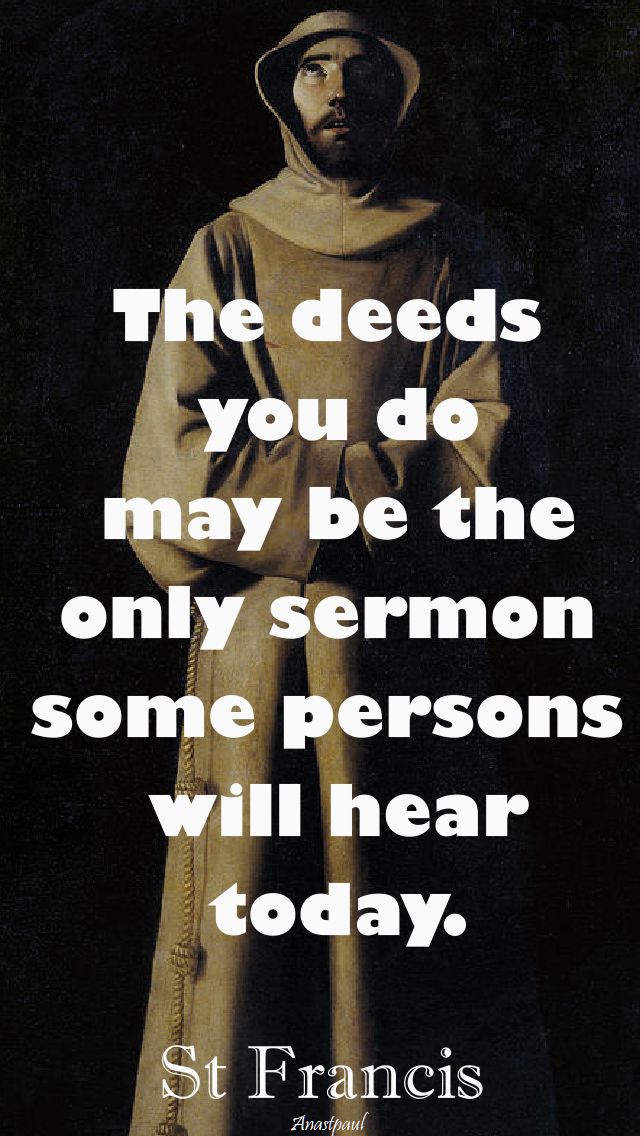
“The deeds you do may be the only sermon
some persons will hear today.”the deeds you do - 4 oct 2017

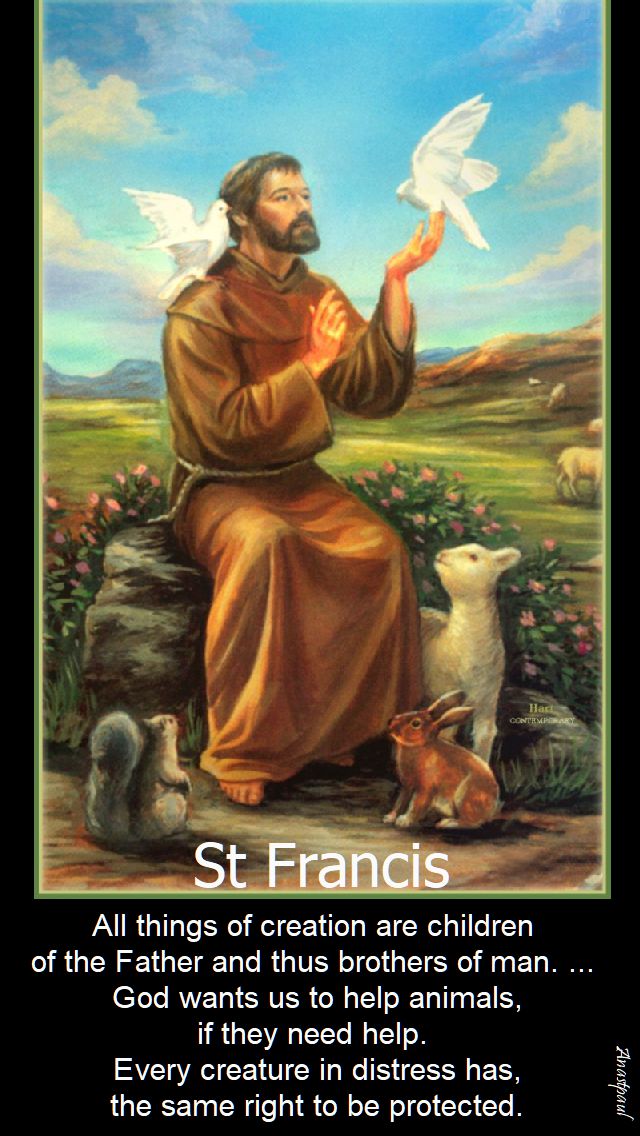
“All things of creation are children of the Father
and thus brothers of man. …
God wants us to help animals, if they need help.
Every creature in distress has,
the same right to be protected.”all things of creation - st francis - 4 oct 2017

St Francis of Assisi (1181–1226)

Posted in franciscan OFM, MORNING Prayers, QUOTES of the SAINTS, SAINT of the DAY, The WORD

One Minute Reflection – 4 October – The Memorial of St Francis of Assisi (1181–1226)

One Minute Reflection – 4 October – The Memorial of St Francis of Assisi (1181–1226)

Then Jesus said to his disciples, “Amen, I say to you, it will be hard for one who is rich to enter the kingdom of heaven.
Again I say to you, it is easier for a camel to pass through the eye of a needle than for one who is rich to enter the kingdom of God.”….Matthew 19:23-24matthew 19 23-24

REFLECTION – “Remember that when you leave this earth, you can take with you nothing that you have received—only what you have given: a full heart, enriched by honest service, love, sacrifice and courage.”….St Francis of Assisiremember that when you leave - st francis - 4 oct 2017

PRAYER – Lord God, You made St Francis of Assisi, Christ-like in his poverty and humility, his gentleness and charity, his love and courage. Help us to walk in his ways that, with joy and love, we may follow Christ Your Son and be united with You. St Francis, pray for us, amen.st francis pray - 4 oct 2017

Posted in franciscan OFM, MORNING Prayers, PRAYERS of the SAINTS, SAINT of the DAY, The HOLY CROSS

Our Morning Offering – 4 October – The Memorial of St Francis of Assisi (1181–1226)

Our Morning Offering – 4 October – The Memorial of St Francis of Assisi (1181–1226)

The Prayer before the San Damiano Crucifix
St Francis of Assisi

Most High, glorious God,
enlighten the darkness of my heart
and give me
true faith,
certain hope,
and perfect charity,
sense and knowledge,
Lord, that I may carry out,
Your holy and true command.  AmenPRAYER BEFORE THE CRUCIFIX SAN DAMIANO.2

Posted in DYING / LAST WORDS, franciscan OFM, Of and For PEACE, Of ANIMALS / ANIMAL WELFARE, Of PARENTS & FAMILIES of LARGE Families, SAINT of the DAY

Saint of the Day – 4 October – St Francis of Assisi OFM (1181–1226)

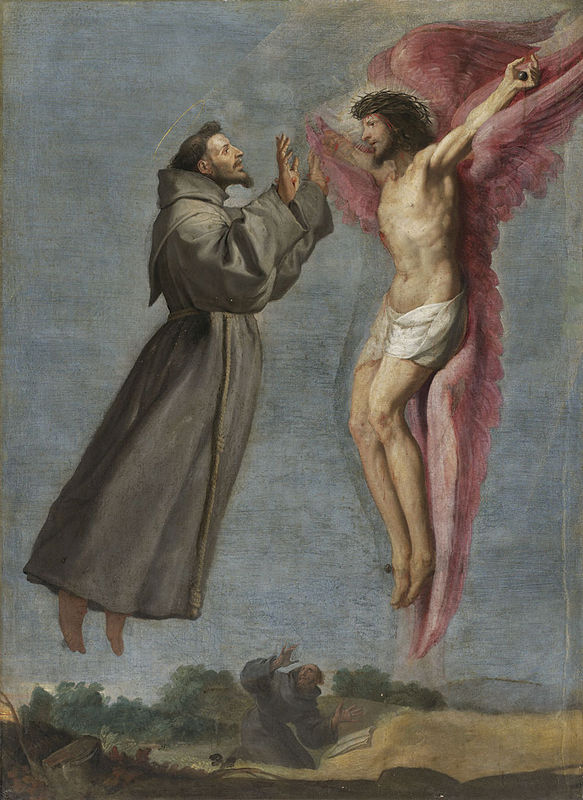
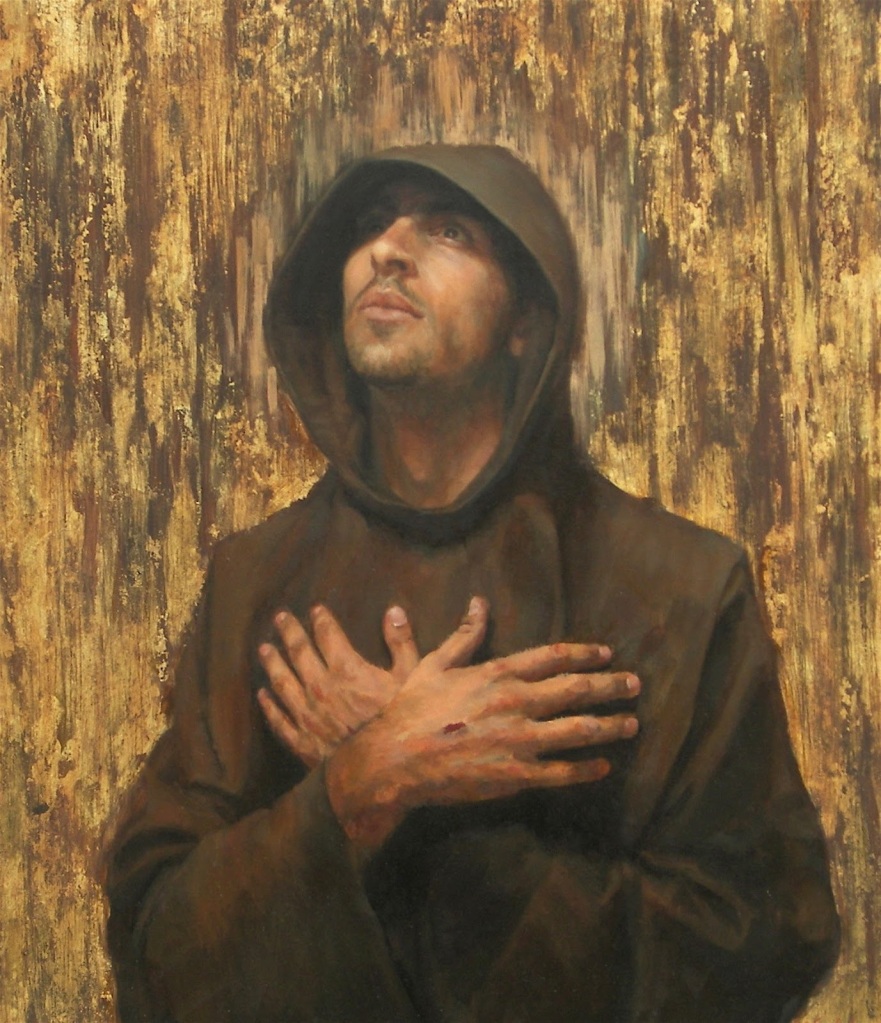
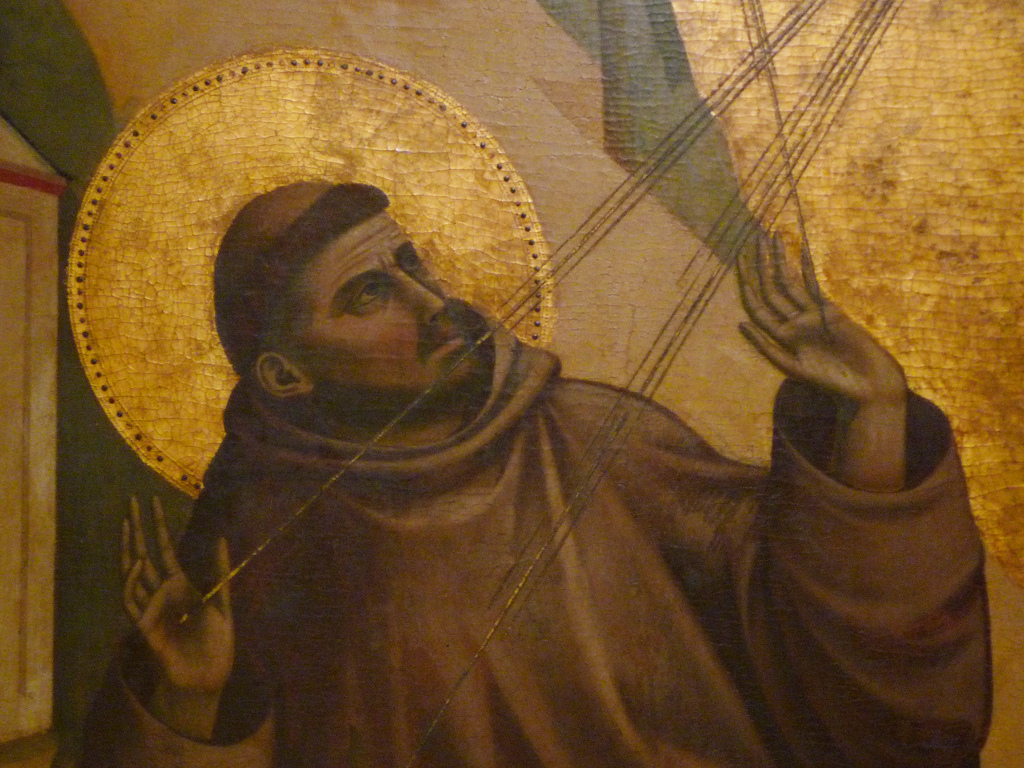
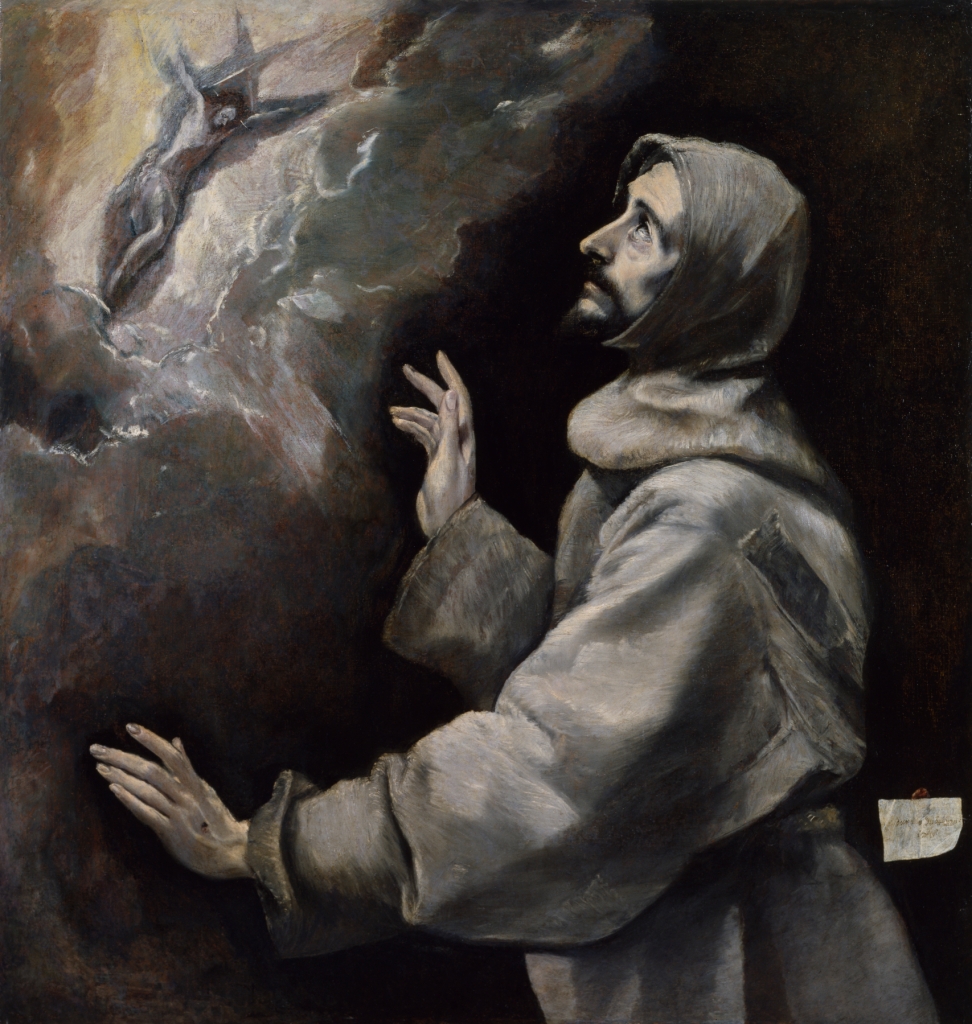
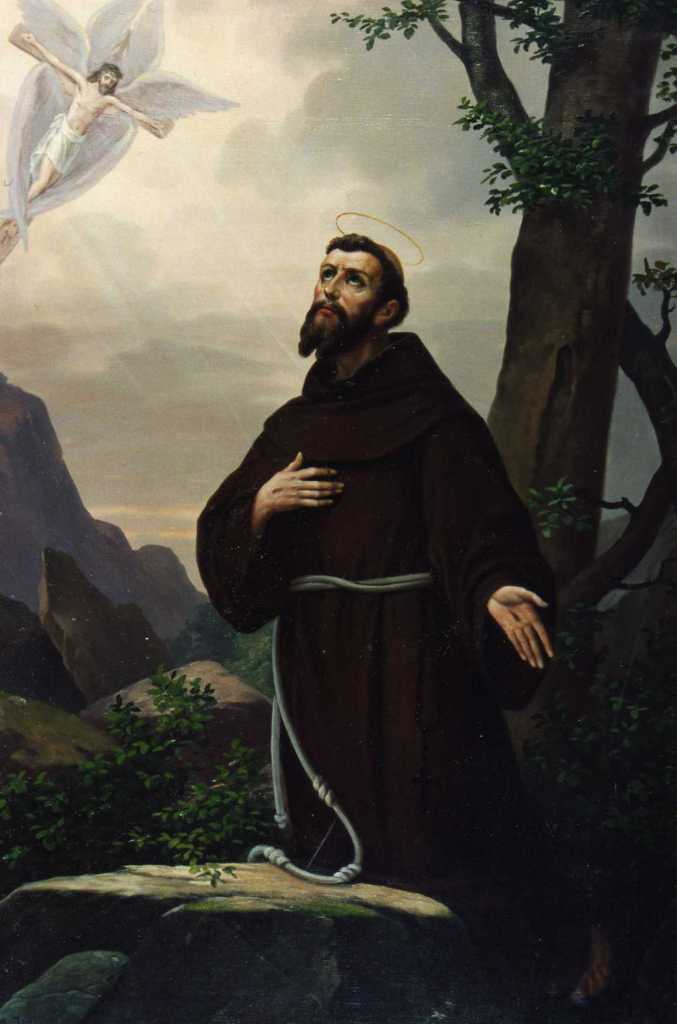
Saint of the Day – 4 October – St Francis of Assisi OFM Confessor, Religious, Deacon, Stigmatist and ounder, Apostle of the Holy Eucharist, the Blessed Virgin and of Charity, Preacher, Missionary, Mystic, Miracle-Worker, Co-patron of Italy, Founder of the Seraphic Order – the men’s Order of Friars Minor, the women’s Order of Saint Clare, the Third Order of Saint Francis and the Custody of the Holy Land, as well as being the Founder of the Nativity Crib and Manger as we know it today.

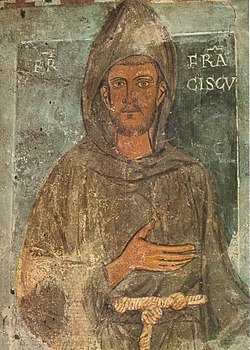
250px-S.Francesco_speco
The oldest surviving depiction of Saint Francis is a fresco near the entrance of the Benedictine abbey of Subiaco, painted between March 1228 and March 1229.   He is depicted without the stigmata but the image is a religious image and not a portrait.

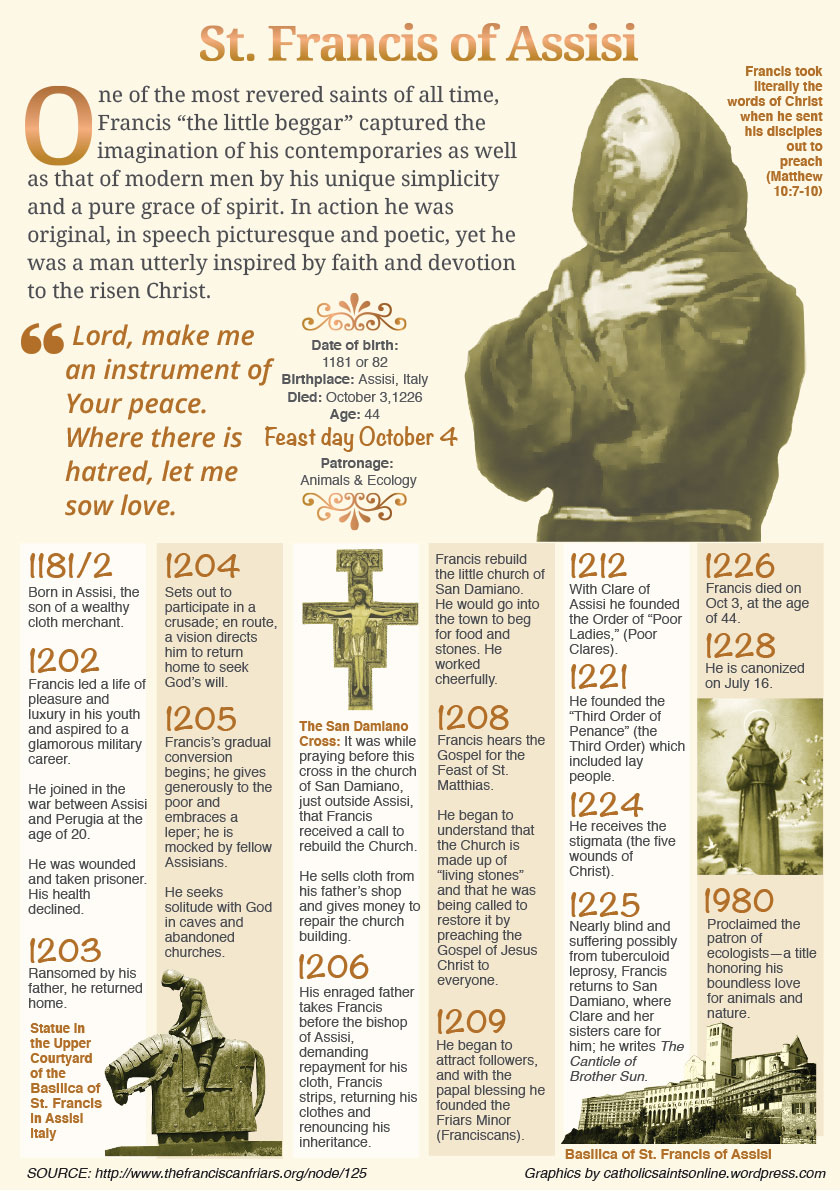
Born Giovanni di Pietro di Bernardone ( informally called Francesco by his Mother) – (1181 at Assisi, Umbria, Italy – 4 October 1226 at Portiuncula, Italy of natural causes).  His relics are enshrined in the Basilica built and named for him in Assisi, Italy.  St Francis was Canonised on 16 July 1228 by Pope Gregory IX.   Patronages – • against dying alone• against fire• animal welfare societies• animals• birds• ecologists, ecology• environment, environmentalism, environmentalists• families• lace makers, lace workers• merchants• needle workers• peace• tapestry workers• zoos• Italy• Colorado• Catholic Action• Franciscan Order• 10 dioceses• 10 cities.   Attributes – • apparition of Jesus• Christ child• birds• deer• fish• lamb• skull• stigmata• wolf.  In 1224 he received the stigmata during the apparition of Seraphic angels in a religious ecstasy making him the first recorded person in Christian history to bear the wounds of Christ’s Passion. He died during the evening hours of 3 October 1226, while listening to a reading he had requested of Psalm 142 (141).   Francis is one of the most venerated religious figures in history. 

A - ST Francis header
B. st francis and the crib info

Francis was born in Assisi in 1182, the son of a wealthy cloth merchant, Pietro Bernardone, and his wife, Pica.   He was baptised Giovanni (John) but soon gained the nickname Francesco because of his father’s close trading links with France.

Francis’ early years were not especially religious.   He was a leader among the young men of Assisi, enjoying a good social life, singing and partying.   His first biographer, Thomas of Celano, describes him as quite short, with black eyes, hair and beard;  he had a long face, with a straight nose and small, upright ears.   His arms were short but his hands and fingers slender and long.   He had a strong, clear, sweet voice.   Francis didn’t want to follow his father into the cloth trade;   he wanted to be a knight.   So at the age of twenty he joined the forces of Assisi in a minor skirmish with the neighbouring city of Perugia.   He was captured and spent a year in a Perugian jail, until his father ransomed him.   This became the first of a series of experiences through which God called Francis to the life which he finally embraced.

One of these experiences, at San Damiano, led to a rift with his father.   Francis, in response to a voice from the crucifix in this tiny ruined Church, began to rebuild churches;   when he ran out of money he took cloth from his father’s shop and sold it.   His father disowned him before the bishop of Assisi and Francis in his turn stripped off his clothes, returning to his father everything he had received from him and promising that in future he would call only God his Father.

And thus, Francis of Assisi, this poor little man began a journey to astound and inspire the Church by taking the gospel literally—not in a narrow fundamentalist sense but by actually following all that Jesus said and did, joyfully, without limit and without a mite of self-importance.Flemish School; St Francis of Assisi

Serious illness brought the young Francis to see the emptiness of his frolicking life as leader of Assisi’s youth.   Prayer—lengthy and difficult—led him to a self-emptying like that of Christ, climaxed by embracing a leper he met on the road.   It symbolised his complete obedience to what he had heard in prayer:  “Francis! Everything you have loved and desired in the flesh it is your duty to despise and hate, if you wish to know my will.   And when you have begun this, all that now seems sweet and lovely to you will become intolerable and bitter but all that you used to avoid will turn itself to great sweetness and exceeding joy.”

From the Cross in the neglected Chapel of San Damiano, Christ told him, “Francis, go out and build up my house, for it is nearly falling down.” Francis became the totally poor and humble workman.

ea8079bd13b0302d84e404c85418a950--saint-francis-pope-francis

He must have suspected a deeper meaning to “build up my house.” But he would have been content to be for the rest of his life the poor “nothing” man actually putting brick on brick in abandoned chapels.   He gave up every material thing he had, piling even his clothes before his earthly father (who was demanding restitution for Francis’ “gifts” to the poor) so that he would be totally free to say, “Our Father in heaven.”

He was, for a time, considered to be a religious “nut,” begging from door to door when he could not get money for his work, bringing sadness or disgust to the hearts of his former friends, ridicule from the unthinking.beeautiful francis 2.

But genuineness will tell.   A few people began to realise that this man was actually trying to be Christian.   He really believed what Jesus said:  “Announce the kingdom! Possess no gold or silver or copper in your purses, no traveling bag, no sandals, no staff” (see Lk 9:1-3).

Francis’ first rule for his followers was a collection of texts from the Gospels.   He had no idea of founding an order but once it began he protected it and accepted all the legal structures needed to support it.   His devotion and loyalty to the Church were absolute and highly exemplary at a time when various movements of reform tended to break the Church’s unity.

He was torn between a life devoted entirely to prayer and a life of active preaching of the Good News.   He decerned in favour of the latter but always returned to solitude when he could.   He wanted to be a missionary in Syria or in Africa but was prevented by shipwreck and illness in both cases.   He did try to convert the sultan of Egypt during the Fifth Crusade.beautiful francis 2.vision-of-st-francis-of-assisi-jusepe-de-ribera-detail-featured-w740x493

During the last years of his relatively short life (he died at 44) he was half blind and seriously ill.   Two years before his death, he received the stigmata, the real and painful wounds of Christ in his hands, feet and side.

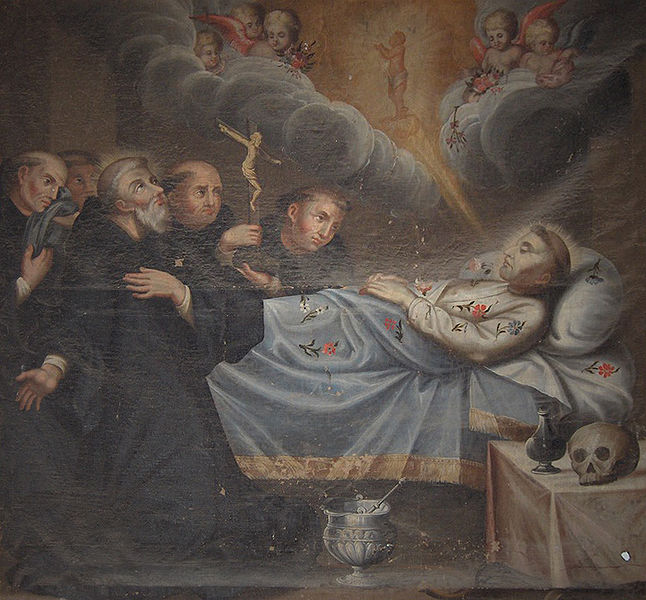
On his deathbed, he said over and over again the last addition to his Canticle of the Sun, “Be praised, O Lord, for our Sister Death.”   He sang Psalm 141 and at the end asked his superior to have his clothes removed when the last hour came and for permission to expire lying naked on the earth, in imitation of his Lord.Death-of-St-Francis-of-Assisi-Evora-Portugal-Igreja-de-Sao-Francisco

On 13 March 2013, upon his election as Pope, Archbishop and Cardinal Jorge Mario Bergoglio of Argentina chose Francis as his papal name in honour of Saint Francis of Assisi, becoming Pope Francis I.
At his first audience on 16 March 2013, Pope Francis told journalists that he had chosen the name in honour of Saint Francis of Assisi and had done so because he was especially concerned for the well-being of the poor.   He explained that, as it was becoming clear during the conclave voting that he would be elected the new bishop of Rome, the Brazilian Cardinal Cláudio Hummes had embraced him and whispered, “Don’t forget the poor”, which had made Bergoglio think of the saint.   Bergoglio had previously expressed his admiration for St Francis, explaining that “He brought to Christianity an idea of poverty against the luxury, pride, vanity of the civil and ecclesiastical powers of the time.   He changed history.”   Bergoglio’s selection of his papal name is the first time that a pope has been named Francis.

Posted in SAINT of the DAY, Uncategorized

Memorials of the Saints – 4 October

St Francis of Assisi (Memorial)

St Adauctus of Ephesus
Bl Alfonso Tabela
St Ammon the Great
St Aurea
Berenice
St Caius of Corinth
St Callisthene of Ephesus
St Crispus of Corinth
St Damaris of Athens
St Diogenes of Milan
St Domnina
St Hierotheus
Bl Julian Majali
St Lucius of Alexandria
St Peter of Damascus
St Petronius of Bologna
St Prosdoce
St Quintius of Tours

Martyrs of Alexandria – 2+ saints: A group of Christians, men and women, young and old, murdered together for their faith. The only names that have come down to us are the brothers Mark and Marcian.

Martyred in the Spanish Civil War:
• Blessed Avelí Martínez de Arenzana Candela
• Blessed Dionisio Ibáñez López
• Blessed Francisco Martínez Granero
• Blessed Fulgencio Martínez García
• Blessed José Aloy Doménech
• Blessed José Gafo Muñiz
• Blessed José Miguel Peñarroya Dolz
• Blessed Juan de Francisco Pío
• Blessed Juan José Orayen Aizcorbe
• Blessed Martina Vázquez Gordo
• Blessed Publio Fernández González
• Blessed Tomás Barrios Pérez
• Blessed Francisco Martínez Granero
• Blessed Fulgencio Martínez García
• Blessed José Aloy Doménech
• Blessed José Gafo Muñiz
• Blessed José Miguel Peñarroya Dolz
• Blessed Juan de Francisco Pío
• Blessed Juan José Orayen Aizcorbe
• Blessed Martina Vázquez Gordo
• Blessed Publio Fernández González
• Blessed Tomás Barrios Pérez

Posted in MORNING Prayers, SAINT of the DAY

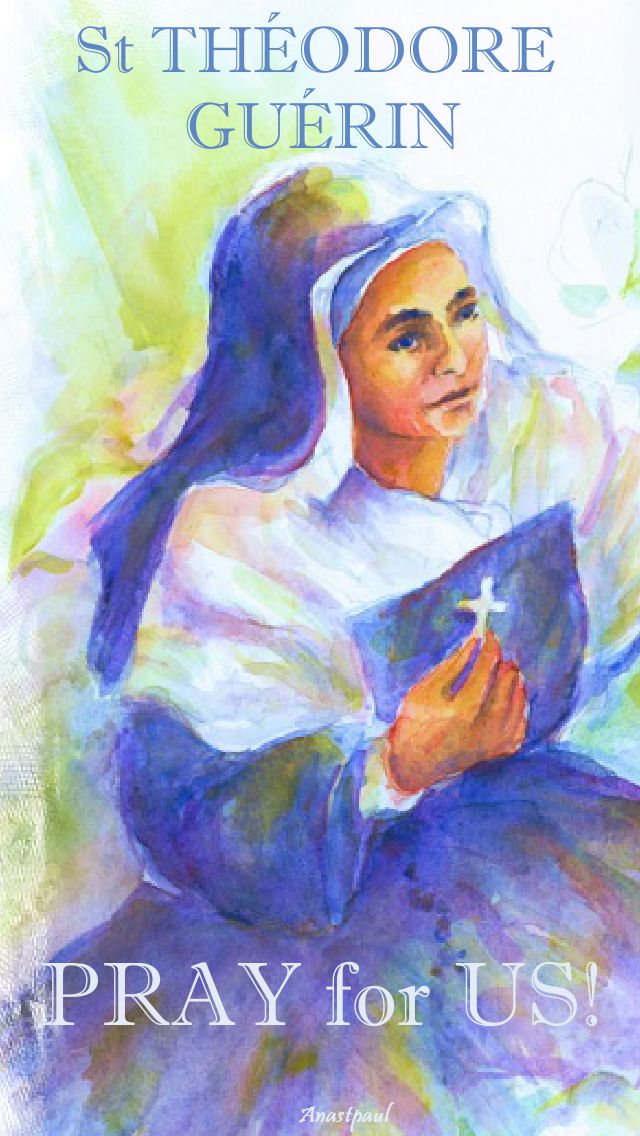
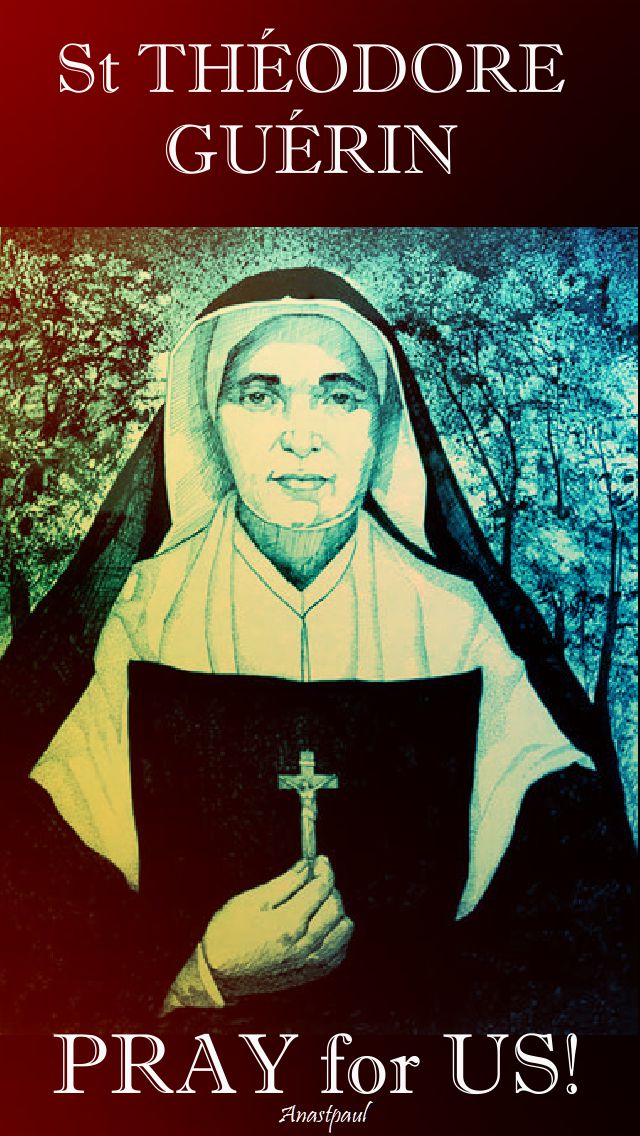
Thought for the Day – October 3 – The Memorial of St Théodore Guérin

Thought for the Day – October 3 – The Memorial of St Théodore Guérin

Every holy person has a strong sense of God’s Divine Providence.

During his homily at the canonisation Mass, Pope Emeritus Benedict said:

“Go, sell everything you own and give the money to the poor… then come, follow me”. These words have inspired countless Christians throughout the history of the Church to follow Christ in a life of radical poverty, trusting in Divine Providence.   Among these generous disciples of Christ was a young Frenchwoman, who responded unreservedly to the call of the divine Teacher.   Mother Théodore Guérin entered the Congregation of the Sisters of Providence in 1823 and she devoted herself to the work of teaching in schools.

Then, in 1839, she was asked by her Superiors to travel to the United States to become the head of a new community in Indiana.   After their long journey over land and sea, the group of six Sisters arrived at Saint Mary-of-the-Woods.   There they found a simple log-cabin chapel in the heart of the forest.  They knelt down before the Blessed Sacrament and gave thanks, asking God’s guidance upon the new foundation.   With great trust in Divine Providence, Mother Théodore overcame many challenges and persevered in the work that the Lord had called her to do.   By the time of her death in 1856, the Sisters were running schools and orphanages throughout the State of Indiana.

In her own words, “How much good has been accomplished by the Sisters of Saint Mary-of-the-Woods! How much more good they will be able to do if they remain faithful to their holy vocation!”.

Mother Théodore Guérin is a beautiful spiritual figure and a model of the Christian life. She was always open for the missions the Church entrusted to her and she found the strength and the boldness to put them [the missions] into practice in the Eucharist, in prayer and in an infinite trust in Divine Providence.   Her inner strength moved her to address particular attention to the poor and above all to children.” – Pope Benedict XVI, from the canonisation homily of Saint Mother Theodore

God’s work gets done by people ready to take risks and to work hard – always remembering what St Paul told the Corinthians, “I planted, Apollos watered but God caused the growth.” (1 Cor 3:6).

St Théodore Guérin, Pray for us!

THÉODORE GUÉRIN - pray for us 2

Posted in MORNING Prayers, QUOTES of the SAINTS, SAINT of the DAY

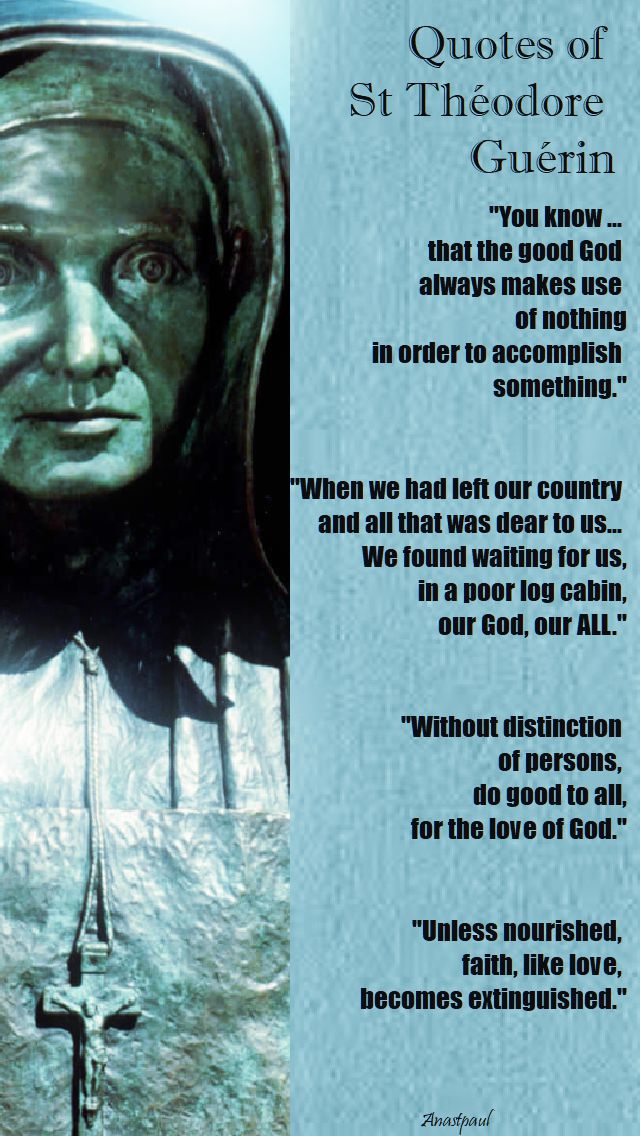
Quote/s of the Day – 3 October – The Memorial of St Théodore Guérin

Quote/s of the Day – 3 October – The Memorial of St Théodore Guérin

“You know … that the good God
always makes use
of nothing,
in order to accomplish
something.”

“When we had left our country
and all that was dear to us…
We found waiting for us,
in a poor log cabin,
our God, our ALL.”

“Without distinction of persons,
do good to all, for the love of God.”

“Unless nourished,
faith, like love,
becomes extinguished.”

St Théodore Guérinquotes of st Théodore Guérin - 3 october 2017

Posted in BREVIARY Prayers, CATHOLIC-PRAYERS OF THE CHURCH, MORNING Prayers

Our Morning Offering – 3 October

Our Morning Offering – 3 October

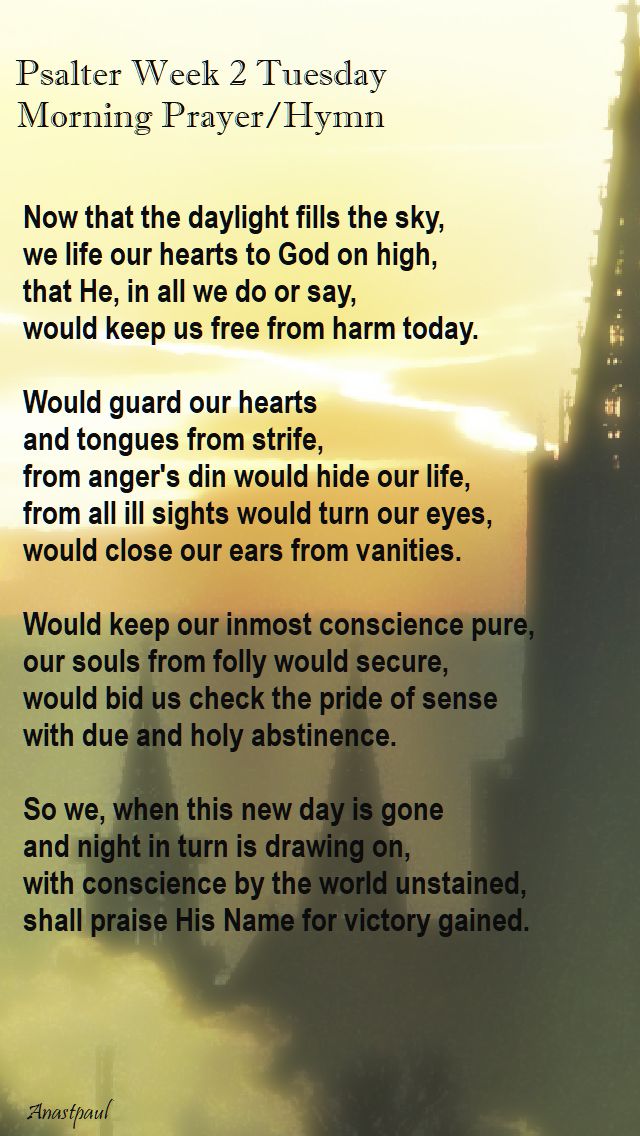
Psalter Week 2 Tuesday – Morning Prayer

Now that the daylight fills the sky,
we life our hearts to God on high,
that He, in all we do or say,
would keep us free from harm today.

Would guard our hearts and tongues from strife,
from anger’s din would hide our life,
from all ill sights would turn our eyes,
would close our ears from vanities.

Would keep our inmost conscience pure,
our souls from folly would secure,
would bid us check the pride of sense
with due and holy abstinence.

Se we, when this new day is gone
and night in turn is drawing on,
with conscience by the world unstained,
shall praise His Name for victory gained.

psalter week 2 tuesday - morning prayer hymn - 3 oct 2017

Posted in MORNING Prayers, QUOTES of the SAINTS, SAINT of the DAY, The WORD

One Minute Reflection – October 3 – The Memorial of St Théodore Guérin

One Minute Reflection – October 3 – The Memorial of St Théodore Guérin

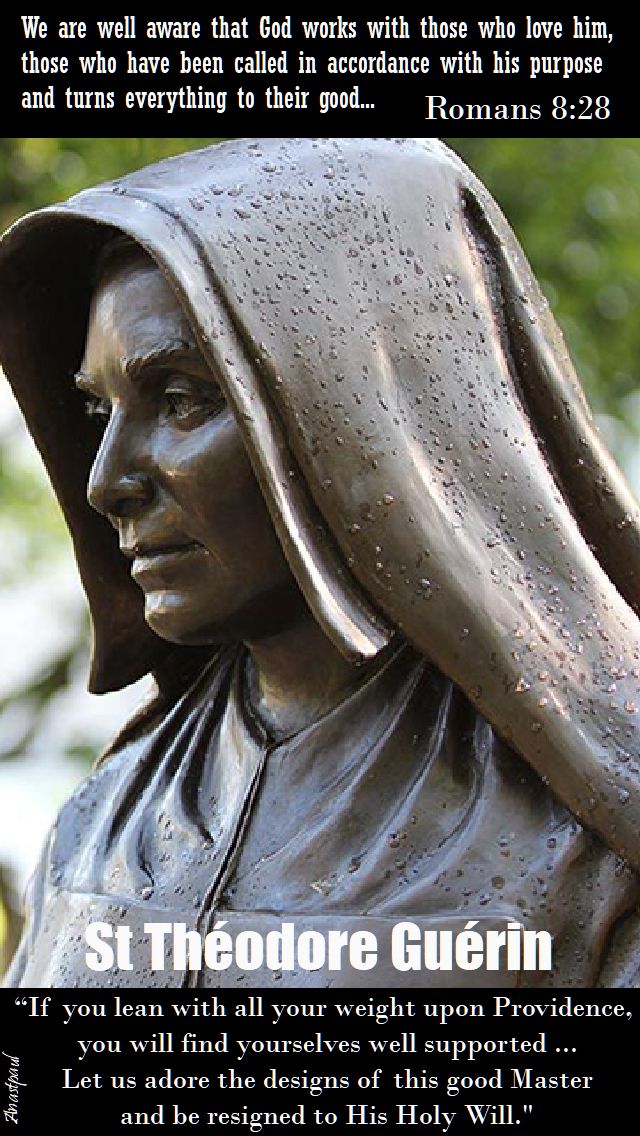
We are well aware that God works with those who love him, those who have been called in accordance with his purpose and turns everything to their good….Romans 8:28

REFLECTION – ““If you lean with all your weight upon Providence, you will find yourselves well supported ….Let us adore the designs of this good Master and be resigned to His Holy Will.” …St Theodore Guérinif you lean with all your weight - St Théodore Guérin - 3 oct 2017

PRAYER – Heavenly Father, increase my love and trust for and in You every day. Teach me total abandonment to Your loving providence and thus enable to do Your will in all things. St Mother Theodora Guérin, you who suffered great persecutions and trials but always abandoned yourself to the Divine Will, please pray for us that we learn to do the same, amen.st THÉODORE GUÉRIN - pray for us

Posted in QUOTES of the SAINTS, SAINT of the DAY

Saint of the Day – 3 October – St THÉODORE GUÉRIN SP (1798 – 1856)

Saint of the Day – 3 October – St THÉODORE GUÉRIN SP (1798 – 1856) Religious, Foundress of the Sisters of Providence of Saint Mary-of-the-Woods and numberous schools, Educator, Apostle of Charity (born Anne-Thérèse Guérin on 2 October 1798 at Etables-sur-Mer, Brittany, France as Anne-Thérèse Guérin – 14 May 1856 at Saint Mary-of-the-Woods, Indiana, USA, of natural causes).  Her body was buried at Church of the Immaculate Conception, Saint Mary-of-the-Woods.  She was  St Pope John Paul in October 1998 and Canonised on 15 October 2006 by Pope Benedict XVI.  Patronage – Diocese of Lafayette, Indiana.
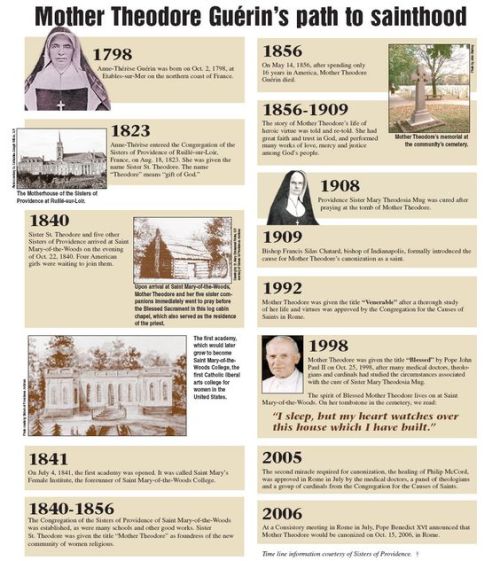
St. Mother Theodore Guerin info

“What strength the soul draws from prayer!   In the midst of a storm, how sweet is the calm it finds in the heart of Jesus.   But what comfort is there for those who do not pray?” These words, written by Mother Théodore Guérin after surviving a violent storm at sea, perhaps best exemplify her life and ministry.   Truly, Mother Theodore drew strength from prayer, from conversations with God, with Jesus and with the Blessed Virgin Mary. Throughout her life, she encouraged prayer as she sought to share the love of God with people everywhere.

Mother THÉODORE—ANNE-THÉRÈSE GUÉRIN—was born Oct. 2, 1798, in the village of Etables, France.   Her devotion to God and to the Roman Catholic Church began when she was a young child.   She was allowed to receive her First Communion at the age of 10 and, at that time, told the parish priest that someday she would be a nun.

The child Anne-Thérèse often sought solitude along the rocky shore near her home, where she devoted hours to meditation, reflection and prayer.   She was educated by her mother, Isabelle Guérin, who centered lessons on religion and Scripture, thus nurturing the child’s love of God.   Anne-Thérèse’s father, Laurent, who served in Napoleon’s navy, was away from home for years at a time.   When Anne-Thérèse was 15 years old, her father was murdered by bandits as he traveled home to visit his family.   The loss of her husband nearly overwhelmed Isabelle and, for many years, Anne-Thérèse bore the responsibility of caring for her mother and her young sister, as well as the family’s home and garden.

Through those years of hardship and sacrifice, indeed through all the years of her life, Mother Théodore’s faith in God neither wavered nor faltered.   She knew in the depths of her soul that God was with her and always would be with her, a constant companion.

Anne-Thérèse was nearly 25 years old when she entered the Sisters of Providence of Ruillé-sur-Loir, a young community of women religious serving God by providing opportunities for education to children and by caring for the poor, sick and dying.20061015guerin
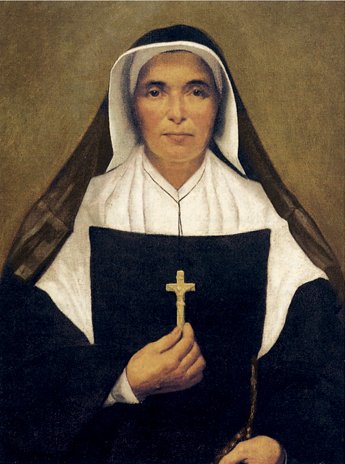
While teaching and caring for the sick in France, Mother Théodore, then known as Sister St Theodore, was asked to lead a small missionary band of Sisters of Providence to the United States of America, to establish a motherhouse, to open schools and to share the love of God with pioneers in the Diocese of Vincennes in the State of Indiana.   Humble and prone to feelings of unworthiness, Mother Theodore could not imagine that she was suitable for such a mission.   Her health was fragile.   During her novitiate with the Sisters of Providence, she became very ill.   Remedies cured the illness but severely damaged her digestive system;  for the remainder of her life she was able to consume only soft, bland foods and liquids.   Her physical condition added to her doubts about accepting the mission.   Nevertheless, after hours of prayer and lengthy consultations with her superiors, she accepted the mission, fearing that if she did not, no one would venture to the wilderness to share the love of God.

Equipped with little more than her steadfast desire to serve God, Mother Théodore and her five companion Sisters of Providence arrived at the site of their mission at Saint Mary-of-the-Woods, Indiana, the evening of October 22, 1840, and immediately hastened along a muddy, narrow path to the tiny log cabin that served as the chapel.   There, they knelt in prayer before the Blessed Sacrament to thank God for their safe journey and to ask for God’s blessings for the new mission.

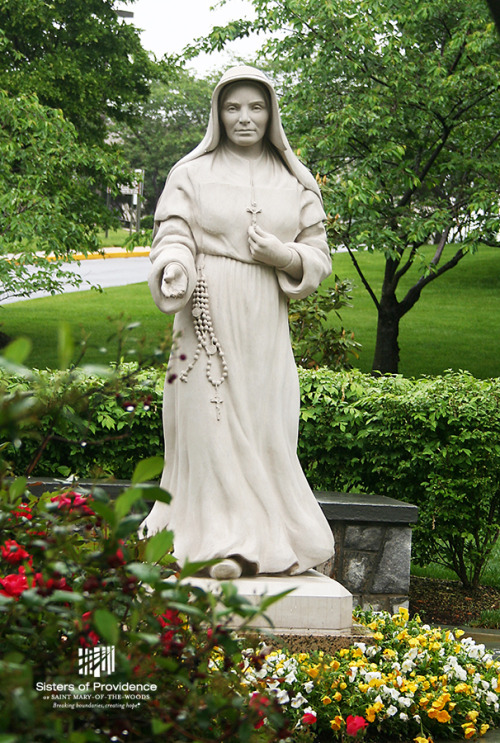
Here, on this hilly, ravine-cut, densely forested land, Mother Théodore would establish a motherhouse, a school and a legacy of love, mercy and justice that continues to this day. (The purpose of the Congregation is to honor Divine Providence and to further God’s loving plans by devoting itself to works of love, mercy and justice in service among God’s people. (Constitutions, Article 3).   As a Congregation of Roman Catholic women religious, the sisters are called by God to be witnesses to the Gospel of Jesus and serve in ministries throughout the United States and in Asia.)St. Mother Theodore Guerin 1.
Throughout years of sorrow and years of peace, Mother Théodore relied upon God’s Providence and her own ingenuity and faith for counsel and guidance. She urged Sisters of Providence to “Put yourself gently into the hands of Providence.”   In letters to France, she stated, “But our hope is in the Providence of God, which has protected us until the present and which will provide, somehow, for our future needs.”

In the fall of 1840, the mission at Saint Mary-of-the-Woods consisted only of a tiny log cabin chapel that also served as lodging for a priest and a small frame farmhouse, where Mother Théodore, the sisters from France and several postulants lived.   During that first winter, harsh winds blew from the north to rattle the little farmhouse The sisters were often cold and frequently hungry.   But they transformed a porch into a chapel and were comforted by the presence of the Blessed Sacrament in the humble motherhouse.   Mother Théodore said, “With Jesus, what shall we have to fear?”

During the early years at Saint Mary-of-the-Woods, Mother Théodore encountered numerous trials:  prejudice against Catholics and, especially, against Catholic women religious;  betrayals; misunderstandings; the separation of the Congregation in Indiana from the one in Ruillé; a devastating fire that destroyed an entire harvest leaving the sisters destitute and hungry and frequent life-threatening illnesses.   Still she persevered, desiring only that “In all and everywhere may the will of God be done.”   In correspondence to friends, Mother Théodore acknowledged the tribulations.   She wrote: “If ever this poor little Community becomes settled, it will be established on the Cross – and that is what gives me confidence and makes me hope, sometimes even against hope.”

Less than a year after arriving at Saint Mary-of-the-Woods, Mother Théodore opened the Congregation’s first Academy and, in 1842, established schools at Jasper, Indiana and St Francisville, Illinois.    By the time of her death on May 14, 1856, Mother Théodore had opened schools in towns throughout Indiana and the Congregation of the Sisters of Providence was strong, viable and respected.   Always, Mother Théodore attributed the growth and success of the Sisters of Providence to God and to Mary, the Mother of Jesus, to whom she dedicated the ministry at Saint Mary-of-the- Woods.St. Mother Theodore Guerin
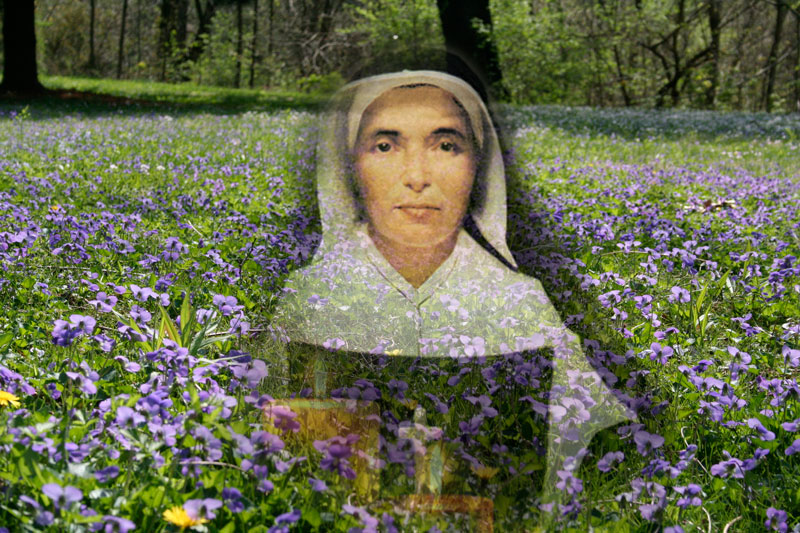
Mother Théodore’s holiness was evident to people who knew her and many described her simply as “saintly”.    She possessed the ability to draw out the best in people, to enable them to attain more than they thought possible.   Mother Théodore’s love was one of her great hallmarks.   She loved God, God’s people, the Sisters of Providence, the Roman Catholic Church and the people she served.   She did not exclude anyone from her ministries or her prayers, for she dedicated her life to helping people know God and live better lives.

Mother Théodore knew that alone she could do nothing but that all things were possible with God.  She accepted trials, trouble and occasions when she was treated unjustly as part of her life.   In the midst of persecution, Mother Théodore remained true, a faithful woman of God.

Mother Théodore died sixteen years after she arrived at Saint Mary-of-the-Woods. During those fleeting years, she touched a countless number of lives—and continues to do so today.

The gift she gives to each succeeding generation is her life as a model of holiness, virtue, love and faith. (The Vatican)

Posted in SAINT of the DAY

Memorials of the Saints – 3 October

St Adalgott of Chur
Bl Agostina of the Assumption
St Candidus the Martyr
St Cyprian of Toulon
Bl Damian de Portu
St Dionysius the Aeropagite
Bl Dominic Spadafora
St Ewald the Black
St Ewald the Fair
St Froilan
St Gerard of Brogne
St Hesychius
Bl Juan Tapia
Bl Maddalena the Greater
St Maximian of Bagaia
St Menna
Bl Szilárd István Bogdánffy
St Theodore Guerin (1798 – 1856) – https://www.youtube.com/watch?v=poeYFF2hRVU
Bl Utto of Metten
St Widradus

Martyrs of Alexandria – 9 saints: A number of Christian martyrs remembered together. We know the names Caius, Cheremone, Dionysius, Eusebio, Fausto, Lucio, Maximus, Paul, Peter and that there were at least two more whose names have not come down to us, and that’s about all we know.

Martyrs of Brazil – 30 beati: On 25 December 1597 an expedition of colonists, with two Jesuit and two Franciscan evangelists, arrived at Natal, Rio Grande do Norte, Brazil. The region was colonized by Portuguese Catholics but was invaded by Dutch Calvinists who soon took over the whole territory. They immediately made a policy of the persecution of Catholics. On Sunday 16 July 1645 at Cunhau, Brazil, 69 people were gathered in the Chapel of Our Lady of the Candles for Mass celebrated by Father Andre de Soveral. At the moment of the elevation a group of Dutch soldiers attack the Chapel, murdering many of the faithful including Father Andre; the parishioners died professing their faith and asking pardon for their sins. On 3 October 1645, 200 armed Indians and a band of Flemish troops, led by a fanatical Calvinist convert, hacked to death an unknown number of people of Rio Grande including:
• Blessed Ambrosio Francisco Ferro
• Blessed André de Soveral
• Blessed Antônio Baracho
• Blessed Antônio Vilela
• Blessed Antônio Vilela Cid
• Blessed Diogo Pereira
• Blessed Domingos Carvalho
• Blessed Estêvão Machado de Miranda
• Blessed Francisco de Bastos
• Blessed Francisco Mendes Pereira
• Blessed João da Silveira
• Blessed João Lostau Navarro
• Blessed João Martins
• Blessed José do Porto
• Blessed Manuel Rodrigues de Moura
• Blessed Mateus Moreira
• Blessed Simão Correia
• Blessed Vicente de Souza Pereira
and other lay people whose names have not come down to us. They were Beatified on 5 March 2000 at Rome, Italy by Pope John Paul II.

Martyred in the Spanish Civil War:
• Blessed Crescencio García Pobo
• Blessed José María González Solís
• Blessed José María Poyatos-Ruiz
• Blessed Manuel Lucas Ibañez
• Blessed Raimundo Joaquín Castaño González

Posted in ArchAngels and Angels, MORNING Prayers

Thought for the Day – 2 October – The Memorial of the Holy Guardian Angels

Thought for the Day – 2 October – The Memorial of the Holy Guardian Angels

The Father learned from his parents to have recourse to his Guardian Angel.   Then later on, as a seminarian, he read in a book by one of the Fathers of the Church that, in addition to a Guardian Angel, priests have a ministerial Archangel as well;  and so, from the day of his ordination to the priesthood, he turned to this Archangel with great simplicity and confidence.   In fact, he said he felt certain that even if the author he had read turned out to have been mistaken, our Lord would have given him a ministerial Archangel anyway, just because of the faith with which he always invoked him.

In any case, after the feast of the Guardian Angels in 1928, the founder of Opus Dei had a still more intense devotion to them.   He was always telling his children, “familiarity with, and devotion to, the holy Guardian Angels is at the heart of our work.   It is a concrete manifestation of the supernatural mission of Opus Dei.”

Convinced that God has placed an Angel beside each and every human being to help that person along the road of life, he had recourse to his own Guardian Angel for all his material and spiritual needs.   He would often say, quite frankly, “For years I’ve experienced the constant and immediate assistance of my Guardian Angel, even in the smallest material particulars.”   In the years between 1928 and 1940, his alarm-clock sometimes didn’t work and he didn’t have the money to repair it, so he turned in trust to his Guardian Angel and asked him to wake him up in the morning at the right time.   His Angel never once failed him.   And that’s why our Father affectionately called him “mi relojerico” [“my dear watchmaker”].

Whenever he greeted our Lord in the Tabernacle, he always thanked the Angels who were present there, for the unceasing adoration that they give to God.   On more than one occasion I heard him say, “When I go into one of our chapels, one that has a Tabernacle, I tell Jesus that I love him, and invoke the Blessed Trinity. Then I thank the Angels who guard the Tabernacle and adore Christ in the Eucharist.”7829cfbe41f6e53c5b6bb9dc0727f70a--angels-and-fairies-heavenly-angels

Through heroic and persevering correspondence with God’s grace, he acquired the habit of always greeting the Guardian Angels of the people he met.   One day in 1972 or 1973, the retired archbishop of Valencia, the Most Reverend Marcelino Olaechea, came to visit him, accompanied by his secretary.   They were very good friends, so that Father greeted him and then asked him playfully, “Marcelino, let’s see if you can guess – whom did I greet first?” The archbishop replied, “You greeted me first.” “No,” the Father said, “I greeted the VIP first.” Archbishop Olaechea, understandably perplexed, replied, “But of the two of us, my secretary and me, I am the ‘VIP’.” Then our founder explained, “No, the VIP is your Guardian Angel.”

During some days of rest that we spent in a rented house in a village in Lombardy, Italy – I can’t remember whether it was Caglio or Civenna – we would play bocce ball every so often, to get a little exercise.   Since we didn’t know the rules of the game too well, at times we would make up our own.   I remember that during one of these games, the Father threw the ball unusually well and made an exceptional score.   But he said immediately, “That doesn’t count – I was helped by my Guardian Angel. I won’t do that any more…” I tell this little story because I consider it indicative of the constant friendly rapport he had with his Guardian Angel and also of his humility; as he later told me directly, he was ashamed of having asked his Guardian Angel for help in such an unimportant matter.

Extract from Cesare Cavalleri, Immersed in God – Blessed Josemaria Escriva, founder of Opus Dei, as seen by his successor, Bishop Alvaro del Portillo, Princeton NJ: Scepter Publishers, 1996.

Let us learn such devotion, love and friendship with our angels too.

St Josemaria and our Holy Guardian Angels, pray for us!guardian angel pray for us 2 - 2017

Posted in ArchAngels and Angels, CATHOLIC Quotes, DOCTORS of the Church, MORNING Prayers, QUOTES of the SAINTS, SAINT of the DAY

Quote/s of the Day – 2 October – The Memorial of the Holy Guardian Angels

Quote/s of the Day – 2 October – The Memorial of the Holy Guardian Angels

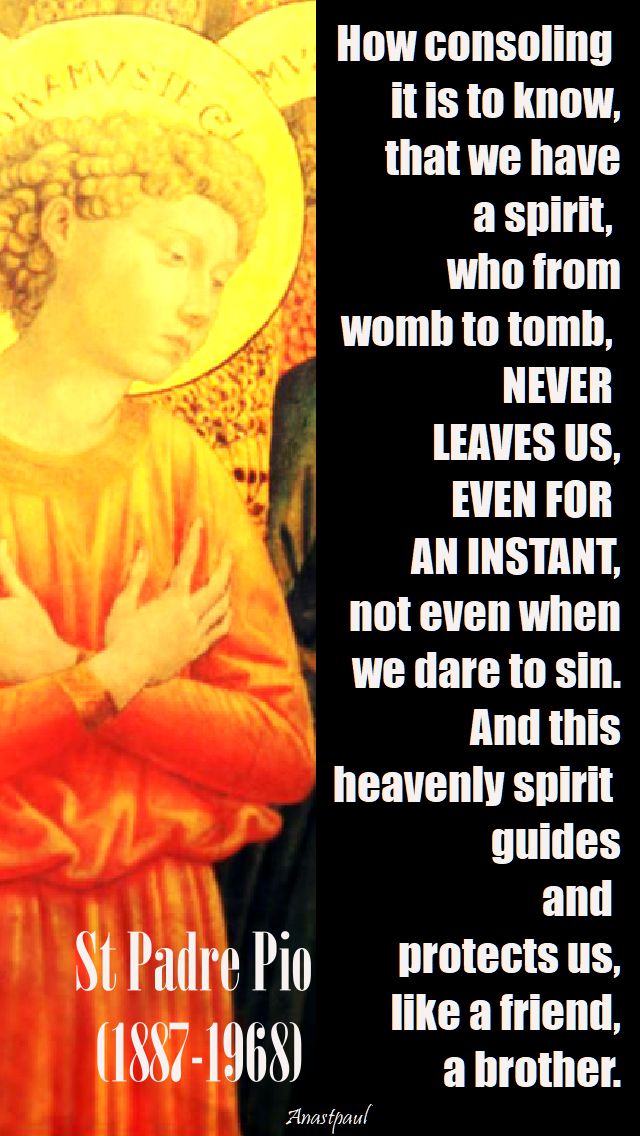
“How consoling it is to know , that we have a spirit, who from womb to tomb, NEVER LEAVES US, EVEN FOR AN INSTANT, not even when we dare to sin.   And this heavenly spirit guides and protects us, like a friend, a brother.”

St Padre Pio (1887-1968)how consoling - st padre pio - 2 oct 2017

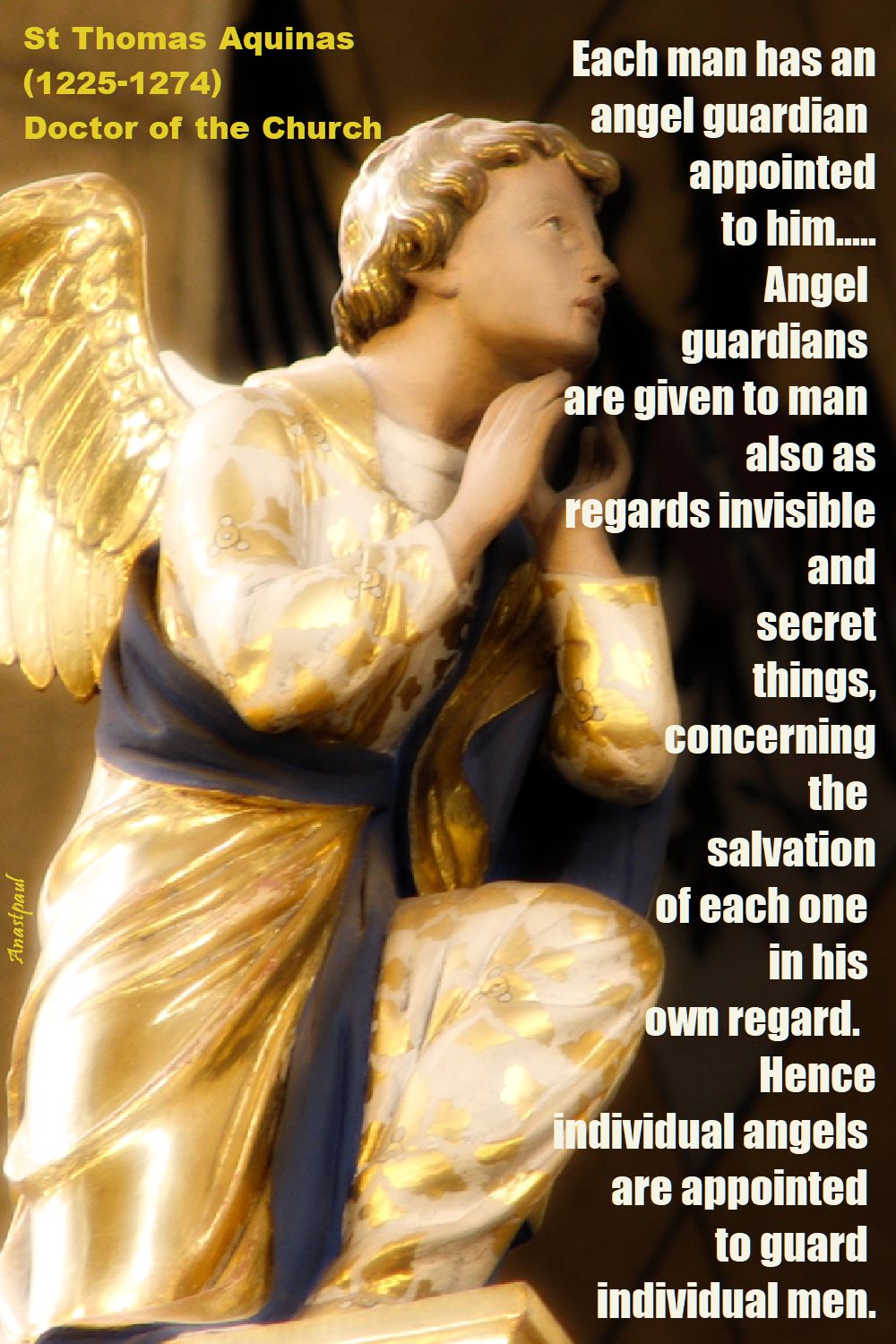
“Each man has an angel guardian appointed to him….Angel guardians are given to man also as regards invisible and secret things, concerning the salvation of each one in his own regard.   Hence individual angels are appointed to guard individual men.”

St Thomas Aquinas  (1225-1274) Doctoreach mans has an - st thomas aquinas 2 oct 207
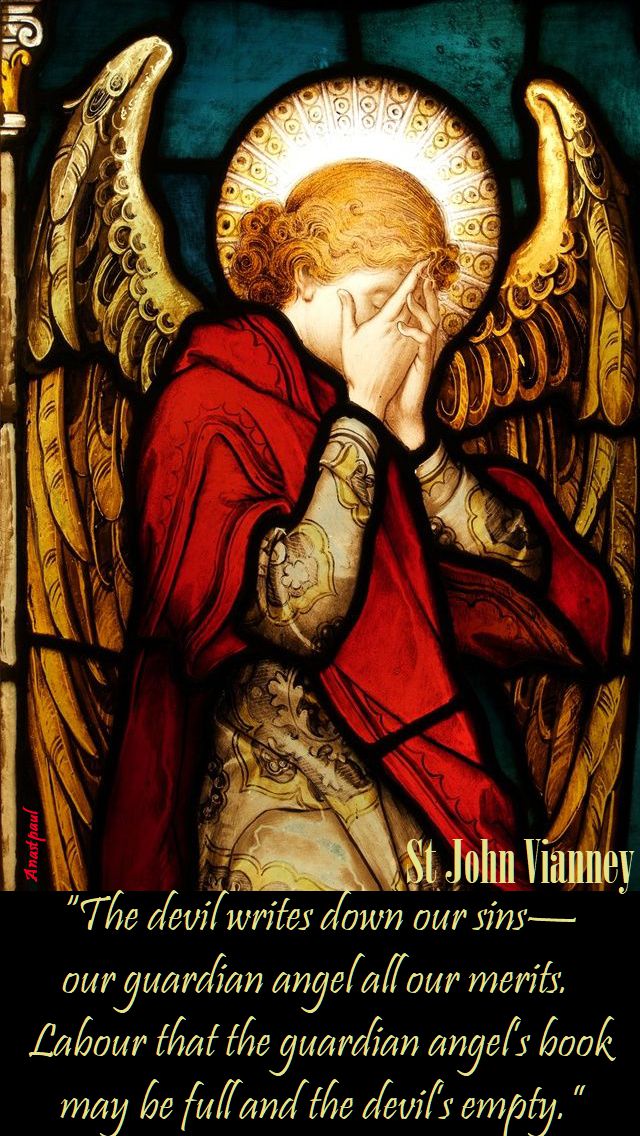
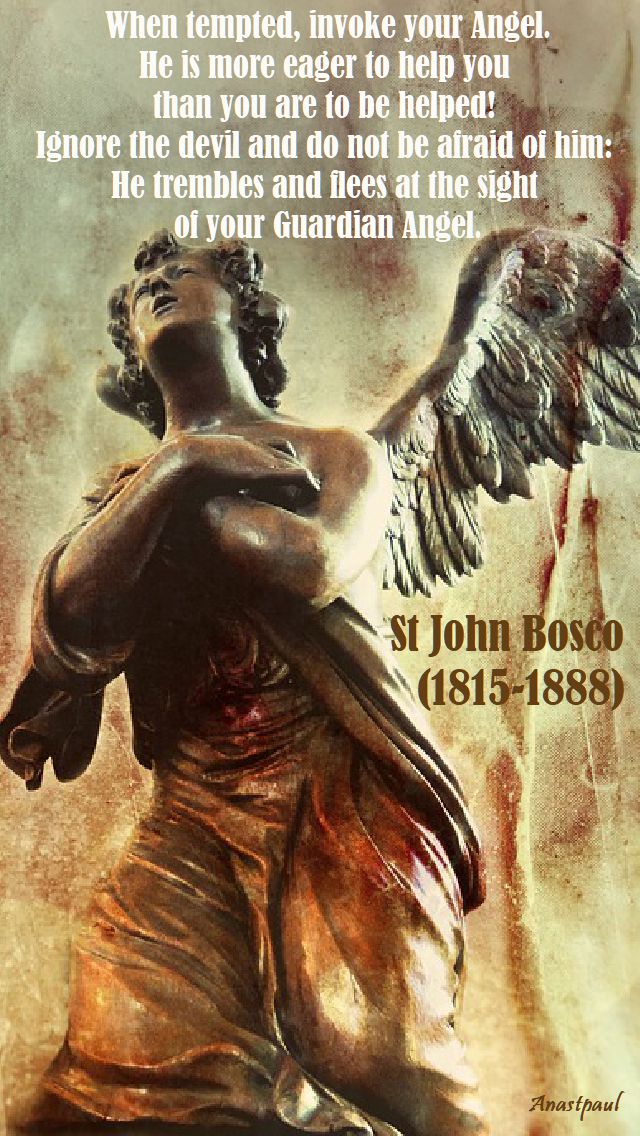
“When tempted, invoke your Angel. He is more eager to help you than you are to be helped!   Ignore the devil and do not be afraid of him:  He trembles and flees at the sight of your Guardian Angel.”

St John Bosco (1815-1888)when tempted - st john bosco - 2 oct 2017

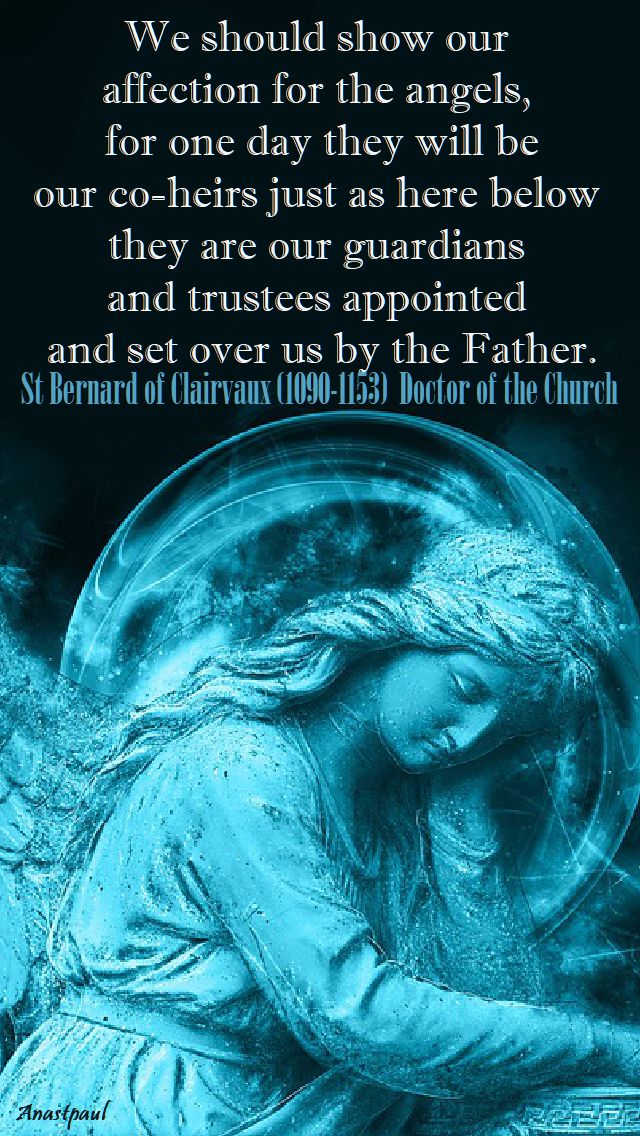
“We should show our affection for the angels, for one day they will be our co-heirs just as here below they are our guardians and trustees appointed and set over us by the Father.”

St Bernard of Clairvaux (1090-1153) Doctorwe should show our affection - St Bernard of Clairvaux (1090-1153) Doctor of the Church 2 oct 2017

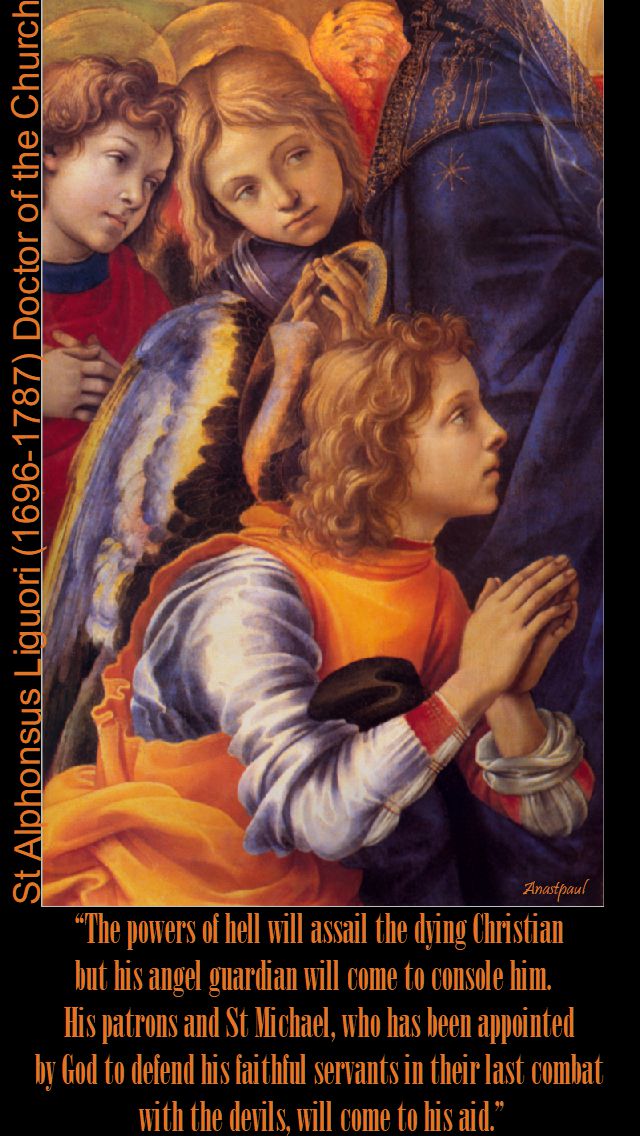
“The powers of hell will assail the dying Christian but his angel guardian will come to console him.   His patrons and St. Michael, who has been appointed by God to defend his faithful servants in their last combat with the devils, will come to his aid.”

St Alphonsus Liguori (1696-1787) Doctorthe powers of hell - st alphonsus - 2 oct 2017

Posted in ArchAngels and Angels, MORNING Prayers, QUOTES of the SAINTS, SAINT of the DAY, The WORD

One Minute Reflection – 2 October – The Memorial of the Holy Guardian Angels

One Minute Reflection – 2 October – The Memorial of the Holy Guardian Angels

“See, I am sending an angel before you, to guard you on the way and bring you to the place I have prepared.
Be attentive to him and obey him. Do not rebel against him, for he will not forgive your sin. My authority is within him. If you obey him and carry out all I tell you, I will be an enemy to your enemies and a foe to your foes.”…… Exodus 23:20-22exodus 23 20

REFLECTION – “The devil writes down our sins—our guardian angel all our merits.  Labour that the guardian angel’s book may be full and the devil’s empty.”…………… St. John Vianneythe devil writes down our sins - st john vianney - 2 oct 2017

PRAYER – Lord God of Hosts, in Your all-wise providence, You send angels to guard our souls and to protect us from all evil.  Surround us with their watchful care on earth and give us the joy of their company, forever in heaven, amen.holy guardian angels - pray for us

Posted in ArchAngels and Angels, BREVIARY Prayers, CATHOLIC-PRAYERS OF THE CHURCH, HYMNS, MORNING Prayers, POETRY, SAINT of the DAY

Morning Hymn/Prayer from the Divine Office – 2 October – The Memorial of the Holy Guardian Angels

Morning Hymn/Prayer from the Divine Office – 2 October – The Memorial of the Holy Guardian Angels

They come, God’s messengers of love,
they come from realms of peace above,
from homes of never-fading light,
from blissful mansions ever bright.

They come to watch around us here,
to soothe our sorrow, calm our fear.
Ye heavenly guides, speed not away,
God willeth you with us to stay.

But chiefly at its journey’s end
“tis yours the spirit to befriends
and whisper to the willing heart,
“o Christian soul, in peace depart.”

To us the zeal of angels give,
with love to serve thee while we live.
To us an Angel-guard supply,
when on the bed of death we lie.

breviary morning prayer - guardian angels 2 oct

Posted in ArchAngels and Angels, DOMINICAN OP, SAINT of the DAY

Our Morning Offering – 2 October – The Memorial of the Holy Guardian Angels

Our Morning Offering – 2 October – The Memorial of the Holy Guardian Angels

Prayer to my Good Guardian Angel
By Fr Peter J Cameron O.P.

My good Guardian Angel;
you have been appointed by God
to be my protector and shepherd,
leading me to life and peace.
Thank you for your guardianship.
Without the benefit of your angelic care,
I would be left to the custody
of my own feeble resources.
You delight in dispensing God’s graces
to aid me in my salvation.
Help me to regulate my life and
move me to the good.
Instruct me that I may live by the
enlightenment of heaven.
Assist me in my prayer.
Ward off demons that would threaten me
and remove the sadness and affliction
brought on by the enemy.
When weighed down by my emotions
and things of the flesh,
lift me up and let me share your joy.
Protect me from all spiritual and bodily harm.
Please forgive my neglect of you.
With trust in your angelic protection,
I offer you my love and gratitude. Amenprayer to my good guardian angel - by for peter j cameron (my novenas book) 2 oct 2017


Posted in ArchAngels and Angels, SAINT of the DAY

Saint of the Day – The Holy Guardian Angels – 2 October

Blessed Memorial of Your Holy Guardian Angel – 2 October.

El Atocha- The Christ Child with Angel
El Atocha: The Christ Child with Angel

Perhaps no aspect of Catholic piety is as comforting to parents as the belief that an angel protects their little ones from dangers real and imagined.  Yet guardian angels are not only for children.   Their role is to represent individuals before God, to watch over them always, especially with respect to helping that person avoid spiritual dangers, to aid their prayer and achieve salvation.
The angel may also help the person avoid physical dangers, particularly if this will help the person achieve salvation. Guardian-AngelVitrailFlorac010609_09AngeGardien

The concept of an angel assigned to guide and nurture each human being is a development of Catholic doctrine and piety based on Scripture but not directly drawn from it.   Jesus’ words in Matthew 18:10 best support the belief:  “See that you do not despise one of these little ones, for I say to you that their angels in heaven always look upon the face of my heavenly Father.”

Devotion to the angels began to develop with the birth of the monastic tradition. Saint Benedict gave it impetus and Saint Bernard of Clairvaux, the great 12th-century reformer, was such an eloquent spokesman for the guardian angels that angelic devotion assumed its current form in his day.

A feast in honour of the guardian angels was first observed in the 16th century. In 1615, Pope Paul V added it to the Roman calendar.

According to the Catechism of the Catholic Church:
From its beginning until death, human life is surrounded by their watchful care and intercession.   Beside each believer stands an angel as protector and shepherd leading him to life.   Already here on earth the Christian life shares by faith in the blessed company of angels and men united in God [CCC 336].guardian angel.2.

According to the general teaching of the theologians, however, not only every baptised person, but every human being, including unbelievers, has his own special guardian angel from his birth [Fundamentals of Catholic Dogma, 120].

This understanding is reflected in an Angelus address by Benedict XVI, who stated:

Dear friends, the Lord is ever close and active in humanity’s history and accompanies us with the unique presence of his Angels, whom today the Church venerates as “Guardian Angels”, that is, ministers of the divine care for every human being.   From the beginning until the hour of death, human life is surrounded by their constant protection. [Angelus, Oct. 2, 2011].angelorum-angel4b

The Congregation stated:  Popular devotion to the Holy Angels, which is legitimate and good, can, however, also give rise to possible deviations:

when, as sometimes can happen, the faithful are taken by the idea that the world is subject to demiurgical struggles, or an incessant battle between good and evil spirits, or Angels and daemons, in which man is left at the mercy of superior forces and over which he is helpless;   such cosmologies bear little relation to the true Gospel vision of the struggle to overcome the Devil, which requires moral commitment, a fundamental option for the Gospel, humility and prayer;
when the daily events of life, which have nothing or little to do with our progressive maturing on the journey towards Christ are read schematically or simplistically, indeed childishly, so as to ascribe all setbacks to the Devil and all success to the Guardian Angels [op. cit., 217].

Should we assign names to our guardian angels?  The Congregation stated:

The practice of assigning names to the Holy Angels should be discouraged, except in the cases of Gabriel, Raphael and Michael whose names are contained in Holy Scripture.angels-58

Detail From The Vision of St. Bernard
Detail From The Vision of St. Bernard FILIPPINO LIPPI c. 1475