
St Pope John XXIII (Optional Memorial)
—
St Agilbert of Paris
St Alexander Sauli
St Anastasius V
St Anastasius the Apocrisarius
St Andronicus of Ephesus
St Andronicus the Soldier
St Ansilio
St Bruno the Great
St Canice
St Digna of Sicily
St Dionisio de Santarem
St Emilian of Rennes
St Ethelburgh of Barking
St Eufridus
St Firminus of Uzes
St Germanus of Besancon
St Gratus of Oloron
St Guiadenzio of Gniezno
St Gummarus
Bl James Grissinger
St Juliana of Pavilly
St Maria Soledad Torres Acosta
St Nectarius of Constantinople
St Phêrô Lê Tùy
St Philip the Deacon
St Philonilla
St Placid
St Placidia
St Probus of Side
St Santino of Verdun
St Sarmata
St Taracus of Cladiopolis
St Zenaides
—
Martyrs of Vilcassin – 4 saints: Four Christians who were martyred together. We know little more than the names – Nicasius, Pienza, Quirinus and Scubicolus. Their martyrdom occured in Vexin Lugdunense territory of Gaul (modern Vilcassin, France), date unknown.
Thought for the Day – 10 October – The Memorial of St Daniel Comboni (1831-1881)
Thought for the Day – 10 October – The Memorial of St Daniel Comboni (1831-1881)
“Preach the Gospel to the whole creation” (Mk 16:15). With these words before the Ascension the Risen One entrusted the universal missionary mandate to the Apostles. Immediately afterwards, He assured them that in this demanding mission they would always be able to count on His help (cf. Mk 16: 20).
From the time of his priestly formation in the institute founded by the Servant of God Nicola Mazza, Daniel Comboni felt called to give his own life to proclaim the Gospel in the land of Africa. This awareness stayed with him throughout his life and supported him in his missionary labours and pastoral difficulties. He felt comforted in this dedication by the words he heard from Pope Pius IX: “Labora sicut bonus miles Christi pro African” (“Work like a good soldier of Christ for Africa” Scritti, n. 4085). The modernness and boldness of his work were expressed in the preparation and formation of future priests, in the tireless promotion of the missions by his writing and publishing, in the founding of two institutes one for men, the other for women exclusively dedicated to the mission “ad gentes”, by struggling for the abolition of the terrible slave-trade and by actively working “for the rebirth of Africa through itself”. These insights of the new blessed produced great fruit for the evangelisation of the African continent by paving the way to the consoling growth of the Church in Africa today (cf. Apostolic Exhortation Ecclesia in Africa, nn. 3338).
“Leading humanity to the light of eternal life”: Daniel Comboni’s ideal continues today in the apostolate of his spiritual sons and daughters. They still maintain strong ties in Africa, particularly in Sudan, where their founder spent a great part of his energy as a tireless evangeliser and where he died at a young age, worn out by his labours and illness. The unconditional trust he had in the power of prayer (cf. Scritti n. 2324) is effectively expressed in the “Cenacles of missionary prayer” which are being set up in many parishes and represent a significant way to promote and renew missionary spirituality. – Pope John Paul II at the beatification ceremony for Blessed Daniel on 17 March 1996
Daniel Comboni: the son of poor gardeners who became the first Catholic Bishop of Central Africa and one of the great missionaries in the Church’s history.
It is a fact. When God decides to take a hand and select a generous and open-hearted individual, things happen: great, new things.
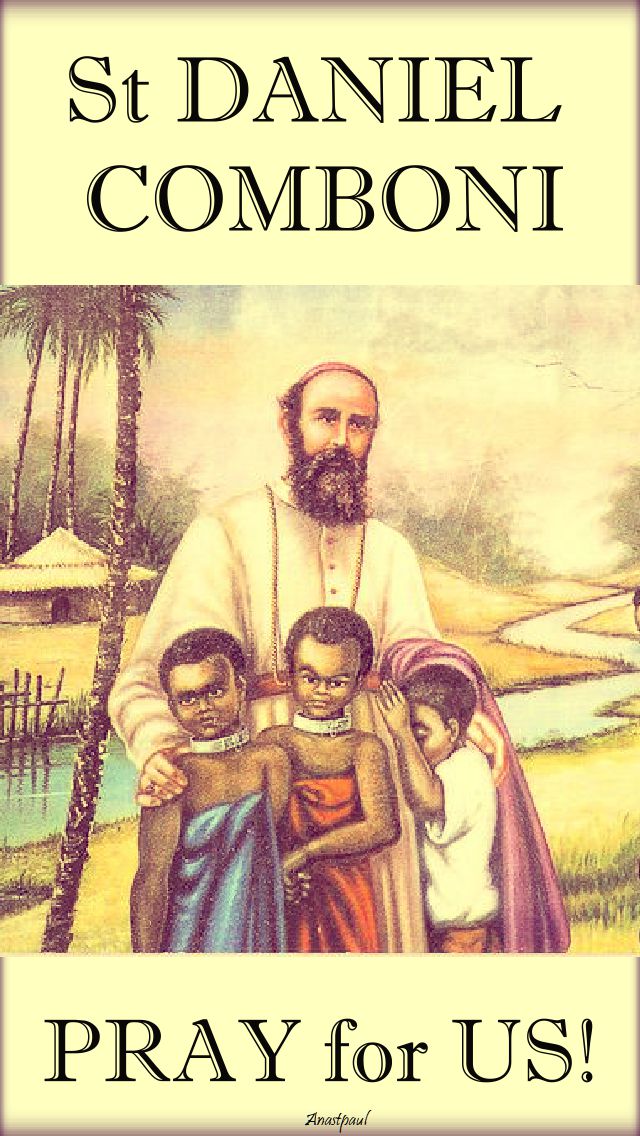
St Daniel Comboni, pray for us!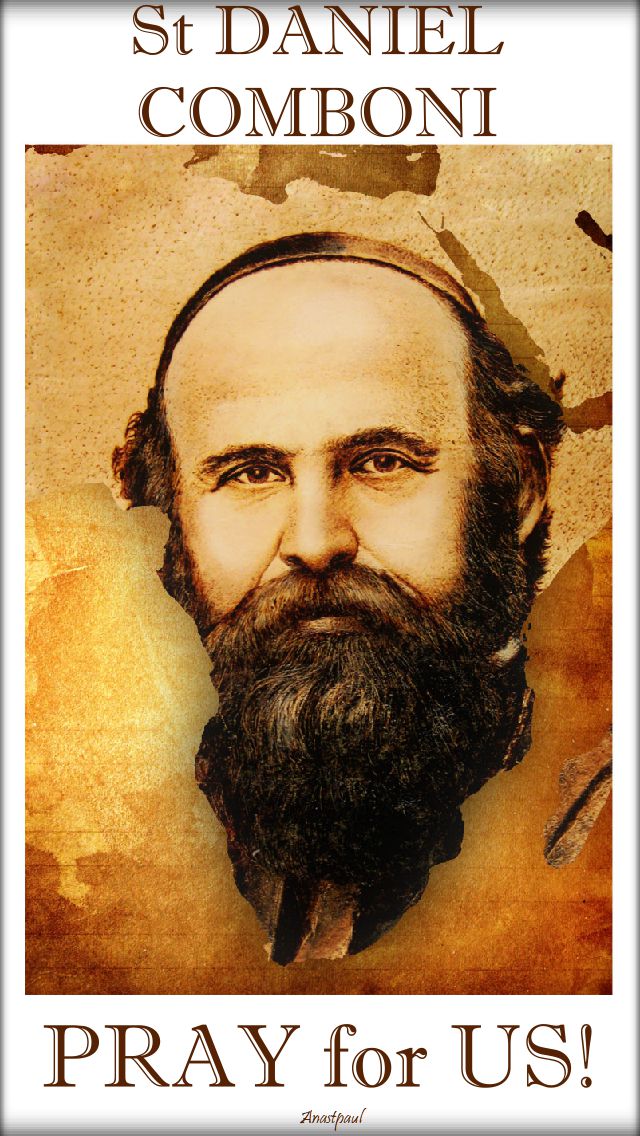
Quote/s of the Day – 10 October – The Memorial of St Francis Borgia SJ (1510-1572) and St Daniel Comboni (1831-1881)
Quote/s of the Day – 10 October – The Memorial of St Francis Borgia SJ (1510-1572) and
St Daniel Comboni (1831-1881)
“I am very sorry to lose the company of a man of your merit,
a shining light of counsel, a model in the exercise of the highest offices of State and,
because of your virtue and piety, a factor of edification for all my court.
But I recognise that it would be unreasonable to dispute over you with the Master you have chosen to serve.
It is, therefore, with sorrow that I grant you the permission you are requesting.
I authorise you to renounce your fiefs and titles in favour of your firstborn son.
The number of those who will envy you, will be greater than those who will imitate you, since it is easy to admire beautiful examples but difficult to follow them.
I recommend myself to your prayers and I count upon you,
to attract divine blessings over me, my States, and all Christendom.”
(King Charles V of Spain when he granted permission to St Francis to enter the novitiate of the Jesuits.)
“When you pray, hear Mass, sit at table, engage in business
and when at bedtime you remove your clothes—
at all times crave that by the pain which He felt when He was stripped
just before His crucifixion, He may strip us of our evil habits of mind.
Thus, naked of earthly things, we may also embrace the cross.”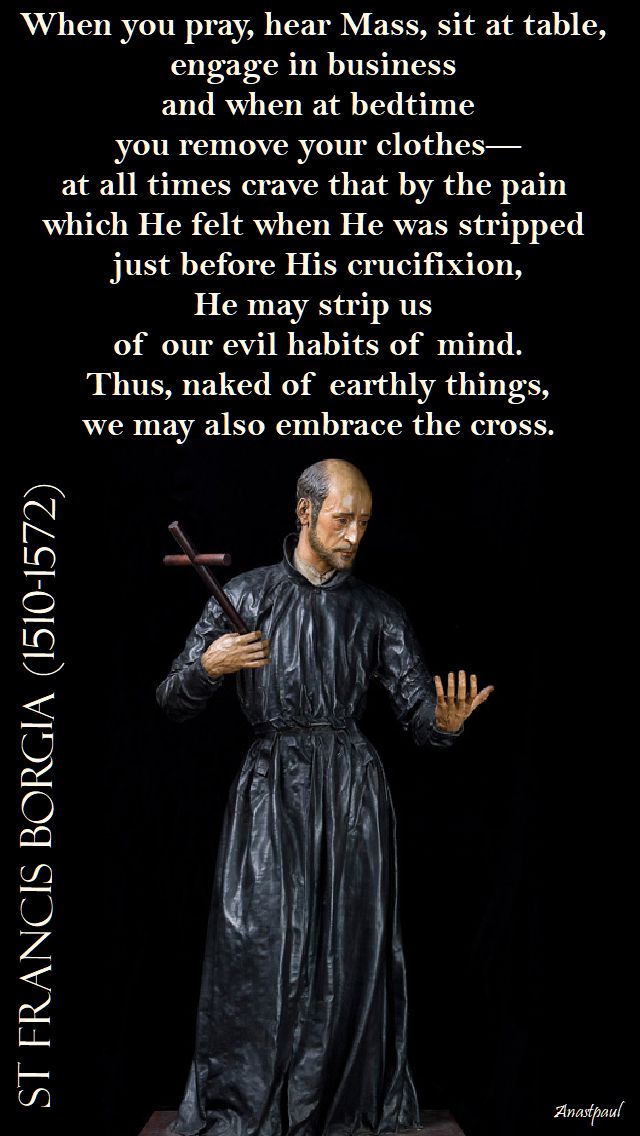
“I have great doubts about the salvation of those
who do not have special devotion to Mary.”
St Francis Borgia (1510-1572)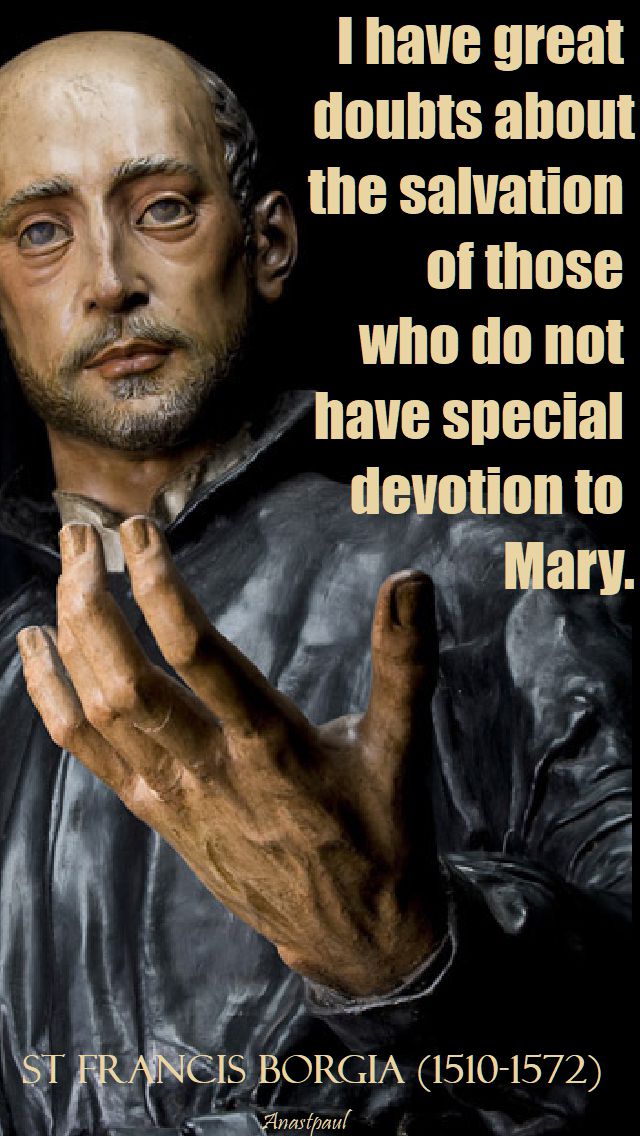
“The same terrible crosses that oppress me
are also the greatest consolation
because Jesus suffered,
Jesus is a Victim
Jesus chose the Cross….
(therefore) I am happy with the Cross,
tbat borne willingly for the love of God,
generates triumph and eternal life.”
St Daniel Comboni (1831-1881)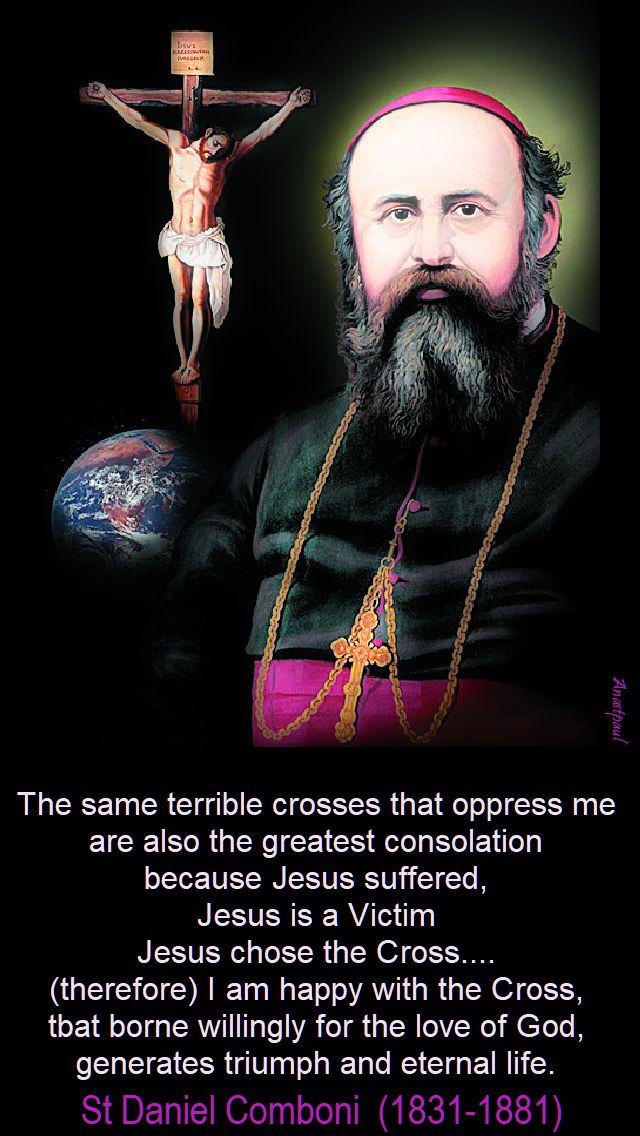
One Minute Reflection – 10 October – The Memorial of St Daniel Comboni (1831-1881)
One Minute Reflection – 10 October – The Memorial of St Daniel Comboni (1831-1881)
God would not be so unjust as to forget all you have done,
the love that you have for his name or the services you have done
and are still doing, for the holy people of God.…Hebrews 6:10
REFLECTION – “The missionaries will have to understand that they are stones hid under the earth, which will perhaps never come to light, but which will become part of the foundations of a vast, new building.”….St Daniel Comboni (1831-1881)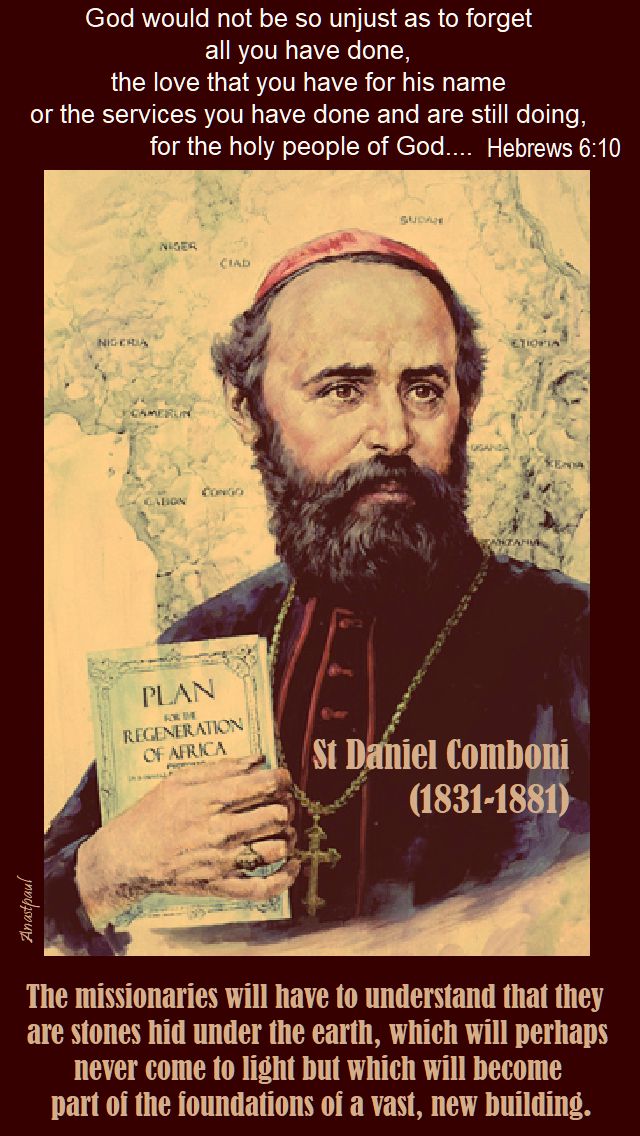
PRAYER – Lord God, by whose supassing mercy St Daniel Comboni made known the unfathomable riches of Christ, grant, at his intercession, that we may grow in knowledge of You, yield fruit in every good work and by the truth of the Gospel, live faithfully in Your presence. Through our Lord Jesus Christ, in union with the Holy Spirit, one God, forever amen.
Our Morning Offering – 10 October – The Memorial of St Francis Borgia S.J. (1510-1572)
Our Morning Offering – 10 October – The Memorial of St Francis Borgia S.J. (1510-1572)
Teach Me Your Ways
Pedro Arrupe, S.J.
Teach me Your way of looking at people:
as You glanced at Peter after his denial,
as You penetrated the heart of the rich young man
and the hearts of Your disciples.
I would like to meet You as You really are,
since Your image changes those with whom You
come into contact.
Remember John the Baptist’s first meeting with You?
And the centurion’s feeling of unworthiness?
And the amazement of all those who saw miracles
and other wonders?
How You impressed Your disciples,
the rabble in the Garden of Olives,
Pilate and his wife
and the centurion at the foot of the cross. . . .
I would like to hear and be impressed
by Your manner of speaking,
listening, for example, to Your discourse in the
synagogue in Capharnaum
or the Sermon on the Mount where Your audience
felt You “taught as one who has authority.”
Teach me Your way O Lord!
Amen
Saint of the Day – 10 October – St Francis Borgia S.J. (1510-1572)
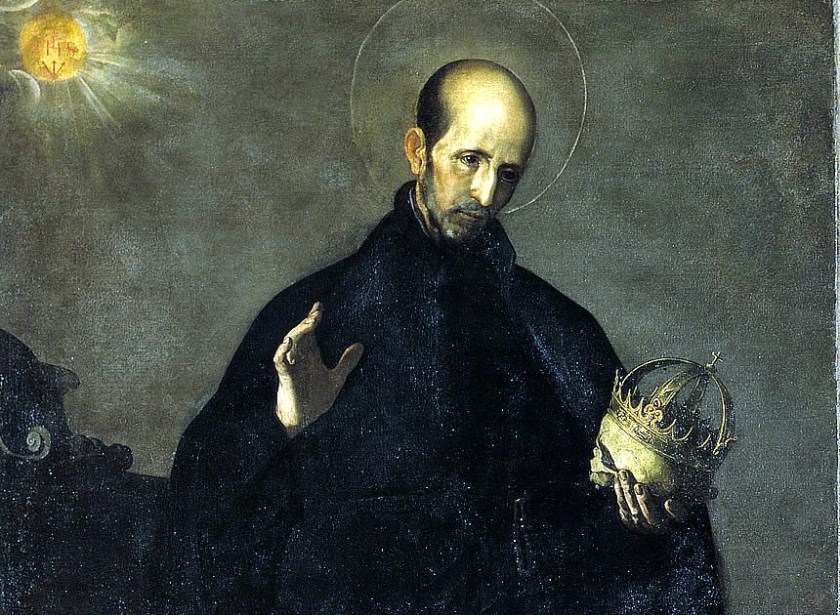
Saint of the Day – 10 October – St Francis Borgia S.J. (1510-1572) Priest, Advisor, Missionary, Evangelist, Administrator par excelleance. Born – Francisco de Borja y Aragon was the 4th Duke of Gandía, was a Grandee of Spain, a Spanish Jesuit and third Superior General of the Society of Jesus – (28 October 1510 at Gandia, Valencia, Spain – 30 September 1572 at Ferrara, Italy). His relics were translated to the Jesuit church in Madrid, Spain in 1901. He was Beatified on 23 November 1624 at Madrid by Pope Urban VIII and Canonised on 20 June 1670 by Pope Clement X in Rome, Italy. Patronages – against earthquakes, Portugal, Rota, Marianas. Attributes – Skull crowned with an emperor’s diadem.
St Francis was born in Duchy of Gandía, Valencia, on 28 October 1510. His father was Juan Borgia, 3rd Duke of Gandía, the son of Giovanni Borgia, the son of Pope Alexander VI (Rodrigo Borgia). His mother was Juana, daughter of Alonso de Aragón, Archbishop of Zaragoza, who, in turn, was the illegitimate son of King Ferdinand II of Aragon. His brother, Tomás de Borja y Castro, also became a clergyman, becoming the Bishop of Málaga and later the Archbishop of Zaragoza.
As a relative of Pope Alexander VI, King Ferdinand of Aragon and Emperor Charles V, joined Spain’s imperial court at age eighteen, although as a child he was very pious and wished to become a monk, his family sent him instead to court. He distinguished himself there, accompanying the Emperor on several campaigns. The next year he married Eleanor de Castro, who bore him eight children. In 1539, shortly after experiencing a religious conversion, Francis left the court but continued in public life as viceroy of Catalonia. At this time under the influence of St Peter of Alcántara O.F.M. and St Peter Favre S.J, he progressed in prayer and the spiritual life.
In 1543, Francis succeeded his father as duke of Gandia. He was much opposed to gaming and did not allow his servants to indulge in it. He used to say: “Gaming is accompanied by great losses; loss of money, loss of time, loss of devotion and loss of conscience.” The same aversion he had for the reading of frivolous books, even if they were not immoral. He found his greatest delight in reading devout books and said: “The reading of devout books is the first step towards a better life.” At the period in which he lived the principal enjoyments of the higher classes were music and hawking; and, as he could not abstain from them entirely, he took care, at such times, to raise his thoughts to the Almighty and to mortify himself. Thus, when he went hawking, he closed his eyes at the very moment when the hawk swooped; the sight of which, they say, was the chief pleasure of this kind of hunting.
The Almighty, to draw His servant entirely away from the world, sent him several severe maladies, which made him recognise the instability of all that is earthly. He became more fully aware of this after the death of the Empress, whose wondrous beauty was everywhere extolled. By the order of the Emperor, it became the duty of Francis to escort the remains to the royal vault at Granada. There the coffin was opened before the burial took place, and the sight that greeted the beholders was most awful. Nothing was left of the beautiful Empress but a corpse, so disfigured, that all averted their eyes, whilst the odour it exhaled was so offensive that most of the spectators were driven away. 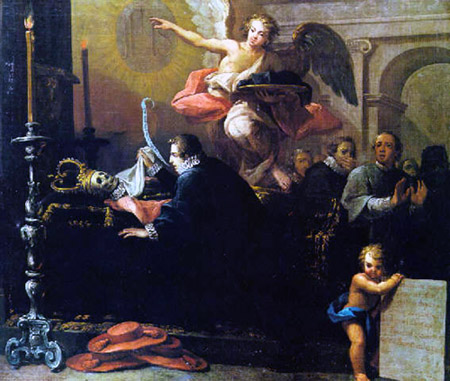
St Francis was most deeply touched, and when, after the burial, he went into his room, prostrated himself before the crucifix and having given vent to his feelings, he exclaimed: “No, no, my God! in future I will have no master whom death can take from me.” He then made a vow that he would enter a religious order, should he survive his consort. He often used to say afterwards: “The death of the Empress awakened me to life.” When Francis returned from Granada the Emperor created him Viceroy of Catalonia and in this new dignity the holy Duke continued to lead rather a religious than a worldly life. He had a fatherly care for his subjects and every one had at all hours admittance to him. Towards the poor he manifested great kindness. He daily gave four or five hours to prayer. He fasted almost daily and scourged himself to blood. He assisted at Mass and received Holy Communion every day. When he heard that disputes had arisen among the theologians at the universities, in regard to the frequent use of Holy Communion, he wrote to St. Ignatius, at Rome and asked his opinion on the subject. St. Ignatius wrote back to him, approving of the frequent use of Holy Communion and strengthening him in his thoughts about it.
Meanwhile, the death of his father brought upon him the administration of his vast estates, without, however, in the least changing his pious manner of living. Soon after his pious consort, who was his equal in virtue, became sick. Francis prayed most fervently to God for her recovery. One day, while he was thus praying, he heard an interior voice, which said these words: “If thou desirest that thy consort should recover, thy wish shall be fulfilled but it will not benefit thee.” Frightened at these words, he immediately conformed his own will in all things to the Divine will. From that moment the condition of the Duchess grew worse and she died, as she had lived, piously and peacefully. St Francis, remembering his vow, determined to execute it without delay. Taking counsel of God and of his confessor, he chose the Society of Jesus, which had recently been instituted. Writing to St. Ignatius, he asked for admittance, which was cheerfully granted. But, to settle his affairs satisfactorily, he was obliged to remain four years longer in his offices. Having at length, by the permission of the Emperor, resigned his possessions to his eldest son, he took the religious habit and proceeded to Rome. Scarcely four months had elapsed since his arrival, when he was informed that the Pope wished to make him a cardinal; and, to avoid this dignity, he returned to Spain. Being ordained priest, he said his first Mass in the chapel of the Castle of Loyola, where St Ignatius had been born; and then spent a few years in preaching and instructing the people. It would take more space than is allowed to us to relate how many sinners he converted, and how much he laboured for the honour of God and the salvation of souls.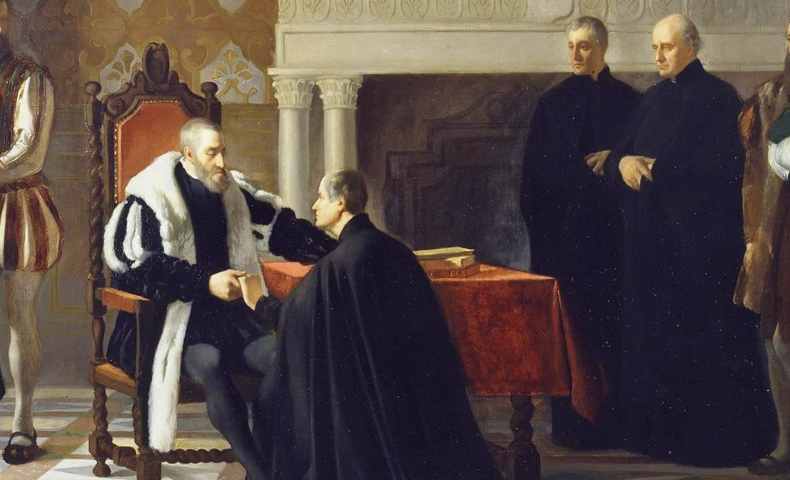

While he preferred a quiet life of solitude, the Jesuits felt differently and promoted him so that he could use his great administrative talents for the church. In 1554, St Ignatius appointed Francis commissary for Spain, where he founded twelve colleges and a novitiate. The Jesuits chose Francis as their general in 1565. His consolidation of the society and expansion of its ministry has caused him to be recognised as the second founder of the order. He established disciplined novitiates in every Jesuit province, writing regulations and books of spiritual instruction for them.


Francis created a new Jesuit base in Poland and strengthened the community’s work in Germany and France. Between 1566 and 1572 he launched the Jesuit mission to Spanish colonies in Florida, Mexico and Peru. He maintained contact with the missioners by letter, advising them about their own spiritual lives and counseling them on strategy. Following is an excerpt from his correspondence:
“We must perform all our works in God and refer them to His glory so that they will be permanent and stable. Everyone—whether kings, nobles, tradesmen or peasants—must do all things for the glory of God and under the inspiration of Christ’s example. . . . When you pray, hear Mass, sit at table, engage in business and when at bedtime you remove your clothes—at all times crave that by the pain which He felt when He was stripped just before His crucifixion, He may strip us of our evil habits of mind. Thus, naked of earthly things, we may also embrace the cross.
Wherever our brethren may be, let their first care be for those already converted. Their first aim must be to strengthen these in the faith and to help them save their souls. After this they may convert others not yet baptised. But let them proceed prudently and not undertake more than they can carry through. It is not desirable for them to hurry here and there to convert heathen with whom they cannot afterwards keep in touch. It is better to advance step by step and consolidate conquests already made. . . . They are not to risk their lives unnecessarily in excursions among unconquered people. The swift loss of life in God’s service may be advantageous for them. However, it is not for the greater good of the many for there are only a few labourers for the vineyard and it is difficult to replace them.”
His successes during the period 1565-1572 have caused historians to describe Francis as the greatest General after Saint Ignatius. He founded the Collegium Romanum, which was to become the Gregorian University in Rome, advised kings and popes and closely supervised all the affairs of the rapidly expanding order. Yet, despite the great power of his office, Francis led a humble life and was widely regarded in his own lifetime as a saint.
In 1571 the pope sent Francis to Spain and Portugal to help build an alliance against the Turks. He grew increasingly ill on this ambassadorial trip and died after returning to Rome in 1572.
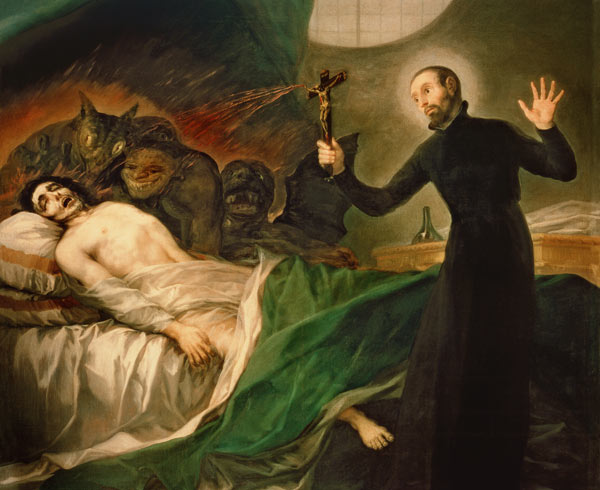
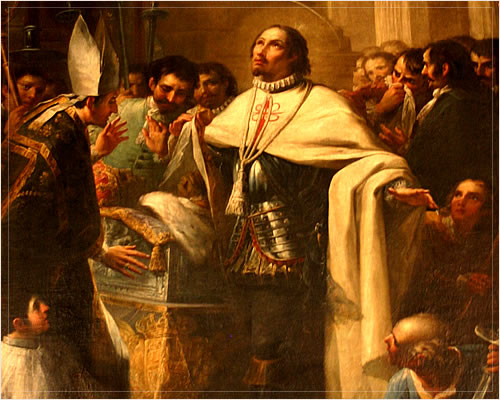
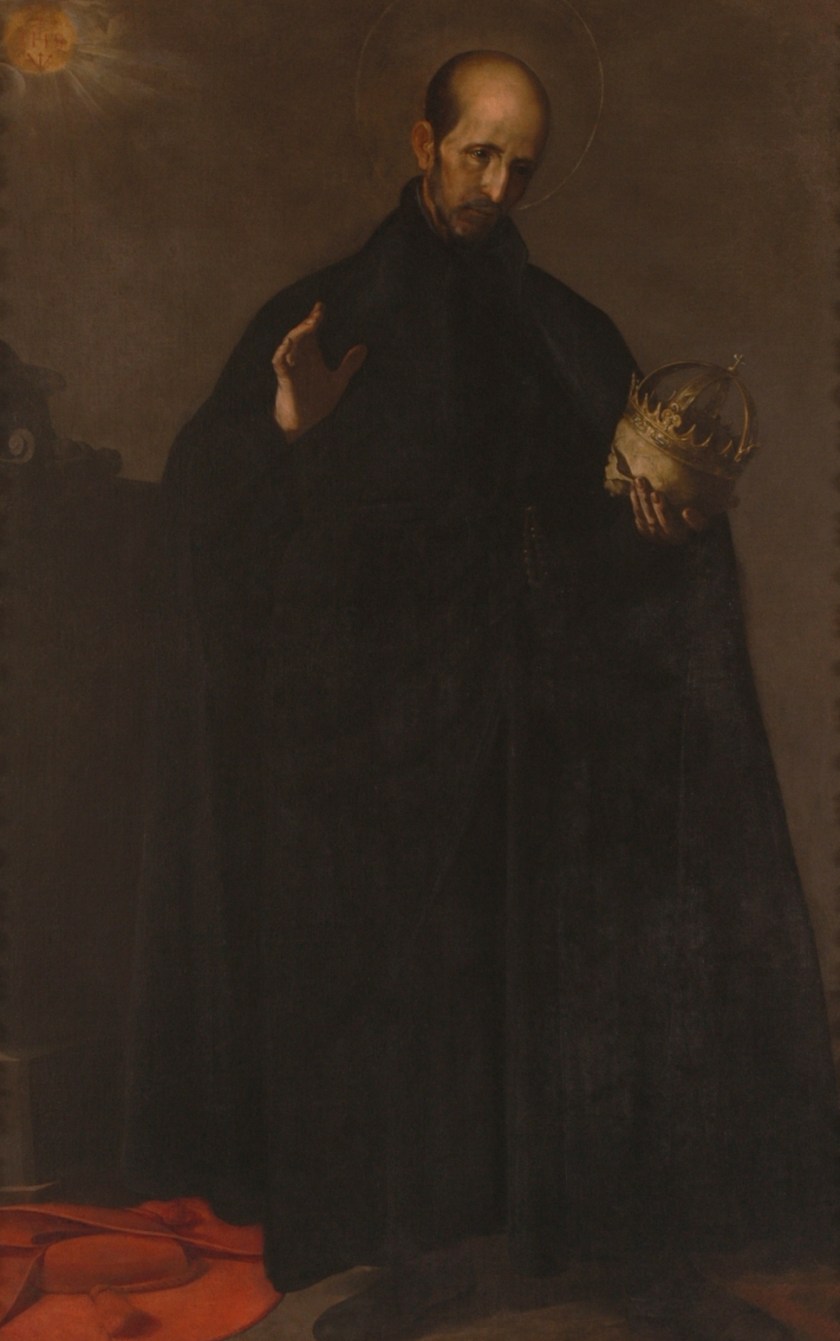
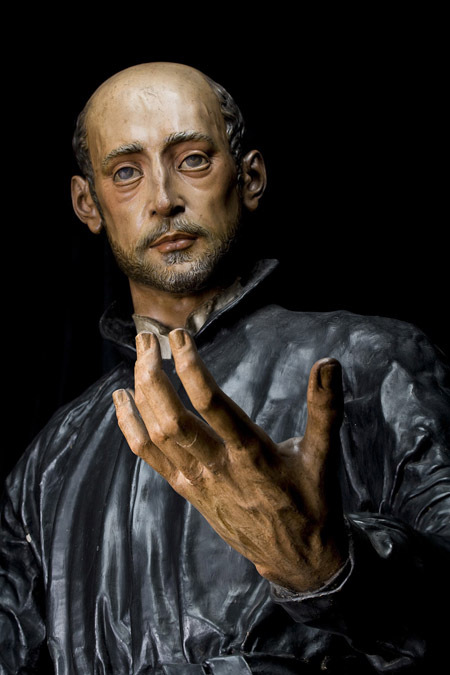
Memorials of the Saints – 10 October
St Daniel Comboni (Optional Memorial) – https://www.youtube.com/watch?v=fiaQEJirlY4
—
St Aldericus
Bl Angela Truszkowska
St Cassius
St Cerbonius of Populonia
St Cerbonius of Verona
St Clarus of Nantes
Bl Demestrius of Albania
Bl Edward Detkens
St Eulampia
St Eulampius
St Florentius the Martyr
St Francis Borgia (1510-1572) – https://www.youtube.com/watch?v=YGQn26BUsJM
St Fulk of Fontenelle
St Gereon
St Gundisalvus
Bl Hugh of Macon
Bl Leon Wetmanski
St Maharsapor the Persian
St Malo the Martyr
St Patrician
St Paulinus of Capua
St Paulinus of York
Bl Pedro de Alcantara de Forton de Cascajares
St Pinytus of Crete
Bl Pontius de Barellis
St Tanca
St Teodechilde
St Victor of Xanten
Martyrs of Ceuta – 7 beati: A group of seven Franciscan Friars Minor missionaries to Muslims in the Ceuta area of modern Morocco. Initially treated as madmen, within three weeks they were ordered to convert to Islam and when they would not they were first abused in the streets, then arrested, tortured and executed.
• Angelo
• Daniele di Calabria
• Donnolo
• Hugolinus
• Leone
• Nicola
• Samuele
They were beheaded in 1227 in Mauritania Tingitana (Ceuta, Morocco). Local Christians secreted the bodies away and gave them proper burial in Ceuta. They were Beatified in 1516 by Pope Leo X.
Thought for the Day – 9 October – The Memorial of St John Leonardi (1541-1609)
Thought for the Day – 9 October – The Memorial of St John Leonardi (1541-1609)
Dear brothers and sisters, St John Leonardi’s existence was always enlightened by the splendour of the “Holy Face” of Jesus, kept and venerated in the Cathedral Church of Lucca, becoming the eloquent symbol and the indisputable synthesis of the faith that animated him. Conquered by Christ like the Apostle Paul, he pointed out to his disciples and continues to point out to all of us, the Christocentric ideal for which “it is necessary to divest oneself of every self interest and only look to the service of God,” having “before the mind’s eye only the honour, service and glory of Christ Jesus Crucified.”
Along with the face of Christ, he fixed his gaze on the maternal face of Mary. She whom he chose patroness of his order, was for him teacher, sister and mother and he felt her constant protection. May the example and intercession of this “fascinating man of God” be, particularly in this Year for Priests, a call and encouragement for priests and for all Christians to live their own vocations with passion and enthusiasm. (Pope Benedict XVI, October 7, 2009)
What can one person do? The answer is plenty! In the life of each saint, one thing stands clear: God and one person are a majority!
What one individual, following God’s will and plan for his or her life, can do is more than our mind could ever hope for or imagine.
Each of us, like John Leonardi, has a mission to fulfill in God’s plan for the world.
Each one of us is unique and has been given talent to use for the service of our brothers and sisters for the building up of God’s kingdom.
St John Leonardi, Pray for us!

A Moment of Joy! – – 9 October – The Memorial of Blessed John Henry Newman (1801-1890) – Vatican investigates second ‘miracle’ attributed to Blessed John Henry Newman (1801-1890)
A Moment of Joy! – – 9 October – The Memorial of Blessed John Henry Newman (1801-1890) -Vatican investigates second ‘miracle’ attributed to Blessed John Henry Newman (1801-1890)
English bishops say the progress of his Cause is a source of ‘great joy’.
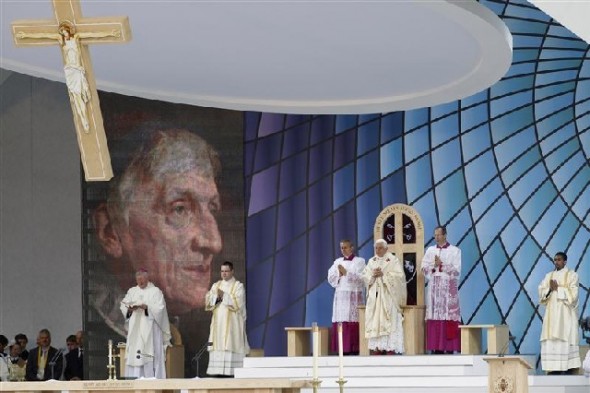
The Archbishop of Birmingham has welcomed reports that the Vatican is investigating a possible second “miracle” which may lead to the canonisation of Blessed Cardinal John Henry Newman. Archbishop Bernard Longley said it was a “great joy” to know that the Cause was making progress. He said the occasion should also spur on Catholics to renew their prayers for the canonisation of Blessed Dominic Barberi, who received Newman into the Catholic faith from the Church of England.
“Blessed Cardinal Newman has left an extraordinarily rich spiritual legacy – not least through the two Oratory communities in Birmingham and Oxford – as well as to the Church nationally and internationally,” Archbishop Longley said. “It would be a great joy to see him take a step closer to being named among the saints and would be an encouragement to all who have been inspired by him seek the truth by seeking Christ.
“At the same time, and especially during this Jubilee Year of Mercy, I am sure that Blessed John Henry Newman would want us to continue praying for the canonisation of Blessed Dominic Barberi, the Passionist priest who first enabled him to receive the Sacrament of mercy at his reception into full communion with the Catholic Church at Littlemore in 1845 and who gave him a new insight into the merciful love of God.”
The archbishop spoke after the Tablet, a Catholic weekly magazine, revealed that the Archdiocese of Chicago had investigated the inexplicable healing of a young American mother who prayed for the Victorian cardinal’s intercession when she became afflicted by a “life-threatening pregnancy”. Doctors who treated her have reported that they have no explanation for the sudden and complete recovery of the woman, a law graduate. The file on her case has now been passed to the Congregation for the Causes of Sainthood and if Vatican theologians and doctors conclude the healing is a divine sign of Newman’s sanctity the Pope will be invited to canonise him as the first English saint since 1970 and the first British saint since 1976.
Two healing miracles are normally required for a candidate to be declared a saint. Cardinal Newman was beatified in Cofton Park, Birmingham, by Pope Benedict XVI in 2010 after the Vatican approved the first miracle, which involved the inexplicable healing of Jack Sullivan, an American who nine years earlier recovered from a crippling spinal condition which had left him “bent double”.
An earlier alleged healing of a baby in Mexico at Newman’s intercession was dismissed by the Congregation and the Vatican is refusing to disclose details about the latest case at the present time. But if the new case passes scrutiny, it will cement the international reputation of Cardinal Newman as one of the most distinguished Englishmen of his generation.
The London-born cardinal was an esteemed 19th-century Anglican theologian who founded the Oxford Movement to try to return the Church of England to its Catholic roots before he converted to the Catholic faith. In spite of a life marked by controversy, he was renowned for his exemplary virtue and also for his reputation as a brilliant thinker and Pope Leo XIII rewarded him with a cardinal’s red hat.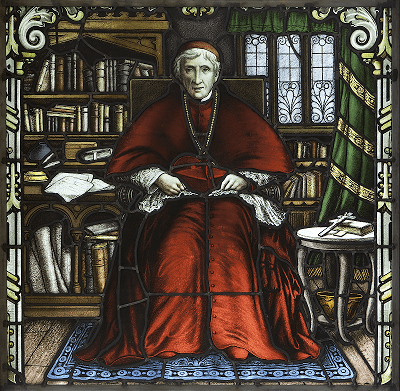
He died in Birmingham in 1890, aged 89, and more than 15,000 people lined the streets for his funeral procession to pay tribute to him.
Scholars believe he was years ahead of his time in his views of the Church and her teachings. He was also a deeply original theologian who articulated a “theology of conscience” which historians have recently discovered influenced Sophie Scholl, the German woman beheaded in 1943 after she was caught flooding Munich University with leaflets urging students to rise up against “Nazi terror”.
Bishop Philip Egan of Portsmouth said he was convinced that Cardinal Newman would not only be canonised one day but would also be declared a Doctor of the Church because of the wealth and depth of teaching he left behind. “He was a man whose life and whose heart was absolutely docile to the truth of God and the truth of Christ,” the bishop said. “He was absolutely under the Word of God and I think that is important to us in an age of relativism and liberalism. Here is somebody led by the truth even if it cost him in his own personal life.” The teachings of Newman continue to be esteemed throughout the world, Bishop Egan said, adding: “I wonder if we undervalue him in England or don’t fully grasp just how significant he is in terms of the universal Church.”
The development was also welcomed by Bishop Mark Davies of Shrewsbury. “John Henry Newman is already recognised by both Catholics and Anglicans for his personal holiness as well as his great learning,” he said. “We cannot anticipate the final judgment on a miracle now attributed to Cardinal Newman’s prayers,” he continued. “However, we pray that soon England will have a new saint recognised, a saint whose life and witness was closely connected with such familiar places as London, Oxford and Birmingham.”
Vatican officials are also studying the Causes of Passionist Fr Ignatius Spencer, a relative of Princes William and Harry through their mother, Lady Diana; Mother Elizabeth Prout, the founder of the Passionist sisters who worked with the poor in Manchester; Frances Taylor, “the saint of Soho” and a colleague of Florence Nightingale, and Mother Riccarda Beauchamp Hambrough, a Bridgettine nun who helped to rescue Jews from the Nazis in the Second World War.
Like Cardinal Newman, all of these post-Reformation candidates for sainthood were converts to the Catholic faith.
Blessed John Henry Newman, Pray for us, as we pray for your Canonisation!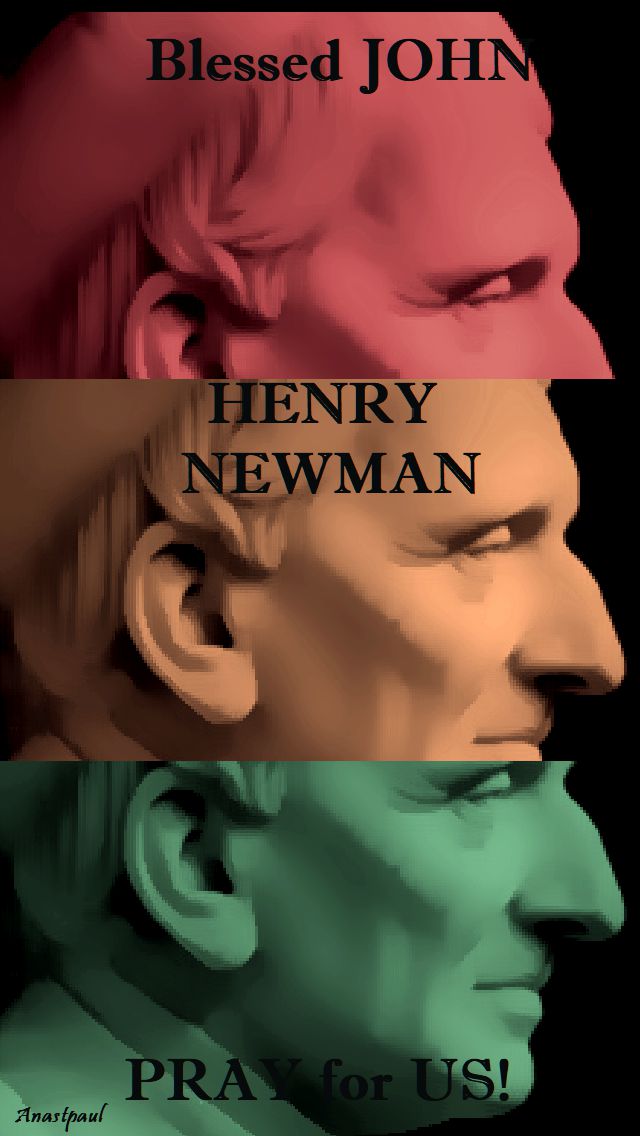
PRAYER FOR CANONISATION of Blessed John Henry Newman (1801-1890)
God our Father,
You granted to Your servant,
Blessed John Henry Newman,
wonderful gifts of nature and of grace,
that he should be a spiritual light
in the darkness of this world,
an eloquent herald of the Gospel
and a devoted servant of the one Church of Christ.
With confidence in his heavenly intercession,
we make the petition for his Canonisation.
For his insight into the mysteries of the kingdom,
his zealous defence of the teachings of the Church
and his priestly love for each of your children,
we pray that he may soon be numbered among the Saints.
We ask this through Christ our Lord.
Amen
Nihil Obstat: Fr Pat McKinney S.T.L.
Imprimatur: + Bernard Longley, Archbishop of Birmingham
30th March 2010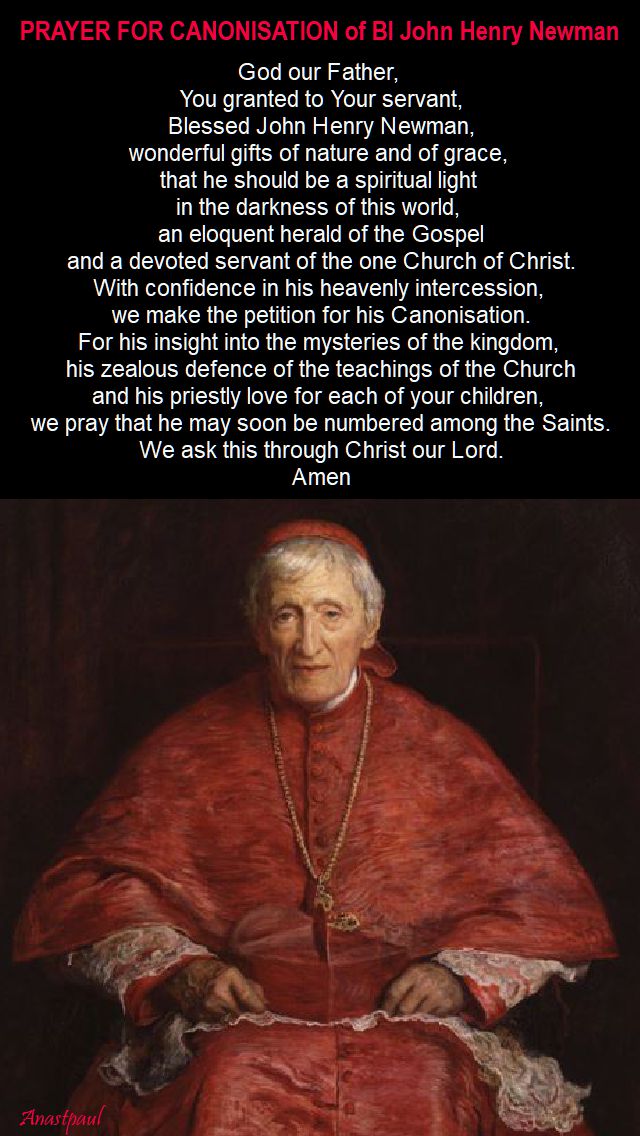
Quote/s of the Day – 9 October – The Memorial of Blessed John Henry Newman (1801-1890)
Quote/s of the Day – 9 October – The Memorial of Blessed John Henry Newman (1801-1890)
“Fear not that your life shall come to an end
but rather fear that it shall never have a beginning.”
“To live is to change
and to be perfect,
is to have changed often.”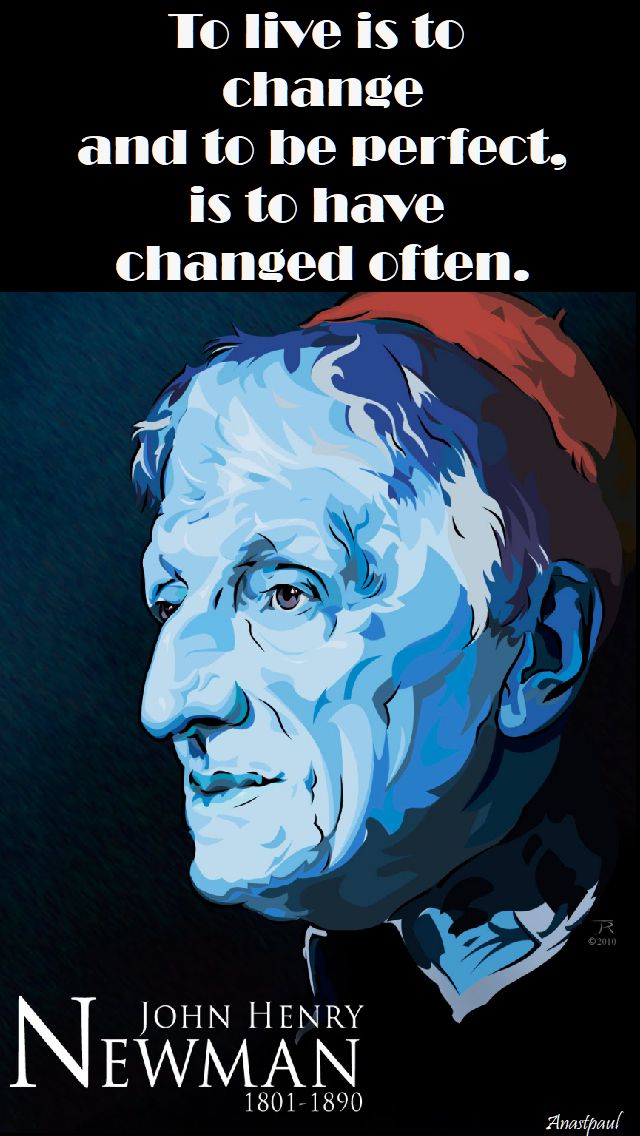
“Nothing would be done at all,
if one waited until one could do it so well,
that no one could find fault with it.”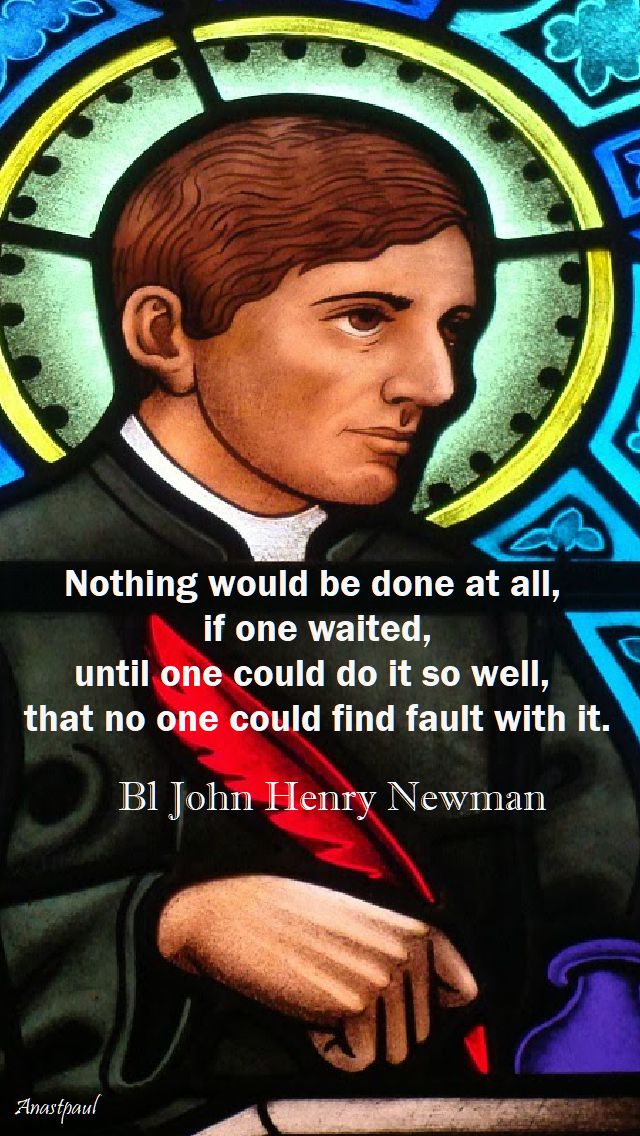
“Regarding Christianity,
ten thousand difficulties –
do not make one doubt.”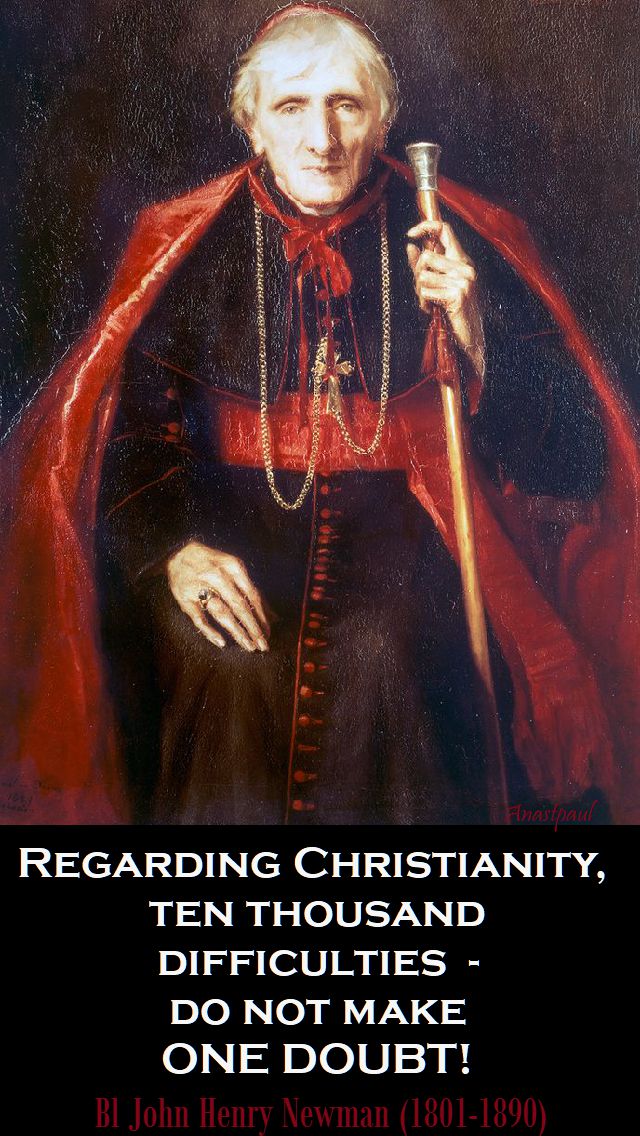
“A great memory does not make a mind,
any more than a dictionary is a piece of literature.”
BLESSED JOHN HENRY NEWMAN (1801-1890)
One Minute Reflection – 9 October – The Memorial of Blessed John Henry Newman (1801-1890)
One Minute Reflection – 9 October – The Memorial of Blessed John Henry Newman (1801-1890)
But without faith it is impossible to please him,
for anyone who approaches God must believe
that he exists and that he rewards those who seek him....Hebrews 11:6
REFLECTION – “Oh that we could take that simple view of things, as to feel that the one thing which lies before us is to please God! What gain is it to please the world, to please the great, even to please those whom we love, compared with this? What gain is it to be applauded, admired, courted, followed, compared with this one aim, of not being disobedient to a heavenly vision? What can this world offer comparable with that insight into spiritual things, that keen faith, that heavenly peace, that high sanctity, that everlasting righteousness, that hope of glory, which they have who in sincerity love and follow our Lord Jesus Christ?”…Blessed John Henry Newman
PRAYER – “Dear Jesus, help me to spread Your fragrance everywhere I go.
Flood my soul with Your spirit and life.
Penetrate and possess my whole being so utterly,
that my life may only be a radiance of Yours.
Shine through me and be so in me
that every soul I come in contact with
may feel Your presence in my soul.
Let them look up and see no longer me but only Jesus!”
Blessed John Henry Newman, pray for us!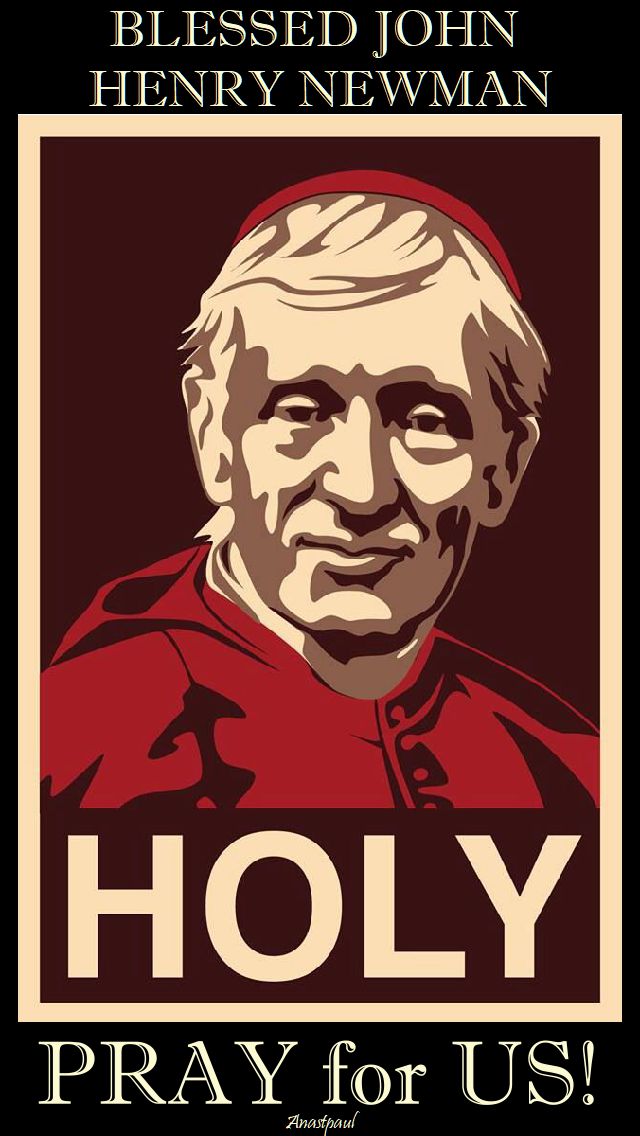
Our Morning Offering – 9 October – The Memorial of Blessed John Henry Newman (1801-1890)
Our Morning Offering – 9 October – The Memorial of Blessed John Henry Newman (1801-1890)
Be with Me Today, O Lord
By Blessed John Henry Newman (1801-1890)
May all I do today begin with You, O Lord.
Plant dreams and hopes within my soul,
revive my tired spirit: be with me today.
May all I do today continue with Your help, O Lord.
Be at my side and walk with me:
Be my support today.
May all I do today reach far and wide, O Lord.
My thoughts, my work, my life:
make them blessings for Your kingdom;
let them go beyond today,O God.
Today is new unlike any other day,
for God makes each day different.
Today God’s everyday grace,
falls on my soul like abundant seed,
though I may hardly see it.
Today is one of those days
Jesus promised to be with me,
a companion on my journey,
And my life today, if I trust Him,
has consequences unseen.
My life has a purpose:
I have a mission…I am a link in a chain,
a bond of connection between persons.
God has not created me for naught…”
Therefore I will trust Him.
Whatever, wherever I am,
I can never be thrown away.
God does nothing in vain.
He knows what he is about.
Amen.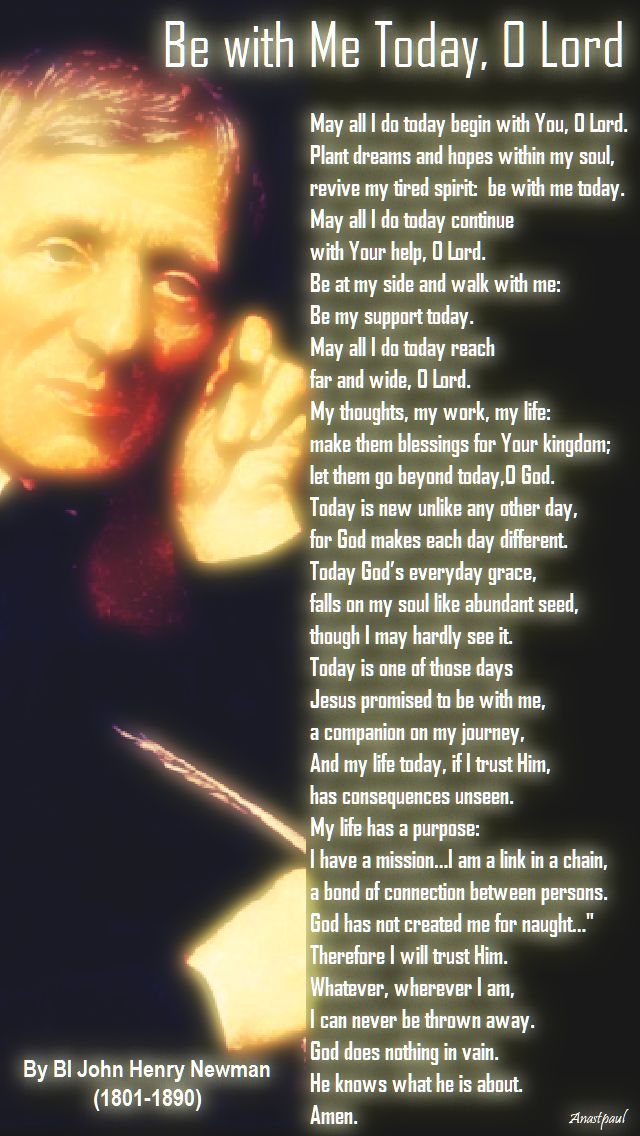
Saint of the Day – 9 October – St John Leonardi (1541-1609)
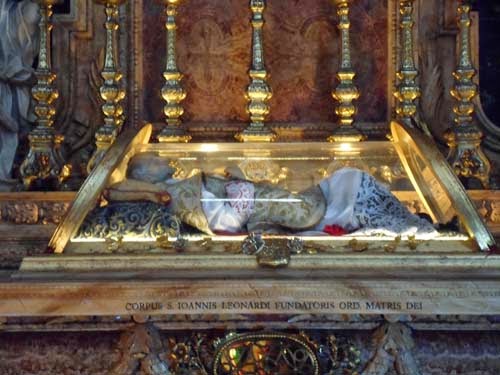
Saint of the Day – 9 October – St John Leonardi (1541-1609) – Priest, Founder, Confessor, Reformer, Apostle of the Holy Eucharist and Eucharistic Adoration, Marian devotee. Born Giovanni Leonardi in 1541 at Diecimo, Lucca, Italy – 8 October 1609 at Rome, Italy of natural causes). He was buried in Santa Maria in Portico and was Beatified in 1861 and Canonised on 17 April 1938 by Pope Pius XI. St John founded the Clerks Regular of the Mother of God of Lucca, wherein he assumed the name of “Giovanni of the Mother of God” as his religious name. Patronages – Pharmacists and the Clerks Regular of the Mother of God of Lucca. Attributes – Cassock.


John Leonardi was born in 1541 in Diecimo, in the province of Lucca. The last of seven siblings, his adolescence was sprinkled with rhythms of faith lived in a healthy and industrious family group, as well as the assiduous frequenting of a shop of herbs and medicines in his native town. At age 17 his father enrolled him in a regular course in pharmacy in Lucca, with the aim of making him a future pharmacist, that is, an apothecary, as they were called then. For close to a decade young John Leonardi was vigilant and diligent in following this, but when, according to the norms established by the former Republic of Lucca, he acquired the official recognition that would have allowed him to open his own shop, he began to think if perhaps the moment had not arrived to fulfill a plan that he had always had in his heart.
After mature reflection he decided to direct himself toward the priesthood. And thus, having left the apothecary’s pharmacy, and acquired an appropriate theological formation, he was ordained a priest and celebrated his first Mass on the feast of Epiphany of 1572. However, he did not abandon his passion for pharmaceutics because he felt that professional mediation as a pharmacist would allow him to realize fully his vocation of transmitting to men, through a holy life, “the medicine of God,” which is Jesus Christ crucified and risen, “measure of all things.”

Animated by the conviction that, more than any other thing, all human beings need such medicine, St John Leonardi tried to make the personal encounter with Jesus Christ the fundamental reason of his existence. It is necessary to “start anew from Christ,” he liked to repeat very often.
The primacy of Christ over everything became for him the concrete criterion of judgment and action and the generating principle of his priestly activity, which he exercised while a vast and widespread movement of spiritual renewal was under way in the Church, thanks to the flowering of new religious institutes and the luminous witness of saints such as Charles Borromeo, Philip Neri, Ignatius of Loyola, Joseph Calasanzius, Camillus of Lellis and Aloysius Gonzaga.
He dedicated himself with enthusiasm to the apostolate among youth through the Company of Christian Doctrine, gathering around himself a group of young men with whom, on Sept. 1, 1574, he founded the Congregation of Reformed Priests of the Blessed Virgin, subsequently called the Order of Clerks Regular of the Mother of God. He recommended to his disciples to have “before the mind’s eye only the honour, service and glory of Christ Jesus Crucified,” and, like a good pharmacist, accustomed to giving out potions according to careful measurements, he would add: “Raise your hearts to God a bit more and measure things with him.”
Moved by apostolic zeal, in May 1605 he sent newly elected Pope Paul V a report in which he suggested the criteria for a genuine renewal of the Church. Observing how it is “necessary that those who aspire to the reform of men’s practices must seek especially and firstly, the glory of God,” he added that they should stand out “for their integrity of life and excellence of customs thus, rather than constraining, they gently draw one to reform.” Moreover, he observed that “whoever wishes to carry out a serious moral and religious reform must make first of all, like a good doctor, a careful diagnosis of the evils that beset the Church so as to be able to prescribe for each of them the most appropriate remedy.” And he noted that “the renewal of the Church must be confirmed as much in leaders as in followers, high and low. It must begin from those who command and be extended to the subjects.”
It was because of this that, while soliciting the Pope to promote a “universal reform of the Church,” he was concerned with the Christian formation of the people, especially of the young, educating them “from their early years … in the purity of the Christian faith and in holy practices.”


He chose the Blessed Mother to be the patroness of his order because he had a strong devotion to her. He always kept his gaze on our Lady and she was his teacher, sister and mother who protected him and led him closer to Jesus Christ.
Dear brothers and sisters, the luminous figure of this saint invites priests, in the first place and all Christians, to tend constantly to the “high measure of the Christian life,” which is sanctity — each, of course, according to his own state. In fact, only from fidelity to Christ can genuine ecclesial renewal spring.
In those years, in the cultural and social passage between the 16th and 17th century, the premises of the future contemporary culture began to be delineated, characterised by an undue separation of faith and reason. This has produced among its negative effects the marginalization of God, with the illusion of a possible and total autonomy of man who chooses to live “as if God did not exist.” This is the crisis of modern thought, which many times I have had the opportunity to point out and which often leads to a form of relativism.
John Leonardi intuited what the real medicine was for these spiritual evils and he synthesized it in the expression: “Christ first of all,” Christ in the centre of the heart, in the centre of history and of the cosmos. And humanity — he affirmed forcefully — needs Christ intensely, because he is our “measure.” There is no realm that cannot be touched by his strength; there is no evil that cannot find remedy in him, there is no problem that cannot be solved in him. “Either Christ or nothing!” Here is his prescription for every type of spiritual and social reform.
There is another aspect of the spirituality of St John Leonardi that I would like to highlight. In many circumstances he had to confirm that a living encounter with Christ is realised in his Church: holy but fragile, rooted in history and in a sometimes dark future, where wheat and weeds grow together (cf. Matthew 13:30), but, nevertheless, always the sacrament of salvation. Having a clear awareness that the Church is the field of God (cf. Matthew 13:24), he was not scandalised by her human weaknesses. To oppose the weeds he chose to be good wheat: He decided, that is, to love Christ in the Church and to contribute to render her an ever more transparent sign of Him.
He saw the Church with great realism, her human frailty, but also her being “God’s field,” the instrument of God for the salvation of humanity. And not only this. For love of Christ he worked with alacrity to purify the Church, to render her more beautiful and holy. He understood that every reform is made within the Church and never against the Church.
In this, St John Leonardi was truly extraordinary and his example is always timely. Every reform certainly involves structures but in the first place it must be engraved in the hearts of believers. Only the saints, men and women who allow themselves to be guided by the divine Spirit, ready to carry out radical and courageous choices in the light of the Gospel, renew the Church and contribute, in a decisive way, to building a better world.
Together with Monsignor Juan Bautista Vives and Jesuit Martin de Funes, he planned and contributed to the establishment of a specific Congregation of the Holy See for the missions, that of Propoganda Fide, and to the future birth of the Pontifical Urbanian Athenaeum “De Propoganda Fide,” which in the course of centuries has forged thousands of priests, many of them martyrs, to evangelise peoples. We are speaking, therefore, of a luminous priestly figure, which I am pleased to point out as an example to all presbyters in this Year for Priests. He died in 1609 from influenza contracted while he was giving himself to the care of all those who had been stricken by the epidemic in the Roman quarter of Campitelli. He was venerated for his miracles and religious fervour and was canonised in 1938 by Pope Pius XI. He was chosen as the patron of pharmacistss.
General Audience
On St John Leonardi
“To Oppose the Weeds He Chose to be Good Wheat”
H.H. Benedict XVI
7 October 2009

9 October – Our Lady of Good Help and Memorials of the Saints
St Denis of Paris (Optional Memorial)
St John Leonardi (Optional Memorial) – https://www.youtube.com/watch?v=Ykk3IFk3_7Y
—
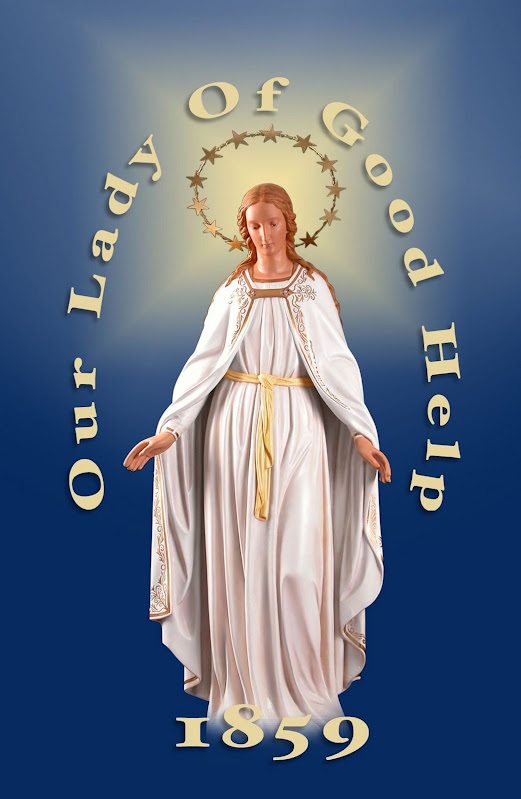
Our Lady of Good Help: “I am the Queen of Heaven who prays for the conversion of sinners.” Such is the way the Mother of God introduced herself to a twenty-eight-year-old Belgian immigrant, Adele Brise, on October 9, 1859. The pious young woman was on her eleven mile walk home to Robinsonville (now Champion), Wisconsin, after attending Mass in Bay Settlement. Adele was traveling at the time with two companions, her sister and another woman, as well as a male guardian who was working for the Holy Cross Fathers at the Settlement. Our Lady had appeared earlier to Adele the day before and, again, that same morning at the same spot, but she had not spoken. Her companions did not see or hear anything. The young woman was told by Heaven’s Queen that she must pray for the conversion of sinners, and warn them, for if they do not convert, her Son was going to punish them. She was told to gather together the children in this remote area and teach them the truths they must know for their salvation; teach them the catechism; teach them how to bless themselves with the Sign of the Cross; and teach them how to approach the sacraments. Our Lady ended by telling Adele, whose faith was strong but simple, to fear nothing and be confident in her help. For the next thirty-seven years of her life, until her death in 1896, Sister Adele Brise was faithful to this mission. – Sr Adele’s life and mission here: http://catholicism.org/first-approved-marian-apparition-in-the-us-champion-wisconsin.html
Bl Aaron of Cracow
St Abraham the Patriarch
St Alfanus of Salerno
St Andronicus of Antioch
St Athanasia of Antioch
Bl Bernard of Rodez
St Demetrius of Alexandria
St Deusdedit of Montecassino
St Domninus
St Dorotheus of Alexandria
St Donnino of Città di Castello
St Eleutherius
St Geminus
St Gislenus
St Goswin
Bl Gunther
Bl John Henry Newman
St Lambert
St Louis Bertrand
St Publia
St Rusticus
St Sabinus of the Lavedan
St Valerius
—
Martyrs of the Spanish Civil War – Martyrs of Astoria – (9 saints): Also known as Martyrs of Turon: A group of Brothers of the Christian Schools and a Passionist priest martyred in the persecutions during the Spanish Civil War. They are –
• Aniceto Adolfo
• Augusto Andrés
• Benito de Jesús
• Benjamín Julián
• Cirilo Bertrán
• Inocencio de la Immaculada
• Julián Alfredo
• Marciano José
• Victoriano Pío
They were martyred on 9 October 1934 in Turón, Spain and Canonised on 21 November 1999 by St Pope John Paul II.
—
Martyrs of Laodicea – (3 saints): Three Christians martyred together in Laodicea, but no other information about them has survived but their names – Didymus, Diodorus and Diomedes. They were martyred in Laodicea, Syria.
Thought for the Day – 8 October: The Eucharist — The Mystery Of Our Christ, by Karl Rahner (extract)
Thought for the Day – 8 October:
The Eucharist — The Mystery Of Our Christ, by Karl Rahner (extract)
What happens when we celebrate the Eucharist? The simple answer is: the Lord’s Supper which He celebrated at the beginning of His passion becomes present among us and for us. If we are to understand this central element of our faith we must reflect on what happened at the Lord’s Supper and we must ponder what it means when it is said that this meal becomes present among us and for us.
………..And thus He says: “Take this body which is given for you, drink this blood poured out for you.” And through the power of His creative word which changes the subsoils of reality, He makes Himself exist in the form of bread and wine, the everyday sign of loving unity with His disciples, so that all of this – His sacrificed reality for their salvation – becomes manifest and manifestly operative; it truly belongs to them and enters into the centre of their being.
“Take, eat; this is my body. Drink. . . for this is my blood of the new covenant which is poured out for all.” They take and they are taken. Taken by the redeeming power of obedience and of love of the Lord, taken by His death which gives birth to life out of its dreadful void, encircled by the grace of God which, with the incomprehensible and consuming holiness of God, unites. They are embraced by love which joins them to each other, not destructively but –redemptively, enveloped by a love which unites them in an experience where otherwise each would die painfully in himself alone in his ultimate solitude. And by eating the dish of God’s mercy, they anticipate the eternal meal when God, no longer in Earthly symbols but in the accomplishment of His revealed glory, makes Himself into the eternal meal of the redeemed. And while they eat thus, they look for the day when the Lord will be entirely with them, the day on which He “will come again” (as they say). And the new and eternal covenant which has been bequeathed to them is celebrated as is their free acceptance of it. These are given in the power of this bread which unites them with the Lord who is the covenant and joins them one to another in the beginning of eternal life.
The Lord’s Supper becomes His presence among us and for us in the church’s celebration of the Eucharist. The church fulfills the fundamental order of the Lord: “Do this (what He Himself had done on the night He was betrayed) in remembrance of me.” The church does what the Lord had done, with the words which He Himself spoke when He gave His body and His blood in the form of bread and wine to His disciples as a pledge of eternal life. The church celebrates the Anamnesis, the “remembrance” of the meal that instituted the new covenant. The church recalls what once happened but does not bring about a repetition of the actual event which happened once and for all on Calvary. Rather, what happened then enters into our place and our time and acquires presence and redemptive power within our own being.
This is possible (if we may so try to understand the miracle of God) because the Lord’s Supper is not an event of the past. The free decision of absolute obedience and unconditional, unreserved love constitutes one of those moments of history in which a temporality becomes the definitive, the enduring and the eternal, not just a moment in which something evaporates into the void of the past. The elements of freedom and spirit always signify the birth of the eternal; in this context, what is temporal passes into time but also attains eternal validity by virtue of the pure essence of the decision itself by a spiritual person. This applies in an utterly unique way to the event of the Last Supper. What happened there as event once and for all is. It is. It is taken up in the eternity of God, it has passed over into the state of perfection in which is becomes permanence in the midst of time. For the Lord in this meal has wrought something that endures forever since His voluntary deeds come from the infinite primal grounds of the eternal Word of God itself and are a spiritual-human reality, like the creative words of Genesis.
He has wrought the “new” and thus the final covenant, as He Himself says.
Quote/s of the Day – 9 October
Quote/s of the Day – 9 October
“Jesus, I am committing myself to accepting the things in life
I cannot change and I ask for the grace of serenity.
I am committing myself to changing the things in life
I can change and I ask for the grace of courage.
I am committing myself to knowing the difference
and I ask for the grace of wisdom.”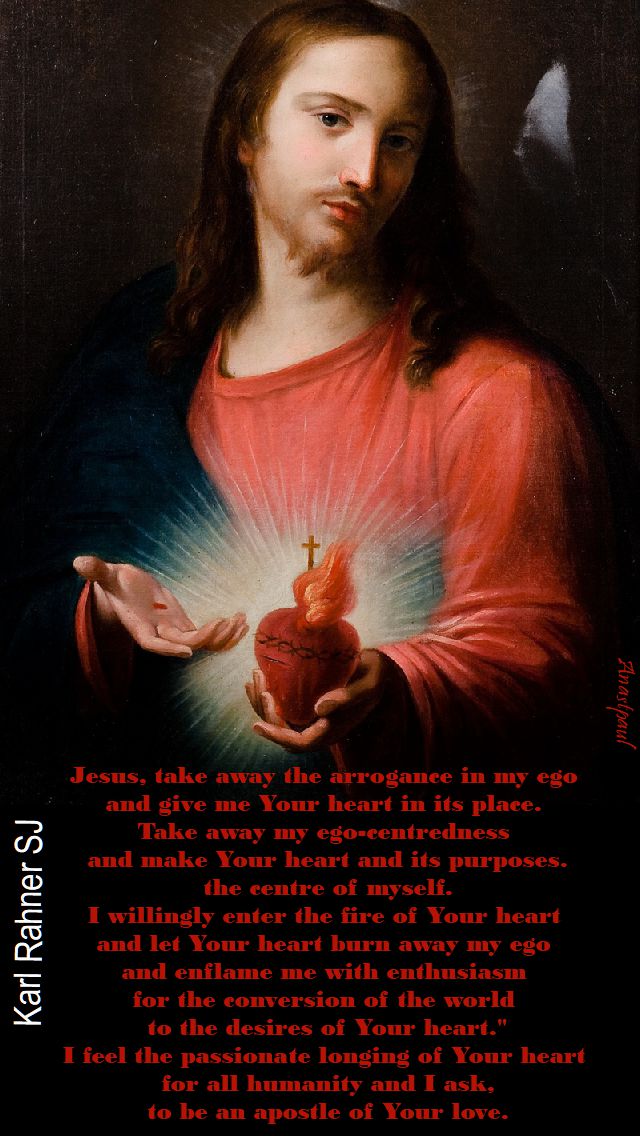
“Jesus, take away the arrogance in my ego
and give me Your heart in its place.
Take away my ego-centredness
and make Your heart and its purposes.
the centre of myself.
I willingly enter the fire of Your heart
and let Your heart burn away my ego
and enflame me with enthusiasm
for the conversion of the world to the desires of Your heart.”
I feel the passionate longing of Your heart for all humanity and I ask to be an apostle of Your love.”
Karl Rahner SJ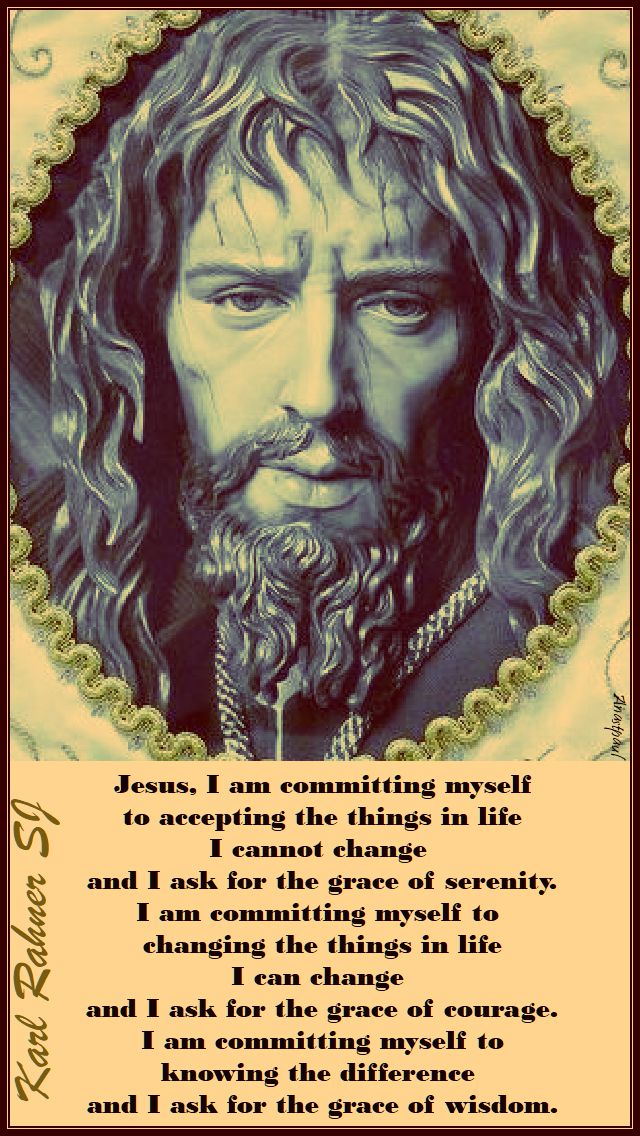
ONE MINUTE REFLECTION – 8 October
ONE MINUTE REFLECTION – 8 October
May our Lord Jesus Christ…console your hearts and strengthen them for every good word and work...2 Thessalonians 2:16-17
REFLECTION – “Jesus knows how to comfort us.
So when you are desolate, leave creatures behind.
Come to the tabernacle and you will always find strength and consolation.”…St Peter Julian Eymard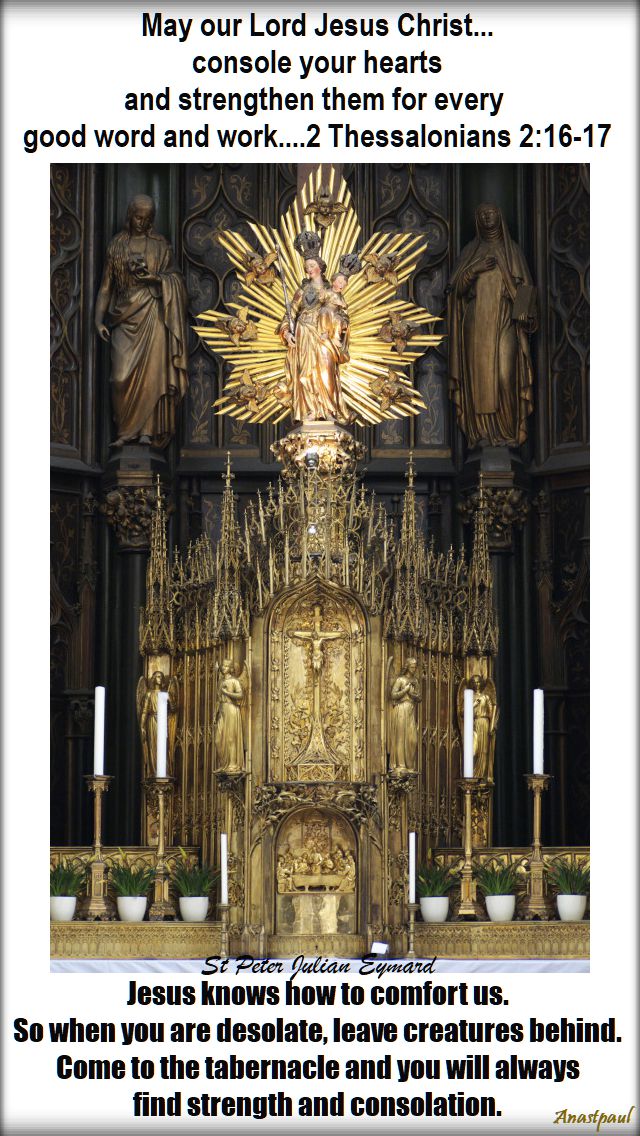
PRAYER – Lord Jesus, let me frequently have recourse to You in the Blessed Sacrament. O Sacrament most Holy, O Sacrament Divine, all praise and all thanksgiving, be every moment thine! Amen
Our Morning Offering – 8 October : Just as It Is – a Prayer before Holy Communion By Karl Rahner SJ
Our Morning Offering – 8 October
Just as It Is – a Prayer before Holy Communion
By Karl Rahner SJ
Come Lord enter my heart, You who are crucified,
who have died, who love, who are faithful,
truthful, patient and humble.
You who have taken upon Yourself, a slow and toilsome life
in a single corner of the world,
denied by those who are Your own,
too little loved by Your friends, betrayed by them,
subjected to the law, made by the plaything of politics
right from the very first,
a REFUGEE CHILD,
a CARPENTER’S SON,
a creature who found only barrenness and futility
as a result of His labours,
a man who loved and found no love in response,
You who were too exalted for those about You to understand,
who were brought to the point of feeling Yourself forsaken by God,
You who sacrificed all,
who commend Yourself into the hands of Your Father,
You who cry, ‘My God, My God, why have you forsaken me?’
I will try to receive You as You are,
to make You the innermost law of my life,
to take You, as at once, the BURDEN and the STRENGTH of my life.
When I receive You, I accept my everyday just as it is.
I do not have any lofty feelings in my heart to recount to You,
I can lay my everyday before You, just as it is.
For I receive it from You Yourself,
The everyday and its inward light,
The everyday and its meaning,
The everyday and the power to endure it,
The sheer familiarity of it,
which becomes the hiddenness of Your Eternal Life.
Amen.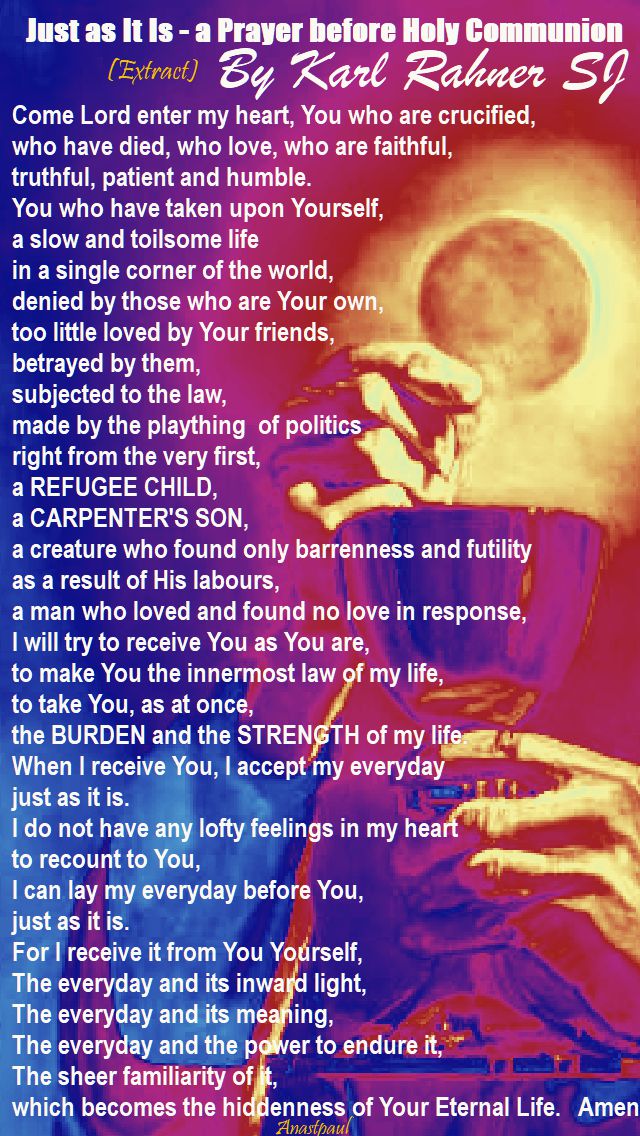
Saint of the Day – 8 October – St Reparata
Saint of the Day – 8 October – St Reparata – Virgin, Martyr (3rd century Caesarea, Palestine – beheaded in the 3rd century). Her relics translated to the Nice Cathedral in 1690. Patronages – Florence, Italy, Nice, France, city of, Nice, France, diocese of, Teano, Italy. Attributes – banner with red cross on a white background, dove, holding a crown and palm of martyrdom, sitting in fire, standing near the Blessed Virgin Mary, with Saint Ansanus.
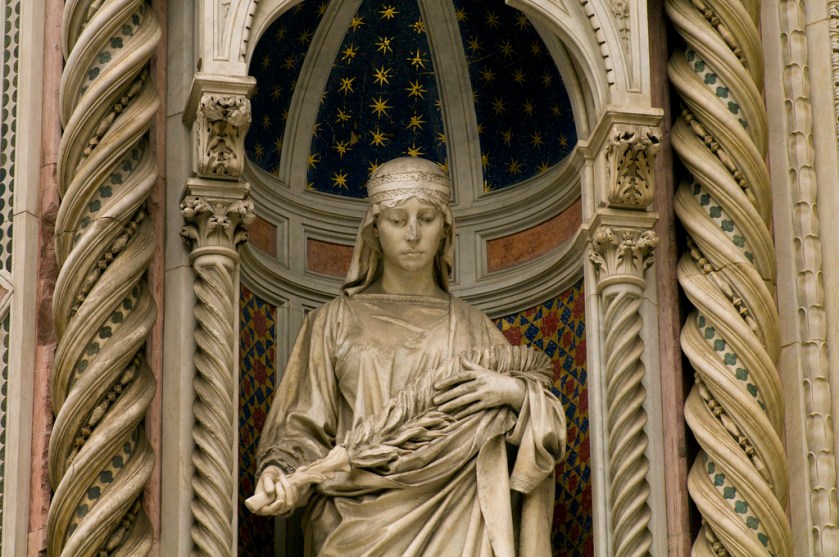
St Reparata was a third-century Christian virgin and martyr of Caesarea in Palestine. Sources vary as to her age – from 11 to 20 years old – though the Sainte-Réparate cathedral in Nice gives it as 15. She was arrested for her faith and tortured during the persecution of Decius.

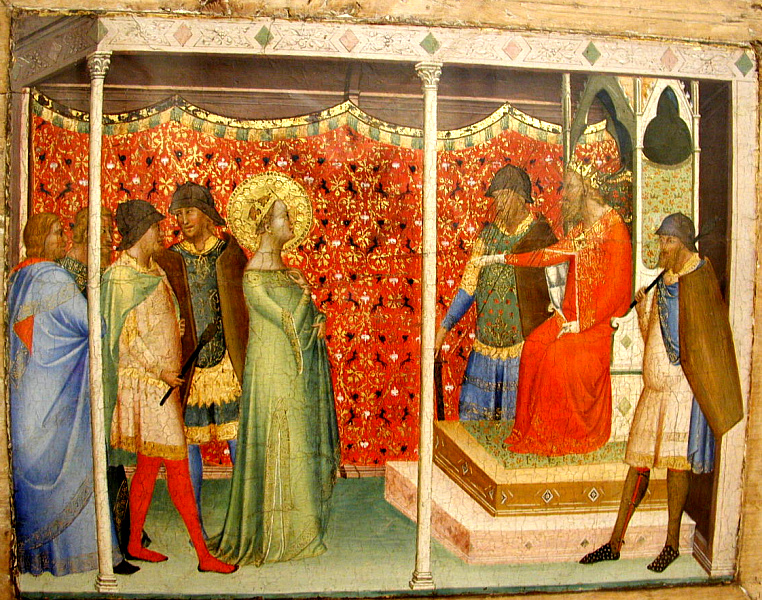
Her persecutors tried to burn her alive but she was saved by a shower of rain. She was then made to drink boiling pitch. When she again refused to apostatise, she was beheaded. Her legend states that as she fell dead, her spirit emerged from her body in the form a dove. Later elaborations of her legend state that her body was laid in a boat and blown by the breath of angels to the bay now known as the Baie des Anges in Nice.
Evidence of her cult does not exist before the ninth century, when her name appears in the martyrology of Bede. She is not mentioned by Eusebius of Caesarea, who recorded the martyrdoms that took place in the Holy Land during the 3rd century.
Her cult became widespread in Europe during the Middle Ages, as evidenced by the multiple Passiones found in various parts of the continent -especially Italy, where her cult was particularly popular in Florence, Atri, Naples, and Chieti. Numerous painters created depictions of her, including Fra Bartolomeo, Arnolfo di Cambio, Andrea Pisano, Domenico Passignano, Lorenzo di Niccolò and Bernardo Daddi.
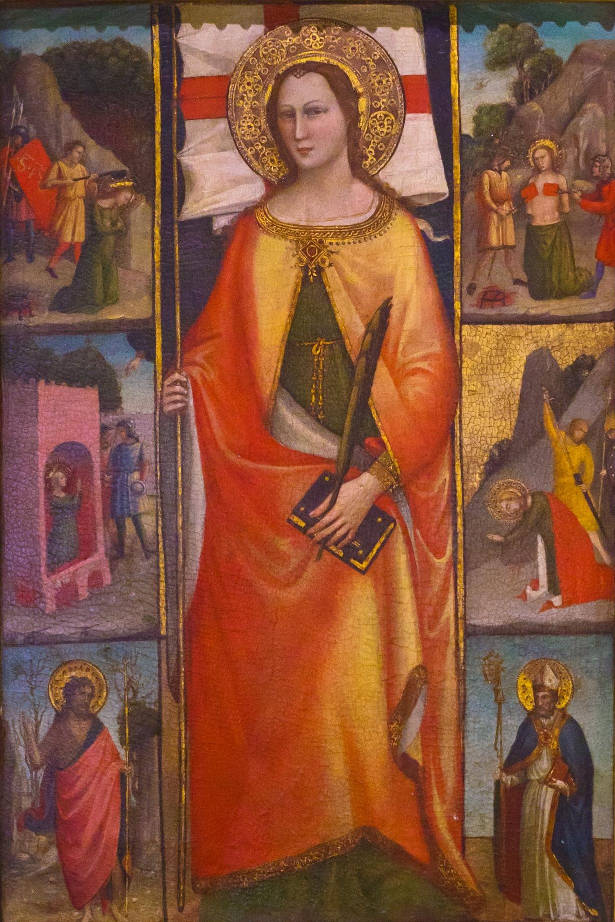
She is the patron saint of Nice and a co-patron saint of Florence (with Saint Zenobius). The former cathedral of Santa Reparata in Florence was dedicated to her. Sainte-Réparate Cathedral, in Nice, is also dedicated to her.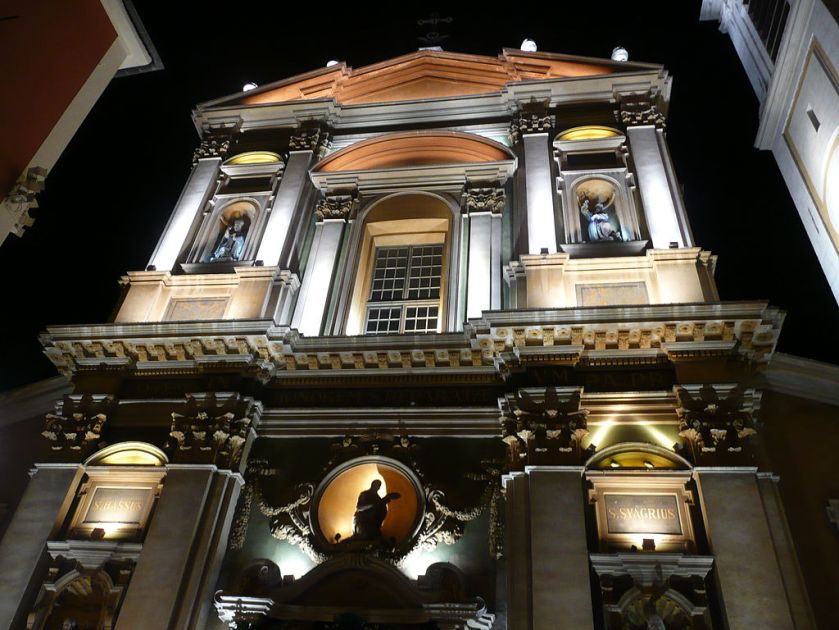
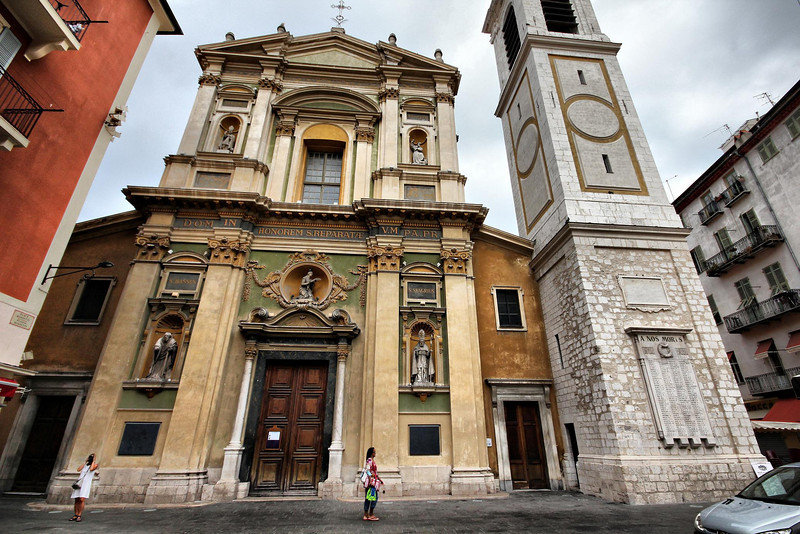
Florence holds a celebration in honour of Reparata each year on October 8 in commemoration of its deliverance from the Ostrogoths in 406, which they attribute to the intercession of St Reparata.


Memorials of the Saints – 8 October
St Amor of Aquitaine
St Artemon of Laodicia
St Badilo
St Benedicta of Laon
St Benedicta of Origny-sur-Oise
St Evodius of Rouen
St Felix of Como
Gratus of Chalons
Bl Hugh Canefro
Bl John Adams
Bl John Lowe
St Keyna
St Laurentia
St Nestor of Thessalonica
St Palatias
St Pelagia the Penitent
St Peter of Seville
Bl Ragenfreda
St Reparata
Bl Robert Bickerdike
Bl Robert Dibdale
St Simeon Senex
St Thaïs the Penitent
St Triduna
—
Martyred in the Spanish Civil War: • Blessed José María Ruano López- Marist Martyrs of Barcelona – 46 beati:
• Blessed Ángel Roba Osorno
• Blessed Anicet Falgueras Casellas
• Blessed Antoni Badía Andale
• Blessed Antoni Roig Alembau
• Blessed Carles Brengaret Pujol
• Blessed Casimir Riba Pi
• Blessed Feliciano Ayúcar Eraso
• Blessed Felipe Ruiz Peña
• Blessed Félix Ayúcar Eraso
• Blessed Fermín Latienda Azpilicueta
• Blessed Ferran Suñer Estrach
• Blessed Florentino Redondo Insausti
• Blessed Fortunato Ruiz Peña
• Blessed Gregorio Faci Molins
• Blessed Isidro Serrano Fabón
• Blessed Jaume Morella Bruguera
• Blessed Jeroni Messegué Ribera
• Blessed Jesús Menchón Franco
• Blessed Joan Pelfort Planell
• Blessed Joan Tubau Perelló
• Blessed José María Ruano López
• Blessed José Miguel Elola Arruti
• Blessed Josep Ambrós Dejuán
• Blessed Josep Blanch Roca
• Blessed Josep Cesari Mercadal
• Blessed Josep Mir Pons
• Blessed Juan Núñez Casado
• Blessed Julio García Galarza
• Blessed Leocadio Rodríguez Nieto
• Blessed Leoncio Pérez Gómez
• Blessed Lucio Izquierdo López
• Blessed Lucio Zudaire Armendía
• Blessed Mariano Alonso Fuente
• Blessed Néstor Vivar Valdivieso
• Blessed Nicolás Pereda Revuelta
• Blessed Nicolás Ran Goñi
• Blessed Pedro Ciordia Hernández
• Blessed Pere Sitges Puig
• Blessed Ramon Mill Arán
• Blessed Santiago Saiz Martínez
• Blessed Santos Escudero Miguel
• Blessed Segismundo Hidalgo Martínez
• Blessed Serafín Zugaldía Lacruz
• Blessed Trifón Lacunza Unzu
• Blessed Victor Gutiérrez Gómez
• Blessed Victoriano Gómez Gutiérrez
• Blessed Victoriano Martínez Martín
Thought for the day – 7 October – The Memorial of Our Lady of the Most Holy Rosary
Thought for the day – 7 October – The Memorial of Our Lady of the Most Holy Rosary
The purpose of the rosary is to help us meditate on the great mysteries of our salvation. Pius XII called it a compendium of the gospel. The main focus is on Jesus—his birth, life, death and resurrection. The Our Fathers remind us that Jesus’ Father is the initiator of salvation. The Hail Marys remind us to join with Mary in contemplating these mysteries. They also make us aware that Mary was and is intimately joined with her Son in all the mysteries of his earthly and heavenly existence. T he Glory Bes remind us that the purpose of all life is the glory of the Trinity.
The rosary appeals to many. It is simple. The constant repetition of words helps create an atmosphere in which to contemplate the mysteries of God. We sense that Jesus and Mary are with us in the joys and sorrows of life. We grow in hope that God will bring us to share in the glory of Jesus and Mary forever..(Fr Don Miller OFM)
Our Lady of the Most Holy Rosary, pray for us!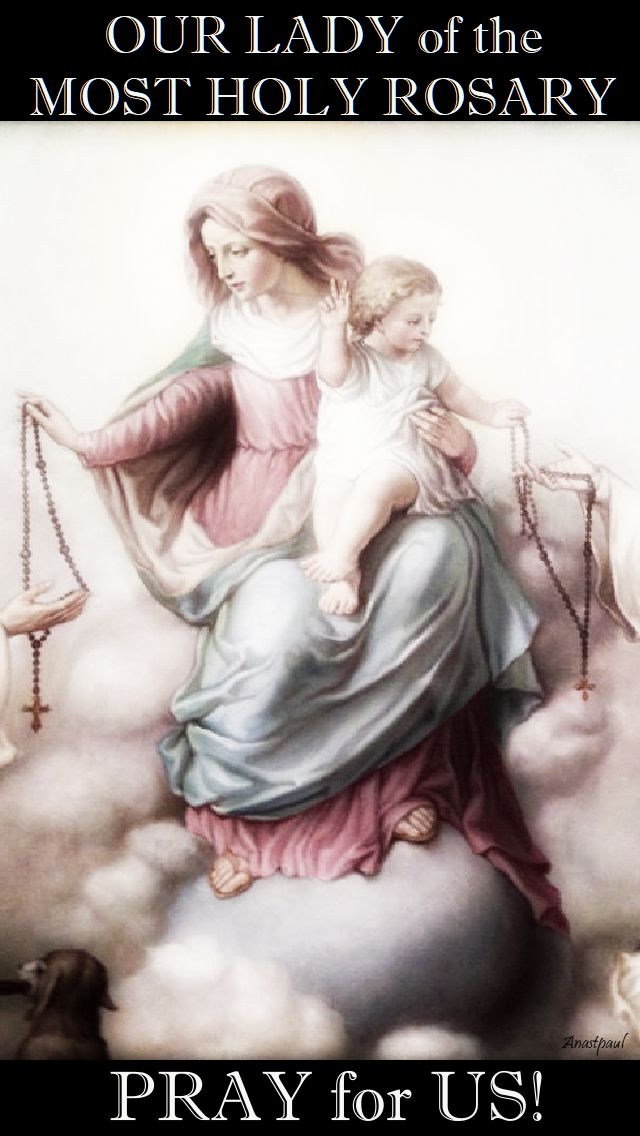
Quote/s of the Day – 7 October – The Memorial of Our Lady of the Most Holy Rosary
Quote/s of the Day – 7 October – The Memorial of Our Lady of the Most Holy Rosary
THE SEVEN BLESSINGS OF THE ROSARY
“The Rosary, recited with meditation on the mysteries, brings about the following marvelous results:
1. It gradually gives us a perfect knowledge of Jesus Christ;
2. It purifies our souls, washing away sin;
3. It gives us victory over all our enemies;
4. It makes it easy for us to practice virtue;
5. It sets us on fire with love of Our Blessed Lord;
6. It enriches us with graces and merits;
7. It supplies us with what is needed to pay,
all our debts to God and to our fellow men
and finally, it obtains all kinds of graces for us from Almighty God.”
St Louis Marie Grignion De Montfort (1673-1716)
The Rosary, when it is prayed in an authentic way,
not mechanical and superficial but profoundly,
it brings, in fact, peace and reconciliation.
It contains within itself the healing power
of the Most Holy Name of Jesus,
invoked with faith and love,
at the centre of each “Hail Mary”.
Pope Benedict XVI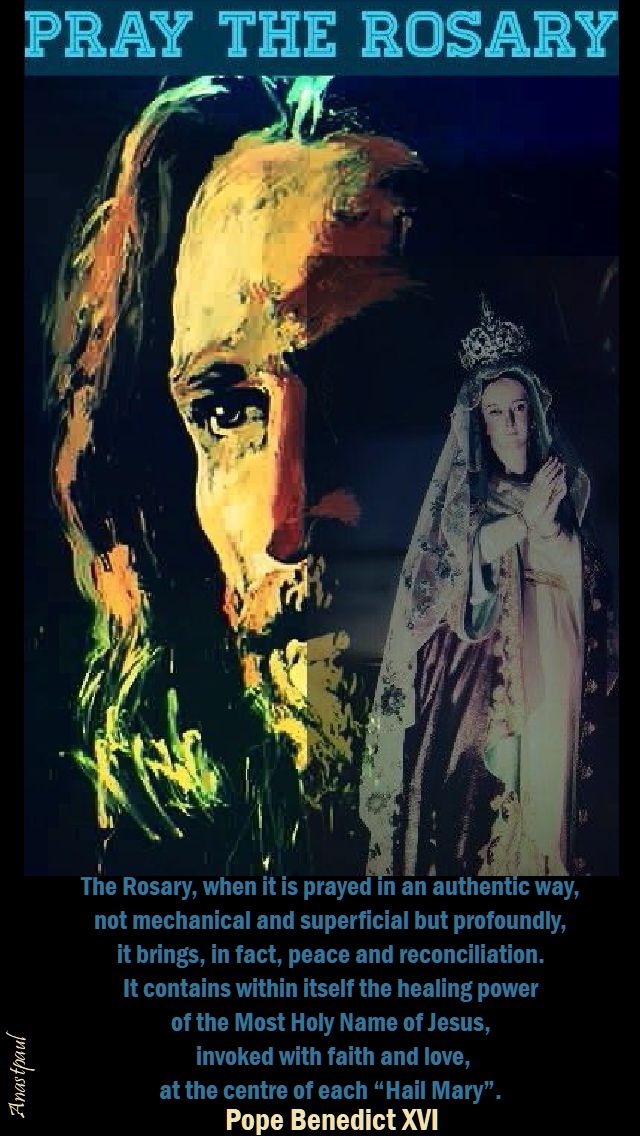
One Minute Reflection – 7 October – The Memorial of Our Lady of the Most Holy Rosary
One Minute Reflection – 7 October – The Memorial of Our Lady of the Most Holy Rosary
Open your petals, like roses planted near running waters...Sirach 39:13
REFLECTION – “To discover whether people are of God, I have found no better way than the following.
Observe whether they say the Hail Mary and the Rosary.”……St Louis Marie de Montfort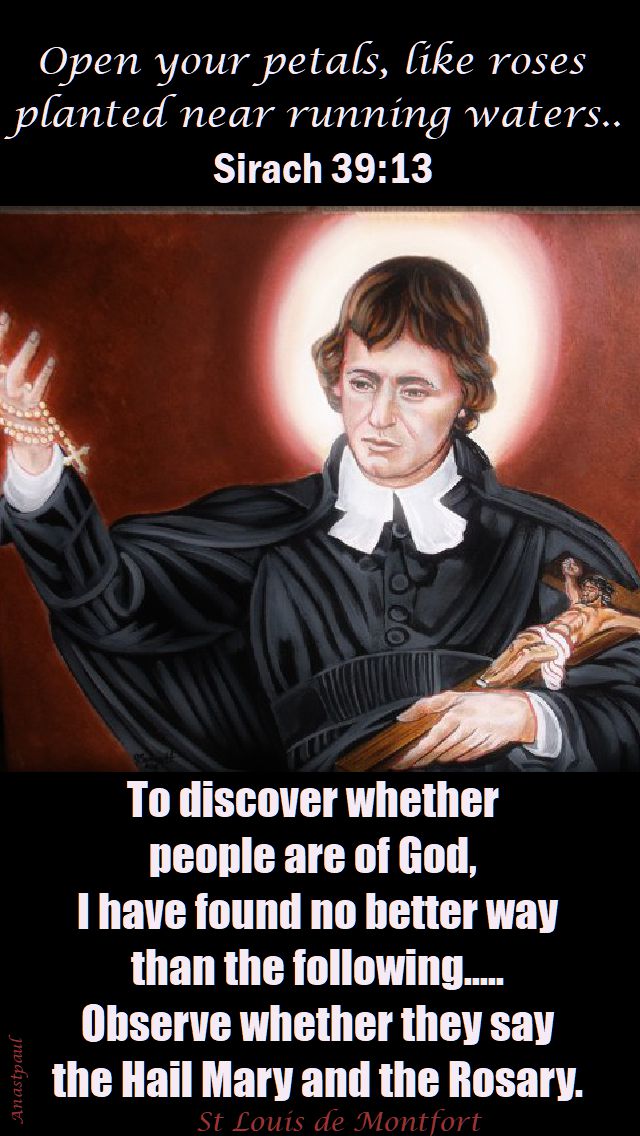
PRAYER – Lord, open our hearts to Your grace. May we, who learned to believe through the angel’s message, in the Incarnation of Christ, Your Son, be brought by His Passion and Cross, at the intercession of the Blessed Virgin Mary, to the glory of His Resurrection. Through Him who redeemed us in unity with the Holy Spirit, one God forever and ever. Our Lady of the Holy Rosary, pray for us, amen.
Our Morning Offering – 7 October – The Memorial of Our Lady of the Most Holy Rosary
Our Morning Offering – 7 October – The Memorial of Our Lady of the Most Holy Rosary
Queen of the most Holy Rosary
O Queen of the most holy Rosary,
in these times of brazen impiety,
show again your power,
with the signs which accompanied your victories of old
and from the throne where you are seated,
dispensing pardon and grace,
in pity watch over the Church of your Son,
His Vicar and every order of the clergy and laity,
suffering in grievous warfare.
Hasten, O most powerful destroyer of heresy,
hasten the hour of mercy,
as the hour of judgment is daily challenged
by innumberable offences.
Obtain for me, the lowest of men,
kneeling suppliant in your presence,
the grace which may enable me
to live a just life on earth
and reign with the just in Heaven,
whilst with the faithful throughout the world,
O Queen of the most holy Rosary,
I salute you and cry out:
Queen of the most holy Rosary, pray for us! Amen.

Saint of the Day – 7 October – Our Lady of the Most Holy Rosary/Our Lady of Victory
Saint of the Day – 7 October – Our Lady of the Most Holy Rosary also known as Our Lady of Victory – Patronages – Rosary, United States, 9 diocese, 8 cities. The Feast of the Holy Rosary, is celebrated on 7 October, the anniversary of the decisive victory of the combined fleet of the Holy League of 1571 over the Ottoman navy at the Battle of Lepanto.


Our Lady of Victory
In 1571, Pope St. Pius V organized a coalition of forces from Spain and smaller Christian kingdoms, republics and military orders, to rescue Christian outposts in Cyprus, particularly the Venetian outpost at Famagusta which, however, surrendered after a long siege on 1 August before the Christian forces set sail. On 7 October 1571, the Holy League, a coalition of southern European Catholic maritime states, sailed from Messina, Sicily and met a powerful Ottoman fleet in the Battle of Lepanto. Knowing that the Christian forces were at a distinct materiel disadvantage, the holy pontiff, Pope Pius V, called for all of Europe to pray the Rosary for victory and led a rosary procession in Rome.
After about five hours of fighting on the northern edge of the Gulf of Corinth, off western Greece, the combined navies of the Papal States, Venice and Spain managed to stop the Ottoman navy, slowing the Ottoman advance to the west and denying them access to the Atlantic Ocean and the Americas. If the Ottomans had won then there was a real possibility that an invasion of Italy could have followed so that the Ottoman sultan, already claiming to be emperor of the Romans, would have been in possession of both New and Old Rome.
Pius V instituted “Our Lady of Victory” as an annual feast to commemorate the victory at Lepanto, which he attributed to the Blessed Virgin Mary. Dedications to Our Lady of Victory preceded this papal declaration. In particular, Simon de Montfort, 5th Earl of Leicester built the first shrine dedicated to Our Lady of Victory in thanks for the Catholic victory over the Albigensians at the Battle of Muret on 12 September.
In 1573, Pope Gregory XIII changed the title of the “Feast of Our Lady of Victory” to “Feast of the Holy Rosary” Dominican friar Juan Lopez in his 1584 book on the rosary states that the feast of the rosary was offered “in memory and in perpetual gratitude of the miraculous victory that the Lord gave to his Christian people that day against the Turkish armada”.


In 1671 the observance of this festival was extended by Clement X to the whole of Spain, and somewhat later Clement XI, after the victory over the Turks gained by Prince Eugene in the Battle of Petrovaradin on 6 August 1716 (the feast of Our Lady of the Snows), commanded the feast of the Rosary to be celebrated by the universal Church, assigning it to the first Sunday in October.
A set of “proper” lessons in the second nocturn were conceded by Benedict XIII. Leo XIII raised the feast to the rank of a double of the second class and added to the Litany of Loreto the invocation “Queen of the Most Holy Rosary”. On this feast, in every church in which the Rosary confraternity has been duly erected, a plenary indulgence toties quoties is granted upon certain conditions to all who visit therein the Rosary chapel or statue of Our Lady. This has been called the “Portiuncula” of the Rosary.
In 1960 Pope John XXIII changed the title to “Feast of Our Lady of the Rosary”.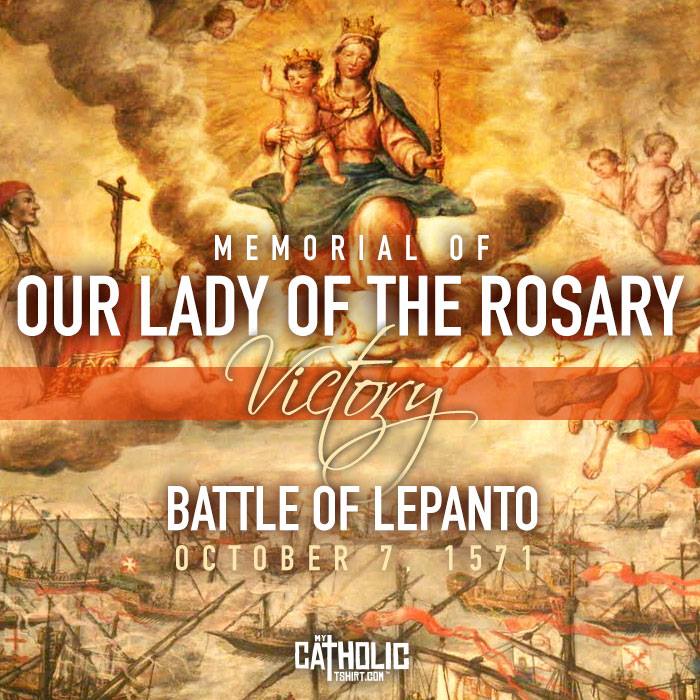


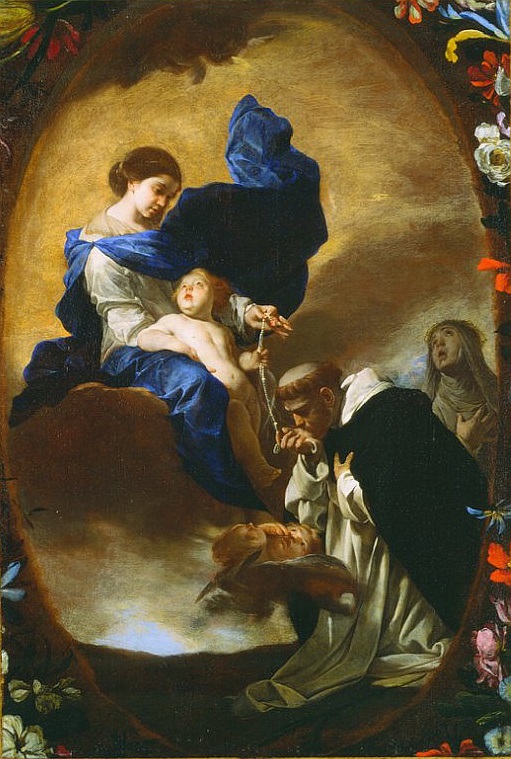
Feast of Our Lady of the Most Holy Rosary and Memorials of the Saints – 7 October
Our Lady of the Rosary (Memorial) – https://www.youtube.com/watch?v=8IvhoSNf6Ls
—
St Adalgis of Novara
St Apuleius of Capua
St Augustus of Bourges
St Canog ap Brychan
St Dubtach of Armagh
St Gerold of Cologne
St Helanus
Bl Jean Hunot
St Julia the Martyr
St Justina of Padua
St Marcellus of Capua
St Pope Mark
St Martin Cid
Bl Matthew Carreri
St Osith
St Palladius of Saintes
St Quarto of Capua
St Rigaldo
Martyrs of Arima: Eight lay people Japan who were martyred together in the persecutions of Christianity in Japan:
• Blessed Hadrianus Takahashi Mondo
• Blessed Ioanna Takahashi
• Blessed Leo Hayashida Sukeemon
• Blessed Martha Hayashida
• Blessed Magdalena Hayashida
• Blessed Didacus Hayashida
• Blessed Leo Takedomi Kan’Emon
• Blessed Paulus Takedomi Dan’Emon
They were martyred on 7 October 1613 in Arima, Hyogo, Japan and Beatified on 24 November 2008 by Pope Benedict XVI.
Mercedarian Nuns of Seville: Five Mercedarian nuns at the monastery of the Assumption in Seville, Spain noted for their piety – Sisters Agnese, Bianca, Caterina, Maddalena and Marianna.
Martyred in the Spanish Civil War
• Blessed José Llosá Balaguer
Celebrating and Learning from Blessed Francis Xavier Seelos – Memorial 5 October – TOP 10 Practical Guide to Holiness
Celebrating and Learning from Blessed Francis Xavier Seelos – Memorial 5 October
TOP 10 Practical Guide to Holiness
1. Go to Mass with deepest devotion.
2. Spend a half hour to reflect upon your main failing & make resolutions to avoid it.
3. Do daily spiritual reading for at least 15 minutes, if a half hour is not possible.
4. Say the rosary every day.
5. Also daily, if at all possible, visit the Blessed Sacrament and toward evening, meditate on the Passion of Christ for a half hour.
6. Conclude the day with evening prayer & an examination of conscience over all the faults & sins of the day.
7. Every month make a review of the month in confession.
8. Choose a special patron every month & imitate that patron in some special virtue.
9. Precede every great feast with a novena, that is, nine days of devotion.
10. Try to begin & end every activity with a “Hail Mary.”
Bl Francis Xavier Seelos PRAY FOR US!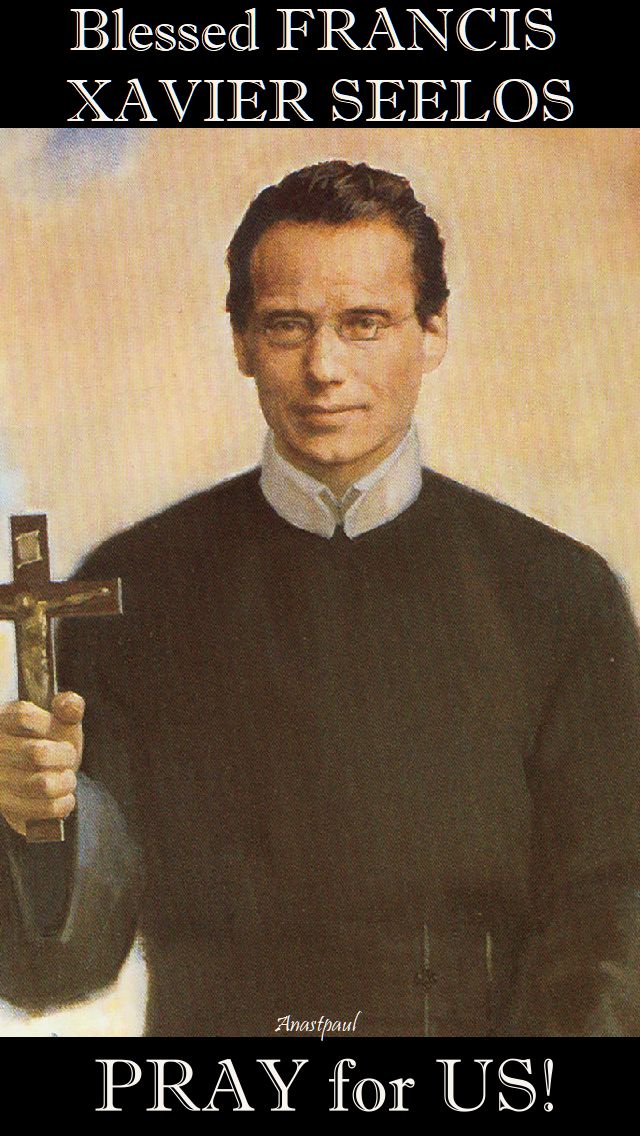
ANNOUNCING a Novena to St John Paul – Day One – 13 October
ANNOUNCING a Novena to St John Paul – Day One – 13 October
Leading up to the feast day of Saint John Paul the Great on 22 October, I invite you to join me in prayer to ask for his powerful intercession as well as learn something new about him each day.
Over nine days from 13 October, I will post a prayer to St John Paul, as well as a fact about him, a short Reflection by a great heart and mind about a great heart and mind and a quote that is perhaps less well known. Thus, we will join our prayers together to pray for all of our intentions and ask John Paul II to intercede for us.
St John Paul, Pray for us!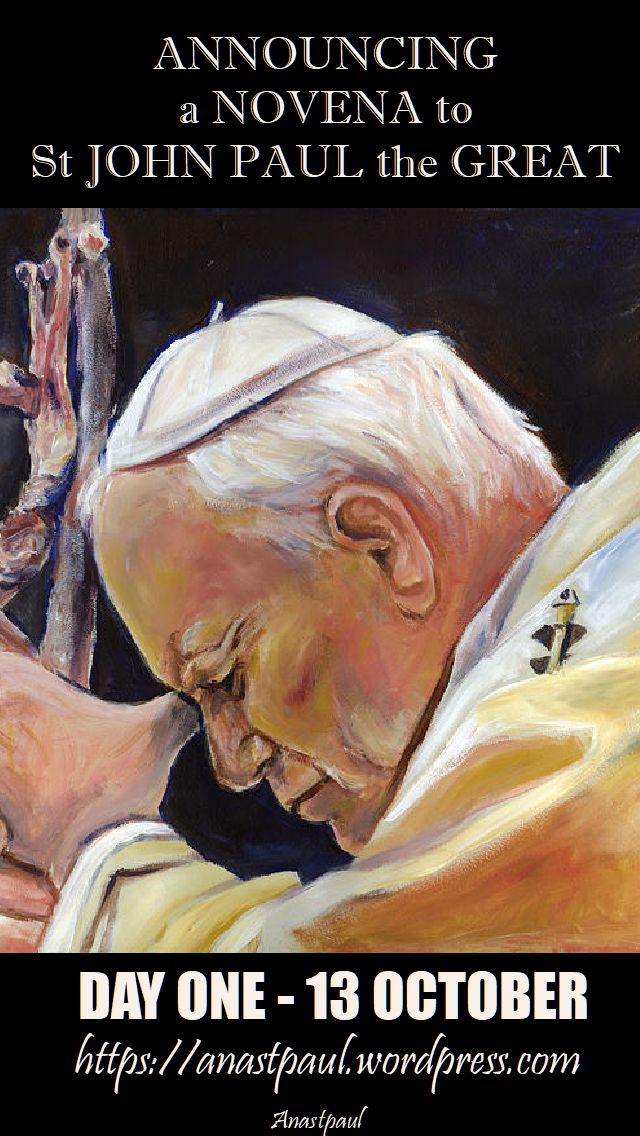
Thought for the Day – 6 October – The Memorial of St Bruno (c 1030-1101)
Thought for the Day – 6 October – The Memorial of St Bruno (c 1030-1101)
Into Great Silence with Saint Bruno the Carthusian
THE KEY ELEMENT of Carthusian spirituality is SOLITUDE, which is required for a total and absolute dedication to God alone. As his name implies, the “monachos” devotes himself to one purpose only: God. He makes himself completely available for God, in a life of prayer and penance. He renounces social contacts, travelling, newspapers, radio and television, telephone, ad lib conversations, correspondence, even spiritual, instrumental music, writing and intellectual work, as much as is feasible within the limits of psychological balance and Christian charity, all this to be alone with God.
Solitude implies SILENCE. Silence is the other key element of Carthusian spirituality. Silence is not lived in any absolute way in the charterhouse. Carthusians speak with their brothers and their superiors when they need to, they speak whenever material life, work or their soul require it. The text that follows explains that the silence of solitude is lived in the charterhouse as an inner requirement in order to be able to hear and to listen to God alone and to let Him utter a Word in our soul, a Word that transcends all human discourse.
Silence in the Statutes:
What benefits
What divine exultation
The solitude and silence of the desert
Hold in store for those who love it!
(Saint Bruno to Raoul)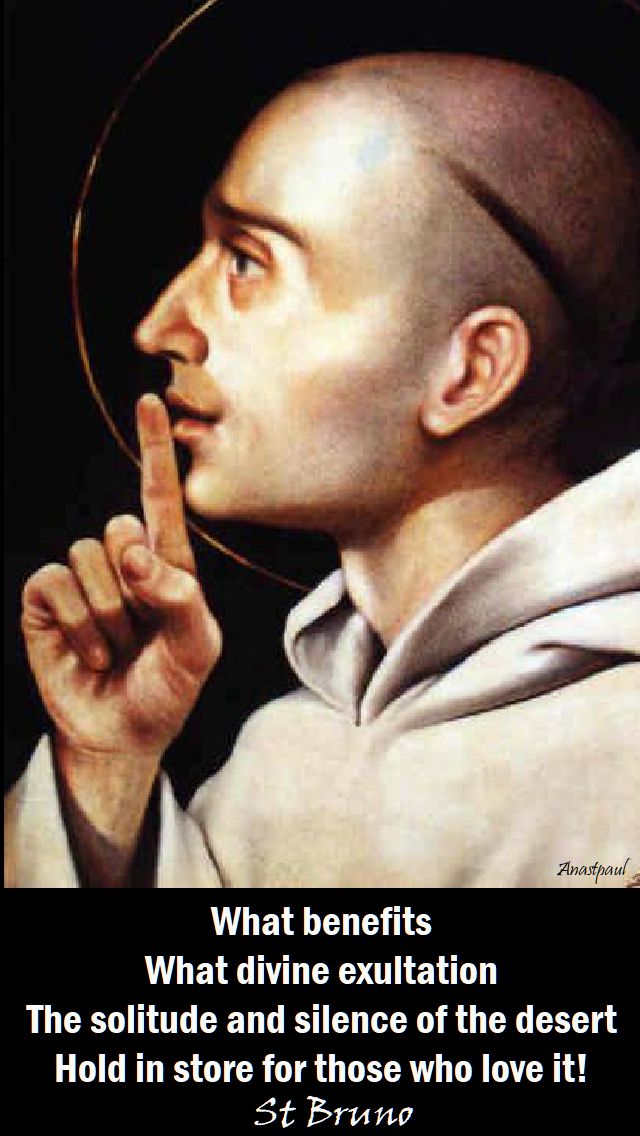
Saint Bruno wrote his letters with all the warmth in his heart and they are filled with indirect indications of what the Lord had given him to see and to know. This is especially true of the impassioned praise of the benefits of silence he sends to Raoul: “only those who have experienced them can know”. And immediately he goes on to show how much he himself knows about it. Saint Bruno was a man of silence. He knew its secret. The Carthusian Statutes contain many references to the beauty of silence and to its sacredness in our life.
Keeping silent is not a spontaneous or natural attitude. It demands a decision and a purpose. To enter into silence, we must want it and we must know why we want it. If we intend to become men of silence, we must assume responsibility for our quest.
Here is what silence truly is: to let the Lord utter within us a word which is equal to Himself. It reaches us, we don’t know which way it followed, we cannot discern its traits with any precision, the very Word of God comes and resonates in our heart.
This is why we can never be content with only the silence of the lips. It would “be merely pharisaic, were it not the outward expression of that purity of heart, to which alone is it promised to see God. To attain this, great abnegation is required, especially of the natural curiosity that men feel about human affairs. We should not allow our minds to wander through the world in search of news and gossip; on the contrary, our part is to remain hidden in the shelter of the Lord’s presence” (St 6.4). It is indeed so easy to just remain in cell, while the mind is roaming all over the world. Who has not experienced this? We are still not in silence, even if our lips are closed and our hands rest on our lap. “On the contrary, our part is to remain hidden in the shelter of the Lord’s presence” (St. 6.2) Recollection does not require only a rigourous control over our imagination: we must quiet down all our tumultuous and undisciplined faculties of knowledge and of speech.
Silence is wrought by God but it is more than this, as we have said: it is the Word of God. The example of Mary at the feet of the Lord is a light unto us : “let Martha bear with her sister, as she follows in the steps of Christ, in stillness knows that he is God” (St 3.9) Mary has truly entered silence : beyond the words uttered by Jesus, she truly perceives that He Himself is the Eternal Son. Her efforts were not in vain : “She purifies her spirit, prays in the depths of her soul, seeks to hear what God may speak within her” (St 3.9).
(Translated from: « Le Silence selon les Statuts », Paroles de Chartreux, A.A.V.C., Correrie de la Grande Chartreuse, pp. 73-82)
Finally, there is the head-scratcher that is an epic three-hour documentary: 2006’s Into Great Silence is either the best insight into the Carthusian daily life (and a kick-start for vocations) or the ultimate sell-out (it took the producers 18 years before obtaining permission to film inside La Grande Chartreuse). So after nearly 1,000 years of complete secrecy, anyone can now see inside the Motherhouse founded by St Bruno himself.
Still, the Carthusians survive. What more can be said about an Order whose salient features are silence and solitude and who await our Lord’s second coming in prayerful penance? St. Bruno can be proud of his achievement—but he would never be accused of pride.
St Bruno pray for us, that we too may learn to hear the Word in the silence of our hearts!
Quotes of the Day – – 6 October – The Memorial of St Bruno (c 1030-1101)
Quotes of the Day – – 6 October – The Memorial of St Bruno (c 1030-1101)
“While the world changes, the Cross stands firm.”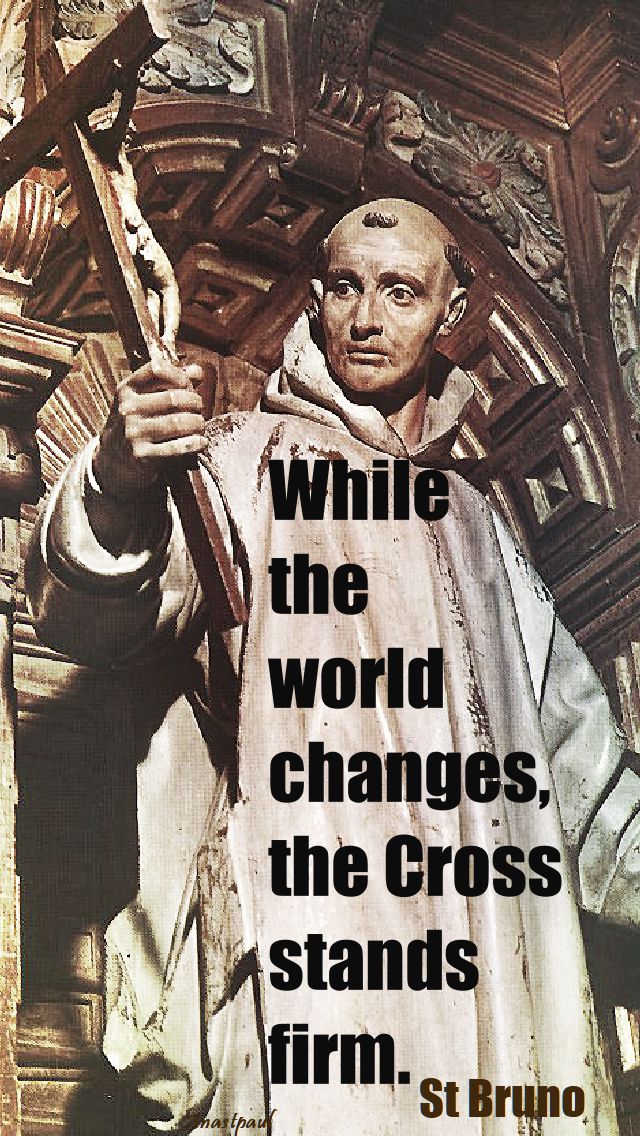
“By your work, you show what you love and what you know.”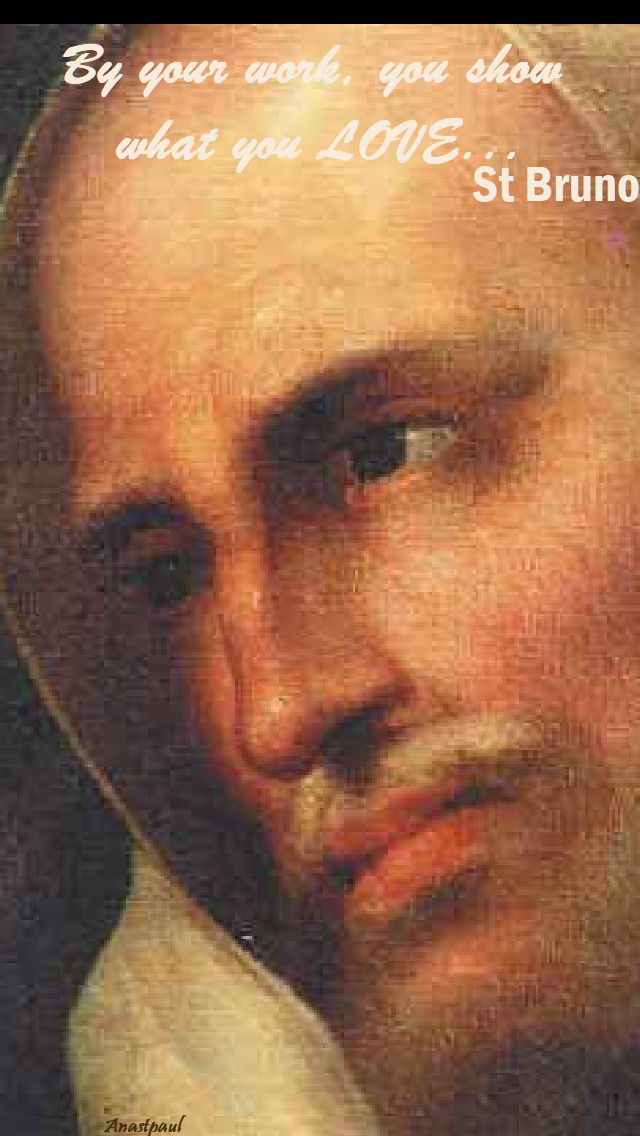
“No act is charitable if it is not just.”
“In the solitude and silence of the wilderness.. for their labour in the contest,
God gives his athletes the reward they desire:
a peace that the world does not know and joy in the Holy Spirit.”
“If the bow is stretched for too long,
it becomes slack and unfit for its purpose.”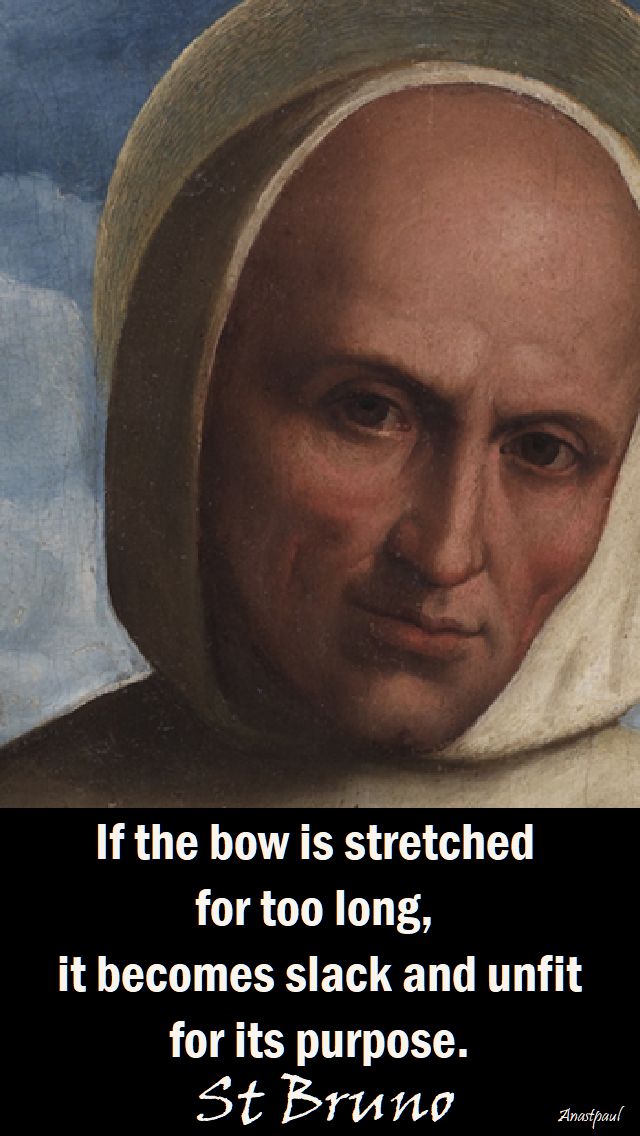
 AnaStpaul
You must be logged in to post a comment.