
St Ariadne
St Dominic Trach Doai
St Eumenius Thaumaturgus
St Eustorgius of Milan
St Ferreolus the Tribune
St Ferreolus of Limoges
St Hygbald
St Irene of Egypt
St Joseph of Cupertino
St Józef Kut
St Juan Massias
St Oceano of Nicomedia
St Richardis of Andlou
St Sophia of Egypt
—
Martyred in the Spanish Civil War:
• Blessed Carlos Eraña Guruceta
• Blessed Fernando García Sendra
• Blessed Jacinto Hoyuelos Gonzalo
• Blessed Jesus Hita Miranda
• Blessed José García Mas
• Blessed José María Llópez Mora
• Blessed Justo Lerma Martínez
• Blessed Salvador Chuliá Ferrandis
• Blessed Salvador Fernández Pérez
• Blessed Vicente Gay Zarzo
• Blessed Vicente Jaunzarás Gómez
NOVENA to St Padre Pio/St Pius of Pietrelcina – DAY FOUR – 17 September
NOVENA to St Padre Pio/St Pius of Pietrelcina – DAY FOUR – 17 September
St Padre Pio you have said:
I often think that there is only one thing in this base world which can soothe the most acute pain which pierces the heart when we see ourselves far from God, the source and consolation of distressed souls. That one thing is solitude, for here the soul enjoys sweet rest in the One who is its true peace. I want the heavenly Father to grant you the grace of stability in all your resolutions, not least of all your resolution to grow in holiness and to be silent and reduce to silence everything around you, so that you may hear the divine voice of the Beloved and establish with Him a tranquil and everlasting dialogue.
Recollect yourself continually, and may your whole life be hidden in Jesus and with Jesus in the Garden of Gethsemane, that is to say, in the silence of meditation and prayer.
Try to be always more docile to grace and more and more generous with Jesus, making absolutely everything around you and within you to be silent. Don’t worry; rest trustfully in the divine Mercy.
Silently adore the delicacy of the workings of divine grace
Let us Pray:
Gracious God, You generously blessed Your servant, Padre Pio, with the gifts of the Spirit.
You marked his body with the five wounds of Christ Crucified,
as a powerful witness to the saving Passion and Death of Your Son
and as a stirring inspiration to many people of Your infinite mercy, forgiveness and love.
Through his powerful intercession, many who suffered were healed of sickness and disease.
Endowed with the gift of discernment, he could read people’s hearts.
With dignity and intense devotion, he celebrated daily Mass,
inviting countless men and women to a greater union with Jesus Christ,
in the Sacrament of the Holy Eucharist.
Through the intercession of Saint Pio,
we confidently beseech You to to grant us the grace of
………………. (state your petition here).
Help us to imitate his example of prayerful holiness and compassion,
so that we, too, may faithfully follow the Risen Lord
and one day rejoice in the Kingdom,
where You live and reign forever and ever. Amen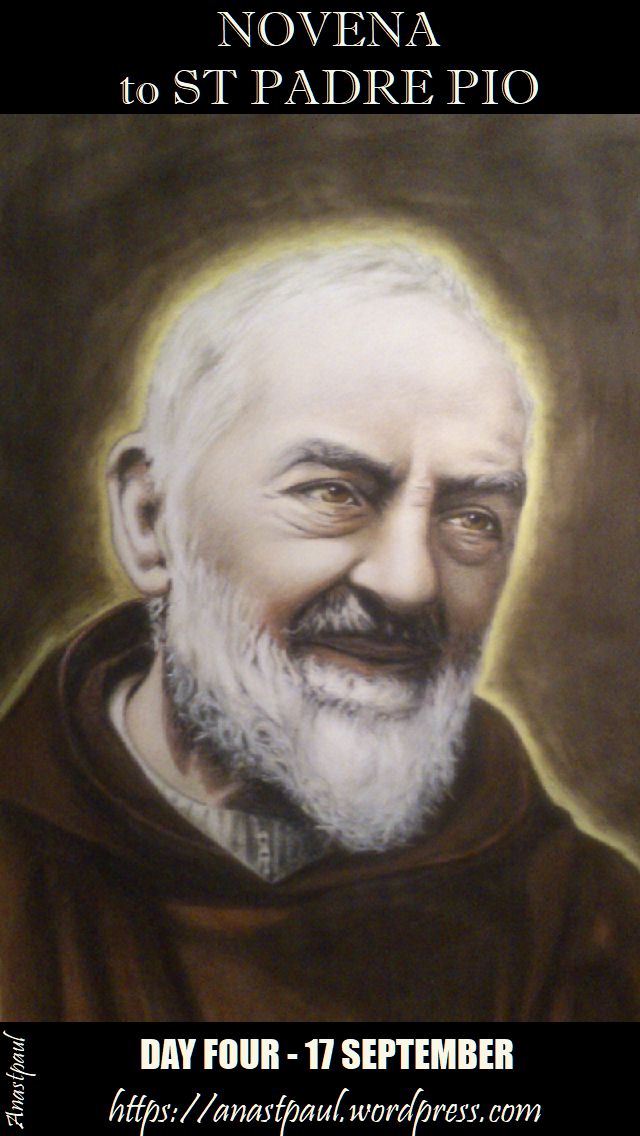
Thought for the Day – 17 September – The Memorial of St Robert Bellarmine (1542-1621) Doctor of the Church
Thought for the Day – 17 September – The Memorial of St Robert Bellarmine (1542-1621) Doctor of the Church
It is said that Robert Bellarmine was so short that he used to stand on a stool to be seen over the high pulpits of Europe.
But he was a giant in many other ways. He devoted his life to the study of Scripture and Catholic doctrine. His writings help us understand that the real source of our faith is not merely a set of doctrines but rather the person of Jesus still living in the Church today.
When it comes down to it, what matters is Christ and Him Crucified, what matters is He who is love.
“Sweet Lord, you are meek and merciful.” Who would not give himself wholeheartedly to your service, if he began to taste even a little of your fatherly rule? What command, Lord, do you give Your servants? “Take my yoke upon you,” You say. And what is this yoke of Yours like? “My yoke,” You say, “is easy and my burden light.” Who would not be glad to bear a yoke that does no press hard but caresses? Who would not be glad for a burden that does not weigh heavy but refreshes? And so You were right to add: “And you will find rest for your souls.” And what is this yoke of Yours that does not weary, but gives rest? It is, of course, that first and greatest commandment: “You shall love the Lord your God with all your heart.” What is easier, sweeter, more pleasant, than to love goodness, beauty and love, the fullness of which You are, O Lord, my God?” Is it not true that You promise those who keep your commandments a reward more desirable than great wealth and sweeter than honey? You promise a most abundant reward, for as Your apostle James says: “The Lord has prepared a crown of life for those who love him.” What is this crown of life? It is surely a greater good than we can conceive of or desire, as Saint Paul says, quoting Isaiah: “Eye has not seen, ear has not heard, nor has it so much as dawned on man what God has prepared for those who love him.” – from On the Ascent of the Mind to God by Saint Robert Bellarmine
St Robert Bellarmine, pray for us
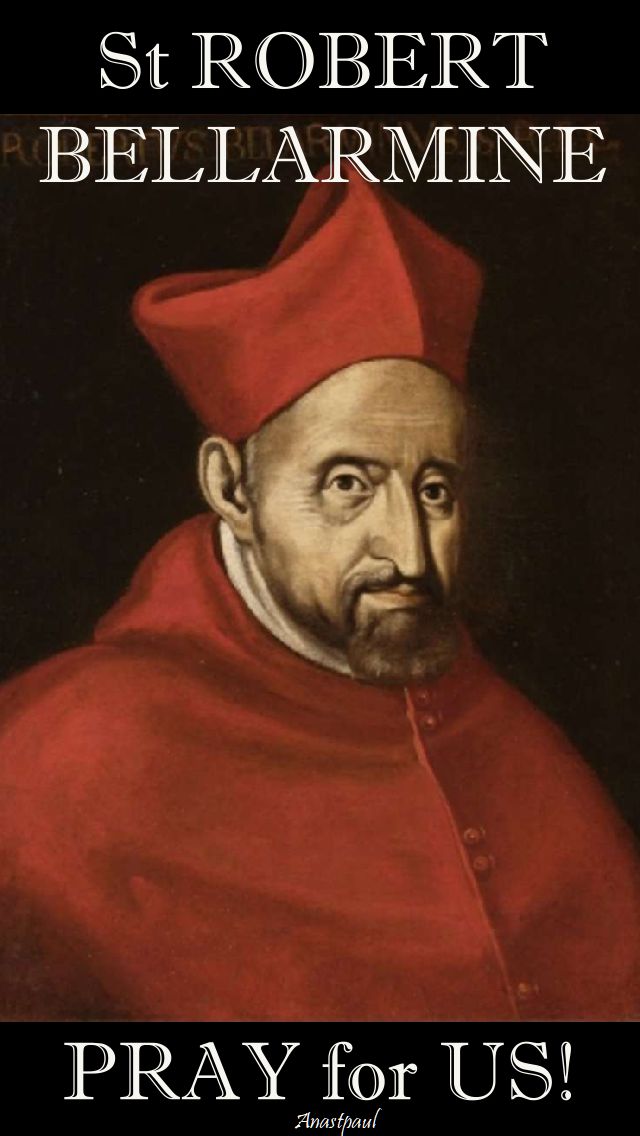
Quotes of the Day – 17 September – The Memorial of St Robert Bellarmine (1542-1621) Doctor of the Church
Quotes of the Day – 17 September – The Memorial of St Robert Bellarmine (1542-1621) Doctor of the Church
“Charity is that, with which no man is lost
and without which, no man is saved.”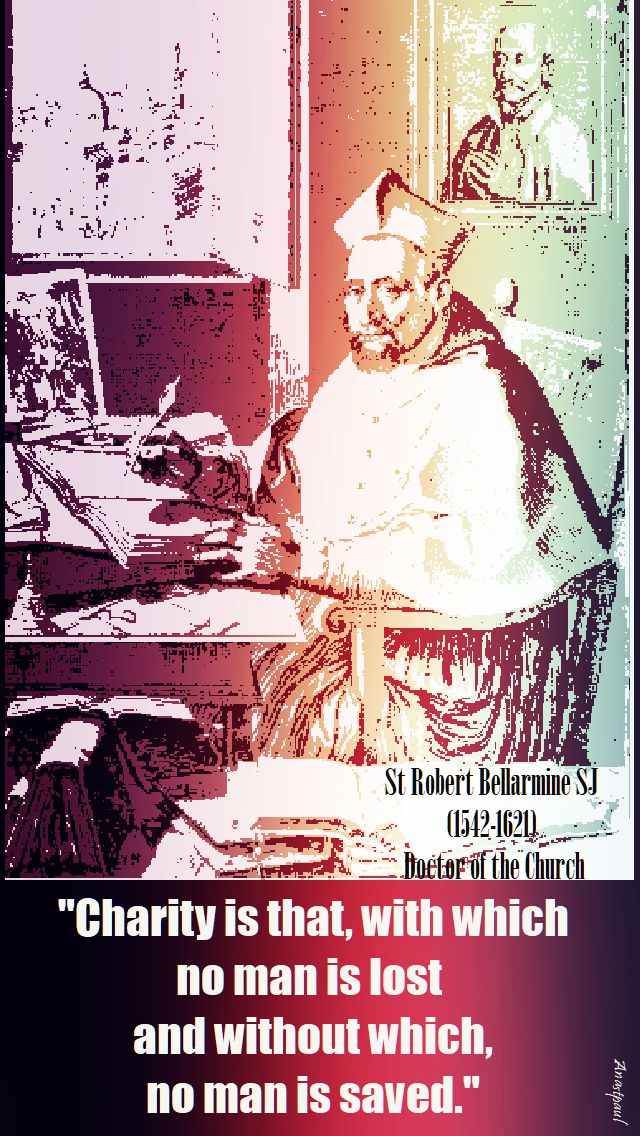
“When we appeal to the throne of grace,
we do so through Mary,
honouring God by honouring His Mother,
imitating Him by exalting her,
touching the most responsive chord
in the Sacred Heart of Christ,
with the sweet name of Mary.”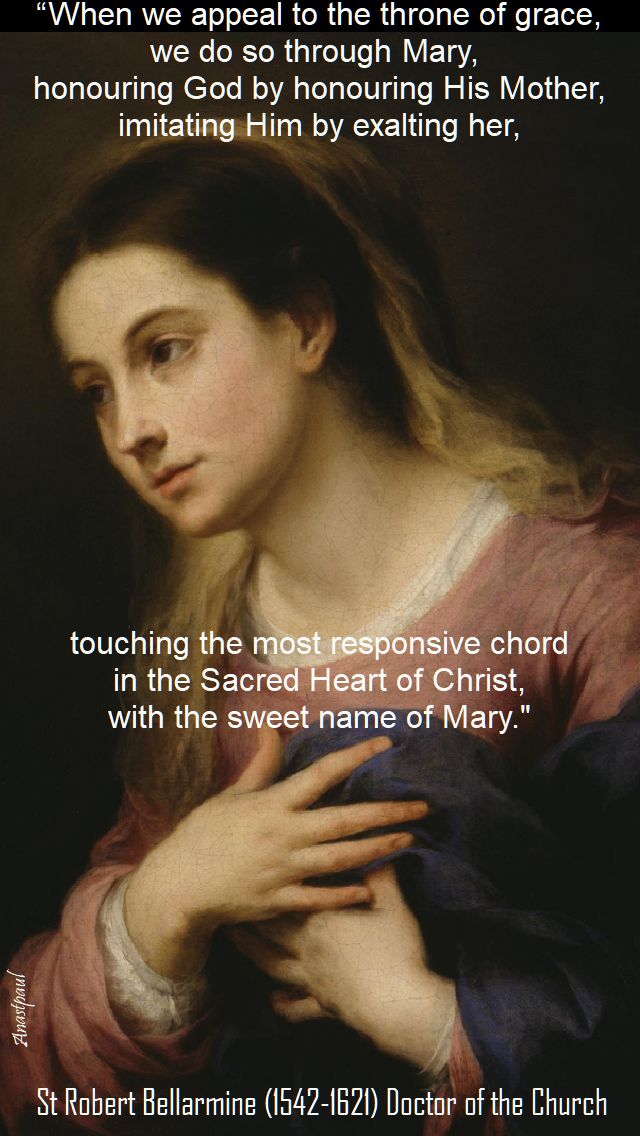
“The school of Christ,
is the school of love.
In the last day,
when the general examination takes place…
Love will be the whole syllabus.”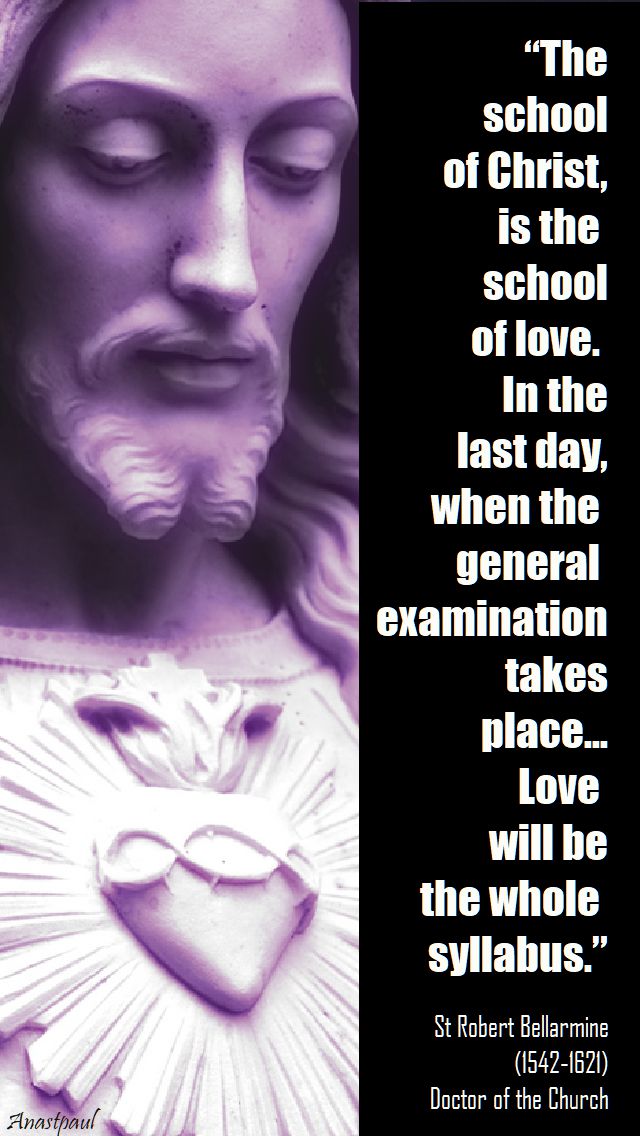
“LOVE is a marvellous
and heavenly thing.
It never tires
and it never thinks
it has done enough!”
St Robert Bellarmine (1542-1621) Doctor of the Church
One Minute Reflection – 17 September – The Memorial of St Robert Bellarmine (1542-1621) Doctor of the Church
One Minute Reflection – 17 September – The Memorial of St Robert Bellarmine (1542-1621) Doctor of the Church
Work with anxious concern to achieve your salvation….Philippians 2:12
REFLECTION – “You have been created for the glory of God
and your own eternal salvation….this is your goal;
this is the centre of your life;
this is the treasure of your heart.
If your reach this goal, you will find happiness.
If you fail to reach it, you will find misery.”….St Robert Bellarmine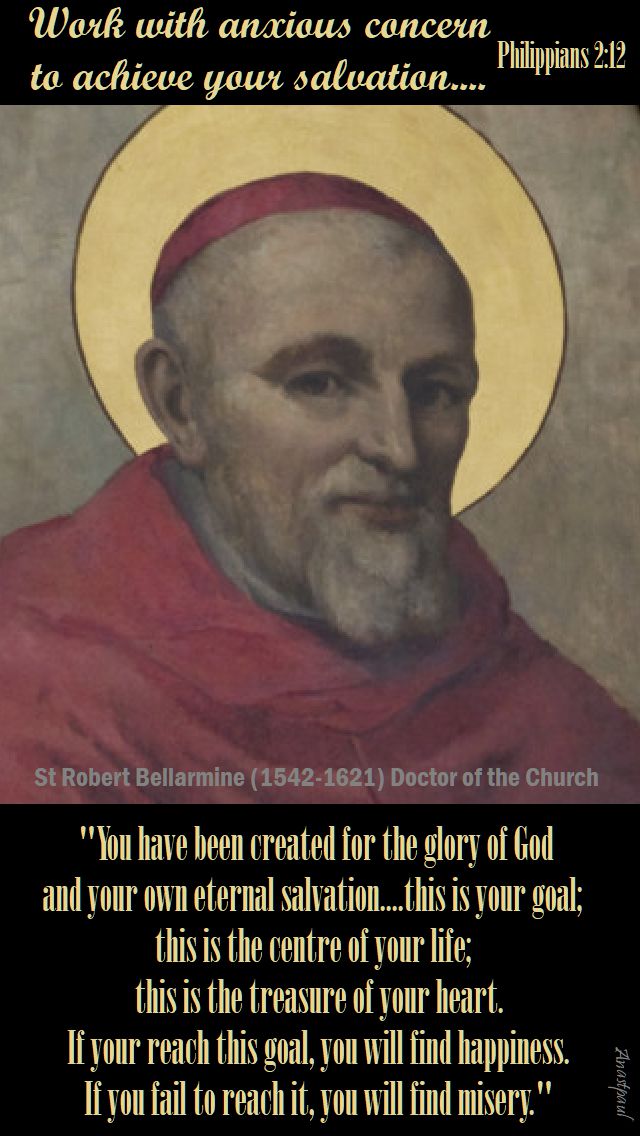
PRAYER – Heavenly Father, teach me to do everything for Your honour and glory.
Grant me the grace to work out my salvation with anxious concern each day of my life.
St Robert Bellarmine, as you worked tirelessly for the salvation of souls, so now
pray for us all, as tirelessly, that we may achieve eternal joy, amen.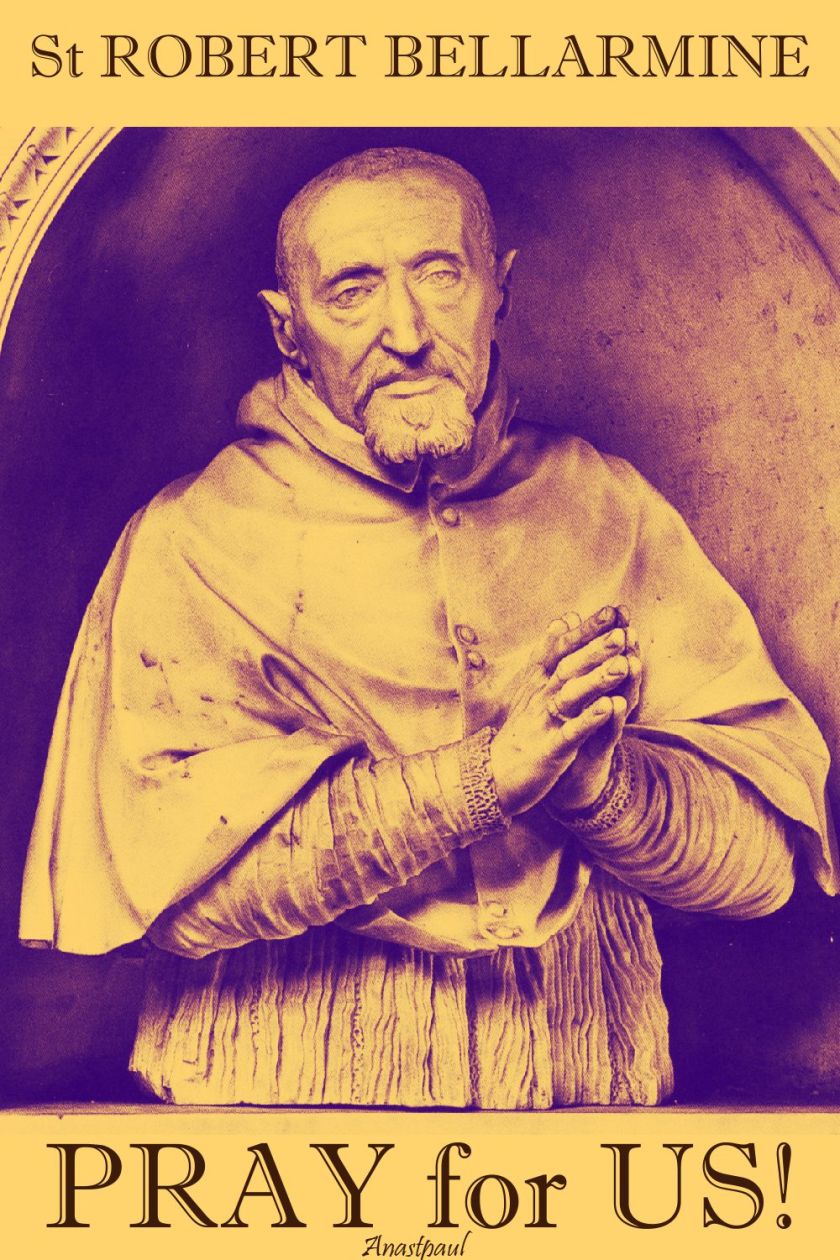
Our Morning Offering – 17 September
Our Morning Offering – 17 September
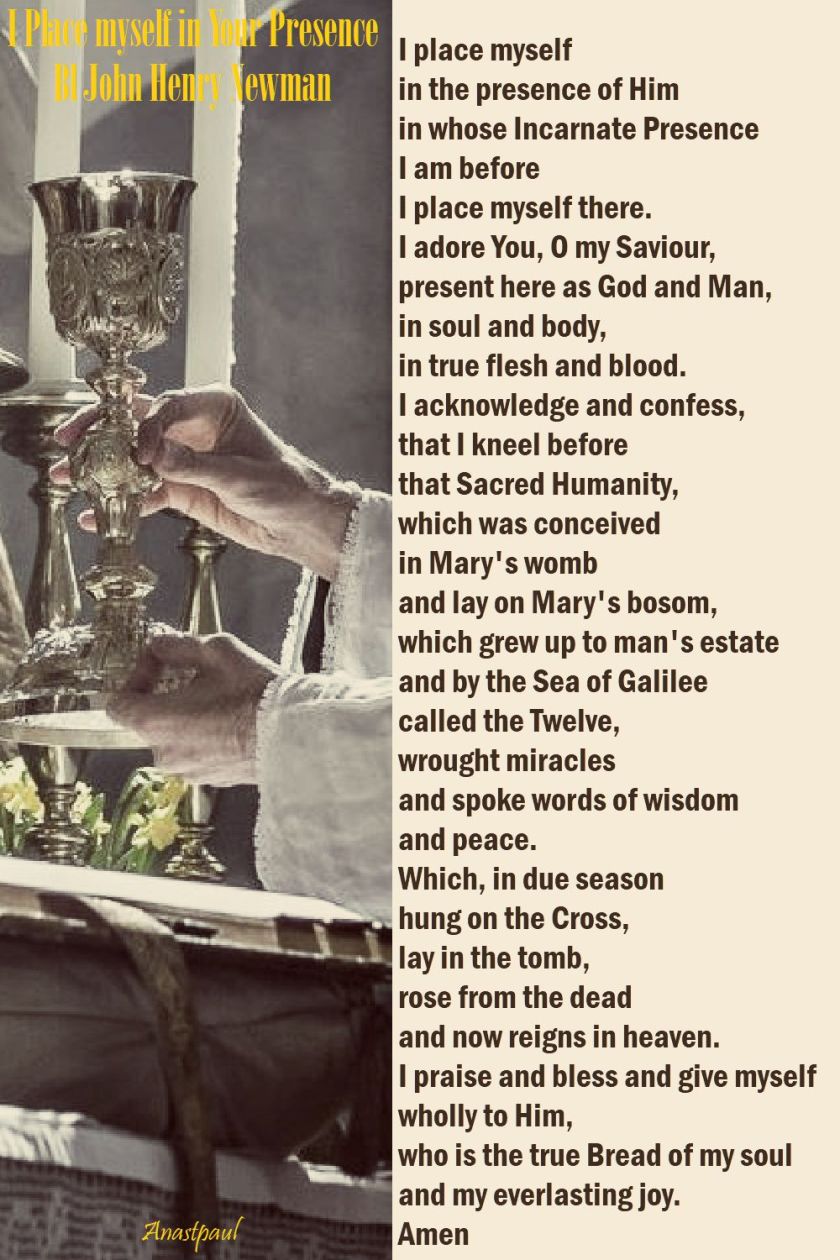
I Place myself in Your Presence (Prayer before Holy Mass or at Eucharistic Adoration)
Bl John Henry Newman
I place myself
in the presence of Him
in whose Incarnate Presence
I am before
I place myself there.
I adore You, O my Saviour,
present here as God and Man,
in soul and body,
in true flesh and blood.
I acknowledge and confess,
that I kneel before
that Sacred Humanity,
which was conceived
in Mary’s womb
and lay on Mary’s bosom,
which grew up to man’s estate
and by the Sea of Galilee
called the Twelve,
wrought miracles
and spoke words of wisdom
and peace.
Which, in due season
hung on the Cross,
lay in the tomb,
rose from the dead
and now reigns in heaven.
I praise and bless and give myself
wholly to Him,
who is the true Bread of my soul
and my everlasting joy.
Amen
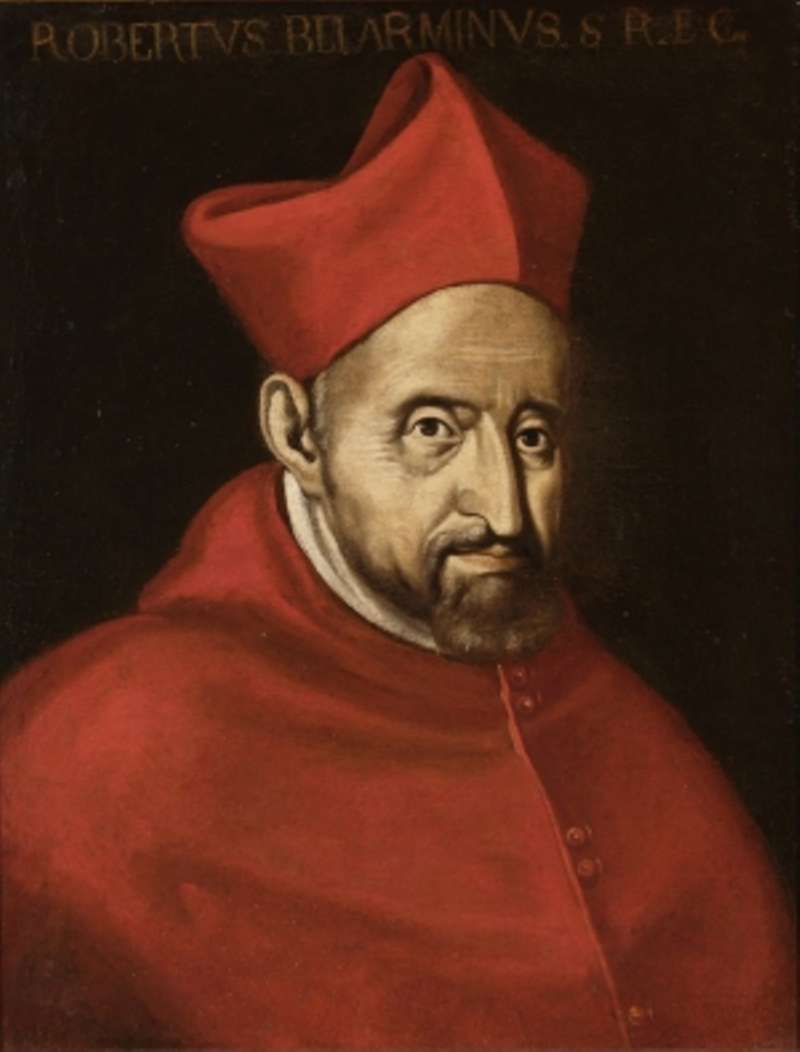
Saint of the Day – 17 September – St Robert Bellarmine SJ (1542-1621) Confessor, Doctor of the Church
Saint of the Day – 17 September – St Robert Bellarmine SJ (1542-1621) Priest of the Society of Jesus, Bishop, Confessor, Cardinal, Theologian, Professor, Writer, Preacher, Mediator, Doctor of the Church. Born as Roberto Francesco Romolo Bellarmino on 4 October 1542 at Montepulciano, Tuscany, Italy and died on the morning of 17 September 1621 at Rome, Italy of natural causes. He was buried in Rome and his relics were translated to the Church of Saint Ignatius, Rome on 21 June 1923. Patronages – Canon lawyer, Catechists, Catechumens, Cincinnati, Ohio Archdiocese of, Bellarmine University, Fairfield University, Bellarmine College and School. He was Beatified on 13 May 1923, Rome by Pope Pius XI and Canonised 29 June 1930, Rome by Pope Pius XI – he was named a Doctor of the Church by the same Pope a year later. He is remembered as one of the most important Cardinals of the Catholic Counter Reformation.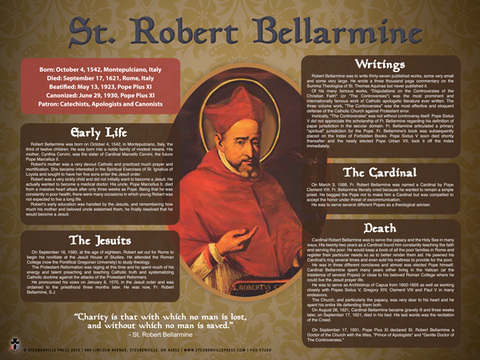
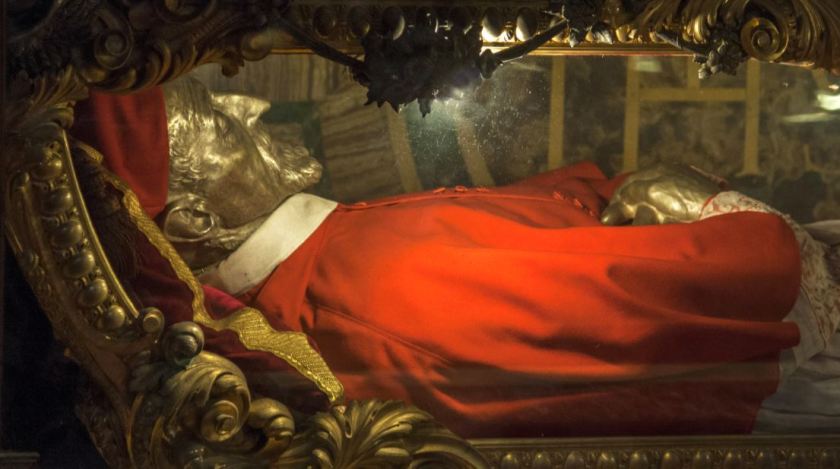
Robert Bellarmine was born to an impoverished noble Italian family. His early intellectual accomplishments gave his father hope that Bellarmine would restore the family’s fortunes through a political career. His mother’s wish that he enter the Society of Jesus prevailed. The young Bellarmine, a very small, frail but lively fellow excelled in his studies, especially Latin and Italian poetry. It didn’t take long for it to become obvious that he wished to join the Society of Jesus. The rector of the college described him as “the best of our school and not far from the kingdom of heaven.” On completion of his studies, Bellarmine taught first at the University of Louvain in Belgium. In 1576 he accepted the invitation of Pope Gregory XIII (1572-1585) to teach polemical theology at the new Roman College. When he was ordained in 1570, the study of Church history and the fathers of the Church was in a sad state of neglect. He devoted his energy to these two subjects, as well as to Scripture, in order to systematise Church doctrine against the attacks of the Protestant Reformers. He was the first Jesuit to become a professor at Louvain.
Robert Bellarmine spent the next 11 years teaching and writing his monumental Disputations on the Controversies of the Christian Faith., a three-volume defence of the Catholic faith against the arguments of the Protestant reformers. Particularly noteworthy are the sections on the temporal power of the pope and the role of the laity. To this day, it is considered one of the most important texts of Catholic theology ever written. Three hundred years after its publication, it was called “the most complete defence of the Catholic teaching”. A confidant to the Popes, Bellarmine held a number of positions, including rector of the Roman College, examiner of bishops, Cardinal Inquisitor, Archbishop of Capua, and Bishop of Montepulciano.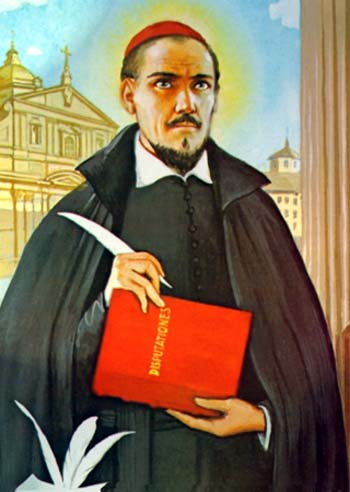
Through his writings Bellarmine was involved in the political, religious and social issues of the time. Bellarmine incurred the anger of monarchists in England and France by showing the divine-right-of-kings theory untenable. He developed the theory of the indirect power of the Pope in temporal affairs; although he was defending the pope against the Scottish philosopher Barclay, he also incurred the ire of Pope Sixtus V. He argued with King James I of England and was a judge at the trial of Giordano Bruno. Bellarmine also communicated the decree of condemning the Copernican doctrine of the movements of the earth and sun, issued by Congregation of the Index to Galileo Galilei in 1616. Among many activities, Bellarmine became theologian to Pope Clement VIII, preparing two catechisms which have had great influence in the Church.
Much to the amazement of all, at the height of his career, at the age of 60, Pope Clement VIII appointed Robert Bellarmine the Archbishop of Capua. Bellarmine had never been in pastoral ministry. Nevertheless, he began a new dimension of his Priesthood with his usual enthusiasm. He would spend the next three years introducing the reforms of the Council of Trent in his Archdiocese. He travelled everywhere, preaching to the people. He visited his clergy as well as religious men and women to encourage them to renew the Church. He won the love of everyone.
The last major controversy of Bellarmine’s life came in 1616 when he had to admonish his friend Galileo, whom he admired. He delivered the admonition on behalf of the Holy Office, which had decided that the heliocentric theory of Copernicus was contrary to Scripture. The admonition amounted to a caution against putting forward—other than as a hypothesis—theories not yet fully proven.
Although he was one of the most powerful men in Rome and was made a cardinal by Pope Clement VIII on the grounds that “he had not his equal for learning.” While he occupied apartments in the Vatican, Bellarmine relaxed none of his former austerities. He limited his household expenses to what was barely essential, eating only the food available to the poor. He was known to have ransomed a soldier who had deserted from the army and gave most of his money to the poor. Once he gave the tapestries from his living quarters to the poor, saying that the walls wouldn’t catch cold. While he took little regard for his own comforts, he always saw to it that his servants and aides had everything they needed.


Robert Bellarmine died at Rome on 17 September 1621 at the age of 79. If his early career featured brilliant polemics and his middle years gentle, loving, pastoral life, his final years brought him transcendent peace. His writings turned spiritual. He wrote several works, the classics being “The Ascent of the Mind to God” and “The Art of Dying.” He wrote that this was his way of preparing for death and to move closer to his God. The process for his Canonisation was begun in 1627 but was delayed until 1930 for political reasons, stemming from his writings. In 1930, Pope Pius XI Canonised him and the next year declared him a Doctor of the Church.
Memorials of the Saints and the Feast of the Stigmata of St Francis of Assisi
St Robert Bellarmine SJ (1542-1621) Doctor of the Church (Optional Memorial) -https://www.youtube.com/watch?
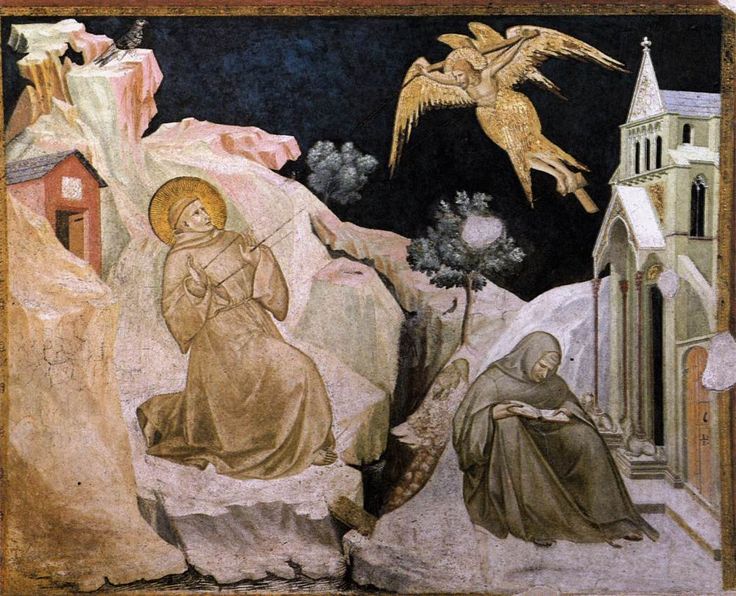
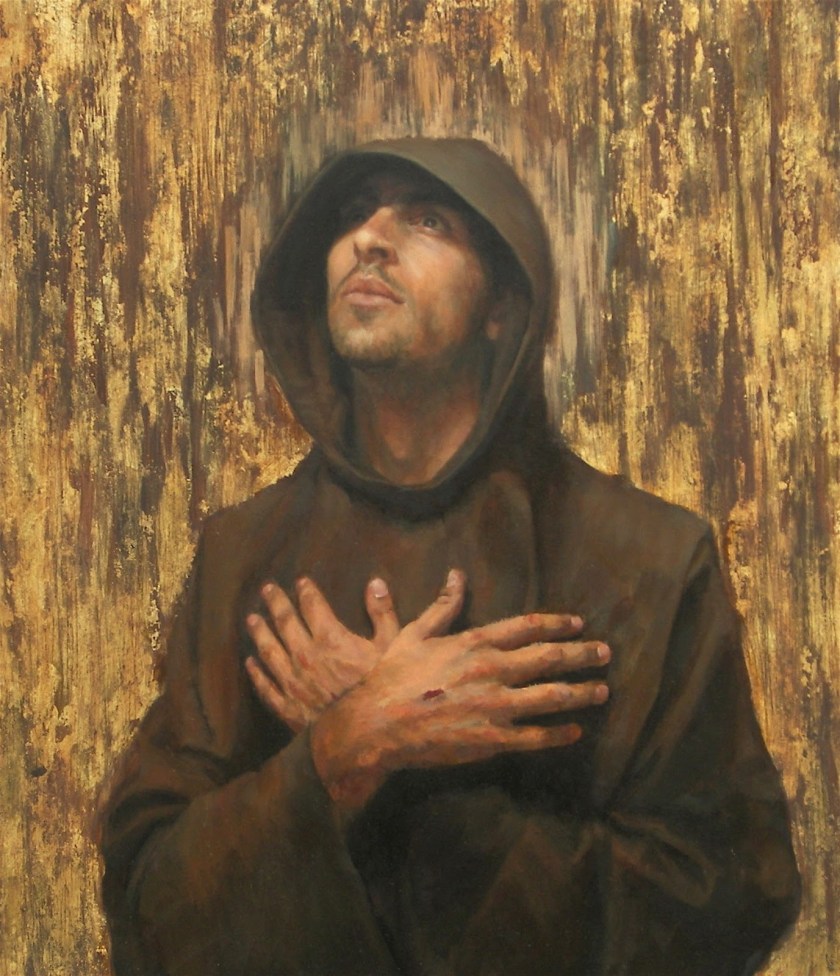
Stigmata of St Francis of Assisi: While in meditation on Mount Alvernia in the Apennines in September 1224, Saint Francis received a vision of a six winged angel, a Seraphim. Francis saw that the angel was crucified. When the angel departed, Francis was left with wounds in his hands, feet and side as though he had been crucified. The wound in his side often seeped blood.
—
St Agathoclia
St Brogan of Ross Tuirc
St Columba of Cordova
St Crescentio of Rome
St Emmanuel Nguyen Van Trieu
St Flocellus
St Hildegard von Bingen
St Justin of Rome
St Lambert of Maastricht
St Narcissus of Rome
St Peter Arbues
St Rodingus
St Satyrus of Milan
St Socrates
Bl Stanislaus of Jesus and Mary
St Stephen
St Theodora
St Uni of Bremen
St Zygmunt Sajna
St Zygmunt Szcesny Felinski
—
Martyred in the Spanish Civil War
• Blessed Álvaro Santos Cejudo Moreno Chocano
• Blessed Juan Ventura Solsona
• Blessed Timoteo Valero Pérez
NOVENA to St Padre Pio/St Pius of Pietrelcina – DAY THREE – 16 September
NOVENA to St Padre Pio/St Pius of Pietrelcina – DAY THREE – 16 September
St Padre Pio you have said:
I am greatly comforted and very content in Jesus’ company and who could describe the help it is to me to have Him continually by my side? This company makes me much more careful not to do anything which would displease God. It seems to me as if Jesus is constantly watching me. If it sometimes happens that I lose the presence of God, I soon hear Our Lord calling me back to my duty. I cannot describe the voice He uses to call me back but I know that it is very penetrating and the soul who hears it finds it almost impossible to refuse what He asks.
Let us Pray:
Gracious God, You generously blessed Your servant, Padre Pio, with the gifts of the Spirit.
You marked his body with the five wounds of Christ Crucified,
as a powerful witness to the saving Passion and Death of Your Son
and as a stirring inspiration to many people of Your infinite mercy, forgiveness and love.
In the confessional, Padre Pio laboured endlessly for the salvation of souls.
Whenever You called, he answered,
serving Your people for the greater good of their souls
and for your Glory.
Through his powerful intercession, many who suffered were healed of sickness and disease.
Endowed with the gift of discernment, he could read people’s hearts.
With dignity and intense devotion, he celebrated daily Mass,
inviting countless men and women to a greater union with Jesus Christ,
in the Sacrament of the Holy Eucharist.
Through the intercession of Saint Pio,
we confidently beseech You to to grant us the grace of
………………. (state your petition here).
Help us to imitate his example of prayerful holiness and compassion,
so that we, too, may faithfully follow the Risen Lord
and one day rejoice in the Kingdom,
where You live and reign forever and ever. Amen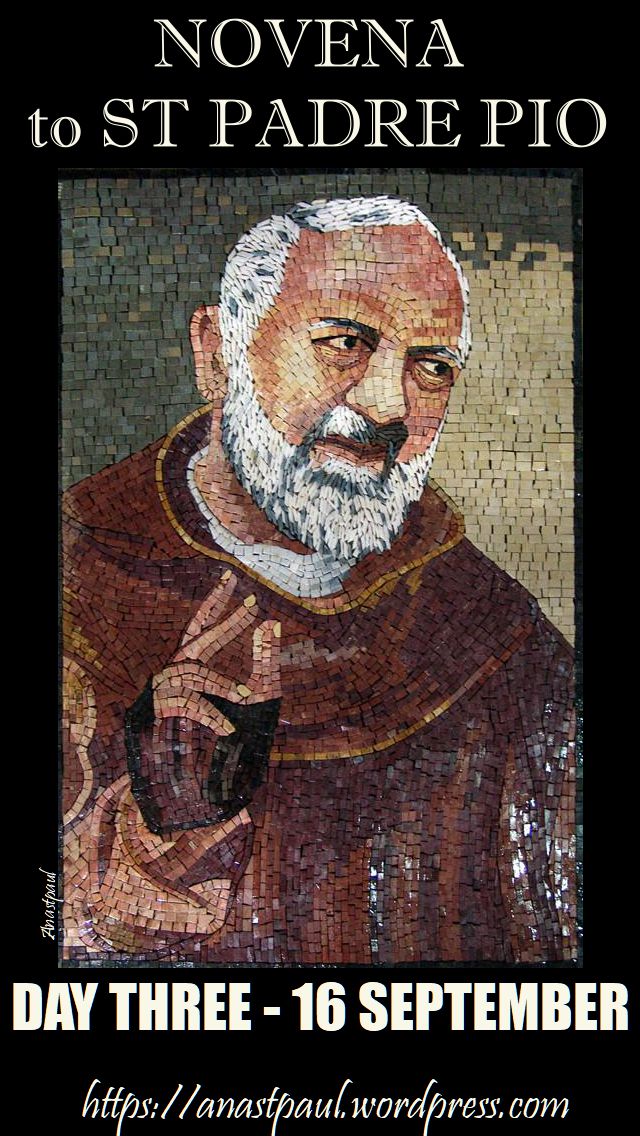
Thought for the Day – 16 September – The Memorial of Sts Cornelius & Cyprian
Thought for the Day – 16 September – The Memorial of Sts Cornelius & Cyprian
It seems fairly true to say that almost every possible false doctrine has been proposed at some time or other in the history of the Church. Men like Cornelius and Cyprian were God’s instruments in helping the Church find a prudent path between extremes of rigorism and laxity. They are part of the Church’s ever-living stream of tradition, ensuring the continuance of what was begun by Christ and evaluating new experiences through the wisdom and experience of those who have gone before.
Cornelius and Cyprian encouraged each other to lead virtuous, self-sacrificing and loving lives for God. There is no greater gift that one friend can offer to another. Today let us think of ways to help our friends grow closer to God.
Sts Cornelius and Cyprian, pray for us!
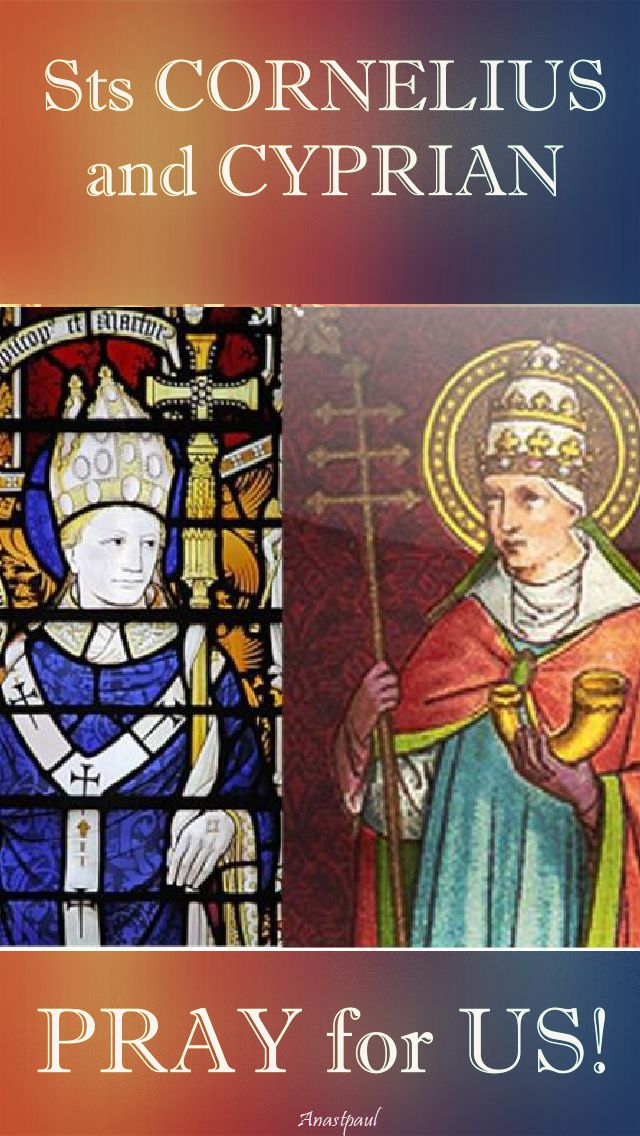
Quote/s of the Day – 16 September – The Memorial of Sts Cornelius & Cyprian
Quote/s of the Day – 16 September – The Memorial of Sts Cornelius & Cyprian
“You cannot have God for your Father if you do not have the Church for your mother…. God is one and Christ is one and His Church is one; one is the faith and one is the people cemented together by harmony into the strong unity of a body…. If we are the heirs of Christ, let us abide in the peace of Christ; if we are the sons of God, let us be lovers of peace.”…St Cyprian from The Unity of the Catholic Church
“Whatever a man prefers to God, that he makes a god to himself.”
“Let us remember one another in concord and unanimity. Let us on both sides of death always pray for one another. Let us relieve burdens and afflictions by mutual love, that if one of us, by the swiftness of divine condescension, shall go hence the first, our love may continue in the presence of the Lord and our prayers for our brethren and sisters not cease in the presence of the Father’s mercy.”…St Cyprian from letters (to St Pope Cornelius no 253)
“You who are envious, let me tell you that however often you may seek for the opportunity of injuring him whom you hate, you will never be able to do him so much harm as you do harm to yourselves. He whom you would punish through the malice of your envy, may probably escape but you will never be able to fly from yourselves.”
St Cyprian of Carthage (190-258)
One Minute Reflection – 16 September – The Memorial of Sts Cornelius and Cyprian
One Minute Reflection – 16 September – The Memorial of Sts Cornelius and Cyprian
Your will be done on earth as it is in heaven…Matthew 6:10
REFLECTION – “We must carry out the will of God rather than our own. This is what we pledge to do in the “Our Father”, which we recite every day.
What a travesty it would be if, after praying that God’s will be done, we should carry out that will halfheartedly and only because we are obliged to do so!…St Cyprian of Carthage
PRAYER – Lord God, heavenly Father, You gave Sts Cornelius and Cyprian to Your Church as faithful shepherds and steadfast martyrs. Strengthen our faith and our courage by their prayers, so that we may strive with all our power, to do Your will at all times, wholeheartedly! Amen
Our Morning Offerings – 16 September
Our Morning Offerings – 16 September
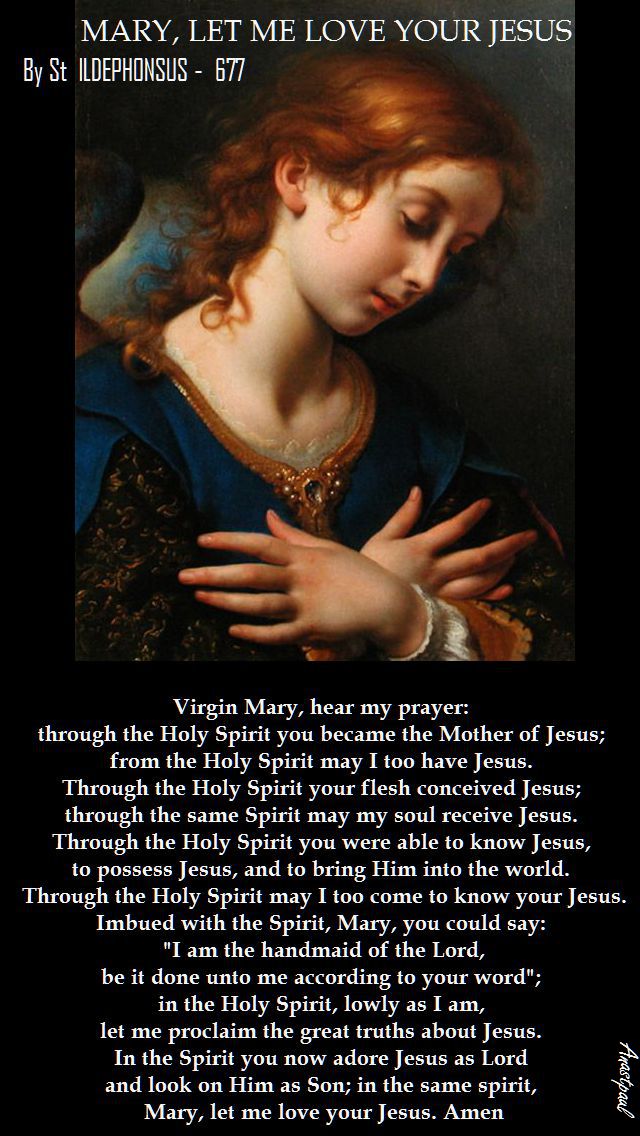
MARY, LET ME LOVE YOUR JESUS
By St ILDEPHONSUS OF SPAIN – 677
Virgin Mary, hear my prayer:
through the Holy Spirit
you became the Mother of Jesus;
from the Holy Spirit may I too have Jesus.
Through the Holy Spirit your flesh conceived Jesus;
through the same Spirit may my soul receive Jesus.
Through the Holy Spirit you were able to know Jesus,
to possess Jesus,
and to bring Him into the world.
Through the Holy Spirit may I too come to know your Jesus.
Imbued with the Spirit,
Mary, you could say:
“I am the handmaid of the Lord,
be it done unto me according to your word”;
in the Holy Spirit,
lowly as I am,
let me proclaim the great truths about Jesus.
In the Spirit you now adore Jesus as Lord
and look on Him as Son;
in the same spirit,
Mary, let me love your Jesus. Amen
Saints of the Day – 16 September – St Pope Cornelius and St Cyprian of Carthage – Martyrs
Saints of the Day – 16 September – St Pope Cornelius and St Cyprian of Carthage – Martyrs. St Pope Cornelius – Papal Ascension: 251. He was Martyred in 253 and his remains were buried at the Cemetery of Saint Callistus Rome. “Cornelius” means ‘battle horn.‘ Patronages – • against earache; earache sufferers• epileptics; against epilepsy• against fever• against myoclonus• cattle• domestic animals• Kornelimünster, Germany. St Cornelius was a Bishop becoming ar reluctant 21st Pope, elected after a 1 1/2 year period, during which the persecutions were so severe that Papal ascension was an immediate death sentence. He worked to maintain unity in a time of schism and apostasy and fought Novatianism. He also called a Synod of Bishops to confirm him as rightful Pontiff, as opposed to the anti-pope Novatian. He had the support of Saint Cyprian of Carthage and Saint Dionysius. He welcomed back those who had apostacised during the persecutions of Decius – the documents which settled this matter prove the final authority of the Pope. Exiled to Centumcellae in 252 by Roman authorities to punish Christians in general, who were said to have provoked the gods to send plague against Rome. Martyr. A document from Cornelius shows the size of the Roman Clergy during his Papacy – 46 Priests, 7 Deacons, 7 Sub-deacons, approximately 50,000 Christians. His name is in the Communicantes in the Canon of the Mass.
St Cyprian of Carthage – (Died in 190 in Carthage, North Africa – Bishop and Martyr, learned Rhetorician, Teacher, Writer, Theologian – beheaded 14 September 258 in Carthage, North Africa). Patronages – • Algeria (proclaimed on 6 July 1914 by Pope Pius X)• North Africa (proclaimed on 6 July 1914 by Pope Pius X, on 10 January 1958 by Pope Pius XII and on 27 July 1962 by Pope John XXIII NOTE – no, I don’t know why it was done so many times).
St Cyprian was born to wealthy pagan parents. He taught rhetoric and literature. He was adult convert in 246, taught the faith by Saint Caecilius of Carthage. He was ordained in 247 and became the Bishop of Carthage in 249. During the persecution of Decius, beginning in 250, Cyprian lived in hiding, covertly ministering to his flock; his enemies condemned him for being a coward and not standing up for his faith. As a writer he was second only in importance to Tertullian as a Latin Father of the Church. Friend of Saint Pontius. St Cyprian was involved in the great argument over whether apostates should be readmitted to the Church; Cyprian believed they should but under stringent conditions. He was supported St Pope Cornelius against the anti-pope Novatian. During the persecutions of Valerian he was exiled to Curubis in 257, brought back Carthage and then martyred in 258. His name is in the Communicantes in the Canon of the Mass.


An excerpt written to Cornelius, Bishop of Rome condemned to martyrdom for his faith, from his brother Bishop Cyprian of Carthage, himself to give his witness as a Martyr a few years later. Read on the feasts of Sts Cornelius and Cyprian, Martyrs, on 16 September.
Cyprian to his brother Cornelius.
My very dear brother, we have heard of the glorious witness given by your courageous faith. On learning of the honour you had won by your witness, we were filled with such joy that we felt ourselves sharers and companions in your praiseworthy achievements. After all, we have the same Church, the same mind, the same unbroken harmony. Why then should a priest not take pride in the praise given to a fellow priest as though it were given to him? What brotherhood fails to rejoice in the happiness of its brothers wherever they are?
Words cannot express how great was the exultation and delight here when we heard of your good fortune and brave deeds: how you stood out as leader of your brothers in their declaration of faith, while the leader’s confession was enhanced as they declared their faith. You led the way to glory, but you gained many companions in that glory; being foremost in your readiness to bear witness on behalf of all, you prevailed on your people to become a single witness.
We cannot decide which we ought to praise, your own ready and unshaken faith or the love of your brothers who would not leave you. While the courage of the bishop who thus led the way has been demonstrated, at the same time the unity of the brotherhood who followed has been manifested. Since you have one heart and one voice, it is the Roman Church as a whole that has thus born witness.
Dearest brother bright and shining is the faith which the blessed Apostle praised in your community. He foresaw in the spirit the praise your courage deserves and the strength that could not be broken; he was heralding the future when he testified to your achievements; his praise of the fathers was a challenge to the sons. Your unity, your strength have become shining examples of these virtues to the rest of the brethren.
Divine providence has now prepared us. God’s merciful design has warned us that the day of our own struggle, our own contest, is at hand. By that shared love which binds us close together, we are doing all we can to exhort our congregation, to give ourselves unceasingly to fastings, vigils and prayers in common. These are the heavenly weapons which give us the strength to stand firm and endure; they are the spiritual defenses, the God-given armaments that protect us.
Let us then remember one another, united in mind and heart. Let us pray without ceasing, you for us, we for you; by the love we share we shall thus relieve the strain of these great trials.

Memorials of the Saints – 16 September
St Pope Cornelius (Memorial) – https://www.youtube.com/watch?v=0elOV8-tQxI
St Cyprian of Carthage (Memorial)
—
St Abundantius of Rome
St Abundius of Rome
St Andrew Kim Taegon
St Cunibert of Maroilles
St Curcodomus
Bl Dominic Shobyoye
St Dulcissima of Sutri
St Edith of Wilton
St Eugenia of Hohenburg
St Euphemia of Chalcedon
St Geminianus of Rome
St John of Rome
Bl Louis Allemand
St Lucy of Rome
St Ludmila
St Marcian the Senator
Bl Martin of Huerta
Bl Michael Himonaya
St Ninian
Bl Paul Fimonaya
St Priscus of Nocera
St Rogellus of Cordoba
St Sebastiana
St Servus Dei
St Stephen of Perugia
Bl Pope Victor III
St Vitalis of Savigny
—
Martyrs of the Via Nomentana: Four Christian men martyred together, date unknown – Alexander, Felix, Papias and Victor. They were martyred on the Via Nomentana outside Rome, Italy.
Martyred in the Spanish Civil War:
• Blessed Antonio Martínez García
• Blessed Ignasi Casanovas Perramón
• Blessed Manuel Ferrer Jordá
• Blessed Pablo Martínez Robles
• Blessed Salvador Ferrer Cardet
NOVENA to St Padre Pio/St Pius of Pietrelcina – DAY TWO – 15 September
NOVENA to St Padre Pio/St Pius of Pietrelcina – DAY TWO – 15 September
St Padre Pio you have said:
I implore you to be faithful and humble and always to keep the great Mother of God before your mental gaze, she who humbled herself more profoundly the more she was exalted. Never, ever be exalted at your virtues but repeat that everything comes from Godand give Him the honour and glory.
Let us Pray:
Gracious God, You generously blessed Your servant, Padre Pio, with the gifts of the Spirit.
You marked his body with the five wounds of Christ Crucified,
as a powerful witness to the saving Passion and Death of Your Son
and as a stirring inspiration to many people of Your infinite mercy, forgiveness and love.
In the confessional, Padre Pio laboured endlessly for the salvation of souls.
Through his powerful intercession, many who suffered were healed of sickness and disease.
Endowed with the gift of discernment, he could read people’s hearts.
With dignity and intense devotion, he celebrated daily Mass,
inviting countless men and women to a greater union with Jesus Christ,
in the Sacrament of the Holy Eucharist.
Through the intercession of Saint Pio,
we confidently beseech You to to grant us the grace of
………………. (state your petition here).
Help us to imitate his example of prayerful holiness and compassion,
so that we, too, may faithfully follow the Risen Lord
and one day rejoice in the Kingdom,
where You live and reign forever and ever. Amen
Thought for the Day – 15 September – The Memorial of Our Lady of Sorrows
Thought for the Day – 15 September – The Memorial of Our Lady of Sorrows
“Jesus came into the world to learn how to be a man and by being a man, walk with men. He came into the world to obey and He obeyed. But He learned this obedience from suffering. Adam left Paradise with a promise, a promise that lasted for so many centuries. Today, through this obedience, this self-abnegation, this humiliation, through Jesus, that promise becomes hope. And the people of God walk with sure hope. Even the Mother, ‘the New Eve’, as Paul himself calls her, in order to participate in her Son’s journey, learned, suffered and obeyed. And thus she becomes Mother”.
The Gospel shows us Mary at the foot of the Cross. Jesus says to John, “Behold your mother.” Mary – the Pope said – “is anointed Mother.
And this is our hope. We are not orphans, we have Mothers: Mother Mary. But the Church is Mother and the Mother Church is anointed when it takes the same path of Jesus and Mary: the path of obedience, the path of suffering and when she has that attitude of continually learning the path of the Lord. These two women – Mary and the Church – carry on the hope that is Christ, they give us Christ, they bring forth Christ in us. Without Mary, there would be no Jesus Christ; without the Church, we cannot go forward.
“Two women and two mothers” – continued the Pope Francis – “and next to them our soul, which in the words of Isaac, the abbot of Stella, is “feminine” and is like “Mary and the Church.
Today, looking at this woman by the Cross, steadfast in following her Son in His suffering to learn obedience, looking at her we see the Church and look at our Mother. And also, we look at our little soul that will never be lost, if it continues to be a woman close to these two great women who accompany us in life: Mary and the Church. And just as our fathers left Paradise with a promise, today we can go forward with a hope: the hope that our Mother Mary, steadfast at the Cross and our Holy Mother, the hierarchical Church, give us.” (Pope Francis 15 September 2014 “Santa Marta”)
Our Lady of Sorrows, Our Lady our Mother, Our Lady our Consoler, pray for us all!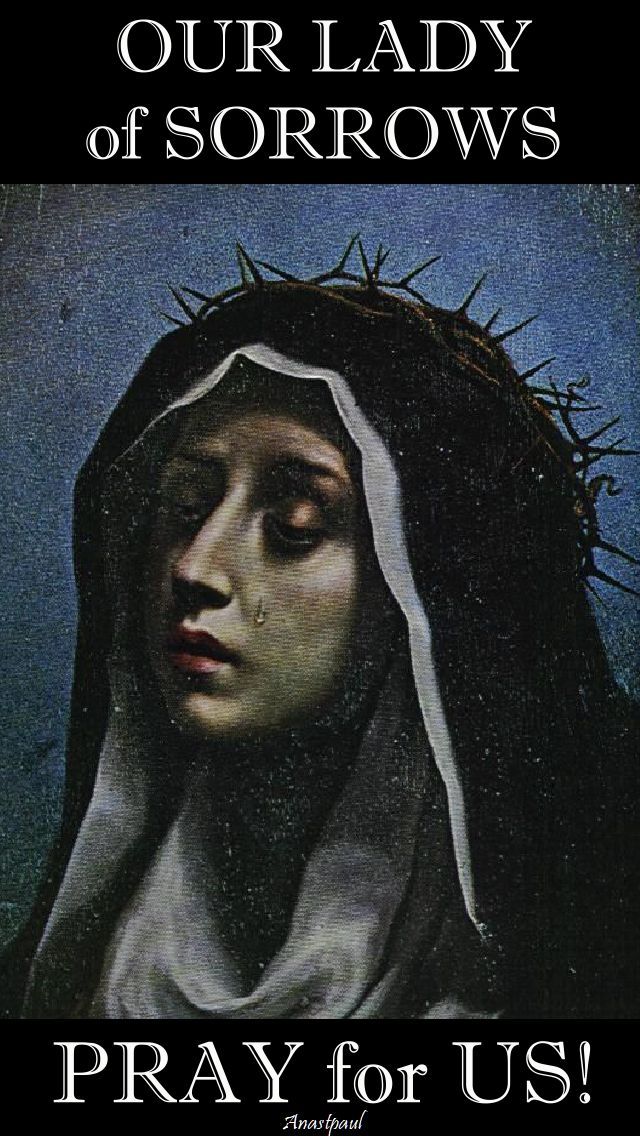
Quote/s of the Day – 15 September – The Memorial of Our Lady of Sorrows
Quote/s of the Day – 15 September – The Memorial of Our Lady of Sorrows
“When a woman is in travail, she has sorrow, because her hour has come; but when she is delivered of the child, she no longer remembers the anguish, for joy that a child is born into the world’ (Jn. 16:21). The first part of Christ’s words refer to the “pangs of childbirth” which belong to the heritage of original sin; at the same time these words indicate the link that exists between the woman’s motherhood and the Paschal Mystery. For this mystery also includes the Mother’s sorrow at the foot of the cross – the Mother who through faith shares in her Son’s amazing “self-emptying”: ‘This is perhaps the deepest ‘kenosis’ of faith in human history.”
St John Paul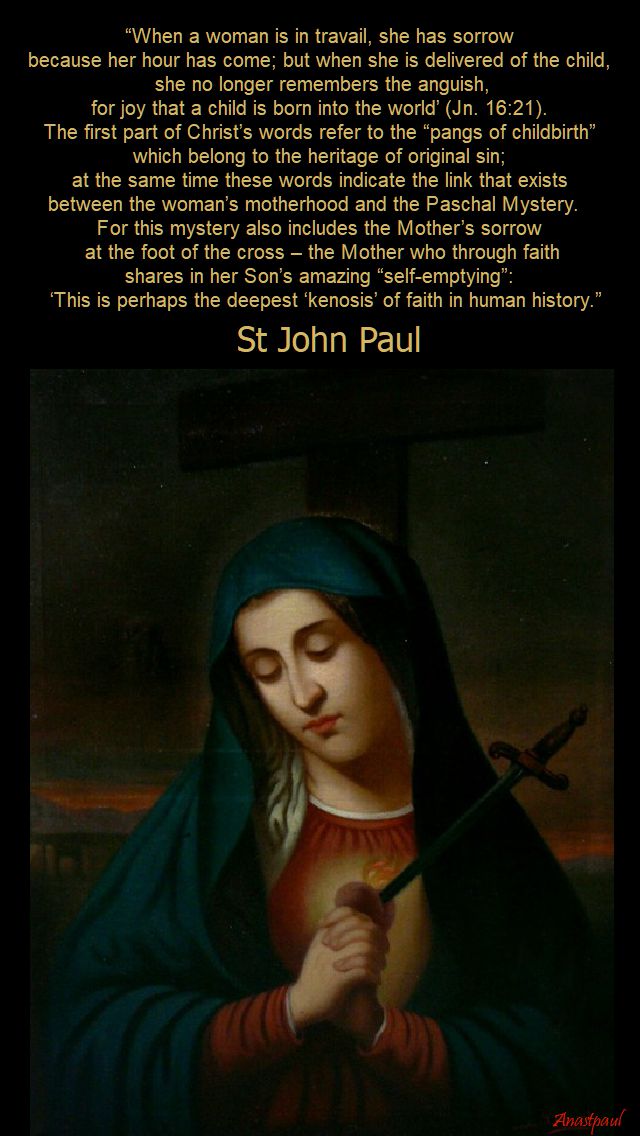
“While other martyrs suffered by sacrificing their own lives, the Blessed Virgin suffered by sacrificing her Son’s life, a Life that she loved far more than her own; so that she not only suffered in her soul all that her Son endured in His Body but moreover, the sight of her Son’s torments, brought more grief to her heart, than if she had endured them all in her own person”.
St Anselm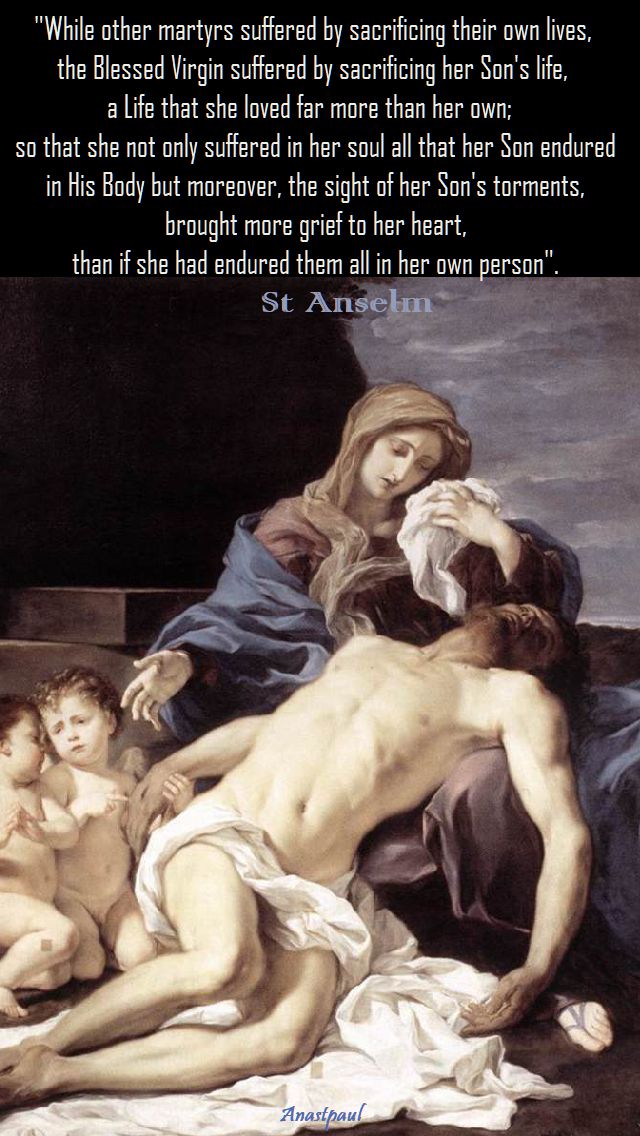
‘By the cross of our salvation
Mary stood in desolation
While the Saviour hung above
All her human powers failing,
Sorrow’s sword, at last prevailing,
Stabs and breaks her heart of love…
Virgin Mary, full of sorrow,
From your love I ask to borrow
Love enough to share your pain.
Make my heart to burn with fire,
Make Christ’s love my own desire,
Who for love of me was slain.’
Stabat Mater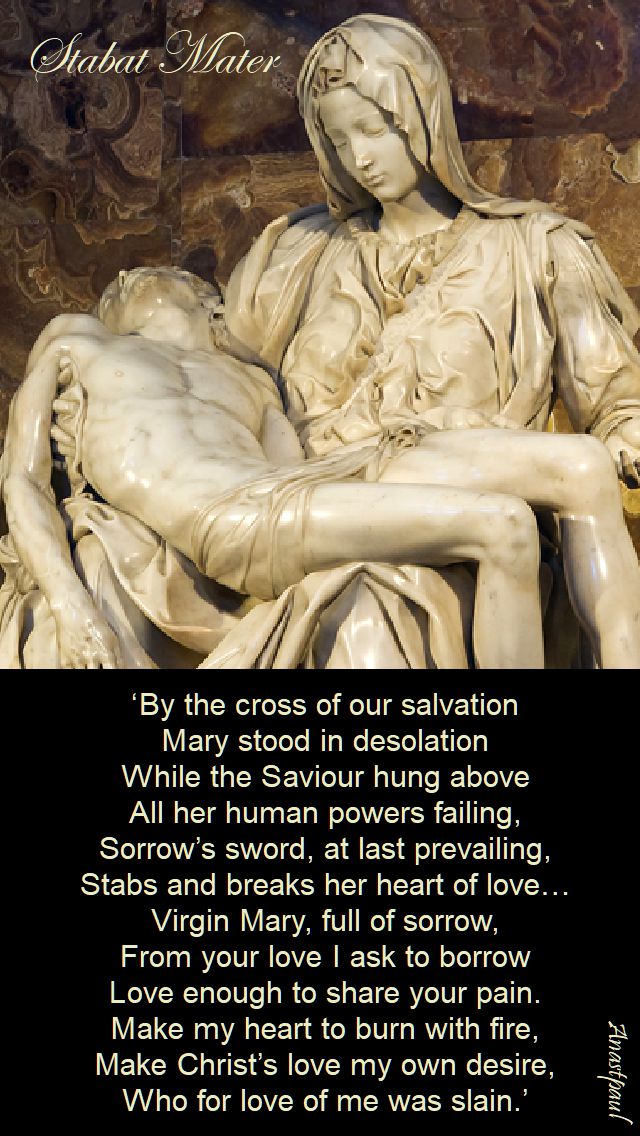
“If you want to assist at Mass, with devotion and with fruit, think of the sorrowful Mother at the feet of Calvary.”
St Padre Pio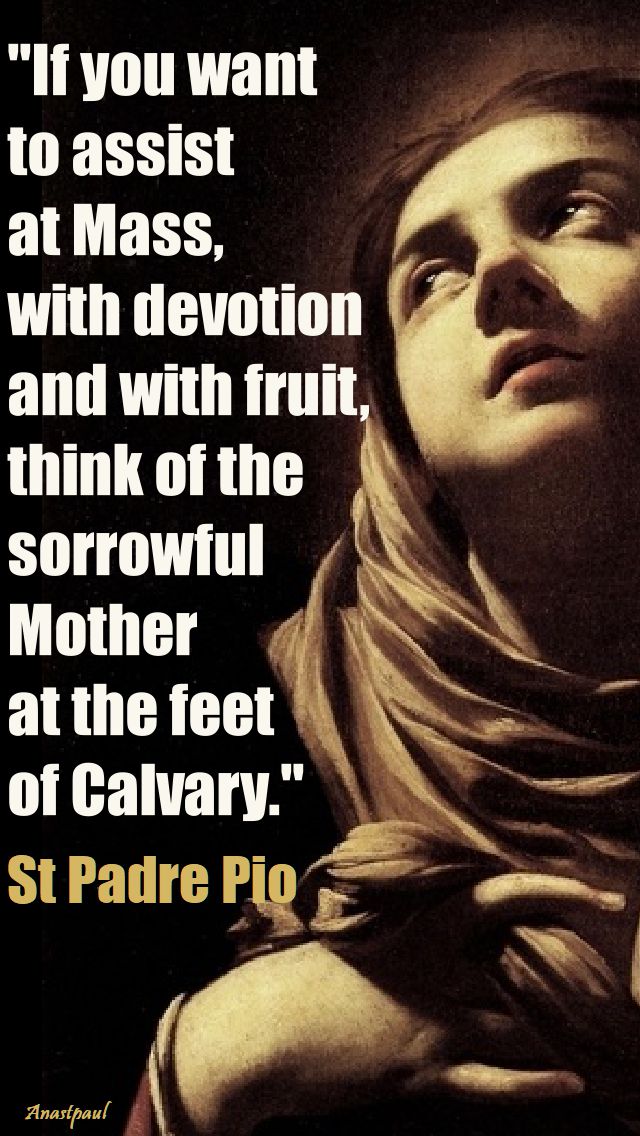
One Minute Reflection – 15 September – The Memorial of Our Lady of Sorrows
One Minute Reflection – 15 September – The Memorial of Our Lady of Sorrows
Near the cross of Jesus, there stood his mother…..John 19:25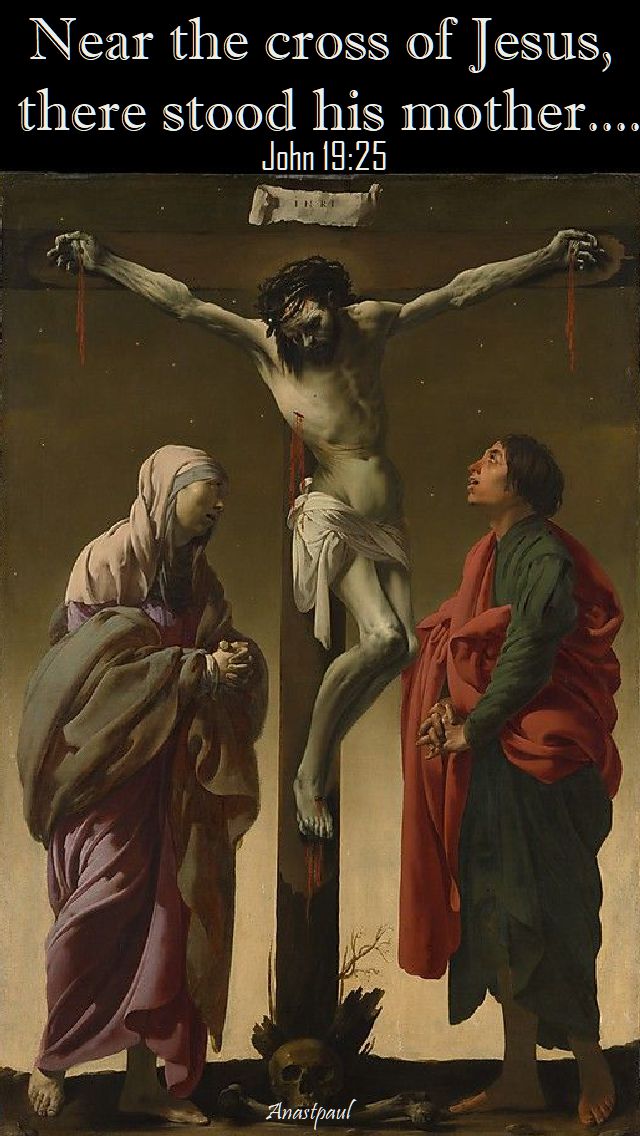
REFLECTION – During the entire course of her life, the Blessed Virgin Mary, Mother of God, never deviated in the slightest from the precepts and examples of her Divine Son.
This was true both in the most sweet joys Mary experienced and in the cruel sufferings she underwent, which made the the Queen of Martyrs…..Pope Pius XII
PRAYER – Our Father, when Jesus Your Son, was raised up on the Cross, it was Your will that Mary, His Mother, should stand there and suffer with Him in her heart. Grant that in union with her, the Church may share in the passion of Christ and so be brought to the glory of His Resurrection. Be our intercessor and our consolation, Our Lady of Sorrows, amen.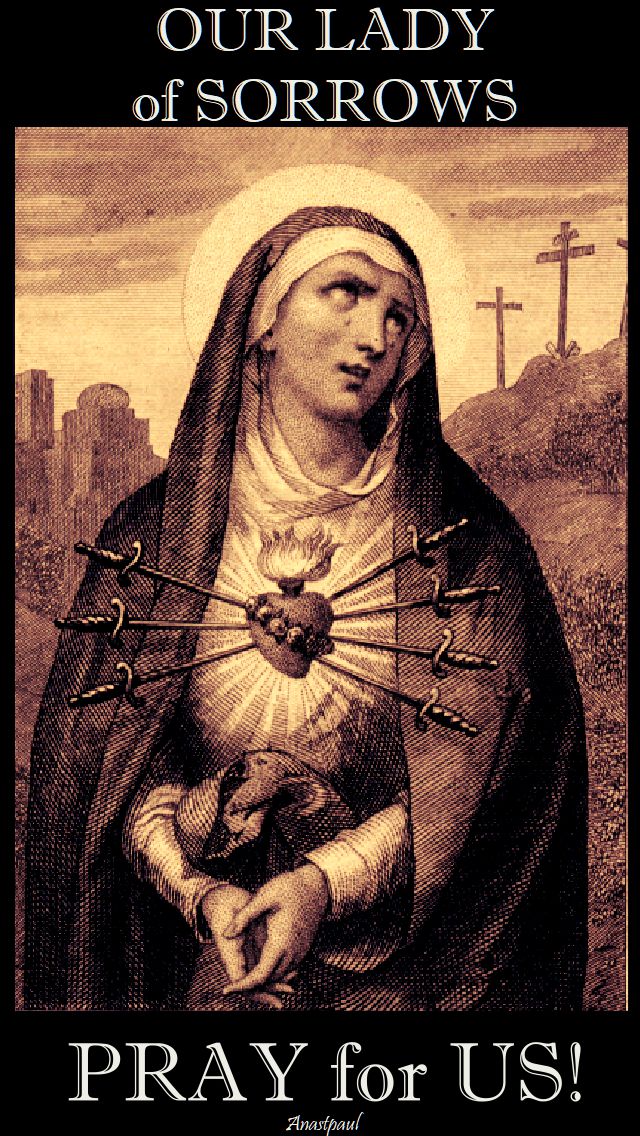
Our Morning Offering – 15 September – The Memorial of Our Lady of Sorrows
Our Morning Offering – 15 September – The Memorial of Our Lady of Sorrows
Traditional Prayer to our
SORROWFUL MOTHER
O Mother of Sorrows, you, who beneath the Cross of Jesus
were given to us as our Mother, look down with pity on us,
your children, who weep and mourn in this vale of tears.
By that sword of sorrow which pierced your Heart
when you looked upon the Face of your dead Son,
obtain for us that comfort we so sorely need in our sufferings.
You were given to us, as our Mother, in the hour of your greatest grief
that you might be mindful of our frailty and the evils that press upon us.
Without your aid, O Sorrowful Mother, we cannot gain the victory
in this struggle against flesh and blood.
Therefore, we seek your help, O Queen of Sorrows,
lest we fall prey to the wiles of the enemy.
We are orphans in need of the guiding hand of our Mother
amid the dangers that threaten our destruction.
You whose grief was boundless as the sea,
grant us by the memory of those sorrows the strength to be victorious.
Intercede further, O Mother of Sorrows, for us
and all who are near and dear to us,
that we may ever do the Will of your Son
and may direct all our actions to His honour
and to the furtherance of devotion to your sorrows. Amen
Virgin Most Sorrowful, pray for us.
Memorial of The Seven Sorrows of the Blessed Virgin Mary – 15 September
Memorial of The Seven Sorrows of the Blessed Virgin Mary – 15 September – also known as: • Septem Dolorum • Beata Maria Virgo Perdolens• Beata Vergine Addolorata• Dolorosa• Maria Santissima Addolorata• Mater Dolorosa• Mother of Sorrows• Our Lady of the Seven Dolours• Our Lady of the Seven Sorrows• Sorrowful Mother. Patronages – Archconfraternity of Christian Mothers, Congregation of the Holy Cross, Slovakia, Mississippi, USA, 13 cities. Attributes – • heart surrounded by a wreath of roses and transfixed by a sword• heart with seven swords, emblematic of the Seven Sorrows.
This feast is dedicated to the spiritual martyrdom of Mary, Mother of God and her compassion with the sufferings of her Divine Son, Jesus. In her suffering as co-redeemer, she reminds us of the tremendous evil of sin and shows us the way of true repentance. May the numerous tears of the Mother of God be condusive to our salvation; with which tears Thou, O God, art able to wash away the sins of the whole world. This feast dates back to the 12th century. It was especially promoted by the Cistercians and the Servites, so much so that in the 14th and 15th centuries it was widely celebrated throughout the Catholic Church. In 1482 the feast was added to the Missal under the title of “Our Lady of Compassion.” Pope Benedict XIII added it to the Roman Calendar in 1727 on the Friday before Palm Sunday. In 1913, Pope Pius X fixed the date on September 15. The title “Our Lady of Sorrows” focuses on Mary’s intense suffering during the passion and death of Christ. “The Seven Dolors,” the title by which it was celebrated in the 17th century, referred to the seven swords that pierced the Heart of Mary. The feast is an octave for the birthday of Our Lady on September 8th. 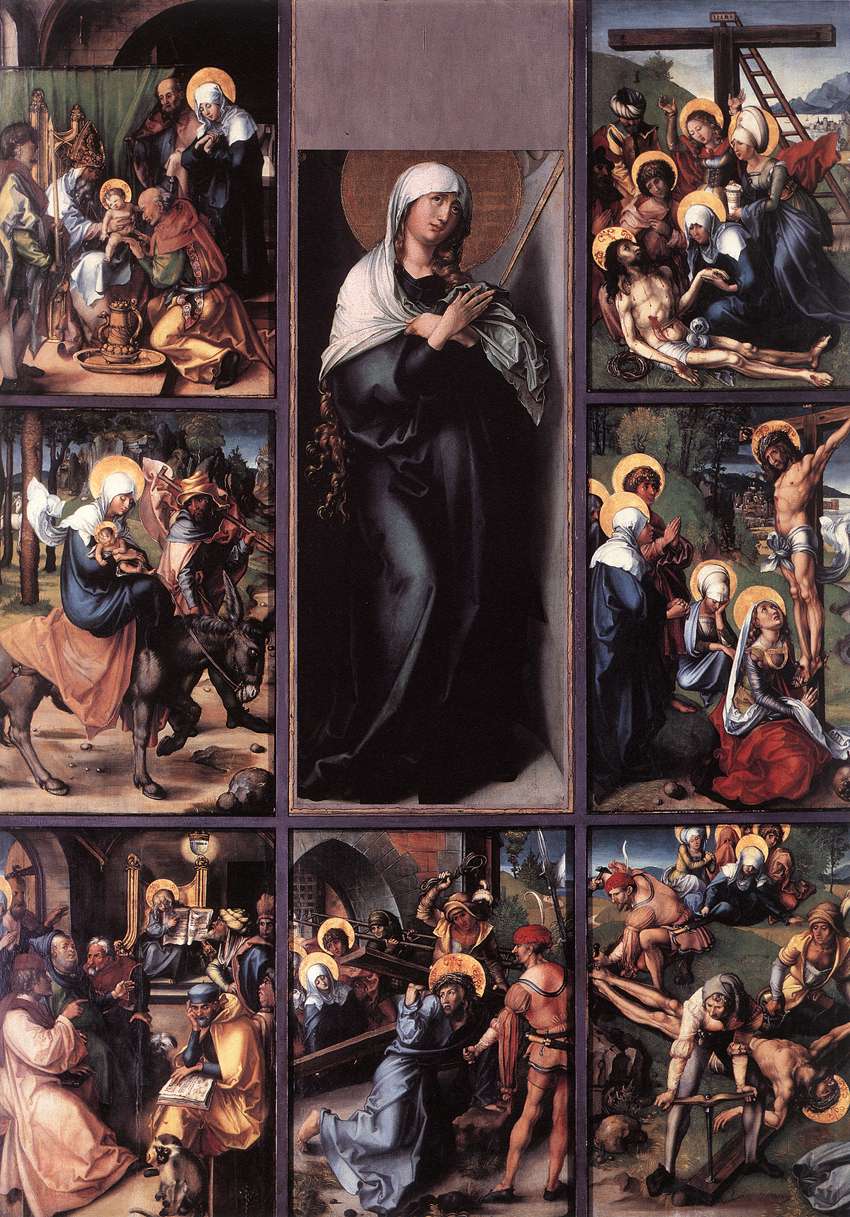
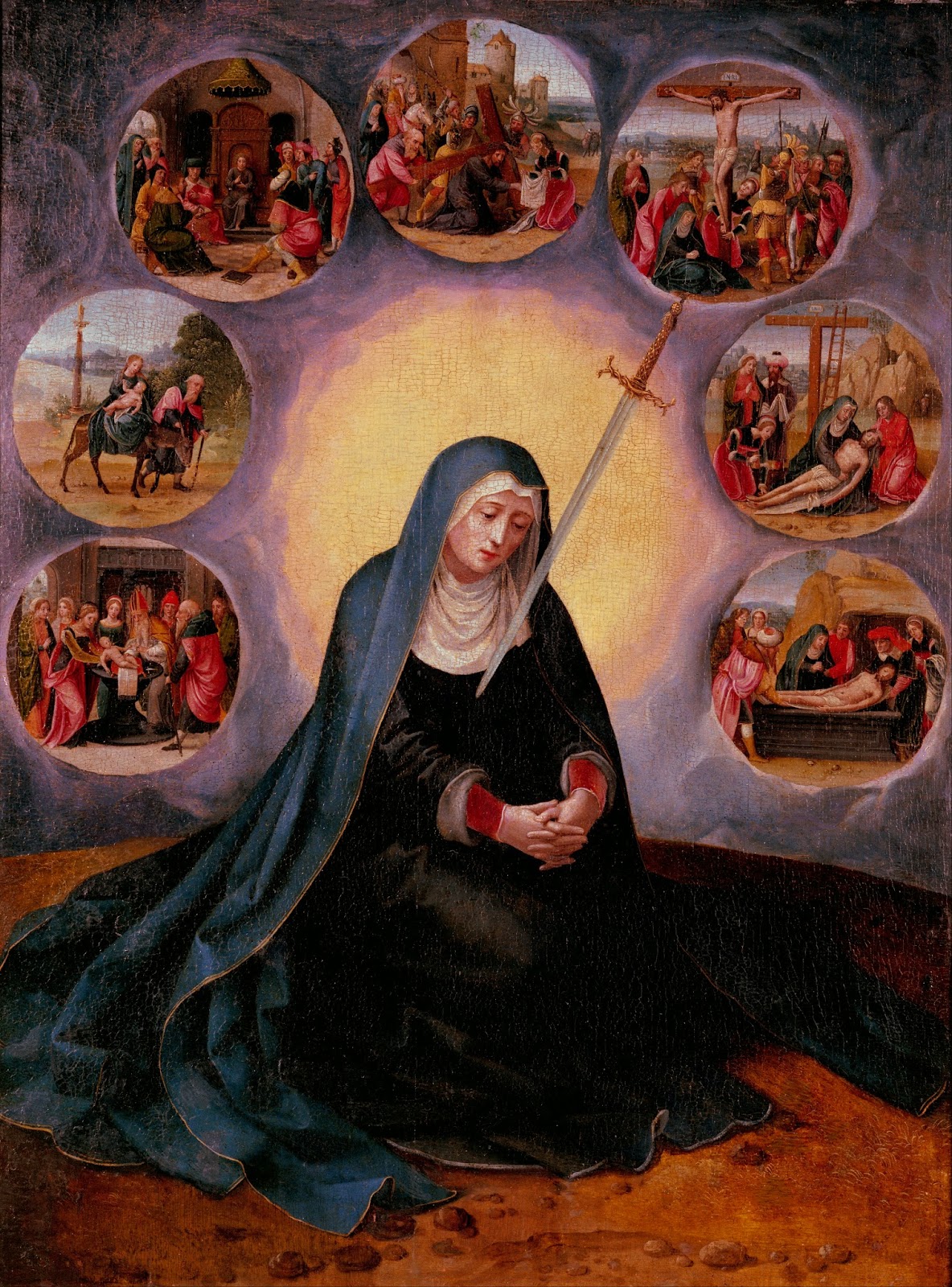
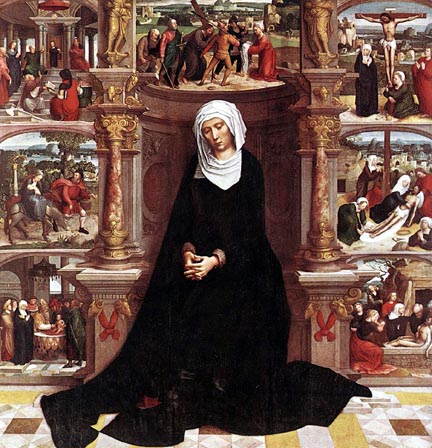
The Seven Sorrows:
• The Prophecy of Simeon over the Infant Jesus (Luke 2:34)
• The Flight into Egypt of the Holy Family (Matthew 2:13)
• The Loss of the Child Jesus for Three Days (Luke 2:43)
• The Meeting of Jesus and Mary along the Way of the Cross (Luke 23:26)
• The Crucifixion, where Mary stands at the foot of the cross (John 19:25)
• The Descent from the Cross, where Mary receives the dead body of Jesus in her arms (Matthew 27:57)
• The Burial of Jesus (John 19:40)

The day after the Feast of the Exaltation of the Holy Cross, Holy Mother Church has us look at Christ’s Mother beneath the Cross. The voice of the liturgy invites us to consider her sorrow: “Ó all ye who pass by the way, attend and see if there be any sorrow like to my sorrow.” Above all, this solemn day shows us Mary on Calvary and reminds us of that supreme sorrow among all the sorrows that ran through the life of Our Lady. The Church gave this feast the title of Seven Sorrows because this number (seven) expresses the idea of totality and universality.
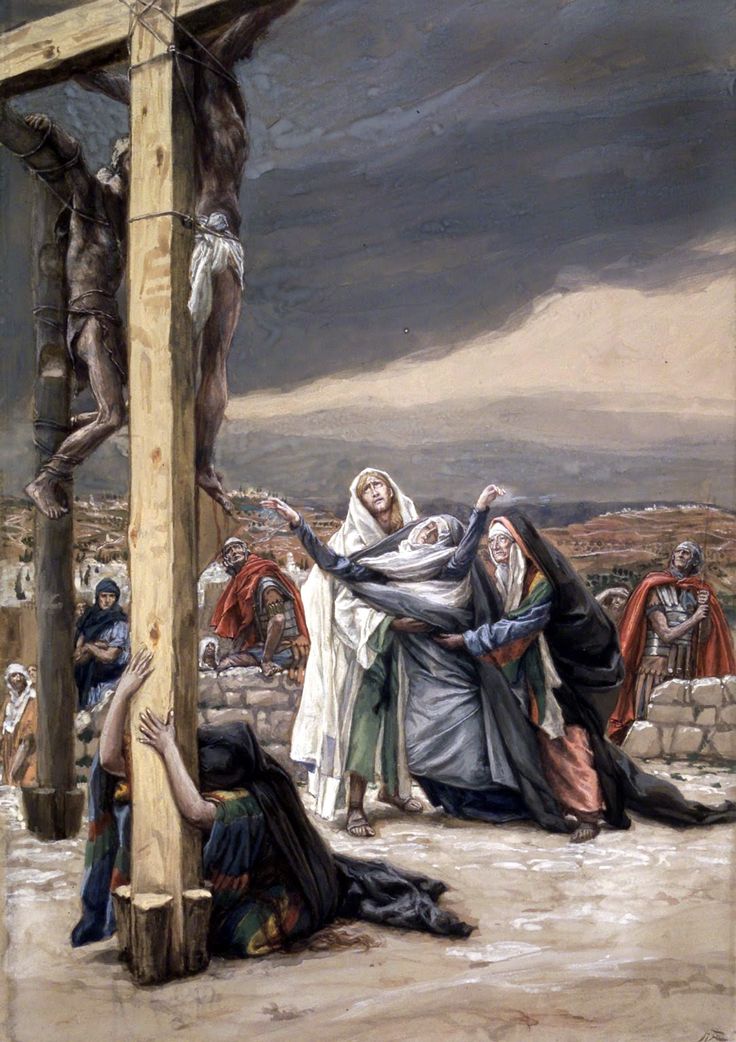

As the octave of the Nativity of Our Lady ends, the consideration of her suffering would not normally come to the mind of the faithful. But if someone would ask about the future of this child, we would recall that before being proclaimed blessed by all nations, Mary would suffer with her Son for the salvation of the world.
The sorrow of Our Lady is a work of God. He was the One who destined her to be the Mother of His Son. Therefore, He indissolubly united her to the Person, life, mysteries and sufferings of Jesus in order to make her His faithful companion in the work of Redemption. Suffering has to be a great gift, because God gave it to His Son and to the creature He loves more than any other after Him, Our Lady. He gave it as a most precious gift.
For Mary the suffering did not start at Calvary, but with Jesus, “that incommodious child,” as Bossuet called Him, because wherever He went, He entered with His Cross and with His thorns which He distributes to those He loves.
The prophecy of the aged Simeon, the flight into Egypt, the loss of the Divine Child in Jerusalem, to see her Son carrying the Cross, His Crucifixion, the taking down from the Cross, and the burial of Jesus: these are the seven mysteries into which are grouped the almost infinite sufferings which made Our Lady the Queen of Martyrs, the first and loveliest rose in the garden of the Spouse.
To understand the extent and intensity of the suffering of Our Lady, we need to understand the extent and intensity of her love for Jesus because her love increased her suffering. Nature and grace concurred to produce in Mary’s heart profound impressions. Nothing is stronger by nature than the love a mother has for her son, and by grace the love one has for God.
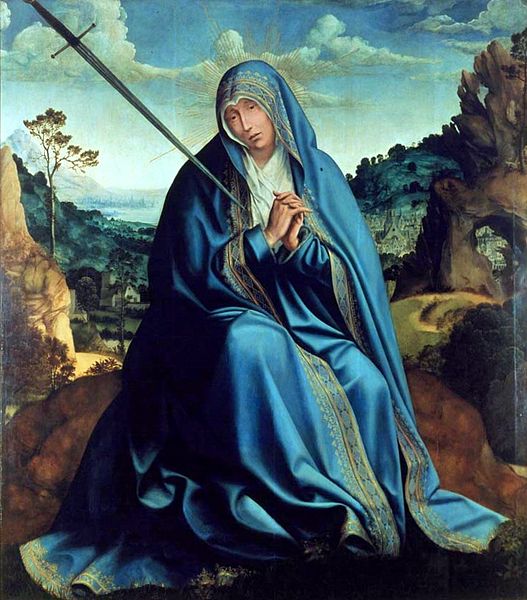
St. Bernard ((1090-1153)) wrote, “Truly, O Blessed Mother, a sword has pierced your heart…. He died in body through a love greater than anyone had known. She died in spirit through a love unlike any other since His”. (De duodecim praerogatativs BVM).
Focusing on the compassion of our Blessed Mother, St Pope John Paul II, reminded the faithful, “Mary Most Holy goes on being the loving consoler of those touched by the many physical and moral sorrows which afflict and torment humanity. She knows our sorrows and our pains because she too suffered, from Bethlehem to Calvary. ‘And they soul too a sword shall pierce.’ Mary is our Spiritual Mother and the mother always understands her children and consoles them in their troubles. Then, she has that specific mission to love us, received from Jesus on the Cross, to love us only and always, so as to save us! Mary consoles us above all by pointing out the Crucified One and Paradise to us!” (1980).
Therefore, as we honour our Blessed Mother, our Lady of Sorrows, we honour her as the faithful disciple and exemplar of faith. Let us pray as we do in the opening prayer of the Mass for this feast day: Father, as your Son was raised on the cross, His Mother Mary stood by Him, sharing His sufferings. May your Church be united with Christ in His suffering and death and so come to share in His rising to new life. Looking to the example of Mary, may we too unite our sufferings to our Lord, facing them with courage, love and trust.


Our Lady of Sorrows and Memorials of the Saints – 15 September
Our Lady of Sorrows (Memorial)
—
St Aichardus
St Albinus of Lyon
Bl Anton Maria Schwartz
St Aprus of Toul
St Bond of Sens
St Catherine of Genoa
Bl Camillus Constanzo
St Emilas of Cordoba
St Eutropa of Auvergne
St Hernan
Bl Jacinto de Los Ángeles and Bl Juan Bautista
St Jeremias of Cordoba
St Joseph Abibos
St Mamillian of Palermo
St Melitina
St Mirin of Bangor
St Nicetas the Goth
St Nicomedes of Rome
Bl Paolo Manna
St Porphyrius the Martyr
St Ribert
St Ritbert of Varennes
Bl Rolando de Medici
Bl Tommasuccio of Foligno
St Valerian of Châlon-sur-Saône
St Valerian of Noviodunum
St Vitus of Bergamo
Bl Wladyslaw Miegon
—
Martyrs of Adrianopolis – 3 saints: Three Christian men martyred together in the persecutions of Maximian – Asclepiodotus, Maximus and Theodore. They were martyred in 310 at Adrianopolis (Adrianople), a location in modern Bulgaria.
Martyrs of Noviodunum – 4 saints: Three Christian men martyred together, date unknown – Gordian, Macrinus, Stratone and Valerian.
They were martyred in Noviodunum, Lower Moesia (near modern Isaccea, Romania).
Mercedarian Martyrs of Morocco – 6 beati: A group of six Mercedarians who were captured by Moors near Valencia, Spain and taken to Morocco. Though enslaved, they refused to stop preaching Christianity. Martyrs. – Dionisio, Francis, Ildefonso, James, John and Sancho. They were crucified in 1437 in Morocco.
Martyred in the Spanish Civil War:
Bl Antonio Sierra Leyva
Bl Pascual Penades Jornet
Thought for the Day – 14 September – Feast of the Exaltation of the Holy Cross/Triumph of the Cross
Thought for the Day – 14 September – Feast of the Exaltation of the Holy Cross
Christians “exalt” (raise on high) the Cross of Christ as the instrument of our salvation. Adoration of the Cross is, thus, adoration of Jesus Christ, the God Man, who suffered and died on this Roman instrument of torture for our redemption from sin and death. The cross represents the One Sacrifice by which Jesus, obedient even unto death, accomplished our salvation. The cross is a symbolic summary of the Passion, Crucifixion and Resurrection of Christ — all in one image.
The Cross — because of what it represents — is the most potent and universal symbol of the Christian faith. It has inspired both liturgical and private devotions: for example, the Sign of the Cross, which is an invocation of the Holy Trinity; the “little” Sign of the Cross on head, lips and heart at the reading of the Gospel; praying the Stations (or Way) of the Cross; and the Veneration of the Cross by the faithful on Good Friday by kissing the feet of the image of Our Saviour crucified.
Placing a crucifix (the cross with an image of Christ’s body upon it) in churches and homes, in classrooms of Catholic schools and in other Catholic institutions, or wearing this image on our persons, is a constant reminder — and witness — of Christ’s ultimate triumph, His victory over sin and death through His suffering and dying on the Cross. (Fr FRANCISCO NASCIMENTO)
We adore You Christ and we praise You, for by Your holy Cross You have redeemed the world.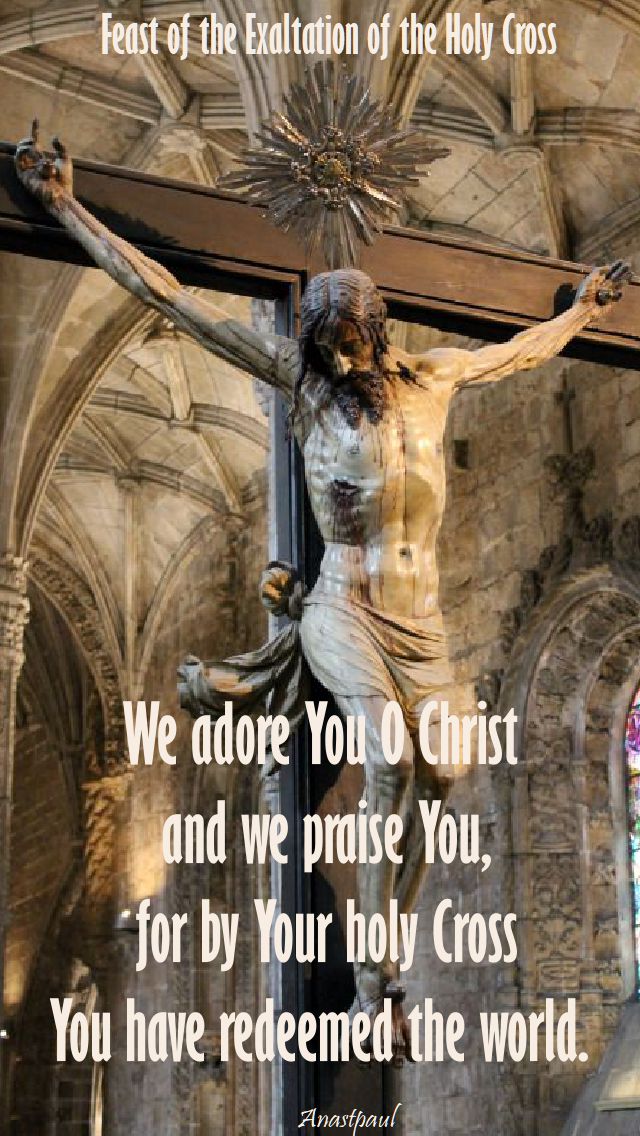
Quote/s of the Day – 14 September – Feast of the Exaltation of the Holy Cross/Triumph of the Cross
Quote/s of the Day – 14 September – Feast of the Exaltation of the Holy Cross
“Everything is a reminder of the Cross.
We ourselves are made in the shape of a cross.”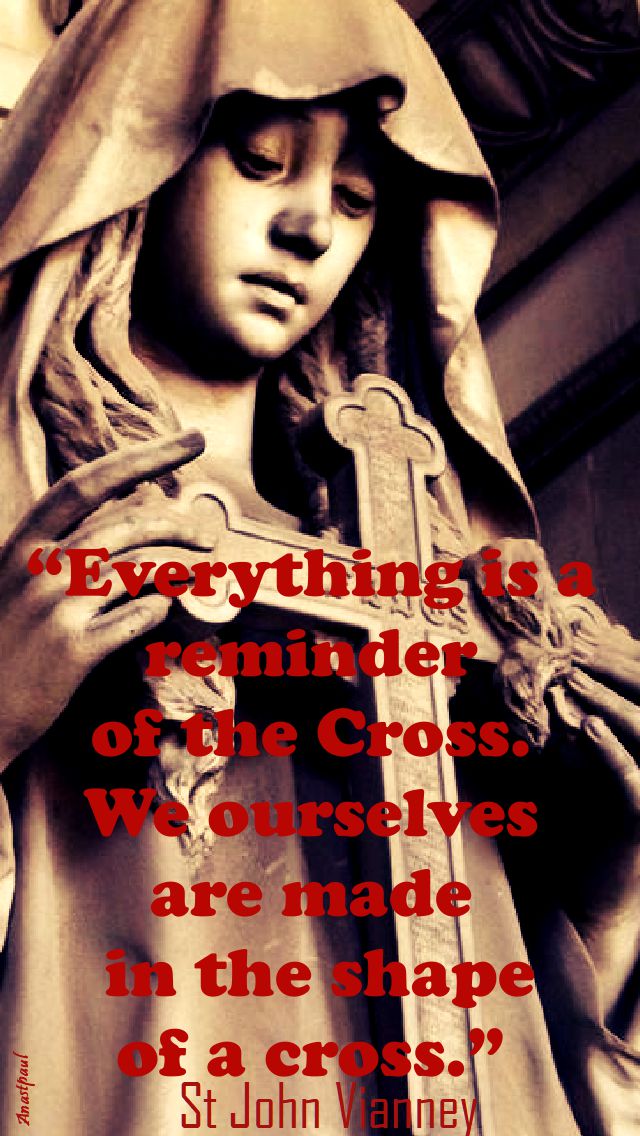
“You must accept your cross.
If you bear it courageously,
it will carry you to heaven.”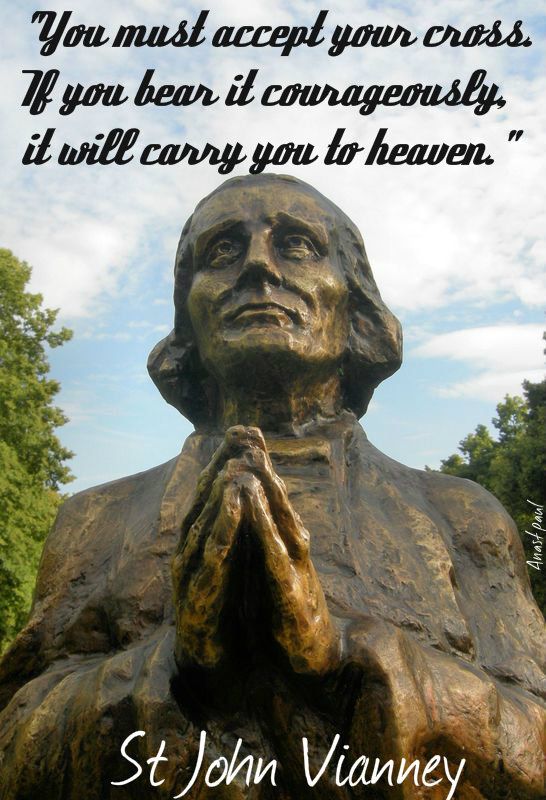
“The sign of the cross
is the most terrible weapon
against the devil.
Thus the Church wishes not only,
that we have it continually
in front of our minds,
to recall to us
just what our souls are worth
and what they cost Jesus Christ
but also that we should make it
at every juncture ourselves:
when we go to bed,
when we awaken during the night,
when we get up,
when we begin any action,
and, above all,
when we are tempted.”
St John Vianney
“Oh cherished cross!
Through thee my most bitter trials
are replete with graces!”
St Paul of the Cross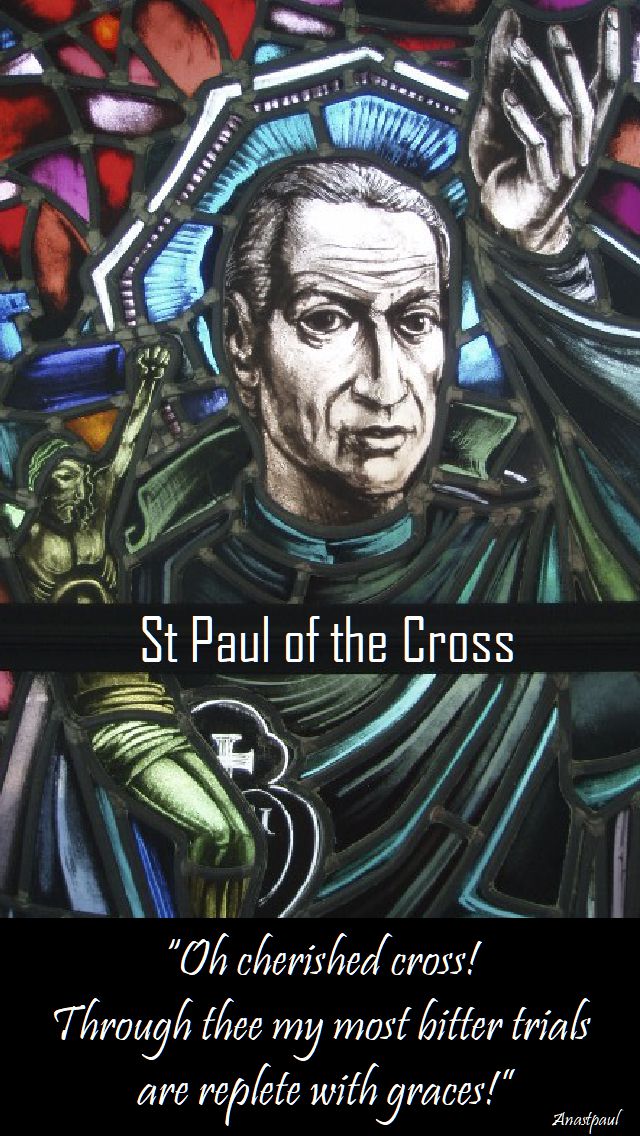
“In the Cross is salvation;
in the Cross is life;
in the Cross is protection against our enemies;
in the Cross is infusion of heavenly sweetness;
in the Cross is strength of mind;
in the Cross is joy of spirit;
in the Cross is excellence of virtue;
in the Cross is perfection of holiness.
There is no salvation of soul,
nor hope of eternal life,
save in the Cross.”
Fr Thomas à Kempis, The Inner Life
“The everlasting God has in His wisdom
foreseen from eternity the cross He now
presents to you as a gift from His inmost heart.
The cross He now sends you He has considered
with His all-knowing eyes, understood with His divine mind,
tested with His wise justice, warmed with loving arms
and weighed with His own hands to see that it is not
one inch too large nor one ounce too heavy for you.
He has blessed it with His holy name,
anointed it with His grace,
perfumed it with His consolation,
taken one last glance at you and your courage
and then sent it to you from heaven,
a special greeting from God to you,
an alms of the all-merciful love of God.”
St Francis de Sales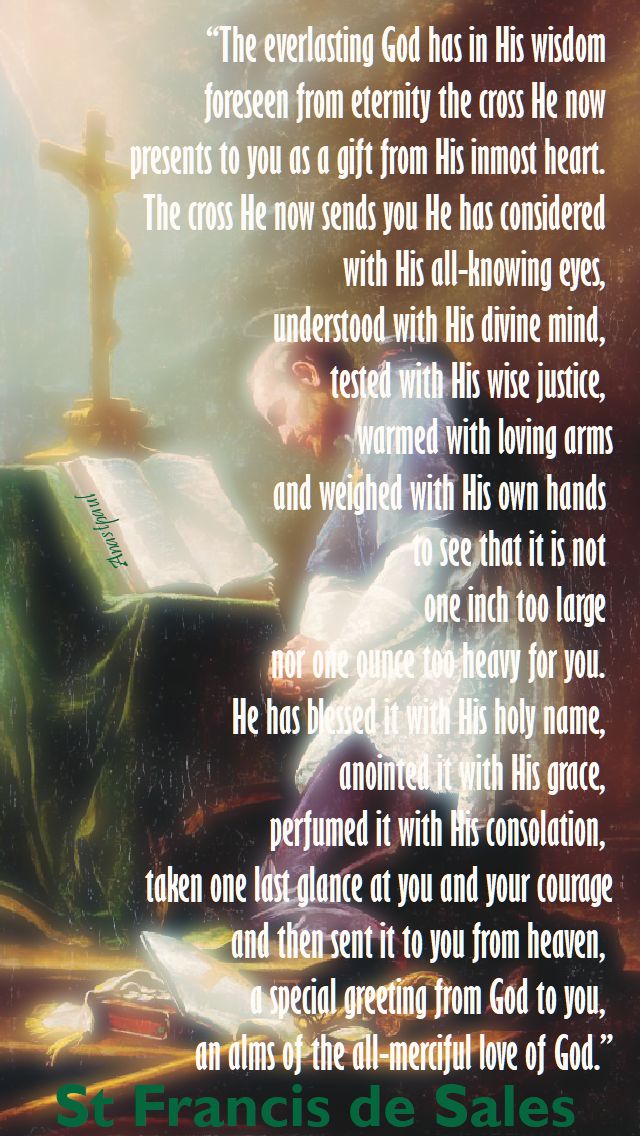
NOVENA to St Padre Pio/St Pius of Pietrelcina – DAY ONE – 14 September
NOVENA to St Padre Pio/St Pius of Pietrelcina – DAY ONE – 14 September
St Padre Pio you have said:
“Jesus keeps nothing for Himself of what is done for love of Him, and He will repay us very lavishly.
Don’t let us make our happiness depend on enjoying wonderful health,
or else we should be just like those foolish worldly people to whom it is not given to know the secrets of heaven….
Continue to love Jesus and make an effort to love Him more and more,
without wanting to know anything else, He alone will steer us to the haven of salvation.”
Let us Pray:
Gracious God,
You generously blessed Your servant, Padre Pio, with the gifts of the Spirit.
You marked his body with the five wounds of Christ Crucified,
as a powerful witness to the saving Passion and Death of Your Son
and as a stirring inspiration to many people of Your infinite mercy, forgiveness and love.
In the confessional, Padre Pio laboured endlessly for the salvation of souls.
Through his powerful intercession, many who suffered were healed of sickness and disease.
Endowed with the gift of discernment, he could read people’s hearts.
With dignity and intense devotion, he celebrated daily Mass,
inviting countless men and women to a greater union with Jesus Christ,
in the Sacrament of the Holy Eucharist.
Through the intercession of Saint Pio,
we confidently beseech You to to grant us the grace of
………………… (state your petition here).
Help us to imitate his example of prayerful holiness and compassion,
so that we, too, may faithfully follow the Risen Lord
and one day rejoice in the Kingdom,
where You live and reign forever and ever. Amen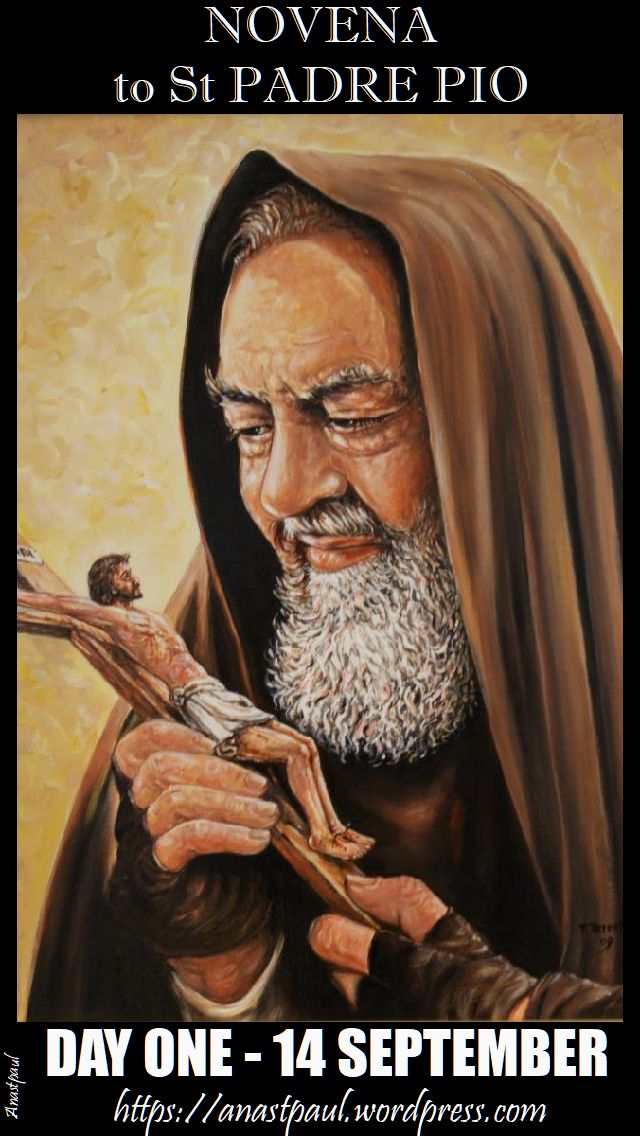
One Minute Reflection – 14 September – Feast of the Exaltation of the Holy Cross/Triumph of the Cross
One Minute Reflection – 14 September – Feast of the Exaltation of the Holy Cross
We proclaim Christ – yes, Christ nailed to the cross; and though it is a stumbling-block to Jews and folly to Greeks, yet to those who have heard his call, Jews and Greeks alike, he is the power of God and the wisdom of God...1 Corinthians 1:23-24
REFLECTION – “We are celebrating the Feast of the Cross which drove away darkness and brought in the light… Had there been no Cross, Christ could not have been Crucified. Had there been no Cross, Life Itself could not have been nailed to the tree. And if Life had not been nailed to it, there would be no streams of immortality pouring from Christ’s side, blood and water for the world’s cleansing. The legal bond of our sin would not be cancelled, we should not have obtained our freedom, we should not have enjoyed the fruit of the tree of life and the Gates of Paradise would not stand open. Had there been no Cross, death would not have been trodden underfoot, nor hell despoiled… The Cross is called Christ’s glory; it is saluted as His triumph!”….St Andrew of Crete (c660-740)
PRAYER – O God, who willed that your Only Begotten Son should undergo the Cross to save the human race, grant, we pray, that we, who have known his mystery on earth, may merit the grace of his redemption in heaven.
For you placed the salvation of the human race on the wood of the Cross, so that, where death arose, life might again spring forth and the evil one, who conquered on a tree, might likewise on a tree be conquered through Christ. O cross, you are the glorious sign of victory. Through your power may we share in the triumph of Christ Jesus.
We adore you Christ and we praise you, for by your holy Cross you have redeemed the world. Amen
Our Morning Offering – 14 September – Feast of the Exaltation of the Holy Cross/Triumph of the Cross
Our Morning Offering – 14 September – Feast of the Exaltation of the Holy Cross
Traditional Prayer to the Holy Cross
Hail, O Holy Cross!
my light and my strength!
Hail, standard of peace empurpled by the Blood of Jesus
and ornamented by His Sacred Members
as with precious stones!
O Venerable Cross, work of the love of God
and the cruelty of men!
O Cross, the terror of Hell and the object of the veneration
of Heaven and earth,
receive the homage of my faith,
my gratitude
and my love!
I consecrate myself entirely to You
and I attach myself to You forever,
as my Saviour was attached to You
for love of me.
I earnestly beseech You, in virtue of the Precious Blood
which empurpled You,
to take me under Your protection,
to be my support in suffering,
my strength in temptation,
my counsel in doubt,
my light in darkness,
my rule of conduct during life,
my confidence and pledge of salvation at the hour of death.
May Jesus, the Incarnate God, Our Saviour,
Who shed His Blood when nailed to You,
protect me through You
and conduct me to my Heavenly home! Amen
Feast of the Exaltation of the Holy Cross/Triumph of the Holy Cross – 14 September
Feast of the Exaltation of the Holy Cross – 14 September, also called Feast of the Triumph of the Cross and Holy Cross Feast.
This feast was observed in Rome before the end of the seventh century. It commemorates the recovery of the Holy Cross, which had been placed on Mount Calvary by St Helena and preserved in Jerusalem but then had fallen into the hands of Chosroas, King of the Persians. The precious relic was recovered and returned to Jerusalem by Emperor Heralius in 629.
The lessons from the Breviary tell us that Emperor Heraclius carried the Cross back to Jerusalem on his shoulders. He was clothed with costly garments and with ornaments of precious stones. But at the entrance to Mount Calvary a strange incident occurred. Try as hard as he would, he could not go forward. Zacharias, the Bishop of Jerusalem, then said to the astonished monarch: “Consider, O Emperor, that with these triumphal ornaments you are far from resembling Jesus carrying His Cross.” The Emperor then put on a penitential garb and continued the journey.
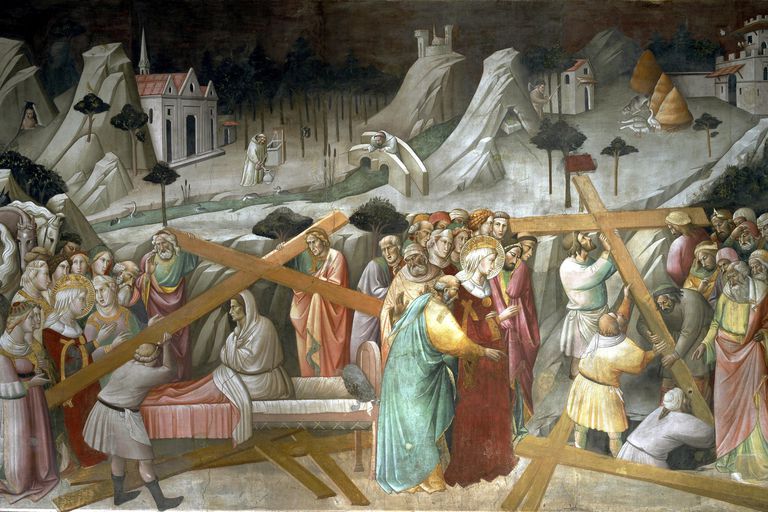
In celebration of the discovery of the Holy Cross, Constantine ordered the construction of churches at the site of the Holy Sepulchre and on Mount Calvary. Those churches were dedicated on September 13 and 14, 335 and shortly thereafter the Feast of the Exaltation of the Holy Cross began to be celebrated on the latter date.
The feast slowly spread from Jerusalem to other churches, until, by the year 720, the celebration was universal.


The liturgy of the Cross is a triumphant liturgy. When Moses lifted up the bronze serpent over the people, it was a foreshadowing of the salvation through Jesus when He was lifted up on the Cross. Our Mother Church sings of the triumph of the Cross, the instrument of our redemption. To follow Christ we must take up His cross, follow Him and become obedient until death, even if it means death on the cross. We identify with Christ on the Cross and become co-redeemers, sharing in His suffering and Cross.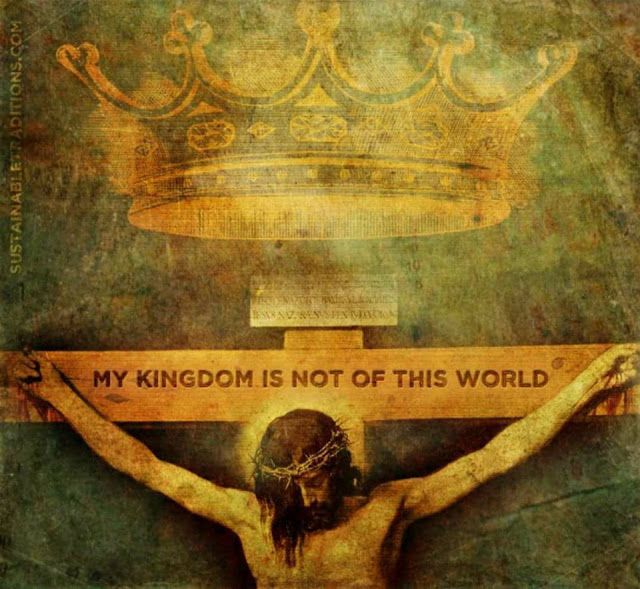

We make the Sign of the Cross before prayer which helps to fix our minds and hearts to God. After prayer we make the Sign of the Cross to keep close to God. During trials and temptations our strength and protection is the Sign of the Cross. At Baptism we are sealed with the Sign of the Cross, signifying the fullness of redemption and that we belong to Christ. Let us look to the cross frequently, and realize that when we make the Sign of the Cross we give our entire self to God — mind, soul, heart, body, will, thoughts.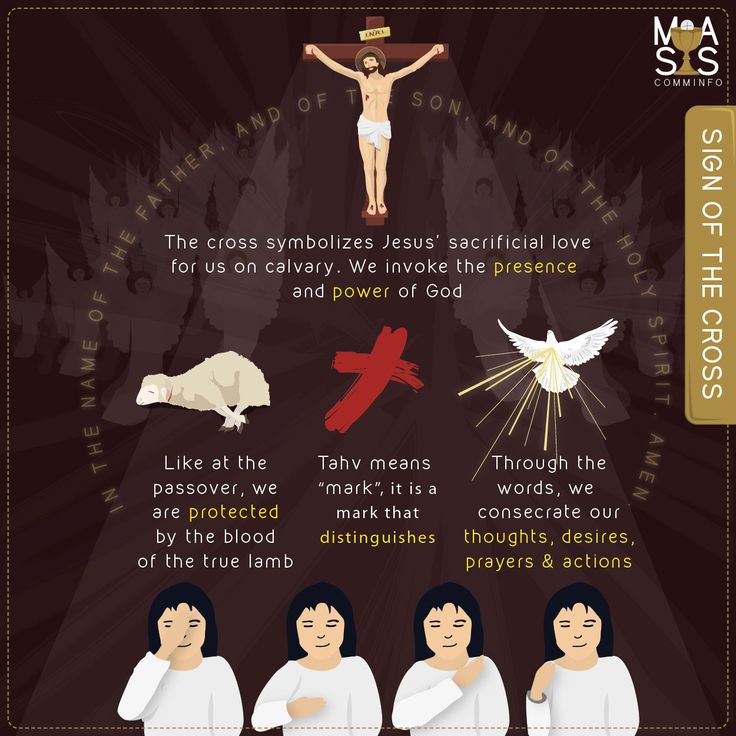
WHY DO WE CELEBRATE THE FEAST OF THE HOLY CROSS?
It’s easy to understand that the Cross is special because Christ used it as the instrument of our salvation. But after His Resurrection, why would Christians continue to look to the Cross? Christ Himself offered us the answer: “If any man will come after me, let him deny himself, and take up his cross daily, and follow me” (Luke 9:23). The point of taking up our own cross is not simply self-sacrifice; in doing so, we unite ourselves to the sacrifice of Christ on His Cross.
When we participate in the Mass, the Cross is there, too. The “unbloody sacrifice” offered on the altar is the re-presentation of Christ’s Sacrifice on the Cross. When we receive the Sacrament of Holy Communion, we do not simply unite ourselves to Christ; we nail ourselves to the Cross, dying with Christ so that we might rise with Him.
“For the Jews require signs, and the Greeks seek after wisdom: but we preach Christ crucified, unto the Jews indeed a stumbling block and unto the Gentiles foolishness . . . ” (1 Corinthians 1:22-23). Today, more than ever, non-Christians see the Cross as foolishness. What kind of Saviour triumphs through death?
For Christians, however, the Cross is the crossroads of history and the Tree of Life. Christianity without the Cross is meaningless: only by uniting ourselves to Christ’s Sacrifice on the Cross can we enter into eternal life.
O cross, you are the glorious sign of victory.
Through your power may we share in the triumph of Christ Jesus.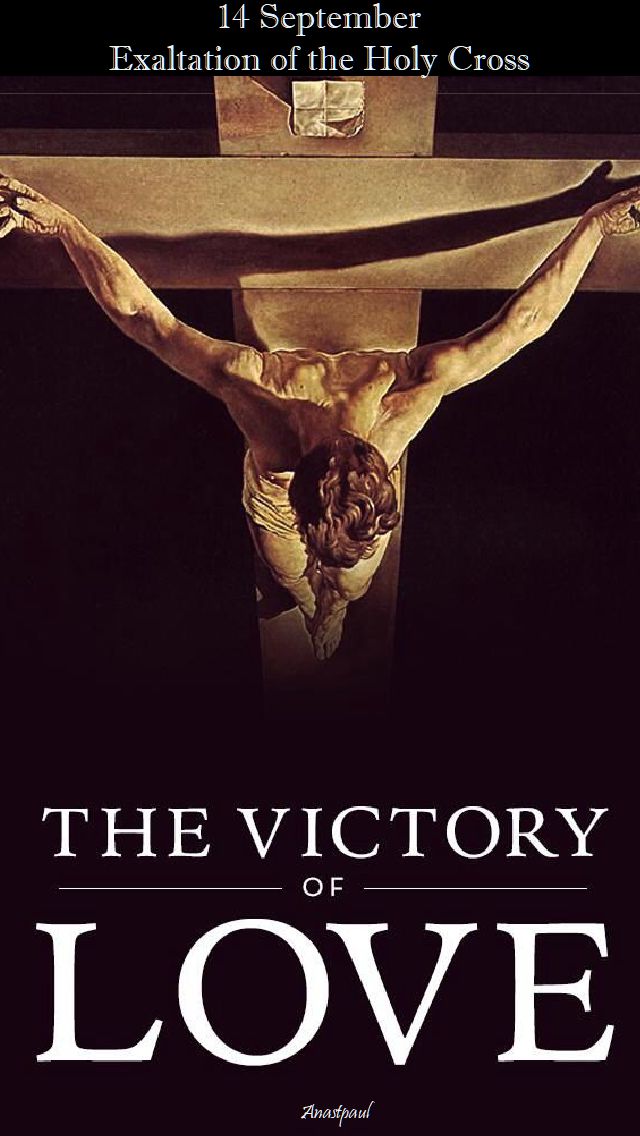

Feast of the Exaltation of the Holy Cross and Memorials of the Saints – 14 September
Exaltation of the Holy Cross (Feast) – https://www.youtube.com/watch?v=qsiOJkpPk7w
—
St Aelia Flaccilla
St Albert of Jerusalem
St Caerealis
Bl Claude Laplace
St Cormac of Cashel
St Crescentian of Carthage
St Crescentius of Rome
St Generalis of Carthage
St Giulia Crostarosa
St Jean Gabriel Taurin du Fresse
St Maternus of Cologne
Bl Notburga
Bl Pedro Bruch Cotacáns
St Rosula of Carthage
St Sallustia
St Victor of Carthage
St John Chrysostom and St Paul – 13 September the Memorial of St John Chrysostum (347-407) of the “Golden Mouth”
St John Chrysostom and St Paul – 13 September the Memorial of St John Chrysostum (347-407) of the “Golden Mouth”
St John Chrysostom and St Paul
John Chrysostom here gives eloquent praise to the passionate love of Christ that drove St. Paul to face persecution and hardship with joy and leave behind the honours and benefits of the world. It is read each year on January 25, the Feast of the Conversion of St. Paul, persecutor turned apostle.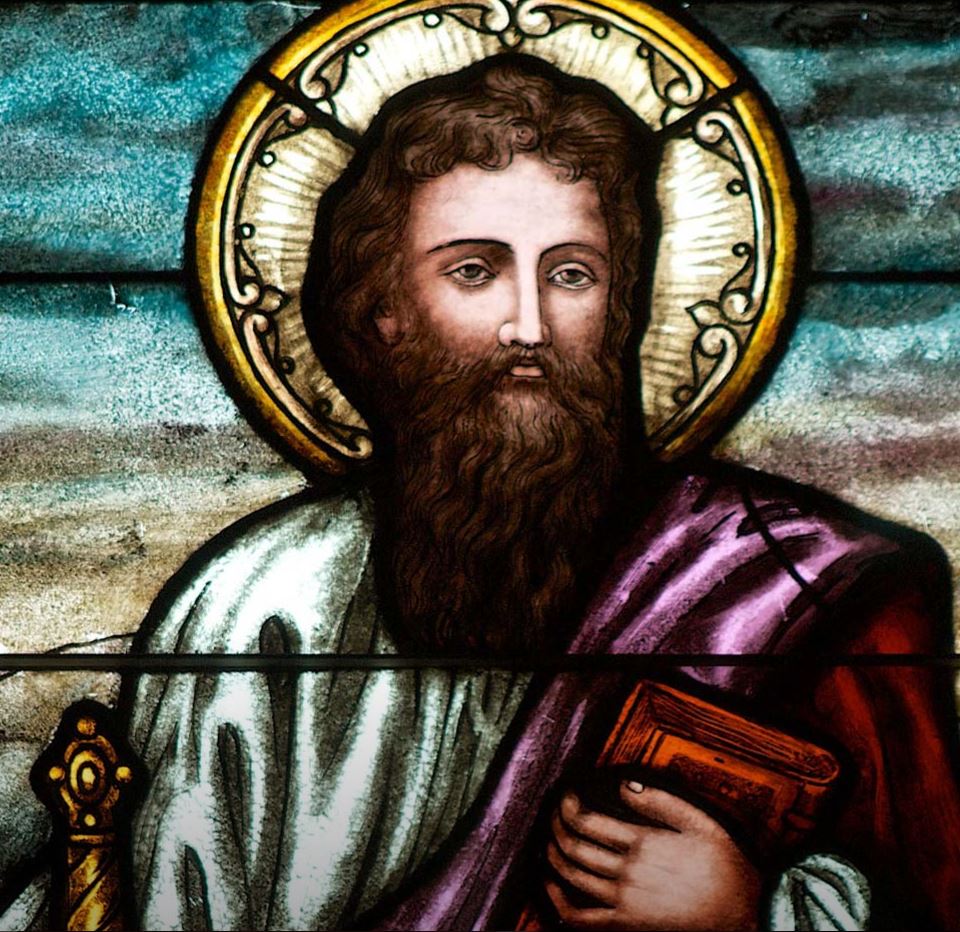
Paul, more than anyone else, has shown us what man really is and in what our nobility consists and of what virtue this particular animal is capable. Each day he aimed ever higher; each day he rose up with greater ardour and faced with new eagerness the dangers that threatened him. He summed up his attitude in the words: “I forget what is behind me and push on to what lies ahead.” When he saw death imminent, he bade others share his joy: “Rejoice and be glad with me!” And when danger, injustice and abuse threatened, he said: “I am content with weakness, mistreatment and persecution.” These he called the weapons of righteousness, thus telling us that he derived immense profit from them.
Thus, amid the traps set for him by his enemies, with exultant heart he turned their every attack into a victory for himself; constantly beaten, abused and cursed, he boasted of it as though he were celebrating a triumphal procession and taking trophies home, and offered thanks to God for it all: “Thanks be to God who is always victorious in us!” This is why he was far more eager for the shameful abuse that his zeal in preaching brought upon him than we are for the most pleasing honours, more eager for death than we are for life, for poverty than we are for wealth; he yearned for toil far more than others yearn for rest after toil. The one thing he feared, indeed dreaded, was to offend God; nothing else could sway him. Therefore, the only thing he really wanted was always to please God.
The most important thing of all to him, however, was that he knew himself to be loved by Christ. Enjoying this love, he considered himself happier than anyone else; were he without it, it would be no satisfaction to be the friend of principalities and powers. He preferred to be thus loved and be the least of all, or even to be among the damned, than to be without that love and be among the great and honoured.
To be separated from that love was, in his eyes, the greatest and most extraordinary of torments the pain of that loss would alone have been hell and endless, unbearable torture. So too, in being loved by Christ he thought of himself as possessing life, the world, the angels, present and future, the kingdom, the promise and countless blessings. Apart from that love nothing saddened or delighted him; for nothing earthly did he regard as bitter or sweet.
Paul set no store by the things that fill our visible world, any more than a man sets value on the withered grass of the field. As for tyrannical rulers or the people enraged against him, he paid them no more heed than gnats. Death itself and pain and whatever torments might come were but child’s play to him, provided that thereby he might bear some burden for the sake of Christ.
This excerpt from a homily preached by St. John Chrysostom around c 400 in praise of St. Paul (Hom. 2 de laudibus sancti Pauli: PG 50, 477-480) is used in the Roman Office of Readings for the Feast of the Conversion of Saint Paul on January 25 with the biblical reading taken from Galatians 1, the story of Paul’s Conversion on the road to Damascus.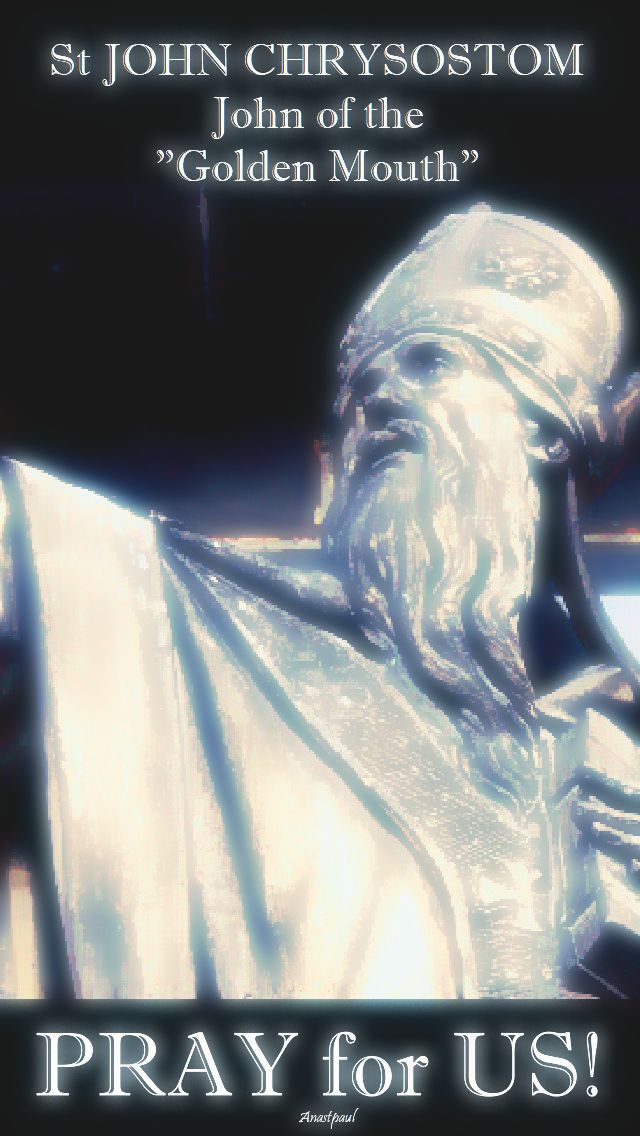
 AnaStpaul
You must be logged in to post a comment.