Posted in EUCHARISTIC Adoration, MORNING Prayers, PRAYERS of the SAINTS, The HOLY EUCHARIST / The HOLY MASS

Our Morning Offering – 18 July

Our Morning Offering – 18 July

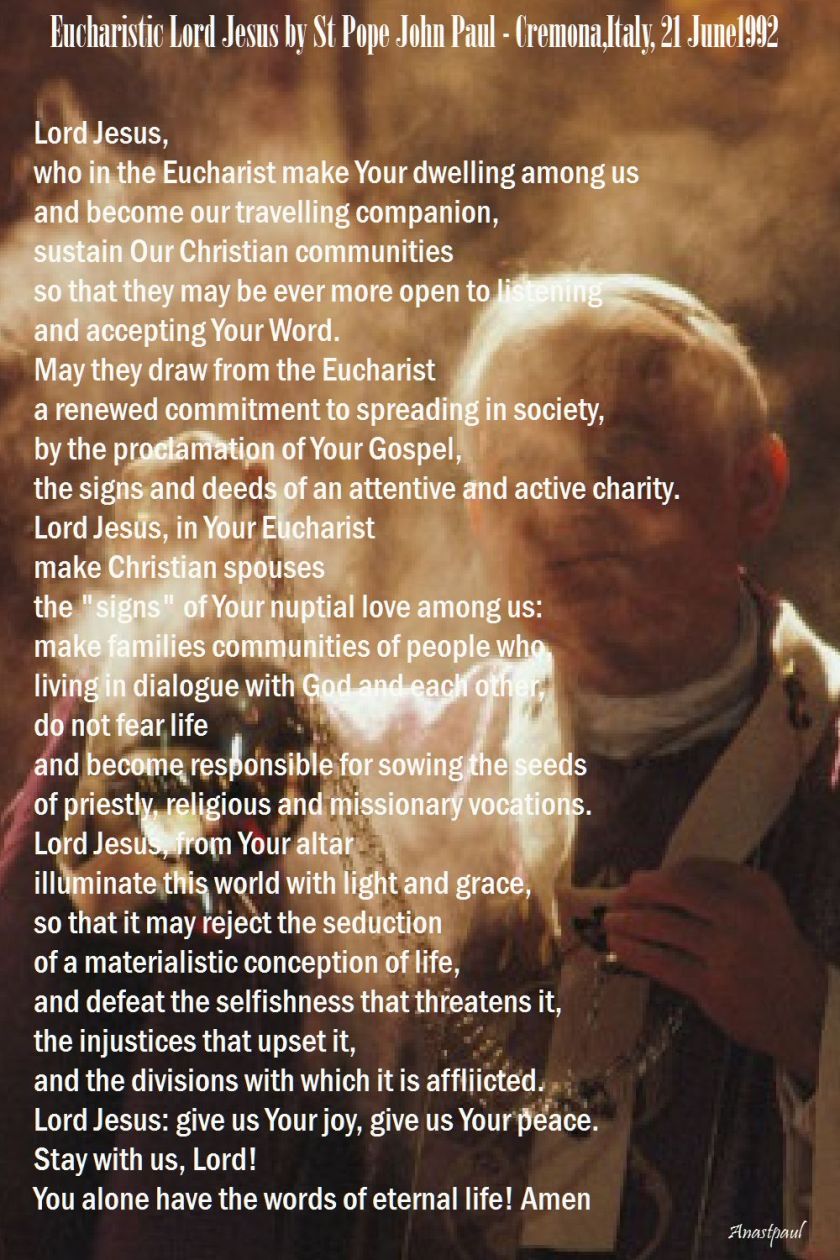
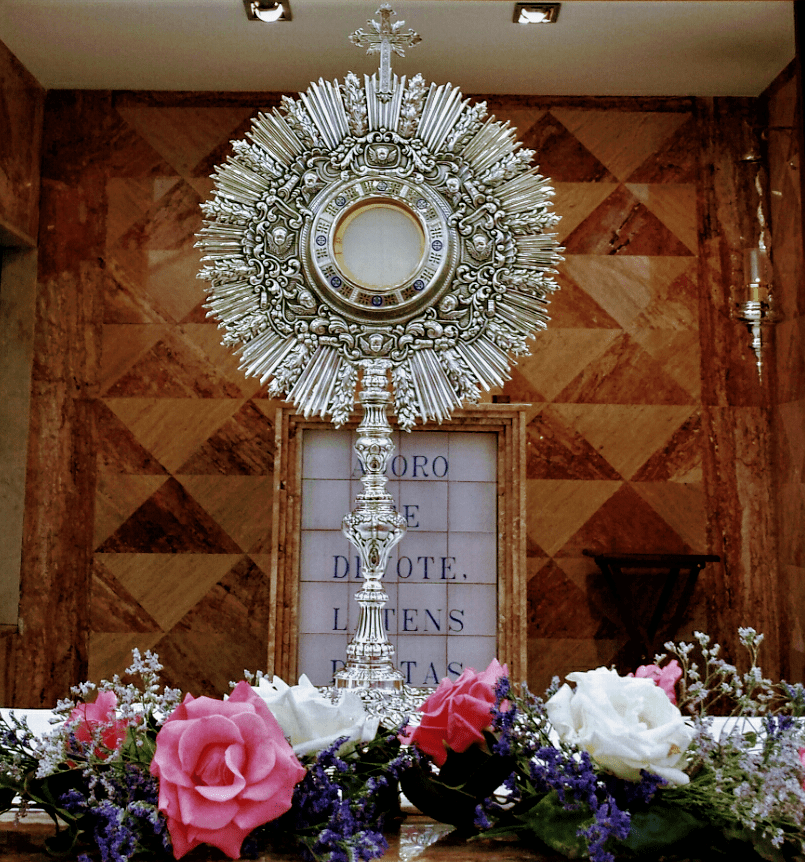
Eucharistic Lord Jesus
St Pope John Paul – Cremona,Italy, June 21,1992

Lord Jesus,
who in the Eucharist make Your dwelling among us
and become our travelling companion,
sustain Our Christian communities
so that they may be ever more open to listening
and accepting Your Word.
May they draw from the Eucharist
a renewed commitment to spreading in society,
by the proclamation of Your Gospel,
the signs and deeds of an attentive and active charity.
Lord Jesus, in Your Eucharist
make Christian spouses
the “signs” of Your nuptial love among us:
make families communities of people who,
living in dialogue with God and each other,
do not fear life
and become responsible for sowing the seeds
of priestly, religious and missionary vocations.
Lord Jesus, from Your altar
illuminate this world with light and grace,
so that it may reject the seduction
of a materialistic conception of life,
and defeat the selfishness that threatens it,
the injustices that upset it,
and the divisions with which it is affliicted.
Lord Jesus: give us Your joy, give us Your peace.
Stay with us, Lord!
You alone have the words of eternal life! Amen

eucharistic lord jesus by st john paul


Posted in DOMINICAN OP, SAINT of the DAY

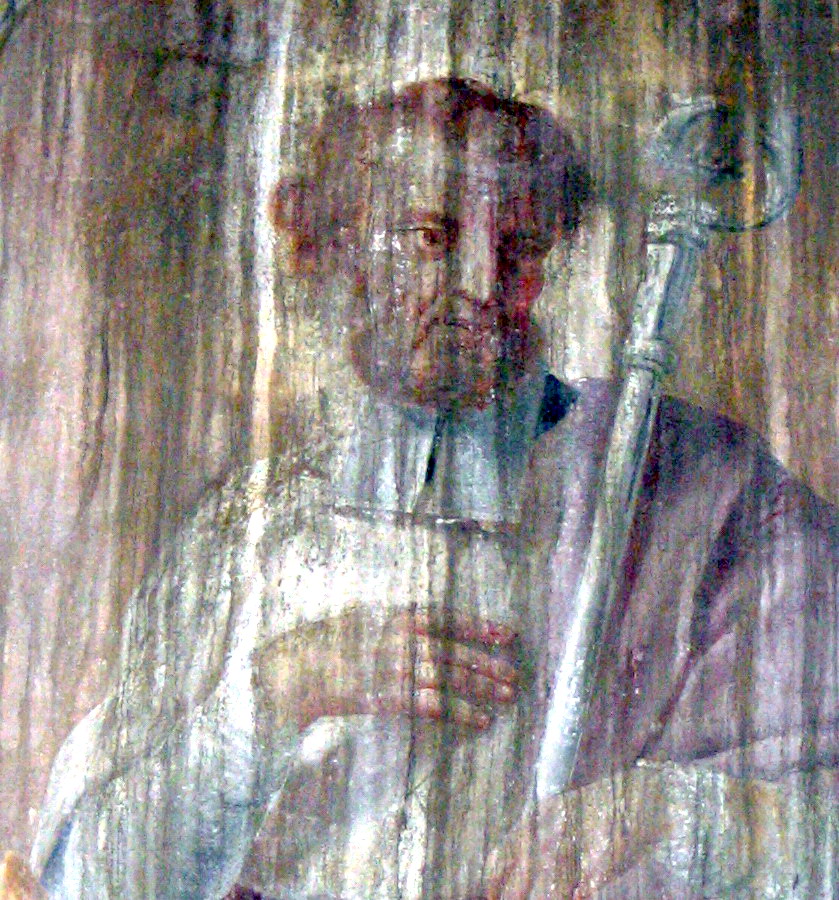
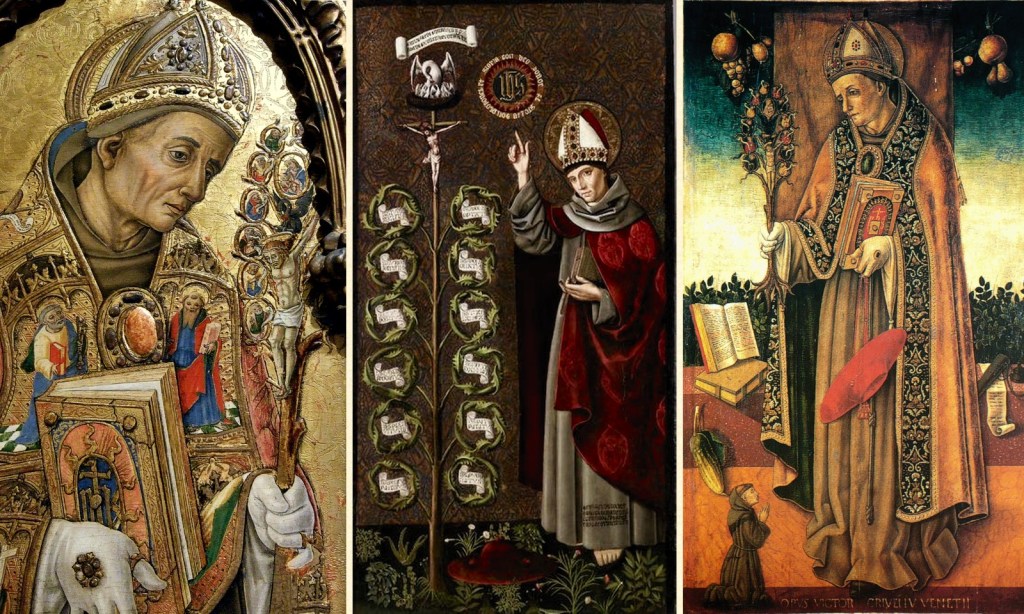
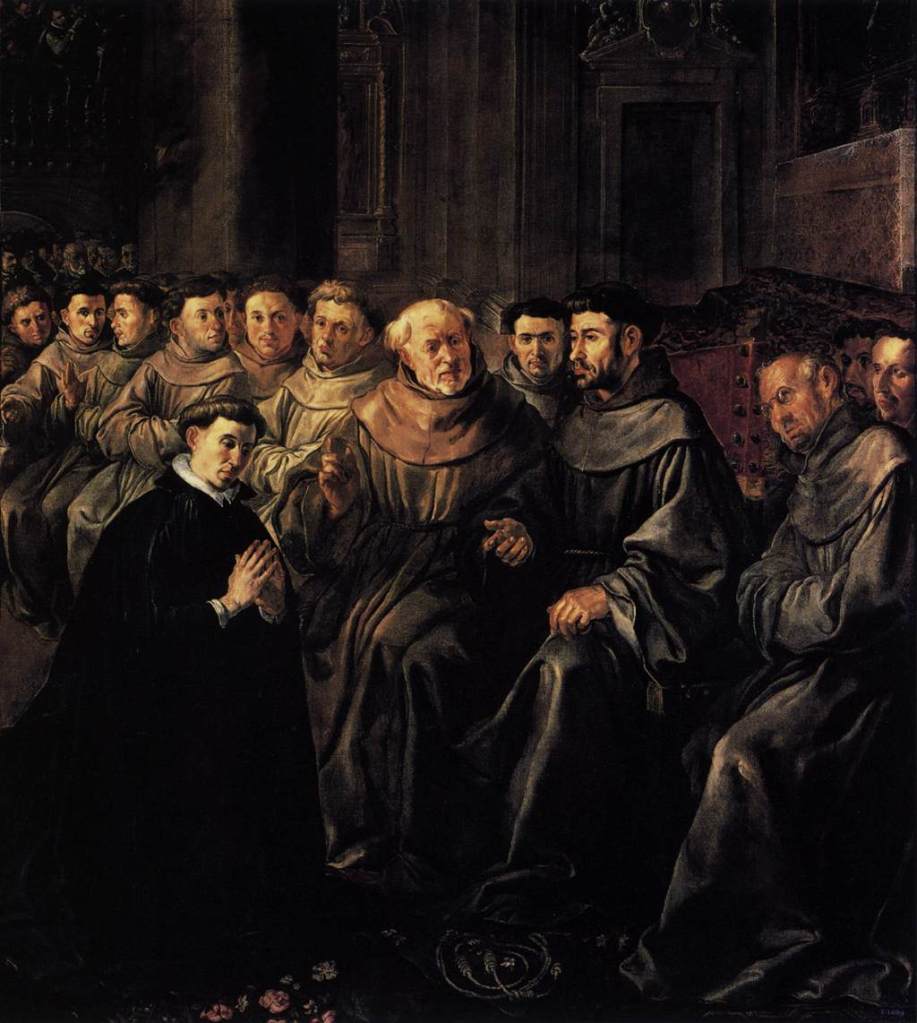
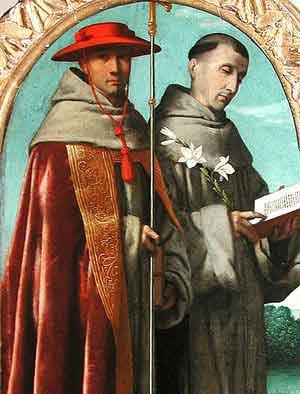
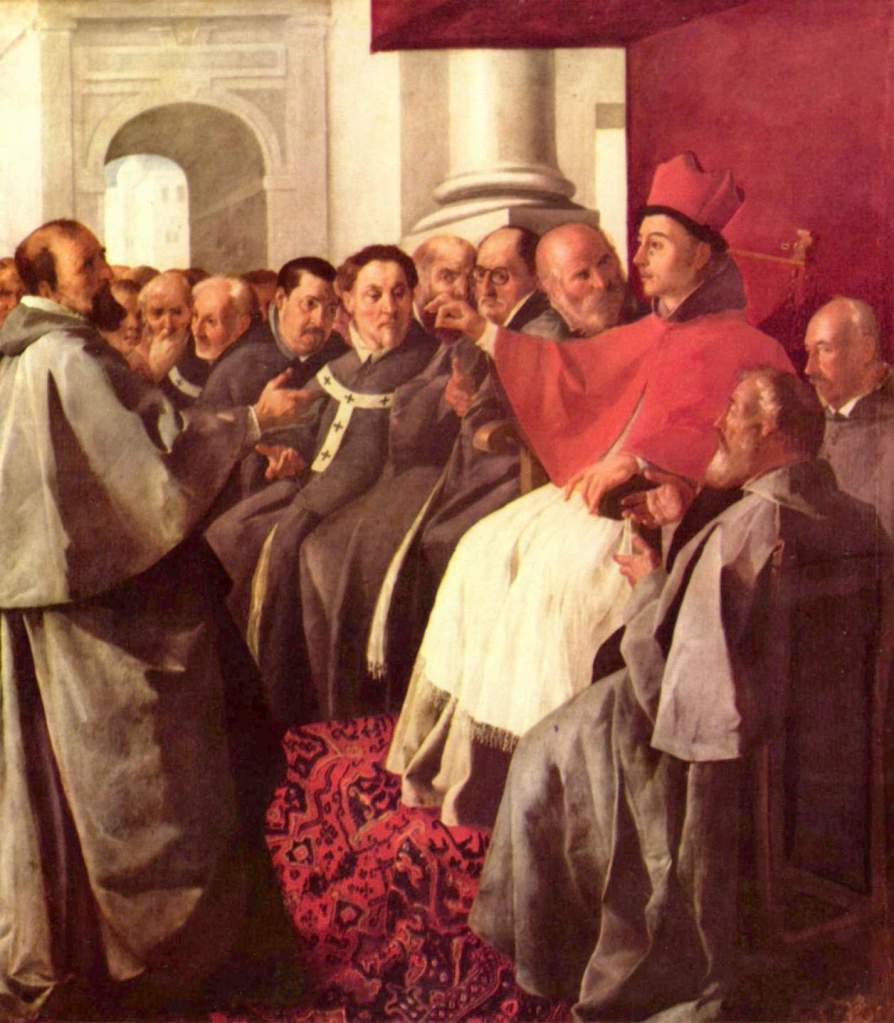
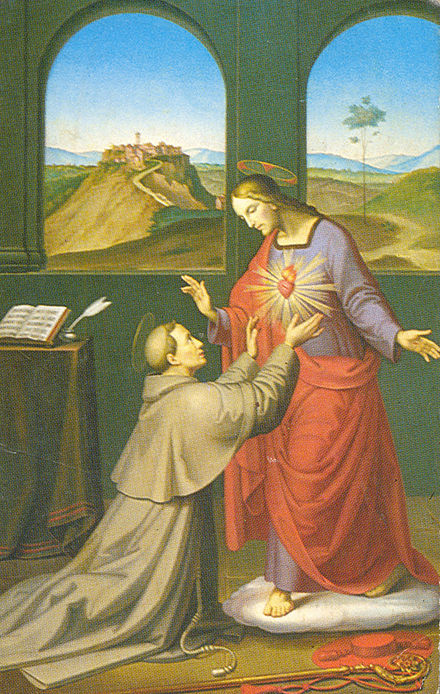
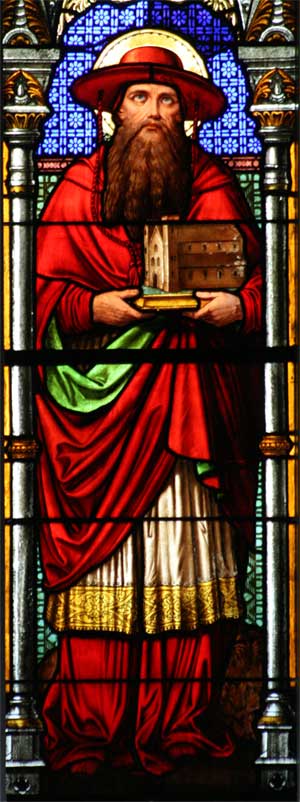
Saint of the Day – 18 July – St Bruno of Segni (1049-1123)

Saint of the Day – 18 July – St Bruno of Segni OSB (1049-1123) – Benedictine Bishop, Confessor, Missionary, Papal Advisor, Theologian, (1049 at Solero, Piedmont, Italy – 1123 of natural causes).   He was Canonised on 5 September 1183 by Pope Lucius III.  Patron of Segni, Italy.

San_Bruno

St Bruno was of the illustrious family of the lords of Asti in Piemont and born near that city.   From his cradle he considered that man’s happiness is only to be found in loving God:  and to please Him in all his actions was his only and his most ardent desire.    He made his studies in the monastery of St Perpetuus, in the diocess of Asti.

In the Roman council in 1079, he defended the doctrine of the Catholic Church concerning the blessed eucharist against Berengarius;   and Pope Gregory VII nominated him bishop of Segni in the ecclesiastical state in 1081.   Bruno, who had been compelled to submit to the appointment, after a long and strenuous resistance, served his flock and on many important occasions the universal church with unwearied zeal.   Gregory VII who died in 1085, Victor III formerly abbot of mount Cassino, who died in 1087 and Urban II who had been scholar to St. Bruno (afterwards institutor of the Carthusians) at Rheims, then a monk at Cluni and afterwards bishop of Ostia, had the greatest esteem for our saint.

He attended Urban II into France in 1095 and assisted at the council of Tours in 1096. After his return into Italy he continued to labour for the sanctification of his soul and that of his flock, till not being able any longer to resist his inclination for solitude and retirement, he withdrew to mount Cassino and put on the monastic habit.   The people of Segni demanded him back;  but Oderisus, abbot of mount Cassino and several cardinals, whose mediation the saint employed, prevailed upon the pope to allow his retreat.   The abbot Oderisus was succeeded by Otho in 1105 and this latter dying in 1107, the monks chose bishop Bruno abbot.   He was often employed by the pope in important commissions and by his writings laboured to support ecclesiastical discipline and to extirpate simony.   This vice he looked upon as the source of all the disorders which excited the tears of all zealous pastors in the church, by filling the sanctuary with hirelings, whose worldly spirit raises an insuperable opposition to that of the gospel.

Paschal II formerly a monk of Cluni, succeeded Urban II in the pontificate in 1099.   By his order St. Bruno having been abbot of mount Cassino about four years, returned to his bishopric and left his abbatial crozier on the altar.  He continued faithfully to discharge the episcopal functions to his death, which happened at Segni on the 31st of August in 1125.   He was canonized by Lucius III in 1183.

The works of St. Bruno of Segni, or of Asti, with a preliminary dissertation of Dom Maur Marchesi, were printed at Venice in 1651, in two vols. folio and in the Bibl. Patr. at Lyons in 1677, t. 20.   They consist of comments on several parts of scripture, one hundred and forty-five sermons, several dogmatical treatises and letters; and a life of St Leo IX and another of St Peter, bishop of Anagnia, whom Paschal II canonised.  Most importantly Bruno’s theologial work on the Holy Eucharist set the standard for centuries and he is considered one of the greatest biblical commentators of his era.

Fr Alban Butler (1711–73). Volume VII: The Lives of the Saints. 1866

Posted in SAINT of the DAY, The BLESSED VIRGIN MARY

Saints’ Memorials and Feast of the Blessed Virgin

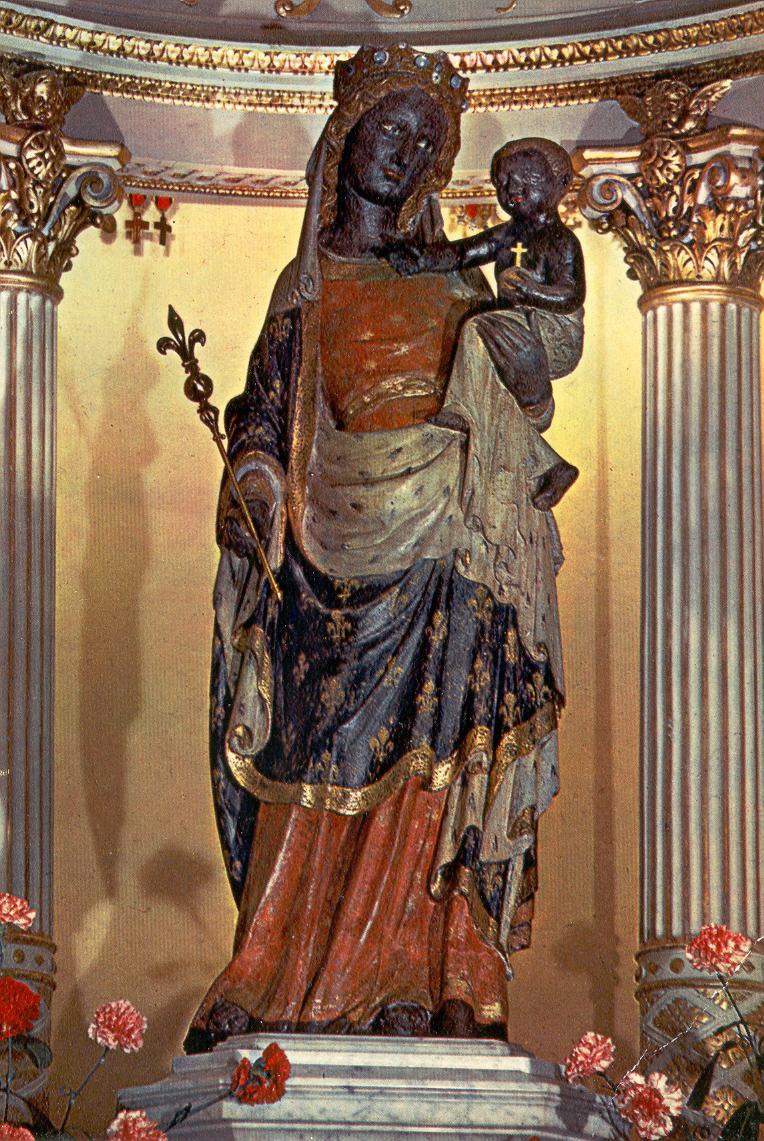
Our Lady of Good Deliverance:   Since the 1000s, the Church of Saint-Etienne-des-Grès in the old Latin Quarter of Paris had a chapel to Our Lady of Good Deliverance, where, across the centuries, pilgrims sought the Virgin’s help with all kinds of sufferings.   During the Wars of Religion and counter-Reformation, her confraternity had 12,000 members, including the King and Queen of France.   In 1587, young Francis de Sales, feeling himself damned, recovered confidence and joy after saying the prayer that had been pasted to a tablet before her statue, the Memorare.
In 1790, the revolutionary government closed the Church of Saint-Etienne-des-Grès. In 1791, when the church’s furnishings were advertised for sale, a devoted countess, Madame de Carignan Saint Maurice, bought the statue of the Black Virgin and moved it to her lodgings in Paris.   The following year, St.-Etienne’s was destroyed.   In 1793, the countess was sent to prison, where she met the Sisters of St. Thomas of Villanova.   They all got out the next year but when the government threatened to disband the Sisters, Mme de Carignan vowed to give them the statue if they were spared.   In 1806, she fulfilled the vow.   The image was installed in the Sisters’ chapel in Paris, moving with them in 1908 to their present motherhouse in the suburb of Neuilly-sur-Seine.
On a pedestal above the altar, the life-size polychrome limestone statue dates from the 1300s:   a classic Gothic standing mother and child, but both coal-black.   The Black Virgin wears a white veil and dark blue mantle ornamented with fleurs-de-lys over a red robe. Every day, the Sisters gather in the chapel to pray on behalf of families, the sick, religious vocations, those who have entrusted themselves to the Virgin and peace in the world.
The feast of Our Lady of Good Deliverance, is set for July 18, the date when the Vatican officially approved the congregation of Soeurs de Saint Thomas de Villenueve in 1873. The May 1 procession formerly held by her confraternity has been revived in recent years by the Chapter of Our Lady of Good Deliverance, Neuilly’s branch of Notre-Dame de Chrétienté.

our lady of good dliverance - 18 july

St Aemilian of Dorostorium
St Alanus of Sassovivo
St Alfons Tracki
Bl Arnold of Amiens
St Arnoul the Martyr
St Arnulf of Metz
St Athanasius of Clysma
Bl Bernard de Arenis
Bl Bertha de Marbais
St Bruno of Segni
St Ðaminh Ðinh Ðat
St Edburgh of Bicester
St Elio of Koper
St Frederick of Utrecht
St Goneri of Treguier
St Gundenis of Carthage
Bl Herveus
Bl Jean-Baptiste de Bruxelles
St Marina of Ourense
St Maternus of Milan
St Minnborinus
St Pambo of the Nitrian Desert
St Philastrius of Brescia
St Rufillus of Forlimpopoli
St Scariberga of Yvelines
St Szymon of Lipnicza
St Theneva
St Theodosia of Constantinople

Martyrs of Silistria – 7 saints: Seven Christians who were martyred together. No details about them have survived but the names – Bassus, Donata, Justus, Marinus, Maximus, Paulus and Secunda. They were martyred in Silistria (Durostorum), Moesia (in modern Bulgaria), date unknown.

Martyrs of Tivoli – 8 saints: A widow, Symphorosa and her seven sons ( Crescens, Eugene, Julian, Justin, Nemesius, Primitivus and Stracteus) martyred in Tivoli, Italy in the 2nd-century persecutions of Hadrian.

Posted in CATHOLIC DEVOTIONS of the Month, MORNING Prayers, The HOLY NAME

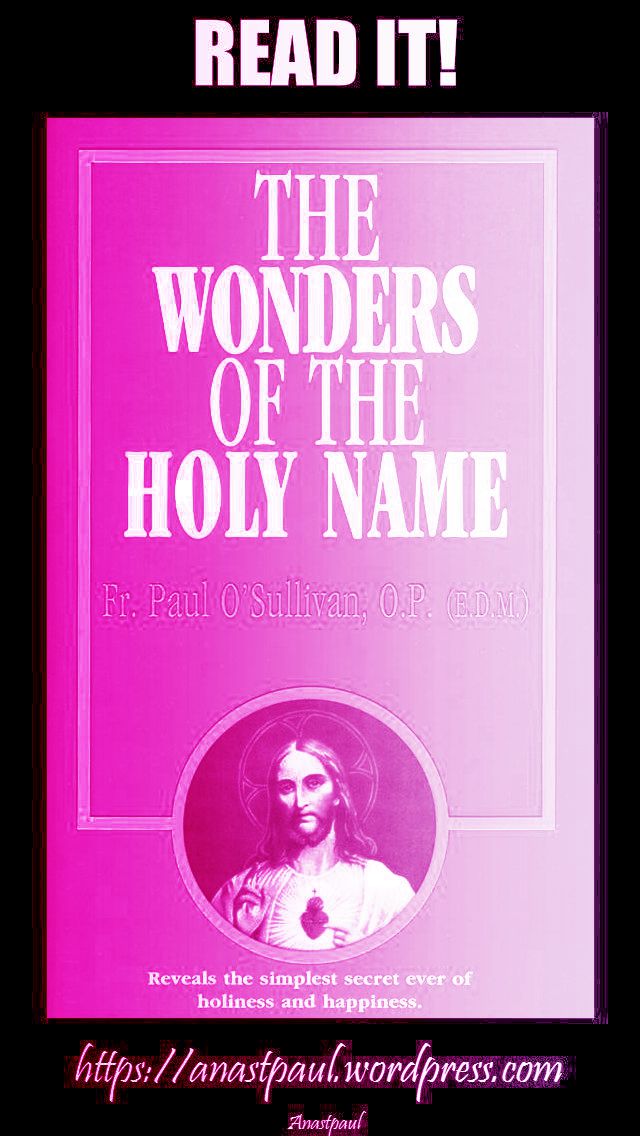
The Wonders of the Holy Name – Fr Paul O’Sullivan, O.P. – “Revealing the Simplest Secret Ever of Holiness and Happiness.” Part Eight – 17 July

Previous – here: https://anastpaul.wordpress.com/category/the-holy-name/

the wonders of the holy name-day eight-17 july

The Saints and the Holy Name

St Augustine:
This great Doctor of the Church,
found his delights in repeating the Holy Name.
He himself tells us that he found much pleasure
in books which made frequent mention of this all-consoling
Name.
St Bernard – felt a wonderful joy and consolation
in repeating the Name of Jesus.   He felt it, as he
says, like honey in his mouth and a delicious
peace in his heart.   We, too, shall feel immense
consolation and peace steal into our souls if we
imitate St. Bernard and repeat frequently this
Holy Name.
St Dominic – spent his days preaching
and discussing with the heretics.   He always went on
foot from place to place as well in the oppressive
heats of the summer as in the cold and rain of
winter.   The Albigensian heretics whom he tried to
convert were more like demons let loose from Hell
than mortal men.   Their doctrine was infamous
and their crimes enormous.   Yet, as another St.
Paul, he converted 100.000 of these wicked men so
that many of them became eminent for sanctity.
Wearied at night with his labours he asked only
for one reward which was to pass the night before
the Blessed Sacrament pouring out his soul in love
for Jesus.   When his poor body could resist no
longer he leaned his head against the Altar and
rested a little, after which he began once more his
intimate converse with Jesus.   In the morning he
celebrated Mass with the ardour of a seraph so that
at times his body was raised in the air in an
ecstasy of love.   The Name of Jesus filled his soul
with joy and delight.
Blessed Jordan of Saxony –  who succeeded St
Dominic as Master General of the Order, was a
preacher of great renown.   His words went straight
to the heart of his hearers above all when he spoke
to them of Jesus.   Learned professors of the University cities came
with delight to hear him and so many of them be~
came Dominican friars that others feared to come,
lest they, too, should be induced to join his Order.
So many were drawn by his irresistible eloquence
that when his visit to a city was announced the Prior
of the convent bought at once a great quantity of
white cloth to make habits for those who were
sure to seek entrance to the Order.   Blessed Jordan
himself received one thousand postulants to the
habit among whom were the most eminent professors
of the European Universities.

Posted in CARMELITES, CATHOLIC DEVOTIONS of the Month, CATHOLIC-PRAYERS OF THE CHURCH, HYMNS, MORNING Prayers, POETRY, QUOTES of the SAINTS, SAINT of the DAY

Thought for the day – 17 July – THE SIXTEEN CARMELITE MARTYRS OF COMPIEGNE

Thought for the day – THE SIXTEEN CARMELITE MARTYRS OF  COMPIEGNE

The French Revolution reveals the titanic struggle between good and evil.   During the terror, over 40,000 Frenchmen were executed just for holding fast to the Catholic Faith and objecting to the worst excesses of the Committee of Public Safety.   The blood lost in the years of 1792-1794 staggers the imagination even in the retelling and the campaign against the Church was as diabolical as it was cruel.

Contemplative religious communities had been among the first targets of the fury of the French Revolution against the Catholic Church.   Less than a year from May 1789 when the Revolution began with the meeting of the Estates-General, these communities had been required by law to disband.   But many of them continued in being, in hiding. Among these were the community of the Carmelite nuns of Compiegne, in northeastern France not far from Paris – the fifty-third convent in France of the Carmelite sisters who followed the reform of  St. Teresa of Avila, founded in 1641, noted throughout its history for fidelity and fervour.   Their convent was raided in August 1790, all the property of the sisters was seized by the government and they were forced to discard their habits and leave their house.   They divided into four groups which found lodging in four different houses all near the same church in Compiegne and for several years they were to a large extent able to continue their religious life in secret.   But the intensified surveillance and searches of the “Great Terror” revealed their secret and in June 1794 most of them were arrested and imprisoned.

They had expected this; indeed, they had prayed for it.   At some time during the summer of 1792, very likely just after the events of August 10 of that year that marked the descent into the true deeps of the Revolution, their prioress, Madeleine Lidoine, whose name in religion was Teresa in honour of the founder of their order, by all accounts a charming  perceptive and highly intelligent woman, had foreseen much of what was to come.   At Easter of 1792, she told her community that, while looking through the archives she had found the account of a dream a Carmelite had in 1693.   In that dream, the Sister saw the whole Community, with the exception of 2 or 3 Sisters, in glory and called to follow the Lamb. In the mind of the Prioress, this mean martyrdom and might well be a prophetic announcement of their fate.

Mother Teresa had said to her sisters: “Having meditated much on this subject, I have thought of making an act of consecration by which the Community would offer itself as a sacrifice to appease the anger of God, so that the divine peace of His Dear Son would be brought into the world, returned to the Church and the state.”   The sisters discussed her proposal and all agreed to it but the two oldest, who were hesitant.   But when the news of the September massacres came, mingling glorious martyrdom with apostasy, these two sisters made their choice, joining their commitment to that of the rest of the community.   All made their offering; it was to be accepted.

After their lodgings were invaded again in June, their devotional objects shattered and their tabernacle trampled underfoot by a Revolutionary who told them that their place of worship should be transformed into a dog kennel, the Carmelite sisters were taken to the Conciergerie prison, where so many of the leading victims of the guillotine had been held during their last days on earth.   There they composed a canticle for their martyrdom, to be sung to the familiar tune of the Marseillaise.   The original still exists, written in pencil and given to one of their fellow prisoners, a lay woman who survived.

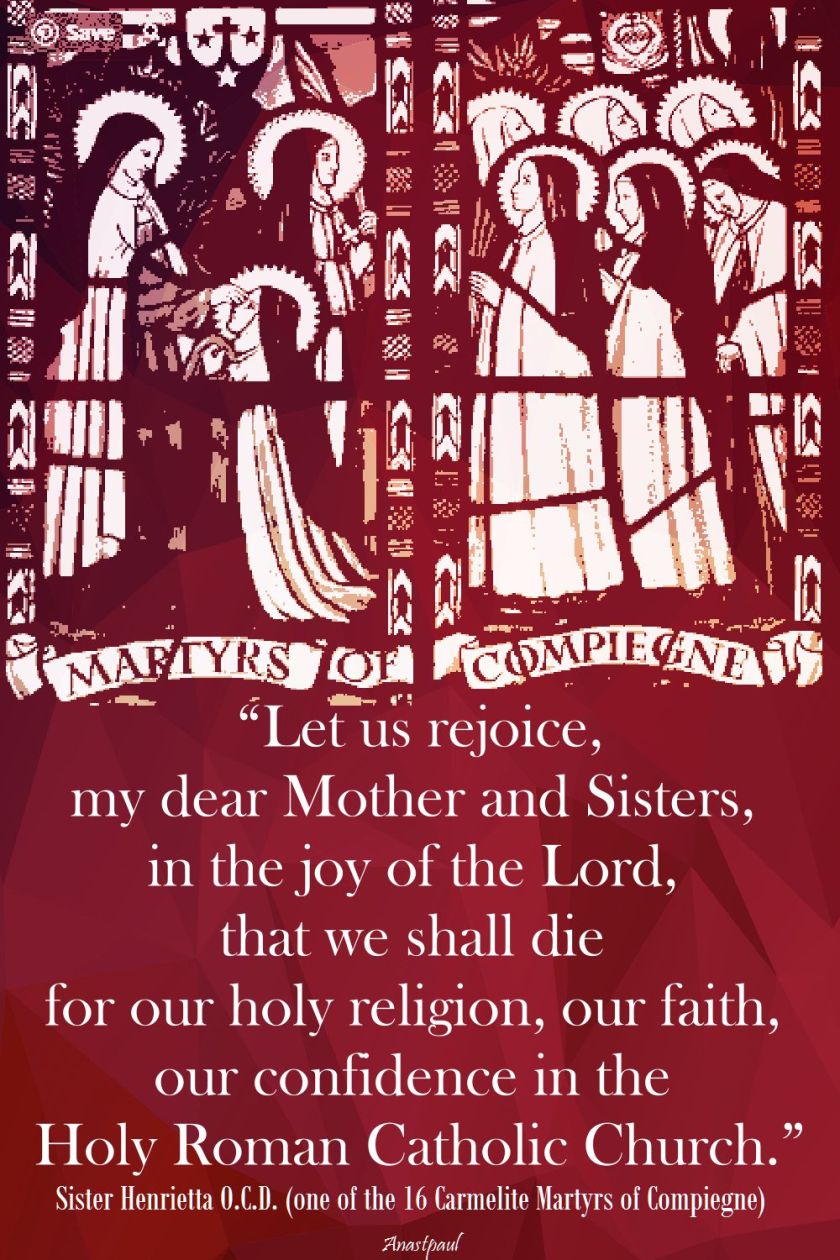
On July 17 the sixteen sisters were brought before Fouquier-Tinville.   All cases were now being disposed of within twenty-four hours as Robespierre had wished;  theirs was no exception.   They were charged with having received arms for the émigrés; their prioress, Sister Teresa, answered by holding up a crucifix. “Here are the only arms that we have ever had in our house.”   They were charged with possessing an altar-cloth with designs honouring the old monarchy (perhaps the fleur-de-lis) and were asked  to deny any attachment to the royal family.   Sister Teresa responded: “If that is a crime, we are all guilty of it; you can never tear out of our hearts the attachment for Louis XVI and his family. Your laws cannot prohibit feeling; they cannot extend their empire to the affections of the soul; God alone has the right to judge them.”   They were charged with corresponding with priests forced to leave the country because they would not take the constitutional oath; they freely admitted this.   Finally they were charged with the catch–all indictment by which any serious Catholic in France could be guillotined during the Terror: “fanaticism.”   Sister Henriette, who had been Gabrielle de Croissy, challenged Fouguier-Tinvile to his face:  “Citizen, it is your duty to respond to the request of one condemned;  I call upon you to answer us and to tell us just what you mean by the word ‘fanatic.”   “I mean,” snapped the Public Prosecutor of the Terror, “your attachment to your childish beliefs and your silly religious practices.”   “Let us rejoice, my dear Mother and Sisters, in the joy of the Lord,” said Sister Henriette, “that we shall die for our holy religion, our faith, our confidence in the Holy Roman Catholic Church.”

Give over our hearts to joy, the day of glory has arrived.
Far from us all weakness, seeing the standard come;
We prepare for the victory, we all march to the true conquest,
Under the flag of the dying God we run, we all seek the glory;
Rekindle our ardour, our bodies are the Lord’s,
We climb, we climb the scaffold and give ourselves back to the Victor.

O happiness ever desired for Catholics of France,
To follow the wondrous road
Already marked out so often by the martyrs toward their suffering,
After Jesus with the King, we show our faith to Christians,
We adore a God of justice; as the fervent priest, the constant faithful,
Seal, seal with all their blood faith in the dying God….

Holy Virgin, our model, August queen of martyrs, deign to strengthen our zeal
And purify our desires, protect France even yet, help; us mount to Heaven,
make us feel even in these places, the effects of your power. Sustain your children,
Submissive, obedient, dying, dying with Jesus and in our King believing.

While in prison, they asked and were granted permission to wash their clothes.   As they had only one set of lay clothes, they put on their religious habit and set to the task. Providentially, the revolutionaries picked that “wash day” for their transfer to Paris.   As their clothes were soaking wet, the Carmelites left for Paris wearing their “outlawed” religious habit.   They celebrated the feast of Our Lady of Mount Carmel in prison, wondering whether they would die that day.

It was only the next day they went to the guillotine.   The journey in the carts took more than an hour.   All the way the Carmelite sisters sang: the “Miserere,” “Salve Regina,” and “Te Deum.”   Beholding them, a total silence fell on the raucous, brutal crowd, most of them cheapened and hardened by day after day of the spectacle of public slaughter.   At the foot of the towering killing machine, their eyes raised to Heaven, the sisters sang “Veni Creator Spiritus.”   One by one, they renewed their religious vows.   They pardoned their executioners.   One observer cried out: “Look at them and see if they do not have the air of angels!   By my faith, if these women did not all go straight to Paradise, then no one is there!

Sister Teresa, their prioress, requested and obtained permission to go last under the knife.   The youngest, Sister Constance, went first.   She climbed the steps of the guillotine With the air of a queen going to receive her crown,” singing Laudate Dominum omnes gentes, all peoples praise the Lord.”   She placed her head in the position for death without allowing the executioner to touch her.   Each sister followed her example, those remaining singing likewise with each, until only the prioress was left, holding in her hand a small figure of the Blessed Virgin Mary.   The killing of each martyr required about two minutes.   It was about eight o’clock in the evening, still bright at midsummer. During the whole time the profound silence of the crowd about the guillotine endured unbroken.

Two years before when the horror began, the Carmelite community at Compiegne had offered itself as a holocaust, that peace might be restored to France and the Church.   The return of full peace was still twenty-one years in the future.   But the Reign of Terror had only ten days left to run.   Years of war, oppression and persecution were yet to come but the mass official killing in the public squares of Paris was about to end.

The Cross had vanquished the guillotine.

These sixteen holy Carmelite nuns have all been beatified by our Holy Father, the Pope, (Pope St. Pius X, 27 May 1906) which is the last step before canonisation.    Blessed Carmelites of Compiegne, pray for us!

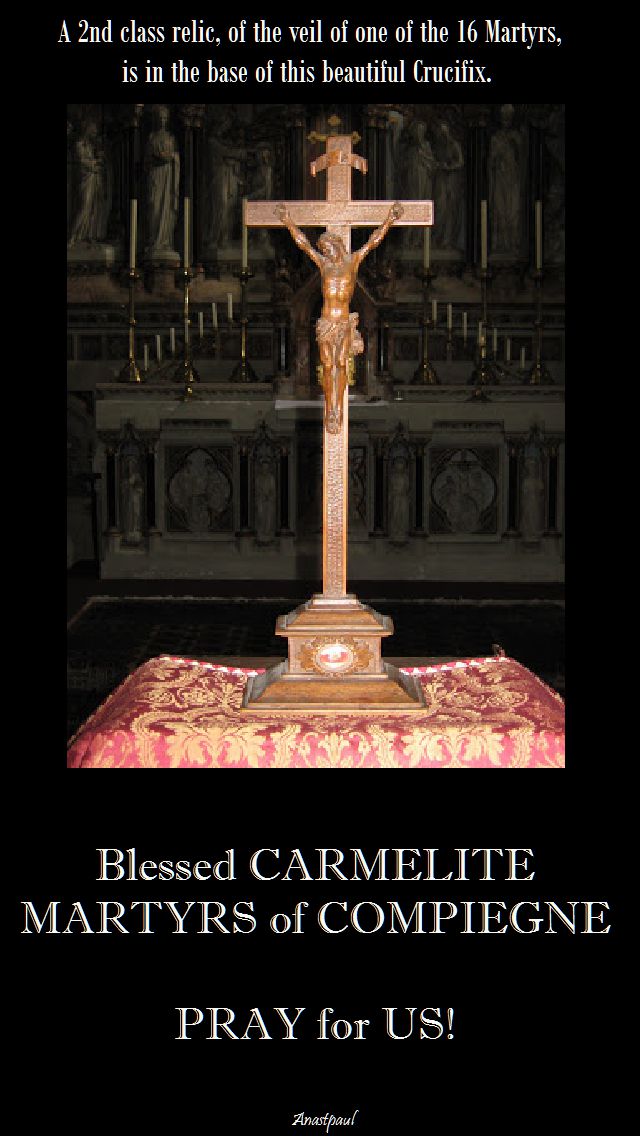
relic of the 16 martyrs of compiegne - pray for us!

Posted in CATHOLIC DEVOTIONS of the Month, DEVOTIO, DOCTORS of the Church, MORNING Prayers, QUOTES of the SAINTS, SAINT of the DAY, The HOLY EUCHARIST / The HOLY MASS

Quote/s of the Day – 17 July – Memorial of the 16 Carmelite Martyrs of Compiegne and July – the Month of the Most Precious Blood

Quote/s of the Day – 17 July – Memorial of the 16 Carmelite Martyrs of Compiegne

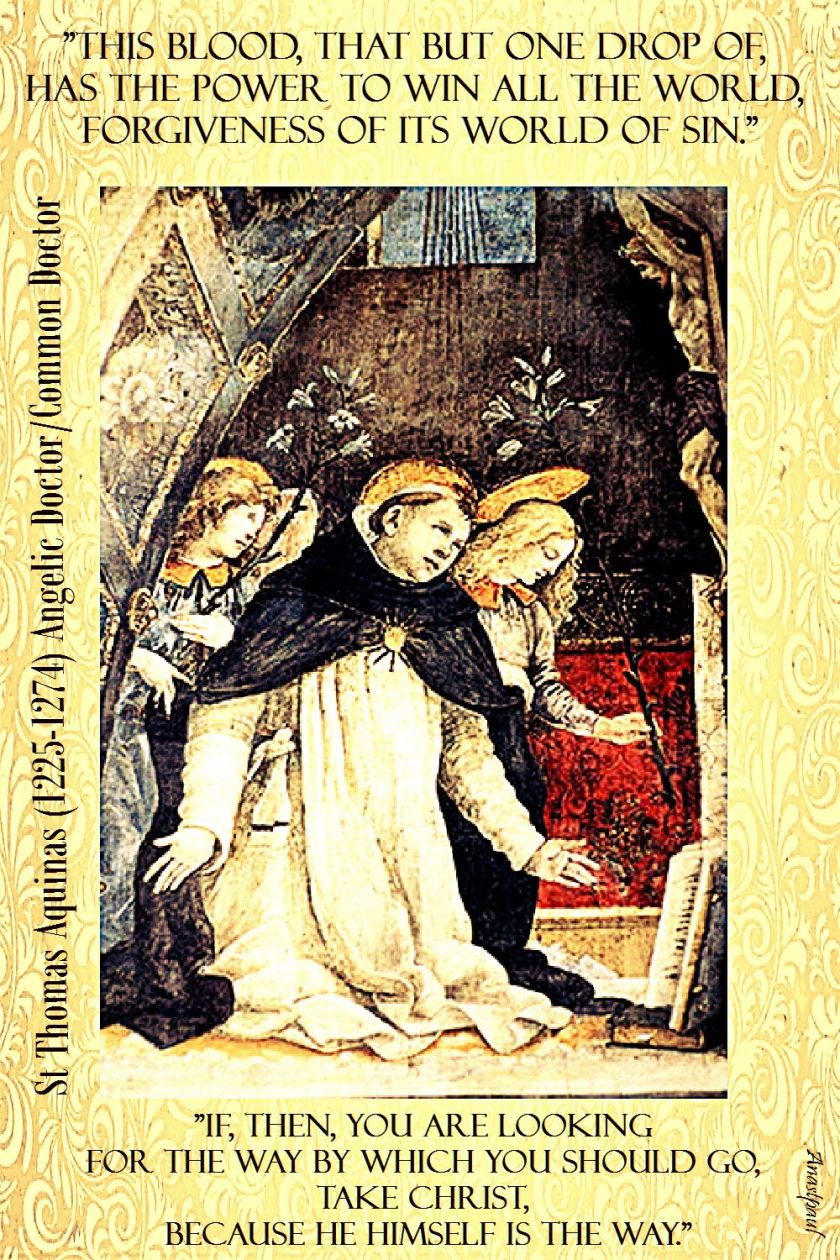
“This Blood, that but one drop of, has the power to win All the world, forgiveness of its world of sin.”

“If, then, you are looking for the way by which you should go, take Christ, because He Himself is the way.”

St. Thomas Aquinas

this blood-st thomas aquinas

Posted in CARMELITES, MORNING Prayers, QUOTES of the SAINTS, SAINT of the DAY, The WORD

One Minute Reflection – 17 July

One Minute Reflection – 17 July

Although you have not seen him, you love him;  even though you do not see him now yet believe in him, you rejoice with an indescribable and glorious joy, as you attain the goal of [your] faith, the salvation of your souls…..1 Peter 8-9

1 peter 8 9

REFLECTION – “Let us rejoice, my dear Mother and Sisters, in the joy of the Lord, that we shall die for our holy religion, our faith, our confidence in the Holy Roman Catholic Church.”……Sister Henrietta O.C.D. (one of the 16 Carmelite Martyrs of Compiegne)

let us rejoice-sister henrietta

PRAYER – Holy God and Father, help us to not only love our Holy Faith but to follow Your Divine Son, happily and with complete trust to the Cross.   Blessed Martyrs of Compiegne, pray for us that we may be graced with your courage and conviction at every moment of our lives, that we may live and die for Christ our Lord, amen.

blessed martyrs of compiegne - pray for us

Posted in CARMELITES, MORNING Prayers, PRAYERS of the SAINTS

Our Morning Offering – 17 July

Our Morning Offering – 17 July

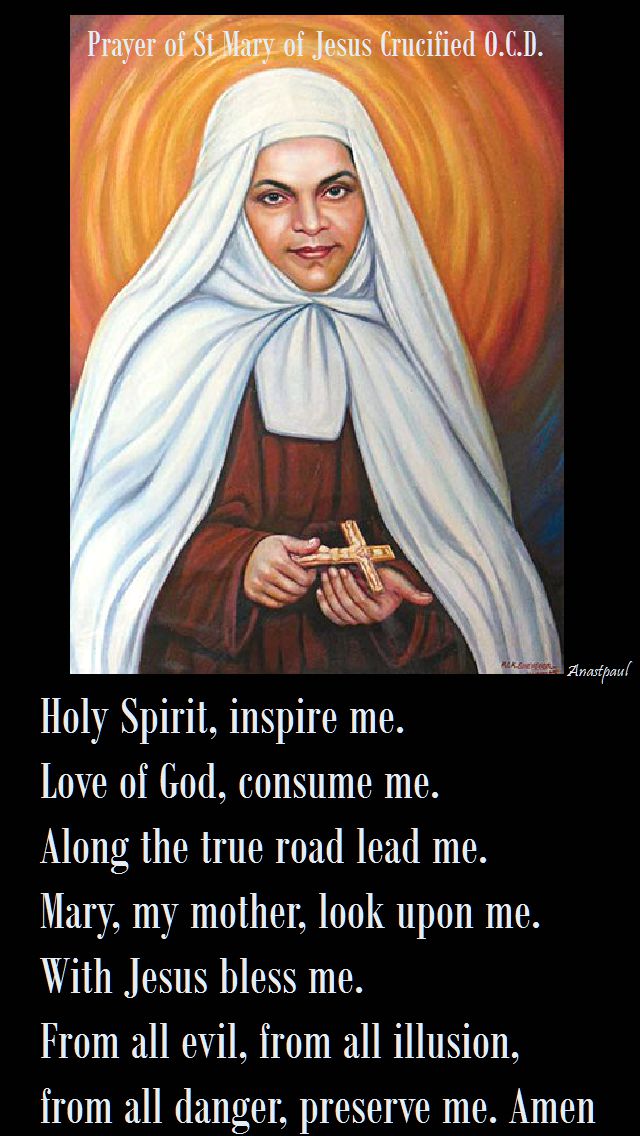
Prayer of St Mary of Jesus Crucified O.C.D.

Holy Spirit, inspire me.
Love of God, consume me.
Along the true road lead me.
Mary, my mother, look upon me.
With Jesus bless me.
From all evil, from all illusion,
from all danger, preserve me. Amen

holy spirit,inspire me-st mary of jesus crucified

Posted in SAINT of the DAY

Saints of the Day – 17 July – The Carmelite Martyrs of Compiegne O.C.D.

Saints of the Day – 17 July – The Carmelite Martyrs of Compiegne O.C.D. (born between 1715–1760 –  guillotined on 17 July 1794 at the Place du Trône Renversé (modern Place de la Nation) in Paris, France).   Before their execution they knelt and chanted the “Veni Creator”, as at a profession, after which they all renewed aloud their baptismal and religious vows.   Their heads and bodies were interred in a deep sand-pit about thirty feet square in a cemetery at Picpus, as this sand-pit was the receptacle of the bodies of 1,298 victims of the French Revolution, there seems to be no hope of their relics being recovered.  Five secondary relics are in the possession of the Benedictines of Stanbrook, Worcestershire, England.   They were Beatified on 27 May 1906 by Pope Pius X.   Miracles proved during the process of beatification were:
• cure of Sister Clare of Saint Joseph, a Carmelite lay sister of New Orleans, Louisiana when on the point of death from cancer in June 1897
• cure of the Abbé Roussarie of the seminary at Brive when at the point of death on 7 March 1897
• cure of Sister Saint Martha of Saint Joseph, a Carmelite lay sister of Vans of tuberculosis and an abcess in the right leg on 1 December 1897
• cure of Sister Saint Michael, a Franciscan of Montmorillon on 9 April 1898.

The 16 Martyrs were:

Mother Teresa of St. Augustine, prioress
Mother St. Louis, sub-prioress
Mother Henriette of Jesus, ex-prioress
Sister Mary of Jesus Crucified
Sister Charlotte of the Resurrection, ex-sub-prioress and sacristan
Sister Euphrasia of the Immaculate Conception
Sister Teresa of the Sacred Heart of Mary
Sister Julie Louise of Jesus, widow
Sister Teresa of St. Ignatius
Sister Mary-Henrietta of Providence
Sister Constance, novice
Lay sisters:
Sister St. Martha
Sister Mary of the Holy Spirit
Sister St. Francis Xavier
Servants:
Catherine Soiron
Thérèse Soiron

The French Revolution – Descent into Tyranny:  Priests and active religious became employees of the state.   The Civil Constitution of the Clergy in 1790 intensified the crisis for the Catholic clergy.   It required an oath of loyalty that conflicted with loyalty to the pope and the one, holy, catholic and apostolic Church. Non-juring priests (those who would not take the oath) were exiled, imprisoned and executed as traitors.   The revolutionary leaders campaigned to de-Christianize France, abolishing holy days and even the observance of Sunday as a day of rest and worship.

After the fall of the constitutional monarchy and the execution of King Louis XVI in 1792, Maximilien Robespierre created rituals to honour the Cult of the Supreme Being even as he led the Committee of Public Safety and the Reign of Terror from 1793 to 1794 — dedicated to eliminating enemies of the Republic.

The Carmelite nuns of Compiègne were just such enemies, although all they wished to do was remain true to their vows to pray, live and work together in a cloistered community. In Robespierre’s view, these nuns were counterrevolutionaries.

When revolutionary officials visited one of their new “convents” in Compiègne, they found a portrait of King Louis XVI and a prayer to the Sacred Heart of Jesus for the king.
Along with their so-called subversive cloistered religious life, this evidence was enough to arrest them.

Counter-revolutionary Carmelites:  Compiègne is a town north of Paris with many other historical connections:   St. Joan of Arc was captured there in the 15th century and two armistice agreements were signed in the Forest of Compiègne in the 20th century: the surrender of Germany in 1918 and the surrender of France in 1940.   In the 17th and 18th centuries the French royal family visited their chateau in Compiègne often and they supported the Carmelites of Compiègne, who were from poor and middle-class families.
After abolishing religious vows, officials visited the Carmelite convent at Compiègne. They offered freedom and financial rewards to those who wanted to leave the order, but none accepted their offer.   Instead, the prioress, Sister Teresa of St. Augustine, led the others in an act of consecration, a vow of martyrdom.
They were thrown out of their cloister on Sept. 14, the feast of the Triumph of the Cross, in 1792.   In quiet defiance they continued to live in small groups observing their usual schedule of prayer.

The Trial:   Sixteen members of their community were taken to Paris for trial in June 1794.   They shared their detention with a group of Benedictine nuns from Cambrai, from a house established for English religious exiles (King Henry VIII had suppressed English monasticism in the 16th century;  it would not be fully re-established until the 19th century).

While awaiting trial the nuns were forbidden to wear their habits.   But because they washed their civilian clothes just before their trial on July 17, the Carmelites appeared in court wearing their habits.   The outcome of the trial was certain, and so the nuns would also die in their habits.   Like so many of the trials during the Reign of Terror, the proceedings were unfair and the nuns endured mockery of their vocation before being sentenced to death that very day.

Their deaths were orderly, calm and holy.   Each Carmelite paused before their prioress and asked permission to fulfill her vow.   They sang together, chanting the Salve Regina, the Te Deum and Veni, Sancte Spiritus on their way to the guillotine and then intoned the psalm Laudate Dominum, omnes gentes (“Praise the Lord, all peoples”);  each stroke of the guillotine silenced another voice until at last the prioress walked up the steps to die. The usually cheering mob was unusually silent.

Place du Trône Renversé:  Until June 8, 1794, the guillotine had stood at what is today Place de la Concorde.   Because Robespierre planned a deistic celebration of the Cult of the Supreme Being on what should have been Pentecost Sunday and the stench of blood along the procession route would have interfered with the solemnity of the occasion, it had been moved to Place du Trône Renversé (the throne turned upside down).

The square had been the royal Place du Trône at the end of a grand entry from the east, along which the kings and queens of France had passed between two grand columns, topped by statues of the great crusading kings, St. Louis and Philippe-August.   The place’s name had been changed after the execution of Louis XVI.

In six weeks, 1,306 “enemies of the state” were decapitated there before the Terror ended.   A place of understandable horror, it was renamed Place de la Nation in 1880.

Within 10 days of the Carmelites’ martyrdom, Robespierre and the members of the Committee of Public Safety were executed at the same site.   The English Benedictines of Cambrai, safely home at Stanbrook Abbey, recalled their former cellmates.

The Benedictines had been released wearing the Carmelite’s civilian clothing and they regarded the clothes as relics of the martyrs.   They ascribed the end of the Reign of Terror to the martyrdom of the Carmelites, who were beatified in 1906 by Pope St. Pius X.

For pilgrims seeking to walk the path of the Carmelites, after leaving the whirl of the Place de la Nation, they should walk to Cimitière de Picpus where the Carmelites are buried in one of the two mass graves behind the wall next to the family tombs.   The opening hours are limited, the entrance fee is only two euros and it is far off the tourist track.   But it is peaceful and apart, perfect for a traveler who wants to be a pilgrim in Paris, contemplating the mystery and the glory of martyrdom.

More About the Martyrs:  The martyrs inspired the opera “Dialogues of the Carmelites,” by Francis Poulenc, based on Georges Bernanos’ play of the same title, which was based on Gertrud von le Fort’s fictional version, “The Song at the Scaffold.”   William Bush’s “To Quell the Terror: The Mystery of the Vocation of the Sixteen Carmelites of Compiègne, Guillotined July 17, 1794,” published by the Institute of Carmelite Studies in 1999, is an excellent study and the main source for this article.
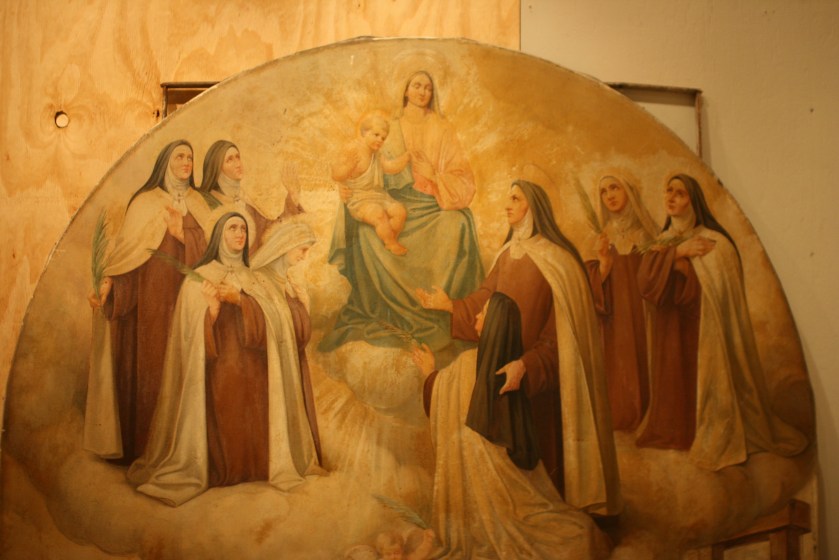
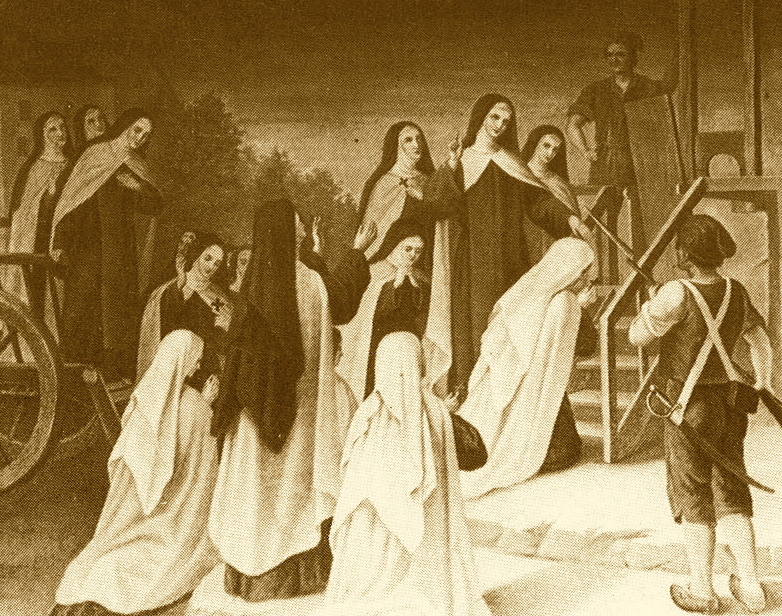
IMG_5323 (3)Martyrs-of-Compiegne


Posted in SAINT of the DAY

Saints’ Memorials – 17 July

St Alexius of Rome
St Andrew Zorard
Bl Arnold of Himmerod
Bl Bénigne
Bl Biagio of the Incarnation
St Clement of Ohrid
St Cynllo
St Ennodius of Pavia
St Fredegand of Kerkelodor
St Generosus
St Gorazd
St Hedwig, Queen of Poland
St Hyacinth of Amastris
St Kenelm
St Leo IV, Pope
St Marcellina
St Nerses Lambronazi
Bl Pavol Gojdic
St Petrus Liu Zeyu
Bl Sebastian of the Holy Spirit
Bl Tarsykia Matskiv
St Theodosius of Auxerre
St Theodota of Constantinople
St Turninus

Martyrs of Compiegne (16 beati): Sixteen Blessed Teresian Martyrs of Compiègne.
Eleven Discalced Carmelite nuns, three lay sisters and two lay women servants who were martyred together in the French Revolution. They were the earliest martyrs of the French Revolution that have been recognized.
• Angelique Roussel • Anne Pelras • Anne-Marie-Madeleine Thouret • Catherine Soiron • élisabeth-Julitte Vérolot • Marie Dufour • Marie Hanniset • Marie-Anne Piedcourt • Marie-Anne-Françoise Brideau • Marie-Claude-Cyprienne Brard • Marie-Françoise de Croissy • Marie-Gabrielle Trezel • Marie-Geneviève Meunier • Marie-Madeleine-Claudine Lidoine • Rose-Chretien de Neuville • Thérèse Soiron •
They were guillotined on 17 July 1794 at the Place du Trône Renversé (modern Place de la Nation) in Paris, France.

Martyrs of Scillium (12 saints): A group of twelve Christians martyred together, the final deaths in the persecutions of Emperor Marcus Aurelius. Upon their conviction for the crime of being Christians, the group was offered 30 days to reconsider their allegiance to the faith; they all declined. Their official Acta still exist. Their names –
• Acyllinus • Cythinus • Donata • Felix • Generosa • Januaria • Laetantius • Narzales • Secunda • Speratus • Vestina • Veturius
They were beheaded on 17 July 180 in Scillium, Numidia (in North Africa).

Posted in EUCHARISTIC Adoration, Re-BLOGS, The WORD

POPE FRANCIS: “COME TO ME (Mt. 11:28).”

Do you attend Eucharistic Adoration? Do you visit Jesus and allow Him to help you with all your burdens?

Posted in CATECHESIS, Re-BLOGS, The WORD

15th Sunday of O.T. (A): THE NECESSITY OF HAVING THE PROPER DISPOSITIONS TO RECEIVE GOD AND HIS WORD. Summary vid + full text.

Thank you Fr Rolly!

Posted in The HOLY NAME

The Wonders of the Holy Name – Fr Paul O’Sullivan, O.P. – “Revealing the Simplest Secret Ever of Holiness and Happiness.” Part Seven – 16 July

Previous – here: https://anastpaul.wordpress.com/category/the-holy-name/

the wonders of the holy name-day seven-16 july

The Saints and the Holy Name:

All the Saints had an immense love for and
trust in the Name of Jesus. They saw in this
Name as in a clear vision all the love of Our Lord,
all His Power, all the beautiful things He said
and did when on Earth.
They did all their wonderful works in the Name
of Jesus. They worked miracles, cast out devils,
cured the sick and gave comfort to everyone using
and recommending to all the habit of invoking
the Holy Name.   St. Peter and the Apostles converted
the World with this all-powerful Name.
The Prince of the Apostles began his glorious
career preaching the love of Jesus to the Jews in
the streets, in the Temple, in their synagogues.
His first striking miracle occurred when he was
going into the Temple with St. John.    A lame man,
well known to the Jews who frequented the Temple
stretched out his hand expecting to receive an alms.
St. Peter said to him:  “Gold and silver I have not
but what I have I willingly give thee. In the
Name of Jesus get up and walk”. .
And instantly the lame man bounded to his
feet and danced for joy.
The Jews were astonished but the great Apostle
said to them:  “Why your wonder and surprise
as if we made this man sound by our
own power. No, it is by the power of Jesus that
this man walks”.
Innumerable times since the days of the Apostle
has the Name of Jesus been glorified.
We will quote a few of these countless examples
which show us how the Saints derived all their
strength and consolation from the Name of Jesus.

St Paul
St. Paul was in a very special way the preacher
and doctor of the Holy Name.   At first he was a
fierce persecutor of the Church, moved by a false
zeal and hatred for Christ.   Our Lord appeared
to him on the road to Damascus and converted
him, making him the great Apostle of the Gentiles
and giving him his glorious mission which was to
preach and make known His Holy Name to Princes
and Kings, to Jews and Gentiles, to all nations
and peoples.
St. Paul filled with a burning love for Our Lord
began his great mission uprooting paganism,
casting down the false idols, confounding the
Philosophers of Greece and Rome, fearing no enemies
and conquering all difficulties, all, all in the
Name of Jesus.
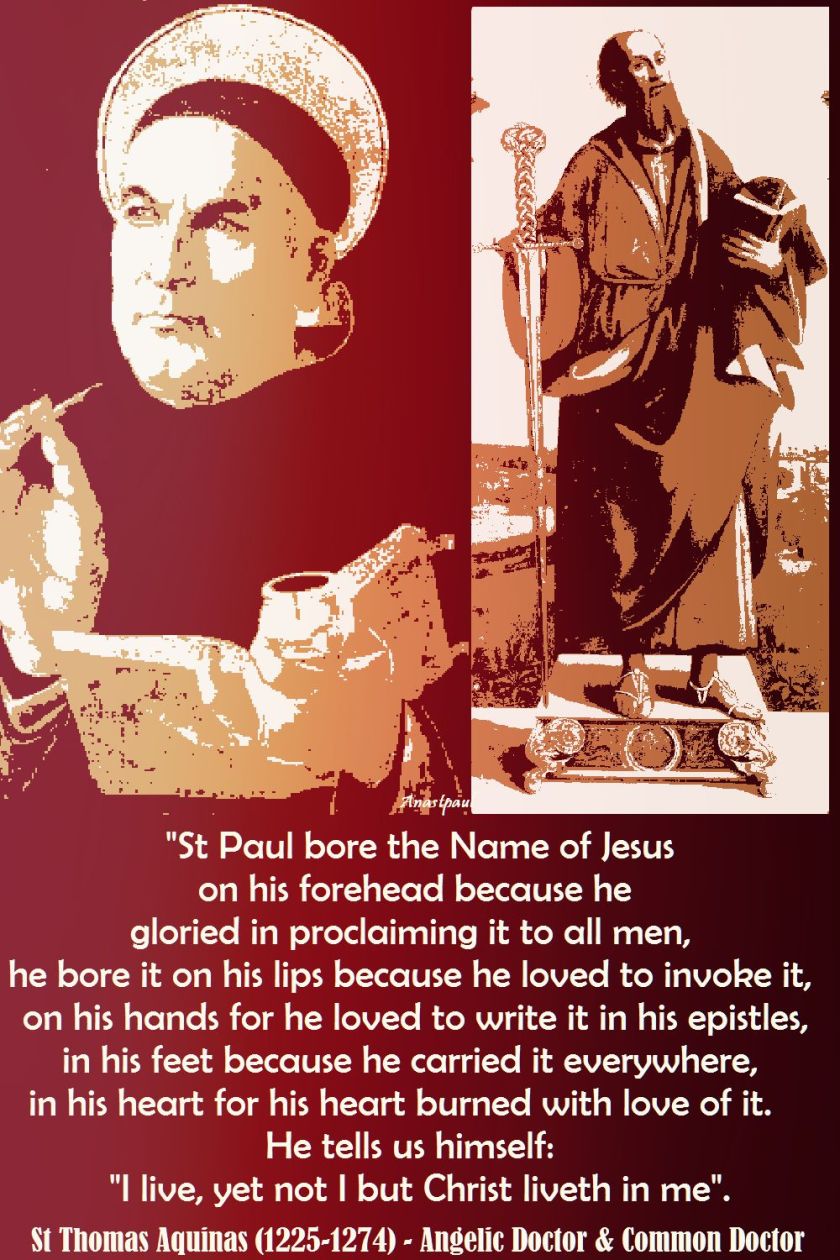
St. Thomas of Aquinas says of him:  “St Paul bore
the Name of Jesus on his forehead because he
gloried in proclaiming it to all men, he bore it on
his lips because he loved to invoke it, on his hands
for he loved to write it in his epistles, in his feet
because he carried it every where, in his heart for
his heart burned with love of it.   He tells us
himself:  “I live, yet not I but Christ liveth
in me”.

st paul bore the name of Jesus-st thomas aquinas

Posted in DEVOTIO, MORNING Prayers, SAINT of the DAY, The BLESSED VIRGIN MARY

Thought for the Day – 16 July

Thought for the Day – 16 July

The Carmelites were known from early on as “Brothers of Our Lady of Mount Carmel.” The title suggests that they saw Mary not only as “mother” but also as “sister.” he word sister is a reminder that Mary is very close to us.   She is the daughter of God and, therefore, can help us be authentic daughters and sons of God.   She also can help us grow in appreciation of being sisters and brothers to one another.   She leads us to a new realisation that all human beings belong to the family of God.   When such a conviction grows, there is hope that the human race can find its way to peace. (Fr. Don Miller, OFM)

carmelites4

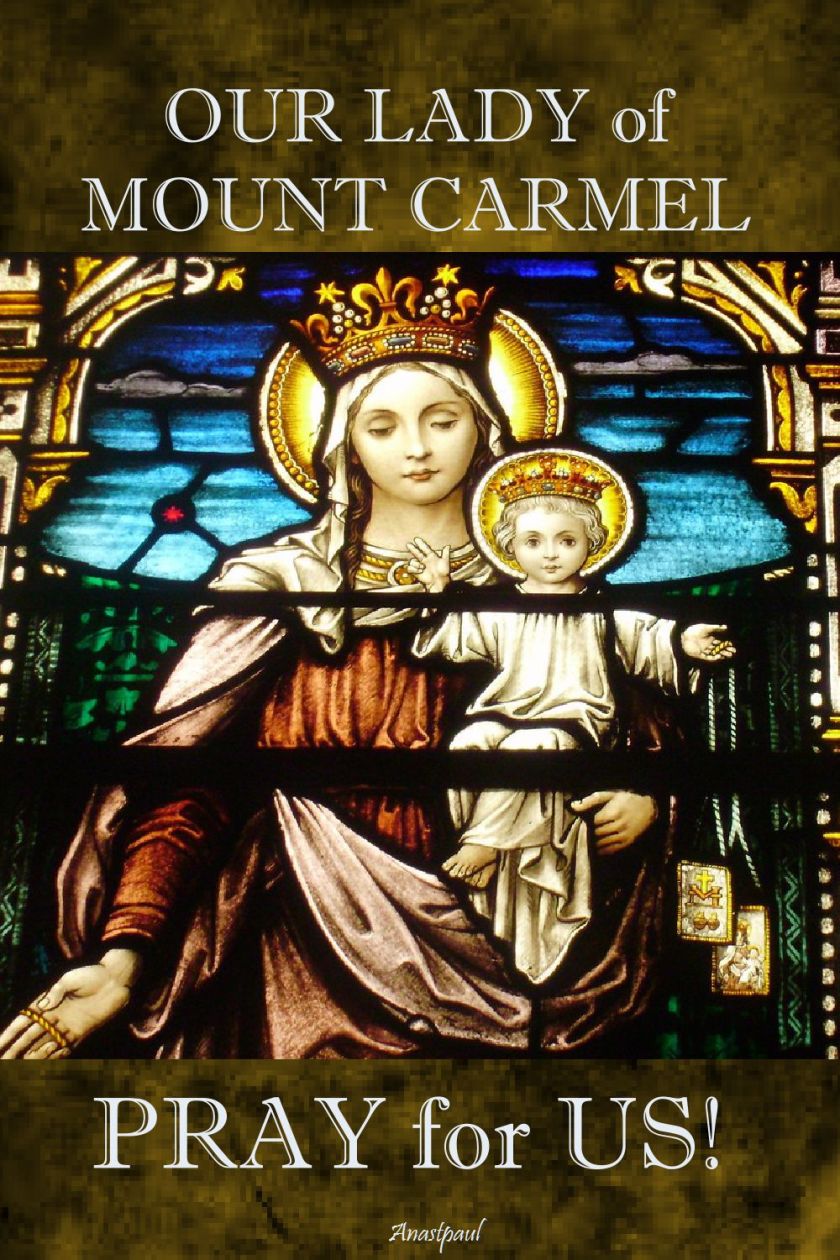
Our Lady of Mount Carmel, Pray for us!

our lady of mount carmel - pray for us.2

Posted in DEVOTIO, MORNING Prayers, QUOTES of the SAINTS, SAINT of the DAY, The BLESSED VIRGIN MARY

Quote/s of the Day – 16 July

Quote/s of the Day – 16 July

In Hebrew Carmel means “garden” and expresses
not only the richness of the natural verdure which covers the mountain like a multicolored tapestry but also the grace and excellence of the many saints who flourished and flowered on its mystical summit…
Tall, majestic, strong and spacious, this Palestinian promontory,
rising out of the edge of the blue Mediterranean, was the site of many Biblical events.
It was the place of seclusion for early Christian monks who lived and prayed in its caves.
It was also the scene of battle and bloodshed for marauding armies:
-Saracens, Turks, and even Napoleon’s French troops-
who climbed its heights and left their destructive mark.
Both mountain and symbol, it stands as an enduring and tangible
testimony that the spirit of the great realities enacted there
will never be lost.

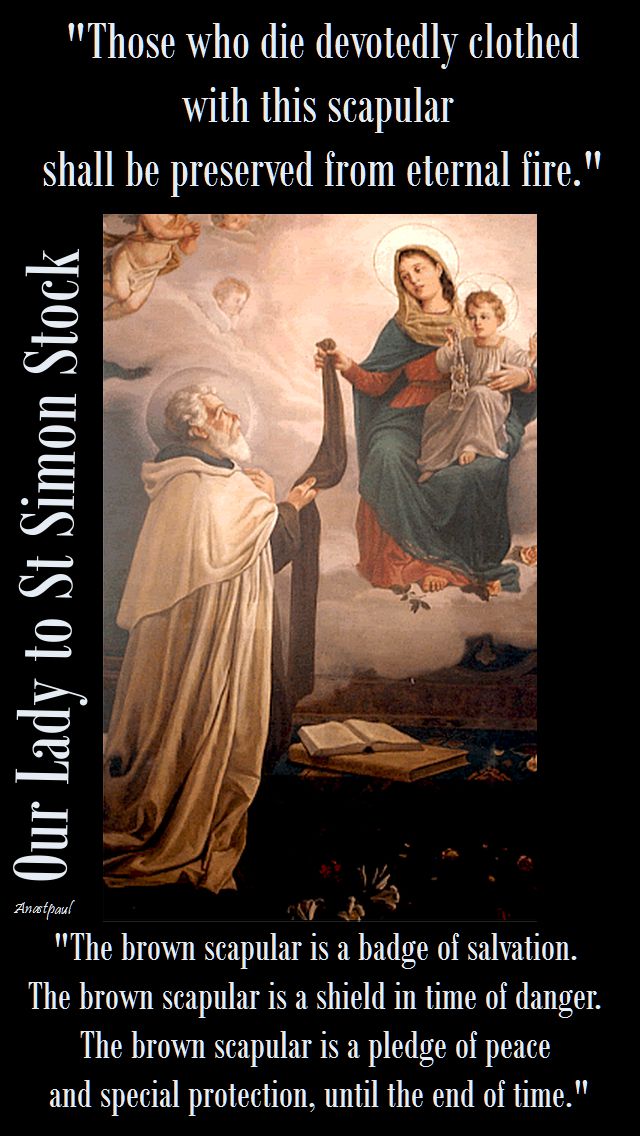
It was to St. Simon Stock, in a moment of ardent petition
for the preservation of the Order, that “the most glorious Mother of God appeared…
holding in her blessed hand the Scapular of Carmel and assured him of her predilection for those who would wear it piously.

In her appearance to Friar Stock, Mary entrusted him
with the Brown Scapular.

“Those who die devotedly clothed with this scapular
shall be preserved from eternal fire.”

“The brown scapular is a badge of salvation.
The brown scapular is a shield in time of danger.
The brown scapular is a pledge of peace
and special protection, until the end of time.”

our lady to st simon stock

“Wear the Scapular devoutly and perseveringly.
It is my garment.
To be clothed in it means you are continually
thinking of me, and I in turn,
am always thinking of you
and helping you to secure eternal life.”

Our Lady to St Simon Stock

mt carmel - quote

Posted in DOCTORS of the Church, MORNING Prayers, SAINT of the DAY, The BLESSED VIRGIN MARY, The WORD

One Minute Reflection – 16 July

One Minute Reflection – 16 July

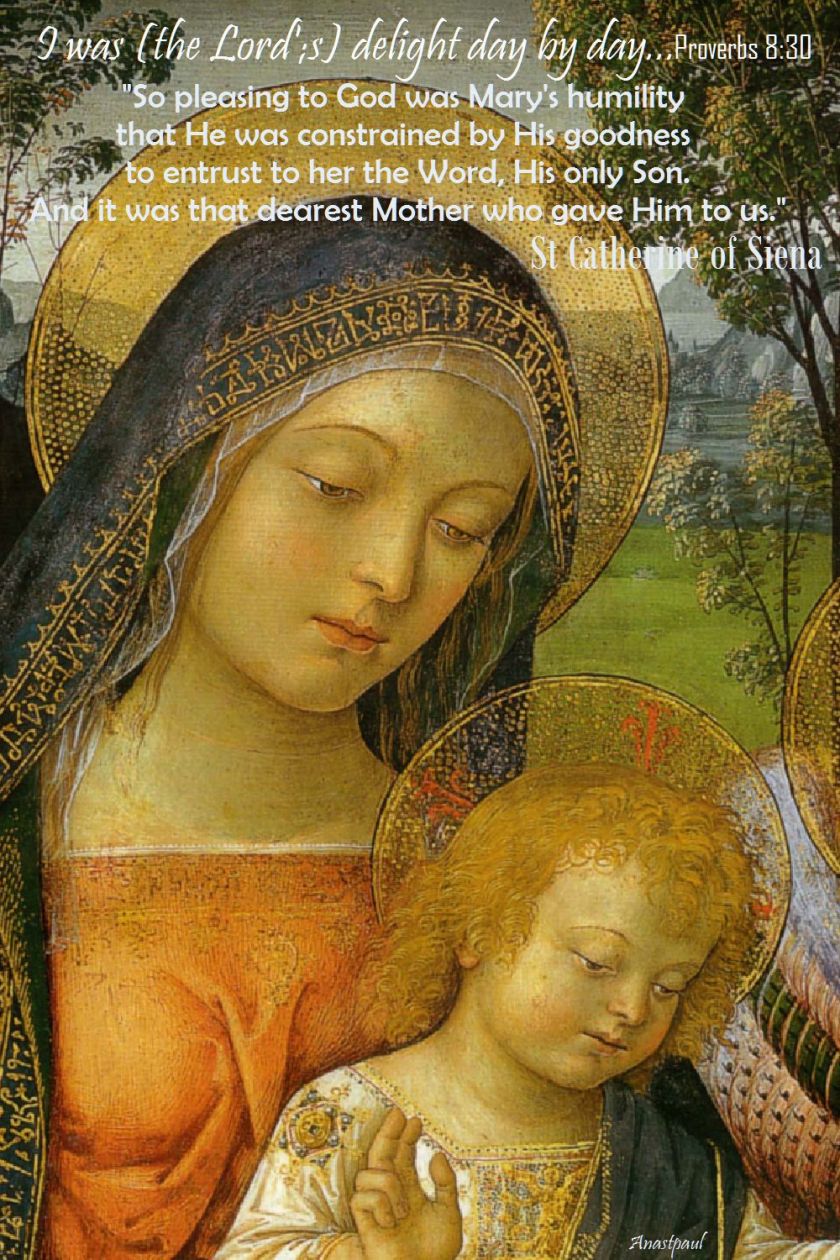
I was (the Lord’s) delight day by day………….Proverbs 8:30

REFLECTION – “So pleasing to God was Mary’s humility that He was constrained by His goodness to entrust to her the Word, His only Son.
And it was that dearest Mother who gave Him to us.”……………St Catherine of Siena

so pleassing to God - st Catherine of Siena

PRAYER – Almighty Lord and God, let the gracious intercession of our Lady of Mount Carmel help us. Under her protection, may we come to the mountain of God, Christ the Lord, who lives and reigns with You and the Holy Spirit, one God, forever and ever. Amen

our lady of mount carmel - pray for us

Posted in SAINT of the DAY, The BLESSED VIRGIN MARY

Saints’ Memorials and Feasts of the Blessed Virgin

15th Sunday in Ordinary Time
Our Lady of Mount Carmel (Optional Memorial)
Blessed Virgin of the Graces
Our Lady of Ziteil

Bl André de Soveral
St Andrew the Hermit
St Antiochus of Sebaste
Bl Arnold of Clairvaux
Bl Arnold of Hildesheim
St Athenogenes of Sebaste
Bl Bartolomeu Fernandez dei Martiri Fernandes
Benedict the Hermit
Bl Claude Beguignot
Bl Domingos Carvalho
St Domnin
St Domnio of Bergamo
Bl Dorothée-Madeleine-Julie de Justamond
St Elvira of Ohren
St Eugenius of Noli
St Faustus
St Faustus of Rome and Milan
St Fulrad of Saint Denis
St Generosus of Poitou
St Gobbán Beg
St Gondolf of Saintes
St Grimoald of Saintes
St Helier of Jersey
Bl Irmengard
Bl John Sugar
St Landericus of Séez
Bl Madeleine-Françoise de Justamond
Bl Marguerite-Rose de Gordon
Bl Marguerite-Thérèse Charensol
Bl Marie-Anne Béguin-Royal
Bl Marie-Anne Doux
St Marie Madeline Postel
Bl Marie-Rose Laye
Bl Milon of Thérouanne
Bl Nicolas Savouret
Bl Ornandus of Vicogne
St Paulus Lang Fu
St Reinildis of Saintes
Bl Robert Grissold
Bl Simão da Costa
St Sisenando of Cordoba
St Tenenan of Léon
St Teresia Zhang Heshi
St Valentine of Trier
St Vitalian of Capua
St Vitaliano of Osimo
St Yangzhi Lang

Martyrs of Antioch – 5 saints: Five Christians who were martyred together. No details about them have survived by the names – Dionysius, Eustasius, Maximus, Theodosius and Theodulus. They were martyred in
Antioch, Syria, date unknown.

Posted in CATHOLIC-PRAYERS OF THE CHURCH, DEVOTIO, MORNING Prayers, SAINT of the DAY, The BLESSED VIRGIN MARY

Our Morning Offering – 16 July

Our Morning Offering – 16 July

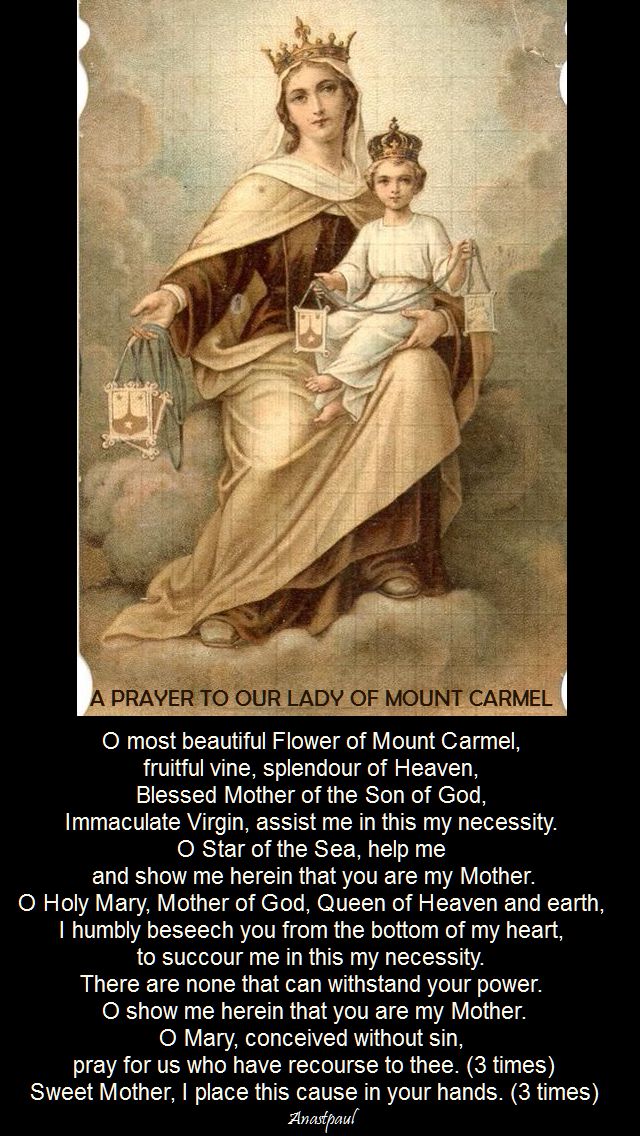
A PRAYER TO OUR LADY OF MOUNT CARMEL

O most beautiful Flower of Mount Carmel,
fruitful vine, splendour of Heaven,
Blessed Mother of the Son of God,
Immaculate Virgin, assist me in this my necessity.
O Star of the Sea, help me
and show me herein that you are my Mother.
O Holy Mary, Mother of God, Queen of Heaven and earth,
I humbly beseech you from the bottom of my heart,
to succour me in this my necessity.
There are none that can withstand your power.
O show me herein that you are my Mother.

O Mary, conceived without sin,
pray for us who have recourse to thee. (3 times)

Sweet Mother, I place this cause in your hands. (3 times)

a prayer to our lady of mt carmel


Posted in DEVOTIO, FEASTS and SOLEMNITIES, PURGATORY, SAINT of the DAY, The BLESSED VIRGIN MARY

Feast of Our Lady of Mount Carmel – 16 July

Feast of Our Lady of Mount Carmel – 16 July

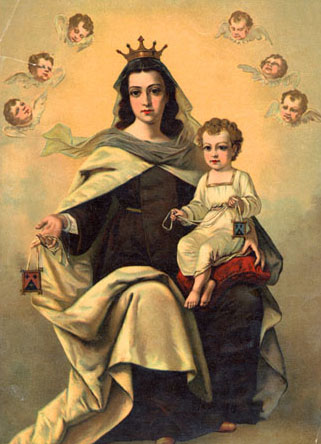
Since the 15th century, popular devotion to Our Lady of Mount Carmel has centered on the Scapular of Our Lady of Mount Carmel, also known as the Brown Scapular, a sacramental associated with promises of Mary’s special aid for the salvation of the devoted wearer.   Traditionally, Mary is said to have given the Scapular to an early Carmelite named Saint Simon Stock.  The liturgical feast of Our Lady of Mount Carmel is celebrated on 16 July.

CARMEL TITLE PIC

July16-OurLadyofMt.C_794227

Mt_carmel1

The solemn liturgical feast of Our Lady of Mount Carmel was probably first celebrated in England in the later part of the 14th century.   Its object was thanksgiving to Mary, the patroness of the Carmelite Order, for the benefits she had accorded to it through its difficult early years.   The institution of the feast may have come in the wake of the vindication of their title “Brothers of the Blessed Virgin Mary” at Cambridge, England in 1374.   The date chosen was 17 July;  on the European mainland this date conflicted with the feast of St. Alexis, requiring a shift to 16 July, which remains the Feast of Our Lady of Mount Carmel throughout the Catholic Church.   The Latin poem “Flos Carmeli” (meaning “Flower of Carmel”) first appears as the sequence for this Mass.

The Carmelite Order was the only religious order to be started in the Crusader States. In the 13th century, some of its people migrated west to England, setting up a chapter and being documented there about 1241-1242.   A tradition first attested to in the late 14th century says that Saint Simon Stock, believed to be an early English prior general of the Carmelite Order soon after its migration to England, had a vision of the Blessed Virgin Mary in which she gave him the Brown Scapular.   This formed part of the Carmelite habit after 1287.   In Stock’s vision, Mary promised that those who died wearing the scapular would be saved.

The Feast of Our Lady of Mount Carmel is known to many Catholic faithful as the “scapular feast,” associated with the Brown Scapular of the Carmelite order.   This is a devotional sacramental signifying the wearer’s consecration to Mary and affiliation with the Carmelite order.

Based on available historical documentation, the liturgical feast of Our Lady of Mount Carmel did not originally have a specific association with the Brown Scapular or the tradition of Stock’s vision of the Blessed Virgin Mary  . This tradition grew gradually, as did the liturgical cult of St. Simon.   The latter has been documented in Bordeaux, where Stock died, from the year 1435; in Ireland and England, from 1458; and in the rest of the Order, from 1564.   Historians have long questioned whether Stock had the vision of Mary and the scapular.   Although Simon Stock was never officially canonised, his feast day was celebrated in the church.

Also associated with Our Lady of Carmel was a papal bull saying that there was a Sabbatine privilege associated with devotion to the saint;   that is, that until the late 1970s, the Catholic liturgy for that day expressed the scapular devotion.   Vatican II resulted in scrutiny of the Feast of Our Lady of Mount Carmel, as well as that of Saint Simon Stock, because of the historical uncertainties about the origins.   The liturgies were revised and, in the 21st century, neither, even in the Carmelite proper, makes reference to the scapular.   The Carmelite convent of Aylesford, England, was restored and a relic of Saint Simon Stock was placed there in 1951.  The saint’s feast is celebrated in the places dedicated to him.

Church teaching:  A 1996 doctrinal statement approved by the Congregation for Divine Worship and the Discipline of the Sacraments states that

“Devotion to Our Lady of Mount Carmel is bound to the history and spiritual values of the Order of the Brothers of the Blessed Virgin Mary of Mount Carmel and is expressed through the scapular.   Thus, whoever receives the scapular becomes a member of the order and pledges him/herself to live according to its spirituality in accordance with the characteristics of his/her state in life.”

According to the Church on the Brown Scapular:  “The scapular is a Marian habit or garment.   It is both a sign and pledge.   A sign of belonging to Mary; a pledge of her motherly protection, not only in this life but after death.   As a sign, it is a conventional sign signifying three elements strictly joined:  first, belonging to a religious family particularly devoted to Mary, especially dear to Mary, the Carmelite Order;  second, consecration to Mary, devotion to and trust in her Immaculate Heart;  third, an urge to become like Mary by imitating her virtues, above all her humility, chastity, and spirit of prayer.”

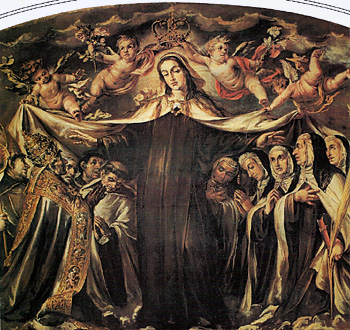
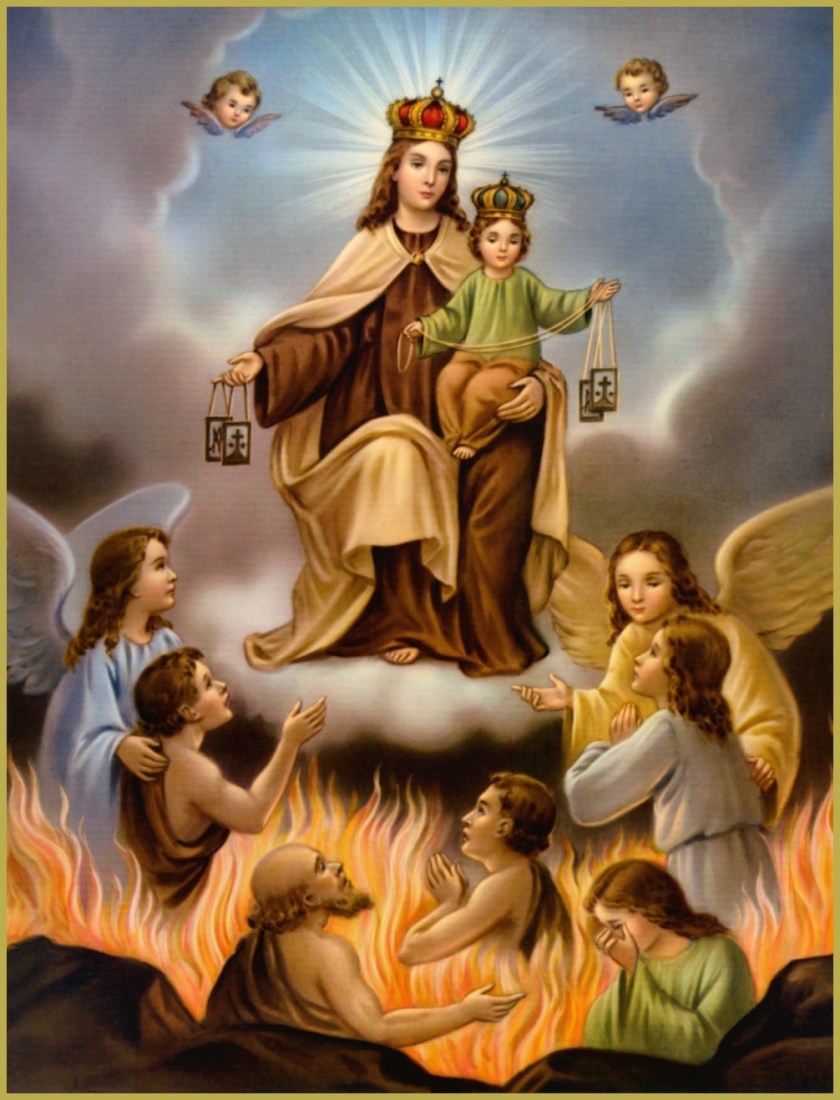
Association with Purgatory:  Since the Middle Ages, Our Lady of Mount Carmel has been related to Purgatory, where souls are purged of sins in the fires.   In some images, she is portrayed as accompanied with angels and souls wearing Brown Scapulars, who plead for her mediation.  In 1613, the Church forbade images to be made of Our Lady of Mt. Carmel descending into purgatory, due to errors being preached about certain privileges associated with the Brown Scapular (known as “the Sabbatine Privilege”).

That privilege appears in the noted Decree of the Holy Office (1613).   It was inserted in its entirety (except for the words forbidding the painting of the pictures) into the list of the indulgences and privileges of the Confraternity of the Scapular of Mount Carmel.   In the 21st century, the Carmelites do not promote the Sabbatine Privilege.   They encourage a belief in Mary’s general aid and prayerful assistance for their souls beyond death, especially her aid to those who devoutly wear the Brown Scapular and commend devotion to Mary especially on Saturdays, which are dedicated to her.

CARMEL-3

Miracles:  In Palmi, Italy, the anniversary of the earthquake of 1894 is observed annually on 16 November.   The earthquake had its epicenter in the city.   An associated event has been classified as the “miracle of Our Lady of Mount Carmel.”   For 17 days preceding this earthquake, many of the faithful had reported strange eye movements and changes in the colouring of the face in a statue of Our Lady of Mount Carmel.   The local and national press reported these occurrences.

In the evening of 16 November, the faithful improvised a procession carrying the statue of the Virgin of Carmel on their shoulders through the streets.   When the procession reached the end of the city, a violent earthquake shook the whole district of Palmi, ruining most of the old houses along the way.   But, only nine people died out of a population of about 15,000 inhabitants, as almost all of the population had been on the street to watch the procession and were not trapped inside the destroyed buildings. Therefore, the city commemorates the 1894 procession each year, accompanied by firecrackers, lights, and festive stalls.

The Catholic Church has officially recognised the miracle.   On November 16, 1896 the statue of the Virgin was crowned, based on the decree issued September 22, 1895 by the Vatican Chapter.
Use in the peace movement:  The first atomic bomb was exploded in the United States at the Trinity test site on 16 July 1945, near Alamogordo, New Mexico.   The Catholic anti-war movement has built on the coincidence between this date and the Feast of Our Lady of Mount Carmel.   In 1990, the Rev. Emmanuel Charles McCarthy, a priest of the Eastern Rite (Byzantine-Melkite) of the Catholic Church, initiated the “16 July Twenty-Four Hours Day of Prayer,” for Forgiveness and Protection with Our Lady of Mount Carmel, at Trinity Site in the New Mexico desert.    Each year on 16 July, a prayer vigil is conducted at the Trinity site to pray for peace and the elimination of nuclear weapons.


Posted in DOCTORS of the Church, franciscan OFM, MORNING Prayers, QUOTES of the SAINTS, SAINT of the DAY

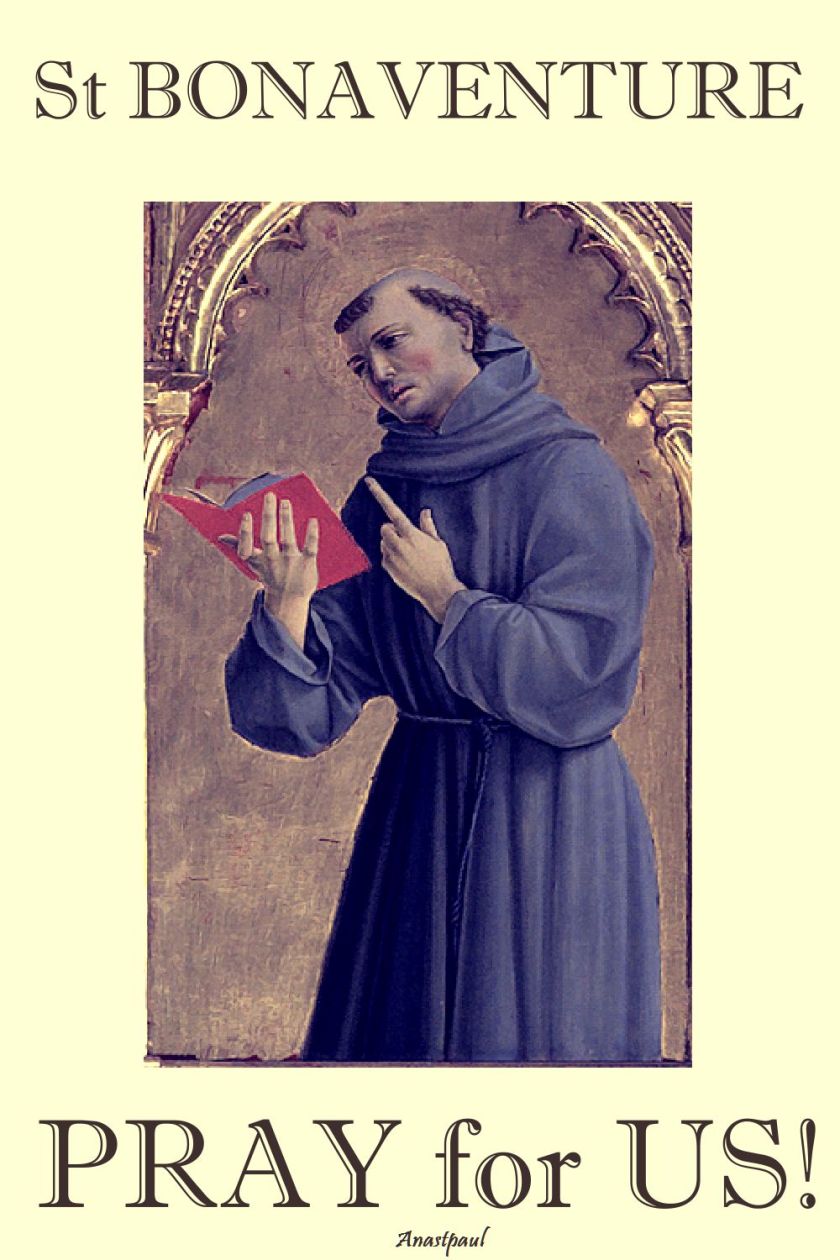
Thought for the Day – 15 July by Pope Benedict XVI – 10 March 2010 on St Bonaventure

Thought for the Day – 15 July by Pope Benedict XVI – 10 March 2010 on St Bonaventure

“Of these his writings, which are the soul of his government and show the way to follow either as an individual or a community, I would like to mention only one, his masterwork, the “Itinerarium mentis in Deum,” which is a “manual” of mystical contemplation.

This book was conceived in a place of profound spirituality: the hill of La Verna, where St. Francis had received the stigmata.   In the introduction, the author illustrates the circumstances that gave origin to his writing:

“While I meditated on the possibility of the soul ascending to God, presented to me, among others, was that wondrous event that occurred in that place to Blessed Francis, namely, the vision of the winged seraphim in the form of a crucifix. And meditating on this, immediately I realised that such a vision offered me the contemplative ecstasy of Father Francis himself and at the same time the way that leads to it” (Journey of the Mind in God, Prologue, 2, in Opere di San Bonaventura. Opuscoli Teologici / 1, Rome, 1993, p. 499).

The six wings of the seraphim thus became the symbol of six stages that lead man progressively to the knowledge of God through observation of the world and of creatures and through the exploration of the soul itself with its faculties, up to the satisfying union with the Trinity through Christ, in imitation of St. Francis of Assisi.

The last words of St. Bonaventure’s “Itinerarium,” which respond to the question of how one can reach this mystical communion with God, would make one descend to the depth of the heart:

“If you now yearn to know how that happens (mystical communion with God), ask grace, not doctrine;  desire, not the intellect; the groaning of prayer, not the study of the letter;  the spouse, not the teacher;  God, not man; darkness not clarity;  not light but the fire that inflames everything and transport to God with strong unctions and ardent affections. … We enter therefore into darkness, we silence worries, the passions and illusions;  we pass with Christ Crucified from this world to the Father, so that, after having seen him, we say with Philip: that is enough for me” (Ibid., VII, 6).

Dear friends, let us take up the invitation addressed to us by St. Bonaventure, the Seraphic Doctor, and let us enter the school of the divine Teacher.   We listen to his Word of life and truth, which resounds in the depth of our soul.    Let us purify our thoughts and actions, so that He can dwell in us, and we can hear His divine voice, which draws us toward true happiness”.        Pope Benedict XVI – 10 March 2010 on St Bonaventure

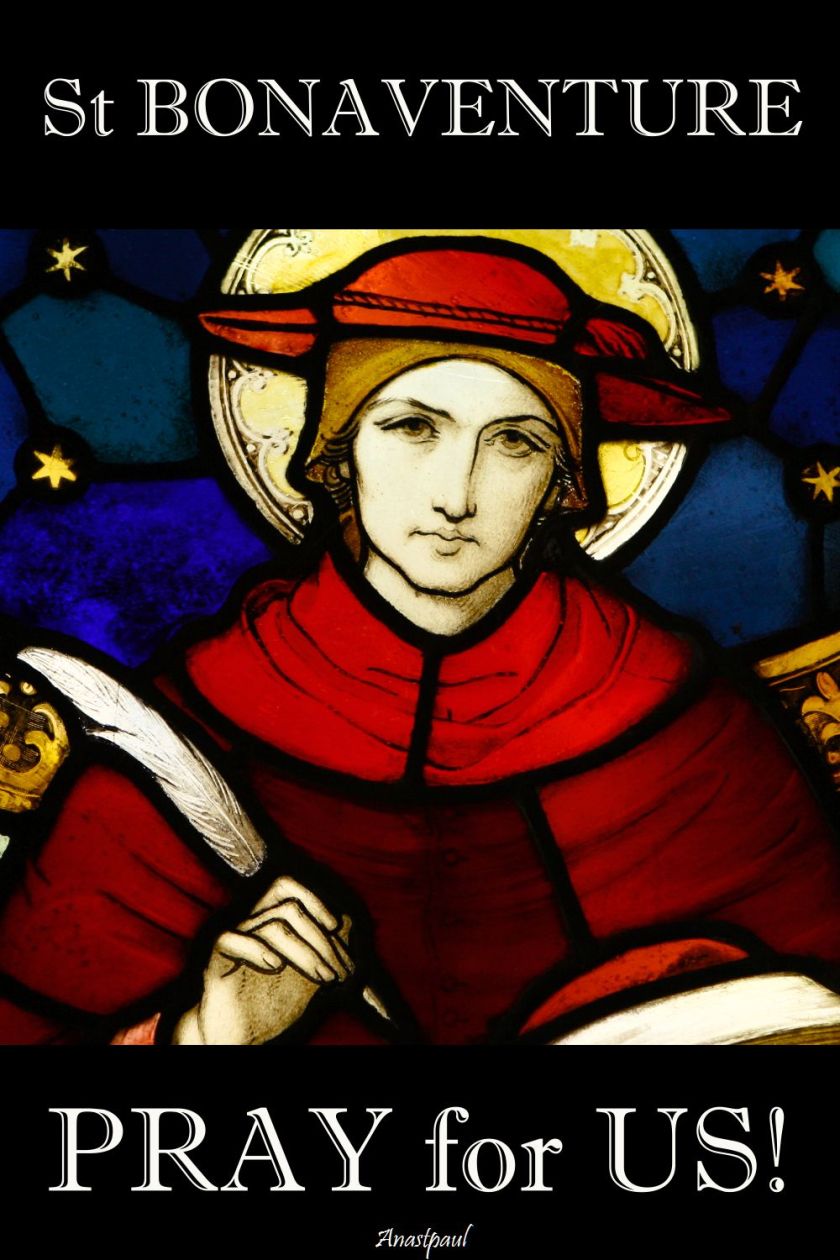
St Bonaventure, pray for us!

st bonaventure pray for us 2

Posted in CATHOLIC DEVOTIONS of the Month, MORNING Prayers, The HOLY NAME

The Wonders of the Holy Name – Fr Paul O’Sullivan, O.P. – “Revealing the Simplest Secret Ever of Holiness and Happiness.” Part Six – 15 July

Previous – here: https://anastpaul.wordpress.com/category/the-holy-name/

the wonders of the holy name-day six-15 july

St Gregory of Tours relates that when he was
a boy his father fell gravely ill and lay dying.
Gregory prayed fervently for his recovery.   When
asleep at night Gregory’s Angel Guardian appeared
to him and told him t.o write the Name of Jesus
on a card and place this under the sick man’s
pillow.
In the morning he acquainted his mother with
the Angel’s message which she advised him to
obey.    He did so and placed the card under his
father’s head when, to the delight of the whole
family, the patient grew rapidly better.

We could fill pages and pages with the miracles
and wonders worked by the Holy Name at all
times and in all places not only by the Saints but by
all who invoke this Divine Name with reverence
and faith.
Marchese says “I refrain from relating here the
miracles worked and graces granted by Our Lord to
those who have been devout to His Holy Name,
because St. John Chrysostom reminds me that
Jesus is always named when miracles are worked
by holy men;  hence to attempt to enumerate them
would be to try to give a list of the countless
miracles which God has performed through all the
ages, either to increase the glory of His Saints
or to plant and strengthen the faith in the hearts
of men”.

Cards of the Holy Name.

The use of cards with the Holy Name inscribed
on them has been used and recommended by the
great lovers of the Holy Name such as Mgr. Andre
Dias (see page 6), St. Leonard of Portmaurice,
St. Gregory of Tours, above mentioned.
Our readers would do well to use the use cards,
carrying them about on their persons during the
day, putting them under their pillows at night and
placing them on the doors of all rooms.

Posted in DOCTORS of the Church, franciscan OFM, QUOTES of the SAINTS, SAINT of the DAY, The BLESSED VIRGIN MARY

Quote/s of the Day – 15 July

Quote/s of the Day – 15 July

“Christ is both the way and the door.
Christ is the staircase and the vehicle,
like the “throne of mercy over the Ark of the Covenant,”
and “the mystery hidden from the ages.”
A man should turn his full attention to this throne of mercy
and should gaze at Him hanging on the cross,
full of faith, hope and charity, devoted,
full of wonder and joy, marked by gratitude
and open to praise and jubilation.
Then such a man will make with Christ a “pasch,”
that is, a passing-over.
Through the branches of the cross.
he will pass over the Red Sea,
leaving Egypt and entering the desert.
There he will taste the hidden manna
and rest with Christ in the sepulcher,
as if he were dead to things outside.
He will experience, as much as is possible for one who is still living,
what was promised to the thief who hung beside Christ:
‘Today you will be with me in paradise.'”
– from Journey of the Mind to God by Saint Bonaventure

“The life of God — precisely because God is triune —
does not belong to God alone.
God who dwells in inaccessible light and eternal glory
comes to us in the face of Christ and the activity of the Holy Spirit.
Because of God’s outreach to the creature,
God is said to be essentially relational, ecstatic, fecund,
alive as passionate love. Divine life is therefore also our life.
The heart of the Christian life is to be united
with the God of Jesus Christ by means of communion with one another.
The doctrine of the Trinity is, ultimately, therefore,
a teaching not about the abstract nature of God,
nor about God in isolation from everything other than God
but a teaching about God’s life with us and our life with each other.”

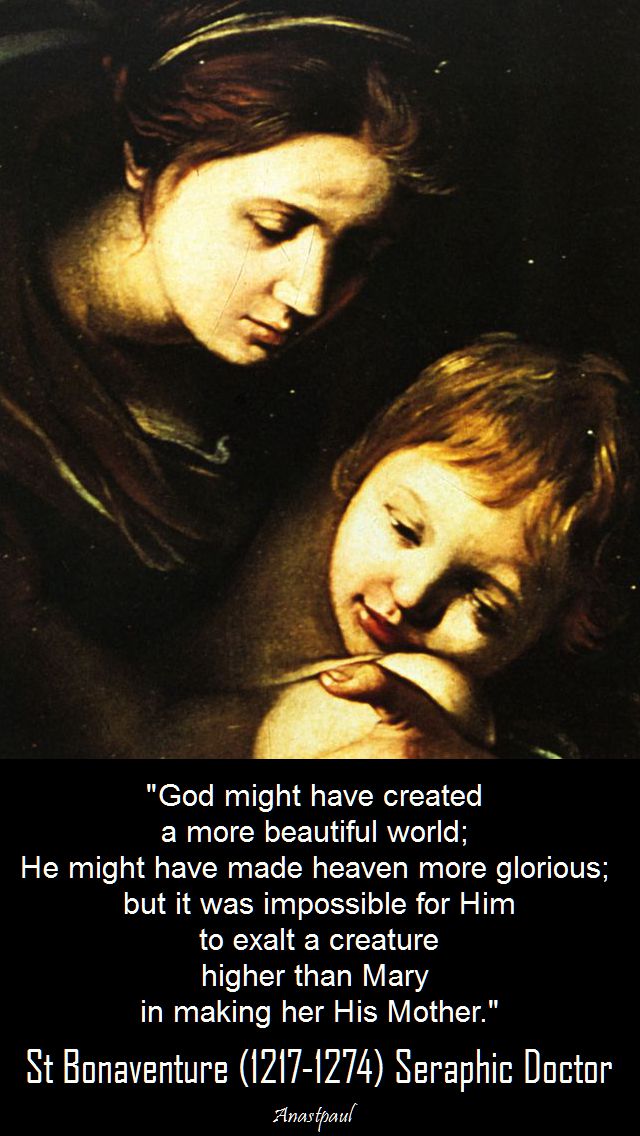
“God might have created a more beautiful world;
He might have made heaven more glorious;
but it was impossible for Him to exalt a creature
higher than Mary in making her His Mother.”

god might have created-st bonaventure


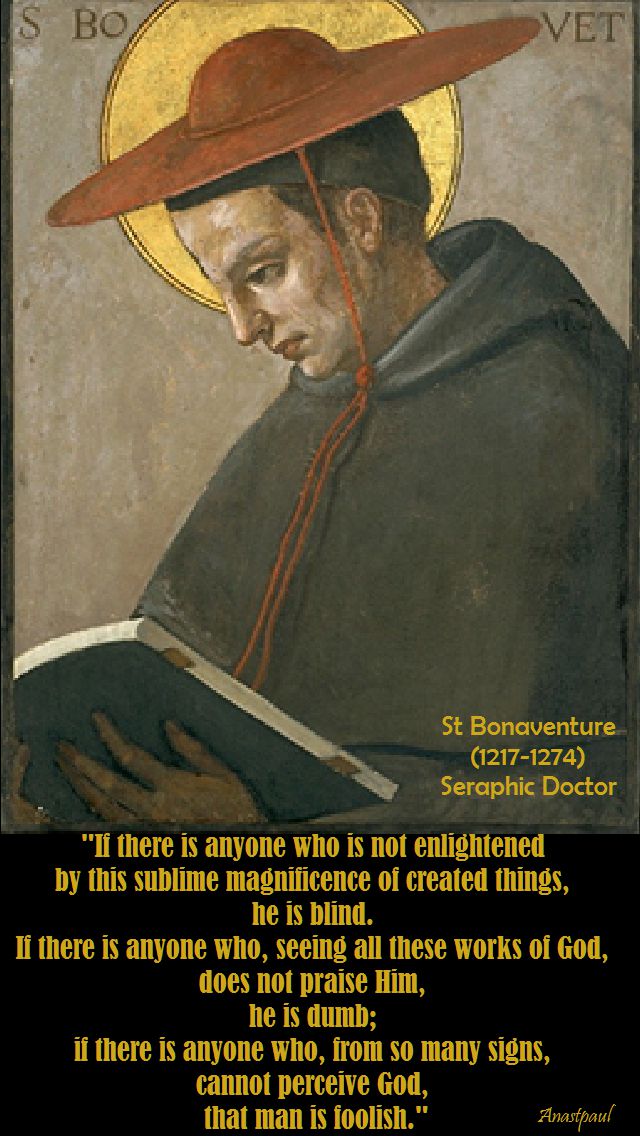
“If there is anyone who is not enlightened
by this sublime magnificence of created things,
he is blind.
If there is anyone who, seeing all these works of God,
does not praise Him,
he is dumb;
if there is anyone who, from so many signs,
cannot perceive God,
that man is foolish.”

if there is anyone who is not enlightened-st bonaventure


St Bonaventure (1217-1274) Seraphic Doctor

Posted in DOCTORS of the Church, MORNING Prayers, QUOTES of the SAINTS, SAINT of the DAY, The WORD

One Minute Reflection – 15 July

One Minute Reflection – 15 July

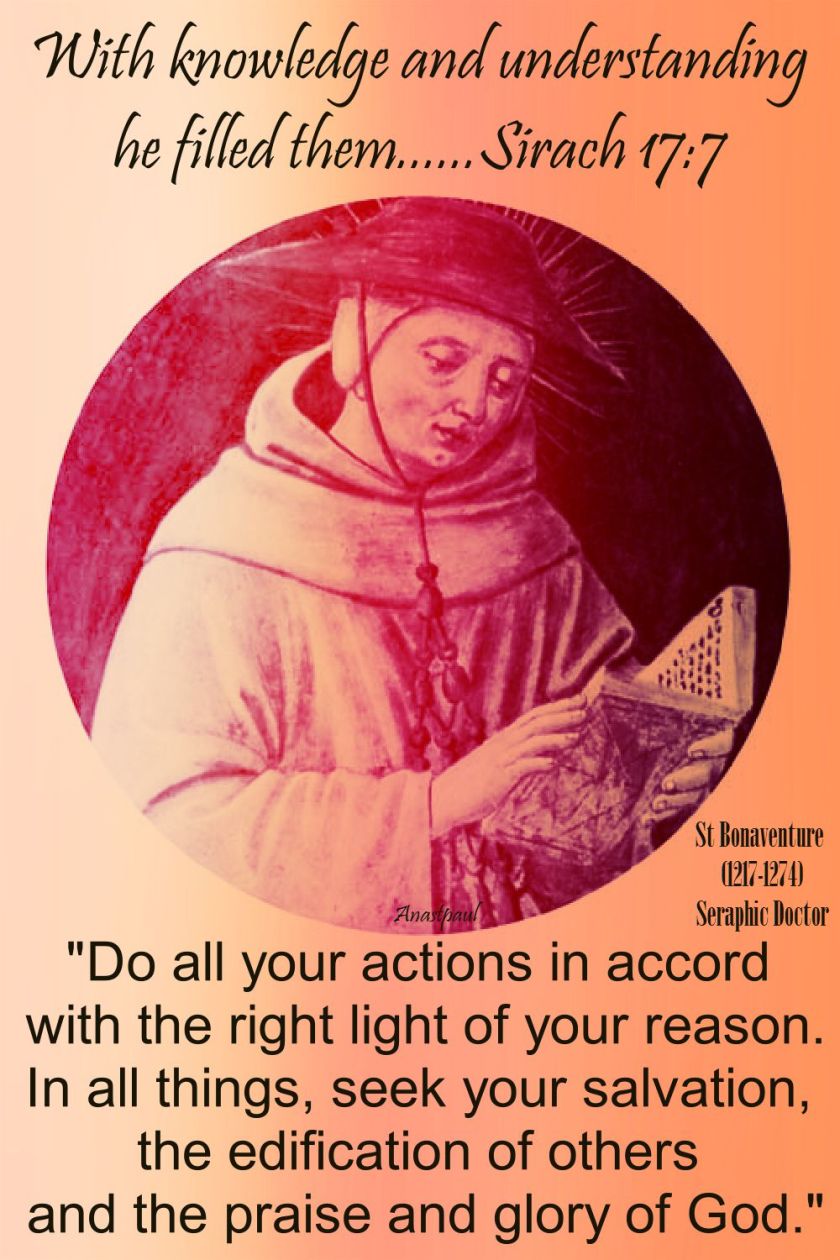
With knowledge and understanding he filled them……….Sirach 17:7

REFLECTION – “Do all your actions in accord with the right light of your reason.
In all things, seek your salvation, the edification of others and the praise and glory of God.”…..St Bonaventure

do all yur actions-st bonaventure


PRAYER – God of goodness and reason, grant me the gift of right reasoning and Christian understanding. Let me act always in accord with the dictates of that reason and so be pleasing to You. St Bonaventure , pray for us that we may always be graced with the gifts of Holy Spirit, amen.

st bonaventure pray for us

Posted in DOCTORS of the Church, MORNING Prayers, PRAYERS of the SAINTS, The HOLY EUCHARIST / The HOLY MASS

Our Morning Offering – 15 July

Our Morning Offering – 15 July

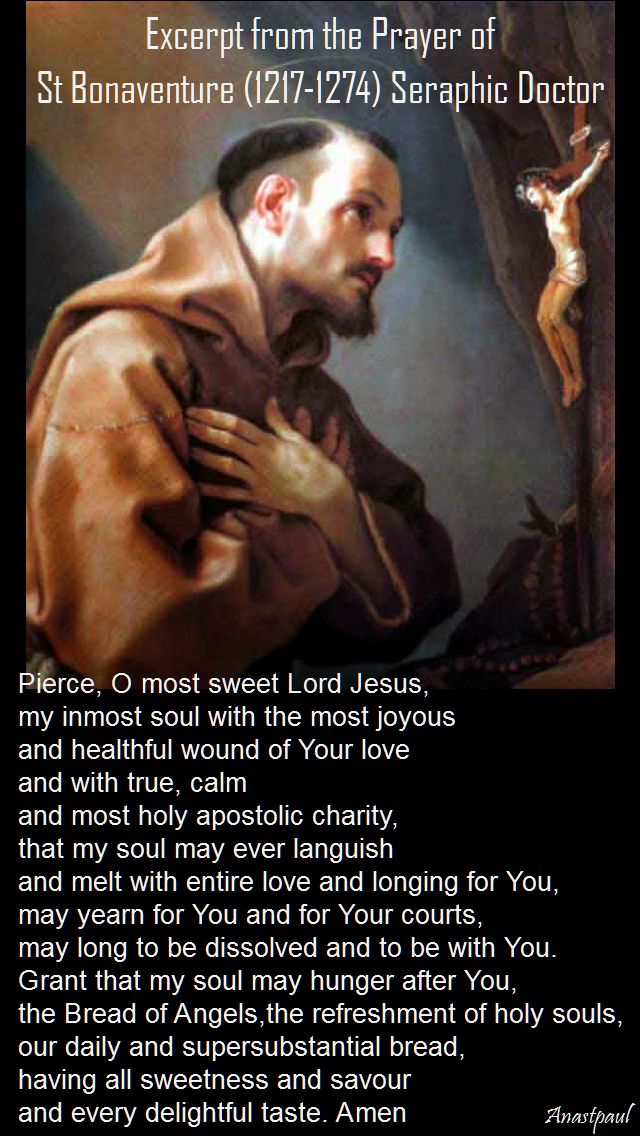
Excerpt from the Prayer of
St Bonaventure (1217-1274) Seraphic Doctor

Pierce, O most sweet Lord Jesus,
my inmost soul with the most joyous
and healthful wound of Your love
and with true, calm
and most holy apostolic charity,
that my soul may ever languish
and melt with entire love and longing for You,
may yearn for You and for Your courts,
may long to be dissolved and to be with You.
Grant that my soul may hunger after You,
the Bread of Angels,
the refreshment of holy souls,
our daily and supersubstantial bread,
having all sweetness and savour
and every delightful taste. Amen

pierce, o most sweet lord jesus - st bonaventure (excerpt)


Posted in DOCTORS of the Church, franciscan OFM, SAINT of the DAY, STOMACH DISEASES and PAIN, INTESTINAL DISORDERS

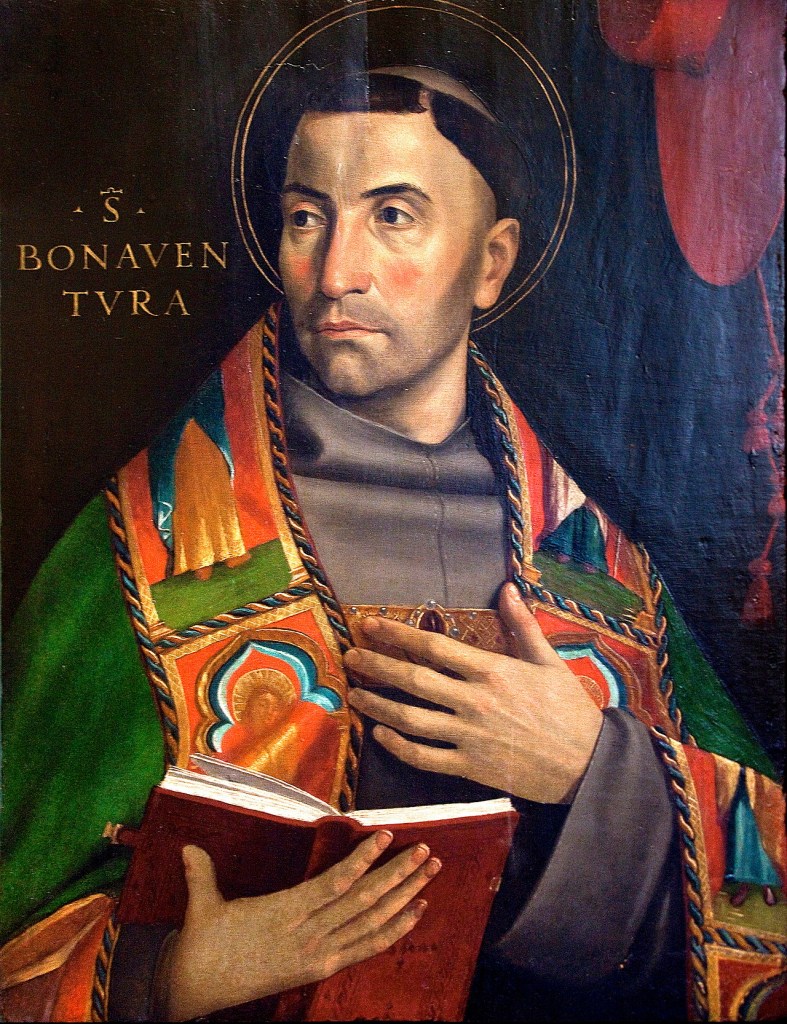
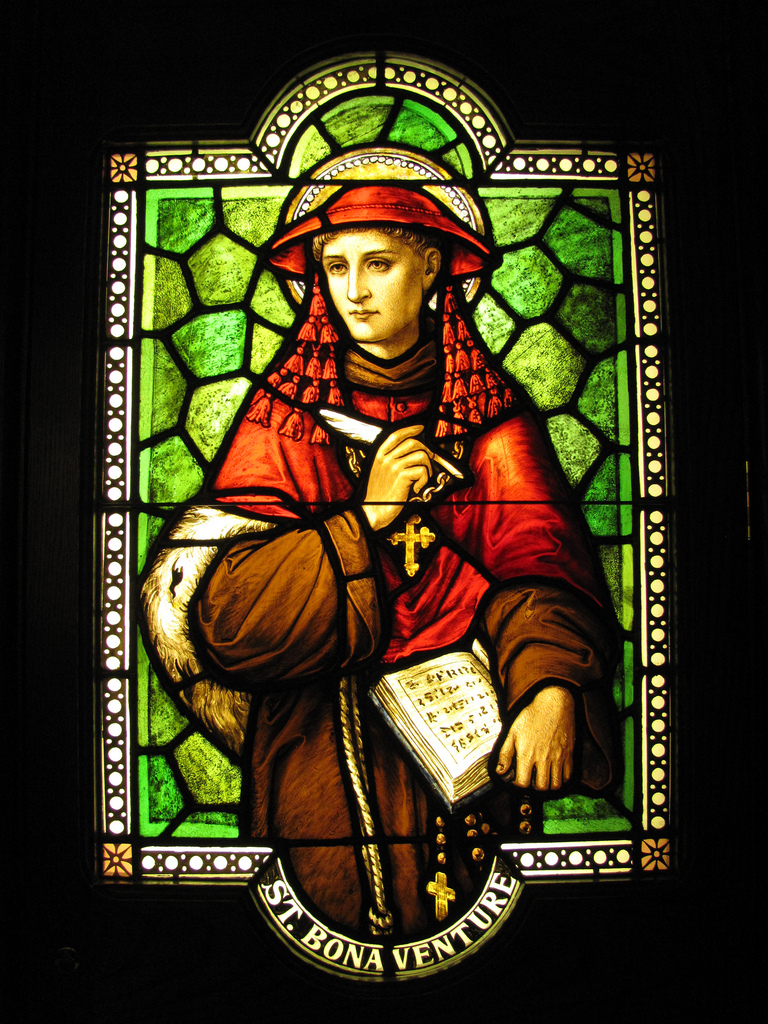
Saint of the Day – 15 July – St Bonaventure – Seraphic Doctor

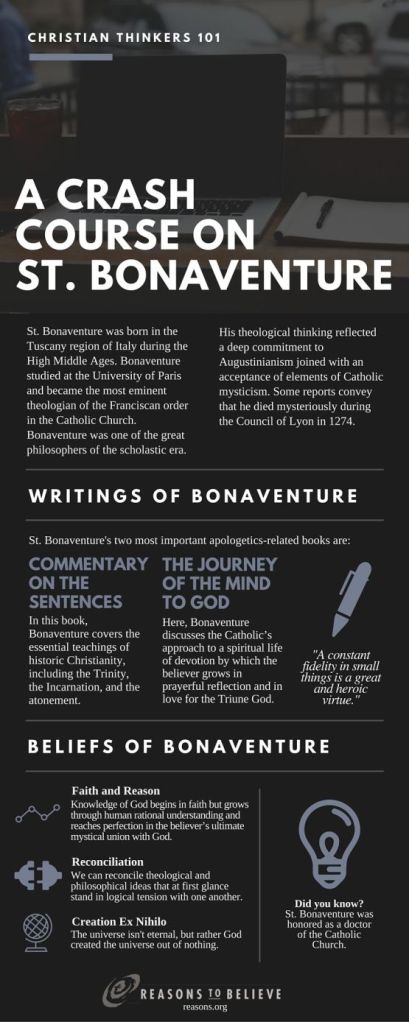
Saint of the Day – 15 July – St Bonaventure – Confessor, Bishop, Doctor of the Church – Friar, Theologian, Philosopher, Writer, Mystic, Preacher, Teacher – born in (1221 at Bagnoregio, Tuscany, Italy and died on 15 July 1274 at Lyon, France of natural causes).  He was born Giovanni di Fidanza and was the seventh Minister General of the Order of Friars Minor, he was also Cardinal Bishop of Albano.  Bonaventure was Canonised on 14 April 1482 by Pope Sixtus IV and declared a Doctor of the Church in the year 1588 by Pope Sixtus V.   He is known as the “Seraphic Doctor” (Latin: Doctor Seraphicus). PATRONAGESagainst intestinal problems, stomach diseases, of – Bagnoregio, Italy, Banja Luka, Bosnia and Herzegovina, Cochiti Indian Pueblo, Saint Bonaventure University, New York.

St Bonaventure was born at Bagnorea in Umbria, not far from Viterbo, then part of the Papal States.   Almost nothing is known of his childhood, other than the names of his parents, Giovanni di Fidanza and Maria Ritella.

He entered the Franciscan Order in 1243 and studied at the University of Paris, possibly under Alexander of Hales and certainly under Alexander’s successor, John of Rochelle. In 1253 he held the Franciscan chair at Paris.    A dispute between seculars and mendicants delayed his reception as Master until 1257, where his degree was taken in company with Thomas Aquinas.   Three years earlier his fame had earned him the position of lecturer on The Four Books of Sentences—a book of theology written by Peter Lombard in the twelfth century—and in 1255 he received the degree of master, the medieval equivalent of doctor.

After having successfully defended his order against the reproaches of the anti-mendicant party, he was elected Minister General of the Franciscan Order.   On 24 November 1265, he was selected for the post of Archbishop of York;   however, he was never consecrated and resigned the appointment in October 1266.[6]

Bonaventure was instrumental in procuring the election of Pope Gregory X, who rewarded him with the title of Cardinal Bishop of Albano and insisted on his presence at the great Second Council of Lyon in 1274.   There, after his significant contributions led to a union of the Greek and Latin churches, Bonaventure died suddenly and in suspicious circumstances.   The 1913 edition of the Catholic Encyclopedia has citations that suggest he was poisoned but no mention is made of this in the 2003 second edition of the New Catholic Encyclopedia.   The only extant relic of the saint is the arm and hand with which he wrote his Commentary on the Sentences, which is now conserved at Bagnoregio, in the parish church of St. Nicholas.

He steered the Franciscans on a moderate and intellectual course that made them the most prominent order in the Catholic Church until the coming of the Jesuits.   His theology was marked by an attempt completely to integrate faith and reason.   He thought of Christ as the “one true master” who offers humans knowledge that begins in faith, is developed through rational understanding and is perfected by mystical union with God.

Bonaventure’s feast day was included in the General Roman Calendar immediately upon his canonisation in 1482.  In 1969 it was classified as an obligatory memorial and assigned to the date of his death, 15 July.

Posted in SAINT of the DAY

Saints’ Memorials – 15 July

St Bonaventure of Bagnoregio – Seraphic Doctor -(Memorial)

Dispersion of the Apostles: Commemorates the missionary work of the Twelve Apostles. It was first mentioned in the 11th century and was celebrated in the northern countries of Europe during the Middle Ages. It is now observed in Germany, Poland and some dioceses of England, France and the United States.—
Abundantia of Spoleto
Abudemius of Bozcaada
Adalard the Younger
Anrê Nguyen Kim Thông
Bl Anne Mary Javhouhey
Bl Antoni Beszta-Borowski
Apronia
Athanasius of Naples
Antiochus of Sebaste
Benedict of Angers
Bl Bernard of Baden
Bl Ceslas Odrowaz
David of Sweden
Donivald
Eberhard of Luzy
Edith of Tamworth
Eternus
Felix of Pavia
Gumbert of Ansbach
Haruch of Werden
Jacob of Nisibis
Joseph Studita of Thessalonica
Bl Michel-Bernard Marchand
Bl Peter Aymillo
Phêrô Nguyen Bá Tuan
Plechelm of Guelderland
Bl Roland of Chézery
Valentina of Nevers
Vladimir I of Kiev

Martyred Jesuit Missionaries of Brazil – 40 beati: A band of forty Spanish, Portugese and French Jesuit missionaries martyred by the Huguenot pirate Jacques Sourie while en route to Brazil. They are –
• Aleixo Delgado • Alonso de Baena • álvaro Borralho Mendes • Amaro Vaz • André Gonçalves • António Correia • Antônio Fernandes • António Soares • Bento de Castro • Brás Ribeiro • Diogo de Andrade • Diogo Pires Mimoso • Domingos Fernandes • Esteban Zuraire • Fernando Sánchez • Francisco Alvares • Francisco de Magalhães • Francisco Pérez Godoy • Gaspar Alvares • Gonçalo Henriques • Gregorio Escribano • Ignatius de Azevedo • Iõao • João Fernandes • João Fernandes • Juan de Mayorga • Juan de San Martín • Juan de Zafra • Luís Correia • Luís Rodrigues • Manuel Alvares • Manuel Fernandes • Manuel Pacheco • Manuel Rodrigues • Marcos Caldeira • Nicolau Dinis • Pedro de Fontoura • Pedro Nunes • Simão da Costa • Simão Lopes •
They were martyed on 15 and 16 July 1570 on the ship Santiago near Palma, Canary Islands. They were beatified on 11 May 1854 by Pope Pius IX.

Martyrs of Alexandria – 13 saints: Thirteen Christians who were martyred together. We know the names of three, no details about them and the other ten were all children. – Narseus, Philip and Zeno. Martyred in the early 4th-century in Alexandria, Egypt.

Martyrs of Carthage – 9 saints: A group of nine Christians who were martyred together. We know nothing else but their names – Adautto, Catulinus, Felice, Florentius, Fortunanziano, Januarius, Julia, Justa and Settimino. They were martyred in Carthaginian and their relics at the basilica of Fausta at Carthage.
Martyrs of Pannonia – 5 saints: Five 4th-century martyrs killed together. No information about them has survived except the names – Agrippinus, Fortunatus, Martialis, Maximus and Secundinus.
Posted in MORNING Prayers, The HOLY NAME

The Wonders of the Holy Name – Fr Paul O’Sullivan, O.P. – “Revealing the Simplest Secret Ever of Holiness and Happiness.” Part Five – 14 July

Previous Posts here: https://anastpaul.wordpress.com/category/the-holy-name/

St. Alexander and the Pagan Philosophers.

During the reign of the Emperor Constantine,
the Christian Religion was constantly and rapidly
making progress.
In Constantinople itself the Pagan Philosophers
felt much aggrieved at seeing many of their adepts
deserting the old religion and joining the new.
They pleaded with the Emperor himself, demanding
that in justice they should get a hearing and
be allowed to hold a public conference with the
Bishop of the Christians.   Alexander, who at the
time ruled the See of Constantinople, was a holy
man but not a keen logician.
He did not, for that fear to meet the representative
of the pagan Philosophers who was an astute
dialectician and an eloquent orator.   On the
appointed day before a vast assembly of learned
men the Philosopher began a carefully prepared
attack on the Christian teaching.   The Holy
Bishop listened for some time and then pronounced
the Name of Jesus which at once confounded the
Philosopher who not only completely lost the
thread of his discourse but was utterly unable,
even with the aid of his colleagues, to return to
the attack.

St Christina
St Christina a young Christian girl was a slave
in Kurdistan, a region almost entirely pagan.
It was the custom in that country when a child
was gravely ill that the mother should take it in her
arms to the houses of her friends and ask them
if they knew of any remedy that might benefit or
cure the little one.   On one of these occasions a
mother brought her sick child to the boys where
Christina lived,
On being asked if she knew of a remedy for that
sickness she looked at the child and said:
“Jesus, Jesus”.
On the instant the dying child smiled and leapt
with joy.   It was completely cured.
This extraordinary fact became soon known and
reached the ears of the Queen who herself was an
invalid.   She gave orders that Christina should be
brought to her presence.
On arriving at the Palace the royal patient
asked her if she could with the same remedy cure
her disordet:  which had baffled the skill of the
physicians.   Once more Christina pronounced with
great confidence:  “Jesus, Jesus”. and again this
divine Name was glorified.   The Queen instantly
recovered her health.
A third wonder was yet to be worked.   Some
days after the cure of the Queen the King found
himself suddenly face to face with certain death.
Escape seemed impossible. Mindful of the divine
power of the Holy Name, which he had witnessed
in the cure of his wife, his Majesty called out
Jesus, Jesus. whereupon he was snatched from the
dreadful peril.   Calling in his turn for the little
slave he learned from her the truths of Christianity
which he and a great multitude of his people
embraced.
St. Christina became a saint and her feast is
kept 11 December 15th.

the wonders of the holy name-day five-12 july

Posted in MORNING Prayers, SAINT of the DAY

Thought for the Day – 14 July

Thought for the Day – 14 July

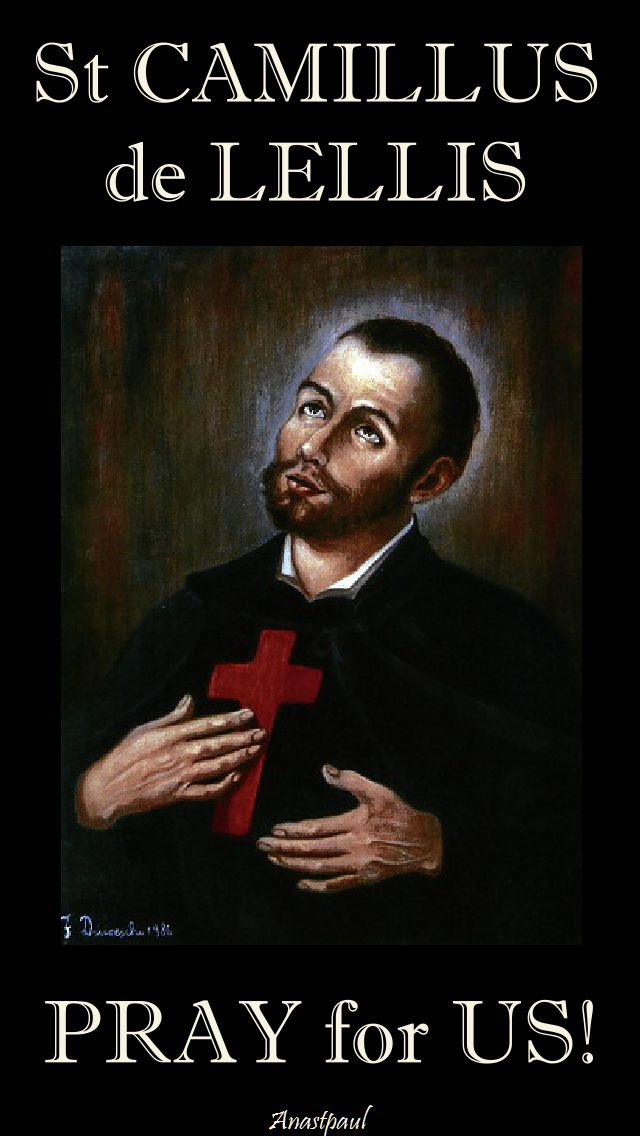
It never ceases to amaze me how many saints we have, (all waiting to hear from us, by the way), who initially led lives totally against the precepts of natural moral order, Christ and Holy Scripture.   But God is never far off – the ‘Hound of Heaven’ goes before and behind us.   And God creates saints.   Seemingly random meetings, words, in the case of St Camillus – a sermon by a Capachin and a meeting with St Philip Neri, alters everything, for we know that nothing is random – God has penetrated our selfishness,   He becomes visible to our souls and once that happens we can only do our very best, try our hardest to do all for Him and as if everything depended on us.   All human effort is the dispensing of God’s divine power and only God’s grace can make us like Himself.

St Camillus de Lellis Pray for us!

st camillus de lellis - pray for us 2

Posted in MORNING Prayers, SAINT of the DAY

Quote/s of the Day – 14 July

Quote/s of the Day – 14 July

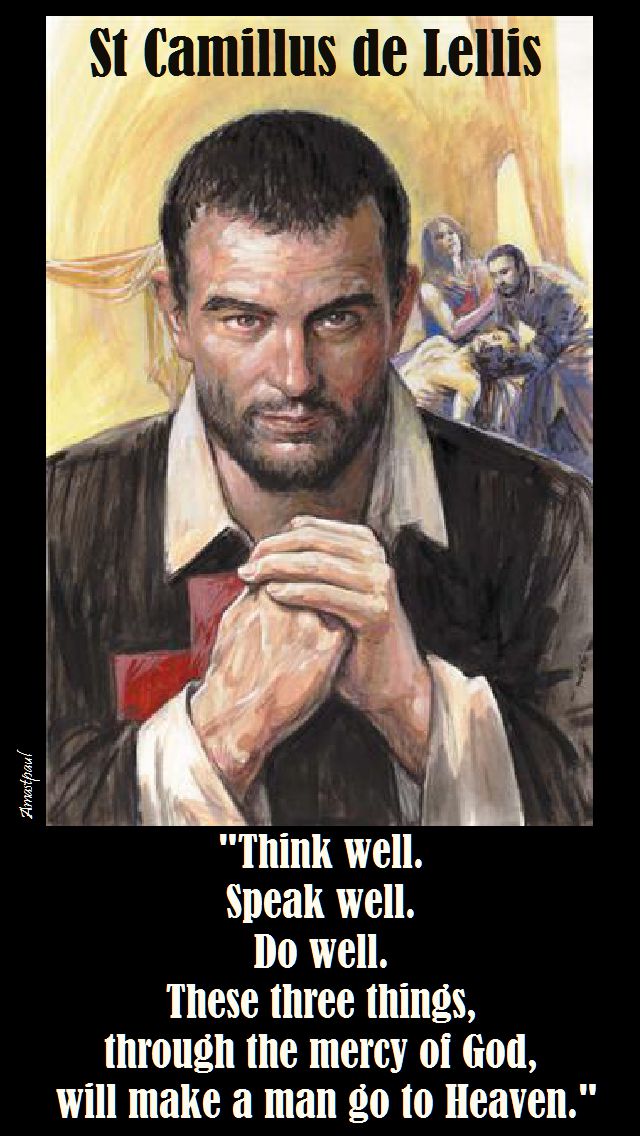
“Think well.
Speak well.
Do well.
These three things,
through the mercy of God,
will make a man go to Heaven.”

think well speak well do well-st camillus de lellis

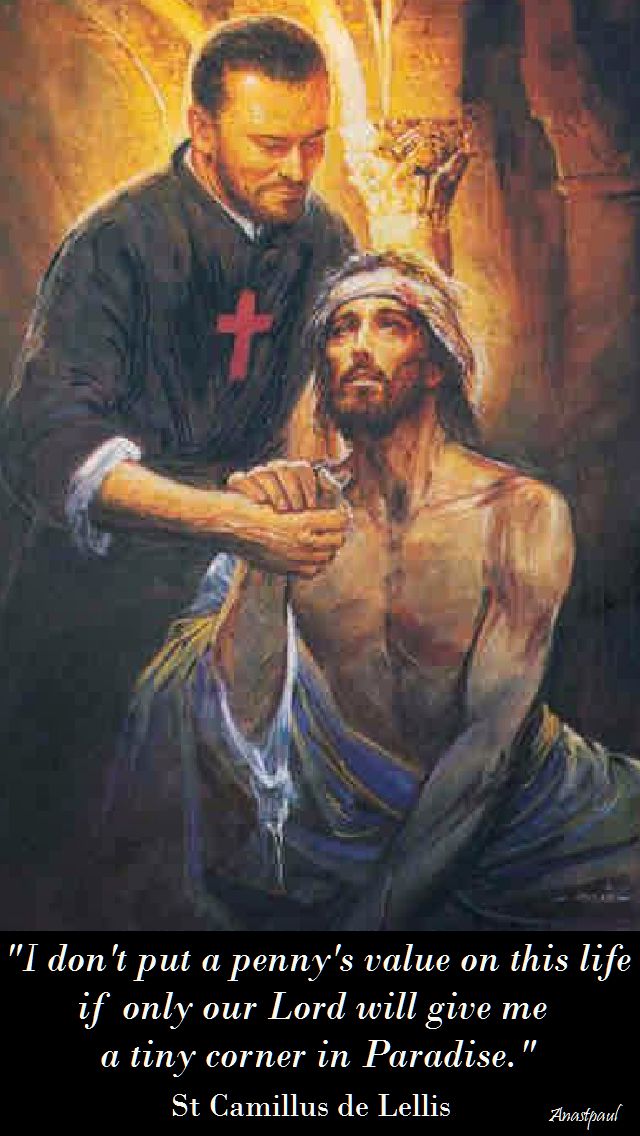
“I don’t put a penny’s value on this life
if only our Lord will give me
a tiny corner in Paradise.”

i donht put a penny's value on tis life - st camillus de lellis

St Camillus de Lellis

Posted in MORNING Prayers, QUOTES of the SAINTS, SAINT of the DAY, The WORD

One Minute Reflection – 13 July

One Minute Reflection – 13 July

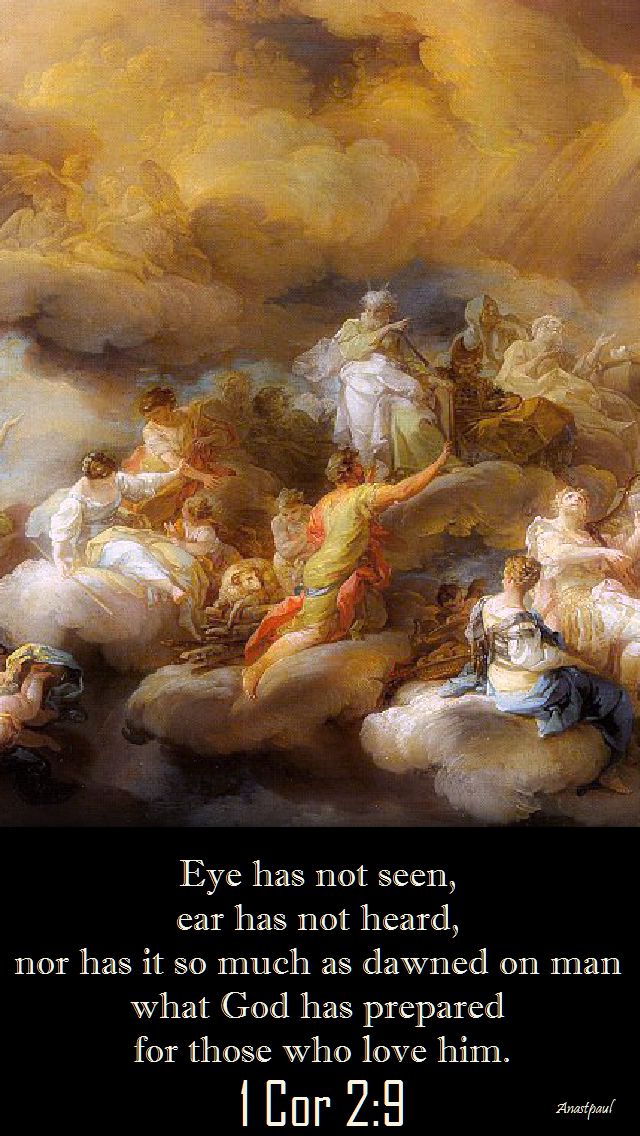
Eye has not seen, ear has not heard, nor has it so much as dawned on man what God has prepared for those who love him………1 Cor 2:9

1 cor 2 9

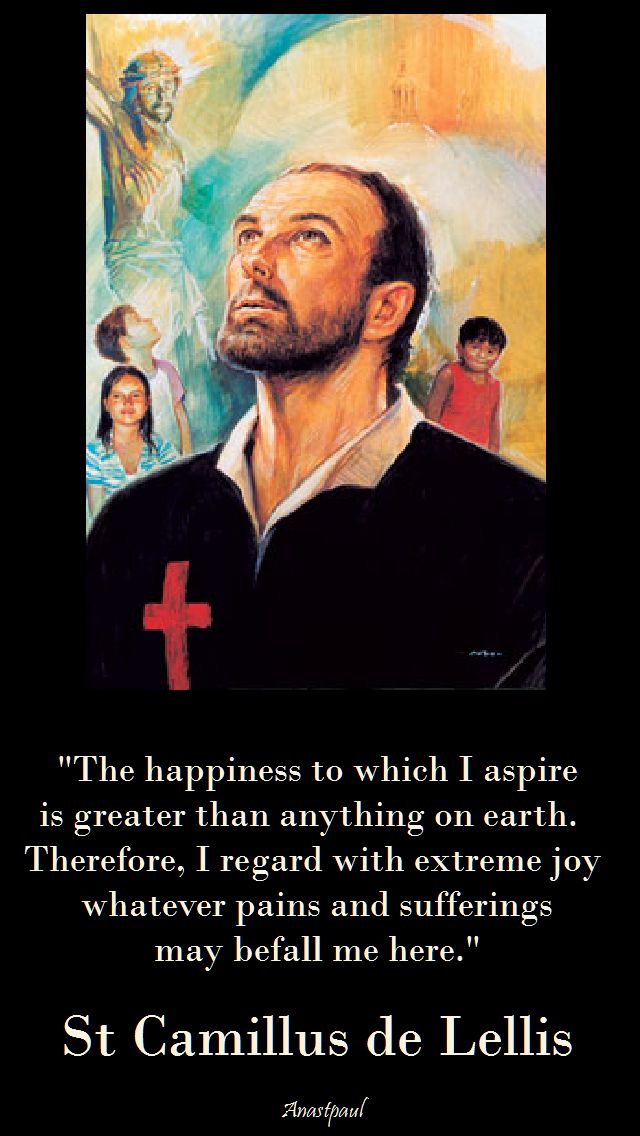
REFLECTION – “The happiness to which I aspire is greater than anything on earth. Therefore, I regard with extreme joy whatever pains and sufferings may befall me here.”………St Camillus de Lellis

the happiness to which I aspire - st camillus de lellis

PRAYER – Heavenly Father. keep my mind fixed on the surpassing joys stored up for me in heaven. And let me be willing to put up with all sufferings and pains that may come upon me. St Camillus de Lellis, pray for us, amen.

st camillus de lellis pray for us