Posted in MORNING Prayers, QUOTES of the SAINTS, SACRED and IMMACULATE HEARTS, SAINT of the DAY

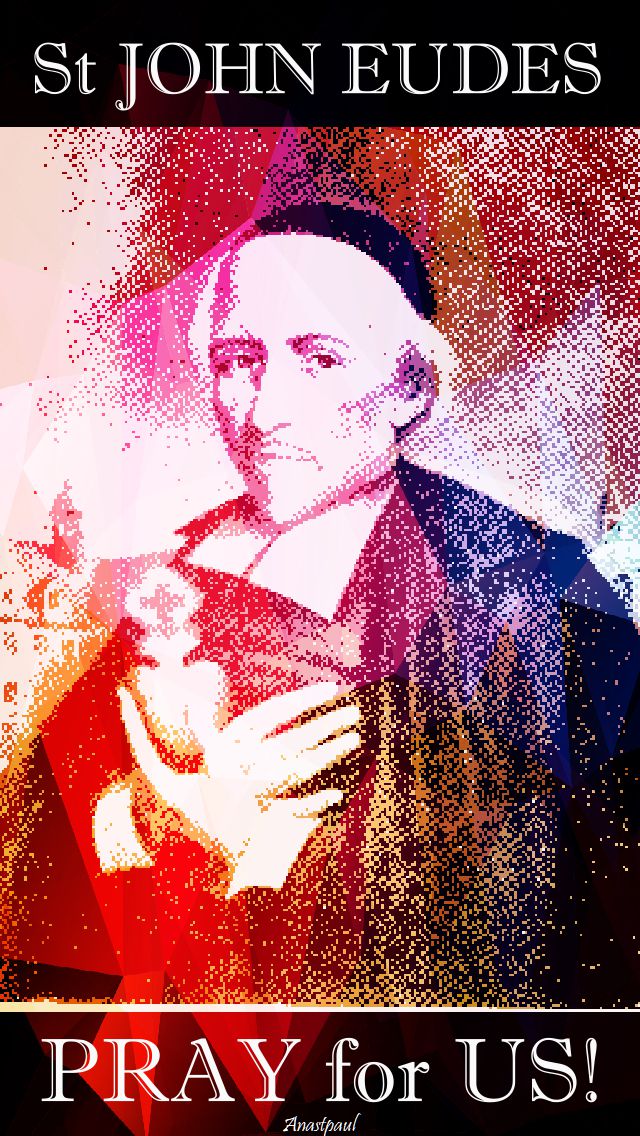
Quotes of the Day – 19 August – The Memorial of St John Eudes “Apostle of Two Hearts”

Quotes of the Day – 19 August – The Memorial of St John Eudes “Apostle of Two Hearts”

“Faith is a beam, radiating from the face of God.”

faith is a beam-st john eudes

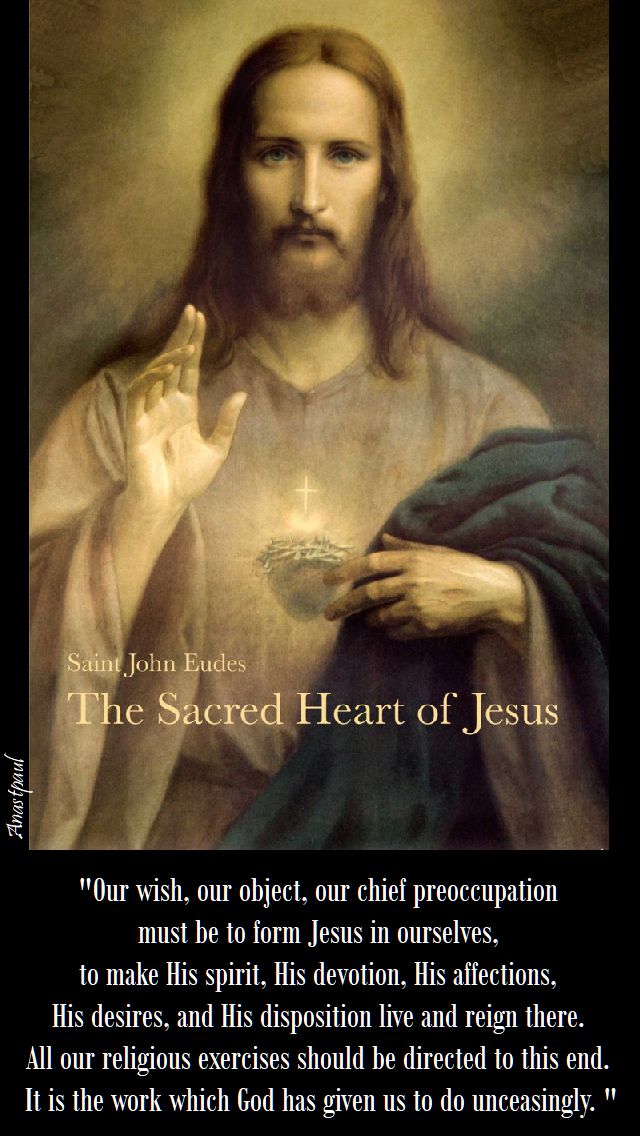
“Our wish, our object, our chief preoccupation
must be to form Jesus in ourselves,
to make His spirit, His devotion, His affections,
His desires and His disposition live and reign there.
All our religious exercises should be directed to this end.
It is the work which God has given us to do unceasingly. “

our wish, our object - st john eudes

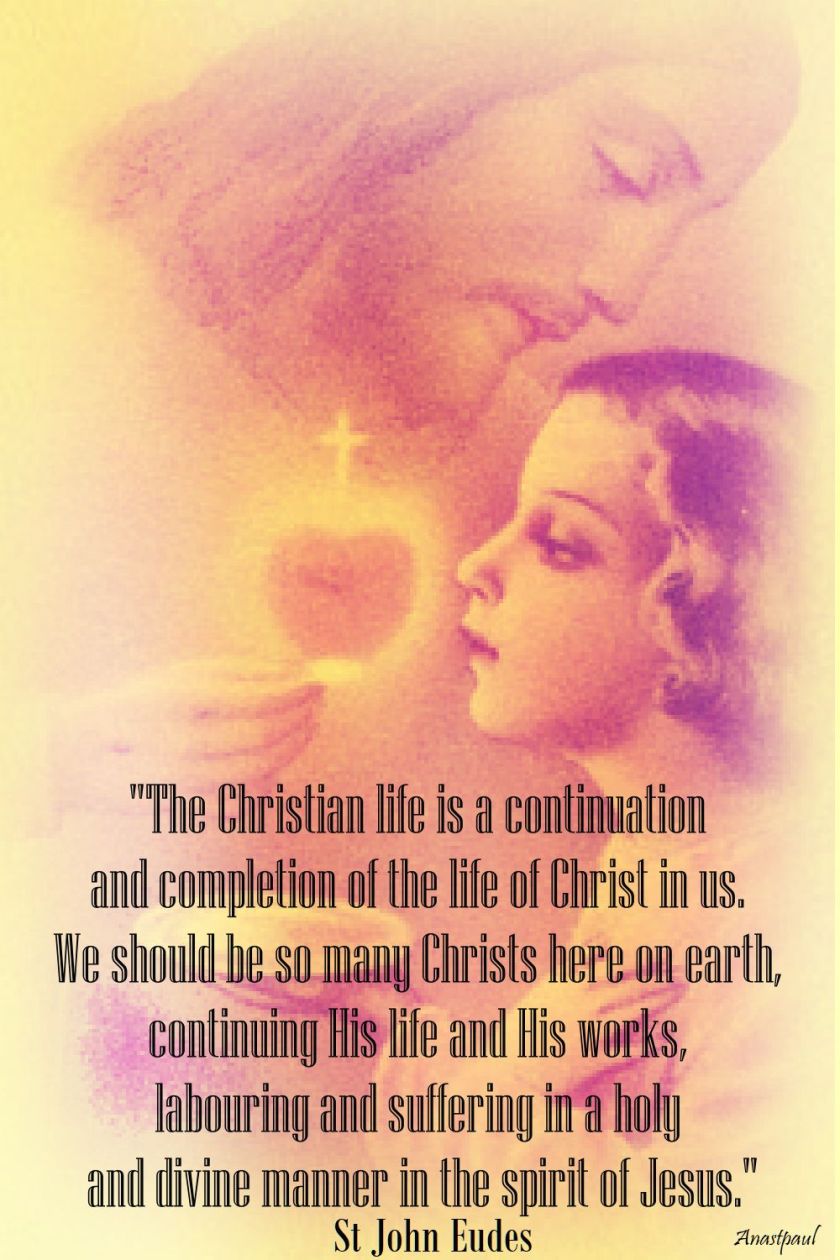
“The Christian life is a continuation
and completion of the life of Christ in us.
We should be so many Christs here on earth,
continuing His life and His works,
labouring and suffering in a holy
and divine manner in the spirit of Jesus.”

the christian life is a continuation - st john eudes

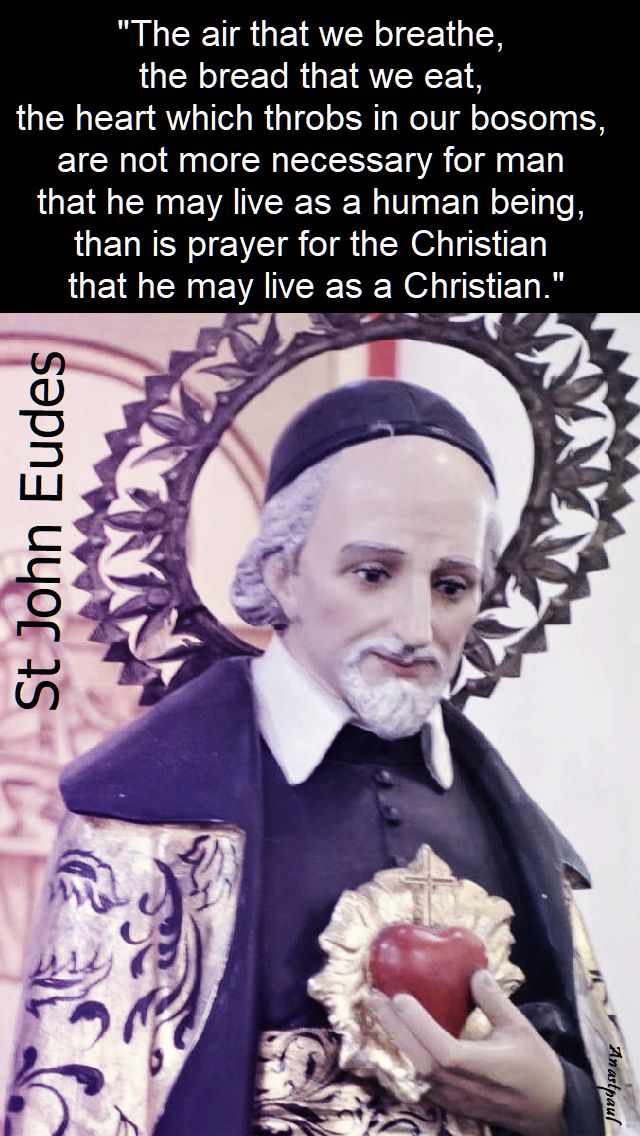
“The air that we breathe,
the bread that we eat,
the heart which throbs in our bosoms,
are not more necessary for man
that he may live as a human being,
than is prayer for the Christian
that he may live as a Christian.”

the air that we breathe - st john eudes

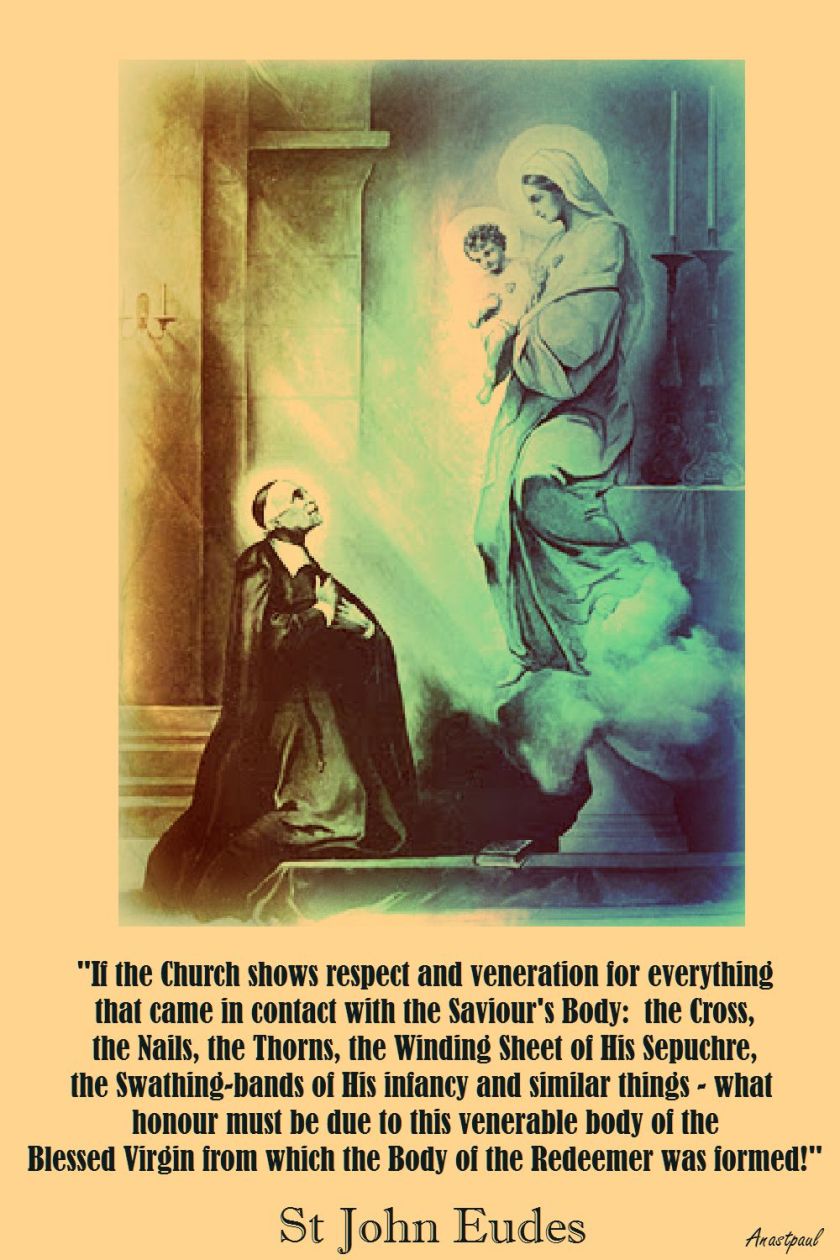
““If the Church shows respect and veneration for everything
that came in contact with the Saviour’s Body: the Cross,
the Nails, the Thorns, the Winding Sheet of His Sepuchre,
the Swathing-bands of His infancy and similar things – what
honour must be due to this venerable body of the
Blessed Virgin from which the Body of the Redeemer was formed!”

St John Eudesif-the-church-st-john-eudes

Posted in MORNING Prayers, QUOTES of the SAINTS, SACRED and IMMACULATE HEARTS, SAINT of the DAY, The WORD

One Minute Reflection – 19 August – The Memorial of St John Eudes “Apostle of Two Hearts”

One Minute Reflection – 19 August – The Memorial of St John Eudes “Apostle of Two Hearts”

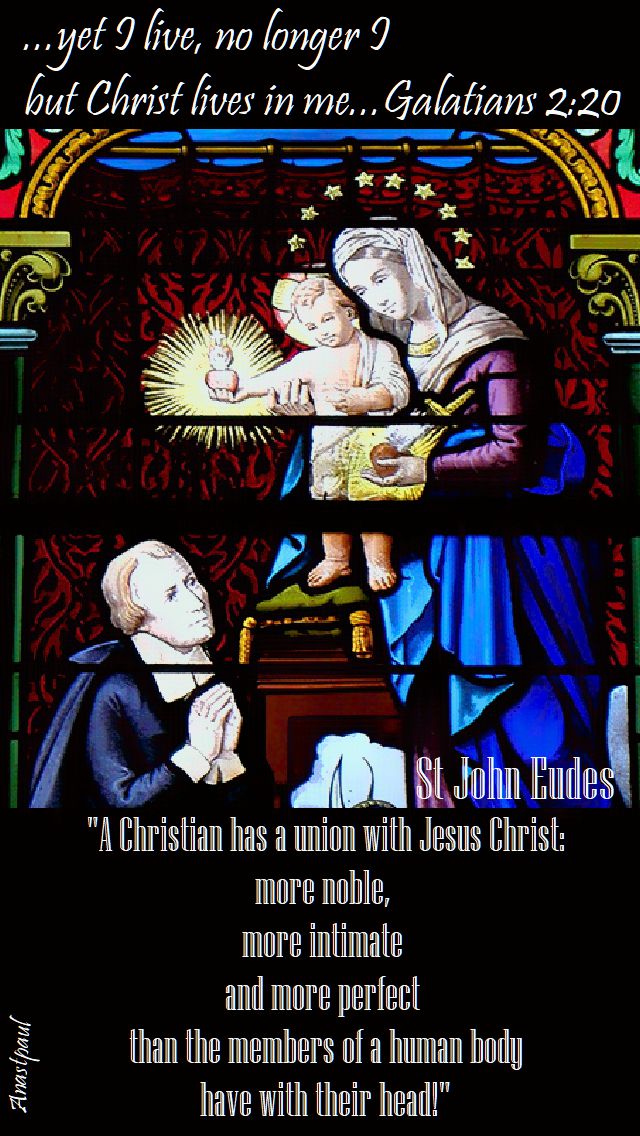
yet I live, no longer I but Christ lives in me….Galatians 2:20

GALATIANS 2 20

REFLECTION – “A Christian has a union with Jesus Christ:
more noble,
more intimate
and more perfect
than the members of a human body
have with their head!”

a christian has a union with jesus christ - st john eudes

PRAYER – Father of mercies and God of all consolation, You gave us the loving Heart of Your own beloved Son, because of the boundless love by which You have loved us, which no tongue can describe. May we render You a love that is perfect with hearts made one with His. Grant, we pray, that our hearts may be brought to perfect unity: each heart with the other and all hearts with the Heart of Jesus….and may the rightful yearnings of our hearts find fulfillment through Him: Our Lord Jesus Christ, Your Son, who lives and reigns with You in the unity of the Holy Spirit, one God, forever and ever. – Collect from Saint John Eudes’ Mass, Gaudeamus, 1668 St John Eudes, Pray for us! amen.

st john eudes - pray for us

Posted in SACRED and IMMACULATE HEARTS, SAINT of the DAY

Saint of the Day – 19 August – St John Eudes (1601-1680) Confessor, “Apostle of Two Hearts”

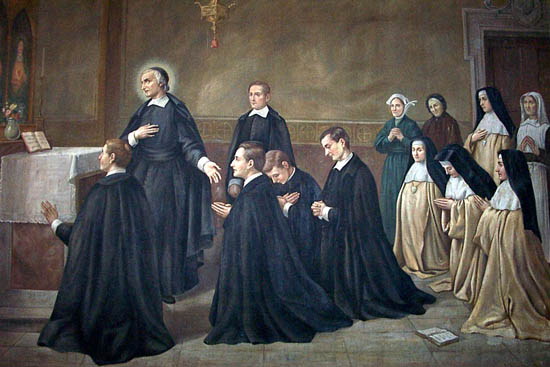
Saint of the Day – 19 August – St John Eudes -(1601-1680 “Apostle of Two Hearts” (14 November 1601 at Ri, Normandy, France – 19 August 1680 at Caen, Normandy, France) –  Beatified on 25 April 1909 by Pope Pius X and Canonised on 31 May 1925 by Pope Pius XI.   Confessor, Priest, Missionary, Founder, Preacher, Writer, he founded the Congregation of Jesus and Mary and the Order of Our Lady of Charity and was the author of the propers for the Mass and Divine Office of the Sacred Hearts of Jesus and Mary.   Patronage – of the Diocese of Baie-Comeau, Québecl.   Attributes – Priest’s garments with the Sacred Heart.

St. John Eudes 02.HEADER

Eudes was born in 1601 on a farm near the village of Ri, in Normandy, the son of Isaac and Martha Eudes.   After studying with the Jesuits at Caen, Eudes joined the Oratorians on 25 March 1623.   His masters and models in the spiritual life were Pierre de Bérulle and the mystic Charles de Condren.   As a student of de Bérulle, Eudes is a member of the French School of Spirituality.   The French School was not a system or philosophy, but a highly Christocentric approach to spirituality, characterized by a sense of adoration, a personal relationship with Jesus, and a rediscovery of the Holy Spirit.

Eudes was ordained a priest on 20 December 1625.   Immediately after his ordination, he came down with an illness that kept him bedridden for a year.   During severe plagues in 1627 and 1631, he volunteered to care for the stricken in his own diocese.   He went about Normandy committing himself to the sick, administering the sacraments, and burying the dead.   To avoid infecting his colleagues, he lived in a huge cask in the middle of a field during the plague.

At age 32, Eudes became a parish missionary, preached over 100 parish missions, throughout Normandy, Ile-de-France, Burgundy and Brittany.   He was called by Jean-Jacques Olier “the Prodigy of his Age”.

He saw that parish priests needed support in becoming men of prayer and action.   He held conferences for them in which he outlined their duties.   Later, John started his own society of priests called the Congregation of Jesus and Mary.   The members were dedicated to promoting good seminary training, which would form Christlike priests.

Christian love impelled John to feel compassion for the women who were trying to escape prostitution.   He wanted a place for them to live, a refuge from their former way of life.   To serve the women in these refuges, he established a society of religious women called the Congregation of Our Lady of the Refuge.   It now serves the needs of troubled girls around the world.

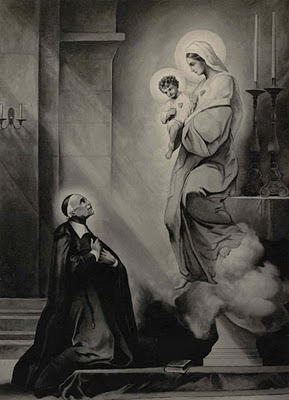
Influenced by the teaching of the French school and St. Francis de Sales, especially as set out in the Treatise on the Love of God, and also by the revelations of St. Gertrude and St. Mechtilde, he was the theoretician, so to speak, of devotion to the Sacred Heart and explained the expressions of his predecessors.   Won over to devotion to the Heart of Jesus by Bérulle’s devotion to the Incarnate Word, he combined with it the gentleness and devotional warmth of St. Francis de Sales.   He changed the somewhat individual and private character of the devotion into a devotion for the whole Church by writing for the benefit of his communities an Office and a Mass, which were later approved by several bishops before spreading throughout the Church.   For this reason, Pope Leo XIII, in proclaiming his virtues heroic in 1903, gave him the title of “Author of the Liturgical Worship of the Sacred Heart of Jesus and Holy Heart of Mary”.

Eudes_Two_Hearts

Eudes dedicated the seminary chapels of Caen and Coutances to the Sacred Heart.   The feast of the Holy Heart of Mary was celebrated for the first time in 1648 and that of the Sacred Heart of Jesus in 1672, each as a double of the first class with an octave.   He composed various prayers and rosaries to the Sacred Hearts. His book “Le Cœur Admirable de la Très Sainte Mère de Dieu” is the first book ever written on the devotion to the Sacred Hearts.

a john
Founder Statue at St Peter’s Rome

Eudes taught the mystical unity of the hearts of Jesus and Mary and wrote, his most famous works are – Devotion to the Adorable Heart of Jesus and The Admirable Heart of the Most Holy Mother of God:

“You must never separate what God has so perfectly united.   So closely are Jesus and Mary bound up with each other that whoever beholds Jesus sees Mary; whoever loves Jesus, loves Mary;  whoever has devotion to Jesus, has devotion to Mary.”

The most striking characteristic of the teaching of St. John Eudes on Devotion to the Sacred Heart—as indeed of his whole teaching on the spiritual life—is that Christ is always its centre.

St John died a month after finishing The Admirable Heart of the Most Holy Mother of God, of natural causes on 19 August 1680 at Caen, Normandy, France.

Posted in SAINT of the DAY

Memorials of the Saints for 19 August

St John Eudes (Optional Memorial) – https://www.youtube.com/watch?v=XvnrPXy5CJA

St Andrew the Tribune
St Badulf of Ainay
St Bertulf of Luxeuil
St Calminius
St Credan of Evesham
St Donatus of Mount Jura
St Elaphius of Châlons
St Ezekiel Moreno Y Diaz
St Guenninus
Bl Guerricus
Bl Hugh Green
St Julius of Rome
St Louis of Toulouse
St Magnus of Anagni
St Magnus of Avignon
St Magnus of Cuneo
St Marianus of Entreaigues
St Marinus of Besalu
St Magino of Tarragona
St Mochta
St Namadia of Marsat
St Rufinus of Mantua
St Sarah the Matriarch
St Sebaldus
St Thecla of Caesarea
St Timothy of Gaza

Martyrs of Nagasaki – 15 beati: A group of missionaries and their laymen supporters who were executed for spreading Christianity in Japan.
• Antonius Yamada
• Bartholomaeus Mohyoe
• Iacobus Matsuo Denji
• Ioachim Díaz Hirayama
• Ioannes Miyazaki Soemon
• Ioannes Nagata Matashichi
• Ioannes Yago
• Laurentius Ikegami Rokusuke
• Leo Sukeemon
• Ludovic Frarijn
• Marcus Takenoshita Shin’emon
• Michaël Díaz Hori
• Paulus Sankichi
• Pedro de Zúñiga
• Thomas Koyanagi
Theywere beheaded on 19 August 1622 at Nagasaki, Japan and Beatified on 7 May 1867 by Pope Pius IX.

Martyred in the Spanish Civil War
Martyred Carmelite Sisters of Charity – 9 beati
Martyred Salesians of Ciudad Real – 8 beati
Martyred Subiaco Benedictines of Barcelona – 7 beati
• Blessed Agueda Hernández Amorós
• Blessed Agustí Busquets Creixell
• Blessed Andrés Pradas Lahoz
• Blessed Antolín Martínez y Martínez
• Blessed Antoni Pedró Minguella
• Blessed Càndid Feliu Soler
• Blessed Cipriano González Millán
• Blessed Damián Gómez Jiménez
• Blessed Elvira Torrentallé Paraire
• Blessed Félix González Bustos
• Blessed Francisca de Amézua Ibaibarriaga
• Blessed Francisco de Paula Ibáñez y Ibáñez
• Blessed Ignasi Guilà Ximenes
• Blessed Isidro Muñoz Antolín
• Blessed Joan Roca Bosch

Posted in JESUIT SJ, MORNING Prayers, QUOTES on CHARITY, SAINT of the DAY

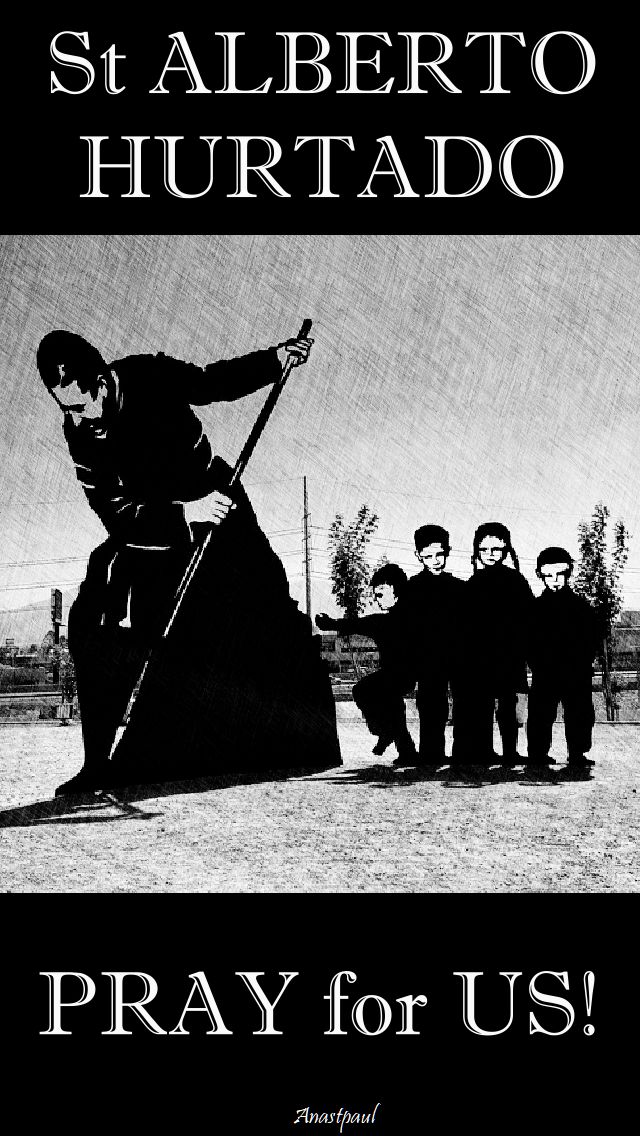
Thought for the Day – 18 August – The Memorial of St Alberto Hurtado

Thought for the Day – 18 August – The Memorial of St Alberto Hurtado

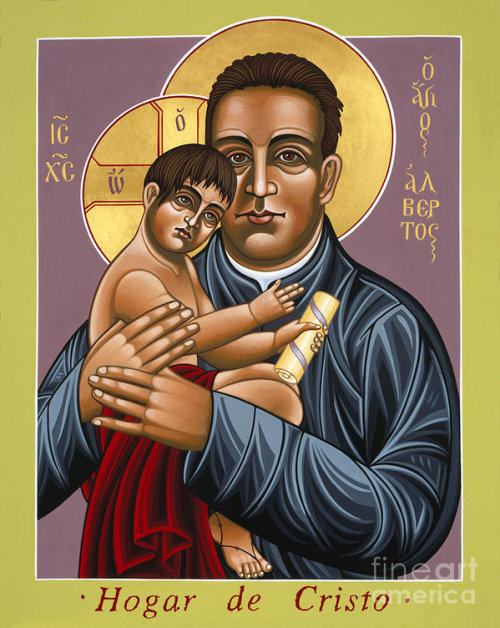
” Hogar de Christo”

Hogar means “hearth” or “home.” Hurtado wanted to welcome the poor into “Christ’s home.”

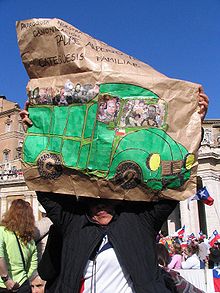
From all accounts Hurtado was an intensely busy man.   In 1946, he bought a green pickup truck to better bring at-risk children living on the street back to the shelters.   He called them his patroncitos, his “little bosses.”   In addition to his work with Hogar, his retreats and outreach to youth, he wrote several books and found the journal Mensaje, a Catholic magazine designed to highlight the social teachings of the church and which is still proudly published by the Chilean Jesuits.

Despite his hectic schedule, Alberto understood the need for the balance between prayer and work, striving to be a “contemplative in action.”   On the one hand, the activist is the one who at every moment recognises “the divine impulse.”   On the other, prayer should not encourage a “sleepy sort of laziness under the pretext of keeping ourselves united with God.”   I like to think of him as the patron saint of multitaskers.

By the age of 50, though, Alberto seemed to his friends worn out.   After a physician-ordered vacation, he returned to discover that he had pancreatic cancer.   The end would come quickly and painfully.   Yet during his suffering he was often heard to say, “I am content, O Lord, I am content.”   He died at age 51.

His funeral, in the Church of St. Ignatius in Santiago, was filled with so many of the poor who venerated Padre Hurtado that many of his close friends had to remain outside. Alberto Hurtado was canonised by Pope Benedict XVI in 2005.   All of Chile celebrated the man who the country’s president called one of Chile’s “founding fathers.”

In Santiago, near the original Hogar, is a shrine to Alberto, where many come to pray. Inside is his beat-up green pickup.

Let us too ‘build a home for Christ’!

St Alberto, Pray for us!

st alberto - pray for us 2

Posted in MORNING Prayers, QUOTES of the SAINTS, QUOTES on CHARITY

Quote of the Day – 18 August

Quote of the Day – 18 August

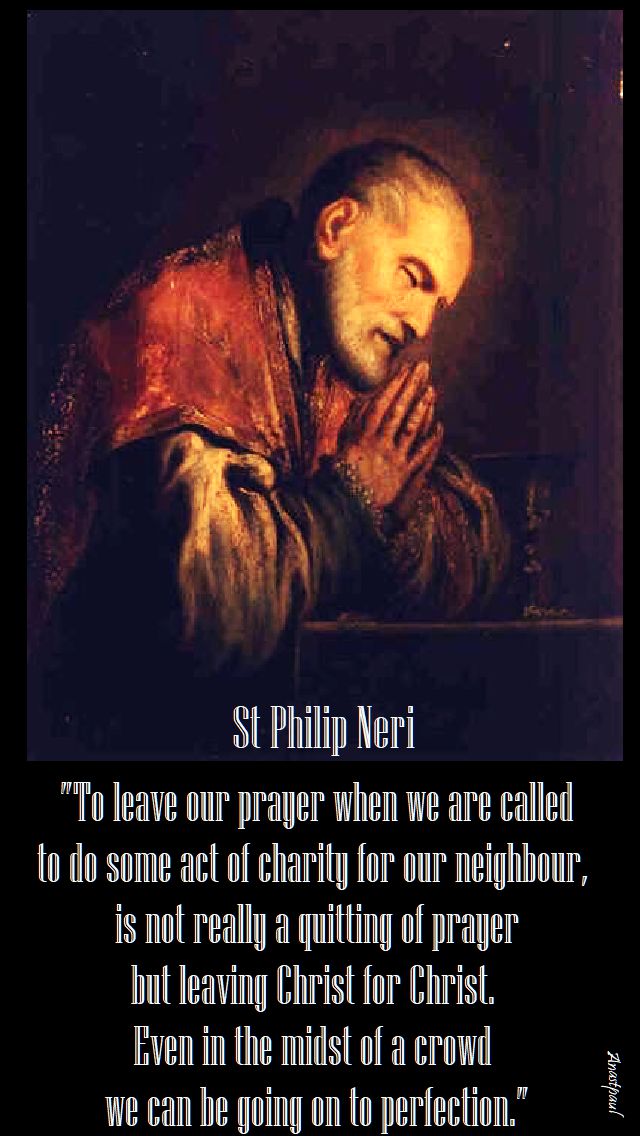
”To leave our prayer when we are called
to do some act of charity for our neighbour,
is not really a quitting of prayer
but leaving Christ for Christ.
Even in the midst of a crowd
we can be going on to perfection.”

St Philip Nerit lave our prayer - st philip neri

Posted in MORNING Prayers, QUOTES of the SAINTS, SAINT of the DAY, The WORD

One Minute Reflection – 18 August – The Memorial of St Alberto Hurtado

One Minute Reflection – 18 August – The Memorial of St Alberto Hurtado

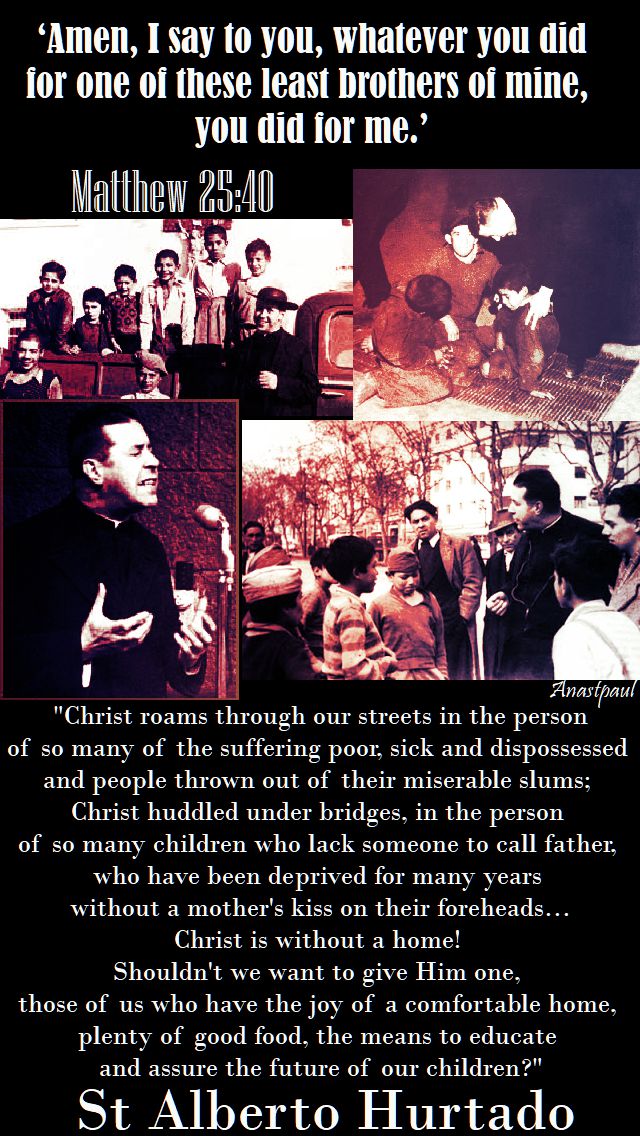
‘Amen, I say to you, whatever you did for one of these least brothers of mine, you did for me.’...Matthew 25:40

REFLECTION – “Christ roams through our streets in the person of so many of the suffering poor, sick and dispossessed, and people thrown out of their miserable slums; Christ huddled under bridges, in the person of so many children who lack someone to call father, who have been deprived for many years without a mother’s kiss on their foreheads…Christ is without a home!   Shouldn’t we want to give Him one, those of us who have the joy of a comfortable home, plenty of good food, the means to educate and assure the future of our children?”…St Alberto Hurtado S.J.

christ roams through our streets - st alberto hurtado.jpg

PRAYER – Heavenly Father, teach us to follow Your Son in all things, to give and not to count the cost. Open our eyes to the distress and sadness around us. What we have may we learn to share with others, so that we too may be called “good and faithful servant” which St Alberto lived to fulfil in each moment of his life. St Alberto Hurtado, pray for us, amen.st alberto - pray for us

Posted in JESUIT SJ, MORNING Prayers, PRAYERS of the SAINTS, SAINT of the DAY

Our Morning Offering – 18 August

Our Morning Offering – 18 August

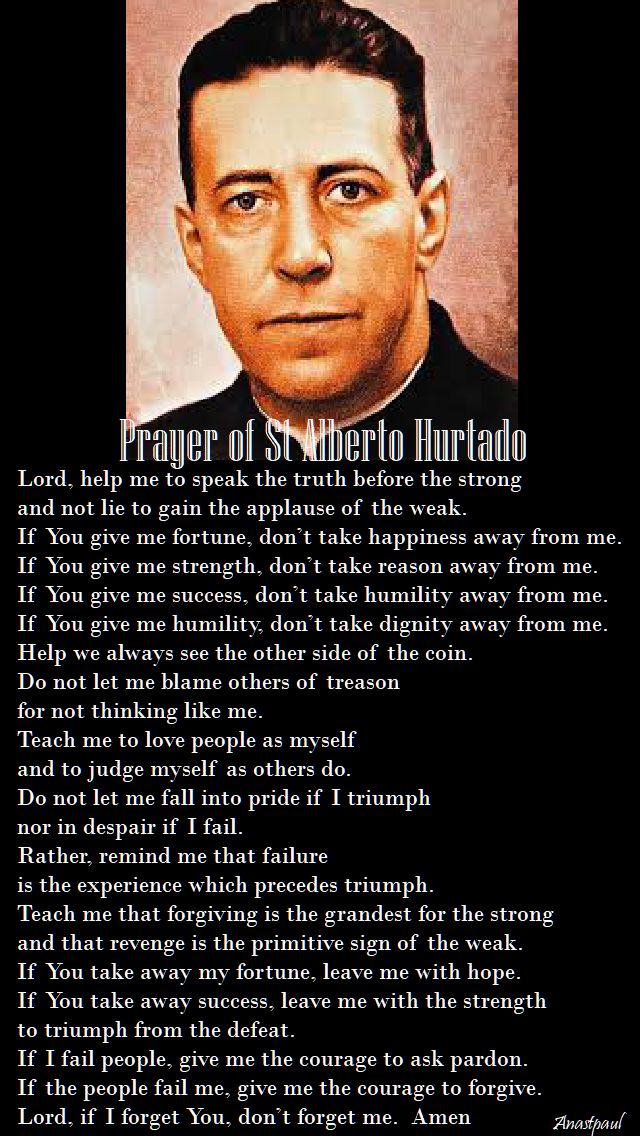
Prayer of St Alberto Hurtado

Lord, help me to speak the truth before the strong
and not lie to gain the applause of the weak.
If You give me fortune, don’t take happiness away from me.
If You give me strength, don’t take reason away from me.
If You give me success, don’t take humility away from me.
If You give me humility, don’t take dignity away from me.
Help we always see the other side of the coin.
Do not let me blame others of treason
for not thinking like me.
Teach me to love people as myself
and to judge myself as others do.
Do not let me fall into pride if I triumph
nor in despair if I fail.
Rather, remind me that failure
is the experience which precedes triumph.
Teach me that forgiving is the grandest for the strong
and that revenge is the primitive sign of the weak.
If You take away my fortune, leave me with hope.
If You take away success, leave me with the strength
to triumph from the defeat.
If I fail people, give me the courage to ask pardon.
If the people fail me, give me the courage to forgive.
Lord, if I forget You, don’t forget me.
Amen

Here’s the Spanish:

Señor, ayúdame a decir la verdad delante de los fuertes
Y a no decir mentiras para ganarme el aplauso de los débiles.

Si me das fortuna, no me quites la felicidad.
Si me das fuerza, no me quites la razón.
Si me das éxito, no me quites la humildad.
Si me das humildad, no me quites la dignidad.

Ayúdame siempre a ver el otro lado de la medalla.
No me dejes inculpar de traición a los demás
por no pensar como yo.
Enséñame a querer a la gente como a mí mismo
y a juzgarme como a los demás.

No me dejes caer en el orgullo si triunfo,
ni en la desesperación si fracaso.
Más bien recuérdame que el fracaso
es la experiencia que precede al triunfo.

Enséñame que perdonar es lo más grande del fuerte,
Y que la venganza es la señal primitiva del débil.

Si me quitas la fortuna, déjame la esperanza.
Si me quitas el éxito, déjame la fuerza para triunfar del fracaso.

Si yo fallara a la gente, dame valor para disculparme.
Si la gente fallara conmigo, dame valor para perdonar.
Señor, si yo me olvido de Ti, no te olvides de mí.

prayer of st alberto hurtado

Posted in SAINT of the DAY

Saint of the Day – 18 August 2017 – Alberto Hurtado Cruchaga S.J. (1901-1952)

Saint of the Day – 18 August 2017 – Alberto Hurtado Cruchaga S.J. (22 January 1901 at Vina del Mar, Chile – 18 August 1952 at Santiago, Chile of pancreatic cancer) Lawyer, Priests, Apostle of the poor and especially of poor/street/orphaned children, Teacher, Catechist, Writer, Apostle of the Youth and of the Homeless Apostle of Social Justice – Fr Hurtado was Beatified by John Paul II on October 16, 1994 and Canonised on 23 October 2005 by Pope Benedict XVI at Rome, Italy.   Patronages – Chile, poor people, street children, social workers.

ALBERTO HURTADO CRUCHAGA was born in Viña del Mar, Chile, on 22 January 1901;  he was orphaned when he was four years old by the death of his father.   His mother had to sell, at a loss, their modest property in order to pay the family’s debts.   As a further consequence, Alberto and his brother had to go to live with relatives and were often moved from one family to another.   From an early age, therefore, he experienced what it meant to be poor, to be without a home and at the mercy of others.

He was given a scholarship to the Jesuit College in Santiago.   Here he became a member of the Sodality of Our Lady and developed a lively interest in the poor, spending time with them in the most miserable neighborhoods every Sunday afternoon.

When he completed his secondary education in 1917, Alberto wanted to become a Jesuit but he was advised to delay the realisation of this desire in order to take care of his mother and his younger brother.   By working in the afternoons and evenings, he succeeded in supporting them; at the same time, he studied law at the Catholic University.   In this period, he maintained his care for the poor and continued to visit them every Sunday.   Obligatory military service interrupted his studies but once he fulfilled this duty he went on to earn his degree early in August 1923.

On 14 August 1923 he entered the Novitiate of the Society of Jesus in Chillán  . In 1925 he went to Córdoba, Argentina, where he studied humanities.   In 1927 he was sent to Spain to study philosophy and theology.

However, because of the suppression of the Jesuits in Spain in 1931, he went on to Belgium and continued studying theology at Louvain.   He was ordained a priest there on 24 August 1933 and in 1935 obtained a doctorate in pedagogy and psychology.   After having completed his Tertianship in Drongen, Belgium, he returned to Chile in January 1936.   Here he began his activity as professor of religion at Colegio San Ignacio and of Pedagogy at the Catholic University of Santiago.   He was entrusted with the Sodality of Our Lady for the students and he involved them in teaching catechism to the poor.   He frequently directed retreats and offered spiritual direction to many young men, accompanying several of them in their response to the priestly vocation and contributing in an outstanding manner to the formation of many Christian laymen.

In 1941 Father Hurtado published his most famous book:  “Is Chile a Catholic Country?” The same year he was asked to assume the role of Assistant for the Youth Movement of the Catholic Action, first within the Archdiocese of Santiago and then nationally.   He performed these roles with an exceptional spirit of initiative, dedication and sacrifice.

In October 1944, while giving a retreat, he felt impelled to appeal to his audience to consider the many poor people of the city, especially the numerous homeless children who were roaming the streets of Santiago.   This request evoked a ready and generous response.   This was the beginning of the initiative for which Father Hurtado is especially well-known:  a form of charitable activity which provided not only housing but a home-like milieu for the homeless: “El Hogar de Cristo”.

ST ALBERTO HEADER

icon - hogar de cristo

By means of contributions from benefactors and with the active collaboration of committed laity, Father Hurtado opened the first house for children;  this was followed by a house for women and then one for men.   The poor found a warm home in “El Hogar de Cristo”.   The houses multiplied and took on new dimensions;  in some houses there were rehabilitation centers, in others trade-schools and so on.   All were inspired and permeated by Christian values.  During all his work he drove a battered old ruck – green it was – it became a little icon of his arrival received with joy and love, wherever he went.

Fr. Hurtado's memorable green pickup truck
Fr Hurtado’s memorable green pickup truck

In 1945 Father Hurtado visited the United States to study the “Boys Town” movement and to consider how it could be adapted to his own country.   The last six years of his life were dedicated to the development of various forms in which “El Hogar” could exist and function.

In 1947 Father Hurtado founded the Chilean Trade Union Association (ASICH) to promote a union movement inspired by the social teaching of the Church.

Between 1947 and 1950, Father Hurtado wrote three important works:  on trade unions, on social humanism and on the Christian social order.   In 1951 he founded “Mensaje”, the well-known Jesuit periodical dedicated to explaining the doctrine of the Church.

Pancreatic cancer brought him, within a few months, to the end of his life.   In the midst of terrible pain, he was often heard to say, “I am content, Lord.”

After having spent his life manifesting Christ’s love for the poor, Father Hurtado was called to the Lord on 18 August 1952.

From his return to Chile after his Tertianship to his death, a matter of only fifteen years, Father Hurtado lived and accomplished all the works described above.   His apostolate was the expression of a personal love for Christ the Lord;  it was characterised by a great love for poor and abandoned children, an enlightened zeal for the formation of the laity and a lively sense of Christian social justice.

Posted in SAINT of the DAY

Memorials of the Sains – 18 August

St Agapitus the Martyr
St Alberto Hurtado Cruchaga – https://www.youtube.com/watch?v=1cANvZdjmG4
Bl Antoine Bannassat
St Crispus of Rome
St Daig Maccairaill
Bl Domenico de Molinar
St Eonus of Arles
St Ernan
St Evan of Ayrshire
St Firminus of Metz
St Florus of Illyria
Bl Francus of Francavilla
Bl Gaspar di Salamanca
St Helena
St Hermas of Rome
St John of Rome
St Juliana of Myra
St Juliana of Stobylum
St Laurus of Illyria
St Leo of Myra
Bl Leonard of Cava
St Maximus of Illyria
Bl Milo of Fontenelle
St Polyaenus of Rome
St Proculus of Illyria
Bl Raynald of Ravenna
St Ronan of Iona
St Serapion of Rome

Massa Candida: Also known as –
• Martyrs of Utica
• White Company
Three hundred 3rd century Christians at Carthage who were ordered to burn incense to Jupiter or face death by fire. Martyrs. Saint Augustine of Hippo and the poet Prudentius wrote about them. They jumped into a pit of burning lime c 253 at Carthage, North Africa.

Martyred in the Spanish Civil War:
Martyred Carmelites of Carabanchel Bajo – 8 beati:
Martyrs of La Tejera – 4 beati:
• Blessed Adalberto Vicente y Vicente
• Blessed Agustín Pedro Calvo
• Blessed Angelo Reguilón Lobato
• Blessed Atanasio Vidaurreta Labra
• Blessed Aurelio García Anton
• Blessed Celestino José Alonso Villar
• Blessed Daniel García Antón
• Blessed Eliseo María Camargo Montes
• Blessed Eudald Rodas Saurina
• Blessed Fermín Gellida Cornelles
• Blessed Francisco Arias Martín
• Blessed Francisco Pérez y Pérez
• Blessed Gregorio Díez Pérez
• Blessed Jaume Falgarona Vilanova
• Blessed José María Ruiz Cardeñosa
• Blessed José Sánchez Rodríguez
• Blessed Joseph Chamayoux Auclés
• Blessed Liberio González Nombela
• Blessed María Luisa Bermúdez Ruiz
• Blessed Micaela Hernán Martínez
• Blessed Nicomedes Andrés Vecilla
• Blessed Patricio Gellida Llorach
• Blessed Rosario Ciércoles Gascón
• Blessed Santiago Franco Mayo
• Blessed Silvano Villanueva González
• Blessed Vicente María Izquierdo Alcón

Posted in DOMINICAN OP, MORNING Prayers, SAINT of the DAY, The BLESSED VIRGIN MARY, The HOLY EUCHARIST / The HOLY MASS

Thought for the Day – 17 August – The Memorial of St Hyacinth of Poland – “Apostle of Poland” “Apostle of the North”

Thought for the Day – 17 August – The Memorial of St Hyacinth of Poland – “Apostle of Poland” “Apostle of the North”

“Our readers, we can but fancy, have marvelled at the prodigious labours and travelling of Saint Hyacinth, although we have given only a meager account of them. They extended over a period of nearly forty years and carried him through a large part of Europe and Asia. Doubtless, if they were recorded in detail and in proper sequence, they would be found infinitely more stupendous than we have painted them. He alone could have told them as they should be recounted. Yet it possibly never entered his mind to leave posterity any information on his life. The one thing that engaged his thoughts was, after saving his own soul, to help those of others, to make God known and to extend the kingdom of Christ. The same idea filled the minds of the confrères who were often his companions in labour. In this way, it was only through the scanty records discovered in cities and the early convents that historians have been able to tell us the little we do know about him. Still perhaps never was there a life which should be more completely written than that of Saint Hyacinth Odrowaz.

One may consider the practical, lively faith of the Poles, whether in the home land or in others, as a perpetual miracle of Saint Hyacinth.   In no small measure they owe it to him. To that keen faith we must attribute the magnificent institutions of learning, charity, benevolence and the like, as well as the churches, monasteries and similar edifices, in which Poland abounds and in which it has found expression.   All these are filled with the spirit which the people largely derived from him.   They simply thrill with love and gratitude for him.   This true spirit of Catholicity, we must remember, has been preserved undiminished for centuries through wars of every kind, division, hardships, persecution and every sort of oppression-the like of which the world has seen few parallels.   We have here, it would seem, the greatest miracle of the zealous apostle’s life. At least, it has contributed more to the glory of God, the good of the Church, and the salvation of souls than any miracle he performed.” (Acta; STANISLAUS, Father, O. P., of Cracow, manuscript Vita Sancti Hyacinthi.)

Saint Hyacinth teaches us to spare no effort in the service of God but to rely for success not on our industry but on the assistance of the Holy Eucharist and the prayer of the Immaculate Mother of God.

St Hyacinth of Poland pray for the Poland, the Church and for us all!

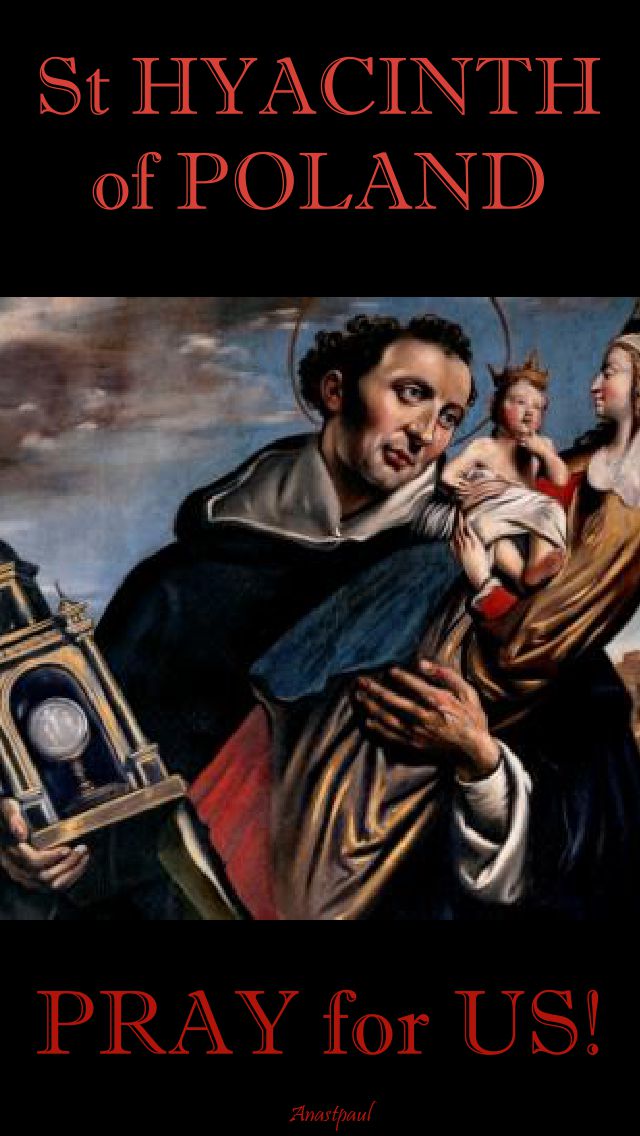
st hyacinth pray for us 2


Posted in DOCTORS of the Church, DOMINICAN OP, FATHERS of the Church, MORNING Prayers, SAINT of the DAY, The BLESSED VIRGIN MARY

Quote/s of the Day – 17 August

Quote/s of the Day – 17 August

As it is the Memorial of St Hyacinth O.P. of the great Marian Miracle,
I am posting Quotations on Mary from some of our great Dominican Saints.
Enjoy!

“Mary is the Divine Page
on which the Father wrote
the Word of God, His Son.”

St Albert the Great O.P. (1200-1280) Doctor of the Church

mary is the divine page - st albert the great

“As mariners are guided into port
by the shining of a star,
so Christians are guided to heaven
by Mary.”

St Thomas Aquinas O.P. (1225-1274) Doctor of the Church

as mariners are guided into port - st thomas aquinas

“Mary is the most sweet bait,
chosen,
prepared
and ordained by God,
to catch the hearts of men.”

St Catherine of Siena T.O.S.D. (1347-1380) Doctor of the Churchmary is the most sweet bait - st catherine of siena

“To ask favours
without interposing Mary,
is to attempt to fly without wings.”

St Antoninus O.P. Bishop of Florence (1389-1459)

to ask favours without interposing mary - st antoninus of florence

Posted in DOCTORS of the Church, FATHERS of the Church, MORNING Prayers, QUOTES of the SAINTS, SAINT of the DAY, The BLESSED VIRGIN MARY, The WORD

One Minute Reflection – 17 August – The Memorial of St Hyacinth of Poland

One Minute Reflection – 17 August – The Memorial of St Hyacinth of Poland

Come, blessed of my Father, possess the kingdom prepared for you from the foundation of the world…Matthew 25:34

REFLECTION – “Mary, the Mother of our Lord, accompanied by the choirs of Angels, will come to meet you. What a day of joy that will be for you!”….St Jerome (343-420) Doctor of the Church

mnary the moher of our lord - st jerome

PRAYER – O Mary, Mother of God and my mother, watch over me at every moment and keep me free from sin. Then upon my death, come to meet me and lead me to my eternal home in heaven. As you, St Hyacinth, took Mary with you and she made smooth your path, pray that we too may always ‘take Mary with us’ to lead us safely home to her son, who is our Lord, amen.

st hyacinth of poland pray for us

Posted in DOCTORS of the Church, DOMINICAN OP, MORNING Prayers, PRAYERS of the SAINTS, SAINT of the DAY

Our Morning Offering – 17 August

Our Morning Offering – 17 August

Our Lord, King of all!
By St Albert the Great O.P. (1200-1280) Doctor of the Church

We pray to You, O Lord,
who are the supreme Truth,
and all truth is from You.
We beseech You, O Lord,
who are the highest Wisdom,
and all the wise depend on You
for their wisdom.
You are the supreme Joy,
and all who are happy
owe it to You.
You are the Light of minds
and all receive
their understanding from You.
We love, we love You above all.
We seek You, we follow You,
and we are ready to serve You.
We desire to dwell under Your power
for You are the King of all.
Amenour lord, king of all - st albert the geat op

Posted in Against DROWNING, DOMINICAN OP, SAINT of the DAY

Saint of the Day – 17 August – St Hyacinth OP (1185-1257) – “Apostle of Poland” and “Apostle of the North”

Saint of the Day – 17 August – St Hyacinth OP (1185-1257) – (born Jacek Odrowąż)  “Apostle of Poland” and “Apostle of the North” also known as “the Polish St Dominic”– Religious Priest, Confessor, Doctor of Law and Divinity, Missionary, Preacher, Miracle Worker, Mystic (1185 at Lanka Castle, Kamien Slaski, Opole, Upper Silesia (in modern Poland) – 15 August 1257 at Krakow, Poland of natural causes).   His major relics are in Paris, France.   He was Canonised on 17 April 1594 by Pope Clement VIII.   Patronages – against drowning, Camalaniugan, Philippines, Ermita de Piedra de San Jacinto, Tuguegarao, Philippines, Krakow, Poland, archdiocese of, Lithuania (named by Pope Innocent XI in 1686), Poland, Lithuania.   Attributes – statue of the Blessed Virgin Mary; Monstrance or Ciborium.

Hyacinth-O.P HEADER 2.-e1424637742936

Called the “Apostle of Poland” and the “Apostle of the North”, Hyacinth was the son of Eustachius Konski of the noble family of Odrowąż.   He was born in 1185 at the castle of Lanka, at Kamin, in Silesia, Poland.   A near relative of Blessed Ceslaus, he made his studies at Kraków, Prague and Bologna and at the latter place merited the title of Doctor of Law and Divinity.   On his return to Poland he was given a stipend at Sandomir.   He subsequently accompanied his uncle Ivo Konski, the Bishop of Kraków, to Rome.

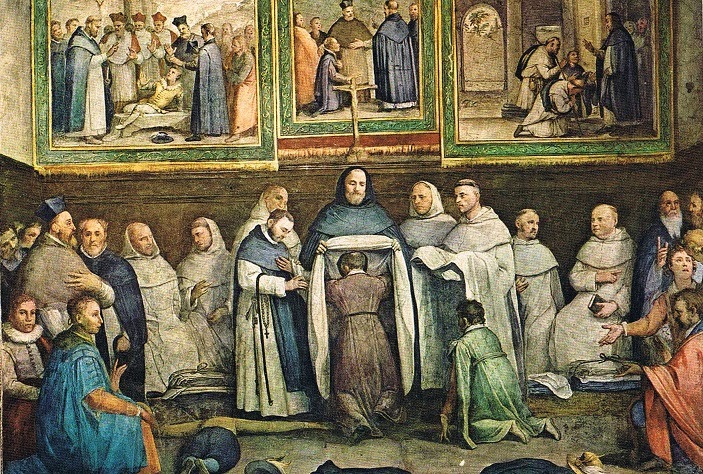
While in Rome, he witnessed a miracle performed by Saint Dominic and became a Dominican friar, along with the Blessed Ceslaus and two attendants of the Bishop of Kraków – Herman and Henry.   In 1219 Pope Honorius III invited Saint Dominic and his followers to take up residence at the ancient Roman basilica of Santa Sabina, which they did by early 1220.   Before that time, the friars had only a temporary residence in Rome at the convent of San Sisto Vecchio which Honorius III had given to Dominic circa 1218, intending it to be used for a reformation of Roman nuns under Dominic’s guidance. Hyacinth and his companions were among the first to enter the convent.   They were also the first alumni of the studium of the Dominican Order at Santa Sabina out of which would grow the 16th century College of Saint Thomas at Santa Maria sopra Minerva, which became the Pontifical University of Saint Thomas Aquinas, Angelicum in the 20th century.   After an abbreviated novitiate, Hyacinth and his companions received the religious habit of the Order from St Dominic himself in 1220.

st dominic gives habit to st hyacinth

The young friars were then sent back to their homeland to establish the Dominican Order in Poland and Kiev.   As Hyacinth and his three companions travelled back to Kraków, he set up new monasteries with his companions as superiors, until finally he was the only one left to continue on to Kraków, where he founded two houses.

His apostolic journeys extended over numerous and vast regions, he walked a total of nearly twenty five thousand miles in his apostolic travels.   Austria, Bohemia, Livonia, the shores of the Black Sea, Tartary, Northern China in the east, Sweden, Norway and Denmark to the west, were evangelised by him and he is said to have visited Scotland.   Everywhere he travelled unarmed, without a horse, with no money, no interpreters, no furs in the severe winters and often without a guide, abandoning to Divine Providence his mission in its entirety.   Everywhere multitudes were converted, churches and convents were built;  one hundred and twenty thousand pagans and infidels were baptised by his hands.   He worked many miracles;  at Krakow he raised a dead youth to life.  His progress among these hostile peoples, with their barbarous customs and unknown languages, through trackless forests, in the fierce cold of the North, can be explained as a miracle.st hyaconth op

He had inherited from Saint Dominic a perfect filial confidence in the Mother of God;  to Her he ascribed his success and to Her aid he looked for his own salvation.   Early in his mission career, Our Lady appeared to Hyacinth and promised him that she would never refuse him anything.   Through the years of his arduous labour she kept her promise, and his ministry was rich with a harvest of souls. He performed many astounding miracles, including countless cures. On one occasion he gave sight to two boys who had been born without eyes. He raised several dead people to life.   The best known incident in his life has to do with Our Lady, which is not surprising.

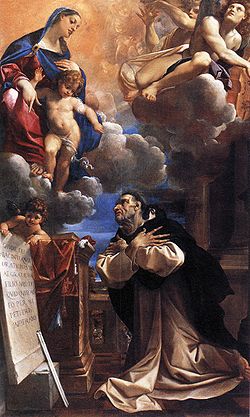
250px-Carracci_Saint_Hyacinth
Apparition of the Virgin to Saint Hyacinth, Ludovico Carracci (1592), in the Louvre Museum

It was at the request of this indefatigable missionary that Saint Thomas Aquinas wrote his famous philosophical Summa contra Gentiles, proving the reasonableness of the Faith on behalf of those unfamiliar with doctrine.

While Saint Hyacinth was at Kiev the Tartars sacked the town but it was only as he finished Mass that the Saint heard of the danger.   Without waiting to unvest, he took the ciborium in his hands and was leaving the church.   Then occurred the most famous of his countless prodigies.   As he passed by a statue of Mary a voice said:  “Hyacinth, My son, why do you leave Me behind? Take Me with you…”   The statue was of heavy alabaster but when Hyacinth took it in his arms it was light as a reed.   With the Blessed Sacrament and the statue he walked to the Dnieper river and crossed dry-shod over the surface of the waters to the far bank.

On the eve of the Assumption, 1257, he was advised of his coming death.   In spite of an unrelenting fever, he celebrated Mass on the feast day and communicated as a dying man.   He was anointed at the foot of altar and died on the great Feast of Our Lady.

A note on the name “Hyacinth”:   Jacek is the common form in Polish, for the name “Hyacinth.”   Literally understood, “Hyacinth” is said to derive from the hyacinth flower or hyacinth stone and thus its meaning has two interpretations.

In the first place he is called “Hyacinth,” because the flower has a stalk with a crimson blossom:   this suits Blessed Jacek well for he was a simple stalk in his docility of heart, a flower in his chastity, a crimson blossom in his vow of poverty and lack of material goods.

Secondly, he is called “Hyacinth” from the hyacinth stone, for he shines brilliantly in the way he handed on the teaching of the gospel, was resplendent in his holy way of life and most steadfast in spreading the catholic faith.

Posted in SAINT of the DAY

Memorials of the Saints – 17 August

Bl Marie-Élisabeth Turgeon (Optional Memorial)

St Amor of Amorbach
St Anastasius of Terni
St Beatrice da Silva
St Benedicta of Lorraine
St Carloman
St Cecilia of Lorraine
St Clare of Montefalco
St Donatus of Ripacandida
St Drithelm
St Pope Eusebius
St Eusebius of Sicily
St Hyacinth – https://www.youtube.com/watch?v=EoOFq6fsiHo
St Jacobo Kyushei Gorobioye Tomonaga
St James the Deacon
St Jeanne of the Cross/Delanoue
St Jeroen of Noordwijk
St Juliana of Ptolemais
St Leopoldina Naudet
St Mamas
St Michaël Kurobyoie
St Myron of Cyzicus
Bl Nicholas Politi
Bl Noël-Hilaire Le Conte
St Paul of Ptolemais
St Theodore of Grammont

Martyred in the Spanish Civil War: Bl Antoni Carmaniú Mercarder, Bl Facundo Escanciano Tejerina, Bl Eugenio Sanz-Orozco Mortera, Bl Enric Canadell Quintana, Florencio López Egea and see below –
Martyrs of Malaga – 8 beati: A priest and seven brothers, all members of the             Hospitallers of Saint John of God, all martyred together in the Spanish Civil War:
• Antonio del Charco Horques
• Eusebio Ballesteros Rodríguez
• Florentino Alonso Antonio
• Isidro Valentín Peña Ojea
• Juan Antonio García Moreno
• Manuel Sanz y Sanz
• Pedro Pastor García
• Silvestre Perez Laguna
17 August 1936 in Málaga, Spain – they were Beatified on 13 October 2013 by Pope Francis.
Martyrs of Maspujols – 3 beati: Three priests in the archdiocese of Tarragona, Spain.         Martyred together in the Spanish Civil War:
• Josep Mañé March
• Magí Civit Roca
• Miquel Rué Gené
17 August 1936 in Maspujols, Tarragona, Spain. They were Beatified on 13 October 2013 by Pope Francis. The beatification ceremony was celebrated in Tarragona, Spain.

Posted in MORNING Prayers, QUOTES of the SAINTS, SAINT of the DAY

Thought for the Day – 16 August – The Memorial of St Stephen of Hungary

Thought for he Day – 16 August – The Memorial of St Stephen of Hungary

At the turn of the second millennium, St Stephen succeeded his father as leader of the Magyars in Hungary.   Looking to strengthen his authority, he determined to consolidate the state and extend Christianity throughout the land.   In 1001 he arranged to have Pope Sylvester II name him king of Hungary.   The pope obliged.   As an additional sign of support, Sylvester had a special crown fashioned for Stephen that has become world famous.

Stephen extended his control over Hungary by restricting the power of the nobles.   By creating dioceses and establishing monasteries, Stephen strengthened the church and positioned it for expansion.   Politically, he aggressively used his power to establish Christianity as Hungary’s religion.   He ruthlessly abolished pagan customs, outlawing adultery and blasphemy.   Stephen ordered everyone to marry, except religious and forbade marriages between Christians and pagans.

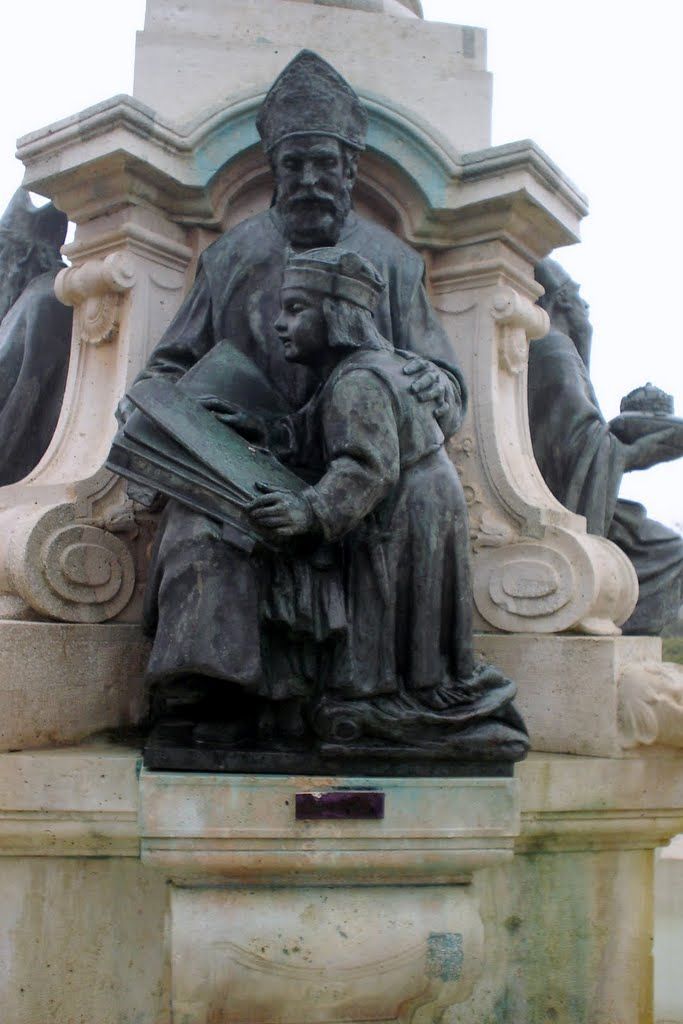
But Stephen had a kinder, gentler side.   Like St Louis IX, he made himself accessible to his people.   He also took personal concern for the poor.   He used to walk the streets in disguise so he could give alms to needy people.   Once he barely escaped when some beggars beat and robbed him.   But he refused to stop the practice.   Stephen was a family man.   In 1015 he had married Gisela, the sister of emperor St Henry II.   The couple had one son, Emeric, whom Stephen groomed as his successor.   In the following letter to his son, Stephen lays out his vision of what a Christian monarch must be:st stephen and his son emeric

“My dearest son, if you desire to honour the royal crown, I advise, I counsel, I urge you above all things to maintain the Catholic and apostolic faith with such diligence and care that you may be an example for all those placed under you by God and that all the clergy may rightly call you a man of true Christian profession. However, dearest son, even now in our kingdom the Church is proclaimed as young and newly planted;  and for that reason she needs more prudent and trustworthy guardians. . .

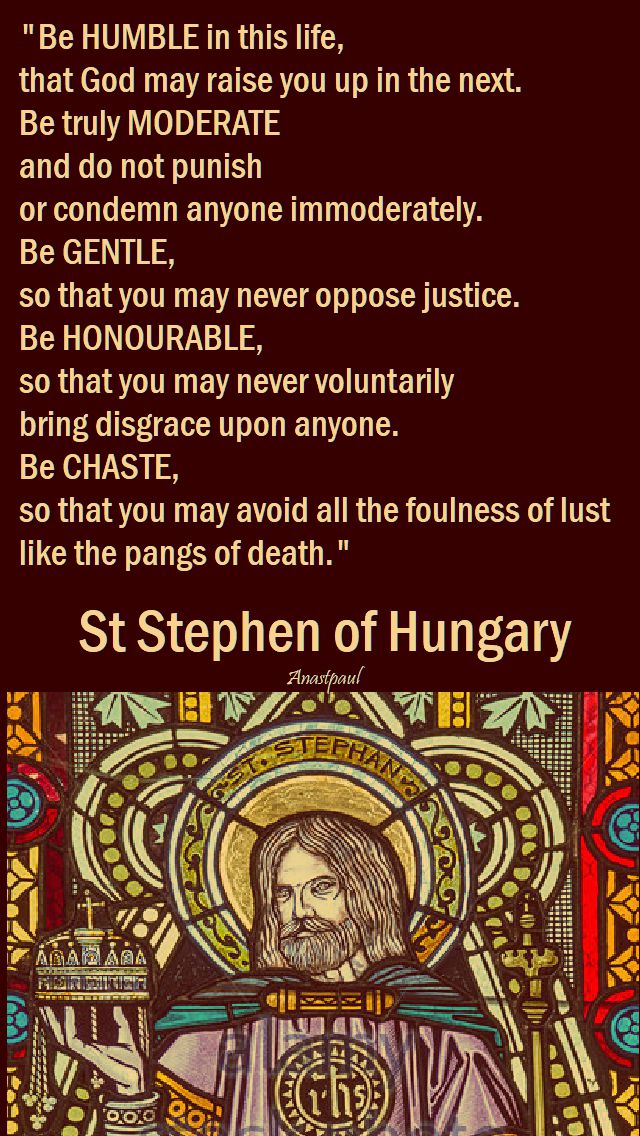
Finally, be strong lest prosperity lift you up too much or adversity cast you down. Be humble in this life, that God may raise you up in the next.   Be truly moderate and do not punish or condemn anyone immoderately.   Be gentle so that you may never oppose justice.   Be honourable so that you may never voluntarily bring disgrace upon anyone.   Be chaste so that you may avoid all the foulness of lust like the pangs of death.   All these virtues I have noted above make up the royal crown and without them no one is first to rule here on earth or attain to the heavenly kingdom.”

Sadly, Emeric died in a hunting accident, leaving Stephen no successor.   But Stephen is a Saint and is still loved and honoured by his people, for whom he is still an inspiration and a model – and for all of us!

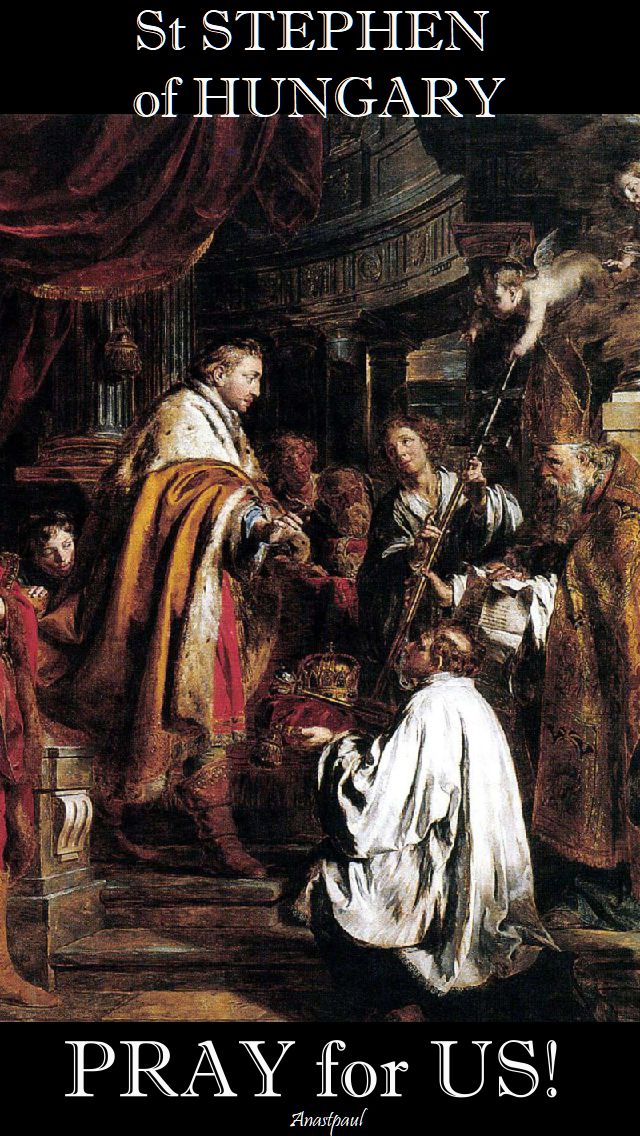
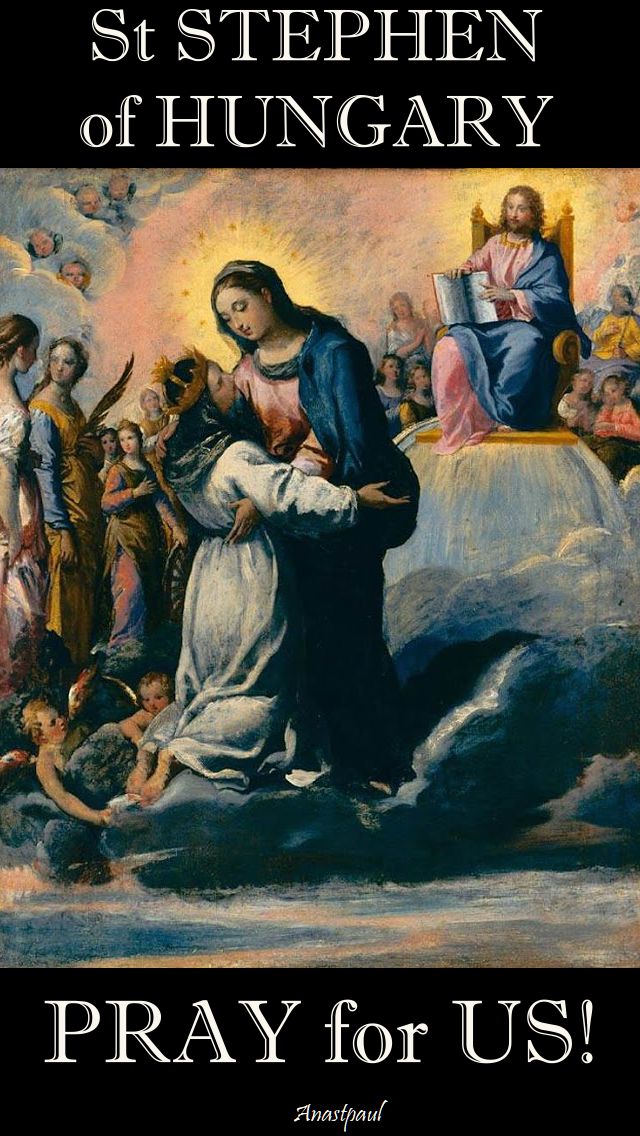
St Stephen, icon of charity and love, pray for us!

st stephen of hungary pray for us 2


Posted in DOCTORS of the Church, MORNING Prayers, QUOTES of the SAINTS, SAINT of the DAY

Quote/s of the Day – 16 August – The Memorial of St Stephen of Hungary

Quote/s of the Day – 16 August – The Memorial of St Stephen of Hungary

“Be HUMBLE in this life,
that God may raise you up in the next.
Be truly MODERATE
and do not punish or condemn anyone immoderately.
Be GENTLE,
so that you may never oppose justice.
Be HONOURABLE,
so that you may never voluntarily
bring disgrace upon anyone.
Be CHASTE,
so that you may avoid all the foulness of lust
like the pangs of death.”

be humble in this life - st stephen of hungary

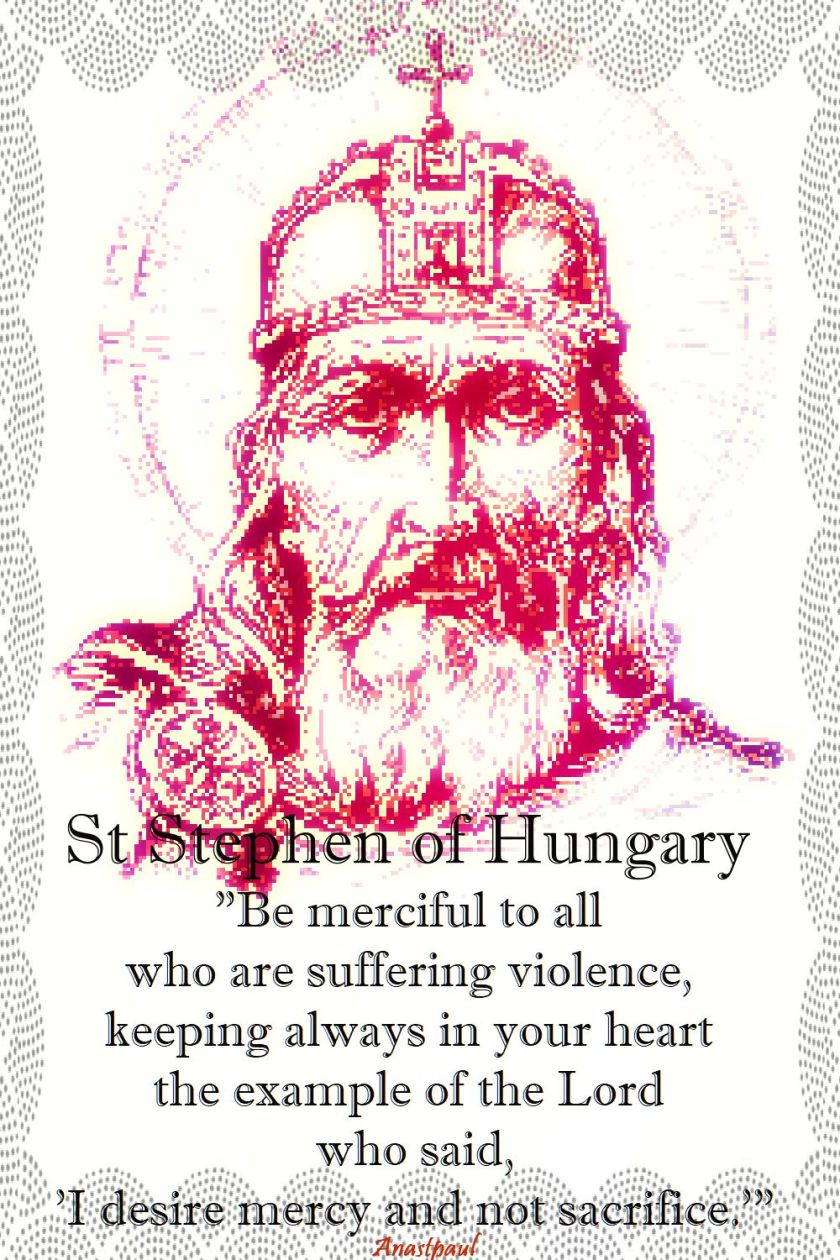
“Be merciful to all who are suffering violence,
keeping always in your heart the example of the Lord
who said, ‘I desire mercy and not sacrifice.'”

St Stephen of Hungary

be merciful to all - st stephen of hungary

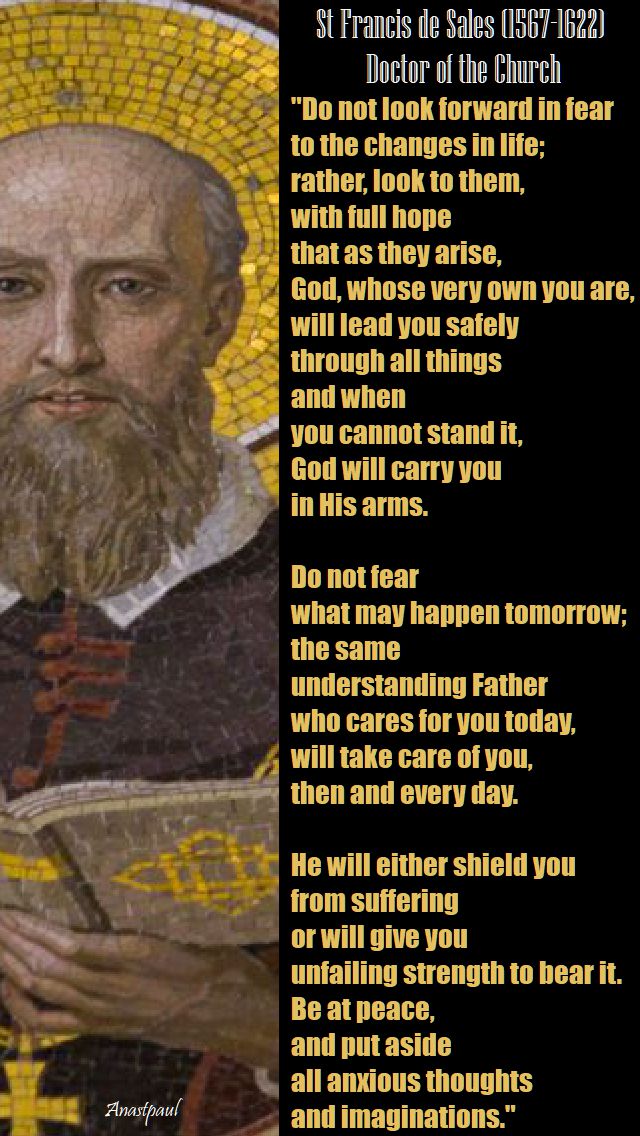
“Do not look forward in fear to the changes in life;
rather, look to them with full hope that as they arise,
God, whose very own you are,
will lead you safely through all things
and when you cannot stand it,
God will carry you in His arms.

Do not fear what may happen tomorrow;
the same understanding Father who cares for
you today, will take care of you then and every day.

He will either shield you from suffering
or will give you unfailing strength to bear it.
Be at peace,
and put aside all anxious thoughts and imaginations.”

St Francis de Sales (1567-1622) Doctor of the Church

do not look forward in fear - st francis de sales

Posted in MORNING Prayers, SAINT of the DAY, The WORD

One Minute Reflection – 16 August – The Memorial of St Stephen of Hungary

One Minute Reflection – 16 August – The Memorial of St Stephen of Hungary

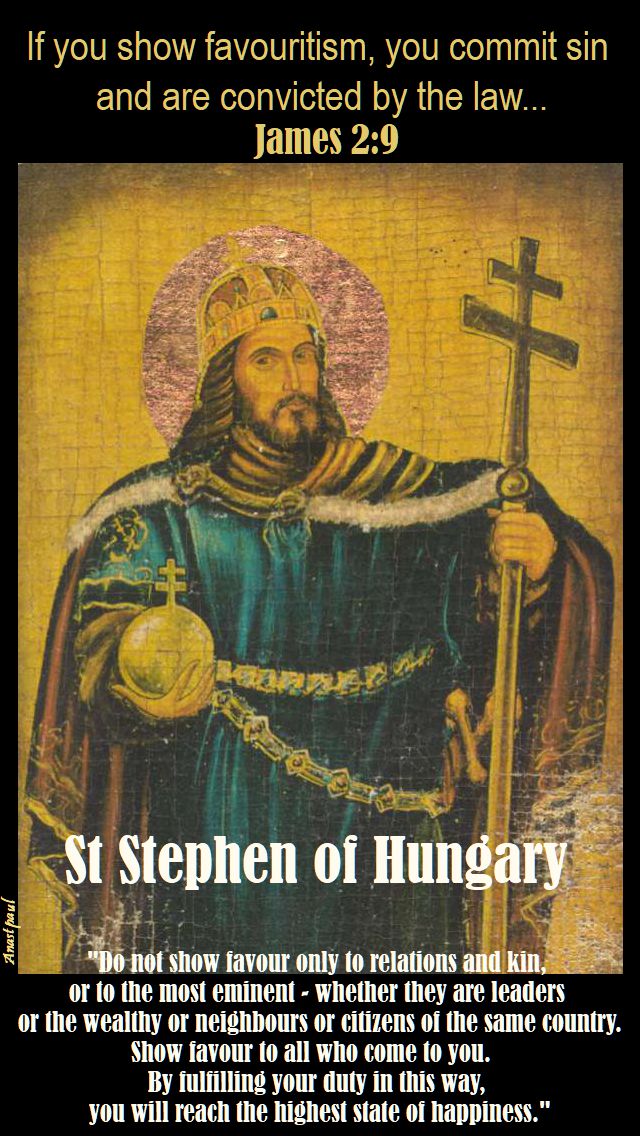
If you show favouritism, you commit sin and are convicted by the law…..James 2:9

REFLECTION – “Do not show favour only to relations and kin, or to the most eminent – whether they are leaders or the wealthy or neighbours or citizens of the same country.
Show favour to all who come to you. By fulfilling your duty in this way, you will reach the highest state of happiness.”…St Stephen of Hungary

do not show favour - st sephen of hungary

PRAYER – Just and Holy Father, help me to overcome all tendencies to show favourtisim in my life. Let me treat all persons as brothers and sisters in Christ and work and pray for their salvation. St Stephen of Hungary, pray for us, amen.

st stephen of hungary pray for us

Posted in DOCTORS of the Church, MORNING Prayers, PRAYERS of the SAINTS

Our Morning Offering – 16 August

Our Morning Offering – 16 August

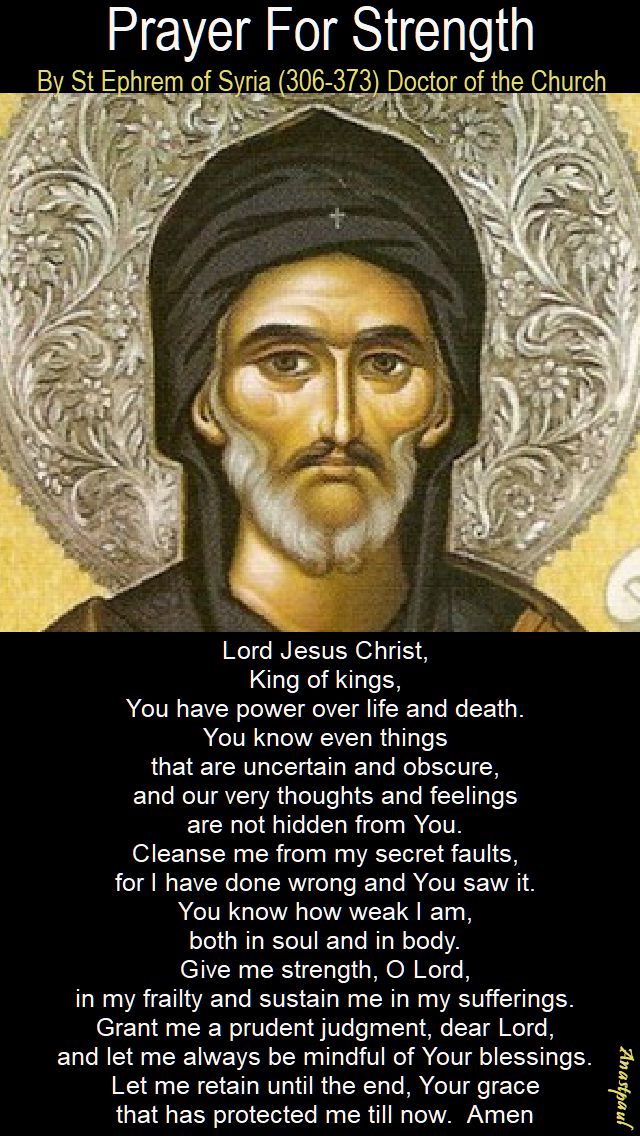
Prayer For Strength
By St EPHREM of Syria (306-373) Doctor of the Church

Lord Jesus Christ,
King of kings,
You have power over life and death.
You know even things that are uncertain and obscure,
and our very thoughts and feelings are not hidden from You.
Cleanse me from my secret faults,
for I have done wrong and You saw it.
You know how weak I am,
both in soul and in body.
Give me strength, O Lord,
in my frailty and sustain me in my sufferings.
Grant me a prudent judgment, dear Lord,
and let me always be mindful of Your blessings.
Let me retain until the end, Your grace
that has protected me till now.
Amen

prayer for strength by st ephrem of syria

Posted in Against EPIDEMICS, GOUT, KNEE PROBLEMS, ARTHRITIS, etc, Of ANIMALS / ANIMAL WELFARE, Of BACHELORS, Of the SICK, the INFIRM, All ILLNESS, PATRONAGE - OF DOGS and against DOG BITES and/or RABIES, SAINT of the DAY, SKIN DISEASES, RASHES

Saint of the Day – 16 August- St Roch (1295-1327) Confessor

Saint of the Day – 16 August- St Roch (1295-1327)  Confessor, Pilgrim, Hermit, Apostle of the Sick, Miracle Worker.   Born in 1295 at Montpelier, France and died in 1327 at Montpelier or Angleria, France of natural causes).   His relics are in Venice, Italy in the Church of San Rocco,some reside in Rome and others in Arles, France.   Patronages –  against cholera, against diseased cattle, against epidemics, against knee problems, against the plague, against skin diseases and rashes, bachelors, of dogs, falsely accused people, invalids, relief from pestilence, OF  surgeons, tile makers, The Diocese of Tagbilaran, Philippines,Constantinople, 24 other assorted Cities around the world.   Attributes – angel, bread, dog, pilgrim with staff, often displaying a plague wound on his leg, pilgrim with a dog, pilgrim with a dog licking the wound, pilgrim with a dog carrying a loaf of bread in its mouth.

According to his Acta and his vita in the Golden Legend, he was born at Montpellier, at that time “upon the border of France“, as the Golden Legend has it, the son of the noble governor of that city.   Even his birth was accounted a miracle, for his noble mother had been barren until she prayed to the Virgin Mary.   Miraculously marked from birth with a red cross on his breast which grew as he did, he began to manifest strict asceticism and great devotion and piety from a very early age.    On days when his “devout mother fasted twice in the week and the blessed child Rocke abstained twice also, he would drink from his mother but once that day.”

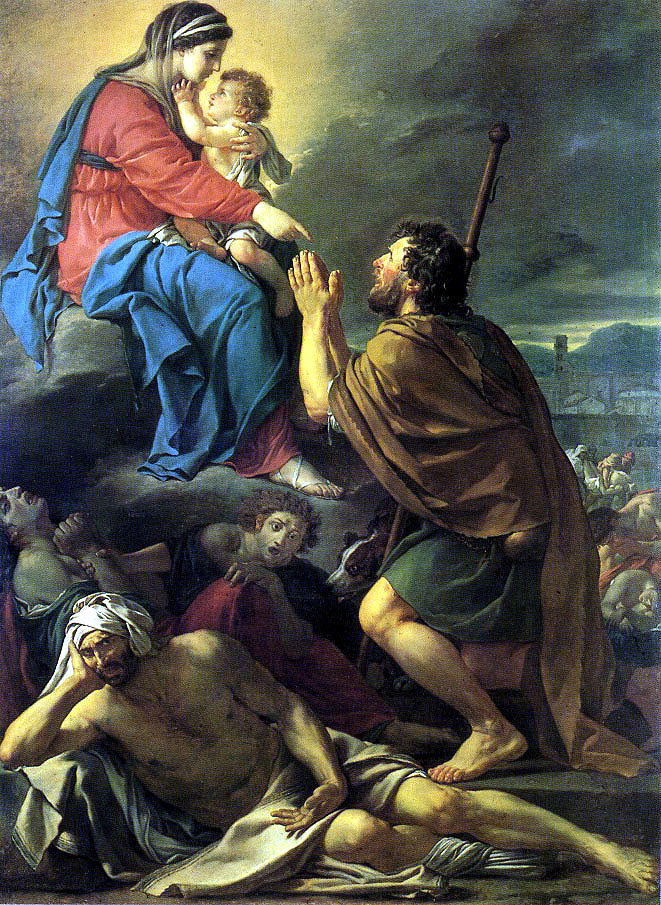
On the death of his parents in his twentieth year he distributed all his worldly goods among the poor like Francis of Assisi—although his father, on his deathbed, had ordained him governor of Montpellier—and set out as a mendicant pilgrim for Rome.   Coming into Italy during an epidemic of plague, he was very diligent in tending the sick in the public hospitals at Acquapendente, Cesena, Rimini, Novara and Rome, and is said to have effected many miraculous cures by prayer and the sign of the cross and the touch of his hand.   St Roch Praying to the Virgin for an End to the Plague Creator(s- Jacques-Louis DavidIn In Rome, according to the Golden Legend he preserved the “Cardinal of Angleria in Lombardy” by making the Sign of the Cross on his forehead, which miraculously remained there, visi nbble to all!    Ministering at Piacenza he himself finally fell ill.   He was expelled from the Town and withdrew into the forest, where he fashioned a shelter of boughs and leaves which was miraculously supplied with water, by a spring wic arose in the place;.   He would have perished, had not a dog belonging to a nobleman named Gothard Palastrelli, supplied him with bread and licked his wounds, healing them.   Count Gothard, following his hunting dog carrying the bread, discovered Saint Roch and became his acolyte.
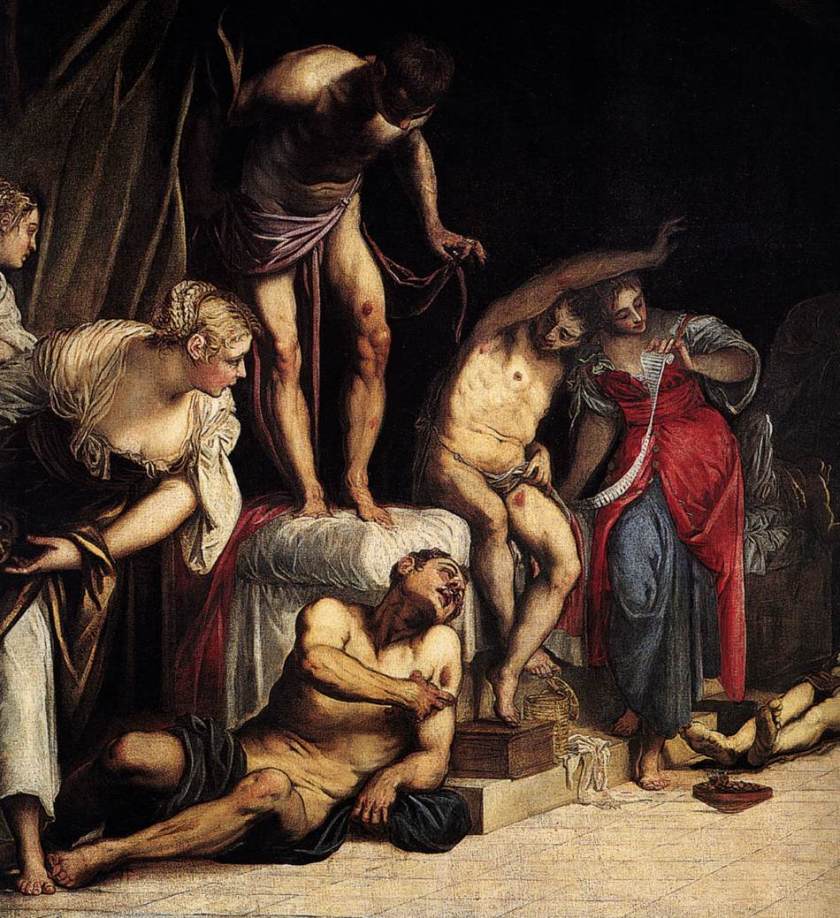
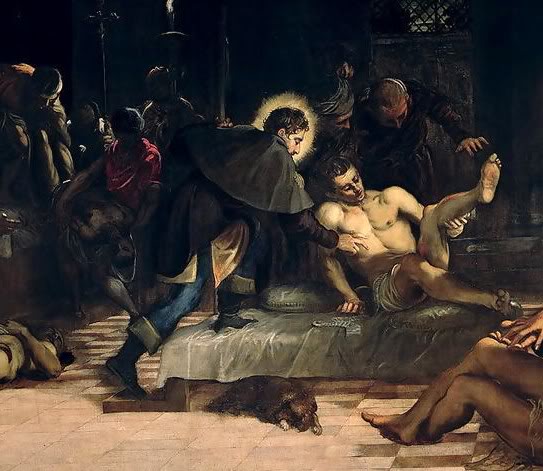
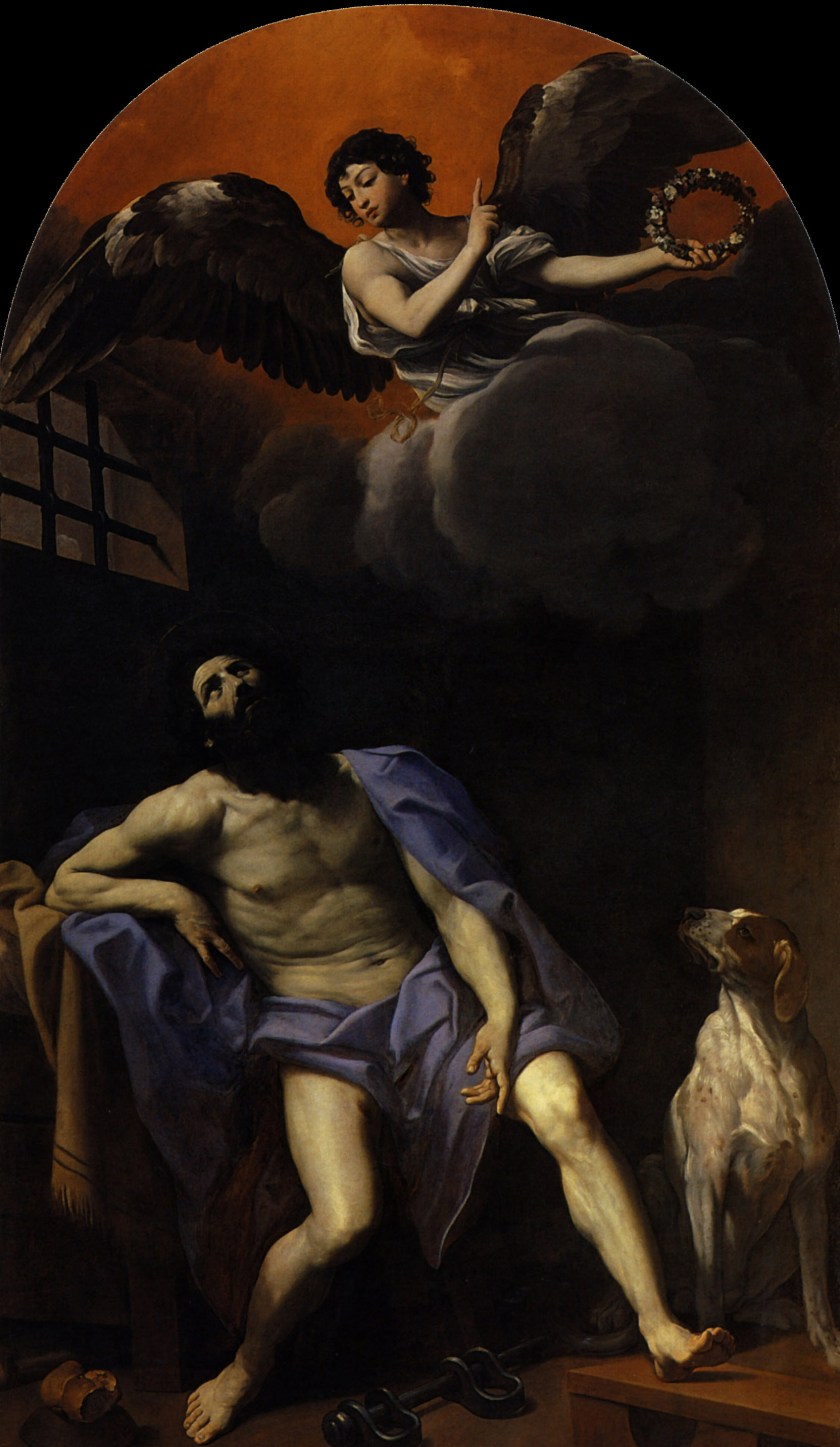
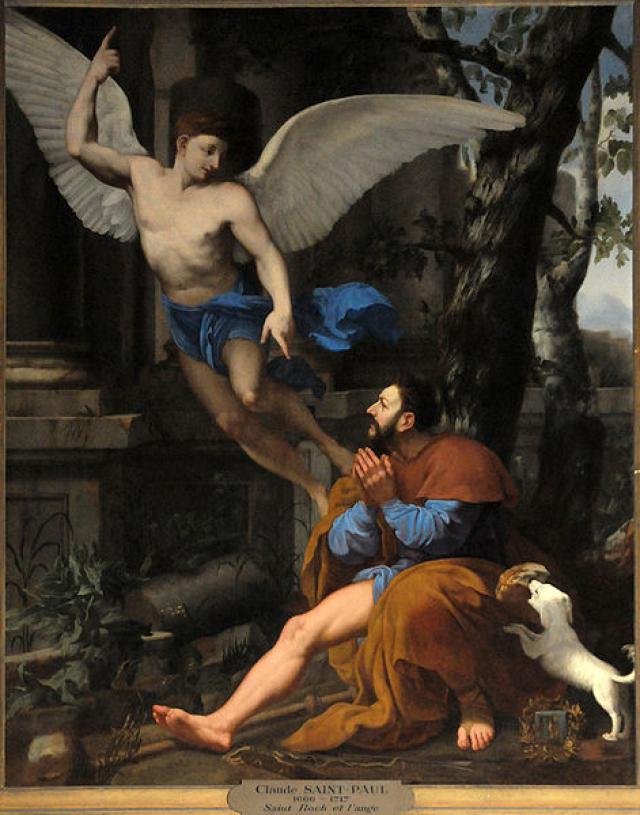
Jacopo_Tintoretto_-_St_Roch_in_the_Hospital_(detail)_-_WGA22606+(2)816roch16guido reni san roque 1617Saint_Paul_Saint_Roch

On his incognito return to Montpellier he was arrested as a spy (by orders of his own uncle) and thrown into prison, where he languished five years and died on 16 August 1327, without revealing his name, to avoid worldly glory.   After his death, according to the Golden Legend;

“anon, an Angel brought a table into the prison, from Heaven, divinely written with letters of gold, which he laid under the head of St Roch.   And on that table was written, God had granted to him his prayer, that is, to wit, that who that calleth meekly to St Roch shall not be hurt with any hurt of pestilence.”

The townspeople recognised him as well by his birthmark;  he was soon Canonised in the popular mind and a great Church erected in veneration.

The story that, in 1414,  when the Council of Constance was threatened with plague, public processions and prayers for the intercession of Roch were ordered and the outbreak ceased, is provided by Francesco Diedo, the Venetian governor of Brescia, in his Vita Sancti Rochi, 1478.   The cult of Roch gained momentum during the bubonic plague that passed through northern Italy in 1477–79.

His popularity, originally in central and northern Italy and at Montpellier, spread through Spain, France, Lebanon the Low Countries, Brazil and Germany, where he was often interpolated into the roster of the Fourteen Holy Helpers, whose veneration spread in the wake of the Black Death.   The magnificent 16th-century Scuola Grande di San Rocco and the adjacent church of San Rocco were dedicated to him by a confraternity at Venice, where his body was said to have been surreptitiously translated and was triumphantly inaugurated in 1485;  the Scuola Grande is famous for its sequence of paintings by Tintoretto, who painted St Roch visited by an angel, in a ceiling canvas (1564).
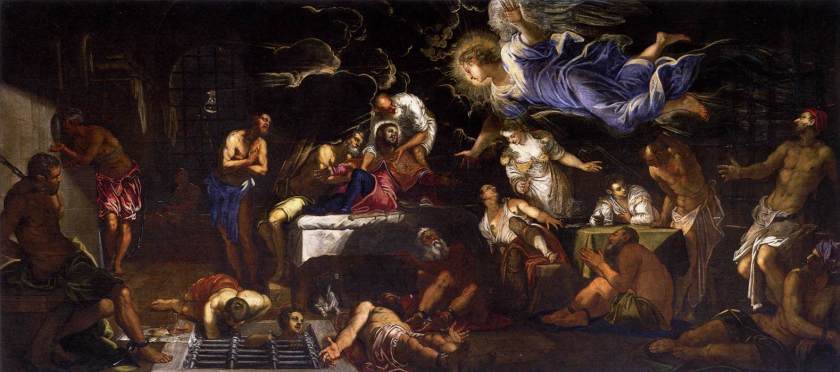
Tintoretto,_Jacopo_-_St_Roch_in_Prison_Visited_by_an_Angel_-_1567

We know for certain that, in 1465,  the body of St Roch was carried from Voghera, instead of Montpellier as previously thought, to Venice.   Pope Alexander VI (1492–1503) built a Church and a hospital in his honour.   Pope Paul III (1534–1549) instituted a confraternity of St Roch.   This was raised to an Arch-confraternity in 1556 by Pope Paul IV;  it still thrives today.

Saint Roch had not been officially recognised as a Saint as yet, however.   In 1590 the Venetian Ambassador to Rome reported to the Serenissima that he had been repeatedly urged to present the witnesses and documentation of the life and miracles of St Rocco, already deeply entrenched in the Venetian life because Pope Sixtus V “is strong in his opinion either to Canonise him or else to remove him from the ranks of the Saints.”    The Ambassador had warned a Cardinal of the general scandal that would result, if the widely venerated St Rocco, were impugned as an impostor.   Sixtus did not pursue the matter but left it to later Popes to proceed with the Canonisation process.   His successor, Pope Gregory XIV (1590–1591), added Roch of Montpellier, who had already been memorialised in the Holy Sacrifice of the Mass for two centuries, to the Roman Martyrology, thereby fixing 16 August as his universal Feast Day.

Numerous brotherhoods have been instituted in his honour.   He is usually represented in the garb of a pilgrim, often lifting his tunic to demonstrate the plague sore in his thigh and accompanied by a dog carrying a loaf in its mouth.   The Third Order of Saint Francis, by tradition, claims him as a member and includes his Feast on its own calendar, observing his Feast on 17 August.

Posted in SAINT of the DAY

Memorials of the Saints for 16 August

St Stephen of Hungary (Optional Memorial)

Bl Angelus Agostini Mazzinghi
St Armagillus of Brittany
St Arsacius of Nicomedia
St Frambaldo
Bl Iacobus Bunzo Gengoro
Bl Jean-Baptiste Menestrel
Bl John of Saint Martha
Bl Laurence Loricatus
Bl Magdalena Kiyota Bokusai
Bl Maria Gengoro
Bl Ralph de la Futaye
St Roch
St Serena
Bl Simon Kiyota Bokusai
Bl Thomas Gengoro
St Titus the Deacon

Martyrs of Palestine – 33 saints: Thirty-three Christians martyred in Palestine; they are commemorated in old martyrologies, but the date and exact location have been lost.

Martyred in the Spanish Civil War:
Bl Amadeu Monje Altés
Bl Antonio María Rodríguez Blanco
Bl Enrique García Beltrán
Bl José María Sanchís Mompó
Bl Laurentí Basil Matas

Posted in DOCTORS of the Church, FATHERS of the Church, MORNING Prayers, QUOTES of the SAINTS, SAINT of the DAY

Thought for the Day – The Memorial of St Simplician – 15 August

Thought for the Day – The Memorial of St Simplician – 15 August

“Augustine and Simplician, sons of Milan, followers of Christ”

“Another great name enters Milan’s rich story in 384, that of the man who became St Augustine.   In 384 he was not yet a saint.   But he was a man who was searching, probing and asking questions, testing the spirits that drove him.   First he found Ambrose, who “welcomed me as a father would and like a good bishop approved of my journeying,” according to his Confessions.   Still, he was not ready to accept the Christian faith and way of life.   But Ambrose could not be the spiritual director he needed.

Augustine had gotten through his doctrinal doubts and he “liked the Way, which was our Saviour, though the tight and narrow parts of that way” annoyed him.   So God put it in his mind to go to Simplician, “whom I considered to be your good servant and your grace shone in him.   I heard that since his youth he lived most devoted to you.”   Now he had grown old and to Augustine he seemed to have become a great expert in studying God’s ways.   “And so he was! So I wanted to share with him my inner turmoil so he might teach me how best I, as I was, could walk in your ways.”

That is quite an endorsement!   From one saint-to-be about a wise and holy mentor, guide, companion on the road.   One intently searching, the other guiding that search.   We all need help from time as we make our authentic way.   Maybe it can sound trite, an easy image, our life as a journey or pilgrimage, our walking the camino to a holy goal. But it speaks a deep truth.“…(Fr Edward W Schmidt S.J.)

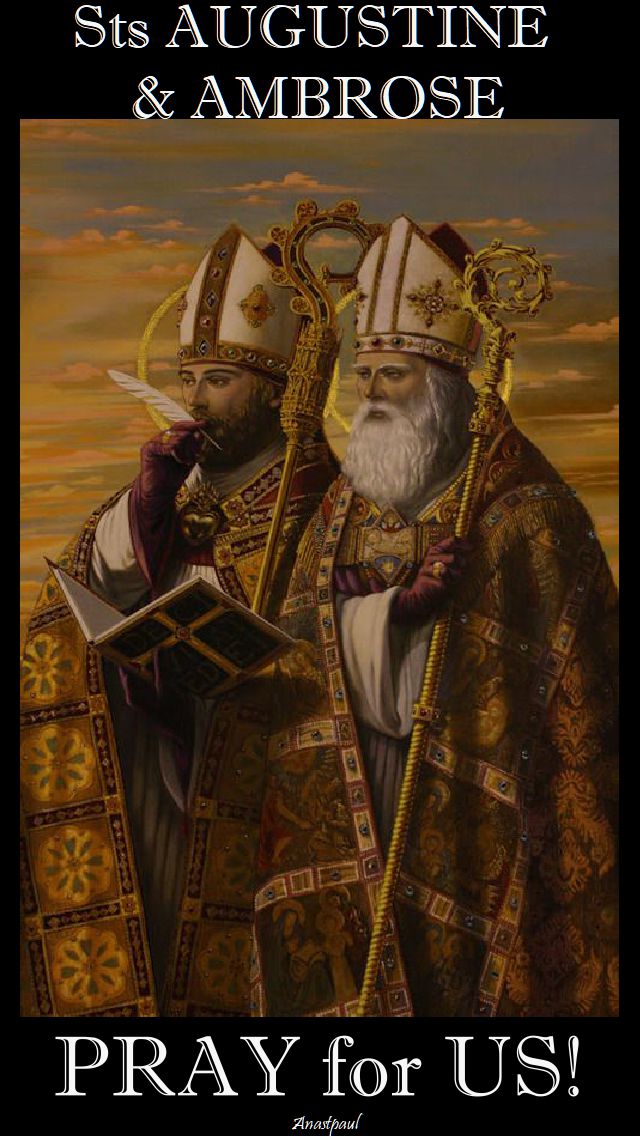
St Simplician, Sts Augustine & Ambrose, pray for us!

st simplician pray for us 2sts augustine and ambrose pray for us

Posted in DOCTORS of the Church, FATHERS of the Church, MORNING Prayers, QUOTES of the SAINTS

Quote/s of the Day – 15 August – The Memorial of St Simplicain, Friend and Teacher of St Ambrose and the “spiritual father of my soul” of St Augustine, both Fathers and Doctors of the Church

Quote/s of the Day – 15 August – The Memorial of St Simplicain, Friend and Teacher of St Ambrose and the “spiritual father of my soul” of St Augustine, both Fathers and Doctors of the Church

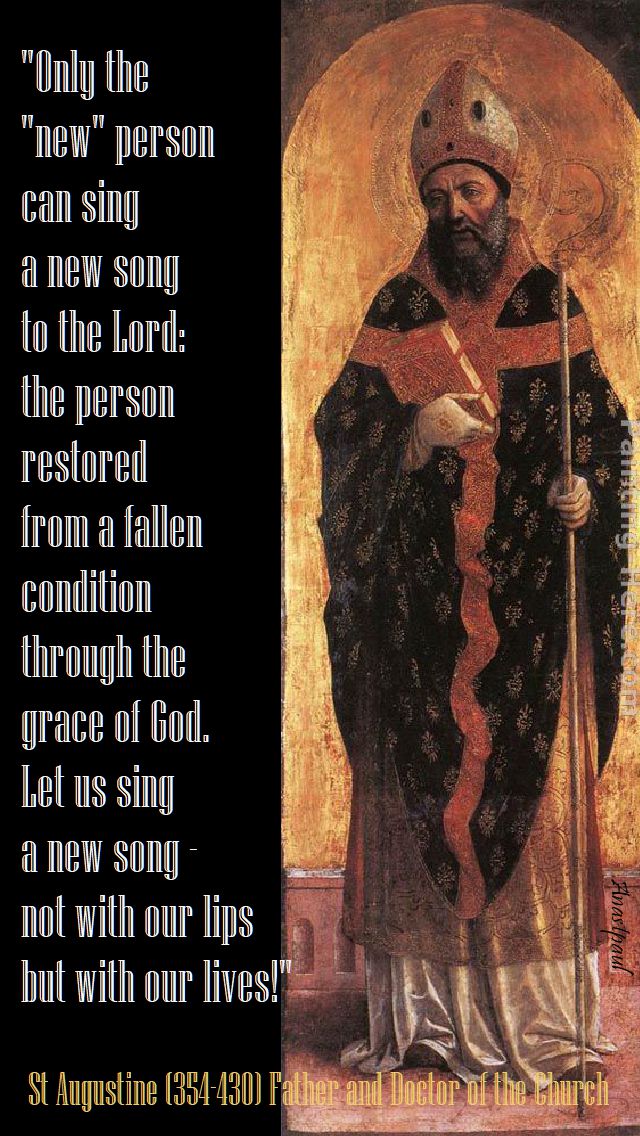
“Only the “new” person can sing a new song to the Lord:
the person restored from a fallen condition through the grace of God.
Let us sing a new song –
not with our lips
but with our lives!”

St Augustine (354-430) Father and Doctor of the Church

only the new person NO 2 - st augustine


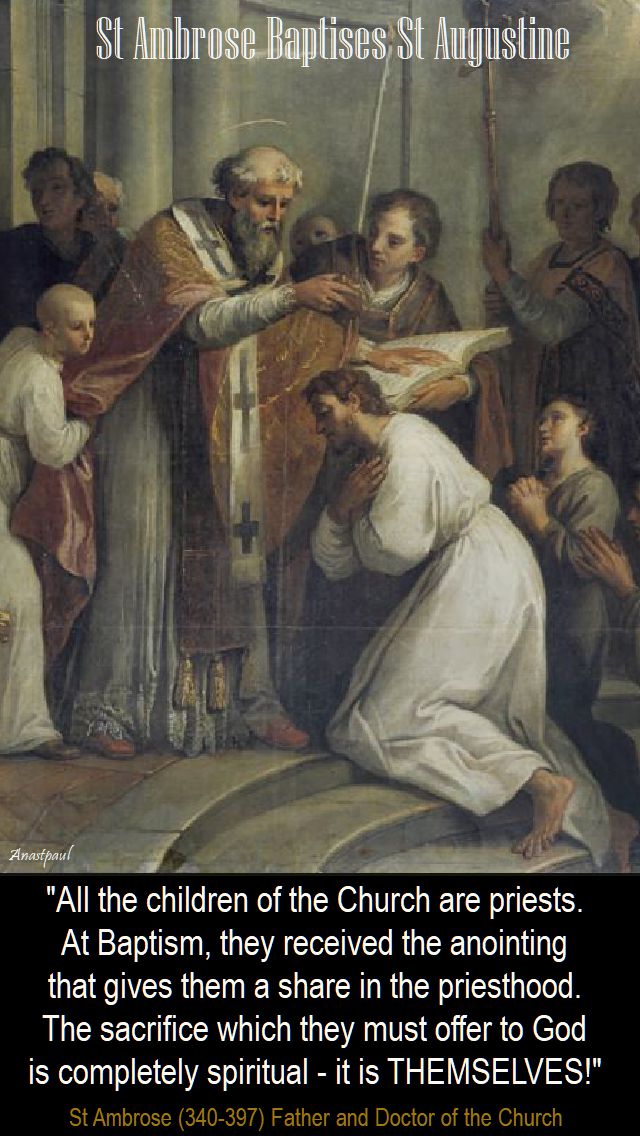
“All the children of the Church are priests.
At Baptism, they received the anointing
that gives them a share in the priesthood.
The sacrifice which they must offer to God
is completely spiritual – it is THEMSELVES!”

St Ambrose (340-397) Father and Doctor of the Church

ALL THE CHILDREN OF THE CHURCH - NO 2 - ST AMBROSE

Posted in CONFESSION/PENANCE, DOCTORS of the Church, FATHERS of the Church, MORNING Prayers, PRAYERS of the SAINTS, QUOTES of the SAINTS, SAINT of the DAY, The WORD

One Minute Reflection – 15 August

One Minute Reflection – 15 August

The Confessions – Book VIII – St Augustine’s Conversion to Christ.   Augustine is deeply impressed by Simplicianus’ story of the conversion to Christ of the famous orator and philosopher, Marius Victorinus.   He is stirred to emulate him but finds himself still enchained by his incontinence and preoccupation with worldly affairs.   He is then visited by a court official, Ponticianus, who tells him and Alypius the stories of the conversion of Anthony and also of two imperial “secret service agents.”   These stories throw him into a violent turmoil, in which his divided will struggles against himself.   He almost succeeds in making the decision for continence but is still held back.   Finally, a child’s song, overheard by chance, sends him to the Bible;  a text from Paul resolves the crisis;  the conversion is a fact.   Alypius also makes his decision and the two inform the rejoicing Monica.

“For I am the LORD, your God,
who grasp your right hand;
It is I who say to you, Do not fear,
I will help you.”….Isaiah 41:13

Isaiah 41 13

REFLECTION – “And Thou didst put it into my mind and it seemed good in my own sight, to go to Simplicianus, who appeared to me a faithful servant of Thine and Thy grace shone forth in him.   I had also been told that from his youth up he had lived in entire devotion to Thee.   He was already an old man and because of his great age, which he had passed in such a zealous discipleship in Thy way, he appeared to me likely to have gained much wisdom–and, indeed, he had.   From all his experience, I desired him to tell me–setting before him all my agitations–which would be the most fitting way for one who felt as I did to walk in thy way.”…St Augustine (From the Confessions – Book VIII – Chapter 1)

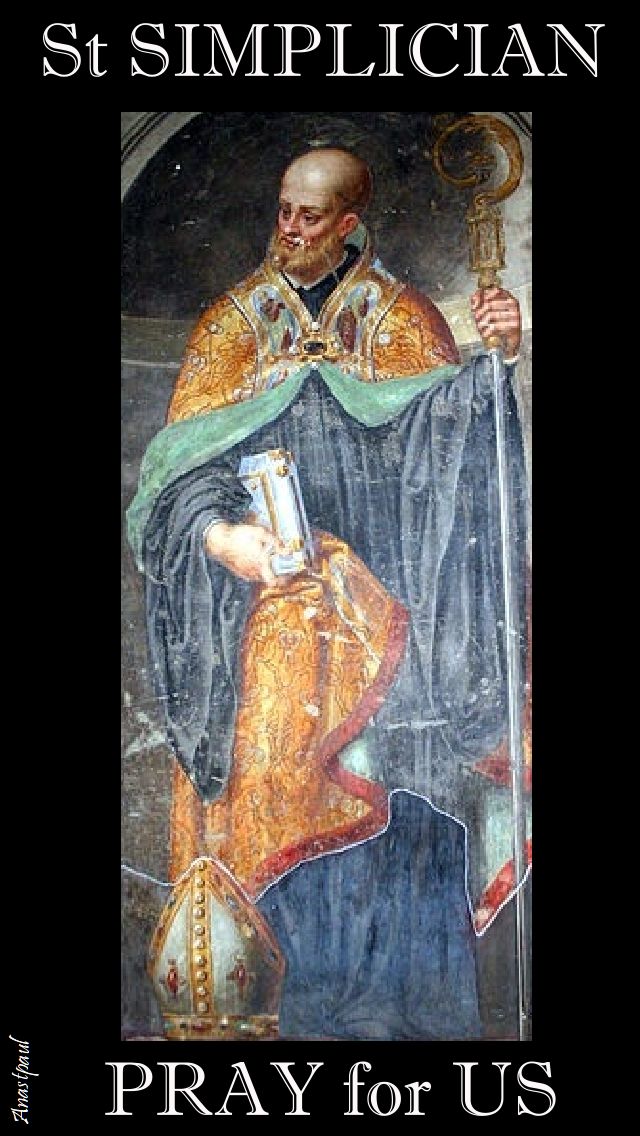
st simplician - pray for us

PRAYER – “Go on, O Lord and act: stir us up and call us back;  inflame us and draw us to Thee;  stir us up and grow sweet to us;  let us now love Thee, let us run to Thee.   Are there not many men … who, out of a deeper pit of darkess,.. return to Thee–who draw near to Thee and are illuminated by that light which gives those who receive it power from Thee to become Thy sons? “… (St Augustine – From the Confessions Book VIII – Chapter IV)  St Simplician, pray for us, Amen.

Posted in DOCTORS of the Church, FATHERS of the Church, MORNING Prayers, PRAYERS of the SAINTS

Our Morning Offering – 15 August

Our Morning Offering – 15 August

PRAYER of ST AMBROSE  (340-397) Father and Doctor of the Church

O Lord, who has mercy upon all,
take away from me my sins
and mercifully kindle in me
the fire of Your Holy Spirit.
Take away from me the heart of stone
and give me a heart of flesh,
a heart to love and adore You,
a heart to delight in You,
to follow and enjoy You,
for Christ’s sake. Amen

12_7_ _Saint_Ambrose_1_Francisco_de_Zurbarán

Posted in SAINT of the DAY

Saint of the Day – 15 August – St Simplician of Milan

Saint of the Day – 15 August – St Simplician (Simpliciano) of Milan – Archbishop of Milan, Teacher, Catechist, Writer, Mystic  successor to St Ambrose – (c 320 in Rome, Italy – c 401 in Milan, Liguria, Italy).


St Simplician was born about 320 probably in Rome, was raised in a Christian family and still young he became a Priest.   He became expert in the Holy Scripture and very educated.   In about 355 he took an active part in the conversion to Christianity of the philosopher Marius Victorinus.   When in 374 Ambrose was elected bishop of Milan and baptised, Simplician became his teacher of doctrine.   Ambrose used to call Simplician father, as a sign of spiritual relationship but they were also great friends.   St Simplician remained an advisor to and correspondent with Saint Ambrose.   Probably in this period Simplician moved to Milan where he remained.

Simplician took also an active part in the conversions of both Alypius of Thagaste and Augustine of Hippo.   The meeting between Augustine and Simplican occurred in Milan in 386 and it is recorded in Augustine’s Confessions.   After his conversion, Augustine also called Simplician father and in 397 he dedicated to Simplician two books on the issue of predestination, known as De Diversis Quaestionibus ad Simplicianum.   St Augustine, remembered and referred to him with deep gratitude, calling him the “spiritual father of my soul” and would submit his own writings to him to review and comment.

He also corresponded extensively with Pope Anastasius I and bishops in Africa and Gaul but none of the writings have survived.   St Simplician always wore a black leather belt; following a vision of the Blessed Virgin Mary by Saint Monica, the belt became part of the habit of the Augustinians

On his deathbed, St Ambrose supported Simplician as his own successor, stating that Simplician was “old but good”.   Thus in April 397, the aged Simplician was elected bishop of Milan, at that time capital of the Western Roman Empire.   A very important act of his episcopate was the receipt in Milan of the relics of the three martyrs Sisinnius, Martyrius and Alexander, sent from Trento by the bishop Vigilius.

St Simplician was asked to judge some doctrinal statements by the Council of Carthage (397) and by the First Council of Toledo.   He also consecrated Gaudentius of Novara a bishop and according to the 13th-century writer Goffredo of Bussero, he organised the texts of the Ambrosian liturgy.

His feast day was anciently set on 15 August, together with the feast of the translation to Milan of the relics of Sisinnius, Martyrius and Alexander; so his death was deemed to have been on 15 August 400.

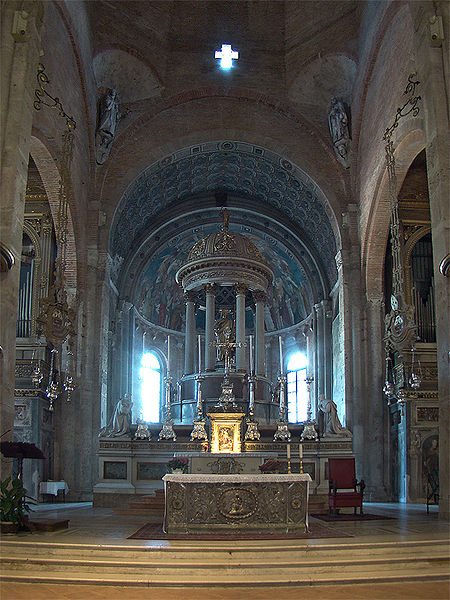
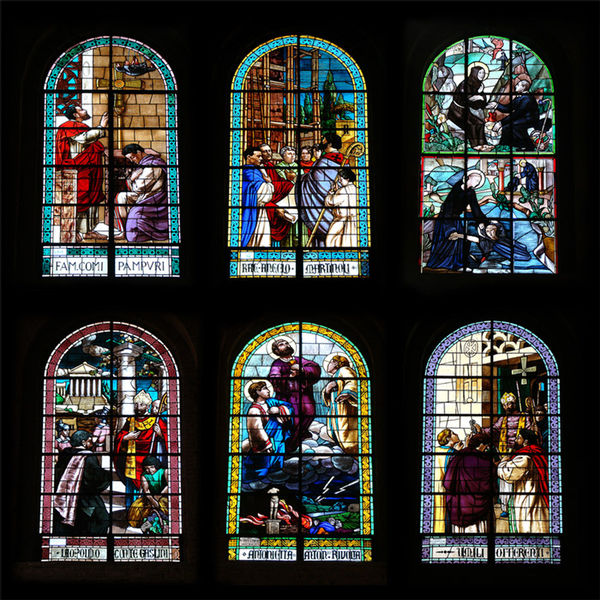
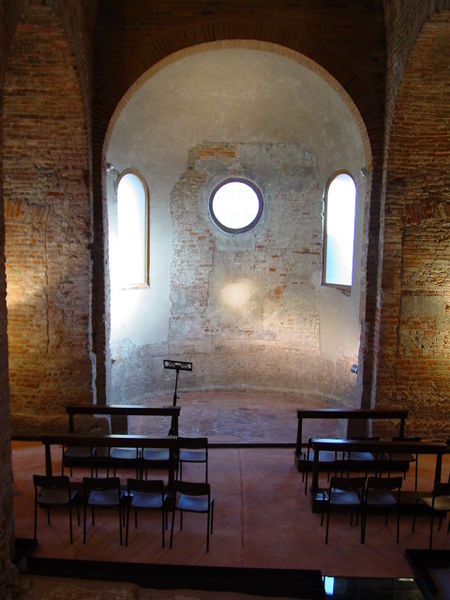
St Simplician was initially buried in the church of Saint Nabor and Felix in Milan and later translated, perhaps on 15 August, to the Basilica Virginum (“Basilica of the Virgins”) which was renamed in his honour; now it is known as Basilica of St Simplician.   The images below are the Basilica, with the Main Altar, Stained Glass windows and the Chapel of the Martyrs of Anaunia, in the Crypt of the Basilica.

St Ambrose began the construction of the Basilica Virginum (“Basilica of the Virgins”), which was finished by his successor Simplician, who is buried there.  A brick with the mark of the Lombard King Agilulf shows that repairs were made between 590 and 615 AD.

In the ninth century the Cluniac Benedictines took possession of the church.   In 1176 the church became famous when, according to the legend, the bodies of the martyrs housed here flew as doves to the field of Legnano, landing on the City’s Carroccio, (a ceremonial war waggon) as a sign of the imminent victory against Frederick Barbarossa’s army.

When the building was modified between the 12th and the 13th centuries, giving it the present Romanesque appearance, the original walls were preserved to a height of 22 meters.   On the night of 6–7 April 1252 the body of Peter of Verona (later St. Peter Martyr) lay in state after his assassination.   A great multitude came to watch vigil, and the origins of Peter’s cult began, as people started to report miraculous occurrences.


Basilica of Saint SimplicianMain Altar of Basilica of Saint SimplicianWINDOWS of Basilica of Saint SimplicianChapel of the Anaunia martyrs, behind the apse in the Crypt of San Simpliciano church.

Posted in FEASTS and SOLEMNITIES, SAINT of the DAY, The BLESSED VIRGIN MARY

Solemnity of the Assumption of the Blessed Virgin Mary and Memorials of the Saints – 15 August

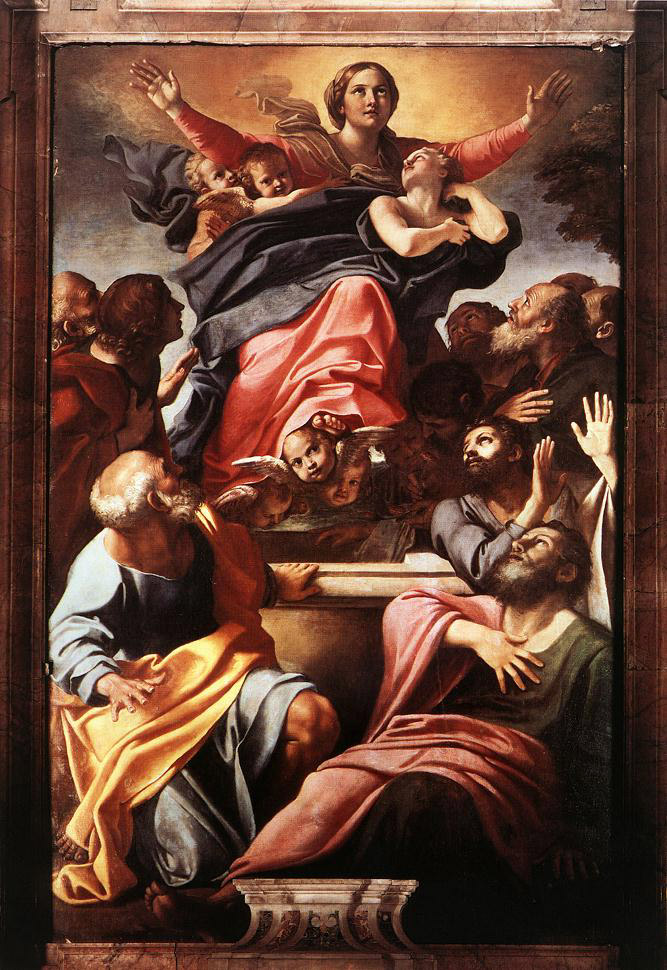
Solemnity of the Assumption of the Blessed Virgin Mary (in the US, however, in most countries of Africa, the Solemnity will celebrated on Sunday 20 AUGUST): The feast celebrates the assumption of the body of the Blessed Virgin Mary into heaven upon her death. According to Pope Benedict XIV, it is a probable opinion, which it is impious to deny, though not an article of faith but has since in 1950 has been raised to a DOGMA of the Faith.   The origin of the feast day is not known but it was celebrated in Palestine before the year 500. It is a holy day of obligation, its vigil being a fast day, in all English-speaking countries except Canada.   Among the many masters who have painted the subject of the Assumption are Fra Angelico, Ghirlandajo, Rubens, Del Sarto and Titian.
Patronages:
• Acadians, Cajuns
• Cistercian Order, Cistercians
• fish dealers, fishmongers
• French air crews
• harness makers
• —
• France
• Guatemala
• India
• Jamaica
• Malta
• Paraguay
• Slovakia
• —
• east Africa (region of east Africa which includes diverse countries, proclaimed on 15 March 1952 by Pope Pius XII)
• South Africa (THIS IS NOT AN REGION BUT A COUNTRY and the Assumption is, therefore, the Patronal Feast of the Country of South Africa – proclaimed on 15 March 1952 by Pope Pius XII)
• —
• 24 dioceses
• 38 cities

Assumption of the Virgin Mary, 1600 - 1601 - Annibale Carracci
Annabale Carraci 1600-1601


St Alipius of Tagaste
Bl Alfred of Hildesheim
Bl Agustín Hurtado Soler
St Arduinus of Rimini
St Arnulphus of Soissons
Bl Claudio Granzotto
Bl George Halley
St Napoleon of Alexandria
Bl Pio Alberto del Corona
St Simplician of Milan
St Tarcisius

Martyrs of Nicomedia – 3 saints: Three Christians martyred together. No details survive but the names – Eutychian, Philip and Straton. They were martyred in Nicomedia, Bithynia (in modern Turkey).

Martyred in the Mexican Revolution: 4 Saints –
St David Roldán Lara
St Luis Batiz Sainz
St Manuel Moralez
St Salvador Lara Puente

Martyred in the Spanish Civil War: Thousands of people were murdered in the anti-Catholic persecutions of the Spanish Civil War from 1934 to 1939.
• Blessed Agustì Ibarra Angüela
• Blessed Carmelo Sastre y Sastre
• Blessed Clemente Vea Balaguer
• Blessed Francisco Míguez Fernández
• Blessed Ildefonso Alberto Flos
• Blessed Jaume Bonet Nadal
• Blessed Joan Ceró Cedó
• Blessed Josep Santonja Pinsach
• Blessed Juan Francisco Barahona Martín
• Blessed Juan Mesonero Huerta
• Blessed Luis Ros Ezcurra
• Blessed Manuel Formigo Giráldez
• Blessed Miguel Alberto Flos
• Blessed Sebastià Balcells Tonijuan
• Blessed Severiano Montes Fernández

Posted in CONFESSION/PENANCE, EUCHARISTIC Adoration, franciscan OFM, MORNING Prayers, QUOTES of the SAINTS, SAINT of the DAY, The BLESSED VIRGIN MARY, The HOLY EUCHARIST / The HOLY MASS

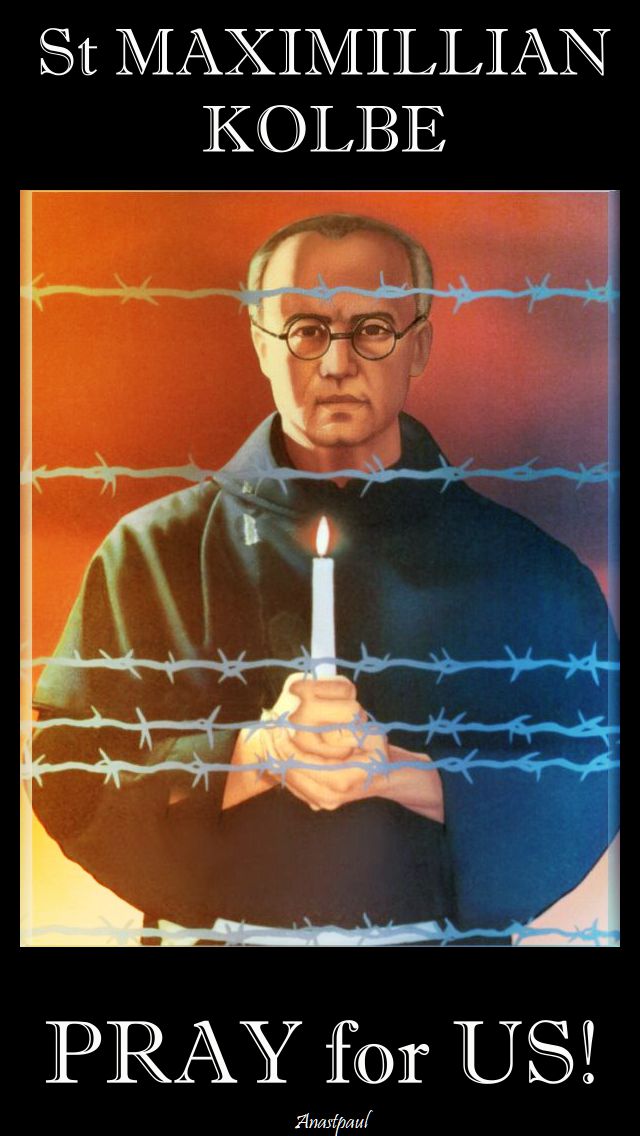
Thought for the Day – 14 August – The Memorial of St Maximillian Kolbe

Thought for the Day – 14 August – The Memorial of St Maximillian Kolbe

St Maximilian’s “Secret” to Holiness and Happiness

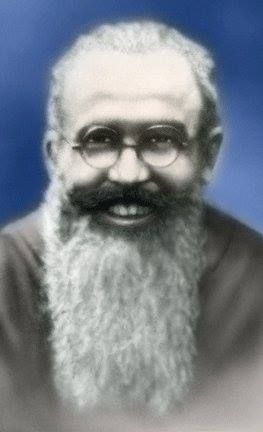
smiling kolbe

St. Maximilian says:  “It is a false and widely diffused idea that the saints were not like us.   They were also subject to temptation, they fell and got up, they also felt overwhelmed with sadness, weakened and paralyzed by discouragement.   But remember the words of the Saviour:  ‘Without me, you can do nothing’ (Jn 15:51) and those of St. Paul:  ‘I can do all things in him who strengthens me’ (Phil 4:13).   Not confiding in themselves, but, putting all their confidence in God after every humiliating fall, they repented sincerely, they purified their soul in the Sacrament of Penance and then they went back to work with still greater fervour.”
We are very much deceived if we think we cannot become a saint, or that we will be “lucky” if we even make it to Purgatory.   The great men of the world overcome all kinds of obstacles in order to become rich or famous.   Why do we not try harder to persevere, when that is precisely what Our Blessed Lord deserves?   After all, He poured Himself out for us so that we might be holy.   The saints were not supermen; they were sinners who persevered through hardship and adversity because they were humble and repentant and confident in God’s grace.”…(Fr Angelo M. Geiger F.I.)
In the end, holiness is not merely a warm feeling of God’s presence or even the ecstatic experiences of the saints.   St Maximilian tells us that true holiness is found in obedience and obedience is acquired through prayer, penance and perseverance.
And this obedience consists in living – truly living the life of a Catholic, St Maximillian said his own words):

“Go to confession with sincerity, diligence, a deep sorrow for his sins and a firm resolve to amend his life. He will suddenly feel a peace and happiness compared with which all the fleeting, unworthy pleasures of this world are really an odious torment.

Let everyone seek to come and receive Jesus in the Holy Eucharist with proper preparation.

Go to Eucharistic Adoration – for this is the the most important activity.

Let him never permit his soul to remain in sin but let him purify it immediately.

Let him do his duty manfully.

Let him address humble and frequent prayers to God’s throne, especially through the hands of the Immaculate Virgin.

Let him welcome his brethren with a charitable heart, bearing for God’s sake the sufferings and difficulties of life.

Let him do good to all, even his enemies, solely for the love of God and not in order to be praised or even thanked by men.”

Then we will come to understand what it means to have a foretaste of paradise;  and perhaps more than once we will find peace and joy even in poverty, suffering, disgrace, or illness.

St Maximillian, pray for us!

st max pray for us

Posted in EUCHARISTIC Adoration, franciscan OFM, MORNING Prayers, QUOTES of the SAINTS, QUOTES on SUFFERING, SAINT of the DAY, The BLESSED VIRGIN MARY, The HOLY EUCHARIST / The HOLY MASS

Quote/s of the Day – 14 August – The Memorial of St Maximillian Kolbe

Quote/s of the Day – 14 August – The Memorial of St Maximillian Kolbe

“If angels could be jealous of men,
they would be so, for one reason:
HOLY COMMUNION.”

if angels could be jealous of men - st maximillian kolbe

“Jesus honoured her before all ages
and will honour her for all ages.
No one comes to Him, nor even near Him,
no one is saved or sanctified,
if he too will not honour her.
This is the lot of Angels and of men.”

jesus honoured her before all ages - st maximillian kolbe

“Be a man! Don’t blush for your convictions.”

be a man! don't blush for your convictions - st maximillian kolbe

“Let us remember, that love lives through sacrifice
and is nourished by giving.
Without sacrifice, there is no love.”

remember that love lives through sacrifice - st maximillian kolbe

“My aim is to institute perpetual adoration,
for this is the the most important activity.”

my aim is to institute - st maximillian kolbe

“Be a Catholic!
When you kneel before an altar,
do it in such a way that others
may be able to recognise
that you know before Whom you kneel.”

be a catholic - st maximillian kolbe

St Maximilian Kolbe