Our Morning Offering – 17 August – “The Month of the Immaculate Heart of Mary” – Pentecost X
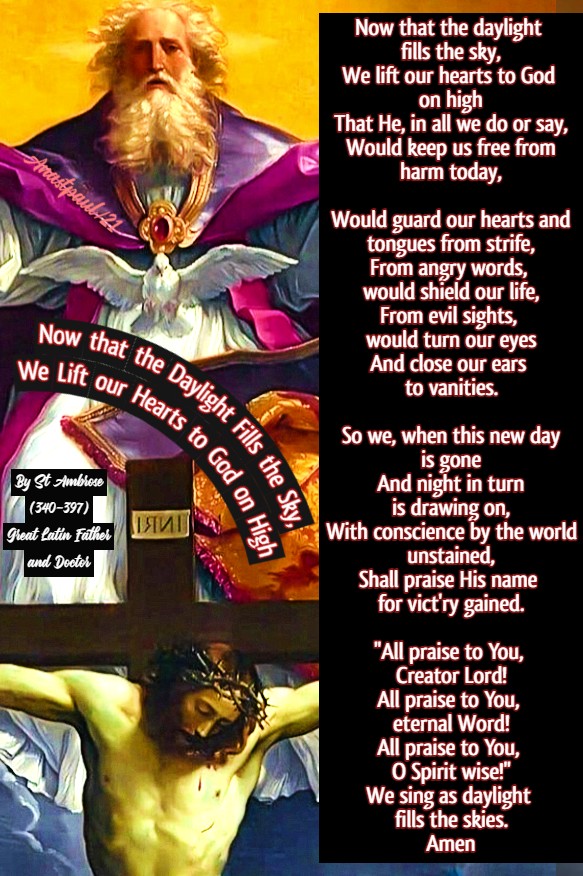
Now that the Daylight Fills the Sky, We Lift our Hearts to God on High By St Ambrose (340-397) Great Latin Father and Doctor of the Church Trans J M Neale (1818-1866)
Now that the daylight fills the sky, We lift our hearts to God on high That He, in all we do or say, Would keep us free from harm today,
Would guard our hearts and tongues from strife, From angry words, would shield our life, From evil sights, would turn our eyes And close our ears to vanities.
So we, when this new day is gone And night in turn is drawing on, With conscience by the world unstained, Shall praise His Name for vict’ry gained.
“All praise to You, Creator Lord! All praise to You, eternal Word! All praise to You, O Spirit wise!” We sing as daylight fills the skies. Amen
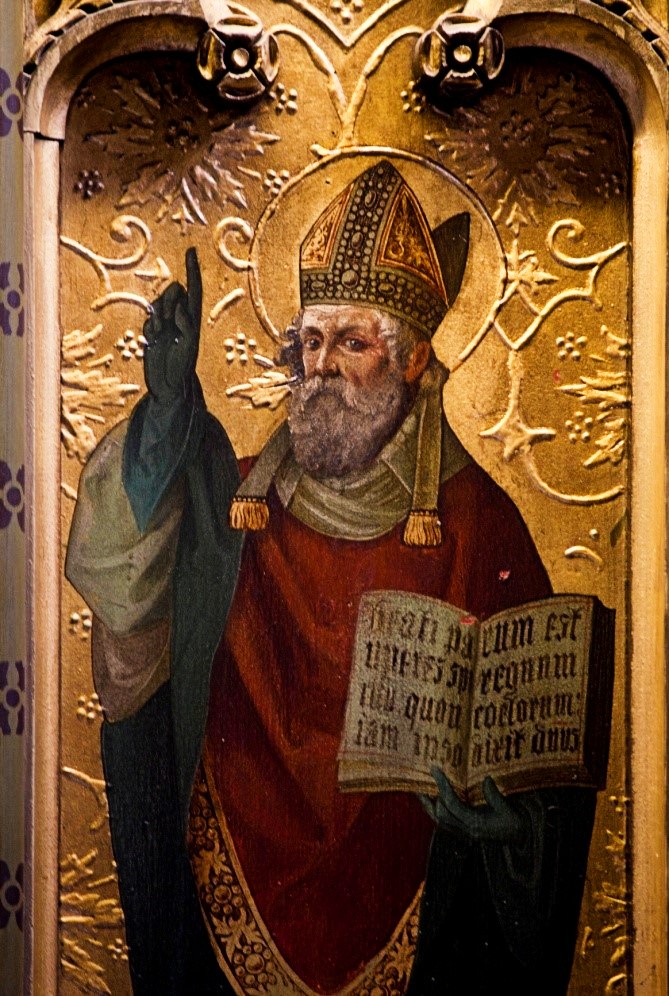
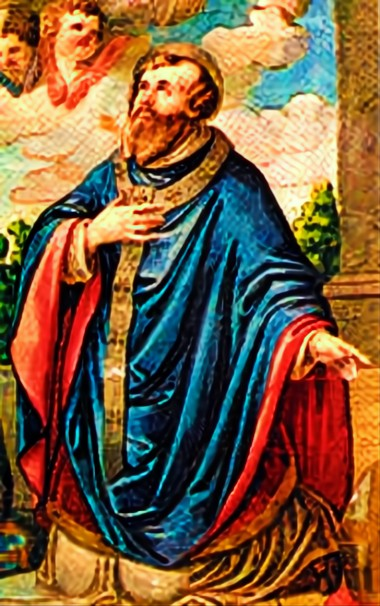
Saint of the Day – 17 August – St James the Deacon (7th Century). James was a Roman Deacon particularly proficient in Church music and Gregorian Chant, who accompanied St Paulinus of York (c584-644) the 1st Bishop of York, on his mission to Northumbria. He was a member of the second Gregorian mission in around 604. After Paulinus left Northumbria due to pagan violence, James stayed near Lincoln and continued his missionary efforts, dying sometime after 671, according to the Venerable St Bede.
James was presumably an Italian, like the other members of the Gregorian mission. His birth date is unknown but it is believed that he arrived in England in the 2nd mission in around 604. He accompanied St Paulinua to Northumbria together with the sister of King Eadbald of Kent, who went to Northumbria to marry King Edwin.
When King Edwin died in battle in 633, having been the principal supporter of St Paulinus’ mission, the pagans responded in aggression to the Christian missionaries. St Paulinus was forced to flee to Kent. James, however, remained in Northumbria and continued missionary evangelisation. James’ efforts were centred in Lincoln, at a Church which St Paulinus had built, the remains of which may lie under the Church of St Paul-in-the-Bail.
St Bede (673-735) writes that James lived in a village near Catterick which “bears his name to this day.” He reports that James, undertook missionary work in the area and lived to a great age. During the reign of King Oswiu of Northumbria, James attended the Royal Court, for he celebrated Easter with Oswiu’s Queen, Eanflæd, Edwin’s daughter. James and Eanflæd celebrated Easter on the date used by the Roman Church which led to conflicts with Oswiu, who celebrated Easter on the date calculated by the Irish Church. These dates did not always coincide and were one of the reasons that Oswiu called the Council of Whitby in 664 to decide which system of Easter calculation his Kingdom would use. We know, in our favoured position that the Council of Whitby settled the issue agreeing to following Rome.
According to St Bede’s account, James was present at the Council of Whitby. St Bede states that after the Council and the return of Roman customs, James, as a trained singing master in the Roman style, taught many Gregorian Chant.
James’ date of death is unknown but St Bede implies that he was still alive during St Bede’s lifetime, meaning he died after the latter’s birth, between 672. This would mean he was at least 70 years old at his death. It has been suggested that St James was St Bede’s informant for the life of St Edwin, the works of St Paulinus and perhaps, the Council of Whitby.
After his death, James was venerated as a Saint throughout the country.
St Amor of Amorbach St Anastasius of Terni St Benedicta of Lorraine St Carloman St Cecilia of Lorraine
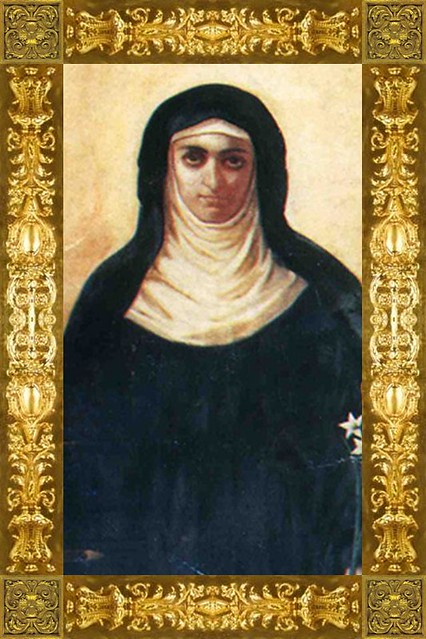
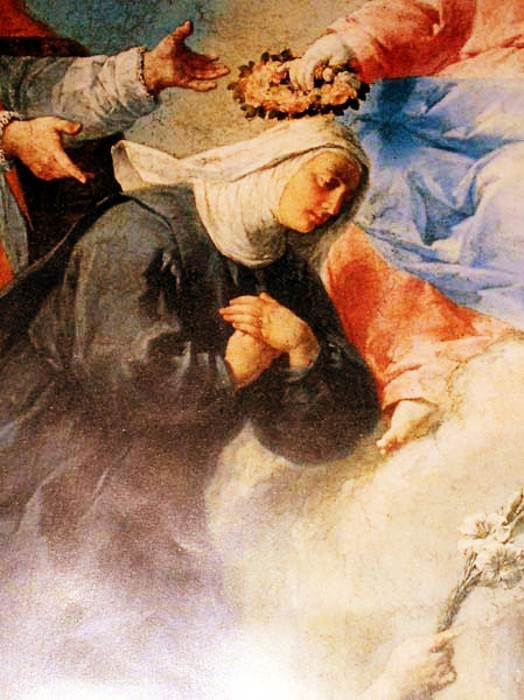
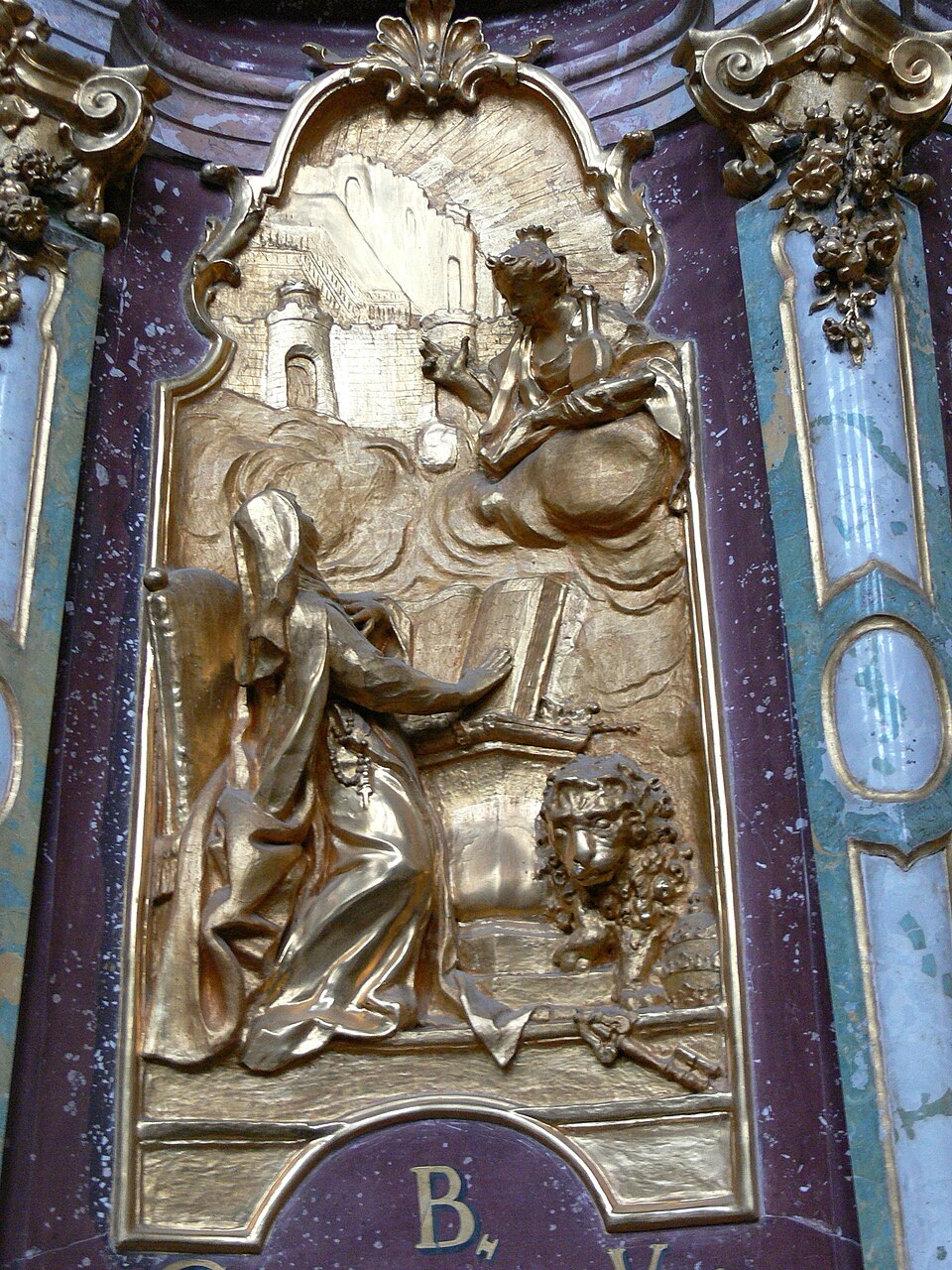
St Clare of the Cross (c1269-1308) Augustinian Nun and Abbess of Montefalco ; before becoming a Nun, St Clare was a member of the Third Order of St Francis (Secular), Mystic, Penitent, Spiritual adviser. Beatified by Pope Clement XII. On 8 December 1881, the Feast of the Immaculate Conception, Pope Leo XIII Canonised Clare. Her Sanctified Life: https://anastpaul.com/2019/08/17/saint-of-the-day-17-august-saint-clare-of-the-cross-of-montefalco-c-1269-1308/
St Drithelm St Elias the Younger St Eusebius of Sicily St James the Deacon (7th Century)
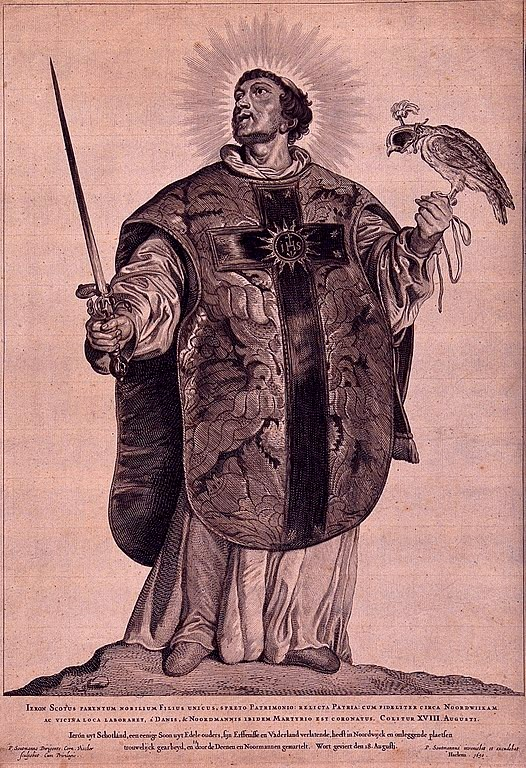
St Jeroen of Noordwijk (c800-856) Priest Martyr, Missionary. Patronage – the finding of lost articles, of Noordwijk. Also known as – Gerone, Hiero, Hieron, Iero, Ieron, Jeroen van Noordwijk, Jéron Noordwijk. Additional Memorial – 3rd Sunday in August in Noordwijk a St Jeroen celebration known as the ‘St Jeroen Sleep Walk’ and on the 1st Sunday in September, his Patronage of Noordwijk (and of lost articles) is celebrated there. Holy Jeropen’s Life and Death: https://anastpaul.com/2024/08/17/saint-of-the-day-17-august-st-jeroen-of-noordwijk-c800-856-priest-martyr/
St Juliana of Ptolemais St Mamas St Myron of Cyzicus
St Nicolò Politi (1117-1167) Basilian Monk and Hermit. He was known for his miracles even during his childhood and was Venerated as a saint even before his death. St Nicolò was Canonised on 7SJune 1507, at Saint Peter’s Basilica, Rome, by Pope Julius II. Miraculous St Nicolò: https://anastpaul.com/2020/08/17/saint-of-the-day-17-august-st-nicolo-politi-1117-1167/
Thought for the Day – 16 August – Meditations with Antonio Cardinal Bacci (1881-1971)
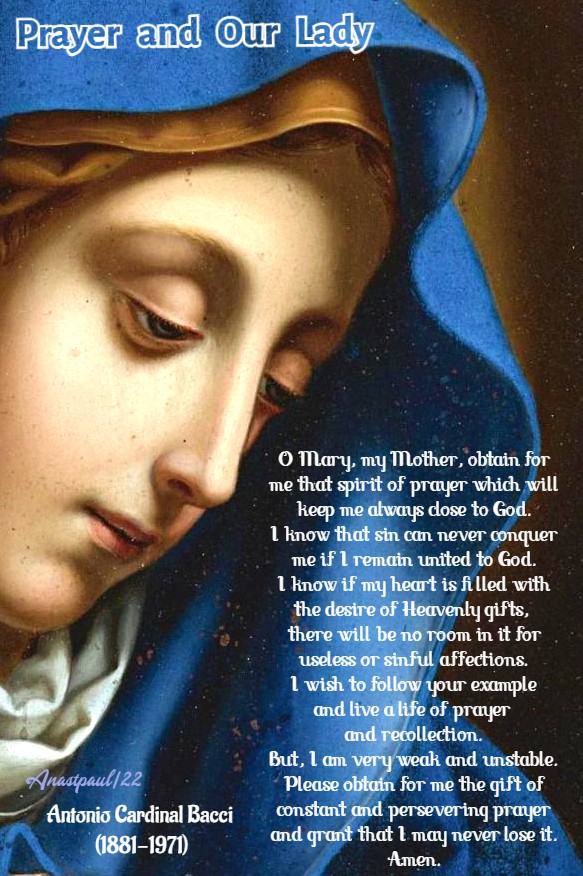
Prayer and Our Lady
“O Mary, my Mother, obtain for me that spirit of prayer which will keep me always close to God. I know that sin can never conquer me if I remain united to God. I know if my heart is filled with the desire of Heavenly gifts, there will be no room in it for useless or sinful affections. I wish to follow your example and live a life of prayer and recollection. But, I am very weak and unstable. Please obtain for me the gift of constant and persevering prayer and grant that I may never lose it. Amen.”
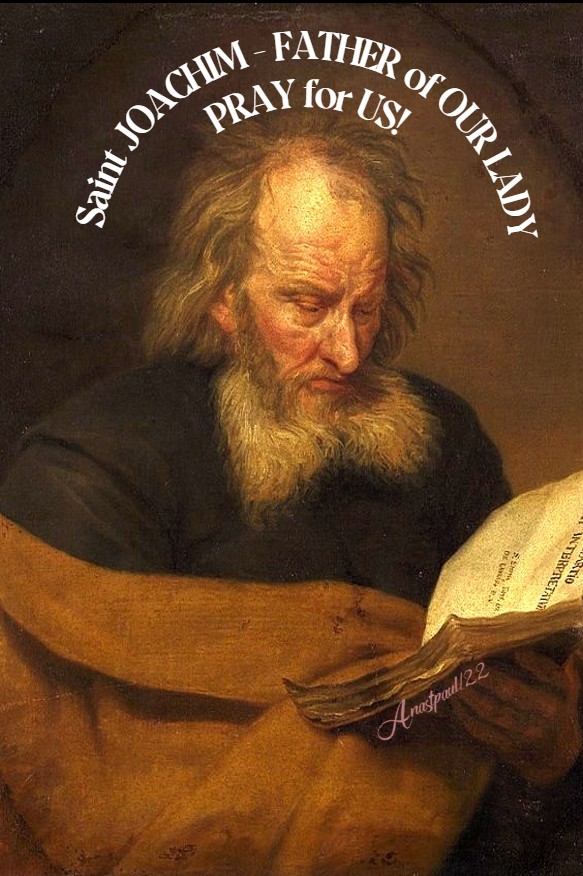
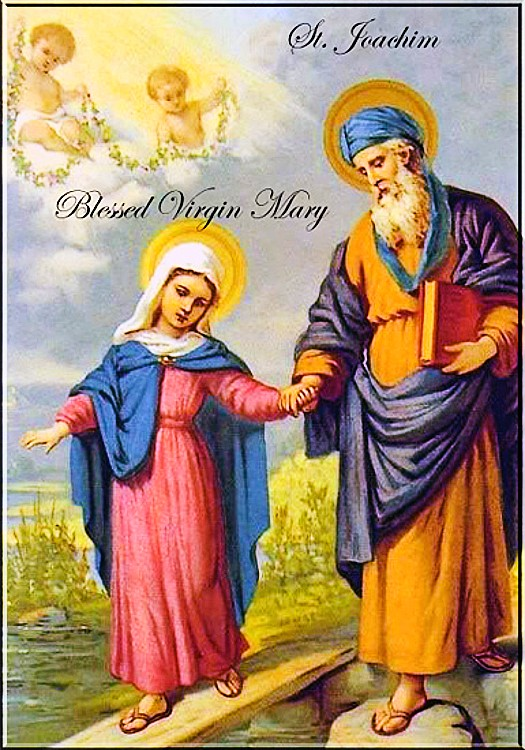
Quote/s of the Day – 16 August – “The Month of the Immaculate Heart of Mary” – St Joachim, Father of the Blessed Virgin Mary – Ecclesiasticus 31:8-11, Matthew1:1-16 – Scripture search here: https://www.drbo.org/
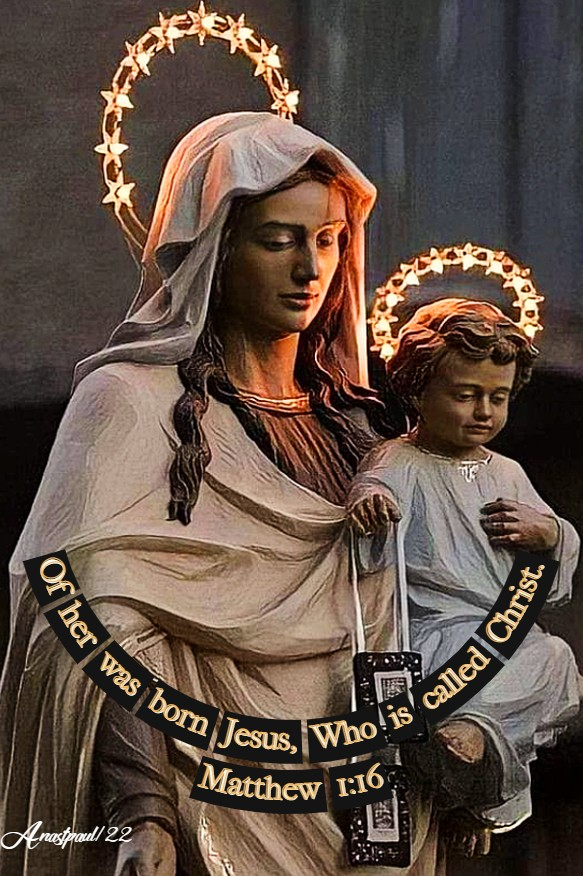
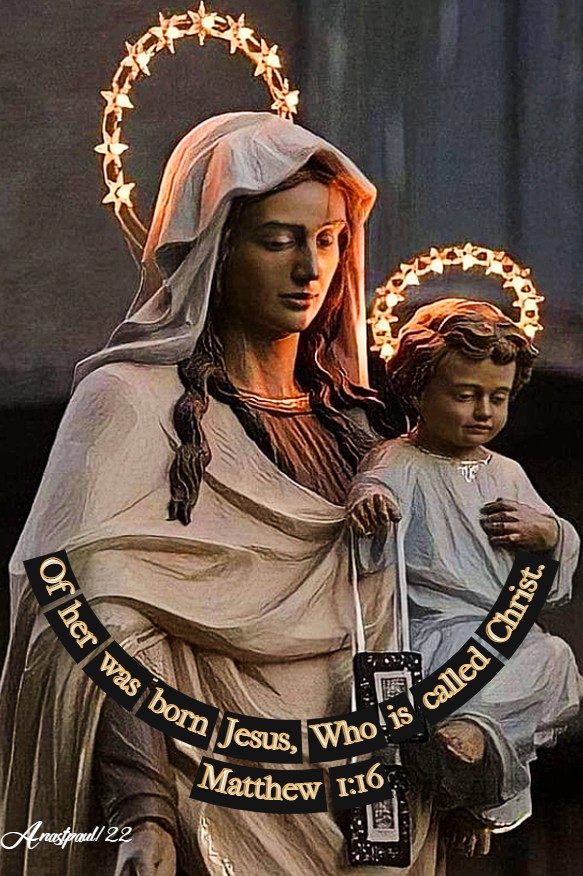
“And Jacob begot Joseph, the husband of Mary and of her was born Jesus, Who is called Christ.”
Matthew 1:16
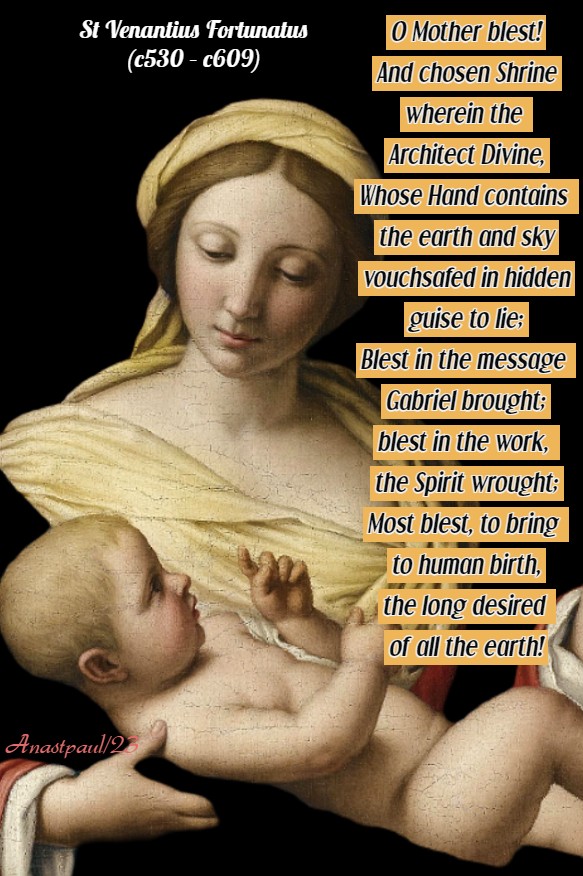
“O Mother blest! And chosen Shrine wherein the Architect Divine, Whose Hand contains the earth and sky vouchsafed in hidden guise to lie; Blest in the message Gabriel brought; blest in the work, the Spirit wrought; Most blest, to bring to human birth, the long desired of all the earth!”
St Venantius Fortunatus (c530 – c609) Bishop, Poet, Theologian, Father
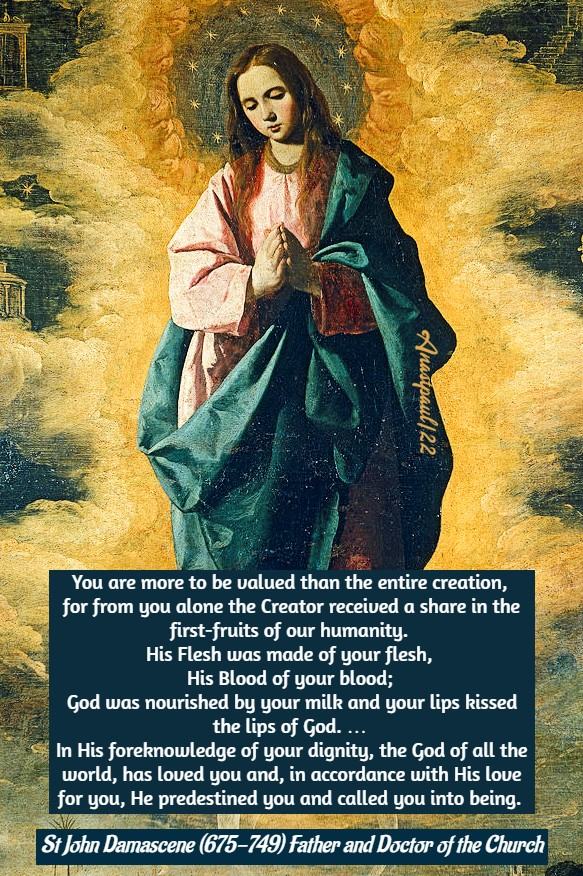
“You are more to be valued than the entire creation, for from you alone the Creator received a share in the first-fruits of our humanity. His Flesh was made of your flesh, His Blood of your blood; God was nourished by your milk and your lips kissed the lips of God. … In His foreknowledge of your dignity, the God of all the world, has loved you and, in accordance with His love for you, He predestined you and called you into being ”
St John Damascene (675-749) Father and Doctor of the Church
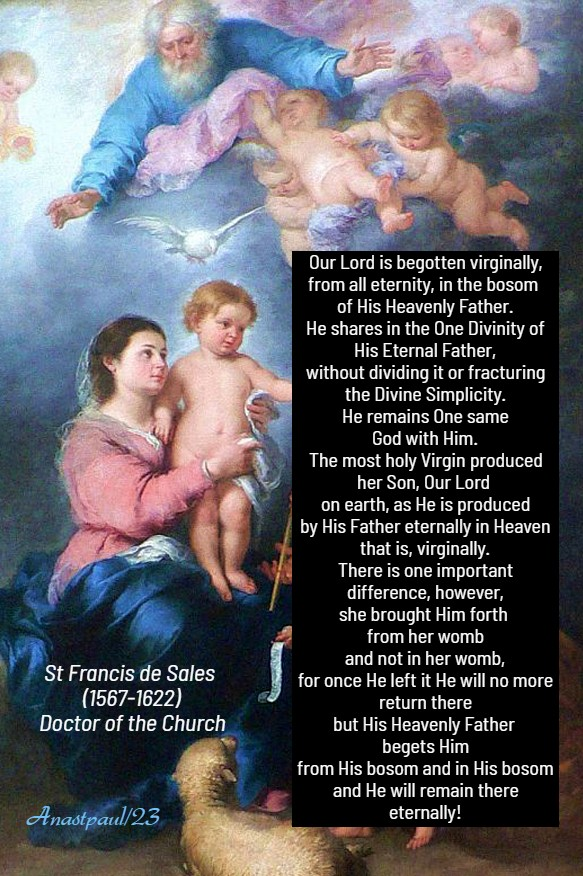
“Our Lord is begotten virginally, from all eternity, in the bosom of His Heavenly Father. He shares in the One Divinity of His Eternal Father, without dividing it or fracturing the Divine Simplicity. He remains One same God with Him. The most holy Virgin produced her Son, Our Lord on earth, as He is produced by His Father eternally in Heaven that is, virginally. There is one important difference, however, she brought Him forth from her womb and not in her womb, for once He left it He will no more return there but His Heavenly Father begets Him from His bosom and in His bosom and He will remain there eternally!”
St Francis de Sales (1567-1622) Doctor of the Church
One Minute Reflection – 16 August – “The Month of the Immaculate Heart of Mary” – St Joachim, Father of the Blessed Virgin Mary – Ecclesiasticus 31:8-11 – Matthew1:1-16 – Scripture search here: https://www.drbo.org/
“And Jacob begot Joseph, the husband of Mary and of her was born Jesus, Who is called Christ.” – Matthew 1:16
REFLECTION – “ It is of no avail to say that our Lord, the Son of the Blessed Virgin Mary, was true and perfect Man, unless we believe that He is so in the way that the Gospel declares. For Matthew says: “The book of the generation of Jesus Christ, the son of David, the son of Abraham” and follows the order of his human origin, so as to bring the lines of His ancestry down to Joseph, to whom the Lord’s Mother was espoused. Whereas Luke, going backwards step by step, traces His succession to the first of the human race, to show that the first Adam and the last Adam, were of the same nature (Lk 3:23).
No doubt, the Almighty Son of God, could have appeared for the purpose of teaching and justifying, in exactly the same way as He appeared, in the semblance of flesh, to the patriarchs and prophets, for instance, when He wrestled with Jacob (Gn 32:25) or engaged in a conversation with Abraham, not refusing His hospitality and even partaking of the food set before Him (Gn 18). But these appearances were indications of that Man Whose reality they manifested, assumed from the stock of those same ancestors.
But the fulfilment of the Mystery of our Redemption, ordained from all eternity, was not assisted by any images because, the Holy Ghost had not yet come down on the Virgin and, the power of the Most High, had not overshadowed her (Lk 1:35). Wisdom had not yet built herself a house within her undefiled body, so that the Word might there become flesh and, the Form of God and the Form of a Slave coming together in one person, the Creator of time, might be born in time and He Himself, through Whom all things were made, might be brought forth in the midst of all things. For, if the New Man had not been made in the likeness of sinful flesh and taken our old nature on Himself and, being consubstantial with the Father, had deigned to be consubstantial with His Mother also – yet, without sin – the whole human race would be held captive under the devil’s yoke and we should not be able to make use of the Conqueror’s victory because, it would have been won outside our nature!But it was from Christ’s marvellous sharing of our nature that the Mystery of regeneration shone upon us.” – St Leo the Great (400-461) Pope, Father and Doctor of the Church (Letter 31).
PRAYER – O God, Who, willed St Joachim to be the father of Thy Son’s Mother; grant, we beseech Thee that we may ever enjoy the spiritual help of him whose feast we celebrate. Through the same Jesus Christ, Thy Son our Lord, Who lives and reigns with Thee, in the unity of the Holy Ghost, God, world without end. Amen (Collect).
Our Morning Offering – 16 August – “The Month of the Immaculate Heart of Mary” – Feast of St Joachim, Father of the Blessed Virgin Mary
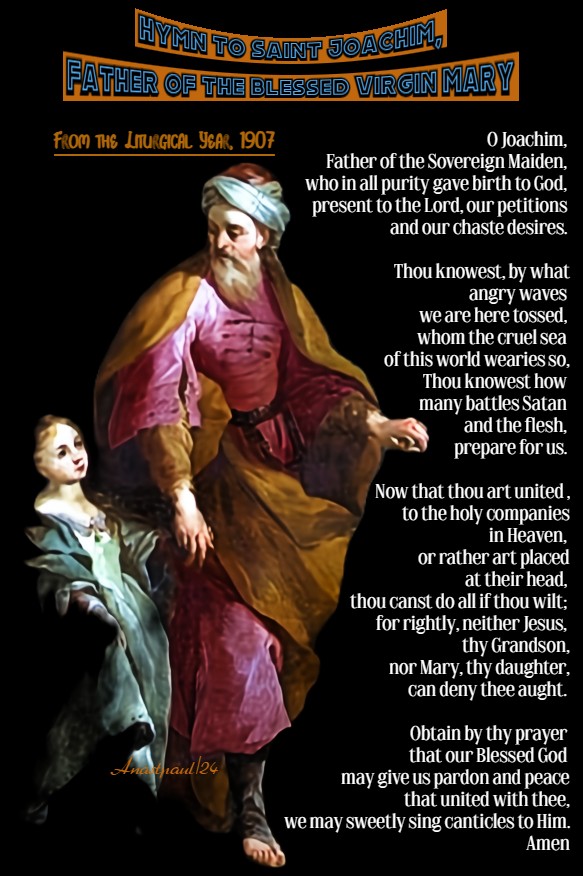
Hymn to St Joachim, Father of the Blessed Virgin Mary From the Liturgical Year, 1907
O Joachim, Father of the Sovereign Maiden, who in all purity gave birth to God, present to the Lord, our petitions and our chaste desires.
Thou knowest, by what angry waves we are here tossed, whom the cruel sea of this world wearies so, Thou knowest how many battles Satan and the flesh, prepare for us.
Now that thou art united , to the holy companies in Heaven, or rather art placed at their head, thou canst do all if thou wilt; for rightly, neither Jesus, thy Grandson, nor Mary, thy daughter, can deny thee aught.
Obtain by thy prayer that our Blessed God may give us pardon and peace that united with thee, we may sweetly sing canticles to Him. Amen
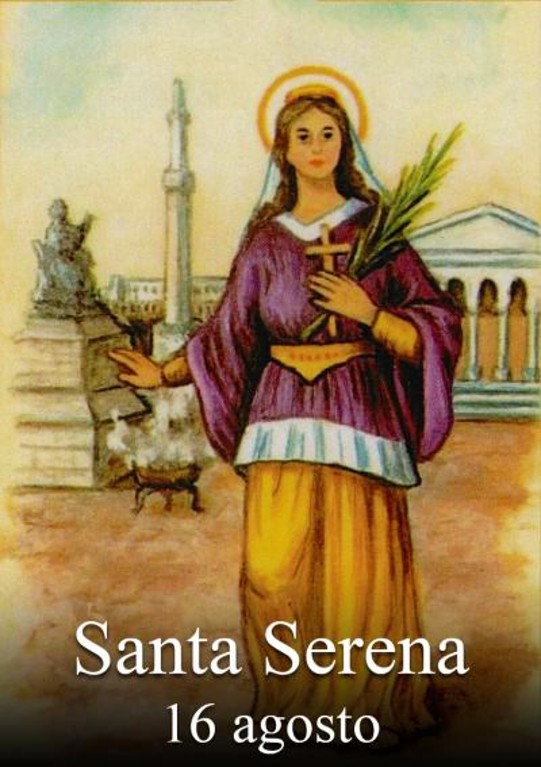
Saint of the Day – 16 August – Saint Serena (4th Century) Wife of Emperor Diocletian and, therefore, the Empress of the Roman Empire and a clandestine Christian.
The Roman Martyrology reads today: “At Rome, St Serena, who had been the wife of the Emperor Diocletian.”
In the Acts of Saint Marcellus and Saint Susanna, whom we celebrated on 11 August, Empress Serena intervened to defend Christians from persecution. For this reason, tradition holds that Serena was repudiated and some sources say she was later Martyred by her husband.
In fact, Lactantius (Lucius Cecilius, 3rd-4th Century), a Latin Christian writer who lived at the time and Court of Diocletian, states in his “De Mortibus Persecutorem” that his wife and daughter were called Prisca and Valeria and that they were forced to perform pagan rites.
While the abovementioned “Acts” speak of an Empress named Serena, wife of Diocletian, who intervened to defend Christians from the persecution unleashed by her husband, the tenth and most violent.
Her intervention evidently helped bring the persecution to an end because in 305 Diocletian abdicated and retired to Split. Probably from antiquity, she was, therefore, considered a saintly figure to be venerated as a Saint and some sources regard her as a Martyr.
Blessed Angelo Agostini Mazzinghi O.Carm. (1385-1438) was an Italian Priest and a professed member of the Carmelite Order. He was a noted Preacher, Prior and Reformer, Teacher of theology and was known for his pious devotion to the Holy Eucharist, the Blessed Virgin Mary and the Carmelite Rule of Life and to the profession of the Gospel. Holy Angelus: https://anastpaul.com/2019/08/16/saint-of-the-day-16-august-blessed-angelo-agostini-mazzinghi-o-carm-1385-1438/
St Arsacius of Nicomedia St Frambaldo Bl Iacobus Bunzo Gengoro Bl Jean-Baptiste Menestrel Bl John of Saint Martha
Blessed Laurence Loricatus (Died 1243) Hermit, Pilgrim, Penitent, previously a Soldier. Laurence served as a Solider as a young man. After accidentally killing a man, perhaps in the course of duty, he was so overcome with remorse that he dedicated himself to a life of penance. The image below by Fra Angelico depicts St Benedict finding a new disciple in his ‘cave.’ His Life of Penitance: https://anastpaul.com/2024/08/16/saint-of-the-day-16-august-blessed-laurence-loricatus-died-1243-hermit-pilgrim-penitent/
Bl Magdalena Kiyota Bokusai Bl Maria Gengoro Bl Ralph de la Futaye St Serena (4th Century) Bl Simon Kiyota Bokusai
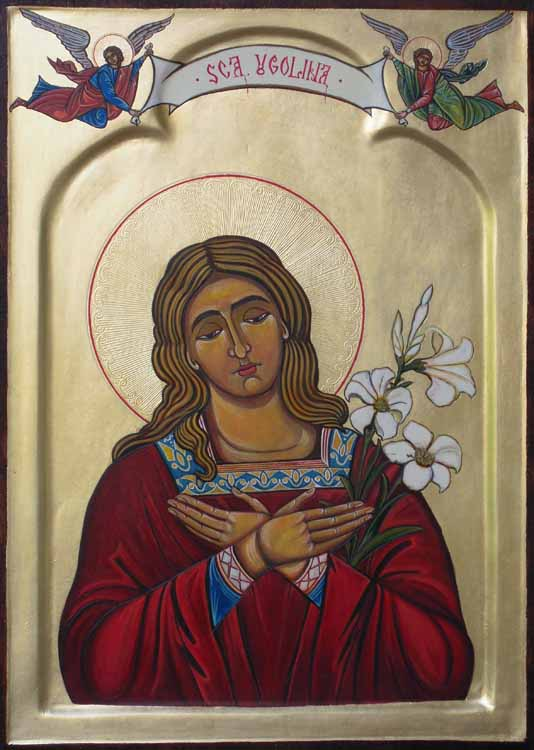
St Ugolina (c1239-c1300) Hermit, Penitent, Spiritual advisor. The very strange story that of this Blessed Ugolina who shut herself in a hermitage, representing herself as a man and remained there for forty-seven years! The aim of her subterfuge was to escape the aims of her father, who wished her to marry. In order not to reveal her secret, she called herself Ugo without revealing her identity to anyone. for nearly fifty years Her Holy Life: https://anastpaul.com/2021/08/16/saint-of-the-day-16-august-saint-ugolina-of-vercelli-c-1239-c-1300/
Martyrs of Palestine – 33 Saints: Thirty-three Christians Martyred in Palestine; they are commemorated in old martyrologies but the date and exact location have been lost.
Thought for the Day – 15 August – Meditations with Antonio Cardinal Bacci (1881-1971)
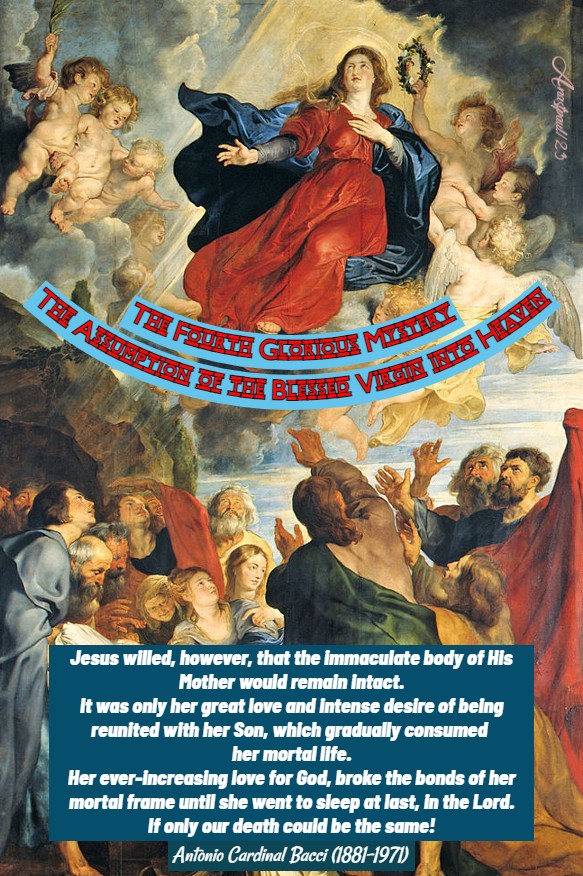
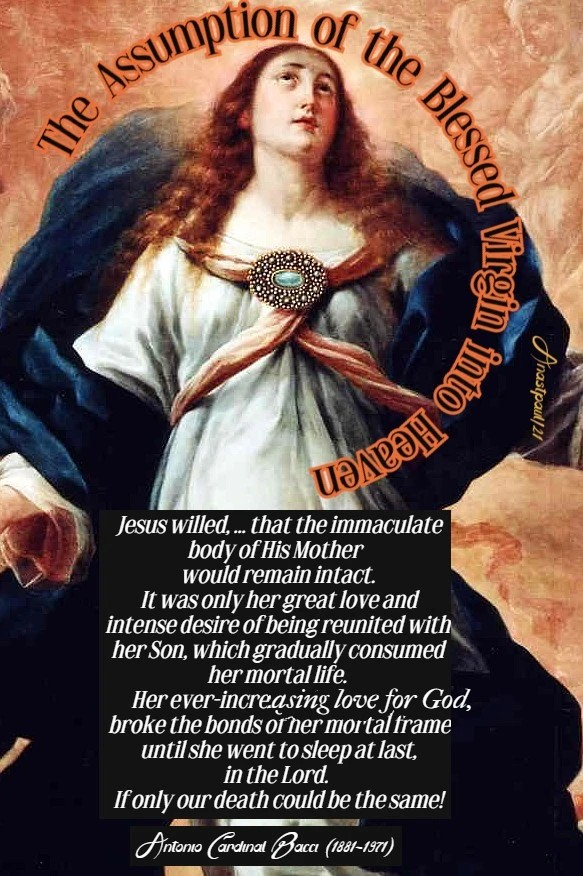
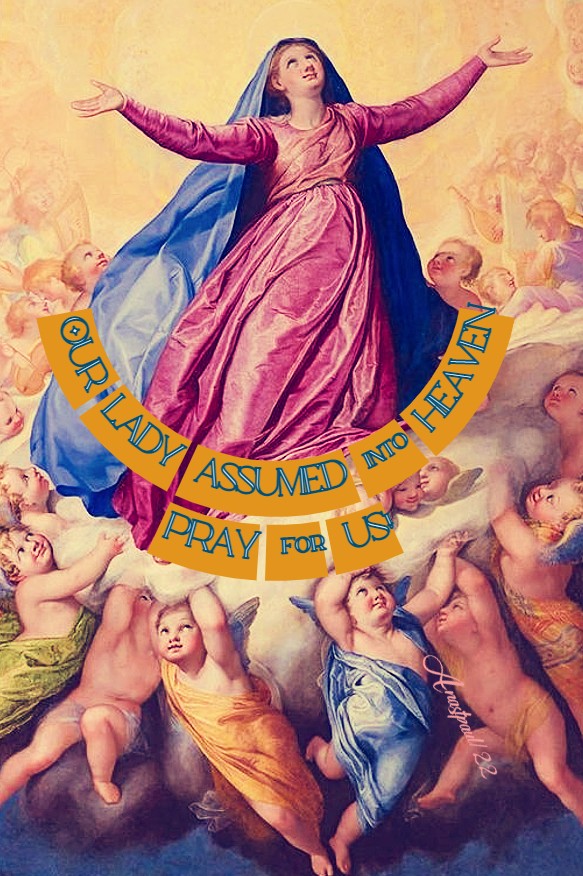
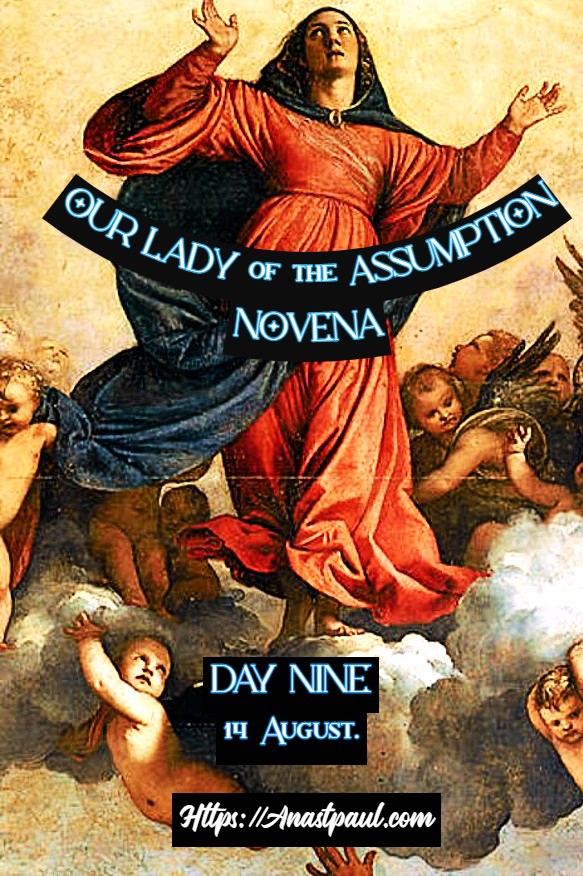
The Assumption of the Blessed Virgin into Heaven
“The fourth Book of Kings tells us, that the Prophet Elias was taken up into Heaven in a fiery chariot without having first endured the pains and humiliations of death (Cf 4 Kings 2:11). Why did God not do likewise in the case of the Blessed Virgin, commanding His Angels to bear her to Heaven before death struck her innocent body? As St Paul says, it was sin which caused death to enter the world. From the moment of her conception, Mary was free from the slightest taint of sin, for she was immaculate and full of grace. Nevertheless, according to the most widely held tradition, Mary chose to die, even as her Divine Son had willed to die. Jesus “was offered because it was His own will” (Isa 53:7). The same is true in Mary’s case, with only this difference. Jesus died a cruel death after the most hideous tortures in the midst of a blaspheming and hate-ridden mob. Nothing like this happened to Mary, although she is called the Queen of Martyrs because of the sword which pierced her soul at the sight of her Divine Son, dying in such agony.
Jesus willed, however, that the immaculate body of His Mother would remain intact. It was only her great love and intense desire of being reunited with her Son which gradually consumed her mortal life. Her ever-increasing love for God, broke the bonds of her mortal frame until she went to sleep at last, in the Lord.
Quote/s of the Day – 15 August – “The Month of the Immaculate Heart of Mary” –The Assumption of the Blessed Virgin Mary into Heaven
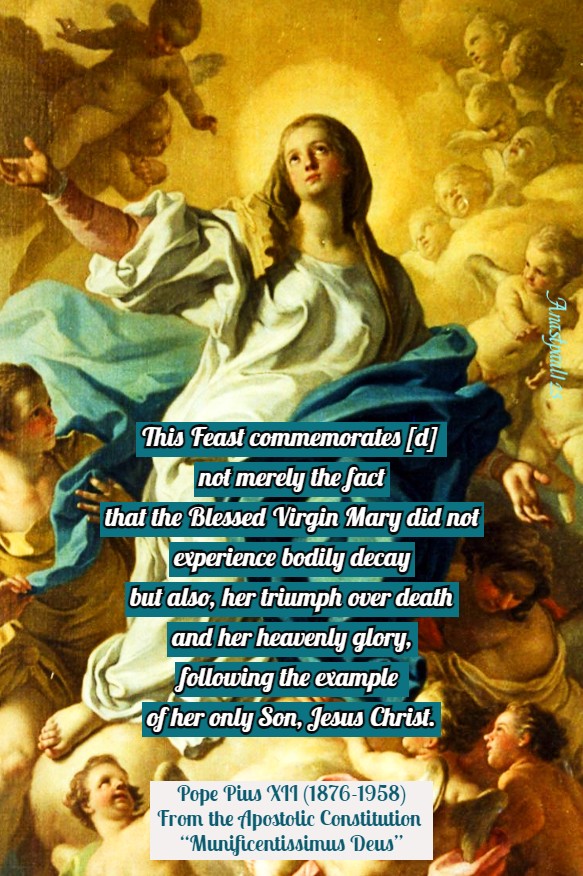
“In their sermons and speeches on the Feast day of the Assumption of the Mother of God, the holy Fathers and the Great Doctors of the Church, were speaking of something which the faithful already knew and accepted – all they did, was to bring it out into the open, to explain its meaning and substance in other terms. Above all, they made it most clear, that this Feast commemorated, not merely the fact that the Blessed Virgin Mary did not experience bodily decay but also, her triumph over death and her heavenly glory, following the example of her only Son, Jesus Christ.”
Pope Pius XII (1876-1958) From the Apostolic Constitution “Munificentissimus Deus” Defining the DOGMA of the Assumption 1 November 1950
“Jesus willed, however, that the Immaculate body of His Mother would remain intact. It was only her great love and intense desire of being reunited with her Son, which gradually consumed her mortal life. Her ever-increasing love for God, broke the bonds of her mortal frame until she went to sleep at last, in the Lord. If only our death could be the same!”
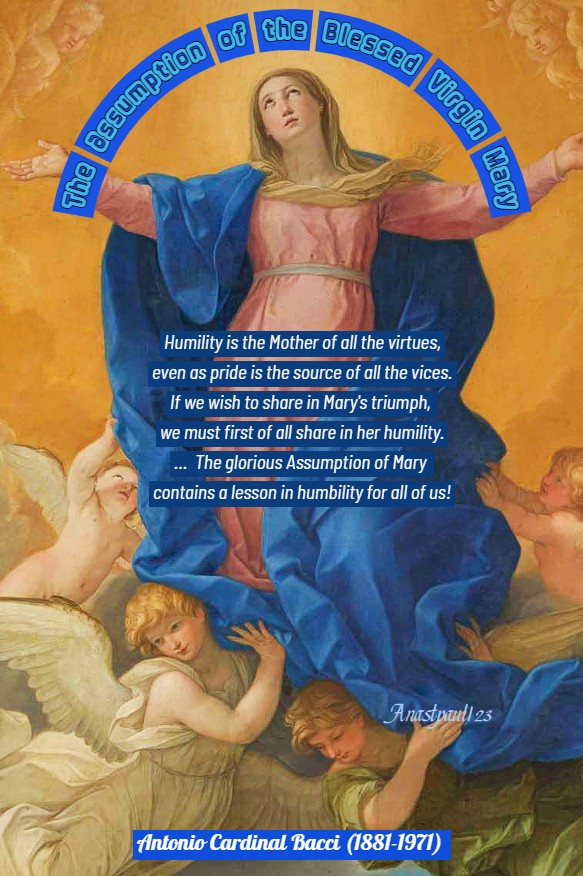
“Humility is the Mother of all the virtues, even as pride is the source of all the vices. If we wish to share in Mary’s triumph, we must, first of all, share in her humility. The glorious Assumption of Mary contains a lesson in humbility for all of us!”
One Minute Reflection – 15 August – “The Month of the Immaculate Heart of Mary” – The Assumption of the Blessed Virgin Mary into Heaven – Judith 13:22-25; 15:10 – Luke 1:41-50 – Scripture search here: https://www.drbo.org/
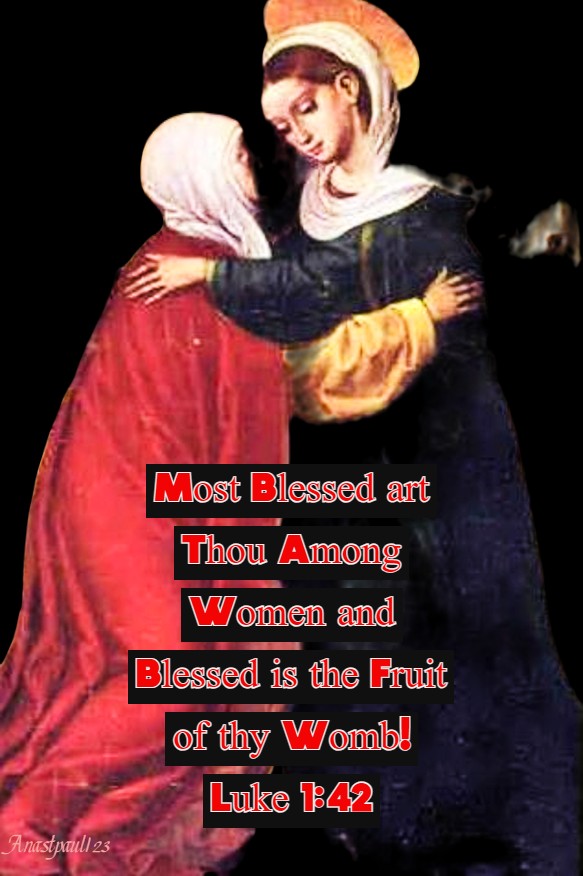
“Most blessed art thou among women and blessed is the fruit of thy womb.” – Luke 1:42
REFLECTION – “Let us honour the Queen of Heaven, Mother of life, Source of mercy, overflowing delights, leaning on her Beloved. Let us praise her, knowing full well that our praise will be insufficient.
Risen above the tallest trees of paradise and exalted above the highest peaks of mountains, she will penetrate Heaven with incredible majesty accompanied by the singing of the choirs of celestial Angels and surrounded by the dancing of Angels. Happy are those who dwell in Thy house, O Lord, they will praise Thee without end! In you we praise not Eve who introduced the poison but Mary who gave life, who is the Mother and nursemaid of all, the life of all the living. In you we praise even our own mother.
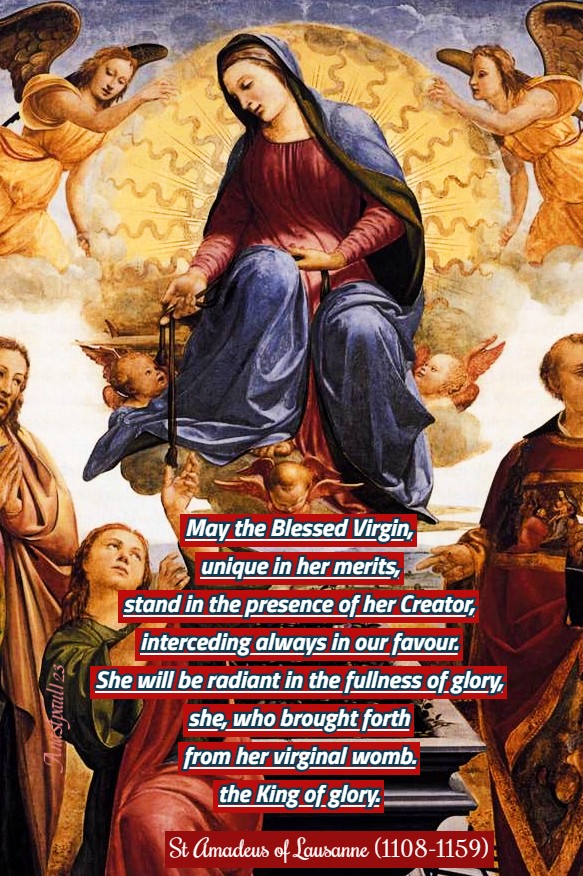
May all hear and rejoice, the humble Virgin rises, crowned, to the throne of glory, may the humble rejoice.May those who exalt themselves in their presumption fall. Mary, who gives herself as a holocaust to the fullness of grace. May the Blessed Virgin, unique in her merits, stand in the presence of her Creator interceding always in our favour. She will be radiant in the fullness of glory, she who brought forth from her virginal womb, the King of glory.” – St Amadeus of Lausanne (1108-1159) Bishop, Cistercian Monk (Marian Homily VIII).
PRAYER – O Lord, we beseech Thee, forgive the transgressions of Thy servants and, forasmuch as by our own deeds, we cannot please Thee, may we find safety through the prayers of the Mother of Thy Son and our Lord. Through the same Jesus Christ, Thy Son our Lord, Who lives and reigns with Thee, in the unity of the Holy Ghost, God, world without end. Amen (Collect).
Our Morning Offering – 15 August – “The Month of the Immaculate Heart of Mary” – The Assumption of the Blessed Virgin Mary into Heaven
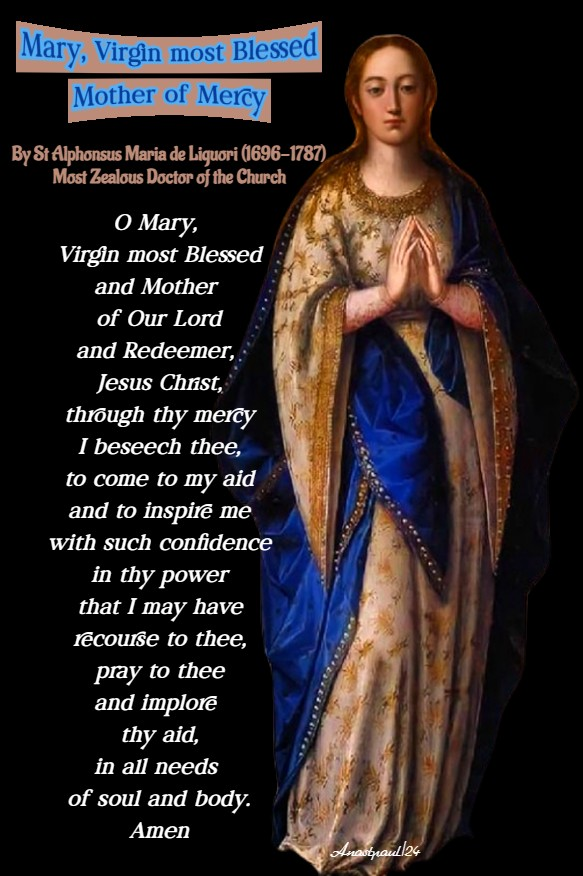
Mary, Virgin most Blessed Mother of Mercy By St Alphonsus Maria de Liguori (1696-1787) Most Zealous Doctor of the Church (Prayer used as part of the Assumption Novena)
O Mary, Virgin most Blessed and Mother of Our Lord and Redeemer, Jesus Christ, through thy mercy I beseech thee, to come to my aid and to inspire me with such confidence in thy power that I may have recourse to thee, pray to thee and implore thy aid, in all needs of soul and body. Amen
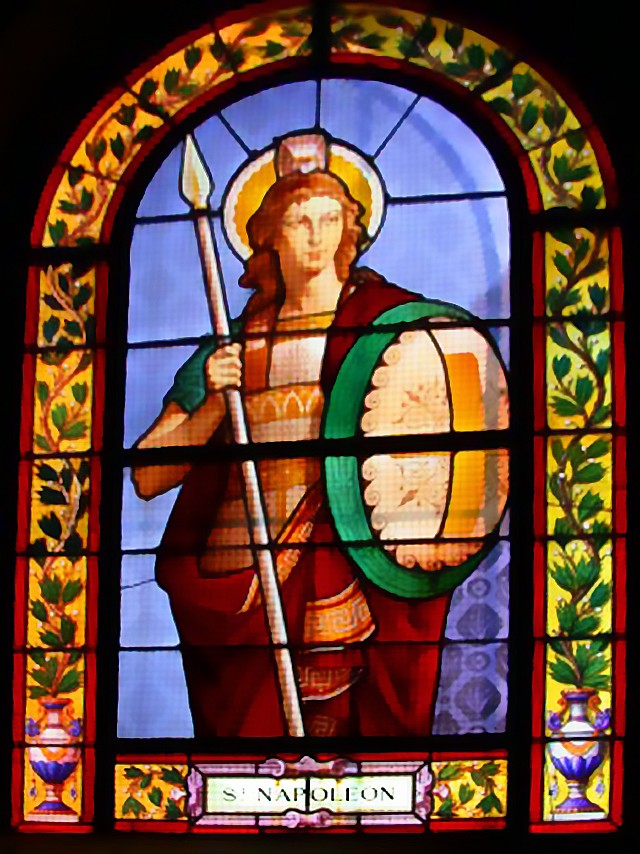
Saint of the Day – 15 August – St Napoleon (Died c302) Martyr of Alexandria. Born in Egypt and was Martyred in Alexandria in the early 4th Century during the persecutions of Diocletian. Also known as – Neopulus, Neopolus, Neopolis or Neópolo.
He was seized during the persecutions under Emperor Diocletian and was brutally tortured in Alexandria. Neopoleon died from his injuries. Sadly we have no further information but it appears that he had been a soldier.
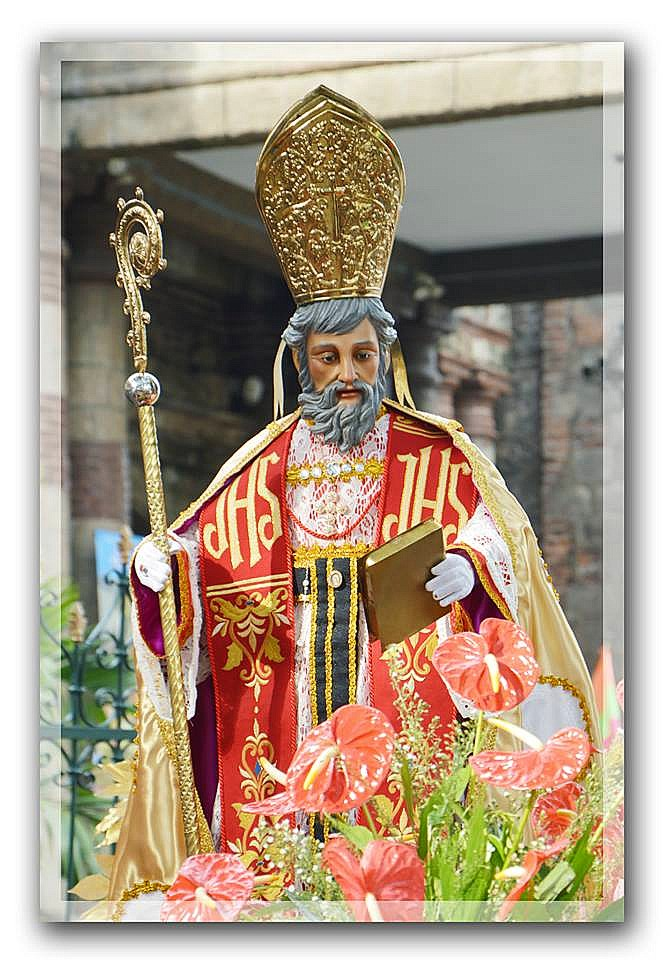
St Alypius (Died 430) Bishop of the See of Thagaste (in what is now Algeria) in 394, Confessor, Reformer, Defender of the Faith against heresy, Lawyer, teacher, spiritual advisor. He was a lifelong disciple and friend of Saint Augustine and joined him in his conversion (in 386; Confessions 8.12.28) and life in Christianity. He is credited with helping establish Augustine’s Monastery in Africa. Most of what is known about him comes from Augustine’s autobiographical Confessions. A Life of Holiness: https://anastpaul.com/2021/08/15/saint-of-the-dy-saint-alypius-of-thagaste-died-430/
Blessed Alfred OSB (Died 874) Bishop of Hildesheim, Benedictine Monk, Confessor, Founder of Essen Abbey, Hildesheim Cathedral, many Convents, Schools and Seminaries, Royal Spiritual Adviser to the East Frankish King Louis the German, Diplomatic Peacemaker, he was know for his great devotion to the Blessed Virgin Mary. His Lifeot Grace: https://anastpaul.com/2020/08/15/saint-of-the-day-15-august-blessed-alfred-of-hildesheim-osb-died-874-bishop/
Blessed Aimo Taparelli OP (c 1395-1495) Priest and Friar of the Order of Preachers, widower and father, Reformer, spiritual writer. He served as an Inquisitor-General for his Order in the Lombard and Liguria regions of Italy and became a travelling preacher in Northern Italian Cities. His name means “defends the house with the sword.” Aimo was Beatified on 29 May 1856 by Pope Pius IX. Blessed Aimo’s Zealous Life: https://anastpaul.com/2022/08/15/saint-of-the-day-15-august-blessed-aimo-taparelli-op-c-1395-1495/
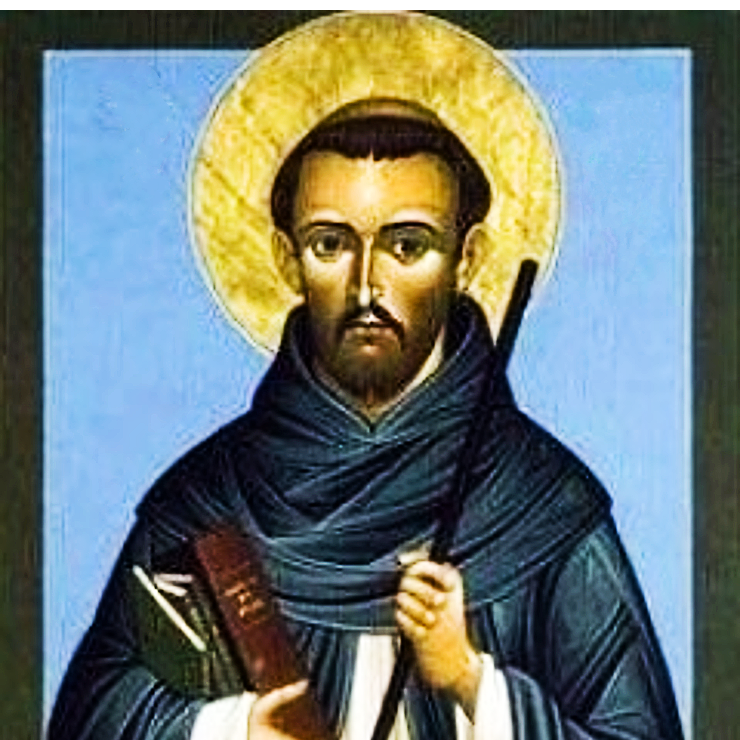
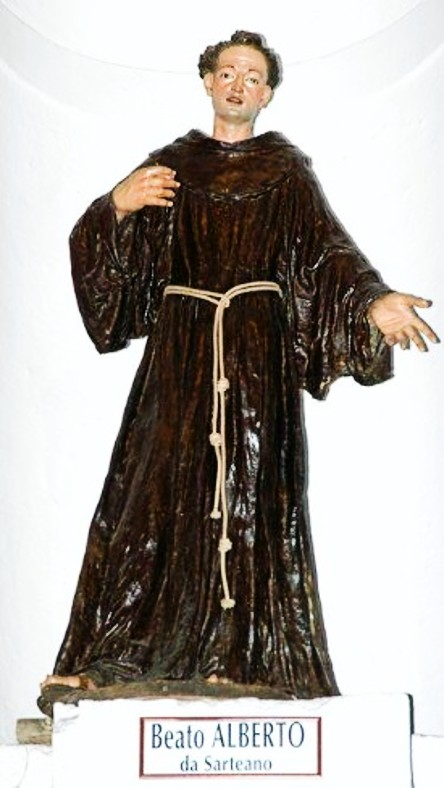
Blessed Alberto Berdini OFM Conv. (1385– 1450) Priest and Friaer of the Friars Minor Conventual, known as the “King of Preachers – Rex Praedicatorum” Disciple and companion of St Bernardine of Siena in his Missionary work in Italy., often called upon to assist in peace discussions between warring Cities. Born in 1385 in Sarteano, Tuscany, Italy and died on 15 August 1450 in Milan, Italy of natural causes. Blessed Holy Albert’s Life: https://anastpaul.com/2023/08/15/saint-of-the-day-14august-blessed-alberto-berdini-ofm-conv-1385-1450/
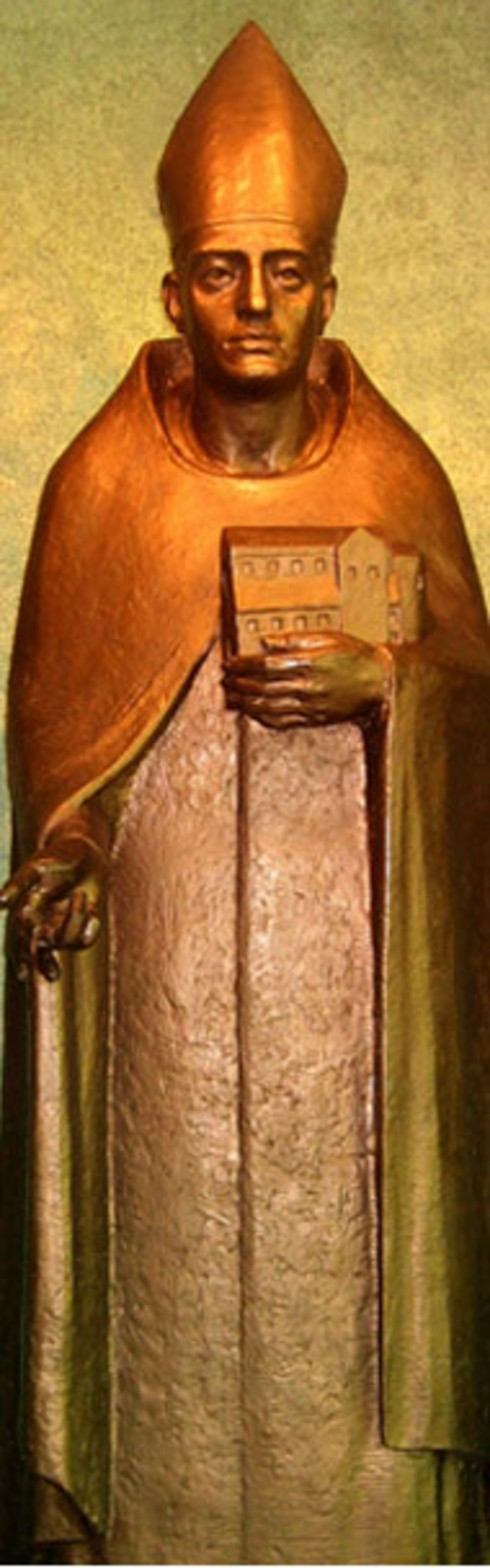
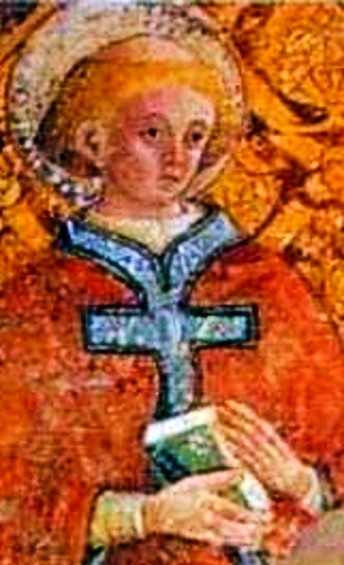
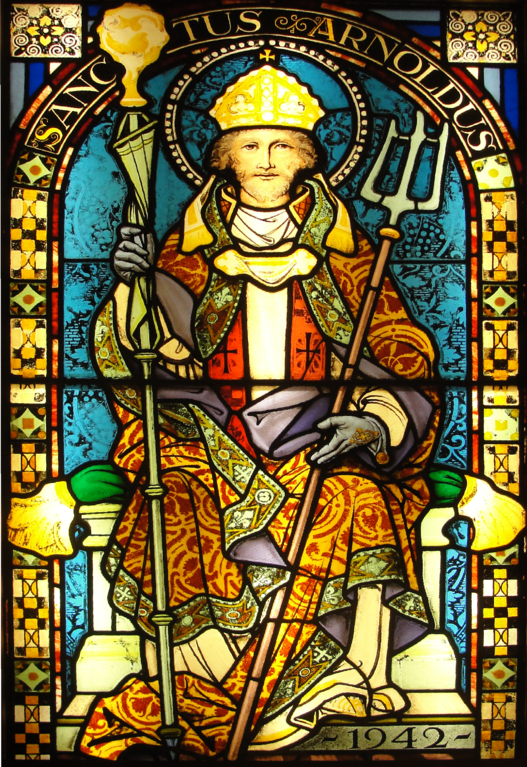
St Simplician (c320-c401) Archbishop of Milan and Successor of St Ambrose (340-397) Doctor of the Church in the Archdiocese of Milan, Teacher, Catechist, Writer, Mystic. St Ambrose used to call Simplician father, as a sign of spiritual relationship but they were also great friends. Simplician took also an active part in the conversions of both Alypius of Thagaste and Augustine of Hippo. The meeting between Augustine and Simplican occurred in Milan in 386 and it is recorded in Augustine’s Confessions. After his conversion, Augustine also called Simplician father and in 397 he dedicated to Simplician two books on the issue of predestination, known as De Diversis Quaestionibus ad Simplicianum. St Augustine, remembered and referred to him with deep gratitude, calling him the “spiritual father of my soul” and would submit his own writings to him to review and comment. Details of the life of St Simplician here: https://anastpaul.wordpress.com/2017/08/15/saint-of-the-day-15-august-st-simplician-of-milan/
Martyrs of Nicomedia – 3 Saints: Three Christians Martyred together. No details survive but the names – Eutychian, Philip and Straton. They were martyred in Nicomedia, Bithynia (in modern Turkey).
Thought for the Day – 14 August – Meditations with Antonio Cardinal Bacci (1881-1971)
“Holy Mary”
“The Angel’s greeting was completed later by the salutation of St Elizabeth. As soon as Elizabeth saw the Blessed Virgin coming to visit her, she cried out in humble veneratin: “Blessed art thou among women and blessed is the fruit of thy womb!” (Lk 1:42).
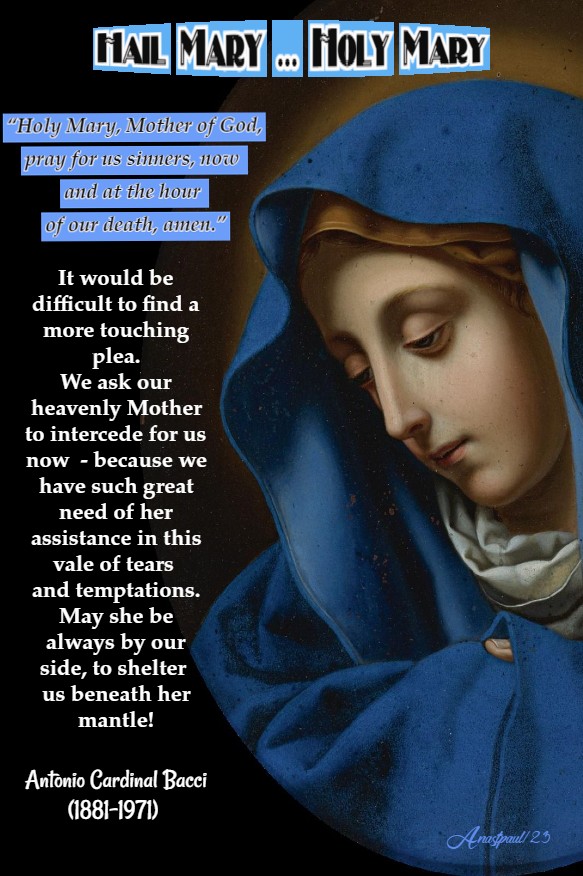
In the first part of the Hail Mary, then, we pay her the words of the Gospel, the highest tributes ever accorded to any human creature, proclaiming her to be full of grace, blessed among women and Mother of the Redeemer. The second part which was later added by the Church, (composed and proposed by St Peter Canisius 1521-1597) Doctor of the Church), is a heartfelt supplication addressed to Mary as the Mother of God and our Mother. “Holy Mary, Mother of God, pray for us sinners, now and at the hour of our death, amen.” It would be difficult to find a more touching plea. We ask our heavenly Mother to intercede for us now – because we have such great need of her assistance in this vale of tears and temptations. May she be always by our side, to shelter us beneath her mantle!”
Quote/s of the Day – 14 August – “The Month of the Immaculate Heart of Mary” – Vigil of the Assumption
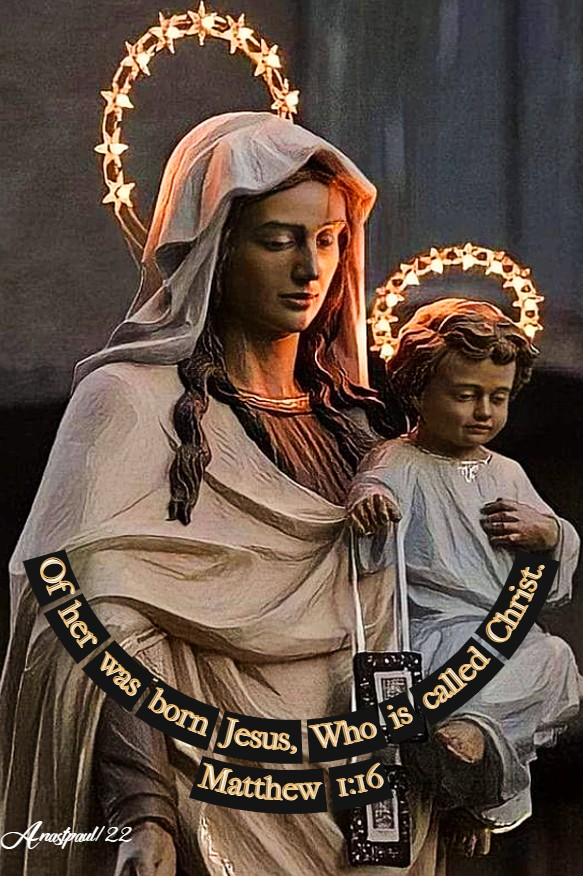
“And Jacob begot Joseph, the husband of Mary and of her was born Jesus, Who is called Christ.”
Matthew 1:16
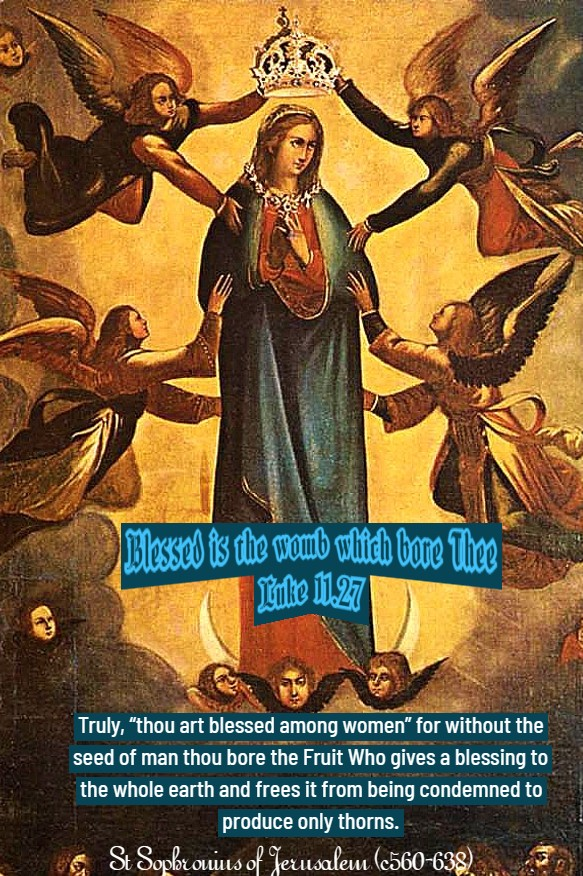
“Truly, “thou art blessed among women” for without the seed of man thou bore the Fruit Who gives a blessing to the whole earth and frees it from being condemned to produce only thorns.”
St Sophronius of Jerusalem (c560-638) Bishop, Father of the Church
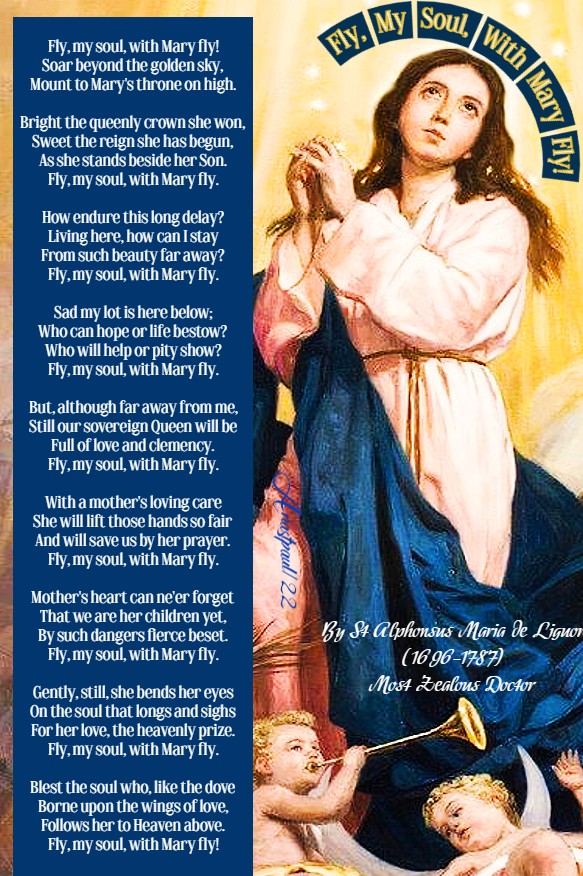
Fly, My Soul, with Mary Fly! By St Alphonsus Maria de Liguori (1696-1787) Most Zealous Doctor (From “The Glories of Mary”) Trans. Redemptoris Fathers, 1931)
Fly, my soul, with Mary fly! Soar beyond the golden sky, Mount to Mary’s throne on high.
Bright the queenly crown she won, Sweet the reign she has begun, As she stands beside her Son. Fly, my soul, with Mary fly.
How endure this long delay? Living here, how can I stay From such beauty far away? Fly, my soul, with Mary fly.
Sad my lot is here below; Who can hope or life bestow? Who will help or pity show? Fly, my soul, with Mary fly.
One Minute Reflection – 14 August – “The Month of the Immaculate Heart of Mary” – Vigil of the Assumption – Ecclesiasticus 24:23-31 – Luke 11:27-28 – Scripture search here: https://www.drbo.org/
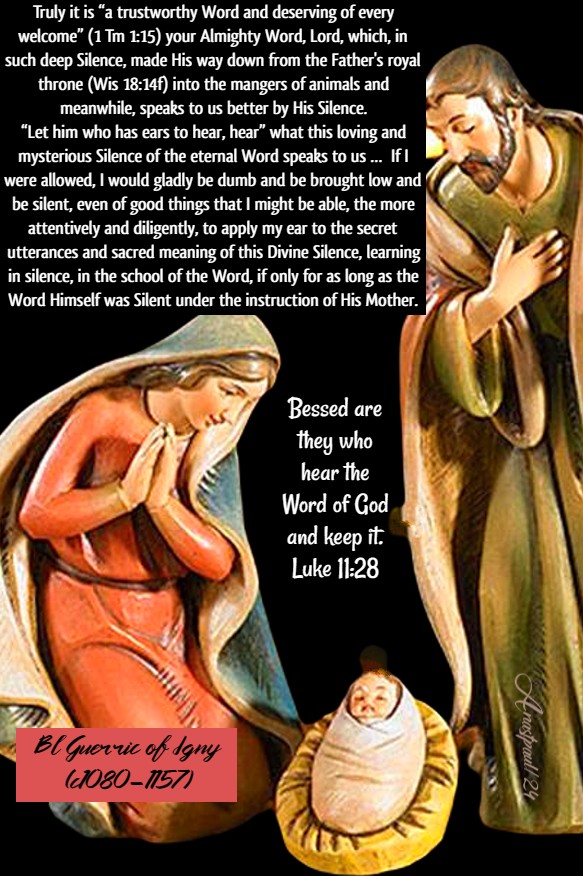
“… Blessed are they who hear the Word of God and keep it.” – Luke 11:28
REFLECTION – “Truly it is “a trustworthy word and deserving of every welcome” (1 Tm 1:15) your Almighty Word, Lord, which, in such deep Silence, made His way down from the Father’s royal throne (Wis 18:14f) into the mangers of animals and meanwhile, speaks to us better by His Silence. “Let him who has ears to hear, hear” what this loving and mysterious Silence of the eternal Word speaks to us …
For what recommends the discipline of silence with such weight and such authority, what checks the evil of restless tongues and the storms of words, as the Word of God, silent in the midst of men. “There is no word on My tongue” (Ps 138:4), the Almighty Word seems to confess while He is subject to His Mother. What madness then will prompt us to say: “With our tongues we can do great things; our lips are good friends to us; we own no master” (Ps 11:5). If I were allowed, I would gladly be dumb and be brought low and be silent, even of good things that I might be able, the more attentively and diligently, to apply my ear to the secret utterances and sacred meaning of this Divine Silence, learning in silence, in the school of the Word, if only for as long as the Word Himself was Silent under the instruction of His Mother …
“The Word was made flesh and dwelt amongst us” (Jn 1:14). With complete devotion, then, let us think of Christ in the swaddling clothes with which His Mother wrapped Him, so that, with eternal happiness, we may see the glory and beauty with which His Father has clothed Him.” – Blessed Guerric of Igny O.Cist. (c1080-1157) Cistercian Abbot (The 5th sermon for Christmas).
PRAYER – O God, Who chose for Thy dwelling the virginal womb of the blessed Mary, grant, we beseech Thee that, with the help of her protection, we may with joy, take part in her festival.Through the same Jesus Christ, Thy Son our Lord, Who lives and reigns with Thee, in the unity of the Holy Ghost, God, world without end. Amen (Collect).
Our Morning Offering – 14 August – “The Month of the Immaculate Heart of Mary” –The Vigil of the Assumption
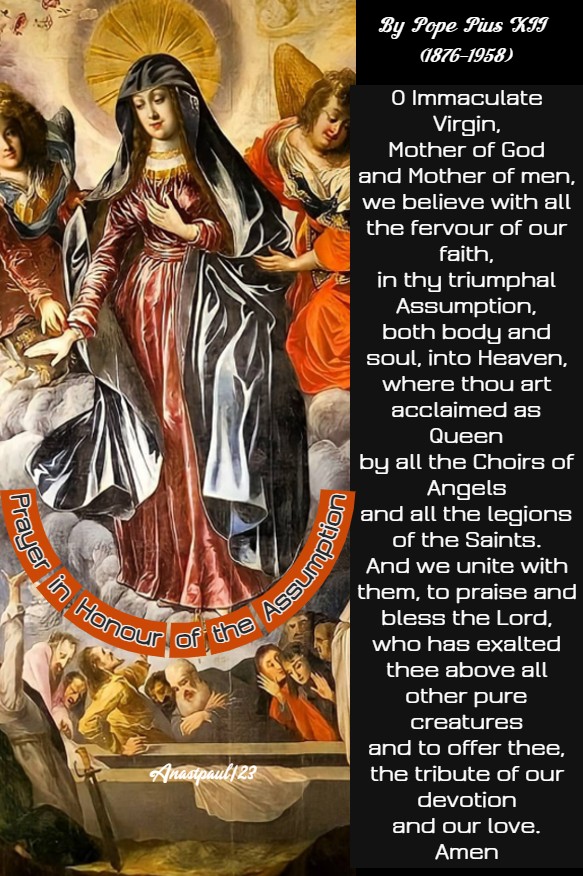
Prayer in Honour of the Assumption of the Blessed Virgin Mary By Pope Pius XII (1876-1958)
O Immaculate Virgin, Mother of God and Mother of men, we believe with all the fervour of our faith, in thy triumphal Assumption, both body and soul, into Heaven, where thou art acclaimed as Queen by all the Choirs of Angels and all the legions of the Saints. And we unite with them, to praise and bless the Lord, who has exalted thee above all other pure creatures and to offer thee, the tribute of our devotion and our love. Amen
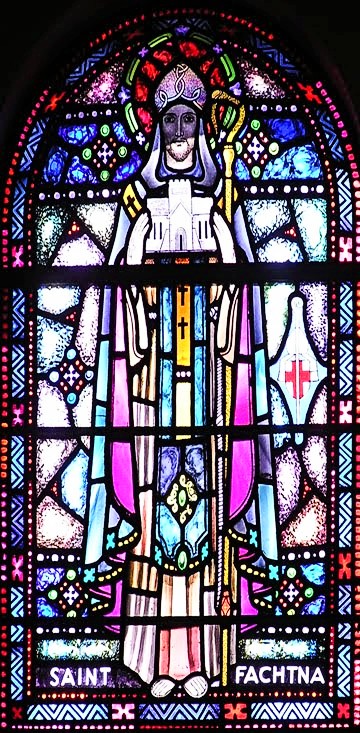
Saint of the Day – 14 August – Saint Fachtna (6th Century) the 1st Bishop of Ross, Ireland, Founder Abbot of a Monastery and a renowned School. Patronage – of Rosscarbery, the Diocese of Kilfenora , Cork and Ross. Also known as – Fachana, Facaage.
Toward the end of the 6th Century, Fachtna founded a Monastery and School in the area now known as Rosscarbery (Ros Ailithir – “the wooded headland of the pilgrims”). The School of Ross became a celebrated seat of learning and gained an international reputation for study of Sacred Scripture and learning, until the 9th Cntury when it was besieged and destroyed by the Danes.
St Brendan the Navigator, taught in this School which was crowded with students from every Continental land. It flourished for three hundred years and survived ,in some form, until the coming of the Normans to Ireland.
Fachtna is regarded as the 1st Bishop and Patron of Ross Diocese
In 1197, Pope Celestine III appointed Daniel as the Bishop of Ross and the Diocese had its own Bishop from the 12th Century until 1693, when it was united with Cork and Cloyne. In 1849 the Diocese regained its own Bishop but in 1954 was united with Cork Diocese.
The description of Saint Fachtna in Cuimin of Connor’s Poem on the characteristic virtues of the Irish Saints is:
“Fachtna, the generous and steadfast, loved to instruct the crowds in concert, He never spoke that which was mean, Nor aught but what was pleasing to his Lord.”
Fachtna is a favouured name for Catholic boys from this area. There is a Catholic Church dedicated to St Fachtna in the picturesque village of Glandore. A stained-glass window of St Fachtna by Sarah Purser appears in the Honan Chapel in University College, Cork. (see above).
St Eusebius of Rome (Died 357) Priest, Confessor. “At Rome, the birthday of the blessed Priest Eusebius, who for the defence of the Catholic Faith, was shut up in a room of his own house by the Arian Emperor, Constantius, where constantly persevering in prayer for seven months, he rested in peace. His body was removed by the Priests, Gregory and Orosius and buried in the cemetery of Cllistus on the Appian Way.” – Roman Martyrology. His Life: https://anastpaul.com/2020/08/14/saint-of-the-day-14-august-saint-eusebius-of-rome-died-357-priest-confessor/
Thought for the Day – 13 August – Meditations with Antonio Cardinal Bacci (1881-1971)
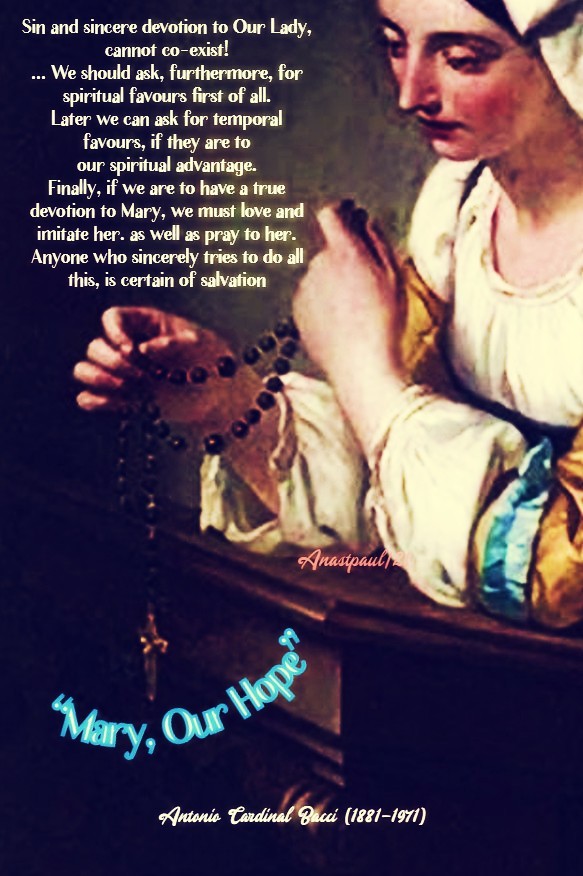
“Mary, Our Hope”
“These expressions of confidence in Mary’s powerful intercession, should not lead us astray, however. They hold good with absolute certainty, only for those who have true devotion to Mary. Even if they are sinners, such clients of Mary, must have at least the good intention of changing their lives and never offending God again. Sin and sincere devotion to Our Lady, cannot co-exist! “Relinquish every intention of sinning.” St Gregory VII wrote to the Princess Matilde, “and you will find Mary more eager to help you than any earthly mother” (Lib 1, Ep 47).
We should ask, furthermore, for spiritual favours first of all. Later we can ask for temporal favours, if they are to our spiritual advantage.
Finally, if we are to have a true devotion to Mary, we must love and imitate her. as well as pray to her. Anyone who sincerely tries to do all this, is certain of salvation!”
Quote/s of the Day – 13 August – “The Month of the Immaculate Heart of Mary” – St John Berchmans SJ (1599-1621) Jesuit Novice
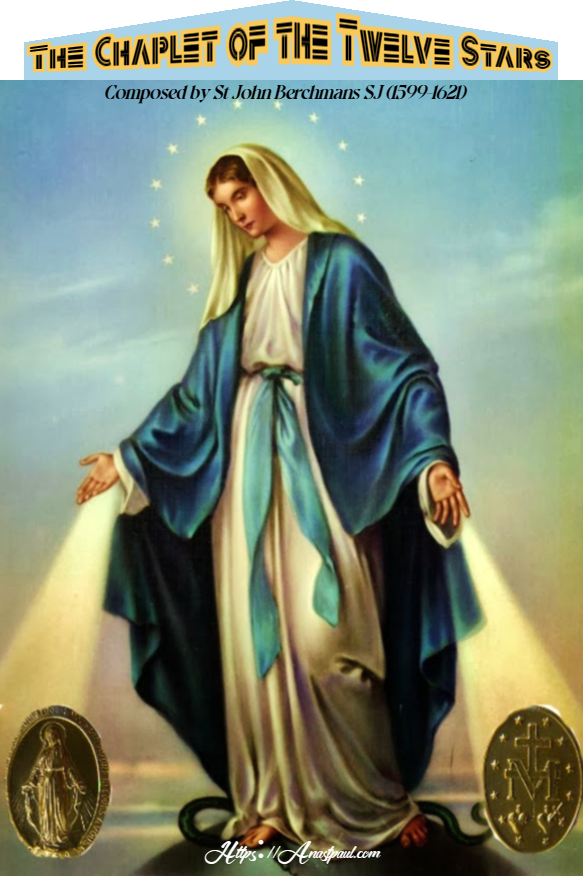
“The Chaplet of the Twelve Stars” OR The Immaculate Conception Chaplet Composed by St John Berchmans SJ (1599-1621)
St John recited the Chaplet daily to obtain the grace never to commit any sin against the virtue of purity, through the intercession of the Immaculate ever Virgin Mary. He name the prayer “The Chaplet of the Twelve Stars” with which to crown our Lady. The Chaplet may be prayed for other intentions.
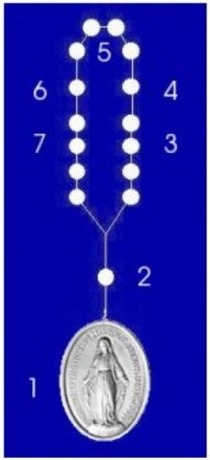
The Chaplet consists of three groups of four beads each. A large bead separates each group and a medal of the Immaculate Conception (also known as The Miraculous Medal) is attached to the end.
How to Pray the Chaplet of the 12 Stars
+1. Holding the Miraculous Medal, make the Sign of the Cross, kissing the Medal as you do so. Then on the Miraculous Medal say: “Blessed be the pure, most Holy and Immaculate Conception of the Blessed Virgin Mary. ”
+2. On the first single bead, the Our Father.
+3. On each of the first group of four beads, the Hail Mary.
After the fourth Hail Mary, the Glory Be.
+4. On the second single bead: “Blessed be the pure, most Holy and Immaculate Conception of the Blessed Virgin Mary. ” Then the Our Father.
+5. Repeat the same sequence on each of the remaing groups to the end. thus completing the 12 Stars i.e. 3 Groups of 4 each.
At the end, some add: “Oh Mary conceived without sin, pray for us who have recourse to thee. ” (The words on the front of the Miraculous Medal).
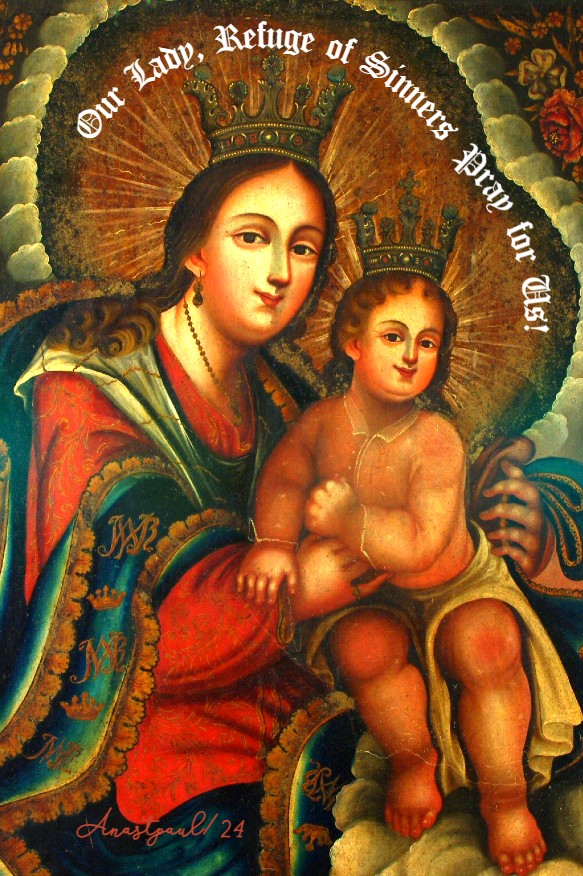
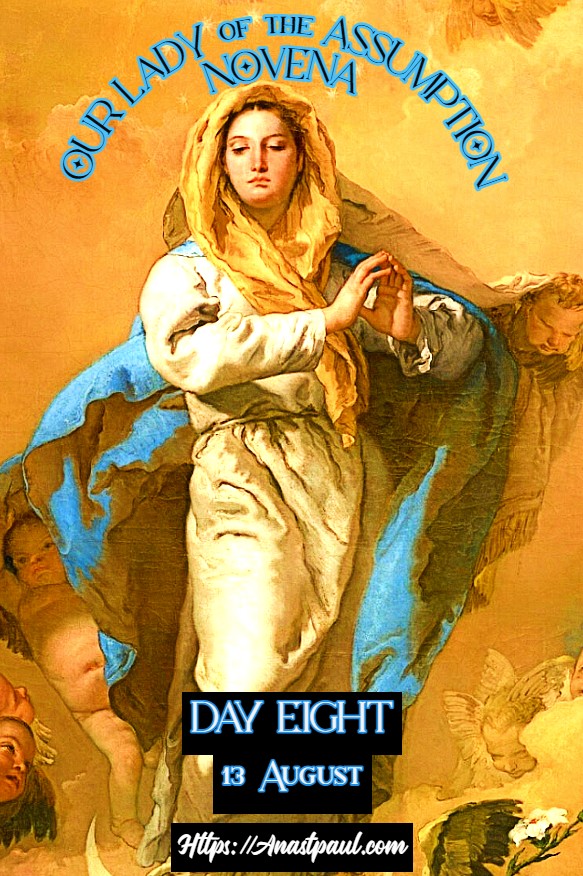
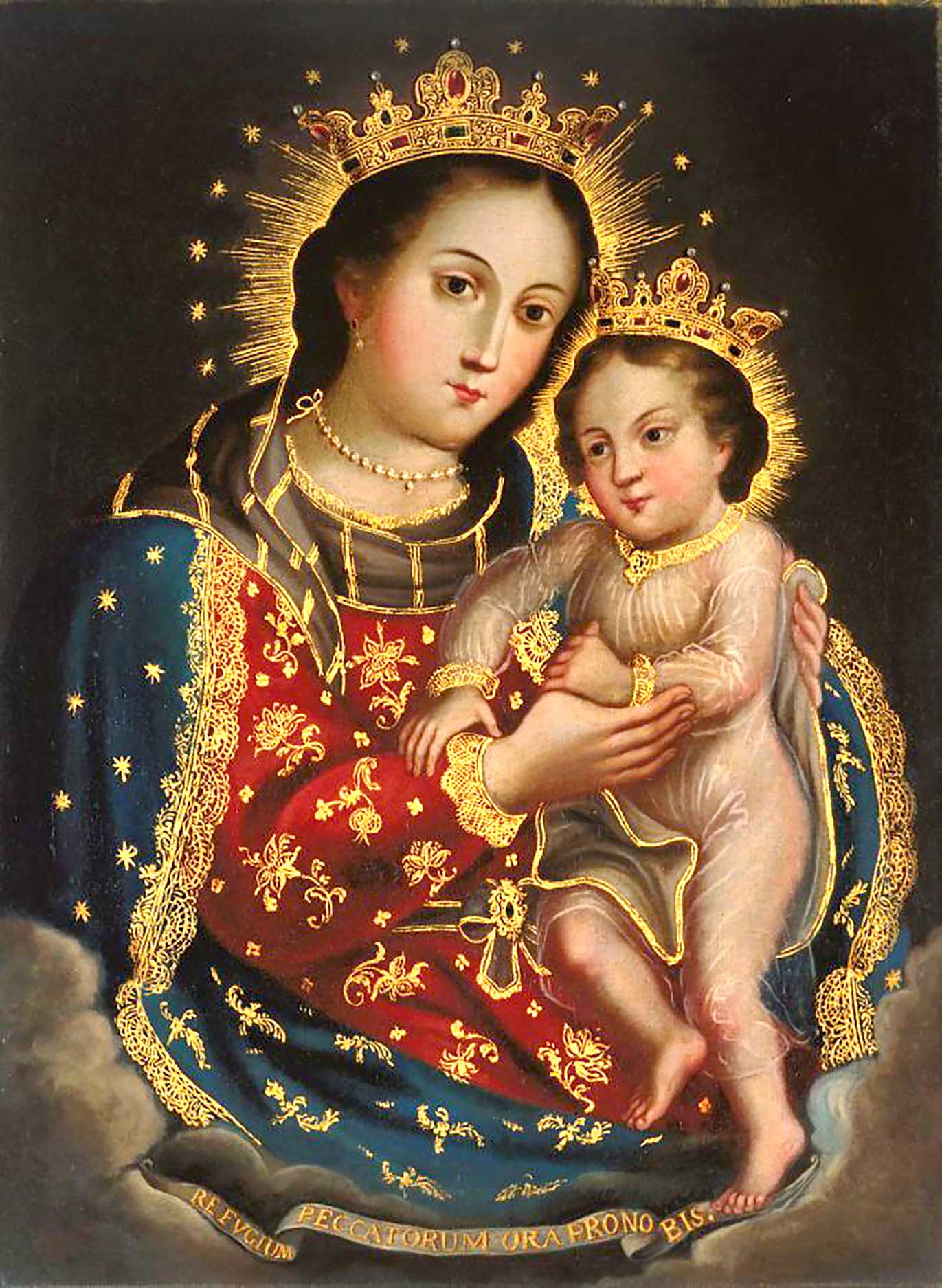
One Minute Reflection – 13 August – “The Month of the Immaculate Heart of Mary” – Saints Hippolytus and Cassian (Died c235) Martyrs – Our Lady Refuge of Sinners – Hebrews 10:32-38 – Luke 12:1-8 – Scripture search here: https://www.drbo.org/
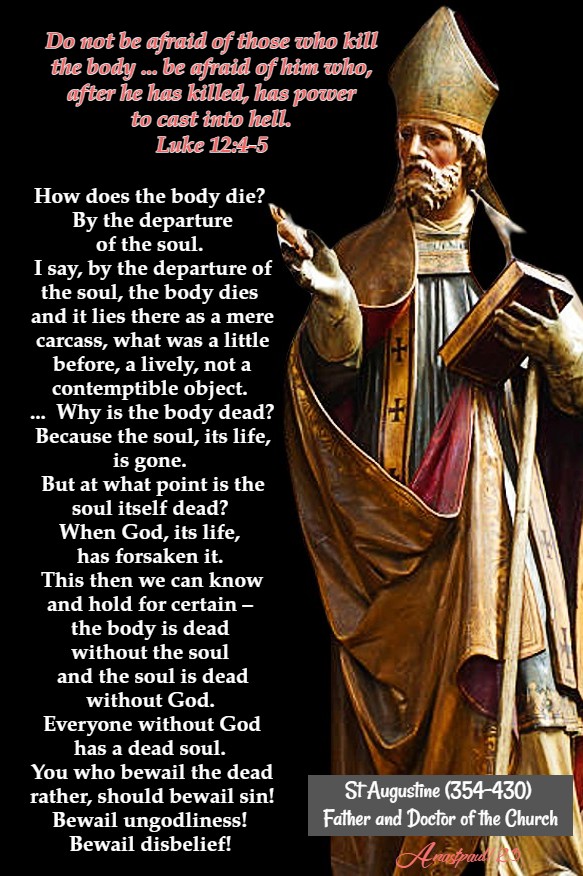
“Do not be afraid of those who kill the body and after that have nothing more that they can do. … be afraid of him who, after he has killed, has power to cast into hell. ” – Luke 12:4-5
REFLECTION – “The Gospel is life. Impiety and infidelity are the death of the soul. So then, if the soul can die, how then is it yet immortal? Because, there is always a dimension of life in the soul which can never be extinguished. And how does it die? Not in ceasing to be life but by losing its proper life. For the soul is both life to something else and it has it own proper life. Consider the order of the creatures. The soul is the life of the body. God is the Life of the soul. As the life that is the soul, is present with the body that the body may not die, so the Life of the soul (God), ought to be with the soul that it may not die.
How does the body die? By the departure of the soul. I say, by the departure of the soul, the body dies and it lies there as a mere carcass, what was a little before, a lively, not a contemptible object. There are in it still, its several members, the eyes and ears. But these are merely the windows of the house – its inhabitant is gone. Those who bewail the dead, cry in vain at the windows of the house. There is no-one there within it to hear. Why is the body dead? Because the soul, its life, is gone. But at what point is the soul itself dead? When God, its Life, has forsaken it. This then we can know and hold for certain – the body is dead without the soul and the soul is dead without God. Everyone without God has a dead soul. You who bewail the dead rather, should bewail sin! Bewail ungodliness! Bewail disbelief! – St Augustine (354-430) Bishop of Hippo, Father and Doctor of the Church (Sermon 65).
PRAYER – Grant, we beseech Thee, O Lord God, unto all Thy servants that they may remain continually in the enjoyment of soundness, both of mind and body and, by the glorious intercession of the Blessed Mary, always a Virgin, may be delivered from present sadness and enter into the joy of Thine eternal gladness. Through Jesus Christ, Thy Son our Lord, Who lives and reigns with Thee, in the unity of the Holy Ghost, God, world without end. Amen (Collect).
Our Morning Offering – 13 August – “The Month of the Immaculate Heart of Mary” – The Feast of Our Lady Refuge of Sinners
Shelter Me Under Thy Mantle, Refuge of Sinners By St Alphonsus de Liguori (1696-1787) Most Zealous Doctor
Most holy Virgin Immaculate, my Mother Mary, to thee, who art the Mother of my Lord, the Queen of the Universe, the Advocate, the Hope, the Refuge of sinners, I, who am the most miserable of all sinners, have recourse this day. I venerate thee, great Queen and I thank thee for the many graces thou hast bestowed upon me, even unto this day, in particular, for having delivered me from the hell which I have so often deserved by my sins. I love thee, my dearest Lady and because of that love, I promise to serve thee willingly forever and to do what I can to make thee loved by others. I place in thee all my hopes for salvation, accept me as thy servant and shelter me under thy mantle, thou, who art the Mother of Mercy. And since thou are so powerful with God, deliver me from all temptations, or at least, obtain for me the strength to overcome them until death. From thee, I implore, a true love for Jesus Christ. Through thee, I hope to die a holy death. My dear Mother, by thy love for Almighty God, I pray thee to assist me always but most of all, at the last moment of my life. Forsake me not then, until thou shalt see me safely in Heaven, there to bless thee and sing of thy mercies, throughout all eternity. Such is my hope. Amen
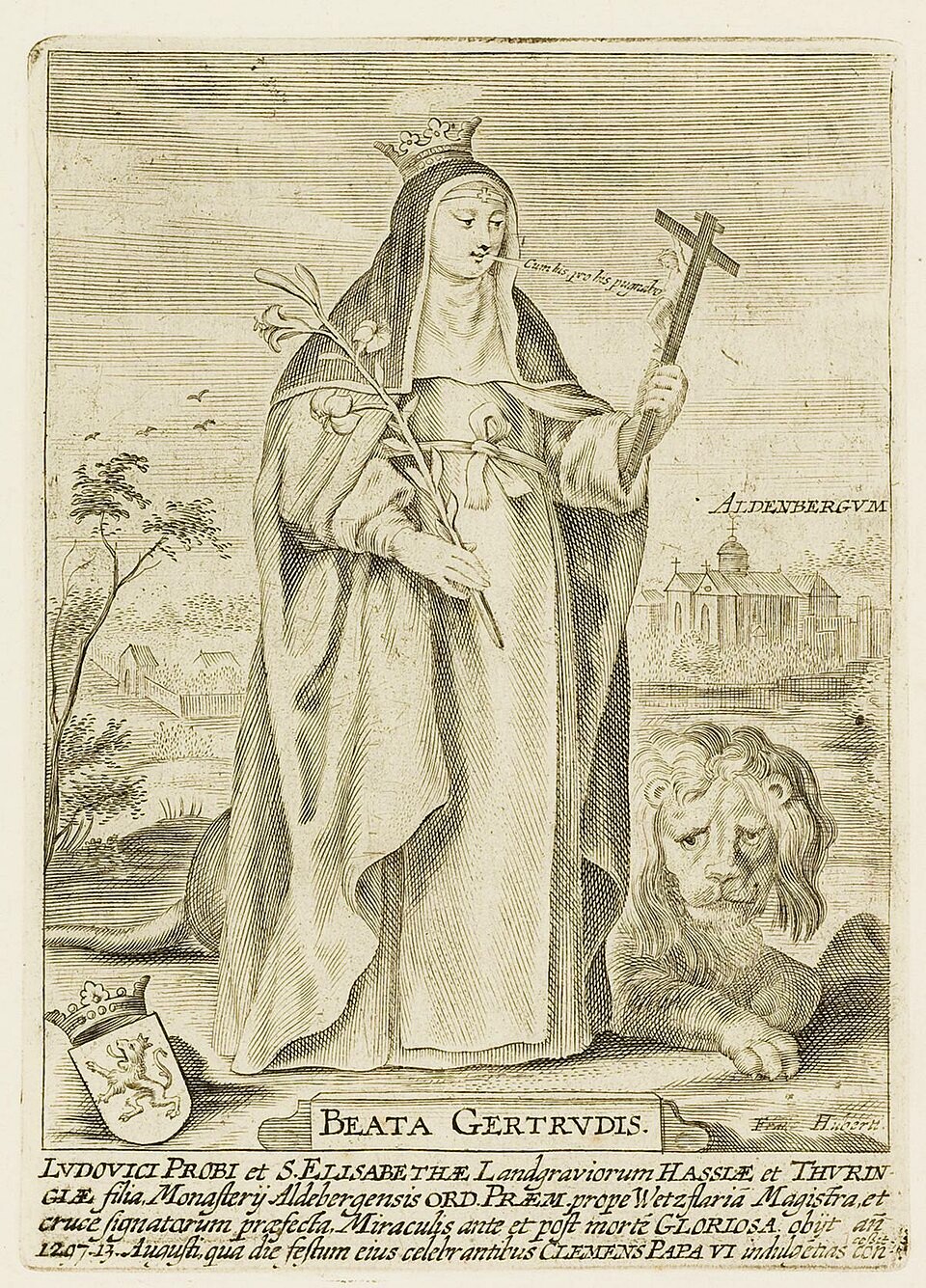
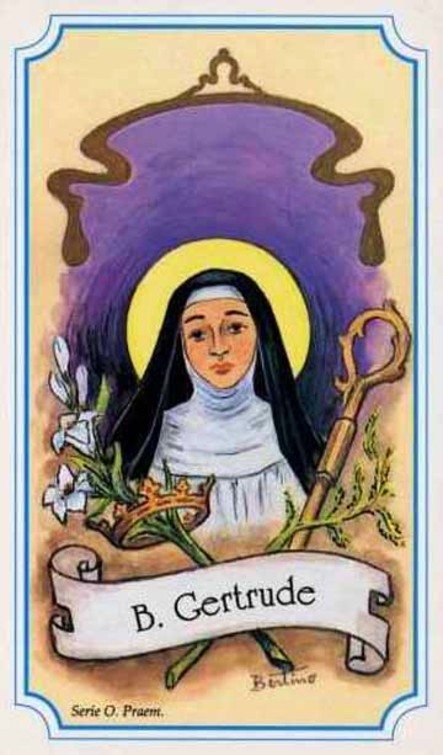
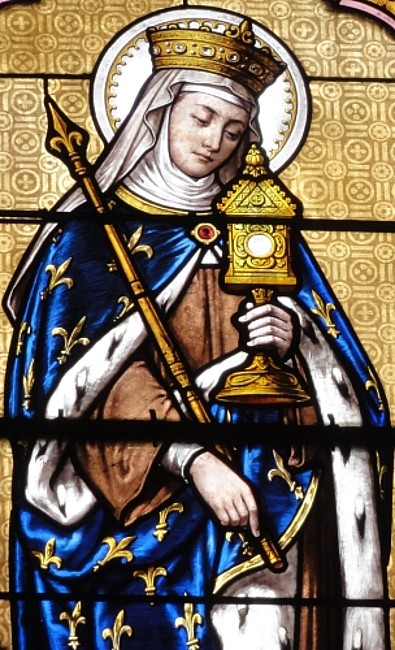
Saint of the Day – 13 August – Blessed Gertrude O.Praem. (1227-1297) Princess, Abbess of Premonstratensian Monastery at Altenberg, Germany, Ascetric, gifted with the charism of prophecy and penance. Born on 29 September 1227, died on 13 August 1297.
In the Monastery of Altenburg near Vetzlar, in Germany, blessed Gertrude, the Abbess of the Premonstratensian Order, who, while still a child, was offered to God in this place by her holy mother St Elizabeth, Queen of Hungary.
Gertrude’s father, Louis XIV, Landgrave of Thuringia, had died on a Crusade. Gertrude was entrusted by her mother to the Premonstratensian Nuns of Altenberg near Wetzlar, in Germany. She became the Abbess of this ascetic Order in 1248. Under her government a beautiful Church dedicated to the Virgin and to St Michael was built and, at the same time, a house was erected to give hospitality to the poor and wayfarers.
As early as 1270, she introduced to Altenberg, the Feast of the Holy Sacrament. She was distinguished by her spirit of penance and her gift of predicting future events.
Not long after her death, in 1311, Pope Clement VI authorised her public veneration at the Nonastery of Altenberg. Her Feast was extended by Pope Benedict XIII to the whole Order on 11 July 1729, enriched with Indulgences. It is celebrated today, on 13 August.
+St Hippolytus (Died c235) Martyr AND +St Cassian (of Imola) (Died c235) Martyr The Roman Martyrology reads today: “At Rome, blessed Hippolytus, Martyr, who gloriously confessed the Faith, under the Emperor Decius {mpt Valerian}. After enduring other torments, he was tied by the feet to the necks of wild horses and being cruelly dragged through briars and brambles and having all his body lacerated, he yielded his spirit.” AND: “At Imola, the birthday of St Cassian, Martyr. As he refused to worship idols, the persecutor called the boys whom the Saint taught and who hated him, giving them leave to kill him. The torment suffered by the Martyr was the more grievious, as the hand which inflicted it by reason of its weakness, rendered death more tardy.” HOLY MARTYRS for CHRIST: https://anastpaul.com/2024/08/13/saint-s-of-the-day-13-august-saints-hippolytus-and-cassian-died-c235-martyrs/
St Cassian
St Cassian of Todi Martyr
St Centolla and Helen (Died c304) Martyrs
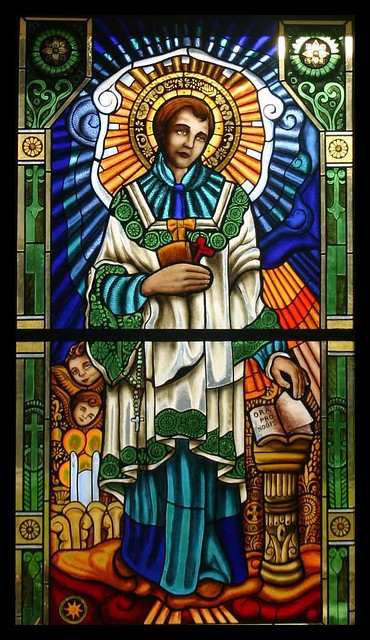
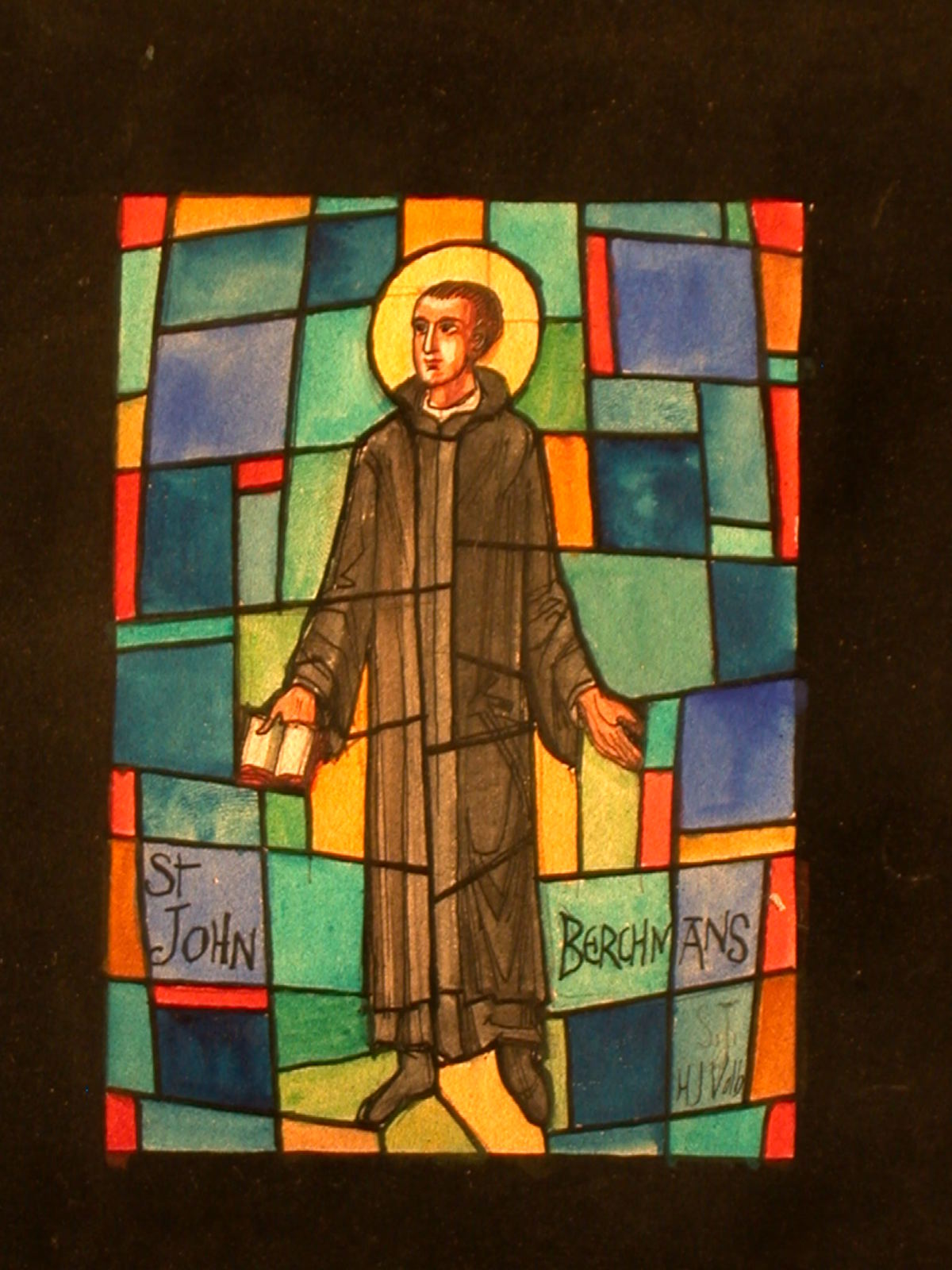
St John Berchmans SJ (1599-1621) Jesuit Novice – born Jan Berchmans on 13 March 1599 at Driest, Brabant, Belgium and died on 13 August 1621 at Rome, Italy of natural causes. Patronages – Altar Servers, Jesuit novices and students. He had a special devotion to God’s Mother and to him is owed the Little Rosary of the Immaculate Conception. Biography: https://anastpaul.com/2019/08/13/saint-of-the-day-13-august-saint-john-berchmans-sj-1599-1621/
St Anastasius the Monk St Anastasius the Priest
St Benildus Romançon FSC (1805-1862) Teacher of the Brothers of Christian Schools
St Cassian of Todi St Concordia Blessed Gertrude O.Praem (1227-1297) Abbess of Altenberg St Helen of Burgos St Herulph of Langres Bl John of Alvernia St Junian of Mairé St Ludolph
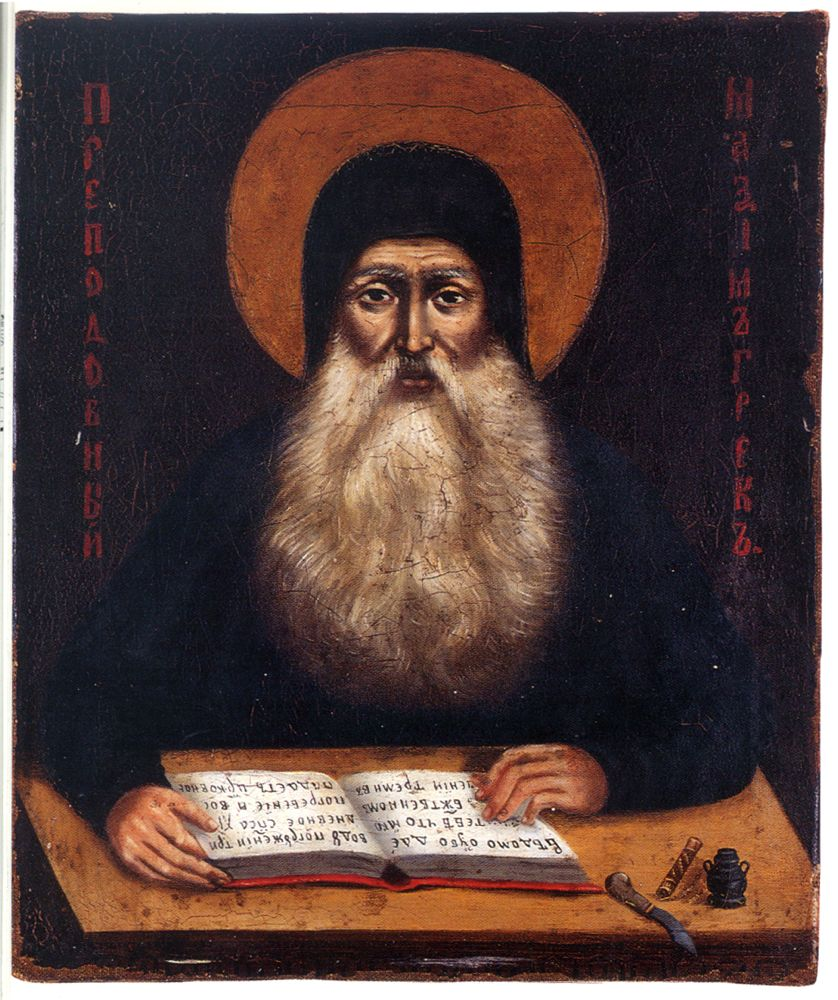
St Maximus the Confessor (c580-662) Father of the Church, Monk, Abbot, Theologian, Confessor, Scholar, Writer. Also known as St Maximus of Constantinople and St Maximus the Theologian. St Maximus, a man of fearless courage in witnessing to – “confessing” – even while suffering, the integrity of his faith in Jesus Christ, true God and true man, Saviour of the world and of His Holy Catholic Church. Glorious St Maximus: https://anastpaul.com/2020/08/13/saint-of-the-day-13-august-saint-maximus-the-confessor-c-580-662-father-of-the-church/
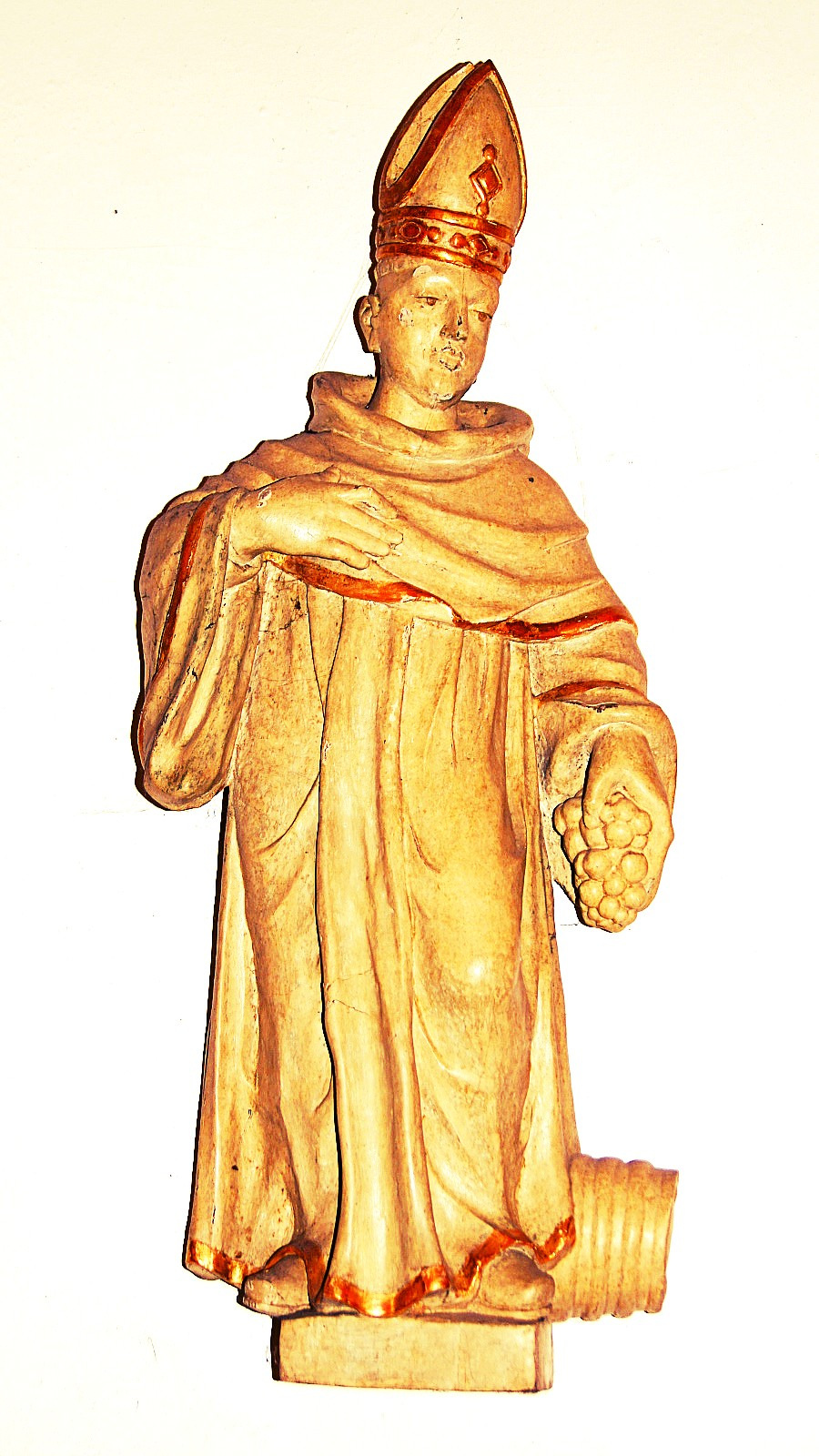
St Wigbert of Fritzlar (c675-c 746) Born in England, a learned Scholar and Abbot, Missionary, Miracle-worker, gifted with a penetrating understanding of Sacred Scripture as well as the gift of prophecy, companion of St Boniface, the Apostle of Germany. Wigbert was known as a quiet and gentle man and a great teacher. Both St Alcuin and St Bede knew and mentioned him in their historical writings of the times and of the Church. St Bede admired his contempt of this world and his learning. A fascinating and much-admired Saint: https://anastpaul.com/2022/08/13/saint-of-the-day-13-august-st-wigbert-of-fritzlar-c-675-c-746/
Thought for the Day – 12 August – Meditations with Antonio Cardinal Bacci (1881-1971)
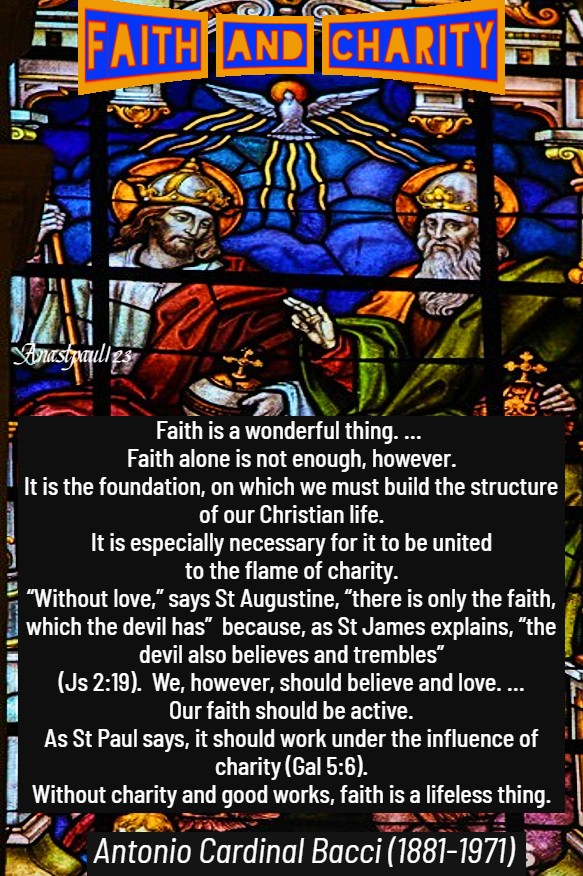
Faith and Charity
“Faith is a wonderful thing. As has been said, it is a supernatural gift from God which we should keep alive by prayer. Faith alone is not enough, however. It is the foundation, on which we must build the structure of our Christian life. It is especially necessary for it to be united to the flame of charity. “Without love,” says St Augustine, “there is only the faith which the devil has” (De Caritate 10) because, as St James explains, “the devil also believes and trembles” (Js 2:19). We, however, should believe and love. We must combine faith with charity towards God and towards our neighbour. Our faith should be active. As St Paul says, it should work under the influence of charity (Gal 5:6). Without charity and good works, faith is a lifeless thing.
If we really believe, we should love God above all things, even more than we love ourselves and, we should be ready to make any sacrifice for Him, even the sacrifice of our lives.
Faith should induce us to think constantly of God and charity should urge us to do everytig for His sake, rather than for any lesser purpose. If we lack this kind of charity, we cannot claim to be sincere Christians.”
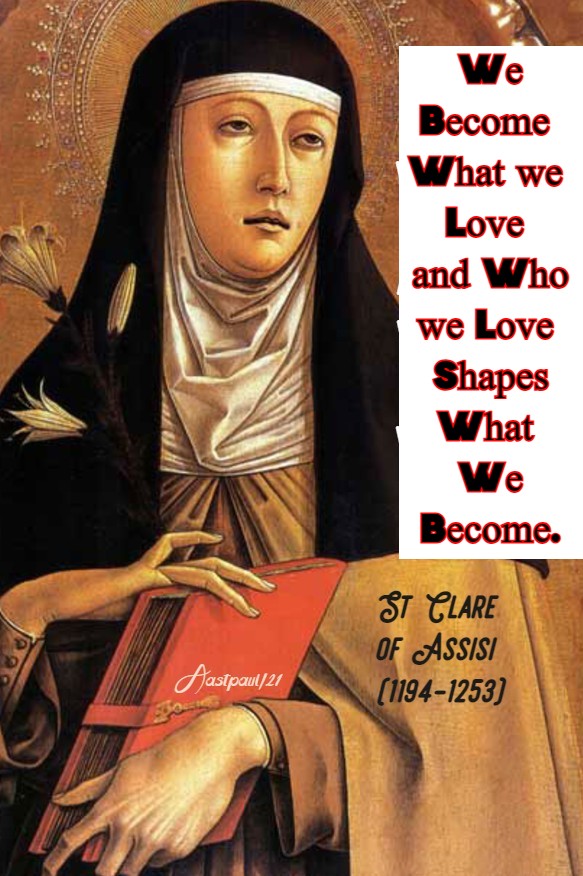
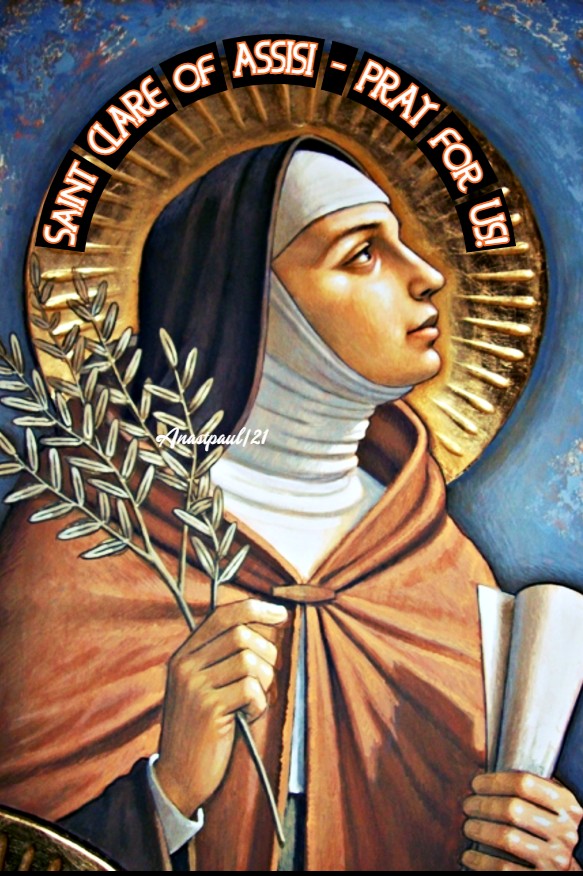
One Minute Reflection – 12 August – “The Month of the Immaculate Heart of Mary” – St Clare (1194-1253) Virgin – 2 Cor inthians 10:17-18; 11:1-2 – Matthew 25:1-13 – Scripture search here: https://www.drbo.org/
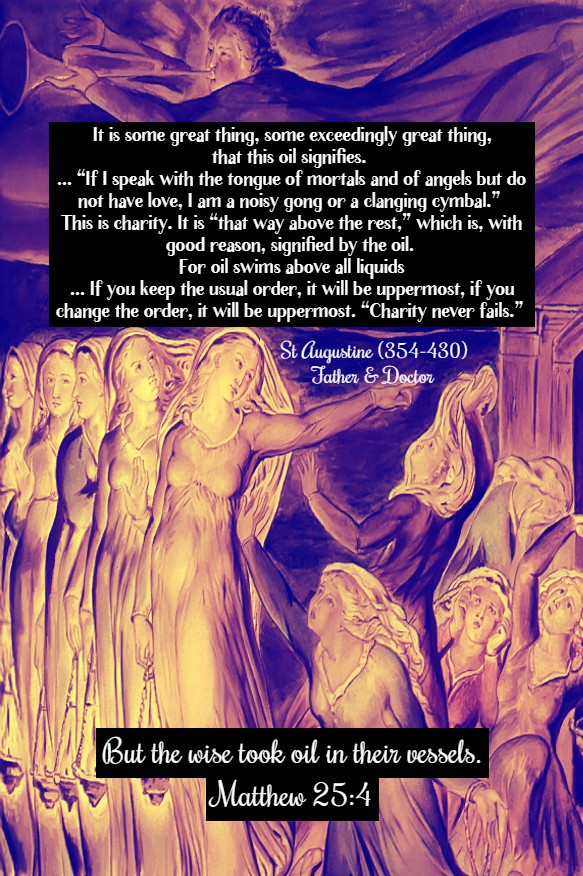
“But the wise took oil in their vessels” – Matthew 25:4
REFLECTION – “It is some great thing, some exceedingly great thing, that this oil signifies. Do you think it might be charity? If we try out this hypothesis, we hazard no precipitate judgement. I will tell you why charity seems to be signified by the oil. The Apostle says, “I will show you a still more excellent way.” “If I speak with the tongue of mortals and of Angels but do not have love, I am a noisy gong or a clanging cymbal.” This is charity. It is “that way above the rest” which is, with good reason, signified by the oil. For oil swims above all liquids. Pour in water and pour in oil upon it, the oil will swim above. If you keep the usual order, it will be uppermost, if you change the order, it will be uppermost. “Charity never fails!” … St Augustine (354-430) Father & Doctor (Sermon 93).
PRAYER – Hear us, O God, our Saviour that as we are gladdened by the festival of blessed Clare Thy virgin, so we may learn from it piety and devotion. Through the same Jesus Christ, Thy Son our Lord, Who lives and reigns with Thee, in the unity of the Holy Ghost, God, world without end. Amen (Collect).


















You must be logged in to post a comment.