One Minute Reflection – 2 November – “The Month of the Holy Souls in Purgatory” – All Souls Day – 1 Corinthian 15:51-57, John 5:25-29 – Scripture search here: https://www.drbo.org/
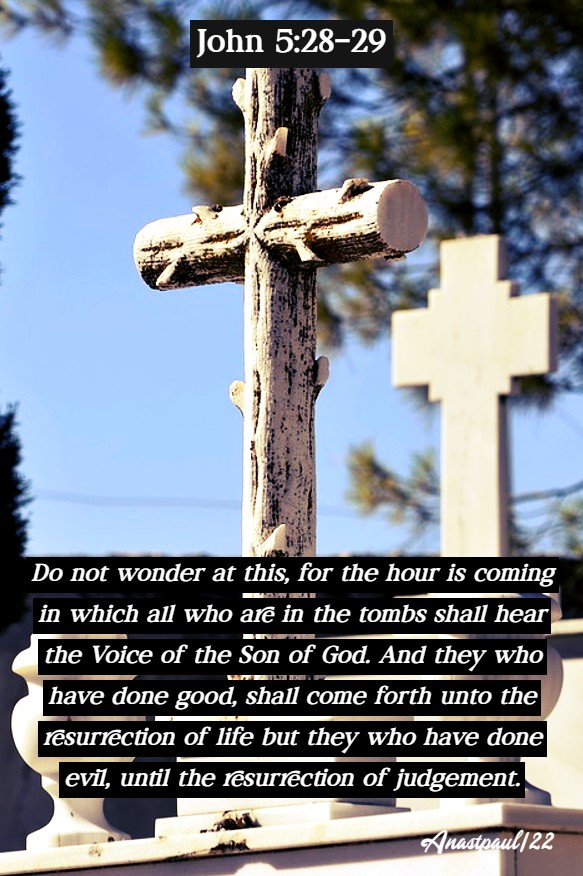
“Do not wonder at this, for the hour is coming in which all who are in the tombs shall hear the Voice of the Son of God. And they who have done good, shall come forth unto the resurrection of Life but they who have done evil, until the resurrection of judgement.” – John 5:28-29
REFLECTION – “Devout, wise and good people are not afraid of death, in view of the great hope they have in what lies before them. Everyday they think of death as of a departure and of the last day, as when the offspring of Adam will be born! The Apostle Paul says: “Death reigned from Adam to Moses, even over those who did not sin, as has happened with all the children of Adam” (Rm 5:14.12) … It has happened, too, in all Moses’ descendants, to the end of the world. However, Moses declared that its rule would be destroyed; death thought to hold everyone captive and rule over them forever. .., but when the Holy One called to Moses, from the heart of the bush, he said to him: “I am the God of Abraham, of Isaac and of Jacob” (Ex 3:6). When it heard these words, death was terrified, it trembled with fear, understanding that … God is Lord over the dead and the living and would come one day when men would escape from its darkness. Now Jesus our Saviour has repeated these words to the Sadducees and said: “He is not God of the dead, for all are alive for Him” (Lk 20:38) …
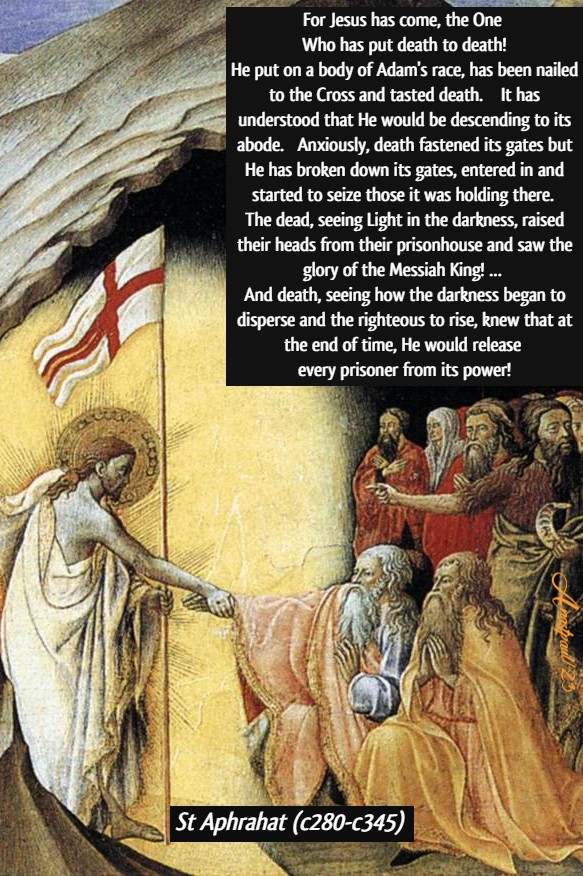
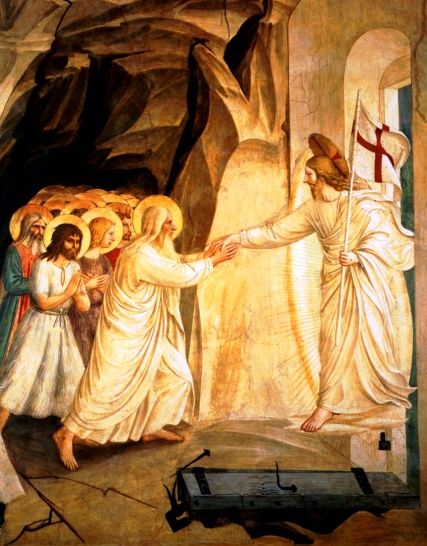
For Jesus has come, the One Who has put death to death! He put on a body of Adam’s race, has been nailed to the Cross and tasted death. It has understood that He would be descending to its abode. Anxiously, death fastened its gates but He has broken down its gates, entered in and started to seize those it was holding there. The dead, seeing Light in the darkness, raised their heads from their prisonhouse and saw the glory of the Messiah King! … And death, seeing how the darkness began to disperse and the righteous to rise, knew that at the end of time, He would release every prisoner from its power!” – St Aphrahat (c280-c345) Bishop near Mosul, Father (Expositions No 22).
PRAYER – O God, Creator and Redeemer of all the faithful, grant to the souls of Thy servants and handmaids, the remission of all their sins, that they may obtain, by our loving prayer,s the forgiveness which they have always desired. Who lives and reigns with God the Father, in the unity of the Holy Spirit, God, world without end. Amen (Collect).
All Souls Day – The Commemoration of All the Faithful Departed: Commemoration of the faithful departed in Purgatory. Abbot Odilo of Cluny instituted it in the Monasteries of his congregation in 998, other religious orders took up the observance and it was adopted by various Diocese and gradually by the whole Church. The Office of the Dead must be recited by the clergy on this day and Pope Benedict XV granted to all Priests, the privilege of saying three Masses of requiem –
St Ambrose of Agaune St Ambrose of Agaune St Amicus of Fonte Avellana St Amicus of Rambone St Baya of Scotland St Domninus of Grenoble St Erc of Slane St Eustochium of Tarsus St George of Vienne
Blessed John Bodey (1549-1583) Layman, Martyr
St Jorandus of Kergrist St Justus of Trieste St Marcian of Chalcis
Martyrs of Isfahan – 5+ Saints: Acindynus, Pegasius and Anempodistus were Persian priests who were imprisoned, tortured, interrogated and Martyred in the persecutions of king Sapor II of Persia; he considered any Christian to be a Roman spy and anti-Persian.
Martyrs of Sebaste – 10 Saints: A group of ten soldiers in the imperial Roman army of Emperor Licinius Licinianus who were executed together for refusing to burn incense as a sacrifice to the emperor. The only details that have survived are five of their names – Agapius, Cartherius, Eudoxius, Styriacus and Tobias. They were burned at the stake in 315 in Sebaste (in modern Turkey).
One Minute Reflection – 2 November – All Souls Day – “The Month of the Holy Souls in Purgatory” – 1 Corinthian 15:51-57, John 5:25-29 – Scripture search here: https://www.drbo.org/
“Do not wonder at this, for the hour is coming in which all who are in the tombs shall hear the Voice of the Son of God. And they who have done good, shall come forth unto the resurrection of life but they who have done evil, until the resurrection of judgement.” – John 5:28-29
REFLECTION – “Let them weep who lack all hope of resurrection; it is not the will of God that takes it away from them but the inflexibility of what they believe. There has to be a difference between the servants of Christ and the pagans. This is what it is – they mourn for those close to them, whom they think to be dead forever; they see no end to their weeping, reach no rest for their grief …, whereas, for us, death is not the end of our existence but the end of our life. Since our existence is restored by a condition that is better, therefore, the coming of death sweeps away all our tears.…
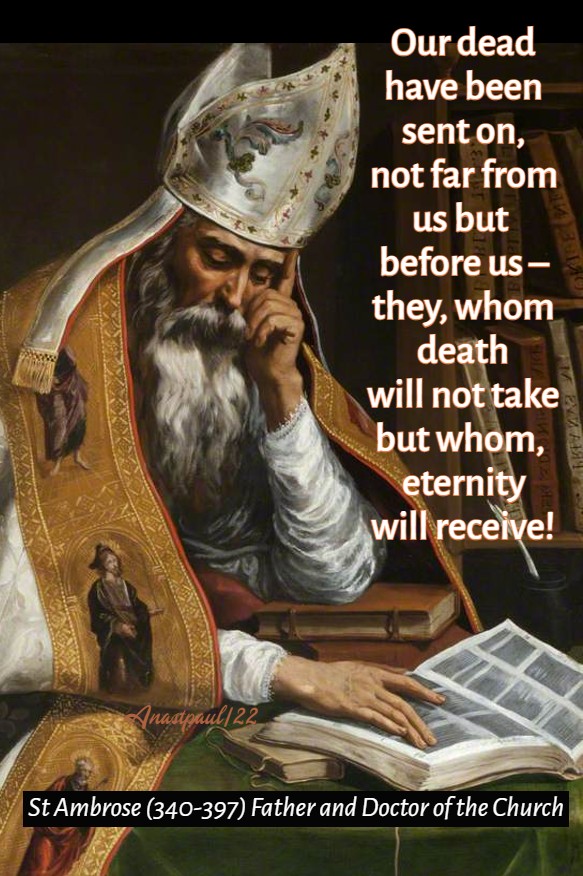
How much greater is our comfort, who believe that our good deeds are the promise, of better rewards after death. As for the pagans, they have their consolation, in thinking that death is a rest from all our trials. Since they think their dead are denied the enjoyment of life, they also think them, to be deprived of every faculty of sense and freed from the pain of the hard and continual sorrows, we bear in this life. We, on the other hand, just as we should have a more elevated spirit because of the reward we expect, so, we should also better bear our pains because of this consolation. … Our dead have been sent on, not far from us but before us – they, whom death will not take but whom, eternity will receive!” – St Ambrose (340-397) Father and Doctor of the Church (On the death of his brother, I, 70-71).
PRAYER – O God, Creator and Redeemer of all the faithful, grant to the souls of Thy servants and handmaids, the remission of all their sins, that they may obtain, by our loving prayer,s the forgiveness which they have always desired. Who lives and reigns with God the Father, in the unity of the Holy Spirit, God, world without end. Amen (Collect).
All Souls Day – The Commemoration of All the Faithful Departed: Commemoration of the faithful departed in Purgatory. Abbot Odilo of Cluny instituted it in the Monasteries of his congregation in 998, other religious orders took up the observance and it was adopted by various Diocese and gradually by the whole Church. The Office of the Dead must be recited by the clergy on this day and Pope Benedict XV granted to all Priests, the privilege of saying three Masses of requiem – • one for the souls in Purgatory • one for the intention of the Holy Father • one for the Priest’s intentions If the feast should fall on Sunday it is kept on 3 November. Patronage: Monselice, Italy HERE: https://anastpaul.com/2018/11/02/commemoration-of-all-souls-day-2-november/ AND: https://anastpaul.wordpress.com/2017/11/02/the-commemoration-of-all-the-holy-souls-in-purgatory-2-november/
St Ambrose of Agaune St Ambrose of Agaune St Amicus of Fonte Avellana St Amicus of Rambone St Baya of Scotland St Domninus of Grenoble St Erc of Slane St Eustochium of Tarsus St George of Vienne Bl John Bodey St Jorandus of Kergrist St Justus of Trieste St Marcian of Chalcis Blessed Margaret of Lorraine OSC (1463-1521)Duchess of Alençon, Mother, Widow, Nun of the Poor Clares St Mateo López y López St Maura of Scotland St Theodotus of Laodicea
Martyrs of Isfahan – 5+ Saints: Acindynus, Pegasius and Anempodistus were Persian priests who were imprisoned, tortured, interrogated and Martyred in the persecutions of king Sapor II of Persia; he considered any Christian to be a Roman spy and anti-Persian.
Martyrs of Sebaste – 10 Saints: A group of ten soldiers in the imperial Roman army of Emperor Licinius Licinianus who were executed together for refusing to burn incense as a sacrifice to the emperor. The only details that have survived are five of their names – Agapius, Cartherius, Eudoxius, Styriacus and Tobias. They were burned at the stake in 315 in Sebaste (in modern Turkey).
One Minute Reflection – 2 November – Commemoration of All the Faithful Departed – All Souls Day – Readings: Wisdom 3: 1-9; Romans 5: 5-11 or Romans 6: 3-9; Gospel: John 6: 37-40
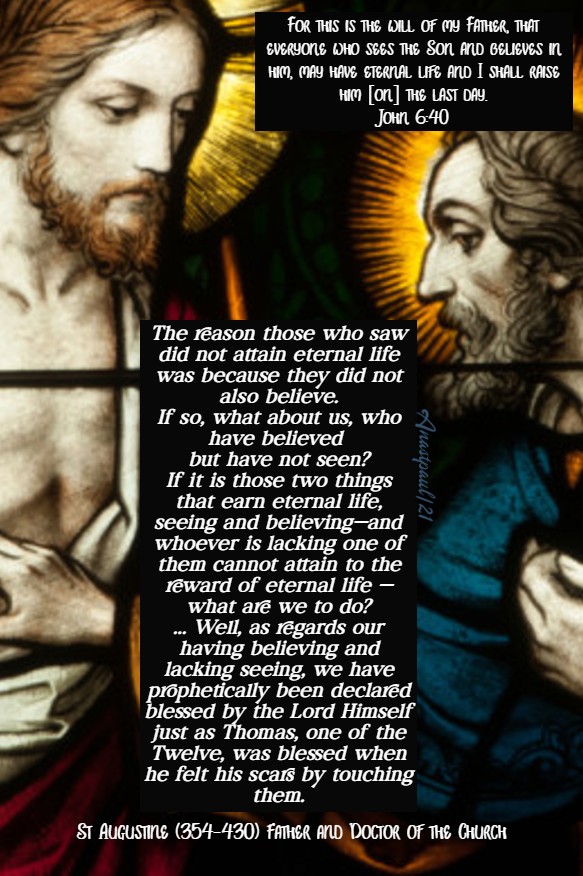
“For this is the will of my Father, that everyone who sees the Son and believes in him, may have eternal life and I shall raise him [on] the last day.” – John 6:40
REFLECTION – “He has said two things: “This is the work of God that you should believe in the One whom He has sent,” while here He added, “whoever sees and believes.” The Jews saw but did not believe; they had the one condition, lacked the other. How could they attain to eternal life without the other? The reason those who saw did not attain eternal life was because they did not also believe. If so, what about us, who have believed but have not seen? If it is those two things that earn eternal life, seeing and believing—and whoever is lacking one of them cannot attain to the reward of eternal life — what are we to do? The Jews [who saw Him] lacked the one; we ,the other. They had seeing but lacked believing. We have believing but lack seeing. Well, as regards our having believing and lacking seeing, we have prophetically been declared blessed by the Lord Himself just as Thomas, one of the Twelve, was blessed when he felt his scars by touching them.” – St Augustine (354-430) Great Western Father and Doctor of the Church (Sermon 14)
PRAYER – Merciful Father, hear our prayers and console us. As we renew our faith in Your Son, Whom You raised from the dead, strengthen our hope that all our departed brothers and sisters will share in His Resurrection, Who lives and reigns with You in the unity of the Holy Spirit, God forever and ever, amen.
The Commemoration of All the Faithful Departed – All Souls Day (Commemoration): Commemoration of the faithful departed in Purgatory. Abbot Odilo of Cluny instituted it in the Monasteries of his congregation in 998, other religious orders took up the observance and it was adopted by various Diocese and gradually by the whole Church. The Office of the Dead must be recited by the clergy on this day and Pope Benedict XV granted to all Priests, the privilege of saying three Masses of requiem – • one for the souls in Purgatory • one for the intention of the Holy Father • one for the Priest’s intentions If the feast should fall on Sunday it is kept on 3 November. Patronage: Monselice, Italy
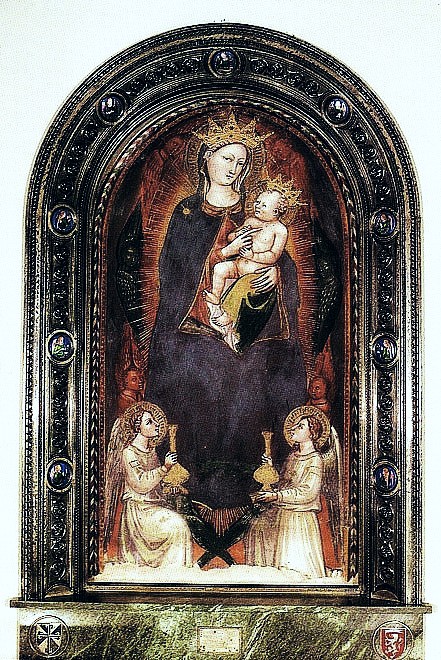
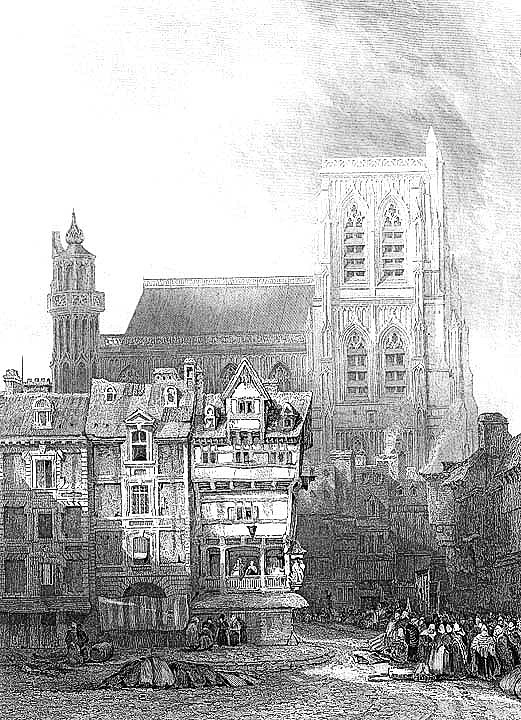
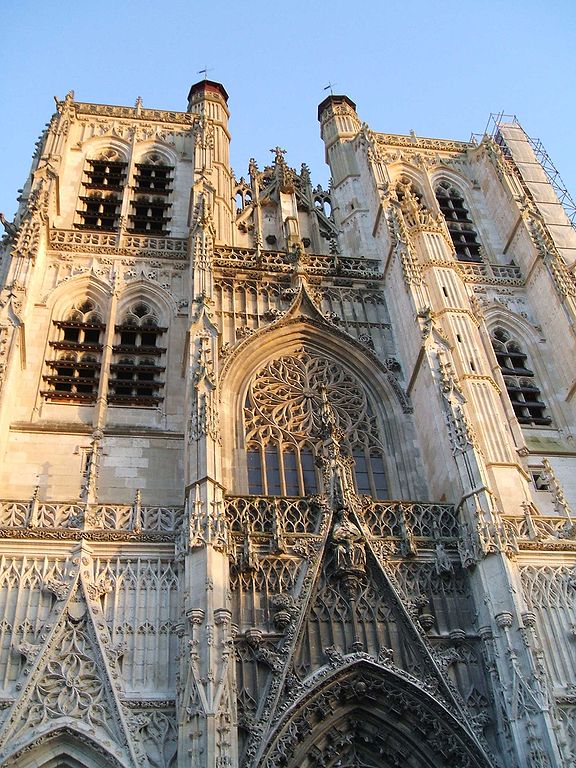
Notre-Dame D’Emminont / Our Lady of Emminont. Abbeville, France (12th Century) – 2 November:
The Shrine to Our Lady of Emminont, or Notre-Dame D’Emminont, is near Abbeville in France. It is much visited by pilgrims devoted to the Mother of God who at their prayers and petitions, still performs many miracles and favours for her people.
The relics of Saint Wulfram (also spelled Wulfran or Vulfran) of Sens, who died in 656, were brought to the Shrine in the year 1058. Until that time, the Church had been known as the Collegiate Church of Our Lady in Abbeville but after the relics of Saint Wulfram were interred there, the Church was rededicated in Saint Wulfram’s honour. The Church retains that name to this day.
Franciscan Friars, well-versed in wood carving, cared for the Shrine. They were consulted in 1510 concerning work on the Cathedral of Amiens. In richness of detail, Abbeville surpasses many other Cathedrals. The nave was built between the years 1488 to 1539 and the small choir between 1661 and 1663. The construction was paid for by the King of France, and Count of Ponthieu and the faithful of Abbeville. The Church is much smaller than it was originally intended to be, as the initial blueprint for the Church was never completed. The nave is quite short, has only two bays and the choir is extremely small. Still, the façade is a superb masterpiece of the flamboyant Gothic style. During the French Revolution the Church of Saint Wulfram was profaned and given the name of a “Temple of Reason” by the unreasoning revolutionaries who sought to destroy the immutable God by demolishing priceless monuments and artifacts and even, the glory of their own history. The Town of Abbeville was heavily bombed by the German’s during World War II, so that much of what is seen there today is of fairly modern origin. The Church was also damaged, but efforts were made to restore it to its former grandeur. The list of favours granted by Our Lady of Emminont, is indeed very long. It includes miraculous cures, astounding spiritual and temporal favours and streams of graces and blessings.
St Ambrose of Agaune St Ambrose of Agaune St Amicus of Fonte Avellana St Amicus of Rambone St Baya of Scotland St Domninus of Grenoble St Erc of Slane St Eustochium of Tarsus St George of Vienne Bl John Bodey St Jorandus of Kergrist St Justus of Trieste
St Marcian of Chalcis Bl Margaret of Lorraine St Mateo López y López St Maura of Scotland St Theodotus of Laodicea St Victorinus of Pettau (Died c 304) Bishop Martyr
St Willebald of Bavaria — Martyrs of Isfahan – 5+ saints: Acindynus, Pegasius and Anempodistus were Persian priests who were imprisoned, tortured, interrogated and martyred in the persecutions of king Sapor II of Persia; he considered any Christian to be a Roman spy and anti-Persian. The three were brought back to life, miraculously healed, freed from their chains and began preaching Christianity, miraculously healing Sapor II in the process. This defiance enraged Sapor so much that he ordered them executed again; they were thrown into a cauldron of molten lead but walked out unharmed. This miracle brought one of the torturers, Aphthonius, to convert; he was immediately martyred. Other attempts were made to kill them, and they emerged each time unharmed. Senator Elpidiphorus led a group speaking in favour of the Christians for their courage and faith; he was immediately executed. In the end the original three Christians were burned to death. Martyrs all – Acindynus, Anempodistus, Aphthonius, Elpidephorus and Pegasius. They were born in Persia and Died: • c.350 in Isfahan, Persia • relics transferred to Constantinople and enshrined in a church dedicated to them • some relics taken to France in 1204 during the 4th Crusade • relics in France were lost when hidden from anti-Christian forces in the French Revolution • relics in France re-discovered in 1892 in Grozon.
Martyrs of Sebaste – 10 saints: A group of ten soldiers in the imperial Roman army of Emperor Licinius Licinianus who were executed together for refusing to burn incense as a sacrifice to the emperor. The only details that have survived are five of their names – Agapius, Cartherius, Eudoxius, Styriacus and Tobias. They were burned at the stake in 315 in Sebaste (in modern Turkey).
Thought for the Day – 2 November – Commemoration of All the Faithful Departed (All Souls)
Let us Die with Christ, to Live with Christ
Saint Ambrose (340-397)
Bishop and Great Latin Father & Doctor of the Church
An excerpt from his work, On the death of Satyrus (Saint Ambrose’s brother)
We see that death is gain, life is loss. Paul says – For me life is Christ and death a gain. What does “Christ” mean but to die in the body and receive the breath of life? Let us then die with Christ, to live with Christ. We should have a daily familiarity with death, a daily desire for death. By this kind of detachment our soul must learn to free itself from the desires of the body. It must soar above earthly lusts to a place where they cannot come near, to hold it fast. It must take on the likeness of death, to avoid the punishment of death. The law of our fallen nature is at war with the law of our reason and subjects the law of reason to the law of error. What is the remedy? Who will set me free from this body of death? The grace of God, through Jesus Christ, our Lord.
We have a doctor to heal us, let us use the remedy He prescribes. The remedy is the grace of Christ, the dead body our own. Let us then be exiles from our body, so as not to be exiles from Christ. Though we are still in the body, let us not give ourselves to the things of the body. We must not reject the natural rights of the body but we must desire before all else the gifts of grace.
What more need be said? It was by the death of one man that the world was redeemed. Christ did not need to die if He did not want to but He did not look on death as something to be despised, something to be avoided and He could have found no better means to save us, than by dying. Thus His death is life for all. We are sealed with the sign of His death, when we pray we preach His death, when we offer sacrifice we proclaim His death. His death is victory, His death is a sacred sign, each year His death is celebrated with solemnity by the whole world.
What more should we say about His death since we use this divine example, to prove, that it was death alone, that won freedom from death and death itsel,f was its own redeemer? Death is then no cause for mourning, for it is the cause of mankind’s salvation. Death is not something to be avoided, for the Son of God did not think it beneath His dignity, nor did He seek to escape it.
Death was not part of nature, it became part of nature. God did not decree death from the beginning, He prescribed it as a remedy. Human life was condemned because of sin to unremitting labour and unbearable sorrow and so began to experience the burden of wretchedness. There had to be a limit to its evil,; death had to restore what life had forfeited. Without the assistance of grace, immortality is more of a burden than a blessing.
The soul has to turn away from the aimless paths of this life, from the defilement of an earthly body, it must reach out to those assemblies in heaven, (though it is given only to the saints to be admitted to them), to sing the praises of God. We learn from Scripture how God’s praise is sung to the music of the harp – Great and wonderful are your deeds, Lord God Almighty, just and true are your ways, King of the nations. Who will not revere and glorify your nature? You alone are holy, all nations will come and worship before you. The soul must also desire to witness Your nuptials, Jesus and to see yYur bride escorted from earthly to heavenly realities, as all rejoice and sing – All flesh will come before you. No longer will the bride be held in subjection to this passing world but will be made one with the spirit.
Above all else, holy David prayed that he might see and gaze on this – One thing I have asked of the Lord, this I shall pray for, to dwell in the house of the Lord all the days of my life and to see how gracious is the Lord.
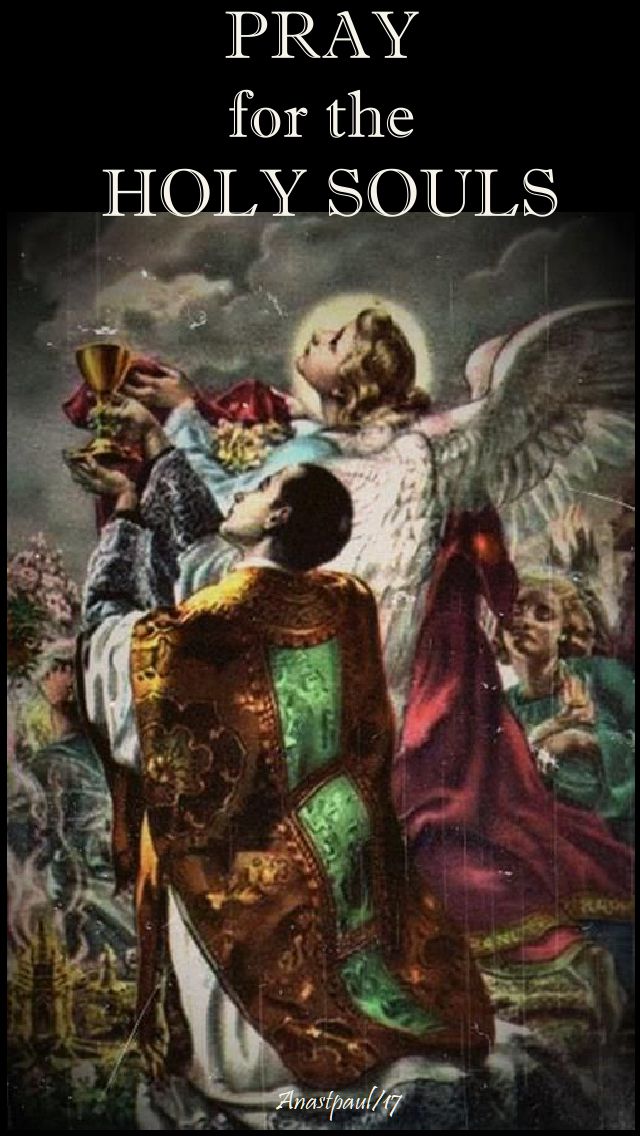
Pray for the Holy Souls, that they may gaze on His Face!
Quote/s of the Day – 2 November – Commemoration of All the Faithful Departed (All Souls)
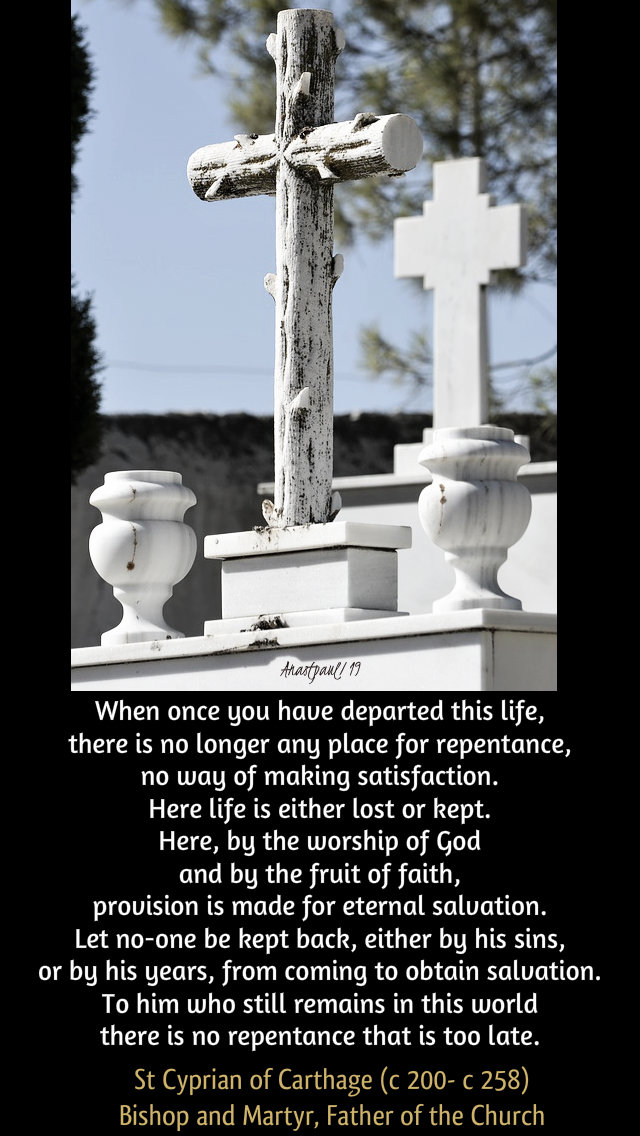
“When once you have departed this life, there is no longer any place for repentance, no way of making satisfaction. Here life is either lost or kept. Here, by the worship of God and by the fruit of faith, provision is made for eternal salvation. Let no-one be kept back, either by his sins, or by his years, from coming to obtain salvation. To him who still remains in this world there is no repentance that is too late.”
St Cyprian of Carthage (c 200- c 258)
Bishop and Martyr, Father of the Church
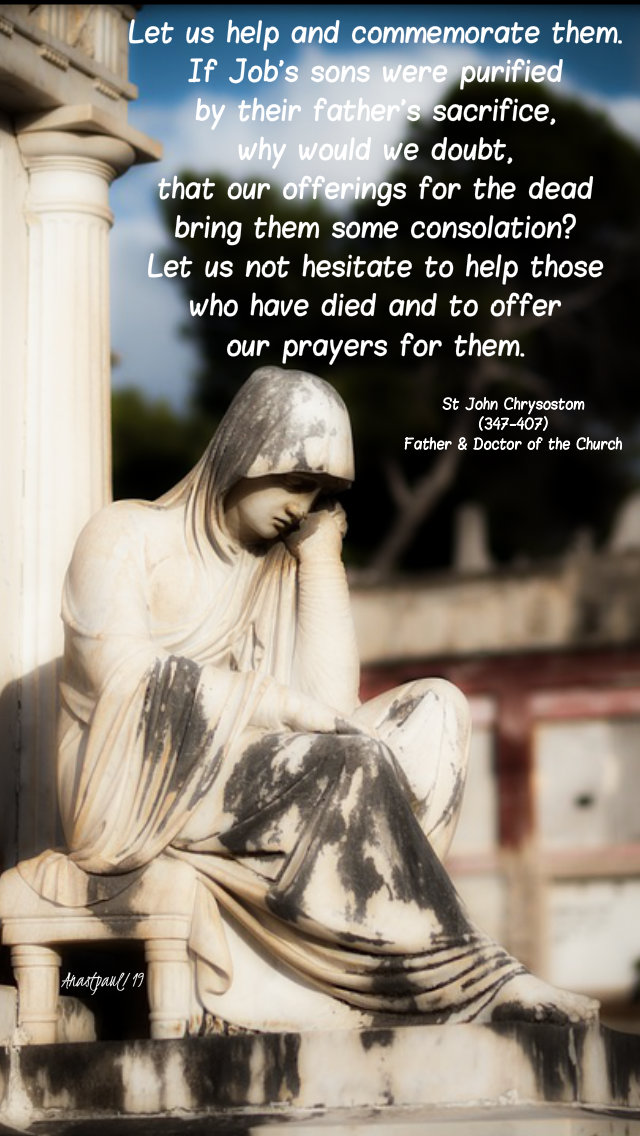
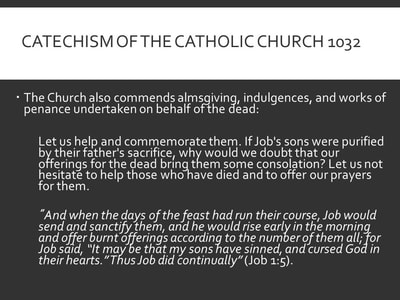
“Let us help and commemorate them. If Job’s sons were purified by their father’s sacrifice [Job 1:5], why would we doubt, that our offerings for the dead bring them some consolation? Let us not hesitate to help those who have died and to offer our prayers for them.”
St John Chrysostom (347-407)
Father & Doctor of the Church
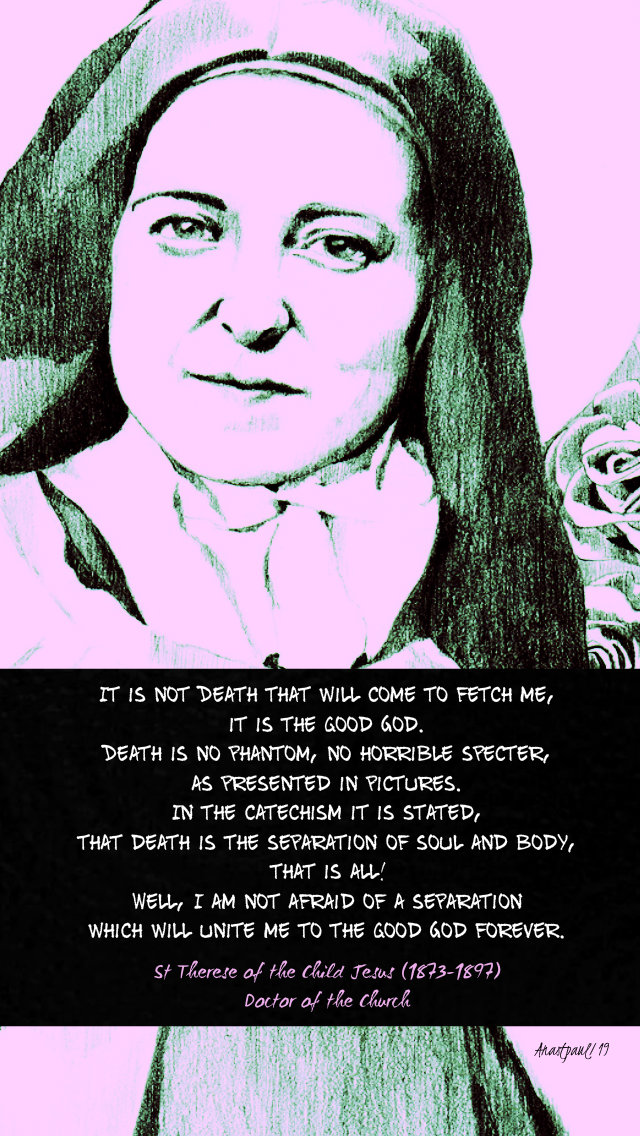
“It is not Death that will come to fetch me, it is the good God. Death is no phantom, no horrible specter, as presented in pictures. In the catechism it is stated, that death is the separation of soul and body, that is all! Well, I am not afraid of a separation which will unite me to the good God forever.”
St Therese of the Child Jesus/Lisieux (1873-1897)
Doctor of the Church
One Minute Reflection – 2 November – The Commemoration of All the Faithful Departed (All Souls), Gospel: John 6:37-40
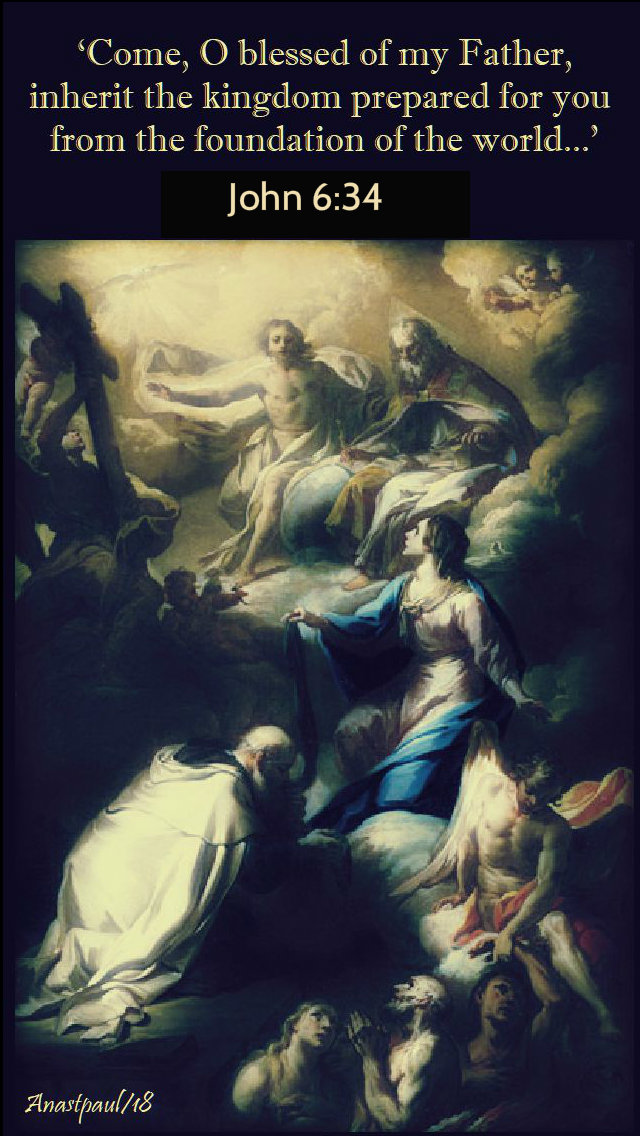
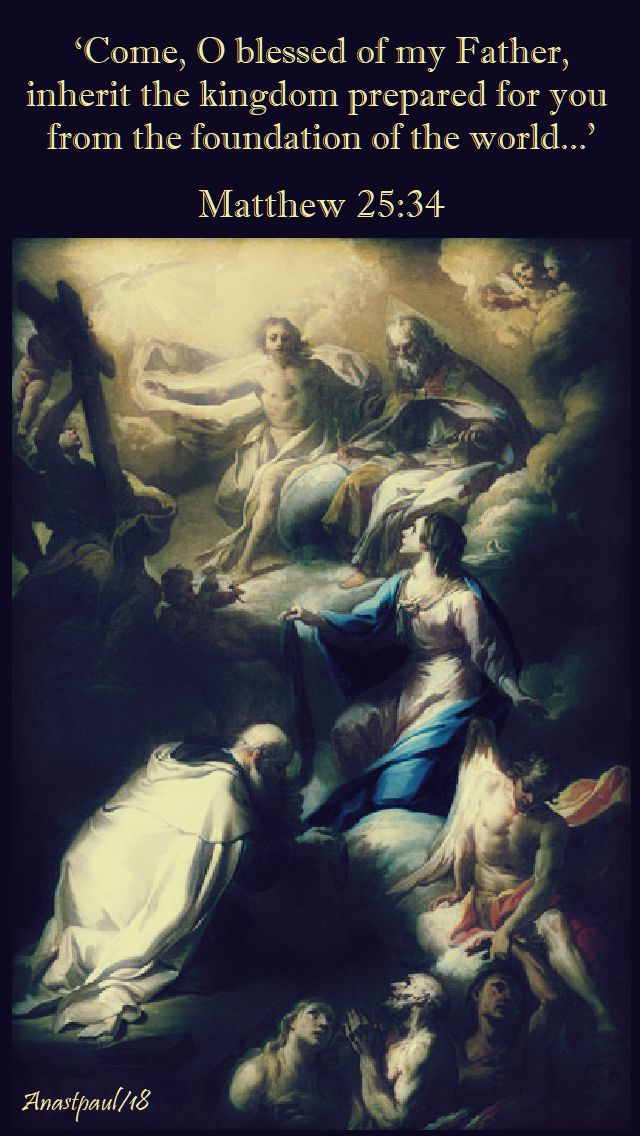
‘Come, O blessed of my Father, inherit the kingdom prepared for you from the foundation of the world’ … John 6:34
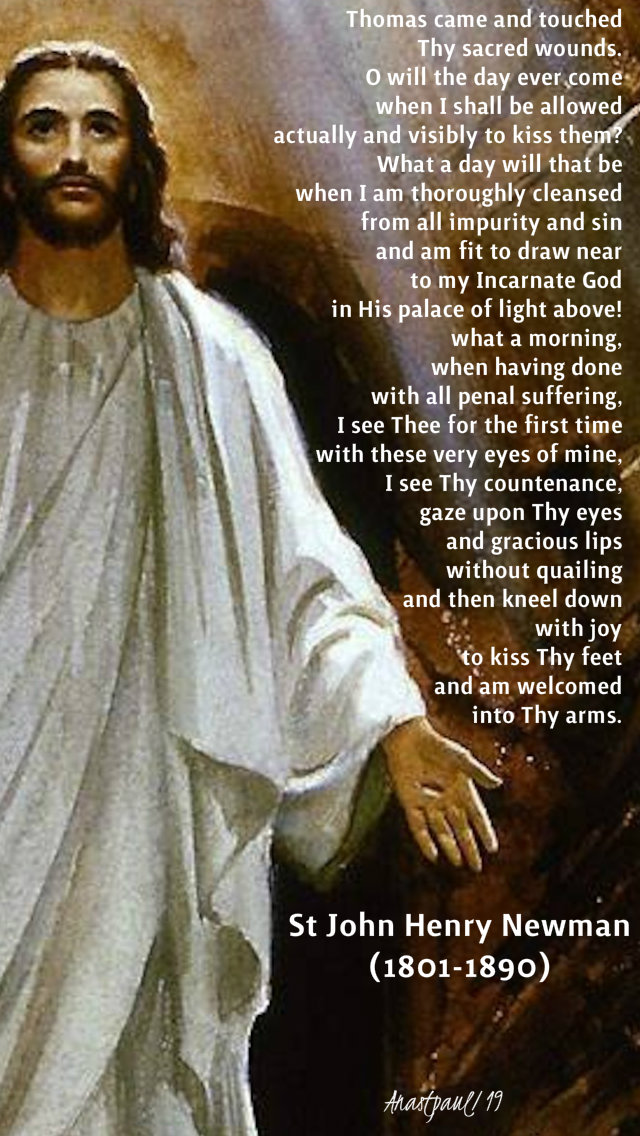
REFLECTION – “Thomas came and touched Thy sacred wounds. O will the day ever come when I shall be allowed actually and visibly to kiss them? What a day will that be when I am thoroughly cleansed from all impurity and sin and am fit to draw near to my Incarnate God in His palace of light above! what a morning, when having done with all penal suffering, I see Thee for the first time with these very eyes of mine, I see Thy countenance, gaze upon Thy eyes and gracious lips without quailing and then kneel down with joy to kiss Thy feet and am welcomed into Thy arms.
O my only true Lover, the only Lover of my soul, Thee will I love now, that I may love Thee then. What a day, a long day without ending, the day of eternity, when I shall be so unlike what I am now, when I feel in myself a body of death and am perplexed and distracted with ten thousand thoughts, anyone of which, would keep me from heaven.
O my Lord, what a day when I shall have done once for all with all sins, venial as well as mortal and shall stand perfect and acceptable in Thy sight, able to bear Thy presence, nothing shrinking from Thy eye, not shrinking from the pure scrutiny of Angels and Archangels, when I stand in the midst and they around me!” … Saint John Henry Newman (1801-1890)
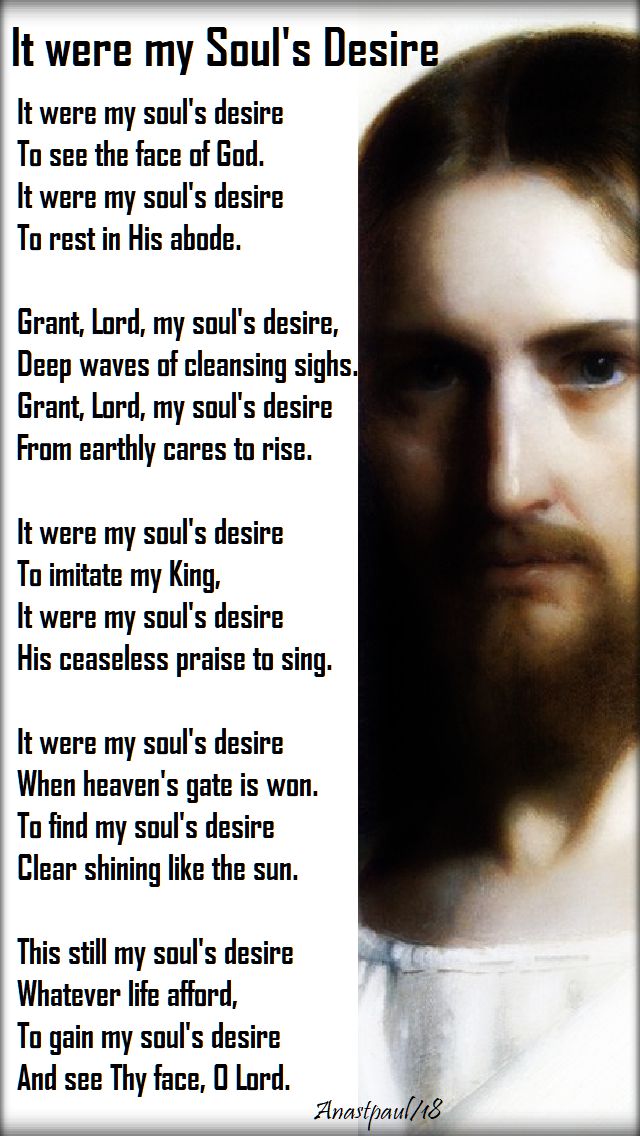
PRAYER- Breviary Hymn – Psalter Week 3 – It were my Soul’s Desire
It were my soul’s desire
To see the face of God;
It were my soul’s desire
To rest in His abode.
Grant, Lord, my soul’s desire,
Deep waves of cleansing sighs;
Grant, Lord, my soul’s desire
From earthly cares to rise.
It were my soul’s desire
To imitate my King,
It were my soul’s desire
His ceaseless praise to sing.
It were my soul’s desire
When heaven’s gate is won
To find my soul’s desire
Clear shining like the sun.
This still my soul’s desire
Whatever life afford,
To gain my soul’s desire
And see Thy face, O Lord.
All Souls Day (Commemoration): Commemoration of the faithful departed in Purgatory. Abbot Odilo of Cluny instituted it in the monasteries of his congregation in 998, other religious orders took up the observance and it was adopted by various dioceses and gradually by the whole Church. The Office of the Dead must be recited by the clergy on this day and Pope Benedict XV granted to all priests the privilege of saying three Masses of requiem –
• one for the souls in Purgatory
• one for the intention of the Holy Father
• one for the priest’s
If the feast should fall on Sunday it is kept on 3 November.
Patronage: Monselice, Italy
St Ambrose of Agaune
St Ambrose of Agaune
St Amicus of Fonte Avellana
St Amicus of Rambone
St Baya of Scotland
St Domninus of Grenoble
St Erc of Slane
St Eustochium of Tarsus
St George of Vienne
Bl John Bodey
St Jorandus of Kergrist
St Justus of Trieste Bl Pius of St Aloysius CP (1868-1889)
St Marcian of Chalcis
Bl Margaret of Lorraine
St Mateo López y López
St Maura of Scotland
St Theodotus of Laodicea
St Victorinus of Pettau
St Willebald of Bavaria
—
Martyrs of Isfahan – 5+ saints: Acindynus, Pegasius and Anempodistus were Persian priests who were imprisoned, tortured, interrogated and martyred in the persecutions of king Sapor II of Persia; he considered any Christian to be a Roman spy and anti-Persian. The three were brought back to life, miraculously healed, freed from their chains and began preaching Christianity, miraculously healing Sapor II in the process. This defiance enraged Sapor so much that he ordered them executed again; they were thrown into a cauldron of molten lead, but walked out unharmed. This miracle brought one of the torturers, Aphthonius, to convert; he was immediately martyred. Other attempts were made to kill them, and they emerged each time unharmed. Senator Elpidiphorus led a group speaking in favour of the Christians for their courage and faith; he was immediately executed. In the end the original three Christians were burned to death. Martyrs all – Acindynus, Anempodistus, Aphthonius, Elpidephorus and Pegasius.
They were born in Persia and Died:
• c.350 in Isfahan, Persia
• relics transferred to Constantinople and enshrined in a church dedicated to them
• some relics taken to France in 1204 during the 4th Crusade
• relics in France were lost when hidden from anti-Christian forces in the French Revolution
• relics in France re-discovered in 1892 in Grozon.
Martyrs of Sebaste – 10 saints: A group of ten soldiers in the imperial Roman army of Emperor Licinius Licinianus who were executed together for refusing to burn incense as a sacrifice to the emperor. The only details that have survived are five of their names – Agapius, Cartherius, Eudoxius, Styriacus and Tobias. They were burned at the stake in 315 in Sebaste (in modern Turkey).
One Minute Reflection – 2 November – Today’s Gospel: Matthew 25:31–46- The Commemoration of All the Faithful Departed (All Souls)
‘Come, O blessed of my Father, inherit the kingdom prepared for you from the foundation of the world…’…Matthew 25:34
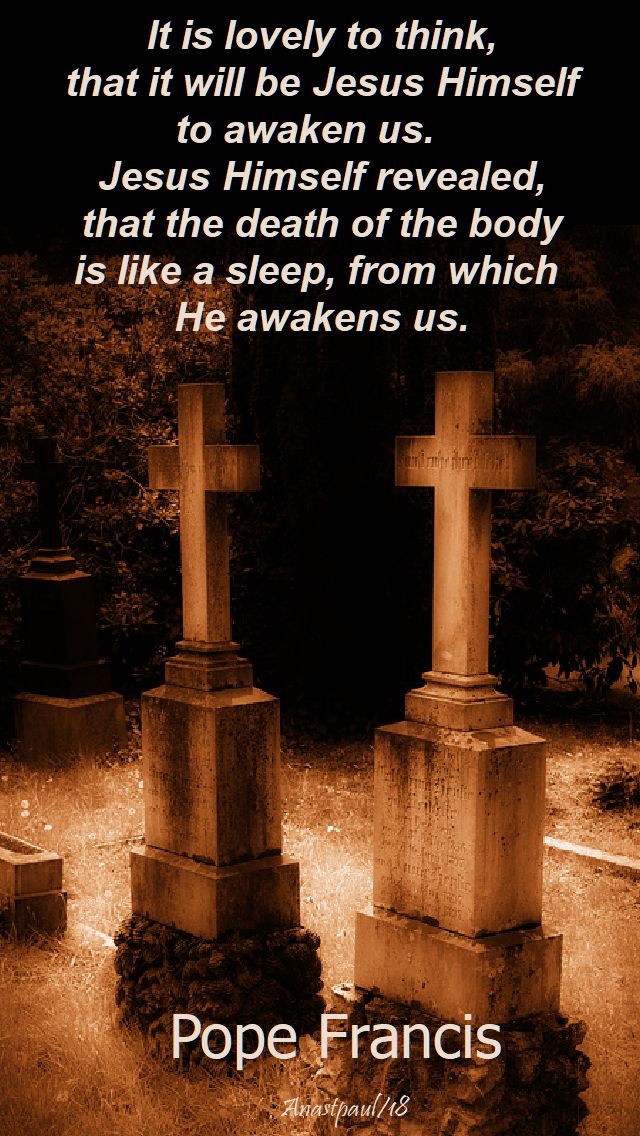
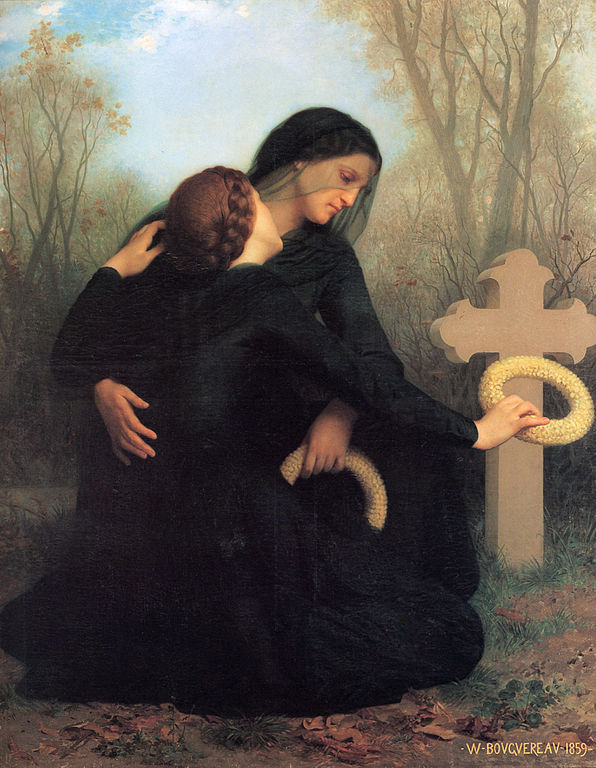
REFLECTION – “Yesterday and today, many have been visiting cemeteries, which, as the word itself implies, is the “place of rest”, as we wait for the final awakening. It is lovely to think, that it will be Jesus Himself to awaken us. Jesus Himself revealed, that the death of the body is like a sleep from which He awakens us. But today we are called to remember everyone, even those who no one remembers. We remember the victims of war and violence, the many “little ones” of the world, crushed by hunger and poverty, we remember the anonymous who rest in the communal ossuary. We remember our brothers and sisters killed because they were Christian and those who sacrificed their lives to serve others.
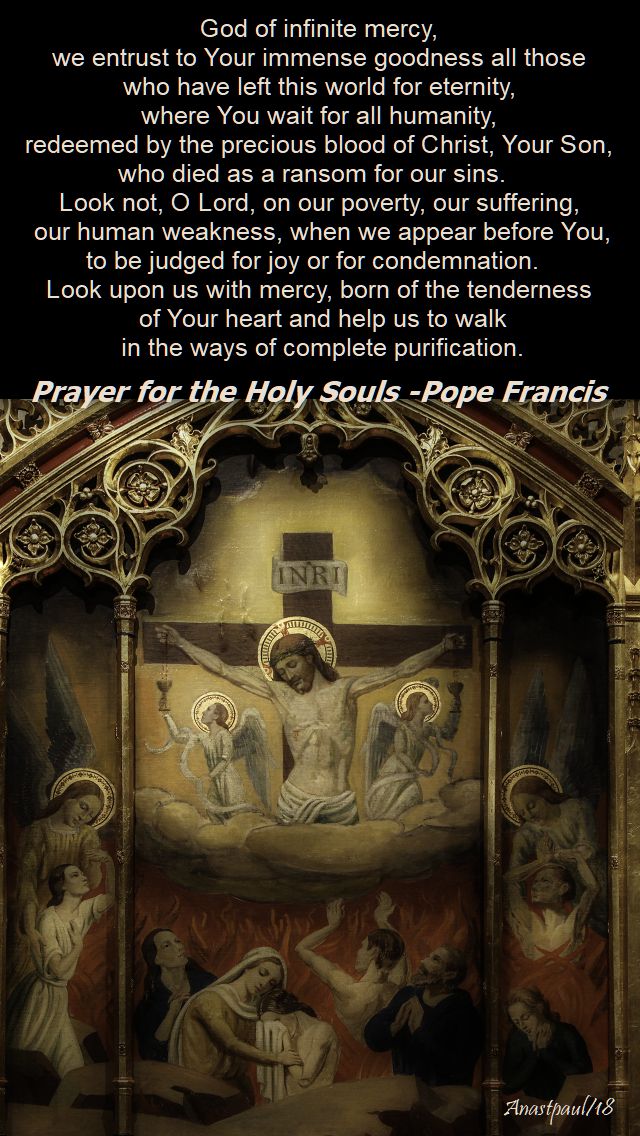
PRAYER – Let us raise this prayer to God: “God of infinite mercy, we entrust to Your immense goodness all those who have left this world for eternity, where You wait for all humanity, redeemed by the precious blood of Christ Your Son, who died as a ransom for our sins. Look not, O Lord, on our poverty, our suffering, our human weakness, when we appear before You to be judged for joy or for condemnation. Look upon us with mercy, born of the tenderness of Your heart and help us to walk in the ways of complete purification.”…Pope Francis – Angelus, 2 November 2014
Our Morning Offering – 2 November – The Commemoration of All the Holy Souls in Purgatory
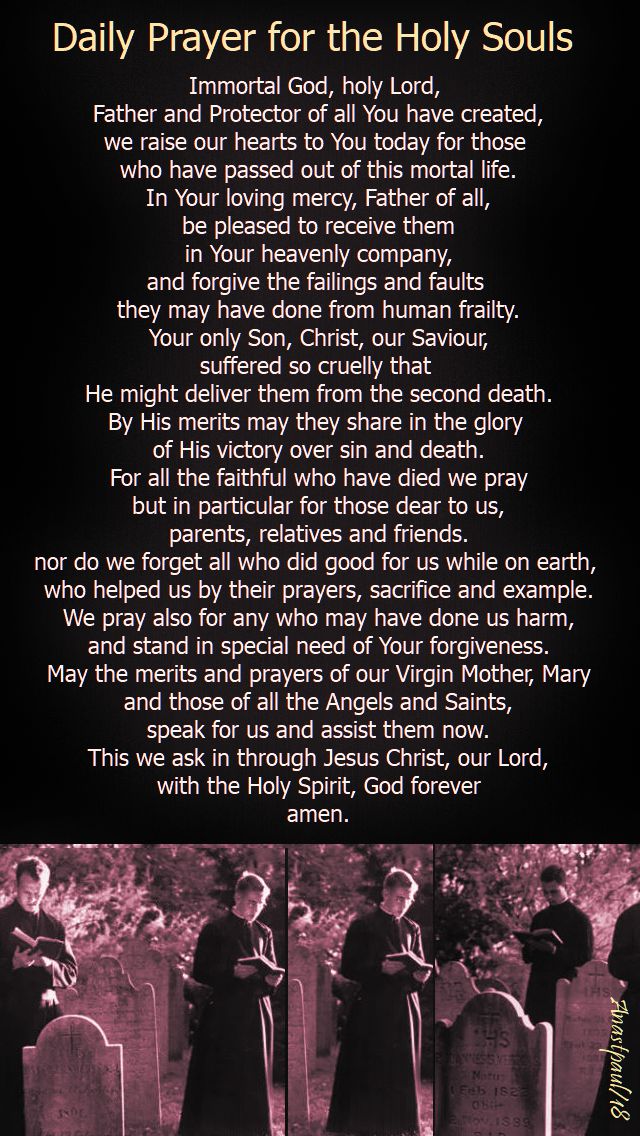
Daily Prayer for the Holy Souls
Immortal God, holy Lord,
Father and Protector of all You have created,
we raise our hearts to You today for those
who have passed out of this mortal life.
In Your loving mercy, Father of all,
be pleased to receive them
in Your heavenly company,
and forgive the failings and faults
they may have done from human frailty.
Your only Son, Christ, our Saviour,
suffered so cruelly that
He might deliver them from the second death.
By His merits may they share in the glory
of His victory over sin and death.
For all the faithful who have died we pray
but in particular for those dear to us,
parents, relatives and friends.
nor do we forget all who did good for us while on earth,
who helped us by their prayers, sacrifice and example.
We pray also for any who may have done us harm,
and stand in special need of Your forgiveness.
May the merits and prayers of our Virgin Mother, Mary
and those of all the Angels and Saints,
speak for us and assist them now.
This we ask in through Jesus Christ, our Lord,
with the Holy Spirit, God forever
amen.
The Commemoration of All the Holy Souls in Purgatory – 2 November
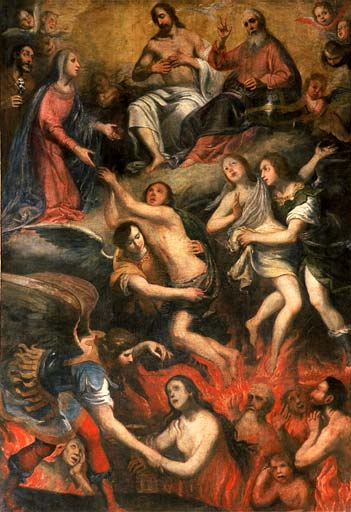
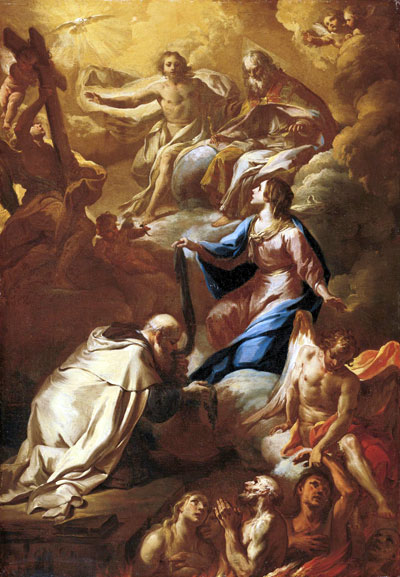
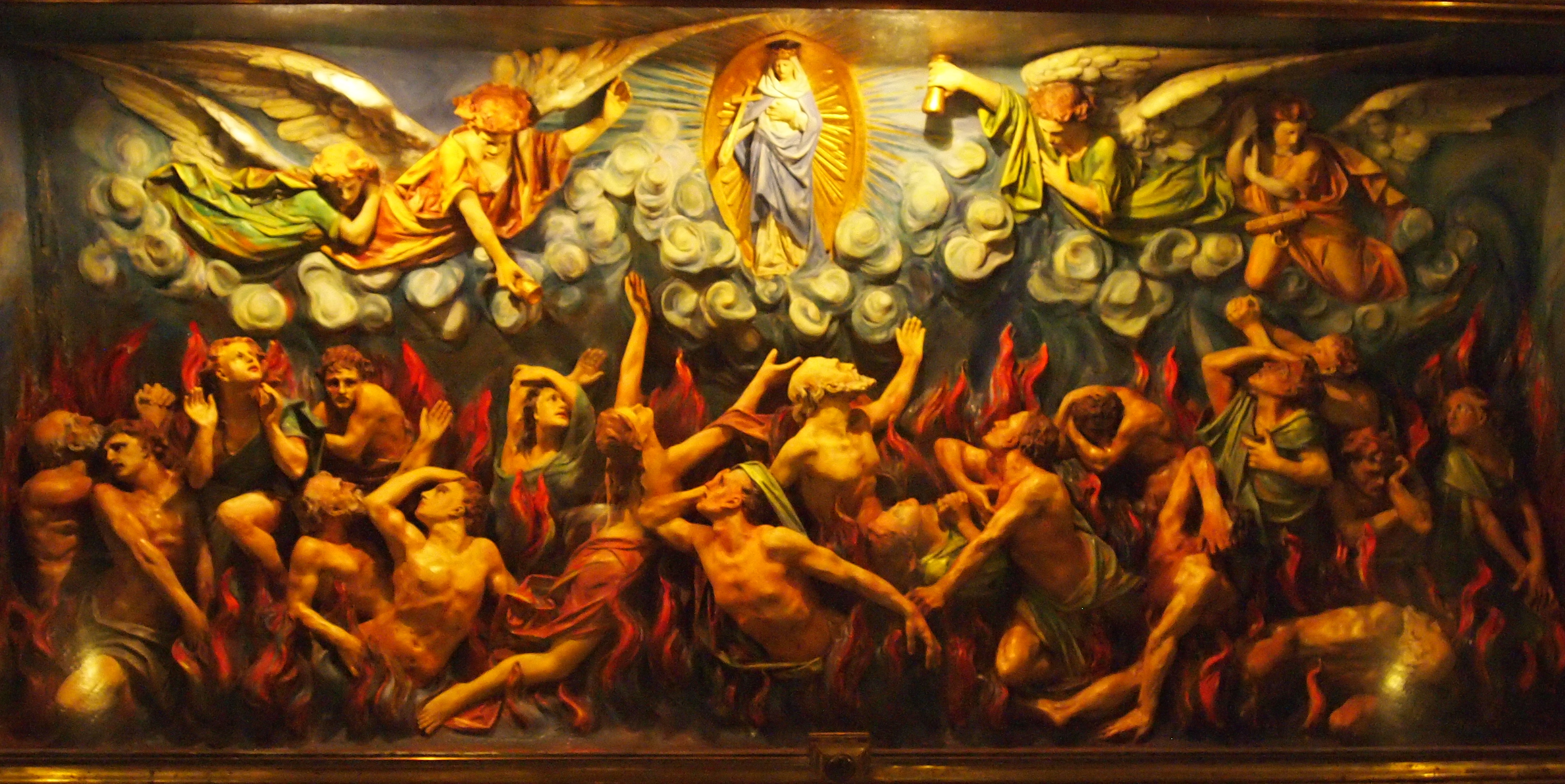
The Church teaches us that the souls of the just who have left this world with traces of venial sin remain for a time in a place of expiation, where they suffer whatever punishment may be due to their offenses. Even if pardon has been obtained for our sins, satisfaction must be made to God, our Creator, in this world or in the next, for His sanctity has been, as it were, insulted by the self-will of one of His ignoble creatures. The more noble the person offended, the more serious the offence, even according to human laws.
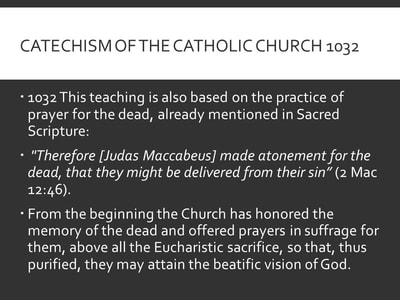
It is a dogma of our faith that the suffering souls are relieved by the intercession of the Saints in heaven and by the prayers of the faithful upon earth. To pray for the dead is therefore an act of charity and of piety, certainly obligatory for a Christian who professes to have charity in his heart. We read in Holy Scripture: It is a holy and wholesome thought to pray for the dead, that they may be loosed from their sins. (II Maccabees 12:46)
When towards the close of the tenth century, Our Lord inspired Saint Odilo, (c 962-1049) Abbot of Cluny, to establish in his Benedictine Order a general commemoration of all the faithful departed, the practice was soon afterwards adopted by the entire Western Church and has been continued unceasingly to our day.
Let us always bear in mind the departed who have died in the love of God and offer up our prayers and sacrifices to help expiate for them. By showing this mercy to the suffering souls in purgatory, we gain for ourselves very devoted friends, who will in their turn pray for us. We shall then be entitled to be treated with mercy at our departure from this world and to share more abundantly in the suffrages of the Church, continually offered for all who have fallen asleep in Christ.
When we offer satisfaction to God in this life for our offences, there is merit attached to our penances. There is no longer any merit in purgatory – others must provide . Let us reflect well that if we do not ourselves repair our sins and faults, we place our burden on other, is that what we want?
All Souls Day (Commemoration): Feast in commemoration of the faithful departed in Purgatory. Abbot Odilo of Cluny instituted it in the monasteries of his congregation in 998, other religious orders took up the observance and it was adopted by various dioceses and gradually by the whole Church. The Office of the Dead must be recited by the clergy on this day and Pope Benedict XV granted to all priests the privilege of saying three Masses of requiem –
• one for the souls in Purgatory
• one for the intention of the Holy Father
• one for the priest’s
If the feast should fall on Sunday it is kept on 3 November.
Patronage: Monselice, Italy
Details here: https://anastpaul.wordpress.com/2017/11/02/the-commemoration-of-all-the-holy-souls-in-purgatory-2-november/
St Ambrose of Agaune
St Ambrose of Agaune
St Amicus of Fonte Avellana
St Amicus of Rambone
St Baya of Scotland
St Domninus of Grenoble
St Erc of Slane
St Eustochium of Tarsus
St George of Vienne
Bl John Bodey
St Jorandus of Kergrist
St Justus of Trieste
Bl Luigi Campidello
St Marcian of Chalcis
Bl Margaret of Lorraine
St Mateo López y López
St Maura of Scotland
St Theodotus of Laodicea
St Victorinus of Pettau
St Willebald of Bavaria
—
Martyrs of Isfahan – 5+ saints: Acindynus, Pegasius and Anempodistus were Persian priests who were imprisoned, tortured, interrogated and martyred in the persecutions of king Sapor II of Persia; he considered any Christian to be a Roman spy and anti-Persian. The three were brought back to life, miraculously healed, freed from their chains and began preaching Christianity, miraculously healing Sapor II in the process. This defiance enraged Sapor so much that he ordered them executed again; they were thrown into a cauldron of molten lead, but walked out unharmed. This miracle brought one of the torturers, Aphthonius, to convert; he was immediately martyred. Other attempts were made to kill them, and they emerged each time unharmed. Senator Elpidiphorus led a group speaking in favour of the Christians for their courage and faith; he was immediately executed. In the end the original three Christians were burned to death. Martyrs all – Acindynus, Anempodistus, Aphthonius, Elpidephorus and Pegasius.
They were born in Persia and Died:
• c.350 in Isfahan, Persia
• relics transferred to Constantinople and enshrined in a church dedicated to them
• some relics taken to France in 1204 during the 4th Crusade
• relics in France were lost when hidden from anti-Christian forces in the French Revolution
• relics in France re-discovered in 1892 in Grozon.
Martyrs of Sebaste – 10 saints: A group of ten soldiers in the imperial Roman army of Emperor Licinius Licinianus who were executed together for refusing to burn incense as a sacrifice to the emperor. The only details that have survived are five of their names – Agapius, Cartherius, Eudoxius, Styriacus and Tobias. They were burned at the stake in 315 in Sebaste (in modern Turkey).
The Commemoration of All the Holy Souls in Purgatory – 2 November
All Souls Day is a solemn celebration in the Roman Catholic Church commemorating all of those who have died and are now in Purgatory, being cleansed of their venial sins and the temporal punishments for the mortal sins that they had confessed and being made pure before entering into the presence of God in Heaven.
THE HISTORY OF ALL SOULS DAY The importance of All Souls Day was made clear by Pope Benedict XV (1914-1922), when he granted all priests the privilege of celebrating three Masses on All Souls Day: one for the faithful departed; one for the priest’s intentions; and one for the intentions of the Holy Father. On only a handful of other very important feast days are priests allowed to celebrate more than two Masses.
While All Souls Day is now paired with All Saints Day (1 November), which celebrates all of the faithful who are in Heaven, it originally was celebrated in the Easter season, around Pentecost Sunday (and still is in the Eastern Catholic Churches).
By the tenth century, the celebration had been moved to October; and sometime between 998 and 1030, St Odilo of Cluny decreed that it should be celebrated on 2 November in all of the monasteries of his Benedictine congregation. Over the next two centuries, other Benedictines and the Carthusians began to celebrate it in their monasteries as well and soon the commemoration of all the Holy Souls in Purgatory spread to the entire Church.
OFFERING OUR EFFORTS ON BEHALF OF THE HOLY SOULS
On All Souls Day, we not only remember the dead but we apply our efforts, through prayer, almsgiving and the Mass, to their release from Purgatory. There are two plenary indulgences attached to All Souls Day, one for visiting a church and another for visiting a cemetery. (The plenary indulgence for visiting a cemetery can also be obtained every day from November 1-8, and, as a partial indulgence, on any day of the year.) While the actions are performed by the living, the merits of the indulgences are applicable only to the souls in Purgatory. Since a plenary indulgence removes all of the temporal punishment for sin, which is the reason why souls are in Purgatory in the first place, applying a plenary indulgence to one of the Holy Souls in Purgatory means that the Holy Soul is released from Purgatory and enters Heaven.
Praying for the dead is a Christian obligation. In the modern world, when many have come to doubt the Church’s teaching on Purgatory, the need for such prayers has only increased. The Church devotes the month of November to prayer for the Holy Souls in Purgatory and participation in the Mass of All Souls Day is a good way to begin the month.
All Souls Day (Commemoration): Feast in commemoration of the faithful departed in Purgatory. Abbot Odilo of Cluny instituted it in the monasteries of his congregation in 998, other religious orders took up the observance and it was adopted by various dioceses and gradually by the whole Church. The Office of the Dead must be recited by the clergy on this day and Pope Benedict XV granted to all priests the privilege of saying three Masses of requiem –
• one for the souls in Purgatory
• one for the intention of the Holy Father
• one for the priest’s
If the feast should fall on Sunday it is kept on 3 November.
Patronage: Monselice, Italy
—
St Ambrose of Agaune
St Ambrose of Agaune
St Amicus of Fonte Avellana
St Amicus of Rambone
St Baya of Scotland
St Domninus of Grenoble
St Erc of Slane
St Eustochium of Tarsus
St George of Vienne
Bl John Bodey
St Jorandus of Kergrist
St Justus of Trieste
Bl Luigi Campidello
St Marcian of Chalcis
Bl Margaret of Lorraine
St Mateo López y López
St Maura of Scotland
St Theodotus of Laodicea
St Victorinus of Pettau
St Willebald of Bavaria
—
Martyrs of Isfahan – 5+ saints: Acindynus, Pegasius and Anempodistus were Persian priests who were imprisoned, tortured, interrogated and martyred in the persecutions of king Sapor II of Persia; he considered any Christian to be a Roman spy and anti-Persian. The three were brought back to life, miraculously healed, freed from their chains and began preaching Christianity, miraculously healing Sapor II in the process. This defiance enraged Sapor so much that he ordered them executed again; they were thrown into a cauldron of molten lead, but walked out unharmed. This miracle brought one of the torturers, Aphthonius, to convert; he was immediately martyred. Other attempts were made to kill them, and they emerged each time unharmed. Senator Elpidiphorus led a group speaking in favour of the Christians for their courage and faith; he was immediately executed. In the end the original three Christians were burned to death. Martyrs all – Acindynus, Anempodistus, Aphthonius, Elpidephorus and Pegasius.
They were born ibn Persia and Died:
• c.350 in Isfahan, Persia
• relics transferred to Constantinople and enshrined in a church dedicated to them
• some relics taken to France in 1204 during the 4th Crusade
• relics in France were lost when hidden from anti-Christian forces in the French Revolution
• relics in France re-discovered in 1892 in Grozon.
Martyrs of Sebaste – 10 saints: A group of ten soldiers in the imperial Roman army of Emperor Licinius Licinianus who were executed together for refusing to burn incense as a sacrifice to the emperor. The only details that have survived are five of their names – Agapius, Cartherius, Eudoxius, Styriacus and Tobias. They were burned at the stake in 315 in Sebaste (in modern Turkey).







 AnaStpaul
You must be logged in to post a comment.