St Aetius St Bairfhion St Baldred of Strathclyde St Baldred the Hermit St Balther of Lindisfarne St Basil of Bologna St Cadroë
St Chrodegang of Metz (c714-776) The First Bishop of Metz, Protector and Father of the poor and orphans, Reformer of the Clergy, a relative of King Pepin and of Prince Charles Martel, both of whom he was Court Chancellor, Royal Diplomat, Saint Opportuna of Montreuil was his brother. The Roman Martyrology states: “In Metz in Austrasia, in today’s France, St Crodegango, Bishop, who arranged for the Clergy to live as if within the walls of a cloister under an exemplary rule of life and greatly promoted liturgical chant.” Biography: https://anastpaul.com/2022/03/06/saint-of-the-day-6-march-saint-chrodegang-of-metz/
St Colette PCC (1381-1447) Abbess and Foundress of the Colettine Poor Clares, a reform branch of the Order of Saint Clare. Patronages – against eye disorders, against fever, against headaches, against infertility, against the death of parents, of women seeking to conceive, expectant mothers and sick children, craftsmen, Poor Clares, servants, Corbie, France, Ghent, Belgium. St Colette was Canonised on 24 May 1807 by Pope Pius VII. Biography: https://anastpaul.com/2017/03/06/saint-of-the-day-6-march-st-colette/ AND: https://anastpaul.com/2019/03/06/saint-of-the-day-6-march-st-colette-2/
St Cyriacus of Trier St Cyril of Constantinople St Evagrius of Constantinople
Bl Guillermo Giraldi St Heliodorus the Martyr Bl Jordan of Pisa St Julian of Toledo St Kyneburga of Castor St Kyneswide of Castor St Marcian of Tortona St Ollegarius Bonestruga OSA (1060-1137) Bishop St Patrick of Malaga St Sananus
Martyrs of Amorium – 42 Saints – Also known as Martyrs of Syria and Martyrs of Samarra; A group of 42 Christian senior officials in the Byzantine Empire who were captured by forces of the Abbasid Caliphate when the Muslim forces overran the City of Amorium, Phrygia in 838 and massacred or enslaved its population. The men were imprisoned in Samarra, the seat of the Caliphate, for seven years. Initially thought to be held for ransom due to their high position in the empire, all attempts to buy their freedom were declined. The Caliph repeatedly ordered them to convert to Islam and sent Islamic scholars to the prison to convince them; they refused until the Muslims finally gave up and killed them. Martyrs. We know the names and a little about seven of them: Aetios Bassoes Constantine Constantine Baboutzikos Kallistos Theodore Krateros Theophilos but details about the rest have disappeared over time. However, a lack of information did not stop several legendary and increasingly over-blown “Acts” to be written for years afterward. One of the first biographers, a monk name Euodios, presented the entire affair as a judgement by God on the empire for its official policy of Iconoclasm. Deaths: beheaded on 6 March 845 in Samarra (in modern Iraq) on the banks of the Euphrates river by Ethiopian slaves the bodies were thrown into the river, but later recovered by local Christians and given proper burial.
St Aetius St Bairfhion St Baldred of Strathclyde St Baldred the Hermit St Balther of Lindisfarne St Basil of Bologna St Cadroë
St Chrodegang of Metz (c 714-776) The First Bishop of Metz, Protector and Father of the poor and orphans, Reformer of the Clergy, a relative of King Pepin and of Prince Charles Martel, both of whom he was Court Chancellor, Royal Diplomat, Saint Opportuna of Montreuil was his brother. The Roman Martyrology states: “In Metz in Austrasia, in today’s France, St Crodegango, Bishop, who arranged for the Clergy to live as if within the walls of a cloister under an exemplary rule of life and greatly promoted liturgical chant.” Biography: https://anastpaul.com/2022/03/06/saint-of-the-day-6-march-saint-chrodegang-of-metz/
St Colette PCC (1381-1447) Abbess and Foundress of the Colettine Poor Clares, a reform branch of the Order of Saint Clare. Patronages – against eye disorders, against fever, against headaches, against infertility, against the death of parents, of women seeking to conceive, expectant mothers and sick children, craftsmen, Poor Clares, servants, Corbie, France, Ghent, Belgium. St Colette was Canonised on 24 May 1807 by Pope Pius VII. Biography: https://anastpaul.com/2017/03/06/saint-of-the-day-6-march-st-colette/ AND: https://anastpaul.com/2019/03/06/saint-of-the-day-6-march-st-colette-2/
St Cyriacus of Trier St Cyril of Constantinople St Evagrius of Constantinople St Fridolin Vandreren of Säckingen (Died c540) “Apostle of the Upper Rhine” Monk, Abbot, Missionary, wandering Evangelist, Founder of the Monastery in Säckingen, Baden (part of modern Germany). Bl Guillermo Giraldi St Heliodorus the Martyr Bl Jordan of Pisa St Julian of Toledo St Kyneburga of Castor St Kyneswide of Castor St Marcian of Tortona Bl Ollegarius of Tarragona St Patrick of Malaga St Sananus
Martyrs of Amorium – 42 Saints – Also known as Martyrs of Syria and Martyrs of Samarra; A group of 42 Christian senior officials in the Byzantine Empire who were captured by forces of the Abbasid Caliphate when the Muslim forces overran the City of Amorium, Phrygia in 838 and massacred or enslaved its population. The men were imprisoned in Samarra, the seat of the Caliphate, for seven years. Initially thought to be held for ransom due to their high position in the empire, all attempts to buy their freedom were declined. The Caliph repeatedly ordered them to convert to Islam and sent Islamic scholars to the prison to convince them; they refused until the Muslims finally gave up and killed them. Martyrs. We know the names and a little about seven of them:
Aetios
Bassoes
Constantine
Constantine Baboutzikos
Kallistos
Theodore Krateros
Theophilos but details about the rest have disappeared over time. However, a lack of information did not stop several legendary and increasingly over-blown “Acts” to be written for years afterward. One of the first biographers, a monk name Euodios, presented the entire affair as a judgement by God on the empire for its official policy of Iconoclasm. Deaths:
beheaded on 6 March 845 in Samarra (in modern Iraq) on the banks of the Euphrates river by Ethiopian slaves
the bodies were thrown into the river, but later recovered by local Christians and given proper burial.
St Aetius St Bairfhion St Baldred of Strathclyde St Baldred the Hermit St Balther of Lindisfarne St Basil of Bologna St Cadroë St Chrodegang of Metz (c 714-776) Bishop
St Cyriacus of Trier St Cyril of Constantinople St Evagrius of Constantinople St Fridolin Vandreren of Säckingen Bl Guillermo Giraldi St Heliodorus the Martyr Bl Jordan of Pisa St Julian of Toledo St Kyneburga of Castor St Kyneswide of Castor St Marcian of Tortona Bl Ollegarius of Tarragona St Patrick of Malaga St Sananus
Martyrs of Amorium – 42 Saints – Also known as Martyrs of Syria and Martyrs of Samarra; A group of 42 Christian senior officials in the Byzantine Empire who were captured by forces of the Abbasid Caliphate when the Muslim forces overran the City of Amorium, Phrygia in 838 and massacred or enslaved its population. The men were imprisoned in Samarra, the seat of the Caliphate, for seven years. Initially thought to be held for ransom due to their high position in the empire, all attempts to buy their freedom were declined. The Caliph repeatedly ordered them to convert to Islam and sent Islamic scholars to the prison to convince them; they refused until the Muslims finally gave up and killed them. Martyrs. We know the names and a little about seven of them: • Aetios • Bassoes • Constantine • Constantine Baboutzikos • Kallistos • Theodore Krateros • Theophilos but details about the rest have disappeared over time. However, a lack of information did not stop several legendary and increasingly over-blown “Acts” to be written for years afterward. One of the first biographers, a monk name Euodios, presented the entire affair as a judgement by God on the empire for its official policy of Iconoclasm. Deaths: • beheaded on 6 March 845 in Samarra (in modern Iraq) on the banks of the Euphrates river by Ethiopian slaves • the bodies were thrown into the river, but later recovered by local Christians and given proper burial.
Saint of the Day – 6 March – Blessed Sylvester of Assisi OFM (Died 1240) Priest, Franciscan Frria. One of the first 4 followers of St Francis of Assisi and was the first Priest in the Franciscan Order.
Sylvester was a member of one of the noblest and wealthiest families of the City of Assisi, the Uncle of St Clare Of Assisi.
When St Francis embarked on his campaign to “rebuild My church” Sylvester sold Francis stones which were to be used to rebuild the little Church of St Damiano. When, a short while later, he saw Francis and Blessed Bernard of Quintavalle distributing Bernard’s wealth to the poor, Sylvester complained that he had been poorly paid for the stones and asked for more money.
Though Francis obliged, the handful of money he gave Sylvester later caused him to regret this spirit of greed he found in himself, his conscience rebuked him and he was filled with guilt. He sold all of his goods and gave the money to the poor and began a life of penance. Sylvester was Ordained a Priest and became a Canon of the Cathedral of San Rufino in Assisi.
Thereafter, he joined St Francis. Sylvester became a holy and prayerful man and a favourite of Francis. He was known in the Order for his strict observance of the life of poverty and contemplation. Together with his cousin, Clare, he later prayed for enlightenment to discern the will of God for Francis, when Francis sought advice on how he should best serve God. Should he go out to preach rather than by devoting himself solely to prayer?
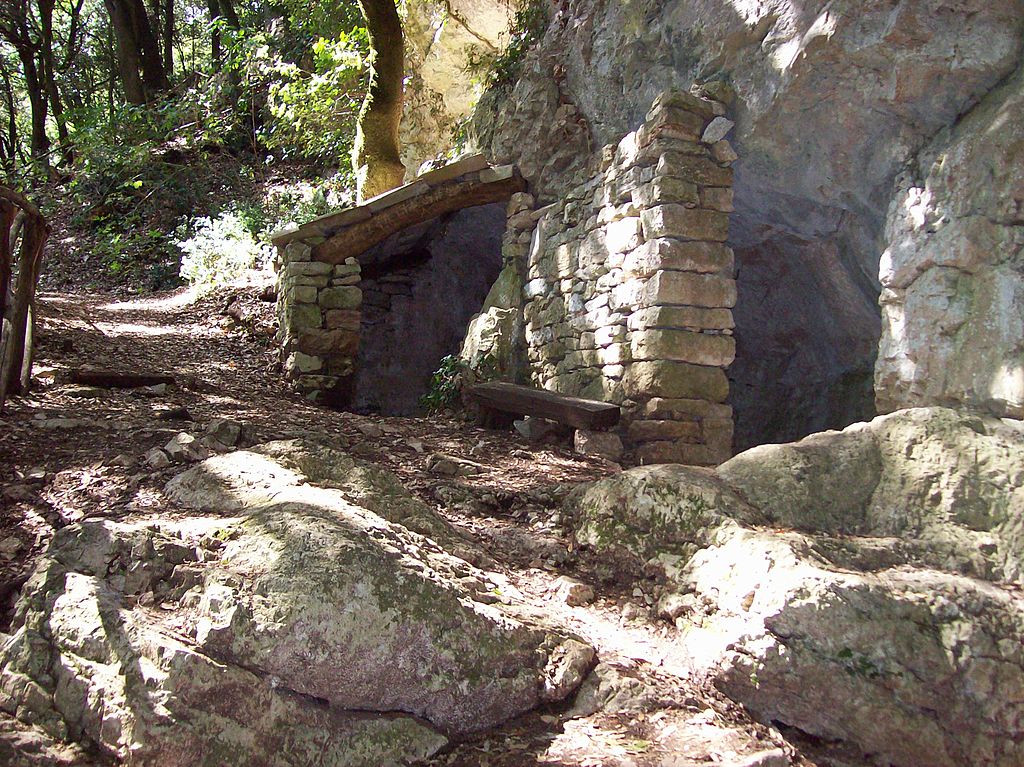
The cave at the Eremo delle Carceri, near Assisi, where Blessed Sylvester spent long periods in solitary prayer
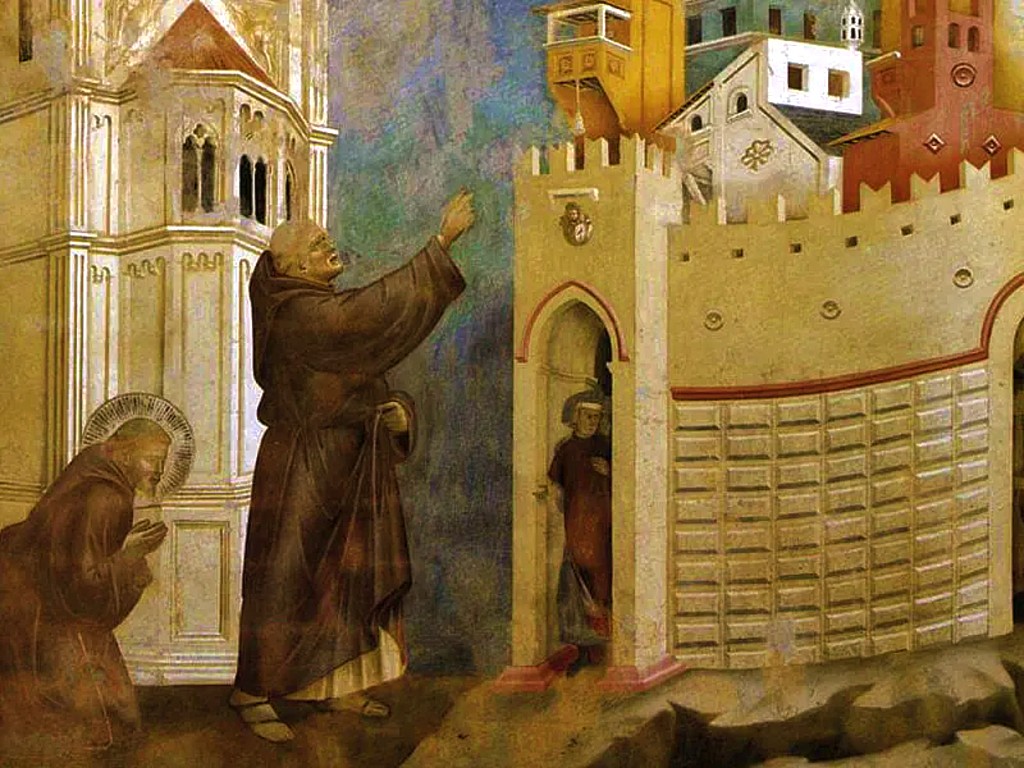
Sylvester often accompanied Francis during his preaching tours. Once, in the city of Arezzo, it was claimed by the residents, that Sylvester’s preaching and prayers brought peace to the City, which was falling prey to hatred and violence amongst its citizens. In another City where civil war was raging, Sylvester was commanded by Francis to drive the devils out. At the City gate Sylvester cried out: “In the name of almighty God and by virtue of the command of His servant Francis, depart from here, all you evil spirits.” The devils departed and peace returned to the City.
St Bonaventure, in a special way, mentions the visions which Sylvester had concerning Francis.
Sylvester died in Assisi in 1240, surviving Francis by 14 year. He is one of Francis’ four original companions who are buried near his tomb in the Basilica of St Francis in Assisi.
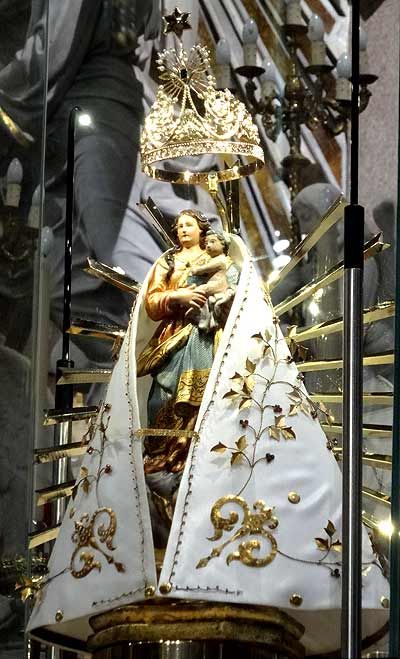
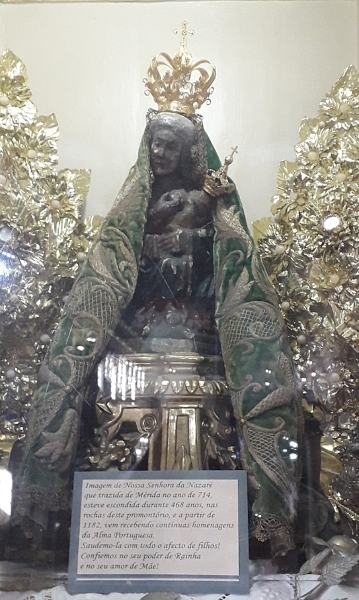
Nossa Senhora da Nazaré/Our Lady of Nazareth, Pierre Noire, Portugal, (1150) – 6 March:
The Abbot Orsini wrote: “This image was honoured at Nazareth in the time of the Apostles, if we may believe a writing which was found, by a hunter, attached to this image, in the year 1150.”
The Shrine of Our Lady of Nazareth, known in Portugal as Nossa Senhora da Nazare, is found in the village of Nazare on the Atlantic coast in Portugal. Indeed, the village is named after this miraculous statue of the Blessed Mother and the Christ Child, that was brought to the area many centuries ago. According to tradition, this miraculous image was carved by the hands of Saint Joseph, the foster-father of Christ, while in the very presence of the Infant Jesus and the Mother of God. Later, the faces and hands of the images were painted by Saint Luke the Evangelist. This remarkable image is still preserved in a Church where it can be viewed by anyone and the story surrounding it is a fascinating one. It is known that the statue of Our Lady of Nazareth came from the Holy Land where it was one of the oldest images ever venerated by Christians. It was saved from destruction at the hands of the iconoclasts sometime early in the 5th century by a Monk named Ciriaco, who gave the statue to Saint Jerome. Saint Jerome later gave it to Saint Augustine in Africa, to protect the statue by removing it from the Holy Land. Saint Augustine then gave it into the safekeeping of the Monastery of Cauliniana, near Merida, a Monastery on the Iberian Peninsula. When the Arabs invaded the Iberian Peninsula in the year 711, King Roderic met them with his Visigothic army at the battle of Guadalete, where he was soundly defeated. It is a fact of history, that the body of Roderic was never found upon the field of battle, although his horse was found and it is often assumed by historians, that Roderic died that day when he lost his kingdom. According to this legend, however, Roderic was not killed but survived the battle and disguised himself as a beggar as he travelled north. Alone and unknown, he made his way to the Monastery of Cauliniana where he sought shelter for the night. Going to Confession, he, of necessity, revealed his true identity to the friar, Frei Romano. As it turned out, the Monks were preparing to leave the Monastery in advance of the Arabs and so Frei Romano asked the King if he could accompany him in his travels. Roderic agreed and the friar took with him the statue of Our Lady of Nazareth and the relics of Saint Bras and Saint Bartholomew. They travelled together until they arrived at a place later named Monte de Saint Bartolomeu in November of the year 714. They made for themselves a hermitage with the friar living in a small cave at the edge of a cliff that overlooked the sea. He placed the image in a niche among the stones upon a pedestal of simple rocks. Roderic went a little ways off by himself to a hill where he also began to live the life of a hermit. After a year, though, King Roderic left the hermitage and nothing else is said of him in this legend. One wonders if he ever learned of his kinsman Pelayo, who had retreated into the mountains and continued to heroically defy the invaders. Before his death, Frei Romano hid the image in his small cave, where it remained undisturbed for some centuries until it was discovered by shepherds, who came there to venerate the statue. Inside that little, ancient sanctuary they had found the renowned and sacred image of Our Lady of Nazareth. Carved of wood, it was unlike any other statue of the Madonna they had ever seen, for it depicts the Blessed Virgin breastfeeding her Divine Child while seated upon a simple bench. When miracles began to frequently occur, it became a major pilgrimage site. Then, in the early morning of 14 September in the year 1182, the Mayor of Porto de Mos, Dom Fuas Roupinho, was hunting on his land when he observed a deer. Chasing it up a steep slope on horseback that misty morning, the fog became heavier all of a sudden. The deer, later suspected to be the devil in the guise of a deer, jumped off the edge of the hilltop into the empty void. Despite his efforts to stop his horse, the spirited mount was determined to follow after the deer. Helpless to save himself, the rider suddenly recognised that he was near the sacred grotto where he would often come to pray. Fuas Roupinho cried out to the Blessed Virgin, praying aloud: “Our Lady, Help Me!”
The horse stopped immediately, as if he were digging his hooves into the rocky cliff above the void. Suspended in an unnatural manner at the edge of the cliff, Fuas Rouphinho knew the drop to be over 100 meters and surely would mean his death if he had fallen. He was then able to back slowly away from the edge, looking down to see the evidence of the impossible and unimaginable – for there in the hard stone was the imprint of one of his horse’s hooves. One of those marks can still be seen in the native rock. Faus Rouphinho dismounted and went to the grotto to pray and give thanks, subsequently causing a chapel ‘Capela da Memoria,’ or ‘The Chapel of Remembrance,’ to be built very near the spot where his life had been miraculously saved. When the masons he had hired took apart the primitive altar in the cave, they found an ivory box of sorts that contained the relics of Saint Bras and Saint Bartholomew. There was also an ancient scroll that they carefully removed. Opening the scroll, they found that it explained the history of the statue of the Blessed Virgin Mary and her Divine Child, now known as Our Lady of Nazareth, as outlined above. The church Santuario de Nossa Senhora da Nazare was later built on the hilltop overlooking Nazare by King Ferdinand I of Portugal in the year 1377. Its construction was necessary due to the large number of pilgrims who continued to come to venerate the image.
Over the years it was often rebuilt, or had additions made, especially in the 17th, 18th and 19th centuries. The profusely decorated and gilded apse displays the statue of Nossa Senhora da Nazare in a lighted niche above the main altar, flanked by twisted columns. The first King of Portugal, Don Afonso Henriques, as well as the chief nobles of his court, were among the early pilgrims to the shrine. Many notable figures came to visit Our Lady of Nazareth throughout history, including Vasco de Gama, who came as a pilgrim before setting out for India and Pedro Alvares Cabral, who later discovered Brazil. St Francis Xavier, the Apostle of the East, went on pilgrimage to Our Lady of Nazareth before later leaving for Goa.
A close-up of the little Statue in it’s niche above the Altar – at Christmas, see the little trees.
According to a plaque placed in the Chapel in 1623, the image was carved by Saint Joseph in Galilee when Jesus was a baby. Some decades later St Luke the Evangelist painted the faces and hands of the images. It remained in Nazareth until brought by the Greek Monk Ciriaco to the Iberian Peninsula. It is believed to be one of the oldest images venerated by Christians.
Nossa Senhora de Nazaré in its Sanctuary of the Portuguese village of Nazaré.
St Cyriacus of Trier St Cyril of Constantinople St Evagrius of Constantinople St Fridolin Vandreren of Säckingen Bl Guillermo Giraldi St Heliodorus the Martyr Bl Jordan of Pisa St Julian of Toledo St Kyneburga of Castor St Kyneswide of Castor St Marcian of Tortona Bl Ollegarius of Tarragona St Patrick of Malaga St Sananus Blessed Sylvester of Assisi OFM (Died 1240) Priest
St Tibba of Castor St Venustus of Milan — Martyrs of Amorium – 42 saints – Also known as Martyrs of Syria and Martyrs of Samarra A group of 42 Christian senior officials in the Byzantine empire who were captured by forces of the Abbasid Caliphate when the Muslim forces overran the city of Amorium, Phrygia in 838 and massacred or enslaved its population. The men were imprisoned in Samarra, the seat of the Caliphate, for seven years. Initially thought to be held for ransom due to their high position in the empire, all attempts to buy their freedom were declined. The Caliph repeatedly ordered them to convert to Islam and sent Islamic scholars to the prison to convince them; they refused until the Muslims finally gave up and killed them. Martyrs. We know the names and a little about seven of them: • Aetios • Bassoes • Constantine • Constantine Baboutzikos • Kallistos • Theodore Krateros • Theophilos but details about the rest have disappeared over time. However, a lack of information did not stop several legendary and increasingly over-blown “Acts” to be written for years afterward. One of the first biographers, a monk name Euodios, presented the entire affair as a judgement by God on the empire for its official policy of Iconoclasm. Deaths: • beheaded on 6 March 845 in Samarra (in modern Iraq) on the banks of the Euphrates river by Ethiopian slaves • the bodies were thrown into the river, but later recovered by local Christians and given proper burial.





 AnaStpaul
You must be logged in to post a comment.