Posted in MARIAN HYMNS, MARIAN PRAYERS, MARIAN REFLECTIONS, MARIAN TITLES, PRAYERS of the SAINTS, QUOTES on SACRED SCRIPTURE, SACRED and IMMACULATE HEARTS, THE ASSUMPTION, The WORD

Quote/s of the Day – 18 August – My soul doth magnify the Lord …

Quote/s of the Day – 18 August – “The Month of the Immaculate Heart of Mary” – 4th Day Within the Octave of the Assumption of the Blessed Virgin – Judith 13:22-25; 13:15; 13:10 – Luke 1:41-50 – Scripture search here: https://www.drbo.org/

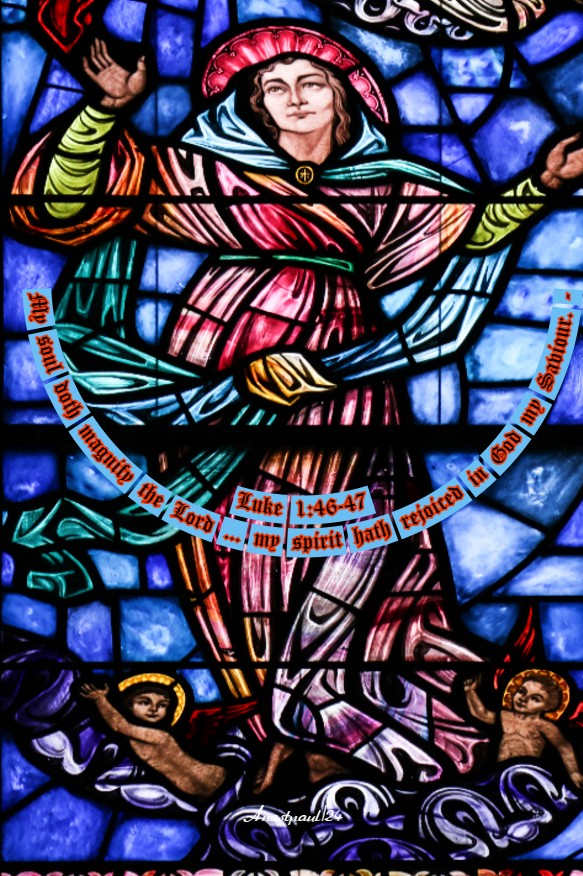
And Mary said:
My soul doth magnify the Lord …
… my spirit hath rejoiced in God my Saviour.”

Luke 1:46-47

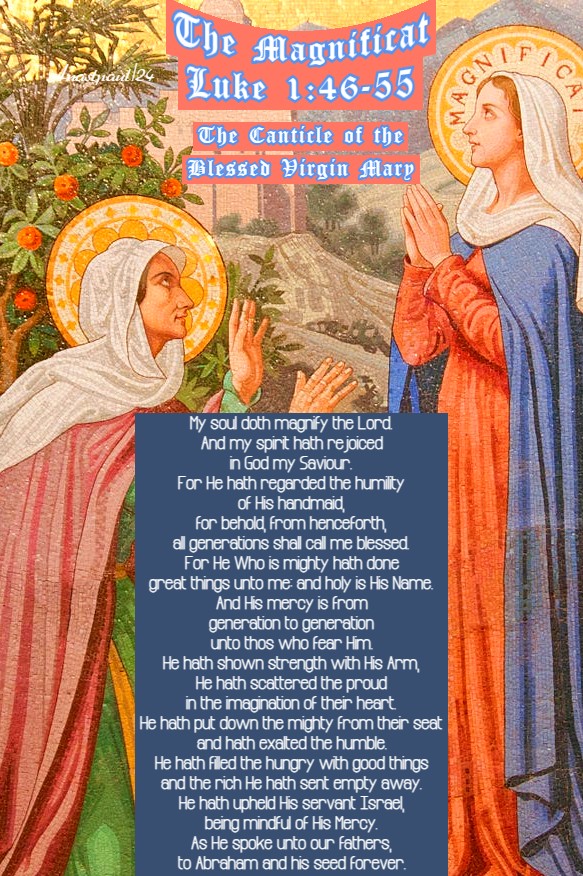
The Magnificat
The Canticle of the Blessed Virgin Mary
Luke 1:46-55
Indulgence 100 days

My soul doth magnify the Lord.
And my spirit hath rejoiced
in God my Saviour.
For He hath regarded the humility
of His handmaid,
for behold, from henceforth,
all generations shall call me blessed.
For He Who is mighty hath done
great things unto me: and holy is His Name.
And His mercy is from
generation to generation
unto thos who fear Him.
He hath shown strength with His Arm,
He hath scattered the proud
in the imagination of their heart.
He hath put down the mighty from their seat
and hath exalted the humble.
He hath filled the hungry with good things
and the rich He hath sent empty away.
He hath upheld His servant Israel,
being mindful of His Mercy.
As He spoke unto our fathers,
to Abraham and his seed forever.

Glory be to the Father
and to the Son
and to the Holy Ghost
as it was in the beginning,
is now and ever shall be,
world without end!
Amen

Posted in DOCTORS of the Church, FATHERS of the Church, Hail MARY!, MARIAN PRAYERS, MOTHER of GOD

Quote/s of the Day – 2 July – Hail, O Mary, Mother of God

Quote/s of the Day – 2 July – The Visitation of the Blessed Virgin Mary

Hail, O Mary, Mother of God
By St Cyril of Alexandria (376-444)
Father & Doctor of the Church

Hail, O Mary, Mother of God,
Virgin and Mother!
Morning Star, perfect vessel.
Hail, O Mary, Mother of God,
Holy Temple in which God
Himself was conceived.
Hail, O Mary, Mother of God,
Chaste and pure dove.
Hail, O Mary, Mother of God,
who enclosed the One
Who cannot be encompassed
in your sacred womb.
Hail, O Mary, Mother of God,
From you flowed the true light,
Jesus Christ, our Lord.
Hail, O Mary, Mother of God,
Through you the Conqueror
and triumphant Vanquisher
of hell, came to us.
Hail, O Mary, Mother of God,
Through you, the glory
of the Resurrection blossoms.
Hail, O Mary, Mother of God,
You have saved every faithful Christian.
Hail, O Mary, Mother of God,
Pray for us sinners now
and at the hour of our death.
Amen

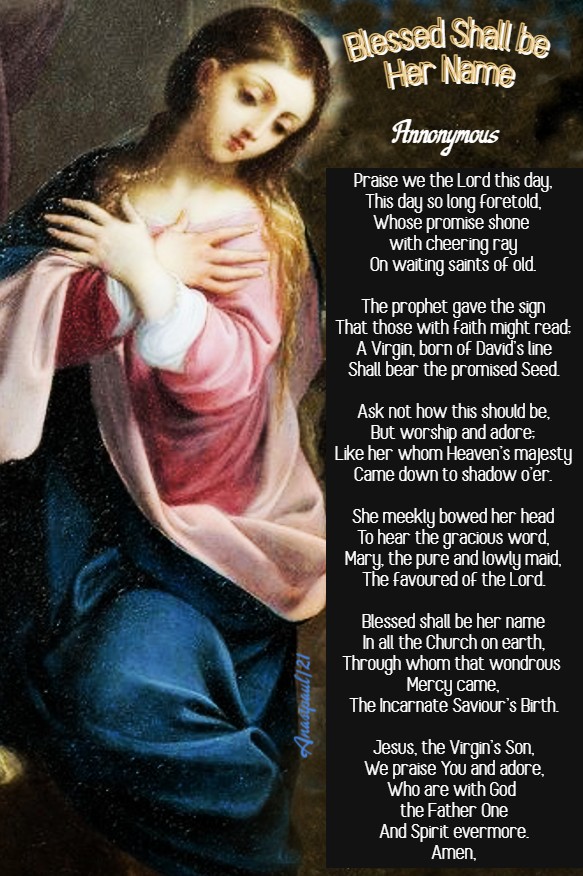
Blessed Shall be Her Name
Anonymous Author

Praise we the Lord this day,
This day so long foretold,
Whose promise shone with cheering ray
On waiting saints of old.

The prophet gave the sign
That those with faith might read;
A Virgin, born of David’s line
Shall bear the promised Seed.

Ask not how this should be,
But worship and adore;
Like her whom Heaven’s majesty
Came down to shadow o’er.

She meekly bowed her head
To hear the gracious word,
Mary, the pure and lowly maid,
The favoured of the Lord.

Blessed shall be her name
In all the Church on earth,
Through whom that wondrous Mercy came,
The Incarnate Saviour’s Birth.

Jesus, the Virgin’s Son,
We praise You and adore,
Who are with God the Father One
And Spirit evermore.
Amen

Posted in DOCTORS of the Church, FATHERS of the Church, FEASTS and SOLEMNITIES, MARIAN REFLECTIONS, ONE Minute REFLECTION, The WORD

One Minute Reflection – 2 July– ‘ … It was thou … ‘

One Minute Reflection – 2 July– “The Month of the Most Precious Blood” – The Visitation of the Blessed Virgin Mary – Song 2:8-14; Luke 1:39-47 – – Scripture search here: https://www.drbo.org/

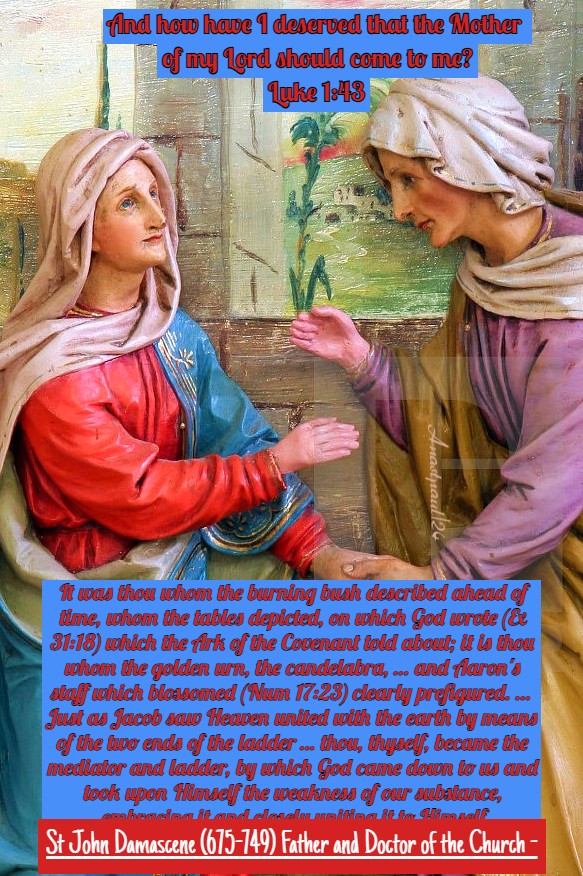
And how have I deserved that the Mother of my Lord should come to me?” – Luke 1:43

REFLECTION – “Most blessed are thou among women and blessed is the fruit of thy womb” … For all ages will call thee blessed, as thou said (Lk 1:48). The daughters of Jerusalem, that is to say, the Church, saw thee and proclaimed thy happiness … For thou art the royal throne near which the Angels stood contemplating their Master and Creator, Who was seated on it (Dan 7:9). Thou hast become the spiritual Eden, more sacred and more divine than the former one. The earthly Adam lived in the former, in thou lives the Lord Who came from Heaven (1 Cor 15:47). Noah’s ark was a prefiguration of thee, it saved the seed of the second creation, for thou gave birth to Christ, the world’s Salvation, Who submerged sin and pacified the floods.

It was thou whom the burning bush described ahead of time, whom the tables depicted, on which God wrote (Ex 31:18) which the Ark of the Covenant told about; it is thou whom the golden urn, the candelabra, … and Aaron’s staff which blossomed (Num 17:23) clearly prefigured. … I almost left out Jacob’s ladder. Just as Jacob saw Heaven united with the earth by means of the two ends of the ladder and the Angels descending and ascending and as the One who is really the strong and invincible One engaged in a symbolic struggle with him, thus thou, thyself, became the mediator and ladder, by which God came down to us and took upon Himself the weakness of our substance, embracing it and closely uniting it to Himself.”St John Damascene (675-749) Monk, Theologian, Father and Doctor of the Church – Added by Pope Leo XIII in 1883 (1st Sermon on the Death and Assumption).

PRAYER – Bestow upon Thy servants, we beseech Thee, O Lord, the gift of heavenly grace that as the child-bearing of the Blessed Virgin marked the beginning of our salvation, so may the solemn Feast of her Visitation bring us an increase of peace.Through Jesus Christ, Thy Son our Lord, Who lives and reigns with Thee, in the unity of the Holy Ghost, God, world without end. Amen (Collect).

Posted in FEASTS and SOLEMNITIES, franciscan OFM, JESUIT SJ, MARIAN TITLES, SAINT of the DAY

The Solemnity of Sts Peter and Paul, The Visitation of Our Lady and Memorials of the Saints – 2 July

The Solemnity of Sts Peter and Paul, Apostles and Martyrs

The Feast of the Visitation of Our Lady, instituted in 1385 by Pope Urban IV
https://anastpaul.com/2018/05/31/the-feast-of-the-visitation-of-the-blessed-virgin-mary-31-may/
AND:
https://anastpaul.com/2017/05/31/feast-of-the-visitation-of-the-blessed-virgin-mary-31-may/

The Fifth Sunday after Pentecost

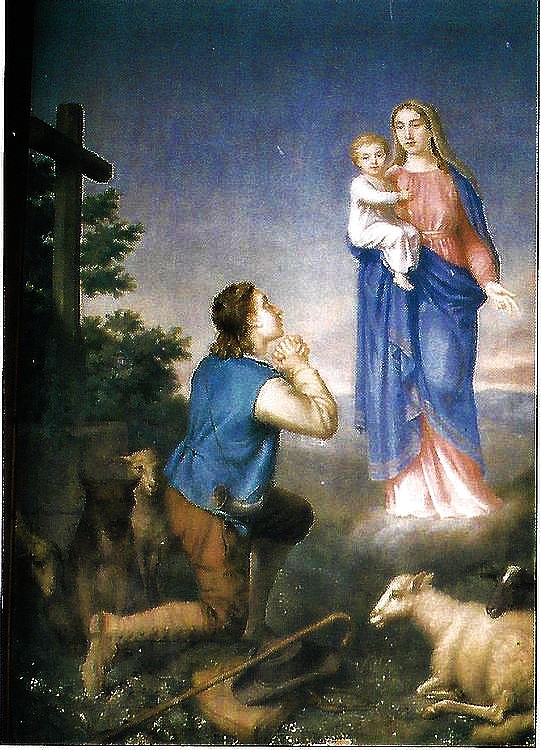
Notre Dame de la Visitation / Our Lady of the Visitation, Lescure, Valuéjols, Cantal, Auvergne, France (1717) – Commemorated on the Fourth Sunday of June and/or 2 July :
HERE:

https://anastpaul.com/2021/07/02/notre-dame-de-la-visitation-our-lady-of-the-visitation-lescure-valuejols-cantal-auvergne-france-1717-and-memorials-of-the-saints-2-july/

Bl Benedict Metzler

St Bernadino Realino SJ (1530-1616) Priest of the Society of Jesus, Lawyer, Teacher, Apostle of Charity.
Biography:

https://anastpaul.com/2017/07/02/saint-of-the-day-2-july-st-st-bernadino-realino-sj/

Servant of God Bernard of Quintavalle OFM ( Died 1q241) “The First fruits of the Minor Orders” – The First Follower of St Francis of Assisi. Bernard was his faithful and devout companion who received. from St Francis on his deathbed, custody of the Friars Minor. \he died nearly 20 years after St Francis.
About dear Bernard:

https://anastpaul.com/2021/07/02/saint-of-the-day-2-july-servant-of-god-bernard-of-quintavalle-ofm-died-1241-the-first-follower-of-st-francis-of-assisi/

Bl Giovanni da Fabriano Becchetti
St Jacques Fermin
Bl Jarich of Mariengaarde
St Jéroche
St Lidanus of Sezze
St Martinian of Rome * (Died c67) Martyr, Layman

St Monegundis
St Oudoceus

Blessed Peter of Luxembourg (1369-1387) Bishop and Cardinal. Because of his prudence and sanctity, at the early age of fifteen, he was appointed Bishop of Metz. He made his public entry into his See barefoot and riding on a donkey.
About Blessed Peter:

https://anastpaul.com/2018/07/02/saint-of-the-day-2-july-blessed-peter-of-luxembourg-1369-1387/

Bl Pietro Becchetti da Fabriano
St Processus of Rome * (Died c67) Martyr, Layman

St Swithun (c 800-863) Bishop of Winchester, Miracle-worker.
About St Swithun:

https://anastpaul.com/2020/07/02/saint-of-the-day-2-july-saint-swithun-c-800-863-bishop/

Martyred Soldiers of Rome – 3 Saints: Three soldiers who were converted at the Martyrdom of Saint Paul the Apostle. Then they were martyred, as well. We known nothing else about them but their names – Acestes, Longinus and Megistus. Martyred c68 in Rome, Italy

Martyrs in Carthage by Hunneric – 7 Saints: A group of seven Christians tortured and murdered in the persecutions of the Arian Vandal king Hunneric for remaining loyal to the teachings of orthodox Christianity. They were some of the many who died for the faith during a period of active Arian heresy. – Boniface, Liberatus, Maximus, Rogatus, Rusticus, Septimus and Servus.

Martyrs of Campania – 10 Saints: A group of ten Christians Marytred together in the persecutions of Diocletian. The only details about them to have survived are their names – Ariston, Crescention, Eutychian, Felicissimus, Felix, Justus, Marcia, Symphorosa, Urban and Vitalis. Martyred in 284 in Campania, Italy.

Posted in FEASTS and SOLEMNITIES, SAINT of the DAY, The BLESSED VIRGIN MARY

The Solemnity of Pentecost +2020, Feast of the Visitation and Memorials of the Saints – 31 May

The Solemnity of Pentecost +2020
(Under lockdown for many of us!)

Visitation of the Blessed Virgin Mary (Feast)
https://anastpaul.com/2018/05/31/the-feast-of-the-visitation-of-the-blessed-virgin-mary-31-may/
AND:
https://anastpaul.com/2017/05/31/feast-of-the-visitation-of-the-blessed-virgin-mary-31-may/

St Alexander of Auvergne
St Camilla Battista da Varano OSC (1458-1524)

St Crescentian of Sassari
St Donatian of Cirta
St Felice of Nicosia
St Galla of Auvergne
St Hermias of Comana
Bl Jacob Chu Mun-mo
Bl James Salomone
St Juan Moya Collado
Bl Kasper Gerarz
St Lupicinus of Verona
St Mancus of Cornwall
Bl Mariano of Roccacasale
St Mechtildis of Edelstetten
St Myrbad of Cornwall
Bl Nicolas Barré
Bl Nicholaus of Vangadizza
Bl Nicholaus of Vaucelles
St Nowa Mawaggali
St Paschasius of Rome
St Petronilla of Rome
Bl Robert Thorpe
St Silvio of Toulouse
Bl Thomas Watkinson
Bl Vitalis of Assisi
St Winnow of Cornwall

Martyrs of Aquileia – 3 saints: Three young members of the imperial Roman nobility and who were raised in a palace and had Saint Protus of Aquileia as tutor and catechist. To escape the persecutions of Diocletian, the family sold their property and moved to Aquileia, Italy. However, the authorities there quickly ordered them to sacrifice to idols; they refused. Martyrs all – Cantianilla, Cantian and Cantius. They were beheaded in 304 at Aquae-Gradatae (modern San-Cantiano) just outside Aquileia, Italy.

Martyrs of Gerona – 29 saints: A group of Christians martyred together in Gerona, Catalonia, Spain, date unknown. No details about them have survived but the names – • Agapia• Amelia• Castula• Cicilia• Donatus• Firmus• Fortunata• Gaullenus• Germanus• Honorius• Istialus• Justus• Lautica• Lupus
• Maxima• Paulica• Rogate• Rogatus• Silvanus• Tecla• Teleforus• Tertula• Tertus• Victoria• Victurinus• Victurus

Martyrs of the Via Aurelia – 4 saints: Four Christians martyred together. No information about them has survived except their names – Justa, Lupus, Tertulla and Thecla. The martyrdom occurred in 69 on the Via Aurelia near Rome, Italy.

Posted in BREVIARY Prayers, CATHOLIC DEVOTIONS of the Month, CATHOLIC-PRAYERS OF THE CHURCH, DEVOTIO, DOCTORS of the Church, FATHERS of the Church, FEASTS and SOLEMNITIES, MARIAN DEVOTIONS, MARIAN PRAYERS, MARIAN QUOTES, MORNING Prayers, PRACTISING CATHOLIC, PRAYERS of the CHURCH, QUOTES of the SAINTS, SAINT of the DAY, The BLESSED VIRGIN MARY, The WORD

Thought for the Day – 31 May – The Last Day of Mary’s Month and the Feast of the Visitation of the Blessed Virgin Mary from St Bede the Venerable

Thought for the Day – 31 May – The Last Day of Mary’s Month and the Feast of the Visitation of the Blessed Virgin Mary from St Bede the Venerable

Writing in the early 8th century, St Bede explains why the Magnificat, Mary’s prayer on the occasion of her Visitation of Elizabeth, is used daily in the liturgy of the hours (a.k.a the divine office) for Vespers or evening prayer.   With Mary’s soul, our souls magnify the Lord and rejoice in God our Saviour.

My soul glorifies the Lord and my spirit rejoices in God my saviour.
With these words Mary first acknowledges the special gifts she has been given.   Then she recalls God’s universal favours, bestowed unceasingly on the human race.

REJOICE IN GOD’S GREATNESS
When a man devotes all his thoughts to the praise and service of the Lord, he proclaims God’s greatness.   His observance of God’s commands, moreover, shows that he has God’s power and greatness always at heart.   His spirit rejoices in God his saviour and delights in the mere recollection of his creator who gives him hope for eternal salvation.

These words are offered for all God’s creations but especially for the Mother of God.   She alone was chosen and she burned with spiritual love for the son she so joyously conceived.   Above all other saints, she alone could truly rejoice in Jesus, her saviour, for she knew that He, who was the source of eternal salvation, would be born in time in her body, in one person both her own son and her Lord.

HOLY IS HIS NAME
For the Almighty has done great things for me, and holy is his name.
Mary attributes nothing to her own merits.   She refers all her greatness to the gift of the one whose essence is power and whose nature is greatness, for He fills with greatness and strength the small and the weak who believe in Him.

She did well to add:  and holy is his name, to warn those who heard and indeed all who would receive His words, that they must believe and call upon His name.   For they too could share in everlasting holiness and true salvation, according to the words of the prophet – and it will come to pass, that everyone who calls on the name of the Lord will be saved.   This is the name she spoke of earlier – and my spirit rejoices in God my saviour.

VESPERS & THE MAGNIFICAT:  AN EVENING CANTICLE
Therefore it is an excellent and fruitful custom of holy Church that we should sing Mary’s hymn at the time of evening prayer.   By meditating upon the incarnation, our devotion is kindled and by remembering the example of God’s Mother, we are encouraged to lead a life of virtue.   Such virtues are best achieved in the evening.  We are weary after the day’s work and worn out by our distractions.   The time for rest is near and our minds are ready for contemplation.

The great canticle by the Blessed Virgin Mary, the Magnificat, proclaimed by Mary during her Visitation to St Elizabeth,  is celebrated and explained in this excerpt from a homily by Saint Bede the Venerable (Lib 1,4:CCL 122, 25-26, 30) which is used in the Roman Catholic Liturgy’s Divine Office of Readings for the Feast of the Visitation, 31 May, with the accompanying biblical reading being from Song of Songs 2:8-14 and 8:6-7.   With Mary’s soul, we proclaim the greatness of the Lord and rejoice in God, her Saviour and ours, each evening in Vespers prayer.

St Bede the Venerable (673-735) Father & Doctor of the Church

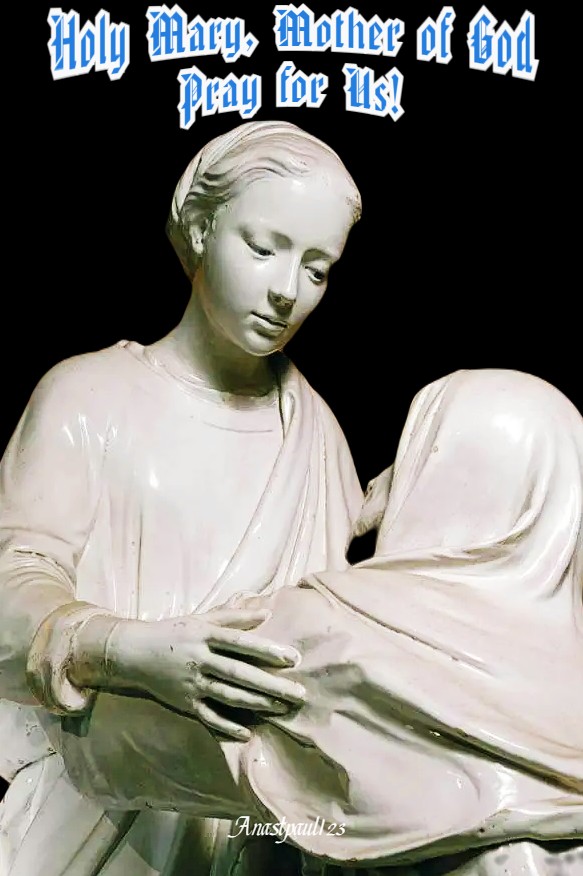
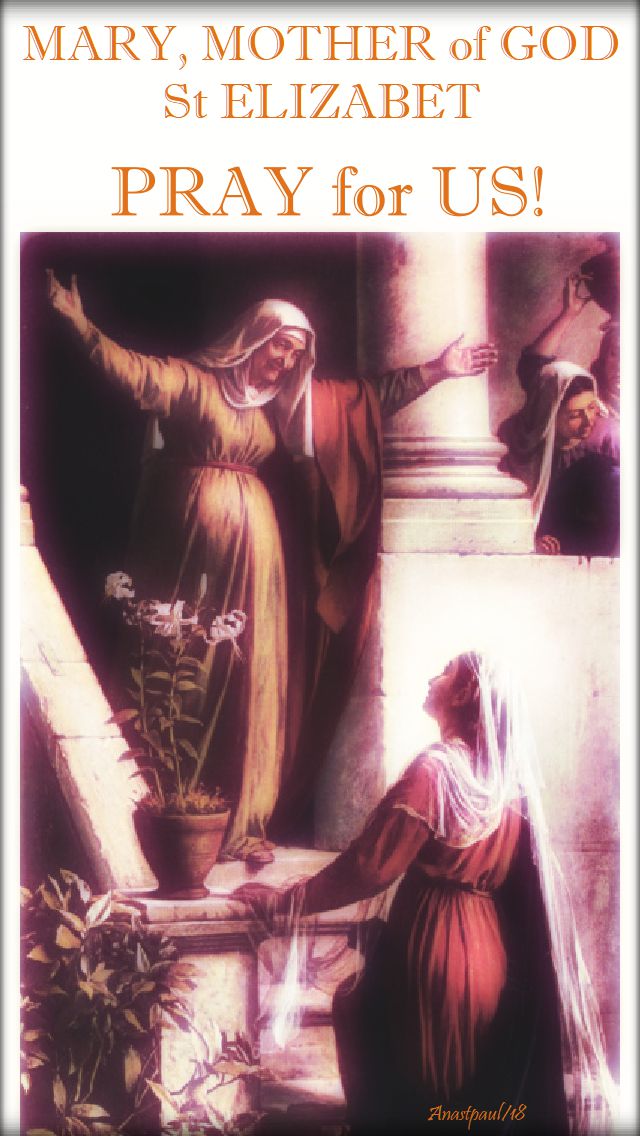
Mary, Mother of God, Pray for us!

St Elizabeth, Pray for us!mary mother of god, st elizabeth, pray for us - 31 may 2018 - the visitation

Posted in BREVIARY Prayers, CATHOLIC DEVOTIONS of the Month, CATHOLIC-PRAYERS OF THE CHURCH, DEVOTIO, FEASTS and SOLEMNITIES, MARIAN DEVOTIONS, MARIAN PRAYERS, MARIAN QUOTES, MORNING Prayers, PAPAL MESSAGES, PRAYERS of the CHURCH, QUOTES of the SAINTS, SAINT of the DAY, The BLESSED VIRGIN MARY, The WORD, VATICAN Resources

Our Morning Offering – 31 May – The Last Day of Mary’s Month and the Feast of the Visitation of the Blessed Virgin Mary

Our Morning Offering – 31 May – The Last Day of Mary’s Month and the Feast of the Visitation of the Blessed Virgin Mary

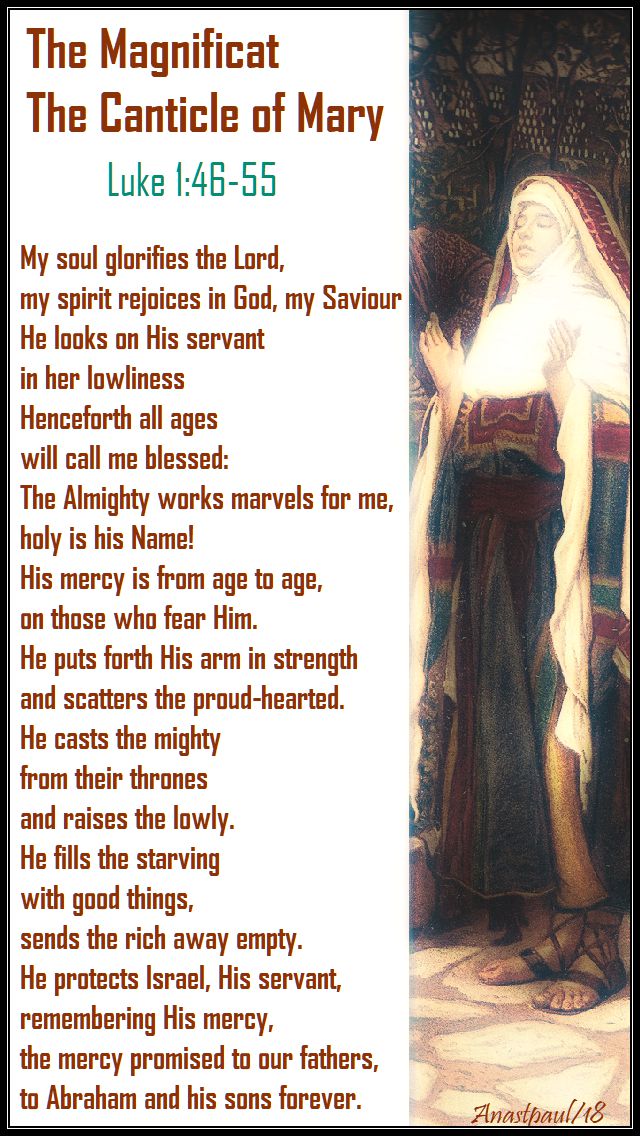
The Magnificat, is Mary’s great gift to scripture, one of its most beautiful prayers.   It is prayed every evening in the Liturgy of the Hours by millions around the world.   With that, Mary’s great acclamation becomes the Church’s.

The Magnificat
The Canticle of Mary
Luke 1:46-55

My soul glorifies the Lord,
my spirit rejoices in God, my Saviour
He looks on His servant in her lowliness
Henceforth all ages will call me blessed:
The Almighty works marvels for me,
holy is his Name!
His mercy is from age to age,
on those who fear Him.
He puts forth His arm in strength
and scatters the proud-hearted.
He casts the mighty from their thrones
and raises the lowly.
He fills the starving with good things,
sends the rich away empty.
He protects Israel, His servant,
remembering His mercy,
the mercy promised to our fathers,
to Abraham and his sons forever.

Excerpt (18) from the Apostolic Exhortation “Marialis Cultus”

 Blessed Pope Paul VI – 2 February 1974

“18.   Mary is also the Virgin in prayer.   She appears as such in the visit to the mother of the precursor, when she pours out her soul in expressions glorifying God and expressions of humility, faith and hope.   This prayer is the Magnificat (cf. Lk. 1:46-55), Mary’s prayer par excellence, the song of the messianic times in which there mingles the joy of the ancient and the new Israel.   As St Irenaeus seems to suggest, it is in Mary’s canticle, that there was heard once more, the rejoicing of Abraham who foresaw the Messiah (cf. Jn. 8:56)(48) and there rang out in prophetic anticipation the voice of the Church:  “In her exultation Mary prophetically declared in the name of the Church:  ‘My soul proclaims the glory of the Lord….'”

 And in fact Mary’s hymn has spread far and wide and has become the prayer of the whole Church in all ages.”

the magnificat - luke 1 46-55 - 31 may 2018 - feast of the visitation.jpg


Posted in CATHOLIC DEVOTIONS of the Month, FEASTS and SOLEMNITIES, MARIAN DEVOTIONS, MARIAN QUOTES, MORNING Prayers, SAINT of the DAY, The BLESSED VIRGIN MARY, The WORD

The Feast of the Visitation of the Blessed Virgin Mary – 31 May

The Feast of the Visitation of the Blessed Virgin Mary – 31 May

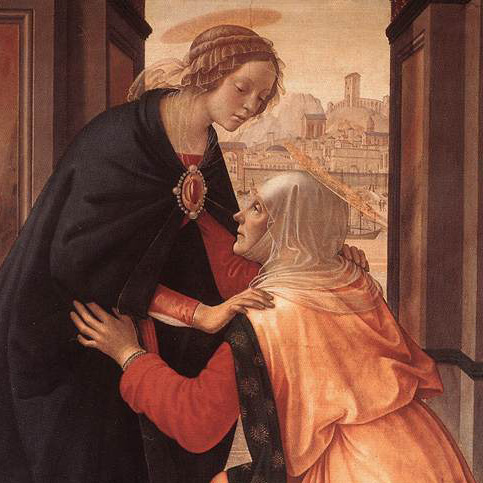
As we say goodbye to Mary’s Month of May, we celebrate today the feast of the Visitation of the Blessed Virgin Mary.   This feast celebrates the visit of Mary, the Mother of God, with the child Jesus in her womb, to her cousin Elizabeth.   The visit took place when Elizabeth was herself, six months’ pregnant, with the forerunner of Christ, Saint John the Baptist.   At the Annunciation of the Lord, the angel Gabriel, in response to Mary’s question “How shall this be done, because I know not man?” (Luke 1:34 ), had told her that “thy cousin Elizabeth, she also hath conceived a son in her old age; and this is the sixth month with her that is called barren: Because no word shall be impossible with God” (Luke 1:36-27).
header - visitation

The evidence of her cousin’s own near-miraculous conception had called forth Mary’s fiat:  “Behold the handmaid of the Lord; be it done to me according to thy word.”   It is thus appropriate, that the very next action of the Blessed Virgin, that Saint Luke the Evangelist records, is Mary’s “making haste” to visit her cousin.

The Significance of the Visitation
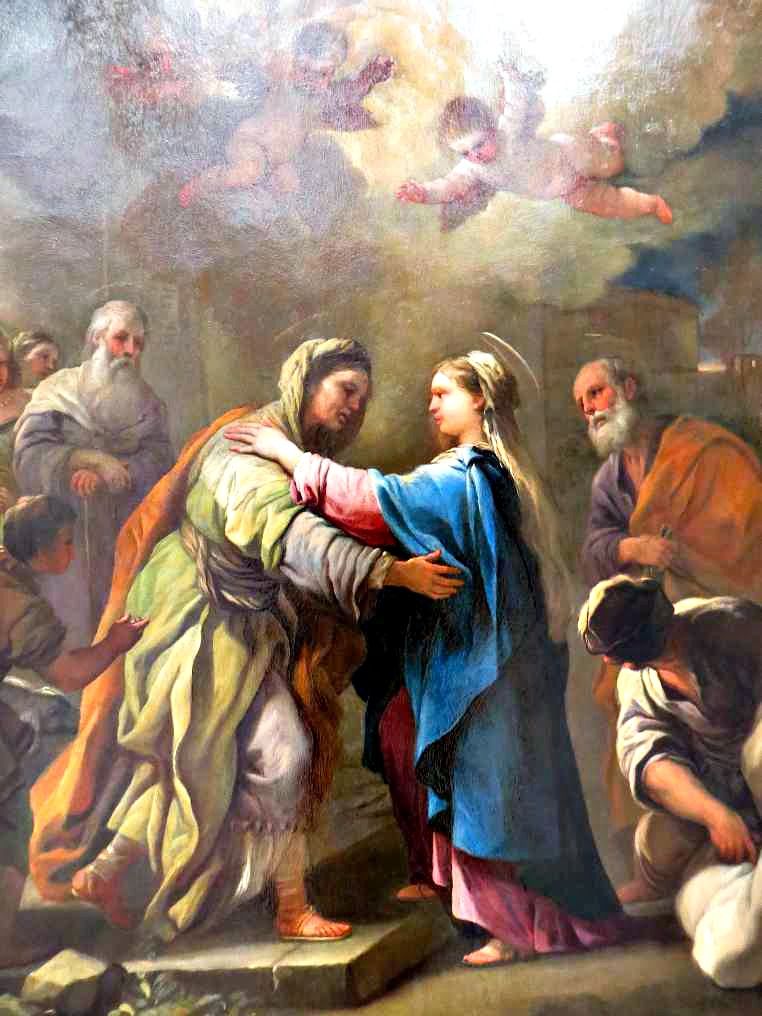
Arriving at the house of Zachariah and Elizabeth, Mary greets her cousin and something wonderful happens:  John the Baptist leaps in Elizabeth’s womb (Luke 1:41).   As the Catholic Encyclopedia of 1913 puts it in its entry on the Visitation, the Virgin Mary’s “presence and much more the presence of the Divine Child in her womb, according to the will of God, was to be the source of very great graces to the Blessed John, Christ’s Forerunner.”visitation 3
 

The Cleansing of John the Baptist From Original Sin
John’s leap was no ordinary movement of an unborn child, for as Elizabeth tells Mary, “as soon as the voice of thy salutation sounded in my ears, the infant in my womb leaped for joy” (Luke 1:44).   The joy of John the Baptist, the Church has held from the time of the early Church Fathers, came from his cleansing at that moment of Original Sin, in accordance with the angel Gabriel’s prophecy to Zachariah, before John’s conception, that “he shall be filled with the Holy Ghost, even from his mother’s womb” (Luke 1:15).   As the Catholic Encyclopedia notes in its entry on St John the Baptist, “as the presence of any sin whatever is incompatible with the indwelling of the Holy Ghost in the soul, it follows that at this moment John was cleansed from the stain of original sin.”

The Origin of Two Great Catholic Prayers
Elizabeth, too, is filled with joy and cries out in words that would become part of the chief Marian prayer, the Hail Mary:  “Blessed art thou among women, and blessed is the fruit of thy womb.”   Elizabeth then acknowledges her cousin Mary as “the mother of my Lord” (Luke 1:42-43).   Mary responds with the Magnificat (Luke 1:46-55), a canticle or biblical hymn that has become an essential part of the Church’s evening prayer (vespers). It is a beautiful hymn of thanksgiving, glorifying God for choosing her to be the mother of His Son, as well as for His mercy “from generation until generations, to them that fear Him.”


The History of the Feast of the Visitation of the Blessed Virgin Mary
The Visitation is mentioned only in Luke’s Gospel and Luke tells us that Mary stayed with her cousin about three months.   The angel Gabriel, as we have seen, told Mary at the Annunciation that Elizabeth was six months pregnant and Luke seems to indicate that the Blessed Virgin departed for her cousin’s home very soon after the Annunciation.

While many Marian feasts are among the first feasts to have been celebrated universally by the Church, East and West, the celebration of the Visitation, even though it is found in Luke’s Gospel, is a relatively late development.   It was championed by Saint Bonaventure and adopted by the Franciscans in 1263.   When it was extended to the universal Church by Pope Urban VI in 1389, the date of the feast was set as July 2, the day after the octave (eighth) day of the feast of the Birth of Saint John the Baptist.   The idea was to tie the celebration of the Visitation, at which Saint John had been cleansed of Original Sin, to the celebration of his birth, even though the placement of the feast in the liturgical calendar was out of sync with the account given by Luke.   In other words, symbolism, rather than chronology, was the deciding factor in choosing when to commemorate this important event.

For close to six centuries, the Visitation was celebrated on July 2, but with his revision of the Roman calendar in 1969, Pope Paul VI moved the celebration of the Visitation of the Blessed Virgin Mary to the last day of the Marian month of May so that it would fall between the feasts of the Annunciation and the Birth of Saint John the Baptist—a time when Luke tells us that Mary would certainly have been with Elizabeth, taking care of her cousin in her time of need.