
Thought for the Day – 28 November – It’s time to Hope! Advent is nearly upon us
This year, as before, I will post daily Advent Reflections drawn from diverse Saints and Holy people – please join me in prayer and in awakening our souls to hope.
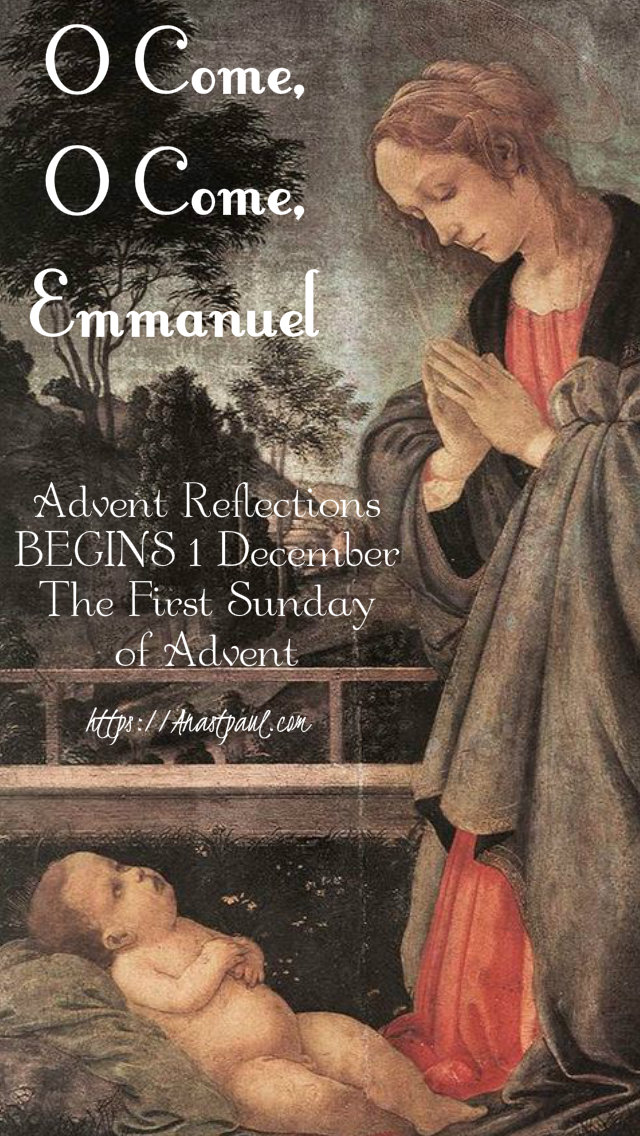
Memory Awakens Hope
By Joseph Cardinal Ratzinger
(Pope Benedict XVI)
In one of his Christmas stories Charles Dickens tells of a man who lost his emotional memory, that is, he lost the whole chain of feelings and thoughts he had acquired in the encounter with human suffering. This extinction of the memory of love is presented to him as liberation from the burden of the past but it becomes clear, immediately, that the whole person has been changed, now, when he meets with suffering, no memories of kindness are stirred within him… Since his memory has dried up, the source of kindness within him has also disappeared. He has become cold and spreads coldness around him.
Goethe deals with the same ideas as Dickens, in his account of the first celebration of the feast of Saint Roch in Bingen, after the long interruption caused by the Napoleonic wars. He observes the people as they press, tightly packed, through the church past the image of the saint and he watches their faces – the faces of the children and the adults are shining, mirroring the joy of the festal day. But with the young people, Goethe reports, it was otherwise. They went past unmoved, indifferent, bored. And he gives an illuminating explanation – they were born in evil times, had nothing good to remember and consequently had nothing to hope for. In other words, it is only the person who has memories who can hope. The person who has never experienced goodness and kindness simply does not know what such things are.
Recently a counsellor who spends much of his time talking with people on the verge of despair, was speaking in similar terms about his own work, if his client succeeds in recalling a memory of some good experience, he may once again be able to believe in goodness and thus relearn hope, then there is a way out of despair. Memory and hope are inseparable. To poison the past does not give hope, it destroys its emotional foundations.
Sometimes Charles Dickens’ story strikes me as a vision of contemporary experience. This man who let himself be robbed of the heart’s memory by the delusion of a false liberation — do we not find him with us today, in a generation whose past has been poisoned by a particular program of liberation that has stifled hope? When we read of the pessimism with which our young people look toward the future, we ask ourselves, Why? Is it that, in the midst of material affluence, they have no memory of human goodness that would allow them to hope? By outlawing the emotions, by satirising joy, have we not trampled on the root of hope?
These reflections bring us straight to the significance of the Christian season of Advent. For Advent is concerned with that very connection between memory and hope which is so necessary to man. Advent’s intention is to awaken the most profound and basic emotional memory within us, namely, the memory of the God Who became a Child. This is a healing memory, it brings hope. The purpose of the Church’s year is continually to rehearse her great history of memories, to awaken the heart’s memory so that it can discern the star of hope. All the feasts in the Church’s calendar are events of remembrance and hence events of hope. These events, of such great significance for mankind, which are preserved and opened up by faith’s calendar, are intended to become personal memories of our own life history, through the celebration of holy seasons by means of liturgy and custom. Our personal memories are nourished by mankind’s great memories, in turn, it is only by translating them into personal term,s that these great memories are kept alive. Man’s ability to believe always depends in part on faith having become dear on the path of life, on the humanity of God having manifested itself through the humanity of men. No doubt each of us could tell his own story here as to what the various memories of Christmas, Easter or other festivals mean in his life.
It is the beautiful task of Advent, to awaken in all of us, memories of goodness and thus to open doors of hope.
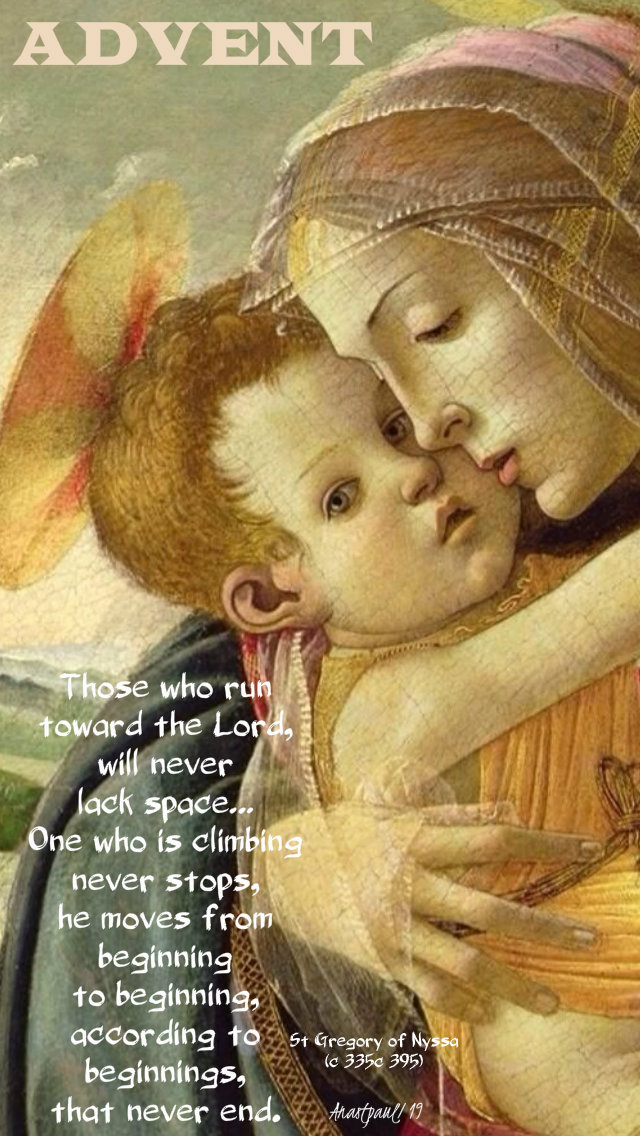
“Those who run
toward the Lord,
will never lack space…
One who is climbing
never stops,
he moves from
beginning to beginning,
according to beginnings,
that never end.”
 AnaStpaul
You must be logged in to post a comment.