
Saint of the Day – 9 April – Saint Acacius (Died c425) Bishop of Amida, Mesopotamia, then Persia (modern-day Turkey), Confessor. He administered his Diocese from c400-c425 during the reign of the Eastern Roman Emperor , Theodosius II. . He has no extant writings but his life is documented by Socrates Scholasticus, in the 21st chapter of the 7th book of his “Church History.” There, Acacius is described as freeing thousands of slaves. Also known as – Acacio, Acathius.
The Roman Martyrology reads today: “At Amida, in Mesopotamia, St Acacius, Bishop, who melted any sold even the Sacred Vessels, in order to ransom captives.”
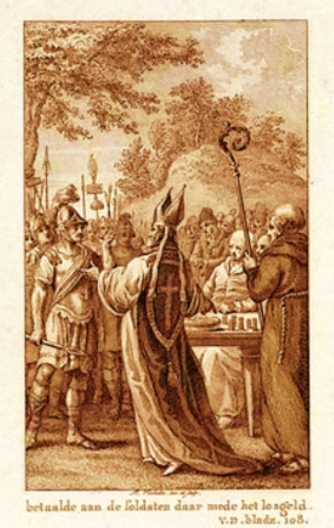
Our Saint Acacius, the Bishop of Amida, a man of faith and action, his tale is intertwined with the political and religious events of 5th Century Persia.
As the Ambassador of Theodosius II to the Sassanid King Iezdgerd I, Acacius found himself mediating between the two powers in a period of growing tension. His fame is linked to the episode of the seven thousand Persian prisoners deported by the Romans. Acacius, moved by their suffering, sold the Sacred Vessels of his Diocese in order to raise the funds needed to ransom these sorrowful prisonsers. When the ransomed captives returned home to Persia, they told their Ruler of the great deeds performed by Acacius. Most of these converted to Christianity of their own accord. An act of Christian charity which earned him the esteem of King Baharam V and the admiration of posterity.
The following is the full account in Socrates Scholastic, “Church History” Book 7, Chapter 21 which records everything known from about St Acacius:
“A noble action of Acacius, the Bishop of Amida, at that time greatly enhanced his reputation among all men.
As the Roman soldiery, would on no consideration, restore the captives whom they had taken, , to the Persian King, these captives, about seven thousand in number, were being destroyed by famine in devastating Azazene. This greatly distressed the King of the Persians.
Then Acacius thought such a matter was by no means to be trifled with; having, therefore, assembled his Clergy, he thus addressed them:
‘Our God, my brethren, needs neither dishes nor cups;
for He neither eats nor drinks, nor is in want of anything. Since then, by the liberality of its faithful members,
the Church possesses many Vessels,
both of gold and silver, it behooves us to sell them,
that by the money thus raised, we may be able to redeem the prisoners and also supply them with food.‘
Having said these things and many others similar to these,
he ordered the Vessels to be melted and from the proceeds, paid the soldiers a ransom for their captives, whom he supported for some time and then, furnishing them with what was needful for their journey, sent them back to their sovereign.
This benevolence on the part of the excellent Acacius, astonished the King of the Persians, as if the Romans were accustomed to conquer their enemies as well by their beneficence in peace, as their prowess in war.
They say also that the Persian King wished that Acacius should come into his presence that he might have the pleasure of beholding such a man; a wish which, by the Emperor Theodosius’ order was soon gratified.
So important a victory having through Divine favour been achieved by the Romans, many who were illustrious for their eloquence, wrote panegyrics in honour of the Emperor and recited them in public. The Empress herself also composed a poem in heroic verse, for she had excellent literary taste; being the daughter of Leontius the Athenian sophist, she had been instructed in every kind of learning by her father. Atticus the Bishop had baptised her a little while previous to her marriage to the Emperor,and had then given her the Christian name of Eudocia, instead of her pagan one of Athenaïs.
Many, as I have said, produced eulogiums on this occasion. Some indeed, were stimulated by the desire of being noticed by the Emperor, while others were anxious to display their talents to the masses, being unwilling that the attainments they had made by dint of great exertion should lie buried in obscurity.”




 AnaStpaul
You must be logged in to post a comment.