
Saint of the Day – 11 May – St Francesco de Girolamo (1642-1716) SJ Priest, Apostolic Missionary of the Society of Jesus, who spent more than 40 years teaching, preaching Naples and its surrounds leading to his being titled “The Apostle of Naples.” His life was one of total service to all in humility and the most zealous care, espeically of the needy, of prisoners, sailors, the youth and women of ill-repute. He was an intellectual giant, scholar and a Miracle-worker. Born on 17 December 1642 at Grottaglie, Apulia, near Taranto, Italy and died on 11 May 1716 at Naples. Also known as – “The Apostle of Naples” Francis di Girolamo, Francis de Geronimo, Francesco de Hieronymo, Franciscus di Hieronymo, Francis Jerome.
The Roman Martyrology reads today: “At Grottaglia, in the Diocese of Taranto, St Francesco de Giroliamo, Confessor, of the Society of Jesus, renowned for his zeal for the salvation of souls and for his patience. He was Canonised by Pope Gregory XVI. The day of his death is celebrated with great solemnity in the Church of the Professed House at Naples where his body rests.”
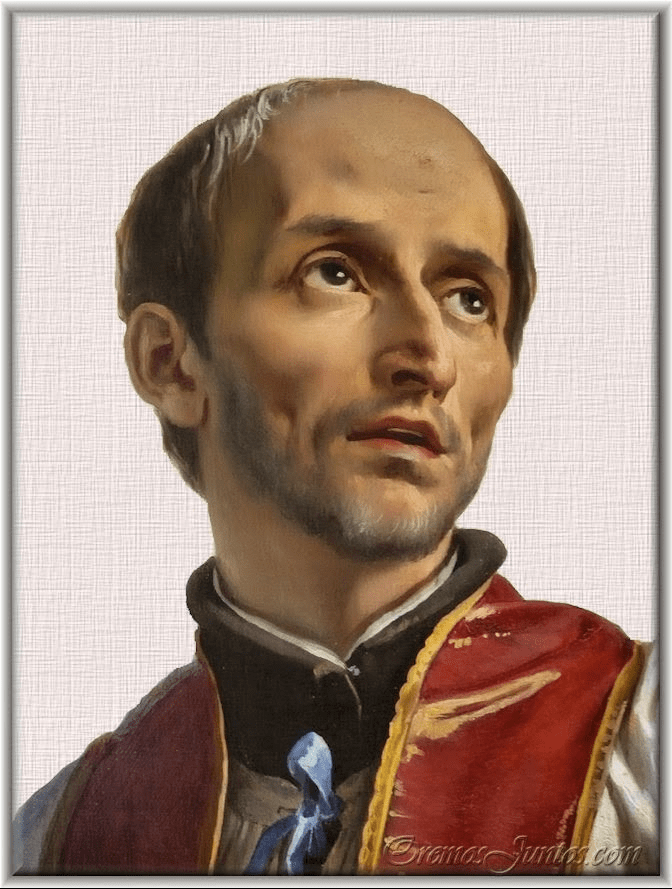
St Francesco was born in Grottaglie (Taranto) on 17 December 1642, the 1st of 11 children, 3 of whom became Priests, to a wealthy family of profound Christian faith.
He was fortunate to find in his native town, a school of letters and piety which benefited him greatly until the age of 17. In fact, at about the age of 10 years, he was entrusted to a Congregation of Priests dedicated to teaching and preaching missions to the faithful.
Young St Francesco, rather than being admitted merely to school, had the privilege of living with these pious Priests, who soon entrusted him with the care of the Church as the Sacristan and the teaching of Catechism to the children. He also sometimes accompanied the Priests on missions, helping them with the instruction of Catechism to the young.
At the age of 16 om 1658, St Francesco was given the first tonsure at the proposal of the same Congregation and at 17 he was received into the Diocesan Seminary in Taranto, to continue his studies, now definitively destined for the Priesthood. He attended courses in rhetoric, science and philosophy at the schools of the Jesuit College, being Ordained Sub-Deacon in 1664 and sometime later Deacon.
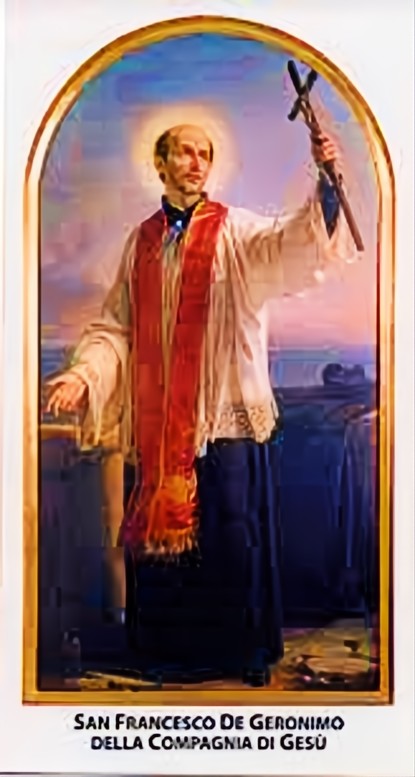
In 1665 St Francesco went to Naples, on the advice of his own teachers, to attend courses in civil and canon law, obtaining a Degree in these subjects, apparently in 1668 and in theology.
In order not to be a burden on the family budget, St Francesco requested and obtained, a position as Assistant to the young students at the highest College of the Neapolitan Jesuits. Meanwhile, in 1666, while studying theology, he was Ordained a Priest and in 1670 he became a Jesuit before completing his theological studies. He completed them a few years later in order to take the examination in universa philosophia et theologia, required by the Order’s Constitutions for the solemn Profession of the four vows.
From 1671 to 1674, he served in apostolic ministry in Puglia, particularly in the Diocese of Lecce.
Just as his excellent intellectual gifts and virtues had already been demonstrated in his life as a student and Assistant to young people, to the point of being called the ‘holY’ Priest by the young, so too in his apostolic activity his qualities as a zealous apostle and effective preacher, were revealed.
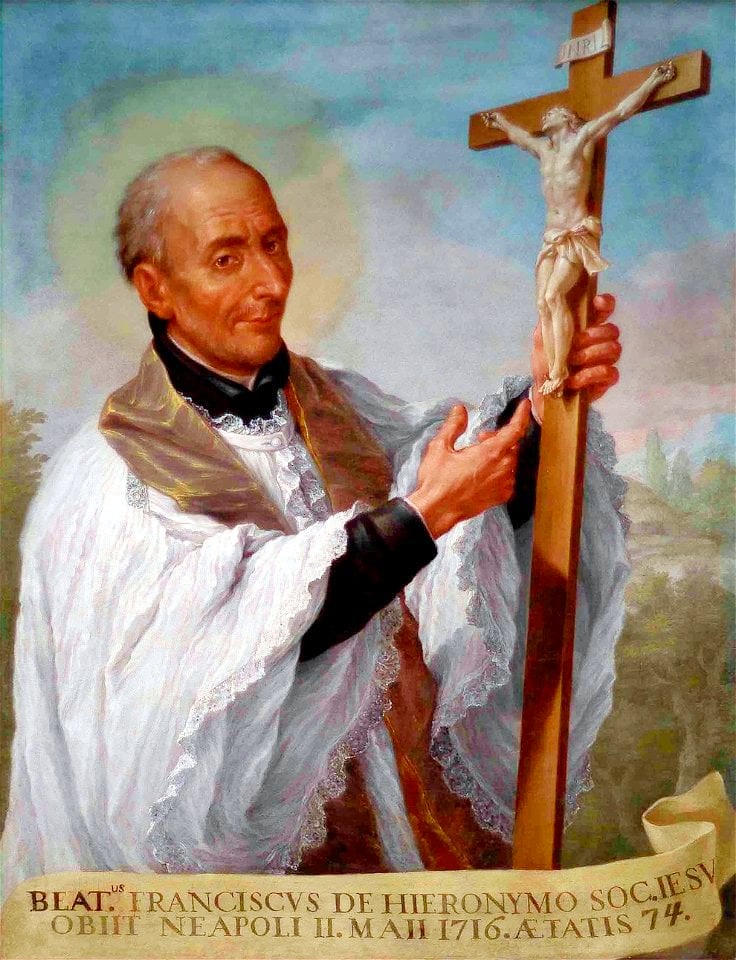
Once he returned to Naples to complete his theological studies, he remained there for his entire life, Assigned to the popular missions which made him an Apostle of Naples and replaced the missions to India and the East which he had insistently requested. He made his solemn Religious Profession (8 December 1682) at the height of his Neapolitan apostolate, having been assigned since 1676 to the Casa Professa del Gesù Nuovo with all the duties inherent to the Office entrusted to him. It was essentially a threefold Office: the missions to the faithful which consisted of sermons held in the squares and along the streets, where large crowds gathered on Feast Days, which were quite numerous; general Communion every 3rd Sunday of the month, also prepared with open-air sermons and with his assistants, led the multitudes to the Church of the Gesù, where numerous Priests were already on standby to hear Confessions and the conversion of women from wicked lives.
This was one aspect of his public missions but what was special about it was that he entered the neighbourhoods where the homes which sheltered the unfortunate, were most numerous and began preaching under their windows.
His biographers recall many cases, sometimes miraculous, of conversions or repentance among these women.
But this threefold role did not exhaust the missionary’s activity, as he extended his apostolate to all those in need, such as ship workers, prisoners, the sick and the men of his congregation of artisans, a kind of Catholic circle or Confraternity which was of invaluable assistance to him in his missions and in organising, as mentioned, the general Communions on the 3rd Sunday of the month.
Although the City of Naples was his missionary field for about forty years, his apostolic zeal did not end there, as he is known to have taken part in missions many times in other regions of the Kingdom of Naples, such as Abruzzo, Puglia, and Sannio . Above all, however, Naples and its surroundings benefited from his work and were strongly influenced by his miracle-working holiness, as demonstrated by the events of 1707, when the Austrian Army occupied Naples, driving out the Spanish under Philip V. As was often the case in similar circumstances, the people gave way to revolts and looting. That time, however, St Francesco’s moral authority succeeded in averting the danger or significantly limiting it. Indeed, it seems that he helped prevent the Spanish barricaded in the fortresses from bombarding the City, acting as a mediator, as the Canonisation processes attests.
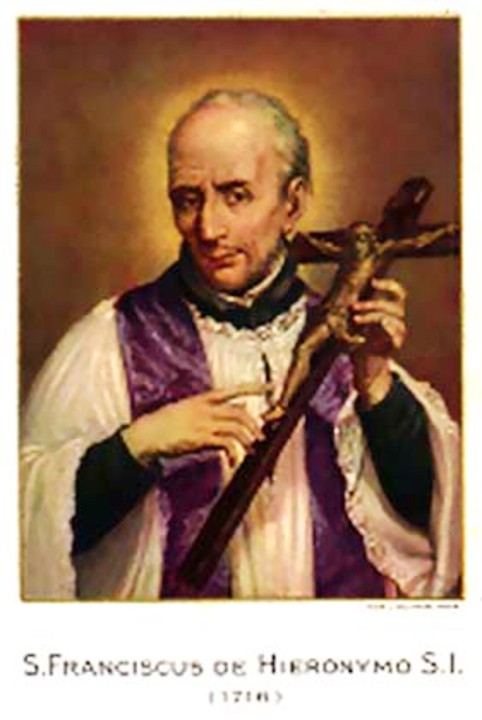
Another apostolic activity of St Francesco deserves mention i.e. his spiritual exercises for various classes of the people: Monasteries of nuns, Youth Centres, prisoners and ‘galley slaves.’ Everywhere he carried warm words of faith and love, inflamed as he was with a burning charity, especially toward Jesus Christ in the Eucharist and his most Holy Mother.
Among the devotions St Francesco favoured and spread ,a particular one was to St. Cyrus, Physician and Martyr, whose body rests in the Chapel of the same name in the Church of the Gesù Nuovo in Naples. He carried a Relic of the Saint with him on his missions and attributed to it all the miracles he performed during his sermons, although many contemporary witnesses believe that God worked miracles through our Saints own virtues and that he, in his humility, hid behind the healing power of St Cyrus. This testimony serves to demonstrate the esteem in which his virtues were held by his contemporaries, who, moreover, unanimously affirmed the sanctity of his life in all the Canonisation processes which began just a few years after his death, which occurred in Naples on 11 May 1716.
St Francesco was Beatified by Pope Pius VII on 2 May 1806, when the Jesuits, at the request of King Ferdinand IV of Bourbon, were recognised for the Kingdom of Naples (the Order was restored in 1814).
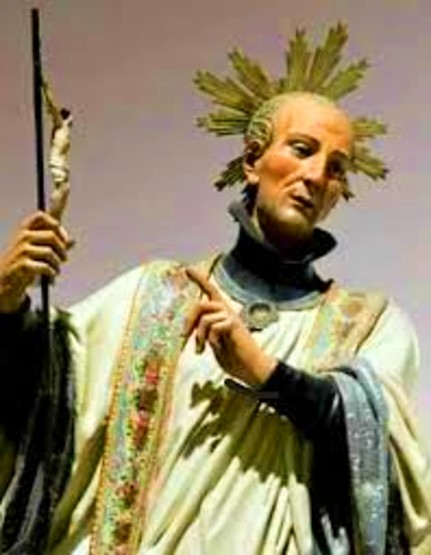
He was then Canonised by Pope Gregory XVI on 26 May 1839, and his Feast Day was set on the day of his death. His body, transferred to the Chapel named after him in the Church of Gesù Nuovo in Naples which was enriched by the sculptor Jerace with an artistic Statue of the Saint preaching, remained there until after the Second World War, when it was moved to the Jesuit Church in Grottaglie, the Saint’s birthplace.



 AnaStpaul
You must be logged in to post a comment.