Quote/s of the Day – 20 December – “The Month of the Divine Infancy and the Immaculate Conception of the Blessed Virgin Mary”
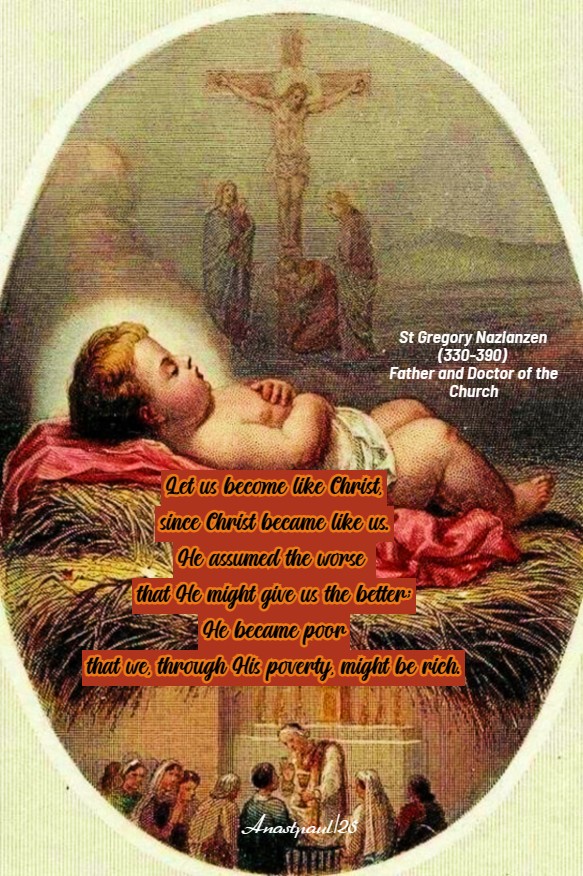
“Let us become like Christ, since Christ became like us. He assumed the worse that He might give us the better; He became poor that we, through His poverty, might be rich.”
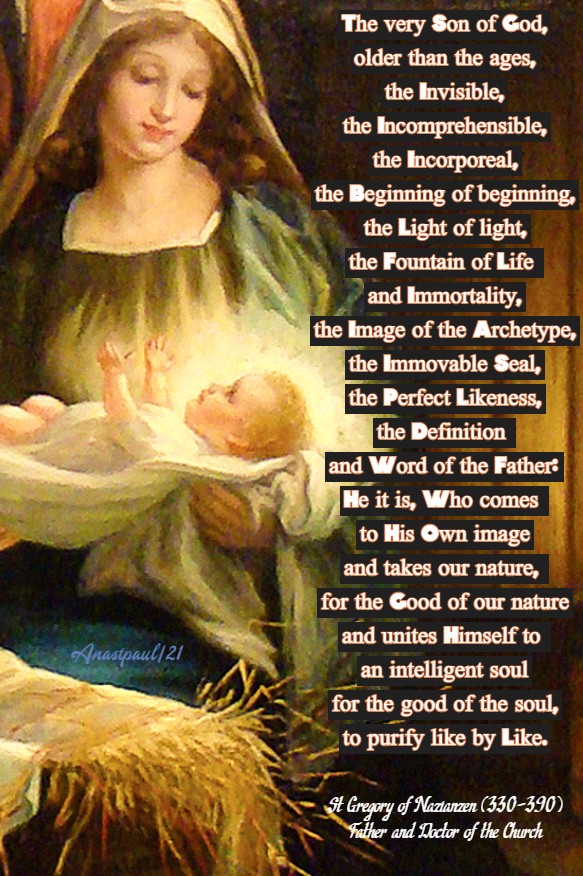
“The very Son of God, Older than the ages, the Invisible, the Incomprehensible, the Incorporeal, the Beginning of beginning, the Light of light, the Fountain of Life and Immortality, the Image of the Archetype, the Immovable Seal, the Perfect Likeness, the Definition and Word of the Father: He it is, Who comes to His Own Image and takes our nature, for the Good of our nature and unites Himself to an intelligent soul for the good of the soul, to purify like by Like.”
St Gregory Nazianzen (330-390) Father and Doctor of the Church
Quote/s of the Day – 29 November – Vigil of St Andrew Apostle – Ecclesiasticus 44:25-27; 45:2-4; 45:6-9; John 1:35-51 – Scripture search here: https://www.drbo.org/
“Jesus turned and saw them following Him and said to them, “What are you looking for?”
John 1:38
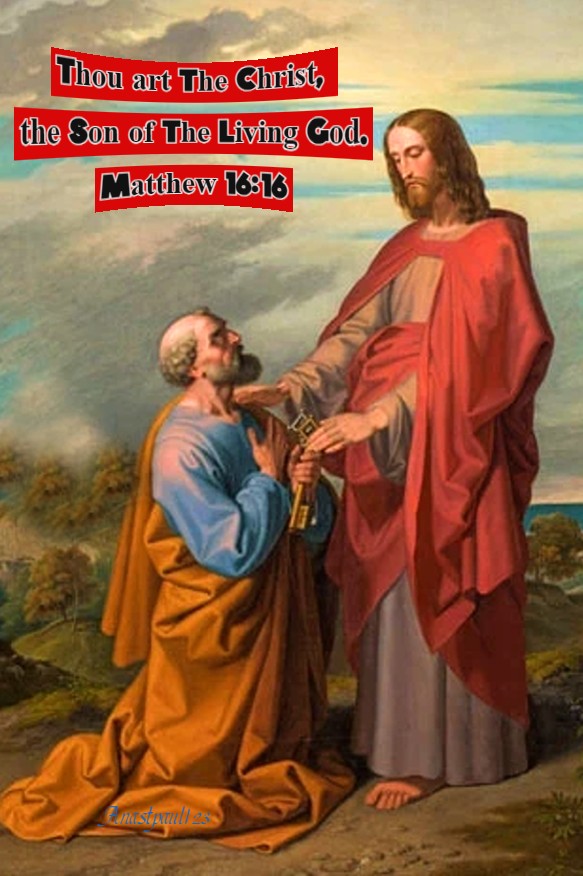
“Thou art the Christ, the Son of the living God!”
Matthew 16:16
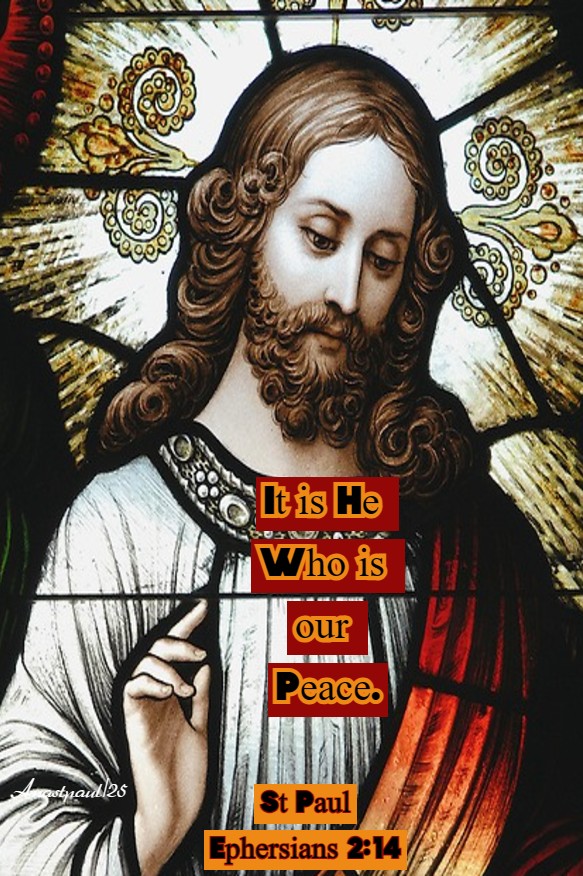
“It is He Who is our peace.”
St Paul Ephesians 2:14
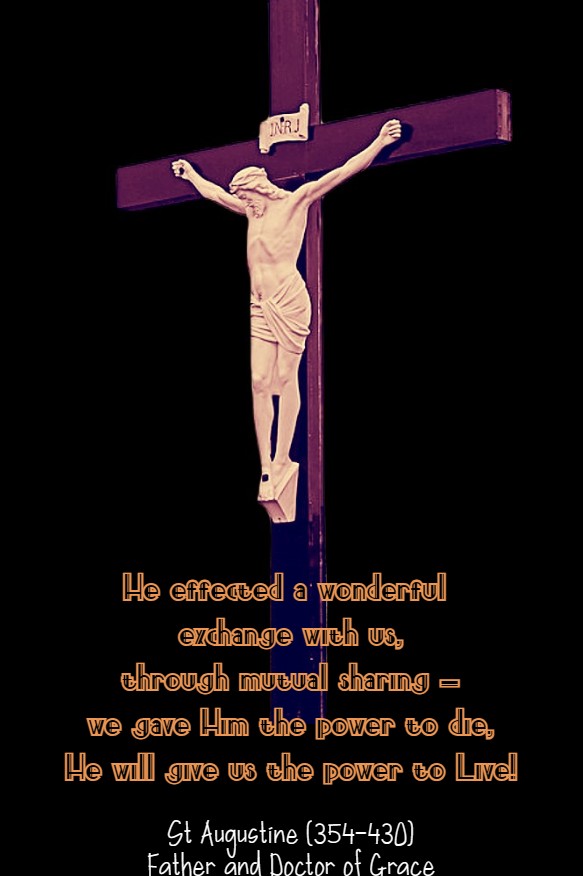
“… He effected a wonderful exchange with us, through mutual sharing – we gave Him the power to die, He will give us the power to Live!”
St Augustine (354-430) Father and Doctor of Grace
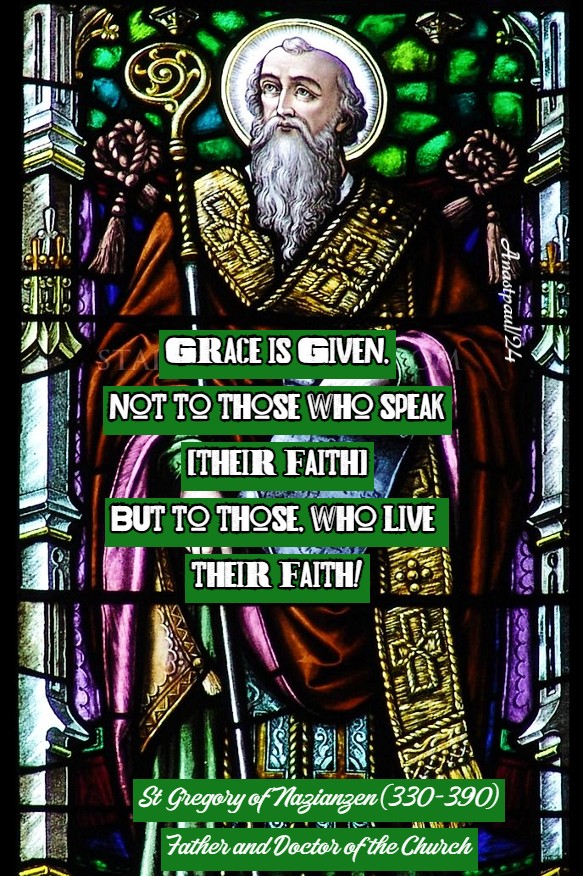
“Grace is given, not to those who speak [their faith] but to those, who live their faith!”
St Gregory Nazianzen (330-390) Father and Doctor of the Church
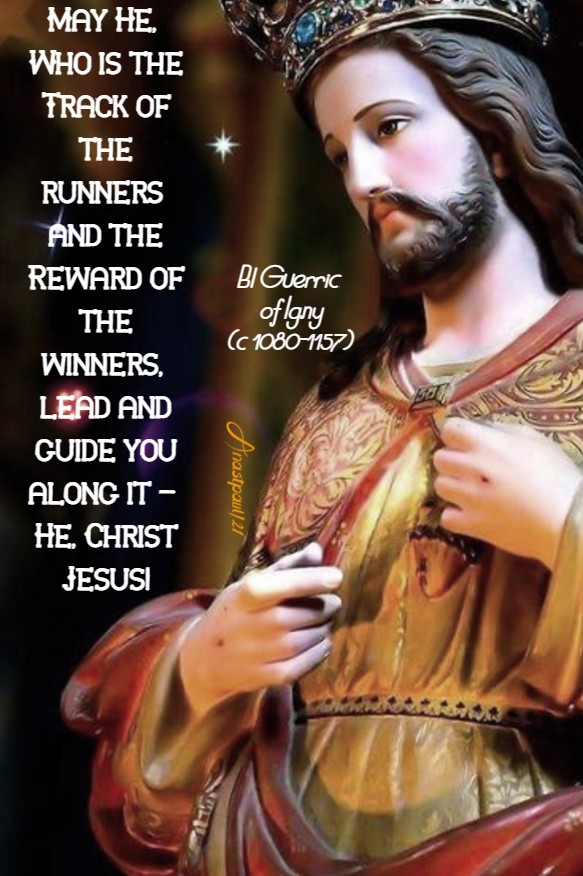
“May He, Who is the Track of the runners and the Reward of the winners, lead and guide you along it – He, Christ Jesus!”
Bl Guerric of Igny O.Cist (c1080-1157)
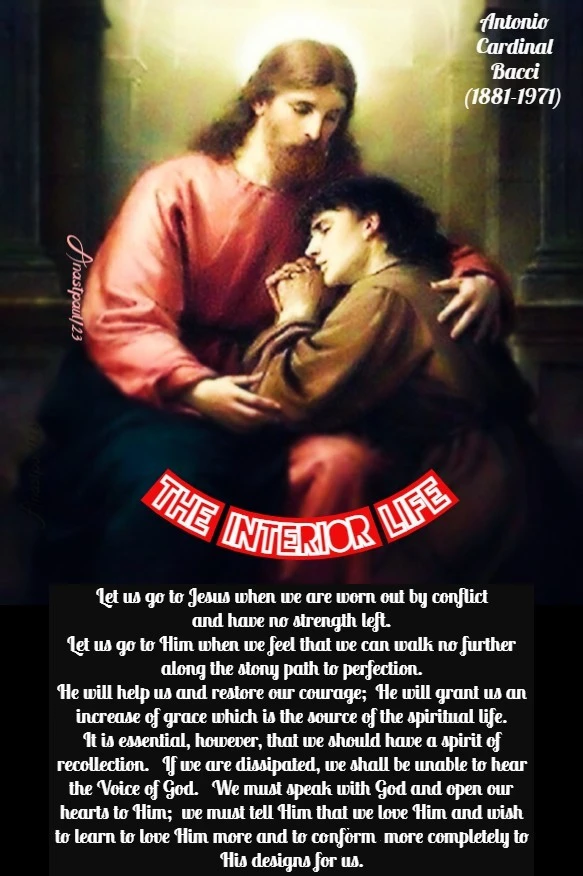
“Let us go to Jesus when we are worn out by conflict and have no strength left. Let us go to Him when we feel that we can walk no further along the stony path to perfection. He will help us and restore our courage; He will grant us an increase of grace which is the source of the spiritual life. It is essential, however, that we should have a spirit of recollection. If we are dissipated, we shall be unable to hear the Voice of God. We must speak with God and open our hearts to Him; we must tell Him that we love Him and wish to learn to love Him more and to conform more completely to His designs for us.”
Quote/s of the Day – 12 October – 1 Corinthians 1:4-8 – Matthew 9:1-8 – Scripture search here: https://www.drbo.org/
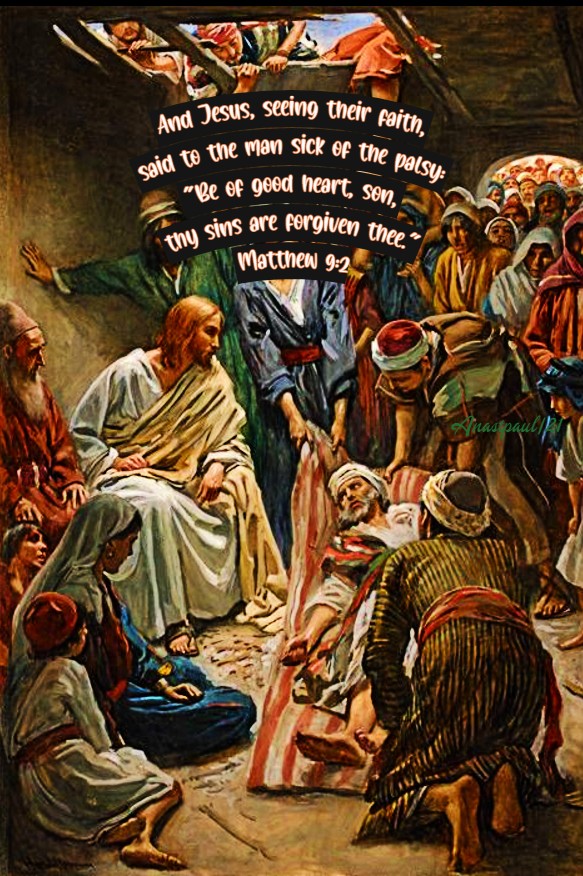
“And Jesus, seeing their faith, said to the paralytic, Take courage, son, your sins are forgiven you.”
Matthew 9:2
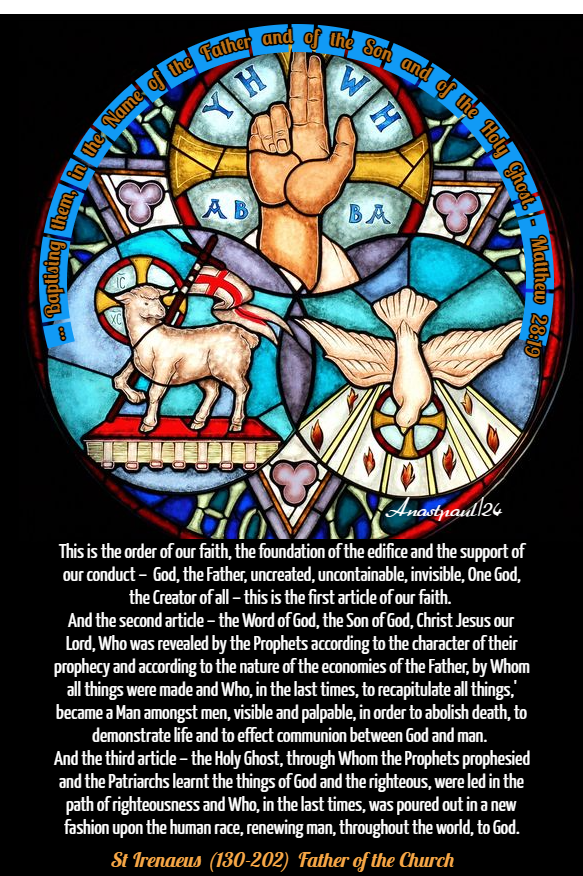
“This is the order of our faith, the foundation of the edifice and the support of our conduct – God, the Father, uncreated, uncontainable, invisible, One God, the Creator of all – this is the first article of our faith. And the second article – the Word of God, the Son of God, Christ Jesus our Lord, Who was revealed by the Prophets according to the character of their prophecy and according to the nature of the economies of the Father, by Whom all things were made and Who, in the last times, to recapitulate all things, became a Man amongst men, visible and palpable, in order to abolish death, to demonstrate life and to effect communion between God and man. And the third article – the Holy Ghost, through Whom the Prophets prophesied and the Patriarchs learnt the things of God and the righteous, were led in the path of righteousness and Who, in the last times, was poured out in a new fashion upon the human race, renewing man, throughout the world, to God.”
St Irenaeus (130-202) Martyr, Father of the Church
“Grace is given, not to those who speak [their faith] but to those, who live their faith!”
St Gregory Nazianzen (330-390) Father and Doctor of the Church
“… He effected a wonderful exchange with us, through mutual sharing – we gave Him the power to die, He will give us the power to Live!”
St Augustine (354-430) Father and Doctor of Grace
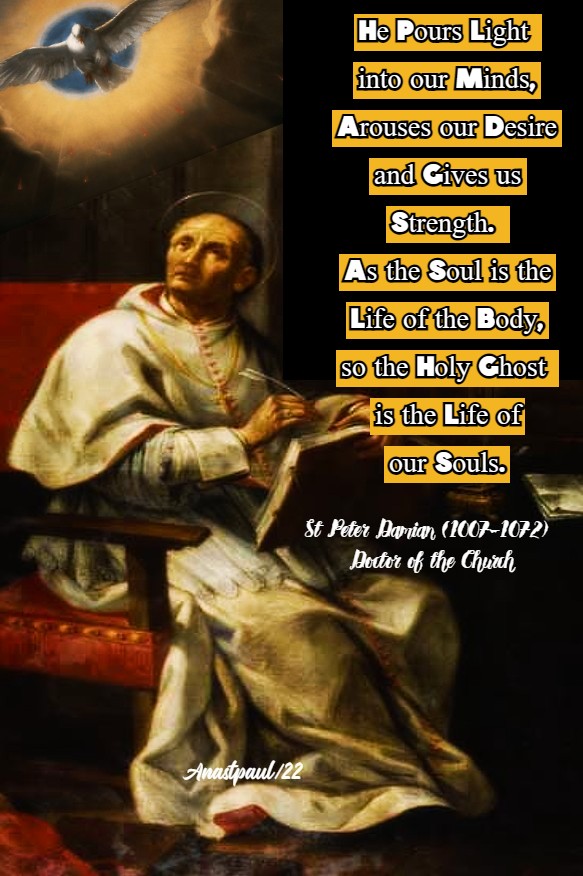
“He pours light into our minds, arouses our desire and gives us strength… As the soul is the life of the body, so the Holy Ghost is the life of our souls.”
St Peter Damian (1007-1072) Bishop, Father and Doctor of the Church
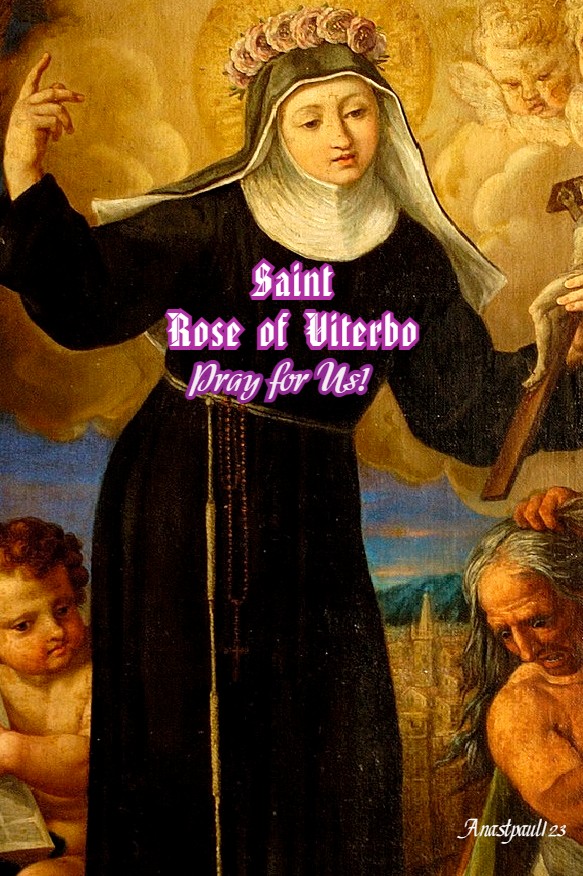
One Minute Reflection – 4 September – “The Month of The Seven Sorrows of the Blessed Virgin Mary and The Holy Cross” – St Rose of Viterbo (c1233 – 1251) Virgin – Ferial Day – 2 Corinthians 3:4-9 – Luke 10:23-37 – Scripture search here: https://www.drbo.org/
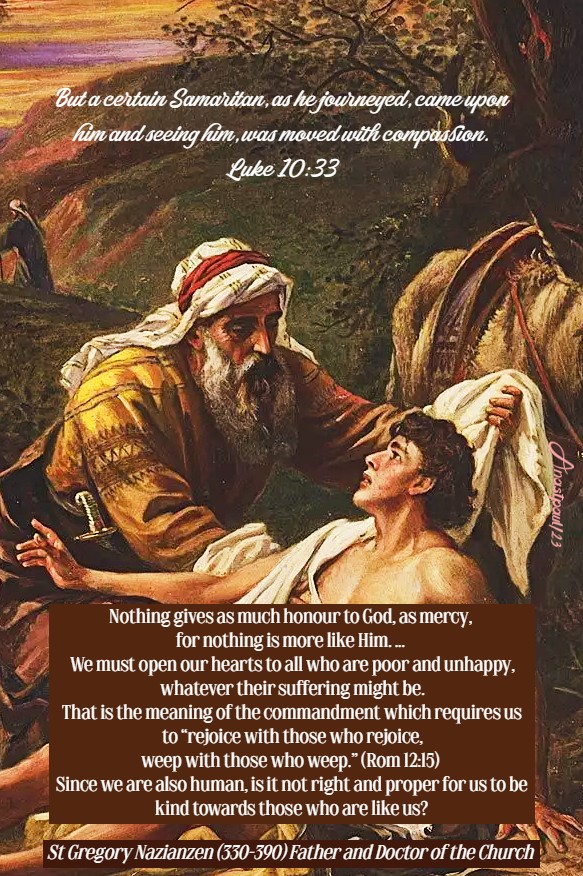
“But a certain Samaritan, as he journeyed, came upon him and seeing him, was moved with compassion.” – Luke 10:33
REFLECTION – “The first and the greatest of the commandments,that on which the Law and the Prophets are based, (Mt 22:40) is love which, it seems to me, brings its greatest proof, in love of the poor, in tenderness and compassion for one’s neighbour. Nothing gives as much honour to God, as mercy, for nothing is more like Him. “Mercy and Truth go before Him,” (Ps 88:15) and He prefers mercy to judgement (Hos 6:6). Nothing attracts the kindness of the Friend of humankind, as much as kindness towards humankind, (Wis 1:6) His reward is just, He weighs and measures mercy.
We must open our hearts to all who are poor and unhappy, whatever their suffering might be. That is the meaning of the commandment which requires us to “rejoice with those who rejoice, weep with those who weep.” (Rom 12:15) Since we are also human, is it not right and proper for us to be kind towards those who are like us?” – St Gregory Nazianzen (330-390) Bishop, Father and Doctor of the Church (On Love of the Poor, 4-6).
PRAYER – Protect Thy Church by Thine abiding mercy, we beseech Thee, O Lord and since all mortals fall without Thee, may Thy help keep them from danger and guide them to salvation. May the prayers of Thy virgin the blessed Rose, assist us on our journey to Thee. Through Jesus Christ, Thy Son our Lord, Who lives and reigns with Thee, in the unity of the Holy Ghost, God, world without end. Amen (Collect).
Quote/s of the Day – 9 May – St Gregory Nazianzen (330-390) Bishop, Confessor, Father and Doctor of the Church
“Let us become like Christ, since Christ became like us. He assumed the worse that He might give us the better; He became poor that we, through His poverty, might be rich.”
“The very Son of God, Older than the ages, the Invisible, the Incomprehensible, the Incorporeal, the Beginning of beginning, the Light of light, the Fountain of Life and Immortality, the Image of the Archetype, the Immovable Seal, the Perfect Likeness, the Definition and Word of the Father: He it is, Who comes to His Own Image and takes our nature, for the Good of our nature and unites Himself to an intelligent soul for the good of the soul, to purify like by Like.”
“Grace is given, not to those who speak [their faith] but to those, who live their faith!”
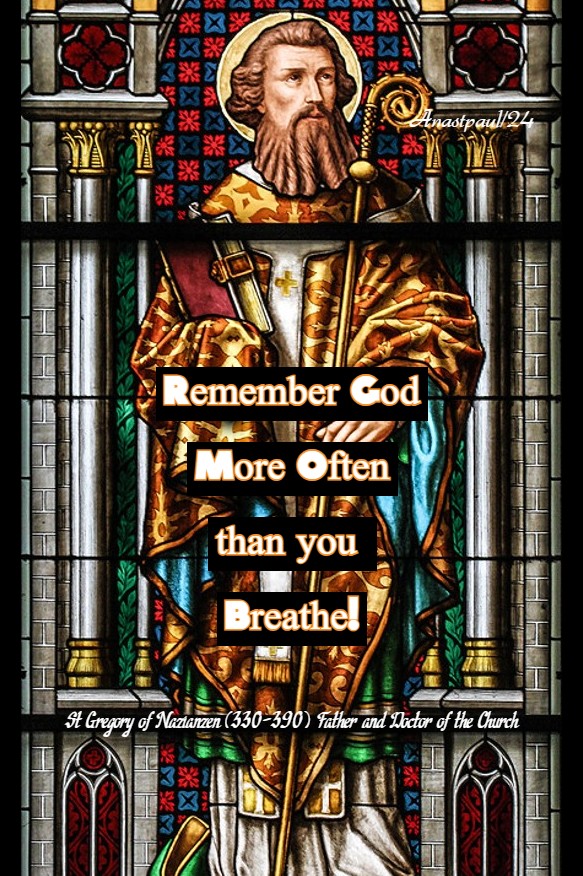
“Remember God more often than you breathe.”
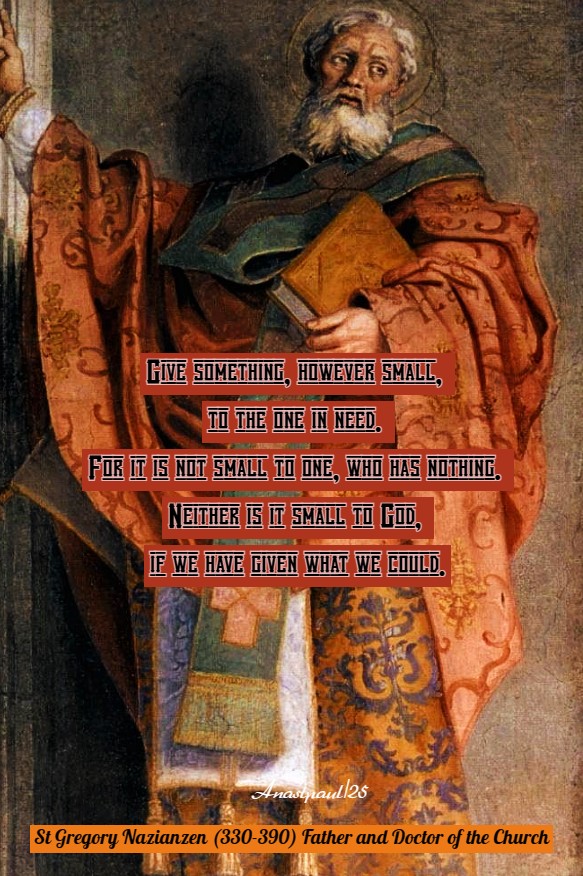
“Give something, however small, to the one in need. For it is not small to one, who has nothing. Neither is it small to God, if we have given what we could.”
One Minute Reflection – 9 May – “The Month of the Blessed Virgin Mary” – St Gregory Nazianzen (330-390) Bishop, Confessor, Father and Doctor of the Church – Sirach 39:6-14 – Matthew 5:13-19 – Scripture search here: https://www.drbo.org/
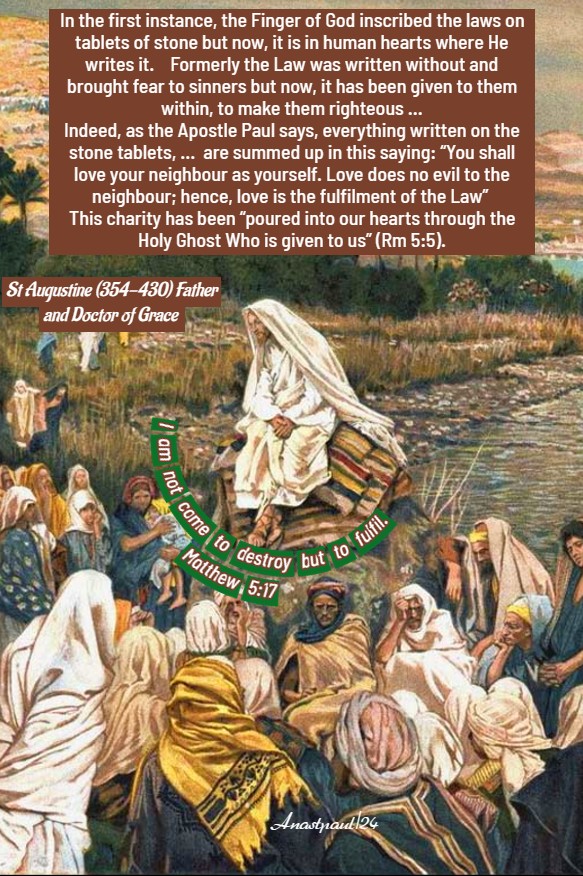
“I am not come to destroy but to fulfil.” – Matthew 5:17
REFLECTION – “Grace which was formerly veiled, so to speak, in the Old Testament, has been fully revealed in the Gospel of Christ by a harmonious disposition of the times, just as God usually disposes of everything with harmony … But within this wonderful harmony, we notice a great difference between the two ages. On Sinai, the people did not dare draw near the place where the Lord was giving His Law; in the Upper Room, the Holy Ghost comes down on all those assembled there, while waiting for the fulfilment of the promise (Ex 19:23; Acts 2:1). In the first instance, the Finger of God inscribed the laws on tablets of stone but now, it is in human hearts where He writes it (Ex 31:18; 2 Cor 3:3). Formerly the Law was written without and brought fear to sinners but now, it has been given to them within, to make them righteous …
Indeed, as the Apostle Paul says, everything written on the stone tablets, “you shall not commit adultery, you shall not kill. .. you shall not covet” and whatever other commandments there may be, are summed up in this saying: “You shall love your neighbour as yourself. Love does no evil to the neighbour; hence, love is the fulfilment of the Law” (Rm 13:9f.; Lv 19:18) … This charity has been “poured into our hearts through the Holy Ghost Who is given to us” (Rm 5:5).” – St Augustine (354-430) Father and Doctor of Grace (On the spirit and the letter, 28-30).
PRAYER – O God, Who gave to Your people, blessed Gregory, as a minister of salvation, grant, we beseech You, that we, who cherished him on earth as a teacher of life, may be found worthy to have him as an intercessor in Heaven. Through Jesus Christ, Thy Son our Lord, Who lives and reigns with Thee, in the unity of the Holy Ghost, God, world without end. Amen (Collect).
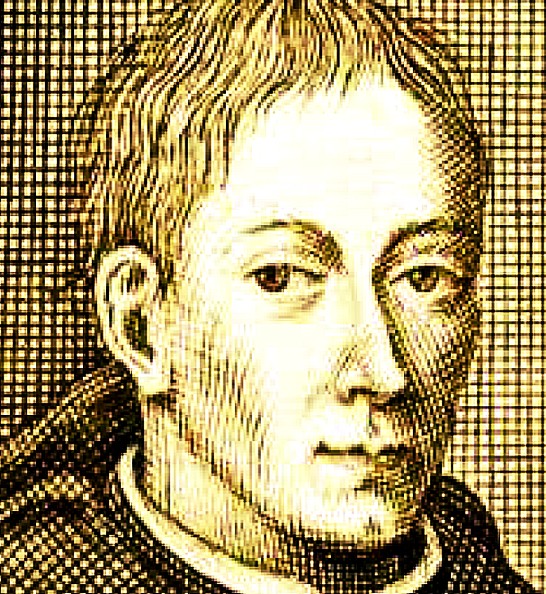
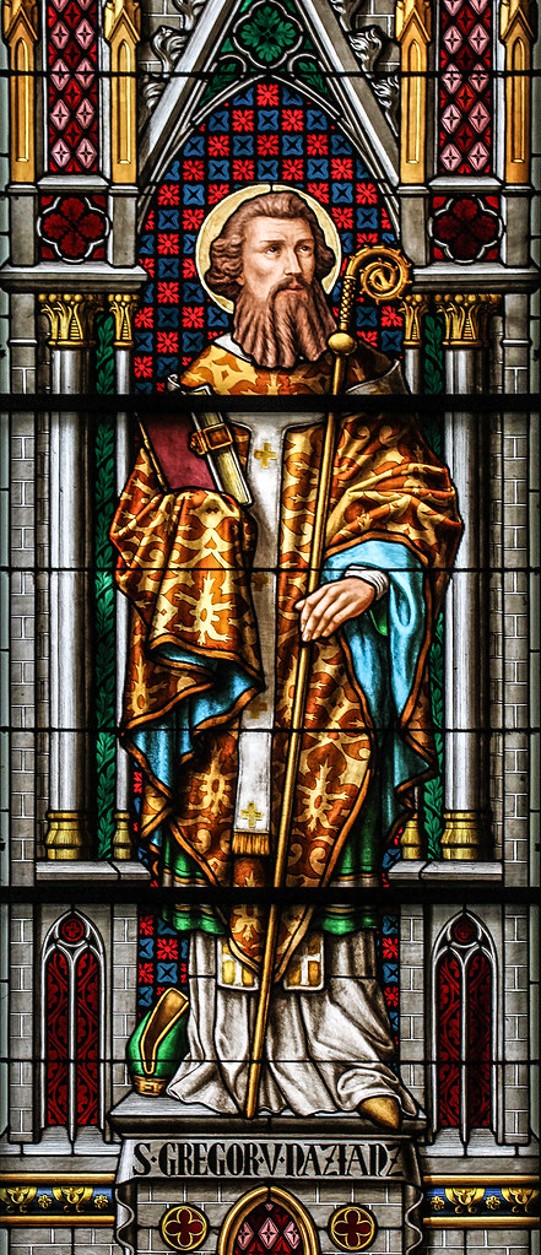
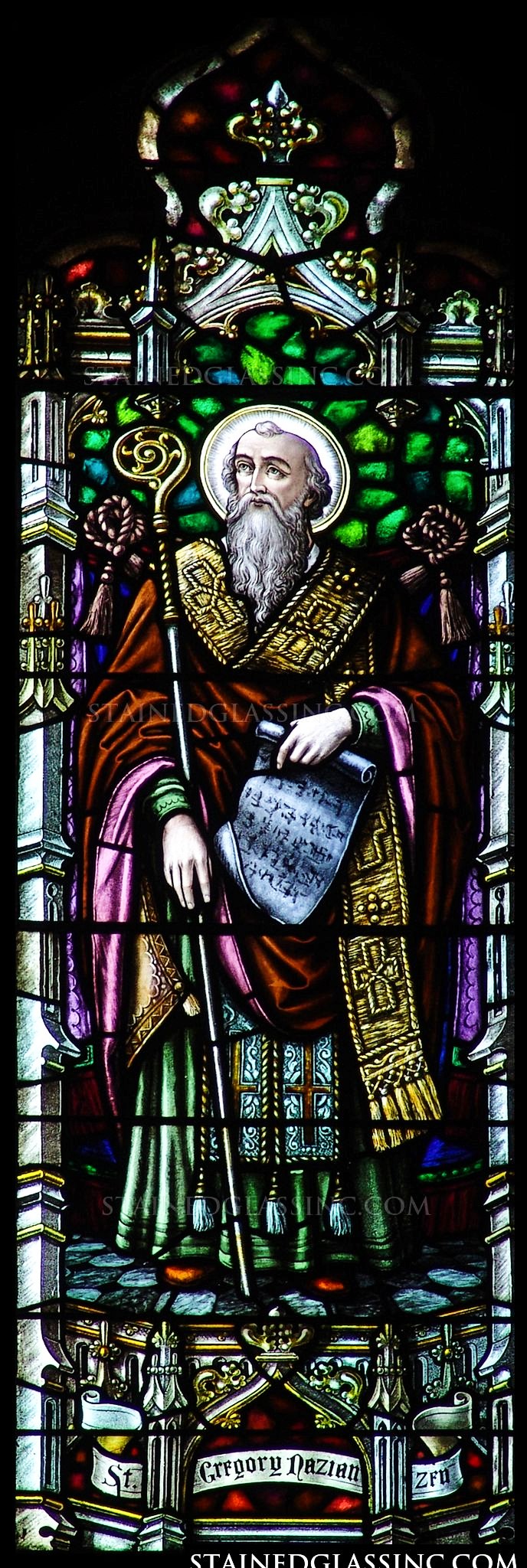
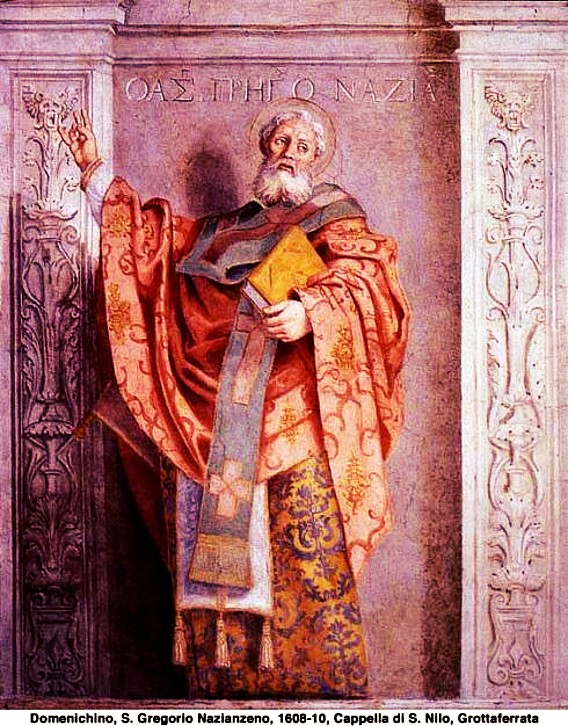
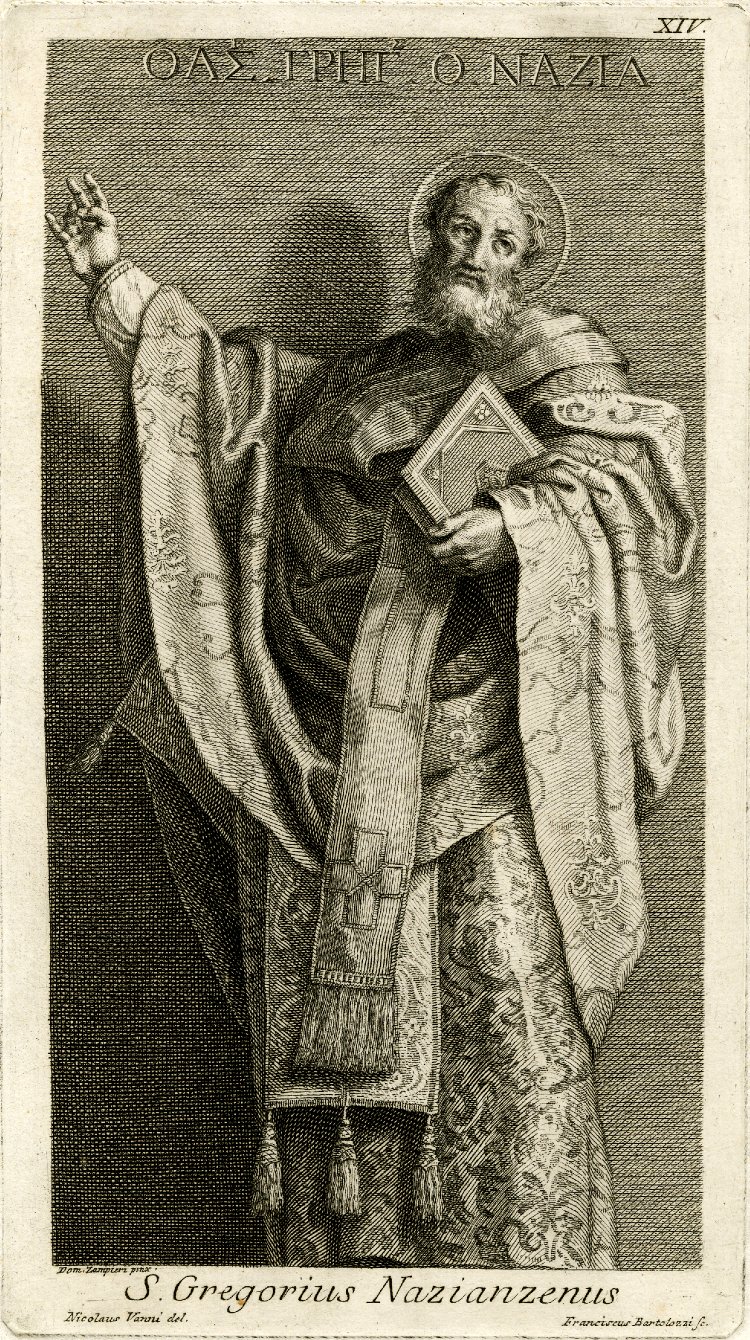
St Gregory Nazianzen (330-390) Archbishop of Constantinople, Father, Doctor, Confessor, Theologian, Philosopher, Orator, Poet, Writer, he is remembered as the “Trinitarian Theologian.” He is widely considered one of the most accomplished rhetorical stylist of the patristic age. Along with his great friends and colleagues, the brothers St Basil the Great and St Gregory of Nyssa, he is known as one of the Cappadocian Fathers. The Cappadocia region, in modern-day Turkey, was an early site of Christian activity, with several missions by St Paul in this region. The Roman Martyrology states of him today: “At Naziazus, the birthday of St Gregory, Bishop and Doctor of the Church, surnamed “The Theologian” because of his remarkable knowledge of divinity. At Constantinople, he restored the Catholic Faith, which was fast waning and repressed the rising heresies.” Wonderful St Gregory: https://anastpaul.com/2022/05/09/saint-of-the-day-9-may-st-gregory-nazianzen-330-390-great-father-and-doctor-of-the-church/ AND: (In 1969, St Gregory’s Feast was combined with that of St Basil the Great – “Two Bodies one Spirit” and was then celebrated on 2 January). Their lives here: https://anastpaul.com/2019/01/02/saint-s-of-the-day-2-january-st-basil-the-great-329-379-and-st-gregory-of-nazianzen-330-390-two-bodies-one-spirit/
St Banban the Wise St Beatus of Laon St Beatus of Lungern St Brynoth of Scara St Dionysius of Vienne Bl Fortis Gabrielli St Gerontius of Cervia
Blessed Giovanni Benincasa of Montepulciano OSM (1375-1426) Religious Friar of the Servite Order, Hermit, Mystic, Penitent. His Beatification received formal approval from Pope Pius VIII on 23 December 1829. His Devout Life
St Giuse Hien St Gorfor of Llanover
St Gregory of Ostia St Hermas of Rome Isaiah the Prophet St John of Châlon
Blessed Thomas Pickering (c1621-1679) Martyr, Benedictine Lay Brother. He was one of the 107 Martyrs of England and Wakes. They were Beatified by Pope Pius XI on 15 December 1929 and is, therefore, remembered with them all on 4 May. In character, he was described, as the most charitable and sweet-tempered of men. His Life and Death: https://anastpaul.com/2021/05/09/saint-of-the-day-9-may-blessed-thomas-pickering-osb-c-1621-1679-martyr/
St Vincent (Died c950) Abbot of Montes
Martyrs of Persia: 310 Christians murdered together for their faith in Persia. No details about them have survived.
20 Mercedarian Martyrs of Riscala: 20 Mercedarian friars who were murdered by Huguenot heretics for refusing to denounce their faith. 16th century at the Santa Maria convent at Riscala, France.
DISCLAIMER: Please note: I cannot control the content of the Advertisements on this Site, or of pop-ups which may appear, The revenue from the Advertisements, however, does provide a little assistance in the support of the Site. I do apologise for any inappropriate content.
Quote/s of the Day – 7 May – The Solemnity of the Patronage of St Joseph
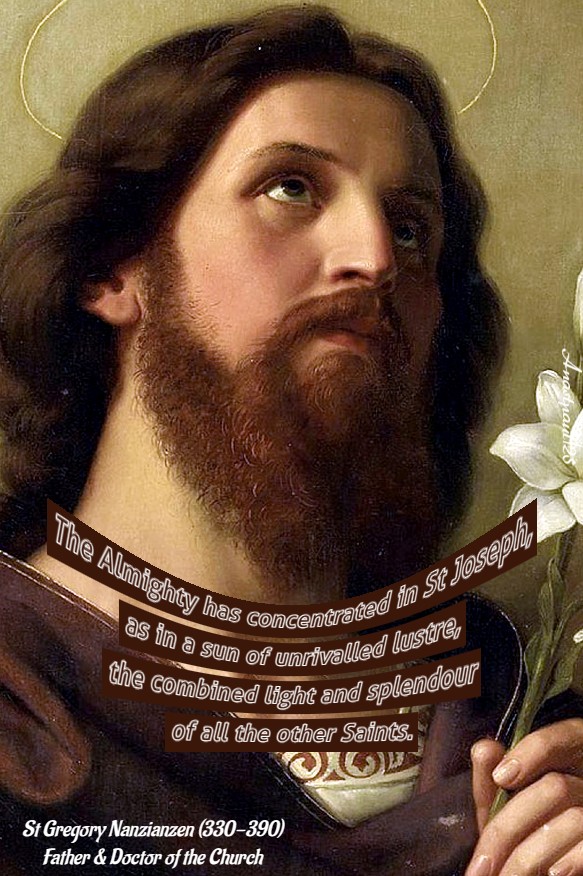
“The Almighty has concentrated in St Joseph, as in a sun of unrivalled lustre, the combined light and splendour of all the other Saints.”
St Gregory Nanzianzen (330-390) Father & Doctor of the Church
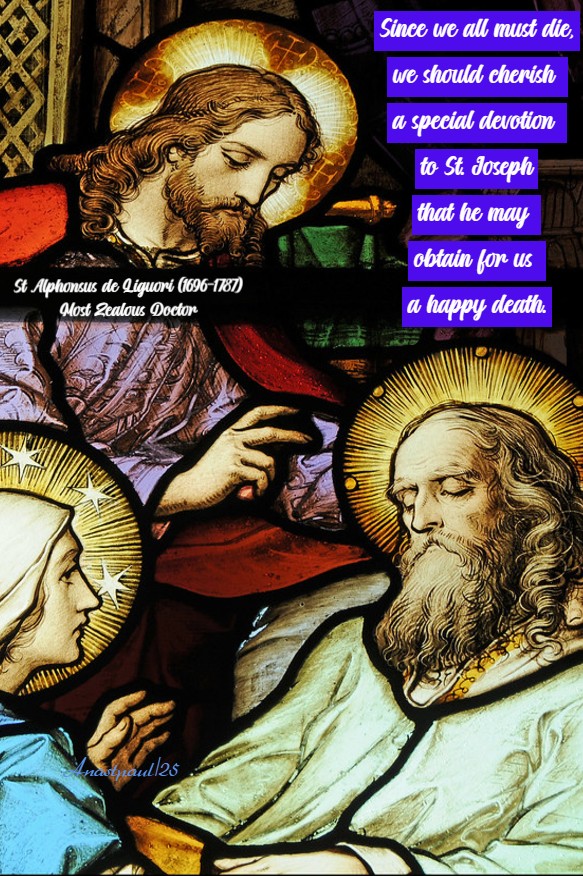
“Since we all must die, we should cherish a special devotion to St Joseph that he may obtain for us a happy death.”
St Alphonsus Maria de Liguori (1696-1787) Most Zealous Doctor
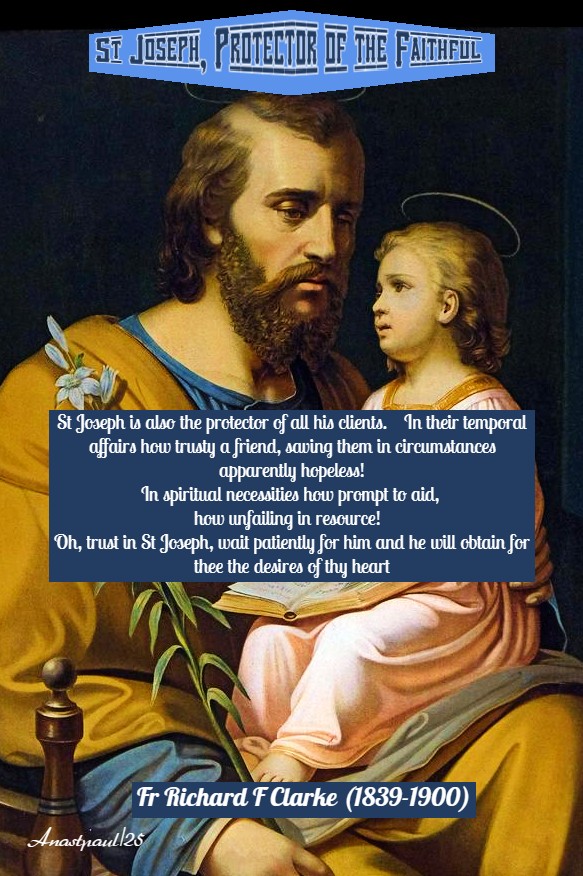
“ St Joseph is also the protector of all his clients. In their temporal affairs how trusty a friend, saving them in circumstances apparently hopeless! In spiritual necessities how prompt to aid, how unfailing in resource! Oh, trust in St Joseph, wait patiently for him and he will obtain for thee the desires of thy heart.”
Quote/s of the Day – 31 March – Goodbye to “The Month of Saint Joseph”
“The Almighty has concentrated in St Joseph, as in a sun of unrivalled lustre, the combined light and splendour of all the other Saints.”
St Gregory Nanzianzen (330-390) Father & Doctor of the Church
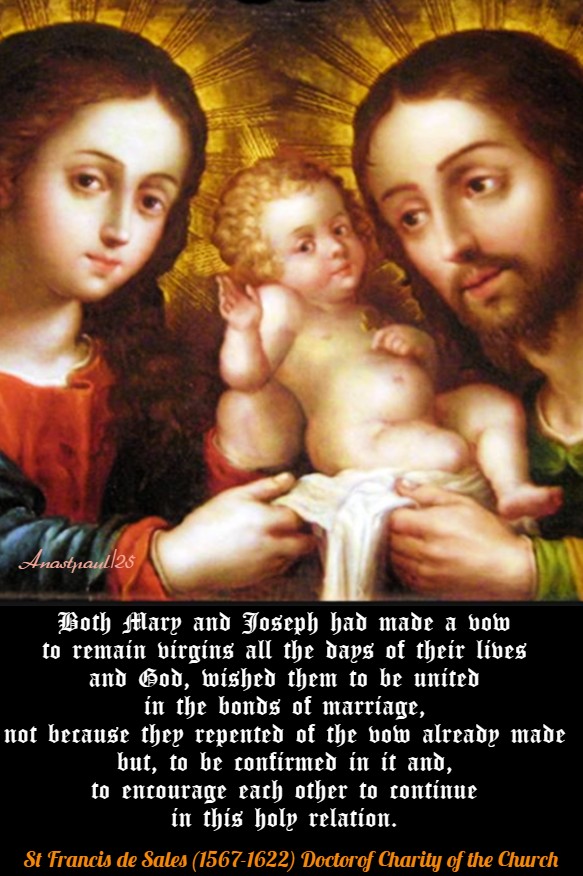
“Both Mary and Joseph had made a vow to remain virgins all the days of their lives and God, wished them to be united in the bonds of marriage, not because they repented of the vow already made but, to be confirmed in it and, to encourage each other to continue in this holy relation.”
St Francis de Sales (1567-1622) Doctorof Charity of the Church
“Since we all must die, we should cherish a special devotion to St. Joseph that he may obtain for us a happy death.”
St Alphonsus Maria de Liguori (1696-1787) Most Zealous Doctor
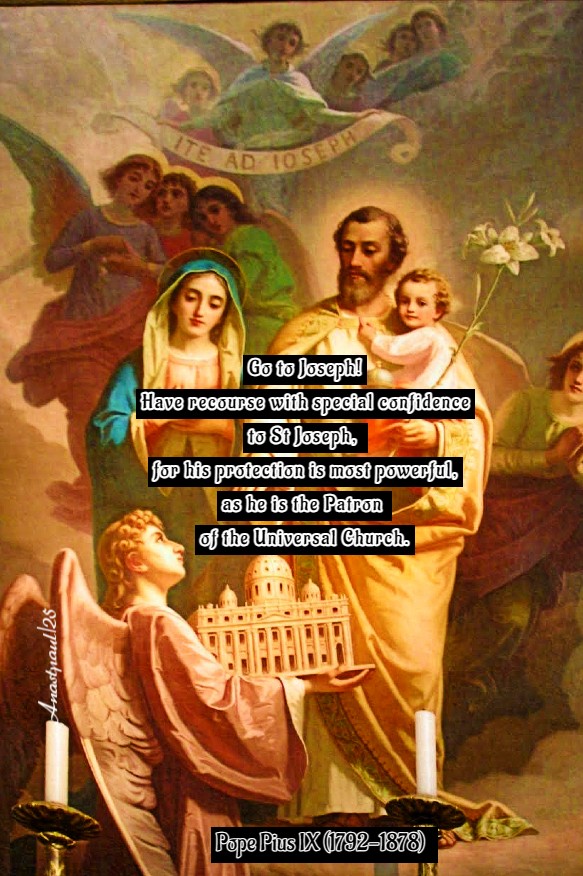
“Go to Joseph! Have recourse with special confidence to St Joseph, for his protection is most powerful, as he is the Patron of the Universal Church.”
Quote/s of the Day – 10 March – Monday of the First Week in Lent – Ezechiel 34:11-16 – Matthew 25:31-46 – Scripture search here: https://www.drbo.org/
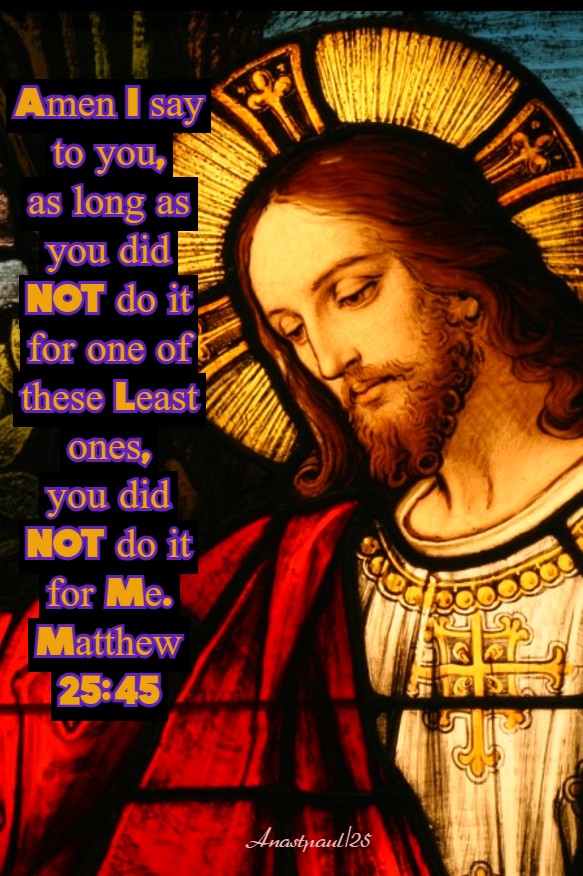
“Amen I say to you, as long as you did NOT do it for one of these least ones, you did NOT do it for Me.”
Matthew 25:45
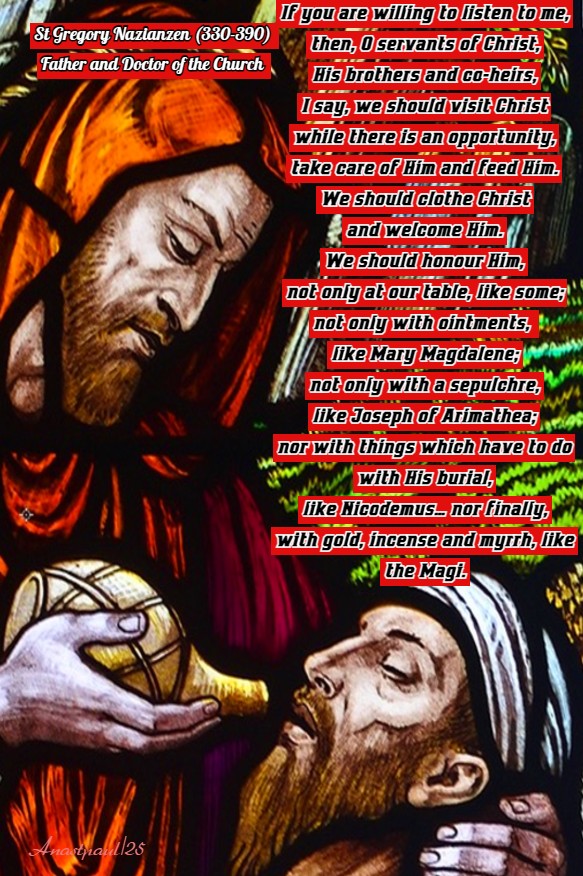
“If you are willing to listen to me, then, O servants of Christ, His brothers and co-heirs, I say, we should visit Christ while there is an opportunity, take care of Him and feed Him. We should clothe Christ and welcome Him. We should honour Him, not only at our table, like some; not only with ointments, like Mary Magdalene; not only with a sepulchre, like Joseph of Arimathea; nor with things which have to do with His burial, like Nicodemus… nor finally, with gold, incense and myrrh, like the Magi.”
St Gregory Nazianzen (330-390) Father and Doctor of the Church
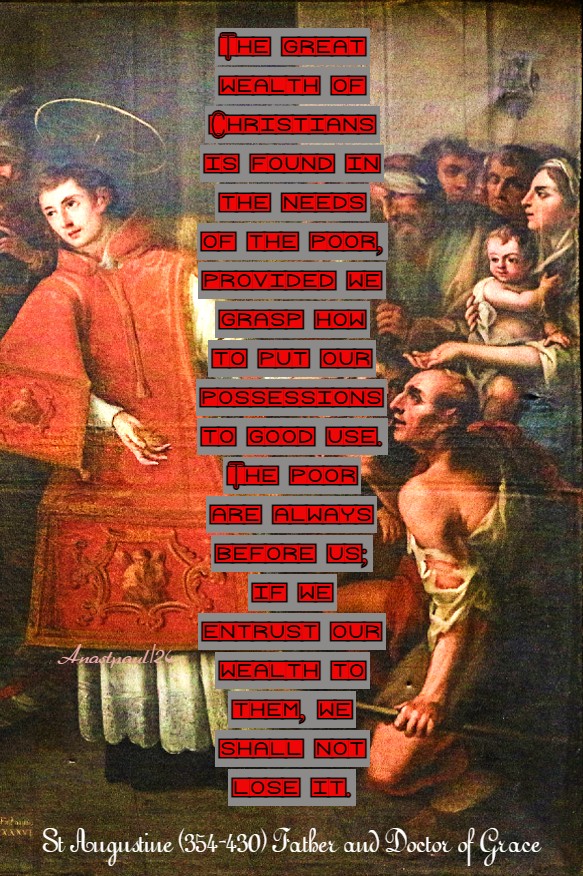
“The great wealth of Christians is found in the needs of the poor, provided we grasp how to put our possessions to good use. The poor are always before us; if we entrust our wealth to them, we shall not lose it.”
St Augustine (354-430) Father and Doctor of Grace
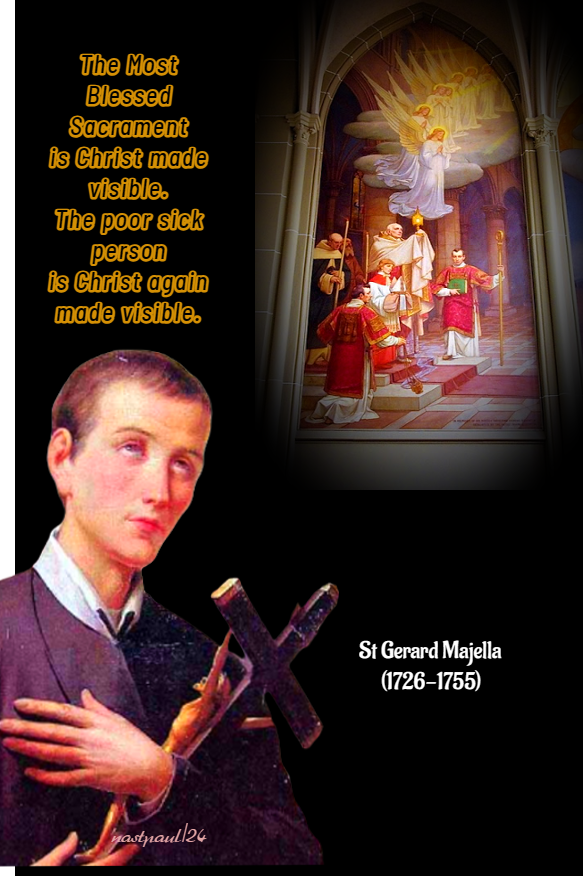
“The Most Blessed Sacrament is Christ made visible. The poor sick person is Christ again made visible.”
Quote/s of the Day – 24 December – “The Month of the Divine Infancy and the Immaculate Conception of the Blessed Virgin Mary” – The Vigil of the Nativity of Our Lord Jesus Christ
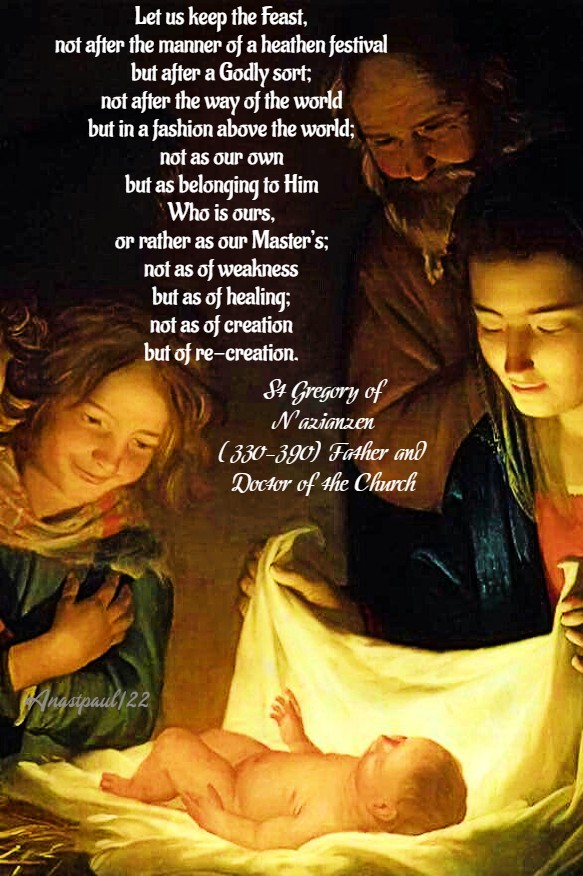
“… Let us keep the Feast, not after the manner of a heathen festival but after a Godly sort; not after the way of the world but in a fashion above the world; not as our own but as belonging to Him Who is ours, or rather as our Master’s; not as of weakness but as of healing; not as of creation but of re-creation.”
St Gregory of Nazianzen (330-390) Father and Doctor of the Church
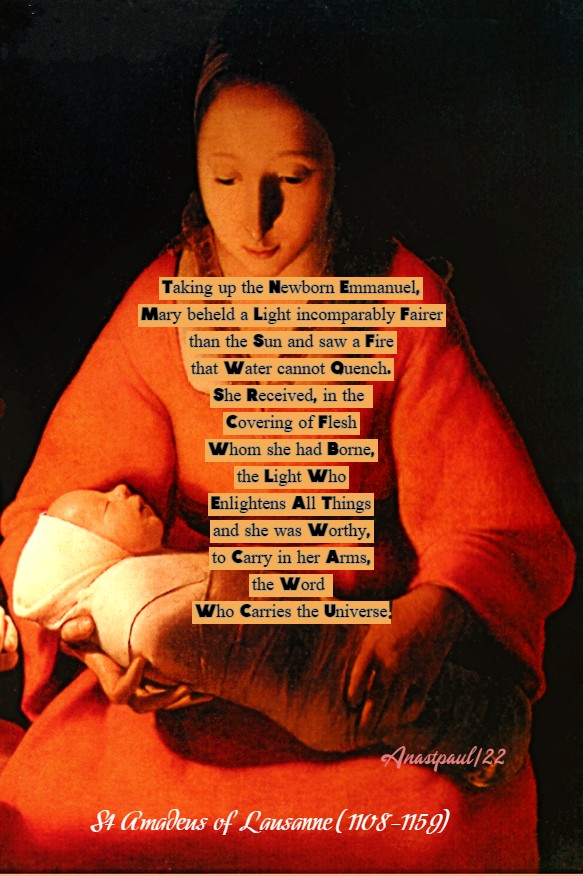
“Taking up the newborn Emmanuel, Mary beheld a Light incomparably fairer than the sun and saw a Fire that water cannot quench. She received, in the covering of flesh Whom she had borne, the Light Who enlightens all things and she was worthy, to carry in her arms, the Word Who carries the universe!” ”
St Amadeus of Lausanne (1108-1159) Bishop, Cistercian Monk
(Homilies in praise of the Blessed Virgin Mary IV SC 72)
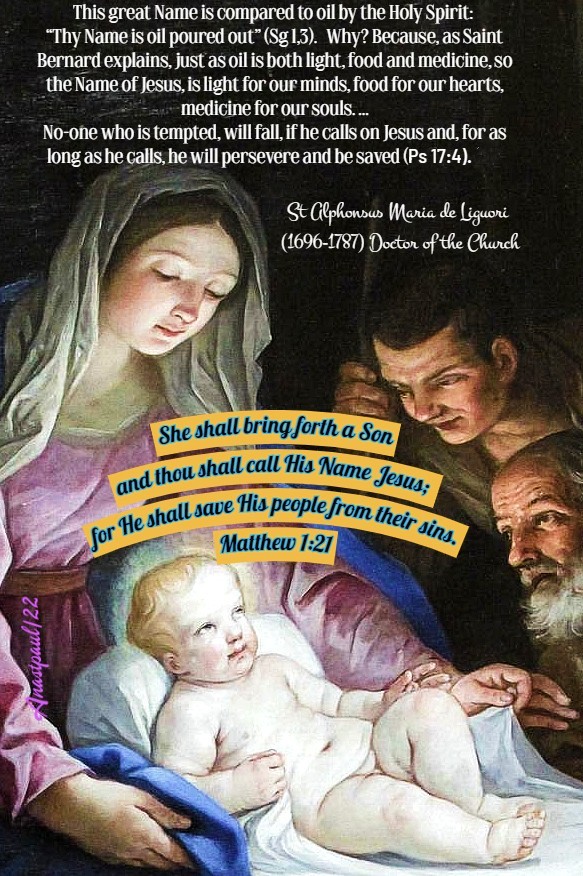
“She shall bring forth a Son and thou shall call His Name Jesus; for He shall save His people from their sins.” Matthew 1:21
“This great Name is compared to oil by the Holy Spirit: “Thy Name is oil poured out” (Sg 1,3). Why? Because, as Saint Bernard explains, just as oil is both light, food and medicine, so the Name of Jesus, is light for our minds, food for our hearts, medicine for our souls. Light for our minds – it was the brilliance of this Name which enabled the world to pass from the shadows of idolatry, to the Light of Faith. … Food for our hearts … And medicine for our souls … No-one who is tempted, will fall, if he calls on Jesus and, for as long as he calls, he will persevere and be saved (cf Ps 17:4).”
St Alphonsus Maria de Liguori (1696-1787) Doctor of the Church
Quote/s of the Day – 9 December – “The Month of the Divine Infancy and the Immaculate Conception of the Blessed Virgin Mary” – Resumed Mass of Sunday – Romans 15:4-13; Matthew 11:2-10 – Scripture search here: https://www.drbo.org/
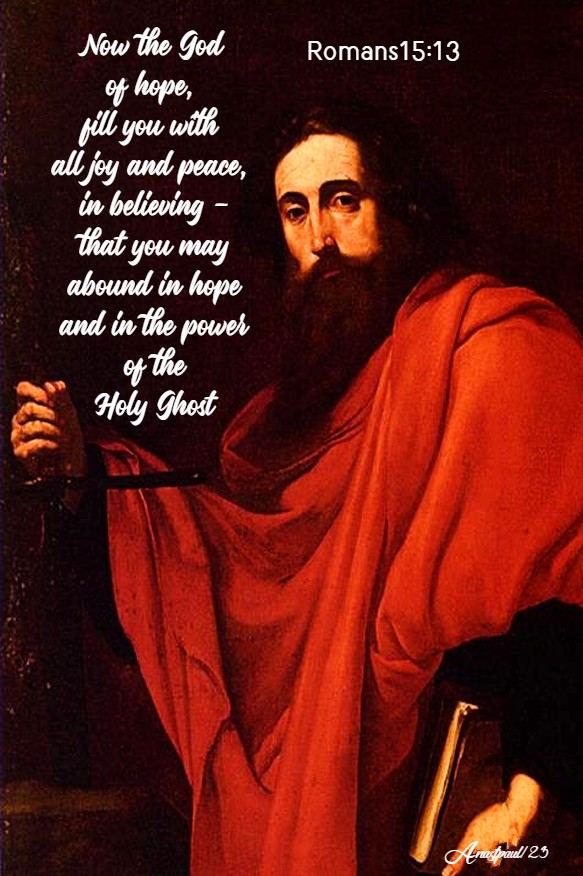
“Now, the God of hope, fill you with all joy and peace in believing – that you may abound in hope and in the power of the Holy Ghost.”
Romans 15:13
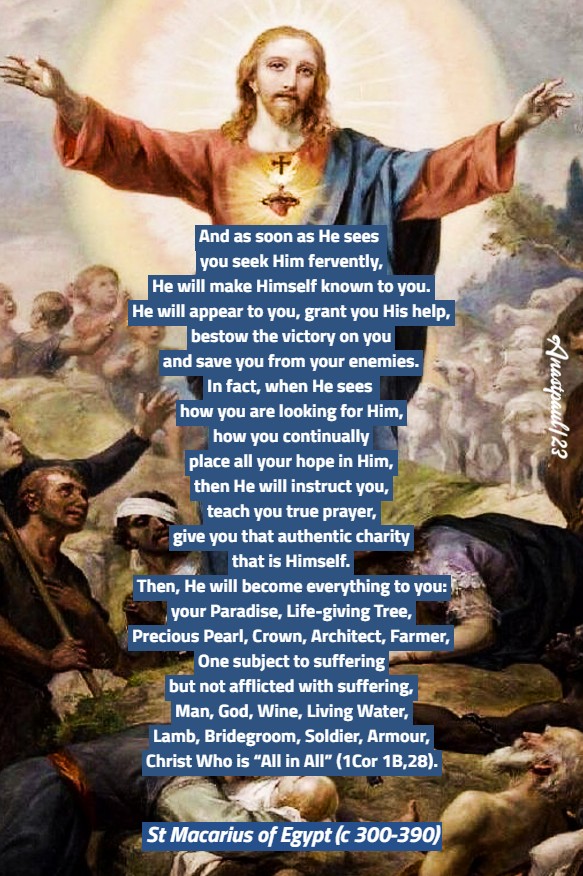
“And as soon as He sees you seek Him fervently, He will make Himself known to you. He will appear to you, grant you His help, bestow the victory on you and save you from your enemies. In fact, when He sees how you are looking for Him, how you continually place all your hope in Him, then He will instruct you, teach you true prayer, give you that authentic charity that is Himself. Then, He will become everything to you: your Paradise, Life-giving Tree, Precious Pearl, Crown, Architect, Farmer, One subject to suffering but not afflicted with suffering, Man, God, Wine, Living Water, Lamb, Bridegroom, Soldier, Armour, Christ Who is “All in All” (1Cor 1B,28).
St Macarius of Egypt (c300-390)
“God accepts our desires as though they were of great value. He longs ardently for us to desire to and love Him. He accepts our petitions for benefits, as though we were doing Him a favour. His joy in giving, is greater than ours in receiving. So let us not be apathetic in our asking, nor set too narrow bounds to our requests; nor ask for frivolous things unworthy of God’s greatness.”
St Gregory Nazianzen (330-390) Father & Doctor of the Church
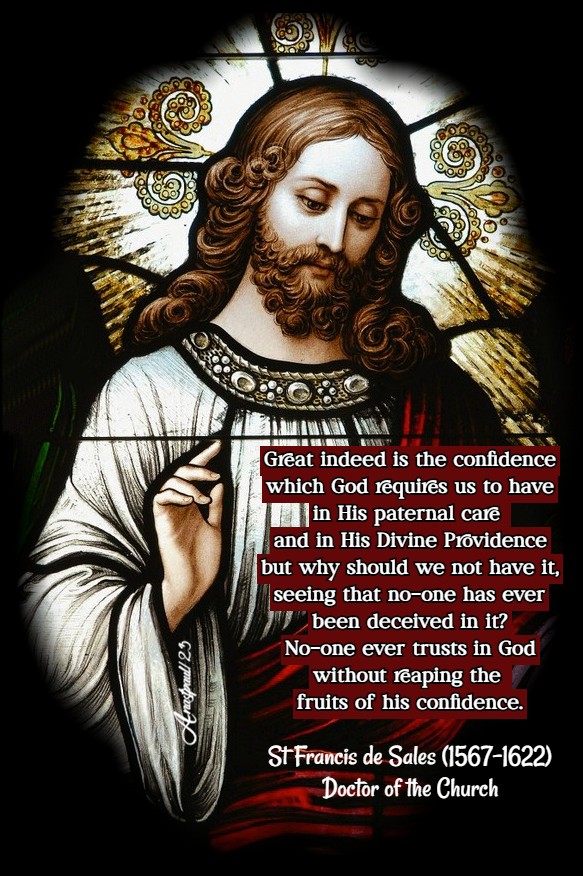
“Great indeed is the confidence which God requires us to have in His paternal care and in His Divine Providence but why should we not have it, seeing that no-one has ever been deceived in it? No-one ever trusts in God without reaping the fruits of his confidence.”
St Francis de Sales (1567-1622) Doctor of the Church
Quote/s of the Day – 26 July – St Anne, Mother of the Blessed Virgin Mary, Grandmother of Jesus.
St Anne, through her constant prayer, received, the Mother of God and then, became the Grandmother of God!
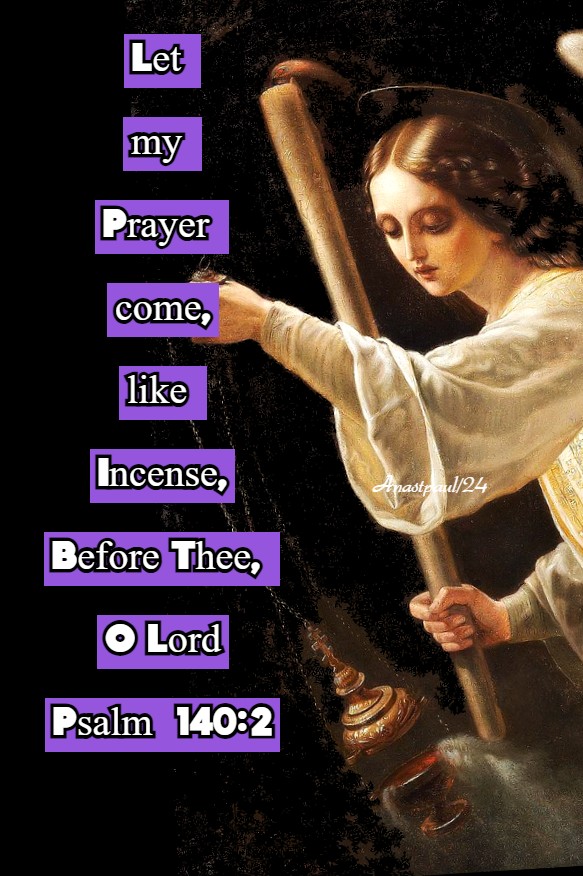
“Let my prayer come like incense before Thee, O Lord.”
Psalm 140:2
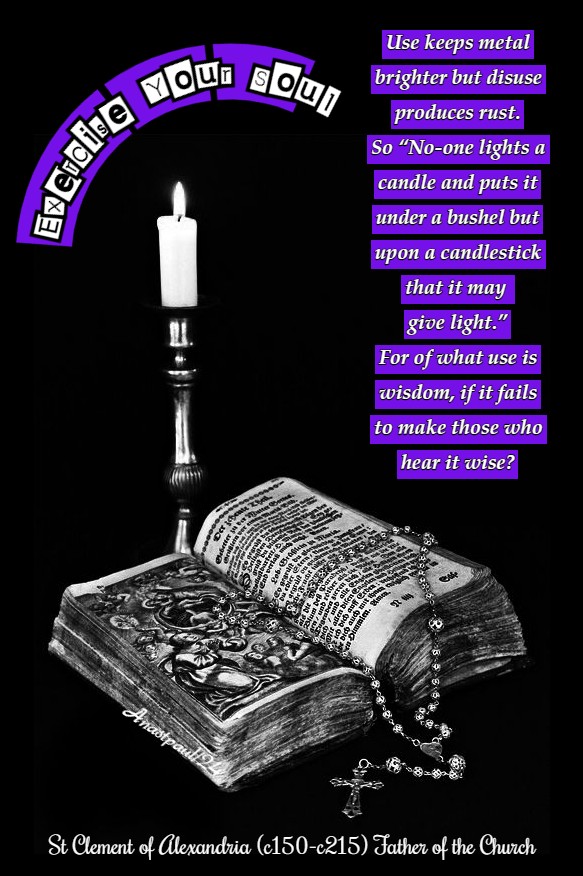
“Exercise your soul! Use keeps metal brighter but disuse produces rust. … So “No-one lights a candle and puts it under a bushel but upon a candlestick that it may give light.” For of what use is wisdom, if it fails to make those who hear it wise?”
St Clement of Alexandria (c150-c215) Father of the Church
“God accepts our desires as though they were of great value. He longs ardently for us to desire to and love Him. He accepts our petitions for benefits, as though we were doing Him a favour. His joy in giving, is greater than ours in receiving. So let us not be apathetic in our asking, nor set too narrow bounds to our requests; nor ask for frivolous things unworthy of God’s greatness.”
St Gregory Nazianzen (330-390) Father & Doctor of the Church
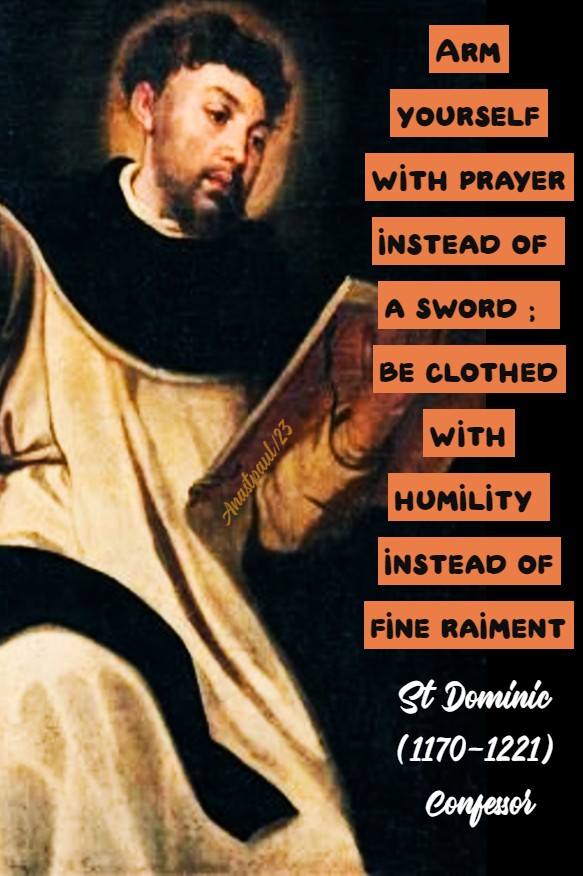
“Arm yourself with prayer instead of a sword; be clothed with humility instead of fine raiment.”
St Dominic OP (1170-1221)
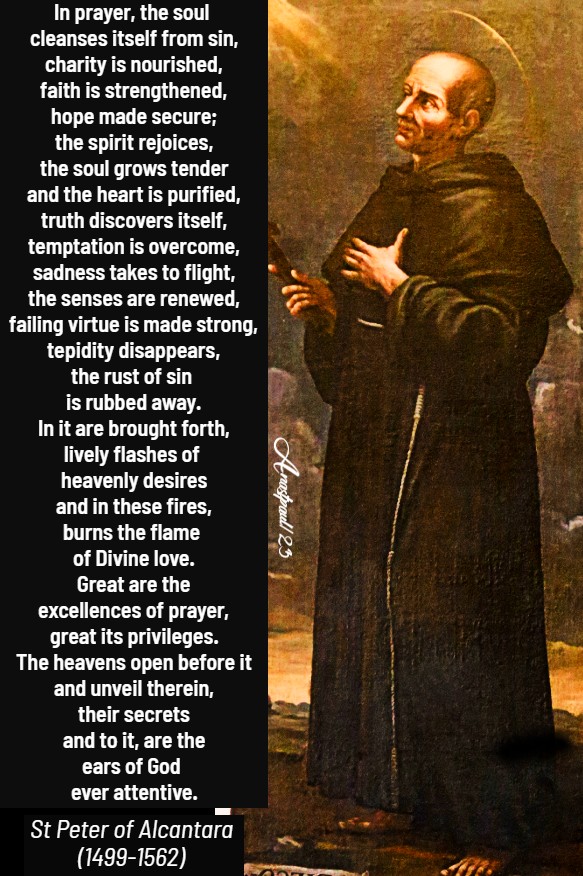
“In prayer, the soul cleanses itself from sin, charity is nourished, faith is strengthened, hope made secure; the spirit rejoices, the soul grows tender and the heart is purified, truth discovers itself, temptation is overcome, sadness takes to flight, the senses are renewed, failing virtue is made strong, tepidity disappears, the rust of sin is rubbed away. In it are brought forth, lively flashes of heavenly desires and in these fires, burns the flame of Divine love. Great are the excellences of prayer, great its privileges. The heavens open before it and unveil therein, their secrets and to it, are the ears of God ever attentive.”
A Golden Treatise of Mental Prayer Download the book, “A Golden Treatise of Mental Prayer”
St Peter of Alcantara (1499-1562)
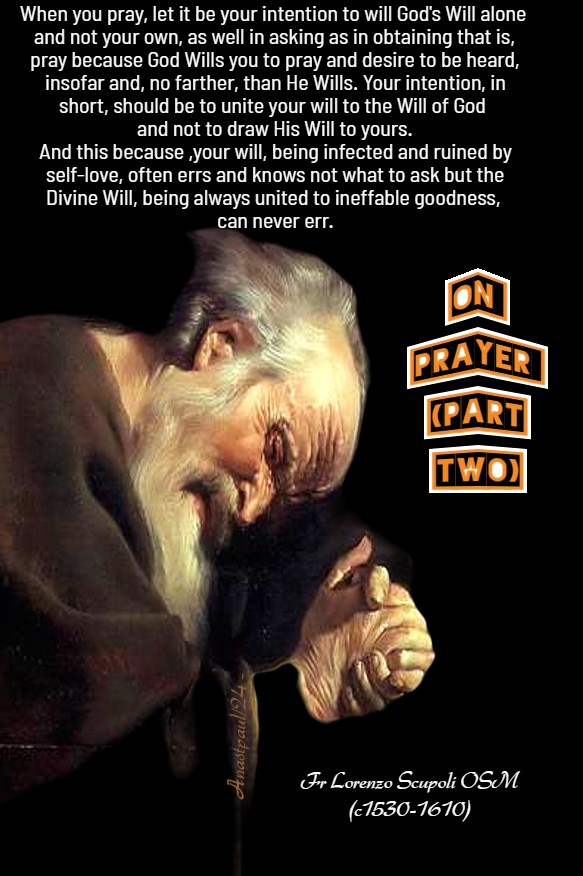
“When you pray, let it be your intention to will God’s Will alone and not your own, as well in asking as in obtaining that is, pray because God Wills you to pray and desire to be heard, insofar and, no farther, than He Wills. Your intention, in short, should be to unite your will to the Will of God and not to draw His Will to yours. And this because, your will, being infected and ruined by self-love, often errs and knows not what to ask but the Divine Will, being always united to ineffable goodness, can never err.”
Quote/s of the Day – 12 April – “The Month of the Resurrection and the Blessed Sacrament” – Ferial Day – Friday in the Second Week of Easter – 1 John 5:4-10; John 20:19-31 – Scripture search here: https://www.drbo.org/
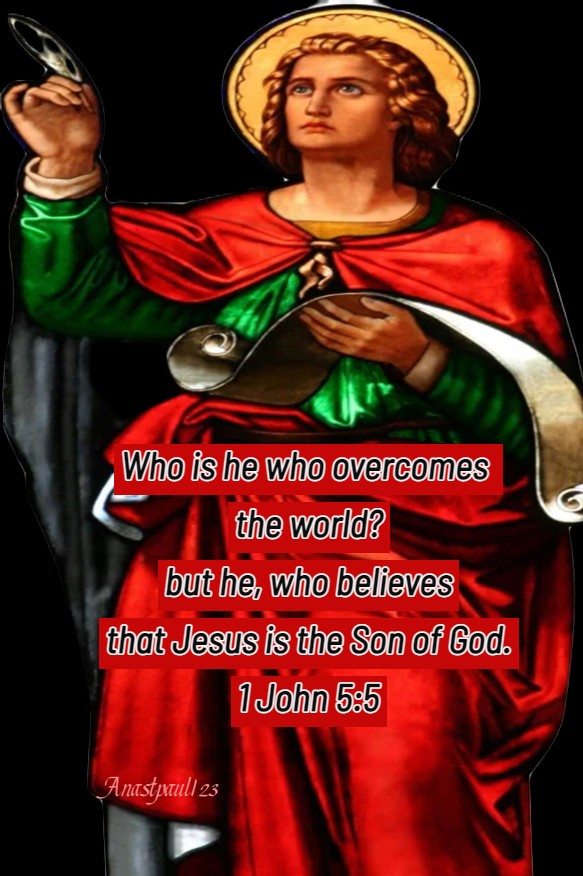
“Who is he who overcomes the world? but he who believes that Jesus is the Son of God.”
1 John 5:5
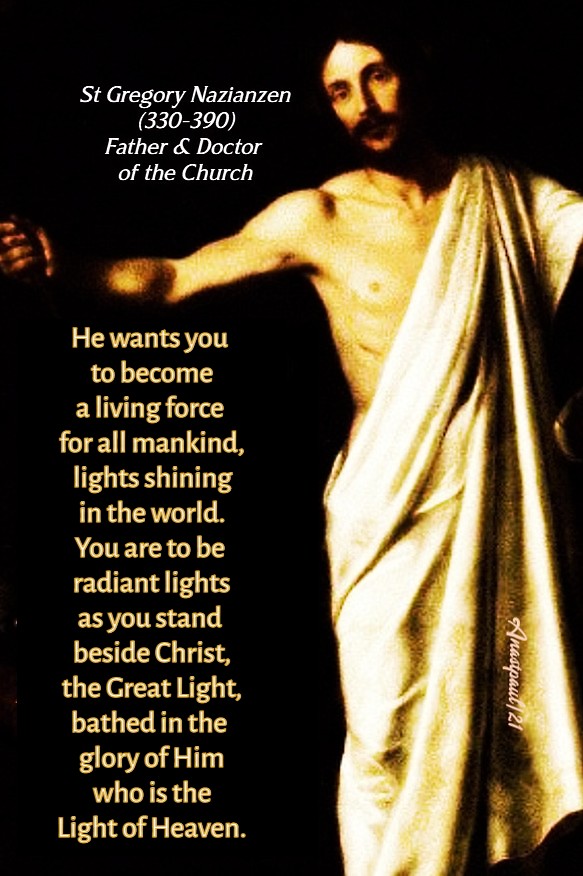
“He wants you to become a living force for all mankind, lights shining in the world. You are to be radiant lights as you stand beside Christ, the Great Light, bathed in the glory of Him who is the Light of Heaven.”
St Gregory Nazianzen (330-390) Father & Doctor of the Church
“The very prince of the universe, is man; the crowning point of man, is his heart; of the heart, is love and the perfection of love, is charity. That is why the love of God is the goal, the crowning point, the be-all and end-all of the universe.”
(Treatise on the Love of God, Book 10, Chapter 1)
St Francis de Sales (1567-1622) Doctor of Charity
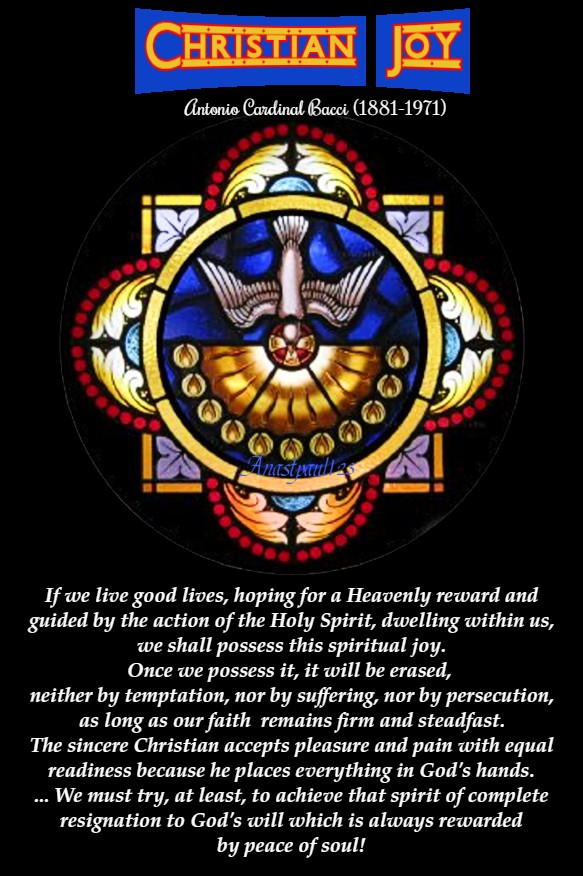
“If we live good lives, hoping for a Heavenly reward and guided by the action of the Holy Spirit, dwelling within us, we shall possess this spiritual joy. Once we possess it, it will be erased, neither by temptation, nor by suffering, nor by persecution, as long as our faith remains firm and steadfast. The sincere Christian accepts pleasure and pain with equal readiness because he places everything in God’s hands. … We must try, at least, to achieve that spirit of complete resignation to God’s will which is always rewarded by peace of soul!”
Our Lenten Journey with the Angels and the Saints – 15 March – Friday of the Fourth Week in Lent – 3 Kings 17:17-24; John 11:1-45 – Scripture search here: https://www.drbo.org/
“Now, by this I know t hat thou art a man of God and the Word of the Lord in thy mouth is true.” 3 Kings 17:24
“ Lazarus, come forth!” John 11:43
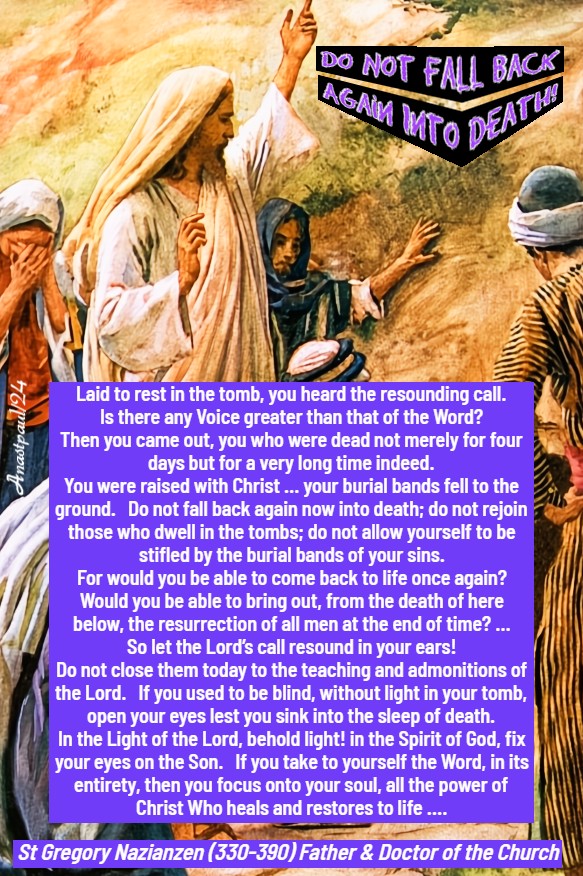
Do Not Fall Back Again Into Death!
St Gregory Nazianzen (330-390) Father & Doctor of the Church
“Laid to rest in the tomb, you heard the resounding call. Is there any Voice greater than that of the Word? Then you came out, you who were dead not merely for four days but for a very long time indeed. You were raised with Christ … your burial bands fell to the ground. Do not fall back again now into death; do not rejoin those who dwell in the tombs; do not allow yourself to be stifled by the burial bands of your sins. For would you be able to come back to life once again? Would you be able to bring out, from the death of here below, the resurrection of all men at the end of time? …
So let the Lord’s call resound in your ears! Do not close them today to the teaching and admonitions of the Lord. If you used to be blind, without light in your tomb, open your eyes lest you sink into the sleep of death. In the Light of the Lord, behold light! in the Spirit of God, fix your eyes on the Son. If you take to yourself the Word, in its entirety, then you focus onto your soul, all the power of Christ Who heals and restores to life …. Do not be afraid to put some work into preserving your Baptismal purity and set the ways that lead to the Lord, within your heart. Take care to preserve the act of acquittal which you received through pure grace ….
Let us be Light, as the disciples learned, from He Who is the Great Light: “You are the light of the world” (Mt 5:14). Let us be lamps in this world by holding up on high the Word of Life, by being a life force for others. Let us set out in search of God, in search of the One Who is the First and Purest of Lights.” – (Sermon on Holy Baptism).
One Minute Reflection – 19 February – Monday of the First Week in Lent – Ferial Day –Ezechiel 34:11-16; Matthew 25:31-46 – Scripture search here: https://www.drbo.org/
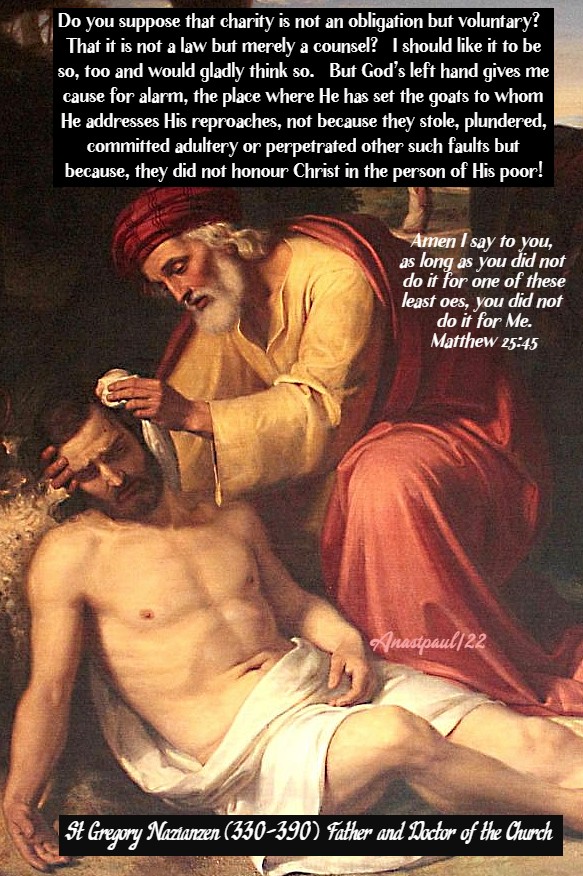
“Amen I say to you, as long as you did not do it for one of these least ones, you did not do it for Me.” – Matthew 25:45
REFLECTION – “Do you suppose that charity is not an obligation but voluntary? That it is not a law but merely a counsel? I should like it to be so, too and would gladly think so. But God’s left hand gives me cause for alarm, the place where He has set the goats to whom He addresses His reproaches, not because they stole, plundered, committed adultery or perpetrated other such faults but because, they did not honour Christ in the person of His poor!
If you are willing to listen to me, then, O servants of Christ, His brothers and co-heirs, I say ,that we should visit Christ while there is an opportunity, take care of Him and feed Him. We should clothe Christ and welcome Him. We should honour Him, not only at our table, like some; not only with ointments, like Mary Magdalene; not only with a sepulchre, like Joseph of Arimathea; nor with things which have to do with His burial, like Nicodemus… nor finally, with gold, incense and myrrh, like the Magi.
But, as the Lord of all “desires mercy and not sacrifice” (Mt 9,13) and as compassion is better than tens of thousands of fat rams, let us offer Him this mercy through the needy and those who are at present cast down to the ground. Let us do this, so that, when we depart hence, they may “welcome us into the eternal habitations” (Lk 16:9), in the same Christ our Lord, to whom be glory forever.” – St Gregory Nazianzen (330-390) Archbishop of Constantinople, Father and Doctor of the Church (Sermon 14, on Love for the Poor, 27, 28, 39-40).
PRAYER – O God, our Saviour, direct our minds by Thy heavenly teaching, so that the Lenten fast may profit us. Through Jesus Christ, Thy Son our Lord, Who lives and reigns with Thee, in the unity of the Holy Ghost, God, world without end. Amen (Collect).
Quote/s of the Day – 16 January – “The Month of the Most Holy Name of Jesus and of the Holy Family” – 1 Peter 5:1-4, 10-11; Matthew 16:13-19 – Scripture search here: https://www.drbo.org/
“Thou art the Christ, the Son of the living God.”
Matthew 16:16
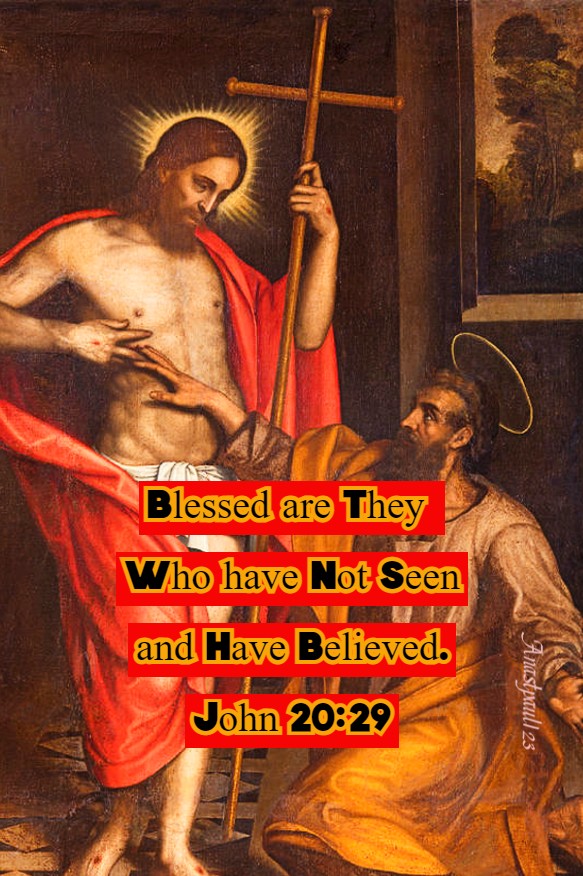
Blessed are they who have not seen and have believed.”
John 20:29
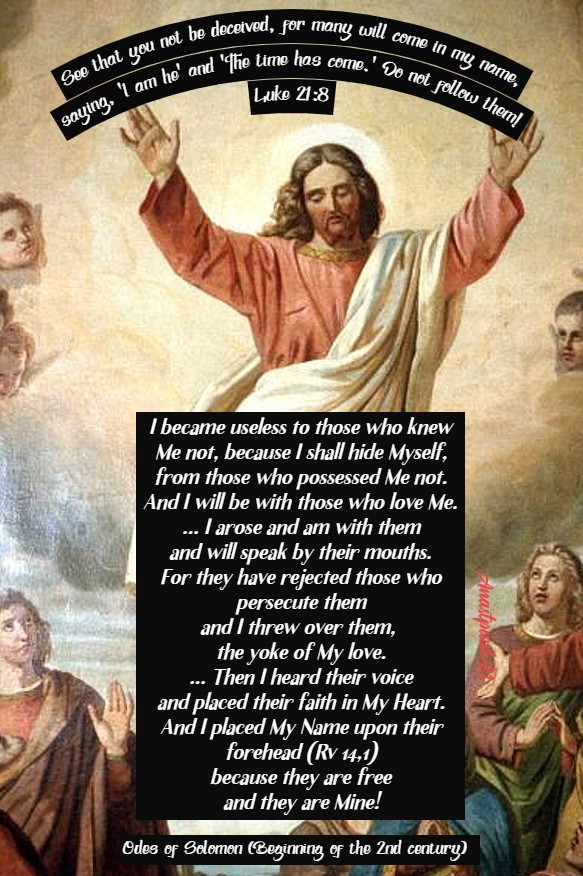
“See that you not be deceived, for many will come in my name, saying, ‘I am he’ and ‘The time has come.’ Do not follow them!” Luke 21:8
“[Christ speaks:] I became useless to those who knew Me not, because I shall hide Myself, from those who possessed Me not. And I will be with those who love Me. … I arose and am with them and will speak by their mouths. For they have rejected those who persecute them and I threw over them, the yoke of My love. … Then I heard their voice and placed their faith in My Heart. And I placed My Name upon their forehead (Rv 14,1) because they are free and they are Mine!”
Odes of Solomon (Hebrew Christian text from the beginning of the 2nd century) N° 42)
“Grace is given, not to those who speak [their faith] but to those, who live their faith!”
St Gregory of Nazianzen (330-390) Father and Doctor of the Church
Quote/s of the Day – 13 January – “The Month of the Most Holy Name of Jesus and of the Holy Family” – Octave Day of Epiphany – Isaias 60:1-6, John 1:29-34 –
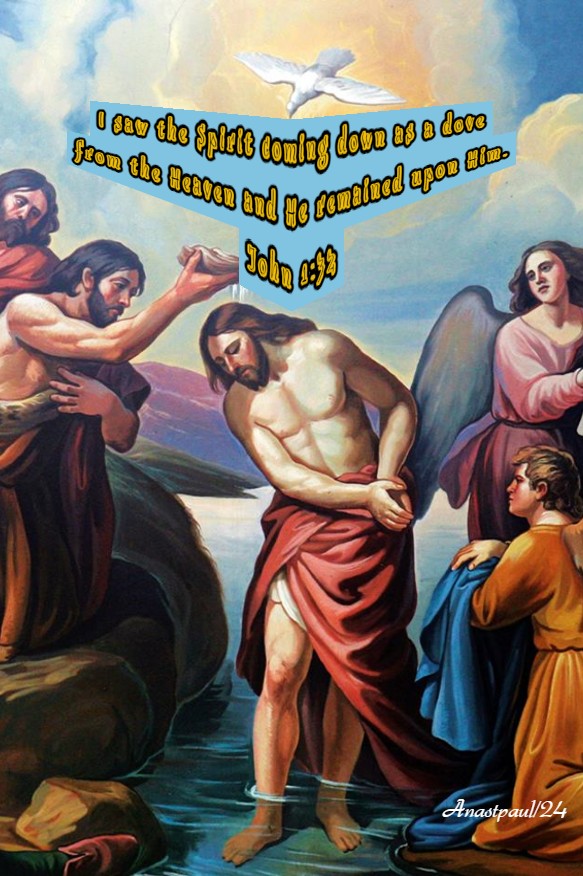
“I saw the Spirit coming down as a dove from the Heaven and He remained upon Him.”
John 1:32
“Jesus rises from the waters – the world rises with Him. The heavens, like Paradise with its flaming sword, closed by Adam for himself and his descendants, are rent open. The Spirit comes to Him as to an equal, bearing witness to His Godhead. A Voice bears witness to Him from Heaven, His place of origin. The Spirit descends in bodily form like the Dove which, so long ago, announced the ending of the flood and so, gives honour to the Body, Who is One with God.”
St Gregory Nazianzen (330-390) Father and Doctor of the Church
“Christ was born of the Holy Spirit and, since it was fitting, that He should fulfill all justice, He entered into the waters of baptism to sanctify them. When He left the Jordan, He was filled with the Holy Spirit, Who had descended upon Him, in the form of a dove. As the Evangelist tells us: Jesus, full of the Holy Spirit, returned from the Jordan.”
Quote/s of the Day – 3 January – Help for those New Year Resolutions
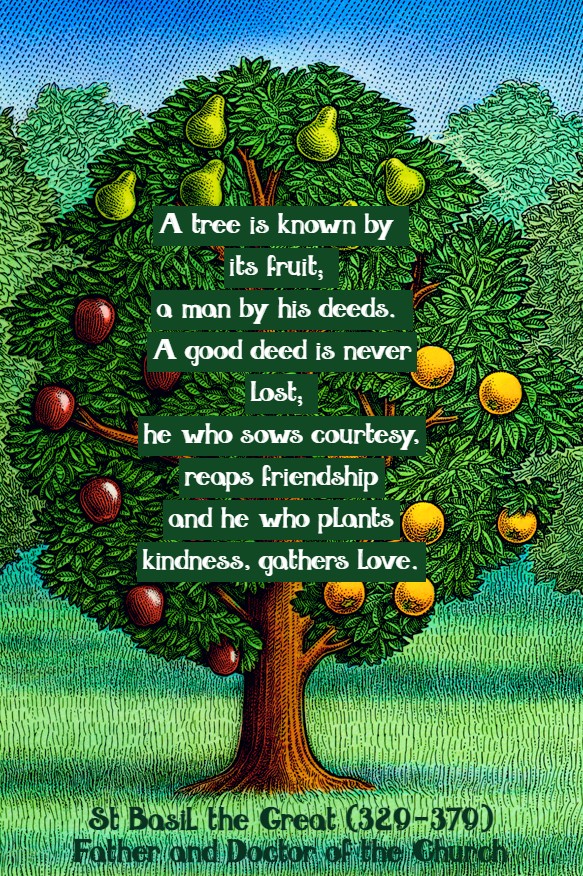
“A tree is known by its fruit, a man by his deeds. A good deed is never lost, he who sows courtesy, reaps friendship and he who plants kindness, gathers love.”
St Basil the Great (329-379) Father and Doctor of the Church
“Remember God more often than you breathe!”
“Grace is given, not to those who speak [their faith] but to those, who live their faith!”
St Gregory of Nazianzen (330-390) Father and Doctor of the Church
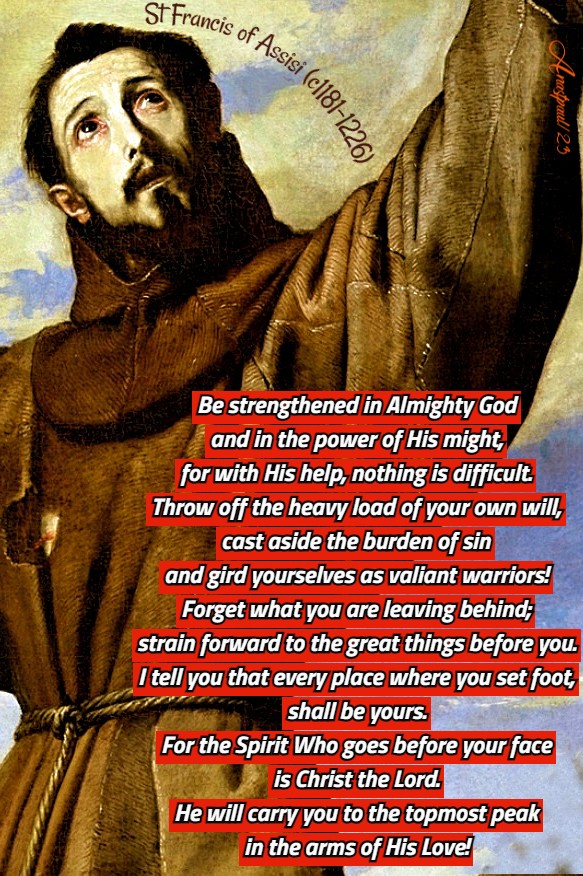
“Be strengthened in Almighty God and in the power of His might, for with His help, nothing is difficult. Throw off the heavy load of your own will, cast aside the burden of sin and gird yourselves as valiant warriors! Forget what you are leaving behind; strain forward to the great things before you. I tell you that every place where you set foot, shall be yours. For the Spirit, Who goes before your face is Christ the Lord. He will carry you to the topmost peak in the arms of His Love.”
Quote/s of the Day – 11 December – “The Month of the Divine Infancy and the Immaculate Conception of the Blessed Virgin Mary” – Monday of the Second Week of Advent – 1 Peter 5:1-4, 10-11; Matthew 16:13-19 – Scripture search here: https://www.drbo.org/
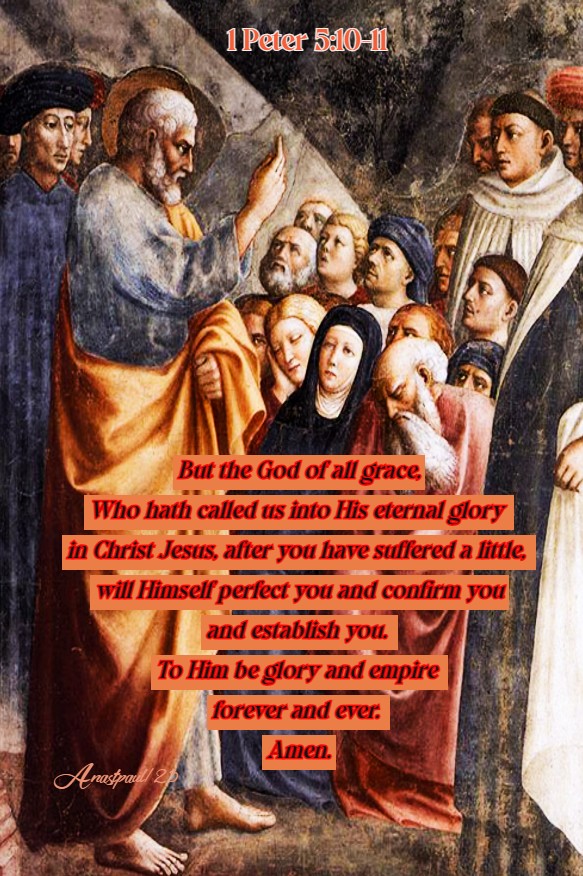
“But the God of all grace, Who hath called us into His eternal glory in Christ Jesus, after you have suffered a little, will Himself perfect you and confirm you and establish you. To Him be glory and empire forever and ever. Amen.”
1 Peter 5:10-11
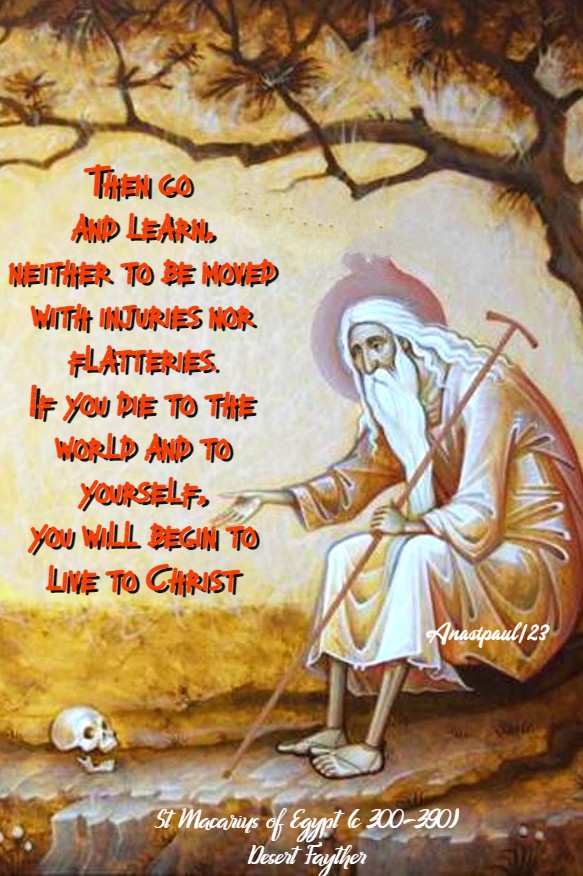
“Then go and learn, neither to be moved with injuries nor flatteries. If you die to the world and to yourself, you will begin to live to Christ.”
St Macarius of Egypt (c300-390)
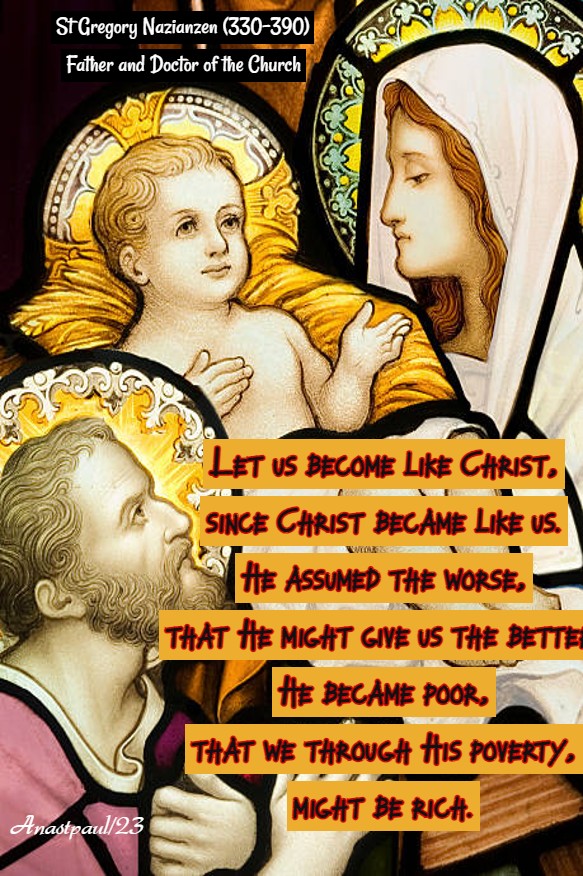
“Let us become like Christ, since Christ became like us. He assumed the worse, that He might give us the better; He became poor, that we through His poverty, might be rich.”
St Gregory Nazianzen (330-390) Father and Doctor of the Church
“Let us always belong to God, unreservedly and without interruption. May He ever live and reign in our hearts.”
(Letter to Madame de Chantal)
St Francis de Sales (1567-1622) Doctor of the Church
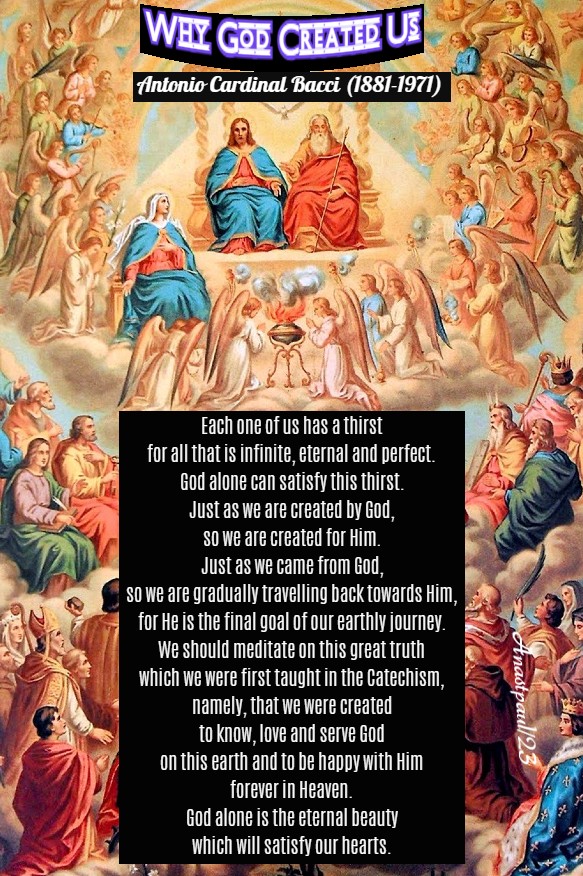
“Each one of us has a thirst for all that is infinite, eternal and perfect. God alone can satisfy this thirst. Just as we are created by God, so we are created for Him. Just as we came from God, so we are gradually travelling back towards Him, for He is the final goal of our earthly journey. We should meditate on this great truth which we were first taught in the Catechism, namely, that we were created to know, love and serve God on this earth and to be happy with Him forever in Heaven. God alone is the eternal beauty which will satisfy our hearts.”
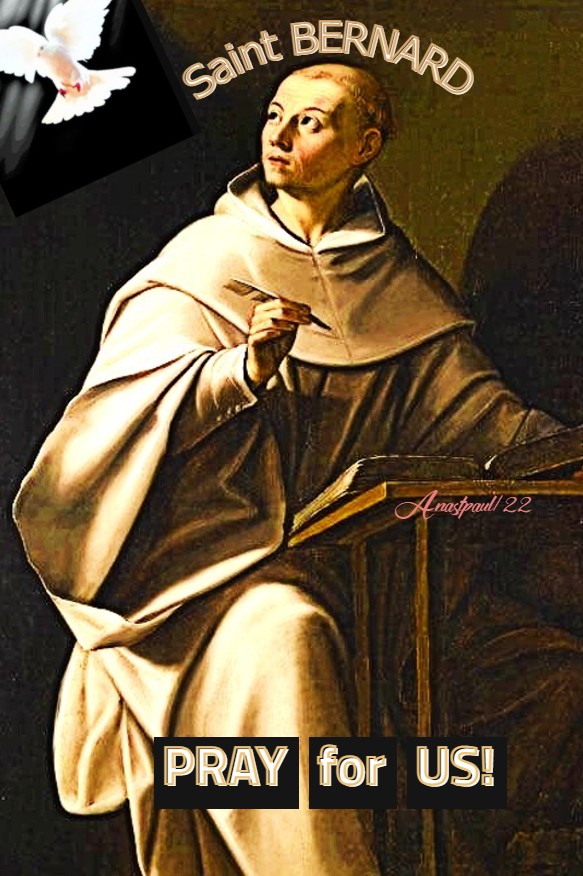
One Minute Reflection – 20 August – “The Month of the Immaculate Heart of Mary” – St Bernard (1090-1153) Confessor – 2 Cor. 3:4-9, Luke 10:23-37 – Scripture search here: https://www.drbo.org/
“But a certain Samaritan, as he journeyed, came upon him and seeing him, was moved with compassion.” – Luke 10:33
REFLECTION – “The first and the greatest of the commandments,that on which the Law and the prophets are based, (Mt 22:40) is love which, it seems to me, brings its greatest proof, in love of the poor, in tenderness and compassion for one’s neighbour. Nothing gives as much honour to God, as mercy, for nothing is more like Him. “Mercy and Truth go before Him,” (Ps 88:15) and He prefers mercy to judgement (Hos 6:6). Nothing attracts the kindness of the Friend of humankind, as much as kindness towards humankind, (Wis 1:6) His reward is just, He weighs and measures mercy.
We must open our hearts to all who are poor and unhappy, whatever their suffering might be. That is the meaning of the commandment which requires us to “rejoice with those who rejoice, weep with those who weep.” (Rom 12:15) Since we are also human, is it not right and proper for us to be kind towards those who are like us?” – St Gregory Nazianzen (330-390) Bishop, Father and Doctor of the Church (On Love of the Poor, 4-6).
PRAYER – O God, Who gave to Thy people, blessed Bernard, as a minister of salvation, grant, we beseech Thee, that we, who cherished him on earth as a teacher of life, may be found worthy to have him as an intercessor in Heaven. Through Jesus Christ, Thy Son our Lord, Who lives and reigns with Thee, in the unity of the Holy Ghost, God, world without end. Amen (Collect).
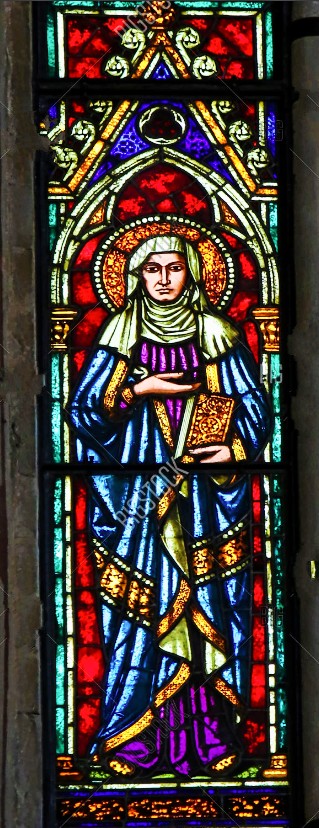
Saint of the Day – 5 August – St Nonna of Nazianzen (c305-374) Widow of St Gregory Nazianzen the Elder, (c276-374) the saintly Bishop of Nazianzen and Mother of St Gregory Nazianzen (330-390) Doctor of the Church, his younger brother St Caesarius Nazianzen (c331-368) a Physician and St Gorgonia (Died c375) Married, Mother. Born in Nazianzen in Cappadocia (modern day Turkey) in around 305 and died in c374 in her home town, of natural causes. Patronages – death of children, Information services. Also known as – Nona.
The Roman Martyrology states: “In Nazianzus in Cappadocia, in today’s Turkey, Saint Nonna, who was the wife of the holy Bishop Gregory the Elder and mother of the Saints Gregory, Cesario and Gorgonia.”
Nonna was born and raised as a deeply religious Christian. After she married, she converted her husband Gregory to Christianity. He had been a member of the Hypsistarians, a Jewish-pagan sect which worshipped Hypsistos, the “Most High” God. Both Gregory and Nonna came from wealthy families and Gregory was able to personally finance the construction of a Church in the region. In 328, Gregory was selected as the Bishop of Nazianzen, a position he held until his death. At one point, Gregory subscribed to an Arian understanding of the Blessed Trinity. However, this was for a very brief time and he quickly renounced that position.
Nonna became the mother of three children, each of whom became Saints, the most notable of whom being the Doctor of the Church, St Gregory Nazianzen.
Nonna outlived her husband and two of her children, dying, almost certainly in 374.
Her son Gregory tells of an occasion in 351 when Nonna fell terribly sick with a severe illness and appeared to be at the point of death. On his way to visit a friend, Gregory hurried instead to his mother who, in the meantime, had begun to recover. She had a vision in which Gregory had given her magical cakes marked with the Sign of the Cross and blessed by him.
Gregory championed Nonna as a model of Christian motherhood. He wrote of her:
“My mother was a worthy companion for such a man [as my father] and her qualities were as great as his. She came from a pious family but was even more pious than they, although, in her body she was but a woman, in her spirit she was above all men…
Her mouth knew nothing but the truth but, in her modesty, she was silent about those deeds which brought her glory. She was guided by the fear of God. …”
Quote/s of the Day – 6 February – St Titus (Died c96) Bishop, Confessor
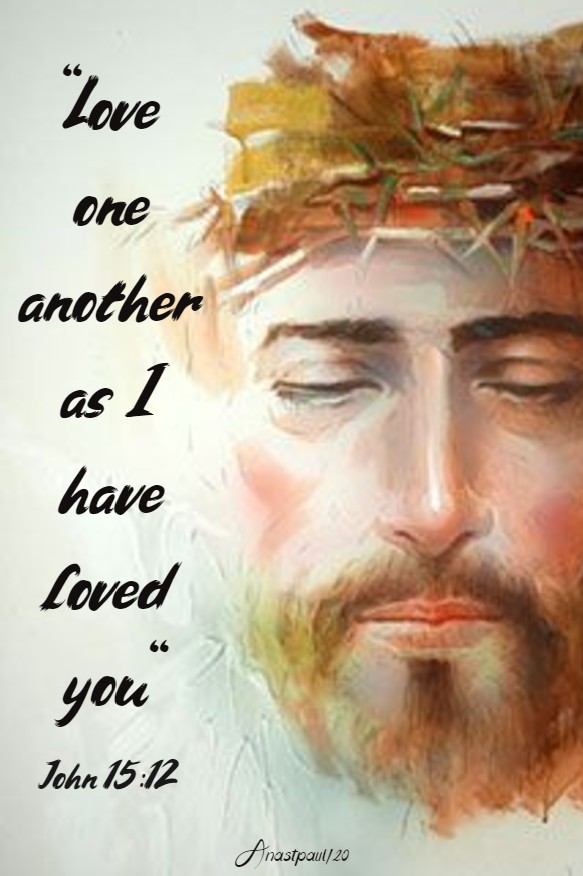
“Love one another as I have loved you”
John 15:12
“I have chosen you and have appointed you, that you should go and should bring forth fruit and your fruit should remain, says the Lord.”
John 15:16
“He wants you to become a living force for all mankind, lights shining in the world. You are to be radiant lights as you stand beside Christ, the Great Light, bathed in the glory of Him who is the Light of Heaven.”
St Gregory Nazianzen (330-390) Father & Doctor of the Church
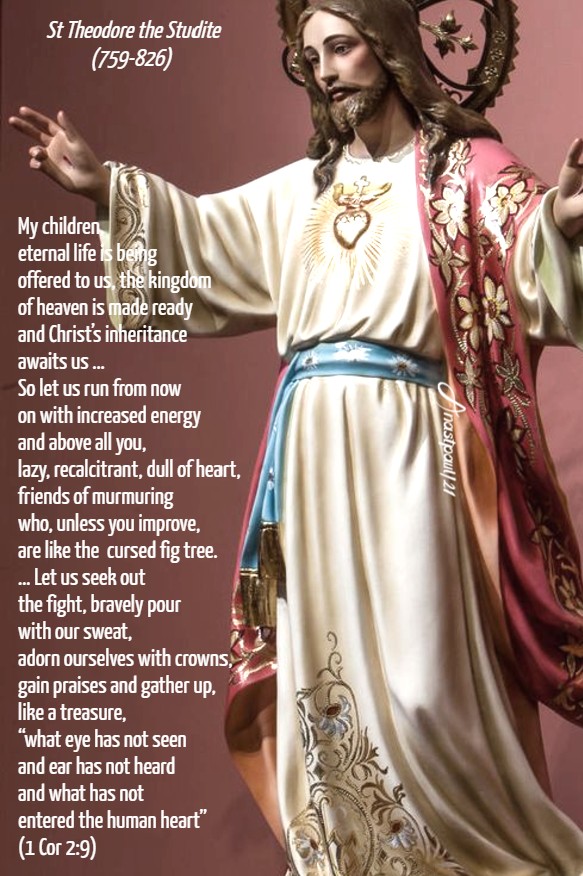
“My children, eternal life is being offered to us, the Kingdom of Heaven is made ready and Christ’s inheritance awaits us … So let us run from now on with increased energy and above all you, lazy, recalcitrant, dull of heart, friends of murmuring who, unless you improve, are like the cursed fig tree. … Let us seek out the fight, bravely pour with our sweat, adorn ourselves with crowns, gain praises and gather up, like a treasure, “what eye has not seen and ear has not heard and what has not entered the human heart” (1 Cor 2:9).
“In the world you will have tribulation. But take heart, I have conquered the world.”
John 16:33
“Who will be crowned without having fought? Who will go to rest if he is not tired (cf. 2 Tim 2:5-6)? Who will gather the fruits of life without having planted virtues in his soul? Cultivate them, prepare the earth with the greatest care, take trouble over it, sweat over it, children, God’s workers, imitators of the Angels, competitors with incorporeal beings, lights for those who are in the world (cf. Phil 2:15)!”
Quote/s of the Day – 11 November – “The Month of the Holy Souls in Purgatory” – St Martin of Tours (c 316-397) Bishop, Confessor – Sirach 44:16-27; 45:3-20, Luke 11:33-36 – Scripture search here: https://www.drbo.org/
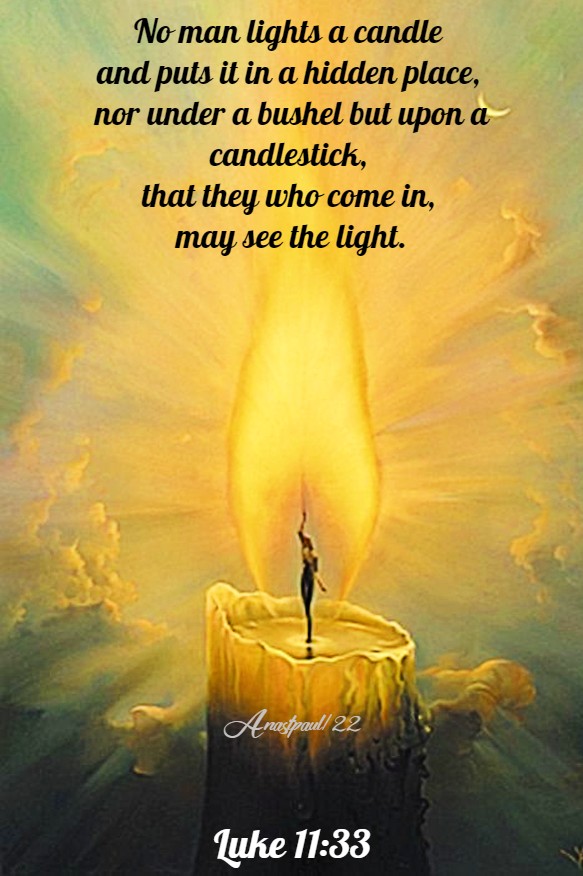
“No man lights a candle and puts it in a hidden place, nor under a bushel but upon a candlestick, that they who come in, may see the light.”
Luke 11:33
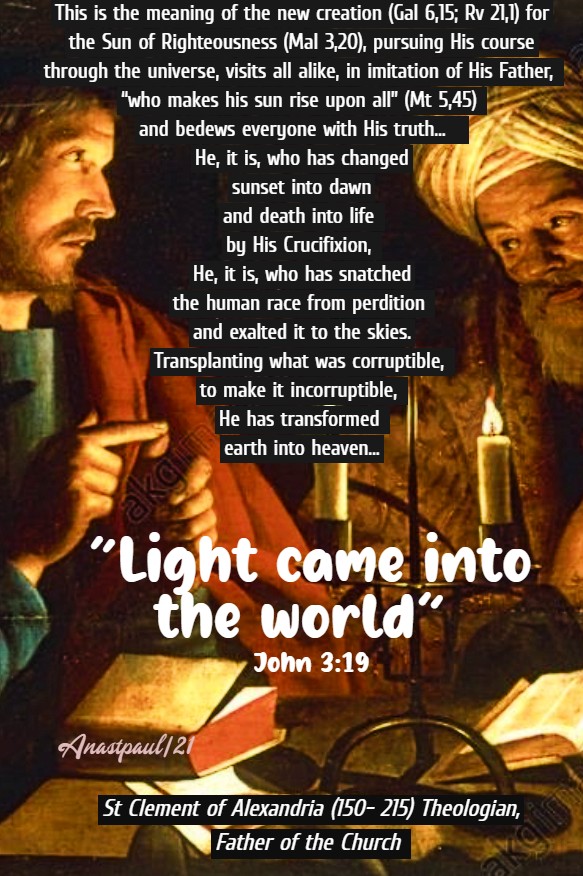
“Light came into the world”
John 3:19
“This is the meaning of the new creation (Gal 6,15; Rv 21,1) for the Sun of Righteousness (Mal 3,20), pursuing His course through the universe, visits all alike, in imitation of His Father, “who makes his sun rise upon all” (Mt 5,45) and bedews everyone with His truth… He, it is, Who has changed sunset into dawn and death into life by His Crucifixion, He, it is, Who has snatched the human race from perdition and exalted it to the skies. Transplanting what was corruptible, to make it incorruptible, He has transformed earth into Heaven!…”
St Clement of Alexandria (150- 215) Theologian, Father of the Church
“He wants you to become a living force for all mankind, lights shining in the world. You are to be radiant lights as you stand beside Christ, the Great Light, bathed in the glory of Him who is the Light of Heaven.”
St Gregory Nazianzen (330-390) Father & Doctor of the Church
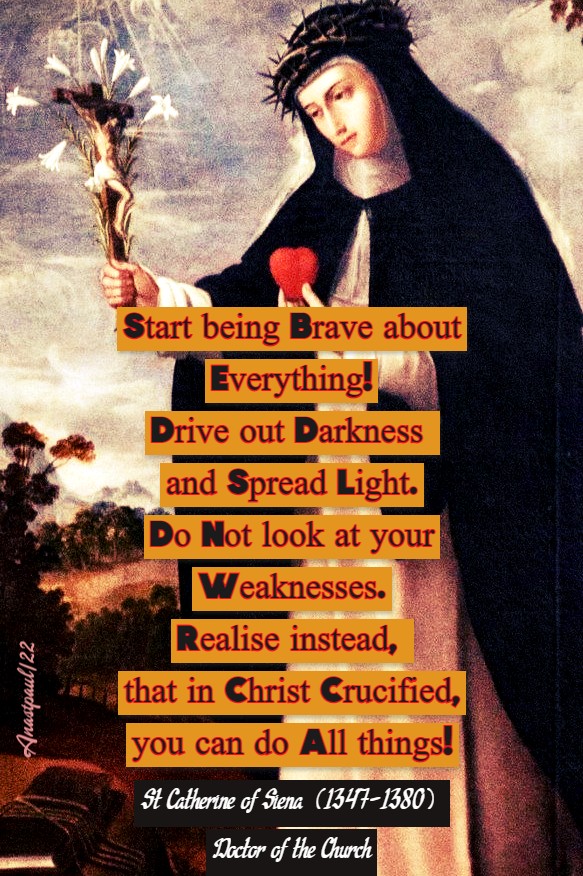
“Start being brave about everything! Drive out darkness and spread light. Do not look at your weaknesses. Realise instead, that in Christ Crucified, you can do all things.”
St Catherine of Siena (1347-1380) Doctor of the Church
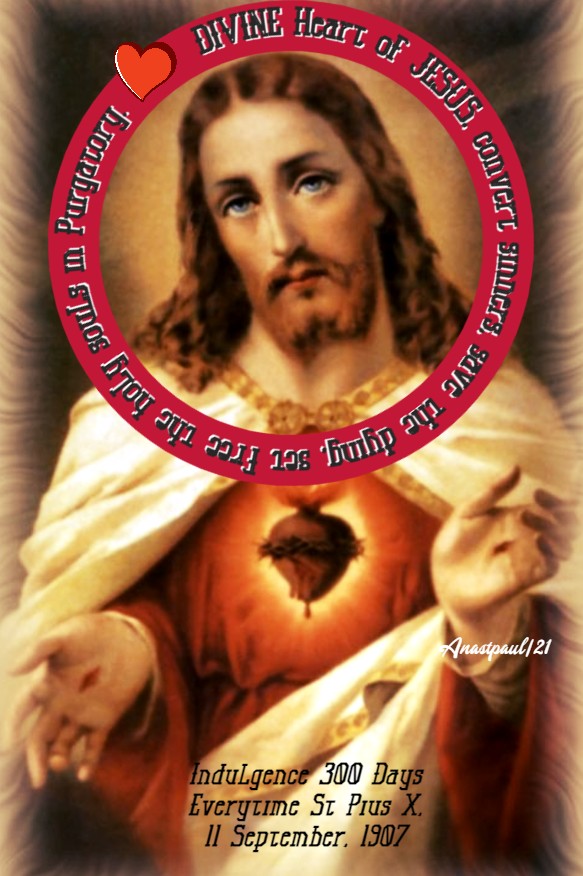
DIVINE Heart of JESUS, convert sinners, save the dying, set free the holy souls in Purgatory. Indulgence 300 Days Everytime – St Pius X, 11 September, 1907
Quote/s of the Day – 26 July – St Anne, Mother of the Blessed Virgin Mary, Grandmother of Jesus.
St Anne, through her constant prayer, received, the Mother of God and then, became the Grandmother of God!
“God accepts our desires as though they were of great value. He longs ardently for us to desire to and love Him. He accepts our petitions for benefits, as though we were doing Him a favour. His joy in giving, is greater than ours in receiving. So let us not be apathetic in our asking, nor set too narrow bounds to our requests; nor ask for frivolous things unworthy of God’s greatness.”
St Gregory Nazianzen (330-390) Father & Doctor of the Church
“Prayer is the place of refuge for every worry, a foundation for cheerfulness, a source of constant happiness, a protection against sadness.”
“When you are weary of praying and do not receive, consider how often you have heard a poor man calling and have not listened to him.”
St John Chrysostom (347-407) Father and Doctor of the Church
“Fasting is the soul of prayer, mercy is the lifeblood of fasting. Let no-one try to separate them, they cannot be separated. If you have only one of them, or not all together, you have nothing! So if you pray, fast; if you fast, show mercy; if you want your petition to be heard, hear the petition of others. If you do not close your ear to others, you open God’s ear to yourself.”
St Peter Chrysologus (c 400-450) Father & Doctor of the Church
“Realise above all, that you are in God’s presence and stand there with the attitude of one, who stands before the Emperor.”
St Romuald (c 951-1027)
“The spirit of prayer is the spirit of the love of God and this should inspire all our vocal prayers. Flowery petitions are no use if our minds and hearts are turned away from God. God wants our hearts. Let us pray often but let our prayers be sincere acts of the love of God, coming from the heart.”
Quote/s of the Day – 10 July – “The Month of the Precious Blood” – The Fifth Sunday after Pentecost and the Solemnity of the Most Precious Blood
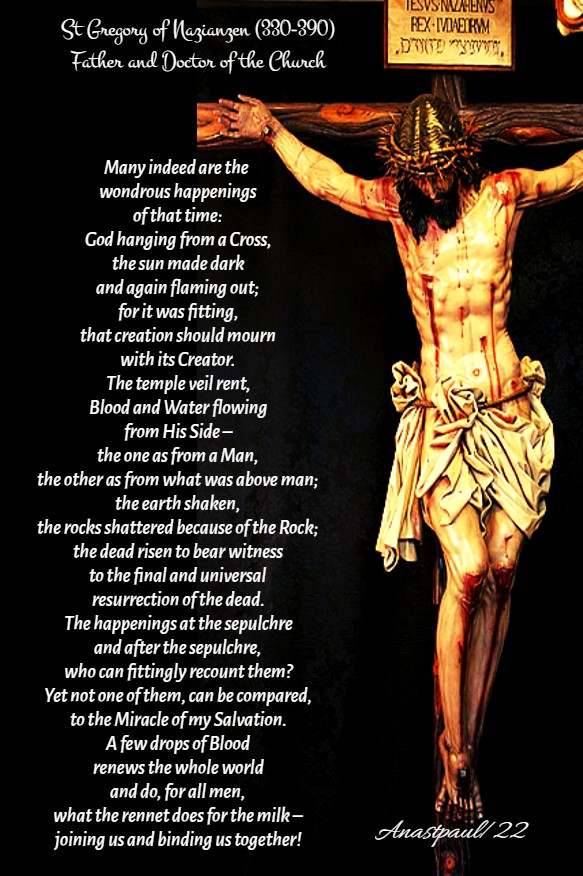
“Many indeed are the wondrous happenings of that time: God hanging from a Cross, the sun made dark and again flaming out; for it was fitting, that creation should mourn with its Creator. The temple veil rent, Blood and Water flowing from His side – the one as from a Man, the other as from what was above man; the earth shaken, the rocks shattered because of the Rock; the dead risen to bear witness to the final and universal resurrection of the dead. The happenings at the sepulchre and after the sepulchre, who can fittingly recount them? Yet not one of them, can be compared, to the Miracle of my Salvation. A few drops of Blood renews the whole world and do, for all men, what the rennet does for the milk – joining us and binding us together!”
St Gregory Nazianzen (330-390) Father & Doctor of the Church
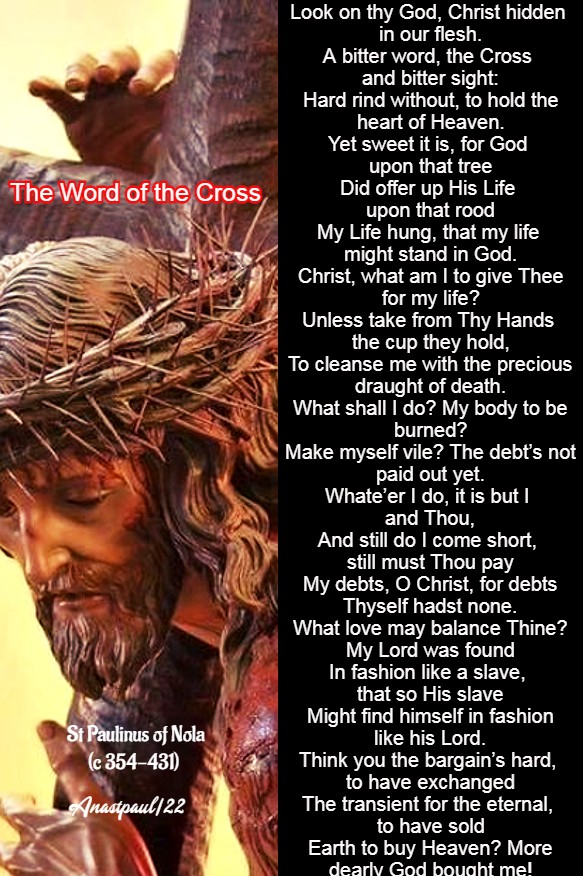
“The Word of the Cross Look on thy God, Christ hidden in our flesh. A bitter word, the Cross and bitter sight: Hard rind without, to hold the heart of Heaven. Yet sweet it is, for God upon that tree Did offer up His Life upon that rood My Life hung, that my Life might stand in God. Christ, what am I to give Thee for my life? Unless take from Thy Hands the cup they hold, To cleanse me with the precious draught of death. What shall I do? My body to be burned? Make myself vile? The debt’s not paid out yet. Whate’er I do, it is but I and Thou, And still do I come short, still must Thou pay My debts, O Christ, for debts Thyself hadst none. What love may balance Thine? My Lord was found In fashion like a slave, that so His slave Might find himself in fashion like his Lord. Think you the bargain’s hard, to have exchanged The transient for the eternal, to have sold Earth to buy Heaven? More dearly God bought me!
St Paulinus of Nola (c 354-431) Father of the Church
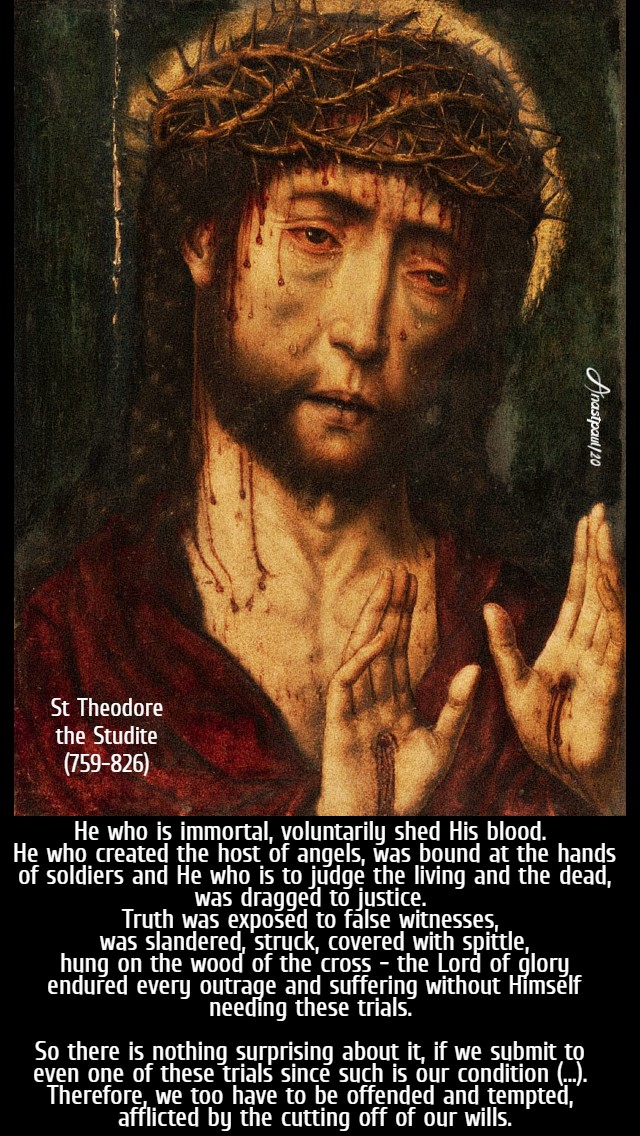
“He who is immortal, voluntarily shed His Blood. He who created the Host of Angels, was bound at the hands of soldiers and He who is to judge the living and the dead, was dragged to justice (cf. Acts 10:42; 2 Tm 4:1). Truth was exposed to false witnesses, was slandered, struck, covered with spittle, hung on the Wood of the Cross – the Lord of Glory (cf. 1 Cor 2:8) endured every outrage and suffering without Himself needing these trials. …
So there is nothing surprising about it, if we submit to even one of these trials, since such is our condition … Therefore, we too have to be offended and tempted, afflicted by the cutting off of our wills.”
St Theodore the Studite (759- 826) Monk at Constantinople, Father (Catecheses 1)
One Minute Reflection – 9 May – The Memorial of St Gregory Nazianzen (330-390) Bishop, Confessor, Father and Doctor of the Church – Sirach 39:6-14, Matthew 5:13-19
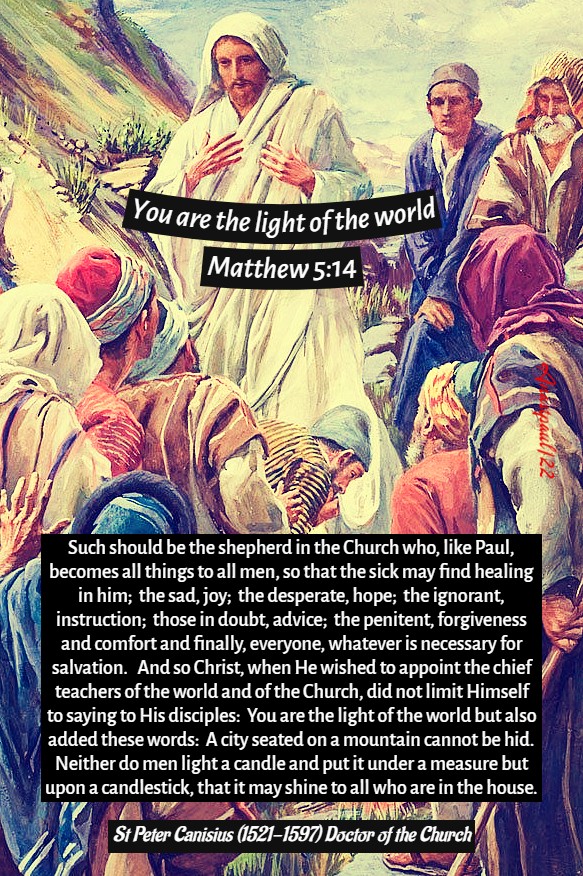
“You are the light of the world.” – Matthew 5:14
REFLECTION – “I shall always love and reverence the Apostles sent by Christ and their successors, in sowing the seed of the Gospel, those zealous and tireless co-operators in propagating the Word, who may justly say of themselves: Let a man so account of us as the ministers of Christ and the dispensers of the mysteries of God. For Christ, like a most watchful and most faithful householder, wished that the Gospel lamp should be lighted by such ministers and delegates, with fire sent down from Heaven and once lighted, should not be put under a measure but set upon a candlestick, so that it may spread its brightness far and wide and put to flight, all darkness and error, rife among both Jews and Gentiles.
Now it is not enough for the Gospel teacher to be a brilliant speaker in the eyes of the people; he must also be as a voice crying in the desert and endeavour, by his eloquence, to help many to lead good lives, lest, if he omit his duty of speaking, he be called the dumb dog that is not able to bark, spoken of by the prophet. Yes, he should also burn, in such a way, that, equipped with good works and love, he may adorn his evangelical office and follow the leadership of Paul. He indeed was not satisfied with bidding the Bishop of the Ephesians: This command and teach: conduct thyself in work as a good soldier of Christ Jesus but he unflaggingly preached the Gospel to friend and foe alike and, said with a good conscience to the Bishops gathered at Ephesus: You know how I have kept back nothing that was for your good but have declared it to you and taught you in public and from house to house, urging Jews and Gentiles to turn to God in repentance and to believe in our Lord Jesus Christ.
Such should be the shepherd in the Church who, like Paul, becomes all things to all men, so that the sick may find healing in him; the sad, joy; the desperate, hope; the ignorant, instruction; those in doubt, advice; the penitent, forgiveness and comfort and finally, everyone, whatever is necessary for salvation. And so Christ, when He wished to appoint the chief teachers of the world and of the Church, did not limit Himself to saying to His disciples: You are the light of the world but also added these words: A city seated on a mountain cannot be hid. Neither do men light a candle and put it under a measure but upon a candlestick, that it may shine to all who are in the house. Those churchmen err, who imagine that it is by brilliant preaching, rather than by holiness of and all-embracing love, they fulfil their office.” – St Peter Canisius SJ (1521-1597) Doctor of the Church (Sermon excerpt).
PRAYER – O God, Who gave to Your people, blessed Gregory, as a minister of salvation, grant, we beseech You, that we, who cherished him on earth as a teacher of life, may be found worthy to have him as an intercessor in Heaven. Through Jesus Christ, Thy Son our Lord, Who lives and reigns with Thee, in the unity of the Holy Ghost, God, world without end. Amen (Collect).
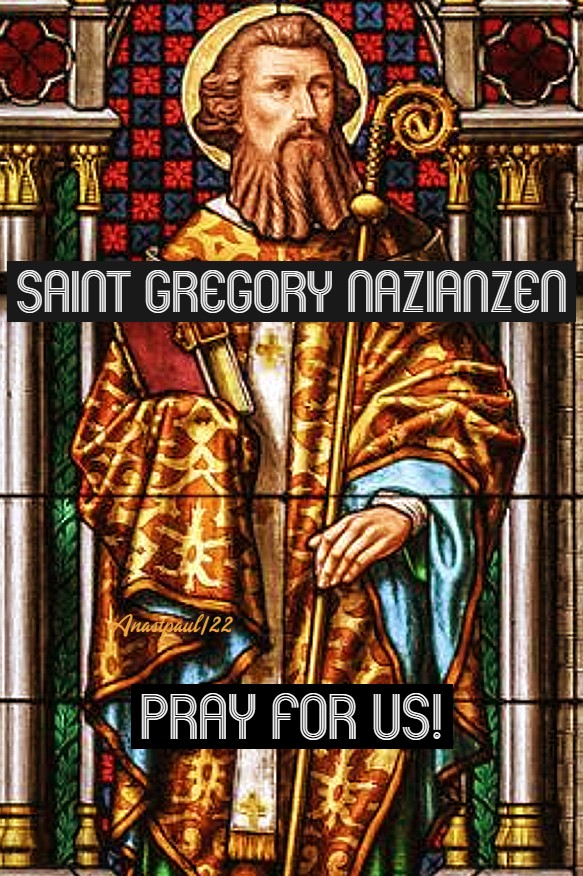
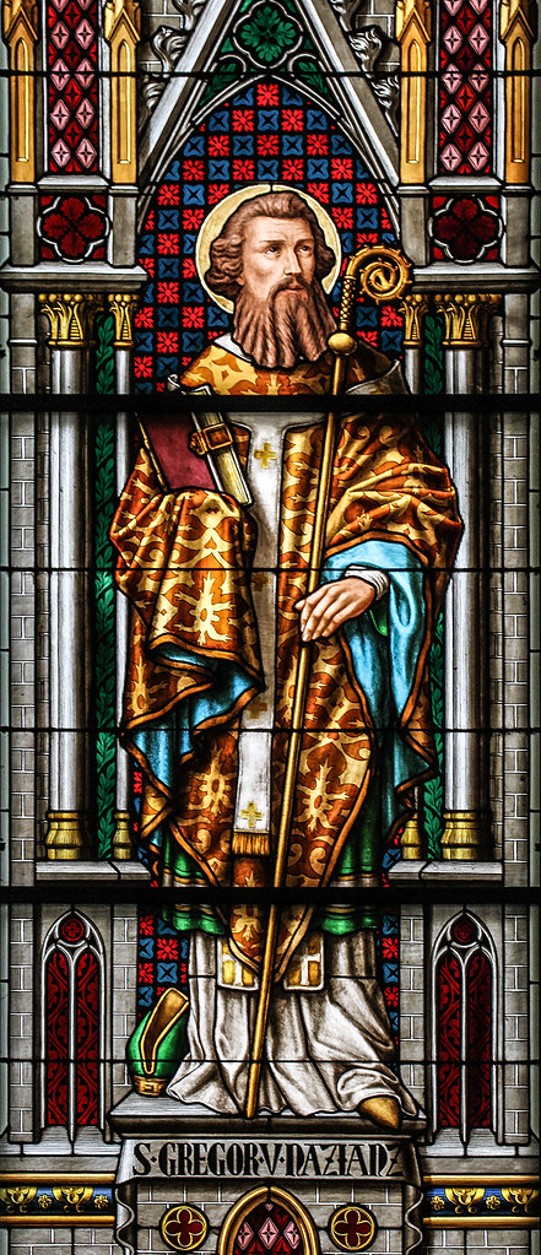
Saint of the Day – 9 May – St Gregory Nazianzen (330-390) Archbishop of Constantinople, Father and Doctor of the Church, Confessor, Theologian, Philosopher, Orator, Poet, Writer, he is remembered as the “Trinitarian Theologian.” He is widely considered one of the most accomplished rhetorical stylist of the patristic age. Along with his great friends and colleagues, the brothers St Basil the Great and St Gregory of Nyssa, he is known as one of the Cappadocian Fathers. The Cappadocia region, in modern-day Turkey, was an early site of Christian activity, with several missions by St Paul in this region. The Cappadocians advanced the development of early Christian theology, for example the doctrine of the Trinity and are highly respected as “Great” Fathers of the Church.
The Roman Martyrology states of him today: “At Naziazus, the birthday of St Gregory, Bishop and Doctor of the Church, surnamed “The Theologian” because of his remarkable knowledge of divinity. At Constantinople, he restored the Catholic Faith, which was fast waning and repressed the rising heresies.”
St Gregory Nazianzen (330-390) Bishop, Father and Doctor of the Church By Fr Francis Xavier Weninger, SJ (1805-1888)
St Gregory who, on account of his great knowledge in Sacred science, is surnamed the Theologian, was born at Nazianzum, in the year c 300. His father, whose name was also Gregory, his mother, Nonna, his brother Caesarius and Gorgonia, his sister, are all honoured as Saints. At Athens, where St. Gregory devoted himself to study, he became acquainted with St Basil the Great, who had made his home there with the same intention. They became most intimate friends, as both were virtuous and diligent. They secluded themselves from all frivolous young men, shunned gaming, idleness, and other vices of youth, cultivating only piety and knowledge. They knew of only two roads, one of which led to school, the other to Church.
After having finished his studies, Basil returned to his home but Gregory remained and studied eloquence, in which he was, in after years, unsurpassed. At that time also, Julian studied at Athens, who afterwards became Emperor and was called the Apostate. In regard to the manners and behaviour of this prince, Gregory said at that time; “Oh what a monster the Roman Empire nourishes in its bosom!” At the same time he predicted, that if Julian should ever wear the imperial crown, he would become the great enemy and persecutor of Christendom, which unhappily became true.
After several years, Gregory left Athens and returned to his native place. One day, while studying, he was overtaken by sleep and it appeared to him that he saw two beautiful virgins, who came as if wishing to speak to him. He asked who they were and what they desired. “One of us,” they answered, “is chastity, the other wisdom.God has sent us to be your friends and remain constantly with you.” His life proved that this vision was no empty dream. Gregory preserved his chastity inviolable and was endowed by the Almighty with such wisdom, that on account of it, he became celebrated throughout the whole world. Great men, among whom was St Jerome, often travelled many miles to hear him speak.
Having been Ordained Priest, he went secretly toBasil, who had retired to the desert of Pontus. There they lived in the greatest harmon, but, at the same time, in the greatest rigour occupied only in prayer and in studying the holy Scriptures.
After the lapse of some years, Gregory returned again to his home, to bring back to the True Faith, his father who, not out of wickedness,but out of simplicity and ignorance, had been deluded by the Arians. Gregory happily extricated him from his error …
Meanwhile Basil became Bishop of Caesarea and most earnestly requested Gregory to take the small bishopric of Sasima, as the far spreading heresy demanded a strong opposition. Gregory allowed himself to be prevailed upon and accepted the See. When, however, another one came who asserted that the office was his, he gave place to him and retired. They wished him afterwards to take charge of the church at Nazianzum but he arranged matters in such a manner, that they chose someone else.
He, however, did not succeed so well in Constantinople. He had gone thither to oppose the heretics, who had filled the whole city with their poison, to defend the Catholic faith and teach its doctrines to the people. After he had laboured there some time with great success, Peter, Bishop of Alexandria, nominated him Bishop of Constantinople and Gregory was obliged to take this heavy burden. All his thoughts were now directed to exterminate heresy and to restore the ancient prestige of the Church.
The Catholics had, at that time, only one Church where they assembled, the heretics having taken possession of all the others. Gregory, however, so brought it about that the newly chosen Emperor Theodosius came himself to Constantinople and gave the Cathedral back to the Catholics, although the heretics opposed it with all their power. This enraged the latter to such a degree that they hired a villain to assassinate the Bishop. The Saint was sick in bed when the murderer came under the pretext of visiting him. As he, however, was alone with him and, therefore, had every opportunity of committing the crime, God suddenly changed his heart, and falling at the feet of the Saint, he confessed his wicked intention and asked forgiveness. The Saint said; “May God, Who protected me, forgive you. I ask you nothing but that you forsake your heresy.”
Much more had he to suffer from the heretics but it in no wise slackened his zeal. The Catholics also gave him just cause of complaint.
Among the Bishops assembled in Council, a dispute arose, concerning the validity of Gregory’s election. The Saint represented to them, that he had not in any manner sought the office but that it had been forced upon him against his desire. Perceiving, however, that all were not satisfied with his explanation and fearing that the peace of the Church might be materially endangered, to the detriment of the whole Christian community, he arose and addressed the assemblage in the following manner:
“Dear colleagues and joint-shepherds of the flock of Christ, it would be very unbecoming to your dignity, should you, whose office it is to exhort others to peace, become disunited among yourselves. Am I the cause of your discord? Behold, I am not better than the prophet Jonas; cast me, therefore, into the sea and the tempest will be calmed. Although I am innocent of your charges, I will suffer without a murmur, that unanimity may be restored among you.”
after having thus spoken calmly and sweetly, he took leave of all present and went to the Emperor, whom he acquainted with his resolution to leave Constantinople. The Emperor, at first refused his consent but the Saint knew so well how to represent to him his reasons, that he at last gave him the desired permission.
He immediately made all the necessary preparations for his departure but once more ascended the pulpit of his Episcopal Church and in a last discourse, took leave of all the assembled faithful, as also of all the other Churches, hospitals and asylums of the city. To those who had frequently complained of his sermons because he unhesitatingly denounced their vices, he said: “Now joyfully clap your hands and cry that the bad, talkative tongue will cease to strike you; yes, it will cease but the hand still remains and pen and ink must in future sustain the combat.” Finally, he admonished them all to lead a Christian life and concluded his sermon with these words: “I exhort you, my dear children, to keep my instructions in your hearts. May the Grace of our Lord Jesus Christ, remain with you all. Amen!“
How deeply affected all his hearers were, was plainly perceived by their tears and their emotion. Well had they reason to be grieved, for they had possessed in Gregory a most tender father for their needy widows and orphans, an invincible protector of their faith, a teacher whom God had gifted with unusual wisdom, a careful, never weary pastor and almost perfect model of all virtue. They tried in every possible way to prevent his leaving but he was not to be persuaded to change his resolution but went on board the ship, which was ready to set sail and returned to his home.
On his arrival, he settled himself upon his parental estate, with the intention of then passing the remainder of his life in solitude and in the exercise of virtue.
This intention he carried out and prayers and devout meditation were his greatest comfort, until, failing health owing to excessive labour, besides old age and sickness, kept him for the greater part of the time in bed. Sometimes, however, he took the pen in hand and wrote several works to confute the doctrine of the heretics and to strengthen and confirm the Catholics. God permitted that the holy man, who had lived until now so piously and pure a life, should endure most fearful temptations from the Evil One. Constant calling on God, austere fasting, prayers, reading devout books and severe study, were the weapons he used against the enemy of man and he always conquered. The Most High also permitted that some men, envious and devoid of conscience, should calumniate the Saint everywhere and even falsely accuse him of some great crimes, to the Bishop of Tianea. The holy man was not angry but, while defending his honour, prayed God to bestow His grace upon his enemies and to pardon them.
Omitting much that might still be related of this great Saint, I will only mention one instance of his solicitude to avoid sin and to do penance. He thought that he had spoken in a certain affair more than was necessary and punished himself by remaining forty days without uttering a single word to anyone!
At length he expired happily, in the 90th year of his age, having laboured and suffered much for the honour of the Almighty and the protection of the True Church. Praise be to God!Amen.
Martyrs of Persia: 310 Christians murdered together for their faith in Persia. No details about them have survived.
20 Mercedarian Martyrs of Riscala: 20 Mercedarian friars who were murdered by Huguenot heretics for refusing to denounce their faith. 16th century at the Santa Maria convent at Riscala, France.
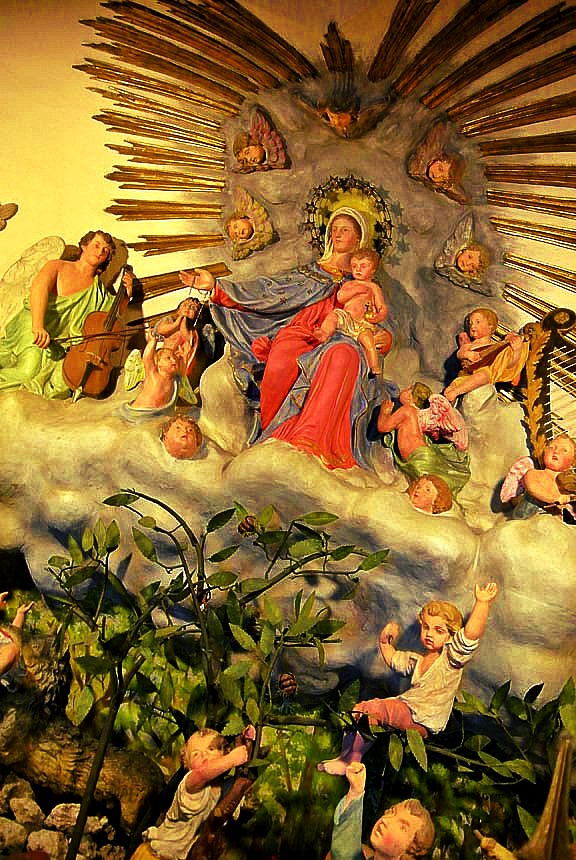
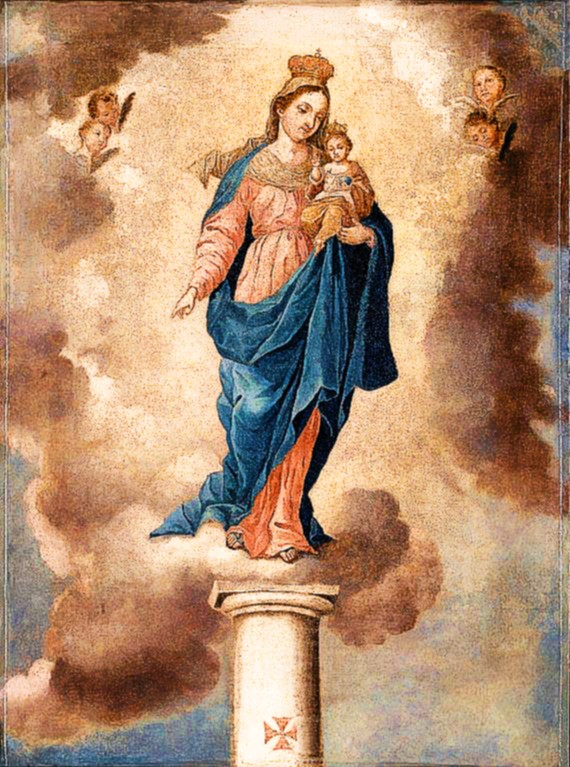
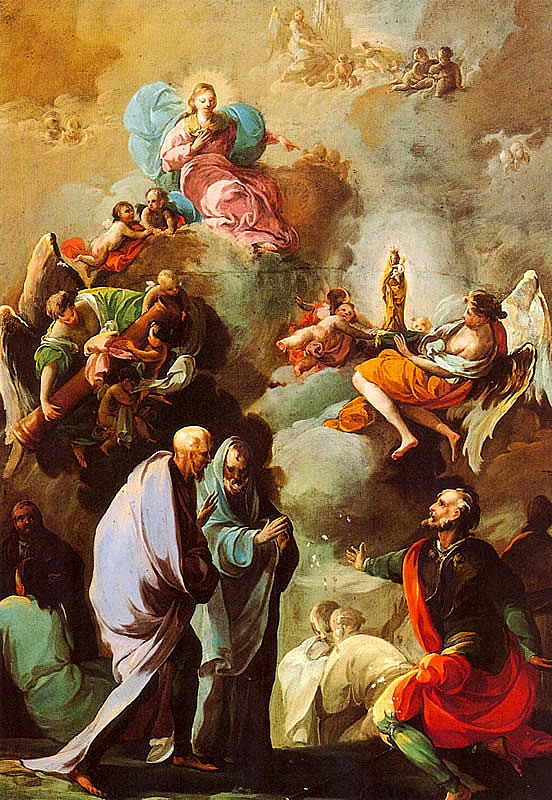
Nuestra Señora del Pilar / Our Lady of the Pillar (Zaragoza, Spain) (40) – 2 January, 12 October (originally 4 October), 15 August – (This Apparition it is considered the first Marian Apparition, and is unique because it happened while Mary was still living on Earth):
According to ancient Spanish history, on 2 January in the year 40, in the early days of Christianity, James the Greater, one of the original Twelve Apostles of Jesus Christ, was preaching the Gospel in what was then the pagan land of Caesaraugusta (now Zaragoza), in the Roman Province of Hispania.
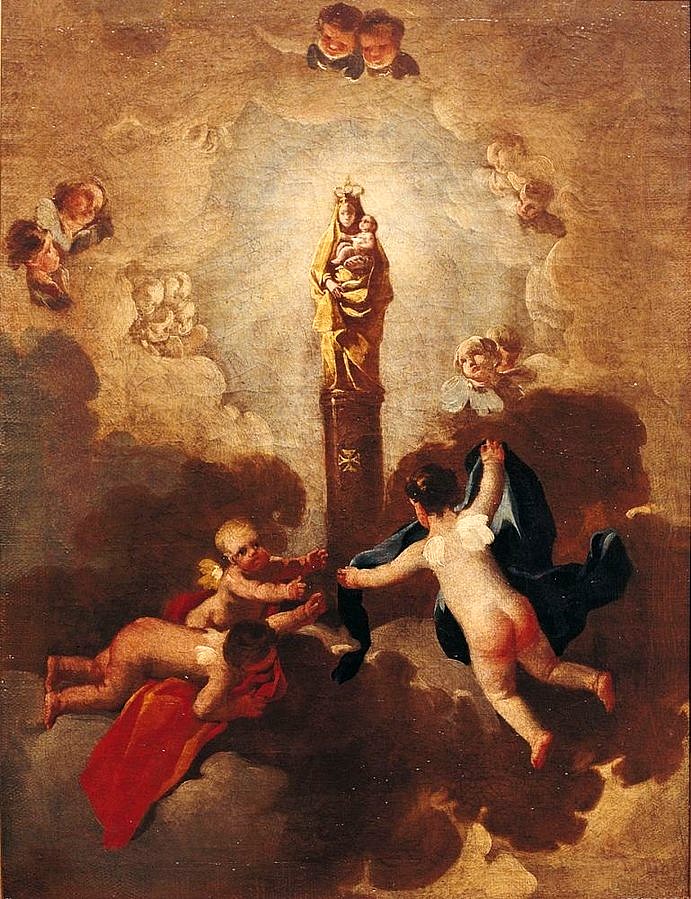
St James was disheartened with his mission, having made only a few converts. While he was praying by the banks of the Ebro River with some of his disciples, the Blessed Virgin Mary miraculously appeared before him atop a pillar accompanied by Angels. Mary assured James that the people would eventually be converted, becoming a stronghold of the Faith due to his efforts and their faith would be as strong as the pillar she was standing on. She gave him the pillar as a symbol and a wooden image of herself. James was also instructed to build a Chapel on the spot where she left the pillar which he did, making it the first Church in Spain.
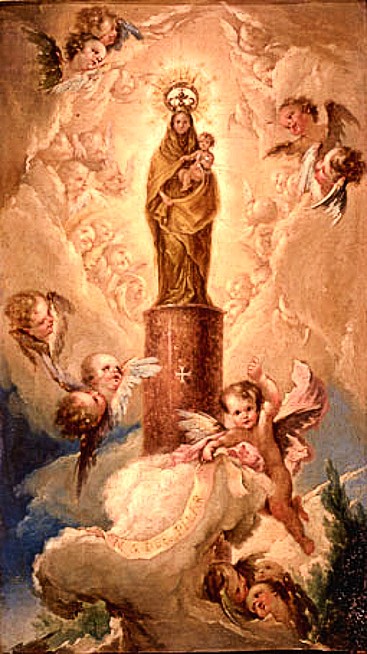
Apparition of the Virgin of the Pillar to Saint James and his Saragossan disciples by Francisco Goya, c 1769.
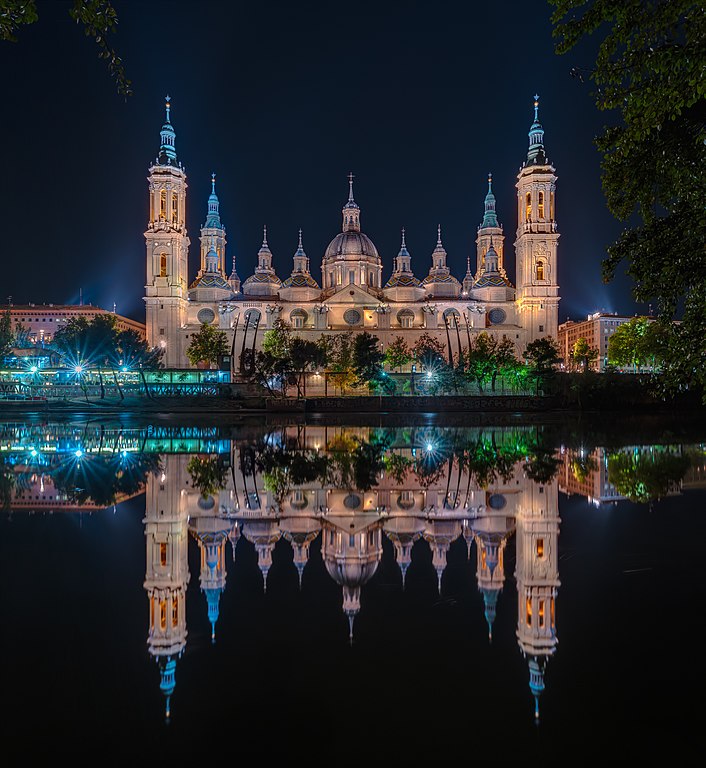
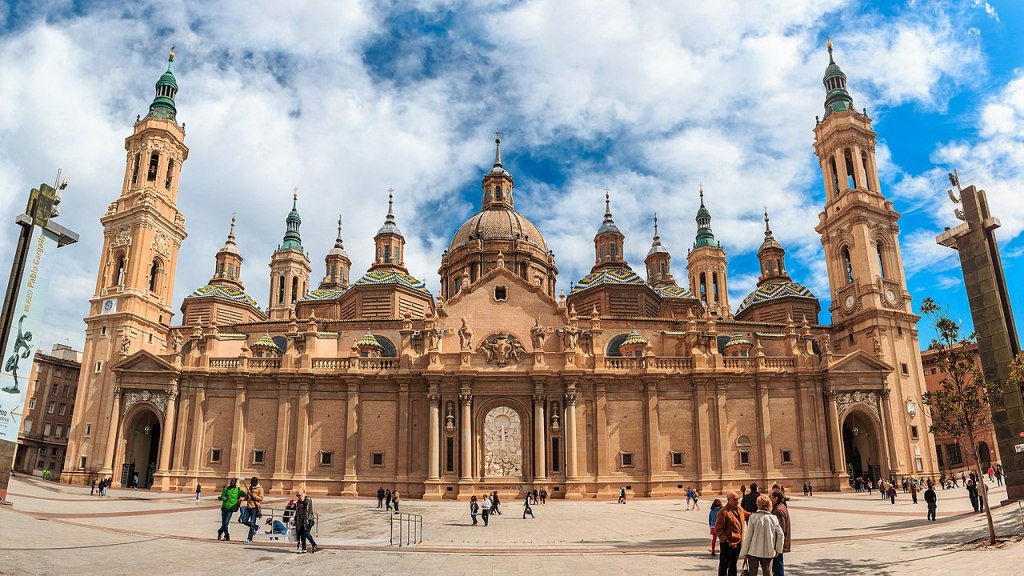
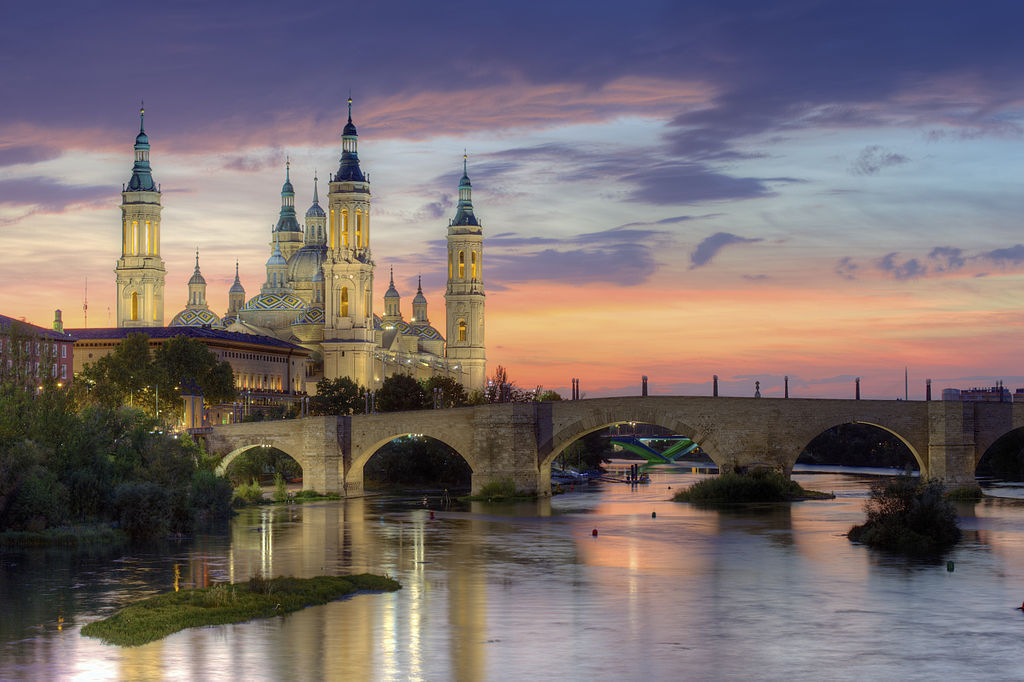
It is generally believed, that Mary appeared to James through bilocation, as she was still living, either in Ephesus or Jerusalem, at the time of this event, as she is believed to have died three to fifteen years after Jesus ascended into Heaven. After establishing the church, James returned to Jerusalem with some of his disciples where he became a Martyr, beheaded in 44 under Herod Agrippa. His disciples returned his body to Spain. The pillar left by the Virgin Mary is presently enshrined in the same but larger Basilica of Our Lady of the Pillar. It is believed to be the same pillar given and promised by Mary, in spite of numerous disasters that beset the Church. A fire in 1434 razed the Church that preceded the present Basilica Cathedral, see below.
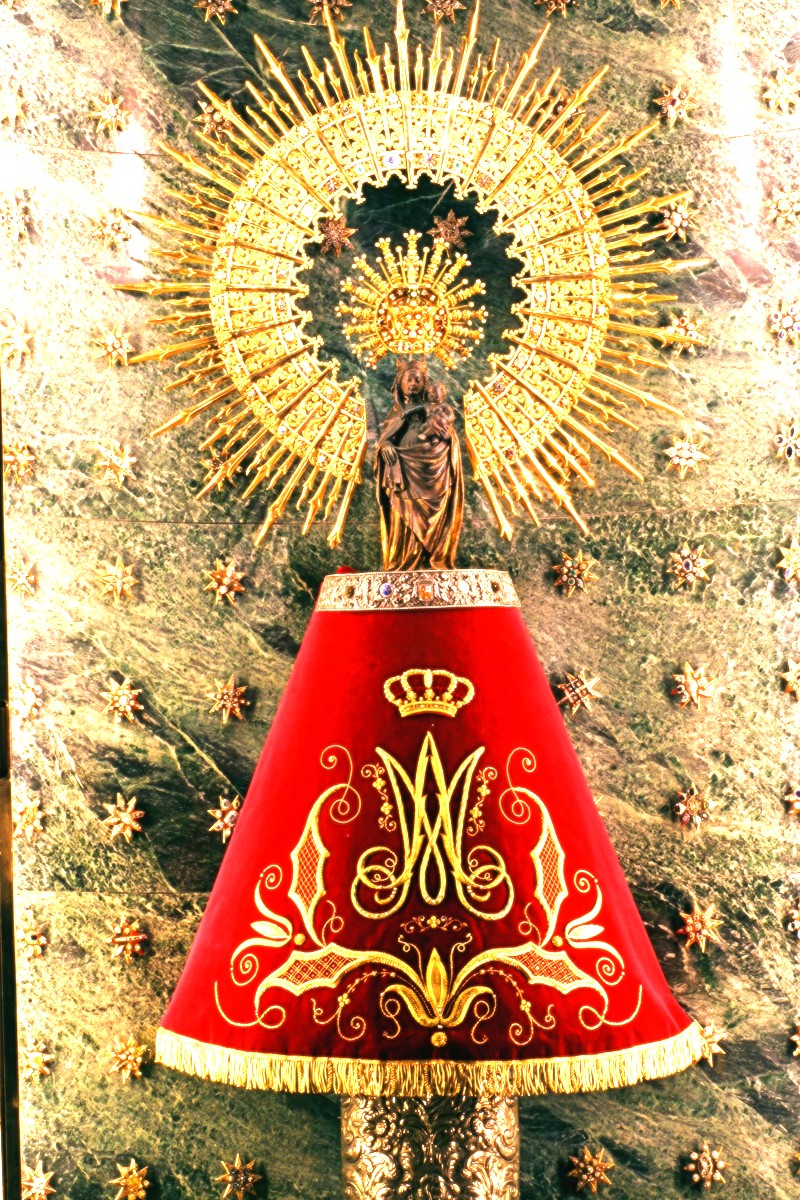
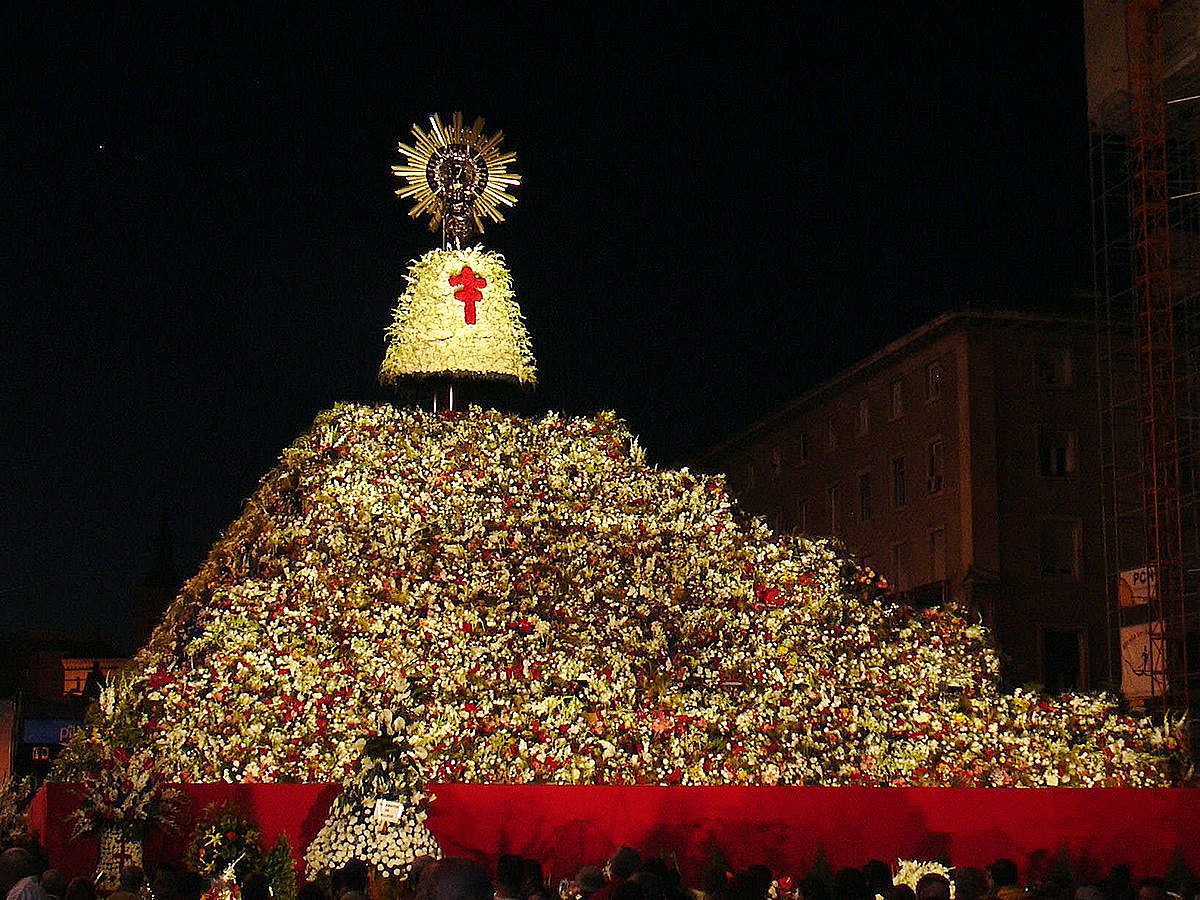
The image of the Blessed Virgin Mary may or may not be the original. Some reports state that the original wooden image was destroyed when the Church burned down in 1434, contradicting other reports, that it is still the original Statue. The Statue of the Blessed Virgin Mary is made of wood and stands 39 centimetres tall while the 1.8 m pillar is made of jasper.quartz. The Statue depicts Mother Mary with the Child Jesus on her left arm, Who has a dove sitting on His left palm. Since the 16th century, the pillar is usually draped in a skirt-like cover called manto (in English: mantle). As a whole, it is protected by a bronze case and then another case of silver. The image was canonically crowned in 1905 during the reign of Pope Pius X. The crown was designed by the Marquis of Griñi, valued at 450,000 pesetas (£18,750, in1910). During the three Marian festivities of today, 15 August and 12 October, the faithful adorn the base of the Pillar and Statue with flowers – see below (both our Blessed Mother and St James would be thrilled by this display of such immense faith and piety!)
The apparition of Our Lady of the Pillar is a widely accepted sacred tradition. Popes from earliest times issued Papal Bulls attesting to the authenticity of the Shrine and the appearance of the Virgin Mary. Pope Calixtus III issued a Bull in 1456 encouraging pilgrimage to the Lady of the Pillar. It acknowledged the miracle of its foundation and the miracles that had taken place at the Spanish Shrine. It was also through this Bull that the name “Our Lady of the Pillar” was confirmed. So many contradictions had arisen concerning the miraculous origin of the Church that during the reign of Pope Innocent XIII , the Bishops of Spain appealed to the Holy See to settle the controversy. After careful investigation, the twelve Cardinals, in whose hands the affair rested, adopted the following account, which was approved by the Sacred Congregation of Rites on 2 August 1723 and has since been inserted in the lessons of the Office of the Feast of Our Lady of the Pillar, celebrated on 12 October.
“Of all the places that Spain offers for the veneration of the devout, the most illustrious is doubtless the Sanctuary consecrated to God under the invocation of the Blessed Virgin, under the title of Our Lady of the Pillar, at Saragossa. According to ancient and pious tradition, St James the Greater, led by Providence into Spain, spent some time at Saragossa. He there received a signal favour from the Blessed Virgin. As he was praying with his disciples one night, upon the banks of the Ebro, as the same tradition informs us, the Mother of God, who still lived, appeared to him and commanded him to erect an oratory in that place. The Apostle delayed not to obey this injunction,and with the assistance of his disciples, soon constructed a small Chapel. In the course of time, a larger Church was built and dedicated, which, with the dedication of Saint Saviour’s, is kept as a festival in the City and Diocese of Saragossa on the 4th of October.“
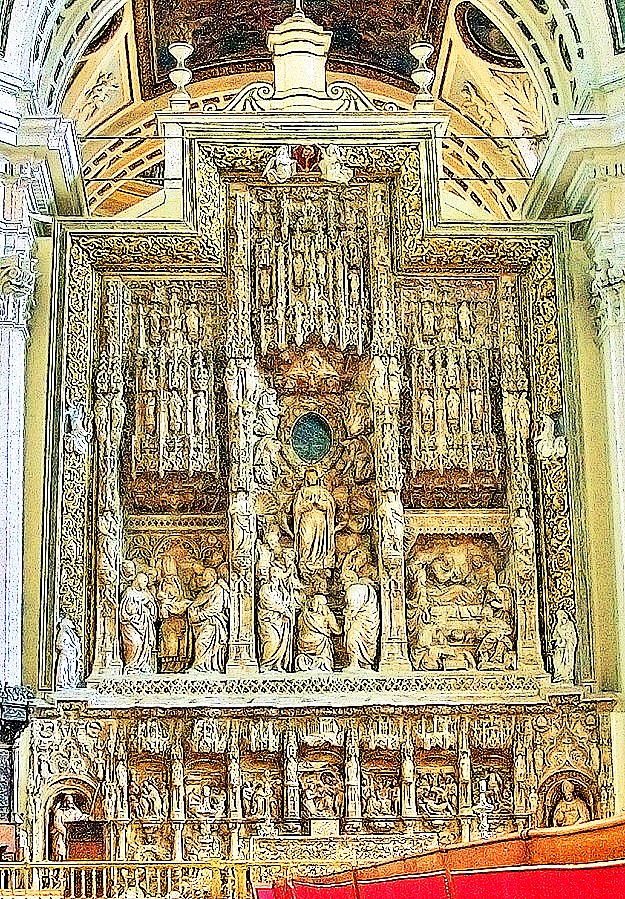
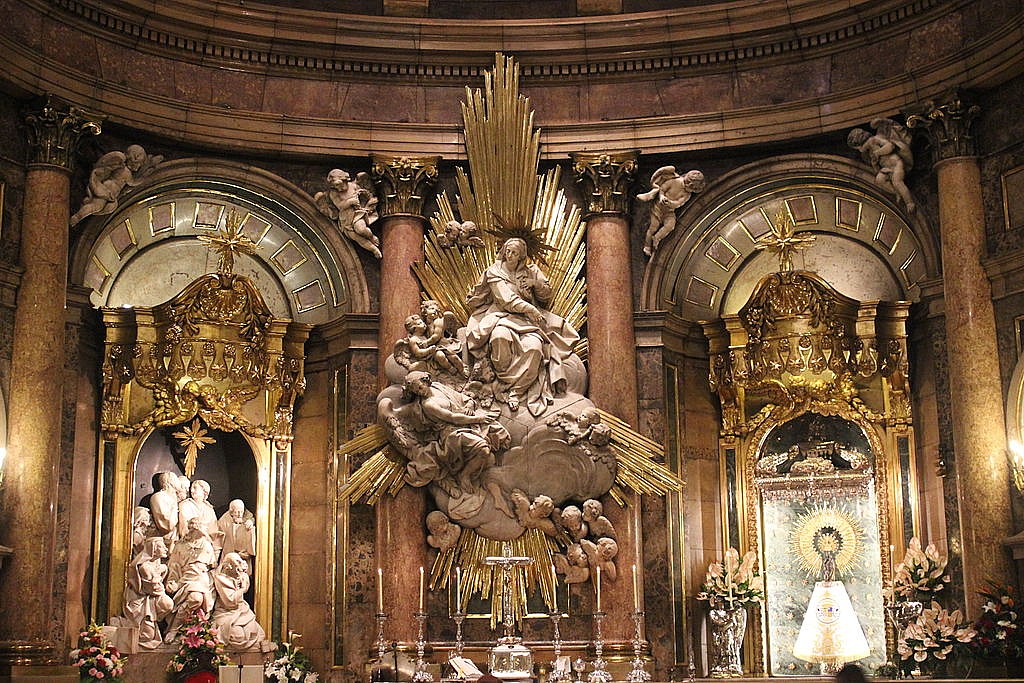
Holy Chapel of the Pillar of Zaragoza. Altar with the Arrival of the Virgin by ‘José Ramírez de Arellano.
In 1730, Pope Clement XII allowed the celebration of the Feast of Our Lady of the Pillar all over the Spanish Empire. As the date coincides with the discovery of the Americas, the Lady was later named as Patroness of the Hispanic World although her Patronages include all of the following: Zaragoza, Spain, Melo, Uruguay, Buenos Aires, Argentina, Diocese of Imus, Cavite, Zamboanga City, Santa Cruz, Manila, Alaminos, Laguna, San Simon, Pampanga, Libmanan, Camarines Sur, Pilar and Morong in Bataan, Mamburao, Occidental Mindoro, Sibonga, Cebu, Baleno, Masbate, Cauayan, Isabela.
Prayer: Hail, Mary, Our Lady of the Pillar, conceived without sin, I come to venerate and honour you. above all the Angels and Saints in Heaven, as my Queen, my Lady and my dearest Mother. I firmly resolve to serve you always and to do whatever I am able, that all may render faithful service to you. Most Holy Mary, through your kind intercession and by your own merits, obtain for me from your Divine Son Jesus, our Lord and Saviour, all the graces I need for the eternal salvation of my soul. Therefore, most devoted Mother of mothers, through the Precious Blood which your Son shed for us, I humbly beseech thee to receive me among your devotees and to accept me as your servant forever. Help me in my every thought, action word and deed, never to be displeasing in your sight and in the sight of your Son, our Lord and Redeemer. Think of me always, my dear Lady of the Pillar and do not forsake me in the hour of my death. Amen.
Bl Airaldus of Maurienne St Asclepius of Limoges St Aspasius of Auch St Blidulf of Bobbio Bl Guillaume Répin St Hortulana of Assisi St Isidore of Antioch St Isidore of Nitria St Laurent Bâtard
Saint Macarius the Younger of Alexandria (Died c 401) Priest, Monk, Desert Hermit.
St Maximus of Vienne Bl Odino of Rot St Paracodius of Vienne St Seiriol Blessed Sylvester of Troina St Telesphorus, Pope St Theodota St Theopistus St Vincentian of Tulle
Many Martyrs Who Suffered in Rome: There were many Martyrs who suffered in the persecutions of Diocletian for refusing to surrender the holy books. Though we know these atrocities occurred, we do not know the names of the Saints and we honour them as a group. c 303 in Rome, Italy.
Martyrs of Antioch – 5 saints: A group of Christian soldiers Martyred together for their faith. We know the names of five – Albanus, Macarius, Possessor, Starus and Stratonicus. They were born in Greece and were Martyred in Antioch (modern Antakya, Turkey).
Many Martyrs of Britain: The Christians of Britain appear to have escaped unharmed in the earlier persecutions which afflicted the Church but the cruel edicts of Diocletian were enforced in every corner of the Roman Empire and the faithful inhabitants of this land, whether native Britons or Roman colonists, were called upon to furnish their full number of holy Martyrs and Confessors. The names of few are on record but the British historian, Saint Gildas, after relating the Martyrdom of Saint Alban, tells us, that many others were seized, some put to the most unheard-of tortures and others immediately executed, while not a few hid themselves in forests and the caves of the earth, where they endured a prolonged death until God called them to their reward. The same writer attributes it to the subsequent invasion of the English, then a pagan people, that the recollection of the places, sanctified by these Martyrdoms, has been lost and so little honour paid to their memory. It may be added, that, according to one tradition, a thousand of these Christians were overtaken in their flight near Lichfield and cruelly massacred and that the name of Lichfield, or Field of the Dead, is derived from them.
Martyrs of Ethiopia – 3 saints: A group of Christians Martyred together for their faith. We know the names of three – Auriga, Claudia and Rutile.
Martyrs of Jerusalem – 2 saints: A group of Christians Martyred together for their faith. We know the names of two – Stephen and Vitalis.
Martyrs of Lichfield: Many Christians suffered at Lichfield (aka Lyke-field, meaning field of dead bodies), England in the persecutions of Diocletian. Though we know these atrocities occurred, we do not know the names of theSsaints and we honour them as a group. Their Martyrdom occurred in 304 at Lichfield, England.
Martyrs of Piacenza: A group of Christians who died together for their faith in the persecutions of Diocletian. No details about them have survived. They were Martyred on the site of Church of Madonna di Campagna, Piacenza, Italy.
Martyrs of Puy – 4 saints: Missionaries, sent by Saint Fronto of Périgueux to the area of Puy, France. Tortured and Martyred by local pagans. We know the names – Frontasius, Severinus, Severian and Silanus. They were beheaded in Puy (modern Puy-en-Velay), France and buried together in the Church of Notre Dame, Puy-en-Velay by Saint Fronto, their bodies laid out to form a cross.
Martyrs of Syrmium – 7 saints: Group of Christians Martyred together, date unknown. We know the names of seven – Acutus, Artaxus, Eugenda, Maximianus, Timothy, Tobias and Vitus – but very little else. This occurred in the 3rd or 4th century at Syrmium, Pannonia (modern Sremska Mitrovica, Serbia).
Martyrs of Tomi – 3 saints: Three brothers, all Christian soldiers, in the Imperial Roman army and all three Martyred in the persecutions of Emperor Licinius Licinianus. We know their names – Argeus, Marcellinus and Narcissus – but little else. They were Martyred in 320 at Tomi, Exinius Pontus, Moesia (modern Constanta, Romania).




















 AnaStpaul
You must be logged in to post a comment.