Saint of the Day – 23 February – St Polycarp of Smyrna – (69-156) – Martyr, Apostolic Church Father and Bishop of Smyrna, Writer, Preacher, Theologian – Patron against dysentery and earache.
Polycarp is regarded as a saint and Church Father in the Eastern Orthodox, Oriental Orthodox, Catholic, Anglican, and Lutheran churches. His name ‘Polycarp’ means ‘much fruit’ in Greek.
It is recorded by Irenaeus, who heard him speak in his youth, and by Tertullian, that he had been a disciple of John the Apostle. Saint Jerome wrote that Polycarp was a disciple of John and that John had ordained him bishop of Smyrna.
With Clement of Rome and Ignatius of Antioch, Polycarp is regarded as one of three chief Apostolic Fathers. The sole surviving work attributed to his authorship is his Letter to the Philippians; it is first recorded by Irenaeus of Lyons.
According to St Irenaeus, Polycarp was a companion of Papias, another “hearer of John” as Irenaeus interprets Papias’ testimony and a correspondent of Ignatius of Antioch. Ignatius addressed a letter to him, and mentions him in his letters to the Ephesians and to the Magnesians.
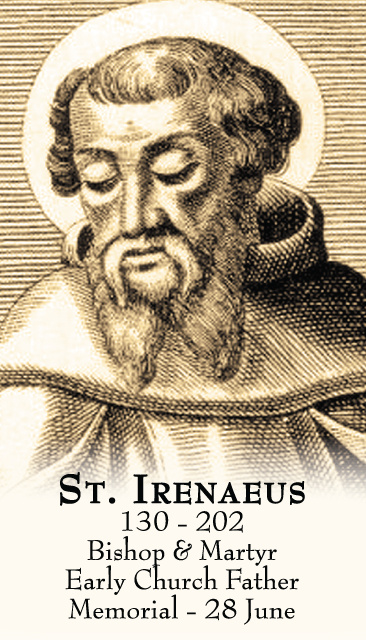
Irenaeus regarded the memory of Polycarp as a link to the apostolic past. He relates how and when he became a Christian, and in his letter to Florinus stated that he saw and heard Polycarp personally in lower Asia. Irenaeus wrote to Florinus:
“I could tell you the place where the blessed Polycarp sat to preach the Word of God. It is yet present to my mind with what gravity he everywhere came in and went out; what was the sanctity of his deportment, the majesty of his countenance; and what were his holy exhortations to the people. I seem to hear him now relate how he conversed with John and many others who had seen Jesus Christ, the words he had heard from their mouths.”
In particular, he heard the account of Polycarp’s discussion with John and with others who had seen Jesus. Irenaeus also reports that Polycarp was converted to Christianity by apostles, was consecrated a bishop and communicated with many who had seen Jesus. He repeatedly emphasizes the very great age of Polycarp. Polycarp kissed the chains of Ignatius when he passed by Smyrna on the road to Rome for his martyrdom.
Polycarp occupies an important place in the history of the early Christian Church. He is among the earliest Christians whose writings survived. Saint Jerome wrote that Polycarp was a “disciple of the apostle John and by him ordained bishop of Smyrna”. He was an elder of an important congregation which was a large contributor to the founding of the Christian Church.
Irenaeus, who had heard him preach in his youth, said of him: “a man who was of much greater weight and a more steadfast witness of truth, than Valentinus and Marcion, and the rest of the heretics”. Polycarp had learned from apostle John to flee from those who change the divine truth. One day he met in the streets of Rome the heretic Marcion who, resenting that Polycarp did not greet him, said: “Do you know me?” The saint replied: “Yes, I know you, the first-born of Satan.” Polycarp lived in an age after the deaths of the apostles, when a variety of interpretations of the sayings of Jesus were being preached. His role was to authenticate orthodox teachings through his reputed connection with the apostle John: “a high value was attached to the witness Polycarp could give as to the genuine tradition of old apostolic doctrine”, Wace commented, “his testimony condemning as offensive novelties the figments of the heretical teachers”. Irenaeus states (iii. 3) that on Polycarp’s visit to Rome, his testimony converted many disciples of Marcion and Valentinus.
The story of Polycarp’s martyrdom is the earliest recorded account of a Christian martyr. Polycarp was seized for being a Christian. Persecution and death would not tear him away from Jesus now. Polycarp was led into the stadium of Smyrna. The crowd demanded that he be left to the lions, but instead he was sentenced to death by fire. An eyewitness account claims that the flames didn’t harm him. He was finally killed by the sword, and his body was burned.
The community of believers celebrated the anniversary of Polycarp’s death with great joy, for in him they had seen an outstanding example of love and patience. He had held strong and had won the treasure of eternal life. Polycarp is remembered as an Apostolic Father, one who was a disciple of the apostles.



 AnaStpaul
You must be logged in to post a comment.