Quote/s of the Day – 16 March – Monday of the Fourth Week of Lent – 3 Kings 3:16-28; John 2:13-25 – Scripture search here: https://www.drbo.org/
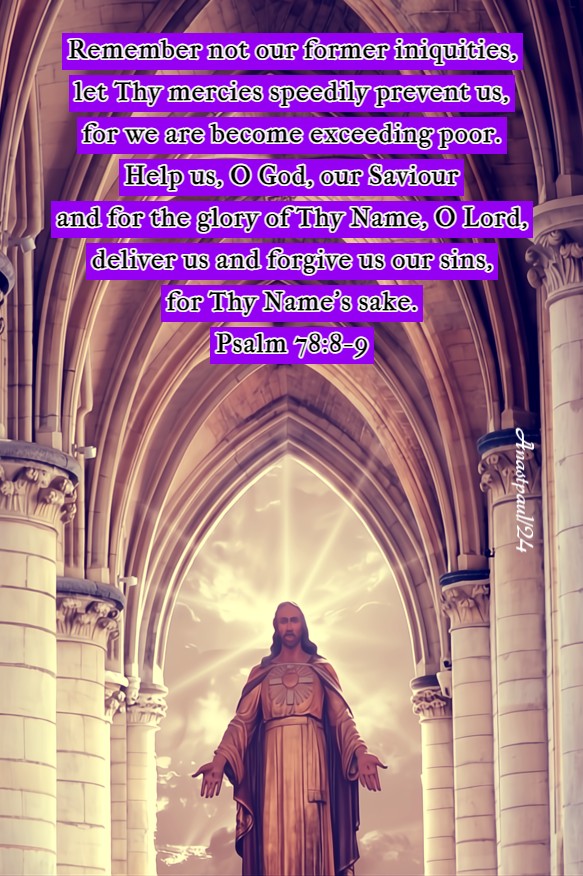
“Remember not our former iniquities, let Thy mercies speedily prevent us, for we are become exceeding poor. Help us, O God, our Saviour and for the glory of Thy Name, O Lord, deliver us and forgive us our sins, for Thy Name’s sake.”
Psalm 78:8-9
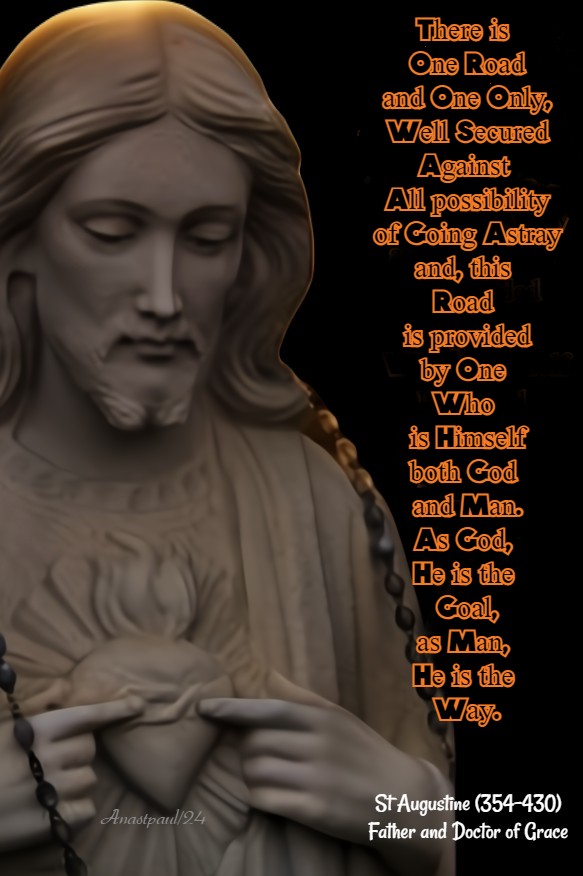
“… There is one Road and one only, well secured against all possibility of going astray and, this Road is provided by One, Who is Himself both God and Man. As God, He is the Goal, as Man, He is the Way.”
St Augustine (354-430) Father and Doctor of Grace
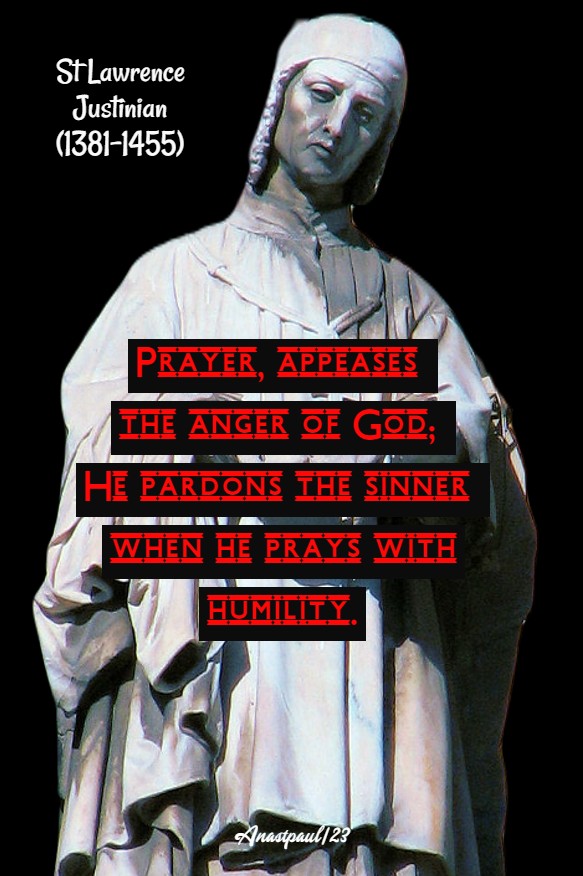
“Prayer, appeases the anger of God; He pardons the sinner when he prays with humility.”
Quote/s of the Day – 21 December – “The Month of the Divine Infancy and the Immaculate Conception of the Blessed Virgin Mary” – Advent IV – 1 Corinthians 4:1-5 – Luke 3:1-6 – Scripture search here: https://www.drbo.org/
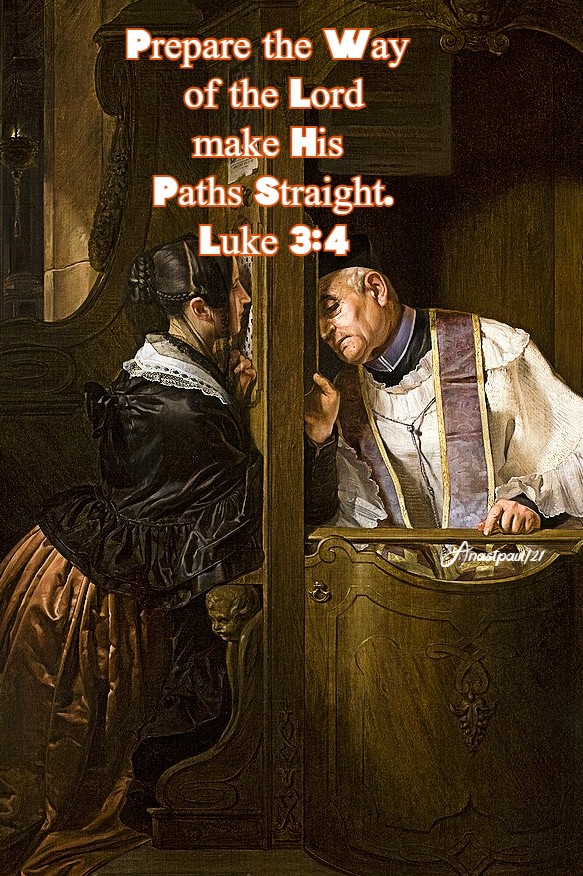
“Prepare the way of the Lord, make straight His paths.”
Luke 3:4
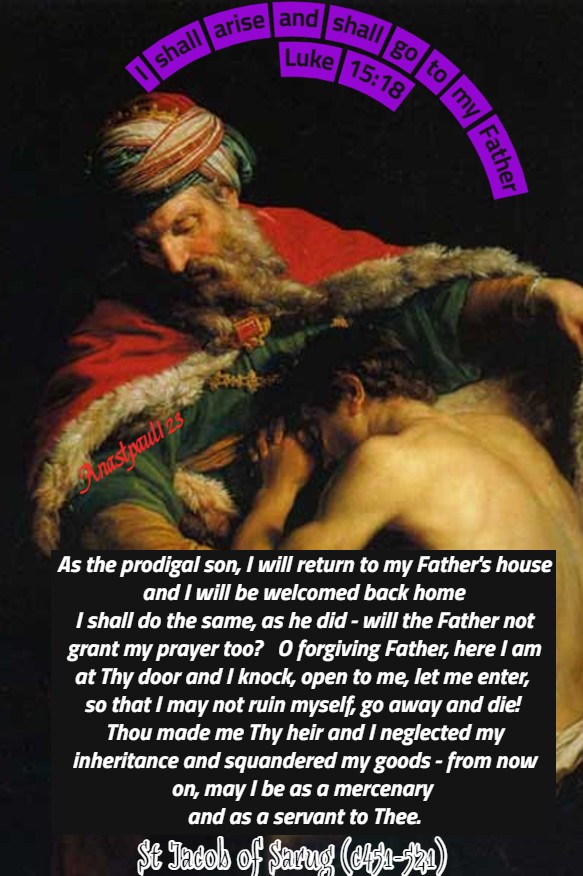
“As the prodigal son, I will return to my Father’s house and I will be welcomed back home. I shall do the same, as he did – will the Father not grant my prayer too? O forgiving Father, here I am at Thy door and I knock, open to me, let me enter, so that I may not ruin myself, go away and die! Thou made me Thy heir and I neglected my inheritance and squandered my goods – from now on, may I be as a mercenary and as a servant to Thee.”
St Jacob of Sarug (c451-521) Bishop, Theologian, Poet, Writer, Father
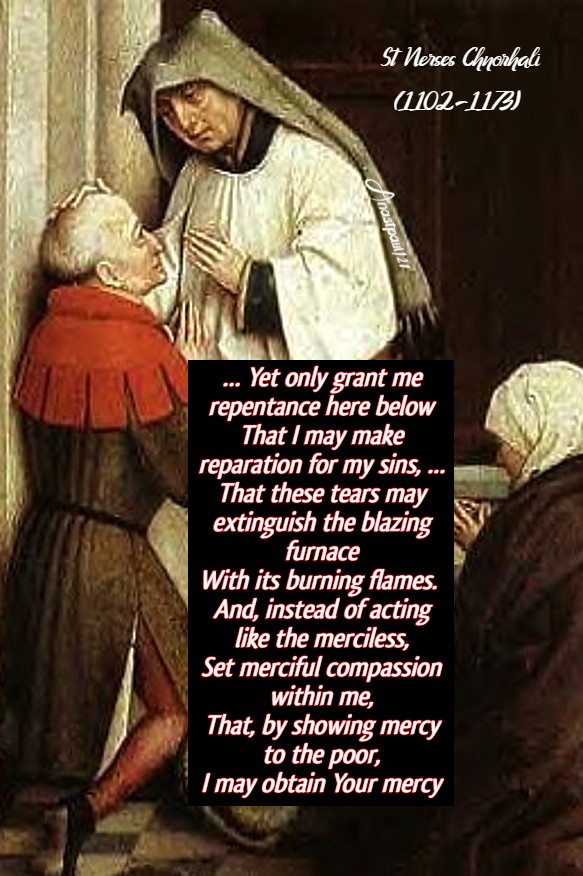
“ … Yet only grant me repentance here below That I may make reparation for my sins, … That these tears may extinguish the blazing furnace With its burning flames. …
And, instead of acting like the merciless, Set merciful compassion within me, That, by showing mercy to the poor, I may obtain Your mercy.”
St Nerses Chnorhali (1102-1173) Armenian Bishop
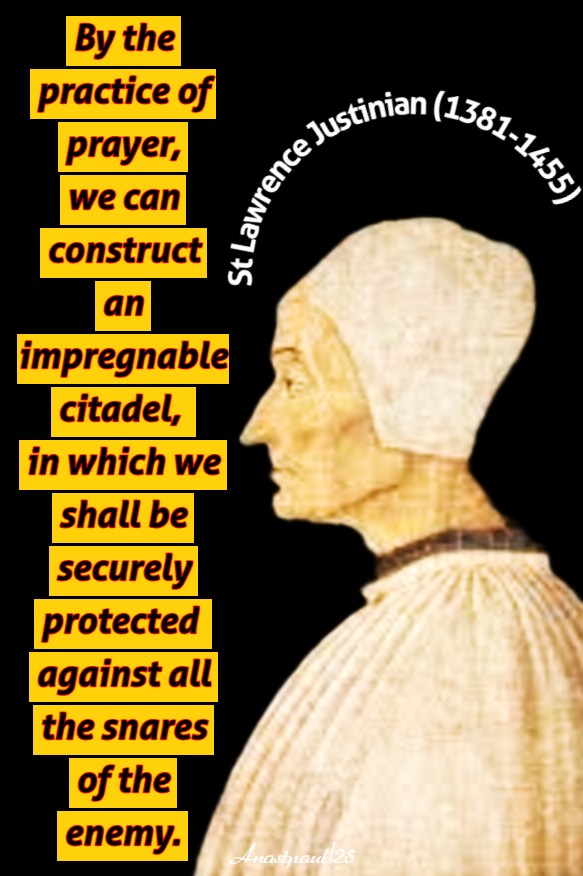
“By the practice of prayer, we can construct an impregnable citadel, in which we shall be securely protected against all the snares of the enemy.”
St Lawrence Justinian (1381-1455)
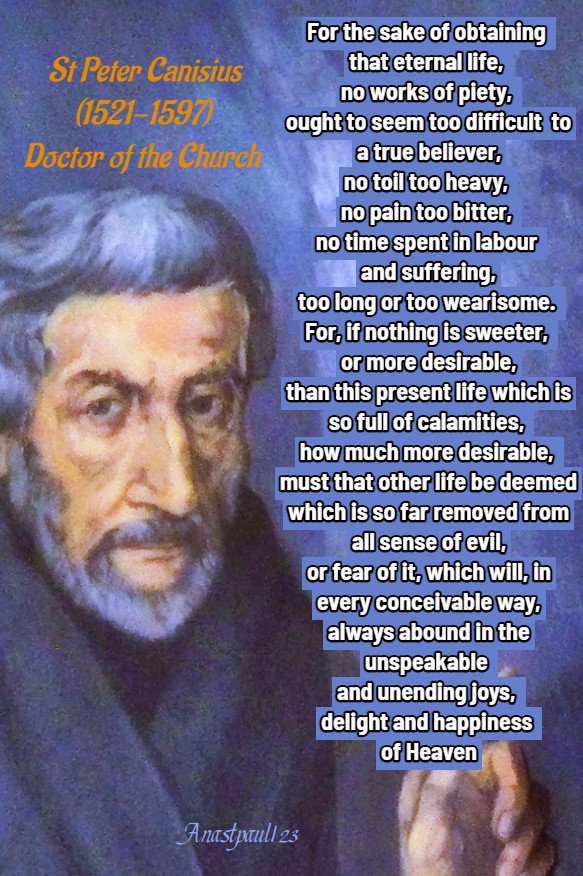
“For the sake of obtaining that eternal life, no works of piety, ought to seem too difficult to a true believer, no toil too heavy, no pain too bitter, no time spent in labour and suffering, too long or too wearisome. For, if nothing is sweeter, or more desirable, than this present life which is so full of calamities, how much more desirable, must that other life be deemed which is so far removed from all sense of evil, or fear of it, which will, in every conceivable way, always abound in the unspeakable and unending joys, delight and happiness of Heaven.”
St Peter Canisius SJ (1521-1597) Confessor, Doctor of the Church
Quote/s of the Day – 24 September – Nuestra Señora de las Mercedes / Our Lady of Mercy / Our Lady of Ransom
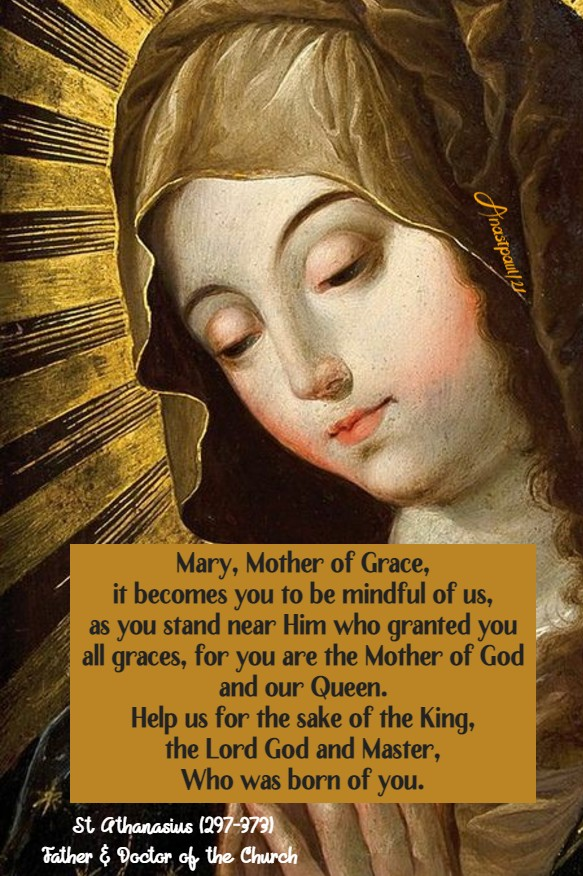
“Mary, Mother of Grace, it becomes you to be mindful of us, as you stand near Him who granted you all graces, for you are the Mother of God and our Queen. Help us for the sake of the King, the Lord God and Master, Who was born of you.”
St Athanasius (297-373) Father & Doctor of the Church
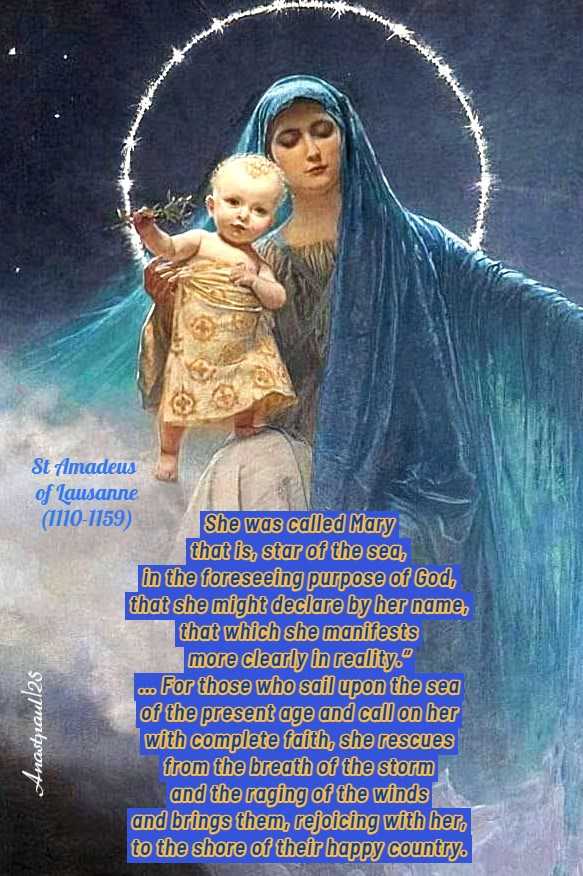
“She was called Mary that is, star of the sea, in the foreseeing purpose of God, that she might declare by her name, that which she manifests more clearly in reality.” … For those who sail upon the sea of the present age and call on her with complete faith, she rescues from the breath of the storm and the raging of the winds and brings them, rejoicing with her, to the shore of their happy country.”
St Amadeus of Lausanne (1110-1159)
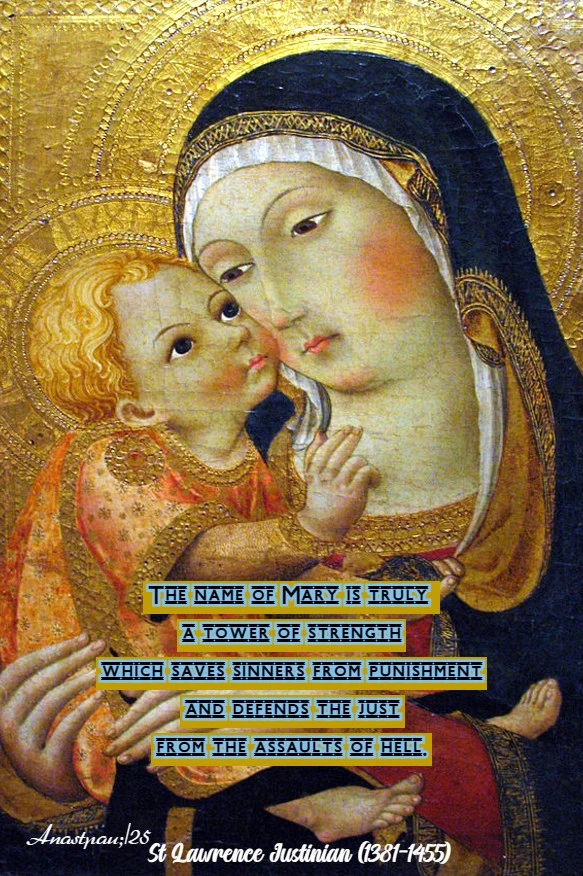
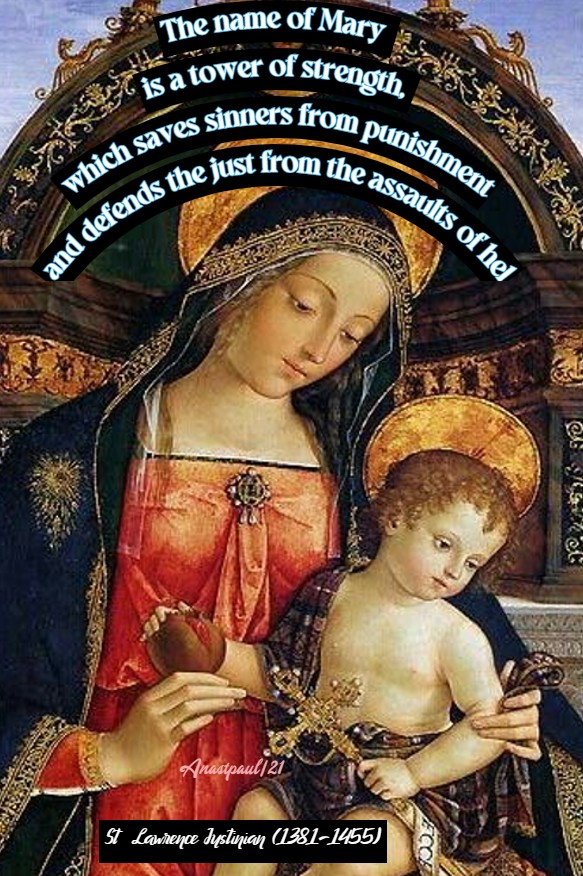
“The name of Mary istruly a tower of strength which saves sinners from punishment and defends the just from the assaults of hell.”
St Lawrence Justinian (1381-1455)
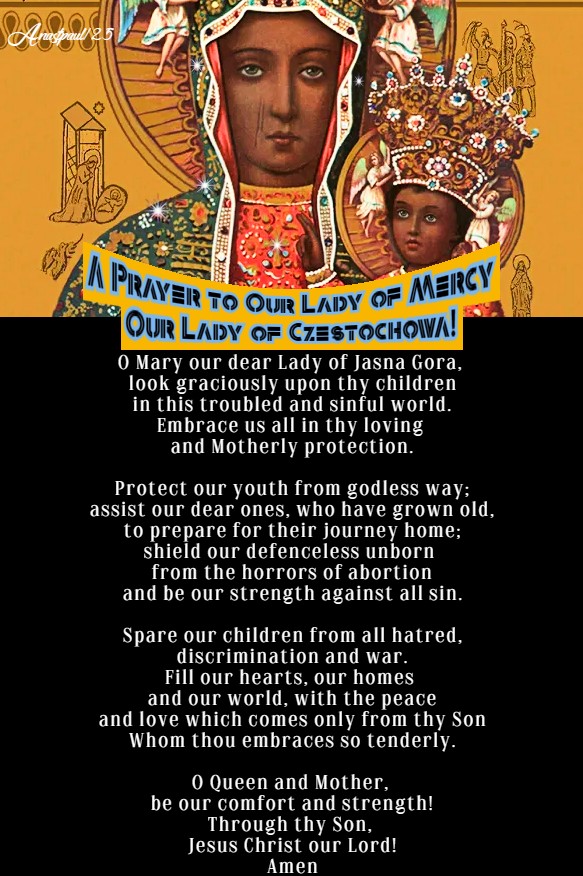
A Prayer to Our Lady of Mercy Our Lady of Czestochowa!
O Mary our dear Lady of Jasna Gora, look graciously upon thy children in this troubled and sinful world. Embrace us all in thy loving and Motherly protection.
Protect our youth from godless way; assist our dear ones, who have grown old, to prepare for their journey home; shield our defenceless unborn from the horrors of abortion and be our strength against all sin.
Spare our children from all hatred, discrimination and war. Fill our hearts, our homes and our world, with the peace and love which comes only from thy Son Whom thou embraces so tenderly.
O Queen and Mother, be our comfort and strength! Through thy Son, Jesus Christ our Lord! Amen
Quote/s of the Day – 6 September – “The Month of The Seven Sorrows of the Blessed Virgin Mary and The Holy Cross” –
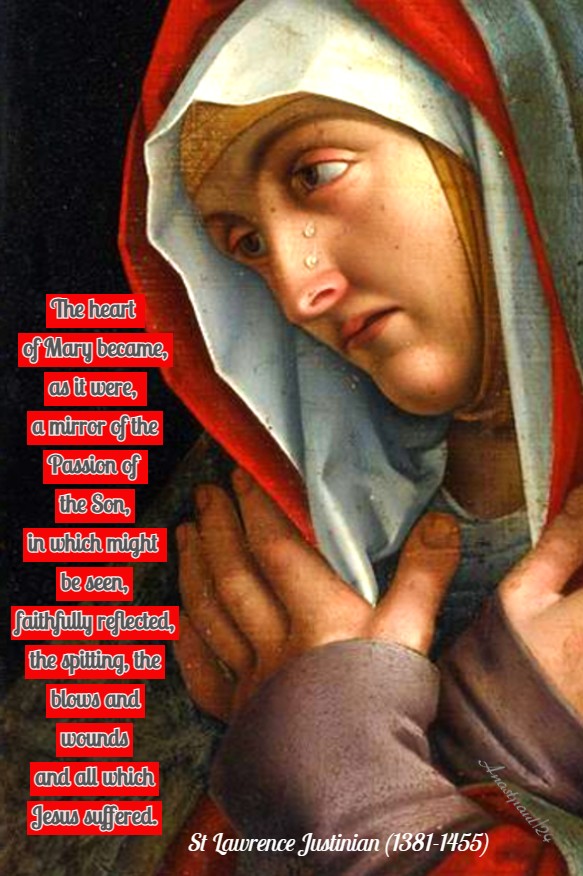
“The heart of Mary became, as it were, a mirror of the Passion of the Son, in which might be seen, faithfully reflected, the spitting, the blows and wounds and all which Jesus suffered.”
St Lawrence Justinian (1381-1455)
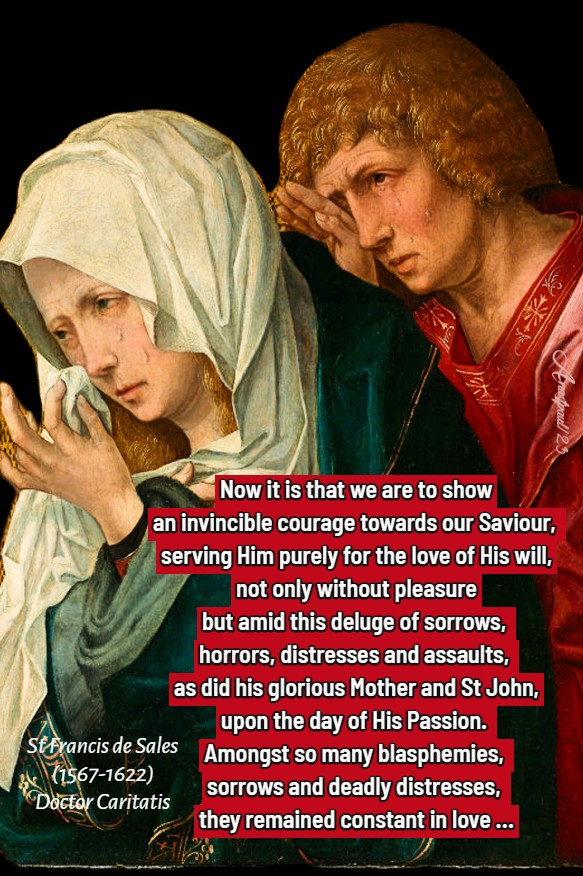
“Now it is that we are to show an invincible courage towards our Saviour, serving Him purely for the love of His Will, not only without pleasure but amid this deluge of sorrows, horrors, distresses and assaults, as did his glorious Mother and St John, upon the day of His Passion. Amongst so many blasphemies, sorrows and deadly distresses, they remained constant in love …”
One Minute Reflection – 5 September – “The Month of The Seven Sorrows of the Blessed Virgin Mary and The Holy Cross” – St Lawrence Justinian (1381-1455) Bishop and Patriarch of Venice, Confessor – Ecclesiasticus 44:16-27; 45:3-20 – Matthew 25:14-23 – Scripture search here: https://www.drbo.org/
“His Lord said to him: Well done, good and faithful servant because thou has been faithful over a few things, I will place thee over many thing. Enter thou into the joy of thy Lord.” – Matthew 25:21
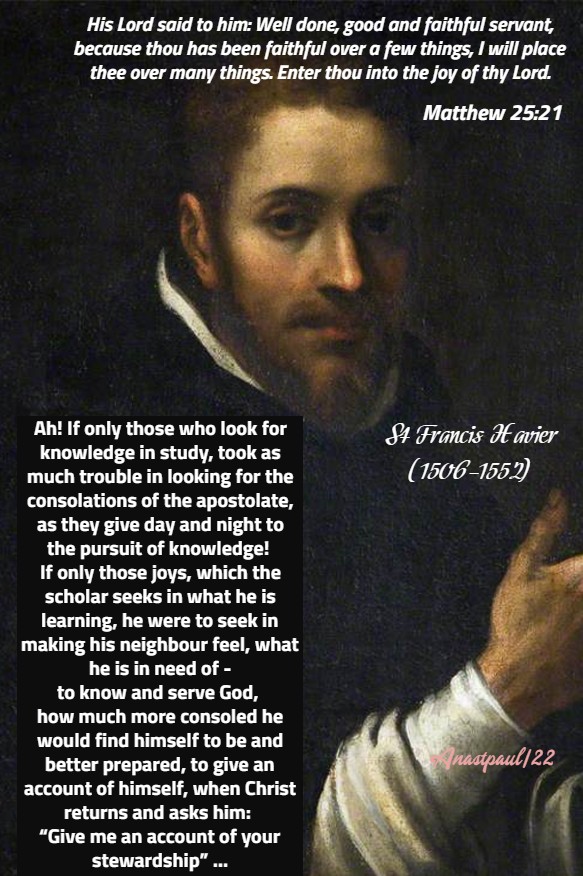
REFLECTION – “I have no idea what to write you from these parts [India and Sri Lanka] except this – the consolations bestowed by our Lord God, to those who go among the pagans, to convert them to the Faith of Christ, are so great that, if there is any joy to be had in this life, it is surely this! I have often heard it said, to someone going about amongst these Christians: “Lord, do not give me so many consolations in this life! Yet since, in Thy infinite goodness and pity, Thou are giving them me, take me into Thine holy glory! For indeed, there is such great suffering in living without seeing Thee, after Thou has shown Thyself to Thy creature, in this way!” Ah! If only those who look for knowledge in study, took as much trouble in looking for the consolations of the apostolate, as they give day and night to the pursuit of knowledge! If only those joys, which the scholar seeks in what he is learning, he were to seek in making his neighbour feel, what he is in need of – to know and serve God, how much more consoled he would find himself to be and better prepared, to give an account of himself, when Christ returns and asks him: “Give me an account of your stewardship” …
I will end, asking our Lord God … to bring us together in His holy glory. And to obtain this blessing, let us take as our intercessors and advocates, all the holy souls of the region, where I now am. … I beg all these holy souls to obtain for us from our Lord God, for as long as we remain separated, the grace of feeling His holy will in the depth of our souls and of fulfilling it perfectly.” – St Francis Xavier (1506-1552) Jesuit missionary (Letter of 15/01/1544).
PRAYER – Grant, we beseech Thee, Almighty God that the venerable feast of Thy blessed Confessor and Bishop, may increase our devotion and promote our salvation. Through Jesus Christ, Thy Son our Lord, Who lives and reigns with Thee, in the unity of the Holy Ghost, God, world without end. Amen (Collect).
St Charbel Bl Florent Dumontet de Cardaillac St Genebald of Laon Bl Gendtilis
Blessed Gerbrand OPraem (Died 1267) Priest Abbot, a supporter of the Crusades. He encouraged the Frisians to join the Crusade and, in 1268, as a result of his zeal, was awarded, by Pope Clement IV, the Title of ‘Sacrae Militiae Dux‘ (Leader of the Crusade). Gerbrand was a close friend of Saint Louis IX of France (1226-1270). A Life of Zeal: https://anastpaul.com/2023/09/05/saint-of-the-day-5-september-blessed-gerbrand-of-dokkum-opraem-died-1267-abbot/
St Guise Hoang Luong Canh Blessed John the Good OSA (c 1168-1249) Bishop Blessed Jordan of Pulsano Abbot
St Obdulia Virgin – A Spanish virgin who was venerated at Toledo, Spain. Her remains are enshrined in Toledo but details of her life are lost. Bl Phêrô Nguyen Van Tu St Romulus of Rome St Victorinus of Amiterme St Victorinus o(Died c644) Bishop f Como Italy. He was a noted opponent of the Arians in his time. Blessed William Browne (Died 1605) Martyr
Martyrs of Armenia – 1,000 Saints: A group of up to 1,000 Christian soldiers in the 2nd Century Imperial Roman Army of Trajan, stationed in Gaul. Ordered to sacrifice to pagan gods, they refused and were transferred to Armenia. Ordered again to sacrifice to pagan gods, they refused again. Martyrs. We know the names of three of them but nothing else – Eudoxius, Macarius and Zeno.
Martyrs of Capua – 3 Saints: Three Christians who were Martyred together. Long venerated in Capua, Italy. We know their names, but little else – Arcontius, Donatus and Quintius. They were martyred in Capua, Italy.
Martyrs of Nicomedia – 80 Saints: A group of 80 Christians, Lay and Clergy, Martyred together in the persecutions of Valens. We know little more than the names of three of them – Menedemo, Teodoro and Urbano. They were locked on a boat which was then set on fire on the shore of Nicomedia, Bithynia (in modern Turkey) c370.
Martyrs of Porto Romano – 4+ Saints: A group of Christians Martyred together in the persecutions of Marcus Aurelius. We know little more than their names – Aconto, Herculanus, Nonno and Taurino. c180 at Porto Romano, Italy.
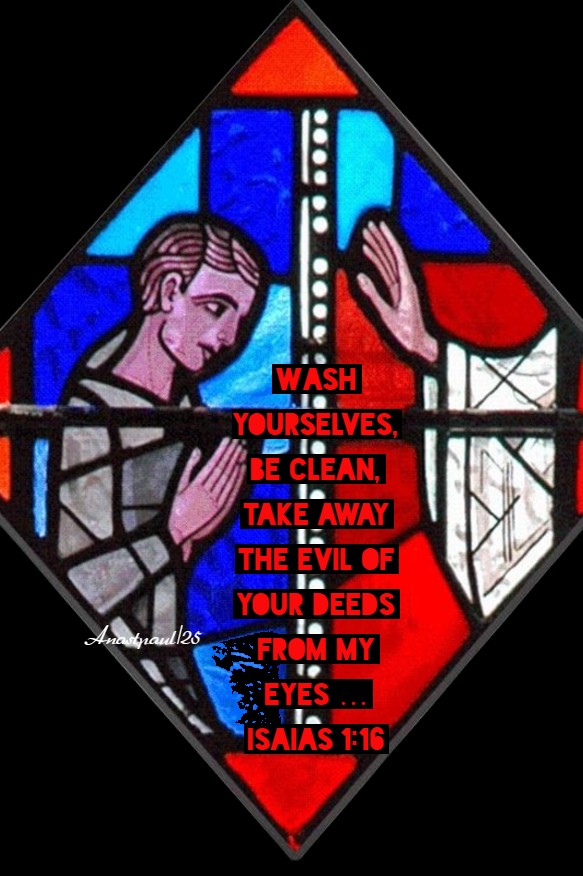
Quote/s of the Day – 2 April – Feastday of St Francis of Paola OM (1416-1507) –Wednesday of the Fourth Week in Lent – Isaias 1:16-19 – John 9:1-38 – Scripture search here: https://www.drbo.org/
“Wash yourselves, be clean, take away the evil of your deeds from My Eyes …”
Isaias 1:16
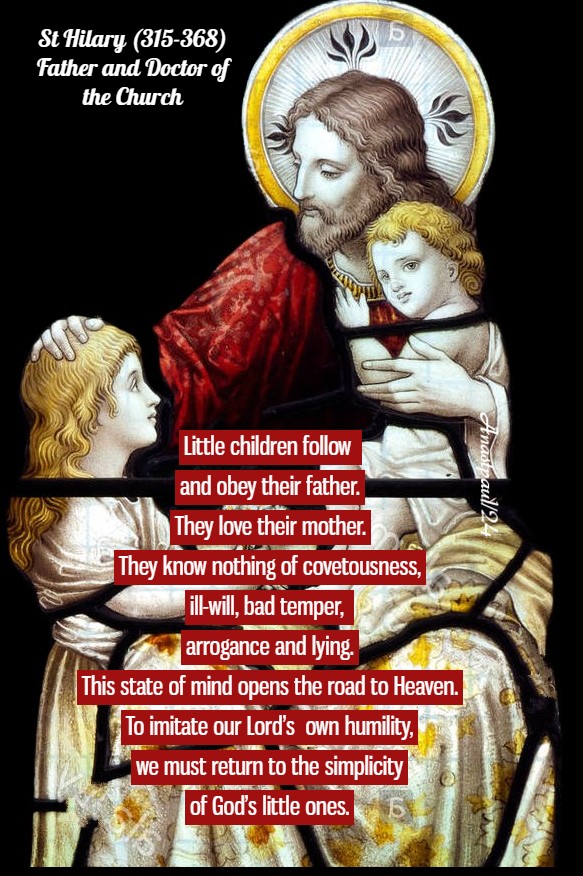
“Little children follow and obey their father. They love their mother. They know nothing of covetousness, ill-will, bad temper, arrogance and lying. This state of mind opens the road to Heaven. To imitate our Lord’s own humility, we must return to the simplicity of God’s little ones.”
St Hilary (315-368) Father and Doctor of the Church
“Prayer, appeases the anger of God; He pardons the sinner when he prays with humility.”
St Lawrence Justinian (1381-1455)
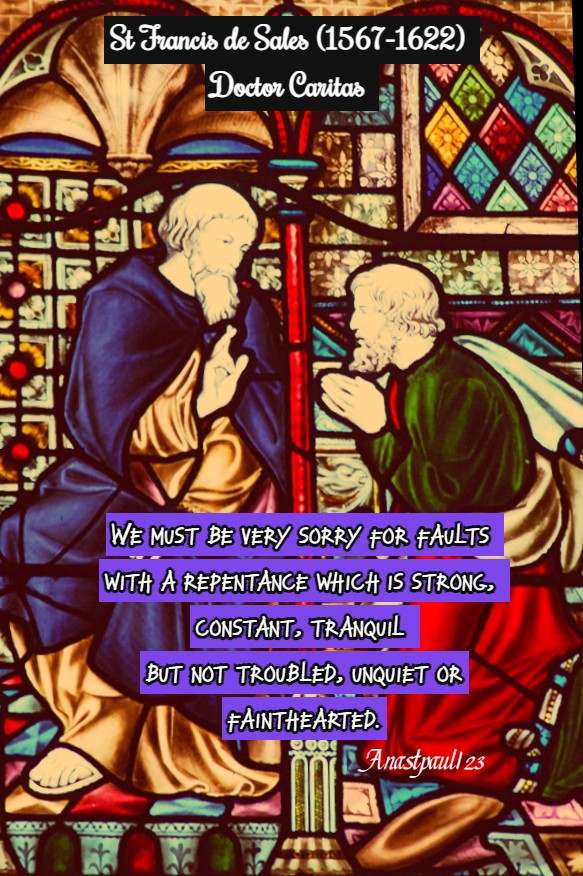
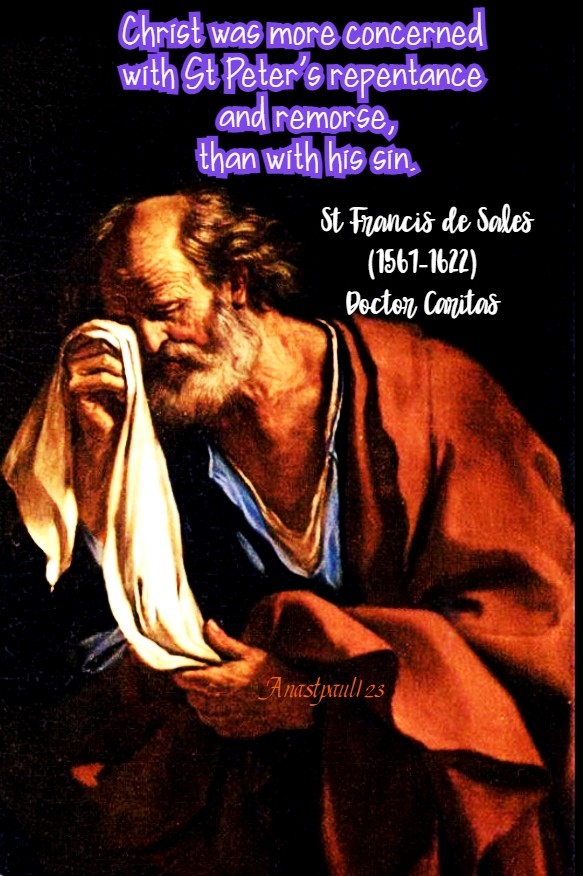
“We must be very sorry for faults with a repentance which is strong, constant, tranquil but not troubled, unquiet or fainthearted.”
(Treatise on the Love of God, Book 9, Chapter 7).
“Christ was more concerned with St. Peter’s repentance and remorse, than with his sin.”
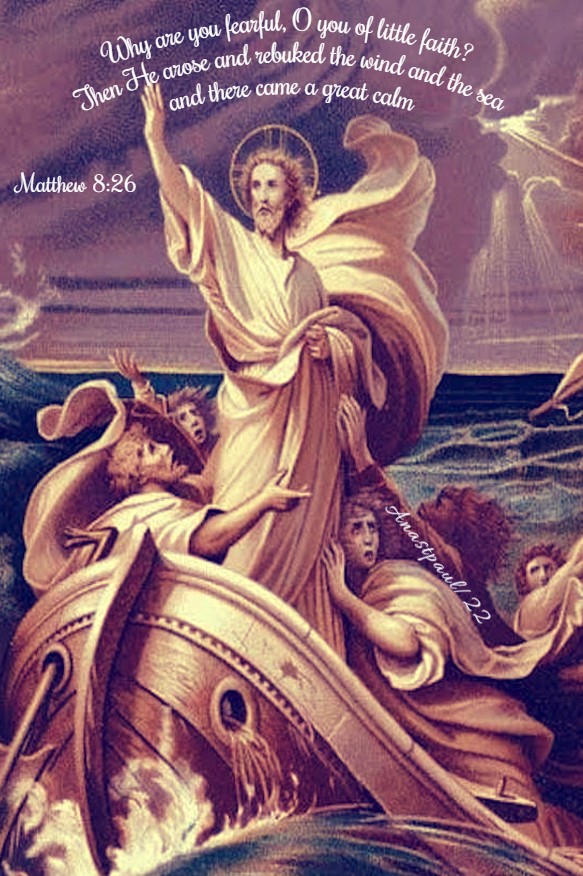
Quote/s of the Day – 3 November – “The Month of the Holy Souls in Purgatory” – Within the Octave of All Saints – Pentecost XXIV – Romans 13:8-10; Matthew 8:23-27 – Scripture search here: https://www.drbo.org/
“Why are you fearful, O you of little faith? Then He arose and rebuked the wind and the sea and there came a great calm.”
Matthew 8:26
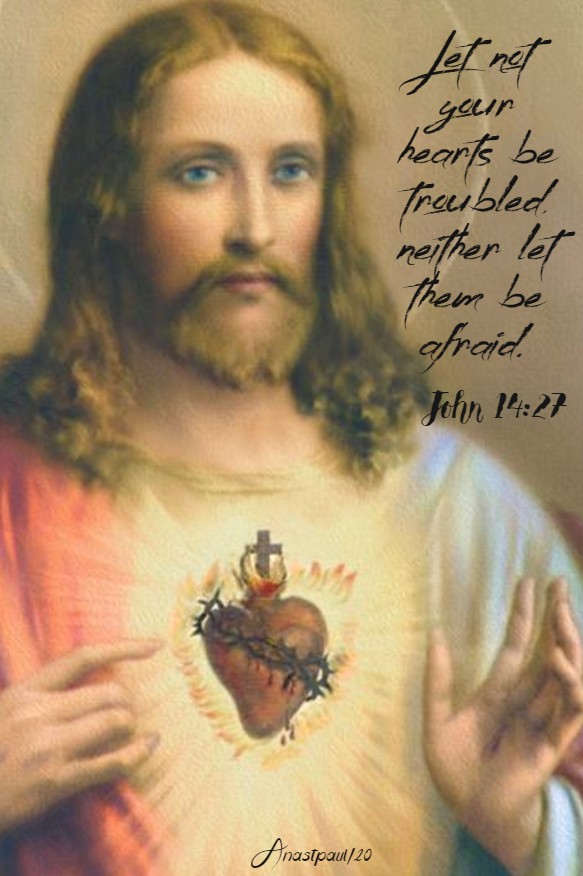
“Let not your hearts be troubled, neither let them be afraid.”
John 14:27
“No-one should fear to suffer for the sake of justice, no-one should lose confidence in the reward that has been promised. The way to rest is through toil, the way to life is through death. Christ has taken on Himself the whole weakness of our lowly human nature. If then, we are steadfast in our faith in Him and in our love for Him, we win the victory that He has won, we receive what He has promised.”
St Pope Leo the Great (400-461) Father and Doctor of the Church
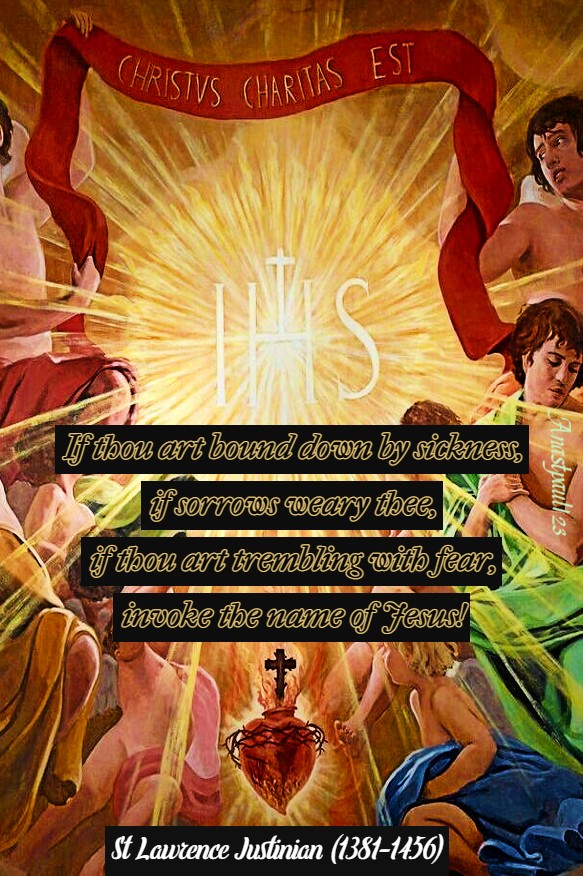
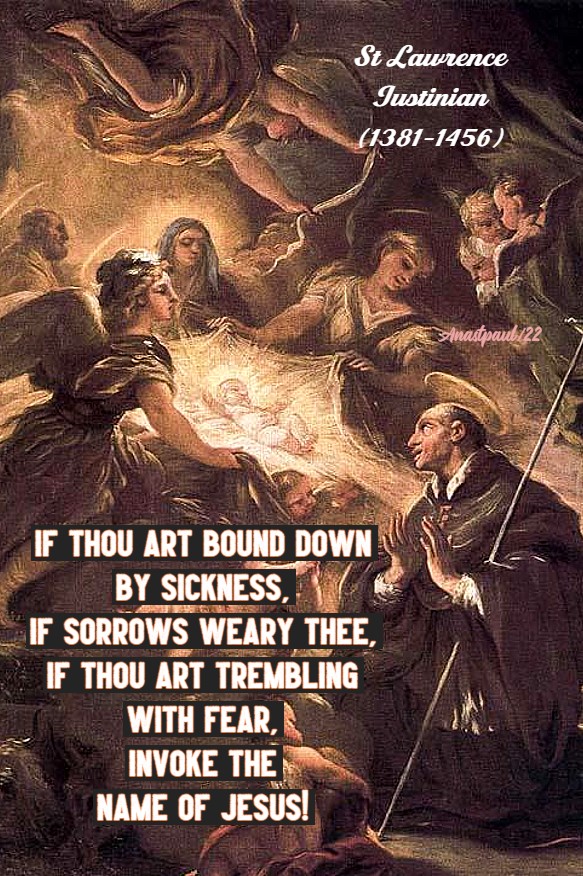
“If thou art bound down by sickness, if sorrows weary thee, if thou art trembling with fear, invoke the Name of Jesus!”
St Lawrence Justinian (1381-1456)
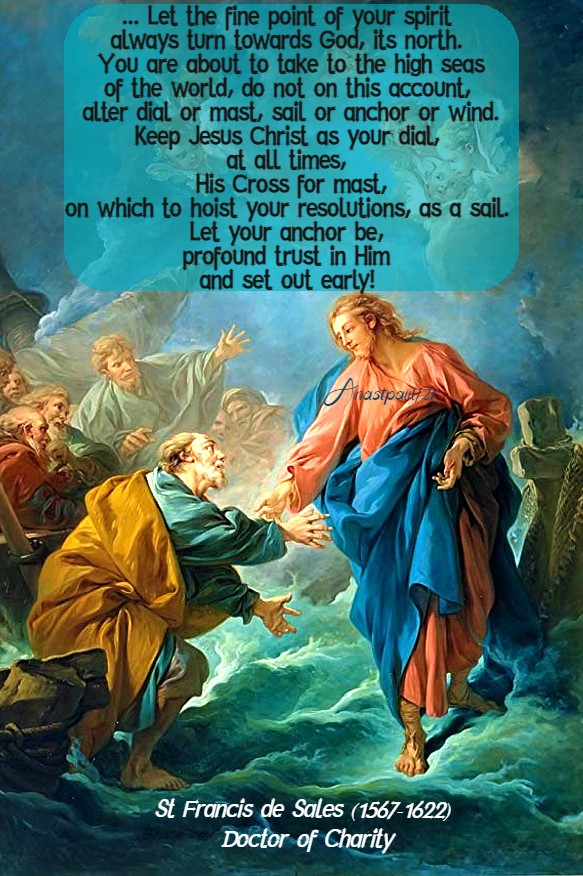
“ … Let the fine point of your spirit always turn towards God, its north. Your are about to take to the high seas of the world, do not, on this account, alter dial or mast, sail or anchor or wind. Keep Jesus Christ as your dial, at all times, His Cross for mast, on which to hoist your resolutions, as a sail. Let your anchor be, profound trust in Him and set out early!”
St Francis de Sales (1567-1622) Doctor of the Church
Quote/s of the Day – 15 September – “The Month of The Seven Sorrows of the Blessed Virgin Mary and The Holy Cross” and The Feast of the Seven Sorrows of the Blessed Virgin
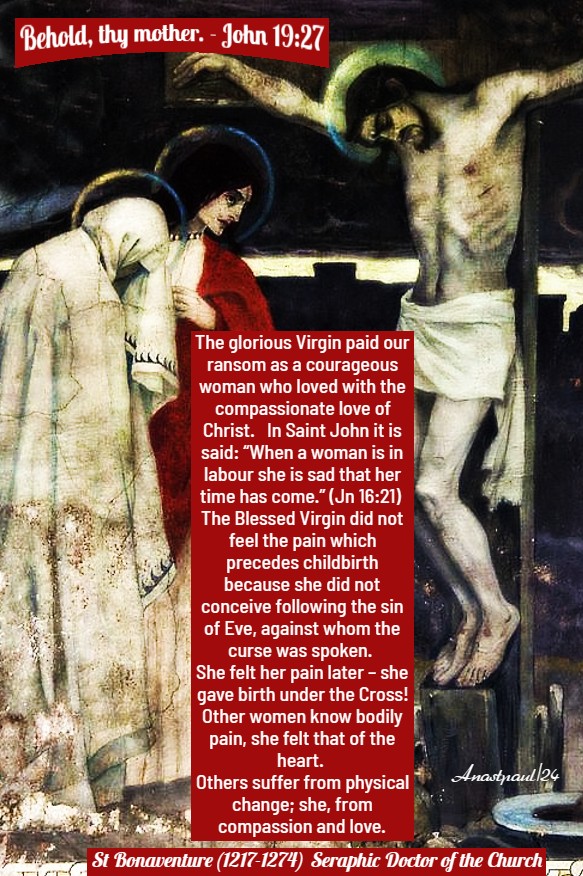
“The glorious Virgin paid our ransom as a courageous woman who loved with the compassionate love of Christ. In Saint John it is said: “When a woman is in labour she is sad that her time has come.” (Jn 16:21) The Blessed Virgin did not feel the pain which precedes childbirth because she did not conceive following the sin of Eve, against whom the curse was spoken. She felt her pain later – she gave birth under the Cross! Other women know bodily pain, she felt that of the heart. Others suffer from physical change; she, from compassion and love.”
St Bonaventure (1217-1274) Seraphic Doctor of the Church
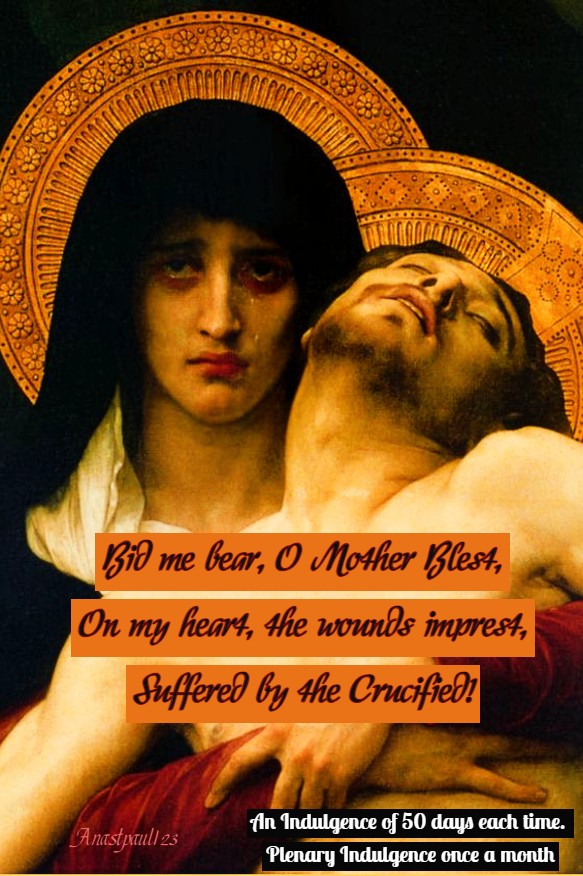
“Bid me bear, O Mother Blest, On my heart, the wounds imprest, Suffered by the Crucified!
An Indulgence of 50 days each time. Plenary Indulgence once a month under the usual conditions.
“The heart of Mary became, as it were, a mirror of the Passion of the Son, in which might be seen, faithfully reflected, the spitting, the blows and wounds and all which Jesus suffered.”
St Lawrence Justinian (1381-1455)
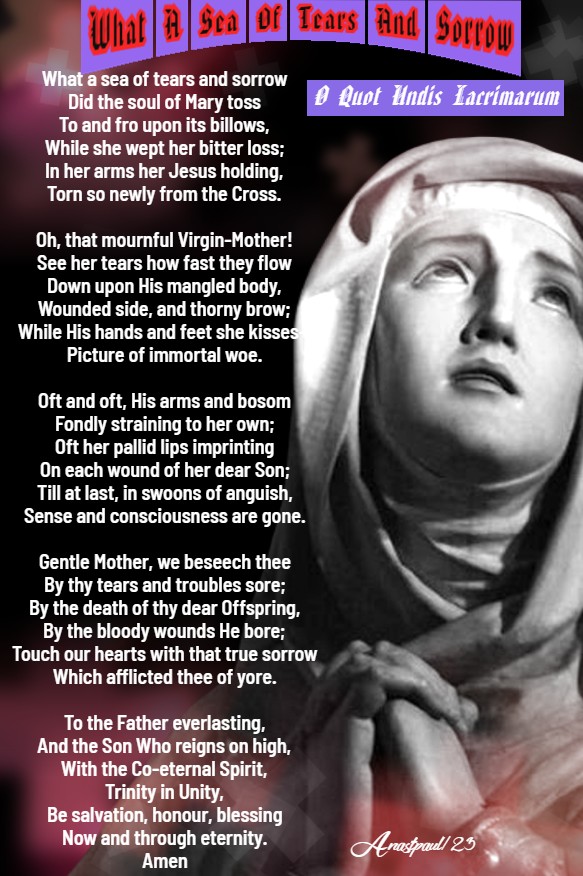
O Quot Undis Lacrimarum What A Sea Of Tears And Sorrow Breviary Hymn for the Feast of the Seven Sorrow Attrib. Bishop Callisto Palumbella OSM (1687-1749) Trans. Fr Edward Caswell COrat (1814–1878)
What a sea of tears and sorrow Did the soul of Mary toss To and fro upon its billows, While she wept her bitter loss; In her arms her Jesus holding, Torn so newly from the Cross.
Oh, that mournful Virgin-Mother! See her tears how fast they flow Down upon His mangled body, Wounded side, and thorny brow; While His hands and feet she kisses— Picture of immortal woe.
Oft and oft, His arms and bosom Fondly straining to her own; Oft her pallid lips imprinting On each wound of her dear Son; Till at last, in swoons of anguish, Sense and consciousness are gone.
Gentle Mother, we beseech thee By thy tears and troubles sore; By the death of thy dear Offspring, By the bloody wounds He bore; Touch our hearts with that true sorrow Which afflicted thee of yore.
To the Father everlasting, And the Son Who reigns on high, With the Co-eternal Spirit, Trinity in Unity, Be salvation, honour, blessing Now and through eternity. Amen
Attrib. to the Servite Bishop Callisto Maria Vincenzo Antonio Palumbella OSM (1687-1749), who also composed the Office for the Feast inserted in the Breviary in 1720. He was the Bishop of Terracina, Priverno e Sezze, Italy. This Translation by Fr Edward Caswell COrat (1814–1878)
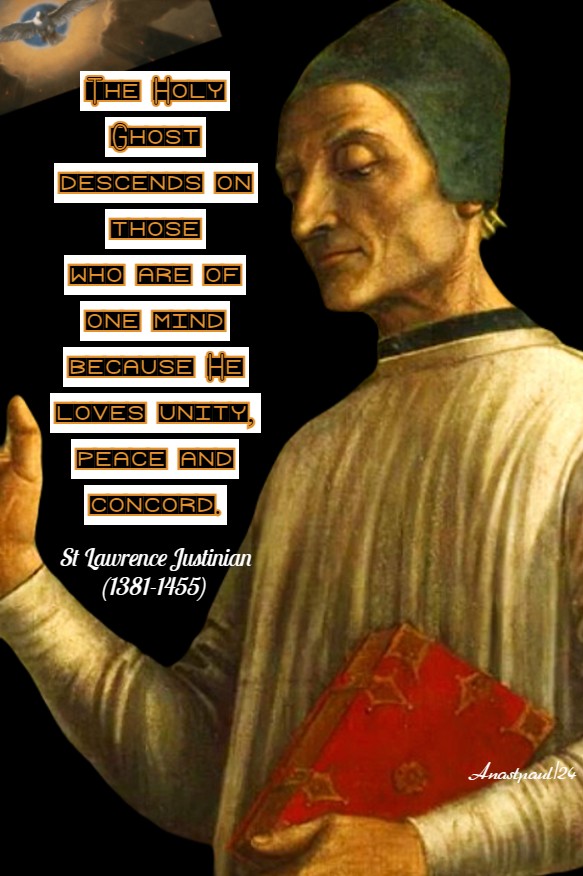
Quote/s of the Day – 5 September – St Lawrence Justinian (1381-1455) Bishop and Patriarch of Venice, Confessor
“The Holy Ghost descends on those who are of one mind because He loves unity, peace and concord.”
“The heart of Mary became, as it were, a mirror of the Passion of the Son, in which might be seen, faithfully reflected, the spitting, the blows and wounds and all which Jesus suffered.”
One Minute Reflection – 5 September – “The Month of The Seven Sorrows of the Blessed Virgin Mary and The Holy Cross” – t Lawrence Justinian (1381-1455) Bishop of Venice, Confessor – Ecclesiasticus 44:16-27; 45:3-20, Matthew 25:14-23 – Scripture search here: https://www.drbo.org/
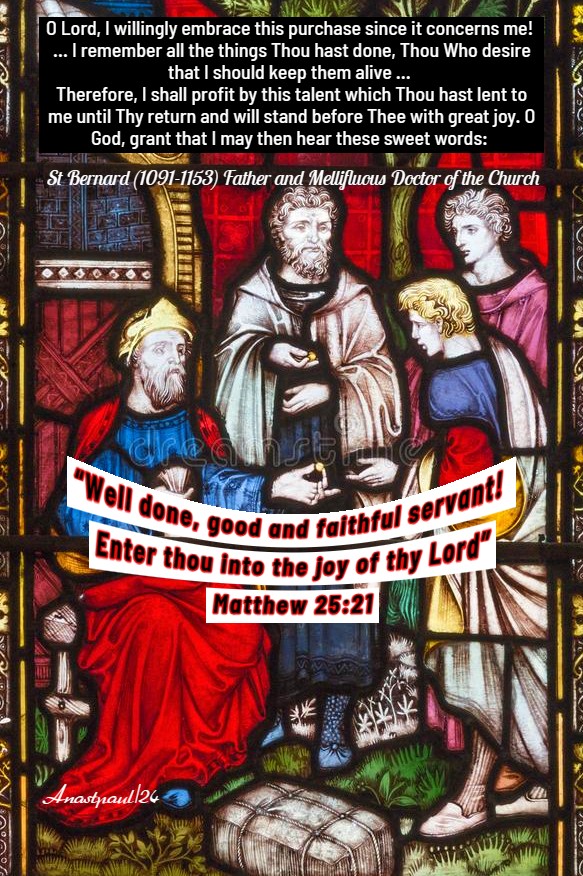
“Well done, good and faithful servant … Enter thou into the joy of thy Lord.”- Matthew 25:21
REFLECTION – “The Word of the Father, Only-begotten Son of God, Sun of Justice (Mal 3:20), is the great Merchant Who has brought us the price of our redemption. It is a truly precious exchange which we can never value sufficiently, when a King, Son of the King Most High, has become the Coin, the Gold has paid our dues, the Just Man is given for the sinner. Truly unmerited mercy, perfectly disinterested love, astonishing goodness…, it is a completely disproportionate purchase, in which the Son of God is delivered up for the servant, the Creator is put to death for the one He has created, the Lord is condemned for His slave.
O Christ, these are Thine Works, Thou Who descended from Heaven’s brightness into our hellish darkness, to bring light to our gloomy prison. Thou came down from the Right Hand of the Divine Majesty, into our human misery, to redeem the human race, Thou Who descended from the Father’s glory to death on the Cross, to triumph over death and its author. Thou art the only One and there is no other but Thee Who could have been drawn to redeem us through Thine Own Goodness…
Let all the merchants of Teman (Bar 3:23) withdraw from this place … it is not they but Israel [Thy] beloved whom [Thou hast] chosen, Thou Who hide these mysteries from the wise and prudent and have revealed them to those babes and humble servants of Thine (Lk 10:21) … O Lord, I willingly embrace this purchase since it concerns me!… I remember all the things Thou hast done, Thou Who desire that I should keep them alive … Therefore, I shall profit by this talent which Thou hast lent to me until Thy return and will stand before Thee with great joy. O God, grant that I may then hear these sweet words: “Well done, good and faithful servant! Enter thou into the joy of thy Lord” (Mt 25:21).” – St Bernard O.Cist. (1091-1153) Cistercian Monk, known as the Last Father and the Mellifluous Doctor of the Church (Selected sermons, no 42: The Five Purchases).
PRAYER – Grant, we beseech Thee, Almighty God that the venerable feast of Thy blessed Confessor and Bishop, may increase our devotion and promote our salvation. Through Jesus Christ, Thy Son our Lord, Who lives and reigns with Thee, in the unity of the Holy Ghost, God, world without end. Amen (Collect).
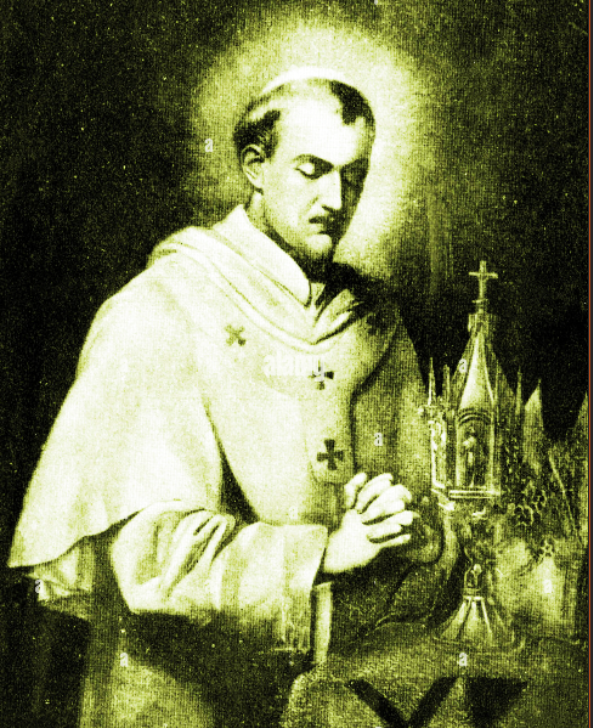
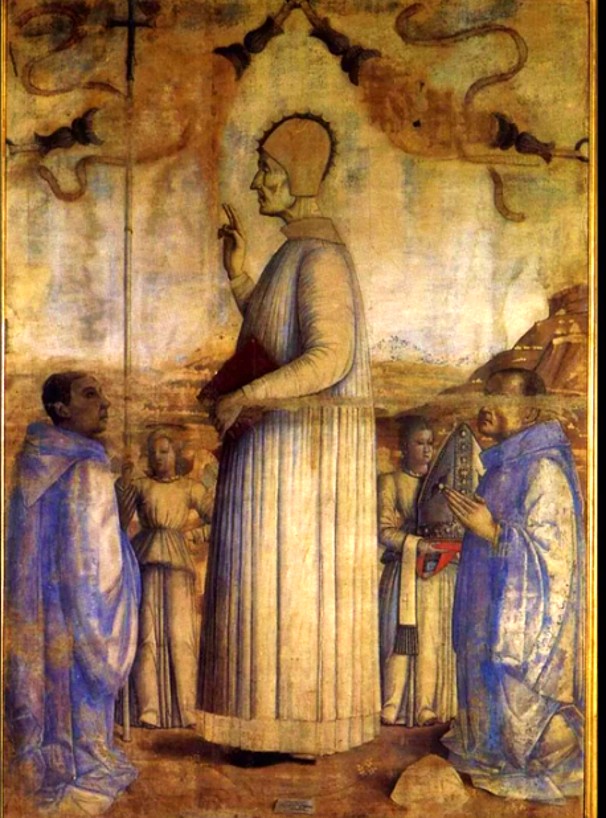
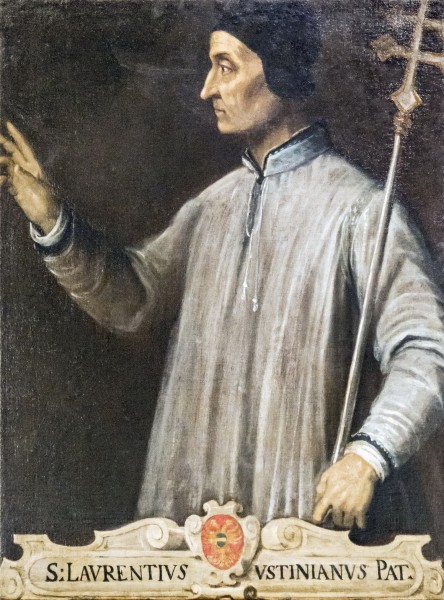
Saint of the Day – 5 September – Saint Lawrence Justinian (1381-1455) Bishop of Venice, Confessor, Patriarch of Venice, Reformer, Spiritual writer. Born on 1 September 1381 at Venice, Italy and died there on 8 January 1455 of natural causes. Also known as – Lorenzo Giustiniani, Laurence…Laurentius…Patriarch of Venice. Patronage – Venice, Italy.
St Lawrence Justinian (1381-1455) Patriarch of Venice By Father Francis Xavier Weninger SJ (1805-1888)
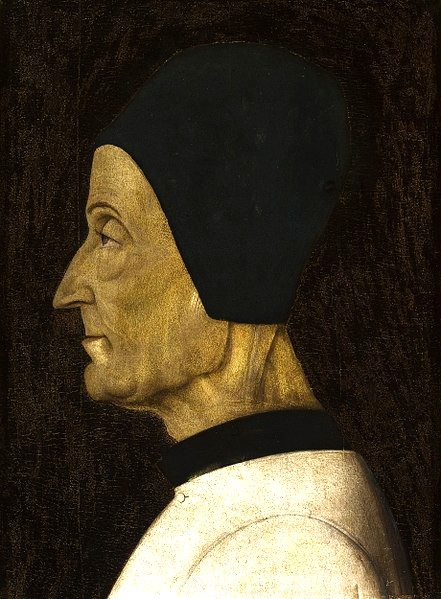
St Lawrence was a descendant of the noble house of Giustiniani, greatly famed in Genoa, Venice and Naples. He was born in 1381, of very pious parents but early lost his father, Bernard. His mother, on whom now devolved the education of her children, redoubled her care but Lawrence gave her very little trouble, as he was naturally inclined to virtue. One day, she made him understand that she feared he harboured ambition or pride secretly in his heart but, he answered: “fear not, mother, I have only one ambition and that is to become a great servant of the Lord and to be more pious than my brothers.” His conduct in youth bore witness to his words, for although he lived at a period when the morals of the whole City were very corrupt, his edifying life was regarded by everyone, with surprise and admiration.
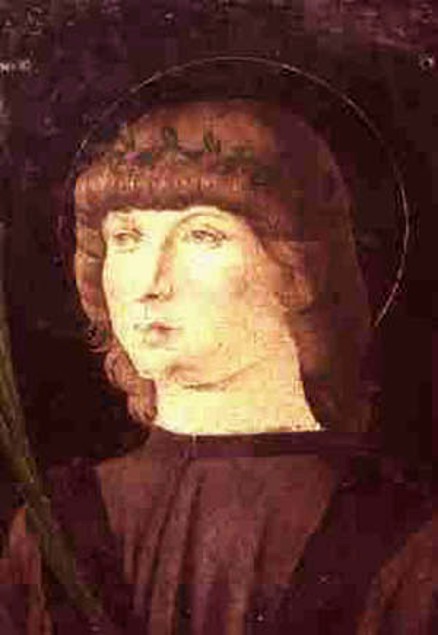
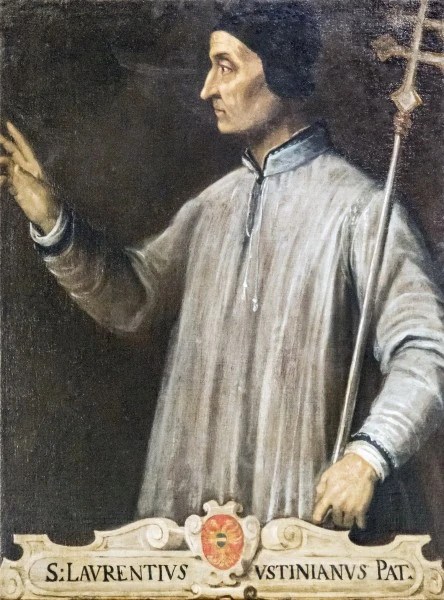
St Lawrence Justinian as a young man by Bellini
To escape the danger which threatened him, he prayed most fervently to God to give him the grace to know the vocation to which he was called. While, one day, kneeling before a Crucifix and an image of the Blessed Virgin, he said his prayers for this intention he experienced a heavenly vision of the Divine Majesty and felt, deep within him, an intense desire to leave the world and to serve God in the Religious state. He obeyed the heavenly Voice, renounced the world and all its allurements, went to the Regular Canons of St George, in Alga, an Island near Venice and requested to be received among their number. His request was granted and he began his Novitiate cheerfully but he soon manifested in his conduct indications that he was no beginner in the science of holiness but a proficient. His Superiors had much more difficulty in moderating his zeal than in animating it.
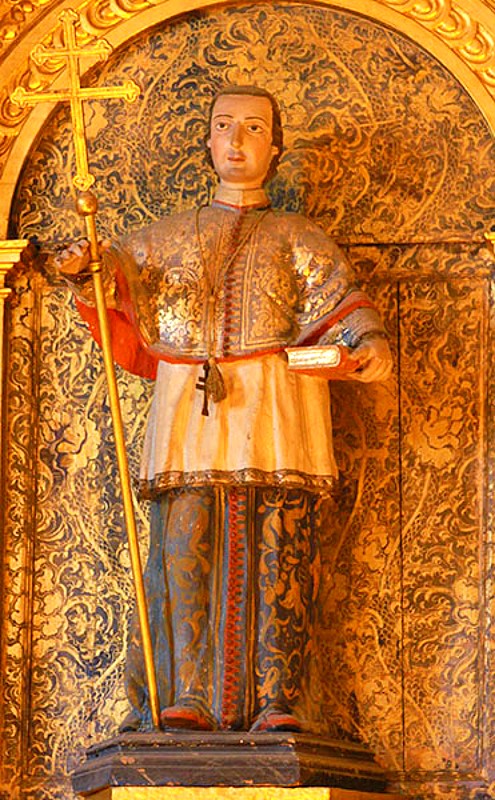
St Lawrence Justinian Statue at the Church of St John the Evangelist, Evora, Portugal.
Amongst other austerities which he practiced to mortify himself, it was specially noticed that, even on the coldest days, he never warmed himself by the fire and that, in summer, he took nothing to allay his thirst, except with his meals at noon and evening. He was never seen taking the air in the Convent garden, or enjoying the beauty and fragrance of the flowers. The only time when he visited his home, was when he was called to see his dying mother. Still more to be admired, is the fortitude with which he bore a very painful and dangerous operation on his throat for the removal of a great tumour. He, himself encouraged the Surgeon to begin fearlessly: “Cannot Christ,” said he, “give me as much fortitude as He gave to the three youths in the furnace?” Not even a sigh escaped him during the operation he repeated only the names of Jesus and Mary. When those present uttered their profound astonishment at his self-control, he said: “How little is my suffering compared with that of the holy Martyrs, who were tortured with burning torches and red hot irons, or roasted over a slow fire!”
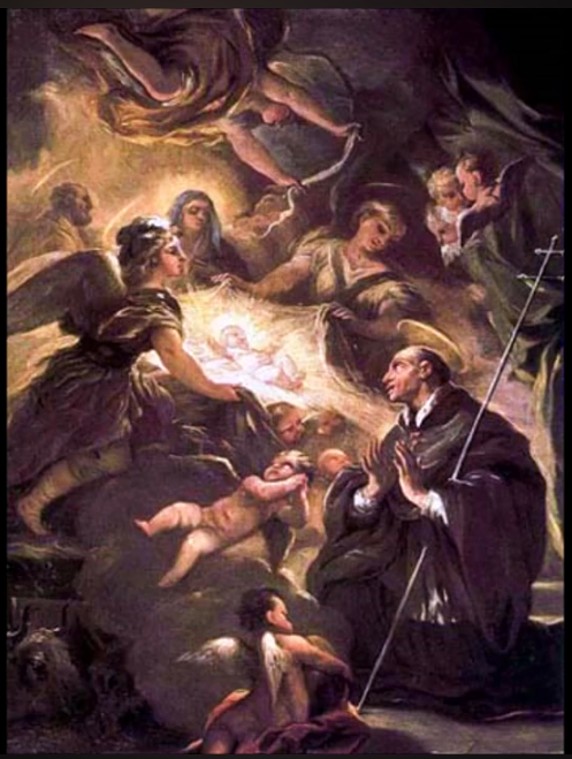
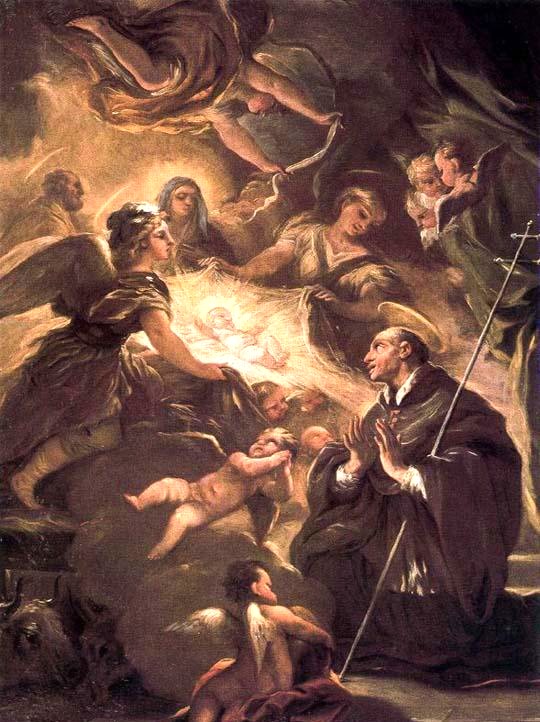
After Lawrence had been Ordained Priest, he daily said Mass with great devotion and seldom without tears. During the Mass on Christmas-night, Heaven bestowed upon him the grace to behold his Saviour in the form of a lovely Child, to the inexpressible comfort of his heart.
St Lawrence Justinian Adoration of the Infant
Although he desired to remain free from all Offices of honour, he was chosen general of his Order and sometime later was nominated as the Bishop of Venice, by Pope Eugenius IV. The humble servant of the Almighty endeavoured, in every possible manner, to escape this dignity but, at last, obliged by obedience, he accepted it.
As the Bishop, he altered nothing of the austerities he had practiced in the Monastery; he visited his whole Diocese and, with Apostolic zeal, animated his flock to observe the Commandments of God and the Church. His income he used for the benefit of the Church and the relief of the poor.
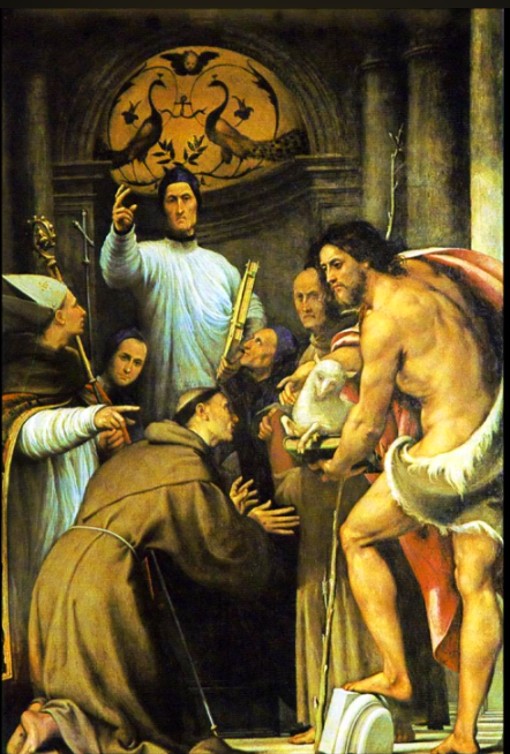
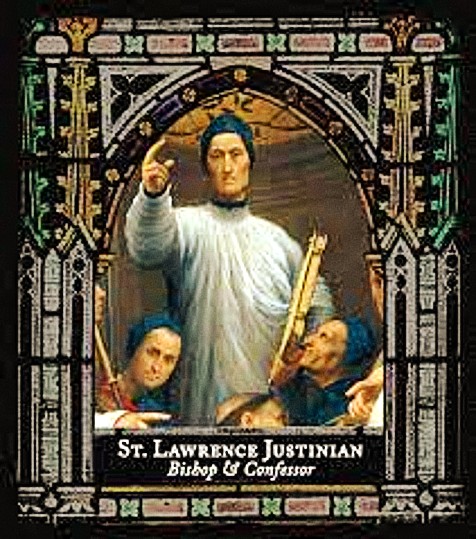
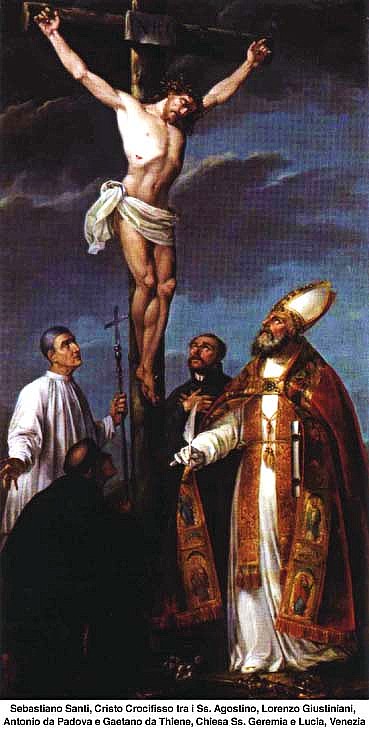
St Lawrence, St John the Baptist, St Franics and ??
Besides several collegiate Churches, he founded fifteen Religious houses and daily fed a great number of poor. The answer he gave to one of his relatives, who requested a contribution out of the Episcopal revenues as a marriage-portion for his daughter, must not be omitted: “It will not satisfy you if I give you but little,” said he “and, if I give you much, you alone will receive it and many others will have nothing. No, the Episcopal revenues must not be used for worldly luxuries but to comfort the needy. Be not offended, therefore, that I cannot fulfil your desire.” Thus spoke the holy Bishop, whom Pope Nicholas V. soon after raised to a still higher dignity.
The Patriarch of Grado died and, as the Pope desired to nominate Lawrence as his own successor but being convinced, at the same time that the Venetians would not consent to part with their Bishop, he transferred the Patriarchal Chair to Venice and declared St Lawrence as the first Patriarch of Venice. This City had indeed great reason to use all possible means not to lose the Saint, as only on his account, God averted a terrible and well-deserved punishment from its walls!
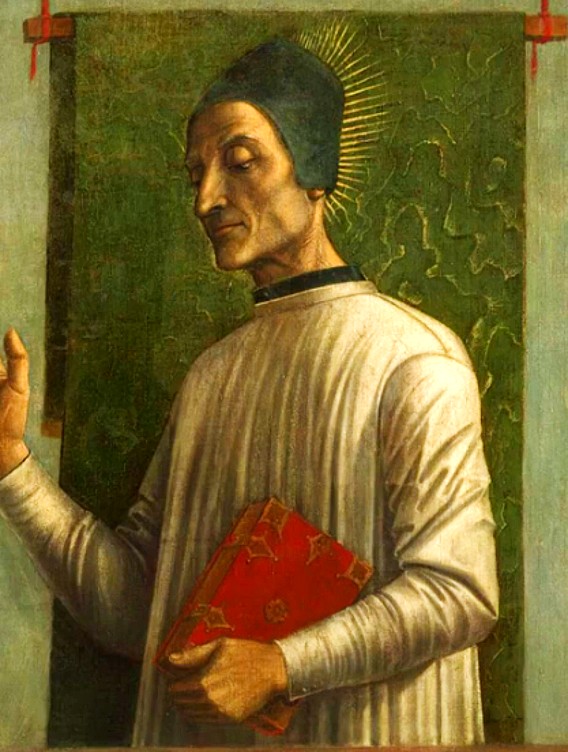
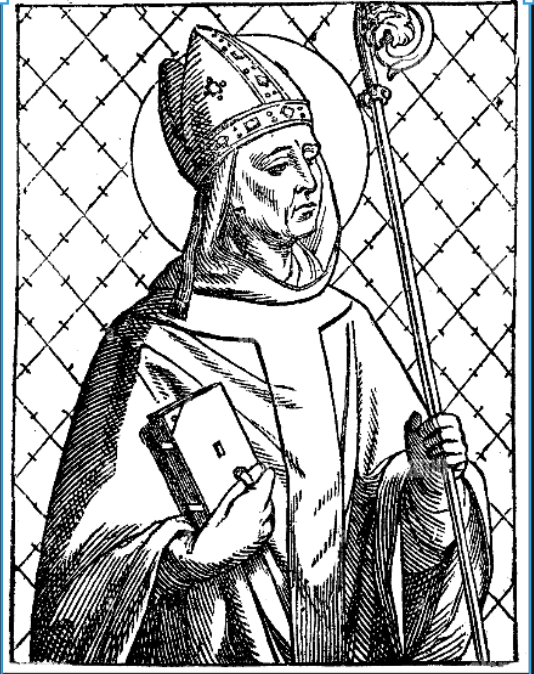
St Lawrence Justinian the First Patriarch of Venice
There lived, at that time, in the Island of Corfu, a Hermit, famous for his holiness, who, one day, said to a Venetian noble, who visited him: “The inhabitants of Venice have provoked God’s wrath, by despising His Words and had not the tears of your Patriarch cried to Him, you would all have long since gone to destruction, like the inhabitants of Sodom!”
While the holy Patriarch was assiduously occupied with the functions of his high station, his strength gradually gave way and he felt his end approaching. On the Feast of the Nativity of Christ, he felt, during Holy Mass, an intense desire to be admitted into the Presence of his God. A fever, which seized him soon after Mass, ended with his death in a very few days.
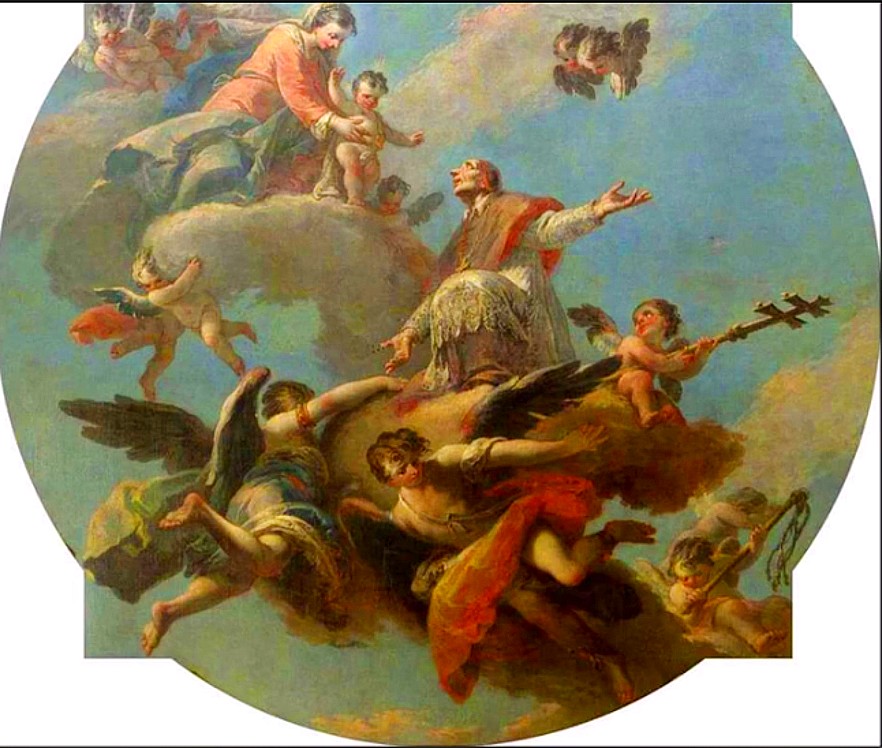
St Lawrence in Glory
He lay on the bare floor and not even in his last day, could he be persuaded to make use of a softer bed:
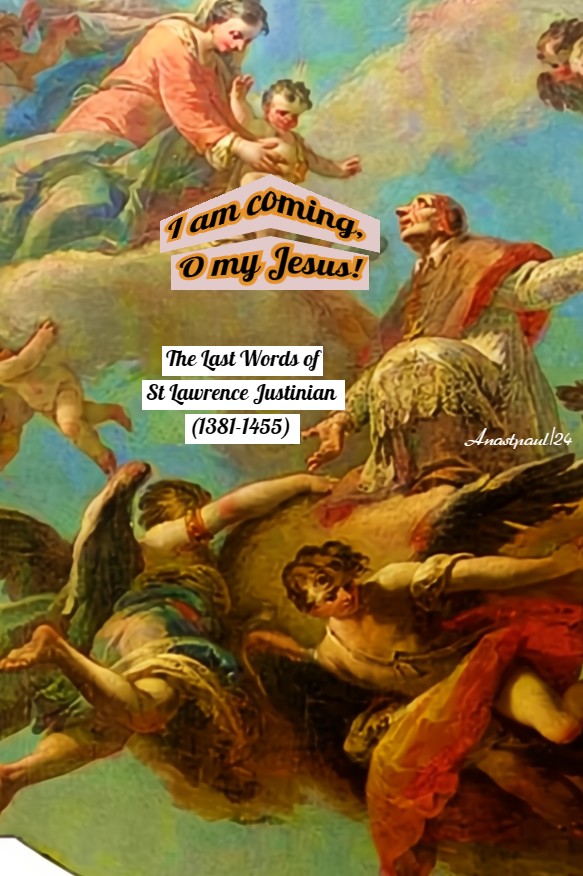
“Jesus Christ,” said he, “died upon the hard wood of the Cross and you desire that a sinner, like me, should lie, soft and comfortable!” After receiving the holy Sacraments, he gave his last instructions to those around him: “Keep the Commandments of the Lord,” said he, “nothing is more noble or excellent than to serve God.” After having finished his discourse, he raised his eyes to Heaven and said: “I am coming, O my Jesus!” and his soul went to God. Thus ended, in the seventy-third year of his age, the earthly career of this great and holy Patriarch. That his life in Heaven had begun, was known by the manner in which the Lord honoured his holy body, from which emanated a heavenly fragrance; as also, by the miracles which, at the intercession of the Saint, took place at his Tomb, in favour of the infirm and the possessed.
St Lawrence Justinian (1381-1455) Bishop of Venice, Confessor, Reformer, Spiritual writer. The Roman Martyrology states of him today: “The Feast of St Lawrence Justinian, first Patriarch of Venice, who, by glorious miracles and virtues, illustrated the Episcopal dignity which he received against his will on this day. His birthday into Heaven is 8 January.” A Saint for Our Times: https://anastpaul.com/2021/09/05/saint-of-the-day-5-september-saint-lawrence-justinian-1381-1455/
St Charbel Bl Florent Dumontet de Cardaillac St Genebald of Laon Bl Gendtilis
Blessed Gerbrand of Dokkum OPraem (Died 1267) Priest Abbot, a supporter of the Crusades. He encouraged the Frisians to join the Crusade and, in 1268, as a result of his zeal, was awarded, by Pope Clement IV, the Title of ‘Sacrae Militiae Dux‘ (Leader of the Crusade). Gerbrand was a close friend of Saint Louis IX of France (1226-1270). A Life of Zeal: https://anastpaul.com/2023/09/05/saint-of-the-day-5-september-blessed-gerbrand-of-dokkum-opraem-died-1267-abbot/
St Guise Hoang Luong Canh Blessed John the Good OSA (c 1168-1249) Bishop Blessed Jordan of Pulsano Abbot
St Obdulia Bl Phêrô Nguyen Van Tu St Romulus of Rome St Victorinus of Amiterme St Victorinus of Como Bl William Browne
Martyrs of Armenia – 1,000 Saints: A group of up to 1,000 Christian soldiers in the 2nd Century Imperial Roman Army of Trajan, stationed in Gaul. Ordered to sacrifice to pagan gods, they refused and were transferred to Armenia. Ordered again to sacrifice to pagan gods, they refused again. Martyrs. We know the names of three of them but nothing else – Eudoxius, Macarius and Zeno.
Martyrs of Capua – 3 Saints: Three Christians who were Martyred together. Long venerated in Capua, Italy. We know their names, but little else – Arcontius, Donatus and Quintius. They were martyred in Capua, Italy.
Martyrs of Nicomedia – 80 Saints: A group of 80 Christians, Lay and Clergy, Martyred together in the persecutions of Valens. We know little more than the names of three of them – Menedemo, Teodoro and Urbano. They were locked on a boat which was then set on fire on the shore of Nicomedia, Bithynia (in modern Turkey) c370.
Martyrs of Porto Romano – 4+ Saints: A group of Christians Martyred together in the persecutions of Marcus Aurelius. We know little more than their names – Aconto, Herculanus, Nonno and Taurino. c180 at Porto Romano, Italy.
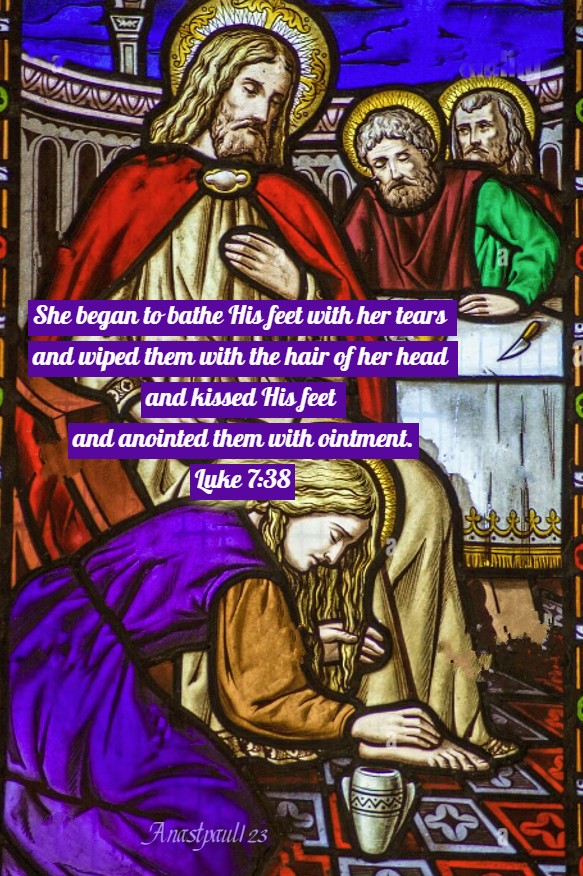
Quote/s of the Day – 22 July – St Mary Magdalen (1st Century) Penitent – Song 3:2-5; 8:6-7, Luke 7:36-50.
“She began to bathe His feet with her tears and wiped them with the hair of her head and kissed His feet and anointed them with ointment.”
Luke 7:38
“Remember not our former iniquities, let Thy mercies speedily prevent us, for we are become exceeding poor. Help us, O God, our Saviour and for the glory of Thy Name, O Lord, deliver us and forgive us our sins, for Thy Name’s sake.”
Psalm 78:8-9
“Let us then, my brethren, endure in hope. Let us devote ourselves, side-by-side with our hoping, so that the God of all the universe, as He beholds our intention, may cleanse us from all sins, fill us with high hopes from what we have in hand and grant us the change of heart which saves. God has called you and you have your calling!”
St Cyril of Jerusalem (315-387) Father and Doctor of the Church
“Prayer, appeases the anger of God; He pardons the sinner when he prays with humility.”
St Lawrence Justinian (1381-1455)
“We must be very sorry for faults with a repentance which is strong, constant, tranquil but not troubled, unquiet or fainthearted.”
(Treatise on the Love of God, Book 9, Chapter 7).
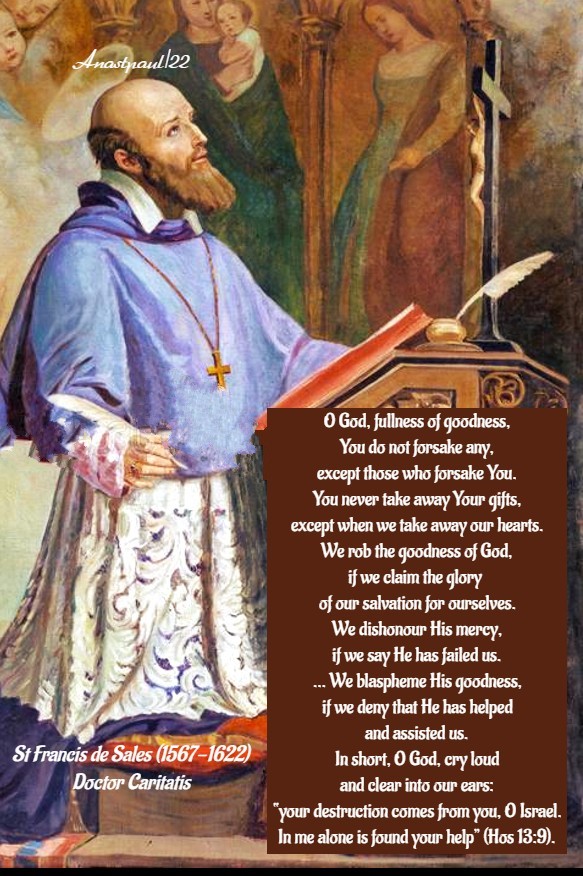
St Francis de Sales (1567-1622) Doctor Caritatis
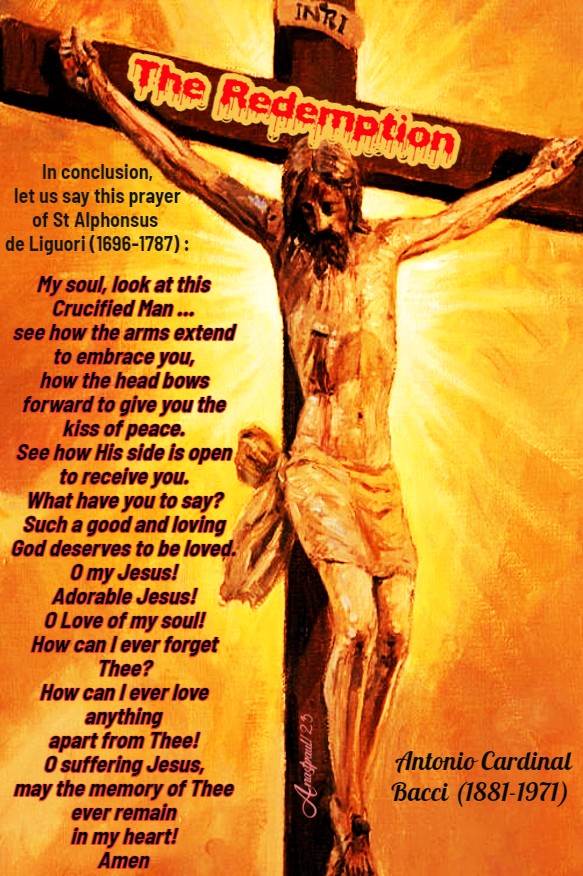
In conclusion, let us say this prayer of St Alphonsus de Liguori (1696-1787): “My soul, look at this Crucified Man … see how the arms extend to embrace you, how the head bows forward to give you the kiss of peace. See how His side is open to receive you. What have you to say? Such a good and loving God deserves to be loved. O my Jesus! Adorable Jesus! O Love of my soul! How can I ever forget Thee? How can I ever love anything apart from Thee! O suffering Jesus, may the memory of Thee ever remain in my heart!”
Quote/s of the Day – 15 March – Friday of the Fourth Week in Lent – 3 Kings 17:17-24; John 11:1-45 – Scripture search here: https://www.drbo.org/
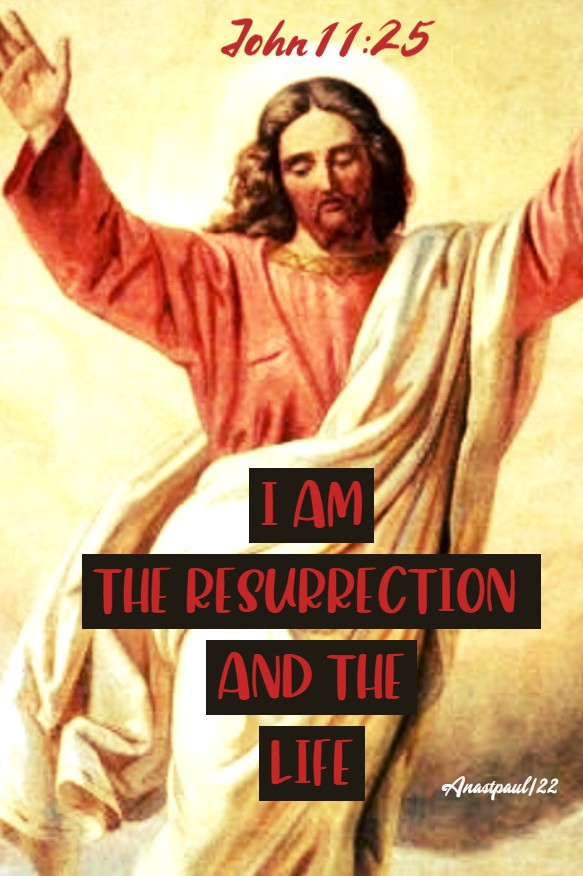
“I Am the Resurrection and the Life”
John 11:25
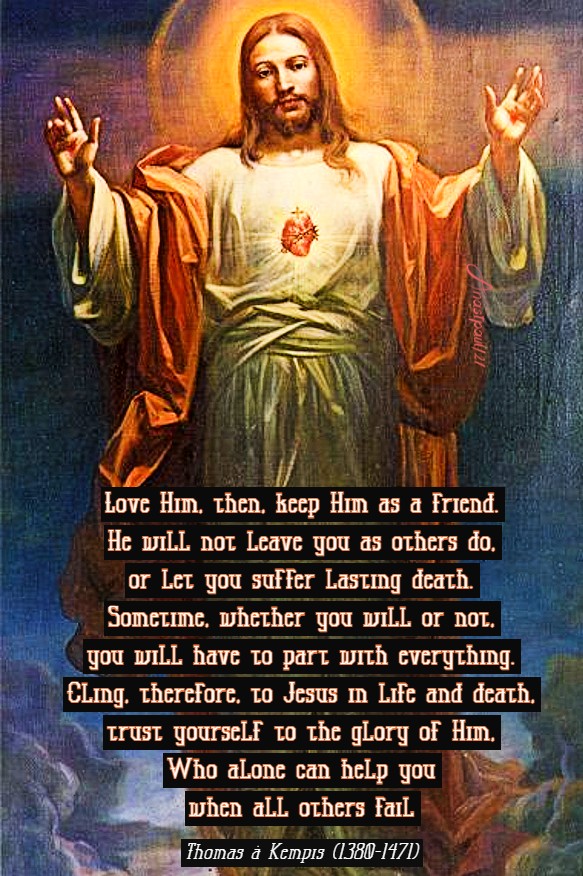
“Love Him, then, keep Him as a friend. He will not leave you as others do, or let you suffer lasting death. Sometime, whether you will or not, you will have to part with everything. Cling, therefore, to Jesus in life and death, trust yourself to the glory of Him, Who alone can help you when all others fail.“
Thomas à Kempis (1380-1471)
“If thou art bound down by sickness, if sorrows weary thee, if thou art trembling with fear, invoke the name of Jesus!”
St Lawrence Justinian (1381-1456)
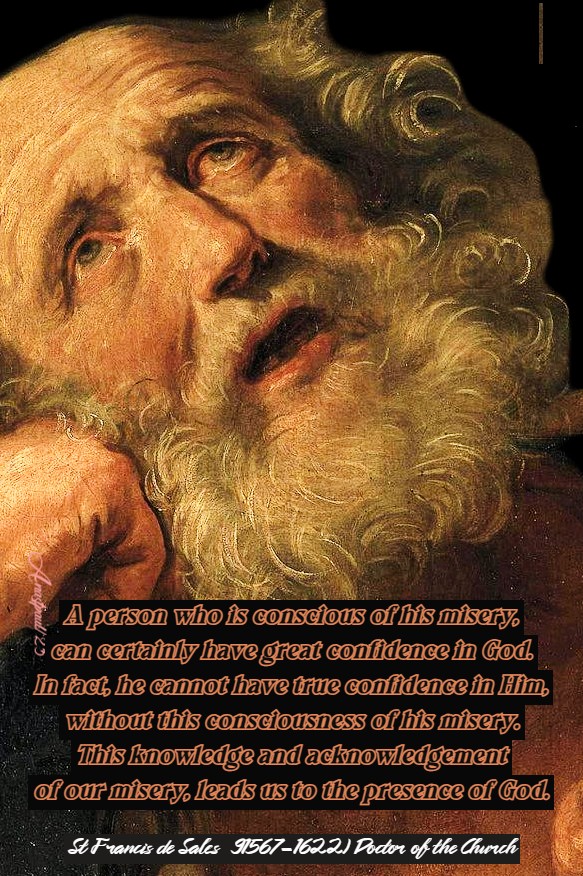
“A person who is conscious of his misery, can certainly have great confidence in God. In fact, he cannot have true confidence in Him, without this consciousness of his misery. This knowledge and acknowledgement of our misery, leads us to the presence of God.”
St Francis de Sales (1567-1622) Doctor of the Church
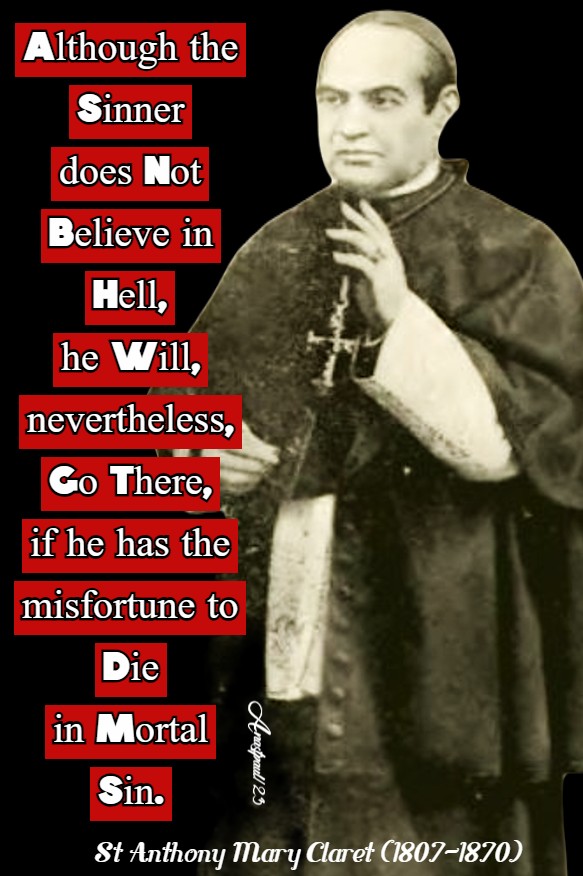
“Although the sinner does not believe in Hell, he will, nevertheless, go there, if he has the misfortune to die in mortal sin.”
St Anthony Mary Claret (1807-1870)
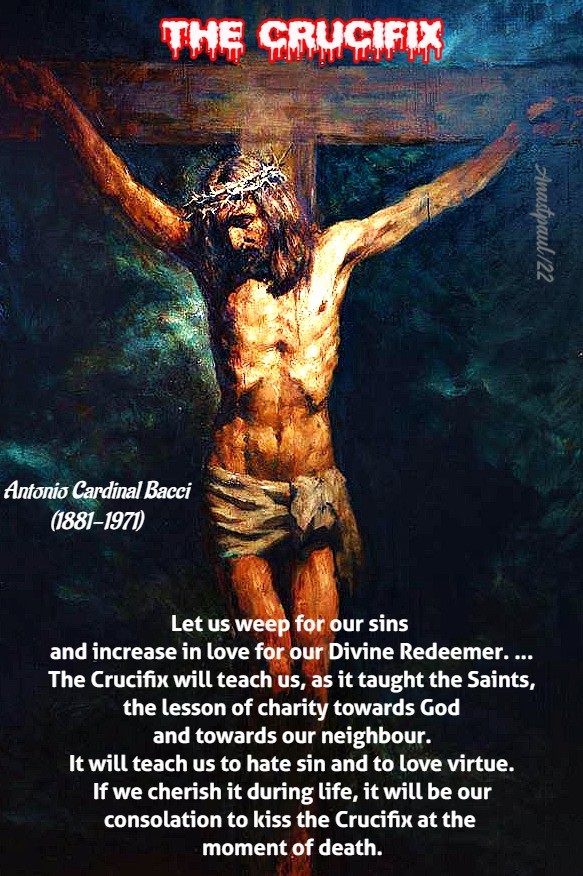
“Let us weep for our sins and increase in love for our Divine Redeemer. The Crucifix will teach us, as it taught the Saints, the lesson of charity towards God and towards our neighbour. It will teach us to hate sin and to love virtue. If we cherish it during life, it will be our consolation to kiss the Crucifix at the moment of death.”
Quote/s of the Day – 14 March – St Lawrence Justinian on Prayer
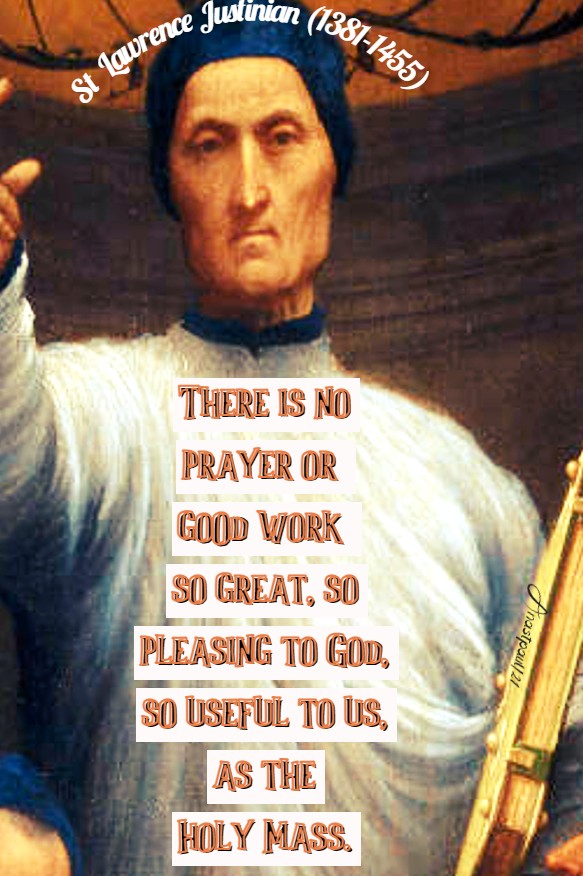
“There is no prayer or good work so great, so pleasing to God, so useful to us, as the Holy Mass.”
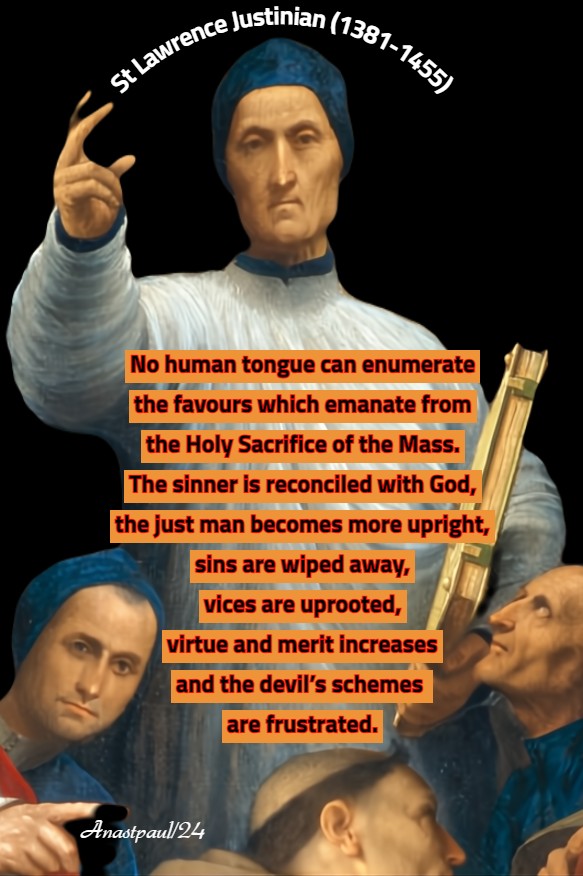
“No human tongue can enumerate the favours which emanate from the Holy Sacrifice of the Mass. The sinner is reconciled with God, the just man becomes more upright, sins are wiped away, vices are uprooted, virtue and merit increases and the devil’s schemes are frustrated.”
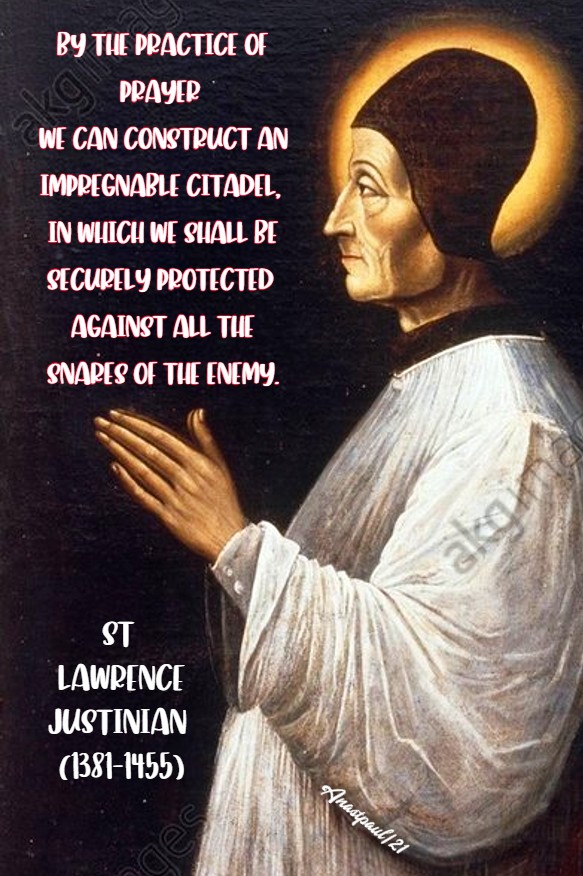
“By the practice of prayer we can construct an impregnable citadel, in which we shall be securely protected against all the snares of the enemy.”
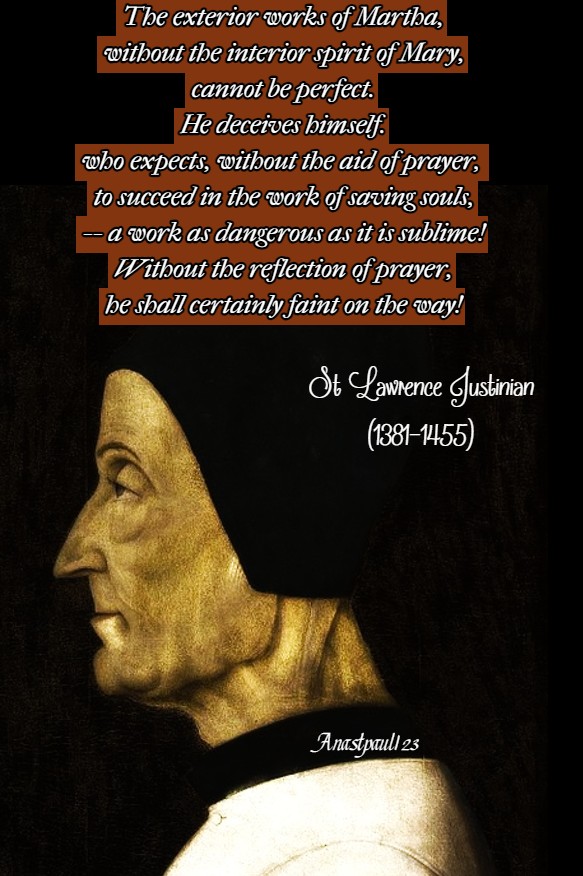
“The exterior works of Martha, without the interior spirit of Mary, cannot be perfect. He deceives himself. who expects, without the aid of prayer, to succeed in the work of saving souls, — a work as dangerous as it is sublime! Without the reflection of prayer, he shall certainly faint on the way!”
Quote/s of the Day – 11 March – Monday of the Fourth Week in Lent – 3 Kings 3:16-28; John 2:13-25 – Scripture search here: https://www.drbo.org/
“Remember not our former iniquities, let Thy mercies speedily prevent us, for we are become exceeding poor. Help us, O God, our Saviour and for the glory of Thy Name, O Lord, deliver us and forgive us our sins, for Thy Name’s sake.”
Psalm 78:8-9
“… There is one Road and one only, well secured against all possibility of going astray and, this Road is provided by One, Who is Himself both God and Man. As God, He is the Goal, as Man, He is the Way.”
St Augustine (354-430) Father and Doctor of Grace
“Prayer, appeases the anger of God; He pardons the sinner when he prays with humility.”
St Lawrence Justinian (1381-1455)
“O God, fullness of goodness, You do not forsake any, except those who forsake You. You never take away Your gifts, except when we take away our hearts. We rob the goodness of God, if we claim the glory of our salvation for ourselves. We dishonour His mercy, if we say He has failed us. … We blaspheme His goodness, if we deny that He has helped and assisted us. In short, O God, cry loud and clear into our ears: “your destruction comes from you, O Israel. In me alone is found your help” (Hos 13:9).
Quote/s of the Day – 13 September – “Month of The Seven Sorrows of the Blessed Virgin Mary and The Holy Cross” – Ferial Day – Galatians 5:25-26; 6:1-10, Luke 7:11-15 – Scripture search here: https://www.drbo.org/
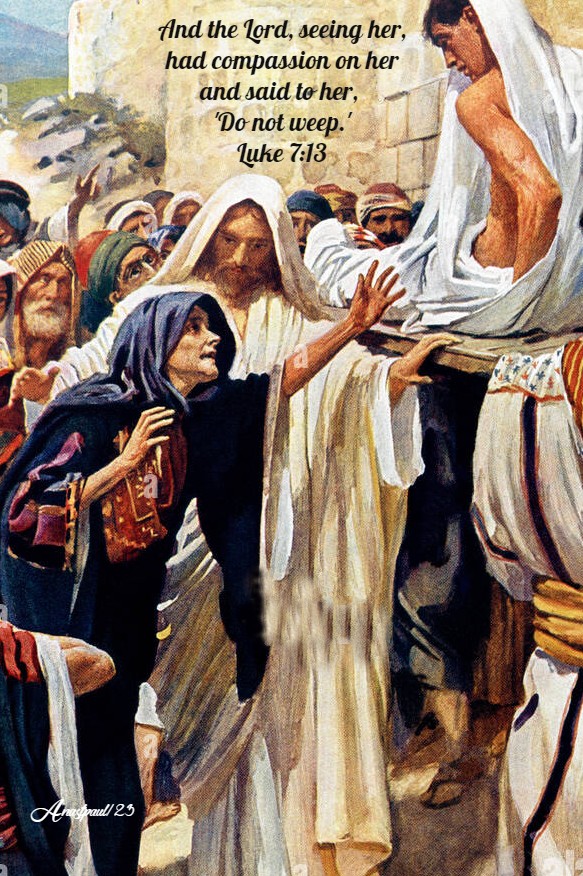
“And the Lord, seeing her, had compassion on her and said to her, ‘Do not weep.’”
Luke 7:13
“Prayer, appeases the anger of God; He pardons the sinner when he prays with humility.”
St Lawrence Justinian (1381-1455)
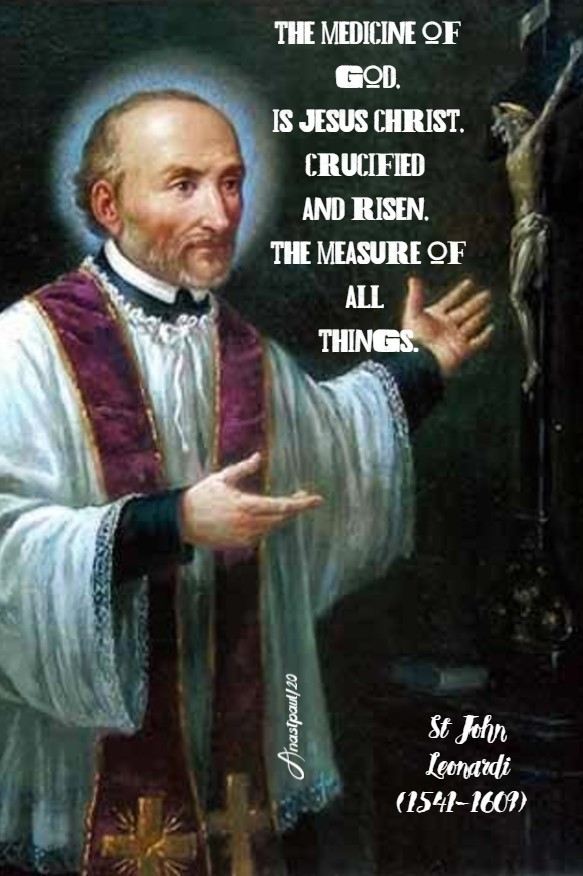
“The medicine of God, is Jesus Christ, Crucified and Risen, the measure of all things.”
St John Leonardi (1541-1609) Confessor, Priest, Founder
“O God, fullness of goodness, You do not forsake any, except those who forsake You. You never take away Your gifts, except when we take away our hearts. We rob the goodness of God, if we claim the glory of our salvation for ourselves. We dishonour His mercy, if we say He has failed us. … We blaspheme His goodness, if we deny that He has helped and assisted us. In short, O God, cry loud and clear into our ears: “your destruction comes from you, O Israel. In me alone is found your help” (Hos 13:9).
Quote/s of the Day – 10 September – The 15th Sunday after Pentecost – Galatians 5:25-26; 6:1-10, Luke 7:11-16 – Scripture search here:
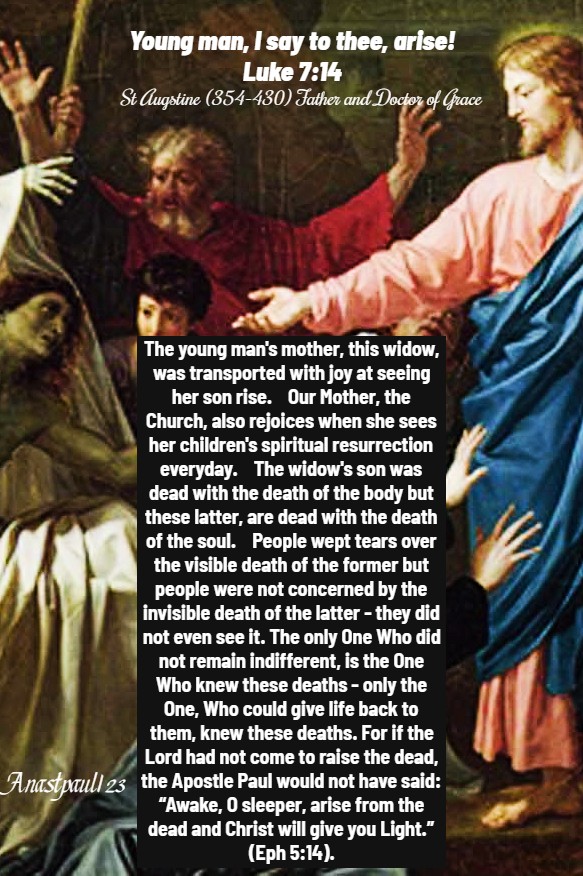
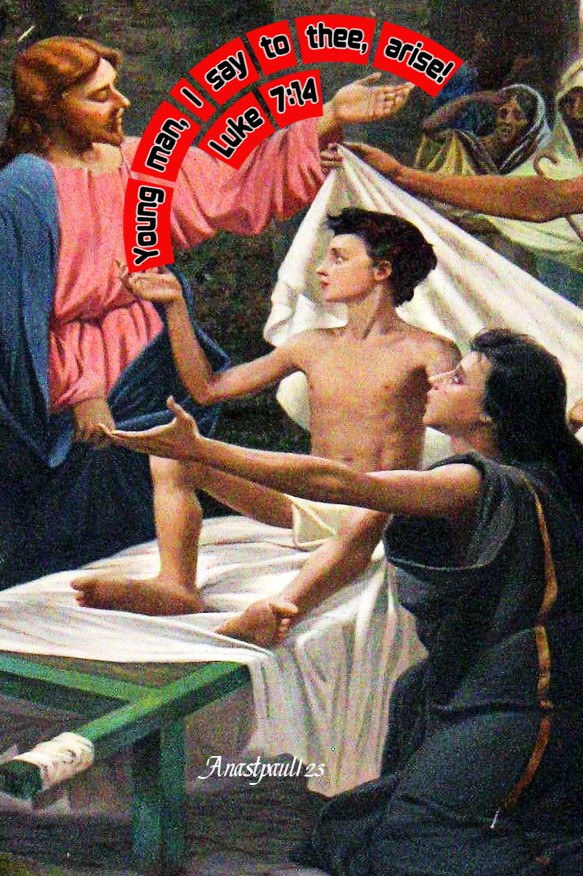
“Young man, I say to thee, arise!” Luke 7:14
“The young man’s mother, this widow, was transported with joy at seeing her son rise. Our Mother, the Church, also rejoices when she sees her children’s spiritual resurrection everyday. The widow’s son was dead with the death of the body but these latter, are dead with the death of the soul. People wept tears over the visible death of the former but people were not concerned by the invisible death of the latter – they did not even see it. The only One Who did not remain indifferent, is the One Who knew these deaths – only the One, Who could give life back to them, knew these deaths. For if the Lord had not come to raise the dead, the Apostle Paul would not have said: “Awake, O sleeper, arise from the dead and Christ will give you Light.” (Eph 5:14).”
St Augustine (354-430) Father and Doctor of Grace
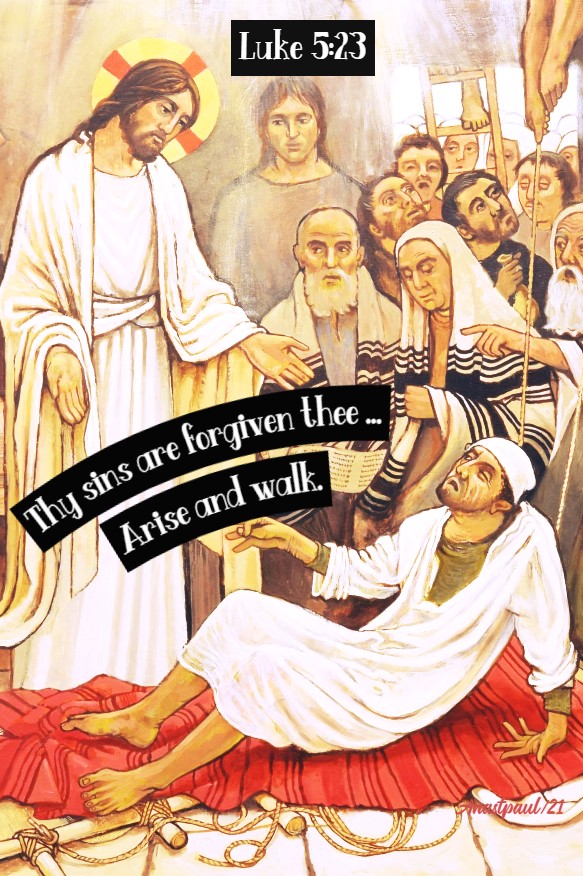
“O my brethren, if only we wanted to, if only we all wanted to perceive our soul’s paralysis in all its depth! Then we would see that it is lying on a stretcher of sins, deprived of strength. Christ’s action within us, would be a source of light and we would understand that each day He sees our lack of faith, harmful as it is, that He draws us towards healing remedies and sharply presses our rebellious wills. “My son” He says, “your sins are forgiven you.”
St Peter Chrysologus (c 400-450) “Golden Words” Father & Doctor of the Church
“If thou art bound down by sickness, if sorrows weary thee, if thou art trembling with fear, invoke the name of Jesus!”
St Lawrence Justinian (1381-1456)
“A person who is conscious of his misery, can certainly have great confidence in God. In fact, he cannot have true confidence in Him, without this consciousness of his misery. This knowledge and acknowledgement of our misery, leads us to the presence of God.”
St Francis de Sales 91567-1622) Doctor of the Church
Quote/s of the Day – 5 September – St Lawrence Justinian (1381-1455) Bishop of Venice, Confessor
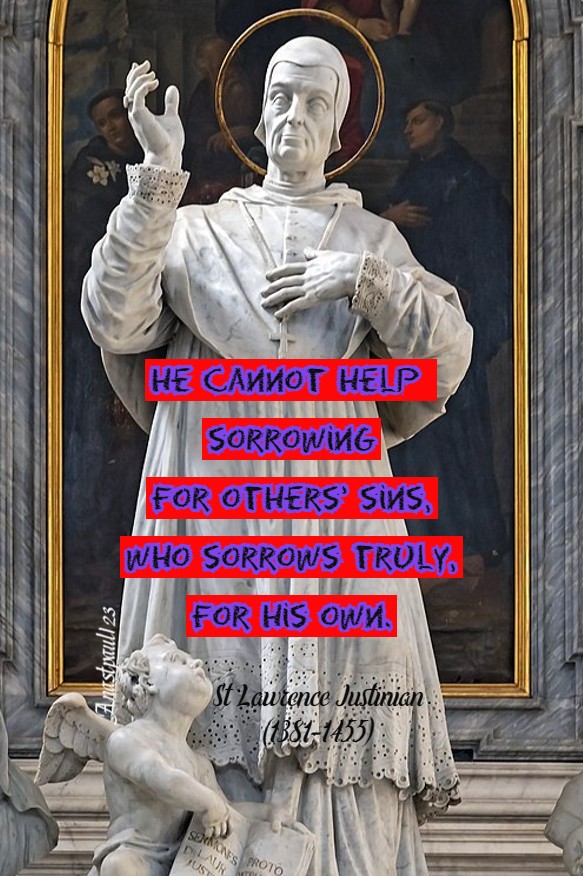
“He cannot help sorrowing for others’ sins, who sorrows truly, for his own.”
“The exterior works of Martha, without the interior spirit of Mary, cannot be perfect. He deceives himself. who expects, without the aid of prayer, to succeed in the work of saving souls, — a work as dangerous as it is sublime! Without the reflection of prayer, he shall certainly faint on the way!”
“Prayer, appeases the anger of God; He pardons the sinner when he prays with humility.”
St Lawrence Justinian (1381-1455) Bishop of Venice, Confessor, Reformer, Spiritual writer. The Roman Martyrology states of him today: “The Feast of St Lawrence Justinian, first Patriarch of Venice, who, by glorious miracles and virtues, illustrated the Episcopal dignity which he received against his will on this day. His birthday into Heaven is 8 January.” His Zealous Life: https://anastpaul.com/2021/09/05/saint-of-the-day-5-september-saint-lawrence-justinian-1381-1455/
St Charbel Bl Florent Dumontet de Cardaillac St Genebald of Laon Bl Gendtilis Blessed Gerbrand of Dokkum OPraem (Died 1267) Priest Abbot St Guise Hoang Luong Canh Blessed John the Good OSA (c 1168-1249) Bishop Blessed Jordan of Pulsano Abbot
St Obdulia Bl Phêrô Nguyen Van Tu St Romulus of Rome St Victorinus of Amiterme St Victorinus of Como Bl William Browne
Martyrs of Armenia – 1,000 Saints: A group of up to 1,000 Christian soldiers in the 2nd Century Imperial Roman Army of Trajan, stationed in Gaul. Ordered to sacrifice to pagan gods, they refused and were transferred to Armenia. Ordered again to sacrifice to pagan gods, they refused again. Martyrs. We know the names of three of them but nothing else – Eudoxius, Macarius and Zeno.
Martyrs of Capua – 3 Saints: Three Christians who were Martyred together. Long venerated in Capua, Italy. We know their names, but little else – Arcontius, Donatus and Quintius. They were martyred in Capua, Italy.
Martyrs of Nicomedia – 80 Saints: A group of 80 Christians, Lay and Clergy, Martyred together in the persecutions of Valens. We know little more than the names of three of them – Menedemo, Teodoro and Urbano. They were locked on a boat which was then set on fire on the shore of Nicomedia, Bithynia (in modern Turkey) c370.
Martyrs of Porto Romano – 4+ Saints: A group of Christians Martyred together in the persecutions of Marcus Aurelius. We know little more than their names – Aconto, Herculanus, Nonno and Taurino. c180 at Porto Romano, Italy.
Quote/s of the Day – 23 March – Thursday of the Fourth Week in Lent – 4 Kings 4:25-38, Luke 7:11-16 – Scripture search here: https://www.drbo.or
“Young man, I say to thee, arise!”
Luke 7:14
“Thy sins are forgiven thee … Arise and walk.”
Luke 5:23
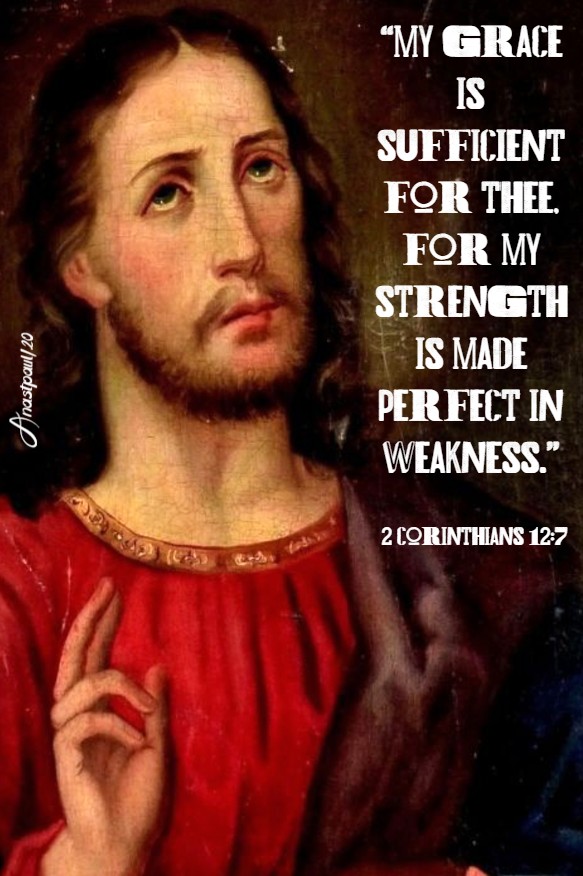
“My grace is sufficient for thee, for My strength is made perfect in weakness. Therefore, I will boast all the more gladly about my weaknesses, so that Christ’s power may rest on me.”
2 Corinthians 12:7
“O my brethren, if only we wanted to, if only we all wanted to perceive our soul’s paralysis in all its depth! Then we would see that it is lying on a stretcher of sins, deprived of strength. Christ’s action within us, would be a source of light and we would understand that each day He sees our lack of faith, harmful as it is, that He draws us towards healing remedies and sharply presses our rebellious wills. “My son” He says, “your sins are forgiven you.”
St Peter Chrysologus (c 400-450) “Golden Words” Father & Doctor of the Church
“If thou art bound down by sickness, if sorrows weary thee, if thou art trembling with fear, invoke the name of Jesus!”
St Lawrence Justinian (1381-1456)
“The medicine of God, is Jesus Christ, Crucified and Risen, the measure of all things.”
St John Leonardi (1541-1609) Confessor, Priest, Founder
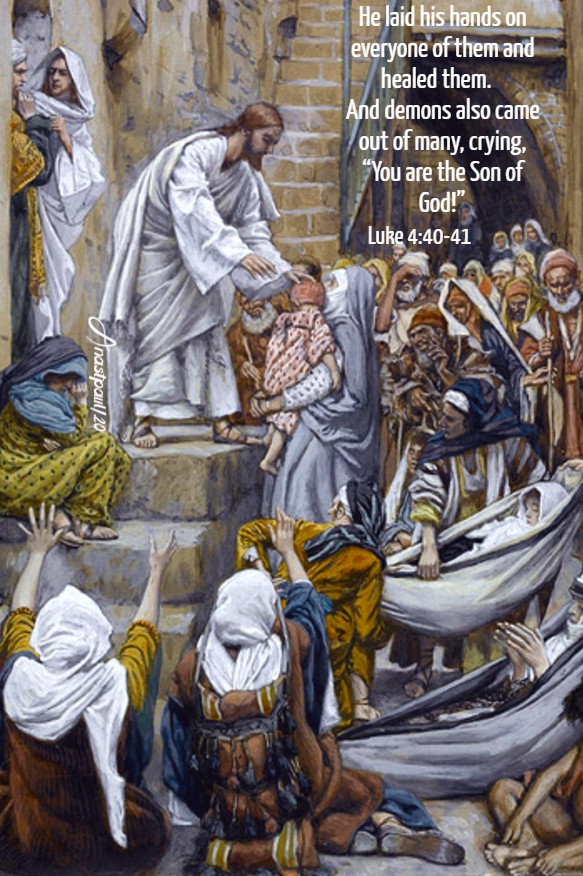
Quote/s of the Day – 16 March – Thursday of the Third Week in Lent
“Now when the sun was setting, all those who had any who were sick with various diseases brought them to him and he laid his hands on everyone of them and healed them. And demons also came out of many, crying, “You are the Son of God!” But he rebuked them and would not allow them to speak because they knew that he was the Christ.”
Luke 4:40-41
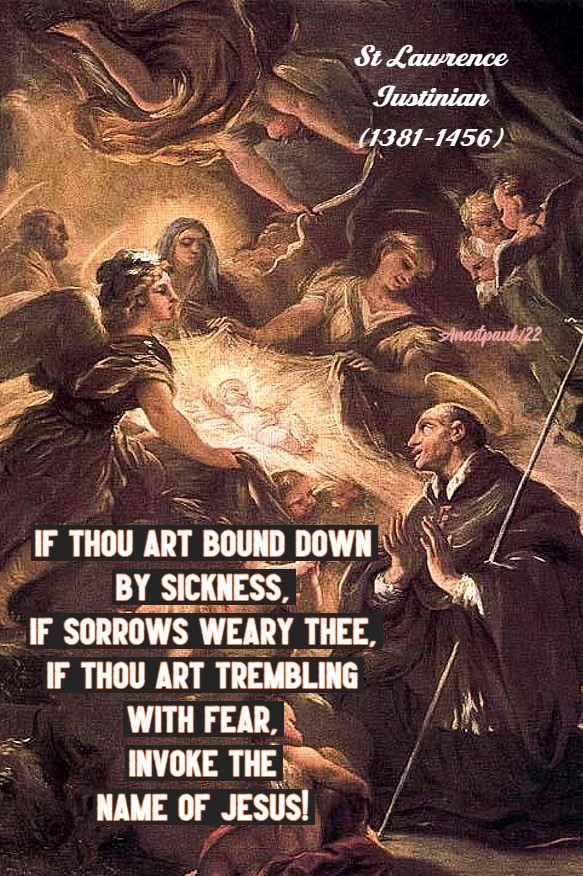
“If thou art bound down by sickness, if sorrows weary thee, if thou art trembling with fear, invoke the name of Jesus!”
St Lawrence Justinian (1381-1456)
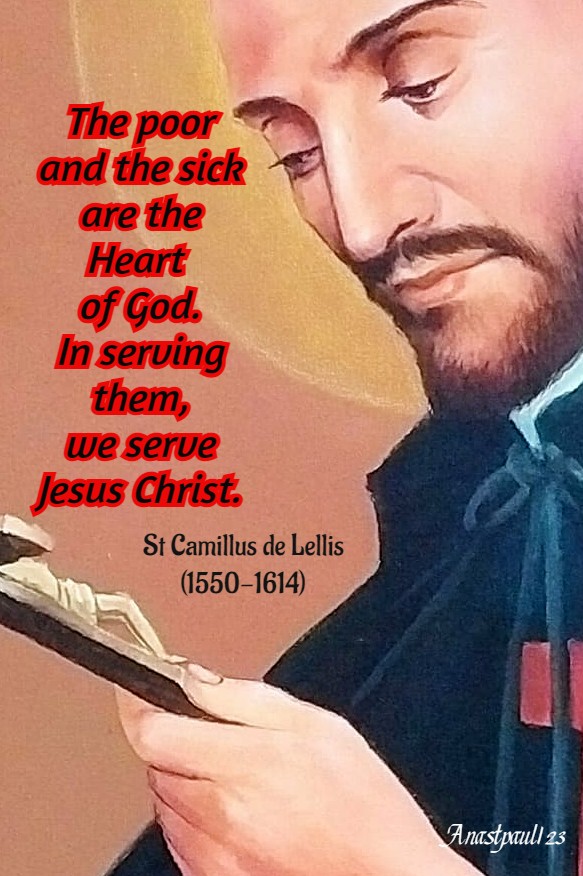
“The poor and the sick are the Heart of God. In serving them, we serve Jesus Christ.”
St Camillus de Lellis MI (1550-1614)
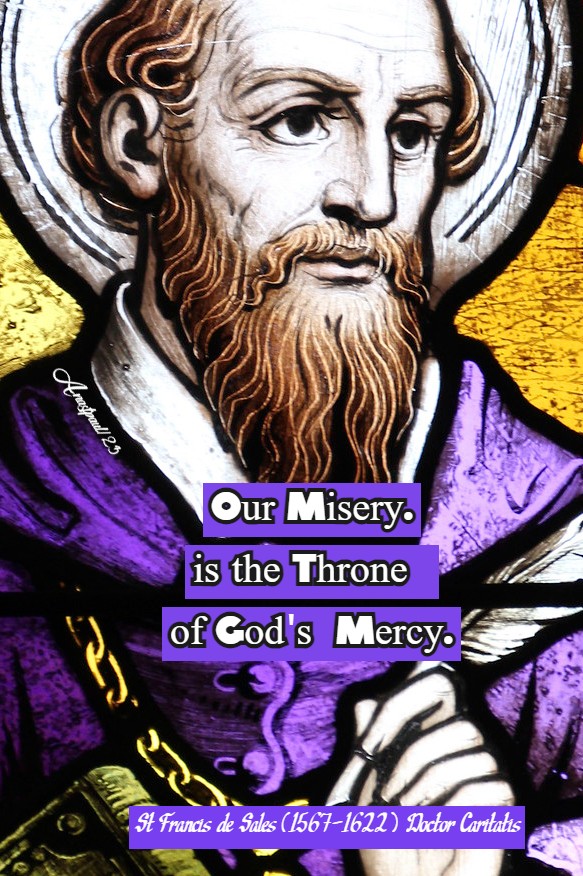
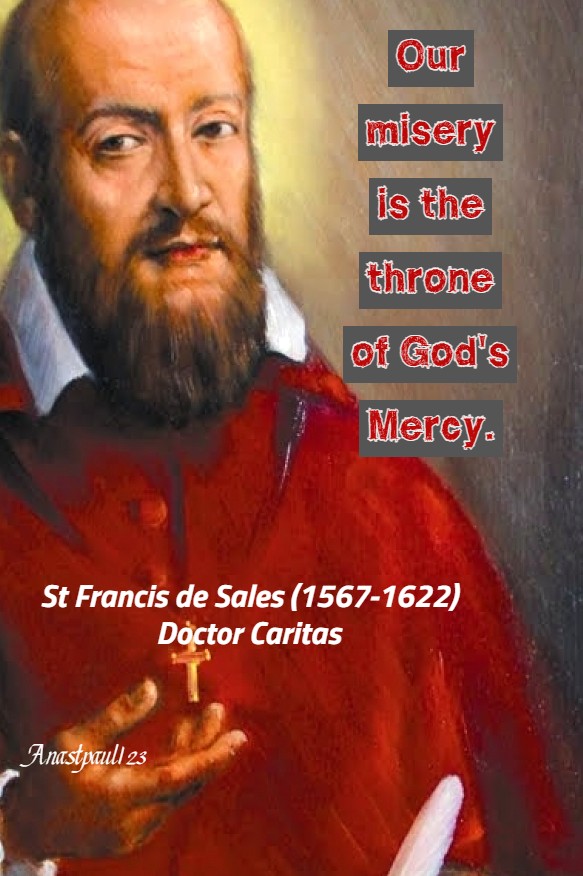
“Our misery is the throne of God’s Mercy.”
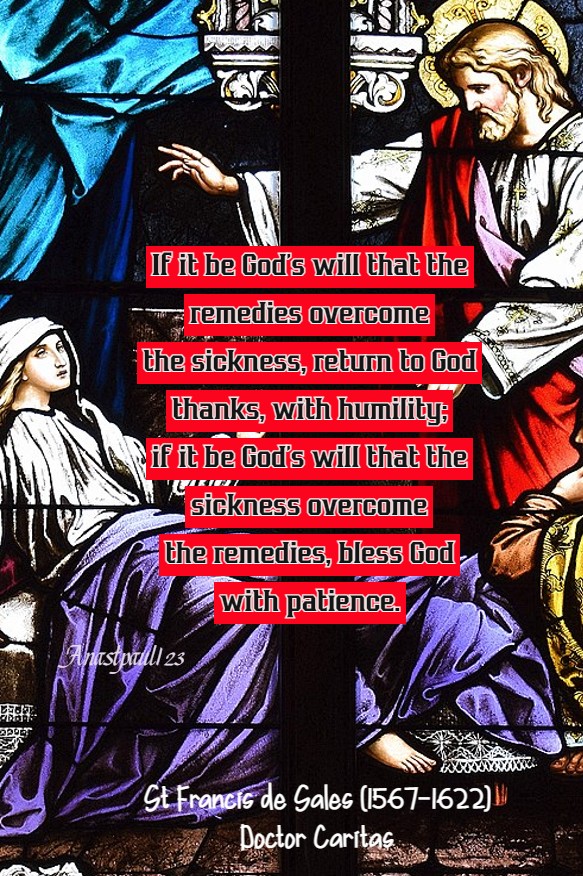
“If it be God’s will that the remedies overcome the sickness, return to God thanks, with humility; if it be God’s will that the sickness overcome the remedies, bless God with patience.”
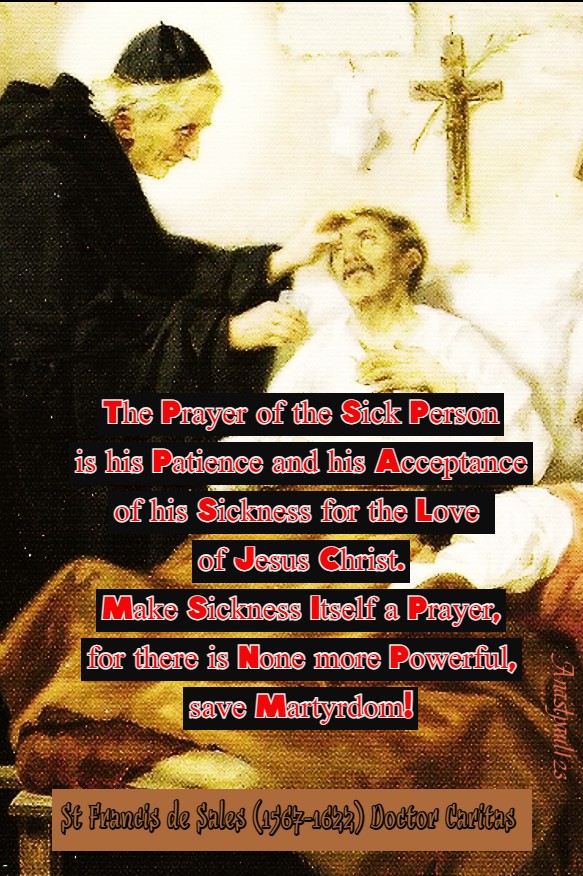
“The prayer of the sick person is his patience and his acceptance of his sickness for the love of Jesus Christ. Make sickness itself a prayer, for there is none more powerful, save Martyrdom!”
Quote/s of the Day – 11 June – Ember Saturday of Pentecost – Romans 5:1-5, Luke 4:38-44.
“Now Simon’s mother-in-law was suffering from a great fever and they besought Him for her.”
Luke 4:38
“May Christ come to our house and enter in and by His command, cure the fever of our sins. Each one of us is sick with a fever. Whenever I give way to anger, I have a fever. There are as many fevers, as there are faults and vices.”
St Jerome (343-420) Father & Doctor of the Church
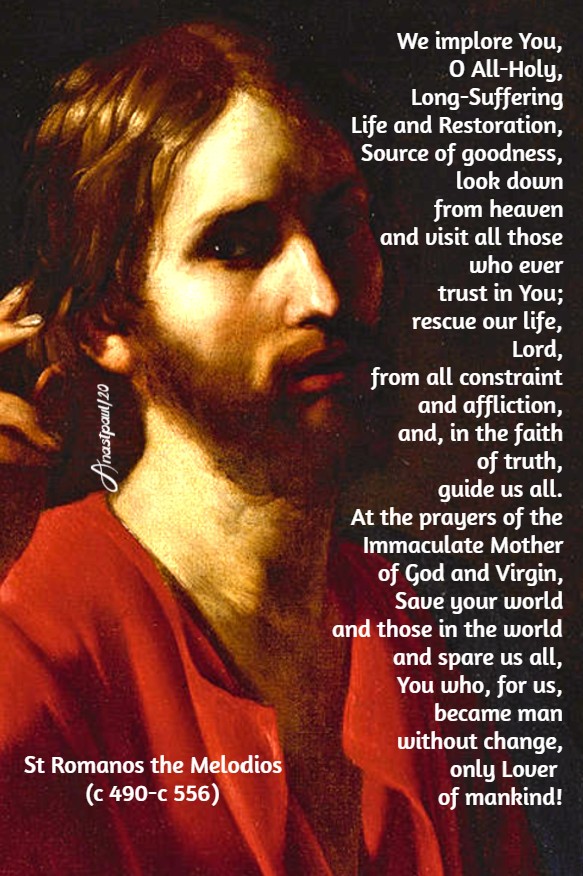
“We implore You, O All-Holy, Long-Suffering Life and Restoration, Source of goodness, look down from Heaven and visit all those who ever trust in You; rescue our life, Lord, from all constraint and affliction, and, in the faith of truth, guide us all. At the prayers of the Immaculate Mother of God and Virgin, Save your world and those in the world and spare us all, You who, for us, became man without change, only Lover of mankind.”
St Romanos the Melodios (c 490-c 556)
“If thou art bound down by sickness, if sorrows weary thee, if thou art trembling with fear, invoke the name of Jesus.”
St Lawrence Justinian (1381-1456)
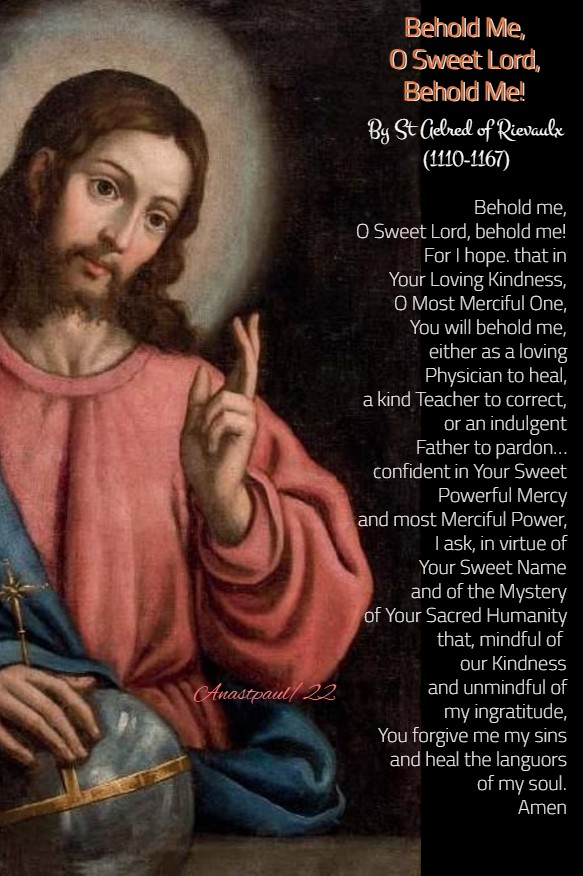
Behold Me, O Sweet Lord, Behold Me! By St Aelred of Rievaulx O.Cist. (1110-1167)
Behold me, O Sweet Lord, behold me! For I hope. that in Your Loving Kindness, O Most Merciful One, You will behold me, either as a loving Physician to heal, a kind Teacher to correct, or an indulgent Father to pardon… confident in Your Sweet Powerful Mercy and most Merciful Power, I ask, in virtue of Your Sweet Name and of the Mystery of Your Sacred Humanity that, mindful of Your Kindness and unmindful of my ingratitude, You forgive me my sins and heal the languors of my soul. Amen
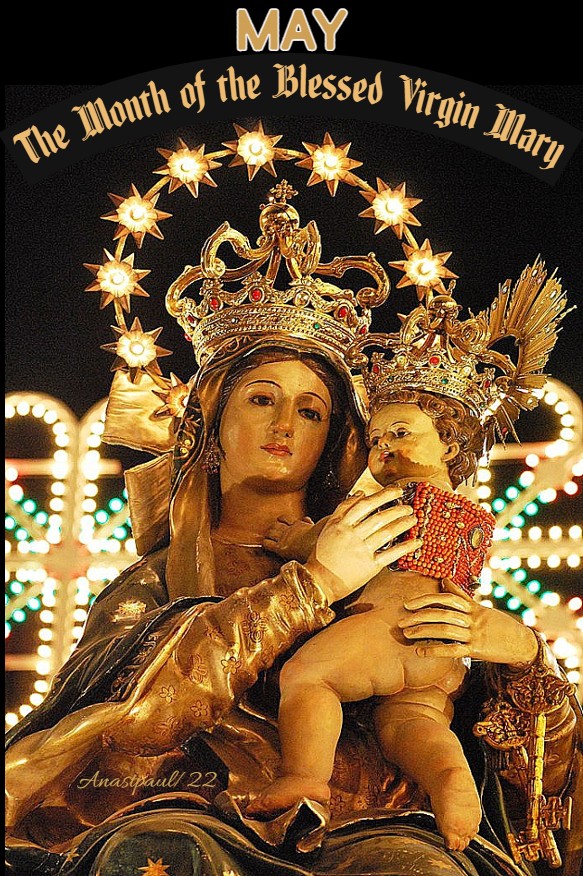
It’s 1 May The Month of the Blessed Virgin Mary The Month of our Loving Mother!
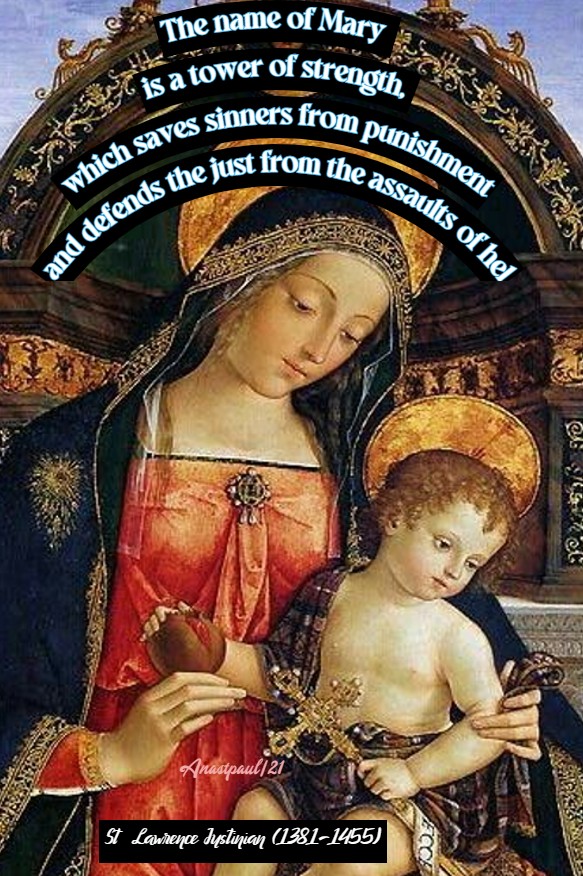
“The name of Mary is a tower of strength, which saves sinners from punishment and defends the just from the assaults of hell.” St Lawrence Justinian (1381-1455)
Mary Pondered All These Things in Her Heart (Cf Luke 2:19)
“While Mary contemplated all she had come to know through reading, listening and observing, she grew in faith,increased in merits and was more illuminated by Wisdom and more consumed by the fire of charity. The Heavenly Mysteries were opened to her and she was filled with joy; she became fruitful by the Spirit, was being directed toward God and watched over protectively, while on earth. So remarkable are the divine graces, that they elevate one from the lowest depths to the highest summit and transform one to a greater holiness. How entirely blessed was the mind of the Virgin which, through the indwelling and guidance of the Spirit, was always and in every way, open to the power of the Word of God. She was not led by her own senses, nor by her own will, thus, she accomplished outwardly, through her body. what Wisdom, from within, gave to her faith. It was fitting for Divine Wisdom, which created itself a home in the Church, to use the intervention of the most Blessed Mary, in guarding the law, purifying the mind, giving an example of humility and providing a spiritual sacrifice. Imitate her, O faithful soul! Enter into the deep recesses of your heart, so that you may be purified spiritually and cleansed from your sins. God places more value on goodwill in all we do, than on the works themselves. Therefore, whether we give ourselves to God in the work of contemplation or whether we serve the needs of our neighbour by good works, we accomplish these things because, the love of Christ urges us on. The acceptable offering of the spiritual purification, is accomplished, not in a man-made temple but, in the recesses of the heart where the Lord Jesus freely enters!”
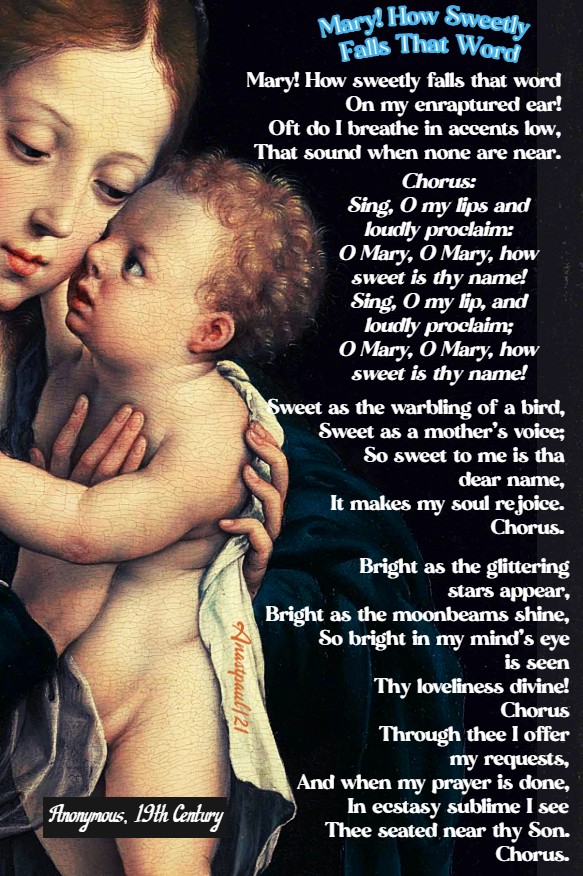
Mary! How Sweetly Falls That Word Anonymous, 19th Century
Mary! How sweetly falls that word On my enraptured ear! Oft do I breathe in accents low, That sound when none are near. Chorus: Sing, O my lips and loudly proclaim: O Mary, O Mary, how sweet is thy name! Sing, O my lip, and loudly proclaim; O Mary, O Mary, how sweet is thy name!
Sweet as the warbling of a bird, Sweet as a mother’s voice; So sweet to me is that dear name, It makes my soul rejoice. Chorus.
Bright as the glittering stars appear, Bright as the moonbeams shine, So bright in my mind’s eye is seen Thy loveliness divine! Chorus.
Through thee I offer my requests, And when my prayer is done, In ecstasy sublime I see Thee seated near thy Son. Chorus.
Quote/s of the Day – 2 January – “Month of the Most Holy Name of Jesus”
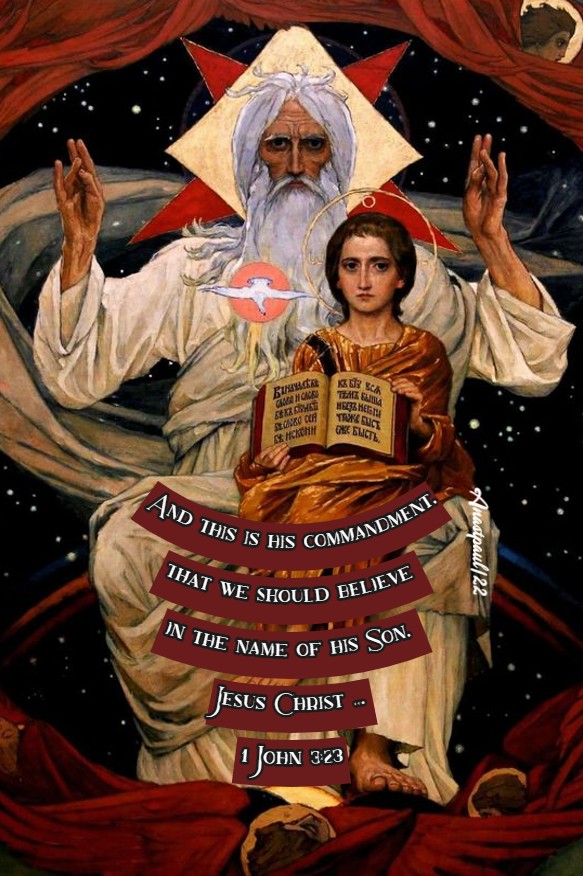
“And this is his commandment, that we should believe in the name of his Son, Jesus Christ … ”
1 John 3:23
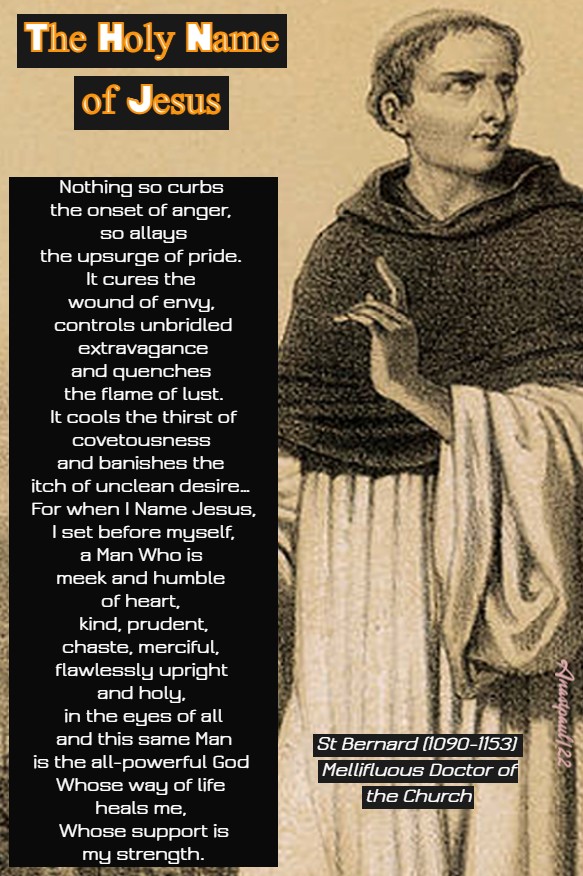
“Nothing so curbs the onset of anger, so allays the upsurge of pride. It cures the wound of envy, controls unbridled extravagance and quenches the flame of lust. It cools the thirst of covetousness and banishes the itch of unclean desire… For when I Name Jesus, I set before myself, a Man Who is meek and humble of heart, kind, prudent, chaste, merciful, flawlessly upright and holy in the eyes of all and this same Man is the all-powerful God Whose way of life heals me, Whose support is my strength.”
St Bernard (1090-1153) Mellifluous Doctor of the Church
(Sermon 15 On the Song of Songs)
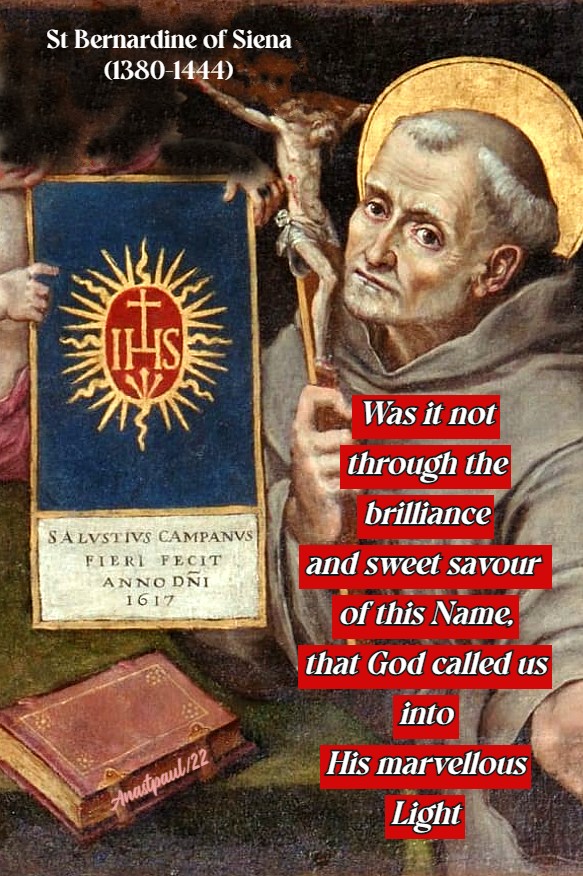
“Was it not through the brilliance and sweet savour of this Name, that God called us into His marvellous Light?”
St Bernardine of Siena (1380-1444)
“If thou art bound down by sickness, if sorrows weary thee, if thou art trembling with fear, invoke the name of Jesus.”
Quote/s of the Day – 12 September – Feast of the Holy Name of Mary
“And the Virgin’s name was Mary.”
Luke 1:27
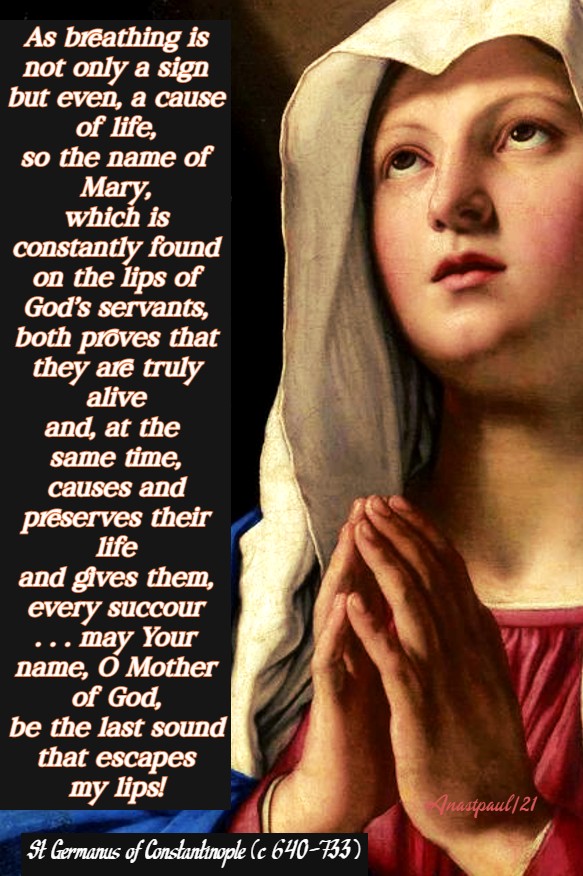
“As breathing is not only a sign but even, a cause of life, so the name of Mary, which is constantly found on the lips of God’s servants, both proves that they are truly alive and, at the same time, causes and preserves their life and gives them, every succour . . . may Your name, O Mother of God, be the last sound that escapes my lips!”
St Germanus of Constantinople (c 640-733)
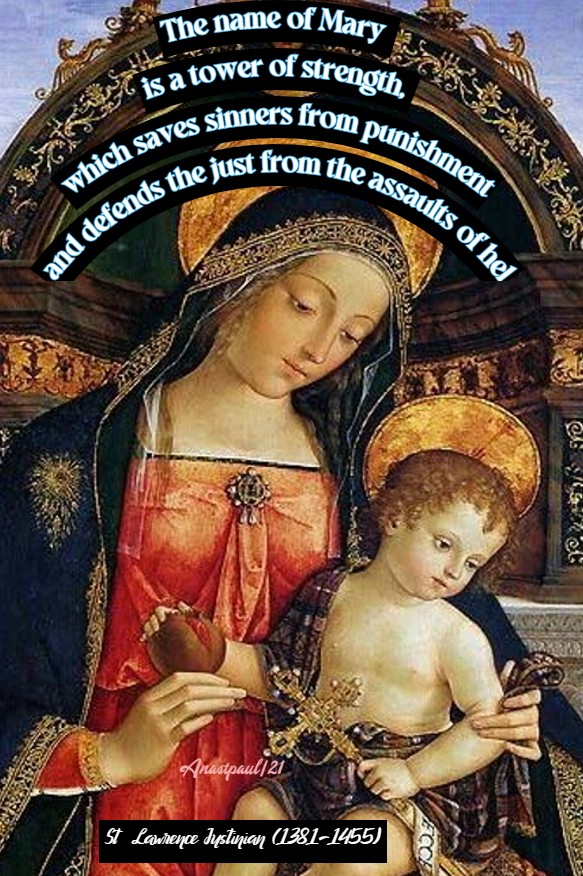
“The name of Mary is a tower of strength, which saves sinners from punishment and defends the just from the assaults of hell.”
St Lawrence Justinian (1381-1455)
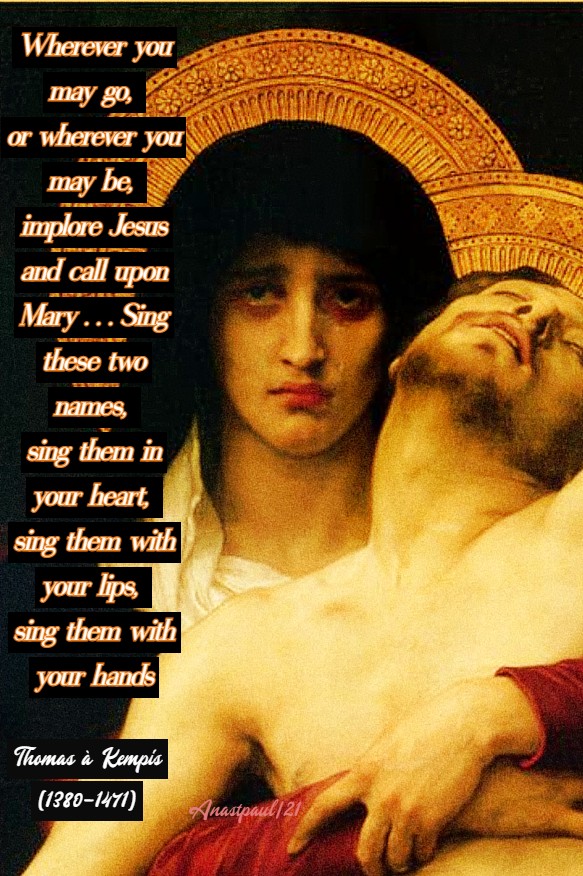
“Wherever you may go, or wherever you may be, implore Jesus and call upon Mary . . . Sing these two names, sing them in your heart, sing them with your lips, sing them with your hands.”
One Minute Reflection – 5 September – “Month of the Seven Sorrows of the Blessed Virgin Mary” – Readings: Isaiah 35: 4-7a; Psalm 146: 7-10 (1b); James 2: 1-5; Mark 7: 31-37 and the Memorial of St Lawrence Justinian (1381-1455) Bishop
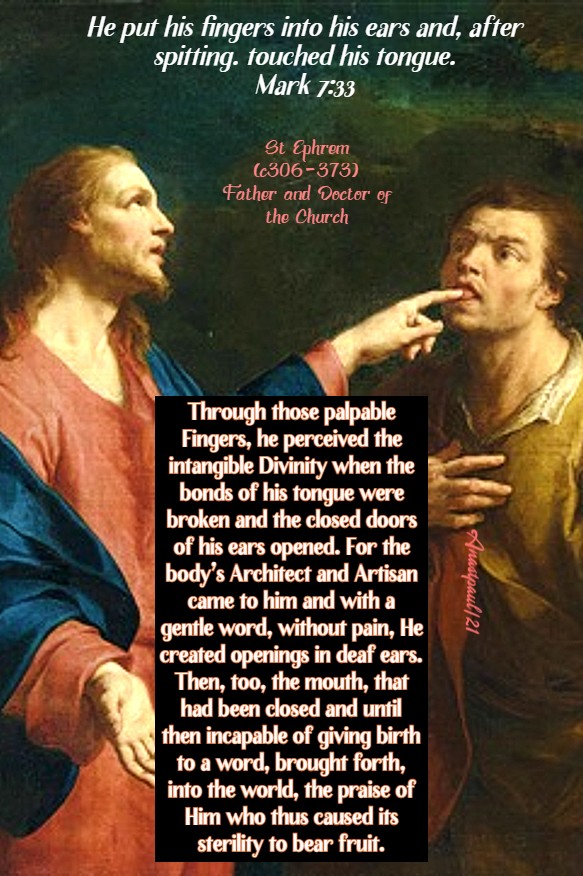
“And taking him aside from the crowd privately, he put his fingers into his ears and, after spitting. touched his tongue.” – Mark 7:33
REFLECTION – “Divine Strength came down, which we humans cannot touch; it covered itself with a palpable body so that the poor might touch it and, in touching Christ’s Humanity, might perceive His Divinity. The deaf-mute sensed that his ears and his tongue were being touched with fingers of flesh. Through those palpable Fingers, he perceived the intangible Divinity when the bonds of his tongue were broken and the closed doors of his ears opened. For the body’s Architect and Artisan came to him and with a gentle word, without pain, He created openings in deaf ears. Then, too, the mouth, that had been closed and until then, incapable of giving birth to a word, brought forth, into the world, the praise of Him who thus caused its sterility to bear fruit.
In the same way, the Lord made paste with His saliva and spread it over the eyes of the man born blind (Jn 9:6), so we might understand that, like the deaf-mute, He was lacking something. An inborn imperfection in our human dough was removed thanks to the leaven that comes from His perfect body …. To complete what was missing in these human bodies of ours, He gave something of Himself, just as He gives Himself to be eaten [in the Eucharist]. By this means, He causes our deficiencies to disappear and raises the dead, so that we might recognise that, thanks to His body in which “the fullness of deity resides” (Col 2:9), the deficiencies in our humanity are brought to completion and true life is given to mortals by this Body in which true life resides.” – St Ephrem (c306-373) Deacon in Syria, Father and Doctor of the Church – Sermon “On our Lord,” 10
PRAYER – Almighty and merciful God, open the ears and eyes of our hearts and fill us with Your grace. May we follow You in holiness all the days of our lives. Grant we pray, that as You brought Your Saints and Martyrs to overcome fearlessly, the persecutions of Your people, that we too may remain invincible under Your protection and by their prayers, be strengthened against the snares of the enemy. St Lawrence Justinian, pray for us in these times of evil! Through our Lord Jesus Christ, your Son, who lives and reigns with you in the unity of the Holy Spirit, one God, forever and ever. Amen.
Saint of the Day – 5 September – Saint Lawrence Justinian (1381-1455) Bishop of Venice, Confessor, Reformer, Spiritual writer. Born on 1 September 1381 at Venice, Italy and died on 8 January 1455 at Venice of natural causes. Also known as – Lorenzo Giustiniani, Laurence…Laurentius…Patriarch of Venice.Patronage – Venice, Italy. Additional Memorial – 8 Jamuary.
The Roman Martyrology states of him today: “The Feast of St Lawrence Justinian, first Patriarch of Venice, who, by glorious miracles and virtues, illustrated the Episcopal dignity which he received against his will on this day. His birthday into Heaven is 8 January.”
Lawrence Justinian was a member of the well-known Giustiniani family, which includes several Saints. The piety of his mother seems to have served as an inspiration for his own piety and he chose a life of prayer and service. In 1404, after he had been Ordained a Deacon, at the suggestion of an uncle who was a Priest, he joined a community of Canons regular following a monastic form of life on the island of San Giorgio in Alga. He was admired by his fellows for his poverty, mortification and fervency of prayer. Two years after his Ordination to the Priesthood in 1407, the community accepted the Rule of St. Augustine. He was chosen to be the first Prior of the community.
Lawrence promoted the Constitutions which had been established for the Canons Regular of St George’S Monastery, which was embraced by other communities of Canons in the region and shortly thereafter, he became the Prior General of his Congregation. He was so zealous in spreading the merits of his community, that he was looked upon as if he were the actual Founder of the Order.
His great humility was a lesson to all his fellow Canons – when he went out begging, even to his own family home where the servants were embarrassed and as quickly as they could, gave him the bread he sought and then hrried him away, before the family were aware that their ‘child‘ was the beggar at the door.
Lawrence, although he had no great oratory skills preached very effectively, on the one hand, continuing to go around with his habit and saddlebag begging and, on the other hand, writing tirelessly. He wrote for the learned and the ignorant, theological treatises and popular pamphlets, offering everyone a guide to personal reform in faith and practicing that faith. He urged the faithful to recover a sense of communion with the whole Church, he encouraged trust in God’s mercy rather than fear of His justice.
In 1433, Pope Eugene IV, one of the Founders of the Monastery of San Giorgio, named Lawrence as the Bishop of Castello. Although he resisted this elevation to the Episcopal dignity supported by his brother Canons in protest, Pope Eugene, who knew him very well, did not heed his protesting pretexts – his tiredness, the task too difficult, etc … He found a Diocese in disarray and his administration was marked by considerable growth and reform. In 1451, Pope Nicholas V united the Diocese of Castello with the Patriarchate of Grado, and the seat of the Patriarchate was moved to Venice, making Lawrence the first Patriarch of Venice, a post that he held for over four years.
It was during Lawrence’s rule that Constantinople fell to Muslim forces. Due to their centuries of close trading partnerships with the Byzantine Empire, the people of Venice were in distress as to their future. He took a leading role in helping the Republic to deal with the crisis, working with the Senate to help chart its future, as well as with the clergy and people.
He died on 8 January 1455 and was Canonised by Pope Alexander VIII (1689–1691) on 16 October 1690. His works, consisting of sermons, letters and ascetic treatises, have been frequently reprinted.
Pope Innocent XII (1691–1700) inserted his Feast day into the General Roman Calendar for celebration on 5 September, the Anniversary of his elevation to the Episcopate.
Duomo (Padua) – cappella di San Lorenzo Giustiniani – Statua di Lorenzo Giustiniani






















 AnaStpaul
You must be logged in to post a comment.