St Anastasius of Córdoba St Burchard of Meissen St Caomhán of Inisheer St Castora Gabrielli St Cearan the Devout Bl Constance de Castro St Cyprien St Cyriacus of Zeganea St Davnet St Digna of Córdoba St Dogmael of Wales St Elgar of Bardsey
St Nennus of Arran Bl Peter de Bustamante St Protus of Aquileia St Quintian St Richard of Saint Vannes St Rufinus of Soissons * (Died 4th Century) Layman, Martyr St Theopista St Valerius of Soissons * (Died 4th Century) Layman, Martyr
St Anastasius of Córdoba St Burchard of Meissen St Caomhán of Inisheer St Castora Gabrielli St Cearan the Devout Bl Constance de Castro St Cyprien St Cyriacus of Zeganea St Davnet St Digna of Córdoba St Dogmael of Wales St Elgar of Bardsey
St Nennus of Arran Bl Peter de Bustamante St Protus of Aquileia St Quintian St Richard of Saint Vannes St Rufinus of Soissons St Thecla St Theopista St Valerius of Soissons Bl Walter Eustace
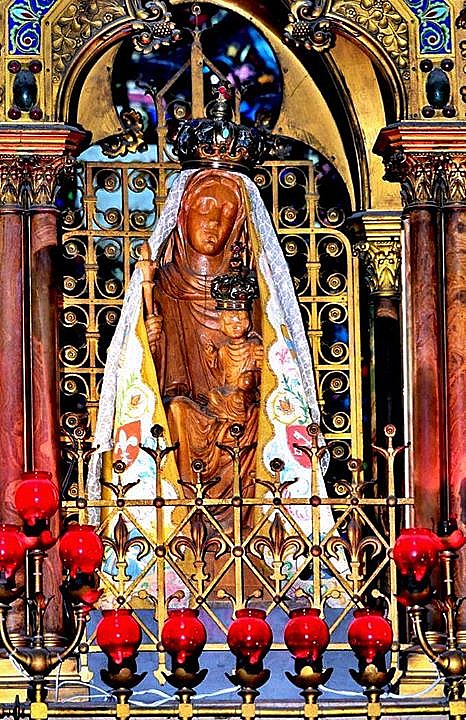
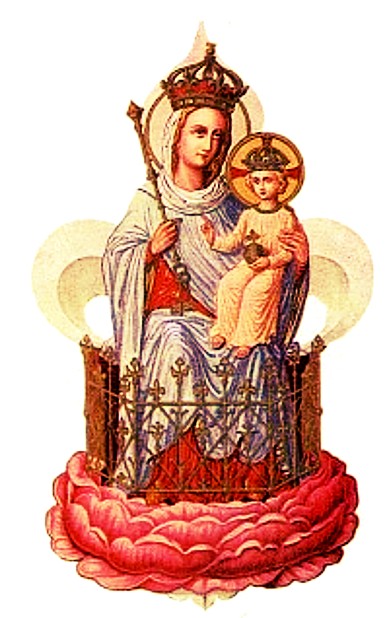
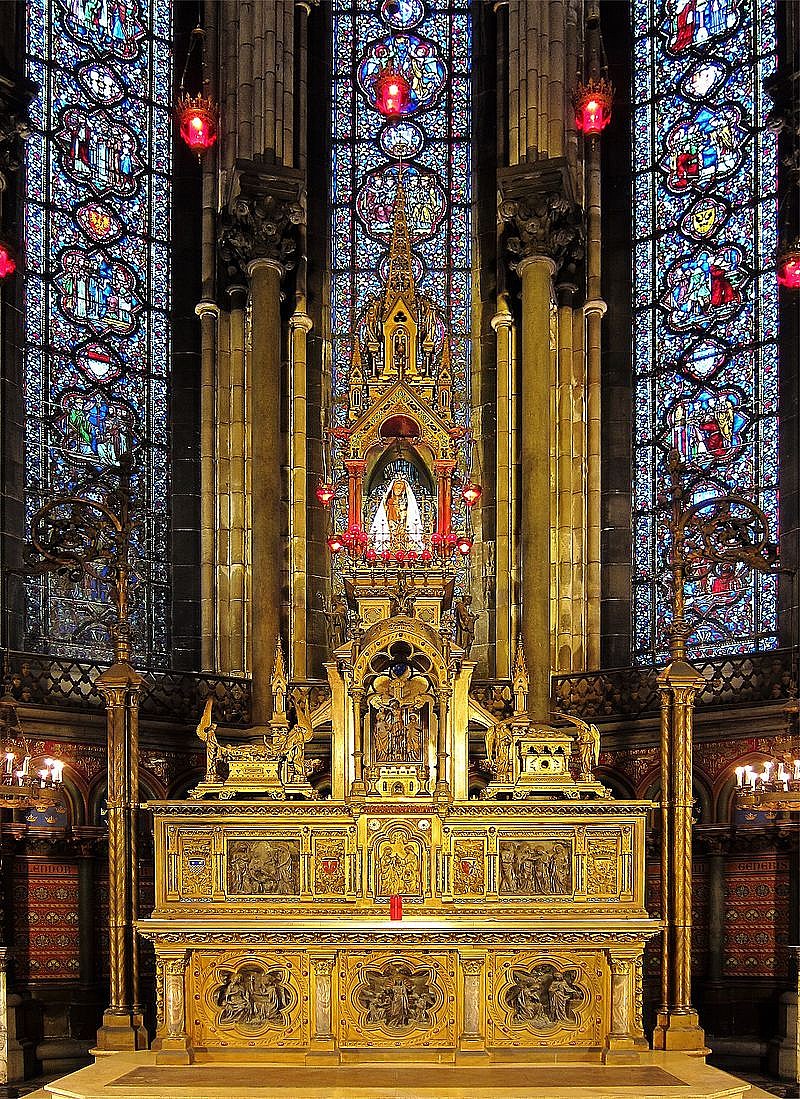
Notre-Dame de la Treille / Our Lady of the Trellis, Lille, Nord, Flandres, France, 1234 – 14 June:
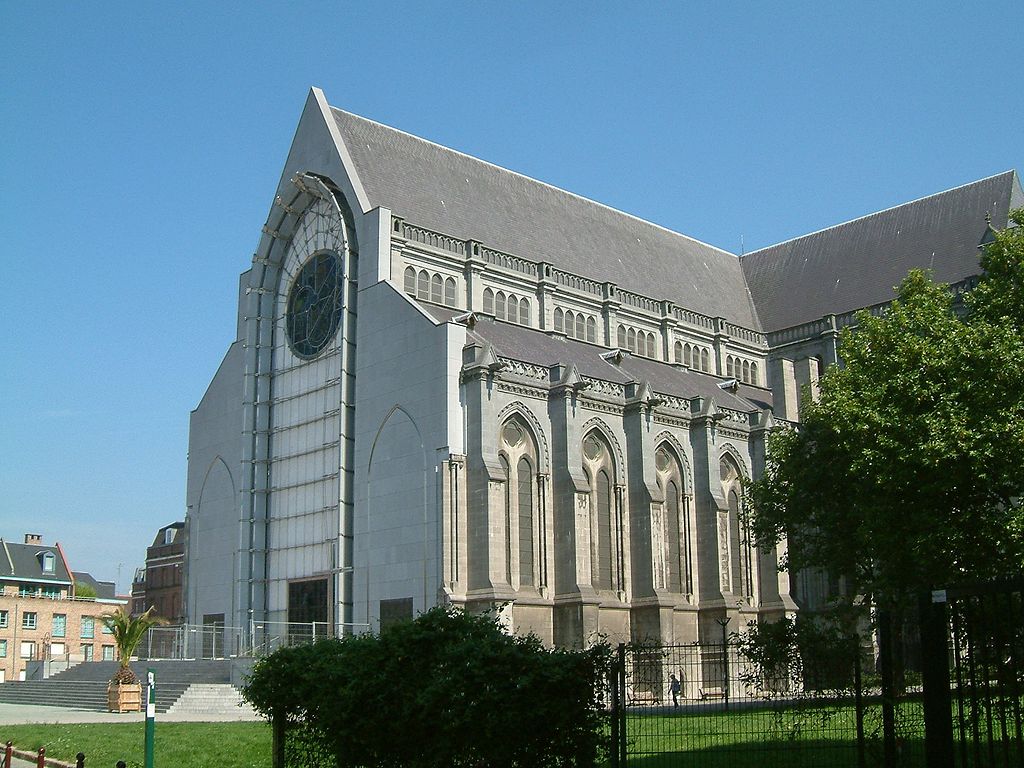
Three series of miraculous events are associated with the Statue, occurring in 1234, from 1519 to 1527 and from 1634 to 1638. The miracle of 1234 was the healing of the 53 disabled patients who resorted to her intercession and were cured upon praying before the Statue of Our Lady of the Trellis, installed behind a latticework fence in St Peter’s Collegiate Church in Lille, France. The miracles in the 16th century were varied and included deliverance from demonic possession, hernias, blindness, paralysis and plague. In 1254, a Confraternity of Our Lady of the Treille was canonically established by Pope Alexander IV and since 1259, an annual procession in honour of Our Lady of the Treille was held – a practice which continued until the French Revolution and since then resumed and is continued today. In 1634, Jean Le Vasseur, Mayor of Lille, Consecrated the City to Our Lady of the Treille. In 1667, Louis XIV, who had just taken Flanders, took an oath to respect the freedoms of Lille before the Statue. A procession held annually on the second Sunday after Pentecost commemorates the miracles. Saved during the destruction of St Peter’s Church in the French Revolution, the Statue moved afterwards to St Catherine’s Church. Devotion to Our Lady of the Trellis revived in the mid-1800s and a grand neo-Gothic Church arose in her honour, where the Statue was installed in 1872 and canonically crowned in 1874. After the theft of the original in 1959, sculptor Marie Madeleine Weerts carved the image now displayed in Lille’s Catholic Cathedral, the Basilica of Notre-Dame de la Treille.
The statue is described by Father Charles Bernard, Parish Priest of the Church of St Catherine, as a sSatue of stone “a little more than two and a half feet high; she has a scepter in her right hand and from her left. she supports the Baby Jesus on her knees.” He mentions the trellis of gilded wood surrounding the Statue and its pedestal, and specifies that the old trellis made of gilded iron was lost in 1792 during the destruction of the Collegiate Church of St. Peter. He speculates that this trellis is what gave the Statue its name, although it is more likely that the name came from Treola, a place existing in the 9th century in what is now Lille.
St Anastasius of Córdoba St Burchard of Meissen St Caomhán of Inisheer St Castora Gabrielli St Cearan the Devout Bl Constance de Castro St Cyprien St Cyriacus of Zeganea St Davnet St Digna of Córdoba St Dogmael of Wales St Elgar of Bardsey
St Etherius of Vienne St Felix of Córdoba Bl Fortunatus of Napoli Bl Francisca de Paula de Jesus Isabel St Gerold of Evreux Bl Hartwig of Salzburg St Joseph the Hymnographer St Marcian of Syracuse (Died c 68) Bishop Martyr, Consecrated by St Peter St Mark of Lucera
St Nennus of Arran Bl Peter de Bustamante St Protus of Aquileia St Quintian St Richard of Saint Vannes St Rufinus of Soissons St Thecla St Theopista St Valerius of Soissons Bl Walter Eustace
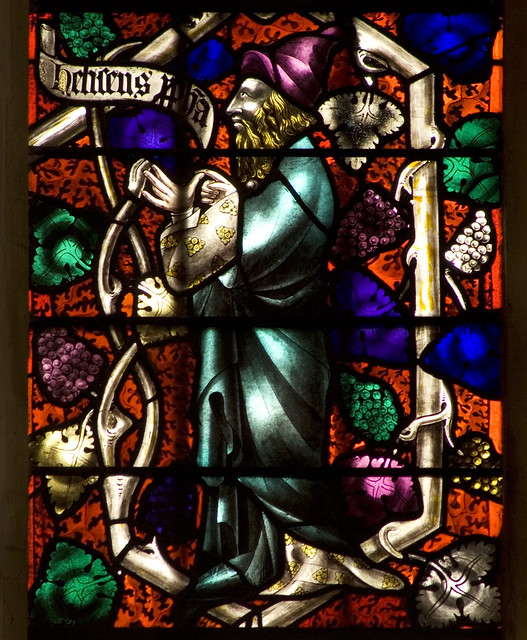
Saint of the Day – 14 June – Saint Elisha the Prophet “My God is salvation” (c 790 BC) was a a disciple and protégé of St Elijah and after Elijah was taken up in a chariot of fire, he gave Elisha a double portion of his power and he was accepted as the leader of the sons of the prophets. Elisha then went on to perform twice as many miracles as Elijah. Patronage – Prophets. St Elisha is commemorated in the calendar of saints of the Carmelite Order following a decree of the Carmelite General Chapter of 1399.
Elijah set out and came upon Elisha, son of Shaphat, as he was ploughing with twelve yoke of oxen, he was following the twelfth. Elijah went over to him and threw his cloak on him. ―1 Kings 19:19
Elisha was a prophet in the northern kingdom of Israel. His moment of calling was rather mystical – Elisha was ploughing a field with twelve yoke of oxen when his predecessor, Elijah, came along and placed his mantle over Elisha’s shoulders―a symbol of a call to share in prophetic work. Elisha requested time to say farewell to his parents and then slew the oxen, gave the meat to the people and joined Elijah.
Elisha, whose name in Hebrew means “My God is Salvation,” was the son of Shaphat.
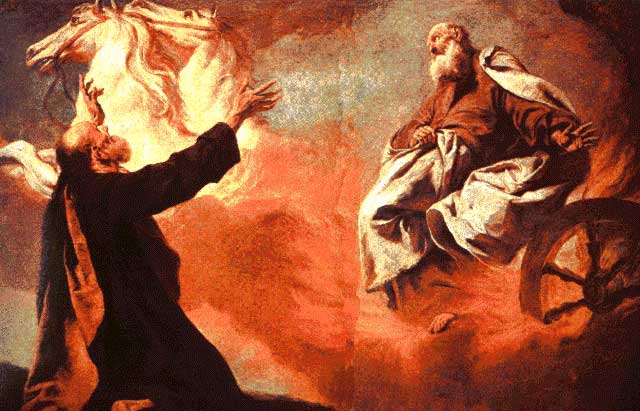
Before Elijah was taken up in a fiery chariot and into the whirlwind, Elisha asked to “inherit a double-portion” of Elijah’s spirit. He won the gratitude of the people of Jericho for healing it’s barren ground by adding salt to its waters.
When the armies of Judah, Israel and Edom, then allied against Mesa, the Moabite king, were being tortured by drought in the Idumæan desert, Elisha consented to intervene. His double prediction regarding relief from drought and victory over the Moabites was fulfilled on the following morning (2 Kgs 3:4-24).
“Elisha’s Spring” (Ain es-Sultan) in Jericho
To relieve the widow importuned by a hard creditor, Elisha so multiplied a little oil as to enable her, not only to pay her indebtedness but to provide for her family needs (2 Kgs 4:1-7).
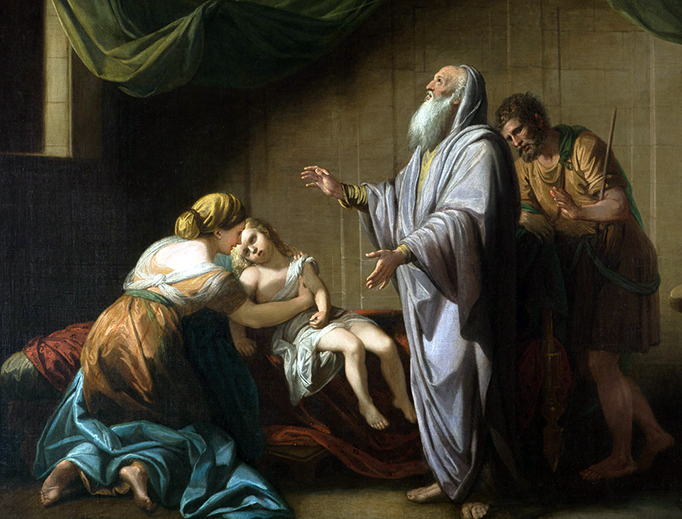
To reward the rich lady of Shunam for her hospitality, he restored to life her son (2 Kgs 4:18-37).
To nourish the sons of the prophets pressed by famine, Elisha changed, into wholesome food, the pottage made from poisonous gourds (2 Kgs 4:38-41).
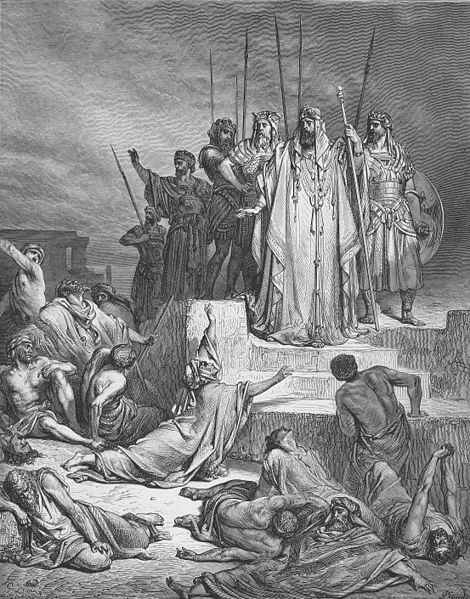
A Famine in Samaria (illustration by Gustave Doré from the 1866 La Sainte Bible)
During the military incursions of Syria into Israel, Elisha cured Naaman the Syrian of his leprosy by simply sending him word that he was to bathe in the Jordan seven times. At first reluctant, Naaman obeyed the Prophet and after washed seven times in the Jordan, he was healed. Jesus referred to this when he said: “And there were many lepers in Israel in the time of Elisha the prophet and none of them was cleansed but Naaman the Syrian” (Luke 4:27).
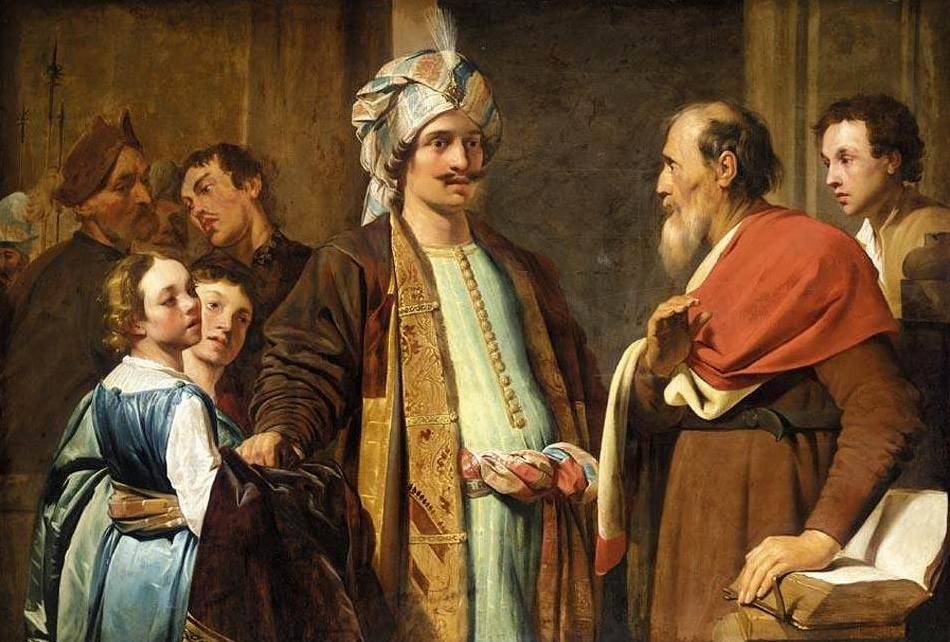
Elisha refusing the gifts offered by Naaman
Elisha’s life and activities are found in 1 and 2 Kings and he is commemorated on this date in the 2004 Roman Martyrology.
Julian the Apostate (361–363) gave orders to burn the relics of the prophets Elisha, Obadiah and John the Baptist, who were buried next to each other in Sebastia but they were rescued by the Christians and part of them were transferred to Alexandria. Today, the relics of Elisha are claimed to be among the possessions of the Coptic Orthodox Monastery of Saint Macarius the Great in Scetes, Egypt.
The miracle at the grave of Elisha. (Jan Nagel, 1596)
As Elisha’s desire was to “Make known the Divine Will of God” to the people of their times, we can benefit from that today. So many times in our lives we ask the simple question, “What is God’s Will for me?” By asking for the intercession of St Elisha, we can obtain the Grace to know more of the Divine Will God has for us, in our lives. Only by living in union with God, can we know in our hearts, we are doing what HE created us for. By asking St Elisha to help us to discern that, God’s Will can be made more clear to us.
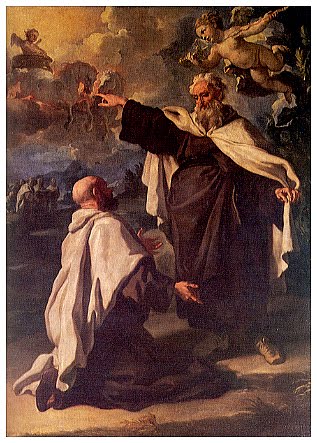
Elijah send Elisha forth
Prayer
O God,
protector and redeemer of the human family,
whose wonders have been proclaimed through the wonders accomplished by Your chosen prophets,
You have bestowed the spirit of Elijah on Your prophet Elisha.
In Your kindness grant us too
an increase in the gifts of the Holy Spirit
so that, living as prophets,
we will bear constant witness to Your abiding presence and providence.
We ask this through Christ our Lord, in the unity of the Holy Spirit, God for all eternity.
Amen
(The Title of the video is extremely appropriate as many of us are still living without “Sunday” in it’s holy and proper form!)
Our Lady of the Trellis:
On 14 June 1234, 53 disabled people were cured upon praying before the statue of Our Lady of the Trellis, installed behind a latticework fence in St Peter’s Collegiate Church in Lille, France.
A procession held annually on the second Sunday after Pentecost commemorates the miracles. Saved during the destruction of St Peter’s Church in the French Revolution, the statue moved afterwards to St Catherine’s Church.
Devotion to Our Lady of the Trellis revived in the mid-1800s and a grand neo-Gothic church arose in her honour, where the statue was installed in 1872 and canonically crowned in 1874.
After the theft of the original in 1959, sculptor Marie Madeleine Weerts carved the image now displayed in Lille’s Catholic Cathedral, the Basilica of Notre-Dame de la Treille.
St Anastasius of Córdoba
St Burchard of Meissen
St Caomhán of Inisheer
St Castora Gabrielli
St Cearan the Devout
Bl Constance de Castro
St Cyprien
St Cyriacus of Zeganea
St Davnet
St Digna of Córdoba
St Dogmael of Wales
St Elgar of Bardsey St Elisha the Prophet “My God is salvation” (790 BC)
St Etherius of Vienne
St Felix of Córdoba
Bl Fortunatus of Napoli
Bl Francisca de Paula de Jesus Isabel
St Gerold of Evreux
Bl Hartwig of Salzburg
St Joseph the Hymnographer
St Marcian of Syracuse
St Mark of Lucera St Methodius of Constantinople (born 8th Century – 847) His Life: https://anastpaul.com/2018/06/14/saint-of-the-day-14-june-st-methodius-i-of-constantinople-8th-cent-847-defender-of-icons/
St Nennus of Arran
Bl Peter de Bustamante
St Protus of Aquileia
St Quintian
St Richard of Saint Vannes
St Rufinus of Soissons
St Thecla
St Theopista
St Valerius of Soissons
Bl Walter Eustace



![st Elijah[1].0](https://anastpaul.com/wp-content/uploads/2020/06/st-elijah1.0.jpg)


 AnaStpaul
You must be logged in to post a comment.