
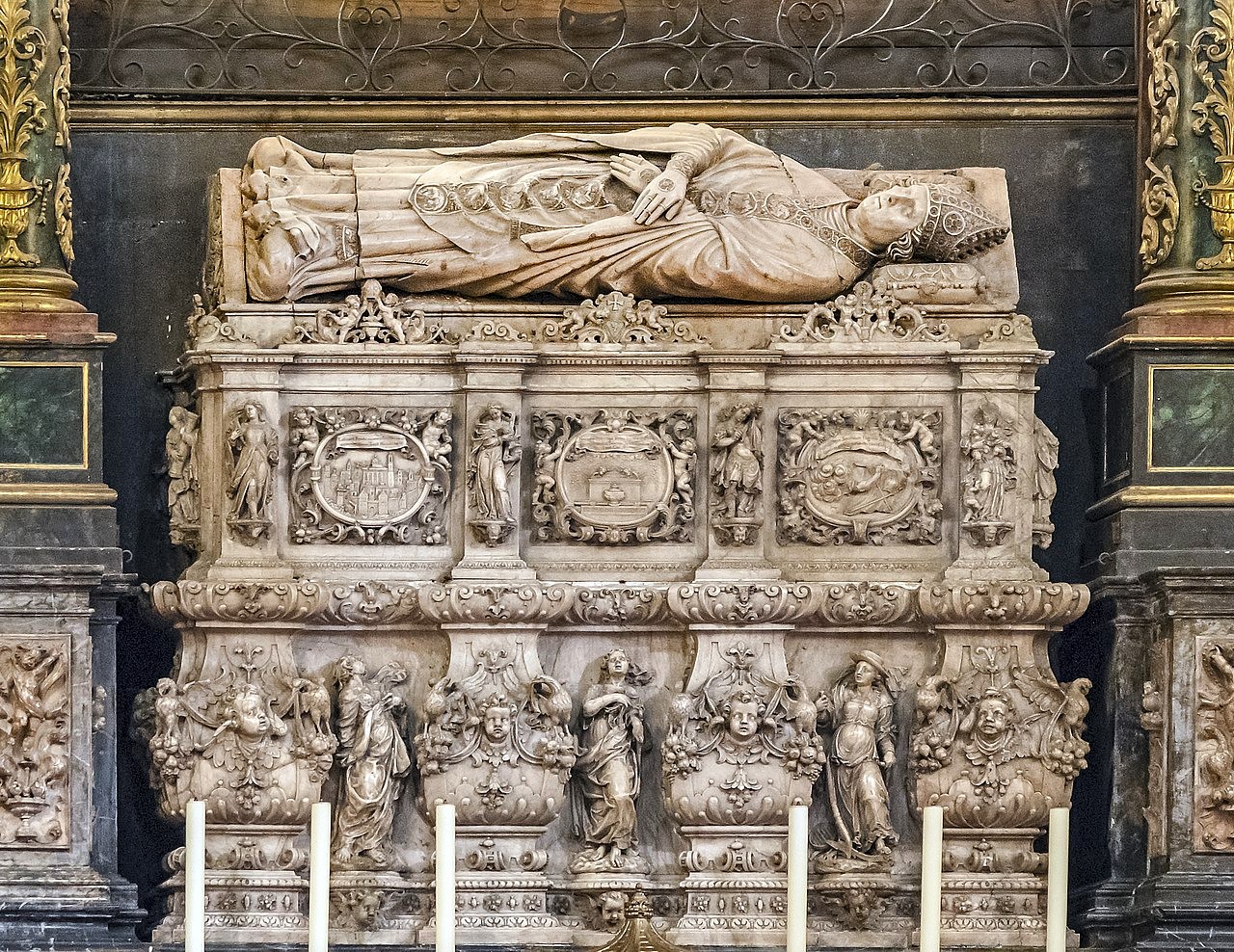
Saint of the Day – 6 March – St Ollegarius Bonestruga OSA (1060-1137) Bishop, Canon Regular of the Augustinians, Reformer, in both the religious sphere and the social one, Abbot, Diplomat, Peacemaker and Proptector of his people from possible violent incursions. Born in 1060 at Barcelona, Spain and died in Tarragona in 1137 of natural causes. Ollegarius was the Bishop of Barcelona from 1116 and at the same time, the Archbishop of Tarragona from 1118 until his death. He was an intimate friend and Counsellor-Confessor of Count Ramon Berenguer III of Barcelona and often accompanied the Count, on military ventures. Also known as – Ollegarius of Tarragona, Ollegarius of Barcelona, Olaguerand, Oldegar, Olegari, Olegarius, Oligarius, Oleguer, Olegario. Ollegarius was Canonised in 1675 and his major Shrine and Sepulchre is in the side Chapel of Christ of Lepanto, in the Cathedral of Barcelona (see image at the end of the page). His Feast is celebrated the date of his death, today 6 March.
The Roman Martyrology reads: “At Barcelona in Spain, the blessed St Ollegarius, who was first a Canon and afterwards the Bishop of Barcelona and Archbishop of Tarragona.”

Ollegarius was born in 1060 into a wealthy family in Barcelona. At the age of 10, he was included in the Cathedral Chapter in his hometown. He was Ordained a Priest in 1094. Over time, he became the Superior of Canons in Barcelona and Sant Adria de Besós (1095-1108) and the Abbot of the Augustinian Monastery of St Rufus in Avignon (1113-1118). He also joined the confraternity of San Pedro de la Portella.
Raymon Berenguer III, Count of Barcelona, appointed him Bishop of that City in 1116. Ollegarius was Consecrated by Cardinal Boso in the Cathedral of Maguelone in Provence, during the Pontificate of Paschal II. In 1117 he went to Rome to pay homage to Pope Gelasius II.
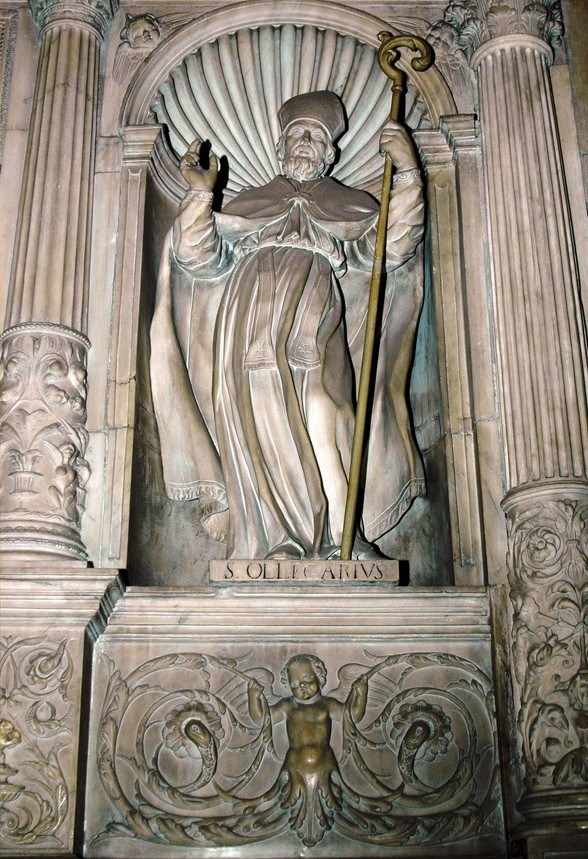
Ollegarius was a zealous reformer. He participated in the Synods of Toulouse (1119), Reims (1120), the First Lateran Council (1123), Narbonne (1129), Clermont (1130) and again in Reims (1131). He was also involved in implementing the Augustinian Reform of Monasteries in Catalonia – in the 1220s he transformed the Monastery of St Eulalia (then outside Barcelona) into the community of Augustinian Canons. On 8 March 1118, Olegarius, then still the Bishop of Barcelona, was also appointed the Bishop of Tarragona. He had the difficult task of rebuilding the Church in this region, after regaining the region from the Moors.
After 1124 he went on a pilgrimage to the Holy Land but due to his concern for his new Diocese, he shortened his stay in Antioch and returned before 1127. Between 1126 and 1130, he was very active in rebuilding the City, especially the Churches. He brought in new inhabitants and knights who would defend the City in the future. The years 1126-1127 were a time of efforts to organise the Second Crusade. Olegarius compensated William V for sending his knights to Barcelona in 1124-1125 and brought about an agreement between William and his son, Bernard IV, thus strengthening the alliance against the Almoravida pirates.
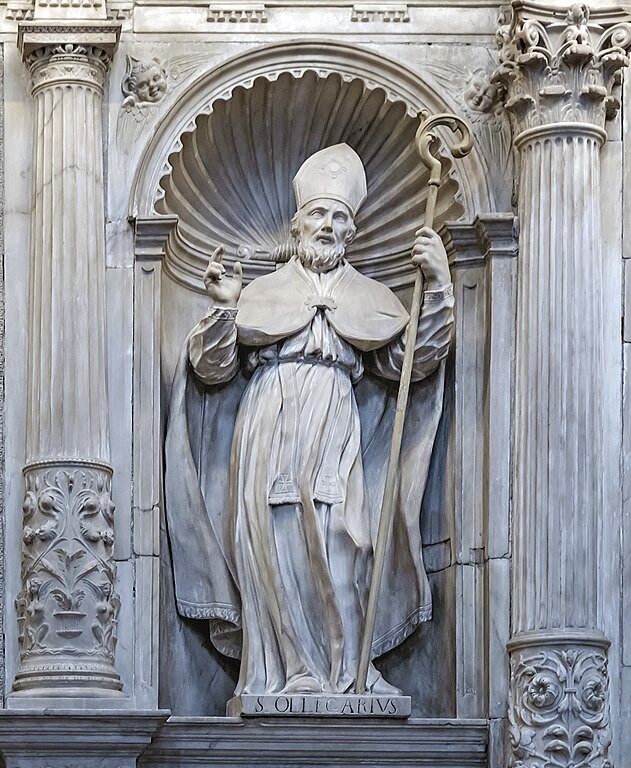
In March 1129, Ollegarius transferred his secular powers to Robert Bordet, making him Duke of Tarragona. He himself returned to caring for the renewal of his Diocese. The Synod of Narbonne (1129) approved the existence of the Archfraternity, which Ollegarius had founded a year earlier — its aim was to rebuild the Church in Tarragona. Members of the Archfraternity, clergy and laity, wealthy and poor, made monetary donations which were allocated to the Archdiocese of Tarragona.
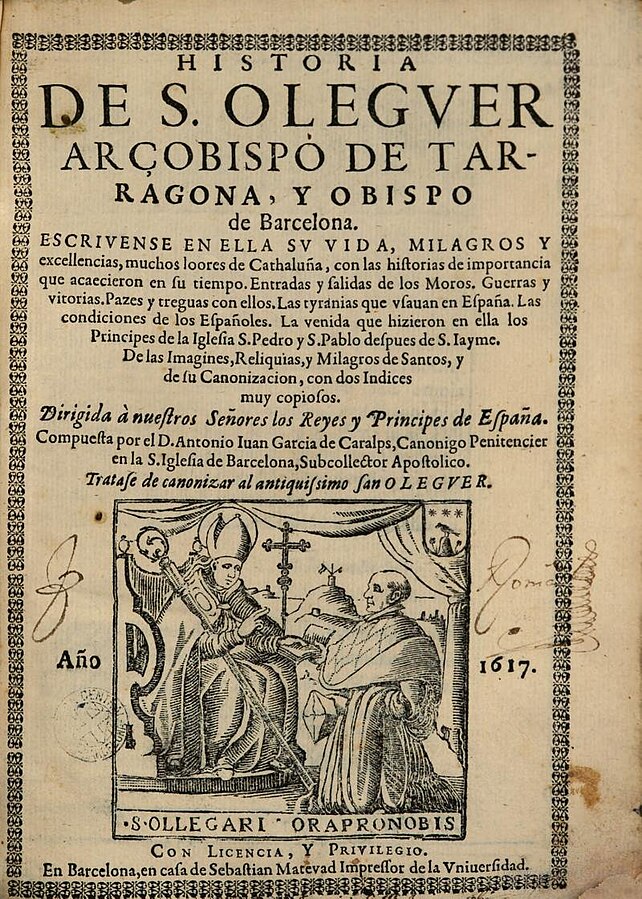
Ollegarius died on 6 March 1137. He was Canonis ed on 18 May 1675 by Pope Clement X. The Tomb of the Bishop of Barcelona and Tarragona, is located in the Cathedral of Barcelona.


 AnaStpaul
You must be logged in to post a comment.