Quote/s of the Day – 24 September – Tuesday of the Twenty-fifth week in Ordinary Time, Year C, Gospel: Luke 8:19-21
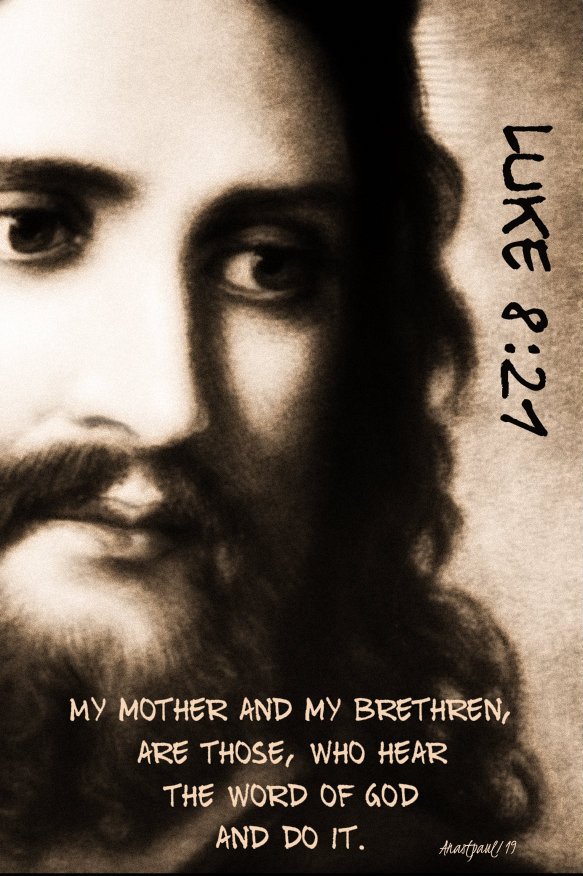
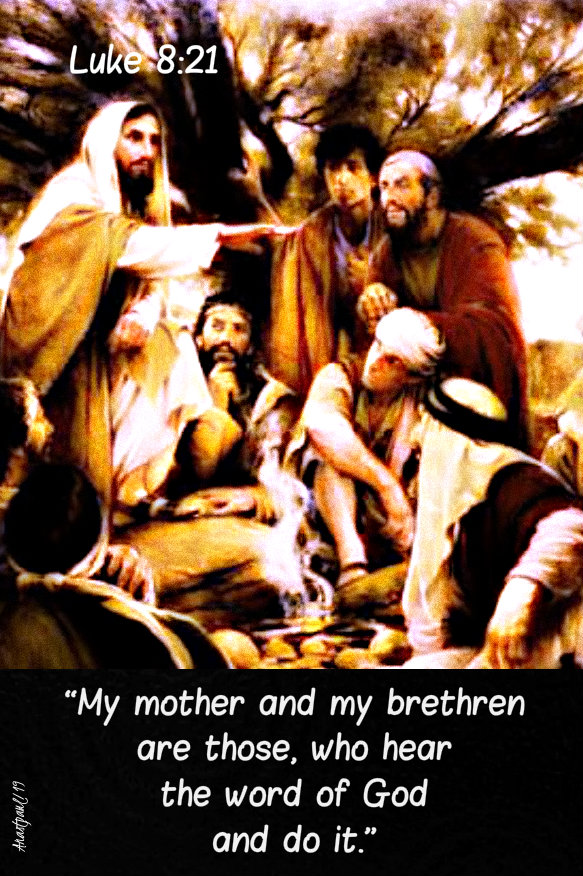
But he said to them, “My mother and my brethren, are those, who hear the word of God and do it.”
Luke 8:21
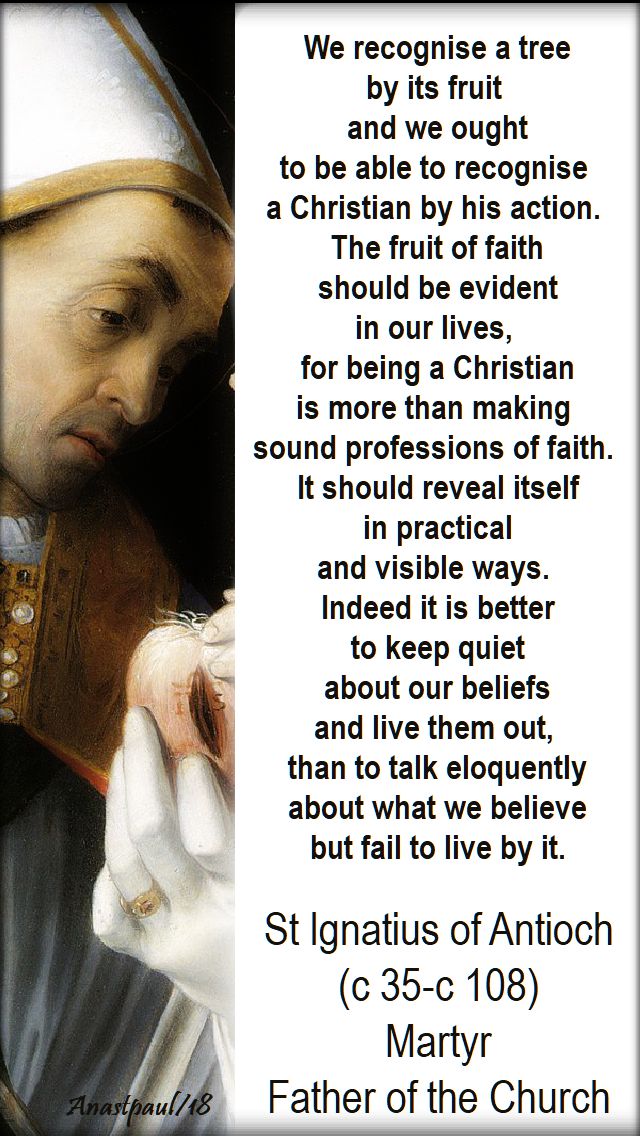
“We recognise a tree by its fruit and we ought to be able to recognise a Christian by his action. The fruit of faith should be evident in our lives, for being a Christian is more than making sound professions of faith. It should reveal itself in practical and visible ways. Indeed it is better to keep quiet about our beliefs and live them out, than to talk eloquently about what we believe but fail to live by it.”
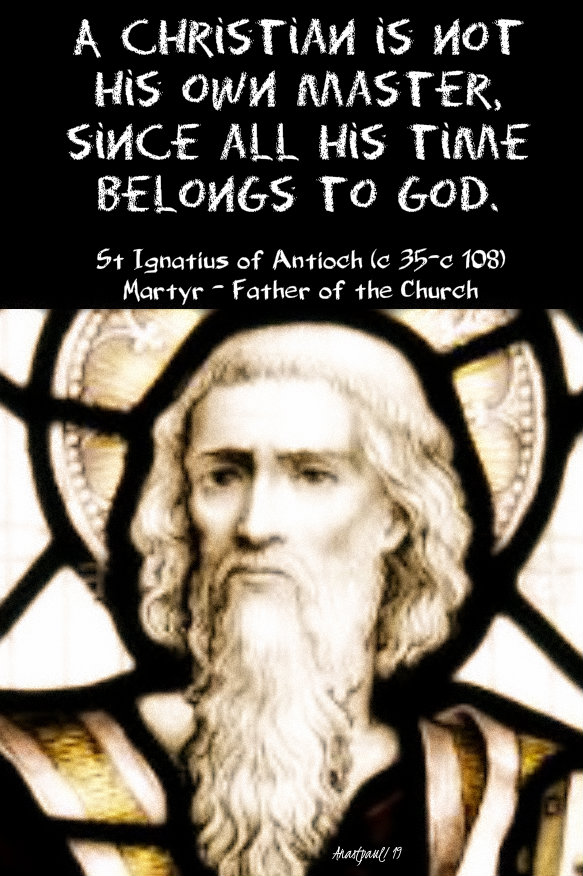
“A Christian is not his own master, since all his time belongs to God.”
St Ignatius of Antioch (c 35-c 108) Martyr
Father of the Church
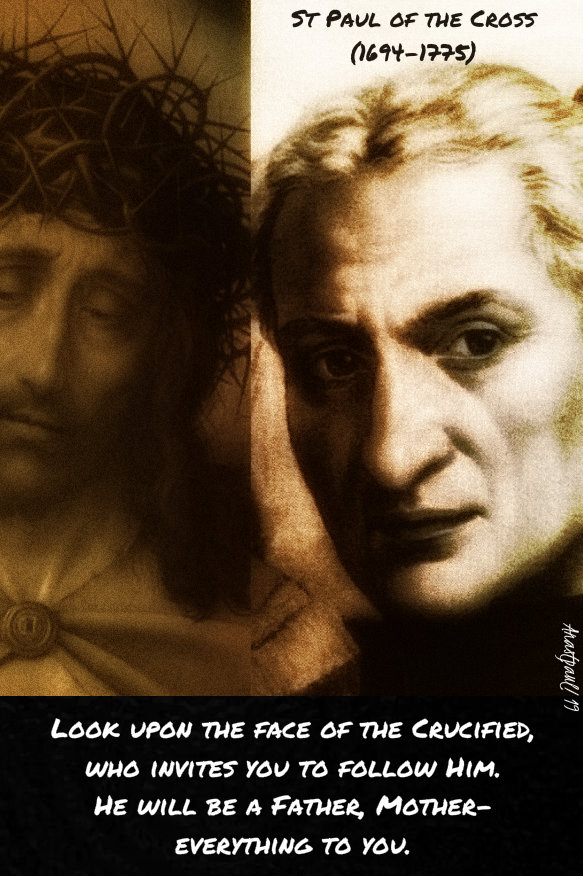
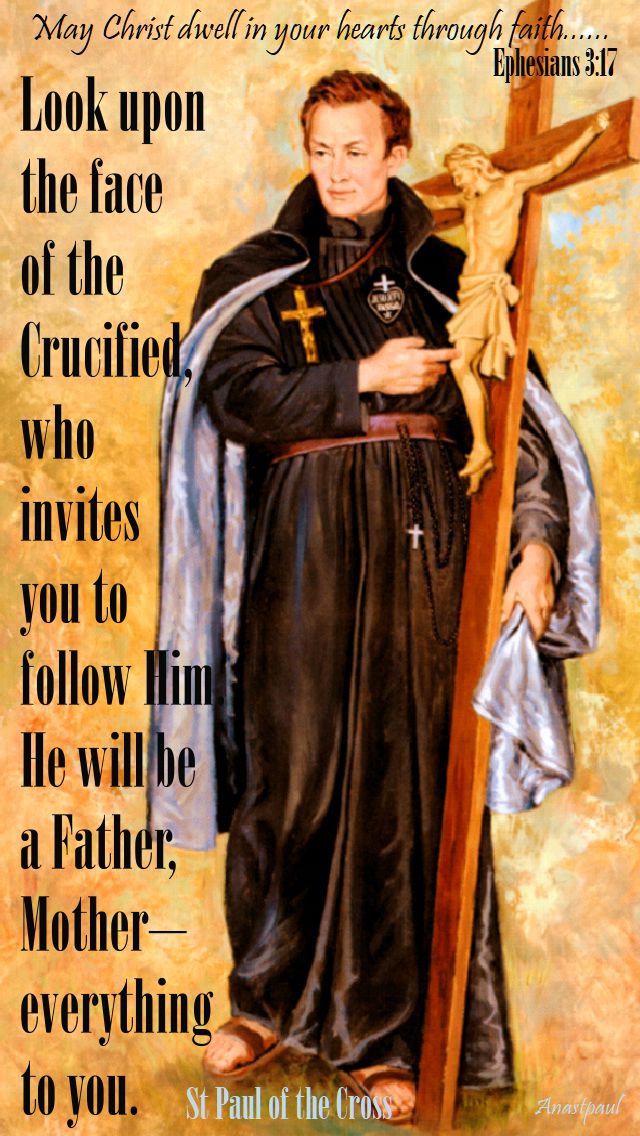
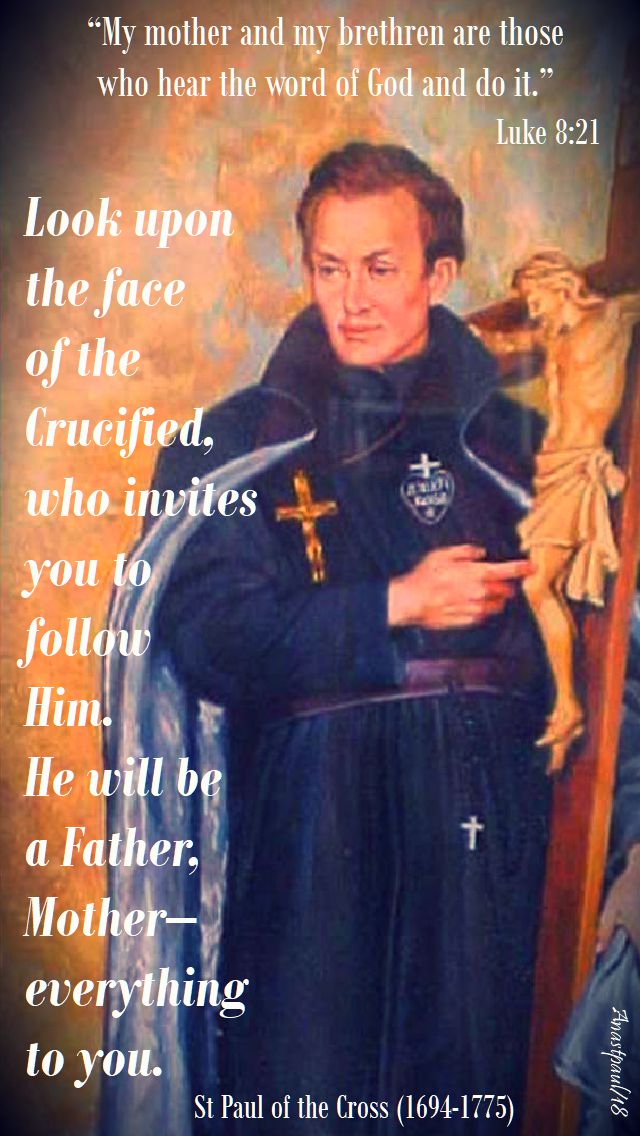
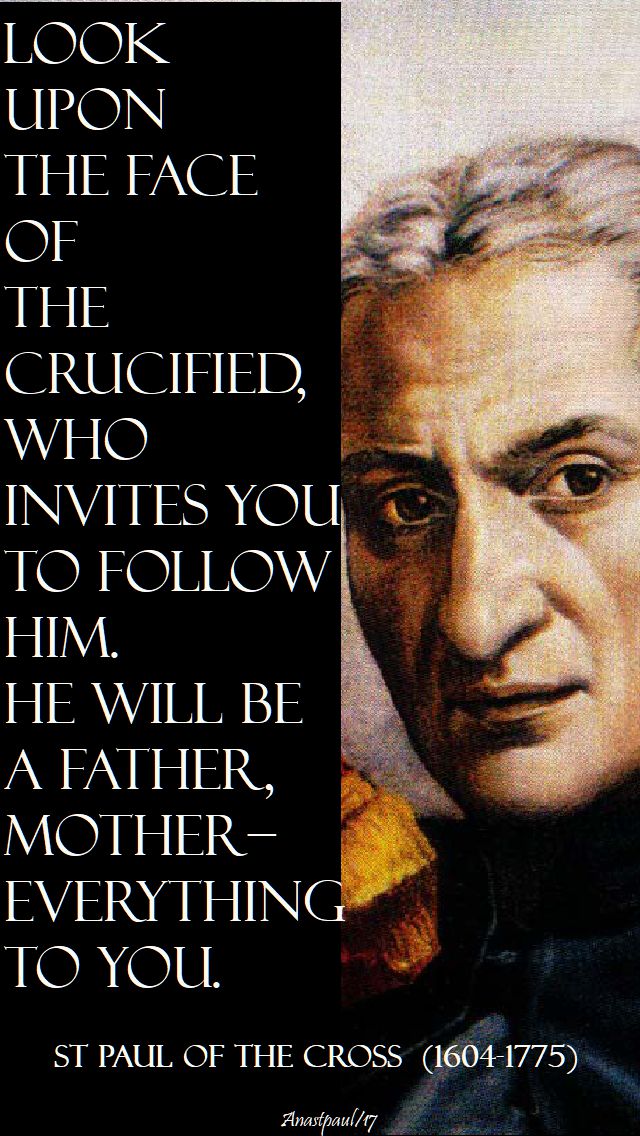
“Look upon the face of the Crucified, who invites you to follow Him. He will be a Father, Mother– everything to you.”
One Minute Reflection – 24 September – Tuesday of the Twenty-fifth week in Ordinary Time, Year C, Gospel: Luke 8:19-21
But he said to them, “My mother and my brethren, are those, who hear the word of God and do it.”…Luke 8:21
REFLECTION – “He who wishes for anything but Christ, does not know what he wishes; he who asks for anything but Christ, does not know what he is asking; he who works and not for Christ, does not know what he is doing.” … Saint Philip Neri (1515-1595)
PRAYER – Shepherd of Your Church and we, the sheep of Your flock, who follow You and hear and do Your Word. Support us with grace those who are constantly striving to do Your will, so that following the example of the humble fiat of Your blessed Mother and ours, we may devote all our powers and talents to love of You and our neighbour and finally arrive safely in our heavenly home. In God, our Father we pray through You who live in union with Him and the Holy Spirit, one God, for ages and ages. Amen
Quote/s of the Day – 15 April – Monday of Holy Week
Speaking of the Cross
“If you seek patience, you will find no better example than the cross. Great patience occurs in two way – either when one patiently suffers much, or, when one suffers things which one is able to avoid and yet does not avoid. Christ endured much on the cross and did so patiently, because, when He suffered, He did not threaten, He was led like a sheep to the slaughter and He did not open His mouth.”
St Thomas Aquinas (1225-1274)
Doctor of the Church
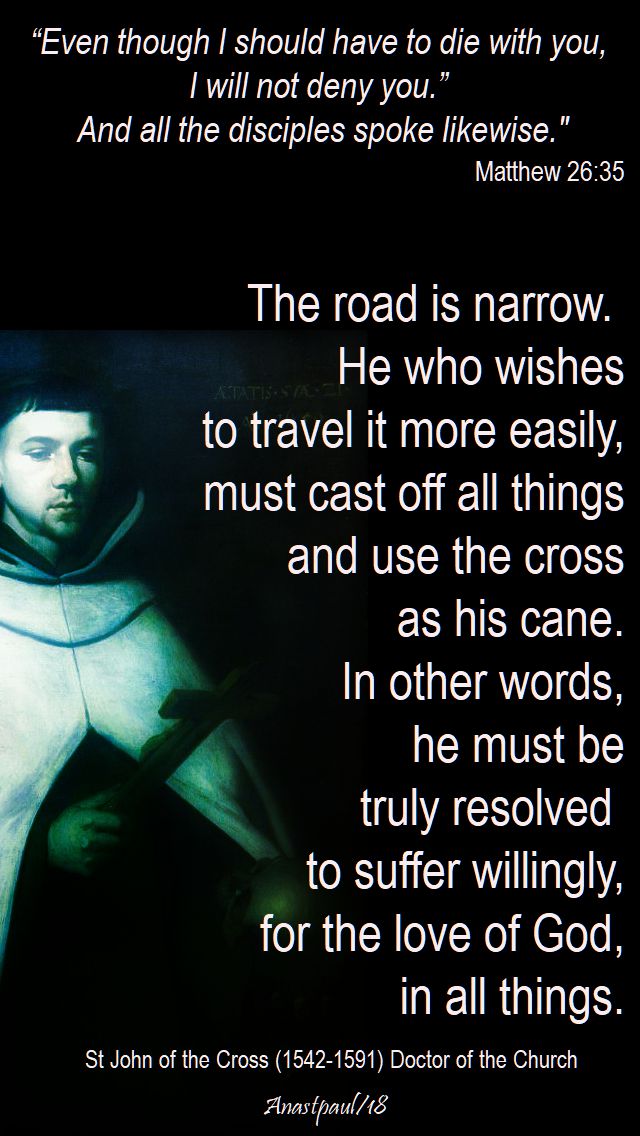
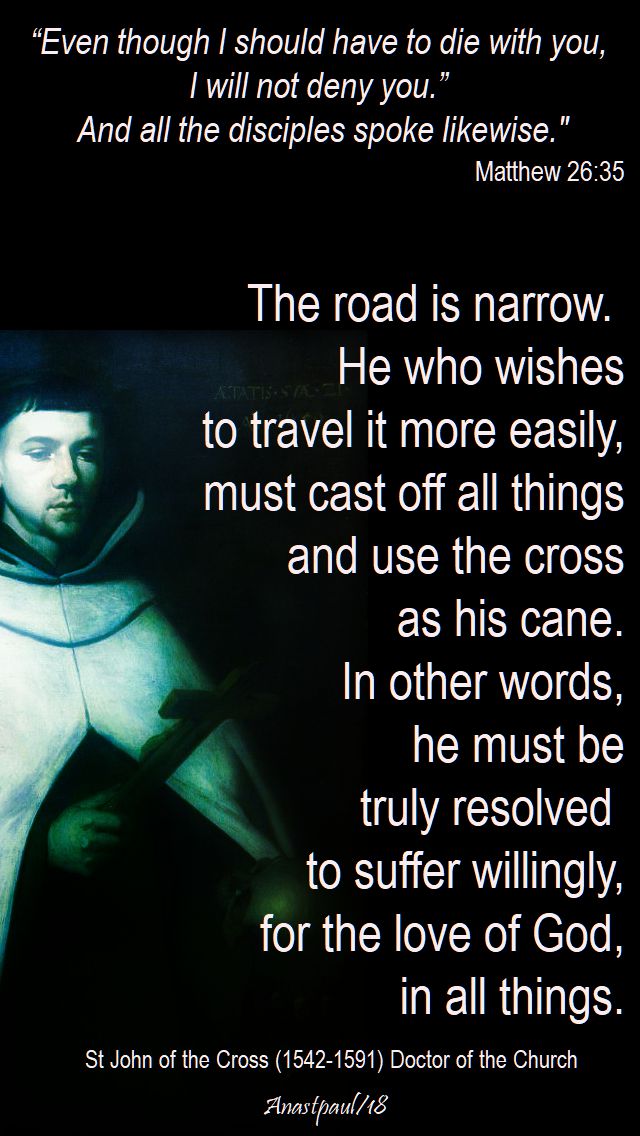
“The road is narrow. He who wishes to travel it more easily must cast off all things and use the cross as his cane. In other words, he must be truly resolved to suffer willingly for the love of God in all things.”
St John of the Cross (1542-1591)
Doctor of the Church
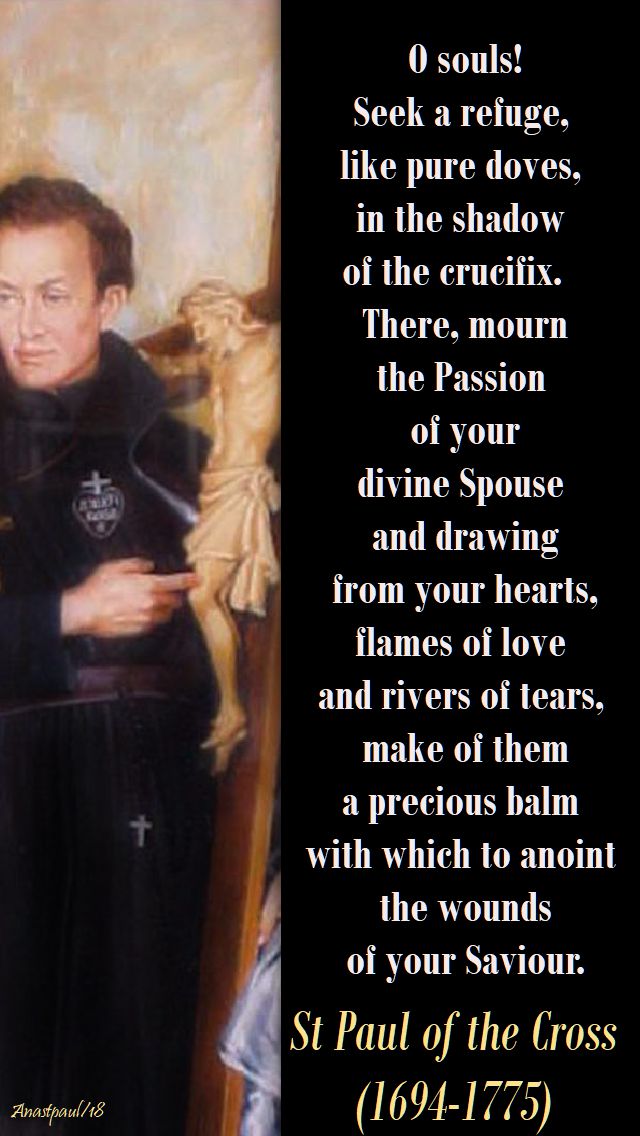
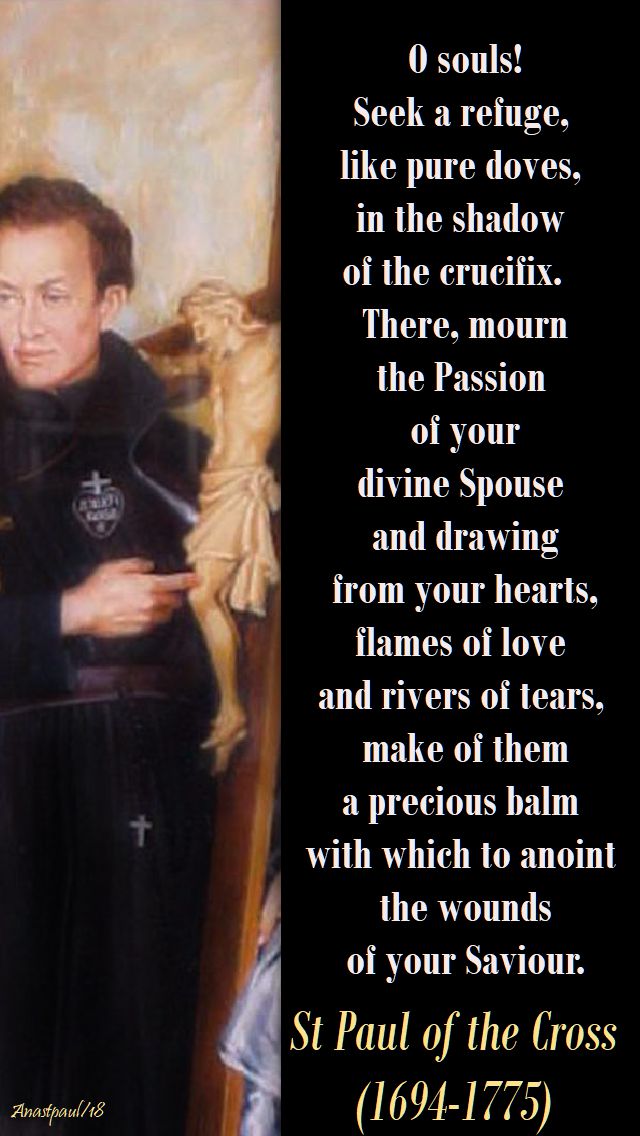
“O souls! Seek a refuge, like pure doves, in the shadow of the crucifix. There, mourn the Passion of your divine Spouse and drawing from your hearts flames of love and rivers of tears, make of them a precious balm with which to anoint the wounds of your Saviour.”
“Look upon the face of the Crucified, who invites you to follow Him. He will be a Father, a Mother – everything to you.”
St Paul of the Cross (1694-1775)
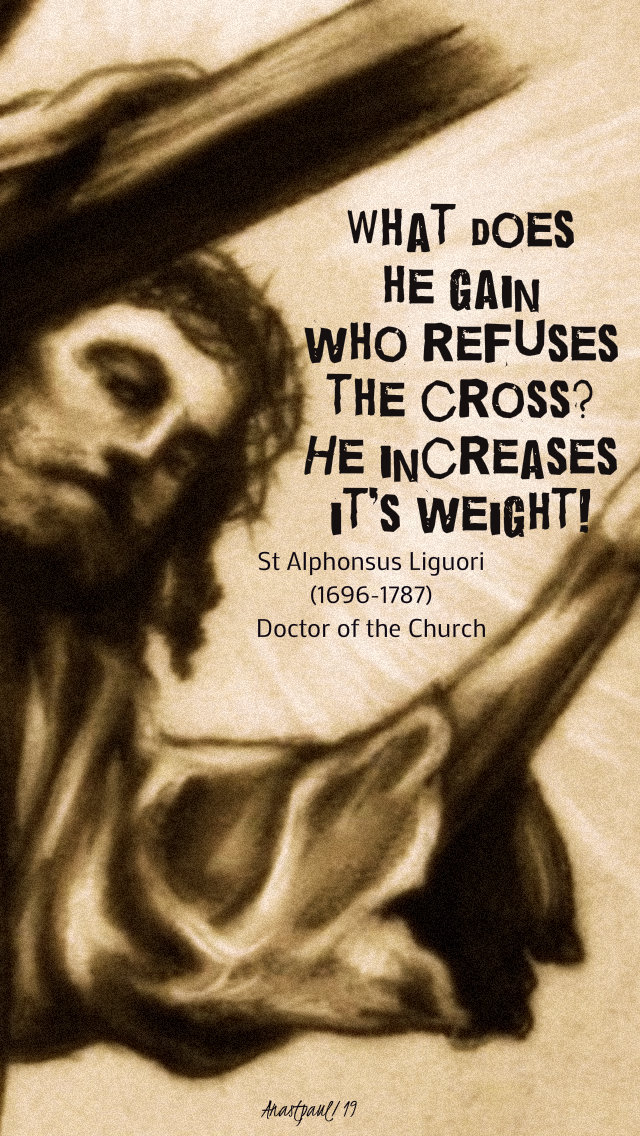
“What does he gain who refuses the cross? He increases it’s weight!”
St Alphonsus Liguori (1696-1787)
Doctor of the Church
One Minute Reflection – 25 September – Today’s Gospel: Luke 8:19-21 – Tuesday of the Twenty-fifth week in Ordinary Time, Year B and the Memorial of St Vincent Strambi C.P. (1745-1824)
But he said to them, “My mother and my brethren are those who hear the word of God and do it.”...Luke 8:21
REFLECTION – “Look upon the face of the Crucified, who invites you to follow Him. He will be a Father, Mother–everything to you.”….St Paul of the Cross C.P. (1694-1775)
PRAYER – Jesus, our Lord and our God, only You are the best Shepherd of Your Church and we, the sheep of Your flock, who follow You and hear and do Your Word. Support with grace those who are responsible for the fate of Your fold, so that following the example of St Vincent Maria Strambi, they devote all their powers and talents to service to the Church. In God, our Father we pray through You who live in union with Him and the Holy Spirit, one God, for ages and ages. Amen
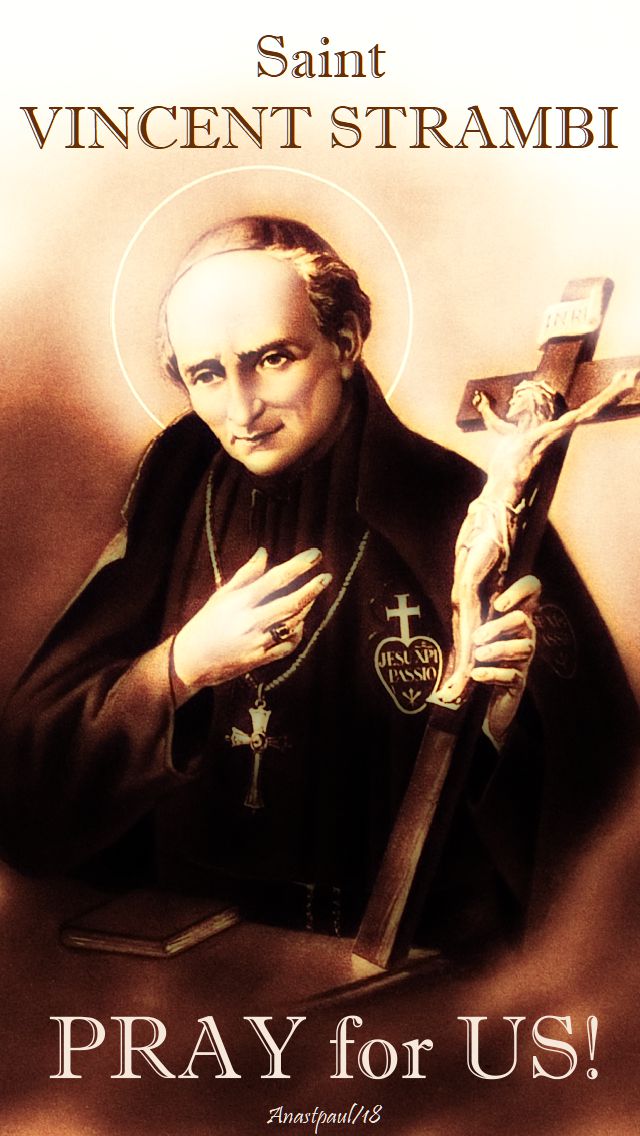
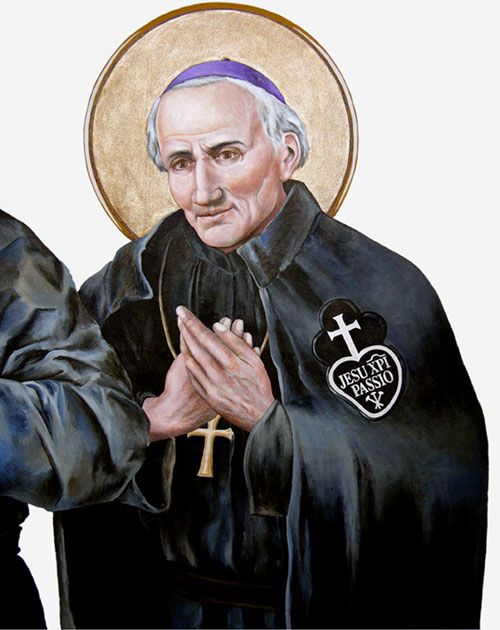
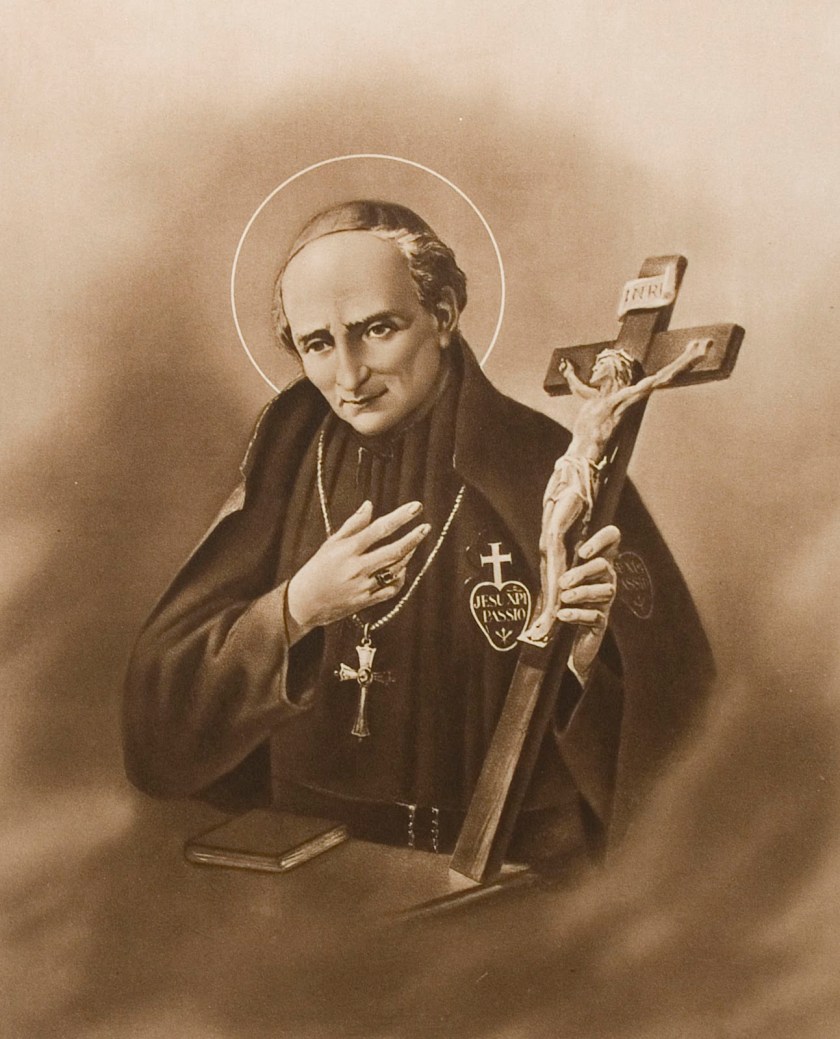
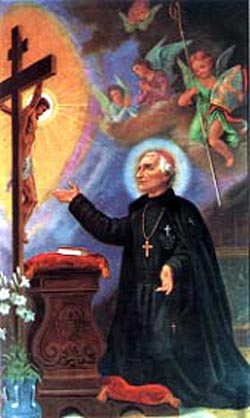
Saint of the Day – 25 September – St Vincent Strambi C.P. (1745-1824) Passionist Religious Priest and Bishop of Macerata and Tolentino, Apostle of Charity, Preacher, Teacher, a man of great learning and prodigious memory.
Born in 1745 at Civitavecchia near Rome, the son of a wealthy businessman, Saint Vincent Strambi never showed any inclination for any occupation other than the service of God. He found his vocation when after his ordination as a deacon in 1767, he made a retreat amid the Passionists of Monte Fogliano, where Saint Paul of the Cross (1694-1775), their founder, was residing at the time. The Passionist houses are called retreats and by their Rule must be situated outside cities. Saint Paul of the Cross told his brethren on his deathbed, as he had taught them during his active years, to conserve always the spirit of prayer, solitude and poverty, in that way the apostolic success of their works would also be conserved. The life of contemplation, essential formation for any fruitful works, was what Saint Vincent Strambi already desired.
St Paul of the Cross
It was formally declared by St Vincent’s last secretary, Monsignor Catervo Serrani, that it would not be temerity to believe that he knew by heart all the works of Saint Thomas Aquinas. The same might have been said of his knowledge of Sacred Scripture. His studies of religion, ever an inexhaustible wealth, continued throughout his lifetime, yet his preaching was so simple that all could easily grasp his thought. He never used notes but taught according to the needs of his listeners, which he always discerned with exactitude after praying intently at the foot of the crucifix. As he studied, he seemed to see around his desk the faces of his spiritual children, waiting for the bread of life he was destined to break for them. This method of study has been preserved among his followers in the Order; the Passionists think of and pray for, their future spiritual children before they study.
Saint Vincent became a bishop after many years of preaching missions all over Italy. But never could he forget his Order, though he had to put aside its habit. Saint Paul of the Cross on his deathbed had said to him several times: ‘Padre Vincenzino, I recommend to you the poor Congregation’. When Saint Vincent asked what he wished him to do, Saint Paul replied: ‘You will do great things! You will do great good ! I recommend to you this poor Congregation!’
In 1773 Father Paul put the former seminary prefect and rector in charge of the training of the young students for future missionary preaching at the newly acquired monastery of Sts John and Paul in Rome. Eventually Father Vincent would write a manual on Sacred Eloquence. In this way Father Vincent was able to be with St Paul during the final years of his life. Paul saw in this young man the apostolic spirit of holiness he was bequeathing to his congregation. We are told that as he was dying St Paul one day turned to Father Vincent Mary and told him he was entrusting the congregation to his care.
Vincent, like the others, missed the founder very much as he continued to prepare young Passionists for the missionary apostolate. He also went forth to preach missions as often as possible.
As bishop of Macerata and Tolentino, he continued whenever possible to rise at midnight for the divine office and regretted being unable to dedicate more than five hours to prayer each day. He called in the poor and gave them alms, he visited the hospitals and the prisoners, blessed, embraced and helped them. He visited every religious house of his diocese, then the Canons and the parish priests. He preached for his clergy a beautiful mission, then organised specialised services for the various professions of the laity, saying, the lawyers need different instruction and different sowings than the merchants or the physicians, for example, to each his own portion of the truth! His table was very frugal, never did he permit more than two dishes. He reduced expenditures to a minimum, to be able to give more to the poor.
He wished to resign as bishop at the age of seventy-eight and Pope Leo XII ceded to his wish but asked him to come to Rome as his counsellor. That his life was soon to end was revealed to him and when the Holy Father was about to die that same year, he offered his life to save that of the Vicar of Christ. He did not say so directly but told everyone not to be anxious, because the Pope would live. Someone he knew had offered his life for him, he added. The prayer was answered on the very day he said this, 24 December, the Pope rose, suddenly cured. Three days later Saint Vincent was struck by apoplexy and died on 1 January 1824. He was Canonised by Pope Pius XII in 1950.
In 1780 he became rector of the Community of Sts John and Paul. In 1781 he was elected provincial. He also served as provincial and general consultor. During this time that he published a biography of the founder. Father Vincent used the testimonies of eye-witnesses as given in the Canonisation processes. It is said that he wrote the life of St Paul on his knees, out of reverence for the founder. His “Life” of Saint Paul has become a classic.
Quote/s of the Day – 14 September – Feast of the Exaltation of the Holy Cross
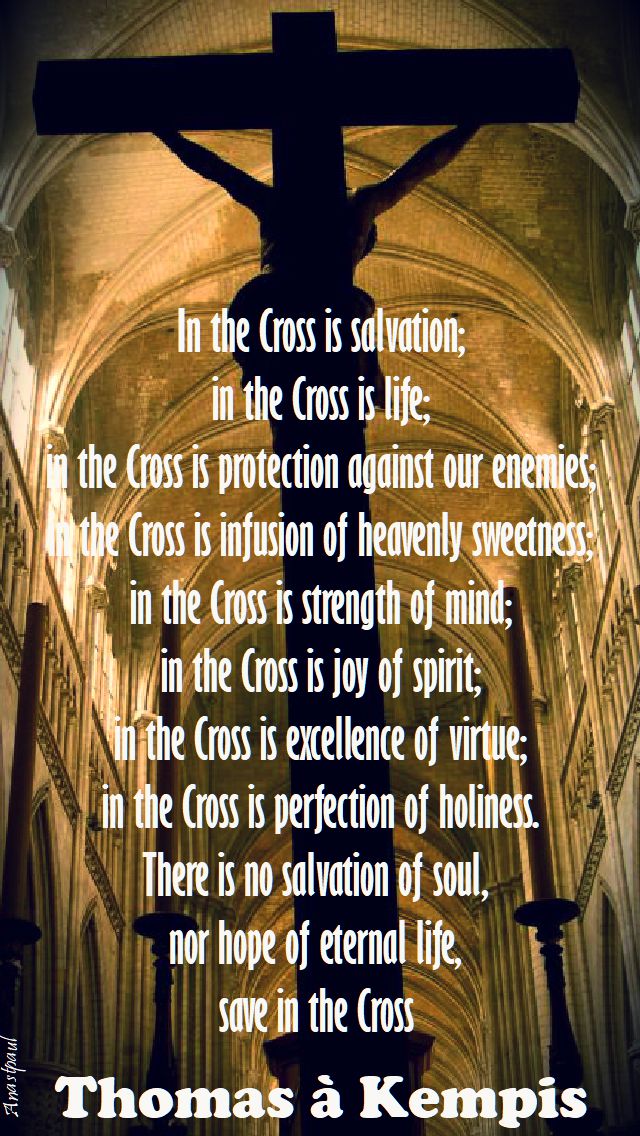
“In the Cross is salvation; in the Cross is life; in the Cross is protection against our enemies; in the Cross is infusion of heavenly sweetness; in the Cross is strength of mind; in the Cross is joy of spirit; in the Cross is excellence of virtue; in the Cross is perfection of holiness. There is no salvation of soul, nor hope of eternal life, save in the Cross.”
Thomas à Kempis (1380-1471) The Inner Life
“The road is narrow. He who wishes to travel it more easily must cast off all things and use the cross as his cane. In other words, he must be truly resolved to suffer willingly for the love of God in all things.”
St John of the Cross (1542-1591) Doctor of the Church
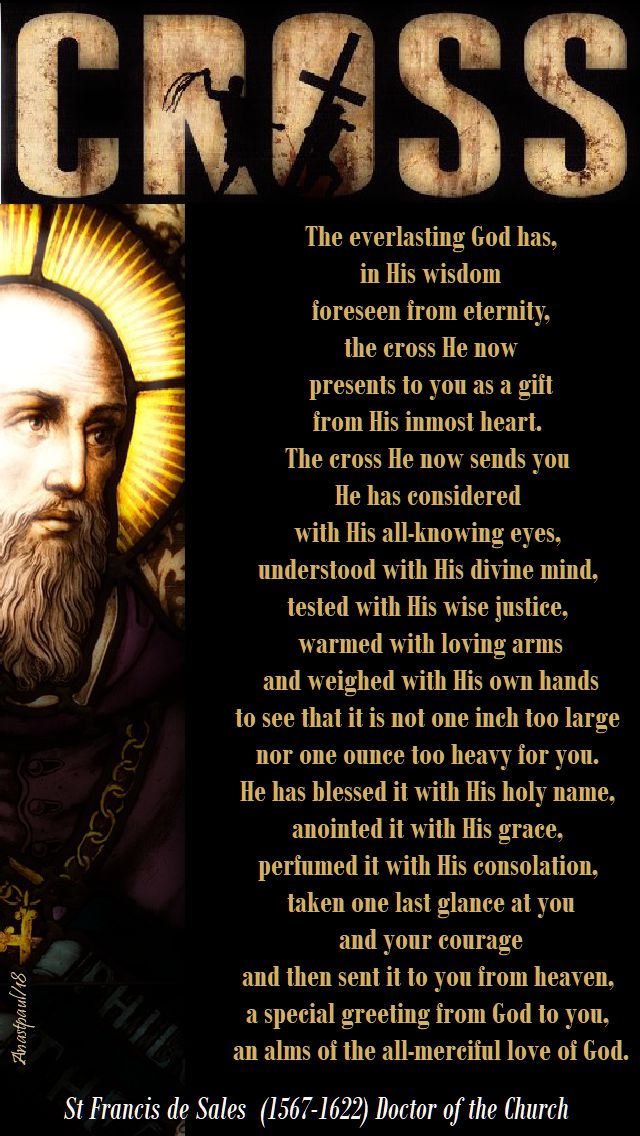
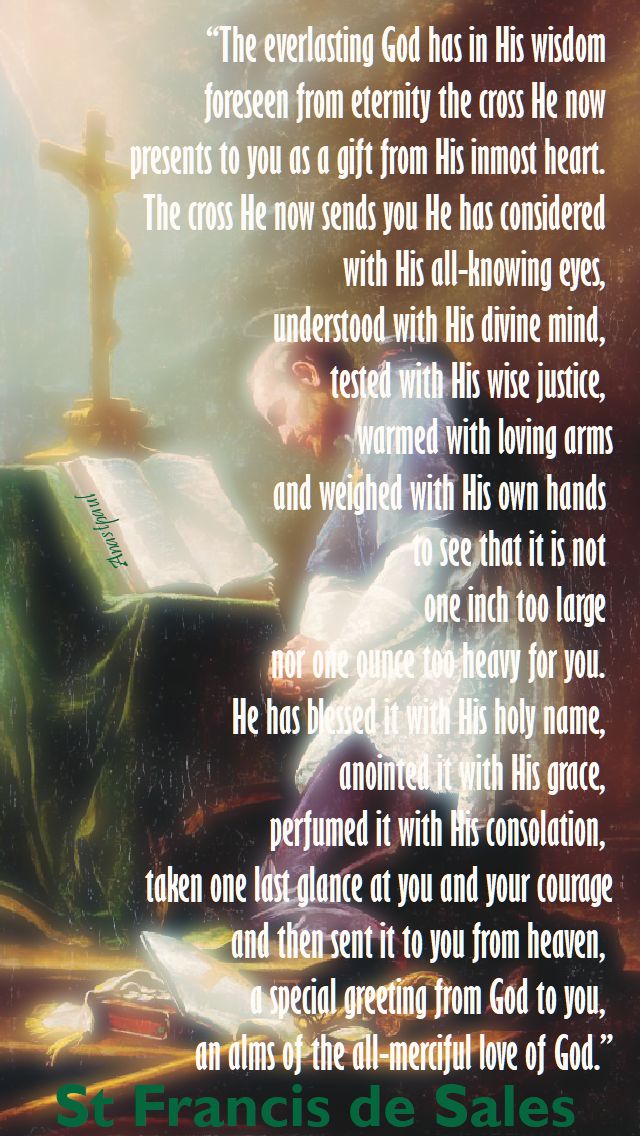
The everlasting God has in His wisdom foreseen from eternity the cross He now presents to you as a gift from His inmost heart. The cross He now sends you He has considered with His all-knowing eyes, understood with His divine mind, tested with His wise justice, warmed with loving arms and weighed with His own hands to see that it is not one inch too large nor one ounce too heavy for you. He has blessed it with His holy name, anointed it with His grace, perfumed it with His consolation, taken one last glance at you and your courage and then sent it to you from heaven, a special greeting from God to you, an alms of the all-merciful love of God.
St Francis de Sales (1567-1622) Doctor of the Church
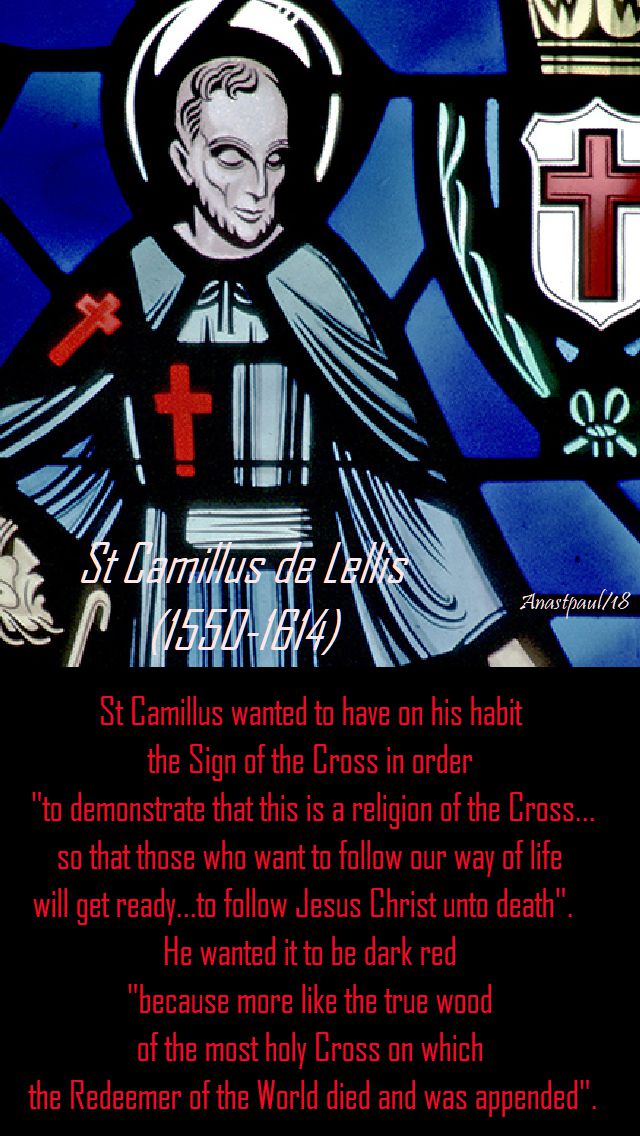
Camillus wanted to have on his habit the Sign of the Cross in order ‘to demonstrate that this is a religion of the Cross… so that those who want to follow our way of life will get ready… to follow Jesus Christ unto death’. He wanted it to be dark red ‘because more like the true wood of the most holy Cross on which the Redeemer of the World died and was appended’.
St Camillus de Lellis (1550-1614)
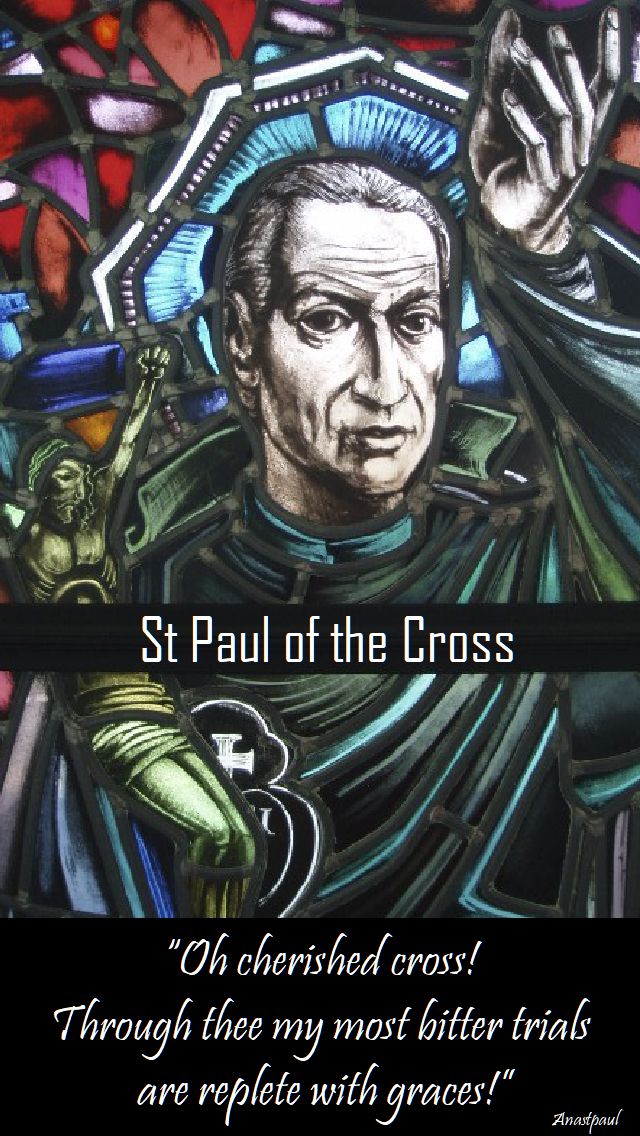
“Oh cherished cross! Through thee my most bitter trials are replete with graces!”
St Paul of the Cross (1694-1775)
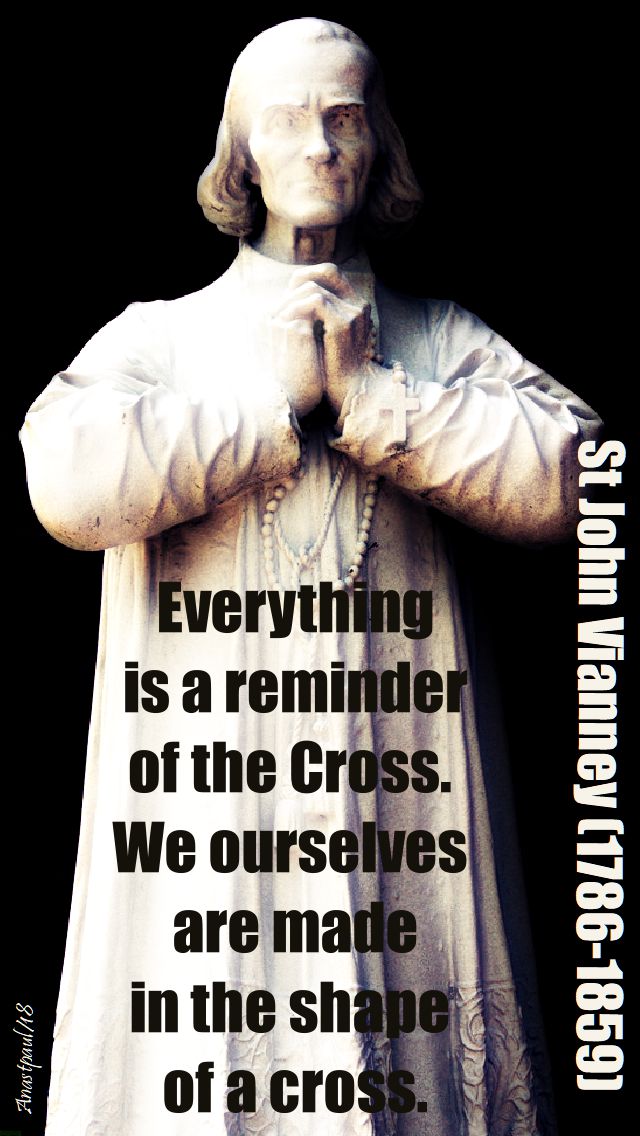
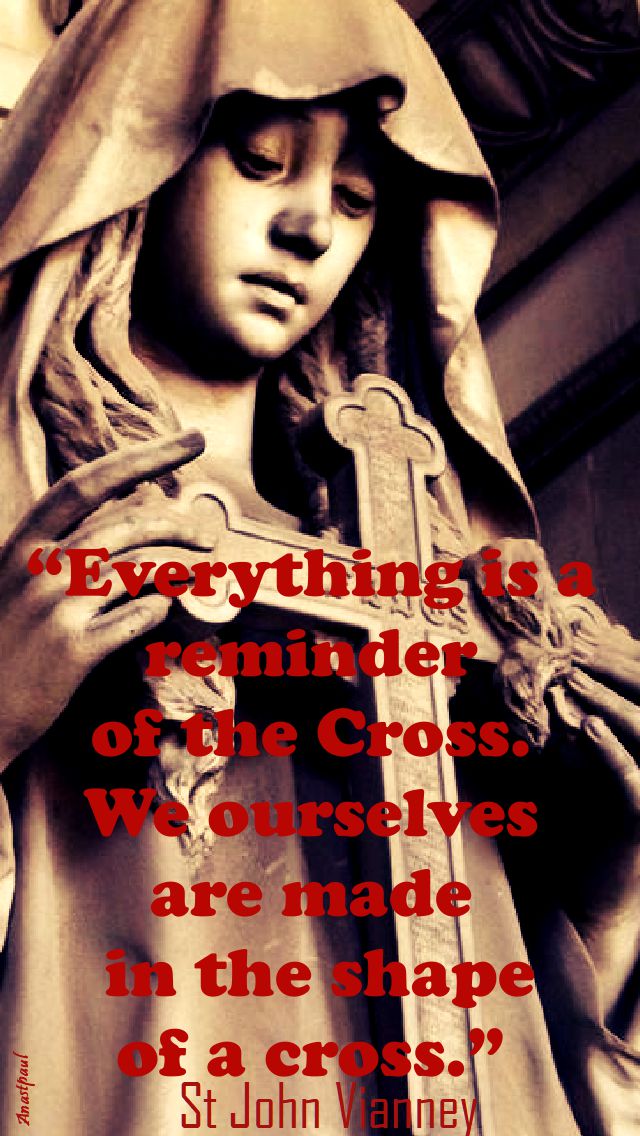
“Everything is a reminder of the Cross. We ourselves are made in the shape of a cross.”
St John Vianney (1786-1859)
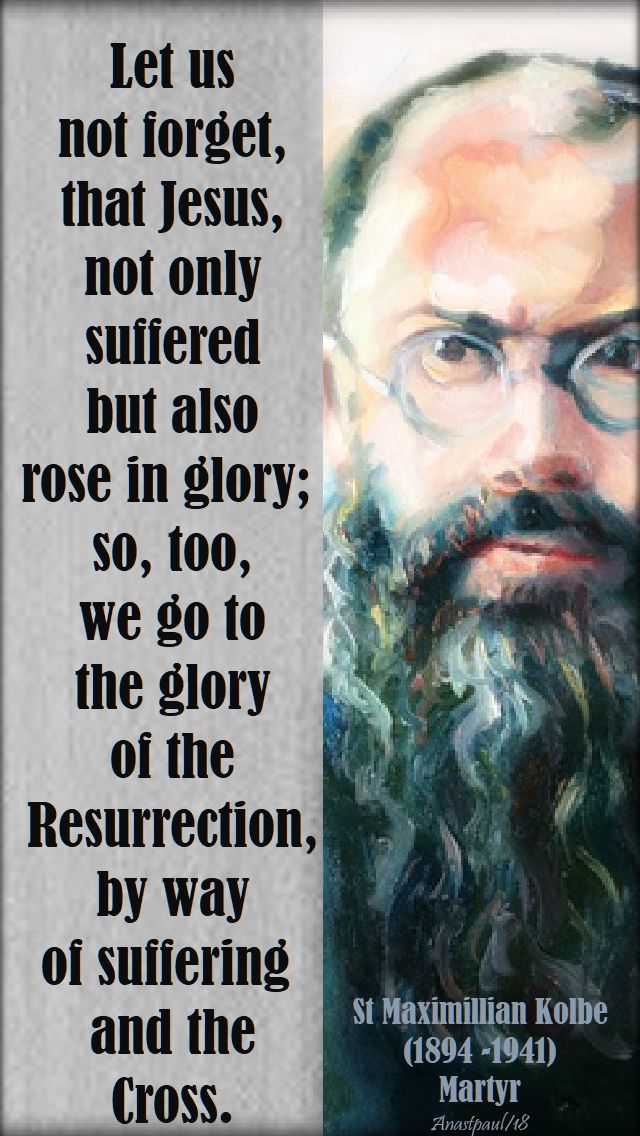
“Let us not forget, that Jesus not only suffered but also rose in glory; so, too, we go to the glory of the Resurrection, by way of suffering and the Cross.”
St Maximillian Kolbe (1894 -1941)
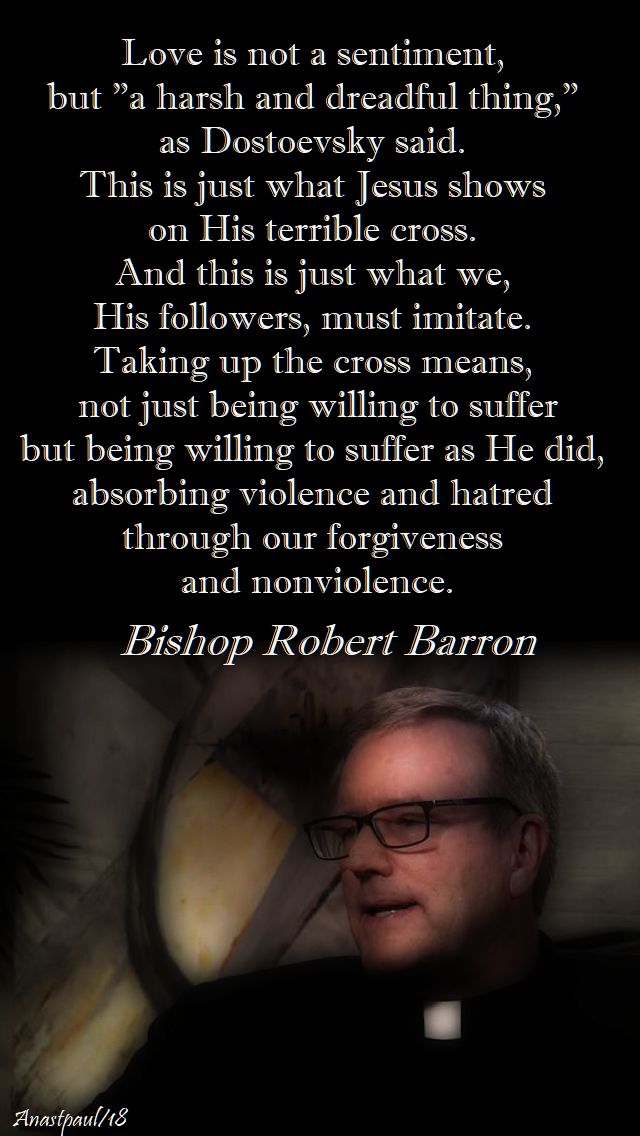
“There is line from the illuminator of the St John’s Bible that states: “We have to love our way out of this.” There is nothing wimpy or namby-pamby or blind about this conviction. When we love extravagantly, we are not purposely blinding ourselves to moral realities— just the contrary.
Love is not a sentiment, but “a harsh and dreadful thing,” as Dostoevsky said.
This is just what Jesus shows on His terrible cross. And this is just what we, His followers, must imitate. Taking up the cross means, not just being willing to suffer but being willing to suffer as He did, absorbing violence and hatred through our forgiveness and nonviolence.”
One Minute Reflection – 30 March 2018 – Good Friday of the Passion of the Lord
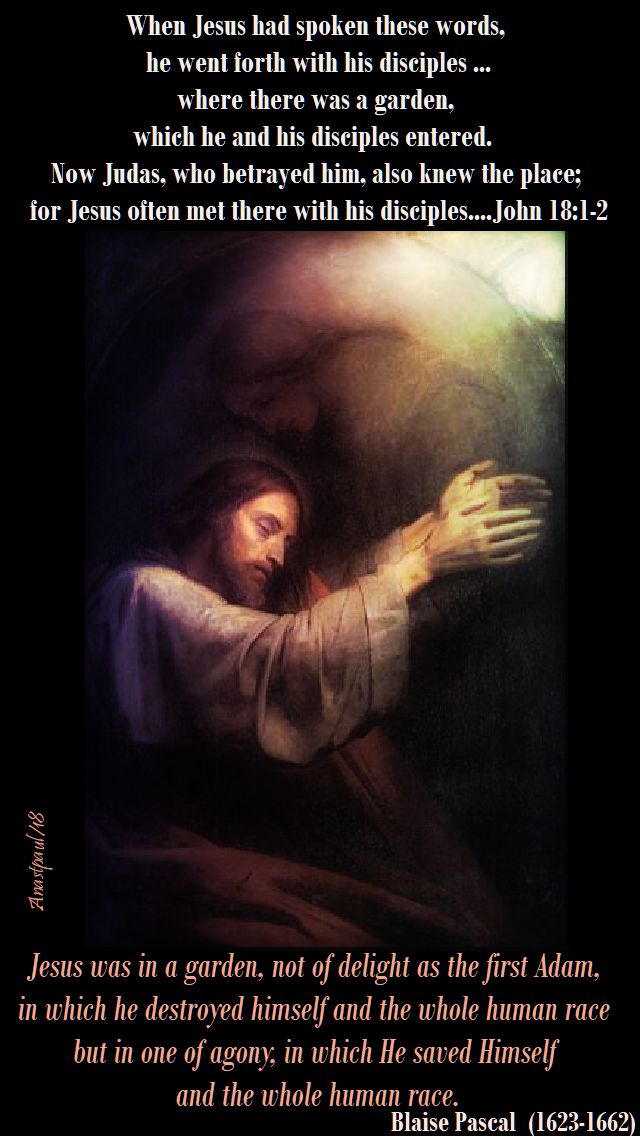
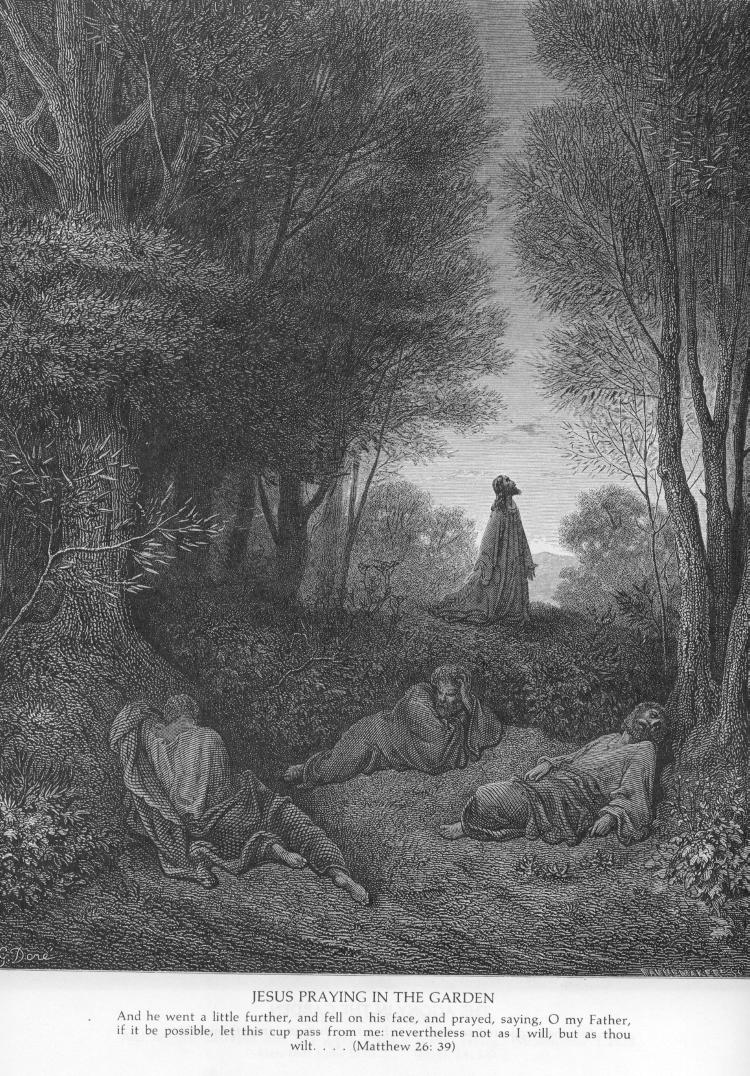
When Jesus had spoken these words, he went forth with his disciples across the Kidron valley, where there was a garden, which he and his disciples entered. Now Judas, who betrayed him, also knew the place; for Jesus often met there with his disciples..…..John 18:1-2
REFLECTION – “Jesus was in a garden, not of delight as the first Adam, in which he destroyed himself and the whole human race but in one of agony, in which He saved Himself and the whole human race.”…Blaise Pascal (1623-1662)
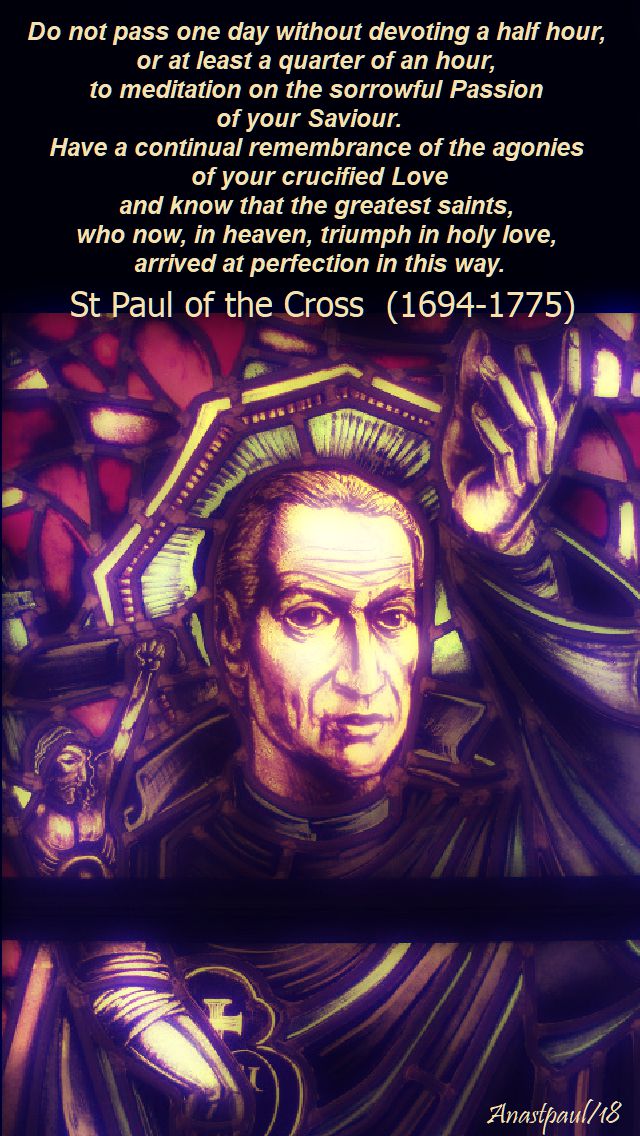
“Do not pass one day without devoting a half hour, or at least a quarter of an hour, to meditation on the sorrowful Passion of your Saviour. Have a continual remembrance of the agonies of your crucified Love and know that the greatest saints, who now, in heaven, triumph in holy love, arrived at perfection in this way.” – St Paul of the Cross (1694-1775)
PRAYER – Be mindful Lord, of this Your family, for whose sake our Lord Jesus Christ, when betrayed, did not hesitate to yield Himself into His enemies hands and undergo the agony of the Cross. Help us holy Father, to ever keep the Cross in our hearts and minds and to accept our own with love of You. Through Jesus our Lord, with the Holy Spirit, one God, amen.
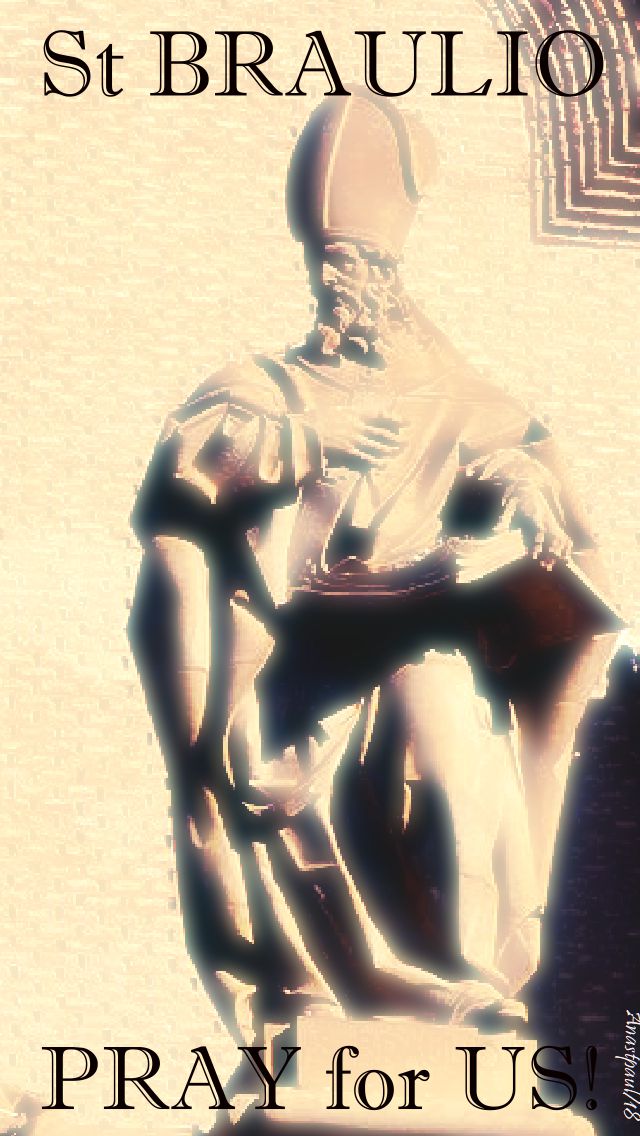
One Minute Reflection – 26 March 2018 – Monday of Holy week and the Memorial of St Braulio (590-651)
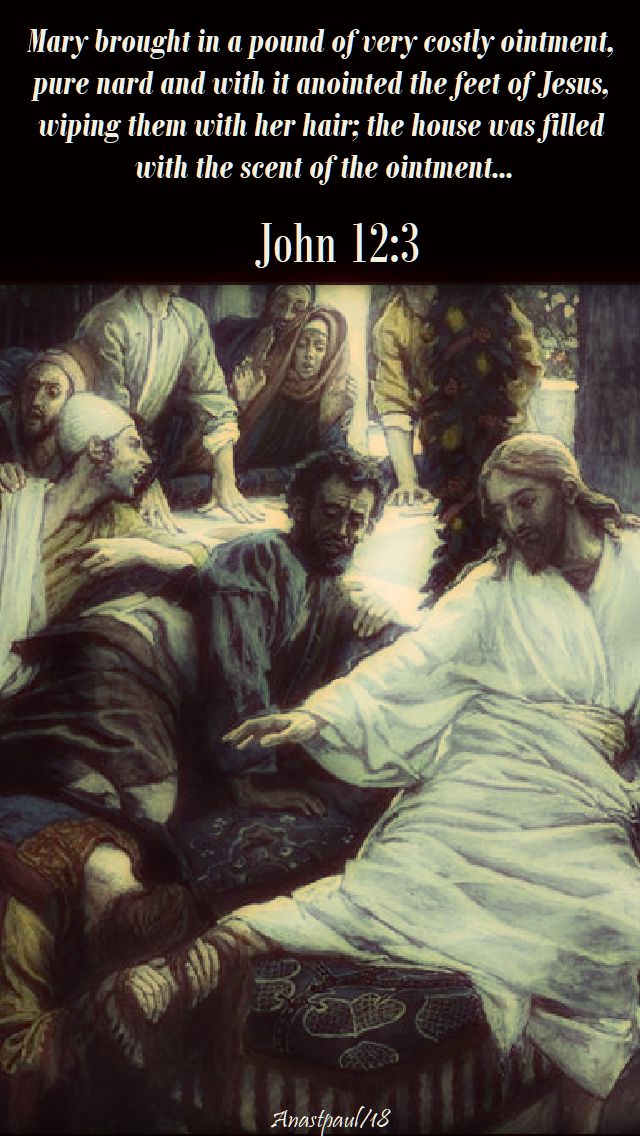
Mary brought in a pound of very costly ointment, pure nard, and with it anointed the feet of Jesus, wiping them with her hair; the house was filled with the scent of the ointment…John 12:3
REFLECTION – “O souls! Seek a refuge, like pure doves, in the shadow of the crucifix. There, mourn the Passion of your divine Spouse and drawing from your hearts flames of love and rivers of tears, make of them a precious balm with which to anoint the wounds of your Saviour.”…St Paul of the Cross (1694-1775)
PRAYER – Almighty God, grant that we who are constantly betrayed by our own weakness, may draw the breath of new life from the passion and death of Your only-begotten Son. St Braulio, you who worked so zealously to assist those in weakness, both in body and soul, please pray for us too. Through our Lord and Saviour, who suffered and died for us, in unity with the Holy Spirit, one God forever, amen.
Quote/s of the Day – 19 October
The Memorials of St Paul of the Cross and Blessed Jerzy Popiełuszko
“Look upon the face of the Crucified, who invites you to follow Him. He will be a Father, Mother–everything to you.”
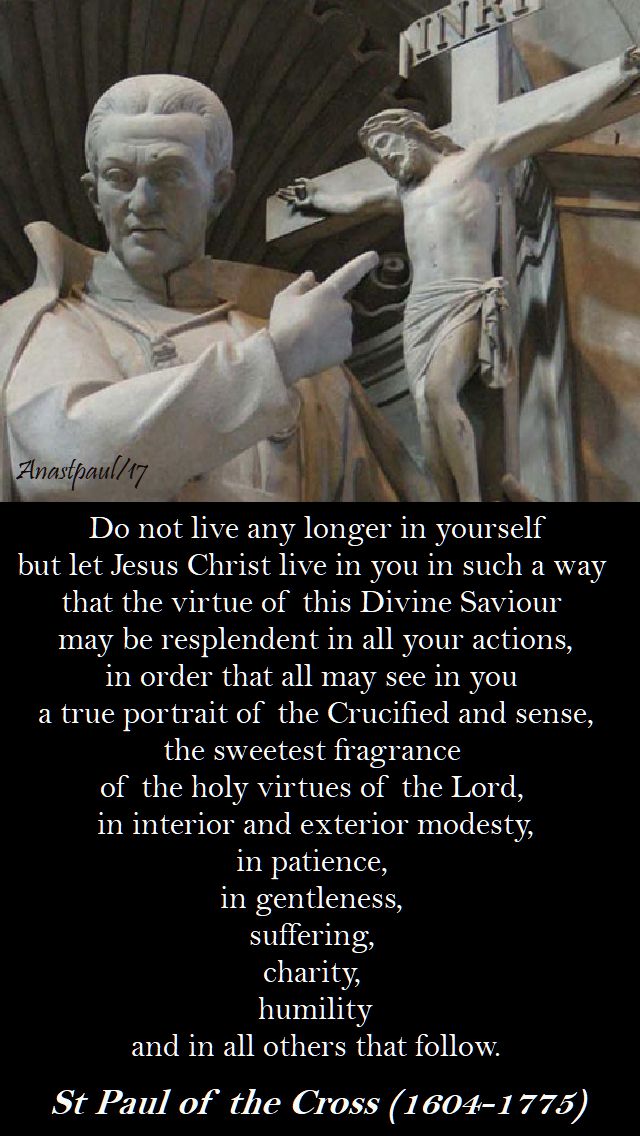
“Do not live any longer in yourself but let Jesus Christ live in you in such a way that the virtue of this Divine Saviour may be resplendent in all your actions, in order that all may see in you a true portrait of the Crucified and sense, the sweetest fragrance of the holy virtues of the Lord, in interior and exterior modesty, in patience, in gentleness, suffering, charity, humility and in all others that follow.”
St Paul of the Cross (1604-1775)
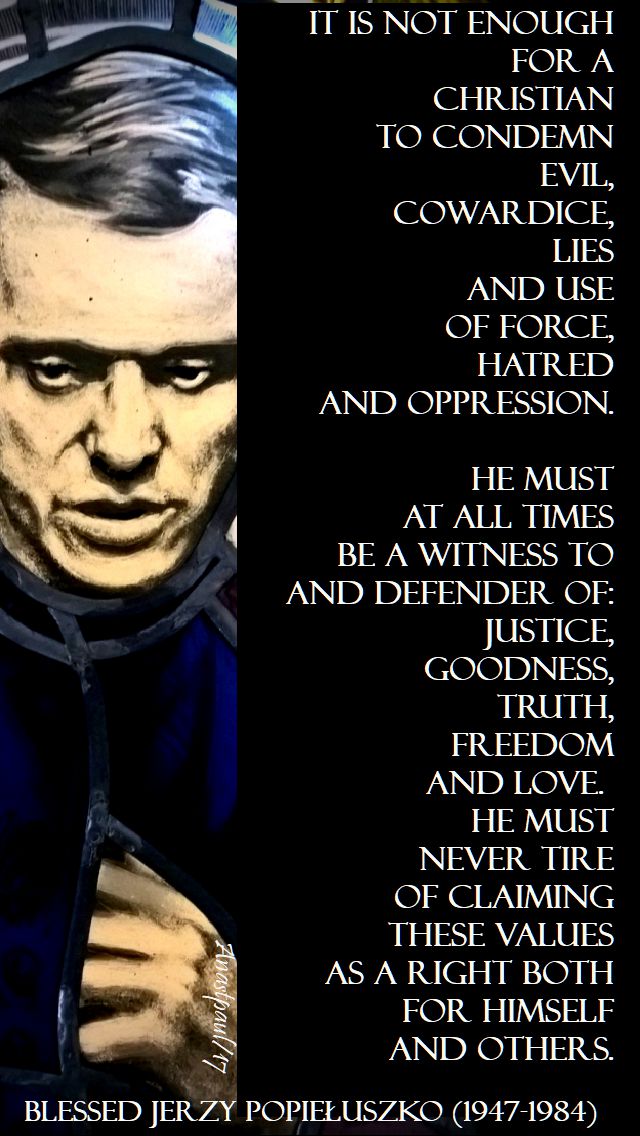
“It is not enough for a Christian to condemn evil, cowardice, lies and use of force, hatred and oppression. He must at all times be a witness to and defender of justice, goodness, truth, freedom and love. He must never tire of claiming these values as a right both for himself and others.”
Our Morning Offering – 19 October – The Memorial of St Paul of the Cross
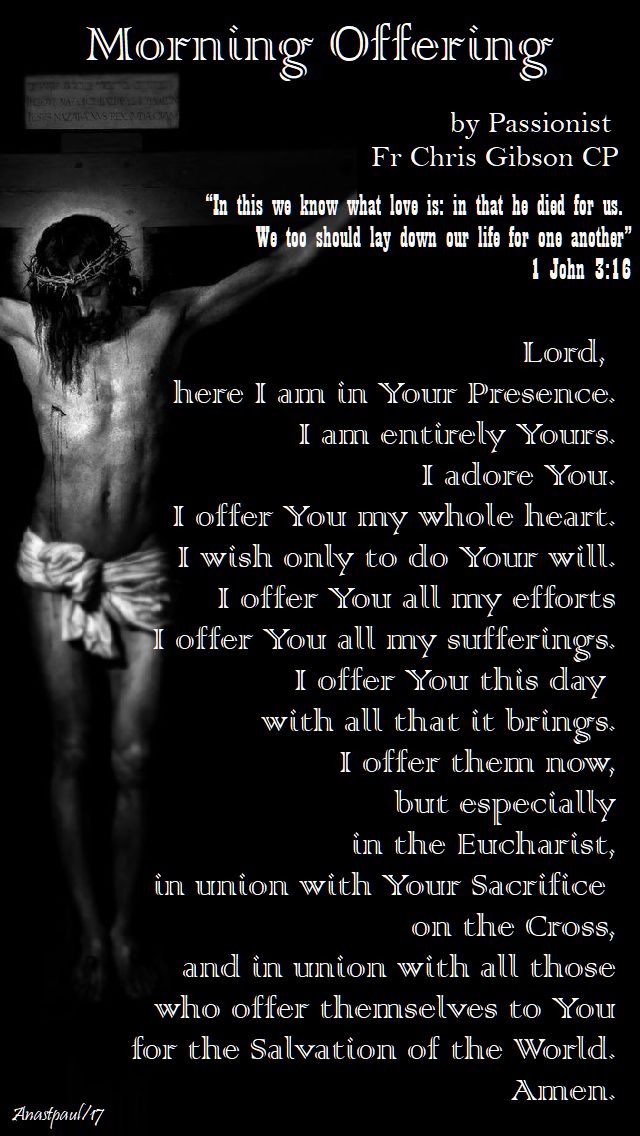
Morning Offering by Passionist Fr Chris Gibson CP
Lord,
here I am in Your Presence.
I am entirely Yours.
I adore You.
I offer You my whole heart.
I wish only to do Your will.
I offer You all my efforts
I offer You all my sufferings.
I offer You this day
with all that it brings.
I offer them now,
but especially in the Eucharist,
in union with Your Sacrifice
on the Cross,
and in union with all those
who offer themselves to You
for the Salvation of the World.
Amen.
“In this we know what love is: in that he died for us. We too should lay down our life for one another”1 John 3:16
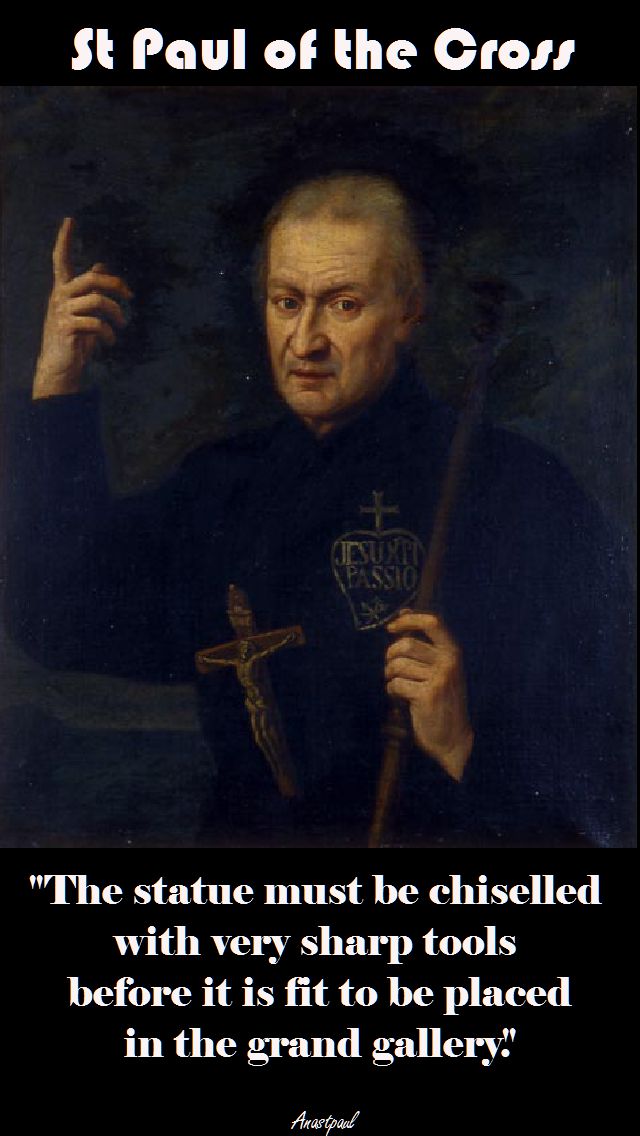
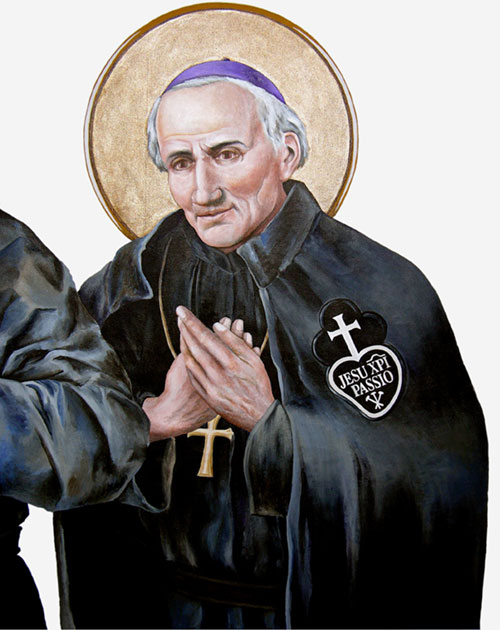
Saint of the Day – 19 October – St Paul of the Cross CP (1604-1775) Priest, Mystic, Preacher, endowed with miraculous powers of healing and prophecy, Founder of the Passionists – born Paolo Francesco Danei on 3 January 1694, in the town of Ovada, Italy and he died at 81 on 18 October 1775, at the Retreat of Saints John and Paul (SS. Giovanni e Paolo), Rome. By the time of his death, the congregation founded by Saint Paul of the Cross had one hundred and eighty fathers and brothers, living in twelve Retreats, mostly in the Papal States. There was also a monastery of contemplative sisters in Corneto (today known as Tarquinia), founded by Paul a few years before his death to promote the memory of the Passion of Jesus by their life of prayer and penance. Saint Paul of the Cross was beatified on 1 October 1852 by Pope Pius IX and Canonised on 29 June 1867 by the same Pope. His relics are also in the Church of Sts John and Paul, Rome. Patronages – The Passionist Orders of Priests and Sisters, of Ovado Italy and the Diocese of Pitigliano-Sovana-Orbetello also in Italy.
Paul Daneo was born on January 3, 1694, in Ovada, Italy, the second of 16 children. Even as a young person, Paul felt strongly connected to God and moved by the passion of Christ. At the age of 19, Paul’s father wanted him to become a merchant like himself. Marriage was a possibility looming in the future. At times Paul dreamed of becoming a soldier and even enlisted in the Venetian army when volunteers were requested by the Pope. But he soon realised that neither the adventure of a military career, the financial promise of the business world, nor the joys and sorrows of marriage were to be his life’s journey. Listening one day to a simple sermon on the sufferings of Jesus, Paul suddenly experienced what he called his “conversion.” He heard the voice of God calling him to a life of the spirit and a path of spiritual rigour.
He spent long hours in prayer, wrestling often with his own inner darkness and fierce temptations, a struggle that continued throughout 40 years of his life. But it was in his connection to the Crucified Jesus that Paul found solace and meaning and in his meditations on Christ’s passion that new inner directions opened up for Paul. His prayer life became an experience for him of the tremendous love God has for us.
Paul could see how many of his contemporaries did not know that God’s love had not deserted them. The sick, the poor, the ordinary people of his day had few hours of rest, little hope of healing and lived in crippling fear of war and bloodshed. Few found spiritual strength in the ritualistic services of the Church, which had became increasingly inaccessible to those who were living at the margins of society. It was these abandoned people who Paul wanted to reach and eventually, it was to their side that Paul traveled long hours throughout the harsh countryside to preach a message of faith, compassion and loving redemption.
Paul had dreamed of gathering companions who would live together in community and promote this new message. But it took from 1720 to 1741—twenty-one years of humble service as a hospital chaplain and traveling preacher combined with quiet perseverance in the face of official Church rejection—for Paul to receive his first papal authority to found his religious order, “The Congregation of the Passion.”
For over 40 years, Paul and his “like-minded companions,” the Passionists, preached the loving memory of the passion and death of Jesus Christ. Paul would challenge his hearers to die a mystical death with Christ so as to rise up with Christ to a life of faith and love. The sick and the poor remained special recipients of Paul’s care but he would also preach to the clergy and remind them of their obligations to serve the neglected. After many years of preaching, teaching and serving the Passionist community as its founder and leader, Paul died in 1775.
OLYMPUS DIGITAL CAMERA
Paul received gifts of prophecy and healing from the Holy Spirit. He was so powerful when he preached and so gentle in confession that he brought many sinners back to the Lord. Paul once said, “England is always before my eyes, and if ever again it becomes Catholic, the benefit to the Church will be immeasurable.” Within 65 years, a Passionist named Blessed Dominic Barberi went to England to help reconcile John Henry Newman and others to the Catholic Church, aiding the revival of Catholicism there.
One Minute Reflection – 25 September – The Memorial of St Vincent Strambi C.P. (1745-1824)
May Christ dwell in your hearts through faith……Ephesians 3:17
REFLECTION – “Look upon the face of the Crucified, who invites you to follow Him. He will be a Father, Mother–everything to you.”….St Paul of the Cross
PRAYER – Jesus, our Lord and our God, only You are the best Shepherd of Your Church.
Support with grace those who are responsible for the fate of Your fold,
so that following the example of St. Vincent Maria Strambi, they devote all their powers and talents to service to the Church.
In God, our Father we pray through You who live in union with Him and the Holy Spirit, one God, for ages and ages. Amen
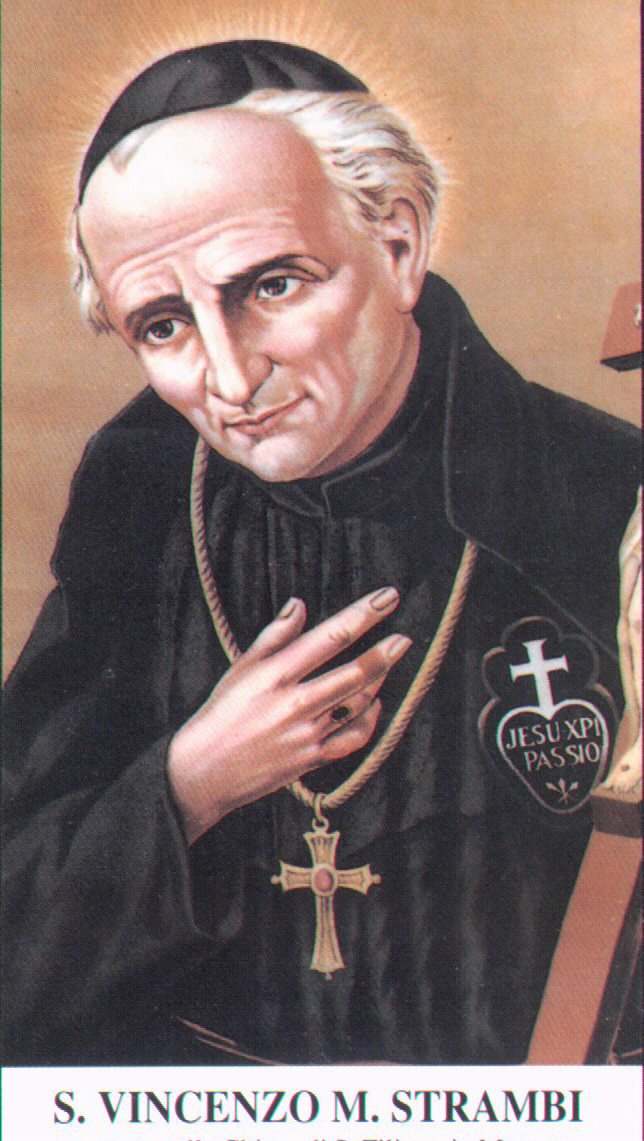
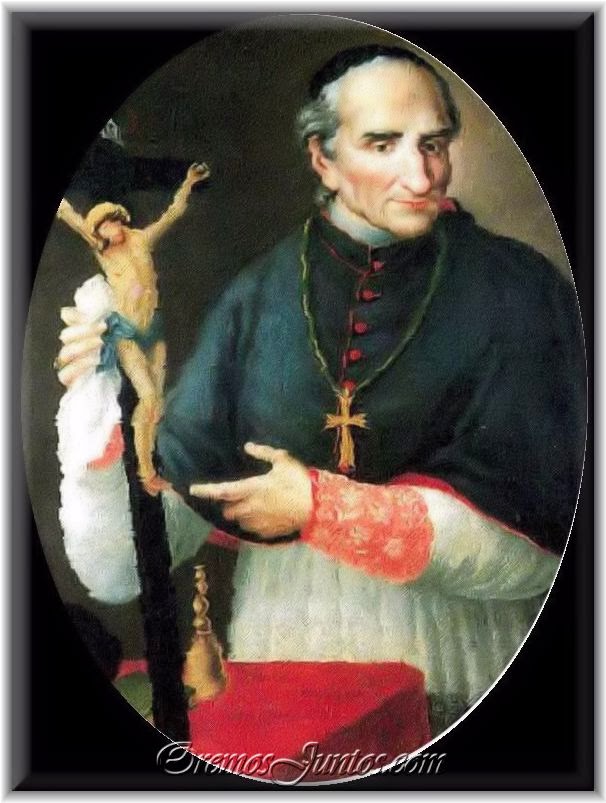
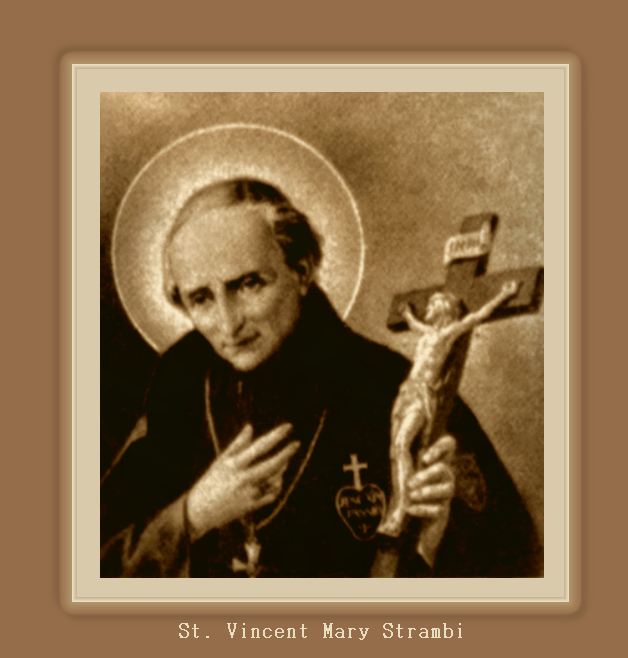
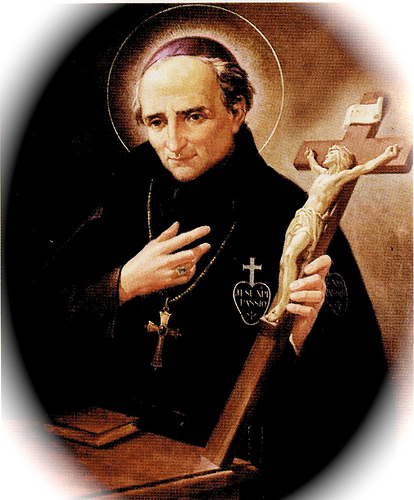
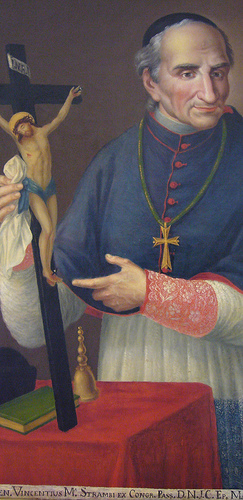
Saint of the Day – 25 September – St Vincent Strambi C.P. (1745-1824) Passionist Religious Priest and Bishop, Apostle of Charity, Preacher, Teacher – Patronage – Diocese of Macerata-Tolentino. Attributes – Passionist habit, Episcopal attire, Crucifix. Beatified on 26 April 1925 at Saint Peter’s Basilica, Kingdom of Italy by Pope Pius XI and Canonised on 11 June 1950 at Saint Peter’s Basilica, Vatican City by Pope Pius XII.
Saint Vincenzo Strambi (1 January 1745 – 1 January 1824) – in religious Vincenzo Maria di San Paolo – was an Italian Roman Catholic prelate who was a professed member from the Passionists and served as the Bishop of Macerata-Tolentino from 1801 until his resignation in 1823. Strambi became a Passionist despite its founder Saint Paul of the Cross refusing him several times due to Strambi’s frail constitution. But he practiced Passionist austerities which continued after his appointment as a bishop that saw him favour his religious habit rather than the usual episcopal garb. He was known for his charitable projects that included the care of the poor and the reduction of diocesan expenditures in order to provide for them; he took special interests in the education and ongoing formation of priests.
Strambi was exiled from his diocese 1808 after he refused to take an oath of allegiance to the First French Empire under Napoleon who had annexed Macerata as part of his empire. He spent that time in Novara and Milan before he managed to return to his see in a triumphant return in 1814. He served as bishop for the remainder of the pontificate of Pope Pius VII before his successor Pope Leo XII accepted Strambi’s resignation and summoned him to Rome as his advisor. But the sudden illness of the pope – which seemed to prove fatal – prompted Strambi to offer his own life to God so that the pope could live. Leo XII rallied to great surprise but Strambi died of a stroke within the week.
Education and priesthood Vincenzo Strambi was born in 1745 in Civitavecchia as the last of four children to Giuseppe Strambi and Eleonora Gori; his three elder siblings all died in childhood. His father served as a pharmacist known for his charitable works and his mother was noted for her piousness and holiness.
He was often a troublesome child who excelled in athletics and became more devout in his adolescence. The Friars Minor oversaw his education and he taught his fellow students the catechism. His desire to become a priest was met with encouragement from his parents and he commenced his ecclesial studies in November 1762. It was at this time that he became quite attracted to the notion of the religious life though his frail health saw him refused admission into the Order of Friars Minor Capuchin and the Vincentians. Strambi was noted for his oratorical gifts and so was sent to Rome for studies in Sacred Eloquence and thereafter continued his theological studies with the Dominicans at Viterbo. While still a student he was appointed prefect of the seminarians and thereafter acting-rector of seminarians at Bagnorea.
Before his ordination to the priesthood he made a retreat at the convent in Vetralla which belonged to the Passionists; it was here that he met the founder Saint Paul of the Cross. Strambi became impressed and enthralled with what he had seen and admired their ardent devotion. This made him ask the founder to be admitted into the order. But he was refused since Paul of the Cross believed that Strambi did not have the stamina for the Passionist life. Strambi left the convent on 18 December 1767 to be ordained.
He was received into the diaconate in Bagnoregio on 14 March 1767. Strambi was ordained to the priesthood on 19 December 1767 and then returned to Rome to further his theological studies. Here he was noted for his studies of the life and works of Saint Thomas Aquinas. He still felt called to the Passionists and made several trips to see Paul of the Cross to beg to be admitted into the order. In September 1768 the founder relented and Strambi commenced his novitiate assuming the name Vincenzo Maria di San Paolo. His parents were not too pleased with this and his father objected to the decision citing his son’s frail health as a sign that Strambi would die due to the rigid penances. He made his profession on 24 September 1769 and continued with a particular emphasis on the Church Fathers and on Sacred Scripture.
Strambi preached missions – a focal point of the Passionist charism – and drew large crowds due to the effectiveness of his preaching. There were even several occasions where he preached before bishops and cardinals. In 1773 he was made a professor of theological studies at the order’s house in Rome – at Santi Giovanni e Paolo – and it was here that he was present at the death of St Paul of the Cross. The founder said to Strambi on his deathbed: “You will do great things! You will do great good!”
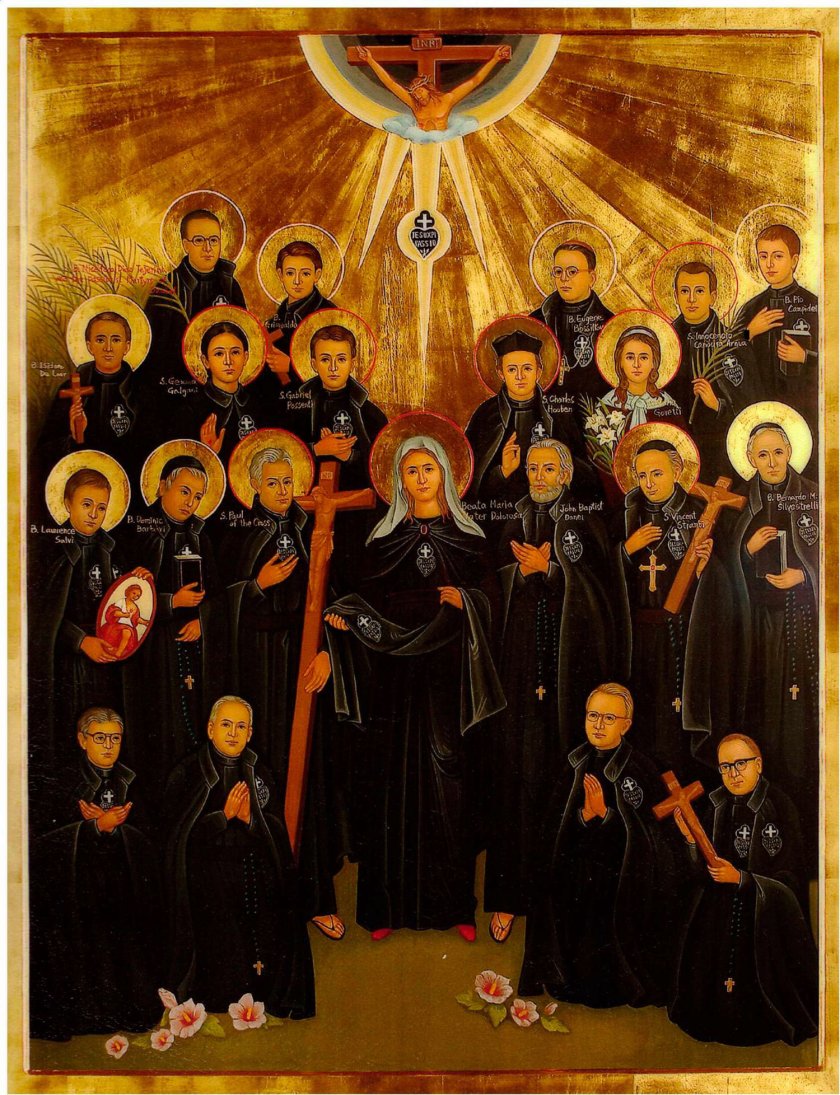
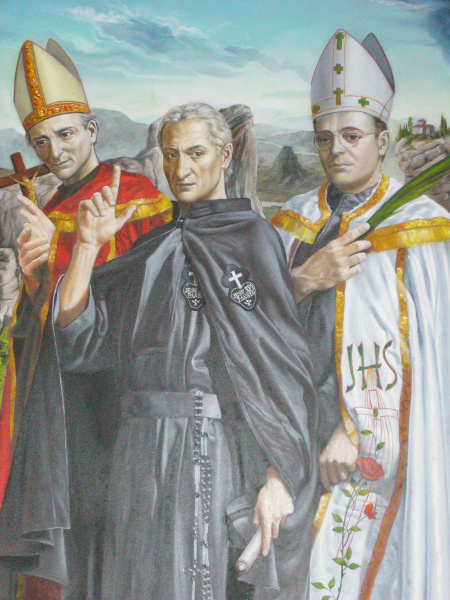
Three Passionists – St Vincent Strambi, St Paul of the Cross and Blessed Eugene Bossilkov
It was after this that he occupied several high offices in the order such as the rector of the Roman house and the provincial for the Roman province. In 1784 he was relieved of these duties in order to write a biographical account of Paul of the Cross which was later published in London (the Blessed Dominic Barberi wrote the preface). The Napoleonic invasion in the Papal States and the anti-religious decrees forced Strambi to flee Rome in 1798 though was in vain when French forces – in May 1799 – took him as their prisoner though he managed to return to Rome not long after this.
Episcopate The death of Pope Pius VI saw his friend Cardinal Leonardo Antonelli nominate him for the papal see and he even received five votes in the conclave. The new Pope Pius VII – in mid-1801 – appointed Strambi as the Bishop of Macerata-Tolentino and he became the first bishop to come from the Passionists. This news – before it was made public – surprised and frightened him and he rushed to Rome in an effort to get the appointment cancelled before it was publicised. Even his good friend Cardinal Antonelli counselled him to accept the nomination for the welfare of the Church. Strambi even took his case to the pope who listened and told Strambi the decision to name him a bishop was “a divine inspiration” he was firm on. Cardinal Antonelli presided over his episcopal consecration at Santi Giovanni e Paolo. But he continued to wear his Passionist habit in private despite his higher office. His episcopate was marked with a concern for the poor and he even begged on their behalf on occasion. He took great care in the education of diocesan priests and paid close attention to the teaching standards in the diocesan seminaries. His charitable works included the establishment of orphanages and homes for the aged. He still practiced the frugalities the Passionists advocated and this applied to his living and eating habits: he never did permit more than two dishes for his meals.
Napoleon – in 1809 – issued a decree that annexed Macerata as part of the French Empire. The French ordered that this decree be read in all churches but Strambi refused to do so. He also refused to provide the French with a list of all the men in his diocese who would be suitable for service in the armed forces. The French arrested him in September 1808 for refusing to take the oath of allegiance to the French invaders and was then exiled and cut off from his diocese. He was first sent to Novara but was sent in October 1809 to Milan where he spent the remainder of his exile as a guest of the Barnabites. He returned to his see in 1814 with vast crowds lining the route of his return. Pius VII had returned from his own exile and remarked:
“This holy man overwhelms me”.
The invaders had left much damage in their wake – not just destruction to infrastructure – but a lax sense of morals and values which Strambi worked hard to rebuild. He instituted strict reforms that ended corruption to the point where he received some death threats. Strambi was also the spiritual director of Blessed Anna Maria Taigi – a friend – as well as Saint Gaspare del Bufalo and Saint Vincenzo Pallotti (Vincent Pallotti)
But the French returned to Macerata in 1817, to set up their headquarters aiming to use that location to attack the Austrian forces. The people turned to Bishop Strambi for fear of what the French would do. His response was to gather priests and seminarians in his private chapel to beg for God’s intercession and after one and a half hours he rose and declared that Macerata would be saved through the intercession of the Mother of God. The French were indeed defeated though the local people feared what would happen during their retreat. Strambi met with the leader of the French forces and begged him not to enter the town to which General Murat agreed. Strambi then secured the assurances of the Austrian generals that the French soldiers would not be slaughtered.
He was a close friend of Carlo Odescalchi and was pleased to learn that the pope named him as a cardinal on 10 March 1823. Strambi tried several times to secure his resignation from Pius VII but on one occasion the pope reprimanded him for using ill health as a vain excuse and dismissed him. Strambi tried once again in 1823 in a letter to Cardinal Ercole Consalvi to the pope but the letter arrived in Rome when the pontiff broke his thigh in a fall and died soon after.
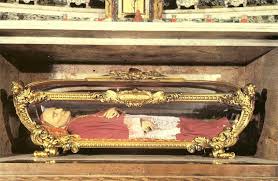
Declining health and death In 1823 his health started to decline and Pope Leo XII gave him his permission to retire. He was then appointed the as Leo XII’s personal advisor and took up residence at the Quirinal Palace in Rome. It was during his time in this office that Napoleon’s sister Pauline returned to the faith with Strambi’s guidance. When the pope fell ill he asked God that his life should be taken rather than that of the pope. The pope recovered on 24 December 1823 and Strambi died in 1824 within the week due to a stroke he had suffered on the previous 27 December. His remains were placed at the Quirinal Palace for mourners to see and was then buried in the Santi Giovanni e Paolo church. Mourners who viewed his mortal remains included Cardinal Bartolomeo Alberto Cappellari – future pope – who took Strambi’s right hand in his own and formed it with the greatest of ease into the sign of the cross. His remains were later transferred on 12 November 1957 to the Chiesa di San Filippo in Macerata.
Sainthood The cause for Strambi’s canonisation opened on a diocesan level for the collection of testimonies and documents in relation to his life and his episcopal works. The formal introduction did not come until 25 June 1845 when he was named as a Servant of God. The recognition of his life of heroic virtue led Pope Leo XIII to name him as Venerable on 1 April 1894. Pope Pius XI presided over the beatification rites on 26 April 1925 and signed a decree on 25 November that allowed the cause to continue. Pope Pius XII canonised Strambi in Saint Peter’s Basilica on 11 June 1950.
Quote/s of the Day – 14 September – Feast of the Exaltation of the Holy Cross
“Everything is a reminder of the Cross. We ourselves are made in the shape of a cross.”
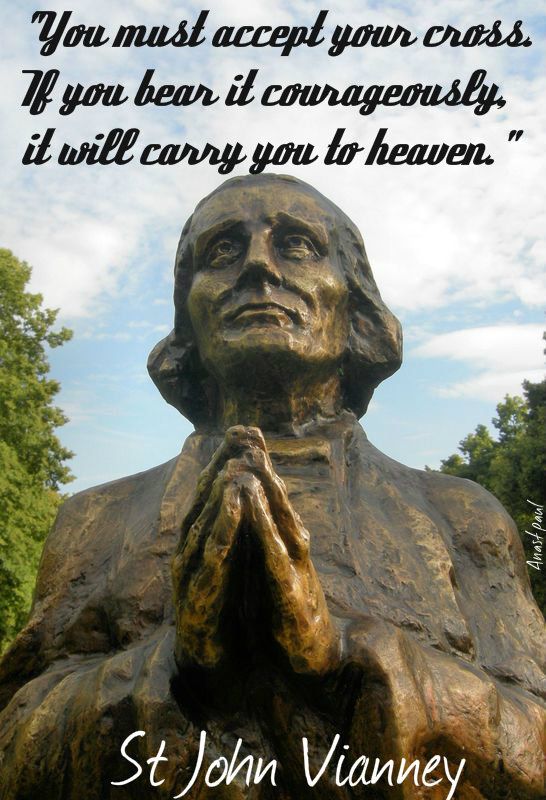
“You must accept your cross. If you bear it courageously, it will carry you to heaven.”
“The sign of the cross is the most terrible weapon against the devil. Thus the Church wishes not only, that we have it continually in front of our minds, to recall to us just what our souls are worth and what they cost Jesus Christ but also that we should make it at every juncture ourselves: when we go to bed, when we awaken during the night, when we get up, when we begin any action, and, above all, when we are tempted.”
St John Vianney
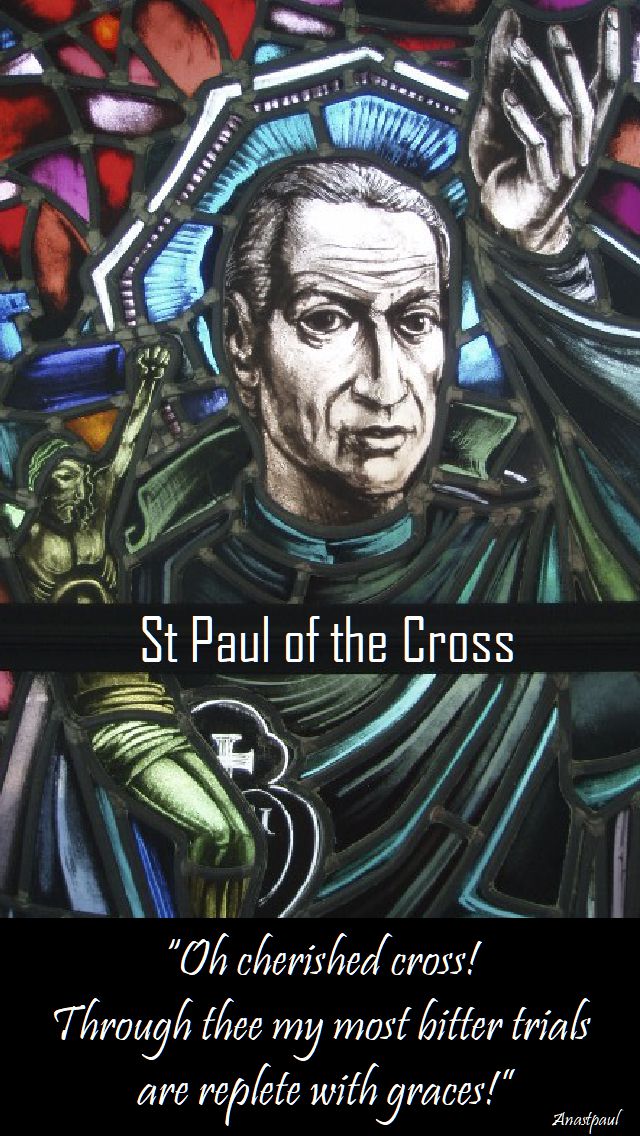
“Oh cherished cross! Through thee my most bitter trials are replete with graces!”
St Paul of the Cross
“In the Cross is salvation; in the Cross is life; in the Cross is protection against our enemies; in the Cross is infusion of heavenly sweetness; in the Cross is strength of mind; in the Cross is joy of spirit; in the Cross is excellence of virtue; in the Cross is perfection of holiness. There is no salvation of soul, nor hope of eternal life, save in the Cross.”
Fr Thomas à Kempis, The Inner Life
“The everlasting God has in His wisdom foreseen from eternity the cross He now presents to you as a gift from His inmost heart. The cross He now sends you He has considered with His all-knowing eyes, understood with His divine mind, tested with His wise justice, warmed with loving arms and weighed with His own hands to see that it is not one inch too large nor one ounce too heavy for you. He has blessed it with His holy name, anointed it with His grace, perfumed it with His consolation, taken one last glance at you and your courage and then sent it to you from heaven, a special greeting from God to you, an alms of the all-merciful love of God.”
“Celebrate the feast of Christmas every day,
even every moment in the interior temple
of your spirit, remaining like a baby in
the bosom of the heavenly Father,
where you will be reborn each moment
in the Divine Word, Jesus Christ.”
St. Paul of the Cross
“Meister Eckhart once said: ‘What good is it that Christ was born 2,000 years ago if he is not born now in your heart?’
“Lord, we do far too much celebrating your actual coming in our hearts. I believe in God, but do I believe in God-in-me? I believe in God in heaven, but do I believe in God-on-earth? I believe in God out there, but do I believe in God-with-us?
“Lord, be born in my heart. Come alive in me this Christmas! Amen.”







 AnaStpaul
You must be logged in to post a comment.