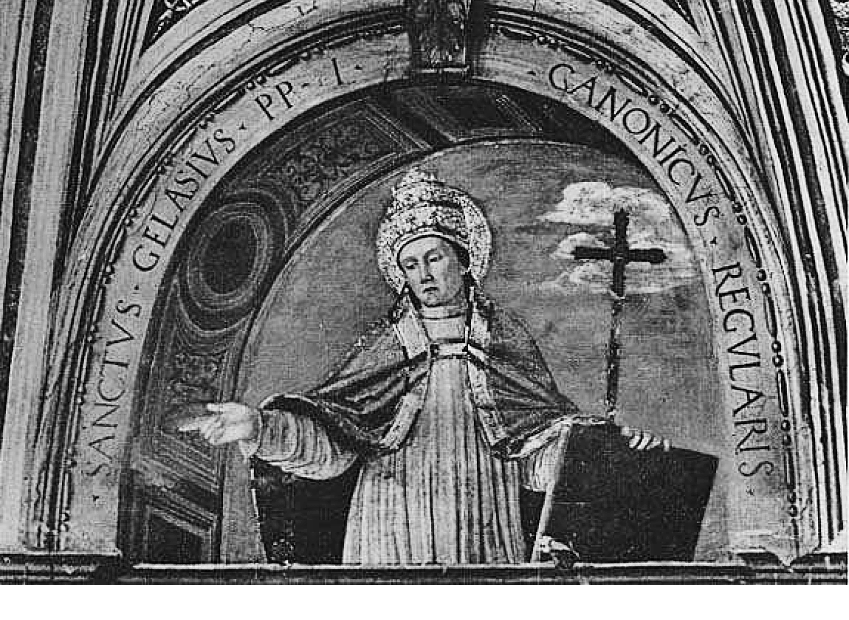
Quote/s of the Day – 21 November – The Memorial of St Pope Gelasius I (Died 496) Bishop of Rome from 1 March 492 until his death on 19 November 496.
“There are two powers, by which chiefly, this world is ruled – the Sacred authority of the Priesthood and the authority of Kings. And of these, the authority of the Priests is, so much the weightier, as they must render, before the tribunal of God, an account, even for the Kings of men.”
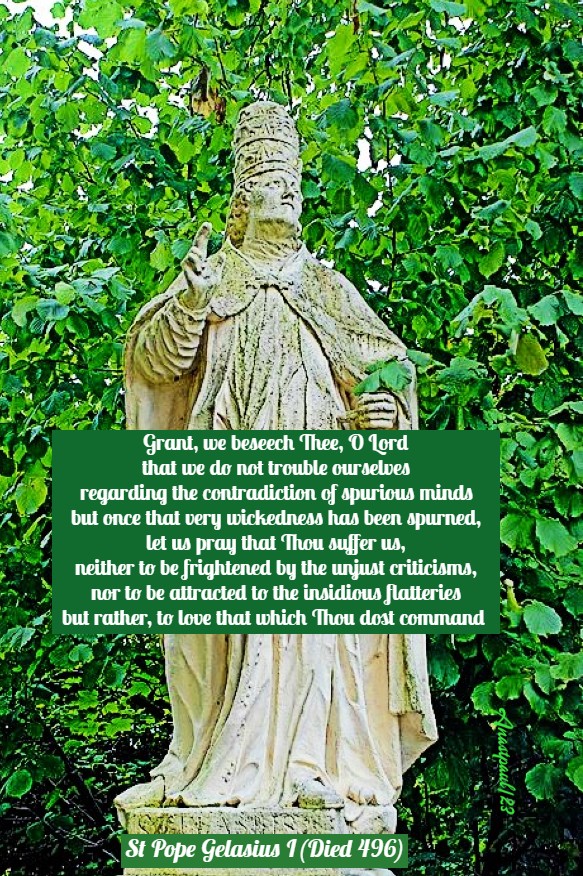
“Grant, we beseech Thee, O Lord that we do not trouble ourselves regarding the contradiction of spurious minds but once that very wickedness has been spurned, let us pray that Thou suffer us, neither to be frightened by the unjust criticisms, nor to be attracted to the insidious flatteries but rather, to love that which Thou dost command …”
(In 1751, Pope Benedict XIV published this Prayer within his Apostolic Constitution “Providas” which exposed the evils of freemasonry.)
Saint of the Day – 21 November – St Gelasius I (Died 496) Bishop of Rome. Papal Ascension 1 March 492 until his death on 19 November 496 in Rome, Italy. Gelasius was learned Scholar and a prolific Author, Defender of orthodoxy and of the See of Peter. Zealous Apostle of the poor and needy and of the Majesty of the Liturgical Worship, including the discipline of Hymn and Prayer within his scholastic orbit of Author. The Feast of St Gelasius is kept on 21 November which is the anniversary of his Interment, although many writers give this as the day of his death which actually occurred on 19 November as stated above.
The Roman Martyrology reads today: “At Rorme, the birthday of St Gelasius, Pope, distinguished for learning and sanctity.”
There is a difference of opinion and understanding of where our Saint was born – either in Rome but of African parents of Roman citizenship or, in Africa and then returned to Rome as their natural home with his parents. Either way he, himself, states that he was “Roman by nature.” Before his election as Pope on 1 March, 492, Gelasius had been greatly employed by his predecessor, Felix II, especially in drawing up Ecclesiastical documents which has led some scholars to confuse the writings of the two Pontiffs.
Upon his election to the Papacy, Gelasius at once showed his strength of character and his lofty conception of his position, by his firmness in dealing with the adherents of the Patriarch of Constantinople. Despite all the efforts of the otherwise orthodox Patriarch, Euphemius of Constantinople and the threats and wiles, by which the Emperor Anastasius tried to obtain recognition from the Apostolic See, Gelasius, though hard-pressed by difficulties at home, would make no peace which compromised. in the slightest degree. the rights and honour of the Chair of Peter!
The constancy with which he combated the pretensions, lay and Ecclesiastical, of the New Rome; the resolve, with which he refused to allow, the civil or temporal pre-eminence of a City, to determine its Ecclesiastcal rank; the unfailing courage with which he defended the rights of the “second” and the “third” Sees i.e. Alexandria and Antioch – these, are some of the most striking features of his Pontificate. It has been well said that nowhere, at this period, can be found stronger arguments for the Primacy of Peter’s See, than in the works and writings of our St Gelasius. He is never tired of repeating – that Rome owes its Ecclesiastical Princedom, not to an Ecumenical Synod, nor to any temporal importance it may have possessed but solely, to the Divine Institution of Christ Himself, Who conferred the Primacy over the whole Church upon Peter and his successors!
Gelasius’ Pontificate was too short to effect the complete submission and reconciliation of the ambitious Church of Byzantium. Not until Hormisdas (514-523) did the contest end in the return of the East to its old allegiance. Troubles abroad were not the only occasions to draw out the energy and strength of Gelasius. The Lupercalia, a superstitious and somewhat licentious vestige of paganism in Rome, was finally abolished by the Pope after a long contest.
Image created in c870, featuring the Coronation of Charles the Bald, flanked by Gelasius I on the left and Gregory the Great (540-604). Gelasius’ Pontificate and his writing, in particular, gave him an acclaimed status within Pontifical history.
A stanch upholder of the old traditions, Gelasius, nevertheless, knew when to make exceptions or modifications. An excellent example of his brilliance was his Decree obliging the reception of the Holy Eucharist under both kinds. This was done as the only effective way of detecting the Manichæans, who, although present in Rome in large numbers, sought to divert attention from their hidden propaganda and subversive plans, by feigning Catholicism. But as they held wine to be impure and essentially sinful, they would refuse the Chalice and thus, be recognised. Later, with the change of conditions, the old normal method of receiving Holy Communion under the form of bread alone, returned.
In his zeal for the beauty and majesty of Divine worship, Gelasius composed many Hymns, Prefaces and Collects and arranged a standard Mass-book, although the Missal which has commonly adopted his name, the “Sacramentarium Gelasianum” belongs properly, to the next Century. How much of it is the work of our Saint, is still subject to uncertainty.
Gelasius, although Pope but for four and a half years, exerted a deep influence on the development of Church polity, of the Liturgy and Ecclesiastical discipline. A large number of his Decrees have been incorporated into the Canon Law.
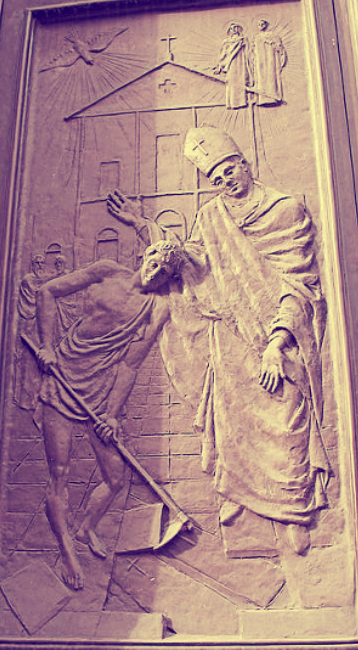
In his private life, Gelasius was, above all, conspicuous for his spirit of prayer, penance and study. He took great delight in the company of Monks and was a true father to the poor, dying empty-handed, as a result of his lavish charity. Dionysius Exiguus (c470-c544) the renowned Canonist, in a letter to his friend, the Priest Julian gives a glowing account of Gelasius as he appeared to his contemporaries.
As a Writer, Gelasius takes high rank for his period. His style is vigorous and elegant, though occasionally, obscure. Comparatively little of his literary work has come down to us, although he is said to have been the most prolific writer of all the Pontiffs of the first five Centuries. There are extant – forty-two letters and fragments of forty-nine others, besides six treatises, of which three are concerned with the Acacian schism, one with the heresy of the Pelagians, another with the errors of Nestorius and Eutyches, while the sixth is directed against the Senator Andromachus and the advocates of the Lupercalia. The best edition is that of Thiel.
St Celsus the Martyr St Clement the Martyr St Demetrius of Ostia St Digain St Pope Gelasius I (Died 496) Papal Ascension 1 March 492 until his death on 21 November 496 in Rome, Italy.
St Heliodorus of Pamphylia St Hilary of Vulturno St Honorius of Ostia
St Maurus of Porec St Maurus of Verona St Rufus of Rome
Martyrs of Asta – 3 Saints: Three Christians Martyred together for their faith during the persecutions of Diocletian. The only details about them to survive are their names – Eutychius, Honorius and Stephen. They were Martyred in c300 at Asta, Andalusia, Spain.






 AnaStpaul
You must be logged in to post a comment.