
Thursday of the 4th Week of Lent –19 March – Our Lenten Journey With St Thomas Aquinas (1225-1274) Doctor of the Church
Thursday of the Fourth Week
The Death of Lazarus
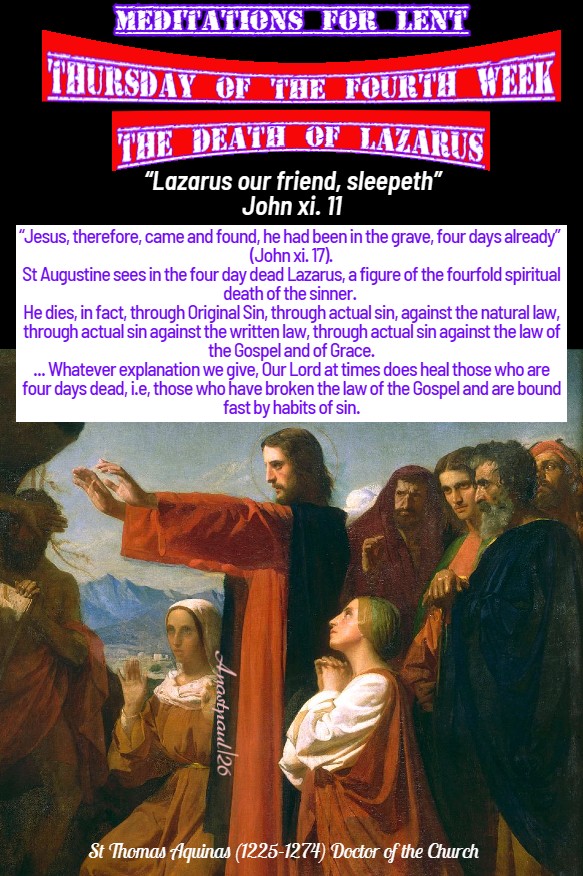
“Lazarus our friend, sleepeth”
John xi. 11
Our friend, for the many benefits and services he rendered us and, therefore, we owe it, not to fail in his necessity. Sleepeth, therefore, we must come to his assistance; “a brother is proved in distress” (Prov xvii. 17).
He sleepeth, I say, as St Augustine says, to the Lord.
But to men he was dead, nor had they power to raise him.
Sleep is a word we use with various meanings.
We use it to mean natural sleep, negligence, blameworthy inattention, the peace of contemplation, the peace of future glory and, we use it also, to mean death.
We will not have you ignorant, concerning the last sleep, that you be not sorrowful, even as others who have no hope, says St Paul (i Thess. iv. 12).
Death is called sleep because of the hope of resurrection and so it has been customary to give death this name since the time when Christ Died and was Raised again, “I have Slept and have taken My rest”(Ps. iii. 6).
“I go that I may awake him out of sleep” (John xi. n).
In these words, Jesus gives us to understand that He could raise Lazarus from the tomb as easily as we raise a sleeper from his bed.
Nor is this to be wondered at, for He is none other than the Lord Who raiseth up the dead and giveth life (John v. 21). And hence, He is able to say, “The hour ccmeth when all who are in the graves, shall hear the Voice of the Son of God (ibid. v. 28).
“Let us go to Him” (John xi. 15).
Here it is the mercifulness of God which we are shown.
Men, living in sin and, as it were, dead, unable by any power of their own to come to Him, He mercifully draws them, anticipating their desire and need.
Jeremias speaks of this when he says, “Thus saith the Lord, I have Loved thee with an Everlasting Love, therefore, have I drawn thee, taking pity on thee”(Jer. xxxi. 3).
“Jesus, therefore, came and found, he had been in the grave, four days already” (John xi. 17).
St Augustine sees in the four day dead Lazarus, a figure of the fourfold spiritual death of the sinner.
He dies, in fact, through Original Sin, through actual sin, against the natural law, through actual sin against the written law, through actual sin against the law of the Gospel and of Grace.
Another interpretation is that the first day represents the sin of the heart, “Take away the evil of your thoughts” says Isaias (i. 16); the second day represents sins of the tongue, “Let no evil speech proceed from your mouth” says St Paul (Eph iv. 29); the third day represents the sins of evil action, “Cease to act perversely” (Isaias i. 16); the fourth day represents the sins of wicked habit.
Whatever explanation we give, Our Lord at times does heal those who are four days dead, i.e, those who have broken the law of the Gospel and are bound fast by habits of sin.
ST THOMAS AQUINAS (1225-1274)
Priest, Theologian, Dominican
Doctor Angelicus (Angelic Doctor)
Doctor Communis (Common Doctor)
Added by Pope Saint Pius V in 1568

 AnaStpaul
You must be logged in to post a comment.