
Wednesday in Holy Week – 1 April – Our Lenten Journey With St Thomas Aquinas (1225-1274) Doctor of the Church
Wednesday in Holy Week
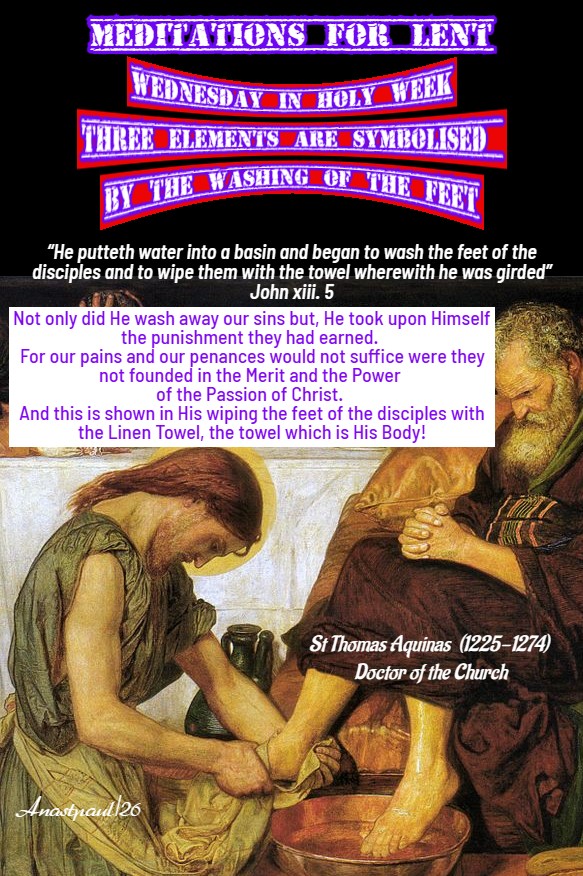
Three Elements are Symbolised
by the Washing of the Feet
“He putteth water into a basin and began to wash the feet of the disciples and to wipe them with the towel wherewith he was girded”
John xiii. 5
There are three elements which this action may symbolise.
- The pouring of the water into the basin, is a Symbol of the pouring out of His Blood upon the earth.
Since the Blood of Jesus has a Power of cleansing, it may in a sense, be called water.
The reason why Water, as well as Blood, flowed from His Side, was to show that this Blood could wash away sin.
Again we might take the water as a figure of Christ’s Passion.
He putteth water into a basin, that is, by faith and devotion He stamped into the minds of faithful followers, the memory of His Passion.
“Remember My poverty and transgression, the wormwood and the gall” (Lam iii. 19).
- By the words, “and began to wash” it is human imperfection which is symbolised.
For the Apostles, after their living with Christ, were certainly more perfect and yet, they needed to be washed, their souls were still stained.
We are here made to understand that, no matter the degree of any man’s perfection, he still needs to be made more perfect; he is still contracting uncleanness of some kind, to some extent.
So in the Book of Proverbs we read,“ Who can say My heart is clean I am pure from sin”(Prov. xx. 9).
Nevertheless, the Apostles and the just have this kind of uncleanness only in their feet.
There are, however, others who are infected, not only in their feet but wholly and entirely.
Those who make their bed upon the soiling attractions of the world, are made wholly unclean thereby.
Those who wholly, that is to say, with their senses and with their wills, cleave to their desire of earthly things, these are wholly unclean.
But they who do not thus lie down, they who stand, i.e. they who, in mind and in desire, are tending towards heavenly things, contract this uncleanness in their feet. Whoever stands must, necessarily, touch the earth at least with his feet.
And we too, in this life, where we must, to maintain life, make use of earthly things, cannot but contract a certain uncleanness, at least as far as those desires and inclinations are concerned which begin in our senses.
Therefore, Our Lord commanded His disciples to shake the dust from their feet. The text says, “He began to wash” because this washing the affection for earthly things is only a beginning.
It is only in the life to come that it will be really complete.
Thus, by putting water into the basin, the pouring of His Blood, is signified and by His beginning to wash the feet of His disciples, the washing away of our sins.
- Finally, there is Symbolised Our Lord’s taking upon Himself the punishment due to our sins.
Not only did He wash away our sins but, He took upon Himself the punishment they had earned.
For our pains and our penances would not suffice were they not founded in the Merit and the Power of the Passion of Christ.
And this is shown in His wiping the feet of the disciples with the linen towel, the towel which is His Body!
ST THOMAS AQUINAS (1225-1274)
Priest, Theologian, Dominican
Doctor Angelicus (Angelic Doctor)
Doctor Communis (Common Doctor)
Added by Pope Saint Pius V in 1568

 AnaStpaul
You must be logged in to post a comment.