Posted in EUCHARISTIC Adoration, MORNING Prayers, QUOTES of the SAINTS, SAINT of the DAY, The WORD

One Minute Reflection – 12 June

One Minute Reflection – 12 June

“I will not leave you orphans; I will come to you.”…..John 14:18

JOHN 14 18

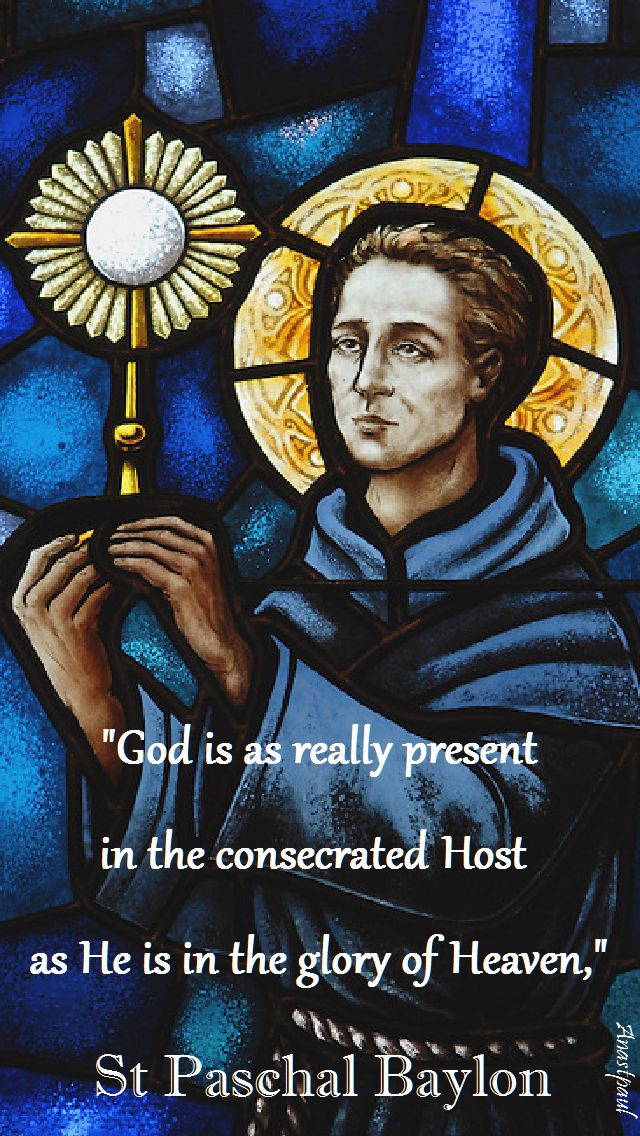
REFLECTION – “God is as really present in the consecrated Host as He is in the glory of Heaven,”…………St Paschal Baylon

god is as really pesent - st paschal baylon

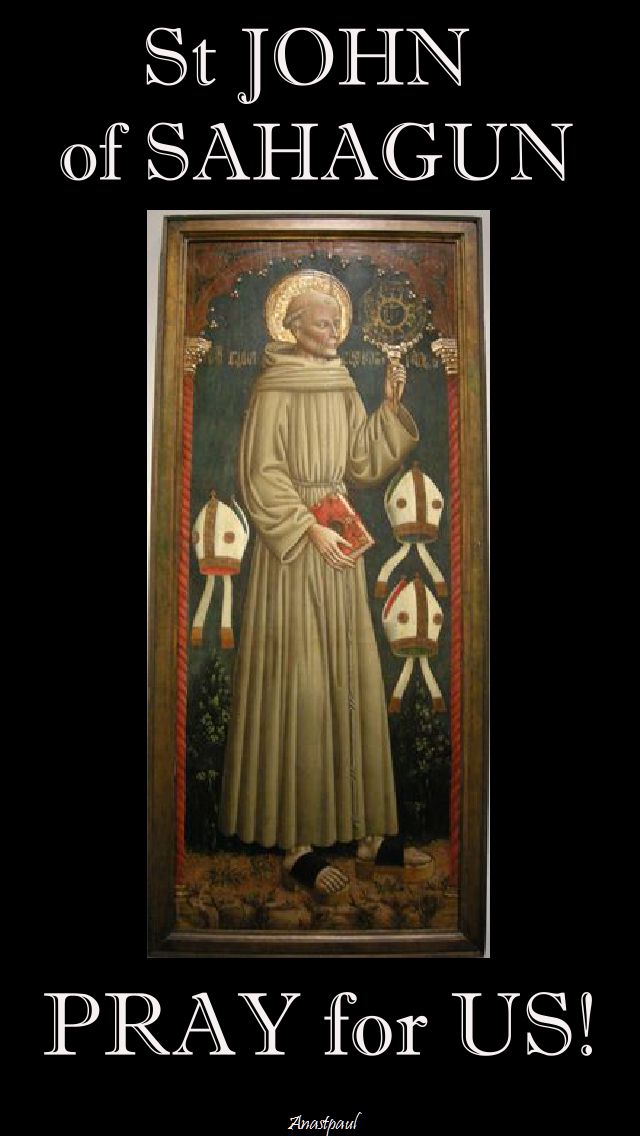
PRAYER – Jesus my Lord and God, You have come to us. You are here with us. How blessed we are and how blessed St John of Sahagun who was able to speak with You during the celebration of the Eucharist and who spent countless hours with You in holy adoration. Teach us all, that we too may learn the glory of spending time with You in loving adoration. St John of Sahagun pray for us! amen.

ST JOHN OF SAHAGUN PRAY FOR US

Posted in CATHOLIC DEVOTIONS of the Month, MORNING Prayers, PRAYERS of the SAINTS, SACRED and IMMACULATE HEARTS

Our Morning Offering – 12 June

Our Morning Offering – 12 June – (June the Month of the Sacred Heart)

MOST SACRED, MOST LOVING HEART
By Blessed Cardinal John Henry Newman

Most Sacred, most loving Heart of Jesus,
You are concealed in the Holy Eucharist,
And You beat for us still.
Now, as then, You say: “With desire I have desired.”
I worship You with all my best love and awe,
With fervent affection,
With my most subdued, most resolved will.
For a while You take up Your abode within me.
O make my heart beat with Your Heart!
Purify it of all that is earthly,
All that is proud and sensual,
All that is hard and cruel,
Of all perversity,
Of all disorder,
Of all deadness.
So fill it with You,
That neither the events of the day,
Nor the circumstances of the time,
May have the power to ruffle it;
But that in Your love and Your fear,
It may have peace. Amen

most sacred, most loving heart - cardinal joh henry newman

Posted in SAINT of the DAY

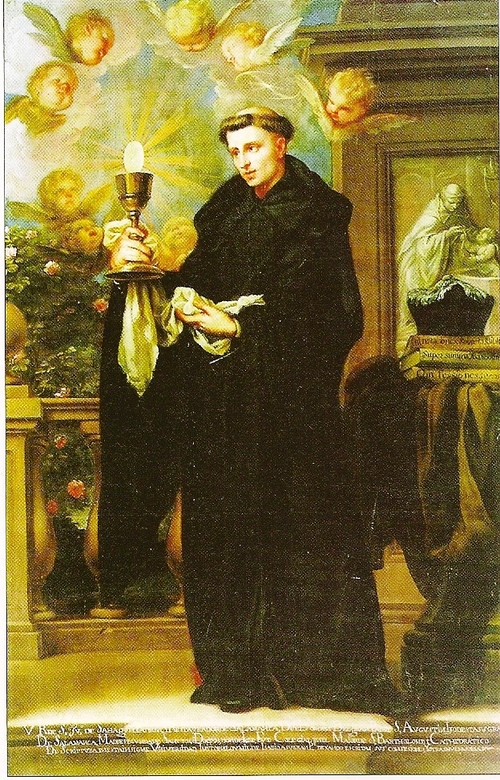
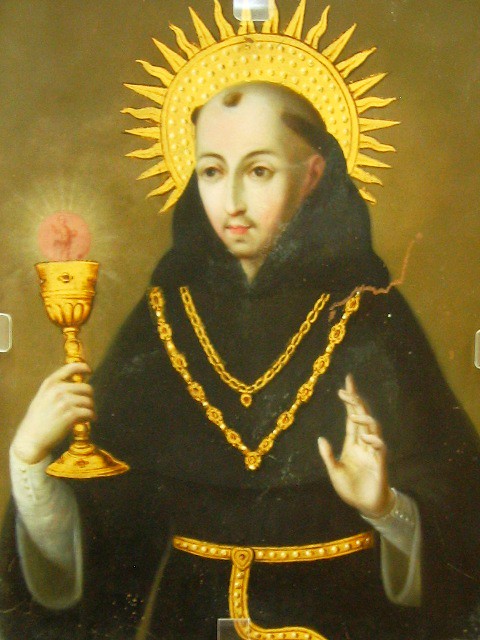
Saint of the Day – 12 June – St John of Sahagun OESA (1419-1479)

Saint of the Day – 11 June – Saint Juan de Sahagun OESA (1419-1479) Priest and Friar of the Order of the Augustinians, Preacher, Social Reformer, Defender of workers- born as Juan González de Castrillo on 1419 at Sahagun (Saint Fagondez), Léon, Spain and died on 11 June 1479 at Salamanca, Spain of natural causes. (However, there is a possible alternative cause of his death – he may have been poisoned by a woman whose lover, a nobleman, broke off their relationship after hearing Juan preach.   For this reason, he is sometimes listed as a Martyr.)    Patronages – the city of Salamanca, Spain, the Diocese of Salamanca, Candon City, Phillipines, Toledo, Spain.
Juan was a peacemaker and worker for justice in society.   A sincere and humble man, he was a noted preacher, whose devotion to the Eucharist marked all aspects of his life.
st john of sahagun 2

St John was born in the year 1419, at Sahagún (or San Facondo) in the Province of Leon. He was the oldest of the seven children of Juan González del Castrillo and Sancha Martínez, a wealthy family of the city.   He received his early education from the monks of the Royal Monastery of St. Benedict in his native city, a leading religious and educational center in the region known as the Cluny of Spain.   He received the tonsure while still a youth, according to the custom of the times, after which his father procured for him the benefice of the neighbouring parish of Tornillo.   He was later introduced to Alfonso de Cartagena, the Bishop of Burgos (1435–1456), who was impressed by the bright, high-spirited boy. Cartagena had him educated at his own residence, gave him several prebends, ordained him a priest in the year 1445, and made him a canon at the Cathedral of Burgos.

Possessing all of these offices simultaneously caused González many qualms of conscience, as it was contrary to the precepts of Christ.   He soon resigned all, retaining only that of the Chapel of St. Agatha in a poor neighbourhood of the city, where he said Mass, preached and the faith to the poor.   He then began to lead a life of strict poverty and mortification.   With his bishop’s consent, Juan obtained permission to enter the University of Salamanca, where for four years he applied himself to the study of theology.   During this time he exercised the ministry at the chapel of the College of St Bartholomew (in the Parish of St Sebastian) and held that position for nine years.   He devoted himself to pastoral care.   Owing to illness, he was obliged to undergo an operation for the removal of kidney stones.   He vowed that if his life were spared, he would become a Religious.San-Juan-de-Sahagún.-La-Vid-Burgos magnificent v lg
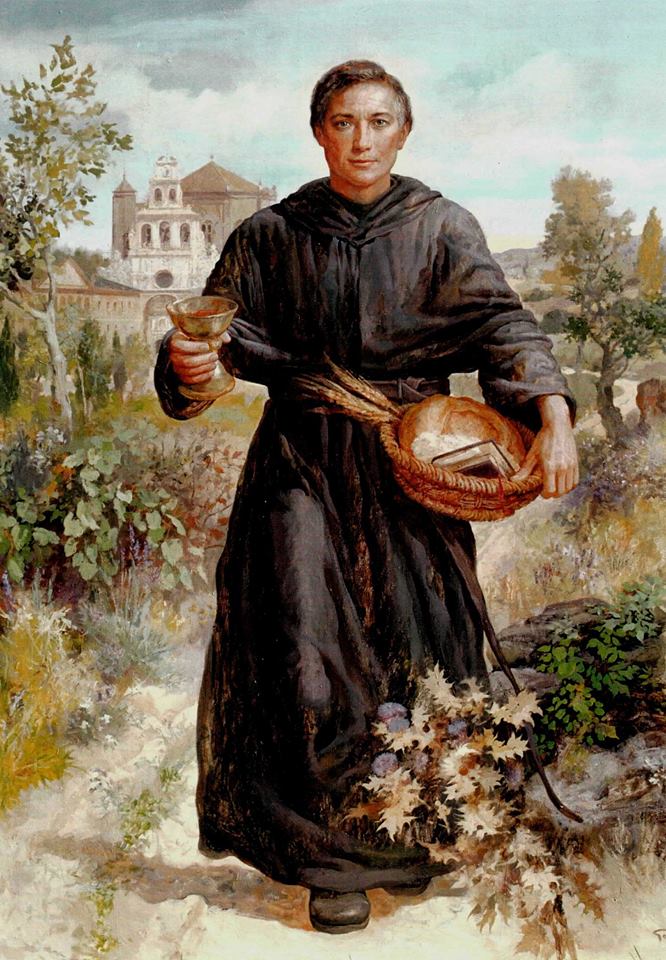
Upon his recovery in the year 1463, Juan applied for admission to the Order of Hermits of St Augustine, at the Monastery of St Peter, from that point on, being known simply as Brother (or Friar) Juan.   In the following year, on 28 August 1464, Juan made his profession of solemn vows as a member of the Order.   By the command of his superiors, John gave himself wholeheartedly to the salvation of souls and with the best results, to preaching the “Word of God.”   By his zeal he was able to effect the entire reformation of the city of Salamanca.

John made such progress in religious perfection that he was soon appointed master of novices, and later in the year 1471, prior of the community.   He conducted the Religious under his rule more by example than by his words.

Great was St John’s devotion to the Blessed Sacrament, that at the celebration of Mass he frequently saw the Sacred Host resplendent in glory.   He was gifted with a special power to penetrate the secrets of conscience, so that it was not easy to deceive him, and sinners were almost always forced to make good confessions.   He was able to obtain wonderful results in doing away with enmities and feuds.   In many ways, John was like a fellow Religious who lived nearly 500 years later, St Pio of Pietrelcina, who also had the uncanny ability to discern the secrets of conscience.

St John spent hours in Adoration of the Blessed Sacrament, as often as he could.   While he celebrated Mass St John often enjoyed the sight of Jesus in glory, becoming enraptured in ecstasy and holding conversations with Him.st juan sahagun lovely
In his sermons, John preached the Word of God and scourged the crimes and vices of the day, by which the rich and noble were offended.   6_12_john_of sahagun smlHe soon made many enemies, who went so far as to hire assassins but these, awed by the serenity and angelic sweetness of his countenance, lost courage.   Some women of Salamanca, embittered by the saint’s strong sermon against extravagance in dress, openly insulted him in the streets and pelted him with stones until stopped by a patrol of guards.

Saint John was acclaimed by the people of Salamanca as a wise and prudent confessor, an effective reconciler of feuding families   and a champion of the rights of workers.   A contemporary, when asked about Saint John, explained:  “If you ask me about the actions of Friar John, with regard to the poor and afflicted, exploited widows and children, the needy and the sick, I would have to say that he was naturally compelled to help them all in word and in deed. He was particularly interested in leading all to peace and harmony, and putting an end to hostility. Living in Salamanca, where the entire city was split into factions, he succeeded in preventing much bloodshed.”st juan of sahagun FRAMED
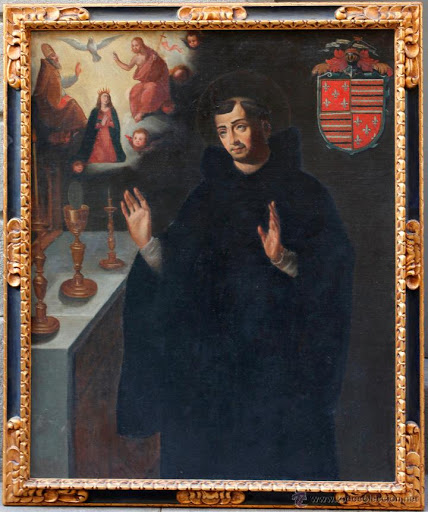
John’s scathing words on the “sins of impurity” produced salutary effects in a certain nobleman who had been living in open concubinage but the woman swore vengeance.   It was popularly believed that she had caused the saint’s death by poison (this statement is found only in later biographies).   His sermons against sinful living conditions and in support of the rights and dignity of workers brought him great opposition of some local leaders.   He became known as an outstanding preacher, whose style, clarity, sincerity, and integrity attracted large crowds and created many opportunities for conversion. 11-San Juan de San Facondo Gonzalez de Castrillo-11

To the Duke of Alba, who complained of John’s stern denunciation of the sins of nobility and commoners alike form the pulpit, John replied:  “It is becoming of Your Grace to know that a preacher must be prepared in his soul to speak the truth, both in denouncing and correcting shortcomings and in praising virtue, to such a point that he is willing in that cause even to face death.”   Incensed, the duke hired assassins to stop Saint John’s preaching but upon recognising John’s holiness, they repented, confessing and begging forgiveness—which he freely gave.  The duke later fell ill and was healed by John’s prayers, himself repenting and renouncing his former ways.

John died on 11 June 1479, in his monastery.   His remains were buried in the Old Cathedral of the city.   Soon after John’s death, his “cult” spread throughout Spain.   The process of beatification began in 1525 under Pope Clement VII and in 1601 he was declared “Blessed” by Pope Clement VIII and Canonised on 16 October 1690 by Pope Alexander VIII.

It is said that after he died, people continued to come to him. People came from different places to the Augustinian convent of Salamanca, where he was buried, to ask the saint for favours. Among the miracles performed, several are cited, including the resurrection of a dead person, the healing of a child hit by an ox cart, the recovery of cripples …

On 1 September 1835, the remains were transferred to the main altar of the Cathedral of Salamanca, where they are currently located.

This slideshow requires JavaScript.

Below is a Poster advertising the annual Feast and Festival of St Juan in Salamanca.
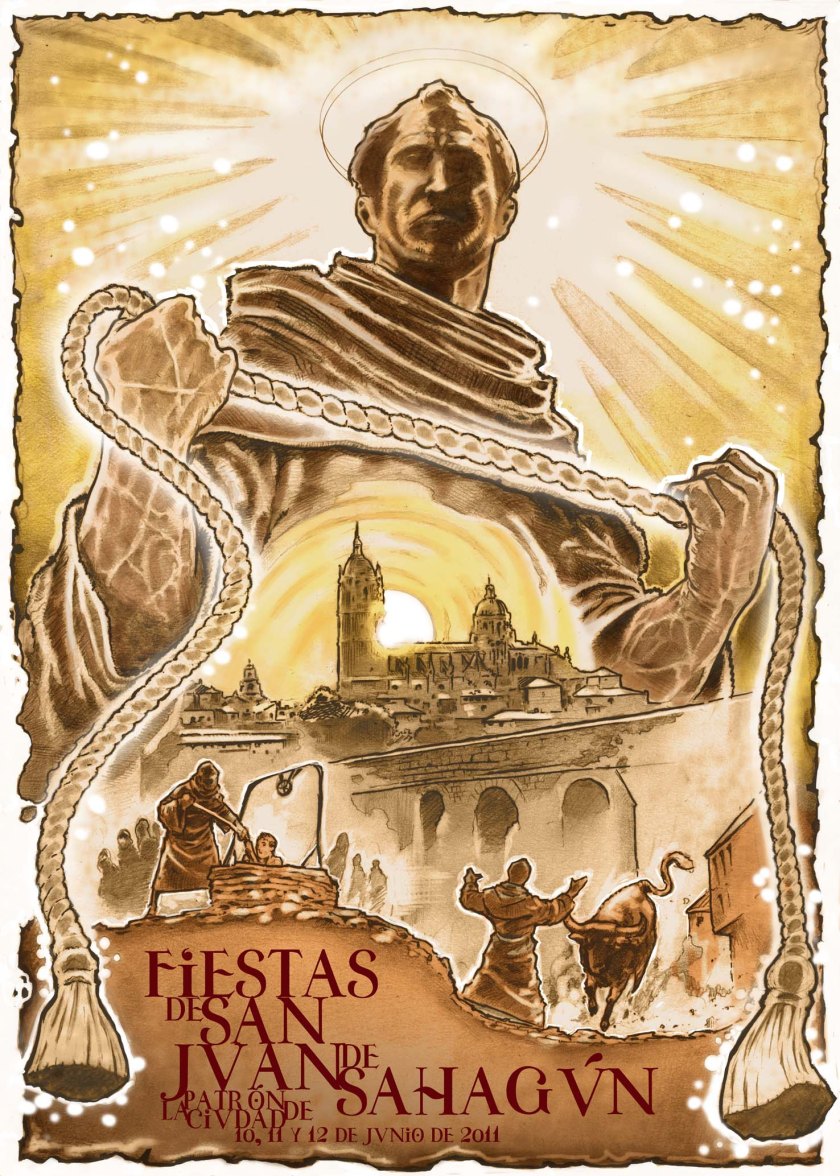
festival of st john of sahagun


Posted in FEASTS and SOLEMNITIES, SAINT of the DAY, The BLESSED VIRGIN MARY

Saints & Feasts- 12 June

Our Lady of Montalto

St Amphion of Nicomedia
Bl Antonia Maria Verna
Bl Antonio de Pietra
St Arsenius of Konev
St Christian O’Morgair of Clogher
St Chrodobald of Marchiennes
St Cominus
Bl Conrad of Maleville
St Cunera
St Cuniald
St Cyrinus of Antwerp
St Eskil
St Galen of Armenia
St Gaspar Bertoni
St Gerebald of Châlons-sur-Seine
St Geslar
Bl Guy Vignotelli of Cortona
St John of Sahagun
St Pope Leo III
St Lochinia of Ireland
Bl Lorenzo Maria Salvi
Bl Maria Candida Barba
Bl Mercedes Maria of Jesus
St Odulf of Utrecht
St Olympius of AEnos
St Onuphrius of Egypt
Bl Pelagia Leonti of Milazzo
St Peter of Mount Athos
St Placid of Val d’Ocre
Bl Stefan Kielman
St Ternan of Culross
St Valerius of Armenia

Posted in DOCTORS of the Church, FATHERS of the Church, FEASTS and SOLEMNITIES, MORNING Prayers, QUOTES of the SAINTS, The MOST HOLY & BLESSED TRINITY

St Augustine, the Holy Trinity, the Child and the SeaShell

St Augustine, the Holy Trinity, the Child and the SeaShell

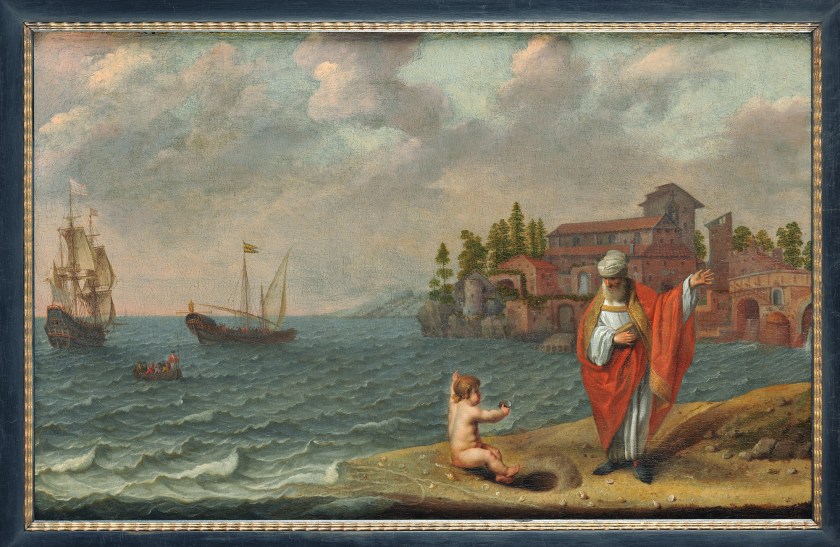
Today, 11 June 2017, on the Solemnity of the Holy Trinity, we remember the legend of St Augustine and the Seashell.

Abraham Willaerts – Saint Augustine and the child
Abraham Willaerts – St Augustine and the Child

The great Doctor of the Church St. Augustine of Hippo spent over 30 years working on his treatise De Trinitate [about the Holy Trinity], endeavouring to conceive an intelligible explanation for the mystery of the Trinity.

He was walking by the seashore one day contemplating and trying to understand the mystery of the Holy Trinity when he saw a small boy running back and forth from the water to a spot on the seashore.   The boy was using a sea shell to carry the water from the ocean and place it into a small hole in the sand.

The Bishop of Hippo approached him and asked, “My boy, what are doing?”

“I am trying to bring all the sea into this hole,” the boy replied with a sweet smile.

“But that is impossible, my dear child, the hole cannot contain all that water” said Augustine.

The boy paused in his work, stood up, looked into the eyes of the Saint, and replied, “It is no more impossible than what you are trying to do – comprehend the immensity of the mystery of the Holy Trinity with your small intelligence.”

The Saint was absorbed by such a keen response from that child, and turned his eyes from him for a short while.   When he glanced down to ask him something else, the boy had vanished.

ST AUGUSTINE AND THE CHILDst augustine and the child 2

Some say that it was an Angel sent by God to teach Augustine a lesson on pride in learning. Others affirm it was the Christ Child Himself who appeared to the Saint to remind him of the limits of human understanding before the great mysteries of our Faith.

Posted in Against STORMS, EARTHQUAKES, THUNDER & LIGHTENING, FIRES, DROUGHT / NATURAL DISASTERS, MORNING Prayers, Of and For PEACE, SAINT of the DAY, The APOSTLES & EVANGELISTS

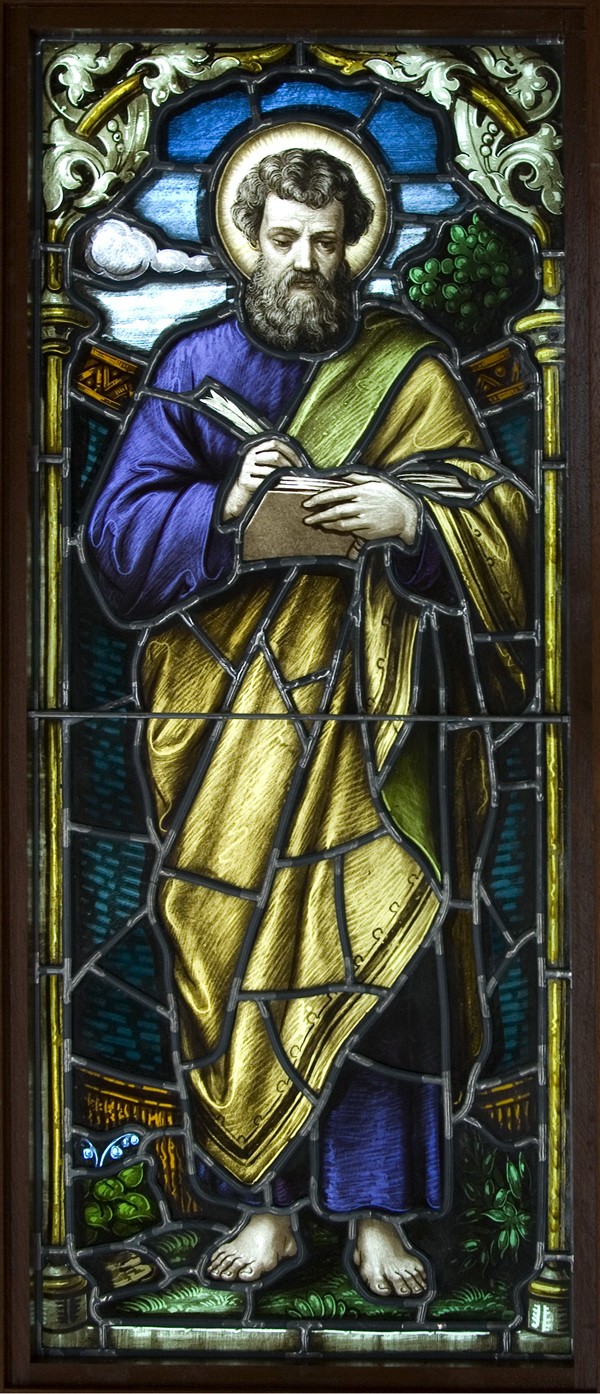
Saint of the Day – St Barnabas the Apostle, Son of Encouragement – 11 June

Saint of the Day – 11 June –  St Barnabas the Apostle – his name means  “Son of Encouragement.”   Patronages – Cyprus, Antioch, against hailstorms, invoked as peacemaker.

Say the word “Apostles” and most people will respond, “the twelve.”   By which, they mean the twelve-become-eleven-and-then-twelve-again:  Simon Peter, Andrew, James (son of Zebedee) John, Philip, Bartholomew, Thomas, Matthew, James (Son of Alphaeus), Jude (Thaddeus), Simon the Zealot, Judas and Matthias, who replaced Judas.   How, then, can the Church celebrate the Feast of St. Barnabas the Apostle every 11 June?

There are more than twelve apostles. The list includes Paul, Luke, John Mark, Lazarus and, today’s saint, Barnabas, who, like Paul, his travelling and preaching companion, was probably converted after Christ’ death, resurrection and ascension. We first hear of Barnabas in Acts 4:36-37:

“There was a Levite, a native of Cyprus, Joseph, to whom the apostles gave the name Barnabas (which means “son of encouragement”).   He sold a field of that belonged to him, then bought the money and laid it at the apostles’ feet.”
The story of Barnabas is told just before the story of Ananias and Sapphira, who kept back part of the proceeds from land they, like Barnabas, had sold and then, unlike Barnabas, lied to Peter about it.   Ananias and Sapphira wanted to be thought of as faithful without doing the work of faithfulness.   It’s instructive that Luke links their stories.

1128

From the day of his conversion Barnabas was faithful.   He was generous and open to all who came seeking Christ.   When the elders of the Jerusalem Church doubted Paul’s conversion, Barnabas vouched for him.   Born, like Paul, a Jew, Barnabas welcomed gentile converts and did not insist that their conversion be two-fold, first to Judaism and only then to Christianity.   With Paul, he spent a year in Antioch preaching Christ crucified to the gentiles.   From Antioch, Barnabas and Paul went to Cyprus and Asia Minor.   They had only one message: Jesus of Nazareth was crucified, died and was buried.   On the third day he rose again and appeared to the ones who have been sent out to tell this good news to all the world.

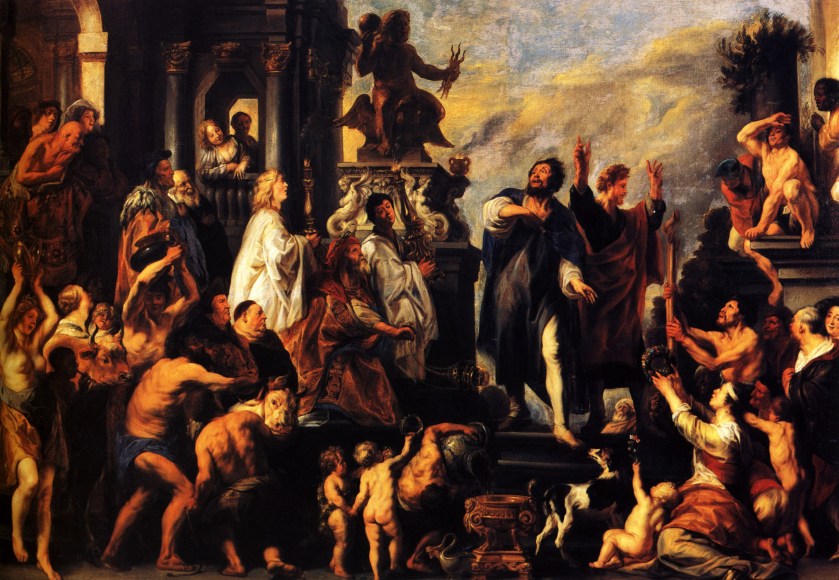
the-apostles-st-paul-and-st-barnabas-at-lystra-1645
← → The Apostles, St. Paul And St. Barnabas At Lystra Jacob Jordaens – 1645

Barnabas and Paul finally separated in their ministries, while remaining apostles of the one Catholic Church, over Paul’s insistence that Mark not travel with them again.

In death, however, the “Apostles to the Gentiles” were reunited. Mark is said to have buried Barnabas after he was killed by a mob in Cyprus around the year 62.   St Paul and St Mark were, in turn, reconciled before St. Paul’s martyrdom five years later.

He is said to have been stoned to death in Salamis in the year 61.

Paul writes of him in first letter to the church at Corinth, where he makes clear that both he and Barnabas have to work for a living.   So we know he was preaching and teaching as late as 56 or 57 A.D.   Some sources say he was the first Bishop of Milan.   In Acts 11:24, St. Luke called him “a good man, full of the Holy Spirit and of faith.”   Luke writes as a result of Barnabas’ preaching in Antioch, “a great many people were brought to the Lord.”

Sometimes the stories of martyrdoms are so dramatic and so compelling that we focus on the death of the saint rather than the life.   Barnabas calls us to consider the way we live, and then through this way, preparing for our deaths.

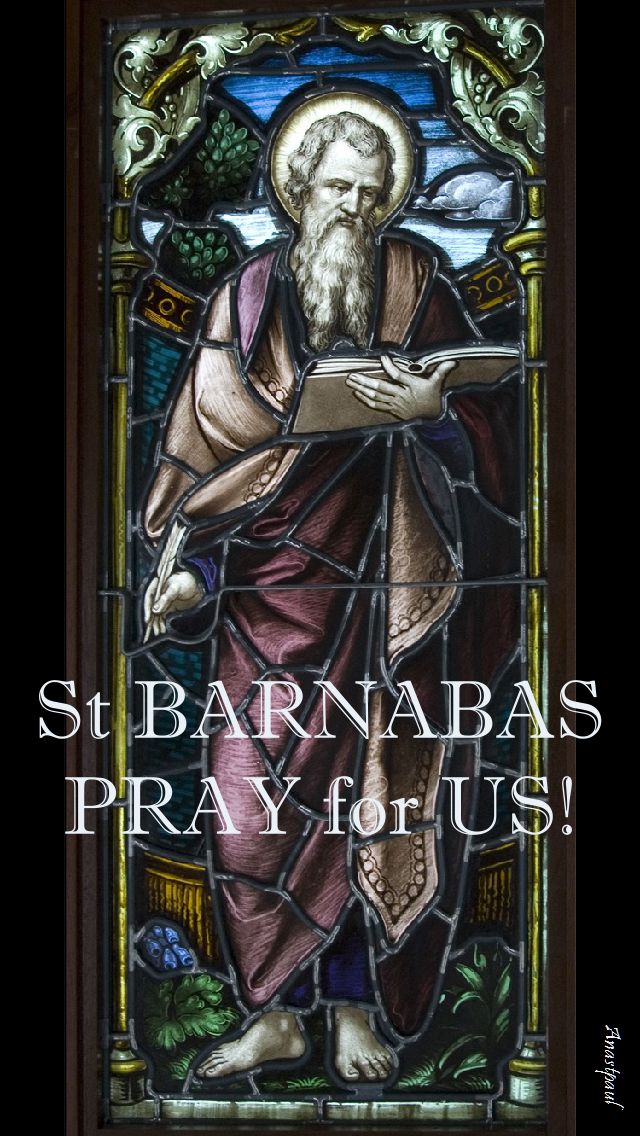
St Barnabas, pray for us!

st barnabas pray for us

Posted in CATHOLIC Quotes, DOCTORS of the Church, MORNING Prayers, QUOTES of the SAINTS, The MOST HOLY & BLESSED TRINITY

One Minute Reflection – 11 June – The Solemnity of the Holy Trinity

One Minute Reflection – 11 June – The Solemnity of the Holy Trinity

Brothers and sisters, rejoice.
Mend your ways, encourage one another,
agree with one another, live in peace,
and the God of love and peace will be with you.
Greet one another with a holy kiss.
All the holy ones greet you.
The grace of the Lord Jesus Christ
and the love of God
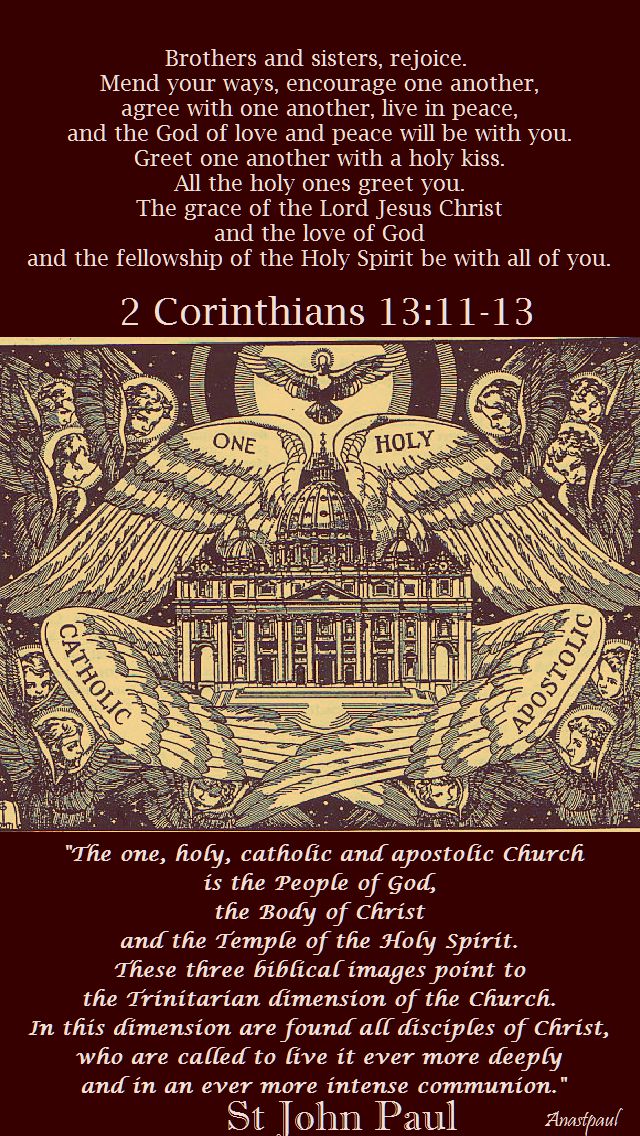
and the fellowship of the Holy Spirit be with all of you………..2 Corinthians 13:11-13

REFLECTION – “The one, holy, catholic and apostolic Church is the People of God, the Body of Christ and the Temple of the Holy Spirit.   These three biblical images point to the Trinitarian dimension of the Church.   In this dimension are found all disciples of Christ, who are called to live it ever more deeply and in an ever more intense communion.”…..St John Paul

the one holy - st john paul

PRAYER – God our Father, who by sending into the world. the Word of truth and the Spirit of sanctification, made known to the human race your wondrous mystery, grant us, we pray, that in profession the true faith, we may acknowledge the Trinity of eternal glory and adore your Unity, powerful in majesty. T  hat we, as your chosen may too live our lives in total unity with all the peoples of Christ’s Church.   Through our Lord Jesus Christ, your Son, who lives and reigns with you in the unity of the Holy Spirit, one God, for ever and ever. Amen

Posted in MORNING Prayers, NOVENAS, Uncategorized

St ANTHONY of PADUA NOVENA for all our Needs – DAY EIGHT – 11 June

St ANTHONY of PADUA NOVENA for all our Needs – DAY EIGHT – 11 June

day eight-novena st anthony

DAY EIGHT

O holy St. Anthony,
you have shown yourself so powerful in your intercession,
so tender and so compassionate towards those who honour you
and invoke you in suffering and distress.
I beseech you most humbly and earnestly
to take me under your protection in my present necessities
and to obtain for me the favour I desire
(State your intention).
Recommend my request to the merciful Queen of Heaven,
that she may plead my cause with you
before the throne of her Divine Son.

One Our Father, one Hail Mary, and Glory Be to the Father, in honour of Saint Anthony.

Saint Anthony, pray for us!

Posted in BREVIARY Prayers, MORNING Prayers, PRAYERS of the CHURCH, The MOST HOLY & BLESSED TRINITY

Our Morning Offering- 11 June 2017 – The Solemnity of the Holy Trinity

Our Morning Offering- 11 June 2017 – The Solemnity of the Holy Trinity

The hymn Te Deum is a moving tribute to God in His triune majesty. Its authorship has been traditionally attributed to Saints Ambrose (it has often been called an Ambrosian Hymn) and Augustine on the occasion of the latter’s baptism by the former in AD 387

It was more likely written by St. Nicetas, Bishop of Remesiana at about the same time period.   It is still part of the Liturgy of the Hours, the public prayers of the Church that are recited daily by the clergy and other religious, along with many of the laity as well.

Te Deum has been set to music by such illustrious composers as Mozart, Haydn, Verdi, Dvorak, Britten and Penderecki.   Its name comes from its opening words in Latin, “Te Deum Laudamus” (“O God we praise you”).

As you read the text of this hymn printed below (which can also be recited as a prayer, of course), you can get a sense of its grandeur!   It gives us a glimpse of heaven, with saints and angels praising God, before focusing on Christ in lines suggestive of the Apostle’s Creed.   It also includes some verses from the Psalms added at a later date (the lines after the space below).

TE DEUM

O, God, we praise You and acknowledge You
to be the supreme Lord.
Everlasting Father, all the earth worships You.
All the angels, the heavens and all angelic powers,
All the cherubim and seraphim, continually cry to you:
Holy, holy, holy, Lord God of Hosts!
Heaven and earth are full of the majesty of Your glory.
The glorious choir of the apostles,
The wonderful company of prophets,
The white-robed army of martyrs, praise You.
Holy Church throughout the world acknowledges You:
The Father of infinite majesty;
Your adorable, true and only Son;
Also the Holy Spirit, the Comforter.
O Christ, You are the King of glory!
You are the everlasting Son of the Father.
When You took it upon Yourself to deliver man,
You did not disdain the Virgin’s womb.
Having overcome the sting of death,
You opened the kingdom of heaven to all believers.
You sit at the right hand of God in the glory of the Father.
We believe that You will come to be our Judge.
We, therefore, beg You to help Your servants
whom You have redeemed with Your Precious Blood.
Let them be numbered with Your saints in everlasting glory.

Save Your people, O Lord, and bless Your inheritance!
Govern them and raise them up forever.
Every day we thank You.
And we praise Your name forever; yes, forever and ever.
O Lord, deign to keep us from sin this day.
Have mercy on us, O Lord, have mercy on us.
Let your mercy, O lord be upon us, for we have hoped in You.
O Lord, in you I have put my trust; never let me be put to shame.

TE DEUM - O GOD WE PRAISE YOU

Te Deum combines important elements of prayer to God, including adoration, supplication (particularly towards the end in its appeal for God’s mercy) and thanksgiving.   (It is often referred to as a Hymn of Thanksgiving).   The Church triumphant (those in heaven) and the Church militant (those on earth) sing God’s praises in adoration in this hymn.

We can see thanksgiving here in the acknowledgement of Christ’s opening “the kingdom of heaven to all believers” and redeeming us with His Precious Blood at Calvary.

The reference to Christ’s having overcome the sting of death also brings to mind the words of St. Paul, who spoke of our Lord as having overcome sin and death in His passion, saying “death, where is thy sting?” (1 Cor 15:55).

We see another good example of gratitude in Te Deum as well in the line that our Lord “did not disdain the Virgin’s womb”, becoming human like us in order to save us. (Indeed, as we hear in the Liturgy of the Eucharist at Mass, Jesus “humbled Himself to share in our humanity”!)

The last line, taken from Psalm 25, verse 2, is particularly moving.   It brings to mind the importance of trusting in our Lord to see us through our troubles if we stay close to Him in prayer, obedience and love.   And we are reminded here as well of the importance of asking God for His mercy in our often challenging journey towards Eternal Life with Him in the Kingdom of Heaven!

Posted in FEASTS and SOLEMNITIES, MORNING Prayers, The MOST HOLY & BLESSED TRINITY

Celebrating the Solemnity of the Holy Trinity – 11 June 2017

Celebrating the Solemnity of the Holy Trinity – 11 June 2017

The fundamental dogma, on which everything in Christianity is based, is that of the Blessed Trinity in whose name all Christians are baptised.   The feast of the Blessed Trinity needs to be understood and celebrated as a prolongation of the mysteries of Christ and as the solemn expression of our faith in this triune life of the Divine Persons, to which we have been given access by Baptism and by the Redemption won for us by Christ.   Only in heaven shall we properly understand what it means, in union with Christ, to share as sons in the very life of God.

The feast of the Blessed Trinity was introduced in the ninth century and was only inserted in the general calendar of the Church in the fourteenth century by Pope John XXII.   But the cultus of the Trinity is, of course, to be found throughout the liturgy. Constantly the Church causes us to praise and adore the thrice-holy God who has so shown His mercy towards us and has given us to share in His life.

The Holy Trinity


Trinity Sunday
The dogma of faith which forms the object of the feast is this:  there is one God and in this one God there are three Divine Persons;  the Father is God, the Son is God, the Holy Spirit is God.   Yet there are not three Gods, but one, eternal, incomprehensible God!   The Father is not more God than the Son, neither is the Son more God than the Holy Spirit. The Father is the first Divine Person; the Son is the second Divine Person, begotten from the nature of the Father from eternity; the Holy Spirit is the third Divine Person, proceeding from the Father and the Son.   No mortal can fully fathom this sublime truth. But I submit humbly and say: Lord, I believe, help my unbelief..

Why is this feast celebrated at this particular time? It may be interpreted as a finale to all the preceding feasts.   All three Persons contributed to and shared in the work of redemption.   The Father sent His Son to earth, for “God so loved the world as to give His only-begotten Son.”   The Father called us to the faith.   The Son, our Saviour Jesus Christ, became man and died for us.   He redeemed us and made us children of God.   He ever remains the liturgist par excellence to whom we are united in all sacred functions.   After Christ’s ascension the Holy Spirit, however, became our Teacher, our Leader, our Guide, our Consoller.   On solemn occasions a thanksgiving Te Deum rises spontaneously from Christian hearts.

The feast of the Most Holy Trinity may well be regarded as the Church’s Te Deum of gratitude over all the blessings of the Christmas and Easter seasons;  for this mystery is a synthesis of Christmas, Epiphany, Easter, Ascension and Pentecost.   This feast, which falls on the first Sunday after Pentecost, should make us mindful that actually every Sunday is devoted to the honour of the Most Holy Trinity, that every Sunday is sanctified and consecrated to the triune God.   Sunday after Sunday we should recall in a spirit of gratitude the gifts which the Blessed Trinity is bestowing upon us.   The Father created and predestined us;  on the first day of the week He began the work of creation.   The Son redeemed us;  Sunday is the “Day of the Lord,” the day of His resurrection.   The Holy Spirit sanctified us, made us His temple;  on Sunday the Holy Spirit descended upon the infant Church. Sunday, therefore, is the day of the Most Holy Trinity.

Excerpted from The Church’s Year of Grace, Pius Parsch

Symbols of the Trinity: Equilateral Triange; Circle of Eternity; Three interwoven Circles; Triangle in Circle; Circle within Triangle; Interwoven Circle and Triangle; Two Triangles interwoven in shape of Star of David; Two Triangles in shape of Star of David interwoven with Circle; Trefoil; Trefoil and Triangle; Trefoil with points; Triquetra; Triquetra and circle; Shield of the Holy Trinity; Three Fishes linked together in shape of a triangle; Cross and Triangle overlapping; Fleur de Lys; St. Patrick’s Shamrock.

Blessed and Holy Solemity of the Holy Trinity to all!

Posted in DOCTORS of the Church, FATHERS of the Church, FEASTS and SOLEMNITIES, MORNING Prayers, QUOTES of the SAINTS, The MOST HOLY & BLESSED TRINITY

Thought for the Day – 11 June 2017 – The Solemnity of the Holy Trinity

Thought for the Day – 11 June 2017 – The Solemnity of the Holy Trinity

The Trinity dogma is not the result of poetic fantasies or of philosophical elucubrations. Nor it is a rational theological formulation that offers the pretext of saying that it is a mystery so detached from our lives that more than one Christian feels quietly authorised to ignore it.   The Mystery of the Trinity is a great mystery which surpasses our minds but speaks deeply to our heart because it is, in its essence, nothing but the explication of the profound expression of Saint John: “God is love” (1 Jn 4: 8,16).   If God is love, he cannot be loneliness in Himself.   In order to have a love affair, it must be at least two.   To love only oneself is not love, it is selfishness.   God Love is, at least, one who always loves and one who has always been loved and reciprocates love:  an eternal Lover, an eternal Beloved and an eternal Love.

The Lover is God, the Father in love, infinitely free and generous in love, motivated to love by no other thing than love.

The eternal Beloved, is the one who always welcomes love:  He is eternal gratitude, grace without beginning and end.  He is the Son in love.

Love is the Holy Spirit, in whom Their love is always open to self-donation and to “go out of their being”.   Therefore, the Spirit is said to be a gift of God, a living source of love, a fire that powers in us the ability to reciprocate Love with love.

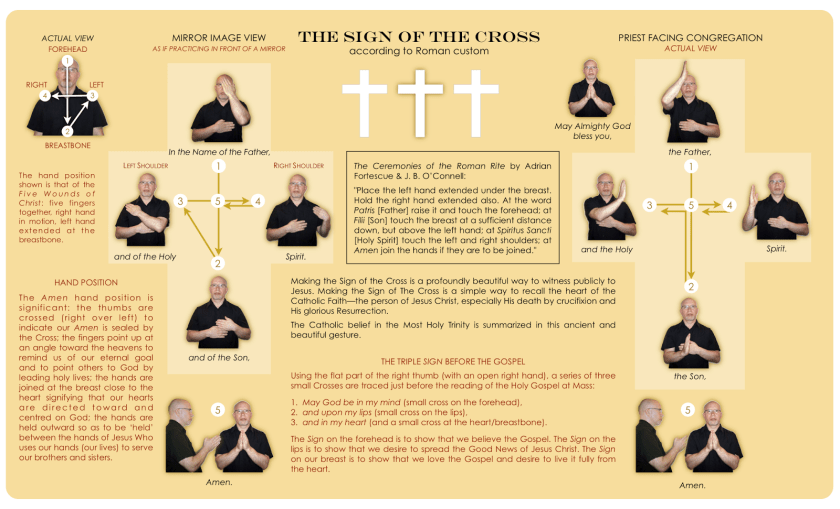
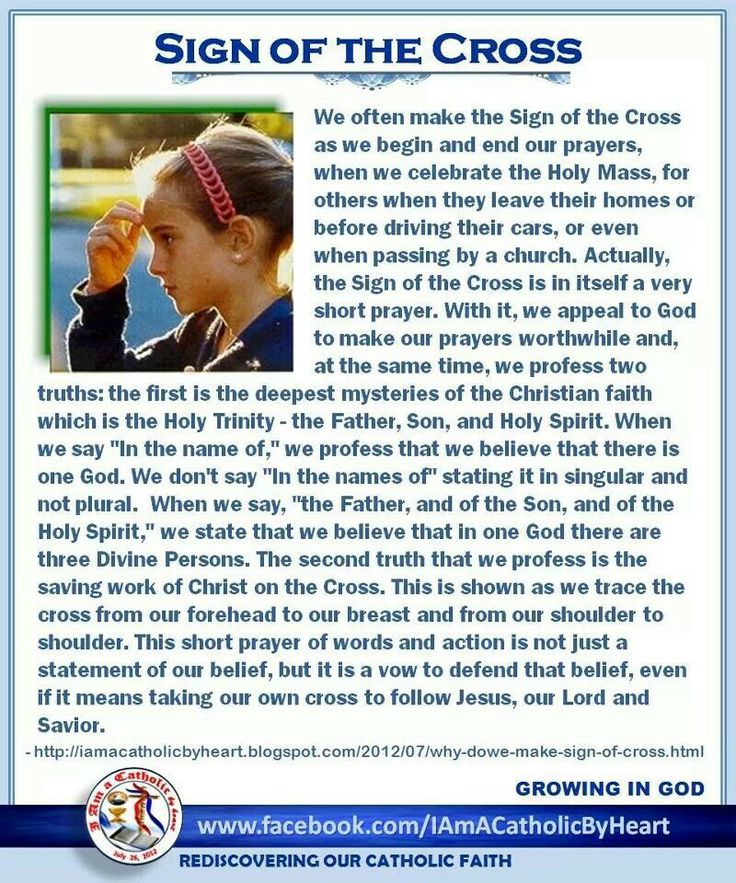
This mystery of love is concrete and close to us more than we think and we live it in practice when, above all in the most important or critical times where we most need God, we make the sign of the cross.   By marking this holy sign, almost without being fully aware, we call upon the One and Triune God , saying, “In the name of the Father, of the Son, and of the Holy Ghost”.   Not only do we invoke God Trinity to help us but we praise with the prayer “Glory to the Father, and to the Son and the Holy Ghost … Amen”. St. Teresa of Calcutta often recited as follows: “Glory to the Father-Prayer and to the Son -Poverty and the Holy Spirit- Zeal for souls. Amen-Mary. “   (JUNE 9, 2017 ARCHBISHOP FRANCESCO FOLLO)

Making the Sign of the Cross (1)the sign of the cross

How can we put the sign of the Cross into practice? Here are some ways you can make the sign of the Cross a part of your daily life.

1.   Immediately after waking and before sleeping – making the sign of the Cross immediately after waking and before sleeping is as ancient as Christianity. It is a powerful way to consecrate our day to Our Lord.

2.   When passing a Catholic Church – there is a beautiful Catholic tradition of crossing oneself while passing a Catholic Church in order to recognize Jesus present in the tabernacle and to show Him honour and love.

2.   At the Name of the Holy Trinity – in Catholic prayer, the name of the Holy Trinity is often invoked.   To show honour to the Holy Trinity, it is a good idea to Cross yourself when saying the Glory Be or any other time the Name is invoked.

3.   In reparation for blasphemy – the name of God is abused frequently in daily conversations.   If you want to make an act of reparation to God for this abuse of his Name, you can quietly make the sign of the Cross.

4.   Before entering a room or house – G.K. Chesterton, the famous Catholic convert and all around genius, was said to have made the sign of the cross before entering any room. This Catholic custom also applies to entering a house and many have Holy Water fonts next to the door for blessings oneself when entering or leaving the home.

5.   Blessing people or things – a small sign of the cross can be traced on the forehead of a child or upon an object which you wish to bless.

6.   When afraid – in old movies that involve Catholicism, you will often see people cross themselves when in the presence of death, upon receiving bad news, or when generally afraid.   Sadly, this custom has fallen out of use but it is an excellent way to drive away fear and to inspire courage.

There are countless other ways to employ the powerful sign of the Cross.  The point is, we should use this powerful sign frequently and reverently, paying attention to what we are doing.


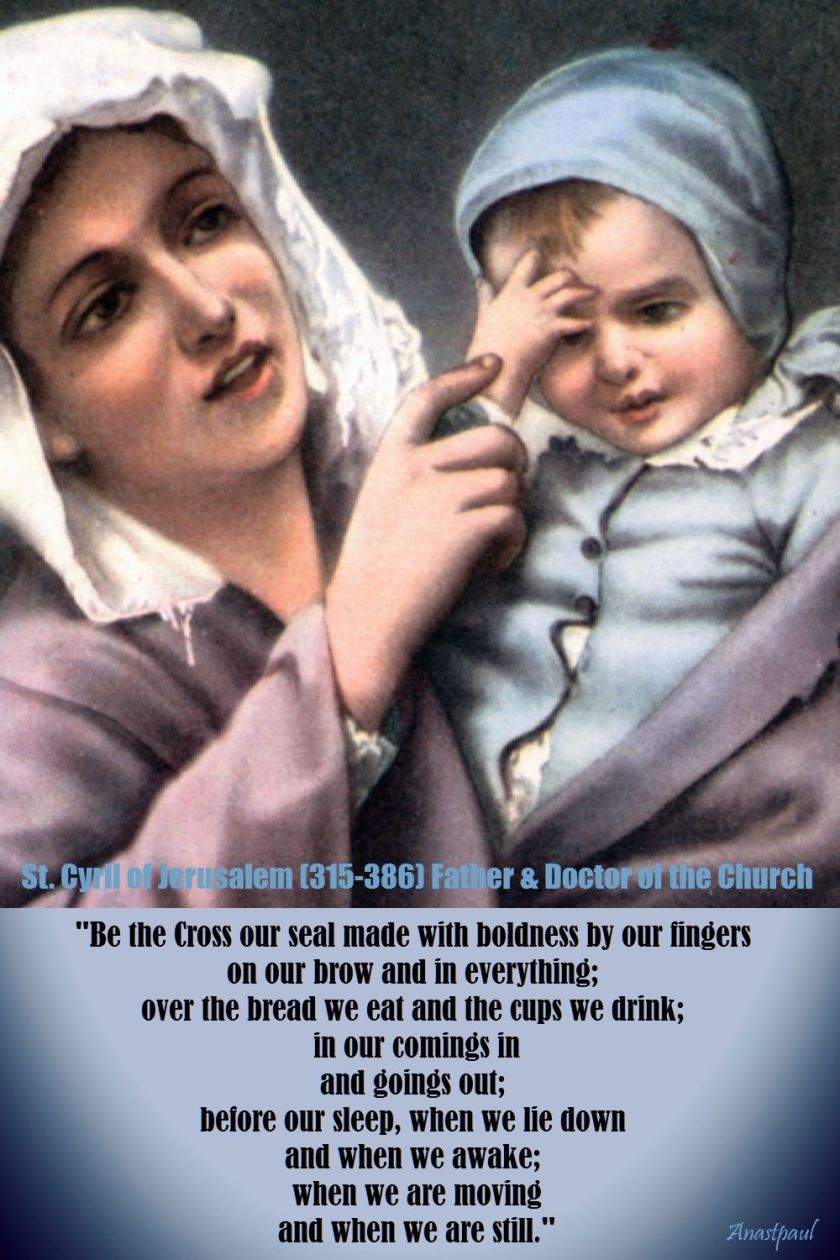
be he cross our seal-st cyril of jerusalem

“Let us not then be ashamed to confess the Crucified.   Be the Cross our seal made with boldness by our fingers on our brow and in everything; over the bread we eat and the cups we drink;  in our comings in and goings out; before our sleep, when we lie down and when we awake;  when we are in the way and when we are still.   Great is that preservative;  it is without price, for the poor’s sake;  without toil, for the sick, since also its grace is from God.   It is the Sign of the faithful and the dread of evils;  for He has triumphed over them in it, having made a shew of them openly;  for when they see the Cross, they are reminded of the Crucified;  they are afraid of Him, Who hath bruised the heads of the dragon.   Despise not the Seal, because of the freeness of the Gift; but for this rather honour thy Benefactor.”

– St. Cyril of Jerusalem

Posted in FEASTS and SOLEMNITIES, SAINT of the DAY, The BLESSED VIRGIN MARY

Saints, Feasts and Solemnities – 11 June

The Most Holy Trinity (Solemnity, 2017)
St Barnabas the Apostle (Memorial)
Our Lady of Mantara

St Aleydis of Schaerbeek
St Blitharius of Seganne
St Herebald of Bretagne
Bl Hugh of Marchiennes
Bl Ignazio Choukrallah Maloyan
Bl Jean de Bracq
Bl Kasper of Grimbergen
St Maximus of Naples
St Parisius
St Paula Frasinetti
St Riagail of Bangor
St Tochumra of Kilmore
St Tochumra of Tuam

Martyrs of Tavira – 7 beati: Members of the Knights of Santiago de Castilla. During the re-conquest of the Iberian peninsula from the Muslims by Christian forces, in a period of truce between the armies, the group was allowed to leave the Portuguese camp to hunt. Near Tavira, Portugal, he and his companions were ambushed and killed by a Muslim force. Making a reprisal attack, the Portuguese army took the city of Tavira. The murdered knights were considered to be martyrs as they died in an action defending the faith. They were –
• Blessed Alvarus Garcia
• Blessed Beltrão de Caia
• Blessed Damião Vaz
• Blessed Estêvão Vasques
• Blessed Garcia Roiz
• Blessed Mendus Valle
• Blessed Pedro Rodrigues
They were martyred in 1242 outside Tavira, Faro, Portugal. Their relics are enshrined under the altar of Saint Barnabas in the Church of Our Lady, Queen of the Angels (modern Santa Maria do Castelo) in Tavria

Mercedarian Martyrs of Damietta: Three Mercedarian lay knights who worked to ransom Christians enslaved by Muslims. During the 7th Crusade, a plague swept through the Christian army and these knights volunteered to work with the sick. During this work they were captured by Muslims and ordered to convert to Islam; they refused. They were tortured, taken to Damietta, Egypt where they were murdered for their faith. They were thrown from a tower in the mid-13th century in Damietta, Egypt.

Posted in DOCTORS of the Church, FATHERS of the Church, FEASTS and SOLEMNITIES, MORNING Prayers, QUOTES of the SAINTS, The MOST HOLY & BLESSED TRINITY

Quote of the Day – 11 June 2017 – Solemnity of the Holy Trinity

Quote of the Day – 11 June 2017 – Solemnity of the Holy Trinity

“Rise, you who were lying fast asleep….
Rise and hurry to the Church:
here is the Father,
here is the Son,
here is the Holy Spirit”
(In Lucam, VII)

St Ambrose (340-397) Father & Doctor

rise you who were lying fast asleep - st ambrose
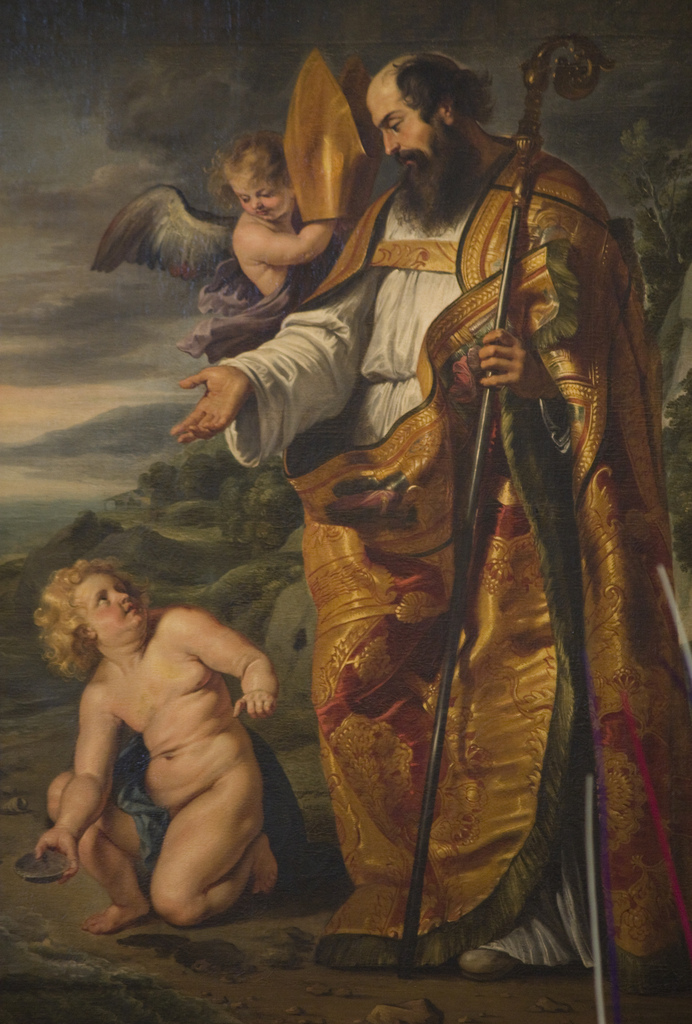
St Ambose – Peter Paul Rubens
Posted in CATHOLIC-PRAYERS OF THE CHURCH, MORNING Prayers, The MOST HOLY & BLESSED TRINITY

Our Morning Offering – 10 June

Our Morning Offering – 10 June

Daily Prayer to the Most Holy Trinity

Omnipotence of the Father,
help my weakness
and deliver me from the depth of misery.
Wisdom of the Son,
direct all my thoughts, words and actions.
Love of the Holy Spirit,
may You be the source and beginning
of all the operations of my soul,
whereby they may be always conformed
to the divine Will.
Amen

(Indulgence 200 days –Leo XIII)

daily prayer to the holy trinity

Posted in MORNING Prayers, NOVENAS

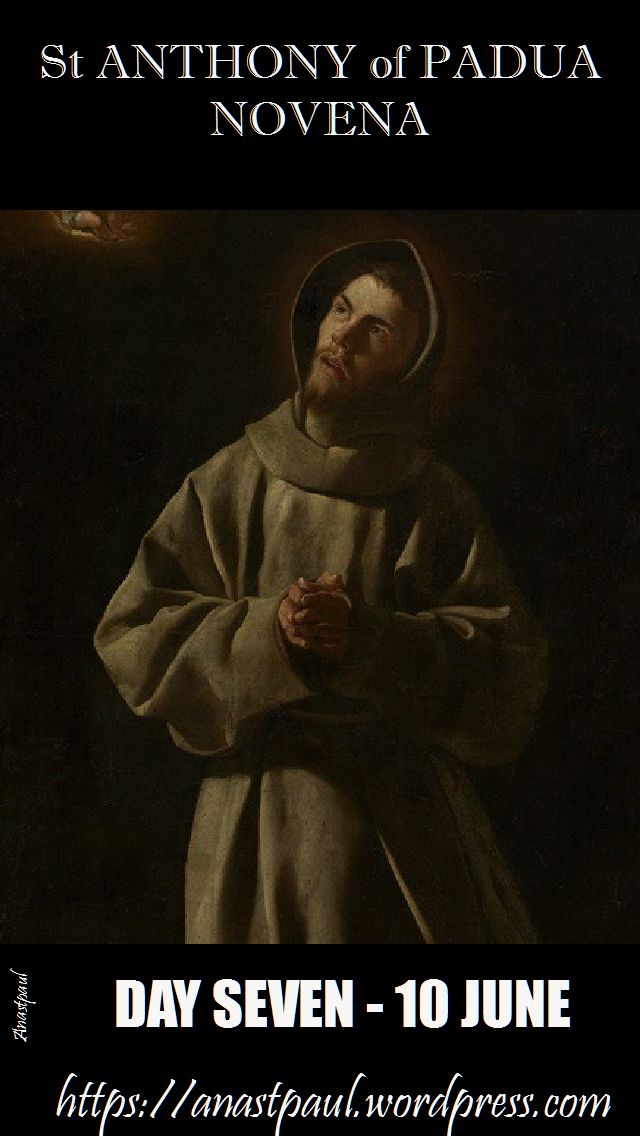
St ANTHONY NOVENA for all our Needs – DAY SEVEN – 10 JUNE

St ANTHONY NOVENA for all our Needs – DAY SEVEN – 10 JUNE

DAY SEVEN NOVENA ST ANTHONY

DAY SEVEN

O renowned champion of the faith of Christ,
most holy St. Anthony,
glorious for your many miracles,
obtain for me from the bounty of my Lord and God
the grace which I ardently seek in this novena
(State your intention) .
O holy St. Anthony,
ever attentive to those who invoke you,
grant me that aid of your powerful intercession.

One Our Father, one Hail Mary, and Glory Be to the Father, in honour of Saint Anthony.

Saint Anthony, pray for us!

Posted in EUCHARISTIC Adoration, QUOTES of the SAINTS, SAINT of the DAY

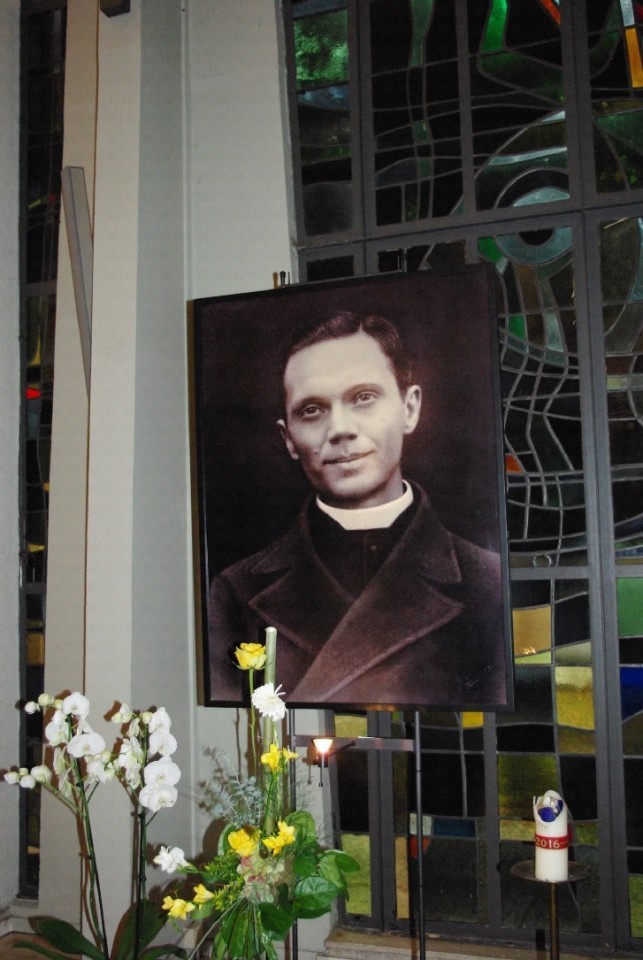
Thought for the Day – 10 June

“Thought for the Day – 10 June

The Eucharist: sun of his life!

To find the strength he needed, Bl Edward Poppe spent a great deal of time before the Tabernacle.
Sometimes he sighed, “Oh, Jesus, how little men love You! At least, the two of us love each other.”
On the eve of All Saints’ Day, after a long day of confessions,
a friend found him close to the Blessed Sacrament:
‘Edward, what are you doing there?”—
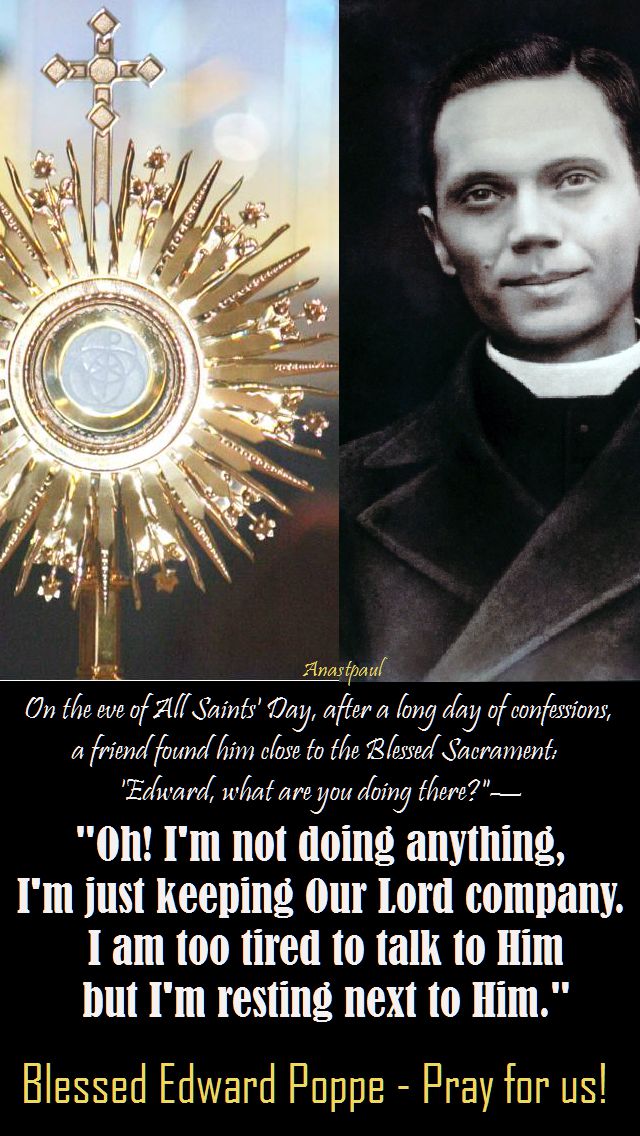
“Oh! I’m not doing anything, I’m just keeping Our Lord company.

I am too tired to talk to Him,

but I’m resting next to Him.”

Blessed Edward Joannes Maria Poppe, Pray for us!

oh i'm not doing anything- bl edward poppe

Prayer For Blessed Edward’s Intercession and Canonisation:

Heavenly Father,
We thank you for giving us Blessed Edward Poppe.
Through his intercession graciously hear our prayer.
Grant that our love
for your Son, for His Church and for the Blessed Eucharist may
increase.
May his testimony encourage many to live as true Christians.
May his example inspire young men to become priests for today.
Hasten the day of his glorification in the communion of your saints.
We
ask this through the intercession of Mary, his and our Mother. Amen.
Our Father…. Hail Mary…
Blessed Edward Poppe, Pray for us!

bl edward poppe - pray for us

Posted in DOCTORS of the Church, EUCHARISTIC Adoration, QUOTES of the SAINTS, Uncategorized

Quote of the Day – 10 June

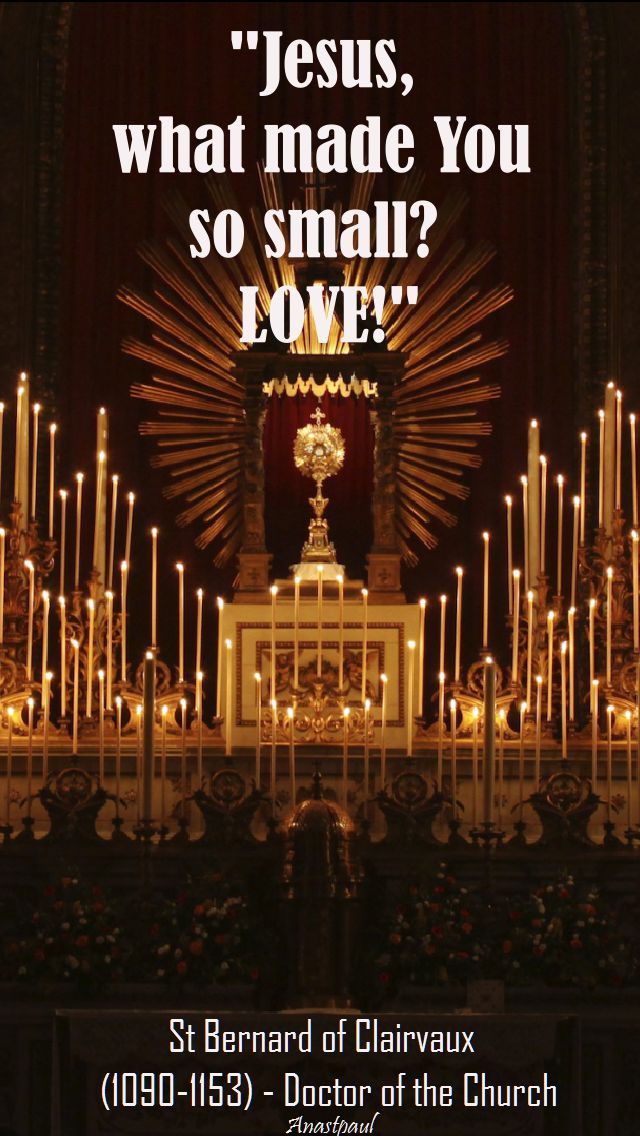
Quote of the Day – 10 June

“Jesus, what made You so small?
LOVE!”

– St. Bernard of Clairvaux (1090-1153)
Doctor of the Church

jesus what made you so small - LOVE - st bernard

Posted in DOCTORS of the Church, FATHERS of the Church, MORNING Prayers, QUOTES of the SAINTS, The MOST HOLY & BLESSED TRINITY, The WORD

One Minute Reflection – 10 June

One Minute Reflection – 10 June

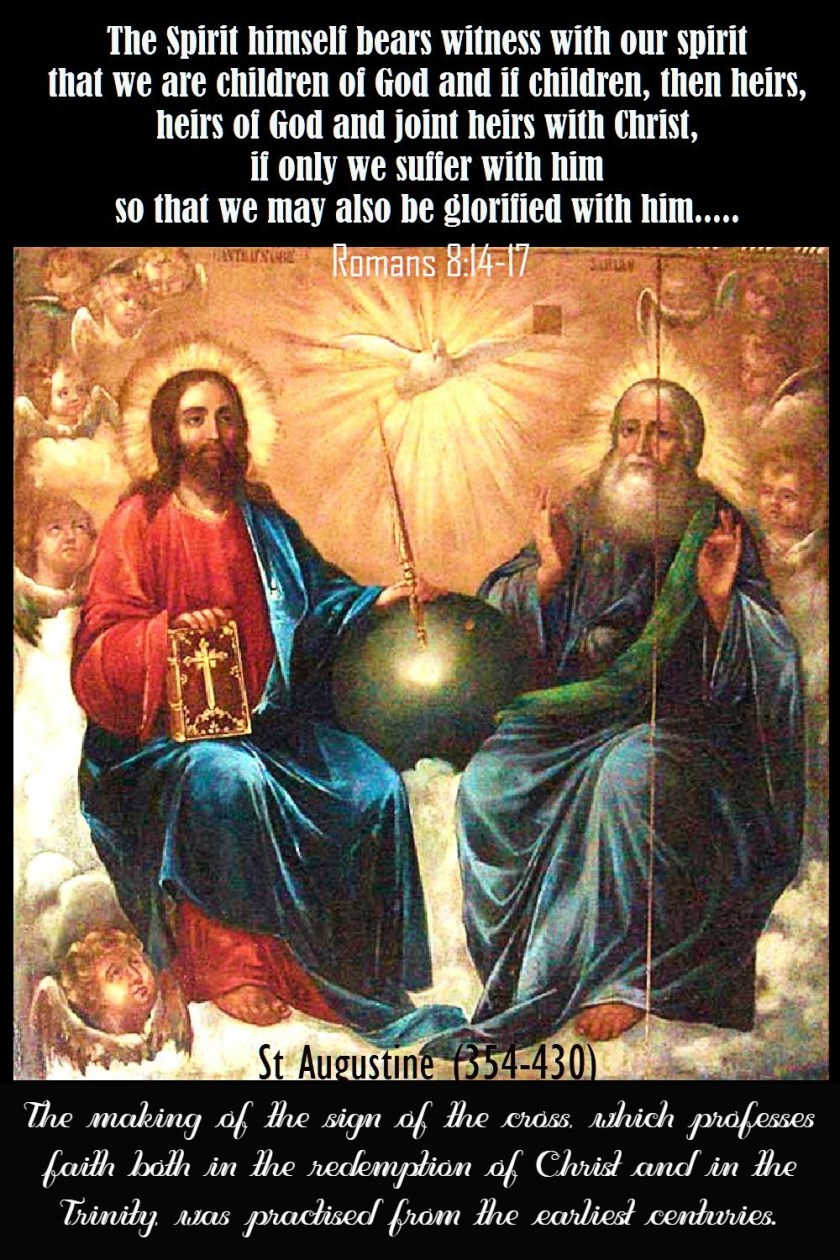
The Spirit himself bears witness with our spirit
that we are children of God
and if children, then heirs,
heirs of God and joint heirs with Christ,
if only we suffer with him,
so that we may also be glorified with him. …. Romans 8:14-17

REFLECTION – “The making of the sign of the cross, which professes faith both in the redemption of Christ and in the Trinity, was practised from the earliest centuries.”………….. St Augustine (354-430) Father and Doctor of the Churchthe making of the sign of the cross - st augustine


PRAYER – God our Father, who by sending into the world the Word of truth and the Spirit of sanctification made known to the human race your wondrous mystery, grant us, we pray, that in professing the true faith, we may acknowledge the Trinity of eternal glory and adore your Unity, powerful in majesty.   Through our Lord Jesus Christ, your Son, who lives and reigns with you in the unity of the Holy Spirit, one God, for ever and ever. Amen


Posted in SAINT of the DAY

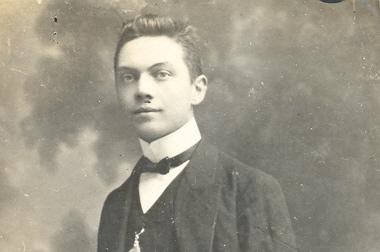
Saint of the Day – 10 June – Blessed Edward Joannes Maria Poppe

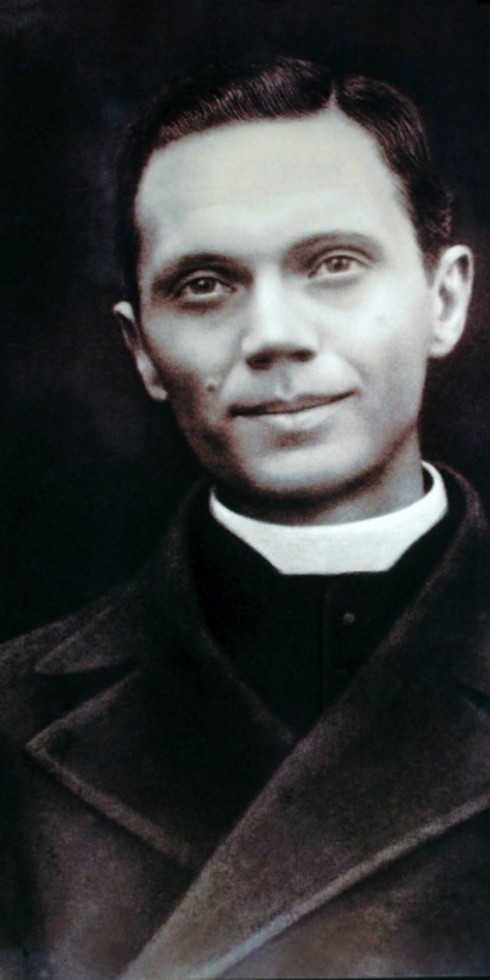
Saint of the Day – 10 June – Blessed Edward Joannes Maria Poppe  (18 December 1890 in Temse, Belgium – 10 June 1924 at Moerzeke, Belgium of a stroke, aged 34) Priest  – Apostle of Eucharistic Adoration, especially amongst children and of the Blessed Virgin Mary, Evangeliser, Reformer, Spiritual Director of Seminarians, Supporter of the Labourer – Patron of Moerzeke, Labourers, Military chaplains, Children’s Eucharistic Adoration.   Attributes – Priest’s robes.   Bl Edward’s beatification cause commenced on 5 April 1966 under Blessed Pope Paul VI and he became titled as a Servant of God as a result while the affirmation of his life of heroic virtue saw St Pope John Paul II name him as Venerable on 30 June 1986. That same pope beatified Poppe in Saint Peter’s Square on 3 October 1999.bl edward header


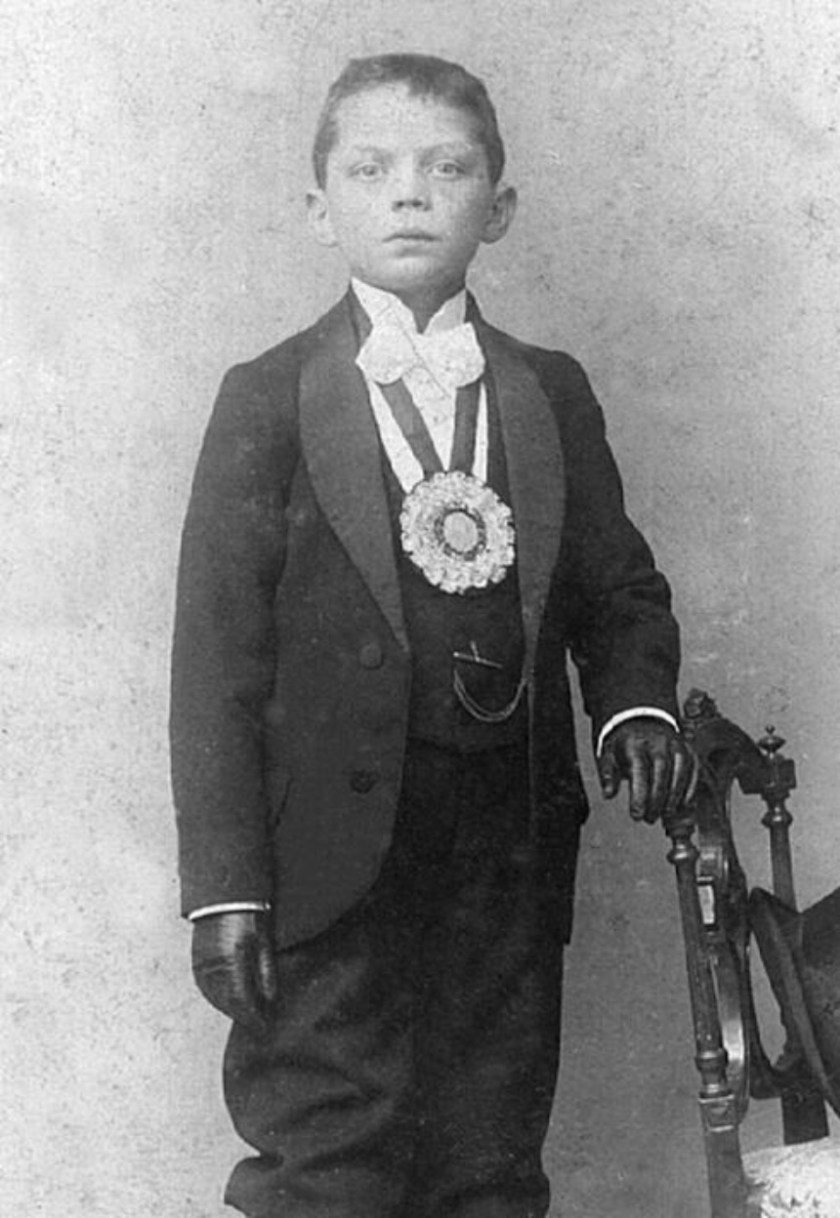
Edward Joannes Maria Poppe was born in Temse on 18 December 1890 as the third of eight children to the baker Dèsirè Aloies Poppe (25.12.1851-10.01.1907) and Josepha Ogiers (31.08.1863-21.10.1947).   One brother became a priest while five sisters were nuns and one daughter remained home alone with her mother.   He was an energetic child and an excellent student.   His mischievousness saw him often knock things over even putting himself at risk of being harmed.   He was also quite stubborn and never left his sisters alone though his sisters would often get back at him and would muss up his hair when he was caught combing in front of the mirror.   He was a big eater and liked to devour treats from his father’s store.  But in 1902 he received his First Communion and Confirmation and this made him more serious which meant jokes and teasing became rarer. bl young-Edouard-Poppe

In spring 1904 his father introduced him to his business plans and had hoped to see his son begin a baking apprenticeship though Poppe remained silent at first though his resolution to become a priest led him to tell his father as much.   Not long after a priest friend to his parents gave a favourable opinion of Poppe’s vocation to which his father told his mother:  “Let’s not be selfish. God has not given us our children for ourselves.”   He studied at the Sint-Niklaas St Joseph Minor Seminary from 1905 until 1910 where he became a member the De Klauwaerts association which was a student movement in the Flemish Movement before World War I.

Despite his father’s death on 10 January 1907 he was able to continue his studies and commenced his ecclesial studies in 1910 to become a priest.   But at first he wanted to take over his father’s business for his mother’s sake, though his mother did not like the idea and told him:  “Before he died, Papa made me promise to let you continue with your studies. I want to keep that promise.”   He was drafted in September 1910 and being a seminarian made him a target for harassment (he was mocked and provoked) while his companions’ vulgar nature was unendurable to him to what he called “a hell.”   He was also quite pained that he could not receive the Eucharist and go to Mass each week due to the rigidity of the army service.   But his time in the service still allowed for him to do his philosophical studies.   He liked to read poems which was something he had done since his childhood.

He began his studies in Thomism on 13 March 1912 at the Louvain college where he became influenced from the works of Saint Louis de Montfort which made him a fervent devotee of the Blessed Mother of God.   It was also around this time that he learnt about Saint Thérèse of Lisieux but he also had a love for Saint Francis of Assisi.   In September 1913 he moved to the Ghent for his studies where he became a member of the Filioli Caritatis which was a group of priests who aimed for holiness.   On 14 July 1913 he graduated in letters and philosophical studies at Louvain.bl edward poppe sml

The outbreak of World War I in 1914 saw Poppe called to arms as a battlefield nurse on 1 August but he fell ill in Namur at Bourlers on 25 August after having been at the battle site since 4 August.   He was placed half-dead in an ambulance van and was taken to Bourlers where the priest Castelain took care of him until December.   In his period of recuperation the Germans advancing had with them several prisoners of war and he appealed to Saint Joseph that these men be freed which led to their miraculous freeing all except a Frenchman;   Poppe renewed the appeal and the Frenchman returned. Father Castelain also told him about the life of Blessed Antoine Chevrier.   Once he recovered in he went to Mechelen to continue with his ecclesial studies in April 1915 after Cardinal Désiré-Joseph Mercier obtained for him a dispensation to leave the armed forces.

Priesthood
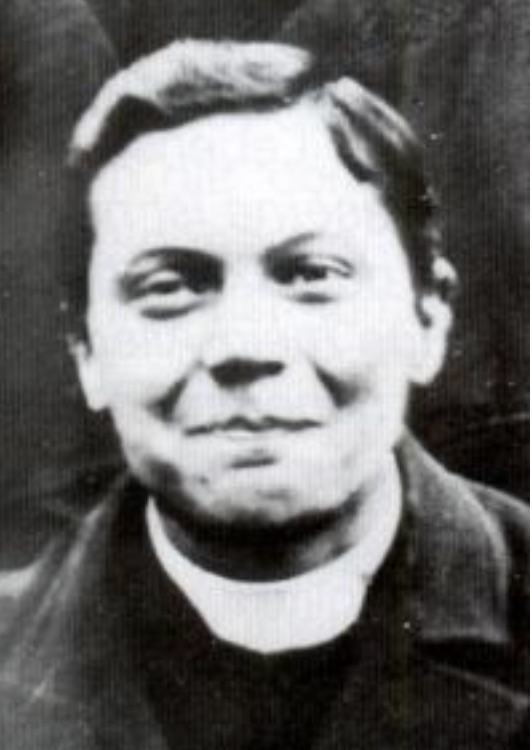
On 1 May 1916 he was ordained to the priesthood.   Poppe became the parish associate pastor in Sint-Coleta on 16 June 1916 which was a poor labourers’ parish in Ghent.   He started the Eucharistic League for the children (he dedicated this to Pope Pius X) and introduced them to the countless aspects of the faith and also taught catechism and handed children devotional cards.  He made it a practice to greet workers after their shifts ended in the late afternoon.   Poppe chose to live in poorness in order to be like his parishioners.Bl-Poppe-in-1913

He became exhausted in July 1917 due to his manner of living and his weak health and so was transferred to a convent in Moerzeke.   He was ordered to rest for a month though when he returned the pastor was concerned for him so discharged him from league meetings and catechetical lessons;   this made him heartbroken but he was obedient.  He was often confined to his bed but from there wrote numerous texts for the “Eucharistische Kruistocht” – Eucharistic Crusade) of the Averbode convent while often appearing in the popular adolescent magazine “Zonneland”.   In July 1918 he asked the Bishop of Ghent for a different post and so from 4 October 1918 until 1922 he served as the rector to the Vincentian Sisters.   But Poppe suffered a severe heart attack on 11 May 1919 (and received the Extreme Unction) though spent his time recovering in his bed while writing letters and articles that were criticisms of materialism and Marxism.   He suffered a much more serious heart attack on 8 June and could no longer have visits or celebrate Mass due to the severe status of his health.   He was weak but recovered over the next several months to the point where he managed to make a trip to visit the tomb of Saint Thérèse of Lisieux in France on 15 September 1920.

Declining health and death
Improvement in his health saw him appointed as the spiritual leader of the armed forces school in Leopoldsburg in October 1922 for seminarians and priests drawn into service.   But a cardiac crisis in 1923 – while visiting his mother on Christmas – made it impossible for him to return to Leopoldsburg and he again was confined to the Moerzeke convent. He suffered a heart attack on 1 January 1924 but suffered a severe relapse on 3 February.   Edward died from a stroke on the morning of 10 June 1924 as he prepared to dress and take care of affairs.   He received the Extreme Unction and gazed at an image of the Sacred Heart of Jesus as he died.

Post-mortem
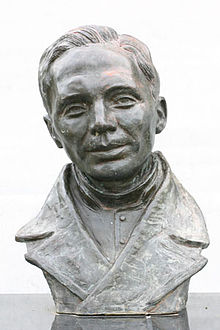
Cardinal Désiré-Joseph Mercier promoted him as an ideal of a good priest who was spiritual and ascetic and who was prepared to sacrifice his life for the faith.   His birth house in Temse has become a museum and the street is renamed “Priester Poppestraat,” another museum can be found in the Moerzeke convent.   There are statues of Poppe in both Moerzeke and Ghent.

Beatification
The miracle was required for his Beatification was investigated in the diocese of its origin from 4-19 January 1996 at which stage all documentation was sent to Rome and received C.C.S. validation in a decree on 28 June 1996.   Medical experts approved this healing as a miracle on 6 November 1997 as did the theologians on 31 March 1998 and the C.C.S. members on 1 July 1998.   John Paul II issued his approval to this miracle on 3 July 1998 and Beatified Poppe in Saint Peter’s Square on 3 October 1999.

img-Blessed-Edward-Joannes-Maria-Poppepoppe_edward-107-LR-191020130514_poppeEdward_Poppe_-_buste


Posted in FEASTS and SOLEMNITIES, SAINT of the DAY, The BLESSED VIRGIN MARY

Saints and Feasts – 10 June

Our Lady of the Grotto

Bl Amata of San Sisto
St Amantius of Tivoli
St Asterius of Petra
St Bardo of Mainz
Bl Bogumilus of Gniezno
St Caerealis of Tivoli
St Censurius of Auxerre
St Crispulus of Rome
Bl Edward Johannes Maria Poppe
Bl Elisabeth Hernden
Bl Elizabeth Guillen
St Evermund of Fontenay
St Faustina of Cyzicus
Bl Gerlac of Obermarchtal
St Getulius of Tivoli
Bl Henry of Treviso
St Illadan of Rathlihen
St Ithamar of Rochester
Bl John Dominici de Banchini
Bl José Manuel Claramonte Agut
Bl Joseph Kugler
St Landericus of Novalese
St Landericus of Paris
Bl Mary Magdalene of Carpi
St Maurinus of Cologne
St Primitivus of Tivoli
St Restitutus of Rome
Bl Thomas Green
St Timothy of Prusa
Bl Walter Pierson
St Zachary of Nicomedia

Martyrs of North Africa – 17 saints: A group of seventeen Christians martyred together in North Africa; the only surviving details are two of their names – Aresius and Rogatius. Both the precise location in North Africa and the date are unknown.

Martyrs of the Aurelian Way – 23 saints: A group of 23 martyrs who died together in the persecutions of Aurelian. The only details that survive are three of their names – Basilides, Mandal and Tripos. c.270-275 on the Aurelian Way, Rome, Italy.

Martyrs of the Hulks of Rochefort/Martyrs of La Rochelle – 64 beati: In 1790 the French Revolutionary authorities passed a law requiring priests to swear allegience to the civil constitution, which would effectively remove them from the authority of and allegience to, Rome. Many refused and in 1791 the government began deporting them to French Guyana. 827 priests and religious were imprisoned on hulks (old ships no longer sea-worthy and used for storage, jails, hospitals, etc.) at Rochefort, France to await exile, most on the Deux-Associés and the Washington which had previously been used to house slaves or prisoners. There they were basically ignored to death as there was little provision for food and water, less for sanitation and none at all for medical help. 542 of the prisoners died there.
The survivors were freed on 12 February 1795 and allowed to return to their homes. Many of them wrote about their time on the hulks and many of them wrote about the faith and ministry of those who had died. 64 of them have been positively identified and confirmed to have died as martyrs, dying for their faith, they are:
• Antoine Auriel
• Antoine Bannassat
• Augustin-Joseph Desgardin
• Barthélemy Jarrige de La Morelie de Biars
• Charles-Antoine-Nicolas Ancel
• Charles-Arnould Hanus
• Charles-René Collas du Bignon
• Claude Beguignot
• Claude Dumonet
• Claude Laplace
• Claude Richard
• Claude-Barnabé Laurent de Mascloux
• Claude-Joseph Jouffret de Bonnefont
• élie Leymarie de Laroche
• Florent Dumontet de Cardaillac
• François d’Oudinot de la Boissière
• François François
• François Hunot
• François Mayaudon
• Gabriel Pergaud
• Georges-Edme René
• Gervais-Protais Brunel
• Jacques Gagnot
• Jacques Lombardie
• Jacques Retouret
• Jacques-Morelle Dupas
• Jean Baptiste Guillaume
• Jean Bourdon
• Jean Hunot
• Jean Mopinot
• Jean-Baptiste de Bruxelles
• Jean-Baptiste Duverneuil
• Jean-Baptiste Laborie du Vivier
• Jean-Baptiste Menestrel
• Jean-Baptiste Souzy
• Jean-Baptiste-Ignace-Pierre Vernoy de Montjournal
• Jean-Baptiste-Xavier Loir
• Jean-François Jarrige de la Morelie de Breuil
• Jean-Georges Rehm
• Jean-Nicolas Cordier
• Joseph Imbert
• Joseph Juge de Saint-Martin
• Joseph Marchandon
• Lazare Tiersot
• Louis-Armand-Joseph Adam
• Louis-François Lebrun
• Louis-Wulphy Huppy
• Marcel-Gaucher Labiche de Reignefort
• Michel-Bernard Marchand
• Michel-Louis Brulard
• Nicolas Savouret
• Nicolas Tabouillot
• Noël-Hilaire Le Conte
• Paul-Jean Charles
• Philippe Papon
• Pierre Gabilhaud
• Pierre Jarrige de la Morelie de Puyredon
• Pierre-Joseph le Groing de la Romagère
• Pierre-Michel Noël
• Pierre-Sulpice-Christophe Faverge
• Pierre-Yrieix Labrouhe de Laborderie
• Raymond Petiniaud de Jourgnac
• Scipion-Jérôme Brigeat Lambert
• Sébastien-Loup Hunot
They died between 19 May 1794 and 23 February 1795 aboard prison ships docked at Rochefort, Charente-Maritime, France and were beatified on
1 October 1995 by St Pope John Paul II.

Posted in MORNING Prayers, NOVENAS

St ANTHONY of PADUA NOVENA for all our Needs DAY SIX – 9 JUNE

St ANTHONY of PADUA NOVENA for all our Needs
DAY SIX – 9 JUNE

day six st anthony novena

DAY SIX

O glorious St. Anthony,
chosen by God to preach His Word,
you received from Him the gift of tongues
and the power of working the most extraordinary miracles.
O good St. Anthony,
pray that I may fulfill the will of God in all things
so that I may love Him, with you, for all eternity.
O kind St. Anthony, I beseech you,
obtain for me the grace that I desire,
the favour I seek in this novena
(State your intention).

One Our Father, one Hail Mary, and Glory Be to the Father, in honour of Saint Anthony.

Saint Anthony, pray for us!

Posted in DOCTORS of the Church, FATHERS of the Church, MORNING Prayers, QUOTES of the SAINTS, SAINT of the DAY

Thought for the Day – 9 June

Thought for the Day – 9 June

The writings of Saint Ephrem speak volumes about his passion for the truth of the Gospel and his zeal for spreading the Word of God.   We are blessed to have poems, hymns, prayers and writings today, penned nearly 2 centuries ago, reminding us not only of the constancy of the love of the Lord but of the long-standing traditions and teachings of the Church.   As we read the writings of Saint Ephrem, we pray for his zeal for the Lord and the future of His Church on earth.
Before his death, Saint Ephrem reflected on his life, writing in his testament:  “There grew a vine-shoot on my tongue:  and increased and reached unto heaven.   And it yielded fruit without measure:  leaves likewise without number.   It spread, it stretched wide, it bore fruit:  all creation drew near.   And the more they were that gathered,the more its clusters abounded.   These clusters were the Homilies and these leaves the Hymns.   God was the giver of them, glory to Him for His grace!   For He gave to me of His good pleasure, from the storehouse of His treasures.”

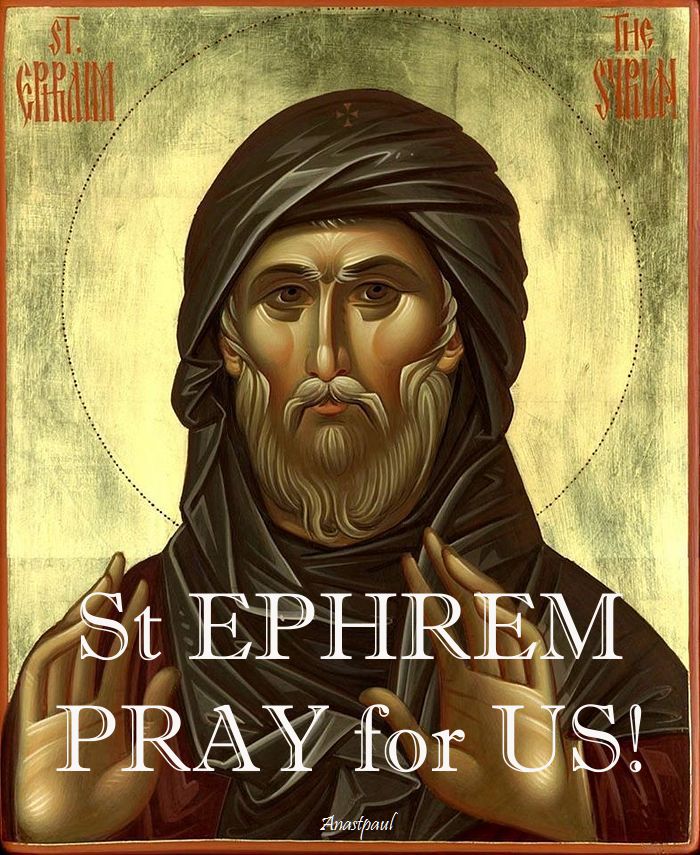
St Ephrem, pray for us that we too may grow a vine-shoot on our tongues by the grace of God!

st ephrem pray for us 2

Posted in DOCTORS of the Church, FATHERS of the Church, MORNING Prayers, SAINT of the DAY

Quote/s of the Day – 9 June

Quote/s of the Day – 9 June

“Forget not the Holy Spirit
at the moment of your enlightenment;  
He is ready to mark your soul with His seal….
He will give you the heavenly and divine seal
which makes the devil tremble;  
He will arm you for the fight;
He will give you strength.”

FORGET NOT THE HOLY SPIRIT-ST EPHREM

“Glory be to Him,
Who received from us,
that He might give to us;
that through that which is ours,
we might more abundantly receive
of that which is His!”

glory be to him, who received from us-st ephrem

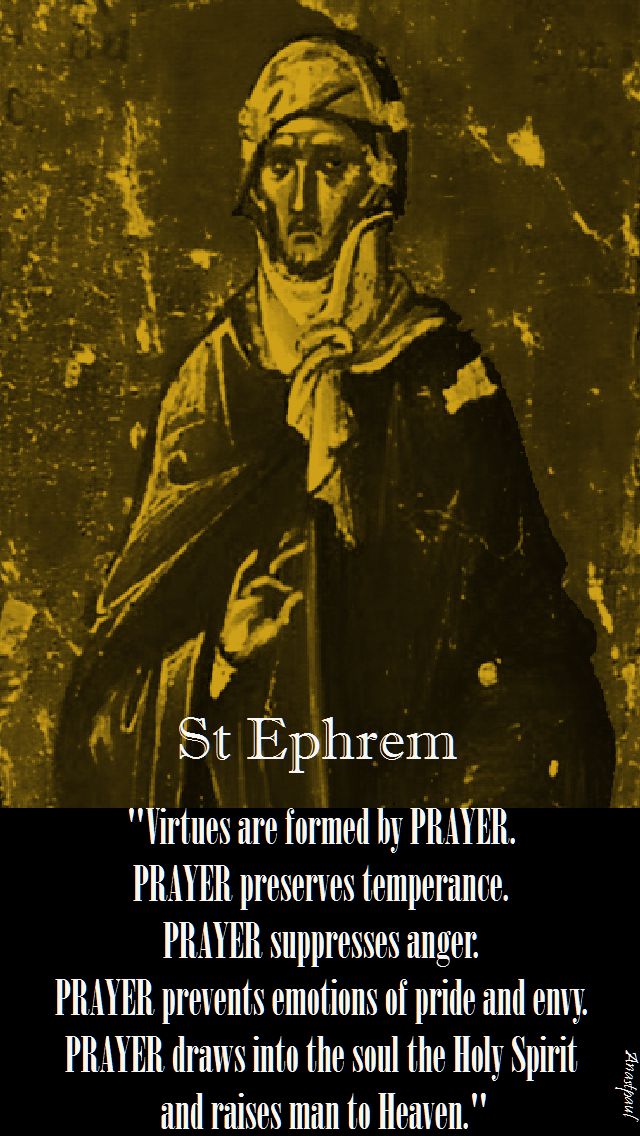
“Virtues are formed by PRAYER.
PRAYER preserves temperance.
PRAYER suppresses anger.
PRAYER prevents emotions of pride and envy.
PRAYER draws into the soul the Holy Spirit
and raises man to Heaven.”

virtures are formed by prayer-st ephrem

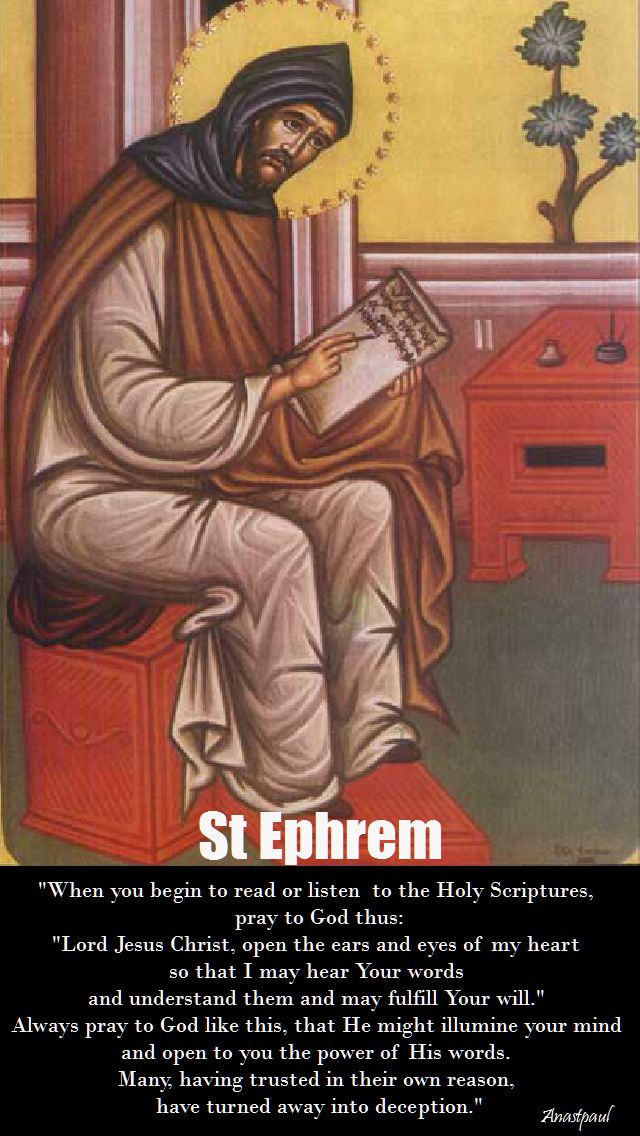
“When you begin to read or listen
to the Holy Scriptures, pray to God thus:
“Lord Jesus Christ, open the ears and eyes
of my heart so that I may hear Your words
and understand them
and may fulfill Your will.”
Always pray to God like this,
that He might illumine your mind
and open to you the power of His words.
Many, having trusted in their own reason,
have turned away into deception.”

St Ephrem of Syria

when you begin to read or listen to the Holy Scriptures-st ephrem

Posted in DOCTORS of the Church, FATHERS of the Church, MORNING Prayers, QUOTES of the SAINTS, SAINT of the DAY, The WORD

One Minute Reflection – 9 June

One Minute Reflection – 9 June

Be on Guard and pray that you may not undergo the test…………….Matthew 26:41

MATTHEW 26-41

REFLECTION – “Jesus, who feared nothing, experienced fear and asked to be freed from death – although He knew it was impossible.
How much more must we persevere in prayer before temptation assails us – so that we may be freed when the test has come!”…St Ephrem

jesus who feared nothing - st ephrem


PRAYER – Heavenly Father, help me to work out my salvation in fear and trembling.  Let me pray daily that I may withstand temptation and carry out Your will in all things.   St Ephrem, please pray for us, that we may withstand the evils which surround us! Amen

st ephrem pray for us

Posted in DOCTORS of the Church, FATHERS of the Church, MORNING Prayers, PRAYERS of the SAINTS, SAINT of the DAY

Our Morning Offering – 9 June

Our Morning Offering – 9 June

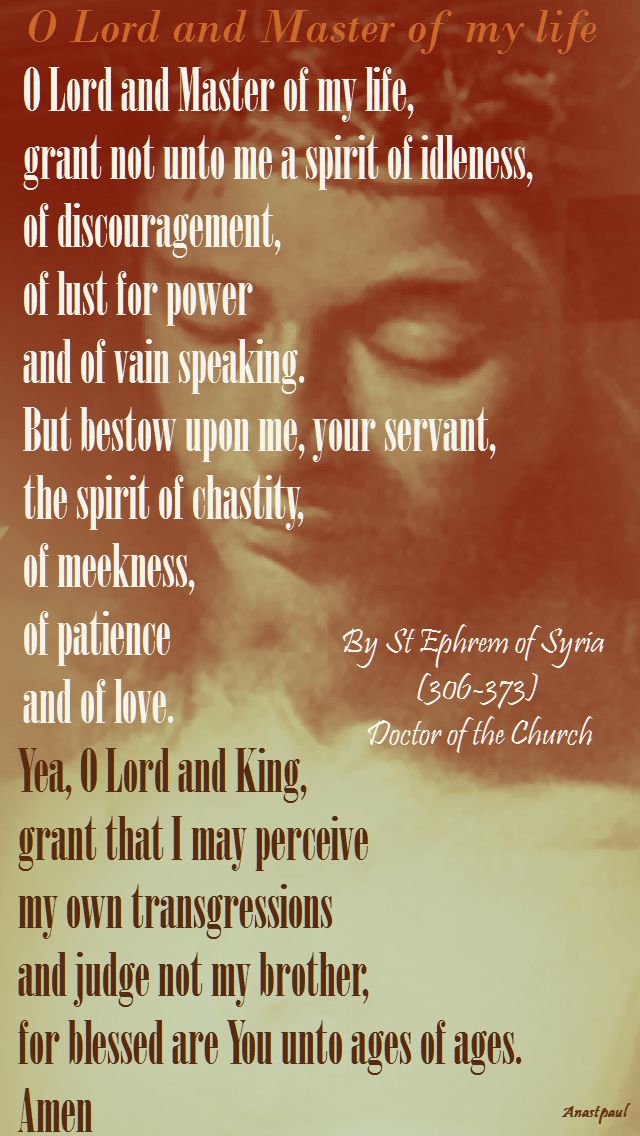
O Lord and Master of my life
By St Ephrem of Syria (306-373) Doctor of the Church

O Lord and Master of my life,
grant not unto me a spirit of idleness,
of discouragement,
of lust for power
and of vain speaking.
But bestow upon me, Your servant,
the spirit of chastity,
of meekness,
of patience
and of love.
Yea, O Lord and King,
grant that I may perceive
my own transgressions
and judge not my brother,
for blessed are You unto ages of ages. Amen

o lord and master of my life - prayer by st ephrem of syria

Posted in DOCTORS of the Church, FATHERS of the Church, SAINT of the DAY

Saint of the Day – 9 June – St Ephrem of Syria (306-373) – Father and Doctor of the Church

Saint of the Day – 9 June – St Ephrem of Syria (306-373) – Father & Doctor of the Church – Also known as:  Ephrem of Edessa, Ephrem the Syrian, Ephraem, Ephraim, Ephraem Syrus, Deacon of Edessa, Harp of the Holy Spirit, Jefrem Sirin, Sun of the Syrians/Venerable Father.  Deacon and Confessor, Exegesist, Writer, Poet, Hymnographer, Theologian, Teacher, Orator, Defender of the Faith – declared Doctor of the Church in 1920 by Pope Benedict XV.    Born – c 306 at Nisibis, Mesopotamia (in modern Syria) – Died on 9 June 373 at Edessa (in modern Iraq) of natural causes.   His tomb is in an Armenian monastery, Der Serkis, west of Edessa.   Patron of Spiritual directors and spiritual leaders.   Attributes –  hermit sitting on a column, deacon’s vestments and thurible, man composing hymns with a lyre, man in a cave with a book, man with a cross on his brow, pointing upwards, vine and scroll.

st ephrem 3

Born in Nisibis, Mesopotamia, he was baptised as a young man and became famous as a teacher in his native city.   When the Christian emperor had to cede Nisibis to the Persians, Ephrem fled as a refugee to Edessa, along with many other Christians.   He is credited with attracting great glory to the biblical school there.   He was ordained a deacon but declined becoming a priest as he felt he was unworthy.

He had a prolific pen and his writings best illumine his holiness.   Although he was not a man of great scholarship, his works reflect deep insight and knowledge of the Scriptures.   In writing about the mysteries of humanity’s redemption, Ephrem reveals a realistic and humanly sympathetic spirit and a great devotion to the humanity of Jesus.   It is said that his poetic account of the Last Judgment inspired Dante.

Over four hundred hymns composed by Ephrem still exist.   Granted that some have been lost, Ephrem’s productivity is not in doubt.   Church historians credit Ephrem with having written over three million lines.ephrem_the_syrian_mosaic_in_nea_moni

The most important of his works are his lyric, teaching hymns.   These hymns are full of rich, poetic imagery drawn from biblical sources, folk tradition and other religions and philosophies.
Particularly influential were his Hymns Against Heresies.   Ephrem used these to warn his flock of the heresies that threatened to divide the early church.   He lamented that the faithful were “tossed to and fro and carried around with every wind of doctrine, by the cunning of men, by their craftiness and deceitful wiles.”   He devised hymns laden with doctrinal details to inoculate right-thinking Christians against heresies such as docetism.   The Hymns Against Heresies employ colourful metaphors to describe the Incarnation of Christ as fully human and divine.   Ephrem asserts that Christ’s unity of humanity and divinity represents peace, perfection and salvation;  in contrast, docetism and other heresies sought to divide or reduce Christ’s nature and, in doing so, rend and devalue Christ’s followers with their false teachings.

Ephrem is popularly believed to have taken legendary journeys.    In one of these he visits St Basil of Caesarea.   This links the Syrian Ephrem with the Cappadocian Fathers and is an important theological bridge between the spiritual view of the two, who held much in common.   Ephrem is also supposed to have visited Saint Pishoy in the monasteries of Scetes in Egypt.    As with the legendary visit with Basil, this visit is a theological bridge between the origins of monasticism and its spread throughout the church.

St Ephrem eventually settled in Edessa (modern Şanlıurfa) in 363.   He was in his late fifties then and in Edessa he applied himself to ministry in his new church and seems to have continued his work as a teacher, perhaps in the School of Edessa.   Edessa had always been at the heart of the Syriac-speaking world and the city was full of rival philosophies and religions.   Ephrem comments that orthodox Nicene Christians were simply called “Palutians” in Edessa, after a former bishop. Arians, Marcionites, Manichees, Bardaisanites and various gnostic sects proclaimed themselves as the true church.   In this confusion, Ephrem wrote a great number of homilies and hymns defending Nicene orthodoxy.   After a ten-year residency in Edessa, in his sixties, Ephrem succumbed to the plague as he ministered to its victims.   The most reliable date for his death is 9 June 373.

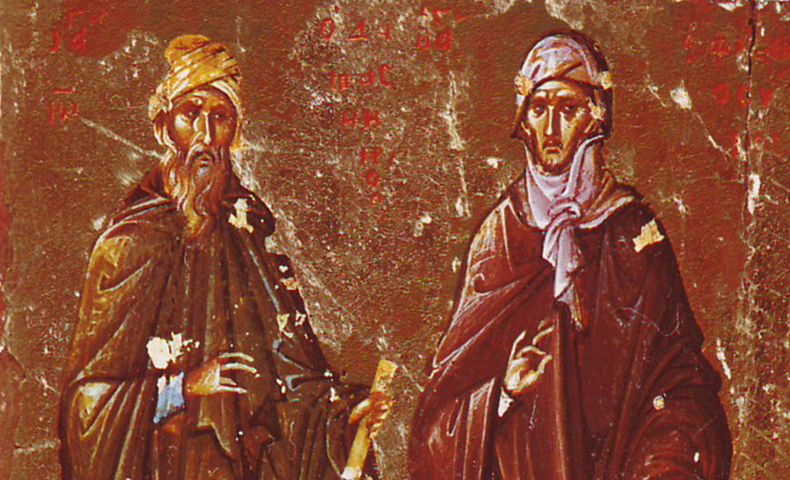
John of Damascus, Ephrem the Syrian
With St John Damascne – left
Posted in SAINT of the DAY, The BLESSED VIRGIN MARY

Saints and Feasts – 9 June

St Ephrem of Syria (Optional Memorial)
Madonna della Fonte Nuova
Mary, Mother of Grace
Mary of the Walnut

Bl Alexander of Kouchta
St Alexander of Prusa
Bl Anne Marie Taigi
St Arnulf of Velseca
St Baithen of Iona
St Columba of Iona
St Comus of Scotland
St Cumian of Bobbio
St Cyrus
Bl Diana d’Andalo
St Diomedes of Tarsus
St Felicianus
Bl Henry the Shoemaker
St Jose de Anchieta
Bl Joseph Imbert
St Julian of Mesopotamia
St Luciano Verdejo Acuña
Bl Luigi Boccardo
St Maximian of Syracuse
St Pelagia of Antioch
St Primus
St Richard of Andria
Bl Robert Salt
Bl Sylvester Ventura
St Valerius of Milan
St Vincent of Agen

Martyrs of Arbil – 5 saints: Five nuns who were martyred together in the persecutions of Tamsabur for refusing to renounce Christianity for sun-worship – Amai, Mariamne, Martha, Mary and Tecla. They were beheaded on 31 May 347 at Arbil, Assyria (in modern Kurdistan, Iraq)

Posted in JESUIT SJ, MORNING Prayers, POETRY

Celebrating GERARD MANLEY HOPKINS SJ – 8 June

Celebrating GERARD MANLEY HOPKINS SJ – 8 June

Gerard Manley Hopkins SJ, one of the leading poets of the nineteenth century, died on this day in Dublin in 1889,   His poetry is strikingly innovative, notable for its vivid imagery and new verse forms at a time when verse mainly followed traditional lines.   He struggled with depression and ill health throughout his short life but his last words at age 44 were “I am so happy, I am so happy.   I loved my life.”

Much of Gerard’s poetry was concerned with the divine presence in the material world, like this, probably one of the most renowned – “God’s Grandeur”

The world is charged with the grandeur of God.
It will flame out, like shining from shook foil;
It gathers to a greatness, like the ooze of oil
Crushed. Why do men then now not reck his rod?
Generations have trod, have trod, have trod;
And all is seared with trade; bleared, smeared with toil;
And wears man’s smudge and shares man’s smell: the soil
Is bare now, nor can foot feel, being shod.

And for all this nature, is never spent;
There lives the dearest freshness deep down things;
And though the last lights off the black West went
Oh, morning, at the brown brink eastward, springs—
Because the Holy Ghost over the bent
World broods with warm breast and with ah! bright wings.

god's grandeur-gerard manley hopkins sj

Posted in MORNING Prayers, NOVENAS

St ANTHONY of PADUA NOVENA for all our needs – DAY FIVE – 8 JUNE

St ANTHONY of PADUA NOVENA for all our needs – DAY FIVE – 8 JUNE

day five st anthony novena

DAY FIVE

I salute you, St. Anthony,
lily of purity, ornament and glory of Christianity.
I salute you, great Saint, cherub of wisdom and seraph of divine love.
I rejoice at the favours our Lord has so liberally bestowed upon you.
In humility and confidence I entreat you to help me,
for I know that God has given you charity and pity,
as well as power.
I ask you by the love you did feel toward the Infant Jesus
as you held Him in your arms to tell Him now of the favour I seek
through your intercession in this novena
(State your intention).

One Our Father, one Hail Mary, and Glory Be to the Father, in honour of Saint Anthony.

Saint Anthony, pray for us!

Posted in JESUIT SJ, MORNING Prayers, SAINT of the DAY

Thought for the Day – 8 June

Thought for the Day – 8 June

May the Holy Spirit help us put into practice the choices of Jacques Berthieu:  his passion for a challenging mission that led him to another country, another language and another culture, his personal attachment to the Lord expressed in  prayer, his pastoral zeal, which was simultaneously a fraternal love of the faithful entrusted to his care and a commitment to lead them higher on the Christian way and finally, a life lived as gift, a choice lived out every day until the death which definitively configured him to Christ.

It is the choice we must all make – let us see our lives too as a missionary, in amongst the daily norms and battles, for viewed through our Christian eyes, our encounters are not that much different to that strange island where St Jacques Berthieu carried out his vocation.

St Jacques Berthieu, pray for us!

ST JACQUES BERTHIEU PRAY FOR US.jpg 2