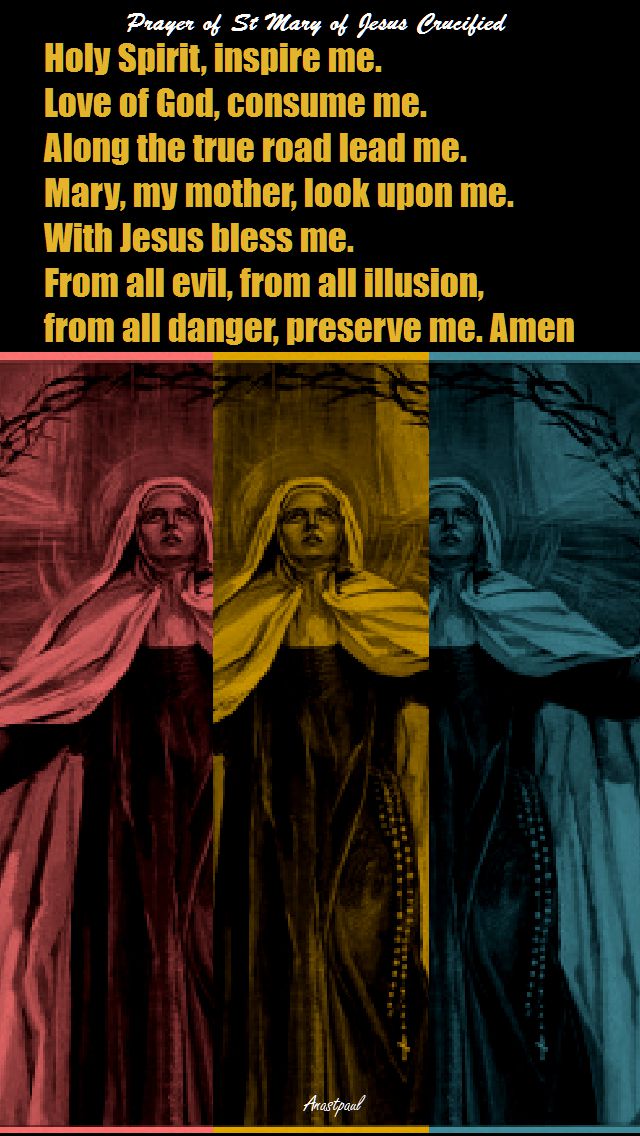
Holy Spirit, inspire me.
Love of God, consume me.
Along the true road lead me.
Mary, my mother, look upon me.
With Jesus bless me.
From all evil, from all illusion,
from all danger, preserve me, amen.
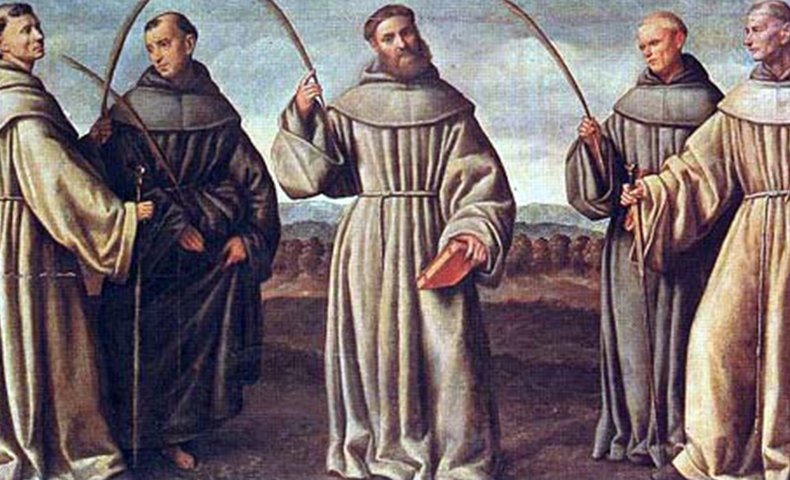
Saint/s of the Day – 16 January – St Berard, Peter, Adjute, Accurs, Odo and Vitalis O.F.M.(died 1220) -Religious/Priests/ Franciscan PROTOMARTYRS
Six Franciscan friars accepted from St. Francis of Assisi an assignment to go to Morocco. They were to announce Christianity to the Muslims. Friars Berard, Peter, Adjutus, Accursio, Vitalis and Odo traveled by ship in 1219. Morocco is in the northwest corner of Africa and the journey was long and dangerous. Vitalis became ill on the journey and the others carried on without him, with his blessing. The group arrived at Seville, Spain, at the time in Muslim hands. They started preaching immediately, on streets and in public squares. People treated them as if they were crazy and had them arrested. To save themselves from being sent back home, the friars declared they wanted to see the sultan. So the governor of Seville sent them to Morocco.
The sultan received the friars and gave them freedom to preach in the city. But some of the people did not like this. They complained to the authorities. The sultan tried to save the friars by sending them to live in Marrakech, on the west coast of Morocco. A Christian prince and friend of the sultan, Dom Pedro Fernandez, took them into his home. But t returned to the city as often as they could to carry on their mssion of preaching the faith. This angered some people who did not want to hear the friars’ message. These complaints angered the sultan so much that one day when he saw the friars preaching, he ordered them to stop or leave the country. Since they did not feel justified about doing either one, they were beheaded right then and there. It was January 16, 1220.
Dom Pedro went to claim the bodies of the martyrs. Eventually he brought their relics to Holy Cross Church in Coimbra, Portugal. The friars’ mission to Morocco had been brief and an apparent failure. But the results were surprising. The story of these heroes fired the first Franciscans with the desire to be missionaries and martyrs too. It was their particular witness that inspired a young man to dedicate his life to God as a Franciscan priest. We know him as St. Anthony of Padua. His feast day is June 13.
St Berard and Companions (Peter, Adjute, Accurs, Odo and Vitalis)
St Dana of Leuca
St Dunchaid O’Braoin
St Fulgentius of Ecija
St Fursey of Peronne
Bl Gonzalo de Amarante
St Henry of Coquet
St Honoratus of Arles
St Honoratus of Fondi
Bl James of Luino
St James of Tarentaise
Bl Joan of Bagno di Romagna
St Joseph Vaz
St Juana Maria Condesa Lluch
Bl Konrad II of Mondsee
St Leobazio
St Liberata of Pavia
St Marcellus I, Pope
St Melas of Rhinocolura
St Priscilla of Rome
St Sigeberht of East Anglia
St Titian of Oderzo
St Triverius
St Valerius of Sorrento
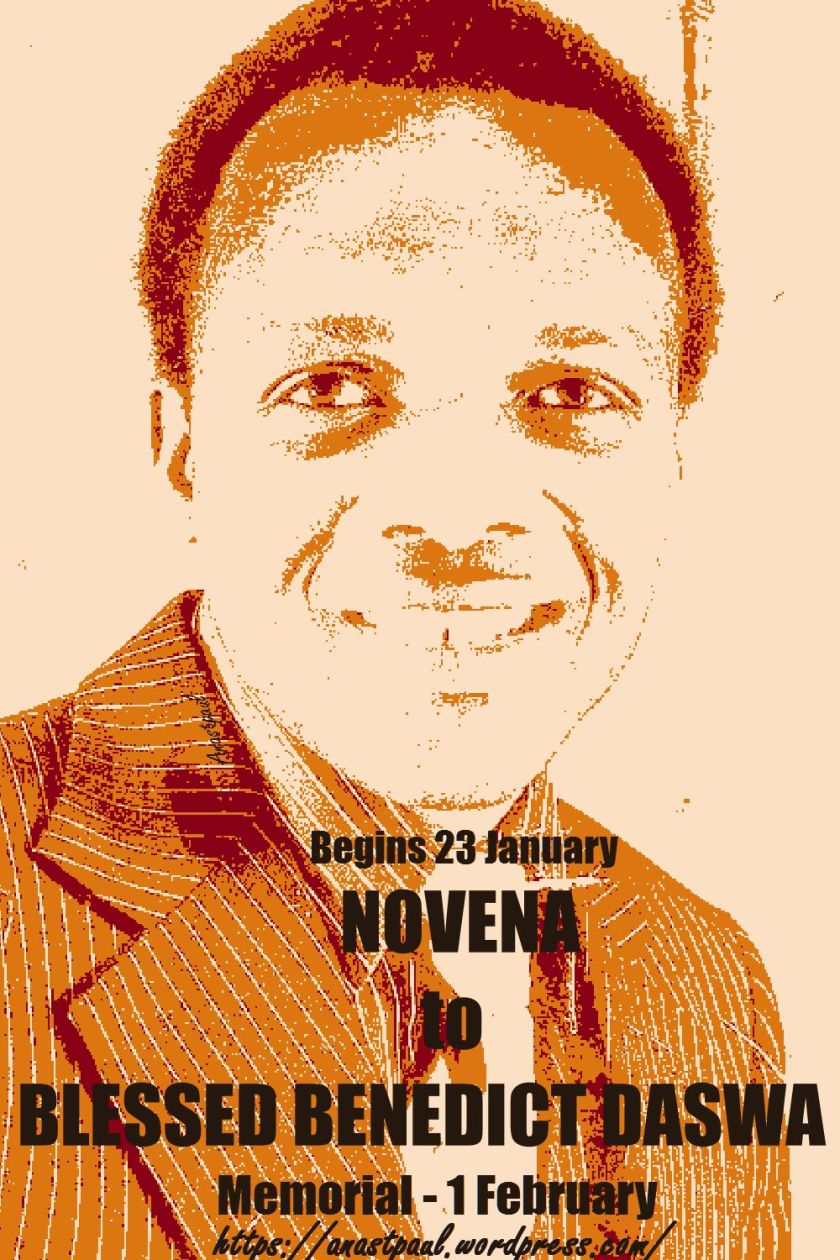
We are encouraging people in all the Dioceses of Southern Africa (SACBC region) to pray for the favours and graces they need during the nine days prior to the Feast on 1 February. This novena will commence on 23 January and conclude on 31 January. We also invite people to make three acts of kindness each day of the Novena in remembrance of the three acts of charity which Blessed Benedict performed the day he was martyred.
The NOVENA PRAYER in various languages
The Novena Prayer in various languages for opening or downloading:
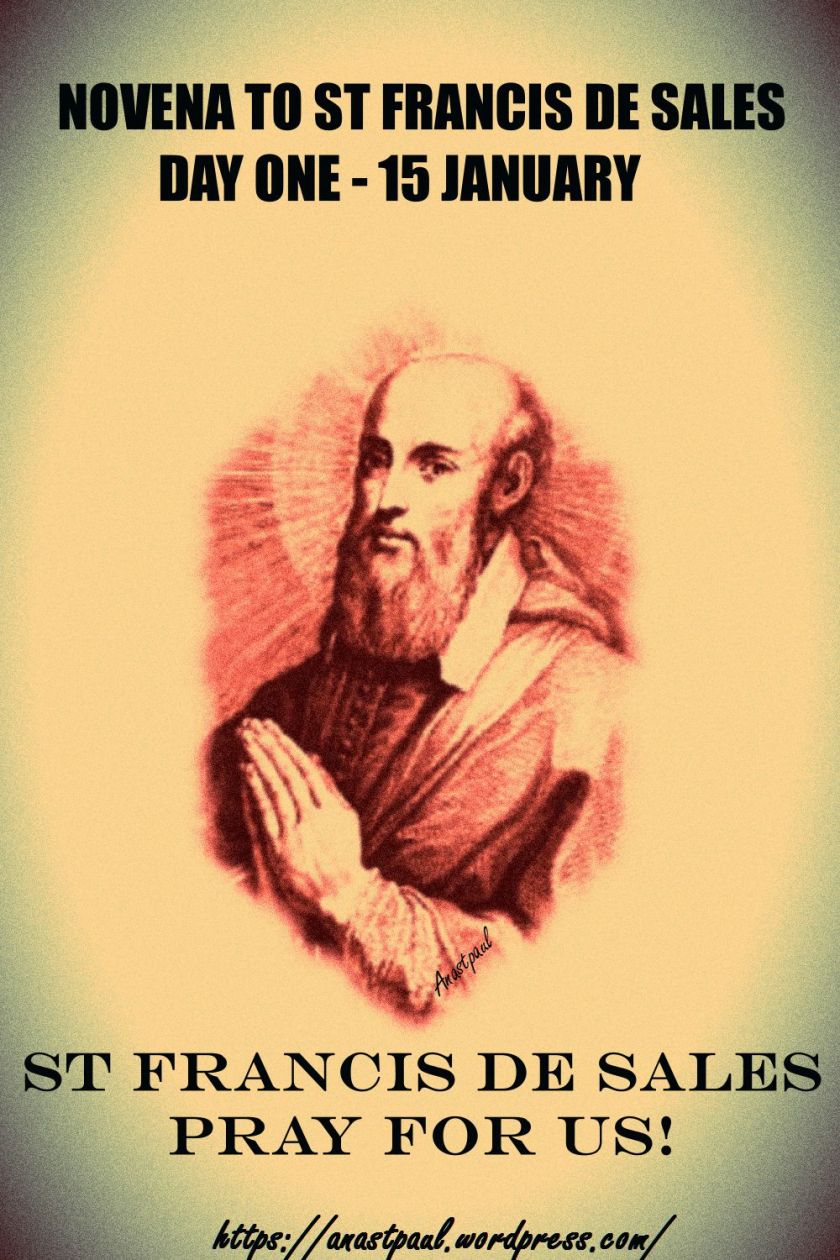
Novena to St Francis de Sales
DAY ONE – 15 JANUARY
There is no clock, no matter how good it may be, that doesn’t need resetting and rewinding twice a day, once in the morning and once in the evening. In addition, at least once a year it must be taken apart to remove the dirt clogging it, straighten out bent parts and repair those worn out. In like manner, every morning and evening a person who really takes care of his heart must rewind it for God’s service by means of certain practices of piety. At least once a year he must take it apart and examine every piece in detail; that is, every affection and passion, in order to repair whatever defects there may be. (St Francis de Sales – INT. Part 5, Ch. 1; O. III, p. 340)
O blessed Francis de Sales, who on earth did excel in a life of virtue, especially in the love of God and neighbour,
I earnestly ask you to take me under your compassionate care and protection.
Obtain for me conversion of mind and heart.
Grant that all people, especially …………… (names of those whom you wish to include)
may experience the depth of God’s redeeming and healing love.
Teach me to fix my eyes on the things of heaven even as I walk each day
with my feet planted firmly on the earth.
Help me, through the practice of virtue and the pursuit of devotion, to avoid anything
that would otherwise cause me to stumble in my attempt to follow Christ
and to be an instrument of the Holy Spirit.
Encouraged by your prayers and example,
help me to live fully my sacred dignity with the hope of experiencing my sacred destiny:
eternal life with God.
Receive also this particular need or concern that I now lift up in prayer.
(mention your particular need).
O God, for the salvation of all, you desired that St. Francis de Sales—
preacher, missionary, confessor, bishop and founder—
should befriend many along the road to salvation.
Mercifully grant that we, infused with the humility and gentleness of his charity,
guided by his wisdom and sharing in his spirit may experience eternal life.
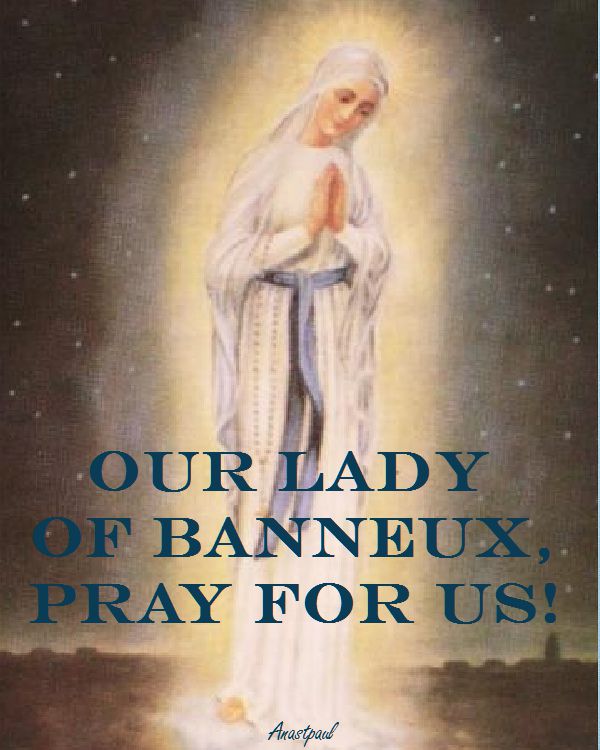
There are many ways of “being poor” and in today’s world, the more we have, the poorer we can be. Our Lady of Banneux is a most worthy intercessor to pray on our behalf to our God of such loving mercy, for all the needs of the poor of the world, for so many who are rich in goods but poor in spirit.
As St John Paul said on a visit to Banneux – “The poor today – and there are many ways of being poor! – feel at home in Banneux. They come here to find comfort, courage, hope, union with God in their affliction. I encourage the pilgrims who come here to pray to her, who, always and everywhere in the Church, reflects the face of the Mercy of God.”
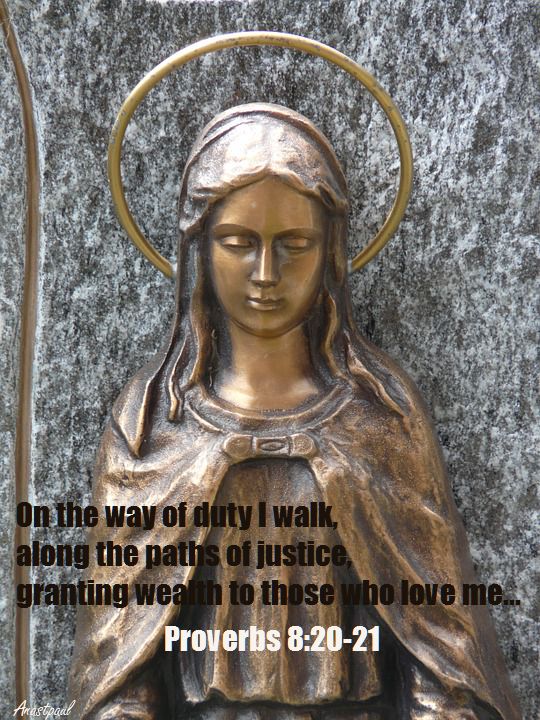
On the way of duty I walk, along the paths of justice, granting wealth to those who love me…………Prv 8:20-21
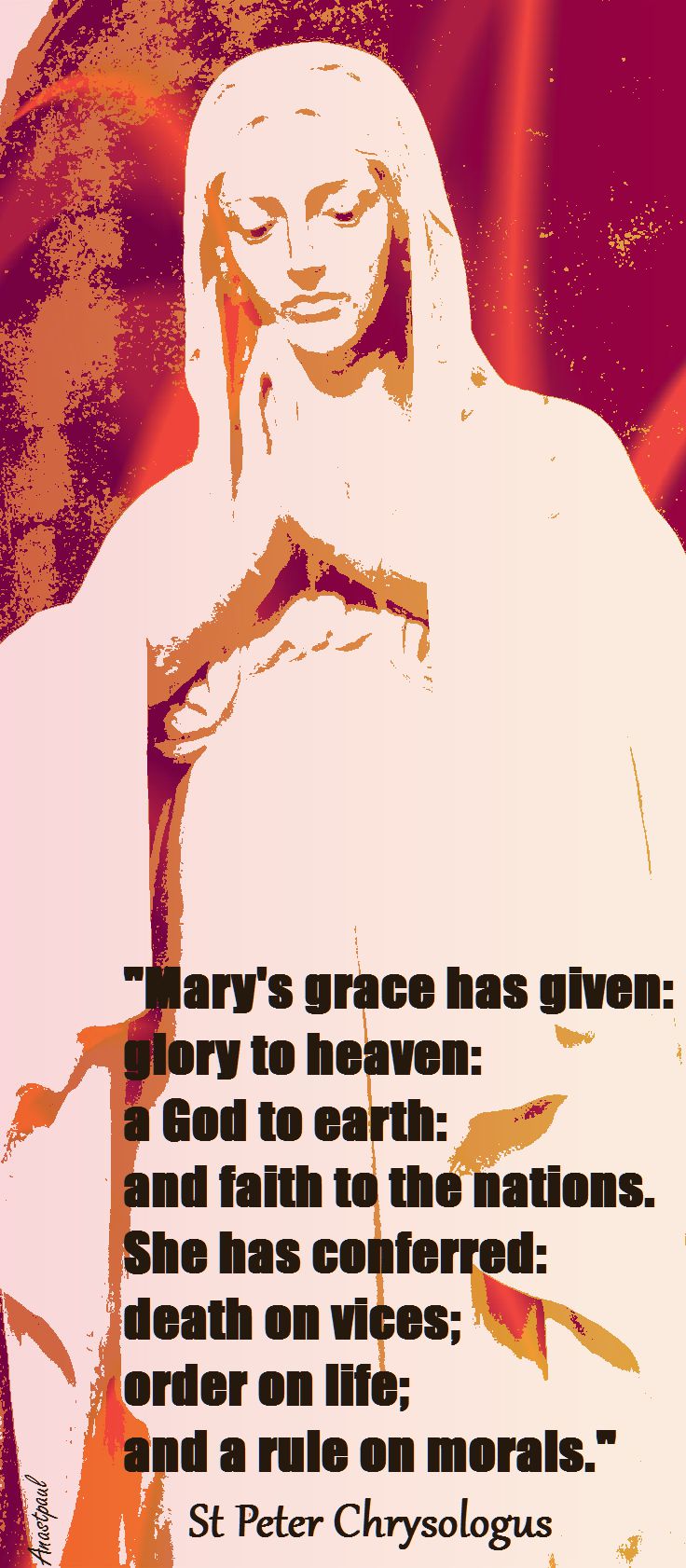
REFLECTION – “Mary’s grace has given glory to heaven: a God to earth: and faith to the nations. She has conferred death on vices, order on life and a rule on morals.”………St Peter Chrysologus
PRAYER – Heavenly Father, grant me the grace to have Mary as my constant intercessor. In all difficulties, let me call on her aid, for she is Your beloved Daughter and our Blessed Mother. Holy Mother of Banneux, Pray for us, amen!
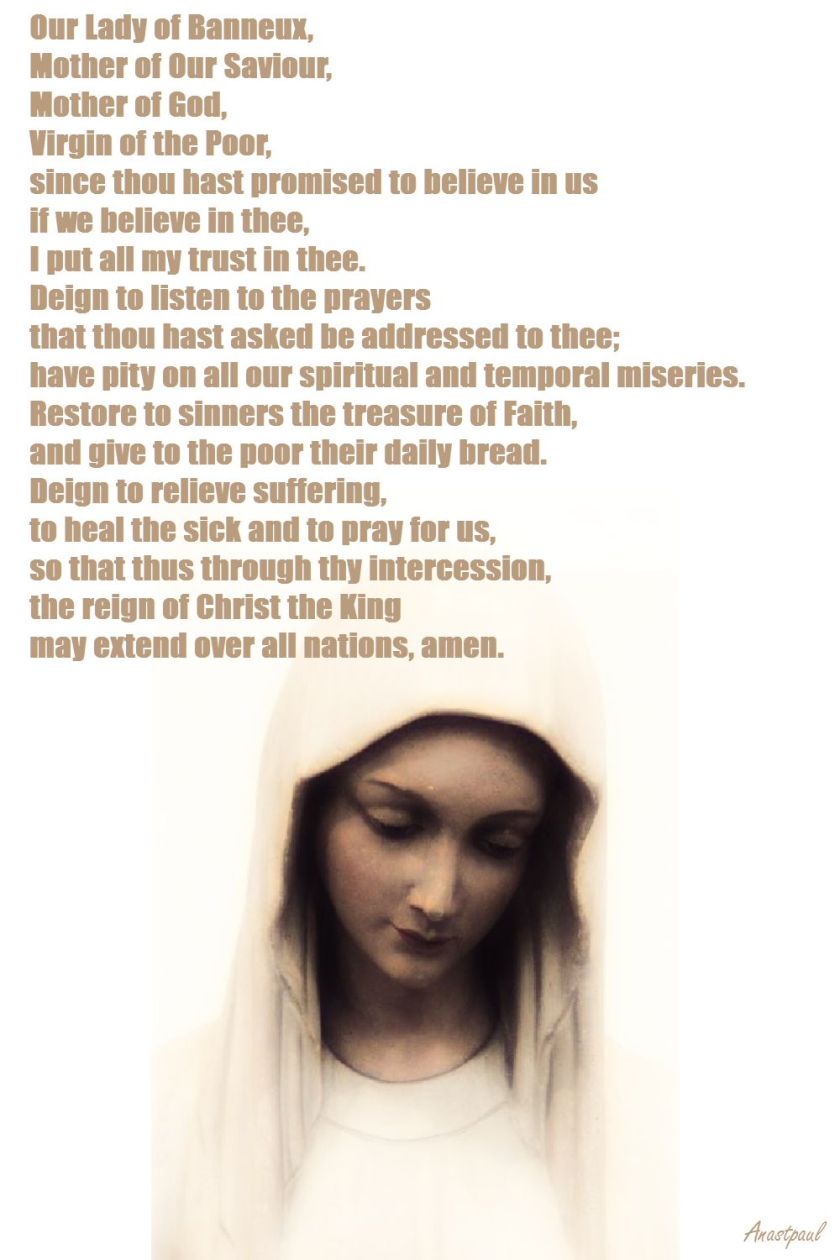
Our Lady of Banneux,
Mother of Our Saviour,
Mother of God,
Virgin of the Poor,
since thou hast promised to believe in us
if we believe in thee,
I put all my trust in thee.
Deign to listen to the prayers
that thou hast asked be addressed to thee;
have pity on all our spiritual and temporal miseries.
Restore to sinners the treasure of Faith,
and give to the poor their daily bread.
Deign to relieve suffering,
to heal the sick and to pray for us,
so that thus through thy intercession,
the reign of Christ the King
may extend over all nations, amen.
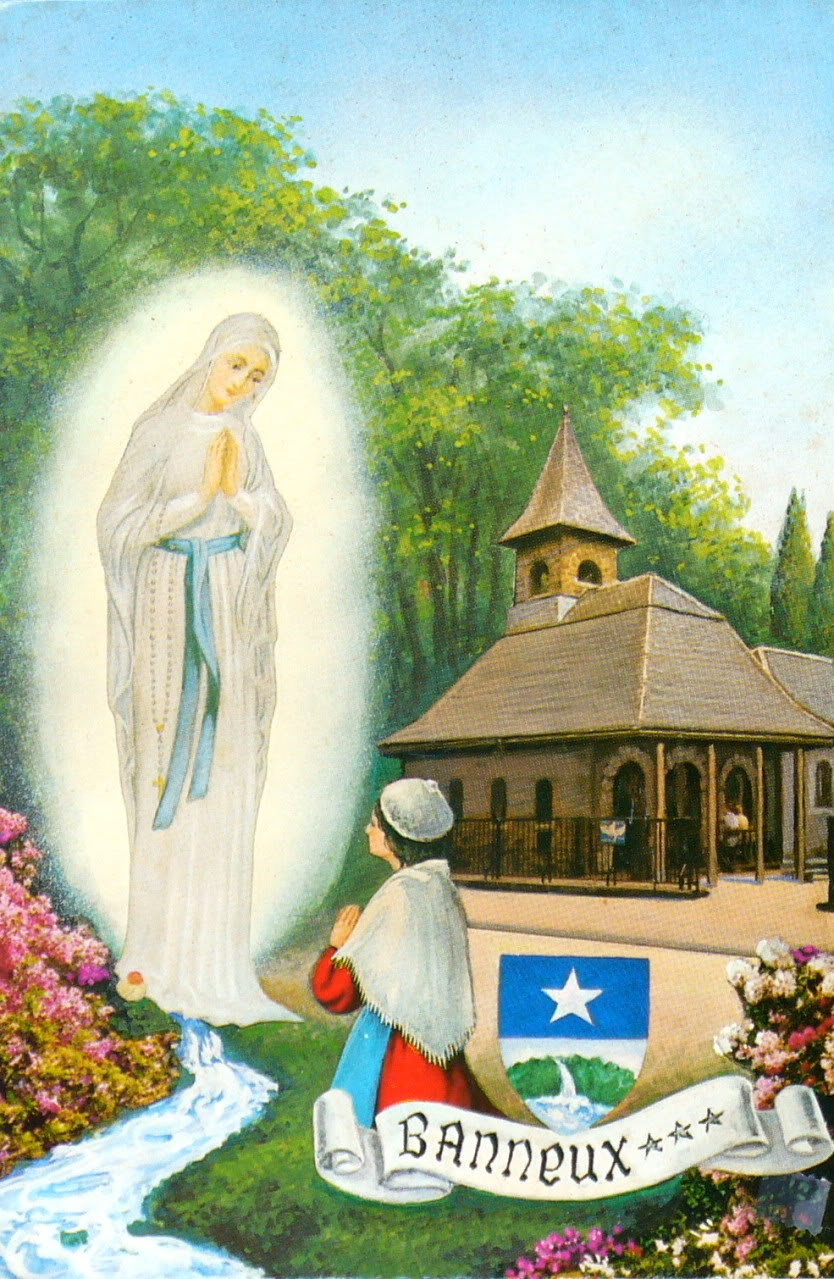
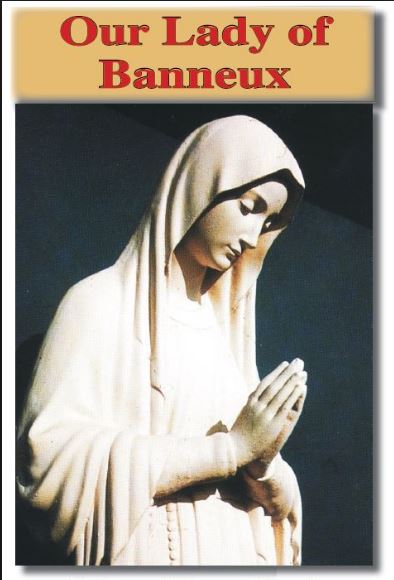
Memorial of the Day – 15 January – Our Lady of Banneux, or Our Lady of the Poor, is the sobriquet given to the apparition of the Virgin Mary to Mariette Beco, an adolescent girl living in Banneux, province of Liège (Belgium). Between January 15 and March 2, 1933, Beco told her family and parish priest of seeing a Lady in white who declared herself to be the “Virgin of the Poor”, saying I come to relieve suffering and believe in me and I will believe in you. As Our Lady of Banneux she has two titles: Our Lady of the Poor and Queen of Nations
Mariette Beco was twelve years old when she reported Marian apparitions in 1933 in Banneux, Belgium, a hamlet about 15 kilometres (10 mi) southeast of the city of Liège. In this case, the Lady in White reportedly declared she was the Virgin of the Poor and said: “Believe in me and I will believe in you.”
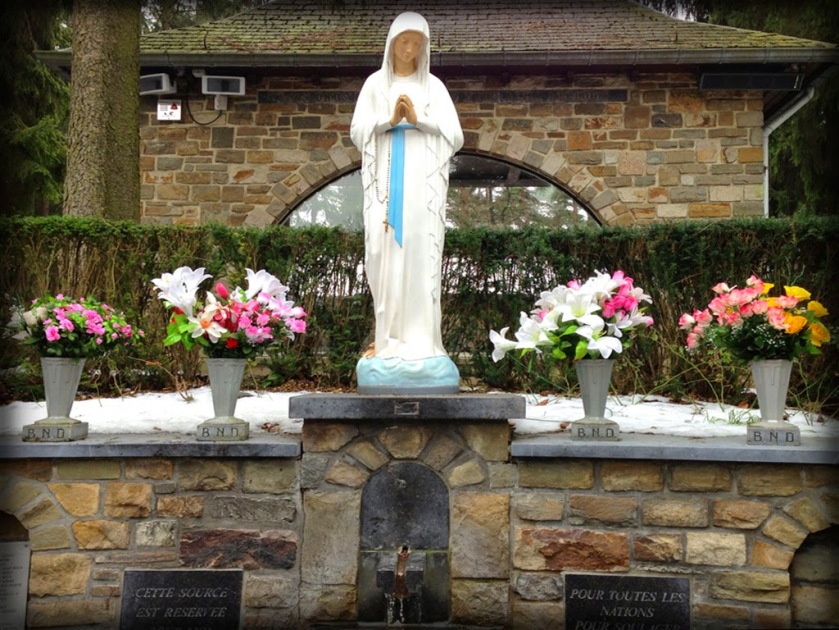
According to Mariette, she first saw the Blessed Virgin on the evening of Sunday, January 15, 1933, as she was looking out the kitchen window. A woman in white stood in the garden and called to her to come out, but her mother would not let her. She is described as a young lady in the yard smiling at her. The woman was bent slightly forward and wearing a long white gown with a blue sash, and a transparent white veil. Three days later the woman in white reappeared and told Mariette she was “Our Lady of the Poor”. The lady appeared eight times in all, the last on March 2, 1933.
In one of these visions, Mariette said the Lady asked her to plunge (push) her hands into a small spring [poussez vos mains dans l’eau], telling her the spring was for healing and “for all nations”. Over time the site drew pilgrims. Today, the small spring yields about 2,000 gallons of water a day with many reports of miraculous healings.
Mariette, meanwhile, became the object of local derision, with even grandmother and aunt making fun of her. Boys followed her around, calling her “Bernadette”, kneeling and asking for her blessing. Her claims were subject to an official investigation from 1935 to 1937 by an episcopal commission. The evidence collected was submitted to Rome for further analysis. Meanwhile, a hospital was built in 1938.
In May 1942, Bishop Kerkhofs of the Roman Catholic Diocese of Liège (Belgium) approved the veneration of Mary under the title of Our Lady of the Poor. Then, in 1947, approval for the apparitions came from the Holy See. It was declared definite in 1949.
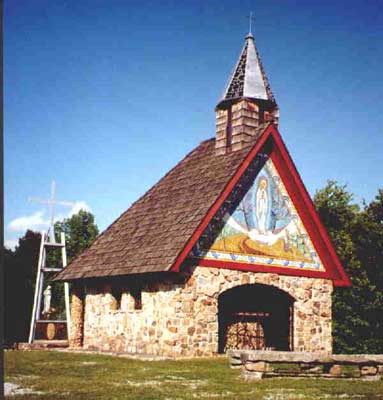
After the apparitions, Mariette decided to remain a private person, married and led a quiet family life. A small chapel stands where the Virgin of the Poor is said to have requested it to be built.
The Chapel of Banneux
Mariette died on December 2, 2011, at the age of 90. In 2008 she made a final statement about her role in the apparitions: “I was no more than a postman who delivers the mail. Once this has been done, the postman is of no importance any more”.
2nd Sunday in Ordinary Time (2017)
Our Lady of Banneux, Belgium (under 2 Titles Our Lady of the Poor and Queen of Nations)
—
St Alexander of Goma
Bl Angelus of Gualdo Tadini
St Arnold Janssen
St Blaithmaic of Iona
St Bonitus of Clermont
St Britta
St Ceolwulf of Northumbria
St Emebert of Cambrai
St Ephysius of Sardinia
St Eugyppius
St Francis Ferdinand de Capillas
Bl Geoffrey of Peronne
Bl Giacomo Villa
St Gwrnerth
St Habakkuk the Prophet
St Isidore of Scété
St Isidore the Egyptian
St Ita of Killeedy
St John Calabytes
St Liewellyn
St Lleudadd of Bardsey
St Macarius of Egypt
St Malard of Chartres
St Maura
St Maurus
St Maximus of Nola
St Pansofius of Alexandria
Bl Peter of Castelnau
St Placid
St Probus of Rieti
St Romedio of Nonsberg
St Sawl
St Secondina of Anagni
St Secundina of Rome
St Tarsicia of Rodez
St Teath
—
Martyrs of Suances – 5 beati
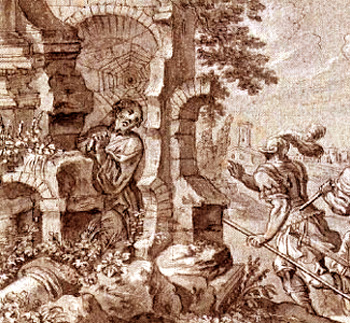
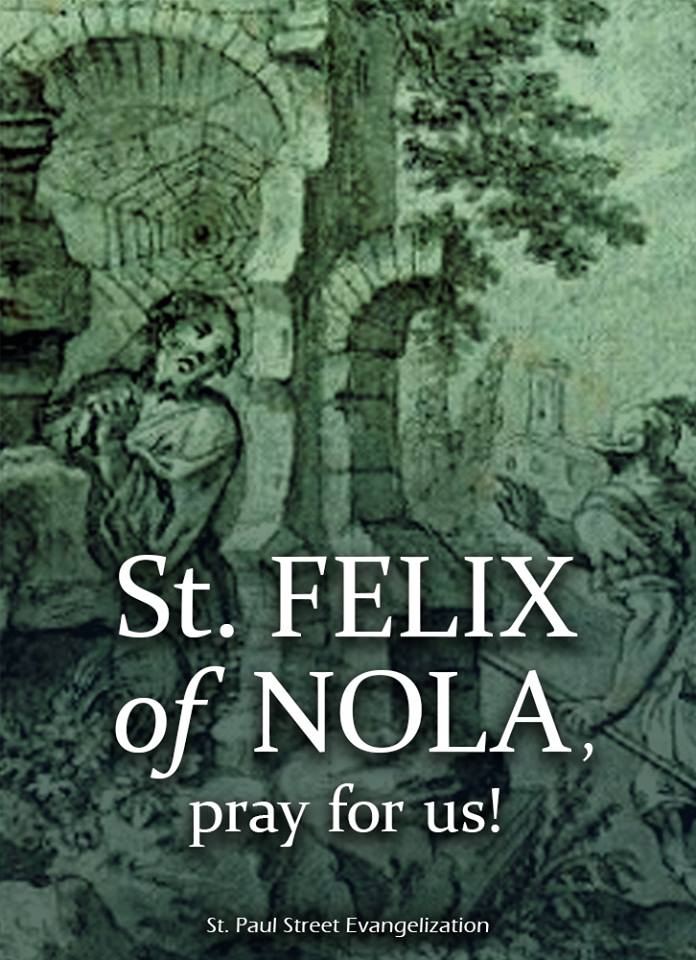
This is the beautiful story of how St Felix of Nola hid from his enemies, during persecution. They were close on his tracks when he hid in the wall of a ruined house. He entered through a narrow opening and immediately afterward, a spider spun a web over the passage to mislead the persecutors. They saw the web and figured that no one could have passed through that opening for some days. So they went on, leaving the saint safe.
A spider web conceals St. Felix from his Roman pursuers
A man protected from terrible persecutors by a spider is extremely charming and poetic. It is a very beautiful episode. Soldiers of the Roman legion, all armed, are searching every inch of the ruined house. I nside one wall is St. Felix, hearing everything. He hears their conversation as they draw near his hiding place. When they stop close to the narrow opening, he thinks: “Now, I am lost.” Then, he hears the commander say: “Let’s not waste time searching here because there are spider webs. No one has been through this opening for some time.”
Again, even if the spider did not exist – and I am not at all sure that it didn’t – it portrays a difficult situation through which St. Felix had to pass that reflects what he had to suffer for the Church, that is, a high moral profile.
Whether these facts are true or not, they tell us that St. Felix was a great saint who left a deep mark on his time. Otherwise the people would not have preserved and passed on the memory of his life. Legend gives us a marvelous image of his life. It is a charming perspective that already has something of Heaven.
Let us pray to St. Felix, asking him to give us dedication in the service of the Church, the courage to face persecution and the desire for Heaven and to know and believe that marvels occur now, each moment of each day, through God who works extraordinary deeds if we believe! (by Prof. Plinio Corrêa de Oliveira)
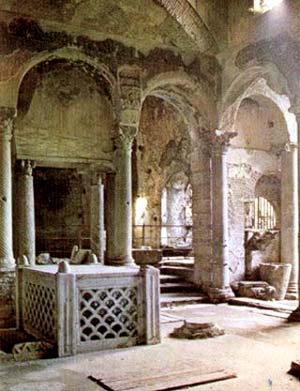
The tomb of St. Felix in the Basilica di San Felix in Cimitile, built in the 3rd century
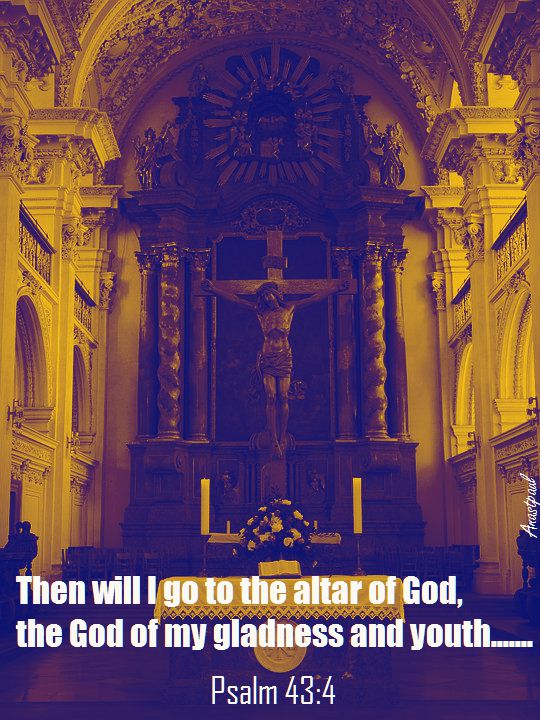
Then will I go to the altar of God, the God of my gladness and youth……….Ps 43:4
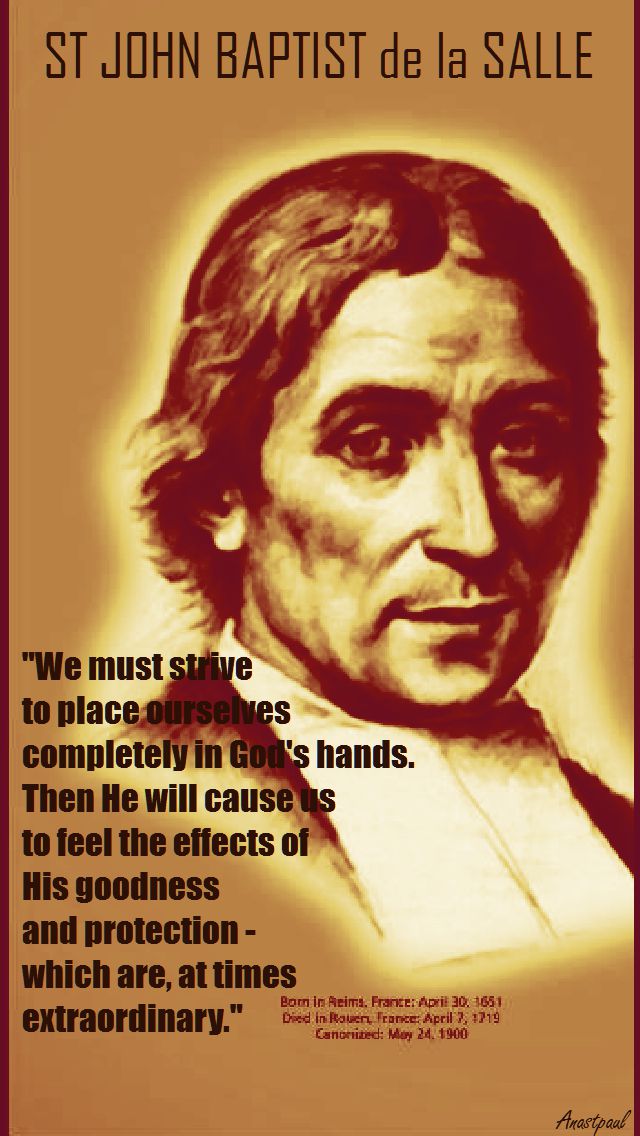
REFLECTION – “We must strive to place ourselves completely in God’s hands. Then He will cause us to feel the effects of His goodness and protection – which are, at times extraordinary.”………St John Baptist de la Salle
PRAYER – Holy Lord God, let me live constantly in Your presence. Grant that I may possess a spirit of joy and gladness because of the firm knowledge that You are always with me and in You and through You and with You, the extraordinary is commonplace! St Felix of Nola, you did no immense deed but in 1800 years we have not forgotten your extraordinary love. Please pray for us, amen.
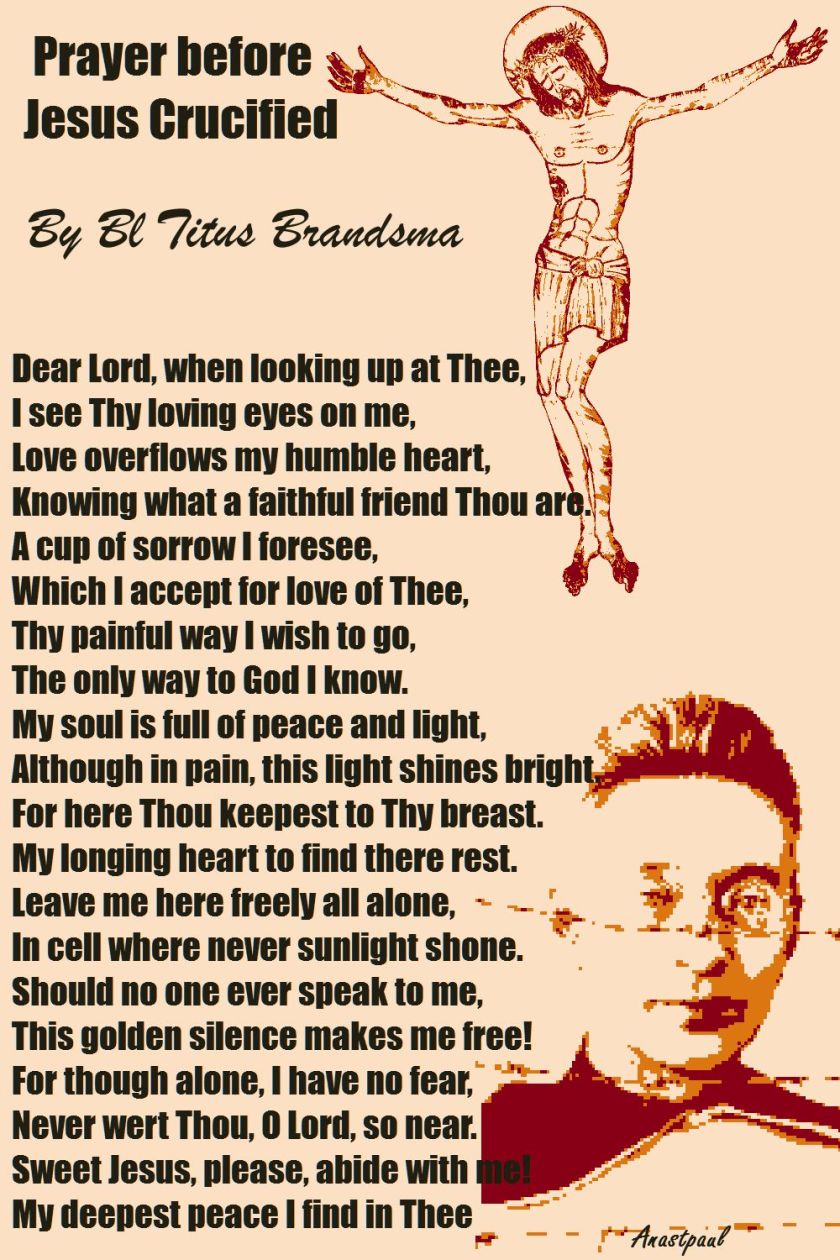
Dear Lord, when looking up at Thee,
I see Thy loving eyes on me,
Love overflows my humble heart,
Knowing what a faithful friend Thou are.
A cup of sorrow I foresee,
Which I accept for love of Thee,
Thy painful way I wish to go,
The only way to God I know.
My soul is full of peace and light,
Although in pain, this light shines bright.
For here Thou keepest to Thy breast.
My longing heart to find there rest.
Leave me here freely all alone,
In cell where never sunlight shone.
Should no one ever speak to me,
This golden silence makes me free!
For though alone, I have no fear,
Never wert Thou, O Lord, so near.
Sweet Jesus, please, abide with me!
My deepest peace I find in Thee
Saint of the Day – 14 January – St Felix of Nola (c early 3rd century-c 260) Priest and Confessor
A 100 years after St. Felix’s death, St. Paulinus of Nola told his story, adding without discernment appealing legends that had accumulated over the years. But we can trust the unadorned factual outline of Felix’s life.
After Felix divested himself of all his possessions, St. Maximus, the bishop of Nola, a town near Naples Italy, ordained him a priest and made him his right-hand man. In 250, when Emperor Decius decreed a ferocious persecution, Maximus installed himself in a desert hiding place from which he safely governed the church. Because soldiers could not find Maximus at Nola, they tortured and jailed Felix in his place. However, just as St. Peter had had a miraculous escape from prison, an angel is said to have released Felix. Then the angel guided Felix to rescue Maximus, who was near death.
The persecution subsided in 251. Upon the death of Maximus the people wanted to name Felix as bishop but he declined. Instead he retired to a small farm, where for the rest of his life he raised crops to feed himself and provide alms for the poor. St. Felix died around 260.
Every year Paulinus wrote a poem to celebrate Felix’s feast day. In one he said that while Felix did not die a martyr he was willing to offer his life as a sacrifice to God. Paulinus thus provided one of the earliest definitions of a “confessor”:
“This festive day celebrates Felix’s birthday, the day on which he died physically on earth and was born for Christ in heaven, winning his heavenly crown as a martyr who did not shed his blood. For he died as confessor, though he did not avoid execution by choice, since God accepted his inner faith in place of blood. God looks into the silence of hearts and equates those ready to suffer with those who have already done so, for he considers this inward test as sufficient, and dispenses with physical execution in case of true devotion. Martyrdom without bloodshed is enough for him if mind and faith are ready to suffer and are fervent towards God.”
Paulinus adopted Felix as his patron saint, a custom that had its roots in the early church. But for Paulinus, a patron was more than a namesake. Felix not only interceded for him in heaven. He also accompanied him spiritually as an encourager, guide, and protector, as Paulinus explained in the following passage:
“Father and lord, best of patrons to servants however unworthy, at last our prayer is answered to celebrate your birthday within your threshold. . . .You know what toils on land and sea have . . . kept me far from your abode in a distant world because I have always and everywhere had you near me and have called on you in the grim moments of travel and in the uncertainties of life.. . . I never sailed without you, for I felt your protection in Christ the Lord when I overcame rough seas. On land and water my journeying is always made safe through you. Felix, I beg you, address a prayer on behalf of your own to that Embodiment of the calm of eternal love and peace, to Him on whose great name you depend.”
Bl Alfonsa Clerici
Bl Amadeus of Clermont
St Barbasymas
St Caldeoldus of Vienne
St Datius of Milan
Bl Devasahayam Pillai
St Engelmaro
St Eufrasio of Clermont
St Euphrasius the Martyr
St Felix of Nola
St Felix of Rome
St Fermin of Mende
St Glycerius of Antioch
Bl Godfrey of Cappenberg
St Isaias the Martyr
St Jesaja of Sinai
St Macrina the Elder
St Nino of Georgia
Bl Odoric of Pordenone
St Odo of Novara
Bl Pablo Merillas Fernández
St Paul of Africa
Bl Petrus Donders
St Potitus
Bl Rainer of Arnsberg
St Sabas of Sinai
St Sava of Serbia
St Successus of Africa
St Theodolus of Sinai
Bl William de Sanjulia
—
Martyrs of Mount Sinai
Martyrs of Raithu – 43 saints
It was in reading the Bible that St Hilary discovered the greatness of God and the sublimity of the Church and Christian teachings. The Bible is not just a revered book to be placed on our shelves in a place of honour it is a book to be read, to be studied and reflected upon. It leads not only to faith and holiness of life but also to the Kingdom of God itself. So we lear that Christ said His coming would bring not peace but a sword (see Matthew 10:34). The Gospels offer no support for us if we fantasise about a sunlit holiness that knows no problems. Christ did not escape at the last moment, though He did live happily ever after—after a life of controversy, problems, pain and frustration. Hilary, like all saints, simply had more of the same.
Trust in the Lord with all your heart, on your own intelligence rely not….Prv 3:5
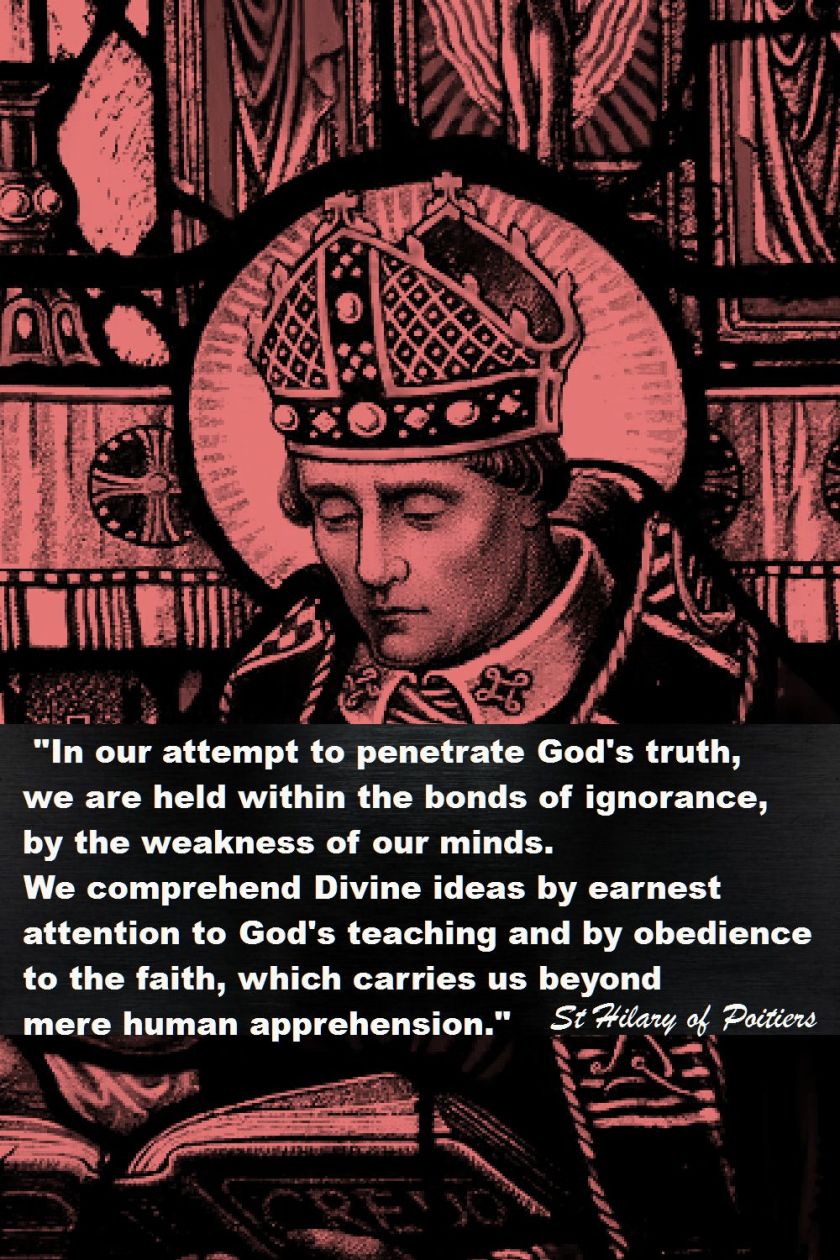
REFLECTION – “In our attempt to penetrate God’s truth, we are held within the bonds of ignorance, by the weakness of our minds.
We comprehend Divine ideas by earnest attention to God’s teaching and by obedience to the faith, which carries us beyond mere human apprehension.”……St Hilary of Poitiers (Saint of the Day)
PRAYER – All-knowing God, grant me the grace to come to a better understanding of Your truths. Let me not only believe them but also carry them out daily in my life. St Hilary of Poitiers, Pray for us, amen!
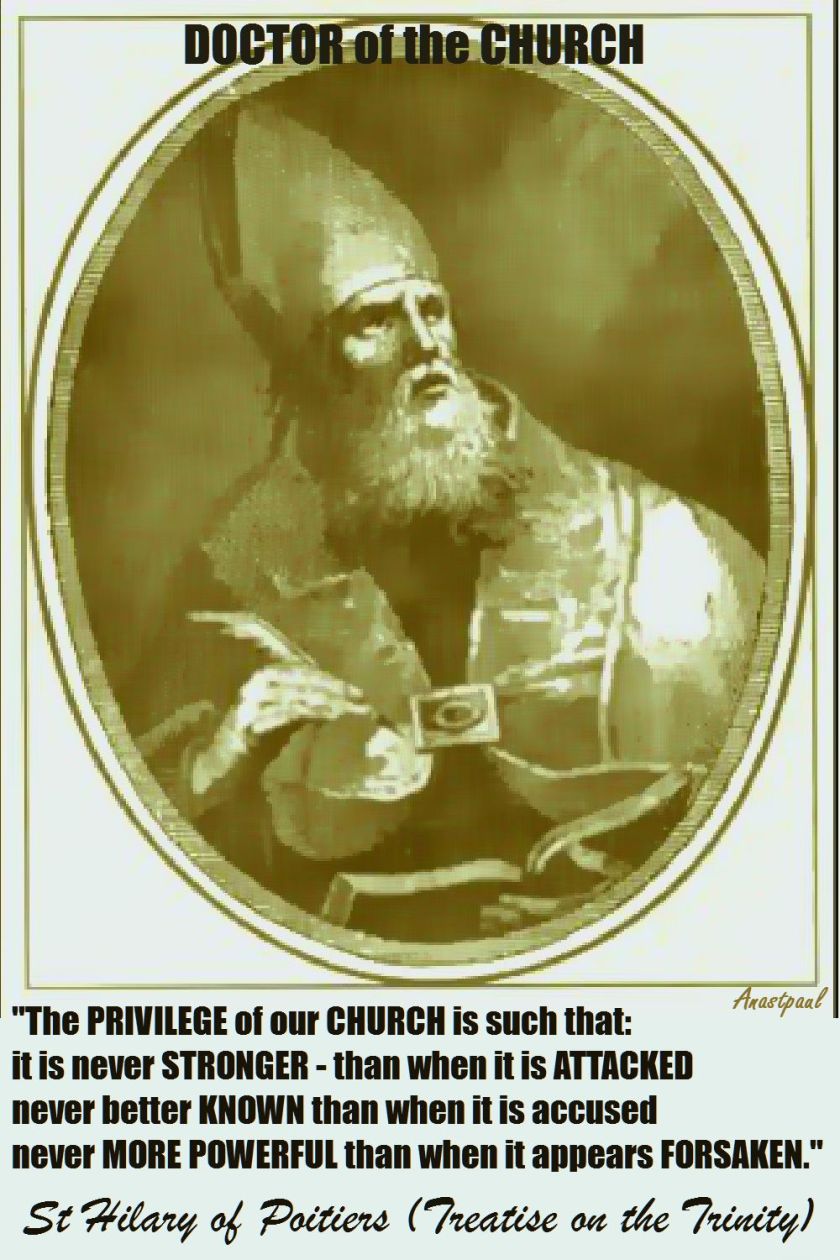
“The privilege of our Church is such that
it is never stronger than when it is attacked,
never better known than when it is accused,
never more powerful than when it appears forsaken.” (Treatise on the Trinity)
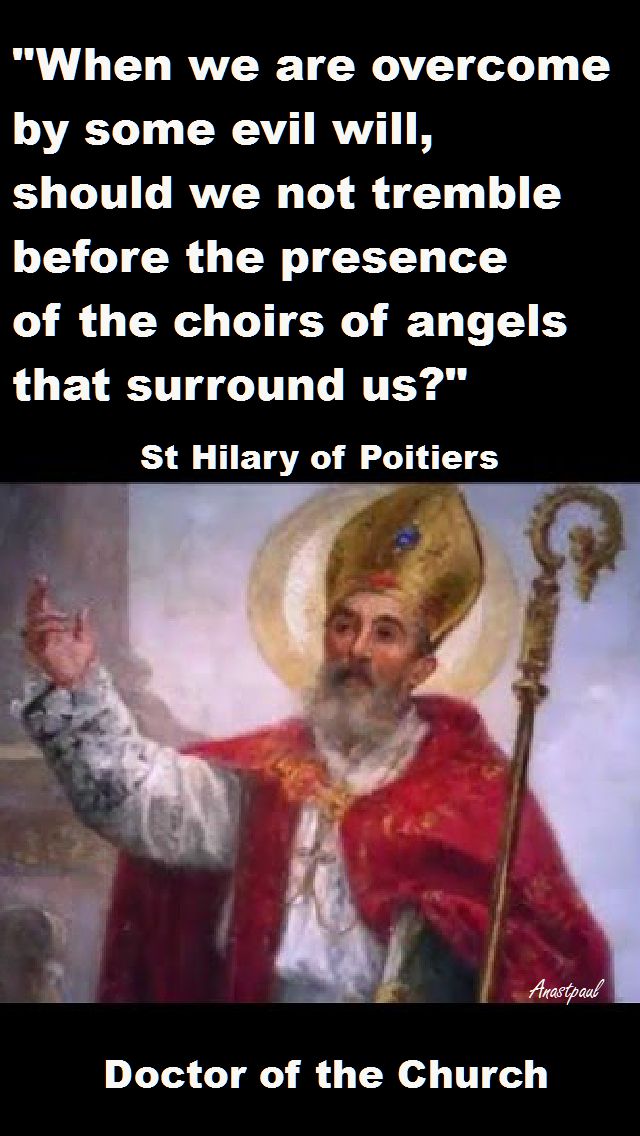
“When we are overcome by some evil will,
should we not tremble before the presence
of the choirs of angels that surround us?”
“The perfection of learning is to know God
in such a way that, though you realise
He is knowable, yet you know Him as indescribable.”
“No matter how sinful one may have been,
if he has devotion to Mary,
it is impossible that he be lost.”
PRAYER OF ST. HILARY OF POITIERS For Perseverance In Faith
Father, keep us from vain strife of words.
Grant to us constant profession of the Truth!
Preserve us in a true and undefiled faith
so that we may hold fast to that
which we professed when we were baptised
in the Name of the Father, Son and Holy Spirit,
that we may have Thee for our Father,
that we may abide in Thy Son
and in the fellowship of the Holy Spirit.
Through Jesus Christ, Our Lord, amen.
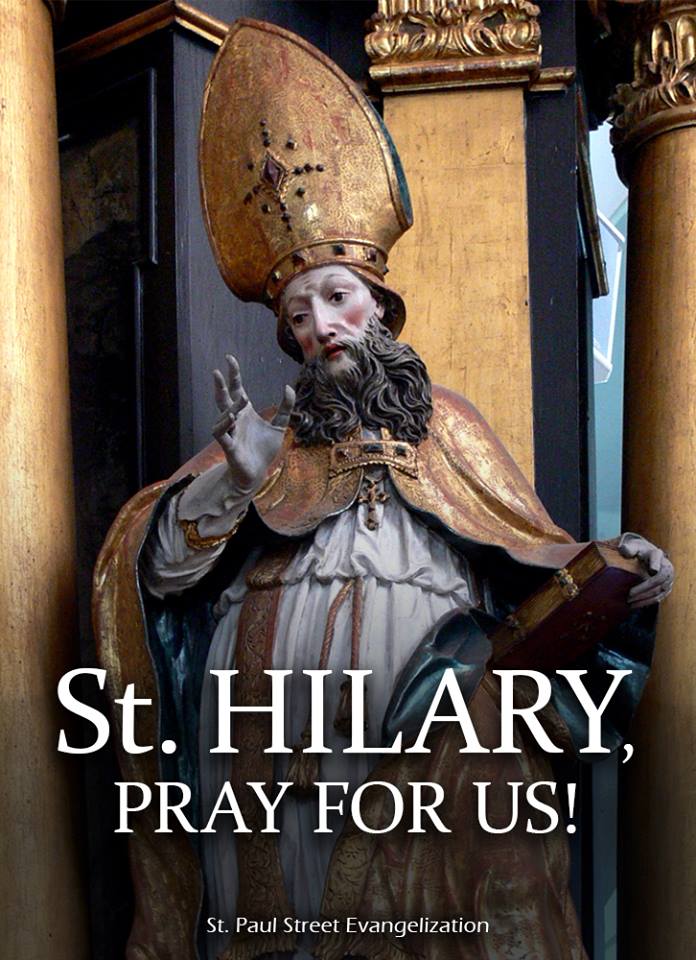
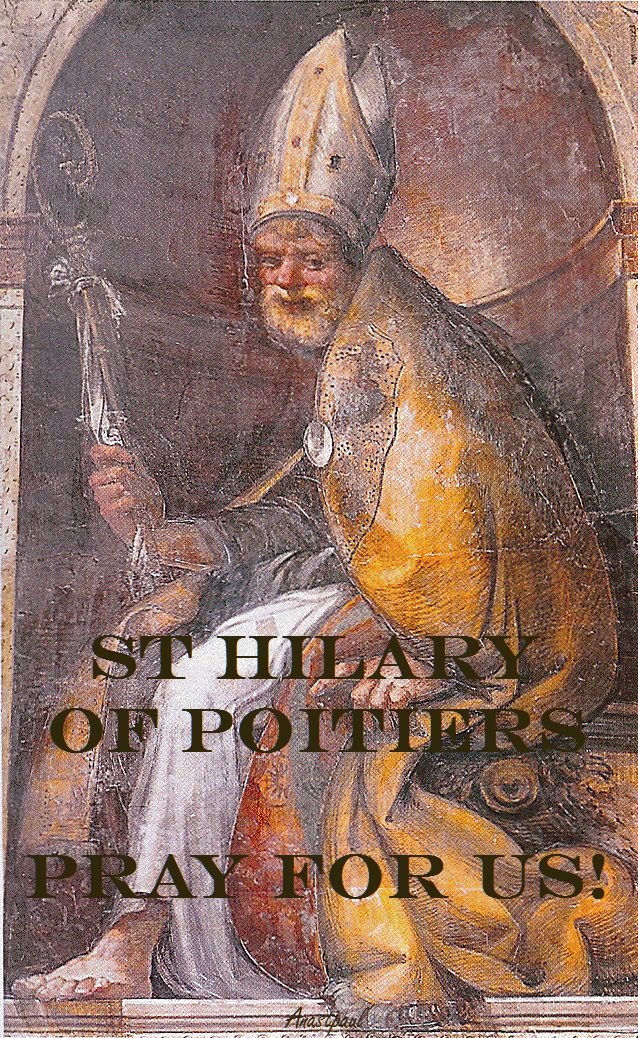
Saint of the Day – 13 January – St Hilary of Poitiers (c315-c368) Bishop/Confessor “”Hammer of the Arians” and “Athanasius of the West” – DOCTOR of the CHURCH. His name “Hilary” His name comes from the Latin word for happy or cheerful. His optional memorial in the General Roman Calendar is 13 January. In the past, when this date was occupied by the Octave of the Epiphany, his feast day was moved to 14 January.
Hilary was born to pagan parents of Poitiers, France, in 315. After training in the classics and philosophy, Hilary married. He and his wife had one daughter, Afra. All who knew Hilary said he was a friendly, charitable, gentle man. Hilary’s studies led him to read Scripture. He became convinced that there was only one God, whose Son became man and died and rose to save all people. This led him to be baptised along with his wife and daughter.
This gentle and courteous man, became a staunch defender of the divinity of Christ. He was devoted to writing some of the greatest theology on the Trinity and was, like his Master, in being labeled a “disturber of the peace.” In a very troubled period in the Church, his holiness was lived out in both scholarship and controversy.
The people of Poitiers chose Hilary to be their bishop in 353. As Bishop, he was soon taken up with battling what became the scourge of the fourth century, Arianism, which denied the divinity of Christ.
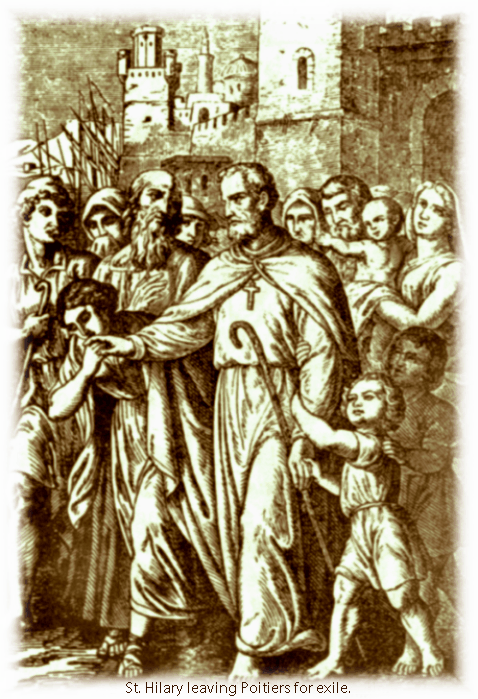
The heresy spread rapidly. Saint Jerome said “The world groaned and marveled to find that it was Arian.” When Emperor Constantius ordered all the bishops of the West to sign a condemnation of Athanasius, the great defender of the faith in the East, Hilary refused and was banished from France to far off Phrygia. There, too, his pastoral solicitude led him to work tirelessly for the re-establishment of the Church’s unity, based on the correct faith, as formulated by the Council of Nicea. To this end, he began writing his most important and most famous dogmatic work: “De Trinitatae” (On the Trinity). Eventually he was called the “Athanasius of the West” and the “Hammer of the Arians.”
During the years of his exile, Hilary also wrote the “Book of the Synod,” in which, for his brother bishops of Gaul, he reproduces and comments on the confessions of faith and other documents of the synods which met in the East around the middle of the 4th century. Always firm in his opposition to radical Arians, St. Hilary showed a conciliatory spirit with those who accepted that the Son was similar to the Father in essence, naturally trying to lead them toward the fullness of faith, which says that there is not only a similarity but a true equality of the Father and the Son in their divinity.
This also seems characteristic: His conciliatory spirit tries to understand those who still have not yet arrived to the fullness of the truth and helps them, with great theological intelligence to reach the fullness of faith in the true divinity of the Lord Jesus Christ.
In 360 or 361, Hilary was finally able to return from exile to his homeland and immediately resumed the pastoral work in his Church but the influence of his teaching extended, in fact, well beyond its borders. A synod celebrated in Paris in 360 or 361 took up again the language used by the Council of Nicea. Some ancient authors think that this anti-Arian development of the bishops of Gaul was due, in large part, to the strength and meekness of the bishop of Poitiers.
During the last years of his life, he wrote “Treatises on the Psalms,” a commentary on 58 psalms, interpreted according to the principle highlighted in the introduction to the work: “There is no doubt that all the things said in the Psalms must be understood according to the Gospel proclamation, so that, independently of the voice with which the prophetic spirit has spoken, everything refers to the knowledge of the coming of our Lord Jesus Christ, incarnation, passion and kingdom, and the glory and power of our resurrection” (“Instructio Psalmorum,” 5).
In all of the Psalms, he sees this transparency of Christ’s mystery and of his body, which is the Church. On various occasions, Hilary met with St. Martin, the future bishop of Tours founded a monastery near Poitiers, which still exists today. Hilary died in 367. His feast day is celebrated on Jan. 13. In 1851, Blessed Pius IX proclaimed him a doctor of the Church.
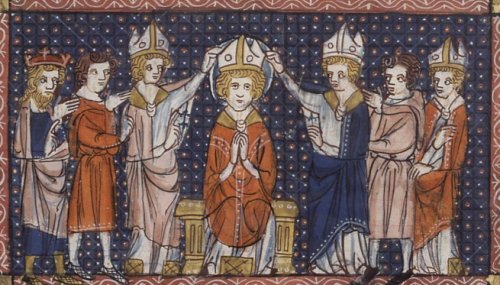
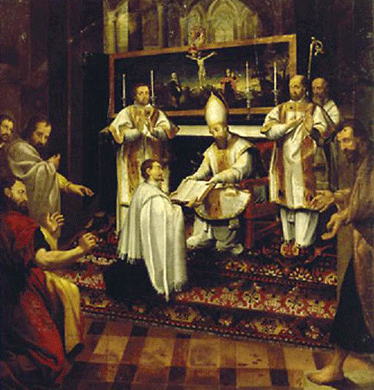
St Hilary confers minor Orders on St Martin of Tours
St Hilary of Poitiers (Optional Memorial)
—
St Agrecius of Trier
St Andrew of Trier
St Berno of Cluny
St Ðaminh Pham Trong Kham
St Designatus of Maastricht
St Elian of Brittany
St Emil Szramek
St Enogatus of Aleth
St Erbin of Cornwall
St Francesco Maria Greco
Bl Francisca Inés Valverde González
St Giuse Pham Trong Ta
St Glaphyra
St Gumesindus of Córdoba
St Hermylus
Bl Hildemar of Arrouaise
Bl Ida of Argensolles
Bl Ivetta of Huy
St Kentigern of Glasgow
St Leontius of Caesarea
St Luca Pham Trong Thìn
Bl María Francisca Espejo y Martos
Bl Matteo de Lana
St Peter of Capitolíade
St Servusdei of Córdoba
St Stephen of Liège
St Stratonicus
Bl Veronica of Milan
St Viventius
St Vivenzio of Blera
—
Forty Martyred Soldiers at Rome
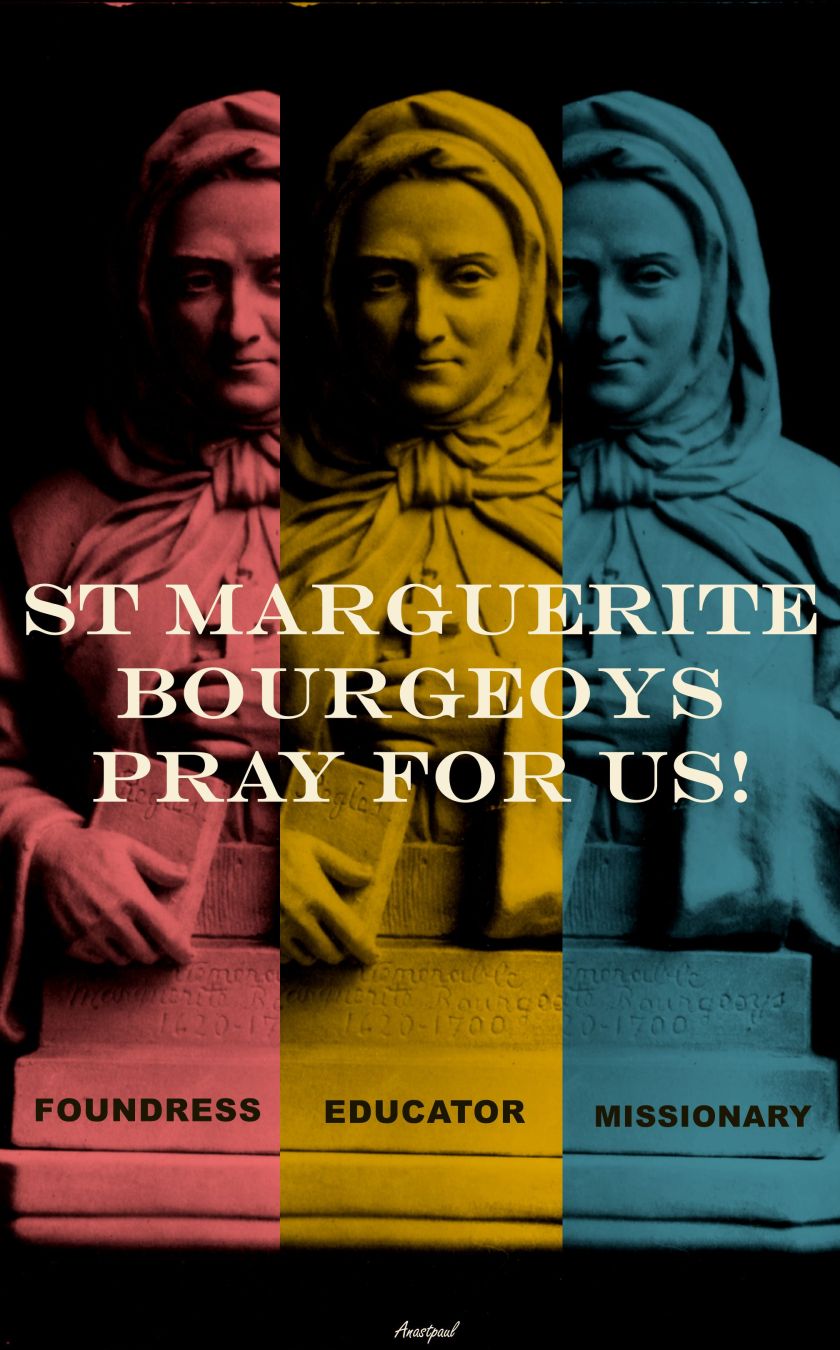
It is easy to become discouraged when plans that we think that God MUST endorse are frustrated. Marguerite was called not to be a cloistered nun but to be a foundress and an educator.
God had not ignored her after all – nor is he ignoring YOU!
May the Lord ….make you overflow with love for one another and for all……..1 Thes 3:12
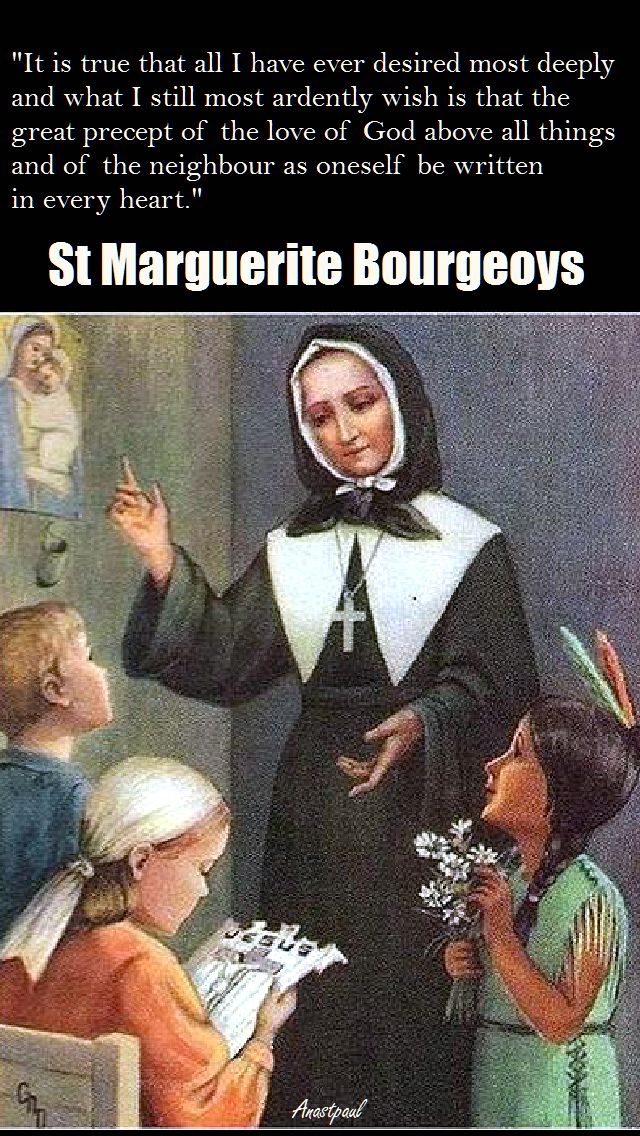
REFLECTION – “It seems to me that we do not pay enough attention to prayer, for unless it arises from the heart which ought to be its centre, it is no more than a fruitless dream. Prayer ought to carry over into our thoughts, our words and our actions…..It is true that all I have ever desired most deeply and what I still most ardently wish is that the great precept of the love of God above all things and of the neighbour as oneself be written in every heart.”……..St Marguerite Bourgeoys (Saint of the Day)
PRAYER – Loving Father, grant me the grace to strive after perfect love. Help me to bring forth frequent acts of love for my neighbour and in this, to grow each day in love for You.St Marguerite Bourgeoys Pray for us, amen.
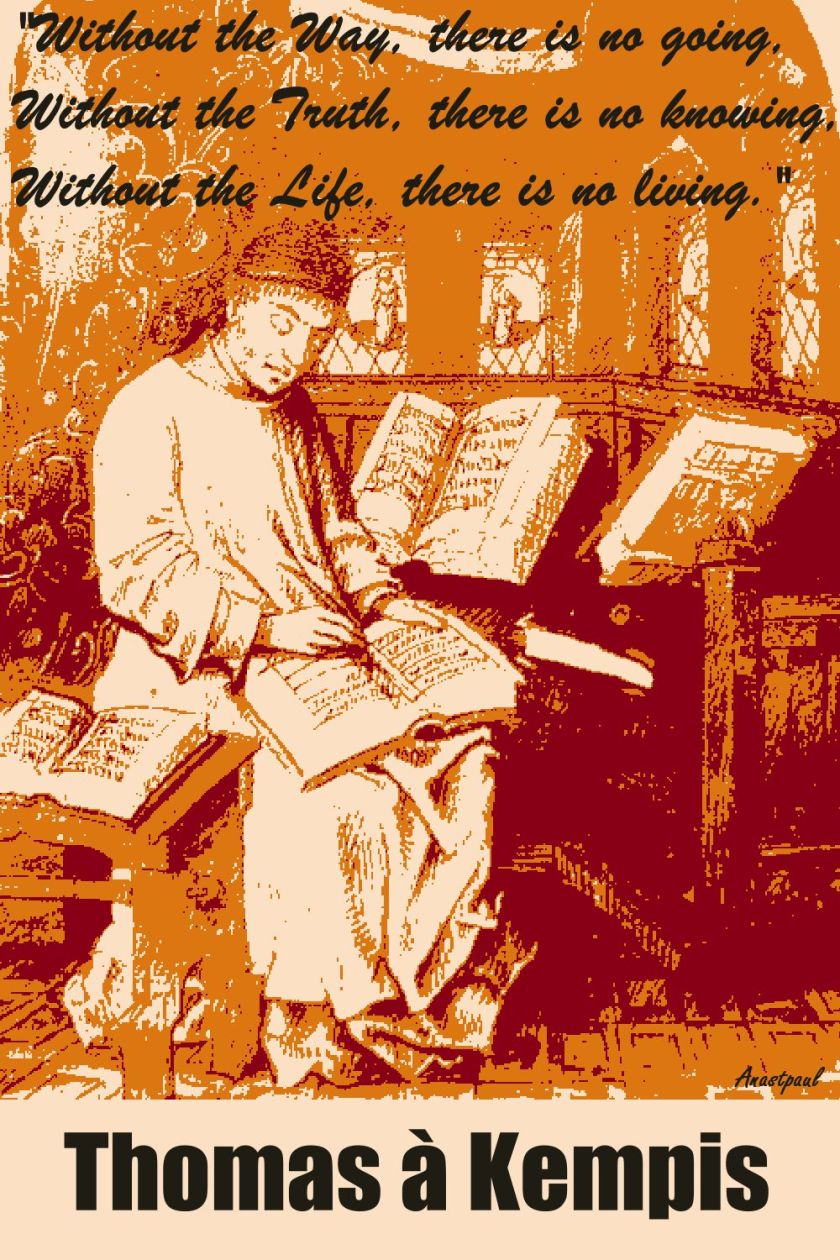
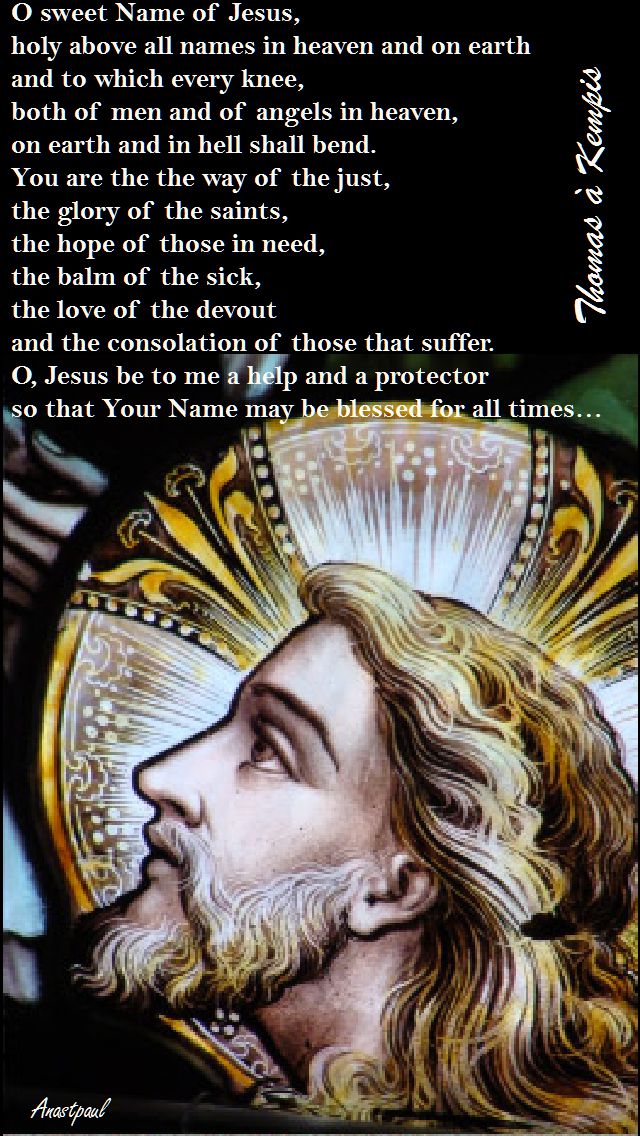
O sweet Name of Jesus,
holy above all names in heaven and on earth
and to which every knee,
both of men and of angels in heaven,
on earth and in hell shall bend.
You are the the way of the just,
the glory of the saints,
the hope of those in need,
the balm of the sick,
the love of the devout
and the consolation of those that suffer.
O, Jesus be to me a help and a protector
so that Your Name may be blessed for all times…
Thomas A Kempis – (Manualis Parvulorum XIII)
Saint of the Day – 12 January – St Marguerite Bourgeoys C.N.D.- 1620-1700 (aged 79) – Founder of the Congregation of Notre Dame/Teacher/Missionary/Apostle of Charity – Patron against poverty; loss of parents; people rejected by religious orders (Video – Apostleship of Prayer – https://www.youtube.com/watch?v=-QJesJSHibw)
Born the sixth of 12 children in Troyes, France, Marguerite at the age of 20 believed that she was called to religious life. Her applications to the Carmelites and Poor Clares were unsuccessful. A priest friend suggested that perhaps God had other plans for her.
In 1654, the governor of the French settlement in Canada visited his sister, an Augustinian canoness in Troyes. Marguerite belonged to a sodality connected to that convent. The governor invited her to come to Canada and start a school in Ville-Marie (eventually the city of Montreal). She sailed on June 20, 1653, and arrived in Canada in mid-November. When she arrived, the colony numbered 200 people with a hospital and a Jesuit mission chapel.
Marguerite began the construction of a chapel in 1657. It was to honour Our Lady of Good Help. In 1658, she opened her first school. Marguerite realized the need to recruit more teachers. She returned to France in 1659 and returned with four companions. In 1670, she went to France again and brought back six companions. These brave women became the first sisters of the Congregation of Notre Dame.
St. Marguerite and her sisters helped people in the colony survive when food was scarce. They opened a vocational school and taught young people how to run a home and farm. St. Marguerite’s congregation was growing. By 1681 there were eighteen sisters. Seven were Canadian. They opened more missions and two sisters taught at the Indian mission. St. Marguerite herself received the first two Indian women into the congregation.In 1693, Mother Marguerite handed over her congregation to her successor. The new superior was Marie Barbier, the first Canadian to join the order. St. Marguerite’s religious rule was approved by the Church in 1698. Marguerite spent her last few years praying and writing an autobiography. On the last day of 1699, a young sister lay dying. Mother Marguerite asked the Lord to take her life in exchange. By the morning of January 1, 1700, the sister was completely well. Mother Marguerite had a raging fever. She suffered for twelve days and died on January 12, 1700. She was declared a saint by Pope John Paul II on April 2, 1982.
St Aelred of Rievaulx
Bl Antoine Fournier
St Antony Mary Pucci
St Arcadius of Mauretania
Bl Bartholomew Alvarez
Bl Bernardo de Plano
St Biccianus
St Benedict Biscop
St Bernard of Corleone
St Caesaria of Arles
St Caroticus
Bl Emmanuel d’Abreu
St Eutropius
St Ferreolus of Grenoble
Bl John Gaspard Cratz
St John of Ravenna
Bl Lucia of Valcaldara
St Marguerite Bourgeous
St Martinian of Belozersk
St Martin of León
Bl Nicholas Bunkerd Kitbamrung
St Peter of Abessala
Bl Pierre-François Jamet
St Probus of Verona
St Quinctus the Soldier
St Satyrus
St Tatiana of Rome
St Tigrius
St Victorian of Asana
Bl Vincent da Cunha
—
Martyrs of Africa – 44 saints
Martyrs of Ephesus – 42 saints
Martyrs of Iona – 38 saints
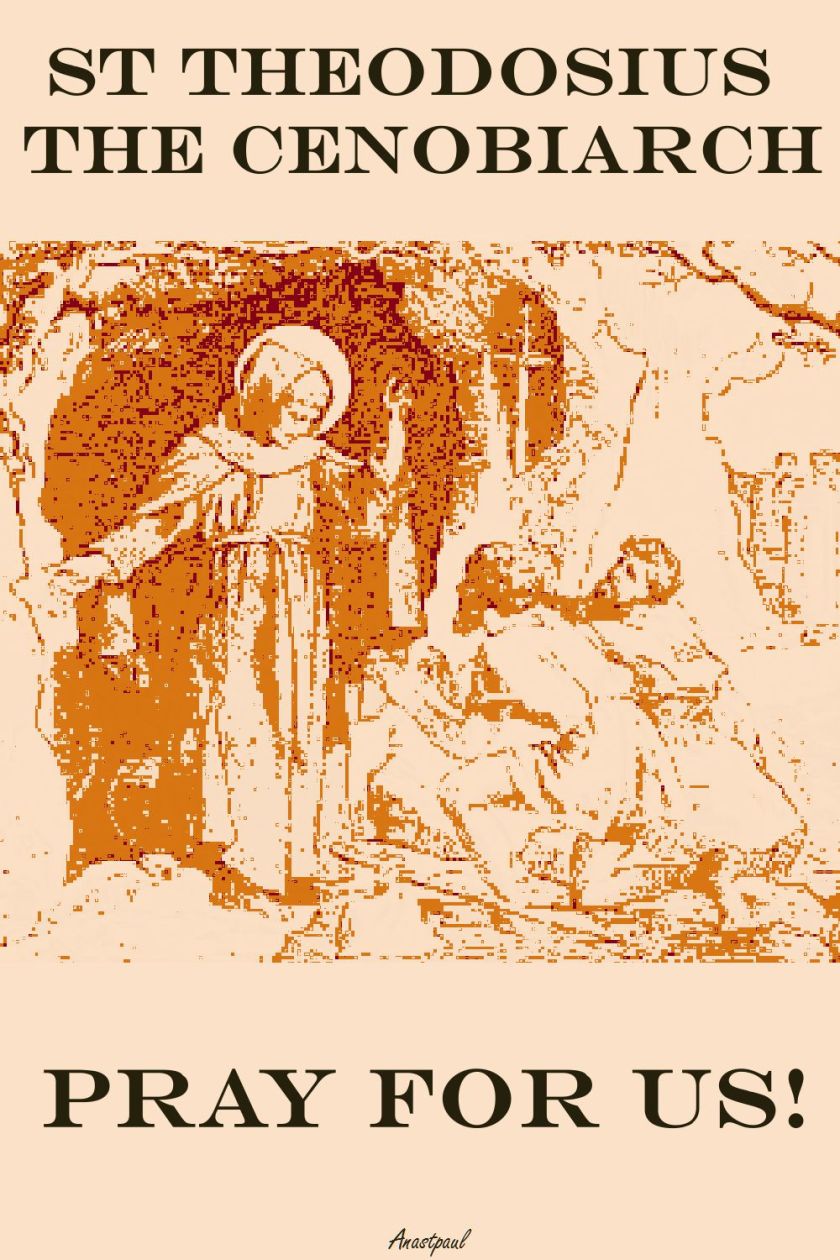
It has always been recognised that love of neighbour is part of the love of God and the great saints have lived this, helping the sick, the poor and the needy without expecting any return. Monasteries were the first hospitals where the sick were cared for, free of charge and where the goodness of God was shown in countless ways. St Theodosius the Cenobiarch was a leader in his time and in ours – we can do no less than he did!

















 AnaStpaul
You must be logged in to post a comment.